

HNA Irish Nominee Ltd v Kinghorn (No 2) [2012] FCA 228
| IN THE FEDERAL COURT OF AUSTRALIA | |
| First Plaintiff HNA GROUP (HONG KONG) CO LIMITED Second Plaintiff | |
| AND: | First Defendant DAVID LLOYD VEAL Second Defendant KV AVIATION HOLDINGS PTY LIMITED (ACN 054 680 376) (FORMERLY CALLED AAHL PTY LIMITED) Third Defendant RIL AVIATION VQZ PTY LIMITED (ACN 110 563 007) AND OTHERS Fourth to Forty-First Defendants (as set out in the attached schedule) |
| DATE OF ORDER: | 15 March 2012 |
| WHERE MADE: |
1. Within 14 days, the plaintiffs file and serve proposed short minutes of orders reflecting these reasons.
2. Within 28 days, the defendants notify the plaintiffs and the Court whether they accept that the plaintiffs’ proposed short minutes reflect these reasons, and, if they do not, what amendments they propose to the plaintiffs’ proposed short minutes.
3. The proceeding be listed for further directions at 9.30am on Friday, 20 April 2012.
Note: Entry of orders is dealt with in Rule 39.32 of the Federal Court Rules 2011. The text of entered orders can be located using Federal Law Search on the Court’s website.
| NEW SOUTH WALES DISTRICT REGISTRY | |
| GENERAL DIVISION | NSD 94 of 2010 |
| BETWEEN: | HNA IRISH NOMINEE LIMITED First Plaintiff HNA GROUP (HONG KONG) CO LIMITED Second Plaintiff |
| AND: | GEOFFREY ANDREW KINGHORN First Defendant DAVID LLOYD VEAL Second Defendant KV AVIATION HOLDINGS PTY LIMITED (ACN 054 680 376) (FORMERLY CALLED AAHL PTY LIMITED) Third Defendant RIL AVIATION VQZ PTY LIMITED (ACN 110 563 007) AND OTHERS Fourth to Forty-First Defendants (as set out in the attached schedule) |
| JUDGE: | EMMETT J |
| DATE: | 15 March 2012 |
| PLACE: | SYDNEY |
REASONS FOR JUDGMENT
1 This proceeding is concerned with the internal management of some 38 companies (the defendant RILAs), each of which is the owner of an aircraft. Each of the defendant RILAs is part of a somewhat complex aircraft financing arrangement (together the Aviation Transactions). Each Aviation Transaction involves, amongst other things, the defendant RILA leasing to an airline the aircraft owned by that defendant RILA. At the end of the lease, the aircraft might be sold, or, following a refinancing, it might be re-leased. Each Aviation Transaction also involves the allotment of preference shares in the relevant defendant RILA to investors who lend money as part of the overall arrangements.
2 As I shall explain further below, each Aviation Transaction involves two companies especially formed for that specific Aviation Transaction. One (the RILA) is the owner of the relevant aircraft. The other (the Financing SPC) is a financing vehicle. The full name of each RILA is RIL Aviation [XXX] Pty Limited. RIL is an acronym, and stands for Record Investments Limited. I shall refer to the company Record Investments Limited (Record) below. The full name of each Financing SPC is Allco [XXX] Financing Pty Limited. For both the RILAs and the Financing SPCs, the registration details of the relevant aircraft appear in place of [XXX]. For example, RIL Aviation VQZ Pty Limited (RILA VQZ), one of the defendant RILAs, is the owner of aircraft VH-VQZ, and the Financing SPC associated with RIL Aviation VQZ Pty Limited is Allco VQZ Financing Pty Limited (VQZ Financing SPC).
3 The defendant RILAs are the fourth to forty-first defendants in the proceeding. The first plaintiff, HNA Irish Nominee Limited (HNA Irish), is the holder of preference shares in each of the defendant RILAs. HNA Irish is a wholly owned subsidiary of the second plaintiff, HNA Group (Hong Kong) Co Limited (HNA Group).
4 The first and second defendants, Messrs Geoffrey Kinghorn and David Veal, are the only directors of each of the defendant RILAs. They are also the only directors of the third defendant, KV Aviation Holdings Pty Limited (KV Aviation). KV Aviation holds all of the ordinary shares in the capital of each of the defendant RILAs. The present shareholders of KV Aviation are Mr Veal, Mr Kinghorn and Niab Capital Markets Pty Limited (Niab). Messrs Veal and Kinghorn together hold the majority of the shares in KV Aviation.
5 In these reasons, references to submissions or contentions advanced on behalf of HNA Irish may be taken to be references to submissions or contentions advanced on behalf of both plaintiffs. Similarly, references to submissions or contentions advanced on behalf of KV Aviation may generally be taken to be references to submissions or contentions advanced on behalf of KV Aviation, Messrs Veal and Kinghorn, and the defendant RILAs. Occasionally, however, it will be appropriate to associate particular defendants more specifically with particular submissions or contentions.
6 The first broad issue raised in the proceeding (the Redemption Issue) is whether the preference shares held by HNA Irish in the defendant RILAs are redeemable, and, if so, in what circumstances they are redeemable and upon what terms they may be redeemed. The constitutions of the defendant RILAs are generally in similar terms, but are not identical. The constitutions of the RILAs generally provide that the preference shares may ony be redeemed out of Aircraft Profits, as that term is defined in the constitutions (see paragraph [56] below), and that the preference shares are entitled to a preferred dividend payable in cash out of Aircraft Profits. KV Aviation contends that the preferred dividend may be paid, and the preference shares redeemed, at any time, upon the amount of the preferred dividend being determined by the defendant RILA, by the assessment of Aircraft Profits according to proper accounting principles based on a revaluation of the aircraft at that time. HNA Irish, on the other hand, says that Aircraft Profits cannot be determined until the aircraft is sold or otherwise realised by the defendant RILA, and, accordingly, that the preference shares, if they can be redeemed at all, cannot be redeemed without the consent of the holder, until the aircraft is sold or realised.
7 If the questions as to redemption are decided unfavourably to HNA Irish and HNA Group, further questions arise (the Misrepresentation Issues) as to the availability of estoppels against asserting any rights of redemption and as to the availability of relief, under the Corporations Act 2001 (Cth) (the Corporations Act) and the Australian Securities and Investments Commission Act 2001 (Cth) (the ASIC Act), in respect of alleged misleading and deceptive conduct concerning the rights attached to preference shares. HNA Irish asserts that representations were made that are inconsistent with the construction of the constitutions of the defendant RILAs now contended for by KV Aviation.
8 The third broad issue raised in the proceeding (the Oppression Issue) is whether the affairs of the defendant RILAs have been conducted, and are likely to be conducted, contrary to the interests of the members of the defendant RILAs as a whole, and in a manner that is oppressive to, unfairly prejudicial to, or unfairly discriminatory against HNA Irish, as the holder of preference shares, within the meaning of s 232 of the Corporations Act, so as to justify the making of orders under s 233 of the Corporations Act. HNA Irish and HNA Group seek orders under s 233 divesting KV Aviation of its ordinary shares in the defendant RILAs, and orders for the appointment of persons nominated by HNA Irish to the board of directors of each defendant RILA. Such orders would effectively deprive Messrs Veal and Kinghorn of any say in the affairs of the defendant RILAs.
9 Before dealing with the issues I have just described, it is necessary to say something about the background and formation of the defendant RILAs. That will require an examination of the history of the business known as Allco Finance Group, whose Aviation Division Mr Veal headed from late 2002 onwards, as well as the history of KV Aviation and its connection with Allco Finance Group. It will also require an examination of the workings of the Aviation Transactions, which were effected by a series of complex instruments collectively referred to as Transaction Documents.
10 After saying something about those matters, I shall deal with the Redemption Issue, which will involve a detailed examination of the constitution of one of the defendant RILAs, in the light of the part that the RILA plays in the relevant Aviation Transaction. After that, I shall deal with the Misrepresentation Issues, which will require an examination of the circumstances in which preference shares were issued by the defendant RILAs to various investors, and the circumstances that led to the acquisition of preference shares by HNA Irish. Finally, I shall deal with the Oppression Issue, which will require an examination of events that followed the appointment of receivers to certain companies in Allco Finance Group.
11 The business known as Allco Finance Group was founded in 1979. Allco is an acronym, and stands for Australian Leveraged Leasing Company. Allco Finance Group specialised in large equity and leveraged leasing of plant and equipment, principally in the government sector. Subsequently, Allco Finance Group diversified its activities and expanded into structured property finance, cross-border finance and specialised vendor finance facilities, including financing within the aviation industry.
12 The Allco Finance Group business was initially conducted through a series of joint ventures. However, in June 1987, Allco Finance Group Limited (Old AFGL) was incorporated. The relationship between the joint ventures of Allco Finance Group and the members of Old AFGL is not entirely clear. However, I do not understand anything to turn on that. References are frequently made to Allco Finance Group as describing the overall group of entities, without identifying a specific entity such as Old AFGL. References in these reasons to Allco Finance Group are intended to refer to the overall business structure rather than to a specific entity.
13 Mr Veal joined Allco Finance Group in 1987 and became a senior partner in 1998. The other senior partners at that time included Mr John Kinghorn (Mr Geoffrey Kinghorn’s father), as well as Messrs John Bennett, David Coe and Brian Holmes. Prior to his appointment as a senior partner, Mr Veal reported to Mr John Kinghorn.
14 In 2001, Record was established to provide a source of equity funding for transactions undertaken by Old AFGL. Record was listed on the Australian Securities Exchange (ASX) and Old AFGL was a major shareholder of Record. In 2006, there was a merger of Old AFGL and Record (the Record Merger), under which Record acquired all the issued shares in Old AFGL. Record then changed its name to Allco Finance Group Limited (Public AFGL), and Old AFGL changed its name to Allco Finance (Australia) Limited. Public AFGL continued to be listed on the ASX. The partners of Allco Finance Group were not directors of Public AFGL.
15 KV Aviation was incorporated in 1991. It was originally called Allco Australian Holdings Limited, and, subsequently, its name was changed to AAHL Limited. Its present name was adopted in January 2010. A document that purports to tabulate the historical directorship of and shareholding in KV Aviation appears as Appendix 1 to these reasons.
16 Historically, the respective directorships of KV Aviation and Old AFGL have been closely aligned. When KV Aviation was incorporated in 1991, its directors were Messrs John Kinghorn, Coe, Bennett and Holmes. The directors of Old AFGL at that time were also Messrs John Kinghorn, Coe, Bennett and Holmes. The shareholders of KV Aviation and Old AFGL were at that time the same, being Mr John Kinghorn (as to 57.07 per cent), Mr Coe (as to 18.85 per cent), Mr Bennett (as to 20.94 per cent) and Mr Holmes (as to 3.14 per cent).
17 That shareholding, as at 1991, reflected the shareholders’ respective interests in the senior joint venture partner in the operating joint ventures of Allco Finance Group. Messrs John Kinghorn, Coe, Bennett and Holmes were the senior partners of Allco Finance Group at that time. Thus, the initial directors and shareholders of KV Aviation and the directors of and shareholders in Old AFGL matched the participation, through joint ventures, of the senior partners of Allco Finance Group.
18 In 1998, new joint venture arrangements were entered into, as a consequence of which the senior partners of Allco Finance Group were Messrs Coe, Veal and Holmes, along with Messrs Nicholas Bain and Gary Cohen. The position within KV Aviation continued to reflect the position that had existed within Old AFGL prior to the new arrangements. That is to say, the shareholders of KV Aviation consisted of interests associated with Messrs Coe (as to 48 per cent), Bain (as to 12 per cent), Tom Malone (as to 36 per cent) and Holmes (as to 4 per cent).
19 On 14 January 2002, Mr Veal was appointed as a director of KV Aviation. The directors of KV Aviation were then Messrs Coe, Bain and Veal, the same as Old AFGL. As at 31 January 2004, the shareholders of KV Aviation were companies associated with Messrs Coe (as to 48 per cent), Bain (as to 16 per cent), Veal (as to 16 per cent), Christopher West (as to 16 per cent) and Holmes (4 per cent). At that time, the shareholding in KV Aviation reflected the shareholding in Old AFGL, involving Messrs Coe, Bain, Veal and West, with Mr Holmes also holding 4 per cent of the shares in KV Aviation. The shareholding in KV Aviation then remained unchanged until November 2008.
20 Following the Record Merger in 2006, 47.8 per cent of the shareholding in Public AFGL was controlled by ten senior executives of Old AFGL, including Messrs Coe, Bain, Veal and West. Mr Veal received 9,602,907 shares, representing approximately 3.3 per cent of Public AFGL.
21 On 4 November 2008, voluntary administrators were appointed to Public AFGL and certain of its subsidiaries. Later on the same day, Messrs Peter Gothard and Steven Sherman (the Receivers) were appointed as receivers and managers of Public AFGL and certain of its subsidiaries, including Allco Management Limited (Allco Management) and Allco Asset Finance Limited (Allco Asset Finance), which had been appointed as managers of the RILAs under the Transaction Documents (together the Managers). The Receivers were also appointed to Allco Managed Investments Limited (Allco Managed Investments), the trustee of unit trusts established by Allco Finance Group known as the Aircraft Holdings Trust and the Allco Aviation Fund. The investments made by those unit trusts include investments in preference shares in defendant RILAs. More will be said about those entities below. No administrators, and no receivers or managers, were appointed to KV Aviation or to any of the RILAs or the Financing SPCs.
22 Shortly after the appointment of the Receivers, Mr Veal decided to attempt to acquire the ordinary shares in KV Aviation that he, or a company controlled by him, did not already own. Mr Veal approached Messrs West, Holmes and Coe with a view to acquiring from them, or from companies associated with them, the shares in KV Aviation that they held. By the last week of November 2008, he had obtained executed share transfers from Mr West and Mr Holmes and had made an oral arrangement with Mr Coe for the transfer of the shares controlled by him. Mr Veal and Mr Geoffrey Kinghorn then entered into a series of transactions in relation to KV Aviation shares. Their acquisition of shares in KV Aviation for a price of $1 per share, or very close to $1 per share, took place as follows:
21 November 2008: Mr Veal acquired one share from Mr Holmes;
21 November 2008: Mr Veal acquired 399 shares from Mr Holmes’ company;
21 November 2008: Mr Veal acquired 1,600 shares from Mr West’s company;
18 March 2009: Mr Kinghorn acquired 1,600 shares from Mr Veal’s company;
18 March 2009: Mr Kinghorn acquired 2,000 shares from Mr Veal;
23 March 2009: Mr Veal acquired 4,800 shares from Mr Coe’s company.
23 Those transfers were approved at meetings of KV Aviation held on 20 March 2009 and 23 March 2009. The total issued share capital at all times was 10,000 shares. After 23 March 2009 the shareholding in KV Aviation was as follows:
4,800 shares controlled by Mr Veal;
3,600 shares controlled by Mr Geoffrey Kinghorn;
1,600 shares controlled by Mr Bain’s company, Niab (see paragraph [4] above).
SALE OF ASSETS OF THE AVIATION DIVISION
24 During November 2008, the Receivers commenced a sale process in respect of assets of the Aviation Division. Information was provided to prospective buyers in the form of various documents (the Sale Information Documents), which consisted of:
a document entitled “Allco Aviation Overview” (the Aviation Overview);
a document dated 19 December 2008 and entitled “Allco Aviation Information Memorandum” (the Sale Information Memorandum);
a written list of questions from bidders for the Aviation Division (the Q&A Document); and
a management presentation to shortlisted bidders dated January 2009 (the Management Presentation).
25 Bravia Capital Partners Inc (Bravia) is an adviser to, and co-investor with, HNA Group. Bravia received a copy of the Sale Information Memorandum and a copy of the Aviation Overview. On 23 January 2009, HNA Group submitted its first bid, and was included on the short list of bidders. It submitted two revised bids on 23 February 2009. One of the revised bids was subject to further due diligence and the other revised bid, a much lower one, was without due diligence. HNA Group submitted its final bid on 26 March 2009, in the sum of US $120 million.
26 Mr Veal resigned from the Aviation Division on 29 January 2009, with effect on the following day. He immediately held discussions with Mr John Kinghorn and Mr Geoffrey Kinghorn about a joint venture with them. Mr Veal said that discussions about participation in a joint venture with the Kinghorns first occurred in November 2008. The outline of a joint venture was substantially agreed between Mr Veal and the Kinghorns on or around 1 February 2009. As part of the arrangement, KV Aviation granted to Mr John Kinghorn a call option (the Call Option), executed on 23 February 2009, in respect of its ordinary shares in the RILAs. Also on 23 February 2009, the Kinghorns made an offer to the Receivers for assets of the Aviation Division. Although their offer was subsequently increased, the Kinghorns were notified that the Receivers did not wish to proceed with their bid.
27 During March 2009, Mr Veal and the Kinghorns gave their proposed new aircraft leasing joint venture the working name “KV Aviation”. On 27 May 2009, they arranged for KV Management Pty Limited (KV Management) to be incorporated as an aircraft lease management company.
28 On 5 May 2009, HNA Group entered into an agreement to acquire certain assets of the Aviation Division for a purchase price of approximately US $116.3 million (the May Sale Agreement). HNA Group had proposed that a component of the purchase price be structured as a control payment, payable in the event that the Receivers could deliver full control over the assets being sold. HNA Group regarded the control payment as an incentive for the Receivers to deal with any potential controversy as to the rights attached to the ordinary shares in the RILAs and the Financing SPCs. That controversy was generally referred to as the David Veal issue. Accordingly, in conjunction with the May Sale Agreement, a further instrument (the Control Payment Deed) was executed, which provided for a control payment of approximately US $24.3 million.
29 Because of changes in the structure of the proposed transaction and the expiration of the May Sale Agreement, HNA Group renegotiated the purchase with the Receivers in October and November 2009. The negotiations began with a purchase price of US $116.3 million, and involved bargaining over discounts from that figure to take account of a reduction in management fees by reason of the passing of time, an allowance for the costs and risks involved in the new structure, the fact that some assets were not going to be acquired, and an allowance to deal with the David Veal issue. The control payment was dropped in the course of those negotiations, such that HNA Group was to take responsibility for solving and funding the David Veal issue. The purchase price finally agreed was US $85.8 million, subject to adjustment. A final sale and purchase agreement (the Final Sale Agreement) was executed and completed on 6 January 2010.
30 The Control Payment Deed was terminated as part of the Final Sale Agreement. Instead, HNA Group received an assurance from 24 of the 28 investors involved in Aviation Transactions that they would not take any action to remove or replace the Managers if the relevant RILA sought to exercise a right of removal. On the basis of that assurance, HNA Group and HNA Irish completed the Final Sale Agreement in relation to 64 of the 68 Aviation Transactions that were in the portfolio of the Aviation Division. HNA Group and the investors also agreed to work together to effect a transfer of the ultimate ownership of the RILAs and the Financing SPCs “to independent trustees on behalf of an orphan trust”.
31 On 6 January 2010, upon completion of the Final Sale Agreement, HNA Irish became the owner of preference shares in the defendant RILAs, and HNA Group became the parent company of the Managers, Allco Management and Allco Asset Finance. The holder of the preference shares immediately prior to the acquisition by HNA Irish was, in most cases, either Allco Managed Investments or Allco Asset Finance. Allco Asset Finance also held units in the Allco Aviation Fund. Those units were transferred to HNA Irish under the Final Sale Agreement.
32 In 2002, following the events of 11 September 2001 in the United States, the aviation market and aircraft values were depressed. At the same time, financing markets were available for strong airline credit transactions. Mr Veal considered, at that time, that both debt finance and equity finance were available on terms that would allow the generation of significant income by structuring new financing transactions for aircraft. He concluded that it was an ideal time to engage in aircraft leasing transactions, so as to take advantage of the business opportunities that he considered were available.
33 Mr Veal therefore instigated a transaction analysis process, which included the commissioning of industry experts to assist in his evaluation of the current and future market value of aircraft, the opportunities available for an aircraft at the end of the term of a proposed lease, and the acceptable terms required to govern the ongoing maintenance and return conditions of the aircraft. He worked with solicitors and tax advisors in developing a financial structure for such transactions. That included the creation and development of appropriate tax and accounting structures, obtaining necessary tax and legal advice in relation to the relevant structures, and achieving bankruptcy remoteness for individual transactions.
34 The first Aviation Transaction was completed in December 2002, and involved Qantas Airways Limited (Qantas). Another Aviation Transaction involving Qantas was completed in February 2003. Mr Veal concluded that, having regard to the state of the market, the availability of similar aircraft on leases that were about to terminate, and the availability of debt and equity finance on acceptable terms, such transactions could be replicated. As a consequence, at about the end of 2002, the Aviation Division of Allco Finance Group was established, with Mr Veal at its head. The Aviation Transactions subsequently effected by the Aviation Division followed similar patterns to the two involving Qantas that I have just mentioned. Mr Veal remained as head of the Aviation Division until he resigned on 29 January 2009.
35 Allco Management and Allco Asset Finance, two companies to which I have referred above, were generally appointed under the Transaction Documents as Managers of Aviation Transactions. Mr Veal intended that the structures used in the Aviation Transactions would result in bankruptcy remoteness from the Managers, thus ensuring that failure of the Managers would not result in a failure of the security of an investor or financier involved in an Aviation Transaction, and thus of the ability of that investor or financier to continue to receive rental proceeds and full repayment of debt at the conclusion of the relevant aircraft lease. He intended that the separation of each Aviation Transaction from every other Aviation Transaction would ensure that the failure of one would not impact on any other, since there were invariably different investors and financiers involved. Mr Veal also intended, through the Aviation Transaction structures, to achieve a known tax treatment that would deal with payments of rental, principal and interest across the multiple tax jurisdictions of the airlines and other entities involved.
Structure of Aviation Transactions
36 An important characteristic of the Aviation Transactions is that they involved several layers of financing, each with a different level of risk. The most secure investors were the Senior Financiers. The next most secure were the Mezzanine Financiers. The Junior Financiers were the least secure. However, the Junior Financiers were compensated by an equity interest, which underlies the present dispute, and about which I shall say more shortly. In addition to the distinction between Senior Financiers, Mezzanine Financiers and Junior Financiers, there was also a distinction, within each of the categories of financier, between Asset Financiers and Receivables Financiers. The distinction will be explained below.
37 While there were some differences between the various Aviation Transactions, the structure that was adopted was generally the same. The features of that common structure, may be summarised as follows:
On a specified date, usually known as the Delivery Date, Allco Rentals Pty Limited (Allco Rentals), a subsidiary of KV Aviation, acquired legal ownership of the relevant aircraft from the manufacturer or from an airline, under a Master Aircraft Purchase Agreement and a Bill of Sale.
On the Delivery Date, Allco Rentals entered into an Operating Lease with the airline that was to use the aircraft, usually for a term of between seven and twelve years, under a Master Operating Lease Deed.
On the Delivery Date, Allco Rentals, under a Residuary Interest Sale Deed and a Bill of Sale, sold the aircraft to the relevant RILA, subject to the Operating Lease. The consideration that the RILA agreed to pay to Allco Rentals was the Residual Purchase Price, which was payable in three instalments. The first instalment was payable on the Delivery Date, the second instalment was payable from the proceeds of the loan by the Junior Financier, and the third instalment was payable from the proceeds of the sale or re-lease of the aircraft at the end of the term of the Operating Lease, or from casualty proceeds.
On the Delivery Date, under a Terms of Sale Receivables Deed, Allco Rentals sold to the related Financing SPC the right to payments of rental under the Operating Lease, and the right to receive from the RILA the third instalment of the Residual Purchase Price (the Terms of Sale Payment Rights).
Allco Management or Allco Asset Finance was appointed Manager under a document known as the Financing Deed.
Preference shares in the RILA were issued to the Junior Asset Financier.
Under the senior loan agreement, the Senior Receivables Financier agreed to provide the senior receivables facility and the Senior Asset Financier agreed to provide the senior asset facility.
Under the mezzanine loan agreement, the Mezzanine Receivables Financier agreed to provide the mezzanine receivables facility and the Mezzanine Asset Financier agreed to provide the mezzanine asset facility.
Under the junior loan agreement, the Junior Receivables Financier agreed to provide the junior receivables facility and the Junior Asset Financier agreed to provide the junior asset facility.
Each of the instruments described above is one of the Transaction Documents in relation to the particular Aviation Transaction.
38 As I have said, the third instalment of the Residual Purchase Price was payable from the proceeds of the sale or re-lease of the aircraft at the end of the term of the Operating Lease, or from casualty proceeds. The third instalment represented the amount required to repay the Senior Asset Financier and the Mezzanine Asset Financier. The effect of the structure was that the Junior Financiers held the riskiest or lowest-ranking investments in the Aviation Transactions, in the form of the junior loans and the preference shares in the RILA.
39 Each Aviation Transaction entered into along those lines resulted in a profit for Allco Rentals equal to:
the proceeds received from the first instalment of the Residual Purchase Price;
plus the proceeds received from the sale of the right to receive rental payments under the Operating Lease and the right to receive the third instalment of the Residual Purchase Price;
less the price paid for the acquisition of the aircraft.
From that profit, Allco Rentals paid an arrangement fee to a subsidiary of Old AFGL or Public AFGL, as relevant. The fee was typically an amount equal to the profit, less $10,000. Thus, Allco Rentals derived a fee of $10,000 from each Aviation Transaction.
40 Aviation Transactions were structured so that term of the loans under the receivables facilities matched the term of the Operating Lease. The Receivables Financiers received monthly or quarterly payments of principal and interest sourced from the rental payments under the Operating Lease. The terms of the loans under the asset facilities also matched the term of the Operating Lease. However, the Asset Financiers typically received no payments of principal or interest until the final maturity date. Thus, the asset loans were future value or zero coupon loans. A future value loan or zero coupon loan is one under which no interest payments are made during the term of the loan. Rather, interest accrues and capitalises during the term of the loan, and is payable at the end of the term from (in the case of an Aviation Transaction) the proceeds of realisation of the relevant aircraft.
41 The source of funds for repayment of the asset loans was intended to be the proceeds from the sale or re-lease of the aircraft, or casualty proceeds. That is to say, the Asset Financiers typically lent to the relevant RILAs and were repaid from the realisation or refinancing of the relevant aircraft, while the Receivables Financiers typically lent to the Financing SPCs and were repaid from rental payments under the Operating Lease. The term of the loans under the asset facilities could be extended at the option of the preference shareholders, in certain circumstances.
42 The Junior Receivables Financier and the Junior Asset Financier were typically Allco Finance Group entities, most commonly Allco Managed Investments, as trustee of the Aircraft Holdings Trust. Allco Managed Investments was also usually the initial holder of some or all of the preference shares in the RILA. The surplus, if any, that remained from the proceeds of sale or re-lease of the aircraft, after payment of the loans under the receivables facilities and the loans under the asset facilities, was paid to the preference shareholders of the RILA. That surplus is generally referred to as the Upside. Thus, Old AFGL or Public AFGL, as relevant, as the holder of interests in the Aviation Holdings Trust, had an incentive to ensure that all loans were repaid in full and to maximise the proceeds from the sale or re-lease of the aircraft at the end of the term of the Operating Lease.
43 Allco Management or Allco Asset Finance, as the Managers, were paid a monthly or quarterly fee. That fee was also sourced from the rental payments under the relevant Operating Leases.
44 Thus, the Aviation Division had three sources of revenue from a given Aviation Transaction, as follows:
the arrangement fee earned when the Aviation Transaction was entered into, funded from the debt raised to finance the purchase of the aircraft;
management fees paid to the Managers, funded from the rental payments under the Operating Lease; and
the Upside, if any, at the end of the Operating Lease, which was payable to the preference shareholders of the RILA.
45 Except in two Aviation Transactions, where there was no junior loan, the borrower of the junior loans was the RILA. The borrower of the senior loans and the mezzanine loans was the Financing SPC. In all cases, the RILA and the Financing SPC each guaranteed the liabilities of the other and provided indemnities in respect of the obligations of the other. All relevant assets, including everything owned by the RILA and everything owned by the Financing SPC, were charged as security for the performance of the obligations arising under the various guarantees and indemnities. The assets included the aircraft and the rental payable under the Operating Lease. The charges were given to the Security Trustee. The role of the Security Trustee in the transactions is largely set out in cl 3 of a document known as the Master Financing Deed. In the case of RILA VQZ, JP Morgan Institutional Services Australia Limited was the Security Trustee.
46 In the course of negotiations with an airline or a bank in relation to an Aviation Transaction, the airline or the bank would usually be provided by Allco Finance Group with a written assurance (Comfort Letter). The Comfort Letters confirmed that KV Aviation (in its earlier guise as Allco Australian Holdings Limited) was the owner of the ordinary shares in the relevant RILA and Financing SPC. The Comfort Letters typically also contained an undertaking, from Old AFGL or Public AFGL, as relevant, to procure that either it or KV Aviation would continue to be the owner of those ordinary shares throughout the term of the Operating Lease. The assurances given in the Comfort Letters may have some significance, as will appear below.
47 Mr Benjamin Wilson, who was “Director – Aviation” with Public AFGL, was told by Mr Veal how to respond when asked by banks and airlines about the shareholding of KV Aviation in the RILAs. Mr Veal told Mr Wilson to tell those enquirers that KV Aviation was owned by the family trusts of executives of Old AFGL or Public AFGL, as relevant, which could always get the consent of KV Aviation and could procure any consents needed at the level of the RILAs and the Finance SPCs, because KV Aviation was controlled by Mr Coe and two other senior executives.
48 The constitutions of the RILAs, together with two of the Transaction Documents, the Remarketing Agreement and the Financing Deed, are of particular significance to the issues raised in this proceeding. The Remarketing Agreement provides for the realisation and application of proceeds from the sale or re-lease of the aircraft. The Managers are appointed under the Financing Deed. I shall describe the constitutions of the RILAs, the Financing Deed and the Remarketing Agreement in more detail.
The Constitutions of the RILAs
49 The constitutions of many of the defendant RILAs are in terms that are the same in relevant respects. Accordingly, the argument has, with a limited number of exceptions, been conducted on the basis that the constitutions of certain defendant RILAs exemplify others in the same form. The example that has been taken to represent the standard structure that applied in relation to the Aviation Transactions is the constitution of RILA VQZ. The Financing SPC associated with RILA VQZ was VQZ Financing SPC (see paragraph [2] above).
50 RILA VQZ was incorporated on 18 August 2004. Its constitution consisted of 66 clauses and 16 schedules. On 3 November 2004, the constitution of RILA VQZ was amended in a number of respects by a resolution passed in accordance with s 249B(1) of the Corporations Act by KV Aviation, which at that time was the only member of RILA VQZ. The original constitution and the resolution are set out in Appendix 2 to these reasons.
51 Clauses 60 to 66 of the constitution of RILA VQZ deal with capital, and Schedules 14 to 16 deal with share classes. Clause 60.1 provides that shares in RILA VQZ may be issued by the directors, and may be issued with such preferred, deferred, or other special rights, or with such restrictions, as the directors by resolution determine. Clause 64.1 provides that the directors may issue shares in the capital of RILA VQZ from the classes set out in Part A of Schedule 14. Clause 65.1, as amended, provides that the rights and conditions of the shares and the classes set out in Part A of Schedule 14 are summarised in Parts B and C of Schedule 14. Part C of Schedule 14 was added to the constitution of RILA VQZ by the resolution of 3 November 2004.
52 Part B of Schedule 14, as amended, consists of a table with eight columns. The headings of the eight columns may be seen in Appendix 2. The first column consists of abbreviated references to each class of share. A note to cl 65.1 states that the rights and conditions attached to a class of share in the table are to be determined by reading the row for each class horizontally, and reading the headings of the remaining vertical columns in accordance with the definitions supplied in cl 65.2. The effect is that Schedule 14 specifies, in relation to each class of share:
whether there is an entitlement to share in surplus assets on a winding up;
the number of votes per share;
whether there is a right to share equally with other holders of shares in the class in dividends;
whether there is a right to share in dividends;
whether the shares in the class are redeemable, in accordance with the general rights specified in cl 65.2(e);
the priority and ranking of the class, on a winding up, in respect of repayment of capital and the distribution of surplus assets and profits; and
whether other rights, referred to in Schedule 15, are attached to the class.
53 The general rights of redeemable preference shares set out in cl 65.2(e) are as follows:
(i) they are issued on the terms that they are liable to be redeemed;
(ii) the directors in their absolute discretion may redeem any one or more redeemable preference shares of this class to the exclusion of other shares;
(iii) they may be redeemed without notice to the holders;
(iv) the directors may set any redemption price before issue, and, if none is set, the redemption price is to be the issue price, excluding any amounts due;
(v) an issue of shares made for the purpose of raising capital from which to redeem any redeemable preference share does not need to be first offered to the holders of the shares to be redeemed, except to the extent that they may hold shares other than the shares to be redeemed;
(vi) dividend rights, if any, are to be cumulative and non-preferential;
(vii) on a winding up of the company, all shares are entitled to a pro-rata repayment of capital contributed.
54 The amendment made to Part A of Schedule 14 by the resolution of 3 November 2004 inserted two additional classes of shares, being A class preference shares and B class preference shares. The amendment made by the resolution to Part B of Schedule 14 was to insert two additional rows, one for each of those two additional classes of shares. However, whereas the table in Part B contains an entry for each of the original eight classes under each of the other seven column headings, the material inserted under all seven column headings in the row for each of the A class preference shares and B class preference shares simply refers to Part C of Schedule 14. Part C of Schedule 14 is set out in Appendix 2.
55 The summary of rights in relation to preference shares set out in Part C of Schedule 14 deals with the rights under the following headings:
1. Issue price
2. Voting
3. Dividends and Redemption
(a) A Class Preference Shares
(b) B Class Preference Shares
4. Dividend lock-up
5. Variation of rights
6. Conversion
7. Ranking of Preference Shares
8. Transfer
9. Registration
10. Definitions
56 Where necessary, I shall refer to the precise language of the constitution of RILA VQZ in dealing with the contentions of the parties as to its proper construction. For present purposes, it will suffice to summarise the rights of the holders of preference shares, as follows:
The holder is not entitled to vote at any general meeting, except in relation to certain specified matters, which include a proposal affecting rights attached to either class of preference share.
The A class preference shares may only be redeemed out of Aircraft Profits in an amount equal to the subscription amount as at the date of redemption of the shares. The term Aircraft Profits is defined to mean all profit derived by RILA VQZ from:
(i) the sale or use of the aircraft;
(ii) any casualty or termination value, as defined in the relevant Operating Lease; and
(iii) any insurance proceeds received in relation to the aircraft.
The A class preference shares may only be redeemed simultaneously with the repayment of the Mezzanine Asset Facility, or upon a sale of the aircraft.
Each holder of A class preference shares is entitled to a preferred dividend, payable in cash out of Aircraft Profits, in an amount equal to the A Class Profit Share, as reduced by:
(i) the amount of any tax paid or payable by the RILA in respect of that portion of its profits; and
(ii) the amount paid or to be paid to the holders of A class preference shares in redemption of the A class preference shares.
The B class preference shares may only be redeemed out of Aircraft Profits in an amount equal to the subscription amount as at the date of redemption of the shares.
Each holder of B class preference shares is entitled to a preferred dividend, payable in cash out of Aircraft Profits, in an amount equal to the B Class Profit Share, as reduced by:
(i) the amount of any tax paid or payable by RILA VQZ in respect of that portion of its profits; and
(ii) the amount paid or to be paid to the holders of B class preference shares in redemption of the B class preference shares.
So long as there are unredeemed preference shares on issue, RILA VQZ may not declare or pay any dividend or make any distribution in respect of shares or any class of shares other than preference shares.
RILA VQZ must not vary any of the rights attached to the preference shares without the consent or sanction of the holders of the preference shares in accordance with the constitution. The issue of preference shares, or the conversion of existing shares into preference shares which rank pari passu or in priority to the preference shares, constitutes a variation of the rights of the preference shares.
The preference shares cannot be converted into ordinary shares.
The preference shares rank in priority to ordinary shares in all respects. If there is a return or distribution of capital, the holders of the preference shares will be entitled to receive, in respect of each preference share held, a sum equal to the aggregate of:
(i) the amount of any dividend, whether declared or not, that is due and payable on the preference shares up to but excluding the date of the winding up;
(ii) all arrears of dividends described in (i) above; and
(iii) all surplus assets and capital of RILA VQZ;
divided by the number of preference shares on issue. The holders of the ordinary shares will be entitled to receive, in respect of each ordinary share, the return of their initial contribution.
The preference shares are transferable at the holder’s option with the prior consent of RILA VQZ, which consent must not be unreasonably withheld, delayed or conditional.
57 Schedules 1 and 2 to Part C of Schedule 14 specify the method by which the A Class Profit Share and B Class Profit Share are to be calculated. Where the Lease Termination Date is on or before the Scheduled Termination Date, the A Class Profit Share is 35 per cent of Remaining Aircraft Profits, up to a fixed amount that varies according to the payment date from 5 November 2004 to 5 August 2015. The B Class Profit Share is the Remaining Aircraft Profits less the A Class Profit Share. The Lease Termination Date is the date on which the Operating Lease is terminated. The Scheduled Termination Date is the expiry date of the Operating Lease. The term Remaining Aircraft Profits is defined as the remainder of Aircraft Profits following satisfaction of the RILA’s obligations under the Transaction Documents. Thus, the amount of the preferred dividend is determined by reference to the amount of Aircraft Profits.
58 The Remarketing Agreement relating to aircraft VH-VQZ is dated 3 November 2004. It may be summarised as follows:
The parties to the Remarketing Agreement include the Senior, Mezzanine and Junior Financiers, the holders of A class preference shares and B class preference shares, Allco Management (which is described as the Remarketing Agent) and RILA VQZ.
By cl 1.1(a), RILA VQZ irrevocably appoints the Remarketing Agent to act as agent for RILA VQZ during the remarketing period, which, ordinarily, is the last 18 months of the term of the Operating Lease. The appointment under cl 1.1(a) does not define the extent of the authority given to the Remarketing Agent.
By cl 1.2(a), the Remarketing Agent must, in the exercise of all rights, powers and discretions on behalf of RILA VQZ under the Remarketing Agreement, act in accordance with any instructions from the Instructing Group. The rights, powers and discretions that may be exercised are not set out.
By the operation of cl 1.2(d), any action taken by the Remarketing Agent in accordance with the Remarketing Agreement binds RILA VQZ.
Assuming that there has been no default, the Instructing Group is the B class preference shareholder. However, where the Junior Financier will not be repaid in full, the A class preference shareholder is the Instructing Group.
Under cl 3.1, the Remarketing Agent must appoint an aircraft agent in relation to the remarketing of the aircraft, and, under cl 3.3, must instruct the aircraft agent to prepare a market value of the aircraft and a lease value of the aircraft. The market value is a prediction of the net proceeds from sale of the aircraft and is to reflect the likely price to be obtainable for the aircraft on a sale. The lease value is a prediction of the proceeds to be received from a lease of the aircraft and is to reflect the market rent or other amount payable for a lease of the aircraft.
Under cl 3.3(c)(i), upon receipt of the report on the market value and the lease value, the Remarketing Agent must instruct the aircraft agent to solicit offers from responsible parties for the purchase or lease of the aircraft. A responsible party is an offeror with sufficient financial resources to be in a position either to complete the purchase or lease transaction pursuant to the offer, or to arrange for all financing within the terms of the offer. Thus, it is the duty of the Remarketing Agent to solicit offers from parties that are in a position to provide the necessary financing associated with their offers.
Under cl 3.3(d), the Remarketing Agent must use all reasonable endeavours either to sell the aircraft for the highest possible price or to lease the aircraft for the highest rent or other amount payable. While that provision stipulates what the Remarketing Agent is required to do, it is arguable that it is not a grant of authority to sell or lease the aircraft on behalf of RILA VQZ.
Under cl 3.4, each of the Financiers, RILA VQZ and the preference shareholders may, though none is obliged to, introduce responsible parties to the Remarketing Agent. There is no mention of RILA VQZ obtaining a fee or any other remuneration for introducing a responsible party.
Under cl 4, if the Remarketing Agent receives an offer from a responsible party, it must, within three days of receipt of the offer, notify each of the Financiers, RILA VQZ and the preference shareholders, stating the offered price.
Clause 5 deals with decision-making procedures during the remarketing period. Clause 5.3 provides a cascading regime for approving the acceptance of offers for the purchase or lease of the aircraft, as follows:
(a) if an offer will result in Net Sale Proceeds, a term defined in the Financing Deed, of less than or equal to the Senior Financier Threshold Amount, RILA VQZ may not direct the Remarketing Agent to accept that offer without the consent of the Senior Asset Financier, the Mezzanine Asset Financier and the Junior Asset Financier;
(b) if an offer will result in net sale proceeds of greater than the Senior Financier Threshold Amount, but less than or equal to the Mezzanine Financier Threshold Amount, RILA VQZ may not direct the Remarketing Agent to accept that offer without the consent of each of the Mezzanine Asset Financier and the Junior Asset Financier, but the consent of the Senior Asset Financier is not required;
(c) if an offer will result in net sale proceeds of greater than the Mezzanine Financier Threshold Amount, but less than or equal to the Junior Financier Threshold Amount, RILA VQZ may not direct the Remarketing Agent to accept that offer without the consent of the Junior Asset Financier, but the consents of the Senior Asset Financier and the Mezzanine Asset Financier are not required;
(d) if an offer will result in the net sale proceeds of greater than the Junior Financier Threshold Amount, RILA VQZ may direct the Remarketing Agent to accept that offer without the consent of any of the Asset Financiers.
The Threshold Amounts are the amounts necessary to discharge all amounts payable to the relevant Financier.
Clause 4 gives power to the Instructing Group to instruct the Remarketing Agent to accept or not accept an offer. That power is expressed to be subject to cl 5. Under cl 5.4, the preference shareholders may request a six month extension of the remarketing period. The remarketing period may be further extended with the consent of the Asset Financiers. However, under cl 5.4(c), certain conditions must be met before any extension is effective. The conditions are that RILA VQZ or the associated Financing SPC has provided satisfactory additional security to the Security Trustee and has made appropriate arrangements to preserve the value of the aircraft. That provision gives RILA VQZ a separate role in the process.
Under cl 5.6, RILA VQZ must not enter into leasing arrangements in respect of the aircraft during the remarketing period without the prior written consent of all of the Asset Financiers. If the lease value of the aircraft exceeds the market value of the aircraft, the parties agree to enter into discussions in good faith in relation to the most appropriate and beneficial way to remarket the aircraft.
Under cl 1.2(a), the entry into a new lease by RILA VQZ can only occur on instructions from the Instructing Group. That is confirmed by cl 9(c), which provides that the Remarketing Agent must not execute any documents on behalf of RILA VQZ unless so instructed by the Instructing Group.
Under cl 6, the preference shareholders must share additional costs during any extended remarketing period.
Clause 7 deals with the circumstances in which the Senior Asset Financier and the Mezzanine Asset Financier may be paid out. Thus, RILA VQZ is granted a right to acquire the interest of the Senior Asset Financier and the interest of the Mezzanine Asset Financier by paying all of the amounts owing to them. That right does not involve any prepayment fee, as RILA VQZ’s entitlement only arises at the end of the term of the Operating Lease. The entitlement of RILA VQZ to acquire those interests does not exclude the right of the Financing SPC, as the borrower from those Financiers, to prepay the loans. RILA VQZ is not given a right to acquire the interest of the Junior Asset Financier in that way. However, RILA VQZ, as the borrower from the Junior Asset Financier, can exercise the right to prepay that loan.
Under cl 7.2, RILA VQZ may only acquire all of the Mezzanine Asset Financier’s interest in the way just described if RILA VQZ simultaneously procures a purchase by a third party of all A class preference shares held by the Mezzanine Asset Financier for a purchase price equal to the amount that the Mezzanine Asset Financier would be entitled to receive by way of dividend and redemption proceeds if the aircraft were sold for a price equal to the best offer actually received for the aircraft that the Mezzanine Asset Financier is prepared to accept. If the Mezzanine Asset Financier is not prepared to accept any offer actually received for the aircraft, it must co-operate with RILA VQZ and use reasonable endeavours to assist RILA VQZ to enter into a refinancing of the aircraft, or other arrangement in respect of the aircraft, in a manner acceptable to RILA VQZ, so as to maximise the value of the aircraft for the A class preference shareholders and the B class preference shareholders.
59 KV Aviation claims that it has, through its holding of the ordinary shares in the defendant RILAs, valuable control rights in relation to the restructuring of Aviation Transactions at the end of the terms of the relevant Operating Leases. HNA Irish relies on the Remarketing Agreement as demonstrating that that claim lacks foundation. It contends that the control rights that exist at the end of the term of the Operating Lease are vested in the preference shareholders, and that there is no potentially profitable business opportunity available to be exploited by the ordinary shareholders of the defendant RILAs. It says that the vesting of control rights in the preference shareholders is consistent with their interest being the lowest ranking, or highest risk, investment in an Aviation Transaction. It says that vesting control rights in the preference shareholders creates an incentive for the proceeds from the sale or re-leasing of the aircraft to be maximised.
60 HNA Irish contends that the function of the Remarketing Agent is important, because it allows the party empowered to give instructions to the Remarketing Agent to control the sale or re-lease of the aircraft and thereby keep within its control the efforts to maximise the proceeds. That party, it says, was the holder of the preference shares, not RILA VQZ. Thus, HNA Irish contends that the provisions of the Remarketing Agreement reflect a clear intention that the holder of preference shares, and not the board of RILA VQZ, is to control the remarketing of the aircraft. KV Aviation, however, contends that that overstates the effect of the Remarketing Agreement. I shall return to that question below.
61 The parties to the Financing Deed of 2 November 2004, relating to aircraft VH-VQZ, apart from RILA VQZ and VQZ Financing SPC, are the Security Trustee, the Senior, Mezzanine and Junior Financiers and Facility Agents, and Allco Management as the Manager. By Part A, the Security Trustee declares that, at any time, it holds the trust fund, as defined, on trust for itself, the Facility Agents and the persons who are Financiers at that time. Under cl 1.3, the trust ends on the day before the 80th anniversary of the date of the Financing Deed, unless ended earlier. The trust fund consisted of the sum of $10, together with any other property that the Security Trustee acquired on the trusts of the Financing Deed, including any security for the payment of money or performance of obligations.
62 Clause 10.1 of the Financing Deed provides that the liability of each of RILA VQZ and VQZ Financing SPC is limited to the lesser of the amount owing by it and the proceeds of sale of the aircraft. The recourse of the Financiers is limited to the property charged under the charges given to the Security Trustee by RILA VQZ and VQZ Financing SPC.
63 Clause 14.1(i) of the Financing Deed contains undertakings about RILA VQZ and VQZ Financing SPC. The relevant undertakings (the Single Purpose Undertakings) are that each of RILA VQZ and VQZ Financing SPC will not:
(i) engage in any business or other activity other than as contemplated in the Transaction Documents;
(ii) have any liabilities, other than its liabilities under the Transaction Documents, liability to its shareholders in accordance with its constitution, and other liabilities required to maintain its existence or comply with any law relating to companies generally;
(iii) have any assets other than those under, or derived from, the Transaction Documents, and its share capital;
(iv) have any employees; or
(v) enter into any agreements other than the Transaction Documents or agreements in connection with any issue of ordinary or preference shares and agreements with the holders of such shares.
64 There is no provision for the termination of the provisions of the Financing Deed or the Single Purpose Undertakings before the end of the trust established by the Financing Deed. Specifically, there is no express provision in the Financing Deed that the Single Purpose Undertakings are to come to an end upon the repayment of the loans that are the subject of the financing documents. That is of some significance, and I shall return to that question below.
65 Clause 8.6 of the Financing Deed provides that the Manager may, with the prior written consent of all of the parties, terminate its appointment. Clause 8.7 of the Financing Deed provides that RILA VQZ, VQZ Financing SPC and Allco Rentals may remove the Manager from office if:
the Manager is insolvent; or
the Manager breaches its obligations under the Financing Deed.
The Security Trustee, acting on instructions of the Financiers, may also remove the Manager in those circumstances. Each of RILA VQZ, VQZ Financing SPC and Allco Rentals may also remove the Manager at the expiration of three months after it gives notice to the Manager that it requires the Manager to cease acting as the Manager.
66 However, cl 8.9 of the Financing Deed provides that neither the termination of the Manager under cl 8.6 nor the removal of the Manager under cl 8.7 is effective unless certain prerequisites are satisfied. First, a replacement Manager must have been identified and approved by both the Security Trustee and entities associated with the Financiers. Secondly, that replacement Manager must have executed documents reasonably satisfactory to the Security Trustee to become the replacement Manager for the purposes of the Transaction Documents.
67 The proceeding was commenced by way of originating process. A fourth further amended originating process was filed on 25 March 2011 (the Originating Process). The amended statement of claim, filed on 20 October 2010 (the Statement of Claim), runs to 168 paragraphs. An amended defence (the Defence) was filed on 21 June 2011. I shall first say something about the Originating Process and the defendant RILAs. I shall then say something about the Statement of Claim, the Defence, and the witnesses.
68 Some of the factual background to the proceeding is set out in the Statement of Claim. However, it is appropriate at this stage to provide a brief summary of certain aspects of the procedural history.
69 The proceeding was commenced during the afternoon of 3 February 2010. The timing is significant, as the commencement of the proceeding formed part of a broader struggle for control of the defendant RILAs that was taking place at that time. On the morning of 3 February 2010, HNA Irish arranged to hold general meetings of certain defendant RILAs. The meetings for ten of the defendant RILAs were to be held that day, and the meetings for another 24 defendant RILAs were to be held on 25 February 2010. Those meetings were arranged with the aim of passing resolutions to amend the constitutions of those defendant RILAs to strengthen the position of preference shareholders, and resolutions to appoint new directors to represent the interests of preference shareholders. At approximately 11.12am on 3 February 2010, the solicitors for HNA Irish sought undertakings from KV Aviation and Messrs Veal and Kinghorn that they would not take any steps to change the share capital of the defendant RILAs without first giving five business days’ notice.
70 The undertakings sought were not provided. Rather, Messrs Kinghorn and Veal responded by immediately convening meetings of the defendant RILAs, at which resolutions were passed to issue further ordinary shares in each of the defendant RILAs to KV Aviation. However, the passing of those resolutions was not disclosed to HNA Irish and HNA Group until 11 February 2010.
71 On the afternoon of 3 February 2010, HNA Irish sought and obtained urgent interlocutory relief. The orders made by the Court included an order that KV Aviation and Messrs Veal and Kinghorn be restrained from taking any action directed to the issue of further shares or securities in the 24 RILAs that were at that time named as defendants, without providing five business days’ notice in writing to HNA Irish and HNA Group. On 5 February 2010, the Court made further orders continuing that restraint until further order.
72 The Court was not told, on 5 February 2010, about the purported issue of ordinary shares in the defendant RILAs on 3 February 2010. On 23 March 2010, after it was accepted on behalf of KV Aviation and Messrs Veal and Kinghorn that that purported issue of ordinary shares was not valid, the Court made declarations to that effect.
73 The Court also ordered that certain questions relating to the resolutions that had been proposed on behalf of HNA Irish be determined separately. On 31 March 2010, the Court answered those questions, determining that the constitutions of the defendant RILAs did not entitle a holder of preference shares to vote on a resolution to insert a provision permitting the preference shareholders to appoint directors (see HNA Irish Nominee Limited v Kinghorn [2010] FCA 311). An appeal from that determination was dismissed (see HNA Irish Nominee Limited v Kinghorn (2010) 78 ACSR 553). Thus, the resolution purporting to insert such a provision and the resolution purporting to appoint new directors were each invalid. The consequence is that, other than for RILA 9V-SLE, about which I shall say something below, the preference shareholders do not have any right under the constitutions of the defendant RILAs to vote at a general meeting on resolutions to appoint directors. Only the holders of ordinary shares are entitled to vote on those questions.
74 By the Originating Process, HNA Irish and HNA Group seek:
declaratory relief in relation to the proper construction of the constitutions of the defendant RILAs;
final injunctive relief with respect to conduct or proposed conduct of Messrs Veal and Geoffrey Kinghorn on behalf of the defendant RILAs that affects the interests of HNA Irish as holder of preference shares;
relief under ss 232 and 233 of the Corporations Act with respect to the conduct of the affairs of the defendant RILAs; and
relief under ss 1324 and 1325 of the Corporations Act, and s 12GD and s 12GM of the ASIC Act, with respect to alleged contraventions of s 1041H of the Corporations Act and s 12DA of the ASIC Act.
75 Section 233 of the Corporations Act relevantly provides that the Court may make such order in relation to a company as it considers appropriate, including an order:
that the company’s existing constitution be modified or repealed;
regulating the conduct of the company’s affairs in the future;
for the purchase of any shares by any member;
restraining a person from engaging in specified conduct; or
requiring a person to do a specified act.
Under s 234, an application for an order under s 233 in relation to a company may be made by a member of the company. Under s 232, the Court may make an order under s 233 if, relevantly, the conduct of the company’s affairs is either:
contrary to the interests of the members as a whole; or
oppressive to, unfairly prejudicial to, or unfairly discriminatory against a member or members, whether in that capacity or in any other capacity.
76 Section 1324 of the Corporations Act relevantly provides that, where a person has engaged, is engaging, or is proposing to engage, in conduct that constituted, constitutes, or would constitute a contravention of the Act, the Court may, on the application of a person whose interests have been, are, or would be affected by the conduct, grant an injunction restraining the first-mentioned person from engaging in the conduct. Under s 1325, where, in a proceeding instituted under, or for a contravention of, certain provisions of the Corporations Act, the Court finds that a person who is a party to the proceeding has suffered, or is likely to suffer, loss or damage because of conduct that was engaged in in contravention of those provisions, the Court may, whether or not it grants an injunction or makes an order under any other provision of the Corporations Act, make such order or orders as it thinks appropriate, if the Court considers that the order or orders will compensate that person in whole or in part for the loss or damage, or will prevent or reduce the loss or damage.
77 One of the provisions referred to in s 1325 is s 1041H. Under s 1041H, a person must not engage in conduct in relation to a financial product or a financial service that is misleading or deceptive or is likely to mislead or deceive. Under s 763A, financial product includes a facility through which, or through the acquisition of which, a person makes a financial investment. Under s 763B, a person makes a financial investment if the person gives money or money’s worth to another person, intending that person to use it to generate a financial return. An example is the payment of money to a company for the issue of shares in the company.
78 Section 12DA of the ASIC Act provides that a person must not, in trade or commerce, engage in conduct in relation to financial services that is misleading or deceptive or is likely to mislead or deceive. Under s 12BAB of the ASIC Act, a person provides a financial service if that person deals in a financial product or provides a service that is otherwise supplied in relation to a financial product. Under s 12BAB(7), issuing a financial product constitutes dealing in a financial product.
79 Section 12GD of the ASIC Act provides that if, on the application of any person, the Court is satisfied that another person has engaged, or is proposing to engage, in conduct that constitutes or would constitute a contravention of a provision such as s 12DA, the Court may grant an injunction in such terms as it determines to be appropriate. Section 12GM provides, without limiting the generality of s 12GD, that if, in a proceeding instituted under or for an offence against a provision such as s 12DA, the Court finds that a person who is a party to the proceeding has suffered, or is likely to suffer, loss or damage, the Court may, whether or not it grants an injunction under s 12GD, make such order or orders as it thinks appropriate against a person who has engaged in conduct in contravention of that provision, if the Court considers that the order or orders concerned will compensate the first-mentioned person in whole or in part for the damage, or will prevent or reduce the loss or damage.
80 The specific relief claimed in the Originating Process is as follows:
an order that the ordinary shares in the defendant RILAs be transferred by KV Aviation to a party nominated by HNA Irish, for consideration of one dollar per share;
further, or in the alternative, an order that the ordinary shares in the defendant RILAs be transferred by KV Aviation to a charitable trust, to be maintainable at the cost of HNA Irish and HNA Group, for consideration of one dollar per share;
further, or in the alternative, an order that Messrs Stewart Smith, Nick Hardge and Mathis Shinnick each be appointed as directors of each of the defendant RILAs, to represent the interests of preference shareholders;
further, or in the alternative, an order that a minimum of three persons nominated by either HNA Irish or any of the other holders of preference shares in the defendant RILAs each be appointed as directors of each of the defendant RILAs, to represent the interests of preference shareholders.
81 In addition, HNA Irish and HNA Group claim declarations as follows:
that, on the proper construction of the constitutions of RILA OJG, RILA OJH and RILA OJJ, the preference shares owned by HNA Irish may not be redeemed by the relevant RILA;
that, on the proper construction of the constitution of RILA 9V–SLE, the preference shares owned by HNA Irish may only be redeemed by the relevant RILA with the consent of HNA Irish; and
that, on the proper construction of the constitutions of the remaining defendant RILAs, the preference shares owned by HNA Irish may only be redeemed by the relevant RILA:
(a) upon or after HNA Irish receiving its relevant share of all Remaining Aircraft Profits (as defined in the constitution of the relevant RILA), or, in the alternative,
(b) at the option of HNA Irish.
Further, or alternatively, they claim:
an injunction restraining each of the defendant RILAs from redeeming the preference shares owned by HNA Irish, except with the prior consent of HNA Irish; and
an order that any right of the defendant RILAs to redeem the preference shares that are owned by HNA Irish is void or unenforceable.
82 The argument before me proceeded on the basis that, with the exception of RILA OJG, RILA OJH, RILA OJJ and RILA 9V-SLE, whose particular circumstances are described below, the resolution of the Redemption Issue in respect of RILA VQZ will also resolve the Redemption Issue in respect of all of the other defendant RILAs.
83 Not all RILAs are defendant RILAs. As at November 2008, the portfolio of the Aviation Division consisted of some 68 Aviation Transactions, of which 38 involved RILAs that are named in the proceeding as defendants. It is possible to group Aviation Transactions together in tranches, with the Aviation Transactions in any given tranche generally having a similar overall structure and involving the same airline. The first three Aviation Transactions, entered into in 2002 and 2003, related to Qantas aircraft. The RILAs involved in those transactions were RILA OGG, RILA OGK and RILA OGL. None of those three RILAs is a defendant RILA.
84 The Aviation Transactions in which the defendant RILAs were involved were entered into from 2003 to 2007. Three further Aviation Transactions, involving defendant RILAs that related to aircraft leased to Qantas, were entered into in 2003. RILA OJG, RILA OJH and RILA OJJ were involved in those Aviation Transactions. By amendment made to the Defence with the leave of the Court after the start of the hearing, KV Aviation conceded that the preference shares of those three defendant RILAs are not redeemable at the option of the relevant RILA. KV Aviation further conceded that it could never receive a dividend in its capacity as the holder of ordinary shares in RILA OJG, RILA OJH and RILA OJJ. It conceded that the holders of preference shares in those three defendant RILAs are entitled to preferred dividends equal to all profits made by the RILAs on any account. The Redemption Issue is therefore not controversial in respect of those three defendant RILAs. In the Originating Process, HNA Irish seeks a declaration that, on the proper construction of the constitutions of RILA OJG, RILA OJH and RILA OJJ, the preference shares that are owned by HNA Irish may not be redeemed by the relevant RILA. It now appears to be common ground that such a declaration should be made.
85 Two Aviation Transactions relating to aircraft leased to SilkAir were entered into in 2006. Two defendant RILAs, namely RILA 9V-SLE and RILA 9V-SLD, were involved. RILA 9V-SLE is the fourth defendant RILA in respect of which the Redemption Issue is not controversial. In the Defence, as amended with leave, KV Aviation conceded that the right to redeem preference shares in accordance with the constitution of RILA 9V-SLE may only be exercised with the consent of the holder of the preference shares. In the Originating Process, HNA Irish seeks a declaration that, on the proper construction of the constitution of RILA 9V-SLE, the preference shares that are owned by HNA Irish may only be redeemed with the consent of HNA Irish. It now appears to be common ground that such a declaration should be made.
86 Aviation Transactions relating to aircraft leased to Jetstar Airways Pty Limited (Jetstar), a subsidiary of Qantas, were entered into in 2004, 2005 and 2006. That tranche of Aviation transactions involved 15 defendant RILAs. In order of their date of entry into their respective Aviation Transactions, those defendant RILAs are RILA VQZ, RILA VQY, RILA VQX, RILA VQW, RILA VQV, RILA VQU, RILA VQT, RILA VQS, RILA VQR, RILA VQQ, RILA VQP, RILA VQJ, RILA VQI, RILA VQH and RILA VQG.
87 Two Aviation Transactions relating to aircraft leased to Emirates were entered into in 2004. Two defendant RILAs, namely RILA MSN 163 and RILA MSN 185, were involved.
88 Two Aviation Transactions relating to aircraft leased to Singapore Airlines and EVA Airways were entered into in 2005 and 2006. Each involved a defendant RILA, being RILA 9V-SFG and RILA 32643. Two Aviation Transactions relating to aircraft leased to Asiana were entered into in 2006. Each involved a defendant RILA, being RILA HL 7744 and RILA HL 7745. Two Aviation Transactions involving aircraft leased to China Eastern were entered into in 2006. Each involved a defendant RILA, being RILA CEA No. 1 and RILA CEA No. 2.
89 Ten Aviation Transactions involving aircraft leased to RyanAir were entered into in 2006 and 2007. Each of those Aviation Transactions involved a defendant RILA, being RILA EI-DLN, RILA EI-DLO, RILA EI-DLR, RILA EI-DPB, RILA EI-DPC, RILA EI-DPD, RILA EI-DPO, RILA EI-DPT, RILA EI-DPX and RILA EI-DPW.
90 Set out in Appendix 3 to these reasons are tables, which were in evidence in the proceeding, that are said to show the dates of the various Transaction Documents in the Aviation Transactions involving defendant RILAs, the initial shareholding in each defendant RILA, and the current shareholding in each defendant RILA. It is apparent from that material that Aircraft Holdings Trust, through its trustee (initially Allco Nominees Limited (Allco Nominees) and subsequently Allco Managed Investments), frequently made the junior loan in Aviation Transactions involving defendant RILAs. For example, in the Aviation Transaction involving RILA OJJ, RILA OJJ issued 100 preference shares to Aircraft Holdings Trust, which were expressed to entitle Aircraft Holdings Trust to receive 100 per cent of the net income of the RILA.
91 Thus, third party investors in Aviation Transactions often made their investments by acquiring units in Aircraft Holdings Trust. Those investors thereby acquired indirect interests in the preference shares of the relevant RILAs. On 28 June 2007, the Allco Aviation Fund (see paragraph [21] above) was established to acquire certain of the interests in Aviation Transactions held by Aircraft Holdings Trust. The Allco Aviation Fund was to have two sub-funds, being the Senior Asset Fund (or Senior Secured Aircraft Investments Trust) and a newly established Junior Asset Fund, later renamed High Return Aircraft Investments Trust. The Junior Asset Fund was intended to hold junior loans and, less frequently, mezzanine loans, together with a portion of the preference shares issued in connection with Aviation Transactions. Allco Managed Investments was the trustee of the Allco Aviation Fund, as well as being trustee of the Senior Secured Aircraft Investment Trust and the High Return Aircraft Investments Trust. The Allco Aviation Fund was initially seeded with investments in 15 Aviation Transactions.
92 The holdings of preference shares vary somewhat as between the 38 defendant RILAs, and it is appropriate to say something about those holdings. In the unique case of RILA 9V-SLE, the Bank of Scotland is a 12.5 per cent preference shareholder. However, as I have indicated, there is no dispute as to the preference shares in RILA 9V-SLE.
93 There are seven defendant RILAs whose preference shareholding consists of a single class with a single member, namely HNA Irish. Those RILAs are RILA VQX, RILA VQJ, RILA VQI, RILA VQH, RILA HL 7744, RILA HL 7745, and RILA EI-DPO.
94 There are multiple preference shareholders in the remaining 30 defendant RILAs, including RILA OJG, RILA OJH and RILA OJJ. Each of those 30 RILAs has other preference shareholders owning the same class of preference share owned by HNA Irish. In the case of 20 of the defendant RILAs, that single class with multiple members accounts for the entire preference shareholding. However, ten of the 30 RILAs have a preference shareholding split across two classes. In those cases, the defendant RILAs also issued A class preference shares to Mezzanine Financiers. Those ten RILAs are RILA VQZ, RILA VQW, RILA VQU, RILA VQT, RILA VQS, RILA VQR, RILA VQQ, RILA VQP, RILA VQY and RILA VQV. I have said something about A class preference shares and B class preference shares above, in describing the constitution of RILA VQZ.
95 In the case of 27 of the 30 defendant RILAs with multiple preference shareholders, the owner of preference shares in the same class as those owned by HNA Irish is Allco Managed Investments, as trustee of the Allco Aviation Fund. I shall say something below, in considering the Misrepresentation Issues, about the various investors in the Allco Aviation Fund and its predecessor. In the case of the remaining three RILAs, namely RILA 32643, RILA CEA No. 1 and RILA CEA No. 2, Citic Allco Investments Limited (Citic) acquired preference shares as part of a selldown process in December 2007.
96 In the case of four of the ten defendant RILAs with A class preference shares on issue to Mezzanine Financiers, namely RILA VQS, RILA VQR, RILA VQQ and RILA VQP, those shares are held by Allco Principals Investments Pty Limited (APIPL). Those shares do not entitle APIPL to any Upside. In the case of the remaining six defendant RILAs, namely RILA VQZ, RILA VQW, RILA VQU, RILA VQT, RILA VQY and RILA VQV, the A class preference shares are held by AMP Capital Investors Limited (AMP). Those shares entitle AMP to an Upside that is capped in accordance with the definition of the A Class Profit Share (see above at [56]-[57]).
97 As I have already indicated, I understand it to be common ground that the Court’s conclusions as to the Redemption Issue in respect of RILA VQZ will resolve the Redemption Issue for all 34 defendant RILAs in respect of which the Redemption Issue is controversial. No party appears to submit that the Redemption Issue turns at all upon the varying arrangements as to the classes of preference shareholder among the defendant RILAs, save in the case of RILA OJJ, RILA OJG, RILA OJH and RILA 9V-SLE, whose exceptional circumstances I have already described.
98 Paragraph 80 of the Statement of Claim makes a series of assertions concerning the relative rights of preference shareholders in certain defendant RILAs, especially those defendant RILAs in which there are two classes of preference shareholder. However, I do not understand HNA Irish to have advanced any argument concerning the Redemption Issue on the basis of that material.
99 The Statement of Claim is divided into sections, as follows:
A. Parties: paras 1-5;
B. KV Aviation and the Allco Group: paras 6-74;
C. The Aviation Division Transactions: paras 75-77;
D. The RILAs: paras 78-84;
E. The Management of the RILAs: paras 85-106;
F. The Directors of the RILAs: paras 107-124;
G. The Invalid Share Issue: paras 125-130;
H. Delay in Registering Transfers: paras 131-133;
I. Misleading and Deceptive Conduct: paras 134-148;
J. Oppression: paras 149-158;
K. Estoppel: pars 159-167; and
L. Whole Circumstances: para 168
100 The relationship between pleaded conduct and pleaded causes of action is not always entirely clear. The material in sections A, B, C and D is relevant mainly to the Redemption Issue. Sections E, F, G, H, I and J and K allege conduct that is said to justify relief for misrepresentation, oppression or both. Section L alleges that, in the light of all of the circumstances set forth in the Statement of Claim, the affairs of the RILAs are being conducted, and are likely to be conducted, contrary to the interests of the members of the RILAs as a whole and in a manner that is oppressive to, unfairly prejudicial to, or unfairly discriminatory against the holders of preference shares in the RILAs, thereby invoking the language of s 232. That is to say, section L appears to be the ultimate assertion based on the conduct alleged in sections E, F, G, H, I and J. Similar assertions invoking the language of s 232, are made in section J.
101 It is desirable to summarise the allegations made in the Statement of Claim. I shall do so under the section headings used in the Statement of Claim, which I have just described.
102 Paragraphs 1 to 5 describe the parties, in terms that are for the most part formal. Paragraph 3 makes allegations concerning various positions, especially directorships, that Mr Veal has held, chiefly in his capacity as head of the Aviation Division. Paragraph 4 makes assertions concerning KV Aviation.
B: KV Aviation and the Allco Group
103 Paragraphs 6 to 74 make detailed assertions concerning Allco Finance Group and the conduct of its Aviation Division, the appointment of the Receivers, and the sale of assets of the Aviation Division.
104 Paragraph 12 of the Statement of Claim is important because of the response it elicited in the Defence. Paragraph 12 of the Statement of Claim alleges that each of the RILAs is a special purpose vehicle involved in an individual Aviation Transaction that was originated and managed by the Aviation Division. The response in the Defence is set out below.
C: The Aviation Division Transactions
105 Paragraphs 75 to 77 assert that, as at December 2008, there were 68 Aviation Transactions in the Aviation Division portfolio. The Aviation Division originated, arranged and managed those Aviation Transactions. Paragraph 77 summarises the steps involved in Aviation Transactions, along the lines that I have already set out above.
106 Paragraphs 78 to 82 make allegations concerning the characteristics of the RILAs and the terms and effect of their constitutions. The Defence raises matters in response to those allegations that I shall address below when dealing with the Redemption Issue.
107 Paragraph 78 asserts that each of the RILAs was a special purpose company established for a particular Aviation Transaction to hold the legal title for the relevant aircraft and provide to the relevant Financiers security over the aircraft. The RILA was not permitted to engage in any business or other activity, whether of a commercial nature or otherwise, other than as contemplated in the Transaction Documents associated with the particular Aviation Transaction. The paragraph asserts that each RILA was a form of bankruptcy-remote company, in that the financing documents relating to the particular Aircraft Transaction to which the RILA was a party included undertakings that were designed to eliminate the risk that the RILAs would become insolvent or involved in an insolvency or bankruptcy proceeding. Finally paragraph 78 asserts that all shares issued by the RILAs, other than the ordinary shares held by KV Aviation, were preference shares.
108 Paragraphs 79 and 80 assert that the constitution of RILA VQZ, in which there are two classes of preference shares, provides that the rights of the holders of preference shares include the following:
the holder of a preference share is not entitled to vote at any general meeting, except in relation to certain specified matters;
the holders of preference shares are entitled to preferred dividends payable in cash in amounts as defined in the constitution, according to which class of preference shares is held;
so long as there are unredeemed preference shares, the RILA may not declare or pay any dividend or make any distribution in respect of shares or any class of shares other than preference shares;
the RILA must not vary any of the rights attached to the preference shares without the consent or sanction of the holders of the preference shares;
the preference shares cannot be converted into ordinary shares;
the preference shares rank in priority to ordinary shares in all respects; and
the preference shares are transferable at the holder’s option with the prior consent of the RILA, which consent must not be unreasonably withheld, delayed or conditional.
109 Paragraph 81 then asserts that, on the proper construction of the constitutions of the RILAs:
all of the economic value in the RILAs, following repayment of financing, was for the benefit of the holders of the preference shares, and none of the economic value was for the benefit of the holders of the ordinary shares;
all of the remaining profits from the use of the aircraft, until sold by the relevant RILA, were to be paid by way of preferred dividend to the preference shareholder;
all of the remaining profits from the net proceeds from the sale of the aircraft were to be paid by way of preferred dividend to the preference shareholder.
Paragraph 82 then asserts that the purpose of the constitutions of the RILAs was to effectuate the allocation of value of the RILAs in that way.
110 Paragraph 83 asserts that Mr Veal understood that:
the purpose and effect of the constitutions of the RILAs and the structure of the Aviation Transactions was as stated in paragraph 81;
the RILAs own the relevant aircraft;
all of the remaining profits from the use, sale or re-lease of the aircraft, in excess of amounts required to repay or refinance the various loans involved in Aviation Transactions, were for the benefit of the preference shareholders;
all of the economic value, however arising, in the RILAs, while the RILAs owned the aircraft, was for the benefit of the holders of preference shares and not for the holders of the ordinary shares; and
the preference shares entitled the holders to all of the Upside from the use and sale of the aircraft owned by the RILAs.
Paragraph 84 then alleges that, contrary to that understanding, Messrs Veal and Kinghorn and KV Aviation have asserted that:
some of the remaining profit from the use and sale of the aircraft in excess of the amount required to repay the loans involved in the Aviation Transactions is not for the benefit of the holders of the preference shares;
some of the economic value in the RILAs, while they own the relevant aircraft, is not for the benefit of the holders of the preference shares; and
some of the economic value in the RILAs, while they own the relevant aircraft, is for the benefit of the holders of the ordinary shares.
111 I have emphasised the phrase all of the economic value in the RILAs. HNA Irish attaches some significance to the concept, although the phrase does not appear to be a term of art used in the Transaction Documents.
E: The Management of the RILAs
112 Paragraph 56, which paragraph 86 repeats, alleges that Messrs Veal and Kinghorn approached Financiers involved in Aviation Transactions and sought their approval for the removal of the Managers of the defendant RILAs and their replacement with KV Management, an aircraft lease management company associated with Messrs Veal and Kinghorn. Paragraph 87 alleges that, by reason of that conduct, Mr Veal improperly used information obtained in his capacity as an officer and director of the RILAs and the Managers to gain an advantage for himself, for Mr Kinghorn and for KV Management, in contravention of s 183 of the Corporations Act. Section 183 relevantly provides that a person who obtains information because he or she is or has been a director of a company must not improperly use the information to gain an advantage for himself or herself, or for someone else. Paragraph 89 also asserts that the alleged conduct of Messrs Veal and Kinghorn was contrary to the interest of the members of the defendant RILAs as a whole.
113 Paragraph 91 asserts that, on 3 February 2010, Mr Veal purported to remove Allco Management and Allco Asset Finance as Managers of RILA OJH, RILA OJJ, RILA OJG, RILA 9V-SLD and RILA 9V-SLE. Paragraph 92 alleges that that conduct was for the purpose of bringing about the replacement of the Managers by KV Management so as to benefit KV Management, as well as Messrs Veal and Kinghorn, and was misleading, in that, at the time of the purported exercise of the right to remove the Managers, the power to remove could not be exercised because of the crystallisation of a charge over the assets of the relevant RILAs. While the allegation concerning crystallisation is made, the argument was not pursued in submissions by HNA Irish.
114 Paragraph 93 asserts that, on 3 February 2010, Mr Veal, acting on behalf of the five defendant RILAs just described, sent notices to the Security Trustee, directing that fees payable in respect of the relevant RILA no longer be paid to one of the Managers and directing that amounts be paid to the relevant RILA. I shall consider this assertion in greater detail below (see paragraph [602]). Paragraph 94 asserts that Mr Veal subsequently indicated that he would not withdraw those notices, and paragraph 95 asserts that that conduct was for the purpose of bringing about the payment of amounts directly to the relevant defendant RILA, contrary to the provisions of the Transaction Documents. It further alleges that the conduct occasioned detriment to the defendant RILAs by causing confusion among Financiers as to the identity of the Managers of the defendant RILAs.
115 Paragraphs 96 and 98 then assert that the conduct alleged contravened s 181 of the Corporations Act and constituted conduct that was contrary to the interests of the members of the defendant RILAs as a whole. Section 181 relevantly provides that a director of a company must exercise his or her powers and discharge his or her duties in good faith, in the best interests of the company, and for a proper purpose.
116 Paragraph 99 asserts that Messrs Veal and Kinghorn caused statements to be made by KV Management that it was responsible for managing KV Aviation, its subsidiary companies, and various entities formerly associated with Public AFGL, and that they have asserted that KV Aviation holds legal title to the aircraft involved in the various Aviation Transactions. Paragraphs 100 and 101 assert that the statements were misleading and that the conduct was engaged in for the purpose of misleading Financiers and market participants as to the nature of KV Aviation’s economic interests in the defendant RILAs. Paragraph 102 asserts that the conduct was contrary to the interest of the members of the defendant RILAs as a whole, and was oppressive to, unfairly prejudicial to or unfairly discriminatory against HNA Irish, as the holder of preference shares.
117 Paragraph 66 of the Statement of Claim, which paragraph 103 repeats, asserts that, on 25 January 2010, Messrs Veal and Kinghorn caused the address of the registered office of the defendant RILAs to be changed to the registered address of KV Aviation and KV Management. Paragraph 104 asserts that the registered address for the defendant RILAs had previously been that of one of the two Managers, Allco Management and Allco Asset Finance. Paragraph 105 asserts that that conduct was for the purpose of causing Financers and market participants to believe that those companies were no longer the sole and exclusive Managers of the defendant RILAs, and for the purpose of suggesting that the defendant RILAs were being managed by KV Management. It asserts that that conduct caused detriment to the defendant RILAs. Paragraph 106 asserts that the conduct contravened ss 181(1) and 182(1) of the Corporations Act. Section 182(1) relevantly provides that a director of a company must not improperly use his or her position to gain an advantage for himself, herself, or someone else, or to cause detriment to the company.
118 Paragraph 108 of the Statement of Claim asserts that, on 3 March 2009, KV Aviation purported to remove Messrs Ben Wilson, Nick Hardge and John Kelly as directors of the RILAs, without giving requisite notice to the preference shareholders. I shall say more about Messrs Wilson, Hardge and Kelly below. The Statement of Claim asserts that, on 16 December 2009, Mr Kinghorn informed Allco Management and Allco Asset Finance that KV Aviation was not prepared to appoint as a director of the defendant RILAs anyone nominated by those companies in their capacity as Managers. It then asserts that, on 14 January 2010, KV Aviation resolved to authorise Mr Kinghorn to sign a resolution on its behalf, reappointing Mr Veal as a director of the defendant RILAs, no requisite notice having been given to preference shareholders in relation to that resolution.
119 Paragraph 109 asserts that the removal and appointment of directors relating to RILA 9V-SLE was invalid. Paragraph 110 asserts that, in the period from 29 April 2009 to the present, either or both of Messrs Veal and Kinghorn have acted as the only directors of the defendant RILAs. Paragraph 111 asserts that Messrs Veal and Kinghorn were appointed as directors of the defendant RILAs by KV Aviation as the ordinary shareholder, and that, at all material times, Mr Veal understood that his position as a director of the defendant RILAs was obtained as an incident of his employment as an officer of members of the Allco Finance Group, and was to be relinquished upon the termination of his employment relationship.
120 Paragraph 113 of the Statement of Claim asserts that, on 3 February 2010, general meetings of ten of the defendant RILAs were to be held pursuant to notices of general meeting issued by HNA Group that day, and that, on 25 February 2010, general meetings for another 24 RILAs were held pursuant to notices of general meeting issued by HNA Group, or Allco Managed Investments, as trustee of Aircraft Holdings Trust, on 3 February 2010. The 34 RILAs involved in those proposed meetings were all of the defendant RILAs save for RILA 9V-SLE, RILA 32643, RILA CEA No. 1 and RILA CEA No. 2. Paragraph 114 asserts that HNA Irish called and arranged to hold general meetings of those defendant RILAs on 3 February 2010 at 11.30am and 25 February 2010 at 11am to consider resolutions amending the constitutions of the respective defendant RILAs and appointing persons associated with HNA Irish as directors.
121 Paragraph 115 asserts that Messrs Veal and Kinghorn sought to frustrate consideration of the resolutions by purporting to issue further ordinary shares in the defendant RILAs to KV Aviation for the purpose of increasing the voting power of the holders of the ordinary shares in the defendant RILAs, and to permit the holders of the ordinary shares to frustrate HNA Group’s application for interlocutory relief to the Court, by issuing the new shares before injunctions restraining that conduct became operative. Paragraph 116 asserts that, at the meetings called and arranged to be held on 25 February 2010, the holder of the ordinary shares cast all votes against the resolutions. Paragraph 117 states that HNA Irish, as the holder of preference shares, is prevented by the constitutions of the defendant RILAs from voting at general meetings on resolutions to appoint directors.
122 Paragraph 118 of the Statement of Claim then asserts that, by reason of the actions referred to above, the conduct of the affairs of the RILAs, including the control of the defendant RILAs, the internal management resulting from the actions described above, and the resolution of KV Aviation removing Messrs Wilson, Hardge and Kelly as directors of the RILAs, is contrary to the interests of the members of the RILAs as a whole. Paragraph 118 also asserts that, by reason of those matters, the conduct of the affairs of the RILAs is oppressive to, unfairly prejudicial to, or unfairly discriminatory against HNA Irish as the holder of preference shares, in that:
directors independent of the ordinary shareholders were removed and replaced by directors appointed by KV Aviation;
the preference shareholders are not legally able to appoint directors;
the current directors intend to act so as to prefer the interest of the ordinary shareholders to the interest of the preference shareholders;
the current directors of the defendant RILAs have a conflict between their duties to the defendant RILAs and their interests in KV Aviation and KV Management; and
the current directors of the defendant RILAs have, in resolving that conflict, preferred their interests in KV Aviation and KV Management.
123 Paragraphs 119 and 120 of the Statement of Claim assert that Messrs Veal and Kinghorn caused KV Aviation, as the holder of the ordinary shares in the defendant RILAs, to resolve or propose to resolve that, for the year ending 30 June 2010, they each be paid $7,500 per company per annum by way of directors’ fees in respect of each defendant RILA, and that, on 2 February 2010 and 10 February 2010, Mr Veal asserted, on behalf of KV Aviation, that directors’ fees were due and payable by the defendant RILAs. Paragraph 121 asserts that any decision to pay, or the payment of, fees to directors by the defendant RILAs is contrary to the Single Purpose Undertakings, and would give rise to an event of default under the Transaction Documents. Paragraph 122 asserts that the conduct just mentioned on the part of Messrs Veal and Kinghorn was engaged in by them for the purpose of enriching themselves, was contrary to their understanding that the defendant RILAs would not have any liabilities other than those under the Transaction Documents, and caused a detriment to the defendant RILAs. Paragraphs 123 and 124 assert that the alleged conduct of Messrs Veal and Kinghorn contravened s 182 of the Corporations Act and was contrary to the interest of the members of the RILAs as a whole.
124 Paragraph 127 of the Statement of Claim asserts that, on 3 February 2010, at approximately 11.12am, the solicitors for HNA Irish sought an undertaking from Messrs Veal and Kinghorn, and KV Aviation that they would not take any action to change the share capital of the defendant RILAs without first giving five business days’ notice, that none of the undertakings sought was provided, and that at approximately 12.50pm on 3 February 2010, Messrs Veal and Kinghorn caused each of the defendant RILAs to purport to issue further ordinary shares to KV Aviation. Paragraph 128 asserts that the purpose of Messrs Veal and Kinghorn in so doing was to increase the voting power of the holders of the ordinary shares in the defendant RILAs relative to the voting power of the holders of the preference shares in order to defeat proposed resolutions amending the constitutions of the RILAs, and to permit the holders of the ordinary shares to frustrate the application being made by HNA Irish for interlocutory relief.
125 Paragraph 129 asserts that those purposes of Messrs Veal and Kinghorn were improper, and that their conduct in causing the purported issue of shares was in contravention of ss 181 and 182 of the Corporations Act. Paragraph 130 asserts that the taking of steps to issue ordinary shares to KV Aviation, and the purported act of issuing ordinary shares to KV Aviation, was contrary to the interests of the members of the defendant RILAs as a whole, and oppressive to, unfairly prejudicial to, or unfairly discriminatory against HNA Irish as the holder of preference shares in the defendant RILAs.
H: Delay in registering transfers
126 Paragraph 131 of the Statement of Claim asserts that the constitutions of the defendant RILAs, apart from RILA 9V-SLE, provide that the preference shares are transferable at the option of the holder, with the prior consent of the defendant RILA, which consent must not be unreasonably withheld, delayed or conditional. In the constitution of RILA VQZ, that provision appears at cl 8 of Part C of Schedule 14. On 3 September 2009, the Receivers requested the consent of Mr Geoffrey Kinghorn, in his capacity as sole director of the defendant RILAs, to the transfer of preference shares in the defendant RILAs to HNA Irish. On 7 December 2009, the defendant RILAs, acting through Mr Kinghorn, agreed to the transfer of the preference shares in the defendant RILAs to HNA Irish, on the proviso that the transfers were completed within 30 days. Paragraph 132 of the Statement of Claim then asserts that that conduct was contrary to the constitutions of the defendant RILAs, in that the consent to the transfer was made subject to a proviso relating to the date for completion of the transfers, and, further, was contrary to the constitutions of RILA OJJ, RILA OJG and RILA OJH, in that the consent to the transfer of the preference shares in those defendant RILAs was unreasonably withheld and delayed until 31 March 2010. Paragraph 133 asserts that, by reason of those matters, the conduct of the affairs of the defendant RILAs was oppressive to, unfairly prejudicial to or unfairly discriminatory against HNA Irish as the holder of preference shares in the defendant RILAs, and was contrary to the constitutions of the relevant defendant RILAs.
I: Misleading and Deceptive Conduct
127 Paragraph 134 of the Statement of Claim asserts that, in about December 2008, the Receivers commenced a sale process for certain assets of the Aviation Division, and that, during the period from December 2008 until 28 January 2009, Mr Veal assisted in the preparation of documents relating to the proposed sale. Paragraph 135 asserts that the Receivers engaged Citi Australia and New Zealand Limited (Citi) to act as investment banking advisors for the proposed sale. Paragraph 136 asserts that, as part of the sale process, Citi and officers of the Aviation Division prepared the Sale Information Documents to provide bidders for the assets of the Aviation Division with information concerning those assets.
128 Paragraph 137 asserts that, during the period from November 2008 until 29 January 2009, Mr Veal reviewed, commented on or prepared each of the Sale Information Documents. Paragraph 138 asserts that, during that period, Mr Veal represented to the other persons involved in the preparation of the Sale Information Documents that the preference shareholders of the defendant RILAs were entitled to all economic Upside from the Aviation Transactions. Paragraph 139 asserts that at no time did Mr Veal inform any person involved in the preparation of any of the Sale Information Documents that the owner of the ordinary shares had significant rights, and that there was significant residual value in the ordinary shares. Paragraph 140 asserts that that conduct on the part of Mr Veal was engaged in by him in his capacity, and within the scope of his authority, as the head of the Aviation Division, as an officer of KV Aviation, and as an officer of the Managers. It also asserts that the conduct was engaged in by KV Aviation and by each of the defendant RILAs.
129 Paragraph 141 then asserts that the Sale Information Documents:
represented that the preference shareholders of the defendant RILAs were entitled to all economic Upside from the Aviation Transactions;
represented that the purpose of KV Aviation was to separate each Aviation Transaction from the structure of the Allco Finance Group entities, and was not to receive any economic value from the ownership of ordinary shares in the defendant RILAs; and
did not disclose that the owner of the ordinary shares in each of the defendant RILAs had significant rights, or that there was significant residual value in those ordinary shares.
130 Paragraph 142 asserts that if, which is denied, the owner of the ordinary shares has significant rights and there is significant residual value in the ordinary shares, then the alleged conduct of Mr Veal, KV Aviation and each of the defendant RILAs was misleading or deceptive, in that the alleged representations and disclosures made in, and during the preparation of, the Sale Information Documents are false. Paragraph 145 then asserts that the conduct of Mr Veal, KV Aviation and the defendant RILAs constituted misleading or deceptive conduct or conduct that was likely to mislead or deceive, in contravention of s 12DA of the ASIC Act and s 1041H of the Corporations Act.
131 Paragraph 146 asserts that HNA Irish was nominated by HNA Group to acquire the preference shares in the defendant RILAs, by reason of the alleged representations and by reason of the conduct of Mr Veal, KV Aviation and each of the defendant RILAs. Paragraph 147 then asserts that, if there is significant residual value in the ordinary shares, HNA Group and HNA Irish have suffered loss and damage equal to the residual value claimed in the ordinary shares. Paragraph 148 asserts that, if each of the defendant RILAs has the right to redeem the preference shares before all Aircraft Profits have been paid to the preference shareholders, HNA Irish and HNA Group are likely to suffer loss or damage, being the share of the Remaining Aircraft Profits that has not been paid to the preference shareholders at the time of redemption.
132 Paragraph 149 of the Statement of Claim asserts that, during the period from 2002 to 2009, investment in Aviation Transactions, through the acquisition, either directly or indirectly, of preference shares in the defendant RILAs, was sought from various entities. Paragraph 150 asserts that, during the period from 2003 to January 2010, various entities acquired preference shares in the defendant RILAs directly, and that, during the period from 2003 to 2008, other entities acquired an interest in preference shares in the defendant RILAs indirectly through the acquisition of shares in Aircraft Holdings Trust, the Allco Aviation Fund or the Senior Secured Aircraft Investments Trust.
133 Paragraph 152 asserts that, in the period from 2003 to 2008, Mr Veal and officers of the Aviation Division represented to those investors that the preference shareholders of the defendant RILAs were entitled to all economic Upside from the Aviation Transactions. Paragraph 153 asserts that at no time during the period from 2003 to 2009 did Mr Veal or any other officer of the Aviation Division inform any of the investors that the owner of the ordinary shares in the defendant RILAs had significant rights and that there was significant residual value in the ordinary shares of the defendant RILAs. Paragraph 154 asserts that those representations and non-disclosures were material representations and non-disclosures, calculated to induce the investors to acquire an interest in preference shares in the defendant RILAs, and that they in fact induced the investors to acquire such interests.
134 Paragraph 155 asserts that the alleged representations and non-disclosures constituted conduct engaged in by Mr Veal in his capacity, and within the scope of his authority, as a director of KV Aviation and each of the defendant RILAs, by Mr Veal and other officers of the Aviation Division within the scope of their authority as officers of the Managers of the defendant RILAs, and by KV Aviation and each of the defendant RILAs. Paragraph 156 then asserts that if, which is denied, the preference shareholders are not entitled to the whole of the economic Upside from the Aviation Transactions, the owner of the ordinary shares has significant rights, and there is significant residual value in the ordinary shares, then the conduct of Mr Veal, KV Aviation and each of the defendant RILAs was misleading or deceptive, in contravention of s 12DA of the ASIC Act and s 1041H of the Corporations Act. Paragraph 157 asserts that KV Aviation and Messrs Veal and Kinghorn maintain that the directors of the defendant RILAs have the right, at some time in the future, to redeem the preference shares so as to realise the claimed significant residual value in the ordinary shares of the defendant RILAs owned by KV Aviation.
135 Paragraph 158 asserts that the proposed conduct of the affairs of the defendant RILAs, as described above, is oppressive to, unfairly prejudicial to, or unfairly discriminatory against the holders of preference shares in the defendant RILAs, in that the proposed conduct is contrary to the representations and non-disclosures made to the investors, and that those representations and non-disclosures were calculated to induce the investors to acquire interests in the preference shares in the defendant RILAs, and did in fact induce them to acquire interests in the preference shares in the defendant RILAs.
136 Paragraph 167 of the Statement of Claim asserts that each of Mr Veal and the defendant RILAs is estopped, whether by convention or representation or otherwise, from:
taking any action directed to realising value in the ordinary shares of the defendant RILAs in excess of $1 per share, whether by action of the directors of the defendant RILAs to redeem the preference shares or otherwise; and
asserting any defence based on the fact, which is denied, that the owner of the ordinary shares in each of the defendant RILAs has significant rights and that there is significant residual value in the ordinary shares of the defendant RILAs.
137 Various allegations are made that are said to give rise to the estoppels. First, the allegations concerning the Sale Information Documents are relied upon (see paragraphs [127]-[131] above). Paragraph 160 of the Statement of Claim asserts that, by reason of those matters, Mr Veal and each of the RILAs represented to HNA Group that:
the preference shareholders of the defendant RILAs were entitled to all economic Upside from the Aviation Transactions;
the purpose of KV Aviation was to separate each Aviation Transaction from the structure of the Public AFGL group of companies, and not to receive any economic value from the ownership of the ordinary shares in the defendant RILAs; and
the owner of the ordinary shares in each of the defendant RILAs had no significant rights, and there was no significant residual value in the ordinary shares of the defendant RILAs, whether by reason of the right of the defendant RILAs to redeem the preference shares or otherwise.
138 Paragraph 161 asserts that Mr Veal and each of the defendant RILAs made the assumption that each of those representations was true and correct. Paragraph 162 asserts that HNA Group and HNA Irish also made that assumption.
139 Paragraph 163 asserts that, in reliance upon the representations just set out, and induced by them, and on the basis of that assumption, HNA Irish acquired preference shares in the defendant RILAs as the nominee of HNA Group. Paragraph 164 asserts that Mr Veal and each of the defendant RILAs knew that HNA Irish was acting on that basis.
140 Paragraph 165 then asserts that if, which is denied, there is significant residual value in the ordinary shares of the defendant RILAs, and each of the defendant RILAs has the right to redeem the preference shares held by HNA Irish before HNA Irish has received the relevant share of all the Remaining Aircraft Profits, HNA Group and HNA Irish have suffered, or are likely to suffer, loss and damage as a result of the departure from the representations and the assumption. Paragraph 166 asserts that the allegation in the Defence that the owner of the ordinary shares in each of the defendant RILAs has significant rights, and that there is significant residual value in the ordinary shares, is contrary to the representations and the assumption.
141 I have emphasised the phrases all economic Upside and economic value, as well as the phrase significant residual value. They appear to refer to the same concept that was described elsewhere as the economic value in the RILAs. As I have said, HNA Irish places some emphasis on the concept, as will appear below.
142 It is noteworthy that the pleaded allegation seems to be that the significant residual value is the right to redeem the preference shares before the holder has received the relevant share of all the Remaining Aircraft Profits. That, however, is not the final position adopted by KV Aviation, as will appear below.
143 The Statement of Claim concludes by alleging, in paragraph 168, that, in all of the circumstances set forth in the Statement of Claim, the affairs of the defendant RILAs are being conducted and are likely to be conducted contrary to the interests of the members of the defendant RILAs as a whole, and in a manner that is oppressive to, unfairly prejudicial to, or unfairly discriminatory against the holder of preference shares in the defendant RILAs.
Some Issues Arising from the Pleadings
144 The Defence raises issues concerning the effect of the constitutions of the defendant RILAs. It is desirable to say something about those issues at this stage.
145 Paragraph 12 of the Statement of Claim alleges (see paragraph [104] above) that each of the defendant RILAs is a special purpose vehicle involved in an individual Operating Lease and related Aviation Transaction that has been originated and managed by the Aviation Division of Allco Finance Group. In response, the Defence says that:
none of the defendant RILAs is restricted by its constitution to conducting activities only as special purpose vehicles;
each of the defendant RILAs entered into an Aviation Transaction involving an individual Operating Lease and related financing documents;
it was a provision of those financing documents that each RILA represented, warranted and undertook that it would not engage in any other business or activity, other than as contemplated in the Transaction Documents, until the loans that were the subject of the financing documents were repaid; and
upon the repayment of the loans that were the subject of the financing documents, those representations, warranties and undertakings come to an end.
The Defence denies that KV Aviation was ever a member of Allco Finance Group.
146 Paragraph 17 of the Statement of Claim asserts that, at all material times, Mr Veal understood that:
it was no part of the purpose of Allco Finance Group or KV Aviation for the shareholders of KV Aviation to enrich themselves from the involvement of KV Aviation or the defendant RILAs in Aviation Transactions;
it was no part of the purpose of Allco Finance Group in establishing the defendant RILAs for there to be any economic value in the ordinary shares in the defendant RILAs allotted to KV Aviation, other than the subscription amount;
KV Aviation was not intended to obtain any economic benefit from holding the ordinary shares in the defendant RILAs; and
Mr Veal’s shares in KV Aviation were obtained as an incident of his employment as an officer of companies in the Allco Finance Group, and were to be relinquished upon the termination of the employment relationship.
147 In response to paragraph 17, the Defence says that:
each of the defendant RILAs entered into transactions relating to the purchase, lease and finance of individual aircraft;
the terms of each such transaction were provided for in the Transaction Documents;
the life of each individual aircraft in any given Aircraft Transaction was of between 25 and 30 years from the date of initial purchase of the aircraft;
the duration of the Operating Lease in each Aircraft Transaction was between 7 and 12 years;
each of the defendant RILAs entered into various agreements with service providers described as Managers, which agreements provided that the Managers remained subject to the direction of the directors of that defendant RILA, and provided that the directors had the right to remove the Manager;
at all times each defendant RILA retained the right to sell or not to sell the aircraft under the terms of the Remarketing Agreement;
at all times each defendant RILA remained under the control of its board of directors;
except in relation to RILA OJG, RILA OJH, RILA OJJ and RILA 9V-SLE, each of the defendant RILAs, by its board of directors, had and still has the right to redeem the preference shares held by HNA Irish in accordance with the terms of its constitution, to prepay debt and remove any restrictions imposed upon the RILA, and to remove the Manager under the terms of the financing documents;
in the case of RILA OJG, RILA OJH and RILA OJJ, the preference shares are not redeemable, and the holders of the preference shares are entitled to preferred dividends equal to all profits made by the defendant RILA on any account;
in the case of RILA 9V-SLE, the board of directors had and still has the right to redeem the preference shares held by HNA Irish in accordance with the terms of the constitution of that RILA, but only with the consent of the holder of the preference shares;
the ordinary shareholders of each defendant RILA had and still have the right, to the exclusion of the holders of preference shares, to appoint directors of that RILA, as well as other rights and powers set out in the constitution of the RILA and in the financing documents; and
by reason of those matters, the owner of the ordinary shares in each of the RILAs has significant rights, and there is significant residual value in the ordinary shares (limited, in the case of RILA OJG, RILA OJJ, RILA OJH and RILA 9V-SLE, as stated above).
148 In response to an allegation in paragraph 18 of the Statement of Claim that, up until 6 May 2009, KV Aviation was managed by Allco Management, the Defence says as follows:
until 6 May 2009, Allco Management had a contract for the provision of services, under which it was referred to as a manager of KV Aviation and a number of subsidiaries of KV Aviation, including the defendant RILAs;
under that contract, Allco Management was at all times subject to the direction of the directors of KV Aviation; and
at all times KV Aviation and its subsidiaries remained under the control of their respective boards of directors.
149 Paragraph 29 of the Statement of Claim asserts that, prior to the Record Merger, the assets and debt associated with Aviation Transactions were not consolidated with the financial position of Old AFGL, Public AFGL or KV Aviation for accounting purposes, and that the object of KV Aviation holding ordinary shares in the defendant RILAs was to obtain that result for accounting purposes. The Defence responds as follows:
at all times prior to 2002, the assets and debt of KV Aviation’s subsidiaries were consolidated in the accounts of KV Aviation;
from 2002, the assets and debt of KV Aviation’s subsidiaries were not consolidated in the accounts of KV Aviation due to changes to accounting policy that made the preparation of consolidated accounts unnecessary;
KV Aviation did not hold shares in the defendant RILAs on behalf of any other body;
the purpose of KV Aviation owning shares in the defendant RILAs was not to obtain the accounting treatment alleged in the Statement of Claim;
KV Aviation owned shares in each of the defendant RILAs for its own benefit;
the purpose of KV Aviation owning ordinary shares in each of the defendant RILAs was to separate ownership of the defendant RILAs from the companies appointed under the financing agreements and service contracts, and to procure services of the RILAs under those agreements and contracts; and
the purpose of the share structure was to achieve a number of critical objectives, namely:
(i) separation of control from Allco Management and Allco Asset Finance, thereby ensuring that a failure of Allco Management and Allco Asset Finance did not result in a failure of the loan security or ability to continue to receive rental proceeds and full repayment of debt at the conclusion of the initial term of the Operating Lease in an Aviation Transaction;
(ii) the ability to issue of multiple tranches of debt to multiple Financiers;
(iii) the ability to achieve appropriate splitting and ranking of both asset security and recourse between different debt tranches and different Financiers;
(iv) separation of Aviation Transactions to ensure that a failure of one did not impact on others, which invariably involved a different set of Financiers;
(v) a known tax treatment encompassing acceptable taxation impacts for income tax, withholding tax, GST and the thin capitalisation rules, using a variety of tax features specific to each Aviation Transaction to deal with payments of rental, principal and interest across the multiple tax jurisdictions of the relevant actors; and
(vi) provision to KV Aviation of the ability to exercise the rights of the holder of ordinary shares in the defendant RILAs.
150 Paragraphs 78 to 82 of the Statement of Claim make a number of allegations concerning the defendant RILAs, and the effect of their constitutions, which I have summarised above. In response, the Defence repeats the responses to paragraphs 12, 17, 18 and 29 that I have set out above, and makes several additional assertions, which are summarised below.
151 The Defence denies the assertions made in paragraph 78 of the Statement of Claim concerning the characteristics of the defendant RILAs. In response to paragraphs 79 and 80 of the Statement of Claim, the Defence repeats the responses to paragraphs 12, 17, 18 and 29 of the Statement of Claim that are summarised above, and otherwise does not admit paragraphs 79 and 80. I shall return, in due course, to the precise terms of the constitutions insofar as they bear on the rights of preference shareholders.
152 In response to paragraphs 81 and 82 of the Statement of Claim, the Defence again repeats the responses to paragraphs 12, 17, 18 and 29, and asserts, by way of additional response, that the only way that KV Aviation could gain any economic value from its holding of the ordinary shares in RILA OJG, RILA OJJ, and RILA OJH is if KV Aviation became entitled, under the financing documents to which those defendant RILAs are a party, to cause those RILAs to engage, in co-operation with other RILAs, in a restructuring of Aircraft Transactions in a manner that might properly entitle KV Aviation, or some subsidiary of KV Aviation, to earn a fee for arranging the restructure. Otherwise the Defence denies paragraphs 81 and 82.
153 Witnesses were called by both the plaintiffs and the defendants. The principal witness for the plaintiffs was Mr Stewart Smith, the vice-chairman of HNA Group and chairman of Bravia. Mr Smith’s evidence is dealt with below, in considering the representations alleged to have been made to HNA Irish and HNA Group.
154 The other witnesses called for the plaintiffs were, for the most part, former employees of Allco Finance Group entities, who gave evidence as to their understanding of the commercial purpose of the Aviation Transactions. Much of their evidence was admitted as evidence only of their respective states of mind. The witnesses were generally not cross-examined on that evidence. There is a dispute, about which I shall say more below, as to the extent to which that evidence may be taken into account in considering the commercial purpose of the Aviation Transactions.
155 KV Aviation contends that it is wrong in law to seek to rely upon evidence as to the uncommunicated subjective understanding and beliefs of individuals involved in a commercial transaction in order to derive the objective commercial purpose of the transactions as part of the surrounding circumstances in which the transactions were entered into. A fortiori, it says, it is wrong in law to rely upon such evidence where that evidence in fact relates to the effect of conduct that postdates the transactions in question. The majority of the evidence relied on by HNA Irish, and which was admitted only as to the subjective understanding or state of mind of the witnesses, was expressed in the negative, and in relation to time periods that purported to relate to events after the date that some Aviation Transactions were entered into.
156 KV Aviation also says that much of the evidence on which HNA Irish seeks to rely as to subjective state of mind is misconceived, and proceeds on a false premise introduced by the witnesses. In particular, it says, evidence admitted only as to the witnesses’ state of mind as to whether or not the preference shares could be redeemed, thereby diverting value from the preference shares to the ordinary shares, is misconceived and irrelevant. There is much substance to those contentions. However, the false premise, which I shall discuss further below, may have been induced by the stance initially adopted by KV Aviation and Mr Veal.
157 Messrs Veal and Geoffrey Kinghorn gave evidence for the defendants. They were both cross-examined at length.
158 Mr Ben Wilson, to whom I have already referred, commenced working with the Aviation Division in 2002. He became a director in 2004, and worked side by side with Mr Veal on the origination of the first of the Aviation Transactions. Mr Wilson was a director of the defendant RILAs until he was removed in early March 2009. He was involved in the presentations to prospective investors when preference shares were originally issued, and when they were later sold. He was also a director of Allco Asset Finance and the Financing SPCs. After the completion of the Final Sale Agreement in January 2010, Mr Wilson became a director of Allco Management. He continues to be retained by HNA Group as a consultant.
159 Mr Wilson’s appointment as a director of the RILAs was approved by the board of Public AFGL on 27 June 2007. The minutes record that his appointment was to reflect better the personnel who were actually involved in the management of the special purpose companies used for Aviation Transactions. The minutes also record that Mr Wilson was responsible for the origination, structuring and execution of investments for the Aviation Division. Mr Veal agreed in cross-examination that, if the board of Public AFGL had not accepted his recommendation to approve Mr Wilson’s appointment as a director of the RILAs and the Financing SPCs, Mr Wilson would not have been appointed.
160 Mr Wilson never attended a meeting, and never drafted any proposal for internal or external purposes, in which it was stated that the ordinary shareholders of the RILAs were to receive any economic benefit from Aviation Transactions. He did not prepare any modelling that provided for ordinary shareholders to receive any economic benefit from the Aviation Transactions, and Mr Veal never suggested to him that the ordinary shareholders had the right to receive any proceeds from Aviation Transactions.
161 Mr Wilson was aware of no instance in which Mr Veal or any other employee of the Aviation Division informed an investor that ordinary shareholders were entitled to a share in the proceeds realised from an Aviation Transaction. He said that it was no part of the purpose of Aviation Transactions that the ordinary shareholders in the RILAs would be entitled to any economic benefit, and that it was never suggested to him by anyone that the RILAs could redeem the preference shares before the sale of the aircraft, thereby diverting value from the preference shareholders to the ordinary shareholders. While that evidence was admitted only as evidence of Mr Wilson’s state of mind, it was never put to him that he was mistaken in his beliefs. HNA Irish contends that Mr Wilson’s beliefs should, accordingly, be accepted as reflecting the facts.
162 While reliance is placed on Mr Wilson’s evidence as to his state of mind on the basis that he was a director of the RILAs, the date on which Mr Wilson was appointed as a director was, in each case, after the date of the relevant Aviation Transaction. In every case, his appointment was on or after July 2007. In relation to all but two of the RILAs, Mr Wilson was appointed in 2008.
163 Mr Wilson was not appointed as a director of the defendant RILAs by Public AFGL. Rather, Public AFGL gave its approval for him, as an employee of that company, to take up a position as a director of the defendant RILAs. The appointment was not made by Public AFGL. During cross-examination, Mr Veal stated that all of the directors were in fact appointed by KV Aviation, the holder of the ordinary shares in the RILAs. The approval by Public AFGL was for an employee to act as a director of another company. Such an appointment had potential ramifications for Mr Wilson’s employment contract, and had potential ramifications for directors’ and officers’ insurance policies that governed the Allco Finance Group. That is to say, the approval had nothing to do with the mechanism for the appointment of Mr Wilson as a director of the RILAs. That was beyond the function of Public AFGL.
164 Financial models prepared by Mr Wilson recorded the current valuations and debt payments in relation to each specific aircraft within each Aircraft Transaction. Utilising those figures, the models then valued the Upside, and the value of the preference shares, in each specific Aircraft Transaction. The models were limited to the values of the debt payments related to the current term of the Operating Lease. The models did not, and did not purport to, value the ordinary shares.
165 KV Aviation accepts that Mr Veal never suggested to Mr Wilson that the ordinary shareholders had the right to receive proceeds from any Aviation Transaction. It accepts that neither Mr Veal nor other officers ever informed an investor in preference shares that the ordinary shareholders were entitled to a share in the proceeds realised from Aviation Transactions. However that acceptance involves acceptance of the definition of the term Aircraft Profits within the Transaction Documents, something about which I shall say more below. KV Aviation says that it has never suggested that the ordinary shareholders are entitled to receive proceeds from Aviation Transactions.
166 KV Aviation contends that at no stage has it, Mr Veal or Mr Kinghorn suggested that the rights that the ordinary shareholders have, and the consequent value of the ordinary shares, involve value that is taken or deducted from the value of the preference shares. Hence, it says that the proposition that it was never suggested to Mr Wilson that the RILAs could redeem the preference shares before the sale of the aircraft is based on a false premise. The so-called false premise is that the practical effect of the assertions made by KV Aviation and Messrs Veal and Kinghorn as to the ordinary shares in the defendant RILAs will be that the preference shareholders will not receive the amount of the preferred dividend to which they are entitled under the constitutions of the RILAs. KV Aviation now accepts that there can be no redemption unless the preference shareholders have received the preferred dividend, calculated in accordance with the constitutions.
167 Mr John Kelly joined Allco Finance Group as a senior executive and director of the Aviation Division in January 2004. Prior to that, he was a partner at Mallesons, specialising in structured finance. He was also formerly a director of KV Aviation, until his resignation in January 2009. He was a director of all of the defendant RILAs until he was removed in early March 2009. Mr Kelly was also a director of Allco Asset Finance and, following completion of the sale to HNA Irish and HNA Group, he was a director of Allco Management. The evidence of Mr Kelly was given by affidavit, which was read at the hearing notwithstanding that Mr Kelly had previously died.
168 Mr Kelly understood that the ordinary shareholders of the RILAs were not entitled to receive any part of the Upside from the Aviation Transactions. He did not recall any discussions with any investor or Financier, or anyone within the Aviation Division, about the redemption of the preference shares prior to the sale of the aircraft. Mr Kelly also commented on parts of the Sale Information Memorandum when it was in draft form, and provided a letter to the Receivers in connection with the Sale Information Memorandum at a time when he was a director of KV Aviation and of the RILAs. Mr Kelly had no expectation of receiving directors’ fees for serving as a director of the RILAs.
169 HNA Irish and HNA Group rely on Mr Kelly’s evidence as to his state of mind on the basis that he was a director of the RILAs. However, KV Aviation points out that the date on which Mr Kelly was appointed as a director was not, in every case, at or prior to the date of the particular Aviation Transaction.
170 KV Aviation advances the same contentions in relation to Mr Kelly’s evidence as it advances in relation to Mr Wilson’s. KV Aviation now accepts that the ordinary shareholders of the RILAs are not entitled to receive any part of the Upside from Aviation Transactions. It says that that proposition, advanced on behalf of HNA Irish and HNA Group, is based on the same allegedly false premise that I have described above. KV Aviation says that at no stage has it, Mr Veal or Mr Kinghorn asserted any entitlement or right to any part of the Upside from any of the Aviation Transactions.
171 Mr Nick Hardge joined Allco Finance Group as an associate director in April 2004, and began working full-time on Aviation Transactions in October 2007. He became a director of the Aviation Division in August 2007, and worked on the origination of Aviation Transactions that are the subject of this proceeding. He was a director of the defendant RILAs until he was removed in early March 2009. He is now a director of Allco Management and Allco Asset Finance. Mr Hardge understood that the purpose of the RILA in an Aviation Transaction was to act as a conduit for the return of all Upside to the holders of the preference shares in the RILA, not to the holders of the ordinary shares.
172 KV Aviation advances the same contentions in relation to the evidence of Mr Hardge as it has advanced in relation to Messrs Wilson and Kelly. Further, KV Aviation says, it is incorrect to assert that the RILAs are conduits for the return of Upside. No other witness, it says, has suggested that that was so. Rather, KV Aviation says, the RILAs were part of a highly structured transaction, and were not mere conduits.
173 Further, KV Aviation points out that, as with Mr Wilson, the date upon which Mr Hardge was appointed as a director of the defendant RILAs in every case postdated the date of the relevant Aviation Transaction. His appointment, in every case, was on or after July 2007. In the case of all but two of the RILAs, his appointment was in 2008.
174 Mr Stephen Mullins joined the Aviation Division in October 2006 as an associate director. He was involved in the origination of Aviation Transactions, and was heavily involved in presentations to prospective investors, including on occasions when preference shares were to be sold by Public AFGL. He also co-ordinated the preparation of the information that was provided to bidders for the Aviation Division during the sale process conducted by the Receivers, including the sale of preference shares to HNA Irish.
175 Mr Tony Stocks was the head of risk management with Record, and, later, the chief risk officer with Public AFGL. Record was, as I have described, an investor in Aviation Transactions, including Aviation Transactions involving the defendant RILAs. Mr Stocks understood that the preference shareholders were entitled to any Upside after the repayment of loans. KV Aviation, as I have indicated, does not now dispute that assertion, provided that the constitutional entitlements of the preference shareholders are understood in the terms for which it contends.
176 Mr Stephen Kilcran is a director of Ladbroke Partners, which provides management services to SIF Limited (SIF), an investor in the Allco Aviation Fund and thus an indirect holder of preference shares in some defendant RILAs. Mr Kilcran joined Allco Finance Group as corporate counsel in August 2005, and was also involved in presentations to investors, including SIF, when preference shares were sold to them. Mr Kilcran was authorised by SIF to say that SIF supports the grant of relief that would result in Messrs Veal and Kinghorn no longer controlling the boards of the defendant RILAs.
177 KV Aviation points out that Mr Kilcran gave no evidence of being misled, or as to what SIF bought. He gave no evidence of any loss that SIF has suffered or might suffer if the interpretation of the constitutions of the defendant RILAs propounded by KV Aviation is correct. KV Aviation therefore invites the Court to draw the inference that SIF was not misled, and that it understood fully the rights and entitlements attached to the investments that it made. SIF is not a holder of preference shares and has no direct interest in the defendant RILAs. Rather, it is an investor in the Allco Aviation Fund. One of the investments of the Allco Aviation Fund is in preference shares in defendant RILAs.
178 Ms Kerry Paki joined Allco Finance Group in 2004, and acted as a financial accountant with responsibility for the RILAs and the Financing SPCs connected with Aviation Transactions. Ms Paki was responsible for preparing the statutory accounts and tax returns for the defendant RILAs. She also prepared the monthly unit pricing and annual financial reports for the Allco Aviation Fund. None of the statutory accounts or tax returns of the defendant RILAs or the financial reports for the Allco Aircraft Fund reflects any economic value for the ordinary shareholders of the defendant RILAs.
179 That is unsurprising. The Allco Aviation Fund is a unit trust, and the financial reports of the unit trust are designed to advise the investors in the unit trust of the value of their investments. The ordinary shares in the defendant RILAs are not assets of the unit trusts. Hence, one would not expect there to be any reference to the value of the ordinary shares in the accounts of the unit trust. KV Aviation further says that, in relation to the defendant RILAS, the current accounts reflected the current position. The interest and value of the ordinary shares is, KV Aviation says, a future value at the end of the current term of the Operating Lease. Therefore, it says, it is not surprising that the accounts do not reflect that future opportunity.
180 Mr Matthew Stubbs was a director of investment banking with Citi from May 2007 to March 2009. He was the lead Sydney-based representative at Citi working on the sale of assets of the Aviation Division by the Receivers. Citi was engaged by the Receivers for the purposes of selling those assets. Between 23 January 2009 and 27 January 2009, Mr Veal, while still head of the Aviation Division and assisting the Receivers to sell the assets of the Aviation Division, sought to persuade Mr Stubbs to include Mr Geoffrey Kinghorn as one of the bidders. Mr Veal asked Mr Stubbs to treat the conversation as ‘off the record’. On 16 March 2009, Mr John Kinghorn told Mr Stubbs that the Kinghorns had paid material consideration to Mr Veal for the Call Option (see paragraph [26] above). Mr Geoffrey Kinghorn then told Mr Stubbs that the amount that was paid represented the value that he was confident could be delivered from securing the management fee streams from a number of the aircraft where he believed he had the support of the Financiers in those structures. Mr John Kinghorn also told Mr Stubbs that he intended to hire Mr Bill Cumberlidge, to whom I shall refer below (see paragraph [553]).
181 Mr Veal is a highly intelligent man, and he gave his evidence in a cautious and calculated manner over four days in Court. When confronted with documents inconsistent with KV Aviation’s case, he tended to seek to construe those documents in technical and narrow ways, and, when confronted with documents that did not assist his case, he tended to disclaim involvement until such a position was shown to be untenable.
182 For example, when it was put to Mr Veal that KV Aviation was a passive owner of the ordinary shares, Mr Veal initially denied that. When he was confronted with his own document to Messrs Thomas and Holmes, who were shortly thereafter, on 18 February 2009, appointed directors of KV Aviation, in which Mr Veal used those precise words, he then sought to contend that the words passive owner had no objective meaning. Finally, he retracted his answer.
183 Again, when cross-examined about a report from Grant Samuel and Associates (Grant Samuel) of May 2006 in connection with the Record Merger (see paragraph [692] below), Mr Veal initially said that he did not have occasion to consider the value of the RILAs or the Financing SPCs in the first half of 2006. When confronted with his own email of 17 January 2006, confirming that there was no material value in the RILAs and the Financing SPCs, Mr Veal was forced to accept that the Grant Samuel conclusion, namely that there was no material economic value in the ordinary shares, reflected his view at the time.
184 KV Aviation and Mr Veal say that it is clear from the relevant chain of emails, which includes the email of 17 January 2006, that Mr Veal was asked a question by email at 8.56pm, which he answered at 9.05pm on the same evening. That is some four months before Grant Samuel’s report was completed. KV Aviation says that one answer, given to a question from somebody other than Grant Samuel, given after normal working hours, nine minutes following the relevant question, and given some four months before the report was finalised, does not lead to the conclusion that Mr Veal was involved in the preparation of the Grant Samuel report. Nor, it says, does it lead to the conclusion that his evidence was false.
185 KV Aviation says that the contention that Mr Veal sought to construe documents in implausible ways is an unfair and inaccurate summary of his evidence. It says that it is clear that HNA Irish and HNA Group had access to a large number of documents to which Mr Veal did not have access. For example, senior counsel for HNA Irish and HNA Group made a call, on the eighth day of the hearing, for the minutes of a meeting of KV Aviation, which were in fact in the possession of HNA Irish and HNA Group. KV Aviation asserted that it was denied access to books and records by the Receivers. Without any prior notice of the contents of documents that he had not seen for years, it is not surprising that Mr Veal did not recall having used particular language, or did not recall that he had involvement with some of the matters referred to in those documents.
186 On 29 January 2010, several days before this proceeding was commenced, Mr Veal sent an email to Mr Alvin Woon, an employee of KV Aviation, saying that KV Aviation effectively owned a call option to buy aircraft at the end of the terms of their Operating Leases, “at a strike price equal to the debt balance”. I do not understand it to be in dispute that that statement asserts, in effect, that the preference shares in all of the defendant RILAs were redeemable for nominal consideration at the option of their respective boards.
187 The evidence given by Mr Veal must be understood in the light of the fact that the theory he advanced in the proceeding as to why there is significant residual value in the ordinary shares of the defendant RILAs, about which I shall say more later, is contrary to the views he held at the commencement of the proceeding, as evidenced by that email to Mr Woon. Neither the Defence nor Mr Veal’s lengthy affidavit raised the matters that he advanced in the witness box in support of that theory. He accepted in cross-examination that there is nothing in his affidavit of any precise proposition, which could be subjected to criticism or critical analysis, supporting a conclusion that the ordinary shares are worth a certain amount of money, on the basis that he now advances. The theory advanced by Mr Veal in the witness box is also contradicted by the evidence of his understanding as to the value of the ordinary shares of the RILAs, as reflected in evidence as to his conduct prior to the appointment of the Receivers, which is addressed below in dealing with the value of the ordinary shares.
188 Mr Veal’s theory as to the value of the ordinary shares in the RILAs, as I understand it, bears mainly on the Oppression Issue, and particularly on the question of what relief, if any, may be appropriate. However, the theory is closely related to the argument that KV Aviation and Messrs Veal and Kinghorn now invite the Court to accept in resolving the Redemption Issue. For example, one of KV Aviation’s contentions concerning the Redemption Issue is that the RILA might derive profits that are not Aircraft Profits. The only example that Mr Veal was able to give of non-Aircraft Profits that might benefit ordinary shareholders was that of break gains that might arise in the event of an early repayment of debts by the RILA. However, under cross-examination, Mr Veal accepted that such gains are in fact payable to the lessee, not the RILA. In any event, HNA Irish says that, as with all other arguments advanced by Mr Veal as to why there is value in the ordinary shares, no disclosure of the possibility of non-Aircraft Profits going to ordinary shareholders was made to any of the investors when Mr Veal was seeking their investment. HNA Irish says that the contention is a recent invention, is not supported by any evidence, and should be rejected.
189 It may well be that the position of KV Aviation and Messrs Veal and Kinghorn as to the Redemption Issue has changed considerably since the proceeding was commenced. However, KV Aviation denies that Mr Veal’s theory is a recent invention. It advances a number of bases for refuting that suggestion.
190 First, KV Aviation asserts that the constitutions of the defendant RILAs expressly provide for a right to redeem preference shares, save for those defendant RILAs to which I have already referred as being exceptional. It says that Mr Veal, as head of the Aviation Division, could be expected to be aware of that fact. The right to redeem was included following the 2003 Aviation Transactions involving RILA OJG, RILA OJH and RILA OJJ. It says that the addition of the right to redeem in the transactions that followed can be seen as a careful and deliberate change to the structure. Mr Veal said that the inclusion of the right was on his express instructions. That assertion was not challenged in cross-examination. Finally, in October 2006, Mr Veal sent a memorandum to Mr Coe setting out a proposal, which was ultimately not put in place, involving exercise of the right to redeem the preference shares. Mr Veal was not taken to that memorandum in cross-examination. KV Aviation says that the memorandum is entirely inconsistent with the contention that Mr Veal’s theory was a recent invention.
191 Secondly, KV Aviation says, the Defence expressly pleaded the key elements of the control rights held by KV Aviation as the owner of the ordinary shares in the defendant RILAs, including the control of the appointment of directors, the fact that the term of the Operating Lease was less than the life of the aircraft, the right to prepay, the right to redeem the preference shares, and the termination of the Single Purpose Undertakings.
192 Thirdly, KV Aviation says, Mr Veal explained why he did not set out in his affidavit any actual proposal in respect of his theory as to the value of the ordinary shares in the defendant RILAs, which relates to commercial opportunity. He said that he had been unable to pursue any such opportunity following the commencement of this proceeding, because of the terms of the injunction and undertakings that have been in place (see paragraph [71] above).
193 Fourthly, KV Aviation says, the email to Mr Woon of 29 January 2010 confirms that Mr Veal believed that the preference shares were redeemable, albeit on a basis that he subsequently determined was inconsistent with the terms of the constitutions of the defendant RILAs. Therefore, as Mr Veal asserted in cross-examination, that basis was never pursued.
194 KV Aviation and Messrs Veal and Kinghorn say that they have at all times asserted that the ordinary shareholders of the defendant RILAs have the rights set out in the Transaction Documents, including the constitutions of the defendant RILAs, and that those rights are valuable. They say that at no stage have they suggested that the value of the ordinary shares, flowing from rights that the ordinary shareholders have, is value that is taken or deducted from the value of the preference shares. They say that the rights of the ordinary shareholders, and the consequent value of the ordinary shares, are entirely separate from and distinct from the rights and value that accrue to the preference shareholders.
195 KV Aviation says that it was clear that Mr Veal and senior counsel for HNA Irish were at cross purposes during large portions of the cross-examination. It says that the primary reason for that was the alleged misunderstanding on which the case for which HNA Irish is based, to which I have already referred, as to the proper construction of the constitutions of the defendant RILAs, the redeemability of the preference shares and the payment of the preferred dividend. In particular, Mr Veal suggested that the confusion could be rectified if one stopped trying to define preference shares by what the ordinary shares are worth and started defining preference shares by what the preference shares are worth. He said that the holders of preference shares are entitled to Aircraft Profits, and that is all. KV Aviation says that Mr Veal’s explanation was not understood by senior counsel for HNA Irish.
196 KV Aviation says that Mr Veal gave credible and reliable evidence, making concessions and, where necessary, conceding that he had formed a mistaken view. Thus, it says, Mr Veal was quick to point out that his initial view that the preference shares could be redeemed for a nominal value was incorrect. The most important aspect of that evidence, it says, is that while Mr Veal may have held a mistaken view, he at no stage acted upon that view, and was readily prepared to accept that it was incorrect.
197 KV Aviation accepts that Mr Veal is a highly intelligent person, who is cautious in his business dealings. It is clear, it says, that before he takes any step, he obtains and accepts advice. Hence, it says, even though he at one point held a mistaken view as to the redeemability of the preference shares, he took no steps to implement that view without first checking it. KV Aviation says that Mr Veal demonstrated a willingness to appoint independent directors, in the form of Messrs Holmes and Thomas, to make decisions in respect of matters on which he was unable to vote due to a conflict. The minutes of a meeting of KV Aviation held on 18 February 2009 show that Messrs Holmes and Thomas were appointed as directors of KV Aviation on that date. The minutes refer to an offer to KV Aviation to provide a call option in respect of “certain shares in special purpose vehicles”, the benefits of which were apparently outlined by Mr Veal at the meeting. The minutes further state that Mr Veal noted his conflict of interest, and advised that he did not intend to vote on the matter.
198 I accept that Mr Veal’s evidence as to how he dealt with, and would deal with, conflicts between interest and duty indicates that he is an unsatisfactory person to remain a director of the defendant RILAs. It is a fair conclusion that, from February 2009 to February 2010, Mr Veal used that position, and that, during the period when Mr Kinghorn was sole director, he used his influence over Mr Kinghorn, to advance the interests of the ordinary shareholders over the interests of the preference shareholders. There is good reason to conclude that it is more likely than not that he will do the same in the future if he is allowed to remain in control of the defendant RILAs.
199 Mr Geoffrey Kinghorn could recall no instance when he, as a director of the defendant RILAs, acted independently of the advice that he was given by Mr Veal. He accepted that he did not read correspondence critically, including correspondence received from the Receivers in relation to the affairs of the defendant RILAs, and that he let others write correspondence for him. He could not recall any time when he acted independently of the advice of others in relation to the correspondence, or when he disagreed with Mr Veal. Nevertheless, Mr Kinghorn asserted that he thought that it was in the interests of the defendant RILAs to pay him $7,500 per RILA per year to perform the function that he so described, as one of two directors. He said that he thought that was an appropriate fee for the time that he had spent. HNA Irish says that, in those circumstances, Mr Kinghorn’s evidence showed him to be a person unsuitable to remain a director of the defendant RILAs. I shall say more about the question of directors’ fees below, in discussing the Oppression Issue.
200 KV Aviation and Mr Kinghorn say that such criticism is unfair and not supported by the evidence. They say that the evidence shows that at all times Mr Kinghorn took relevant advice and acted on that advice. Importantly, while he said that he did not disagree with the advice he received from Mr Veal or his legal advisors, he made the decisions, which remained his responsibility. KV Aviation and Mr Kinghorn say that a critical review of his evidence demonstrates that, while he generally accepted the advice he received, he would himself have made the relevant decisions. They say that that is not the conduct of a person who is unsuitable to be a director. Rather, they say, it is the sort of conduct that is expected of a director, especially in circumstances where, as senior counsel for HNA Irish expressed on a number of occasions, the transaction and issues involved were complex. KV Aviation and Mr Kinghorn say that, rather than forming the basis for any criticism, the evidence shows that Mr Kinghorn was fully aware of his duties as a director and that he acted in accordance with those duties and obligations. Therefore, they say, he is eminently suitable to be a director of the defendant RILAs.
201 However, I do not accept that characterisation of the evidence. It is a reasonable conclusion to draw that Mr Kinghorn did not perform his duties as a director of the defendant RILAs with the diligence and care required of a person in his position. Mr Kinghorn accepted that he sometimes did not “understand the documents in the particular circumstances”. While Mr Kinghorn tried, to a degree, to understand the correspondence with the Receivers, his evidence was that he did not understand it. I do not consider that Mr Kinghorn’s conduct gives rise to any degree of confidence that he is an appropriate director of the defendant RILAs, so long there are preference shares on issue that are held by persons other than KV Aviation.
202 Before dealing with the issues as to whether and, if so, when the preference shares in RILA VQZ can be redeemed, it is desirable to say something about redeemable preference shares under the Corporations Act. I shall also say something about the principles applicable to the interpretation of the constitutions of companies such as RILA VQZ.
Redeemable Preference Shares under the Corporations Act
203 Part 2J.1 of the Corporations Act deals with share capital reductions and share buy-backs. Part 2J.1 consists of ss 256A to 258F, and states the rules to be followed by a company for reductions in share capital and for share buy-backs. Section 256B provides that a company may reduce its share capital in a way that is not otherwise authorised by law if the reduction is fair and reasonable, does not materially prejudice the company’s ability to pay its creditors, and is approved by shareholders in accordance with the requirements set out in s 256C. Section 256D provides that a company must not make a reduction unless it complies with s 256B.
204 Under s 124(1)(a) of the Corporations Act, a company has the power to issue shares in its capital. Section 254A(1)(b) provides that a company’s power under s 124 to issue shares includes the power to issue preference shares, including redeemable preference shares. However, under s 254A(2), a company can issue preference shares only if the rights attached to the preference shares with respect to certain matters are set out in the company’s constitution, or have been otherwise approved by a special resolution of the company. The matters are as follows:
repayment of capital;
participation in surplus assets and profits;
cumulative and non-cumulative dividends;
voting; and
priority of payment of capital and dividends in relation to other shares or classes of preference shares.
205 Redeemable preference shares are preference shares that are issued on the terms that they are liable to be redeemed. Under s 254A(3) they may be redeemable:
at a fixed time or on the happening of a particular event; or
at the company’s option; or
at the shareholder’s option.
206 The redemption of redeemable preference shares is dealt with by Part 2H.2 of Chapter 2H of the Corporations Act, which consists of ss 254J, 254K and 254L. Under s 254J, a company may redeem redeemable preference shares only on the terms on which they are on issue and, on redemption, the shares are cancelled. Section 254K provides that a company may only redeem redeemable preference shares if they are fully paid up, and may only redeem them out of profits or the proceeds of a new issue of shares made for the purpose of the redemption. However, under s 254L, if a company redeems shares in contravention of s 254J or s 254K, the contravention does not affect the validity of the redemption. On the other hand, a person who is dishonestly involved in a company’s contravention of s 254K commits an offence.
Some Legal Principles as to Construction of Company Constitutions
207 Under s 140 of the Corporations Act, the constitution of a corporation has effect as a contract between the company and each member, between the company and each director, and between any member and any other member. The constitution of a corporation must be read as a whole and, where appropriate, having regard to the purposes that, from an objective perspective, the constitution was intended to serve. In that respect, the constitution of a corporation is the same as any other commercial instrument. More particularly, the meaning to be given to a particular provision in the constitution of a corporation can and should be influenced by the context in which that provision appears.
208 The text of a written contract that is to be construed and interpreted must be examined in the context of the surrounding circumstances known to the parties, including the purpose and object of the relevant transaction. It is necessary to assess how a reasonable person would have understood the language of the written contract in that context. The presence of ambiguity in the contract is not a prerequisite for examining the surrounding circumstances. Further, the nature and extent of the commercial aims and purposes of a contract, including the genesis of the transaction, its background, the context and the market within which the parties are operating, are all part of the surrounding circumstances (see Zhu v Treasurer of New South Wales (2004) 218 CLR 530 at [82]). On the other hand, the conduct of the parties after the contract was made may not be used as an aid in the construction and interpretation of the contract.
209 While surrounding circumstances may be taken into account in construing the constitution of a corporation, the rules applicable to the construction of ordinary contracts should be applied with some caution when construing the constitution of a corporation. The statutory contract which is deemed by s 140 of the Corporations Act to exist is different in a number of respects from an entirely consensual contract. Since it is a deemed contract, normal elements need not exist and normal defences may be unavailable. Rectification may not be available, even if the constitution does not accord with the intention of all of the signatories at the time of signature. Further, a constitution can be amended at different times and in different circumstances, and the members who are the corporators can change, and ordinarily do change, from time to time. Those factors suggest that primacy must be given to the objective intention discernable from the language in which the constitution is expressed, rather than to other features of the surrounding circumstances in which the corporation may have been formed. Hence, the range of surrounding circumstances that will be available as an aid to construction of a corporate constitution will be much more limited than in cases involving other types of contractual document.
210 It is legitimate for the Court to have regard to the terms of other related contracts that were entered into between the parties prior to or at the same time as the contract being construed. Thus, where several agreements are made contemporaneously with each other, it will be appropriate to construe the agreements together. However, it is not open to take into account related contracts that are entered into after the contract being construed.
211 Where a particular construction of the constitution of a corporation is available on its language, and that construction would give the constitution reasonable business efficacy, that construction should be preferred over one that would give a result that would or might prove unworkable (see Lion Nathan Australia Pty Limited v Coopers Brewery Limited (2006) 156 FCR 1 at [97] and [232]). Where alternative constructions of the provisions of the constitution of a corporation are open, the construction that is most consonant with business efficacy is to be preferred (see Tosich v Tosich Construction Pty Limited (1993) 10 ACSR 590 at 596). A commercial contract such as the constitution of a corporation should be given a businesslike interpretation. That requires attention to the language used by the parties, the commercial circumstances that are addressed by the contract, and the objects that it is intended to secure (see McCann v Switzerland Insurance Australia Limited (2000) 203 CLR 579 at [22] and International Air Transport Association v Ansett Australia Holdings Limited (2008) 234 CLR 151 at [8] and [53]).
Formulation of the Redemption Issue
212 HNA Irish formulates the Redemption Issue as follows:
whether the preference shares of RILA VQZ are redeemable only upon sale of its aircraft, or, alternatively, only at the option of the holder of the preference shares, or whether they are redeemable at the option of RILA VQZ, acting through its directors; and
whether the Aircraft Profits to which the preference shareholders are entitled are confined to profits derived from the use of the aircraft during the initial Operating Lease.
213 KV Aviation asserts in the Defence that each of the defendant RILAs, other than RILA OJG, RILA OJH, RILA OJJ and RILA 9V-SLE, had, and still has, the right to prepay debt and then redeem the preference shares, with the result that there is significant residual value in the ordinary shares of the defendant RILAs. KV Aviation asserts that it can also gain economic value from its holding of the ordinary shares in RILA OJG, RILA OJH and RILA OJJ if it becomes entitled, under the Transaction Documents to which those defendant RILAs are a party and the constitutions of those defendant RILAs, to cause them to engage, in co-operation with other RILAs, in a restructuring of Aviation Transactions in a way that might properly entitle KV Aviation, or a subsidiary of KV Aviation, to earn a fee for arranging such a restructure.
214 KV Aviation therefore formulates the Redemption Issue as follows:
whether the preference shares held by HNA Irish, other than in RILA OJG, RILA OJH and RILA OJJ, are redeemable;
if they are, whether any party has the right to elect to redeem the preference shares, and, if so, which party;
if the preference shares are redeemable, whether they are redeemable at a fixed time, or at the happening of a particular event, and, if so, what that time or event is;
what the proper basis is for the calculation of preferred dividends payable in respect of the preference shares held by HNA Irish;
the times at which and the basis upon which the preferred dividends payable in respect of the preference shares held by HNA Irish are to be paid;
whether the defendant RILAs are entitled to redeem the preference shares held by HNA Irish after payment of any preferred dividend to which HNA Irish becomes entitled;
whether the Court should make any of the declarations claimed in the Originating Process as to the proper construction of the constitutions of the defendant RILAs and the effect of such construction on the redeemability of preference shares; and
whether the Court should restrain the defendant RILAs from redeeming the preference shares owned by HNA Irish, except with the prior consent of HNA Irish.
KV Aviation also raises the question as to whether the economic value to KV Aviation of ownership of the ordinary shares in the RILAs is limited to an amount equal to their subscription price of $1 per share.
215 Whether or not there has been a change in the stance taken by KV Aviation and Messrs Veal and Kinghorn since January 2010, or some misapprehension of their case by HNA Irish, it is now clear that KV Aviation accepts that RILA VQZ may not redeem preference shares held by HNA Irish without first paying the full preferred dividend to which the HNA Irish is entitled under its constitution. However, KV Aviation says, the preferred dividend may be paid, and the preference shares may be redeemed, at any time, if the proper amount of the preferred dividend can be determined by RILA VQZ, by assessing the amount of Aircraft Profits within the meaning of its constitution, on the basis of a valuation of the aircraft according to proper accounting principles.
216 KV Aviation says that HNA Irish, as the holder of B class preference shares, is not entitled to a preferred dividend based upon all of the profits that RILA VQZ may earn during the time of its ownership of its aircraft for the whole of its useful life, even after the end of the original term of the Operating Lease. It says that the preferred dividend is the amount, if any, of the profit earned by RILA VQZ from the particular Aircraft Transaction in which the holders of preference shares participated as Financiers, after repayment of all amounts owing by RILA VQZ under the relevant Transaction Documents and the payment of tax.
217 KV Aviation therefore says, in effect, that RILA VQZ is entitled to redeem the preference shares at any time, if the amount of the preferred dividend can be determined on the basis of a proper valuation of its aircraft at that time. So far as the Redemption Issue in relation to RILA VQZ is concerned, that assertion is at the heart of the dispute between HNA Irish, as the owner of B class preference shares, and KV Aviation, as the owner of ordinary shares. That is to say, HNA Irish contends, in essence, that there can be no redemption of its preference shares without its consent, unless the aircraft is sold by RILA VQZ, or RILA VQZ receives casualty insurance proceeds in respect of the aircraft.
218 KV Aviation accepts that the holders of ordinary shares do not have an entitlement to receive proceeds from Aircraft Transactions, which are necessarily limited to the terms of the Operating Leases. However, that concession does not lead to the conclusion that the ordinary shares have no value. Nor, it says, can such a proposition be used to assess or determine the value of the ordinary shares. KV Aviation says, further, that acceptance of the proposition that it was not a purpose of Aviation Transactions that the holders of the ordinary shares in the RILAs were entitled to any economic benefit from involvement in the Aviation Transactions does not lead to the conclusion that there is no economic value in the ordinary shares, or that no economic value can accrue to the holders of the ordinary shares.
Prepayment and the Single Purpose Undertakings
219 An important aspect of the dispute as to the redeemability of the preference shares is the operation of the Single Purpose Undertakings. In particular, there is a question as to the extent to which the Single Purpose Undertakings would inhibit RILA VQZ from undertaking new borrowing obligations in order to fund the repayment, or prepayment, of the borrowings made from the Financiers under the original Aviation Transaction. I shall therefore say something about the circumstances in which the Single Purpose Undertakings might come to an end.
220 It is common ground that the relevant borrower, whether it be RILA VQZ or VQZ Financing SPC, is entitled to prepay all loans in full at any time, irrespective of whether the loans were made by Senior Financiers, Mezzanine Financiers or Junior Financiers, subject to a number of conditions, including payment of a prepayment fee. However, the ability of RILA VQZ to prepay any of the loans is constrained by the fact that it has mortgaged its aircraft to the Security Trustee in order to secure repayment of the loans obtained from the Junior Financiers, as well as the loans made by the Senior Financiers and the Mezzanine Financiers to VQZ Financing SPC. The practical ability of either RILA VQZ or VQZ Financing SPC to prepay its loans will also be impeded by the fact that title to the aircraft is vested, subject to the Operating Lease, in RILA VQZ, whereas the entitlement to rental payments under the Operating Lease is vested in VQZ Financing SPC. Consequently, neither RILA VQZ nor VQZ Financing SPC, acting individually, will be able to prepay any of the loans, or to provide the aircraft, with the benefit of the Operating Lease, as security for any new borrowings to fund a refinancing.
221 On the other hand, each of RILA VQZ and VQZ Financing SPC has the right of prepayment, and the two could conceivably act in concert to achieve such prepayment. Upon prepayment, they would cease to be indebted to the Financiers, and so the aircraft and the entitlement to rental payments under the Operating Lease would cease to be subject to the charge in favour of the Security Trustee. The decision to prepay the loans rests with the directors of RILA VQZ and VQZ Financing SPC, acting in accordance with their companies’ respective constitutions.
222 The prepayment rights just described give a degree of flexibility to the Aviation Transactions, in so far as they permit RILA VQZ and VQZ Financing SPC to make commercially appropriate responses to changes in market conditions and values. But for the rights of prepayment, an Aviation Transaction would be inflexible over the full term of the Operating Lease. All parties would have no option but to accept their respective fates at the end of the term of the Operating Lease. The only parties that have power to unwind the transactions, without the unanimous consent of all interested parties, are RILA VQZ and VQZ Financing SPC, acting together. However, the extent to which they can act is constrained by the Single Purpose Undertakings.
223 KV Aviation contends that it does not follow, from the absence of an express termination provision, that all obligations created by the Financing Deed, including the Single Purpose Undertakings, endure for the full 80 years of the trust established by the Financing Deed, even after the satisfaction of all obligations of RILA VQZ and VQZ Financing SPC. In the absence of clear language that a particular provision was intended to continue to operate after repayment, it says, the obligations under the Financing Deed would be discharged by performance upon repayment. That is to say, all undertakings, representations and warranties, including the Single Purpose Undertakings, would come to an end upon repayment of all of the loans.
224 KV Aviation says that, for the Single Purpose Undertakings to continue after repayment of the loans, clear language would be required. For example, cl 26.14 of the Financing Deed provides that the indemnities in the Transaction Documents are continuing obligations, independent of other obligations under the Transaction Documents, and continue after the Transaction Documents end. KV Aviation contends that, in the absence of clear language such as that, the repayment of a loan would constitute discharge of the contractual obligations by performance. It says that similar principles apply in each Aviation Transaction, and that the fact that the repayment and prepayment terms are in one document, and the representations, warranties and undertakings are given separately in another document, namely the Financing Deed, does not alter the application of those principles.
225 KV Aviation contends that, if the parties had intended that the Single Purpose Undertakings, or the provisions of the Financing Deed as a whole, were to continue after repayment of the loans, words similar to those in cl 26.14 would have been included. However, there is no wording equivalent to cl 26.14 in any other provision. Therefore, KV Aviation says, the obligations under the Financing Deed were intended to terminate on repayment of the loans. Since any refinancing of an aircraft would involve a repayment, or prepayment, of all of the loans then owing, the principle would apply with respect to all of the financing agreements.
226 HNA Irish, on the other hand, asserts that the Single Purpose Undertakings were in part for the protection of the preference shareholder, and specifically, where there were two classes, for the protection of the B class preference shareholder. It says that it would be inconsistent with the express undertaking that RILA VQZ may not enter into any agreements, other than the Transaction Documents or agreements in connection with the issue of shares, for the Single Purpose Undertakings to come to an end on repayment of the loans made under the original Aviation Transaction. Thus, it says, since the preference shareholders are parties to the Financing Deed, they can enforce the undertaking by RILA VQZ not to enter into agreements, other than the Transaction Documents or agreements in connection with the issue of shares and, in effect, have a veto over any actions by RILA VQZ that are inconsistent with the Single Purpose Undertakings.
227 HNA Irish contends, accordingly, that the Single Purpose Undertakings inure for the benefit of the preference shareholders, even if the loans are repaid, and that the preference shareholder can prevent RILA VQZ from taking action to use the aircraft as collateral for the purpose of refinancing, because entry by RILA VQZ into a new mortgage would be the entry into an agreement that is not one of the Transaction Documents. It relies on the fact that the Single Purpose Undertakings were also given to Allco Managed Investments, as trustee of Aircraft Holdings Trust, which was both the Junior Financier and the holder of the B class preference shares. HNA Irish says that there is nothing in the Financing Deed to suggest that the Single Purpose Undertakings were to expire upon repayment of the junior loan while the preference shares remained on issue. It is unlikely, it says, that it was intended that the Single Purpose Undertakings would expire while Allco Managed Investments, as the holder of the B class preference shares in its capacity as trustee of Aircraft Holdings Trust, had important rights under the Remarketing Agreement, which allowed it to control the process of the sale of the aircraft.
228 KV Aviation disputes that the Single Purpose Undertakings are absolute and indefinite. Thus, although Single Purpose Undertaking (i) is not to engage in any business or other activity other than as contemplated in the Transaction Documents, one activity so contemplated is for RILA VQZ to take an assignment of the Operating Lease from Allco Rentals. The Operating Lease is one of the Transaction Documents, and, accordingly, KV Aviation says, the Transaction Documents contemplate that RILA VQZ and VQZ Financing SPC may continue to enjoy between them the benefits of the Operating Lease for its term, a right that would continue if all the Financiers were prepaid. Similarly, KV Aviation says, while RILA VQZ and VQZ Financing SPC undertake not to have any assets other than those under or derived from the Transaction Documents, the rights of RILA VQZ and VQZ Financing SPC under the Operating Lease are assets within that category.
229 KV Aviation contends that the repayment or prepayment of the loans, as permitted by all of the financing agreements, would be an act done in fulfilment of obligations provided for in the Transaction Documents. Accordingly, it says, a refinancing agreement would not be a breach of the Special Purpose Undertaking that prohibits entry by RILA VQZ into agreements. Further, it would not be a breach of that undertaking to enter into agreements in connection with any issue of ordinary shares or agreements with the holders of such shares. KV Aviation contends, therefore, that it would not be a breach of the Single Purpose Undertakings for RILA VQZ or VQZ Financing SPC, for example, to raise share capital from its ordinary shareholders in an amount sufficient to prepay, or repay, any or all of the Financiers. Such an arrangement, it says, could be implemented without the need for RILA VQZ or VQZ Financing SPC itself to make any additional borrowings. As no additional borrowing would be necessary, KV Aviation says, the Financiers could be prepaid selectively.
230 Another of the Single Purpose Undertakings is not to have any liabilities, other than liabilities under the Transaction Documents, liabilities to shareholders and liabilities to comply with the law relating to companies. KV Aviation contends that that prohibition would not prevent RILA VQZ and VQZ Financing SPC from entering into agreements that are entered into in order to fund the prepayment or repayment of all of the borrowings from the Financiers.
231 KV Aviation says that the Financing Deed is intended to protect the interests of all Financiers, and to facilitate the repayment of all loans in accordance with the financing agreements. The terms of the loans limit recourse for their repayment to the aircraft and the rental payable under the Operating Lease. Accordingly, KV Aviation says, the Special Purpose Undertakings are designed to protect the Financiers’ security, as the sole source of repayment of the loans. Therefore, it says, the Financing Deed should not be construed in a manner that would impede the recovery of the loans by the Financiers, particularly if such a construction would do no more than provide a collateral and perverse power to the holder of preference shares to impede the repayment of the loans.
232 Under the financing agreements, VQZ Financing SPC or RILA VQZ, as the case may be, is required to repay the receivables loan on each payment date and to repay the asset loan on the maturity date. The cardinal obligation of RILA VQZ and VQZ Financing SPC, under all of the finance agreements, is to repay the relevant loans. The loan agreements are Transaction Documents. Thus, a payment or prepayment in conjunction with refinancing would be implicit performance of the obligations under the Transaction Documents.
233 Under cl 1.4 of the financing agreements, the limited recourse provision in cl 10 of the Financing Deed applies. Accordingly, the liability of RILA VQZ and the VQZ Financing SPC to the Financiers is limited to the lesser of the amount owing and the amount actually received from the realisation of the aircraft. The relevant instruments should not be construed as giving the preference shareholder a contractual right to prevent RILA VQZ and the VQZ Financing SPC from prepaying or repaying 100 per cent of the amount of the loans, where such prepayment or repayment required refinancing. Otherwise, the preference shareholder would be able to hold the Financiers hostage to the amount realisable from the sale of the aircraft at the end of the Operating Lease. Such a result could be commercially inconvenient. I do not consider that such a construction should be given to the Transaction Documents.
234 I consider, therefore, that the Single Purpose Undertakings would be extinguished upon the repayment of all amounts owing to the Financiers by RILA VQZ and VQZ Financing SPC. That consequence follows from the combination of the discharge by performance of the obligations under the Transaction Documents, and the subsequent absence of Financiers to instruct the Security Trustee to take any action to enforce the Single Purpose Undertakings. Where both parties have fully performed their contractual obligations, their contract would be discharged by performance, which, prima facie, means compliance with their contractual obligations. I do not consider that the Single Purpose Undertakings are obligations that subsist for the benefit of the Junior Financiers otherwise than in their capacity as Junior Financiers. That capacity comes to an end once they have been repaid in full.
HNA Irish’s Contentions as to the Redemption Issue
235 I have already referred to some relevant provisions of the constitution of RILA VQZ (see paragraph [50] above). The language of the constitution, which is set out in Appendix 2, clearly contemplates that preference shares can be redeemed.
236 Thus, cl 3 of Part C of Schedule 14 is headed “Dividends and Redemption”. Clauses 3(a) and 3(b) both state that the respective classes of preference shares may only be redeemed out of Aircraft Profits. Clause 3(a) provides that the A class preference shares may only be redeemed simultaneously with repayment of the Mezzanine Asset Facility or upon a sale of the aircraft. Each of cll 3(a) and 3(b) provides that the holder of the preference shares is entitled to a preferred dividend in an amount calculated as specified in the constitution, which is to be reduced by an amount of tax paid or payable by RILA VQZ, and the amount paid or to be paid in redemption of the preference shares. Further, cl 4 contains an undertaking by RILA VQZ not to declare or pay any dividend or make any distribution in respect of shares or any class of shares other than preference shares, so long as there are unredeemed preference shares on issue. Clearly enough, the author of the constitution assumed that the preference shares could be redeemed in some circumstances. Whether that assumption was well-founded is one of the questions raised in the proceeding.
237 It is significant that the references to redemption are expressed in the passive. Further, there is no express indication of who may initiate redemption, or when and in what circumstances redemption may be initiated.
238 The contention of KV Aviation is that the A class preference shares and the B class preference shares are redeemable at the discretion of RILA VQZ, acting through its directors. It says that that conclusion follows from an examination of the provisions of Schedule 14 Part C in the context of the provisions of the constitution prior to its amendment by the resolution of 3 November 2004.
239 The constitution, prior to its amendment, provided for the issue of eight classes of shares, being Registration Shares, Ordinary Shares, Equity Shares, Management Shares, Dividend-E Shares, Dividend-V-R Shares, Capital-R Shares and Appointor-R Shares. Under the table in Part B of Schedule 14, prior to the amendment, four of those classes of shares were redeemable preference shares, being the Registration Shares, the Dividend-V-R Shares, the Capital-R Shares and the Appointor-R Shares. Under cl 65.2(e)(ii), the directors were empowered, in their absolute discretion, to redeem any one or more redeemable preference shares of a particular class, to the exclusion of other shares. KV Aviation says that Part C of Schedule 14 should be read together with cl 65.2(e), such that the general rights of redeemable preference shares set out in cl 65.2(e) are incorporated into the rights attached to the new classes of preference shares added to Part B, the rights of which are set out in Part C, except to the extent that the general rights set out in cl 65.2(e) are excluded expressly or by implication by the language of Part C.
240 HNA Irish rejects KV Aviation’s construction for several reasons. First, it says, if that construction is correct, one of the commercial objects of the Aviation Transactions, namely that the preference shareholders would receive all the Upside, could be frustrated by redemption. In that event, HNA Irish says, all of the Upside would be available for the holders of ordinary shares. However, while KV Aviation’s stance may have been different at one stage, it now accepts that the holder of the preference shares is entitled to a preferred dividend before redemption, and that the timing of the redemption of the preference shares must be consistent with the receipt by the preference shareholders of the preferred dividend expressly provided for in the constitution. KV Aviation’s change of stance has given rise to a degree of confusion in the proceeding, in that some of the contentions advanced on behalf of HNA Irish were formulated on the basis of KV Aviation’s initial position.
241 Secondly, HNA Irish says, unless a company complies with the provisions for an authorised reduction of capital or a permitted buy-back, the company cannot redeem its shares except in accordance with Part 2H.2 of the Corporations Act, as outlined above. To engage Part 2H.2, a share must be a redeemable preference share. As indicated above, under s 254A(2), a company may issue preference shares only if the rights attached to the preference shares with respect to certain matters are set out in the constitution or are otherwise adopted by a special resolution. Section 254A(3) provides that redeemable preference shares may be redeemable at a fixed time, or on the happening of a particular event, or at the company’s option, or at the shareholder’s option. A trigger for redemption of the A class preference shares is the repayment of the Mezzanine Asset Facility, or sale of the aircraft. However, Part C of Schedule 14 of the constitution of RILA VQZ is silent as to which of the three events specified in s 254A(3) is the trigger for redemption of the B class preference shares. Accordingly, HNA Irish says, the constitution does not set out the rights with respect to repayment of capital in respect of the B class preference shares, since it fails to state expressly which of the three possibilities set out in s 254A(3) is applicable. Therefore, it says, the shares are not redeemable preference shares and may not be redeemed under s 254J. If a share is not a redeemable preference share, redemption that is not in accordance with s 256B infringes s 256D.
242 KV Aviation’s primary response to those submissions is to rely on cl 65(2)(e), which provides that the directors may redeem preference shares in their absolute discretion. KV Aviation also contends that, if the apparent absence of express identification in Part C of Schedule 14 of a trigger for redemption under s 254A(3) cannot be cured on the proper construction of the constitutions, the consequence will be that the creation and issue of the preference shares will be invalid. It says that the absence will not have the effect that shares expressly described as being redeemable become irredeemable preference shares.
243 Thirdly, HNA Irish says, any ambiguity in the constitution on the question of which of the circumstances identified in s 254A(3) is the trigger for redemption should be resolved in favour of the holder of the shares and not RILA VQZ. Thus, it says, the constitution should be construed contra proferentem, that is to say, against RILA VQZ, as the issuer of the shares. Accordingly, HNA Irish says, the B class preference shares should only be redeemable, if at all, at the shareholder’s option, or on the happening of a particular event, namely the sale of the aircraft.
244 KV Aviation does not accept that Part C of Schedule 14 is ambiguous as to which of the three circumstances referred to in s 254A(3) is the trigger for redemption. Therefore, it says, notwithstanding that Part C does not provide expressly for terms of issue of the preference shares that are required by s 254A(3), the Court should not read into Part C restrictions that the preference shares are only redeemable at the shareholder’s option, or on the sale of the aircraft, in reliance on the contra proferentem principle. It says that that approach would fundamentally change the terms on which the preference shares were issued and would not simply resolve an ambiguity.
245 Fourthly, HNA Irish says, redemption at the option of RILA VQZ would be inconsistent with the context supplied by the remainder of Part C of Schedule 14, and the surrounding circumstances. Thus, it says, the holders of preference shares have no part in the appointment of directors. Rather, the ordinary shareholders have the exclusive right to appoint directors. Effectively, therefore, redemption at the option of RILA VQZ would mean that the ordinary shareholders have the right to redeem preference shares. HNA Irish says that a construction having that effect should be rejected because:
the preference shares expressly rank in priority to ordinary shares in all respects;
the holders of preference shares are expressly entitled to all profit derived by the RILA from the sale or use of the aircraft;
so long as there are unredeemed preference shares, RILA VQZ undertakes not to declare or pay any dividend or make any distribution in respect of shares or any class of shares other than the preference shares; and
on a winding up, the holders of preference shares are entitled to the amount of any dividend due and payable on the preference shares up to but excluding the date of the winding up, and all surplus assets and capital of RILA VQZ.
246 HNA Irish says that the interpretation advanced by KV Aviation would have the effect that those express privileges, which are attached to the preference shares, would be circumvented by something that is not stated expressly, namely, the alleged right of RILA VQZ, acting through its directors, to redeem the preference shares. It says that the provision of the constitution allocating surplus assets and capital to the preference shareholders on winding up, or other return of capital, is particularly difficult to reconcile with the interpretation advanced by KV Aviation. It is most unlikely, HNA Irish says, that, upon a re-lease of the aircraft, the preference shares could be redeemed, leaving economic benefit for the holders of ordinary shares, when the consequence of a winding up would be that all surplus assets of the company would be returned to the preference shareholders. When it was intended that preference shares could be redeemed by the directors in their absolute discretion, without the consent of the holder or prior to the sale of the aircraft, that was made express in cl 65.2. However, that express right of redemption, HNA Irish says, was intended for a different class of preference shares, and not for the A class preference shares or, more importantly, the B class preference shares.
247 Fifthly, HNA Irish says, the two alternative constructions advanced by it, namely, that the preference shares are either redeemable only at the shareholder’s option or redeemable only on the happening of a particular event, being the sale of the aircraft, which are based on limbs of s 254A(3), are consistent with Part C of Schedule 14, and with the commercial purpose of the Aviation Transactions. It says that, in the case of sale, the amount paid to the holders of the B class preference shares in redemption of the shares extends to the last dollar of Aircraft Profits. However, while the shares being redeemable at the shareholder’s option would satisfy s 254A(3)(c), there is nothing in the constitution to support such a construction. While the sale of the aircraft is a particular event within the meaning of s 254A(3)(a), the choice of that event, rather than the indefinite time when the aircraft ceases to have any profitable use, is entirely arbitrary.
248 Sixthly, HNA Irish points to the provisions of other Transaction Documents as assisting in the construction of the constitution. Under the Remarketing Agreement, the Instructing Group is, in the absence of default, the B class preference shareholder, except on receipt of an offer that is less than the Junior Financier Threshold Amount, in which case it is the A class preference shareholder. All rights, powers and discretions on behalf of RILA VQZ under the Remarketing Agreement are to be exercised in accordance with the instructions of the Instructing Group. The Instructing Group is authorised to give instructions to the Remarketing Agent to accept or not accept an offer, subject, depending on the proceeds to be realised, to consents from the Senior Financier, the Mezzanine Financier and the Junior Financier. If it were contemplated that the B class preference shares could be redeemed prior to the sale of the aircraft, HNA Irish says, there would need to be some provision in the Remarketing Agreement addressing who would be the Instructing Group in the event of the redemption. The absence of such a provision, HNA Irish says, is entirely consistent with there being no possibility of redemption prior to the sale of the aircraft.
249 Seventhly, HNA Irish relies on the right of the B class preference shareholder to instruct the Remarketing Agent as an important right that puts that shareholder in a position to control the remarketing and sale of the aircraft. It is a right expressly conferred on the B class preference shareholder in the Remarketing Agreement. HNA Irish says that redemption prior to the sale of the aircraft would extinguish that important contractual right. There is nothing, it says, to suggest that the parties intended that consequence. On the contrary, it says, while the Remarketing Agreement refers expressly to the possibility of redemption of the A class preference shares, in cl 7.2, it is completely silent as to the possibility of redemption of the B class preference shares.
250 HNA Irish points out that cl 7.2 contemplates that the A class preference shareholder must receive an amount for its shares determined by reference to an actual offer obtained from a responsible party as part of the remarketing process. That is to say, the A class preference shareholder must receive an amount for its preference shares reflecting market pricing, following a marketing process undertaken by an agent independent of the directors of RILA VQZ. The offer must be one that the Mezzanine Asset Financier is prepared to accept. While the receipt by the holder of A class preference shares of an amount reflecting dividend and redemption proceeds is expressly contemplated in cl 7.2, the redemption of the B class preference shares is not.
251 HNA Irish asserts that the express purpose of the re-lease and refinancing contemplated by cl 7.2 is to assist RILA VQZ to maximise the value of the aircraft for the benefit of the A class preference shareholders and the B class preference shareholders. That, it says, creates an obligation binding on RILA VQZ. It says that maximising value for the A class preference shareholders and the B class preference shareholders cannot be consistent with the proposition advanced on behalf of KV Aviation that, in a re-lease and refinancing, the preference shares could be redeemed against the wishes of the preference shareholders, in circumstances where there was some advantage for the ordinary shareholders. It says that any redemption by RILA VQZ resulting in any possibility of advantage for the ordinary shareholders would be inconsistent with the obligations of RILA VQZ to the A class preference shareholders and the B class shareholders under cl 7.2.
252 The Remarketing Agreement contemplates two scenarios at the end of the term of the Operating Lease, namely, sale and re-lease. Procedures are put in place to maximise offers for both scenarios. In a perfectly efficient market, one might expect that the proceeds from the sale and the proceeds from re-lease would be identical, in that the proceeds from a sale would be the present value of all future proceeds from the re-lease scenario, including a future residual value of the aircraft at the end of the term of the second operating lease. In the sale scenario, all of the economic benefits from the Aviation Transaction would clearly be for the account of the preference shareholders, and there would be nothing for the ordinary shareholders. HNA Irish contends that it would be inconsistent to suggest that, in a re-lease scenario, there might be some material economic value for the ordinary shareholders. Such an outcome, it says, would make no commercial sense.
253 KV Aviation responds that the manner in which HNA Irish seeks to rely upon the Remarketing Agreement reveals a significant distinction between the Transaction Documents relating to different Aviation Transactions. HNA Irish, it says, relies upon the argument that the Remarketing Agent must act on instructions from the Instructing Group, and that the Instructing Group is generally the holder of B class preference shares. However, KV Aviation says, while that is true in the case of the Aviation Transaction involving RILA VQZ, it is not true in the case of every Aviation Transaction. KV Aviation divides the Aviation Transactions into three kinds: the first kind consists of those where the Instructing Group is the preference shareholder, the second consists of those where it is the Junior Financier, and the third consists of those where there is no Instructing Group. KV Aviation contends that those differences are material to the effect of the Remarketing Agreements, because of the right of prepayment afforded to the RILAs. It says that, in cases where the RILA prepays the Junior Financier, there would be no Instructing Group if the Junior Financier were the Instructing Group under the Remarketing Agreement. KV Aviation says that HNA Irish has not accurately described the effect of the Remarketing Agreements on the value of the ownership by KV Aviation of the ordinary shares in the RILAs. KV Aviation appears to contend that those distinctions among Aviation Transactions tend to support the view that the relevant aircraft may be valued, and the relevant loans prepaid, prior to the commencement of the Remarketing Agreements.
254 The requirement that the result of the co-operation between the Mezzanine Financier and RILA VQZ, described in cl 7.2, must be acceptable to RILA VQZ is significant. Thus, RILA VQZ has a separate role to play in the implementation of the provisions of the Remarketing Agreement. Clause 7, in its entirety, proceeds upon the basis that RILA VQZ has an independent right of action in deciding whether, instead of repaying the loans in co-operation with VQZ Financing SPC, it would be in the best interests of RILA VQZ to acquire the rights of the Senior Asset Financier and the Mezzanine Asset Financier, by buying them out in the way I have described above.
255 Further, cl 7.2 refers to the amount that the Mezzanine Asset Financier would be entitled to receive by way of dividend and redemption proceeds under the terms of issue of the A class preference shares. As the Junior Asset Financier is a party to the Remarketing Agreement, it must be taken to be aware that the Remarketing Agreement contemplates that the payment of the preferred dividend would be associated with the redemption of preference shares. Nothing in the constitution of RILA VQZ would suggest to the Junior Asset Financier that the expression dividend and redemption proceeds could apply only to the Mezzanine Asset Financier and not to the Junior Asset Financier.
256 Finally, cl 7.2 imposes on the Mezzanine Asset Financier an obligation to assist RILA VQZ to enter into a refinancing of the aircraft, if it is not prepared to sell its preference shares for the price offered. That rather indicates that the Remarketing Agreement contemplates that the loans could be repaid from a refinancing.
257 Eighthly, HNA Irish rejects the contention that redemption may occur following a revaluation of the assets of RILA VQZ. Section 254J of the Corporations Act provides that a company may redeem redeemable preference shares only on the terms on which they are issued. Under the constitution of RILA VQZ, any redemption must be out of Aircraft Profits, as defined therein (see paragraph [56] above). HNA Irish contends that a redemption upon revaluation prior to sale could not be from profit derived by the RILA from the sale or use of the aircraft, and therefore would not be a redemption out of Aircraft Profits.
258 KV Aviation places reliance on the definitions of A Class Profit Share, B Class Profit Share and Remaining Aircraft Profits in the constitution (see paragraphs [56]-[57] above). Relevantly for present purposes, Remaining Aircraft Profits means the remainder of the Aircraft Profits after any application of the Aircraft Profits necessary to satisfy the obligations, under the Transaction Documents, to repay the Junior Financiers and to satisfy the guarantee of all of the obligations of VQZ Financing SPC, together with any other sundry obligations under the Transaction Documents. The preferred dividend is defined as being a proportion of the Aircraft Profits, which are, in turn, defined as being all profit derived by the RILA from the sale or use of the aircraft. That may simply mean profit derived from sale or use up to the time of calculation of the profit. If profit is derived from the sale of the aircraft, whether at the end of the Operating Lease or otherwise, the capacity of RILA VQZ to earn further profits from the use of the aircraft will end. By contrast, if the aircraft is not sold, it is possible that RILA VQZ may earn profits from a further lease of the aircraft, or from the sale of its parts or, perhaps, from other uses. The possibility that RILA VQZ might continue to earn profits from the use of the aircraft will continue for an indefinite period, which could be many years, until such time as the aircraft itself is beyond being a source of any revenue at all. Thus, depending upon whether the aircraft is sold or not, it is possible for RILA VQZ to continue to earn income, and thus profit, from the sale or use of the aircraft for a substantial and indefinite period.
259 Ninthly, HNA Irish says, while unrealised accretions to the value of a company’s capital assets may be available for dividend where it is clear that the accretion in value is of a permanent character (see QBE Insurance Group Limited v Australian Securities Commission (1992) 38 FCR 270 at 288), the revaluation of the residual value of the aircraft after repayment of all debt could never have such a character, because of the volatility inherent in the calculation of a residual value on the basis of a discount rate, and unforeseeable changes in future market conditions.
260 KV Aviation disputes that the residual value of the aircraft has such a high level of volatility and that changes in future market conditions are so unforeseeable as to make impossible the determination of the value of the preferred dividend at any time during the Operating Lease. KV Aviation says that the value of the Aircraft is likely to change over time, but that the expression volatile is inapt, since the evidence establishes that all parties interested in the value of the preference shares, including HNA Irish and HNA Group, regularly valued them on a day-to-day basis throughout the whole of the relevant period. I shall deal below with the question of aircraft valuation.
261 Finally, HNA Irish says, the construction advanced by KV Aviation is inconsistent with the evidence of officers of Allco Finance Group as to their understanding of the object of the Aviation Transactions. HNA Irish relies upon the evidence of Messrs Wilson, Hardge and Kelly, each of whom was involved in the origination of Aviation Transactions. It says that, in the circumstances in which the Aviation Transactions were arranged and documented, their knowledge is relevant to the task of construction because they, as officers of the Aviation Division, acted for both the RILA and the person to whom the preference shares were allotted, namely Allco Managed Investments, as trustee of Aircraft Holdings Trust.
262 I do not consider that HNA Irish can rely on the evidence of the subjective understanding of the witnesses in question in order to determine the proper construction of the constitutions of the defendant RILAs. Evidence of mutually known facts is admissible to identify the meaning of a descriptive term and of the genesis and purpose of a transaction. However, the Court cannot rely on evidence from the parties as to their subjective intentions, or construe the terms of a contract by reference to such intentions (DTR Nominees Pty Limited v Mona Homes Pty Limited (1978) 138 CLR 423 at 429).
263 The subjective beliefs or understandings of the parties about their rights and liabilities do not govern their contractual relations. The underpinning legal theory of the law concerning the formation, construction and interpretation of contracts is the objective theory of contract (see Taylor v Johnson (1983) 151 CLR 422 at 428-432; Byrnes v Kendle (2011) 243 CLR 253 at [59]). Thus, contractual relations are governed by what each party, by words and conduct, would have led a reasonable person in the position of the other party to understand. The meaning of the terms of the contractual document is to be determined by what a reasonable person would have understood them to mean. That normally requires consideration, not only of the text, but also of the surrounding circumstances known to the parties, and of the purpose and object of the transaction (Toll (FGCT) Pty Limited v Alphapharm Pty Limited (2004) 219 CLR 165 at [40]). However, the subjective intentions of the witnesses, albeit that they might have been the relevant minds of both sides of the contracts, are irrelevant.
264 Specifically, I do not consider that HNA Irish is entitled to rely on the evidence of Messrs Wilson, Hardge and Kelly in the way that it seeks to do. Commercial purpose is not to be gleaned from the subjective purpose of persons involved. Rather, the purpose is to be gleaned objectively from how a reasonable person in the position of the parties would view the matter. While the genesis of the transaction, the background, the context and the market in which the parties are operating is relevant, it is relevant only to the extent that those were known to both parties. That is the extent of the relevance of the state of mind of the parties. It is for the Court to determine the objective purpose in the light of what was known to the parties.
KV Aviation’s Contentions as to the Redemption Issue
265 KV Aviation points to the specific language of cll 3(a) and 3(b) of Part C of Schedule 14. Both provide for the entitlement of preference shareholders to a preferred dividend, calculated with reference to the A Class Profit Share or the B Class Profit Share, as the case may be. Both expressions are singular, suggesting that there is intended to be but one preferred dividend paid. Further, the fact that the formula includes reduction by the amount paid or to be paid in redemption suggests a single preferred dividend, because the amount paid or to be paid in redemption is a single sum, which could only be paid once.
266 However, the plural is also used in the constitution and in the Financing Deed. Thus, the constitution provides that dividends must be franked to the extent possible. Further, the Financing Deed defines the B class preference share dividends as all amounts payable to the B class preference shareholders as dividends under the terms of the B class preference shares. Those grammatical niceties are therefore not decisive.
267 KV Aviation also contends that the reference in cll 3(a) and 3(b) to the amount paid or to be paid in redemption suggests that, at the time when the entitlement to the preferred dividend arises, RILA VQZ has acted, or is acting, to redeem the preference shares, because it is only in that circumstance that the redemption amount is paid or to be paid. The preferred dividend must be paid in cash. Accordingly, it says, cash must be available. Further, it says, the preferred dividend is not an amount that is equal to Aircraft Profits, reduced by the sums referred to. Rather, the preferred dividend is to be paid out of Aircraft Profits. Accordingly, it says, the preferred dividend may be an amount less than all of the profits that have been or may have been derived by RILA VQZ from the sale or use of the aircraft. The preferred dividend is an amount equal to the Profit Share. That may be less than all Aircraft Profits. It is the expression Profit Share that is, KV Aviation says, the real measure of the preferred dividend, not Aircraft Profits per se.
268 Reading the words of the initial paragraph of cll 3(a) and 3(b) on the basis that the reference to Aircraft Profits is to the profits at the date of redemption of the shares identifies the relevant Aircraft Profits as those that are earned up to the date of redemption. If the constitution is construed in a manner that entitles the preference shareholder to a payment of preferred dividends calculated by reference to all profits that may be earned by RILA VQZ from the use of the aircraft over the whole of its useful life in the ownership of RILA VQZ, then that would, in practical terms, make the preference shares irredeemable. That would be contrary to the clear assumption that they are redeemable in some circumstances.
269 Of course, if RILA VQZ is entitled to redeem the preference shares at a particular time, such redemption would truncate the entitlement of the preference shareholders to dividends in relation to subsequently derived profits. Dividends could not be paid to a person who was no longer a holder of shares. That difficulty may be resolved by a proper analysis of the expression Profit Share. Nevertheless, it is significant that the preferred dividend may be less than all of the profit derived. The preference shareholder should not then be entitled to say that the preferred dividend includes all profit derived so long as RILA VQZ owns and uses the aircraft.
270 The constitution does not expressly entitle the holders of the preference shares to all profit derived by RILA VQZ from the sale or use of the aircraft. The entitlement to a preferred dividend depends upon the availability of Remaining Aircraft Profits. Once it is established that the preference shares are redeemable, it follows that any privileges that are vested in the holders of preference shares vis-a-vis the holders of ordinary shares must be intended to subsist only up until the point of redemption. The mere existence of privileges attached to the preference shares does not, of itself, negate any entitlement to redeem. Rather, it is necessary to construe the constitution to determine the entitlements of the holders of preference shares to a preferred return, being, in this case, the preferred dividend, and to determine how the provisions of the constitution work together so that the entitlement to the preferred dividend can co-exist with the redeemable nature of the preference shares.
271 The reference in the constitution to terms defined in the Transaction Documents demonstrates that the Transaction Documents, together with the Aviation Transactions to which they relate, are part of the surrounding circumstances against which the constitutions may be construed. The question, of course, is what use is to be made of provisions in the Transaction Documents.
272 HNA Irish’s contention is that, so long as RILA VQZ owns the aircraft, and the aircraft is being put to use for the purpose of generating profit, the amount of the preferred dividend cannot be finally determined. The holder of the preference shares is entitled to a preferred dividend, that can only finally be determined when the aircraft is sold, or the aircraft is no longer capable of further profitable use. That is to say, the entitlement to the preferred dividend continues indefinitely, and the contractual right is not extinguished until there is no practical further possibility of profit being derived from the use of the aircraft. KV Aviation says that, if that construction were accepted, it would give rise to serious practical problems, which are described below.
273 First, KV Aviation repeats its contention that, on the proper construction of the constitution, the B class preference shares are redeemable by RILA VQZ at any time at its discretion, exercised by the directors. The exercise by RILA VQZ of that right to redeem, it says, would terminate the right of the preference shareholders to receive the promised preferred dividend. Redemption at any time, as permitted by the constitutions, might breach the contractual rights of the preference shareholder to the preferred dividend. On the other hand, it says, if RILA VQZ must wait until the aircraft is either sold or is of no further profitable use, the right to redeem at any time would be thwarted. The timing of redemption would depend upon an occurrence that is neither at a fixed time nor a particular event, contrary to the requirements of s 254A(3) of the Corporations Act.
274 Secondly, KV Aviation says that, under the terms of the constitution, which provides for the issue of A class preference shares, those shares may expressly be redeemed when the Mezzanine Asset Facility is repaid. Because prepayment is permissible, that may occur prior to the end of the Operating Lease. If RILA VQZ is entitled under the constitution to redeem the A class preference shares upon prepayment, the constitution should allow for the possibility of Aircraft Profits being derived by RILA VQZ before that time, in a way that would enable RILA VQZ to satisfy its obligation to the A class preference shareholders to pay the preferred dividend in full. If an A class preference shareholder has a right to receive a preferred dividend calculated up to the time when the aircraft is sold or incapable of generating a profit from further use, the preferred dividend could not be calculated until after the time at which the constitution permits RILA VQZ to redeem the A class preference shares. These contentions, of course, would not be applicable to the constitution of a defendant RILA in which a Mezzanine Asset Financier does not hold preference shares.
275 Thirdly, KV Aviation says, in the ordinary case, where the commercial hopes and expectations of the parties to the Transaction Documents are fulfilled, RILA VQZ may not take any steps to sell the aircraft until the end of the Operating Lease. At that stage, the aircraft may be sold for a price that permits the Asset Financiers to be repaid. All of the Receivables Financiers and all of the Asset Financiers would then be repaid. In that ordinary case, RILA VQZ will not derive a profit from the actual sale or use of the aircraft until a sale is effected at the end of the Operating Lease. That result, KV Aviation says, arises from the terms of the Transaction Documents and the constraints imposed upon RILA VQZ. However, it says, the constitution permits RILA VQZ, in most cases, to redeem the preference shares at any time, and, in the case of A class preference shares, at the time of repayment of the Mezzanine Asset Facility. That may occur before the end of the Operating Lease, and, accordingly, at a time other than the time of sale of the aircraft. Aircraft Profits must be capable of being calculated, in those circumstances, so as to make the various terms of the constitution work in practical terms.
HNA Irish’s Response to KV Aviation’s Contentions
276 HNA Irish says that the proposition that ordinary shareholders might be entitled to profits that are not Aircraft Profits should be rejected. RILA VQZ had a single purpose, namely, holding legal title to the aircraft. The only possible sources of profit were from the sale or use of the aircraft, or casualty or insurance proceeds. Aircraft Profits is defined as all profit derived by RILA VQZ from those sources. Further, HNA Irish says, the provisions of the constitutions dealing with a return or distribution of capital, whether on a winding up, dissolution or otherwise, confirm that the profits of RILA VQZ cannot be divided into Aircraft Profits and profit other than Aircraft Profits. In the event of a return or distribution of capital, the preference shareholders are entitled to all surplus assets and capital of RILA VQZ. If KV Aviation’s contention were correct, HNA Irish says, the preference shareholders would, upon a distribution of capital, be entitled to receive both Aircraft Profits and profit other than Aircraft Profits, but, otherwise, they would only receive Aircraft Profits. HNA Irish says that that could hardly be what was intended, since the preference shareholders were intended to receive “all profit derived by” RILA VQZ.
277 KV Aviation’s contention depends on the proposition that the Single Purpose Undertakings (see paragraph [63] above) are extinguished upon repayment of the Financiers. HNA Irish says that the contention ignores the fact that, under the Remarketing Agreement, the B class preference shareholder (or the A class preference shareholder, in certain circumstances), ultimately decides whether the aircraft is to be sold or re-leased at the end of the original term of the Operating Lease, since that shareholder may direct RILA VQZ to accept an offer under cll 1.2(a), 4 and 5.3. KV Aviation contends that, if RILA VQZ elects to refinance the asset loans at the end of the term of the Operating Lease, rather than sell the aircraft, the obligations of RILA VQZ to the new Financiers will not arise under the Transaction Documents. However, HNA Irish says, RILA VQZ cannot elect to refinance the asset loans over the objection of the A class or B class preference shareholder, as the case may be. Therefore, it says, the real party in control of the decision about what happens to the aircraft at the end of the term of the Operating Lease is that shareholder.
278 I have addressed above the question of the termination of the Single Purpose Undertakings. I have concluded that they would be extinguished upon repayment of all amounts owing by RILA VQZ and VQZ Financing SPC. HNA Irish says that, regardless of whether the Single Purpose Undertakings are extinguished upon repayment of the loans made by the Financiers, they will prevent a refinancing or restructuring of an Aviation Transaction in the co-operative manner foreshadowed by KV Aviation, so as to result in KV Aviation, or its subsidiaries, earning fee income. HNA Irish says that a refinancing means that either a RILA or its associated Financing SPC, or both, raise new debt or equity to repay the existing Financiers. For all practical purposes, HNA Irish says, a refinancing would require a new aircraft mortgage in favour of the new Financier to support new financing. That would not be permitted by the Single Purpose Undertakings, if they are still operative.
279 HNA Irish says that RILA VQZ and VQZ Financing SPC are prohibited from raising new debt by the Single Purpose Undertakings. Accordingly, it says, RILA VQZ or VQZ Financing SPC would require a waiver or amendment of the Single Purpose Undertakings from the other parties, including the Manager and the Junior Financier. Since RILA VQZ needs the consent of the Manager and of the Junior Financier to effect a refinancing or restructuring, it does not, HNA Irish says, control a refinancing or restructuring. Rather HNA Irish says, it is the Junior Financier and the B class preference shareholder (or the A class preference shareholder, in some circumstances) who control the refinancing or restructuring, since no transaction can take place without the consent of the preference shareholder. By contrast, under the Remarketing Agreement, the B class preference shareholder (or the A class preference shareholder in some circumstances) can require a sale without obtaining the consent of RILA VQZ. For all practical purposes, HNA Irish says, it is therefore the B class preference shareholder (or the A class preference shareholder, as the case may be) that controls the refinancing possibilities, rather than the holder of the ordinary shares. There is, it says, no scope for RILA VQZ to use the refinancing possibilities to extract fees for companies related to KV Aviation.
280 HNA Irish contends that the contentions of KV Aviation are inconsistent with the terms of the Remarketing Agreement. The Instructing Group was authorised to give instructions to the Remarketing Agent to accept, or not accept, an offer, subject, depending on the proceeds to be realised, to consents from the Senior, Mezzanine and Junior Financiers. HNA Irish says that, since the B class preference shareholder exercises the right of RILA VQZ, it is the B class preference shareholder that controls, for all practical purposes, the decision at the end of the term of the Operating Lease as to whether the aircraft is sold. Of course, if the sale proceeds will not result in repayment of the other Asset Financiers, they, and the A class preference shareholder, will also have a say. That is confirmed, HNA Irish contends, by cl 9(c) of the Remarketing Agreement, which provides that the Remarketing Agent must not execute documents on behalf of RILA VQZ unless instructed to do so by the Instructing Group. HNA Irish says that it is clear that the ordinary shareholders of RILA VQZ, and the directors of RILA VQZ, have no say in whether or not an offer is accepted. The express provision of those control rights for the benefit of B class preference shareholders is, it says, inconsistent with the notion that the B class preference shares can be redeemed prior to sale. Such redemption would strip the B class preference shareholder of those control rights, and the Remarketing Agreement, HNA Irish says, clearly contemplates that those control rights would be exercised by the B class preference shareholder. Therefore, HNA Irish says, there is no commercial opportunity for the ordinary shareholder of RILA VQZ to extract value from control rights, since the real control rights are expressly rights of the preference shareholders.
281 In setting appropriate valuations for aircraft, the terms base value and soft value are relevant. Base value describes the situation where the sale of an aircraft occurs in a market of balanced supply and demand. Soft value represents a situation where there is a degree of seller distress from short remarketing periods and/or oversupply. HNA Irish says that KV Aviation seeks to justify the use of valuations as an appropriate means for determining Remaining Aircraft Profits prior to the sale of an aircraft by pointing to various circumstances in which valuations have been used and adopted. However, it says, the valuation that would be used to calculate Remaining Aircraft Profits would be undertaken on different assumptions from the assumptions used in those other circumstances, namely a base valuation. HNA Irish says that, in the circumstances in which KV Aviation suggests that a revaluation and redemption of the preference shares may be justified, namely a declining market, a market valuation would bear little or no relationship to a base valuation.
The Proper Construction of the Constitutions
282 Reading the definition of Aircraft Profits into the definition of Remaining Aircraft Profits has the effect that the preferred dividend is defined as an amount equal to the remainder of all profit derived by RILA VQZ from the sale or use of the aircraft, after any application of that profit necessary to satisfy RILA VQZ’s obligations under the Transaction Documents. The term all profit derived by the RILA from the sale or use of the aircraft is thus an integer of the definition of Remaining Aircraft Profits.
283 The Transaction Documents are those that put into effect the particular Aviation Transaction to which RILA VQZ is a party. Further, Aircraft Profits are defined by reference to the profit derived by RILA VQZ, which must involve the ordinary accounting sense of that term. Given that the business of RILA VQZ is limited to the ownership of a single aircraft, Remaining Aircraft Profits are essentially all profits, less all liabilities, so long as the Transaction Documents are in effect.
284 The manner in which RILA VQZ can practically derive profits is constrained under the Transaction Documents. The rent payable under the Operating Lease, which is ultimately the source of all of RILA VQZ’s income, is committed to repay the Receivables Financiers. The only expectation of profit comes from the sale or re-lease of the aircraft. It is possible that RILA VQZ may derive profit from a re-lease of the aircraft, without repaying the original Financiers. In accordance with the above observations, the date intended as the date for payment of the preferred dividend, and also the date permitted for the redemption of the preference shares, is the date when the obligations of RILA VQZ under the Transaction Documents are extinguished.
285 The express reference to the obligations of RILA VQZ under the Transaction Documents, in the definition of Remaining Aircraft Profits in the constitution of RILA VQZ, establishes that the constitution was drawn in contemplation of the Transaction Documents. Therefore, it is reasonable to conclude that the obligations of RILA VQZ are intended to be limited to the obligations under the Transaction Documents relevant to the original purchase of the aircraft by RILA VQZ. If RILA VQZ were to extinguish its obligations under those Transaction Documents, by refinancing the aircraft without selling it, the new obligations of RILA VQZ to new financiers would not be obligations of RILA VQZ for the purposes of the definition.
286 The relevance of the reference to the obligations of RILA VQZ is that the Profit Share cannot be calculated until the amount needed to satisfy all of the obligations of RILA VQZ is known and, accordingly, able to be deducted from Aircraft Profits. However, the nature of the deduction that is required may affect not only the amount of the Profit Share but also the time at which it must be calculated. The reason is that the amount of the deduction can only be known with certainty when all of the obligations have been extinguished, by payment of debts and release of securities and other obligations. The calculation must be done once and for all. The monetary amount of the obligations will, of course, change over time: the amount of the obligations calculated as at one time is likely to be different from the amount calculated at a later time, if the obligations are not extinguished.
287 The wording of the definition of Remaining Aircraft Profits reflects that reasoning. That definition is not in terms of Aircraft Profits less the amount necessary to satisfy RILA VQZ’s obligations, which is an arithmetical calculation that may be made without actually extinguishing the obligations. Rather, Remaining Aircraft Profits means the remainder of the Aircraft Profits after any application necessary to satisfy the obligations of RILA VQZ. The use of the word application suggests the actual extinguishment of the obligations. That fits in with the reality that, until the obligations of RILA VQZ are actually extinguished, the amount of the obligations is likely to change over time. If a mere arithmetical calculation is done, without an actual extinguishment of the obligations, then an amount for Remaining Aircraft Profits, and thus the Profit Share, may be determined that does not ultimately leave enough money for RILA VQZ to extinguish its obligations at some later time, because the amount of those obligations might have changed.
288 Accordingly, the Aircraft Profits to which the definition of the Remaining Aircraft Profits refers are the Aircraft Profits derived by RILA VQZ from the Aviation Transaction that was effected by the Transaction Documents. The Aircraft Profits to which the constitution refers are any profits left from the sale proceeds of the aircraft at the end of the Operating Lease, or any re-lease of the aircraft entered into, including during the Remarketing Period, less all amounts necessary to repay the Asset Financiers, and other consequential obligations of the RILA arising out of the Transaction Documents. That description of the preference shareholders’ entitlement to a preferred dividend is consistent with virtually every description of the preferred shareholders’ entitlement to Upside in all sales documents issued over the years, and also in sales documents provided to HNA Group and HNA Irish. Those descriptions stated, in substance, that the Upside would be any profit generated by the sale or re-lease of the aircraft at the end of the initial Operating Lease.
289 If, at the end of the Operating Lease, RILA VQZ elects to refinance the asset loans rather than to sell the aircraft, its obligations to the new financiers will not arise under the Transaction Documents. The revaluation that would take place in association with such a refinancing would generate the relevant Aircraft Profits, if the value is high enough to permit the repayment of the Asset Financiers. The preference shareholders would not be entitled to some additional preferred dividend if, at some later time, RILA VQZ were to sell the aircraft for a price higher than the revaluation amount. Nor would they be required to disgorge any amount if the aircraft were sold for a price lower than the revaluation amount. A profit generated at that time could not fairly be described as a profit derived from the sale of the Aircraft after any application of that profit necessary to satisfy the obligations of the RILA under the Transaction Documents.
290 I consider that, on the proper construction of the constitution of RILA VQZ, Aircraft Profits, for the purpose of funding the redemption of preference shares and the payment of the preferred dividend, may be derived at any time, provided that the manner in which the profits are determined is in accordance with the requirements of the Corporations Act, proper accounting principles, and the obligations of the directors of RILA VQZ in relation to the declaration of profits for the purposes of the accounts of RILA VQZ. That would permit Aircraft Profits to be derived and quantified at any time by the assessment of the value of the aircraft as at the end of the initial Operating Lease, the deduction of relevant outgoings, and the determination of a proper Aircraft Profit by application of an appropriate discounting methodology as at the date when the Aircraft Profit is to be recognised. It is therefore necessary to say something about aircraft valuation.
Valuation of Aircraft for Purposes of Determining Aircraft Profits
291 It is legitimate for a company to calculate its profits, for the purposes of paying a dividend, by revaluing the company’s assets and recognising in the company’s accounts any profit thrown up by the revaluation (see Dimbula Valley (Ceylon) Tea Co Limited v Laurie [1961] Ch 353; Industrial Equity Limited v Blackburn (1977) 137 CLR 567; Marra Developments Limited v BW Rofe Pty Limited [1977] 2 NSWLR 616 at 630). If, on the proper construction of the constitution of RILA VQZ, Aircraft Profits cannot be calculated on the basis of a revaluation of the aircraft, it would not be possible for RILA VQZ to redeem the preference shares, either at any time at the discretion of the directors, or, in the case of A class preference shares, at the time of the repayment of the Mezzanine Asset Facility. Rather, the redemption could not take place unless and until actual profit had been earned from the sale or use of the aircraft. Further, RILA VQZ could not redeem the preference shares, so long as any further actual profit could be derived by the sale or use of the aircraft, without breaching the obligations of RILA VQZ to pay the defined preferred dividend to the preference shareholders.
292 KV Aviation does not suggest that the directors of RILA VQZ may always determine profits in the manner just indicated. Whether or not that can be done will depend upon the satisfaction of the various obligations and conditions. If those obligations and conditions cannot be satisfied, there will be no Aircraft Profits to permit redemption and payment of the preferred dividend, and there could be no redemption.
293 In principle, the structure of the Aviation Transaction in which RILA VQZ is involved is such that it is likely to be both practically possible and permissible for the directors of RILA VQZ to resolve to adopt accounts that recognise profits in the manner outlined above. That would enable RILA VQZ to redeem the preference shares in the manner contemplated by the constitution, and to do so in a way that would allow RILA VQZ to perform its obligations to the preference shareholders in relation to the payment of the preferred dividend. That is KV Aviation’s fundamental submission concerning the issue that I have identified as the essence of the dispute between the parties.
294 KV Aviation accepts that any exercise of the power to redeem the preference shares should not be undertaken in a way that would deprive the shareholder of the right to receive any preferred dividend contemplated by the constitution. That gives rise to the question of how the constitution permits the preferred dividend to be calculated in a manner that allows the preference shareholder to receive its entitlement, but also allows RILA VQZ to redeem the preference shares. KV Aviation says that guidance to the answer to that question is to be found in those provisions of the constitution that permit the issue of both A class preference shares and B class preference shares, and that entitle both classes to receive a preferred dividend equal to a specified proportion of Remaining Aircraft Profits.
295 The constitution of RILA VQZ provides that the A class preference shares may only be redeemed simultaneously with the repayment of the Mezzanine Asset Facility or upon sale of the aircraft. The first circumstance reflects the fact that the A class preference shares were issued to the Mezzanine Asset Financier. If RILA VQZ elects to redeem the A class preference shares at the time that the aircraft is sold, no question will arise, since the sale will crystallise the Aircraft Profits, if any profit arises. However, the Mezzanine Asset Facility may be repaid at a time that is different from the time of the sale of the aircraft. Indeed, it may be prepaid by VQZ Financing SPC, with the co-operation of RILA VQZ, at any time. The question then arises as to how it would be possible for RILA VQZ to determine whether there are any Remaining Aircraft Profits at the time of repayment, given that the aircraft would not yet have been sold, and a profit from its use could be derived for some indefinite period into the future.
296 KV Aviation points to instances in documents prepared within Allco Finance Group where the rights of preference shareholders to preferred dividends were valued from time to time before the quantum of the preferred dividend had been crystallised by the sale of an aircraft. Such values were generally calculated on the basis of an estimate of a possible sale value of the aircraft at the end of an Operating Lease, based upon a number of professional valuations, less the total of the amount owed to Asset Financiers at that time, discounted at an appropriate rate back to the date of the valuation. KV Aviation contends that that process was commonplace, and reflects a generally accepted commercial view as to the proper manner for determining the value of a preferred dividend at any time other than the time of the actual sale of an aircraft.
297 It is unremarkable for company accounts to be drawn up, and investments made in assets and in companies owning assets, on the basis of properly obtained valuations of future income streams. The Upside was able to be measured, and is in fact regularly measured. The essential reason why the measure of the Upside is undertaken at the end of the Operating Lease is that, prior to that time, the ownership of the aircraft, on the one hand, and the rental stream, on the other, have been divided. The valuation, whenever it is undertaken, values the aircraft as at the end of the Operating Lease, on the basis that the two parts are rejoined and that there is a notional sale at that date, discounted back to present value.
298 The Aviation Division used a financial model that was adapted for each specific Aviation Transaction. A Deal Model recorded all the financial inputs relevant to a particular Aviation Transaction, including forecast aircraft valuations, purchase price, loan amounts, base rates and margins, as well as the entitlements arising from the particular Aviation Transaction. The Upside expected to flow from the expected value of a particular aircraft at the end of its Operating Lease could be derived from the model, if needed, by use of the forecast aircraft valuations. The financial modelling of the transactions required an estimate of the likely proceeds to be realised from an aircraft upon sale or re-lease of the aircraft, at the end of the Operating Lease. The model enabled a calculation to be made of the net amount that needed to be realised from the aircraft at the end of the term of the Operating Lease, after payment of any applicable fees and the costs of realisation, in order to repay the Senior, Mezzanine (if any) and Junior Financiers’ “future value” or “zero coupon” loans in full. That was known as the top of junior, and any proceeds realised in excess of that amount constituted the Upside.
299 In assessing the expected future base value and future soft value of an aircraft (see paragraph [281] above), at the end of the term of an Operating Lease, the Aviation Division would typically obtain valuations from five valuers, apply an assumed 2.5 per cent per annum inflation rate, and take the average of the middle three valuations. That methodology enabled the Aviation Division, at the commencement of an Aviation Transaction, to set a projected appraised base value and soft value for an aircraft, each value being an estimate of the aircraft’s worth at the end of the term of the Operating Lease.
300 Valuations of an aircraft and, hence, the value of the prospective Upside, were utilised in a number of ways. First, the decision by the Junior Asset Financier and, on occasions, by the Mezzanine Asset Financier, to invest was based on valuations of the relevant aircraft as at the end of the Operating Lease. Secondly, the value of preference shares, when being sold by Public AFGL, was measured according to the same valuation methodology. The financial model was used to quantify the expected Upside in order to arrive at a purchase price for preference shares that would be entitled to that Upside when they were sold to investors. Similarly, when junior loans and preference shares were sold into the Allco Aviation Fund, the purchase price was calculated on the same basis, using the financial model. That is to say, the price for its preference shares that were entitled to Upside that Public AFGL, a publicly listed company, could properly accept on behalf of its shareholders could be properly measured by reference to the financial model.
301 HNA Irish and HNA Group themselves utilised the financial model to assess the value of the Upside in relation to Aviation Transactions when negotiating with the Receivers for the purchase of assets of the Aviation Division. They also measure the value of their preference shares, for the purposes of their accounts, on the same basis. Thus, HNA Irish made valuations of its own Upside in the 38 defendant RILAs as at 30 June 2010 and 31 December 2010. The total value, as assessed, decreased from US $127,106,519 to US $111,652,813 over that six-month period. As at 30 June 2010, HNA Irish assigned a negative value for the Upside in transactions involving six of the defendant RILAs. Six months later, the value was negative for transactions involving ten of the defendant RILAs.
302 The constitutions of the RILAs should, to the extent possible, be construed in a manner that permits their businesses to operate in such a way as will allow them to react in a proper commercial way to unfolding events. I consider that HNA Irish’s use of the financial model to assess the value of Upside lends credibility to the contention that the model is available for use in the particular context now contended for by KV Aviation, namely the prepayment of borrowings and redemption of preference shares in a defendant RILA prior to the sale of its aircraft, based on a future valuation of that aircraft.
303 The following conclusions can be drawn:
If the aircraft is actually sold at a time contemplated by the Transaction Documents, the existence and quantum of any remaining Aircraft Profits will be determined arithmetically.
If, at some earlier time, the aircraft is actually sold by reason of co-operation between RILA VQZ and VQZ Financing SPC, the existence and the quantum of any Remaining Aircraft Profits will also be determined arithmetically.
If, at some time permitted by the Transaction Documents, the aircraft is not sold, but is re-valued by the directors of RILA VQZ at its true market value, and new borrowings are made to repay the existing Financiers, then Remaining Aircraft Profits can be determined as though the aircraft were actually sold.
The same result would obtain if the aircraft were re-valued by the directors of RILA VQZ at its true market value, even in the absence of a refinancing of the existing borrowings at that time. That approach may be more difficult for the directors to justify, in terms of accounting principles, than if the existing borrowings were actually repaid, since repayment would crystallise the amount of the obligations of RILA VQZ under the Transaction Documents.
304 KV Aviation accepts that the question of whether any one of those approaches may be justified will require a consideration by the directors of RILA VQZ of all relevant commercial issues, having regard to the duty of the directors to act fairly in the interests of the members of RILA VQZ as a whole. However, for present purposes, the only question is whether there may realistically be circumstances in which those courses of action are available to RILA VQZ, in order to quantify the preferred dividends that must be paid to preference shareholders before the preference shares are redeemed.
305 KV Aviation contends that the constitution should not be construed in a manner that imposes upon RILA VQZ a state of absolute inflexibility in relation to how it responds to changes in market circumstances that may affect the viability of the Aviation Transaction of which it forms part, and the interests of the various participants in that Aviation Transaction. It says that, in many cases, inflexibility that leads inexorably to the sale of the aircraft at the end of the Operating Lease could be an egregious waste, and inimical to the interests of the parties.
306 Redemption based on a valuation at the end of the term of the initial Operating Lease, or prepayment and refinancing, could give rise to anomalous results. KV Aviation accepts that, where there is a sale, all proceeds remaining after repayment of debt are for the benefit of the preference shareholders. The Remarketing Agreement provides for an assessment to be made, at the end of the Operating Lease, as to whether sale or re-lease would result in higher proceeds. In a perfect market, those amounts would be expected to be equal, although, in the real world, that would not necessarily be so. However, it would be anomalous if one scenario, involving sale, would result in all economic benefit going to the preference shareholders, but the other, involving re-lease, would result in a sharing of economic benefits between preference shareholders and ordinary shareholders. HNA Irish says that such a result was clearly not intended, and that all of the economic benefits were intended for preference shareholders in all circumstances.
307 In exercising any right to revalue the aircraft and redeem the preference shares, directors of RILA VQZ who have an interest in the ordinary shares would be involved in a conflict between their duty to the holders of the preference shares and their interest in relation to the ordinary shares. One way in which the redemption could give rise to value for the ordinary shareholders would be if the aircraft were undervalued. However, that would be oppressive to the holders of the preference shares and a breach of duty by the directors.
Conclusion as to the Redemption Issue
308 It is now common ground that HNA Irish and HNA Group are entitled to the declarations sought in relation to RILA OJG, RILA OJH, RILA OJJ and RILA 9V-SLE. The question is whether, on the proper construction of the constitutions of the other defendant RILAs, the preference shares owned by HNA Irish may only be redeemed at the option of HNA Irish, or on realisation of the aircraft. There is no dispute that, at redemption, HNA Irish is entitled to receive all Remaining Aircraft Profits by payment of the preferred dividend. Thus, it is clear enough that HNA Irish is entitled to a declaration that the preference shares owned by it may only be redeemed upon or after receiving the relevant share of Remaining Aircraft Profits, as defined in the relevant constitutions. The issue is whether Remaining Aircraft Profits can be determined prior to the realisation of the aircraft.
309 I consider that the regime in clause 65.2(e) of the constitution of RILA VQZ was not intended to apply to the two additional classes of shares, namely the A class preference shares and the B class preference shares. Rather, the rights and conditions attached to those two additional classes of shares are to be determined exhaustively by Part C of Schedule 14. The language of the constitution of RILA VQZ is clear enough in evincing an intention that the preference shares might be redeemed at some stage. Accordingly, it is necessary to determine from the language of Part C of Schedule 14, either expressly or implicitly, whether they are redeemable at a fixed time, on the happening of a particular event, or at the option of either RILA VQZ or the holder of the shares.
310 No fixed time is stated in the constitution, and it is not possible to glean a fixed time from the language. Further, for the reasons advanced on behalf of KV Aviation, which are dealt with in detail above, I do not consider that the nature of the arrangements supports a construction that would permit redemption only at the option of the holder.
311 The purpose of the Aviation Transaction in relation to RILA VQZ was to finance a particular aircraft. The object of issuing preference shares to the Junior Financier was to afford an opportunity to share in the Upside, a term that does not appear in the Transaction Documents. Rather, the concept finds recognition in the definition of Aircraft Profits. However, the holders of the preference shares in RILA VQZ have no interest in any of the shares of VQZ Financing SPC. Further, it is an express term of the Transaction Documents that prepayment of the facilities can occur before their due dates. If a refinancing is possible, either on prepayment or at the end of the Operating Lease, there is nothing inconsistent with the underlying commercial object of the Aviation Transaction for the junior asset facility to be prepaid and the preference shares to be redeemed. The Financiers are lenders. There is no basis for suggesting that they invest in order to have a proprietary interest in a particular aircraft.
312 The underlying object of the Aviation Transaction to which RILA VQZ is a party was the acquisition and exploitation of a particular aircraft by RILA VQZ. The Remaining Aircraft Profits, as defined, are intended to be for the benefit of the holders of the preference shares. The preference shares constituted an “equity sweetener” for the Junior Asset Financier, who made the riskiest, least secure, investment in the Aviation Transaction. Even if the preference shares are redeemable in the circumstances contended for by KV Aviation, the preference shareholders still receive their preferred dividend, and thus their sweetener, assuming the amount of the dividend is calculated on the basis of industry-standard valuation methods.
313 So long as it is clear that, if the aircraft is not sold at the time of prepayment or at the end of the Operating Lease, a proper valuation of the aircraft will be carried out in order to determine with commercial certainty the price that the aircraft would realise on sale, there is nothing in the constitution of RILA VQZ that is inconsistent with calculating Aircraft Profits on the basis of the valuation and distributing the preferred dividend to the preference shareholders, followed by redemption of the preference shares. Of course, any difference between sale value and re-lease value must be taken into account in determining the value of the aircraft for purposes of calculating Aircraft Profits. Whether, in a particular case, a valuation has been carried out on a proper basis may give rise to considerable dispute. A deliberate undervalue, of course, would attract other remedies. On the other hand, if the shares cannot be redeemed prior to realisation of the aircraft, all the problems adverted to by KV Aviation could arise.
314 It may cut across the underlying object of the Aviation Transaction to permit the directors appointed by the holders of the ordinary shares in RILA VQZ to appropriate to the ordinary shares the opportunity for a benefit from an upturn in the aircraft market, which might arise from the decision to re-lease the aircraft rather than selling it, albeit that the opportunity for a benefit also carries with it the risk of loss because of a downturn in the aircraft market. Upon the sale of the aircraft or the payment to RILA VQZ of casualty insurance proceeds, Remaining Aircraft Profits can be determined with arithmetical precision and the amount of the preferred dividend can therefore be calculated. Nevertheless, the evidence indicates that it is possible to value an aircraft at any time, and a calculation of Remaining Aircraft Profits could be made on the basis of that valuation.
315 I consider that the nature of the Aircraft Transaction leads to the conclusion that the preference shares can be redeemed, at the option of RILA VQZ, at any time after the satisfaction of all of the obligations of RILA VQZ under the Transaction Documents, provided that a proper valuation can be made. The conclusions that I have reached relate to the constitution of RILA VQZ. As I understand the position of the parties, the conclusions stated above would also resolve the dispute as to the construction of the constitutions of the other 33 defendant RILAs.
316 There is no inconsistency with the underlying objects of the Aviation Transaction in providing that the preference shares are redeemable at the election of the RILA, so long as the financing transactions have been completed, either by satisfaction in accordance with their terms or by prepayment in full. Such completion is the event that triggers the option to redeem. On the other hand, redemption cannot be effected except in accordance with the terms of the constitution of the RILA, which require that the preference shareholder receives the preferred dividend calculated by reference to Aircraft Profits. That may require a valuation of the aircraft, if the aircraft has not been disposed of. So long as a proper valuation can be made of the aircraft as at the date of proposed redemption, there is no reason why Aircraft Profits cannot be calculated and the preferred dividend paid before redemption.
317 At present, the conflict concerning redemption is entirely hypothetical. Nevertheless, appropriate declarations should be made to resolve the conflict between the parties, to the extent that it is possible to do so without prejudging questions that have not yet arisen. Having regard to the actions of Messrs Veal and Kinghorn in the past, HNA Irish and HNA Group are also entitled to injunctions restraining any attempt to redeem preference shares in circumstances that would be inconsistent with any declarations made. The parties should be directed to bring in short minutes of orders to give effect to my conclusions as to the construction of the constitution of RILA VQZ.
318 The conclusions I have reached as to the Redemption Issue should be read in the light of a dispute as to whether all proper parties have been joined to the proceeding. I shall return to that question below.
319 HNA Irish and HNA Group contend that if, but only if, the questions as to whether the preference shares can be redeemed at the option of the RILAs and as to whether the ordinary shares have any material economic value are answered unfavourably to them, several further questions arise. While the question of whether the ordinary shares have any material economic value has been litigated in the proceeding, that question is not addressed as such in the declaratory relief claimed in the Originating Process. However, the question arises in relation to the relief claimed for oppression, insofar as it is relevant to the consideration to be paid for the ordinary shares if, as is claimed, an order is to be made that KV Aviation transfer the shares to another party.
320 I have concluded that the preference shares can be redeemed in the circumstances outlined above. Accordingly, as I understand the position, the following further questions arise:
whether Mr Veal’s conduct, in the preparation of the Sale Information Documents, was misleading and deceptive to the other persons involved in the preparation of those documents, and, if so, whether that conduct was also the conduct of KV Aviation and the RILAs;
whether there is a causal connection between Mr Veal’s conduct in the preparation of the Sale Information Documents and the acquisition by HNA Irish of the preference shares in the RILAs;
whether there was a representation made to HNA Irish, or a common assumption made by HNA Irish and the RILAs, that would found an estoppel;
whether the conduct of Mr Veal in the period from 2003 to 2008 was misleading and deceptive to investors in the RILAs and, if so, whether that conduct was conduct of KV Aviation and the RILAs;
whether that conduct of Mr Veal was calculated to induce investors to acquire interests in preference shares, and whether it did in fact induce investors to acquire interests in preference shares; and
the relief, if any, that is appropriate in those circumstances.
321 Thus, there are are two aspects to the Misrepresentation Issues. One aspect concerns the entry into the Final Sale Agreement by HNA Irish and HNA Group. The other concerns the investment in Aviation Transactions by the original acquirers of preference shares in the RILAs. I shall deal separately with those two aspects below.
322 KV Aviation and Messrs Veal and Geoffrey Kinghorn formulate the following questions arising out of alleged misleading and deceptive conduct:
whether KV Aviation is estopped from taking any action directed to realising a value in the ordinary shares of the defendant RILAs in excess of $1 per share;
whether KV Aviation is estopped from asserting that the owner of the ordinary shares in each of the RILAs has significant rights and that the ordinary shares have material economic value; and
whether the Court should order that any right of the defendant RILAs to redeem the preference shares that are owned by HNA Irish is void or unenforceable.
That formulation rather merges the two aspects that are to be seen in the formulation by HNA Irish.
323 HNA Irish says says that the construction of the constitutions of the defendant RILAs originally advanced on behalf of KV Aviation would subvert the express terms of the constitutions. For more than six years, Mr Veal, as head of the Aviation Division, sought investment from third parties based on the return of the Upside to the preference shareholders, namely, that the preference shareholders are entitled to all profit derived from the sale or use of the aircraft or in connection with the aircraft. At no time during that period did Mr Veal disclose that he could, by causing the RILAs to redeem the preference shares before the preference shareholders had received all the Upside, divert any or all of the Upside to KV Aviation and, ultimately, to himself, as a shareholder of KV Aviation. The most striking example relied on by HNA Irish is an explanatory memorandum relating to the Record Merger, which states expressly that KV Aviation’s interest in the RILAs has no material economic value.
324 However, as I have indicated, KV Aviation now accepts that there could be no redemption of preference shares before the holders have received the preferred dividend that would afford them the full amount of Aircraft Profits, calculated in accordance with the constitutions. The question is whether that preferred dividend can be determined before sale or other realisation of the aircraft. Nevertheless, KV Aviation maintains its contention that, even after the preferred dividend has been paid, the ordinary shares in the defendant RILAs have material economic value.
325 HNA Irish says that, if KV Aviation is correct, and the ordinary shares in the defendant RILAs have material economic value, the shareholders of Record were misled. Further, although the ordinary shares in Public AFGL are now probably worthless, it says that Mr Veal will have emerged from the demise of Public AFGL with a valuable asset for which he paid nothing. HNA Irish asserts that it is just one of several investors in preference shares who have been misled by Mr Veal, if the construction of the constitutions of the defendant RILAs advanced on behalf of KV Aviation is accepted.
326 Those allegations of misleading and deceptive conduct are relevant to the relief claimed under s 233 of the Corporations Act. HNA Irish points to a range of matters that it says, taken as a whole, and in addition to other matters, entitle them to relief under s 233. It says that those matters include conduct that was misleading to, and deceptive of, investors who acquired preference shares.
327 The thrust of paragraphs 149 to 158 in section J of the Statement of Claim (see paragraphs [132]-[135] above) is that various investors were induced to acquire, either directly or indirectly, interests in preference shares in the defendant RILAs, relying on representations that were misleading or deceptive and on non-disclosures the effect of which was to mislead and deceive. The Statement of Claim then asserts that the proposed conduct of Messrs Veal and Kinghorn and KV Aviation in exercising rights to redeem the preference shares, so as to realise the claimed significant residual value in the ordinary shares, would be oppressive in the light of those misrepresentations and non-disclosures.
328 The primary contentions of HNA Irish, of course, are that the Redemption Issue should be resolved in its favour, and that the ordinary shares have no material economic value. If those primary contentions were to be accepted, such that the preference shares are not redeemable at the option of the defendant RILAs, and the ordinary shares have no material economic value, then there can have been no misrepresentation and no non-disclosure. The head of oppression alleged in section J would then fall away. That is to say, in paragraph 156 of the Statement of Claim, the contentions that the preference shareholders are not entitled to the whole of the Upside, and that the owner of the ordinary shares has significant rights, and there is significant residual value in the ordinary shares, are denied. If those contentions were to be rejected, as the denial invites, there will have been no misleading or deceptive conduct of the kind conditionally alleged in paragraph 156.
329 Section J does not contain an explicit assertion that the conduct of KV Aviation and Messrs Veal and Kinghorn, in contending that the preference shares are redeemable at the option of the defendant RILAs and that the ordinary shares have material economic value, in circumstances where those contentions are false, is itself oppressive. That is to say, paragraph 158 says explicitly that the proposed conduct is oppressive in that it is contrary to the misrepresentations and non-disclosures made to the investors. Paragraphs 157 and 158 do not allege independently that, in the absence of misrepresentation and non-disclosure, it is oppressive for the directors of the defendant RILAs to assert the right to redeem the preference shares, so as to realise the claimed significant residual value in the ordinary shares of the defendant RILAs (as is alleged in paragraph 17 of the Defence), in circumstances where the asserted right does not exist. I have already summarised above (see paragraph [147]) the effect of paragraph 17 of the Defence.
330 As I have said, the primary position of HNA Irish is that the contentions advanced by KV Aviation are erroneous. It says, however, that there are grounds for intervention under ss 232 and 233 of the Corporations Act and that Mr Veal and the RILAs have engaged in misleading and deceptive conduct in contravention of s 12DA of the ASIC Act and s 1041H of the Corporations Act, if, as KV Aviation now alleges, the preference shares are liable to be redeemed by the directors of the RILAs before the sale or other realisation of the aircraft, and the ordinary shares in the RILAs have significant residual value. HNA Irish seeks statutory remedies for that alleged misleading and deceptive conduct under ss 1324 and 1325 of the Corporations Act and ss 12GD and 12GM of the ASIC Act.
Misrepresentation to HNA Irish and HNA Group
331 In connection with the sale of assets of the Aviation Division, Mr Veal drafted parts of, reviewed and commented on the Sale Information Documents. HNA Irish contends that he did so by passing drafts and comments to Mr Stephen Mullins (see paragraph [174] above), who had joined the Aviation Division in 2006 as an associate director and to whom was assigned the responsibility for collecting comments from the various personnel of the Aviation Division, including Mr Veal. On 19 December 2008, the date of the issue of the Sale Information Memorandum, Mr Veal wrote to the Receivers saying that, in the time available, he had not had the opportunity to verify the statements, including the forward-looking statements, made in that document. He said that, to the extent to which he had been able to review the Sale Information Memorandum, he had found nothing in the factual statements that, as far as he was aware, he believed to be incorrect. However, he said that he was not in a position to comment on the reasonableness of the forward-looking statements. Mr Veal said in cross-examination that he stood by what was said in that letter.
332 Following the appointment of the Receivers, Mr Veal, and other personnel in the Aviation Division working under him, organised the Sale Information Documents. Mr Veal accepted in cross-examination that he personally edited the Sale Information Memorandum on 6 December 2008. He specifically accepted that he made a deliberate decision to omit from the Sale Information Memorandum any reference to KV Aviation’s allegedly valuable interests in ordinary shares in the RILAs. Mr Veal also accepted that he told no one in the Aviation Division about his decision not to refer, in the Sale Information Memorandum, to those allegedly valuable interests. Mr Veal told the Receivers that there was an issue in connection with the ownership of KV Aviation, and that he controlled the shares in KV Aviation, which owned and controlled the subsidiaries that owned and funded the aircraft, namely the RILAs and the Financing SPCs. He said that he told the Receivers that, on the assumption that they wished to sell the assets of the Aviation Division, that issue would need to be addressed. However, Mr Veal did not say that he mentioned the redemption of preference shares by the RILAs, the timing of any such redemption, or the consequences of any such redemption.
333 Mr Veal accepted that the Sale Information Memorandum referred to very high rates of return that were based on the re-lease of aircraft, resulting in large dividends to the preference shareholders. He conceded that nowhere in the Sale Information Memorandum was there any qualifying language to the effect that there was no guarantee that preference shareholders would, in the future, get the revenue derived from a re-lease, by reason that the directors might redeem the preference shares. Mr Veal accepted that the high rates of return depended upon the proposition that the preference shareholders got essentially all of the return from the re-lease in those transactions.
334 Mr Veal accepted in cross-examination that he carefully read the statement in the Sale Information Memorandum to the effect that the Receivers were seeking to divest all of their interest in the aviation portfolio and ongoing business of the Aviation Division. He made no change to that. Specifically, he made no change referring to the exclusion of KV Aviation.
335 The Sale Information Memorandum includes reference to the performance of the Aviation Division based on the proceeds realised for the preference shareholders from the refinancing of the Qantas aircraft. Mr Veal accepted that the quality of disclosure in the Sale Information Memorandum could and should have been improved by referring to the right of redemption of preference shares. He accepted that the Sale Information Memorandum should have mentioned the right of redemption in black and white, in order to avoid being misleading and deceptive.
336 Thus, HNA Irish asserts, Mr Veal deliberately omitted reference to material matters from the Sale Information Memorandum. HNA Irish says that those omissions rendered various aspects of the Sale Information Memorandum misleading and deceptive. For example, one appendix presented figures for the expected ‘equity receipt’ for the preference shares on the basis that all of the proceeds realised from the aircraft were for the preference shareholders, with no amount allocated to the ordinary shareholders of the RILAs. If there were a right of redemption, it says, that would importantly qualify the information contained in the appendix. HNA Irish says that if Mr Veal’s theory is to be accepted, the disparity between the statement of the entitlements of the preference shareholders in the appendix and the true position, namely that the preference shareholders’ entitlements were subject to redemption at any time based on a revaluation, was so great that it was necessary for the maker of the statement to draw the attention of the reader to the true position in the clearest possible way (see National Exchange Pty Limited v Australian Securities and Investments Commission (2004) 49 ACSR 369 at [55]). Mr Veal, however, consciously decided to omit that disclosure. HNA Irish contends that Mr Veal’s conduct, accordingly, contravened s 12DA of the ASIC Act and s 1041H of the Corporations Act.
337 It is not necessary to enquire into the question of any reliance on the part of HNA Irish or HNA Group in order to establish the contraventions. Further, no such enquiry is necessary in order for Mr Veal’s conduct to form the basis for injunctive relief under s 1324 of the Corporations Act or s 12GD of the ASIC Act. However, HNA Irish says that breaches of s 12DA of the ASIC Act and s 1041H of the Corporations Act are relevant to the grant of relief under s 233 of the Corporations Act, independently of whether they might also give rise to statutory remedies under s 1325 of the Corporations Act or s 12GM of the ASIC Act. On the other hand, HNA Irish accepts that the question of reliance does arise in relation to the claim for relief under s 1325 of the Corporations Act and s 12GM of the ASIC Act, since it is necessary, in making out such claims, to demonstrate that relevant loss or damage was suffered by the conduct of another person. That requires a causal connection between the alleged conduct and the alleged loss or damage.
338 HNA Irish says that Mr Smith’s unchallenged evidence was that HNA Irish acquired the assets of the Aviation Division referred to in the Sale Information Memorandum on the premise that the preference shares were entitled to all of the Upside from each Aviation Transaction, and that HNA Irish would not have accepted the attendant risks, had he known that the preference shares could be redeemed prior to receiving all of the Upside. HNA Irish relies on that evidence as establishing its reliance on the representations made in the Sale Information Memorandum.
339 In any event, HNA Irish says, a fair inference arises that the representations in the Sale Information Memorandum operated as an inducement to any bidder, including HNA Irish, to acquire the assets of the Aviation Division. Where a representation is made with the intention of inducing conduct in reliance upon it, and the conduct occurs, it is possible to draw an inference that the conduct was induced by the representation (see Gould v Vaggelas (1985) 157 CLR 215 at 236-237; Dominelli Ford (Hurstville) Pty Limited v Karmot Auto Spares Pty Limited (1992) 38 FCR 471 at 482-483).
340 HNA Irish asserts that it suffered loss or damage because it remained unaware, through and until the completion of the Final Sale Agreement on 6 January 2010, of the alleged right to redeem preference shares in order to provide economic value to the ordinary shareholders. It asserts that, on the hypothesis that there is a right of redemption exercisable at the option of the defendant RILAs, it is clear, at the very least, that if HNA Irish had not been misled, it could have acted in some other way that would have been of greater benefit or less detriment to it than the course that it in fact adopted (see Marks v GIO Australia Holdings Limited (1998) 196 CLR 494 at [48]). It says that it could have acted differently by negotiating a further reduction in the purchase price to take account of the risks arising from the existence of any right on the part of the defendant RILAs to redeem the preference shares. It asserts that such a reduction would have been appropriate if the right of redemption, as advanced by Mr Veal, had been known to the Receivers and HNA Irish in October 2009, when the terms of sale were being renegotiated.
341 HNA Irish also alleges that, by reason of the representations made by Mr Veal and the defendant RILAs, and by reason of the assumptions adopted by Mr Veal, HNA Irish and each of the defendant RILAs, acting through their directors, Messrs Veal, Kelly, Hardge and Wilson, Mr Veal and the defendant RILAs are estopped from taking any action to realise value in the ordinary shares in excess of $1 per share, including any action of the directors to redeem the preference shares, or otherwise, before the preference shareholders have received all the Aircraft Profits, and from asserting, in the Defence, that there is significant residual value in the ordinary shares in the RILAs.
342 HNA Irish also relies on the evidence of former employees of Public AFGL to the effect that the commercial purpose of Aviation Transactions was for the preference shareholders of the RILAs to receive all of the Aircraft Profits and for there to be no material economic value in the ordinary shares of the RILAs. Messrs Wilson, Kelly and Hardge gave evidence to that effect, and none of them was cross-examined on that question, although, as I have already indicated in considering the Redemption Issue, there is a controversy as to the extent to which their evidence may used. Mr Veal accepted in cross-examination that he could not say that it was part of the purpose of the structure of the Aviation Transactions to leave alive the possibility that some value might flow to the ordinary shareholders of the RILAs. HNA Irish says that all of the evidence leads to the conclusion that there was a common assumption made by HNA Irish, Mr Veal and the defendant RILAs that no value would flow to the ordinary shareholders.
343 Accordingly, HNA Irish says, if the defendant RILAs are permitted to depart from the common assumption, and to redeem the preference shares, HNA Irish will suffer detriment by reason of the departure, since profits actually realised from the sale or use of the relevant aircraft after redemption would then go to the benefit of the ordinary shareholders of the RILAs, whereas those profits would go to the benefit of the preference shareholders if the defendant RILAs are held to the common assumption. Therefore, HNA Irish says, Mr Veal and the defendant RILAs should be estopped in the manner I have set out. However, assuming the preference shareholders have received any preferred dividend to which they are entitled under the constitutions, it is difficult to see how the holder of preference shares could ever realise a benefit that might flow to the holder of the ordinary shares by reason of the fact that the holder of the ordinary shares happens to hold shares in another company.
344 KV Aviation says that the representation, pleaded in paragraph 141(a) of the Statement of Claim (see paragraph [129] above), that the preference shareholders of the defendant RILAs were entitled to all Upside from the Aviation Transactions, describes accurately, albeit summarily, the substance of the entitlement of the preference shareholders under the constitutions of the RILAs. It says that the preference shareholders are entitled to the profit, or Upside, from the particular Aviation Transaction. Thus, the preference shares were issued to the original preference shareholders in conjunction with their making loans to the defendant RILAs or the associated Financing SPCs. The possibility of Upside was an incident of the reward for investing in a particular Aviation Transaction. KV Aviation does not deny the entitlement of preference shareholders to receive the preferred dividend, calculated by reference to the general description contained in paragraph 141(a) of the Statement of Claim, in accordance with the constitutions, properly construed.
345 KV Aviation contends, however, that the extracts of the Sale Information Memorandum relied on by HNA Irish as giving rise to the representation alleged in paragraph 141(a) clearly inform the reader that the return to be enjoyed by the preference shareholders is expected to occur at about the end of the Operating Lease. Specifically, KV Aviation draws attention to the following extract:
Upside Participation
In each Aircraft Transaction, the title to the aircraft is held by a transaction SPVO, which typically issues ordinary shares and preference shares. On the realisation/refinance/lease renewal of an aircraft at the end of the primary lease term, the preference shareholder is entitled to all economic Upside (i.e. the excess of realisation proceeds once all the debt and selling/remarketing costs have been fully repaid). Expected (or target) Upside Participation returns are benchmarked off the achievement of Projected Base Values.
As described above, each of the business’ Aircraft Transactions generally has its own aircraft owning SPVO. In many cases, the SPVO is an Australian tax resident company and, where that is the case, on sale of the aircraft at the end of the lease term sale profits are expected to be taxable in the hands of the SPVO. The entitlement of the holders of the preference shares issued by the Australian SPVOs, under the terms of those shares, to all or part of the profits from the sale or re-lease of the aircraft at the end of the lease term (after debt funding has been repaid), is accordingly and after company tax entitlement.
[KV Aviation emphasis]
346 Thus, KV Aviation says, the entitlement of the preference shareholders arises on the realisation, refinancing or re-lease of an aircraft at the end of the primary term of the Operating Lease. The Upside is the excess of realisation proceeds, once all debt and costs have been fully repaid. It says that there is no suggestion in that extract that, if the holders of the preference shares do not participate in any refinancing, they will continue to be entitled to the profits from the use of the aircraft until its ultimate sale, or for the duration of its useful life, if the RILA continues to own the aircraft.
347 KV Aviation accepts that Mr Veal, in his capacity as an employee of the Receivers, had a supervisory role in relation to the preparation of the Sale Information Documents. It says, however, that that involvement was itself under the direct supervision of Citi, as the Receivers’ advisors. It says that Mr Mullins was given primary responsibility for the Sale Information Memorandum. Mr Veal supervised some of the initial drafts. KV Aviation contends, however, that when Citi took over control of the process of drafting the Sale Information Memorandum, the document was substantially recast and redrafted. KV Aviation says that, in substance and form, the final draft overseen by Mr Veal was quite different from the first draft produced under the supervision of Citi. For example, the last version of the Sale Information Memorandum commented on by Mr Veal contained a description of the rights of the RILAs and the Financing SPCs that was absent from the next version prepared by Citi. Further, the first version prepared by Citi contained other descriptions of Upside and references to the RILAs and Financing SPCs, which were excised from the final form. KV Aviation says that there was no evidence that Mr Veal was privy to any of those amendments or the decision to amend the Sale Information Memorandum in that way.
348 KV Aviation says, referring to the example just given, that Mr Veal was not responsible for deciding what was or was not included in the final form of the Sale Information Memorandum. Further, it says, the constitutions of the RILAs clearly suggest that the preference shares are redeemable, and no one could have believed otherwise. Finally, KV Aviation says, its interests in the ordinary shares were not included as part of the sale. Decisions to remove other references to the RILAs and Financing SPCs were taken not by Mr Veal but by Citi.
349 KV Aviation accepts that the earlier drafts of the Sale Information Memorandum contained descriptions of the rights involved in what is termed Upside participation that are comparable to those found in the final form of the Sale Information Memorandum. It says, however, that those descriptions, though concise, were reasonably accurate in the context of the Sale Information Memorandum.
350 However, it is probably no answer to say that Citi issued the Sale Information Memorandum, or that Mr Veal had no direct contact with HNA Irish prior to his resignation. Further, it is probably no answer for Mr Veal, having failed to disclose important matters when he was reviewing and commenting on the Sale Information Memorandum, to say that the final document was not under his control. It would be a different matter, of course, if he had disclosed that the ordinary shareholders were entitled to economic value from the Aviation Transactions, but that comment had subsequently been ignored. That, however, is not what happened.
351 In response to the allegation in paragraph 138 of the Statement of Claim (see paragraph [128] above) that Mr Veal represented to the other persons involved in preparing the Sale Information Documents that the preference shareholders were entitled to all Upside from the Aviation Transactions, KV Aviation says that that representation is true, provided that what is meant by the Aviation Transactions is properly understood. I have already said something about KV Aviation’s contentions as to that matter. KV Aviation contends, further, that there is no reason why Mr Veal was required to provide to the Receivers, or any employees of or advisors to the Receivers, any information as to the effect of the constitutions of the RILAs in the context of the Aviation Transactions. None of the Sale Information Documents contemplated the sale of ordinary shares in the RILAs. There is considerable substance in that contention.
352 Paragraph 139 of the Statement of Claim asserts that Mr Veal did not inform any person involved in the preparation of the Sale Information Documents that the owner of the ordinary shares in the defendant RILAs had significant rights, and that there was significant residual value in the ordinary shares. Paragraph 141(c) alleges that the Sale Information Documents did not disclose that the owner of the ordinary shares had such rights (see paragraph [129] above).
353 However, HNA Irish called no evidence that might establish that any person believed, on its behalf or on behalf of HNA Group, that the preference shareholders had some rights and entitlements that were different from the rights and entitlements provided for in the constitutions of the defendant RILAs. Nor was there any evidence that any person formed that belief on the basis that that person expected that Mr Veal would explain any such difference.
354 KV Aviation contends that it is crucial that HNA Irish formulate the subject matter of what it says Mr Veal did not disclose in terms of residual value, being the value that exists as a residue after the preference shareholders have received their entitlements, under the constitution, to a preferred dividend. The fact that the ordinary shares existed was disclosed by the Sale Information Documents. It was also obvious that the ordinary shares had the rights provided for in the constitutions of the RILAs. It was obvious that those rights included the power to appoint the directors of the RILAs, and it was also obvious that the RILAs had various rights and entitlements under the Transaction Documents. Since the Sale Information Documents were not concerned with any sale of the ordinary shares in the RILAs, there was no occasion for any party, including Mr Veal and the Receivers, to make statements in the Sale Information Documents as to their understanding concerning significant rights held by the owner of the ordinary shares in the defendant RILAs, and any significant residual value of owning the ordinary shares in the RILAs.
355 In any event, KV Aviation says, HNA Irish became fully aware that Mr Veal intended to cause KV Aviation to rely upon its rights under the constitutions of the defendant RILAs as an ordinary shareholder, well before it entered into the May Sale Agreement on 5 May 2009 (see paragraph [28] above). It says that, at all times during the sale process, HNA Irish and HNA Group were aware that Mr Veal openly claimed that KV Aviation’s ordinary shares in the RILAs had value, and that KV Aviation was entitled to exercise those rights in accordance with the constitutions of the RILAs and the Transaction Documents. HNA Irish became aware of Mr Veal’s claims no later than the publication, on 23 February 2009, of an article in the journal Commercial Aviation Online. That was the date on which HNA Group submitted its second round bid to the Receivers (see paragraph [25] above).
356 KV Aviation draws attention to other indications that HNA Irish knew about and understood the need to deal with and investigate Mr Veal’s claims. For example, on 5 March 2009, Bravia raised, as an outstanding question for consideration, the status of Mr Veal’s issues with regard to ownership and control of the defendant RILAs. On 6 March 2009, an officer of Bravia said that HNA Group needed to clarify that the equity assets would be bought in a separate negotiation, referring to Mr Veal’s claims. HNA Irish became aware, on 2 April 2009, of an article in The Australian newspaper that included a reference to Mr Veal enforcing his legal rights to the ownership of aircraft.
357 On 5 May 2009, HNA Group entered into the Control Payment Deed, and agreed to pay up to US $24,299,066 for the control of all of the RILAs and the Financing SPCs. That control was derived from the ordinary shares in the defendant RILAs and the shares in the Financing SPCs, which are owned by KV Aviation. HNA Group must have understood how that ownership conferred control of the defendant RILAs and the Financing SPCs and, through that control, the ability to restructure Aviation Transactions. KV Aviation says that, whatever HNA Group understood, it clearly realised that the ordinary shares in the RILAs had some value. During the final negotiations to determine the price that HNA Irish would pay to the Receivers, Mr Bharat Bhise of Bravia told the Receivers that “the bottom line is that we jointly allocated a value of US $25 million to the [KV Aviation] shares that you can’t deliver, but we may be able to if we have the freedom to negotiate”.
358 HNA Irish contends that, without control of the RILAs, it faced some serious risks in entering into the transaction by which it acquired assets of the Aviation Division. It says that one of the key assets being sold was the rights of the Managers to management fees under the management contracts. It says that, since the RILAs had certain rights pursuant to the Financing Deed to remove the Managers, HNA Irish could not be assured, without control of the RILAs, that it would receive the rights under the management agreements that it was buying. That submission appears to reinforce KV Aviation’s contention that HNA Irish clearly understood the value of the ordinary shares in the defendant RILAs.
359 A virtual data room, which was made available by Receivers to prospective purchasers of assets of the Aviation Division, contained over 7,000 documents listed in an index of almost 600 pages in length. The Q&A Document (see paragraph [24] above) was provided as part of that information. The way in which HNA Irish and HNA Group understood the Aviation Transactions, and the nature of the interests that they were acquiring, is set out in detail in a due diligence report dated 25 March 2009 (the Due Diligence Report). The Due Diligence Report stated that Bravia had been retained by HNA Group to assist in preparing the document, which was based on the information provided by HNA Group and the due diligence performed by Bravia and other engaged parties solely for use by prospective financiers or investors in considering their interests in the proposal.
360 The Due Diligence Report stated that the Aviation Division held junior receivables loans, junior assets loans, lease management and Upside participation/residual interests in a diversified portfolio of 68 aircraft. It stated that one of the assets being acquired by a potential investor was Upside participation, which was described as $197 million of future value in aircraft, which entitled the business to a pre-agreed portion of the net proceeds from the sale or re-lease of the aircraft at the end of the term of the Operating Lease, after repayment of all outstanding debt and costs.
361 The Due Diligence Report also referred, under the heading ‘Considerations for Closing’, to conditions precedent, which included a condition that the purchaser be satisfied, in its sole discretion, that it has control, or it is otherwise satisfied with the control, of the RILAs. In giving an overview of the Aviation Division, it stated that the Aviation Division was entitled to all or part of any Upside participation in aircraft residual values, in the form of preference shares, that may be realised from sale or re-lease of the aircraft at the end of the term of the Operating Lease, after repayment of all outstanding debt and associated costs.
362 The Due Diligence Report contained a diagrammatic representation of the Aviation Transaction structures, and stated that a primary feature of the structure was that the residual value of the relevant aircraft and the rent received from the airline operator are separated and sold by the lessor to a RILA and a Financing SPC respectively. It stated that preference shares had been issued by the RILAs, which provided Upside participation in relation to the Aviation Transactions. It stated that, in broad terms, the preference shareholders were entitled to a preferred dividend payable out of the after-tax profits derived by the RILAs from the sale of the aircraft. It also stated that the ordinary shares of the RILAs were typically held by KV Aviation, which held the legal title but received no economic benefit. It stated that Allco Rentals was typically the lessor but that, like KV Aviation, Allco Rentals typically received no economic benefit in the receivables of residual value of the aircraft.
363 Under the sub-heading ‘Financing Risk’, the Due Diligence Report referred to the potential for a Financier to buy back current senior debt at a discount. Under the heading ‘Counterparties’, reference was made to strategic partners, including equity holders of the legal interest of various special purposes vehicles involved in the Aviation Transactions. Under the heading ‘Special Considerations’, reference was made to discussion and negotiation with current equity holders of the RILAs and the Financing SPCs.
364 It is highly unlikely that HNA Irish and HNA Group did not obtain and rely upon their own legal advice as to the meaning and effect of the constitutions of the defendant RILAs and the operation of the Transaction Documents, together with the independent rights and entitlements of the RILAs and the associated Financing SPCs under the Transaction Documents. Clearly enough, HNA Irish and HNA Group obtained and relied upon their own legal advice concerning the rights and entitlements attached to the ordinary shares in the RILAs owned by KV Aviation, and the consequent effect on the rights of the preference shareholders. Indeed, HNA Group engaged three legal firms. The first, Addisons, dealt with property matters. The second was a Chinese firm. The third firm acts for the plaintiffs in the present proceeding. HNA Group received legal advice from Addisons on 26 March 2009 on the subject of discussions with Mr Veal’s solicitor. Mr Smith said, in a letter of 1 September 2009, that HNA Group and the Receivers had sought their own legal advice on the ramifications of proceeding with the acquisition with the KV Aviation issue unresolved. By 22 December 2009, HNA Group had formulated a detailed strategy to gain control of the RILAs. It is clear from the formulation of that strategy that it was based on legal advice.
365 No officer of HNA Irish, HNA Group or Bravia who actually gave any detailed consideration to the contents of the Sale Information Documents, was called to give evidence. As I have said, it is reasonable to assume that HNA Irish and HNA Group relied upon detailed legal advice as to the constitutions of the RILAs and the Transaction Documents. Nevertheless, no evidence of that advice has been put before the Court.
366 Accordingly, I would not draw an inference that HNA Irish and HNA Group were ultimately caused to enter into and complete the Final Sale Agreement in reliance upon representations made in the Sale Information Documents, or by any failure by Mr Veal to make some public statement as to the precise nature of the rights that he claimed KV Aviation had by reason of its ownership of the ordinary shares in the RILAs. Rather, HNA Irish and HNA Group did not rely on Mr Veal’s conduct at all but relied, if at all, on the Sale Information Documents provided by the Receivers.
367 The reliance case advanced on behalf of HNA Irish and HNA Group, which is substantially dependent upon the evidence of Mr Smith, is based on what seems to be a false premise inherent in much of the evidence called by them, namely the proposition that the practical effect of the assertions made by KV Aviation and Messrs Veal and Kinghorn is that the preference shareholders will not receive the amount of the preferred dividend to which they are entitled under the constitutions of the RILAs. I have already said something about that question in dealing with the Redemption Issue. The real issue appears to be whether or not the preference shares may be redeemed before the end of the term of the initial Operating Lease, upon satisfaction of all obligations under the Transaction Documents, on the basis of an estimate of the value of the aircraft. The essential difference between the parties is as to who should have the opportunity of taking the benefit of an upturn in the aircraft market and bear the risk of a downturn in that market.
368 I consider that the conduct of Mr Veal in connection with the preparation of the Sale Information Documents was undertaken by him in his capacity as an employee of the Receivers, under an employment agreement entered into on 26 November 2008. Mr Smith’s evidence makes it perfectly clear that he, and accordingly HNA Group, understood that the Sale Information Documents were issued by or on behalf of the Receivers, and that the due diligence process was undertaken between potential buyers and the Receivers and their agents. KV Aviation accepts that Mr Veal acted in his capacity, and within the scope of his authority, as the head of the Aviation Division, provided that it is understood that, after the Receivers were appointed, Mr Veal’s employment relationship was with the Receivers.
369 I do not consider that Mr Veal was acting in his capacity, and within the scope of his authority, as an officer of KV Aviation or of any of the defendant RILAs. Neither KV Aviation nor the defendant RILAs was engaged in the sale of assets of the Aviation Division or in the due diligence process. There was no proposal that KV Aviation or the RILAs would sell any assets owned by them. The terms of the Sale Information Memorandum and the Q&A Document make it clear that the shares in the Financing SPCs and RILAs owned by KV Aviation were not being offered for sale. The only reasonable inference that could be drawn is that Mr Veal was acting on behalf of the persons who were seeking to sell assets, namely, the Receivers.
370 There was no evidence suggesting that HNA Irish or HNA Group understood that anything stated in the Sale Information Documents was being stated on behalf of the owners of shares in KV Aviation, or on behalf of KV Aviation as the holder of ordinary shares in the defendant RILAs. Nothing done by Mr Veal could amount to conduct engaged in by, or on behalf of, KV Aviation or any of the defendant RILAs within the meaning of either s 769B of the Corporations Act or s 12GH of the ASIC Act. Accordingly, the allegation in paragraph 140(d) of the Statement of Claim that the relevant conduct was the conduct of KV Aviation and each of the RILAs cannot be sustained.
371 Further, Mr Veal did not act in his capacity and within the scope of his authority as an officer of the Managers of the defendant RILAs. The Statement of Claim does not make any allegation of a basis for any involvement of the Managers in the proposed sale or the due diligence process. There was nothing for the Managers to do, because the defendant RILAs were not involved in the proposed sale negotiations. In any event, it was not within the Managers’ authority to act as agent of the RILAs in that context. The authority of the Managers, as set out in clause 8 of the Financing Deed, is limited to certain administrative tasks under the Transaction Documents, administrative or management tasks (with the agreement of the RILAs), the preparation of accounting records, and incidental matters. The Managers are expressly denied authority to negotiate and conclude contracts on behalf of the RILAs without the agreement of the boards of the RILAs. Accordingly nothing done or omitted to be done by Mr Veal was done or omitted to be done by or on behalf of KV Aviation or the defendant RILAs.
372 KV Aviation contends that the allegation in paragraph 142 of the Statement of Claim, that the representations alleged in paragraph 141 were misleading and deceptive, is misconceived. The economic value that KV Aviation claims resides in ownership of the ordinary shares is either residual to the economic value in the preference shares, or derived from ownership and control of the ordinary shares in all of the RILAs together with ownership and control of all of the Financing SPCs. Thus, any economic value in the ordinary shares does not impinge upon the economic value in the preference shares. Further, the existence of economic value in the ordinary shares does not have the effect that the preference shareholders are not entitled to all Upside from the Aviation Transactions, so long as the nature of that Upside is properly understood. The entitlement of preference shareholders is to receive a preferred dividend, calculated in accordance with the constitutions of the defendant RILAs. That is the Upside.
373 There is no representation made in the Sale Information Documents that there is no economic value in the ordinary shares in the defendant RILAs. Similarly, there is no representation made in the Sale Information Documents that the owner of the ordinary shares does not have some significant rights.
374 Mr Stubbs said that Mr Veal had made it clear from the very early days of the receivership of Public AFGL that he had informed the Receivers and Mr Stubbs that he was in control of the ordinary shares in the RILAs, and that those shares were not part of the sale process. That may be inconsistent with the proposition that Mr Veal kept the ownership of the ordinary shares secret and did not inform anybody that he was in control of the ordinary shares of the defendant RILAs. It may be that Mr Veal took no active steps either to publicise or to conceal his ownership of the ordinary shares. Mr Stubbs also said that HNA Irish and HNA Group were fully aware that Allco Finance Group did not own the ordinary shares in the defendant RILAs, and that KV Aviation was asserting rights arising from its ownership of the shares. That assertion of rights by the ordinary shareholder, and communications to HNA Group, occurred before a final and binding offer was made for assets of the Aviation Division by HNA Group. In those circumstances, it is difficult to conclude that HNA Irish and HNA Group were unaware of the rights being asserted by KV Aviation in its capacity as the owner of the ordinary shares in the defendant RILAs, or that Mr Veal had kept knowledge of those rights from the Receivers.
375 It must have been apparent to HNA Irish and HNA Group that the assets that were the subject of the May Sale Agreement did not include the ordinary shares in KV Aviation or the ordinary shares in the defendant RILAs. Further, by operation of the Control Payment Deed, HNA Group agreed to pay up to US $24.3 million for control rights that were substantially constituted by ownership or control of the ordinary shares in the RILAs (see paragraph [28] above). No one who read the Sale Information Documents could reasonably have thought that they contained any information about the rights and benefits attached to ownership of the ordinary shares in KV Aviation or the defendant RILAs. Mr Smith understood that the Sale Information Documents were not saying anything about the shares in KV Aviation or the ordinary shares in the defendant RILAs.
376 Ultimately HNA Group, or companies controlled by it, paid in the order of US $85.8 million for the assets acquired under the Final Sale Agreement. It is highly unlikely that HNA Irish and HNA Group entered into that transaction simply in reliance upon what was said or not said in the Sale Information Documents. There were significant due diligence investigations undertaken on behalf of HNA Group, which ultimately relied upon its own legal advice as to the legal effect of the entitlements it was acquiring.
377 Mr Smith only gave the Sale Information Memorandum cursory attention, and left it to other officers of Bravia to review the Sale Information Memorandum in detail. He relied upon those other officers. One of those other officers, Mr Yan, was available to give evidence but was not called. KV Aviation says that HNA Irish and HNA Group have deliberately adopted a course of proffering no witness who could have been cross-examined in detail as to any understanding on the part of HNA Irish and HNA Group as a result of reading the Sale Information Memorandum. Mr Smith failed to explain, by analysis of the Sale Information Memorandum, how he understood it to make any relevant representations.
378 In any event, the only representation alleged in relation to the Sale Information Memorandum is that pleaded at paragraph 141 of the Statement of Claim, which I have already described. KV Aviation says that that representation was not false, once one understands what is meant by the language used. That, again, raises the question as to the real issue between the parties and as to the nature of the entitlement to Upside of the holders of the preference shares.
379 KV Aviation further contends that the allegations in paragraphs 147 and 148 of the Statement of Claim (see paragraph [131] above) are misconceived. HNA Irish is entitled to all of the benefits of owning the preference shares in the defendant RILAs, and KV Aviation accepts that the preference shareholders are entitled to be paid a preferred dividend in accordance with the terms of the constitutions of the defendant RILAs. There is a genuine controversy as to the proper construction of the constitutions in relation to how and when the amount of the preferred dividend is to be determined and whether, and in what circumstances, the constitutions permit the defendant RILAs to redeem the preference shares. However that controversy may be determined in this proceeding, the preference shareholders will be entitled to receive whatever preferred dividend is payable in accordance with the Court’s determination of the effect of the constitutions of the defendant RILAs.
380 It does not follow, from the fact that the ordinary shares in the defendant RILAs have some economic value, that the value of the entitlements of the preference shareholders under the constitutions is diminished by the amount of that value. The economic value available to the ordinary shareholder is that which is left after the preference shareholders receive whatever they are entitled to receive under the constitutions. The existence of the one type of economic value need not reduce the value of the other type of economic value. That highlights a misconception that permeates the case advanced on behalf of HNA Irish.
381 Any economic value that might flow to the holder of the ordinary shares in the RILAs, by reason of the benefit of controlling the ordinary shares in all of the RILAs and all of the associated Financing SPCs, arises at the shareholder level and not at the level of the businesses conducted by the individual defendant RILAs. That economic value could never be available to the preference shareholders, and its existence could never diminish the value of owning preference shares.
382 Where a misrepresentation allegedly induces a person to enter into an agreement to purchase property, the damage is generally measured by the difference between the price paid or payable under the agreement and the value of the property at the date of the agreement (see Potts v Miller (1940) 64 CLR 282). Value is determined by forming an opinion as to what a willing but not anxious purchaser will pay and a willing but not anxious vendor will accept for property. The proper measure of loss depends on the difference between the price paid and the estimated true value at the relevant time.
383 HNA Irish has not adduced any valuation evidence to demonstrate, by reference to the price that it paid for the preference shares in each of the defendant RILAs, that the value of its entitlements was diminished by a specified amount as a consequence of the fact that the ordinary shares might have some economic value. KV Aviation says that there was in fact no such loss. In any event, it says, the measure of any such loss is certainly not equal to the residual value claimed in the ordinary shares or a share of Remaining Aircraft Profits, as alleged in paragraphs 147 and 148 of the Statement of Claim. There is considerable substance in those contentions.
384 The common assumption alleged by HNA Irish proceeds on the premise that KV Aviation’s case involves a subtraction from the Upside or preferred dividend. For the reasons set out above, HNA Irish has failed to establish the alleged common assumption at the relevant time, or at all, from the evidence of Mr Smith, Mr Veal and Messrs Hardge, Wilson and Kelly. The case based on such an alleged common assumption accordingly fails. Whether or not there was any misrepresentation or non-disclosure in the Sale Information Documents, there was no relevant conduct on the part of KV Aviation, Messrs Veal and Kinghorn or the defendant RILAs. Further, there was no relevant evidence led by HNA Irish and HNA Group of reliance upon any such misrepresentation or non-disclosure.
Initial Investors in Aviation Transactions
385 Before dealing with the second aspect of the Misrepresentation Issues, it is necessary to recount the representations alleged by HNA Irish to have been made to the initial investors in connection with the issue of preference shares in RILAs. In the period from 2002 to 2009, investments in Aviation Transactions, involving the direct or indirect acquisition of preference shares, were made by the following:
Record;
Military Superannuation and Benefits Board of Trustees No 1 (Military Super);
LJCB Investments Pty Limited (LJCB);
AMP (see paragraph [97] above);
Allco Managed Investments as trustee of the Allco Aviation Fund;
SIF (see paragraph [176] above); and
Citic (see paragraph [95] above).
Ultimately, as will appear below, HNA Irish acquired preference shares in the RILAs held by Allco Managed Investments. In addition, as I have set out above, APIPL and the Bank of Scotland were Financiers in some Aviation Transactions, and received a parcel of preference shares in some instances. Each of the above entities is dealt with separately below.
386 On 18 February 2003, Aircraft Holdings Trust (see paragraph [21] above) was established for the purpose of investing in Aviation Transactions as the Junior Financier and holder of all preference shares. The unit holders of Aircraft Holdings Trust were Record, through its wholly owned subsidiary, ACME Leasing Pty Limited (ACME), and Old AFGL. Each held 50 B class units. Old AFGL also held 100 A class units. An entity known as Allco Nominees Limited was the trustee until January 2004, when Allco Managed Investments became trustee.
387 ACME’s initial investment in Aircraft Holdings Trust was US $2.2 million, from which Old AFGL was paid US $0.4 million, with a deferral of US $0.2 million, for its interest in RILA OGG, the RILA relating to aircraft VH-OGG. The transaction involving aircraft VH-OGG was the first Aviation Transaction, and was completed in December 2002. ACME’s interest in RILA OGG was an indirect interest in the form of preference shares. The balance of the US $2.2 million invested in Aircraft Holdings Trust was applied by way of junior loan to RILA OJJ, to fund the first instalment paid by RILA OJJ to Allco Rentals in connection with the Aviation Transaction involving aircraft VH-OJJ.
388 A board paper of 10 February 2003 (the February 2003 Board Paper), prepared by Old AFGL, was submitted to ACME in connection with the proposed investment by ACME in Aircraft Holdings Trust. The February 2003 Board Paper related to RILA OGG and RILA OJJ. Paragraph 6.2 stated that a number of discussions had been held with Qantas staff, who had indicated that they were unlikely to return the aircraft “at year four”, and that they fully expected to exercise their option to extend the Operating Lease for the additional two years. It stated that the most likely outcome was that Qantas would extend the lease on both aircraft for at least a further two years after the six year initial term. A residual value was based on the sale of the aircraft at the end of four years, six years and eight years. The February 2003 Board Paper stated that the entitlement of Aircraft Holdings Trust was a share in the Upside ‘on sale or continual lease of an aircraft’.
389 The proposal put in the February 2003 Board Paper related to an initial investment by ACME, by way of general loan, in an equity interest in aircraft VH-OJJ, and a further commitment to allow Aircraft Holdings Trust to acquire interests in aircraft VH-OJG, VH-OJH and VH-OGK, together with sale of an interest by Old AFGL to Aircraft Holdings Trust in aircraft VH-OGG. RILA OGK and RILA OGG are not defendant RILAs.
390 The February 2003 Board Paper stated that Aircraft Holdings Trust would be entitled to 100 per cent of the income earned by both RILA OJJ and RILA OGG. The proposal stated that the RILA would acquire the residual value of the aircraft upon payment of a deferred instalment, equal to the amount of the future value of the asset loans, which would be payable on sale of the aircraft at the end of the term of the Operating Lease.
391 The February 2003 Board Paper stated that RILA OJJ would fund the second instalment from either the proceeds from sale of the aircraft, or, where Qantas extended the Operating Lease, the receipt of lease rentals and an adjusted instalment, deferred for two years. The February 2003 Board Paper said that, where the Operating Lease was extended, the loan would be extended for two years. It said that the rental payments would go first to repay the non-recourse Financier, but that the Mezzanine Financier had agreed that any surplus cash flow after that would be split fifty-fifty between the Mezzanine Financier and Aircraft Holdings Trust.
392 Thus, KV Aviation contends, it follows that repayment of the asset loans, and accrual of any Upside, was dependent on the sale of the aircraft at the end of the Operating Lease. If the aircraft was not sold, but was re-leased, then either the Asset Financiers agreed to extend the term of the loans, or, if they did not, the aircraft would have to be refinanced with new Financiers. Ordinarily, KV Aviation says, either the extension of the loan or the refinancing is a new transaction. However, in this particular case, an extension of the Operating Lease, with consequent extension in the term of the loans, was already built into the initial transaction.
393 The February 2003 Board Paper disclosed that the risks in the return to Aircraft Holdings Trust, and then to ACME, were dependent on factors that included the future value of the aircraft. The February 2003 Board Paper proposed exit strategies, which included the extension of the lease, sale of the aircraft, alternative leasing opportunities and funds management opportunities. After dealing with the return analysis for ACME from distributions by Aircraft Holdings Trust, the February 2003 Board Paper then stated that the entitlement of Aircraft Holdings Trust to share in the Upside on sale or continual lease of an aircraft varied for the different transactions. In the case of aircraft VH-OGG, the RILA would receive all Upside after repayment of the “debt bullet”, which I understand to mean the outstanding value of the asset loan, and payment of a remarketing fee for Qantas.
394 In the middle of 2004, the Aviation Division was given a mandate to complete 15 transactions for Jetstar. By a proposal dated 25 May 2004 (the Jetstar proposal), Old AFGL sought further investment from ACME to provide the funding for the junior loans to be made by Aircraft Holdings Trust. Aircraft Holdings Trust was to receive preference shares entitling it to a share of the Upside. It was to receive 100 per cent of the Upside above a certain benchmark. RILA VQZ is the RILA in one of the Jetstar Aviation Transactions. The proposal described its ‘Upside Participation’ by stating that the Junior Financier would hold a preference share in the RILA, entitling it to share in further net sale proceeds in excess of the ‘forecast soft inflated value’, for 50 per cent to 70 per cent until the Mezzanine Upside was repaid, and then 100 per cent thereafter.
395 The constitutions of the RILAs involved in the Jetstar transactions did not, in terms, preclude redemption. However, HNA Irish says, there was no suggestion that ACME was ever told that there was something special about the RILAs involved in the Jetstar transactions that made them different from the RILAs involved in the OGG and OJJ transactions. That is to say, ACME was not told that directors of the RILAs reserved to themselves a power to redeem the preference shares issued to the trustee of Aircraft Holdings Trust to enable them to extract value for the ordinary shareholders.
396 The purpose of the Jetstar proposal, as I have indicated, was to seek a commitment from ACME to provide a junior loan to Aircraft Holdings Trust, secured by the residual value of the aircraft. The proposal stated that, based on the expected value of the aircraft at the expiry of the lease, the junior asset loan was sized to yield 15 per cent per annum. The proposal stated that repayment of the senior asset loan would be sourced from net aircraft sale proceeds and/or insurance proceeds. Repayment of the mezzanine asset loan would be sourced from a “base bullet amount”, repayable from the first portion of net aircraft sale proceeds in excess of the “senior asset tranche bullet” and an “Upside bullet amount”, capped from the same source. The proposal said that the junior loan was repayable solely from the net aircraft sale proceeds above the sum of the senior asset tranche bullet and the mezzanine base return, if any, up to the “Upside participation benchmark”, which I take to be a reference to the threshold amounts described above at paragraph [58] in relation to cl 5.3 of the Remarketing Agreement. It stated that there would be a preference share in the RILA, from which ACME would receive a portion of any net aircraft sale proceeds above the Upside participation benchmark.
397 The proposal stated that the term of the junior loan would match the term of the Operating Lease of the aircraft. It stated that a bullet repayment of the junior asset tranche base loan would be made at the expiry of the lease term out of the excess net sale proceeds of the aircraft over the “senior asset tranche bullet” and the “mezzanine asset base return”, if any, up to the “forecast soft inflated valuation”. The document stated that the Junior Financier would hold a preference share in the RILA, entitling it to a share in further net sale proceeds in excess of the forecast soft inflated value, for 50 per cent to 70 per cent until the mezzanine Upside was repaid, then 100 per cent thereafter. The document stated that the borrower could repay the junior loan at any time.
398 The proposal stated, under the heading ‘Indicative Loan Amounts’, that the indicative loan components for a ten year term were set out in an appendix. The appendix contains a diagram of the outstanding loan amounts, aircraft valuation and expected Upside over the life of the Operating Lease and loan. No Upside was recorded beyond September 2014, on the basis of the indicative ten year term for the operating lease. That is also recorded in the table that follows the diagram in the appendix.
399 A board paper was prepared for a meeting on 19 September 2005 (the September 2005 Board Paper) in relation to a proposal that Record consider adopting specified variations to the investment model under which Aircraft Holdings Trust would take up Junior Financier positions. Essentially, KV Aviation says, the proposal was for an adjustment to the valuation premium benchmark. The September 2005 Board Paper stated that the proposal, if effected well, should lead to a bigger and better diversified Aircraft Holdings Trust portfolio. It said that increased residual value exposure at maturity increased risk at the individual aircraft level for Record, and said that the revised proposal was economically unattractive if individual aircraft investments were to be sold at lease maturity and downside valuations were to be crystallised. The key mitigating factor to the downside return was said to be the expectation that it was unlikely that the aircraft of Aircraft Holdings Trust would be sold at the bottom of a cycle or in a distressed fashion just because an underlying lease had matured. It was stated that it would be expected that each aircraft would be re-leased, refinanced or exited prior to lease maturity, or would be re-leased, refinanced or held until the next up cycle, or that the portfolio would be sold down by means of a funds management strategy within three to five years.
400 A transaction proposal in relation to further investment by Record was prepared on or around 22 November 2005 (the November Proposal). The November Proposal was for Record to consider an investment in the financing of the acquisition of a Singapore Airlines aircraft, through A class preference shares, by way of the provision of a mezzanine loan through ACME. The November Proposal stated that Allco Finance Group would have the incentive to achieve healthy returns for the junior investor, given its 50 per cent share of potential Upside. It stated that, to maximise that potential Upside, Allco Finance Group could not wait to exit the aircraft only at lease maturity, particularly since that might coincide with industry down cycles. It said that exit strategies therefore included the sale of one or more of the aircraft at the next industry up cycle to individual investors or a fund, or lease renewal at lease maturity, or sale at lease maturity.
401 The November Proposal stated that the entitlements of preference shareholders were for a fixed share of aircraft proceeds at maturity for class A preference shares allotted to a Mezzanine Financier and for class B preference shares allotted to a Junior Financier, and the equity Upside for the class C shareholder for all aircraft proceeds at maturity above the class B preference shareholders. The documents state an exit strategy as being:
a selldown of the aircraft portfolio to an aircraft investment fund managed by Allco Finance Group that would target institutional investors;
the sale of individual or a small group of aircraft to external parties during an upturn in the aviation cycle;
the release or refinancing of the aircraft at, or prior to, lease maturity, so that the RILA’s ongoing investment was not exposed to a forced sale at lease maturity or at an industry downturn;
the sale of the aircraft at lease maturity.
402 The merger of Record and Old AFGL on 30 June 2006 brought about a change in the accounting treatment of the Aviation Transactions. Previously, Record and Old AFGL were separate entities with a fifty-fifty split of the B class units in the Aircraft Holdings Trust. Following the merger, Public AFGL consolidated the assets and liabilities associated with the Aviation Transactions on its balance sheet. Although each new Aviation Transaction was cash flow positive for the merged entity, for accounting purposes, each new Aviation Transaction was loss-making in the early years because of the high depreciation of the aircraft and the interest expense. That was perceived to be undesirable for a publicly listed company.
403 Considerable effort was therefore devoted to restructuring the Aviation Transactions so that the Aviation Division could show accounting profits for the financial year ending 30 June 2007. As a consequence of those efforts, the Aviation Division began to sell to other investors the junior loans held by Aircraft Holdings Trust and half of the interest in the preference shares held by Aircraft Holdings Trust.
404 As I have said, the Allco Aviation Fund was established on 28 June 2007 to acquire certain of the interests in Aviation Transactions to be sold by Aircraft Holdings Trust. I have also already said something (see paragraph [91] above) about the sub-funds of the Allco Aviation Fund. The initial third party investor in the Allco Aviation Fund was Military Super, which at the time held units in the Senior Asset Fund. Military Super and SIF invested approximately $100 million in the Allco Aircraft Fund. The investment by SIF was made on 28 December 2007 in the sum of $35 million, in relation to interests in 14 Aviation Transactions that were transferred to the Allco Aviation Fund.
405 The Allco Aviation Fund issued an information memorandum on 28 June 2007 (the June Information Memorandum), a copy of which was provided to SIF and Military Super in connection with their proposed investment in the Allco Aviation Fund. Mr Veal accepted that the June Information Memorandum was used to persuade the advisors to the trustees of the Military Superannuation Fund to invest in the Allco Aviation Fund.
406 Section 3.7 of the June Information Memorandum stated that participation in future value loans carried an additional entitlement to a portion of the surplus net sale or re-lease proceeds for an aircraft, if any, over a pre-agreed benchmark for each Aviation Transaction. That was described as Upside Participation, and referred to ss 4.1.8 and 4.1.9. Section 4.1.8 described a number of forms that the Upside Participation could take, including an entitlement to a preference share dividend. KV Aviation draws attention to the use of the singular. The Upside Participation was described as being 7.5 per cent of any Aircraft Proceeds in excess of the valuation benchmark.
407 The valuation benchmark is defined, in s 4.1.1, as the projected appraised soft value as determined on acquisition of the aircraft, plus the valuation premium. The valuation premium is defined as an amount up to a maximum of 50 per cent of the difference between the projected appraised soft value and the projected appraised base value. Aircraft Proceeds are defined as any amount actually received from the sale, re-leasing or other realisation of the aircraft, or casualty insurance proceeds, or any specified credit enhancement, after deducting costs and expenses incurred in realisation of the aircraft. That definition appears to correspond substantially with the definition of Aircraft Profits appearing in the constitution of RILA VQZ. HNA Irish contends that the use of the phrase any amount actually received is inconsistent with the contention advanced by KV Aviation that the Upside is limited to proceeds arising during the primary term of the Operating Lease, and does not depend upon amounts actually received, but can in fact be based on a revaluation without a sale.
408 The June Information Memorandum was issued by Allco Management Investments to provide a guide as to the principal features of an investment in units in the Allco Aviation Fund. It is significant that the document was not issued by any of the present defendants. It begins with a disclaimer stating that its purpose is to provide a guide only, and that it is not a product disclosure statement. It states that investors must rely on their own examination, including examination of the merits and risks involved, and that investors should take their own professional advice. It states that it should be read in conjunction with other documents, and that, where it summarises any agreement, the summary is qualified by the provisions and terms of the relevant agreement.
409 Details of the structure and target returns at the beginning of the June Information Memorandum state that “underlying assets of the fund are structured as asset-backed loans that participate in the equity Upside of the aircraft resale and re-lease proceeds”. One of the key offer terms is stated by KV Aviation to be that the term of the fund is expected to continue for at least the life of the Aviation Transactions referable to the seed assets, being approximately 14 years, and could be up to 32 years. The June Information Memorandum states, however, that the trustee has the discretion to wind up the fund at any time in accordance with the terms of the trust deed.
410 Following the key offer terms is an executive summary, which gives an overview of the investments, the fund structure and other issues. The June Information Memorandum states that the fund will invest in loans and Upside participation arrangements referable to Aviation Transactions. It states that the funding of each individual aircraft is structured according to two types of debt instrument:
future value loans: “zero coupon” asset-backed loans which also participate in the equity Upside of each aircraft, funded from the value of the aircraft at re-lease or sale; and
receivable loans: fully amortising loans with regular cash payments sourced from the lease rental payments.
411 The June Information Memorandum states that participation in future value loans carries an additional entitlement to a portion of the surplus net sale or re-lease proceeds for an aircraft, if any, over a pre-agreed benchmark for each Aviation Transaction. That is described as Upside Participation. No detail is provided as to the timing of the Upside Participation.
412 The June Information Memorandum states that the fund will terminate when all the aircraft to which the fund has an exposure have been disposed of or re-leased, and the fund is not a financier to the new lease. It states that no new aircraft transactions will be entered into for the benefit of the fund after 30 June 2014. Later, it states that Upside Participations are payable after all loans have been repaid in full.
413 Clause 3.13 of the June Information Memorandum states that distributions will be paid to investors quarterly in arrears, and states that the trustee intends to distribute to investors, within 90 days of receipt, all net payments of interest and any Upside Participation received on each Aviation Transaction arising from the sale or re-lease of the aircraft, after repayment of the relevant trust’s debt and expenses, and principal, unless the principal is retained by the Allco Aviation Fund for the purposes of potential re-investment in new Aviation Transactions or new leases of existing aircraft. It states that, for the purposes of determining the value of the Upside Participation for an Aviation Transaction, the aircraft would be valued at the applicable forecast base value applying at the end of the primary lease term to that aircraft, and the resulting Upside Participation would be discounted at 20 per cent per annum. The definition of loan encompasses the various different types of loans that are to be made by the fund. KV Aviation says that, it follows that, once the loans made by the funds have been repaid, the Upside Participation is payable.
414 KV Aviation contends that the June Information Memorandum is not entirely clear about the timing of expected receipts of preferred dividends. KV Aviation says, however, that the method for determining the value of the Upside Participation clearly indicates an expectation that the preferred dividend will accrue at the end of the Operating Lease, and that there was no expectation of receipt of further preferred dividends after that date.
415 KV Aviation says that the June Information Memorandum is inconsistent with the contention that a reader would be led to believe that the preference shares could not be redeemed. Clause 3.13 refers expressly to redemption proceeds from preference shares in the context of dealing with distribution of the trust fund to investors. KV Aviation says that that is a key recognition that the preference shares would be redeemable, and tends to link redemption with the payment of dividends.
416 Clause 3.5 of the June Information Memorandum contains an indication that the interest of the Allco Aviation Fund will not continue in relation to a particular aircraft if the aircraft is re-leased and the fund is not a financier to the new lease. Although the Allco Aviation Fund will continue in existence while any aircraft is the subject of interests held, that provision recognises, KV Aviation says, in relation to the last aircraft, that the fund cannot continue if on a re-lease the fund does not participate in any relevant financing. It contends that there is nothing in the June Information Memorandum that represents that the preference shareholders will be entitled to receive preferred dividends at times after they ceased to be Financiers in the Aviation Transactions.
417 Mr Veal wrote to Military Super on 22 August 2007 and 16 November 2007 enclosing quarterly activity reports for the Allco Aviation Fund for the quarters ended 30 June 2007 and 30 September 2007 respectively. The reports contain references to the value of Upside Participation as an asset on the balance sheet. However, they do not contain any details concerning the timing or amount of the payment of preferred dividends.
418 In the period May to December 2007, the Aviation Division refinanced the Aviation Transactions involving Qantas aircraft, as had been foreshadowed in the proposals made to Record in relation to the VH-OGG and VH-OJJ aircraft. The refinancing resulted in substantial proceeds for the RILAs, which were paid as dividends to the preference shareholders, as Record had been told they would be in the February 2003 Board Paper. In September 2007, preference shares in the RILAs associated with aircraft VH-OJH and VH-OGL were sold into the Allco Aviation Fund.
419 On 2 April 2008, Mr Veal sent an email to Messrs Peter Dedes and James Tsiolis of Military Super attaching revised capital balances setting out the current loans and preference share ownership of various aircraft in the Aviation Division portfolio. The table contained a list of values for total Upside for the relevant aircraft. Nothing is said about the timing or manner of calculation of preferred dividends.
420 On 7 April 2008, Mr Stephen Mullins of the Aviation Division responded to a question from Mr Dedes about what was to happen at the end of a lease where the aircraft could not be sold or where it was to be re-leased. Mr Mullins copied his response to Mr Veal. The response attached a table showing the sources and application of funds for the initial funding of the Aviation Transaction involving RILA VQQ, and three cash flow diagrams. The first diagram described the cash flows that occurred at initial financing. The second diagram described how the monthly rentals flowed during the term of the Operating Lease. The third diagram showed cash flow at lease termination, and showed potential cash flow scenarios depending upon whether the aircraft was sold or whether the aircraft was re-leased with no refinancing. Under the heading “VH-VQQ Monthly cashflows assuming re-lease without refinance” the following sentence appears: “Re-lease is normally associated with a refinancing of the aircraft (cash flows seen on previous tab)”.
421 Mr Veal accepted that Mr Dedes did not have the understanding that all that Military Super was going to get was revenue derived during the initial Operating Lease. HNA Irish contends that the email from Mr Mullins confirms that Military Super was led to understand that the preference shares held by the Allco Aviation Fund would continue to enjoy the rights to Upside if the Operating Lease were extended.
422 KV Aviation says, on the other hand, that the cash flow diagrams that were provided indicate that, where there is a re-lease and the existing debt is refinanced, the cash flows are the same as where the aircraft is sold. KV Aviation says that it is clear that the scenario of a re-lease occurring where the existing debt was refinanced describes the case where, at the end of the Operating Lease, the RILA does not sell the aircraft but, instead, is able to repay all of the existing loans by means of borrowing from third party lenders. In that case, the return to the Allco Aviation Fund is said to be the same as in the case of sale. It says that the re-lease and refinancing scenario can only happen if the RILA has revalued the aircraft at the end of the Operating Lease to market value, and borrowed the amount necessary to refinance the existing loans based upon that revaluation. It says that the revaluation will lead to the recognition of profit from the value of the aircraft, which is identical in amount to the profit that would have been earned had the aircraft been sold for its market value.
423 KV Aviation says that, if the RILA recognises a profit that is available to pay the preferred dividends to the preference shareholders by means of a revaluation and refinancing, rather than a sale, then the rental from the new lease would need to be applied to fund the new borrowings. If the Allco Aviation Fund did not participate in the refinancing, KV Aviation says, then it could not expect the rent to be available to pay further preferred dividends to it as the holder of preference shares.
424 KV Aviation emphasises that only two cash flows were attached to the email sent by Mr Mullins. One of them showed what was expected to happen if the aircraft was sold at the end of the Operating Lease, being the result if there was a revaluation and refinancing. The cash flow relevant to the scenario of sale, or re-lease with refinancing, does not show any expected cash receipts by Allco Aviation Fund, as preference shareholder, after the date of the sale or refinancing. KV Aviation says that that is consistent with the expectation that the preferred dividend would be an Upside receipt from the original Aviation Transaction. Subsequent cash flows would be for the benefit of those parties who took the later risks involved in the refinancing.
425 The VH-VQQ sale proceeds cash flow shows a single payment of Upside by the RILA to each holder of preference shares. According to Mr Mullins’ email, the same result would apply if there were a sale of that aircraft with a refinancing. KV Aviation says that that is consistent with Mr Veal’s evidence that the preference shareholders would become entitled to the same preferred dividends, whether the aircraft was sold at the end of the Operating Lease, or whether it was re-leased, after it was revalued and refinanced by third party lenders.
426 The second cash flow diagram, assuming re-lease without refinance, deals with a special case where the Asset Financiers, at the end of the Operating Lease, agree with the RILA to extend and restructure their loans, so that they become repayable over the course of, or at the end of, a new lease of the aircraft. A note on the cash flow diagram, to which I have already referred, states that re-lease is normally associated with a refinancing of the aircraft and that, if no refinancing is available, there would simply be a restructure of the debt at maturity. That is, the outstanding senior asset debt would be converted to amortising receivable debt, which would be paid down over the term. The mezzanine and junior asset loans would then continue to accrue over the extended term. The note states that, if a five year extension term were assumed, with all asset loans to be “zero coupon”, the new implied cash flows could be deduced. Those cash flows are then set out. KV Aviation advances several observations about this cash flow diagram.
427 First, it points out that there is a statement that re-lease is normally associated with a refinancing, which will have the same effect as a sale of the aircraft. It says that that may reflect the fact that a re-lease, without refinancing, will require at least the agreement of all of the Asset Financiers to extensions and restructuring of their loans. Secondly, KV Aviation says, the Senior Secured Aircraft Investments Trust was apparently the Senior Asset Financier, a fact that might facilitate the agreement of at least the Senior Asset Financier to an extension of the senior asset loan. Thirdly, KV Aviation says, the rental under the new lease would not go to the preference shareholders. It would fund the repayment, over the term of the Operating Lease, of the senior asset loan, which would have been restructured into a receivables loan. Fourthly, KV Aviation says, the original Aviation Transaction would be effectively extended by the agreement of interested parties, principally the RILA, as borrower, and the original Asset Financiers. There would be no preferred dividend paid at the end of the original Operating Lease, because no funds would have been generated from the sale of the aircraft; nor would there be any revaluation and refinancing to support the recognition of a profit and to fund the payment of any preferred dividend. The time for the generation of a possible profit to support the payment of a preferred dividend would therefore be deferred to the end of the new lease. Finally, KV Aviation says that, even in that case, there is no suggestion that any further preferred dividends would be paid to the holders of the preference shares after the end of the new lease. No such cash flow is recognised.
428 KV Aviation also points out that the cash flow diagram just discussed recognises payments of monthly amounts to the Manager of $6,574. That payment is made out of the rental under the new Operating Lease. The total amount payable over the assumed term of the new Operating Lease is AUD $401,014. That sum is not payable by the RILA and the Financing SPC to the Manager under the Transaction Documents. KV Aviation contends that, at the time of Mr Mullins’ email of 7 April 2008, Mr Mullins assumed that the Manager would continue to be an Allco-related company. However, it says, the receivership of Public AFGL intervened and, accordingly, the management fee would be an amount that was available to be paid to the provider of management services under some new agreement, which would require the consent of the RILA.
429 KV Aviation contends that Mr Mullins’ email conveyed very specific information about the cash flows that were expected to accrue to the holders of the preference shares. It conveyed in a general way, using the transaction involving RILA VQQ as an example, that the preference shareholders were entitled to all economic Upside from the Aviation Transactions. However, it says, that clearly signified the particular Aviation Transaction, which would come to an end, in the ordinary case, upon sale of the aircraft at the end of the Operating Lease, or upon a revaluation and a refinancing. In a special case, the original Aviation Transaction could be extended with the agreement of the Asset Financiers. However, KV Aviation says, there is no suggestion in the email that the preference shareholders are entitled to any continued preferred dividends if the aircraft is not sold, but is revalued and refinanced by third parties.
430 On 29 April 2008, Mr Veal sent an email to Messrs Tsiolis and Dedes stating that Allco Asset Finance, in its capacity as manager of the Allco Aviation Fund, had agreed with Qantas to extend the Operating Lease for aircraft VH-OGL for a second time, to September 2011. The email said that the extension was the result of strong airline demand for a particular type of aircraft following delays in the delivery of a new type of aircraft. The email said that, as a result of the extension, Allco Asset Finance would, for the second time in 12 months, be able to refinance the existing debt in relation to aircraft VH-OGL against the new extension period lease rentals. It said that Allco Asset Finance would use the proceeds of the refinancing to pay down prior-ranking debt on the aircraft and fully repay its existing investment in the aircraft. It stated that the current accrued value of the investment was approximately US $2.6 million. In addition, it said, the Allco Aviation Fund would continue to receive dividends sourced from the lease rentals payable during the period up to the end of the extended lease term. Finally, it said, the Allco Aviation Fund would continue to own its 50 per cent share of the Upside, which might result in future returns upon the maturity of the extended lease.
431 HNA Irish contends that it is notable that, within the month of April 2008, Mr Veal explained to Mr Dedes the consequences of re-lease in relation to both aircraft VH-OGL, the preference shares of whose associated RILA Mr Veal accepts are not redeemable, and whose associated RILA is not a defendant RILA, and was also copied into a similar explanation in relation to aircraft VH-VQQ, the preference shares of whose associated RILA Mr Veal contends are redeemable, at the option of that RILA, at the end of the primary term of the Operating Lease. The case advanced on behalf of KV Aviation is that the consequences of re-lease in relation to VH-OGL and VH-VQQ, or their related RILAs, are quite different. HNA Irish says, however, that there is nothing in Mr Veal’s responses to Mr Dedes in relation to VH-OGL and VH-VQQ to suggest that the constitutions of their associated RILAs have a different operation, or that the preference shares for RILA VQQ were subject to redemption by the RILA.
432 Mr Mullins was not aware of any instance in which the advisors to Military Super were told that the ordinary shareholders were entitled to economic Upside from involvement in the Aviation Transactions. Nor was he aware of any instance in which Mr Veal informed the advisors of Military Super that the owner of the ordinary shares in the RILAs had significant rights and that there was significant residual value in those ordinary shares by reason of a right of the RILAs to redeem the preference shares.
433 The Allco Aviation Fund provided quarterly investment reports to its investors. The reports showed the initial amount paid for the preference shares held in the fund, and reported as income the increase in the value of the preference shares, since purchase, resulting from the periodic revaluation of the aircraft. HNA Irish points out that the value of the preference shares did not include any allocation of a return to the ordinary shareholders of the RILAs. The description of the Upside in the report for the year ended 30 June 2008 is also, HNA Irish says, consistent with there being no return to ordinary shareholders.
434 KV Aviation points out that there is nothing in any of the quarterly investment reports that makes any specific representation about the calculation or timing of payment of preferred dividends to preference shareholders, save for statements that the estimated Upside Participation represented the base value of the aircraft at the termination of the primary term of the Operating Lease, less all future outstanding loan obligations at that point, discounted at 20 per cent to 30 June of a given year. KV Aviation says that that is a clear indication that the receipt of the preferred dividends is intended to be tied generally to the end of the Operating Lease. The discounting formula does not make provision for any income earned by the RILA after the end of the Operating Lease, although the direct reason for that is the assumption that the aircraft will be sold. KV Aviation says that the quarterly investment reports make no representation that the preference shareholders will be entitled to preferred dividends if the aircraft is re-leased after it is revalued and refinanced, rather than sold.
435 In 2003, a proposal was made for LJCB to invest in Aviation Transactions by acquiring B class units in Aircraft Holdings Trust that were held by Record. The proposal was that LJCB invest in a portfolio of aircraft currently owned by Aircraft Holdings Trust, by acquiring such units in Aircraft Holdings Trust, which was to invest in aircraft VH-OGL. The VH-OGL transaction was for an initial lease term of four years and eight months, with two elections for Qantas to extend the lease.
436 At that time, Aircraft Holdings Trust had held junior loans and preference shares in respect of six Aviation Transactions relating to aircraft leased by Qantas. LJCB was informed that the units in Aircraft Holdings Trust related to Upside sharing in resale and re-leasing proceeds. That statement was made in a proposal to LJCB dated 8 December 2003. The proposal modelled five different portfolio returns, two of which contemplated an extension of the existing Operating Lease and a sale at the end of the extended term. Those two scenarios were described as:
all aircraft extended and sold at 100 per cent of average soft valuation; and
all aircraft extended and sold at 100 per cent of average base valuation.
HNA Irish says that, if the contentions of KV Aviation are accepted, those two scenarios were misleading since, on KV Aviation’s case, the descriptions would have required reference to proceeds from revaluation and redemption, rather than from sale.
437 In return for LJCB’s investment in Aircraft Holdings Trust, LJCB was to be entitled to a percentage of Record’s entitlements under the B class units held in Aircraft Holdings Trust, which were said to relate to Upside sharing in resale and re-leasing proceeds. KV Aviation says that the term of a junior loan by Aircraft Holdings Trust matched the term of the Operating Lease, subject to extension. The “bullet repayment” of the junior loan by Aircraft Holdings Trust was stated to be payable on 2 September 2008, the end of the term of the Operating Lease, from the net sale proceeds, if any, in excess of the “Second Instalment”. I have already referred (see paragraph [37] above) to arrangements in Aviation Transactions under which the Residual Purchase Price was payable in three instalments. The Aircraft Holdings Trust junior loan was stated to be limited recourse to any casualty/termination/insurance value received from Qantas, as well as any proceeds from refinance, sale or re-lease of the aircraft. It follows, KV Aviation says, that the repayment of the junior asset loan, and accrual of any Upside, was dependent on the sale of the aircraft at the end of the Operating Lease. If the aircraft was not sold, but was re-leased, then either the Asset Financiers would agree to extend the term of the loan or, if they did not, then the aircraft would have to be refinanced with new Financiers. Ordinarily, it says, either the extension of the loan or the refinancing constituted a new transaction. In a particular case, an extension of the Operating Lease with consequent extension in the term of the loans was already built into the initial Aviation Transaction as described above.
438 A term sheet dated 26 February 2004 (the AMP Term Sheet) was provided to AMP in relation to mezzanine loan and preference shares involving up to 20 new Airbus A320-200 aircraft for lease to Qantas. The AMP Term Sheet sets out a summary of each proposed transaction for the financing of the new aircraft. It was proposed that AMP would provide both tranches of the mezzanine loan for each aircraft, namely the mezzanine receivables loan and the mezzanine asset loan. That arrangement was to be effected by way of a combination of loan and “preferred shares”.
439 There was to be limited recourse to the RILA for the mezzanine loan for any proceeds from refinance, sale or re-lease proceeds of the aircraft. The borrower was entitled to repay the mezzanine loan at any time. A prepayment fee of one per cent of the outstanding loan amount, including accrued asset Upside return component, was to be payable.
440 The AMP Term Sheet stated, under the heading Indicative Loan Amounts, that the indicative loan components for a ten year term were set out in a diagram of the outstanding loan amounts and aircraft valuation and expected Upside over the life of the lease and loan. No Upside is recorded beyond October 2014, on the basis of an indicative ten year lease term.
Allco Managed Investments as trustee of the Allco Aviation Fund
441 A memorandum dated 27 June 2007 (the June Memorandum) was provided to the board of Allco Managed Investments, seeking approval for that company to act as trustee of a new fund to be called the Allco Aviation Fund. The June Memorandum stated that the assets of the proposed fund would include junior Upside sharing arrangements, being preference shares and other instruments entitling the holder to share in the excess of proceeds realised on sale of the aircraft that were above the amount required to repay all prior-ranking debt. The June Memorandum does not make any specific statements about the calculation or timing of payment of preferred dividends to preference shareholders.
442 A financial report for the Allco Aviation Fund for the period to 30 June 2007 was to be distributed to members of Allco Managed Investments in its capacity as trustee of the Allco Aviation Fund. The financial report stated that the Allco Aviation Fund owned 100 per cent of the Senior Secured Aircraft Investments Trust, and 85 per cent of the High Return Aircraft Investments Trust, as well as Upside in a number of “Allco Asset Finance originated aircraft”. Note (e) to the financial statements sets out details of the revenue of the trust, and includes a statement that estimated Upside participation represented the present value of 50 per cent of the difference between the future base value and the future loan value, at lease termination date, for each aircraft.
443 A paper dated 3 September 2007, which was prepared for the board of Allco Managed Investments, sets out details of a proposed transfer of interests from the Aviation Division to the Allco Aviation Fund relating to three Aviation Transactions. The paper sets out broad steps regarding what had to occur, but does not make any specific representation about the calculation or timing of payment of preferred dividends to preference shareholders.
444 A board paper and revised information memorandum was provided to a group described as the Allco Investment Committee at a meeting held on 17 December 2007 (the December 2007 Paper). The purpose of the December 2007 Paper was to consider a purchase of assets by the Allco Aviation Fund, which in turn was dependent upon obtaining further investment in the Allco Aviation Fund. The December 2007 Paper said that assets included junior Upside sharing arrangements, being preference shares and other instruments entitling the holder to share in the excess of proceeds realised on sale of the aircraft that were above the amount required to repay all prior-ranking debt. As the fund was to purchase interests in a number of Aviation Transactions, as set out in the December 2007 Paper, it was necessary for the loans and preference shares to be valued so that they could be transferred. Details of how the preference shares were valued were stated as being that Upside in all Aviation Transactions sold into the fund would occur at a price determined by taking 100 per cent of the base value at the end of the term of the Operating Lease, less the value of the prior-ranking debt and the 1.5 per cent remarketing fee, and discounting the remainder at 20 per cent per annum.
445 The Allco Aviation Fund quarterly investment report for the period ending June 2007 (the June 2007 Report) states that the estimated Upside participation had been calculated as per the information memorandum, and represented the base value of the aircraft at the termination of the Operating Lease, less all future outstanding loan obligations at that point, discounted at 20 per cent to 30 June 2007. KV Aviation asserts that that is a clear indication that the receipt of the preferred dividends is intended to be tied generally to the end of the Operating Lease. The discounting formula does not make provision for any income earned by the RILA after the end of the Operating Lease, it says, although the direct reason for that is the assumption that the aircraft will be sold.
446 KV Aviation says that, in the period June to December 2007, SIF was considering investing in the Allco Aviation Fund, and that, throughout that period, several documents that provided information to SIF were prepared by the Aviation Division. Some of those documents were in the form of updates that informed SIF as to the current position of the Allco Aviation Fund.
447 An investment proposal dated 8 May 2007 (the May 2007 Proposal) was made to SIF, APIPL and APT Holdings (Singapore) Pty Limited. The proposal related to a number of mezzanine loans, junior loans and junior Upside sharing arrangements in relation to several aircraft. The May 2007 Proposal contained several disclaimers, including a statement that the information presented in it was in addition to an earlier document, and a statement that no warranty was made as to the accuracy or reliability of any estimates, opinions, conclusions, recommendations or other information in the document. All liability and responsibility was also disclaimed for any direct or indirect loss or damage that might be suffered by any recipient through relying on anything contained in or omitted from the document. The May 2007 Proposal urged that, before acting on any advice contained in the document, the recipient should assess whether the advice was appropriate, in light of the recipient’s financial circumstances.
448 Details of the loan structures that formed part of the relevant transactions are set out in the May 2007 Proposal, including lease receivables loans and aircraft future value loans. The aircraft future value loans are said to be loans to be repaid from aircraft future proceeds at the end of the lease term. The May 2007 Proposal states that aircraft future value loans typically consist of a senior loan, a mezzanine loan and a junior loan, and states that, at the end of the lease term, aircraft sale or re-lease proceeds are applied first to repay the senior loan, then the mezzanine loan, and then the junior loan.
449 The May 2007 Proposal states that SIF was to be repaid from two sources, being aircraft future value, which required a successful disposal or re-lease of the aircraft at the end of the term of the Operating Lease, and lease rental payments, which involved the taking of a credit risk on the lessee airline.
450 A slide presentation was apparently made to SIF on 12 June 2007. The presentation is split into four sections dealing with the four aircraft being considered by SIF. The various sections detail the anticipated returns to be available upon termination of the primary term of the Operating Lease, and include an amount for the junior Upside. The amount available for junior Upside is dependent on the sale or re-lease price, which is given four different values.
451 Two investment proposals dated 15 June 2007 were made to SIF. The first proposal related to the purchase of a number of mezzanine loans, junior loans and junior Upside sharing arrangements in two aircraft. The second proposal related to a number of mezzanine loans, junior loans and junior Upside sharing arrangements in three other aircraft. None of those aircraft appears to be associated with the Aircraft Transactions that involved defendant RILAs. The proposals contain a disclaimer in the same terms as the May 2007 Proposal, as well as the same statements concerning aircraft future value loans, risk, and the sources of repayment.
452 A transaction guide dated 28 June 2007 was prepared by Mallesons. There is no suggestion that Mallesons acted for any of the present defendants in preparing that transaction guide. The transaction guide relates to two aircraft, neither of which appears to be associated with an Aviation Transaction involving a defendant RILA. Details of the preference shares held by Aircraft Holdings Trust are set out. The document states that Aircraft Holdings Trust held 100 preference shares in each relevant RILA, entitling Aircraft Holdings Trust to proceeds of the Aircraft Profits from the sale or re-lease of the aircraft after the end of the lease, after payment of debt funding in the transaction. Details of the proposed transaction are set out in a table, which lists the percentage of the profits that SIF would be entitled to if the investment were made.
453 The June Information Memorandum, referred to above (see paragraph [405]) in relation to the investment by Military Super, was provided to SIF in connection with its investment in the Allco Aviation Fund.
454 An update to the proposal originally made in June 2007 for SIF to acquire units in the Allco Aviation Fund was provided to SIF by investment proposal of 5 December 2007. The updated proposal was attached to an email sent on behalf of Public AFGL to Mr Stephen Kilcran and Ms Danielle Nichollas of Public AFGL. The email was copied to Mr Veal. The updated proposal sought an investment by SIF in the Allco Aviation Fund, and provided details of the establishment of a new sub-trust within the Allco Aviation Fund, being the Short Term Leasing Fund, which was to employ a typical financial structure for short to medium term leases. That new sub-trust had been contemplated in the June Memorandum.
455 The proposal confirmed that, under the terms of the fund, the trustee would not issue any new units in the fund after 30 June 2010, and would not enter into any new Aircraft Transactions after 30 June 2014. KV Aviation contends that the proposal confirms that, under the Senior Secured Aircraft Investment Trust and the High Return Aircraft Investment Trust, the underlying assets of the fund were structured as asset backed loans that “participate in the equity Upside proceeds of sale of the aircraft future resale/re-lease proceeds”.
456 A financial report for the year ending 30 June 2008 was prepared to be distributed to the members of Allco Managed Investments as trustee for the Allco Aviation Fund. The report stated that the Allco Aviation Fund owned 100 per cent of the Senior Secured Aircraft Investment Trust, 92 per cent of the High Return Aircraft Investments Trust, and 100 per cent of a trust described as the Aircraft Portfolio Investments Trust No 1, as well as Upside in a number of “Allco Asset Finance originated aircraft”. It stated that Upside could be defined as the funds available following re-lease or sale of the aircraft after repayment of all prior-ranking Financiers and costs. It said that Upside could also be attributable, and paid, to holders throughout the term of the lease, if rental payments were sufficient to meet all prior-ranking financiers’ obligations and costs.
457 The report stated that the Allco Aviation Fund held preference shares in special purpose vehicles that owned the residual value position in Aviation Transactions. It stated that those preference shares entitled the holder to the Upside profit on the sale of the aircraft at the end of the lease term. It said that the present value of the preference shares was the difference between the future base value of the aircraft and the future loan value at the lease termination date.
458 Citic was one of the investors to whom preference shares were sold as part of the selldown process to which I have already referred (see paragraph [95] above). Mr Veal accepted that he was personally involved in the process of soliciting funds from third party investors as part of that selldown process.
459 A proposal of 12 December 2006, prepared by Allco Asset Finance, was made to Citic. It is an updated proposal from one made on 20 November 2006. Under the proposal, Citic was to acquire the interest of Allco Managed Investments in three aircraft. Citic acquired preference shares in RILA 32643, RILA CEA No 1 and RILA CEA No 2. Citic was also required to pay an additional amount referred to as the additional junior loan, in the sum of US $958,619. The documents in the two proposals state that, at the end of the term of the Operating Lease, aircraft sale proceeds would be applied first to repay the Senior Asset Loan and the Mezzanine Asset Loan, and then the Junior Asset Loan. The proposals stated that excess sale proceeds would then be distributed to the Junior Financier. The proposal of 12 December 2006 stated that new preference shares would be issued by the relevant RILA to Citic, which would entitle Citic to the balance of Aircraft Profits after deducting the amount of the additional junior loan.
460 The proposal differed slightly from the earlier one of 20 November 2006, since then original preference shares issued to Allco Managed Investments were to be bought back by the relevant RILA, and then new classes of preference shares were to be issued by the RILA. The new preference shares were to entitle Citic to the balance of Aircraft Profits after deducting the amount of additional junior loan. In addition to paying out the junior and mezzanine loans, Citic was to pay an amount referred to as the additional junior loan in the sum of US $958,619. The proposal included other identical terms to those set out in relation to the proposal of 20 November 2006.
461 The proposal of 20 November 2006 was to seek approval of Citic to acquire the interest held by Aircraft Holdings Trust in three transactions involving Eva Airways Corporation and China Eastern Corporation Limited. The interests held by Aircraft Holdings Trust were Junior Asset Loans and Mezzanine Asset Loans. The proposal contained a disclaimer that no warranty was made as to the accuracy or reliability of any estimates, opinions, conclusions, recommendations or other information in the document. There was also a disclaimer of all liability and responsibility for any direct or indirect loss or damage that might be suffered by any recipient through relying on anything contained in or omitted from the document.
462 Under the terms of the proposal, Citic was to acquire the interest of Allco Managed Investments as trustee of Aircraft Holdings Trust in three aircraft. Allco managed Investments in that capacity held junior and mezzanine aircraft future value loans, junior and mezzanine receivables loans and preference shares. Under the proposal, Citic was to acquire the junior and mezzanine loans, and be substituted into the Aviation Transactions. The preference shares held by Allco Managed Investments were to be transferred to Citic. Citic was to pay out the junior and mezzanine asset loans and the junior and mezzanine receivables loans.
463 The proposal advises Citic that the investment is into aircraft lease loans that are repaid from “lessee guaranteed rental cash flows”, plus a “balloon repayment” sourced from aircraft sale or re-lease proceeds following the conclusion of the term of the Operating Lease. An overview of the proposed investment is set out in tabular form. It is noted in the table that the term of the investment is 12 years, which correlates to the length of the lease.
464 The proposal then provides outlined details of the structure of the loans that are to be acquired by Citic. The proposal states that the “aircraft future value” loans, being the Asset Loans, are repaid from aircraft future value proceeds at the end of the lease term, and states that aircraft future value loans typically consist of a senior loan, a mezzanine loan and a junior loan. It states that at the end of the lease term, aircraft sale proceeds are applied first to repay the senior loan, then the mezzanine loan and then the junior loan, and that excess sale proceeds are then disbursed to the Junior Financier. The proposal then contains an analysis of how Citic is to be repaid from two sources, being the proceeds of a successful disposal or re-lease of the aircraft at the end of the term of the Operating Lease, and lease rental payments, which involve a credit risk on the lessee/airline. It states that in the completed transactions, the aircraft future value loans are to be repaid from the proceeds of disposal or re-lease of the aircraft at the end of the lease term.
465 In conjunction with those two proposals, Mr Chris Waring, the Aviation Finance Director of Public AFGL, provided a memorandum to Citic of 15 December 2006. That memorandum states that the ordinary shares in the RILA are owned by KV Aviation, an SPC holding company owned by Messrs Bain, Veal, West and Coe. It says that preference shares would be owned as described earlier, and have terms such that all profit in the RILA must be paid to the preference shareholders. It said that the RILA was an SPC, set up for the benefit of the transaction participants.
Misrepresentation to Initial Investors
466 HNA Irish says that none of AMP, the Allco Aviation Fund, Military Super, SIF, Citic and HNA Irish was ever told by Mr Veal, or by anyone else in the Aviation Division, that the ordinary shares in the RILAs had significant residual value, or that the preference shares were liable to be redeemed before the sale or other realisation of the aircraft, or that the ordinary shareholders were entitled to any profit that could arise that was not part of the Upside. Rather, HNA Irish says, the investors were expressly told that they would enjoy revenue earned by the RILAs in the event of a re-lease of the aircraft.
467 Military Super and SIF are holders of units in the Allco Aviation Fund. The trustee of Allco Aviation Fund is now BNY Trust Australia Limited (BNY). Each of Military Super, SIF and BNY has indicated that it supports the relief claimed by HNA Irish and HNA Group. That indication may be relevant to a further question that has been raised by KV Aviation and Messrs Veal and Kinghorn concerning the proper constitution of the proceeding. They say that, if the Court were minded to grant any of the orders sought by HNA Irish and HNA Group, all other shareholders in the defendant RILAs should be notified and should be given an opportunity to be heard prior to the making of such orders. I shall say more about that matter below.
468 KV Aviation contends that the documents particularised in paragraph 152 of the Statement of Claim, which were sent to the initial investors, were not misleading or deceptive. They say that the representations were either not made or were true.
469 As I have already said, paragraph 155 of the Statement of Claim asserts that the representations and non-disclosures alleged in paragraphs 152 and 153 were engaged in by Mr Veal in his capacity as an officer of KV Aviation and the RILAs, and were engaged in by KV Aviation and each of the RILAs. However, the documents particularised in paragraph 152 specifically relate to the value of the assets to be acquired by the relevant investor, and do not attempt to specify details of the value of other assets, such as the ordinary shares in the RILAs. Neither the defendant RILAs nor KV Aviation were selling anything to the other investors. I do not consider that the defendant RILAs or KV Aviation engaged in any relevant conduct in respect of the documents relied on.
470 Further, I do not consider that Mr Veal, in any relevant sense, engaged in any conduct in his capacity as a director of the defendant RILAs or KV Aviation on which HNA Irish can rely. Mr Veal did not disseminate the particularised documents in his capacity as a director of the defendant RILAs or KV Aviation. He did not publish them, and was not, as a director of the defendant RILAs or KV Aviation, responsible for, nor did he have control over, the decision to publish or disseminate the particularised documents to the investors. There was no relevant representation by Mr Veal. Nor was there any relevant non-disclosure on the part of Mr Veal.
471 KV Aviation accepts that the documents particularised in paragraph 152 were prepared by the Aviation Division. However, the documents are not documents of the defendant RILAs, which took no active role in, and did not promote or authorise, the preparation of the documents. The defendant RILAs did not actively instruct the Managers to take such steps. Indeed, the duties and obligations imposed on the Managers under the terms of the finance deeds and management fee letters do not provide for such action to be taken by the Managers on behalf of the defendant RILAs. There was no relevant representation by the defendant RILAs. Nor was there any relevant non-disclosure on the part of the defendant RILAs.
472 The underlying assumption of paragraph 156 of the Statement of Claim is that there is inconsistency between the preference shareholders being entitled to the whole of the Upside from the Aviation Transactions, on the one hand, and the owner of the ordinary shares having significant rights and the shares having significant residual value, on the other hand. However, when the constitutions of the defendant RILAs are properly understood, the supposed inconsistency evaporates.
473 KV Aviation accepts that, in the broad terms alleged in the Statement of Claim, the preference shareholders are entitled to the Upside from each of the Aviation Transactions. However, where, at the end of the term of the Operating Lease, either the aircraft is sold or the RILA retains ownership of the aircraft by revaluing it and borrowing new funds from new lenders in order to repay and refinance the existing loans, the Upside is calculated at that point. A preferred dividend is then paid to the preference shareholders at the time of the repayment of their loans, and the preference shares may then be redeemed by the RILAs.
474 KV Aviation acknowledges that there is a special case where, at the end of the term of the Operating Lease, the remaining Asset Financiers may agree to extend their loans where it is possible to re-lease the aircraft, so that, in effect, the individual Aviation Transactions may be extended, and the rent under the new lease may be available to repay loans and, potentially, create Upside. The time for determining the amount of Upside and the redemption of the preference shares would then be deferred to the end of the new Operating Lease.
475 There may be occasions when, after payment in full of the preferred dividends to which the holders of the preference shares are entitled, and the redemption of those preference shares, the RILA may be the owner of a refinanced aircraft that is available as an asset that may be the made subject of a new structured finance transaction. That might occur by reason of the RILA acting unilaterally, or by the RILA acting co-operatively with other RILAs that are under the control of their ordinary shareholder, namely KV Aviation. On that basis, the underlying premise of paragraph 156 of the Statement of Claim is false.
476 As KV Aviation now accepts, there can be no redemption unless the preferred dividend has been paid to the holders of the preference shares, although KV Aviation contends that that payment may be based on a valuation of the aircraft, if it has not been sold. That may leave some possibility of the holders of ordinary shares receiving a benefit, if there is a subsequent change in the market such that the aircraft realises more than the valuation upon which the redemption is based. Nevertheless, I am not persuaded that there was any relevant misrepresentation in connection with the initial investment in preference shares by any of Record, Military Super, LJCB, AMP, Allco Managed Investments, SIF or Citic.
Conclusion as to Misrepresentation Issues
477 I did not generally find the submissions relating to the Misrepresentation Issues to be of great assistance. Frequently, material from evidentiary documents was presented in unprocessed form, without meaningful connection to the pleaded issues. Terminological jargon was often not explained adequately. There was little attempt to set out the circumstances surrounding the various investments that were proposed and made. For example, it was at times unclear which Aviation Transactions were relevant to a given document or set of documents. An excessively discursive style was adopted, characterised by looseness of language and unexpected moves from issue to issue. The complexity of the proceeding warranted greater clarity.
478 There were representations about the Upside. The question is whether those representations did any more than to say that the preference shareholders would receive Aircraft Profits by way of a preferred dividend. There was no express representation that no benefit could be gained by reason of a refinancing. That is to say, there was no representation that there could be no advantage flowing from the fact that KV Aviation was the owner of the Financing SPC as well as the ordinary shares in the defendant RILAs. The failure to disclose the fact that such an advantage might be derived was not misleading.
479 I do not consider, based upon the state of the evidence before me, that there has been any relevant misrepresentation, or any misleading or deceptive conduct, on the part of the defendant RILAs, KV Aviation, or Messrs Veal and Kinghorn. Considerable time and costs have been expended in pursuing the parts of the case concerning misrepresentation and misleading and deceptive conduct. It may be that the case was based upon a misapprehension as to the position of KV Aviation and Messrs Veal and Kinghorn. Alternatively, it may be that there has been a significant change in the stance of KV Aviation and Messrs Veal and Kinghorn as to the basis upon which redemption of preference shares might take place. That may be relevant to the question of costs.
480 No case has been made out for an estoppel. Nor has a case been established for the granting of relief under ss 1324 or 1325 of the Corporations Act or ss 12GD or 12GM of the ASIC Act. I am not persuaded that there has been a contravention of s 1041H of the Corporations Act or s 12DA of the ASIC Act.
481 KV Aviation says that, in any event, the orders sought by HNA Irish and HNA Group, for transfer of the ordinary shares, would not restrain the alleged contravening conduct, namely the alleged representations, but would in fact restrain conduct inconsistent with those representations. It says that any orders that may be made should do no more than make good the erroneous assumption said to have been caused by the misleading and deceptive conduct. An order for transfer may be appropriate in circumstances where the claimant is induced by misleading and deceptive conduct to undertake a continuing future obligation, and where a lump sum award of damages is not an appropriate remedy. However, KV Aviation says, that is not the present case. An order that makes good a false assumption, rather than preventing contravening conduct, should be granted sparingly and only where no other remedy can be granted to relieve the claimant from the loss incurred by the contravening conduct. KV Aviation says that the present case does not meet that criterion. The wrong that provisions such as s 12DA of the ASIC Act prohibit is the making of, not the failure to honour, a false representation. Therefore, KV Aviation says, the orders sought in respect of the misleading and deceptive conduct claim are misconceived. In the light of the conclusion that I have reached in relation to the Misrepresentation Issues, it is not necessary to express a view as to the appropriateness of the relief claimed for alleged contraventions of the Corporations Act or the ASIC Act.
482 The factual circumstances that underlie the contention that the affairs of the defendant RILAs are being conducted in a manner that warrants the making of orders under s 232 of the Corporations Act began after the appointment of the Receivers to Public AFGL and its subsidiaries. It is fair to say that, following that appointment, Mr Veal wished to continue operating the Aviation Division in his own right. His desire to gain control of the business of the Aviation Division underlies much of the conduct about which complaint is now made by HNA Irish and HNA Group. I have already referred to his joint venture discussions with the Kinghorns, the circumstances in which he and Geoffrey Kinghorn acquired further shares in KV Aviation, and the offer to buy assets of the Aviation Division made on behalf of the Kinghorns (see paragraphs [22] to [26] above).
483 On 15 January 2009, the Receivers wrote to Mr Veal, saying that they had received complaints from a number of bidders for assets of the Aviation Division concerning Mr Veal’s conduct. The Receivers specifically asked Mr Veal whether he was currently, or had ever previously been, involved in any capacity with any particular bidder, and, if so, what that capacity was and whether it was continuing. Mr Veal’s response was that he did not understand the question, and had dealt with many of the bidders in the past. He said that he had not entered into any arrangement with any bidders. The Receivers also asked Mr Veal whether he had entered into any agreement or made any attempt to acquire the shares in KV Aviation, or any of its shareholding entities, from other persons, including other principals of Allco Finance Group, or to otherwise put himself in a position to control KV Aviation. Mr Veal’s response was that that was an improper question and that his private business affairs were not the concern of the Receivers. Mr Veal waited more than three months before registering the transfer of shares controlled by Mr West and Mr Holmes. It might be possible to draw an inference that Mr Veal was not anxious to disclose the fact of those acquisitions, or that Mr Veal was anxious that the Receivers not be aware of his arrangements with the Kinghorns or the attempts to acquire the shares in KV Aviation that Mr Veal did not already control.
484 HNA Irish and HNA Group assert that Messrs Veal and Geoffrey Kinghorn have engaged in conduct that warrants orders by the Court under s 233 of the Corporations Act. The conduct alleged is, in summary, as follows:
proposing, at about the date of the commencement of this proceeding, to redeem the preference shares held by HNA Irish for nominal consideration;
asserting in the proceeding that there is significant residual value in the ordinary shares in the defendant RILAs;
acting in breach of contractual obligations arising under:
the Restraint Deed and the Employment Agreement (see paragraph [552] below);
the Comfort Letters;
acting in breach of equitable obligations in:
removing Messrs Kelly, Wilson and Hardge as directors of the defendant RILAs;
establishing the KV Aviation business, including KV Management, conditionally terminating the appointment of the Managers for certain of the defendant RILAs, attempting to replace the Managers of the RILAs with KV Management in circumstances where KV Management was associated with KV Aviation, and causing the defendant RILAs to attempt to replace the Managers with Macquarie Capital Advisors Limited (Macquarie) and to attempt to derive fees for KV Aviation for doing so;
directing the payment of management fees for certain defendant RILAs to a bank account of KV Management associated with two other RILAs;
directing changes to the Ascend Database (see paragraph [607] below), and causing misleading statements to be made on the KV Aviation website;
demanding that the Managers pay directors’ fees to Messrs Veal and Kinghorn personally;
delaying the approval of the transfer to HNA Irish of preference shares in the defendant RILAs;
changing the registered address of the defendant RILAs without consulting the Managers;
purporting to issue ordinary shares in the defendant RILAs to KV Aviation; and
acting in breach of the following statutory obligations:
the obligation under s 195 of the Corporations Act of a director not to be present while a matter in which that director has a material personal interest is being considered;
the obligation under s 183 of the Corporations Act not to use improperly information obtained as a director; and
the obligation under s 181 of the Corporations Act to exercise powers as directors and officers of the RILAs in the best interests of the defendant RILAs and for proper purposes; and
acting in breach of orders made by the Court on 3 February 2010 and 5 February 2010.
485 HNA Irish and HNA Group say that it is not necessary for all the matters just listed to be established in order to demonstrate that the prerequisites for relief under s 233 have been satisfied. They say that, in all the circumstances, the conduct of the affairs of the defendant RILAs is contrary to the interests of the members as a whole, and has been oppressive to, unfairly prejudicial to, and unfairly discriminatory against HNA Irish and other preference shareholders.
486 The proceeding has been conducted, at least by HNA Irish and HNA Group, on the basis that the conduct about which complaint is made is relevant to the relief sought in relation to all of the defendant RILAs, notwithstanding that some conduct has no direct connection with some defendant RILAs. Indeed, some conduct has no direct connection with any of the defendant RILAs.
487 HNA Irish formulates, as follows, the questions that it says arise in relation to its case based on alleged oppressive conduct of the affairs of the defendant RILAs:
• whether the alleged conduct of Messrs Veal and Kinghorn, as particularised above, taken as a whole, is such as to satisfy s 232 of the Corporations Act;
whether the affairs of the defendant RILAs were conducted, in the period prior to February 2010, in such a way that makes the assertion by KV Aviation of a right to redeem the preference shares at the option of the directors oppressive to, unfairly prejudicial to, or unfairly discriminatory against the holders of the preference shares.
whether the affairs of the defendant RILAs were conducted, in the period prior to February 2010, in such a way that makes a denial by KV Aviation and Messrs Veal and Kinghorn of an entitlement of the holders of preference shares to profits derived from the use of relevant aircraft beyond the term of their initial Operating Leases, or the assertion that the ordinary shares have material economic value, oppressive to, unfairly prejudicial to, or unfairly discriminatory against the holders of the preference shares.
It says that those questions are concerned with whether the impugned assertions and actions were valid and fair. Those, it says, are the essential criteria in an oppression suit. HNA Irish contends that, in order to make an assessment as to the validity and fairness of the assertions and actions, it is necessary to look at the consecutive story, rather than each incident in isolation.
488 HNA Irish points to various claims on behalf of KV Aviation and Messrs Veal and Kinghorn that there is significant residual value in the ordinary shares in the defendant RILAs by reason of, among other things:
the alleged cessation of the Single Purpose Undertakings upon repayment of loans;
the right of the directors of the defendant RILAs to remove the Managers;
the right of the defendant RILAs, as owners, to sell or not to sell their aircraft;
the right of the ordinary shareholders of the RILAs, to the exclusion of the preference shareholders, to appoint directors of the defendant RILAs; and
the control exercised by the directors over the defendant RILAs.
It also points to assertions by KV Aviation that it can gain economic value from its holding of the ordinary shares by causing the defendant RILAs to engage, in co-operation with other RILAs, in a restructuring of the Aviation Transactions in a manner that might properly entitle KV Aviation, or some subsidiary of KV Aviation, to earn a fee for arranging a restructure.
489 HNA Irish says that the last-mentioned assertion should be rejected for several reasons. First, it says that the assertion is outside the case pleaded by KV Aviation, although it is by no means clear why such a matter needed to be pleaded. Secondly, HNA Irish says, the assertion is unsupported by evidence. Thirdly, it says, there is no lawful means for the rights described to be exercised without the approval of the preference shareholders, so as to enrich KV Aviation as the holder of the ordinary shares, without such action being oppressive to the preference shareholders. HNA Irish says that, contrary to the assertion, Messrs Veal and Kinghorn cannot use their positions as directors of the defendant RILAs to enable KV Aviation, or some subsidiary of it, to earn fees from co-operating with other defendant RILAs, and the Financing SPCs. It says that implicit in the assertion that significant residual value in the ordinary shares could be so realised is a continuation of the conflict between duty and interest on the part of Messrs Veal and Kinghorn, and their preference for interests associated with themselves. Those matters, HNA Irish says, are at the heart of the alleged oppressive conduct in respect of which relief is claimed.
490 HNA Irish points to the actions of Messrs Veal and Kinghorn, after making an unsuccessful bid for assets of the Aviation Division. Thus, Mr Veal removed the other directors of the defendant RILAs, and then, with Messrs Geoffrey and John Kinghorn, and contemporaneously with his resignation as a director of Allco Management and Allco Asset Finance, the Managers of the defendant RILAs, he established a business in competition with those entities.
491 HNA Irish says that Mr Veal, together with Mr Geoffrey Kinghorn, using Mr Veal’s position as an officer of the defendant RILAs to obtain information of the defendant RILAs, sought to divert management fees to their own companies and to demand that the Managers pay them directors’ fees. It asserts that Mr Veal, who accepted in cross-examination that conflicts or potential conflicts existed throughout 2009, had a conflict at the time of his resignation, and that Mr Kinghorn had the same conflict from the time of his appointment as a director of the defendant RILAs on 29 April 2009. At the date of commencement of this proceeding, Messrs Veal and Kinghorn proposed to use their positions as directors of the defendant RILAs to redeem the preference shares and divert all of the Upside to the ordinary shares. Mr Veal accepted, in cross-examination, that that proposal, had it been implemented, would have involved a breach of fiduciary duty. HNA Irish contends, therefore, that Messrs Veal and Kinghorn have preferred their own interests over the interests of the preference shareholders, and will continue to seek to do so if relief is not granted.
492 HNA Irish also asserts that Mr Veal has breached contractual, equitable and statutory obligations, and has acted in contravention of orders of the Court. It says that Mr Kinghorn has acted in a similar way. Therefore, it says, they should not be left in control of the defendant RILAs.
493 KV Aviation relies on the fact that it is the beneficial owner of the ordinary shares in the defendant RILAs and asserts that it is entitled to the benefits of that ownership, whatever those benefits may be. That is so, it says, whether or not it is in a position to demonstrate that its ownership of the ordinary shares has some present economic value. KV Aviation asserts that a person who owns property is entitled to retain that property, even if it is valueless in economic terms, and that the Court should not intervene to expropriate the proprietary rights of ordinary shareholders upon the assertion that all of the economic value in the company inures for the benefit for some other class of shareholder. KV Aviation contends that the rights conferred by the constitutions of the defendant RILAs were created intentionally, with KV Aviation as the holder of the ordinary shares. The constitutions provide for the issue of ordinary shares and define the rights that attach to the ordinary shares, including the exclusive power to appoint the directors.
494 KV Aviation further asserts that the contentions advanced on behalf of HNA Irish are based on premises that are false in fact or wrong in law. It advances several reasons in support of that assertion.
495 First, KV Aviation says, any claim by HNA Irish that KV Aviation and Messrs Veal and Kinghorn have asserted an entitlement to the Upside, and a right to divert the Upside, is misconceived. The Upside, it says, is the right of the preference shareholders to receive a preferred dividend under the constitutions of the defendant RILAs. KV Aviation does not deny the entitlement of HNA Irish to receive the preferred dividend in accordance with the constitutions of the defendant RILAs. It accepts that there can be no redemption before the preference shareholders have been paid the preferred dividend in accordance with the constitutions.
496 Secondly, KV Aviation says, there is a genuine controversy between the parties concerning how and when the preferred dividend is to be quantified, and whether and when the defendant RILAs are entitled to redeem the preference shares. It says that it is entitled to propound its case and to seek judicial resolution of those questions, and that the making of its claims about those matters cannot, of itself, be held against it as constituting oppressive or unfair conduct in relation to the holders of the preference shares. I accept that contention.
497 Thirdly, KV Aviation says that the concept of economic value, which it says is central to the case advanced on behalf of HNA Irish, is virtually unknown to the law as a proper basis for enlivening any jurisdiction to make an expropriation order in respect of the assets of a party. It says that to use the notion of economic value as a touchstone for the deprivation of ownership rights and control is virtually unknown to the law, and would be an unsafe and unorthodox basis for judicial interference with the enjoyment of corporate constitutional and contractual rights, lawfully created and freely entered into.
498 Fourthly, KV Aviation says, the proposition that the ordinary shares in the defendant RILAs have no economic value to it is fundamentally inconsistent with a proper analysis of the constitutions of the defendant RILAs, the Transaction Documents and the evidence generally. Clearly enough, the ability of KV Aviation to generate some economic value from its ownership of the ordinary shares in the defendant RILAs will depend upon the expertise and capital of its shareholders. Further, the value of any commercial opportunity available to the present shareholders is not determined by the circumstances in which, or the price at which, they acquired the ordinary shares in KV Aviation from previous owners.
499 KV Aviation says that, insofar as the claim for relief is based on the economic value of the ordinary shares, it is necessary to consider what, if any, commercial opportunities may be available to the owners of the ordinary shares in the defendant RILAs, together with the potential for value to be derived from the control rights attached to the ordinary shares in the defendant RILAs.
500 I shall deal below with the detailed contentions concerning the conduct alleged to satisfy the prerequisites for the grant of relief under s 233 of the Corporations Act. Before doing so, however, I shall say something about the relevant legal principles.
Relevant Legal Principles as to Oppression
501 Company law developed from the law of partnership. Partnership itself was a development of societas, one of the Roman law consensual contracts. Societas was a perfectly bilateral contract in Roman law. Accordingly, it was enforced according to principles of bona fides. That is to say, the strict enforcement or exercise of legal rights would not be permitted if that strict enforcement or exercise was contrary to good faith. Matters that were recognised by practices and custom could be taken into account in the enforcement of a synallagmatic contract, rather than restricting such enforcement to the literal meaning of words (See Digest 21.1.31.20). The tradition of the enforcement of contracts of partnership in equity carried over into company law, such that equitable considerations may make it unfair for those conducting the affairs of a company to rely upon strict legal powers. Unfairness may consist of the use of the provisions of a constitution in a manner that equity would regard as contrary to good faith (see O’Neill v Phillips [1999] 1 WLR 1092 at 1098-1099).
502 Actions that, as a matter of strict law, involve the valid exercise of powers conferred by the constitution of a company may nevertheless be outside what can fairly be regarded as having been in the contemplation of parties when they became members of the company. It may be that one purpose of provisions such as ss 232 and 233 of the Corporations Act is to enable the Court to relieve a party from the strict enforcement of the contract constituted by the constitution of a company. While literal meanings might prevail in a court of law, equity can give effect to what is considered to have been the true intentions of the parties, by preventing or restraining the exercise of strict legal rights (see In Re Wondoflex Textiles Pty Limited [1951] VLR 458 at 467, Blisset v Daniel (1853) 10 Hare 493 at 523, and O’Neill v Phillips at 1100-1101).
503 Thus, it may be appropriate to consider whether the exercise of a particular power would be contrary to the bargain that the parties, by words or conduct, appear to have made. In the constitution of a company, limits on the exercise of a power may be found in the understandings between the members at the time when they became members of the company. There may be understandings, evidenced by words or by conduct, that it would be unfair to allow a member to ignore. A promise may be binding as a matter of justice and equity, notwithstanding that it is not enforceable at law (see O’Neill v Phillips at 1101).
504 It is not necessarily unfair for directors, acting in good faith, to advance one of the objects of a company to the prejudice of a member, where the advancement of that object necessarily entails prejudice to that member or discrimination against him. Prima facie, it is for the directors, not the Court, to decide whether the furthering of a corporate object that is inimical to the interests of a particular member should prevail over those interests, or whether some balance should be struck between them. While the view of the directors is not conclusive, an element in assessing unfairness to a member is the fact that all members have reposed power to affect their interests in the directors. The question of fairness is one of fact and degree. Nevertheless, the question is to be resolved after having regard to the view that the directors themselves have formed. The question of unfairness is to be determined by an objective test. The test assumes that reasonable directors weigh the furthering of the corporate object against the disadvantage, disability or burden that their decision would impose. One of the functions of the Court is to determine whether reasonable directors, possessing any special skill, knowledge or acumen that is possessed by the directors making the decision, and having regard to the importance of furthering the corporate object, on the one hand, and the disadvantage, disability or burden that a decision would impose on one member, on the other, would conclude that it was unfair to make that decision (Wayde v NSW Rugby League Limited (1985) 180 CLR 459 at 471-472).
505 HNA Irish says that, even if there is a right of redemption that can be exercised by the directors of the defendant RILAs in the manner now contended for by KV Aviation, the literal meaning of that right must give way to what can fairly be regarded as having been in the contemplation of the preference shareholders when they became members of the defendant RILAs. Thus, it says, in assessing whether a case for relief under ss 232 and 233 has been made out, the Court must consider the effect of the relevant conduct independently of the question of whether the actions of the alleged oppressor are valid or otherwise comply with the constitution. It is not essential to point to any actual irregularity, or to an invasion of legal rights, a lack of probity, or a want of good faith (see Thomas v HW Thomas Limited [1984] 1 NZLR 686 at 693). The statutory provision may be attracted by a decision made by directors in good faith, for purposes within the powers of the directors, but which reasonable directors would think to be unfair when weighing the furthering of the corporate object against the disadvantage, disability or burden that the decision would impose (see Wayde v NSW Rugby League at 472-473).
506 Section 232(e), in dealing with conduct that is oppressive to, unfairly prejudicial to, or unfairly discriminatory against a member or members, is concerned with commercial unfairness (see Dynasty Pty Limited v Coombs (1995) 59 FCR 122 at 130). That phrase is to be considered as a composite whole, and the different elements of the phrase must be considered merely as different aspects of the essential criterion, namely commercial unfairness (see Morgan v 45 Flers Avenue Pty Limited (1986) 10 ACLR 692 at 704).
507 The mere fact that a decision by directors might affect the interests of a shareholder adversely is not of itself sufficient, assuming good faith, to render the decision oppressive, unless it was one that no reasonable directors could have made (see John J Starr (Real Estate) Pty Limited v Robert R Andrew (Australasia) Pty Limited (1991) 6 ACSR 63 at 67). The Court will not interfere with the traditional roles of directors and shareholders in managing and controlling a company, as provided for in its constitution, unless appropriate cause is shown. One assumes that action that is in accordance with the provisions of the constitution is not unfair, absent some other basis for complaint. Of course, conduct in contravention of the duties of a director under the Corporations Act, such as those set out in ss 181 to 183, could constitute conduct contrary to the interests of the members as a whole.
508 While Parliament may have chosen commercial unfairness as the criterion for the granting of relief, it does not follow that the Court can do whatever the individual judge happens to think fair. The concept of fairness must be applied judicially, and the content that is given to it by the Court must be based upon rational principles (O’Neill v Phillips at 1098). While equity may, in certain circumstances, restrain the exercise of strict legal rights in certain relationships where not to do so would be contrary to good faith, it must be remembered that a company is an association of persons for an economic purpose, usually entered into with legal advice and a degree of formality. Accordingly, the manner in which the affairs of that company may be conducted is closely regulated by the provisions of the company’s constitution, with which the members have agreed and which they must be taken to have accepted (see O’Neill v Phillips at 1098). In order to give rise to an equitable constraint based on legitimate expectation, what is required is a personal relationship or personal dealings of some kind between the parties seeking to exercise the legal right and the party seeking to restrain such exercise, such as will affect the conscience of the former (O’Neill v Phillips at 1101).
509 KV Aviation contends that HNA Irish puts its case under ss 232 and 233 of the Corporations Act on a basis that requires s 232 to be satisfied at too high a level of abstraction. It says that HNA Irish seeks to equate directors’ conflict of interest with conduct that is contrary to the interests of the members as a whole, without sufficient examination of the legitimate interests of the members and the circumstances in which members may properly authorise the conduct of the directors. It complains that HNA Irish does not focus on the interests of members that are intended to be protected by ss 232 and 233.
510 As a general proposition, the Court may intervene to prevent persons in control of the affairs of a company from exercising strict legal rights, where that course would be unfair and contrary to matters in the contemplation of the parties when they became members. Nevertheless, KV Aviation says, that proposition must not be applied at too high a level of abstraction. The law, it says, requires an identification of the existence of relationships actually entered into or agreed by the members, and a detailed analysis of the circumstances which form a proper basis for the intervention of equity on recognised principles, on the ground that departure from the expectations created would be in bad conscience.
511 While KV Aviation accepts that the operation of s 232 may be attracted by a decision made by directors that reasonable directors would think to be unfair, it says that it remains necessary to identify a proper reason as the basis for the intervention of equity. It is necessary to judge, in a real and objective way, whether the furthering of the corporate object is outweighed by the disadvantage, disability or burden that a particular decision would impose. That is to say, KV Aviation says, there must actually be a disadvantage, disability or burden that is imposed upon the members, or some of them, as members, as a matter of fact.
512 Numerous separate acts are alleged to give rise to the entitlement to relief. I shall deal separately with each discrete head of conduct relied on by HNA Irish.
Proposals to Redeem the Preference Shares
513 I have already said something about events concerning the defendant RILAs that took place on 3 February 2010. Those events included meetings of the defendant RILAs convened by Messrs Kinghorn and Veal, at which resolutions were passed to issue ordinary shares in each of the defendant RILAs to KV Aviation. The passing of those resolutions was not immediately disclosed to HNA Group and HNA Irish. Ultimately, KV Aviation and Messrs Kinghorn and Veal conceded that the attempted issue of ordinary shares was invalid, and the Court made declarations accordingly.
514 On or before 24 November 2009, Messrs Veal, Geoffrey Kinghorn and John Kinghorn attended a meeting (the Strategy Meeting). The minutes of the Strategy Meeting included a valuation of the preference shares owned by Public AFGL, being $5 million at soft value, and $33 million at base value. The minutes suggest a strategy to be implemented after completion of the sale to HNA Group. The strategy involved the redemption of preference shares in cases where Allco Finance Group owned 100 per cent of the preference shares, and the buy-back, purchase or redemption of preference shares in the remaining cases.
515 HNA Irish and HNA Group contend that the inference to be drawn from that valuation of preference shares is that Mr Veal intended to redeem the preference shares in RILAs where HNA Irish was acquiring 100 per cent of those shares, and claim their value for KV Aviation as the holder of the ordinary shares. Mr Veal accepted in cross-examination that that was what the minutes of the Strategy Meeting reflected. He accepted that he was telling Messrs John and Geoffrey Kinghorn that $33 million was a potential cash flow to KV Aviation. He accepted that the minutes indicated that, on a conservative value, there would be a $5 million potential cash flow to KV Aviation.
516 On 29 January 2010, several days before this proceeding was commenced. Mr Veal sent an email asking Mr Woon to summarise the aircraft that were controlled in the manner that he outlined. Mr Woon then prepared a spreadsheet listing the RILAs, with a column headed “Debt Balance at Lease Term”.
517 Mr Veal accepted in cross-examination that the email to Mr Woon proceeded on the basis that the directors could redeem the relevant preference shares. He accepted that there was a misunderstanding as to the rights of the preference shares in connection with redemption. Mr Veal also accepted that the theory being advanced in his email to Mr Woon would, if implemented by the redemption of the preference shares, have caused him to be in breach of his duties as a director of the defendant RILAs. Mr Veal said that he gave some thought to how he would go about resolving the conflict that he faced in the event of such redemption. He said that, when he thought about the conflict, whereby, for nominal consideration, all of the preference shares would be redeemed, such that $5 million or, potentially, $33 million of value went to the ordinary shareholders, he rejected the proposal He said that he realised that no director acting in accordance with his fiduciary obligations could possibly resolve to redeem the preference shares in those circumstances.
518 Mr Veal accepted in cross-examination that, if the directors have a power to redeem the preference shares of a defendant RILA, there is, prima facie, a conflict between the obligation of the directors to act in the interest of the defendant RILAs as a whole and the self-interest of the directors in making money through KV Aviation’s ownership of the ordinary shares. However, he would not accept that it was a blatant conflict, and stated that he did not think that all shareholders had the right to have directors who were free from such a conflict in exercising any power of redemption that might exist.
519 HNA Irish points to the treatment proposed in the minutes of the Strategy Meeting in relation to the preference shares to be acquired by HNA Irish, namely the proposal to single out for redemption, after completion of the Final Sale Agreement, the preference shares in RILAs where HNA Irish had acquired 100 per cent of those shares. As compared to the treatment proposed in relation to the remaining preference shares, HNA Irish contends that that is a blatant example of conduct that would constitute unfair discrimination against HNA Irish as the holder of preference shares. However, the proposal in fact seems to involve no discrimination within any given defendant RILA. That is to say, where HNA Irish was not acquiring all of the preference shares, it would be treated in the same way as other holders of preference shares in that particular defendant RILA. There may, of course, have been conduct unfair to preference shareholders, as compared with ordinary shareholders.
520 KV Aviation accepts that any exercise of the right to redeem the preference shares must be undertaken in accordance with the constitutions, properly construed, and the duties of directors, whatever they may be. Further, Mr Veal accepted that the possibility of redeeming the preference shares on the basis proposed in the Strategy Meeting was contrary to the constitutions of the defendant RILAs, and could not occur on any basis. KV Aviation says that that concession demonstrates that there is no current proposal unfairly to deny the preference shareholders their proper entitlement to the preferred dividend under the constitutions.
521 On the other hand, at the commencement of the proceeding, Mr Veal was proposing to take action that would have denied the entitlement of HNA Irish to the preferred dividend. HNA Irish complains that Mr Veal also accepted that the proposal, if implemented, would have breached his duty as a director of the defendant RILAs. Nevertheless, even if it be accepted that Mr Veal abandoned the plan, and that there is no current proposal unfairly to deny the preference shareholders their proper entitlement to the preferred dividend, the proposal in place at the commencement of the proceeding is relevant to the grant of relief. That is so because Mr Veal, as the long-serving head of the Aviation Division, could hardly have been expected to have inadvertently formed a view that is now conceded to have been unlawful and “diametrically opposed to the purpose of the structure”. It is not necessary that the conduct complained of be continuing at the time the Court considers making an order. The starting point for the determination of whether s 232 of the Corporations Act is engaged, and what relief should be granted, is the stance taken by the defendants at the time the proceeding is commenced (see Campbell v Backoffice Investments Pty Limited (2009) 238 CLR 304 at [65] and [182]).
522 Mr Veal’s original proposal provides some basis for relief under s 232 of the Corporations Act, since, at the commencement of the proceeding, there was a proposal in place to act in a way that was oppressive to, unfairly prejudicial to and unfairly discriminatory against HNA Irish. The fact that the proposal was not pursued, because Mr Veal realised that it would involve a breach of his duties as a director, might fairly be regarded as an attempt to avoid the legal consequences of the proposal. KV Aviation, however, says that consideration of a proposal that was not implemented, and was not attempted to be implemented, does not constitute conduct or an act within the meaning of s 232. It says that, where s 232 refers to a proposed act or a proposed resolution, the reference is to an act or resolution that has actually been proposed. It says that a proposal that exists merely in the minds of the members of the company cannot be contrary to the interests of the members as a whole, or be oppressive to, unfairly prejudicial to or unfairly discriminatory against the members. If a member forms an erroneous thought as to the member’s legal rights, that is immaterial, so long as no act to implement that thought occurs because the member learns that the thought is erroneous. It says that there are no legal consequences of a proposal that is not given effect.
523 HNA Irish also contends that the assertion made on behalf of KV Aviation that there is significant residual value in the ordinary shares of the defendant RILAs, by reason of the right to redeem the preference shares, implicitly carried with it a proposal to redeem the preference shares prior to the payment of the preferred dividend to the preference shareholders. HNA Irish says that, even if that proposal is not in breach of the constitutions of the defendant RILAs, the proposal is for conduct that, although it might be literally permitted by the constitutions, involves using a power impermissibly for an ulterior purpose with an intention not justified by the instrument creating the power (see Ngurli Limited v McCann (1953) 90 CLR 425 at 438).
524 KV Aviation says that there is no proposal or evidence of a proposal to the effect alleged on behalf of HNA Irish. There is no conduct, or any act or any proposed act, or any resolution, or any proposed resolution. KV Aviation says that there is no justification for the alleged implication. It is an entirely open question, it says, whether now, or at any time in the future, the market value of the aircraft owned by any particular defendant RILA, and the circumstances of the financial markets, will make it commercially desirable for the defendant RILAs and their related Financing SPCs to value the aircraft and refinance, and to redeem preference shares after payment of the full preferred dividend to which the preference shareholders are entitled on the basis of that valuation. It is clear enough that HNA Irish would not sit by idly and accept a payment of a preferred dividend that could not be completely justified, both on the basis of true current value of the aircraft and the commercial appropriateness of the decision of the directors to prepay loans, to value the aircraft, to recognise Aircraft Profits, to pay the preferred dividend, and then to redeem the preference shares.
525 KV Aviation says that there is every likelihood that, in relation to some or all of the defendant RILAs, it will not be commercially attractive for the defendant RILAs to redeem the preference shares until the end of the relevant current Operating Leases. In those cases where the aircraft is sold, the Aircraft Profits, if any, will depend upon an arithmetical calculation. If it is attractive to a defendant RILA to refinance the aircraft rather than to sell it, the directors will have to be able to justify the revaluation. KV Aviation says that there is no reason to think that HNA Irish would be unable to protect itself at such a time, should it see the need to do so.
526 KV Aviation says that the contentions of HNA Irish treat an implicit proposal as an actual proposal, and that that is significant, in that it illuminates the prematurity of the present proceeding. It says that the only reason why the Court is now being pressed to treat implications as actual oppressive conduct is the determination of HNA Irish and HNA Group to wrest control of the defendant RILAs from KV Aviation, by means of an oppression suit, as a fallback against the failure of the efforts commenced on 3 February 2010 to alter the provisions of the constitutions.
527 HNA Irish says that, if there is a right of redemption, the only way for the ordinary shareholders to realise value from the ordinary shares is for the directors to undervalue the preference shares on a revaluation. The effect of the position finally advanced on behalf of KV Aviation appears to be that there can be a redemption, based on a valuation. The effect of such a redemption is that the risk of loss or gain will pass to the ordinary shareholders, rather than remaining with the preference shareholders. HNA Irish says that the problem with that outcome is that Messrs Veal and Kinghorn, the current directors of the defendant RILAs, are in a position of conflict between their duty to the shareholders of the defendant RILAs, on the one hand, and their interest as the ultimate owners of the ordinary shares in the defendant RILAs, on the other hand, in determining the manner in which a valuation is to be made, and in deciding to redeem the preference shares.
528 HNA Irish says that, given the incentive to do so, there can be little doubt that Messrs Veal and Kinghorn will undervalue the aircraft, thereby undervaluing the preferred dividend payable in respect of the preference shares. HNA Irish says that Messrs Veal and Kinghorn have shown, in the past, a preference for interest over duty, and, accordingly, should not be left in control of the defendant RILAs.
529 KV Aviation responds that the contentions advanced on behalf of HNA Irish ignore the reality that ownership of the ordinary shares in the defendant RILAs is of value to KV Aviation because KV Aviation is also the owner of the ordinary shares in the related Financing SPCs, and, therefore, may gain value by causing the entities to act co-operatively. If KV Aviation can organise the prepayment of existing loans and the refinancing on favourable terms, it says, an interest rate differential may benefit the Financing SPCs: the Financing SPCs are, by means of the senior and mezzanine loans, the borrowers of most of the funds used to acquire the aircraft in a given Aviation Transaction.
530 KV Aviation also says that the contentions of HNA Irish ignore the fact that Mr Veal’s business expertise lies in the structured financing of aircraft transactions. It asserts that ownership by a defendant RILA of an aircraft that has effectively been purchased for full value, by reason of the payment of the proper preferred dividends to the preference shareholders, will offer an opportunity for deriving a fee in the future from the packaging of a new Aviation Transaction.
531 KV Aviation contends that the position of conflict posited by HNA Irish is not a circumstance that, by itself, attracts the application of s 232 of the Corporations Act. It says that it will often be the case, where the ordinary shareholders appoint the board of directors of a company, that the company will have a right to redeem preference shares in circumstances where the preference shareholders have some interest in whether, and if so in what circumstances, the preference shares are to be redeemed. In such a case, the directors will be under a duty to weigh that corporate object against any disadvantage, disability or burden that their decision might impose. It says that the terms of s 232 are not satisfied simply by the occurrence of a situation in which the directors must deal with the conflicting interests of members. A company would otherwise be ungovernable, because it would be no solution to replace the ordinary shareholders’ control of the board of directors with control by the preference shareholders. That would simply reverse the conflict. KV Aviation contends that, where a proposed act is concerned, the proposal must be real and not a mere possibility. It says that, on the evidence, there is no actual proposal to redeem any of the preference shares. The possibility is before the Court only in a hypothetical way, because of what KV Aviation characterises as the attempt by HNA Irish to gain control of the RILAs by arguing, among other things, that there is no residual economic value in the ordinary shares.
532 KV Aviation rejects the contention, advanced by HNA Irish, that there can be little doubt that Messrs Veal and Kinghorn will undervalue the preference shares. It says that that is another manifestation of the prematurity of this proceeding, insofar as it is based upon any possible future redemption of the preference shares. There is, at present, no proposal within the meaning of s 232 and, accordingly, KV Aviation says, there is no justification for the Court to find that Messrs Veal and Kinghorn will undervalue the preference shares. KV Aviation says that HNA Irish is perfectly capable of looking after itself and that there is as much a risk that HNA Irish will assert that any revaluation is at an undervalue, even if it is not, as there is a risk that Messrs Veal and Kinghorn would try to act upon an undervaluation. That is not an issue that is, in practical terms, justiciable in this proceeding. It is a matter of speculation. In any event, as I have already said, KV Aviation and Messrs Veal and Kinghorn have repeatedly conceded the entitlement of preference shareholders to receive the full preferred dividend upon redemption. The only issue, as I understand the position that the parties have reached, is when and how that dividend may be payable, and how it may be calculated.
533 Finally, HNA Irish contends that the concession on behalf of KV Aviation that, if it turned out that a valuation of the aircraft for the purposes of redemption was at an undervalue, the preference shareholders would be deprived of a benefit and the ordinary shareholders would get a benefit, confirms the conclusion that the ordinary shares have no material economic value. It says that the appropriate assumption in assessing the value of the ordinary shares is that the directors, properly exercising their powers, would not undervalue the aircraft and thus undervalue the preference shares, and that any proper valuation would always result in the preference shares receiving all Aircraft Profits in accordance with the constitutions of the RILAs. KV Aviation accepts that any proper revaluation would have that result, provided that that is understood as meaning the Aircraft Profits of the current Aviation Transaction. I have already said something about that argument. The position taken by KV Aviation leaves room for profits from subsequent transactions involving the same aircraft, with such profits being available to be paid as dividends to the ordinary shareholders.
534 HNA Irish contends that the preference shareholders of the defendant RILAs are oppressed by being deprived of directors who are free from conflict in exercising any power to redeem preference shares, and in being controlled by a director who misunderstands what a conflict is. It says that the oppression of the preference shareholders arising from the asserted present conflict is acute, given the proposal that was current, as at the commencement of the proceeding, for Messrs Veal and Kinghorn to use their powers as directors to redeem all of the preference shares and divert all of the Upside to the ordinary shareholders.
535 HNA Irish says that KV Aviation now concedes that it was no purpose of the Aviation Transactions that the ordinary shareholders in the RILAs would be entitled to any economic benefit from involvement in the Aviation Transactions. While Mr Veal accepted as much in cross-examination, Mr Veal’s admission, HNA Irish says, went further. He was asked about the purpose of having a structure whereby the ordinary shares were held by KV Aviation. He accepted that it was not part of that purpose to leave alive the possibility that some value might flow to the ordinary shareholders of the RILAs.
536 Paragraph 17 of the Statement of Claim alleges that Mr Veal understood the matters relating to the purpose of KV Aviation’s holding the ordinary shares in the RILAs. That is denied in the Defence, which asserts that there was significant residual value in the ordinary shares arising, amongst other things, by reason of the right to redeem the shares. HNA Irish asserts that much of its lay evidence was directed to proving the issue to which that denial gave rise. It says that its case is based principally upon a series of attempts, made by Messrs Veal and Kinghorn, through the exercise of legal rights, including their powers as directors of the defendant RILAs, to seek to obtain value for the ordinary shareholders of the defendant RILAs, contrary to the purpose of the structure of the Aviation Transactions. It says that it is that conduct that is at the heart of its case for relief on the grounds of oppression.
537 HNA Irish says that it is now clear that the purpose of the transaction structure is substantially common ground. In particular, it is common ground that the preference shareholders were entitled to all profits from a sale of the aircraft at the end of the Operating Lease, and from any re-lease of the aircraft to which the same financiers had agreed. However, KV Aviation says that, if the aircraft is re-leased with different financiers, then the preference shareholders do not enjoy all the profits and the ordinary shareholders may enjoy some profits.
Assertion of Significant Residual Value in the Ordinary Shares
538 The primary contention of HNA Irish is that KV Aviation, and Messrs Veal and Kinghorn, have advanced an erroneous interpretation of the constitutions of the defendant RILAs concerning the rights of KV Aviation as the holder of ordinary shares in the defendant RILAs. HNA Irish says, however, that there are grounds for intervention under ss 232 and 233 of the Corporations Act, even if the interpretation advanced by KV Aviation is correct. KV Aviation says that if its contentions as to the interpretation of the constitutions are accepted, the primary submission on behalf of HNA Irish must also fail.
539 HNA Irish says that ss 232 and 233 of the Corporations Act are engaged by conduct that, in law, is a valid exercise of powers conferred by the constitution, but is nonetheless outside what may fairly be regarded as having been in the contemplation of the parties when they became members of the company. It says that it was never intended at the time the terms were originally documented that any redemption would leave significant residual value in the ordinary shares. HNA Irish relies on the evidence of Messrs Wilson, Kelly and Hardge, as well as admissions by Mr Veal, as to the commercial purpose of the structure of the Aviation Transactions. It says that the assertion by KV Aviation of an entitlement to significant residual value in the ordinary shares of the defendant RILAs is inconsistent with the basis upon which investors became direct or indirect holders of preference shares in the defendant RILAs, and that the attempt to dilute the entitlements of the preference shareholders to the profits derived by the defendant RILAs is contrary to the disclosures that were made when their investment in preference shares was made. HNA Irish says that it was never informed of the nature of the right of redemption presently asserted by KV Aviation because Mr Veal admitted that he made a deliberate decision to omit reference to that matter from the Sale Information Memorandum.
540 KV Aviation, as the holder of ordinary shares in the defendant RILAs, has standing to advance the contentions upon which it now relies as to the proper interpretation of the constitutions. It is not oppressive for a member, in good faith, to advance a claim as to how the constitution of a company should be interpreted. HNA Irish has not established that a relationship recognised by equity arose that prevents any member of the defendant RILAs from seeking judicial resolution of a genuine controversy as to the interpretation of the constitutions. Even if KV Aviation’s contentions fail, its stance is reasonably arguable. The preference shares are expressly described as being redeemable, and therefore it is not oppressive to claim that they are redeemable. Otherwise, members could be deterred from putting in contest before the Court the proper interpretation of the constitution of a company.
541 There is no evidence of any objective agreement between the ordinary and preference shareholders, or between the defendant RILAs and the preference shareholders, whether or not such an agreement was legally enforceable, that the defendant RILAs would not redeem the preference shares during the useful life of the aircraft, or would not redeem the preference shares at the end of the Aviation Transaction, or would not redeem the preference shares before that time if a proper and fair preferred dividend could be calculated and paid in accordance with the constitutions. There is no evidence that Allco Management, as trustee of Aircraft Holdings Trust, was unaware of the terms of the constitutions of the defendant RILAs or the various Transaction Documents. There is no evidence that Allco Management received or acted upon any objective communication that would make it inequitable for the defendant RILAs to implement whatever legal rights concerning redemption might arise under their constitutions. Rather, the evidence universally supports the conclusion that there was no representation to any investor that the preferred dividend would attach to all profits during the useful life of the aircraft, even after the end of the current Operating Lease and the repayment of the facilities advanced by the preference shareholders.
542 KV Aviation says that the submission advanced on behalf of HNA Irish is based on the alleged absence of an intention that redemption of the preference shares would result in the realisation of significant residual value in the ordinary shares. That is to say, HNA Irish contends that it was never intended by the parties that such residual value could arise. KV Aviation disputes that prospective investors, who were Financiers, and who were expected to acquire preference shares in conjunction with the making of their loans, would be interested in the future prospects of the ordinary shareholders.
543 KV Aviation accepts that investors would have been interested in their own entitlements. In that regard, they would be expected to have formed judgments about the circumstances in which the entitlement to receive the preferred dividend would arise, and when preference shares could be redeemed. KV Aviation says that investors must have understood that they would have no continuing interest in the defendant RILAs after redemption of the preference shares. The investors would have had no interest in whether or not ordinary shares might have some residual value after the redemption of the preference shares. There is no evidence that that was a matter of any interest to the investors.
544 KV Aviation contends that the conceptual connection between the redemption of the preference shares and the residual value for the ordinary shareholders could have had no commercial reality until it became important for HNA Irish as a basis for its claim that the ordinary shares should be expropriated for a consideration equal to their subscription price. KV Aviation says that potential investors who reviewed the constitutions of the defendant RILAs and the Transaction Documents would have had regard to the entitlements of the preference shareholders. I accept that it is improbable that any investor would have been interested in whether or not there would be any value remaining for the ordinary shareholders after the preference shares had been redeemed, on the assumption that the preferred dividend had been paid in accordance with the constitutions.
545 The unilateral, subjective understanding of the directors of the defendant RILAs, such as Messrs Wilson, Kelly and Hardge, is not a proper basis for a finding of the existence of some contemplation of the parties, objectively founded, and sufficient for equity to prevent reliance by the defendant RILAs on the lawful rights conferred under their constitutions. Such evidence goes only to the understanding of the witnesses in question, insofar as that understanding may be relevant.
546 KV Aviation rejects the concept of purpose advanced on behalf of HNA Irish and HNA Group in paragraphs 17, 30, 32, 33, 82 and 83 of the Statement of Claim. The commercial purpose and understanding of the participants in Aviation Transactions has no significance to the law, unless it can be derived from the proper construction of the wording of relevant transaction documents or communications, or from objective circumstances that give rise to agreements or arrangements that will be recognised by equity.
547 The contention advanced on behalf of HNA Irish that KV Aviation has attempted to dilute the entitlements of the preference shareholders to the profits from the defendant RILAs must be understood as a claim that, over the six-year period in question, all investors were misled by the defendant RILAs as to the true effect of the constitutions of the defendant RILAs and the Transaction Documents. There is no evidence that any investor was actually misled, and, accordingly, there is no basis for the Court to find that investors did not prudently review the constitutions and Transaction Documents, or for the Court to conclude that any investor was unaware of the true effect of those documents.
548 There is no basis for a finding that the defendant RILAs or KV Aviation misled HNA Irish or HNA Group. HNA Irish and HNA Group had access to, and reviewed, the constitutions of the defendant RILAs and all of the relevant Transaction Documents. They engaged in comprehensive enquiries and obtained sophisticated legal advice from a number of legal firms. There has been no evidence from HNA Irish as to the basis of any understanding it formed concerning the redeemability of the preference shares, and it is highly unlikely that the present solicitors for HNA Irish were unaware of the references in the constitutions that suggest that the preference shares are redeemable. I consider that an inference can be drawn that HNA Irish and HNA Group formed their own view, on the basis of the legal advice that they received. Their conduct on 3 February 2010 supports an inference that they believed that they could circumvent any entitlement on the part of the defendant RILAs to redeem the preference shares by acting to amend the constitutions unilaterally, as they then attempted to do.
549 Mr Veal’s concession that he made a deliberate decision to omit any reference to the valuable interests of KV Aviation from the Sale Information Memorandum leads nowhere. The shares in the defendant RILAs held by KV Aviation were not the subject of the Sale Information Memorandum. They were never offered for sale. No potential purchaser who reviewed the Sale Information Memorandum could reasonably expect it to provide information about assets that were not being offered for sale. KV Aviation characterises the suggestion that the Sale Information Memorandum should have contained information about the value of the ordinary shares in the defendant RILAs as an illusion that arises out of the desire of HNA Irish to establish retrospectively that there is no residual value in the ordinary shares. Since HNA Irish and HNA Group agreed to pay US $24.3 million for control of all of the RILAs and Financing SPCs, it is difficult to conclude that they believed that the ordinary shares in the defendant RILAs, which carry that control, were of no value, simply because there was no contradiction of that proposition in the Sale Information Memorandum.
550 HNA Irish contends that ss 232 and 233 of the Corporations Act are engaged by exercises of power that conflict with what the parties, by words or conduct, have agreed, including later promises that it would be unfair to allow a member to ignore. It says that the representations that were made to investors, both prior to and after the initial investment, were consistent in failing to state that the ordinary shareholders of the RILAs were entitled to any economic value. It says that it would be unfair, in the circumstances, for Mr Veal to seek to benefit personally from any redemption of the preference shares, assuming that such a right exists, to the detriment of the preference shareholders. However, there is no reason why investors who were not offered the ordinary shares in the RILAs needed, or would have expected, to be told anything about the residual value of the ordinary shares, so long as the investors received what they were entitled to receive under the constitutions of the defendant RILAs, namely, the preferred dividends, before redemption. Further, no basis is advanced on behalf of HNA Irish for the existence of any detriment to the preference shareholders flowing from the exercise of any right to redeem. There is no evidence that any investor made an investment on the basis of any belief that the returns from owning the preference shares would be greater than that provided for upon the proper interpretation of the constitutions.
551 Finally, HNA Irish asserts that Mr Veal and the defendant RILAs have engaged in misleading and deceptive conduct, as outlined earlier, in contravention of the ASIC Act and the Corporations Act. They say that such unlawful conduct itself provides an independent basis for relief because, if the theories now advanced on behalf of KV Aviation are accepted, there should have been disclosure to the investors, including HNA Irish, prior to the making of their respective investments. I have dealt with above the contentions advanced by the parties as to misleading and deceptive conduct. This basis advanced for attracting the operation of ss 232 and 233 must be rejected.
Breach of the Restraint Deed and the Employment Agreement
552 By a deed dated 10 April 2006 (the Restraint Deed), Mr Veal agreed with Record that, for a period of three years from the completion of the Record Merger, he would not engage in a business or activity of the same type as, or competitive in any material respect with, the business of Allco Finance Group, or solicit or entice away or endeavour to solicit or entice away any employee of the business of Public AFGL. Completion of the Record Merger took place on 1 July 2006. By another agreement, also dated 10 April 2006 (the Employment Agreement), which varied the terms of his appointment as an executive director of Allco Asset Finance, Mr Veal agreed that, for a period of six months after his employment ended, he would not offer to hire, entice away or in any other manner persuade or attempt to persuade any of the directors of Public AFGL or employees of Public AFGL to discontinue their relationship with Public AFGL. He also agreed that, upon termination of his appointment, he would immediately resign from office as a director of all of Public AFGL’s related bodies corporate, as well as any other office attained in his capacity as employee.
553 The proposals that were sent to Financiers in early June 2009 all withheld the name of the head of sales and remarketing for KV Management. However, as early as 16 March 2009, Mr John Kinghorn had stated that, in connection with the business of KV Management, he intended to hire Mr Bill Cumberlidge, who was the head of sales and remarketing for the Aviation Division. On 31 May 2009, Mr John Kinghorn wrote a letter saying that the head of aircraft sales and remarketing of KV Management would be Mr Cumberlidge. The letter stated that, for reasons to do with his employment contract, KV Management could not reveal his identity until 1 July 2009. That was the day after the restraint operative on Mr Veal under the Restraint Deed expired.
554 HNA Irish asserts that, during the six-month period after his resignation, Mr Veal breached the Restraint Deed and the Employment Agreement by competing with Allco Management and Allco Asset Finance, and by offering to hire or enticing Mr Bill Cumberlidge away from Public AFGL. It says that Mr Veal also took steps, in entering into the Call Option (see paragraph [26] above), that breached the Comfort Letters.
555 At the time of the grant of the Call Option by KV Aviation, the directors of the defendant RILAs were Messrs Veal, Wilson, Kelly and Hardge. Mr Veal accepted in cross-examination that he was the only director of any defendant RILA who knew about the Call Option, and that he stood to make an enormous amount of money if the deal he had struck with the Kinghorns was effectuated. He accepted that there was a potential conflict between his self-interest and his fiduciary obligations to the defendant RILAs, in those circumstances.
556 HNA Irish contends that, prior to 1 July 2009, Mr Veal had breached both the Restraint Deed and the Employment Agreement, by offering to hire, enticing or persuading Mr Cumberlidge to join KV Management. HNA Irish contends that Mr Veal’s position as a director of the defendant RILAs is an office he attained in his capacity as an employee of Allco Finance Group, and it is also a directorship of an entity related to Public AFGL. Accordingly, it says, he should have resigned as a director of the defendant RILAs upon his resignation from Public AFGL.
557 KV Aviation responds that the claims concerning the Restraint Deed and the Employment Agreement of 10 April 2006 are not pleaded. In any event, KV Aviation says, the claims are misconceived. It says that, following the placement of Public AFGL into receivership on 4 November 2008, the Receivers engaged Mr Veal on new terms on 26 November 2008. It says that Mr Veal was thereby constructively dismissed from his prior employment. That is not inconsistent, as HNA Irish contends, with Mr Veal then giving his resignation to the Receivers on 29 January 2009. HNA Irish contends, by contrast, that the assertion that Mr Veal was constructively dismissed on 26 November 2008 is inconsistent with his having resigned from employment on 29 January 2009.
558 KV Aviation contends that Mr Veal’s obligations under his previous employment agreement ended on the date six months from 26 November 2008, being 26 May 2009. Public AFGL went into liquidation on 26 May 2009, and, accordingly, KV Aviation says, there was no business with which one could compete after that date.
559 KV Aviation says, further, that none of the restraints would survive following the new terms of employment offered by the Receivers. Further, KV Management was not incorporated until 27 May 2009, and there is no evidence of any conduct in breach of any of the restraints prior to that date. KV Aviation says that preparatory steps do not constitute engaging in competition.
560 KV Aviation says that HNA’s assertion concerning Mr Cumberlidge is not pleaded. It notes that Mr Cumberlidge’s employment contract is not in evidence, and says that there is no evidence that Mr Cumberlidge was ever approached prior to 27 May 2009.
561 I consider that claims of breach of contract are irrelevant to the oppression case, except insofar as the contracts provide a clear delineation between KV Aviation, on the one hand, and Public AFGL, on the other. The existence of a cause of action on the part of Mr Veal’s employer for breach of the agreements has nothing to do with HNA Irish or HNA Group.
562 I have already said something about the Comfort Letters. The Comfort Letters contained an undertaking that either Old AFGL or Public AFGL, or KV Aviation, would continue to hold the ordinary shares in the RILAs and Financing SPCs throughout the term of the relevant Operating Lease. By the Call Option, KV Aviation granted the option to the Kinghorns of acquiring the ordinary shares in the defendant RILAs. HNA Irish asserts that the alienation of ordinary shares pursuant to the Call Option would have been in breach of the Comfort Letters.
563 KV Aviation says that neither Mr Veal nor KV Aviation breached any contractual obligations in relation to the Comfort Letters. It is appropriate to say something more about the Comfort Letters. Mr Veal was cross-examined about the Comfort Letter sent in relation to RILA VQR (the VQR Comfort Letter). The VQR Comfort Letter is dated 8 September 2005. Its addressee is the Group Treasurer of Qantas. The VQR Comfort Letter is executed as a deed on behalf of Old AFGL and Qantas. In paragraph 1(a), Old AFGL confirms that KV Aviation is the legal and beneficial owner of all of the ordinary shares in RILA VQR and VQR Financing SPC. In paragraph 1(b), Old AFGL undertakes to procure that either it or KV Aviation will be the legal and beneficial owner of those shares throughout the term of the relevant Operating Lease.
564 At the time of the asserted breach of the assurance in the Comfort Letters relating to the Call Option, namely early 2009, Public AFGL was in receivership, and was no longer in a position to procure anything. The result of the receivership was that all parties, being the Receivers and HNA Irish, were seeking to transfer the ownership of the shares in the defendant RILAs from KV Aviation to the buyer of the business. That, KV Aviation says, was in itself contrary to the undertaking of the Comfort Letters. Further, KV Aviation says, there is no alleged breach of the Comfort Letters by the defendant RILAs. The question of whether or not the Call Option was in the best interests of the defendant RILAs is wholly unrelated to whether the Call Option would have placed Public AFGL in breach of the Comfort Letters.
565 KV Aviation says that it was not a matter for the directors of the defendant RILAs as to whether KV Aviation, the owner of the ordinary shares, wished to sell its shares to another party pursuant to the Call Option. KV Aviation says that, in that regard, no conflict arose for Mr Veal as a director of the defendant RILAs. It says that the contentions advanced on behalf of HNA Irish confuse and elide the true issues, and that any suggestion that Mr Veal did anything wrong in that respect is misconceived.
566 In any event, KV Aviation still owns the shares, and the only parties seeking to alter that situation are HNA Irish and HNA Group, by the relief they seek in the present proceeding. They seek that relief without concern as to the position taken by the beneficiary of the Comfort Letters. The relief, if granted, would itself be a breach of the Comfort Letters insofar as KV Aviation would no longer be the holder of 100 per cent of the ordinary shares. Further, there is no evidence that Qantas or any of the other relevant airlines consents to the orders now sought, which, on their face, are inconsistent with the assurances given by the Comfort Letters. There is no prejudice or detriment whatsoever to the defendant RILAs, or the preference shareholders, caused by the conduct alleged against Mr Veal in relation to the Call Option.
Removal of Messrs Kelly, Wilson and Hardge
567 Messrs Holmes and Thomas were appointed as directors of KV Aviation on 18 February 2009. On 23 March 2009, Mr Geoffrey Kinghorn was appointed as a director of KV Aviation. On 27 August 2009, Messrs Holmes and Thomas resigned as directors, leaving Mr Veal and Mr Kinghorn as the only directors of KV Aviation.
568 On 3 March 2009, KV Aviation, acting through Mr Veal, removed Messrs Wilson, Kelly and Hardge as directors of the defendant RILAs. Mr Veal wrote to them, saying that it had been determined to remove them as directors of each of the defendant RILAs in order to remove any possibility that they would find a conflict between their duties as a director and their obligations as an employee of the receiver. I shall return to the question of conflict below. On 29 April 2009, Mr Veal was replaced by Mr Geoffrey Kinghorn as the only director of the defendant RILAs.
569 Mr Veal accepted in cross-examination that, by removing Messrs Kelly, Wilson and Hardge as directors, he effectively disabled the defendant RILAs from being able to deal effectively with the conflicts of interest that he himself faced. Mr Veal also accepted that, had he not removed Messrs Kelly, Wilson and Hardge, he could have declared his conflict of interest arising from the fact that he and Mr Kinghorn were interested in providing management services, and could have invited the three other directors to determine what was best on behalf of the defendant RILAs. Mr Veal accepted that that would have resolved his personal conflict, and that his removal of the other three directors took that capacity away from the board. He agreed that another way to resolve the conflict would have been to appoint independent directors or representatives of the preference shareholders. He accepted that he did not think about doing that.
570 KV Aviation says that there is no pleaded complaint about such matters. The allegation in the Statement of Claim, at paragraphs 110 and 111, is that, following the removal of the three directors, Messrs Veal and Kinghorn acted as the only directors of the defendant RILAs, in circumstances where Mr Veal understood that his position as director was obtained only as an incident of his employment within Allco Finance Group. KV Aviation contends, by contrast, that Mr Veal’s position as director was the result of a deliberate step to reserve control in KV Aviation and its subsidiaries to those who were senior principals of Allco Finance Group, rather than being an incident of his employment.
571 KV Aviation points out that there is no oppression, nor any conduct contrary to the interest of the members of the defendant RILAs as a whole, in the ordinary shareholder making decisions as to who will be the directors of the RILAs, and seeking to prevent that right being taken by the preference shareholders. It says, therefore, that the decision to remove Messrs Wilson, Hardge and Kelly cannot of itself be oppressive conduct. The contention that Mr Veal’s continuing as a director was contrary to the basis upon which he was appointed as a director, namely his employment with Public AFGL, is, it says, contrary to the constitutions of the defendant RILAs. It says that, once that false premise is removed, the conduct of KV Aviation in refusing to cede control of the defendant RILAs on 3 February 2010 was not only valid but wholly unremarkable. There is nothing in the constitutions that requires the holders of the ordinary shares to cede control to the preference shareholders. KV Aviation says that the traditional roles of directors and shareholders in managing and controlling the company, provided for by the constitutions, should not be invaded without due cause.
572 KV Aviation says that Mr Veal correctly asserted in cross-examination that, while not removing Messrs Wilson, Hardge and Kelly would have resolved his own conflict, that course would have left unresolved another conflict, being the conflict that Messrs Wilson, Hardge and Kelly would have had between the interests of the current, insolvent, Managers, on the one hand, and the interests of the defendant RILAs, on the other hand. It says that the real question is what Mr Veal was required to do in respect of his own conflict after 27 May 2009. I shall say something about that below.
573 Mr Veal accepted that Mr Geoffrey Kinghorn had exactly the same conflict as he had, through his interests in KV Aviation. However, whatever the reason for replacing Mr Veal with Mr Kinghorn, Mr Kinghorn’s evidence made it clear that Mr Veal was the person in accordance with whose wishes the defendant RILAs continued to act. Mr Veal remained in effective control of the defendant RILAs for the period that he was not formally a director. Mr Kinghorn did not become involved in the details of letters that the defendant RILAs sent, which were drafted by others, including Mr Veal, Mr Tom Lennox, who was acting as legal advisor to Mr Veal, after having left Public AFGL in March 2009, and Mr John Hambly of Mallesons. KV Aviation says that Mr Lennox was not providing legal advice to Mr Veal until late 2009, and that Mr Veal’s cross-examination did not properly delineate the different times at which Mr Hambly or Mr Lennox provided legal services to Mr Veal.
574 HNA Irish contends that the current arrangements for appointing directors of the defendant RILAs have been rendered oppressive to the preference shareholders by the removal of Messrs Wilson, Kelly and Hardge, and by Mr Veal being placed in a position of conflict between his duty to the defendant RILAs and his interests in KV Aviation. The removal of Messrs Wilson, Kelly and Hardge had the following consequences:
Previously, the directors of the defendant RILAs included representatives who had no affiliation with KV Aviation; following the removal, the only directors of the defendant RILAs were shareholders of KV Aviation.
There are no directors of the defendant RILAs who are free from the conflict in which Messrs Veal and Kinghorn find themselves, being directors of the RILAs while operating a business that was and is seeking to enter into profitable transactions with the defendant RILAs.
There was a change from a situation in which the majority of the directors, Messrs Wilson, Kelly and Hardge, considered that the purpose of the defendant RILAs was not for the ordinary shareholders to receive material economic value from the Aviation Transactions, to one in which, regardless of his true views, Mr Veal and later Mr Kinghorn were intent on using their powers to cause the ordinary shareholders, or companies related to them, to receive material economic value from the Aviation Transactions.
575 A company’s affairs, within the meaning of s 232, includes the manner in which that company goes about electing directors and the manner in which directors are removed (see Sutherland v National Roads and Motorists’ Association Limited (2003) 47 ACSR 428 at [15]). It is a fair conclusion that the current arrangements for electing directors of the defendant RILAs depart significantly from the way in which the Aviation Division conducted its business prior to Mr Veal’s resignation on 30 January 2009. Prior to that time, the boards of the defendant RILAs comprised employees of the Aviation Division. That was consistent with a structure in which entities associated with Allco Finance Group occupied the lowest-ranking positions in the capital structure of the defendant RILAs, and in which the role of the directors and Managers was to maximise Aircraft Profits, by ensuring that the Financiers were repaid in full and by seeking the most profitable use of the aircraft, at the end of the Operating Lease, to ensure that Upside was maximised. Subsequently, Messrs Veal and Kinghorn have refused to accept the appointment of directors nominated by the Managers. When HNA Irish proposed a resolution seeking the appointment of three directors who were free from the conflict to which Messrs Veal and Kinghorn are subject, Messrs Veal and Kinghorn went to significant lengths to defeat the resolution, including invalidly attempting to issue ordinary shares in the defendant RILAs to KV Aviation.
576 HNA Irish therefore seeks to put in place an arrangement that, it says, is common industry practice for structured aviation operating lease transactions. That is to say, it asks that the ordinary shares in the defendant RILAs be transferred into a charitable trust.
577 It is clear enough from Mr Kinghorn’s evidence that he was not someone who would scrutinise Mr Veal’s plans independently. HNA Irish’s complaint is not that Mr Kinghorn was a friend of Mr Veal’s, but that he is not otherwise fit to be a director, and did not carry out his duties appropriately. HNA Irish asserts that Mr Kinghorn failed to pay attention to the affairs of the defendant RILAs, and acted as an ornament rather than an essential component of corporate governance (see Australian Securities and Investments Commission v Healey (2011) 196 FCR 291 at [18]-[19]).
578 KV Aviation says that the proper inference is that the employees of the Aviation Division who were directors of the defendant RILAs represented their employer, Public AFGL, and, subsequently, the Receivers. KV Aviation says that it was entitled to remove directors who were employees of the Receivers, once it was clear that it would retain ownership of the ordinary shares in the defendant RILAs. It says that the removed directors owed duties to the Receivers. If it be the fact that the removed directors considered that the purpose of the defendant RILAs was not for the ordinary shareholders to receive economic value from their shareholding, as HNA Irish asserts, then KV Aviation says that it was entitled to take the view that those directors would not act in accordance with the proper effect of the constitutions, as KV Aviation understood them.
579 KV Aviation disputes the assertion that the ordinary shareholders have no stake in the profitability of the defendant RILAs: its stake, it says, is the economic value of its ownership of the ordinary shares. It is not commercially unfair, KV Aviation says, for the constitutions of the defendant RILAs to have the effect that they have always had.
580 HNA Irish says that it is now commercially unfair to it, as a preference shareholder in the defendant RILAs, for directors to be appointed by parties who have no stake in the profitability of the defendant RILAs, but are instead interested in another business that seeks to benefit from dealings with the defendant RILAs. That, it says, only encourages the directors to use their position as directors to further their own interests in conflict with their duty to the defendant RILAs as a whole, and the preference shareholders in particular. It says that the current state of affairs renders ineffective the protections afforded by Division 2 of Part 2D.1 of the Corporations Act with respect to voting on matters in which a director has a material personal interest. Under s 191, which is in Division 2, a director is required to give the other directors notice of such a conflict. But such a notice is unlikely to protect the position of the preference shareholders when the only directors each have the same conflict in relation to a proposal for the appointment of KV Management as Manager.
581 KV Aviation says that the obligation on the director of a defendant RILA to give notice of a material personal interest to the other directors, imposed by s 191(1), is excluded in the circumstances described in s 191(2)(b), namely where the company is a proprietary company, and the other directors are aware of the nature and extent of the interest and its relation to the affairs of the company. KV Aviation says, therefore, that nothing in Division 2 of Part 2D.1 of the Corporations Act has the effect that, if all of the directors of a proprietary company have the same conflict of interest, they should not be entitled to vote on the relevant issue, notwithstanding the terms of the constitutions. The statutory provisions, it says, do not have the effect of warranting the Court making orders giving perpetual control of the board of directors to a class of shareholder that does not share in the directors’ interest. However, the appropriate relief may be that the ordinary shares be vested in a charitable trust which would then have power to remove and appoint directors, rather than vesting control in the holders of the preference shares.
Establishing KV Aviation and Attempting to Remove the Managers
582 Under the Financing Deed, the Managers of the RILAs were responsible for administrative and management tasks, subject to control by the directors of the RILAs. At the time of the appointment of the Receivers, the relevant Managers, Allco Management and Allco Asset Finance, were insolvent. They had also committed acts of default in failing to perform their obligations, leading to proceedings being commenced by the Australian Securities and Investment Commission (the Commission) under ss 292 and 319 of the Corporations Act in relation to failure to lodge statutory accounts and financial statements. Their books and records were not provided to the directors of the defendant RILAs, despite repeated requests. Therefore, under cl 8.7 of the Financing Deed (see paragraph [65] above), their appointment as Managers could be terminated. KV Aviation says that, at that time, there was a clear need for a new Manager for the RILAs, and the only question was that of identifying the best choice from the point of view of the RILAs.
583 On 5 May 2009, the Receivers announced that a consortium, consisting of HNA Group and Bravia, was the successful bidder for assets of the Aviation Division. On the next day, Mr Geoffrey Kinghorn caused certain of the defendant RILAs to write to the Managers indicating that they wished to remove them as Managers, and that they intended to consult with the Security Trustee seeking appointment of a replacement. The letter referred to a two-phase process for replacing the Managers. First, there was an entitlement to remove the Managers under cl 8.7 of the Financing Deed. Secondly, there was a requirement for the identification and approval of a replacement before the removal was effective under cl 8.9 of the Financing Deed (see paragraph [66] above). The letter of 6 May 2009 gave notice that the relevant RILAs had determined that they wished to remove the Manager in accordance with those provisions.
584 On 2 June 2009, Mr Veal obtained a copy of the Financing Deed. He used information from that document to prepare a proposal to be sent to certain Financiers involved in Aviation Transactions, including the Korea Development Bank, seeking approval for the appointment of KV Management as Manager of the Aviation Transactions in which those Financiers were involved. On 3 June 2009, Mr Veal sent a request for approval to Korea Development Bank. The proposal included information from the Financing Deed concerning the appointment, removal, obligations and fees of Managers of Aviation Transactions.
585 At about the same time, Mr Veal put similar proposals to other Financiers seeking their approval for the appointment of KV Management as Manager of the Aviation Transactions in which those Financiers had an interest. Requests were made to Allco Aviation Fund on 15 June 2009, to SIF on 3 June 2009 and to AMP, Citic and others on 27 May 2009. HNA Irish says that Mr Veal prepared those documents using a template that included information obtained from the Master Financing Deed, which was supplied to him in his capacity as a director of the defendant RILAs.
586 Mr Veal accepted that he used company information of the defendant RILAs to assist KV Management in an endeavour to make money by making the request to Korea Development Bank and the other Financiers. He accepted that he gave information to KV Management that he obtained as an advisor to the defendant RILAs on the afternoon of 2 June 2009, and that he used that information as an officer or director of KV Management on the following morning. He accepted that, in those circumstances, there was a conflict in the manner in which the information was used.
587 In June 2009, Mr Geoffrey Kinghorn discussed with Macquarie an arrangement whereby KV Aviation would cause each defendant RILA to give notice of termination of its Manager and nominate Macquarie as replacement. KV Aviation was to support, and consent to, Macquarie’s appointment as Manager and Remarketing Agent, and KV Aviation was to transfer ordinary shares in the defendant RILAs to a charitable trust. Macquarie was to pay KV Management a fee of US $1.6 million per annum for the period 30 June 2010 to 30 June 2018, based on the management fees to be received by Macquarie.
588 Mr Veal accepted in cross-examination that, in reality, he, because of his decision to compete for the provision of management services, was in a position of conflict or potential conflict. He accepted that he understood that at the time. He said that he weighed up the position of the Managers of the defendant RILAs being in receivership and having an uncertain future against the position of the defendant RILAs having a Manager who was of reasonably known quantity and quality. He said that, having established that there would be no difference to the cash flows of the defendant RILAs by reason of the appointment of new Managers, he considered that there would be no impact on the defendant RILAs and therefore was satisfied that it was in their best interests to appoint new Managers. However, he did not ask the shareholders, and, as at 3 March 2009, KV Aviation was not a Manager of reasonably known quantity and quality. At that stage, it had not been engaged in the business of managing Aviation Transactions, and it had no employees.
589 The proposed new business name of KV Aviation was established during March 2009. However, KV Management was not incorporated until 27 May 2009, and KV Aviation Pty Limited was incorporated on 14 July 2009. Therefore, KV Aviation says, Mr Veal was correct to describe his position as at March 2009 as only a potential conflict.
590 An obvious application of the rules concerning conflict between duty and interest arises where a director of a company enters into a transaction, directly or indirectly, to which the company is a party. If that director is paid, or seeks to be paid, there is a conflict between interest and duty, because the director is not in a position to perform impartially the duty of assessing whether the contract is in the best interest of the company. Where a conflict arises, the director should either remove himself or herself from the situation of conflict, or ensure that adequate care is taken of the interests of the persons to whom the duty is owed (see Re Cumberland Holdings (1976) 1 ACLR 361 at 373).
591 Messrs Veal and Geoffrey Kinghorn did neither. Rather, they established an aircraft leasing business, which sought to manage the defendant RILAs, of which they were also directors. Mr Veal accepted that both he and Mr Kinghorn had a conflict in that regard. The purpose of Messrs Veal and Kinghorn was for the aircraft leasing business that they established, through KV Management, to receive the management fees that were, and are, being paid to the Managers of the defendant RILAs, who are affiliated with HNA Irish. Messrs Veal and Kinghorn advanced the interests of their own business to the detriment of the defendant RILAs and their shareholders. HNA Irish says that that is a clear instance of oppression.
592 KV Aviation and Messrs Veal and Kinghorn accept that conduct by directors that may involve a conflict between interest and duty may be oppressive and unfairly discriminatory. However, they say, the mere existence of the conflict is not sufficient, and what triggers s 232 is the relevant conflict leading to oppressive and unfairly discriminatory results. It says that there is no absolute bar to the directors of a private company acting in ways that involve conflict between interest and duty, in the sense of causing the company to act in a manner that leads to other companies in which they are involved deriving some benefit. Thus, KV Aviation says, it may well be that the directors of a private company may act in a way that will generate benefit for some other company that is owned by the shareholders of the first company. The consequences of the directors acting in that manner will depend upon the circumstances and the nature of the conflict, and whether the conduct is expressly or impliedly authorised by the members of the company.
593 KV Aviation says that where, as in the present case, there is either a minority group of shareholders or a split of the shareholding into different classes, the analysis is more complex. Directors of the company who have been appointed by the majority, or by one of the classes, may wish to cause the company to act in a manner that benefits the majority or the appointing class. They may wish to do so because of some other interest that they own, such as another company in which they hold shares. In such a case, KV Aviation says, it is necessary to recognise that a conflict may arise as a result of a particular proposal. The outcome should depend upon an analysis of the different interests of the different groups of shareholders, and whether, in the circumstances, the proposed conduct of the directors can be authorised by the controlling shareholders, or whether any purported authorisation will itself involve oppression or unfair prejudice to the minority shareholders or other class of shareholder.
594 KV Aviation accepts that directors will be in breach of their statutory and fiduciary duties if they use their powers to promote the interests of other companies in which they are involved. However, it says, actions involving a conflict of interest are not necessarily wrongful, provided that the shareholders can properly authorise the conduct and do in fact authorise the conduct. It says that, to attract relief under s 233, it is not sufficient that the directors of a company merely act under a conflict of interest: there must be a finding that the transactions benefited the other companies, and were not beneficial to the company in question, or were detrimental to the company and, thereby, were oppressive and unfair to its members.
595 KV Aviation says that the question of whether impugned conduct is oppressive, unfairly discriminatory, unfairly prejudicial, or contrary to the interests of the members as a whole must be determined objectively. It may be necessary to weigh the conflicting interests of different groups within the company. Fairness, it says, cannot be assessed in a vacuum or simply from one member’s point of view. It is a matter of balancing all the interests involved in terms of the policies underlying the Corporations Act (see Reid v Bagot Well Pastoral Co Pty Limited (1993) 12 ACSR 197 at 205).
596 KV Aviation complains that the allegation by HNA Irish that the purpose of Messrs Veal and Kinghorn was for KV Management to receive management fees rather than Allco Management and Allco Asset Finance, who are now affiliated with HNA Irish, is not made in the pleading. KV Aviation says that no explanation is given by HNA Irish as to how the affiliation between HNA Irish and the existing Managers gives rise to any oppressive or unfairly discriminatory conduct on the part of Messrs Veal and Kinghorn.
597 KV Aviation says that it is necessary to consider whether the particular capacity in which a member claims to be affected by given conduct is a capacity that has arisen, or has significance, independently of membership of the company. Whether the relevant statutory provisions are triggered may depend upon whether the particular relationship in question was acquired by reason of being a member. The Court normally expects that the other capacity, if there is one, will have a close nexus with the membership, notwithstanding that s 232(e) explicitly states that the operative oppression may be against the member in the member’s capacity as a member or in any other capacity. Thus, a failure to pay superannuation entitlements payable to a member, in his capacity as a sales manager, does not involve a sufficiently close nexus for s 232 to be engaged (see Dick v Alan Powell Holdings [2009] QSC 184 at [125]-[126]). Likewise, if the only effect of conduct complained about is against a member in that member’s capacity as a franchisee, rather than in that member’s capacity as a member, then the Court may well decline to grant relief (see Starr v Andrew at 65-66). Where membership of a company limited by guarantee is dependent upon the member’s being an employee, termination of employment does not affect the employee in his capacity as a member in such a way as to trigger the provisions. In that case, the remedy would be by way of proceeding for unfair or wrongful dismissal.
598 Thus, KV Aviation says, it is relevant to consider the extent to which a member may be affected by conduct that is prejudicial to other interests of members, not only in their capacity as members pursuant to their strict legal rights under the constitution of the company, but also under arrangements made between the shareholders when the company was first being planned and formed. The justification for the members seeking relief, however, must be based on a real financial benefit that the member, though in the capacity as investor, might achieve if the relief sought were to be granted (see Gamlestaden Fastigheter AB v Baltic Partners Limited [2007] 4 All ER 164 at [36]).
599 KV Aviation complains that HNA Irish and HNA Group have not pleaded that they are prejudiced by reason of any harm, or potential harm, to Allco Management and Allco Asset Finance in their capacity as Managers of the defendant RILAs. KV Aviation says that that is because no such harm would affect HNA Irish in its capacity as a member of the defendant RILAs: there is no actual connection between the capacity in which HNA Irish holds preference shares and the capacity in which it owns shares in Allco Management and Allco Asset Finance, the Managers, either pursuant to the strict legal rights attaching to the preference shares under the constitutions of the defendant RILAs or under the Transaction Documents entered into at the time when the defendant RILAs were first planned and formed. Thus, none of the constitutions of the defendant RILAs or the relevant Transaction Documents provides any right for the owner of preference shares to be entitled to be appointed as the Manager in respect of the relevant transaction. Further, KV Aviation says, at the time of incorporation of the defendant RILAs and entry into the relevant Aviation Transactions, some preference shareholders were not associated with Allco Management and Allco Asset Finance. That remains the case.
600 Historically, KV Aviation says, the preference shareholder in each defendant RILA was a different entity from the Manager of that defendant RILA: there was no symmetry between the identity of the preference shareholder and that of the Manager, except in a few instances, which can be seen to be anomalous. It has never been suggested, KV Aviation says, that there was any deliberate and intended connection between the identity of the holder of the preference shares and the identity of the Manager of the relevant RILA. Such association as did exist, in some instances, was merely a function of Allco Finance Group electing to take some interest in the funding of the Aviation Transactions through its investment vehicles. Such association occurred, KV Aviation says, as part of a confluence of interest between Allco Finance Group, on the one hand, and KV Aviation and its subsidiaries, on the other hand, the latter existing prior to Public AFGL going into receivership. That is to say, there was a confluence between the interests in Public AFGL, as originator and packager of the Aviation Transactions, Allco Management and Allco Asset Finance, being subsidiaries of Public AFGL, as Managers of the RILAs, Allco Managed Investments or Allco Aviation Fund, as preference shareholders, and KV Aviation, being controlled by the senior principals of Allco Finance Group, as owner of the ordinary shares in the defendant RILAs with the right to appoint the directors, and hence control the defendant RILAs.
601 The conflict between the duty of Messrs Veal and Kinghorn to the holders of the preference shares, on the one hand, and their personal interest, on the other hand, is significant, given the particular circumstances of the defendant RILAs. The day-to-day management of the defendant RILAs is performed by the Managers, leaving little, if any, day-to-day role for the directors. While the directors of a company are normally responsible for the strategic direction of the company, no such decisions of that nature arise for the directors of the defendant RILAs, because the defendant RILAs are single purpose companies with a specific role set by the Transaction Documents. I consider that the actions of Messrs Veal and Kinghorn, in using their positions as directors of the defendant RILAs to seek to replace Allco Management and Allco Asset Finance with KV Management, involved the improper use of their positions as directors to gain an advantage for KV Management, in contravention of s 182 of the Corporations Act. That is ground for relief under s 232. Messrs Veal and Kinghorn cannot rely on their control of the general meeting of the defendant RILAs to ratify conduct in breach of duty. The holding of a general meeting of shareholders for the purpose of remedying oppression is ineffective where the oppressor controls the voting power of the meeting. The passing of a resolution at the meeting would itself work a further oppression (see Jenkins v Enterprise Goldmines NL (1992) 6 ACSR 539 at 560).
602 I have already said something about the allegations made in paragraph 93 of the Statement of Claim. On 3 February 2010, Mr Veal signed letters addressed to the Security Trustee on behalf of RILA OJH, RILA OJJ and RILA OJG. The letters directed that fees payable under the Intercreditor Deed, one of the Transaction Documents, no longer be paid to Allco Management, but instead be paid into an account in the name of “KV Management Pty Limited – RIL Aviation HL 7740 and HL 7741 Pty Limited” Messrs Veal and Kinghorn were signatories on that account. HNA Irish asserts that those actions breached ss 181 and 182 of the Corporations Act. KV Aviation says that that claim was not pleaded. Mr Veal offered no justification for his conduct in the course of cross-examination. He accepted that it was an error and that it should not have been done. He accepted that he did not tell the Security Trustee who owned the bank account into which he was requesting that the payments be made.
603 Paragraphs 91 to 98 of the Statement of Claim assert that Mr Veal purported to remove Allco Management or Allco Asset Finance as Manager of certain defendant RILAs, namely RILA OJG, RILA OJH, RILA OJJ, RILA 9V-SLD and RILA 9V-SLE, and sent notices to the Security Trustee directing that fees payable under Transaction Documents be paid to the relevant defendant RILAs. While the Statement of Claim alleges that the oppressive conduct purporting to remove the Manager was misleading, no submissions were advanced in support of that proposition.
604 KV Aviation asserts that at that time, namely 3 February 2010, the directors of the defendant RILAs were of the view that the Managers of the defendant RILAs remained in breach of their obligations. The breaches included allowing one of the defendant RILAs to be in breach of the Corporations Act for non-payment of 2008 annual return fees and a failure to lodge financial statements and tax returns on time. That had led to proceedings being commenced by the Commission against some defendant RILAs.
605 The Intercreditor Deed provided for the RILA to receive funds that were then to be disbursed in part to the Manager for management services. None of the defendant RILAs has its own bank account. Rather, the Manager receives money from the Security Trustee on behalf of the RILA. The specified defendant RILAs attempted to terminate the appointment of the existing Managers. If the termination had been effective, the defendant RILA would have needed to specify a new bank account, by giving a direction to pay issued to the Security Trustee. That direction was given by the defendant RILA. The attempt to terminate the appointment would have been valid, except that it was claimed that the right to remove the Manager was not able to be exercised as certain charges had been crystallised in June 2009.
606 None of that makes the issuing of the direction oppressive. It did not have any effect on the interests of the preference shareholders. There was no change to the value of the RILAs or to the rights, obligations or entitlements of those who hold shares in the defendant RILAs, or to the value of those shares, being the bundle of those rights, obligations and entitlements.
Misleading Statements about Ownership of Aircraft
607 The Ascend Database is an industry register of aircraft ownership. Mr Veal was well aware that the defendant RILAs were the owners of the aircraft associated with the Aviation Transactions, not KV Aviation. Nevertheless, on 1 February 2010, Mr Veal wrote to employees of KV Aviation saying that he was keen for the Ascend Database to be updated to show that the aircraft were owned by KV Aviation. On 3 February 2010, Mr Colin Short of KV Aviation sent an email to Mr Steven Phipps, who maintained the Ascend Database, saying that all of the relevant aircraft should be shown as being owned by KV Aviation.
608 As at 14 April 2010, the website of KV Aviation stated that KV Management was responsible for managing KV Aviation and its subsidiary companies, which included various entities formerly associated with Allco Finance Group, including a number of operating companies and ventures and other special purpose vehicle ownership companies. HNA Irish contends that Messrs Veal and Kinghorn well knew that, at that time, Allco Management and Allco Asset Finance remained the validly appointed Managers of the defendant RILAs.
609 HNA Irish also complains about the allegedly misleading statements that were made about the ownership of aircraft the subject of Aviation Transactions. HNA Irish says that the dealing involving the Ascend Database constituted oppressive conduct of the affairs of the defendant RILAs, and was intended to advance the interests of KV Aviation at the expense of the defendant RILAs and their shareholders.
610 KV Aviation, referring to the email sent by Mr Colin Short to Mr Steven Phipps, to which I have referred above, says that Mr Veal did not cause the impugned statements to be made to Ascend, and that Mr Kinghorn did not know or approve of the statements. In any event, it says, the statements were not misleading, because the owners of the aircraft were the respective defendant RILAs, which were in turn owned by KV Aviation. The statements were, therefore, KV Aviation says, consistent with the way in which ordinary business people would understand the reality. Even if they caused confusion, it says, that is not the same as being misleading.
611 KV Aviation says that there is no evidence that the statements were made for the purpose of misleading financiers and market participants as to the nature of KV Aviation’s economic interest in the defendant RILAs, as pleaded in paragraph 101 of the Statement of Claim (see paragraph [116] above). It says that the bald assertion that that was oppressive at the expense of the defendant RILAs and their shareholders is unsubstantiated and baseless.
612 There is no evidence that Mr Veal made the statements included on the KV Aviation website. Following the termination by KV Aviation of the Global Management Agreement (see paragraph [653] below), KV Aviation entered into an agreement with KV Management to be the manager of KV Aviation and its subsidiaries, including the defendant RILAs and the Financing SPCs. Therefore, KV Aviation says, the statements on the website were true, and were consistent with how ordinary business people would understand the reality.
613 In any event, KV Aviation says, another part of the website made clear that, in some cases, the subsidiaries were currently managed by subsidiaries of the Allco Finance Group. Further, it says, neither that statement nor the one impugned by HNA Irish changed the value of the defendant RILAs, the rights or obligations of those who hold shares in the defendant RILAs, or the value of those shares. There is no evidence, nor any allegation in the Statement of Claim, of any detriment suffered by the defendant RILAs or HNA Irish by reason of the statement on the website. The statement leads nowhere as an element of oppressive conduct.
Claims against the RILAs and the Managers
614 In minutes that he prepared of the Strategy Meeting (see paragraph [514] above), Mr Veal described the meeting as an Allco Aviation strategy meeting. By that time, he expected that HNA Irish would acquire assets of the Aviation Division from the Receivers. HNA Irish suggests that the minutes reflect a strategy to exert pressure by making a series of claims against the Receivers in respect of the assets being sold by the Receivers.
615 The minutes set out a number of claims that might be mounted. The claims included the following:
an indemnity claim for $1 million for loss allegedly caused by Allco Management’s breach of its obligations under a management services agreement, and a claim for refund of management fees amounting to $1.5 million;
a claim for directors’ fees totalling $7.5 million, comprising a claim of $1.5 million per year for five years;
a claim for management fees in relation to RILAs HL 7740 and HL 7741 amounting to $15.2 million; and
a claim for $8.2 million in relation to certain Aviation Transactions described in the document as ‘Other “Fixed Charge” Agreements’.
616 On 7 December 2009, Mr Kinghorn wrote to Allco Management and Allco Asset Finance. The letter made the indemnity claim and the claim for refund of “prepaid but unearned” management fees foreshadowed in the minutes of the Strategy Meeting. HNA Irish asserts that those claims lacked any merit, given that, upon the acquisition of Allco Management by HNA Group, the liabilities of Allco Management were extinguished by a deed of company arrangement.
617 The letter of 7 December 2009 also indicated that the ordinary shareholders of the defendant RILAs proposed to resolve that, for the year ended 30 June 2010, each director, being Mr Veal and Mr Geoffrey Kinghorn, be paid $7,500 per company. On 16 December 2009, Mr Kinghorn wrote again to Allco Management and Allco Asset Finance in relation to the directors’ fees, and stated that, if the Managers were not prepared to pay the directors’ fees, they would be placing the defendant RILAs in the potential position of accumulating a liability not capable of being met, thereby placing in question the solvency or continued existence of the defendant RILAs. On 10 February 2010, Mr Veal demanded payment by Allco Management and Allco Asset Finance of the sum of $805,288 as directors’ fees for the the 2010 financial year.
618 HNA Irish says that the demand by Messrs Veal and Kinghorn for payment of $805,288 in directors’ fees, made without any resolution approving such fees and in circumstances where the defendant RILAs are single purpose companies for which the directors have no day-to-day management responsibility, is oppressive. It complains about the threat to the continued existence of the RILAs posed by the claim for payment of directors’ fees, and says that the claim is a further example of Messrs Veal and Kinghorn seeking to use their position as directors not to act in the best interests of the defendant RILAs but to advance their own personal interests.
619 Since no resolution was passed authorising the payment of directors’ fees, HNA Irish contends, the demand made of Allco Management and Allco Asset Finance was without foundation, as was the threat to the solvency of the independent RILAs. It says that the claim was made even though Mr Kinghorn was not expecting to receive any fees when he became a director of the defendant RILAs, as he conceded under cross-examination.
620 KV Aviation accepts that an assertion that directors’ fees were due was made when no resolution for the payment of directors’ fees had been passed. They say, however, that nothing of substance turns on that proposition, and that the correspondence was asserting that it was not inconsistent with the constitutions of the defendant RILAs, or the Transaction Documents, for the defendant RILAs to resolve to pay directors’ fees. They say there is nothing oppressive about that conduct.
621 KV Aviation says that the complaint in relation to directors’ fees confuses, on the one hand, the powers and duties of KV Aviation in setting the fees, if any, of the directors of the defendant RILAs, and, on the other hand, the position of Messrs Veal and Kinghorn as the directors of the defendant RILAs. They say that there was no detriment to the defendant RILAs, or to the preference shareholders, because the relevant resolution was never passed, and because the correspondence from KV Aviation did not envisage any payment by the defendant RILAs, but rather by Allco Management and Allco Asset Finance, the existing Managers.
622 KV Aviation says that it is clear from the letter of 7 December 2009 that it was KV Aviation, as the sole ordinary shareholder of each defendant RILA, that was proposing to set the remuneration of directors of each of the defendant RILAs by resolution. That remuneration was to be based, it says, on a report from an independent consultant (the Egan Report). Mr Veal said that he sought to have the issue assessed independently, and there was no cross-examination of Mr Veal concerning the Egan Report.
623 Section 202A(1) of the Corporations Act provides that the directors of a company are to be paid the remuneration that the company determines by resolution. Clause 16.1 of the constitution of RILA VQZ also provides that the directors are to be paid the remuneration that the company determines by resolution. The letters of 7 December 2009, 2 February 2010 and 10 February 2010 (see paragraphs [123] and [126] above) were all on the letterhead of KV Aviation. Neither Mr Kinghorn nor Mr Veal has threatened to use his position as a director of the RILAs to set remuneration for himself; it is KV Aviation as the holder of voting shares that has the power to determine the remuneration of the directors. Accordingly, KV Aviation and Messrs Veal and Kinghorn say, there is no question of either Mr Veal or Mr Kinghorn making improper use of his position as a director of the defendant RILAs. As directors of the defendant RILAs, they have no power to set their own fees. Therefore, they say, as an incident of oppressive conduct alleged against Messrs Veal and Kinghorn as directors of the defendant RILAs, the claim is bound to fail.
624 HNA Irish has proffered a proposal on behalf of Trust Company Ltd for the ordinary shares in the defendant RILAs be held by Trust Company Ltd on charitable trust, and for directors to be engaged, which involves the payment of directors’ fees. The proposal is that directors’ fees be payable in exactly the same sum as the demand that was made, namely $7,500 per RILA per year. KV Aviation further says that the concession that Mr Kinghorn was not expecting to receive fees when he became a director of the defendant RILAs is irrelevant. The fact that Mr Kinghorn was not expecting to receive fees when he first became a director, KV Aviation says, does not mean that the payment of fees did not subsequently become justified, in light of the work involved in the position.
Withholding Consent to Transfer of Preference Shares
625 From 3 September 2009 onwards, the Receivers made requests of Mr Geoffrey Kinghorn, as director of the defendant RILAs, for him to consent to the transfer of preference shares in the RILAs to HNA Irish. In October and November 2009, correspondence was exchanged between the Receivers and Mr Kinghorn. Mr Kinghorn sought information, some of which the Receivers were willing to provide and some of which the Receivers were not willing to provide. It is clear from the correspondence between the Receivers and HNA Irish during the period that the final terms of the agreement to purchase the preference shares had not been agreed at that time, and that it was far from clear that there would be any transfer of the preference shares. On 7 December 2009, Mr Kinghorn agreed to consent to the transfer of preference shares in the defendant RILAs to HNA Irish, subject to the proviso that those transfers be completed within 30 days of the date of the letter.
626 HNA Irish also complains that Messrs Veal and Kinghorn caused the defendant RILAs to breach provisions of their constitutions by initially withholding consent to the transfer of preference shares to HNA Irish, for no good reason, and then by making the provision of consent conditional. It says that both the delay and the imposition of the condition were unreasonable.
627 HNA Irish contends that the granting of conditional consent was contrary to the constitutions. KV Aviation says that, on a proper construction of cl 8 of Part C of Schedule 14, the qualifying adverb unreasonably applies equally whether the consent is withheld, delayed or conditional. If the effect of the clause is that one can withhold consent on a reasonable basis, KV Aviation says, it follows that the consent can be made conditional on a reasonable basis, given that a conditional consent is less severe than withholding consent. Insofar as the case advanced on behalf of HNA Irish contends that unreasonably does not qualify conditional, KV Aviation says that that contention should be rejected.
628 I have said something above about the letter of 7 December 2009 whereby Mr Kinghorn gave conditional consent for the transfer. KV Aviation relies on the explanation given in that letter for the imposition of the 30-day condition. The proviso was included on the basis that any delay of transfers beyond 30 days would suggest either that the sale of the Aviation Division would not proceed, or that other issues potentially relevant to the transfer of the preference shares had arisen. Mr Kinghorn’s letter stated that, for those preference share transfers that were not completed within 30 days, the consent being provided would not be valid, and that it would be necessary to reapply for consent in the event that the Receiver subsequently wished to request a transfer. In the circumstances, such a condition was not unreasonable.
629 Even if the condition was unreasonable, or the Court adopted a different construction of cl 8 to that for which it advocates, the impugned action was not commercially unfair. HNA Irish was not in a position to complete the sale transaction prior to January 2010, as it was still negotiating the price with the Receivers. In any event, the condition was complied with by HNA Irish. No detriment has been pleaded, and the condition did not cause any detriment to the members of the defendant RILAs as a whole, or to HNA Irish in particular.
630 On 14 January 2010, eight days after the completion of the Final Sale Agreement, Mr Veal was reappointed as a director of each of the defendant RILAs. On 20 January 2010, Mr Veal caused the registered office of the defendant RILAs to be changed from that of Allco Management and Allco Asset Finance to the principal place of business of KV Aviation.
631 The submissions made on behalf of HNA Irish and HNA Group mention the change of registered office of the RILAs, which is pleaded as an element of oppressive conduct in paragraphs 103 to 106 of the Statement of Claim (see paragraph [117] above). There is no express assertion in the Statement of Claim, however, that such conduct fell within s 232 of the Corporations Act, either as being contrary to the interests of the members of the defendant RILAs as a whole, or as oppressive to HNA Irish as the holder of preference shares.
632 KV Aviation asserts that Messrs Veal and Kinghorn caused the registered office to be changed to the address of KV Aviation following a change in the address of the Managers. As a change in registered office was required by the defendant RILAs in any event, KV Aviation says, the only question was whether the address ought to be that of KV Aviation or ought to continue to be that of Allco Management and Allco Asset Finance, the existing Managers, albeit at their new address. There is no evidence that the purpose of the conduct of Messrs Veal and Kinghorn was as asserted by HNA Irish, and the Statement of Claim does not allege that any detriment was suffered by the defendant RILAs or by HNA Irish. There is no objective evidence of any confusion among financiers or market participants. Further, there was no evidence of any advantage gained by KV Management from the change in the registered office of the defendant RILAs.
Purported Issue of Ordinary Shares
633 HNA Irish also complains that, on 3 February 2010, Messrs Veal and Kinghorn breached ss 181 and 182 of the Corporations Act, by causing the defendant RILAs to purport to issue further ordinary shares in order to increase their own voting power. It says that directors are not entitled to use their power of issuing and allotting shares for the purposes of defeating the voting power of existing shareholders.
634 KV Aviation contends that, in the light of the events of 3 February 2010, and of the timing with which the strategy that had been planned months before was unleashed, on the advice of the solicitors for HNA Irish and HNA Group, including the plan to obtain ex parte injunctive relief, and in the light of the fact that the conduct of HNA Irish at that time was contrary to the constitution of the defendant RILAs, there was no oppression.
635 KV Aviation accepts that, on 3 February 2010, Messrs Veal and Kinghorn sought to cause each of the defendant RILAs to issue further ordinary shares to KV Aviation. It also accepts that they did so to increase the voting power of the ordinary shareholders relative to the voting power of the preference shareholders. However, they say that, in context, that conduct was not only unsurprising, and indeed foreseen by HNA Irish and HNA Group months before, but was for a proper purpose, namely, maintaining the status quo of the defendant RILAs.
636 KV Aviation says that, on 3 February 2010, HNA Irish, with no notice to KV Aviation or Messrs Veal and Kinghorn, took steps that were designed to change control of the defendant RILAs. HNA Irish attempted to achieve that end by the combination of holding meetings on no notice and seeking, by way of ex parte urgent injunctive relief, to stultify the capacity of the directors to do anything to prevent the ultimate result that it sought.
637 KV Aviation says that HNA Irish and HNA Group did not provide Messrs Veal and Kinghorn with any evidence at all as to the consequences of the defendant RILAs being taken over by HNA Irish, including the potential significance of the defendant RILAs becoming a subsidiary of an Irish company. In the short time available, Messrs Veal and Kinghorn considered that the ramifications could be serious, and could result in the effective or actual insolvency of the defendant RILAs. KV Aviation says that, in those circumstances, Messrs Veal and Kinghorn were entitled to take whatever steps were immediately available to maintain the status quo. Those steps included issuing further shares to the ordinary shareholders to maintain the then existing voting power. In doing so, KV Aviation says, they acted to protect the interests of the company, and therefore for a proper purpose.
638 KV Aviation accepts that directors must not use their powers to issue new shares for collateral purposes. The key question, it says, is whether a company has a genuine commercial need for issuing new shares and whether it would be an improper use of power to issue shares for no good reason. The primary purpose of the power to issue new shares is to raise necessary capital. However, there may be legitimate commercial reasons to issue shares other than for capital raising, including the preservation of the long-term financial stability of the company or taking advantage of some genuine commercial opportunity (see Harlowe’s Nominees Pty Limited v Woodside (Lakes Entrance) Oil Co NL (1968) 121 CLR 483).
639 It is no part of the function of a director to favour one shareholder or group of shareholders over another, for example, by acting to defeat the voting power of existing shareholders by creating a new majority through diluting the voting power attaching to the issued shares held by some other shareholder. However, KV Aviation says that, in the present case, the purpose of Messrs Veal and Kinghorn was not to defeat the voting power of other shareholders but to preserve their own voting power. They were not intending to dilute the voting power of the preference shareholders, but to maintain the respective powers of the ordinary shareholders and the preference shareholders.
640 KV Aviation contends that, where the dominant purpose of the actions of directors is to protect the company’s legitimate commercial interests or objectives, rather than to affect the relevant power of shareholders to control the company, then such a purpose is a proper purpose (see Teck Corporation Limited v Millar (1973) 33 DLR (3rd) 288). It is the perception of the directors, rather than the objective commercial justification, that determines their purpose. The position of each director, it says, must be analysed separately (see Re Southern Resources Limited (1989) 15 ACLR 770).
641 KV Aviation says that HNA Irish has not explained how the conduct about which complaint is made, when properly understood in context, was contrary to the interests of the members of the defendant RILAs as a whole. The Statement of Claim does not allege any detriment suffered by the defendant RILAs or their shareholders. Rather, KV Aviation says, the evidence is that the proposed issue of further ordinary shares was undertaken to be done in a way that prevented any harm being suffered by the defendant RILAs and hence the shareholders. In the end, no further ordinary shares were validly issued.
642 KV Aviation says that the conduct about which complaint is made was in direct response to what was correctly perceived to be the wrongful takeover of the defendant RILAs by the preference shareholders. In such circumstances, the conduct of Messrs Veal and Kinghorn, they say, was not unfair, even though it might have been prejudicial. The conduct was not retaliatory; rather, they say, it was proportionally defensive. Therefore, they say, it was not oppressive, since it was not commercially unfair.
643 Further, KV Aviation says, the conduct of HNA Irish was subsequently found to be contrary to the constitutions of the defendant RILAs and, therefore, invalid. It says that, in those circumstances, the conduct of the directors was not oppressive, and that, as it turned out, the concerns of Messrs Veal and Kinghorn proved to be entirely prescient, in that the holding of the preference shares by HNA Irish, a company incorporated in Ireland, has exposed the defendant RILAs to a taxation liability, of the nature referred to by Mr Smith in the course of cross-examination. The liability was assessed by Mr Smith at US $3.5 million.
644 In the circumstances, KV Aviation and Messrs Veal and Kinghorn contend, their conduct was not in contravention of ss 181 and 182 of the Corporations Act. It was not within s 232, and would therefore not entitle HNA Irish and HNA Group to relief under s 233.
645 As at 18 February 2009, KV Aviation was a public company. Section 195 of the Corporations Act provides that a director of a public company with a material personal interest in a matter must not be present while the matter is being considered at a directors’ meeting. A breach of s 195 is a strict liability offence. At a meeting of KV Aviation held on 18 February 2009, it was resolved to appoint Brian Holmes and Jack Thomas as directors. Mr Veal was present at the meeting. The minutes of the meeting record that Mr Veal noted his conflict and informed the board that he did not intend to vote on the matter. Mr Veal could not recall the details of the meeting. The minutes can therefore be taken as accurately reflecting Mr Veal’s participation in the meeting in contravention of s 195.
646 As recorded in the minutes, the Call Option terms were not finalised at the time of the meeting of 18 February 2009. A paper summarising the issues was sought from Mr Veal. KV Aviation contends that it is far from clear that there was any breach of s 195. In any event, any such breach is irrelevant to a claim of oppressive conduct in relation to the affairs of the defendant RILAs, since it did not occur in the affairs of the defendant RILAs and did not cause any detriment or prejudice to the defendant RILAs or any of their members.
647 HNA Irish contends that the meeting of KV Aviation held on 29 April 2009, at which it was resolved to replace Mr Veal with Mr Kinghorn as a director of the defendant RILAs, also involved a contravention of s 195 of the Corporations Act. Mr Veal’s presence was noted in the minutes of that meeting, although concern was expressed about his position of conflict. KV Aviation says that it is not clear from the minutes of the meeting that there was any contravention of s 195. In any event, it says, that is irrelevant as an element in a claim for oppressive conduct in relation to the defendant RILAs. It was not something that occurred in the affairs of the defendant RILAs, and it did not cause any detriment or prejudice to the defendant RILAs or their members.
648 HNA Irish contends that Mr Veal’s conduct in relation to the request to Korea Development Bank and other investors, to which I have alluded above (see paragraph [584]), involved a breach of ss 182 and 183 of the Corporations Act. The complaint made in the Statement of Claim is that Mr Veal improperly used information, obtained as an officer of the defendant RILAs and of the Managers, to gain an advantage for himself and Mr Kinghorn, and for KV Management.
649 However, KV Aviation says, the use of information obtained when a person was a director of a company is not, ipso facto, improper. The use must itself be a breach of a statutory or fiduciary duty owed to the company. The word information in s 183 must be taken to refer to information that equity would restrain the director from using for personal profit. KV Aviation says that the information relied on was information to which Mr Veal had access in his position as director of the defendant RILAs. It says that the allegation made at paragraph [87] of the Statement of Claim that Mr Veal used information obtained as an officer of Allco Management and Allco Asset Finance appears to have been abandoned.
650 KV Aviation points out that Mr Veal was not a director of the defendant RILAs at the relevant time, namely June 2009, since he had resigned on 28 April 2009. HNA Irish now claims that Mr Veal continued as an officer of the defendant RILAs, although that, KV Aviation says, is not pleaded. Mr Kinghorn was the sole director of the defendant RILAs at the relevant time. A claim concerning the involvement of Mr Kinghorn was subsequently abandoned.
651 KV Aviation disputes that the information used by Mr Veal, being a list of clause references to an agreement, could constitute information within s 183. In any event, KV Aviation says that, on a proper reading of the document that was sent to Korea Development Bank, the proposals for the appointment of KV Management were made on behalf of the defendant RILAs, not KV Management. The defendant RILAs were recommending KV Management as an alternative manager. Thus, it says, the release of the information was made to the defendant RILAs, and was used by the defendant RILAs. The defendant RILAs were using their own information. There was no use of the information by KV Management or anyone else.
652 KV Aviation, as the holder of ordinary shares in the defendant RILAs, says that it could cause them to engage the services of a related company, such as KV Management, without there being any misuse of information by the directors of the defendant RILAs, especially in circumstances where the decision as to whether the related company is successful is in the hands of an independent umpire. KV Aviation says that there is no breach in making use of such information for the potential benefit of the defendant RILAs. Where there are proper reasons for such conduct, that will be an answer to any action alleging oppression.
653 KV Aviation says that the cross-examination of Mr Veal, upon which HNA Irish relies, proceeded on the false premise that the proposal to Korea Development Bank was prepared by KV Management, rather than on behalf of the defendant RILAs. It says that the uncontested evidence was that KV Aviation appointed KV Management as the manager of KV Aviation and its subsidiaries, including the defendant RILAs, effectively in place of the previously existing Global Management Agreement entered into in 2006. Under the Global Management Agreement, Allco Asset Finance had provided management services to KV Aviation and its subsidiaries, including the defendant RILAs, in addition to the management services specifically provided by either Allco Management or Allco Asset Finance.
654 KV Aviation points out that there is no allegation in the Statement of Claim, in relation to this ground of oppressive conduct, that any detriment was suffered by any of the defendant RILAs, or by HNA Irish as a preference shareholder. KV Aviation says that neither the interests of the members of the defendant RILAs as a whole, nor the interests of HNA Irish in particular, have been affected by the attempt by KV Aviation and KV Management to compete for the management fees for the management of the defendant RILAs, or the alleged improper use of information in the approaches made to the Financiers.
655 Mr Veal accepted that, by making the proposal to Korea Development Bank for the appointment of KV Management, he used company information of the defendant RILAs to assist KV Management to make money. He also accepted that he had a conflict at that time that made the use of the information improper, the reasons for such impropriety including that its use breached s 182 of the Corporations Act.
656 HNA Irish complains that, irrespective of the validity of the action taken to remove Allco Management and Allco Asset Finance as Managers of the defendant RILAs, Mr Veal’s purpose was an improper one, namely, to bring about their replacement by KV Management in order to benefit himself and KV Management, thus preferring his own interests over the interests of HNA Irish and the other preference shareholders. It complains that, immediately prior to the commencement of the proceeding, Mr Veal was still threatening to remove Allco Management and Allco Asset Finance. It says that Mr Veal’s actions in sending notices concerning certain RILAs to the Security Trustee, directing that fees payable under the relevant Intercreditor Deed (see paragraph [602] above] no longer be paid to the Manager, but instead be paid to another account, which I have described above, breached his duty as a director of the defendant RILAs and were oppressive. Mr Veal, HNA Irish says, subsequently indicated that he would not withdraw the notices, and sought to justify his actions by asserting that Allco Management and Allco Asset Finance had not performed their duties properly and that KV Management was a competent replacement Manager.
657 KV Aviation says that the “true complaint” in respect of the conduct of Mr Veal and Mr Kinghorn was the conflict between their duties to the defendant RILAs and their personal interests in seeking to remove the existing Managers and have KV Management appointed as Manager. Mr Veal gave evidence as to the basis upon which he believed it was proper to consider replacing Allco Management and Allco Asset Finance as managers of the Aviation Transactions. He also gave evidence as to the basis of his decision to consider the appointment of KV Management as Manager.
658 In relation to the great majority of defendant RILAs, the appointment of a new Manager required the approval of the Financiers, through the Security Trustee, under cl 8.9 of the Financing Deed. Even after a decision was made that Allco Management and Allco Asset Finance would not go into liquidation, they continued to be in breach of cl 8.7 of the Financing Deed, and, accordingly, the approval of the Financiers was required. It follows, KV Aviation says, that the Managers had no rights unless the Financiers chose them. In those circumstances, there was nothing wrong with the owner of the ordinary shares putting forward its own potential new Manager to the Security Trustee, as an independent umpire, if it could convince the Financiers that the proposed new Manager could provide better services. The directors of the defendant RILAs were, under the Transaction Documents, unable to make the relevant decision.
659 KV Aviation says that it is significant, in that regard, that Messrs Veal and Kinghorn were not only directors but also the owners of ordinary shares, those being the only voting shares in the defendant RILAs. KV Aviation says that the owner of the ordinary shares in a company can cause that company to engage the services of a related company. There is no need for an independent board of directors to be appointed. The ordinary shareholders can ratify the decision taken by the directors, provided the decision taken by the ordinary shareholders is not itself oppressive.
660 KV Aviation says that HNA Irish and HNA Group are in effect inviting the Court to replace one conflict with another. Directors aligned with the current Managers of the defendant RILAs would, they say, be in a position of conflict. Their duty to KV Aviation, the owner of the ordinary shares, would be in conflict with their duty to the current Managers or their interest in the Managers.
661 KV Aviation accepts that conduct by directors that constitutes a breach of fiduciary duty or other duty to the company may be relied upon under s 232 of the Corporations Act. However, that principle applies, it says, only where the effect of the conduct is to direct a business opportunity or other benefit away from the company, and its shareholders, towards interests or companies connected with the directors, or where the conduct involves a misappropriation of company funds. In such circumstances, it says, all of the shareholders are deprived of what ought to have inured to the company, because opportunities are directed away from the company. Such action as may arise under s 232, therefore, KV Aviation says, will arise because the obligations of directors include those necessary to ensure that anticipated benefits inure to the company and its shareholders from the efficient operation of its business (see Campbell v Backoffice Investments Pty Limited (2008) 66 ACSR 359 at [214]). KV Aviation says that, in the present case, there is no business opportunity or other benefit of the defendant RILAs that has been, or would have been, taken away from them.
662 Indeed, HNA Irish does not assert, in paragraphs 52 to 57 of the Statement of Claim, in respect of this head of alleged oppressive conduct, that any detriment was suffered by the defendant RILAs, or by HNA Irish as a preference shareholder. Neither the interests of the members of the defendant RILAs as a whole, nor the interests of HNA Irish, have been affected by any attempt on the part of KV Management to compete for management fees for the management of the defendant RILAs. There has been no change to the value of the defendant RILAs, or to the rights, obligations or entitlements of those who hold shares in the defendant RILAs. Nor has there been any change in the value of those shares, being the bundle of those rights, obligations and entitlements. Rather, KV Aviation contends, it is in the interests of the defendant RILAs to appoint a Manager that is not in breach of its obligations.
663 HNA Irish contends that there is no lawful means for Messrs Veal and Geoffrey Kinghorn to realise significant value in the ordinary shares of the defendant RILAs. It says that they are required, as directors, to act in the best interests of the defendant RILAs as a whole. It poses the test of whether proposed action is, in the honest opinion of those who propound it, for the benefit of those persons (see Reid v Bagot Well Pastoral Co Pty Limited (1993) 12 ACSR 197 at 206). The fact that Messrs Veal and Kinghorn were nominated as directors by KV Aviation, HNA Irish says, does not permit them to act in disregard of the interest of the RILAs as a whole (see SGH Limited v Commissioner of Taxation (2002) 210 CLR 51 at [30]).
664 In the specific circumstances of the defendant RILAs, the duties of Messrs Veal and Kinghorn require them to seek to maximise Aircraft Profits and, in so doing, ensure that all of the Financiers are repaid and that the return to the preference shareholders is maximised. Any other purpose may well be foreign to the operation, affairs and organisation of the defendant RILAs. The consequence is that, if the contention of KV Aviation as to a right to redeem preference shares based upon a revaluation is accepted, and the revaluation and redemption resulted in value flowing to the ordinary shareholders, a proper consideration of the position of the preference shareholders may require the directors to refrain from redeeming the preference shares.
665 Further, Messrs Veal and Kinghorn cannot use their powers as directors of the defendant RILAs to promote the interests of other companies in which they are involved, such as KV Aviation and KV Management. To do so would place them in breach of their statutory and fiduciary duties to avoid conflict and not to profit from their position as directors. For Messrs Veal and Kinghorn to prefer their own interests over those of another group of shareholders is capable of constituting oppression and unfair discrimination within the meaning of s 232 (see Reid v Bagot Well at 206-207). Thus, directors act in their own interests when they act in the interests of another company of which they are also directors and shareholders (see Re Cumberland Holdings Limited (1976) 1 ACLR 361 at 375). The assertion by KV Aviation that there is significant residual value in the ordinary shares of the defendant RILAs is tantamount to an acceptance by Messrs Veal and Kinghorn that they have an interest in not carrying out their duties as directors of the defendant RILAs properly.
666 Messrs Veal and Kinghorn accept that at least one of their duties as directors of the defendant RILAs is to ensure that the possibility of the preference shareholders receiving the preferred dividend, and the amount of that dividend, is maximised. Where an Aviation Transaction is allowed to run until the end of the Operating Lease, the only variable relevant to the entitlement to the preferred dividend and its amount is the value of the aircraft. The duties of the directors, therefore, require them to ensure, so far as it is within the control of the defendant RILAs, that the aircraft is sold for the best price achievable or, if the aircraft is revalued and refinanced, that the revaluation is to market, being the best price achievable if it were sold. They say that, if it appeared commercially desirable for any aircraft to be revalued before the end of the Operating Lease, their duties as directors would, to an extent, be more complicated. They would then have to justify the timing of their actions, which would require a balanced and objective consideration of the aircraft market and the finance market.
667 KV Aviation says that the preference shareholders are not the only proper objects of the duties of the directors. It says that the need for the directors to act properly in relation to the entitlement of the preference shareholders to the preferred dividend does not exclude the possibility that they could act properly in relation to the interests of ordinary and preference shareholders at the same time. In that regard, they say that the preference shareholders acquired their shares in the defendant RILAs on the basis of constitutions permitting the redemption of those preference shares, and on the basis of Transaction Documents permitting the defendant RILAs and their associated Financing SPCs to prepay all loans. The possibility that the directors of the defendant RILAs might cause the defendant RILAs to participate in a refinancing that generates value for both the defendant RILAs and the associated Financing SPCs is not, they say, mutually exclusive with the obligation imposed on the directors to maximise the returns to preference shareholders.
668 KV Aviation characterises as extreme the contention of HNA Irish that a proper consideration of the position of the preference shareholders would require the directors to refrain from redeeming the preference shares. KV Aviation says that that contention is too simplistic, and that it cannot be said, as a generalisation, that in no circumstances could redemption on the basis of a revaluation of the aircraft be in the interests of the preference shareholders and the ordinary shareholders at the same time. Thus, it says, the value to the ordinary shareholders is likely to come from favourable terms of a refinancing. However, the terms of refinancing need not bear any relationship to the market value of the aircraft. Further, the position adopted by HNA Irish, KV Aviation says, has no regard to the complexity of the market and to changing market circumstances. It says that the evidence suggests that the value of the aircraft owned by most of the defendant RILAs has fallen relative to expected market values. It points out that HNA Irish and HNA Group have themselves been reducing the value of the preferred dividend that they hope to gain from ownership of the preference shares in most of the defendant RILAs. As I have already mentioned, spreadsheets prepared on behalf of HNA Irish itself compare the values as at 30 June 2010 and 31 December 2010. On HNA Irish’s own calculations, it expects to receive no preferred dividends in relation to ten of the defendant RILAs.
669 KV Aviation rejects outright the proposition that the nature of the aircraft market and finance market is such that preference shareholders will always be better off if the directors of the defendant RILAs are required, in every case, to wait until the end of the Operating Lease before they attempt to realise the value of an aircraft in order to repay Financiers and to generate profits to pay preferred dividends to preference shareholders. It says that HNA Irish has not demonstrated that, as between the interests of the ordinary shareholders and the interests of the preference shareholders, ‘the game will always be win/lose’. KV Aviation accepts that a defendant RILA could not realistically hope to avoid controversy and litigation if it attempted to redeem preference shares in circumstances that did not involve a proper valuation of the aircraft and the payment of preferred dividends that were justified. Nevertheless, it says, the evidence does not rule out the possibility of a “win/win” situation. It says that if the constitutions are construed as requiring the directors to wait until the end of the Operating Lease before attempting to realise the value of the aircraft, irrespective of aircraft market conditions and finance market conditions, then, in certain eventualities, the shareholders may be committed to a lose/lose outcome. KV Aviation says that it is conceivable that the preferred dividend may be maximised by refinancing and prepayment of all debts prior to the end of the Operating Lease.
670 At some time on or after 3 February 2010, Mr Kinghorn authorised Mr Veal to prepare draft updated share registers and draft share certificates in accordance with the correct number of shares in the RILAs intended to be issued. On 11 February 2010, those documents were prepared. No notice was provided to HNA Irish and HNA Group of that action. In cross-examination, Mr Veal said that the directors did not prepare the draft updated share register. However, he accepted that legal counsel may, on behalf of the directors, have instructed their staff to do so, in which case the directors had responsibility for it.
671 In cross-examination, Mr Kinghorn agreed that he told Mr Veal to go ahead and prepare draft updated share registers and draft share certificates at some time after 3 February 2010, when it became obvious to him that the wrong number of shares had been the subject of the original purported resolution. He accepted that, when he told Mr Veal to do that, he had no doubt that he was bound by the orders that had been made by the Court, but that he did not take any steps to give notice to HNA Irish and HNA Group before he took the action.
672 Finally, HNA Irish complains that Messrs Veal and Kinghorn breached the orders of the Court made on 5 February 2010 by their actions of 11 February 2010, namely, their causing the preparation at that time of updated share registers and draft share certificates. HNA Irish rejects any attempt by Messrs Veal and Kinghorn to justify action taken in breach of the orders of the Court on the basis that they were correcting a mistake in the number of shares purportedly issued on 3 February 2010. It says that the preparation of the updated share registers and draft share certificates involved steps taken by Messrs Veal and Kinghorn in breach of the orders made on 5 February 2010. There is a pending contempt prosecution concerning those alleged steps, which has been adjourned, on the application of Messrs Veal and Kinghorn, until after the determination of the present proceeding.
673 KV Aviation points out that the Statement of Claim does not allege any breach of the Court’s orders. The cross-examination in relation to the alleged breach was allowed, over objection, on the question of credit. It says that, in those circumstances, and given that there is a separate contempt hearing pending, the matter should not be an issue raised in this proceeding, other than in respect of credit.
674 KV Aviation contends that, in any event, there was no breach of the Court’s orders. The orders were formulated by counsel for HNA Irish and HNA Group. KV Aviation points out that the orders of 3 February 2010, which were extended on 5 February 2010, contain, unusually, the words “directed to” the issuance of further shares or securities. KV Aviation says that that imports a subjective element and that the evidence of Messrs Veal and Kinghorn does not demonstrate that, after the Court’s orders were made, they took steps directed to, or so as to cause, the issue of shares. The draft share certificates and share register were never signed. Mr Veal denied being involved in any backdating and contended that, if the shares had been issued, they had been issued on 3 February 2010.
Conclusion as to the Oppression Issue
675 So long as KV Aviation is the holder of ordinary shares in RILA VQZ, as well as other defendant RILAs and owns the shares in the Financing SPCs, including VQZ Financing SPC, it will have an interest, according to Mr Veal, in promoting prepayment to enable it, or entities associated with it, to benefit from changes in aircraft and financing markets. Messrs Veal and Kinghorn have demonstrated that they were prepared to act in a way that involves breach of duties owed by them to RILA VQZ and the preference shareholders, in their capacity as directors of RILA VQZ. They are directors of RILA VQZ only by reason of having been appointed by KV Aviation as the holder of the ordinary shares.
676 Since the removal of Messrs Wilson, Kelly and Hardge as directors, the affairs of the defendant RILAs have been conducted through Mr Veal, Mr Geoffrey Kinghorn or both of them, in a way that has been calculated to advance the interests of KV Aviation, without regard to the interests of the holders of the preference shares. The circumstances in which KV Aviation came to be the holder of ordinary shares are such that the conduct of the affairs of the defendant RILAs has been contrary to the interests of the members of the defendant RILAs as a whole. The attempts to issue ordinary shares, albeit made to avoid the consequences of invalid attempts by the holder of preference shares to alter the constitutions, coupled with the proposal to redeem preference shares, were unfair to the holder of preference shares.
677 The demands for the payment of excessive directors’ fees were clearly enough not made with a genuine desire to be remunerated for work done or responsibility accepted. Rather, they were made with a view to imposing pressure on the holders of the preference shares. The holders of the ordinary shares, of course, control the appointment of the directors.
678 Clearly enough, the circumstances that have now arisen were not in contemplation when the Aviation Division was operating as part of Allco Finance Group. In particular, it is clear that it was not in contemplation when any of the defendant RILAs was formed that the owners of the ordinary shares might derive a benefit personal to those holders, by refinancing the loans made under Aviation Transactions to take advantage of movements in the finance or aircraft markets. The allotting of ordinary shares in the RILAs to KV Aviation, with its shareholders consisting of the principals, or companies associated with the principals, of the Allco Finance Group, was never intended to give a personal benefit to those principals or the companies associated with them. Rather, any benefit would have been for the enterprise known as Allco Finance Group. As a practical matter, the significant identity between the shareholding of KV Aviation, in its original guise, on the one hand, and the shareholders in Old AFGL, on the other, would have meant that such a question would never have arisen.
679 On the other hand, it is also clear enough that the possibility of a collapse of Allco Finance Group, such as occurred when the Receivers were appointed, was not foreseen by those responsible for the structure of the Aviation Transactions. Had such a possibility been foreseen, it is highly probable that some safeguards against the creation of the circumstances that now exist, with Mr Veal and Mr Kinghorn effectively controlling KV Aviation for their own personal benefit, would have been put in place to avoid the possibility. Any advantage that KV Aviation now seeks to press, for the benefit of its shareholders, is the fortuitous result of lack of foresight. That, of itself, is not necessarily a justification for denying KV Aviation the fortuitous advantage that it has derived. On the other hand, the pressing of that advantage, by causing the defendant RILAs to prepay their indebtedness to Financiers from refinancing and the subsequent redemption of preference shares, after payment of the preferred dividends based on a valuation of the aircraft, may be seen as a breach of good faith and thereby constitute unfairness.
680 In all of the circumstances, I consider, on balance, that the conduct of the affairs of each of the defendant RILAs has been oppressive to, unfairly prejudicial to and unduly discriminatory against the holders of preference shares. I am satisfied that it is just and equitable that that situation be brought to an end. Accordingly, I am satisfied that the prerequisites for the making of an order under s 233 of the Corporations Act have been established, such as to trigger the operation of the relevant provisions. That can be done by ordering the transfer of the ordinary shares in RILA VQZ and the other defendant RILAs to an appropriate entity. It may be a matter for that entity to determine who should be the directors of the defendant RILAs. That entity would not be in the same position as KV Aviation, because it would not own shares in the associated Financing SPCs. The opportunity for profit that is contended for by Mr Veal would therefore not arise, and the position of conflict in which Mr Veal and Mr Kinghorn find themselves would not arise. On the other hand, if, fortuitously, KV Aviation has a valuable asset, it may not be appropriate to deprive it of that asset without compensation. I shall consider that question further below.
681 HNA Irish formulates the questions as to relief for oppression as follows:
Whether the ordinary shares in the defendant RILAs should be transferred to the trustee of a charitable trust, or to HNA Irish, on its undertaking to transfer the ordinary shares to the trustee of a charitable trust.
Whether and what consideration, if any, should be paid to KV Aviation for the transfer of the ordinary shares.
Whether additional directors should be appointed to the boards of the defendant RILAs, and who should make such appointments.
682 KV Aviation formulates the questions of relief, assuming that the prerequisites of s 233 of the Corporations Act are satisfied, as follows:
Whether KV Aviation should be ordered to transfer its ordinary shares in the defendant RILAs to some other party for a consideration of $1 per share and, if so, to what other party.
Whether the Court should order that additional directors be appointed to the defendant RILAs, and, if so, how those additional directors should be selected and appointed and the basis upon which they should be appointed.
The Originating Process also claims an order that KV Aviation and Messrs Veal and Kinghorn indemnify the defendant RILAs in respect of any liability for legal costs incurred by any other parties to any financing agreements relating to the Aviation Transactions involving RILA OJH, RILA OJJ, RILA OJG, RILA 9V-SLD and RILA 9V-SLE. No evidence or submission appears to have been advanced specifically in support of that relief.
683 In its written submissions, KV Aviation raises the possibility that, if an order in the nature of a buy-out is contemplated to relieve oppression, the appropriate and orthodox order would be for the oppressor, namely KV Aviation and Messrs Veal and Kinghorn, to buy out the oppressed, namely HNA Irish. Despite that possibility having been raised, I do not understand KV Aviation to ask for such an order, in the event that I am persuaded to grant relief for oppression. Such an order would have complex consequences, including, but not limited to, the question of the role of the Managers. KV Aviation and Messrs Veal and Kinghorn have not made submissions as to how those consequences would be handled. Further, HNA Irish contends that any appeal to the orthodoxy of the majority buying out the minority does not apply to the present case, in which the use of labels such as “minority” and “majority” does not capture the unusual capital structure of the defendant RILAs, in which holders of preference shares have limited voting rights but very substantial economic entitlements.
684 In dealing with the appropriate relief, it is necessary to bear in mind the possible deficiency in the joinder of parties to the proceeding, which I shall describe below. It is also necessary to say something about the question of the value of the ordinary shares.
Value of the Ordinary Shares in the RILAs
685 HNA Irish and HNA Group have led no valuation evidence to prove that the ordinary shares in the defendant RILAs are worth no more than their subscription price. Further, HNA Group, on the day that it entered into the May Sale Agreement, also entered into the Control Payment Deed, with the effect that HNA Group would pay an additional US $24.3 million if the Receivers were able to transfer the ordinary shares owned by KV Aviation, or otherwise give control over the RILAs and Financing SPCs to HNA Group. HNA Group was aware of, and obtained, legal advice specifically concerning KV Aviation’s rights under the constitutions of the defendant RILAs, and the independent rights of action of the defendant RILAs under the control of the directors provided for in the Transaction Documents. Thus, HNA Group ultimately received a substantial discount on the purchase price because the Receivers were not able to transfer ownership and control of the RILAs and the Financing SPCs from KV Aviation.
686 KV Aviation contends that the control rights attached to the ordinary shares in the defendant RILAs give rise to real commercial opportunities for value to be derived from the ownership of those ordinary shares. That could include, as I have previously indicated, the possibility that KV Aviation could cause all of the defendant RILAs and Financing SPCs involved in various Aviation Transactions to act co-operatively, so as to create commercial opportunities from the suite of Aviation Transactions. KV Aviation denies that deriving any such value is to the detriment of the preference shareholders, who, they accept, would remain entitled to, and would receive, the preferred dividend to which they are entitled under the constitutions of the defendant RILAs.
687 HNA Irish places considerable store on evidence as to the attitude of Mr Veal, prior to the appointment of the Receivers, to the value of the ordinary shares in the RILAs held by KV Aviation. When Allco Finance Group was negotiating with an airline or a bank in relation to an Aviation Transaction, that airline or bank would usually be provided with a Comfort Letter (see paragraph [562] above), which said that Old AFGL or Public AFGL would ensure that the shares in the relevant RILA would continue to be owned by Old AFGL or Public AFGL, or by KV Aviation (in its earlier guise as Allco Australian Holdings Limited). As I have already mentioned (see above at paragraph [47]), Mr Wilson was told by Mr Veal how to respond when asked by banks and airlines about the shareholding of KV Aviation in the defendant RILAs. In 2002, Mr Veal said to Mr Wilson that, while the economic interest in Allco Finance Group changed from year to year, KV Aviation, which was owned by the key principals, was set up on the basis that the same individuals owned the majority of Allco Finance Group and KV Aviation. He said that KV Aviation was “off balance sheet”, and that there was no economic value in KV Aviation. It was just a holding company, Mr Veal said.
688 Annual reports of KV Aviation for the years ending 30 June 2007, 2008 and 2009, signed by Mr Veal and lodged with the Commission, described the principal activities of KV Aviation as being to act only in a holding capacity for special purpose financing entities. The ordinary shares were described as shares that did not entitle the holder to any dividends or to a share in the profits of the company. The description stated that those rights were held by holders of preference shares.
689 On 17 February 2009, Mr Veal asked Messrs Thomas and Holmes to become directors of KV Aviation. He told them that KV Aviation acted exclusively as a passive owner of shares in special purpose vehicles that owned certain assets.
690 In a memorandum to Mr Coe of 10 October 2006, Mr Veal addressed certain consequences, following the Record Merger, of the requirement that Public AFGL consolidate the aircraft in the Aviation Transactions on its balance sheet. Mr Veal said that, in the existing Aviation Transactions, 100 per cent of the Upside was owned by Aircraft Holdings Trust through its ownership of the preference shares. Mr Veal proposed an alternative structure to address the consolidation question, which he described as the shareholders of KV Aviation “enriching themselves”. He said that that would give rise to a “potential related party issue”. HNA Irish contends that that is a concession by Mr Veal that the Aviation Transactions were not intended to enrich the shareholders of KV Aviation.
691 In a letter to the Receivers of 19 February 2009, Mr Veal said that considerable pains had been taken by the previous management of Public AFGL to ensure that each of the special purpose companies that took part in Aviation Transactions were bankruptcy remote. To that end, the companies were owned directly or indirectly by KV Aviation. The whole purpose of the structure, Mr Veal said, was to ensure that an insolvency of Public AFGL would not engulf the special purpose companies or render them insolvent. He said that that purpose had clearly been achieved. In cross-examination, Mr Veal was asked whether the whole purpose of having such a structure was to ensure that an insolvency of Public AFGL would not engulf the RILAs or render them insolvent. In answer, Mr Veal said that that was not the whole purpose. He said that there were multiple purposes, such as tax considerations, accounting considerations, and many others. He accepted, as I have said above, that he could not say that any part of the purpose was to leave alive the possibility that some value might flow to the ordinary shareholders of the RILAs.
692 HNA Irish also contends that other evidence establishes that the ordinary shares in the RILAs have no material economic value, and that, throughout his tenure as head of the Aviation Division, Mr Veal did not believe or understand there to be material economic value in the ordinary shares in the RILAs. It points to the explanatory memorandum relating to the Record Merger, the purpose of which was to inform the shareholders of Record about the proposed acquisition of Old AFGL. Grant Samuel was appointed by the directors of Record, who were not associated with Allco Finance Group, to prepare an independent expert report setting out whether the proposed merger was fair and reasonable, having regard to the interests of shareholders not associated with shareholders of Old AFGL. The explanatory memorandum included a report from Grant Samuel dated May 2006. That report stated that the interest of KV Aviation in the RILAs had “no material economic value”.
693 When the Grant Samuel report was put to Mr Veal in cross-examination, he said that he did not have occasion, at that time, to consider the value. Subsequently, however, he accepted that his view was that there was no material economic value in the special purpose companies, and that he had said that “we can safely say there’s nothing material”. He accepted that the terms of an email sent by him on 17 January 2006, to which I have already referred (see paragraph [183] above), reflected a confidence, at that time, that there was no material economic value in the ordinary shares of the RILAs owned by KV Aviation.
694 The explanatory memorandum disclosed that certain business interests were to be retained by the Australian-based principals of Old AFGL, including special purpose companies used in Old AFGL’s leasing and other structures. The Grant Samuel report similarly stated that certain business interests were to be retained which had no material economic value. KV Aviation points out that no evidence was advanced as to the instructions provided to Grant Samuel, and the author of the report was not available for cross-examination. KV Aviation says that, since the special purpose companies were especially and specifically excluded from the transaction, the purpose of the Grant Samuel report was not to make any assessment of value of the ordinary shares. In any event, KV Aviation says, at that time, it was not surprising that, when assessing and measuring the value of the transaction, it was concluded that the special purpose companies had no material economic value.
695 In May 2008, two ordinary shares in each of RILA OGL, RILA OGK and RILA OGG were transferred by KV Aviation to Allco Aircraft Holdings Pty Limited, a special purpose company owned entirely by the Allco Finance Group. The price paid was $1 for each ordinary share. The transfers were signed by Mr Veal on behalf of both the transferor and the transferee. Mr Veal accepted that letters were sent to the New South Wales and Australian Capital Territory stamp duty authorities stating that the ordinary shares were being transferred at market price. He also accepted that the authors of those letters were doing the best they could, truthfully and honestly, to convey what their understanding of the market value of the ordinary shares was.
696 When cross-examined on the letters, Mr Veal advanced a theory concerning confluence of interest in order to explain how it was that in May 2008 the market value of the ordinary shares in the RILAs was $1 per share, but, around six months later, after the appointment of the Receivers, the shares had material economic value. He said that whether or not ordinary shares in the RILAs have more than nominal market value depends upon whether or not KV Aviation is prepared, at a particular time, to forgo control rights and that, if KV Aviation does not want to forgo control rights, there is material economic value. If it does choose to do so, there is no material economic value.
697 Mr Veal said that the circumstances in May 2008 “were different”. The transfers were transfers from KV Aviation, which was minded to use control rights in the RILAs in a manner whereby Allco Finance Group would receive fees roughly equal to the profit that would otherwise be made by KV Aviation. Allco Finance Group, he said, expected that attitude to continue. The prospect of KV Aviation realising additional value over and above the issue price of the ordinary shares, in those circumstances, was negligible. Thus, Mr Veal said, the price accurately reflected the market value of the shares when they were transferred in 2008. He said that, given the confluence of interests between KV Aviation and Allco Finance Group, there was no value in the control rights. KV Aviation contends that that explanation was a logical and rational one, given the circumstances that existed at the time and the changes that had occurred on the appointment of the Receivers.
698 On 19 June 2008 Mr Veal sent an email to Mr Glenn Winters of Qantas, in which he told Mr Winters that KV Aviation was a holding vehicle for Aviation Transaction companies. He said that it was never intended that KV Aviation would have any equity in the companies, and it never did. Mr Veal accepted that that statement accurately reflected the view that he held on 19 June 2008. The email formed part of an email chain concerning the Record Merger, the formation of Public AFGL, and the proposed issue to Qantas of a new Comfort Letter by Public AFGL.
699 In the course of cross-examination, Mr Veal asserted that KV Aviation had become an “operating company” at the receivership. He said that, prior to the receivership, KV Aviation shareholders were similar to, if not identical to, the principals of Allco Finance Group. Therefore, he said, a confluence of interest prevailed. The shareholders of KV Aviation, as a result of that confluence of interest, were minded to promote the business of Allco Finance Group, as opposed to that of KV Aviation. So where, for example, control rights that were held by KV Aviation were used, at the commencement or during a restructure of a transaction, it was in the mind of the shareholders that those control rights would allow a fee equal to all, or substantially all, of the profits which would otherwise accrue to KV Aviation from the exercise of those rights to be paid. He said that, at the receivership, the confluence of interest ceased to exist. Therefore what was in the mind of the shareholders prior to the receivership was not the same as what was in the mind of the shareholders after the receivership.
700 Mr Veal accepted, in cross-examination, that nominal stamp duty was paid on the transfer of shares in KV Aviation from Mr Coe to him because the stamp duty authorities were told that the shares were being transferred at market value. He accepted that that reflected the actuality of the matter. He said that he believed, at the time, that $1 consideration per share reflected market value for those shares. That would follow from the fact that the only assets of KV Aviation were the ordinary shares in the RILAs, which themselves were of only nominal value. He also accepted that the transaction with Mr Coe was at arm’s length, and that he regarded Mr Coe as very well placed to assess the true value of the shares he was selling. HNA Irish contend that those circumstances establish, through a recent arm’s length transaction involving well-informed parties, that KV Aviation’s ordinary shares in the RILAs have no material economic value. KV Aviation says that, that in circumstances where KV Aviation and its subsidiaries consisted of over 200 companies that were involved in a large number of complex structured finance transactions, the transfers between former senior principals in the Aviation Division do not provide proper evidence of value.
701 In cross-examination, Mr Veal justified his position, taking the example of the transfer from Mr West, by saying that he told Mr West that the shares were valuable to him, Mr Veal, but not to Mr West. He explained that by saying that KV Aviation was a diverse group, which owned $5 billion worth of assets. He said that KV Aviation was not in receivership, and that he was, at the time, the sole remaining director, by virtue of the fact that each of the other principals had since left Allco Finance Group. He said that there was considerable burden on KV Aviation and its remaining director to continue to manage the group. He said that if other people were to remain shareholders of the group, then he would expect them to contribute to the managing and running of the group. None of the former principals, he said, expressed any desire at all to continue to be involved in KV Aviation. Mr Veal said that he believed that they were relatively grateful that he was prepared to do so.
702 Mr Veal said that the relevant shares were not valueless, but that their value was unlikely to be unlocked while there was a confluence of interest. He said that the confluence of interest had ceased upon the appointment of the Receivers. He said that the shares were valuable to him because they conferred control rights, in addition to imposing onerous obligations regarding management. KV Aviation contends that the economic value of the ownership of KV Aviation of the ordinary shares in the RILAs was not reflected in the price paid in the transactions between former business associates, but, rather, depended on the value of the opportunities that the availability of expertise and capital to the acquirers may have permitted them to cause KV Aviation to follow.
703 There are several reasons why the theory advanced by Mr Veal concerning confluence of interests should be rejected. First, Mr Veal and the other principals of Allco Finance Group, including Mr Coe and Mr West, caused Old AFGL to merge with Record on the basis that, and caused the shareholders of Record to be informed that, the shares in the RILAs and the associated SPCs had no material economic value and were excluded from the assets of the merged entity. Mr Veal said that he believed that to be true at the time of the merger, and that it continued to be true for so long as there existed the confluence of interest between KV Aviation and Allco Finance Group. Mr Veal asserts that, upon the receivership of Public AFGL, the confluence of interest ended, and the value of the shares in KV Aviation emerged for the benefit of the shareholders of KV Aviation. That benefit necessarily came by subtraction from the value of the pool of assets available to satisfy the claims of creditors of Public AFGL. HNA Irish suggests that Mr Veal’s contentions caused detriment to the creditors of Public AFGL, since the Receivers received a lower price for the Aviation Division than they would have if Mr Veal had accepted that the shares in the RILAs held by KV Aviation had no material economic value. The submission advanced on behalf of KV Aviation that the Aviation Transactions survived the demise of Public AFGL “without anybody losing a penny” ignores the losses suffered or likely to be suffered by the Financiers in those Aviation Transactions in which the Upside is now worth nothing, as well as the losses suffered by Record and Old AFGL in contributing the equity at the origination of those Aviation Transactions.
704 Secondly, it is a fair inference that none of Messrs Coe, West or Holmes, the principals of Allco Finance Group who sold their shares in KV Aviation for $1 per share, shared Mr Veal’s theory as to the value of the shares in KV Aviation. Each of those principals sold his shares for nominal value only.
705 Finally, the confluence of interest theory is inconsistent with an admission made by Mr Veal in cross-examination. Mr Veal, as I have said, accepted that it was no part of the purpose of the structure under which the ordinary shares in the RILAs were held by KV Aviation for value to flow to the ordinary shareholders of the RILAs.
706 On 15 August 2009, Mr Veal informed the directors of KV Aviation that it was clear that KV Aviation was in “wind down mode”, and was not proposing to enter into new transactions. Accordingly, he said, it was anticipated that the bulk of existing net assets in the group would be required to service management fees to wind the group down in an orderly fashion. As a result, he said, it was expected that there would be little value available to shareholders. Mr Veal accepted in cross-examination that he was doing his best to tell the truth when he wrote those words.
707 KV Aviation responds that that document was providing an update to the directors of KV Aviation in relation specifically to the management of KV Aviation by KV Management. In the document, Mr Veal set out details of KV Aviation and its subsidiaries as follows:
168 special purpose companies involved in Aviation Transactions;
20 special purpose companies connected with the property portfolio of Record;
15 special purpose companies connected with the existing lease transactions;
Allco Rentals Pty Limited, the lessor in a number of Aviation and non-Aviation Transactions; and
158 other dormant companies from transactions that had been terminated.
708 They say that the document, when read in context, sets out the issues that were facing KV Aviation at the time. They draw attention to the position detailing the management of the special purpose companies in aviation Operating Leases. The document stated that KV Aviation had been approached by a number of financiers who were keen to appoint Macquarie as Manager, and to arrange the transfer of shares in the special purpose companies to an acceptable custodian account. They draw attention to the negotiations with Macquarie, which would have resulted in fees of US $1.6 million being paid each year for eight years (see paragraph [587] above).
709 On 18 August 2009, the majority of the financiers in the Aviation Transactions wrote to KV Aviation requesting the transfer of the ordinary shares to an orphan charitable trust. They said that the Aviation Transactions were structured so that the owner of the ordinary shares would have no economic interest in the underlying Aviation Transactions. Messrs Veal and Kinghorn disregarded that request. HNA Irish contends that the letter of 18 August 2009 indicates that the Financiers shared the view that the ordinary shares in the RILAs had no material economic value.
710 KV Aviation responds that the letter from the Financiers did no more than assert that the transactions were structured so that the owner of the ordinary shares would have no economic interest in the relevant underlying Aviation Transaction. It accepts that that assertion as correct insofar as it relates to the Aviation Transactions, as defined in the Transaction Documents. KV Aviation does not now suggest that, as an ordinary shareholder, it is entitled to receive proceeds from the Aviation Transactions. However, they say, the fact that the ordinary shareholders do not have an entitlement to receive proceeds from the Aviation Transactions, which are necessarily limited to the period of the current Operating Leases, need not lead to the conclusion that the ordinary shares have no value. I have already given some attention to that argument.
711 HNA Irish contends that the overwhelming weight of evidence is that there is not, and never has been, any economic value in the ordinary shares in the defendant RILAs. They rely on the evidence summarised above in support of that proposition. The arguments as to why there is value in the ordinary shares in the defendant RILAs, by contrast, may be summarised as follows:
the preference shares may be redeemed by a defendant RILA prior to the sale of the aircraft, notwithstanding the objection or absence of consent of the preference shareholder, provided that, at the time of redemption, the preference shareholder receives a preferred dividend calculated by reference to the value of Aircraft Profits as at the date of redemption, determined on a basis chosen by the directors of the RILA;
the preference shareholder’s entitlement to a preferred dividend does not extend to profits that might be derived by the RILA after the expiration of the initial Operating Lease of the aircraft;
while the preference shareholder is entitled to all Aircraft Profits, the ordinary shareholder is entitled to profits other than Aircraft Profits;
the right of the ordinary shareholder to control the defendant RILA is a valuable right, having regard to, first, the right of the defendant RILA to prepay the Financiers and liberate the defendant RILA from the Single Purpose Undertakings in the Financing Deed, and, secondly, the right of the defendant RILA to remove the Managers, since, through the control rights, the defendant RILA may be caused to enter into transactions with KV Aviation or its subsidiaries, which would entitle KV Aviation or those subsidiaries to earn a fee from their co-operation with the defendant RILA;
the exercise of control rights in that manner is not inconsistent with the purpose of the shareholding of KV Aviation in the defendant RILA because, while there was a confluence of interest between KV Aviation and either Old AFGL or Public AFGL, KV Aviation was prepared to forgo the control rights in favour of Old AFGL or Public AFGL; however, upon the receivership of Public AFGL, KV Aviation was no longer minded to forgo those control rights.
712 HNA Irish contends that each of those propositions should be rejected, as they are all inconsistent with the evidence that the ordinary shares in the defendant RILAs were never intended to have, and do not have, material economic value. They point out that no evidence has been adduced that the theories advanced by Mr Veal result in the subsistence of material economic value in the ordinary shares, being evidence that could be subjected to criticism or critical analysis. That is so, they say, even though Mr Veal’s solicitors indicated, some considerable time before the commencement of the hearing, when they declined to provide particulars of the allegation that the ordinary shares had significant residual value, that it was a matter of evidence. Mr Veal accepted that there is nothing in his affidavit that would constitute a precise proposition that could be subjected to criticism or critical analysis as to why the ordinary shares in the RILA are worth a certain amount of money (see paragraph [187] above).
713 KV Aviation contends that the ordinary shares in RILA OJJ, RILA OJG and/or RILA OJH also have value, notwithstanding that the preference shares in those defendant RILAs are expressly non-redeemable. Mr Veal said that he would value the ordinary shares by identifying opportunities for those defendant RILAs to work in tandem with other companies to create refinancing or restructuring opportunities. HNA Irish contends that Mr Veal’s proposition that the ordinary shareholders’ right to control the defendant RILAs is valuable, having regard to the right of the defendant RILAs to prepay the Financiers and thereby liberate the defendant RILAs from the Single Purpose Undertakings, and having regard to the rights of the defendant RILAs to remove the Managers, should be rejected for several reasons.
The Defendants’ Contentions as to the Value of the Ordinary Shares
714 KV Aviation places emphasis on what it says are the possible commercial outcomes from the Aviation Transactions, according to whether the defendant RILAs act separately, on the one hand, or act co-operatively with the associated Financing SPCs, on the other. It says that the potential commercial outcome from any Aviation Transaction, for any party whose circumstances confined it to the commercial perspective of an individual RILA, was highly constrained. It points to the following matters:
the RILA could not sell its interests in the aircraft outright during the term of the Operating Lease because the RILA did not acquire any entitlement to the rent; moreover, its assets were charged to the Security Trustee to secure all of the debts and other obligations of the RILA and its associated Financing SPC under the Transaction Documents;
the RILA could not revalue the aircraft and refinance its obligations to the Junior Financiers, for the same reasons;
accordingly, it would be inevitable that the remarketing period would commence and the Remarketing Agreement would take effect;
efforts would be made by the Remarketing Agent to sell or re-lease the aircraft, and, if the requisite consents were obtained, net proceeds would be generated from the sale or re-lease;
if the net proceeds under a offer for the aircraft were sufficient to repay all of the Asset Financiers, a profit would be generated, in which case the RILA had the right to direct the Remarketing Agent to accept the offer;
the profit would be the difference between the net proceeds, on the one hand, and the accrued liability of the RILA to the Junior Asset Financier plus the amount of the second instalment that the RILA was obliged to pay to the Financing SPC, which would be used to repay the Senior and Mezzanine Asset Lenders, on the other hand;
alternatively, the RILA could exercise its right to acquire the Senior and Mezzanine Asset Lenders’ loans to the associated Financing SPC, and repay its own debt to the Junior Asset Lender, and, having refinanced those obligations, the RILA could continue to put the aircraft to commercial account; and
the RILA would be protected by the non-recourse provisions in all of the Transaction Documents, such that it could not incur a loss.
715 Any profit that the RILA made, KV Aviation says, would have to come from the sale or re-lease of the aircraft at the end of the term of the Operating Lease. Refinancing of the Asset Financiers would be necessary if the aircraft was to be re-leased rather than sold, because the RILA would otherwise be unable to pay the final instalment, with the consequence that the lenders to the Financing SPC would be expected to exercise the security rights upon non-payment. Any refinancing that the RILA elected to undertake to permit the acquisition of the Asset Financier’s loans to the Financing SPC would involve borrowing, it says, that was not made under any Transaction Document.
716 Any decision by the RILA to refinance would be at its election, since no party has any right under the Transaction Documents to require the RILA to do so. Refinancing of all of the assets loans in that way could not be prohibited by the Single Purpose Undertakings, since it is unthinkable, KV Aviation says, that the Financiers under the Transaction Documents would impose any restriction that prevented the RILA from repaying the debts owed to them upon maturity.
717 KV Aviation says that, while the commercial opportunities available to a RILA acting unilaterally might be limited to the outcomes described above, the opportunities may be expanded by the RILA and its associated Financing SPC acting co-operatively. Provided that they pool their respective interests in the aircraft and the Operating Lease, those entities would be in a position to sell the aircraft on the open market with the benefit of the Operating Lease. Such a sale could take place at any time, including at a time before the inception of the remarketing period. Both the RILA and the associated Financing SPC could exercise their prepayment rights at the time of sale.
718 Instead of selling the aircraft and its Operating Lease for market value, the RILA and the associated Financing SPC could, KV Aviation says, revalue their respective interests in the assets, at their market value, and borrow to prepay the Financiers at that time. A revaluation to market value would generate an identical profit to that which the sale of the aircraft and the Operating Lease would yield. Any profit could be paid from refinancing. Any profit that was earned in that way would not be wholly to the account of the RILA, since the opportunity to earn the profit would arise out of the co-operation between the RILA and its associated Financing SPC, and the contribution by the associated Financing SPC of the right to the rent payable under the Operating Lease. The profit would therefore have to be apportioned on some fair basis between the RILA and its associated Financing SPC.
719 KV Aviation says that the question of whether it would be commercially sensible for a RILA and its associated Financing SPC to adopt the course outlined above, in any particular case, would depend upon many variables, including:
movements in interest rates relative to the interest rates payable to the Financiers under the Transaction Documents;
changing perceptions as to the strength and likely future course of the aircraft markets;
the possible premium on the market value of the aircraft, if sold at a time when the balance of the Operating Lease may be attractive to the purchaser, rather than the sale of the aircraft alone after termination of the lease; and
the market value of the aircraft at that time.
720 The directors of the RILA would also have to consider whether the participation of the RILA in a transaction of the nature described above might disadvantage preference shareholders in a manner that would be oppressive or unfair to them and not in the interests of the members of the RILA as a whole. However, KV Aviation says, such a hypothetical question cannot be given a general answer. The issue of whether and in what circumstances the directors of the RILA may properly cause the RILA to participate in transactions of the type described above is, in practical terms, simply not justiciable without an actual proposal being put before the Court.
721 However, KV Aviation contends, if any proposition is likely to be commercially unsound, it is one to the effect that the directors of the RILA should never entertain the possibility that an early unwinding of the Aviation Transaction may be in the best interests of all interested parties, and that the directors should always allow the transaction effected by a given set of Transaction Documents to proceed to its inevitable conclusion at the end of the term of the Operating Lease, which might be many years later. KV Aviation says that many commercial possibilities could be imagined in a falling market where the only commercially sound course would be for the directors of the RILAs to unwind the Aviation Transaction prematurely in order to avoid the risks identified in remaining committed to it, and in order to salvage the best outcome that may be available to all interested parties.
722 While Mr Veal asserted that there was material economic value in the ordinary shares of the RILAs, including those RILAs whose preference shares are expressly non-redeemable, he was unable to estimate that value. He said, as I have already described, that the material economic value of the ordinary shares could be valued by identifying opportunities for the RILAs to work in tandem with other companies to create refinancing or restructuring opportunities. The value, Mr Veal said, would be a function of the opportunity identified.
723 Mr Veal also said that, even if no opportunities were identified at any given point, the shares are still not worthless, because the lack of opportunities at a particular point need not preclude opportunities from arising in the future. He said that the ordinary shares have value because he could identify opportunities, and he was able to describe the general nature of those opportunities. He gave an example of the opportunities open to the RILAs, including RILA OJG, RILA OJJ and RILA OJH. He said that it was entirely feasible, in conjunction with KV Aviation and its subsidiaries, to create a cross-collateralised debt instrument, the result of which would be that the overall cost of the debt to the KV Aviation and its subsidiaries would be reduced, compared with its present state. That would give rise, he said, to refinancing profit arising to various companies in the group. Mr Veal said that that was not an opportunity of which an individual RILA could take advantage, since it would need to act co-operatively with some other company.
724 KV Aviation contends that the commercial opportunities thus identified by Mr Veal are consistent with evidence adduced on behalf of HNA Irish and HNA Group. For example, on 5 March 2009, Mr Robin Yan, a vice-president of Bravia who was responsible on behalf of HNA Irish for modelling and structuring the purchase from the Receivers, sent an email to Mr Bharat Bhise and Mr Stewart Smith, copied to Mr Rasik Chopra, all of whom were senior executives of Bravia acting for HNA Irish. Mr Yan referred in his email to the strategy of negotiating with Senior Financiers to refinance, and to opportunities to enhance returns in the future. When asked about that email in cross-examination, Mr Smith said that a possible commercial benefit of acquiring assets of the Aviation Division would flow from the ability to renegotiate lending arrangements with the Financiers involved in the existing Aviation Transactions. Mr Smith that that was an option under consideration. He said that refinancing would have been a very difficult process, if not impossible, because of the deal structures, which were extremely complicated.
725 On 5 March 2009, Mr Chopra sent an email to Messrs Bhise and Yan saying that there was “potential upside from restructuring the debt”. KV Aviation says that that was consistent with the commercial opportunity identified by HNA Irish and HNA Group in the Due Diligence Report (see paragraph [359] above). The email referred to various commercial opportunities.
726 KV Aviation says that, once consideration is given to the possible commercial outcomes described above, it should be remembered that Public AFGL was essentially a trading company, albeit that the deals that were implemented involved highly sophisticated legal and commercial models. Assets such as aircraft are essentially trading stock. Where the commercial opportunities and legal obligations of the RILAs permit the unwinding of any particular Aviation Transaction, that will release the aircraft as a trading opportunity. Public AFGL made its profits, in part, out of charging fees for initiating and implementing Aviation Transactions. Many of the former employees of the Aviation Division, including Mr Veal, are now employed by KV Management, which is in the business of initiating and, through related companies, managing Aviation Transactions. KV Management is the manager of KV Aviation. Part of the economic value that ownership of ordinary shares in the RILAs and the associated Financing SPCs afford to KV Aviation, KV Aviation says, springs from its ability to cause the RILAs and associated Financing SPCs to engage in future transactions that will generate fee income for KV Aviation or related companies.
727 KV Aviation accepts that there are constraints on the manner in which it may be entitled to use the opportunities created by its ownership of the ordinary shares in the RILAs and associated Financing SPCs to initiate and complete Avietion Transactions. One such constraint is that, in any particular case, the directors of the RILA must properly exercise their duties in relation to the company as a whole. That will involve having proper regard to the interests of all of the preference shareholders, including HNA Irish.
728 KV Aviation accepts that there may be circumstances in which those constraints prevent a particular RILA from engaging in the form of transaction suggested above, because that would improperly damage the interests of preference shareholders. Nevertheless, it says, there will be many circumstances in which the RILA will not be so constrained, and circumstances in which it is possibly in the interests of preference shareholders that the RILA participate in such a transaction. Clearly enough, it is virtually impossible to forecast in advance what opportunities may become available to all the RILAs, and how the directors may be required to act in the particular circumstances that arise.
729 KV Aviation says that the economic value available to it from owning the ordinary shares in the RILAs is not confined to the commercial benefit that may flow from the activities of individual RILAs, but extends to the opportunities that may be available to numerous RILAs acting in concert. The Aviation Transaction paradigm that has historically been utilised by Allco Finance Group has involved RILAs and their associated Financing SPCs, which were established to implement each separate transaction, non-recourse restrictions on Financiers, and bankruptcy remote structures. That arrangement has succeeded, KV Aviation says, because the economic conditions that prevailed made the structure commercially effective. For example, aircraft have been available at prices, and aircraft leases have been available for terms and at rents, lenders have been available who were prepared to lend on a receivables basis or an asset basis, at rates of interest that made the transactions commercially viable.
730 KV Aviation says that it should not be assumed that commercial circumstances are now, or will in future be, conducive to the continuing commercial viability of the historical arrangements. The economic value of the ordinary shares in the RILAs to KV Aviation may flow from the rights of control that KV Aviation has over the RILAs, and that may, KV Aviation says, if circumstances justify the course, enable KV Aviation to pool the opportunities available to numerous RILAs in a manner that will generate an economic return to KV Aviation.
731 KV Aviation says that that aspect of the control value was one that induced HNA Group to agree to pay US $24.3 million for the transfer of control rights of the RILAs and Financing SPCs. It says that, were the Court to grant the expropriation orders or control orders sought by HNA Irish and HNA Group, that would neutralise the control opportunities available to it, and HNA Irish and HNA Group “would gain a blocking power which they have not paid for”.
732 KV Aviation says that one advantage that HNA Irish would gain for no proper consideration would be the power to neutralise the rights granted to the RILAs in the Financing Deeds to terminate the appointment of the Manager, either upon insolvency, upon breach or upon three months’ notice. While KV Aviation accepts that a RILA cannot exercise that right without the agreement of the Security Trustee and the Financiers, it says that under the terms of the Financing Deeds, the RILAs have the opportunity to try to persuade the Security Trustee and the Financiers to accept an alternative Manager, if the RILA is unsatisfied with the performance of the Manager, or believes that the fees payable to the Manager are excessive.
733 In December 2009, HNA Group made a payment to Financiers to persuade them to enter into deeds of confirmation, under which the Financiers confirmed the appointments of the Managers of the RILAs and the associated Financing SPCs, notwithstanding that they were insolvent. The Financiers agreed to limit their rights to replace the Managers, or to approve any step taken by the RILAs and the Financing SPCs to replace the Managers. KV Aviation contends that HNA Group procured the deeds of confirmation because it proposed to acquire the shares in the Managers from the Receivers as part of the assets acquired under the agreement for the purchase of the Aviation Division assets. KV Aviation says that the existence of the deeds of confirmation reduces the value to the RILAs of their rights under the Financing Deeds to gain value by replacing the Managers with the approval of the Security Trustee and the Financiers. That, it says, supports the conclusion that, in the absence of the deeds of confirmation, the replacement rights to which the RILAs are entitled under the Financing Deeds would be valuable. It says that HNA Irish is not entitled to gain the collateral benefit inherent in the neutralisation of the RILAs’ ability to seek to replace their Managers, either by means of an expropriation order against KV Aviation’s ordinary shares, or by the appointment of a controlling majority of their directors.
Conclusion as to Value of the Ordinary Shares
734 Despite the forewarning that was given to KV Aviation and Messrs Veal and Kinghorn on behalf of HNA Irish and HNA Group, no attempt was made to adduce specific evidence as to the value to KV Aviation of the ordinary shares in the defendant RILAs. On the basis of the evidence presently before me, I am not persuaded that the ordinary shares in the defendant RILAs have a value in excess of $1 per share. However, as I have indicated, the position of KV Aviation is that the ordinary shares in the defendant RILAs have special value for it because of its ownership of the shares in the associated Financing SPCs. On the basis of the evidence presently before me, it is not possible to quantify any such special value. Further, any such special value very much depends upon the construction to be attributed to the constitutions of the defendant RILAs. That is to say, any special value is dependent upon the preference shares being redeemable prior to the disposition of the aircraft. The conclusion that I have reached as to the construction of the constitutions, which was favourable to KV Aviation, therefore has a considerable bearing on any special value that the ordinary shares in the defendant RILAs may have to KV Aviation.
735 In the circumstances, I consider that it would be appropriate for KV Aviation to be afforded a final opportunity to establish that the ordinary shares in the defendant RILAs have some special value to KV Aviation. That would not be an invitation to reopen the evidence as to the issues that have now been resolved. However, I would be disposed to consider a mechanism involving the appointment of a referee under s 54A of the Federal Court of Australia Act 1976 (Cth) and Division 28.6 of the Federal Court Rules 2011, for the purposes of reporting to the Court as to any special value that the ordinary shares have to KV Aviation. The terms of reference for the referee would require careful attention, and I would hear the parties as to the formulation of those terms of reference.
Conclusion as to Relief for Oppression
736 I would be disposed to order the transfer of the ordinary shares in the defendant RILAs to a disinterested, but responsible, party, such as a charitable trust, as has been proposed by HNA Irish. However, before considering the appropriate orders that should be made under s 233 of the Corporations Act, for the transfer of ordinary shares in defendant RILAs or the removal of directors of the defendant RILAs, it would be necessary to have evidence as to the identity and standing of any proposed transferee or director. For example, it may be desirable to determine whether they should be disinterested, and independent of both the preference shareholders and KV Aviation, and to assess whether they are disinterested and inependent. Further, I would require that the other shareholders be notified, and given an opportunity to be heard, prior to the making of any such orders. The question of any consideration to be paid for the transfer should be the subject of a report by a referee.
737 KV Aviation says that, insofar as HNA Irish asserts that any proposed conduct on its part, or by the defendant RILAs, would be oppressive to the holders of preference shares, it is, in effect, making a claim on behalf of the other investors identified in paragraphs 149, 150, 151 and 152 of the Statement of Claim, namely Record, LJCB, AMP, Allco Managed Investments, Citic, SIF, and Military Super. None of those investors is a party to the proceeding. KV Aviation says that HNA Irish and HNA Group have no standing to seek relief on the basis of any alleged oppression of other investors who acquired preference shares, if those investors make no claim themselves. KV Aviation says that the Court should not make findings as to the basis upon which those investors acquired interests, directly or indirectly, in preference shares in the RILAs, when they are not parties to the proceeding. It says that it would not be proper for the Court to make findings that the other investors had made substantial investments, in circumstances where they had been misled and deceived, when they are not parties. It points out that no evidence has been proffered on behalf of any of the other investors that any investor was misled or deceived in acquiring its interest, directly or indirectly, in the preference shares in the RILAs.
738 KV Aviation says that HNA Irish and HNA Group claim that the other investors were induced to acquire their interests in preference shares on the basis of the documents particularised in paragraph 152 of the Statement of Claim. Those documents appear, KV Aviation says, to be records obtained by HNA Irish and HNA Group in conjunction with their acquisition of assets of the Aviation Division from the Receivers. KV Aviation says that there is no reason to infer that the documents particularised constitute all of the documents given to and relied upon by the investors in making decisions to invest in preference shares in the RILAs. KV Aviation says that the case advanced on behalf of HNA Irish and HNA Group is defective, insofar as no attempt has been made to put before the Court all of the evidence of the type that the Court would expect to receive if any of the other investors had mounted its own case against KV Aviation and Messrs Veal and Kinghorn.
739 KV Aviation and Messrs Veal and Kinghorn invite the Court to draw the inference, in the absence of the other investors as parties and protagonists, that those investors do not regard their legal rights as having been violated by any conduct on the part of KV Aviation or Messrs Veal and Kinghorn. They contend that any determination made by the Court concerning ownership, control and redemption, insofar as it is based upon the alleged misleading and deception of other investors, is likely to have ramifications upon the other investors’ enjoyment of their rights in relation to preference shares, and that that is a reason why no such determination should be made.
740 The test for determining whether a person is a necessary party to a proceeding in which an order is made is whether the order directly affects a third party’s rights against or liabilities to a party to the proceeding. Such an order should not be made unless the third person is also joined as a party (see News Limited v Australian Rugby Football League Limited (1996) 64 FCR 410 at 523-525 and John Alexander’s Clubs Pty Limited v White City Tennis Club Limited (2010) 241 CLR 1 at 46).
741 KV Aviation and Messrs Veal and Kinghorn assert that, in a case in which relief is sought in respect of oppressive conduct in relation to the affairs of a company, and where the relief may impact upon the rights of other shareholders of the company, every shareholder should be joined as a party to the proceeding. An order that affects the shares of a non-party to the proceeding should not be made without joinder of that party.
742 The initiating process of 25 March 2011 claims orders that the ordinary shares in the defendant RILAs be transferred to a party nominated by HNA Irish, or to a charitable trust, and orders that named representatives of HNA Irish, or a minimum of three persons nominated by HNA Irish, be appointed as directors of the RILAs. The effect of cl 8 of the constitution of RILA VQZ is to give the holder of the ordinary shares exclusive power to appoint the directors, and thereby to control the affairs of the RILA. An order that the preference shareholders nominate directors would expressly affect the rights of the other preference shareholders, as between those shareholders and HNA Irish, on the one hand, and as between those other shareholders and the RILA, on the other hand.
743 The originating process also seeks declaratory relief in respect of the construction of the constitutions. The declaratory relief, which is framed only in respect of the rights of HNA Irish, does not in terms directly affect the rights of other preference shareholders against a party to the proceedings. However, KV Aviation says, by operating to limit the right to redeem preference shares owned by HNA Irish, the ability of other shareholders, in those RILAs where there are other preference shareholders, to exit the transaction may be dependent upon the position taken by HNA Irish, if the relief sought were to be granted.
744 There are seven defendant RILAs in which HNA Irish and KV Aviation are the only members, being RILA VQX, RILA VQJ, RILA VQI, RILA VQH, RILA HL 7744, RILA HL 7745 and RILA EI-DPO. No question of parties arises in relation to those defendant RILAs.
745 HNA Irish contends that there is no requirement that additional parties be joined in the present proceeding. It submits that there is no established practice that majority shareholders should be joined to an action claiming oppression, and that there are sound policy reasons why there should be no such established practice. It contends that the primary relief sought, being compulsory purchase of the ordinary shares held by KV Aviation, does not affect the legal rights of any other shareholder. It also says that the declaratory and injunctive relief sought in the Originating Process is expressed to apply only to shares owned by HNA Irish.
746 HNA Irish accepts that, if the Court is minded to make orders directed to the composition of the boards of the RILAs, it is appropriate for the other shareholders to be heard prior to the making of those orders. There is evidence as to Military Super and SIF and their trustee, BNY, that suggests that the making of such orders is unlikely to be controversial. The position of Citic, a preference shareholder in three of the defendant RILAs, is unknown. HNA Irish says that the position of Citic is unlikely to differ.
747 HNA Irish submits that AMP, whose A class preference shares in six of the defendant RILAs reflect a capped Upside issued at the same time that mezzanine loans were made, is not a necessary party. Still less, it says, is APIPL, whose A class preference shares in four defendant RILAs do not entitle it to any Upside.
748 KV Aviation says that, even if the Court took the view that the other preference shareholders were not necessary parties, but were proper parties, then those shareholders should be joined. It says that the rules of natural justice would require that before an order that may affect the rights or interests of a person is made, that person should be given an opportunity to contest the making of that order. Accordingly, it is the invariable practice of courts to require such a person to be joined as a party, if there is an arguable possibility that that person may be affected by the making of an order sought in the proceeding.
749 KV Aviation says that, in a case in which relief is sought in respect of oppressive conduct in relation to the affairs of a company, there will be cases where other shareholders should be joined because their interests are affected, such as where the relief would affect the balance of voting rights, even if there is no inviolable rule that all shareholders be joined in the action. Therefore, KV Aviation says, if the Court were minded to grant any of the orders sought in the proceeding, the other shareholders should be notified, and should be given an opportunity to be heard prior to the making of any such orders.
750 I consider that the nature of the Aircraft Transaction leads to the conclusion that the preference shares can be redeemed, at the option of RILA VQZ, at any time after the satisfaction of all of the obligations of RILA VQZ under the Transaction Documents, subject, of course, to the payment of the relevant preferred dividend. The amount of the preferred dividend may be determined prior to the realisation of the aircraft on the basis of a proper valuation, after all obligations of RILA VQZ have been satisfied in full, either at the end of the initial Operating Lease or upon prepayment in full, in accordance with their terms, of all of the financing facilites. I do not consider that there has been any relevant misrepresentation or misleading or deceptive conduct that would lead to any estoppel against maintaining such a construction or that would justify any remedy under ss 1324 and 1325 of the Corporations Act or ss 12GD and 12GM of the ASIC Act.
751 Further, I would be disposed to order the transfer of the ordinary shares in the defendant RILAs to a disinterested, but responsible, party, such as a charitable trust, as has been proposed by HNA Irish. The question of the consideration to be paid for the transfer should be the subject of reference to a referee for the purposes of consideration and report to the Court. The question of the constitution of the board of directors of the defendant RILAs may be a matter for the new holder of ordinary shares. However, I would require that the other holders of preference shares in the defendant RILAs be notified, and given the opportunity to be heard, before making any orders under s 233 of the Corporations Act.
752 HNA Irish and HNA Group should be directed to bring in short minutes of the orders that they say are appropriate to give effect to my conclusions as to the construction of the constitutions of the defendant RILAs, as well as orders necessary to progress the question of relief under s 233, including the notification of other holders of preference shares and the identity of proposed transferees and directors. It is premature, at this stage, to consider any questions as to the costs of the proceeding.
Tabulation of Historical Directorship of and Shareholding in KV Aviation
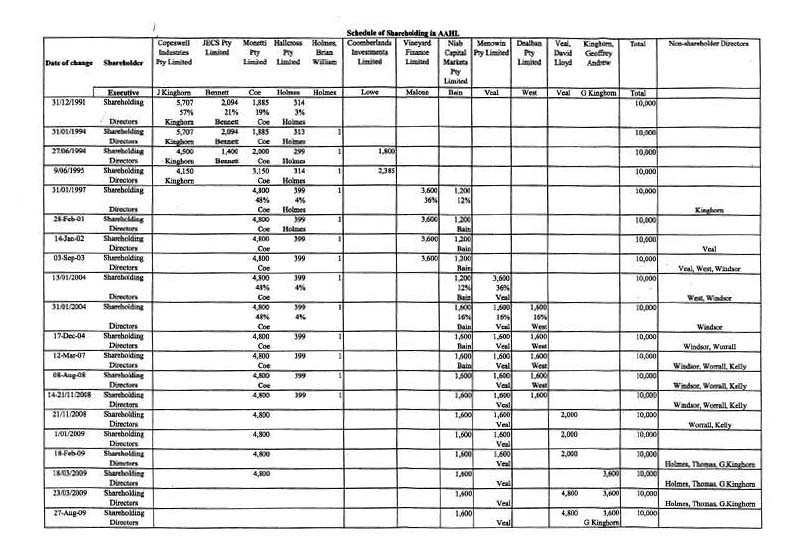
Relevant Provisions of the Constitution of RILA VQZ
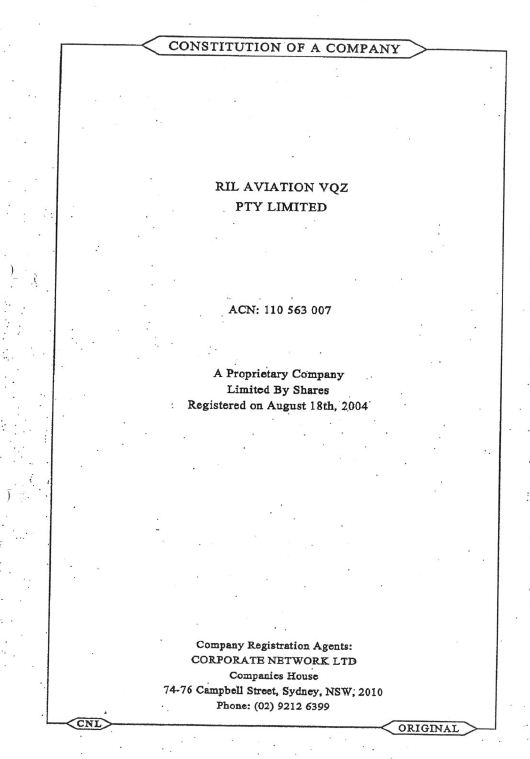
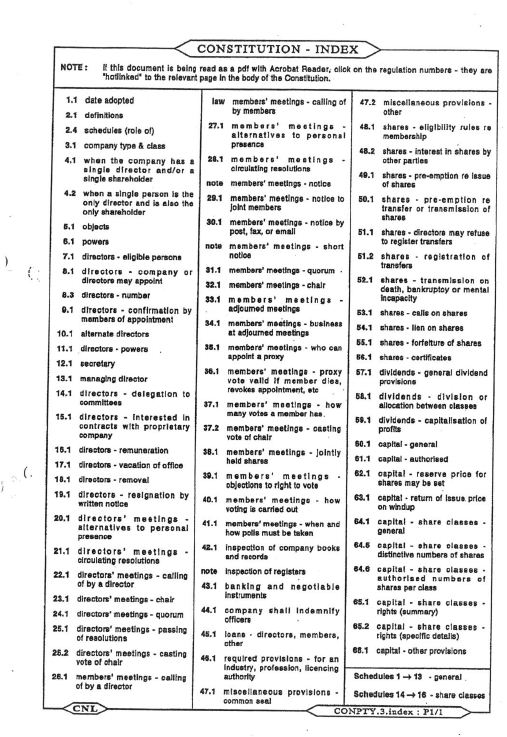
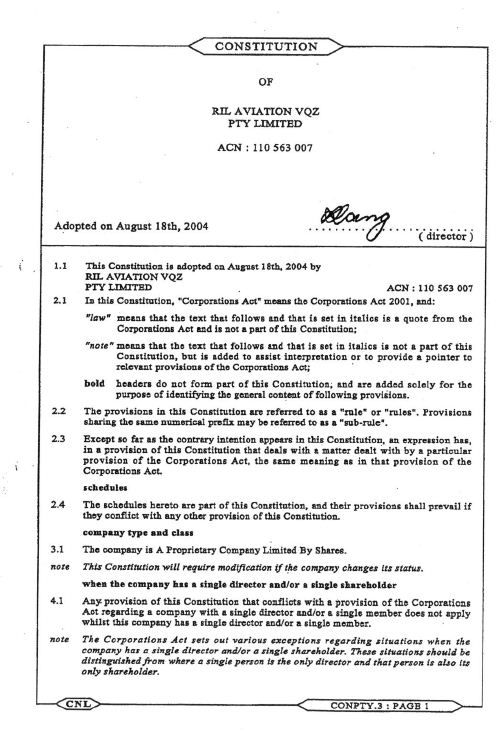
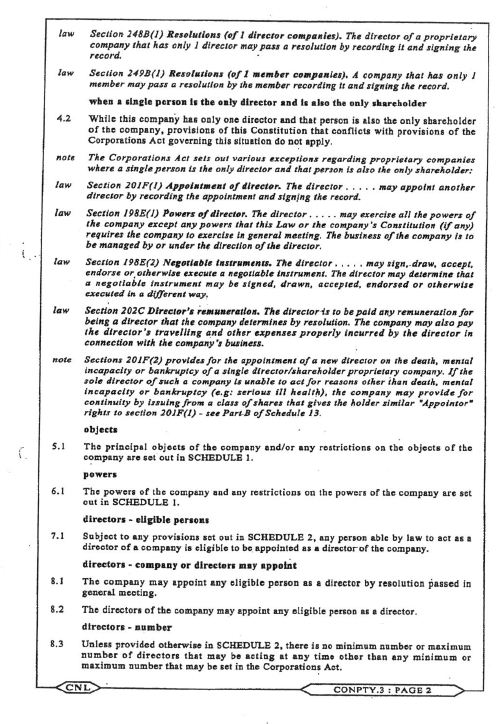
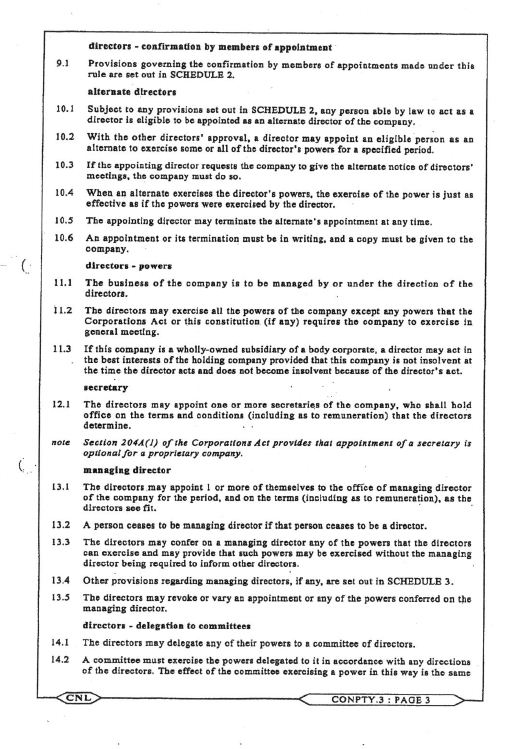
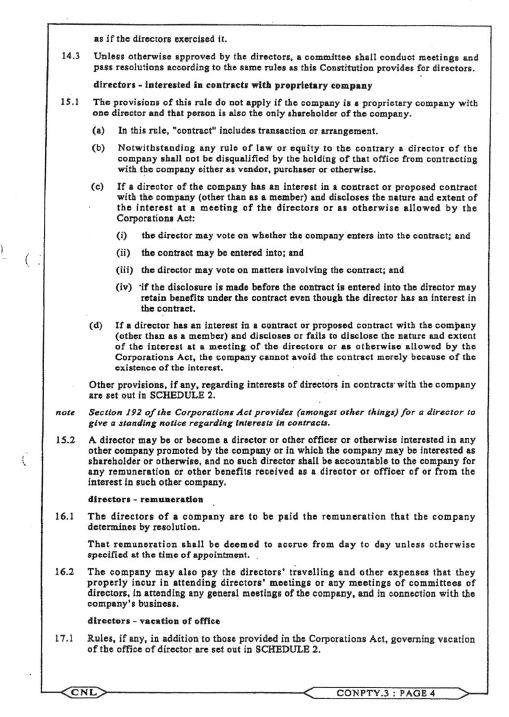
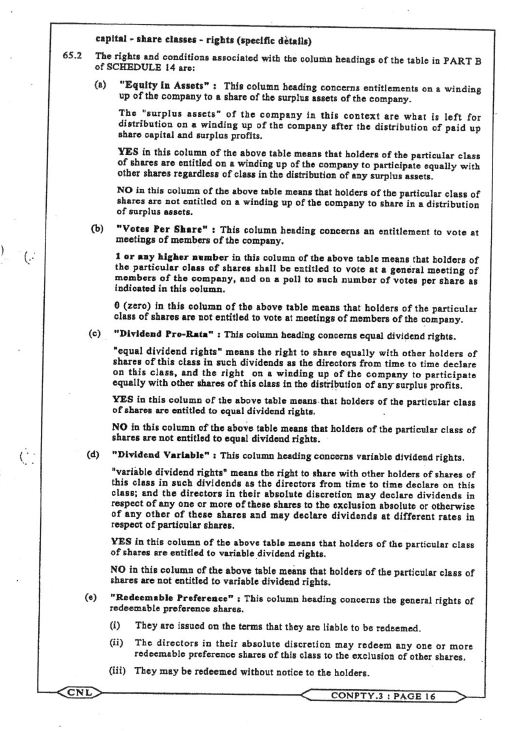
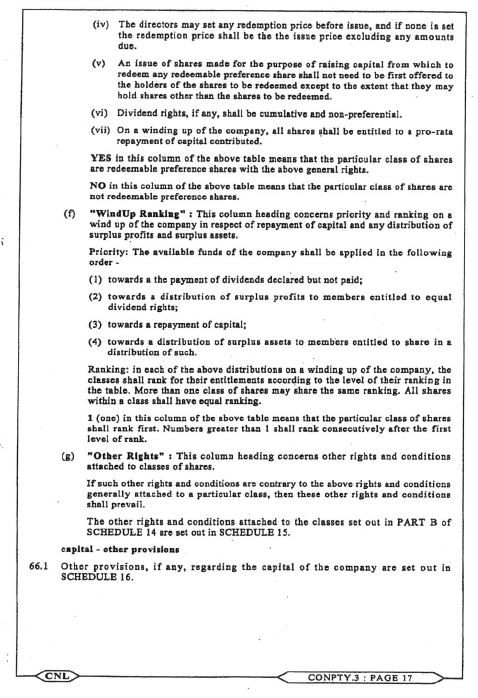
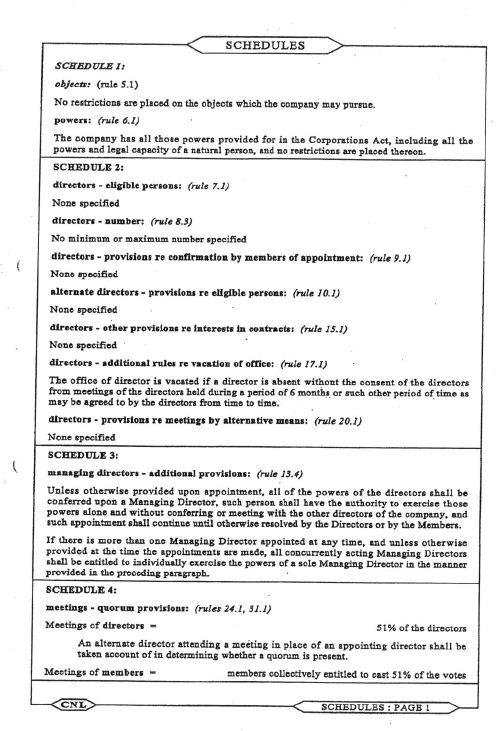
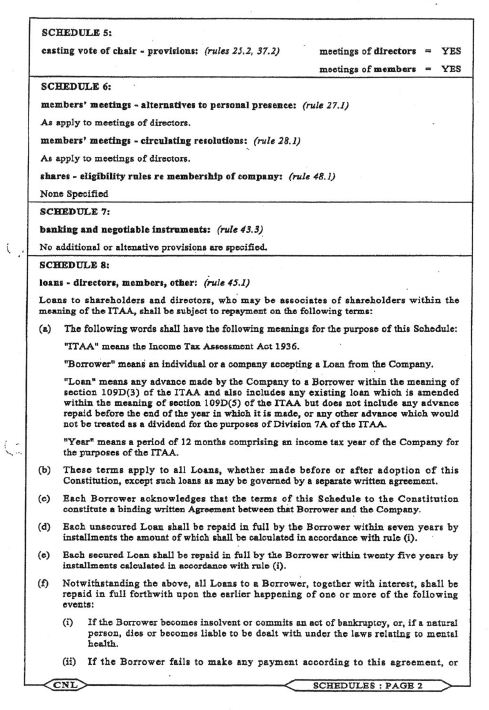
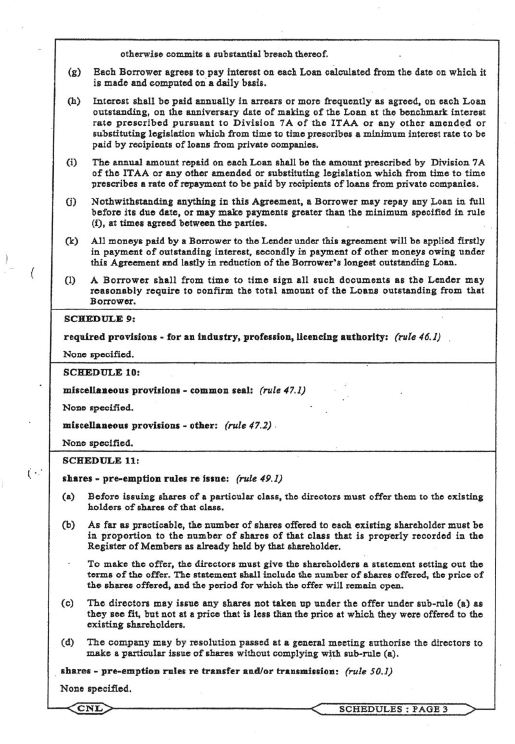
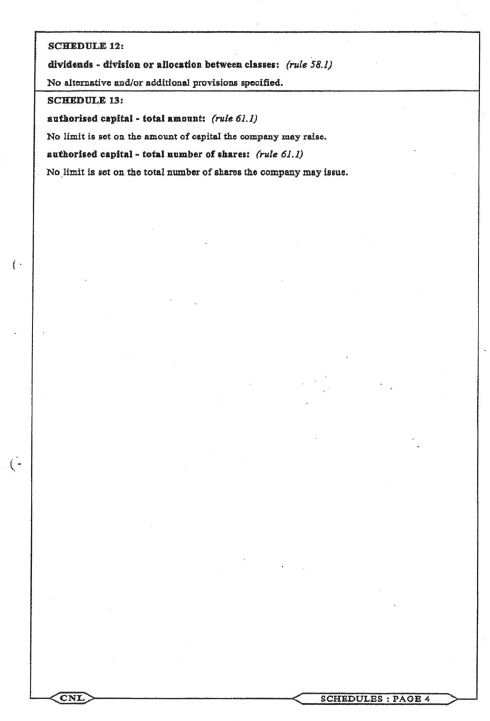
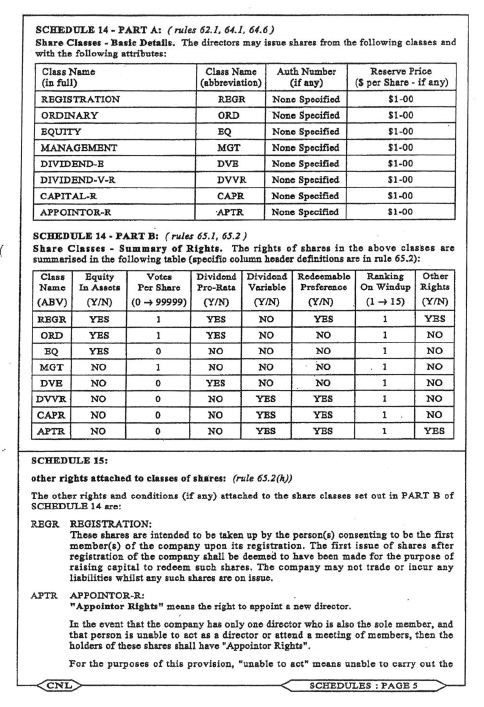
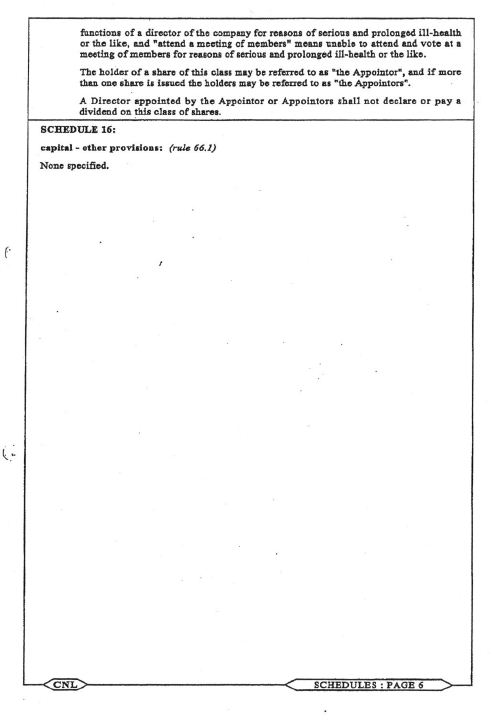
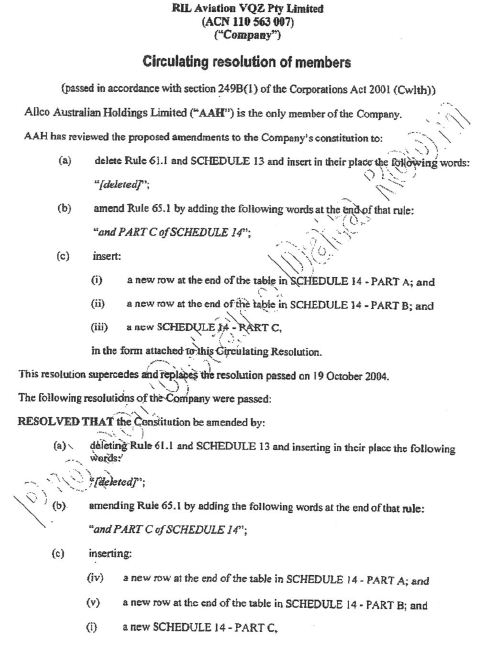
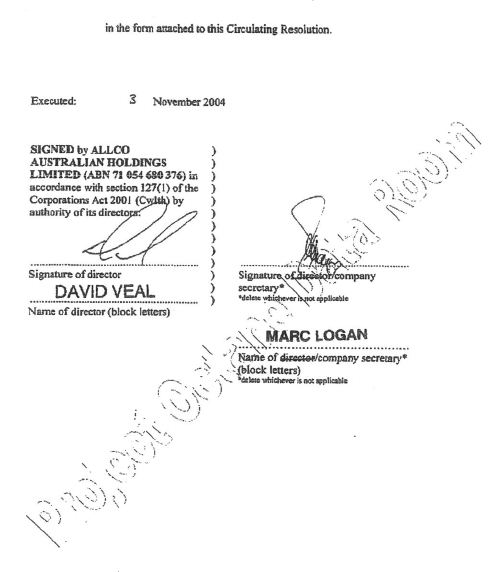
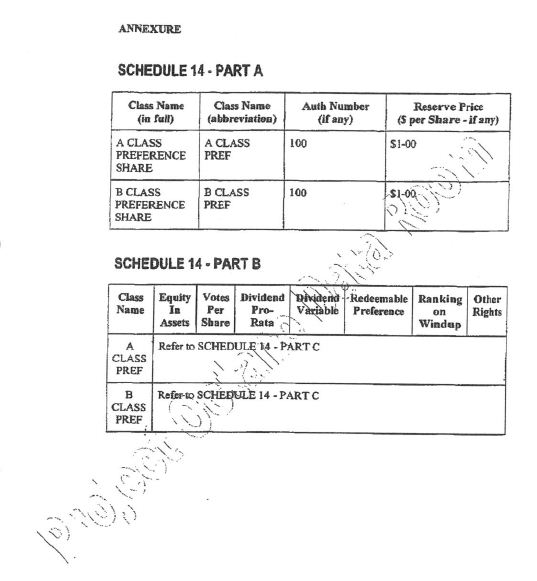
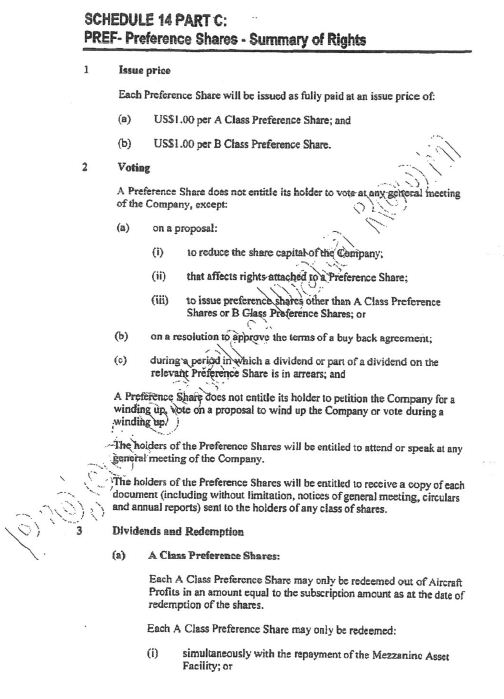
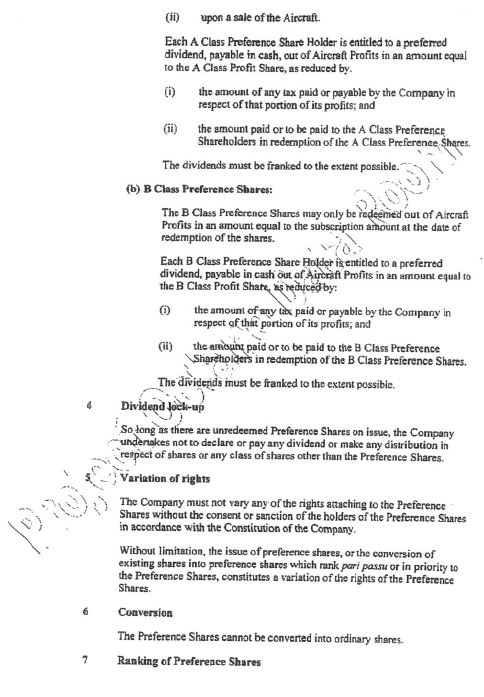
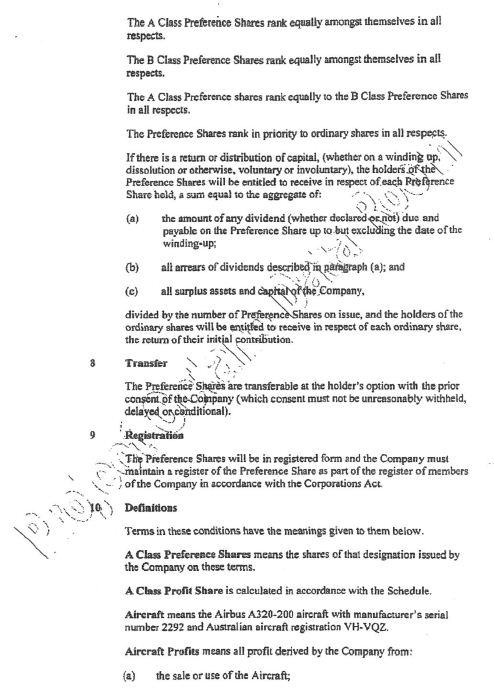
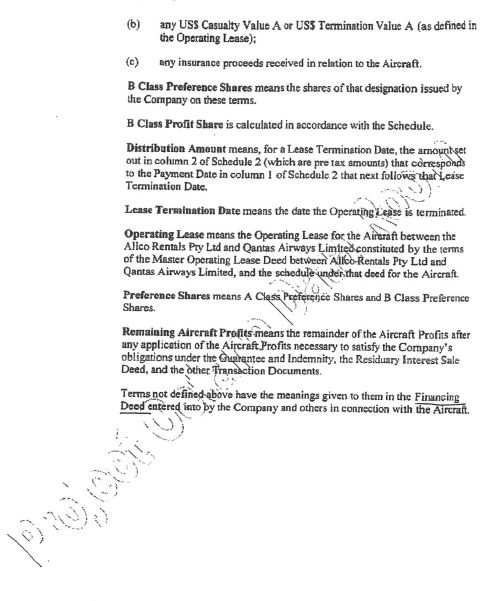
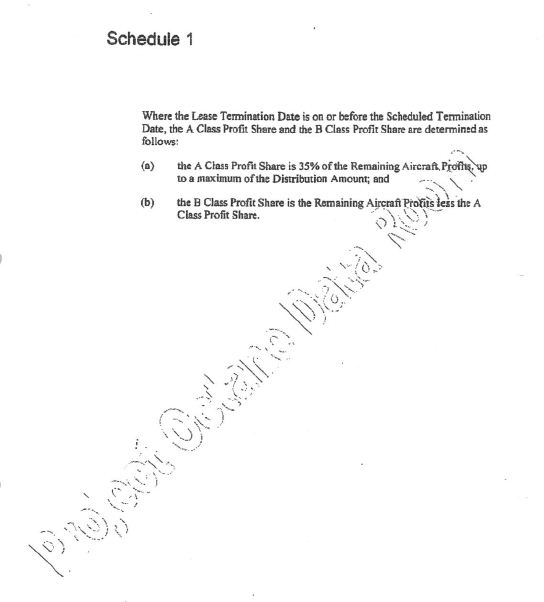
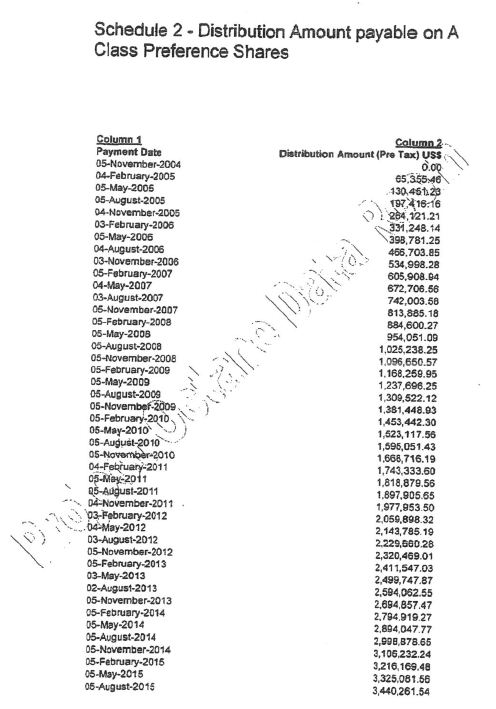

Tabulation of Shareholding and Transaction Information for the Defendant RILAs
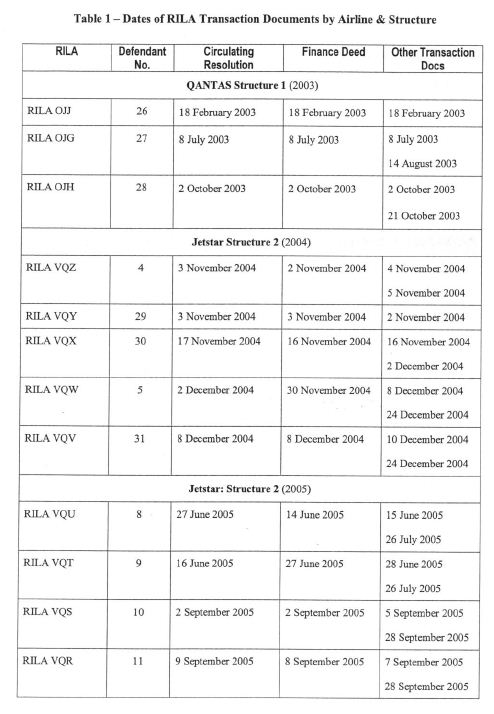
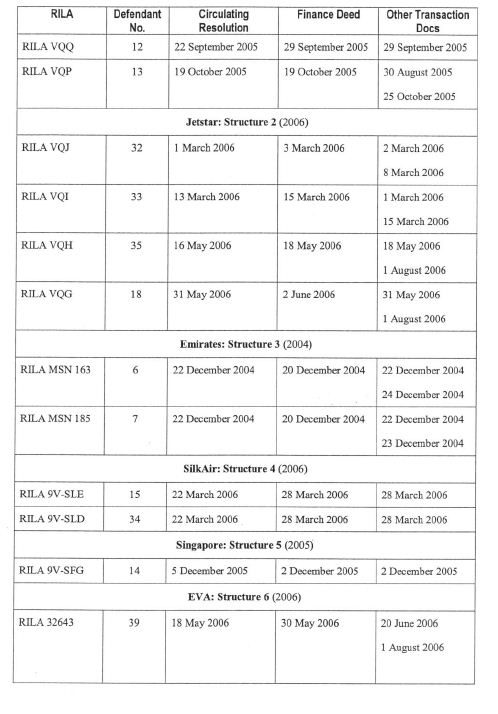
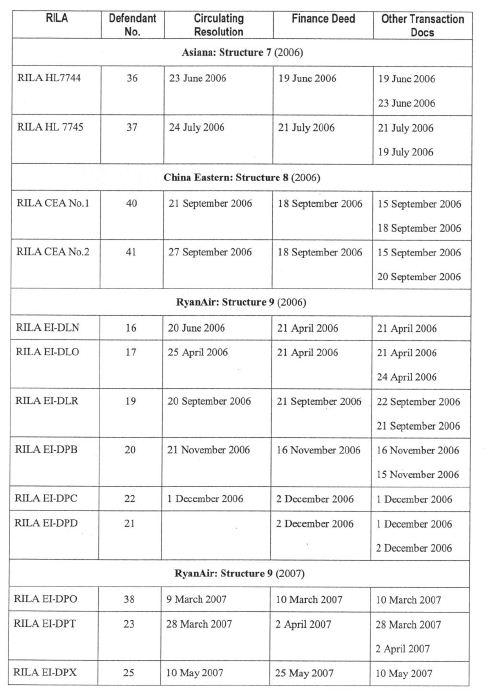
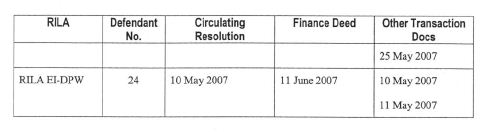
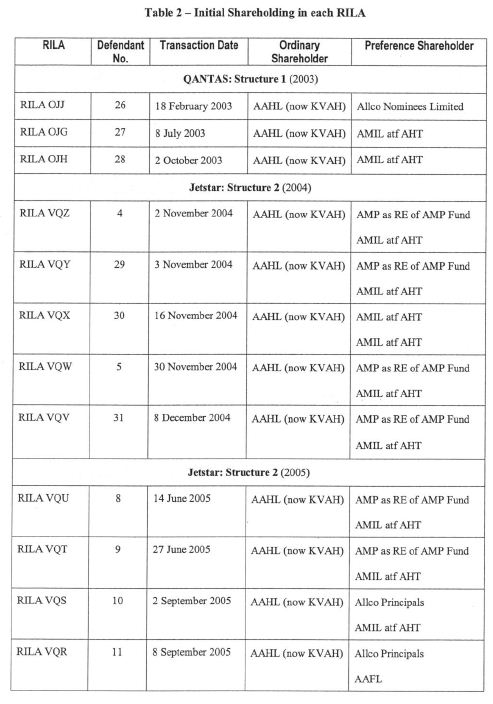
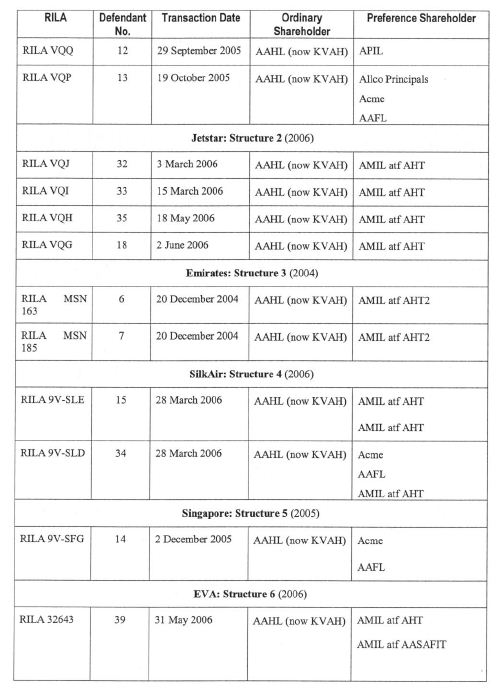
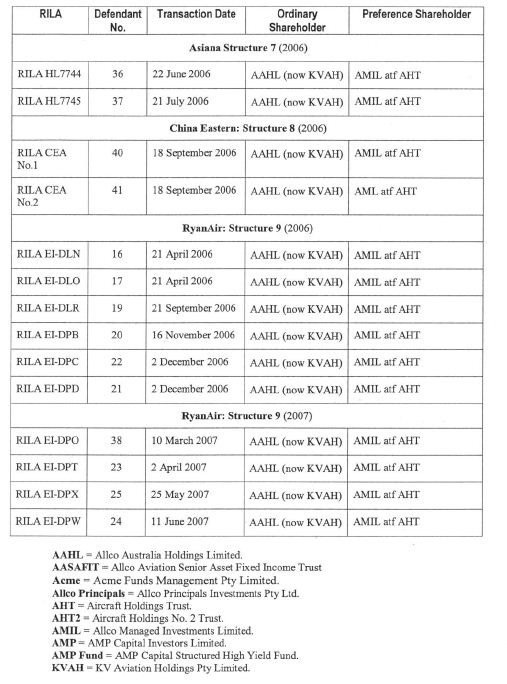
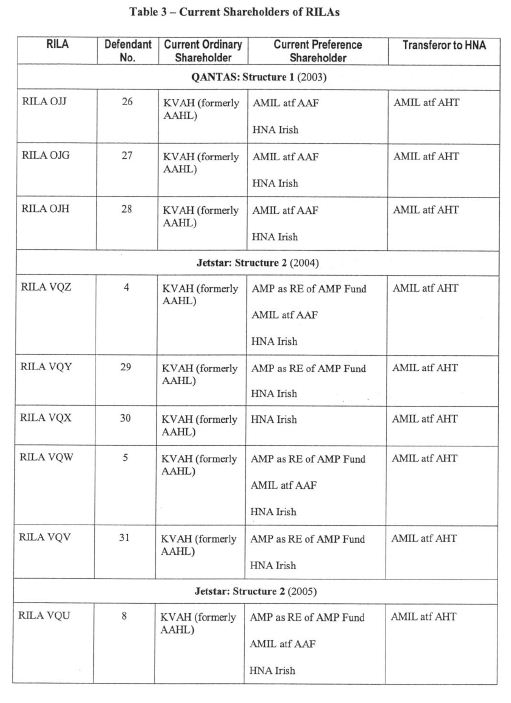
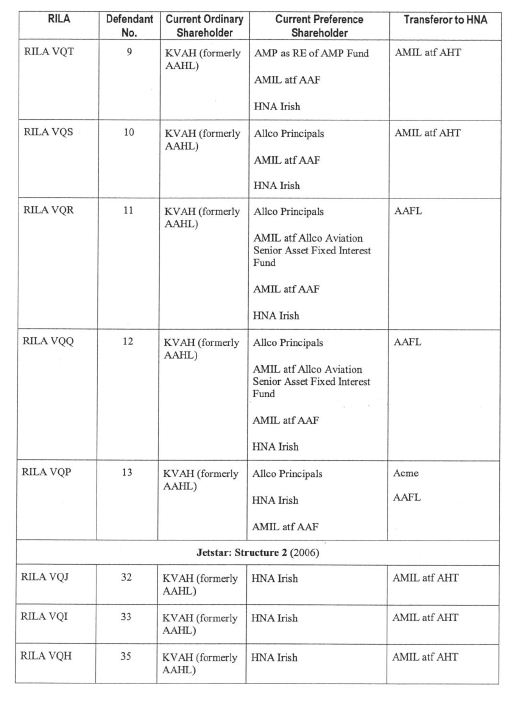
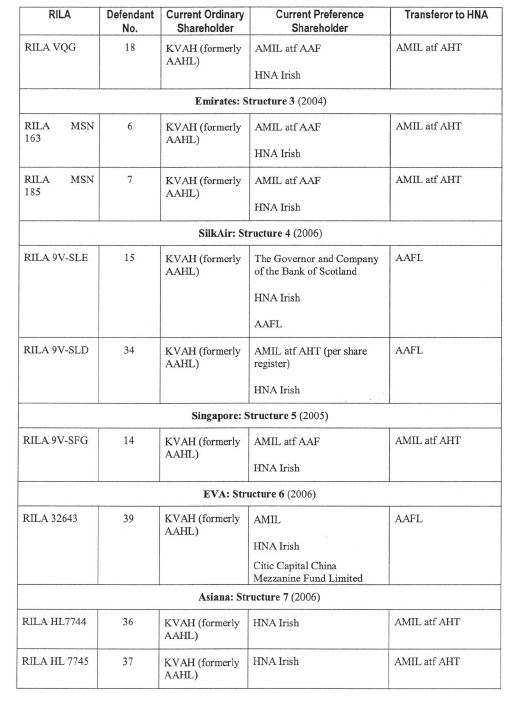
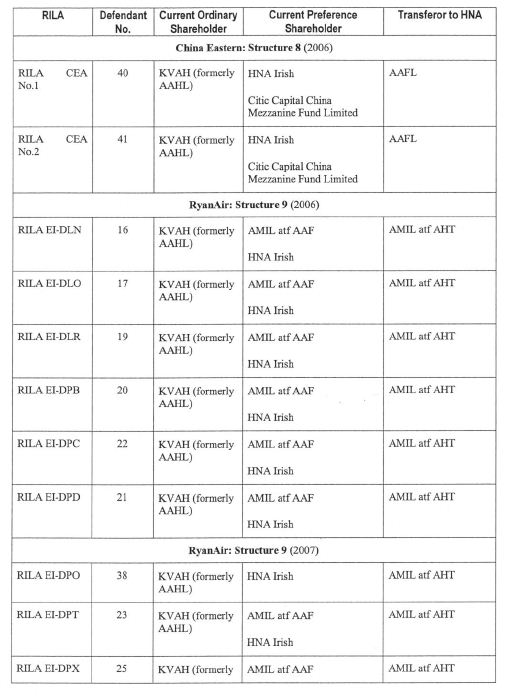
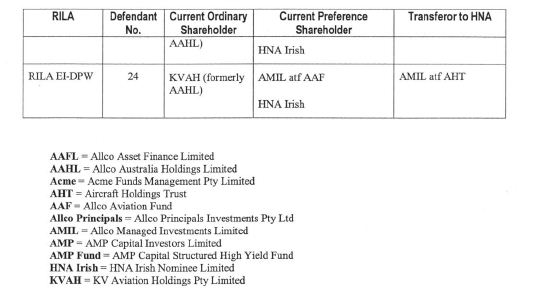
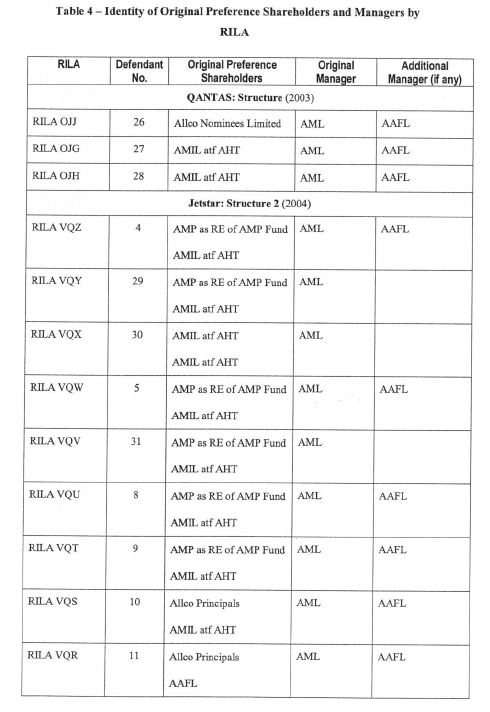
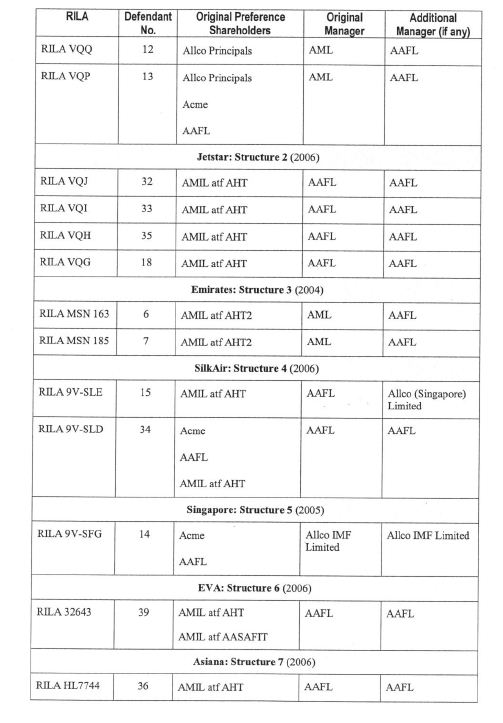
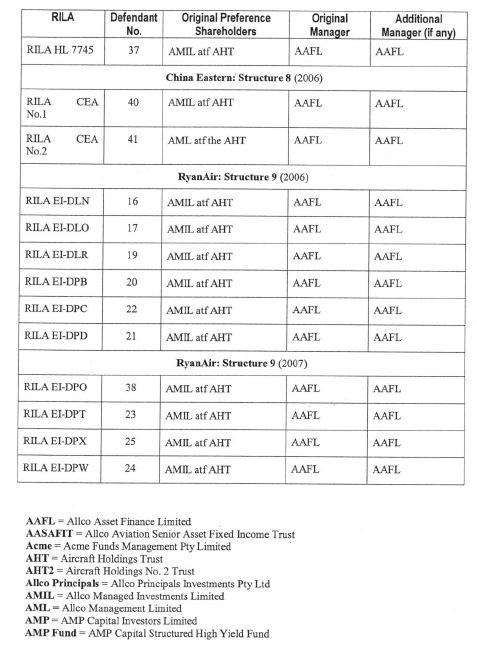
| I certify that the preceding seven hundred and fifty-two (752) numbered paragraphs are a true copy of the Reasons for Judgment herein of the Honourable Justice Emmett. |
Associate:
Fourth to Forty-First Defendants
| Fourth Defendant | RIL Aviation VQZ Pty Limited ACN 110 563 007 |
| Fifth Defendant | RIL Aviation VQW Pty Limited ACN 110 562 831 |
| Sixth Defendant | RIL Aviation MSN 163 Pty Limited ACN 111 127 087 |
| Seventh Defendant | RIL Aviation MSN 185 Pty Limited ACN 111 127 130 |
| Eighth Defendant | RIL Aviation VQU Pty Limited ACN 114 265 833 |
| Ninth Defendant | RIL Aviation VQT Pty Limited ACN 114 265 842 |
| Tenth Defendant | RIL Aviation VQS Pty Limited ACN 114 265 860 |
| Eleventh Defendant | RIL Aviation VQR Pty Limited ACN 114 265 922 |
| Twelfth Defendant | RIL Aviation VQQ Pty Limited ACN 114 265 940 |
| Thirteenth Defendant | RIL Aviation VQP Pty Limited ACN 114 265 968 |
| Fourteenth Defendant | RIL Aviation 9V-SFG Pty Limited ACN 116 838 905 |
| Fifteenth Defendant | RIL Aviation 9V-SLE Pty Limited ACN 115 858 298 |
| Sixteenth Defendant | RIL Aviation El-DLN Pty Limited ACN 115 857 488 |
| Seventeenth Defendant | RIL Aviation El-DLO Pty Limited ACN 115 857 684 |
| Eighteenth Defendant | RIL Aviation VQG Pty Limited ACN 115 079 751 |
| Nineteenth Defendant | RIL Aviation EI-DLR Pty Limited ACN 121 180 470 |
| Twentieth Defendant | RIL Aviation EI-DPB Pty Limited ACN 122 128 830 |
| Twenty-First Defendant | RIL Aviation EI-DPD Pty Limited ACN 122 642 031 |
| Twenty-Second Defendant | RIL Aviation EI-DPC Pty Limited ACN 122 641 963 |
| Twenty-Third Defendant | RIL Aviation EI-DPT Pty Limited ACN 124 271 236 |
| Twenty-Fourth Defendant | RIL Aviation EI-DPW Pty Limited ACN 124 850 255 |
| Twenty-Fifth Defendant | RIL Aviation El-DPX Pty Limited ACN 124 850 317 |
| Twenty-Sixth Defendant | RIL Aviation OJJ Pty Limited ACN 102 697 709 |
| Twenty-Seventh Defendant | RIL Aviation OJG Pty Limited ACN 102 697 914 |
| Twenty-Eighth Defendant | RIL Aviation OJH Pty Limited ACN 102 697 549 |
| Twenty-Ninth Defendant | RIL Aviation VQY Pty Limited ACN 110 562 957 |
| Thirtieth Defendant | RIL Aviation VQX Pty Limited ACN 110 562 902 |
| Thirty-First Defendant | RIL Aviation VQV Pty Limited ACN 110 562 699 |
| Thirty-Second Defendant | RIL Aviation VQJ Pty Limited ACN 115 079 171 |
| Thirty-Third Defendant | RIL Aviation VQI Pty Limited ACN 115 079 322 |
| Thirty-Fourth Defendant | RIL Aviation 9V-SLD Pty Limited ACN 115 857 899 |
| Thirty-Fifth Defendant | RIL Aviation VQH Pty Limited ACN 115 079 635 |
| Thirty-Sixth Defendant | RIL Aviation HL 7744 Pty Limited ACN 119 743 627 |
| Thirty-Seventh Defendant | RIL Aviation HL 7745 Pty Limited ACN 114 467 364 |
| Thirty-Eighth Defendant | RIL Aviation EI-DPO Pty Limited ACN 123 795 997 |
| Thirty-Ninth Defendant | RIL Aviation 32643 Pty Limited ACN 119 336 168 |
| Fortieth Defendant | RIL Aviation CEA No. 1 Pty Limited ACN 120 875 372 |
| Forty-First Defendant | RIL Aviation CEA No. 2 Pty Limited ACN 120 875 710 |


