FEDERAL COURT OF AUSTRALIA
Nexans S.A. v Nex 1 Technologies Co. Ltd [2012] FCA 180
FEDERAL COURT OF AUSTRALIA
Nexans S.A. v Nex 1 Technologies Co. Ltd [2012] FCA 180
CORRIGENDUM
1. In the Appearances section on the cover page, the words “Counsel for the Respondent” should read “Counsel for the First Respondent, The First Respondent did not appear”.
2. In the Appearances section on the cover page, the words “Counsel for the Second Respondent, B Fitzpatrick” should be inserted.
3. In the Appearances section on the cover page, the words “Solicitor for the Respondent” should read “Solicitor for the Second Respondent”.
4. In the Orders, the word “First” should be inserted before “Respondent”.
5. In the Orders, the words “THE REGISTRAR OF TRADE MARKS Second Respondent” should be inserted after “First Respondent”.
6. In order 3, the words “The respondent pay the applicant’s costs” should read “The first respondent pay the applicant’s costs.”
7. In the Reasons for Judgment, the word “First” should be inserted before “Respondent”.
8. In the Reasons for Judgment, the words “THE REGISTRAR OF TRADE MARKS Second Respondent” should be inserted after “First Respondent”.
9. In paragraph 4 of the Reasons for Judgment, the last sentence should read “I have ordered that Nex 1 pay Nexans’ costs.”
10. In paragraph 21 of the Reasons for Judgment, the word “Maquarie” should be replaced with “Macquarie”.
11. In paragraph 36 of the Reasons for Judgment, the last sentence should read “I order the first respondent to pay the applicant’s costs.”
|
I certify that the preceding eleven (11) numbered paragraphs are a true copy of the Corrigendum to the Reasons for Judgment herein of the Honourable Justice Murphy. |
Associate:
Dated: 6 March 2012
|
IN THE FEDERAL COURT OF AUSTRALIA |
|
|
Applicant | |
|
AND: |
First Respondent THE REGISTRAR OF TRADE MARKS Second Respondent |
|
DATE OF ORDER: |
|
|
WHERE MADE: |
THE COURT ORDERS THAT:
2. The decision of the delegate of the Registrar of Trade Marks of 30 March 2011 be set aside and Australian Trade Mark Application No 1165913 be refused.
3. The first respondent pay the applicant’s costs.
Note: Entry of orders is dealt with in Rule 39.32 of the Federal Court Rules 2011.
|
VICTORIA DISTRICT REGISTRY |
|
|
GENERAL DIVISION |
VID 301 of 2011 |
|
BETWEEN: |
NEXANS S.A. Applicant |
|
AND: |
NEX 1 TECHNOLOGIES CO. LTD First Respondent THE REGISTRAR OF TRADE MARKS Second Respondent |
|
JUDGE: |
MURPHY J |
|
DATE: |
2 March 2012 |
|
PLACE: |
MELBOURNE |
REASONS FOR JUDGMENT
background
1 This matter is an appeal from a decision of a delegate of the Registrar of Trade Marks pursuant to section 55 of the Trade Marks Act 1995 (Cth).
2 In July 2007 the Registrar accepted an application by Nex 1 Technologies Ltd (“Nex 1”), a company registered in Taiwan, to register an Australian Trade Mark under the Act. That application was opposed on 16 October 2007 by the French company Nexans S.A., by the filing of a Notice of Opposition. Following a hearing, a delegate of the Registrar (“the Registrar”) issued written reasons on 30 March 2011. The Registrar decided that Nexans’ opposition to the trademark was not established and allowed Nex 1’s application to proceed to registration.
3 On 19 April 2011 Nexans appealed the Registrar’s decision by filing a Notice of Appeal. The Notice of Appeal cites grounds under the Act pursuant to ss 42(b), 44 and 60. Nex 1 did not appear in the appeal proceedings and did not file Points of Defence to deny the matters pleaded by Nexans, or put forward any evidence rebutting Nexans’ evidence. The Registrar appeared but made submissions only as to his proper role in an appeal against a decision made by the Registrar or his delegate.
4 For the reasons I now set out I have determined to allow Nexans’ appeal and reject the registration of Nex 1’s proposed trade mark. I have ordered that Nex 1 pay Nexans' costs.
The Trade marks in question
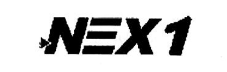
5 Nex 1’s Australian Trade Mark Application before the Registrar was in respect of its logo (“the NEX1 Logo”) in relation to a list of Class 9 goods (“the NEX1 Goods”). The NEX1 Logo and the NEX1 Goods are Annexure A and Annexure B respectively.
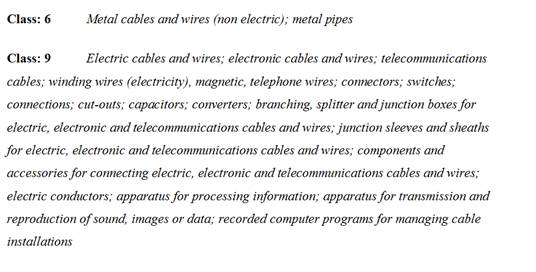
6 Nexans is and has been since 13 December 2000 the registered owner of the Australian Trade Mark for the word “NEXANS” (Australian Trade Mark No. 860431). The list of Class 9 and Class 6 goods in respect of which the word “NEXANS” is registered (“the NEXANS Goods”) is Annexure C.
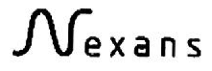
7 Nexans is also and has been since 14 February 2001 the registered owner of the Australian Trade Mark for a logo incorporating the word NEXANS in respect of the NEXANS Goods (Australian Trade Mark No. 866141) (“the NEXANS Logo”). The NEXANS Logo is Annexure D.
Principles relevant to the appeal
8 The proper approach to an appeal from a decision of the Registrar pursuant to s 55 of the Act was referred to in Suyen Corporation v Americana International Limited (2010) 187 FCR 169 at [141] to [146] per Dodds-Streeton J. An appeal from the decision of the Registrar is an appeal de novo and the Court must conduct a rehearing of the matter in its original jurisdiction. In particular, the Court is guided by the following principles:
(a) the Court must approach the matter afresh without undue concern for the ratio decidendi of the Registrar;
(b) the provisions of s 197 of the Trade Marks Act, which allows the taking of further evidence, make it plain that in exercising its jurisdiction the Court is to determine the question of acceptance of the application on its merits;
(c) there is no presumption in favour of the correctness of the Registrar’s decision save that weight will be given to the Registrar’s opinion as that of a skilled and experienced person; and
(d) the Court is required to apply the same legal criteria as the Registrar is required to adopt.
9 Nexans bears the onus of proof which is discharged on the balance of probabilities: Chocolaterie Guylian N.V. v Registrar of Trade Marks (2009) 82 IPR 13 per Sundberg J.
10 In hearing this matter I have had regard to these principles. I have considered the following evidence which was before the Registrar:
(a) a statutory declaration of Michel Rousseau declared on 30 October 2008 together with exhibits;
(b) a statutory declaration of Thierry Roucher, the Marketing and Communications Director of Nexans, declared on 30 July 2009 together with exhibits;
(c) a statutory declaration of Thierry Roucher declared on 16 February 2010 together with exhibit;
(d) a statutory declaration of Vincent Tsao declared on 23 March 2009 together with exhibits;
11 I have also had regard to further evidence adduced by Nexans consisting of;
(a) a further affidavit and exhibits of Thierry Roucher sworn on 30 September 2011 concerned with, amongst other things, evidence of Nexans’ retail sales in Australia and Nexans’ worldwide advertising budget for the years prior to the registration of Nex 1’s Australian Trademark Application. It also concerned the successful prosecution on similar grounds of appellate proceedings by Nexans against Nex 1 before the Office for Harmonization in the Internal Market (OHIM), the official trade marks and designs office of the European Union;
(b) an affidavit by Ally Akbarzedeh, a solicitor for the applicant sworn on 30 September 2011 concerned with, amongst other things, the availability of Nexans products at retail outlets in Australia and the price ranges in which Nexans products are sold in these outlets.
12 I have considered the decision of the Registrar and given it due weight as the opinion of a skilled and experienced person. However I had before me persuasive evidence that was not put before the Registrar.
grounds OF APPEAL
13 Nexans relies on three grounds in its appeal namely that:
(a) the Registrar erred in finding that Nexans had failed to make out its grounds under s 44 of the Act and should have found that the NEX1 Logo in respect of the NEX1 Goods is deceptively similar to both the NEXANS word and logo registrations in respect of the NEXANS Goods;
(b) the Registrar erred in finding that Nexans had failed to make out its grounds under s 60 of the Act and should have found that there was, in the circumstances of use and promotion of the NEXANS trademark in Australia at and prior to the priority date, a likelihood of deception and confusion by the use of the NEX1 Logo;
(c) the Registrar erred in finding that Nexans had failed to make out its grounds under s 42(b) of the Act and should have found that there was in the circumstances of use and promotion of the NEXANS trademark in Australia at and prior to the priority date, a likelihood of deception and confusion by the use of the NEX1 Logo contrary to law as;
(i) misleading and deceptive conduct in contravention of s 52 and subs 53(a), (g) and (h) of the Trade Practices Act 1974 (Cth) and the successor provisions of the Competition and Consumer Act 2010 (Cth);
(ii) passing off of the NEX1 Goods as the goods of, or associated with, Nexans.
Relevant legislation
14 Section 44(1) of the Act provides:
Subject to subsections (3) and (4), an application for the registration of a trade mark (applicant’s trade mark) in respect of goods (applicant’s goods) must be rejected if:
(a) the applicant’s trade mark is substantially identical with, or deceptively similar to:
(i) a trade mark registered by another person in respect of similar goods or closely related services; or
(ii) a trade mark whose registration in respect of similar goods or closely related services is being sought by another person; and
(b) the priority date for the registration of the applicant’s trade mark in respect of the applicant’s goods is not earlier than the priority date for the registration of the other trade mark in respect of the similar goods or closely related services.
15 Section 60 provides:
The registration of a trade mark in respect of particular goods or services may be opposed on the ground that:
(a) another trade mark had, before the priority date for the registration of the first-mentioned trade mark in respect of those goods or services, acquired a reputation in Australia; and
(b) because of the reputation of that other trade mark, the use of the first-mentioned trade mark would be likely to deceive or cause confusion.
16 Section 42(b) provides:
An application for the registration of a trade mark must be rejected if:
…
(b) its use would be contrary to law.
consideration under s 60 of the act
17 Section 60 of the Act was amended in 2006 to dispense with the requirement for a party opposing registration to show that the applicant’s trade mark is deceptively similar to the prior trade mark. Parliament thereby evinced the intention to allow opposition to registration even when the differences in the trade marks were not such that they were deceptively similar. The amendment had the effect of substantially widening the scope and application of s 60, making it possible to oppose registration of a trademark on the sole basis of the possible deception or confusion arising from the reputation of the existing trademark: Explanatory Memorandum to the Trade Marks Amendment Bill 2006 (Cth) at [4.10].
18 It follows that meeting the requirements of s 60 is the lowest hurdle that Nexans must pass if it is to succeed in the appeal. For that reason I will deal first with the requirements of this section. In order for Nexans to succeed under the section it is necessary for it to show:
(a) the NEXANS registration has an earlier priority date than the opposed application;
(b) the NEXANS trade marks are in respect of goods which are also goods in respect of which the NEX1 Logo is sought to be registered;
(c) the NEXANS trade marks have acquired a reputation in Australia amongst a significant section of the public; and
(d) because of that reputation of the NEXANS trade marks the use of the NEX1 Logo would be likely to deceive or cause confusion.
Does Nexans have an earlier priority date.
19 In this case the pre-existing registration relied upon by Nexans are;
(a) the Nexans word registration on 13 December 2000 (Australian Trade Mark No. 860431) in respect of the NEXANS Goods; and
(b) the NEXANS Logo registration on 14 February 2001 (Australian Trade Mark No. 866141) also in respect of the NEXANS Goods.
These registrations both pre-date by a number of years the application by Nex 1 to register the NEX1 Logo on 14 March 2007. Therefore, the first element of the grounds necessary for Nexans to successfully oppose registration is satisfied.
Do the goods sold by Nexans overlap with the goods covered by the Nex 1 application.
20 The overlap between the goods the subject of the NEXANS registration, and the goods in respect of which the NEX1 Logo is sought to be registered requires more attention. Nexans contends that the goods covered by the competing registrations overlap to a sufficient degree, but I note that there are some differences in the goods listed by the parties. For example some NEXANS Goods are not on the NEX 1 Goods list, and some NEX1 Goods are not on the NEXANS Goods list. However, I am satisfied that there is a sufficient degree of overlap between the NEX1 Goods and the NEXANS Goods for s 60 to be engaged, particularly in that both lists cover communications cables for electric, electronic and telecommunications use, network cables, and network connectors: see Southern Cross Refrigerating co v Toowoomba Foundry Ltd (1954) 91 CLR 592 at 606 (“Southern Cross”).
Have the Nexans trade marks acquired a reputation in Australia.
21 In McCormick and Company Inc v McCormick [2000] FCA 1335 (“McCormick”) Kenny J held at [81] that the meaning of the word “reputation” in s 60 was its ordinary meaning as defined in the Macquarie Dictionary. Her Honour found it therefore includes:
The estimation in which a person or thing is held, esp. by the community or by the public generally; repute…2. Favourable repute; good name…3. A favourable and publicly recognised name or standing for merit, achievement, etc….
22 Kenny J also held that reputation may be determined by considering sales and advertising expenditure: McCormick at [86]. Her Honour noted:
In practice, it is commonplace to infer the reputation from a high volume of sales, together with substantial advertising expenditures and other promotions, without any direct evidence of consumer appreciation of the mark, as opposed to the product: [citations omitted]
23 Nexans made comprehensive submissions as to its reputation in Australia based on, amongst other things:
(a) use of the NEXANS trade marks throughout Australia since 2001 in relation to cables and cabling systems;
(b) evidence of substantial sales of goods under the NEXANS trade mark in Australia in the two years prior to the filing of the Opposed Application, namely:
(i) in 2005: AUD$10.6 million (approximate retail sales value);
(ii) in 2006 AUD$12.3 million (approximate retail sales value);
(c) the acquisition by NEXANS in 2006 of Olex Cables, an Australian cable manufacturer, and the subsequent reference to Olex Cables as “a NEXANS company”;
(d) the goods sold by Nexans have been promoted under the NEXANS trademark by means of packaging, instructions, product handbooks, print advertisements, brochures, point-of-sale material, promotional articles in newspapers, on its websites and at trade fairs;
(e) the sales of goods worldwide under the NEXANS trade mark;
(f) the global market presence of NEXANS in more than 70 countries with worldwide advertising expenditure in the three years prior to the filing of the Nex 1 application of almost AU$4 million.
I did not accord Nexans’ evidence regarding its worldwide advertising expenditure and worldwide sales significant weight as it is Nexans’ Australian reputation that is of relevance to these proceedings.
24 I am satisfied that the Nexans trade marks have acquired a reputation in Australia amongst a significant section of the public. I note that the Registrar was similarly satisfied. Nexans has therefore met the third limb of s 60.
Is use of the NEX1 trade mark in respect of the NEX1 Goods likely to deceive and confuse?
25 The 2006 amendments to s 60 had the effect that Nexans is not required to establish that it is a deceptive similarity between the trade marks in question that gives rise to any likelihood of deception and confusion. Nexans is only required to establish that a likelihood of deception and confusion arises from the reputation of its trade marks and the use of the NEX1 Logo.
26 The test as to whether there is a real and substantial risk that a trade mark may deceive and cause confusion is whether there is a real likelihood that a reasonable person is, or a number of persons in the relevant class of likely purchasers are, caused to wonder whether it might not be the case that the two products or closely related products and services come from the same source. It is enough if an ordinary person entertains a reasonable doubt: Registrar of Trade Marks v Woolworths (1999) 93 FCR 365 at [50] (“Woolworths”); Explanatory Memorandum to Trade Marks Amendment Bill 2006, at [4.10] to [4.10.1]. In making this assessment, all of the surrounding circumstances should to be taken into account, including: the circumstances in which the trade marks will be used; the circumstances in which the goods or services will be bought and sold; and the character of the probable purchasers of the goods and services: Southern Cross at 595; Woolworths at 382-383; In Re Application by the Pianotist Co Ltd (1906) 1A IPR 379 at 380; 23 RPC 774 at 777.
27 I reiterate that I consider that Nexans has established that its trade mark word and logo have a reputation with a significant section of the public. The question in this case is whether there is a real and substantial risk that a number of consumers in the class of purchasers of the relevant goods, having an imperfect recollection of the Nexans trade marks, will entertain a reasonable doubt or be caused to wonder as to whether the NEXANS and NEX1 Goods come from the same source.
28 In this matter the competing trade marks relate to goods which include lower priced consumer items which are sold to the general public through commonly known hardware, electronics, office suppliers and department stores. The evidence is that the price of such goods may be anywhere between AU$1.25 and AU$99.00. Both the NEXANS Goods and the NEX1 Goods will be purchased by the general public who are not trained in the electrical or electronics field. The purchases are likely to be “casual” purchases from the shelves of well known consumer stores or online. It is in this context that the likelihood of deception and confusion should be assessed. In this context of lay consumers casually purchasing low priced cables in a retail environment a similarity in trade marks increases the likelihood of deception or confusion.
29 The competing trade marks are to be compared visually to assess the likelihood of deception and confusion. This is a matter of visual impression: Johnson & Johnson v Kalnin [1993] FCA 210 at [24] per Gummow J. His Honour noted:
… the process of deception and recognition of a word involves not so much the reading of the entire word… but the seeing and identification of certain features which are then matched to that which is contained in the memory…
The prefix “NEX” is visually distinctive which is important in assessing the visual similarity of each trade mark. In the context of the NEX1 and NEXANS trade marks, the visual feature that a purchaser will take away from viewing each trade mark is the prefix “NEX”. In my view, considered with regard to visual similarity only, the use of the prefix “NEX” has a tendency to deceive and confuse purchasers of the goods.
30 The competing trade marks must also be compared by reference to the words used. The prefix “NEX” is not a usual abbreviation or commonly used term to designate cables, and “NEX” is not a common word. Having two trade marks which relate to overlapping goods carrying the same prefix also increases the likelihood that purchasers will be deceived or confused.
31 This tendency is increased in circumstances, such as the case in hand, where the NEXANS and NEX1 Goods are not highly specialised and are often inexpensive. Further, as an invented word, “NEX” is more likely to be confused with a similar or related invented word. I agree with Farewell J in William Bailey (Birmingham) Ltd’s Application (1935) 52 RPC 136 at 153 where his Honour held:
No doubt in the case of a fancy or invented word, a word which is not in use in the English language, the possibility of confusion is very much greater. A fancy word is more easily carried in mind and is more easily carried in mind in connection with some particular goods and it may well be that in the case of a fancy word there is much more chance of confusion…
32 Finally, the authorities provide that the sound of the trade marks is relevant to assessing the likelihood of a trade mark deceiving and confusing. This assessment must be made in the context in which the relevant goods are likely to be purchased. In Rysta Ltd’s Application (1943) 60 RPC 87 at 108 Luxmore LJ held:
The Court must be careful to make allowance for imperfect recollection and the effect of careless pronunciation and speech on the part not only of the person seeking to buy under the trade description, but also of the shop assistant ministering to that person’s wants.
33 In this regard Nexans submits that the prefix “Nex” is likely to be emphasised by consumers in any comparison of the sound of the competing trade marks. It relies on London Lubricants (1920) Ltd’s Application (1925) 42 RPC 264 at 279 in which Sargant LJ observed:
… the first syllable of a word is, as a rule, far the most important for the purpose of distinction.
34 Taking into account the reputation of Nexans, the similarity from the use of the word “NEX”, the visual similarity, and their similarity in sound, I consider that the use of the NEX1 Logo is likely to deceive or cause confusion within the meaning of s 60. I am satisfied on the evidence that there is a real and substantial risk that a reasonable person, or a number of persons in the relevant class of likely purchasers, will at least be caused to wonder whether it might not be the case that NEX1 Goods come from the same source as NEXANS Goods.
35 Accordingly I find that Nexans has made out its ground under s 60 of the Act, and the appeal succeeds. It is unnecessary for me determine the other grounds contended in reliance on ss 44 and 42(b) and I do not do so. I note though that Nexans’ submissions, that I have accepted as to the tendency of the NEX1 Logo to deceive and confuse, largely also related to the deceptive similarity of that proposed trade mark under s 44.
costs
36 The applicant having been successful in its proceeding, the usual rule is that costs follow the event – unless special reasons otherwise indicate: Ruddock v Vardalis (No 2) (2001) 115 FCR 229 at 234-235. I can discern no special reason in this matter. I order the first respondent to pay the applicant’s costs.
|
I certify that the preceding thirty-six (36) numbered paragraphs are a true copy of the Reasons for Judgment herein of the Honourable Justice Murphy. |
Associate:
Dated: 5 March 2012
ANNEXURE A
ANNEXURE B

ANNEXURE C
ANNEXURE D