FEDERAL COURT OF AUSTRALIA
Boyd v Wild Hibiscus Flower Company Pty Ltd (No 2) [2012] FCA 74
IN THE FEDERAL COURT OF AUSTRALIA | |
DATE OF ORDER: | |
WHERE MADE: |
THE COURT:
1. NOTES that the applicants by their Counsel undertake to the Court:
(a) to submit to such order (if any) as the Court may consider to be just for the payment of compensation, to be assessed by the Court or as it may direct, to any person, whether or not a party, adversely affected by the operation of the undertaking given to the Court by the first respondent which is recorded in par 2 below or any continuation (with or without variation) thereof; and
(b) to pay the compensation referred to in (a) to the person there referred to.
2. NOTES that, upon the undertaking recorded in par 1 above having been given, the first respondent by its solicitor undertakes to the Court that, pending determination of this proceeding, or until further or other order of the Court, it shall keep accounts, in the ordinary course of its business, recording:
(a) the costs of sales of the products described as the first respondent’s “Freshburst finger lime products”, a sample of which is Exhibit “JB-1” tendered at the interlocutory hearing which took place on 9 January 2012 before Foster J; and
(b) revenue earned by the first respondent on sales of those products to the first respondent’s Australian customers.
3. ORDERS that the interlocutory application made by the applicants on 9 January 2012 be dismissed.
4. ORDERS that the applicants pay the respondents’ costs of and incidental to that interlocutory application.
5. ORDERS that the respondents may forthwith tax their costs the subject of Order 4 above.
6. ORDERS that the applicants have leave to amend both their Application and their Statement of Claim in such manner as they may be advised, such amended process to be filed and served by 5.00 pm on 2 February 2012.
7. DIRECTS the respondents to file and serve their Defence and any Cross-Claims by 5.00 pm on 13 February 2012.
8. ORDERS that the proceeding be listed for directions before the Docket Judge at 9.30 am on 17 February 2012.
9. ORDERS that Exhibit “JB-1” and the items marked as “MFI-A” and “MFI-B” respectively be returned to the solicitors for the applicants.
10. NOTES that the applicants may wish to agitate the question of whether the undertaking given to the Court by the first respondent by its solicitor, recorded in par 2 above, should be required to be varied to accommodate all sales of the respondents’ products wherever made.
Note: Entry of orders is dealt with in Rule 39.32 of the Federal Court Rules 2011.
NEW SOUTH WALES DISTRICT REGISTRY | |
GENERAL DIVISION | NSD 8 of 2012 |
BETWEEN: | JAMES BOYD First Applicant LIMEBURST PTY LTD (ACN 115 684 243) Second Applicant
|
AND: | WILD HIBISCUS FLOWER COMPANY PTY LTD (ACN 115 057 497) First Respondent LEE DANIEL ETHERINGTON Second Respondent JOCELYN LILY GALE ETHERINGTON Third Respondent
|
JUDGE: | FOSTER J |
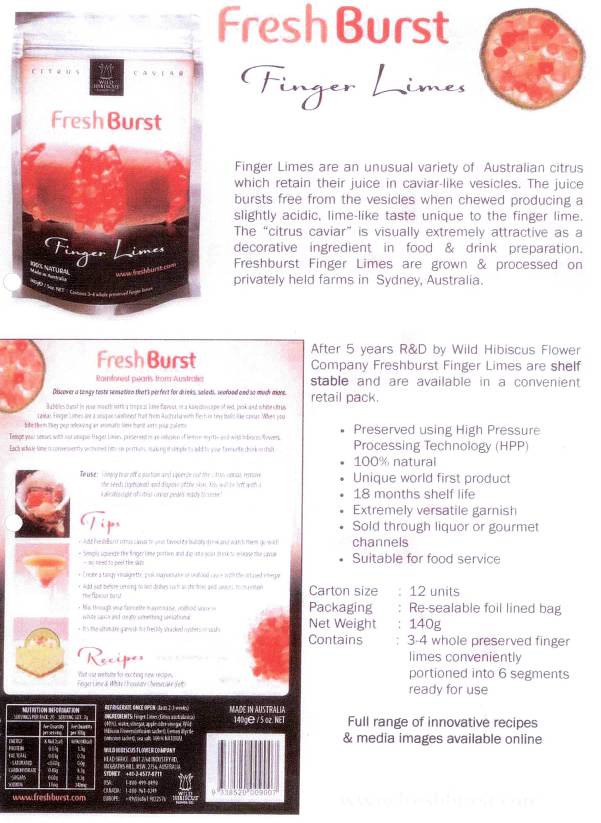
DATE: | 10 JANUARY 2012 |
PLACE: | SYDNEY |
REASONS FOR JUDGMENT
1 This is an application for urgent interlocutory injunctive and ancillary relief made by the applicants in this proceeding. By that interlocutory application, the applicants seek to restrain conduct which they contend constitutes an infringement of two registered trade marks, misleading or deceptive conduct or conduct that is likely to mislead or deceive, in contravention of s 18 of the Australian Consumer Law, and passing off.
2 The subject matter of the proceeding concerns trade marks used by one or other of the applicants in respect of the sale by them of a fruit called finger lime. A finger lime is a citrus fruit which is about the size and shape of a small zucchini. Its outer skin can be green, brown, yellow or red. Its pulp varies in colour from yellow to pink.
3 The applicants’ complaint is that the respondents have, in respect of a product which the applicants contend is the same as, or very similar to, the finger limes which they sell, used words and images which are substantially identical to or deceptively similar to the registered trade marks. It is obvious that the trade marks used by the respondents are not substantially identical to the first applicant’s registered trade marks. The real question which arises in the applicants’ trade mark infringement case is whether the respondents’ trade marks are deceptively similar to one or other of the first applicant’s registered trade marks.
4 The applicants first approached a Registrar of the Court in the afternoon of Thursday, 5 January 2012 ex parte and sought a listing before the Duty Judge on Friday, 6 January 2012. After some discussion between the solicitor for the applicants and the Duty Registrar, the Registry accepted the applicants’ documents for filing and listed the proceeding before me, as Duty Judge, yesterday (Monday, 9 January 2012) for consideration by me at that time. No orders were made last week. The solicitor for the applicants was informed by the Duty Registrar that, when the matter came before the Duty Judge on 9 January 2012, the applicants would have to persuade the Court that the application which they wished to make was urgent and should be dealt with accordingly.
5 The matter was listed before me at 10.15 am yesterday. On that occasion, the respondents were represented by their solicitor.
6 When the matter was called on, the respondents’ solicitor submitted that I should not deal with the matter at all because it was not urgent. He also submitted that I should not deal with the matter because there had been no orders made by a judge or a registrar abridging the time for service of the applicants’ Application and that the proceeding should simply fall to be dealt with in the ordinary way.
7 I ruled against these submissions and decided that I would deal with the applicants’ interlocutory application yesterday.
8 Accordingly, the interlocutory application made by the applicants was heard yesterday. These Reasons for Judgment determine that application.
The Registered Trade marks
9 The first applicant is the registered owner of two Australian registered trade marks. These are:
(1) Registered trade mark number 999861 in respect of the word limeburst in Class 31: Fresh fruit. This trade mark has a priority date of 30 April 2004.
(2) Registered trade mark number 1409853 being in respect of words and images in the following form:
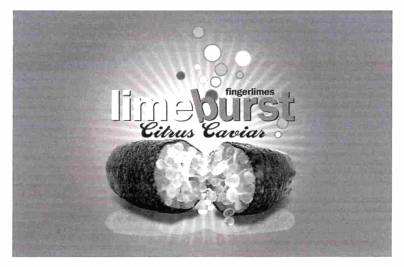
That registered trade mark is registered in Class 31: Citrus fruit. It has a priority date of 20 February 2011.
10 The first applicant has also made three additional trade mark applications to IP Australia which have not yet been determined. Those applications relate to the same words and images as are covered by the registered trade marks (that is to say the word “limeburst” and the composite mark comprising the words “fingerlimes”, “limeburst” and “Citrus Caviar” associated with the image of a finger lime fruit). By these additional applications, the applicants seek to procure registrations in three additional classes in respect of those trade marks (viz Classes 29, 32 and 33). The applicants identify food preserves; fruit, preserved; fruit pulp; food products made from preserved fruits; frozen fruits and fruit preserved in alcohol as the type of products in Class 29 in respect of which the first applicant seeks registration. They identify fruit beverages as the subject matter of interest in Classes 32 and 33.
Use By The Applicants
11 As I have mentioned, the first applicant is the registered owner of the registered trade marks and the applicant in respect of the other trade marks which are the subject of the additional, as yet undetermined, trade mark applications.
12 The first applicant gave evidence in his affidavit, affirmed on 23 December 2011, to the following effect:
(a) He created the image depicted in registered trade mark 1409853 in about mid to late 2005;
(b) He (personally) has been using the images in relation to the sale of finger limes (as a fruit);
(c) Since about mid to late 2005, he has grown finger limes and also procured finger limes through contract growers and then marketed, distributed and sold finger limes in Australia and other parts of the world using the trade marks depicted in the two registered trade marks and that he did so “… since in or about 2000 through a corporate entity called Fingerlimeing Good Pty Ltd (FLG) and then since in or about mid to late 2005 on my own account and/or by the [second applicant Limeburst Pty Ltd] pursuant to an unwritten arrangement, whereby I have agreed to allow the [second applicant] to use such marks and/or signs” (par 7 and par 8 of the first applicant’s affidavit).
(d) The word “Limeburst” is registered as a business name (although he does not say in whose name it is so registered); and
(e) The second applicant, Limeburst Pty Ltd, was incorporated on 9 August 2005.
13 In that affidavit, the first applicant also said (at pars 10–12):
10. Since in or about 2000, FLG and then myself since in or about mid to late 2005 have had:
a. Standing agreements with third party growers who grow fingerlimes from stock which I grafted and sold to them for the purpose of supplying and fulfilling orders for Australian and overseas customers;
b. Standing agreements with customers in Australia or overseas, including:
i. Special Fruits (Belgium);
ii. Chairreire (France);
iii. Nature’s Pride (The Netherlands);
iv. Guzzman (Spain);
v. Grund Sakeshallen (Sweden);
vi. 24 Carot (New Zealand);
vii. Katzman Produce (New York City, New York, USA);
viii. Grant Archez (Los Angeles, California, USA)
ix. David Jones (Sydney, NSW);
x. Flavours Fruit & Vegetables (Melbourne, Vic); and
xi. Andrew Felkie (Adelaide).
These companies are some of the most prominent and well-known food wholesalers in the world, and they themselves supply high-end retailers, food service and catering providers and restaurants.
11. Since in or about 2000, either through FLG or myself, in all correspondence, invoicing and labelling the trade marks annexed hereto have been used extensively.
12. In addition, since 2006 these trade marks have been used on my Limeburst websites which include, but are not limited to, the following: www.fingerlime.com.au, www.fingerlime.com, www.limeburst.com,
www.limeburst.com.au, www.limeburst.org and www.limebursts.com. I own all of these domain names. Annexed hereto and marked “G” is an extract from the “Who-is” website for these domain names showing me as the owner.
14 At the hearing, I allowed par 10, rejected par 11 and restricted par 12 of the first applicant’s affidavit to the use or uses specifically referred to in that paragraph and in Annexure “G” to the first applicant’s affidavit (see Boyd v Wild Hibiscus Flower Company Pty Ltd (No 1) [2012] FCA 73).
15 This material established that corporations associated with the first applicant had used the registered trade marks from about 2005 in connection with the sale of the fruit known as finger lime. Although the evidence was not particularly detailed and rather imprecise, it is, I think, for present purposes, sufficient to establish such use. The evidence is also sufficient, for present purposes, to establish that such use was with the permission and licence of the first applicant.
16 The first applicant also testified that he had a stand at the 2011 Anuga Food Expo and that he displayed material at that stand in relation to the proposed launch of a new product called “Fingerlime Limeburst Citrus Caviar”. There was no evidence that such a product had ever been sold in Australia by the applicants or any of them, nor was there any evidence as to the nature of that product or the likely or expected market for its sale and distribution.
17 The items sold by the applicants and its associates are finger lime fruits, either fresh, chilled or frozen. The fruit is sold in bulk by the kilogram to food wholesalers who onsell to high-end specialty retailers, caterers, chefs and restaurants. The finger lime fruit has a short shelf life. The finger lime fruit sold by the applicants and their associates fetches a much lower price per unit than each preserved finger lime sold by the respondents in the packages which I shall describe in more detail below.
The Applicants’ case
18 The applicants filed an Application and a Statement of Claim on 5 January 2012. The causes of action relied upon in the Statement of Claim may be summarised as follows:
(a) A cause of action for infringement of the registered trade marks (as to which, see s 120 of the Trade Marks Act 1995 (Cth));
(b) A cause of action based upon s 18 of the Australian Consumer Law (and cognate State legislation) (misleading and deceptive conduct or conduct likely to mislead or deceive); and
(c) A cause of action in the tort of passing off.
19 The conduct relied upon as the contravening conduct is the same for each of the causes of action relied upon in the Statement of Claim. It is pleaded in par 10 of the Statement of Claim in the following way:
10. Prior to the commencement of these proceedings, and both before and after the date and/or dates of registration of each of the registered trade marks and/or first use by the First Applicant [and/or other/s with his authority and/or consent] of the unregistered trade marks, the First Respondent infringed the First Applicant’s trade marks by the use in the course of trade of a sign and/or signs which is/are substantially identical with or deceptively similar to, the First Applicant’s trade marks in relation to goods which are identical and/or similar to those for which the registered trade marks are registered and the unregistered trade marks are and/or have been employed and such use, being without due cause, and without the authority or consent of the Applicant, has taken and, unless restrained, will continue to take unfair advantage of and/or is detrimental to the distinctive character and/or reputation of the First Applicant’s trade marks.
Particulars
The First Respondent has since a date unknown to the Applicants, marketed and sold fingerlimes to retail and/or other outlets under and/or bearing the mark “FreshBurst”. In particular the Applicants rely on the fact that such fingerlimes have been exposed and/or made available for sale in such manner, namely in the manner deposed to in paragraphs 15–20, 26–27 and 36, inclusive, of the First Applicant’s Affidavit affirmed 23 December 2011 and filed herein.
20 It is true that the applicants also plead in par 11 and par 14 of the Statement of Claim that they do not wish to be limited to the particulars upon which they currently rely in par 10 of the Statement of Claim and will seek either to amend the Statement of Claim or to supplement the allegations made therein with more particulars in due course. At the hearing, Counsel for the applicants repeated that the applicants did not wish to be confined by their pleadings and submitted that the Court should consider the applicants’ case on its merits by having regard to all of the evidence. I intend to approach the present application by considering the import of all of the alleged contravening conduct in which the respondents are said to have engaged. This is not to say, however, that the position advocated by the applicants is sound in principle.
21 The case against the individual respondents is based upon the relevant accessorial liability provisions in the Australian Consumer Law and the cognate state legislation.
22 The essence of the case sought to be made by the applicants is that, in October 2011, at the Anuga Food Expo held in Cologne, Germany at that time, the first respondent displayed signs and marketing material and promoted a product called “Citrus Caviar, FreshBurst, Fingerlimes” and also, at least from December 2011, sold to retail grocery outlets in Australia for resale by them to the public the same product that had been promoted in Cologne (the respondents’ product).
23 The applicants also complain about the use of the name or words “Freshburst” or “FreshBurst” in material on websites and in other promotional material.
24 The applicants contend that the use of the name or words “Freshburst” or “FreshBurst”, either alone or in conjunction with the words “Citrus Caviar” or “Citrus Caviar fingerlimes”, constitutes an infringement of the first applicant’s registered trade marks and also constitutes misleading or deceptive conduct, or conduct likely to mislead or deceive, and passing off by reason of the fact that either the first applicant or the second applicant has a substantial reputation in Australia in the subject matter of those trade marks.
The Respondents’ Product and Alleged Infringing Conduct
25 The respondents’ product is labelled “FreshBurst Citrus Caviar”. The product is made from finger limes. The finger lime fruit is preserved in a liquid preservative and placed in resealable foil packaging. The process by which this is done is confidential information of the first respondent and is said to be unique. Each package contains a few items of preserved finger lime fruit (three or four fruits). The packaging is designed to allow the package to be opened and resealed.
26 The respondents’ product is sold to grocery retailers, delicatessens (and other specialty stores) and supermarkets for resale by them to interested members of the public. It is also sold directly to consumers.
27 The respondents’ product is intended to be used as an additive to alcoholic drinks, a dip into a drink, part of a vinaigrette or mayonnaise, an additive to hot dishes or as a garnish for food such as oysters or sushi.
28 The front and reverse side of the packaging of the respondents’ product is accurately depicted in the photographs appearing at p 114 of Mr Boyd’s affidavit. I have attached a copy of those photographs to these Reasons for Judgment as Attachment “A”.
29 On the front of the packaging of the respondents’ product, the words “Citrus Caviar” appear in upper case across the top of that packaging in conjunction with the logo and name of the first respondent. Under those words, the word “FreshBurst” appears. “Fresh” is in the colour pink and “Burst” is in red. Under that word is a stylised image of a cut finger lime. That image shows finger lime pulp. The pulp is depicted as being pink or red in colour in a skin which is pink to brown in colour. Under the image of a finger lime, there are the words “Finger Limes” and reference to a website www.freshburst.com. The following words then appear:
Contains 3-4 whole preserved finger limes.
30 The reverse side of the packaging contains tips and recipes for using the contents of the package and some promotional text.
31 As I mentioned at [3], [22 and [23] above, the applicants complain about the sale, marketing and distribution of the respondents’ product and the use of the words “FreshBurst” or “Freshburst” by the respondents on their websites and in their business.
32 The respondents do not deny engaging in the conduct about which the applicants complain. They say that they were and are entitled to engage in that conduct.
Dealings Between The Parties
33 On 14 October 2011, an acquaintance of the first applicant emailed to him a flyer which the acquaintance had obtained at the Anuga Food Expo in Cologne which depicted the same packaging and promotional material as the first applicant himself had seen at that Expo.
34 This led the applicants to retain their solicitors to write letters of demand to each of the respondents. The letters of demand were essentially in the same terms in each case and were all dated and sent on 24 October 2011. Omitting formal parts, the text of the letter of demand sent to the third respondent was as follows:
RE: JAMES BOYD: TRADEMARK INFRINGEMENT;
I. James Boyd
We act on behalf of Mr James Boyd (“Mr Boyd”).
James Boyd is the owner of Registered Trade Marks for the words Limeburst and Fingerlimes Limeburst Citrus Caviar together with, inter alia, an image of a finger lime halved and the finger lime pods flowing out with Image Constituents Ball +, Bubble +, Citrus, Disc +, Fruit, Halved, Round +, Seed + and Sun,Rays being Australian Trade Marks 999861 and 1409853 as well as European Trade Mark 009750803 (“the Trade Marks”).
Mr Boyd distributes and sells finger limes via his business interests in Australia and in various parts of the world and in particular in Europe under the Trade Marks.
II. Your wrongful conduct
It has come to our client’s attention that Wild Hibiscus Flower Company Pty Ltd ACN 115 057 497 (“Wild Hibiscus”) has been offering for sale in Europe finger limes and/or finger lime products under the brand of “Freshburst” and a logo consisting of a finger lime halved and finger lime pods flowing out (“the Infringing Marks”). The Infringing Marks are deceptively similar to our client’s Trade Marks are likely to deceive or confuse the public.
More particularly, our client is aware that you have exhibited in Europe and in particular in Germany, finger lime products under the Infringing Marks, and further you have on the Anuga Food Expo 2011 website acknowledged that finger limes had won the top innovation award at FruitLogistica in Berlin earlier in 2011 which award was won by our client.
It is evident from the above statement that you were or would have, or should have, been aware of our client’s Trade Marks which were displayed at the FruitLogistica awards. This fact in itself shows a blatant disregard of our client’s intellectual property rights. Annexed hereto is a copy of the abovementioned article and the Wild Hibiscus Flower Company’s stand at the Drinking In Anuga 2011 Show held in South Africa between 8 and 12 October 2011.
The remedies available to our client for the infringement of his Trade Marks include declarations, injunctions, damages (including additional damages for flagrancy) or at his election an account of profits.
Your conduct also raises issues of passing off and if you are advertising and using the Infringing Marks in Australia, breach of the prohibitions on the making of misrepresentations under Australian Consumer Law.
Our client has suffered damage as a result of your wrongful conduct.
It is our client’s policy to rigorously enforce his rights where there has been any misuse of his intellectual property, and he is prepared to institute legal proceedings against your company to restrain it from engaging in this wrongful conduct, and to obtain damages or an account of profits. However, before embarking on that course, we have been instructed to write to you to see whether the matters to which we have referred above can be resolved amicably.
In these circumstances, and without prejudice to any actions, rights or remedies which our client may have, our client requires the following undertakings to be given on behalf of your company, its officers, servants and agents and you, your servants and agents:
1. Will cease to use the Infringing Marks;
2. Will destroy all materials, products and packaging containing the Infringing Marks.
3. That you and your company will, within 7 days of giving of these undertakings, advise us in writing of the quantity of stock of any packaging containing the Infringing Marks currently in your company’s power, possession, custody or control or in transit to it as at the date of this letter.
4. That you and your company, whether acting by itself, its servants, agents or howsoever otherwise will not order, accept delivery or sell further quantities of any products containing the Infringing Marks.
5. That you and your company, whether acting by themselves, their servants, agents or howsoever otherwise will immediately cease and forever desist from representing that any goods offered by you or your company have the sponsorship or approval of, or an affiliation with our client when that is not the case or otherwise engaging in misleading or deceptive conduct or passing off.
6. That you and your company will, within 7 days of giving these undertakings, provide us with copies of receipts, invoices and other documentation relating in any way whatsoever relating to any products sold by you containing the Infringing Marks or as a result of advertising containing the Infringing Marks.
7. That you and your company will pay our client’s legal costs incurred up to and including the date of resolution of the matter.
Our client regards this matter very seriously, and requires these undertakings to be provided by no later than 5 PM on Monday, 31 October 2011. These undertakings may be given by you and your company by executing the endorsements on the final page of the enclosed copy of this letter and returning your signed copy of this letter to us by the specified date.
In the event that you or your company are not prepared to provide the undertakings, or if provided they are not complied with, our client reserves his right to initiate court proceedings, seeking the full relief to which he is entitled and legal costs.
Our client would prefer to reach an agreed resolution which will protect their valuable rights, and not require litigation. However, if we do not receive your prompt and complete cooperation, then you can expect that our client will prepare for proceedings to issue against your company without further notice.
35 The respondents retained solicitors who were instructed to respond to these letters of demand.
36 By facsimile transmission dated 31 October 2011, the respondents’ solicitors denied that the respondents had infringed the applicants’ trade marks or contravened s 18 of the Australian Consumer Law or, indeed, had committed the tort of passing off. Their response was in the following terms:
WILD HIBISCUS FLOWER COMPANY PTY LTD -ATS- BOYD
Our Ref: 1110038
We act for Wild Hibiscus Flower Company Pty Limited and have a copy of your letter to our client dated 24 October 2011 with instructions to reply.
We note your client’s claim to be the registered owner of two trade marks, as follows:
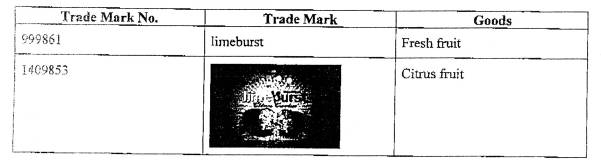
Your Client complains of our client's supply of citrus caviar under its freshburst trade mark and logo,
Of course, under s.120 of the Trade Marks Act, 1995 we consider that our client’s trade mark is neither identical with nor deceptively similar to either of the trade marks above. Accordingly, it follows that there is no infringement of any registered trade mark owned by your client.
Although your client seems to be claiming some exclusivity in the image of a finger lime fruit, the descriptive words “finger limes” and “citrus caviar”, no such exclusivity is available to your client as these are clearly descriptive.
Accordingly, for reasons that include the above reasons, we consider that your client’s threats of trade mark infringement are groundless threats for the purposes of s.129, Trade Marks Act, 1995 and should be immediately withdrawn. Our client reserves the right to commence such action under s.129 as it is advised in due course.
We also do not consider that any issues arise in respect of your claims for passing off and/or breaches of the Competition and Consumer Act 2010. You have supplied no information to enable your client’s reputation to be assessed, but further and importantly, a comparison of our client’s trade mark with that of the trade marks your client claims to own, does not give rise, in our view, to any likelihood of the relevant class of consumers being misled or deceived such as to ground a cause of action under the Act or in passing off.
In the above circumstances, our client will not be providing the undertakings sought.
37 There were then two further communications emanating from the applicants’ lawyers. These were a letter dated 1 December 2011 and an email dated 30 December 2011.
38 Omitting the formal parts, the letter dated 1 December 2011 was in the following terms:
RE: JAMES BOYD; TRADEMARK INFRINGEMENT;
We refer to the above matter.
Thank you for your letter dated 3 November 2011.
The allegations made in your abovementioned letter are rejected out of hand.
We note your client, that is Wild Hibiscus Flower Company Pty Ltd ACN 115 057 497, will not provide the undertakings sought in our letter to it of 24 October 2011.
Accordingly, please confirm that you have instructions to accept service for:
1. Wild Hibiscus Flower Company Pty Ltd ACN 115 057 497;
2. Wild Hibiscus Flower Pty Limited ACN 140 669 361;
3. Wild Hibiscus Plant and Equipment Pty Limited ACN 140 670 837;
4. Wild Hibiscus Holdings Pty Limited ACN 131 809 213;
5. Wild Hibiscus Nominees Pty Limited ACN 131 788 719;
6. Ms Jocelyn Lily Gale Etherington; and
7. Mr Lee Etherington.
39 The email dated 30 December 2011 was in the following terms:
RE: JAMES BOYD: TRADEMARK INFRINGEMENT;
We refer to the above matter and in particular to our letter to you of 1 December 2011, to which we note we have received no response.
Please advise us as a matter of urgency whether you have instructions to accept service.
40 No further communication passed between the parties or their lawyers before the solicitor for the applicants approached the Duty Registrar last week.
Consideration
Relevant Principles
41 In Samsung Electronics Co Limited v Apple Inc [2011] FCAFC 156 at [52]–[69] the Full Court discussed and explained the relevant principles when the Court is required to consider whether or not to grant an interlocutory injunction in respect of private rights. The Full Court said:
The Correct Approach
52 In Lenah Game Meats, a majority of the High Court held that, where an interlocutory injunction is sought (inter alia) in respect of private rights, it is necessary to identify the legal or equitable rights which are to be determined at the trial and in respect of which the final relief is sought. As Gleeson CJ said at [15] (p 218):
If the respondent cannot show a sufficient colour of right of the kind sought to be vindicated by final relief, the foundation of the claim for interlocutory relief disappears.
See also [8] to [21] (pp 216–220) (per Gleeson CJ); [59] to [61] (pp 231–232) (per Gaudron J); and [86] to [92] (pp 239–242); [98] to [100] (pp 244–246); and [105] (p 248) (per Gummow and Hayne JJ). At [10] (p 216), Gleeson CJ also specifically cited with approval Spry, The Principles of Equitable Remedies (5th edn, 1997) (pp 446–456).
53 At [13] (p 218), Gleeson CJ expressly approved the following passage from the judgment of Mason ACJ in Castlemaine Tooheys Ltd v South Australia (1986) 161 CLR 148 at 153:
In order to secure such an injunction the plaintiff must show (1) that there is a serious question to be tried or that the plaintiff has made out a prima facie case, in the sense that if the evidence remains as it is there is a probability that at the trial of the action the plaintiff will be held entitled to relief; (2) that he will suffer irreparable injury for which damages will not be an adequate compensation unless an injunction is granted; and (3) that the balance of convenience favours the granting of an injunction.
54 These remarks made by Mason ACJ which were approved by Gleeson CJ in Lenah Game Meats echo the observations made by the High Court in Beecham.
55 In Beecham, the High Court (Kitto, Taylor, Menzies and Owen JJ) said (at 622–623):
The Court addresses itself in all cases, patent as well as other, to two main inquiries. The first is whether the plaintiff has made out a prima facie case, in the sense that if the evidence remains as it is there is a probability that at the trial of the action the plaintiff will be held entitled to relief: Preston v. Luck (1884) 27 Ch.D. 497, at p.506); Challender v. Royle (1887) 36 Ch.D. 425, at p.436. How strong the probability needs to be depends, no doubt, upon the nature of the rights he asserts and the practical consequences likely to flow from the order he seeks. Thus, if merely pecuniary interests are involved, “some” probability of success is enough: Attorney-General v. Wigan Corporation (1854) 5 De G.M. & G. 52, at pp. 53, 54 [43 E.R. 789] and in general it is right to say, as Roper C.J. in Eq. said in Linfield Linen Pty. Ltd. v. Nejain (1951) 51 S.R. (N.S.W.) 280, at p. 281
“There are disputes of fact as to a number of matters ... but this being an application for an interlocutory injunction I look at the facts simply to ascertain whether the plaintiff has established a fair prima facie case and a fair probability of being able to succeed in that case at the hearing.”
Thus where the defendant goes into evidence on the interlocutory application the Court does not undertake a preliminary trial, and give or withhold interlocutory relief upon a forecast as to the ultimate result of the case. James L.J. explained the general attitude of the Court when he said, in Plimpton v. Spiller (1876) 4 Ch.D. 286, at p.289, in relation to a patent action where there was no outstanding issue as to validity:
“... the Court, not forming an opinion very strongly either one way or the other whether there is an infringement or not, but considering it as a fairly open question to be determined at the hearing, and not to be prejudiced by any observation in the first instance, reserves the question of infringement as one which will have to be tried at the hearing, and which it will then have to consider.”
And he proceeded to discuss what was the best mode of keeping things in statu quo:
“... for that”—he said—“is what the Court has to do—to keep things in statu quo—until the final decision of the question.”
This is generally true, but in a particular case it may be that although the plaintiff has shown a probability of success other considerations make it unjust to grant an injunction, especially if another form of interlocutory relief is possible. The second inquiry is directed to this aspect of the matter. It is whether the inconvenience or injury which the plaintiff would be likely to suffer if an injunction were refused outweighs or is outweighed by the injury which the defendant would suffer if an injunction were granted. It is of course to be remembered that if an injunction be granted it will be upon terms of the plaintiff submitting, in the event of his ultimately failing, to such order as to damages as the Court may make in order to compensate the defendant for any injury caused by the injunction; and likewise it is to be remembered that if the injunction be refused the defendant may be required to keep an account of the profits he makes from the course of conduct of which the plaintiff complains, so that, if he loses the case and the plaintiff elects under s. 118 of the Patents Act to recover the amount of those profits rather than damages, the quantum will be readily ascertainable.
56 In Beecham, after making the observations extracted at [55] above and after referring to certain matters of practice, the High Court proceeded to discuss the circumstances in play in that case. In the course of that discussion, the Court noted that the validity of the relevant patents had only recently been put in issue and then only faintly. Invalidity was, therefore, not really in issue or contested before the High Court in Beecham. On the issue of infringement, the Court said that, upon the material then before the Court, Beecham had shown so substantial a probability of succeeding at the trial that it was entitled to have the status quo preserved. Implicit in that remark was the proposition that the Court had assessed the strength of that probability and had come to the view that it justified injunctive relief. The Court went on to hold that the keeping of accounts would not adequately meet the circumstances which obtained in Beecham.
57 In O’Neill at [65] (pp 81–82), Gummow and Hayne JJ said that the relevant principles were those explained in Beecham. Gleeson CJ and Crennan J agreed with that proposition. When referring to the well-known passage in Beecham at 622–623 (which we have extracted at [55] above), Gummow and Hayne JJ then said, at [65] (pp 81–82), that, when considering an application for an interlocutory injunction, the Court must address itself to two main inquiries (viz has the plaintiff established a prima facie case in the sense explained in Beecham and does the balance of convenience and justice favour the grant of an injunction or the refusal of that relief). Their Honours then observed:
By using the phrase “prima facie case”, their Honours did not mean that the plaintiff must show that it is more probable than not that at trial the plaintiff will succeed; it is sufficient that the plaintiff show a sufficient likelihood of success to justify in the circumstances the preservation of the status quo pending the trial. That this was the sense in which the Court was referring to the notion of a prima facie case is apparent from an observation to that effect made by Kitto J in the course of argument [(1968) 118 CLR 618 at 620]. With reference to the first inquiry, the Court continued, in a statement of central importance for this appeal [(1968) 118 CLR 618 at 622]:
“How strong the probability needs to be depends, no doubt, upon the nature of the rights [the plaintiff] asserts and the practical consequences likely to flow from the order he seeks.”
58 At [68] to [72] (pp 83 and 84), their Honours went on to explain the similarities and differences between the test expounded in Beecham and the test articulated in American Cyanamid Co v Ethicon Ltd [1975] AC 396 as follows:
68. Lord Diplock was at pains to dispel the notion, which apparently had persuaded the Court of Appeal to refuse interlocutory relief, that to establish a prima face case of infringement it was necessary for the plaintiff to demonstrate more than a 50 per cent chance of ultimate success. Thus Lord Diplock remarked:
“The purpose sought to be achieved by giving to the court discretion to grant such injunctions would be stultified if the discretion were clogged by a technical rule forbidding its exercise if upon that incomplete untested evidence the court evaluated the chances of the plaintiff's ultimate success in the action at 50 per cent or less, but permitting its exercise if the court evaluated his chances at more than 50 per cent.”
69 In Beecham, the primary judge, McTiernan J, had refused interlocutory relief on the footing that, while he could not dismiss the possibility that the defendant might not fail at trial, the plaintiff had not made out a strong enough case on the question of infringement. Hence the statement by Kitto J in the course of argument in the Full Court that it was not necessary for the plaintiff to show that it was more probable than not that the plaintiff would succeed at trial.
70 When Beecham and American Cyanamid are read with an understanding of the issues for determination and an appreciation of the similarity in outcome, much of the assumed disparity in principle between them loses its force. There is then no objection to the use of the phrase “serious question” if it is understood as conveying the notion that the seriousness of the question, like the strength of the probability referred to in Beecham, depends upon the considerations emphasised in Beecham.
71 However, a difference between this Court in Beecham and the House of Lords in American Cyanamid lies in the apparent statement by Lord Diplock that, provided the court is satisfied that the plaintiff's claim is not frivolous or vexatious, then there will be a serious question to be tried and this will be sufficient. The critical statement by his Lordship is “[t]he court no doubt must be satisfied that the claim is not frivolous or vexatious; in other words, that there is a serious question to be tried” [[1975] AC 396 at 407]. That was followed by a proposition which appears to reverse matters of onus [[1975] AC 396 at 408]:
So unless the material available to the court at the hearing of the application for an interlocutory injunction fails to disclose that the plaintiff has any real prospect of succeeding in his claim for a permanent injunction at the trial, the court should go on to consider whether the balance of convenience lies in favour of granting or refusing the interlocutory relief that is sought. (emphasis added)
Those statements do not accord with the doctrine in this Court as established by Beecham and should not be followed. They obscure the governing consideration that the requisite strength of the probability of ultimate success depends upon the nature of the rights asserted and the practical consequences likely to flow from the interlocutory order sought.
72 The second of these matters, the reference to practical consequences, is illustrated by the particular considerations which arise where the grant or refusal of an interlocutory injunction in effect would dispose of the action finally in favour of whichever party succeeded on that application [See the judgment of McLelland J in Kolback Securities Ltd v Epoch Mining NL (1987) 8 NSWLR 533 at 535-536 and the article by Sofronoff, “Interlocutory Injunctions Having Final Effect”, Australian Law Journal, vol 61 (1987) 341.95]. The first consideration mentioned in Beecham, the nature of the rights asserted by the plaintiff, redirects attention to the present appeal.
59 Both Beecham and American Cyanamid were cases of patent infringement. The appeal in each case resulted in the grant of an interlocutory injunction in favour of the patentee. The critical integer in the test explained in Beecham is the need for the Court to assess the strength of the probability of ultimate success on the part of the plaintiff. The strength of that probability will depend upon the nature of the rights asserted and the practical consequences likely to flow from the grant of the injunction which is sought. The emphasis in Beecham is on the need to assess the plaintiff’s probability of success at trial. The extent of the strength required will vary from case to case.
60 At [19] (p 68) in O’Neill, Gleeson CJ and Crennan J said:
As Doyle CJ said in the last-mentioned case, in all applications for an interlocutory injunction, a court will ask whether the plaintiff has shown that there is a serious question to be tried as to the plaintiff's entitlement to relief, has shown that the plaintiff is likely to suffer injury for which damages will not be an adequate remedy, and has shown that the balance of convenience favours the granting of an injunction. These are the organising principles, to be applied having regard to the nature and circumstances of the case, under which issues of justice and convenience are addressed. We agree with the explanation of these organising principles in the reasons of Gummow and Hayne JJ. (See [65]–[72], and their reiteration that the doctrine of the Court established in Beecham Group Ltd v Bristol Laboratories Pty Ltd (1968) 118 CLR 618 should be followed. See also Firth Industries Ltd v Polyglas Engineering Pty Ltd (1975) 132 CLR 489 at 492 per Stephen J; Winthrop Investments Ltd v Winns Ltd [1975] 2 NSWLR 666 at 708 per Mahoney JA; World Series Cricket Pty Ltd v Parish (1977) 16 ALR 181 at 186 per Bowen CJ.)
61 The requirement that, in order to obtain an interlocutory injunction, the plaintiff must demonstrate that, if no injunction is granted, he or she will suffer irreparable injury for which damages will not be adequate compensation (the second requirement specified by Mason ACJ in Castlemaine Tooheys at p 153) was not mentioned in Beecham. Nor was it referred to by Gummow and Hayne JJ in O’Neill. Nonetheless, Gleeson CJ and Crennan J included that requirement in their articulation of the relevant “organising principles” (at [19] (p 68) in O’Neill). They also agreed with the explanation of those principles given by Gummow and Hayne JJ at [65]–[72] (pp 81–84) in the same case. One way of reconciling the views of Gleeson CJ and Crennan J with those of Gummow and Hayne JJ on this point is to treat “irreparable harm” as one of the matters which would ordinarily need to be addressed in the Court’s consideration of the balance of convenience and justice rather than as a distinct and antecedent consideration. This has been the approach taken by some judges (eg Ashley J in AB Hassle v Pharmacia (Australia) Pty Ltd (1995) 33 IPR 63 at 76–77; Gordon J in Marley New Zealand Ltd v Icon Plastics Pty Ltd [2007] FCA 851 at [3]; Kenny J in Medrad Inc v Alpine Pty Ltd (2009) 82 IPR 101 at [38] (p 109); and Yates J in Instyle Contract Textiles Pty Ltd v Good Environmental Choice Services Pty Ltd (No 2) [2010] FCA 38 at [55]–[64]).
62 The assessment of harm to the plaintiff, if there is no injunction, and the assessment of prejudice or harm to the defendant, if an injunction is granted, is at the heart of the basket of discretionary considerations which must be addressed and weighed as part of the Court’s consideration of the balance of convenience and justice. The question of whether damages will be an adequate remedy for the alleged infringement of the plaintiff’s rights will always need to be considered when the Court has an application for interlocutory injunctive relief before it. It may or may not be determinative in any given case. That question involves an assessment by the Court as to whether the plaintiff would, in all material respects, be in as good a position if he were confined to his damages remedy, as he would be in if an injunction were granted (see the discussion of this aspect in Spry, The Principles of Equitable Remedies (8th edn, 2010) at pp 383–389; at pp 397–399; and at pp 457–462).
63 The interaction between the Court’s assessment of the likely harm to the plaintiff, if no injunction is granted, and its assessment of the adequacy of damages as a remedy, will always be an important factor in the Court’s determination of where the balance of convenience and justice lies. To elevate these matters into a separate and antecedent inquiry as part of a requirement in every case that the plaintiff establish “irreparable injury” is, in our judgment, to adopt too rigid an approach. These matters are best left to be considered as part of the Court’s assessment of the balance of convenience and justice even though they will inevitably fall to be considered in most cases and will almost always be important considerations to be taken into account.
64 Gleeson CJ also observed in Lenah Game Meats (at [18] (p 219)), that, where there is little or no room for argument about the legal basis of the applicant’s claimed private right, the court will be more easily persuaded at an interlocutory stage that a prima facie case has been established. The court will then move on to consider discretionary considerations, including the balance of convenience and justice. But, as his Honour also observed at [18] (p 219):
The extent to which it is necessary, or appropriate, to examine the legal merits of a plaintiff’s claim for final relief, in determining whether to grant an interlocutory injunction, will depend upon the circumstances of the case. There is no inflexible rule.
65 The resolution of the question of where the balance of convenience and justice lies requires the Court to exercise a discretion.
66 In exercising that discretion, the Court is required to assess and compare the prejudice and hardship likely to be suffered by the defendant, third persons and the public generally if an injunction is granted, with that which is likely to be suffered by the plaintiff if no injunction is granted. In determining this question, the Court must make an assessment of the likelihood that the final relief (if granted) will adequately compensate the plaintiff for the continuing breaches which will have occurred between the date of the interlocutory hearing and the date when final relief might be expected to be granted.
67 As Sundberg J observed in Sigma Pharmaceuticals (Australia) Pty Ltd v Wyeth (2009) 81 IPR 339 at [15] (p 342), when considering whether to grant an interlocutory injunction, the issue of whether the plaintiff has made out a prima facie case and whether the balance of convenience and justice favours the grant of an injunction are related inquiries. The question of whether there is a serious question or a prima facie case should not be considered in isolation from the balance of convenience. The apparent strength of the parties’ substantive cases will often be an important consideration to be weighed in the balance: Tidy Tea Ltd v Unilever Australia Ltd (1995) 32 IPR 405 at [416] per Burchett J; Aktiebolaget Hassle v Biochemie Australia Pty Ltd (2003) 57 IPR 1 at [31] (p 10) per Sackville J; Hexal Australia Pty Ltd v Roche Therapeutics Inc (2005) 66 IPR 325 at [18] (p 329) per Stone J; and Castlemaine Tooheys at 154 per Mason ACJ.
68 It may also be necessary to consider and evaluate the impact that the grant or refusal of an injunction will have or is likely to have on third persons and the public generally.
69 In Patrick at [65] and [66] (pp 41–43), Brennan CJ and McHugh, Gummow, Kirby and Hayne JJ, in a joint judgment, expressly adopted a passage from Spry, The Principles of Equitable Remedies (5th edn, 1997) (at pp 402–403), which may be summarised as follows:
(a) In assessing the balance of convenience in an interlocutory injunction application, the interests of the public and third persons are relevant and have more or less weight according to other material circumstances;
(b) Whether those interests tend to favour the grant or the refusal of an injunction in any given case depends upon the circumstances of that case; and
(c) Hardship visited upon third persons or the public generally by the grant of an interlocutory injunction will rarely be decisive.
42 I propose to apply these principles in the present case.
Prima Facie Case
43 The applicants submitted that their case was quite straightforward.
44 As far as the trade mark infringement case was concerned, the applicants pointed to the admitted conduct on the part of the respondents and to the subject matter of the registered trade marks owned by the first applicant and submitted that it is “plain” that the respondents have used a trade mark which is either the same as or deceptively similar to the registered trade marks owned by the first applicant.
45 In addition, for essentially the same reasons the applicants submitted that the respondents had contravened and were continuing to contravene s 18 of the Australian Consumer Law and were and are guilty of the tort of passing off.
46 As far as registered trade mark 999861 is concerned, the applicants must persuade the Court that the use by the first respondent of the word “FreshBurst” on the packaging of its product is the use of a trade mark which is substantially identical to or deceptively similar to the mark “limeburst”. I must say that I have great difficulty in accepting that proposition. The words are quite different, although the word “burst” is common to both. The word “burst” describes the sensation felt by the consumer when biting into or tasting the pulp of the finger lime. Each of the words “lime”, “fresh” and “burst” are words commonly used in the English language. Applying the appropriate test, that is to say, having looked at “limeburst” and having an imperfect but impressionistic recollection of it when one comes to look at “FreshBurst”, does one recall “limeburst”? I think not.
47 In addition, the get up of the respondents’ product includes mention of the first respondent by name thereby distinguishing the product from the fruit sold by the applicants.
48 Of course, on an application such as this it is not for me finally to decide that question. The applicants’ case based upon the contention that “FreshBurst” is deceptively similar to “limeburst” is, at best, weak and I will proceed upon that basis.
49 As far as the registered trade mark 1409853 is concerned (the composite mark comprising words and images) (as to which see [9] above), I also have difficulty in accepting that the use by the respondents on its product of the word “FreshBurst” in association with the words “Citrus Caviar” and the image of a finger lime constitutes an infringement of that trade mark.
50 The respondents have tendered on this application a significant amount of publicly available material which demonstrates, I think, quite emphatically that the words “citrus caviar” are used descriptively in respect of finger limes by growers and traders in the relevant markets to describe the physical appearance of the contents of the finger lime when cut. When a finger lime is cut, the contents tend to tumble out in small balls resembling caviar, in some cases pink or near to pink in colour, and in other cases yellow or lime.
51 All parties accepted that the applicants could not claim intellectual property rights in a picture of a finger lime on its own. It was the applicants’ case that one has to look at the entirety of the mark, which includes the words, the way in which the word “limeburst” is presented, the expression “citrus caviar” and the fruit, and then decide whether the use of the words and images which the respondents have used on their product constitutes an infringement. Again, I have difficulty accepting that the material relied upon constitutes an infringement of the applicants’ composite trade mark.
52 Both of the registered trade marks are registered in respect of fruit—one concerns fresh fruit and the other is registered in respect of citrus fruit.
53 The applicants’ businesses to date have all involved the sale of finger limes (either fresh, chilled or frozen). The respondents’ product consists of preserved fruit. To me, there is a difference between fresh fruit in its natural state and the same fruit in a preserved state. They are different “products”.
54 The persons likely to buy fresh finger limes (the fruit) are wholesalers and middle men (chefs, restaurants and specialty shops) who wish to use the fruit in the food and beverages prepared and offered by them to their customers. The persons likely ultimately to buy the respondents’ product are consumers who intend to use and consume the product themselves.
55 Even if I were to think that the words and images deployed by the respondents on their product were deceptively similar to the first applicant’s registered trade marks (which I do not), the matters to which I have referred at [52]–[54] above suggest that the use by the respondents of their trade marks is not a use in relation to goods in respect of which the first applicant’s trade marks are registered. This circumstance places yet another obstacle in the way of the applicants’ trade mark infringement case (as to which see s 120(1) of the Trade Marks Act 1995 (Cth)).
56 I am, therefore, not persuaded that the applicants have established a prima facie case of trade mark infringement or serious question to be tried in relation to that case.
57 Nonetheless, in case I am wrong on the question of prima facie case, I will move on to consider the remaining issues upon the assumption that the applicants have established that there is a serious question to be tried or prima facie case.
58 Before leaving the question of prima facie case, I should remark that the same views as I have expressed in respect of the applicants’ trade mark infringement case apply equally to the other causes of action relied upon by them. The applicants’ reputation in Australia subsists in respect of the sale of finger lime fruit under the “limeburst” banner. I do not think that the respondents’ promotion and sale of preserved finger limes under the “FreshBurst” name constitutes passing off or misleading or deceptive conduct.
The Balance of Convenience and Justice
59 The applicants have been aware of the respondents’ conduct about which they now complain since October 2011. Counsel for the applicants submitted that the applicants’ conduct up to late December 2011 was reasonable in all the circumstances because they were pursuing their rights at IP Australia in relation to competing trade mark applications being made by the first respondent and were engaged in sensible pre-litigation communications with the lawyers for the respondents so that up until late December 2011 there is a reasonable explanation as to why steps were not taken earlier to protect the applicants’ rights. He then submitted that, in December 2011, the applicants became aware of fresh contravening conduct (that is to say the sale of the offending product in Australia) which changed the landscape and forced the applicants to confront the fact that they needed to take action to protect their rights. However, even then, and notwithstanding that affidavits were prepared by 23 December 2011, no application to the Court was made until 5 January 2012.
60 When one looks at the terms of the letters of demand made on 24 October 2011, it is fairly clear that, although the conduct complained in those letters of took place overseas, the essence of the allegations made by the solicitors for the applicants in those letters was the same as the fundamental complaint which is now made, that is to say, that the use of the brand name “Freshburst” or “FreshBurst” either alone or in conjunction with an image of a finger lime cut in half and finger lime pods flowing out of the sliced fruit were uses which were deceptively similar to the registered trade marks.
61 The truth is that the delay in bringing forward the present interlocutory application is unexplained.
62 In the period from at least 24 October 2011 to date, the respondents have taken steps to market, distribute and sell their product. Although the respondents were warned by the solicitors for the applicants in October 2011 that proceedings might be taken if the respondents did not cease selling their product, they were entitled to assume that the applicants were not going to proceed, given that the applicants did not commence proceedings in the face of the respondents’ denial of wrongdoing at any time in the period of just over ten weeks after the letters of demand were sent on 24 October 2011. It seems to me that this period of delay alone on the part of the applicants would on its own be sufficient to refuse the interlocutory relief which they now claim.
63 In addition, there are other reasons which tip the scales against the grant of interlocutory relief.
64 The applicants have simply ignored consideration of the question of whether, if no injunctions are granted, they will suffer irreparable harm. The applicants adduced no evidence and made no submission directed to this matter. The applicants did not suggest that monetary or pecuniary relief would not be an adequate remedy for the applicants in respect of the period between today and the final determination of the proceeding were they ultimately to succeed in the case at trial.
65 Furthermore, the applicants failed adequately to address the prejudice which the respondents are likely to suffer if injunctions were granted. There was evidence filed on behalf of the respondents which, after explaining the history of the respondents’ relevant businesses, addressed the balance of convenience and justice.
66 At par 8 of the affidavit of Mr Whitehead, affirmed on 9 January 2012, the deponent said:
8. I am also informed by Mr Etherington and verily believe as follows:
(a) he has developed a processing technology that enables finger lime fruit used in the manufacture of the First Respondent’s FreshBurst products to be cooked and preserved without heat so as to have a shelf life of about 2 years whilst retaining the freshness of the fruit. It also enables consumers to buy small quantities of 3 pieces;
(b) Mr Etherington knows of no other entity that presently processes the fruit in the way that the First Respondent does and that it has taken him about 4 years to develop the technology and the FreshBurst product sold by the First Respondent;
(c) the season during which finger lime fruits grows commences in about mid January and finishes in approximately March or April of each year, depending on weather conditions;
(d) Mr Etherington has made commitments to growers of the fruit for the First Respondent to purchase approximately 6 tonnes of fruit at a cost of approximately $150,000 in the current season and this will produce about 100,000 units of the FreshBurst product;
(e) the technology used by the First Respondent to process the fruit into its FreshBurst product requires processing almost as soon as the fruit is received from growers;
(f) in order to process the fruit into the FreshBurst product, the First Respondent has leased a machine from Europe for the duration of the current season that arrives in a week or so at a cost of €70, 000;
(g) it has taken some time for the First Respondent to develop the packaging that is being used on its FreshBurst product that was displayed at a Trade Show in Europe in October 2011;
(h) since October 2011, the First Respondent has launched and received orders in relation to its FreshBurst product in Europe;
(i) since in or about November 2011, the First Respondent has been selling its FreshBurst product in Australia;
(j) the packaging for the FreshBurst product is printed with the design under which it is sold prior to processing of the fruit so that when packaged the product is ready to be sold to the market;
(k) in addition to the cost of finger limes referred to in subparagraph (d) about $170,000 has already been invested into the FreshBurst product and thousands of hours have been spent on research, trials and testing over the past 4 years;
(l) if the First Respondent is forced to rebrand, it will have delays in its production of the FreshBurst product such that the product will have to be packaged in blank packaging. When an appropriate packaging design is then developed which could take many weeks, the packaged FreshBurst product packaging would need to be hand labelled and this is of inferior quality than pre-printed packaging;
(m) the cost of printing and relabelling if a rebranding is required will cause both delays in the First Respondent supplying both the Australian and Overseas markets and will increase the First Respondent’s cost of production by about $35,000.00 to $40,000.00 for a packaging quality that will have an inferior appearance.
67 That material demonstrates quite clearly that there would be serious prejudice to the respondents if an injunction is granted.
68 The applicants submitted that the prejudice was insignificant. However, I do not agree. The disruption to the marketing and sale of the respondents’ product and the cost that would be visited upon the respondents in order to meet the requirements of any injunction are considerable and cannot be ignored. The applicants sat on their hands from early October 2011 until 5 January 2012 during which time the respondents spent considerable time, effort and money promoting and marketing their product.
69 Finally, it is important to remember that, when one comes to consider the question of the balance of convenience and justice, to some extent it is appropriate and necessary to consider the strength of the case that is being put by the applicants. In this regard, as I have already mentioned, I do not think that the conduct relied upon by the applicants constitutes trade mark infringement or constitutes the other contraventions relied upon by the applicants. I am entitled to take into account my assessment of the strength of the applicants’ case when weighing the balance of convenience and justice. At best, the applicants’ case is weak.
Conclusions
70 In my view, the applicants have failed to make out a prima facie case or serious question to be tried. In any event, even if I am wrong about that conclusion, it seems to me that the balance of convenience and justice clearly favours the refusal of the interlocutory relief which the applicants seek. For all of the reasons I have explained, I will refuse the applicants’ application for interlocutory relief sought.
71 In response to an invitation from me, the first respondent is prepared to give an interlocutory undertaking to the Court to keep accounts in respect of all sales of the respondents’ product in Australia. I think that the Court should accept that undertaking. The applicants will be required to give the usual undertaking as to damages in the event that they wish to have the benefit of the first respondents’ undertaking to keep accounts.
72 After I delivered Reasons for Judgment on the applicants’ application for interlocutory relief, the solicitor for the respondents sought an order for costs in favour of his clients together with an additional order that those costs be taxed and paid forthwith. He submitted on behalf of the respondents that the disposition of the present interlocutory application is a separate and distinct matter from the balance of the proceeding and that the forensic reversal which the applicants have suffered was of such a character that the applicants should now be ordered to pay the costs of and incidental to that application.
73 Counsel for the applicants, on the other hand, submitted that, very often in interlocutory matters, an order for costs is not made against a party, even in circumstances where that party has lost the particular application. He submitted that it is often the case that an unsuccessful party in an interlocutory injunction application is not visited with a costs burden when that interlocutory application is determined by the Court and that the question of costs is often dealt with at the conclusion of the proceeding in the Court’s final judgment. He submitted that I should take the latter course in the present case because it may well be that his clients ultimately prevail at trial and that, for this reason, they ought to be entitled to have the question of the costs of the present application considered in light of that potential for final success.
74 The question of costs is a matter in the discretion of the Court. Section 43 of the Federal Court of Australia Act 1976 (Cth) gives a very broad discretion to a judge when considering the question of costs. However, as I said in Kazar (Liquidator) v Kargarian; In the Matter of Frontier Architects Pty Ltd (In Liq) (2011) 197 FCR 113 at [44]–[47] (pp 124–125), it is very often an appropriate exercise of that discretion for the Court to award costs in favour of that party who prevails in relation to the particular “event”. Here, the relevant “event” is the refusal of interlocutory relief.
75 In the present case, it seems to me that the applicants’ interlocutory application should not have been brought. The applicants’ trade mark infringement case is, at best, weak, as are the cases based upon s 18 of the Australian Consumer Law and the tort of passing off. It seems to me that there were powerful reasons why the balance of convenience and justice were against the grant interlocutory relief.
76 For these reasons, I think that the appropriate order is an order that the applicants pay the respondents’ costs of and incidental to the interlocutory application made by the applicants and determined by me today.
77 The next point is whether or not the respondents should be permitted to tax those costs forthwith. I think that in a matter such as this, where the parties are going to be required to expend significant sums of money if the proceeding is to be pursued, it is appropriate to allow parties who have succeeded in the way in which the respondents have succeeded in the present case and who now have the benefit of an order for costs, to be permitted to tax those costs forthwith. Accordingly, I will also order that the respondents be permitted to tax forthwith the order for costs which I have just made.
78 There will be orders accordingly.
I certify that the preceding seventy-eight (78) numbered paragraphs are a true copy of the Reasons for Judgment herein of the Honourable Justice Foster. |
Associate:
Attachment A