

FEDERAL COURT OF AUSTRALIA
Secretary, Department of Health and Ageing v Export Corporation (Australia) Pty Ltd [2012] FCA 42
IN THE FEDERAL COURT OF AUSTRALIA | |
SECRETARY, DEPARTMENT OF HEALTH AND AGEING Applicant | |
AND: | EXPORT CORPORATION (AUSTRALIA) PTY LTD ACN 009 441 632 Respondent |
DATE OF ORDER: | |
WHERE MADE: | SYDNEY (HEARD IN CANBERRA) |
THE COURT ORDERS THAT:
1. The parties bring in short minutes of order giving effect to these reasons within seven days.
Note: Entry of orders is dealt with in Rule 39.32 of the Federal Court Rules 2011.
AUSTRALIAN CAPITAL TERRITORY DISTRICT REGISTRY | |
GENERAL DIVISION | ACD 38 of 2009 |
BETWEEN: | SECRETARY, DEPARTMENT OF HEALTH AND AGEING Applicant
|
AND: | EXPORT CORPORATION (AUSTRALIA) PTY LTD ACN 009 441 632 Respondent
|
JUDGE: | PERRAM J |
DATE: | 3 february 2012 |
PLACE: | sydney (heard in CANBERRA) |
REASONS FOR JUDGMENT
I. Introduction
1 The substantive question which arises in this case is the size of the civil penalty which should be imposed upon the respondent (‘Export Corporation’) for its actions in: first, importing into this country some 35 different products each of which was a ‘therapeutic good’ within the meaning of the Therapeutic Goods Act 1989 (Cth) (‘the Act’); and, secondly, the supply to various retailers of 36 products which were also therapeutic goods. It is sufficient to observe at the outset that the quantities imported and then supplied were substantial reflecting, no doubt, the fact that the business of Export Corporation consists of the import and supply of therapeutic goods.
2 There is no disagreement between the applicant (‘the Secretary’) and Export Corporation as to the facts of what happened. The Secretary seeks the imposition upon Export Corporation of total civil penalties which fall in a range between $5.2 million and $8 million. For its part Export Corporation suggests that a range between $1.2 million and $1.8 million or, perhaps, $1.4 million to $2.1 million would be more appropriate.
3 In addition to the question of penalty there is also a subsidiary issue associated with the making of declarations.
4 I turn first to the statutory régime.
II. Statutory régime
5 The objectives of the Act are set forth in s 4 and include provision for the establishment and maintenance of a national system of controls relating to the quality, safety, efficacy and timely availability of ‘therapeutic goods’ that are used in Australia. What are therapeutic goods? According to s 3 they consist of goods ‘that are represented in any way to be, or that are, whether because of the way in which the goods are presented or for any other reason, likely to be taken to be… for therapeutic use’. What kind of use is that? The same section tells one that therapeutic use is ‘use in or in connection with… influencing, inhibiting or modifying a physiological process in persons’. To put the matter plainly: this Act regulates the use of substances which are claimed to have some effect on the human body.
6 The centrepiece of the regulatory apparatus is a register – the Australian Register of Therapeutic Goods (‘the Register’) – and it is erected by s 9A. The Register is divided into four parts (s 9A(3)) but only two of these are presently material. The first is to contain therapeutic goods designated as ‘registered goods’; the second, those referred to as ‘listed goods’ (s 9A(3)(a) and (b)).
7 These separate folios in the Register reflect fundamentally different approaches to regulation. So far as registered goods are concerned, there is required of them as a condition precedent to registration exposure to a system of evaluation conducted by the Secretary which is reasonably astringent: s 25. If, on the other hand, entry is sought of a product only in the listed goods folio of the Register, there is no process of evaluation. So much flows from s 26A which deals with those therapeutic goods which are medicines and provides that an application for listing must certify that: the medicine is eligible for listing; it is safe for the purposes for which it is to be used; its presentation is not unacceptable; prescribed safety and quality standards have been complied with; the information included in the application is correct; and the applicant holds information or evidence to support the claims made in the application. If the application meets the requirements in s 26A(1) (which include the applicant’s certifications in s 26A(2)), the Secretary must list the medicine. It will be seen that the Secretary’s only inquiry is into whether the appropriate matters have been certified. She is not concerned with whether the certifications are correct.
8 The practical difference between listing and registration is significant. Generally speaking, the only medicines which are eligible for listing are those considered to be low-risk medicines which are mostly available over the counter for self-treatment by consumers (such as vitamins, herbal substances, homeopathic preparations, throat lozenges and sunscreens). Save for some exceptions which are irrelevant to the present case, if a medicine is not eligible for listing it must be registered. In general terms, any medicine which contains potentially harmful ingredients can only be included in the Register by being registered.
9 In practice, the process necessary to obtain registration is a rigorous, complex, costly and quite often lengthy process for an applicant. Applications for the registration of a medicine are evaluated by the Secretary having regard to a range of matters including the quality, safety and efficacy of the goods, the presentation of the goods, whether the goods conform to any relevant standard and whether the goods have been manufactured in accordance with applicable requirements. For example, with respect to safety considerations the applicant for registration will usually be required to provide information to satisfy the Secretary as to: the chemical analysis of the medicine; toxicological data for the medicine; and satisfactory results of proper clinical trials of the medicine in humans.
10 The Register is not merely ornamental. The Act proscribes the importation or supply of therapeutic goods which are neither listed nor registered on pain of civil penalty. Section 19D(1) provides:
19D Civil penalties relating to registration or listing etc. of imported, exported, manufactured and supplied therapeutic goods
Civil penalty relating to importing, exporting, manufacturing or supplying goods for use in humans
(1) A person contravenes this subsection if:
(a) the person does any of the following:
(i) imports into Australia therapeutic goods for use in humans;
(ii) exports from Australia therapeutic goods for use in humans;
(iii) manufactures in Australia therapeutic goods for use in humans;
(iv) supplies in Australia therapeutic goods for use in humans; and
(b) none of the following subparagraphs applies in relation to the goods:
(i) the goods are registered goods or listed goods in relation to the person;
(ii) the goods are exempt goods;
(iii) the goods are exempt under section 18A;
(iv) the goods are the subject of an approval or authority under section 19;
(v) the goods are the subject of an approval under section 19A.
Maximum civil penalty:
(a) for an individual—5,000 penalty units; and
(b) for a body corporate—50,000 penalty units.
11 Resort to s 42YA informs one that s 19D(1) is a ‘civil penalty provision’ and s 42Y(1) authorises this Court to impose a civil penalty for contravention of such a provision. Section 42Y(3) sets out the matters which must be considered in assessing any penalty:
(3) In determining the pecuniary penalty, the Court must have regard to all relevant matters, including:
(a) the nature and extent of the contravention; and
(b) the nature and extent of any loss or damage suffered as a result of the contravention; and
(c) the circumstances in which the contravention took place; and
(d) whether the person has previously been found by the Court in proceedings under this Act to have engaged in any similar conduct.
12 A penalty unit is defined in s 42YB to have the same meaning it bears in s 4AA of the Crimes Act 1914 (Cth), i.e. $110. The maximum penalty for any contravention of s 19D(1) is, therefore, $5.5 million.
13 It is then necessary to turn to the circumstances of the contraventions.
III. The circumstances of the contraventions
14 Export Corporation is an Australian company which operates apparently from premises located at 9 Foundry Street, Maylands which is in Western Australia. Although it is not clear who its shareholders are it has only one director, a Mr Danny Allen Pavlovich.
15 Export Corporation is one of eight-10 major wholesalers in the market of importing and distributing sports supplements in Australia. At the times relevant to this case it conducted its wholesale import and distribution business principally under the registered business name ‘Nutrition Systems’; for a short period at the outset of the events involved in this case it also conducted its business under the name ‘BPG Imports’.
16 In the conduct of its distribution business Export Corporation sells by way of wholesale to around 450 retail accounts. The business is not small. During the period January 2007 to May 2008 Export Corporation imported approximately US $10.9 million worth of goods into Australia which amounts to about US $7.7 million per annum. It is relevant to note that all of the goods sold by Export Corporation in Australia are imported by it; it is not involved in the distribution of locally manufactured goods. Reflecting the significant size of these importing activities is Export Corporation’s annual turnover in the years in question which was $14.2 million (in the year ending 30 June 2007) and $19.5 million (in the year ending 30 June 2008).
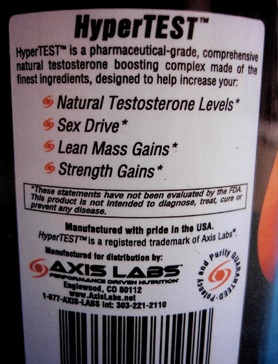
17 There is no question that all of the goods imported and then supplied by Export Corporation with which this case is concerned are ‘therapeutic goods’ within the meaning of s 3 of the Act. The labelling of each of the containers was in evidence and showed that the goods were presented in a way which represented that they might, to use the language of s 3, be used ‘in connection with… influencing, inhibiting or modifying a physiological process in persons’. For example, the packaging for one of the products (Hypertest) looks like this:
18 None of the goods the subject of these proceedings were included in the Register and it is this which has excited the Secretary’s desire to have imposed upon Export Corporation civil penalties. Apart from the products the subject of the present proceedings, however, it is also clear that Export Corporation has an extensive history of dealing in products which are included in the Register and about which there is no evidence of any complaint by the Secretary. The matter is to be approached on the basis that Export Corporation has, at least so far as this Court is concerned, a blemishless past.
19 It is useful then to say something of the importation contraventions. There is no dispute that between 19 January 2007 and 9 May 2008 Export Corporation imported a number of therapeutic goods which were not included in the Register. There were 80 separate acts of importation which occurred in the course of 19 separate shipments. In all 35 separate therapeutic goods were involved. Attached in Schedule 1 to these reasons is a full list of each of the goods in question, the dates of the importation, the number of importations and the total quantity imported. That schedule contains, by way of example, the following entry:
Name of Good | Period of Importation | Instances of Importation | Total Qty Imported |
Cellucor Muscle Growth R3 Extreme Pro-Immune Technology (120 capsules) | 2/11/2007 to 1/02/2008 | 2 | 240 |
20 A question immediately arises as to how Export Corporation, which undoubtedly conducts legitimate businesses, came to be engaging in such acts of unlawful importation. As it happens, its international suppliers are based either in the United States or Canada. At the times giving rise to these proceedings Export Corporation had in place an arrangement whereby its international suppliers would ship its sports supplements to it through businesses controlled by it in New Zealand who would then forward them to Export Corporation in Australia. Although the evidence did not entirely resolve this issue it seems likely that one of these businesses was conducted by Nutrition Systems NZ Pty Ltd which is a company incorporated in New Zealand and of which Export Corporation is the sole shareholder. At the level of detail, Export Corporation used the services of freight forwarders who would arrange the importation of the goods including the preparation and provision of customs declarations on its behalf.
21 The evidence does not directly disclose whether Export Corporation was aware that the 35 products it imported were not on the Register. The parties however did agree as a fact that the importation (and also subsequent supply – see below):
…was undertaken by Export Corporation based on a misunderstanding of regulatory advice from consultants engaged by Export Corporation. As a result of its misunderstanding of this regulatory advice, Export Corporation wrongly believed that goods imported into Australia from New Zealand that complied with the New Zealand Dietary Supplement Regulation were exempted from the Therapeutic Goods Act by virtue of the Trans Tasman Mutual Recognition Act 1997.
(Emphasis added.)
22 This agreed fact does not perhaps shed as much light on the matter as might be hoped. It would not be irrelevant to the question of determining the magnitude of the civil penalty to know a little more about the nature and origin of Export Corporation’s misunderstanding. That misunderstanding is an important element in the calculus of culpability but the agreed fact does not tell one whether the misunderstanding was a foolish one not likely to be made by a person responsibly attending to the advice which had been proffered or, alternatively, an entirely understandable misunderstanding arising form the abstruse nature of the advice proffered. On the former view, a species of blameworthiness may be located in Export Corporation; on the latter it resides in part with its consultants.
23 The Secretary did not seek to submit either of these views and was content to rely upon the agreed fact on its own terms. I am not in a position to draw any inferences about the matter either way and it is appropriate in that situation to resolve this matter by reference to the question of who bears the onus of proving wrongdoing. In a slightly different context, albeit still in a domain of discourse concerned with civil penalties, the High Court has observed that certain privileges serve ‘the purpose of ensuring that those who allege criminality or other illegal conduct should prove it’: Rich v Australian Securities and Investments Commission (2004) 220 CLR 129 at 142 [24] per Gleeson CJ, Gummow, Hayne, Callinan and Heydon JJ. That reflects an underlying theme that ultimately it is for a prosecuting authority to prove wrongdoing: cf. the remarks of Viscount Sankey LC in Woolmington v Director of Public Prosecutions [1935] AC 462 at 481; in this context, the concept of prosecution extends to those seeking the imposition of civil penalties. In that circumstance, I propose to proceed on the basis that Export Corporation’s misunderstanding was a reasonable one.
24 Thus far it has been sufficient to refer to the 35 products which were imported compendiously on the basis that they all shared the common attribute of not being in the Register. However, it is part of the Secretary’s case that some of these importations are to be viewed more seriously due to the identity of some of their ingredients.
25 To understand the submission it is necessary to say something of the ‘Poisons Standard’. The original Poisons Standard was prepared by the National Drugs and Poisons Schedule Committee but is now controlled by the Secretary: s 52D(2). Under the Poisons Standard, substances are classified into schedules according to what level of regulatory control over the availability of the medicine or chemical is considered necessary to protect public health or safety. The parties agreed that generally speaking a medicine which contains an ingredient which is included on one of the schedules to the Poisons Standard will not be eligible for listing and must instead be registered for inclusion on the Register.
26 The ingredients in question in this case fall into one of three categories:
(a) substances appearing in Schedule 2 of the Poisons Standard. Substances of this kind are substances the safe use of which may require advice from a pharmacist and which should be available from a pharmacy, or where a pharmacy is not available, from a licensed person;
(b) substances appearing in Schedule 4 of the Poisons Standard. These are prescription-only medicines the supply or use of which should be by or on the order of persons permitted by State or Territory legislation to prescribe medicines and should only be available from a pharmacist on prescription; and
(c) ‘undeclared active ingredients’. These are substances with active ingredients which neither appear on the packaging of the products nor in any of the schedules to the Poisons Standard.
27 As to the first category, the parties agreed that two of the 35 products imported contained ingredients in Schedule 2. These were:
(i) Nutrition Works Maximum Female (90 tablets). The Schedule 2 ingredient was folic acid and the packaging indicated its presence.
(ii) Twinlab Women’s Ultra Daily (120 capsules). The Schedule 2 ingredient was folic acid and the packaging indicated its presence.
Additionally, it should be noted that the packaging of Cellucor Weight Loss L2 Extreme Pro-Renal Technology (60 capsules) indicated that it contained the Schedule 2 substance folic acid. However, no folic acid was detected in the product and the parties treated it as not containing a Schedule 2 substance.
28 As to the second category, the parties agreed that nine of the products contained Schedule 4 substances. These were:
(i) BSN Thermonex Fat Loss & Energy Amplifier (120 capsules). This product contained the Schedule 4 substance oxedrine, also known as synephrine. The presence of synephrine was disclosed on the packaging.
(ii) Cellucor Weight Loss L2 Extreme Pro-Renal Technology (60 capsules). This product contained the Schedule 4 substance arbutin, not expressly disclosed on the packaging. A separate bottle of this product was also imported as part of the Cellucor Weight Loss System which was a carton containing three products including this arbutin.
(iii) Cellucor Weight Loss T7 Extreme Pro-Thyroid Technology (90 capsules). The packaging for this product indicated the presence of selenomethionine. That substance corresponds to selenium which, at the levels present, was a Schedule 4 substance. This product was also imported as part of the Cellucor Weight Loss System and the Cellucor Weight Loss System Stimulant Free.
(iv) CMI FireCaps (120 fire injected capsules). These contained the Schedule 4 substance oxedrine, disclosed on the packaging as synephrine.
(v) CMI NO3 Overload MM5T (120 super tabs). These contained the Schedule 4 substance vincamine, the presence of which was disclosed on the packaging.
(vi) Muscletech Competition-Use Thermo Shred Muscle Defining Thermogenic (150 capsules). These contained the Schedule 4 substance xanthinol nicotinate. This substance was included in the product as caffeine, the presence of which was disclosed on the packaging.
(vii) Nutrex Lipo 6 (120 liqui-caps). These contained the Schedule 4 substances yohimbe (not expressly disclosed on the packaging) and oxedrine (disclosed as synephrine).
(viii) STS Fit Woman Multi (100 capsules). These contained the Schedule 4 substance selenium, disclosed on the packaging as selenomethionine.
(ix) Twinlab Immunity Booster (90 capsules). These also contained selenium, disclosed on the packaging.
29 As to the third category, there were three products which contained an active ingredient which was not to be found in the Poison Standard and whose presence was not indicated on the packaging. The first two were Cellucor Eros Desire Female Enhancement Formula (20 capsules) and Cellucor Eros Fire Male Enhancement Formula (20 capsules). Both of these contained xanthocanthrafil which is an unregistered and untested erectile dysfunction treatment. The Therapeutic Goods Authority (‘the TGA’) suspects that xanthocanthrafil may have the potential to cause harm to consumers.
30 The third product was Cellucor Weight Loss T7 Extreme Pro-Thyroid Technology (90 capsules). It contained the unregistered substance 3,5-diiodo-4hydroxyphenylacetic acid whose harmful potential is unknown (it also contained the Schedule 4 substance selenium).
31 The Secretary developed a submission that the contraventions involving these three categories were more serious and, in particular, that the third category of undisclosed ingredients not contained in the Poisons Standard was the most serious. In that last regard, however, the parties agreed that Export Corporation was at all times wholly unaware of the presence of these undeclared active ingredients. It had received written assurance from the manufacturers involved that the products had been the subject of extensive testing and that they contained an identified list of ingredients which list, as it happens, did not disclose the presence either of xanthocanthrafil or 3,5-diiodo-4hydroxyphenylacetic acid.
32 In relation to the supply contraventions the situation is as follows: In Schedule 2 is a table setting out the 36 products supplied. The schedule is divided into three parts: the first consists of goods supplied before June 2008 and for which the Secretary can provide full particulars; the second of goods supplied before June 2008 for which the level of particularisation is lower; the third, nine products supplied after June 2008. As in the case of the importation contraventions, Export Corporation’s sale of these products arose from its misunderstanding of the regulatory advice it received. As with the imported products, various of the supplied products contained Schedule 2, Schedule 4 or undeclared active ingredients. There appear to have been eleven such products each of which, was inter-alia, considered above in the context of importation. Those were:
(i) Nutrition Works Maximum Female (90 tablets). This contained folic acid (Schedule 2) which was disclosed on the packaging;
(ii) Twinlab Women’s Ultra Daily (120 capsules). This also contained folic acid (Schedule 2) which was disclosed on the packaging;
(iii) Cellucor Eros Desire Female Enhancement Formula (20 capsules). This contained, without disclosure on the packaging, the unregistered substance xanthocanthrafil;
(iv) Cellucor Eros Desire Male Enhancement Formula (20 capsules). This also contained xanthocanthrafil not disclosed on the packaging;
(v) BSN Thermonex Fat Loss & Energy Amplifier (120 capsules). This contained oxedrine (Schedule 4) disclosed on the packaging;
(vi) Cellucor Weight Loss L2 Extreme Pro-Renal Technology (60 capsules). This contained arbutin (Schedule 4). The presence of arbutin was not noted on the package;
(vii) CMI FireCaps (120 fire injected capsules). This contained oxedrine (Schedule 4) disclosed on the packaging.
(viii) CMI NO3 Overload MM5T (120 super tabs). This contained vincamine (Schedule 4) disclosed on the packaging.
(ix) Muscletech Competition-Use Thermo Shred Muscle Defining Thermogenic (150 capsules). This contained xanthinol nicotinate (Schedule 4) in caffeine disclosed on the packaging.
(x) STS Fit Woman Multi (100 capsules). This contained selenium (Schedule 4) disclosed on the packaging.
(xi) Cellucor Weight Loss T7 Extreme Pro-Thyroid Technology (90 capsules). This contained selenium (Schedule 4) which was disclosed on the packaging. It also contained the undeclared active ingredient 3,5-diiodo-4-hydroxyphenylacetic acid, not disclosed on the packaging.
33 Items (vi) and (xi) were also included as parts of combinations of multiple products sold as ‘systems’.
34 Again, and for the same reasons, the Secretary accepted that Export Corporation was wholly unaware of the presence of the undeclared active ingredients.
35 So much for the circumstances of the contraventions. It is now necessary to consider their nature.
IV. The nature of the contraventions
36 Plainly enough Export Corporation has committed a very large number of contraventions, possibly – as the Secretary noted in her written submissions – numbering into the thousands. That fact combined with the terms of s 19D(1) gives rise to the potential for injustice in the imposition of a penalty. The difficulty is that each act of importing or supplying products will constitute a separate contravention. The prescribed civil penalty for a corporation – 50,000 penalty units – currently equates, as I have noted above, to $5.5 million. If Export Corporation’s conduct is treated as a single contravention then $5.5 million will mark the upper limit of any penalty; on the other hand, if what is disclosed are hundreds or thousands of incidents of contravening conduct then the maximum penalty will run potentially into hundreds of millions of dollars.
37 Observations of that kind have provided the impetus for ascertaining, as best as can be done, the degree of wrongdoing involved as an inquiry separate from and distinct to the simple and often arbitrary process of merely summing the actual number of contraventions. Particularly in regulatory contexts involving laws directed towards various species of consumer protection, this factor in the penalty fixing process is likely to be by far the most important from a numerical perspective. This is a result of the large number of contraventions to which systemic failures can give rise and the correspondingly multiplicative effect that this can have on any penalty.
38 This Court has therefore accepted in the context of civil penalties that whether multiple instances should be seen as a single course of conduct or in some other way is essentially a factual inquiry for the judge imposing the penalty. But it is an inquiry whose lodestone points to the need to avoid double punishment for the same wrongdoing. Middleton and Gordon JJ explained the ‘course of conduct’ principle this way in Construction, Forestry, Mining and Energy Union v Cahill (2010) 194 IR 461 at 473 [39]:
… It is a concept which arises in the criminal context generally and one which may be relevant to the proper exercise of the sentencing discretion. The principle recognises that where there is an interrelationship between the legal and factual elements of two or more offences for which an offender has been charged, care must be taken to ensure that the offender is not punished twice for what is essentially the same criminality. That requires careful identification of what is “the same criminality” and that is necessarily a factually specific enquiry. Bare identity of motive for commission of separate offences will seldom suffice to establish the same criminality in separate and distinct offending acts or omissions.
39 As is often the case with principles stated at a high level of generality the parties were in basic agreement as to the principle but not as to its application. The Secretary was inclined to view the ongoing activity of importing each product as a single course of conduct. Since 35 distinct products were imported it followed there were 35 courses of conduct. Treating multiple importations of the same product as being part of a course of conduct relating to that product did have the consequence at an arithmetical level that there were as many courses of conduct as there were products. The Secretary took the same position in relation to the supply contraventions where the fact that 36 distinct products were involved was said to give rise to 36 courses of conduct. This resulted in 71 contraventions in total with a theoretical maximum penalty, therefore, of $390.5 million.
40 On the other hand, Export Corporation submitted that there were in substance only two contraventions: one for import and one for supply. This was said to be so for a number of reasons the chief, but not sole, of which was the fact that all of the contraventions arose from its misunderstanding of its consultants’ advice as to the operation of the Trans-Tasman Mutual Recognition Act 1997 (Cth). The concession that there were two courses of conduct flowed, one assumes, from the fact that the factual matters making up the import and supply contraventions are inevitably distinct (I leave for now Export Corporation’s further submission that because the business was an import/supply business a risk of overlap was present here too).
41 There is no doubt that each contravention has its origins in the misunderstanding that Export Corporation laboured under. In that sense it is not meaningless to say not only that its motives for each contravention were the same but also that those motives were largely innocent ones. But the passage from Cahill which I have quoted above shows that bare identity of motive for the commission of separate contraventions will ‘seldom’ suffice to establish the same wrongdoing in those separate acts.
42 On the other hand, it seems to me that the Secretary’s position that there is a separate contravention for each product imported and supplied (that is, 71 separate contraventions) is extravagant and well beyond anything which might be viewed as the objective seriousness of the matter. The assured correctness of that observation is underscored by a contemplation of the $390.5 million maximum total civil penalty which to my mind could not conceivably serve as the maximum penalty in the worst of the present kind of case. In saying that I accept, of course, the sentiment underpinning the Minister’s remarks about the civil penalties on the second reading of the Therapeutic Goods Amendment Bill (2005) (Cth) that ‘[h]igher penalty levels attach to civil penalties because they are designed to provide adequate incentives, especially in relation to well-resourced corporate entities, for deterring breaches of regulatory requirements under the act’. But even so I do not think the Parliament had in contemplation the imposition of a maximum civil penalty whose magnitude would not be out of place in an appropriations bill.
43 In this case it seems to me appropriate to accept that each of the import and supply contraventions was susceptible to further factual distinguishment as follows:
(a) Goods not containing Schedule 2 or Schedule 4 poisons or undeclared substances;
(b) Goods containing Schedule 2 substances;
(c) Goods containing undeclared substances;
(d) Goods containing Schedule 4 substances; and
(e) Goods containing both Schedule 4 substances and undeclared substances.
44 I take this approach because the risks posed to the public by each of these categories was different and those differences thereby provide a meaningful criterion for distinction. There is, I think, a real difference between importing a medicinally harmless muscle growth factor, on the one hand, and, on the other, importing a weight loss system containing drugs usually available only under prescription together with drugs which are neither lawfully available in this country nor whose presence is disclosed on the packaging.
45 It will follow that, in principle, I accept that there were 10 distinct courses of conduct. In theory, the maximum penalty therefore is $55 million. I am prepared to accept that in a worst case – perhaps deliberate importation of poisonous non-registered substances by a large scale corporation resulting in widespread consumer deaths – such a penalty could be appropriate. For reasons I am about to give I do not think that a penalty of anything like that order is called for.
46 To begin with I accept that there is a very high degree of overlap between the import and supply contraventions. These are, of course, distinct but by virtue of the fact that Export Corporation did not supply anything which it had not imported there is a real risk that by punishing both sets of contraventions equally double punishment will occur. It is true that the overlap is not complete. Two of the products supplied before June 2008 are not the subject of import contraventions, nor are four of those supplied after June 2008. Nevertheless this does imply that a significant majority of the supply contraventions relate to importation contraventions too. In Secretary, Department of Health and Ageing v Prime Nature Prize Pty Ltd (in liquidation) [2010] FCA 597 Stone J accepted a submission that contraventions constituted by the supply of counterfeit goods were identical to contraventions constituted by the supply of an unlisted good and thereby treated them as one (at [62]). I would not go that far here – supply and import in this business were closely related but they were not the same and there does not appear to be a complete overlap in terms of products. Nevertheless, the overlap is an element which must be taken into account. For completeness I regard the degree of overlap between the importation and supply matters as being at the upper end of the range.
47 I turn then to the factors which are required by law to be taken into account in assessing the penalty which is to be imposed.
V. Matters which are to be considered in assessing the penalty
48 Section 42Y(3) requires that the Court must have regard ‘to all relevant matters, including’:
(a) the nature and extent of the contravention; and
(b) the nature and extent of any loss or damage suffered as a result of the contravention; and
(c) the circumstances in which the contravention took place; and
(d) whether the person has previously been found by the Court in proceedings under this Act to have engaged in any similar conduct.
49 In addition to those four statutory matters it seems to me that the following are also relevant to the formulation of a penalty under s 42Y:
(e) the size of the contravening company;
(f) the deliberateness of the contravention and the period over which it extended;
(g) whether the contravention arose out of the conduct of senior management of the contravenor or at some lower level;
(h) whether the contravenor has a corporate culture conducive to compliance with the Act as evidenced by educational programmes and disciplinary or other corrective measures in response to acknowledged contravention;
(i) whether the contravenor has shown a disposition to cooperate with the authorities responsible for the enforcement of the Act in relation to a contravention;
(j) whether the contravenor has engaged in similar conduct in the past;
(k) the financial position of the contravenor, including any benefits derived;
(l) whether the contravening conduct was systematic, deliberate or covert;
(m) the maximum penalty; and
(n) whether any forfeiture order has been made.
50 These factors are largely drawn from decisions concerned with s 76 of the formerly entitled Trade Practices Act 1974 (Cth): Trade Practices Commission v CSR Ltd [1991] ATPR 41-076 at 52,152-52,153 per French J; NW Frozen Foods Pty Ltd v Australian Competition and Consumer Commission (1996) 71 FCR 285 at 292-294 per Burchett and Kiefel JJ, Carr J agreeing; J McPhee & Son (Aust) Pty Ltd v Australian Competition and Consumer Commission (2000) 172 ALR 532 at 574 [150] ff per Black CJ, Lee and Goldberg JJ. There is nothing in the scheme of that Act when compared to the scheme of the present Act which would require a different attitude to be taken to these matters. I have, however, excluded from the list above the matters of the degree of market power and the effects on a functioning market which are referred to in those decisions but which appear to have little relevance in the current field of discourse. So far as (m) is concerned: see Markarian v the Queen (2005) 228 CLR 357 at 372 [31] per Gleeson CJ, Gummow, Hayne and Callinan JJ. So far as the benefit referred to in (k) is concerned, it might be noted that its relevance arises because of the need to ensure that the payment of civil penalties does not come to be seen merely as a cost of doing business: Australian Competition and Consumer Commission v ABB Transmission and Distribution Ltd [2001] ATPR 41-815 at 42,938 [13] per Finkelstein J; Australian Competition and Consumer Commission v McMahon Services Pty Ltd [2004] ATPR 42-031 at 49,228 [15] per Selway J; Australian Competition and Consumer Commission v Leahy Petroleum Pty Ltd (No 3) (2005) 215 ALR 301 at 309 [39] per Goldberg J. In that context it is important to keep in mind that a civil penalty is not an allowable deduction against assessable income: s 26.5 of the Income Tax Assessment Act 1997 (Cth). It might be noted that (j) is somewhat broader than (d).
51 Turning to the matters to be considered: as to (a), the contraventions and their extent appear in Schedules 1 and 2 of these reasons. I return below to the question of how they should be characterised. As to (b), no loss was suffered by anyone in consequence of the contraventions.
52 As to (c) (the circumstances in which the contraventions took place), I have already indicated the fact that all of the contraventions occurred as a result of a misunderstanding which, given the state of the evidence, I have assumed to have been a reasonable one. Further, insofar as the goods contained undeclared substances Export Corporation had been told that this was not the case by its suppliers. That will raise in the minds of some the question of whether it is an adequate compliance arrangement to rely upon the word of suppliers as to the content of goods which are being imported. There is no direct evidence as to whether that is so. There is no way directly to discern, therefore, in relation to the question of undeclared ingredients whether what took place was an inadequate compliance arrangement suffering an entirely predictable failure or whether, instead, what was involved was an adequate compliance arrangement which suffered an unforeseeable bout of bad luck. The evidence does, however, disclose that Export Corporation has subsequently acknowledged that it did not take sufficient steps to ensure compliance with the Act. I infer from that, therefore, that its earlier procedure of relying upon the suppliers’ explanations of the contents of the various products was not adequate.
53 As to (d), the parties accepted that Export Corporation has not been found to have contravened this Act before.
54 As to (e) (the size of the contravening company): Export Corporation’s gross turnover in the two years ending 30 June 2007 and 2008 was $14.2 million and $19.5 million respectively. The parties agreed it was one of the eight-10 major wholesalers in Australia. The evidence does not disclose the number of staff it employs, the number of its shareholders or its profitability. Proceeding by inference from the turnover figures I conclude that Export Corporation is a medium size business; in all likelihood at the larger end of that spectrum.
55 As to (f) (the deliberateness of the conduct), as I have said already the conduct was not deliberate.
56 As to (g) (the management level at which the conduct arose): the evidence only disclosed that the conduct occurred as a result of the misunderstanding to which reference has already been made. The identity of the person who formed that misunderstanding was not disclosed (nor, indeed, the nature of the misunderstanding). The evidence does disclose that the misunderstanding arose from a failure to grasp the true impact of advice obtained from consultants. It can be inferred, in a medium size business such as Export Corporation, that the function of receiving such advice would have been towards the top of the management structure. The only other evidence which may be relevant is the fact that Export Corporation has a single director, Mr Pavlovich. Although it is possible that Mr Pavlovich may have been the person with the misunderstanding I do not feel that the material is sufficient enough for me to draw that conclusion.
57 It is, however, sufficient to permit the drawing of the inference that someone at, or just under, Mr Pavlovich’s level was responsible: it was an error made at a high level. This, of course, increases its seriousness.
58 As to (h) (the extent of a compliance culture) the following should be observed: at the time of the contraventions such a culture does not appear to have been in place. As mentioned above, Export Corporation admitted that it had not taken sufficient steps to ensure compliance with the Act prior to February 2008. Further, prior to the present matter there were some events which took place between the TGA and Export Corporation which signal a degree of nonchalance on its part at that time towards compliance. In 2006 the TGA expressed concerns about the extent of Export Corporation’s compliance with the regulatory scheme. Export Corporation now agrees that its response to those matters was inadequate and based upon a mistaken belief that the TGA’s concerns could be addressed by taking certain steps which it now accepts were not sufficient. These steps included the hiring of a full-time employee tasked with ensuring compliance. Based on these matters my conclusion is that, at the relevant times, Export Corporation did not appreciate the seriousness of the requirements which lay upon it and was inclined not to incur the expense necessary to ensure appropriate compliance. This, to my mind, is a serious matter particularly when combined with the level of seniority at which the difficulties arose.
59 A further matter bears this out. In relation to the nine supply contraventions arising after June 2008 it is to be noted that these occurred even after the TGA had written to Export Corporation informing it that the supply of the goods should desist. The further supply occurred in circumstances where Export Corporation failed to arrange for the proper quarantining of the goods the subject of the TGA’s letter. The conduct was not deliberate but it exemplifies the deficiencies in the compliance culture.
60 As to (i) (the degree of co-operation) one should observe the fulsome degree of cooperation which has been offered and the earliness at which it was made. Export Corporation’s officers, employees and contractors cooperated with the TGA’s investigation by:
(a) providing assistance to the TGA during the execution of search warrants at its premises including provision of supply records which, the parties agree, may not otherwise have been readily obtainable by the TGA. Those records have formed the basis upon which the supply contraventions were brought and particularised;
(b) with the TGA’s knowledge and at no charge, storing the goods seized by the TGA for a period of about four months;
(c) making full and frank admissions about a range of matters;
(d) filing a defence admitting the Amended Statement of Claim in its entirety together with agreeing upon an agreed statement as to facts. There are two aspects of this which deserve particular emphasis. First, it did so at the first available opportunity when the Secretary desisted from pursuing a number of other allegations. Secondly, it did these things without having reached agreement with the Secretary as to penalty. It did not seek to parley its ability to put the Secretary to proof for advantage. By agreeing the facts in that way it has exposed itself to the full consequences of its admissions. This demonstrates a willingness to confront the consequences of its actions and to accept responsibility for them. The same action has averted the expenditure of money and time which would have been required to pursue the matter at a trial. So viewed there has been a significant social saving. Furthermore, in response to the present proceeding Export Corporation has put in place an adequate compliance system. From October 2008 it has undertaken a reorganisation and upgrading of its compliance department. It now has 1.8 full time employees dedicated to its regulatory and compliance requirements. New work procedures were introduced to address all compliance measures during the process of developing new products including, importantly, reviews of ingredients, labels and promotions. The present head of compliance is a person with 18 years experience in the Australian pharmaceutical, foods and consumer goods industries and with 12 years experience in the pharmaceutical and medical device industries. Following this rearrangement, Export Corporation now spends about $280,000 per annum on its compliance staffing costs. It would be fair to say that Export Corporation now has in place appropriate arrangements.
61 As to (j), there is nothing to suggest the Export Corporation has done anything similar in the past.
62 As to (k) (the financial position of the contravenor), the agreed facts showed that in the period January 2007 to May 2008 the goods the subject of the proceedings constituted 15% of Export Corporation’s total imports and 14% of its total supplies. These figures do not include the nine supply contraventions arising after June 2008 about which there is no evidence. This resulted in net earnings of $694,539.00. I infer from those figures that Export Corporation’s net total earning for the same 17 month period were about $5 million.
63 As to (l) (whether the conduct was systematic, deliberate or covert), I have already recorded my view that it was not deliberate. And, whilst it may be described as an error of systems control, I do not think it deserves to be characterised as systematic.
64 As to (m), in the view that I have taken of the matter there are in existence 10 contraventions – five for supply and five for importation. That being so, the theoretical maximum penalty is, as I have already noted, $55 million.
65 As to (n) (whether any forfeiture order has been made) no such order will be made. However, it is relevant to note that Export Corporation has surrendered all of the goods in question to the Secretary, making such an order unnecessary. There is no evidence as to the value of the goods but since they may not be sold or exported they are likely to be of little value.
VI. The appropriate penalties
66 The purpose of the penalty of the present kind is punishment and, by punishment, deterrence. Deterrence of the wrongdoer, no doubt, but also deterrence of others who might be tempted to make the same mistake. There is then about proceedings of the present kind an element of public spectacle whose theatre is directed not at the contravenor but rather at others involved in the importation of therapeutic goods. In this case these twin aims have sharply differing outcomes. I do not believe that Export Corporation is in need of deterrence: its lesson has been learnt and it is contrite. But whatever punishment is imposed upon Export Corporation will serve as a message to the industry. One of the many questions which therefore arise is what the nature of that message should be.
67 In the process of assessing the appropriate penalties I can see no reason not to apply the approach to sentencing laid down by the High Court in Markarian which I would summarise as follows:
1. the Court’s assessment of the appropriate penalty is a discretionary judgment based on all relevant factors (Markarian at 371 [27]);
2. careful attention to the maximum penalties will almost always be required, first, because the Parliament has legislated for them; secondly, because they invite comparison between the worst possible case and the case before the Court at the time; thirdly, because in that regard they do provide, balanced with all of the other relevant factors, a yard stick (at 372 [31]);
3. it will rarely be appropriate for a Court to start with the maximum penalty and proceed by making a proportional deduction from that maximum (at 372 [31]);
4. the Court should not adopt a mathematical approach of increments or decrements from a predetermined range or assign specific numeric or proportionate value to the various relevant factors (at 373-374 [37]);
5. it is not appropriate to determine an objective sentence and then adjust it by some mathematical value given to one or more factors such as the plea of guilty or assistance to authorities (at 373-374 [37]);
6. the Courts ‘may not add and subtract item by item from some apparently subliminally derived figure’ to determine the penalty to be imposed (at 375 [39]);
7. since the law plainly favours transparency, accessible reasoning is necessarily in the interests of all. While there may be occasions where some indulgence in arithmetical process will better serve that end, it is unlikely to apply where there are numerous and complex considerations that must be weighed (at 375 [39]).
68 I turn then to the appropriate penalties.
69 I have set out the categories of contraventions, as I view them, at [43] above. The first category of contraventions consists of the import of some 20 therapeutic goods into Australia in various quantities. These goods did not contain any undeclared substances or Schedule 2 or Schedule 4 poisons. The quantities varied from as little as five bottles of Twinlab Vital Memory to 5,500 bottles of Cellucor Weight Loss D4 Extreme Pro-Adrenal Technology SAMPLES. In all 20,003 products were imported. The imports were, on any view, substantial and took place over an extended period of time. In my opinion, an appropriate penalty for this course of conduct is $1.25 million.
70 The second category consisted of goods which were imported and which contained Schedule 2 poisons. There were only two such products – Nutrition Works Maximum Female and Twinlab Women’s Ultra Daily. The total quantity imported was 140 products. It seems to me that an appropriate penalty would be $50,000.
71 The third category consisted of goods which contained undeclared substances but no Schedule 2 or 4 poisons. There were two such products –Cellucor Eros Desire Female Enhancement Formula and Cellucor Eros Fire Male Enhancement Formula. In all 420 bottles were imported. An appropriate penalty for this is, in my opinion, $190,000.
72 The fourth category was those goods which contained Schedule 4 poisons. A significant number of such products were imported, some 30,779. The smallest importation was of five packages of Twinlab Immunity Booster and the largest, 26,064 bottles of Nutrex Lipo 6. An appropriate penalty would be $2.205 million.
73 The final import category was those goods containing both Schedule 4 and undeclared substances. There was one such product, packaged and sold in three different ways (one individual, the other two as part of ‘weight loss systems’) and in all 1500 packages were imported. It seems to me appropriate to impose a penalty of $600,000.
74 This will result in total penalties for importation of $4.295 million.
75 I turn then to the supply contraventions. I begin by observing that most, but by no means all, of the supply contraventions correspond with import contraventions. To the extent that they do correspond the numbers involved are broadly similar but not identical; in most cases the supply quantities are slightly less. Overall, fewer products are involved.
76 As to the first category, 23 individual products were supplied in quantities amounting to 13,019 packages. All but six – Omega Slim Stimulant Free Fat Burner; Six Star Body Fuel All-Day Energy; Axis Labs Creatine Ethyl Ester; Muscletech Aplodan; Muscletech Leukic Advanced Anabolic Activator and Nutrex Niox Extra Strength Liquid Nitric Oxide Muscle Mass Stimulator – were the subject of corresponding importation contraventions. In this first category, there were no Schedule 2 or Schedule 4 poisons and no undeclared substances. There being a substantial overlap in the nature of the wrongdoing as between the import and supply contraventions I have determined that a penalty of $400,000 is appropriate.
77 The second category consists of the supply of two products in a combined quantity of 238 packages. The products contained Schedule 2 substances. I have concluded that a penalty of $6,000 is appropriate given the overlap with the import contraventions.
78 The third category consists of two products containing undeclared substances (the ‘Cellucor Eros’ products). In all 197 of these were supplied. Given the overlap with the importation of these same products I have concluded that a penalty of $25,000 will be sufficient.
79 The fourth category consists of products containing Schedule 4 substances. There were six such products supplied in a total quantity of 3,599. Again there is a substantial overlap with the import contraventions. An appropriate penalty is $60,000.
80 The final category consists of products which contain Schedule 4 poisons and undeclared ingredients. Again, there was one such product sold in three separate packages and 536 packages imported. Each product supplied was also imported. An appropriate penalty is $25,000.
81 The supply penalties therefore total $516,000. In all the supply and import penalties total $4.811 million. To this I propose to apply a reduction of 35% reflecting the very high degree of cooperation afforded by Export Corporation to the Secretary. This will result, in principle, in a penalty of $3,127,150. I pause to consider whether this penalty is consistent with the overall extent of the wrongdoing involved. Bearing in mind the high maximum penalty of $5.5 million per contravention and the extent of the import and sale activities I believe that it does.
82 There is, of course, an inherent tension in determining penalties. On the one hand, justice must be individualised so that the specific circumstances of the contravenor may be examined; on the other hand, justice must be uniform – everyone must be treated the same – for consistency is an element of fairness. These contradictory notions mean that regard should be had, if possible, to comparable tariffs. Only four were suggested: the imposition by Stone J of a civil penalty under the Act of $7.25 million in Prime Nature Prize; by Flick J in Secretary, Department of Health and Ageing v Pagasa Australia Pty Ltd [2008] FCA 1545 of penalties totalling $198,242.75; a fine for criminal offences in R v Pan Pharmaceuticals Pty Ltd [2008] NSWDC 221 which related to the crime of issuing false certificates in respect of pharmaceutical products; and the imposition of a fine by the District Court in R v Comax-Pharma Pty Ltd [2008] NSWDC 200 for guilty pleas to charges of knowingly manufacturing counterfeit goods. These last two decisions are of no relevance arising, as they do, from a fundamentally different field of discourse, viz criminal procedure. I am able to derive little assistance from the first two civil penalty decisions either, however, as the facts of those cases were far removed from the present. Prime Nature Prize involved the counterfeiting and sale as a listed therapeutic good of two products, one including substances derived from sheep placenta and the other a herbal aid to joint mobility. Pagasa involved a container load of facial soaps, scrubs, creams and cleansers. I do not find the circumstances of the penalties imposed by the Court in those cases to be analogous to the present case in a way which might be useful in comparing the penalties. In addition, it is to be noted that in neither matter did the Court have the benefit of a contradictor to the Secretary (the former was undefended; in the latter the penalties were agreed).
83 In the present case I am not unaware that the penalties which have been arrived at substantially exceed the net earnings made by Export Corporation from the contravening activities. This is a function of the size of the penalty prescribed. The size of the penalties contemplated by s 19D(1) and the result in this case will underscore that non-compliance with this particular Act is likely to have disastrous consequences for the business involved. This is what Parliament has determined.
84 The Secretary also sought the making of two declarations in the following forms:
1. A declaration that in the period 19 January 2007 to 9 May 2008 [Export Corporation] committed 80 contraventions of section 19D(1)(a)(i) of [the Act] by importing into Australia therapeutic goods for use in humans as specified in Schedule A to the Further Amended Application, in circumstances where the therapeutic goods were not listed on the Australian Register of Therapeutic Goods and none of the subparagraphs in section 19D(1)(b) applied.
…
3. A declaration that in the period 1 January 2007 to 2 October 2009 [Export Corporation] contravened section 19D(1)(a)(iv) of [the Act] by supplying in Australia therapeutic goods for use in humans as specified in Schedule B to the Further Amended Application, in circumstances where the therapeutic goods were not listed on the Australian Register of Therapeutic Goods and none of the subparagraphs in section 19D(1)(b) applied.
85 Export Corporation consented to the second of these but not to the first. In regard to it, Export Corporation submitted that the declaration did not reflect the pleading. It does, however, reflect my conclusions.
86 In Australian Competition and Consumer Commission v MSY Technology Pty Ltd (No 2) (2011) 279 ALR 609 I concluded that the Full Court’s decision in BMI v Federated Clerks Union of Australia (1983) 6 IR 416 bound me not to make declarations by consent. I also expressed the view, on that occasion, that this should not be the case and that BMI was wrongly decided. Since then two members of this Court have concluded that BMI does not have that effect: Australian Competition and Consumer Commission v Willesee Healthcare Pty Ltd (No 2) [2011] FCA 752 per Dodds-Streeton J; Australian Competition and Consumer Commission v Sampson [2011] ATPR 42-374 per Tracey J. MSY (No 2) is presently the subject of a reserved decision in the Full Court. What I propose to do is to indicate that if I have the power to make the second declaration sought by consent I would be content to make it. I will make the other orders, including the first declaration, which are necessary to dispose of the rest of the case but direct that those orders not be taken out. On the delivery by the Full Court of its decision in respect of MSY (No 2) I will finalise the matter.
VII. An Interlocutory Application
87 After judgment was reserved the Secretary sought leave to amend the form of her pleadings. Very shortly these amendments were as follows:
(a) the dropping of a claim for a forfeiture order; and
(b) the addition of nine further products to the particulars provided to the supply allegations.
88 Export Corporation consented to the amendments. At the same time, both parties joined in seeking to put on a further agreed statement of facts. It related to:
(a) revised net earnings of Export Corporation;
(b) the facts relating to the nine further products; and
(c) the fact that all of the goods in question had been surrendered to the Commonwealth.
89 Plainly, the amendments to the pleadings should be permitted. If they were not, separate proceedings would need to be commenced. In circumstances where the amendments are consented to this would be likely to increase delay and expense. For that reason I granted leave prior to judgment.
90 The proposed agreed statement of facts in part contradicts an earlier agreed statement of fact. Consequently, leave is required for its reception: s 191(2) of the Evidence Act 1995 (Cth). The parties are in agreement that the earlier statement was in error. This provides a sufficient reason for granting leave. The Further Statement of Agreed Facts will be Exhibit 2.
VII. Costs
91 In all the circumstances, it is appropriate that Export Corporation pays the Secretary’s costs of the proceedings. Although Export Corporation submitted that this and its own costs should be taken into account in assessing the penalty I do not think that that submission should be accepted in this case. Whilst there may be cases where it is appropriate to take costs into account, generally such an approach may provide an economic incentive to resist in civil penalty proceedings which would undermine the policy sought to be served by giving a discount for cooperation; put another way, it would not be wise to create a régime which engenders an expectation that increased expenditure on defence costs might result ultimately in a decreased penalty.
92 The parties are to bring in short minutes of order within seven days giving effect to these reasons.
I certify that the preceding ninety-two (92) numbered paragraphs are a true copy of the Reasons for Judgment herein of the Honourable Justice Perram. |
Associate:
Dated: 3 February 2012
Schedule 1
Name of Good | Period of Importation | Instances of Importation | Total Qty Imported |
Axis Labs Hyper TEST Hypertrophic Testosterone Complex (120 Capsules) | 28/12/2007 | 1 | 360 |
Axis Labs SesaMAX Sesamin Plus 3X Fish Fats (90 softgels) | 28/12/2007 | 1 | 240 |
BSN Axis-HT Pro-Testosterone Amplifier (120 tablets) | 9/3/2007 to 21/12/2007 | 6 | 2,910 |
BSN Cheaters Relief Pre-&Post-Meal Calorie Control (120 capsules) | 19/01/2007 to 21/12/2007 | 8 | 3,780 |
BSN Thermonex Fat Loss & Energy Amplifier (120 capsules) | 9/3/2007 to 1/02/2008 | 7 | 3,630 |
Cellucor Eros Desire Female Enhancement Formula (20 capsules) | 2/11/2007 to 1/02/2008 | 2 | 240 |
Cellucor Eros Fire Male Enhancement Formula (20 capsules) | 2/11/2007 to 1/02/2008 | 2 | 180 |
Cellucor Muscle Growth R3 Extreme Pro-Immune Technology (120 capsules) | 2/11/2007 to 1/02/2008 | 2 | 240 |
Cellucor Muscle Growth System (Cellucor Muscle Growth P6 Extreme Pro-Androgenic Technology (120 capsules), Cellucor Muscle Growth Island Punch M5 Extreme Pro-Cellular Technology (460g) and Cellucor Muscle Grown R3 Extreme Pro Immune Technology (120 capsules)) | 16/11/2007 to 1/02/2008 | 2 | 480 |
Cellucor Weight Loss D4 Extreme Pro-Adrenal Technology (120 capsules) | 2/11/2007 to 1/02/2008 | 2 | 420 |
Cellucor Weight Loss D4 Extreme Pro-Adrenal Technology (120 capsules) SAMPLES | 16/11/2007 to 2/11/2007 | 3 | 5,500 |
Cellucor Weight Loss L2 Extreme Pro-Renal Technology (60 capsules) | 1/02/2008 to 2/11/2007 [sic] | 2 | 240 |
Cellucor Weight Loss System (Cellucor Weight Loss D4 Extreme Pro-Adrenal Technology (120 capsules), Cellucor Weight Loss T7 Extreme Pro-Thyroid Technology (90 capsules) and Cellucor Weight Loss WS1 Extreme Pro-PPAR Technology (148 capsules)) | 2/11/2007 to 1/02/2008 | 2 | 840 |
Cellucor Weight Loss System Stimulant Free (Cellucor Weight Loss T7 Extreme Pro-Thyroid Technology (90 capsules), Cellucor Weight Loss WS1 Extreme Pro-PPAR Technology (148 capsules), Cellucor Weight Loss L2 Extreme Pro-Renal Technology (60 capsules)) | 2/11/2007 to 1/02/2008 | 2 | 420 |
Cellucor Weight Loss T7 Extreme Pro-Thyroid Technology (90 capsules) | 2/11/2007 to 1/02/2008 | 2 | 240 |
Cellucor Weight Loss WS1 Extreme Pro-PPAR Technology (148 capsules) | 2/11/2007 to 1/02/2008 | 2 | 180 |
CMI Fire Caps (120 fire injected capsules) | 1/02/2008 | 1 | 120 |
CMI NO3 Overload MM5T (120 supertabs) | 1/02/2008 | 1 | 120 |
Inner Armour LipoRIP Hardcore (120 tablets) | 23/02/2007 | 1 | 600 |
Inner Armour LipoRIP Hardcore (60 tablets) | 23/02/2007 | 1 | 600 |
Inner Armour Testosterone Test-9-Metho Andogenic (90 capsules) | 23/02/2007 to 1/02/2008 | 4 | 1,266 |
Muscletech Competition-Use Thermo Shred Muscle Defining Thermogenic (150 capsules) | 10/08/2007 to 7/12/2007 | 3 | 480 |
Nutrex Lipo 6 (120 liqui-caps) | 19/01/2007 to 9/05/2008 | 5 | 26,064 |
Nutrex Vitrix Maximum Impact Testosterone Stimulator (90 fast-acting liquid-caps) | 10/08/2007 to 23/11/2007 | 2 | 484 |
Nutrex Vitrix with NTS-5 Natural Testesterone [sic] Stimulator (180 liqui-caps) | 19/01/2007 to 23/01/2007 | 3 | 1,738 |
Nutrition Works Maximum Female (90 Tablets) | 2/11/2007 | 1 | 120 |
STS BCAA 250 XP (120 Vegetarian capsules) | 28/12/2007 | 1 | 120 |
STS Fit Woman Multi (100 capsules) | 28/12/2007 | 1 | 120 |
STS GCHA (90 capsules) | 28/12/2007 | 1 | 240 |
STS Methylcobalamin B-12 5000 (90 lozenges/mixed berry) | 28/12/2007 | 1 | 120 |
STS Vitamin E 400 (90 perlecaps) | 28/12/2007 | 1 | 120 |
Twinlab Immunity Booster (90 capsules) | 23/02/2007 | 1 | 5 |
Twinlab Vital Memory (45 tablets) | 23/02/2007 | 1 | 5 |
Twinlab Women’s Ultra Daily (120 capsules) | 23/02/2007 | 1 | 20 |
VPX AEX NO (180 capsules) | 28/12/2007 to 9/05/2008 | 2 | 360 |
VPX BCAAEX (180 caplets) | 9/05/2008 | 1 | 120 |
VPX Glucosa Cream (NET WT 8oz (227g)) | 9/05/2008 | 1 | 120 |
Schedule 2
PART 1 – DETAILED PARTICULARS OF SUPPLY
Name of Good | Supply period | Instances of Supply | Net number of goods supplied |
Cellucor Eros Desire Female Enhancement Formula (20 capsules) | 711/07 to 1/02/08 | 26 | 65 |
Cellucor Eros Fire Male Enhancement Formula (20 capsules) | 7/11/07 to 31/01/08 | 37 | 110 |
Cellucor Muscle Growth R3 Extreme Pro-Immune Technology (120 capsules) | 7/11/07 to 8/02/08 | 27 | 56 |
Cellucor Muscle Growth System (Cellucor Muscle Growth P6 Extreme Pro-Androgenic Technology (120 capsules), Cellucor Muscle Growth Island Punch M5 Extreme Pro-Cellular Technology (460g) and Cellucor Muscle Grown R3 Extreme Pro Immune Technology (120 capsules)) | 22/11/07 to 9/04/08 | 61 | 151 |
Cellucor Weight Loss D4 Extreme Pro-Adrenal Technology (120 capsules) | 7/11/07 to 8/02/08 | 69 | 192 |
Cellucor Weight Loss L2 Extreme Pro-Renal Technology (60 capsules) | 7/11/07 to 5/2/08 | 39 | 94 |
Cellucor Weight Loss System (Cellucor Weight Loss D4 Extreme Pro-Adrenal Technology (120 capsules), Cellucor Weight Loss T7 Extreme Pro-Thyroid Technology (90 capsules) and Cellucor Weight Loss WS1 Extreme Pro-PPAR Technology (148 capsules)) | 7/11/07 to 9/04/08 | 106 | 342 |
Cellucor Weight Loss System Stimulant Free (Cellucor Weight Loss T7 Extreme Pro-Thyroid Technology (90 capsules), Cellucor Weight Loss WS1 Extreme Pro-PPAR Technology (148 capsules), Cellucor Weight Loss L2 Extreme Pro-Renal Technology (60 capsules)) | 7/11/07 to 9/04/08 | 48 | 91 |
Cellucor Weight Loss T7 Extreme Pro-Thyroid Technology (90 capsules) | 7/11/07 to 21/01/08 | 39 | 77 |
Cellucor Weight Loss WS1 Extreme Pro-PPAR Technology (148 capsules) | 7/11/07 to 5/02/08 | 34 | 52 |
PART 2 – GENERAL PARTICULARS OF SUPPLY
Name of Good | Supply period | Total quantity of further supply |
BSN Axis-HT Pro-Testosterone Amplifier (120 tablets) | 1/01/2007 to 12/02/2008 | 2,219 |
BSN Cheaters Relief Pre- & Post-Meal Calorie Control (120 capsules) | 1/01/2007 to 12/02/2008 | 3,151 |
BSN Thermonex Fat Loss & Energy Amplifier (120 capsules) | 1/01/2007 to 12/02/2008 | 2,910 |
CMI Fire Caps (120 fire injected capsules) | 1/01/2007 to 12/02/2008 | 36 |
CMI NO3 Overload MM5T (120 super tabs) | 1/01/2007 to 12/02/2008 | 30 |
Inner Armour LipoRIP Hardcore (120 tablets) | 1/01/2007 to 12/02/2008 | 392 |
Inner Armour Testosterone Test-9-Meth Androgenic (90 capsules) | 1/01/2007 to 12/02/2008 | 1,175 |
Muscletech Competition-Use Thermo Shred Muscle Defining Thermogenic (150 capsules) | 1/01/2007 to 12/02/2008 | 480 |
Nutrex Vitrix Maximum Impact Testosterone Stimulator (90 fast-acting liqui-caps) | 1/01/2007 to 12/02/2008 | 282 |
Nutrex Vitrix with NTS-5 Natural Testesterone [sic] Stimulator (180 liqui-caps) | 1/01/2007 to 12/02/2008 | 1,075 |
Nutrition Works Maximum Female (90 tablets) | 1/01/2007 to 12/02/2008 | 76 |
Omega Slim Stimulant Free Fat Burner (120 soft gels) | 1/01/2007 to 12/02/2008 | 534 |
Six Star Body Fuel All-Day Energy (60 caplets) | 1/01/2007 to 12/02/2008 | 58 |
STS Fit Woman Multi (100 capsules) | 1/01/2007 to 12/02/2008 | 29 |
STS Vitamin E 400 (90 perlecaps) | 1/01/2007 to 12/02/2008 | 24 |
Twinlab Vital Memory (45 tablets) | 1/01/2007 to 12/02/2008 | 34 |
Twinlab Women's Ultra Daily (120 capsules) | 1/01/2007 to 12/02/2008 | 162 |
PART 3 – PARTICULARS OF SUPPLIES AFTER JUNE 2008
Name of Good | Supply period | Instances of Supply | Net number of goods supplied |
Axis Labs Creatine Ethyl Ester (120 capsules and 240 capsules) | 2/07/08 to 14/11/08 | 20 | 224 |
Axis Labs SesaMAX Sesamin Plus 3X Fish Fats (90 softgels) | 29/07/08 to 6/08/09 | 19 | 178 |
Inner Armour LipoRIP Hardcore (60 tablets) | 2/07/08 to 12/08/08 | 17 | 210 |
Muscletech Aplodan (111 caplets) | 1/07/08 to 6/08/09 | 121 | 835 |
Muscletech Leukic Advanced Anabolic Activator (180 caplets) | 1/07/08 to 28/08/08 | 153 | 1,251 |
Nutrex Niox Extra Strength Liquid Nitric Oxide Muscle Mass Stimulator (180 liqui caps) | 2/07/08 to 8/01/09 | 74 | 615 |
STS BCAA 2500 XP (120 vegetarian capsules) | 9/07/08 to 11/12/08 | 10 | 41 |
STAS GCHA (90 capsules) | 7/07/08 to 2/10/09 | 18 | 106 |
STS Methylcobalamin B-12 5000 (90 lozenges/mixed berry) | 31/07/08 to 30/03/09 | 11 | 68 |


