

FEDERAL COURT OF AUSTRALIA
Federal Treasury Enterprise (FKP) Sojuzplodoimport v Spirits International B.V. (No 2) [2012] FCA 23
IN THE FEDERAL COURT OF AUSTRALIA | |
DATE OF ORDER: | |
WHERE MADE: |
THE COURT ORDERS THAT:
1. On or before 3 February 2012:
(i) The parties file draft short minutes of order to give effect to the Reasons for Judgment; in default of agreement,
(ii) The cross-claimants and the cross-respondent each file draft short minutes of order to give effect to the Reasons for Judgment.
2. The matter be listed for further directions on 10 February 2012 at 9:30 am.
Note: Entry of orders is dealt with in Rule 39.32 of the Federal Court Rules 2011.
NEW SOUTH WALES DISTRICT REGISTRY | |
GENERAL DIVISION | NSD 1816 of 2004 |
BETWEEN: | FEDERAL TREASURY ENTERPRISE (FKP) SOJUZPLODOIMPORT First Cross-Claimant FEDERAL PUBLIC UNITARY ENTERPRISE EXTERNAL ECONOMIC UNION SOJUZPLODOIMPORT (FGUP VO) Second Cross-Claimant
|
AND: | SPIRITS INTERNATIONAL B.V. (REGISTERED IN THE NETHERLANDS) Cross-Respondent
|
JUDGE: | EDMONDS J |
DATE: | 25 january 2012 |
PLACE: | SYDNEY |
REASONS FOR JUDGMENT
Introduction
1 This is a motion on notice filed 23 December 2010 which I heard on 27 September 2011. By the motion, the cross-respondent (‘Spirits’) sought, inter alia, orders that:
(1) The cross-claimants (‘FKP’) give discovery of documents relating to the separate questions which were the subject of orders made on 26 November 2010 (leave to appeal from those orders having been refused on 20 May 2011: Spirits International B.V. v FKP Sojuzplodoimport [2011] FCAFC 69), by reference to five categories.
(2) Leave be granted to Spirits to file and serve an amended defence to the further amended cross-claim in a form previously provided to FKP’s solicitors.
(3) FKP provide additional security for Spirits’ costs in respect of the cross-claim in the sum of $1,200,000 within 14 days of the making of such an order by way of payment into the controlled moneys account maintained by FKP’s solicitors.
2 By the time the motion came on for hearing, the orders sought had been, to some extent, overtaken by events:
(1) The dispute as to Spirits’ categories for discovery by FKP in relation to the separate questions had resolved to this extent:
(a) Categories 1 and 2, by consent, were agreed;
(b) Category 3 was not pressed;
(c) Categories 4 and 5 were still in dispute.
During the course of the hearing, senior counsel for Spirits stated that categories 4 and 5 were no longer pressed. In consequence, there is no longer any dispute as to the scope of FKP’s discovery of documents relating to the separate questions.
(2) The issue as to leave to file further pleadings had resolved to this extent:
(a) FKP intends to file a Second Further Amended Cross-Claim which requires leave. Spirits consents to leave being granted on the basis that FKP pay Spirits’ costs thrown away by reason of the amendments;
(b) FKP accepts that Spirits does not require leave to file a Defence to the Second Further Amended Cross-Claim: see r 16.55 of the Federal Court Rules 2011 (‘FCR’);
(c) FKP requires leave to file its proposed Reply, certainly insofar as it raises claims that have not previously been pleaded, but Spirits consents to leave being granted on the basis that FKP pay Spirits’ costs thrown away by reason of the amendments;
(d) Spirits says that it does not require leave to file its proposed Rejoinder in reliance on r 16.08 of the FCR. In my view, the foundation for that contention is wrong or at best attended with considerable doubt. FKP says that leave is required but consents to leave being granted for all but paragraph 3 of the proposed Rejoinder.
The hearing in relation to the pleadings was confined to this latter issue, namely, irrespective of whether or not leave was required, whether Spirits should be allowed to rely on its proposed Rejoinder including para 3. The parties took the approach, correctly in my view, that it was within the Court’s power to control its own processes and it was in the interests of the efficient management of the case for the issue to be resolved now on the basis of a pleading notionally filed rather than be the subject of a post-filing motion for strike-out or summary dismissal.
(3) Spirits’ application for the provision of an additional $1,200,000 in security for costs and FKP’s opposition to it on the basis that it is significantly in excess of the amount of further security to which Spirits is entitled was the one constant from the time of the filing of the notice of motion in December 2010 until it came on for hearing at the end of September last. FKP did not dispute, in principle, Spirits’ entitlement to security for costs in the proceedings. FKP is a party incorporated and resident outside the jurisdiction and there is no suggestion that it has any assets in the jurisdiction. The only issue is the amount of further security to be awarded. FKP offered to pay an additional amount of $300,000, which, when added to the $625,000 previously provided by FKP together with interest of $121,000 exercised on that sum, would bring the total security to $1,046,000, a substantial sum for a matter that has not yet included the preparation of affidavit evidence.
The Pleadings
3 Paragraph 3 of the proposed Rejoinder reads:
‘3 In further rejoinder to paragraphs 7A(a) to 7A(c) of the Reply, the Cross-Respondent [Spirits]:
(a) says that the Presidium Decision does not have any force in, and ought not be recognised in, Australia by reason of there being valid defences to the recognition in Australia of those judgments, as pleaded and particularised in paragraphs (b) to (f) below;
(b) the Presidium Decision constitutes a violation of the rules of natural justice and/or procedural fairness under the common law of Australia for the reasons pleaded in paragraphs (c) to (f) to below;
(c) for the reasons pleaded in paragraph (f) below, the Presidium of the Supreme Court of Arbitration was a tribunal which was not impartial, or in the alternative, was a tribunal which did not appear to be impartial;
(d) for the reasons pleaded in paragraph (f) below, the Presidium did not give [OAO “Plodovaya Kampaniya” (formerly VAO-SPI) (“OAO”)] a fair opportunity to be heard in relation to the grounds on which it decided the case;
(e) for the reasons pleaded in paragraph (f) below, the procedure pursuant to which the decision was issued constituted a breach of substantial justice;
(f) the Cross-Respondent relies on the following matters:
(i) the Presidium Decision was issued as the result of procedure of [prosecutorial] protest and supervision initiated by the Deputy Prosecutor General (also known as the Deputy Procurator General, but hereafter referred to as the Deputy Prosecutor General);
(ii) the procedure of [prosecutorial] protest and supervision is a proceeding available to the Deputy Prosecutor General, a party to the decision being protested against, but was unavailable to any private litigant such as OAO;
(iii) the Deputy Prosecutor General participated in the proceedings both as a party to the proceedings and as a public official, and OAO did not have the right to participate in the proceedings equally with the Deputy Prosecutor General.
(iv) The Presidium purported to decide the case on the ground that the transformation of Sojuzplodoimport to VAO-SPI was invalid under the privatisation legislation of the [Russian Soviet Federal Socialist Republic (“RSFSR”)] (namely Article 4 of the RSFSR law dated 3 July 1991 re privatisation of state and municipal enterprises), in circumstances where:
(A) that ground was not alleged by the Deputy Prosecutor General in the proceedings;
(B) in the Protest of 12 June 2001 filed with the Presidium, the Deputy Prosecutor General expressly stated that he does not allege, in connection with the transformation of Sojuzplodoimport to VAO-SPI, any violation of the privatisation procedure under the law of the RSFSR;
(C) that ground was not the subject of any argument before the Presidium;
(D) that ground was not put to OAO by the Presidium as a matter in issue prior to the judgment being delivered; and
(E) OAO was not given any opportunity to make any submissions in contradiction of that ground.
(v) OAO argued before the Presidium that:
(A) the applicable law in relation to the transformation of Sojuzplodoimport into VAO-SPI was the law of the USSR regulating transformation of state enterprises into private companies; and
(B) the law of the RSFSR was not applicable to that issue;
and the Presidium, in its reasons for judgment, failed to address that argument, despite the fact that it purported to apply the law of the RSFSR;
(vi) The Presidium purported to decide the case on the basis of a finding that the events of the meeting held on 5 September 1991 constituted a foundation agreement for the establishment of VAO-SPI, in circumstances where:
(A) that matter was not alleged by the Deputy Prosecutor General in the proceedings;
(B) that matter was not the subject of any argument before the Presidium;
(C) that matter was not put to OAO by the Presidium as a matter in issue prior to the judgment being delivered;
(D) OAO was not given any opportunity to make any submissions in contradiction of that finding;
(E) had OAO been given the opportunity do so, OAO would have submitted, as was the fact, that the contract to create VAO-SPI was concluded on 19 December 2000.
(vii) Upon and after acting President Vladmir Putin coming to power in January 2000, the executive government of the Russian Federation has undertaken a definite, conscious decision of renationalising certain valuable key industries and assets without payment of just compensation, including recovery of the trade marks the subject of the present proceedings, which decision has been implemented by means including the issue of a directive dated 13 March 2000 signed by Mr Putin.
(viii) In the Protest dated 13 June 2001 filed with the Presidium, the Deputy Prosecutor General referred to the directive signed by Mr Putin dated 13 March 2000 as a basis for seeking invalidation of a clause of the articles of association of OAO recording that it was the successor to VAO-SPI.
(ix) At least since the events described in paragraph (vii) above, the Presidium has not been impartial and has been accustomed to act in accordance with the wishes of the executive government of the Russian Federation, and in the alternative, the Presidium has not appeared to be impartial and has appeared to act in accordance with the wishes of the executive government of the Russian Federation.
(x) The Presidium, being aware of the policy of the executive government of the Russian Federation referred to in paragraph (vii) above, made its decision, so as to give effect to the wishes of the executive government of the Russian Federation which were known to it, rather than based on the merits of the case before it, and in the alternative appeared to do so.
(xi) The Presidium Decision was given notwithstanding that it:
(A) incorrectly applied the law of the RSFSR in relation to the privatisation of State owned enterprises, instead of the law of the USSR, in relation to the succession of VAO-SPI to the rights of Sojuzplodoimport;
(B) applied a ten year limitation period instead of the six month limitation period which applied to the cause of action as outlined in the Protest; or the three year limitation which applied to the cause of action which purportedly formed the basis for the Presidium’s decision;
(C) applied the limitation period based on an error of fact, in that the agreement amongst the founders of VAO-SPI was agreed to and signed at the meeting of the founders on 19 December 1990; not at the 5 September 1991 constitutive conference of the founders and prospective shareholders as purportedly found by the Presidium;
(D) violated Article 8 of the Russian Constitution and Article 35 of the Russian Federation Constitution;
(E) violated Protocol No 1, Article I of the European Convention of Human Rights, which has force under Russian law pursuant to Article 15(4) of the Russian Federation Constitution;
(F) violated OAO’s due process rights under Articles 19(1), 46(1) and Article 123(3) of the Russian Constitution;
(g) by reason of one or more of the matters pleaded in paragraph (f) above, recognition of the decision of the Presidium Decision in Australia would be contrary to public policy in Australia.’
4 The background material in [5] – [8] below, and the summaries of the Presidium Decision and the European Court of Human Rights (‘ECHR’) Decision in [9] – [14] below are largely taken from FKP’s outline of submissions. They are common ground and not in dispute.
Background
5 As FKP argued in its submissions on the separate questions, the preclusive effect of the Presidium Decision is based on issue estoppel, abuse of process and judgment in rem. These are now pleaded in detail in the proposed Reply: issue estoppel in para 7A; abuse of process in para 7B and judgment in rem in para 7C. In each case, the pleading concludes with an allegation of the preclusive effect of the Presidium Decision in terms which are reflected in the separate questions (paras 7A(i), 7B and 7C(c) of the proposed Reply).
6 The proposed Reply also updates the pleading in relation to VAO-SPI’s application to the ECHR in respect of the Presidium Decision. At the time of last pleading, that application was pending. However, it was then dismissed by decision dated 7 June 2007 and an application for referral to the Grand Chamber was rejected on or about 12 November 2007. That is pleaded in para 4(g) of the proposed Reply.
7 Paragraph 3 of the proposed Rejoinder pleads that the Presidium Decision does not have any force in, and ought not to be recognised in, Australia by reason of four ‘defences’, which are identified in paragraphs 3(b) – (e) (denial of natural justice and/or procedural fairness, no opportunity to be heard, lack of impartiality and breach of substantial justice). Paragraph 3(f) supplies the entirety of the particulars upon which Spirits relies in support of these defences.
8 FKP disputes that any of the four defences are recognised in Australian law as a valid answer to the three bases relied upon for the preclusive effect of the Presidium Decision and ECHR Decision, namely, issue estoppel, judgment in rem and abuse of process. However, for present purposes FKP did not advance that argument. For the reasons identified further below, FKP submitted that the pleaded case relied upon by Spirits is not sufficient to have reasonable prospects of success in any event.
Presidium and ECHR Decisions
9 It is not in dispute that the Presidium is the court of highest instance in Russia. The manner in which the proceeding came before the Presidium is well summarised in the ECHR Decision dated 7 June 2007 and reproduced at [2010] FCA 1293, [11]. In short:
(a) On 21 December 2000, the Commercial Court of Moscow (the court of first instance) declared the provision in VAO-SPI’s charter in respect of succession null and void, and held that VAO-SPI had no legal grounds to claim succession to FGUP. It had been set up as a new company and not converted from an existing one. Indeed Sojuzplodoimport, far from being transformed into VAO-SPI was a founding member of it. The Court said:
‘[17] It follows from the case that VAO “Sojuzplodoimport” was established by several legal entities entering into a foundation agreement (Foundation Conference of VAO “Sojuzplodoimport” dated 05.09.91, Minutes No. 1). VVO “Sojuzplodoimport” being one of its founders …
…
[19] Establishment of an enterprise by entering into a foundation agreement excludes its foundation by reorganising any other enterprise, as these are two different ways of setting up an enterprise ...
[20] … As that new legal entity [VAO “Sojuzplodoimport”] was not and could not be a legal successor of VVO “Sojuzplodoimport”, the statement in the defendant’s charter on such legal succession is unlawful.’
(b) On 19 February 2001 the Appellate Board of the Commercial Court of Moscow considered the appeal. Without entering into the merits it quashed the first instance judgment on the ground that the prosecutor’s office did not have standing to bring the proceedings: see ECHR Decision at [7] – [10].
(c) On 16 October 2001 the Presidium of the Supreme Commercial Court of Russia examined the case in supervisory review proceedings. The Presidium held that the prosecutor’s office was entitled by law to commence proceedings before the Commercial Court for defending the State or where public interests were involved: at [11]. It found that the proceedings at issue concerned State property, and that this provided sufficient grounds for the Prosecutor to intervene. As to the merits of the case, the Presidium upheld the finding that VAO-SPI was not entitled to claim succession because VAO-SPI had been created as a new entity and not as a result of any reorganisation of an existing legal person. At [18] and [19] the Presidium said:
‘According to the foundation documents of VAO “Sojuzplodoimport” it was established by several corporate founders (inclusive of the state enterprise VVO “Sojuzplodoimport”).
As VVO “Sojuzplodoimport” was established as a result of foundation but not transformation, right is the first instance court’s conclusion on invalidity of the provision of that company’s charter pursuant to which it is a legal successor of VVO “Sojuzplodimport”.’
10 Three aspects of this decision are said to be critical for present purposes. First, one issue before the Presidium specifically concerned the standing of the Prosecutor to take proceedings. That was a point on which the appeal court had decided in favour of OAO Plodovaya Kompaniya (‘OAO’). The Presidium overturned that ruling. Secondly, on the merits of the succession question, the Presidium upheld the decision of the first instance court. No bias or other allegation is made in respect of that first instance court or proceeding. Thirdly, the decision of the first instance court on that question (which was upheld by the Presidium) was that VAO-SPI was not formed by transformation (also referred to as privatisation, reorganisation or conversion) of FGUP, but rather by formation of a new company.
11 The Deputy Prosecutor-General’s protest and OAO’s objection thereto confirm what is apparent on the face of the decisions, namely that OAO raised and argued matters in its interest. These included factual matters said to support the alleged transformation, an allegation that USSR law applied, and matters relating to the Deputy-Prosecutor General’s standing and statutory time limits. As noted below, para 3 of the proposed Rejoinder, and in particular sub-paras (f)(iv), (v) and (vi), appear to overlook this.
12 In the application that was subsequently made to the ECHR in respect of the Presidium Decision, VAO-SPI alleged that the decision breached Art 1, Protocol 1, Art 6§l, and Arts 13 and 14 in combination with Art 6§1, of the European Convention on Human Rights. Those provisions are set out at [22] and [31] of the ECHR Decision as follows.
‘Art 1, Protocol 1 (protection of property): Every natural or legal person is entitled to the peaceful enjoyment of his possessions. No one shall be deprived of his possessions except in the public interest and subject to the conditions provided for by law and by the general principles of international law. The preceding provisions shall not, however, in any way impair the right of a State to enforce such laws as it deems necessary to control the use of property in accordance with the general interest or to secure the payment of taxes or other contributions or penalties.
Art 6 (right to a fair hearing): In the determination of his civil rights and obligations ... everyone is entitled to a fair ... hearing ... by [a] ... tribunal ...
Art 13 (right to an effective remedy): Everyone whose rights and freedoms as set forth in [the] Convention are violated shall have an effective remedy before a rational authority notwithstanding that the violation has been committed by persons acting in an official capacity
Art 14 (prohibition of discrimination): The enjoyment of the rights and freedoms set forth in [the] Convention shall be secured without discrimination on any ground such as sex, race, colour, language, religion, political or other opinion, national or social origin, association with a national minority, property, birth or other status.’
13 The alleged breaches of Art 6 were recorded by the Court as follows (at [30]):
‘The applicant company complained under Article 6 § 1 of the Convention and under Articles 13 and 14 in conjunction with Article 6 § 1 that the final decision of the Appellate Board of the Commercial Court of Moscow of 19 February 2001 had been quashed by way of supervisory review, in violation of the principle of legal certainty. It also complained that the proceedings before the Presidium of the Supreme Commercial Court of Russian Federation had been conducted in violation of the principle of equality of arms, in that the State, as a party to proceedings, had exercised its extraordinary power to institute supervisory review whilst the applicant company had no such possibility. Finally, it complained that it had not been summoned to take part in the proceedings.’
14 The Court found that no violation of any of those provisions had occurred (at [35] – [37]). No allegation of bias, whether actual or apparent, is recorded.
FKP’s Submissions
15 FKP made the following submissions on the legal basis for the ‘defences’ identified in para 3 of the proposed Rejoinder:
[25] Paragraphs 3(b), (d) and (e) of the proposed Rejoinder appear to raise different species of procedural unfairness, and para 3(c) raises the question of impartiality and the appearance of impartiality, as reasons that would influence an Australian court in deciding not to apply the doctrines of issue estoppel, abuse of process or judgment in rem to the decision of a foreign court.
[26] FKP submits that these do not under Australian law represent defences to those doctrines. However, for present purposes it is not necessary to examine the competing contentions in this regard.
[27] In his minority decision in the Full Court [2011] FCAFC 69, Rares J identified some of the competing arguments at [50] – [54]. The high point of the cases in favour of Spirits’ arguments might be said to have been summarised by his Honour at [50]:
‘In Boele [2002] NSWCA 363 at [24] Giles JA, with whom Handley and Beazley JJA agreed, approved the statement in an earlier edition that now appears in Davies, Bell and Brereton: Nygh’s Conflict of Laws in Australia (8th Ed: Butterworths 2010) at [40.79] that the requirement of natural justice in the procedure of a foreign court in this context are, first, that each party must have had the opportunity of presenting his or her case before an impartial tribunal, and, secondly, each party must have been given due notice of the proceedings.’
[28] In the context of the allegation of absence of impartiality (bias as formerly characterised in submissions made to this court) it is to be noted that an allegation of actual or apprehended bias is a serious matter which must be distinctly made and clearly proved: Minister for Immigration and Multicultural Affairs v Jia Legeng (2001) 205 CLR 507 at [69]. It must be pleaded with particularity: Edwards v Santos Limited (No 3) [2011] FCA 886 at [46].
[29] The rationale for this rule was set out in Ramadan v New South Wales Insurance Ministerial Corp (unreported, New South Wales Court of Appeal, Kirby P, Cole JA and Rolfe AJA, 7 April 1995) where Kirby P stated (at [4]):
‘If an allegation of actual or apprehended bias is to be made in court proceedings, it should not only be recorded in a timely fashion during the trial. It should be alleged, with appropriate particularity, in subsequent proceedings, as in the notice of appeal ... This rule derives not only from modern principles of pleading. It rests also upon respect for the judicial office and recognition that it is a serious, and not a light, matter for a party or its legal representatives, to allege bias against a judge. If it is to be claimed, it must be done quickly and with particularity.’
[30] Where an allegation of actual or apprehended bias (or absence of impartiality) is made of the court of a foreign sovereign nation, a fortiori the obligation of pleading and giving proper particulars is all the more applicable. In Voth v Manildra Flour Mills Pty Ltd (1990) 171 CLR 538 at 559, the High Court (Mason CJ, Deane, Dawson and Gaudron JJ) said:
‘[T]here are powerful policy considerations which militate against Australian courts sitting in judgment upon the ability or willingness of the courts of another country to accord justice to the plaintiff in the particular case. Those policy considerations are not dissimilar to those which lie behind the principle of “judicial restraint or abstention”…which ordinarily precludes the courts of this country, from passing upon “the provisions for the public order of another State”.’
[31] The principle of abstention there referred to had been described by the High Court in Attorney-General (United Kingdom) v Heinemann Publishers Australia Pty Ltd (1988) 165 CLR 30 at 40 – 41 as follows (citations omitted):
‘The statement of Fuller CJ in Underhill v Hernandez that “the courts of one country will not sit in judgment on the acts of the government of another done within its own territory” has been repeated with approval in the House of Lords (Buttes Gas v Hammer) and the Supreme Court of the United States: Banco Nacional de Cuba v Sabbatino. The principle rests partly on international comity and expediency. So, in Oetjen v Central Leather Co the Supreme Court said:
“To permit the validity of the acts of one sovereign State to be re-examined and perhaps condemned by the courts of another would very certainly ‘imperil the amicable relations between governments and vex the peace of nations’.”
As Lord Wilberforce observed in Buttes Gas v Hammer, in the context of considering the United States decisions, the principle is one of “judicial restraint or abstention” and is “inherent in the very nature of the judicial process”.’
[32] The principle of abstention was applied in this Court’s consideration of the conduct of the Athens Court of Appeal in Mokbel v Attorney-General for the Commonwealth (2007) 162 FCR 278 at [59]. In that case, the applicant sought a writ of prohibition against extradition from Greece on the footing that certain emails between the Greek Ministry of Justice, the Deputy Prosecutor and the Athens Court of Appeal gave rise to bad faith, an improper purpose or a breach of natural justice. Justice Gordon referred to the passage from Heinemann set out above and said (at [58] to [59]):
‘[F]or an Australian court to comment on, or intervene in, the manner in which the Greek Ministry of Justice official dealt with the First Email, or for that matter, how the Athens Court of Appeals conducted the Request hearing, would run directly counter to fundamental principles of public international law.
The courts of one country will not sit in judgment on the acts of the government of another done within its own territory. This principle of non-adjudication is consistent with the international rule of comity which refers to the respect or courtesy accorded by a country to the laws and institutions of another.’
[33] In light of those principles, Spirits’ proposition that an Australian court would refuse to recognise the decision of a foreign court on the basis of the matters identified at paras 3(b) to (e) of the proposed Rejoinder is doubtful in the extreme. Further, those principles point to the seriousness of impugning a sovereign’s judicial acts, and accordingly highlight that any allegation of actual or apprehended bias in such cases should be made cogently and pleaded with clarity and specificity.
Reasons why the particulars given are inadequate
Para 3(f)(i)-(ii) – OAO had no right of [prosecutorial] protest
[34] This ground alleges that the Prosecutor initiated the Presidium proceeding by way of prosecutorial protest, and that OAO, as a private litigant, had no such right. That is a demurrable pleading. There is no allegation that the prosecutor’s protest to the Presidium was made other than in accordance with Russian law. There is no allegation that this contravenes the European Convention on Human Rights (nor could there be, as that allegation was made and rejected in the ECHR Decision). Nor is there any allegation as to how, in such circumstances, it might be said that a breach of an Australian rule of natural justice might arise, and what that rule is.
Para 3(f)(iii) – OAO ‘did not have the right to participate in the proceedings equally with the Deputy Prosecutor General’
[35] This ground alleges that VAO-SPI did not have the right to participate in the proceedings ‘equally’ with the Deputy Prosecutor General. This is the pleading of a conclusion which is entirely devoid of any material fact. There is no allegation of any substantive respect in which VAO-SPI’s rights to ‘participate’ in the proceeding were not equal with those of the Deputy Prosecutor-General.
Para 3(f)(iv) – Decision on the basis that the transformation was invalid under RSFSR privatisation law
[36] This particular asserts that the Presidium purported to decide the case on the ground that the transformation of Sojuzplodoimport to VAO-SPI was invalid under the privatisation law of the RSFSR in circumstances where that ground was not alleged by the Deputy Prosecutor General; the Protest filed with the Presidium did not allege any violation of the privatisation procedure under the law of the RSFSR; the ground was not subject of any argument before the Presidium; the ground was not ‘put to’ OAO as a matter in issue before judgment; and OAO was not given any opportunity to make any submissions in contradiction of that ground.
[37] This allegation is entirely untenable, for the following reasons.
[38] First, the relevant finding of the Presidium was that VAO-SPI had not been formed by transformation of Sojuzplodoimport but rather had been formed as a new entity (and indeed Sojuzplodoimport was itself one of the founders). It said (at [18] – [19]):
‘According to the foundation documents of VAO “Sojuzplodoimport” it was established by several corporate founders (inclusive of the state enterprise VVO “Sojuzplodoimport”.
As VAO “Sojuzplodoimport” was established as a result of foundation but not transformation, right is the first instance court’s conclusion on invalidity of the provision of that company’s charter.’
[39] Secondly, that finding mirrored the decision of the first instance court (indeed, as set out in the passage just quoted, the Presidium expressly upheld that decision). The first instance Court said (at [17], [19] – [20]):
‘It follows from the case that VAO “Sojuzplodoimport” was established by several legal entities entering into a foundation agreement (Foundation Conference of VAO “Sojuzplodoimport” dated 05.09.91. Minutes No. 1.), VVO “Sojuzplodoimport” being one of its founders ...
Establishment of an enterprise by entering into a foundation agreement excludes its foundation by reorganising any other enterprise, as these are two different ways of setting up an enterprise ...
As that new legal entity [VAO “Sojuzplodoimport”] was not and could not be a legal successor of VVO “Sojuzplodoimport”, the statement in the defendant’s charter on such legal succession is unlawful.’
[40] Thirdly, far from being a ground disclaimed by the Deputy Prosecutor-General, that position was repeated in the Deputy Prosecutor-General’s protest to the Presidium, which said:
‘The Court of Appeal has misrepresented arguments of the General Prosecutor’s Office, stating in its decree that a representative of the General Prosecutor’s Office of Russia referred for violation of privatization law by reorganization of VVO “Sojuzplodoimport”. Deputy Prosecutor General brought the action against “Plodovaya Kompaniya” JSC as against start-up company (formerly VAO “Sojuzplodoimport”) basing exactly on the fact that it hasn’t been reorganized.’
[41] Fourthly, that position reflected the Deputy Prosecutor-General’s statement of claim in the first instance proceedings.
[42] Fifthly, particular 3(f)(v) on its face asserts that OAO had argued before the Presidium that the applicable law was the law of the USSR and not the law of the RSFSR. That is wholly inconsistent with a pleading that OAO was denied an opportunity to argue its position as to the correct law to be applied.
[43] Sixthly, the fact that OAO had an opportunity to, and did, argue the converse of the Presidium’s finding, that is, that VAO-SPI was not formed as a new entity but rather by transformation of Sojuzplodoimport, is borne out on the face of its written submissions before the first instance Court, the appeals Court and the Presidium.
[44] Thus, the ground on which the Presidium decided the succession point was that VAO-SPI was not formed by transformation of FGUP, but rather was formed as a new entity; that ground was at all times alleged and never disclaimed by the Deputy Prosecutor-General, and OAO had every opportunity to, and did, make submissions in contradiction of that ground. It follows that para 3(f)(iv) is untenable.
Para 3(f)(v) – Choice of law
[45] In this paragraph it is asserted that OAO argued before the Presidium that the applicable law was the law of the USSR and that the law of the RSFSR was not applicable, but that in its judgment the Presidium failed to address that argument.
[46] This particular appears to be an attack on the correctness of the decision of the Presidium. To say that a Court made an error (and it is disputed that there was any such error) does not involve any breach of natural justice. The pleading itself concedes that VAO-SPI was given an opportunity to, and did, submit that Soviet law applied.
[47] It is precisely the purpose of issue estoppel and its related doctrines that a party is not permitted to reargue questions decided by the first court.
[48] In Adams v Cape Industries plc [1990] Ch 433, the Court of Appeal said (at 569):
‘It is well established that a defendant, shown to have been subject to the jurisdiction of a foreign court, cannot seek to persuade our court to examine the correctness of the judgment whether on the facts, or as to the application by the foreign court of its own law or, when relevant, the law of this country. A foreign judgment is not impeachable merely because it is “manifestly wrong”.’
[49] Under the guise of breach of natural justice, Spirits wishes to take an impermissible approach of this kind.
Para 3(f)(vi) – Decision on the basis of the 5 September 1991 meeting
[50] This particular alleges that the Presidium purported to ‘decide the case on the basis of a finding that the events of a meeting held on 5 September 1991 constituted a foundation agreement for the establishment of VAO-SPI’, in circumstances where the Prosecutor did not make that allegation; that it was not put to OAO by the Presidium as a matter in dispute; OAO was not given any opportunity to contradict it; and if it had been given the opportunity, it would have argued that the contract to create VAO-SPI was concluded on 19 December 2000 [sic].
[51] This ground is also untenable.
[52] First, the first instance court found that the events of a meeting held on 5 September 1991 constituted a foundation agreement for the establishment of VAO-SPI. (Indeed, it did so on the basis of VAO-SPI’s own charter filed with the Moscow Registration Chamber.) It said (at [17]):
‘It follows from the case that VAO “Sojuzplodoimport” was established by several legal entities entering into a foundation agreement (Foundation Conference of VAO “Sojuzplodoimport” dated 05.09.91, Minutes No. 1), VVO “Sojuzplodoimport” being one of its founders. This circumstance is reflected in the first version of VAO “Sojuzplodoimport” charter fled with the Moscow Registration Chamber on 20.01.92.’
[53] It is not suggested that OAO was not given an opportunity to make submissions on that point to the first instance court.
[54] Secondly, in fact, it appears on the face of the submissions of OAO at each instance that OAO never at any stage submitted that ‘the contract to create VAO-SPI was concluded on 19 December 2000 [sic]’ (or 19 December of any other year). To the contrary, OAO consistently relied upon the foundation agreement of 5 September 1991.
[55] Thirdly, there is no pleading as to how the Presidium decision is said to be made ‘on the basis of’ a finding in respect of the 5 September 1991 meeting. In particular there is no pleading as to what part of that decision is said to turn upon that date.
Para 3(f)(vii)-(x) – Actual or apparent bias by reason of the directive of President Putin
[56] The allegations made in each of these paragraphs are serious, as they impugn the impartiality of the courts of another sovereign nation. The accusation of actual or apprehended bias is levelled at the court of highest instance in the Russian Federation. That requires clear, specific and detailed pleading if it is to be allowed to proceed.
[57] The pleading in paras (vii) – (x) comes nowhere near the requisite standard.
[58] Para (vii) alleges, on the part of the executive government of the Russian Federation ‘a definite, conscious decision of renationalising certain valuable key industries and assets without payment of just compensation’.
[59] Para (ix) pleads that the Presidium has ‘not been impartial’, has ‘been accustomed to act in accordance with the wishes of the executive government of the Russian Federation’, or has so appeared.
[60] Para (x) pleads that the Presidium did not decide the proceedings based on the merits of the case, but rather the ‘wishes of the executive government of the Russian Federation which were known to it’ or appeared to do so.
[61] These are extraordinary allegations. The only specific matter pleaded in support of them is the directive of President Putin dated 13 March 2000. The terms of that document are as follows.
‘I ask you to take urgent measures to reinstate and protect the state’s rights over the intellectual property in the area of production and circulation of vodka products, and to identify and bring legal action against the persons involved in the infringement of those rights. Report on the results on a monthly basis.’
[62] The terms of that document, in which the President issues a governmental directive to recover the state’s intellectual property rights are entirely unexceptional. It is certainly not said to be a directive issued to the Presidium (or any court). Nor does it make any direction to appropriate the property of any person, but rather to ‘bring legal action’. Indeed, the only specific allegation made by Spirits is that the Deputy Prosecutor General referred to it in his protest. (It might also be observed that the directive predated the appeals instance judgment, which was in favour of OAO; Spirits makes no allegation of actual or apprehended bias in relation to that judgment.)
[63] On the face of the Presidium Decision, that document did not form a basis for the decision at all. Rather, the Court decided the appeal on the basis of the Prosecutor’s rights under Article 41 Part I of the Code of Arbitration Procedure of the Russian Federation: see, in particular, [11].
[64] Thus, the only specific matter pleaded in support of the bias allegation is a governmental directive of the President, certainly not a document addressed to the court. There is no appropriate foundation for an allegation of actual or apprehended bias in such circumstances.
Para 3(f)(xi) – Decision incorrect
[65] This ground pleads that the Presidium Decision ‘was given notwithstanding that’ it contained errors of various kinds. As set out at [46] to [49] of this paragraph, in relation to the ground in para 3(f)(v), the effect of a foreign judgment cannot be resisted by alleging that it was made in error (and it is disputed that there was any such error). It is precisely the purpose of issue estoppel and its related doctrines that a party is not permitted to re-agitate questions decided by the first court.
[66] Particularly conspicuous is sub-para (E), which alleges that the Presidium Decision violated Protocol No l, Article of the European Convention on Human Rights. That proposition is exactly what was rejected in the ECHR Decision, from which an application for referral to the Grand Chamber was rejected. Apart from any questions of issue estoppel, there is no evident reason why this Court would come to a different view. Accordingly, for that additional reason, that proposition has no reasonable prospects of success.
FKP’s Conclusion
[67] In light of the above, to the extent that para 3 of the proposed Rejoinder states the material facts on which Spirits relies, those facts are inadequate to justify the conclusion that they disclose a reasonable defence; to the extent that it does not disclose the matters relied upon, it is embarrassing and evasive: FCR r 16.02. Leave to file the Rejoinder in the proposed form should be refused.
Spirits’ Submissions
16 Spirits made the following submission in response:
[24] In [26] – [33] of its submissions, FKP refers to a number of authorities and says that, in light of those cases, Spirits’ proposition that an Australian court would refuse to recognise the decision of a foreign court is ‘doubtful in the extreme’. The cases to which FKP refers form part of a complex and evolving body of law in relation to issues of international comity. To illustrate the developing nature of the law on this area, see the recent Privy Council decision AK Investment CJSC v Kyrgyz Mobil Tel Limited & Ors [2011] UKPC 7 at [96] to [102], in which the Australian cases relied upon by FKP are discussed.
[25] The cases referred to by FKP in its submissions may well be relevant to the Court’s consideration of the defences raised in para 3 of the proposed Rejoinder, but they are plainly insufficient to justify an order for strike-out of that paragraph.
[26] Similarly, the issues which arise on para 3 of the proposed Rejoinder relating to the recognition of foreign judgments are issues which arise infrequently in Australian courts, in relation to which the law is still developing. This factor would, of itself, be a clear reason to refuse any application for strike-out. The remarks made by Tamberlin J in Hicks v Ruddock (2007) 156 FCR 574 at [93] are entirely apposite to the present case:
‘The modern law in relation to the meaning of “justiciable” and the extent to which the court will examine executive action in the area of foreign relations and Acts of State is far from settled, black-letter law. Likewise, in relation to the elements of and the reach of the habeas corpus writ regarding control and unlawfulness, the authorities are far from settled and clear. The law has developed greatly. There are no bright lines which foreclose, at this pleading stage, the arguments sought to be advanced in the present case.’
[27] In any event, the legal basis for the pleading in para 3 of the proposed Rejoinder is sound. As a threshold issue, for an issue estoppel to arise, the foreign decision which is said to found the estoppel must be capable of being recognised by the Australian Court. There is authority for the proposition that an Australian Court may refuse to recognise a foreign judgment if a breach of natural justice occurred in the foreign jurisdiction, or if recognition of the judgment is contrary to Australian public policy. Contrary to suggestions previously made by FKP, the availability of that argument is not affected by any distinction between recognition of a judgment for the purposes of giving effect to an issue estoppel or res judicata, and recognition of a foreign judgment for the purposes of enforcing it. In the Full Court, Rares J described this distinction sought to be drawn by FKP as a ‘curious’ distinction: [2011] FCAFC 69 at [51].
Particulars given by Spirits – general matters
[28] Further, the basis for the allegation in para 3 is very clearly particularised in sub-paras 3(c) – 3(f) of the proposed Rejoinder. The proposed Rejoinder defines the issues with sufficient clarity that FKP understands, and has the opportunity to meet, the allegations set out therein. The proposed Rejoinder complies with all relevant rules of pleading.
[29] In seeking to argue the inadequacy of the particulars to para 3 of the proposed Rejoinder, in [36] – [66] of its submissions FKP addresses each of the particulars individually and then seeks to assert that the particular, standing alone, is not determinative. Several general points may be made.
[30] First, the particulars are not to be considered severally; they are to be considered as a totality, supporting matters alleged in sub-paras 3(b) – 3(e) of the proposed Rejoinder.
[31] Secondly, to the extent that FKP disputes certain allegations of fact, it is does so in reliance on the affidavit of Nicole Hinks, served on Spirits three months late and shortly before the hearing of the motion. Spirits objected to the admissibility of this evidence on the motion.
[32] Thirdly, to the extent that FKP’s submissions and Ms Hinks’ affidavit indicate a dispute as to the facts pleaded by Spirits in paragraph 3 of the proposed Rejoinder, the existence of this dispute only serves to highlight why paragraph 3 is not susceptible to strike-out pursuant to r 16.21 of the FCR. In Jianshe Southern Pty Ltd v Turnbull Cooktown Pty Ltd [2007] FCA 489 at [10], Besanko J held:
‘[I]t is clear from the authorities that summary judgment should not be granted, either under O 20 r 1 or s 31A, if there is a real dispute between the parties as to issues of fact.’
Similar views have been expressed in cases involving applications for strike-out of a pleading.
[33] Fourthly, the matters of fact pleaded in para 3 of the proposed Rejoinder will be the subject of lay and expert evidence in due course. To require Spirits to meet the particular allegations raised by FKP in their submissions, whether in the context of a pleadings dispute or in the context of any subsequent application for strike-out pursuant to r 16.21 of the FCR would, in Spirits’ submission, frustrate entirely the overarching principle of civil practice and procedure set out in s 37M of the Federal Court of Australia Act 1976 (Cth) (‘the FCA’).
[34] Fifthly, it may be pointed out at this early stage that in no sense are the factual allegations set out in para 3 of the proposed Rejoinder far-fetched or in any way fanciful. Findings of judicial bias and political interference in the Russian courts in cases where the interests of the Russian State are involved have been made by courts of similar tradition to this Court, including the following:
(a) Deripaska v Cherney [2009] EWCA 849 at [39] – [44], [66] – [67];
(b) The Government of the Russian Federation v Yuri Victorovich Shefler, City of Westminster Magistrates’ Court, 8 June 2010 (unreported) at [26] – [35]; and
(c) Films by Jove v Joseph Beroz, 341 F Supp 2d 199 (2004) at 212.
[35] It may be noted that Mr Shefler, the defendant in the case referred to at (b) above, features in para 59A of FKP’s draft Further Amended Cross-Claim.
[36] Sixthly, FKP seeks to make, by way of submission and without evidence, assertions of Russian law, Soviet law and European law which it seems to allege justify a strike-out of Spirits pleading. But the Court cannot decide contested issues of Russian law, Soviet law or European law in the absence of expert evidence on topic: see Regie Nationale des Usines Renault SA v Zhang (2002) 210 CLR 491 at [71].
[37] Finally, the issues arising on para 3 of the proposed Rejoinder can only be resolved following consideration of competing expert evidence. It is anticipated that both legal and linguistic expertise will be invoked, including with respect to the translation and meaning of terms used in the documents placed before the Russian courts, and also in the Russian court decisions themselves. The significance of this evidence renders these issues completely inapt for determination on a strike-out basis.
Particulars given by Spirits-specific matters
Paras 3(f)(i) to (iii)
[38] At [24] of FKP’s submissions, FKP repeats a familiar refrain to the effect that the ECHR found ‘that the right of [prosecutorial] protest did not contravene [Article 6]’ of the European Convention of Human Rights. Further reference is made to this topic at [34] of FKP’s submissions. FKP constantly makes that assertion, as though that somehow means that the European Court of Justice has found that the right of [prosecutorial] protest was consistent with a fair hearing. In fact, the ECHR has made no such finding. Rather, and importantly, the Court did not need to decide whether or not the right of [prosecutorial] protest was consistent with a fair hearing, because the Court found, in the circumstances of this case, that there was no ‘civil right’ at issue in the proceedings which attracted the protection of Article 6.
[39] Plainly, the Australian law of natural justice, including the Australian law as to appearance of impartiality and/or opportunity to be heard, does not depend on whether there was a ‘civil right’ within the meaning of Article 6 of the ECHR at issue in the Russian proceedings. Accordingly, on any view the European law is not determinative. But it is notable that in cases where there was a ‘civil right’ at issue in the proceedings, it has been positively held that the right of [prosecutorial] protest does contravene the right to a fair hearing: see Ryabykh 52854/99 [2003] ECHR 396; Volkova v Russia 48758/99 [2005] ECHR 214; Sovtransavto Holding v Ukraine 4855/99 [2002] ECHR 626; Brumarescu v Romania 28342/95 [1999] ECHR 105.
[40] To the extent that a footnote to [34] of FKP’s submissions seeks to suggest that OAO had the same rights as the Deputy Prosecutor General, it is incorrect. The evidence at trial will demonstrate that:
(a) the Deputy Prosecutor General was a party to the proceedings in his capacity as both a litigant and a public official;
(b) the Deputy Prosecutor General has an absolute right to use his public power to make the protest in aid of his interests as a litigant in the instant case;
(c) OAO only had the right to request the Deputy Prosecutor General to make a protest; and
(d) there was therefore a clear inequality before the court.
Paragraph 3(f)(iv)
[41] Paragraphs [36] – [41] of FKP’s submissions are incorrect as a matter of fact. The evidence at the trial will demonstrate the following:
(a) The protest filed by the Deputy Prosecutor General with the Presidium only contained an argument on the issue of the invalidity of the VVO to VAO transformation to the effect that VVO was not transformed into VAO because VAO was incorporated anew by a number of entities, including VVO itself.
(b) Whilst this argument was one of the bases on which the Presidium decided the case, the Presidium further decided the case on the basis of a breach of the RSFSR privatisation law, namely Article 4 of the RSFSR law on privatisation of state and municipal enterprises.
[42] Argument (b) above was not raised by the Deputy Prosecutor General in the Protest. FKP’s submissions thus seek to elide the distinction between two distinct grounds of argument.
[43] Paragraph [42] of FKP’s submissions alleges that particular 3(f)(v) on its face alleges that OAO has argued before the Presidium that the applicable law was the law of the USSR and not the law of the RSFSR. Whilst OAO did indeed argue before the Presidium that the law of the USSR applied, it was never put to OAO, or argued by the Deputy Prosecutor General, that if, contrary to OAO’s submissions, the law of the RSFSR applied, then Article 4 of the RSFSR law had the effect of invalidating the transformation of VVO to VAO. That is a denial of natural justice as alleged in particular 3(f)(iv).
[44] The evidence at the trial will demonstrate the following:
(a) Despite OAO having argued before the first instance court that the applicable law was the law of the USSR, the first instance court did not discuss the issue of applicable law to the VVO to VAO transformation process. The first instance court also did not refer to any legal provisions supporting its conclusion that VVO was not transformed into VAO.
(b) OAO argued that the applicable law was the law of the USSR before the appellate court. The appellate court also did not address the issue of the applicable law.
(c) In its submissions filed with the Presidium, OAO argued again that the applicable law was the law of the USSR and submitted why the law of the RSFSR did not apply. Without giving reasons for rejecting OAO’s arguments or for its finding that the law of the RSFSR applied, Presidium applied the RSFSR law in considering the transformation of VVO to VAO.
(d) The transformation of VVO to VAO was in conformity with USSR law which provided for a transformation procedure different from that which applied under the law of RSFSR.
Paragraph 3(f)(v) and paragraph 3(f)(xi)
[45] Paragraphs [45] – [49], and [65], of FKP’s submissions make the error of assuming that an issue estoppel applies at the stage of the natural justice argument. But the point of the natural justice argument is that an Australian court would refuse to recognise the Russian judgment because of a denial of natural justice, and hence there can be no issue estoppel arising from it. Whilst one cannot challenge the correctness of a decision, once an issue estoppel is found to apply, that says nothing about the grounds which can be relied upon in support of an allegation of a denial of natural justice, being anterior to the question of whether the Australian Court should recognise the Russian judgment for the purposes of an issue estoppel.
[46] It is soundly in accordance with Australian principles of natural justice that the court can look at the outcome of the decision, as one matter which may be held to support a contention that the finding was affected by apparent bias: see NADH of 2001 & Ors v Minister for Immigration and Multicultural and Indigenous Affairs (2005) 214 ALR 264 at [12] per Allsop J (with whom Moore and Tamberlin JJ agreed). In a decision of the High Court in Concrete Pty Ltd v Parramatta Design & Developments Pty Ltd (2006) 229 CLR 577 at [179], a case involving consideration of an allegation of apparent bias, Callinan J held:
‘The respondents were correct in submitting, and the Full Court in holding, that it was right in determining this issue to look not only at the course of the trial, but also at the reasons for judgment, and to read them together to see whether the cumulative effect was one of apparent bias.’
[47] Accordingly FKP’s submissions at [45] – [49] and [65] are wholly misconceived.
Para 3(f)(vi)
[48] In relation to [50] – [55] of FKP’s submissions, the fact that the first instance court decided the case in a particular way cannot be determinative of whether OAO was afforded natural justice at the Presidium level of the proceeding. The question of whether the first instance Court was affected by bias is irrelevant, as the decision of the first instance Court was in any event corrected by the decision of intermediate appellate Court.
[49] Paragraph [54] alleges a matter of fact as to the content of OAO’s submissions which is a matter to be decided at the trial. The reference to ‘19 December 2000’ in para 3(f)(vi)(E) of the Rejoinder should be a reference to ‘19 December 1990’ and has been corrected. Spirits’ evidence at the trial will include the following:
(a) the sentence in the judgment of the first instance Court which refers to the conference of 5 September 1991 simply means that VAO was established by a number of legal entities, including VVO, and that additionally there was a ‘constitutive conference’ held on 5 September 1991;
(b) the ‘constitutive conference’ held on 5 September 1991 was undoubtedly one of the steps in the VVO to VAO transformation under USSR law, but no party to proceedings at any level ever alleged that the agreement to establish VAO was concluded on 5 September 1991;
(c) the true position is that signing of the agreement to establish VAO was concluded on 19 December 1990, however, OAO did not need to make this submission, because it was irrelevant for the purposes of challenging the erroneous first instance court’s conclusion that VAO was established by a number of legal entities, including VVO, and no party had ever alleged to the contrary;
(d) the Presidium made a finding that the agreement to establish VAO was concluded on 5 September 1991, which in turn led to a central finding adverse to OAO – namely, that the claim against OAO was not barred by a 10 year limitation period;
(e) the applicability of a 10-year limitation period had been never alleged by any party at any stage of the proceedings, and was not mentioned by the Presidium prior to delivery of its judgment, and OAO could not reasonably anticipate that this issue would be a central basis for the Presidium’s decision; and
(f) as noted in para 3(f)(vi)(E) of the proposed Rejoinder, had OAO been given notice that the Presidium was considering an argument that the agreement to establish VAO was concluded on 5 September 1991 (and the claim against OAO was therefore not statute barred), OAO would have made the submission that agreement to establish VAO was concluded on 19 December 1990.
[50] Further, with respect to the Court’s consideration of the applicable limitation period, Spirits’ evidence at the trial will include the following:
(a) in the proceedings before the first instance court, the appellate court and the Presidium, OAO argued that a limitation period of 3 years or, alternatively 6 months, applied;
(b) the Presidium found that a 10 year limitation period applied and that the Prosecutor’s claim was therefore not statute barred;
(c) neither the first instance court nor the appellate court had found that a 10 year limitation period applied;
(d) the Deputy Prosecutor General did not submit that a 10 year limitation period applied; and
(e) had the Presidium applied a 3 year or alternatively 6 month limitation period, as contended for by OAO before the Presidium, the outcome of the case would likely have been in OAO’s favour.
[51] The explanation set out above addresses the complaint in [55] of FKP’s submissions. As stated in [37] of Spirits’ submissions, expert evidence, including linguistic evidence, relating to the meaning and translation of Russian language terms, is likely to be highly significant to the Court’s determination of these issues.
Para 3(f)(vii) – (x) Actual or apparent bias by reason of the directive of President Putin
[52] Spirits’ case with respect to bias is not confined to a case of actual bias. Spirits submits that a reasonable apprehension of bias arising with respect to the Presidium Decision would suffice as a defence to the recognition in Australia of that judgment. In this regard, the test is whether, in relation to the Presidium Decision, there is a ‘reasonable apprehension of bias in the mind of a fair-minded lay observer’: British American Tobacco Australia Services Limited v Laurie (2011) 242 CLR 283 at [52].
[53] In relation to the issue of bias, actual or apprehended, Spirits refers to the authorities in [34] of this paragraph. In Deripaska v Cherney [2008] EWHC 1530 (Comm) (QBD, Commercial Court), Clarke J found as follows (at [247] – [248]):
‘I should make it clear what I am not deciding. I am not deciding that a fair trial can never be obtained in the Russian arbitrazh system. On the contrary I do not doubt that there are many honest and good judges in the system at every level, who conscientiously seek to do justice according to the relevant legal principles and procedures, who are developing the arbitrazh system to relate to the commerce of the new Russia, and who do so without improper interference ... I do however regard there as being a significant risk of improper government interference if Mr Cherney were to bring the present claims in Russia, where they would be very high profile proceedings indeed, such that substantial justice may not be done to him if he is required to proceed there. I an not satisfied that, if he is so required, justice will be done.’
[54] An appeal from Clarke J’s decision was dismissed by the Court of Appeal ([2009] EWCA 849), with Waller and Moore-Bick LJJ and Sir John Chadwick observing (ast [64]):
‘It was an essential plank in [the appellant’s] argument, both in relation to the risk of prosecution on trumped-up charges and the risk of interference in the working of the arbitrazh courts, that there was no reliable evidence that the government was or would be interested in what was no more than a private dispute between two individuals over a relatively small shareholding in a joint stock company whose business, unlike that of oil and gas production, was not considered to engage the strategic interests of the state. He accepted that there was evidence that in cases which do engage Russia’s national interests the government is liable to manipulate the judicial process (the proceedings against Yukos and Mr. Khordorkovsky provide one obvious example), but he submitted that that was confined to cases in which national strategic interests were at stake or in which the state was seeking to re-nationalise previously privatised assets.’
[55] Their Honours proceeded to make the following finding (at [66]):
‘The three instances of government interference in the judicial process on which the judge relied are the proceedings relating to Yukos, Films by Jove and Media Most. It call be said with some justification that the Yukos case involved both what might be described as the re-nationalisation of strategic assets and the damaging of a political opponent. It can also be said that the Films by Jove case (which concerned rights to animated cartoons produced in the Soviet era) involved tine re-nationalisation of assets formerly owned by the state (though hardly assets of strategic nature) and that the Media Most case again involved the damaging of a political opponent. However, it was open to the judge to view these cases more broadly as examples of the government’s willingness to interfere in the judicial process in circumstances where it considers that national interests are sufficiently engaged. Having regard to the economic and industrial importance of United Company Rusal and the links between Mr. Deripaska and those in government, I think that there was ample evidence on which the judge could find that there was a risk of government interference in tine judicial process if the present action were tried in Russia.’
[56] Spirits notes that unlike the facts in Deripaska v Cherney, the present case most clearly involves a situation in which the Russian state seeks to re-nationalise previously privatised assets (namely, the STOLICHNAYA trade marks). Accordingly, Spirits submits, the concerns raised by the UK divisional court and the Court of Appeal regarding the risk of government interference in the judicial process are of even greater relevance to the present case, and in particular, to Spirits’ claims in para 3 of the proposed Rejoinder.
[57] Similar sentiments were expressed by Senior District Judge Workman in The Government of the Russian Federation v Yuri Victorovich Shefler, City of Westminster Magistrates’ Court, 8 June 2010 (unreported) at [34]:
‘Both Professor Bowring and Professor Sakwa gave evidence to me about the independence of the Judiciary in Moscow. Both Professors have given evidence to me in the past and contrary to the assertions of the Russian Federation in their response to the defence evidence, they both have an extensive knowledge and expertise and both have been extremely careful to see that their view is balanced and objective. It is clear that their misgivings about the independence of the Judiciary are specific and well documented.’
[58] Spirits submits that there is a clear basis for its pleading of bias in para 3 of the proposed Rejoinder, and that there is clearly no basis for any strike-out of that aspect of the pleading.
Spirits’ Conclusion
[59] In summary, Spirits submits that if FKP obtains leave to file its amended Reply, Spirits is entitled, and indeed required, to file its proposed Rejoinder. The matters raised in [8] – [67] of FKP’s submissions are irrelevant to the present motion because there is no application before the Court which concerns the filing of Spirits’ proposed Rejoinder.
[60] Even if an application for leave was before the Court, the matters referred to in [8] – [67] of FKP’s submissions would be plainly insufficient to sustain a strike-out application in respect of para 3 of the proposed Rejoinder. The dispute as to the various factual matters pleaded in para 3 are matters which should, and undoubtedly will, be ventilated at the hearing of the Separate Questions. They are not matters which can be appropriately, efficiently and most importantly justly be disposed of at a strike-out level.
17 On the hearing of the motion, I rejected FKP’s application to read the second affidavit of Nicole Angela Hinks sworn 13 September 2011 and filed the following day. It was filed three months late and less than two weeks before the hearing of the motion. Those matters aside, it failed to comply with a number of requirements for English translations of foreign language documents exhibited to her affidavit.
Consideration
18 While there is no application by Spirits before the Court seeking leave to file its proposed Rejoinder, the arguments presented to the Court were predicated on the basis that that was the only pleading issue. As indicated at [2(2)] above, I have considerable doubt as to the foundation of Spirits’ claim that it does not require leave to file the proposed Rejoinder. The FCR make no reference to the filing of a Rejoinder, and certainly not as of right. If Spirits is given leave to file a Rejoinder, that Rejoinder must comply with r 16.08, but r 16.08 neither gives Spirits a right to file the Rejoinder nor relieves Spirits of the requirement that its pleading disclose a reasonable prospect of success.
19 In any event, as noted at [2(2)] above, the parties sensibly approached the matter on the basis that the Court had power to control its own processes and that the Court had power not to permit a pleading which had no reasonable prospect of success to go forward, whether by way of refusal of leave to file, or strike-out or summary dismissal of a pleading notionally filed.
20 I agree with FKP’s submissions (‘FKPS’: [25] – [33]) that there is considerable doubt about whether the defences raised by Spirits in para 3 of the proposed Rejoinder are available to it as a matter of law, having regard in particular to the applicable principles of judicial abstention in relation to foreign courts. Spirits makes the submission (‘SS’: [25]) that the availability of the defences is not a matter to be decided on a strike-out basis. So much may be accepted. However, FKP does not ask the Court to resolve this issue on the present application, but rather emphasises that, in light of those principles, thorough and specific pleading of such matters is required.
21 In particular, Spirits appears not to dispute that the high point of the cases in favour of its arguments might be said to have been summarised by Rares J in the Full Court, [2011] FCAFC 69 at [50], namely, that ‘the requirement of natural justice in the procedure of a foreign court in this context are, first, that each party must have had the opportunity of presenting his or her case before an impartial tribunal, and, secondly, each party must have been given due notice of the proceedings’ (FKPS [27]). Nor does it appear to dispute the strict requirements for pleading bias as set out at FKPS [28] – [29].
22 It is appropriate to have regard to these principles in considering the adequacy of the pleading in para 3 of the proposed Rejoinder.
Paras 3(f)(i)-(iii) – prosecutor's right of protest
23 These grounds relate to the prosecutor’s right of protest. There is no pleading as to any concrete matter relating to the prosecutor’s right of protest which gives rise to any actual or apparent bias, or any denial of an opportunity to be heard.
24 Spirits’ submissions do not provide any further explanation. Rather there is an inchoate suggestion that, because the Deputy Prosecutor-General had a right of protest, there was an ‘inequality before the court’: SS [40(d)]. But there is no suggestion, and certainly no pleading, that this meant that the Presidium was not impartial, or that OAO was not given an opportunity to be heard: in fact it is clear even from the proposed Rejoinder itself that it was given that opportunity: Rejoinder para 3(f)(v).
Para 3(f)(iv) – finding as to ‘breach’ of RSFSR privatisation law
25 This ground asserts, inter alia, that the Presidium ‘purported to decide the case on the ground that the transformation of Sojuzplodoimport to VAO-SPI was invalid under the privatization legislation of the RSFSR’.
26 As FKP pointed out (FKPS [38]), the Presidium decided that VAO-SPI was formed as a new entity, having Sojuzplodoimport as one of its founders. As foundation and transformation are mutually exclusive, the transformation did not occur. That reflected the first instance court’s ruling.
27 Critically, and contrary to the proposed Rejoinder, Spirits now accepts this by stating ‘this argument was one of the bases on which the Presidium decided the case’ (SS [41(b)]). Thus, there is no suggestion (nor could there be) that OAO was not given an opportunity to meet that argument. Rather, Spirits’ submission is reduced to the proposition that an additional (obiter) observation made by the Presidium, namely that a particular requirement of the transformation process did not occur, was not put to it. That cannot in any event be sufficient to support a case of alleged bias or denial of procedural fairness.
Para 3(f)(v) and para 3(f)(xi) – decision was incorrect
28 These paragraphs assert that the Presidium decision was incorrect in various respects. As FKP submitted (FKPS [46] – [47]), it is no answer to an issue estoppel to assert that a decision was wrong. That is precisely the exercise which an issue estoppel precludes.
29 Further, an allegation that a court failed to respond to a party’s arguments is not an allegation that the party was denied an opportunity to present the arguments, and does not constitute an allegation of breach of natural justice at all. As Kiefel J said in HA Bachrach Pty Ltd v Minister for Housing (1994) 85 LGERA 134 at 140:
‘Natural justice is applied to correct gaps in procedure, and might enable a party to be heard which may, or may not, then have an effect upon the ultimate decision. Whether or not the decision-maker is obliged to have regard to the matters raised is a different question and is determined by reference to different criteria.’
30 Spirits has called in aid the following comments by Callinan J in Concrete v Parramatta Design at [179]:
‘The respondents were correct in submitting, and the Full Court in holding, that it was right in determining this issue to look not only at the course of the trial, but also at the reasons for judgment, and to read them together to see whether the cumulative effect was one of apparent bias.’
31 However, in light of those observations (and consistently with Bachrach), it is plainly not sufficient to assert, as a bias pleading, that a party made a particular submission at trial and the court’s decision was contrary to that submission. There must be something alleged in respect of the course of the trial which, when read with the judgment, produces a cumulative effect of bias. Neither of these paragraphs identifies any such thing.
Para 3(f)(vi) – the 5 September 1991 meeting
32 This ground alleges, inter alia, that the Presidium ‘purported to decide the case on the basis of a finding that the events of the meeting held on 5 September 1991 constituted a foundation agreement for the establishment of VAO-SPI’. As FKP submitted, the pleading does not identify what part of the decision is said to turn on that alleged finding.
33 In its submissions, Spirits states that this finding ‘led to a central finding adverse to OAO – namely, that the claim against OAO was not barred by a 10 year limitation period’. Not only is this not identified in the pleading, it is wrong on the face of the Presidium decision. The Presidium did not decide that time started running from the date of the foundation agreement (5 September 1991) but rather from the date of registration of VAO-SPI with the state (20 January 1992). This is because the authorised state agency could not have known of the wrong prior to that date. The Presidium states at [24], [26]:
‘The charter of VAD “Sojuzplodoimport” passed the state registration on 20.1.92. The authorised state agency could not [have] known of violation of the right prior to that date.
So the claim for declaring invalid the charter provision on legal succession based on the agreement of 05.09.91 being ineffective in that respect could be filed with the court within the time limit established by Article 181, Paragraph 1 of the Civil Code of the Russian Federation, ie, within 10-year limitation period starting from 20.01.92.’
34 In my view, this ground remains untenable.
Para 3(f)(vii)-(x) – Actual or apparent bias by reason of the directive of President Putin
35 This ground relates to the pleading of actual or apparent bias by reason of the governmental directive of President Putin dated 13 March 2000. As FKP observed, an allegation of bias is a serious matter, requiring particularly thorough and precise pleading. The submissions made in support of this ground confirm that there is, in fact, no support for it.
36 Instead of setting out any matters relating to the Presidium proceedings at all, Spirits does nothing more than refer to three cases in which concerns were expressed by foreign courts about the prospect that individuals would not receive a fair trial in certain Russian courts. That provides no basis for a suggestion that the Presidium proceedings, in the events which happened in 2001, involved bias. Indeed, to the extent that concerns were expressed in those cases about the Russian Arbitrazh courts, it is salutary to recall that it was precisely the appellate board of the Moscow Arbitrazh court which found in OAO’s favour in the present proceedings. Spirits makes no allegation that that court was biased.
37 Further, none of the decisions referred to suggest anything about proceedings in the Presidium, which is the court of highest instance in Russia.
38 It is clear, in my view, that Spirits has no proper basis for the serious allegations it makes under these grounds.
Conclusion
39 For these reasons, if Spirits does require the leave of the Court to file its proposed Rejoinder, and I am disposed to the view that it does, then I would refuse leave to file it in its present form, specifically including para 3. If leave is not required, I would be favourably disposed to accede to a strike-out motion if the defences pleaded in paras 3(b) to (e) inclusive continue to be supported and confined to the matters raised in para 3(f).
Security for Costs
40 Spirits seeks an order for security of $1,200,000. This sum takes into account the security already provided by FKP prior to the stay of the proceedings in 2008 and is based on what is said to be a conservative estimate of Spirits’ costs from 2 December 2005 up to and including the hearing of the separate questions. Spirits’ calculations are said to have been made taking into account the usual principles applied to a taxation of legal fees. In support of its motion, Spirits relies upon the affidavits of Mr John Swinson sworn on 23 December 2010 (‘Swinson Dec 2010’) and 28 February 2011 (‘Swinson’).
41 As indicated in [2(3)] above, FKP does not dispute, in principle, Spirits’ entitlement to security for costs in the proceedings. The only issue is the amount of further security to be awarded. The background set out in [42] – [45] below is taken from Spirits’ outline of submissions. It is common ground and not in dispute.
Background
42 At the commencement of the proceeding in 2004, it was agreed between the parties that it was appropriate to adopt a tranche-based approach to the provision of security, given the complexity of the issues in the proceedings and their likely duration. FKP has previously consented to the provision of four tranches of security, totalling approximately $625,000 (excluding interest) (Swinson, [10] – [24]).
43 With the exception of the sum of $25,000 paid expressly as security for Spirits’ costs of FKP’s motion for determination of separate questions in January 2010 (Swinson, [24], Exhibit JS-5, p 34), the most recent tranche of security provided by FKP was in October 2006, at the outset of the discovery process.
44 The issue of further security was raised by Spirits in early 2008. On 22 April 2008, the Court made orders by consent directing Spirits to file a motion for further security. This order was vacated on 27 June 2008 to allow the parties to discuss the possible settlement of the proceeding. The proceedings were stood over from 10 July 2008 until December 2009 for settlement discussions to take place. On 16 December 2009, the parties informed the Court that they had been unable to resolve the matter and the issue of further security was again raised (Swinson, Exhibit JS-5, pp 27-35). At the directions hearing on 16 December 2009, FKP also informed the Court of its intent to pursue its motion for determination of a separate question, which had been filed in February 2008 (Swinson, Exhibit JS-5, p 26).
45 In January 2010, the parties agreed to an interim arrangement in relation to security in accordance with which FKP would provide $25,000 expressly as security for Spirits’ costs of the motion for determination of separate questions (Swinson, Exhibit JS-5, pp 38, 47). Judgment on FKP’s motion was delivered on 26 November 2010 and on 15 December 2010, Spirits’ solicitors wrote to FKP’s solicitors requesting the provision of further security in respect of Spirits’ costs up to and including the hearing of the separate questions (Swinson Dec 2010, p 53). On 23 December 2010, Spirits filed the present motion.
Spirits’ Submissions
46 In its written outline of submissions, Spirits advances its case in the following way.
General principles
47 Section 56 of the FCA invests the Court with a broad power to award security for costs, as well as to increase the amount of any security previously ordered. The principles which govern the exercise of this power are well-established: Equity Access Ltd v Westpac Banking Corporation (1989) ATPR 40-972; KP Cable Investments Pty Ltd v Meltglow Pty Ltd (1995) 56 FCR 189 at 197-8; Chapman v Luminis Pty Ltd [2002] FCA 496 at [13]; Croker v Sydney Institute of TAFE (NSW) [2003] FCA 942. The power has been described as ‘essentially one of risk-management between the parties having regard to their legitimate interests both as applicant and respondent’: East Grace Corporation v Xing (No 1) [2005] FCA 219 at [6].
48 In the present case, as noted above, the cross-claimants are both parties incorporated and resident outside the jurisdiction. The proceedings which the cross-claimants have elected to pursue in Australia are highly complex and consequently have been, and continue to be, protracted and costly. In the event that the cross-claimants are unsuccessful in the proceedings, any costs award made in favour of Spirits will be substantial. It follows having regard to the authorities, that Spirits must be appropriately and adequately protected with respect to its practical ability to enforce any costs order which may be made in its favour.
49 In relation to the assessment of quantum in an application for security for costs. Emmett J observed in Save the Ridge Inc v Commonwealth of Australia [2004] FCA 1289 at [24]:
‘In assessing quantum of an order for costs, a broad brush approach needs to be taken. It would be counter productive if too much tune there spent on requiring detailed proof of likely costs or hypothetical taxation of bills in advance. That is not to say that security should be ordered without proper evidence. It is necessary for a court to have evidence from an experienced practitioner as to the costs that are likely to be incurred and as to the amount of those costs that are likely to be allowed on taxation.’
50 It is clear that security may be ordered not only in respect of future costs, but also in respect of costs already incurred in a proceeding: Bryan E Fencott and Associates Pty Ltd v Eretta Pty Ltd (1987) 16 FCR 497 per French J at 515; Australian Equity Investors v Colliers International (NSW) Pty Ltd (No. 2) [2010] FCA 1209; Readymix Holdings International Pte Ltd v Wieland Process Equipment Pty Ltd [2008] FCA 373; NV Sumatra Tobacco Trading Co v British American Tobacco Australia Services Limited (2010) 89 IPR 357; a fortiori where, as here, there have been repeated reservations by Spirits of its right to seek further amounts by way of security (for example, Swinson, Ex. JS-5, pp 14, 45).
51 In support of its motion for further security, Spirits relies on Swinson Dec 2010 and Swinson. Mr Swinson’s experience as a legal practitioner specialising in intellectual property litigation is set out at [5] – [9] of Swinson. Mr Swinson has had carriage of these proceedings on behalf of Spirits since their commencement in 2004. The amount which Spirits presently seeks as security for its costs was arrived at by Mr Swinson on the basis of his close involvement in the present proceedings since their commencement in 2004, his knowledge of the issues that arise in those proceedings, a review of billing records and his fourteen years experience as a litigation lawyer conducting large and medium scale litigation involving complex legal and factual issues, including advising on the likely costs of proceedings and likely costs recovery. The figure takes into account the security already provided by FKP in the proceeding to date.
52 Spirits’ present application for further security is made taking account of the costs incurred in the proceedings from 1 December 2005 to date and those likely to be incurred in the period up to and including the hearing of the separate questions. Spirits maintains that given the complexity of the proceedings, the tranche-based approach remains the most appropriate course.
Costs in respect of which security is presently sought
53 From 2 December 2005 to 31 January 2011, Spirits incurred approximately $1,615,108 in costs (legal fees and disbursements) in defending the proceedings in respect of FKP’s cross-claim (i.e. the present proceeding) (Swinson, para 52, Ex JS-6).
54 On 1 December 2005, the Court ordered FKP to provide its second tranche of security (Swinson, [13]. The legal fees incurred by Spirits up to that date in relation to the cross-claim totalled approximately $703,700 (excluding disbursements). Spirits accepts that the initial two tranches of security provided by FKP, totalling $400,000, constituted adequate security for Spirits’ costs in relation to the cross-claim up until l December 2005 (Swinson, [14]). Spirits does not seek to re-agitate that matter, and accordingly Spirits’ present application does not seek security in respect of any costs incurred prior to 1 December 2005. A summary of the legal fees incurred by Spirits in relation to the cross-claim and the periods during which those fees were incurred is set out at Swinson Exhibit JS-6. Exhibit JS-6 does not include amounts incurred by Spirits for any disbursements.
55 The process by which the calculation of Spirits’ costs (as between 2 December 2005 and 31 January 2011) was undertaken is set out in Swinson [28] – [51]. Relevantly, this figure excludes the following:
(a) Costs incurred by Spirits with respect to the proceedings as against Diageo Australia Limited (now settled) (Swinson, [30]);
(b) costs incurred by Spirits with respect to the Full Court appeal and application for special leave to appeal to the High Court in relation to the issue of discovery from the Russian Federation (Swinson, [34]);
(c) costs incurred by Spirits between 15 January 2010 and 9 August 2010, which were incurred primarily but not exclusively with respect to FKP’s motion for determination of the separate questions, in relation to which FKP provided, with the consent of Spirits, discrete security of $25,000 (Swinson, [25]);
(d) costs incurred by Spirits with respect to proceedings with third parties involving the trade marks which are the subject of these proceedings (i.e. trade mark infringement proceedings and trade mark oppositions) (Swinson, [35]);
(e) costs incurred by Spirits with respect to the judicial review proceedings brought against the Trade Marks Registrar in Federal Court Proceedings NSD 1261 of 2001 (now resolved) (Swinson, [37]);
(f) costs incurred by Spirits in the proceedings since 31 January 2011, including the costs of this motion (Swinson, [28], [43] and [52]).
56 Spirits submits that the significant costs it has incurred in the proceeding to date are readily understood in the context of the complex matters of fact and law which arise under the cross-claim and under Spirits’ defence to that cross-claim. In Swinson [42] – [45], Mr Swinson summarises the work that has been undertaken in relation to the cross-claim. Significant disbursements, incurred in particular during the discovery process, are identified in Swinson [50].
57 In Swinson [53] – [58] and in Exhibit JS-7, Mr Swinson sets out the future work likely to be carried out up to and including the hearing of the separate questions and estimates that Spirits is likely to incur at least a further $584,284 in costs (legal fees and disbursements) up to this point. The work referred to by Mr Swinson includes (1) review of FKP’s evidence; (2) preparation of evidence, including expert evidence; (3) research and submissions; (4) briefing of counsel; and (5) preparation and attendance at the hearing, based on an assumption of a six day hearing.
58 It is evident on the pleadings, and on the issues raised in the conduct of the proceedings to date, that the proceedings, and particularly the separate questions, involve a high degree of factual and legal complexity and will require the Court to have regard not only to Australian law, but also principles of foreign and international law. Expert evidence will be required on the issues of foreign law which arise on the separate questions.
59 Spirits submitted that the estimate of future costs is in fact a conservative one. Mr Swinson’s estimate does not include any costs associated with discovery on the separate questions, which is sought by Spirits in accordance with para 1 of its Motion. Further, the estimate is calculated on the basis of solicitor and counsel hourly rates which applied prior to 31 January 2011. However, Spirits accepts in the context of this application that these exclusions and limitations are consistent which the ‘broad brush’ approach which is taken by this Court to the calculation of an appropriate amount of security.
Taxation
60 Mr Swinson says, on the basis of his experience, that the proportion of a client’s actual legal costs recoverable on a taxation in the Federal Court of Australia ranges between 50-65% of its actual costs (Swinson, [59]). Spirits submits that this is the appropriate measure that should be adopted in calculating the quantum of further security in the present case.
61 Spirits submitted that the measure put forward by Mr Swinson is consistent with that adopted by the Federal Court in recent large scale cases involving applications for security for costs. In Australian Equity Investors (No 2), the award of security amounted to 59% of the respondent’s estimated solicitor/client costs (legal fees and disbursements) up to trial. In calculating this figure, the Court took into account both the costs incurred in the proceeding to date (i.e. past costs) and the solicitor’s estimate of future costs.
62 In Wainter Pty Ltd v Freehills (a firm) (No. 2) [2009] FCA 770, Barker J ordered the applicant to provide $220,000 as further security for the first and second respondents’ costs up to the point of entry to trial, on the basis of evidence from the respondents that the solicitor/client costs likely to be incurred up to that point were approximately $437,000. The proportion is 50.4%.
63 Spirits submitted that this measure is also consistent with that taken by this Court in considering applications for payment of costs in a lump sum at the conclusion of proceedings. In Datadot Technology Ltd v Alpha Microtech Pty Ltd [2003] FCA 1449, Emmett J awarded a figure slightly in excess of 60% of the applicant’s actual costs. In the subsequent patent infringement case of Williams Advanced Materials Inc v Target Technology Co LLC (2004) 63 IPR 645, Bennett J ordered the payment of 65% of the applicant’s actual costs, citing Datadot, but taking note of the added complexity of the proceeding before her Honour.
64 Ms Rosati’s affidavit, relied upon by FKP, applies only a figure of 40-45% costs as being recoverable ([118] and [124]). Spirits submitted that this is a significant underestimate, for reasons including that:
(a) Ms Rosati fails to apply the new scale costs set out in Schedule 3 to the FCR for costs incurred after 1 August 2011; and
(b) Ms Rosati does not give sufficient allowance for the novelty and complexity of these proceedings,
Appropriate amount of security in the present case
65 As indicated above, Mr Swinson estimates Spirits’ costs (legal fees and disbursements) from 1 December 2005 up to and including the hearing of the separate questions to be $2,199,392. This figure comprises $1,615,108 in costs incurred from 2 December 2005 to 31 January 2011 (but excluding those costs referred to in [55] above) (see [53] above) and an estimate of $584,284 in respect of future costs to be incurred from 1 February 2011 up to the hearing of the separate questions (see [57] above).
66 Adopting a broad brush approach and applying a recovery rate of 60% of actual costs, this would amount to $1,319,635 in recoverable costs, which Spirits submitted is an appropriate measure of further security in the present case. Taking into account the $183,000 provided as security since 2 December 2005, Spirits submitted that an appropriate award of further security for Spirits’ costs up to and including the hearing of the separate questions is $1,200,000, to be payable in the same manner and on the same terms as the security previously provided by FKP in the proceeding.
FKP’s Submissions
67 In opposing Spirits’ motion that it provide additional security for the costs of Spirits in respect of the cross-claim in the sum of $1,200,000 within 14 days of the making of such an order, FKP developed its opposition by reference to the following six heads of submission:
(1) First, Spirits already holds as security for costs the amount of $746,000, being $625,000 provided by FKP plus $121,000 in interest that has accrued on that sum: Affidavit of Nicole Hinks sworn 13 September 2011 (‘Hinks’) at [14] – [16]. FKP has offered to pay a further $300,000, which would bring the total security for the present proceedings to $1,046,000.
(2) Secondly, whilst FKP accepts that it is prima facie liable, as an overseas claimant bringing proceedings in Australia, to give security for costs, Spirits has not discharged its onus of establishing an entitlement to the vast quantum ($1,200,000) of further security it now seeks.
(3) Thirdly, Spirits seeks to ‘top up’ its security by reference to ‘past costs’ of $1,615,108 (Swinson at [52]). Of this sum, $542,000 was incurred before the third tranche of security was provided by FKP in October 2006 (see Ex JS-6 to Swinson). FKP should not be required to give security now for this amount. Delay and prior agreements between the parties are factors that tell against such orders. Further, security is sought for $143,000 in costs from 10 October 2006 to 28 February 2007 and ‘Discovery Costs’ of $254,000 incurred between 1 March 2007 and 15 January 2010 (see Ex JS-6) when these costs are directly referable to an agreement to accept a particular level of security ($600,000) up to and including the completion of discovery: Ex JS-5, pp 13 – 20. Delay and prior agreements thus also tend against the exercise of the Court’s discretion to award security for such costs.
(4) Fourthly, the more recent ‘past costs’ (being $127,000 incurred between 10 August 2010 and 31 January 2011) appear to incorporate substantial work related to Spirits’ unsuccessful appeal to the Full Federal Court on the issue of the separate questions. Spirits was ordered by the Full Court to pay FKP’s costs of the appeal and has no entitlement to security for such costs. FKP invites Spirits to reconsider this claim.
(5) Fifthly, the amount of security sought for the ‘past costs’ is excessive. Whilst Spirits is free to make such arrangements as it sees fit for its representation in these proceedings, FKP should not be required to give security of more than a fair estimate of the amount it is likely to be ordered to pay on Spirits’ taxed costs, should Spirits succeed in the case. The costs incurred to date, which include the work of over 130 different fee earners and over $90,000 in overseas travel expenses, should be discounted significantly having regard to the evidence that no more than 45% of Spirits’ ‘past costs’ is likely to be allowed on any taxation (see the Affidavit of Kerrie-Ann Rosati sworn 23 June 2011 (‘Rosati’)).
(6) Sixthly, the amount of security sought for the estimated ‘future costs’ of preparing and running the separate questions is also excessive, having regard to the manner in which Spirits has incurred costs to date and the particulars of its estimate (set out at Ex JS-8).
68 For the reasons set out in more detail below, FKP submitted that the appropriate calculations for the payment of any further security are as follows:
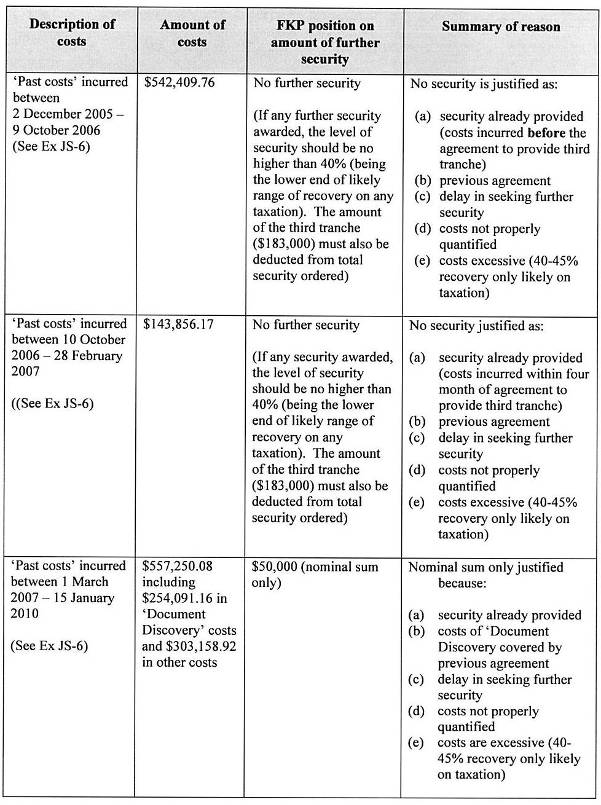
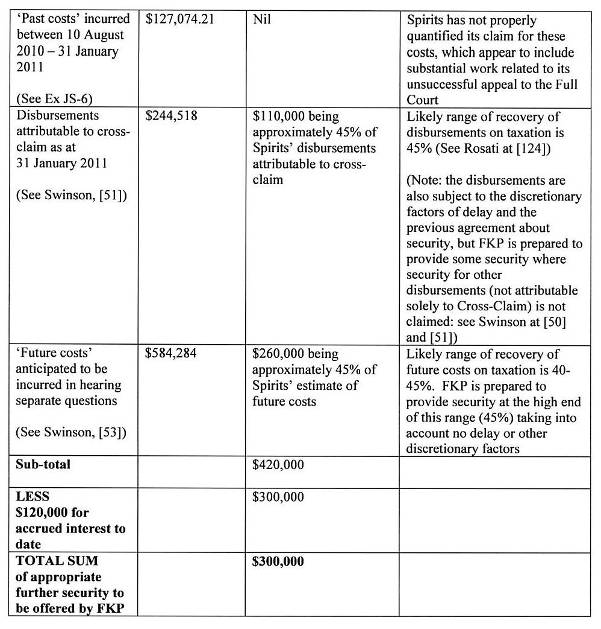
Current security
69 To date, four tranches of security for costs have been provided by FKP as set out in the following table (Hinks at [14]):
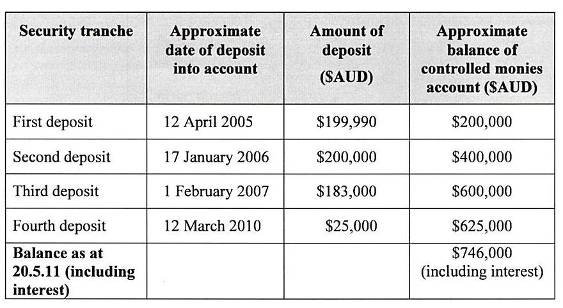
70 As shown in the above table, the amount of security presently available to Spirits is approximately $746,000, including about $120,000 in interest. The interest is not taken into account in Spirits’ calculations of the amount of security required and should be discounted from the sum awarded, as per FKP’s calculations at [68] above.
71 By comparison to the $746,000 in security that has already been provided, Spirits’ asserts its total ‘costs to date’ of the cross-claim are in the vicinity of $2,340,000 (this figure represents the sum of Mr Swinson’s calculations of (i) non-discovery costs of $1,892,744; (ii) discovery costs of $254,937; and (iii) disbursements of $244,518 attributable to the cross-claim: see Swinson at [52]) plus estimated future costs of $584,284.
72 The effect of depositing an additional $1.2m, as sought by Spirits, would be to raise the security available to Spirits to approximately $1.95m pending determination of the separate questions. FKP submitted that this amount of security is excessive and unfairly prejudicial having regard to the following matters, which are canvassed in greater detail in [73] – [113] below:
(a) The principles applicable to applications for security for costs;
(b) the nature of the ‘past costs’ (including Spirits’ previous agreement and its delay in seeking further security for such costs);
(c) Spirits’ failure to properly quantify its claim for security;
(d) the likely proportion of costs recoverable by Spirits on any taxation; and
(e) the cost orders in FKP’s favour that are yet to be paid by Spirits.
(a) Security for costs - Principles
73 Section 56 of the FCA provides that the Court may order an applicant to give security for the payment of costs that may be awarded against him or her. The security shall be of such amount, and given at such time and in such manner and form, as the Court directs: s 56(2).
74 The onus of leading evidence to establish its entitlement to an order for security in the amount sought lies with Spirits: Idoport Pty Ltd v National Australia Bank Ltd [2001] NSWSC 744 at [60]. This must be done by evidence having ‘some characteristic of cogency’: Idoport at [62].
75 The question of whether security for costs should be granted ‘is a matter entirely within the discretion of the Court’: Australian Equity Investors v Colliers International (NSW) Pty Limited (No 5) [2011] FCA 1041 at [11]. That discretion is exercised ‘having regard to all the circumstances of the case without any predisposition in favour of the award of security’: KP Cable Investments at 196.
76 It is not the purpose of security to give a full indemnity to the respondent: see, e.g., Brundza v Robbie & Co (No 2) (1952) 88 CLR 171 at 175 per Fullagar J. Instead, the Court has a discretion to fix such amount as it thinks fit in all the circumstances of the case: Reinsurance Australia Corporation Ltd v HIH Casualty and General Insurance Ltd (in liq) [2003] FCA 803 at [94]. The amount of security will not exceed the likely recoverable party/party costs on taxation and may be less: Allstate Life Insurance Co v Australia and New Zealand Banking Group Ltd (1995) 134 ALR 187 at 200 per Lindgren J.
77 For the purposes of calculating party/party costs, the scale under the old Federal Court Rules (Cth) (‘the Rules’) continues to apply to ‘past costs’ incurred before 1 August 2011: see r 40.29 of the FCR. ‘Future costs’ incurred after l August 2011 are taxable under the scale adopted by the FCR. Under the FCR unreasonable costs and unnecessary expense are not allowable: see r 40.30. There is no reason to suppose this will be interpreted in a manner relevantly different from the ‘necessary or proper’ test under O 62 r 19 of the Rules.
78 A longstanding and ‘most important’ principle is that applications for security for costs must be brought promptly: Southern Cross Exploration v Fire NL & All Risks Insurance Co Ltd (1985) 1 NSWLR 114 at 123; KP Cable Investments at 197. The principle is of equal force where the application is for further (or ‘top up’) security: Fencott v Eretta at [514] per French J.
79 Where security is sought for previous costs incurred over a long period time ‘it is unlikely that an award for past costs will be made’: Australian Equity Investors (No 5) at [58]. Relevant factors include the length of the delay, the nature of the acts done in the interim and the reasons for it: Szanto v Bainton [2011] NSWSC 985 at [50]; Southern Cross at 125. The failure of the party seeking security to ‘supervise or monitor its own continuing exposure to the risk of non-recovery of costs’ is also a relevant discretionary matter: NV Sumatra Tobacco Trading Company at [15] per Greenwood J.
80 The principle that security must be sought promptly remains applicable where security has previously been provided in ‘tranches’: see, e.g., Karl Suleman Enterprizes Pty Ltd (in liq) v Pham [2010] NSWSC 886. In that case, consent orders were made in 2005 for substantial security to be provided by the plaintiff in tranches ‘without prejudice’ to the defendants’ right to seek further security if initial estimates proved inaccurate. Four years later, the defendants applied for an additional $1.8 million in security, including with respect to significant ‘past costs’ incurred between the making of the consent order and the application for further security. The Court (Schmidt J) refused to order any additional security for the past costs, holding it was unfair and oppressive for the plaintiff to be required to provide security for ‘significant costs already incurred, when it must have been long apparent that [the defendants’] original estimates of costs, would be far exceeded’ (at [13]).
(b) The nature of the ‘past costs’
81 The vast majority of costs for which Spirits seeks further security are the ‘past costs’ totalling $1,615,108. The costs in question are said to have been incurred between 2 December 2005 and 31 January 2011: see [53] above.
82 FKP submitted that no security for these ‘past costs’, or alternatively, a nominal amount only, is appropriate for the following reasons.
83 First, Spirits has previously agreed to accept the current level of security as adequate for all (or alternatively, a substantial part) of the ‘past costs’ for which security now is sought. In a letter to FKP’s solicitors dated 11 September 2006, Spirits’ solicitors stated (Ex JS-5, pp 13 – 14):
‘Given the progress of the proceedings, the extent of costs incurred by our clients and recent issues which have arisen … it is clearly an appropriate time for your clients to post further security ...
… in the circumstances, we consider it is entirely reasonable to request that your clients increase the total security for costs to AU$600,000. Our clients will accept this amount as security for the current estimate of their costs up to and including the completion of discovery. Our clients expressly reserve the right to request additional security once discovery is completed or should their costs increase significantly beyond current estimates between now and the completion of discovery.
Please confirm by 16 September 2006 whether your clients agree to the above proposal.’
84 On 9 October 2006, FKP accepted Spirits’ proposal and agreed to deposit the third tranche of $183,000 (raising the balance of the Account to $600,000): see Ex JS-5, p 20. FKP submitted Spirits should be held to that agreement taking into account that:
(a) Discovery has not yet been completed;
(b) no adequate explanation is given for Spirits’ delay in seeking further security (see Karl Suleman Enterprizes at [52]);
(c) as a matter of discretion, the Court would not permit Spirits to ‘come back for its hat’ six years later;
(d) this is all the more so where (as noted below) the current application includes substantial costs incurred before Spirits agreed in October 2006 to accept $600,000 as an appropriate level of security up to, and including, the completion of discovery.
85 Secondly, Spirits’ present application has the effect of bundling the past costs into a single, lump sum covering the entire five year period between 2 December 2005 and 31 January 2011. This obscures the extent of its delay in seeking further security and the significance of its earlier agreement.
86 In fact, the breakdown of costs relied upon by Spirits at Ex JS-6 shows that:
(a) $542,409.76 of the ‘past costs’ for which security is now sought were incurred between 2 December 2005 and 9 October 2006, i.e. costs incurred before the October 2006 agreement was reached. This figure should be set to one side immediately. The time for Spirits to protect its position with respect to these costs was in the course of negotiations in 2006 with FKP. As a matter of discretion, the Court would not revisit the matter five years later, particularly where no explanation is given for why Spirits has delayed so long in seeking security for these costs.
(b) $143,856.17 of the ‘past costs’ for which security is sought were incurred between 10 October 2006 and 28 February 2007. These costs were incurred in the four month period immediately following the October 2006 agreement and must, again, be treated as governed by Spirits’ agreement to accept the third tranche as adequate security for its costs ‘up to and including the completion of discovery’. The appropriate time to bring any application for further security with respect to such costs was also in February 2007, and Spirits failed to do so.
(c) $557,250.08 of the ‘past costs’ for which security is sought were incurred between 1 March 2007 and 15 January 2010, including $254,091.16 recorded in ‘Document Discovery’ costs. The ‘Document Discovery’ costs are proportionate to the third tranche of security ($183,000) and appear to be part of the very costs envisaged by the parties to be governed by the October 2006 agreement ($183,000 is about 72% of the Document Discovery costs of $254,000). The remainder of these costs are subject to the criticism of Spirits’ delay in seeking further security and its failure to properly quantify the claim. It is also unclear from Spirits’ evidence whether these costs include amounts related to the settlement negotiations: Hinks at [26]. Spirits’ legal costs of the settlement negotiations, including during the 12 month period of the stay, cannot be the subject of any cost order in its favour.
(d) $127,074.21 of the ‘past costs’ for which security is sought were incurred between 10 August 2010 and 31 January 2011. No security is warranted for these costs as quantified because they include significant work related to Spirits’ unsuccessful appeal to the Full Federal Court, in which it was ordered to pay FKP’s costs: see [92] below. This no doubt reflects the fact that Spirits prepared its evidence on the security application before the Full Federal Court delivered judgment on its appeal. FKP invited Spirits to reconsider this claim.
87 Thirdly, the first occasion Spirits foreshadowed it would seek further security for such a significant, lump sum of ‘past costs’ was in correspondence dated 15 December 2010: Hinks at [29]. The period of settlement negotiations commencing about May 2008 and ending in December 2009 (Hinks at [25]; Swinson at [21] – [23]) affords no excuse for failing to raise the issue of further security for the costs referred to at [86(a)] and [86(b)] above before early 2007 and, in the case of [86(c)] above, at the very latest in December 2009 when the settlement negotiations were complete. A possible explanation is that Spirits has failed to properly supervise and monitor its costs, and only recently discovered a ‘blow out’ in the extent of its liability. This hypothesis is consistent with the evidence to suggest Spirits has never obtained estimates of legal costs from its solicitors or entered into any cost agreement.
88 Fourthly, and whatever the reason for Spirits’ extensive delay in seeking further security, FKP should not be called upon to deposit such a large, lump sum of further security now. FKP has budgeted for its own costs of the proceeding in light of the parties’ previous agreement: see Hinks at [30]. Requiring FKP to deposit the security sought will adversely affect its ability to discharge its liabilities and comply with Russian laws concerning economic efficiency: Hinks at [30]. Permission is also required from the Federal Service for the Regulation of the Alcohol Market in Russia. This could possibly be refused because of its affect on FKP’s financial position: Hinks at [30].
(c) Failure properly to quantify Spirits’ claim
89 Before security for costs will be awarded, there must be proper and cogent evidence from the party seeking security: see Idoport at [60]. Such evidence usually comprises details of (Rosati at [34]):
(a) The nature of the work actually performed or anticipated likely to be performed;
(b) the hourly rates charged by each of the different fee earners;
(c) details of any discount applied, or to be applied, to the costs charged; and
(d) the number of hours spent by each fee earner either in total, or in relation to each category of the work.
90 FKP submitted that other than some general comments about discovery, there is insufficient detail in Spirits’ evidence to justify the costs sought as security for past costs: Rosati at [36], [115].
91 Absent appropriate evidence from Spirits, FKP issued a notice to produce for copies of the tax invoices issued to Spirits by its solicitors (Mallesons): see Hinks at [31]. A redacted version of the tax invoices, issued by Mallesons to Spirits in US dollars, was subsequently made available for inspection by FKP. FKP argued that for present purposes, these invoices illustrate two important points.
92 First, expenditure is included in Spirits’ calculations which cannot be the subject of a costs order in its favour. As noted above, Spirits seeks security for $127,074.21 in past costs incurred between 10 August 2010 and 31 January 2011 (Ex JS-6) when the narrations in its tax invoices show a significant proportion of work in this period related to Spirits’ unsuccessful appeal to the Full Court regarding the separate questions: Rosati at [127]; see also Ex KR-3 pp 6 – 9, 16 – 19 and 26 – 28. Spirits was ordered to pay FKP’s costs of that appeal. It is not entitled to security for costs the subject of a specific, adverse costs order against it: Rosati at [129].
93 Secondly, Spirits’ expenditure to date is excessively high to justify the level of 60% security sought. This second point is developed further below.
(d) The likely proportion of costs recoverable by Spirits on any taxation
(i) Overview
94 Spirits calculates that it requires $1.2m in further security by applying a recovery rate of 60% to the ‘past costs’ and ‘future costs’ identified in Swinson. This rate is based upon Mr Swinson’s ‘assumption’ (Swinson at [59]) that 60% of Spirits’ costs will be recoverable on any taxation.
95 In the calculations set out at [68] above, FKP adopts a recovery rate of 45% for the ‘future costs’ and ‘disbursements’ and submits 40% is an appropriate rate if, contrary to its submissions, further security is awarded to Spirits for its ‘past costs’. These figures reflect the upper and lower range of costs likely to be recoverable by Spirits on any taxation according to the affidavit of the independent expert, Ms Kerrie-Ann Rosati.
96 Ms Rosati is a legal costs expert and the Solicitor-Director at DG Thompson, Legal Costs Lawyers and Consultants. She is responsible for managing a team of around 20 legal cost consultants and has provided legal costing services in thousands of commercial litigation matters, including novel, complex and protracted proceedings.
97 The principles applicable to the taxation of costs in this Court are explained in detail by Ms Rosati. Ms Rosati deposes that the proportion of costs recoverable on 65% of actual costs, with some matters falling above or below this range: Rosati [43].
(ii) Past costs in the present case
98 Having regard to the tax invoices produced by Spirits, the pleadings and other relevant documents, Ms Rosati’s expert opinion is that a reasonable range of the likely ‘past costs’ recoverable by Spirits on any taxation is between 40% and 45% of its actual costs, and quite possibly less: Rosati at [118].
99 The basis for Ms Rosati’s opinion that the amount of ‘past costs’ recoverable by Spirits will be at the lower end, or slightly below, the usual range of recovery, is detailed at [42] – [118] of her affidavit. Broadly, and in summary, FKP submitted:
(a) 138 fee earners at Mallesons have billed time to Spirits in relation to the cross-claim, giving rise to a duplication of work and time spent conferring internally that is not usually recoverable on any taxation ([82] – [84]).
(b) The hourly rates billed by Mallesons to Spirits for lawyers and clerks are significantly higher, and in some instances well in excess of 50% higher, than the rates allowed on a party/party basis under the Federal Court scale ([74], [75]). For example, partners at Mallesons have charged Spirits for work done at hourly rates ranging from $410 to $1,150 per hour ([69(a)]) when the Federal Court scale has permitted recovery at rates ranging from $244 to $304 (plus the general care and conduct uplift ([55]). The ‘general care and conduct’ uplift is discussed at Rosati [18] – [19], [50], [58] ff). Paralegal and clerical staff have charged rates ranging from $90 to $412 ([69]) when the scale has permitted recovery at $52 to $64 per hour.
(c) Spirits has been billed by reference to hourly rates for work that is not recoverable on the basis of time charging. For example, Ms Rosati refers to a four page procedural affidavit for which Spirits was billed by block narrations a total of up to 20.74 hours ([100] – [106]) by four fee earners, equating to US$4,414 (over US$1,000 per page). The costs recoverable at scale on the basis of the number of folios (etc) equated to about 4.5 hours of time (or US$1,480 in total) by one fee earner only.
(d) Consistently with the above points, many examples exist of amounts billed to Spirits well in excess of what is allowed at scale. For example, on 3 March 2006, Mallesons charged Spirits US$12,012.80 for time spent by three solicitors (including two partners) for attending and instructing counsel at the hearing of a notice of motion and related work ([86]). At that time, the maximum daily amount permitted by the scale for attendance at a hearing instructing counsel was approximately AUD$1,000 ([88]), or less than 10% of what was charged by Mallesons to Spirits.
(e) A significant portion of time has been billed to Spirits for overseas trips by Mallesons, such as the trip undertaken by Mr Swinson in January 2007 costing $26,792.92 (excluding disbursements) ([94] to [96]). The billing narrations for this trip read 12 hours for ‘Travel and prepare for meeting’ (US$5,716.92), three entries of eight hours for ‘Meeting with expert witness’ (each costing approximately US$3,800), eight hours for ‘Working in Lovell’s office preparing response to FKP’s brief and travel’ (US$3,844.96) and a further 12 hours for ‘Travelling’ (US$5,767.44). Notwithstanding this expenditure, no expert evidence has been filed and Spirits estimates an additional $214,700 is necessary to prepare its evidence on the separate questions hearing, plus $30,000 in expert travel and accommodation costs: see Ex JS-7. There was also a 10 day ‘Discovery Trip’ in September 2006 ([97]) where two lawyers entered block units of 7 hours 30 minutes per day (costing up to US$3,000 per day) under the narration ‘Attending Discovery Trip’. The time for both trips is likely to be significantly reduced or disallowed on a party/party basis.
(f) Considerable amounts of time have been billed to Spirits for research that are likely to be disallowed or reduced significantly ([91]) on any taxation, including over 60 hours billed by two ‘seasonal clerks’ in December 2010 and January 2011. The research costed over US$10,000. It is apparent from Ex KR-3 p 10 that the summer clerks were billed at approximately US$180/hr. It is not clear what was being researched.
(g) Many tasks associated with electronic discovery are not recognised by the scale and the amount allowed on a party/party basis for these costs is likely to be significantly less than the costs that have been charged to Spirits ([107] – [114]).
100 FKP’s position, of course, is that no further security should be given for the ‘past costs’ for the discretionary reasons submitted above. If, contrary to that position, the Court decided to award any further security, FKP submitted the security awarded should be below, or at the lowest end of the range proposed by Ms Rosati (40%), having regard to her evidence and the discretionary factors.
(iii) The ‘future costs’ estimate
101 Ms Rosati deposes that the ‘future costs’ recoverable by Spirits are also likely to be in the vicinity of 40 to 45%, taking into Spirits’ estimate at Ex JS-7 and the matters set out at [130] – [149] of her affidavit which include that:
(a) The team approach of involving large numbers of lawyers (and consequent duplication of work) is likely to continue;
(b) the tasks detailed in Spirits’ estimate are duplicated with both the partner and solicitor performing the same or similar tasks;
(c) the estimates of costs ($8,500) for briefing counsel appear to be excessive given counsel have been briefed in the matter for a number of years;
(d) $214,700 is estimated for the costs of Spirits’ evidence, yet no indication of the scope or extent of the evidence in question is provided. The estimate of 132 hours in solicitors’ time (including 32 hour of partners’ time) to prepare such evidence appears to be high;
(e) thirty hours of solicitors’ time (or $24,700) has been estimated for ‘preparing submissions’, yet both senior and junior counsel are briefed, and
(f) there is no indication how any of the estimated amounts for costs to be incurred by expert witnesses have been calculated.
102 FKP is prepared to give security for the ‘future costs’ at approximately the upper end (or 45%) of the range proposed by Ms Rosati, as per its calculations at [68] above.
(iv) Disbursements
103 Further security is sought for disbursements of $244,518 including $92,520 for the costs of overseas airfares (and associated costs) and $151,998 in processing documents for discovery ([120]). Ms Rosati opines that 45% is a likely recovery rate for these disbursements ([124]).
104 Although the disbursements are open to criticism on the grounds of delay and the previous agreement, for example, the $92,000 in ‘overseas airfares’ appears to include trips undertaken in September 2006 and January 2007 ([94], [97]), FKP is prepared to give further security for these costs in the range (45%) adopted by Ms Rosati taking into account there is evidence that security is not claimed for other disbursements that may relate (in part) to the cross-claim: see Swinson at [50] and [51].
(v) Criticisms of Ms Rosati
105 Contrary to Spirits’ submission at [61] and [62] above, it is no answer to Ms Rosati’s evidence for Spirits to point to other cases where a higher percentage of security has been awarded. FKP does not dispute the usual range of recovery on any taxation is between 45% to 65%, a figure consistent with the cases referred to by Spirits. The point is that, in the present case, the costs recoverable are likely to be at the lower end, or slightly below, that range (and possibly less). The reasons for this are explained in detail in the affidavit of Ms Rosati.
106 The criticisms of Ms Rosati’s affidavit at [64] above have no foundation because:
(a) Rule 40.29 of the FCR provides for work done prior to 1 August 2011 to be taxed in accordance with the scale under the Rules. The FCR thus cannot affect Ms Rosati’s evidence concerning the ‘past costs’ incurred between 2 December 2005 and 31 January 2011.
(b) The FCR maintain the rule that unreasonable and unnecessary expenses are not allowable on any taxation: r 40.30. There is no reason to suppose this rule will be interpreted in a way that is relevantly different to the ‘necessary or proper’ test under O 62 r 19 of the Rules.
(c) Spirits does not justify, on the evidence before the Court in this application, how the FCR give rise to an expectation of recovery of ‘future costs’ in higher proportion to that adopted by Ms Rosati in her report.
(d) The allegation that Ms Rosati does not give sufficient allowance for the novelty and complexity of the proceedings reflects a misreading of her affidavit. In fact, Ms Rosati concluded that the matter was novel and complex, that there were a large number of documents and questions of law and fact, and that an appropriate ‘uplift’ in light of that complexity was between 20% to 25%: Rosati at [50] – [52]. There is no reason for this Court to doubt the correctness of that opinion, particularly where Ms Rosati’s experience includes involvement in the recovery of costs in large and complex matters.
(vi) Summary of likely position on taxation
107 In summary, FKP submitted the picture revealed by analysis of the tax invoices is that, far from the 60% recovery rate adopted by Spirits being a ‘conservative estimate’ of what is recoverable (cf [40] above), security is sought for costs which are excessive having regard to:
(a) A duplication of work involving 138 fee earners;
(b) time charging at hourly rates well in excess of what is recoverable;
(c) the billing of amounts well in excess of what is recoverable;
(d) costs and disbursements associated with discovery costs and overseas trips that will not be recoverable or substantially reduced.
(e) Cost orders in FKP’s favour
108 Spirits has been ordered to pay FKP’s costs of the substantive interlocutory steps to date in the proceeding, such as:
(a) The costs of the Full Federal Court appeal, and subsequent application for special leave to appeal to the High Court, in relation to Spirits application for discovery from the Russian Federation: Hinks at [38](a) and (b); and
(b) the costs of Spirits’ appeal to the Full Federal Court with respect to the hearing of separate questions: Hinks at [38](c).
109 Spirits has not yet paid FKP’s costs of the above orders, which will be significant: Hinks at [39]. This is a further factor warranting a lower than usual amount of security.
(f) Manner of payment
110 Owing to Russian laws, FKP cannot deposit any large lump sum of security into the Account in a period less than four months: Hinks at [30], [37]. FKP accordingly requested the Court allow sufficient opportunity for it to provide any additional security that is ordered.
(g) Conclusion on security for costs
111 Spirits application for further security in the amount of $1,200,000 should be refused.
112 FKP consents to providing an additional $300,000 in security and submits that this amount is fairly adequate and appropriate by reference to the calculations at [68] above. The security offered will raise the amount of security to $1,046,000 plus accruing interest. That is more than adequate at this point in the proceeding.
113 Beyond that, further security is not justified having regard to:
(a) The October 2006 agreement;
(b) the timing of the ‘past costs’ (including the $542,000 incurred before the previous agreement to provide the third tranche up to, and including, discovery);
(c) the length of Spirits’ delay in seeking further security, which is not adequately explained;
(d) the failure of Spirits properly to quantify its claim; and
(e) the excessive quantum of costs for which security is sought, including because of the involvement of 138 fee earners and the charging of amounts well in excess of what is recoverable.
Consideration
114 On the hearing of the motion, Spirits, through its senior counsel, ‘walked away’ from its claim for security in respect of ‘past costs’ incurred between 2 December 2005 and 9 October 2006 amounting to $542,409.76. In doing so, in my opinion, it acted correctly. In relation to ‘past costs’ incurred between 10 October 2006 and 28 February 2007 ($143,856.17), it was submitted that there should be ‘some allowance for those costs’, but I do not agree. Indeed, it should have taken the same position with respect to all ‘past costs’; those incurred between 10 October 2006 and 28 February 2007 ($143,856.17); those incurred between 1 March 2007 and 15 January 2010 ($557,250.08); and those incurred between 10 August 2010 and 31 January 2011 ($127,074.21), for the reasons summarised in FKP’s submissions as recorded in [68] above and subsequently developed in [73] – [113] above.
115 It follows from what is said in [114] above, that Spirits’ motion for security for costs must be refused.
116 In the face of FKP’s offer to pay an additional amount of $300,000 by way of security for Spirits’ costs, I would be disposed to make an order in those terms. Orders going to the temporal and other relevant aspects of the execution of such an order should be the subject of negotiation between the parties.
117 On any view, FKP should have its costs of the motion.
I certify that the preceding one hundred and seventeen (117) numbered paragraphs are a true copy of the Reasons for Judgment herein of the Honourable Justice Edmonds. |
Associate:


