FEDERAL COURT OF AUSTRALIA
Quall v Northern Territory of Australia [2011] FCA 1441
IN THE FEDERAL COURT OF AUSTRALIA | |
| Applicant | |
AND: | NORTHERN TERRITORY OF AUSTRALIA & ORS Respondent |
DATE OF ORDER: | |
WHERE MADE: |
THE COURT ORDERS THAT:
1. The proceedings be dismissed.
2. There be no order as to costs.
Note: Entry of orders is dealt with in Rule 39.32 of the Federal Court Rules 2011.
IN THE FEDERAL COURT OF AUSTRALIA | |
NORTHERN TERRITORY DISTRICT REGISTRY | |
GENERAL DIVISION | NTD 6039 of 1998 |
BETWEEN: | KEVIN LANCE (TIBBY) QUALL Applicant |
AND: | NORTHERN TERRITORY OF AUSTRALIA & ORS Respondent |
JUDGE: | REEVES J |
DATE OF ORDER: | 16 December 2011 |
WHERE MADE: | BRISBANE (HEARD IN DARWIN) |
THE COURT ORDERS THAT:
1. The proceedings be dismissed.
2. There be no order as to costs.
Note: Entry of orders is dealt with in Rule 39.32 of the Federal Court Rules 2011.
IN THE FEDERAL COURT OF AUSTRALIA | |
NORTHERN TERRITORY DISTRICT REGISTRY | |
GENERAL DIVISION | NTD 6009 of 1999 |
BETWEEN: | KEVIN LANCE (TIBBY) QUALL Applicant |
AND: | NORTHERN TERRITORY OF AUSTRALIA & ORS Respondent |
JUDGE: | REEVES J |
DATE OF ORDER: | 16 December 2011 |
WHERE MADE: | BRISBANE (HEARD IN DARWIN) |
THE COURT ORDERS THAT:
1. The proceedings be dismissed.
2. There be no order as to costs.
Note: Entry of orders is dealt with in Rule 39.32 of the Federal Court Rules 2011.
IN THE FEDERAL COURT OF AUSTRALIA | |
NORTHERN TERRITORY DISTRICT REGISTRY | |
GENERAL DIVISION | NTD 6010 of 1999 |
BETWEEN: | KEVIN LANCE (TIBBY) QUALL Applicant |
AND: | NORTHERN TERRITORY OF AUSTRALIA & ORS Respondent |
JUDGE: | REEVES J |
DATE OF ORDER: | 16 December 2011 |
WHERE MADE: | BRISBANE (HEARD IN DARWIN) |
THE COURT ORDERS THAT:
1. The proceedings be dismissed.
2. There be no order as to costs.
Note: Entry of orders is dealt with in Rule 39.32 of the Federal Court Rules 2011.
IN THE FEDERAL COURT OF AUSTRALIA | |
NORTHERN TERRITORY DISTRICT REGISTRY | |
GENERAL DIVISION | NTD 6011 of 1999 |
BETWEEN: | KEVIN LANCE (TIBBY) QUALL Applicant |
AND: | NORTHERN TERRITORY OF AUSTRALIA & ORS Respondent |
JUDGE: | REEVES J |
DATE OF ORDER: | 16 December 2011 |
WHERE MADE: | BRISBANE (HEARD IN DARWIN) |
THE COURT ORDERS THAT:
1. The proceedings be dismissed.
2. There be no order as to costs.
Note: Entry of orders is dealt with in Rule 39.32 of the Federal Court Rules 2011.
IN THE FEDERAL COURT OF AUSTRALIA | |
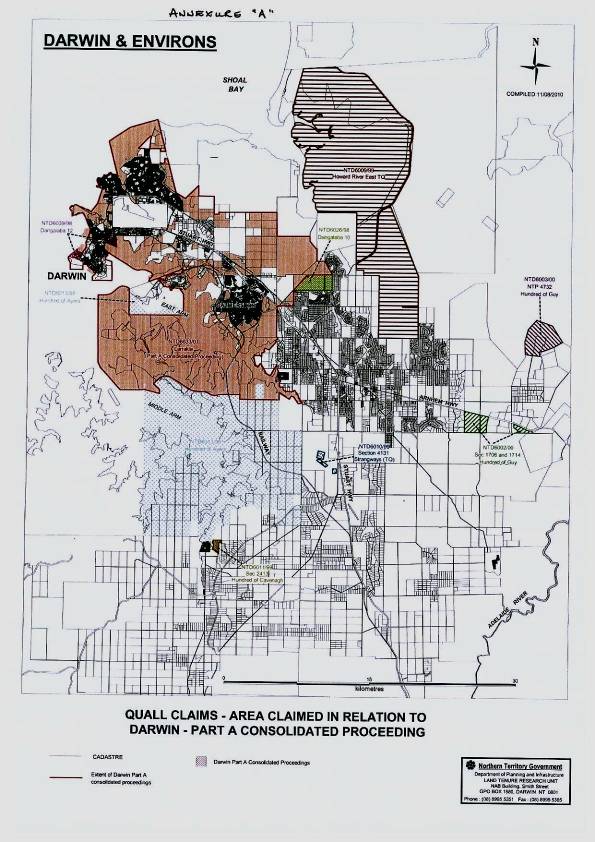
NORTHERN TERRITORY DISTRICT REGISTRY | |
GENERAL DIVISION | NTD 6002 of 2000 |
BETWEEN: | KEVIN LANCE (TIBBY) QUALL Applicant |
AND: | NORTHERN TERRITORY OF AUSTRALIA & ORS Respondent |
JUDGE: | REEVES J |
DATE OF ORDER: | 16 December 2011 |
WHERE MADE: | BRISBANE (HEARD IN DARWIN) |
THE COURT ORDERS THAT:
1. The proceedings be dismissed.
2. There be no order as to costs.
Note: Entry of orders is dealt with in Rule 39.32 of the Federal Court Rules 2011.
IN THE FEDERAL COURT OF AUSTRALIA | |
NORTHERN TERRITORY DISTRICT REGISTRY | |
GENERAL DIVISION | NTD 6003 of 2000 |
BETWEEN: | KEVIN LANCE (TIBBY) QUALL Applicant |
AND: | NORTHERN TERRITORY OF AUSTRALIA & ORS Respondent |
JUDGE: | REEVES J |
DATE OF ORDER: | 16 December 2011 |
WHERE MADE: | BRISBANE (HEARD IN DARWIN) |
THE COURT ORDERS THAT:
1. The proceedings be dismissed.
2. There be no order as to costs.
Note: Entry of orders is dealt with in Rule 39.32 of the Federal Court Rules 2011.
NORTHERN TERRITORY DISTRICT REGISTRY | |
GENERAL DIVISION | NTD 6026 of 1998 NTD 6039 of 1998 NTD 6009 of 1999 NTD 6010 of 1999 NTD 6011 of 1999 NTD 6002 of 2000 NTD 6003 of 2000 |
BETWEEN: | KEVIN LANCE (TIBBY) QUALL Applicant
|
AND: | NORTHERN TERRITORY OF AUSTRALIA & ORS Respondent
|
JUDGE: | REEVES J |
DATE: | 16 December 2011 |
PLACE: | BRISBANE (HEARD IN DARWIN) |
REASONS FOR JUDGMENT
Introduction
1 These applications mark a further stage in the history of a series of native title determination and compensation applications lodged under the Native Title Act 1993 (Cth) (“the Act”) by Mr Quall, as the sole member of the authorised applicant. To distinguish Mr Quall’s substantive applications from these dismissal applications, in these reasons I will refer to those substantive applications as the Quall native title applications, or the Quall applicants. In this stage, the Northern Territory of Australia, the first respondent, has applied for orders to dismiss a further seven Quall native title applications. On the affidavit evidence filed in support of these dismissal applications, it appears that these seven applications constitute the remaining Quall native title applications that have been filed with the Court. To set the scene for these dismissal applications, it is necessary to briefly recount some of the history of the various native title applications lodged over the past decade or more by Mr Quall, on behalf of the Quall applicants.
The history of the Quall native title applications
2 Since 1996, Mr Quall has lodged or filed more than 20 native title determination applications and one native title compensation application under the Act. Most of those applications have already been dismissed by earlier judgments of this Court. In chronological order, they include: Quall v Risk [2001] FCA 378 (“Quall No 1”), Risk v Northern Territory of Australia [2006] FCA 404 (“Risk”) and Quall v Northern Territory of Australia [2009] FCA 18 (“Quall No 2”).
3 In Quall No 1, O’Loughlin J dismissed a Quall application in proceeding NTD 6044 of 1998. In the course of his reasons, O’Loughlin J mentioned five other native title applications Mr Quall had filed which, it appears, suffered the same fate as proceeding NTD 6044 of 1998: see Quall No 1 at [30]–[31]. Mr Quall did not appeal that decision.
4 Risk was a consolidated set of proceedings (NTD 6033 of 2001) involving a number of native title applications made by Mr Risk, as the authorised applicant, (in these reasons I will refer to those applications as the Risk native title applications, or the Risk native title applicants) together with a number of native title applications made by Mr Quall, as the authorised applicant. The consolidated proceedings related to the lands and waters that were the subject of the various native title applications, that fell within the urban areas of the city of Darwin in the Northern Territory – known as “Area A”. This designation as “Area A” came about when all the various native title applications covering lands and waters within, and surrounding, the city of Darwin were divided into two areas: Areas A and B. Area B related to the lands and waters in the rural areas surrounding the city of Darwin: see Quall No 2 at [1].
5 In Risk, Mansfield J dismissed 11 Quall applications that wholly or partly related to the lands or waters within Area A. The final orders made by Mansfield J in Risk, on 17 May 2006, were in the following form:
THE COURT ORDERS, DECLARES AND DETERMINES THAT:
1. Native title does not exist in relation to any part of the land or waters the subject of the applications comprising this consolidated proceeding as described in the attached Consolidated Proceeding Claim Area List.
AND THE COURT FURTHER ORDERS THAT:
2. The applications comprising this consolidated proceeding (NTD6033 of 2001) be dismissed to the extent of the consolidation as follows:
(a) in relation to proceedings NTD6017 of 1998, NTD6013 of 1998 and NTD6026 of 1998, they are dismissed to the extent that those proceedings seek a determination of native title in relation to an area referred to in the attached Consolidated Proceeding Area List; and
(b) in relation to proceedings NTD6007 of 1998, NTD6010 of 1998, NTD6011 of 1998, NTD6012 of 1998, NTD6014 of 1998, NTD6015 of 1998, NTD6018 of 1998, NTD6019 of 1998, NTD6022 of 1998, NTD6029 of 1998, NTD6040 of 1998, NTD6001 of 1999, NTD6007 of 1999, NTD6018 of 1999 and NTD6026 of 2001, they are dismissed in their entirety.
3. There be no order as to costs.
(Emphasis added)
6 The Full Court dismissed appeals against the judgment in Risk lodged by both the Risk native title applicants and the Quall applicants: see Risk v Northern Territory of Australia [2007] FCAFC 46 (“Risk FC”). Mr Quall sought special leave to appeal the Full Court’s decision in Risk FC to the High Court of Australia. That application was subsequently refused: see [2008] HCA Trans 127.
7 The 11 proceedings emphasised above (at [5]) were all Quall native title applications. With the exception of proceeding NTD 6001 of 1999 (see Risk at [2]), all the others were Risk native title applications. So, in summary, in Risk, two Quall native title applications were partly dismissed and nine were entirely dismissed.
8 As appears from the orders made in Risk (see [5] above), the two Quall native title applications that were partly dismissed were NTD 6026 of 1998 and NTD 6013 of 1998. The areas identified in the Consolidated Proceeding Area List attached to the final orders in Risk (see [5] Order 2(a) above), involving those two applications, all fell within Area A.
9 The remaining parts of proceeding NTD 6026 of 1998 – which all relate to lands and waters in Area B – is one of the seven proceedings the subject of these dismissal applications: see at [13(a)] below. I explain immediately below (at [10]–[12]) how the other proceeding, NTD 6013 of 1998, was disposed of.
10 Soon after the High Court refused Mr Quall’s application for special leave to appeal in Risk, the Northern Territory applied to dismiss the remaining parts of proceeding NTD 6013 of 1998. In Quall No 2, I ordered that proceeding be dismissed. In brief summary, I did that on the following grounds:
(a) that Mr Quall was estopped by the decision in Risk from pursuing the following issues:
(i) whether the Aboriginal society at sovereignty, that by the traditional laws and customs of its normative system, possessed native title rights and interests in relation to the lands and waters in the Darwin area, including those within Area A, was some Aboriginal society other than the society of the Larrakia/Kulumbiringin peoples identified by Mansfield J in Risk;
(ii) whether there had been a substantial interruption in the acknowledgment and observance of the traditional laws and customs of that society of the Larrakia/Kulumbiringin peoples since sovereignty such that native title no longer existed in the lands and waters within Area A; and
(iii) whether there was a separate, more confined, traditional Aboriginal society at sovereignty comprising the Danggalaba clan that by the traditional laws and customs of its normative system, possessed native title rights and interests in relation to the lands and waters in Area A: see Quall No 2 at [80]–[81].
(b) the application was an abuse of process because in Risk Mr Quall and the Quall applicants had every opportunity to fully litigate the issue as to what was the relevant Aboriginal society at sovereignty possessing native title rights and interests in the Larrakia lands in area A: see Quall No 2 at [107].
(c) these findings applied to all Larrakia lands whether those lands fell within Area A or Area B: see Quall No 2 at [86], [98] and [115].
11 On appeal, the Full Court upheld all of these conclusions: see Quall v Northern Territory of Australia (2009) 180 FCR 528; [2009] FCAFC 157 (“Quall FC”). In particular, as to issue estoppel: see Quall FC at [33]–[40] and [45]; as to abuse of process: see Quall FC at [27]–[31] and as to the findings applying to all Larrakia lands whether in Area A or B: see Quall FC at [41]–[45].
12 The High Court subsequently refused Mr Quall’s application for special leave to appeal the Full Court’s judgment in Quall FC: see [2010] HCA Trans 186.
the seven quall native title applications concerned
13 Having set out a brief summary of the history of the various Quall native title applications that have been lodged or filed under the Act, it is now convenient to summarise the main features of the remaining seven Quall native title determination and compensation applications that are the subject of these dismissal applications. In the chronological order in which they were originally lodged with the National Native Title Tribunal (“NNTT”), or filed with the Court, they may be summarised as follows:
(a) NTD 6026 of 1998 (partly dismissed in Risk: see [8] and [9] above)
(i) lodged with the NNTT on 19 August 1997.
(ii) made under ss 13(1) and 61(1) of the Act for a determination of native title.
(iii) native title claim group: 27 named people, four of whom, and their descendants, are described as: “descendants of Kulumbiringin ancestors and constitutes the Kulumbiringin according to Aboriginal law and custom”.
(iv) so far as it remains on foot (the application as it related to NT Portions 2818, 2819 and 2820 in Area A was dismissed in Risk) it relates to NT Portions 2821 and 2822 in Area B.
(v) amended and replaced on 11 February 2002. Prior to this amendment, the form lodged with the NNTT simply stated the application was being made on behalf of the “Danggalaba Clan”.
(b) NTD 6039 of 1998
(i) lodged with the NNTT on 14 May 1998.
(ii) made under ss 50(2) and 61(1) of the Act for a determination of compensation.
(iii) native title claim group: Dangalaba (for consistency, henceforth in these reasons I will adopt the spelling: “Danggalaba”) Clan being “those who have direct descent and whose rights and interests that are affected by the acts” the subject of the claim. Beyond this broad and general statement, the members of the native title claim group were not identified.
(iv) relates to Lot 5647 (Cullen Bay) and Lot 5988 (Bayview Haven), both of which are within the City of Darwin, ie within Area A.
(v) not amended or replaced.
(c) NTD 6009 of 1999
(i) filed with the Court on 30 September 1999.
(ii) made under ss 13(1) and 61(1) of the Act for a determination of native title.
(iii) native title claim group: 27 named people, four of whom, and their descendants, are described as: “descendants of Kulumbiringin ancestors and constitutes the Kulumbiringin according to Aboriginal law and custom”.
(iv) relates to NT Portion 3601, Hundred of Bagot, and surrounding land within Area B.
(v) amended and replaced on 8 August 2001. Prior to this amendment the native title claim group was eight named people with the surname Quall who are described as members of the “Danggalaba Clan”.
(d) NTD 6010 of 1999
(i) filed with the Court on 5 October 1999.
(ii) made under ss 13(1) and 61(1) of the Act for a determination of native title.
(iii) native title claim group: eight named people with the surname Quall who are described as members of the “Danggalaba Clan”.
(iv) relates to Sections 3491, 3492, 3493, 3495, 3496 and 3497, Hundred of Strangways, within Area B.
(v) amended and replaced on 2 November 1999, but the native title claim group remained the same.
(e) NTD 6011 of 1999
(i) filed with the Court on 26 November 1999.
(ii) made under ss 13(1) and 61(1) of the Act for a determination of native title.
(iii) native title claim group: eight named people with the surname Quall who are described as members of the “Danggalaba Clan”.
(iv) relates to Section 2413(A), Hundred of Cavenagh, within Area B.
(v) amended on 2 December 1999, to name the Northern Territory as a respondent, but otherwise it remained the same.
(f) NTD 6002 of 2000
(i) filed with the Court on 21 February 2000.
(ii) made under ss 13(1) and 61(1) of the Act for a determination of native title.
(iii) native title claim group: eight named people with the surname Quall who are described as members of the “Danggalaba Clan”.
(iv) relates to Sections 1706 and 1714, Hundred of Guy, within Area B.
(v) amended and replaced on 20 March 2000, but the native title claim group remained the same.
(g) NTD 6003 of 2000
(i) filed with the Court on 21 February 2000.
(ii) made under ss 13(1) and 61(1) of the Act for a determination of native title.
(iii) native title claim group: eight named people with the surname Quall who are described as members of the “Danggalaba Clan”.
(iv) relates to NT Portion 4732, Hundred of Guy, within Area B.
(v) amended and replaced on 20 March 2000, but the native title claim group remained the same.
Some distinguishing features of some of these seven applications
14 For the purpose of these dismissal applications, this summary requires some further elaboration. First, proceeding NTD 6039 of 1998 is different to the other six proceedings in at least four relevant respects: it is an application for the determination of compensation rather than native title; it does not name or identify who the members of the native title claim group are, viz the Danggalaba Clan, cf “eight named people with the surname Quall who are described as members of the ‘Danggalaba Clan’” (above); it relates to land falling within Area A instead of Area B; and it was lodged before the 1998 amendments to the Act (which relevantly came into effect on 30 September 1998) and has not since been amended or replaced by an application in a form which complies with those amendments and the Native Title (Federal Court) Regulations 1998. All the others do comply with these regulations, even NTD 6026 of 1998, which was also originally lodged with the NNTT before the 1998 amendments to the Act.
15 Secondly, proceedings NTD 6026 of 1998 and NTD 6009 of 1999 contain a difference to the other five proceedings. While they both began as Danggalaba Clan applications, they were subsequently amended (see below) so that the native title claim group was stated to be named descendants of Kulumbiringin ancestors. In the other five proceedings the native title claim group is described as eight named members of the Danggalaba Clan. I include here NTD 6039 of 1998, although, as I have noted above, the members of the Danggalaba claim group in that proceeding are unnamed and unidentified.
16 These two proceedings and a number of others, including NTD 6013 of 1998, were amended by leave given by Mansfield J in October 2001 to change the native title claim group to the Kulumbiringin: see Quall No 2 at [33]. These amendments occurred about 11 months before the Risk trial began in September 2002. As an aside, since NTD 6009 of 1999 relates to land and waters entirely within Area B, and therefore it was not a part of the Risk trial, it is not apparent to me why that application was amended to change the native title claim group from the Danggalaba Clan to the Kulumbiringin claim group. Nor is it apparent to me why the native title claim group in NTD 6018 of 1998 and NTD 6019 of 1998, both of which were a part of the Risk trial, remained as the eight named members of the Danggalaba Clan.
17 I have specifically mentioned NTD 6013 of 1998 above because that proceeding and NTD 6026 of 1998 are the two proceedings that partly survived the orders of Mansfield J in Risk: see at [8] above. Moreover, from the procedural history of NTD 6013 of 1998 set out in Quall No 2 at [5]–[53], the introduction of the Kulumbiringin native title claim group appears to have been an aberration that occurred in relation to most (but as noted above, not NTD 6018 and 6019 of 1998: see Risk at [10]) of the proceedings that were determined by Mansfield J in Risk. I have described this as an aberration because, as appears from that procedural history, during final submissions in Risk, Mr Quall elected not to pursue the Kulumbiringin case and instead he reverted to the Danggalaba Clan case: see Quall No 2 at [38]. This appears to have occurred without any amendment being made to those proceedings that identified the Kulumbiringin as the native title claim group. This directly affected NTD 6026 of 1998 and, I infer, NTD 6009 of 1999. In other words, from then on both these proceedings were regarded as being Danggalaba Clan applications as they had been at the outset and as the other five of these seven Quall native title applications have been throughout.
18 While it is not clear from the procedural history why this aberration occurred, it seems to have come about shortly after two telling blows were dealt to the Danggalaba Clan case. The first was the conclusion of Gray J in the Kenbi Land Claim Report delivered in December 2000 that the Danggalaba Clan was not a local descent group under the Aboriginal Land Rights (Northern Territory) Act 1976 (Cth): see Quall No 2 at [13]. And the second was the decision of O’Loughlin J in proceeding NTD 6044 of 1998 (see at [3] above) to dismiss those proceedings because of, among other things, Mr Quall’s repeated failure to identify “with appropriate particularity” the Danggalaba Clan he claimed to represent: see Quall No 2 at [19]–[30].
19 Despite this, as I have already noted above, by the time of closing submissions in Risk, the position taken by the Quall applicants in relation to the identity of the native title claim group in all of their native title applications was that it was the eight named members of the Danggalaba Clan, all of whose surnames were Quall. It is also worth recalling that this Danggalaba Clan case ultimately failed in Risk because, as the Full Court observed in Risk FC (at [177]):
As with the Larrakia people, it was held that the current laws and customs of the Danggalaba clan were not “traditional” in the sense required by s 223(1)(a) of the Act: [796]. More fundamentally, however, it was concluded (i) there was uncertainty or inconsistency about the composition of the Danggalaba clan and the rules governing its structure: [797]-[801] ; (ii) there was no satisfactory foundation for finding that the Quall appellants practise and enjoy certain rights and interests which arise under laws and customs which only they have inherited from, or have been passed on to them by, their predecessors back to sovereignty: [797]-[798]; and (iii) there was no satisfactory foundation for concluding that the Danggalaba laws and customs reflected or derived from the normative system of the Aboriginal society which existed at sovereignty: [798].
20 This may explain a further aberration in the way the Quall applicants have described the native title claim group. Before the Full Court in Risk FC, the main thrust of their case was that the native title claim group, and therefore the relevant traditional Aboriginal society at sovereignty possessing native title rights and interests in relation to the lands and waters of Area A, was variously described as “the Top End society” or “people of the Top End”: see Quall No 2 at [44], referring to Risk FC at [116]. The Full Court rejected that case on the basis that it was not put to Mansfield J in Risk: see Quall No 2 at [47]. The Quall applicants pursued the same case in their High Court special leave application in Risk: see at [6] above.
21 However, in Quall No 2, they began a further reversion to the Danggalaba Clan case. They did that by adopting all three alternative forms of the native title claim group they had put forward thus far, viz the Danggalaba Clan, the Larrakia/Kulumbiringin and the Top End society: see Quall No 2 at [71]. As will emerge later in these reasons, this reversion is now complete in that, in all these seven applications, the Quall applicants have sought to put forward an expanded or restructured version of the Danggalaba Clan, known as the Danggalaba Land Owners Group, or DLOG, as the native title claim group and, more importantly, the relevant traditional Aboriginal society at sovereignty possessing native title rights and interests in relation to the lands and waters of the Darwin area.
22 Thirdly, in relation to the distinguishing features of some of these seven applications, apart from NTD 6039 of 1998 (as to which see [14] above), the other six proceedings relate to land and waters in Area B.
the contentions oN the dismissal applications
23 Not surprisingly, in its original submissions, the Northern Territory relied heavily on the decisions in Quall No 2 and Quall FC. Based upon those decisions, it submitted that, since these seven Quall native title applications seek to agitate the same issues as were decided against the Quall native title applicants in Risk, Mr Quall should now be prevented from doing that either because an issue estoppel arises, or because that course would be oppressive and therefore involve an abuse of process.
24 In his original submissions, Mr Quall submitted, in very short summary, that: the principles of issue estoppel did not apply in native title proceedings; and the fresh evidence he had adduced from Dr Day, an anthropologist, demonstrated it would not be an abuse of process for him to pursue these seven native title applications because, in them, he sought to pursue a different issue from that raised and determined in Risk.
25 Having mentioned the evidence of Dr Day, it is convenient to describe how that came about. Following the Northern Territory’s original submissions, Mr Quall filed two affidavits by Dr William Bartlett Day. The second affidavit repeated much of the contents of the first and then included a large quantity of additional material. Among other documents, it had annexed to it a report prepared by Dr Day and a genealogy he had prepared in 1973 for the purposes of the Aboriginal Land Rights Commission 1973. In his second affidavit Dr Day explained that he had obtained a copy of that 1973 genealogy in 2009 from the National Archives in Canberra.
26 I have referred to the “original submissions” of the parties in the paragraphs above to highlight a distraction that has occurred in these dismissal applications in relation to issue estoppel. After I initially reserved my decision on these dismissal applications, the Full Court delivered its decision in Dale v Western Australia [2011] FCAFC 46 (“Dale FC”). In Dale, at first instance (see Dale v Western Australia (2009) 261 ALR 21; [2009] FCA 1201 (“Dale”)), McKerracher J dismissed a native title determination application in Western Australia on the grounds that the applicants, the WGTO People, “were estopped from asserting that they form a society that has existed continuously since sovereignty because of the key ‘finding’ made in Daniel”: see Dale FC at [53]. Daniel (see Daniel v Western Australia [2003] FCA 666 (“Daniel”)), like Risk, was a consolidated set of proceedings combining a number of native title determination applications that had been made by different applicants over the same area of land. In Daniel, the trial judge determined, among other things, that “the claims to native title over the overlapping portions of the NY Consolidated Claim Area by the WGTO claim group as the third applicants and by the YM group claim as the second applicants were dismissed”: Dale FC at [21].
27 In Dale FC, the Full Court dismissed the appeal by the Dale applicants against the judgment of McKerracher J. However, it did not do so on the basis of an issue estoppel, but rather on the basis that the proceedings were an abuse of process. It held the proceedings were an abuse of process because the WGTO claim group was seeking to relitigate the issues that had been determined against them in Daniel: see Dale FC at [114]. Of significance to these proceedings, in the course of its reasons for decision, the Full Court appeared to express some reservations about whether issue estoppel could apply to a determination of native title proceedings made under the Act. Specifically, it said this:
1. However we should first say something about the judgment of the Full Court in Quall FC which McKerracher J relied on, as have the respondents in this appeal. In that appeal, no suggestion was made that issue estoppel had no application in relation to native title cases. The appeal proceeded on the assumption that it did. The applicability of the principle was not in issue. Indeed it is faintly apparent from the reasons of the Full Court at [37] that a question might arise about the applicability of the principle given that the parties in whose favour the principle was said to operate had not all been parties to the earlier proceedings in which the issue founding the estoppel had been decided: see Risk v Northern Territory of Australia [2006] FCA 404. The Full Court there observed:
At this point we note that at para 17 of the respondent’s written submissions it is stated that “there was one party to the remainder of the application the subject of this appeal who was not a party in Risk”. At the hearing of the appeal no mention was made of this party and no point was made in relation to the party.
1. Our significant reservations about the applicability of issue estoppel to native title claims rest on the statutory framework which establishes the procedures for hearing such application and the character of any determination itself if ultimately made. When considering in proceedings whether an issue estoppel might arise, any statute underpinning the proceedings can be important.
1. As Gummow J observed in Re Pollard; Ex parte Lensing Management Co Pty Limited [1991] FCA 640; (1991) 33 FCR 284, a matter arising under the Bankruptcy Act 1966 (Cth):
The term “estoppel” has been described as a label which covers a complex array of rules spanning various categories: The Commonwealth of Australia v Verwayen (supra) per Mason CJ at 409. But what the various species of estoppel have in common is that they are the creatures of the common law or equity (or both) and as such must operate consistently with the terms of any statute which has an impact upon the controversy in the course of which reliance is placed upon an estoppel; Walsh v Commercial Travellers’ Association of Victoria [1940] VicLawRp 42; (1940) VLR 259 at 268-269, G Spencer Bower and AK Turner, pp 139-142. Accordingly, it is necessary in the present case to look more closely at the statutory setting which both creates and controls the “matter” in relation to which the creditor takes the estoppel point.
1. Under the NT Act any application made under s 61 might be the subject of an order under s 67(2), (as set out earlier), with the result that part of that application together with other applications (or parts of them) concerning the same area are dealt with together. Experience tells us that this is common, as occurred in the present case. The effect of an order under s 67(2) will typically be to create separate proceedings concerning a particular area with respondents which are only a subset of the respondents to the initial application or applications on which the order operates. Any determination made concerning the area will bind the world at large. It is, in effect, a judgment in rem: see Wik Peoples v Queensland [1994] FCA 967; (1994) 49 FCR 1. The determination will bind persons beyond parties to the proceedings. Because of the special characteristics of a judgment in rem, it operates outside the usual field of operation of the principle of issue estoppel requiring, as the latter does for its engagement, that the same parties (or their privies) were parties in the proceedings in which the issue was earlier determined. That is, a judgment in rem involves the determination of the status of the person or thing and binds the world at large and not simply the parties to the litigation: Re Lawrence: Ex parte Burns (1985) 9 FCR 9 and Wall v the King; Ex parte King Won (No 1) [1927] HCA 4; (1927) 39 CLR 245 at 291 per Isaacs J.
1. Even accepting, as McKerracher J noted, that the principle can operate in relation to some but not all parties to a proceeding, it is difficult to see how it can operate in that way in relation to proceedings under the NT Act. Assume, as contended in these proceedings, that an issue was resolved in earlier litigation between the State and the WGTO raising an issue estoppel between those parties but which had not been resolved as against other parties such as the KM claim group. It is not as if the State can then, on the strength of that estoppel, obtain judgment in its favour while leaving other parties who are not the beneficiary of the estoppel to contest the issue. The capacity of a party in ordinary litigation to obtain judgment in its favour leaving unaffected the resolution of rights between other parties to the same litigation underpins the proposition mentioned to by McKerracher J referring to Taylor v Ansett Transport Industries Ltd (1987) 18 FCR 342 that an issue estoppel can operate to the benefit of some though not all parties to particular litigation. That cannot happen, as we see it, in proceedings under the NT Act. That is, as earlier discussed, because the ultimate judgment (the determination) does not operate against named parties. It is not possible to give judgment in this context against a party relying on the estoppel and not against another party who cannot rely on the estoppel and fails on the issue on which the estoppel could have otherwise operated.
28 After the Full Court delivered its decision in Dale FC, I asked the parties to make supplementary submissions as to the effect of that decision, if any, on these dismissal applications. In its written supplementary submissions, the Northern Territory submitted, in summary, that the Full Court’s decision in Dale provided considerable support for its abuse of process ground and the Full Court’s observations on the issue estoppel ground were not binding, were flawed and should not be followed.
29 On the abuse of process ground, the Northern Territory submitted that:
(a) the same principles were applied in Dale FC (at [112]–[113]) as were applied in Quall No 2 (at [100]–[102] and [104]).
(b) a number of parallels existed between the fresh evidence relied upon by the WGTO in Dale FC and Mr Quall’s reliance on the evidence of Dr Day in this matter. They included that:
(i) like the WGTO claim group, Dr Day’s evidence is directed to demonstrating that the findings of Mansfield J in Risk were factually wrong, even if justified on the evidence produced to him.
(ii) the only explanation offered for not presenting Dr Day’s evidence before Mansfield J in Risk, ie that Mr Quall had no funding to pay Dr Day and Dr Day was otherwise occupied with paid employment, was quite similar to the explanation advanced by the WGTO people in Dale. The Northern Territory pointed to the Full Court’s conclusion in Dale FC that “there is no explanation why the additional affidavit evidence was not adduced before the trial judge”.
(c) Further, the evidence of Dr Day does not assist Mr Quall because his evidence was merely a reassertion of the Danggalaba Clan case unsuccessfully litigated by Mr Quall in Risk.
30 On the issue estoppel ground, the Northern Territory submitted that the essence of the Full Court’s reasoning in Dale FC was that, since issue estoppel only binds the parties to the previous litigation, it could not apply in native title judgments which are decisions in rem because, if it did, it would bind the whole world, not just the parties to the previous litigation. It submitted that none of the authorities relied upon by the Full Court in Dale FC supported this reasoning and that the Full Court had reasoned from a false premise.
31 It submitted that the requirements for establishing a res judicata (whether in relation to cause of action estoppel, issue estoppel or Anshun estoppel) are: that the decision was judicial; that it was pronounced; that the Tribunal had jurisdiction over the parties and the subject matter; that the decision was final; that the decision was made on the merits; that the decision determined a question that was raised in the later litigation; and that the parties or their privies are the same, or the earlier decision was in rem. This later submission relied upon the observations set out by Handley KR in Spencer Bower and Handley, Res Judicata (4th ed, 2009) (LexisNexis para 1.02).
32 The Northern Territory submitted that the concept of res judicata in Australia involves an estoppel that follows the litigation and adjudication upon a cause of action and the merger of that cause of action into a final judgment. It submitted that, with res judicata, the extent to which the final judgment binds others to prevent them relitigating the same cause of action depends upon whether the judgment is against the world at large (in rem), or against a particular person (in personam). Thus, so the Northern Territory submitted, the availability of the estoppel in subsequent proceedings does not depend upon whether the judgment in the previous proceedings was in rem or in personam. It added that the doctrines of res judicata and issue estoppel rest upon the same policy foundations, referring to the decision of French J in Spalla v St George Motor Finance Ltd (No 6) [2004] FCA 1699 at [59]–[68] (“Spalla”).
33 In his supplementary written submissions, Mr Quall submitted that, while the Full Court’s decision in Dale FC in relation to issue estoppel did not form part of the ratio decidendi of that decision, it was persuasive. He submitted that the in rem effect of native title determinations told strongly against issue estoppel arising in relation to such determinations because they were applied to the world at large and therefore prevented persons who were not named in proceedings; and who had not had an opportunity to ventilate a claim in those proceedings, from pursuing any such claim in the future. Otherwise, Mr Quall repeated the detailed submissions he had made on estoppel issue in his original submissions, including the special circumstances applying to native title proceedings, that tell against issue estoppel operating in relation to native title determinations.
34 As to abuse of process, Mr Quall submitted that the judgment in Dale FC affirmed the same principles, but each case required careful consideration of its factual circumstances. He submitted that he was not seeking to relitigate the same issues as had been determined in Risk and Quall No 2.
35 In oral submissions, Mr Quall essentially maintained the same position as outlined above. However, in its oral submissions the Northern Territory, while maintaining its reliance on the issue estoppel ground, changed its primary emphasis to the abuse of process ground. Thus, it submitted that these proceedings could be dismissed on the abuse of process ground alone, without addressing the estoppel ground. Bearing in mind this change of emphasis by the Northern Territory, I will proceed to consider the abuse of process ground first, and only turn to consider the issue estoppel ground if I am not satisfied that the abuse of process ground applies. I might add that I have set out the contentions on the issue estoppel ground in some detail in deference to the considerable time and effort both counsel devoted to that issue.
Consideration
The principles on an application for summary dismissal
36 The central issue raised by the parties’ contentions on the abuse of process ground is whether the issues the Quall applicants seek to agitate in these seven proceedings are essentially the same as those decided against them in Risk and therefore involve a re-litigation of those issues. Related to this central issue is the effect of the evidence of Dr Day that has been advanced by Mr Quall. Before I turn to consider these issues I will briefly outline the principles relevant to an application to summarily dismiss a proceeding as an abuse of process.
37 Because all these proceedings were commenced before 1 December 2005, the Northern Territory has relied upon O 20 r 4(2)(b) of the former Federal Court Rules, which allows for a proceeding to be dismissed generally if it is an abuse of the processes of the Court. That particular rule has been replaced by Rule 26.01(d) of the new Federal Court Rules which came into effect on 1 August 2011. However, Rule 1.04 of the new Rules makes it clear that the former Rules apply in this instance.
38 The principles in relation to the summary dismissal of proceedings are set out in Quall No 2 at [73]–[74]. As I observed there, those principles dictate that: “I must take ‘exceptional caution’ to ensure that Mr Quall and the Quall applicants are not deprived of the right to submit a real and genuine controversy for determination, which has not yet been fully and finally determined on its merits.” And further that: “I should approach [these] strike out application[s] on the version of any evidence that is favourable to Mr Quall and the Quall applicants.”
The principles on abuse of process
39 In Quall No 2 (at [100]–[102]) I also set out the relevant principles as to what amounts to an abuse of the Court’s processes and the authorities from which I extracted those principles. Rather than replicate those paragraphs of Quall No 2 here, I will summarise their contents. The principles are that:
(a) the underlying concerns in an abuse of process application of the kind being pursued here are that a person should not be troubled twice for the same cause and public policy considerations require there to be a finality to litigation: see Quall No 2 at [100];
(b) the circumstances in which abuse of process may arise are extremely varied and not limited to any fixed categories: see Quall No 2 at [101]; and
(c) the power to summarily dismiss proceedings for abuse of process is a power that is to be exercised very sparingly and only in exceptional circumstances: see Quall No 2 at [101].
40 The principle set out in [39(b)] was recently confirmed by the High Court in Michael Wilson & Partners Limited v Nicholls [2011] HCA 48 at [89]. In that judgment, the High Court went on to refer to the conclusions of McHugh J in Rogers v The Queen (1994) 181 CLR 251 at 286; [1994] HCA 42 to the effect that:
Although the categories of abuse of procedure remain open, abuses of procedure usually fall into one of three categories: (1) the court’s procedures are invoked for an illegitimate purpose; (2) the use of the court’s procedures is unjustifiably oppressive to one of the parties; or (3) the use of the court’s procedures would bring the administration of justice into disrepute.
41 Whilst recognising these categories are not closed, based on the observations I have made in [39(a)] above, the present applications fall into both the second and third categories described by McHugh J.
42 In relation to the more specific question whether a proceeding is an abuse of process because it seeks to relitigate an issue that has been determined in earlier proceedings, I referred in Quall No 2 at [102] to the non-exhaustive list of factors identified by Giles CJ in State Bank of New South Wales v Stenhouse (1997) Aust Torts Reports 81-423 (“Stenhouse”) at 64,098, and adopted by French J in Spalla at [70]. They bear repeating here. They are:
(a) the importance of the issue in and to the earlier proceedings, including whether it is an evidentiary issue or an ultimate issue;
(b) the opportunity available and taken to fully litigate the issue;
(c) the terms and finality of the finding as to the issue;
(d) the identity between the relevant issues in the two proceedings;
(e) any plea of fresh evidence, including the nature and significance of the evidence and the reason why it was not part of the earlier proceedings; all part of –
(f) the extent of the oppression and unfairness to the other party if the issue is relitigated and the impact of the relitigation upon the principle of finality of judicial determination and public confidence in the administration of justice; and
(g) an overall balancing of justice to the alleged abuser against the matters supportive of abuse of process.
Conclusions in Risk – ultimate issues of paramount importance
43 As I did in Quall No 2, I will turn to consider each of these Stenhouse factors in turn, as they apply to these dismissal applications. But before doing so, it is first necessary to identify the issues that were determined in the earlier proceedings, that is, by Mansfield J in Risk. The most convenient way to do that is to set out the paragraphs of my decision in Quall No 2 where I have described and summarised the conclusions on those issues. The best summary appears in Quall No 2 at [80] as follows:
a) the Larrakia peoples comprised the Aboriginal society at sovereignty that by the traditional laws and customs of its normative system possessed rights and interests in relation to the lands and waters in the Darwin area, including Area A;
b) there has been a substantial interruption in the acknowledgement and observance of the traditional laws and customs of the Larrakia peoples since sovereignty such that native title does not now exist for the lands and waters in Area A; and
c) there was not a separate, more confined, Aboriginal society at sovereignty that by its traditional laws and customs had rights and interests in relation to the lands and waters in the Darwin area, comprising the Danggalaba clan.
44 At [41]–[42] of Quall No 2, I set out the relevant paragraphs of Risk where these conclusions appear.
45 I turn then to the first of the Stenhouse factors: the importance of these conclusions in Risk. I considered this factor in Quall No 2 and concluded (at [106]) as follows:
In Risk, Mansfield J ultimately held that native title did not exist for the Larrakia lands and waters in Area A. That ultimate conclusion depended upon his Honour’s application of the definition of native title in s 233 of the NT Act, as explained by the High Court in Yorta Yorta, to the facts as disclosed by the evidence before him. After undertaking that process, Mansfield J made two critical findings which I have already set out above (see [41]-[42] and summarised by [80]). Each of these findings was, in my view, a crucial part of the ground work for the ultimate conclusion made by Mansfield J that native title did not exist in Area A. Therefore, in my view, each of these findings was an ultimate issue as defined by Dixon J in Blair v Curran. Furthermore, I consider that each of these findings was of paramount importance in Risk because they were fundamental to that ultimate conclusion.
(Emphasis added)
46 The emphasised parts of this statement require some clarification. First, Mansfield J actually made three critical findings, or conclusions, in Risk. Two of them are set out in Quall No 2 at [41] and the third is set out at [42]. The three conclusions are then set out in summary form at [80]: see at [43] above. Secondly, the reference to the judgment of Dixon J in Blair v Curran (1930) 62 CLR 464 relates back to [104] of Quall No 2 where I said this:
This first matter requires a consideration of what constitutes an ultimate issue. In my view, an ultimate issue is one that forms the ingredients of the cause of action in a proceeding, or the “title to the right established”. It encapsulates the actual ground upon which the existence of any right in the proceedings was negatived, or any point which was necessary to decide and was actually decided as a part of the ground work of the decision itself: see Blair v Curran (1930) 62 CLR 464 (‘Blair v Curran’) at 532-533 per Dixon J and Kuligowski at [60]-[62].
47 So, the relevant conclusions in Risk included the ultimate conclusion that native title did not exist for the Larrakia lands and waters in Area A, along with the actual ground, or groundwork, upon which that ultimate conclusion was based. The first was the positive conclusion that the traditional Aboriginal society at sovereignty possessing native title rights and interests in relation to the lands and waters in the Darwin area, including Area A, was the society of the Larrakia Peoples, viz the conclusion at [80(a)] of Quall No 2 at [43(a)] above. The second was the negative conclusion that there had been a substantial interruption in the acknowledgement and observance of the traditional laws and customs of the Larrakia People since sovereignty, viz the conclusion at [80(b)] of Quall No 2. And, finally, the negative conclusion that there was not a separate traditional Aboriginal society at sovereignty comprising the Danggalaba Clan, viz the conclusion at [80(c)] of Quall No 2.
48 With these clarifications, given that exactly the same issues are involved here as in Quall No 2, I consider my observations in that decision apply with equal force to these dismissal applications. In other words, the ultimate conclusion in Risk and each of the three conclusions upon which it was based were all conclusions on issues of paramount importance in Risk.
Ample opportunity to fully litigate fundamental issue in Risk
49 The second of the Stenhouse factors is: the opportunity available and taken to fully litigate the issue in Risk. To properly address this factor, it is first necessary to identify what issue or issues the Quall applicants wish to pursue in these seven proceedings and to then determine whether they had the opportunity to fully litigate those issues in Risk. The best way to do that is to go to Mr Quall’s written submissions where he has defined what he says those issues are.
50 In his written submissions, Mr Quall began by equating the Danggalaba Clan with a group called the DLOG. However, in oral submissions, Mr Louizou, for Mr Quall, said that the DLOG was different from the Danggalaba Clan: “insofar as it encapsulates those groups that we have not yet been able to clearly identify as being of the Danggalaba Clan”. A little later, when asked to describe the distinguishing features, Mr Louizou said: “The land owner group is still being collated. It’s an evolving group.” When pressed on this, he said: “The Danggalaba Clan is referred to by various reports that you would be aware of, an identified group. The Danggalaba Land Owners Group is made up of other members either connected genealogically or otherwise. Now, I say it’s being collated because if you go to what Dr Day put into this report.” In his written submissions, Mr Quall stated that the DLOG comprised the following persons:
(a) Tommy Lyons: Grandfather to Ms Raylene Singh and Ms Stephanie Thompson;
(b) Crab Billy: Kathlen Presley descendant;
(c) Blanchie: Deja Batcho daughter: Tibby Quall grandson including families;
(d) Frank Secretary: considered long term resident of Kulaluk Community and family; and
(e) King George.
51 Based on this, Mr Quall claimed that the 1973 genealogy annexed to Dr Day’s affidavit created a link between the Tommy Lyons group, who were successful in the Kenbi Land Claim Report, and “the Darwin families of the DLOG”. He also relied upon the fact that Ms Raylene Singh (the granddaughter of Tommy Lyons) had made a number of public statements identifying herself as “a ‘true Danggalaba’ and TO [Traditional Owner] who represents the Kenbi Danggalaba Association”. In this regard, Mr Quall pointed to the material included in, and annexed to, Dr Day’s affidavits. It is apparent from all this that Mr Quall is now seeking to set up the DLOG as an expanded and restructured version of the Danggalaba Clan. In other words, Mr Quall is not seeking to abandon the Danggalaba Clan, but to enlarge its membership to include the descendants of Tommy Lyons.
52 More significantly, Mr Quall’s written submissions disclose that the Quall applicants wish to claim that the DLOG was the relevant traditional Aboriginal society at sovereignty possessing native title rights and interests in the land and waters of the Darwin area. This means, as Mr Quall’s written submissions clearly show, it has become necessary for the Quall applicants to challenge many of the conclusions made by Mansfield J in Risk, including the one which denies the existence of the Danggalaba Clan. That extends to both the specific negative conclusion that the Danggalaba Clan does not exist and the positive conclusion that the Larrakia Peoples comprised the traditional Aboriginal society at sovereignty possessing native title rights and interests in relation to the land and waters in the Darwin area. There are numerous examples of this in Mr Quall’s written submissions. They include the following:
(a) In one part the submissions describe three “ultimate issues” in these proceedings as follows:
Issue One
Whether the Larrakia people comprised the Aboriginal society at sovereignty. The Applicants dispute the assertion as it relates to the Darwin area on the following basis:
(i) The Darwin area is not clearly stated or mapped to be adequately known to the extent to which Darwin area is to include either Larrakia or DLOG;
(ii) Challenge the assertion and finding that the Larrakia were the sole Aboriginal society at sovereignty in the Darwin area;
(iii) The normative system as determined by Justice Mansfield in Risk is not that of the Larrakia society.
Issue Two
Substantial interruption in the acknowledgment and observance of traditional laws and customs of the Danggalaba. The Applicant’s dispute:
(i) That there has been substantial interruption in the acknowledgement and observance of their traditional laws and customs;
(ii) That the Larrakia are the only identified people who can claim that they maintained a normative systems [sic] by which to claim Darwin area;
(iii) The construction of the nature of Danggalaba as presented and outlined by Justice Mansfield in Risk and later applied in Quall,
Issue Three
The Applicant’s disputes [sic] the finding in Risk:
(i) That the Danggalaba does not exist as a group, clan, society or in any other construction in accordance with the NTA;
(ii) That there is not a separate or more confined society of the Danggalaba;
(iii) There was not an aboriginal society at sovereignty defined as Danggalaba; and
(iv) by its traditional laws and customs the Danggalaba had no rights and interests in Darwin or the Darwin area,
On the following basis:
(i) The nature and construction of the Larrakia and DLOG as determined by the genealogy set out in Dr Day’s material which highlights discrepancies in evidential material and findings based on this evidential material;
(ii) Disputes the nature and construction of the Larrakia and DLOG in relation to family groupings;
(iii) No evidence has been properly presented or adduced to establish or deny such a group existed to the exclusion of all others;
(iv) The findings by Justice Mansfield were based on evidence presented by the NLC for the purpose of establishing a model favourable to the construction of Larrakia and did not acknowledge the DLOG.
(b) In another part of the written submissions, the issues are described as follows:
There are separate issues which were not adequately addressed in Risk or Quall which now arise as a result of Dr Day’s material. They are:
(a) Whether the DLOG has its laws and customs rooted in pre-Sovereignty and how they have not been adopted pre-Sovereignty through connection with the group in Darwin area;
(b) Whether with the assertion of Ms Singh as being a true Danggalaba suggests substantial interruption or not on the basis of her clear recognition as a traditional owner by Justice Gray in Kenbi;
(c) how is the DLOG to be defined in the context of new material and therefore new evidence as outlined in the material; and
(d) in what way does (a) and (b) affect the recognition of communal, group or individual right to native title as set out in s.223(1) as it relates to the DLOG;
(c) And finally, in still another part, the issues were described as follows:
(a) New evidence supports the claim that the DLOG existed pre-Sovereignty;
(b) New evidence relating to the composition of DLOG was not presented in Risk and Quall;
(c) There is a change in circumstances surrounding the composition of the DLOG;
(d) There is a substantial difference in the anthropological model and evidence that was led by the NLC in Risk based on Dr Day’s Material;
(e) New evidential material which draws attention to the development of a classification of the DLOG which is yet to be determined by a Court. This creates a new issue in relation to:
(i) classification of the DLOG;
(ii) construction of a society constituted or characterised by DLOG and in particular its customs and traditions; and
(iii) classificatory system of membership of the DLOG for the purpose of establishing connection to land for the requirement of native title.
(f) …
(g) …
(h) Creates uncertainty in relation to the evidence heard and determined in Risk, accepted by Quall and was the basis for the determination in Kenbi;
(i) The query over who has openly identified as a Danggalaba and those who have not;
(j) Introduces new evidence in relation to Ms Raylene Singh, as someone who has identified herself as “true Danggalaba” and holds herself out to be representative of the Kenbi Danggalaba Association;
(k) The Dariniki Association clearly shows that in order to be member one has to be a Danggalaba which creates a new set of evidential circumstances yet to be fully examined as they relate to the DLOG.
53 From these excerpts from Mr Quall’s written submissions it is plain that the three main issues the Quall applicants now wish to pursue in these seven proceedings are as follows:
(a) first, they wish to put forward an expanded or restructured version of the Danggalaba Clan, viz the DLOG, which incorporates the members of the Tommy Lyons group;
(b) secondly, they wish to pursue a claim that the DLOG was the traditional Aboriginal society at sovereignty possessing native title rights and interests in relation to the land and waters in the Darwin area; and
(c) finally, they wish to claim that the DLOG has suffered no substantial interruption in the acknowledgement and observance of its traditional laws and customs since sovereignty.
From this summary it can be seen that the fundamental underlying issue is: what was the relevant Aboriginal society at sovereignty possessing native title rights and interests in relation to the land and waters in the Darwin area?
54 The next step in considering this second Stenhouse factor is to determine the opportunity available and taken to fully litigate these issues in Risk. On this aspect, I can do no better than to repeat the observations I made in Quall No 2 (at [107]–[108]) as follows (cross-referencing omitted):
107. There can be little doubt, in my view, that Mr Quall and the Quall applicants had every opportunity to fully litigate the issue as to what was the relevant Aboriginal society at sovereignty possessing rights and interests in the Larrakia lands in Area A. The Quall applicants became the second applicants in Risk and therefore were a party to the consolidated proceedings in Risk. Indeed, one of the main purposes of s 67 of the NT Act is to require that all claims over the same area are dealt with together in the same proceedings. Having become a party, the nature and extent of Mr Quall’s participation in the hearing in Risk was summarised by the Full Court as follows (Risk FC at [119]):
It is important to emphasise that Mr Quall was not represented at the hearing before his Honour. Nonetheless, as his Honour indicated ([34] and [798]), he gave evidence (albeit of “relatively short compass”); he tendered some documents, though these did not include an anthropological report prepared for the proceedings; he cross-examined witnesses; and he made submissions. His Honour noted (at [797]) that his evidence was, in effect, the only evidence directly supporting his claim.
108. After the decision in Risk, the Quall applicants took the opportunity to appeal that decision to the Full Court and then took the opportunity to seek special leave to appeal to the High Court. Mr Quall and the Quall applicants have therefore taken the opportunity to pursue their case/s at every level of the federal courts system.
55 And further (at [110]–[113]) as follows (cross-referencing omitted):
110. Notwithstanding these complaints, I consider the record shows that Mr Quall, and the Quall applicants, were able to fully litigate the issue as to what was relevant Aboriginal society at sovereignty possessing rights and interests in Larrakia lands. The most obvious indication of this is that both the Quall applicants and the Risk applicants were jointly successful in establishing that the relevant Aboriginal society at sovereignty possessing those rights and interests was the Larrakia peoples. Furthermore, the aspect upon which this native title application failed in the consolidated proceedings in Risk, ie a substantial interruption in the continuous acknowledgement and observance of the laws and customs of the Larrakia peoples since sovereignty, was a joint failure with the Risk and Quall applicants. In this respect, I consider it is significant that the Risk applicants were legally represented and assisted by the NLC throughout, so this joint failure occurred notwithstanding that the Risk applicants were legally represented.
111. The other area of failure for the Quall applicants was the rejection by Mansfield J of their claim that the Larrakia/Kulumbiringin society did not include the Risk applicants and was limited to the Danggalaba clan (originally the Larrakia/Kulumbiringin case), comprised of the Quall applicants. In my view, this failure on the part of the Quall applicants was secondary to the joint success and joint failure described above. Moreover, it is debatable, in my view, whether the Quall applicants’ failure to establish the Danggalaba clan case was due to a lack of legal representation, or due to a fundamental defect in that case.
112. As to the latter, I consider it is significant that the Danggalaba clan case put forward by Mr Quall and the Quall applicants had already failed in the Kenbi Land Claim, albeit in a different statutory regime. Furthermore, one of the native title applications lodged by Mr Quall and the Quall applicants, based upon the Danggalaba clan, had already been dismissed in Quall because O’Loughlin J found that Mr Quall could not adequately identify what the Danggalaba clan was. Finally, Mr Quall himself changed from the Danggalaba clan case to the Larrakia/Kulumbiringin case, in October 2001, and then changed back to the Danggalaba clan case, during final submissions in Risk in 2004, after four witnesses he called in support of the Larrakia/Kulumbiringin case, failed to give evidence in support of that case. The description of this event by Mansfield J in Risk at [797] and by the Full Court in Risk FC at [176], suggests that Mr Quall, and perhaps his sister, ended up being the only ones supporting the Larrakia/Kulumbiringin case, and that all the other members of the Larrakia/Kulumbiringin, including the witnesses Mr Quall had called, supported the Risk applicants about the identity of the relevant Aboriginal society at sovereignty possessing rights and interests in Larrakia land.
113. Next, I consider it is significant that despite his lack of legal representation during the course of these proceedings, Mr Quall was able to produce a detailed description of his Danggalaba clan case in this native title application, ie the May 2000 amendments. He was then able to produce a detailed description of his Larrakia/Kulumbiringin case in this native title application, at the time of the October 2001 amendments. In both these versions, Attachment S contained detailed references to the writings of historians and anthropologists. In my view, these documents demonstrate that Mr Quall and the Quall applicants were able, despite their lack of legal representation, to outline what their case was and to make considered decisions as to what form their case should take. ...
56 Of course, since my decision in Quall No 2, Mr Quall has had yet a further opportunity to use every level of the federal courts system by appealing that decision to the Full Court and seeking special leave to appeal to the High Court: see at [11]–[12] above. It should also be recalled that the fundamental underlying issue throughout all this process was that prescribed above. This is so whether the group comprising that society was the Danggalaba Clan, the Larrakia/Kulumbiringin or the Top End society. For these reasons, I consider Mr Quall had an ample opportunity in Risk, which he has compounded since, to fully litigate the fundamental issue as to what was the relevant Aboriginal society at sovereignty possessing native title rights and interests in relation to the land and waters in the Darwin area.
Final findings in clear terms in Risk
57 The third of the Stenhouse factors is the terms and finality of the finding on the issue. This obviously refers to the finding in the earlier proceedings, viz in Risk. Again, on this aspect, I can do no better than reproduce my observations in Quall No 2 (at [115]) as follows (cross-referencing omitted):
As I have already observed above, I consider the findings made by Mansfield J in Risk are in clear terms and they deal directly with the various components of the definition of native title in s 233 of the NT Act, as explained by the High Court in Yorta Yorta. Those findings followed an exhaustive examination of a large body of evidence and they resulted in the final orders made by Mansfield J to the effect that native title does not exist for Larrakia lands in Area A. In my view, the findings and orders of Mansfield J are final, in the sense that they foreclose on any other Aboriginal society being able to establish that the laws and customs under its normative system gave rise to rights and interests in Larrakia lands in Area A. Indeed, they constitute a judgment in rem that no native title exists in those lands. While the decision in Risk does not have the same status in relation to the lands in Area B, I do not consider that detracts from the final effect of the findings on the ultimate issues upon which that decision is founded. Specifically, that the Larrakia peoples were the relevant Aboriginal society at sovereignty that possessed rights and interests in Larrakia lands. I consider this constitutes a final finding as to the relevant Aboriginal society that possessed rights and interests in those lands whether they fell within Area A or B.
Issues in the two sets of proceedings relevantly the same or similar
58 The next of the Stenhouse factors requires an examination of the identity between the relevant issues in the two sets of proceedings. This obviously requires a comparison between the issues determined by Mansfield J in Risk (see at [43] above) and the issues the Quall applicants wish to pursue in these seven native title applications (see at [53] above).
59 In my view, there can be little doubt that these two sets of issues are, in substance, very similar, if not the same. To begin with, the fact that Mr Quall has seen it necessary to challenge each of the three critical conclusions in Risk provides a strong indication in itself, this is so. This reflects the fact that whether it is the Danggalaba Clan, the Larrakia/Kulumbiringin or the Top End society case, the fundamental question involved in all these is what was the relevant Aboriginal society at sovereignty possessing native title rights and interests in relation to the land and waters in the Darwin area. Secondly, for the reasons I gave in Quall No 2 (at [86] and [115]), I consider that the conclusions in Risk relevantly apply to the lands and waters in the Darwin area whether they fell within Area A or Area B. In summary, those reasons were that:
(a) in all the Quall native title applications, the lands and waters the subject of them have been described in the same, or similar, form throughout, ie variously as the Larrakia or Kulumbiringin lands or country;
(b) the splitting of the various native title applications into two areas did not relevantly change the substantive character of the lands and waters that were the subject of them;
(c) Mr Quall (or his counsel) referred to the lands and waters as Larrakia lands or country repeatedly throughout the proceedings in Risk; and
(d) the finding in Risk that the Larrakia Peoples were the relevant Aboriginal society at sovereignty that possessed rights and interests in Larrakia lands constituted a final finding as to the relevant Aboriginal society that possessed rights and interests in those lands whether they fell within Area A or Area B.
60 Thirdly, and further to the above, the various areas of land and waters covered by each of these seven native title applications are variously within, or in close proximity to Area A. They are shown on the map which is Annexure “A” to these reasons. The following may be noted:
(a) the lands and waters in proceeding NTD 6039 of 1998 fall within Area A and therefore the area covered by the conclusions in Risk: see [13(b)] above;
(b) the lands and waters covered by NTD 6026 of 1998 (as with NTD 6013 of 1998 dealt with in Quall No 2) overlapped Areas A and B: see at [13(a)] above;
(c) the lands and waters covered by NTD 6009 of 1999 are, at their closest point, approximately 3 kilometres from the boundary of Area A and the land and waters covered by NTD 6003 of 2000, which are the furthest from that boundary, are located approximately 25 kilometres from it: see at [13(c) and (g)] above.
61 For these reasons, subject to my further observations about NTD 6039 of 1998, ie the compensation application, immediately below, I consider that the issues determined by Mansfield J in Risk and the issues the Quall applicants wish to pursue in these seven native title applications, are substantively similar, or the same.
62 As noted above, NTD 6039 of 1998 is distinguishable from the other six native title applications because, among other things, it is an application for the determination of compensation. As the Full Court observed in Jango v Northern Territory of Australia (2007) 159 FCR 531; [2007] FCAFC 101 (“Jango”): “That requires the antecedent determination whether there were in existence at some relevant time native title rights and interests whose extinguishment or impairment has given risen to the compensation right”: see at [83].
63 To determine what the relevant time was, it is necessary to examine the application in NTD 6039 of 1998 in some more detail. That reveals that the compensation sought is for the extinguishment of native title rights and interests by “the development of Cullen Bay and … Bay View Haven”. The application refers to the Cullen Bay Marina Act 1992 (NT) and goes on to assert that “Before they developed Cullen Bay and Bay View Haven, all of our rights and interests subject to [sic] these lands and waters have been impaired and extinguished by Cullen Bay Marina Act 1992 and the Validation of Titles and Actions Act 1994 (NT).”
64 The Northern Territory submits that it is apparent from the application in NTD 6039 of 1998 and its attachments that the acts that are alleged to have extinguished the native title rights and interests concerned “are the legislative and/or administrative acts pursuant to which the claimed portions of land were subdivided and developed into the residential subdivisions and marina area known as Cullen Bay and Bay View Haven”. The Northern Territory further submits that the earliest of those two developments was the Cullen Bay development and therefore that the earliest that the legislative and/or administrative acts concerned could have taken place was on and after 18 December 1992, when the Cullen Bay Marina Act 1992 came into effect. I accept that submission.
65 It follows that, to make out the claim for compensation made in NTD 6039 of 1998, the Quall applicants would have to establish that from at least 18 December 1992 the undefined Danggalaba Clan was the relevant traditional Aboriginal society at sovereignty possessing native title rights and interests in relation to the identified lands and waters in the Cullen Bay and Bay View Haven developments.
66 The expression “native title” or “native title rights and interests” is defined in s 223(1)–(4) of the Act as follows:
(1) The expression native title or native title rights and interests means the communal, group or individual rights and interests of Aboriginal peoples or Torres Strait Islanders in relation to land or waters, where:
(a) the rights and interests are possessed under the traditional laws acknowledged, and the traditional customs observed, by the Aboriginal peoples or Torres Strait Islanders; and
(b) the Aboriginal peoples or Torres Strait Islanders, by those laws and customs, have a connection with the land or waters; and
(c) the rights and interests are recognised by the common law of Australia.
(2) Without limiting subsection (1), rights and interests in that subsection includes hunting, gathering, or fishing, rights and interests.
(3) Subject to subsections (3A) and (4), if native title rights and interests as defined by subsection (1) are, or have been at any time in the past, compulsorily converted into, or replaced by, statutory rights and interests in relation to the same land or waters that are held by or on behalf of Aboriginal peoples or Torres Strait Islanders, those statutory rights and interests are also covered by the expression native title or native title rights and interests.
(3A) Subsection (3) does not apply to rights and interests conferred by Subdivision Q of Division 3 of Part 2 of this Act (which deals with statutory access rights for native title claimants).
(4) To avoid any doubt, subsection (3) does not apply to rights and interests created by a reservation or condition (and which are not native title rights and interests):
(a) in a pastoral lease granted before 1 January 1994; or
(b) in legislation made before 1 July 1993, where the reservation or condition applies because of the grant of a pastoral lease before 1 January 1994.
67 In Western Australia v Ward (2002) 213 CLR 1; [2002] HCA 28 (“Ward”), the High Court (Gleeson CJ, Gaudron, Gummow and Hayne JJ) explained what was involved in establishing native title rights and interests as defined in s 223(1) of the Act as follows (at [18]):
The question in a given case whether (a) is satisfied presents a question of fact. It requires not only the identification of the laws and customs said to be traditional laws and customs, but, no less importantly, the identification of the rights and interests in relation to land or waters which are possessed under those laws or customs. These inquiries may well depend upon the same evidence as is used to establish connection of the relevant peoples with the land or waters. This is because the connection that is required by par (b) of s 223(1) is a connection with the land or waters “by those laws and customs”. Nevertheless, it is important to notice that there are two inquiries required by the statutory definition: in the one case for the rights and interests possessed under traditional laws and customs and, in the other, for connection with land or waters by those laws and customs.
(Emphasis in original)
68 Aspects of this were elaborated upon in Members of the Yorta Yorta Aboriginal Community v Victoria (2002) 214 CLR 422; [2002] HCA 58 (“Yorta Yorta”) where the majority (Gleeson CJ, Gummow and Hayne JJ) made these observations:
46. That being so, the references, in pars (a) and (b) of the definition of native title, to "traditional" law or custom must be understood in the light of the considerations that have been mentioned. As the claimants submitted, "traditional" is a word apt to refer to a means of transmission of law or custom. A traditional law or custom is one which has been passed from generation to generation of a society, usually by word of mouth and common practice. But in the context of the Native Title Act, "traditional" carries with it two other elements in its meaning. First, it conveys an understanding of the age of the traditions: the origins of the content of the law or custom concerned are to be found in the normative rules of the Aboriginal and Torres Strait Islander societies that existed before the assertion of sovereignty by the British Crown. It is only those normative rules that are "traditional" laws and customs.
47. Secondly, and no less importantly, the reference to rights or interests in land or waters being possessed under traditional laws acknowledged and traditional customs observed by the peoples concerned, requires that the normative system under which the rights and interests are possessed (the traditional laws and customs) is a system that has had a continuous existence and vitality since sovereignty. If that normative system has not existed throughout that period, the rights and interests which owe their existence to that system will have ceased to exist. And any later attempt to revive adherence to the tenets of that former system cannot and will not reconstitute the traditional laws and customs out of which rights and interests must spring if they are to fall within the definition of native title.
(Emphasis in original)
69 It follows from the above matters that the antecedent determination mentioned in Jango, that has to be made before any right to compensation is made out, involves determining the same issues as have to be determined in any native title determination application. In Quall No 2, I accepted, as accurate, the summary of those matters provided by Ms Brownhill on behalf of the Northern Territory as follows (at [55]):
1. at sovereignty, there was a group of Aboriginal people having rights and interests in relation to certain land or waters;
2. at sovereignty, those rights and interests were possessed under an identified body of laws and customs;
3. at sovereignty, that body of laws and customs comprised a normative system of a particular “society” (or “community”);
4. at sovereignty, that society was united in and by its acknowledgement and observance of the body of laws and customs;
5. acknowledgement and observance of the pre-sovereignty body of laws and customs has continued, substantially uninterrupted, by each generation of that society since sovereignty;
6. the claimants today acknowledge and observe a body of laws and customs which is substantially the same normative system as that which existed at sovereignty; and
7. the pre-sovereignty normative society has continued to exist throughout the period since sovereignty as a body united in and by its acknowledgement and observance of the laws and customs.
70 Since these are the same matters that the Quall applicants have to establish in relation to their other six native title applications, there is no relevant distinction between the issues they have to prove in them and the issues they have to prove in their compensation application NTD 6039 of 1999.
71 Before leaving NTD 6039 of 1999, I should record a matter the Northern Territory raised about that application, but did not appear to press. That is, as noted above (at [14]), the application does not comply with the provisions of the Act and Regulations that prescribe the requirements for a valid application. For example, it does not comply with the authorising provisions of s 61 or the Native Title (Federal Court) Regulations 1998. It may therefore be liable to be struck out on this ground alone. However, that would deal with the form of the application rather than its substance and I suspect that is why the Northern Territory has not pressed a dismissal on that ground.
Dr Day’s evidence neither fresh nor relevantly significant, and no satisfactory explanation given for its late production
72 Next, I come to one of the central planks of the Quall applicants’ defence of these dismissal applications, ie the plea of fresh evidence constituted by the affidavits of Dr Day. This is the fifth of the Stenhouse factors. It requires an examination of the nature and significance of that evidence and the reason why it was not put forward by the Quall applicants in Risk. In other words, the cogency of the explanation, if any, that they have given for that. First, I will briefly describe the important aspects of Dr Day’s two affidavits.
73 The centre point of them is the 1973 genealogy. Its origins are identified in Dr Day’s second affidavit as follows:
In 1973 at the request of the Aboriginal Land Rights Commissioner Mr Justice Woodward in association with Larrakia elder Topsy Secretary I prepared a Larrakia genealogy. I did not keep a copy of this genealogy. Annexed to this Affidavit and marked “WBD1” is a copy of the said genealogy.
74 In his second affidavit, Dr Day summarised what he said is the significance of the 1973 genealogy for the Quall applicants’ case, as follows:
The significant points of the rediscovered 1973 genealogy are:
(a) the genealogy supports the claims of the Batcho family that there were mistakes in the genealogies prepared by the Northern Land Council (NLC).
(b) the genealogy is evidence that cognative [sic] descent was a recognised principle of descent.
(c) the genealogy confirms the membership of the danggalaba [sic] clan.
(d) the genealogy shows the names of those who Topsy Secretary identified as Larrakia before the so called revival of the Larrakia people in the late 1970s and 1980s.
75 Following this, most of Dr Day’s two affidavits are devoted to describing how the structure and membership of the Danggalaba Clan are said to be affected by the contents of the 1973 genealogy. In that process Dr Day has sought to challenge numerous factual findings and conclusions made by Mansfield J in Risk and, less relevantly, for present purposes, Gray J in the Kenbi Land Claim Report. The following provides a brief, but significant example of the former from Dr Day’s second affidavit:
64. Mr Justice Mansfield (2006: Para 800) wrote: ‘…I am not satisfied that there is a separate more confined society of Aboriginal persons comprising the second applicants who, alone among those who comprise what Mr Quall called the wider ‘Larrakia language group’, possess rights and interests under ‘traditional’ laws and customs by which they have a connection to the land and waters of the claim area.’
65. The 1973 genealogy supports Mr Quall’s assertion that there is a separate more confined society than the NLC model of the wider ‘Larrakia language group’.
76 In my view, there is a number of difficulties with the Quall applicants’ reliance on this material and, in particular, the 1973 genealogy. The first is that I do not consider it is fresh evidence in the sense that it was not previously known or encountered. In his first affidavit, Dr Day makes it plain that both the existence and significance of the 1973 genealogy were known to, and discussed by, Mr Quall and himself since approximately 2000. He said:
Tibby Quall has often questioned me about this genealogy during the past decade but until May 2009 I was not able to locate it.
77 Furthermore, the suggestion (above) that: “until May 2009 [Dr Day] was not able to locate it” is somewhat qualified in his second affidavit. There, he said that the file containing the 1973 genealogy was closed by National Archives of Australia until 16 August 2004. He then annexed a letter dated 23 June 2004 from National Archives of Australia which, among other things, offered access to its pre-1 January 1974 records upon application. It is to be inferred that Dr Day did not make any such application until approximately five years later in 2009. Indeed, so much appears to be clear from the succeeding paragraph of his second affidavit, where he says:
Another relevant file ‘Transcript of Notes of Discussion, Kulaluk, Darwin, Northern Territory, 02 June 1973’ was previously marked ‘not yet examined’ and as a result of my payment and request is now marked ‘Open, date of decision 14 May 2009’. The discussions were between Bobby Secretary, Captain Bishop, Tommy Lyons, Bill Day (self) and others and Mr Justice Woodward, the Aboriginal Land Rights Commissioner.
78 Taking into account this background, I consider it is significant that neither Dr Day nor Mr Quall has provided any explanation as to why the 1973 genealogy was not put forward in support of the Quall applicants’ case until late 2010. Mr Quall himself has not filed any affidavits in these dismissal applications. When I raised this matter with Mr Quall’s counsel at the hearing of these applications, he pointed to the explanation offered by Dr Day. However, the only hint of an explanation from Dr Day’s two affidavits is the following statement in his first affidavit:
Tibby Quall has often spoken to me about his case but I was unable to commit myself owing to my full time employment and lack of funds. As a semi-retired consulting anthropologist, I am now more able to give some attention to Mr Quall’s claim, although much needs to be done.
79 I do not consider this provides a satisfactory explanation as to why the 1973 genealogy was not obtained and put forward in support of the Quall applicants’ case soon after it apparently became available from National Archives of Australia in 2004. For example, Dr Day does not say when he ceased full-time employment, or when his lack of funds ceased, or when he was first able to give attention to Mr Quall’s claim. He also does not explain why he was seeking access to the 1973 genealogy from National Archives of Australia in June 2004 and why he did nothing between that date and May or August 2009 to obtain access to that document.
80 Quite apart from these considerations, I do not consider the 1973 genealogy has the significance that Mr Quall and Dr Day have put on it. Even if it were assumed for the purposes of this argument that the 1973 genealogy provides evidence of an expanded membership of the Danggalaba Clan by reference to a cognatic descent model and/or certain descent lines that were incorrectly described by the Risk applicants in Risk, that will not provide any evidence to the effect that the Danggalaba Clan, so restructured or expanded, was a society or community at sovereignty with a nominative system of laws and customs that gave rise to rights and interests in the land and waters in the Darwin area. The primary evidence about these matters would have to come from Mr Quall and the other members of the restructured or expanded Danggalaba Clan, not from Dr Day. As I have already observed above, Mr Quall did not submit any affidavit in support of his opposition to these dismissal applications.
81 Nonetheless, Mansfield J heard from Mr Quall and numerous other witnesses in Risk. He summarised the effect of that evidence in Risk as follows (at [797]):
Mr Quall was clearly not supported by other persons (other than his sister) who, he said, were members of the Danggalaba clan. His sister Dianne Quall also was less precise than Mr Quall about the independent significance of the Danggalaba clan and the details of its laws and customs. Other persons who Mr Quall said were members of the Danggalaba clan, some of whom he described as the seniors or elders of that clan, gave evidence about the existence of the wider group comprising the first applicants. Their evidence did not explain with any precision the separate independent existence of the Danggalaba clan. Nor did they regard it as the current ultimate repository of the laws and customs of their predecessors in the Darwin area. They did not describe the laws and customs of the Danggalaba clan as distinct from those of the first applicants. Mr Quall’s evidence (in effect as the only evidence directly supporting the claim) did not go into sufficient detail to establish a separate received set of laws and customs of the Danggalaba clan.
82 Based on that evidence, his Honour decided that, as well as there being: “uncertainty, or inconsistency, about the composition of the Danggalaba clan and the rules governing its structure. There is also, on the evidence, no satisfactory foundation for finding that the second applicants practise and enjoy certain rights and interests which arise under laws and customs which they only have inherited from or had passed on to them by their predecessors back to sovereignty”: see Risk at [798]. It follows that, even if the 1973 genealogy addresses the difficulties the Quall applicants encountered with the composition and structure of the Danggalaba Clan, that will not overcome the obvious deficiency in the evidence going to show that the Danggalaba Clan was the relevant Aboriginal society at sovereignty possessing native title rights and interests in relation to the land and waters in the Darwin area.
83 Before leaving this fifth Stenhouse factor, I should record that, consistent with the principles I have set out above at [38], I have endeavoured to approach the evidence of Dr Day in his two affidavits on the basis that is most favourable to Mr Quall and the Quall applicants. For this reason, I have ignored the Northern Territory’s submissions in relation to Dr Day’s qualifications and alleged partiality as an expert witness, and its submissions about the alleged contradictions and inaccuracies in his affidavits.
84 For all these reasons, I do not consider that the so-called fresh evidence comprised in Dr Day’s two affidavits can properly be called fresh evidence, or is relevantly significant. And nor do I consider any satisfactory explanation has been given as to why it was not produced earlier. Of course, if the 1973 genealogy had been obtained and put forward in about mid-2004, it may have been possible for the Quall applicants to re-open their evidence in Risk and tender it and/or put it before the Full Court in Risk FC as fresh evidence. In all these circumstances, I do not consider the Quall applicants should now be permitted to relitigate the issues that were determined in Risk based upon this claim of fresh evidence.
85 I turn then to the last two of the seven Stenhouse factors. The words “all part of” at the end of para (e) of the Stenhouse factors (see at [42] above) make it clear that the preceding five Stenhouse factors are to be assessed in a balancing exercise between the oppression and unfairness said to be occasioned to a party by the relitigation of an issue, and the prejudice and unfairness said to arise if a litigant is unable to submit a real and genuine controversy for determination on its merits. This balancing exercise must also take account of the finality of litigation principle and maintaining public confidence in the administration of justice. In other words, a court should not allow litigants to needlessly use the court’s resources to endlessly pursue a cause when they have already had a fair opportunity to submit that cause to a final determination. In my view, these concerns have a particular focus in the native title system in this country where almost all of the parties are, to some extent, if not totally, funded from the public purse.
86 In Quall No 2 I addressed these factors and the balancing exercise involved at [118]–[122]. While those observations were directed to the Top End society case that the Quall applicants then wished to pursue, I consider they apply with even more force to the expanded, or restructured, Danggalaba Clan case that the Quall applicants now wish to pursue in these seven applications. This is so because a form of the Danggalaba Clan case has been at the foundation of the Quall applicants’ case in all of the 20-odd native title determination applications that they have lodged or filed over the past decade and a half, including these seven native title applications, the oldest of which has now been on foot for more than 14 years. It was also the foundation of their involvement in the Kenbi Land Claim from the early 1980s.
87 I do not consider it necessary to repeat here in full the factors I identified in Quall No 2. In summary they were that it would be oppressive to the Northern Territory, it would be a needless waste of both the Court’s and the public’s resources and it will be damaging to the reputation of the judicial system if the Quall applicants were to be allowed to keep litigating their cause in these seven native title applications. In Quall No 2 (at [118]) I said: “At some point, there must be an end to this litigation and I consider it has now been reached”. This observation was made almost three years ago so I consider it applies with even greater force now.
Conclusions
88 For all these reasons, I consider it would constitute an abuse of process if the Quall applicants were permitted to further pursue these seven native title applications. In all the circumstances I have outlined above, I am satisfied of this to the high degree of certainty required to justify their seven native title applications being dismissed on that ground. Accordingly I propose to make orders to that effect in each proceeding.
89 Having reached this conclusion, it is not necessary for me to consider the alternative issue estoppel ground: see [35] above.
I certify that the preceding eighty-nine (89) numbered paragraphs are a true copy of the Reasons for Judgment herein of the Honourable Justice Reeves. |
Associate: