

FEDERAL COURT OF AUSTRALIA
Australian Competition and Consumer Commission v Harvey Norman Holdings Limited [2011] FCA 1407
IN THE FEDERAL COURT OF AUSTRALIA | |
AUSTRALIAN COMPETITION AND CONSUMER COMMISSION Applicant | |
AND: | HARVEY NORMAN HOLDINGS LIMITED (ACN 003 237 545) Respondent |
DATE OF ORDER: | |
WHERE MADE: |
THE COURT DECLARES THAT:
1. The respondent (HNHL), by representing in trade or commerce in a catalogue caused to be published and distributed to the public by HNHL in metropolitan and regional areas throughout each State and Territory in Australia (the 3D Catalogue) and on its website http://www.harveynorman.com.au (the HN Website) between 3 September 2010 and 19 September 2010 that potential purchasers from Harvey Norman franchise stores of 3D enabled televisions advertised in the 3D Catalogue would be able to use the said television to watch the Australian Football League and National Rugby League grand finals in 3D format on 25 September 2010 and 3 October 2010 respectively (the 3D Broadcasts) in their local area, when it was the fact and HNHL knew it to be the fact that:
1.1 the Australian Communications and Media Authority would issue licences for the 3D Broadcasts to the Seven Network and the Nine Network for Sydney, Melbourne, Brisbane, Newcastle, Adelaide and Perth only (the 3D Broadcast Cities); and
1.2 neither grand final was to be broadcast in 3D format outside the 3D Broadcast Cities,
has in respect of the distribution and publication to persons outside the 3D Broadcast Cities, in connection with the promotion of the supply of the said televisions, represented them to have uses or benefits they did not have, contrary to section 53(c) of the Trade Practices Act 1974 (Cth) (the TPA) and has engaged in misleading and deceptive conduct contrary to section 52 of the TPA.
2. HNHL, in trade or commerce in connection with the promotion of the supply of goods at specified prices in catalogues published and distributed throughout Australia (the HN Catalogues) between about October 2008 and July 2011 (the Condition Period), which contained promotional offers that were each subject to a condition, namely that all the offers and representations in each HN Catalogue concerning the availability, features or price of the goods in each HN Catalogue were made only by and in respect of the franchisees at a single nominated Harvey Norman Complex (HN Complex) in the State or Territory where the HN Catalogue was distributed and no other franchisees (the HN Catalogue Condition), by:
2.1 representing in each HN Catalogue that the said offers and representations were being made by HN Complexes generally in the areas in which the HN Catalogues were distributed, or by HN Complexes named in some HN Catalogues, such representation arising by implication from matters including:
2.1.1 the repeated and prominent use of the name, trade mark or logo “Harvey Norman®” in each HN Catalogue and the listing of HN Complexes in some HN Catalogues without making prominent or proximate reference to the HN Catalogue Condition;
2.1.2 distributing the HN Catalogues in cities and in regions other than that of the single HN Complex referred to in the HN Catalogue Condition; and
2.1.3 in some HN Catalogues only disclosing the existence and main terms of the HN Catalogue Condition in fine print on a single page of each of those HN Catalogues, usually on the last page and never on the front page, and referring the reader, in each of those HN Catalogues, to a website for the full terms of the HN Catalogue Condition and in the other HN Catalogues disclosing the existence and full terms of the HN Catalogue Condition only in fine print on a single page of each of those other HN Catalogues, usually on the last page and never on the front page,
has by each HN Catalogue made a misleading representation as to the existence or effect of a condition, warranty or right, contrary to section 53(g) of the TPA or, in relation to conduct that occurred on or after 1 January 2011, section 29(1)(m) of the Australian Consumer Law (the ACL), which is Schedule 2 to the Competition and Consumer Act 2010 (Cth) (the CCA), and has engaged in conduct that is misleading and deceptive contrary to section 52 of the TPA or, in relation to conduct that occurred on or after 1 January 2011, section 18 of the ACL.
3. HNHL, in trade or commerce in connection with the promotion of the supply of goods at specified prices on the HN Website throughout the Condition Period, which contained website promotional offers that were each subject to a condition, namely that:
3.1 the offers and representations on the HN Website were only made by and in respect of the franchisees operating at the HN Complex located in Auburn, New South Wales; and
3.2 the prices of the goods advertised on the HN Website and offered for sale by franchisees outside of the Sydney Metropolitan area would be higher than the prices stated on the HN Website,
(the HN Website Condition), by:
3.3 representing on the HN Website that the said offers and representations were being made by HN Complexes generally in Australia, such representation arising by implication from matters including:
3.3.1 the repeated and prominent use of the name, trade mark or logo “Harvey Norman®” on the HN Website without making prominent or proximate reference to the HN Website Condition;
3.3.2 featuring a “Store Finder and Opening Hours” function on the home page and each other page of the HN Website, by which the user could insert their postcode and be informed of the nearest HN Complexes, without making prominent or proximate reference to the HN Website Condition;
3.3.3 only displaying the HN Website Condition if a user accessed a link at the bottom of each page of the HN Website titled “Website Terms and Conditions”; and
3.3.4 only placing the terms of the HN Website Condition within several pages of a closely typed set of terms and conditions,
has by the HN Website made a misleading representation as to the existence or effect of a condition, warranty or right, contrary to section 53(g) of the TPA or, in relation to conduct that occurred on or after 1 January 2011, section 29(1)(m) of the ACL and has engaged in conduct that is misleading and deceptive contrary to section 52 of the TPA or, in relation to conduct that occurred on or after 1 January 2011, section 18 of the ACL.
THE COURT ORDERS THAT:
4. HNHL pay to the Commonwealth a pecuniary penalty of $500,000 in respect of the contravention of section 53(c) of the TPA referred to in order 1 of these orders.
5. HNHL pay to the Commonwealth a single pecuniary penalty of $750,000 in respect of the contraventions of section 53(g) of the TPA, and in relation to conduct that occurred on or after 1 January 2011, section 29(1)(m) of the ACL referred to in orders 2 and 3 of these orders.
THE COURT ORDERS BY CONSENT THAT:
6. HNHL be restrained, for a period of 3 years, whether by itself, its servants, agents or otherwise howsoever from, in connection with the promotion of the supply by any means whatsoever of goods:
6.1 representing by any means whatsoever that such goods have particular uses or benefits that such goods do not have;
6.2 causing, allowing, permitting, inducing, counselling or aiding any other person to represent by any means whatsoever that such goods have particular uses or benefits unless it knows that such goods have such uses or benefits as the case may be;
6.3 including in any catalogue, brochure, pamphlet or other written advertisement or on any internet site (Publication) relating to the promotion of the supply of goods a condition or conditions applying to the promotion of the supply of such goods unless the existence and nature of the said condition is prominently and clearly set out in the said Publication; and
6.4 causing, allowing, permitting, inducing, counselling or aiding any other person to include in any Publication relating to the promotion of the supply of goods a condition or conditions applying to the promotion of the supply of those goods if it knows that the existence and nature of the condition is not prominently and clearly set out in the said Publication.
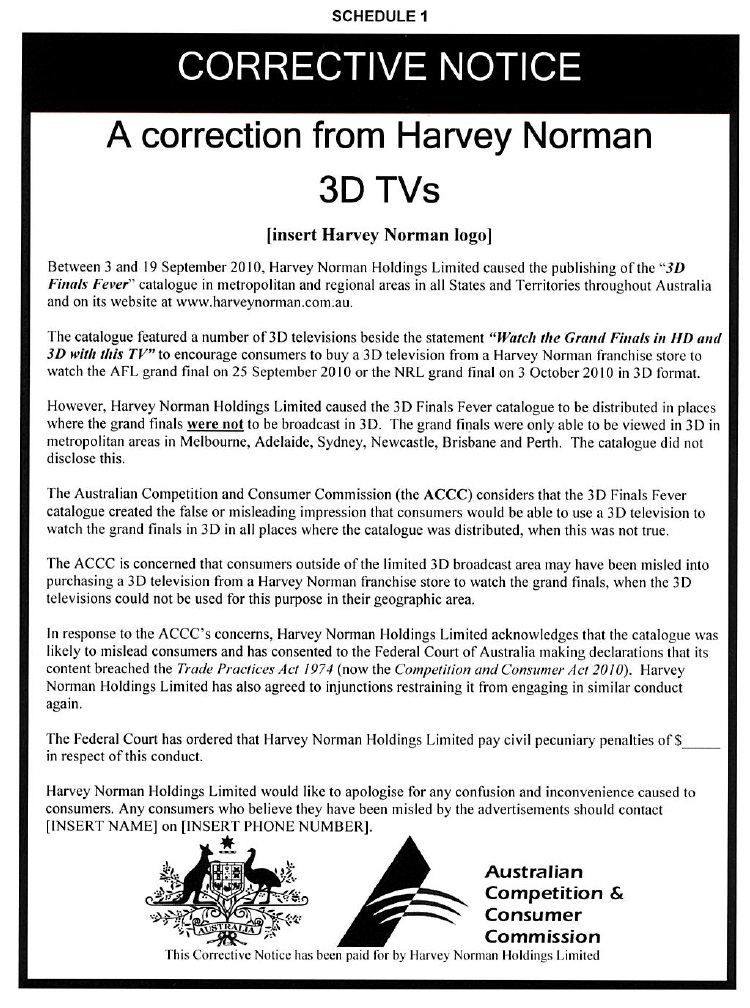
7. HNHL within 42 days of this order, take all reasonable steps to cause corrective notices in the form of:
7.1 Schedule 1 attached hereto to be published in each newspaper in which the 3D Catalogue was distributed in each State and Territory in Australia (“Relevant Newspaper”), on a Saturday or, in the case where a Relevant Newspaper is not published on a Saturday (“Non-Saturday Relevant Newspaper”), on a day when that Non-Saturday Relevant Newspaper is published; and
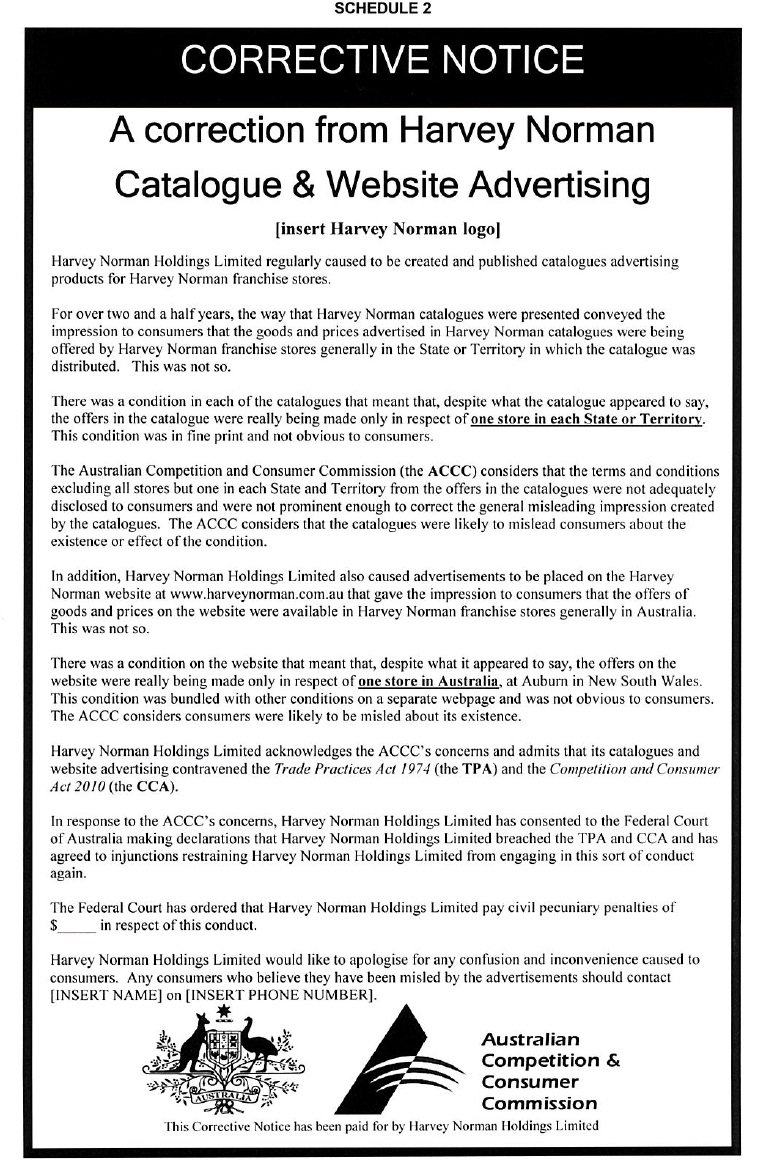
7.2 Schedule 2 attached hereto to be published in:
7.2.1 each Relevant Newspaper referred to in the immediately preceding sub-paragraph on a Saturday or, in the case of a Non-Saturday Relevant Newspaper, on a day when that Non-Saturday Relevant Newspaper is published; and
7.2.2 in each State or Territory’s daily state-wide newspaper with the highest circulation on a Saturday or, if not published on a Saturday, on a day when it is published,
and shall take all reasonable steps to ensure that such notices are substantially the same as the notices in the form of Schedules 1 and 2 attached hereto, including font and formatting, and shall:
7.3 not appear in the same newspaper on the same day;
7.4 be placed within the first 10 pages of the newspaper;
7.5 be at least 20 centimetres by 3 columns in size;
7.6 have a banner font of sans serif 14 point size;
7.7 have a headline font of 24 point size;
7.8 contain in the body of text font that is no less than 10 point size; and
7.9 have Harvey Norman, ACCC and Commonwealth logos of at least 20 millimetres in height and centred.
8. HNHL, within 28 days of this order, cause corrective notices in the form of Schedules 1 and 2 attached hereto to be published on the home page of the HN Website, and shall take all reasonable steps to ensure that such notices have the following specifications:
8.1 the notice in the form of Schedule 1 is accessible through a prominent one-click link displayed in the top third of the home page of the HN Website entitled “CORRECTIVE NOTICE FOR FALSE OR MISLEADING CONDUCT IN RELATION TO 3D TELEVISIONS” with the following minimum specifications:
8.1.1 the words “CORRECTIVE NOTICE FOR FALSE OR MISLEADING CONDUCT IN RELATION TO 3D TELEVISIONS” to be in uppercase 18 point, bold, black, sans serif font on a white background, centred and in a bordered box;
8.1.2 the words “Click here for further information” to be in 14 point, black, sans serif font on a white background, centred below the words “CORRECTIVE NOTICE FOR FALSE OR MISLEADING CONDUCT IN RELATION TO 3D TELEVISIONS” in the same bordered box;
8.1.2.1 the bordered box and its contents, including the white space, is to operate in the form of a one-click hyper-link to the said notice,
8.2 the notice in the form of Schedule 2 is accessible through a prominent one-click link displayed in the top third of the home page of the HN Website entitled “CORRECTIVE NOTICE FOR FALSE OR MISLEADING CONDUCT IN RELATION TO HARVEY NORMAN CATALOGUES” with the following minimum specifications:
8.2.1 the words “CORRECTIVE NOTICE FOR FALSE OR MISLEADING CONDUCT IN RELATION TO HARVEY NORMAN CATALOGUES” to be in uppercase 18 point, bold, black, sans serif font on a white background, centred and in a bordered box;
8.2.2 the words “Click here for further information” to be in 14 point, black, sans serif font on a white background, centred below the words “CORRECTIVE NOTICE FOR FALSE OR MISLEADING CONDUCT IN RELATION TO HARVEY NORMAN CATALOGUES” in the same bordered box;
8.2.2.1 the bordered box and its contents, including the white space, is to operate in the form of a one-click hyper-link to the said notice;
8.3 the said notices are substantially the same as the notices in the form of Schedules 1 and 2 attached hereto, including font and formatting, and comply with the following specifications:
8.3.1 contain in the body of text font that is no less than 10 point size;
8.3.2 the border will be black;
8.3.3 the Harvey Norman, ACCC and Commonwealth logos will be in colour, centred and at least 20mm high,
8.4 the said notices will be displayed on stand-alone web pages that are coded in standard ‘HTML’ format;
8.5 the said notices will not be displayed as a ‘pop-up’ or ‘pop-under’ window; and
8.6 the said notices remain on the HN Website for a period of at least 28 days.
9. HNHL pay the applicant within 14 days of the date this order is made a contribution towards its costs of and incidental to these proceedings in the sum of $10,000.
Note: Entry of orders is dealt with in Rule 39.32 of the Federal Court Rules 2011.
QUEENSLAND DISTRICT REGISTRY | |
GENERAL DIVISION | QUD 519 of 2011 |
BETWEEN: | AUSTRALIAN COMPETITION AND CONSUMER COMMISSION Applicant
|
AND: | HARVEY NORMAN HOLDINGS LIMITED (ACN 003 237 545) Respondent
|
JUDGE: | COLLIER J |
DATE: | 8 DECEMBER 2011 |
PLACE: | BRISBANE |
REASONS FOR JUDGMENT
1 On 25 November 2011 the Australian Competition and Consumer Commission (“ACCC”) filed an originating application and a Statement of Claim instituting these proceedings against Harvey Norman Holdings Limited (ACN 003 237 545) (“HNHL”). In summary, the ACCC seeks the following:
(a) Pecuniary penalties, injunctions, declarations and other orders pursuant to ss 76E, 80 and 86C of the Trade Practices Act 1974 (Cth) (“the TPA”) and s 21 of the Federal Court of Australia Act 1976 (Cth) (“the Federal Court Act”) in relation to conduct occurring prior to 1 January 2011; and
(b) Pecuniary penalties, injunctions, declarations and other orders pursuant to s 224, 232 and 246 of the Australian Consumer Law (“the ACL”) which is Sch 2 to the Competition and Consumer Act 2010 (Cth) (“the CCA”) and s 21 of the Federal Court Act in relation to conduct occurring on or after 1 January 2011.
2 These remedies are sought in relation to conduct in contravention of ss 52, 53(c) and 53(g) of the TPA and s 18 and s 29(1)(m) of the ACL.
3 It is clear that, by reason of Sch 7 to the Trade Practices Amendment (Australian Consumer Law) Act (No 2) 2010 (Cth), the TPA as in force immediately before 1 January 2011 continues to apply to acts or omissions that occurred before that date. It is not in dispute that the legislative basis for the Court’s jurisdiction to hear the matter and grant the relief sought is found in s 86 of the CCA and s 39B(1A)(c) of the Judiciary Act 1903 (Cth).
Background
4 The “Harvey Norman” brand is well-known in Australia for retailing a wide range of goods including furniture, televisions, computers, cameras, electrical goods and white goods. There are approximately 180 “Harvey Norman” retail shops throughout Australia. Extensive advertising in the Australian consumer market is conducted under the “Harvey Norman” name.
5 HNHL is a corporation duly incorporated according to law, and wholly owns (and has wholly owned) a number of subsidiary companies which carry on activities as franchisors, and associated activities, in the retail industry (“HNHL Subsidiaries”). Independent franchisees, each of which is incorporated, have carried on retail businesses under the name, trade mark or logo “Harvey Norman®” (“the Franchisees”) pursuant to franchises granted by HNHL Subsidiaries.
6 At all material times, in relation to the sale of goods by the Franchisees in “Harvey Norman” retail complexes, HNHL:
caused to be prepared catalogues advertising goods for sale (“HN Catalogues”);
instituted a website – www.harveynorman.com.au – advertising goods for sale by Franchisees (“HN Website”); and
controlled HNHL Subsidiaries which:
prohibited Franchisees engaging in any advertising or promotion involving “Harvey Norman®” which was not approved by HNHL Subsidiaries;
required Franchisees to contribute to the cost of Harvey Norman Catalogues;
provided the Harvey Norman Catalogues to Franchisees to display in retail complexes (“HN Complexes”) for collection by the public.
The Statement of Claim
7 In its Statement of Claim the ACCC alleged, in summary, two types of conduct in respect of which it sought remedies. This conduct was described in the Statement of Claim as:
3D Conduct; and
Catalogue Conduct, which includes conduct involving the HN Catalogues and the HN Website.
3D Conduct
8 The 3D Conduct is detailed in paragraphs 7-18 of the Statement of Claim. These paragraphs read as follows:
7. In or about early July 2010, HNHL commenced to cause the preparation of a nationwide advertising campaign to promote the sale by certain Franchisees of 3D enabled televisions and other products in a catalogue titled “Harvey Norman – the Electrical Specialist – 3D Finals Fever” (the 3D Catalogue)
8. On or about 13 August 2010, HNHL caused to be incorporated the statement “Watch the Grand Finals in HD and 3D with this TV” (the 3D Representation) into a draft of the 3D Catalogue, at which time the Australian Communications and Media Authority (ACMA) had not granted any licence to any free-to-air television network to make any such broadcast in 3D format.
9. The draft 3D Catalogue contained the 3D Representation as set out below:
9.1. the front page of the 3D Catalogue contained the 3D Representation in relation to a “Panasonic (50”) 127 cm 3D ready full high definition ‘Neo’ plasma television” advertised at $2,999;
9.2. page 2 of the 3D Catalogue contained the 3D Representation in relation :
9.2.1. an “LG 3D ready full high definition LED LCD television” available in 42”, 47” and 55” models advertised at $2,499, $2,999 and $4,299 respectively; and
9.2.2. a “Sony 3D ready full high definition LED LCD television” available in 40”, 46” and 55” models advertised at $2,299, $3,299 and $4,499 respectively,
9.3. page 3 of the 3D Catalogue contained the 3D Representation in relation :
9.3.1. a “Panasonic (50”) 127 cm 3D ready full high definition ‘Neo’ plasma television” advertised at $2,999 (as advertised on the front page of the 3D Catalogue); and
9.3.2. a “Samsung (58”) 147 cm 3D ready full high definition plasma television” advertised at $2,999.
10. Between about 23 August and 3 September 2010, HNHL caused the final versions of the 3D Catalogue, which included the 3D Representation as pleaded in paragraph 9 above, to be printed.
11. From on or about 27 August 2010, HNHL caused the 3D Catalogues to be delivered to newspapers for subsequent distribution to the public and to Franchisees for display in HN Complexes for collection by the public.
12. As at 31 August 2010, HNHL was still unaware as to whether the ACMA would grant any broadcast licence to any television network in any location to broadcast the Australian Football League (AFL) and National Rugby League (NRL) grand finals in 3D format on 25 September 2010 and 3 October 2010 respectively (the 3D Broadcasts).
13. On 1 September 2010, HNHL became aware:
13.1. that the ACMA had announced that it would issue licences to the Seven Network and the Nine Network to make the 3D Broadcasts in metropolitan Sydney, Melbourne, Brisbane, Newcastle, Adelaide and Perth (the 3D Broadcast Cities) only; and
13.2. that neither grand final was to be broadcast in 3D format outside the 3D Broadcast Cities.
14. Notwithstanding the matters pleaded in paragraph 13, between 3 September 2010 and 19 September 2010 (the Promotional Period), HNHL caused about 4.25 million copies of the 3D Catalogue containing the 3D Representation to be published and distributed to the public throughout all major regional and metropolitan areas of Australia including about 1.75 million copies outside the 3D Broadcast Cities.
Particulars
14.1. Copies of the 3D Catalogue were distributed outside the 3D Broadcast Cities as insertions in approximately 68 metropolitan and regional newspapers, by letterbox drop and in over 100 HN Complexes.
14.2. HNHL caused to be published 14 different versions of the 3D Catalogue. Each version was identical as to all material representations concerning 3D enabled televisions, excepting that each 3D Catalogue contained a list of HN Complexes from which the 3D enabled televisions could be purchased and the HN Complexes in that list varied according to the State or Territory in which the 3D Catalogue was distributed.
15. Further, during the Promotional Period, HNHL caused the 3D Catalogue to be published on the HN Website. To access the 3D Catalogue on the HN Website, users were required to enter their postcode and were then shown the 3D Catalogue as distributed in their local area.
16. It was not stated in either the 3D Catalogue or on the HN Website that the grand finals would be broadcast in 3D format only in the 3D Broadcast Cities.
17. By making the 3D Representation in each 3D Catalogue distributed outside the 3D Broadcast Cities or published on the HN Website to persons who entered postcodes that were outside the 3D Broadcast Cities, HNHL represented that purchasing any of the said televisions would enable a person to use that television to watch the 2010 AFL and NRL grand finals in 3D format in their local area, when the 3D Broadcasts were not available outside the 3D Broadcast Cities.
18. By reason of the matters set out in paragraphs 7 to 17 above, HNHL has, by making the 3D Representation contained in each 3D Catalogue distributed outside the 3D Broadcast Cities and on the HN Website, in trade or commerce and in connexion with the promotion of the supply of goods:
18.1. represented that the said televisions had uses and benefits that they did not have; and
18.2. in contravention of sections 53(c) and 52 of the TPA.
Catalogue Conduct
9 The Catalogue Conduct is detailed in paragraphs 19-36 of the Statement of Claim. These paragraphs read as follows:
19. Between about October 2008 and July 2011 (the Condition Period), HNHL has:
19.1. caused to be prepared, published and distributed from time to time HN Catalogues in connection with the promotion of the supply of goods by Franchisees for the time specified in each particular HN Catalogue; and
19.2. advertised specified goods for sale at specified goods for sale at specified prices on the HN Website.
HN Catalogues
20. Throughout the Condition Period, HNHL represented by each HN Catalogue that the offers contained therein, concerning goods and their prices, were being made by HN Complexes generally in the areas in which the HN Catalogues were distributed, or at least by HN Complexes listed in some HN Catalogues.
Particulars
20.1. The representation was impliedly conveyed by:
20.1.1. the prominent inclusion in each HN Catalogue of statements including one or more of the following:
20.1.1.1. the trademark “Harvey Norman®” in various styles and logos
20.1.1.2. “Best Brands – Best Advice – Best Value – Nationwide”;
20.1.1.3. “Harvey Norman – Australia’s #1 … Retailer”;
20.1.1.4. We are Australia’s #1…”
without proximate or prominent statements that:
20.1.1.5. goods stocked and sold at any HN Complexes were only stocked and sold by independently operated Franchisees; and
20.1.1.6. the advertised goods were not being advertised as available from HN Complexes generally in the areas in which the HN Catalogues were distributed, or even HN Complexes listed in some HN Catalogues;
20.1.2. the inclusion on the last page of some HN Catalogues of a list in bold, block print of HN Complexes located in that State or Territory where the HN Catalogues were distributed.
20.2. The statement pleaded in paragraphs 22 and 23 below, was not sufficient to correct, qualify or dispel the representation due to the small font size, and lack of prominence in each HN Catalogue of the statement.
21. Throughout the Condition Period:
21.1. HNHL did not require all Franchisees in all HN Complexes to have in stock all of the goods advertised in an HN Catalogue;
21.2. some Franchisees in some HN Complexes, excluding those in the single HN Complex nominated in each HN Catalogue, did not always have n stock all of the goods advertised in an HN Catalogue, during the periods specified in the HN Catalogue; and
21.3. HNHL caused copies of the HN Catalogues to be distributed directly to the public and also caused copies to be provided to Franchisees for display in HN Complexes for collection by the public.
22. Throughout the Condition Period, the offers and representations in each HN Catalogue were subject to a condition, the effect of which was that the offers and representations in each HN Catalogue were being made only by Franchisees at a single nominated HN Complex in the State or Territory where the HN Catalogue was distributed and by no-one else (the HN Catalogue Condition).
Particulars
22.1. In some HN Catalogues the main terms of the HN Catalogue Condition were contained in a statement in the following terms:
“Franchisees located in Harvey Norman complexes, with the exception of those located in the [nominated] complex, do not make any offer by this catalogue”;
and the full terms were contained on a website nominated in those HN Catalogues.
22.2. In the other HN Catalogues the full terms of the HN Catalogue Condition were contained in a statement in each HN Catalogue in the following terms:
“Each of HNH (i.e. HNHL), each subsidiary of HNH and each Other Franchisee [i.e. each franchisee other than those located in the nominated complex], does not publish, make or authorise any offer or representation by this catalogue. The relevant category [nominated] Franchisee will offer each item of the goods described in this catalogue (“Offer Goods”) for sale until…”
22.3. The terms contained on the website and in the statement contained in each HN Catalogue were the same in all material respects, excepting that the single nominated HN Complex and the nominated website differed depending on which State or Territory the relevant HN Catalogue was distributed in.
23. Throughout the Condition period:
23.1. the HN Catalogue Condition appeared in fine print on one page of the HN Catalogue only, usually on the last page and never on the front page; and
23.2. the full terms as set out on the said website did not appear in some HN Catalogues, and when they did, were also in the print, usually on the last page.
24. Throughout the Condition Period, the supply of goods specified in the HN Catalogues was subject to the HN Catalogue Condition.
25. Throughout the Condition Period, HNHL knew of the matters pleaded in paragraphs 21 to 24 above.
26. As a consequence of the matters pleaded in paragraphs 21 to 25 above, the representation pleaded in paragraph 20 above, was a false or misleading representation as to the existence or effect of a condition, warranty or right.
27. By engaging in the conduct pleaded in paragraphs 20 to 26 above:
27.1. HNHL, in connexion with the promotion of the supply of goods contravened section 53 (g) of the TPA or, in relation to conduct that occurred on or after 1 January 2011, section 29 (1)(m) of the Australian Consumer Law that is Schedule 2 to the CCA (the ACL); and
27.2. further, HNHL has engaged in conduct that was misleading and deceptive or likely to mislead or deceive in contravention of section 52 of the TPA or, in relation to conduct that occurred on or after 1 January 2011, section 18 of the ACL.
HN Website
28. Throughout the Condition Period, HNHL represented on the HN Website that the offers contained on the HN Website, concerning goods and their prices, were being made by HN Complexes generally in Australia.
Particulars
28.1. The representation was impliedly conveyed by the following matters:
28.1.1. the prominent inclusion of the trademark “Harvey Norman®” in various styles and logos throughout the HN Website;
28.1.2. the home page of the HN Website by the prominent banner reading “Harvey Norman®” at the top of the home page and each other page of the HN Website, without a proximate or prominent statement that goods stocked and sold at any HN Complexes were only stocked and sold by independently operated Franchisees;
28.1.3. prominent production of a single telephone number for each HN Complex, namely “1300 GO HARVEY” on the home page and each other page of the HN Website;
28.1.4. the inclusion of a “Store Finder and Opening Hours” function on the home page and each other page of the HN Website, by which the user could insert their postcode and be informed of the nearest HN Complexes but with no prominent or proximate statement that HN Complexes, other than the one at Auburn, New South Wales, were not making the offers contained on the HN Website; and
28.1.5. the absence of a proximate or prominent statement that goods advertised on the HN Website were not being advertised as available from HN Complexes generally in Australia.
28.2. the condition pleaded in paragraph 30 below, was not sufficient to correct, qualify or dispel the representation due to the matters pleaded in paragraphs 31.1 to 31.3 below.
29. Throughout the Condition Period:
29.1. HNHL did not require all Franchisees in all HN Complexes to stock and have available all of the goods advertised on the HN Website; and
29.2. some Franchisees in some HN Complexes, excluding those in the single HN Complex nominated on the HN Website, did not always have in stock all of the goods advertised on the HN Website.
30. Throughout the Condition Period, the offers and representations made on the HN Website were subject to a condition, the effect of which was that the offers and representations concerning goods and their prices were being made by the Franchisees at the HN Complex located at Auburn, New South Wales, and by no-one else (the HN Website Condition)
Particulars
The condition was “The information in this website has been published by HN Auburn Publishing Pty Limited upon the basis that relevant Harvey Norman franchisees at the Harvey Norman Auburn Complex, New South Wales, Australia, will offer the goods for sale until a specified date or until sold, whichever first occurs, at no greater than the advertised prices, GST-inclusive…. Prices of goods described on this website and offered for sale by Harvey Norman franchisees located out of the Sydney Metropolitan area will be higher than prices in this website.”
31. Throughout the Condition Period, the HN Website Condition:
31.1. was accessible from the HN Website by way of accessing a link at the bottom of each page of the HN Website titled “Website Terms and Conditions”;
31.2. was not displayed unless a user accessed the necessary link; and
31.3. formed part of several pages of lengthy terms and conditions in closely typed print dealing with a range of matters.
32. Throughout the Condition Period, there was no reference on the HN Website to the HN Website Condition other than as pleaded in paragraph 31 above.
33. Throughout the Condition Period, the supply of goods specified on the HN Website was subject to the HN Website Condition.
34. Throughout the Condition Period, HNHL knew of the matters pleaded in paragraphs 29 to 33 above.
35. As a consequence of the matters pleaded in paragraphs 29 to 34 above, the representation pleaded in paragraph 28 above, was a false or misleading representation as to the existence or effect of a condition, warranty or right.
36. By engaging in the conduct pleaded in paragraphs 28 to 35 above:
36.1. HNHL, in connexion with the promotion of the supply of goods contravened section 53(g) of the TPA or, in relation to conduct that occurred on or after 1 January 2011, section 29(1)(m) of the ACL; and
36.2. further, HNHL has engaged in conduct that was misleading and deceptive or likely to mislead or deceive in contravention of section 52 of the TPA or, in relation to conduct that occurred on or after 1 January 2011, section 18 of the ACL.
Statement of Agreed Facts and Admissions pursuant to section 191 of the Evidence Act 1995 and Joint Submissions
10 I have set out in their entirety the claims of the ACCC against HNHL because the parties to these proceedings have filed a Statement of Agreed Facts and Admissions Pursuant to Section 191 of the Evidence Act 1995 and Joint Submissions. Critically, in that document HNHL admits all matters pleaded in the Statement of Claim, including with respect to its conduct in relation to representations and conditions contained in HN Catalogues and on the HN Website.
11 HNHL admits that the conduct contravened ss 52, 53(c) and 53(g) of the TPA, and, in relation to conduct that occurred on or after 1 January 2011, s 18 and s 29(1)(m) of the ACL.
12 The ACCC has also filed, by consent, a draft Short Minute of Order giving effect to the remedies claimed by the ACCC, for consideration by the Court.
13 In summary, the ACCC and HNHL jointly request the Court:
insofar as the conduct occurred after 15 April 2010, to impose a pecuniary penalty pursuant to s 76E of the TPA and, in relation to conduct that occurred on or after 1 January 2011, s 224 of the ACL;
to grant injunctions pursuant to s 80 of the TPA and, in relation to conduct that occurred on or after 1 January 2011, s 232 of the ACL; and
to make other orders against HNHL, so as to dispose of this proceeding.
14 The pecuniary penalties submitted and jointly recommended by the parties as appropriate in the circumstances of this case are:
$500,000 in respect of the contravention of s 53(c) of the TPA concerning the 3D Conduct, and
a single penalty of $750,000 in respect of the contraventions of s 53(g) of the TPA and, in relation to the conduct that occurred on or after 1 January 2011, s 29(1)(m) of the ACL concerning Catalogue Conduct.
15 The parties recognise that, under s 76E of the TPA and s 224 of the ACL, it is for the Court to determine whether the relevant legislative contraventions occurred, the quantum of any pecuniary penalties, and any other relief which should be ordered. Nonetheless, it is invariably of assistance to the Court to receive joint submissions in respect of such issues.
Orders by Consent
16 In deciding whether to make consent orders, the Court must be satisfied that it has the power to make the orders proposed and that the orders are appropriate: Australian Competition and Consumer Commission (ACCC) v Real Estate Institute of Western Australia [1999] FCA 18 at [17]-[21]; Smith v Marapikurrinya Pty Ltd [2011] FCAFC 150. Further, the Court must be satisfied that what is proposed is in the public interest, and should weigh the public interest and the desirability of an agreed resolution of enforcement proceedings: Australian Competition and Consumer Commission (ACCC) v Alvaton Holdings Pty Ltd [2010] FCA 760 at [23].
17 However as Lee J pointed out in Australian Competition and Consumer Commission (ACCC) v Target [2001] FCA 1326 at [24], once the Court is satisfied as to the appropriateness of the orders it should be slow to impede final settlement of such matters. In particular, his Honour observed:
…the public has an interest in the mutual resolution of litigation, and subject to the foregoing the Court should be careful not to refuse to make orders simply because the orders may have been different had it been the Court’s task to formulate them.
Assessment of appropriate penalty
18 Section 76E(2) of the TPA and s 224(2) of the ACL are in substantially identical terms. Both sections state that the Court must have regards to all relevant matters in determining the appropriate pecuniary penalty. Both sections also name a number of matters to which the Court must have regard. Section 76E(2) identifies those specific matters as:
(a) the nature and extent of the act or omission and of any loss or damage suffered as a result of the act or omission; and
(b) the circumstances in which the act or omission took place; and
(c) whether the person has previously been found by a court in proceedings under Part VC or this Part to have engaged in any similar conduct.
19 The only difference in wording between s 76E(2) of the TPA and s 224(2) of the ACL is that in s 224(2) the words “Chapter 4” substitute “Part VC”.
20 Section 76E came into force on 15 April 2010. Section 76E(2) was recently considered by Perram J in Australian Competition and Consumer Commission (ACCC) v Singtel Optus Pty Ltd (No 4) [2011] FCA 761 at [11] where his Honour said:
The requirements of s 76E(2) are, however, inclusive; other matters thought relevant may also be taken into account. Several decisions in this Court have confirmed that the principles relevant to the imposition of a civil penalty under the former s 76 (which dealt with the civil penalties to be imposed in the case of breaches of Part IV) are applicable in principle to s 76E: Australian Competition and Consumer Commission v Global One Mobile Entertainment Ltd [2011] FCA 393 at [110]-[112] per Bennett J; Australian Competition and Consumer Commission v Gourmet Goody’s Family Restaurant Pty Ltd [2010] FCA 1216 at [6] per Jagot J; and my own decision in MSY Technology (No.2) at [68]-[69]. Those principles, which derive from several decisions concerned with penalties in the context of Part IV, suggest that relevant non-mandatory factors under s 76E will include:
1. the size of the contravening company;
2. the deliberateness of the contravention and the period over which it extended;
3. whether the contravention arose out of the conduct of senior management of the contravener or at some lower level;
4. whether the contravener has a corporate culture conducive to compliance with the Act (or the new Australian Competition and Consumer Law) as evidenced by educational programmes and disciplinary or other corrective measures in response to an acknowledged contravention;
5. whether the contravener has shown a disposition to co-operate with the authorities responsible for the enforcement of the Act in relation to the contravention;
6. whether the contravener has engaged in similar conduct in the past;
7. the financial position of the contravener;
8. whether the contravening conduct was systematic, deliberate or covert.
21 These principles are consistent with factors discussed in earlier cases in respect of comparable provisions, including TPC v CSR Ltd (1991) ATPR 41-076 at 52,152-52,153 and in particular comments of the Full Court in J McPhee & Son (Aust) Pty Ltd v Australian Competition and Consumer Commission [2000] FCA 365.
22 An additional factor not included in this list is the factor of deterrence – not only of the contravener but of others who might be tempted to contravene the Act: NW Frozen Foods Pty Ltd v Australian Competition and Consumer Commission (ACCC) (1996) 71 FCR 285 at 294-295.
23 The parties in this case have submitted that a combined penalty of $1.25 million is appropriate and within the range of penalties a Court would order in these circumstances. In considering whether this is an appropriate penalty in this case it is helpful to turn to factors to which the Court is directed by the legislation as well as principles developed in the authorities.
Nature and extent of the contravening conduct – 3D conduct
24 The 3D Conduct relates to representations made by HNHL during the Promotional Period to persons outside the 3D Broadcast Cities, that they could purchase and use in their location, certain 3D enabled televisions advertised in the 3D Catalogues to watch the 2010 AFL and NRL grand finals in 3D format.
25 In relation to this conduct the following facts are clear.
26 The said televisions could not, and HNHL knew they could not, be used for that purpose in those locations. The said televisions could not be put to the represented use in numerous locations in Australia where the 3D Representation was made.
27 About 4.25 million copies of the 3D Catalogues containing the 3D Representation were published and distributed to the public throughout all major regional and metropolitan areas of Australia, including about 1.75 million copies outside the 3D Broadcast Cities, during the Promotional Period. The distributions outside the 3D Broadcast Cities were made:
as insertions in approximately 68 metropolitan and regional newspapers;
by letterbox drop; and
in over 100 HN Complexes.
28 There were 14 versions of the 3D Catalogue distributed throughout Australia, each which applied to a different geographic area. The versions varied only in respect of the HN Complexes named in each 3D Catalogue and the HN Complex named in the HN Catalogue Condition as the one that was actually advertising the goods and where they would be available.
29 The conduct in proceeding to cause the 3D Catalogues to be published and distributed occurred in circumstances where, before the ACMA announced on 1 September 2010 that it would issue licences for the 3D Broadcasts:
the 3D Representation was inserted into the draft version of the 3D Catalogue on or about 13 August 2010;
HNHL caused the final draft of the 3D Catalogues to be finalised;
HNHL caused the 3D Catalogues to be printed; and
HNHL caused the 3D Catalogues to be forwarded to newspapers for distribution to the public during the Promotional Period and forwarded to Franchisees for display in HN Complexes for collection by the public during the Promotional Period.
30 HNHL knew from its previous involvement in or consideration of trial 3D broadcasts of this nature that such broadcasts had only been available in limited geographic areas subject to licences granted by the ACMA and had no reason to believe the 3D Broadcasts would be available throughout Australia.
31 By 1 September 2010 HNHL knew that the 3D Broadcasts were to be limited to the 3D Broadcast Cities and that the 3D Catalogues were to be widely distributed in regional and metropolitan locales outside the 3D Broadcast Cities.
32 HNHL caused the distribution of the 3D Catalogues to commence and to continue notwithstanding the matters in the preceding two subparagraphs.
33 Finally, HNHL took no steps to correct the 3D Representation during the Promotional Period.
Nature and extent of the contravening conduct – Catalogue Conduct
34 The Catalogue Conduct involved promoting goods in HN Catalogues and on the HN Website in a manner that misleadingly represented that a significant condition to which the promotion of the goods was subject did not exist.
35 In the case of the HN Catalogues, the condition was that the advertisements contained in the HN Catalogues were only being made in respect of a single HN Complex and not in respect of HN Complexes generally in the areas in which the HN Catalogues were distributed, or HN Complexes listed in some HN Catalogues.
36 In the case of the HN Website, the condition was that the advertisements contained on the HN Website were only being made in respect of the HN Complex located in Auburn, New South Wales, and not in respect of HN Complexes generally in Australia.
37 Two aspects of the promotion combined to mislead as to the existence of the HN Catalogue Condition and the HN Website Condition:
the first was the inclusion of the HN Catalogue Condition only in fine print in the HN Catalogue (with reference to a nominated website), or the display of the HN Website Condition on the HN Website within several pages of closely typed terms and conditions and seen only if a user accessed a link at the bottom of each page of the HN Website titled “Website Terms and Conditions”, such that it was unlikely either condition would be found by a normal reader reading the HN Catalogue or viewing the HN Website; and
the second was the prominent and frequent use in each format of the name, trade mark or logo “Harvey Norman®”, without explaining that the reference to “Harvey Norman®” was not a reference to a single corporate entity but to a group of independent Franchisees, and with no prominent or proximate mention of the HN Catalogue Condition or the HN Website Condition, such that the normal reader would have no reason to go looking for either condition and no suspicion that either condition existed.
38 In the case of the HN Catalogues:
the home delivery of HN Catalogues by letterbox drop;
distribution of the HN Catalogues in regional and metropolitan newspapers;
the mention of HN Complexes by name in some HN Catalogues;
the prominent use of the trademark “Harvey Norman®” in various styles and logos throughout the HN Catalogues; and
the description of the seller as “Australia’s #1” national retailer in various HN Catalogues,
created the representation that the offers contained in each HN Catalogue were being made by HN Complexes generally in the areas where the HN Catalogues were distributed, or at least by HN Complexes named in some HN Catalogues.
39 The HN Website allowed users to identify their location through a “Store Finder and Opening Hours” search function and they were then informed of the nearest HN Complexes, but with no prominent or proximate suggestion that the advertisements on the HN Website may not or did not apply to those HN Complexes.
40 The fact that all other Franchisees were not making the offers in the HN Catalogues or on the HN Website did not mean that those other Franchisees were not making similar or identical offers by other means, but it did mean that the customer could not rely on any of the matters or representations in the HN Catalogues or on the HN Website if he or she bought, or was seeking to buy, the featured goods from those other Franchisees.
41 HNHL caused to be prepared, published and distributed approximately 781 million copies of HN Catalogues affected by the Catalogue Conduct throughout the Condition Period.
42 Between about April 2009 and June 2011, the HN Website had approximately 44 million hits. It should be noted however that pages on the HN Website did not consist solely of offers for goods but also included other matters of interest. There is no information on how many of these hits were for offers for goods on the HN Website.
43 HNHL knew that not all Franchisees had in stock nor were required to carry stock of the advertised goods. Both the HN Catalogue Condition and HN Website Condition attempted to negative the plain and prominent impression otherwise created by the HN Catalogues and HN Website.
44 Readers of the HN Catalogues and HN Website were thus induced to believe, and then act on that belief, that Franchisees located at HN Complexes generally in the areas where the HN Catalogues were distributed or HN Complexes generally in Australia (in the case of the HN Website) were making the offers contained in the HN Catalogues and on the HN Website, when the fact was that only the Franchisees in a single nominated HN Complex were making those offers.
Nature and extent of the contravening conduct – Summary
45 This description of the facts constituting the contravening conduct paints a picture of an expensive, misleading and calculated campaign of sizeable proportions, characterised by blatant and deliberate disregard of the truth, cynical strategies to capitalise on contemporary sporting events (in the case of the 3D Conduct) and the contemptuous manipulation of the expectations of ordinary consumers in respect of so-called “fine print” (in relation to the Catalogues). The conduct of HNHL appeared intended to reach as many Australian consumers as possible, in all parts of the country, through such diverse media as internet, newspaper and letterbox drop. In relation to both types of conduct, the evidence before the Court is that HNHL knew of the deceptive nature but did nothing to correct it.
46 In my view, this conduct was seriously misleading and deceptive, on a significant and far-reaching scale.
The amount of loss or damage caused
47 It is common ground that neither party is aware of whether actual loss or damage was caused by the contravening conduct, and if so, how much.
48 The 3D enabled televisions advertised in the 3D Catalogue ranged between $1,900 and $4,500. Franchisees outside the 3D Broadcast Cities sold 819 3D enabled televisions during the Promotional Period, generating sales revenue of approximately $2 million.
49 The 3D Representation was intended to, and is likely to, have induced at least some consumers to purchase a 3D enabled television earlier than they otherwise may have, and likely at a higher price than they would have paid had they deferred their decision to purchase a 3D enabled television until a time where there was a greater uptake of the technology and more content was available. The number of consumers outside the 3D Broadcast Cities who might have deferred their purchase but for the conduct, or who might have acquired from another retailer, cannot be assessed.
Circumstances in which the conduct took place
50 The 3D Conduct appears to have taken place against a background of obfuscation and, at least initially, indifference on the part of HNHL to ACCC inquiries in relation to the possibility of misleading and deceptive by HNHL. So, for example:
On or about 22 September 2010, HNHL wrote to the ACCC informing it that neither HNHL nor any HNHL Subsidiaries published the 3D Catalogue, but rather it was the conduct of certain independent franchisees.
In that letter of 22 September 2010, HNHL also informed the ACCC that three companies in Fyshwick (ACT), Darwin (NT) and Cambridge Park (Tas), had published the 3D Catalogue outside the Broadcast Cities. HNHL did not inform the ACCC in that letter that the 3D Catalogue had also been distributed in other areas which were also outside the 3D Broadcast Cities. HNHL subsequently informed the ACCC, in answer to s 155(1)(a) and (b) notices, that the 3D Catalogue had in fact been distributed in the vicinity of over 100 other HN Complexes outside the 3D Broadcast Cities in all States and Territories in Australia.
On or about 23 September 2010, the ACCC wrote to HNHL setting out remedial action the ACCC considered necessary to address the 3D Conduct, including publication of a copy of a corrective notice in all places where the 3D Representation had been made outside the 3D Broadcast Cities, and asking whether HNHL and/or its respective franchisees were agreeable to taking such action prior to the AFL and NRL grand finals on 25 September 2010 and 3 October 2010 respectively.
On or about 24 September 2010, HNHL provided the ACCC with a revised corrective notice and informed the ACCC that it would be published in The Hobart Mercury, The Canberra Times and The NT News the following day. HNHL also informed the ACCC that with the exception of the Cambridge Park, Fyshwick and Darwin HN Complexes, no other HN Complex outside the 3D Broadcast Cities had made any offer by the 3D Catalogue, and therefore that no corrective notice would be published in any other location.
The ACCC responded to HNHL that day and informed HNHL that the ACCC did not agree with the revised corrective notice. HNHL accepts that such corrective notices as were published were not accurate or adequate.
51 Further, it is clear that the HN Website and HN Catalogues failed to disclose proximately or prominently the existence of the HN Catalogue Condition and HN Website Condition to the reader, and thereby failed to dispel the contrary impressions made by the remainder of the HN Catalogue and HN Website. In this respect HNHL created the misleading impression that the conditions did not exist. This strategy of HNHL was particularly serious in that the HN Website and HN Catalogues were clearly intended by HNHL to be key marketing tools directed at consumers and their custom.
The size of the contravener
52 It is not in dispute in this proceeding that the size of the contravener is a relevant factor for the Court to consider in assessing penalty. HNHL is a large corporation, with total assets of approximately $1.78 billion as at 30 June 2011, and a net income after tax for the financial year ended 30 June 2011 of approximately $295 million.
53 The size of the contravener is a relevant factor in assessing the deterrent quality of the proposed penalty.
The period over which the contravening conduct extended
54 It is common ground that the 3D Conduct occurred over a discrete period from 3 September 2010 to 19 September 2010. On the other hand, the Catalogue Conduct occurred over a considerably longer period, namely from April 2010 to July 2011. It follows that the deceptive qualities of the Catalogue Conduct in particular were significant for reason of the period of that conduct.
Culture of compliance with the TPA and the ACL
55 It is common ground that HNHL has, and had, competition and consumer compliance policies and programs in place at all material times. It is equally clear, however, that those policies failed to prevent the conduct occurring.
56 The inference available to the Court is that this is yet another unfortunate example of a corporation with a compliance policy to which mere lip-service is paid. Another inference available is that the compliance policy in the organisation was woefully inadequate. Either inference is unfavourable to HNHL.
Co-operation and contrition
57 The interaction between the ACCC and HNHL appears to have been one where HNHL initially resisted imputations of impropriety in respect of its conduct, failed to publish corrective notices, and exhibited poor levels of co-operation. There is evidence before the Court however that after the first meeting between the ACCC and HNHL, HNHL co-operated at the highest level, and that HNHL has taken steps to address the ACCC concerns.
58 The fact that joint submissions have been filed in this case, in addition to agreement on penalty, is further suggestive of high levels of co-operation between the parties as well as contrition by HNHL.
Similar conduct in the past
59 In particular, there is evidence before the Court of action commenced by the ACCC against HNHL, two HNHL Subsidiaries, employees of one of the Subsidiaries and fifteen former franchisees in 2002 in respect of alleged bait advertising and misleading or deceptive conduct. Enforceable undertakings were provided at the time by HNHL to the ACCC.
60 In my view this conduct, which occurred some time ago, is of minimal relevance.
Conclusion
61 I am satisfied that, in all the circumstances, and having regard to the factors to which I have referred in this judgment, the penalties proposed by the parties are within the appropriate range.
62 I form this view also in light of the fact that HNHL has consented to orders requiring it to publish corrective notices in all the newspapers which were used to carry or distribute both the misleading 3D and HN Catalogues.
63 Further, following the admissions of HNHL in the Statement of Agreed Facts and Admissions, I am prepared to make the declarations and other orders upon which the parties agree.
64 I will make orders in accordance with the Short Minute of Order filed by the parties in this proceeding.
I certify that the preceding sixty-four (64) numbered paragraphs are a true copy of the Reasons for Judgment herein of the Honourable Justice Collier. |
Associate:


