

FEDERAL COURT OF AUSTRALIA
Parker v Minister for Sustainability, Environment, Water, Population and Communities [2011] FCA 1325
|
IN THE FEDERAL COURT OF AUSTRALIA |
|
|
First Applicant CARLY PARKER Second Applicant GARRY LOPATTA Third Applicant CLAY HUNTER Fourth Applicant | |
|
AND: |
MINISTER FOR SUSTAINABILITY, ENVIRONMENT, WATER, POPULATION AND COMMUNITIES Respondent |
|
DATE OF ORDER: |
|
|
WHERE MADE: |
THE COURT ORDERS THAT:
1. The applicants’ Application dated 3 December 2009 be dismissed.
2. The respondent’s costs be paid by the applicants.
Note: Entry of orders is dealt with in Rule 39.32 of the Federal Court Rules 2011
|
IN THE FEDERAL COURT OF AUSTRALIA |
|
|
VICTORIA DISTRICT REGISTRY |
|
|
GENERAL DIVISION |
VID 869 of 2009 |
|
BETWEEN: |
GLENN PARKER First Applicant CARLY PARKER Second Applicant GARRY LOPATTA Third Applicant CLAY HUNTER Fourth Applicant |
|
AND: |
MINISTER FOR SUSTAINABILITY, ENVIRONMENT, WATER, POPULATION AND COMMUNITIES Respondent |
|
JUDGE: |
BROMBERG J |
|
DATE: |
18 NOVEMBER 2011 |
|
PLACE: |
MELBOURNE |
REASONS FOR JUDGMENT
1 A Savannah Cat is a hybrid cross between a medium-sized African wild cat known as a “Serval” or “Felis serval” and a Domestic Cat (Felis catus). This hybrid specimen was developed in the United States in the mid-1980s. In the United States and some other countries, Savannah Cats are kept as companion animals. Savannah Cats may have been previously imported into Australia but if so there are unlikely to be many in Australia. Significant populations of other hybrid cats such as the Bengal Cat (Asian Leopard Cat x Domestic Cat) exist.
2 The applicants are cat breeders who would like to import into Australia for breeding purposes, fifth generation (F5) Savannah Cats. An F5 Savannah Cat is a hybrid cat derived from a breeding program in which a first generation through to a fourth generation Savannah Cat is bred, in each case, with a Domestic Cat. An F5 Savannah Cat is five generations removed from a Serval wild cat.
3 Prior to 2 August 2008, it was possible to import into Australia an F5 Savannah Cat, subject only to quarantine control under the Quarantine Act 1908 (Cth). That was because an F5 generation hybrid cat was regarded as a Domestic Cat (Felis catus). On 2 August 2008, the respondent (“the Minister”) made a legislative instrument (“the 2008 instrument”) utilising a power conferred by s 303EC of the Environment Protection and Biodiversity Conservation Act 1999 (Cth) (“the EPBC Act”). The 2008 instrument amended the list of specimens suitable for live import made under s 303EB(1) of the EPBC Act (“the live import list”). The live import list was amended with the effect of excluding Savannah Cats from Part 1 of the list. This rendered Savannah Cats a “regulated live specimen” (s 303EA) and, if the 2008 instrument is valid, it precluded the importation of Savannah Cats into Australia other than for limited testing purposes for which a permit is required (s 303EK(1) and (3)).
4 Thus, if it is valid, the 2008 instrument precluded the applicants from putting into effect their intent (and prior preparations) for importing Savannah Cats. The preclusion came about including because the intent of the applicants (or some of them) became the subject of adverse media reporting and came to the attention of the Minister. A report was then prepared for the Minister by his Department. That report (“the Environmental Assessment Report”), upon which the Minister acted, made adverse findings about importing Savannah Cats, including that there would be an extreme risk of Savannah Cats integrating into Australia’s feral Domestic Cat population and becoming a pest with the potential to impact differently and more substantially on Australian native wildlife than those Domestic Cats already in Australia.
5 Whether the importation of Savannah Cats would create an unacceptable risk to the Australian environment is not a question I need to determine. That question and the merits generally of allowing the importation into Australia of Savannah Cats are issues which the EPBC Act empowers the Minister to determine. The question raised by the proceeding before me is whether, in making the 2008 instrument, the power conferred upon the Minister was validly exercised. By reference to the challenge made by the applicants to the validity of the 2008 instrument, broadly stated, the issues raised for determination are:
(1) Was an environmental assessment report required to be considered by the Minister as a condition precedent to the making of the 2008 instrument?: [21]-[34]
(2) If required, was a requisite report prepared and considered?: [35]-[57]
(3) Is the 2008 instrument invalid for unreasonableness or lack of reasonable proportionality?: [58]-[85]
6 For the reasons that follow, I have determined that the applicants’ application for a declaration that the 2008 instrument is invalid and for an injunction restraining the Minister from implementing it should be dismissed.
background
Relevant legislative provisions
7 Division 4 of Part 13A of the EPBC Act regulates the import into Australia of “regulated live specimens” (s 303EA). Specimens are live animals or plants (s 303EA(a)). Pursuant to s 303EB the Minister by instrument has established the live import list. The list is divided into two parts. Part 1 is a list of “unregulated specimens”. Part 2 is a list of “allowable regulated specimens”. A specimen on Part 2 of the list may only be imported where a specified permit is in force (s 303EK(1) and (2)). A specimen on Part 1 of the list may be imported without a permit. The default position is that a specimen not on the list is banned from import into Australia other than where a testing permit issued in accordance with s 303GD is in force (s 303EK(3)).
8 The live import list is a legislative instrument published in the Gazette and first made on 11 January 2002. The power of the Minister to amend the live import list is given by s 303EC of the EPBC Act. It is a power to amend one legislative instrument (the live import list) by the making of another legislative instrument. Section 303EC(1) is in the following terms:
(1) The Minister may, by instrument published in the Gazette, amend the list referred to in section 303EB by:
(a) including items in a particular part of the list; or
(b) deleting items from a particular part of the list; or
(c) correcting an inaccuracy or updating the name of a species; or
(d) imposing a restriction or condition to which the inclusion of a specimen in Part 2 of the list is subject; or
(e) varying or revoking a restriction or condition to which the inclusion of a specimen in Part 2 of the list is subject.
9 Relevantly, for the matters I need to determine, s 303EC(5) provides:
(5) The Minister must not amend the list referred to in section 303EB by including an item in the list, unless:
(a) the amendment is made following consideration of a relevant report under section 303ED or 303EE; or
(b) the amendment is made following consideration of a relevant review under section 303EJ.
10 In the context of the issues raised by this case, it becomes relevant to consider s 303ED which is in the following terms:
Amendment of list on the Minister's own initiative
(1) The Minister may formulate a proposal for the list referred to in section 303EB to be amended by including an item.
(2) Unless subsection (3) applies, the Minister must:
(a) cause to be conducted an assessment of the potential impacts on the environment of the proposed amendment; and
(b) cause to be prepared a report on those impacts.
The report must be prepared in accordance with section 303EF and be given to the Minister.
(3) This subsection applies if:
(a) Biosecurity Australia has prepared a report (whether before or after the amendment was proposed) on the potential impacts on the environment if the specimen were to be imported; and
(b) the report is of a type specified in regulations made for the purposes of this paragraph; and
(c) the report is given to the Minister; and
(d) the Minister determines that subsection (2) does not apply to the proposed amendment.
(4) A determination made under paragraph (3)(d) is not a legislative instrument.
11 The requirement of s 303ED(2) for the report to be prepared in accordance with s 303EF relevantly requires that, if the Minister determines that s 303EF(1)(a) applies (which was the case here), terms of reference be prepared “for a report on the relevant impacts.” That assessment must accord with s 303EF(2) which states:
(2) The assessment must also provide for:
(a) the preparation of a draft of a report on the relevant impacts; and
(b) the publication of the draft report for public comment for a period of at least 20 business days that is specified by the Minister; and
(c) the finalisation of the report, taking into account the comments (if any) received after publication of the draft report; and
(d) any other matter prescribed by the regulations.
12 There are other provisions of Division 4 of Part 13A of the EPBC Act which are relevant and to which I later refer. For ease of reference subdivisions A and B of Division 4 are annexed to these reasons.
Background to the 2008 Instrument
13 Preparations for the import of F5 Savannah Cats by some of the applicants were first made in 2006 and 2007. From about December 2006, communications with various Commonwealth agencies concerning the import of Savannah Cats first began. In May 2007, the Department for Sustainability, Environment, Water, Pollution and Communities (“the Department”) obtained a report on the importation of hybrid cats prepared by Latitude 42 Environmental Consultants Pty Ltd (“the Latitude Report”). The preparations, in which the applicants (or some of them) were involved, included entering into various contracts and the making of various arrangements in preparation for the breeding of Savannah Cats. In June and July of 2008, media commentary on the proposed importing of Savannah Cats was published. By letter dated 16 June 2008, the Minister advised the first applicant of a review of the import status of Savannah Cats. On that date, the Minister agreed to formulate a proposal to amend the live import list and proposed terms of reference for an assessment of the environmental impacts of the proposed amendment.
14 The terms of reference called for an “environmental assessment of the suitability of the import of Domestic Cat x Serval hybrid specimens (Savannah Cat) into Australia” and sought the provision of information and/or assessment of a range of matters including the ecology of the specimens (point 3) and their reproductive biology (point 4); the likelihood that the specimens could establish a breeding population in the Australian environment should they ever be released from effective human control (point 7); the potential impact of the specimen should it establish feral populations in Australia (point 8); and what conditions or restrictions, if any, could be applied to the import of the specimens to reduce any potential for negative environmental impacts (point 12).
15 On 16 June 2008, the Minister also wrote to State and Territory Ministers and the Commonwealth Minister for Agriculture, Fisheries and Forestry and to others, advising them of the proposal to amend the live import list and seeking their views.
16 On 19 June 2008, the Department published a draft report which was then made available for public comment between 19 June 2008 and 17 July 2008. The Department received some 549 written comments on the draft report and thereafter and on 24 July 2008 published the Environmental Impact Report in its final form.
17 On 30 July 2008 the Minister signed a briefing approving the recommendation “to include in Part 1 of the List of Specimens Suitable for Live Import, a definition of Domestic Cat which would exclude Savannah Cats” and for an explanatory statement to be tabled with the signed instrument in Parliament. The briefing included: the Environmental Assessment Report; a summary of written submissions from key stakeholders; a summary of written submissions that supported or opposed prohibition; a draft of the 2008 instrument; and a statement that the more complex issue of other hybrids will be dealt with separately and that the Minister would be briefed further on that in the future.
18 As at 30 July 2008 and prior to the 2008 instrument taking effect, Part 1 of the live import list included an entry in the following terms:
|
Taxon |
Common Name |
|
Felis catus |
Domestic Cat |
19 The 2008 instrument, which was made on 30 July 2008 but which took effect on 2 August 2008, is in the following terms:
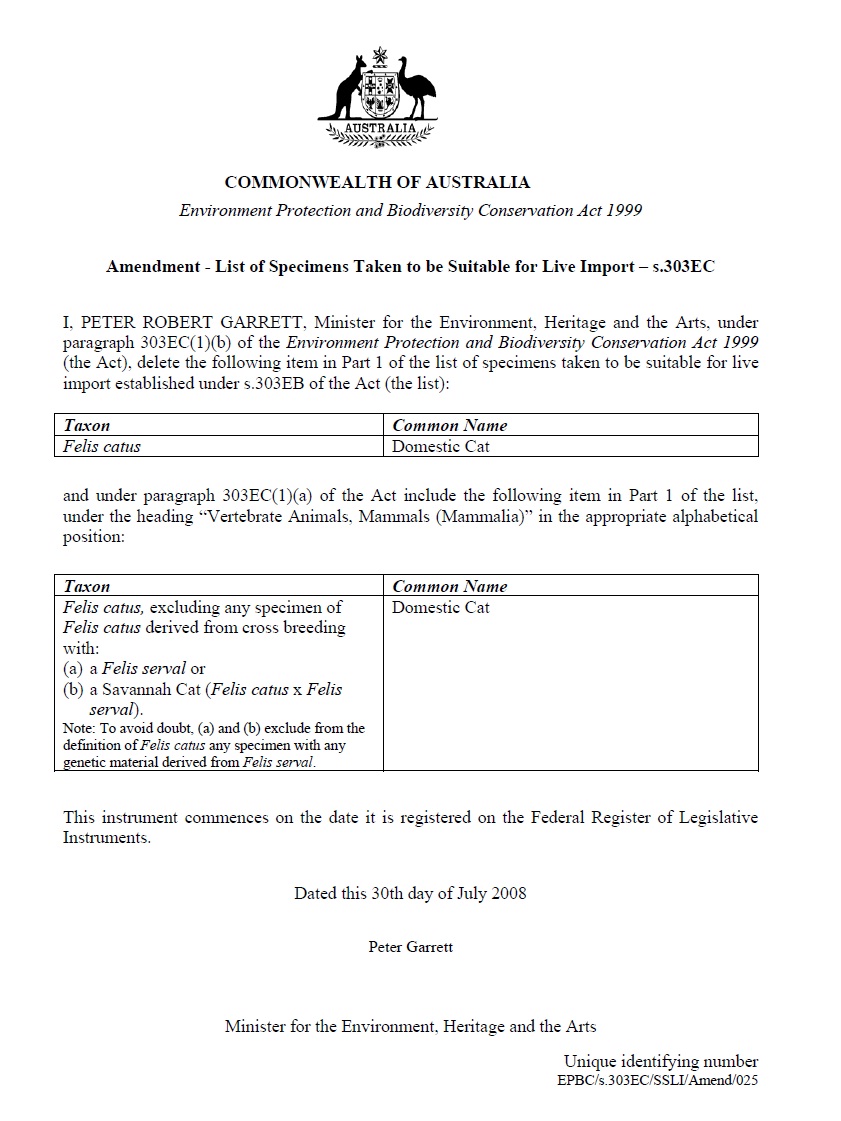
20 There is no issue before me that the 2008 instrument is a legislative instrument. Nor is any issue raised as to the Court’s power to grant the relief sought by the applicants.
was an Environmental assessment report required to be considered by the minister as a condition precedent to the making of the 2008 instrument?
21 The applicants contend that where an amendment is sought to be made to the live import list in order to include an item on the list, s 303EC(5) imposes a precondition upon the exercise of the Minister’s power to amend. That precondition is that the amendment is made “following consideration of a relevant report under section 303ED…” (s 303EC(5)(a)). Upon that foundation, the applicants contend that a requisite report was not prepared and that accordingly the precondition for the exercise of the power was not satisfied.
22 I will return to consider the second proposition relied upon, but because the foundation upon which it is based is in contention, I need to consider that first. The Minister contends that even though the evidence establishes that a report which meets the requirements of s 303EC was prepared and considered, it was not necessary for that to have been done because the amendment made to the live import list by the Minister did not involve “including an item in the list” (s 303EC(5)). In essence, the Minister says that the power which was exercised was not conditioned by the requirements of s 303EC(5)(a). Those requirements were not applicable, even if the Minister and those who advised him perceived that they were.
23 The Minister contended that despite the form of 2008 instrument, properly construed the amendment made by the 2008 instrument involved deleting a specimen from the live import list or the partial deletion of an item from that list and did not involve any addition to that list by the inclusion of any item. The Minister contended, that a particular concern of Division 4 of Part 13A of the EPBC Act is to prevent the introduction into Australia of animals that could adversely affect the Australian environment. Division 4 seeks to address that concern by putting in place a statutory scheme which requires consultation and the assessment of the likely impact upon the environment of the introduction into Australia of a particular specimen.
24 The Minister’s contentions are supported by the objects of the EPBC Act and in particular:
Section 3(1)(a) which provides:
to provide for the protection of the environment, especially those aspects of the environment that are matters of national environmental significance.
Section 3(2) which identifies the means for achieving the objects of the Act and in paragraph (d) provides for the adoption of:
an efficient and timely Commonwealth environmental assessment and approval process that will ensure activities that are likely to have significant impacts on the environment are properly assessed.
25 Those contentions are further supported by the objects to Part 13A including those found in s 303BA(1)(a), (b) and (c) and s 303BA(2) in the following terms:
(2) In order to achieve its objects, this Part includes special provisions to conserve the biodiversity of Australian native wildlife.
26 There are a range of categories of amendment to the live import list which s 303EC(1) specifies. Those categories include: “including items in a particular part of the list” (s 303EC(1)(a)); “deleting items” (s 303EC(1)(b)); “correcting an inaccuracy or updating the name of the species” (s 303EC(1)(c)); or imposing, varying or revoking a restriction or condition to which the inclusion of a specimen in Part 2 of the list is subject (s 303EC(1)(d) and (e)). Although consultation by the Minister is envisaged by s 303EC(3) in relation to any proposed amendment, it is only those proposed amendments which involve including an item in the list, that require an assessment report dealing with the potential impacts on the environment of the proposed amendment to be prepared and considered or a review conducted (s 303EC(5)).
27 Furthermore, it is only an amendment decision “about including an item in the list” that requires the Minister to take account of the precautionary principle (s 391(1) and (3)). That principle is defined in s 391(2) as:
… that lack of full scientific certainty should not be used as a reason for postponing a measure to prevent degradation of the environment where there are threats of serious or irreversible environmental damage.
28 The Minister contends, and I agree, that the rationale of the scheme for amending the live import list is to require an assessment of the potential environmental impacts of an amendment that would permit the importation of a specimen which at the time of the amendment is not permitted for import. An interpretation of s 303EC which requires an environmental assessment to be performed when the list is to be amended so as to delete a specimen runs counter to that rationale and is not supported by any discernible legislative purpose. It is difficult to discern any reason why an environmental assessment for potential impacts upon the Australian environment would be necessary in circumstances where a specimen previously permitted for import was no longer to be permitted. The terms of s 303ED(3)(a) and 303EE(4)(a) support the interpretation that the “proposed amendment” in contemplation involves a proposal which would allow a specimen to be imported in circumstances where the importation of the specimen was not then permitted.
29 That purposive construction requires the word “item” to be read as meaning a specimen, species or sub-species included or to be included in the list. Such a construction is reinforced by the Revised Explanatory Memorandum to the EPBC Amendment (Wildlife Protection) Bill 2001 which introduced what became ss 303EC, 330ED and 330EE of the EPBC Act. In addressing the content of what became s 303EC(5) the Revised Explanatory Memorandum said:
The Minister cannot amend the list unless he or she has considered either a relevant report under clauses 303ED or 303EE, or a relevant review under clause 303EJ. This means a species cannot be added to the list of species allowed into Australia (with or without a permit) unless an environmental assessment has been carried out.
In addressing what became s 303ED the Revised Explanatory Memorandum said:
The Minister may formulate a proposal to add an item to the list of specimens suitable for live import. In this case, he or she must cause an assessment to be conducted of the potential impacts on the environment of the proposed amendment and a report to be prepared, in accordance with clause 303EF, on those impacts.
30 The applicants contend for a textually based construction of the word “item” as used in s 303EC. They say “item” means a tabular entry in the list. Such an interpretation is said to be consistent with the prevailing drafting convention for Commonwealth legislative drafting.
31 Whilst, that approach has some initial appeal, in my view, it should not be preferred. It is far more likely that Parliament intended that the substance of an amendment rather than its form should control the requirement for an environmental assessment. All of the different categories of amendment which are specified in s 303EC(1) other than paragraph (b) (dealing with deleting an item), would likely require the replacement of an existing tabular item in the list with a substituted entry and would thus involve the deletion of one tabular entry and the inclusion of another tabular entry. On the applicants’ construction, even the correction of the inaccurate name of a specimen would require the preparation of an environmental assessment report. That is so because if “item” means tabular entry, a correction made to the list will necessarily involve the deletion of the incorrect tabular entry and the inclusion of a new tabular entry to replace it. That an environmental assessment report should be required in those circumstances was clearly not intended by Parliament. It makes no sense in the context of the rationale of the provisions in question.
32 In the context of a list of specimens and a provision which empowers the amendment of such a list, no violence is done to the word “item” in the phrase “including an item in the list” by an interpretation which includes a specimen within the meaning of “item”. The probable reason for the draftsperson’s use of the word “item” rather than “specimen” is because the relevant provisions contemplate that the list of “specimens” (defined by s 527A to include an “animal” or “plant”) may include a listing of animals or plants by species or sub-species (see s 303EC(1)(c) and the definition of “species” in s 528). The word “item” covers each of those alternative means of listing which ss 303EB and 303EC contemplate. Moreover, the definition of “specimen” in s 527A extends beyond live animals and plants and for that reason as well was not an appropriate term in s 303EC.
33 It is also necessary to recognise that what s 303EC(5) is concerned with is the effect of an amendment upon the live import list. The form adopted by the amending instrument may be relevant but ought not control the proper characterisation of the amendment made to the list. Whilst the 2008 instrument speaks of including an item in the list, the effect of the amendment made to the list is not the inclusion of Domestic Cat on the list. Domestic Cat was already on the list. The 2008 instrument had the effect of excluding the specimen Savannah Cat from the extant listing of the species “Domestic Cat”.
34 The effect of the 2008 instrument upon the live import list did not involve the inclusion of an item in the list and therefore did not require the preparation and consideration of an environmental assessment report. The fact that the Minister did call for and did consider a report is of no moment to the validity of the 2008 instrument. The Minister cannot impose a precondition upon the power given to the Minister to amend, where no such precondition is provided by the legislation conferring the power. Nor is the validity of the 2008 instrument affected by the Minister mistaking the source of the power to make the instrument: Brown v West (1990) 169 CLR 195 at 203.
if required, was a REQUISITE assessment report prepared and considered?
35 Even if I had been of the view that the preparation and consideration of an environmental assessment report was a precondition to the exercise of the Minister’s power to make the 2008 instrument, I am not of the view that such a precondition was not satisfied.
36 On the basis that an assessment report was required, the applicants argued that a draft assessment report and a final assessment report of the kind required by the legislation had not been prepared, had not been considered by the Minister and thus a condition precedent to the exercise of the Minister’s power to amend the live import list to include an item was not satisfied. As a result, the applicants contended that the 2008 instrument is invalid and ultravires the relevant enabling power.
37 There is no issue that prior to the Minister including an item on the live import list on the Minister’s own initiative and unless s 303EC(5)(b) or s 303ED(3) apply, the Minister must first consider a relevant report under s 303ED or 303EE. The preparation of a draft report is required by s 303EF(2) and after the publication of the draft report and the receipt of submissions and the finalisation of the report taking into account comments received on the draft report, a final report is to be prepared. The fact that draft and final reports were prepared and considered is not in contention. The applicants contend, however, that those reports were not compliant with the kind of reports the EPBC Act requires.
38 The applicants contend that the draft environmental assessment report for the 2008 instrument, released by the Department on 19 June 2008, was not a “draft of a report on the relevant impacts” under EPBC Act s 303EF(2)(a) for the following reasons:
(a) the Latitude report had concluded that F5 Savannah Domestic Pedigree Cats (and later generations) posed no greater risk to the environment than that posed by the Domestic Cat;
(b) despite that, the draft report:
(i) selectively cited the Latitude report;
(ii) quoted the Latitude report out of context;
(iii) deliberately amplified the risk of importing F5 Savannah Cats described by the Latitude report;
(iv) failed to properly distinguish between F5 and later Savannah Cats and F1 to F4 hybrid cats;
(v) was not scientifically adequate or rigorous;
(vi) included assessments and a conclusion that were influenced by adverse media comment which, in turn, was erroneous;
(vii) failed to adequately address the terms of reference for the report;
(viii) failed to adequately assess the potential impacts on the environment of the proposed amendment.
39 The applicants also contend that the final report, the Environment Assessment Report, was not a report prepared in accordance with s 303EF of the EPBC Act for the following reasons:
(a) the report failed to properly distinguish between F5 and later Savannah Cats and F1 to F4 hybrid cats;
(b) the report was not prepared by authors with, or with adequate, scientific expertise in animal husbandry or breeding;
(c) the report included statements and conclusions that were speculative in nature and inconsistent with scientific principles;
(d) the report conflated features and behaviours of Serval and hybrid cats other than F5 Savannah Cats, with those of F5 Savannah Cats (and later generations);
(e) the report failed to adequately assess the potential impacts on the environment of the proposed amendment;
(f) the report erroneously treated F5 Savannah Cats (and later generations) as discrete from, and different to, Domestic Cats.
40 The applicants also relied upon ss 303EC(5) and 303ED(1) and (2) as the source of the imposition of a condition precedent upon the Minister’s power to amend the live import list. In that respect the applicants contended that the condition precedent was that a report had been prepared which objectively amounted to “an assessment of the potential impacts” of the Minister’s proposal to amend the live import list.
41 There are two matters the Court would need to be satisfied about before any conclusion could be reached that the 2008 instrument is invalid by reason of the matters here raised by the applicants. The first element is that the requisite precondition exists and has been breached or not complied with and secondly, that such a breach of or non-compliance with the condition regulating the exercise of the power to amend, renders the amendment invalid and of no effect.
42 In Project Blue Sky v Australian Broadcasting Authority (1988) 194 CLR 355 at [91] McHugh, Gummow, Kirby and Hayne JJ said:
An act done in breach of a condition regulating the exercise of a statutory power is not necessarily invalid and of no effect. Whether it is depends upon whether there can be discerned a legislative purpose to invalidate any act that fails to comply with the condition. The existence of the purpose is ascertained by reference to the language of the statute, its subject matter and objects, and the consequences for the parties of holding void every act done in breach of the condition.
43 For the purpose of considering whether there has been any breach of the asserted precondition and also for considering whether a legislative intent can be discerned to invalidate any act that fails to comply with any such precondition, it is necessary to turn to the subject matter and objects of the provisions in question.
44 Firstly, it is to be observed that the Minister is given a very wide discretion to include an item on the live import list. That discretion is not conditioned by any specified criteria and there are few limits on the way in which the power is to be exercised. No doubt the power must be exercised for the purpose for which it is conferred and in that respect the objects of the EPBC Act and those of Part 13A, including of conserving the biodiversity of Australian native wildlife, will need to be taken into account by the Minister. But the Minister’s power is broad. For instance, the power is not conditioned by any criteria requiring the Minister to reach a particular view as to the extent of any potential impact on the environment of an amendment to the list. Such matters, of very obvious importance, are left for the Minister to determine and are wholly within the Minister’s discretion.
45 The only specified limits on the exercise of the power to include an item on the list are procedural and not substantive. The procedural constraints are limited to processes designed to put information before the Minister for the obvious purpose of promoting an informed decision by the Minister. There are two distinct forms of information gathering envisaged. The first is consultation which is dealt with by s 303EC(3). The second is the consideration of a report or a review which is dealt with by s 303EC(5) in combination with the provisions of Subdivision B (ss 303ED-303EJ).
46 An analysis of those provisions demonstrates that the sufficiency, quality or adequacy of the information that the EPBC Act envisages the Minister may consider prior to including an item on the list, is a matter largely left to the discretion of the Minister.
47 The extent of any consultation that may be engaged in is left to the Minister to determine. Ministerial consultation need only occur with other Ministers that the Minister “considers appropriate” (s 303EC(3)(a) and (b)) and the Minister “may” consult with others that the Minister “considers appropriate” (s 303EC(3)(c)).
48 The requirements for the consideration by the Minister of a report or review are more prescriptive but, apart from identifying in broad terms the nature of the assessment required, the provisions say little or nothing of the adequacy, quality or sufficiency of the information to be considered. These are matters left to be controlled by the Minister.
49 The broadly expressed nature of the assessment required is contained in the requirement for an assessment “of the potential impacts on the environment of the proposed amendment”. That requirement applies to an amendment to be made at the initiative of the Minister (s 303ED(2)(a) and (3)(a)); or on the application for an amendment made by others (s 303EE(3)(b) and (4)(a)); and to a review by the Minister (because a review conducted under s 303EJ will be conducted by reference to an earlier report made under s 303ED or s 303EE).
50 Reports meeting that legislative description may take many forms and vary as to content, quality and have many other variable characteristics. Reasonable minds can probably agree as to whether a particular report meets the legislative description of “an assessment of the potential impacts on the environment of the proposed amendment”, but given the subject matter in question, it is highly likely that reasonable minds will differ in opinion as to the quality, sufficiency or adequacy of any particular report dealing with the impact on the environment of a proposed amendment.
51 It is highly unlikely that Parliament intended that a court should be the arbiter over the quality, sufficiency or adequacy of a particular report and that the court should strike down a report which failed to meet some indeterminate and unspecified standard, on the basis that such a failure constituted non-compliance with a requisite precondition on the Minister’s exercise of power.
52 It is far more likely that Parliament intended that, with some legislative guidance as to the expected process (and in particular an expectation of public consultation), the Minister would be the arbiter over the quality, sufficiency or adequacy of the information which the Minister must consider in arriving at his or her decision to amend the list to include an item. That the Minister is trusted with that task follows naturally from the fact that the Minister is trusted to make the ultimate decision unencumbered by prescriptive criteria. That the Minister is accorded that task is also apparent from the following characteristics of the procedural process itself:
It is the Minister that determines the terms of reference for the draft report (s 303EF(1)). That power is a very significant control mechanism over the information which will be put before the Minister through the final report, including as to its quality, sufficiency and adequacy;
It is the Minister that is given the power to determine whether an assessment is required at all or whether instead an extant report prepared by Biosecurity Australia meeting the requirements of s 303ED(3) or 303EE(4) will suffice. In that respect, the Minister will need to assess the quality, sufficiency or adequacy of the extant report and decide whether more information obtained through an additional assessment is appropriate;
It is for the Minister to decide whether an assessment is required or whether instead a decision to include an item on the list will be made upon a review of a relevant report made at an earlier time for the purpose of an earlier decision as to whether to include an item on the list (a five year limitation applies): s 303EC(5) and 303EJ. In this respect, the Minister is called upon to consider the quality, sufficiency or adequacy of the extant report as an alternative to the preparation of a new report; and
Where the proposed amendment is not at the Minister’s initiative, the Minister is empowered to call for further information beyond the information contained in an assessment report prepared in accordance with s 303EE (s 303EH(1)).
53 The provisions in question provide no statutory prescription regulating the quality, sufficiency or adequacy of a report beyond the requirement of s 303EF(2)(c) that the final report take into account the comments received after the publication of the draft report. The quality, sufficiency or adequacy of the report is otherwise a matter left to the Minister’s judgment and discretion. Whilst consideration of a report is a necessary jurisdictional precondition to the exercise of the power, the consideration of a report of a particular quality or particular standard is not.
54 For the reasons contended by the Minister, most if not all of the applicants’ allegations as to the report’s failures set out at [38] and [39] above are not made out. Most were not pursued in final submissions. But I need not deal with them individually, it is sufficient to observe that each of the alleged failures challenge the quality, sufficiency or adequacy of the draft or final report. None of the alleged failures were suggested to constitute an express breach of any particular provision. The applicants’ case rests on the proposition that a report containing the failures alleged is not a report of the kind that the provisions mandate. However, that contention is premised on the erroneous presumption that the preparation of the report of a particular quality, sufficiency or adequacy is mandated as a requisite objective jurisdictional fact. It is not: Anvill Hill Project Watch Association Inc v Minister for Environment and Water Resources (2008) 166 FCR 54 at [16], [17], [19]-[34] (Tamberlin, Finn and Mansfield JJ).
55 For the reasons I have sought to explain, whilst the scheme of the legislation intends that the Minister makes an informed decision, including by reference to consideration of a report which meets the description of an “assessment of the potential impacts on the environment of the proposed amendment”, the quality, sufficiency and adequacy of the information to be considered is a matter for the Minister’s judgment. A requisite standard is not mandated as an objective fact which must be satisfied as a prerequisite to the exercise of power. The applicants have failed to demonstrate any breach of the provisions of the EPBC Act, let alone any legislative purpose to invalidate any act that fails to comply with the precondition for which the applicants contend.
56 The applicants also contended that the report considered by the Minister was a non-compliant report because it should have, but did not, assess the environmental impacts of the re-inclusion of Domestic Cats on the live import list. There is no issue that the Environmental Impact Report did not make any such assessment.
57 The failure of the Environmental Impact Report to assess and report upon the potential impacts on the environment of the re-inclusion of Domestic Cats (excluding Savannah Cats) on the live import list did not render the report non-compliant with the requirements of s 303EC(5) and s 303ED(2). The proposed amendment, if implemented, would have brought no change to the regulation of the importation of Domestic Cats (excluding Savannah Cats). That aspect of the proposed amendment had no potential to impact upon the environment because it involved no change to the status quo. To interpret the requirements of s 303EC(5) and s 303ED(2) as requiring an assessment of the maintenance of the status quo because of the form of the amendment involves the inclusion of an item, would be to place form over substance and ignore the rationale of the provisions to which I have earlier referred at [28]. It would also fail to give proper regard to the textual indicators contained in the phrase “potential impacts on the environment of the proposed amendment”. In particular, the future tense involved in the phrase “potential impacts”, suggests that only the influence or effect exerted by something new or changed is to be assessed.
is the 2008 instrument invalid for unreasonableness or lack of reasonable proportionality?
58 The applicants had a further basis for contending that the 2008 instrument was invalid. They rely upon the judicial review principles of “unreasonableness” and lack of proportionality.
59 The applicants’ final submissions contended that the 2008 instrument was unreasonable in the following respects:
(a) when prohibiting import, it treats an F5 Savannah Cat and later filial generations in the same way as F1 to F4 filial generations despite a lack of information about the risk profile of the former;
(b) it imposes potential criminal liability when it is presently impossible to test an apparent domestic cat for the presence of Felis serval genes;
(c) it treats F5 Savannah Cats, and later generations, as greater risks to native species and biodiversity in Australia than Domestic Cats when there is no evidence this is the case;
(d) it singles out the import of hybrid cats of Felis serval and Domestic Cat origin without addressing other domestic-wild cat hybrids which are relevantly the same as F5 Savannah Cat;
(e) it was made without relying on expert evidence;
(f) it was made on the basis of a final assessment report that was not adequate for the purpose.
60 The applicants’ final submissions contended that the 2008 instrument was insufficiently proportionate to the purpose for which the power to make and amend the live import list was conferred, in that:
(a) it treats F5 Savannah Cats, and later filial generations, as greater risks to native species (as defined by the EPBC Act) and biodiversity in Australia than domestic cats-for which there is no logical scientific evidence – while disregarding the risk posed by Domestic Cats, or other domestic-wild cat hybrids, the import of which continues to be permitted under the live import list;
(b) arbitrarily, and without any basis in evidence, it distinguishes between the risk posed by Domestic Cats and that arising from F5 Savannah Cats and later filial generations;
(c) it treats F1 domestic-Serval cat hybrids in the same way as F5 Savannah Cats, and later filial generations, without any scientific or logical basis.
61 The authorities expressing the legal principles in question are well known and both parties recognised the overlap between the doctrines of “unreasonableness” and lack of reasonable proportionality. “Unreasonableness” as well as “arbitrariness” or “capriciousness” may be “regarded as indicia of a failure to satisfy” the test of reasonable proportionality: Vanstone v Clark (2005) 147 FCR 299, at [141] (Weinberg J). Whether the validity of delegated legislation is challenged for unreasonableness or a lack of reasonable proportionality, ultimately the question for the Court to determine is whether the delegated legislation is within the power conferred by the legislation.
62 As Gummow J said in Minister of State for Resources v Dover Fisheries Pty Ltd (1993) 43 FCR 565 at 577:
The fundamental question is whether the delegated legislation is within the scope of what the Parliament intended when enacting the statute which empowers the subordinate authority to make certain laws.
63 In the same case, Cooper J saw no substantive difference between the two doctrines and said at 585:
Whether one describes the test as one of “reasonable proportionality” or “unreasonableness”, the object is to find the limit set by the legislature for the proper exercise of the regulation or rule making power and then to measure the substantive operation of the delegated legislation by reference to that limit.
64 In support of the observations cited above, Gummow J in Dover referred to the reasons for decision of Lockhart J in Minister for Primary Industries and Energy v Austral Fisheries Pty Ltd (1993) 40 FCR 381 where at 384 Lockhart J said:
Delegated legislation may be declared to be invalid on the ground of unreasonableness if it leads to manifest arbitrariness, injustice or partiality; but the underlying rationale is that legislation of this offending kind cannot be within the scope of what Parliament intended when authorising the subordinate legislative authority to enact laws.
65 Lockhart J at 383-384 relied on the joint judgment of Williams ACJ and Kitto J in Clements v Bull (1953) 88 CLR 572 where their Honours posited the test of validity of delegated legislation as being whether there is a “real connection” between the delegated legislation and the purpose for which the regulation making power was conferred by Parliament. As Lockhart said at 383:
Their Honours saw the test of invalidity on the ground that no reasonable mind could justify it as ‘only a way of stating the conclusion that no real connection with the purposes of the power can be seen’ (at 577).
66 It is important to recall that delegated legislation is not invalid on the ground of unreasonableness on the basis that in the view of the Court, a more reasonable approach was open or preferable. The threshold for substantiating the ground of unreasonableness is high. It needs to be established that no reasonable depository of the power could have devised it: Austral Fisheries at 400-401 (Beaumont and Hill JJ) and at 382 (Lockhart J). The high threshold has also been emphasised in relation to the doctrine of reasonable proportionality. In South Australia v Tanner (1989) 166 CLR 161 Wilson, Dawson, Toohey and Gaudron JJ expressed the test as “whether the regulation is capable of being considered to be reasonably proportionate to the end to be achieved” (at 167) and continued at 168:
It is not enough that the court itself thinks the regulation inexpedient or misguided. It must be so lacking in reasonable proportionality as not to be a real exercise of the power. Nor is it enough to point, as did Jacobs J in his reasons for judgment, to other provisions in the Waterworks Regulations which impose only qualified prohibitions as a step leading to a conclusion that a total prohibition of the kind contained in reg.37.2.1 is unjustified. To do that is again to substitute the judgment of the court for that of the legislator.
67 A metaphoric reference to the nature of a disproportionate act required to found invalidity was made to by Wilson, Dawson, Toohey and Gaudron JJ at 168 when their Honours referred to the use of a sledge hammer to crack a nut. See further Vanstone at [172].
68 With those authorities in mind, I propose to tackle the task at hand by reference to the three steps identified by Weinberg J in Vanstone in the following passage at [103]:
Pearce observes that the task that confronts a court in determining the validity of delegated legislation was described by Lord Diplock in McEldowney v Forde [1969] 2 All ER 1039 at 1068 as involving three separate steps. The court must first determine the meaning of the words used in the Act conferring power upon the body authorised to make subordinate legislation. It must next determine the meaning of the subordinate legislation, and finally, it must decide whether the subordinate legislation falls within the power so conferred.
69 The meaning of the enabling power is relatively straightforward. The enabling power is the power to amend the live import list conferred by s 303EC. That power is part of the scheme established by Division 4 of Part 13A to regulate the import of live specimens into Australia. As already identified, the power is conferred in wide terms but must be exercised for the purposes for which it is conferred, including the conservation of the biodiversity of Australian native wildlife, amongst other environmental protections.
70 The meaning of the 2008 instrument is more complicated and requires careful consideration of what is being excluded from the species Felis catus (Domestic Cat).
71 The applicants contend that the effect of the 2008 instrument is to prohibit the importation of any Domestic Cat with any genetic material derived from Felis serval. For that interpretation the applicants rely on the Note to the 2008 instrument and say that even the existence of a single gene from a Felis serval would result in exclusion.
72 If the Note was to control the meaning of the exclusion and the interpretation contended for was correct, it is likely that a high proportion of Domestic Cats would be excluded from importation. That is because Domestic Cats are thought to be descendents of African wild cats and the likelihood is that a Domestic Cat will have some genetic material of a Felis serval. It is by reference to that interpretation of the 2008 instrument that the applicants primarily argued that the 2008 instrument was invalid for unreasonableness or lack of reasonable proportionality. If the applicants’ interpretation of the 2008 instrument is correct, all Domestic Cats who are in any way descendents of a Felis serval, no matter how remote, would be prohibited from importation. That construction leads to a result which can be seen to be absurd in its effect. The fact that the interpretation involves an absurd consequence weighs heavily against the conclusion that such a construction was intended. It might be said that if the intended exclusion of any specimen descended from a Felis serval was intended, the entry could have plainly said so utilising that simple formulation.
73 It seems to me that on its proper construction what the entry dealing with Felis catus excludes from the general category of Felis catus, is a Felis catus which is a hybrid cross derived from cross-breeding with a Felis serval. What is excluded is a hybrid cat which has been derived from either a direct cross with a Felis serval or a cross between a Felis catus and a Savannah Cat; a Savannah Cat being itself identified as a cross between a Felis catus and a Felis serval.
74 The subject matter of the exclusion is a hybrid cross, not a common domestic cat. The Note should not be construed to travel beyond the scope of the subject matter with which it deals. That is particularly so given that the Note does not form part of the description of a Domestic Cat made by the 2008 instrument and its status is no higher than that of an aid to interpretation (s 13(1)(a) of the Legislative Instruments Act 2003 (Cth) (“Legislative Instruments Act”) and Pearce, Statutory Interpretation in Australia, Seventh Ed, at [4.54]). Its purpose, in the context of the provision as a whole, is to make it clear that a cat which is a hybrid cross between a Felis catus and a Felis serval is excluded, irrespective of the limited extent to which the genetic material of the hybrid cross specimen is derived from a Felis serval. As long as the specimen is a hybrid derived from a Felis serval it is excluded. That does not, however, mean that any cat with genetic material derived from the Felis serval is excluded. The excluded cat must be a hybrid cross of the defined kind. The point at which a cat may no longer meet the description of a hybrid cross is not defined but that presumably has been left to be determined by reference to the common understanding of what constitutes a Savannah Cat. Breed standards for cats (including hybrid cats like the Bengal Cat) are generated by organisations such as the Australian Cat Federation.
75 The 2008 instrument was accompanied by an Explanatory Statement approved by the Minister. The purpose of the Explanatory Statement was for it to be tabled with the 2008 instrument in both Houses of Parliament in the context of the 2008 instrument being a disallowable instrument for the purposes of s 46A of the Acts Interpretation Act 1901(Cth) (“Acts Interpretation Act”). The Explanatory Statement may properly be regarded as a document capable of assisting in the ascertainment of the meaning of the 2008 instrument (s 13(1)(a) of the Legislative Instruments Act and s 15AB(1) of the Acts Interpretation Act).
76 Relevantly, the Explanatory Statement said:
The new item will define Felis catus (Domestic Cat) to exclude any hybrid cross of Felis catus (Domestic Cat) and Felis serval (Serval). The hybrid derived from Felis catus (Domestic Cat) and Felis serval (Serval) is commonly known as the Savannah Cat. The inclusion of the item in the list will prohibit the import of live specimens of Felis catus (Domestic Cat) and Felis serval (Serval) hybrids and any reproductive material. This means that any specimen with genetic material derived from the Serval will be a prohibited specimen unless it has been lawfully imported prior to the instrument taking effect, or if the specimen is Felis serval (Serval), listed under Part 2 of the list, imported in accordance with a permit granted under the Act.
77 The Explanatory Statement tends to confirm the construction that the intended exclusion only extends to the hybrid cross commonly known as the Savannah Cat.
78 In my view, the 2008 instrument is within the scope of what Parliament intended by empowering the Minister to amend the live import list. The Minister was given the power to amend including for the purpose of protecting the environment by conserving the biodiversity of Australian native wildlife. A prohibition on the importing of Savannah Cats has a rational connection to the purpose for which the power was conferred.
79 Nothing raised by the applicants demonstrates that no reasonable depository of the power to amend could have determined to make the 2008 instrument. Each of grounds (a),(e) and (f) relied upon by the applicants (see [59] above) involve assertions about the inadequacy of the information before the Minister. Not only are the assertions not correct but more fundamentally, even if they were correct, they do not demonstrate a basis for the necessary conclusion that no reasonable Minister could have made the 2008 instrument on the basis of the information available. That is particularly so in a legislative context which leaves it to the Minister to determine the sufficiency, quality and adequacy of the information upon which the power to amend is to be exercised and provides the Minister with a wide and largely unconditioned discretion as to its exercise (see [44]-[53] above).
80 By ground (c) (see [59] above) the applicants contend that there was no evidence before the Minister that Savannah Cats posed a greater risk to native species than Domestic Cats. That contention is not made out on the evidence. The Environmental Assessment Report found that the introduction of Savannah Cats posed greater risks to native species than is currently posed by feral domestic cats. No unreasonableness is demonstrated by this ground.
81 Ground (d) (see [59] above) is not sustained. The Minister’s decision to address the prohibition on the importation of Savannah Cats whilst not addressing a prohibition on other wildcat-domestic hybrid cross cats who arguably could be just as harmful to the environment, was not a decision no reasonable Minister could have made. As the Minister correctly contended, there is nothing in the EPBC Act to prevent a piece-meal approach to the protection of the environment. The fact that the Minister has decided to tackle Savannah Cats as opposed to any other cats is a matter for the Minister. The Minister had reason to deal with Savannah Cats at the time that he did because of the proposal for their imminent importation.
82 Grounds (a), (b) and (c) of the applicants’ case based upon an asserted lack of proportionality (see [60] above), in substance, replicates those grounds in support of the case for unreasonableness which I have already dealt with. For the same reasons as discussed in relation to unreasonableness, none of those grounds demonstrate that the 2008 instrument is so lacking in reasonable proportionality as not to be a real exercise of the power to amend the live import list.
83 A further ground relied upon for unreasonableness was based upon the alleged unworkability of the 2008 instrument. The applicants contended that because there is no test which can establish whether the genetic makeup of a cat includes genetic material from a Felis serval, the amendment made by the 2008 instrument could never be properly enforced. However, it is wrong to suggest that difficulties in enforcement undermine the connection between the conferral of the power and its exercise in this case. The 2008 instrument has utility whether or not it may be effectively policed, because law abiding people will obey it even if the risk of being caught is minimal or non-existent. In any event, the applicants’ contention relies largely on its construction of the 2008 instrument and the assertion that what is excluded is any specimen with any genetic material derived from a Felis serval. I have rejected that construction. But even if it were correct, the existence of genetic material derived from Felis serval will (at least in many specimens) be manifested in the physical features of the specimen and with the assistance of expertise may be identified. Enforcement would not be rendered impossible in all cases. On the construction of the 2008 instrument which I have found to be appropriate, it may be expected that enforcement will be effectuated by reference to breed standards for a Savannah Cat. Whilst such standards were not in evidence, breed standards for a Bengal Cat were. Those standards are not in any respect based upon genetic testing but are based upon a cat’s appearance by reference to its physical characteristics. There may nevertheless be difficulties in enforcement. However, difficulties of law enforcement are experienced across all laws to varying degrees and unless a law could be shown to be impossible of enforcement and thus of no utility whatsoever, it is unlikely that the exercise of the power to make the law could be said to be an invalid exercise of the power conferred.
84 I should add that if I had accepted the applicants’ construction of the 2008 instrument as correct and absent the directive made by s 13(1)(b) of the Legislative Instruments Act, I would have found that the 2008 instrument was invalid. A prohibition on all Domestic Cats with any genetic material from a Felis serval would have constituted the kind of disproportionate act encompassed by the metaphor of using a sledge hammer to crack a nut (see [67] above). However s 13(1)(b) would have had application in that circumstance. It provides:
(1) If enabling legislation confers on a rule-maker the power to make a legislative instrument, then, unless the contrary intention appears:
(a) …
(b) …
(c) any legislative instrument so made is to be read and construed subject to the enabling legislation, and so as not to exceed the power of the rule-maker.
85 The construction I have adopted is, for the reasons earlier given, a construction which is both available and within power. If reliance upon it was necessary, s 13(1)(c) of the Legislative Instruments Act supports the proposition that the 2008 instrument should be read and construed in the manner in which I have.
disposition
86 As the applicants have failed to establish a basis for the relief they seek, their application should be dismissed and ordinarily they would be ordered to pay the costs of the Minister. I will make an order dismissing the applicants’ application. I have not heard the parties on the question of costs. The applicants should be given an opportunity to be heard on that issue should they wish to contend that costs should not follow the event. The most convenient course is that I make an order that the Minister’s costs be paid by the applicants but do so on the basis that should the applicants inform the Court that they seek to be heard on the question of costs, the order made as to costs will be immediately vacated. Any such information should be received within seven days of the publication of these reasons and be accompanied by a short written submission in support of the applicants’ position on costs. Should that occur, a responding submission from the Minister should be filed and served no later than seven days thereafter.
|
I certify that the preceding eighty-six (86) numbered paragraphs are a true copy of the Reasons for Judgment herein of the Honourable Justice Bromberg. |
Associate:
ANNEXURE
Division 4—Imports of regulated live specimens
Subdivision A—Regulated live specimens
303EA Regulated live specimens
For the purposes of this Act, a regulated live specimen is a specimen that:
(a) is a live animal or a live plant; and
(b) is not included in Part 1 of the list referred to in section 303EB.
303EB Listing of specimens suitable for live import
(1) The Minister must, by instrument published in the Gazette, establish a list of specimens that are taken to be suitable for live import.
(2) The list is to be divided into 2 Parts, as follows:
(a) Part 1 is to be a list of unregulated specimens;
(b) Part 2 is to be a list of allowable regulated specimens.
(3) The list may only contain specimens that are live animals or live plants.
(4) Part 1 of the list, as first established, must contain only the specimens referred to in Part I of Schedule 5 or Part I of Schedule 6 to the Wildlife Protection (Regulation of Exports and Imports) Act 1982, as in force immediately before the commencement of this section.
(5) Part 1 of the list must not contain a CITES specimen.
(6) Part 1 of the list is taken to include a live plant the introduction of which into Australia is in accordance with the Quarantine Act 1908.
(7) For each specimen included in Part 2 of the list (except a specimen referred to in subsection (11A)), there is to be a notation that states whether the inclusion of the specimen in that part of the list is subject to restrictions or conditions and, if so, the nature of those restrictions or conditions.
(8) A restriction or condition referred to in subsection (7) may:
(a) consist of a quantitative limit in relation to the import of the specimen; or
(b) relate to the circumstances of the import of the specimen; or
(c) relate to the source of the specimen; or
(d) relate to the circumstances in which the specimen was taken.
(9) Subsection (8) does not limit subsection (7).
(10) Part 2 of the list, as first established, must contain only specimens that were, at any time before the commencement of this section, the subject of an import permit granted under the Wildlife Protection (Regulation of Exports and Imports) Act 1982.
(11) For the purposes of subsection (10), a specimen is taken to have been the subject of an import permit if, and only if, the specimen was identified in the permit at the species or sub-species level.
(11A) Part 2 of the list is taken to include a live plant that:
(a) is a CITES specimen; and
(b) is introduced into Australia in accordance with the Quarantine Act 1908.
(12) A copy of an instrument under subsection (1) is to be made available for inspection on the internet.
(1) The Minister may, by instrument published in the Gazette, amend the list referred to in section 303EB by:
(a) including items in a particular part of the list; or
(b) deleting items from a particular part of the list; or
(c) correcting an inaccuracy or updating the name of a species; or
(d) imposing a restriction or condition to which the inclusion of a specimen in Part 2 of the list is subject; or
(e) varying or revoking a restriction or condition to which the inclusion of a specimen in Part 2 of the list is subject.
(2) For the purposes of paragraph (1)(c), correcting an inaccuracy includes ensuring that the list complies with subsections 303EB(4) and (10).
(3) Before amending the list referred to in section 303EB as mentioned in paragraph (1)(a), (b), (d) or (e) of this section, the Minister:
(a) must consult such other Minister or Ministers as the Minister considers appropriate; and
(b) must consult such other Minister or Ministers of each State and self-governing Territory as the Minister considers appropriate; and
(c) may consult such other persons and organisations as the Minister considers appropriate.
(4) An instrument under subsection (1) (other than an instrument mentioned in paragraph (1)(c)) is a disallowable instrument for the purposes of section 46A of the Acts Interpretation Act 1901.
(5) The Minister must not amend the list referred to in section 303EB by including an item in the list, unless:
(a) the amendment is made following consideration of a relevant report under section 303ED or 303EE; or
(b) the amendment is made following consideration of a relevant review under section 303EJ.
(6) A copy of an instrument under subsection (1) is to be made available for inspection on the internet.
Subdivision B—Assessments relating to the amendment of the list of specimens suitable for import
303ED Amendment of list on the Minister’s own initiative
(1) The Minister may formulate a proposal for the list referred to in section 303EB to be amended by including an item.
(2) Unless subsection (3) applies, the Minister must:
(a) cause to be conducted an assessment of the potential impacts on the environment of the proposed amendment; and
(b) cause to be prepared a report on those impacts.
The report must be prepared in accordance with section 303EF and be given to the Minister.
(3) This subsection applies if:
(a) Biosecurity Australia has prepared a report (whether before or after the amendment was proposed) on the potential impacts on the environment if the specimen were to be imported; and
(b) the report is of a type specified in regulations made for the purposes of this paragraph; and
(c) the report is given to the Minister; and
(d) the Minister determines that subsection (2) does not apply to the proposed amendment.
(4) A determination made under paragraph (3)(d) is not a legislative instrument.
303EE Application for amendment of list
(1) A person may, in accordance with the regulations, apply to the Minister for the list referred to in section 303EB to be amended by including an item.
(2) The Minister must not consider the application unless either subsection (3) or (4) applies to the proposed amendment.
(3) This subsection applies to the proposed amendment if:
(a) subsection (4) does not apply to the proposed amendment; and
(b) an assessment is made of the potential impacts on the environment of the proposed amendment; and
(c) a report on those impacts is given to the Minister.
The report must be prepared in accordance with section 303EF.
(4) This subsection applies to the proposed amendment if:
(a) Biosecurity Australia has prepared a report (whether before or after the amendment was proposed) on the potential impacts on the environment if the specimen were to be imported; and
(b) the report is of a type specified in regulations made for the purposes of this paragraph; and
(c) the report has been given to the Minister; and
(d) the Minister determines that subsection (3) does not apply to the proposed amendment.
(5) A determination made under paragraph (4)(d) is not a legislative instrument.
303EF Requirement for assessments
(1) The assessment under subsection 303ED(2) or 303EE(3) must provide for:
(a) if the Minister determines that this paragraph applies—the preparation of terms of reference for a report on the relevant impacts; or
(b) if the Minister determines that this paragraph applies—all of the following:
(i) the preparation of draft terms of reference for a report on the relevant impacts;
(ii) the publication of the draft terms of reference for public comment for a period of at least 10 business days that is specified by the Minister;
(iii) the finalisation of the terms of reference, to the Minister’s satisfaction, taking into account the comments (if any) received on the draft terms of reference.
(2) The assessment must also provide for:
(a) the preparation of a draft of a report on the relevant impacts; and
(b) the publication of the draft report for public comment for a period of at least 20 business days that is specified by the Minister; and
(c) the finalisation of the report, taking into account the comments (if any) received after publication of the draft report; and
(d) any other matter prescribed by the regulations.
(3) A determination made under paragraph (1)(a) or (b) is not a legislative instrument.
303EG Timing of decision about proposed amendment
(1) If the Minister receives a report under section 303ED or 303EE in relation to a proposed amendment, the Minister must decide whether or not to make the proposed amendment within:
(a) 30 business days; or
(b) if the Minister, by writing, specifies a longer period—that longer period;
after the first business day after the day on which the report was received.
Notice of extension of time
(2) If the Minister specifies a longer period for the purposes of subsection (1), he or she must:
(a) if section 303EE applies—give a copy of the specification to the applicant; and
(b) publish the specification in accordance with the regulations.
303EH Requesting further information
(1) If:
(a) section 303EE applies; and
(b) the Minister believes on reasonable grounds that he or she does not have enough information to make an informed decision whether or not to make the proposed amendment;
the Minister may request the applicant to give the Minister, within the period specified in the request, information relevant to making the decision.
(2) The Minister may refuse to consider the application until the applicant gives the Minister the information in accordance with the request.
303EI Notice of refusal of proposed amendment
If section 303EE applies and the Minister refuses to make the proposed amendment, the Minister must give the applicant notice of the refusal.
If, following consideration of a relevant report under section 303ED or 303EE, the Minister has made a decision to include, or refusing to include, an item in the list referred to in section 303EB, the Minister may review that decision at any time during the period of 5 years after the decision was made.


