

FEDERAL COURT OF AUSTRALIA
Tucker on behalf of the Narnoobinya Family Group v Western Australia [2011] FCA 1232
IN THE FEDERAL COURT OF AUSTRALIA | |
DOROTHY ANN TUCKER & ANOR ON BEHALF OF THE NARNOOBINYA FAMILY GROUP Applicants | |
AND: | STATE OF WESTERN AUSTRALIA & ORS Respondents |
THE COURT ORDERS THAT:
1. The Narnoobinya applicant’s motion filed on 1 August 2011 is dismissed.
Note: Entry of orders is dealt with in Rule 39.32 of the Federal Court Rules 2011
WESTERN AUSTRALIA DISTRICT REGISTRY | |
GENERAL DIVISION | WAD 6170 of 1998 |
BETWEEN: | DOROTHY ANN TUCKER & ANOR ON BEHALF OF THE NARNOOBINYA FAMILY GROUP Applicants |
AND: | STATE OF WESTERN AUSTRALIA & ORS Respondents |
JUDGE: | MARSHALL J |
DATE: | 31 October 2011 |
PLACE: | sydney |
REASONS FOR JUDGMENT
1 Two native title claimant groups have acted in negotiations with each other to advance claims over a substantially overlapping area. One group now wishes to amend its points of claim in such a way that, according to the other group, is prejudicial to that group’s case. The question before the court is whether or not this amendment should be allowed.
2 This judgment should be read in conjunction with an earlier interlocutory judgment which dealt with the same interests that are in contest now, see Tucker on behalf of the Narnoobinya Family Group v Western Australia [2009] FCA 1459 (“the previous judgment”).
3 In the previous judgment the Court adjourned, subject to conditions, an application by the Goldfields Land and Sea Council (“the GLSC”) to strike out the Narnoobinya claim, and adjourned, subject to the outcome of the GLSC motion, an application by the Narnoobinya applicant to be joined as respondent to the Ngadju claim.
4 The current interlocutory application is that the Narnoobinya applicant be given leave to amend her points of claim. Ordinarily such an application, in circumstances where no trial date has been set for the Narnoobinya claim or the Ngadju claim, would not be controversial. However the particular circumstances of the progression of the Narnoobinya claim and its effect on the Ngadju claim make this interlocutory application a controversial one.
5 After the previous judgment, the Narnoobinya applicant filed a document on 9 December 2009 containing proposals for the future conduct of that proceeding. That document, amongst other things, says that the Narnoobinya applicant:
intends to participate, if necessary, in the trial of both claims;
will be in a position to participate in any such trial from mid 2010 onwards; and
will commence preparation of witness statements in January 2010.
6 Based on the 9 December 2009 document and the GLSC submissions in response, on 14 December 2009 the Court made procedural orders in the Narnoobinya claim, including for the filing of a points of claim document and a response to the points of claim in the Ngadju matter on or before 29 July 2010. The Court also ordered that the motions which were the subject of the previous judgment be adjourned to 23 April 2010 for directions.
7 On 29 January 2010, the Narnoobinya applicant filed her points of response to the points of claim in the Ngadju application. The only matters raised in that response that took issue with the Ngadju points of claim were claims that:
the Ngadju people include the biological descendants of White Ann (aka Anna Whitehand); and
the Narnoobinya claim group also hold common or group rights comprising native title as part of the Ngadju community or group, as members of the Dimer family group (as part of the broader Ngadju society) or in their own right (as part of the broader Ngadju society).
8 Also on 29 January 2010, the Narnoobinya applicant filed her points of claim. At paragraph 2 that document says that the Narnoobinya applicant group is:
one of the family groups which make up the Ngadju people; or
is part of one of the family groups which make up the Ngadju people being the Dimer family.
9 That document asserted that native title is held by the Ngadju people in the claim area and that Ngadju society is made up of a number of different sub-groups, being family groups. Remaining parts of the document support the rights of the Ngadju people to native title in the claim area, with the Narnoobinya family group being, in effect, a sub-set of Ngadju society. Paragraph 21(b), in the section dealing with the “determination sought”, says:
Native title in the claim area is held in common by the Ngadju People, which includes the applicant group; alternatively group rights are held by the applicant group and others as members of the Dimer family group; alternatively group rights are held by the applicant group as members of the broader Ngadju society.
10 In April 2010, the Ngadju claimant group met to consider the document filed by the Narnoobinya group. As the Ngadju group required more time to consider whether it accepted the claim that the Narnoobinya group had been incorporated into the Ngadju native title holding group, it filed points of response which were neutral on that aspect of the Narnoobinya points of claim.
11 On 23 April 2010, and on several ensuing dates, the strike out motion and the joinder motion the subject of the previous judgment were adjourned. On 1 December 2010 they were referred to a Registrar for mediation with a report back to the docket Judge due by 30 March 2011. On 24 March 2011, Registrar Gilich reported that the mediation had not resolved the motions.
12 Ultimately, on 24 May 2011, the Court dismissed the GLSC strike out motion without an adjudication of its merits and dismissed the Narnoobinya joinder application without an adjudication of its merits. The Court made a timetable for the filing of any motion by the Ngadju applicant for dismissal of that part of the Narnoobinya claim which overlaps with the Ngadju claim. It set down 24 June 2011 for the hearing of that motion. The motion was filed by the GLSC. It sought orders dismissing the Narnoobinya proceeding under O 24 r 4 of the then rules of Court and/or under s 84C(1) of the Native Title Act 1993 (Cth) (“the Act”).
13 On 23 June 2011, the day before the hearing of the motion on 24 June 2011, the Narnoobinya group served a proposed amended points of claim on the GLSC. At that stage, the Narnoobinya group had not sought leave to amend its points of claim. It became apparent at the 24 June 2011 hearing that whether or not leave was to be given for the proposed amended points of claim to be relied on would affect the outcome of the strike out motion. In the absence of an amendment to the points of claim, there would be no serious issue to be tried in the Narnoobinya claim.
14 The Court then made orders for the programming of a motion to amend the points of claim. It in effect treated the 3 June 2011 strike out motion as stood over pending the outcome of the motion to amend the Narnoobinya points of claim. The amendment motion was listed for 2 September 2011. It sought an order that the “applicant be given leave to amend (her) points of claim as set out in Annexure A to the affidavit of Dorothy Ann English…”
15 The affidavit of Mrs Dorothy English (also known as Mrs Dorothy Tucker) made the following points:
when she signed the points of claim she was “not in a clear frame of mind” as a result of the death of her husband some six weeks earlier;
when she re-read the points of claim on or about 7 November 2010, she realised they were inaccurate;
she drew the inaccuracies to the attention of the other members of the group, who had not seen the points of claim;
those other members agreed with her views about inaccuracies; and
she then instructed her solicitor to prepare the proposed amended points of claim.
16 On 31 August 2011, the motions currently before the Court were adjourned to 31 October 2011 due to the ill health of counsel for the Narnoobinya applicant, but on the basis that no further adjournment be permitted. The 2 September 2011 listing was vacated. The group filed an affidavit sworn by Ms Normae Bennett, the sister of Mrs Tucker (English). Ms Bennett’s affidavit referred to her sister’s ill-health and stated that the proposed amended points of claim accurately set out the basis of the Narnoobinya group’s native title claim. At the 31 October 2011 hearing Ms Bennett was cross examined, and during that cross examination made it clear that there were Ngadju people not included within the Narnoobinya claim group who had rights under Aboriginal law on what, in the proposed amended points of claim, is said to be an area where the Narnoobinya applicant has exclusive rights.
17 The GLSC objects to leave being granted to allow the Narnoobinya group to amend its points of claim. It observes that the proposed amended points of claim seek to:
withdraw important admissions with respect to the claims of the Ngadju people;
now assert a claim of exclusive possession in respect of part of the overlap between the Narnoobinya and Ngadju claim areas (as to which see the map set out between [32] and [33] below);
significantly change the position of the Narnoobinya group from its existing points of claim; and
foreshadow further amendments to reduce the area of claimed exclusive rights.
18 The GLSC complain that, in reliance on the existing points of claim, it conducted extensive consultations with members of the Ngadju claim group which led to that group resolving to include the Narnoobinya claimants in the Ngadju claim. The terms of that resolution, made at a meeting of the Ngadju claim group on 27 July 2010 are:
The Ngadju claim group resolves to recognise the members of the Narnoobinya native title claim group as members of the Ngadju Dimer family. Accordingly, when the time is right, the Ngadju native title claims should be amended to include the Narnoobinya claimants in the Ngadju native title claim group. The Ngadju claim group makes this resolution on the understanding that:
1. Before the claim is amended, the Narnoobinya native title overlap is withdrawn or dismissed;
2. The Narnoobinya claimants are part of the Dimer family; and
3. The State agrees to the amendment.
19 GLSC contends that the application to amend the points of claim is, in effect, an application to withdraw admissions made in that document which support the Ngadju claim. In those circumstances, it contends that good cause should be shown to allow the Narnoobinya claimants to withdraw their admissions. GLSC says that no satisfactory explanation has been given by the Narnoobinya applicant for the making of the admissions or for the delay in seeking to withdraw them. It says that it would suffer significant prejudice if the amendments are allowed. It also says that it would be futile to permit the amendments because the Narnoobinya applicant would still fail to comply with s 61 of the Act.
20 Section 84C(1) of the Act permits a party to a proceeding to apply to strike out an application if it does not comply with s 61 of the Act. A native title application will not comply with s 61 if it is not made by a native title group. This encompasses:
a person or persons authorised by all the persons … who according to their traditional laws and customs, hold common or group rights and interests comprising the particular native title claimed, provided the person or persons are also included in the native title group.
21 Section 61(4) provides, so far as is material, that:
A native title determination application … that persons in a native title claim group … authorise the applicant to make must:
(a) name the persons; or
(b) otherwise describe the persons sufficiently clearly so that it can be ascertained whether any particular person is one of those persons.
22 GLSC contends that the persons in the Narnoobinya claim group comprise a sub-group of the Ngadju people. It follows, GLSC submits, that the Narnoobinya claim does not comply with s 61 because it has never been made on behalf of or authorised by all the persons who hold the common or group rights and interests, ie. the Ngadju people.
23 GLSC further notes that the proposed amended points of claim do not say that the Narnoobinya claim is brought on behalf of the biological descendants of “White Ann”, despite affidavit evidence that the Narnoobinya claimants have their descent from Anna Whitehand.
24 Under the proposed amended points of claim the “Narnoobinya Family Group” is said to compromise:
Dorothy Tucker;
John Tucker;
Elsie Tucker;
Normae Bennett;
the biological descendants of the above (which include Walter Tucker); and
the biological descendants of George Tucker and Thelma Tucker (both deceased).
25 Paragraph 2 of the proposed amended points of claim says the members of the group are all descendants of Anna Whitehand, who identify as traditional owners of the claim area.
26 Paragraph 3 refers to “the descendants of the original society” as referrable in the document to “the Ngadju peoples”. It says that Anna Whitehand was one of the members of the society, being a body of persons and family groups united in and by its acknowledgement and observance of a body of laws and customs.
27 Paragraph 4 says that:
Anna Whitehand was a member of the family group that held the native title rights and interests to the exclusion of all others in the area within the claim area hatched and encircled on the attached map and in the remainder of the claim area together with the other members and family groups of the original society, subject to the rights of particular family groups to particular areas.
28 At paragraph 9 the applicant group is said to be “the successors in title to Anna Whitehand and Toby Whitehand.”
29 At paragraph 10, the applicant group asserts a claim to certain rights and interests:
(i) to the exclusion of all others [in respect] of the area within the claim area hatched and encircled and so depicted in the extracted map; (see below) [and]
(ii) together with other Ngadju peoples of the remaining land and waters in the claim area subject to the rights and interests of particular family groups in respect of particular areas.
30 In paragraph 22(b), native title is now claimed to exist in the claim area and be held by:
the applicant group and each member in common in respect of the area hatched and encircled on the annexed map and with other members of the Ngadju peoples in respect of the remaining area of the claim.
31 Similar wording is used at paragraph 22(f) of the proposed amended points of claim.
32 As the claim to native title is not made by all persons who, according to their traditional laws and customs, hold the common or group rights or interests comprising the particular native title claimed, GLSC say that the application does not comply with s 61 and must be struck out pursuant to s 84C. There is much force in this submission.
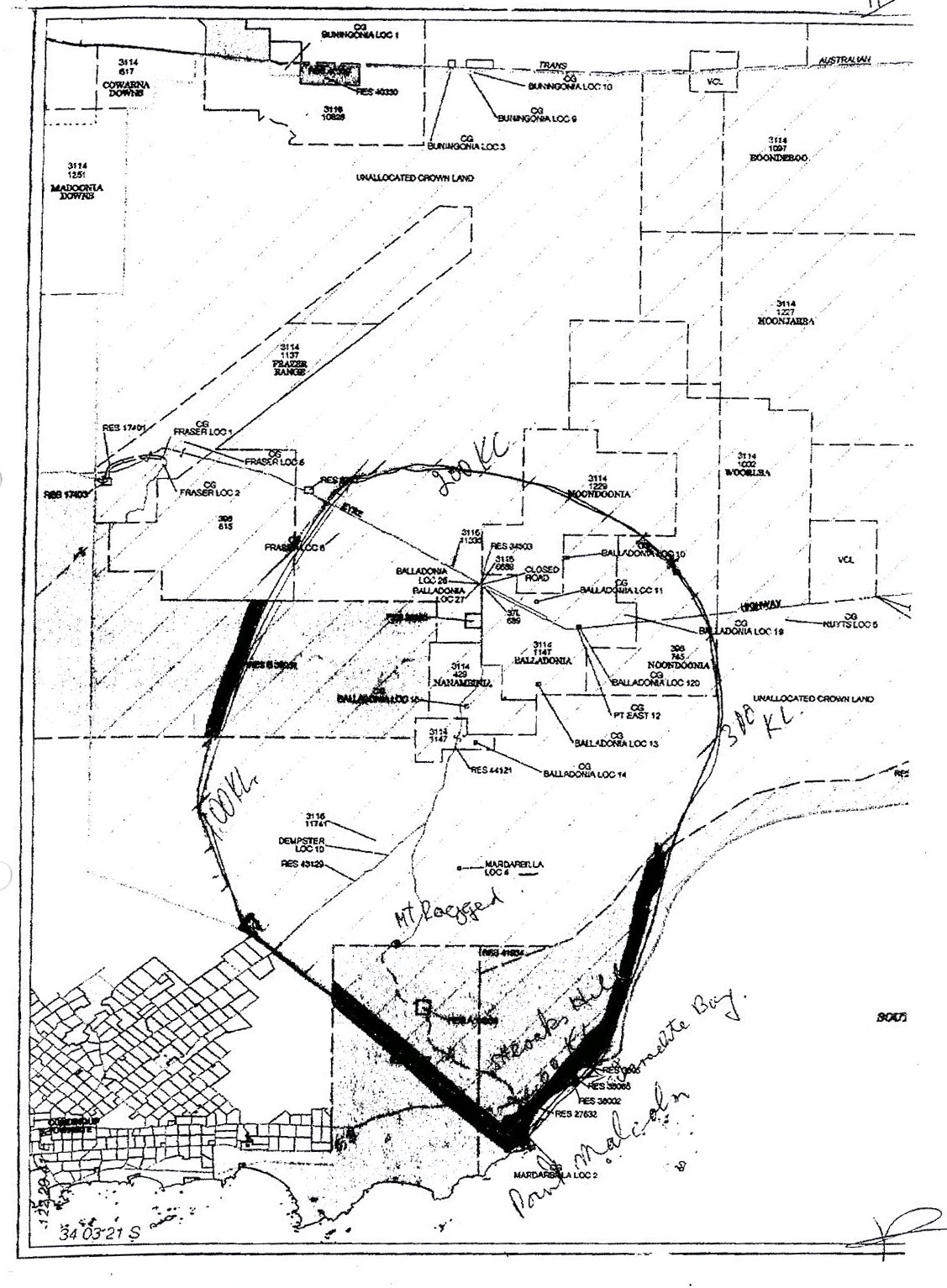
33 A clear case must be made out for the dismissal of a proceeding under s 84C; see Brown v State of South Australia [2009] FCA 206 at [11], per Besanko J.
34 As is apparent from [12] and [13] in Brown the issues raised in that matter are essentially the same as raised in this matter.
35 At [12], Besanko J said:
There is one qualification to these statements and that is that one now has regard to s 31A of the FCAA rather than O 20 r 2 of the Federal Court Rules. In this case, I have reached the conclusion, having regard to the principles applicable to s 84C(1) of the NTA, that the amended application should be struck out under that section. In the circumstances, it is unnecessary to consider the possible application of s 31A of the FCAA to the circumstances of the case.
36 At [13], His Honour said:
The first respondent contends on its notice of motion that the NTA allows for an application to be made by a native title claim group, but not by a sub-group. It contends that the Brown Family Group, as defined in the amended application, is not a native title claim group but, rather, it is a sub-group and therefore the amended application is incompetent. The first respondent further contends, as an independent basis for the orders sought in its notice of motion, that a native title determination application is competent only if the applicant is authorised by all persons in a native title claim group and all the persons in the Brown Family Group have not authorised the applicant to make the application and to deal with matters arising in relation to it. The first respondent submits that it follows that the applicant’s amended application is incompetent. The second respondent supports the first respondent’s contentions.
37 After setting out the relevant statutory processes, his Honour said at [19]:
A native title determination application does not comply with s 61 of the NTA if it is clearly established that it is not made by a native title claim group. A native title claim group is a group consisting of all the persons who, according to their traditional laws and customs, had the common or group rights or interests comprising the particular native title claimed. These propositions follow from the provisions of ss 61(1) and (4), 251B and 253 of the NTA and have been stated in the cases: Risk v National Native Title Tribunal [2000] FCA 1589 at [60]-[61] per O’Loughlin J; Tilmouth v Northern Territory of Australia (2001) 109 FCR 240 (“Tilmouth”) at 241-242 [4] per O’Loughlin J; Landers v State of South Australia (2003) 128 FCR 495 (“Landers”) at 504 [33] per Mansfield J; Dieri People v State of South Australia (2003) 127 FCR 364 (“Dieri People”) at 377-378 [55]-[56] per Mansfield J; McKenzie at 223 [41] per Finn J; Hillig as Administrator of Worimi Local Aboriginal Land Council v Minister for Lands for the State of New South Wales (No 2) [2006] FCA 1115 (“Hillig”) at [60] per Bennett J; Harrington-Smith (on behalf of the Wongatha People) v Western Australia (No 9) (2007) 238 ALR 1 at 230-232 [1206]-[1217] per Lindgren J; Reid v State of South Australia [2007] FCA 1479 (“Reid”) at [27] per Finn J; Kite v State of South Australia [2007] FCA 1662 (“Kite”) at [21]-[22] per Finn J.
38 At [20], Besanko J said:
The propositions have been applied most commonly in circumstances where it is clear that the claimant group is a sub-group or sub-set or part of a native title claim group. Cases such as Tilmouth, Landers, Dieri People, McKenzie and Reid are all cases in which it was clear that the claim group was not a native title claim group. The cases also make it clear that caution needs to be exercised before concluding on a strike-out application that a claim group is a sub-group, sub-set or part of a native title claim group: Colbung v The State of Western Australia [2003] FCA 774 at [23]-[26] per Finn J; McKenzie at 223 [41] per Finn J; Hillig at [60] per Bennett J; Reid at [28] per Finn J; and Kite at [22] per Finn J. For example, it may be that a sub-group of a community sharing traditional laws and customs alone possesses rights and interests in a particular area and that sub-group may itself constitute a native title claim group: Hillig at [60] per Bennett J (see also the obiter observations of Wilcox J in Bodney v State of Western Australia [2003] FCA 890 at [41]; Perry M and Lloyd S, Australian Native Title Law (Lawbook Co, 2003) [3.130].
39 It is not in contest that the current form of s 61 of the Act applies to the instant application, if the application in its amended form can fairly be characterised as a fresh application. As Mansfield J said in Risk v Northern Territory of Australia [2006] FCA 404 at [64] to [75], an application that is amended after the commencement of 1998 amendments to the Act must comply with the new s 61. The application was amended by the amended points of claim filed in January 2010, so the current s 61 applies to it.
40 It is of particular relevance for this case that a sub-group may possess rights and interests in a particular area and that the sub-group itself may constitute a native title group. It may be that the Narnoobinya claim is capable of being amended to refer just to the claimed area of exclusivity referred to in the proposed amended points of claim. However, even if amended to that form the application would not have been authorised by all the persons comprising that sub-group. Further the claimed area of exclusivity needs to be one which is claimed in good faith and capable of being rationally advanced as such. There is also an issue raised by GLSC as to whether Walter Tucker, who is a sibling of Ms Dorothy Tucker (English) is part of the Narnoobinya group or authorised the making of the proposed amended points of claim as a member of the Narnoobinya family group. The Narnoobinya applicant claims in her submissions that Walter Tucker is no longer part of that group, but there is no evidence to support that contention as things currently stand, as distinct from what the position was in 1999 when the claim was first made. In any event, it is not open to the Narnoobinya group to in effect self define; see at [37] above, in the passage referred to from Brown at [19].
41 Having regard to the above, and in reliance on Brown, it would be futile to allow the points of claim to be amended to reflect their proposed form. They can only be amended validly to claim native title in the area of legitimately claimed exclusivity and then only if all members of the group who claim to hold native title in the relevant area authorise such a claim. The Narnoobinya applicant has no authority to make a broader claim on behalf of the Ngadju people generally. The Ngadju people more broadly have had no role in the re-formulation of the Narnoobinya claim.
42 It would be pointless to allow the points of claim to be amended to allow a claim for exclusivity when that claim is bound to fail. Ms Bennett made it clear in her evidence today, under cross examination, that persons who identify at Ngadju have rights in the claimed area of exclusivity under the proposed amended points of claim. Many of those people would be her cousins, nieces and nephews. I do not consider the claimed area of exclusivity to be in reality an area of exclusivity which can be rationally asserted by the Narnoobinya claimant.
43 Given all the above difficulties with the Narnoobinya points of claim, based on the proposed amended points of claim, no useful purpose would be served by permitting the amendment. A logical consequence of this conclusion is that the GLSC strike out motion, which is also before the court, would succeed. This does not mean that the Narnoobinya group is forever shut out. Members of that group may have native title rights arising from the Ngadju claim, or may bring a fresh, properly authorised claim.
I certify that the preceding forty three (43) numbered paragraphs are a true copy of the Reasons for Judgment herein of the Honourable Justice Marshall. |
Associate:


