

FEDERAL COURT OF AUSTRALIA
Australian Competition and Consumer Commission v Sontax Australia (1988) Pty Ltd [2011] FCA 1202
IN THE FEDERAL COURT OF AUSTRALIA | |
AUSTRALIAN COMPETITION AND CONSUMER COMMISSION Applicant | |
AND: | SONTAX AUSTRALIA (1988) PTY LTD (ACN 009 180 278) Respondent |
DATE OF ORDER: | |
WHERE MADE: |
THE COURT DECLARES THAT:
1. Between 2 July 2010 and 29 November 2010, the Respondent contravened s 65C(1)(a) of the Trade Practices Act 1974 (Cth) (the TPA) by supplying to retailers a total of 2,353 elastic luggage straps, in trade and commerce:
(1) that were intended to be used, or were a kind likely to be used, by a consumer; and
(2) in respect to which there was a consumer product safety standard prescribed by reg 11C of the Trade Practices (Consumer Product Safety Standards) Regulations 1979 (Cth) (the Regulations),
in circumstances where the elastic luggage straps supplied did not comply with the Regulations in that the elastic luggage straps did not have permanently attached to them a warning label as required by regs 11C(3) and 11C(4) of the Regulations in the prescribed form.
2. By engaging in the conduct described in paragraph 1 above, the Respondent breached cl 13.1 of an undertaking given by it to the Applicant under s 87B of the TPA dated 10 March 2009 (the Undertaking).
AND THE COURT ORDERS BY CONSENT THAT:
Injunction
3. The Respondent be restrained for a period of five years, whether by itself, its officers, servants, agents or howsoever otherwise, in trade or commerce in Australia from supplying elastic luggage straps which are intended to be used by, or of a kind likely to be used, by consumers that do not comply with the Regulations or such other prescribed consumer product safety standard as may from time to time be applicable at the time of the supply.
Trade Practices Compliance Program
4. The Respondent must:
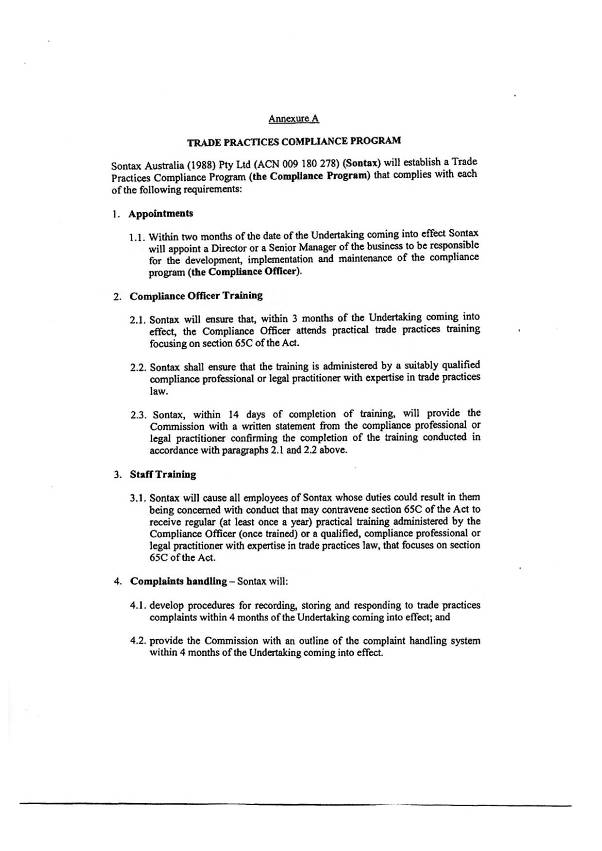
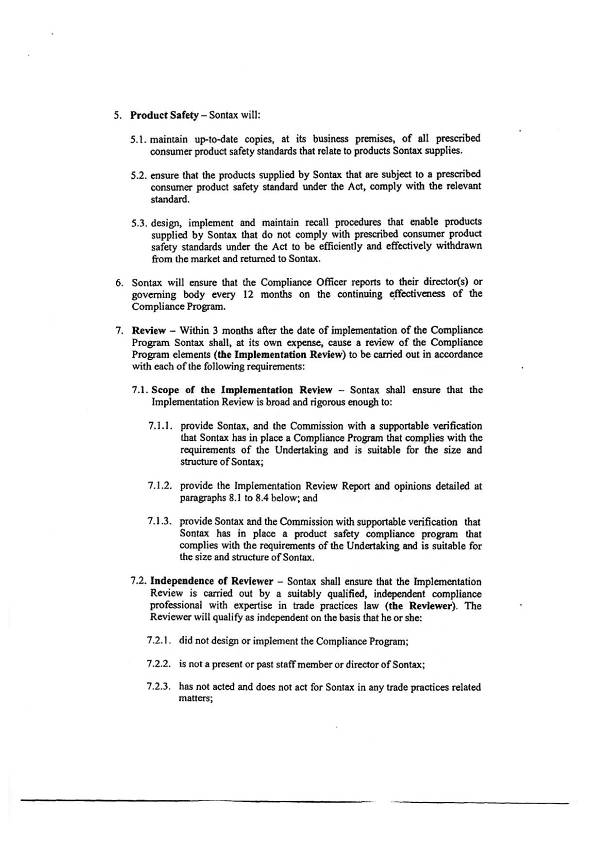
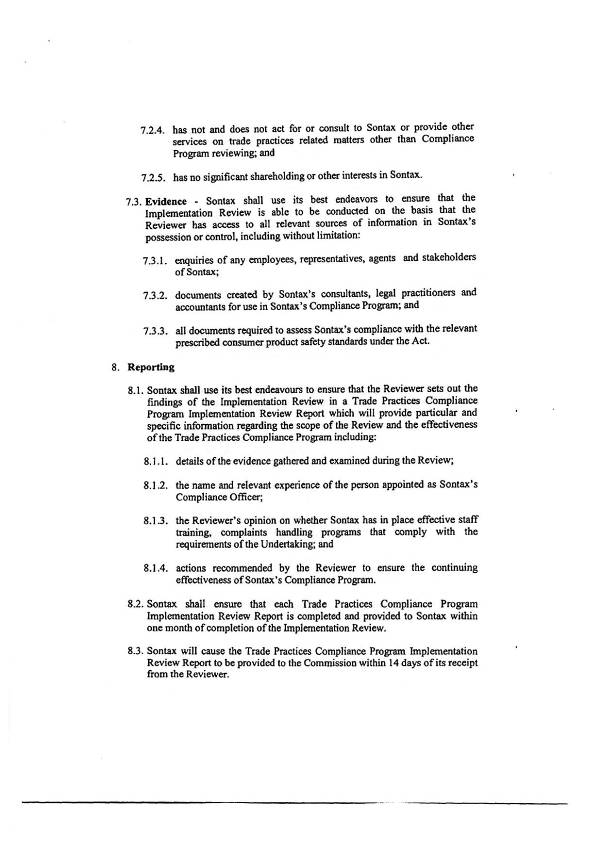
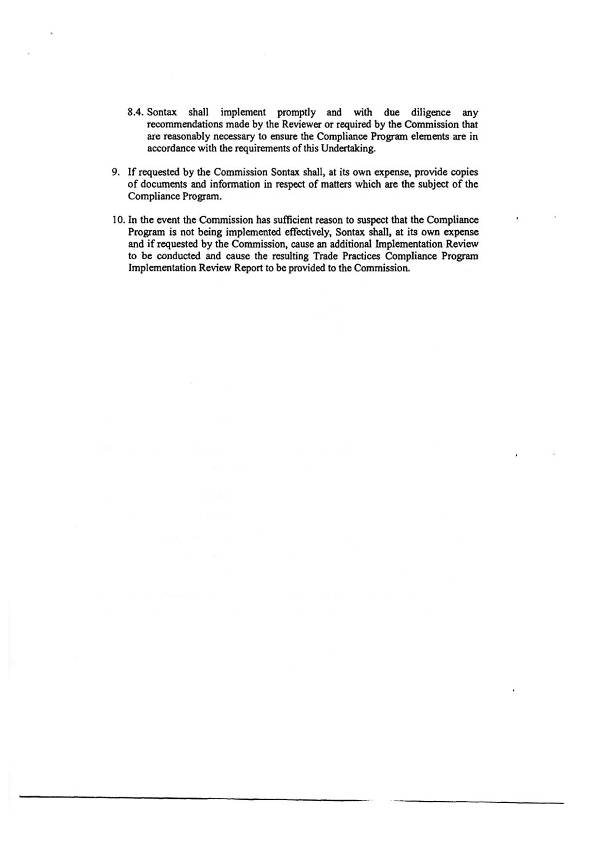
(1) continue to maintain and administer its existing trade practices compliance program in accordance with the program set out in Annexure A to this Order (the Trade Practices Compliance Program) for a period of three years from the date of this Order; and
(2) within three months of the date of this Order, ensure that the Compliance Officer appointed under paragraph 1.1 of the Trade Practices Compliance Program, attends further practical trade practices training focusing on s 65C of the TPA conducted by a suitably qualified compliance professional or legal practitioner with expertise in trade practices law (being a person other than the person who administered any training previously provided to the Compliance Officer pursuant to paragraph 2.2 of the Trade Practices Compliance Program); and
(3) provide a written statement to the Applicant confirming the completion of the training required pursuant to paragraph 4(2) above, within two weeks of the completion of that training; and
(4) within one month of the date of this Order, replace the Independent Reviewer appointed pursuant to paragraph 7 of the Trade Practices Compliance Program with a new Independent Reviewer in accordance with the criteria set out in paragraph 7.2 of the Trade Practices Compliance Program (the Replacement Reviewer); and
(5) within three months of the date of this Order, ensure that the Replacement Reviewer carries out a review of the compliance program elements which is conducted in accordance with paragraphs 7.1, 7.3 and 8 of the Trade Practices Compliance Program and that subsequent reviews are similarly carried out every six months thereafter.
Publication Orders
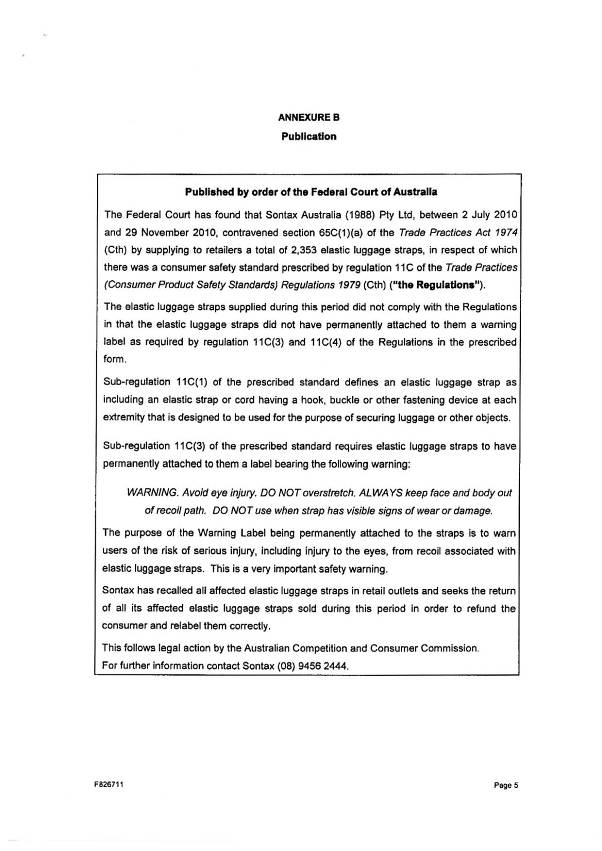
5. The Respondent shall cause to be published, at its expense, within 60 days of the date of this Order, an advertisement in a local trade magazine and local newspaper in the form of Annexure B to this Order and, further, the Respondent shall use its best endeavours to ensure such advertisement shall be of a size not less than a quarter of one page and in text which is not less than 10 point.
Pecuniary Penalty
6. On or before 18 November 2011, or by such further term and but such instalments as the District Registrar may allow, the Respondent pay to the Commonwealth of Australia, pursuant to s 76E of the TPA, a pecuniary penalty of $40,000 in respect of its contravention of the TPA identified paragraph 1 above.
Costs
7. On or before 18 November 2011, or by such further term and but such instalments as the District Registrar may allow, the Respondent pay to the Commonwealth of Australia, $20,000 as a contribution towards the Applicant’s costs of the proceeding.
Note: Entry of orders is dealt with in Rule 39.32 of the Federal Court Rules 2011.
ANNEXURE A – TRADE PRACTICES COMPLIANCE PROGRAM
(Paragraph 4 of the Orders)
ANNEXURE B – ADVERTISEMENT FOR PUBLICATION
(Paragraph 5 of the Orders)
VICTORIA DISTRICT REGISTRY | |
GENERAL DIVISION | VID 633 of 2011 |
BETWEEN: | AUSTRALIAN COMPETITION AND CONSUMER COMMISSION Applicant |
AND: | SONTAX AUSTRALIA (1988) PTY LTD (ACN 009 180 278) Respondent |
JUDGE: | GORDON J |
DATE: | 21 OCTOBER 2011 |
PLACE: | MELBOURNE |
REASONS FOR JUDGMENT
INTRODUCTION
1 On 17 June 2011, the Australian Competition and Consumer Commission (the ACCC) commenced proceedings in Fast Track against Sontax Australia (1988) Pty Ltd (ACN 009 180 278) (Sontax) alleging contraventions of s 65C(1)(a) of the Trade Practices Act 1974 (Cth) (TPA) (as in force immediately before 1 January 2011, applicable by reason of item 6 of sch 7 to the Trade Practices Amendment (Australian Consumer Law) Act (No 2) 2010 (Cth)).
2 Section 65C(1)(a) of the TPA provided, at the relevant time, that:
A corporation shall not, in trade or commerce, supply goods that are intended to be used, or are of a kind likely to be used, by a consumer if the goods are of a kind:
(a) in respect of which there is a prescribed consumer product safety standard and which do not comply with that standard.
3 Sontax filed a fast track response on 2 August 2011. The parties filed an agreed statement of facts on 12 September 2011. That statement, to which s 191 of the Evidence Act 1995 (Cth) applies, is evidence.
4 For the purposes of this proceeding, Sontax admits that it contravened s 65C(1)(a) of the TPA by supplying elastic luggage straps intended to be used, or of a kind likely to be used, by a consumer in respect of which there was a prescribed consumer product safety standard and which did not comply with that standard between 2 July 2010 and 29 November 2010.
RELIEF SOUGHT BY CONSENT AND ISSUES IN DISPUTE
5 The ACCC and Sontax sought the following relief, by consent:
1. a declaration that during the relevant period (2 July 2010 and 29 November 2010), Sontax contravened s 65C(1)(a) of the TPA by supplying to retailers a total of 2,353 elastic luggage straps, that were non-compliant with a prescribed consumer product safety standard, in trade or commerce;
2. a declaration that Sontax breached cl 13.1 of an undertaking dated 10 March 2009 (the 2009 Undertaking) given by it to the ACCC pursuant to s 87B of the TPA;
3. an injunction pursuant to s 232 of sch 2 of the Competition and Consumer Act 2010 (Cth) (CCA) restraining Sontax for a period of five years from engaging in similar conduct;
4. a probation order pursuant to s 86C(2)(b) of the TPA providing Sontax enter into a compliance program; and
5. an order requiring Sontax to publish corrective advertisements in a local magazine and newspaper.
6 In relation to injunctions, pursuant to cl 7(2) of Trade Practices Amendment (Australian Consumer Law) Act (No 2) 2010 (Cth) (Amendment Act No 2), as of 1 January 2011, the power of the Court to grant an injunction in relation to conduct in contravention of what was Pt V of the TPA is provided for under s 232 of Sch 2 of the CCA rather than s 80 of the TPA.
7 The ACCC also sought a pecuniary penalty pursuant to s 76E of the TPA. Sontax did not oppose the imposition of a penalty but submitted that the level of penalty sought by the ACCC was outside the appropriate range. There is also a dispute about costs.
8 These reasons for decision consider the agreed facts, the relief sought by consent, then s 76E of the TPA and then the question of costs.
FACTS
9 As noted above, the ACCC and Sontax filed a statement of agreed facts: see [3] above. The agreed facts, so far as is currently relevant, are summarised below.
10 The relevant conduct is agreed to have taken place between 2 July 2010 and 29 November 2010 (the relevant period) in relation to the supply of elastic luggage straps by Sontax intended to be used, or of a kind likely to be used, by a consumer in respect of which there was a prescribed consumer product safety standard and which did not comply with that standard.
11 During the relevant period, Sontax:
1. was a company duly incorporated pursuant to the Corporations Act 2001 (Cth), being a trading corporation formed within the limits of Australia and to which the provisions of the TPA and the CCA apply; and
2. carried on a business as an importer and wholesale supplier of hardware goods to retailers in the hardware, camping, nursery and gardening industries.
12 During the relevant period, Sontax supplied a total of 2,353 elastic luggage straps (Straps) to retailers. The Straps were goods of a kind that were intended to be used by a consumer and fell within the definition of elastic luggage straps in reg 11C(1) of the Regulations. For the purposes of s 65C(1)(a) of the TPA, reg 11C prescribes the consumer product safety standard applying to elastic luggage straps. It requires luggage straps to have permanently attached to them a label (Warning Label) bearing the following warning (Warning):
WARNING. Avoid eye injury. DO NOT overstretch. ALWAYS keep face and body out of recoil path. DO NOT use when strap has visible signs of wear or damage.
13 Further, under reg 11C(4) of the Regulations, the Warning Label must:
1. bear the word “warning” in uppercase black letters of not less than 4 millimetres in height on a yellow background; and
2. bear the words “do not” and “always” in uppercase black letters of not less than 2 millimetres in height on a yellow background; and
3. bear the remaining words in lower case black letters of not less than 2 millimetres in height on a yellow background.
14 The label which was attached to the Straps read:
“READ WARNINGS CAREFULLY BEFORE USING THIS PRODUCT. FAILURE TO FOLLOW THESE WARNINGS MAY RESULT IN PERSONAL INJURY AND/OR PROPERTY DAMAGE”
1. DO NOT stretch cord more than 50% of the unstretched length.
2. Overstretching can cause hook failure and/or cord failure. DO NOT overstretch cord.
3. Uncontrolled release can cause serious injury. Use extreme caution when stretching and/or releasing the cord. Wear eye and body protection when using this product.
4. Inspect bungee cord regularly for signs of wear. Discard product if cord or hook is cut, abraded, or shows and (sic) signs of damage.
5. DO NOT use to secure heavy or large loads.
The label also had in capital letters, printed vertically on the right hand margin of the label, the word “!WARNING!”.
15 During the relevant period, the Straps did not comply with reg 11C(3) in that the Warning Label attached to the Straps did not bear all the prescribed words of the Warning and did not comply with reg 11C(4) in that the prescribed words of the Warning that were printed on the Warning Label “WARNING” and “DO NOT overstretch” were not printed in the required height nor on the prescribed coloured background. In particular:
1. the word “warning” was in upper case black letters of 2 millimetres in height on a white background;
2. the words “do not” were in upper case black letters of 1 millimetre in height on a white background; and
3. the remaining word “overstretch” was in lower case black letters of 1 millimetre in height on a white background.
16 By supplying the Straps, during the relevant period Sontax supplied goods which were subject to a prescribed consumer product safety standard which did not comply with that standard in breach of s 65C(1)(a) of the TPA.
The 2009 ACCC Undertaking
17 In 2008, the ACCC investigated Sontax for supplying elastic luggage straps from 27 July to 25 August 2008 that did not comply with the prescribed consumer product safety standard in contravention of s 65C(1) of the TPA. These elastic luggage straps were found not to have a warning label permanently attached as required, as the label was made out of paper that would easily tear and perish through use and exposure to the elements. The investigation was finalised by the ACCC on 10 March 2009 when it accepted the Court enforceable 2009 Undertaking offered by Sontax pursuant to s 87B of the TPA: see [5(2)] above.
18 Paragraph 13.1 of the 2009 Undertaking required Sontax for a period of three years from the date of the Undertaking coming into effect, to ensure that all goods it supplied that were subject to a prescribed consumer product safety standard under the Act complied with the relevant standard. By supplying the Straps, Sontax supplied goods which were subject to a prescribed consumer product safety standard which did not comply with that standard in breach of paragraph 13.1 of the 2009 Undertaking.
19 Paragraph 13.2 of the 2009 Undertaking also required Sontax within three months of the Undertaking coming into effect, to establish and implement a Trade Practices Compliance Program (in accordance with prescribed requirements) for the employees or other persons involved in Sontax’s business, being a program designed to minimise Sontax’s risk of future breaches of s 65C of the TPA and to ensure awareness of its responsibilities and obligations in relation to the requirements of s 65C of the TPA. On 24 March 2009, the Compliance Strategies Branch of the ACCC wrote to Sontax detailing the timeline of its obligations arising under the 2009 Undertaking.
20 On 27 June 2010, the ACCC received the Implementation Review Report dated 18 April 2010 (the April 2010 Report) from Michael Lurie & Associates (who had been appointed by Sontax to ensure the Trade Practices Compliance Program was implemented). The April 2010 Report was late. It should have been provided on or before 10 September 2009.
21 On 7 September 2010, the ACCC’s Compliance Strategies Branch wrote to Sontax advising that it believed the review recorded in the April 2010 Report was not sufficient to comply with the requirements of the 2009 Undertaking. The ACCC sought a statement in response to its letter confirming, amongst other things, whether Sontax had carried out specific requirements under the 2009 Undertaking such as practical training focusing on s 65C of the TPA and seeking information from Sontax as to whether it had ensured the products it supplies that are subject to a prescribed consumer product safety standard comply with the relevant standard. The ACCC requested a response by 17 September 2010. No response was received by the ACCC by 17 September 2010, or at all.
22 On 26 October 2010, a 382mm elastic luggage strap (one of the Straps) was purchased by ACCC officers from S&C Trading Pty Ltd, trading as Barrow & Bench Mitre 10 (S&C Trading) in South Australia. Further Straps were purchased from S&C Trading on 15 November 2010. The Straps purchased did not comply with the Regulations: see [12] and [13] above.
23 On 1 December 2010 (prior to it receiving a letter dated 13 December 2010 from the ACCC referred to below), Sontax was notified by S&C Trading that S&C Trading had received a letter from the ACCC explaining that the Strap had a non-compliant warning label. Upon becoming aware of the problem, Sontax initiated its recall procedure, which involved placing all stock of the Strap held at Sontax’s warehouse on hold. On 14 December 2010, Sontax contacted its retailers to inform them that the Strap was non-compliant and advised them to cease selling the Strap. Retailers were given the option of either returning the Strap and receiving a credit note or retaining the Strap and re-labelling it once new compliant labels had been supplied.
24 On 15 December 2010, Sontax received a letter dated 13 December 2010 from the ACCC advising it that the Straps may not comply with the prescribed consumer product safety standard and that by supplying the Straps Sontax may also have breached the 2009 Undertaking.
25 On 19 January 2011, Sontax advised its sales staff that replacement warning labels were available to replace the non-compliant labels.
26 Sontax has since ceased importing all “Bungee Luggage Straps” and will delete the product once all remaining “compliant” stock has been sold.
RELIEF SOUGHT BY CONSENT
Applicable principles?
27 The principles are well established. The Court must be satisfied that it has the power to make the orders proposed and that the orders are appropriate: Australian Competition and Consumer Commission v Real Estate Institute of Western Australia Inc (1999) 161 ALR 79 and Australian Competition and Consumer Commission v Virgin Mobile Australia Pty Ltd (No 2) (2003) Aust Contract R 90-164 at [1]. Once satisfied of those matters, the Court should be slow to impede final settlement of proceedings especially where the orders may have been different had it been the Court’s task to draft them: Australian Competition and Consumer Commission v Target Australia Pty Ltd (2001) ATPR 41-840 at [24]. Next, in deciding whether consent orders conform with legal principle, the Court is entitled to treat a respondent’s consent as involving an admission of all facts necessary or appropriate to the granting of the relief sought: Thomson Australian Holdings Pty Ltd v Trade Practices Commission (1981) 148 CLR 150 at 164. With those principles in mind, I turn to deal with the relief sought by consent.
Declarations
28 The parties seek, by consent, declarations to the effect that:
1. Sontax contravened s 65C of the TPA by supplying 2,353 elastic luggage straps that were non-compliant with a consumer product safety standard prescribed by reg 11C of the Regulations; and
2. Sontax breached the 2009 Undertaking it provided to the Applicant pursuant to s 87B of the TPA.
29 The Court has a wide discretionary power to make declarations under s 21 of the Federal Court of Australia Act 1976 (Cth). In Forster v Jododex Australia Pty Ltd (1972) 127 CLR 421 at 437-438, the High Court identified three threshold requirements before a declaration will ordinarily be made:
1. the question must be a real and not a hypothetical or theoretical one;
2. the applicant must have a real interest in raising it; and
3. there must be a proper contradictor.
Each is satisfied in this case. The proposed declarations relate to conduct that contravenes the TPA and the matters in issue have been identified and particularised by the parties. The question is not hypothetical or theoretical; it is real. It is in the public interest for the ACCC to seek the declarations and for the declarations to be made and, finally, Sontax was the proper contradictor. Its conduct is the subject of the declaration. It had a real interest in opposing the declarations sought by the ACCC.
30 Moreover, there was evidence to support the making of the declarations: see [3] above and Australian Competition and Consumer Commission v Skins Compression Garments Pty Ltd [2009] FCA 710 at [13].
31 Finally, in my view, the declarations sought were appropriate:
1. they are an appropriate vehicle to record the Court’s disapproval of the contravening conduct: see Real Estate Institute of Western Australia at [20]-[21]; Tobacco Institute of Australia Ltd v Australian Federation of Consumer Organics Inc (No 2) (1993) 41 FCR 89 at 100; Australian Competition and Consumer Commission v Midland Brick Co Pty Ltd (2004) 207 ALR 329 at [21]-[22]; Australian Competition and Consumer Commission v LG Electronics Australia Pty Ltd [2006] FCA 1118 at [8]-[9] and Australian Competition and Consumer Commission v Construction, Forestry, Mining and Energy Union (2007) ATPR 42-140 at [6];
2. they serve to vindicate the ACCC’s claim that Sontax contravened the TPA;
3. they are of assistance to the ACCC in the future in carrying out the duties conferred upon it by the TPA; and
4. they may deter other corporations from contravening the CCA.
Injunctions
32 The parties seek, by consent, an injunction to the effect that Sontax be restrained for a period of five years from supplying elastic luggage straps to consumers that do not comply with the Regulations or such other prescribed consumer product safety standard as may from time to time be applicable at the time of the supply.
33 Section 232 of the CCA is relevantly identical to s 86 of the TPA in its form at the commencement of the proceedings. Although the power conferred by the section is broad, it is subject to at least three limitations identified in Australian Competition and Consumer Commission v Z-Tek Computer Pty Ltd (1997) 78 FCR 197 at 2133-4:
1. the power is confined by reference to the scope and purpose of the TPA. Consequently, the relief should be designed to prevent a repetition of the conduct for which the relief is sought;
2. because the jurisdiction to grant an injunction is enlivened by an alleged or actual contravention of a provision of Pt V of the TPA, there must be a sufficient nexus or relationship between the contravention and the injunction granted; and
3. the Federal Court exercises judicial power under Ch III of the Constitution in respect of ‘matters’. Consequently, the injunction must be related to the case or controversy.
34 In my view, the injunction proposed by the parties satisfies these three limitations. It is directed at preventing the precise conduct the subject of this proceeding. Further, the proposed injunction is capable of being readily obeyed and it does not require ongoing Court supervision: Real Estate Institute of Western Australia at [26].
Trade Practices Compliance Program
35 Section s 86C of the TPA relevantly provides:
(1) The Court may, on application by the [ACCC], make one or more of the orders mentioned in subsection (2) in relation to a person who has engaged in contravening conduct.
…
(2)(b) a probation order for a period of no longer than 3 years.
…
(4)… probation order, in relation to a person who has engaged in contravening conduct, means an order that is made by the Court for the purpose of ensuring that the person does not engage in the contravening conduct, similar conduct or related conduct during the period of the order, and includes:
(a) an order directing the person to establish a compliance program for employees or other persons involved in the person’s business, being a program designed to ensure their awareness of the responsibilities and obligations in relation to the contravening conduct, similar conduct or related conduct; and
(b) an order directing the person to establish an education and training program for employees or other persons involved in the person’s business, being a program designed to ensure their awareness of the responsibilities and obligations in relation to the contravening conduct, similar conduct or related conduct; and
(c) an order directing the person to revise the internal operations of the person’s business which lead to the person engaging in the contravening conduct.
36 The purpose of a probation order is to ensure a company-wide awareness of responsibilities and obligations in relation to the contravening conduct or similar or related conduct: Australian Competition and Consumer Commission v Anglo Estates Pty Ltd (2005) ATPR 42-044 at [46]. There must be a nexus between the terms of the compliance program and the contravening conduct: Australian Competition and Consumer Commission v Dataline.Net.Au Pty Ltd (2007) ATPR 42-138 at [96]. The compliance program should set out the steps to be taken with sufficient clarity so that it is able to be performed. It should also be in the public interest that the respondent undertake the program: LG Electronics Australia at [14].
37 In the present case, the parties submitted that ordering the continuance and administration of Sontax’s existing compliance program would be beneficial because the compliance program provides specific and ongoing guidance in relation to the training of its staff as to the rights of consumers under the TPA and under the CCA and, secondly, additions to the compliance program were directed at the conduct the subject of the proceeding and seek to prevent any similar breaches in the future. So, for example, the amendments to the program require Sontax to report on the completion of staff training and to report on a review whether its supplies are compliant with the relevant safety standard.
38 In my view, there is a sufficient nexus between the contravening conduct and the proposed compliance program. The proposed program sets out with sufficient clarity the steps to be taken. The agreed facts disclose that Sontax employs about 20 staff. In my view, it is in the public interest that Sontax undertake this compliance program to assist it and its employees in understanding the obligations imposed by the TPA and the CCA and ensuring compliance with those provisions. If those objectives are achieved, consumers ultimately benefit.
Corrective Advertising
39 Section s 86C relevantly provides:
(1) The Court may, on application by the [ACCC], make one or more of the orders mentioned in subsection (2) in relation to a person who has engaged in contravening conduct.
…
(2)(d) an order requiring the person to publish, at the person’s expense and in the way specified in the order, an advertisement in the terms specified in, or determined in accordance with, the order.
40 Corrective advertising is to be used protectively and not by way of punishment: Hospitals Contribution Fund of Australia Ltd v Switzerland Australia Health Fund Pty Ltd (1987) 78 ALR 483 at 492. Its purposes include:
1. to raise public awareness for consumers and competitors as to the type of conduct that may contravene the Act, and as to the outcome of particular litigation: Target Australia at 43,382;
2. to alert consumers to the fact of the contravening conduct and inform them that they may have some remedy;
3. to aid in the enforcement of a primary order and prevent repetition of the conduct: Luxottica Retail Australia Pty Ltd v Specsavers Pty Ltd (No 2) [2010] FCA 644 at [9].
The purposes are not cumulative.
41 However, there must be a nexus between the corrective advertising and the conduct that constituted the breach: Medical Benefits Fund of Australia Ltd v Cassidy (2003) 135 FCR 1 at [54]. Therefore, in deciding whether to make an order for corrective advertising Courts will seek to ensure that it is not disproportionate to the contravening conduct and will take into account the time which has elapsed since the offending conduct: Makita (Australia) Pty Ltd v Black & Decker (Australasia) Pty Ltd (1990) 18 IPR 270 at 282.
42 In the present case, the parties submit that the utility of the corrective advertising sought by the parties by consent includes:
1. alerting customers who have purchased the Straps or may purchase similar straps in the future that there is a risk of serious injury from the recoil associated with the elastic luggage straps;
2. alerting consumers and suppliers to the fact that the warning label prescribed by the Regulations is an important safety warning; and
3. preventing repetition of the conduct in the future.
43 In my view, there is a nexus between the contravening conduct and the particular order sought for corrective advertising and its content is proportionate to the contravening conduct. Here, the lapse of time since the contravening conduct may be put to one side because these kinds of products continue to be sold.
SECTION 76E
44 That brings me to the issue in dispute – the quantum of the pecuniary penalty to be imposed on Sontax under s 76E(1) of the TPA. Sontax accepts that a penalty should be imposed. It rejects the ACCC’s submission that the appropriate range is $80,000 to $120,000. Sontax submitted that the penalty to be imposed on it should be “less and significantly less” and should not exceed $20,000.
History of Legislation and Maximum Penalty
45 Section 76E was added to the TPA by the Trade Practices Amendment (Australian Consumer Law) Act (No 1) 2010 (Cth) (Amendment Act No 1), by provisions commencing on 15 April 2010: items 1 and 18 of Sch 2 to Amendment Act No 1 and s 2(1) table item 3 of Amendment Act No 1. The CCA commenced on 1 January 2011. Section 76E of the TPA was repealed. However, s 76E, in its form prior to 1 January 2011, continues to apply to conduct after 15 April 2010 up to and including 31 December 2010: see cll 6 and 7 of Sch 7 of the Amendment Act No 2.
46 Pursuant to s 76E of the TPA, a pecuniary penalty is able to be imposed in respect of a contravention of s 65C(1) of the TPA. For each contravention of s 65C(1), a penalty of up to 10,000 penalty units may be imposed upon a body corporate. As each penalty unit is worth $1101, the maximum penalty for a body corporate for each contravention of s 65C(1) is $1.1 million.
Relevant penalty principles or factors
47 What then are the principles or factors to be applied by the Court in determining the appropriate pecuniary penalty?
48 Section 76E(2) of the TPA provided at all relevant times:
In determining the appropriate pecuniary penalty, the Court must have regard to all relevant matters including:
(a) the nature and extent of the act or omission and of any loss or damage suffered as a result of the act or omission; and
(b) the circumstances in which the act or omission took place; and
(c) whether the person has previously been found by the Court in proceedings under Part VC or this Part to have engaged in any similar conduct.
49 Section 76E(2) incorporates the same non-exhaustive mandatory considerations that are expressly provided for determining a pecuniary penalty pursuant to s 76(1) of the Act: Australian Competition and Consumer Commission v Yellow Page Marketing BV (No 2) [2011] FCA 352 at [88]-[100]. While some of the considerations relevant to s 76 (specifically market share and consumer harm from anti-competitive conduct) are inapposite in the context of penalties imposed under s 76E, many of the established principles to be applied by the Court in determining penalties for contraventions of Pt IV under s 76 are broadly applicable in determining a penalty under s 76E of the Act: see Australian Competition and Consumer Commission v Dimmeys Stores Pty Ltd [2011] FCA 372 at [27]-[36] and Yellow Page Marketing at [21]-[36]. In the context of the present case, it is sufficient to refer to, and adopt, the analysis set out in Dimmeys at [27]-[36] and Yellow Page Marketing at [83]-[97].
Application of principles to Sontax’s conduct
Nature and Extent of the Act or Omission and Any Loss or Damage Suffered
50 The parties agree that the relevant period of the contravening conduct was between 2 July 2010 and 29 November 2010, a period of approximately five months. Shortly after becoming aware of the problem, Sontax put the offending stock on hold and informed retailers that the product should not be sold. However, the recall of the Straps did not occur until 14 December 2010.
51 Each supply of one of the 2,353 Straps to retailers was able to be characterised as a breach of the TPA. The ACCC accepts it is appropriate to regard Sontax’s conduct as a single course of conduct (see Yellow Page Marketing at [84]-[87]) but places considerable reliance on the fact that there were a large number of Straps supplied.
52 In assessing the nature and extent of the omission, I accept that because the Straps did have a warning label attached to them, albeit a non-compliant one, Sontax’s conduct was of a less serious nature than might otherwise be the case. However, I accept the ACCC’s submission that in this context, Sontax’s failure to place advertisements in newspapers warning the public of the non-compliance is relevant.
53 The ACCC further submitted that there was a real possibility that Sontax’s contravening conduct may have lead to serious injury (or worse) to a consumer using the Straps. In its written submissions, the ACCC referred to (but did not adduce evidence of) injury and death. In the circumstances, I have placed little weight on this last aspect. It is sufficient, in my view, that there was a prescribed warning which the Court is entitled to assume was put in place to either address actual or anticipated personal harm or damage from a product.
The Circumstances in Which the Act or Omission took Place
54 In my view, there are two circumstances of particular significance. First, the contravening conduct ceased only after Sontax was made aware that the ACCC had detected the breach: see [23] above. Secondly, in 2008 the ACCC investigated Sontax for supplying luggage straps that breached the regulation in that they did not have a warning label permanently attached as required, as the label was made out of paper that would easily tear and perish through use and exposure to the elements. As a result, the ACCC accepted the 2009 Undertaking that required Sontax to do certain things: see [17] to [21] above. I accept the ACCC’s submission that the fact that the present contravention occurred in circumstances where:
1. the ACCC had recently drawn a similar failure to comply with the same prescribed consumer product safety standard to Sontax’s attention;
2. Sontax had provided the 2009 Undertaking, a condition of which was that it would ensure that future supply would be subject to the relevant standards: Australian Competition and Consumer Commission v Singtel Optus Pty Ltd (No 4) [2011] FCA 761 at [37]-[41]);
3. Sontax had also undertaken in the 2009 Undertaking to establish and implement a Trade Practices Compliance Program; and
4. the ACCC had raised concerns with Sontax in relation to whether Sontax had properly established and implemented the Trade Practices Compliance Program it had undertaken to establish,
are aggravating factors.
Previous findings of the Court
55 I accept that Sontax has not previously been found by a Court to have engaged in similar conduct.
Deterrence
56 The ACCC submits that in assessing penalty in this case, the Court should attach most weight to deterrence, both specific and general. Sontax contravened s 65C(1) of the TPA, located in Div 1A of Pt V of the TPA, entitled “Product safety and product information”. The primary purpose of s 65C(1) of the TPA is the protection of consumers.
57 It is common ground that the Straps were intended to be used, or were of a kind likely to be used, by a consumer in respect of which there is a prescribed consumer product safety standard and that the Straps did not comply with regs 11C(3) and 11C(4) as they did not bear the appropriate warning in the requisite size and font on a yellow background.
58 The complicating factor in the present case is that the Straps had warning labels affixed to them but the labels were not the correct colour, the typeface was 50% smaller than that required and certain information that was required by the prescribed consumer product safety standard was omitted. The ACCC submitted that these failures made it more difficult for consumers of the Straps to be made aware of the importance of using them in an appropriate manner so as to avoid injury. Moreover, the ACCC submitted that the penalty imposed on Sontax should:
1. operate so that it is not in the financial interest of Sontax or any other company that supplies products subject to a prescribed consumer product safety standard to have ineffectual internal procedures for ensuring compliance with the relevant standards;
2. reflect the seriousness of Sontax having breached its s 87B undertaking;
3. act as a deterrent to other companies who give Court enforceable undertakings to the ACCC and who, by not having appropriate procedures in place, risk breaching these undertakings.
59 Although Sontax acknowledged that any penalty to be imposed must have regard to the principle of deterrence and that the protection of consumers was a primary object of s 65C of the TPA, Sontax submitted that its conduct did not directly affect a class of consumers considered vulnerable (cf Dimmeys at [61]-[63]) and that fact was relevant in assessing deterrence. Further, Sontax submitted that although general deterrence remained critical, specific deterrence was a not a weighty consideration because as soon as they were notified of the issue, they took immediate action to rectify the problem: cf Australian Competition and Consumer Commission v Gourmet Goody’s Family Restaurant Pty Ltd [2010] FCA 1216 at [10]-[11]. I reject the significance that Sontax places on these facts and matters. No fact or matter can be looked at in isolation. The items in issue in Dimmeys were children’s pyjamas. Children are vulnerable. In the same way, children use or are at least exposed to these Straps. I accept that the extent of the use might be less, but it is still use or potential use by children. Next, steps were taken to rectify the problem but those steps were not exhaustive: see [52] and [66].
Size of Contravener and its Financial Position
60 The ACCC submitted that:
1. the financial position of a respondent is a relevant factor to be taken into account in the assessment of the appropriate penalty, including the effect of a penalty on third persons (such as creditors and employees);
2. deterrence is the primary objective of penalties; and
3. as deterrence is the primary objective of penalties, the financial capacity of a respondent to pay a particular level of penalty is of lesser importance than the need for an appropriate pecuniary penalty to be imposed, even if it will cause a company to become insolvent: Australian Competition and Consumer Commission v High Adventure Pty Ltd (2006) ATPR 42-091 per Heerey, Finkelstein and Allsop JJ at [111].
61 Sontax employs 25 people. In the financial year ended 30 June 2011, it recorded a turnover of $14.5 million which resulted in a gross profit of $1.3 million. It has net assets of approximately $2.8 million. Its forecasted turnover for the current financial year is lower than previous years with little or no profit forecast due to anticipated declining purchases by one of its largest customers.
Deliberateness of the contravention and the period over which it extended
62 There is no dispute that the contravening conduct was the result of lax management and poor oversight rather than deliberate supply of the Straps in breach of the Regulations. However, as the ACCC submitted, carelessness is not a defence.
Participation of senior employees and management
63 There was no evidence of Sontax’s ordering processes. There was no evidence that instructions were given to the overseas suppliers regarding the requirements of Australian prescribed consumer product safety standards and the need to comply with them. At the time Sontax breached s 65C(1) of the TPA it was required to have an effective compliance program in place under a compliance officer. This was senior management’s responsibility. To that extent, senior management failed to discharge their responsibilities.
Culture of Compliance
64 Sontax undertook to implement a Trade Practices Compliance Program which should have been in operation during the relevant period. The ACCC had expressed concerns about the implementation of the Trade Practices Compliance Program and, further, the Trade Practices Compliance Program failed to prevent the contravening conduct from occurring: see [20] to [21] above. As the ACCC submitted, the processes that Sontax had in place for inspection of goods for compliance with the prescribed consumer product safety standard were inadequate. In this context, it is relevant to note that Sontax has consented to an amended Trade Practices Compliance Program.
Cooperation and Contrition
65 There are two aspects to this matter. Sontax’s conduct on being notified of the breach and its cooperation in relation to these proceedings.
66 Upon being notified of the breach on 1 December 2010, Sontax took immediate steps to place all the Straps held at Sontax’s warehouse on hold. However, it was not until 14 December 2010 that Sontax contacted its retailers to inform them that the Straps were non-compliant and to stop selling them. Retailers were then given the option of either returning the Straps and receiving a credit note or retaining the Straps and re-labelling them once new compliant labels had been supplied. No steps were taken by Sontax to alert members of the public who had already purchased the Straps.
67 In relation to the second aspect, Sontax has cooperated with the ACCC in the conduct of this proceeding. It made an early acknowledgement of its liability for the contravening conduct, it did not contest its liability and it cooperated in the making of the agreed statement of facts, the consent orders and a joint submission on all relief other than penalty.
68 As a result of Sontax making full admissions on liability and its cooperation in the conduct of the proceeding, a trial has been avoided. A fully contested trial would have consumed a substantial amount of the time and resources of the Court and the ACCC. The penalty imposed upon Sontax would have been higher but for Sontax’s early acknowledgment of liability and the consequent savings in time and resources to the Court and the ACCC.
Parity Principle
69 There are no other respondents to this proceeding. Accordingly, no question arises of equivalence of the penalties imposed on Sontax with other contravenors.
70 There are only two cases of penalties under s 76E of the Act that relate to contraventions of s 65C of the Act: Dimmeys and Australian Competition and Consumer Commissioner v Smash Enterprises Pty Ltd [2011] FCA 375. Both cases provide, to an extent, some guidance as to the appropriate penalty here.
71 In the case of Smash Enterprises, Fantastic Furniture supplied to its franchisees a total of 257 bean bag covers, over a six month period between 15 April 2010 to 17 September 2010, to which no warning label was attached in contravention of reg 11 of the Regulations. In supplying the non-compliant bean bag covers Fantastic Furniture also breached an undertaking given to the ACCC pursuant to s 87B of the TPA on 12 November 2008 in relation to the supply of bunk beds that did not comply with the prescribed consumer product safety standard. A penalty of $300,000 was held to be within the permissible range that a Court, without any agreement between the parties, would have considered appropriate.
72 The ACCC submitted that in Smash Enterprises, unlike here, the non-compliant bean bags were for sale to a particularly vulnerable class of consumers, being children, and, unlike here, no warning label at all was attached to the bean bags. However, unlike Smash Enterprises, the undertaking given by Sontax to the ACCC was with respect to the same product being found to be non-compliant.
73 As noted earlier, Dimmeys concerned the supply of children’s night gowns that did not comply with the prescribed consumer product safety standard. Many gowns did not carry a low fire hazard warning label. A smaller number of gowns did carried the required label but not in the correct position. The failure by Dimmeys to correctly attach the warning label was a less serious contravention than the failure to attach a warning label. A penalty of $100,000 was imposed.
74 The Dimmeys case is of limited assistance. It is similar in that, like Dimmeys, Sontax attached a warning label although the warning label did not comply with the Regulations. However, the usefulness of Dimmeys is limited, inter alia, by the fact that the penalty arrived at took into account proceedings against the company for similar conduct in breach of the TPA. There is no such aggravating factor here.
Conclusions on appropriate penalty
75 In light of those facts and matters, what is the appropriate level of penalty? Applying each of the factors relevant to the exercise of the discretion under s 76E and for the reasons set out above, I consider that a pecuniary penalty of $40,000 should be imposed on Sontax. In my view, such a penalty is appropriate to demonstrate, inter alia:
1. the Court’s concern for both specific and general deterrence in relation to contraventions of Pt V of the TPA;
2. the Court’s disapproval of the nature of the conduct underlying the contraventions;
3. the Court’s disapproval of Sontax’s contravening conduct in this proceeding, having regard to the fact that Sontax had provided the 2009 Undertaking to the ACCC in relation to similar product safety issues;
4. the Court’s concern for the ineffectiveness of Sontax’s trade practices compliance, and product and stock control at the time of the contraventions;
5. the Court’s acceptance of the mitigating facts and matters including Sontax’s early acknowledgment of liability and its co-operation since that time; and
6. Sontax’s capacity to pay.
COSTS
76 Sontax should also pay a contribution towards ACCC’s costs of the proceeding, such contribution to be fixed in the sum of $20,000.
ORDERS
77 In addition to the relief sought by consent, I will direct that:
1. on or before 18 November 2011, or by such further term and but such instalments as the District Registrar may allow, Sontax pay to the Commonwealth of Australia, pursuant to s 76E of the TPA, a pecuniary penalty of $40,000 in respect of its contravention of the TPA identified paragraph 1 of the declarations;
2. on or before 18 November 2011, or by such further term and but such instalments as the District Registrar may allow, Sontax pay to the Commonwealth of Australia, $20,000 as a contribution towards the ACCC’s costs of the proceeding.
I certify that the preceding seventy-seven (77) numbered paragraphs are a true copy of the Reasons for Judgment herein of the Honourable Justice Gordon. |
Associate:


