FEDERAL COURT OF AUSTRALIA
Wang v Anying Group Pty Ltd [2011] FCA 1196
|
IN THE FEDERAL COURT OF AUSTRALIA |
|
THE COURT ORDERS THAT:
1. Within fourteen (14) days of this day (21 October 2011), the legal representatives of the parties confer and, to the extent that it is possible, agree on Short Minutes of Order to give effect to these Reasons for Judgment.
2. In the absence of complete agreement amongst the parties as to those orders, each party is to submit to the Associate to Foster J by no later than 11 November 2011 that party’s suggested Short Minutes of Order together with a Written Submission of no more than four (4) pages in length in support of that party’s version of the appropriate orders.
3. All questions of costs be reserved for argument in light of final orders.
Note: Entry of orders is dealt with in Rule 39.32 of the Federal Court Rules 2011.
|
NEW SOUTH WALES DISTRICT REGISTRY |
|
|
GENERAL DIVISION |
NSD 768 of 2008 |
|
BETWEEN: |
HUA WEI WANG First Applicant XINYING PTY LTD (ACN 118 548 977) Second Applicant NEW CENTURY 2001 PTY LTD TRADING AS ANYING SYDNEY COMPANY (ACN 114 661 568) Third Applicant |
|
AND: |
ANYING GROUP PTY LTD (ACN 126 282 657) First Respondent YANYAN SUN Second Respondent YUN CHEN Third Respondent |
|
and between: |
ANYING GROUP PTY LTD (ACN 126 282 657) First Cross-Claimant YANYAN SUN Second Cross-Claimant YUN CHEN Third Cross-Claimant |
|
and: |
HUA WEI WANG First Cross-Respondent XINYING PTY LTD (ACN 118 548 977) Second Cross-Respondent NEW CENTURY 2001 PTY LTD TRADING AS ANYING SYDNEY COMPANY (ACN 114 661 568) Third Cross-Respondent REGISTRAR OF TRADE MARKS Fourth Cross-Respondent CHUANG WANG Fifth Cross-Respondent ANYING INTERNATIONAL FINANCIAL PTY LIMITED (ACN 105 067 990) Sixth Cross-Respondent |
|
JUDGE: |
FOSTER J |
|
DATE: |
21 OCTOBER 2011 |
|
PLACE: |
SYDNEY |
REASONS FOR JUDGMENT
INTRODUCTION
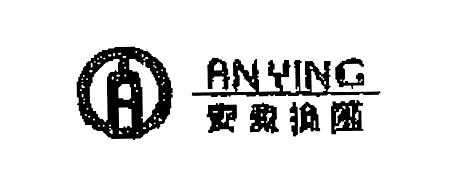
1 The main parties to these proceedings are fighting for control of the trade name or business name “Anying” (the Anying name) and a trade mark comprising the Anying name, a logo and four Chinese characters (the Anying trade mark). The Anying name and the Anying trade mark have, for some time, been used in Australia by the second and third applicants and others and, more recently, by the first respondent.
2 The Anying trade mark comprises the following:
3 Each of the second and third applicants conducts a foreign exchange business. The second applicant operates in Melbourne and the third applicant operates in Sydney. The first applicant (Harry Wang) controls the second applicant (Xinying) with his partner Xuan Zheng. Ronan He and his wife (Juan Hua Yan) control the third applicant (New Century). Juan Hua Yan is the sole director and shareholder of New Century.
4 The first respondent (Anying Auburn) also conducts a foreign exchange business. Its business is based in Auburn, a suburb of Sydney. Anying Auburn is controlled by the third respondent (Andrew Chen). The second respondent (Yan Yan Sun) is a director of Anying Auburn and a close associate of Andrew Chen. Anying Auburn commenced its business operations in December 2007 or January 2008. From about that time, Anying Auburn has used the Anying name and a trade mark which is substantially identical to the Anying trade mark in connection with its business.
5 In late 2008, Anying Auburn attempted to expand its business into the Haymarket area of the city of Sydney. Pursuant to interlocutory arrangements agreed amongst the parties at that time, Anying Auburn has confined its business to the Auburn area. It has agreed to keep accounts in respect of that business.
6 The applicants seek declaratory, injunctive and pecuniary relief against the respondents. Several separate and distinct causes of action are relied upon.
7 The respondents do not dispute that they have used the Anying name and the Anying trade mark in connection with the business of Anying Auburn. However, they contend that they are entitled to do so. In addition, they challenge the applicants’ claimed entitlement to the proprietorship of the Anying name and the Anying trade mark on a number of bases.
8 These Reasons for Judgment determine all questions in dispute amongst the parties except their respective claims for pecuniary relief which has been reserved for separate consideration in the event that one or more of the moving parties becomes entitled to such relief.
THE APPLICANTS’ CASE
9 The applicants rely upon four separate causes of action.
10 First, Harry Wang and Xinying contend that, from at least late 2007, Anying Auburn advertised, promoted, offered for sale, supplied and sold services under or by reference to a mark, name, word, device or sign that is substantially identical and/or deceptively similar to Australian Registered Trade Mark No 1100722 in Class 36 (the Registered Trade Mark) for services for which that trade mark is registered being foreign currency exchange services; that the conduct of Anying Auburn was engaged in without the licence or authority of either Harry Wang or Xinying; and that, accordingly, Anying Auburn has infringed and continues to infringe the Registered Trade Mark. The applicants allege that Harry Wang is the registered proprietor of the Registered Trade Mark and that the registration of that mark took effect from 24 February 2006, the date when Harry Wang applied for the registration of that trade mark. The applicants also allege that Xinying is entitled to sue for trade mark infringement as a licensee of Harry Wang. In this regard, the applicants rely upon a user agreement between Harry Wang and Xinying dated 3 November 2006. That agreement was not tendered in evidence before me.
11 The Certificate of Registration in respect of the Registered Trade Mark includes the following statement:
The applicant has advised that the Chinese characters appearing in the trade mark may be transliterated as AN YING HUAN HUI and may be translated into ENGLISH as SAFE RICH EXCHANGE CURRENCY.
12 The Registered Trade Mark comprises the following:
13 It thus comprises the logo depicted above (the Anying logo), the single word ANYING and the four Chinese characters to which reference is made in the text of the Certificate of Registration. Each of these integers of the trade mark is laid out as depicted at [12] above.
14 There is no dispute that Harry Wang is the registered proprietor of the Registered Trade Mark. However, the respondents contend that Harry Wang was never entitled to be the registered proprietor of the Registered Trade Mark. They argue that the Register of Trade Marks (the Register) should be rectified by expunging the Registered Trade Mark.
15 The applicants claim a declaration that Anying Auburn has infringed the Registered Trade Mark, an injunction restraining it from continuing to infringe the Registered Trade Mark and damages or an account of profits, at their election. The applicants also claim orders requiring that all marketing and advertising material in the possession of Anying Auburn which bear the Registered Trade Mark or any mark, name, word, device or sign which is substantially identical or deceptively similar to that mark be delivered up to the applicants or their duly authorised agents for destruction.
16 Second, New Century contends that, by engaging in the same conduct relied upon by Harry Wang and Xinying as constituting an infringement of the Registered Trade Mark, Anying Auburn contravened s 52 and s 53 of the Trade Practices Act 1974 (Cth) (the TPA) and committed the tort of passing off. New Century alleges that:
(a) Since about December 2006, it has conducted its foreign currency exchange business under or by reference to the name or mark “Anying”;
(b) In about April 2007, it registered the business name “Anying Sydney Company” and from that time has offered its services trading under the business name of “Anying Sydney Company”;
(c) New Century has acquired a very substantial and valuable reputation amongst the general public throughout New South Wales in respect of the provision of foreign currency exchange services by reference to its name or mark “Anying” and the business name “Anying Sydney Company”;
(d) Since about December 2006, New Century’s name or mark “Anying” and its business name “Anying Sydney Company” are and have at all material times been understood by the trade and general public throughout New South Wales as being services in a name and mark exclusively and distinctively indicated and associated with New Century and its business, and no other; and
(e) By trading under the name “Anying” and by using the Anying logo and certain of the Chinese characters forming part of the Registered Trade Mark, Anying Auburn has engaged in misleading and deceptive conduct and thereby contravened s 52 of the TPA and has represented that it has the sponsorship or approval of New Century (which it does not have) and has therefore contravened s 53(d) of the TPA.
17 The precise allegations of contravention of the TPA are:
25. The acts and conduct of [Anying Auburn] referred to in paragraphs 23 and 24 are calculated to mislead and deceive, have misled and deceived and are likely to mislead and deceive members of the trade and public into the false belief that:
(a) [Anying Auburn’s] services:
(i) are [New Century’s] services,
(ii) are offered by or under the authority of [New Century],
(iii) have the sponsorship or approval of [New Century]
(b) [Anying Auburn] has the sponsorship or approval of [New Century] or is affiliated with it.
26. By reason of the matters referred to in paragraphs 23, 24 and 25 [Anying Auburn] has, in trade or commerce, contravened ss 52 and 53 of the Trade Practices Act 1974 (Cth), as amended or one or more of those provisions.
18 The same conduct is relied upon as constituting passing off.
19 New Century claims appropriate injunctive relief and damages for the alleged contraventions of the TPA by Anying Auburn and in respect of the tort of passing off.
20 Third, the applicants allege that Andrew Chen and Yan Yan Sun are personally liable pursuant to s 75B of the TPA to New Century in respect of the alleged contraventions of the TPA by Anying Auburn.
THE RESPONDENTS’ DEFENCE AND CROSS-CLAIM
21 The respondents admit that Anying Auburn has, since December 2007 or January 2008, carried on business under the corporate name and style “Anying Group Pty Ltd” and has advertised, offered for sale, supplied and sold foreign exchange services to the public using “Anying”, the Anying logo and four Chinese characters which translate as “safe rich group”. They also admit that they have engaged in that conduct without the licence or authority of either Harry Wang or Xinying. They contend, however, that the licence or authority of Harry Wang and Xinying is not required.
22 In addition, the respondents do not concede the authenticity and validity of the user agreement between Harry Wang and Xinying which is relied upon by the applicants as part of their case. Also, they deny that the applicants have suffered any loss or damage as a result of their activities.
23 The respondents deny that the applicants are entitled to any of the relief claimed in the Application. In answer to the whole of the Statement of Claim, the respondents:
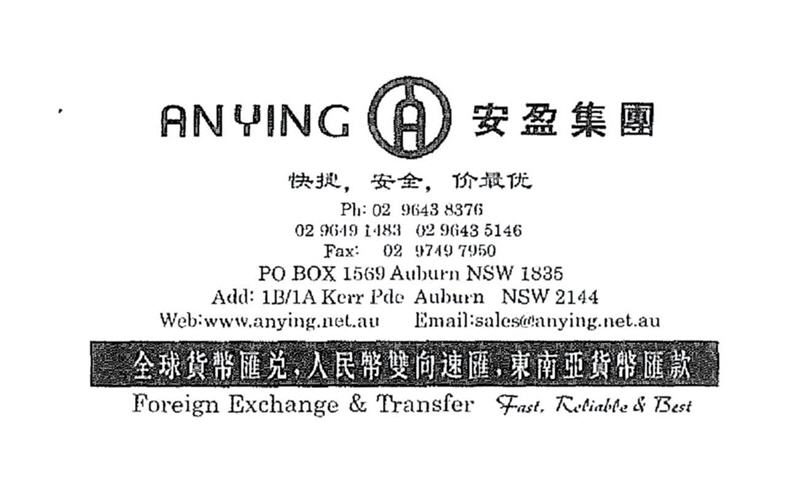
(a) Say that neither the First, the Second or the Third Applicant were the owner of the mark the subject of the application for the Registered Trade Mark and had no other right, title or interest in the mark the subject of the Registered Trade Mark; and
(b) Say that the Registered Trade Mark should be expunged from the Register for the reasons set out in the cross claim.
(Par 34 of the Defence).
24 In addition, the respondents contend that they have not infringed the Registered Trade Mark and that it would be proper to allow Anying Auburn or Andrew Chen to register the mark the subject of the Registered Trade Mark pursuant to s 44(3)(b) of the Trade Marks Act 1995 (Cth) (the Trade Marks Act).
25 The respondents also rely upon a Cross-Claim. The final iteration of that Cross-Claim is the Second Further Amended Cross-Claim filed on 25 May 2010 (the SFACC).
26 The relief claimed, based upon the matters pleaded in the SFACC, is found in a Further Amended Cross-Claim Application also filed on 25 May 2010.
27 The cross-respondents to the SFACC are the three applicants, the Registrar of Trade Marks (as fourth cross-respondent), Chuang Wang (as fifth cross-respondent) and Anying International Financial Pty Limited (ACN 105 067 990) (as sixth cross-respondent) (Anying Sydney No 1).
28 There was no appearance at the hearing either by or on behalf of any of the fourth, fifth and sixth cross-respondents. There is an issue as to whether or not any of those cross-respondents have been validly served with the SFACC and the accompanying Further Amended Cross-Claim Application. I will return to this issue later in these Reasons.
29 By the SFACC, the respondents contend the following:
(a) Andrew Chen caused to be incorporated in New Zealand in May 2001 a New Zealand corporation called “An Ying Group Limited” (An Ying Group NZ) of which he was the controller and which traded under the Anying name and a trade mark comprising the name “Anying” and the Anying logo (as defined in the Cross-Claim). This combination of the English word and the logo will be referred to as “the first Anying mark”.
(b) In about mid 2003, Andrew Chen caused An Ying Group NZ to establish Anying Sydney No 1 in order to launch the Anying brand and foreign exchange business in Sydney using an updated version of the first Anying mark. I shall refer to the 2003 version of the Anying mark as “the second Anying mark”. The second Anying mark comprises the logo and stylised print of the English word “Anying” in capitals in the same format as is depicted in [2] above together with two Chinese characters said to mean “safe rich”.
(c) Andrew Chen was authorised to use the first Anying mark (presumably by An Ying Group NZ) which he had been instrumental in designing.
(d) In June 2003, Anying Sydney No 1 was incorporated in New South Wales. An Ying Group NZ controlled a majority share interest in Anying Sydney No 1 from the date of its incorporation until May 2006.
(e) Yan Yan Sun was a director of Anying Sydney No 1 from the date of its incorporation until about April 2006.
(f) Andrew Chen was the controller of Anying Sydney No 1 from the date of its incorporation until early December 2006.
(g) From the date of its incorporation until at least August 2006, Anying Sydney No 1 promoted and traded under the second Anying mark which, in Australia, was distinctively associated with Anying Sydney No 1.
(h) In early 2004, Andrew Chen caused An Ying Group NZ to establish An Ying International Financial (Melbourne) Pty Limited (An Ying Melbourne) in Melbourne. That company was incorporated in Victoria on or about 20 April 2004.
(i) Harry Wang has been a director of An Ying Melbourne since the date of its incorporation.
(j) Chuang Wang has been a director of Anying Sydney No 1 from the date of its incorporation up to the present time. He was also a director of An Ying Melbourne from the date of its incorporation up to 15 November 2005.
(k) An Ying Group NZ and Andrew Chen through a nominee, Yee Jian, held a majority share interest in An Ying Melbourne from the date of its incorporation until at least 11 August 2006.
(l) Andrew Chen has been the beneficial owner of five shares in An Ying Melbourne held by Yee Jian since the date of its incorporation.
30 In par 26 of the SFACC, the cross-claimants allege the following:
26. By reason of the matters pleaded above, the first cross respondent [Harry Wang] knew that the name “Anying” and the Anying mark [referring to the second Anying mark]:
(a) Were first used in New Zealand by, and was distinctively associated, with Anying NZ [being a reference to An Ying Group NZ], and
(b) Were first used in Australia by, and was distinctively associated with, Anying Sydney [being a reference to Anying Sydney No 1]; and
(c) That Andrew Chen was authorised to use the Anying mark [referring to the second Anying mark].
31 In their Defence to the SFACC, the first, second and third cross-respondents (who are also the applicants) admit the allegations made in subpars 26(a) and 26(b) of the SFACC but deny the allegation made in subpar 26(c) of the SFACC. In addition, in answer to an allegation that the second Anying mark was at all material times being used internationally by An Ying Group NZ, Anying Sydney No 1 and An Ying Melbourne, the first three cross-respondents admit that the second Anying mark was first used in Australia by Anying Sydney No 1.
32 There is, therefore, no issue in the present proceeding as to which corporation first used the second Anying mark in Australia. It is alleged by the respondents/cross-claimants that Anying Sydney No 1 was the corporation which first used the second Anying mark in Australia and the applicants agree.
33 The respondents further allege that Harry Wang, in his own name and on his own behalf and without the authority, knowledge or approval of any of An Ying Group NZ, Anying Sydney No 1, An Ying Melbourne, Yan Yan Sun or Andrew Chen:
(a) In or about mid 2004 obtained registration of the business name “Anying” in Victoria, which business name continues to be registered in his name;
(b) On or about 24 February 2006, lodged an application for registration of the Registered Trade Mark, which trade mark is substantially similar or identical to the second Anying mark; and
(c) On or about 8 April 2006, obtained registration of the domain name “anying.com”, which domain name continues to be registered in his name.
34 The cross-claimants further allege that An Ying Group NZ, Anying Sydney No 1 and An Ying Melbourne, at all relevant times prior to 24 February 2006 and at least until August 2006, carried on business respectively under the name and style “Anying” and used the second Anying mark in connection with that business. For these reasons, it is alleged that Harry Wang had no personal right, title or interest in the name and mark “Anying” and was not the owner of the trade mark which was the subject of the application for the Registered Trade Mark either at 24 February 2006 or at any other relevant time. Accordingly, the cross-claimants allege that Harry Wang was not the owner of the trade mark the subject of the application for the Registered Trade Mark within the meaning of s 58 of the Trade Marks Act. Further, for this reason, it is said that Harry Wang had no right, title or authority to grant a licence to Xinying to use the Registered Trade Mark in relation to its business or at all nor did he have any such authority to grant a licence to New Century to use the Registered Trade Mark in relation to its business or at all.
35 The cross-claimants also allege that Harry Wang owed a fiduciary duty to An Ying Melbourne and to its shareholders and that, by engaging in the conduct summarised at [33] above, he breached that fiduciary duty.
36 In addition, the cross-claimants allege that Harry Wang obtained the Registered Trade Mark in bad faith in contravention of s 62A of the Trade Marks Act and also caused the Registrar of Trade Marks to accept his application for registration of the Registered Trade Mark on the basis of evidence or representations that were false in a material particular within the meaning of s 62 of the Trade Marks Act. The false evidence or representation was that he was the true owner of the trade mark the subject of that application.
37 In sum, the cross-claimants contend that the Register ought to be rectified on the grounds specified in s 88(2)(a) and s 88(2)(e) of the Trade Marks Act by the removal of the Registered Trade Mark. They also contend that the same facts, matters and circumstances support the proposition that it would be proper to allow Anying Auburn or Andrew Chen to register the mark the subject of the Registered Trade Mark pursuant to s 44(3)(b) of the Trade Marks Act.
38 In addition to the relief to which I have referred under the Trade Marks Act, the cross-claimants rely upon allegations made against Chuang Wang directed to establishing that they have been oppressed in the conduct of the affairs of Anying Sydney No 1 by Chuang Wang. In particular, the cross-claimants wish to challenge the validity of various agreements entered into amongst the shareholders of Anying Sydney No 1 and Anying Sydney No 1 itself in 2006. As a consequence, the cross-claimants also challenge the validity of the Sale of Business Agreements between Anying Sydney No 1 and New Century and An Ying Melbourne and Xinying. There are difficulties with these claims which I will address later in these Reasons.
39 In addition to the relief sought against the applicants based upon the Trade Marks Act, the cross-claimants also rely upon a cause of action based upon infringement of copyright.
40 The copyright case may be summarised as follows:
(a) Andrew Chen was the author of and wrote and devised the name and mark “Anying” and first published the name and mark “Anying” in New Zealand in or about 2000. The mark referred to is the first Anying mark.
(b) Andrew Chen devised and was the author of and wrote and devised a symbol comprising an inverted “Y” in a circle and first published the Anying symbol in New Zealand in or about 2003.
(c) The Anying name and mark referred to at (a) above was and is an original literary work. The Anying symbol referred to at (b) above was and is an original artistic work.
(d) Accordingly, copyright subsisted in and continues to subsist in each of the Anying name and mark referred to at (a) above and the Anying symbol referred to at (b) above in Australia.
(e) Andrew Chen is and was at all material times the owner of copyright in Australia in the Anying name and mark referred to at (a) above and in the Anying symbol referred to at (b) above.
(f) By reproducing the Anying name and mark and the Anying symbol in a material form on their stationery, signs and advertising, Xinying, New Century and Anying Sydney No 1 published the works and communicated the works to the public. Harry Wang and New Century have authorised and procured the infringement by Xinying, New Century and Anying Sydney No 1 of Andrew Chen’s copyright. Declaratory, injunctive and pecuniary relief is claimed.
41 The cross-claimants also contend that Harry Wang has been guilty of unconscionable conduct within the meaning of s 51AC of the TPA, s 43 of the Fair Trading Act 1987 (NSW) (the NSWFTA) and s 8A of the Fair Trading Act 1999 (Vic) (the VicFTA). He is also said to have engaged in misleading and deceptive conduct in contravention of s 42 of the NSWFTA and s 9 of the VicFTA. The conduct relied upon as constituting those contraventions is the same wrongful conduct pleaded earlier in the SFACC which may broadly be described as his conduct in procuring the registration of the Registered Trade Mark, procuring the registration of the business name “Anying” in Victoria and procuring the registration of the domain name “anying.com” and his conduct in wresting control of An Ying Melbourne from interests associated with Andrew Chen.
42 Similar allegations of unconscionable conduct and misleading and deceptive conduct are made against Xinying and New Century.
43 Finally, the cross-claimants allege that Chuang Wang misled them by misrepresenting the reasons for and the effect of the various transactions which he procured in relation to Anying Sydney No 1 during the course of 2006.
44 Harry Wang, Xinying and New Century admit that Harry Wang applied for and obtained registration of the Registered Trade Mark, that Harry Wang obtained registration of the domain name “anying.com” and that that domain name continues to be registered in his name.
45 In addition, in seeking to meet the respondents’ Cross-Claim, the applicants contend that:
(a) Anying Sydney No 1 was the first user of the second Anying mark in Australia and was thereby entitled to registration of that trade mark.
(b) By written agreement dated 12 December 2006, Anying Sydney No 1 sold all of its assets to New Century, including the goodwill and intellectual property in its foreign exchange business in Australia.
(c) New Century thereby became entitled to the registration of the second Anying mark in Australia.
(d) By written agreement dated 7 September 2007, as varied by a further written agreement dated 16 September 2008, New Century assigned to Harry Wang or alternatively to Xinying, its entire interest in the second Anying mark.
(e) In the circumstances, it would be futile and of no benefit to the cross-claimants to make any of the orders sought in the SFACC and in the Further Amended Cross-Claim Application.
46 A similar set of allegations in the alternative is made in respect of An Ying Melbourne. That is to say, in the event that Anying Sydney No 1 is found not to be the corporation or entity which first used the Anying trade mark in Australia, the applicants wish to assert that first use in Australia was undertaken by An Ying Melbourne and that, for reasons similar to those advanced in respect of Anying Sydney No 1, Xinying has the benefit of that first user.
47 The cross-claimants seek the removal of the Registered Trade Mark from the Register and injunctive and pecuniary relief in respect of the alleged infringement of Andrew Chen’s copyright. In addition, they seek relief in relation to the alleged oppression in the affairs of Anying Sydney No 1 and damages in respect of the alleged breaches of the TPA. They also seek relief voiding the sale of business assets agreements between Anying Sydney No 1 and New Century and others and An Ying Melbourne and Xinying and others.
THE ISSUES
48 The following issues arise:
(a) Whether the registration of the Registered Trade Mark should be cancelled by order of this Court because Harry Wang was not the owner of that mark as at 24 February 2006 or at any time (s 58 and s 88(2)(a) of the Trade Marks Act).
(b) Whether the registration of the Registered Trade Mark should be cancelled by order of this Court because the application made by Harry Wang on 24 February 2006 was made in bad faith (s 62A and s 88(2)(a) of the Trade Marks Act).
(c) Whether the registration of the Registered Trade Mark should be cancelled by order of this Court because the Registrar accepted an application made by Harry Wang on 24 February 2006 on the basis of evidence or representations that were false in material particulars (s 62(b) and s 88(2)(a) of the Trade Marks Act).
(d) Whether the entry of the Registered Trade Mark in the Register was made as a result of fraud, false suggestion or misrepresentation (s 88(2)(e) of the Trade Marks Act).
(e) Whether the Court should make a declaration to the effect that it would be proper for the Registrar of Trade Marks to register the Registered Trade Mark in the name of either Anying Auburn of Andrew Chen pursuant to s 44(3)(b) of the Trade Marks Act.
(f) Whether the Court is of the opinion that Anying Auburn would obtain registration of the Registered Trade Mark in its name if it were to apply for it with the consequence that Anying Auburn should be held not to have infringed the Registered Trade Mark (s 122(1)(f) of the Trade Marks Act).
(g) Whether Andrew Chen (or either of the other two cross-claimants) has any entitlement to challenge the 2006 share buy-back transactions effected by Anying Sydney No 1 and An Ying Melbourne and, as a consequence, to challenge the Sale of Business contracts between those corporations and New Century and Xinying respectively.
(h) Whether Andrew Chen is the owner of copyright in the Anying name and in the Anying logo and, if so, whether he is entitled to relief against the respondents for breach of copyright.
(i) Whether any of Harry Wang, New Century or Xinying was guilty of unconscionable conduct.
(j) Whether Harry Wang was guilty of misleading and deceptive conduct and thus contravened s 42 of the NSWFTA and s 9 of the VicFTA.
(k) What is the effect of the agreement dated 7 September 2007 between New Century, Harry Wang and others, as amended by the Deed dated 16 September 2008 involving the same parties.
(l) What is the effect of the 2010 transactions involving a company called “Global Forex NZ Limited” (Global Forex NZ).
(m) Whether Anying Auburn has contravened and continues to contravene s 52 and s 53(d) of the TPA as alleged by New Century.
(n) Whether Andrew Chen and Yan Yan Sun contravened and continue to contravene s 75B of the TPA.
(o) Whether Anying Auburn has passed off itself and its business as that of New Century.
THE RELEVANT FACTS
Andrew Chen and the New Zealand Companies
49 Andrew Chen is now 49 years of age. He was born in Anren City in Hunan Province in China. In 1997, he migrated to New Zealand with his wife.
50 In 1999 and 2000, he worked for a sharebroking and money exchange company in New Zealand. In 2000, he arranged for the incorporation of a New Zealand corporation called An Ying International Financial Limited (An Ying International NZ). That corporation was incorporated on 8 December 2000. In the period from early 2001 until about August 2006, that corporation carried on a foreign exchange business in New Zealand. An Ying International NZ was wound up on 24 August 2006 by order of the High Court of New Zealand.
51 In 2001, Andrew Chen decided that he would set up other offices throughout New Zealand using, in effect, an incorporated joint venture structure. He called these other offices “branches”—meaning branches of An Ying Group NZ. His plan was that he would establish a separate company for each of the additional offices. A corporation controlled by him would own 51% of the issued capital of each of these separate companies and the remaining 49% of that capital in each case was to be owned by the joint venture partner. He decided to establish a separate New Zealand corporation to be the 51% shareholder in these other corporations. Accordingly, he arranged for the incorporation of a second New Zealand corporation, An Ying Group NZ. An Ying Group NZ was incorporated on 16 May 2001. It was to be the 51% shareholding entity in the joint venture corporations which were to be subsequently incorporated. An Ying Group NZ was wound up by order of the High Court of New Zealand made on 1 February 2007 although it remains on the Register of Companies in New Zealand. At the time of its incorporation, An Ying Group NZ had approximately five to eight shareholders. Each of those shareholders was also a director of the company. Andrew Chen had the largest shareholding. He was the Managing Director of An Ying Group NZ at all times until May 2006 when he resigned as a director of that company. All but one of the other directors of An Ying Group NZ also resigned as directors in May 2006, leaving the company with only one director at the time when it went into liquidation. As a practical matter, the business of An Ying Group NZ ceased in early 2006. It showed no ongoing interest in Australia after that time. Through its only surviving director, it disengaged itself from Anying Sydney No 1 and from An Ying Melbourne. There were good reasons for this. It had the benefit of minimising the risk that the collapse of the New Zealand companies would bring about the downfall of Anying Sydney No 1 and An Ying Melbourne. Control of its affairs after July 2006 was placed into the hands of the interim liquidators who had been appointed to An Ying International NZ on 28 July 2006.
The Creation of the Anying Mark
52 Andrew Chen said that he conceived the name Anying in the year 2000. According to him, this was before the incorporation of either An Ying Group NZ or An Ying International NZ. He said that the name “Anying” means “safe, rich and/or profitable” in the Chinese language. He gave a detailed explanation of the thought processes which he undertook in order to create the name. He said that Anying is a word that he made up by putting together two separate and distinctive Chinese characters, one signifying the word “an” and the other signifying the word “ying”. At paragraphs 12–22 of the affidavit sworn by him on 20 March 2009, Mr Chen said that:
12. The reason I used the word Anying was because:
a. The first character is the “An” being the “An” in Anren is similar in sound to the county where I grew up. The Chinese character “An” also refers to safety and security;
b. The second character is the “Ying”, which has a number of meanings in Chinese including rich and profitable. Because I am from the Hunan province the word “Ren” is pronounced in similar fashion to “Ying”. The term “Ying”, is represented by two separate and distinctive Chinese characters. The first Chinese character has a meaning similar to kind, safe and/or merciful. The second Chinese character has a meaning similar to rich and profitable.
13. I chose the second of these two Chinese characters because it has a direct relationship with my money exchange business, which I was establishing at the time. I was also directing this business specifically to a Chinese market.
14. I wanted a unique name, which was easily recognised in the Chinese community, so that people would identify that name with my business.
15. [NOT PRESSED]
16. [NOT PRESSED]
17. There is a large Chinese community in New Zealand and when I started the Anying International NZ business I had those people in mind as possible clients. A large number of those people became my clients.
18. Once I had confirmed that I was going to use the word “Anying” I started to create a physical symbol.
19. During about early 2001, I illustrated a picture reflecting my thoughts of what the first physical symbol representing Anying (“First Anying Symbol”) would look like.
20. Originally the First Anying Symbol was represented by an “A” in a circle above a “Y”. The “A” in the circle (circle being a symbol of harmony) represented the first Chinese character being the “An” and the “Y” represented the second Chinese character being the “Ying”. The “Y” also had significance for me as it is the “Y” in my name being “Yun”.
21. This symbol has further significance including:
a. the “A” stands for the first letter of my mothers first name being “Ai Ying”;
b. my mother’s middle name is “Ying”, being the same Chinese symbol as the “Ying” in Anying;
22. The First Anying Symbol also had horizontal lines to the right of the circle, which were for aesthetic reasons. Exhibited to me at the time of swearing this affidavit and marked “YC1” is a true copy of a drawing of the original or First Anying Symbol.
53 In paragraphs 18–22 extracted at [52] above, Mr Chen described the first logo which he claimed to have created. A shareholder booklet used by An Ying International NZ in its business in New Zealand in 2001 was tendered in evidence before me. A copy of the front and back cover of that booklet is attached to these Reasons for Judgment and marked with the letter “A”. The logo depicted in Attachment “A” is an example of the first Anying logo.
54 Mr Chen then described how he transformed that initial logo into a second logo and explained the processes which he undertook in order to effect that transformation. He said that he created the second Anying logo in about 2003 and that it was fully formed by late August 2003. At paragraphs 26–31 of his affidavit, Mr Chen said:
26. Prior to 2003, I had been approached by a number of customers who suggested that the First Anying Symbol was too dull and complicated and recommended that it should be simplified to look more appealing.
27. This led me to reflect upon the First Anying Symbol and redesigning it to be simplistic and modern.
28. I started experimenting with the design of the second physical symbol that would represent Anying (“Second Anying Symbol”) and came up with the idea that I would keep the circle, because the circle signifies harmony. I placed a “Y” in the circle upside down and then a line in about the centre of the “Y” which created an “A”. Now I had a circle and in the centre of the circle I had both the “A” and the “Y”. The meaning attributable to this second physical symbol was the “Anying” term.
29. Also, when one looks at the Second Anying Symbol, one will immediately see an “A”, but when one moves the second physical symbol upside down, one immediately is able to identify a “Y”.
30. In addition the Second Anying Symbol it also looks like a traditional Chinese coin, which links back to the Chinese character “ying”, meaning profit and/or rich.
31. In my view this aspect of the Second Anying Symbol would be recognisable to a person from my generation, as it was the currency which was used by my grandparents whilst I was living in China. Exhibited to me at the time of swearing this affidavit and marked “YC2” is a true copy of the type of coin I am referring to in the paragraph above.
55 Attached to these Reasons for Judgment and marked with the letter “B” is a copy of a With Compliments slip used by An Ying Group NZ, probably in late 2003. That document depicts the Anying mark which Mr Chen described in paragraphs 28 and 29 of his affidavit sworn on 20 March 2009. The evidence was that the second Anying mark was used in New Zealand by both An Ying Group NZ and An Ying International NZ. Both of these companies were in existence when the second Anying mark was created in 2003. The logo in the second Anying mark is identical to the Anying logo included within the Registered Trade Mark. The depiction of the printed name “ANYING” as used by the New Zealand corporations in conjunction with the Anying logo is identical to the word “ANYING” as it appears in the Registered Trade Mark. There is a difference between the Chinese characters which appear on the attached With Compliments slip and those which are incorporated in the Registered Trade Mark. Only two such characters are shown on the With Compliments slip, a copy of which is Attachment “B”.
56 Andrew Chen testified that the first Anying mark was created by him alone without any assistance from anyone else. He conceded that the second Anying mark was created with “… some suggestions and advice from other people”. Initially, he asserted that those who assisted him did not work for An Ying Group NZ.
57 He also testified that he conceived the Anying name by himself with perhaps some input from his wife.
58 The letter dated 27 January 2008 sent by Yan Yan Sun and Andrew Chen to Rigby Cooke at about that time (as to which see [79]–[80] below) contained an unequivocal assertion that it was An Ying Group NZ which had undertaken the design of the Anying logo and trade mark. The letter also contained an assertion that An Ying Group NZ had spent considerable money on that exercise.
59 Andrew Chen was evasive and unconvincing when he was cross-examined about the letter of 27 January 2008. Initially, he tried to distance himself from its contents. Ultimately, he conceded the obvious: He had told Yan Yan Sun what to put into the letter. He persistently refused to accept that he told her what she had recorded at par 3 of the letter. However, he did accept that, before the letter was sent, he knew that the letter would contain par 3. He tried to maintain the position that he personally had designed the second Anying mark.
60 I do not accept that Andrew Chen personally for himself and on his own created and designed the second Anying mark. Such a conclusion is inconsistent with par 3 of the letter written by him and Yan Yan Sun to Rigby Cooke on 27 January 2008 and inconsistent with the earlier concession to the effect that he had been assisted by others. An Ying Group NZ was in existence in 2003 when the second Anying mark was created and was, at that time, the principal corporate vehicle involved in the New Zealand business. It is consistent with the probabilities that the second Anying mark was created by employees of An Ying Group NZ (including Andrew Chen) and/or others for the benefit of An Ying Group NZ. I find that it was the true owner of that trade mark.
61 On 8 August 2003, An Ying Group NZ applied to register the Anying mark as a trade mark in China. It was subsequently registered there.
The Corporate Relationships
62 Andrew Chen met Chuang Wang (who is the fifth cross-respondent) in 2000 when Chuang Wang was an international student in Auckland. In early 2001, Chuang Wang migrated to Australia to complete his studies at the Australian National University in Canberra. Later, in 2003, Chuang Wang approached Andrew Chen to see whether there were any business opportunities which he might be able to exploit in Australia in association with Andrew Chen.
63 After the initial approach from Chuang Wang in 2003, Andrew Chen contacted Yan Yan Sun (the second respondent), who was and is a friend of him, and conscripted her to be his and An Ying Group NZ’s representative in Australia in the corporation which was likely going to be set up by Chuang Wang for the purpose of carrying on a similar foreign exchange business to those which were then being carried on in New Zealand by An Ying Group NZ and its associated corporations.
64 On 12 June 2003, Anying Sydney No 1 was incorporated. At incorporation, the directors of Anying Sydney No 1 were Andrew Chen, Yan Yan Sun and Chuang Wang. Andrew Chen was the Managing Director of Anying Sydney No 1. According to the records kept by the Australian Securities and Investments Commission (ASIC), Andrew Chen ceased to be a director of Anying Sydney No 1 on 4 December 2006 and Yan Yan Sun ceased to be a director of that corporation on 19 April 2006. As at the date of its incorporation, the issued capital in Anying Sydney No 1 was held as follows: 46% directly by An Ying Group NZ; 5% by a nominee on behalf of Andrew Chen; 49% by Chuang Wang. The respondents claim that, from its incorporation until late 2006, Anying Sydney No 1 was authorised by Andrew Chen and An Ying Group NZ to use the Anying mark in Australia. There was no evidence of any express authorisation or licence. The structure of Anying Sydney No 1 essentially replicated the incorporated joint venture structure which had been used in New Zealand. Anying Sydney No 1 was not a wholly-owned subsidiary of An Ying Group NZ. Its operations were conducted under the joint management of Andrew Chen and Chuang Wang, with Chuang Wang being the active resident director.
65 In mid 2003, Andrew Chen was also introduced to Harry Wang and his partner Xuan Zheng. Subsequently, on 20 April 2004, An Ying Melbourne was incorporated. Harry Wang is now the sole director of An Ying Melbourne. Previously, Chuang Wang, Xuan Zheng and Xuan Zheng’s father (Jian Ping Zheng) were the directors of that corporation.
66 The Anying mark (as used in New Zealand) was utilised in the businesses of each of Anying Sydney No 1 and An Ying Melbourne up to late 2006, in the former case from about late August 2003 and in the latter from its incorporation on 20 April 2004. Attached to these Reasons and marked with the letter “C” is an example of such use in stationery deployed by Anying Sydney No 1.
67 On 24 February 2006, Harry Wang applied to register the Registered Trade Mark in Australia. On or about 8 April 2006, he also obtained registration of the domain name “anying.com”. He did not inform Andrew Chen or anyone else associated with An Ying Group NZ of these steps which he had taken. The respondents allege that Harry Wang had no right to make either application. In his Defence to Cross-Claim, Harry Wang admits that he was aware that the Anying mark was first used in New Zealand by, and was distinctively associated with, An Ying Group NZ and that it was first used in Australia by, and was distinctively associated with, Anying Sydney No 1. It is alleged that Harry Wang applied to register the Registered Trade Mark in breach of duties owed by him to An Ying Melbourne, An Ying Group NZ and Andrew Chen.
68 Chuang Wang is said to have dishonestly wrested control of Anying Sydney No 1 from Andrew Chen and An Ying Group NZ by a series of manoeuvres and transactions effected in the second half of 2006. On the face of things, Anying Sydney No 1 transferred all of its business assets (including its goodwill and intellectual property) to New Century pursuant to a contract for the sale of such assets dated 12 December 2006. A similar transaction was effected in respect of the business assets (including goodwill) of An Ying Melbourne. Those assets were conveyed to Xinying pursuant to a contract dated 6 November 2006. Other transactions were effected at around about the same time, the result of which was to disengage Anying Sydney No 1 from An Ying Group NZ and to remove Andrew Chen as a director of Anying Sydney No 1. Further, real control of An Ying Melbourne passed to Harry Wang at around this time.
69 The evidence as to the circumstances in which all of these transactions were effected is somewhat scant. It is the respondents’ contention that all of these transactions were done improperly at the instigation of Chuang Wang, possibly in association with Harry Wang. It was common ground that Chuang Wang returned to China before the hearing of these proceedings.
70 In September 2007, New Century agreed with Harry Wang and Xinying that it (New Century) would not conduct any foreign exchange business outside New South Wales. At the same time, it acknowledged Harry Wang’s ownership of the Anying trade mark and Xinying’s status as a licensee of that mark.
The Current Position
71 The net result of the transactions effected in the latter part of 2006 was as follows:
(a) Xinying, being a company controlled by Harry Wang and Xuan Zheng, took over the business and operations of An Ying Melbourne and thereafter conducted that business in its own right and for its own benefit using the Registered Trade Mark or a trade mark which closely resembled that trade mark in connection with that business. It has also operated the website “www.anying.com”.
(b) New Century took over the business and operations of Anying Sydney No 1 and thereafter conducted that business in its own right and for its own benefit using the Registered Trade Mark or a trade mark which closely resembled that trade mark in connection with that business. It has also traded since late 2006 under the registered business name “Anying Sydney Company”. It is the owner and operator of the website “www.anying.com.au”.
(c) The Registered Trade Mark remained in the name of Harry Wang, who licensed its use to New Century. The applicants also contend that Harry Wang licensed that mark to Xinying but there was no evidence of that licence before me.
First Use of the Anying Mark in Australia
72 Andrew Chen asserted that An Ying Group NZ had itself carried on business in Australia to some extent between 2001 and 2003, before Anying Sydney No 1 was incorporated. His assertion was expressed in very general terms and was not supported by any documentary material. There is no other evidence to support Andrew Chen’s assertion. I reject it.
73 The applicants and the respondents agree that Anying Sydney No 1 was the legal entity which first used the Anying mark in Australia. The evidence before me proved that fact. I therefore find that Anying Sydney No 1 was the legal entity which first used the Anying mark in Australia. It commenced to do so in late 2003 and thereafter did so until late 2006 with the permission, approval and authority of both An Ying Group NZ and Andrew Chen.
74 The respondents contend that the use of the Anying mark in Australia by Anying Sydney No 1 was, in truth and in substance, use by An Ying Group NZ (or, perhaps, use by Andrew Chen). They point to the following matters:
(a) An Ying Group NZ was the entity for which the mark was devised and was the entity which directly and indirectly through its incorporated joint ventures used the mark in New Zealand;
(b) Anying Sydney No 1 was established at the instigation of Andrew Chen on behalf of An Ying Group NZ which held shares in Anying Sydney No 1 as at the date of its incorporation (46% of its issued capital). Andrew Chen held a further 5% of the issued capital. Chuang Wang held the remaining 49%;
(c) Andrew Chen was the Managing Director of Anying Sydney No 1 from the date of its incorporation until late 2006; and
(d) In late 2003, specific permission was given to Chuang Wang and Anying Sydney No 1 by An Ying Group NZ to use the Anying mark and Anying name.
75 In addition, An Ying Group NZ supplied to Anying Sydney No 1 the template for its stationery (including business cards). That template depicted the second Anying mark.
76 In the early years, up to about May 2006, the affairs of Anying Sydney No 1 and An Ying Melbourne were managed by Andrew Chen on behalf of An Ying Group NZ and Chuang Wang.
The Conduct of Anying Auburn
77 Anying Auburn was incorporated on 29 June 2007. It commenced to trade as a foreign exchange business in December 2007 or January 2008. It has used the Anying trade mark and the Anying name extensively in business and intends to continue doing so. Attached to these Reasons and marked with the letter “D” is an example of such use being a With Compliments slip. It also owns and operates the website “www.anying.net.au”.
78 There was evidence that customers (both actual and potential) regularly telephoned the business premises of New Century asking about Anying Auburn. Those enquiries generally concerned whether New Century and Anying Auburn were the same business or at least associated in some way. In addition, some persons who telephoned New Century reported to the New Century employee that Anying Auburn employees were telling callers to that business that Anying Auburn and New Century were the same company. Others said that they thought that Anying Auburn and New Century were connected or that they had a business association.
79 On or about 25 January 2008, Yan Yan Sun received a letter dated 23 January 2008 from Rigby Cooke, Lawyers, who were then acting for Harry Wang and Xinying. Omitting formal parts, that letter was in the following terms:
“Anying”
We act for Mr Hua Wei Wang. Mr Wang is also the sole director of Xinying Pty Ltd (for whom we also act) which trades under the “Anying” name.
Mr Wang is the registered proprietor of trade mark 1100722 which comprises the Anying name and devices.
We are instructed that you have recently begun trading in Australia in the foreign currency and financial services area under the Anying name. We note you have registered Anying Group Pty Ltd ACN 126 282 657. We also note that you are conducting a website at www.anying.net.au and that you are promoting your business under the Anying name and under a trade mark which is almost identical to our client's registered trade mark.
Based on our client's instructions, your unauthorised use of the "Anying" name and associated device is a clear and flagrant breach of our client's rights including the following:
1 Trade Mark Infringement
Our client has a registered Australian trade mark for the Anying name and devices no. 1100722 (the “Trade Mark”). Attached is a copy of the IP Australia details of the registration for the Trade Mark. The Trade Mark is registered from 24 February 2006.
Registration of the Name “Anying” and the associated logos provide our client with the exclusive right to use that name and logos in connection with the services it is registered in relation to, being foreign currency exchange services.
Under section 120 of the Trade Marks Act 1995, infringement of our client’s Trade Mark will occur if a person uses a trade mark (without our client’s specific consent), a sign that is substantially identical with or deceptively similar to, our client’s Trade Mark in relation to the registered services (or in relation to services that are closely related to the registered services).
Your use of the name “Anying” and its associated devices without our client’s consent is a clear breach of our client’s trade mark rights. A side by side comparison of the two marks clearly reveals that your company is using the exact same word as well as misleading and deceptively similar graphical devices.
2. Common Law Tort of Passing Off
Our client has been extensively using the name “Anying” and the “Anying” logo since April 2004 in Australia. As a result of such extensive use throughout Australia and the registered Trade Mark, the name “Anying” and the associated devices have acquired a reputation in the market place and have become synonymous with our client. Our client has spent considerable money in advertising and marketing of its services under the Trade Mark and such services are known within the market place to be of superior quality.
Therefore, our client has a right to prevent any misrepresentation by you of its “Anying” name and devices on the basis that you are “passing off” your services as being our client’s services, or as being associated with our client. Any misrepresentation or confusion in the market place will damage our client's reputation and/or cause loss to our client.
3 Section 52 and Section 53 of the Trade Practices Act (“TPA”)
Section 52 of the TPA provides that a person shall not, in trade or commerce, engage in conduct that is misleading or deceptive or is likely to mislead or deceive.
Section 53 of the TPA provides that a person shall not in trade or commerce, in connection with the supply or possible supply of goods or services or in connection with the promotion by any means of the supply or use of goods or services:
• represent that the goods or services have a sponsorship, approval, performance, characteristics or benefits that they do not have; or
• represent that the corporation has a sponsorship, approval or affiliation it does not have.
Your use of the name “Anying” and the associated devices will mislead or deceive consumers into believing that your services are affiliated with our client’s services or that your company is affiliated with our client company, when such affiliation does not exist. Such conduct constitutes a contravention of Sections 52 and 53 of the TPA.
In the circumstances, we are instructed to demand that you:
1 immediately cease and forever desist from using our client’s Trade Mark to advertise or promote your services, now or in the future, in any form whatsoever (whether verbal or written) and forever desist from using any substantially identical or deceptively similar trade mark, in association with any goods or services offered by you;
2 immediately cease and forever desist from authorising third parties (including, but not limited to, publishers) to advertise or promote your services with reference to our client’s Trade Mark, now and in the future, in any form whatsoever (whether verbal or written);
3 undertake in writing that:
a) you will cease and forever desist from using our client’s Trade Mark to advertise or promote your services, now and in the future, in any form whatsoever (whether verbal or written) and forever desist from using any substantially identical or deceptively similar trade mark, in association with any goods or services offered by you; and
b) you will immediately cease and forever desist from authorising third parties (including, but not limited to publishers) to advertise or promote your services with reference to our client’s Trade Mark, now and in the future, in any form whatsoever (whether verbal or written);
4 immediately change the name of your company to a name that does not include “Anying” or any confusingly or deceptively similar word;
5 immediately cease use of the domain name and website at www.anying.net.au or any other domain or website including “Anying” or any confusingly or deceptively similar name.
Unless each of the above actions is undertaken and the undertakings and confirmations provided to us by 5.00 p.m. on Friday 8 February 2008, then we will seek instructions from our client as to commencing legal proceedings against you without further notice. In such proceedings, our client may seek injunctions, damages or an account of profits made by you (at our client’s option) and legal costs. In the event that such proceedings are commenced, our client reserves the right to produce a copy of this letter to the Court on the question of costs and damages.
The above demands are made without prejudice to our client’s rights to damages or an account of profits, which are hereby reserved.
You may provide the requested undertakings by signing a copy of this letter in the appropriate section provided.
80 Yan Yan Sun responded to that letter by her letter dated 27 January 2008. Omitting formal parts, Yan Yan Sun’s response was in the following terms:
Re: “Anying”
Anying Group Pty Ltd received your letter on 25/01/2008. We, instead of authorising our lawyer, write this letter to you is because of the following reasons:
1. Mr Hua Wei Wang did not tell you all the truth of “Anying”. As a previous staff of Anying Group Ltd (New Zealand), he did not tell you the history of Anying which misled you writing this letter. We would like to remind Mr Hua Wei Wang that he can not use the same method to seize ANYING logo as he misled New Zealand Immigration Bureau to gain permanent residence permit for his father-in-law successfully. Because ANYING logo is related to many people’s benifits.
2. We did not authorise our lawyer write this letter to you is to give him a chance to tell you the true history of Anying Trade Mark. After he tells you the truth, we believe you would never write a letter like what we have received.
3. Anying Group Ltd (New Zealand) spent considerable money in designing the logo and trade mark which we still have document to prove.
4. As one of the shareholder, Mr Hua Wei Wang did not seek other shareholders and directors’ approval to register the Anying trade mark and logo under his own name which means he stole the company’s intellectual property.
5. After we noticed the registration of Mr Hua Wei Wang with IPaustralia, we explained the fact to IPaustralia, and were advised to seek legal advice. One of our directors would like to give him a chance to solve the problem without the lawyer’s action because Mr Wang used to work for him. But this does not mean we will give up our right.
We hope your client can tell you all the truth so that you can make right decision based on it to avoid wasting your time and losing your reputation. We believe the government set the law is to protect what and who needs to be protected. Truth is always truth; it can never be turned down. If your client does not correct all the misleading, we will definitely seek legal action and all the cost and loss raised will be made by him.
We also reserve the right to produce a copy of this letter to the Court on the question of costs and loss. And we reserve the right to produce a copy of this letter to all the beneficiaries of AnYing Group Ltd.
The 2010 Transactions
81 By Deed dated 25 January 2010, seven of the New Zealand companies, including An Ying Group NZ and An Ying International NZ, purported to assign absolutely their respective right, title and interest in the Anying name to Global Forex NZ. Each of the assignor parties was in liquidation as at 25 January 2010. The Deed was executed by the joint liquidators of each of those companies.
82 By Deed dated 18 May 2010, Global Forex NZ purported to grant to Anying Auburn a licence to use the name and mark “An Ying” together with whatever goodwill may attach thereto to which Global Forex NZ is or may become entitled in and in relation to Anying Auburn’s business of foreign exchange and money transfer and other financial transactions effected or carried on in Australia. In the same Deed, Andrew Chen purported to license Anying Auburn to use the name and mark An Ying and associated logo in Anying Auburn’s business.
SERVICE OF THE CROSS-CLAIM ON THE REGISTRAR OF TRADE MARKS, CHUANG WANG AND ANYING SYDNEY NO 1
Service on the Registrar
83 The cross-claimants did not tender any evidence of service of the SFACC or the Further Amended Cross-Application on the Registrar. There was no other evidence proving service on the Registrar.
Service on Anying Sydney No 1
84 The evidence established that the Amended Cross-Claim filed on 9 January 2009 (which was an earlier and somewhat briefer version of the SFACC) was placed into the letter box designated as the letter box for Unit 97, 83–105 Quay Street, Haymarket, NSW on 3 February 2009 by a process server retained by the cross-claimants’ lawyers. Unit 97 itself is located in a high rise building comprising residential units. The letter box for Unit 97 is located either in the lobby area of that building or outside the building—the evidence did not make clear which. This was the only attempt at service of any relevant process on Anying Sydney No 1.
85 No attempt was made to serve the Further Amended Cross-Application or the SFACC.
86 As at 3 February 2009, the registered office of Anying Sydney No 1 was specified in the records of ASIC as Unit 97, 83–105 Quay Street, Haymarket NSW 2000.
87 Section 109X(1) of the Corporations Act 2001 (Cth) (the Corporations Act) provides that a document may be served on a company by (inter alia) leaving it at the company’s registered office (s 109X(1)(a)).
88 In James v Ash Electrical Services Pty Ltd (2008) 73 NSWLR 95, Barrett J held that leaving a document in a letter box located on the outside wall of an office building was not service at the registered office of the corporation in respect of which that letter box was maintained if the registered office of that corporation is shown in the records of ASIC as being at particular premises within the office building. In doing so, Barrett J followed a number of other cases to the same effect, including the New South Wales Court of Appeal decision of Jin Xin Investment and Trade (Aust) Pty Ltd v ISC Property Pty Ltd (2006) 196 FLR 350.
89 I think that the reasoning of Barrett J in James v Ash Electrical Services Pty Ltd is correct and I propose to follow it. Accordingly, the Amended Cross-Claim has not been validly served on Anying Sydney No 1.
Chuang Wang
90 The cross-claimants did not tender any evidence of service upon Chuang Wang. From time to time during the hearing, suggestions were made that an application for substituted service on Chuang Wang would be made. No such application was ever made.
91 Accordingly, I find that Chuang Wang has never been served with any version of the Cross-Claim.
CONSIDERATION AND DECISION
Issues (a)–(d): Cancellation of the Registered Trade Mark
92 Harry Wang has never personally used the Anying trade mark. Nor has he personally ever been the owner of that trade mark at any time. He did not create that trade mark nor is he the assignee from the entity which did create that trade mark (An Ying Group NZ). His transactions with New Century in 2007 and 2008 do not assist him. Those transactions did not effect an assignment of the relevant trade marks.
93 There is no direct evidence of the terms of Harry Wang’s application for registration of the Registered Trade Mark nor is there any evidence of his communications with the Registrar about that application.
94 However, given the terms of s 27 of the Trade Marks Act, Harry Wang must have claimed to be the owner of the Anying trade mark and must have represented that he intended to use it or to license or assign that trade mark to another who intended to use it.
95 A claim by Harry Wang in his application for registration to be the owner of the Anying trade mark would have been false and false to his knowledge.
96 For these reasons, subject to my being satisfied that one or more of the cross-claimants is an “aggrieved person” within the meaning of that expression in s 88 of the Trade Marks Act, s 58 and s 88(2)(a) of the Trade Marks Act are engaged. The Court is empowered to cancel the Registered Trade Mark for the reason that Harry Wang was never the owner of the mark which was the subject of his application for registration which led to the registration of the Registered Trade Mark.
97 In my judgment, Anying Auburn is an “aggrieved person” because it has been using the Anying trade mark since late 2007 or early 2008 and thus will be appreciably disadvantaged in a legal and practical sense if the trade mark remained on the Register (see Health World Ltd v Shin-Sun Australia Pty Ltd (2008) 75 IPR 478 at [117]–[121] (pp 493–494) and the cases cited therein). A person may be an aggrieved person by the false claim to ownership made by another (James North (Aust) Pty Ltd v Blundstone Pty Ltd (1978) 1b IPR 596 at 604).
98 The fact that Harry Wang was never the owner of the trade mark would also engage s 62(b) and s 88(2)(a) of the Trade Marks Act; s 62A and s 88(2)(a); and s 88(2)(e) of that Act. Cancellation can be justified under all of those provisions.
99 I therefore propose to make an appropriate order rectifying the Register by cancelling the Registered Trade Mark.
100 I am not satisfied that Harry Wang misrepresented the position concerning future use of the trade mark the subject of his application. There is no evidence to support such a contention.
Issues (e), (f) and (l): Registration in favour of Anying Auburn or Andrew Chen (s 44(3)(b) and s 122(1)(f) of the Trade Marks Act and the Global Forex NZ transactions)
101 The owner of the Anying trade mark was, at least until January 2010, An Ying Group NZ, not Andrew Chen personally. Anying Auburn was never the owner of that mark.
102 However, Anying Auburn submitted that:
(a) Whichever New Zealand company was the true owner of that trade mark, that mark was assigned to Global Forex NZ on 25 January 2010;
(b) In May 2010, Global Forex NZ granted to Anying Auburn a licence to use the mark in Australia; and
(c) It is therefore entitled to the benefit of s 44(3)(b) of the Trade Marks Act and s 122(1)(f) of that Act.
103 The only property sold and transferred under the 25 January 2010 Deed was the Anying name. Neither the alleged copyright in the name or the Anying logo was assigned. Nor was the second Anying mark or the Anying trade mark.
104 Under its licence agreement with Anying Auburn, Global Forex NZ purported to licence much more than it ever secured under the 25 January 2010 Deed. The purported licence was ineffective.
105 In any event, I would not be disposed to fetter any future decision that might be under consideration by the Registrar pursuant to s 44(3)(b) of the Trade Marks Act by making the declaration sought by the cross-claimants. Nor am I convinced that the requirements of s 122(1)(f) are satisfied in the present case.
106 Issues (e), (f) and (l) must be decided against the cross-claimants.
Issue (g): The Cross-Claimants’ Challenges to the 2006 Transactions
107 The first of these transactions is the Share Buy-Back Agreement dated 28 July 2006. The parties to that agreement were An Ying Group NZ and Anying Sydney No 1. The relevant part of that agreement is the buy-back by Anying Sydney No 1 of all of the shares held in it by An Ying Group NZ.
108 An Ying Group NZ is not a party to these proceedings. Anying Sydney No 1 has been joined as the sixth cross-respondent but it has never been served with any relevant process.
109 If the Share Buy-Back Agreement is to be impugned, it must be attacked by one of those corporations or by a shareholder which can bring itself within the relevant statutory provisions enabling it to sue on behalf of the corporation. None of the cross-claimants has standing to do so.
110 Andrew Chen contends that he executed that agreement on behalf of Anying Sydney No 1, having been misled by Chuang Wang. I am far from satisfied that he was misled. He had every reason to co-operate in the disengagement of Anying Sydney No 1 from the New Zealand companies in the middle of 2006, given the parlous financial condition of those companies.
111 For the above reasons, I am not prepared to interfere with the Share Buy-Back Agreement.
112 Similarly, I am not prepared to interfere with the internal changes at An Ying Melbourne effected during 2006.
113 The parties to the two Sale of Business Agreements do not wish to attack those agreements and, as matters presently stand, none of the cross-claimants has standing to do so. They do not (and could not now) purport to sue in the name of An Ying Group NZ in its capacity as a shareholder of Anying Sydney No 1 and An Ying Melbourne.
114 For these reasons, I do not propose to grant any relief in respect of either of the Sale of Business Agreements. They must be regarded as valid and effective for the purposes of these proceedings.
Issue (h): Copyright
115 A good deal of time and effort was devoted to the copyright case brought by Andrew Chen.
116 It may be recalled that the fundamental contention underpinning this case is the contention that Andrew Chen is the owner of the copyright in each of the Anying name and the Anying logo.
117 I have already held that he did not create the second Anying mark on his own, for himself and without the assistance of others. That mark comprises the two elements claimed to be the subject of copyright together with the four Chinese characters previously described. That finding means that the copyright case fails at the outset. Even if there was copyright in the works alleged, it was not owned by Andrew Chen.
118 In any event, I do not think that any copyright existed in the works the subject of the claim of copyright.
119 The cross-respondents called evidence from Dr Yong Zhong who is an expert linguist specialising in the Chinese language and in translation to and from the Chinese language from and to English.
120 Dr Zhong said that neither the combination of the first two Chinese characters nor all four Chinese characters in the Anying trade mark were original. Those characters represented ordinary words which were commonly used in the Chinese language. He also said the logo was original to some extent but that the originality was not substantial.
121 The cross-claimants called Dr Dacheng Zhao. He testified that both the Anying name and the Anying logo were original works.
122 In the end, as submitted by the applicants, the experts agreed that “An” is one of the most common and frequently used Chinese characters and that “Ying” is a less common but still frequently used Chinese character.
123 In my judgment, there was no element of “originality” in the Anying name (see, for example, Data Access Corporation v Powerflex Services Pty Ltd (1999) 202 CLR 1 at [92]–[95] (pp 34–35) per Gleeson CJ, McHugh, Gummow and Hayne JJ).
124 The name is too insubstantial to be a literary work: It does not afford either information and instruction or pleasure in the form of literary enjoyment (see Computer Edge Pty Ltd v Apple Computer Inc (1986) 161 CLR 171 at 182 (per Gibbs CJ), 192 (per Mason and Wilson JJ) and 201 (per Brennan J)).
125 I prefer the views of Dr Zhong in respect of the Anying logo. The logo may have an element of originality about it but that element is too insubstantial to warrant copyright protection.
126 The copyright case propounded by the cross-claimants fails.
Issue (m): Is Anying Auburn guilty of contravention of s 52 and s 53(d) of the TPA and the tort of passing off?
127 These causes of action are relied upon by New Century against Anying Auburn.
128 The uncontested evidence was that New Century commenced to trade using the Anying name and the Anying trade mark in the Haymarket area of the city of Sydney from December 2006. It commenced its business activities after acquiring the entire business (including the goodwill and intellectual property of Anying Sydney No 1). New Century has assiduously promoted, marketed and advertised its business by reference to the Anying name and the Anying trade mark ever since.
129 By December 2007 or January 2008, when Anying Auburn commenced its business in Auburn, the Anying name and the Anying trade mark were associated exclusively with New Century and its business. An Ying Group NZ had abandoned Australia in May 2006 and Anying Sydney No 1 had sold its entire business to New Century at the end of 2006.
130 If Anying Sydney No 1 is to be regarded as the first user of the Anying name and the Anying trade mark in Australia, the sale of its entire business passed the benefit of that intellectual property to New Century.
131 If, on the other hand, the business activities of Anying Sydney No 1 and An Ying Melbourne, are to be regarded as, in truth, the business of An Ying Group NZ, then that business ceased to operate in about May 2006 when An Ying Group NZ ceased to operate. New Century occupied the space left by its departure. The departure of An Ying Group NZ was not temporary but permanent.
132 On the evidence, members of the public are actually being misled and are likely to be misled by Anying Auburn using the Anying name and the Anying trade mark in relation to its business. Because New Century (and Anying Sydney No 1) used that name and trade mark in Australia well before Anying Auburn, it is Anying Auburn who must be regarded as the cause of the public being misled (see Conagra Inc v McCain Foods (Aust) Pty Ltd (1992) 33 FCR 302 at 340–344 and at 353 (per Lockhart J); at 373–375 (per Gummow J); and at 377–378 (per French J)).
133 For the same reasons, Anying Auburn is guilty of passing off, as alleged.
134 Furthermore, on the evidence, Anying Auburn has actually misrepresented to members of the public that it is part of New Century’s business; that it is the same company as New Century; and that it has a business association with New Century when it has no such association.
135 Declarations should be made and injunctions granted to restrain this conduct. They should extend to any use of the Anying name or the Anying trade mark (including in websites).
Issue (n): Personal Responsibility of Andrew Chen and Yan Yan Sun
136 In order to be liable pursuant to s 75B of the TPA, Andrew Chen and Yan Yan Sun must be found to have intentionally participated in the contraventions of s 52 and s 53(d) by Anying Auburn. Intentional participation requires actual knowledge of the elements of the contravention (Yorke v Lucas (1985) 158 CLR 661).
137 Here, both of these individuals were well aware of the existence of New Century’s business and of its use of the Anying name and the Anying trade mark. Indeed, what has occurred in the present case is the taking of a calculated risk by both of them. They believed that they could bluff Harry Wang and his associates into giving way. I find that they must have known that, once Anying Auburn commenced to trade in late December 2007 or January 2008, members of the public would be misled or would be likely to be misled as to whether there was any connection between New Century and Anying Auburn and, if so, what that connection was.
138 Both Andrew Chen and Yan Yan Sun must be held liable pursuant to s 75B of the TPA in respect of Anying Auburn’s conduct with the exception of the conduct engaged in by some employees of Anying Auburn whereby they expressly misrepresented the true relationship between New Century and Anying Auburn. There is no evidence connecting either Andrew Chen or Yan Yan Sun to those misrepresentations.
139 Declarations and injunctions should be made in respect of the s 75B contraventions on the part of Andrew Chen and Yan Yan Sun.
Issues (i) and (j): Whether Harry Wang was guilty of unconscionable conduct and misleading and deceptive conduct
140 In Australian Competition and Consumer Commission v Allphones Retail Pty Limited (No 2) (2009) 253 ALR 324 at [113]–[115] (pp 346–347), I said:
113 There is a body of authority in this court which establishes the following propositions:
(a) The scope of s 51AC is wider than that of s 51AA. The meaning of unconscionable for the purposes of s 51AC is not limited to the meaning of the word according to established principles of common law and equity: per French J in Australian Competition and Consumer Commission v C G Berbatis Holdings Pty Ltd (No 2) (2000) 96 FCR 491; 169 ALR 324; [2000] FCA 2 at [24] and [25], per Sundberg J in Australian Competition and Consumer Commissioner v Simply No-Knead Franchising Pty Ltd (2000) 104 FCR 253; 178 ALR 304; [2000] FCA 1365 at [31], per Selway J in Australian Competition and Consumer Commission v 4WD Systems Pty Ltd (2003) 200 ALR 491; 59 IPR 435; [2003] FCA 850 at [183] and per Jacobson J in Pacific National (ACT) Ltd v Queensland Rail (2006) 28 ATPR (Digest) 46-268; [2006] FCA 91 at [918] and [931].
(b) The ordinary or dictionary meaning of unconscionable, which involves notions of serious misconduct or something which is clearly unfair or unreasonable, is picked up by the use of the word in s 51AC. When used in that section, the expression requires that the actions of the alleged contravenor show no regard for conscience, and be irreconcilable with what is right or reasonable. Inevitably the expression imports a pejorative moral judgment: per Heerey, Drummond and Emmett JJ in Hurley v McDonalds Australia Ltd (2000) ATPR 41-741; [1999] FCA 1728 at [22] and 29. This helpful articulation of the meaning of the word when used in s 51AC was followed by Selway J in Australian Competition & Consumer Commission v 4WD Systems Pty Ltd (2003) 200 ALR 491; 59 IPR 435; [2003] FCA 850 at [183]–[185] (4WD Systems) and by Sundberg J in Australian Competition and Consumer Commission v Simply No-Knead Franchising Pty Ltd (2000) 104 FCR 253; 178 ALR 304; [2000] FCA 1365 at [30]; and
(c) Normally, some moral fault or moral responsibility would be involved. This would not ordinarily be present if the critical actions are merely negligent. There would ordinarily need to be a deliberate (in the sense of intentional) act or at least a reckless act: per Selway J in 4WD Systems at [185].
114 The above statements of principle provide useful guidance as to the content of the concept of unconscionability or unconscionable when used in s 51AC of the TPA. Of necessity, the authorities to which I have referred do not prescribe a precise definition which would be able to be applied to every set of circumstances presented to the court for consideration. The application of the meaning accorded to the concept will always be a matter of judgment in every case and will depend upon a careful consideration of the circumstances of each case.
115 It must also be remembered that, as is the case with other sections of the TPA contained in Pts IVA, IVB and V, s 51AC establishes a norm of conduct. Failure to observe that norm has consequences provided elsewhere in the Act: see the judgment of the High Court in Master Education Services Pty Ltd v Ketchell (2008) 249 ALR 44; 82 ALJR 1322; [2008] HCA 38 at [28]–[32] and the cases cited in those paragraphs.
141 The conduct of Harry Wang in registering the Registered Trade Mark has the necessary moral fault and would thus constitute a contravention of s 51AC of the TPA. But the only consequence of that conduct (the registration of the mark) will be remedied by the order cancelling the mark which I propose to make.
142 For reasons previously given, I do not think that the conduct of Harry Wang, New Century or Xinying in respect of the internal transactions effected within Anying Sydney No 1 and An Ying Melbourne in 2006 or in respect of the Sale of Business Agreements is touched by any moral fault. Those agreements cannot be effectively attacked in the present proceeding and should be taken as being valid and effective for the purposes of the present proceeding.
143 For similar reasons, the cross-claimants’ case based upon contraventions of s 51AA and s 52 of the TPA, s 42 of the NSWFTA and s 9 of the VicFTA must also fail.
Issue (k): The 7 September 2007 Agreement
144 This agreement and the subsequent variation thereof do not advance Harry Wang’s position. It only preserved Harry Wang’s position in respect of the Registered Trade Mark to the extent that he was otherwise entitled to maintain that registration. The Deeds do not impair or affect New Century’s capacity to bring its TPA case and passing off case against Anying Auburn.
CONCLUSIONS
145 The Registered Trade Mark must be cancelled and removed from the Register. New Century is entitled to relief against Anying Auburn in respect of Anying Auburn’s contraventions of s 52 and s 53(d) of the TPA. It is also entitled to s 75B relief against Andrew Chen and Yan Yan Sun. All other claims for relief are rejected.
146 I propose to direct the parties to bring in Short Minutes of Order in order to give effect to these Reasons. Those orders should include a retrospective order for the separate trial of all questions other than the parties’ claims for pecuniary relief and should provide directions as to the future conduct of the matter. I will give the parties an opportunity to address submissions on costs in light of these Reasons.
147 There will be orders accordingly.
|
I certify that the preceding One hundred and forty-seven (147) numbered paragraphs are a true copy of the Reasons for Judgment herein of the Honourable Justice Foster. |
Associate:
Attachment "A"
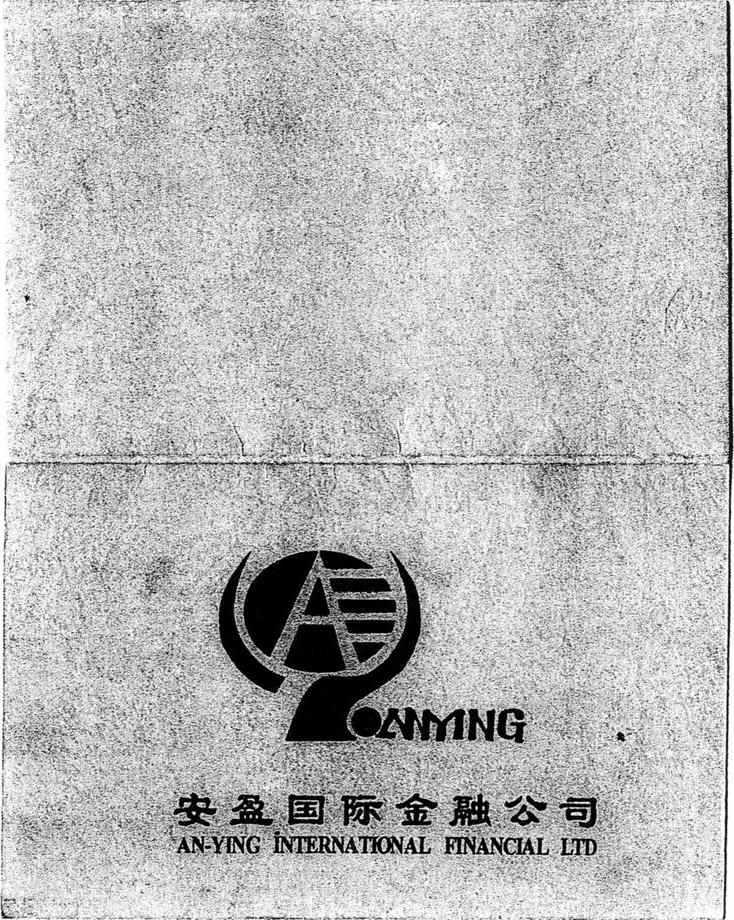
Attachment "B"
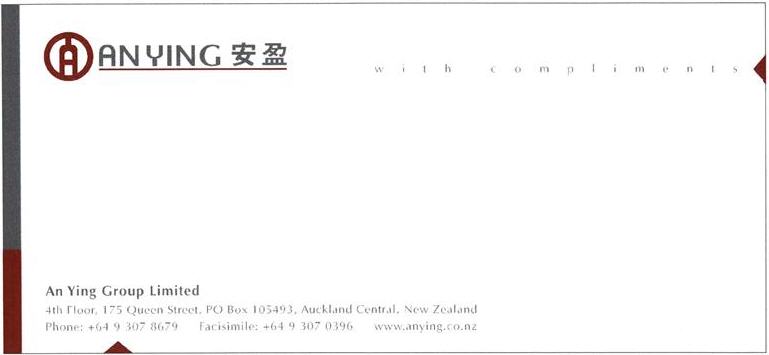
Attachment "C"
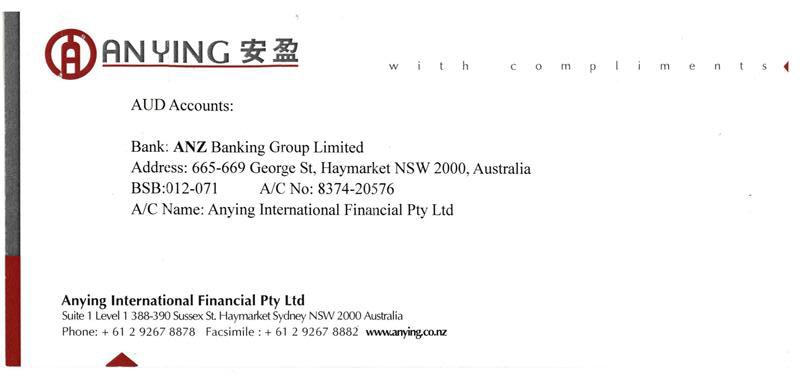
Attachment "D"