

FEDERAL COURT OF AUSTRALIA
Australian Competition and Consumer Commission v Sampson [2011] FCA 1165
|
IN THE FEDERAL COURT OF AUSTRALIA | |
| AUSTRALIAN COMPETITION AND CONSUMER COMMISSION Applicant | |
| AND: | Respondent |
| DATE OF ORDER: | |
| WHERE MADE: |
BY CONSENT THE COURT DECLARES THAT:
1. The Respondent in trade or commerce engaged in conduct that was misleading or deceptive or likely to mislead or deceive, in contravention of s 52 of the Trade Practices Act 1974 (Cth), by:
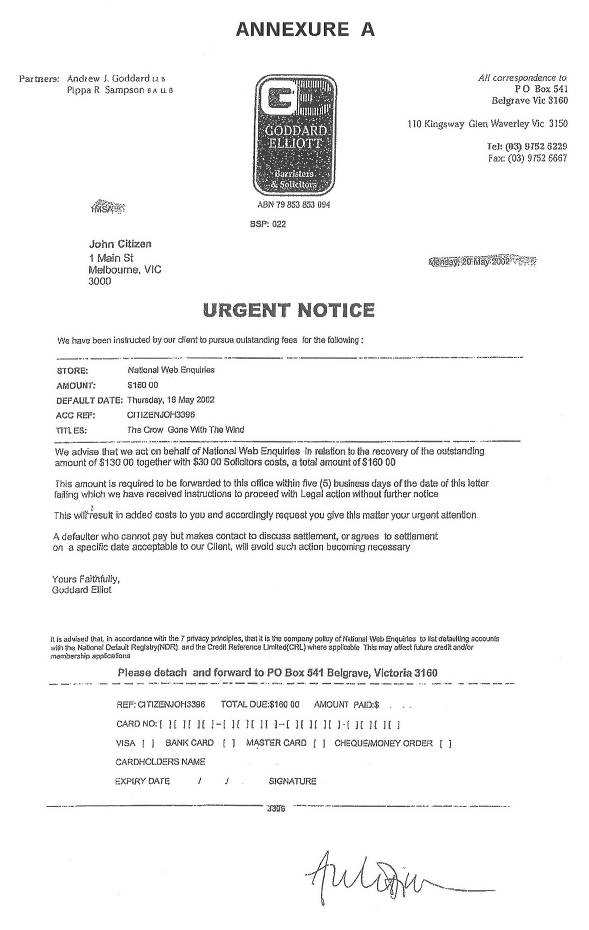
(a) sending to addresses in all States and Territories during the periods April 2002 to 12 October 2010 letters titled “URGENT NOTICE”, examples of which are attached as Annexure A to this order, that contained the statements that:
(i) Goddard Elliott acted on behalf of an identified video rental client (“the video rental client”) in relation to the recovery of an outstanding amount “together with $30.00 (or such other amount specified that was not $0) Solicitors costs”; and
(ii) the outstanding amount was required to be sent to Goddard Elliott within five (5) business days of the date of the letter failing which Goddard Elliott had received instructions to proceed with legal action without further notice and that “this will result in added costs to you”.
and thereby representing that:
(iii) the video rental client claiming the outstanding amount was necessarily entitled to recover solicitor’s costs of $30.00 (or such other amount specified that was not $0) as part of the recovery of the outstanding amount claimed (First Urgent Notice A Representation), even though there was no outstanding amount which included $30 (or such other amount specified) for solicitor’s costs and, moreover, the video rental client had no necessary entitlement to recover solicitor’s costs in respect of that claim; and
(iv) if legal action was taken to recover the outstanding amount then this would necessarily result in the addressee incurring additional costs associated with legal proceedings (Second Urgent Notice A Representation), even though the video rental client would have no entitlement to recover legal costs in respect of unsuccessful legal action for a debt claim and even though, if successful in its legal action, the video rental client would not necessarily obtain an order for costs in respect of a proceeding issued for the recovery of a small debt.
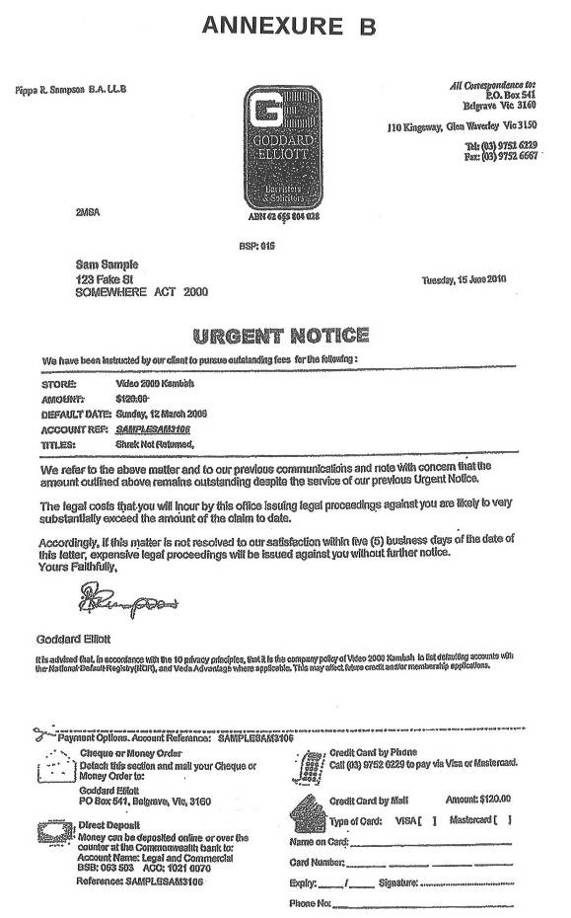
(b) sending to addressees in all States and Territories during the period 1 December 2004 to 12 October 2010 a letter titled “URGENT NOTICE” an example of which is attached as Annexure B to this order (Urgent Notice B), that contained the statements that:
(i) the legal costs incurred by the addressee as a result of Goddard Elliott issuing proceedings against them were likely to “very substantially exceed the amount of the claim to date”; and
(ii) if the matter was not resolved to Goddard Elliott’s satisfaction within five (5) business days of the date of the letter, “expensive legal proceedings will be issued against you without further notice”,
and thereby representing that if legal proceedings were issued in respect of the outstanding amount then this would be likely to result in the addressee necessarily incurring additional legal costs, which costs would substantially exceed the amount claimed by the video rental client (Urgent Notice B Representation), even though the video rental client would have no entitlement to recover legal costs in respect of unsuccessful legal action for a debt claim, and even though, if successful in its legal action, the video rental client would not necessarily obtain an order for costs in respect of a proceeding issued for the recovery of a small debt;
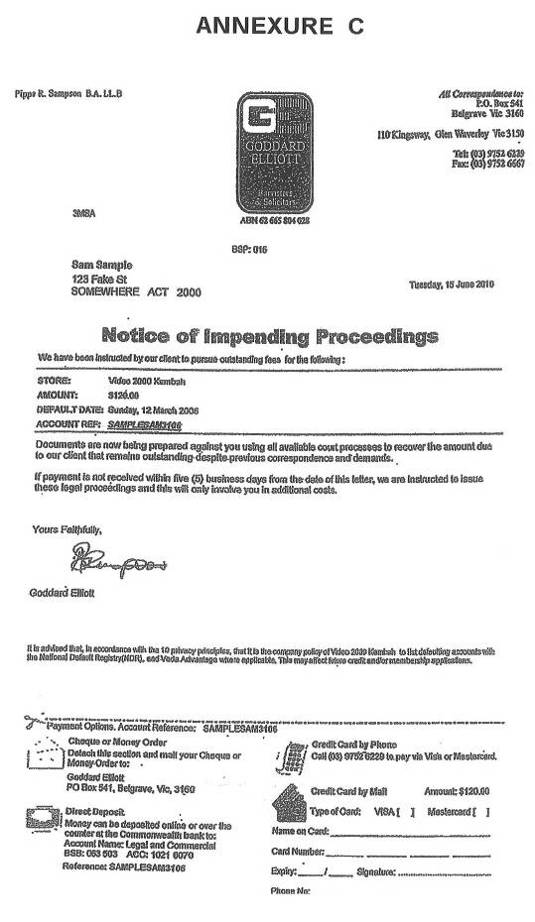
(c) sending to addressees in all States and Territories during the period 1 December 2004 to 12 October 2010 a letter titled “NOTICE OF IMPENDING PROCEEDINGS” an example of which is attached as Annexure C to this order (Notice of Impending Proceedings) that contained the statements that:
(i) documents were being prepared against the addressee “using all available court processes to recover the amount due” to the video rental store client; and
(ii) if payment was not made by the addressee within five (5) business days from the date of the Notice of Impending Proceedings, Goddard Elliott would issue proceedings on behalf of the video rental client which “will only involve you in additional costs”,
and thereby representing that if legal proceedings were issued in respect of the outstanding amount then this would result in the addressee necessarily incurring additional legal costs (Notice of Impending Proceedings Representation), even though the video rental client would have no entitlement to recover legal costs in respect of an unsuccessful legal action for a debt claim, and even though, if successful in its legal action, the video rental client would not necessarily obtain an order for costs in respect of a proceeding issued for the recovery of a small debt;
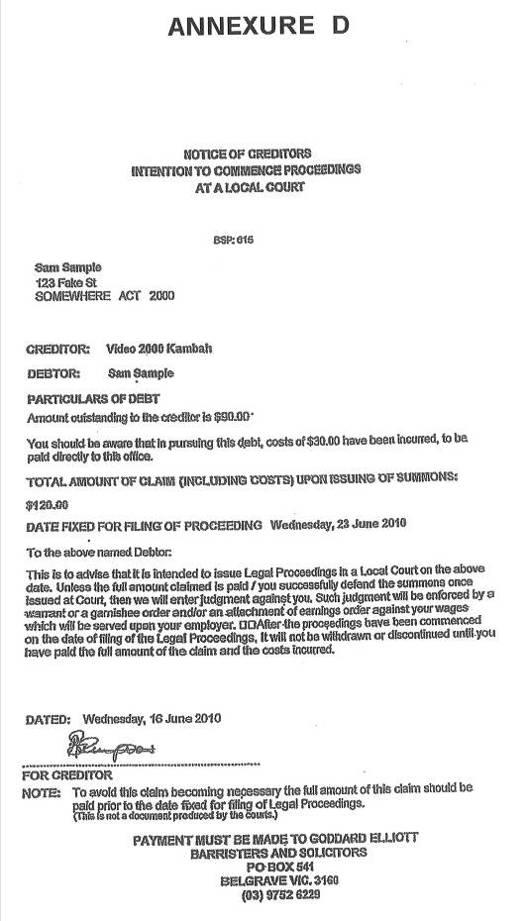
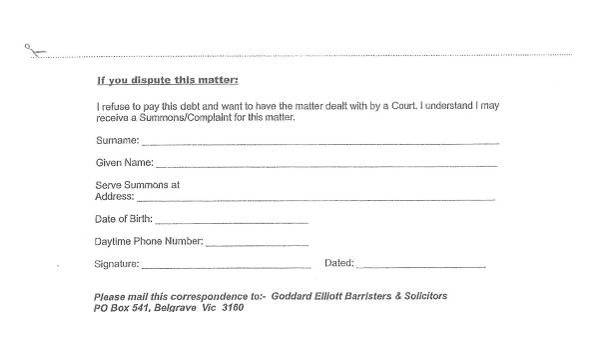
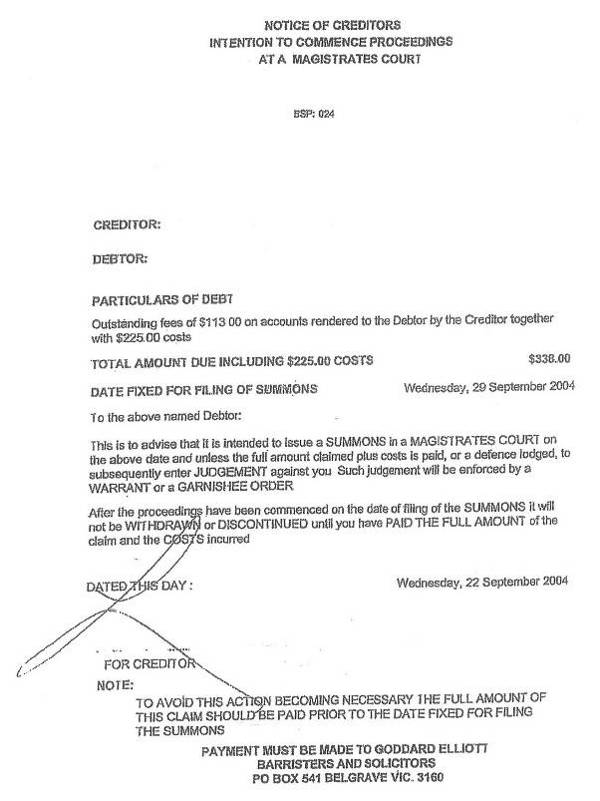
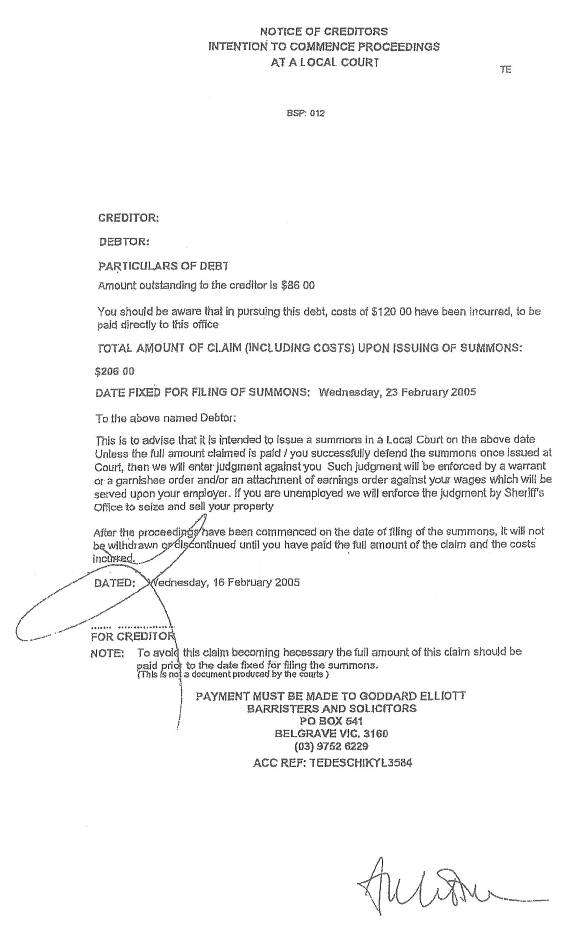
(d) sending to addressees in all States and Territories during the period 1 December 2004 and 2 June 2010 documents titled “NOTICE OF CREDITORS INTENTION TO COMMENCE PROCEEDINGS AT A LOCAL COURT” and “NOTICE OF CREDITORS INTENTION TO COMMENCE PROCEEDINGS AT A MAGISTRATES COURT”, examples of which are attached as Annexure D to this order (together, the Notice of Intention to Commence Proceedings), that contained the statements that:
(i) “Unless the full amount claimed [plus costs] is paid/you successfully defend the summons once issued at Court, [or a defence lodged], then we will [subsequently] enter judgment against you”; and
(ii) “Such judgment will be enforced by a warrant or a garnishee order [and/or an attachment of earnings order against your wages which will be served upon your employer]”,
and thereby representing that:
(iii) Judgment could be entered by Goddard Elliott against the addressee without the obtaining of an order from the Court, unless the amount was paid in full or the proceeding was successfully defended by the addressee (Second Notice of Intention to Commence Proceedings Representation), even though in truth judgment could not be entered until legal proceedings had been commenced, and thereafter an order obtained from the Court; and
(iv) Goddard Elliott could itself enforce any judgment obtained against the addressee by means of a warrant, garnishee order and/or attachment of earnings (Third Notice of Intention to Commence Proceedings Representation), which it could not, the true position being that the video rental client needed to be successful in Court proceedings, and then an application for an order needed to be made, and then the Court needed to grant an order for a warrant, garnishee order and/or attachment of earnings order; and
(e) sending to addressees in the States and Territories and during the periods set out in sub-paragraph (d) above the Notice of Intention to Commence Proceedings that was similar in format to a document that had been, or was able to be, filed in a Court, and thereby representing that the Notice of Intention to Commence Proceedings was a document that had been, or was able to be, filed in a Court (First Notice of Intention to Commence Proceedings Representation), when that was not correct.
BY CONSENT THE COURT ORDERS THAT:
Injunctions
2. The Respondent be restrained for a period of five (5) years from the date of this order from making or causing to be made the following representations (each as defined above):
(a) First Urgent Notice A Representation;
(b) Second Urgent Notice A Representation;
(c) Urgent Notice B Representation;
(d) Notice of Impending Proceedings Representation;
(e) First Notice of Intention to Commence Proceedings Representation;
(f) Second Notice of Intention to Commence Proceedings Representation; and
(g) Third Notice of Intention to Commence Proceedings Representation.
Corrective Advertising
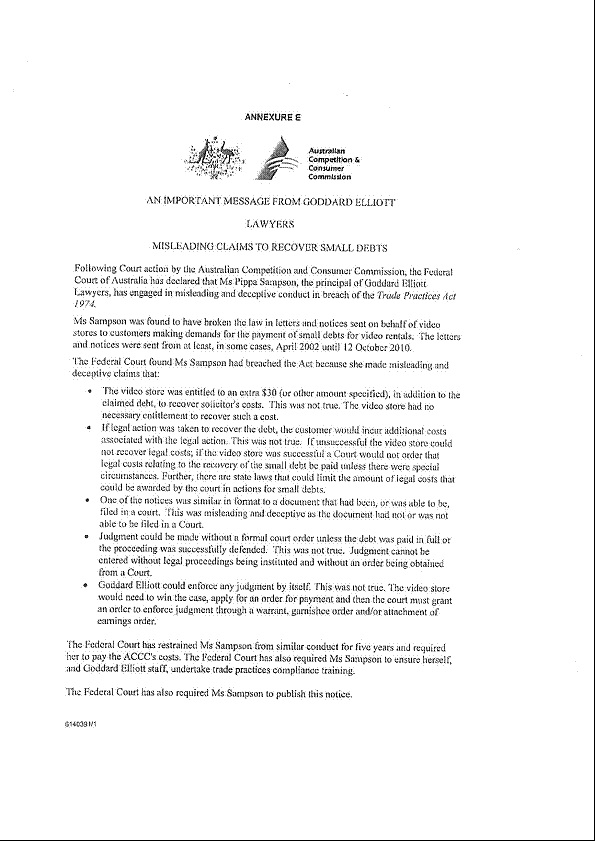
3. The Respondent cause to be published, at her expense, within 21 days of the date of this order, a corrective advertisement in the form of Annexure E to this order in the:
(a) Friday edition of each of the:
(i) “Australian Financial Review”; and
(ii) “The Australian”;
(“the Newspapers”) and in the next available edition of the:
(b) Lexis Nexis publication, “Lawyers Weekly”; and
(c) Australian Institute of Credit Management publication “Credit Management in Australia”,
and, further, that the Respondent shall use her best endeavours to ensure that such advertisement shall be”
(d) placed within that part of the Newspapers styled “Legal Affairs”; and
(e) in text which is in a type not less than 10 point.
Training
4. The Respondent will, for a period of three (3) years from the date of this order and only whilst the Respondent continues to practice as a legal practitioner:
(a) receive; and
(b) for so long as the Respondent remains a principal of Goddard Elliott, cause all the employees of Goddard Elliott whose duties could result in them being concerned with conduct that may contravene Chapters 2 or 3 of the Australian Consumer Law (Schedule 2 to the Competition and Consumer Act 2010 (Cth) (ACL)) to receive,
regular (at least once a year) practical training administered by a qualified compliance professional or legal practitioner with expertise in trade practices law, that focusses on Chapters 2 and 3 of the ACL.
5. Upon the completion of any training conducted pursuant to order 4 above the Respondent will, within 14 days, at her own expense provide the Applicant with a statutory declaration confirming the completion of the training conducted in accordance with that order, including the date conducted, and the name and qualifications of the person who conducted the training.
6. The Respondent file and serve on the Applicant, within 42 days of the date of this order, an affidavit, sworn by her, verifying that she has carried out the obligations made under the orders of the Court set out in paragraph 3 above, and:
(a) detailing the steps taken in relation to the publication of the corrective advertisements; and
(b) providing a copy of the corrective advertisements.
Other orders
7. A copy of the Reasons for Judgment, with the seal of the Court thereon, be retained in the Court for the purposes of s 83 of the Act.
8. The Respondent pay the Applicant’s costs of the proceeding in the agreed sum of $30,000.
Note: Entry of orders is dealt with in Rule 39.32 of the Federal Court Rules 2011.

|
IN THE FEDERAL COURT OF AUSTRALIA | |
| VICTORIA DISTRICT REGISTRY | |
| GENERAL DIVISION | VID 852 of 2010 |
| BETWEEN: | AUSTRALIAN COMPETITION AND CONSUMER COMMISSION Applicant |
| AND: | PIPPA ROSALIND SAMPSON Respondent |
| JUDGE: | TRACEY J |
| DATE: | 17 OCTOBER 2011 |
| PLACE: | MELBOURNE |
REASONS FOR JUDGMENT
1 Ms Pippa Sampson is a solicitor who numbers amongst her clients companies which rent digital video discs to members of the public. From time to time Ms Sampson sent notices to members of the public who were indebted to the companies for outstanding rental charges.
2 The Australian Competition and Consumer Commission (“the ACCC”) commenced a proceeding in the Court alleging that Ms Sampson had contravened s 52 of the Trade Practices Act 1974 (Cth) (“the Act”) (now the Competition and Consumer Act 2010 (Cth)). She did so by making various statements, in notices which she caused to be sent to those indebted to her clients, which were misleading or deceptive or likely to mislead or deceive. The contravening conduct occurred whilst the Act remained in operation and it has application notwithstanding the commencement of the new legislation: see Trade Practices Amendment (Australian Consumer Law) Act (No 2) 2010 (Cth), Schedule 7, Item 6.
3 Ms Sampson has admitted the contravening conduct.
4 The parties have filed an agreed statement of facts and joint submissions in support of orders which it is proposed should be made by consent.
5 Having considered the parties’ submissions I have determined to make the orders sought. My reasons for doing so follow.
THE AGREED FACTS
6 The agreed statement of facts provides a detailed account of the conduct and the circumstances in which it occurred. The following passages are drawn from that statement:
“3. The Respondent at all material times has:
(a) Carried on business as a Partner of and, from 1 July 2009, the principal of the law firm Goddard Elliott from offices in Glen Waverley, Victoria (Goddard Elliott);
(b) been one of the registered owners of, and from 1 July 2009, been the sole registered owner of, and carried on business under, the business name ‘Goddard Elliott’;
(c) employed or engaged lawyers to work for Goddard Elliott; and
(d) acted for and on behalf of the mercantile agent Legal and Commercial Recoveries Pty Ltd and on behalf of video rental businesses, including but not limited to businesses trading under the names Video 2000, Video Ezy, Video Busters, Civic Video, Network Video, Box Office, Movies 4U, Homeshow Video, Family Videoland, Moveland, Leading Edge Video and Blockbuster in relation to debt collection work through out Australia (video rental clients).
4. At all material times since at least April 2002 Goddard Elliott sent video rental debt collection letters and notices (Notices), by post, to addresses located throughout Australia on behalf of video rental clients and in the preceding 12 month period before these proceedings, approximately 20,000 Notices were sent each month.
The Notices
5. At all material times since at least April 2002 Goddard Elliott sent the following Notices, on behalf of video rental clients, to addresses:
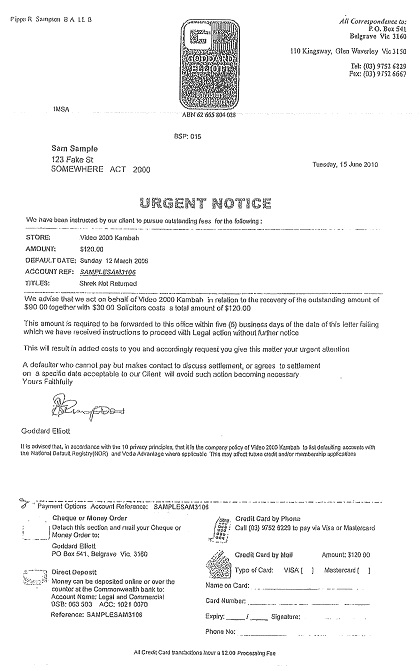
(a) in all States and Territories during the periods April 2002 to January 2003 a letter titled ‘URGENT NOTICE’, … and sending to addresses in all States and Territories during the periods January 2006 to December 2008 and sending to addresses in all States and Territories (except for Tasmania) during the periods December 2004 to December 2005 and January 2009 to October 2010 a letter titled ‘URGENT NOTICE’ … (together, Urgent Notice A);
(b) in all States and Territories during the period 1 December 2004 to 12 October 2010 a letter titled ‘URGENT NOTICE’, … (Urgent Notice B);
(c) in all States and Territories during the period 1 December 2004 to 12 October 2010 a letter titled ‘NOTICE OF IMPENDING PROCEEDINGS’; … (Notice of Impending Proceedings); and
(d) all States and Territories during the period 1 December 2004 to 2 June 2010 a document titled ‘NOTICE OF CREDITORS INTENTION TO COMMENCE PROCEEDINGS AT A LOCAL COURT’, … and sending to addresses in all States and Territories during the period January 2004 to 1 December 2004 a document titled ‘NOTICE OF CREDITORS INTENTION TO COMMENCE PROCEEDINGS AT A MAGISTRATES COURT’ … and sending to addresses in all States and Territories (excluding Tasmania) during the period December 2004 to June 2010 a document titled ‘NOTICE OF CREDITORS INTENTION TO COMMENCE PROCEEDINGS AT A LOCAL COURT’ … (together, Notice of Intention to Commence Proceedings).
6. Further to paragraph 4 above, at all material times since at least April 2002, the practice of Goddard Elliott was to, when instructed by a video rental client to recover a debt from a person, send Notices, including:
(a) Urgent Notice A;
(b) Urgent Notice B;
(c) Notice of Impending Proceedings; and
(d) Notice of Intention to Commence Proceedings,
whereby an addressee may have received only one of the Notices or a combination of the Notices unless in the meantime the amount specified was paid.
Urgent Notice A: Representations
7. Urgent Notice A contained statements, inter alia, that:
(a) Goddard Elliott acted on behalf of an identified video rental client in relation to the recovery of an outstanding amount ‘together with $30.00 (or such other amount specified that was not $0) Solicitors costs’; and
(b) the outstanding amount was required to be sent to Goddard Elliott within five (5) business days of the date of the letter failing which Goddard Elliott had received instructions to proceed with legal action without further notice and that ‘this will result in added costs to you’.
8. By sending Urgent Notice A, containing the statements set out in paragraph 7 above, the Respondent made representations to the effect that:
(a) the video rental client claiming the outstanding amount was necessarily entitled to recover solicitor’s costs of $30.00 (or such other amount specified that was not $0) as part of the recovery of the outstanding amount claimed (First Urgent Notice A Representation); and
(b) if legal action was taken to recover the outstanding amount then this would necessarily result in the addressee incurring additional costs associated with legal proceedings (Second Urgent Notice A Representation);
Urgent Notice B: Representations
9. Urgent Notice B contained statements, inter alia, that:
(a) the legal costs incurred by the addressee as a result of Goddard Elliott issuing proceedings against them were likely to ‘very substantially exceed the amount of the claim to date’; and
(b) if the matter was not resolved to Goddard Elliott’s satisfaction within five (5) business days of the date of the letter, ‘expensive legal proceedings will be issued against you without further notice’.
10. By sending Urgent Notice B, containing the statements set out in paragraph 9 above, the Respondent made representations to the effect that if legal proceedings were issued in respect of the outstanding amount then this would be likely to result in the addressee necessarily incurring additional legal costs, and those said costs would substantially exceed the amount claimed by the video rental client (Urgent Notice B Representation).
Notice of Impending Proceedings: Representations
11. The Notice of Impending Proceedings contained statements, inter alia, that:
(a) documents were being prepared against the addressee ‘using all available court processes to recover the amount due to our client and remains outstanding despite previous correspondence and demands’ to the video rental store client; and
(b) if payment was not made by the addressee within five (5) business days from the date of the Notice of Impending Proceedings, Goddard Elliott would issue proceedings on behalf of the video rental client which ‘will only involve you in additional costs’.
12. By sending the Notice of Impending Proceedings, containing the statements set out in paragraph 11 above, the Respondent made representations to the effect that if legal proceedings were issued in respect of the outstanding amount then this would result in the addressee necessarily incurring additional legal costs (Notice of Impending Proceedings Representation).
Notice of Intention to Commence Proceedings: Representations
13. The Notice of Intention to Commence Proceedings:
(a) does not incorporate the Goddard Elliott letterhead and is similar in format to a document that had been, or was able to be, filed with a Court;
(b) states, inter alia, that ‘Unless the full amount claimed is paid/you successfully defend the summons once issued at Court, then we will enter judgment against you’; and
(c) states, inter alia, that ‘Such judgment will be enforced by a warrant or a garnishee order and/or an attachment of earnings order against your wages which will be served upon your employer’.
14. By sending the Notice of Intention to Commence Proceedings, in the form set out in paragraph 13(a) above, the Respondent made representations to the effect that the Notice of Intention to Commence Proceedings was a document that had been, or was able to be, filed with a Court (First Notice of Intention to Commence Proceedings Representation).
15. By sending the Notice of Intention to Commence Proceedings, containing the statements set out in paragraph 13 above, the Respondent made further representations to the effect that:
(a) judgment could be entered by Goddard Elliott against the addressee without the obtaining of an order from the Court, unless the amount was paid in full or the proceeding was successfully defended by the addressee (Second Notice of Intention to Commence Proceedings Representation); and
(b) Goddard Elliott could itself enforce any judgment obtained against the addressee by means of a warrant, garnishee order and/or attachment of earnings (Third Notice of Intention to Commence Proceedings Representation).
The misleading conduct
16. The First Urgent Notice A Representation was misleading or deceptive or was likely to mislead or deceive because:
(a) there was no outstanding amount which included $30 (or such other amount specified) for solicitor’s costs; and
(b) the video rental clients claiming the outstanding amounts referred to in Urgent Notice A, had no necessary entitlement to recover solicitor’s costs in respect of the claim.
17. Each of the Second Urgent Notice A Representation, the Urgent Notice B Representation, and the Notice of Impending Proceedings Representation was misleading or deceptive or likely to mislead or deceive because:
(a) if unsuccessful, a creditor would not have an entitlement to recover legal costs, in respect of a debt claim;
(b) many of the debts claimed were small, and the Magistrates Court Act 1989 (Vic) and equivalent legislation in other States and Territories provide that legal costs cannot be recovered for small debt claims except in special circumstances; and
(c) accordingly, even where a creditor is successful, it is not necessarily the case that a debtor must pay legal costs in respect of a legal proceeding issued for the recovery of a small debt.
18. The First Notice of Intention to Commence Proceedings Representation was misleading or deceptive or was likely to mislead or deceive because a reasonable person in the class of addressees that were sent the Notice of Intention to Commence Proceedings would believe that they had been sent a document that had been, or was able to be, filed in a Court, but in truth that was not so.
19. The Second Notice of Intention to Commence Proceedings Representation was misleading or deceptive or likely to mislead or deceive because judgment cannot be entered by a video rental client against a debtor unless and until:
(a) legal proceedings are commenced in the Magistrates Court of Victoria, or equivalent courts around Australia; and
(b) thereafter:
(i) the debtor does not file a defence, and an order in default of defence is obtained against the debtor; or
(ii) a summary order is obtained by the video rental company on the basis that the debtor has no defence; or
(iii) on the hearing of the matter, the video rental company was successful in its claim as against the debtor.
20. The Third Notice of Intention to Commence Proceedings Representation was misleading or deceptive or likely to mislead or deceive because, in order for a video rental company to obtain a warrant, garnishee order and/or attachment of earnings against a debtor:
(a) the company must be successful in its proceeding against the debtor;
and then
(b) the company must apply to the court for an order for a warrant, garnishee order and/or attachment of earnings;
and then
(c) the Court must grant an order for a warrant, garnishee order and/or attachment of earnings against the debtor”.
RELIEF
7 The ACCC seeks declaratory orders, injunctions under s 80 of the Act, publication orders pursuant to s 86C(2)(d) of the Act, orders requiring compliance training under s 86C(2)(b) of the Act, costs and certain ancillary orders.
8 Ms Sampson consents to the making of such orders.
9 Save for the proposed declaratory orders, the orders sought are of a kind which are commonly made in proceedings under the consumer protection provisions of the Act and are uncontroversial. They are, for the most part, directed to ensuring that there is no repetition of the contravening conduct either by Ms Sampson, her firm and others who, in future, might be minded to engage in similar conduct.
10 There has, however, been some debate as to whether declaratory relief is available in such cases and, if so, on what conditions.
Declarations
11 The Court has the power to make declarations under s 21 of the Federal Court of Australia Act 1976 (Cth). Any declaratory order made in the exercise of this power must be directed to quelling legal controversy between parties. The applicant must have a real interest in obtaining the relief sought: see Ainsworth v Criminal Justice Commission (1992) 175 CLR 564 at 581-2. There must also be a proper contradictor: Forster v Jododex Australia Pty Ltd (1972) 127 CLR 421 at 437-8.
12 Each of these requirements is satisfied in the present proceeding. A dispute has existed between the parties as to whether or not Ms Sampson had engaged in contraventions of s 52 of the Act. The ACCC is a public body which had power under the Act to bring enforcement proceedings. Declaratory orders of the kind proposed serve the public interest by making it plain that conduct such as that admitted by Ms Sampson contravenes the Act: see Australian Competition and Consumer Commission v Midland Brick Company Pty Ltd (2004) 207 ALR 329 at 333; Rural Press Limited v Australian Competition and Consumer Commission (2003) 216 CLR 53 at 91.
13 In Forster Gibbs J (with whom McTiernan, Stephen and Mason JJ agreed) adopted Lord Dunedin’s description of a proper contradictor (in Russian Commercial and Industrial Bank v British Bank for Foreign Trade Limited [1921] 2 AC 438 at 448) as “one presently existing who has a true interest to oppose the declaration sought”: see at 438. In Australian Competition and Consumer Commission v MSY Technology Pty Ltd (No 2) [2011] FCA 382 Perram J added a requirement that the proper contradictor must not only be a party but must argue against the granting of relief: see at [32]. In adding this requirement his Honour considered himself bound by the joint judgment of Keely and Beaumont JJ in BMI Limited v Federated Clerks Union of Australia (1983) 51 ALR 401.
14 More recently, Dodds-Streeton J has held that the true ratio of BMI is much narrower and that, in any event, the decision is distinguishable: see Australian Competition and Consumer Commission v Willesee Healthcare Pty Ltd (No 2) [2011] FCA 752 at [32]-[43].
15 I respectfully agree with her Honour’s analysis. In BMI the failure of the respondents actively to oppose the making of declarations was but one of a number of factors which led the Court, in the exercise of its discretion, to refuse relief. Forster, in my view, establishes that a person will be a “proper contradictor” provided that he or she has a genuine interest in resisting the grant of relief. Ms Sampson is a proper contradictor notwithstanding her agreement to the making of the proposed declarations. Despite her willingness to compromise her position in the litigation she retained a genuine interest in resisting the granting of the declarations.
16 One of the reasons for requiring that there be a proper contradictor is to ensure that the Court is supplied with a factual foundation for the making of orders. Some judges have expressed reservations about whether this requirement can be satisfied in circumstances where the parties have reached agreement as to the facts and the orders which should be made. These reservations can be traced to the statement of Keely and Beaumont JJ in BMI at 412-3, that declarations “ought not to be made merely on admissions of counsel or by consent, but only if the court is satisfied by evidence.” This statement of principle led Finkelstein J to hold, in Australian Competition and Consumer Commission v Allergy Pathway Pty Ltd [2009] FCA 960 at [19], that the Court should “not grant a declaration involving a public right in the absence of evidence that supports the declaration.” Statements of agreed facts did not constitute “evidence” for relevant purposes. See also: Australian Competition and Consumer Commission v Cosic Holdings Pty Ltd [2009] FCA 1579; Australian Competition and Consumer Commission v Wilson Parking 1992 Pty Ltd [2009] FCA 1580 (per Barker J).
17 Other judges have, however, been prepared to grant declaratory relief on the evidentiary foundation provided by a statement of agreed facts which has been made in accordance with the requirements of s 191 of the Evidence Act 1995 (Cth): see Australian Competition and Consumer Commission v Skins Compression Garments Pty Ltd [2009] FCA 710 (per Besanko J); Minister for Environment, Heritage and the Arts v PGP Developments Pty Ltd (2010) 183 FCR 10 (per Stone J); MSY Technology at [27] (per Perram J). An ‘agreed fact’ is one which the parties to a proceeding have agreed will not be disputed in that proceeding: see s 191(1). Whilst agreement as to a fact will not necessarily be determinative of the truth of that fact, evidence need not be brought to prove its existence: see s 191(2)(a).
18 In my view the agreed statement of facts, when considered in light of s 191, provides a sufficient basis for the making of the declarations sought in the present proceeding. The agreed statement clearly identifies the impugned statements and the reasons that those statements are misleading and deceptive. The declarations which are sought accurately describe the contravening conduct.
Injunctions
19 Injunctive relief is provided for under s 80 of the Act.
20 The parties are agreed as to the terms of the injunctions. They enjoin Ms Sampson from any repetition of the impugned conduct and thereby further the consumer protection objectives of the Act: cf ICI Australia Operations Pty Ltd v Trade Practices Commission (1992) 38 FCR 248 at 268.
Publication Orders
21 Section 86C(2)(d) of the Act empowers the Court to make the publication orders on which the parties are agreed.
22 The purposes served by such orders were identified in Medical Benefits Fund of Australia Ltd v Cassidy (2003) 135 FCR 1 at 20-21 (per Stone J) as including the dispelling of incorrect or false impressions created by the misleading and deceptive conduct, the alerting of consumers to the fact that such conduct has occurred and in aiding the enforcement of the primary orders and the prevention of any repetition of the contravening conduct.
23 These purposes will be served by the publication of the advertisements in publications where they are likely to come to the attention of legal practitioners and those interested in legal matters.
Compliance Training
24 The Court is empowered to make orders of the kind proposed pursuant to s 86C(2)(b) of the Act.
25 Goddard Elliott presently has no training programme which is designed to alert the principal and her staff to their obligations under the Act and its successor. The training required by the orders is linked to the impugned conduct: cf Australian Competition and Consumer Commission v Auspine Limited (2006) 235 ALR 95 at 106-7 and the authorities there collected. The training is to focus on Chapters 2 and 3 of the Australian Consumer Law (Schedule 2 to the Competition and Consumer Act 2010 (Cth)). Chapter 2 deals with general protection for consumers including the proscription formerly contained in s 52 of the Act. Chapter 3 covers, among other things, unfair practices which include the making of false or misleading representations about goods or services. Those orders should be made.
Costs
26 The parties are agreed that a costs order should be made against Ms Sampson and as to the quantum of such an order.
| I certify that the preceding twenty-six (26) numbered paragraphs are a true copy of the Reasons for Judgment herein of the Honourable Justice Tracey. |
Associate:


