

FEDERAL COURT OF AUSTRALIA
Traxys Europe SA v Balaji Coke Industry Pvt Ltd [2011] FCA 1132
IN THE FEDERAL COURT OF AUSTRALIA |
|
|
Applicant |
|
AND: |
First Respondent BOOYAN COAL PTY LIMITED (ACN 115 420 598) Second Respondent |
DATE OF ORDER: |
|
WHERE MADE: |
THE COURT RULES THAT:
1. In the affidavit sworn by Vineet Agarwal on 26 September 2011:
(a) Paragraph 3 be admitted;
(b) The correspondence comprised in Annexure “VA1” be admitted;
(c) The document being Annexure “VA2” be rejected;
(d) The whole of paragraphs 4, 6, 7, 8 and 9 be rejected;
(e) The copy bank statement which is Annexure “VA3” be admitted as a business record of the first respondent; and
(f) The document being Annexure “VA4” be rejected.
2. In the affidavit sworn by Vineet Agarwal on 28 September 2011:
(a) Annexure “VA2A” referred to in paragraph 6 be rejected;
(b) The whole of paragraphs 4, 5 and 6 be rejected; and
(c) Paragraphs 7 and 14 be allowed.
Note: Entry of orders is dealt with in Rule 39.32 of the Federal Court Rules 2011.
NEW SOUTH WALES DISTRICT REGISTRY |
|
GENERAL DIVISION |
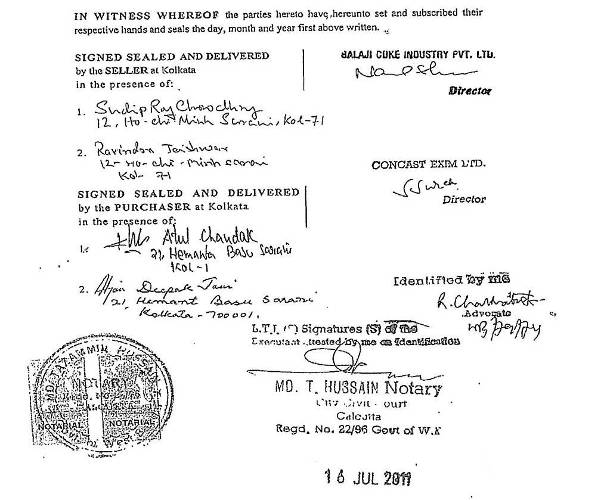
NSD 1490 of 2011 |
BETWEEN: |
TRAXYS EUROPE SA Applicant
|
AND: |
BALAJI COKE INDUSTRY PVT LTD First Respondent BOOYAN COAL PTY LIMITED (ACN 115 420 598) Second Respondent
|
JUDGE: |
FOSTER J |
DATE: |
29 SEPTEMBER 2011 |
PLACE: |
SYDNEY |
REASONS FOR RULINGS ON EVIDENCE
1 The first respondent, Balaji Coke Industry Pvt Limited (Balaji), reads an affidavit sworn by Vineet Agarwal on 26 September 2011 and filed on 27 September 2011 (first affidavit). In his first affidavit, Mr Agarwal states that he is the General Manager of Balaji Group and that he has held this position since 11 November 2009. He also states that Balaji is one of the companies within what he describes as “the Balaji Group”. He does not state with precision whether he is an employee or officer of Balaji and, if so, what his powers, functions, duties, responsibilities and obligations are in such capacity. He does not provide any detail as to his powers, functions, duties, responsibilities and obligations as the General Manager of the Balaji Group. In paragraph 2 he says:
The contents of this affidavit are true where they concern matters within my own knowledge. Otherwise they are true to the best of my knowledge, information and belief including through information I have obtained and documents I have seen as General Manager of Balaji.
2 The first affidavit comprises nine paragraphs together with four annexures. Objection is taken by Senior Counsel for the applicant, Traxys Europe SA (Traxys), to paragraphs 3 to 9 of the first affidavit and to the tender of all of the annexures to that affidavit.
Ruling 1
3 The first matter is that dealt with in paragraph 3 of Mr Agarwal’s first affidavit. In paragraph 3, Mr Agarwal swears that, on or about 19 April 2011, Balaji owned the two issued shares in Booyan Coal Pty Limited (Booyan), which is the second respondent. I take that assertion to be a statement to the effect that, as at that date, Balaji owned the shares referred to. That seems to be a matter which is common ground and I propose to admit paragraph 3.
Ruling 2
4 In paragraph 4 of his first affidavit, Mr Agarwal says that, in the first half of 2011, there were negotiations between Balaji and an Indian corporation, Concast Exim Limited (Concast), about the sale of Balaji’s shares in Booyan. I propose to reject the whole of paragraph 4. The statement made in paragraph 4 is simply a bald assertion made by Mr Agarwal without any attempt to provide a proper foundation for that assertion. There is no other evidentiary material at the moment that would suggest that Mr Agarwal is in a position to make the assertion which he has made.
Ruling 3
5 Objection is taken to the tender of all of the documents comprised in Annexure “VA1” to Mr Agarwal’s first affidavit. The documents which comprise Annexure “VA1” to the first affidavit are various letters passing between Balaji and Concast in the period between 20 April 2011 and 18 June 2011. In broad terms, the subject matter of that correspondence is the prospect of Balaji selling its entire shareholding in Booyan to Concast. Each of the letters from Balaji which comprise Annexure “VA1” is signed by Naresh Sharma who is apparently a Director of Balaji. Each of the letters from Concast has been sent to Mr Sharma at Balaji.
6 An inspection of the correspondence does not demonstrate that Mr Agarwal participated in the negotiations referred to in the correspondence. Mr Agarwal does not specifically advert in his first affidavit to having had such a role. The tenor of his evidence is that he had no personal involvement in the negotiations referred to in the correspondence in Annexure “VA1” or in the drafting or sending of the letters from Balaji included in Annexure “VA1”. He also appears to have played no part in considering and dealing with the correspondence from Concast. The basis upon which he attempts to authenticate the sending and receipt of the correspondence in Annexure “VA1” is simply not addressed.
7 Senior Counsel for Balaji submitted that none of this matters because the correspondence is admissible pursuant to s 69(2) of the Evidence Act 1995 (Cth) (the Evidence Act) and that no submission has been made on behalf of Traxys that it should be excluded on some discretionary basis (eg pursuant to s 135 of the Evidence Act).
8 I am entitled to look at the documents in Annexure “VA1”in order to decide whether or not they should be admitted pursuant to s 69 of the Evidence Act. It seems to me that the documents do meet the requirements of subs (2) of s 69. I say this because, on their face, they appear to be documents maintained by Balaji as part of its ordinary business records (see s 183 of the Evidence Act) and, insofar as those letters generated by Balaji itself are concerned, appear to have been generated by a person with the requisite knowledge. The same may be said of the letters emanating from Concast.
9 For these reasons, I propose to admit the correspondence comprised in Annexure “VA1” to Mr Agarwal’s first affidavit. In so doing I say nothing about the weight that will be given to those documents when I come to consider the substantive decision or decisions which I have to make in the present litigation.
Ruling 4
10 The next item is the alleged Share Sale and Purchase Agreement said to have been entered into on 16 July 2011 between Balaji and Concast whereby Balaji agreed to sell to Concast and Concast agreed to buy the two shares which it held in Booyan as at that date (the Share Sale Agreement). The Share Sale Agreement appears to have been executed by Mr Sharma on behalf of Balaji and witnessed by two other persons, neither of whom is Mr Agarwal. None of Mr Sharma or the witnesses to Mr Sharma’s signature on the Share Sale Agreement is to be called as a witness at the present hearing. The Share Sale Agreement appears to have been executed by Mr Sureka, on behalf of Concast, and witnessed by two other persons, neither of whom is Mr Agarwal. None of Mr Sureka or the witnesses to his signature on the Share Sale Agreement is to be called. The Share Sale Agreement is not a business record. The question of its authenticity, in the sense of authentication in order to make the Share Sale Agreement admissible, has been left to an inspection of the document coupled with a statement in paragraph 6 of Mr Agarwal’s first affidavit to the following effect:
A copy of the Share Sale and Purchase Agreement is annexed to this affidavit and marked “VA2”.
11 The question of whether I should be satisfied that the Share Sale Agreement was entered into, in the sense that it was executed as it purports to have been executed with the intention that it bind the parties as a contract, is a matter which has to be decided on evidence. I am not prepared to infer that the Share Sale Agreement was executed with that intention, solely from an inspection of the document itself or from the evidence which Mr Agarwal gives in his affidavit about the Share Sale Agreement and its subject matter. Mr Agarwal has not specified the basis upon which he asserts the facts in paragraph 6 of his first affidavit nor has he explained how it is that he can say that the Agreement is what it purports to be.
12 It is incumbent upon the party tendering a document which is said to constitute a binding contract such as the Share Sale Agreement to authenticate its execution by calling a witness who can testify as to that matter or by otherwise satisfying the Court that the document was executed as it appears to have been. In the present case, I am not satisfied that Balaji has discharged that proof. The correct approach to a matter such as this was discussed by Nicholas J in Australian Competition and Consumer Commission v Allphones Retail Pty Limited (No 4) (2011) 280 ALR 97 at [63]–[87], particularly at [78]–[80]. As Bryson J said in National Australia Bank Ltd v Rusu (1999) 47 NSWLR 309 at [17] (p 312), at its simplest, the authenticity of a document may be proved by the evidence of the person who made it or one of the persons who made it, or a person who was present when it was made. Proof of authenticity in this sense means proof that the relevant document is what it purports to be. Section 149 of the Evidence Act ameliorates the position as far as the evidence of attesting witnesses is concerned but does not otherwise affect these basic propositions.
13 In the present case, Balaji relies only upon the form, appearance and subject matter of the copy of the Share Sale Agreement. There is and will be no other evidence which is probative of the fact that the document is what it purports to be—an Agreement for the Sale and Purchase of the shares in Booyan. The document does not prove itself.
14 For these reasons, I propose to reject the tender of the copy Share Sale Agreement which is Annexure “VA2”. This ruling carries with it the rejection of the second sentence of paragraph 6.
Ruling 5
15 Mr Agarwal also asserts in the first sentence of paragraph 6 of his first affidavit that:
On or about 16 July 2011, Balaji transferred its shareholding in Booyan to Concast in return for 50,000,000 INR (i.e., AUD$1,050,000).
16 The basis upon which he makes that assertion is simply not revealed. It is hearsay. I reject the first sentence of paragraph 6.
Ruling 6
17 The next group of matters concerns transactions evidenced in the bank account of Balaji. Mr Agarwal asserts in the first sentence of paragraph 7 of his first affidavit that:
On 16 July 2011, Balaji received the purchase price of 50,000,000 INR into its bank account.
18 He then refers to and annexes a bank statement in respect of that account. For the same reasons as I rejected the first sentence of paragraph 6, I also propose to reject the whole of paragraph 7 (including the reference to Annexure “VA3”). I propose to admit as a business record of Balaji the redacted copy bank statement which is Annexure “VA3” to the first affidavit.
Ruling 7
19 The last document referred to in the affidavit is a letter dated 24 September 2011 from the Allahabad Bank in Calcutta addressed “To Whom it May Concern”. In that document, the author apparently certifies that 50 million rupees were credited on 16 July 2011 to the account of Balaji with that bank by the deposit into that account of a certain cheque. The letter was obtained from the bank only very recently. It has obviously been obtained for the purposes of the present litigation. It thus cannot be admitted as a business record (see subs 69(3) of the Evidence Act).
20 It does not otherwise prove itself and I propose to reject the document which is Annexure “VA4” to the first affidavit. I also reject the whole of paragraph 8 of Mr Agarwal’s first affidavit.
Ruling 8
21 The last matter is the respondent’s objection to the whole of paragraph 9 of Mr Agarwal’s first affidavit. In paragraph 9, Mr Agarwal says:
The proceeds of the sale of the Booyan shares have been used by Balaji to meet obligations to one of its suppliers.
22 I propose to reject that paragraph for the same reasons as I rejected the first sentence of paragraph 6 and the whole of paragraph 7. The statement is also hearsay and bad in form.
Ruling 9
23 Balaji reads a second affidavit sworn by Mr Agarwal on 28 September 2011 and filed on the same day (second affidavit). Objection is taken to paragraph 6 of that affidavit, which is in the following terms:
Annexure VA2 to my First Affidavit is a copy of the Share Sale and Purchase Agreement between Balaji and Concast. I have now obtained a notarised copy of that agreement, which is annexed to this affidavit and marked “VA2A”.
24 Senior Counsel for Traxys submits that the paragraph and the annexure “VA2A” should be rejected for the same reasons as I rejected a copy of the alleged Share Sale Agreement when referred to in Mr Agarwal’s first affidavit.
25 Senior Counsel for Balaji submits, however, that the document is admissible because s 150 of the Evidence Act makes it admissible. In addition, Senior Counsel for Balaji submits that I should revisit the previous ruling which I made rejecting the alleged Agreement (Ruling 4) for the same reason, that is to say, that s 150 of the Evidence Act makes the document admissible.
26 Section 150 of the Evidence Act is in the following terms:
150 Seals and signatures
(1) If the imprint of a seal appears on a document and purports to be the imprint of:
(a) a Royal Great Seal; or
(b) the Great Seal of Australia; or
(c) another seal of the Commonwealth; or
(d) a seal of a State, a Territory or a foreign country; or
(e) the seal of a body (including a court or a tribunal), or a body corporate, established by a law of the Commonwealth, a Territory or a foreign country; or
(f) the seal of a court or tribunal established by a law of a State;
it is presumed, unless the contrary is proved, that the imprint is the imprint of that seal, and the document was duly sealed as it purports to have been sealed.
Note: This subsection differs from subsection 150(1) of the NSW Act.
(2) If the imprint of a seal appears on a document and purports to be the imprint of the seal of an office holder, it is presumed, unless the contrary is proved, that:
(a) the imprint is the imprint of that seal; and
(b) the document was duly sealed by the office holder acting in his or her official capacity; and
(c) the office holder held the relevant office when the document was sealed.
(3) If a document purports to have been signed by an office holder in his or her official capacity, it is presumed, unless the contrary is proved, that:
(a) the document was signed by the office holder acting in that capacity; and
(b) the office holder held the relevant office when the document was signed.
(4) In this section:
office holder means:
(a) the Sovereign; or
(b) the Governor General; or
(c) the Governor of a State; or
(d) the Administrator of a Territory; or
(e) a person holding any other office under an Australian law or a law of a foreign country.
(5) This section extends to documents sealed, and documents signed, before the commencement of this section.
Note 1: Section 5 extends the application of this section to proceedings in all Australian courts.
Note 2: Australian law is defined in the Dictionary.
27 In Pt 1 of the Dictionary in the Evidence Act, “seal” is defined as including a stamp. Annexure “VA2A” has the seal of a notary from Calcutta affixed to it. Initially, Senior Counsel for Balaji relied upon that fact as assisting the admissibility of the document but, upon more mature reflection, accepted that that circumstance did not take the matter as far as he needed to take it.
28 The critical submission ultimately made was that the document has affixed to pages 1, 2 and 3 a stamp which appears to be either the Common Seal of Balaji or at least a stamp containing the name of Balaji and that, at the point where the document required execution, the following appeared:
29 It is apparent, therefore, that there is a stamp (not the same stamp as appears on pages 1, 2 and 3 of the document but, nonetheless, a stamp) at the point where the document was required to be executed by Balaji, together with the signature of Mr Sharma as its Director. It appears, therefore, that there was an imprint of a seal of Balaji on the document, which is Annexure “VA2A” to the second affidavit. It also appears that Balaji is a body corporate established by a law of a foreign country (namely, India).
30 It, therefore, appears that the presumption raised by s 150(1) of the Evidence Act is raised in the present case. That presumption is a presumption to the effect that the imprint is the imprint of the corporate seal and that the document was duly sealed as it purports to have been sealed.
31 In addition, Senior Counsel for Balaji relies upon subs (3) of s 150 which raises a presumption that, if a document purports to have been signed by an office holder in his or her official capacity, the document was signed by that office holder acting in that capacity and that that office holder held the relevant office when the document was signed. Relevantly, for present purposes, Mr Sharma is said to have been an office holder of Balaji on 16 July 2011 (see s 150(4)(e) of the Evidence Act).
32 The basis upon which I rejected the alleged Share Sale and Purchase Agreement when it was sought to be tendered as part of Mr Agarwal’s first affidavit was the absence of evidence to establish that the Agreement had, in fact, been entered into as it appears to have been. What I meant by that ruling is that it is incumbent upon a party tendering a contract to prove that the contract was made. In the case of a written contract, that would ordinarily involve (unless it were common ground that the contract was made) proof that the agreement was made. True it is that s 149 of the Evidence Act makes it unnecessary in the ordinary course to adduce evidence from an attesting witness of the making of the relevant agreement but, nonetheless, evidence that the contract was, in fact, made must be adduced. Such evidence may be evidence from the person who made the contract but it may consist of other evidence. In the present case, there is no evidence (apart from the copy Agreement itself) which proves or is capable of proving that the copy Agreement is what it purports to be.
33 It seems to me that the presumption raised by s 150(1) does not address this very fundamental problem but, rather, addresses the more mechanical issue of whether the seal is, in fact, the seal of the corporate entity and whether it was, in fact, affixed to the document. Similarly, subs (3) of s 150 does not address the fundamental fact which, in my view, has not been established, that is, that the agreement was made as it appears to have been.
34 For those reasons, I propose to reject Annexure “VA2A” referred to in paragraph 6 of Mr Agarwal’s second affidavit. I also reject the whole of paragraph 6 of that affidavit for the same reasons as I rejected similar assertions made in Mr Agarwal’s first affidavit.
35 There will be rulings accordingly.
I certify that the preceding thirty-five (35) numbered paragraphs are a true copy of the Reasons for Judgment herein of the Honourable Justice Foster. |
Associate:


