Warner v Hung, in the matter of Bellpac Pty Limited (Receivers and Managers Appointed) (In Liquidation) (No 2) [2011] FCA 1123
|
IN THE FEDERAL COURT OF AUSTRALIA | |
IN THE MATTER OF BELLPAC PTY LIMITED (RECEIVERS AND MANAGERS APPOINTED) (IN LIQUIDATION) ACN 101 713 017
| DATE OF ORDER: | |
| WHERE MADE: |
1. No later than 14 October 2011, the plaintiffs provide the Court with short minutes of orders required to give effect to these reasons.
2. No later than 28 October 2011, the defendants notify the plaintiffs and the Court of any objections to the proposed orders.
3. No later than 14 October 2011, each party make such written submissions as he or it may be advised as to the costs of the proceeding.
4. No later than 28 October 2011, each party make such written submissions in response as he or it may be advised as to the costs of the proceeding.
Note: Entry of orders is dealt with in Rule 39.32 of the Federal Court Rules 2011.
|
IN THE FEDERAL COURT OF AUSTRALIA | |
| NEW SOUTH WALES DISTRICT REGISTRY | |
| GENERAL DIVISION | NSD 34 of 2010 |
IN THE MATTER OF BELLPAC PTY LIMITED (RECEIVERS AND MANAGERS APPOINTED) (IN LIQUIDATION) ACN 101 713 017
| BETWEEN: | ANTHONY JOHN WARNER AND STEVEN KUGEL IN THEIR CAPACITIES AS JOINT AND SEVERAL LIQUIDATORS OF BELLPAC PTY LIMITED (RECEIVERS AND MANAGERS APPOINTED) (IN LIQUIDATION) ACN 101 713 017 First Plaintiffs BELLPAC PTY LIMITED (RECEIVERS AND MANAGERS APPOINTED) (IN LIQUIDATION) ACN 101 713 017 Second Plaintiff |
| AND: | KEN YUK KEE HUNG First Defendant AUSTCORP INTERNATIONAL LIMITED (SUBJECT TO DEED OF COMPANY ARRANGEMENT) ACN 003 132 090 Second Defendant ALFRED CHI WAI WONG Third Defendant DANNY KAM YUN AU-YEUNG Fourth Defendant SHAN PEI INVESTMENT LIMITED Fifth Defendant |
| JUDGE: | EMMETT J |
| DATE: | 30 SEPTEMBER 2011 |
| PLACE: | SYDNEY |
REASONS FOR JUDGMENT
| [1] | |
| [4] | |
| [8] | |
| [22] | |
| [30] | |
| [36] | |
| [46] | |
| [57] | |
| [62] | |
| [84] | |
| [100] | |
| Assignment of Convertible Bonds in Reduction of the Bellpac Indebtedness | [116] |
| [120] | |
| [123] | |
| [140] | |
| [145] | |
| [146] | |
| [152] | |
| [159] | |
| [160] | |
| Uncommercial, Insolvent or Unreasonable Director-Related Transaction | [161] |
| [181] | |
| [191] | |
| [217] | |
| [223] |
1 This proceeding is concerned with the beneficial ownership of convertible bonds having a face value of $2,000,000. The convertible bonds were issued by Gujarat NRE Minerals Limited (Gujarat) to the second plaintiff, Bellpac Pty Limited (Bellpac), and are registered in the name of Bellpac. However, the first defendant, Mr Ken Hung, claims to be the beneficial owner of the convertible bonds by reason of a series of transactions said to have been entered into in 2008 and 2009. He has asked Gujarat to register him as the holder of the convertible bonds, having presented certificates in respect of the convertible bonds, together with transfers purportedly signed on behalf of Bellpac (the Impugned Transfers).
2 On 30 July 2009, the first plaintiffs, Messrs Anthony Warner and Steven Kugel (the Liquidators), were appointed as administrators of Bellpac. On 3 September 2009, they were appointed as liquidators of Bellpac. The Liquidators and Bellpac seek a declaration that Bellpac is the true owner of the convertible bonds, and an order that Ken Hung deliver up the transfers and certificates purporting to vest in him the beneficial ownership of the bonds. They assert that certain of the alleged transactions relied on by Ken Hung to divest Bellpac of beneficial ownership of the convertible bonds were ineffective. The transactions impugned by the Liquidators and Bellpac (the Impugned Transactions) were dealings involving Bellpac, Compromise Creditors Management Pty Limited (Compromise Creditors), Shan Pei Investment Limited (Shan Pei), Mr Alfred Wong, Austcorp International Limited (Austcorp), and Ken Hung.
3 In the alternative, the Liquidators and Bellpac say that certain of the Impugned Transactions, if they were effective, should be declared to be void or be set aside. The claim for avoidance of certain of the Impugned Transactions rests primarily on various provisions of the Corporations Act 2001 (Cth) (the Corporations Act), including provisions relating to directors’ fiduciary obligations, uncommercial transactions, insolvent transactions, and unreasonable director-related transactions. The Liquidators and Bellpac also rely on provisions of the Conveyancing Act 1919 (NSW) (the Conveyancing Act), as well as on the general law of fiduciary obligations and the law of constructive trusts.
4 Alfred Wong is the founder of a group of companies known as the Great Pacific Financial Group. The group consists of various private companies owned by him and members of his family. Mr Wong is a director of Great Pacific Capital Limited (GPC), a public listed company. Subsidiaries of GPC include GPC Finance Pty Limited (GPC Finance), GPC No 8 (Bulli) Pty Limited (GPC No 8), GPC No 11 Pty Limited (GPC No 11), and GPC No 12 Pty Limited (GPC No 12). Bellpac is a wholly owned subsidiary of GPC No 8.
5 At relevant times, Alfred Wong was a director of Bellpac. He was also a director of GPC Finance, GPC No 8, GPC No 11, and GPC No 12.
6 From 11 May 2001 to 15 March 2010, the fourth defendant, Mr Danny Au-Yeung, was also a director of GPC, GPC Finance and each of GPC No 8, GPC No 11 and GPC No 12, and was chief executive officer of those companies. In that capacity, he was responsible for managing, and dealing with, the creditors of GPC and its subsidiaries. Danny Au-Yeung was a director of Bellpac from 23 April 2004 onward, and was also chief executive officer of Bellpac until early 2007. After he retired from his position as chief executive officer of Bellpac, Danny Au-Yeung remained as a director of Bellpac.
7 Before dealing with the issues raised in the proceeding, I shall say something about certain indebtedness of Bellpac (the Bellpac Indebtedness). Reduction of the Bellpac Indebtedness is asserted to form the consideration for one of the Impugned Transactions. I shall also say something about the issue of the convertible bonds and the subsequent alleged dealings with them.
8 On 21 March 2003, Bellpac, which was at that time known as GPC Bellambi Pty Limited, acquired assets associated with a coal mine near Wollongong, New South Wales (the Mine). Bellpac’s purchase of the Mine was financed by a number of loans. One of the loans, which was secured by first charge and mortgage over various assets of Bellpac, including the land and leases that constituted the Mine, was made by LM Investment Management Limited (LM Investment), through its custodian, Permanent Trustee Australia Limited.
9 Bellpac was also lent $9,000,000 by Ace Bond Capital Limited (Ace Bond) pursuant to a deed of loan dated 21 March 2003 (the Deed of Loan). Ace Bond entered into the Deed of Loan as trustee for GPC No 8, GPC No 11 and GPC No 12 (the GPC Subsidiaries), each of which apparently advanced part of the principal of the loan made to Bellpac by Ace Bond. The loan from Ace Bond under the Deed of Loan gave rise to the original Bellpac Indebtedness. By clause 6 of the Deed of Loan, the Bellpac Indebtedness was to be repaid no later than 20 March 2005. The Bellpac Indebtedness was secured by a fixed and floating charge over the assets of Bellpac, and a mortgage over the land and mining leases that constituted the Mine. That charge was inferior, in terms of priority, to the security held by LM Investment.
10 On 29 September 2004, by deed of transfer and acknowledgment (the Deed of Transfer), Ace Bond transferred its right, title and interest in and under the Deed of Loan, including the Bellpac Indebtedness, to the GPC Subsidiaries as tenants in common, in shares that were apparently equal to the amounts of principal respectively advanced by them. The effect of the Deed of Transfer was that the Bellpac Indebtedness became owing to the GPC Subsidiaries in those shares. By deed of variation of 14 July 2005, made between Bellpac and the GPC Subsidiaries, the date for repayment of the Bellpac Indebtedness was extended to 13 July 2008 and the amount of the Bellpac Indebtedness was increased to approximately $22.4 million.
11 In July or August 2007, a deed of compromise (the Deed of Compromise) was executed by Compromise Creditors, Bellpac, GPC, GPC Finance, the GPC Subsidiaries and five other creditors of GPC and GPC Finance (the GPC Creditors). The GPC Creditors and the debts owing to them were described in schedule 1 to the Deed of Compromise. The Deed of Compromise recited that GPC and GPC Finance were indebted to the GPC Creditors and that the GPC Creditors had agreed to compromise their rights in relation to that indebtedness. The GPC Creditors and the debts owing to them, as shown in schedule 1 to the Deed of Compromise, were as follows:
Burnaby Investment Pty Limited (Burnaby) $1,179,897.29
Shan Pei $1,671,855.10
Pioneer States Investment Limited (Pioneer) $323,757.64
Mr Hollis Ho $217,938.33
Sausalito (Nominees) Pty Limited (Sausalito) $2,997,198.62
The debts of the GPC Creditors amounted to $6,390,646.98 in total. While there is some evidence before the Court concerning Shan Pei and Hollis Ho, there is no evidence concerning Burnaby, Pioneer or Sausalito.
12 The pivotal provisions of the Deed of Compromise were clauses 4, 5 and 6. By clause 4, the GPC Creditors released and discharged GPC and GPC Finance from all liability with respect to the debts owing to them. By clause 5, the GPC Subsidiaries assigned to Compromise Creditors all right, title and benefit in and to the Bellpac Indebtedness. By clause 6, Bellpac acknowledged that the Bellpac Indebtedness, together with interest and other fees payable under the Deed of Loan, was owed to Compromise Creditors. The amount of the Bellpac Indebtedness was not specified in the Deed of Compromise. Clauses 4, 5 and 6 of the Deed of Compromise were conditional upon members of GPC in general meeting approving the transactions that were the subject of the Deed of Compromise.
13 The Deed of Compromise stated that Compromise Creditors entered into it as trustee of a trust (the GPC Creditors Trust) constituted by a deed dated 16 July 2007 (the Compromise Trust Deed) made between Fuwin No 2 Pty Limited (Fuwin) and Compromise Creditors. By the Compromise Trust Deed, Compromise Creditors acknowledged receipt of the sum of $100 from Fuwin, which entitled Fuwin to be entered into the register of unit holders under the Compromise Creditors Trust as the holder of 100 units. Compromise Creditors agreed that it held the initial sum of $100, and all other moneys paid to it in respect of the issue of units, on the trusts of the Compromise Trust Deed. By clause 3, the beneficial interest in the trust fund of the GPC Creditors Trust, as existing from time to time, was vested in the unit holders for the time being, and, if more than one unit holder existed, in proportion to the number of units each held. However, clause 3 provided that a unit did not entitle the holder of the unit to any particular asset comprised in, or any particular part of, the trust fund. By clause 4, Compromise Creditors was empowered to create and issue additional units to such persons as it might determine. Clause 5 of the Compromise Trust Deed required Compromise Creditors to maintain an up-to-date register of the unit holders.
14 A document purporting to be the unit register of the GPC Creditors Trust was admitted into evidence. The document records that 100 units were issued to Fuwin on 16 July 2007, and that those units were cancelled on 18 July 2007. On the same day, 100 units were issued to Shan Pei. The unit register contains a notation that the certificate issued to Fuwin was cancelled in accordance with notification of an assignment from Fuwin to Shan Pei and that the certificate was replaced in accordance with that assignment notification. No party drew attention to any other evidence concerning the owner of units in the GPC Creditors Trust.
15 As contemplated by the Deed of Compromise, an extraordinary general meeting of the members of GPC was convened by GPC. The meeting was convened for 9 November 2007 by notice dated 9 October 2007. The business of the meeting was to consider two resolutions, as follows:
• that GPC, for itself and the GPC Subsidiaries and GPC Finance, be authorised to complete and give effect to the Deed of Compromise; and
• that GPC be authorised to issue and allot 29,327,944 fully paid ordinary shares to Shan Pei to satisfy debts of $2,639,515 owed by GPC to Shan Pei.
An explanatory memorandum attached to the notice of meeting provided further information in relation to each of the two resolutions.
16 In relation to the first resolution, the explanatory memorandum stated that, under the Deed of Compromise, the GPC Subsidiaries were to assign to the GPC Creditors all right, title and benefit in and to their entitlements to the Bellpac Indebtedness, in consideration for which the GPC Creditors would release GPC and GPC Finance from liability with respect to the debts due to them. The explanatory memorandum also stated that all of the directors of GPC, consisting of Alfred Wong, Danny Au-Yeung and Mr Ivan Wong, Alfred Wong’s brother, considered that the proposal was in the best interests of the shareholders of GPC and recommended that the shareholders vote in favour of the first resolution. The explanatory memorandum stated that no directors had any interest in the passing of the first resolution, other than in their capacity as shareholders of GPC.
17 In relation to the second resolution, the explanatory memorandum stated that Fuwin had provided to GPC an unsecured loan totalling $1,993,599 and that, by deed of assignment dated 18 July 2007, Fuwin had assigned that unsecured loan to Shan Pei. The explanatory memorandum said that Shan Pei intended to work with GPC’s existing directors and management to develop GPC’s business and therefore had agreed to convert the existing debt, together with interest accrued of $645,916, into equity in GPC. The explanatory memorandum stated that Shan Pei was an investment company registered in Anguilla, British West Indies, that its sole director was Mr Siu Kai Ng, that its issued capital was one fully paid ordinary share and that the sole shareholder was Siu Kai Ng. Siu Kai Ng is known as Eric Ng.
18 The deed of assignment of loan of 18 July 2007 between Fuwin and Shan Pei, which is referred to in the explanatory memorandum, is in evidence. The deed of assignment of loan states that the assignment was made in consideration of the payment of $150,000 by Shan Pei to Fuwin.
19 The relationship between Shan Pei, the other GPC Creditors and the record of unit holdings in the GPC Creditors Trust is not satisfactorily explained by the evidence in the proceeding. Thus, there is no evidence to indicate whether, and in what circumstances, Compromise Creditors held the benefit of the Bellpac Indebtedness on trust for all five of the GPC Creditors, or on trust for Shan Pei alone. The natural inference to be drawn from the terms of the Deed of Compromise is that Compromise Creditors held the Bellpac Indebtedness on trust for the five GPC Creditors in the proportions that their respective debts, as stated in schedule 1 to the Deed of Compromise, bear to each other. However, as I have said, the unit register of the GPC Creditors Trust records Shan Pei as the only unit holder.
20 Likewise, the relationship, if any, between the deed of assignment of loan of 18 July 2007, on the one hand, and the transfer of units in the GPC Creditors Trust, on the other hand, is quite obscure. Still more obscure is the relationship, if any, between the transfer of units in the GPC Creditors Trust and any entitlement to the Bellpac Indebtedness. I consider that it is more likely than not that the transfer of units was connected in some way with the deed of 18 July 2007, rather than with any entitlement of Shan Pei to the Bellpac Indebtedness.
21 As will appear below, those questions are of some importance to the proceeding. Ken Hung and Austcorp contend that Shan Pei, pursuant to an agreement with Compromise Creditors, became exclusively entitled to the Bellpac Indebtedness in September 2007. That entitlement underpins the chain of transactions upon which Ken Hung relies in his assertion of beneficial ownership of the convertible bonds.
22 Bellpac sold assets associated with the Mine to Gujarat. On 3 December 2004, Bellpac and Gujarat entered into a remediation licence deed (the Remediation Deed) in connection with that sale. In late 2006 a dispute arose between Bellpac and Gujarat concerning Gujarat’s obligations under the Remediation Deed. The disputes became the subject of proceedings in the Supreme Court of New South Wales and the Warden’s Court of New South Wales.
23 Bellpac and Gujarat settled the dispute concerning Gujarat’s remediation obligations, and a deed of settlement was executed on 12 September 2007 (the 2007 Settlement Deed). However, the terms of the 2007 Settlement Deed were not acceptable to LM Investment, in its capacity as chargee and mortgagee. Accordingly, negotiations for new terms of settlement were undertaken. The negotiators included Alfred Wong on behalf of Bellpac, and the executive chairman of Gujarat, Arun Kumar Jagatramka.
24 Mr Eduard Alcordo is a director of First Pacific Capital Underwriters Pty Limited, which he describes as a boutique financial services company. Mr Alcordo has known Alfred Wong for approximately ten years, during which time Alfred Wong has been Mr Alcordo’s client in respect of a number of projects. In April 2008, Alfred Wong sought Mr Alcordo’s advice in respect of the complex settlement negotiations that were taking place. The negotiations involved, among other things, the prospective issue of convertible bonds by Gujarat. Alfred Wong asked for Mr Alcordo’s professional opinion as to what would make such convertible bonds marketable.
25 On 1 May 2008, Mr Alcordo attended a meeting at Alfred Wong’s office with Alfred Wong, together with representatives of Gujarat and representatives of LM Investment. The purpose of the meeting was to discuss the proposed new terms of settlement of the dispute between Bellpac and Gujarat. Mr Alcordo said that Alfred Wong said to those attending the meeting that Bellpac would apply the convertible bonds proposed to be issued by Gujarat to reduce other secured creditors’ debts ranking behind the debt owed to LM Investment. Mr Alcordo said that, after some discussion of the terms of settlement outlined by Alfred Wong, the representatives of LM Investment expressed support in principle for the proposal.
26 On 23 July 2008, a restated settlement deed (the 2008 Settlement Deed) was entered into by Bellpac and Gujarat. By the 2008 Settlement Deed, the parties settled the disputes arising out of the Remediation Deed. Clause 2.1 of the 2008 Settlement Deed provided for a payment of $1,000,000 in cash by Gujarat to or to the order of Bellpac. By clause 2.2, Gujarat agreed to issue in favour of Bellpac, and deliver to Bellpac, certificates in respect of convertible bonds evidencing a debt totalling $10,000,000. The delivery of convertible bonds and the payment of $1,000,000 were in consideration of the surrender by Bellpac of rights to receive royalty payments from Gujarat.
27 On 5 August 2008, Gujarat issued $10,000,000 of convertible bonds to Bellpac pursuant to the 2008 Settlement Deed. The convertible bonds were in denominations of $50,000. The terms and conditions of issue of the convertible bonds included a provision that the holder would have the right to convert the bonds into fully paid ordinary shares in the capital of Gujarat at any time during the months of July and January, on or after 1 July 2011. The conversion price was to be determined in accordance with a formula stated in the terms and conditions. The shares issued to a holder upon conversion were to be held in escrow for six months, after which time Gujarat was to apply to list the shares. The convertible bonds were to mature on 1 July 2028 unless previously redeemed, converted or purchased and cancelled.
28 The terms and conditions on which the convertible bonds were issued also included a provision that title to a convertible bond was vested absolutely in the person entered in the register as the holder of the bond, and would pass by transfer and registration. Under the terms and conditions, a convertible bond was to be freely transferable. Application for the transfer of a bond was to be made by the lodgment with Gujarat of a duly completed transfer form.
29 Upon issue of the $10,000,000 of convertible bonds, Bellpac was recorded as the holder of the convertible bonds in the register maintained by Gujarat. On 6 August 2008, certificates in respect of $10,000,000 of convertible bonds were delivered by Gujarat to Bellpac’s office, where they were received by Alfred Wong. Alfred Wong gave the certificates to Ms Wai Kim Kok, the in-house counsel of the Great Pacific Financial Group, with instructions for the certificates to be handed to Ivan Wong for safe custody. Wai Kim Kok delivered the certificates to Ivan Wong in accordance with those instructions.
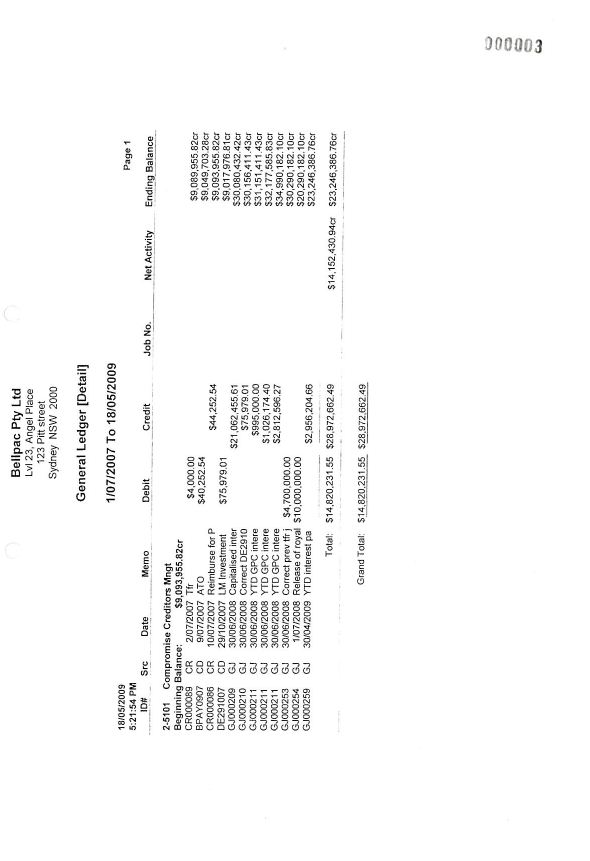
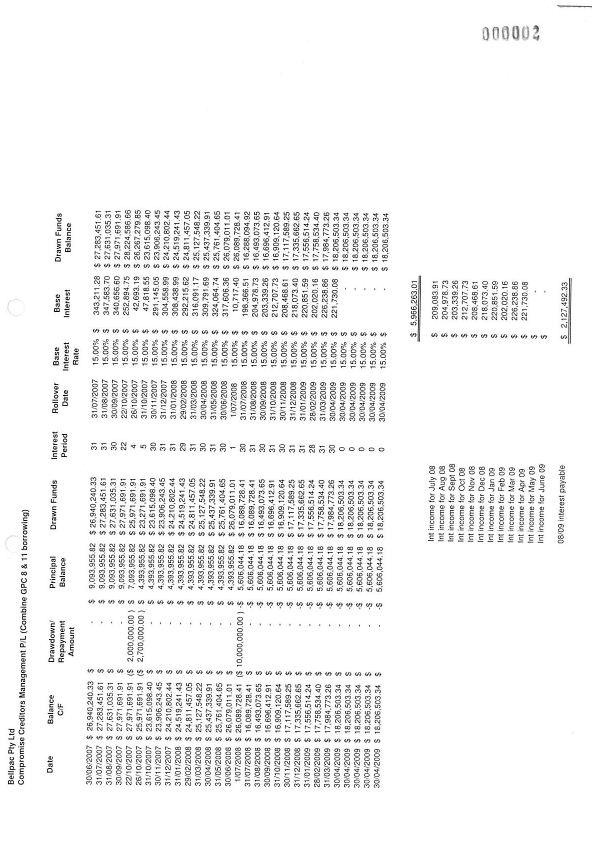
30 On 20 October 2009, the solicitors for the Liquidators wrote to Gujarat, enquiring as to details of the current holder of the convertible bonds that had been issued to Bellpac on 5 August 2008. By letter of 3 November 2009, Gujarat’s solicitors replied, furnishing particulars of the state of the register of bond holders. The particulars showed that Bellpac remained the registered holder of $4,000,000 of convertible bonds, $2,000,000 of which are the bonds in issue in the present proceeding. The remaining $6,000,000 of convertible bonds had been transferred to various parties. The ultimate destination and ownership of that $6,000,000 of convertible bonds is not in issue in the present proceeding, and has not been the subject of any evidence. However, since the transactions involving those bonds may have some bearing on any orders that should be made, I shall say something about the transfer of those convertible bonds.
31 The letter of 3 November 2009 from Gujarat’s solicitors enclosed two schedules specifying particulars of the transferred bonds, and particulars of the current registered bond holders. The schedules disclosed that there had been transfers of convertible bonds by Bellpac, as follows:
$1 million on 5 December 2008 to Good Team Investments Limited;
$1 million on 16 December 2008 to Great Investments Limited;
A further $1 million on 16 December 2008 to Great Investments Limited;
$1 million on 1 May 2009 to Mr Hong Xu;
$2 million on 1 May 2009 to Mr Osmond Tze Leung Kwok.
The particulars furnished by Gujarat’s solicitors indicate that each of those transferees was still registered as the holder of those convertible bonds as at 3 November 2009. However, none of them has been joined as a party to the proceeding. For reasons that I shall later explain, that may affect whether and in what circumstances orders should be made.
32 On 18 December 2009, Gujarat’s solicitors wrote to the Liquidators’ solicitors, indicating that Ken Hung was seeking to have $2,000,000 of the convertible bonds that remained registered in the name of Bellpac transferred into his name. Gujarat’s solicitors attached copies of the Impugned Transfers, being four transfers of convertible bonds signed by Alfred Wong on behalf of Bellpac, together with a copy of a power of attorney granted by Bellpac to Alfred Wong on 7 May 2008, under which the Impugned Transfers were signed. Gujarat’s solicitors said that Gujarat held the original certificates in respect of the $2,000,000 of convertible bonds.
33 The receipt of the letter from Gujarat’s solicitors of 18 December 2009 prompted the commencement of this proceeding by originating process. The plaintiffs are the Liquidators, in their capacity as liquidators of Bellpac, and Bellpac. Initially, Ken Hung was the only defendant. Subsequently, Austcorp, Alfred Wong, Danny Au-Yeung and Shan Pei were joined as defendants. Ken Hung is a director of Austcorp and was its founding shareholder.
34 By interlocutory process filed on 18 January 2010, an application was made for an injunction restraining Gujarat from registering any transfer of convertible bonds from Bellpac to Ken Hung. On 18 January 2010, a judge of the Court made an order restraining Gujarat from registering the Impugned Transfers. Subsequently, accommodation was reached between the parties, whereby Gujarat undertook to give at least 14 days’ written notice of any proposed transfer or other dealing with the convertible bonds. A possible complicating matter, which has not received any real attention in this proceeding, is the fact that there is apparently further litigation on foot in the Supreme Court of New South Wales between Bellpac and Gujarat touching upon the circumstances surrounding the issue of the convertible bonds. There is nothing before the Court as to the present state of that litigation.
35 The final hearing was, unfortunately, somewhat disjointed. It was originally intended that the proceeding would be disposed of, as a matter of urgency, before 30 June 2010. The urgency was said to arise as a result of an undertaking given by Ken Hung to assign the $2,000,000 of convertible bonds, before that date, in connection with a deed of company arrangement entered into by Austcorp Group Limited (Austcorp Group), a subsidiary of Austcorp. However, because of the unavailability of witnesses, the hearing could not be completed before that time. In addition, once it had commenced, the hearing was adjourned on several occasions because of the unavailability of witnesses.
36 The principal issue for determination in the proceeding concerns the effectiveness of the Impugned Transactions and the Impugned Transfers. As I have said, the primary relief sought by the Liquidators and Bellpac is a declaration that Bellpac is the true owner of the $2,000,000 of convertible bonds, and an order that Ken Hung deliver up the transfers and certificates purporting to vest in him the beneficial ownership of the bonds. The Liquidators and Bellpac deny that Ken Hung, or any person other than Bellpac, is entitled to be registered as the owner of the convertible bonds, and deny that Bellpac has been a party to any transaction by which it has disposed of the convertible bonds either legally or beneficially.
37 In their amended statement of claim of 28 July 2010 (the Statement of Claim), the Liquidators and Bellpac assert the following:
Pursuant to the 2008 Settlement Deed, convertible bonds evidencing a debt totalling $10,000,000 were issued by Gujarat to Bellpac.
It was an express term of the convertible bonds that title thereto is vested absolutely in the person entered in the register as the holder of the convertible bonds, and passes by transfer and registration.
Upon issue of the convertible bonds, Bellpac was recorded in the register as the holder of the convertible bonds.
Since the issue of the convertible bonds, there has been no transfer of the relevant $2,000,000 of convertible bonds recorded in the register.
In the premises, Bellpac has been since their issue, and remains, the holder absolutely of the convertible bonds.
The documents before me variously state the date of issue of the convertible bonds to have been 23 July 2008, 5 August 2008 and 6 August 2008. I do not understand anything to turn on the determination of the exact date. In these reasons, I will take the convertible bonds to have been issued on 5 August 2008.
38 Ken Hung and Austcorp are in the same interest in the proceeding, and were represented by the same solicitors and counsel. It is common ground that Bellpac remains the legal owner of the $2,000,000 of convertible bonds. However, in their defence, Ken Hung and Austcorp assert that Ken Hung is the beneficial owner of the $2,000,000 of convertible bonds as a result of the following transactions, all of which are Impugned Transactions:
On or about 6 August 2008, Bellpac assigned its interest in $10,000,000 of convertible bonds to Shan Pei.
On or about 6 August 2008, Shan Pei assigned its interest in $10,000,000 of convertible bonds to Alfred Wong.
On or about 17 October 2008, Alfred Wong assigned his interest in the relevant $2,000,000 of convertible bonds to Austcorp.
Austcorp held the beneficial ownership in the $2,000,000 of convertible bonds from about 17 October 2008 to 17 November 2009.
On or about 17 November 2009, Austcorp assigned its interest in the $2,000,000 of convertible bonds to Ken Hung.
Ken Hung and Austcorp further assert that, as at 6 August 2008, when the $10,000,000 of convertible bonds are alleged to have been assigned to Shan Pei, Shan Pei was exclusively entitled to the Bellpac Indebtedness, and that the consideration for the assignment of the convertible bonds to Shan Pei was the reduction of the Bellpac Indebtedness by $10,000,000. The transactions pursuant to which Shan Pei is said to have become exclusively entitled to the Bellpac Indebtedness constitute the balance of the Impugned Transactions.
39 Danny Au-Yeung was also represented by solicitors and counsel. Danny Au-Yeung’s primary position was to support the contentions of the Liquidators and Bellpac that there was no effective transfer or assignment of the convertible bonds by Bellpac to Shan Pei. Defences were originally filed by a single firm of solicitors acting on behalf of Alfred Wong, Danny Au-Yeung and Shan Pei. Subsequently, those solicitors withdrew their representation on behalf of Alfred Wong and Shan Pei. Alfred Wong thereafter participated in the proceeding in person. Shan Pei did not thereafter participate in the proceeding.
40 The principal focus of the proceeding, accordingly, is on the question of whether, at some time after the convertible bonds were issued by Gujarat, and prior to the signature of the Impugned Transfers, there was an effective assignment of the $10,000,000 of convertible bonds from Bellpac to Shan Pei and then from Shan Pei to Alfred Wong. If there was no effective assignment from Bellpac to Shan Pei and from Shan Pei to Alfred Wong, Ken Hung has no entitlement to have the Impugned Transfers registered, and has no entitlement to retain possession of the certificates in respect of the $2,000,000 of convertible bonds.
41 In the Statement of Claim, the Liquidators and Bellpac refer to the allegation of Ken Hung and Austcorp concerning the assignment of the convertible bonds by Bellpac to Shan Pei. While the Liquidators and Bellpac do not admit that a transaction to that effect occurred, their alternative position is that, to the extent that such a transaction did occur, the transaction should be declared void or set aside. In support of that position, the Liquidators and Bellpac advance several arguments, which are secondary issues for determination in the proceeding. They assert that the transaction:
was an uncommercial transaction within the meaning of s 588FB of the Corporations Act;
was an insolvent transaction within the meaning of s 588FC of the Corporations Act;
was an unreasonable director-related transaction within the meaning of s 588FDA of the Corporations Act; and
involved a breach of the fiduciary and statutory duties owed to Bellpac by its directors, Alfred Wong and Danny Au-Yeung.
42 Ken Hung and Austcorp deny that any transfer of convertible bonds by Bellpac to Shan Pei was an uncommercial, insolvent or unreasonable director-related transaction. They also deny that any such transfer involved a breach of the fiduciary or statutory duties owed to Bellpac by its directors. Danny Au-Yeung denies any breach of statutory or fiduciary duty on his part.
43 Some time after the hearing and addresses ended, in response to an enquiry from the Court, the Liquidators and Bellpac sought leave to file an amended reply raising ss 12 and 23C of the Conveyancing Act. No explanation was offered as to why questions as to the effect of those sections were not raised earlier. Nevertheless, Ken Hung and Austcorp accepted that they were not unfairly prejudiced as a result of the fact that the questions were raised after final submissions had ended. Accordingly, leave was given to file the amended reply.
44 The amended reply asserts that if, it be found that the Impugned Transactions involving the assignments of the convertible bonds did in fact take place, then:
the transactions purported to be dispositions of an equitable interest within the meaning of s 23C of the Conveyancing Act;
the dispositions were not in writing signed by the person disposing of the same, as required by either s 23C or s 12 of the Conveyancing Act;
express written notice of the purported assignments was not given to Gujarat; and
accordingly, the Impugned Transactions did not validly assign any legal or equitable interest in the convertible bonds and were ineffective, by reason of the operation of ss 12 and 23C of the Conveyancing Act.
45 The amended reply also asserts that, if it be found that the Bellpac Indebtedness was assigned by Compromise Creditors to Shan Pei, then, to the extent that that Impugned Transaction took place:
the transaction purported to be a disposition of a legal interest within the meaning of s 12 of the Conveyancing Act, or an equitable interest within the meaning of s 23C of the Conveyancing Act;
the alleged disposition was not in writing signed by the person disposing of the same as required by either s 12 or s 23C of the Conveyancing Act;
express written notice of the purported assignment was not given to Bellpac; and
accordingly, the alleged disposition did not validly assign any legal or equitable interest in the Bellpac Indebtedness and was ineffective, by reason of the operation of ss 12 and 23C of the Conveyancing Act.
46 As a general rule, the burden of proof of a fact that is an essential element in a claimant’s cause of action lies on the claimant. A party who seeks relief has the burden of satisfying the Court of facts that, in the absence of proof of other facts, would justify the grant of that relief. What those facts might be will depend on the nature of the relief sought and the operation of any relevant presumptions. In the case of relief by declaratory order, the precise terms of the declaration sought assume particular significance. Thus, the party seeking a declaratory order has the burden of proof of any matter that is a necessary element of the declaration sought, even if, in a proceeding by that party for relief of another kind, or in a proceeding by the other party, that matter would not arise unless raised, and the burden of proof consequently assumed, by that other party (see Massoud v NRMA Insurance Ltd (1995) 62 NSWLR 657 at 660).
47 Putting it another way, when a person commences a declaratory proceeding, that person bears the legal onus of proof. That is so even though the majority of the facts that are relevant may be in the opposing camp. It is for the claimant to establish the ambit of the rights to be declared, and to prove all the facts necessary to enable the declaration to be made (see Blanch v British American Tobacco Australia Services Ltd (2005) 62 NSWLR 653 at 655). When a party seeks a negative declaration, such as, for example, a declaration that an acquisition will not contravene s 50 of the Competition and Consumer Act 2010 (Cth), that party bears the onus of proving that negative proposition (see Australian Gas Light v Australian Competition and Consumer Commission (No 3) (2003) 137 FCR 317 at [355]-[356]).
48 Under s 140(2) of the Evidence Act 1995 (Cth) (the Evidence Act), the Court must, in deciding whether it is satisfied that a case has been proved to the requisite standard, take into account:
the nature of the cause of action or defence;
the nature of the subject matter of the proceeding; and
the gravity of the matters alleged.
When proof of any fact is required, the Court must feel an actual persuasion of the occurrence or existence of that fact before it can be found. Mere mechanical comparison of probabilities, independent of any belief in reality, cannot justify the finding of a fact. Actual persuasion is achieved where the affirmative of an allegation is made out to the reasonable satisfaction of the Court. However, reasonable satisfaction is not a state of mind that is attained or established independently of the nature and consequences of the fact to be proved. The seriousness of an allegation made, the inherent unlikelihood of an occurrence of a given description, and the gravity of the consequences flowing from a particular finding are considerations that must affect whether the fact has been proved to the reasonable satisfaction of the Court. Reasonable satisfaction should not be produced by inexact proofs, indefinite testimony or indirect inferences (see Briginshaw v Briginshaw (1938) 60 CLR 336 at 361-2).
49 In the present proceeding, the Liquidators and Bellpac are the only parties seeking relief from the Court. Ken Hung and Austcorp contend that, in circumstances where the Liquidators and Bellpac claim a declaration that Bellpac is the true owner of the convertible bonds in question, the Liquidators and Bellpac have the burden of positively satisfying the Court that Bellpac remains the beneficial owner of the convertible bonds, and that it has not disposed of them for value.
50 However, if an allegation made by a defendant is not a denial of an essential ingredient in the cause of action, but is one that, if established, would constitute a good defence, being an avoidance of the claim that the plaintiff might prima facie appear to have, the burden of proof of that allegation is on the defendant (see Currie v Dempsey (1967) 69 SR (NSW) 116 at 125). The Liquidators and Bellpac contend that Ken Hung and Austcorp bear the burden of proving that the Impugned Transactions involving the convertible bonds did in fact occur. They rely on the fact that Bellpac is registered as the holder of the convertible bonds as giving rise to a presumption that it is beneficially entitled to them, which presumption offers prima facie support for the claim for declaratory relief. That, they say, is the effect of the terms and conditions on which the convertible bonds were issued.
51 Ken Hung and Austcorp also contend that, since the Liquidators and Bellpac in effect allege that the Impugned Transactions were fraudulent, they bear a still heavier onus. They say that, since the Liquidators and Bellpac assert that the alleged transactions did not occur, they must be taken to be asserting that the evidence of the Impugned Transactions given by Alfred Wong was fabricated. They contend that the evidence before the Court does not satisfy the necessary requirements for such a finding to be made.
52 However, the Liquidators and Bellpac have not made a submission that Alfred Wong fabricated evidence. Rather, they say that the state of the evidence does not support a positive finding, if that is necessary, that the transactions alleged on behalf of Austcorp and Ken Hung were effective to vest exclusive entitlement to the Bellpac Indebtedness in Shan Pei or to effect an assignment of an equitable interest in the convertible bonds from Bellpac to Shan Pei or from Shan Pei to Alfred Wong. Such a positive finding would be necessary in order for Ken Hung and Austcorp successfully to resist the claims made by the Liquidators and Bellpac, if the Liquidators and Bellpac are correct in their primary contention as to the onus of proof.
53 Possession of goods gives rise to a presumption of ownership (see Russell v Wilson (1923) 33 CLR 538 at 546-7). Thus, actual possession may be sufficient to found an immediate right to possession that, in turn, could be the basis for an action in detinue. Ken Hung and Austcorp say that, since Ken Hung is in possession of the transfers and certificates in respect of the convertible bonds, he is presumed to be the owner of the convertible bonds, unless Bellpac can prove a better title.
54 However, the possession of goods is clearly distinguishable from the circumstances of the present case. Ken Hung may be in possession of transfers and certificates, which are chattels, but he cannot have possession of incorporeal property such as convertible bonds. Possession of a chattel is very much different from entitlement to a chose in action, such as the convertible bonds. For as long as Ken Hung is in possession of the transfers and certificates in relation to the convertible bonds, there may be a presumption that he is entitled to possession of the transfers and certificates. However, that does not necessarily say anything about his entitlement to the beneficial ownership of the underlying convertible bonds. His position is comparable to that of a financier holding a mortgage over shares to secure a loan. That financier would ordinarily have possession of the mortgagor’s share certificates, but such possession would not give rise to any presumption of title. Accordingly, no presumption arising from possession operates in favour of Ken Hung and Austcorp in the present case.
55 If the existence of a fact alleged is a condition precedent to a plaintiff’s right to maintain a cause of action, or if the fact is otherwise an essential element in the cause of action, then the burden of proof of that fact will be on the plaintiff (see Currie v Dempsey at 125). The non-disposition for value of the convertible bonds by Bellpac is certainly a condition precedent to the right of the Liquidators and Bellpac to maintain their claim for declaratory relief in respect of the convertible bonds. However, as I have said, the terms on which the convertible bonds were issued included a provision that title to the convertible bonds is vested absolutely in the person entered in the register as the holder of the bond, and passes by transfer and registration. One effect of that provision is to raise a presumption that the registered holder of a bond is its owner at law and, assuming that there can be a separate beneficial interest in equity, the owner of that beneficial interest. That is to say, in the absence of something further, the fact that Bellpac is the registered holder of the convertible bonds in question gives rise to a presumption substantiating a prima facie case that Bellpac is the true owner of those convertible bonds.
56 Ken Hung and Austcorp have sought to challenge Bellpac’s entitlement to the beneficial ownership of the convertible bonds by proving the execution of the Impugned Transfers by Alfred Wong, as attorney of Bellpac, and by endeavouring to prove the Impugned Transactions pursuant to which Alfred Wong purported to sign the Impugned Transfers on behalf of Bellpac. The transactions on which Ken Hung and Austcorp rely would, if established, constitute good defences to the prima facie claim of the Liquidators and Bellpac. Accordingly, and in the light of what I have set out above, I consider that Ken Hung and Austcorp bear the onus of establishing that Bellpac has disposed of its beneficial ownership of the convertible bonds. It follows that I do not consider that it is necessary to make a finding of fraud on the part of Alfred Wong in order for the Liquidators and Bellpac to succeed in their contentions.
ARRANGEMENTS INVOLVING SHAN PEI
57 The case advanced on behalf of Ken Hung and Austcorp raises three questions as to the Impugned Transactions involving Shan Pei. They are:
Did Shan Pei become exclusively entitled to the Bellpac Indebtedness at some point prior to 6 August 2008?
Was there an effective assignment of the beneficial interest in the $10,000,000 of convertible bonds by Bellpac to Shan Pei on 6 August 2008?
Was there a subsequent effective assignment of the beneficial interest in the $10,000,000 of convertible bonds by Shan Pei to Alfred Wong?
Ken Hung and Austcorp contend that each of those three questions should be answered in the affirmative. They assert that, by 6 August 2008, when Bellpac received the certificates for the convertible bonds, the whole of the Bellpac Indebtedness was owing to Shan Pei and that, at that time, Bellpac assigned the $10,000,000 of convertible bonds to Shan Pei, in consideration of a reduction of the amount of the Bellpac Indebtedness by $10,000,000. At the same time, they say, Shan Pei agreed to assign the $10,000,000 of convertible bonds to Alfred Wong in exchange for a promise by him to pay the face value of the convertible bonds when they became eligible for conversion.
58 Those arrangements, involving a subsidiary of a public company and one of its directors, seem somewhat unlikely. One would expect there to be some documentation evidencing the transactions by which they were given effect. However, Ken Hung and Austcorp do not rely on any written evidence of the transactions. There does not appear to be a single piece of paper passing between Bellpac and Shan Pei, or between Shan Pei and Alfred Wong, concerning any aspect of the alleged assignments of convertible bonds. Nor does there appear to be a single piece of paper evidencing any communication between Shan Pei and either Compromise Creditors or the GPC Creditors concerning entitlement to the Bellpac Indebtedness.
59 Ken Hung and Austcorp did adduce certain documentary evidence in support of their contentions as to the arrangements involving Shan Pei. That evidence included:
entries in the books of Bellpac; and
entries in a set of documents purporting to be accounting records of Shan Pei (the Shan Pei Documents).
I shall say something further about that evidence below.
60 Save what was apparent from the books and records of Bellpac, the Liquidators have no personal knowledge of the Impugned Transactions relied upon by Ken Hung and Austcorp. Accordingly, the case of the Liquidators and Bellpac was essentially a documentary one. The directors of Bellpac who were responsible for the alleged transactions were Alfred Wong and Danny Au-Yeung, both of whom are defendants. The Liquidators, in that regard, may be thought to suffer a disadvantage. However, as I have said, I consider that the onus of establishing the effectiveness of the arrangements involving Shan Pei rests upon Ken Hung and Austcorp, notwithstanding that it is the Liquidators and Bellpac who seek declaratory relief from the Court.
61 I shall deal separately with each of the alleged transactions involving Shan Pei. I shall then deal with the operation of the Conveyancing Act in relation to the alleged assignments and the entitlement to the Bellpac Indebtedness. First, however, I shall describe the evidence that was given orally and by affidavit, and the relevant accounting records, including the Shan Pei Documents.
62 Evidence in chief was given by affidavit. That course was adopted substantially because English is not the first language of most of the witnesses. The principal evidence as to the alleged arrangements involving Shan Pei was adduced from:
Alfred Wong;
Hollis Ho, who is the sole director of Compromise Creditors, having been appointed on 11 October 2006; and
Thomas Lo, who is the only current director of Shan Pei, having been appointed on 23 November 2009.
Alfred Wong was not an impressive witness. I would not be disposed to accept his evidence if it were contradicted, unless that evidence were corroborated by independent contemporaneous documents. Apart from certain accounting records described below, some of which should be given little, if any, weight, there was no corroboration of his evidence as to critical matters.
63 Alfred Wong was called to give evidence on behalf of Ken Hung and Austcorp. He did not otherwise offer evidence in the proceeding.
64 Ken Hung and Austcorp say that the absence of documentary records of the arrangements involving Shan Pei does not mean that the transactions giving effect to those arrangements did not take place. They rely upon Alfred Wong’s evidence that there are cultural differences between East and West when it comes to the documentation of transactions between businessmen who have a long business association. Alfred Wong accepted that there was no document brought into existence to evidence the relevant Impugned Transactions, and that, by Western standards, the evidencing of the alleged transactions was “sloppy”. He asserted, however, that it was a quite normal way of doing things for Chinese. He also said that he never sees a few million dollars as significant.
65 There are no accounting records of Compromise Creditors and there is no other record of Compromise Creditors reflecting upon any of the Impugned Transactions. Hollis Ho said that no accounts have been prepared because of lack of funds. That assertion was not disputed by the Liquidators and Bellpac.
66 Both Hollis Ho and Alfred Wong gave evidence of conversations they said they had had with Danny Au-Yeung, in which Danny Au-Yeung reported discussions that he said he had had with Eric Ng. Hollis Ho gave hearsay evidence of discussions between Danny Au-Yeung and Eric Ng on the topic of the assignment of the Bellpac Indebtedness to Shan Pei. He said in an affidavit that, in about September 2007, he had a conversation with Danny Au-Yeung, in which Danny Au-Yeung told him that the owner of Shan Pei was proposing that Shan Pei take over the benefit of all of the Bellpac Indebtedness, in return for which Shan Pei would undertake to pay Hollis Ho and the other GPC Creditors, within five years, the full amount of the debts owing to them. Hollis Ho said that Danny Au-Yeung told him that he did not know Shan Pei’s financial position but did know that, once a restructure of GPC’s debt was complete, Shan Pei would own 70 per cent of GPC. Hollis Ho said that, since Danny Au-Yeung recommended that he accept Shan Pei’s proposal, he told Danny Au-Yeung that he could tell Shan Pei that Compromise Creditors, as trustee for the GPC Creditors, accepted Shan Pei’s proposal.
67 The evidence I have just described was admitted only as evidence concerning discussions between Hollis Ho and Danny Au-Yeung. It was not admitted as evidence of the fact of any discussion between Danny Au-Yeung and Eric Ng.
68 Alfred Wong gave oral evidence that he considered Shan Pei and Compromise Creditors to be, in effect, the same entity. He said that, once he had been told by Danny Au-Yeung and Hollis Ho of internal arrangements as between Compromise Creditors and Shan Pei, whereby Shan Pei effectively became the creditor of Bellpac in respect of the Bellpac Indebtedness, that was sufficient for him to conclude that Shan Pei and Compromise Creditors were the same.
69 Alfred Wong gave hearsay evidence of discussions between Danny Au-Yeung and Eric Ng on the topic of the assignment of the convertible bonds in consideration for a reduction of the Bellpac Indebtedness. He said in an affidavit that, in late July or early August 2008, Danny Au-Yeung told him that he had spoken to Eric Ng and Hollis Ho, and that they had agreed for Bellpac to transfer all of the convertible bonds to Shan Pei by way of partial payment, in the amount of $10,000,000, of Bellpac’s indebtedness to Shan Pei and the other GPC Creditors. Alfred Wong said that he and Danny Au-Yeung, as directors of Bellpac, resolved that the proposed transfer of convertible bonds to Shan Pei, in return for the reduction of the Bellpac Indebtedness by $10,000,000, was favourable to Bellpac, and resolved to accept and proceed with the proposal. Alfred Wong said that he told Danny Au-Yeung to tell Eric Ng that, once Gujarat issued the convertible bonds, they would be Shan Pei’s.
70 There was no evidence of any minute of any such resolution, and Alfred Wong’s affidavit was not admitted as evidence of the fact of the alleged resolution. It was admitted only as evidence of the fact of the discussion between Alfred Wong and Danny Au-Yeung, to the extent that that bore relevantly upon Alfred Wong’s state of mind, and not as evidence of the fact of any discussion between Danny Au-Yeung and Eric Ng or between Danny Au-Yeung and Hollis Ho.
71 Alfred Wong also said that he had a discussion with Danny Au-Yeung, in which he asked Danny Au-Yeung to put a proposal to Eric Ng for Shan Pei to transfer the convertible bonds to him, Alfred Wong, in return for which he, Alfred Wong, would undertake to pay Shan Pei the face value of the convertible bonds and all accrued interest, as and when each of the convertible bonds became eligible for conversion. Alfred Wong said that, some time later, Danny Au-Yeung told him that he had spoken with Eric Ng and submitted Alfred Wong’s proposal to Shan Pei. Alfred Wong said that Danny Au-Yeung told him that Eric Ng accepted the proposal on Shan Pei’s behalf, and that Shan Pei would transfer the $10,000,000 of convertible bonds to Alfred Wong on the basis proposed.
72 Alfred Wong gave oral evidence that he himself had had discussions from time to time with Hollis Ho and Eric Ng. However, that evidence was highly generalised, and Ken Hung and Austcorp did not make any submissions concerning that evidence. The evidence does not appear to have any probative value.
73 Alfred Wong said that he intended to apply the convertible bonds to discharge debts to his private creditors, including Austcorp, and it is Ken Hung and Austcorp’s case that he in fact did so. As I have said, the Liquidators and Bellpac contend that, if there was an effective assignment of convertible bonds by Bellpac to Shan Pei, the assignment involved a breach of fiduciary and statutory duties on the part of Danny Au-Yeung and Alfred Wong as directors of Bellpac. Alfred Wong’s belief as to the alleged discussions involving Eric Ng may have some relevance in relation to that alternative case. Accordingly, his hearsay evidence was admitted for that limited purpose, although, as I have said, it was not admitted as evidence of the fact of any discussion between Danny Au-Yeung and Eric Ng.
74 The alleged discussions between Eric Ng and Danny Au-Yeung deposed to by Alfred Wong and Hollis Ho, if they actually took place, would clearly enough be of critical importance to the question of the arrangements involving Shan Pei. However, while Danny Au-Yeung was represented in the proceeding, and affidavits by him were filed, none of those affidavits was read, and none of the principal protagonists in the proceeding called him to give evidence. There was no evidence of the fact of any discussion concerning assignment of the Bellpac Indebtedness to Shan Pei, between Eric Ng, or any other person acting with the authority of Shan Pei, on the one hand, and Hollis Ho, or any other person acting with the authority of Compromise Creditors, on the other hand. Further, there was no evidence of the fact of any discussion concerning transfer or assignment of convertible bonds or the reduction of the Bellpac Indebtedness, between Eric Ng, or any other person acting with the authority of Shan Pei, on the one hand, and any person acting with the authority of Bellpac, on the other hand.
75 Eric Ng, who was the only director of Shan Pei from 10 July 2007 until 23 November 2009, the period in which the Impugned Transactions involving Shan Pei are alleged to have taken place, was also not called to give evidence. There was no evidence of any discussion with Eric Ng that was admissible as to the truth of whether the discussion occurred and what its terms were. While the Liquidators took steps at a very late stage in the conduct of the proceeding to tender hearsay evidence from Eric Ng, in the form of an email apparently sent by Eric Ng, that attempted tender was ultimately unsuccessful. Although allegations are made in the proceeding that Shan Pei knowingly participated and assisted in breaches of fiduciary and statutory duties on the part of Alfred Wong and Danny Au-Yeung, Shan Pei did not offer any evidence in defence of those allegations.
76 The failure of any party to call evidence from Danny Au-Yeung or Eric Ng is of some significance. As I have said, their evidence would be critical in establishing the arrangements involving Shan Pei contended for by Ken Hung and Austcorp. The gist of Alfred Wong’s evidence is that he was informed that Danny Au-Yeung had spoken to Eric Ng and Hollis Ho and that, in the course of those conversations, Danny Au-Yeung entered into the agreements for Bellpac to transfer the convertible bonds to Shan Pei and then for Shan Pei to transfer the convertible bonds to Alfred Wong. Alfred Wong does not say that he, Alfred Wong, entered into the agreements or made the relevant Impugned Transactions.
77 The failure to call a witness cannot give rise to an inference that will fill a gap in the evidence. Nor can it be used to convert conjecture and suspicion into inference. On the other hand, if an inference is open to be drawn, the inference can be the more easily drawn if a witness who could give evidence inconsistent with the inference is available to give evidence and is not called (see Jones v Dunkel (1959) 101 CLR 298 at 308, 312 and 320-1).
78 The explanation provided by Ken Hung and Austcorp for their failure to call Danny Au-Yeung or Eric Ng is that neither could be said to be in their camp. Ken Hung and Austcorp claim to be mere downstream purchasers for value without notice. However, Ken Hung and Austcorp had no difficulty in calling Alfred Wong. There is nothing to suggest that Danny Au-Yeung declined to assist Ken Hung and Austcorp in the case that they advanced. While Danny Au-Yeung indicated in the course of final address that he did not support the case advanced by Ken Hung and Austcorp, he had taken no step in the proceeding adverse to their interests. He filed a defence in which there was virtually no joinder of issue in relation to the Impugned Transactions involving Shan Pei. Danny Au-Yeung was the very person who could prove all of the Impugned Transactions. It was open to Ken Hung and Austcorp to adduce evidence from him, yet they do not appear to have attempted to do so. Likewise, there is no reason to conclude that Eric Ng would have been antagonistic towards the case advanced by Ken Hung and Austcorp. In all of those circumstances, there is a strong basis for concluding that the evidence of Danny Au-Yeung and Eric Ng may not have assisted that case.
79 Thomas Lo gave evidence both by an affidavit dated 10 August 2010 and by videolink from Hong Kong. The need to call Thomas Lo was one of the occasions for adjourning the hearing.
80 Thomas Lo is a qualified chartered accountant, and is employed in a senior executive capacity by a large private group in Hong Kong. He said that Alfred Wong has been one his best friends for over 23 years, and that he knew Danny Au-Yeung as a longtime business partner of Alfred Wong. He first heard of Shan Pei in late November 2009, when Danny Au-Yeung asked him whether he could act as a director of a company registered in Anguilla. Danny Au-Yeung told him that he was looking for someone to succeed a director of the company. Danny Au-Yeung did not say who the director was that Thomas Lo was to replace, but told him that the director was about to leave the position because he foresaw a possible conflict of interest. Danny Au-Yeung told Thomas Lo that Faith Corporate Services Limited would contact him about secretarial services for the company. Subsequently, Ms Claudia Chen of Faith Corporate Services Limited telephoned Thomas Lo to say that there were some documents for him to sign concerning the change of directorship. Thomas Lo subsequently signed a form of acceptance as appointment as a director of Shan Pei.
81 Thomas Lo said that he has absolutely no idea who the owner or shareholders of Shan Pei are. He said that he understood that the shareholding is by means of a bearer certificate. Claudia Chen told him that he should speak with Eric Ng for information about Shan Pei. Thomas Lo obtained Eric Ng’s telephone number from Danny Au-Yeung and spoke to Eric Ng. He asked Eric Ng for the financial records of Shan Pei. Several days later, Thomas Lo received by mail the Shan Pei Documents. The Shan Pei Documents consist of 36 pages, 17 of which relate to the year ended 30 June 2008, and 19 of which relate to the year ended 30 June 2009. Thomas Lo’s recollection is that he received them towards the end of November 2009. They are the only accounting documents concerning Shan Pei that he has. He has no electronic version of the Shan Pei Documents.
82 Thomas Lo said that he did not know how the Shan Pei Documents had been prepared, or when they had been prepared. He agreed that, in order to know whether or not the Shan Pei Documents were properly prepared, and the time of the transactions that they purport to record, he would need to look at the cash books and journals. Thomas Lo does not have a complete ledger for Shan Pei. Nor does he have any cash books or journals. He has no documents recording or evidencing any of the transactions or events that the Shan Pei Documents purportedly record.
83 Thomas Lo said that, in order to prepare accounts for the year ended 30 June 2010, he would need to know what the transactions of Shan Pei were during that period. He said that nobody has told him of any transactions in relation to the payment of secretarial or record keeping fees. He said that he might try his luck and contact the former director of Shan Pei, Eric Ng. There is no evidence that he made any further effort to do so.
84 The accounting records and related documents that are in evidence cannot be said to present a clear picture. It is difficult to extract a cogent history of transactions from them, let alone a persuasive one. I found much of the evidence given by witnesses about the accounting records to be unhelpful, and some of it to be almost incomprehensible.
85 The Bellpac accounting records that are in evidence were amongst the financial records produced to the Liquidators upon their appointment as liquidators. The records that are in evidence consist of detail from Bellpac’s general ledger, a copy of which is set out in Appendix 1 to these reasons (the General Ledger Extract), and an account in the name of Compromise Creditors, a copy of which is set out in Appendix 2 to these reasons (the Compromise Account). Those appear to be the only formal records of Bellpac that contain any reference to either the convertible bonds issued by Gujarat or the Bellpac Indebtedness.
86 The General Ledger Extract deals with an account numbered 2-5101, in the name of Compromise Creditors, between the dates 1 July 2007 and 18 May 2009. It begins with an opening credit balance of $9,093,955.82 and ends with a credit balance of $23,246,386.76. That balance is arrived at after substantial credits for interest and three minor debits, in addition to a debit of $10,000,000 on 1 July 2008 with the narration “release of royal”, and a further debit entry of $4,700,000 with the narration “correct prev tfr j”.
87 Alfred Wong asserts that he instructed Ivan Wong and the clerical staff of Bellpac to record the transfer of the convertible bonds to Shan Pei in the manner in which the debit entry of $10,000,000 of 1 July 2008 appears in the General Ledger Extract. He also says that he gave instructions for the narration “release of royal” to be recorded in order to provide an explanation for the consideration moving from Bellpac to Gujarat, namely, the release by Bellpac of Gujarat’s royalty payment obligations to Bellpac. That contention by Alfred Wong is puzzling, and the explanation it offers does not appear to be satisfactory, since there is no obvious reason why entries in an account in the name of Compromise Creditors should be concerned with transactions involving the convertible bonds. Alfred Wong’s evidence was inconsistent in drawing a distinction between Compromise Creditors and Shan Pei, a matter about which I have already said something, and about which I shall say something further below.
88 There is no mention of Shan Pei in the General Ledger Extract. The General Ledger Extract is quite equivocal as to any question of the assignment of the convertible bonds.
89 There is a handwritten note, dated 17 October 2008, that deals with the transfer of the $2,000,000 of convertible bonds to Austcorp, which was amongst the records produced to the Liquidators. That document appears to deal with delivery of the Impugned Transfers and certificates to Austcorp. There is nothing in the document to suggest any involvement of Shan Pei or Bellpac with the convertible bonds. The document does, however, contain the word “Alfred”. In the course of cross-examination, Alfred Wong agreed that, on 17 October 2008, he intended to engage in a personal dealing with Austcorp in connection with the convertible bonds. However, he said that he had not seen the note before, and that he was unable to identify its author by the handwriting. The significance of the notation “Alfred” is not and has not been otherwise explained.
90 The Compromise Account apparently records the Bellpac Indebtedness. It shows a balance owing, as at 30 June 2007, of $26,940,240.33. On that day, interest of $343,211.28 was charged, giving a balance of $27,283,451.61. Repayments of $2,000,000 on 22 October 2007 and $2,700,000 on 26 October 2007, made by cheque, are also recorded. Bank records that are in evidence show that the sum of $2,000,000 was for an overseas telegraphic transfer, the beneficiary of which was View Plan Enterprises Limited. The sum of $2,700,000 was also for an overseas telegraphic transfer, the beneficiary of which was All Seasons Resources Inc. The Bellpac books originally showed those payments as being made for the benefit of Austcorp. However, the corrected entry in the General Ledger Extract shows Compromise Creditors as the beneficiary of those payments.
91 Alfred Wong said in an affidavit that the two cheques that I have just described were drawn on funds advanced by Gujarat under the 2007 Settlement Deed. However, the reasons for those payments and the circumstances of the correction are quite unexplained. There is nothing to connect the payments to Shan Pei. Further, Hollis Ho gave evidence that View Plan Enterprises Limited and All Seasons Resources Inc were not part of the Compromise Creditors group, that he was unfamiliar with those companies, and that he had not authorised the payment of moneys to those companies that might otherwise have been payable to Compromise Creditors. I am unable to draw with confidence any conclusions concerning how the two cheques, or the payments effected by them, may have borne upon or related to any of the Impugned Transactions.
92 Entries for interest appear in the Compromise Account for successive months down to 30 May 2008, when the balance owed is shown as $26,079,011.01. There is an entry of $10,717.40 for interest on 30 June 2008, to give a balance owing of $26,089,728.41. There is then a repayment of $10,000,000 recorded as at 1 July 2008, giving a balance of $16,089,728.41 on 1 July 2008. Successive monthly debits of interest are then shown in the account, which ends with a balance, as at 30 April 2009, of $18,206,503.34.
93 The balance of the account in the name of Compromise Creditors as at 30 April 2009, as shown in the Bellpac General Ledger Extract, is $23,246,386.76. On the other hand, the balance shown in the Compromise Account is $18,206,503.34. Alfred Wong said that the difference of $5,039,883.42 represented a guarantee fee payable by Bellpac to GPC as part of the Bellpac Indebtedness. I interpose here that figures in other documents, such as the Shan Pei Documents, indicate that the Bellpac Indebtedness may have risen as high as approximately $28.3 million by the date of the purported assignment of the convertible bonds. It is virtually impossible to be certain of the precise quantum of the Bellpac Indebtedness at relevant times. However, nothing appears to turn on that detail.
94 Bellpac’s balance sheets as of June 2007, June 2008, April 2009 and June 2009 are also in evidence. Each of those documents records borrowings from “Compromise Creditors Mngt” under the heading “Non Current Liabilities”. None of the documents makes reference to Shan Pei.
95 The Shan Pei Documents include balance sheets of Shan Pei as at 30 June 2008 and 30 June 2009. The balance sheet as at 30 June 2009 records, as an asset of Shan Pei, a loan to Bellpac of $18,996,787.34. The balance sheet as at 30 June 2008 records, as an asset of Shan Pei, a loan to Bellpac of $26,361,849.81. Both documents also make reference to a loan called “Bellpac Guarantor Fee”, in the amounts of $4,499,986.25 and $3,504,986.25 respectively.
96 The balance sheets as at 30 June 2008 and 30 June 2009 show, as liabilities, loans as follows:
Burnaby $1,179,897.29
Pioneer $323,757.64
Sausalito $2,997,198.62
Hollis Ho $237,575.35
The first three amounts are identical to the amounts shown in schedule 1 to the Deed of Compromise. The amount shown for Hollis Ho is similar to the amount shown in schedule 1 to the Deed of Compromise.
97 The Shan Pei Documents include several extracts from the general ledger of Shan Pei for the period 1 July 2007 to 30 June 2008. One extract, in respect of an account called “Bellpac P/L”, shows a debit entry of $28,224,586.66, dated 30 September 2007, with the narration “Assignment of”, and credit entries, dated 22 October 2007 and 26 October 2007, of $2,000,000 and $2,700,000 respectively, with the narration “Repayment for”. The Shan Pei Documents also include extracts in respect of accounts in the names of the GPC Creditors other than Shan Pei, showing credits in the amounts shown in the balance sheets. Each has the narration “Settlement Clea”.
98 The Shan Pei Documents also include several extracts from the general ledger of Shan Pei for the period 1 July 2008 to 30 June 2009. One extract, in respect of an account called “Gujarat Bond”, records two entries on 6 August 2008. One is a debit of $10,000,000, with the narration “Repayment Guj”. That appears to be a reference to Gujarat. The other is a credit of $10,000,000, with the narration “Loan to AW”. That appears to be reference to Alfred Wong. A second extract, in respect of an account called “Bellpac P/L”, shows a credit of $10,000,000, on 6 August 2008, with the narration “Repayment Guj” and a debit, on 30 June 2009, of $2,634,937.53, with the narration “Interest income”. A third extract, in respect of an account called “Alfred Wong”, shows a debit of $10,000,000, on 6 August 2008, with the narration “Loan to AW”, and three debits, on 1 October 2008, 1 January 2009 and 1 April 2009, each with the narration “Interest income”, and each of approximately $200,000.
99 In the light of the matters I have just set out, the most that can be said is that there are entries in the books of Bellpac, apparently authorised by Alfred Wong, and entries in the Shan Pei Documents, the authority for which has not been the subject of evidence, that may be consistent with the Impugned Transactions having occurred. However, under Australian law, unlike the situation under the obligatio litterarum of Roman law (see Gaius, Institutes 3.128-130 and Justinian, Institutes 3.21), a mere book entry cannot by itself give rise to indebtedness or its discharge. A book entry can do no more than record the effect of a transaction that has otherwise taken effect according to law.
Ownership of the Bellpac Indebtedness
100 As I have said, there is no instrument of assignment of the Bellpac Indebtedness to Shan Pei by either Compromise Creditors or the GPC Creditors. There is no admissible evidence as to any communication between Shan Pei, on the one hand, and Compromise Creditors or the other GPC Creditors, on the other, as to the assignment of the Bellpac Indebtedness to Shan Pei. I am not persuaded that the transfer of units in the GPC Creditors Trust is relevantly connected to any entitlement to the Bellpac Indebtedness. The lack of formality and documentation in relation to the circumstances in which Shan Pei is alleged to have become entitled to the Bellpac Indebtedness is in stark contrast to the formality with which the Bellpac Indebtedness was assigned to the GPC Subsidiaries by Ace Bond and by the GPS Subsidiaries to Compromise Creditors.
101 There is no mention of Shan Pei in the books of Bellpac. There is no record in the books of Bellpac consistent with the proposition that, by 2008, the Bellpac Indebtedness was owed exclusively to Shan Pei, as Ken Hung and Austcorp contend, rather than to Compromise Creditors. There is nothing in the books of Bellpac to suggest that the Bellpac Indebtedness was owed to any entity other than Compromise Creditors. As I have said, no accounting records have been prepared for Compromise Creditors.
102 The Shan Pei Documents are consistent with the Bellpac Indebtedness being owed to Shan Pei as at 30 June 2008, and with Shan Pei being indebted to the GPC Creditors in amounts the same as, or substantially the same as, the amounts owing to the GPC Creditors by GPC and GPC Finance as shown in schedule 1 to the Deed of Compromise. The entries in the Shan Pei Documents are consistent with the Bellpac Indebtedness having been assigned to Shan Pei in consideration of Shan Pei undertaking to pay to the GPC Creditors the amounts shown as owing to them in schedule 1 to the Deed of Compromise.
103 However, as I have said, Thomas Lo played no part in the preparation of the Shan Pei Documents. His involvement with Shan Pei commenced entirely after the Impugned Transactions involving Shan Pei are alleged to have taken place. Thomas Lo had no knowledge of the accuracy of the Shan Pei Documents or the circumstances in which they were created, and there was no other evidence as to those questions. The Shan Pei Documents were tendered well after the hearing began. They are manifestly incomplete. In those circumstances, it is difficult to accord any weight to the Shan Pei Documents.
104 Ken Hung and Austcorp rely on the evidence of Hollis Ho, the sole director of Compromise Creditors, to support the conclusion that Shan Pei and Compromise Creditors made an agreement pursuant to which Shan Pei took over the right to the Bellpac Indebtedness, in return for which Shan Pei agreed to pay Hollis Ho and the other GPC Creditors, within five years, the full amount of the debts owing to them. They say that Danny Au-Yeung, as chief executive officer and a director of Bellpac, was a party to those discussions and that, accordingly, Bellpac consented to the assignment of the Bellpac Indebtedness from Compromise Creditors to Shan Pei.
105 There is no explanation as to why Shan Pei might put a proposal in the terms deposed to by Hollis Ho when recounting his conversation with Danny Au-Yeung. There is no evidence that Danny Au-Yeung had authority to act on behalf of Shan Pei or make any agreement on behalf of Shan Pei. There is also nothing to indicate that any of the GPC Creditors, other than Hollis Ho and Shan Pei, knew anything of the alleged proposal, let alone that they consented to it.
106 There was also no record of such an assignment in the books of Bellpac. The only evidence to which attention has been drawn, apart from the Shan Pei Documents, is quite inconsistent with there having been an assignment of the Bellpac Indebtedness by Compromise Creditors or the GPC Creditors to Shan Pei.
107 The proposition that Compromise Creditors or the other GPC Creditors assigned the Bellpac Indebtedness is inconsistent with later actions of Compromise Creditors. On 6 August 2009, a formal proof of debt in the winding up of Bellpac was lodged with the Liquidators on behalf of Compromise Creditors. The proof of debt was for the sum of $6,390,646.98, the total of the debts due to the GPC Creditors as shown in schedule 1 to the Deed of Compromise, and stated that that sum was owing by Bellpac under the Deed of Compromise. A copy of the Deed of Compromise was annexed to the proof of debt. The proof of debt was signed by Hollis Ho on behalf of Compromise Creditors. If there had been an assignment of the Bellpac Indebtedness to Shan Pei, it is curious in the extreme that Hollis Ho would lodge a proof of debt in the name of Compromise Creditors in respect of the Bellpac Indebtedness. No proof of debt has been lodged on behalf of Shan Pei. In the course of cross-examination, Hollis Ho agreed that he lodged the proof of debt in the name of Compromise Creditors on the basis that there had been no transfer or assignment of the Bellpac Indebtedness to Shan Pei.
108 Further, no explanation was offered as to why the proof of debt that Hollis Ho lodged was for the amount originally owed to the GPC Creditors, rather than for the current amount of the Bellpac Indebtedness, whatever that might have been. The GPC Creditors accepted an assignment of the Bellpac Indebtedness as consideration for the extinguishment of the amounts shown in schedule 1 to the Deed of Compromise as owing to them. Accordingly, their entitlement to prove would extend to the full amount of the Bellpac Indebtedness. I consider that Hollis Ho’s actions in connection with the proof of debt, insofar as they are cogent at all, are completely inconsistent with the case that is put by Ken Hung and Bellpac.
109 Ken Hung and Austcorp say that the continued involvement of Hollis Ho and Compromise Creditors with the Bellpac Indebtedness is explained by reference to the fact that it was Alfred Wong’s understanding that Compromise Creditors remained the mortgagee in respect of the Bellpac Indebtedness. They rely on Alfred Wong’s evidence that he was concerned to deal with the person who “made the decisions and called the shots”. They say that Eric Ng, who was the sole director of Shan Pei until 23 November 2009, was the person who made the decisions and called the shots on behalf of Shan Pei at the relevant time. They rely on the Shan Pei Documents as corroborating the assignment of the Bellpac Indebtedness to Shan Pei in the sum of $28,224,586.66.
110 However, Ken Hung and Austcorp say that, in any event, the question of whether Shan Pei or Compromise Creditors was the creditor of Bellpac is not to the point. They say that Bellpac received a substantial benefit from its creditor, namely a reduction in the Bellpac Indebtedness in the sum of $10,000,000, in return for which it transferred or assigned its interest in the convertible bonds to Shan Pei. Ken Hung and Austcorp say that, even if Shan Pei did not become legally entitled to the Bellpac Indebtedness, that would not affect the validity of any transaction concerning the convertible bonds between Shan Pei and Bellpac. There is no reason, they say, why Bellpac could not agree to transfer property to Shan Pei in return for a reduction in indebtedness owed by Bellpac to Compromise Creditors.
111 However, there is no evidence to suggest that Compromise Creditors, or the GPC Creditors other than Shan Pei, agreed to any such reduction of the Bellpac Indebtedness. The evidence is quite to the contrary. Bellpac could not, by an entry in its own books, unilaterally affect the quantum of its indebtedness to a creditor. It would be necessary to show that that creditor had actually accepted that there was a reduction in the amount of the Bellpac Indebtedness. The fact that Compromise Creditors lodged a proof of debt with the Liquidators is solid evidence that it regarded the Bellpac Indebtedness as still owing to it. As I have said, there is no admissible evidence of any assignment of the Bellpac Indebtedness to Shan Pei by either Compromise Creditors or the GPC Creditors.
112 The fact that Hollis Ho said that he told Danny Au-Yeung that Danny Au-Yeung could tell Shan Pei that Compromise Creditors would accept the proposal allegedly made by Shan Pei is not evidence of an agreement between Compromise Creditors and Shan Pei. Danny Au-Yeung was not a representative of Shan Pei, the other party to the alleged agreement. Further, even if Hollis Ho’s discussions with Danny Au-Yeung did give rise to a contract for the assignment of the Bellpac Indebtedness, in consideration of a promise by Shan Pei to make a payment within five years, that contract remains entirely executory. Clearly, Shan Pei has not performed its side of the bargain, in that no payment has been made to Compromise Creditors or any of the other GPC Creditors. In the absence of any written assignment by Compromise Creditors or the GPC Creditors, neither side has performed any obligation under that contract. The mere making of a contract to assign for a consideration to be paid in the future does not effect an equitable assignment of a chose in action. Ownership of a chattel could have been transferred by delivery, but no ownership in the Bellpac Indebtedness could have been assigned by mere agreement. I am not persuaded that there was an effective assignment to Shan Pei of either a legal or equitable interest in that part of the Bellpac Indebtedness that was not already vested in it in its capacity as one of the GPC Creditors.
113 The case advanced on behalf of Ken Hung and Austcorp is that the consideration for the assignment of the convertible bonds has been paid in the form of a reduction of the amount owing by Bellpac in respect of the Bellpac indebtedness. Accordingly, the identity of the creditor in respect of the Bellpac Indebtedness is of critical significance, since, in the absence of consideration in the form of a reduction in the Bellpac Indebtedness moving from Shan Pei to Bellpac, no beneficial interest in the convertible bonds can have been assigned by Bellpac to Shan Pei.
114 I am not persuaded, on the balance of probabilities, that there was an arrangement whereby Shan Pei became entitled to the whole of the Bellpac Indebtedness. I consider that the Bellpac Indebtedness was, as at 6 August 2008, owed either to Compromise Creditors or, perhaps, to the GPC Creditors. I do not consider that it was owed to Shan Pei. The debt is held by Compromise Creditors on trust for the GPC Creditors, in the proportions that their respective debts bear to the total amount of the indebtedness owing to the GPC Creditors, as shown in schedule 1 to the Deed of Compromise. Shan Pei is simply one of the GPC Creditors. As such, it is entitled to a proportionate part of the Bellpac Indebtedness, being the proportion that the debt due to it from GPC or GPC Finance bears to the whole of the indebtedness owing to the GPC Creditors. That proportion is slightly more than 26 per cent. Shan Pei could not release Bellpac from $10,000,000 of the total liability, which exceeded $20,000,000.
115 The release of the interest that I have just described, namely the equitable part interest in the Bellpac Indebtedness that Shan Pei has by virtue of its being one of the GPC Creditors, would have been capable of constituting consideration for an assignment of the $10,000,000 of convertible bonds by Bellpac. However, it has never been put that the release of that interest constituted the consideration. Such a contract has never been alleged, and there is no evidence of it. Ken Hung and Austcorp have placed complete reliance on Shan Pei’s having become exclusively entitled to the Bellpac Indebtedness prior to any assignment of the convertible bonds by Bellpac on 6 August 2008.
Assignment of Convertible Bonds in Reduction of the Bellpac Indebtedness
116 There is no instrument of assignment of an interest in the convertible bonds from Bellpac to Shan Pei. Further, there was no admissible evidence as to the fact of any communication, either written or oral, between Bellpac and Shan Pei as to the assignment of convertible bonds from Bellpac to Shan Pei.
117 The only evidence relied on by Ken Hung and Austcorp that is capable of supporting the alleged assignment of the convertible bonds in reduction of the Bellpac Indebtedness consists of the entries in the books of Bellpac and Shan Pei. Those entries are consistent with the loan to Bellpac having been reduced during the year ended 30 June 2009. Thus, the account of Compromise Creditors in the books of Bellpac appears to record a reduction, on 1 July 2008, of the amount of the Bellpac Indebtedness owing to Compromise Creditors of $10,000,000. I have described above the entry, in the general ledger of Bellpac, of a debit of $10,000,000 on 1 July 2008 with the narration “release of royal”, made at the direction of Alfred Wong. I have also described the entry in the general ledger of Shan Pei of a $10,000,000 credit on 6 August 2008, with the narration “repayment Guj”. A corresponding debit on 6 August 2008 relating to Alfred Wong also appears in the Shan Pei documents. Ken Hung and Austcorp contend that, in the light of those entries, there is evidence that Bellpac was given credit for the sum of $10,000,000, which they say was the consideration for the transfer of the convertible bonds.
118 The Liquidators and Bellpac have not suggested that Alfred Wong’s evidence that he gave instructions for entries to be made in the books of Bellpac should not be accepted, and it was not put to Alfred Wong in cross-examination that those entries were fabricated. Ken Hung and Austcorp highlight the fact that the Liquidators and Bellpac have not attempted to provide any hypothesis that would explain the entries in Bellpac’s books that apparently record a reduction in the Bellpac Indebtedness by $10,000,000. Ken Hung and Austcorp say that the only explanation consistent with the facts is that Bellpac received a benefit in the form the reduction. Accordingly, they contend, the Court should conclude that the amount owed by Bellpac in respect of the Bellpac Indebtedness was reduced by $10,000,000, with effect on 1 July 2008. That would be sufficient consideration for an assignment of some proprietary interest in the convertible bonds.
119 However, the entries in the books could not, of themselves, effect the reduction. It may be that Alfred Wong had a genuine belief that the convertible bonds had been assigned to Shan Pei in reduction of the Bellpac Indebtedness. Nevertheless, the fact that there was a relevant intention to assign the convertible bonds does not mean that the convertible bonds were effectively assigned. I am not persuaded that there was an effective assignment of the beneficial interest in the $10,000,000 of convertible bonds by Bellpac to Shan Pei on 6 August 2008.
Assignment by Shan Pei to Alfred Wong
120 There is also no instrument of assignment of an interest in the convertible bonds from Shan Pei to Alfred Wong. Further, there was no admissible evidence as to the fact of any communication, either written or oral, between Shan Pei and Alfred Wong as to the assignment of convertible bonds from Shan Pei to Alfred Wong.
121 The only evidence relied on by Ken Hung and Austcorp that is capable of supporting the alleged assignment from Shan Pei to Alfred Wong consists of the entries in the books of Bellpac and Shan Pei. The balance sheet of Shan Pei as at June 2009 shows the same liabilities to the GPC Creditors as are shown in the June 2008 balance sheet. The 30 June 2009 balance sheet shows as an asset, a loan to Alfred Wong of $10,612,649.44. That is consistent with a loan having been made to Alfred Wong during the year ended 30 June 2009.
122 As I have already said, it is impossible to give any weight to the Shan Pei Documents in the light of the uncertainties surrounding their creation. In any event, accounting records could not, of themselves, effect transactions concerning the beneficial interest in the convertible bonds. I am not persuaded that there was an effective assignment of beneficial ownership of the $10,000,000 of convertible bonds from Shan Pei to Alfred Wong.
Operation of the Conveyancing Act
123 Section 12 of the Conveyancing Act relevantly provides that any absolute assignment by writing under the hand of the assignor of any debt or other legal chose in action, of which express notice in writing has been given to the debtor or other person from whom the assignor would have been entitled to receive or claim such debt or chose in action, is and is deemed to have been effectual in law to pass and transfer the legal right to such debt or chose in action from the date of such notice.
124 Section 23C(1)(c) of the Conveyancing Act relevantly provides that, subject to the provisions of the Conveyancing Act with respect to the creation of an interest in land by parol, a disposition of an equitable interest or trust subsisting at the time of the disposition must be in writing signed by the person disposing of the same or by the person’s agent lawfully authorised in writing for that purpose. However, under s 23E(d) of the Conveyancing Act, nothing in s 23C is to affect the operation of the law relating to part performance.
125 As I have said, the Liquidators and Bellpac belatedly filed an amended reply concerning the effect of the Conveyancing Act. They contended that both the assignment of the Bellpac Indebtedness to Shan Pei and the assignments of the convertible bonds from Bellpac to Shan Pei and from Shan Pei to Alfred Wong, to the extent that they took place at all, were ineffective for want of compliance with ss 12 and 23C of the Conveyancing Act.
126 The Bellpac Indebtedness is a debt or other legal chose in action within the meaning of s 12. In the absence of compliance with s 12, there could be no legal assignment of the Bellpac Indebtedness. Since there has clearly been no compliance with s 12, it follows that there was no assignment, effective at law, of the Bellpac Indebtedness from Compromise Creditors to Shan Pei.
127 However, s 12 is not a precondition to the validity of an assignment of an equitable interest in a chose in action. Ken Hung and Austcorp, although their submission is not clear on the point, must therefore be taken to contend that the purported assignment of the Bellpac Indebtedness to Shan Pei was effective in equity only. Likewise, it is common ground that Bellpac retains legal title to the $2,000,000 of convertible bonds, by reason of its being the registered holder of the bonds. Ken Hung and Austcorp contend that the various alleged assignments of the convertible bonds were assignments of the equitable interest in the bonds. Thus, they say, s 12 did not apply to any of the Impugned Transactions.
128 Ken Hung and Austcorp advance five arguments in support of their contention that none of the transactions giving effect to the arrangements involving Shan Pei is rendered ineffective for want of compliance with s 23C. First, they contend that the requirements of s 23C(1)(c) apply only to real property, and not to personalty such as the Bellpac Indebtedness and the convertible bonds. They point to the context in which s 23C appears. Thus, the introduction to s 23C refers expressly to the creation of interests in land by parol. Further, s 23C is found in Division 3 of Part 2 of the Conveyancing Act, which is entitled Assurances of Land. Ken Hung and Austcorp contrast that with Division 4 of Part 2, which is entitled Property Generally.
129 However, headings are not decisive in relation to the question of construction. There are countervailing considerations that indicate that s 23C(1)(c) is not limited to real property. First, there is no compelling rationale for distinguishing between the disposition of an equitable interest in real property and the disposition of an equitable interest in personalty. But for the context of s 23C, there would be no reason to draw any such distinction. Secondly, in contrast to s 23C(1)(a) and s 23C(1)(b), which refer respectively to the creation or disposition of an interest in land and to a declaration of trust respecting any land or any interest therein, s 23C(1)(c) refers merely to an equitable interest or trust subsisting at the time of the disposition. Thirdly, both the High Court and the House of Lords have indicated that provisions equivalent to s 23C(1)(c) extend to equitable dispositions of personalty, although those equivalent provisions were not to be found under headings relating to land (see, for example, Adamson v Hayes (1973) 130 CLR 276 and Grey v IRC [1960] AC 1). For those reasons, I consider that s 23C(1)(c) applies to such dispositions, including dispositions of any beneficial interest in choses in action such as the Bellpac Indebtedness or the convertible bonds (see PT Ltd v Maradona Pty Ltd (No 2) (1992) 27 NSWLR 241 at 250-252).
130 Secondly, Ken Hung and Austcorp raise the issue of constructive trusts. They say that, assuming that there was an agreement between Shan Pei and Compromise Creditors in respect of the Bellpac Indebtedness, that agreement constituted a contract for valuable consideration to assign the Bellpac Indebtedness. Accordingly, they say, it gave rise to a constructive trust in favour of Shan Pei in respect of the Bellpac Indebtedness. Ken Hung and Austcorp further say that any agreement between Bellpac and Shan Pei to assign the convertible bonds was supported by valuable consideration, and was therefore specifically enforceable. Thus, they say, Bellpac promised to assign the convertible bonds to Shan Pei in consideration for a reduction in the Bellpac Indebtedness. They say that, upon such reduction being effected, a constructive trust was created in favour of Shan Pei in respect of the convertible bonds. They say that, accordingly, the requirements of s 23C were displaced in respect of both alleged transactions.
131 Ken Hung and Austcorp advance the same contentions in relation to the alleged agreement between Shan Pei and Alfred Wong. That is to say, upon Alfred Wong’s promising to provide the agreed consideration, they assert that a constructive trust was created in his favour, under which Shan Pei held an equitable interest in the convertible bonds on trust for him. They say that Alfred Wong purported to transfer the convertible bonds to Austcorp and thereby irrevocably committed himself to the terms of the agreement with Shan Pei, including the promise to pay Shan Pei the face value of the convertible bonds and all accrued interest on each of the dates as and when the bonds became eligible for conversion.
132 Each of the constructive trusts for which Ken Hung and Austcorp contend ultimately depends on the proposition that there was an agreement by which Shan Pei became exclusively entitled to the Bellpac Indebtedness. As I have indicated, I am not persuaded that that is so. If there was no such agreement, Shan Pei could not have given any valuable consideration for the assignment of the convertible bonds, because the Bellpac Indebtedness would not have been owed to it in its entirety. There is no evidence that Compromise Creditors assigned the legal title to the Bellpac Indebtedness. Accordingly, Shan Pei’s entitlement to the Bellpac Indebtedness would have been, at most, an equitable share of the Bellpac Indebtedness in the proportion that $1,671,855.10 bears to $6,390,646.98.
133 However, even if the agreement to assign the convertible bonds from Bellpac to Shan Pei was supported by valuable consideration, and was therefore capable of specific performance, that does not mean that Bellpac became a trustee of the convertible bonds upon the making of the agreement, but before the payment of the consideration (see for example Tanwar Enterprises Pty Ltd v Cauchi (2003) 217 CLR 315 at [53]). As there has been no payment of the consideration by Shan Pei, no constructive trust can have arisen in its favour. No interest in the bonds could subsequently have passed, therefore, from Shan Pei to Alfred Wong or from Alfred Wong to any other person.
134 Thirdly, Ken Hung and Austcorp say that the requirements of s 23C(1)(c) were displaced, in respect of the assignment of the convertible bonds, by acts of part performance on the part of Shan Pei. They say that Shan Pei reduced the amount owed to it by Bellpac in its books by the face value of the convertible bonds, namely $10,000,000, and thereby performed its part of the contract with Bellpac. That contention also assumes that Shan Pei became exclusively entitled to the Bellpac Indebtedness, and, accordingly, is untenable. Further, in order for acts of part performance to operate in the way contended for by Ken Hung and Austcorp, those acts must be unequivocally and of their own nature referable to some such agreement as is alleged (see Waltons Stores (Interstate) Ltd v Maher (1988) 164 CLR 387 at 432). I do not consider that that requirement is satisfied in relation to the alleged assignment by Bellpac to Shan Pei, since the entries in the Shan Pei Documents do not have any dispositive effect, but, rather, at their highest, do no more than record some other juridical act.
135 In any event, there has been no part performance by Alfred Wong that could operate to displace the requirements of s 23C(1)(c) in respect of the alleged assignment of convertible bonds from Shan Pei to him. Alfred Wong has merely made a promise, which is still executory, to pay the amount of the convertible bonds in the future. Similar considerations would apply to any agreement between Shan Pei, on the one hand, and Compromise Creditors or the other GPC Creditors, on the other hand, in respect of the Bellpac Indebtedness. That agreement, too, must be regarded as wholly executory, since the promise by Shan Pei, if it was made at all, was to pay the amounts owing to the GPC Creditors by GPC and GPC Finance within five years.
136 Fourthly, Ken Hung and Austcorp contend that the assignment of the Bellpac Indebtedness to Shan Pei was not a disposition of property at all. No reasons are advanced in support of that submission, which I reject.
137 Fifthly, Ken Hung and Austcorp say that s 23C(1)(c) can have no application to any equitable assignment of the convertible bonds from Bellpac to Shan Pei, because that transaction did not involve a disposition of an equitable interest. Rather, they say, Bellpac created out of its legal and beneficial ownership an equitable interest that did not previously exist. The argument runs as follows. It appears to be wrong to say that the legal and beneficial owner of property has two estates in the property, one legal and the other equitable, and that when that owner equitably assigns the property while retaining the legal title, there is a disposition of the equitable estate. Rather, it seems correct to say that the owner creates in the assignee an equitable estate distinct from the estate held by the owner prior to the transaction. That is, the owner does not, by the equitable assignment, dispose of an equitable interest subsisting at the time of the disposition. Accordingly, there can be no application of s 23C(1)(c) (see Baloglow v Konstantinidis [2001] NSWCA 451 at [116]-[117]).
138 However, in the circumstances of the present case, that argument begs the question. The allegation made by Ken Hung and Austcorp is that the Impugned Transactions involved promises to transfer the convertible bonds themselves, rather than to assign any equitable interest in the convertible bonds. In other words, the Impugned Transactions involved promises to place the intended assignees of the convertible bonds in a position whereby they could become registered as the owners of the convertible bonds. In the absence of payment of the consideration, any agreement between Shan Pei and Bellpac remained wholly executory. Accordingly, there can have been no equitable assignment capable of engaging the analysis considered in Baloglow
139 In the light of the matters I have set out above, I consider that the requirements of s 23C(1)(c) of the Conveyancing Act were applicable to all of the transactions giving effect to the arrangements involving Shan Pei that are relied upon by Ken Hung and Austcorp. I consider that there was no compliance with s 23C(1)(c) in respect of any of those transactions. I am not persuaded by the available evidence that the requirements of s 23C(1)(c) have been displaced by acts of part performance or the creation of any constructive trust. It follows that s 23C(1)(c) would operate to render ineffective any of the arrangements involving Shan Pei that might otherwise be effective. In particular, s 23C(1)(c) would mean that no consideration passed from Shan Pei to Bellpac for the assignment in equity of the convertible bonds, since Shan Pei could have acquired no exclusive entitlement, in equity or otherwise, to the Bellpac Indebtedness.
Conclusion as to the Shan Pei Transactions
140 The Liquidators and Bellpac contend that the Impugned Transactions involving Shan Pei, leading up to the execution of the Impugned Transfers by Edgar Hung as attorney for Ken Hung on 17 November 2009, are no more than a contrivance pieced together in an attempt to justify a transfer of property of Bellpac to Ken Hung in November 2009, after Bellpac had gone into liquidation. Not only was there no writing recording the relevant Impugned Transactions, there was no evidence of the fact of any oral communication effecting those transactions. No step was taken to execute a transfer of either the Bellpac Indebtedness or the convertible bonds in favour of Shan Pei. The certificates for the convertible bonds remained in the custody of Ivan Wong. There is no evidence that Ivan Wong was given the certificates to hold on behalf of any person other than Bellpac. Certainly, no attempt was made to deliver the certificates to the custody of any person on behalf of Shan Pei. The highest that the evidence rises in support of the Impugned Transactions is that there are entries in the books of Bellpac and in the Shan Pei Documents that are consistent with the transactions, and that may be inconsistent with there having been no dealing with the convertible bonds or the Bellpac Indebtedness.
141 However, in the absence of any admissible evidence of juridical acts that are capable of constituting them, it is not possible to conclude that any of the Impugned Transactions involving Shan Pei occurred. In particular, there was no juridical act that was effective to vest in Shan Pei either a legal or an equitable interest in the Bellpac Indebtedness. Further, there is no evidence of any writing that would satisfy s 23C(1)(c) of the Conveyancing Act in respect of any of the Impugned Transactions involving Shan Pei.
142 Having regard to the matters specified in s 140(2) of the Evidence Act, I consider that the case advanced on behalf of Ken Hung and Austcorp is far from having been proved to the requisite standard. I am not actually persuaded that the Impugned Transactions involving Shan Pei took place. In the light of the available evidence, I consider that it is unlikely that they took place, or, to the extent that there was an attempt to effect the Impugned Transactions, that it is unlikely that the attempt was effective.
143 It follows that no consideration has been given by Shan Pei to Bellpac for the transfer or assignment of any interest in the convertible bonds. Accordingly, there was no transfer of any equitable interest in the convertible bonds by Bellpac. Alfred Wong therefore acquired no interest in the convertible bonds. Alfred Wong therefore could not transfer any interest in the convertible bonds to Austcorp. Austcorp therefore had no interest to transfer to Ken Hung. Accordingly, subject to a possible question of hearing from non-parties, the Liquidators and Bellpac are entitled to declarations and orders in the terms claimed in their amended originating process.
144 While it is not strictly necessary to do so, I shall say something about the subsequent transactions relied on by Ken Hung and Austcorp. I shall also say something about the alternative cases mounted by the Liquidators and Bellpac.
ARRANGEMENTS INVOLVING ALFRED WONG, AUSTCORP AND KEN HUNG
145 In asserting his entitlement to be registered as the owner of the $2,000,000 of convertible bonds, Ken Hung relies on two further purported assignments of the bonds. The first assignment is from Alfred Wong to Austcorp. The second is from Austcorp to Ken Hung. I shall deal with each purported assignment separately.
146 As at about 1999, Austcorp and Alfred Wong were the principals and effective controllers of entities engaged in the development of a resort at The Entrance, New South Wales (the Resort Development). By 2001, the Resort Development was completed, all apartments had been sold and the profits from the venture had been distributed to those entitled. However, in August 2006, 49 purchasers of apartments commenced a proceeding in the Federal Court claiming damages against Austcorp and other parties involved in the Resort Development. By deed made between Austcorp and Alfred Wong on 16 July 2008 (the Indemnity Deed), Alfred Wong agreed to indemnify Austcorp in respect of 50 per cent of all legal costs and damages that Austcorp might be held liable to pay in that Federal Court proceeding.
147 Edgar Hung is Ken Hung’s son. He is an executive director of Austcorp, having been appointed in 1992. He is the deputy executive chairman of Austcorp Group. In August 2008, Alfred Wong had conversations with Edgar Hung in which he said that his personal financial situation was very tight, and that he could not contribute his share of the legal costs under the Indemnity Deed. He told Edgar Hung about the $10,000,000 of convertible bonds that Gujarat had issued to Bellpac, and said that Bellpac had used the convertible bonds to reduce a debt due to Shan Pei, one of its investors, for the full amount of their face value of $10,000,000. He said that that had been helpful to him, since he subsequently reached agreement with Shan Pei for all of the convertible bonds to be transferred to him, so that he could apply them to discharge his personal liabilities. He said that a number of his creditors were happy to accept a transfer of convertible bonds in discharge of his liabilities to them, and that he would like to make such an arrangement with Austcorp. He offered to transfer to Austcorp convertible bonds having a face value of $2,000,000, in return for a release from his liability under the Indemnity Deed.
148 Subsequently, Edgar Hung told Alfred Wong that Austcorp agreed to take a transfer of the $2,000,000 of convertible bonds, in consideration for which Austcorp would release Alfred Wong from his liability under the Indemnity Deed. Alfred Wong then said that he would arrange for Wai Kim Kok to deliver transfers and certificates to Edgar Hung.
149 On 17 October 2008, Alfred Wong, as attorney of Bellpac, signed the four Impugned Transfers in blank. He gave instructions to Wai Kim Kok to deliver the signed transfers to Austcorp. On 21 October 2008, Wai Kim Kok completed details, including details relating to the convertible bonds and the transferor, on the four Impugned Transfers, and, on 22 October 2008, sent them, together with the relevant certificates, to Edgar Hung at Austcorp.
150 Ken Hung and Austcorp say that the circumstances of the signature of the transfers on behalf of Bellpac, rather than by Alfred Wong in his personal capacity, are explained by the evidence. Thus, as I have said, Alfred Wong received the certificates from Gujarat on 6 August 2008, when he gave them to Wai Kim Kok, with instructions that she give them to Ivan Wong for safe custody. Wai Kim Kok did so. The form of transfer required by Gujarat was not provided to Bellpac until 17 October 2008, when Alfred Wong signed the four Impugned Transfers in blank, in his capacity as attorney for Bellpac. He gave instructions to Ms Kok to obtain the certificates from Ivan Wong and to complete the transfer forms, leaving the transferee details blank. On 22 October 2008, Ms Kok sent the four signed Impugned Transfers, together with the relevant certificates for the convertible bonds, to Edgar Hung by express post. Edgar Hung then filled out the transferee details at a later time.
151 Ken Hung and Austcorp say that Alfred Wong was seeking to wrap up several transactions in single transfer forms, rather than arrange for separate transfers from Bellpac to Shan Pei, from Shan Pei to himself personally, and from himself personally to his creditors, including Austcorp. Accordingly, it was necessary for Alfred Wong to sign the Impugned Transfers as Bellpac’s attorney. Ultimately, as a result of the matters I shall describe shortly, Ken Hung was named as the transferee in the Impugned Transfers. In effect, Ken Hung and Austcorp say that there was a transfer from Bellpac to Ken Hung by direction of the various intermediate transferees in that chain.
152 Since 1998, Ken Hung has from time to time provided loans to Austcorp to assist it with its capital requirements. As at 16 October 2009, the outstanding balance owing by Austcorp to Ken Hung was $2,872,650. In about May 2000, the loan arrangements between Austcorp and Ken Hung were formalised with legal documentation that included provision, as security for the loans, of a charge over all of Austcorp’s assets in favour of Ken Hung.
153 On 6 May 2009, administrators were appointed to Austcorp Group, and, on 16 October 2009, administrators were appointed to Austcorp itself. In about November 2009, Ken Hung had a conversation with Edgar Hung in relation to a proposal that the indebtedness of Austcorp to Ken Hung be reduced by a transfer of the convertible bonds to Ken Hung, and the subsequent transfer of those convertible bonds by Ken Hung to Austcorp Group, in order to satisfy one of the conditions of a deed of company arrangement that was then being proposed concerning Austcorp Group. Edgar Hung said that, in connection with the proposed deed of company arrangement, it was necessary to provide to the administrators a sum of between $5 million and $10 million over a period of five years. He said that one way of achieving that would be to transfer to Austcorp Group the $2,000,000 of convertible bonds owned by Austcorp. He said that such a transfer could not take place unless Ken Hung, as the holder of a charge over the assets of Austcorp, gave his consent.
154 Edgar Hung told his father that it was proposed that the convertible bonds be transferred in part satisfaction of Ken Hung’s loan to Austcorp, to the extent of $2,000,000. Ken Hung would then transfer the convertible bonds to the administrators of Austcorp Group to be held for the purposes of the deed of company arrangement. Ken Hung would then become a creditor of Austcorp Group in the sum of $2,000,000, which would be a debt payable after completion of the deed of company arrangement. The debt of $2,000,000 would be owed by Austcorp Group, but would be guaranteed by Austcorp.
155 Edgar Hung told Ken Hung that it was best for Ken Hung and all the shareholders of Austcorp that the proposal be implemented. Following Edgar Hung’s explanation of the proposal, Ken Hung decided to proceed with it. He considered that, as a shareholder of Austcorp, and given his position as the holder of a charge from Austcorp in respect of its indebtedness to him, it was incumbent upon him for the benefit of Austcorp and its shareholders to assist Austcorp Group to satisfy the condition of its proposed deed of company arrangement. Accordingly, Ken Hung instructed Edgar Hung to sign documents and do all other things necessary on his behalf, under a general power of attorney that he had previously granted to Edgar Hung, in order to give effect to the proposal.
156 On 17 November 2009, Edgar Hung signed the four Impugned Transfers on behalf of his father, as transferee. The Impugned Transfers are in evidence. Each transfer is in respect of $500,000 of convertible bonds. The transfers are from Bellpac to Ken Hung. They are executed on behalf of Bellpac by Alfred Wong, under a power of attorney executed on 7 May 2008, and are signed on behalf of Ken Hung by Edgar Hung, under a power of attorney made on 6 February 2006. The signature on behalf of Bellpac is dated 17 October 2008. Under cover of a letter dated 17 November 2009, Edgar Hung submitted the four transfers to Gujarat, and requested that the transfers be registered. That prompted the letter of 18 December 2009 from Gujarat’s solicitors to the Liquidators’ solicitors, to which I have referred above.
157 Edgar Hung gave affidavit evidence concerning a controversy as to the effectiveness of the 2006 power of attorney. However, I do not understand there to be any issue as between the parties regarding that matter.
158 On 23 December 2009, Austcorp Group entered into a deed of company arrangement and, on 17 February 2010, Austcorp also entered into a deed of company arrangement. On 20 January 2010, Edgar Hung, as attorney of Ken Hung, executed a deed of assignment (the Austcorp Assignment) of $2,000,000 of convertible bonds, under which Ken Hung assigned all his legal and equitable right, title and interest in the convertible bonds to the administrators of the Austcorp Group deed of company arrangement. The Austcorp Assignment provided that completion was to take place on 30 June 2010. On 23 April 2010, a deed of acknowledgement was executed on behalf of Ken Hung, under which he agreed not to take any steps to enforce his rights under the charge given to him by Austcorp until completion of the Austcorp Group deed of company arrangement. Finally, in consideration of the transfer by Austcorp to Ken Hung of the convertible bonds, Ken Hung accepted a reduction of $2,000,000 in the amount owing to him by Austcorp under the Austcorp deed of company arrangement.
Conclusion as to Subsequent Assignments
159 If Alfred Wong had acquired beneficial ownership of the $2,000,000 of convertible bonds, I would be satisfied that the evidence establishes that that beneficial ownership passed to Austcorp, and then from Austcorp to Ken Hung. However, I have concluded that Alfred Wong did not become the owner of the bonds, either legally or beneficially, because Shan Pei did not acquire any interest in them: nemo dat quod non habet.
160 As I have already indicated, the Liquidators and Bellpac assert that any transaction by which the convertible bonds were assigned by Bellpac to Shan Pei was an insolvent transaction, an uncommercial transaction, and an unreasonable director-related transaction within the meaning of the Corporations Act, as well as involving breaches of statutory and fiduciary duty on the part of Alfred Wong and Danny Au-Yeung. They therefore contend that the transaction, to the extent that it took place at all, is voidable. In the light of the conclusions reached above, it is not strictly necessary to deal with those alternative cases. Nevertheless, it is desirable to say something about the issues that they raise.
Uncommercial, Insolvent or Unreasonable Director-Related Transaction
161 Part 5.7B of the Corporations Act deals with the recovery of property or compensation for the benefit of creditors of an insolvent company. Division 2 of Part 5.7B, which consists of s 588FA to s 588FJ inclusive, deals with voidable transactions. Relevantly, s 588FE(3) provides that a transaction of a company is voidable if it is an insolvent transaction and also an uncommercial transaction of the company, and it was entered into during the two years ending on the relation-back day. Section 588FE(6A) provides that a transaction of a company is voidable if, relevantly, it is an unreasonable director-related transaction of the company and it was entered into during the four years ending on the relation back day. For present purposes, the relation-back day is 30 July 2009, the day on which the Liquidators were appointed as administrators of Bellpac.
162 The Liquidators and Bellpac assert in the Statement of Claim that the alleged assignment of convertible bonds from Bellpac to Shan Pei on 6 August 2008 is voidable under s 588FE. Accordingly, they say, the Court is empowered to make one or more of the orders set out in s 588FF(1) of the Corporations Act. They say that the Court should make an order declaring that the transfer of convertible bonds was void ab initio, as well as other restitutional orders.
163 Section 588FB of the Corporations Act deals with uncommercial transactions. Under s 588FB(1), a transaction of a company is an uncommercial transaction of the company if, and only if, it may be expected that a reasonable person in the company’s circumstances would not have entered into the transaction, having regard to:
the benefits, if any, to the company of entering into the transaction;
the detriment to the company of entering into the transaction;
the respective benefits to other parties to the transaction of entering into it; and
any other relevant matter.
164 Section 588FC deals with insolvent transactions. Under s 588FC, a transaction of a company is an insolvent transaction of the company if, relevantly, it is an uncommercial transaction of the company, and the transaction is entered into at a time when the company is insolvent.
165 Section 588FDA deals with unreasonable director-related transactions. Under s 588FDA, a transaction of a company is an unreasonable director-related transaction if, relevantly, the transaction is a disposition by the company of property of the company, the disposition is to a director of the company, and it would be expected that a reasonable person in the company’s circumstances would not have entered into that transaction, having regard to:
the benefits, if any, to the company of entering into the transaction;
the detriment to the company of entering into the transaction;
the respective benefits to other parties to the transaction of entering into it; and
any other relevant matter.
166 By the deed of variation of 14 July 2005 made between Bellpac and the GPC Subsidiaries, the Bellpac Indebtedness fell due for payment on 13 July 2008. The Liquidators and Bellpac assert in the Statement of Claim that, from 13 July 2008, Bellpac was unable to pay its debts as and when they fell due and, accordingly, was insolvent, and that, therefore, the transaction involving the assignment of convertible bonds to Shan Pei by Bellpac took place while Bellpac was insolvent, thereby satisfying one limb of s 588FC. They rely on the following matters as supporting the conclusion that Bellpac was insolvent by 6 August 2008:
Bellpac incurred a loss of $4,765,176.23 for the year ended 30 June 2007.
As at 30 June 2007, Bellpac had negative equity of $51,601,601.97 and its current liabilities exceeded its current assets.
Bellpac incurred a loss of $8,141,957.93 for the year ended 30 June 2008.
As at 30 June 2008, Bellpac had negative equity of $59,743,559.90 and its current liabilities exceeded its current assets.
As at 30 April 2009, Bellpac had negative equity of $56,978,594.37 and its current liabilities exceeded its current assets.
Bellpac failed to pay the amount of the Bellpac Indebtedness when it fell due for repayment on 13 July 2008.
167 Under s 95A of the Corporations Act, a person who is not solvent is deemed to be insolvent. A person is solvent if, and only if, the person is able to pay all the person’s debts as and when they become due and payable. Whether a company is insolvent at a particular time is a question of fact, to be determined by proper consideration of the company’s financial position, in its entirety, based on commercial reality. Regard must be had not only to the cash resources immediately available to the company, but also to moneys that it can procure by realisation of its assets or by borrowing. It is the inability of a company, using such resources as are realistically available to it to raise funds, to meet debts as and when they fall due, that indicates insolvency (see Powell v Fryer (2001) 37 ACSR 589 at [75]).
168 While a company’s balance sheet is a relevant consideration, a company’s solvency is ultimately determined by reference to its ability to pay its debts as and when they fall due. The fact that a company’s liabilities at a given time exceed its assets at that time does not necessarily indicate that the company is insolvent. For example, its income may be such that it will in fact be in a position to meet its liabilities when they become due for payment. Thus, the Court must look at all of the liabilities of a company and make a finding as to when those liabilities fall due for payment. It is then necessary to assess what moneys will become available to the company to meet those liabilities at the relevant times.
169 Ken Hung and Austcorp dispute that Bellpac was insolvent at any relevant time. Ken Hung and Austcorp say that the substantial liabilities of Bellpac as at 30 June 2008 were not all owing at that time. LM Investment had agreed on 11 July 2008, less than a month before the alleged transfer of convertible bonds to Shan Pei, to vary the existing loan to LM Investment by capitalising the interest previously payable. That resulted in an increase in the loan from $16,000,000 to $37,000,000. In those circumstances, they say, there could be no suggestion that LM Investment was pressing for payment as at 6 August 2008.
170 Ken Hung and Austcorp also say that, while it is correct that Shan Pei, assuming it was the other major creditor on Bellpac’s balance sheet at the relevant time, was pressing for repayment in early July 2008, the bargain that was struck was that the convertible bonds would be transferred to Shan Pei. Thus, they say, there was an agreement to extend the payment terms in respect of the Bellpac Indebtedness, and thereafter no demand was made for repayment of the balance.
171 Finally, Ken Hung and Austcorp point to the fact that Bellpac derived a profit in the period to 30 April 2009. However, there is nothing to suggest that that profit was such as to make a difference as to whether Bellpac could meet its liabilities as and when they fell due.
172 Bellpac’s balance sheet as at June 2008 suggests that it did not have cash available to meet interest payments that continued to accrue in respect of the loan from LM Investment. Further, even allowing for a reduction in the Bellpac Indebtedness, a substantial majority of the Bellpac Indebtedness remained owing, in respect of which Bellpac was in default as at August 2008. There was no suggestion that Shan Pei or Compromise Creditors agreed that the time for repayment of the balance of the Bellpac Indebtedness was to be deferred. In the circumstances, I would be disposed to conclude that Bellpac was insolvent as at August 2008.
173 In order to be an insolvent transaction under s 588FC, a transaction must also be uncommercial within the meaning of s 588FB. The Liquidators and Bellpac say that it would be expected that a reasonable person in Bellpac’s circumstances would not have entered into the transaction by which the convertible bonds were purportedly assigned to Shan Pei, in circumstances where, inter alia:
there were no benefits to Bellpac;
Bellpac was divested of an asset with a face value of $10,000,000, and suffered detriment from entering into the transaction; and
other parties, including Shan Pei and Alfred Wong, derived a benefit from the transaction.
The Liquidators and Bellpac say that Alfred Wong derived a significant personal benefit because the purported transfer was part of an arrangement whereby, upon Shan Pei’s acquisition of the convertible bonds, Shan Pei would immediately transfer them to Alfred Wong, purportedly in consideration of a promise that he would pay Shan Pei their face value, together with interest, on their respective conversion dates. Thus, they say, Alfred Wong obtained the convertible bonds merely by promising to pay their face value at a future time, without making any payment at the time of acquisition. They say that the purported transfer was an uncommercial transaction of Bellpac.
174 Ken Hung and Austcorp say that the relevant transaction was not uncommercial, since Bellpac received a reduction of $10,000,000 in its liability to Shan Pei in respect of the Bellpac Indebtedness, in return for the transfer of an asset of dubious value. There was no evidence indicating the value of the convertible bonds, aside from opinions, albeit unchallenged ones, proffered by Alfred Wong, and no evidence to indicate whether or not a market existed for the convertible bonds, such that they could be realised prior to their conversion into shares in Gujarat. Nevertheless, it is at least arguable that the alleged transaction between Shan Pei and Bellpac was not uncommercial, since, although Bellpac lost the benefit of an asset having a face value equal to $10,000,000, it also received a reduction in that sum owing to an unsecured creditor. Ken Hung and Austcorp contend that undervalue is at the heart of s 588FB, and that the relevant transaction was plainly not conducted at an undervalue. There may be a rational basis for concluding that a company in the circumstances of Bellpac may have wished to have the certainty of such a reduction in its liabilities that were immediately due and payable, in exchange for an asset that may not have been immediately realisable.
175 Further, Ken Hung and Austcorp assert, there is evidence that LM Investment was informed that the convertible bonds, once issued, would be used to satisfy other creditors of Bellpac, and that LM Investment raised no objections to that suggestion. They say that any question of priority as between LM Investment and either Compromise Creditors or Shan Pei is an irrelevant distraction. They further say that the assignment of the convertible bonds cannot be said to be uncommercial on the basis of an alleged reversal of priority in circumstances where LM Investment effectively approved the paying down of the Compromise Creditors debt.
176 However, I accept that, if the arrangements involving Bellpac, Shan Pei and Alfred Wong were given effect in the manner contended for by Ken Hung and Austcorp, notwithstanding that there is minimal evidence to support those contentions, then they could fairly be characterised as a single tripartite transaction whereby Bellpac transferred the interest in the convertible bonds to Alfred Wong at the direction of Shan Pei, in consideration for which Shan Pei reduced the indebtedness of Bellpac under the Bellpac Indebtedness by $10,000,000. On that characterisation, Shan Pei agreed to give such direction to Bellpac in consideration of Alfred Wong’s promise to pay the face value of the convertible bonds as and when they became eligible for conversion.
177 In assessing whether a transaction is uncommercial, it is appropriate for the Court to look to the totality of the business relationship between the parties, to what was intended to be effected under that relationship, and to how the transaction, in whole or in part, effected that intention (see Cussen v Sultan (2009) 74 ACSR 496 at [23]). There is some merit in the submissions advanced by Ken Hung and Austcorp as to uncommerciality. However, in all of the circumstances, I would be disposed to view the arrangements involving Bellpac, Shan Pei and Alfred Wong as a single transaction, as just described. Having regard to the obvious benefit derived by Alfred Wong, a director of Bellpac, I have considerable reservations about the propriety of that transaction. Alfred Wong’s benefit was, in my view, such as could not be explained by normal commercial practice (see Peter Pan Management Pty Ltd v Capital Finance Corp (Aust) Pty Ltd (2001) 19 ACLC 1392 at [43]). I would be disposed to conclude that the tripartite transaction was an uncommercial transaction of Bellpac.
178 Section 588FDA of the Corporations Act narrows the scope of the concept of transaction compared with the scope of that concept elsewhere in Division 2. Relevantly for present purposes, in order for a transaction to be an unreasonable director-related transaction under s 588FDA(1)(a), the transaction must be a disposition by a company of property of the company, and the disposition must be to a director of the company. Ken Hung and Austcorp say that there was no disposition by Bellpac of any interest in the convertible bonds to Alfred Wong, and, accordingly, that the terms of s 588FDA are not engaged.
179 However, if the arrangements involving Bellpac, Shan Pei and Alfred Wong together constituted a single tripartite transaction, the terms of s 588FDA would be satisfied. Accordingly, I would be disposed to conclude that the purported assignment of the convertible bonds by Bellpac on 6 August 2008 was also an unreasonable director-related transaction of Bellpac.
180 For the reasons given above, I would be disposed to uphold the alternative cases advanced by the Liquidators and Bellpac in reliance upon Division 2 of Part 5.7B of the Corporations Act. That conclusion would empower the Court to make an order under s 588FF, subject to the possible operation of s 588FG, about which I shall say something below.
181 The Liquidators and Bellpac contend that Alfred Wong and Danny Au-Yeung misused their respective positions as directors of Bellpac, breached ss 180(1), 181(1) and 182(1) of the Corporations Act and breached the fiduciary duties that they owed to Bellpac. The duties alleged to have been owed by Alfred Wong and Danny Au-Yeung to Bellpac were:
a duty under s 180(1) of the Corporations Act to exercise their powers and discharge their duties with the degree of care and diligence that a reasonable person would exercise if that person was a director of Bellpac and occupied the office held by, and had the responsibilities within Bellpac of, Alfred Wong and Danny Au-Yeung;
a duty under s 181(1) of the Corporations Act to exercise their powers and discharge their duties in good faith in the best interests of Bellpac and for a proper purpose;
a duty under s 182(1) of the Corporations Act not to use their positions improperly to gain advantage for themselves or someone else or cause detriment to Bellpac;
a fiduciary duty to account for any benefit or gain they obtained in circumstances where there was conflict or potential conflict between their duty to Bellpac and their personal interest in the pursuit or possible receipt of such a benefit or gain;
a fiduciary duty to account for any benefit or gain obtained or received by use or by reason of their respective positions, or by use or by reason of opportunities or knowledge resulting from their positions;
a fiduciary duty to keep confidential information and knowledge they obtained in the course of exercising their responsibilities relating to the operation of the business of Bellpac; and
a fiduciary duty to act in the best interests of Bellpac.
182 The Liquidators and Bellpac say that the vice in the purported transfer of the convertible bonds to Shan Pei, assuming that it was a creditor of Bellpac, is that the transfer was undertaken in circumstances where Alfred Wong was a direct beneficiary of the transfer, by reason of the arrangement that he made with Shan Pei that the convertible bonds would be at his personal disposal, and could then be used to satisfy his personal creditors. They contend that reasonable directors in the position of Alfred Wong and Danny Au-Yeung would not have used a substantial asset of Bellpac in order to satisfy part of a debt owed by Bellpac to an unsecured creditor, being a debt that was incapable of being paid from the assets of Bellpac if those assets were administered according to its (Bellpac’s) commercial arrangements, in circumstances where that unsecured creditor was prepared to make an arrangement with one of the directors involved in making the corporate decision, being an arrangement that benefited that director.
183 The Liquidators and Bellpac, therefore, contend that any decision made by Alfred Wong and Danny Au-Yeung to transfer convertible bonds to Shan Pei, assuming Shan Pei was an unsecured creditor in respect of the Bellpac Indebtedness, in partial satisfaction of that indebtedness, was motivated by an improper purpose, namely the benefit obtained by Alfred Wong as a result of his arrangement with Shan Pei. They say that the improper purpose was to benefit Alfred Wong by reason of the arrangement made between Alfred Wong and Shan Pei for Shan Pei to transfer the convertible bonds to Alfred Wong to enable him to discharge his own personal obligations. That arrangement was very favourable to Alfred Wong, in that it involved no more than a mere promise by him to pay the face value of the convertible bonds when they became eligible for conversion in the future.
184 As I have said, the hearsay evidence of conversations between Danny Au-Yeung and Eric Ng that both Alfred Wong and Hollis Ho gave was not admitted as evidence of the fact of those conversations. It was admitted only as evidence of the discussions in which the witnesses were told of the conversations, and of the witnesses’ state of mind. However, that evidence, even so restricted as to admissibility, may have some bearing on the question of breach of fiduciary duty by Alfred Wong and Danny Au-Yeung.
185 Thus, Alfred Wong asserted in an affidavit that, shortly after 13 July 2008, when the Bellpac Indebtedness was due for payment, Danny Au-Yeung told him that Eric Ng and Bellpac’s other creditors had been asking for payment of the Bellpac Indebtedness. Alfred Wong said that he told Danny Au-Yeung that Bellpac could offer Eric Ng and Bellpac’s other creditors the convertible bonds by way of reduction of the Bellpac Indebtedness. From that, it may be open to conclude that Alfred Wong reasonably believed that entry into the Impugned Transactions involving the convertible bonds was in the best interests of Bellpac, and that his actions, accordingly, were done in good faith and for a proper purpose.
186 The reference to Eric Ng as a creditor of Bellpac was, it may be inferred, a reference to Shan Pei in respect of the Bellpac Indebtedness. Alfred Wong gave no admissible evidence as to how, as he understood the position, Shan Pei had become the only creditor of Bellpac in respect of the Bellpac Indebtedness. It is significant that Alfred Wong said in affidavit evidence that, at that time, Danny Au-Yeung referred to the GPC Creditors as including Shan Pei, amongst others. That is not consistent with Shan Pei having become exclusively entitled to the Bellpac Indebtedness. Alfred Wong drew a clear distinction in his affidavit evidence between Shan Pei and Eric Ng, on the one hand, and Compromise Creditors and Hollis Ho, on the other, despite his subsequent oral evidence that he considered them to be in effect the same entity once he had been told by Danny Au-Yeung of agreements having been made between them.
187 In all of the circumstances, I do not consider that the hearsay evidence given by Alfred Wong bears significantly on the question of breach of duty as a director. As I have indicated, I did not find Alfred Wong to be an impressive witness.
188 Ken Hung and Austcorp submit that the fact that the purpose of the transfer of the convertible bonds was to enable Alfred Wong to pay off certain of his personal creditors does not matter in circumstances where Bellpac received good consideration for the transfer of the convertible bonds. That contention is unsupported, and it appears to me to be somewhat obscure. I am not disposed to give it any weight, particularly since, as I have indicated, I am inclined to regard the arrangements involving Bellpac, Shan Pei and Alfred Wong as a single tripartite transaction.
189 There is no admissible evidence as to Danny Au-Yeung’s state of mind concerning the Impugned Transactions. Danny Au-Yeung contends that there has been no breach of statutory or fiduciary duty on his part. He asserts that he stood to gain nothing from the Impugned Transactions, and points out that he was joined as a defendant more than six months after the proceeding had commenced. He asserts that Alfred Wong’s involvement in downstream transactions after the purported transfer of the convertible bonds to Shan Pei cannot be visited upon him, Danny Au-Yeung, in his capacity as a director of Bellpac. Further, he asserts that there is no evidence that any misconduct on his part, which it is his primary position to deny, caused Bellpac to suffer any loss or damage, given that the convertible bonds do not mature until 1 July 2028, and that there is no certainty that Gujarat’s shares will have any value on the relevant conversion dates.
190 On the assumption that the transactions allegedly effecting the assignment of the convertible bonds on 6 August 2008 should properly be characterised as a tripartite arrangement involving Bellpac, Shan Pei and Alfred Wong, I consider that there are strong grounds for concluding that the arrangements involved a breach of fiduciary duty and a breach of statutory duty, at least on the part of Alfred Wong, who was instrumental in proposing the arrangements. The clear effect of the arrangements was that Alfred Wong was put in a position whereby he had substantial assets, having a face value of $10,000,000, at his disposal for the purposes of discharging his own personal liabilities, having given no more than an unsecured promise to pay the face value of the convertible bonds at some time in the future. The fact that Alfred Wong was prepared to take the convertible bonds, and was in a position to discharge his personal indebtedness by assigning the convertible bonds, might suggest that the convertible bonds could have provided a similar benefit to Bellpac. I would be disposed to conclude that the transaction involved a breach of ss 180, 181 and 182 of the Corporations Act, as well as of general fiduciary duties, on the part of Alfred Wong and Danny Au-Yeung.
191 In the event that the alleged transfer of convertible bonds from Bellpac to Shan Pei were found to be voidable under s 588FE of the Corporations Act, the Court would be empowered to make an order under s 588FF. Ken Hung and Austcorp place reliance on s 588FG of the Corporations Act in arguing that such an order ought not be made.
192 Section 588FG(1) provides that the Court may not make an order under s 588FF that materially prejudices a right or interest of a person other than a party to the transaction, if certain matters are proved. Thus, the Court may not make such an order if the person whose right or interest is prejudiced received no benefit because of the transaction. Alternatively, the Court is not to make such an order if it is proved that, in relation to each benefit that the person received because of the transaction, the person received the benefit in good faith and, at the time when the benefit was received, the person had no reasonable grounds for suspecting that the company whose transaction was voidable was insolvent, as that term is defined in s 588FC, and a reasonable person would have had no reasonable grounds for suspecting that the company was insolvent.
193 It is clear enough that Ken Hung will be materially prejudiced if orders are made declaring the arrangements involving Bellpac, Shan Pei and Alfred Wong to be void. He has accepted a reduction in the amount owing to him by Austcorp. He may be also exposed to a claim for a breach of contract under the Austcorp Assignment.
194 There can be no suggestion that Ken Hung received a benefit because of the Impugned Transactions involving Bellpac, Shan Pei and Alfred Wong. There is no suggestion that any of those parties contemplated a transfer of convertible bonds to Ken Hung. It is clear that Alfred Wong contemplated a transfer of some of the convertible bonds to his personal creditors, one of which was Austcorp. Nevertheless, even if there was a single tripartite transaction, as I have found, Austcorp was not a party to that transaction. Accordingly, I also do not consider that it could be said that Austcorp received a benefit because of the transaction.
195 It may be that, but for the Impugned Transactions involving Shan Pei, Alfred Wong would not have been in a position to strike the bargain that he made with Austcorp, whereby he would assign $2,000,000 of convertible bonds to Austcorp as consideration for a release of his obligations under the Indemnity Deed. Further, if Austcorp had not acquired the convertible bonds, it could not have assigned them to Ken Hung. Nevertheless, I do not consider that either Austcorp or Ken Hung received a benefit because of the Impugned Transactions involving Bellpac, Shan Pei and Alfred Wong, howsoever characterised.
196 However, the Liquidators and Bellpac contend that the entire series of transactions by which the convertible bonds were allegedly assigned from Bellpac to Shan Pei, from Shan Pei to Alfred Wong, from Alfred Wong to Austcorp, and from Austcorp to Ken Hung, is capable of constituting a transaction within the meaning of s 588FB of the Corporations Act. They say that each of the several purported dealings with the convertible bonds is part of that transaction, which, by reason of the arguments I have already set out, is voidable under s 588FE, and because of which, they say, Austcorp and/or Ken Hung obtained a benefit.
197 The Liquidators and Bellpac assert, although the facts underlying the assertion are not described in the submission, that Austcorp was a joint venturer with, and a secured creditor of, Bellpac, ranking behind LM Investment. Austcorp had securities owing for indebtedness of about $5,000,000 as at August 2008. Austcorp knew of the prior securities, by reason of registration of its inferior securities. The Liquidators and Bellpac point to Alfred Wong’s deposition that he told LM Investment that Austcorp was to be paid by the use of the convertible bonds and that, before settlement and the issue of the convertible bonds, he told LM Investment that he had for some time told the recipients of the convertible bonds that they would be secured by second mortgages over land of Gujarat. The Liquidators and Bellpac say that the only parties who could be told that were Compromise Creditors and Austcorp, they being the subsequent ranking creditors not being paid cash by Gujarat. That submission is difficult to follow. If, however, it is correct, then it appears that it would be possible to conclude that Austcorp was told that convertible bonds would be issued to Bellpac and that it would be paid its debt by Bellpac through the use of the convertible bonds.
198 The concept of transaction is very broad. Thus, a series of steps over a period, involving several parties, can constitute a transaction. A transaction includes an arrangement giving rise to an estoppel under which one party may not resile from a position. Further, a transaction may be unilateral in character (see Australian Kitchen Industries Pty Ltd v Albarran (2004) 51 ACSR 604 at [24]). A number of separate dealings may together be regarded as constituting one transaction. Nevertheless, in every case, it is vital that, however the transaction is constituted, it must be able to be characterised as a transaction of the company (see Kalls Enterprises Pty Ltd v Baloglow (2006) 58 ACSR 63 at [27]).
199 If the Impugned Transactions took effect, then Austcorp in fact received convertible bonds issued to Bellpac, and may even have been told, as the Liquidators and Bellpac suggest, that it would receive those bonds prior to their issue. However, it did not receive those convertible bonds from Bellpac, but from Alfred Wong, who was known to be a director of Bellpac. It received the convertible bonds in payment of Alfred Wong’s personal debt to Austcorp, not in satisfaction of Bellpac’s debt. Ken Hung’s taking of an interest in the convertible bonds had nothing to do with the dealings of Bellpac and Alfred Wong with Shan Pei.
200 The transactions involving Austcorp and Ken Hung in November 2009 were entirely separate and distinct from the transactions involving Shan Pei and Alfred Wong in August 2008. Ken Hung and Austcorp say that it could not possibly have been contemplated, at the time of the Impugned Transactions involving Shan Pei, that the convertible bonds would subsequently be assigned to Ken Hung in November 2009 as a result of Austcorp’s deteriorating financial position. Ken Hung’s evidence is that he was unaware of Bellpac’s existence until May 2010. Further, they say, the internal transaction involving Austcorp, one of its directors, namely Ken Hung, and Austcorp Group could not conceivably be characterised as a transaction of Bellpac.
201 I consider that it is not possible to characterise the transactions involving Austcorp and Ken Hung as part of a single transaction involving the transfer of convertible bonds by Bellpac to Shan Pei and the transfer by Shan Pei to Alfred Wong. Accordingly, I do not consider that the chain of assignments of the convertible bonds can be said to have constituted a single transaction from which Ken Hung derived a benefit, as the Liquidators and Bellpac contend.
202 Alternatively, Ken Hung and Austcorp say that, to the extent that Ken Hung received any benefit because of a transaction of Bellpac, he received the benefit in good faith and that at the time he received the benefit, namely 17 November 2009, he had no reasonable grounds for suspecting that Bellpac was insolvent or that it would become insolvent. They say that a reasonable person in Ken Hung’s circumstances would have had no grounds for so suspecting and, accordingly, that Ken Hung can rely on the alternative defence afforded by s 588FG.
203 Ken Hung and Austcorp rely on a number of matters in support of that aspect of their defence, some of which I have already mentioned. For instance, the transactions to which Ken Hung agreed were suggested by his son, Edgar Hung, and Ken Hung placed complete reliance on what Edgar Hung told him, in circumstances where Edgar Hung was a very experienced, knowledgeable and responsible senior executive of Austcorp and Austcorp Group. Ken Hung and Austcorp contend that Ken Hung gave good consideration for the transfer of the convertible bonds, in that the debt owed to him by Austcorp was reduced by $2,000,000. Further, Ken Hung bound himself to transfer the convertible bonds to Austcorp Group, in consideration for which he would be treated as a creditor of Austcorp Group for the amount of $2,000,000. Ken Hung considered, as I have said, that it was incumbent upon him to assist Austcorp Group to satisfy its deed of company arrangement. He believed at all times that Austcorp was the owner of the convertible bonds, and he says that, had he been aware of any claim by Bellpac over the convertible bonds, it is unlikely that he would have accepted and proceeded with the proposal that was put to him. He said that at no time in the course of his dealings in relation to the convertible bonds was he aware of any claim or potential claim relating to the convertible bonds by Bellpac.
204 Ken Hung and Austcorp say that, in those circumstances, Ken Hung acted in good faith in agreeing to the proposal put to him by Edgar Hung. They say that he could not have had any reasonable grounds for suspecting that Bellpac was insolvent, given that he was not even aware of Bellpac’s existence until about six months after he agreed to the proposal. They claim that there is no reason for Edgar Hung to have made any enquiries at all in relation to Bellpac’s solvency, given that there was no suggestion that Bellpac maintained any legal or beneficial interest in the convertible bonds. They say that, so far as Ken Hung and Edgar Hung were concerned, Bellpac had nothing to do with the transactions pursuant to which Austcorp and Ken Hung took title.
205 Edgar Hung says that, at all times during his dealings with Alfred Wong on behalf of Austcorp in relation to the convertible bonds, he believed that Alfred Wong, and not Bellpac, was the beneficial owner of the convertible bonds. He says that nothing came to his knowledge, and nothing was said to him by Alfred Wong during the course of their discussions, that caused him any doubt in that belief. He also says that he did not have any concerns that Bellpac’s solvency might be such as would potentially have an adverse impact upon the effectiveness of Austcorp’s acquisition of the convertible bonds. Edgar Hung says that he considered Bellpac to be in a sound financial position. He believed that Bellpac was receiving financial support from LM Investment. He says that the first time he became aware that Bellpac had financial difficulties was in about mid-2009, following the appointment of receivers and managers.
206 Ken Hung conducted his negotiations in relation to the convertible bonds through Edgar Hung. Edgar Hung made no inquiry as to why Bellpac was the registered holder of the convertible bonds or as to whether Alfred Wong had any documentation to show that he could deal with the convertible bonds as his own. Edgar Hung said that, although he understood that his father, Ken Hung, would be taking a transfer of bonds from Alfred Wong, he did not turn his mind to the question of whether Alfred Wong would be the transferor. Edgar Hung said that he thought that Alfred Wong was the owner of the convertible bonds, but did not turn his mind to the question of whether there ought to be something recording a transfer of the bonds from Bellpac to Shan Pei and then from Shan Pei to Alfred Wong.
207 Edgar Hung said that he never doubted things that Alfred Wong said to him. He did not make any inquiry as to what Shan Pei was. Nor did he make any inquiry as to whether Shan Pei had any entitlement to receive money or property from Bellpac. Edgar Hung said that he trusted Alfred Wong’s word.
208 Ken Hung and Austcorp further say that, even if Edgar Hung had grounds for suspecting that Bellpac might have been insolvent (which they deny), Edgar Hung was not Ken Hung’s agent for all purposes. Where there is no duty for an agent to communicate knowledge to the agent’s principal, the principal is not bound by any knowledge acquired by the agent if, at the time when the knowledge was acquired, the agent was not acting on behalf of the principal. Accordingly, they say, whatever knowledge Edgar Hung acquired as to Bellpac’s insolvency (and they deny that there was any) was irrelevant to whether Ken Hung had knowledge of Bellpac’s insolvency. They say that any knowledge that Edgar Hung had as to Bellpac’s insolvency was acquired in the course of his activities as a senior executive of Austcorp, not as attorney for Ken Hung, and that Edgar Hung had no obligation to communicate that knowledge to his father.
209 In any event, Ken Hung and Austcorp say, the fact that Edgar Hung made no enquiries as to the extent of Bellpac’s liabilities is a far cry from his being put on notice about potential insolvency. Edgar Hung said that, as at October 2008, he thought there were no solvency problems with Bellpac because, so far as he was aware, none of the other significant creditors of Bellpac, such as LM Investment, had taken any action against Bellpac.
210 Austcorp, independently of Ken Hung, also relies on s 588FG of the Corporations Act. Thus, Ken Hung and Austcorp say, Austcorp received no benefit from any transaction of Bellpac involving the assignment of the convertible bonds. Alternatively, they say, the executive of Austcorp who had carriage of the matter on its behalf, Edgar Hung, had no suspicions as to the possible insolvency of Bellpac, and, in the light of what Alfred Wong had told Edgar Hung about the continuing support of Bellpac by LM Investment, Austcorp had no reasonable grounds for suspecting that Bellpac was insolvent. LM Investment did not appoint the Liquidators as receivers and managers of Bellpac until 13 May 2009, more than six months later. Ken Hung and Austcorp say that Austcorp was simply a good faith assignee of the convertible bonds, which it accepted in return for the release of Alfred Wong’s liability under the Indemnity Deed.
211 To the extent that a finding were made that Edgar Hung had reason to suspect Bellpac’s insolvency, Austcorp’s knowledge would be the same. Austcorp could not raise the argument concerning agency that was raised by Ken Hung.
212 In all of the circumstances, I consider that neither Ken Hung nor Austcorp received a benefit from the transaction whereby the convertible bonds were allegedly assigned by Bellpac. Accordingly, s 588FG would be an answer to a claim by the Liquidators and Bellpac for orders under s 588FF that the Impugned Transactions be avoided. I did not find Edgar Hung to be an impressive witness. Nevertheless, I would also be disposed to find, assuming that Ken Hung or Austcorp did in fact receive a benefit, that the benefit was received in good faith and in circumstances where there were no reasonable grounds for believing that Bellpac was insolvent.
213 The Liquidators and Bellpac invite the Court to infer that, even assuming that Shan Pei did acquire some proprietary interest in the convertible bonds, contrary to their primary contention, Shan Pei was nevertheless a knowing participant in breaches of statutory and fiduciary duty committed by Alfred Wong and Danny Au-Yeung and, accordingly, received the convertible bonds as constructive trustee for Bellpac. Shan Pei has not provided any evidence in response to the allegation of knowing participation, despite having been given the opportunity to do so and having indicated that it wished to do so.
214 Receipt from Alfred Wong, as seller, of a transfer of convertible bonds registered in the name of Bellpac, and signed by him as attorney for Bellpac, of which he was a director, would be sufficient to put the recipient of the transfer on notice of enquiry as to the circumstances in which Alfred Wong came to be beneficial owner of those convertible bonds. In the light of the evidence I have described above, the Liquidators and Bellpac contend that Ken Hung, through the knowledge of his attorney, Edgar Hung, knew of the relevant obligations, and of the misapplication of the assets of Bellpac, by reason of one or other of the following circumstances:
Edgar Hung had actual knowledge of the constructive trust and the misapplication of the trust property;
Edgar Hung deliberately shut his eyes to those things;
Edgar Hung abstained, in a calculated way, from making the enquiries that an honest and reasonable person would make about the constructive trust and the misapplication of the trust property; or
Edgar Hung knew of facts that would indicate to an honest and reasonable person the existence of a constructive trust in favour of Bellpac and the misapplication of the trust property.
215 Therefore, the Liquidators and Bellpac say, Austcorp and Ken Hung received a transfer of the convertible bonds subject to the constructive trust that had arisen in favour of Bellpac. Accordingly, they say, Ken Hung is liable to restore the convertible bonds to Bellpac. Ken Hung and Austcorp say, in response, that they received the convertible bonds as bona fide purchasers without notice of any claim by Bellpac.
216 It is by no means clear whether or not Shan Pei knowingly participated in breaches of statutory and fidicuiary duty committed by the directors of Bellpac. However, even assuming that it did, I would be disposed, in the light of what I have already set out, to find that Ken Hung and Austcorp were bona fide purchasers for value without notice of the convertible bonds, and, accordingly, that they were not bound by any constructive trust that had previously arisen in favour of Bellpac.
217 The 2008 Settlement Deed refers to Bellpac’s entitlement to receive royalties from Gujarat in connection with the Mine. The Liquidators and Bellpac contend that that right was an asset of Bellpac within the terms of the securities that had been granted by Bellpac to LM Investment. Under clause 2.2 of the 2008 Settlement Deed, that right was compromised and converted into the right to receive the convertible bonds from Gujarat. The Liquidators and Bellpac accordingly contend that, at the time of the purported transfer of the convertible bonds to Shan Pei, the convertible bonds, being property in conversion of the royalty interest of Bellpac, constituted real property that was secured by mortgages in favour of LM Investment. By reason of the failure of Bellpac to pay its debts as they fell due and the breach of the terms of securities granted by Bellpac for the payment of the Bellpac Indebtedness, they say, the securities in favour of LM Investment crystallised. Accordingly, the Statement of Claim alleges, the right to receive the convertible bonds was property of Bellpac and the subject of the securities in favour of LM Investment, which had priority over the securities granted to Ace Bond in respect of the Bellpac Indebtedness. Thus, the Liquidators and Bellpac say, at the time of any purported dealing with the convertible bonds by Bellpac, the convertible bonds were charged with the repayment of the debt owing to LM Investment, and therefore could not be dealt with without the written consent of LM Investment.
218 Further, the Bellpac Indebtedness was conditionally assigned to Compromise Creditors as trustee for the GPC Creditors, who included Shan Pei, Burnaby, Sausalito, Pioneer and Hollis Ho. It was an express term of the Deed of Compromise that the operative provisions would not take effect unless and until certain conditions precedent were fulfilled. Those conditions precedent included the receipt of consents in a form reasonably acceptable to Compromise Creditors as trustee. The term consent was defined to mean such written consent as may be required from prior security holders to permit Compromise Creditors to receive the full benefit of the Deed of Compromise. LM Investment did not give any written consent for Bellpac to enter into the Deed of Compromise or the assignment of securities to Compromise Creditors.
219 The Liquidators and Bellpac contend that, in the absence of such consent, the purported assignment of the Bellpac Indebtedness to Compromise Creditors was ineffectual to pass any title to Compromise Creditors or any other person, including any beneficial title to the GPC Creditors. Accordingly, they say, Compromise Creditors did not become a creditor in law or in equity of Bellpac. The Impugned Transactions rest upon Compromise Creditors having become a creditor of Bellpac. If the Liquidators and Bellpac are correct, therefore, Compromise Creditors was not a competent assignor of the Bellpac Indebtedness to Shan Pei, and Shan Pei could not, on any version of the transaction, have become a creditor of Bellpac for $10,000,000, or even for the lesser amount specified in schedule 1 to the Deed of Compromise.
220 Ken Hung and Austcorp contend, on the other hand, that the argument I have just described is misconceived, and that it proceeds on a misconstruction of the provisions of the Deed of Compromise, and of the charge in favour of LM Investment. They claim that the phrase as may be required, which appears in the definition of consent in the Deed of Compromise, makes it clear that the Deed of Compromise did not itself require any consent to be obtained from prior security holders, including LM Investment. They further say that the charge in favour of LM Investment says nothing about whether consent would be required to a document that assigned moneys owed by Bellpac from one entity, namely the GPC Subsidiaries, to another, namely Compromise Creditors. Thus, they say, no property of Bellpac was affected by dint of the Deed of Compromise.
221 Ken Hung and Austcorp further contend that the Liquidators and Bellpac bear the onus of proving the alleged lack of consent on the part of LM Investment. They say that there is no evidence of that lack of consent, and, furthermore, that the available evidence, including the notice for the extraordinary general meeting of GPC, supports an inference that LM Investment in fact gave the relevant consent.
222 Those submissions on the part of Ken Hung and Austcorp carry some weight. I would not be disposed to find that the case of the Liquidators and Bellpac is strengthened by the arguments they have advanced as to lack of consent on the part of LM Investment. However, in the light of the other conclusions I have reached, it is not necessary to express a firm view on that question.
223 It follows from the conclusions reached above that I am not persuaded that Ken Hung became entitled to a beneficial interest in the $2,000,000 of convertible bonds in question. The Liquidators and Bellpac would therefore be entitled to a declaration that Bellpac is the true owner of the convertible bonds. They would also be entitled to an order that the certificates and the transfers signed by Alfred Wong be delivered up to them. The parties should be directed to bring in short minutes of orders giving effect to these reasons, and to make any submissions as they are advised on the question of costs.
224 However, there is a question as to whether the making of such declarations and orders as I have just foreshadowed could bear upon the position of the holders of the remaining convertible bonds. As I have set out above, the schedules provided by Gujarat’s solicitors on 3 November 2009 disclosed that $6,000,000 of the original $10,000,000 of convertible bonds had been registered in the name of various other parties. The conclusion I have reached is that, on the evidence presently before the Court, the Impugned Transactions involving the assignment of the Bellpac Indebtedness and the assignment of the $10,000,000 of convertible bonds from Bellpac to Shan Pei were ineffective. I have also provisionally concluded that, if those transactions were effective, there may be a basis for setting them aside, subject to questions of defences of good faith and bona fide purchaser. Those conclusions could affect the position of the holders of the remaining convertible bonds, although their position is different from, and possibly stronger than, that of Ken Hung, in that they have become registered as the holders of the bonds.
225 In the circumstances, I consider that the appropriate course is to invite the parties to make submissions as to whether there is any basis upon which the holders of the remaining convertible bonds should be invited to be heard as to whether declarations and orders should be made as sought by the Liquidators and Bellpac. An alternative course would be for the Liquidators and Bellpac to undertake to the Court not to seek to impugn the title of the registered holders of the remaining bonds, as a condition of making the declarations and orders.
226 I am mindful of the fact that there is no issue presently before the Court as between Ken Hung and Austcorp, on the one hand, and Alfred Wong and Shan Pei, on the other hand. While orders made in this proceeding will create estoppels as between the Liquidators and Bellpac, on the one hand, and all of the defendants, on the other hand, there has been no submission as to the consequences as between the various defendants.
| I certify that the preceding two hundred and twenty-six (226) numbered paragraphs are a true copy of the Reasons for Judgment herein of the Honourable Justice Emmett. |
Associate: