

FEDERAL COURT OF AUSTRALIA
Schutz DSL (Australia) Pty Ltd v VIP Plastic Packaging Pty Ltd (No 10) [2011] FCA 1107
IN THE FEDERAL COURT OF AUSTRALIA | |
DATE OF ORDER: | 27 SEPTEMBER 2011 |
WHERE MADE: |
THE COURT ORDERS THAT:
1. The applicants/cross-respondents’ motion to restrain the respondents/cross-claimants’ cross-bottling dated 3 June 2011 be dismissed with costs.
Note: Entry of orders is dealt with in Rule 39.32 of the Federal Court Rules 2011.
WESTERN AUSTRALIA DISTRICT REGISTRY | |
GENERAL DIVISION | WAD 136 of 2009 |
BETWEEN: | SCHUTZ DSL (AUSTRALIA) PTY LTD (ACN 009 069 907) First Applicant/Cross-Respondent SCHUTZ GMBH & CO KGAA Second Applicant/Cross-Respondent PROTECHNA S.A. Third Applicant/Cross-Respondent
|
AND: | VIP PLASTIC PACKAGING PTY LTD (ACN 095 313 705) First Respondent/Cross-Claimant VIP STEEL PACKAGING PTY LTD (ACN 095 314 195) Second Respondent/Cross-Claimant
|
JUDGE: | MCKERRACHER J |
DATE: | 27 SEPTEMBER 2011 |
PLACE: | PERTH |
REASONS FOR JUDGMENT
INTRODUCTION
1 These reasons address a discrete motion advanced by Schutz at the same time as other interlocutory motions pursued by each of the ‘Schutz’ applicants and the ‘VIP’ respondents. The background to the dispute and abbreviations adopted are as in Schutz DSL (Australia) Pty Ltd v VIP Plastic Packaging Pty Ltd (No 9) [2011] FCA 1087 (Schutz No 9).
VIP’S ALLEGED BREACH OF UNDERTAKINGS
2 In support of further relief for which Schutz contends, it argues that there has been a breach by VIP of undertakings discussed in the Background section of Schutz No 9. An interim ex parte injunction had been granted on 7 August 2009 restraining VIP from ‘… offering for sale or otherwise exploiting Composite Intermediate Bulk Containers manufactured by [Schutz] which contain inner plastic containers manufactured by persons other than [Schutz] …’.
3 The interim injunction lapsed on 19 August 2009. On 26 August 2009, VIP offered to the Court undertakings in relation to the sale and distribution of cross-bottled IBCs in the following terms:
1. To refrain by themselves, their servants or agents from selling, offering for sale or distributing in the course of trade cross-bottled Intermediate Bulk Containers designated as being suitable for the transport of dangerous goods.
2 To affix to each label plate of the cage of any cross-bottled Intermediate Bulk Container (IBC) that is sold, offered for sale or distributed in the course of trade by them a heat resistant label substantially in the form and dimensions of the mock-up annexed and marked "A" and to remove therefrom any marking affixed by the Applicants signifying that the said IBC is certified for use in the transport of dangerous goods.
“A”
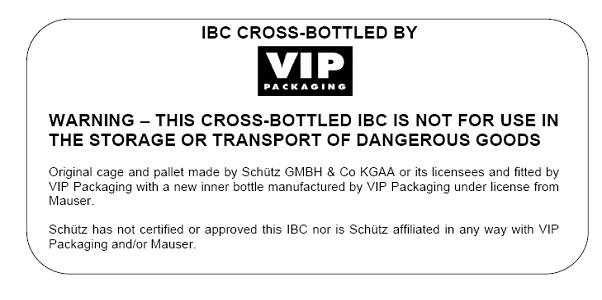
4 Schutz was not content with this form of the undertaking. I heard an application on 27 August 2009 (Schutz No 1) for an interlocutory injunction restraining VIP from exploiting the cross-bottled IBCs. By orders made on 6 October 2009, I dismissed the application by Schutz for an interlocutory injunction as I considered that the undertakings voluntarily offered by VIP were adequate protection. The terms of the undertakings above were included in the orders.
5 Schutz makes the point that the orders made on 6 October 2009 did not expressly define the term ‘cross-bottled IBC’ nor was that term defined in the reasons for orders made on 6 October 2009 in Schutz No 1. By orders made on 13 October 2010, VIP was released from the undertakings which were recorded in the 6 October 2009 orders. In lieu of those undertakings, VIP undertook to refrain from selling or offer for sale or distributing in the course of trade any cross-bottled IBC not bearing a specific warning label, the text of which was endorsed by the Court from the annexures to the motion. Again, the orders made on that date did not expressly define the term ‘cross-bottled IBC’. As a technical term, it is true to say that it was also not expressly defined in the reasons published on 13 October 2010.
6 Schutz argues that VIP’s practice of reconditioning and selling cross-bottled IBCs, which are cross-bottled by other manufacturers, breaches the undertakings. Schutz says these undertakings need to be read broadly.
7 Schutz contends that at the time the undertakings were recorded and the orders made on 6 February 2009 and 13 October 2010, there was no evidence before the Court to suggest that VIP were engaging in the practice of reconditioning IBCs that had been cross-bottled by other parties. Schutz says that if evidence of that type had been before the Court it could be inferred that the Court would have made orders to prevent VIP from engaging in that practice. Schutz argues that on a simple analysis, the undertakings applied to any cross-bottled IBC whatsoever including IBCs cross-bottled by other parties not just by VIP.
8 Schutz points to the fact that since February 2011, Schutz has received, through its ‘own’ ticket service, a total of nine cross-bottled IBCs sold, supplied or otherwise distributed in the course of trade by VIP in a condition which, Schutz contends, breaches the undertakings recorded in the orders of 6 October 2009 and 13 October 2010.
9 Briefly, the evidence (in the fifth affidavit of Mr Johnston sworn on 10 March 2011) shows that the first of these is a ‘Nuplex IBC’ comprising a Schutz manufactured cage, a Mauser-manufactured inner plastic container bearing Schutz UN certification markings and a ‘reconditioned IBC’ sticker bearing the date, 22 November 2010 but no Court endorsed ‘warning’ label.
10 Schutz has received IBCs ‘Q67’ and ‘Q68’ on which the Court endorsed warning label has the word ‘new’ blacked out.
11 Schutz has also received IBCs ‘VO16’ and ‘VO22’ where no label has been affixed and IBCs ‘DGV018’ and ‘DGV019’ with no labels attached.
12 It is argued, therefore, by Schutz that there were nine instances of breach of VIP’s undertakings to attach the warning labels. As such, it is argued that the breaches cannot be dismissed as mere errors.
13 To the contrary, it is argued by Schutz that VIP’s conduct exhibits a pattern of disregard for the regulatory regime governing the transport of Dangerous Goods (DG) by road and rail and for their undertakings given to the Court and Schutz. It is argued that VIP’s conduct is likely to mislead and deceive those persons who fill, transport and use the VIP cross-bottled IBCs to believe that the units are genuine Schutz manufactured products; that they have been cross-bottled with Schutz’ approval and/or authorisation and in the case of units bearing UN certification markings, that they are certified for use in the transport of DG. It is argued that the cage and bottle combination of the units, however, has not been performance tested and certified in accordance with the regulatory regime. On that basis, Schutz seeks an injunction which would have the effect of preventing ‘non-compliant IBC products’ being sold by VIP.
14 VIP submit, and I accept, that the undertakings must be construed as a whole according to the ordinary principles of construction, taking into account, amongst other things, the context in which the undertakings were given. While the orders would normally speak for themselves, in the case of ambiguity, the Court may have reference to the underlying issues in the proceedings. In Franks v Equitiloan Securities Pty Ltd [2010] NSWSC 693, Pembroke J said (at [7] and [8]):
7 It is well accepted that the construction of an undertaking given to a Court will inevitably involve consideration of the surrounding circumstances, including the context in which the undertaking was given, and will require reference to the issues in the underlying proceedings and the competing allegations of the parties. The parties did not disagree about the applicable principles: Owston Nominees No 2 Pty Ltd v Branir Pty Ltd (2003) 129 FCR 558 at 569 per Allsop J; Bryant & Anor v Keith Harris & Co Ltd & Ors (1980) 33 ALR 437 at 449-450 per Lockhart J.
8 There is no separate principle that requires any additional leniency or generosity in construing an undertaking compared to that which would apply in the construction of a contract. The question is, what do the words mean, and if there is any ambiguity about the words, or even perhaps if there is no patent ambiguity, what was the context in which those words were made, so as to elucidate their meaning - conformably with the language chosen by the parties in the circumstances which prevailed at the time: Pacific Carriers Ltd v BNP Paribas (2004) 218 CLR 451 at 462. See also Codelfa Constructions Pty Ltd v State Rail Authority of NSW (1982) 149 CLR 337 at 350; Reardon Smith Line Ltd v Hansen-Tangen (1976) 1 WLR 989 at 995-996 per Lord Wilberforce.
15 The broad reading advanced by Schutz is inconsistent with the basis on which the issues were argued and determined.
16 At the time of giving the undertaking of 13 October 2010, the conduct complained about by Schutz, in its then second further amended application, sought orders declaring that VIP had infringed the patent by ‘replacing the original plastic tank contained in the Eco Bulk IBCs with IBCs [plastic tanks] manufactured by VIP’. This, in turn, was supported by the pleading as at that stage which expressly defined ‘cross-bottled IBCs’ (at [14]) as being products which VIP ‘had manufactured in New South Wales, Queensland and Victoria … comprised of: used outer steel cages, originally manufactured by Schutz …; and new inner rigid plastic blow-moulded containers manufactured by VIP under licence from Mauser …’.
17 All of the pleaded representations (the Certification Representations, Affiliation Representation, Authorisation Representations and the Misleading and deceptive conduct and false representations) related specifically to the manufacture, sale and supply of the defined IBCs. The defined IBCs (that is the CB1 IBCs and the CB2 IBCs) related to the ‘manufacture’ by VIP of a cross-bottled IBC comprising a Schutz cage and a VIP bottle. Therefore, it follows that at all times it has been the conduct of cross-bottling which was and is the subject of Schutz’ pleaded case as distinct from the washing of bottles of previously cross-bottled IBCs, whether by VIP or any other person. This aspect of the pleading has not changed.
18 Further, the evidence adduced by the parties was consistent with the construction for which VIP contends. The affidavit evidence relied upon by VIP, including the affidavit of Mr Andrew Smith sworn on 17 August 2009, explained the activities of VIP including cross-bottling on the one hand and reconditioning or cleaning of existing used bottles on the other. In his further evidence in relation to the orders made on 13 October 2010, the same distinction was drawn.
19 In my view, Schutz has never sought to restrain VIP’s reconditioning activities. Its case has always been directed against the cross-bottling activities. I do not accept the contention that the undertakings apply to the mere washing and supply of previously cross-bottled IBCs. It follows that there has been no breach of any undertaking by VIP and certainly no ‘pattern of disregard’.
20 Further, on its terms, the undertaking 1(b) in the orders of 13 October 2010 provides that VIP:
Will affix to each label plate of the cage of any Cross-Bottled Non-DG IBC that is sold, offered for sale or distribution in the course of trade by them a heat resistant label in the form and dimensions of the example annexed here to and marked ‘B’ and to remove therefrom any marking affixed by [Schutz] signifying that the Cross-Bottled IBC is certified for use in the transport of dangerous goods.
21 In the annexure B referred to in undertaking 1(b), which has been previously referred to and similar to the annexure at [3], the heading expressly relates to IBCs cross-bottled by VIP. The terms of the undertaking expressly contain the words ‘fitted by VIP Packaging with a new inner bottle manufactured by VIP Packaging … under licence from Mauser’. Order 1(a) of the undertaking is also relevantly in similar terms. In turn, these reflect order 2(b) of the previous order of 6 October 2009.
22 In my view, it is clear that VIP’s labelling obligations apply where VIP fits a new inner bottle manufactured by VIP to a Schutz IBC. Were it otherwise, as contended by Schutz, the undertaking would be required to apply to the sale of IBCs washed by VIP which had been previously cross-bottled by a third party such as ‘Nuplex’ and ‘VIC’. The wording in annexure B is not directed to such circumstances. In express terms it is directed to the fitting by VIP with a new inner bottle manufactured by VIP.
23 I am not persuaded by the arguments advanced by Schutz on these issues. The IBCs under consideration now are what VIP has previously described as ‘reconditioned IBCs’. That is, they are simply the washed inner containers previously cross-bottled either by VIP or by others.
24 Schutz is therefore seeking to reinstate orders which were discharged on 13 October 2010 and to extend the scope of such orders by restraining the provision of reconditioned IBCs. Although there is a general power to revisit interlocutory orders and to vary an order previously made, the re-litigation of issues already determined, even at an interlocutory level, requires a stronger case to be made than has been advanced on this occasion. In my view, no material change in the circumstances has been relied upon in support of this motion. The serious allegation that VIP has exhibited a pattern of disregard for regulatory regime governing the transport of DG or for undertakings given, is not made out. It turns on a narrow construction of the undertakings given when the parties were clear as to the issues under consideration and being addressed by the terms of previous orders and undertakings.
25 I accept the submissions of VIP that:
(a) VIP has obtained Approval number 30746 and is lawfully entitled to undertake cross-bottling in accordance with that approval;
(b) VIP’s compliance with that approval is the subject of supervision by the competent authorities exercising authority under the DG Legislation;
(c) Such activity represents lawful competition in the market for reconditioned IBCs which ought not to be lightly curtailed; and
(d) No relevant risk to public safety has been shown.
The nine NDG IBCs relied upon by Schutz
26 There is a warning label affixed to the NDG IBCs, cross-bottled by VIP consistent with the Court’s orders of 13 October 2010 reading as follows:
27 VIP draws particular attention to the words ‘fitted by VIP Packaging with a new inner bottle manufactured by VIP Packaging’. The plain meaning of the words are that the label is required on IBCs where VIP has both manufactured and fitted the inner bottle. Against that background, in relation to the nine IBCs identified by Schutz, the ‘Nuplex IBC’ and the ‘VIC IBCs’ were not cross-bottled by VIP but rather, were cross-bottled by third parties overseas. In those circumstances, no warning labels could be expected to be affixed to those IBCs. They were subsequently reconditioned (washed) by VIP and supplied for NDG purposes. The evidence shows (in the ninth affidavit of Mr Andrew Smith sworn on 17 June 2011 (the 9th Smith affidavit)) that in one instance only the cage continued to bear a Schutz UN marking. VIP has, on the basis of the Smith evidence and consistently with its undertaking, removed Schutz UN labelling as part of its cross-bottling practices. It had not previously done so as part of its washing process on the basis that customers may wish to use such an IBC for DG purposes in the future subject to compliance with the regulatory regime. Neither does the undertaking require, VIP stresses, removing a UN marking as part of the washing process. The evidence shows that, notwithstanding this, VIP has now taken immediate steps to ensure that it removes UN labelling appropriately as part of its washing process as well.
28 As to the ‘VO16’, ‘VO22’, ‘DGV018' and ‘DGV019’ IBCs, VIP accepts those IBCs were cross-bottled by VIP for NDG purposes but prior to the making of the interlocutory orders in this proceeding. It follows that in relation to those IBCs, no ‘warning’ labels were affixed.
29 The evidence appears to demonstrate that on one occasion as part of the washing process, a VIP employee (an inspector) applied a sticker reading ‘reconditioned DG’ notwithstanding that the IBCs were supplied for NDG purposes. It is an isolated error but, in any event, according to VIP, does not technically breach the Court ordered warning label and does not represent a breach of the undertakings.
30 Finally, as to ‘Q67’ and ‘Q68’ IBCs, again, VIP accepts those IBCs were cross-bottled by it and supplied for NDG use. The warning labels were applied in compliance with VIPs undertakings given to the Court. When the IBCs were provided to VIP for reconditioning, VIP laundered those IBCs and supplied them for NDG purposes. It appears that, as part of that process, a VIP employee out of concern that the word ‘new’ in the warning label might create a misapprehension that the laundered bottle was new, blacked out that word using a felt tip pen. VIP has taken immediate steps to ensure that this does not recur in the future. Again, however, it does not reflect a breach or at least a significant breach of the undertakings.
31 Coming then to the main point upon which Schutz relies, the complaints as to each of the IBCs are said, by Schutz, to relate to VIP’s cross-bottling activities. VIP argues, however, that the complaints do not in truth relate to those activities at all but rather to the supply of units by VIP in circumstances where it has merely washed the inner bottle and supplied the IBC. Those IBCs were previously cross-bottled either by third parties (in three instances) or by VIP prior to the commencement of the interlocutory orders (in four instances). On the remaining two occasions, VIP cross-bottled the IBCs during the currency of the labelling regime and applied the appropriate warning labels in compliance with the regime. As part of a subsequent reconditioning activity, the word ‘new’ was marked out lest there be any misapprehension as to the condition of the bottle.
32 There has been no relevant adverse change of circumstance which would warrant revisiting the earlier orders, especially without adequate notice being given to VIP to consider the failed but serious assertions raised against them.
33 As noted in Schutz DSL (Australia) Pty Ltd v VIP Plastic Packaging Pty Ltd (No 5) [2010] FCA 1105 (Schutz No 5) (at [40]), VIP has acquired Approval number 30746 pursuant to which it is entitled to engage in cross-bottling. There is no reasonable basis on which to unconditionally prohibit VIP from engaging in that activity.
34 As previously noted in Schutz No 5 (at [40]-[42]), Worksafe Victoria has extensive powers under the DG legislation to supervise the relevant conduct and has been invited to do so. It has been actively doing so. It is inappropriate for the Court to interfere in the administration of that regime.
35 The initial injunction was granted having regard, in particular, to Schutz’ assertions as to heightened risks of public safety arising from cross-bottling. However, by the time of the hearing on 6 August 2010, as I noted in Schutz No 5 (at [43]), the emphasis in the claim by Schutz had shifted from one initially relying on possible dangers to one which asserted contraventions of the TPA. I considered that there was inadequate, if any, evidence as to a risk of public safety at that stage and noted that should such evidence emerge, it would be open to revisit the position. No evidence has been adduced in support of the current motion of any risk of public safety. Indeed, as noted, on the evidence of the 9th Smith affidavit, Schutz’ own licensees undertake cross-bottling.
CONCLUSION
36 The balance of convenience and all other factors relied upon in the arguments advanced by Schutz are, in my respectful view, strongly against the injunctive relief sought by Schutz.
37 The applicants/cross-respondents’ motion to restrain the respondents/cross-claimants’ cross-bottling dated 3 June 2011 be dismissed with costs.
I certify that the preceding thirty-seven (37) numbered paragraphs are a true copy of the Reasons for Judgment herein of the Honourable Justice McKerracher. |
Associate:


