

FEDERAL COURT OF AUSTRALIA
Schutz DSL (Australia) Pty Ltd v VIP Plastic Packaging Pty Ltd (No 9) [2011] FCA 1087
IN THE FEDERAL COURT OF AUSTRALIA | |
DATE OF ORDER: | 21 SEPTEMBER 2011 |
WHERE MADE: |
THE COURT ORDERS THAT:
Applicants’ Motion
1. The applicants/cross-respondents’ motion to amend the Third Further Statement of Claim dated 3 June 2011 (Applicants’ Motion) be allowed.
2. Further to paragraph 1, the applicants/cross-respondents have leave to file a Fourth Further Amended Statement of Claim in terms of the draft document entitled ‘Revised Minute of Fourth Further Amended Statement of Claim’ dated 3 June 2011.
3. The Fourth Further Amended Statement of Claim be filed within 14 days.
4. The applicants do pay any costs thrown away by reason of the Applicants’ Motion.
Respondents’ Motion
5. The respondents/cross-claimants motion to amend the Defence to the Third Further Amended Statement of Claim and Third Further Amended Cross-Claim, and the Further Amended Particulars of Invalidity dated 3 June 2011 (Respondents’ Motion) be allowed.
6. Further to paragraph 5, the respondents/cross-claimants has leave to file an amended defence to the third further amended statement of claim and fourth further amended cross-claim in terms of Annexure A entitled ‘Amended Defence to the Third Further Amended Statement of Claim and Fourth Further Amended Cross-Claim’ attached to the Respondents’ Motion filed on 7 June 2011.
7. The Amended Defence to the Third Further Amended Statement of Claim and Fourth Further Amended Cross-Claim be filed within 14 days.
8. Further to paragraph 5, the respondents/cross-claimants has leave to file a further amended particulars of invalidity in terms of Annexure B entitled ‘Second Further Amended Particulars of Invalidity’ attached to the Respondents’ Motion filed on 7 June 2011.
9. The Second Further Amended Particulars of Invalidity’ be filed within 14 days.
10. The respondents do pay any costs thrown away by reason of the Respondents’ Motion.
Note: Entry of orders is dealt with in Rule 39.32 of the Federal Court Rules 2011.
WESTERN AUSTRALIA DISTRICT REGISTRY | |
GENERAL DIVISION | WAD 136 of 2009 |
BETWEEN: | SCHUTZ DSL (AUSTRALIA) PTY LTD (ACN 009 069 907) First Applicant/Cross-Respondent SCHUTZ GMBH & CO KGAA Second Applicant/Cross-Respondent PROTECHNA S.A. Third Applicant/Cross-Respondent
|
AND: | VIP PLASTIC PACKAGING PTY LTD (ACN 095 313 705) First Respondent/Cross-Claimant VIP STEEL PACKAGING PTY LTD (ACN 095 314 195) Second Respondent/Cross-Claimant
|
JUDGE: | MCKERRACHER J |
DATE: | 21 SEPTEMBER 2011 |
PLACE: | PERTH |
REASONS FOR JUDGMENT
INTRODUCTION
1 These reasons (Schutz No 9) and those in the five sets to follow, relate to several interlocutory applications concerning the dispute between Schutz and VIP, as those parties have been defined in Schutz DSL (Australia) Pty Ltd (ACN 009 069 907) v VIP Plastic Packaging Pty Ltd (ACN 095 313 705) (2009) IPR 477 (Schutz No 1). These reasons relate to opposed motions for pleading amendments.
BACKGROUND
2 Given the passage of time since commencement of the proceeding, it is desirable to revisit the basic dispute. As noted in Schutz No 1, products known as Composite Intermediate Bulk Containers (Composite IBCs) are used for transporting liquids. Composite IBCs constitute an outer metal frame or cage in the shape of a cube and an inner container of a different material such as plastic or polyethylene. Composite IBCs present a viable option for the transport of liquids which might have otherwise been transported in larger containers or tanks or, alternatively, in smaller containers such as ‘44 gallon’ drums. Liquids transported in Composite IBCs fall into various classes ranging from non-dangerous through to highly dangerous.
3 In Schutz No 1, I described the products and the market in some detail. It is not necessary to repeat that detail. The abbreviations adopted in those and subsequent reasons remain in use in these reasons.
Collection service
4 A service exists of collecting Composite IBCs, reconditioning them and having them recertified in accordance with regulatory requirements so that they can be offered for resale. The applicants (collectively, ‘Schutz’), at various levels, have provided those goods and services worldwide including within Australia. The respondents (collectively, ‘VIP’) have also entered the same market, providing similar services. On occasions, reconditioned Composite IBCs provided by VIP have included one of the Schutz cages. Schutz objects to VIP’s use, especially without safety precautions and suitable attribution to Schutz, of any part of Schutz’ products.
5 An interim injunction was granted for a brief period restraining VIP from the conduct the subject of the complaint. That injunction lapsed and Schutz sought an interlocutory injunction until trial. Prior to the hearing, VIP produced an undertaking (without any admissions).
VIP’s undertaking
6 In Schutz No 1, I noted (at [35]) that VIP offered an undertaking in the following terms:
1. To refrain by themselves, their servants or agents from selling, offering for sale or distributing in the course of trade cross-bottled Intermediate Bulk Containers designated as being suitable for the transport of dangerous goods.
2 To affix to each label plate of the cage of any cross-bottled Intermediate Bulk Container (IBC) that is sold, offered for sale or distributed in the course of trade by them a heat resistant label substantially in the form and dimensions of the mock-up annexed and marked "A" and to remove therefrom any marking affixed by the Applicants signifying that the said IBC is certified for use in the transport of dangerous goods.
“A”
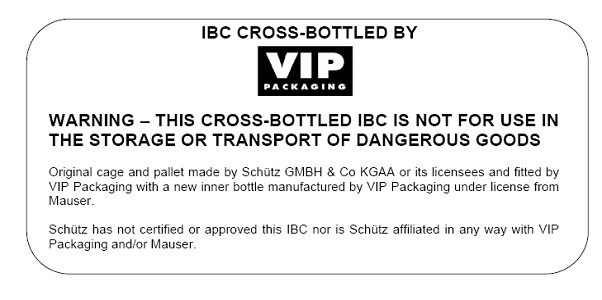
7 Paragraph 1 of the undertaking was to be effective immediately on it being given to the Court.
8 VIP pointed to the fact that in relation to the sale of the containers for non-dangerous goods (NDG), no labelling or warning of any description was required by regulation and the labelling or warning which they undertook to put on the containers went beyond any obligation they had under statute or regulation.
9 Schutz contended that the labelling was inadequate and that consumers could still easily be misled into believing that they were acquiring a reliable Schutz made product when in fact that was not the case.
10 I concluded that the undertaking, as provided by VIP until trial, was suitable protection for Schutz.
SCHUTZ MOTION TO FILE FOURTH FURTHER AMENDED STATEMENT OF CLAIM
11 Subsequent to the hearing, on 17 August 2011 consent orders were made in relation to the proposed amended pleadings. The orders provided for VIP to notify Schutz and the Court on whether they would consent to the amended pleadings. VIP did not consent to the amendments.
12 The substance of the amendment proposed by Schutz in the proposed amended pleading relates to the claim, by Schutz, for removal of VIP’s ECODRUM trademark from the Register of Trademarks.
13 By para 74G of the third further amended statement of claim for Schutz, there is a plea referring to the manufacture of the Schutz drum container products in various countries since in or around 2001 and the promotion of those products under the ECODRUM trademark owned by Schutz GMBH. It reads as follows:
74G Since January 2001, Schütz Germany has by itself, its licensees and subsidiaries, manufactured ECODRUM Products in Germany, Norway, England, Ireland, the United States, Argentina, Mexico and Australia, and promoted and sold ECODRUM Products worldwide.
14 As is made clear in the seventh affidavit of Mr Steven Johnston, sworn on 2 June 2011 (the 7th Johnston affidavit) (at [32]), that the reference to ‘Australia’ in para 74G was included in that paragraph in error. It does not accord with the true factual history of the manufacture and sale of Schutz drum container products in Australia. Accordingly, the proposed amendment simply corrects that error and proposes to add para 74GA and para 74GB so as to clarify the position. Those paragraphs are in these terms:
74GA Since in or around July 2003, Schütz Australia has promoted and sold in Australia drum containers manufactured by Schütz Germany for use in the transport and storage of non-dangerous and dangerous goods under the Schütz Mark.
74GB Since in or around October 2006, Schütz Australia has manufactured, promoted and sold 220L closed head drum containers in Australia for use in the transport and storage of non-dangerous and dangerous goods under the Schütz Mark.
15 In exchanges prior to the hearing, VIP raised objections to the proposed amendments contending that the amendments proposed amounted to withdrawal of an admission to the effect that Schutz promoted and sold ECODRUM products in Australia from 2001.
16 Under the Federal Court Rules (FCR) applicable at the time this interlocutory dispute was argued, the power of the Court to grant leave to withdraw an admission was contained in O 18 r 1(2) FCR. Relevantly to this proposed amendment, to withdraw an admission an applicant is required to satisfy the Court that an error or mistake has been demonstrated; there is a sensible explanation for the making of the admission based on evidence of a solid and substantial character; and no injustice will be occasioned by withdrawal of the admission other than hardship by delay or cost which can be accommodated by an appropriate order for costs: Murran Investments Pty Ltd v Aromatic Beauty Products Pty Ltd (2000) 191 ALR 579 (at [45]).
17 VIP argues that the withdrawal of the admission of use of the ECODRUM trademark in Australia is surprising in circumstances where the remainder of Schutz’ pleading, such as para 74N and para 75S of the third further amended statement of claim, continues to positively assert that Schutz has used the ECODRUM trademark in respect of its drum containers in various jurisdictions around the world since 2001. Further, in relation to claims by Schutz that VIP’s predecessor wrongly obtained the mark from Schutz, VIP argues that it is particularly difficult to reconcile the denial of the use of the ECODRUM trademark in Australia with the assertion by Schutz of a s 52 TPA claim, presumably based on its reputation in Australia and in respect of that name. VIP points to the fact that Schutz’ use of the ECODRUM trademark is further confirmed by the evidence which has been filed by VIP relating, for example, to the use on its website in Australia.
18 VIP contends that Schutz has provided no adequate explanation as to whether the admission as to the use of the ECODRUM trademark in Australia was by mistake. VIP argues that the evidence of Mr Johnston is limited only to the issue of the change of date of commencement of manufacture and sale of the products in Australia. In relation to the issue of the use of the ECODRUM trademark, Mr Johnston makes no more than a bare assertion that Schutz has sold relevant products under the ‘Schutz’ trademark.
19 Schutz argues that the amendment does not constitute withdrawal of any admission because the ‘bundled up’ plea in para 74G was not clear in any event.
20 Secondly, and perhaps more importantly, Schutz argues correctly that the purpose of the pleadings is to define the issues between the parties. The purpose will only be achieved if the plea at para 74G is amended to reflect the actual or true factual position. Schutz relies upon the observations by Bowen LJ in Smith v Cropper (t/a HS Cropper & Co) (1884) LR 26 Ch D 700 (at 710-711) (also noted with approval in Celestino, R. v. Celestino, A [1990] FCA 449) where Bowen LJ said:
… that the object of Courts is to decide the rights of the parties, and not to punish them for mistakes they make in the conduct of their cases by deciding otherwise than in accordance with their rights. Speaking for myself, and in conformity with what I have heard laid down by the other division of the Court of Appeal and by myself as a member of it, I know of no kind of error or mistake which, if not fraudulent or intended to overreach, the Court ought not to correct, if it can be done without injustice to the other party. Courts do not exist for the sake of discipline, but for the sake of deciding matters in controversy, and I do not regard such amendment as a matter of favour or of grace. Order XXVIII. rule 1, of the Rules of 1883, which follows previous legislation on the subject, says that, “All such amendments shall be made as may be necessary for the purpose of determining the real questions in controversy between the parties.” It seems to me that as soon as it appears that the way in which a party has framed his case will not lead to a decision of the real matter in controversy, it is as much a matter of right on his part to have it corrected, if it can be done without injustice, as anything else in the case is a matter of right.
21 The observations by Bowen LJ in a succinct manner conform with what was said in Aon Risk Services Australia Ltd v Australian National University (2009) 239 CLR 175, as long as the expression ‘without injustice’ is understood to include the injustice that may be occasioned by unnecessary delay and the consequential cost. There is, in my view, no basis at present for a conclusion that the amendment would give rise to any real injustice. As observed in the authorities discussed above and more recently by Flick J in AMI Australia Holdings Pty Ltd v Bade Medical Institute (Aust) Pty Ltd (No 2) (2009) 262 ALR 458 (at [50]), the central principle applying to the discretion to grant leave to amend is to do justice between the parties.
22 To the contrary, I accept the submissions from Schutz that the amendment is appropriate as it has been established that the inclusion of the reference to Australia in para 74G was in error. The error was detected shortly prior to the motion being pursued and the amendment sought promptly after it was detected; the sole purpose of the amendment is to correct the factual error; the proceedings are not so far advanced that the amendment will cause any real disruption to the programming of the matter to trial. It is by no means apparent that VIP will suffer any real prejudice by reason of the amendments.
23 The amendment is permitted. Schutz should pay any costs thrown away by reason of the amendment.
VIP NOTICE OF MOTION TO AMEND ITS DEFENCE
24 VIP also seeks leave to file an amended defence to the third further amended statement of claim, fourth further amended cross-claim and second further amended particulars of invalidity. Schutz opposes the VIP application.
25 These proceeding were commenced by Schutz in August 2009. Discovery was given on 21 December 2010. The parties have filed evidence in chief in relation to the infringement issue in March 2011.
26 The evidence in answer and VIP’s evidence in chief on its cross-claim for invalidity of the Australian Patent number 686500 (the Patent) should now have been filed. No date has been set for trial. Trial remains at least some months away.
27 VIP’s proposed second further amended particulars of invalidity proposes to include additional challenges to the validity of the Patent. The amendments fall within three groups relating to:
(a) the ‘interchangeable’ nature of the inner container;
(b) the inclusion of Schutz IBCs as part of the relevant prior art; and
(c) the significance of the ‘Weld Relief Feature’.
28 VIP contends that the factual matters the subject of those amendments will, in any event, be before the Court on the pleadings in their current form and, accordingly, the amendments do not materially extend the factual scope of the proceedings.
29 In relation to the defence and the cross-claim, the defence pursuant to s 144 of the Patents Act 1990 (Cth) (PA) is raised. That section provides as follows:
144 Void conditions
(1) A condition in a contract relating to the sale or lease of, or a licence to exploit, a patented invention is void if the effect of the condition would be:
(a) to prohibit or restrict the buyer, lessee or licensee from using a product or process (whether patented or not) supplied or owned by a person other than the seller, lessor or licensor, or a nominee of the seller, lessor or licensor; or
(b) to require the buyer, lessee or licensee to acquire a product not protected by the patent from the seller, lessor or licensor, or a nominee of the seller, lessor or licensor.
(1A) A condition in a contract relating to the sale or lease of, or a licence to exploit, an invention the subject of an innovation patent is void if the effect of the condition would be to:
(a) prohibit the buyer, lessee or licensee from applying for examination of the patent; or
(b) impose restrictions on the circumstances in which the buyer, lessee or licensee may apply for examination of the patent.
(2) Subsection (1) does not apply if:
(a) the seller, lessor or licensor proves that, at the time the contract was made, the buyer, lessee or licensee had the option of buying the product, or obtaining a lease or licence, on reasonable terms without the condition; and
(b) the contract entitles the buyer, lessee or licensee to be relieved of the liability to comply with the condition on giving the other party 3 months’ notice in writing and paying, in compensation for the relief:
(i) in the case of a sale—such sum as is fixed by an arbitrator appointed by the Minister; or
(ii) in the case of a lease or licence—such rent or royalty as is so fixed for the rest of the term of the contract.
(3) A person is not stopped from applying for or obtaining relief in any proceedings under this Act merely because of an admission made by the person about the reasonableness of terms offered to the person as mentioned in paragraph (2)(a).
(4) It is a defence to proceedings for infringement of a patent that the patented invention is, or was when the proceedings were started, the subject of a contract containing a provision, inserted by the patentee, that is void under this section.
(5) If the patentee offers the other parties to a contract mentioned in subsection (4) a new contract that does not contain the void condition but that otherwise gives the parties the same rights as the existing contract, then, whether or not the other parties accept the new contract in place of the existing contract, subsection (4) ceases to apply, but the patentee is not entitled to damages or an account of profit for an infringement of the patent committed before the offer of the new contract.
30 The conditions of sale of Schutz’ products to third parties are already in issue on the current pleadings. Schutz contends that it manufactures and sells IBCs and denies that there is an implied licence to reuse IBCs with a new inner container. Accordingly, it appears that Schutz currently asserts that it is a condition of sale of Schutz IBCs that all new inner containers for use with those IBCs must be provided by Schutz or its nominees. VIP, therefore, contends that it is entitled to rely on the defence provided above by s 144 PA which constitutes a confined legal point based on matters already raised on the facts in the current pleading.
31 As to the defence under s 144 PA, Schutz contends that the defence must fail for being insufficiently pleaded and failing to comply with the FCR. It is argued that the case put is speculative and lacking in particularity.
32 Schutz have raised extensive objections to the pleading. However, the topics raised by the pleading essentially raise principles of law. They will not require a significant body of additional evidence and can primarily turn on the existing facts. If the points advanced in opposition to the pleading are correct, then it is difficult to see that Schutz would suffer any prejudice as those points can be advanced in their present or modified form at the hearing. In contrast, VIP would be deprived of what may be a reasonable defence. As to that, it is not possible at this stage to say that the defence would be unarguable as Schutz contends.
33 VIP also seeks to raise a further cross-claim in relation to misleading and deceptive conduct. This relates to representations appearing on the second applicant’s website (Schutz GMBH & Co KGAA). Those representations, of which VIP only recently became aware, relate to alleged inferior safety or cross-bottled IBCs. VIP contends that the representations are misleading and deceptive. The safety issue is central for the disputes between the parties. Schutz also opposes the amendments.
34 In relation to the misleading and deceptive conduct claim, VIP’s evidence is that they have only recently become aware of the representations made on the website. Schutz complains that they could have discovered this much earlier. In my view, that is not the test. There may be some additional delay but Schutz has advanced many interlocutory applications in this litigation, sometimes on a repeated basis. I do not think Schutz can be heard to complain about delay by reason of this additional amendment.
35 In relation to the proposed amendments to the particulars, I intend to adopt the approach taken in relation to the s 144 PA amendment. Schutz draws VIP’s attention to Practice Note IP1 which, no doubt, VIP will take into account.
36 As to VIP’s amendment, there is no obvious prejudice for these amendments to be allowed. On the basis of the reasoning reflected in the previous section dealing with the application by Schutz, leave will be granted to VIP in accordance with its motion to file and serve its amended defence and further particulars in the terms sought.
37 VIP should pay any costs thrown away by reason of the amendment.
conclusion
38 The orders will be:
Applicants’ Motion
1. The applicants/cross-respondents’ motion to amend the Third Further Statement of Claim dated 3 June 2011 (Applicants’ Motion) be allowed.
2. Further to paragraph 1, the applicants/cross-respondents have leave to file a Fourth Further Amended Statement of Claim in terms of the draft document entitled ‘Revised Minute of Fourth Further Amended Statement of Claim’ dated 3 June 2011.
3. The Fourth Further Amended Statement of Claim be filed within 14 days.
4. The applicants do pay any costs thrown away by reason of the Applicants’ Motion.
Respondents’ Motion
5. The respondents/cross-claimants motion to amend the Defence to the Third Further Amended Statement of Claim and Third Further Amended Cross-Claim, and the Further Amended Particulars of Invalidity dated 3 June 2011 (Respondents’ Motion) be allowed.
6. Further to paragraph 5, the respondents/cross-claimants has leave to file an amended defence to the third further amended statement of claim and fourth further amended cross-claim in terms of Annexure A entitled ‘Amended Defence to the Third Further Amended Statement of Claim and Fourth Further Amended Cross-Claim’ attached to the Respondents’ Motion filed on 7 June 2011.
7. The Amended Defence to the Third Further Amended Statement of Claim and Fourth Further Amended Cross-Claim be filed within 14 days.
8. Further to paragraph 5, the respondents/cross-claimants has leave to file a further amended particulars of invalidity in terms of Annexure B entitled ‘Second Further Amended Particulars of Invalidity’ attached to the Respondents’ Motion filed on 7 June 2011.
9. The Second Further Amended Particulars of Invalidity’ be filed within 14 days.
10. The respondents do pay any costs thrown away by reason of the Respondents’ Motion.
I certify that the preceding thirty-eight (38) numbered paragraphs are a true copy of the Reasons for Judgment herein of the Honourable Justice McKerracher. |
Associate:


