FEDERAL COURT OF AUSTRALIA
Australian Competition and Consumer Commission v Trading Post Australia Pty Ltd [2011] FCA 1086
FEDERAL COURT OF AUSTRALIA
Australian Competition and Consumer Commission v
Trading Post Australia Pty Ltd [2011] FCA 1086
CORRIGENDUM
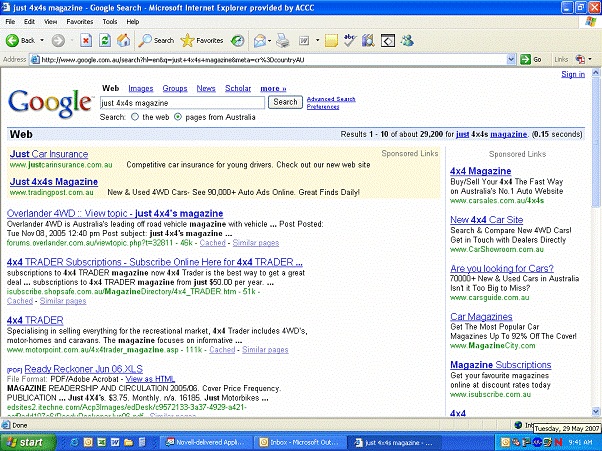
1. In paragraph 29 of the Reasons for Judgment, in the second sentence, the words “a licence” should be inserted after the word “hold”.
2. In paragraph 139 of the Reasons for Judgment, in the third sentence, the word “as” should be omitted.
3. In paragraph 200 of the Reasons for Judgment, in the third sentence, the word “not” should be inserted after the word “does”.
4. In paragraph 241 of the Reasons for Judgment, in the first sentence, the word “Travel” should be inserted after the word “STA”
5. In paragraph 282 of the Reasons for Judgment, in the first sentence, the word “accounts” should read “account”.
6. In paragraph 314 of the Reasons for Judgment, in the second sentence, the words “there were” should read “there was”.
7. In paragraph 339 of the Reasons for Judgment, in the first sentence, the words “Just Magazine” should read “Just Magazines”.
| I certify that the preceding seven (7) numbered paragraphs are a true copy of the Corrigendum to the Reasons for Judgment herein of the Honourable Justice Nicholas. |
Associate:
Dated: 10 October 2011
|
IN THE FEDERAL COURT OF AUSTRALIA | |
| AUSTRALIAN COMPETITION AND CONSUMER COMMISSION Applicant | |
| AND: | TRADING POST AUSTRALIA PTY LIMITED (ACN 001 821 156) First Respondent GOOGLE INC Second Respondent |
| DATE OF ORDER: | |
| WHERE MADE: |
THE COURT DECLARES THAT:
1. By publishing or causing to be published advertisements on or about 28 August and 30 August 2005 in response to searches undertaken using the search engine at the website at www.google.com.au for the keyword “Kloster Ford” in circumstances where:
(a) each advertisement included a headline consisting of the words “Kloster Ford”;
(b) each advertisement included a link to the website at www.tradingpost.com.au;
(c) no information regarding Kloster Ford could be found at the website at www.tradingpost.com.au; and
(d) no information regarding Kloster Ford car sales could be found at the website at www.tradingpost.com.au
the first respondent, in trade or commerce, engaged in conduct that was misleading or deceptive or likely to mislead or deceive in contravention of s 52(1) of the Trade Practices Act 1974 (the Act) by representing, contrary to the fact, that:
(i) there was an association or affiliation between the first respondent and Kloster Ford;
(ii) information regarding Kloster Ford could be found at the website at www.tradingpost.com.au; and
(iii) information regarding Kloster Ford car sales could be found at the website at www.tradingpost.com.au.
2. By publishing or causing to be published advertisements on or about 28 August and 30 August 2005 in response to searches undertaken using the search engine at the website at www.google.com.au for the keyword “Kloster Ford” in circumstances where:
(a) each advertisement included a headline consisting of the words “Kloster Ford”;
(b) each advertisement included a link to the website at www.tradingpost.com.au;
(c) no information regarding Kloster Ford could be found at the www.tradingpost.com.au website; and
(d) no information regarding Kloster Ford car sales could be found at the www.tradingpost.com.au website
the first respondent, in trade or commerce, in connection with the supply or possible supply of goods or services, represented that it had an affiliation which it did not have and thereby contravened s 53(d) of the Act.
THE COURT ORDERS THAT:
3. The fourth further amended application filed 1 April 2010 be otherwise dismissed.
4. The first respondent pay $28,000 to the applicant by way of agreed contribution to the applicant’s costs of the proceeding.
5. The applicant pay the second respondent’s costs of the proceeding.
6. None of the orders previously made in this proceeding under s 50 of the Federal Court of Australia Act 1976 (Cth) shall prevent any person from publishing the whole or any part of these reasons for judgment.
Note: Entry of orders is dealt with in Rule 39.32 of the Federal Court Rules 2011
| NEW SOUTH WALES DISTRICT REGISTRY | |
| GENERAL DIVISION | NSD 1323 of 2007 |
| BETWEEN: | AUSTRALIAN COMPETITION AND CONSUMER COMMISSION Applicant |
| AND: | TRADING POST AUSTRALIA PTY LIMITED (ACN 001 821 156) First Respondent GOOGLE INC Second Respondent |
| JUDGE: | NICHOLAS J |
| DATE: | 22 September 2011 |
| PLACE: | SYDNEY |
REASONS FOR JUDGMENT
1 The second respondent, Google Inc (Google), operates the well known internet search engine also known as “Google” (the Google search engine). The first respondent, Trading Post Australia Pty Limited (Trading Post), has paid Google, or a related entity, to advertise in the manner and circumstances which I will later describe. The applicant (the ACCC) alleges that Google and Trading Post have, in trade or commerce, engaged in conduct that is misleading or deceptive or likely to mislead or deceive and that each of them contravened s 52 of the Trade Practices Act 1974 (Cth) (the Act). The ACCC alleges that Trading Post also contravened s 53(d) of the Act. The ACCC seeks declarations and injunctive relief against Google and declaratory relief against Trading Post.
2 The proceeding has been settled as between the ACCC and Trading Post. It was agreed between all parties that no declarations should be made as between the ACCC and Trading Post until the claims made against Google were determined in order to allow for the possibility that I came to the conclusion, in light of the evidence, that it would not be appropriate to make them.
BRIEF OVERVIEW OF THE ACCC’S CASE AGAINST GOOGLE
3 Google operates various websites throughout the world, including the websites google.com and google.com.au, which provide search facilities accessible in Australia. Some of the webpages generated by means of these search facilities in response to search requests are alleged by the ACCC to be misleading or deceptive or likely to mislead or deceive.
4 The ACCC alleges that at all relevant times Google has had a reputation for displaying search results in order of decreasing relevance as determined by Google. In particular, Google determines where, and in what order, on the webpage appearing on the screen of the user the search results generated by the Google search engine will appear. Such search results, known as “organic” search results, are ranked by Google according to relevance. They are to be distinguished from “sponsored links” which may also appear on the webpage. It is common ground that a sponsored link is an advertisement.
5 Google earns income from advertisers who pay for such sponsored links. How much an advertiser pays depends upon whether, and how often, users of the Google search engine click on the sponsored link when it appears. Sponsored links do not always appear in response to a search request but when they do so they appear either above or to the right of the organic search results or in both these locations. While the order of organic search results is determined solely by relevance as assessed by software which drives the Google search engine, the position of any sponsored links appearing on the webpage is determined by different software which takes account of various factors including the price-per-click which the advertiser is prepared to pay to have the sponsored link appear in response to a user’s search request.
6 The ACCC alleges that the appearance of organic search results and sponsored links is essentially the same. It alleges that the features of the relevant webpages that are said to distinguish organic search results from sponsored links are insufficient to do so. An example of a results page that includes advertisements on both the left and right side of the results page appears below:
7 The ACCC points to, on the left side of the results page, the subtle yellow shading at the top of the page and the use of what it alleges is the ambiguous expression “sponsored links” to describe the advertisements. The yellow shading and the expression “sponsored links” are said by the ACCC to be insufficient to counteract the impression otherwise created by the running together of the advertisements and search results. The ACCC also points to the heading (which in the above example states “Results 1-10 of about 29,200”) in the bar (the results bar) appearing at the top of the results page. So far as the right side of the page is concerned, the ACCC contends that neither the vertical line immediately to the left of the advertisements nor the expression “sponsored links” just above them is sufficient to distinguish them from organic search results.
8 It is also said by the ACCC that the lack of distinction on the left side of the page is compounded by the expectation that search results will appear in decreasing order of relevance which, according to the ACCC, inclines a class of users, such as those who are inexperienced or inadvertent, to click on an entry that appears at the top left side of the page, believing it to be an organic search result rather than an advertisement.
9 Each of the sponsored links appearing on the results page produced in response to a user’s search request contains a blue headline (the headline) which is itself a link which, if clicked, will ordinarily take the user to a website or webpage the Uniform Resource Locator of which is designated in green. Looking at the first of the top left sponsored links in the above example, the blue headline “Just Car Insurance” is a clickable link which will take the user who clicks on it to the website at www.justcarinsurance.com.au designated in green immediately beneath the “Just Car Insurance” headline.
10 Sometimes the headline to an advertisement will consist of keywords selected by a user of the Google search engine that corresponds with keywords selected by the advertiser which may, according to the ACCC, also be a business or product name of the advertiser’s competitor. The ACCC alleges that when the user clicks on the headline consisting of such keywords, he or she is likely to be taken to a website that has no association with the keywords selected.
11 According to the ACCC, the use of keywords in this manner implies, contrary to the fact, that there is an association between, on the one hand, the business or product that is known or identifiable by the keyword and, on the other hand, the advertiser or the advertiser’s website. This is said to be so of all such advertisements which are the subject of specific complaint in this proceeding irrespective of whether they appear on the top left or right hand side of the results page. The ACCC alleges that the use of such keywords in the headline of an advertisement is misleading or deceptive or likely to mislead or deceive.
12 Thus, there are two parts to the ACCC’s case against Google. The first part of the case is concerned with the overall layout and appearance of the results page which, it is said, fails to distinguish sufficiently between organic search results and advertisements. This part of the ACCC’s case extends to both advertisements which might appear on the left hand side of the results page immediately above the organic search results and to those advertisements which appear to their right, on the right hand side of the results page. The second part of the case is concerned with the use of what are said to be misleading keywords in the headlines of particular advertisements which may also appear on the left or right hand side of the results page.
13 The second part of the ACCC’s case is based upon eleven distinct claims involving various advertisers and sponsored links which Google is alleged to have published on its results pages. In particular, it is the ACCC’s case that these sponsored links were misleading or deceptive or likely to mislead or deceive because in each instance they included a headline consisting of a trading name, a product name or a website address of the advertiser’s competitor but which also serves as a clickable link to the advertiser’s website.
14 There is an overlap between the first and second parts of the ACCC’s case in that any failure to distinguish adequately between organic search results and advertisements forms part of the context in which the more specific complaints are made in relation to the use of the competitors’ names in keywords inserted into the headlines of advertisements. It will be necessary to take that overlap into account at least when considering whether the use of competitors’ names in keywords in advertisement headlines is likely to mislead users of the Google search engine.
15 As to the first part of the ACCC’s case, Google simply says that there is nothing that is misleading or deceptive or likely to mislead or deceive in the way in which it presented advertisements on its results pages. It says that the expression “sponsored links” and the overall design and layout of its search page sufficiently distinguished such advertisements from organic search results.
16 As to the second part of the ACCC’s case, Google raises various answers. First, Google says that to the extent that any of the twenty sponsored links that are the subject of the second part of the ACCC’s case might be found to convey a representation that is misleading or deceptive or likely to mislead or deceive then any such representation was made by the advertiser and not by Google. Secondly, Google says that it has not in any event been established that any of the twenty sponsored links the subject of the second part of the ACCC’s case conveyed any representation that was misleading or deceptive or likely to mislead or deceive. Thirdly, Google says that if it is established that Google has by publishing a particular advertisement made any representation that is misleading or deceptive or likely to mislead or deceive, then it has a defence under s 85(3) of the Act.
17 There are three matters the subject of concessions made in this proceeding by Google and the ACCC that I must mention because they have considerable significance to some of the questions that arise in this proceeding.
18 First, the evidence discloses that a number of subsidiaries of Google – including Google Australia Pty Ltd (Google Australia) and Google Ireland Limited (Google Ireland) – may have played a role in arranging some of the advertisements that are the subject of complaint by the ACCC. Google has conceded that it was at all relevant times responsible for determining the appearance of the user interface of the Google search engine available at the google.com.au and google.com websites. Further, Google has conceded that if the provider of the Google search engine made any of the pleaded representations to users then such representations were made by Google.
19 Secondly, it is conceded by Google that, to the extent that any employee of any of the Google companies may have had knowledge of any matter that might be relevant to its potential liability under s 52 of the Act, then such knowledge was possessed by Google irrespective of whether the employee concerned was employed by Google. Some of the witnesses called by Google were employees of Google but most were at relevant times employed by Google Australia. Google’s written submissions state:
In the present case, Google has made admissions to the effect that the knowledge of its employees in relation to the sponsored links the subject of these proceedings was Google’s knowledge. This means that the knowledge of the customer service representatives who gave evidence in relation to the relevant campaigns can be regarded as the knowledge of Google, without the need to inquire as to whether … they should be treated as the company itself.
20 A written admission referred to by Google in a footnote to this submission does not go quite this far. However, the case was conducted in accordance with a concession by Google to the effect stated in its written submissions. Accordingly, the knowledge of the customer service representatives, although they were at relevant times employed by Google Australia, is to be treated as knowledge of Google.
21 Thirdly, the ACCC made clear in its final submissions that it does not contend that any conduct engaged in by Google the subject of its complaints in this proceeding was engaged in by Google with any intention to mislead, deceive or cause confusion. I shall say more about this concession later in these reasons. It is sufficient for present purposes to note that the ACCC cannot rely upon the existence of any such intention in support of any aspect of its case against Google.
22 Another matter I must mention is that the ACCC has not made any claim against Google based upon s 75B of the Act. It is not suggested by the ACCC that Google is liable on the basis that it aided and abetted or was knowingly concerned in any contravention of s 52 of the Act by Trading Post. The ACCC’s case against Google must fail if Google is not shown to have itself engaged in conduct that was misleading or deceptive, or likely to mislead or deceive.
23 Hence, questions of knowledge relevant to accessorial liability under s 75B of the Act do not arise in this proceeding: cf. Yorke v Lucas (1985) 158 CLR 661 at 666. Nevertheless, if Google is shown to have itself engaged in conduct that is misleading or deceptive or likely to mislead or deceive but is to avoid liability by virtue of the defence provided for under s 85(3) of the Act then Google must establish, among other things, that it did not know, and had no reason to suspect, that publication of the sponsored links was misleading or deceptive or likely to mislead or deceive.
THE RELEVANT STATUTORY PROVISIONS
24 The statutory provisions relevant to this proceeding are set out below. The Australian Consumer Law (ACL), which is to be found at Schedule 2 to the Competition and Consumer Act 2010 (Cth) (the new name of the Act), took effect on 1 January 2011. However, when I refer in these reasons to the Act, it is to the Act as it stood at relevant times which was prior to the ACL taking effect.
25 Sections 52 and 53 are contained in Part V of the Act. Section 52(1) provides:
A corporation shall not, in trade or commerce, engage in conduct that is misleading or deceptive or is likely to mislead or deceive.
Section 53 relevantly provides:
A corporation shall not, in trade or commerce, in connexion with the supply or possible supply of goods or services or in connexion with the promotion by any means of the supply or use of goods or services:
…
(d) represent that the corporation has a sponsorship, approval or affiliation it does not have;
…
26 The Act provides that relief including injunctions, damages and other remedies is available against persons who were involved in a contravention of s 52. Under s 75B of the Act, this includes persons who have aided, abetted or counselled or procured the contravention or have been in any way, directly or indirectly, knowingly concerned in, or party to, the contravention. As I have already mentioned, the ACCC does not rely on s 75B of the Act in this proceeding.
27 Section 85(3) of the Act provides:
In a proceeding in relation to a contravention of a provision of Part V or VC committed by the publication of an advertisement, it is a defence if the defendant establishes that he or she is a person whose business it is to publish or arrange for the publication of advertisements and that he or she received the advertisement for publication in the ordinary course of business and did not know and had no reason to suspect that its publication would amount to a contravention of a provision of that Part.
28 Section 65A(1) of the Act provides:
(1) Nothing in section 52, 53, 53A, 55, 55A or 59 applies to a prescribed publication of matter by a prescribed information provider, other than:
(a) a publication of matter in connection with:
(i) the supply or possible supply of goods or services;
(ii) the sale or grant, or possible sale or grant, of interests in land;
(iii) the promotion by any means of the supply or use of goods or services; or
(iv) the promotion by any means of the sale or grant of interests in land;
where:
(v) the goods or services were relevant goods or services, or the interests in land were relevant interests in land, as the case may be, in relation to the prescribed information provider; or
(vi) the publication was made on behalf of, or pursuant to a contract, arrangement or understanding with:
(A) a person who supplies goods or services of that kind, or who sells or grants interests in land, being interests of that kind; or
(B) a body corporate that is related to a body corporate that supplies goods or services of that kind, or that sells or grants interests in land, being interests of that kind; or
(b) a publication of an advertisement.
29 Section 65A(3) defines “a prescribed information provider” as “a person who carries on a business of providing information”. This is deemed to include various persons who hold or provide services under the Broadcasting Services Act 1992 (Cth).
30 I have set out s 65A(1) of the Act because it was also pleaded by Google by way of defence. Of course, it is clear that the defence under s 65A(1) does not apply to the publication by a prescribed information provider of an advertisement. Section 65A(1) was relied on by Google against the possibility that the ACCC might seek to argue that s 85(3) of the Act could not provide Google with a defence to the second part of the ACCC’s case not because the sponsored links published by Google were not advertisements but because the subject matter of each act of publication relied upon by the ACCC was the whole of the results page upon which sponsored links and organic search results appeared rather than any individual sponsored link. However, the ACCC did not suggest that the subject matter of each act of publication relied upon consisted of anything other than the individual sponsored link. For it to have done so would have been inconsistent with the way in which it pleaded the second part of its case. In those circumstances, I do not see s 65A(1) as having direct relevance to any issue arising in this proceeding.
SECTION 52 OF THE ACT: SOME WELL SETTLED PRINCIPLES
31 The general principles to be applied in determining whether a corporation contravenes s 52 are well settled and I approach this case having regard to them.
32 The question whether conduct is misleading or deceptive or likely to mislead or deceive is a question of fact that must be determined in light of the relevant surrounding facts and circumstances: Butcher v Lachlan Elder Realty Pty Ltd (2004) 218 CLR 592 at [109] per McHugh J.
33 A corporation may be found to have contravened s 52 even though it lacked any intention to mislead or deceive: Hornsby Building Information Centre Pty Ltd v Sydney Building Information Centre Ltd (1978) 140 CLR 216 at 228 per Stephen J.
34 But if it is established that the corporation did intend to mislead, a Court may be more likely to find that the conduct complained of was misleading: Campomar Sociedad Limitada & Anor v Nike International Limited & Anor (2000) 202 CLR 45 at 63.
35 Conduct may be misleading or deceptive if it induces error but it is not sufficient merely to show that it may have led to confusion or caused people to wonder: Parkdale Custom Built Furniture Pty Ltd v Puxu Pty Ltd (1982) 149 CLR 191 at 198 per Gibbs CJ.
36 Evidence that some people may have been misled is not essential but it is admissible and may be persuasive if given: Taco Co of Australia Inc v Taco Bell Pty Ltd (1982) 42 ALR 177 at 202 per Deane and Fitzgerald JJ.
37 In order to establish that conduct is misleading or likely to mislead it is not necessary to show that it conveys a misrepresentation. In Henjo Investments Pty Ltd v Collins Marrickville Pty Ltd (No. 1) (1988) 39 FCR 546 Lockhart J said (at 555):
Misleading or deceptive conduct generally consists of representations, whether express or by silence; but it is erroneous to approach s 52 on the assumption that its application is confined exclusively to circumstances which constitute some form of representation … [U]ltimately in each case it is necessary to examine the conduct, whether representational in character or not, and ask the question whether the impugned conduct of its nature constitutes misleading or deceptive conduct. This will often, but not always, be the same question, as whether the conduct is likely to mislead or deceive.
38 Of course, if the conduct alleged by an applicant to be misleading or deceptive or likely to mislead or deceive is said to consist of the making of a representation having one or more of those qualities then it will be necessary for the applicant to establish that the relevant representation was actually conveyed, that it was misleading or deceptive or likely to mislead or deceive and that it was made by the respondent.
39 In the present case the representations complained of are alleged to have been made to the general public or a section of the general public. In Campomar Sociedad Limitada & Anor v Nike International Limited & Anor (2000) 202 CLR 45, the High Court stated at 85:
102. It is in these cases of representations to the public, of which the first appeal is one, that there enter the “ordinary” or “reasonable” members of the class of prospective purchasers. Although a class of consumers may be expected to include a wide range of persons, in isolating the “ordinary” or “reasonable” members of that class, there is an objective attribution of certain characteristics. Thus, in Puxu Gibbs CJ determined that the legislation did not impose burdens which operated for the benefit of persons “who fail[ed] to take reasonable care of their own interests”. In the same case, Mason J concluded that, whilst it was unlikely that an ordinary purchaser would notice the very slight differences in the appearance of the two items of furniture in question, nevertheless such a prospective purchaser reasonably could be expected to attempt to ascertain the brand name of the particular type of furniture on offer.
103. Where the persons in question are not identified individuals to whom a particular misrepresentation has been made or from whom a relevant fact, circumstance or proposal was withheld, but are members of a class to which the conduct in question was directed in a general sense, it is necessary to isolate by some criterion a representative member of that class. The inquiry thus is to be made with respect to this hypothetical individual why the misconception complained has arisen or is likely to arise if no injunctive relief be granted. In formulating this inquiry, the courts have had regard to what appears to be the outer limits of the purpose and scope of the statutory norm of conduct fixed by s 52. Thus, in Puxu, Gibbs CJ observed that conduct not intended to mislead or deceive and which was engaged in “honestly and reasonably” might nevertheless contravene s 52. Having regard to these “heavy burdens” which the statute created, his Honour concluded that, where the effect of conduct on a class of persons, such as consumers, was in issue, the section must be “regarded as contemplating the effect of the conduct on reasonable members of the class”.
(Citations omitted)
40 The High Court’s statement of the test to be applied in determining whether a misleading or deceptive representation has been made to the general public or a section of the general public has been considered in a number of Full Court decisions: see, for example, National Exchange Pty Ltd v Australian Securities and Investment Commission (2004) 49 ACSR 369, Domain Names Australia Pty Ltd v .au Domain Administration Ltd (2004) 139 FCR 215. Those decisions recognise, consistently with what the High Court said, that the class of persons by reference to which the effect of the relevant conduct is to be assessed may be quite large. In particular, the relevant class may cover a wide range of people whose personal capacity, knowledge and experience may vary quite significantly. Nevertheless, all members of the relevant class are presumed to take reasonable care to protect their own interests and the behaviour of those who do not may be disregarded. What steps they may be expected to take in order to protect their own interests will depend upon the circumstances of the particular case.
41 The principal witness called by Google was Mr Daniel Dulitz who has been employed by Google since 2000. His current job description is “Group Product Manager”. From 2000 to 2006 Mr Dulitz, who has academic qualifications in computer science, was involved with the computer programs that allow Google to generate automated search results. Since 2006 his responsibilities have included the “user interface” and “user experience” in relation to sponsored links appearing on search results pages that may appear along with organic search results in response to a search query.
42 Mr Dulitz was cross-examined mostly, as I perceived it, with a view to having him explain or amplify aspects of his evidence. It is fair to say that his evidence was not the subject of any significant challenge. In any event, I found him to be an acceptable witness who was highly knowledgeable about the matters which were the subject of his evidence and quite careful in the way he went about giving it. Most of his evidence was uncontroversial. The following matters which, unless otherwise indicated, represent findings made by me, are largely based upon evidence given by Mr Dulitz.
43 The World Wide Web (web) is the vast system of linked documents accessed via the internet. It is difficult to provide an accurate estimate of the size of the web but it is likely to be made up of many billions of pages generated by millions of people and organisations across the world. Pages on the web vary substantially in content and nature.
44 A person wishing to make available documents on the web specifies an address known as a “Uniform Resource Locator” (URL), which appears on the address window of a browser at the top of the screen. A browser is the software used to navigate the web (e.g. Microsoft Internet Explorer, Mozilla Firefox and Google Chrome). This software reads the address to locate the information made available by a website operator and deliver it to an end user.
45 A browser reads the underlying code of the page that is stored on the content owner’s computer (or host) and translates that code into a webpage visible to an end user. The code commonly used is called the HyperText Markup Language or HTML (HTML), and is translated by the browser into what the user actually sees on his or her computer screen from lines of text bookended by code tags.
46 Google operates a search engine on a number of websites worldwide including google.com and google.com.au (Google search engine). The google.com.au site is the website directed to users in Australia though both google.com and google.com.au are accessible by users in Australia.
47 The Google search engine allows users to search for webpages on the web by entering search terms into the search engine’s search bar and clicking a button marked “Google Search” (search button). Hundreds of millions of searches are conducted by users worldwide per day on the Google search engine. Millions of search queries per day are conducted on google.com.au. The Google search engine offers its users a means of locating pages that may be relevant to their needs.
48 When a Google user enters a search term and clicks on the search button, Google returns a list of matching webpages ranked in order of relevance determined by a formula used by Google for that purpose. Those results (organic search results) are based entirely on relevance. The exact method of determining relevance by Google is complex. It is based not only on the content of each webpage, but on many other factors including the number and types of other websites that link to the relevant webpage. The system uses a large number of signals to determine the ranking of a webpage. They include the number of times one or more of the user’s search terms appear on the webpages Goggle has indexed, the location of the user’s search terms on such webpages as well as what is referred to as ranking technology which attempts to measure the relative importance of a webpage based on the number of times other webpages link to the webpage, and the importance of the other webpages that link to the webpage.
49 Web search engines are information retrieval systems designed to navigate the extensive information across the web using keywords or queries. Search engines attempt to guess what a user wants based on his or her queries. They typically deliver links to other locations on the web that the search engine has previously indexed. A search engine does not usually provide the user with just one result but rather a list of results. The results from a particular query might run to several pages or several hundreds of pages depending on the nature of the search and the volume of available information.
50 In order to provide organic search results in response to user queries, Google indexes a large number of the pages available on the web using a robot program that periodically “crawls” across any page that is open for crawling. The underlying HTML coded text is copied and then indexed. When a user enters a query and clicks on the search button, Google examines the index and applies a sequence of search algorithms across the index to derive a list of links to webpages which are delivered to the user as organic search results. Google updates its search algorithms regularly. The index is refreshed continuously as the robot crawls the web so as to provide more up to date results.
51 While the same index may be used to generate results across various Google search domains worldwide, Google’s search algorithms allow Google to deliver results which are specific to a particular region. Thus, a user who submits a query on www.google.com.au may be presented regional results, which would not appear if the query had been submitted on www.google.com.
52 Google’s revenues are derived primarily from advertising through its program called AdWords. AdWords advertising appears on the google.com and google.com.au websites as “Sponsored Links” which, when they appear, are located above the organic search results or to the right hand side of them. Hundreds of thousands of AdWords customers advertise through the AdWords program.
53 A sponsored link is a form of advertisement. Sponsored links are created by advertisers who are willing to pay for advertising text which incorporates a link that directs a user to a webpage of the advertiser’s choosing. Goggle provides its advertisers with access to the AdWords program which allows them to create, change and monitor the performance of their advertisements.
54 When a user enters a query into the Google search engine, an “auction” occurs that determines which sponsored links to show, in which order to show them, and how much to charge the advertisers whose advertisements are displayed and clicked on by the user.
55 An AdWords customer may elect to trigger advertisements (or participate in an auction that may have that result) by exact match, phrase match or broad match. Exact match will trigger sponsored links only if the query entered by the user is exactly the keyword chosen by the AdWords customer. Phrase match will trigger sponsored links based on any word in the phrase. Broad match triggers sponsored links based on known associations determined by Google’s search algorithms.
56 The factors that influence an auction include which AdWords customers have a sufficient budget to participate and the quality of the advertisement they have created. Google first determines whether the advertisement is eligible to participate in the auction. Eligibility is a function of several factors that determine the “Quality Score” of the advertisement. The Quality Score takes into account factors such as the relevance of the advertisement to the query and the historical user experience of the page associated with that advertisement when it appears as a sponsored link. The advertisements which are deemed eligible according to their Quality Score are subsequently ranked by virtue of the auction process.
57 The sponsored links which do appear are generated by the AdWords system, not the system that generates organic search results. Each sponsored link generated by the AdWords system consists of a clickable headline that appears in blue, some text that appears in black, and a URL for the webpage to which the user will be taken if he or she clicks on the headline that appears in green.
58 The sponsored links that appear in a yellow shaded box marked “Sponsored Links” directly above the organic search results are referred to as the “top left sponsored links”. The sponsored links that appear under the heading “Sponsored Links” on the right hand side of the organic search results are referred to as “right side sponsored links”. Top left sponsored links occupy the most prominent position on the search results page. This is because testing has shown that users of the Google search engine are likely to look to the upper left side of the first page.
59 Not all queries result in top left sponsored links. A small minority of search queries on the Google search engine worldwide generate top left sponsored links. This is because the auction process for most queries does not produce sponsored links for placement as top left sponsored links. Mr Dulitz’s evidence did not explain in any detail why this might be so.
60 Until April 2007, the shaded rectangular box containing the top left sponsored links was coloured blue. It was thereafter coloured yellow. Google’s decision to change to yellow followed the completion of a study which it undertook for the purpose of exploring the desirability of making such a change.
Geographic targeting of advertisements
61 AdWords allows advertisers to target their advertisements geographically. If an advertiser prefers to target only Australian users it can indicate this in the AdWords interface. AdWords also allows advertisers to target their advertisements at particular cities. The Alpha Dog Training advertisement (referred to later in these reasons) was targeted at Melbourne with the consequence that, subject to special exceptions, it would be shown only to people using computers that had IP addresses located in Melbourne.
Google’s AdWords Terms of Service
62 Ms Kerry Barker was a “Policy Specialist” and is now a paralegal at Google. Her role as a Policy Specialist involved creating, defining and implementing AdWords policies. She gave evidence about the terms which AdWords customers are required to accept before participating in the AdWords program. Although her evidence did not directly explain when such terms came into effect, it is apparent from the documents exhibited to her affidavit that Google’s Terms of Service had been in place since at least 16 April 2007 and Google’s AdWords Program Terms had been in place since at least 12 July 2006. Her evidence, which I accept, was that the AdWords Program Terms had been available on the internet since the inception of the AdWords program in 2000 and that those terms had not been updated since 2006. This is confirmed by other evidence before me, in particular, that of Mr Dulitz, who indicated that the AdWords program began in about 2000 and that sponsored links had been published on Google’s results pages since that time. The following findings by me in relation to Google’s AdWords Terms of Service and Program Terms are based on Ms Barker’s evidence.
63 Participation in the AdWords program is subject to Google’s Terms of Service. Any new AdWords customer is prompted to accept the Terms of Service before accessing or activating an AdWords account. The account cannot be activated until acceptance of the Terms of Service has been affirmed. The Terms of Service are accessible by clicking on a link on the page which prompts the prospective advertiser to accept them.
64 Relevantly, Google’s Terms of Service include the following provisions:
5.2 You agree to use the Services only for purposes that are permitted by (a) the Terms and (b) any applicable law, regulation or generally accepted practices or guidelines in the relevant jurisdictions (including any laws regarding the export of data or software to and from the United States or other relevant countries).
…
5.6 You agree that you are solely responsible for (and that Google has no responsibility to you or to any third party for) any breach of your obligations under the Terms and for the consequences (including any loss or damage which Google may suffer) of any such breach.
…
6.2 Accordingly, you agree that you will be solely responsible to Google for all activities that occur under your account.
…
8.5 You agree that you are solely responsible for (and that Google has no responsibility to you or to any third party for) any Content that you create, transmit or display while using the Services and for the consequences of your actions (including any loss or damage which Google may suffer) by doing so.
…
9.6 Unless you have been expressly authorized to do so in writing by Google, you agree that in using the Services, you will not use any trade mark, service mark, trade name, logo of any company or organization in a way that is likely or intended to cause confusion about the owner or authorized user of such marks, names or logos.
…
16.2 Google operates a trade mark complaints procedure in respect of Google’s advertising business, details of which can be found at http.//www.google.com/tm_complaint.html.
65 In addition to the Terms of Service, all AdWords customers are required to agree to be bound by Google’s AdWords Program Terms. Prospective advertisers who create their account online are presented with the AdWords Program Terms via a link and are required to affirm their agreement to them, without which they will not be able to continue the process required to activate an AdWords account. Advertisers who wish to receive assistance from a Google customer support representative are usually required to execute a hard copy service agreement which incorporates the terms of the AdWords Program Terms.
66 Relevantly, the AdWords Program Terms include the following provisions:
1. Policies. Program use is subject to all applicable Google and Partner ad specification requirements and policies, including without limitation the Editorial Guidelines (adwords.google.com.au/select/guidelines.html), Google Privacy Policy (www.google.com.au/privacy.html) and Trademark Guidelines (www.google.com.au/permissions/guidelines.html) (collectively, “Policies”) … Google may modify ads to comply with any Policies …
2. The Program. Customer is solely responsible for all: (a) ad targeting options and keywords (collectively “Targets”) and all ad content, ad information, and ad URLs (“Creative”), whether generated by or for Customer; and (b) web sites, services and landing pages which Creative links or directs viewers to, and advertised services and products (collectively “Services”) ...
4. Prohibited Uses; License Grant; Representations and Warranties. Customer shall not, and shall not authorize any party to: ... (c) advertise anything illegal or engage in any illegal or fraudulent business practice ...
5. (“Use”). Customer represents and warrants that (y) all Customer information is complete, correct and current; and (z) any Use hereunder and Customer’s Creative, Targets, and Customer’s Services will not violate or encourage violation of any applicable laws, regulations, code of conduct, or third party rights (including, without limitation, intellectual property rights) …
The AdWords Program Terms also contain provisions pursuant to which Google’s liability is limited and the advertiser indemnifies Google in respect of any liability arising out of the advertiser’s use of the AdWords program.
67 As appears from clause 1 of the AdWords Program Terms set out above, advertisers are required to abide by all Google policies including its Editorial Guidelines. Google’s Editorial Guidelines contain the following provision relevant to the composition and use of sponsored links:
Accurately represent your product or service.
Your ads and keywords must directly relate to the content on the landing page for your ad. When users see your ad, they should be able to understand what kind of product, service, or other content they will find on your site. Products or services promoted in your ad must be reflected on your landing page; ads can be disapproved if a promoted product is not offered or available for sale as promised.
As a basic rule, use clear, descriptive, and specific ad content that highlights the differentiating characteristics of your product/service. You can distinguish your ad by including your company name, line of business or by highlighting one specific product. If you offer a local service or product, you might want to indicate your location in your ad.
Example:
If your alterations business only services Adelaide, you might include ‘Adelaide’ in your ad text, mention your company’s particular specialty (such as ‘experts in reweaving fine garments’), and link to a page that displays this service.
68 I am satisfied that at all relevant times since about 2000 Google’s Terms of Services and the AdWords Program Terms have been to the same general effect as those identified by Ms Barker.
69 Ms Katherine Fowler, who described herself as a “Legal Support Analyst in the AdWords Trade Mark Team” at Google’s head office in Mountainview, California, gave evidence concerning Google’s trade mark policy. Her evidence in chief was given by way of an affidavit made in March 2009. She was cross-examined with a view to demonstrating that Google’s trade mark policy was somewhat ineffective and could be easily circumvented. Ms Fowler’s evidence did not indicate exactly when the trade mark policy came into force but that it had been in place since at least 2006. It is also clear from other evidence that the policy had been in force by the time that Mr James Brodie of Harvey World Travel raised a complaint in correspondence with a Google employee in May 2006. The following findings by me regarding Google’s trade mark policy are based on Ms Fowler’s evidence.
70 Google has a trade mark policy to assist trade mark owners to prevent advertisers from using their trade marks in sponsored links. This trade mark policy (referred to in the AdWords Program Terms as the “Trademark Guidelines”) is a policy to which advertisers are expressly required to agree pursuant to clause 1 of the AdWords Program Terms.
71 Pursuant to the trade mark policy Google may, at the request of a trade mark holder, prevent advertisers from making any use of a qualified trade mark as a keyword (in some countries, including Australia) or in the text of a sponsored link. The policy operates on a notification basis, that is to say, on the basis of Google receiving a request or complaint from a trade mark holder relating to the use of its mark in a particular jurisdiction in relation to a particular good or service. A trade mark holder may notify Google about its trade mark rights, and how it wishes its mark to be dealt with, whether or not there has been any alleged infringement by an advertiser.
72 Pursuant to the trade mark policy, Google takes action in cases in which the complainant has trade mark rights in the relevant jurisdiction. For jurisdictions such as Australia, the policy extends to registered trade mark rights as well as common law rights in respect of unregistered marks. For the purposes of assessing common law rights, Google assesses both the use and distinctiveness of the mark.
73 Where it applies the trade mark policy, Google only blocks the use of a notified trade mark in the region and industry that are relevant having regard to the scope of the trade mark holder’s rights (whether those rights are defined by the scope of the registration or the use of the mark). The trade mark holder may indicate to Google that specific persons (such as resellers) are authorised to use the mark.
74 Ms Fowler gave the following evidence in cross-examination concerning Google’s trade mark policy:
As you understand it, is it Google’s position that unless and until a trademark owner complains about the appearance of a trademark term, there’s nothing wrong with an advertiser using a trademark term in its advertisement including where the term comprises the headline?---We do not encourage use of trademarks as ad words. Our terms and conditions explicitly state that advertisers are responsible for the content they choose to use in their ads. However, we will not disapprove the use of trademarks without having received a trademark complaint from trademark owners.
75 It is important to note that Ms Fowler was not aware of what training Google’s customer service representatives (including those referred to as “maximisers”) received nor was she in a position to know whether any particular customer service representative encouraged the use of trade marks in AdWords advertisements. My strong impression based upon the evidence given in this case is that some of them do. However, it does not follow that either the customer service representative or his or her employer has thereby been involved in or, much less, committed a wrong under Australia’s trade marks or consumer protection laws. There are many circumstances in which the use of trade marks by advertisers, even those belonging to an advertiser’s competitor, is quite legitimate.
THE FIRST PART OF THE ACCC’S CASE: GOOGLE’S ALLEGED FAILURE TO DISTINGUISH ADEQUATELY BETWEEN ORGANIC SEARCH RESULTS AND PAID ADVERTISEMENTS
76 The ACCC’s case based upon the overall appearance of the search results generated by the Google search engine was pleaded in some detail in the ACCC’s third further amended statement of claim (the statement of claim). Relevantly, the ACCC alleges:
10. When a person carries out a search on a website operated by Google Inc. the results are displayed on a results page in a format which:
(a) includes search results:
(i) generated by the hardware and software owned or licensed by Google Inc. (collectively the “Google Search Tool”) and used by Google Inc. to identify and rank relevant webpages as search results;
(ii) listed on the left side of the results page in decreasing order of relevance as determined by the Google Search Tool; and
(iii) the display of which generates no direct income for Google Inc.; and
(b) may also include advertisements produced by the Adwords Program:
(i) which appear on the results page only where an advertiser has selected key words that correspond, either exactly or substantially, to the words chosen by the person conducting the search;
(ii) which appear at either, or both, of the following locations:
(A) the top left side of the results page; and
(B) the right side of the results page;
(iii) in respect of which Google Inc. or one of its subsidiaries is entitled to be paid by the advertiser when a person clicks on the advertisement; and
(iv) whose position and order on the results page is determined in part by the price per click that the advertiser has agreed to pay.
Particulars
[The particulars included a reproduction of the example of a results page set out above.]
Google Inc’s failure to distinguish between search results and advertisements
11. The results displayed on any Google Inc. website results page:
(a) are listings of websites or webpages consisting of:
(i) a blue underlined headline, which contains a hyperlink that takes a person who clicks on the headline or a part thereof to a predetermined webpage;
(ii) black text; and
(iii) a website, or webpage, address in green text;
(b) show in bold text any part of the search term which generated the results; and
(c) are listed under a heading in the format set out below:
Web: Results 1-10 of about [n] for [search term]. (0.x seconds)
12. Where the results page of a Google Inc. website includes advertisements at the top left of the page, the results page also displays:
(a) a shaded area at the top of the page; and
(b) the words “sponsored links” at the top right corner of the shaded area.
Particulars
(i) At all material times, there has been a maximum of three advertisements in the shaded area at the top left of the page.
(ii) Until about April 2007, the shaded area was blue.
(iii) Since about April 2007, the shaded area has been, and continues to be, a shade of yellow.
(iv) The hue of the shaded area has at all material times varied according to the angle at which the computer screen is tilted or viewed.
13. Where the results page of a Google Inc. website includes advertisements at the right side of the page, the results page also displays:
(a) an advertisement or list of advertisements in a column at the right side of the page;
(b) a vertical line to the left of the column on the right side of the page; and
(c) the words “sponsored links” at the top of the column on the right.
14. At all material times, Google Inc. in maintaining and operating its websites including http://www.google.com.au and http://www.google.com:
(a) has purported to rank search results on its results pages according to relative relevance (as determined by the Google Search Tool) to the search term entered;
(b) has controlled the appearance of the results pages whose format cannot be modified by its advertising customers;
(c) has published advertisements in the same or similar format as search results; and
(d) has determined the position of advertisements on a results page proximate to the search results.
15. At all material times, Google Inc. has had, and continues to have, a reputation in Australia for providing a search tool on its websites that ranks search results by reference to their relevance to the search terms entered.
16. Where the results page of a Google Inc. website displays advertisements (whether on the top left or at the right of the page, or both), Google Inc. engages in misleading or deceptive conduct or conduct that is likely to mislead or deceive:
(a) by failing adequately to distinguish between search results and advertisements; and/or
(b) by failing to identify advertisements as such.
Particulars
Where advertisements appear only at the top left of the results page
(i) the appearance of search results and advertisements is essentially the same;
(ii) there is no appreciable difference between the nature of the results listed on the results page in that:
(A) each is generated by the same search term; and
(B) each pertains to a general subject matter that embraces the search term;
(iii) both advertisements and search results are listed below the heading:
Web: Results 1-10 of about [n] for [search term]. (0.x seconds)
(iv) advertisements and search results run together on the left side of the result page;
(v) the overall impressions created by each of (i), (ii), (iii) and (iv), and any combination thereof, are that the results listed:
(A) are search results generated by the Google Search Tool and are displayed in decreasing order of relevance; and/or
(B) are not advertisements;
(vi) the following features of the results page are insufficient to counteract the overall impressions (referred to in (v) above) otherwise created by the listing of the advertisements and search results:
(A) the shaded area at the top of the page;
(B) the words “sponsored links” at the top right corner of the shaded area;
(vii) the term ‘Sponsored Links’ as it appears on such a results page:
(A) is itself ambiguous; and
(B) does not have, as its primary meaning, advertisement.
Where advertisements appear only at the right of the results page
The ACCC repeats particulars (i), (ii), (iii) and (vii) above in respect of the results which appear on such a results page and also relies on the following:
(viii) the overall impressions created by each of (i), (ii) and (iii) and any combination thereof are that the results listed:
(A) are search results generated by the Google Search Tool and are displayed in decreasing order of relevance; and/or
(B) are not advertisements.
(ix) the following features of the results pages are insufficient to counteract the overall impressions (referred to in (viii) above) otherwise created by the listing of the advertisements and search results:
(A) the column on the right side of the results page;
(B) the vertical line to the left of the column on the right side of the results page; and
(C) the words “Sponsored Links” at the top of the column on the right.
Where advertisements appear both at the top left and the right of the results page
The ACCC repeats particulars (i) - (iv) and (vii) above in respect of the results which appear on such a results page and also relies on the following:
(x) the overall impressions created by each of (i), (ii), (iii) and (iv) and any combination thereof are that the results listed:
(A) are search results generated by the Google Search Tool and are displayed in decreasing order of relevance; and/ or
(B) are not advertisements.
(xi) the features set out in particulars (vi) and (ix) above are insufficient to counteract the overall impressions (referred to in (x) above) otherwise created by the listing of the advertisements and search results.
I make the following observations in relation to this part of the ACCC’s pleaded case.
77 First, subject to one exception, the matters alleged in paras 11, 12 and 13 of the statement of claim were clearly established by the evidence and by the time of closing address (if not before) were not controversial. That is to say, there was essentially no dispute between the parties about the particular features of layout and appearance of the results pages of searches conducted with the Google search engine. The exception to this relates to the allegation made in the particulars to para 12(b) of the statement of claim which asserts that “[t]he hue of the shadowed area [varies] … according to the angle at which the computer screen is tilted or viewed.” However, this allegation was not the subject of any evidence and the ACCC’s closing submissions make no reference to it. In the circumstances I consider it reasonable to assume that this allegation is no longer relied upon by the ACCC in support of any aspect of its case.
78 Secondly, as to the allegations made in para 14(a) of the statement of claim, it is clear that Google does not make any express representation on the search pages at www.google.com.au or www.google.com that the Google search engine produces search results that are ranked according to “relative relevance” nor does it do so on any of its search results pages. However, the ACCC relies upon an assortment of express representations made by officers and employees of Google on various occasions between 2000 and 2007 as proof of the matters alleged in para 14(a) of the statement of claim. The evidence relating to these express representations was received by me subject to an objection raised by Google to which I will return later in these reasons.
79 Thirdly, para 14(b) of the statement of claim is a matter about which I am satisfied provided it is recognised that it is the third parties who advertise with Google through the AdWords program that generally determine what is to appear in the headline or text of the advertisement. Of course, they do this within limits set by Google which places restrictions on the appearance and content of the headline and text that make up the advertisement as well as when and how often the advertisement will appear.
80 Fourthly, I am satisfied that the allegations made in para 14(c) and (d) of the statement of claim are essentially correct though para 14(c) must also be read subject to some important qualifications. In particular, the format of the advertisements are different to the organic search results in two significant respects:
any advertisements appearing above the organic search results appear within a shaded rectangular box in which the words “Sponsored Links” appear;
any advertisements appearing on the right hand side of the results page are headed with the words “Sponsored Links” and separated from the search results appearing on the left by a vertical line.
81 Paragraphs 15 and 16 of the statement of claim are central to the first part of the ACCC’s case. The starting point is the allegation that Google has a reputation in Australia for providing a search tool that ranks search results by reference to their relevance to the search terms entered (para 15). It is then asserted that Google engages in misleading or deceptive conduct or conduct that is likely to mislead or deceive by failing adequately to distinguish between search results and advertisements and by failing to identify advertisements as such (para 16).
82 The allegation that Google has a reputation as a provider of a search tool that ranks search results by reference to their relevance to the search terms entered was the subject of considerable discussion at the trial. But for the way in which the ACCC’s case has been pleaded, I would not have thought that Google’s reputation in Australia as a search engine provider has any relevance to Google’s alleged failure to distinguish advertisements from organic search results. To the extent that any such reputation might be considered relevant, I think it is mostly likely that which arose out of the extensive use made of the Google search engine by the Australian public. Subject to the change from blue to yellow that occurred in 2007, Google’s search results were at all relevant times presented to users in substantially the same form, with sponsored links appearing both above and to the right of the organic search results.
83 Significantly, various statements by senior employees of Google relied upon by the ACCC suggested that Google has never actively marketed its search engine apart from issuing press releases and either holding or participating in conferences. Google apparently prefers to rely on word of mouth much of which, I infer, will consist of recommendations made by people who have used the Google search engine and who are likely to have formed their own views as to how good or bad a search engine it is.
84 I can see that, in theory at least, Google’s reputation in Australia might be relevant to the ACCC’s case if it was established that Google had a reputation in Australia as an advertisement free search engine or as one which clearly distinguished advertisements from organic search results. But the ACCC did not attempt to prove that Google had any such reputation; on the contrary, it is the ACCC’s case that Google has never clearly distinguished sponsored links from organic search results.
THE SECOND PART OF THE ACCC’S CASE: THE USE OF COMPETITORS’ NAMES IN THE HEADLINES
85 As I have mentioned, the second part of the ACCC’s case is based upon eleven distinct claims involving various advertisers and sponsored links. Each of these sponsored links is said by the ACCC to be misleading or deceptive or likely to mislead or deceive because it included a headline which linked to the advertiser’s webpage rather than to a webpage of the advertiser’s competitor whose trading or product name featured in the headline.
86 The pleaded allegations relating to these eleven claims are cast in very similar form. Three of these claims relate to advertisements published by Trading Post while the remaining eight relate to advertisements by other advertisers who are not parties to this proceeding. It is appropriate that I make findings in relation to all eleven claims even if I conclude that it is the advertiser, and not Google, that makes the relevant representations. At this stage, however, I shall concentrate on the way in which the ACCC has pleaded its case against Trading Post and Google.
87 The first and second of the eleven claims relate to what I shall refer to as the “Kloster Ford” and the “Charlestown Toyota” advertisements respectively. These are the only advertisements in relation to which the ACCC seeks relief against both Trading Post and Google. The claim based upon the Kloster Ford advertisement is pleaded by the ACCC in paras 17-29 of the statement of claim in these terms:
17. During 2005 and 2006, Trading Post, by its agent Downstream Australia, and Google Ireland agreed that Trading Post would advertise on Google Inc.’s websites using the Adwords Program.
18. At material times, Downstream Australia and Google Ireland arranged for the placement of advertisements on selected Google Inc. websites in the following way:
(a) Trading Post provided Downstream Australia with a list of key words which included “Kloster Ford” and “Charlestown Toyota”;
(b) Downstream Australia selected, inter alia, “Kloster Ford” and “Charlestown Toyota” as key words; and
(c) Downstream Australia provided to Google Australia the key words selected and the text of the advertisement into which a key word or key words would be inserted.
19. At material times, the key words selected by Downstream Australia, including “Kloster Ford” and “Charlestown Toyota” were uploaded into Google Inc.’s system in order that they would generate advertisements for Trading Post on Google Inc.’s websites when the key words were selected by a person conducting a search.
20. “Kloster Ford” was at all material times the registered business name of PPT Investments Ply Ltd, which operates Ford car dealerships in the Newcastle area in New South Wales.
21. At all material times, PPT Investments Pty Ltd, trading as Kloster Ford:
(a) neither sold products on or through the Trading Post Site;
(b) nor had any other connection with Trading Post or its business.
22. On or about 28 August 2005, Trading Post advertised its business and the Trading Post Site on at least one Google Inc. website in the format set out at the top of the left side of the results page pictured at Schedule B (Kloster Ford Advertisement).
Particulars
The advertisement appeared on the http://www.google.com.au website. Further particulars of other websites on which the advertisement appeared may be provided following discovery.
23. If a person clicked on, or in proximity to, the headline of the Kloster Ford Advertisement he or she was taken to the Trading Post Site.
24. By publishing the Kloster Ford Advertisement, Google Inc. and Trading Post made each of the following representations:
(a) by clicking on the result at the top of the left side of the results page at Schedule B a person would be taken to a website associated with Kloster Ford;
(b) there was an association between Trading Post and Kloster Ford;
(c) there was an affiliation between Trading Post and Kloster Ford;
(d) Kloster Ford approved of the link between its name and the Trading Post Site;
(e) Kloster Ford had paid for the link between its name and the Trading Post Site;
(f) Kloster Ford was a sponsor of the Trading Post Site;
(g) information regarding Kloster Ford could be found at the Trading Post Site; and
(h) information regarding Kloster Ford car sales could be found at the Trading Post Site
(Kloster Ford Representations).
25. In addition to making the Kloster Ford Representations, Google Inc., by publishing the Kloster Ford Advertisement also made each of the following representations:
(a) the Kloster Ford Advertisement was a search result;
(b) the position of the Kloster Ford Advertisement on the results page was the result of its relative relevance (as determined by the Google Search Tool) to the words “Kloster Ford”; and
(c) the Kloster Ford Advertisement was not an advertisement.
26. Each of the Kloster Ford Representations and the representations alleged in paragraph 25 was made in trade or commerce.
27. By making each or any of the Kloster Ford Representations, Google Inc. and Trading Post have engaged in conduct that was misleading or deceptive or likely to mislead or deceive, in that:
(a) a person who clicked on the result at the top of the left side of the results page at Schedule B would be taken to the Trading Post Site which was not a website associated with Kloster Ford;
(b) there was no association between Trading Post and Kloster Ford;
(c) there was no affiliation between Trading Post and Kloster Ford;
(d) Kloster Ford had not approved the link between its name and the Trading Post Site;
(e) Kloster Ford had not paid for the link between its name and the Trading Post Site;
(f) Kloster Ford was not a sponsor of the Trading Post Site;
(g) there was no information regarding Kloster Ford at the Trading Post Site; and
(h) there was no information regarding Kloster Ford car sales at the Trading Post Site.
28. By making each, or any, of the Kloster Ford Representations set out in subparagraphs 24(b) to (f) Trading Post has represented that it has a sponsorship, approval or affiliation that it does not have.
29. By making each or any of the representations alleged in paragraph 25, Google Inc. has engaged in conduct that was misleading or deceptive or likely to mislead or deceive, in that:
(a) the Kloster Ford Advertisement was not a search result;
(b) the Kloster Ford Advertisement was an advertisement;
(c) the position of the Kloster Ford Advertisement was determined in part by the price per click that Trading Post had agreed to pay; and
(d) the position of the Kloster Ford Advertisement was not the result of any relative relevance (as determined by the Google Search Tool) of the words “Kloster Ford” to the Trading Post Site.
There are a number of things I will say about these paragraphs of the statement of claim.
88 First, it is clear that the case sought to be made out against Google and Trading Post is based upon the making of what are implied representations that are said to be misleading or deceptive or likely to mislead or deceive. In particular, it is alleged that both Google and Trading Post made the representations referred to in para 24 of the statement of claim. It was not suggested by any party, including Trading Post, that if any of those representations were made then they were not made by Trading Post. If such representations were made, they were certainly made by Trading Post. The more difficult question is whether they were also made by Google.
89 Secondly, the manner in which this part of case is pleaded is reminiscent of a passing off case. That is hardly surprising because in essence the allegation being made against Google and Trading Post is that they both represented that Trading Post’s business had a trading or business association or connection with Kloster Ford that it did not actually have. Some of the claims involve the use of names that are somewhat descriptive. This led Google to argue that it has not been established on the evidence that the use of such names in the headlines of sponsored links would give rise to any misrepresentation. I will return to this issue when I come to examine those headlines which consist of what Google says are descriptive words. “Kloster Ford” is not one of them. In any event, it is important to recognise that there are basic differences between the law of passing off and the law relating to s 52. To begin with, there are fundamental differences in underlying purpose between the law of passing off and s 52 of the Act. The former, unlike s 52, is directly concerned with the protection of goodwill. In Cadbury Schweppes Pty Ltd v Darrell Lea Chocolate Shops Pty Ltd (2007) 159 FCR 397 the Full Court (Black CJ, Emmett and Middleton JJ) drew a contrast between the question whether the applicant had shown a sufficient reputation in a name or get up in a passing off case and the question (at [99]):
… whether the use of the particular get-up or name by an alleged wrongdoer in relation to his product is likely to mislead or deceive persons familiar with the claimant’s product to believe that the two products are associated, having regard to the state of the knowledge of consumers in Australia of the claimant’s product.
Whether or not one speaks in terms of a person’s reputation in a name or get up, a case founded upon implied representations of the kind relied upon by the ACCC requires the Court to make an assessment of the state of knowledge of consumers with respect to the business and product names used in the headlines of the relevant advertisements.
90 Thirdly, while the relevant paragraphs of the pleading do not explicitly state that the representations were false, that is their clear effect because they allege, in substance, that the true state of affairs was the opposite of what is alleged to have been represented. In light of this approach the generality with which some of the representations are pleaded may be problematical given the evidence relied upon to establish that they were false. For example, Google points to what it says is the absence of evidence to prove that there was no association between Trading Post and Kloster Ford.
91 Fourthly, para 25 of the statement of claim alleges that by publishing the Kloster Ford advertisement, Google made implied representations that the Kloster advertisement was a search result, that its position on the results page was the result of its relative relevance (as determined by the Google search engine) to the words “Kloster Ford” and that the Kloster Ford advertisement was not an advertisement. These particular allegations are closely related to the first part of the case raised against Google in that they depend upon what the ACCC alleges is the misleading impression conveyed by the overall appearance of the results page.
92 Fifthly, the references in the statement of claim to Google Ireland and Google Australia, including those contained in the paragraphs set out above, must be read in light of the concession made by Google concerning the involvement of its related entities to which I have previously referred.
THE TRADING POST ADVERTISEMENTS
93 The case pleaded by the ACCC against both Trading Post and Google depends upon it being established that each of the Kloster Ford advertisement and the Charlestown Toyota advertisement was likely to convey one or more of the implied representations pleaded in paras 24 and 34 of the statement of claim, that such representations were false and that they were made by both Trading Post and Google. The case pleaded by the ACCC solely against Google centred around paras 25 and 35 of the statement of claim depends upon it being established that by publishing the Kloster Ford advertisement and the Charlestown Toyota advertisement Google made one or more of the representations referred to in those paragraphs including that the advertisement concerned was not an advertisement but a search result.
The Kloster Ford Advertisement
94 The ACCC called evidence from Mr Wayne Sharp in relation to the Kloster Ford advertisement. Mr Sharp is employed by PPT Investments Pty Ltd (PPT) which carries on business under the name Kloster Ford. He has been the Group General Manager of the Kloster Group, which includes Kloster Ford, since 1996. During his time as Group General Manager, Kloster Ford has operated car dealerships in the Newcastle area of New South Wales at Hamilton, Cardiff and Raymond Terrace.
95 There was little evidence called by the ACCC in relation to the strength of the reputation of PPT in the name Kloster Ford. Any finding that the use of the name Kloster Ford by Trading Post would be likely to imply the existence of some association or relationship between the businesses carried on under those names depends upon the proof of such a reputation. Nevertheless, there was evidence to support a finding that in 2005 Kloster Ford was the name of a car dealership of a substantial size operating in Newcastle. I have already referred to Mr Sharp’s evidence concerning his involvement in the business. It has been carried on under the Kloster Ford name at least since he took up the position of Group General Manager in 1996. Further, he gave evidence in cross-examination that Kloster Ford sold approximately 3,500 motor vehicles in 2005. There was also reference made in his cross-examination to advertising by Kloster Ford which suggested that the business had a significant advertising budget.
96 Mr Sharp agreed in cross-examination that he knew of a ski resort in Switzerland known as Klosters. Leaving that aside, there was no suggestion that the word “Kloster” is descriptive or that the name “Kloster Ford” is descriptive save to the extent that it signifies a car dealership which sells vehicles manufactured by or under licence from the Ford Motor Company. The name Kloster Ford is to my mind quite distinctive.
97 In the circumstances, I am satisfied that at all relevant times the name Kloster Ford was likely to signify to a significant number of people in Australia, particularly in the Newcastle region, the car dealership operated under that name by PPT.
98 Mr Sharp gave evidence, which I accept, that on or about 30 August 2005 he prepared a written complaint to be sent by e-mail to the ACCC concerning online advertisements by Trading Post which included the headline “Kloster Ford”. Mr Sharp’s complaint was directed to an incorrect e-mail address and not received by the ACCC. That it was not received by the ACCC is of no consequence for present purposes.
99 The searches which generated the results pages which included the advertisements referred to in Mr Sharp’s complaint were conducted by Mr Tony Stamenkovski who was employed by PPT as Information Technology Manager of the Kloster Group. He carried out one such search using the search engine at google.com.au in August 2005.
100 The results page generated in response to Mr Stamenkovski’s search of the name “Kloster Ford” using the google.com.au search engine showed at the top of the page an advertisement in the following form:
Kloster Ford
www.tradingpost.com.au New/Used Fords – Search 90,000 + auto ads online. Great finds daily!
Though there was no evidence from Mr Stamenkovski that he clicked on the “Kloster Ford” headline I am satisfied that had he done so he would have been taken to a Trading Post webpage. Immediately below the Kloster Ford advertisement was another advertisement in the following terms:
New Car? Save $1,000s
www.privatefleet.com.au Our buying power and trade targets save you time and money! Guaranteed.
Both advertisements appeared in the rectangular box designated “Sponsored Links” which in 2005 was shaded blue rather than yellow.
101 Immediately below the two advertisements were the various organic search results appearing against a white background. The first of the organic search results reads:
Kloster Ford Cardiff’s used cars on drive.com.au
Kloster Ford Cardiff’s used cars for sale on Drive.com.au. Drive has 51 cars from Kloster Ford Cardiff online right now, so be sure to compare & find the …
www.drive.com.au/used_car_dealers/-kloster_ford_cardiff/p1/9/11049results.aspx – Similar pages
102 The headline in the Kloster Ford advertisement was generated through a process known as keyword insertion. By this process keywords selected by the advertiser are automatically inserted into the headline of an advertisement as it appears on the results page so that the headline replicates either the whole or a part of the relevant search query. This is why Mr Stamenkovski’s search for “Kloster Ford” generated a results page that contained an advertisement with an identical headline. It is apparent that the headline for the advertisement appearing beneath the Kloster Ford advertisement was not generated by the process of keyword insertion because neither “Kloster” nor “Ford” appear in it. I infer that the advertiser stipulated that this advertisement should appear in response to searches for the name Kloster Ford or at least one of the words that make up that name and that it did so by selecting them as keywords. But these words would not automatically appear in the headline of the advertisement unless the advertiser also opted for keyword insertion.
103 Mr Sharp gave evidence, which I accept, that Kloster Ford had not paid or sponsored Trading Post for the link to the Trading Post site, that Kloster Ford had obtained no payment or benefit from Trading Post for the link to that site and that Kloster Ford had not given permission to Trading Post to use Kloster Ford’s name in a Google “sponsored link” to the Trading Post. I also accept Mr Sharp’s evidence that, as at August 2005, Kloster Ford did not advertise its business on Trading Post online and that it did not advertise in Trading Post’s printed version during that period.
104 Although the cross-examination of Mr Sharp suggested that Mr Sharp’s knowledge concerning Kloster Ford’s advertising with Trading Post during August 2005 may have been limited, there was no evidence to suggest that Kloster Ford was advertising with Trading Post in August 2005. In fact, the complaint that Mr Sharp prepared in August 2005 referred specifically to his concern that the relevant advertisements would suggest that Kloster Ford’s motor vehicles were listed for sale with Trading Post at a time when they were not so listed. I am satisfied that Kloster Ford was not advertising with Trading Post at this time.
105 Mr Jeremy Wood was an account manager employed by Google. He gave evidence in relation to the Trading Post AdWords accounts. A good deal of his evidence was based upon business records which he exhibited to his affidavit and which he explained without objection from the ACCC. The business records included not only records created by Google but also records created by Sensis which appear to have been obtained by the ACCC from Sensis and produced on discovery. The following findings are based upon Mr Wood’s evidence and the business records to which he referred.
106 There were two AdWords accounts of relevance for the purposes of the Kloster Ford claim. These were held by Sensis Pty Ltd (Sensis) which was a related company of Trading Post. They were referred to as the “First Trading Post (Autotrader) Account” and the “Second Trading Post (Autotrader) Account” in the evidence. These accounts contained the keywords “kloster ford” and “charlestown toyota”. The accounts were managed on behalf of Sensis and Trading Post at different times by two advertising agencies employed by them, Decide Interactive (Decide) and Downstream Australia (Downstream).
107 The “kloster ford” keyword appears to have originated from an account held by Sensis in relation to another advertising service operated by Looksmart Ltd (Looksmart). Google was first contacted by Sensis on 6 May 2004 indicating that it had acquired the Trading Post website and wished to advertise on Google.
108 On 10 June 2004, the First Trading Post (Autotrader) Account was created. At that time, Sensis accepted the AdWords terms and conditions electronically.
109 The next day, the keyword “kloster ford” (with others) was first uploaded to an AdGroup within the First Trading Post (Autotrader) Account by Decide interactive. Sensis’ various accounts with Google consist of a number of AdWords campaigns which relate to different groups of products or services including those advertised by Trading Post. Each campaign includes a number of what Google refers to as AdGroups that record sponsored links, keywords and negative keywords. Keywords are used to trigger advertisements while negative keywords are used to prevent them being triggered. On 18 June 2004, the keyword “kloster ford” (with others) was uploaded to another AdGroup within the same account by Decide Interactive.
110 On 27 July 2005, Mr Steve Knowles of Downstream e-mailed to Ms Mindy Thomas of Google a spreadsheet containing keywords for bulk upload. Ms Thomas was a colleague of Mr Wood who also worked on the Sensis accounts. On the same date, Mr Knowles sent an e-mail to Ms Thomas attaching a spreadsheet which had been amended to remove “a few important competitor words that we cannot use”. The next day Mr Knowles e-mailed Ms Thomas attaching the final version of the spreadsheet for upload, containing 43,584 keywords including “kloster ford”.
111 On 31 July 2005, Sensis entered into a new AdWords agreement, establishing the Second Trading Post (Autotrader) Account. On the same date, Ms Thomas created the AdGroups associated with the Kloster Ford advertisement. She later uploaded the keyword “kloster ford” in a batch of 226 keywords to the AdGroup that generated the Kloster Ford advertisement. On the same date, the keyword approval status for that keyword was changed from “Unchecked” to “Approved” by Google’s automated approval system.
112 On 19 August 2005, Ms Jenni Lock of Sensis sent an e-mail to Mr Knowles to ask that competitor names “as outlined in blacklist previously supplied” be removed from the campaign.
113 On or about 12 September 2005, Mr Knowles informed Mr Wood that a complaint had been made about Trading Post’s use of the “carpoint” keyword. Mr Wood suggested that it be added as a negative keyword in the relevant account. Downstream then added 24 negative keywords including “carpoint” at about which time Mr Knowles sent Mr Wood a list of what Mr Knowles referred to as “banned words”. Mr Wood forwarded this list to Google’s internal support team in the United States. Later that day, Downstream paused the Second Trading Post (Autotrader) Account.
114 I infer that the intense activity that occurred on 12 September 2005 was prompted by Sensis learning around this time that the television program known as “The 7.30 Report” was proposing to broadcast a story which was likely to be critical of Trading Post’s use of third parties’ business names in online advertising. Such a story went to air that evening.
115 On 6 October 2005, Ms Jackie Durnin of Downstream forwarded Mr Wood a revised and expanded list of negative keywords including “kloster ford”. On 25 October 2005, Mr Wood deleted the keyword “kloster ford” and others from their relevant AdGroups and changed the status of the Second Trading Post (Autotrader) Account from paused to active.
116 Google relies on Mr Wood’s evidence, which I accept, to establish the chronology of events which I have recounted and to show, in particular, that the keyword “kloster ford” was not recommended to Sensis or Trading Post by Google. Instead, it was the subject of a bulk upload carried out by Ms Thomas of Google on instructions from Mr Knowles of Downstream Australia along with many other keywords some of which were ultimately deleted by Mr Wood on instructions from Ms Durnin of Downstream.
117 I am satisfied that the keyword “kloster ford” was not selected or recommended by Google. Of course, Google made available to Trading Post and other advertisers the technical facility that enabled keywords to be uploaded which, if made the subject of a search by a user of the Google search engine, might then generate top left or right side sponsored links. And Google also made available to Trading Post and other advertisers the technical facility which allowed for keyword insertion to occur. However, it was Trading Post, not Google, that choose to use these facilities to produce headlines containing the name Kloster Ford in response to search queries including those words.
What representations were conveyed by the Kloster Ford advertisement?
118 I now come to that part of the case centred around paras 24 and 34 of the statement of claim. It is there alleged that both Trading Post and Google made various representations by publishing the Kloster Ford advertisement and the Charlestown Toyota advertisement. For the moment I propose to confine my attention to the claim made against Trading Post. I do so because it is accepted by the parties that if the representations were made, they were certainly made by Trading Post. Whether or not they were also made by Google gives rise to additional considerations to which I will return later in these reasons.
119 There are eight different representations said to have been made by publication of the Kloster Ford advertisement:
by clicking on the headline of the Kloster Ford advertisement a person would be taken to a website associated with Kloster Ford (representation A);
there was an association between Trading Post and Kloster Ford (representation B);
there was an affiliation between Trading Post and Kloster Ford (representation C);
Kloster Ford approved of the link between its name and the Trading Post Site (representation D);
Kloster Ford had paid for the link between its name and the Trading Post Site (representation E);
Kloster Ford was a sponsor of the Trading Post Site (representation F);
information regarding Kloster Ford could be found at the Trading Post Site (representation G); and
information regarding Kloster Ford car sales could be found at the Trading Post Site (representation H).
120 Similar allegations are made in relation to the Charlestown Toyota advertisement. It is alleged, for example, that by publishing the Charlestown Toyota advertisement Trading Post represented that there was an association between it and Charlestown Toyota.
121 It is necessary to make some findings concerning the make up of the class of consumers against which the likely effect of the Kloster Ford advertisement may be assessed. In particular, it is necessary for me to define the class and to consider the likely effect of the Kloster Ford advertisement on ordinary and reasonable members of that class.
122 The relevant class will consist of people who have access to a computer connected to the internet. They will also have some basic knowledge and understanding of computers, the web and search engines including the Google search engine. They will not necessarily have a detailed familiarity with the Google search engine but they should be taken to have at least some elementary understanding of how it works. It is not possible to use a search engine in any meaningful way without knowing something about how it operates.
123 Since the Kloster Ford advertisement is targeted at users of the Google search engine who search for “Kloster Ford” it may also be inferred that ordinary and reasonable members of the class will have some degree of familiarity with the business operated under that name. I think they are also likely to be familiar with the Trading Post. In particular, they would know of Trading Post as a publication in which motor vehicles, among other things, are advertised for sale by dealers and private sellers.
124 The ACCC submitted that there would be ordinary and reasonable members of the class who would not appreciate that if they clicked on the headline of a sponsored link they would be taken to the webpage at the URL specified immediately below. In particular, the ACCC argued that there would be some users of the Google search engine who would not appreciate that by clicking on the headline of the Kloster Ford advertisement they would be taken to the webpage at www.tradingpost.com.au.
125 It is true that the URL included in the Kloster Ford advertisement is not as prominent as the headline. The headline is underlined and its typeface is larger and brighter than that of the URL. Nevertheless, I think the URL is difficult to miss. I do not consider it analogous to what might be referred to as the “fine print”. It is not likely to escape the attention of the ordinary and reasonable member of the class.
126 In my view ordinary and reasonable members of the class would read the Kloster Ford advertisement as a whole. They would see the address appearing immediately below the headline and understand it to indicate the webpage to which they would be taken if they were to click on the relevant link. I am therefore satisfied that ordinary and reasonable members of the class who clicked on the Kloster Ford advertisement or the Charlestown Toyota advertisement would expect to be taken to the webpage at www.tradingpost.com.au.
127 Hence, whether the Kloster Ford advertisement or the Charlestown Toyota advertisement conveyed any one or more of the eight representations to ordinary and reasonable members of the class is to be considered on the footing that they would not only see the URL appearing immediately below the headline but that they would also appreciate that it was the address of the webpage to which they would be taken if they clicked on the headline.
128 I turn now to consider the specific representations which Trading Post is alleged to have made by publishing the Kloster Ford advertisement.
Representation A - by clicking on the headline of the Kloster Ford advertisement a person would be taken to a website associated with Kloster Ford
129 It was apparent from the ACCC’s submissions that it contends that the Kloster Ford advertisement conveyed the representation that by clicking on the headline of the Kloster Ford advertisement a person would be taken to a website operated by or on behalf of Kloster Ford or, at least, one operated with its approval. I am satisfied that no such representation was conveyed. Ordinary and reasonable members of the relevant class would understand that by clicking on the headline to the Kloster Ford advertisement they would be taken to the webpage at www.tradingpost.com.au. They would also understand that to be the website of Trading Post. They would have no reason to understand from the Kloster Ford advertisement that the Trading Post website was operated by or on behalf of Kloster Ford or with Kloster Ford’s approval. I find that representation A was not conveyed.
Representation B - there was an association between Trading Post and Kloster Ford
130 In my view the Kloster Ford advertisement conveyed a representation by Trading Post that there was an association between Trading Post and Kloster Ford. Specifically, I consider it conveyed a representation by Trading Post that information concerning vehicles offered for sale by Kloster Ford could be found at the Trading Post website. I am therefore satisfied that representation B was made by Trading Post. I am also satisfied that during the period the Kloster Ford advertisement was likely to have appeared there was no such association between Kloster Ford and Trading Post. Accordingly, I consider that in this particular respect the Kloster Ford advertisement was likely to mislead or deceive ordinary and reasonable members of the relevant class.
Representation C - there was an affiliation between Trading Post and Kloster Ford
131 No party suggested that there is any relevant difference in meaning between “association” and “affiliation”. I am satisfied that the Kloster Ford advertisement conveyed a representation by Trading Post that there was an affiliation between Trading Post and Kloster Ford.
Representation D - Kloster Ford approved of the link between its name and the Trading Post Site
132 There is nothing about the Kloster Ford advertisement to suggest that the operator of the business conducted under the Kloster Ford name approved of the link to the Trading Post website. Nor do I think that ordinary and reasonable members of the class would be prompted to turn their mind to the question whether the use of the Kloster Ford name in the link occurred with the approval of the person or entity that carried on business under that name. Even if they did, they are not likely to do more than wonder whether the use of the Kloster Ford name occurred in accordance with such approval. I find that representation D was not conveyed.
Representation E - Kloster Ford had paid for the link between its name and the Trading Post Site
133 There is nothing in the evidence to suggest that the Kloster Ford advertisement would have lead ordinary and reasonable members of the class to believe that Kloster Ford had paid for the link between its name and the Trading Post website. No such representation is conveyed by the Kloster Ford advertisement. I find that representation E was not conveyed.
Representation F - Kloster Ford was a sponsor of the Trading Post Site
134 There is nothing in the evidence to suggest that the Kloster Ford advertisement would have lead ordinary and reasonable members of the relevant class to believe that Kloster Ford was a sponsor of the Trading Post website. Again, no such representation was conveyed by the Kloster Ford advertisement. I find that representation F was not conveyed.
Representation G - information regarding Kloster Ford could be found at the Trading Post Site
135 As is apparent from what I have said concerning representation B, I consider that the Kloster Ford advertisement did convey a representation that information regarding Kloster Ford could be found at the Trading Post website. I am also satisfied that this representation was, as at August 2005, incorrect and that it was likely to mislead or deceive ordinary and reasonable members of the relevant class.
Representation H - information regarding Kloster Ford car sales could be found at the Trading Post Site
136 I consider that representation H was also conveyed by the Kloster Ford advertisement. I am satisfied that it was, as at August 2005, incorrect and that it was likely to mislead or deceive ordinary and reasonable members of the relevant class.
The Charlestown Toyota Advertisement
137 The ACCC called evidence from Mr Barry Smith in relation to the Charlestown Toyota advertisement. He is the managing director of BR & KM Smith (Newcastle) Pty Ltd (B & K Smith). Between 2001 and 2008 B & K Smith operated a car dealership at Gateshead, near Newcastle, New South Wales.
138 A considerable portion of Mr Smith’s affidavit was either not pressed or rejected as inadmissible. In the result, there is no evidence to show that the Charlestown Toyota advertisement was published in response to a search enquiry for Charlestown Toyota or, more particularly, that it was published on or about 30 August 2005 as alleged in pars 32 and 34 of the statement of claim. However, Google has admitted in its defence that on or about 30 August 2005 a results page containing the information depicted in Schedule C to the statement of claim was displayed in response to a search conducted at the URL www.google.com.au. Schedule C to the statement of claim reproduces the relevant results page.
139 The reproduction in Schedule C of the statement of claim is not very clear. For a start, it is in black and white. Still, it is apparent from the reproduction that a search of the name “Charlestown Toyota” on 30 August 2005 generated a results page which included as a top left sponsored link in the following terms:
Charlestown Toyota
www.tradingpost.com.au New/Used Toyota Cars – See 90,000+
auto ads online. Great finds daily!
140 Given that it is admitted that this advertisement appeared in August 2005 it may be inferred that it appeared in the rectangular box designated “Sponsored Links” which was at that time shaded blue. The second entry appearing immediately beneath the Charlestown Toyota advertisement appears to be an organic search result. It states:
Charlestown Toyota – Oh what a feeling!
Charlestown Toyota has been established since 1978 exclusively specialising in the range of Toyota’s products and services. We have new and used cars, and …
www.charlestowntoyota.com.au/ - 3k – Cached – Similar pages
141 I accept evidence given by Mr Smith that, apart from intermittently advertising on the Trading Post website or in the Trading Post printed edition, Charlestown Toyota had no commercial or business relationship with Trading Post. He also stated that Charlestown Toyota did not authorise Trading Post to use the name Charlestown Toyota as a headline to a sponsored link. He went further and stated that Charlestown Toyota never authorised Trading Post to use the Charlestown Toyota name “in any circumstances”.
142 I do not think Mr Smith would have intended me to take the latter statement literally. It is at odds with his own acknowledgement that Charlestown Toyota advertised with Trading Post from time to time. It is hardly likely that Trading Post was never authorised to use the Charlestown Toyota name in advertisements published by Trading Post at the request of Charlestown Toyota.
143 However, a more fundamental problem with Mr Smith’s evidence and the other evidence relied upon by the ACCC in relation to its claim based upon the Charlestown Toyota advertisement is that it does not show whether or not Charlestown Toyota was advertising with Trading Post in August 2005. I will return to this point shortly.
144 So far as the evidence called by Google is concerned, it reveals that the position in relation to the Charlestown Toyota advertisement appears to be much the same as for the Kloster Ford advertisement. In particular, the “charlestown toyota” keyword appears to have originated from the same account Sensis operated with Looksmart as the “kloster ford” keyword. It was also deleted by Mr Wood on 25 October 2005 in the circumstances I have previously described. As with the “kloster ford” keyword, I am satisfied that Google did not select or recommend the “charlestown toyota” keyword to Sensis or Trading Post and that it was deleted by Mr Wood at the request of Ms Durnin of Downstream.
145 Mr Smith was cross-examined to demonstrate that there were likely to be other businesses that used the word “Charlestown” in their trading names. This was no doubt with a view to demonstrating that the name Charlestown Toyota was descriptive or at least not particularly distinctive of the business carried on by B & K Smith.
146 The evidence as to the size of the Charlestown Toyota business, and the extent of its reputation in the Newcastle region, was scant. However, I am prepared to infer that there would be many people in Gateshead and other suburbs of Newcastle who would associate the name Charlestown Toyota with the business previously carried on by B & K Smith. There was no evidence to suggest that there was any other business carried on under the name Charlestown Toyota besides that carried on by B & K Smith at relevant times.
147 I am satisfied that in August 2005 the use of the name Charlestown Toyota in Australia would be understood by a significant number of people, particularly in Newcastle and surrounding regions, to signify the car dealership operating in Gateshead under that name. Of course, it does not follow that people who read those words in an advertisement would necessarily understand that the advertisement was for Charlestown Toyota or, indeed, that the advertiser who was responsible for placing the advertisement had any business relationship or association with Charlestown Toyota. Whether or not any such message was conveyed depends upon the context in which the name was used.
148 So far as Charlestown Toyota’s advertising with Trading Post is concerned, I have already referred to Mr Smith’s evidence on that topic. It was acknowledged by Mr Smith that Charlestown Toyota advertised with Trading Post in 2005 intermittently but he was unable to say whether or not it was doing so in August of that year. There was no other evidence to show that Charlestown was not advertising with Trading Post in August 2005. Accordingly, it has not been established to my satisfaction that Charlestown Toyota was not advertising with Trading Post in August 2005.
149 For the same reasons that lead me to conclude that representations B, C, G and H were conveyed in the case of the Kloster Ford advertisement I am also satisfied that those representations were conveyed by the Charlestown Toyota advertisement. Likewise, I find that representations A, D, E or F were not conveyed.
150 However, I am not satisfied that any of representations B, C, G or H as conveyed by the Charlestown Toyota advertisement was misleading or deceptive or likely to mislead or deceive. This is because I am not satisfied on the evidence that representations B, C, G or H were incorrect. As I previously observed, the evidence did not establish that Charlestown Toyota was not advertising with Trading Post at the time that the Charlestown Toyota advertisement was likely to have appeared. In the result, the ACCC’s case based upon the Charlestown Toyota advertisement fails.
DID GOOGLE MAKE REPRESENTATIONS THAT THE TRADING POST ADVERTISEMENTS WERE NOT ADVERTISEMENTS?
151 This question is closely related to the first part of the ACCC’s case which alleges that Google engaged in conduct that was misleading or deceptive or likely to mislead or deceive by failing to adequately distinguish on its search results pages between sponsored links and organic search results. I propose to consider these issues together.
152 There was no evidence called by the ACCC to show that any user of the Google search engine was mislead or deceived in any respect relevant to the issues in its case against either Trading Post or Google. In particular, there was no evidence called to show that any person had been mislead into thinking that the Kloster Ford advertisement or the Charlestown Toyota advertisement (or any of the other advertisements about which the ACCC complained) was not an advertisement. Nor was there any survey or other evidence based upon observation or experiment adduced by the ACCC to show that users of the Google search engine were likely to be mislead into thinking that sponsored links are not advertisements or that they are no different to organic search results.
153 However, a study which was tendered by Google to explain why the background colour of the rectangular box in which top left sponsored links appear was changed from blue to yellow was also relied upon by the ACCC not to show that the change was motivated by any sinister purpose but to provide support for the following submission:
… although the colour draws attention to the results that are, as a matter of fact, advertisements it does not draw attention to the fact that they are advertisements. Rather, the colour as well as the position attracts the eye and leads … more users to click on the left hand side advertisements than they did when the colour was blue. The fact that the right hand side advertisements are not similarly coloured means that a class of users will not appreciate that the advertisements on the right and on the left have the same characteristics, apart from their relative quality scores and cost per click.
154 The ACCC’s submission is not that the coloured box – whether blue or yellow – does not draw attention to the contents of the box, it is that the box fails to draw attention to the fact that it contains advertisements. Hence, the ACCC accepts that, regardless of whether blue or yellow is used, the coloured background is likely to attract the attention of users to the sponsored links. The problem is, according to the ACCC, that while users are attracted to these links by the use of colour, they are not told that the links are advertisements. The ACCC’s submission also suggests that the fact that top left sponsored links appear against a coloured background while right side sponsored links do not means that a class of consumers will not appreciate that the right side sponsored links are advertisements.
155 It is necessary for me to make an assessment of how users of the Google search engine are likely to understand the expression “sponsored links” in the context in which it appears on the results pages. This question is not to be looked at in isolation and must be looked at in the context of all the surrounding circumstances. It must also be addressed by reference to the knowledge, understanding and behaviour of ordinary and reasonable members of the relevant class of consumer. As previously discussed, the relevant class will consist of people who have a basic knowledge and understanding of computers, the web and search engines including the Google search engine.
156 It is reasonable to infer that most users of the Google search engine would be unaware of the actual arrangements made between Google and those who have arranged for the publication of “sponsored links”. Of course, it is not necessary for one to know the details of such arrangements to understand that a sponsored link is a type of advertisement.
157 It is also reasonable to infer that most users of the Google search engine would understand that Google is a commercial enterprise. They would equally understand that since Google does not charge users to use its search engine, Google must generate revenue by some other means. Hence, ordinary and reasonable members of the class are likely to understand that Google generates revenue by causing advertisements to appear on its results pages. There was no evidence to suggest, nor would I infer, that there are likely to be any ordinary and reasonable people within the relevant class who believed that Google was advertisement free.
158 The ACCC did not suggest that Google’s result pages conveyed any express representation to the effect that the sponsored links which appear there are not advertisements. Rather, it argued that the expression “sponsored links” is ambiguous. In particular, it submitted that while the word “sponsored” means that one person is giving money to another person, the expression “sponsored links” does not illuminate what the relationship is or in what direction the money is flowing.
159 In support of its argument the ACCC referred to evidence of other advertisements which Google causes to appear on third party websites (such as the Sydney Morning Herald) where the advertisements are not referred to as sponsored links but as “Ads by Google”. The implication of this submission seemed to be that in the case of advertisements appearing on Google’s search results pages Google preferred to describe them as sponsored links in an effort to conceal from users that they were actually advertisements.
160 I am not prepared to draw that inference. It seems to me that the expression “Ads by Google” is itself ambiguous. In any event, as I have already made clear, the ACCC disavowed any suggestion that Google intended to mislead or deceive users into thinking that sponsored links were no different to organic search results.
161 I accept that the use of the word “advertisements” or an abbreviation of that word to describe what are referred to as sponsored links might eliminate or at least reduce the possibility of confusion arising in the mind of a person who knew what an advertisement was but did not understand what a sponsored link was. Yet assuming that “advertisements” is more apt to describe what Google has described as “sponsored links”, it does not follow that the use of that expression is likely to mislead or deceive ordinary and reasonable members of the relevant class into thinking that what are referred to as “sponsored links” are not advertisements.
162 Since the advertisements that appear on the Google results pages include links, the use of that word as part of the composite expression is not inapt. The word “sponsored” is likely to convey to users that the links are paid for in the sense that their sponsors have paid Google to cause them to appear on the results pages delivered in response to search queries.
163 The ACCC also submitted that the position of the words “sponsored links” on the results page served to disguise the true character of the advertisements which appear at the top left. It was said that users might simply not notice the words “sponsored links” nor give real consideration to them due to the lack of prominence given to them on the search page. I do not accept this submission. I do not consider that people would be likely to fail to notice the caption “sponsored links” when and where it appears on the results page.
164 If the words “sponsored links” appear on a results page on which top left sponsored links appear, they will always appear near the top of the page either slightly to the right of centre or to the far right depending on whether any right side sponsored links also appear on the page. If they appear to the far right this is because there are no right side advertisements also being displayed. However, on the evidence before me, it appears that this seldom occurs and, when it does, the shaded rectangular box extends across the entire width of the results page. Either way, the shaded rectangular box draws attention not only to the advertisements appearing within it but also to the words “sponsored links” appearing in its upper right hand corner. If right side sponsored links appear on the results page then the words “sponsored links” will appear immediately above them, close to the top of the page, and regardless of whether any top left sponsored links also appear.
165 I do not think the words “sponsored links” in any of these locations are likely to go unnoticed. To my mind the sponsored links appearing on the right side of the results page are clearly identified as such. Even in the case of the top left links, I do not think the reference to “sponsored links” is physically so far removed from the sponsored links themselves to escape the notice of a person who is perusing a results page.
166 It seems to me that the inference which ordinary and reasonable members of the class would draw from the appearance on the results page of the caption “sponsored links” when it is used to describe top left sponsored links is that the entries in the coloured box so described are links for which businesses seeking to promote their goods or services made payments to Google. They would therefore understand that these top left sponsored links are in the nature of advertisements.
167 Similarly, in the case of the right side sponsored links, it seems to me that users would appreciate that they were also in the nature of advertisements. In particular, I do not accept the ACCC’s argument that the absence of the coloured background in the area of the results page where the right side sponsored links appear is likely to mislead or deceive users into thinking that the right side links are not advertisements. My own impression is that right side sponsored links are clearly distinguishable from the organic search results appearing to their left.
168 The ACCC submitted that there was a relevant class of consumers consisting of first time users of the Google search engine who were unlikely to understand the difference between sponsored links and organic search results. There was no evidence to show what proportion of people using the Google search engine are likely to be first time users. I am not willing to infer in the absence of evidence that the numbers of first time users are likely to be significant. But, in any event, while a person using a search engine (including the Google search engine) for the first time might be confused by the initial experience, this response is likely to be very short lived. Any confusion arising out of first use is of a temporary and commercially irrelevant kind that may be disregarded for the purpose of determining whether there has been any misleading or deceptive conduct or whether there is a real risk of it occurring in the future: SAP Australia Pty Ltd v Sapient Australia Pty Ltd (2000) 48 IPR 593 at [51].
169 In the result, I do not accept that ordinary and reasonable members of the class would be likely to be lead to believe that either top left or right side sponsored links were not advertisements or that they were no different to organic search results. This conclusion applies not only to the Kloster Ford advertisement and the Charlestown Toyota advertisement but also to top left sponsored links and right side sponsored links generally.
170 It follows that I reject the first part of the ACCC’s case. In particular, I am not persuaded that Google has engaged in misleading or deceptive conduct or conduct likely to mislead or deceive (whether or not representational in character) by either failing adequately to distinguish between organic search results and advertisements or by failing to identify advertisements as such.
171 It also follows that I reject the ACCC’s claim that by publishing the Kloster Ford advertisement and the Charlestown Toyota advertisement Google made a representation to the effect that neither was an advertisement. I am satisfied that Google made no such representation.
172 The ACCC contended that by publishing the Kloster Ford advertisement Google also represented that it was a search result and that its position on the results page was due to its relative relevance (as determined by the Google search tool) to the words searched. The ACCC contends that Google made an analogous representation by publishing the Charlestown Toyota advertisement.
173 In my view the representation conveyed by the use of the term “sponsored links” in the context in which it was used was that each of the links so described was a form of advertisement. Accordingly, I do not accept that users would have been likely to understand that sponsored links were the same as organic search results or that their position on the results page was determined by the same considerations that determined the position of organic search results. I do not intend to suggest by this that sponsored links are not “search results”. In one sense they are. What sponsored links will appear on a results page depends upon, among other things, the content of the search query. But I do not accept that in publishing “sponsored links” Google represented to users that they were organic search results, that they were the same as organic search results or that their appearance on the page was determined by the same considerations that determine when and where results which were not identified as sponsored links appeared on the page.
174 For the above reasons I am not satisfied that Google has made any of the additional representations referred to in paras 25 and 35 of the statement of claim.
DID GOOGLE MAKE THE REPRESENTATIONS CONVEYED BY THE TRADING POST ADVERTISEMENTS?
175 I now turn to the question whether Google made the representations conveyed by the Trading Post advertisements. Before addressing this question it is necessary to refer to some of the relevant authorities.
Butcher v Lachlan Elder Realty Pty Ltd
176 In Butcher v Lachlan Elder Realty Pty Ltd (2004) 218 CLR 592 the High Court held (by majority) that a real estate agent which produced a brochure that it provided to the purchaser had not contravened s 52(1) of the Act by making representations that were misleading or deceptive. The brochure reproduced a survey diagram of land and thereby misrepresented the location of a swimming pool relative to the boundaries of the land. It was held that the agent had done no more than communicate what the vendor was representing without either adopting or endorsing it. The majority (Gleeson CJ, Hayne and Heydon JJ) said (at [38]-[40]):
38. … In Yorke v Lucas [(1985) 158 CLR 661 at 666], Mason A-CJ, Wilson, Deane and Dawson JJ said that a corporation could contravene s 52 even though it acted honestly and reasonably:
“That does not, however, mean that a corporation which purports to do no more than pass on information supplied by another must nevertheless be engaging in misleading or deceptive conduct if the information turns out to be false. If the circumstances are such as to make it apparent that the corporation is not the source of the information and that it expressly or impliedly disclaims any belief in its truth or falsity, merely passing it on for what it is worth, we very much doubt that the corporation can properly be said to be itself engaging in conduct that is misleading or deceptive.”
39. In applying those principles, it is important that the agent’s conduct be viewed as a whole. It is not right to characterise the problem as one of analysing the effect of its “conduct” divorced from “disclaimers” about that “conduct” and divorced from other circumstances which might qualify its character. Everything relevant the agent did up to the time when the purchasers contracted to buy the Rednal land must be taken into account. It is also important to remember that the relevant question must not be reduced to a crude inquiry: “Did the agent realise the purchasers were relying on the diagram?” To do that would be impermissibly to dilute the strict liability which s 52 imposes.
40. For the following reasons, the agent did not engage in conduct towards the purchasers which was misleading. Whatever representation the vendor made to the purchasers by authorising the agent to issue the brochure, it was not made by the agent to the purchasers. The agent did no more than communicate what the vendor was representing, without adopting it or endorsing it. That conclusion flows from the nature of the parties, the character of the transaction contemplated, and the contents of the brochure itself.
177 After referring to the particular circumstances of the case before them – including the nature of the parties and the character of the transaction – the majority concluded (at [51]):
51. Hence it would have been plain to a reasonable purchaser that the agent was not the source of the information which was said to be misleading. The agent did not purport to do anything more than pass on information supplied by another or others. It both expressly and implicitly disclaimed any belief in the truth or falsity of that information. It did no more than state a belief in the reliability of the sources.
178 The decision in Butcher was referred to by French CJ and Kiefel J in Australian Competition and Consumer Commission v Channel Seven Brisbane Pty Ltd (2009) 239 CLR 305. In that case the High Court was required to interpret s 65A(1) of the Act. In the course of considering the scope of the exemption arising under s 65A(1) French CJ and Kiefel J stated (at [43]):
43. The rationale for limits upon the exemption should be understood in the light of conditions that must be satisfied before an information provider is liable in respect of misleading or deceptive representations made by a third party and published by the information provider. The publication, by an information provider, of third party statements about goods or services, does not, without more, amount to the adoption or making of those statements by the information provider.
In support of the latter proposition their Honours cited the passage appearing in the majority judgment in Butcher (at [38]-[40]) which I set out above. Gummow J said (at [57]):
57. … following the decision of Toohey J in Australian Ocean Line Pty Ltd v West Australian Newspapers Ltd [(1985) 58 ALR 549 at 586-587], it has become well established that, for the broadcasts in question here to give rise to contraventions of s 52 by Channel Seven, it was necessary at least for some “endorsement” or “adoption” of what was represented on the programs by the relevant third parties, Ms Forster and Ms Boholt. The point, with particular reference to s 53 of the Act (which deals with certain false or misleading representations), was made as follows by French J in Gardam v George Wills & Co Ltd [(1988) 82 ALR 415 at 427]:
“The innocent carriage of a false representation from one person to another in circumstances where the carrier is and is seen to be a mere conduit, does not involve him in making that representation ... When, however, a representation is conveyed in circumstances in which the carrier would be regarded by the relevant section of the public as adopting it, then he makes that representation. It will be a question of fact in each case.”
Universal Telecasters (Qld) Ltd v Guthrie
179 In support of its submission that by publishing the Kloster Ford advertisement and the Charlestown Toyota advertisement Google made the same representations that were made by Trading Post, the ACCC relied upon the Full Court’s decision in Universal Telecasters (Qld) Ltd v Guthrie (1978) 18 ALR 531. In that case the Full Court (Bowen CJ, Nimmo and Franki JJ) was concerned with the question whether a television broadcaster (United Telecasters) had been wrongly convicted of an offence against s 53(e) of the Act which, as it then stood, prohibited a corporation from, in trade or commence, in connexion with the supply or possible supply of goods or services, making any false or misleading statement concerning the existence or amount of any price reduction.
180 Universal Telecasters, the appellant, had broadcast a television commercial for a motor vehicle dealership which referred to a price reduction that was said to be available, contrary to the fact, for a limited time only. The script for the commercial was written by an advertising agency retained by the advertiser. The commercial was produced in a studio hired out by Universal Telecasters for that purpose. At trial it was held that by broadcasting the commercial United Telecasters made a statement which was false or misleading. By majority (Bowen CJ and Franki J) the conviction was set aside on the ground that Universal Telecasters had a good defence under s 85(3) of the Act. However, all three members of the Full Court considered that Universal Telecasters had made a false or misleading statement for the purposes of s 53(e).
181 Bowen CJ identified the relevant question as being whether a television station which broadcasts an advertisement for one of its customers “makes” any statement which forms part of the advertisement. His Honour said (at 532):
…The word “make” is a word with a wide range of meanings. One meaning is “to cause to exist; to produce by action; bring about”. Another is “to cause to be, render” (see Shorter Oxford Dictionary, 3rd ed (1973) p 1263). In one sense, when a television station broadcasts an individual saying something, it is the individual who makes the statement; the station broadcasts his statement. However, the meaning of the word “make” is such that it is wide enough to cover the broadcasting of the statement. It appears to be used in s 53(e) of the Trade Practices Act 1974 in a sense which extends to that.
Franki J said (at 547):
…Although the phrase “make false or misleading statements” rather suggests that there may very well be a difference between making a statement and publishing the statement of somebody else, I have come to the conclusion that, in general, where a television station telecasts an advertisement that contains certain spoken words, it is proper to hold that the television station has made a statement. Section 85(3) of the Act also points in the same direction. I consider that by telecasting the advertisement the appellant made the statement as alleged.
182 Nimmo J also considered that Universal Telecasters had made the relevant statement and went on to reject the company’s defence based on s 85(3). On the former point, his Honour said (at 538-539):
The first ground on which it is contended that the order should be set aside is based on the undisputed fact that the advertisement was prepared by an advertising agency … on the instructions of the advertiser … and then sent to the appellant to be telecast. In those circumstances, it is argued, it was the advertising agency that made the statements and all that the appellant did was provide the means by which they were published. This argument suggests that the mere preparation by the advertising agency constitutes the making of the statements. In the context of Pt V of the Act, I consider that the making of statements involves more than that and requires their dissemination by one means or another to potential consumers. In the present case the text of the advertisement was disseminated to potential consumers by the appellant in its telecast which made no reference to the advertising agency. In my view the making and publishing of the statements in this case were contemporaneous and mutually inclusive. Such a state of affairs appears to me to have been contemplated by the legislature for s 85 (3) provides a defence to a person whose business is to publish or arrange for the publication of advertisements and who received an advertisement for publication in the ordinary course of business but did not know and had no reason to suspect that its publication would amount to a contravention of Pt V of the Act.
183 In Global Sportsman Pty Ltd v Mirror Newspapers Pty Ltd (1984) 2 FCR 82 the Full Court (Bowen CJ, Lockhart and Fitzgerald JJ) was concerned with an alleged contravention of s 52 by a newspaper publisher arising out of its publication of several articles about the politics of Australian cricket. The Full Court analysed the judgments in Guthrie and observed that since the majority allowed the appeal on the basis that the appellant had a good defence under s 85(3), the observations of Bowen CJ and Franki J on the question of whether the broadcaster made the relevant statements were obiter. After drawing attention to the fact that s 52 of the Act, unlike s 53(e), does not use the word “make” the Full Court said (at 89):
Of course, no present question arises of what is meant by the word “make”. Its present use arises not as part of a statute but in the discussion of the effect and application of a statutory provision expressed in different language. Further, importantly for present purposes, Bowen C.J. made it clear that whether the publication of an advertisement containing false or misleading statements constituted the making of those false or misleading statements could only be decided by reference to all of the facts of a particular case, including the content of the advertisement.
184 The difference in language between s 52 and s 53(e) is not a satisfactory basis for distinguishing Guthrie. Distinguishing Guthrie on that basis raises the possibility that a television broadcaster which engaged in the same conduct that Universal Telecasters engaged in could be found liable for contravention of s 53(e) but not found liable for contravention of s 52. That the broadcaster could be found to have made a false representation with respect to the price of goods but not to have engaged in conduct that was misleading or deceptive or likely to mislead or deceive is not a result that Parliament is likely to have intended.
185 The reality is that the law relating to s 52 and s 53 of the Act has developed considerably since Guthrie and has reached the point where it is hard to see how the Full Court’s reasoning in that case can provide any assistance in determining whether or not the operator of a television station or the publisher of a newspaper will have contravened s 52 or s 53 by making representations conveyed by advertisements which they have transmitted or published.
186 The question then is whether, by publishing the Kloster Ford advertisement or the Charlestown Toyota advertisement to ordinary and reasonable members of the relevant class, Google made any of the representations conveyed by those advertisements. The mere fact that the relevant class may not have understood the representations to have been made by Google cannot be determinative of the question: Cassidy v Saatchi & Saatchi (2004) 134 FCR 585 per Moore and Mansfield JJ at [28].
187 Whether or not Google made the representations depends upon all the circumstances including those which were the subject of my earlier findings. In particular, the question should be addressed in the knowledge that ordinary and reasonable members of the class would have understood that:
a sponsored link is an advertisement that includes a headline incorporating a link to a website address displayed beneath the headline;
if a person clicks on the headline they will be taken to the website address displayed beneath the headline;
the website address displayed beneath the headline will usually be the website address of the advertiser;
the identity of the advertiser will usually be apparent from the website address displayed beneath the headline.
188 Ordinary and reasonable members of the class would have understood in the case of the Kloster Ford advertisement and the Charlestown Toyota advertisement that the advertiser was Trading Post. The links included in these advertisements to www.tradingpost.com.au made this reasonably clear. They also would have understood that it is the advertiser who usually determines the content of an advertisement. That is not to say that they would have understood Google to have had no involvement in determining the form and content of the Kloster Ford advertisement. They could be expected to have known from their own knowledge and experience that advertisements are often required to satisfy standards or criteria imposed by publishers in relation to their form and content and that publishers sometimes provide assistance to advertisers in the composition or production of their advertisements. Even so, ordinary and reasonable members of the relevant class would have understood that the message being conveyed to them by the publication of such an advertisement was one from the advertiser rather than the publisher.
189 The point is well illustrated by reference to the top left sponsored link which appeared immediately beneath the Kloster Ford advertisement. The headline consisted of the words “New Car? Save $1000’s”. Next to the www.privatefleet.com.au website address the following statement appeared: “Our buying power and trade contacts save you time and money! Guaranteed!”
190 Ordinary and reasonable members of the class would have most likely understood this to be an advertisement placed by a business operated under the name “Private Fleet”. And they would also have understood that it was not Google but Private Fleet which was making the representations conveyed by the advertisement. They would certainly not have understood Google to be telling them that it was Google’s buying power or trade contacts that were guaranteed to save them money. Nor would they have understood that it was Google telling them that Private Fleet’s buying power or trade contacts were guaranteed to save them money. They would have understood this to be a message to them from Private Fleet, not from Google.
191 Nor would ordinary and reasonable members of the relevant class have understood that Google was representing to them that information regarding Kloster Ford or Charlestown Toyota could be found at the Trading Post site. They could be expected to have understood from their own knowledge and experience that it was Trading Post rather than Google which determined what information was made available at the Trading Post website. So I consider it most unlikely that they would have understood Google to be endorsing or adopting a representation made to them by Trading Post regarding information available at the Trading Post website. In my opinion Google did no more than represent that the Kloster Ford advertisement and the Charlestown Toyota advertisement were advertisements. In particular, Google did not make any representation as to what might be found at the Trading Post website. The only party that made such a representation was Trading Post.
192 The ACCC’s argument for holding that the relevant representations were made by Google as well as Trading Post depended to a considerable extent upon the proposition that ordinary and reasonable members of the relevant class would not have understood that sponsored links were advertisements. However, the ACCC also relied upon Google’s use of keyword insertion to generate headlines that matched the terms of the search queries exactly. The ACCC argued that “[i]n a very real sense Google itself is making the representations. It cannot, particularly given keyword insertion, be regarded simply as adopting them and it is very far from ‘passing them on for what they are worth’”.
193 Keyword insertion is a technical facility the availability of which enables the publication of an advertisement in a particular form. While the technology employed in on-line advertising may be quite different to that associated with the publication of advertisements in newspapers or magazines or the broadcasting of television or radio advertisements, it is nevertheless clear that the publisher or broadcaster of such advertisements always provides at least some of the technical facilities that permit the relevant advertisement to be seen or heard. It does not follow that these publishers or broadcasters have thereby endorsed or adopted any information conveyed by the advertisement or that they have done anything more than pass it on for what it is worth.
194 Once it is accepted that the ordinary and reasonable members of the class would have understood, as was the fact, that the Kloster Ford advertisement and the Charlestown Toyota advertisement were advertisements, then it seems to me to follow that they would be most unlikely to have understood that any information conveyed by those advertisements was endorsed or adopted by Google. They would have understood that the message conveyed was a message from the advertiser which Google was passing on for what it was worth.
195 I find that representations B, C, G and H as conveyed by the Kloster Ford advertisement were made by Trading Post and not by Google. Google merely communicated what Trading Post represented without adopting or endorsing any of it. Similarly, none of the representations made by Trading Post by the publication of the Charlestown Toyota advertisement was made by Google.
GOOGLE’S DEFENCE UNDER S 85(3) OF THE ACT
196 The question whether Google has a defence under s 85(3) of the Act to the case based upon the publication of the Kloster Ford advertisement and the Charlestown Toyota advertisement need not be decided given my previous findings. However, it is desirable that I make some findings concerning the application of s 85(3) to those advertisements given that it was relied upon by Google and was the subject of submissions by the parties.
197 It is clear that the proceeding brought against Google in relation to each of the Kloster Ford advertisement and the Charlestown Toyota advertisement relates to an alleged contravention of Part V of the Act committed by the publication of an advertisement. It follows that the first requirement of s 85(3) is satisfied. I am also satisfied that at all relevant times it was the business of Google to publish or arrange for the publication of advertisements. The second requirement of s 85(3) is therefore satisfied.
198 However, the ACCC argued that the Kloster Ford advertisement and the Charlestown Toyota advertisement were not received by Google in the ordinary course of business as required by s 85(3). In support of this submission the ACCC argued that s 85(3) contemplates that the advertisement will be received in “a completed form”. Reference was made to para [18.2170] of Heydon JD, Trade Practices, Deceptive Conduct and Consumer Protection (Thomson, subscription service) (Heydon) which expresses a tentative view to that effect. The same view is expressed in the first edition of that work: see Donald BG and Heydon JD, Trade Practice Law, Vol. 2 (The Law Book Company Limited, 1978) at p 854.
199 The automated manner in which Google compiles advertisements – particularly by keyword insertion – and the fact that Google determines where and when they will appear, was said by the ACCC to put Google outside the scope of s 85(3). The ACCC argued that Google could not be said to have received the advertisements in completed form. Further, it argued that it was Google rather than the advertiser which compiled the advertisements and that Google could not be said to have received an advertisement that it had itself compiled. If this is true of the Kloster Ford advertisement and the Charlestown Toyota advertisement then it is likely to be true of most advertisements appearing on Google’s results pages including all advertisements generated by means of keyword insertion.
200 I do not think that the defence under s 85(3) is limited in the manner suggested by the ACCC. The section requires that the advertisement be received by the publisher for publication in the ordinary course of business. But that does mean that there must be an advertisement that is complete in form which the publisher receives in a physical sense. In my opinion the defence may be relied upon by a publisher which has published an advertisement in the ordinary course of business even if the publisher has had a substantial involvement in its compilation. This is because the advertisement need only be received in the sense of having been accepted for publication. Of course, the other elements of s 85(3) must also be satisfied.
201 So far as keyword insertion is concerned, it is the advertiser who determines whether or not keyword insertion will be used and what particular headlines will appear subject to Google’s trade marks and editorial policies as made applicable by the AdWords Terms of Service and the AdWords Program Terms.
202 For the purposes of s 85(3) I find that the Kloster Ford advertisement and the Charlestown Toyota advertisement were received by Google for publication in the ordinary course of its business on or about 31 July 2005 when the relevant ad text and keywords were uploaded and approved by Google.
203 That brings me to the last requirement of s 85(3). Google must satisfy me that when it received the Kloster Ford advertisement and the Charlestown Toyota advertisement for publication it did not know and had no reason to suspect that their publication would amount to a contravention of s 52 of the Act . In Guthrie, Franki J said (at 548):
I consider that the defence provided by this section, which need only be established on the balance of probabilities, is available whether or not a defendant is able to show that he took reasonable precautions and exercised due diligence to avoid any relevant contravention. What is necessary under this defence is not a setting-up and policing of a system, but in relation to a particular advertisement, that he did not know and had no reason to suspect that its publication would amount to a contravention of a provision of Pt V. Nowhere in the Act is it said that the knowledge of any servant is the knowledge of a company or that a company shall be deemed to suspect something if any servant of the company suspects it.
Bowen CJ gave his own reasons concerning s 85(3) but these were confined to the question whether the knowledge and suspicions of a particular employee should be treated as the knowledge and suspicions of his employer. While his Honour expressed his own view on that aspect of the case, he stated that, speaking generally, he agreed with the reasons of Franki J.
204 Section 85(3), as interpreted by Franki J, is not concerned, at least not directly, with the steps which a defendant might have taken to avoid the contravention. Rather, it calls for a consideration of whether the defendant knew or had reason to suspect that publication of the advertisement might give rise to the contravention. The ACCC referred me to para [18.2180] of Heydon in which the learned author provides the following comments on Franki J’s interpretation of s 85(3):
[It] suggests that the defence is wide; by acting merely as a conduit and deliberately refusing to read or consider advertisements and refraining from instituting any system to detect errors in an advertisement, the defendant could never know or have any reason to suspect a problem. Probably, however, the section requires the defendant to establish that it had no reason to suspect a contravention in the sense that a defendant could not discharge the burden if it had closed its mind to the possibility of an advertisement contravening the Act. Instead, the defendant is probably required to show that, recognising its business to involve a frequent risk of contravention, the control system it set up was appropriate.
205 The ACCC relied upon these comments in support of a submission that Google could not succeed in its defence under s 85(3) unless Google showed that it had a control system in place that was appropriate. What an appropriate system might be for this purpose was not the subject of any direct evidence. In any event, I consider I must apply s 85(3) on the basis that Franki J’s interpretation was agreed to by Bowen CJ and that it reflects the correct approach.
206 Section 85 of the Act has been the subject of various amendments since Guthrie was decided. However, none of the amendments made to s 85(3) modified the scope of the defence created by it with respect to contraventions of the provisions of Part V of the Act. Moreover, Part V of the Act has been the subject of other amendments including, in 1984, the introduction of s 65A. There is nothing in any of these amendments to suggest that Parliament intended that s 85(3) of the Act should be given a different interpretation to that adopted by the Full Court. On the contrary, the terms of s 65A (which is expressly stated not to apply to the publication of an advertisement) suggests that Parliament intended that s 85(3) would continue to operate in accordance with the Full Court’s interpretation. See Re Alcan Australia Limited; Ex Parte Federation of Industrial, Manufacturing and Engineering Employees (1994) 181 CLR 96 at 106; Platz v Osborne (1943) 68 CLR 133 at 141, 146 and 146-147 per Rich, McTiernan and Williams JJ respectively.
207 I am satisfied that Ms Thomas did not know, and could not reasonably be expected to know, whether or not motor vehicles were being advertised by Kloster Ford or Charlestown Toyota through Trading Post at the time the relevant advertisements were accepted for publication. Nor is there any reason to believe that Ms Thomas or any other employee of Google Australia or its related entities would have had any reason to suspect that Kloster Ford or Charlestown Toyota were not advertising with Trading Post at relevant times.
208 It follows that I am satisfied that Google did not know and had no reason to suspect that the publication of the Kloster Ford advertisement or the Charlestown Toyota advertisement would amount to a contravention of s 52 or any other relevant provision of the Act. Hence, even if I had come to the view that Google made the misleading representations conveyed by the Kloster Ford advertisement, Google would have been entitled to succeed in its defence under s 85(3) of the Act.
The Harvey World Travel advertisements
209 The Harvey World Travel advertisements appeared on 29 May 2007, 18 July 2007, 24 October 2007 and 17 April 2008. The one which appeared on 18 July 2007 (see Schedule 1) was generated in response to a search conducted by Mr Sebastian Hare, an investigator employed by the ACCC. Mr Hare conducted a search on the Google search engine at www.google.com.au for the words “Harvey World Travel”. This search generated a results page consisting of a single top left sponsored link and three right side sponsored links. The top left sponsored link appeared against the background of the yellow rectangular box.
210 The top left sponsored link was in the following terms with a blue headline, URL in green and ad text in black:
Harvey World
www.harveyworld.com.au Experience Africa on spectacular 18 day Safari. Save upto $720 p/couple
211 The right side sponsored links appeared against the white background with the colours of the headline, the URL and the ad text being the same as the top left sponsored link. The three right side sponsored links were in the following terms:
Escape Travel Online
Airfares, Accommodation, Car Hire Save Time and Money - Escape Travel
www.EscapeTravel.com.au
Flight Centre
Flights, Hotels, Holidays and More Search. Compare. Book.
www.flightcentre.com.au
Harvey Travel
Unbeatable deals on flights, Hotels & Pkg’s Search, Book & Pack Now!
www.statravel.com.au
212 The results page also included many organic search results. The first three such results adopted the same colour scheme as the right side sponsored links save that additional links included in the organic search result were also underlined and coloured blue. These organic search results were in the following terms:
Cheap flights from Qantas, Virgin Blue and Jetstar
Harvey World Travel. For the best packaged holidays, business travel, cheap flights, hotels and care hire.
www.harveyworld.com.au/ - 23k - 17 Jul 2007 - Cached - Similar pages
Great Deals - www.harveyworld.com.au/specialoffers/index.cfm
Flights - www.harveyworld.com.au/redirect/menu.cfm?Location=Flights
Search More Holidays - www.harveyworld.com.au/specialoffers/search.cfm
About us - www.harveyworld.com.au/aboutus/about.cfm
More results from www.harveyworld.com.au »
Harvey World Travel
Harvey World Travel The Travel Professionals. Call us 132757 Find your Local Harvey World … Gift Vouchers Order a Harvey World Travel gift card today …
www.harveyworld.com.au/legal/termsofuse.cfm - 19k - Cached - Similar pages
Harvey World Travel
An international travel agency with offices in Australia, New Zealand, Southern Africa and the UK. Includes an on-line last minute world wide hotel booking …
www.harveyworld.com/ - 4k - Cached - Similar pages
213 There are a number of other examples in evidence of sponsored links which feature the words “Harvey World” or “Harvey World Travel” in the headline. The URL for some of these indicates that the advertiser is STA Travel. But the evidence also includes other examples where the advertiser appears to be Harvey World Travel, or as it was sometimes referred to, Harvey Travel. It is and was, at all relevant times, a substantial business operating in the travel industry. Harvey World Travel and STA Travel were at all relevant times major competitors in the travel industry both of which had their own AdWords accounts with Google.
214 Ms Alice Wood was a witness called by Google. She was the account manager and account strategist who gave evidence in relation to the STA Travel AdWords account. She was involved with this account between about March 2006 and March 2007.
215 Prior to January 2006, the STA Travel account was managed by a UK-based online marketing agency on STA Travel’s behalf. From January 2006 until March 2006 STA Travel managed the account internally with the assistance of Blue Digital, an online marketing agency based in Melbourne. STA Travel entered into an online click and accept AdWords Service Agreement with Google on 22 March 2006.
216 In March 2007 an online marketing agency, Clear Light Digital, took over the management of the STA Travel account and entered into a new agreement with Google on behalf of STA Travel. The relevant AdGroups associated with this account, one of which was created by Ms Wood when she worked on it but most of which were created by Clear Light Digital after it became involved, are summarised below:
(a) Generic Travel > Competitor AdGroup – this was created by Ms Wood on 10 August 2006. She performed various actions on this AdGroup prior to March 2007 from which time it was managed by Clear Light Digital. This AdGroup contained the keywords “Harvey World Travel” and “harvey travel” which Ms Wood added to the AdGroup on the date it was created. Other names added to it by her at the time include Expedia, Expedia.com.au, Flight Centre. Webjet, Zuji, flightcentre.com.au, webjet.com.au and Zuji.com.au.
(b) TRAFFIC - Generic > Travel – this was created by Clear Light Digital on 20 September 2007 and managed by Clear Light Digital. This AdGroup contained the keywords “hervey world travel”, “harvey world travel com au”, “harveyworld com au”, “harveyworldtravel”, “harveywordtravel com” and “harveyworldtravel com au”.
(c) TRAFFIC - Generic > Package – this was created by Clear Light Digital on 20 September 2007 and managed by Clear Light Digital on behalf of STA Travel. This AdGroup contained the keyword “harveyworld travel”.
(d) TRAFFIC - Specialist > World – this was created by Clear Light Digital on 20 September 2007 and managed by Clear Light Digital without the involvement of Google. This AdGroup contained the keywords “harvey wolrd travel”, “harvey worl travel”, “harveyword travel” and other keywords containing Harvey World Travel related variations.
(e) CONV - Flights International > Thailand – this was created by Clear Light Digital on 20 September 2007 and managed by Clear Light Digital on behalf of STA Travel. This AdGroup contained the keyword “harvey travel”.
217 In January 2006 Mr Arjan Goudsblom, online marketing manager of STA Travel, added 821 keywords to what Ms Wood described in her evidence as the STA Travel “General Travel campaign”. The General Travel campaign was a campaign that existed within the STA Travel account prior to Ms Wood’s first involvement with the account in March 2006. The change history report for the STA Travel account shows that 14 of 17 keywords placed in the Generic Travel > Competitor AdGroup by Ms Wood on 10 August 2006 were already contained in other STA Travel campaigns, including 12 keywords which were already in the General Travel campaign, and had been added by representatives of STA Travel before Ms Wood became involved. These keywords included “Harvey World Travel”.
218 On 18 May 2006 Mr James Brodie, Head of Marketing for Harvey World Travel Franchises Pty Ltd, lodged a trade mark complaint through Google’s online system. On the same day the Google AdWords Trade Mark Team (based in the USA) sent an e-mail to Mr Brodie stating “...in order for us to review your complaint, you must either mail or fax the letter to the respective address shown at the bottom of the complaint form ... We will contact you via email shortly after receipt of your signed complaint.”
219 On 7 June 2006 Mr Goudsblom of STA Travel sent to Ms Wood by e-mail two documents, one of which set out what was referred to as “top-200 key phrases in May” which included the keywords “Harvey World Travel” and “Harvey Travel”. On 3 July 2006 Mr Goudsblom sent to Ms Wood by e-mail another document containing 199 keywords including “Harvey World Travel” and “Harvey Travel”. He requested that Ms Wood “adjust our categories to contain all these phrases”. The document contains the keywords “harvey travel”, “escape travel” and “jetset travel” which were three keywords uploaded by Ms Wood into the Generic Travel > Competitor AdGroup on 10 August 2006 and which were not already contained in any of the other STA Travel campaigns. On 5 July 2006 Ms Wood sent to Mr Goudsblom electronic worksheets containing more than 5,800 keywords including “harvey travel” and “Harvey World Travel”.
220 On 10 August 2006 Ms Wood sent an e-mail to Mr Goudsblom the subject of which was entitled “Final Campaign for Approval” which was in the following terms:
Attached is the campaign that is yet to be approved. Could you attach a daily budget and Max CPC and confirm the landing pages and I can get this uploaded upon your approval.
221 In the e-mail Ms Wood referred to herself as a “Creative Maximiser” which was another name used to describe the position she held with Google Australia. The reference to “Max CPC” in the e-mail was shorthand for “maximum cost per click” being the maximum amount that a client would be willing to pay Google for each display of a sponsored link that was clicked on by a user of the Google search engine. Attached to Ms Wood’s e-mail was an electronic worksheet that specified keywords and ad text to be used in the proposed campaign. This electronic worksheet contained each of the 17 keywords which were added into the Generic Travel > Competitor AdGroup. On the same day, Mr Goudsblom replied to Ms Wood’s e-mail attaching a revised version of the worksheet sent to him by Ms Wood. In this e-mail he described the changes he had made and indicated that he hoped they could be uploaded as soon as possible. This worksheet reflected the content uploaded to the STA Travel account by Ms Wood on 10 August 2006.
222 The evidence shows that on 10 August 2006 Google’s automatic systems approved the 17 keywords added by Ms Wood to the Generic Travel > Competitor AdGroup, which included the keywords “Harvey World Travel” and “harvey travel”, for use in the relevant AdWords campaigns.
223 In March 2007 Clear Light Digital took over management of the STA Travel account from STA Travel and entered into a new agreement with Google on behalf of STA Travel at which time Ms Wood ceased to have any involvement in the account and Clear Light Digital took the conduct of the account.
224 On 21 May 2007 Mr Brodie sent an e-mail to Google at ads-trademarks@google.com to request worldwide trade mark protection for Harvey World Travel. On 7 June 2007 the Google AdWords Trade Mark Team sent an e-mail to Mr Brodie in the following terms:
Thank you for sending us your trademark complaint letter. Your complaint has been processed and the ads in question no longer include your trademark: HARVEY WORLD TRAVEL.
Please note, we only processed the exact trademark you submitted. If you would like us to investigate variations or misspellings of your trademark, please supply us with a list of the exact variations or misspellings and we will review them.
225 It appears that Mr Brodie did not supply variations or misspellings of the trade mark to Google or at least that he did not do so for some considerable time. In any event, after processing Mr Brodie’s trade mark complaint, Google’s systems automatically blocked the use of the mark “Harvey World Travel” as the headline for sponsored links which were not placed by or with the approval of the trade mark owner. However, STA Travel advertisements continued to appear after the trade mark complaint had been processed but each of these advertisements included variations on “Harvey World Travel”. Thus, the STA Travel advertisement published on 18 July 2007 and 24 October 2007 incorporated the headlines “Harvey Travel” and “Harveyworld Travel” respectively while that published on 17 April 2008 incorporated the words “Hervey World Travel” in the headline.
226 I have set out the facts relating to the involvement of Ms Wood in the STA Travel account in some detail first, because it is said by the ACCC to bear upon whether any of the representations that may have been conveyed by the Harvey World Travel advertisements were made by Google and secondly, because of its obvious relevance to Google’s pleaded defence based upon s 85(3) of the Act. For the moment it is sufficient to say that the evidence disclosed that employees of Google Australia played a much more substantial role in the management of the STA Travel account than they did in relation to the Trading Post account as to which there is no evidence of any similar involvement on the part of Ms Wood or her colleagues at Google Australia. Before I consider the implications of Ms Wood’s involvement it is necessary for me to ascertain which, if any, of the ACCC’s pleaded representations were actually conveyed by the Harvey World Travel advertisements.
What representations were conveyed by the Harvey World Travel advertisements?
227 To begin with, I am satisfied for the same reasons given in relation to the Trading Post advertisements that Google did not represent by the publication of the Harvey World Travel advertisements that they were not advertisements, that they were organic search results or that their position on the results page was determined by the same considerations that determine where results which were not identified as sponsored links appear on the page. I have come to that conclusion not only in relation to the Trading Post advertisements and the Harvey World Travel advertisements but also in relation to all the other advertisements which the ACCC alleged gave rise to representations to similar effect.
228 The other representations alleged to have been made by Google by the publication of the Harvey World Travel advertisements were as follows:
by clicking on the Harvey World Travel advertisement a person would be taken to a website associated with the Harvey World Travel Businesses or any of them (representation A);
there was an association between STA Travel and Harvey World Travel Businesses or any of them (representation B);
there was an affiliation between STA Travel and Harvey World Travel Businesses or any of them (representation C);
the Harvey World Travel Businesses or any of them approved of the link between the name “Harvey World Travel” and the STA Site; (representation D);
the Harvey World Travel Businesses or any of them had paid for the link between the name “Harvey World Travel” and the STA Site (representation E);
the Harvey World Travel Businesses or any of them were sponsors of the STA Site (representation F);
information regarding the Harvey World Travel Businesses or any of them could be found at the STA Site (representation G); and
information regarding the travel services provided by the businesses associated with the name “Harvey World Travel” could be found at the STA Site (representation H).
229 I am satisfied that none of representations A, D, E or F was made by the publication of the Harvey World Travel advertisements. My reasons for so holding are essentially the same as those given when rejecting the equivalent representations said to have been conveyed by the Kloster Ford advertisement and the Charlestown Toyota advertisement. There is nothing about the Harvey World Travel advertisements that points in favour of any different conclusion so far as those particular representations are concerned.
230 For the purpose of assessing the impact of the Harvey World Travel advertisements on the relevant class of consumer it is necessary for me to make some further findings. Clearly, members of the relevant class would very likely have known something about Harvey World Travel or else they would not be searching for that name. Should it be inferred that they also knew of STA Travel?
231 Google argues that the relevant class – or at least its ordinary and reasonable members – would have known that Harvey World Travel and STA Travel were competitors in the travel industry. It further argues that the representation conveyed to such people by the headlines “Harvey World Travel”, “Harvey Travel” or “Harvey World” is in substance no more than this: “If you click on this link you may find information relevant to your search, in particular, information relevant to travel”. It follows, according to Google, that there was nothing misleading or deceptive about the Harvey World Travel advertisements because information of that kind was no doubt available at the www.statravel.com.au website at relevant times.
232 The main difficulty I have with Google’s argument is that it attributes to ordinary and reasonable members of the class an understanding that Harvey World Travel and STA Travel are competitors. No doubt many ordinary and reasonable members of the class would have that understanding but there would be others who did not. I expect that a significant number of consumers would have never heard of STA Travel. So I am not prepared to attribute such an understanding to the relevant class.
233 Moreover, there are likely to be ordinary and reasonable members of the class who infer from the Harvey World Travel advertisement that there is some association between Harvey World Travel and STA Travel. The nature of the association between the two businesses may vary considerably in the minds of people interpreting the advertisements in this way simply because the range of possibilities is rather wide. Some might reasonably infer that Harvey World Travel has been taken over by STA Travel, that the two businesses had merged or that they have otherwise joined forces. In my opinion the Harvey World Travel advertisements were likely to convey to ordinary and reasonable members of the relevant class that Harvey World Travel and STA Travel were associated in some such way.
234 Google also argued that the results page on which each of the Harvey World Travel advertisements appeared must be read as a whole and that if this was done it would be apparent to ordinary and reasonable members of the class from the various organic search results and other sponsored links appearing on the same page that STA Travel was not associated with Harvey World Travel except in the very limited sense that they both operated in the travel industry and were competing against each other in the supply of flights, holidays and other travel related products.
235 I do not consider it appropriate to analyse the impact of the Harvey World Travel advertisements on the basis that ordinary and reasonable members of the relevant class were likely to read the whole of the results page on which such advertisements appeared. In my opinion there will be many people who read and click on sponsored links without taking the time to read the whole of the results page. There is nothing unreasonable about such behaviour. The whole point of positioning the top left sponsored links within a coloured box at the top of the results page is to set them apart from organic search results and make them attractive to the user.
236 I am also satisfied that ordinary and reasonable members of the relevant class would understand from the Harvey World Travel advertisements that they could find information relating to Harvey World Travel at the website address www.statravel.com.au. It is not possible to be precise about what type of information they would expect to find there. They might reasonably expect to see details of the flights, holidays or other travel related products or services available through Harvey World Travel.
237 In the result, I am satisfied that representations B, C, G and H were made by STA Travel. In particular, I am satisfied that by the publication of the Harvey World Travel advertisements STA Travel represented that it had a commercial association with Harvey World Travel and that information regarding Harvey World Travel and its products or services could be found at the STA Travel website.
238 There was evidence given by Mr Keith Stanley who is the Chief Executive Officer of Stella Travel Services Group Pty Ltd. His evidence established that a subsidiary of that company, Harvey World Travel Group Pty Ltd (HWT Group), was at all relevant times the owner of the registered trade mark “Harvey World Travel” and that HWT Group licensed its subsidiary, Harvey World Travel Franchises Pty Ltd (HWT Franchises), to use the trade mark in the course of carrying on business under the Harvey World Travel name. Mr Stanley’s evidence makes clear that at no relevant time did either HWT Group or HWT Franchises have any commercial association with STA Travel. I am also satisfied, on the basis of Mr Stanley’s evidence, that at no relevant time was there likely to have been any information regarding Harvey World Travel’s products or services available at the STA Travel website.
Did Google make the representations conveyed by the Harvey World Travel advertisements?
239 I previously concluded that the representations conveyed by the Kloster Ford advertisement and the Charlestown Toyota advertisement were not made by Google. I did so on the basis that I was not satisfied that Google endorsed or adopted them. I arrived at that conclusion in circumstances where there was no evidence to suggest that Google’s or Google Australia’s employees had encouraged the use of keywords which they might reasonably suspect would convey representations that might be likely to mislead or deceive.
240 As I have already mentioned, the ACCC disavowed any suggestion that Google, its related entities or any of their employees intended at any stage to mislead, deceive or confuse users of the Google search engine. This applies to both the first and second parts of the ACCC’s case. So I was not invited to find that Ms Wood, or any other employee, engaged in any conduct relevant to the publication of the Harvey World Travel advertisements which was intended to cause consumers to believe, or to wonder if, there was a commercial association of some kind between Harvey World Travel and STA Travel.
241 It is clear that Ms Wood was aware that by the process of keyword insertion the names of STA competitors uploaded by her on 10 August 2006 into the Generic Travel > Competitor AdGroup would be likely to appear in the headlines of sponsored links triggered by users’ searches for those keywords. Of course, it does not follow that she appreciated that the Harvey World Travel advertisements were likely to mislead consumers and, after having considered her evidence closely, I do not make any such finding. In any event, the key question is whether Google could be said to have endorsed or adopted the representations made by STA Travel by the publication of the Harvey World Travel advertisements. Leaving aside Ms Wood’s involvement in the selection of keywords, the circumstances in which the Harvey World Travel advertisements appeared were not relevantly different to those in which the Kloster Ford advertisement or the Charlestown Toyota advertisement appeared. In particular, there was nothing about the way in which the Harvey World Travel advertisements were presented on results pages to suggest that Google had endorsed or adopted any of the representations which I previously found to have been conveyed and I do not think that it did so. Accordingly, I find that the representations conveyed by the Harvey World Travel advertisements were not made by Google.
242 If I had concluded that Google made any of the representations that I found were conveyed by the Harvey World Travel advertisements I would have rejected Google’s defence based on s 85(3) of the Act. This is because it has not been established to my satisfaction that Google did not have any reason to suspect that the publication of the Harvey World Travel advertisements was likely to mislead or deceive. Ms Wood knew that Harvey World Travel was a well known competitor of STA Travel and it is very likely that she knew that these names were within the AdGroup which she created. A reasonable person in her position would have appreciated that the use of a well known competitor’s name such as “Harvey World Travel” as a keyword triggering an advertisement for STA Travel with a matching headline gave rise to a significant risk that people searching for “Harvey World Travel” would be lead to believe that there was, contrary to the fact, an association of the kind I previously identified.
The Honda.com.au Advertisement
243 The Honda.com.au advertisement is a top left sponsored link that appeared on 28 May 2007 (see Schedule 2) and at various other times as I will explain below. It is an advertisement for a business known as CarSales in the following terms:
Honda .com.au
www.carsales.com.au/Honda-Cars Buy/Sell Your Civic The Fast Way on Australia’s No.1 Auto Website
Immediately below the sponsored link is the first of the organic search results which consists of a link to the website www.honda.com.au which is a domain name registered to Honda Australia Pty Ltd (Honda Australia). Honda Australia is a subsidiary of the well known car manufacturer.
244 The keyword that resulted in the Honda.com.au advertisement appearing was “Honda .com.au”. Apparently, the space in the keyword did not prevent the advertisement from appearing in response to a search which did not contain such a space due to Google’s broad match facility. There was no evidence to explain why there was a space between the words “Honda” and “.com.au” in the keyword. First impressions might suggest that the space was introduced in order to circumvent Google’s trade mark policy, assuming that Honda had lodged a trade mark complaint with respect to “Honda.com.au”. However, Google tendered evidence which established that no such complaint was made by Honda.
245 The evidence is a little unclear as to the precise period in which the Honda.com.au advertisement appeared. The ACCC pleaded that the advertisement appeared on occasions in April, May and July 2007. Google relied on the evidence of Ms Wood who deposed that the sponsored link “ran for the period April 2007 to July 2007”. However, it is apparent from the business records exhibited to Ms Wood’s affidavit that the keyword “Honda .com.au” was used by CarSales as early as March 2006. The records also suggest that advertisements for CarSales which featured the headline “Honda .com.au” appeared, and were clicked on, on numerous occasions between March 2006 and July 2007. Although the precise words of the ad text or URL which appeared in those sponsored links may have differed slightly to that which appeared on 28 May 2007, I infer that the Honda.com.au advertisement, or slight variations of it, appeared throughout the period between March 2006 and July 2007.
246 Various representations were pleaded by the ACCC arising out of the publication of the Honda.com.au advertisement each of which was alleged to have been made by Google. Relevantly, they were as follows:
by clicking on the Honda.com.au Advertisement, a person would be taken to the Honda Australia Site or an official website operated by Honda Australia;
there was an association between the Honda Australia Site and the Carsales site;
Honda Australia approved of the link between the domain name “honda.com.au” and the Carsales Site;
Honda Australia had paid for the link between the domain name “honda.com.au” and the Carsales Site;
Honda Australia was a sponsor of the Carsales Site.
247 In considering the effect of the Honda.com.au advertisement I have allowed for what I consider to be the real possibility that the relevant class includes people who use their search engine to visit a website at a known address. Using the search engine in this way obviates the need to enter the website address in the address window of the web browser. I think it may be inferred that entering a website address directly into the address window of the web browser can be an awkward exercise for some less experienced users. Even for more experienced users, it involves what might fairly be regarded as a finicky task.
248 Whatever the reason for entering the known address of a website as a query on a search engine, there was evidence to suggest that it occurs relatively frequently. On 6 December 2006 Ms Wood sent an email to Mr Daniel Johnson of CarSales which included her suggestions for maximising the CarSales account. Attached to that email was a spreadsheet in which Ms Wood had highlighted certain keywords in red. In her email she described such keywords as “the best converting terms for [CarSales]”. These keywords included the name of a well known car manufacturer followed by a space then the familiar suffix .com.au. Once again, the use of the space is somewhat mystifying. However, the fact that keywords that end in .com.au were highlighted by Ms Wood as “top performing” suggests that a significant number of people use the Google search engine in the way I have described.
249 Google argued that ordinary and reasonable members of the relevant class would read the advertisement as a whole and therefore understand it to be an advertisement for CarSales. My impression is that this advertisement is in a quite different category to the other advertisements I have considered thus far. In particular, the fact that the headline is itself a website address is likely to mislead a significant number of people into believing that it links to that website address. I do not accept that they would not have been mislead by this particular advertisement because they would have noticed the URL beneath the headline and therefore understood that they would not be taken to the website www.honda.com.au. The effect of the URL must be weighed against the effect of the headline which is not only more prominent than the URL but is in highly specific terms used to describe a particular website address.
250 Google also argued that people reading the Honda.com.au advertisement would have read the whole of the results page including the first of the organic search results referring to Honda Australia and the website at www.honda.com.au. I reject this argument for the same reasons that I rejected it in relation to the Harvey World Travel advertisement.
251 I am satisfied that the Honda.com.au advertisement was likely to mislead or deceive ordinary and reasonable members of the relevant class into thinking that by clicking on the headline to the advertisement they would be taken to the Honda Australia website. In my opinion the advertisement conveyed a representation to that effect. I am therefore satisfied that the advertisement conveyed a representation that was likely to mislead. I am not satisfied that any of the other representations alleged to have been made were conveyed by the advertisement. And, for reasons previously stated in relation to other advertisements published by Google, I am satisfied that the representation conveyed by the Honda.com.au advertisement was not made by Google.
252 Google submitted that it had no reason to suspect that the publication of the Honda.com.au advertisement would contravene s 52 of the Act. It relied on Franki J’s interpretation of s 85(3) in Guthrie and submitted that the evidence established, on the probabilities, that none of Google’s customer service representatives, in particular, Mr Chris Bayley and Ms Wood, knew that “Honda .com.au” was being used as a keyword in any of the AdGroups for the CarSales account. It followed, as I understood the argument, that Google could not be said to have any reason to suspect that the publication of this particular advertisement would contravene s 52 of the Act. On the other hand, the ACCC submitted that Google employees knew of the Honda.com.au advertisement because of work done on the CarSales account by Ms Wood and, before her, Mr Bayley.
253 Mr Bayley, who was at relevant times employed by Google Australia as a customer service representative, was not called to give evidence. He left Google, according to Ms Wood, in about 2007. But the fact that Mr Bayley is no longer employed by Google does not really explain why he was not called. Another of the customer service representatives who did give evidence (Ms Staresina) also left Google in 2007. The lack of explanation for not calling Mr Bayley is significant in circumstances where Google has the onus under s 85(3) of the Act.
254 Google relied upon Ms Wood’s evidence and relevant business records exhibited to her affidavit in support of its submission that neither Ms Wood nor Mr Bayley knew of the Honda.com.au advertisement. It also relied upon the fact that it had not received any notification in accordance with its trade mark policy in respect of the word Honda or any variant thereof.
255 In e-mails to Mr Johnson, who managed the Carsales account for CarSales, Mr Bayley described himself as a “Maximiser”. He was involved in the “maximization” of the CarSales account in early 2006 and recommended to CarSales that it use keyword insertion for all its advertisements. Mr Bayley sent an e-mail to Mr Johnson on 15 March 2006 enclosing a spreadsheet for Mr Johnson’s approval including what appears to have been an extensive list of keywords in respect of which keyword insertion was to apply. The business records presented by Ms Wood show that on 17 March 2006 Mr Bayley added 46 more keywords to the CarSales account including the keywords “honda” and “Honda .com.au”. These were approved for use by Google’s automated systems on the same day.
256 In the absence of evidence to the contrary, I infer that Mr Bayley knew that the additional 46 keywords which he added to the account on 17 March 2006 included the keyword “Honda .com.au” and that it would therefore be made to appear as the headline for a CarSales advertisement generated in response to a Google search for that term. I am also satisfied, in the absence of evidence to the contrary, that Mr Bayley would have known, or at least suspected, that the use of this keyword in such circumstances would be likely to mislead in the manner I have previously described.
257 In the circumstances, I am not satisfied that Google had no reason to suspect that the publication of the Honda.com.au advertisement was likely to amount to a contravention of s 52 of the Act. If I had concluded that the representation conveyed by the Honda.com.au advertisement was made by Google then I would have held that Google had not satisfied the requirements of s 85(3) of the Act.
The Fowlers Auction Advertisements
258 The Fowlers Auction advertisements were published by Google in May and July 2007. The advertiser was the proprietor of a business carried on under the name CarsGuide. I infer that its business involved the online advertising of motor vehicles, a fact that is apparent from the ad text of the advertisements. The first of the relevant advertisements was published by Google on 4 May 2007. It was a top left sponsored link in the these terms:
Fowlers Auctions
www.carsguide.com.au With Thousands of New & Used Cars, CARSguide.com.au is Too Big to Miss
Each of the Fowlers Auction advertisements was triggered by a search for the words “fowlers auctions” or “Fowlers Auctions”.
259 According to the case pleaded by the ACCC, ManheimFowles Pty Ltd (formerly known as Fowles Group Auctions Pty Ltd) conducted an auction business involving the auctioning of motor vehicles under the business name “Fowles Auction Group” (Fowles Auctions) and also operated a website at www.fowles.com.au.
260 The representations alleged to have been conveyed by the publication of the Fowlers Auction advertisements were essentially the same as those alleged to have been conveyed by the Kloster Ford advertisement. They included representations that there was an association between the CarsGuide site and Fowles Auctions and that information regarding Fowles Auctions and the sale of motor vehicles through Fowles Auctions could be found at the CarsGuide site. It was further alleged that Fowles Auctions did not advertise the sale or auction of motor vehicles on or through the CarsGuide site and that it had no other connection with the CarsGuide site or the business associated with it.
261 Google was alleged to have made the representations said to have been conveyed by the publication of the Fowlers Auction advertisement. For the reasons previously given in relation to the Trading Post advertisements, I am satisfied that none was made by Google.
262 There was no evidence to show that any of the representations pleaded by the ACCC concerning the relationship between the CarsGuide site and Fowles Auction were untrue. In particular, there was no evidence to establish that Fowles Auctions did not advertise with CarsGuide. Accordingly, even if I had been satisfied that any such representation had been made by Google, this part of the ACCC’s case against Google would still have failed for lack of evidence that the representation was misleading or deceptive or likely to mislead or deceive.
The Playstation 2 Advertisement
263 The Playstation 2 advertisement appeared on a Google results page in response to a search of the term “playstation2” undertaken on 10 May 2007 (see Schedule 3) by Mr Hare of the ACCC. It was a top left sponsored link in these terms:
Playstation2
www.xbox360.com.au Over 160 Games, Console, Wireless freedom and Xbox Live with Xbox 360
The advertiser who placed the Playstation 2 advertisement was Microsoft Pty Ltd (Microsoft). It distributes in Australia the Xbox 360 which is a well known gaming console manufactured and sold by the Microsoft companies. Microsoft had an AdWords account with Google managed on its behalf by the online marketing agency Universal McCann.
264 Ms Emily Staresina was an accounts manager employed by Google Australia between May 2006 and September 2007. Her evidence showed that in March 2007 Microsoft established an AdWords account for a new campaign to promote its Xbox 360. Universal McCann executed an AdWords Agreement on behalf of Microsoft in relation to the Xbox 360 account. The campaign was created by Ms Echo Ye of Universal McCann on 23 March 2007 shortly after the Xbox 360 account was established. She included within the campaign an AdGroup entitled “Games” and uploaded onto Google’s system the various keywords that were to be used in that AdGroup including “playstation2”. On 23 March 2007 Google’s automated systems reviewed the keywords and approved them for use. This indicates, as Ms Staresina testified, that Google had not received any notification under its trade mark policy in respect of “playstation2”. Whether or not it had received any such notice in respect of “playstation” or even “playstation 2” is not apparent from the evidence.
265 Ms Staresina gave evidence, which I accept, that to her knowledge Universal McCann usually managed accounts on behalf of its customers, that this included undertaking keyword selection, and that keyword selection for the Xbox 360 account was done by Ms Ye without any assistance from Google. I am satisfied by Ms Staresina’s evidence that the keyword “playstation2” was not recommended by Google and was directly uploaded by Universal McCann into the Xbox 360 account without the involvement of Ms Staresina or any of her colleagues.
266 The ACCC called Mr Michael Ephraim who is the managing director of Sony Computer Entertainment Australia Pty Ltd (Sony Australia). According to his evidence, which is not in dispute, Sony Australia is a wholly owned subsidiary of Sony Computer Entertainment Europe Limited (Sony Europe), which holds the exclusive distribution rights in Australia and other countries for the computer entertainment system with videogame, music and DVD playback capabilities called the Playstation 2 or PS2. Sony Australia is Sony Europe’s exclusive distributor in Australia for the PS2. The Xbox 360 has similar capabilities to the PS2 in that it is able to play videogames, music and DVDs. Both consoles were similarly priced at up to $1,000 with games costing around $100.
267 Mr Ephraim’s evidence also reveals that “Playstation 2” has been a registered trade mark of Kabushiki Kaisha Sony Computer Entertainment (Kabushiki), the parent company of Sony Europe, for more than ten years and was registered at the time the Playstation 2 advertisement was published. Of course, the question whether Microsoft or Google may have infringed Kabushiki’s trade mark does not arise in this proceeding.
268 According to Mr Ephraim’s evidence, which is not disputed by Google, Sony Europe and Sony Australia do not have, and have never had, a commercial relationship with Microsoft in relation to console or video game production or distribution. On the contrary, Microsoft is their direct competitor in Australia.
269 The evidence did not deal expressly with the question whether there was information relating to the PS2 available at the Xbox 360 site but given that the PS2 and the Xbox 360 are rivals I infer that there was not. In any event, as will become apparent, Google’s own submissions assumed this to be the case.
270 The representations pleaded by the ACCC in relation to the Playstation 2 advertisement, though fewer in number, were for the most part in the usual terms. The representations alleged to have been made by Google by publishing the advertisement included:
by clicking on the Playstation 2 Advertisement a person would be taken to a website associated with Playstation 2;
there was an association between Playstation 2 and Xbox 360;
Playstation 2 and Xbox 360 were manufactured and/or distributed by the same entity.
271 It is necessary to make some further observations relating to the class of people likely to be using the Google search engine to search for “playstation2”. One cannot make any meaningful assessment of the likelihood of the Playstation 2 advertisement misleading or deceiving ordinary and reasonable consumers without forming a view as to the composition of the relevant class. Most of Google’s submissions went to this issue.
272 Google placed emphasis upon the strength of the reputation in the PS2 brand name. It argued that the PS2 has a widespread reputation as the world’s best selling game console and that it is known by everyone familiar with it to be a Sony product. Similarly, it argued that the Xbox 360 has its own widespread reputation as another highly popular console and that everyone familiar with it would know that it was a Microsoft product. Against this background, Google’s argument then focuses on the message that it says the Playstation 2 advertisement conveys. According to Google the message is merely this: “If you are interested in game consoles, which you appear to be because you typed in Playstation 2, we have the Xbox 360 game console.”
273 In support of its argument Google also says that the ordinary and reasonable user should be taken to read not only the whole of the sponsored link but the other links appearing on the results page including links to various Sony sites.
274 For reasons which I have previously explained, I accept that ordinary and reasonable people would read the whole of the Playstation 2 advertisement but I do not accept that they would read all the other sponsored links or organic search results appearing on the results page. Even if they did read them, I am not sure that it would affect the way in which many ordinary and reasonable people would interpret the Playstation 2 advertisement.
275 It is true that there would be people who read the Playstation 2 advertisement in the way suggested by Google because they would have understood that the PS2 and the Xbox 360 are competing products made by Sony and Microsoft respectively. But there would be many ordinary and reasonable people who would not have that understanding. The ACCC gave the example of parents or grandparents looking to buy a console for their children or grandchildren who may know only that they have been asked to buy a Playstation 2 console or a Playstation 2 game.
276 It follows that I do not accept Google’s argument. I think it attributes too high a level of awareness of the market for consoles and games to a significant number of people likely to want to use the Google search engine to buy or at least obtain information about PS2 consoles or games. Just because someone knows about the PS2 does not mean that they also know about the Xbox 360. Moreover, there is nothing in the ad text of the Playstation 2 advertisement to indicate that PS2 and the Xbox 360 are competing products or that there is no information concerning the PS2 available at the Xbox 360 site.
277 Google also submitted that, even if a misrepresentation was conveyed by the Playstation 2 advertisement, any error which it might induce was a temporary and commercially irrelevant error because a quick scan of the Xbox 360 site by clicking on the link would reveal that it did not contain any reference to the PS2. I do not accept that argument. The willingness of Microsoft to pay every time someone clicked on the Playstation 2 advertisement suggests that it was not commercially irrelevant.
278 I am satisfied that the Playstation 2 advertisement was likely to mislead or deceive ordinary and reasonable members of the relevant class because it would convey to them that Playstation 2 consoles or games could be purchased from the website at www.xbox360.com.au or that information concerning those products was available at that website. I am therefore satisfied that the first and second of the two pleaded representations was conveyed by the Playstation 2 advertisement and that it was likely to mislead or deceive. I am not satisfied that the third of the pleaded representations was conveyed. Of course, as with all of the other advertisements relied upon by the ACCC, I am not satisfied that any of them was made by Google.
Section 85(3)
279 As I have already found, Ms Staresina and her colleagues at Google Australia did not have any involvement in the selection of the “playstation2” keyword used in the campaign for Xbox 360. Moreover, the Sony companies, including Sony Australia, had not lodged any trade mark notification with Google in respect of “playstation2” prior to the appearance of the Playstation 2 advertisement on 10 May 2007. Nor is there any reason to think that anyone, including the ACCC, complained to Google about this particular advertisement.
280 I am satisfied that at the time the advertisement appeared on Google’s results page, Google had no reason to believe that its publication would amount to a contravention of s 52 of the Act. Accordingly, had I found that Google made any of the representations conveyed by the Playstation 2 advertisement I would have held that it was entitled to succeed under s 85(3) of the Act.
281 On 7 May 2007 Google published a top left sponsored link with the headline “Jobsguide” as a result of a search for the term “jobsguide” conducted by Mr Hare of the ACCC. The Jobsguide advertisement was in the following terms:
Jobsguide
www.careerone.com.au Search 1000s of jobs online or Have the latest jobs emailed to you
Ms Wood gave evidence concerning the Jobsguide advertisement. The following findings are based upon her evidence.
282 The Jobsguide advertisement was for a business operated by a company called CareerOne Pty Ltd (CareerOne) which at the relevant time had an AdWords accounts with Google. The account was managed by Optimedia, an online search marketing agency that also traded under other names including 24/7 Real Media.
283 There were two AdGroups within the CareerOne account relevant to this proceeding. The first was the “General Jobs > jobs1” AdGroup, the second, the “Miscellaneous > jobs1” AdGroup. I shall refer to these AdGroups as General Jobs and Miscellaneous. General Jobs was created by Ms Jane Beaven of Google in November 2004 apparently at the request of Optimedia. It included the keyword “jobsguide” which was uploaded by Ms Wood in a bulksheet provided to her by Optimedia. The Miscellaneous AdGroup was created by 24/7 Real Media in August 2006. This AdGroup also included the keyword “jobsguide” which was added by 24/7 Real Media.
284 I am satisfied that the keyword “jobsguide” was not selected or recommended by Google for inclusion in either the General Jobs or the Miscellaneous AdGroups.
285 The ACCC alleged that Regional Publishers Pty Ltd (Regional Publishers), or a related entity, conducted a business (referred to in the statement of claim as “the Jobsguide Business”) under the name Jobsguide providing an on-line facility for advertising and searching for jobs at the www.jobsguide.com.au website. The registered owner of that domain was alleged to be Rural Press Ltd (Rural Press) which is another company related to Regional Publishers. The ACCC alleged that by publishing the Jobsguide advertisement Google made the usual representations including that:
by clicking on the Jobsguide Advertisement a person would be taken to a website associated with the Jobsguide Business;
there was an association between the Jobsguide Business and the Career One Business (referred to in the statement of claim as the business carried on by News Digital Media Pty Ltd (News Digital) or an entity related to that company);
information regarding the Jobsguide Business could be found at the Career One Site.
I am willing to infer that CareerOne was a company that was related to News Digital which, at all relevant times, was the registered owner of the domain name “careerone.com.au”.
286 The ACCC called evidence from Ms Gail Hambly who is the Group General Counsel and Company Secretary of Fairfax Media Limited (Fairfax). Both Regional Publishers and Rural Press are subsidiaries of Fairfax. The affidavit setting out Ms Hambly’s evidence in chief, affirmed by her in May 2008, says two things about what the statement of claim refers to as the Jobsguide business. The first is that Rural Press maintains a website www.jobsguide.com.au (Jobsguide Website) which provides a facility for advertising and searching for jobs throughout Australia. The second is that Jobsguide is registered as a business name of Regional Publishers Pty Ltd. Business records produced by Ms Hambly and admitted into evidence included a copy of the relevant business name registration.
287 The business name registration suggests that a business was carried on under the name “Jobsguide” by Regional Publishers since 1998 and that the nature of the business carried on under that name was “newspaper publishing/internet”. However, that document cannot establish that anyone was likely to be mislead or deceived in the manner pleaded by the ACCC. If the ACCC was to make out its pleaded case then there would need to be at least some evidence as to Regional Publisher’s actual use of the Jobsguide name prior to May 2007.
288 In my view Ms Hambly’s evidence is insufficient to establish that any consumers would have known of “Jobsguide” in May 2007, much less that the use of that name in the Jobsguide advertisement would have signified to consumers that there was any association or connection between that business or its website and CareerOne or its website as pleaded by the ACCC. In the result, the ACCC’s pleaded case based upon the Jobsguide advertisement fails for lack of evidence.
The Just Listed Advertisements
289 There were five Just Listed advertisements about which the ACCC complained. Leaving aside immaterial variations there were really two types of advertisement with which I am concerned. The first appeared on a Google results page on 14 May 2007 in response to a search for “just listed.com.au” by Mr Hare of the ACCC. It was another top left sponsored link in these terms:
Just Listed
HomeHound.com.au/RealEstate 200,000+ Houses For Sale & Rent From 4,000 Real Estate Agents
The second appeared on 9 April 2008, in response to a search for “just listed.com.au” by Ms Catharina Hong of the ACCC. It was a top left sponsored link in these terms:
Just Listed Com Au
Homehound.com.au Find 200,000 Homes for Sale & Rent 4,000 Leading Real Estate Agents
290 I begin with the evidence of Ms Jillian Thomson, a witness called by the ACCC, who, ironically, was employed by Sensis. Just Listed Pty Ltd (JLPL) is a subsidiary of Sensis which, like Trading Post, is a subsidiary of Telstra. Ms Thomson, whose evidence in chief was given by affidavit affirmed in April 2008, was responsible for the management of the www.justlisted.com.au website (the Just Listed website) for Sensis. She gave evidence that after speaking with Ms Hong of the ACCC she conducted searches of “justlisted.com.au” or variations thereof. There is no evidence to suggest that anyone other than Ms Thomson or investigators working for the ACCC have ever carried out a Google search of “justlisted.com.au” or variations thereof.
291 Ms Thomson gave evidence that the Just Listed website provides a facility for internet users to conduct searches to locate residential properties for sale throughout Australia which has been operating since about 2000. She also gave evidence that the registered business name for “justlisted.com.au” is registered in the name of Trading Post. Her evidence does not explain why the business name “justlisted.com.au” was registered in the name of Trading Post when, according to her other evidence, the Just Listed website was run by Sensis. This perhaps confirms what many lawyers already know, first, unlike a registered trade mark, a business name registration consisting of a highly descriptive expression is not difficult to obtain and, secondly, a business name registration is not always a reliable source of information as to the identity of a person or entity actually carrying on business under the registered business name. Here, contrary to what the business name registration shows, it was Sensis that was carrying on business under the registered business name.
292 Ms Thomson gave evidence, which I accept, that the Homehound website and the Just Listed website are in competition in the sense that both websites contain residential property listings coupled with a search facility. She gave evidence, which I also accept, that JLPL did not have any commercial relationship with Homehound and that, except that Homehound may have advertised in one of Sensis’ other publications, Sensis did not have any commercial relationship with Homehound.
293 Significantly, Ms Thomson gave evidence during cross-examination that the Just Listed business “didn’t have a heavy marketing spend” when she worked for Sensis and said, as I understood her evidence, that Sensis was not wiling to invest in the business, including in any marketing. She also gave evidence, which I accept, that “Just Listed” was an expression commonly used in the real estate industry to refer to real estate recently listed for sale. The latter evidence is supported by the views of the Trade Marks Examiner when explaining, in October 2005, why JLPL’s application for registration of that expression as a trade mark was rejected:
JUST LISTED is widely used in the real estate industry to indicate or promote the new listing of properties for sale or lease. Other traders should be able to use JUST LISTED to indicate their own similar services.
294 Google called evidence concerning the Just Listed advertisement from Ms Kate Conroy, an account strategist employed by Google Australia. She has been employed by Google Australia since April 2006. The following findings are based upon Ms Conroy’s evidence.
295 Homehound’s AdWords account was established in June 2006 by an online marketing agency known as The Found Agency. Shortly after the account was established another agency called Agency XYZ took over responsibility for the management of the account. The evidence shows that Ms Tania Taylor of Agency XYZ had most to do with the Homehound account.
296 Ms Conroy’s evidence identified three particular AdGroups within the Homehound account which are of relevance. One of these was designated “Homehound > Industry Brand Names (E)” and the other two were in virtually identical terms. The keywords which were associated with each of these three AdGroups included “just listed”, “justlisted”, “justlisted com” and “justlisted com au”.
297 Ms Conroy’s evidence established that these keywords formed part of some 233 keywords added to one of the relevant AdGroups on 12 June 2006 and that they were approved for use by another Google employee, Mr Simon McArthur shortly thereafter. Her evidence was that, at that time, it was the practice of Google employees to use automated tools to check whether keywords would be approved in accordance with Google’s policies. Many of the these keywords were subsequently added to the other two AdGroups. These additions were also approved by other Google employees following the practice that I have just described, while some very well known names, Raine & Horne and LJ Hooker, were not approved for use as keywords, or at least not for the purposes of keyword insertion, presumably because they were the subject of notifications given in accordance with Google’s trade mark policy. These well known names were later cleared for use after Agency XYZ apparently obtained the necessary consents or otherwise satisfied Google that they came within some relevant exemption to the trade mark policy.
298 In July 2008 Ms Taylor of Agency XYZ sent an e-mail to Ms Allison Hoffman of Google Australia which sheds some light on the attitude of Agency XYZ to the use of keywords. In her e-mail Ms Taylor stated:
I have had an interesting call late last week from … the ACCC who gave me a courtesy call to say that they will be using an example of my online marketing campaign in their case against Google .... apparently for infringing the Trade Practices Act ... passing off or misleading and deceptive conduct.
Therefore, I am hoping you guys are able to provide me with some clarity as to what is and isn’t permitted.
In our Homehound campaign, we use (or did use until Friday) dynamic keyword insertion and have keywords that include terms such as
Just listed
Just listed rentals
Just listed properties for rent
Rental properties just listed
Just listed homes for sale
Just listed melbourne
Just listed melbourne properties
Just listed Sydney
Justlisted com au
JustListed.com.au is an Australian website that generates less than 25,000 visitors per month (according to Nielsen Netratings for June 2008) and is predominantly Sydney based, and run by Sensis. It has property listings.
There is no trademark apparent on the ATMOSS database in Australia for just listed, justlisted, justlisted.com and so forth, and by ACCC own admission.
Yet they are saying that we should not be permitted to advertise on these keywords.
I don’t see how that can be the case, unless the term was trademarked.
Can you please clarify for me, as obviously I do not want our client or our company to be liable for any trademark infringement, but in my limited knowledge of trademark law in Australia, I did not think it was possible to trademark common terms.
In this property industry in particular, that would create huge ramifications for example if REA Group trademarked ‘real estate’ or similar, and so prevented others from using that term in their advertising, which is the equivalent I think to what the ACCC are suggesting.
I would hope that by clearly displaying the URL in all advertising, that it is clear to the common person (online) which website the ad is related to, too.
299 A representative of the Google AdWords team, Mr Jared Evans, having met with Ms Taylor the next day, provided a brief but what I think was an accurate response in an e-mail to her in which he stated:
As discussed, when a trademark owner lodges a complaint with Google we will monitor for the trademarked terms specified and disallow use of them in the ad text. The terms can be used in keyword searches but not when using the keyword insertion formula. Our system will automatically prevent monitored terms being used in keyword insertion.
If a trademark owner has not lodged a complaint or a request to monitor terms with AdWords then we will not monitor for the terms in question.
I hope this helps to clarify our policy. Let us know if you have any further questions.
300 The ACCC alleged that by publication of the Just Listed advertisement Google made various representations all of which are in similar form to those which I have previously considered. They included:
by clicking on the Just Listed Advertisement a person would be taken to a website associated with the Just Listed Business;
there was an association between the Just Listed Business and the Just Listed Site on the one hand, and the HomeHound Business and the HomeHound Site on the other hand.
301 The ACCC accepted that the expression “just listed” is descriptive. But it argued that it should be inferred that the expression was used by Homehound “consciously” and “for the purpose of intercepting traffic to … [the] Justlisted website and diverting it to the Homehound website”. In support of its submission the ACCC relied upon the names of the AdGroups in which the relevant keywords had been included and the fact that Ms Taylor’s e-mail demonstrated her awareness that justlisted.com.au was an Australian website run by Sensis and having property listings.
302 Ms Taylor’s e-mail referred to her dealings with the ACCC about the Just Listed advertisements. It did not suggest that the ACCC had accused either Ms Taylor or the Agency XYZ of intentionally seeking to mislead or deceive consumers though this is what is now put against them in their absence. In fact, Ms Taylor’s e-mail suggests that it was not her intention to mislead or deceive. Her e-mail indicated that it was her view that by clearly displaying Homehound’s URL, it would be clear to people that the advertisement was for Homehound. There is no reason to doubt that this view was genuinely held by Ms Taylor. Accordingly, I am not prepared to infer that Ms Taylor or the Agency XYZ intended to convey misleading or deceptive representations by the publication of the Just Listed advertisements. The ACCC’s case must therefore be evaluated without the advantage that it might have gained if an intention to mislead or deceive had been inferred. In this regard, the ACCC’s case for holding that the Just Listed advertisements conveyed the relevant representations hinges on Ms Thomson’s evidence to which I have already referred.
303 I am not persuaded that there was, at any relevant time, a class of consumer who, by reason of their knowledge or awareness of the business carried on by Sensis under the Just Listed name, would be likely to carry out a search using the Google search engine for any particular business or website known as Just Listed or justlisted.com.au. The fact that employees of the ACCC might have carried out such a search does not establish that there was, at the relevant time, a class of people likely to do so. Nor am I satisfied that people who may have known of the business conducted by Sensis under the name Just Listed or at the justlisted.com.au website would have understood the Just Listed advertisements to convey any one or more of the representations pleaded by the ACCC. In the result, this part of the ACCC’s case must also fail.
The Alfa Dog Training Advertisement
304 The ACCC called evidence from Mr Gregory Fontana who is the co-owner of a number of dog training businesses operating in Victoria under a variety of registered business names including Alpha Dog Training, Alpha Boarding Kennels, Boarding School for Dogs and Canine Communications. He gave evidence that the business known as Alpha Dog Training, which is based in Victoria, started operations in 1996. It now has a website with the domain name alphadogtraining.com.au. The website appears to have been operational as of 10 March 2008 but there is no evidence to indicate when it was first established. Such evidence as there is suggests that it was established just prior to that time.
305 On 12 March 2008 Mr Fontana conducted a Google search of “Alpha Dog Training”. The results page produced in response to that search contained numerous sponsored links. The top left sponsored link was in these terms:
Alpha Dog Training
DogTrainingAustralia.com.au All Breeds. We come to you. No dog that can’t be trained.
Immediately below this sponsored link was the first of the organic search results. It referred to Mr Fontana’s business and was in the following terms:
Alpha Dog Training
www.alphadogtraining.com.au/ - 5K – Cached – Similar pages
Alpha Dog Training
Welcome to Alpha Dog Training’s informative website. Take your time and thoroughly explore what our dog training has to offer you and see why so …
www.alphdogtraining.com.au/index.asp?Pageld=1&MenuSection=Home - 22k –
Cached – Similar pages
More results from www.alphadogtraining.com.au »
306 Mr Fontana was also an AdWords customer advertising with Google. The first of a number of right side sponsored links appearing on the same results page was an advertisement for one of Mr Fontana’s other businesses, Canine Communications, which had the name Alpha Dog Training as its headline:
Alpha Dog Training
Dog & puppy training. Behavioural problem solving. Free info booklet. www.caninecommunications.com.au
Victoria
307 On 13 March 2008 Mr Fontana sent an e-mail to Google which was responded to the next day by Ms Casey-Lee Atherton of the Google Australia & New Zealand AdWords Team. Mr Fontana’s e-mail was entitled “Fraudulent use of our business name”. In it Mr Fontana complained about the sponsored link to the website at DogTrainingAustralia.com.au which he stated was the website of a competitor also operating in Melbourne. He also pointed out, correctly, that Alpha Dog Training was the registered name of his business and that he considered that the use being made of his business name was “blatantly misleading”. Ms Atherton’s response to Mr Fontana’s e-mail was, relevantly, as follows:
Google appreciates your bringing this sort of matter to our attention. However, as a provider of space for advertisements, we are not in a position to intervene in disputes over the use of registered business names. As stated in our Terms and Conditions, advertisers are responsible for the keywords and ad text that they choose to use.
If you have concerns regarding the business practices of ‘DogTrainersAustralia.com.au’ [sic] I would suggest that you take them up directly with that company in the first instance, or with the Consumer Affairs Department of Victoria or, with the State’s department in which you have registered your business name (for example, in NSW you would approach the Office of Fair Trading) if that fails.
In addition, you may like to trademark your business name with IP Australia. Google takes allegations of trademark infringement very seriously and, as a courtesy, we’re happy to investigate matters raised by trademark owners. The trademark owner is not required to be a Google AdWords advertiser in order to send a complaint or file notice of their trademark with Google. Once you have registered your business name as a trademark then you may file notice of it with Google by completing the Trademark Complaint Form accessible to you at this link: http://www.google.com/tm_complaint_adwords.html#2
308 On 27 March 2008 Mr Fontana carried out another search of the name Alpha Dog Training and the same sponsored link which was the subject of his earlier complaint to Google reappeared on the results page. On 1 April 2008 Mr Fontana telephoned Mr Harkin of Ausdog – The Dog Trainer Pty Ltd (Ausdog) and complained to him. The next day Mr Fontana carried out the same search and saw there was no further reappearance of Ausdog’s sponsored link. I infer that Mr Harkin moved quickly to ensure that it would no longer appear soon after he received Mr Fontana’s complaint.
309 Ms Conroy also gave evidence in relation to the Alpha Dog Training advertisement. Her evidence established that the AdWords account for Ausdog was also managed by Ms Taylor of Agency XYZ. Ms Conroy’s evidence established that at the time the Ausdog’s AdWords account was established an AdWords campaign called “Generic Dog Training” was created by Agency XYZ. Her evidence also showed that on 16 December 2007 Agency XYZ uploaded 3 text ads and 239 keywords including the following 15 “alpha dog” keywords:
alpha dog training
alphadog
alphadogtraining
alpha dog trainer
alpha dogtraining.com.au
alpha dogtraining com au
alpha dog training.com au
alpha dog training.com.au
alpha dog training com au
alphadogtraining.com.au
alphadog com.au
alphadog.com au
alphadog com au
alphadog.com.au
alphadogtrainer
310 On the same date that the 239 keywords were uploaded, Google’s automated systems reviewed and approved the keywords. It is apparent from a change history report which is in evidence that the vast majority of all 239 keywords consisted of the names of dog breeds or generic words and phrases that describe dog training services which may have been offered by Ausdog. In particular, apart from the 15 alpha dog keywords and, perhaps, the “bark busters” keyword, there is no reason to think that any other keywords consisted of a name or mark under which any of Ausdog’s competitors carried on business.
311 The evidence also establishes that on 2 April 2008 (the day after Mr Fontana spoke to Mr Harkin) Agency XYZ took some steps to ensure that “alpha dog training” did not reappear as the headline of any Ausdog sponsored link and that on 12 April 2008 Agency XYZ deleted all “alpha dog” keywords from the Ausdog account.
312 The ACCC alleged that by publishing the Alpha Dog Training advertisement Google made various representations including the following:
by clicking on the Alpha Dog Training Advertisement a person would be taken to a website associated with the Alpha Dog Training Business;
there was an association between the Alpha Dog Training Business and the Ausdog Site;
information regarding the Alpha Dog Training Business could be found at the Ausdog Site;
313 Although the evidence lead by the ACCC concerning the extent of Mr Fontana’s trading activities using the name “Alpha Dog Training” was scant, it is apparent from Mr Fontana’s evidence that he has carried on business under the name Alpha Dog Training in Victoria since 1996. Thus, by the time the Ausdog’s AdWords account was established, Mr Fontana had been carrying on business as Alpha Dog Training for about 12 years.
314 Further, while the keywords included in the relevant AdGroup consist almost entirely of generic words and phrases, the 15 alpha dog keywords that were deleted on 7 April 2008 were of a different character. I infer that they were included by Agency XYZ because of their special signification in Victoria where there were likely to be a significant number of people who knew of Mr Fontana’s business. For reasons I have stated in relation to the Just Listed advertisement, it does not follow merely because Agency XYZ or its client knew that the 15 alpha dog keywords would be understood to refer to the business or the website of the business trading as Alpha Dog Training that there was necessarily any intention to mislead or deceive. At the very least, however, the use of these keywords in the Ausdog account is further evidence of Mr Fontana’s reputation in the name and points to the existence of a class of people who were likely to associate it with Mr Fontana’s business.
315 Mr Fontana was cross-examined with a view to demonstrating that “alpha dog” (in the sense of “top dog” or “leader of the pack”) and “alpha dog training” are descriptive phrases. To some extent they are. But I do not think they are so descriptive that they might not become distinctive of a dog training business, even one that specialised in the training of what some professional dog trainers might sometimes refer to as “alpha” dogs.
316 Some of Mr Fontana’s oral evidence was a little confusing. However, having considered it closely, and other evidence relied upon by Google on this issue, I do not accept, as was submitted by Google, that the expression “alpha dog” is commonly used to describe a dog with a certain personality trait. Nor do I accept Google’s submission, at least not in its unqualified terms, that Alpha Dog Training is an expression that all dog trainers are free to use. Whether or not a dog trainer is free to use that expression depends upon the circumstances including where, how and in what context it is used.
317 In my opinion the publication of the Alpha Dog Training advertisement was likely to mislead or deceive ordinary and reasonable members of the relevant class. First, it was likely to mislead or deceive people living in Victoria who knew of Mr Fontana’s business or were looking for information concerning it to believe that it was associated in some way with Ausdog. Similarly, it was likely to lead the same people to believe that by clicking on the Alpha Dog Training advertisement they would be taken to a website associated with the business carried on under the name Alpha Dog Training or a website at which they could find information concerning that business.
318 Accordingly, I am satisfied that the Alpha Dog Training advertisement was in these respects misleading or deceptive or likely to mislead or deceive ordinary and reasonable members of the relevant class. I am not satisfied that any of the other representations relied upon by the ACCC were conveyed by the Alpha Dog Training advertisement. Nor am I satisfied, for reasons which I have already explained, that any of the representations that were conveyed were made by Google.
319 By the time the Alpha Dog advertisement appeared on 27 March 2008, Ms Atherton had received and responded to Mr Fontana’s e-mail of 13 March 2008. In those circumstances I am satisfied that Google had reason to suspect that the publication of the Alpha Dog advertisement from on or about 13 March 2008 would amount to a contravention of s 52(1) of the Act. It follows that if I had found that the misleading and deceptive representation conveyed by the Alpha Dog advertisement had been made by Google, I would have rejected Google’s defence based upon s 85(3) of the Act.
320 The ACCC called evidence from a number of witnesses in relation to the Nilsen advertisement. It was a top left sponsored link that appeared on 17 December 2007 in response to a search of the word “Nilsen” and was in the following terms:
Nilsen
www.highenergysolutions.com.au Electrical Installation, Testing Maintenance, Commissioning.
The Nilsen advertisement was the only sponsored link to appear on the results page. It included a link to the website at highenergysolutions.com.au. That is the website of High Energy Solutions Pty Ltd (High Energy Solutions). Immediately below the Nilsen advertisement was an organic search result with the same headline including a link to the website at nilsen.com.au. That is the website of Oliver J. Nilsen (Australia) Limited (Nilsen Australia).
321 Evidence was given by Mr Oliver Mark Nilsen, the managing director of Nilsen Australia. Nilsen Australia is a long established business that supplies electrical services and equipment particularly in the “high energy” area. It is the registered owner of Australian trade mark number 423995 for the word “Nilsen” which was registered with effect from 19 March 1985 for goods in class 9 consisting of “Electric circuitry apparatus in Class 9, including fuses, fuseboards, service fuses, enclosed switchgear, electric bells and buzzers, transformers, switches and electric links.”
322 On 16 December 2007 Mr Gary Rothville, a director of Nilsen Australia and its solicitor, wrote to Google Australia complaining about the Nilsen advertisement. He alleged that High Energy Solutions was engaging in passing off and demanded that Google withdraw the Nilsen advertisement. It is clear from other evidence that Mr Rothville’s letter was not received by Google until about 2 January 2008. Ms Fowler of the Google AdWords Trademark Team replied to Mr Rothville’s letter by e-mail dated 7 January 2008. Mr Rothville does not appear to have responded to her e-mail.
323 On 18 December 2007, at Mr Nilsen’s request, Mr Rothville also wrote to High Energy Solutions. Although High Energy Solutions appears not to have responded to that letter, Mr Nilsen’s evidence was that he carried out further searches after 17 December 2007 but that it was not until around 15 January 2008 that he noticed that the Nilsen advertisement no longer appeared in response to his searches for “Nilsen”. Evidence from Ms Fowler established that the Nilsen advertisement ceased because High Energy Solutions did not pay the amount outstanding under its AdWords account.
324 High Energy Solutions was incorporated in March 2007 by two former employees of Nilsen Australia, Mr Dylan Danyluk and Mr Jacques Pang, even though, as Mr Nilsen was quick to point out, they were employed by Nilsen Australia until June 2007. There is no evidence to suggest that Mr Danyluk and Mr Pang were not qualified to maintain or service electrical equipment originally installed by Nilsen Australia or its related companies. On the contrary, I infer that they were. The evidence showed that Mr Danyluk was employed by Nilsen NSW Pty Ltd (Nilsen NSW), a subsidiary for Nilsen Australia, for more than seven years.
325 Mr Nilsen gave evidence that High Energy Solutions did not have any commercial or other relationship with Nilsen Australia and that High Energy Solutions is a direct competitor of Nilsen Australia. However, his evidence also established that High Energy Solutions provided services to Nilsen NSW under sub-contracting arrangements apparently overseen by the service manager employed by Nilsen NSW. Such arrangements appear to have been entered into before and after the Nilsen advertisement appeared.
326 The website of High Energy Solutions included a webpage entitled “Company Profile”. The following statements appeared on that webpage:
High Energy Solutions is a Sydney based company which specialises in all high energy electrical services;
High Energy Solutions has well trained and highly qualified technicians to meet your electrical needs with 24 hour emergency breakdown assistance;
High Energy Solutions is able to provide its specialised electrical services Australia wide, with very competitive rates.
Appearing on the same webpage were the words “services on all makes and models”. Beneath those words appeared about twenty brand names and logos including the Nilsen name and some very well known names and marks such as those of G.E., Westinghouse, Siemens and Mitsubishi Electric. While the evidence of what appears on the website is incomplete, it is consistent with what is likely to be the fact, that is, at relevant times High Energy Solutions was carrying on business maintaining and repairing high energy electrical installations including those manufactured and installed by Nilsen Australia or its related companies.
327 According to Mr Nilsen’s evidence, Nilsen Australia manufactures, or licences others to manufacture, electrical equipment which is supplied for use in new and existing electrical installations. He accepted in cross-examination that it also supplies electrical equipment in the ordinary course of business to competitors such as High Energy Solutions. Presumably the competitors use this equipment when servicing electrical installations previously supplied and installed by Nilsen Australia or its related companies. Mr Nilsen did not know whether these products were sold by Nilsen Australia under the Nilsen mark but he did say that some of these products were sold under the name Nilstat. Of course, that does not exclude the possibility that they were also sold under the Nilsen mark. The evidence showed that two Nilstat DPB protection relays were supplied by Nilsen NSW to High Energy Solutions for slightly more than $5,000 in January 2008. The Nilsen mark appeared on the invoices relating to those sales.
328 In the statement of claim, the ACCC alleged that by publishing the Nilsen advertisement Google made various representations including the following:
by clicking on the Nilsen Advertisement a person would be taken to a website associated with the Nilsen Business;
there was an association between the Nilsen Business and the High Energy Solutions Business;
the Nilsen Business approved of the link between the word “Nilsen” and the High Energy Solutions Site;
the Nilsen Business had paid for the link between the word “Nilsen” and the High Energy Solutions Site;
the Nilsen Business was a sponsor of the High Energy Solutions Site;
information regarding the Nilsen Business could be found at the High Energy Solutions Site;
information regarding the electrical services offered by the Nilsen Business could be found at the High Energy Solutions site.
The expression “Nilsen Business” was defined to refer to the business known as “Nilsen” providing specialised electrical services throughout Australia, including the provision of high energy electrical system maintenance and construction services to major building and industrial sites. The expression “High Energy Solutions Business” was defined to refer to the business which High Energy Solutions carried on providing high energy electrical system maintenance and construction services. The ACCC alleged that each of the representations upon which it relied was misleading or deceptive or likely to mislead or deceive in that none was correct and that:
… although a subsidiary of Nilsen occasionally engaged in a labour hire arrangement with High Energy Solutions and sold products to High Energy Solutions there was no other commercial relationship between Nilsen and High Energy Solutions.
329 I do not think the Nilsen advertisement would be likely to mislead or deceive if, at relevant times, the true position was that High Energy Solutions was engaged in the business of maintaining or servicing electrical installations supplied by Nilsen Australia or its related companies or supplying genuine Nilsen branded products. Of course, in saying this I have in mind a situation in which such activities were engaged in by High Energy Solutions in good faith and not as a mere subterfuge undertaken in order to justify what was in reality a “half truth”. But the evidence called by the ACCC in relation to the Nilsen advertisement did not establish that it conveyed a “half truth” nor, in particular, did it establish that High Energy Solutions was not genuinely engaged in the business of maintaining or servicing electrical equipment originally supplied and installed by Nilsen Australia or its related companies using genuine Nilsen parts.
330 In my view, it has not been established that, at any relevant time, electrical equipment supplied by Nilsen Australia was not also available from High Energy Solutions or that High Energy Solutions was not offering to supply, or not able to supply, goods and services related to the maintenance or repair of electrical installations originally supplied and installed by Nilsen Australia or its related companies.
331 Accordingly, while I am satisfied that the Nilsen advertisement represented that there was an association between Nilsen and High Energy Solutions, I am not satisfied that such a representation was misleading or deceptive or likely to mislead or deceive. In particular, the ACCC has not satisfied me that there was no relevant association between High Energy Solutions and Nilsen Australia. As to the other representations relied upon by the ACCC, I am not satisfied that any of them was made. Nor am I satisfied that any of the representations relied upon by the ACCC was made by Google.
The Just 4 x 4s Magazine Advertisement
332 The Just 4 x 4s Magazine advertisement as it appeared on 29 May 2007 (Schedule 4) was a top left sponsored link. There were two top left sponsored links and a larger number of right side sponsored links on the results page. The Just 4 x 4s Magazine advertisement, and the other top left sponsored link immediately above it, were in the following terms:
Just Car Insurance
www.justcarinsurance.com.au Competitive car insurance for young drivers. Check out our new web site
Just 4x4s Magazine
www.tradingpost.com.au New & Used 4WD Cars – See 90,000+ Auto Ads Online. Great Finds Daily!
The evidence established that the Just 4 x 4s Magazine advertisement appeared in answer to a search query for “just 4x4s magazine” and that this name appeared in the headline of the Just 4 x 4s Magazine advertisement by reason of keyword insertion. Curiously, while it is alleged that the Just 4 x 4s Magazine advertisement was published by Google, no such allegation is made against Trading Post even though it is clear that Trading Post was the advertiser.
333 The Trading Post account relevant to the Just 4 x 4s Magazine advertisement was the Trading Post (TP Autos 2) account. Mr Wood also gave evidence in relation to this account. It was opened by Sensis on 21 November 2006. Mr Eric Wan of Sensis was nominated as its contact person.
334 According to Mr Wood’s evidence, on 26 December 2006 Mr Wan uploaded the keyword “just 4x4s magazine” to the Trading Post (TP Autos 2) account in a batch of 246 keywords. These were uploaded by Mr Wan without any assistance from Mr Wood or any other representative of Google. I am satisfied on the basis of his evidence that the keyword “just 4x4s magazine” was not selected or recommended by Google.
335 The ACCC called evidence from Mr Hunter who is the Chief Executive Officer and Managing Director of Just Magazines Pty Ltd (Just Magazines). In his affidavit affirmed in May 2008, he stated that Just Magazines was the publisher of various magazines published throughout Australia including a magazine titled “Just 4 x 4s”. Mr Hunter gave evidence that the magazine published by Just Magazines under the name “Just 4 x 4s” contains classified advertisements for four wheel drive vehicles. He also gave evidence that Trading Post was a competitor of Just Magazines and that Just Magazines had never had any commercial or other relationship with Trading Post.
336 In its final submission Google drew attention to the lack of any specific information in Mr Hunter’s evidence as to the numbers of copies of “Just 4 x 4s” that had been distributed by Just Magazines by May 2007 or the manner in which the name had been used by Just Magazines up to that time. The absence of such evidence was, according to Google, all the more problematical given the highly descriptive nature of the magazine’s title.
337 Leaving aside those representations relevant to Google’s alleged failure to distinguish between sponsored links and organic search results, there are six relevant representations that are alleged to have been made by Google as a result of it having published the Just 4 x 4s Magazine advertisement. These are to the same effect as those alleged to have been conveyed by the Kloster Ford advertisement though, of course, they relate expressly to Just 4 x 4s Magazine rather than Kloster Ford. Whether such representations were conveyed by the publication of the Just 4 x 4s Magazine advertisement depends upon, among other things, whether there was a relevant class of consumer who knew of Just 4 x 4s Magazine at the time of publication of the Just 4 x 4s Magazine advertisement. More particularly, the ACCC must establish that there was a relevant class of consumer to whom “Just 4 x 4s Magazine” signified a particular publication known by that name. The evidence relied upon by the ACCC for this purpose was thin.
338 So far as the descriptive nature of the expression “Just 4 x 4s” is concerned, there are two points to make. First, it is clear that a name consisting of descriptive words may become distinctive of a particular business: see, for example, BM Auto Sales Pty Ltd & Anor v Budget Rent A Car System Pty Ltd (1976) 12 ALR 363 in which case the High Court held that the name “Budget Rent A Car” had become distinctive of the plaintiff’s business in various parts of Australia. Secondly, the name “Just 4 x 4s Magazine” as used in the headline of the Just 4 x 4s Magazine advertisement was used by the advertiser not to describe its own publication but to refer to a magazine published under that name by the advertiser’s competitor. That use seems to be of a completely different character to the descriptive use of the expression “just 4 x 4s magazine” appearing in the first of the organic search results on the results page published on 29 May 2007.
339 The evidence going to Just Magazines’ reputation in the name “Just 4 x 4s Magazine” as at the relevant date included the evidence of various Australian trade marks owned by Just Magazine. The most relevant for present purposes is registered trade mark number 1081634 for “Just 4 x 4” in respect of various goods and services in classes 9, 16 and 41 including “printed matter and printed publications … magazines” and “publishing services including the provision of electronic publications and on-line magazines”. This trade mark was applied for by Just Magazines on 19 October 2005 and accepted for registration on 3 December 2007. The evidence indicates that in accepting the mark for registration the Registrar of Trade Marks (the Registrar) applied the provisions of s 41(5) and s 44(3) of the Trade Marks Act 1995 (Cth). Section 41(5) allows for the registration of a trade mark that the Registrar finds is to some extent inherently adapted to distinguish provided he or she is satisfied that the trade mark does or will distinguish while s 44(3) allows for registration in circumstances where there has been honest concurrent use of two marks. The short point is that the Registrar’s decision to register the trade mark in reliance upon these provisions suggests that the trade mark had been in use by Just Magazines since at least 19 October 2005. The cross-examination of Mr Hunter did not suggest otherwise.
340 I infer that Just Magazines was using the mark “Just 4 x 4” or “Just 4 x 4s” as the title of the magazine it published for some years prior to the time the “Just 4 x 4s Magazine” advertisement was published by Trading Post and that this magazine was likely to have been well known to four wheel drive enthusiasts prior to that time. I also infer that the keyword “just 4x4s magazine” was uploaded by Mr Wan of Sensis to the Trading Post (TP Autos 2) Account because it was well known to Trading Post (even if not to Mr Wan) that people interested in four wheel drive vehicles would use the Google search engine not only to search for information relating to four wheel drive vehicles generally but also information concerning four wheel drive vehicles published in Just 4 x 4s Magazine or on a website associated with that publication. In the circumstances, I am satisfied that in May 2007 a significant number of people in Australia interested in four wheel drive vehicles would have understood “Just 4 x 4s Magazine” to signify the magazine published by Just Magazines under that name.
341 I am also satisfied that by the publication of the Just 4 x 4s Magazine advertisement Trading Post made a representation that there was a commercial association between the Just 4 x 4s Magazine and Trading Post and a representation that information regarding Just 4 x 4s Magazine could be found at the Trading Post website. The precise nature of the commercial association represented to exist hardly matters because, as Mr Hunter’s evidence made clear, Just Magazines and Trading Post are competitors which have never shared any commercial relationship. From this evidence I also infer that a person visiting the Trading Post website would be unlikely to find any information at that site regarding the Just 4 x 4s Magazine.
342 In the circumstances, I am satisfied that representations conveyed by the Just 4 x 4s Magazine, being those I have identified, were misleading or deceptive or likely to mislead or deceive. However, I am not satisfied that any of the other representations relied upon by the ACCC were conveyed by the Just 4 x 4s Magazine advertisement. Nor am I satisfied that any of the representations said by the ACCC to have been conveyed by the Just 4 x 4s Magazine advertisement were made by Google.
Section 85(3)
343 As I have already found, the keyword “just 4x4s magazine” was not selected or recommended by Google and was uploaded to the Trading Post (TP Autos 2) account by Mr Wan of Sensis without any assistance from any representative of Google. However, in opening the ACCC asserted that the original statement of claim in this proceeding was served on Google Australia on 11 July 2007 and that it would have come to Google’s attention on or shortly after that date. The original statement of claim made express reference to the Just 4 x 4s Magazine advertisement as an example of “continuing conduct”.
344 The evidence showed that the Just 4 x 4s Magazine advertisement was published on 18 July 2007. It is possible that the original statement of claim did not come to Google’s attention until shortly prior to 18 July 2007 or perhaps some time thereafter. But there was no evidence called by Google directed to that question. In the circumstances, I am not satisfied that Google had no reason to suspect that the publication of the Just 4 x 4s Magazine advertisement on 18 July 2007 would amount to a contravention of s 52(1) of the Act.
345 Hence, if I had found that Google had made the misleading and deceptive representations conveyed by the Just 4 x 4s Magazine advertisement, I would have rejected Google’s defence based upon s 85(3) of the Act at least in so far as it was relied upon in relation to the publication that occurred on 18 July 2007.
346 Various documents consisting of reproductions of results pages that were admitted into evidence were the subject of a general objection by Google on the basis that they did not accurately depict the appearance of such results pages on the computer screens on which they originally appeared. These documents were admitted into evidence subject to Google’s general objection. I have been mindful when considering the evidence that the quality of the various reproductions varied considerably. There is no doubt that the reproductions are not perfect and in some cases they are quite poor. Nevertheless, this is not a sufficient basis for rejecting the evidence and the general objection taken by Google is disallowed.
347 Google also objected to evidence tendered by the ACCC which was relied upon by the ACCC in support of the allegation made in para 14(a) of the statement of claim which asserted that Google “… purported to rank search results on its results pages according to relative relevance …”. This evidence (the 14(a) evidence) is identified in Appendix I to the ACCC’s outline of closing submissions. The 14(a) evidence was received into evidence subject to Google’s objection that it was inadmissible hearsay and that, if not rejected on that basis , it should be rejected under s 135 of the Evidence Act 1995 (Cth).
348 The 14(a) evidence included transcripts of recordings of statements made in 2000 by Sergey Brin, one of the two founders of Google, on the US game show “To Tell the Truth” and statements made by other senior officers and employees of Google during the course of various seminars and presentations. During the course of his appearance on “To Tell the Truth” Mr Brin apparently said that the reason why the Google search engine is so much better than its competitors is that “you find the best things first – the best answer is on top” and “we really return the most relevant results very quickly.” Statements by other officers and employees of Google that were relied upon by the ACCC included “users expect from Google that we give them the exact right thing every time” and “to be Google is to deliver the fastest answer to every question and be right.”
349 The ACCC argued that the 14(a) evidence was not hearsay but that if it was then it was admissible under s 81 of the Evidence Act as evidence of statements that were admissions. The former argument was not developed in submissions but in relation to s 81 the 14(a) evidence was said to be “evidence of an admission in any circumstances where Google wishes to take the position that the statement is not correct or true”.
350 In my opinion the 14(a) evidence is inadmissible as hearsay unless it is within the exception provided for in s 81. Whether or not it is within that exception depends, among other things, upon whether the relevant statements are adverse to Google’s interest in the outcome of this proceeding. Section 88 of the Evidence Act provides:
For the purpose of determining whether evidence of an admission is admissible, the court is to find that a particular person made the admission if it is reasonably open to find that he or she made the admission.
351 Since the 14(a) evidence has been received subject to Google’s objection there is no longer any advantage to be gained by asking whether it is reasonably open to me to find that Mr Brin or any of the other officers or employees made admissions. What I will do is admit the 14(a) evidence unconditionally but explain why I do not consider that it is of any assistance in determining whether or not Google contravened s 52 of the Act by failing to adequately distinguish sponsored links from organic search results.
352 In closing submissions the ACCC made it clear that the search results referred to in para 14(a) are organic search results. It argued that the 14(a) evidence when read in conjunction with the evidence of Mr Dulitz would:
… allow the Court to find that Google does purport to rank organic search results in order of relative relevance as pleaded by the ACCC and further achieves a remarkable degree of success in achieving same.
Accepting that Google purports to rank organic search results in order of relative relevance, I cannot see what difference this could make to the outcome of the first part of the ACCC’s case. If Google purports to rank organic search results according to “relative relevance” it does not follow that sponsored links will be ranked according to “relative relevance” or that ordinary and reasonable members of the relevant class would understand that they were ranked according to “relative relevance”. Once it is accepted that ordinary and reasonable members of the relevant class are likely to understand that sponsored links are advertisements then it may be inferred that they will also understand that the positions occupied by sponsored links on results pages will be determined in whole or part by commercial arrangements between Google and the advertiser.
353 There was evidence in this case that was, and remains, the subject of non-publication orders made under s 50 of the Federal Court of Australia Act 1976 (Cth). Having come to the view that it would be necessary for me to refer to parts of that evidence in my reasons (though not necessarily in detail), I gave the parties an opportunity to make submissions in relation to a form of order I proposed that would ensure that these reasons for judgment could be published by others without risk of contravening any of the s 50 orders previously made. The parties had no difficulty with me making the proposed order except in so far as it related to one matter which Google argued should be included in a confidential annexure to my reasons. Having considered Google’s arguments and further evidence from Mr Dulitz in relation to that matter, I am not persuaded that there will be any prejudice to the administration of justice in allowing the relevant evidence to be published in the manner provided for by the terms of the proposed order.
354 I am satisfied that there should be a declaration that Trading Post contravened s 52(1) of the Act by, in trade or commence, engaging in conduct that was misleading or deceptive or likely to mislead or deceive by publishing the Kloster Ford advertisement. This is on the basis that by publishing the Kloster Ford advertisement Trading Post made various representations which were misleading or deceptive, or likely to mislead or deceive, in the respects that I have identified. I am also satisfied that Trading Post contravened s 53(d) of the Act by representing, contrary to the fact, that it had an affiliation with Kloster Ford. I will make declarations to that effect in appropriate terms. The case brought against Trading Post based upon its publication of the Charlestown Toyota advertisement has failed due to the evidentiary deficiencies that I have previously identified.
355 I am not satisfied that Google contravened s 52 of the Act by failing to sufficiently distinguish advertisements (sponsored links) from organic search results on its search results pages. Nor am I satisfied that Google contravened s 52 of the Act by making any of the representations that the ACCC alleged Google made by the publication of the Kloster Ford advertisement, the Charlestown Toyota advertisement or any of the other advertisements about which the ACCC complained in this proceeding.
356 There will be an order for costs as between the ACCC and Trading Post in the amount agreed between them before the trial. The ACCC should pay Google’s costs of the proceeding.
357 I will make orders accordingly.
| I certify that the preceding three hundred and fifty-seven (357) numbered paragraphs are a true copy of the Reasons for Judgment herein of the Honourable Justice Nicholas. |
Associate:
Schedule 1
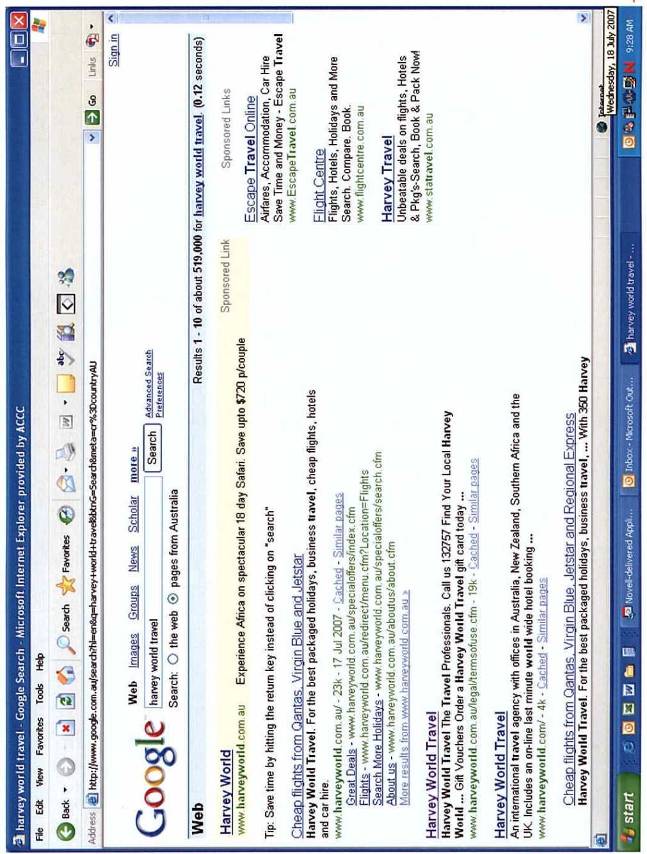
Schedule 2
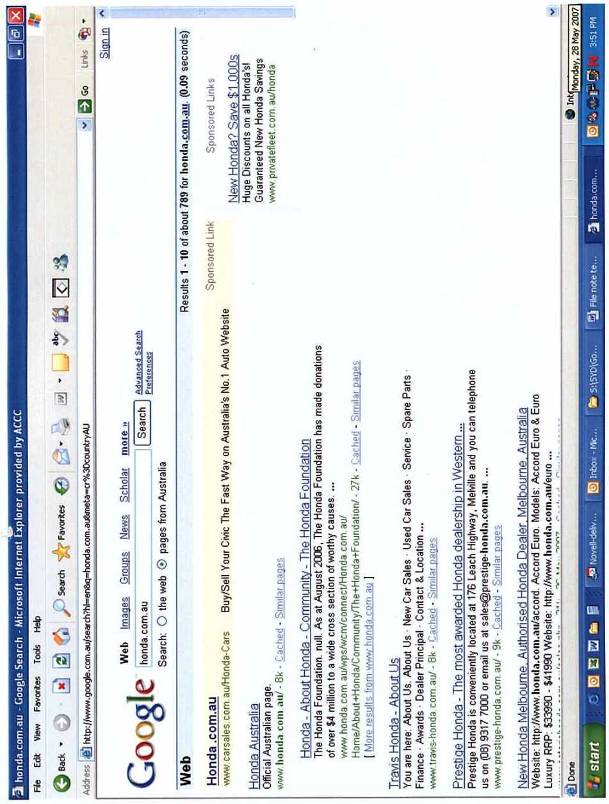
Schedule 3
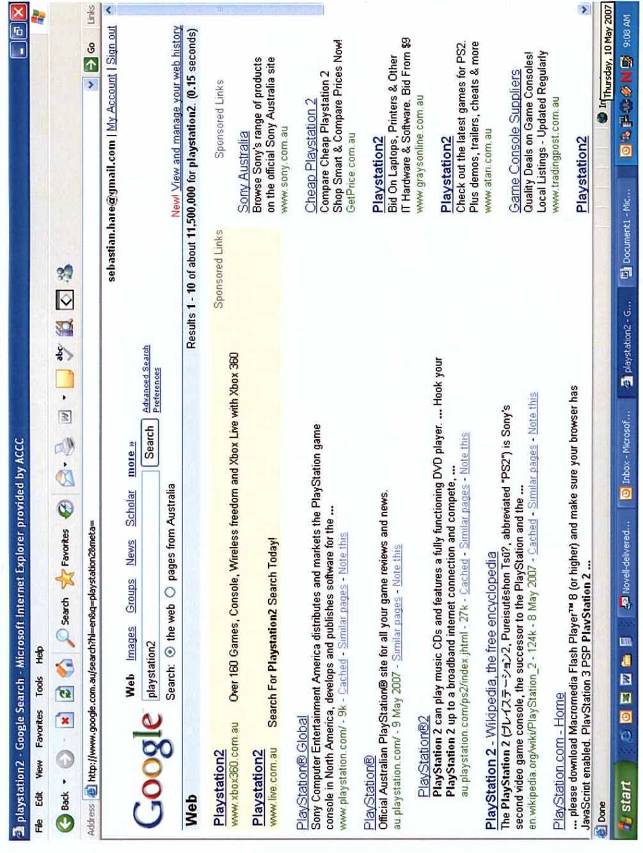
Schedule 4