FEDERAL COURT OF AUSTRALIA
Fair Work Ombudsman v Australian Shooting Academy Pty Ltd [2011] FCA 1064
IN THE FEDERAL COURT OF AUSTRALIA |
|
|
Applicant |
|
AND: |
AUSTRALIAN SHOOTING ACADEMY PTY LTD ACN 010 821 780 First Respondent MICHAEL JOSEPH MURPHY Second Respondent |
DATE OF ORDER: |
|
WHERE MADE: |
THE COURT ORDERS THAT:
1. Because the Australian Shooing Academy Individual Flexibility Arrangement (ASA IFA) did not identify the terms of the Amusement, Events and Recreation Award 2010 (Modern Award) that were to be varied, the first respondent failed to ensure that the ASA IFA met the requirements of clause 7.4(b) of the Modern Award and the first respondent thereby contravened section 45 of the Fair Work Act 2009 (Cth) (FW Act).
2. Because the ASA IFA did not detail how each term of the Modern Award had been varied, the first respondent failed to ensure that the ASA IFA met the requirements of clause 7.4(c) of the Modern Award and the first respondent thereby contravened section 45 of the FW Act.
3. Because the ASA IFA did not include the date it commenced operation, the first respondent failed to ensure that the ASA IFA met the requirements of clause 7.4(e) of the Modern Award and the first respondent thereby contravened section 45 of the FW Act.
4. The first respondent contravened sub-section 340(1) of the FW Act when it injured Mr Swanson in his employment and altered his position to his prejudice specifically by not affording any further work to Mr Swanson until on or about 17 July 2010 because Mr Swanson had a workplace right or workplace rights.
5. The first respondent did not comply with clause 7.2 of the Modern Award and contravened section 45 of the FW Act because it failed to ensure that the first respondent and Mr Baxter genuinely made the ASA IFA without coercion or duress as it was required to do so because of sub-section 145(3) and 144(4)(b) of the FW Act and clause 7.2 of the Modern Award.
6. The first respondent contravened sub-section 340(1) of the FW Act when it threatened to injure Mr Baxter in his employment and threatened to alter his position to his prejudice if he did not sign the ASA IFA because Mr Baxter had a workplace right or workplace rights.
7. The first respondent contravened section 343(1) of the FW Act because it threatened to take action with intent to coerce Mr Baxter to exercise or not exercise his workplace right and/or exercise his workplace right in a particular way.
8. The first respondent contravened sub-section 344(c) of the FW Act by applying undue influence and pressure on Mr Baxter to procure his agreement to the ASA IFA.
9. For the purposes of section 550 of the FW Act, the second respondent was involved in each of the contraventions of the first respondent.
THE COURT ORDERS THAT:
10. Pursuant to sub-section 546(1) of the Fair Work Act 2009 (Cth) (FW Act), the first respondent, Australian Shooting Academy Pty Ltd, pay a pecuniary penalty in the sum of $25,000.00.
11. Pursuant to sub-section 546(1) of the FW Act, the second respondent, Michael Joseph Murphy, pay a pecuniary penalty in the sum of $5,000.00.
12. Pursuant to sub-section 546(3) of the FW Act, the penalties payable to the respondents are to be paid to the Consolidated Revenue Fund of the Commonwealth within 30 days of the date of this Order.
13. Pursuant to sub-section 545(2)(b) of the FW Act, the respondents pay compensation to Mr Swanson as he directs in the sum of $7,146.00 (subject to ordinary tax including statutory superannuation) within 30 days of the date of this Order.
14. The application otherwise be dismissed.
Note: Entry of orders is dealt with in Rule 39.32 of the Federal Court Rules 2011
QUEENSLAND DISTRICT REGISTRY |
|
FAIR WORK DIVISION |
QUD 150 of 2011 |
BETWEEN: |
FAIR WORK OMBUDSMAN Applicant
|
AND: |
AUSTRALIAN SHOOTING ACADEMY PTY LTD ACN 010 821 780 First Respondent MICHAEL JOSEPH MURPHY Second Respondent
|
JUDGE: |
LOGAN J |
DATE: |
6 SEPTEMBER 2011 |
PLACE: |
BRISBANE |
REASONS FOR JUDGMENT
1 This proceeding was commenced in June this year on the filing of an application and accompanying statement of claim by the applicant, the Fair Work Ombudsman. Per force of s 701 of the Fair Work Act 2009 (Cth) (Fair Work Act), the applicant was at that time a Fair Work Inspector for the purposes of that legislation. The first respondent, Australian Shooting Academy Pty Ltd (Australian Shooting Academy), is a corporation which operates an indoor shooting range business on the Gold Coast in Queensland. It has done so since 1994. That shooting range is open to members of the public.
2 At that facility it is possible for persons who do not hold individual licences under governing State weapons legislation to engage in range practice using firearms for recreational purposes. Australian Shooting Academy holds a separate licence under State weapons legislation which allows this type of facility and activity lawfully to be conducted. Mr Michael Joseph Murphy (Mr Murphy), the second respondent, has at all times material to the proceeding been the managing director of the Australian Shooting Academy. He has also held the office of company secretary and has a 50% shareholding in that company.
3 In those various capacities, but particularly that of managing director, he has had responsibility, and continues to have responsibility, for the overall direction, supervision and management of the Australian Shooting Academy’s operations, including the terms and conditions of employment of the company’s employees.
4 As a result of changes made by the Parliament to the laws governing industrial relations in this country in respect of, materially, constitutional corporations, the Australian Shooting Academy came to be subject on and from 1 July 2009 to Pt 3-1 of the Fair Work Act. Similarly, on and from 1 January 2010 it became bound by the National Employment Standards which are found in Pt 2-2 of that Act. Also on and from that date it became covered by the Amusement, Events and Recreation Award 2010 which is a species of “modern award” with respect to the employment of its employees.
5 In or about late February 2010 the Australian Shooting Academy sought to enter into what are known as Individual Flexibility Arrangements with certain of its employees. In his capacity as managing director, Mr Murphy was knowingly concerned in that corporate endeavour. Seven employees, including a Mr Jonathan Baxter, signed what at least purported to be individual flexibility arrangements.
6 Another employee of the Australian Shooting Academy, a Mr Kenneth Swanson, declined to sign such an arrangement. As a consequence of statements made and conduct engaged in by the Australian Shooting Academy, in which Mr Murphy was knowingly concerned in relation to the offering of those arrangements to those employees, the Fair Work Ombudsman alleged that a number of contraventions of the Fair Work Act had occurred.
7 The Australian Shooting Academy and Mr Murphy have admitted that contraventions of the Fair Work Act occurred. I am satisfied that each of them has done so at the earliest practical opportunity.
8 Thus, whilst the case was originally, and perhaps out of an abundance of caution, listed for trial, there has been a timely acknowledgement of liability on the part of each respondent with a consequential saving to the Executive Government of the cost of the prosecution of the civil penalty proceeding, a saving in terms of disruption of the lives of those whom one might apprehend would necessarily have had to give evidence for the Fair Work Ombudsman in the proceeding, and also a saving in terms of publically provided judicial resources. All of these are factors to take into account in relation to the imposition of penalty. They are mitigating factors.
9 Behind the somewhat terse summary which I have thus far offered of the occasion for the bringing of proceedings, lies a detailed course of events in respect of dealings as between the Australian Shooting Academy, via Mr Murphy, with its employees. Those details have become the subject of an agreed statement of facts which was tendered jointly on the penalty hearing. The agreed statement travels beyond just matters of fact, but also embraces to an extent agreement as to some mixed questions of fact and law. Insofar as it agrees matters of fact, I act on the evidentiary foundation thus disclosed. Insofar as there are mixed questions of fact and law in the agreed statement, I am satisfied that there is no error of principle in relation to the legal questions which intrude in those mixed questions. That statement of agreed facts is incorporated in a schedule to these reasons for judgment. By this means the detail in respect of the conduct will be revealed without unnecessarily intruding upon the consideration of the questions of penalty.
10 The parties have also lodged with the Court, and adopted in the course of oral submissions, joint submissions on penalty. They are, with respect, to be commended for so doing. I have had the benefit of considering those joint submissions. I agree with the substance of them. I shall make some general observations concerning them and also highlight particular aspects of those submissions.
11 One feature in relation to penalty of those joint submissions is that they underscore the degree of cooperation in the administration of justice on the part of the Australian Shooting Academy and Mr Murphy. I particularly take that into account also as a mitigating factor on the subject of penalty.
12 Another matter which emerged in the course of oral submissions this morning which is a mitigating factor is that Mr Murphy proposes to cause the Australian Shooting Academy to send, via the Fair Work Ombudsman, to each of the employees concerned a letter of apology. That is no small thing in the conduct of industrial relations. It can, I am quite sure, not only evidence contrition on the part of the Australian Shooting Academy and Mr Murphy, but also have what one might term a healing effect in respect of individual grievances on the part of particular employees. The respondents are to be commended for taking this course. It is conduct to be encouraged in relation to the conduct of industrial relations in this country, in my opinion.
13 In other words, even though one might hope and expect that contraventions of the Fair Work Act do not occur, if when, on reflection, an employer realises that it has contravened the legislation, it takes steps such as the Australian Shooting Academy and Mr Murphy have, it must necessarily have beneficial effects in relation to industrial relations. I cannot help but observe that the conduct of the Australian Shooting Academy and Mr Murphy, in relation to the proffering of an apology to employees, is in marked contrast to that which came to my attention on the part of the Commonwealth of Australia in relation to an acknowledged contravention by the Commonwealth of separate obligations which can attend employers under occupational health and safety legislation: see Comcare v Commonwealth of Australia [2011] FCA 1043.
14 The Australian Shooting Academy has admitted to contravening the following:
(a) section 45 of the Fair Work Act for contravening a term of the Modern Award in respect of:
(i) failing to state each term of the modern award that would be varied by the individual flexibility arrangement in accordance with subclause 7.4(b) of the Modern Award;
(ii) failing to detail how the application of each term of the Modern Award had been varied by the individual flexibility in accordance with subclause 7.4(c) of the Modern Award;
(iii) failing to state the date on which the individual flexibility arrangement commenced operation in accordance with subclause 7.4(e) of the Modern Award;
(iv) failing to ensure that the individual flexibility arrangement made with Mr Baxter was generally agreed to without coercion or duress in accordance with subclause 7.2 of the Modern Award.
(b) subsection 340(1) of the Fair Work Act in respect of threatening to take adverse action against Mr Baxter because he had a workplace right, namely being entitled to the benefit of a workplace instrument being the Modern Award and because he made an inquiry about his employment with his employer;
(c) subsection 340(1) of the Fair Work Act in respect of taking adverse action against Mr Swanson because he had a workplace right, namely being entitled to the benefit of a workplace instrument being the Modern Award and because he made an inquiry about his employment with his employer;
(d) subsection 343(1) of the Fair Work Act in respect of threatening to take action against Mr Baxter with the intent to coerce him not to exercise his workplace right, namely being entitled to the benefit of a workplace instrument in the Modern Award; and
(e) subsection 344(c) of the Fair Work Act in exerting undue influence and undue pressure on Mr Baxter in relation to his decision on whether or not to agree to the individual flexibility arrangement.
15 For his part, Mr Murphy admits that he was involved in, within the meaning of s 550(2) of the Fair Work Act, the contraventions alleged against the Australian Shooting Academy, which I have just identified.
16 I note that the Fair Work Ombudsman does not pursue a separately alleged contravention of s 45 of the Fair Work Act in respect of cl 7.3(b) of the Modern Award. The foundation for the proceedings is evident from the recitation of particular sections of the Fair Work Act in the statement which I have made of the contraventions which are alleged and admitted.
17 Sub-section 546(1) of the Fair Work Act enables the Court to order a person to pay a pecuniary penalty in an amount that the Court considers appropriate if satisfied that a person has contravened a civil penalty provision. The provisions to which I have just made reference are civil penalty provisions. I am satisfied on the basis of the agreed statement that the Australian Shooting Academy and Mr Murphy have respectively contravened the civil penalty provisions to which I have made reference. More detailed provision as to what constitutes a civil penalty provision is to found in subs 539(1) and subs 439(2) of the Fair Work Act.
18 Apart from these provisions and the seeking of civil penalties in respect of them, the Fair Work Ombudsman also seeks declaratory relief. The Federal Court of Australia Act 1976 (Cth) confers on the Court a broad discretion in relation to the making of declarations of right. Such declarations are not made as a matter of course. I am satisfied, though, that, in the circumstances of this case, there is a strong public interest in the granting of declaratory relief. Each side promoted the making of such declarations. In that they were not, in my opinion, mistaken as to the aptness of this case for the granting of declaratory relief.
19 In their joint submission and by reference to authority the parties submit that the following approach is one which the Court ought to take in determining the appropriate penalties to impose:
29. The first step for the Court is to identify the separate contraventions involved. Each contravention of each separate obligation found in the Fair Work Act in relation to each employee by the First Respondent is a separate contravention for the purposes of subsection 546(1) of the Fair Work Act.
30. Secondly, to the extent that two or more contraventions have common elements, this should be taken into account in considering what is an appropriate penalty in all the circumstances for each contravention. The First and Second Respondents should not be penalised more than once for the same conduct. The penalties imposed by the Court should be an appropriate response to what the First and Second Respondents did. This task is distinct from and in addition to the final application of the ‘totality principle’.
31. Thirdly, the Court will then consider an appropriate penalty to impose in respect of each contravention for each group of contraventions, having regard to all of the circumstances of the case.
32. In cases where the parties have reached agreement in relation to the penalties or penalty ranges to be imposed, the court must be satisfied the penalties fall within the permissible range.
I agree that this is the appropriate approach to take in relation to the imposition of penalty.
20 So far as the pecuniary penalties are concerned column 4 in the table located in subs 539(2) of the Fair Work Act provides the maximum penalty that can be imposed by a court for each contravention of ss 45, 340(1), 343(1) and 344 of the Fair Work Act. That maximum is 60 penalty units. Subsection 546(2) of the Fair Work Act provides that a pecuniary penalty must not be more than:
(a) if the person is an individual - the maximum number of penalty units referred to in column 4 in the table in subsection 539(2) (In other words, 60 penalty units); and
(b) if the person is a body corporate - 5 times the maximum number of penalty units referred to in the relevant item in column 4 of the table in subsection 539(2) (in other words, 300 penalty units).
21 “Penalty unit” is defined in the Fair Work Act in a way that incorporates by reference the meaning given to that term in s 4AA of the Crimes Act 1914 (Cth). The latter section defines a penalty unit to be $110. In this fashion the maximum penalty which may be imposed by the Court is derived as follows:
(a) $33,000 in relation to the Australian Shooting Academy in respect of each contravention (300 x $110);
(b) $6,600 in relation to Mr Murphy, in respect of each contravention (60 x $110).
22 The Australian Shooting Academy has admitted to eight separate contraventions of the Fair Work Act. By process of mathematics one therefore derives a theoretical maximum, subject to considerations to which I shall shortly make reference, of $264,000. In like fashion Mr Murphy’s accessorial liability gives rise to a theoretical maximum in respect of the eight admitted accessorial contraventions of $52,800. Those maximums are relevant in the sense that they provide what might be termed a yard stick of comparison as between the present case and the worst possible case.
23 It is common ground between the parties that the admitted contraventions, both corporate and individual accessorial, have common elements. It is also common ground that the contraventions arise from the same unlawful conduct. For these reasons the parties jointly submit that each of these factors should be taken into account by the Court when considering the appropriate penalty. That, they submit, is to ensure that neither respondent is punished more than once for what is the same or a substantially similar course of conduct. I agree with all aspects of those submissions. It is particularly important in this case, in my opinion, to recognise the existence of a course of conduct and of inter-related or overlapping elements in respect of what are acknowledged by the parties to be strictly separate contraventions.
24 There is some recognition of such sentiments in subs 557(1) of the Fair Work Act. That provides that:
… 2 or more contraventions of a civil penalty provision, referred to in subsection (2) are subject to subsection (3) taken to constitute a single contravention if:
(a) the contraventions are committed by the same person; and
(b) the contraventions arose out of a course of conduct by the person.
25 Subsection 557(2)(b) provides that:
Section 45 of the Fair Work Act is a civil remedy provision to which subsection 557(1) applies.
26 Section 45 of that Act, as is evident from the recitation of contraventions, provides that:
A person must not contravene a term of a modern award.
27 Here there are multiple separate contraventions which arise from the applicability of multiple separate clauses in the Modern Award. Section 557 of the Fair Work Act does not apply to contraventions in respect of provisions in Pt 3-1 of the Fair Work Act. There is agreement, though, between the parties that there have been
(a) two separate contraventions of subs 340(1) of that Act in respect of Messrs Baxter and Swanson respectively;
(b) one contravention of subs 343(1) of that Act in relation to Mr Baxter; and
(c) one contravention of subs 344(c) of that Act in relation to Mr Baxter.
28 As to these Pt 3-1 contraventions, the parties correctly, in my opinion, draw attention to an observation by Keane CJ and Marshall J in their joint judgment in QR Limited v Communications, Electrical, Electronic, Energy, Information, Postal, Plumbing and Allied Service Union of Australia [2010] FCAFC 150 at [49]:
Even if s 557(2) does not apply to a case to oblige to treat as one contravention all the consequences of a particular piece of conduct, it is open to the Court, in an appropriate case, to take into account, as a matter of discretion, the circumstances that the same acts or omissions have resulted in multiple contraventions by multiple breaches of a term cast in similar language in each of multiple agreements, by imposing a lesser penalty or even no penalty in respect of contraventions of some terms, while imposing a substantial penalty in respect of contraventions of other terms.
I propose to adopt that approach in relation to the admitted Pt 3-1 contraventions.
29 The parties submit correctly that the admitted contraventions ought to be characterised into three distinct groups in the following way:
(a) individual flexibility arrangement contraventions comprising three separate contraventions of s 45 of the Fair Work Act for failing to comply with cl 7.4(b), cl 7.4(c) and cl 7.4(e) of the Modern Award;
(b) the Swanson contravention, comprising a single contravention of s 340(1) of the Fair Work Act in respect of Mr Swanson; and
(c) the Baxter contraventions, comprising a contravention of section 45 of the Fair Work Act for failure to comply with cl 7.2 of the Modern Award, a contravention of subs 340(1) of the Fair Work Act, a contravention of subs 343(1) of the Fair Work Act, and a contravention of subs 344(c) of the Fair Work Act.
They submit, again correctly in my opinion, that these three categories of contravention have a common thread. That common thread is that Mr Murphy caused the Australian Shooting Academy to seek to introduce permanent employment with that company through the medium of individual flexibility arrangements. Each of these categories of unlawful conduct was directed to that particular end. The individual flexibility arrangement contraventions are, in substance, very similar. That is because the individual flexibility arrangement was identical in content for each employee. The intent, obviously, was to achieve a uniform result in the workplace. The offers of these arrangements by the Australian Shooting Academy were made at the same time and they were accepted at about the same time by the employees. The parties agree, and the inference is inescapable on the agreed facts, that the introduction of those individual flexibility arrangements was to a single end to which I have already made reference.
30 The parties further submit that the penalties for the Swanson and Baxter contraventions should not be treated as a single course of conduct resulting in a single penalty for these reasons:
(a) the respondents’ conduct directed at Mr Swanson was different to that directed at Mr Baxter, both in time and type;
(b) the respondents took adverse action against Mr Swanson by declining to roster him on for any work shifts because Mr Swanson did not sign the individual flexibility arrangement;
(c) the adverse action taken by the respondents against Mr Baxter was constituted by threats made to him on the basis he would not have a job if he did not sign the individual flexibility arrangement;
(d) the threat made by Mr Murphy on behalf of the Australian Shooting Academy to Mr Baxter did not occur in Mr Swanson’s presence;
(e) subsection 340(1) of the Fair Work Act also speaks of adverse action against another person in the singular rather than persons in the plural.
They submit, by reference to cases concerning predecessor provisions of s 340(1), which are unnecessary to set out, that it has been held that where a proscribed act impacted on more than one employee, a separate contravention will be taken to have occurred in respect of each employee.
31 Each of these considerations, in my opinion, is relevant to why it is that one ought to treat the Swanson and Baxter contraventions discretely rather than amalgamating them and classifying them as but one course of conduct. The better way, which is the way promoted by the parties, is to regard it as disclosed on the agreed statement of facts that there is a single course of conduct in relation to Mr Swanson and a separate but nonetheless single course of conduct in relation to Mr Baxter. Each of those separate individually specific courses of conduct might be regarded, in my opinion, as a manifestation, or perhaps a furtherance, of the end served by the individual flexibility arrangement contraventions.
32 As to the Baxter contraventions, the parties have agreed that those four contraventions should be grouped as one category and treated as one contravention. That would have the effect that the maximum penalty for each category of contravention, which comprises the Baxter contraventions, is $33,000 for the Australian Shooting Academy and $6600 for Mr Murphy. It will be obvious from the observations that I have just made that I agree with that approach in relation to the Baxter contraventions. What follows from this, so the parties submit, is that the Court should approach the assessment of the relevant maximum on the basis that the maximum penalty that could be imposed by the Court, having regard to the three categories, is:
(a) $99,000 in respect of the Australian Shooting Academy;
(b) $19,800 in respect of Mr Murphy.
33 It necessarily follows from my agreement with the categorisation approach promoted by the parties that I agree that these are the relevant maximums.
34 In Kelly v Fitzpatrick (2007) 166 IR 14 at [14], Tracey J provided a helpful list of considerations that are relevant to the determination of penalty in matters arising under the Fair Work Act. It is important, nonetheless, to recall that helpful though that list is, the considerations set out by his Honour there are not exhaustive of matters which may relevantly be taken to account in the exercise of the sentencing discretion with respect to the imposition of pecuniary penalties. It is quite plain from his Honour’s judgment in that case that he did not intend his list to be anything other than a non-exclusive list of relevant considerations.
35 The position which obtains is that the discretion as the imposition of penalty must be exercised in the circumstances of individual cases. Particular care must be taken in the absence of guiding authority at an intermediate appellate level as to appropriate penalties in respect of frequently-encountered contraventions so as not to skew the imposition of penalty by reference to other outcomes in the original jurisdiction in respect of quite different facts. I remind myself that I adopted just such an approach in relation to penalty in Communications, Electrical, Electronic, Energy, Information, Postal, Plumbing and Allied Services Union of Australia v QR Ltd (No 2) [2010] FCA 652 at [34].
36 I was informed without objection on the part of the respondents by the Fair Work Ombudsman that this is the first occasion in which it has fallen for the Court to consider the imposition of pecuniary penalties in respect of contraventions of the Fair Work Act related to individual flexibility arrangements. That said, there are some features of this case in respect of which no novel considerations arise. It is axiomatic and each party acknowledges that employees should not be subject to duress, coercion, undue influence or pressure in the workplace. Parliament has expressly so provided in the Fair Work Act. The manifest intention of that legislation is that individual flexibility arrangements should be negotiated openly and freely at arms length between employer and employee without outside interference and without either party being deceived or misled. There is no suggestion, on the facts of this case, of any misleading or deceptive conduct. There is, though, as is acknowledged, evidence of other types of conduct to which I have made reference.
37 The parties submit jointly that the pressure and adverse action applied by the Australian Shooting Academy, by Mr Murphy, to Messrs Swanson and Baxter respectively comprised the following:
(a) informing Mr Swanson and Mr Baxter about the individual flexibility arrangements in a way such that it was conveyed to them that the terms of those arrangements were not flexible or negotiable;
(b) Mr Swanson’s removal from the roster and a denial to him of any further rostered shifts as a result of his refusal to agree to the proffered individual flexibility arrangement; and
(c) the threats made to Mr Baxter that he would have no job if he did not agree to and sign the proffered individual flexibility arrangement.
This is an apt way of particularising the conduct which amounts to the pressure and adverse action applied to Messrs Swanson and Baxter.
38 Some facts concerning the operation of the Australian Shooting Academy which are in context mitigating facts need to be set out.
39 When it commenced operation in 1994, neither the Fair Work Act nor for that matter the legislation which gave rise to the “Work Choices” amendments to the Workplace Relations Act 1996 (Cth) were in force. At the time when the Australian Shooting Academy commenced operations it was not covered by any particular state or federal award, or any enterprise agreement. That remained the case until 1 January 2010. However, from 27 March 2006 to 1 January 2010, the Australian Shooting Academy was then bound by the Preserved Pay and Classification Scale derived from the Industrial Relations Act 1999 (Qld) incorporating the State Wage Case 2005 (Qld) from 1 January 2010, the Australian Shooting Academy was bound by the Amusement, Events and Recreation Award 2010 (Modern Award).
40 Messrs Swanson and Baxter were each engaged in the capacity of range officers. In that capacity they undertook a number of duties related to the reception of prospective users of the indoor range, the safe supervision of those shooters on the range, and certain firearms cleaning duties. Each of them, in accordance with then-practices of the Australian Shooting Academy had been engaged, only as casual employees before 25 February 2010. The evidence discloses that such casual employees regularly worked between 30 and 70 hours per week.
41 The contravening conduct took place, therefore, against a background where hitherto the Australian Shooting Academy had not been subject to award regulation for about 16 years. The conduct also took place in the opening months of the operation of the Modern Award as a result of the Fair Work Act’s operation. The Australian Shooting Academy had hitherto struck its pay rates in the absence of specific award regulation, by reference to payments made to security guards who were entitled to carry a firearm. It is possible to see a rational basis for such a reference base in terms of the responsibilities which reposed in range officers for the safe use of firearms and the safe custody of firearms.
42 Immediately after being informed that the new federal modern award system might apply to the Australian Shooting Academy, Mr Murphy took steps to seek guidance from the company’s accountant to determine what were the company’s obligations. On the basis of that advice, he understood that the Modern Award applied to the Australian Shooting Academy’s range officers.
43 It is common ground that he was under the impression that the Modern Award did not allow the Australian Shooting Academy to employ casual employees. His understanding was that if they worked a regular pattern of work, they must instead be engaged as permanent employees, either full time or part time. On the basis of that understanding, Mr Murphy then commenced the process of asking the existing Australian Shooting Academy employees to agree to the individual flexibility arrangements. Those arrangements involved the employees converting to permanent status, in which they would receive entitlements to annual and personal leave, whilst also removing entitlements to penalty rates and overtime.
44 There is a wider background which also is relevant to the initiative taken by Mr Murphy. That wider background arises from what had at the time been a steady decline in business at the Australian Shooting Academy from about July 2009. By early 2010 because of that decline in business the Australian Shooting Academy had sought to reorganise its shift arrangements. In so doing, in short, it sought to ensure that its employees retained their jobs and maintained, as far as possible, their hours of work. It may well be that the decline in business from about July 2009 was a reflection of the impact of what has popularly been termed the “global financial crisis”. I make that observation because there is reference in the agreed statement of facts to part of the business of the company coming from the tourist trade and in particular from Japanese tourists. Necessarily, to an extent, the business seems to be one which was hostage to the vagaries which can attend the tourist trade and in particular to the impact on that trade of circumstances beyond the control of the Australian Shooting Academy derived from prevailing national and international economic conditions.
45 The conduct then of the Australian Shooting Academy needs to be viewed and the parties invited it to be viewed against the background of a necessary business decision to reduce costs of the company during the first half of 2010. That much acknowledged it nonetheless remains the case that the company was obliged to effect any such reduction in accordance with the requirements of the Fair Work Act.
46 Mr Swanson was a longstanding employee. He had worked for almost 10 years with the Australian Shooting Academy, commencing in June 2000. It is agreed in this case that as a result of the adverse action taken against him, Mr Swanson suffered financially. He did so because he lost his regular and systematic hours at work with the Australian Shooting Academy. It is common ground that he was unable to obtain alternative employment despite his efforts so to do. One consequence of his loss of the regular and systematic hours at work with the Australian Shooting Academy and his inability to secure alternative employment was that Mr Swanson’s pension payments from the Commonwealth via the Department of Veterans Affairs increased. I infer from this that Mr Swanson is an ex-serviceman with an entitlement to a means-tested pension under the Veterans’ Entitlements Act 1986 (Cth). It emerges from the agreed statement that the Australian Shooting Academy, preferentially it seems, employs persons with a service background as its range officers. That preference is understandable given the emphatic attention to firearm safety, which is a feature of military training in Australia.
47 The respondents have offered compensation to Mr Swanson without deduction in respect of any payments received by him during the period in which he was affected by the contravening conduct. The amount which is offered is agreed in the sum of $7,146.
48 The parties agree that the conduct directed to Mr Baxter was serious because it involved an application of illegitimate pressure which denied him a right to exercise his freewill. I agree. In short, the effect of the conduct was that Mr Baxter lost the opportunity to negotiate the terms and conditions of his employment. There is no previous conduct alleged as against Mr Murphy personally or the Australian Shooting Academy either in relation to like contraventions of earlier legislation, state or federal, or for that matter, any previous contraventions of industrial relations legislation, state or federal. The parties put forward, and it is appropriate to approach the imposition of penalty on the basis, that both the Australian Shooting Academy and Mr Murphy are to be regarded as “first offenders”.
49 It also needs to be noted that the business is what is aptly termed by the parties “a small-sized business.” It has currently six employees in addition to its two working directors, one of whom, the managing director, is Mr Murphy. It is a business which in the 2009 financial year made a profit. In the 2010 financial year it made a modest loss. When compared with the profit made in the 2009 financial year, that underscores the downturn in business which occurred over the course of that year. I do not propose, because it may have about it a degree of commercial sensitivity, to set out precisely the amounts of profit and loss concerned. Suffice it to say, I have taken the amounts, which are set out in the agreed statement, into account in relation to the imposition of penalty.
50 Even though the business conducted by the Australian Shooting Academy is a small business, it is nonetheless obliged to comply with the law of the land in the form of the Fair Work Act. In relation to the contraventions, it is put forward that the agreed statement of facts does not disclose a deliberate contravention of the Fair Work Act. I agree with that characterisation of the agreed facts. It is apparent that Mr Murphy sought on behalf of the Australian Shooting Academy advice in relation to the phenomenon of new federal regulation of the employment conditions in respect of the company.
51 What occurred thereafter was, as I put to counsel in the course of submissions today, a ham-fisted approach to the negotiation of individual flexibility arrangements. There was an attempted use, in my view, of an inequality in bargaining power in relation to the continuance of regular employment. That should not have occurred. I am quite certain, however, that Mr Murphy well appreciates that and is truly contrite. As I have already observed, he has voluntarily taken steps to cause the company to issue individual letters of apology to the employees concerned.
52 Another manifestation of that contrition is the very studied way in which there has been a cooperation on and from investigation through to the present as between the company and the Fair Work Ombudsman in relation to this matter.
53 There is no doubt that senior management was involved in the contraventions. So much flows from the “hands on” aspect of a small business.
54 An important factor to take into account in relation to the imposition of penalty are the objects of the Fair Work Act, which include particularly in relation to Pt 3-1 the protection of workplace rights and the provision of effective relief for persons who have been discriminated against, victimised or otherwise adversely affected as a result of contraventions of Pt 3-1.
55 There is a need to ensure that the penalties imposed do not trivialise the intent of Parliament in relation to those objects. That said, so far as deterrence is concerned and as will be apparent from what I have already observed, I do not see that specific deterrence is a factor of great moment in this case given the conduct in which the company, via Mr Murphy, has engaged after these matters were drawn to its attention. There is, though, a need to remind employers generally of obligations which arise under the Fair Work Act and to do so in a way which, as I have observed, does not trivialise those obligations. To that extent, general deterrence is a relevant consideration.
56 Bearing these factors in mind, the parties have submitted jointly that, having to the three identified categories of contravention to which I have earlier made reference, the Court should impose penalties within the following range:
(a) in relation to the Australian Shooting Academy between $25,000 and $30,000; and
(b) in relation to Mr Murphy between $5,000 and $6,000.
57 They put forward accurately that these represent 25% to 30% of the maximum penalties that could be imposed for the three categories of contraventions. Again, accurately, they put forward that such an agreed position does not bind the Court as to the amount to impose, that being ultimately a matter for the exercise of a penalty discretion, which reposes per force of statute in the Court, not the parties by agreement: see in this regard Minister for Industry, Tourism and Resources v Mobil Oil Australia Pty Ltd [2004] FCAFC 72 and NW Frozen Foods Pty Ltd v Australian Competition and Consumer Commission (1996) 71 FCR 285 at 298-299.
58 That said, it is not irrelevant to take into account a jointly-agreed position where one of the parties to that agreement, namely, the Fair Work Ombudsman, has particular responsibility for the administration of aspects of the Fair Work Act. As it happens, in this instance, my quite separate view of the facts upon reading the agreed statement of facts was that just such a range of penalty was apt. It in no way causes me any disquiet that the parties have come jointly to promote such a range. Further, it seems to me, having regard to mitigating factors to which I have made reference, that the appropriate course to take in this instance is to impose penalties at the lower end of the range.
59 So far as the imposition of penalty is concerned and in relation to the course of conduct and the requirement not to impose double penalty, there is, in my view, an analogy to be drawn in terms of principle between the circumstances of the present case and the quite separate circumstances under quite separate legislation which came before the High Court in L Vogel & Son Pty Ltd v Anderson (1968) 120 CLR 157 at 167 to 168 (Vogel v Anderson). That case concerned the allegation and the consequential finding of serial and separate contraventions of the Customs Act 1901 (Cth) constituted by what could only be regarded on the facts as a single course of conduct directed to a single end. In expressing agreement with observations made in the original jurisdiction by Kitto J, Taylor, Menzies and Owen JJ at page 168 observed that:
Though the offences in each group were separate offences in law, they were substantially contemporaneous and connected.
Their Honours made that observation in the course of expressing agreement that the appropriate approach to sentencing should reflect that view of the facts in terms of the imposition of penalty. There is an analogy between the way in which the parties jointly promoted the imposition of penalty in this case in relation to groups of contraventions and the sentencing approach endorsed in the High Court in Vogel v Anderson.
60 Drawing these disparate considerations together and particularly taking into account a need for general deterrence and not trivialising the conduct concerned, but tempering that with mitigating factors to which I have made reference, the view that I have reached is that the appropriate penalty to impose in respect of the Australian Shooting Academy is a penalty in the sum of $25,000 and the appropriate penalty to impose in respect of Mr Murphy is a penalty in the sum of $5,000. In each instance, it is submitted by agreement that 30 days should be allowed for payment. I allow such a time for the payment of the penalties imposed respectively on the Australian Shooting Academy and Mr Murphy. I also propose to, and do, make declarations in terms of those which have been promoted by the parties. I shall also make provision for compensation in the sum of $7,146.
I certify that the preceding sixty (60) numbered paragraphs are a true copy of the Reasons for Judgment herein of the Honourable Justice Logan. |
Associate:
SCHEDULE
STATEMENT OF AGREED FACTS
Scope
1. This Statement of Agreed Facts is an agreed document of the Applicant and the First and Second Respondents and is made for the purposes of section 191 of the Evidence Act 1995 (Cth). The admissions made are made only for the purpose of these proceedings.
2. This document is submitted to the Court for the purpose of determining penalties to be ordered against the First and Second Respondents.
Background
3. The Applicant, is:
(a) the Fair Work Ombudsman, appointed pursuant to section 687 of the Fair Work Act 2009 (FW Act); and
(b) a Fair Work Inspector by operation of section 701 of the FW Act.
4. The Applicant has standing to apply to the Court for an order under section 539 of the FW Act for orders in relation to contraventions of sections 45, 340(1), 343(1) and 344 of the FW Act.
5. The First Respondent is, and at all material times was, a company duly registered in accordance with the requirements of the Corporations Act 2001 (Cth) and is capable of suing and being sued.
6. The First Respondent was at all material times:
(a) a constitutional corporation; and
(b) an employer,
within the meaning of those terms as defined by the FW Act insofar as it employed Mr Kenneth Swanson, Mr Jonathan Baxter, Mr Masashi Matsuzoe (“Mr Matsuzoe (Jnr)”), Mr Ramon Losa, Mr Laurence Rowe and Mr Hiroaki Matsuzoe (“Mr Matsuzoe (Snr)”) (Employees).
7. At all material time the Second Respondent was:
(a) the managing direction of the First Respondent;
(b) a company secretary of the First Respondent;
(c) until on or about 10 August 2010, the sole director of the First Respondent;
(d) a shareholder in the First Respondent, holding 50% of the allocated shares;
(e) involved in the day-to-day operation of the First Respondent;
(f) the operative and controlling mind of the First Respondent;
(g) responsible for the overall direction, supervision and management of the First Respondent’s operations;
(h) responsible for determining the Employees’ terms and conditions of employment, recruiting the Employees and preparing the Employee’s rosters; and
(i) the representative of the First Respondent with whom the Employees of the First Respondent primarily dealt.
8. At all material times the First Respondent carried on business, at Centro Surfers Paradise Shop 464, Level 1, 3 Hanlan Street, Surfers Paradise, Queensland (Centro) under the business name “Australian Shooting Academy”.
9. At all material times the First Respondent operated an indoor shooting range where people who did not have a firearms licence could shoot at moving and stationery targets. The First Respondent’s business has a Queensland Police Group Licence number, which entitles it to use and possess the categories of firearms used at the premises at Centro.
10. The First Respondent’s business is the only dedicated indoor shooting gallery in Queensland open to the public for recreational purposes.
The Employees
Mr Kenneth Swanson
11. Mr Swanson:
(a) was employed by the First Respondent from on or about 10 June 2000;
(b) was employed on a casual basis as a range officer;
(c) in the period prior to around August 2009, was regularly rostered to work in excess of 40 hours each week save for when Mr Swanson took leave for holidays;
(d) from about September 2009 until on or about 1 March 2010, upon his request, Mr Swanson was usually rostered to work approximately 39 hours each week;
(e) was not rostered for any periods of leave or holidays, which Mr Swanson chose to take;
(f) declined to sign an Individual Flexibility Agreement provided to him by the First and Second Respondents in or around late February 2010;
(g) from on or about 1 March 2010 to 29 March 2010, took holidays and was unavailable for work; and
(h) did not receive any offers of work with the First Respondent from on or about 30 March 2010 to in or around July 2010.
Mr Jonathan Baxter
12. Mr Baxter:
(a) was employed by the First Respondent from on or about 27 July 2007 to on or about 11 August 2010;
(b) was primarily engaged to perform range officer duties which included, because of his military experience, primary responsibility for firearms maintenance and range maintenance;
(c) was initially engaged on a casual basis;
(d) worked regular and systematic hours each week although his average hours of work varied during his employment;
(e) became a permanent employee on or about 25 February 2010 as a result of signing an Individual Flexibility Agreement; and
(f) ceased working for the First Respondent on or about 11 August 2010 when the First Respondent terminated Mr Baxter’s employment for operational reasons.
Mr Masahi Matsuzoe
13. Mr Matsuzoe (Jnr):
(a) was employed by the First Respondent from in or around December 2009 as a range officer on a casual basis;
(b) usually worked regular and systematic hours each week although his average hours of work varied during his employment; and
(c) was paid as a permanent employee on or about 25 February 2010 as a result of signing an Individual Flexibility Agreement.
Mr Ramon Losa
14. Mr Losa:
(a) was employed by the First Respondent from on or about 26 December 2007 as a range officer on a casual basis;
(b) until becoming a permanent employee, worked hours and roster patterns as requested by the First Respondent subject to Mr Losa’s availability for work;
(c) was often rostered to work approximately the same number of weekly hours; and
(d) become a permanent employee on or about 25 February 2010 as a result of signing an individual Flexibility Agreement.
Mr Laurence Rowe
15. Mr Rowe:
(a) was employed by the First Respondent from in or around October 2008 as a range officer on a casual basis;
(b) usually worked regular and systematic hours each week although his average hours of work varied during his employment; and
(c) became a permanent employee on or about 25 February 2010 as a result of signing an Individual Flexibility Agreement.
Mr Hiroaki Matsuzoe
16. Mr Matsuzoe (Snr):
(a) was employed by the First Respondent from on or about 4 February 2006 as a range officer on a casual basis; and
(b) usually worked regular and systematic hours each week although his average hours of work varied during his employment; and
(c) became a permanent employee on or about 25 February 2010 as a result of signing an Individual Flexibility Agreement.
Range officers
17. Range officers deal with customers on arrival at the premises, explain the First Respondent’s services, assist the customers with purchasing range time, supervise customers in preparation for use and use of firearms on the shooting range, assist customers with the purchase of souvenirs, clean the range in readiness for use by the next customer and their accompanying range officer and perform basic cleaning of firearms.
18. Range officers have different levels of responsibility for cleaning and maintaining firearms, depending on their skills. From time to time, the First Respondent has had range officers who, because of their familiarity with firearms, usually because of military experience, were given primary responsibility for dismantling weapons, attending to scheduled maintenance and fixing breakdowns. Mr Baxter was allocated that responsibility during the time of his employment. The First Respondent now employs an external armourer.
19. Employees engaged as Range Officers were employed on a casual basis. An individual Employee’s shift pattern was negotiated with the First Respondent and was determined by that individual’s preferences and personal circumstances and the First Respondent’s operational requirements. The shift patterns for each Employee were generally regular. That is, Employees would generally be rostered on the same days each week and for much the same hours on each day.
Applicable Instruments
20. The First Respondent commenced operations at Centro in June 1994 and has been at those premises ever since.
21. Upon commencing its operations, Queensland industrial legislation applied to the First Respondent’s business and its employees until the commencement of the Workplace Relations Amendment (Work Choices) Act 2005 (Cth) on 27 March 2006 when the First Respondent came within the jurisdiction of the Workplace Relations Act 1996 (Cth).
22. For its entire period of operation, until 1 January 2010, the First Respondent and its employees were not coved by a State or Federal award (or a Notional Agreement Preserving a State Award) or a collective or enterprise agreement.
23. From 27 March 2006 to 1 January 2010 the First Respondent was bound by the Preserved Pay and Classification Scale derived from the Industrial Relations Act 1999 (Qld) Incorporating the State Wage Case 2005 (Qld).
24. From 1 July 2009 onwards, the First Respondent was, in respect of the Employees’ employment, bound by the FW Act.
25. From 1 January 2010 onwards, the First Respondent was, in respect of the Employees’ employment:
(a) bound by the provisions of the FW Act that commenced on this date including section 45 of the FW Act and the National Employment Standards as contained in Part 2-2 of the FW Act; and
(b) bound by the Amusement, Events and Recreation Award 2010 (Modern Award) because of sub-sections 47(1), 48(1) and section 49 of the FW Act.
26. From 1 January 2010 onwards, the Modern Award applied to the Employees’ employment with the First Respondent and the Employees were covered by the Modern Award in accordance with sub-sections 47(1), 48(1) and section 49 of the FW Act.
27. The First Respondent classified the Employees as performing duties within the Grade 3 classification under the Modern Award.
28. From 1 January 2010, Mr Swanson and Mr Baxter had workplace rights for the purposes of sub-section 341(1) of the FW Act, in that they were entitled to the benefit of a workplace instrument, being the Modern Award.
The making of the individual flexibility arrangement
29. In early January 2010, the Second Respondent became aware through his wife of the commencement of the National Employment Standards and the Fair Work Information Statement.
30. As a result of his wife informing him of changes to award arrangements in the child care industry (in which she worked), the Second Respondent made an enquiry of the First Respondent’s accountant, Mr Fearnley.
31. On about 1 February 2010, Mr Fearnley advised the Second Respondent that the Modern Award applied to the First Respondent. This was the first time that the First and Second Respondents became aware of the Modern Award.
32. During the same conversation, Mr Fearnley also informed the Second Respondent that the Applicant had audited businesses at the Biggera Waters Shopping Centre and that one of Mr Fearnley’s clients and the other businesses had been fined as a result.
33. The Second Respondent subsequently searched the Applicant’s website but was unable to locate a copy of the Modern Award. He understood that he was required to provide a copy of the Fair Work Information Statement to all employees.
34. On or about 6 February 2010 (and on subsequent days as Employees were rostered) the Second Respondent provided a copy of a Fair Work Information Statement to the Employees.
35. In the course of providing the Fair Work Information Statement to Mr Baxter, the Second Respondent stated to Mr Baxter words to the effect that there were changes in the laws and rules governing employment and that was the reason for the Second Respondent providing the Fair Work Information Statement to Mr Baxter.
36. The Fair Work Information Statement was a document prepared and published by the Applicant in accordance with section 124 of the FW Act.
37. The Second Respondent had been unable to locate a copy of the Modern Award by searching the internet. Mr Swanson downloaded a copy of the Modern Award and gave it to the Second Respondent.
38. On or about 8 February 2010 the Second Respondent provided a copy of the Modern Award and National Employment Standards to the Employees. Copies of the Modern Award and the National Employment Standards remained in the reception area (of the First Respondent’s premises) frequented by the Employees from that time on and the Second Respondent advised the Employees of this.
39. The Second Respondent read the Modern Award and assessed that the Employees were most likely within the Grade 2 classification. He decided to pay at the Grade 3 classification in order to avoid any doubt.
40. The Second Respondent then had conversations with Employees, about a week or so after he first received a copy of the Modern Award, and advised the Employees of the Modern Award wage rate that the First Respondent would apply and the intended date that the Modern Award would be applied from.
41. After further studying the Modern Award, the Second Respondent reached the conclusion that Clause 10 of the Modern Award required that Employees who worked regular shifts had to be paid as permanent employees. He also learned the changes could be made to the Modern Award provisions about ordinary hours of work and overtime rates by an agreement with the Employees.
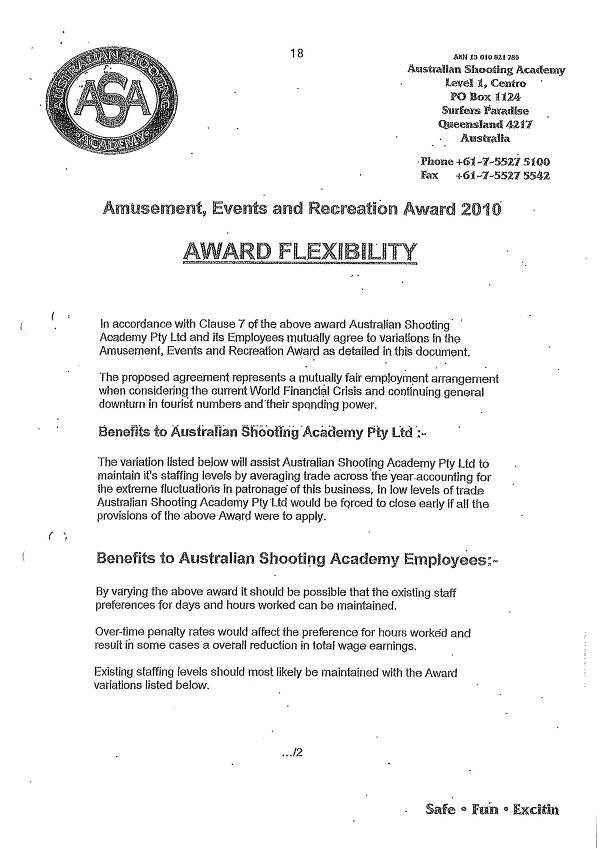
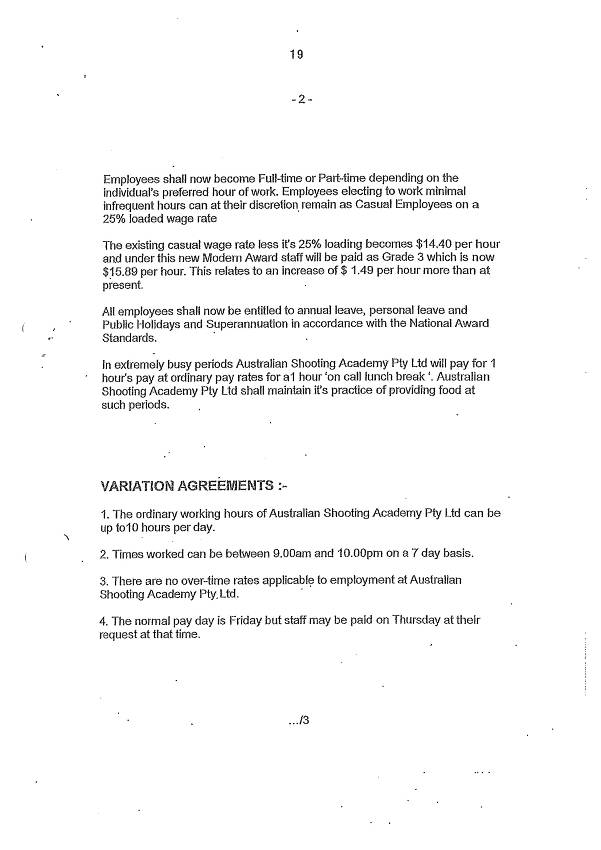
42. On or about 22 February 2010 the Second Respondent provided, to the Employees, a document on the First Respondent’s letterhead titled “Award Flexibility” (the ASA IFA).
43. The ASA IFA was in a folder with other folders containing the Modern Award, National Employment Standards and Fair Work Information Statement in the reception area of the First Respondent’s premises.
44. The Second Respondent told each of the Employees as they arrived for work that the documents were in the folders and he asked the Employees to read them.
45. The Second Respondent discussed the ASA IFA with the Employees, both individually and in small groups for varying lengths of time. The Second Respondent:
(a) provided the Employees with calculations of the effect that the proposed IFA would have on their earnings;
(b) told the Employees that the Modern Award required the First Respondent to employ the Employees as permanent employees if they wanted to retain the regular roster arrangements;
(c) informed the Employees that the First Respondent could not afford to pay the penalties and overtime rates under the Modern Award; and
(d) said that the purpose of the ASA IFA was allow the Employees to maintain their current hours while meeting the First Respondent’s concerns about the costs attached to the change to permanent employment.
46. The Second Respondent verbally advised the Employees to review the Modern Award, National Employment Standards, Fair Work Information Statement and the ASA IFA and to sign the relevant pages.
47. A copy of the ASA IFA is attached as Schedule One.
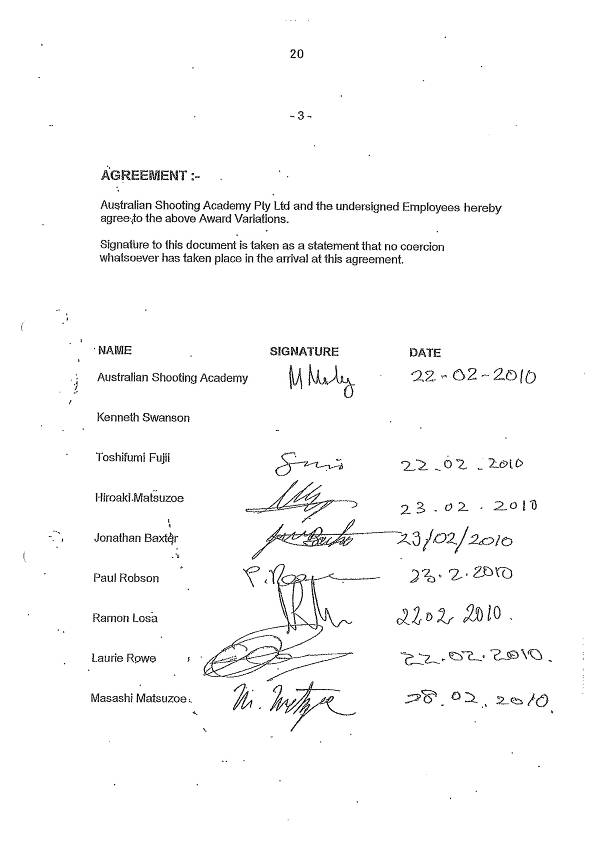
48. The ASA IFA was signed by:
(a) Mr Murphy, Mr Rowe and Mr Losa on 22 February 2010;
(b) Mr Matsuzoe (Snr), Mr Baxter and Mr Robson on 23 February 2010; and
(c) Mr Matsuzoe (Jnr) on 28 February 2010.
49. The ASA IFA did not:
(a) identify the terms of the Modern Award that were varied by the ASA IFA as required by clause 7.4(b) of the Modern Award;
(b) include detail of how each term of the Modern Award had been varied by the ASA IFA as required by clause 7.4(c) of the Modern Award; or
(c) include the date that it commenced operation as required by clause 7.4(e) of the Modern Award.
Mr Baxter
50. On or about 22 February 2010, the Second Respondent and Mr Baxter had a conversation at the First Respondent’s premises about the Modern Award, Fair Work Information Statement and the ASA IFA.
51. On or about 22 February 2010, Mr Baxter made inquires of the First Respondent about the terms and conditions of his employment, specifically he discussed the terms and conditions offered under the ASA IFA with the Second Respondent. During this conversation, Mr Baxter and the Second Respondent discussed whether Mr Baxter would be better off under the terms of the ASA IFA. Mr Baxter’s concern was that he would not be better off under the ASA IFA, in particular, because it did not factor in public holidays and public holiday rates of pay.
52. Mr Baxter had an additional workplace right under sub-section 341(1)(c)(i) of the FW Act because he was able to make a complaint or inquiry in relation to his employment. The concerns raised by Mr Baxter about the ASA IFA on 22 February were such a complaint or inquiry.
53. The Second Respondent said to Mr Baxter, during the conversation of 22 February 2010, words to the effect that if Mr Baxter did not sign the ASA IFA:
(a) he would be considered a casual employee but would be unable to work standard hours each week;
(b) the Second Respondent did not have a job for Mr Baxter;
(c) the Second Respondent could not employ Mr Baxter; and
(d) he could not continue working the hours he was currently working.
54. In reliance on the Second Respondent’s statement at paragraph 53 above, Mr Baxter believe that:
(a) the ASA IFA was his new employment contract;
(b) the terms of the ASA IFA were not flexible;
(c) if he did not sign the ASA IFA, he would continue to be engaged as a casual employee of the First Respondent but the First Respondent would no work for him; and
(d) if he did not sign the ASA IFA, he would not have a job.
55. Mr Baxter signed the ASA IFA as he wished to maintain employment.
56. In the premises, at the time of signing the ASA IFA, Mr Baxter was of the view that:
(a) he must sign the ASA IFA; and
(b) the consequences of not signing the ASA IFA were that he would not maintain ongoing employment with the First Respondent.
Mr Swanson
57. On or about 26 February 2010 Mr Swanson at the direction of the Second Respondent received a copy of a document titled “Variation to Agreed Ordinary Working Hours” and the ASA IFA.
58. In or around late February 2010 Mr Swanson and the Second Respondent discussed the ASA IFA. Mr Swanson said to the Second Respondent, words to the effect that, Mr Swanson required an explanation from the Second Respondent about the proposed changes to his working arrangements and whether Mr Swanson would be better off under the new arrangements.
59. In response to Mr Swanson’s request for an explanation about the proposed changes to his working relationships, the Second Respondent said words to the effect that Mr Swanson would be better off because he would receive annual leave and sick pay.
60. Mr Swanson had an additional workplace right under sub-section 341(1)(c)(i) of the FW Act because he was able to make a complaint or inquiry in relation to his employment. The request for an explanation of the ASA IFA made by Mr Swanson in late February 2010 was such an inquiry for the purposes of sub-section 341(1)(c)(i)
61. In or around late February 2010 Mr Swanson declined to sign the document titled “Variation to Agreed Ordinary Working Hours” and the ASA IFA. Mr Swanson told the Second Respondent that he required more time to consider the documents and said that he wished to discuss the documents further when he returned from leave.
62. Mr Swanson took leave from on or about 1 March 2010 to on or about 29 March 2010.
63. On or about 2 March 2010 Mr Swanson attended the First Respondent’s premises and was given a letter by Ms Grim, an administrative assistant engaged by the First Respondent, acting at the direction of the Second Respondent. The contents of this letter (signed by the Second Respondent) were as follows:
“It is noted that you have not signed the agreement to vary the ‘Amusement, Events and Recreation Award 2010’ under which Australian Shooting Academy’s employees are now being paid.
We accept your right to not sign this agreement and become a Permanent Part-time employee and take heed of your request that you remain a casual Employee as your spouse Dianne is employed.
However we must adhere to the award and hereby confirm that you are from now on engaged as a Casual employee at the rate of Grade 3 wage being $15.89 per hour plus 25% loading which makes your hourly rate $19.86.
Your new hourly rate in fact is an increase of $1.86 which will be reflected in the next pay being Thurs 4th March 2010.
Please note that this casual rate does not carry the loadings, holidays and other entitlements that permanent staff receive, but that all of the Award conditions that pertain to Casual workers are applicable to you without any variances or waivers.”
64. Mr Swanson did not discuss the contents of the letter with Ms Grim or the Second Respondent at this time.
65. In or around late March 2010, Mr Swanson contacted the Second Respondent to discuss the documents previously provided to him on or about 26 February 2010 and to find out what his rostered hours of work would be upon his return from leave.
66. In response to these enquiries, Mr Swanson was told by the Second Respondent that there were no shifts available for Mr Swanson and the Second Respondent would contact Mr Swanson if any shifts became available. On or about the same day Mr Swanson went to the workplace of the First Respondent to return his key to the premises. Whilst at the premises Mr Swanson checked the roster, which indicated no hours had been allocated to him.
67. The First Respondent’s business was experiencing a downturn in trade and because of this, from on or about 8 March 2010, the First Respondent removed 4 shifts from the Employees’ roster from Monday to Thursday because only 3 staff members were required on these days. On the same day, the First Respondent requested (in writing) that the Employees (except for Mr Swanson) advise whether they were prepared to reduce their hours to accommodate any shifts for Mr Swanson. All staff members declined the request.
68. In or around late March 2010, Mr Swanson asked the First Respondent to provide a letter about the current shift arrangements so that Mr Swanson could give it to the Department of Veterans Affairs for pension-related reasons.
69. On or about 29 March 2010 Mr Swanson received a letter signed on behalf of the First Respondent by the Second Respondent that read:
“Dear Ken,
This is confirm that with the current down-turn in trade at present that we do not require your services as a casual Range Officer.
Should trade pick up we shall be in contact with you.
Yours faithfully”
70. Mr Swanson lodged a complaint against the First Respondent with the Applicant in or about late March 2010. Mr Swanson was not offered any further work with the First Respondent from on or about 1 March 2010 until in or around July 2010.
Events after March 2010
71. The First Respondent’s business continued to experience a downturn in trade. This decline started in about July 2009 had been steady from that time.
72. It is a requirement of the First Respondent that at least one Japanese-speaking employee is working at all time to assist those customers that only speak Japanese.
73. The below graph demonstrations the total number of hours worked each week by the non Japanese speaking range officers and the Japanese speaking range officers from 1 July 2009 to late July 2010. The graph does not reflect the individual hours worked by each employee per week.
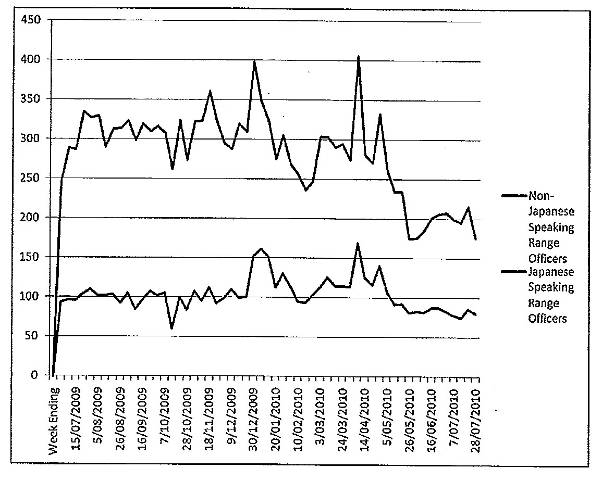
74. In May 2010, the First Respondent was forced to implement further measures to reduce costs. In order to keep all the Employees in employment, the hours of work of all the Employees were reduced. A staff meeting was held on 14 May 2010 to discuss the deteriorating situation that the possibility of staff redundancies. Mr Baxter proposed that all staff reduce their hours in preference to any Employee losing their job. The Employees and the Second Respondent accepted this proposal. A new roster was made on this basis commencing on 20 May 2010.
75. On or about 17 July 2010, the Second Respondent emailed Mr Swanson seeking Mr Swanson’s availability to work casual shifts from 31 July 2010 to 6 August 2010 and from 3 to 24 September 2010.
76. On or about 23 July 2010 Mr Swanson advised the Second Respondent, via email, that he was not available on the dates specified by the First Respondent. Later that day, the Second Respondent requested Mr Swanson’s availability for the following 6 months.
77. On 30 July 2010 Mr Swanson emailed the Second Respondent stating:
“Due to volunteer work, a TAFE course, I am about to commence and family commitments in Melbourne and Nanango,
I doubt that I would be available before February 2011 or later.”
78. Mr Swanson had not worked for the First Respondent since late February 2010.
Section 793
79. At all relevant times, the Second Respondent was acting as an officer, employee and/or agent of the First Respondent within the scope of his actual or apparent authority so that:
(a) under section 793(1) of the FW Act, conduct engaged in by the Second Respondent is also taken to have been engaged in by the First Respondent;
(b) under section 793(2) of the FW Act, the Second Respondent’s state of mind was the state of mind of the First Respondent.
Contraventions of Clause 7.4 of the Modern Award
Clause 7.4(b)
80. Because the ASA IFA did not identify the terms of the Modern Award that were to be varied, the First Respondent failed to ensure that the ASA IFA met the requirements of clause 7.4(b) of the Modern Award and the First Respondent thereby contravened section 45 of the Award.
Clause 7.4(c)
81. Because the ASA IFA did not detail how each term of the Modern Award had been varied, the First Respondent failed to ensure that the ASA IFA met the requirements of clause 7.4(c) of the Modern Award and the First Respondent thereby contravened section 45 of the FW Act.
Clause 7.4(e)
82. Because the ASA IFA did not include the date it commenced operation, the First Respondent failed to ensure that the ASA IFA met the requirements of clause 7.4(e) of the Modern Award and the First Respondent thereby contravened section 45 of the FW Act.
Specific Contraventions concerning Mr Swanson
83. By engaging the conduct in paragraphs 66 and 70 above, the First Respondent injured Mr Swanson in his employment and altered his position to his prejudice in that Mr Swanson was not rostered for any further work with the First Respondent after he declined to sign the ASA IFA (Swanson Adverse Action).
84. One of the First Respondent’s operative reasons for taking the said Swanson Adverse Action was because Mr Swanson had a workplace right or workplace rights referred to in paragraphs 28 and 60 above.
85. The said Swanson Adverse Action taken by the First Respondent against Mr Swanson was in contravention of sub-section 340(1) of the FW Act.
Specific Contraventions concerning Mr Baxter
Clause 7.2
86. The First Respondent was required, by sub-sections 145(3) and 144(4)(b) of the FW Act and clause 7.2 of the Modern Award, to ensure that the First Respondent and Mr Baxter genuinely made the ASA IFA without coercion or duress.
87. By engaging in the conduct referred to in paragraphs 50, 51 and 53 above, the First Respondent did not comply with clause 7.2 of the Modern Award and contravened section 45 of the FW Act.
Adverse Action
88. By engaging in the conduct referred to in paragraphs 50, 51 and 53 above, the First Respondent threatened to injure Mr Baxter in his employment and threatened to later his position to his prejudice if he did not sign the ASA IFA (Baxter Adverse Action).
89. One of the reasons why the First Respondent took the said Baxter Adverse Action in the preceding paragraph was because Mr Baxter had a workplace right or workplace rights as pleaded in paragraphs 28 and 52 above.
90. The said Baxter Adverse Action taken by the First Respondent against Mr Baxter was in contravention of sub-section 340(1) of the FW Act.
Coercion
91. By engaging in the conduct referred to in paragraphs 50, 51 and 53 above, the First Respondent threatened to take action with intent to coerce Mr Baxter to exercise or not exercise his workplace right and/or exercise his workplace right in a particular way in contravention of sub-section 343(1) of the FW Act.
Undue influence or pressure
92. By engaging in the conduct referred to in paragraphs 50, 51 and 53 above, the First Respondent exerted undue influence and pressure on Mr Baxter to procure his agreement to the ASA IFA.
93. The First Respondent’s conduct in the preceding paragraph contravened sub-section 344(c) of the FW Act.
Compensation
Mr Swanson
94. As a result of the contravention of sub-section 340(1) of the FW Act referred to at paragraphs 83, 84 and 85 above Mr Swanson suffered economic loss in that had the contravention not taken place, Mr Swanson would:
(a) have continued to be offered work by the First Respondent;
(b) have remained employed as a casual employee;
(c) have, along with all other Employees, worked reduced hours of work because of a downturn in business;
(d) have reduced his hours of work in approximately the same proportion as the reductions experienced by other non-Japanese range officers;
(e) have received the entitlements due under the Modern Award (if applicable), namely:
(i) overtime entitlements in accordance with Clause 23.1 of the Modern Award;
(ii) penalty rates for work performed on Sundays in accordance with Clause 23.3(a) of the Modern Award; and
(iii) penalty rates for work performed on public holidays in accordance with Clause 23.3(b) of the Modern Award.
95 Compensation for Mr Swanson’s lost wages has been assessed by the Parties as $7,146.00.
Second Respondent’s Involvement in the Contraventions
96. For the purposes of section 550 of the FW Act, the Second Respondent was involved in the respective contraventions set out at paragraph:
(a) 80 on the basis that Second Respondent procured and was knowingly concerned in the contraventions because he drafted the ASA IFA and presented or arranged for the ASA IFA to be presented to the Employees;
(b) 81 on the basis that Second Respondent procured and was knowingly concerned in the contraventions because he drafted the ASA IFA and presented or arranged for the ASA IFA to be presented to the Employees;
(c) 82 on the basis that Second Respondent procured and was knowingly concerned in the contraventions because he drafted the ASA IFA and presented or arranged for the ASA IFA to be presented to the Employees;
(d) 85 on the basis that the Second Respondent procured and was knowingly concerned in the contravention in that he injured and altered Mr Swanson’s employment by not allocating any further shifts to Mr Swanson from on or about 30 March 2010 to in or around July 2010;
(e) 87 on the basis that the Second Respondent procured and was knowingly concerned in the contravention because the Second Respondent made the specific comments to Mr Baxter in relation to signing the ASA IFA as outlined in paragraph 53;
(f) 90 on the basis that the Second Respondent procured and was knowingly concerned in the contravention in that he threatened to injure and alter Mr Baxter’s employment when the Second Respondent made the specific comments to Mr Baxter in relation to signing the ASA IFA as outlined in paragraph 53;
(g) 91 on the basis that the Second Respondent procured and was knowingly concerned in the contravention in that he made the specific comments to Mr Baxter in relation to signing the ASA IFA as outlined in paragraph 53; and
(h) 93 on the basis that the Second Respondent procured and was knowingly concerned in the contravention in that he made the specific comments to Mr Baxter in relation to signing the ASA IFA as outlined in paragraph 53.
Contraventions concerning clause 7.4 of the Modern Award
97. By virtue of the facts set out at paragraphs 49, 80, 81, 82 and 96, the Second Respondent was involved in the contraventions of section 45 of the FW Act in relation to the failure to comply with clause 7.4 of the Modern Award.
98. By operation of section 550 of FW Act, the Second Respondent contravened section 45 of the FW Act because the ASA IFA did not comply with clause 7.4 of the Modern Award.
Contraventions concerning Mr Swanson
99. By virtue of the facts set out at paragraphs 66, 70 and 96 above, the Second Respondent was involved in the contravention of sub-section 340(1) of the FW Act.
100. By operation of section 550 of FW Act, the Second Respondent has contravened sub-section 340(1) of the FW Act.
Contraventions concerning Mr Baxter
101. By virtue of the facts set out at paragraphs 50, 51, 53 and 96 above, the Second Respondent was involved in the contravention of section 45 of the FW Act in relation to the failure to comply with clause 7.2 of the Modern Award.
102. By operation of section 520 of FW Act, the Second Respondent has contravened sub-section 340(1) of the FW Act.
103. By virtue of the facts set out at paragraphs 50, 51, 53 and 96, the Second Respondent was involved in the contravention of sub-section 340(1) of the FW Act.
104. By operation of section 550 of FW Act, the Second Respondent has contravened sub-section 340(1) of the FW Act.
105. By virtue of the facts set out at paragraphs 50, 51, 53 and 96, the Second Respondent was involved in the contravention of sub-section 343(1) of the FW Act.
106. By operation of section 550 of FW Act, the Second Respondent has contravened sub-section 343(1) of the FW Act.
107. By virtue of the facts set out at paragraphs 50, 51, 53 and 96, the Second Respondent was involved in the contravention of sub-section 344(c) of the FW Act.
108. By operation of section 550 of FW Act, the Second Respondent has contravened sub-section 344(c) of the FW Act.
Agreed Orders
1. Declarations that the First Respondent contravened:
(a) section 45 of the FW Act, in that it contravened the following clauses of the Modern Award:
(i) clause 7.2, in respect of the employment of Mr Baxter;
(ii) clause 7.4(b), in respect of the employment of Mr Baxter, Mr Matsuzoe Jnr, Mr Losa, Mr Rowe, and Mr Matsuzoe Snr;
(iii) clause 7.4(c), in respect of the employment of Mr Baxter, Mr Matsuzoe Jnr, Mr Losa, Mr Rowe, and Mr Matsuzoe Snr;
(iv) clause 7.4(e), in respect of the employment of Mr Baxter, Mr Matsuzoe Jnr, Mr Losa, Mr Rowe, and Mr Matsuzoe Snr;
(b) sub-section 340(1) of the FW Act in respect of the employment of Mr Swanson and Mr Baxter;
(c) sub-section 343(1) of the FW Act in respect of the employment of Mr Baxter; and
(d) sub-section 344(c) of the FW Act in respect of the employment of Mr Baxter.
2. Declarations that, by sub-section 550(1) of the FW Act, the Second Respondent contravened:
(a) section 45 of the FW Act, in that he had contravened the following clauses of the Modern Award;
(i) clause 7.2, in respect of the employment of Mr Baxter;
(ii) clause 7.4(b), in respect of the employment of Mr Baxter, Mr Matsuzoe Jnr, Mr Losa, Mr Rowe, and Mr Matsuzoe Snr;
(iii) clause 7.4(c), in respect of the employment of Mr Baxter, Mr Matsuzoe Jnr, Mr Losa, Mr Rowe, and Mr Matsuzoe Snr;
(iv) clause 7.4(e), in respect of the employment of Mr Baxter, Mr Matsuzoe Jnr, Mr Losa, Mr Rowe, and Mr Matsuzoe Snr;
(b) sub-section 340(1) of the FW Act in respect of the employment of Mr Swanson and Mr Baxter;
(c) sub-section 343(1) of the FW Act in respect of the employment of Mr Baxter; and
(d) sub-section 344(c) of the FW Act in respect of the employment of Mr Baxter.
3. Orders under sub-section 546(1) of the FW Act that the First Respondent pay penalties in respect of the contraventions referred to in Order 1 above.
4. Orders under sub-section 546(1) of the FW Act that the Second Respondent pay penalties in respect of the contraventions referred to in Order 2 above.
5. An order under sub-section 546(3) of the FW Act that the Respondents pay the penalties referred to in Orders 3 and 4 above to the Consolidated Revenue Fund of the Commonwealth within 30 days of the date of the order.
6. An order under sub-section 545(2)(b) of the FW Act that the Respondents pay compensation to Mr Swanson as he directs in the sum of $7,146.00 (subject to ordinary tax including statutory superannuation) for loss suffered by him as a result of the Respondents’ contravention of section 340(1) of the FW Act.
7. An order that the Respondents pay any amounts payable to Mr Swanson referred to in Order 6 above within 30 days of the date of the order.
8. Any further orders that the Court considers appropriate.
SCHEDULE ONE