

FEDERAL COURT OF AUSTRALIA
QS Holdings Sarl v Paul’s Retail Pty Ltd (No 2) [2011] FCA 1038
IN THE FEDERAL COURT OF AUSTRALIA | |
DATE OF ORDER: | |
WHERE MADE: |
THE COURT DECLARES THAT:
Declaration in relation to the first applicant
1. By importing, advertising, offering for sale, distributing, supplying and selling board shorts and t-shirts bearing the following trade marks:
(a) Australian trade mark registration number 273431 for  in Class 25;
(b) Australian trade mark registration number 421856 for  in Class 25;
(c) Australian trade mark registration number 947943 for  in Class 25;
(d) Australian trade mark registration number 1099207 for 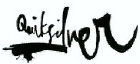 in Class 25; and
(e) Australian trade mark registration number 947940 for QUIKSILVER in Class 25,
(together referred to as the Quiksilver Trade Marks) or a name, word, mark, sign or device which is substantially identical with or deceptively similar to any one or more of the Quiksilver Trade Marks, without the licence or authority of the first applicant, the first respondent has infringed the Quiksilver Trade Marks and each of them.
Declaration in relation to the second applicant
2. By importing, advertising, offering for sale, distributing, supplying and selling board shorts bearing Australian registered trade mark number 358063 for BILLABONG in Class 25 (the GSM Trade Mark) or a name, word, mark, sign or device which is substantially identical with the GSM Trade Mark, without the licence or authority of the second applicant, the first respondent has infringed the GSM Trade Mark.
Declarations in relation to the third applicant
3. By importing, advertising, offering for sale, distributing, supplying and selling board shorts bearing the following trade marks:
(a) Australian trade mark registration number 1060886 for  in Class 25;
(b) Australian trade mark registration number 1201342 for  in Class 25; and
(c) Australian trade mark registration number 1278830 for  in Class 25,
(together referred to as the Billabong Trade Marks), or any name, word, mark, sign or device which is substantially identical with any one or more of the Billabong Trade Marks, without the licence or authority of the third applicant, the first respondent has infringed the Billabong Trade Marks and each of them.
4. By reproducing in material form, publishing and communicating to the public, or causing to be reproduced in material form, published and communicated to the public, a brochure, without the licence or authority of the third applicant, incorporating the following artistic work (or a substantial part thereof):
 (the Military Wave Copyright Work),
the first respondent has infringed the third applicant’s copyright in the Military Wave Copyright Work.
Declarations in relation to the fourth applicant
5. By importing, advertising, offering for sale, distributing, supplying and selling t-shirts bearing the following trade marks:
(a) Australian trade mark registration number 722649 for  in Class 25;
(b) Australian trade mark registration number 783375 for  in class 25; and
(c) Australian trade mark registration number 783377 for DCSHOES in class 25,
(together referred to as the DC Trade Marks), or a name, word, mark, sign or device which is substantially identical with or deceptively similar to any one or more of the DC Trade Marks, without the licence or authority of the fourth applicant, the first respondent has infringed the DC Trade Marks and each of them
6. By reproducing in material form, publishing and communicating to the public, or causing to be reproduced in material form, published and communicated to the public, a brochure, without the licence or authority of the fourth applicant, incorporating the following artistic work (or a substantial part thereof):
 (the DC Stylised Copyright Work),
the first respondent has infringed the fourth applicant’s copyright in the DC Stylised Copyright Work.
Declarations in relation to the fifth applicant
7. By reproducing in material form, publishing and communicating to the public, or causing to be reproduced in material form, published and communicated to the public, without the licence or authority of the fifth applicant, the following artistic works (or a substantial part thereof):
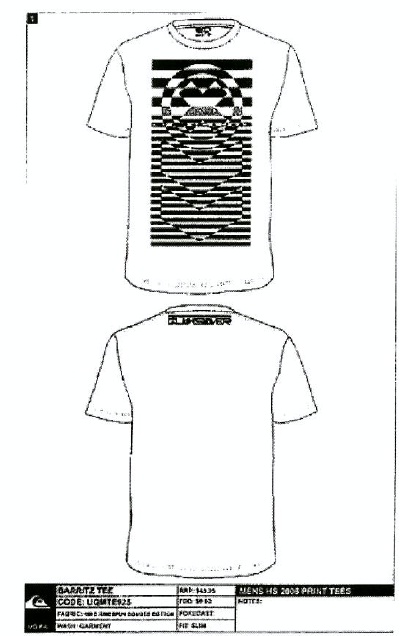
(a) the artistic work known as the “Biarritz Tee”, a representation of which is attached as Annexure A (the Biarritz Tee Copyright Work);
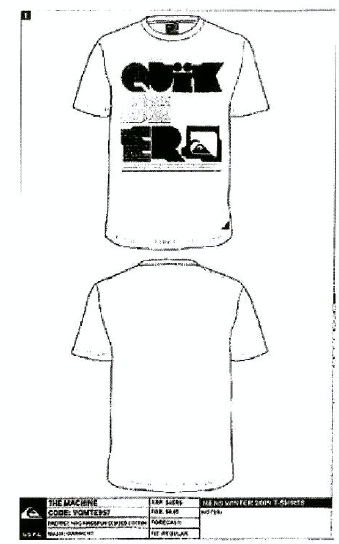
(b) the artistic work known as “the Machine”, a representation of which is attached as Annexure B (the Machine Copyright Work); and
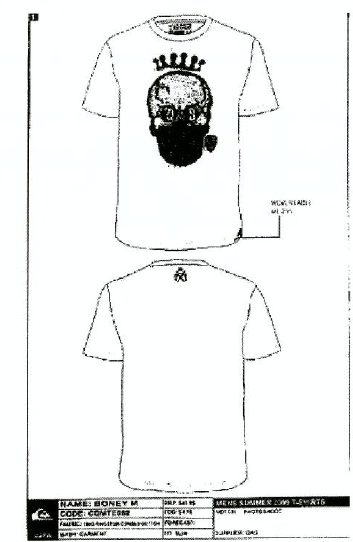
(c) the artistic work known as the “Boney M”, a representation of which is attached as Annexure C (the Boney M Copyright Work),
(together referred to as the Ug Manufacturing Copyright Works) the first respondent has infringed the fifth applicant’s copyright in the Ug Manufacturing Copyright Works.
8. By importing, offering for sale and selling articles of clothing, without the licence or authority of the fifth applicant, bearing reproductions of the Ug Manufacturing Copyright Works (or a substantial part thereof), the first respondent has infringed the fifth applicant’s copyright in the Ug Manufacturing Copyright Works.
Declarations in relation to the sixth applicant
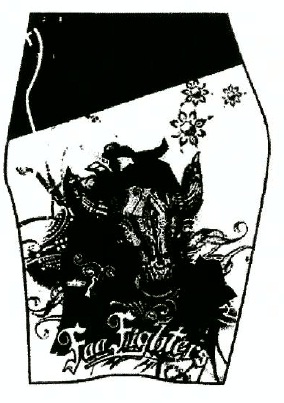
9. By reproducing in material form, publishing and communicating to the public, or causing to be reproduced in material form, published and communicated to the public, without the licence or authority of the sixth applicant, the artistic work known as the “Foo Fighters”, a representation of which is attached as Annexure D (the Foo Fighters Copyright Work) (or a substantial part thereof) the first respondent has infringed the sixth applicant’s copyright in the Foo Fighters Copyright Work.
10. By importing, offering for sale and selling articles of clothing, without the licence or authority of the sixth applicant, bearing reproductions of the following artistic works (or a substantial part thereof):
(a) the artistic work known as the “Bellview Bird”, a representation of which is attached as Annexure E (the Bellview Bird Copyright Work);
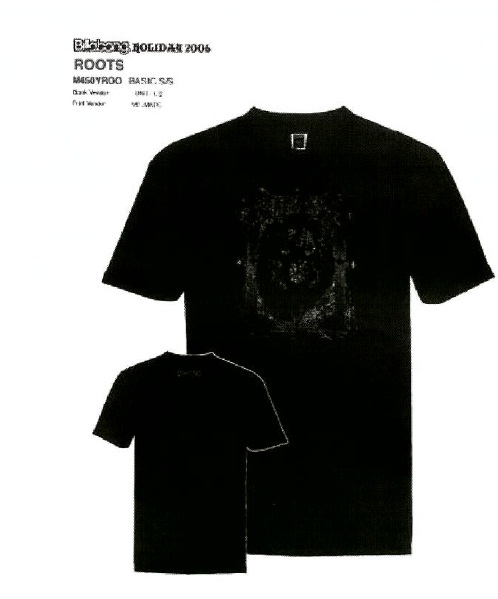
(b) the artistic work known as the “Roots Lion”, a representation of which is attached as Annexure F (the Roots Lion Copyright Work); and
(c) the Foo Fighters Copyright Work
(together referred to as the Billabong Artistic Copyright Works), the first respondent has infringed the sixth applicant’s copyright in the Billabong Artistic Copyright Works.
Declaration in relation to the seventh applicant
11. By reproducing in material form, publishing and communicating to the public, or causing to be reproduced in material form, published and communicated to the public, a brochure, without the licence or authority of the seventh applicant, incorporating the following artistic work (or a substantial part thereof):
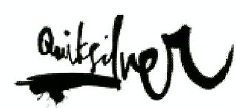 (the Quiksilver Script Copyright Work),
the first respondent has infringed the seventh applicant’s copyright in the Quiksilver Script Copyright Work.
AND THE COURT ORDER THAT:
Orders in relation to the first applicant
12. The first respondent be permanently restrained from using any of the Quiksilver Trade Marks or any name, word, mark, sign or device which is substantially identical with or deceptively similar to any of the Quiksilver Trade Marks in the course of trade on or in relation to:
(a) any of the goods in respect of which the Quiksilver Trade Marks are registered (the Quiksilver Registered Goods);
(b) any goods of the same description as any of the Quiksilver Registered Goods; or
(c) any services that are closely related to any of the Quiksilver Registered Goods,
not manufactured (in the case of goods) or provided (in the case of services) by or under the licence or authority of the first applicant, or procuring or inducing any other person to do any of the acts specified in this paragraph 12.
13. Within 28 days of the date of these orders, the first respondent deliver up to the first applicant, and verified on oath, all goods in the possession, power, custody or control of the first respondent to which any of the Quiksilver Trade Marks, or any name, word, mark, sign or device which is substantially identical with or deceptively similar to any of the Quiksilver Trade Marks, has been applied without the licence or authority of the first applicant.
14. The first respondent pay the first applicant damages to be assessed for infringement of the Quiksilver Trade Marks, together with interest, or, at the first applicant’s election, an account be taken of the first respondent’s profits, together with interest.
15. An enquiry, including appropriate discovery, be held to quantify the damages, or subject to the first applicant’s election, to take an account of profits, referred to in Order 14.
Orders in relation to the second applicant
16. The first respondent be permanently restrained from using the GSM Trade Mark or any name, word, mark, sign or device which is substantially identical with or deceptively similar to the GSM Trade Mark in the course of trade on or in relation to:
(a) any of the goods in respect of which the GSM Trade Mark is registered (the GSM Registered Goods);
(b) any goods of the same description as any of the GSM Registered Goods; or
(c) any services that are closely related to any of the GSM Registered Goods,
not manufactured (in the case of goods) or provided (in the case of services) by or under the licence or authority of the second applicant, or procuring or inducing any other person to do any of the acts specified in this paragraph 16.
17. Within 28 days of the date of these orders, the first respondent deliver up to the second applicant, and verified on oath, all goods in the possession, power, custody or control of the first respondent to which the GSM Trade Mark, or any name, word, mark, sign or device which is substantially identical with or deceptively similar to the GSM Trade Mark, has been applied without the licence or authority of the second applicant.
18. The first respondent pay the second applicant damages to be assessed for infringement of the GSM Trade Mark, together with interest, or, at the second applicant’s election, an account be taken of the first respondent’s profits, together with interest.
19. An enquiry, including appropriate discovery, be held to quantify the damages, or subject to the second applicant’s election, to take an account of profits, referred to in Order 18.
Orders in relation to the third applicant
20. The first respondent be permanently restrained from using any of the Billabong Trade Marks or any name, word, mark, sign or device which is substantially identical with or deceptively similar to any of the Billabong Trade Marks in the course of trade on or in relation to:
(a) any of the goods in respect of which the Billabong Trade Marks are registered (the Billabong Registered Goods);
(b) any goods of the same description as any of the Billabong Registered Goods; or
(c) any services that are closely related to any of the Billabong Registered Goods,
not manufactured (in the case of goods) or provided (in the case of services) by or under the licence or authority of the third applicant, or procuring or inducing any other person to do any of the acts specified in this paragraph 20.
21. Within 28 days of the date of these orders, the first respondent deliver up to the third applicant, and verified on oath, all goods in the possession, power, custody or control of the first respondent to which any of the Billabong Trade Marks, or any name, word, mark, sign or device which is substantially identical with or deceptively similar to any of the Billabong Trade Marks, has been applied without the licence or authority of the third applicant.
22. The first respondent pay the third applicant damages to be assessed for infringement of the Billabong Trade Marks, together with interest, or, at the third applicant’s election, an account be taken of the first respondent’s profits, together with interest.
23. An enquiry, including appropriate discovery, be held to quantify the damages, or subject to the third applicant’s election, to take an account of profits, referred to in Order 22.
24. Pursuant to section 115(2) of the Copyright Act 1968 (Cth), the first respondent be permanently restrained from:
(a) reproducing, publishing and communicating to the public; or
(b) authorising the reproduction, publication and communication to the public
of the whole or a substantial part of the Military Wave Copyright Work (including by reproducing the Military Wave Copyright Work in brochures or advertisements) without the licence or authority of the third applicant.
25. Within 28 days of the date of these orders, the first respondent deliver up to the third applicant, and verified on oath, all articles (including brochures, advertisements and other documents and/or electronic materials) in the possession, power, custody or control of the first respondent on or in which:
(a) the first respondent has reproduced or authorised the reproduction; or
(b) the first respondent has published and communicated to the public or authorised the publication and communication to the public
of the Military Wave Copyright Work or a substantial part thereof without the licence or authority of the third applicant.
26. In respect of the Military Wave Copyright Work, there be a further hearing at a date to be fixed to determine whether or not the third applicant is entitled to damages (including additional damages) or, at its election, an account of profits pursuant to section 115 of the Copyright Act 1968 (Cth).
Orders in relation to the fourth applicant
27. The first respondent be permanently restrained from using any of the DC Trade Marks or any name, word, mark, sign or device which is substantially identical with or deceptively similar to any of the DC Trade Marks in the course of trade on or in relation to:
(a) any of the goods in respect of which the DC Trade Marks are registered (the DC Registered Goods);
(b) any goods of the same description as any of the DC Registered Goods; or
(c) any services that are closely related to any of the DC Registered Goods,
not manufactured (in the case of goods) or provided (in the case of services) by or under the licence or authority of the fourth applicant, or procuring or inducing any other person to do any of the acts specified in this paragraph 27.
28. Within 28 days of the date of these orders, the first respondent deliver up to the fourth applicant, and verified on oath, all goods in the possession, power, custody or control of the first respondent to which any of the DC Trade Marks, or any name, word, mark, sign or device which is substantially identical with or deceptively similar to any of the DC Trade Marks, has been applied without the licence or authority of the fourth applicant.
29. The first respondent shall pay the fourth applicant damages to be assessed for infringement of the DC Trade Marks, together with interest, or, at the fourth applicant’s election, an account be taken of the first respondent’s profits, together with interest.
30. An enquiry, including appropriate discovery, be held to quantify the damages, or subject to the fourth applicant’s election, to take an account of profits, referred to in Order 29.
31. Pursuant to section 115(2) of the Copyright Act 1968 (Cth), the first respondent be permanently restrained from:
(a) reproducing, publishing and communicating to the public; or
(b) authorising the reproduction, publication and communication to the public
of the whole or a substantial part of the DC Stylised Copyright Work (including by reproducing the DC Stylised Copyright Work in brochures or advertisements) without the licence or authority of the fourth applicant.
32. Within 28 days of the date of these orders, the first respondent deliver up to the fourth applicant, and verified on oath, all articles (including brochures, advertisements and other documents and/or electronic materials) in the possession, power, custody or control of the first respondent on or in which:
(a) the first respondent has reproduced or authorised the reproduction; or
(b) the first respondent has published and communicated to the public or authorised the publication and communication to the public
of any of the DC Stylised Copyright Work or a substantial part thereof without the licence or authority of the fourth applicant.
33. In respect of the DC Stylised Copyright Work, there be a further hearing at a date to be fixed to determine whether or not the fourth applicant is entitled to damages (including additional damages) or, at its election, an account of profits pursuant to section 115 of the Copyright Act 1968 (Cth).
Orders in relation to the fifth applicant
34. Pursuant to section 115(2) of the Copyright Act 1968 (Cth), the first respondent be permanently restrained from:
(a) reproducing or authorising the reproduction of the whole or a substantial part of any of the Ug Manufacturing Copyright Works without the licence or authority of the fifth applicant;
(b) publishing and communicating to the public or authorising the publication and communication to the public of the whole or a substantial part of any of the Ug Manufacturing Copyright Works without the licence or authority of the fifth applicant;
(c) selling, offering for sale, supplying, offering to supply, importing or distributing any articles bearing any Infringing Ug Manufacturing Copyright Works (such Works being a copy of the whole or a substantial part of any of the Ug Manufacturing Copyright Works which has not been made or applied by or with the licence or authority of the fifth applicant);
(d) authorising, directing or procuring any other company or person to engage in any of the conduct sought to be restrained by sub-paragraphs (a), (b) and (c).
35. Within 28 days of the date of these orders, the first respondent deliver up to the fifth applicant, and verified on oath:
(a) all articles (including brochures, advertisements and other documents and/or electronic materials) in the possession, power, custody or control of the first respondent on or in which:
(i) the first respondent has reproduced or authorised the reproduction;
(ii) the first respondent has communicated and published or authorised the communication and publication
of any of the Ug Manufacturing Copyright Works or a substantial part thereof without the licence or authority of the fifth applicant; and
(b) all articles bearing any Infringing Ug Manufacturing Copyright Works (as defined in Order 34(c).
36. In respect of the Ug Manufacturing Copyright Works and the articles bearing any Infringing Ug Manufacturing Copyright Works (as defined in Order 34(c)), there be a further hearing at a date to be fixed to determine whether or not the fifth applicant is entitled to damages (including additional damages) or, at its election, an account of profits pursuant to section 115 of the Copyright Act 1968 (Cth).
Orders in relation to the sixth applicant
37. Pursuant to section 115(2) of the Copyright Act 1968 (Cth), the first respondent be permanently restrained from:
(a) reproducing or authorising the reproduction of the whole or a substantial part of any of the Billabong Artistic Copyright Works without the licence or authority of the sixth applicant;
(b) publishing and communicating to the public or authorising the publication and communication to the public of the whole or a substantial part of any of the Billabong Artistic Copyright Works without the licence or authority of the sixth applicant;
(c) selling, offering for sale, supplying, offering to supply, importing or distributing articles bearing an Infringing Foo Fighters Copyright Work (being a copy of the whole or a substantial part of the Foo Fighters Copyright Work which has not been made or applied by or with the licence or authority of the sixth applicant);
(d) without the licence or authority of the sixth applicant, selling, offering for sale, supplying, offering to supply, importing or distributing articles bearing either the Bellview Bird Copyright Work or the Roots Lion Copyright Work;
(e) authorising, directing or procuring any other company or person to engage in any of the conduct sought to be restrained by sub-paragraphs (a), (b), (c) and (d).
38. Within 28 days of the date of these orders, the first respondent deliver up to the sixth applicant, and verified on oath:
(a) all articles (including brochures, advertisements and other documents and/or electronic materials) in the possession, power, custody or control of the first respondent on or in which:
(i) the first respondent has reproduced or authorised the reproduction;
(ii) the first respondent has communicated and published or authorised the communication and publication
of any of the Billabong Artistic Copyright Works or a substantial part thereof without the licence or authority of the sixth applicant;
(b) all articles bearing an Infringing Foo Fighters Copyright Work (as defined in Order 37(c)); and
(c) all articles bearing either the Bellview Bird Copyright Work or the Roots Lion Copyright Work.
39. In respect of the Billabong Artistic Copyright Works and the articles bearing those works, there be a further hearing at a date to be fixed to determine whether or not the sixth applicant is entitled to damages (including additional damages) or, at its election, an account of profits pursuant to section 115 of the Copyright Act 1968 (Cth).
Orders in relation to the seventh applicant
40. Pursuant to section 115(2) of the Copyright Act 1968 (Cth), the first respondent be permanently restrained from:
(a) reproducing, publishing and communicating to the public; or
(b) authorising the reproduction, publication and communication to the public
of the whole or a substantial part of the Quiksilver Script Copyright Work (including by reproducing the Quiksilver Script Copyright Work in brochures or advertisements) without the licence or authority of the seventh applicant.
41. Within 28 days of the date of these orders, the first respondent deliver up to the seventh applicant, and verified on oath, all articles (including brochures, advertisements and other documents and/or electronic materials) in the possession, power, custody or control of the first respondent on or in which:
(a) the first respondent has reproduced or authorised the reproduction; or
(b) the first respondent has published and communicated to the public or authorised the publication and communication to the public
of the Quiksilver Script Copyright Work or a substantial part thereof without the licence or authority of the seventh applicant
42. In respect of the Quiksilver Script Copyright Work, there be a further hearing at a date to be fixed to determine whether or not the seventh applicant is entitled to damages (including additional damages) or, at its election, an account of profits pursuant to section 115 of the Copyright Act 1968 (Cth).
Costs
43. The first respondent pay the applicants’ costs of the motion, notice of which is dated 8 December 2010, to be taxed in default of agreement.
44. The respondents pay the applicants’ costs of the respondents’ application (made by letter dated 3 February 2011) for leave to amend their amended defence, to be taxed in default of agreement.
Time for filing application for leave to appeal
45. Any application for leave to appeal be filed within 21 days after the date on which the above declarations and orders are made.
ANNEXURE A
ANNEXURE B
ANNEXURE C
ANNEXURE D
ANNEXURE E

ANNEXURE F
Note: Entry of orders is dealt with in Rule 39.32 of the Federal Court Rules 2011.
VICTORIA DISTRICT REGISTRY | |
GENERAL DIVISION | VID 652 of 2010 |
BETWEEN: | QS HOLDINGS SARL First Applicant GSM (TRADEMARKS) PTY LTD ACN 085 955 291 Second Applicant GSM (OPERATIONS) PTY LTD ACN 085 950 803 Third Applicant DC SHOES INC Fourth Applicant UG MANUFACTURING CO PTY LTD ACN 005 047 941 Fifth Applicant PINEAPPLE TRADEMARKS PTY LTD ACN 107 248 680 Sixth Applicant QUIKSILVER INC Seventh Applicant
|
AND: | PAUL'S RETAIL PTY LTD ACN 114 419 242 First Respondent PAUL ANDREW DWYER Second Respondent
|
JUDGE: | KENNY J |
DATE: | 5 SEPTEMBER 2011 |
PLACE: | MELBOURNE |
REASONS FOR JUDGMENT
Introduction
1 On 2 August 2011, the Court gave reasons for judgment in relation to the applicants’ motion for summary judgment against the first respondent under s 31A of the Federal Court of Australia Act 1976 (Cth) (‘the Federal Court Act’) and the respondents’ application for leave to file and serve a second amended defence. The Court held that the first respondent had no reasonable prospect of defending the applicants’ allegations of trade mark and copyright infringement in so far as they were pressed on the applicants’ summary judgment motion, and that the applicants were entitled to summary judgment on these claims. Further, the Court held that the respondents’ application for leave to amend should be refused to the extent opposed by the applicants.
2 The parties were given an opportunity to make submissions as to the appropriate form of orders to give effect to these reasons for judgment. Their disagreement on these orders led to a further hearing on Friday, 12 August 2011.
3 At this hearing, in relation to the issues of relief, the applicants sought to rely on some additional evidence, being the affidavit of Dahlia Devaraj of 10 August 2011, the affidavit of Stephen Stern of 11 August 2011, the affidavit of Kenneth Taylor of 10 August 2011, the affidavit of Kalya Perry of 11 August 2011, and the affidavit of Richard Mallon of 11 August 2011. (For present purposes, I have not had regard to the 10 August 2011 affidavit of Ms Devaraj and the 11 August 2011 affidavit of Mr Stern because they dealt with the “Roxy” mark, which was not the subject of the summary judgment application. For the same reason, I have also put out of account those parts of Kalya Perry’s affidavit that concern the “Roxy” mark.) I explain the respondents’ position with respect to the applicant’s additional evidence hereafter.
Declarations
4 At the hearing, the applicants sought declarations, in a form which met the gist of the respondents’ criticisms as set out in written submissions dated 9 August 2011. As Besanko J said in Australian Competition and Consumer Commission v Cambur Industries Pty Ltd [2006] FCA 1027 at [96], referring to Rural Press Ltd v Australian Competition and Consumer Commission (2003) 216 CLR 53 at 91 [89]-[90]:
A declaration … must identify the contravening conduct. It must be precise in its terms, such that a person reading the declaration understands the nature of the contravention and, in broad terms, the conduct constituting the contravention. On the one hand, it is not necessary to put all the relevant findings of fact in the declaration, but, on the other, the gist of the conduct (as found) should be identified.
The applicants’ proposed declarations satisfied the requisite requirements and I consider it appropriate to make them.
Injunctions
5 The respondents argued, first, against the grant of injunctions at all and, secondly, against the applicants’ proposed form of the injunctions against future copyright infringements.
6 I accept that, as the applicants submitted, permanent injunctions are a conventional remedy in cases involving infringement of intellectual property rights. As Crennan J said in Nokia Corporation v Truong (2005) 66 IPR 511 (‘Nokia v Truong’) at 522 [46]:
Permanent injunctions are granted conventionally in respect of cases of intellectual property infringement against proven infringement and a proven threat to continue infringing as this avoids multiplicity of proceedings …
7 In this case, I consider it appropriate to exercise my discretion to grant permanent injunctions, because:
1. The respondents have not given any undertakings of the kind sought by the applicants not to infringe the applicants’ copyright and trade mark rights in the future.
2. The first respondent’s infringing conduct apparently continued after the proceeding began in August 2010 notwithstanding the statements in the Amended Defence that the infringing conduct had ceased. On 5 February 2011, a private investigator made a trap purchase of a counterfeit DC Shoes t-shirt from a Paul’s Warehouse store. This was the subject of evidence adduced by the applicants at the hearing of their summary judgment motion. Further, Ms Perry also gave evidence that she observed on-going use of the Quiksilver Script Copyright Work (in a brochure and television commercial).
3. Procedures to prevent counterfeit goods entering the first respondent’s stores have not in fact prevented the sale of counterfeit goods. There was evidence that Mr Dwyer’s instructions to stores to quarantine the counterfeit products had not prevented the subsequent sale of such products. There was also evidence in Mr Dwyer’s affidavit that, where the first respondent had been unable to obtain goods from an authorised Australian supplier, the first respondent sourced the goods from elsewhere.
4. The precise scale of infringing conduct has not yet been ascertained. However, an exhibit to Mr Dwyer’s affidavit indicates that the first respondent received a shipment of more than 19,000 pairs of Quiksilver and Billabong branded shorts.
5. The first respondent disputed subsistence and ownership of copyright in relation to the works upon which the applicants relied.
8 Having regard to the above, I am persuaded that a sufficient risk of future infringing conduct remains and that, in accordance with the usual practice of the Court, it is appropriate to grant injunctive relief. I have borne in mind the first respondent’s submission that the respondents did not apprehend the generality of the copyright claims concerning reproduction on brochures and in advertising until around 17 January 2011, but would, as indicated, nonetheless grant injunctive relief.
9 The additional evidence, which the applicants filed shortly before the hearing, also supported the applicants’ contention that, as at June 2011, there remained evidence of ongoing infringing conduct.
10 In relation to this material, the respondents’ counsel stated that her instructions were that the respondents thought that the goods in question may have come from a genuine source and that the Court should not accept that they were counterfeit. The respondents’ counsel indicated that there had not been enough time to check the position. The respondents’ counsel did not submit, however, that the Court should not have regard to the applicants’ additional evidence because the respondents had not had sufficient time to answer it. As it happened, the first respondent filed no affidavit material indicating that its relevant officer held the belief to which counsel referred and/or that the first respondent had had insufficient time to investigate the position. In the circumstances, it seems to me that the additional evidence can be regarded as supporting the applicants’ case that the infringing conduct was on-going to June 2011. As indicated above, however, I would grant the applicants injunctive relief irrespective of this additional material.
11 In opposing the grant of injunctions, the respondents’ counsel relied on Nicholas J’s findings in Sporte Leisure Pty Ltd v Paul’s International Pty Ltd (No 3) (2010) 88 IPR 242, particularly at 257-8 [81], [82] and 259 [90], and his Honour’s refusal of injunctive relief in that case (see 268 [138]). Sporte Leisure is distinguishable from the present case, however, because, in Sporte Leisure, his Honour made findings of contractual misbehaviour by an authorised manufacturer. No such circumstance is said to arise in the present case.
12 The first respondent accepted that, if the Court determined that injunctive relief was appropriate, then the form of the trade mark injunction proposed by the applicants was also appropriate. I would make these injunctions in a form similar to that which the applicants proposed, subject to some amendments designed to narrow and clarify the injunctions.
13 The first respondent opposed the applicants’ proposed form of copyright injunction upon the basis that the proposed injunction travelled beyond the pleadings and findings made. The first respondent argued that the proposed injunctions should be limited to restraining the identified acts of infringement. The applicants defended their position by reference to a number of authorities. As appears below, I consider that there are difficulties with the positions taken by both parties.
14 As the applicants noted, in a case of a patent infringement, an injunction will not ordinarily be limited to restraining the infringing conduct found proven at trial and will in terms restrain all infringements of the patentee’s rights: see Coflexip SA v Stolt Comex Seaway MS Ltd [2001] RPC 9 (‘Coflexip’) at 186 [12]-188 [21] and Welcome Real-Time SA v Catuity Inc (No 2) (‘Welcome Real-Time’) (2001) AIPC 91,736 at [9] and [11]. The considerations affecting the grant of injunctions in patent infringement cases are, however, to some extent peculiar to patent cases: see Coflexip at 187 [18].
15 In Solahart Industries Pty Ltd v Solar Shop Pty Ltd (No 2) [2011] FCA 780 at [11], Perram J rejected a submission that “an analogy should be drawn between what happens in patent litigation and the consideration which takes place in the context of a trade mark in suit” in a trade mark infringement proceeding, saying:
The drawing of injunctions in such a form is not a practice which is to be encouraged any more broadly than is necessary. The careful parsing of the claims made in patents litigation is far more closely involved in a dissection of what the patent means than that which takes place in a trade mark suit. I do not accept, therefore, that a general injunction against infringing is appropriate.
As a reading of Perram J’s reasons for judgment shows, the circumstances in that case led his Honour to grant injunctions in narrow and specific terms. The circumstances of the present case are different from those under consideration by his Honour, but nonetheless I have sought to confine the injunctions flowing from the trade mark infringements more narrowly than the applicants’ proposed draft.
16 In this case, however, the parties’ respective submissions raised the question whether, in relation to the prospective copyright infringements, the injunctions should be expressed to restrain the first respondent from infringing copyright generally, or whether they should be confined to the identified acts of infringement. The first respondent supported the latter position, whilst the applicants supported the former. As indicated, there are difficulties with the positions adopted by both parties.
17 The applicants referred me to the reasons for judgment of the Full Court in Universal Music Australia Pty Ltd v Sharman Networks Ltd (2006) 150 FCR 110 (‘Universal Music’) at 120-121 [42]-[48], 122 [53] and 123 [57], in support of the proposition that, in a copyright infringement case, an injunction will not be limited to restraining the infringing conduct found proven at trial and will in terms restrain all infringements of the copyright owner’s rights. When read carefully, however, I do not consider that the case supports such a broad proposition.
18 The issue on appeal in Universal Music was whether, having regard to the terms of the order originally made in earlier copyright infringement proceedings, the respondents had disobeyed the order and were in contempt. In the course of Branson J’s reasons, with which Lindgren and Finkelstein JJ agreed, her Honour considered the appropriate form of an injunction in such a case. After referring to the observations of Lockhart J in ICI Australia Operations Pty Ltd v Trade Practices Commission (1992) 38 FCR 248 at 259, Branson J said:
There is Full Court authority for the proposition that any practice of granting injunctions in a form which reproduces, with the risk of sanctions for contempt, that which an Act forbids is to be discouraged (Commodore Business Machines Pty Ltd v Trade Practices Commission (1990) 92 ALR 563 at 574). … However, the authorities do not support the proposition that an injunction which incorporates the terms of a statutory prohibition should never be made, or if made, cannot found a charge of contempt.
Indeed, there is United Kingdom authority, which I found persuasive in Microsoft Corp v Goodview Electronics Pty Ltd (2000) 49 IPR 578, that injunctions should be granted in broad terms in cases of trademark and copyright infringements where the defendants have shown themselves to be “untrustworthy” or “dishonest” (see Coflexip SA v Stolt Comex Seaway MS Ltd [1999] 2 All ER 593 at 603; [1999] FSR 473 at 486 (this issue was not dealt with on appeal) and Microsoft Corp v Plato Technologies Ltd [1999] FSR 834).
19 Having regard to the authorities, Branson J ultimately rejected the contention that the original order was incapable of founding a charge of contempt because it was drawn in terms which reproduced the statutory language as opposed to terms that prescribed specific conduct. This is a different proposition from that which the applicants invite me to accept in this case. Furthermore, the terms of the injunction with which her Honour was concerned were markedly more specific than the proposed injunctions in the present case.
20 None of the UK authorities to which her Honour referred offerred much support for the broad proposition for which the applicants contended since the Coflexip Case, to which reference has already been made, was a patent infringement case and might be regarded as attracting different considerations: see [14] above.
21 In Microsoft Corp v Plato Technologies Ltd [1999] FSR 834 (‘Microsoft Corp v Plato’), the defendant submitted to summary judgment on the basis that it had sold five copies of software purporting to be the plaintiff’s software, without knowing that the software was counterfeit. The defendant successfully opposed an injunction that went so far as to prohibit all infringements of the plaintiff’s trade marks and copyright upon the basis that there was no threat of future infringement at large. An injunction was fashioned to deal only with the specific risk that was found to exist. This case provided little direct support for either side in the present case, where the circumstances were markedly different.
22 Perhaps, the most that can be said is that an analysis of the authorities referred to in Microsoft Corp v Plato tends to support the grant of injunctions in wider terms than that for which the first respondent contended, although not as wide as the terms proposed by the applicants. See also Microsoft Corp v Goodview Electronics Pty Ltd (2000) 49 IPR 578 (‘Microsoft Corp v Goodview Electronics’) at 592 [67] per Branson J.
23 As noted above, in Universal Music Branson J stated that it may be permissible to incorporate in an injunction the terms of a statutory prohibition. It does not follow from this, however, that it is permissible to include in injunctions prohibitions against forms of infringing conduct that have not been proven, let alone alleged: compare Microsoft Corp v Goodview Electronics at 592. Bearing these considerations in mind, I propose to grant injunctions in terms incorporating the statutory language but substantially designed to guard against the infringing conduct that has been proven.
24 As a consequence, in this case, the forms of the injunctions vary depending on the nature of the copyright infringement pleaded and proven for the purposes of the summary judgment application: compare QS Holdings Sarl v Paul’s Retail Pty Ltd [2011] FCA 853 at [58], [65], [99] (reproduction in catalogue) with [73], [82] (reproduction of clothing stock). For the reasons appearing hereafter, these differences also entail consequential differences in the scope of the orders for delivery up: see [30] below.
Damages or account of profits
25 In respect of the trade mark infringements, the applicants are entitled to orders for damages or an account of profits. I would reject the first respondent’s challenge to the applicants’ proposed orders in respect of trade mark infringement, having regard to Nokia Corporation v Liu (2009) 82 IPR 452 at 460 [33] - 461 [39].
26 The position is different with respect to the copyright infringements. Whilst infringements have been established, there has been no adjudication of the matters with which s 115(3) of the Copyright Act 1968 (Cth) is concerned. Whether or not the applicants are entitled to damages or are limited to an account of profits has not yet been determined.
27 Whilst the applicants’ draft orders included a proposed order for damages in respect of copyright infringement under s 115, for the reasons stated, I would not make such an order at this stage of the proceeding. The applicants accepted that any entitlement to additional damages also awaits adjudication. I have made orders accordingly.
28 The applicants’ original application included a claim by the fifth and sixth applicants for “[d]amages for conversion under section 116 of the Copyright Act 1968 (Cth)”. However, so far as I could tell, the applicants’ statement of claim did not include any action for conversion. Nor did the applicants refer to any claim for conversion in their written or oral submissions. Although the applicants’ draft orders included a proposed order for damages under s 116(1A) of the Copyright Act 1968 (Cth), for the reasons just stated, I would not make any such order now. It is a matter for the applicants whether they wish to take any further steps in relation to this matter.
Delivery up
29 There was also a dispute about the orders for delivery up, which counsel for the respondents argued went well beyond the findings the Court had made.
30 An order for delivery up operates in aid of injunctive relief “by removing from the defendant a source of temptation”: see Meagher, Heydon & Leeming, Meagher, Gummow and Lehane’s Equity Doctrines and Remedies (Butterworths, 4th ed, 2002) at 905 [27-050].
31 I accept that orders for delivery up should be made, and that their scope should, generally speaking, reflect the terms of the injunctive relief. I have formulated orders accordingly. Because this injunctive relief is narrower than that proposed by the applicants, the result is that the need for a delivery-up protocol of the kind prepared by the applicants is dissipated. There were, moreover, difficulties with respect to the parties’ competing protocols, which led me to conclude that no such protocol should be incorporated in the Court’s orders. Within the regime created by these orders, the parties are at liberty to agree on a suitable protocol if they so wish.
Costs “payable forthwith”
32 Pursuant to s 43(2) of the Federal Court Act, the award of costs is in the discretion of the Court. The discretion must, of course, be exercised judicially.
33 Generally speaking, costs follow the event. That is, a successful litigant will ordinarily be entitled to its costs: see also Rule 40.04 of the Federal Court Rules 2011 (Cth). The ordinary position is that, where a costs order is made on an interlocutory application, the party in whose favour the order is made must not tax those costs until the proceeding is finished: see Rule 40.13. The Court may, however, order that costs be taxed and paid immediately.
34 The applicants have been successful in their summary judgment application and in resisting the respondents’ application for leave to amend their amended defence. Having regard to these outcomes, the respondents do not dispute the applicants’ entitlement to an award of costs. What the respondents’ dispute is the applicants’ proposition that it is appropriate that the respondents pay these costs forthwith.
35 In Courtney v Medtel Pty Ltd (No 3) [2004] FCA 347 (‘Courtney v Medtel’) at [20], Sackville J referred to the policy reasons that have been said to support the general rule that Rule 40.13 now embodies.
36 The authorities accepted that, under O 62 r 3(2) of the previous Federal Court Rules, the Court retained a discretion to determine whether or not costs ought be payable forthwith: see McKellar v Container Terminal Management Services Ltd [1999] FCA 1639 (‘McKellar’) at [14]–[15], [38]; Life Airbag Company of Australia Pty Ltd v Life Airbag Company (New Zealand) Ltd [1998] FCA 545 (‘Life Airbag’) at [11]; Courtney v Medtel at [21]; Wu v Avin Operations Pty Ltd (No 2) [2006] FCA 792 at [47]; and Thunderdome Racetiming and Scoring Pty Ltd v Dorian Industries Pty Ltd (1992) 36 FCR 297 (‘Thunderdome’) at 312.
37 Weinberg J reviewed the authorities concerning O 62 r 3(2) of the former Rules in McKellar before concluding at [38] that “[t]he discretion which is vested in the Court to order that a party’s costs be taxed and paid forthwith should be exercised only where the interests of justice in the particular case require that there be a departure from the general practice”. See also Life Airbag at [11] and Thunderdome at 312. The same test is apposite in cases where the Court is asked to make such an order under the new Rules.
38 The interests of justice depend on the circumstances of the case. The applicants referred to the fact that their summary judgment application and their objection to the respondents’ proposed amendments to their amended defence have been resolved at significant cost and effort. They also referred to the fact that the end of the proceeding is probably some time away and the fact that their summary judgment application resolved a significant part of the liability issues.
39 Whilst I accept that these are factors relevant to the exercise of discretion, in the circumstances of this case, I would not regard them as a sufficient reason to depart from the usual position, which is supported by the various policy considerations to which Sackville J referred in Courtney v Medtel.
Time for filing application for leave to appeal
40 As the first respondent sought, I would also order that any application for leave to appeal be filed within 21 days after the date on which the declarations and orders discussed above are made.
I certify that the preceding forty (40) numbered paragraphs are a true copy of the Reasons for Judgment herein of the Honourable Justice Kenny. |
Associate:


