

FEDERAL COURT OF AUSTRALIA
Australian Energy Regulator v Stanwell Corporation Limited
[2011] FCA 991
IN THE FEDERAL COURT OF AUSTRALIA | |
| Applicant | |
AND: | STANWELL CORPORATION LIMITED (ACN 078 848 674) Respondent |
DATE OF ORDER: | |
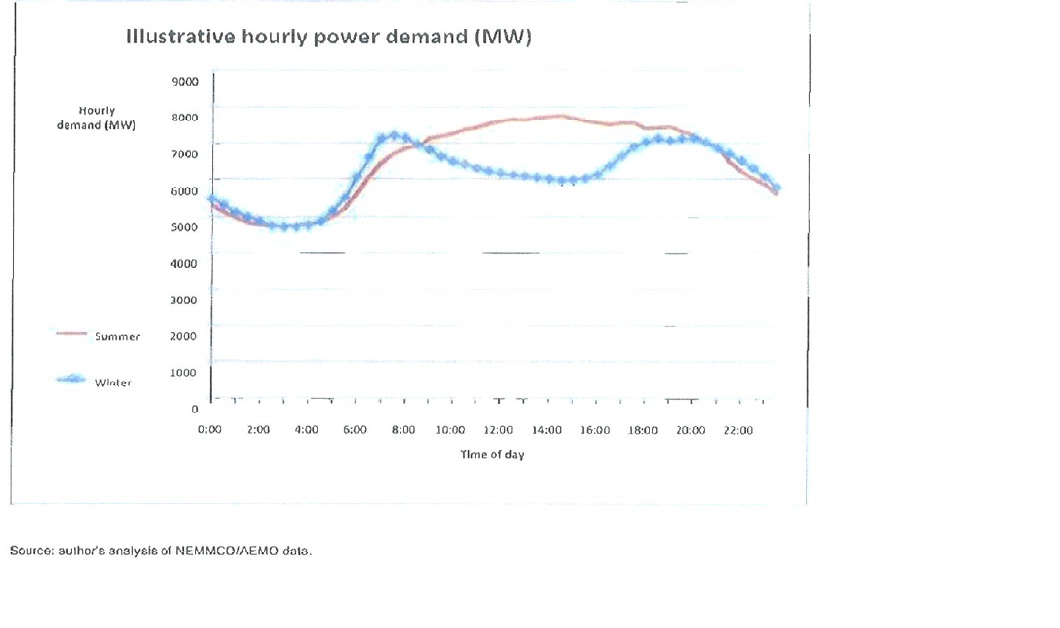
WHERE MADE: |
THE COURT ORDERS THAT:
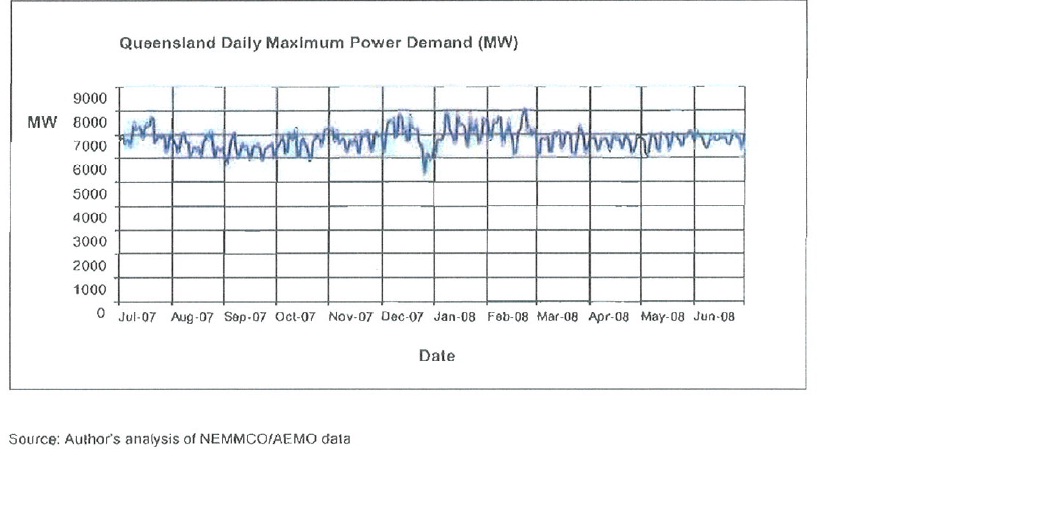
1. the application be dismissed; and
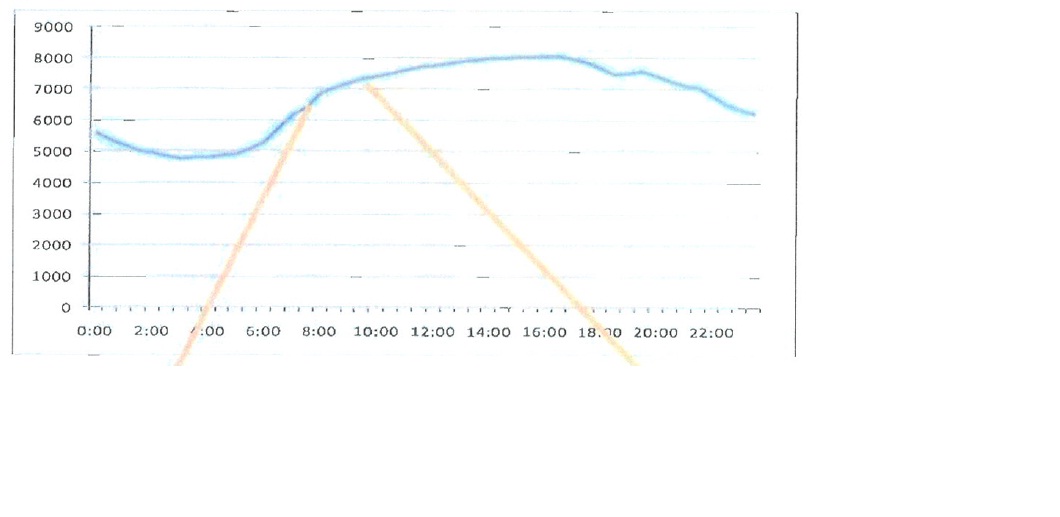
2. in the absence of any application, within 7 days, for any other order as to costs, the applicant pay the respondent’s costs of the proceedings, including reserved costs.
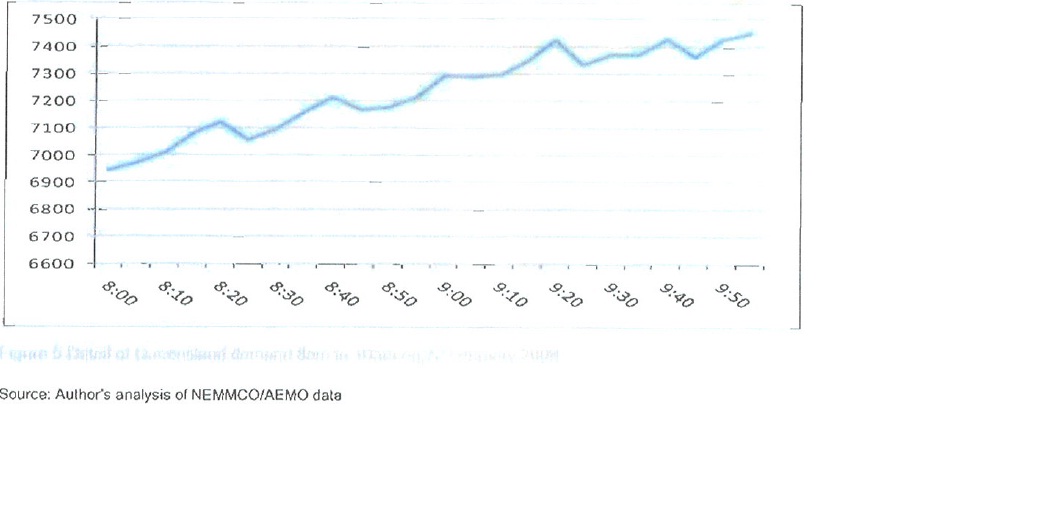
Note: Entry of orders is dealt with in Rule 39.32 of the Federal Court Rules 2011.
QUEENSLAND DISTRICT REGISTRY | |
GENERAL DIVISION | QUD 186 of 2009 |
BETWEEN: | AUSTRALIAN ENERGY REGULATOR Applicant
|
AND: | STANWELL CORPORATION LIMITED (ACN 078 848 674) Respondent
|
JUDGE: | DOWSETT J |
DATE: | 30 AUGUST 2011 |
PLACE: | BRISBANE |
REASONS FOR JUDGMENT
1 The National Electricity Market (the “NEM”) is a market for the sale and acquisition of electricity. The NEM is established pursuant to the National Electricity Law (the “Law”), originally enacted by the Parliament of South Australia and subsequently adopted by Commonwealth, New South Wales, Victorian, Queensland, Tasmanian and Australian Capital Territory legislation. The Law provides that:
The objective of this Law is to promote efficient investment in, and efficient operation and use of, electricity services for the long term interests of consumers of electricity with respect to −
(a) price, quality, safety, reliability and security of supply of electricity; and
(b) the reliability, safety and security of the national electricity system.
2 The National Electricity Rules (the “Rules”) govern the operation of the NEM. They have the force of law. There are five regions in the NEM, of which the State of Queensland is one. Although the demand for electricity within Queensland is generally met from local sources, electricity can be obtained from, and supplied to New South Wales. The NEM operates electronically. This case primarily concerns the Queensland region of the NEM in which there were, at the relevant time, effectively, nine suppliers of electricity. Although there were numerous purchasers of electricity in the market, mainly retail suppliers of electricity, decisions to purchase were, for present purposes, effectively made by the National Electronic Market Management Company Limited. That corporation is generally referred to in the evidence as “NEMMCO”, although the acronym “AEMO” is also used as its name is now Australian Energy Market Operator Limited. In these reasons I shall refer to it as the “Operator”. It was responsible for operation of the NEM.
ELECTRICITY GENERATION AND SUPPLY
3 The structure and operation of the NEM reflect certain characteristics of electricity and the mechanisms by which it is generated and supplied to end users. These matters are dealt with in detail in the affidavit of Gregory Harold Thorpe filed by the applicant on 26 February 2010. Mr Thorpe is an electrical engineer with considerable experience in the electricity industry, including industry regulation and marketing. Dr Ian Athol Rose was called by the respondent. He is an engineer, also eminently qualified to give evidence in respect of both technical and market matters. In his evidence Dr Rose avoided unnecessary repetition of the very detailed and helpful description of the market and of technical matters given by Mr Thorpe. He chose rather to comment upon aspects of Mr Thorpe’s report and to provide other, in most cases more detailed information concerning such matters. Much of this part of my reasons comes from Mr Thorpe’s evidence. I shall consider Dr Rose’s evidence separately.
4 In these reasons, I shall use the term “generating unit” to identify one set of equipment which is capable of generating electricity. I shall use the word “generator” to describe a legal entity which operates a generating unit. Generators usually operate power stations which house more than one generating unit. Electricity produced by generating units is, in the case of larger generators, transported to consumers through shared bulk transmission networks and local distribution networks. Some smaller or local generators supply electricity directly to local distribution networks.
5 Electricity is generated by converting other forms of energy into electrical energy. This may involve the conversion of energy stored in fuel such as coal or gas. Running water, the wind and the sun are other sources of energy used in generating electricity. Consumers convert electrical energy into other forms of energy such as light, heat and motion. The rate at which electrical energy is produced, transported or used at any point in time is described as “electrical power” and is measured in Watts (“W”). Applications which require substantial amounts of energy in short periods are said to have high power demand. The amount of energy produced or consumed in a given time is found by multiplying the power (that is the rate at which energy was delivered) by the length of time for which it was delivered and is measured in Watt-hours (“Wh”). Multiples of one thousand, one million and one thousand million units of power and energy are termed “kilowatts” and “kilowatt hours”, “megawatts” and “megawatt hours” and “gigawatts” and “gigawatt hours” respectively. The abbreviations “kW” and “kWh”, “MW” and “MWh” and “GW” and “GWh” are in common use. In this case it is not necessary to distinguish between Watts and Watt-hours.
6 In an electrical power system the aggregate power and energy requirements of individual consumers create the system demand for power and energy. Demand is sometimes described as “load”. That term may also be used to nominate the level at which generators are operating. This ambiguity is best avoided by referring to energy requirements of individual consumers and the aggregate of such requirements as “demand”.
7 Demand within any system will vary from second to second as users (including major users) switch appliances on and off. Demand tends to vary across each day and seasonally. Over a 24 hour period from midnight to midnight, demand typically falls to a low between 4.00 am and 6.00 am. Overnight demand includes 24 hour industry, security, street lighting and refrigeration. Demand rises as industrial, domestic and commercial activities commence for the day. Depending on the time of year and the location, early morning demand may reflect lighting, cooking, heating or air conditioning and public transport needs. During daylight hours, demand generally continues to rise to one or more peaks, and then begins to fall as commercial and industrial activity winds down. In hot weather air conditioning demand falls as the sun goes down. In cooler locations heating may drop as commerce and retailing close down for the day. Around 6.00 pm demand for cooking is high. Demand for lighting and for uses such as domestic television also increases until the daily cycle repeats.
8 Figure 2 in Mr Thorpe’s report appears below. It shows typical daily fluctuation in demand for summer and winter days. Winter demand reflects lighting and heating requirements at the start and end of daylight hours, whilst summer demand reflects air conditioning requirements during the day and into the evening.
9 In Figure 3 (below) Mr Thorpe demonstrates the maximum or peak levels of power demand occurring during the 2007-2008 year in Queensland. Seasonal variations can be seen. The lowest peak demand was on Boxing Day. The Christmas and New Year period is generally the lowest demand period because of summer holidays and reduced industrial and commercial activity. This period of low demand is generally followed, later in January and February, by elevated demand due to air conditioning use. In general, there are higher peak demand periods in mid-winter and summer than in the rest of the year. In Australia demand is highly sensitive to weather conditions and associated heating and air conditioning requirements, resulting in significant day-to-day variations. In some other states there are even greater seasonal and daily variations than in Queensland.
10 In Figure 4 (below) Mr Thorpe demonstrates the half-hourly demand trend in Queensland on 22 February 2008. It is typical of the variations experienced on a summer’s day.
11 The diagonal lines indicate the part of the trend line (from 8.00 am to 10.00 am) which is considered in more detail in Figure 5 (below). Mr Thorpe says that there may be significant fluctuations within the general demand trend. Figure 5 shows demand for the 5 minute periods between 8.00 am and 10.00 am on 22 February 2008.
12 The “saw tooth” effect in Figure 5 cannot be seen in Figure 4. As I understand it, that effect demonstrates very rapid rises and falls in demand which the electricity generating and distribution system must meet. Such variation in demand imposes a number of constraints on the operation of power systems. In particular the Operator and generators need detailed knowledge of prevailing conditions and resources to manage the technical implications of fluctuations in demand.
13 Electricity, once generated, cannot be stored in any meaningful quantities. This characteristic has great significance in the technical and commercial operation of electrical power systems and the NEM. Electricity must generally be produced as it is needed by users. Hence aggregate production must track the short-term, saw-tooth shape of demand as it occurs. If the aggregate supply from all generators is not closely balanced with the aggregate level of demand from all users, the power system can become unstable. In extreme circumstances such instability may result in a complete shutdown of the power system with consequential interruption of supply. Widespread shutdowns are rare. Systems are designed and operated to avoid such occurrences to the extent that this is possible. However even a few seconds of imbalance between aggregate generation and aggregate demand can lead to instability. Stability of a system is indicated by fluctuations in its operating frequency measured in Hertz (Hz). The standard frequency in Australia is 50 Hz. If the frequency varies from 50 Hertz by more than one or two per cent, there is a risk of instability. Mr Thorpe explains this instability as follows:
a. The electrical frequency at which a generating unit produces electricity is determined by the speed of rotation (rpm) and the construction of each turbine-generator unit;
b. Instability can occur because the rotating parts of power generating units are generally only able to operate safely within a relatively narrow range of speed of rotation and hence output electrical frequency;
c. If there is too much supply, for example due to the sudden disconnection of a block of customer demand when a transmission line is taken out of service due to a fault, the rotating machines may speed up to dangerous levels and potentially fail;
d. Conversely if there is too little aggregate supply, for example if a large generator is suddenly shutdown because of a fault, the remaining generators will slow down as they attempt to meet the full customer demand; and
e. Self-protection devices are built into turbine-generating plant [sic] to disconnect the units from the power system to avoid the plants running at unsafe speeds. In the case of under-supply, the failure or disconnection of a generating unit will exacerbate the under-supply and could lead to a cascading situation and eventual collapse of the power system.
14 As with any mechanical or electrical equipment, faults sometimes occur in generating units and in transmission and distribution networks. They may have to be taken off line for repair. There must be available reserve capacity in appropriate locations, with suitable response times, in order to keep power system frequency within safe bounds. Some generating systems have very short response times or other characteristics which make them especially suitable for use in the reserve role. Mr Thorpe says that some such systems are referred to as “ancillary services”. That term is defined in cl 3.11.1 of the Rules as:
… services that are essential to the management of power system security, facilitate orderly trading in electricity and ensure that electricity supplies are of acceptable quality.
15 In other words such services are vital aspects of the operation of the electricity supply system as a whole. Mr Thorpe presumably uses the term to describe generating units suitable for use in ensuring that such services are available as required. Other evidence suggests that there are special arrangements designed to guarantee the electricity supply necessary to maintain ancillary services, including arrangements concerning payments to generators for supplying such electricity. Mr Gnanananthan, formerly a trader employed by the respondent, gave further information concerning ancillary services. There are eight ancillary services markets. One such market is for power used in fine-balancing supply and demand. The markets are organized on the basis of 5 minute supply periods. Those periods are, themselves, divided into four second intervals. Although ancillary services are mentioned fairly frequently in the evidence, they are not of great importance in the case.
16 The generating units used to guarantee reserve and ancillary services are sometimes less cost effective than other units, and so may not always be in use when demand is low, and other sources are available. To guard against the risk that all available reserves may not be adequate to meet the demand created by a particular incident, systems are usually designed to permit disconnection of controlled amounts of customer demand. Similarly, to guard against a sudden drop in demand, systems are designed to permit disconnection of generating units. These mechanisms also provide a method of monitoring and recording changes in demand on a minute-to-minute or hour-to-hour basis.
17 The applicant was established pursuant to s 44AE of the Trade Practices Act 1974 (Cth), now the Competition and Consumer Act 2010 (Cth). Its functions are prescribed by the Law. They include the investigation of possible breaches of the Law, associated Regulations and the Rules and the conduct of proceedings in connection with any such breaches.
18 The Operator is responsible for various aspects of the electricity distribution system, including the NEM. In that capacity it effectively makes decisions as to the acceptance of offers by generators to supply electricity to the NEM. It is also responsible for power system security and for planning the development of the national transmission grid.
THE GENERATORS, INCLUDING THE RESPONDENT
19 At the relevant time there were nine generators selling electricity in the Queensland region of the NEM. The respondent was the largest single supplier, operating generating units at Stanwell, Gladstone, Kareeya, the Barron Gorge, and Mackay power stations. For present purposes the Stanwell and Gladstone power stations are of particular importance. At Stanwell there were four coal-fired, thermal, 350 MW generating units and at Gladstone, six coal-fired, thermal, 280 MW generating units. As I have said, electricity could also be acquired from the New South Wales generating system, using interstate connectors.
20 Some electricity generators sold electricity directly to larger end users pursuant to long term contracts. However much of the electricity produced was sold in the Spot Market which is part of the NEM. Operation of the NEM required that demand be tracked in order to match it with economical supply in prevailing conditions. This “dispatch process” had, as its dual objectives, reliable technical operation and economic use of resources. In order to manage the process the Operator had to predict future demand for electricity and have knowledge of available generating capacity. In particular, it had to know the quantities of electricity offered by the various generators at any point in time. Mr Thorpe suggests that the Operator had to “… judge the relative economic merits of calling different generators into service as demand rises and falls on the basis of the ‘dispatch cost’ presented to [the Operator]”. Mr Thorpe argues that the generators, in effect, would bid for shares of market demand by offering quantities of electricity at particular prices. Whilst the Operator sought to ensure continuity of supply to users at the lowest cost, generators sought to ensure that the amounts of electricity which they generated were disposed of and to maximise their returns. I have previously identified the need for reserve capacity, that such capacity might be provided by generating units which could be brought on line quite quickly and that those units may be more expensive to operate than other units. In periods of high demand, the cheaper generating units would be unable to meet demand, and so more expensive units would be brought on line. Only the prospect of higher prices would entice a generator to bring such units on line. A generator would seek to ensure that the electricity produced by its cheaper units was sold, whilst seeking to maximise its return by activating the more expensive units when the price was sufficiently high to justify their engagement. As will be seen, when the Operator acquired electricity at a higher price, all generators supplying electricity at the relevant time received the benefit of that price.
21 In discussing the market it is important to note one curiosity in its terminology. The regulations distinguished between dispatch bids, which reflected customer demand, and dispatch offers made by generators. However, in common parlance within the industry, both bids and offers were referred to generically as “bids”. Subsequent variations to either dispatch offers or dispatch bids were described as “rebids”. This latter usage was recognized in the definition provisions contained in Ch 10 of the Rules.
22 As I have said, trading of electricity in the NEM occurred in two broad forms, “spot” and “contract”. This case primarily concerns spot trading. Mr Thorpe described the NEM as occurring in a “mandatory gross spot market”, saying that:
a. It is mandatory as, with a limited number of exceptions … all wholesale quantities of electricity must be bought and sold through the Spot Market;
b. It is a gross arrangement as settlement of trading is for the entire amount of electricity produced by generators and consumed by retailers and large users;
c. It is a spot market as the trading occurs at Spot Prices determined on the basis of prevailing market conditions each half hour, although the design presumes market participants are likely to enter into bilateral contracts outside of the auspices of the [Rules]; and
d. The points of connection to the transmission networks of generators and wholesale buyers are grouped into geographic price regions and a separate Spot Price is set for each region. …
23 Contract trading occurred between buyers and sellers in parallel with spot trading, generally in the form of “contracts for difference”. Such contracts were made in advance and may have covered periods of some years. These contracts were, as Mr Thorpe puts it, “financial in nature”. The parties were free to agree on the contract price and other terms on a bilateral basis. However such trading was subject to legislative and regulatory oversight outside of the Rules. A contract for difference guaranteed that the generator would dispose of at least part of its capacity at a fixed price. Similarly, the end user had a guaranteed supply at that price. These contracts were generally performed by the payment of money by one party to the other, representing the difference between the relevant contract price and the spot price at the time of supply. Electricity was transferred between generators and contract customers using the various distribution networks. In the evidence these contracts are often referred to as “hedge contracts”.
24 The prices at which electricity was supplied reflected differences in generating technology. A turbine generating unit comprises a generating mechanism mounted on one end of a shaft. The shaft is made to rotate by a force acting on the blades of the turbine mounted on the other end of the shaft. When the turbine rotates, the generating mechanism produces electricity. Numerous technologies and fuels are used to drive turbines. They include:
steam produced by heating water in a boiler fuelled by gas, coal or other fuels;
hot exhaust gas from the combustion of fuels such as gas in gas turbines;
wind passing over the blades of wind turbines;
water falling from a height or flowing into a hydro-power station; and
emerging technologies, in various stages of development, including hot rocks as a source of energy to create steam, wave power and air heated in solar towers.
25 These technologies have different capital and operating cost structures which affect the cost of using them in producing electricity. Different technologies have different characteristics, affecting the rapidity with which they can be brought from standby mode to operating mode in order to respond to dispatch instructions. Generators were permitted only to submit bids for supply by generating units which were in operating mode and able so to respond. Relevant characteristics of different technologies are discussed below.
26 Steam boilers take between six and twenty hours to heat in order to produce sufficient steam to drive turbines and thus produce electricity. Hence there is a significant delay between a decision to call on an inactive steam generating unit and actual supply. Boilers have high capital costs which add significantly to the cost of thermal steam generating units. However they are often built in locations at which there is ample low cost fuel, so that operating costs can be lower than for other technologies. Typical average cost of electricity from a boiler-based generating unit using coal is $40.00 per MWh, of which approximately $25.00 to $35.00 per MWh is due to capital cost.
27 Gas turbine technology is less capital-intensive than thermal steam generation but makes less efficient use of fuel. As a result gas turbines generally have relatively low capital costs, but higher operating costs per unit of electricity produced. Gas turbines are very responsive. They can be brought from standby to dispatch in between 5 and 20 minutes. Because of the lower capital cost and relatively short response time, a gas turbine system is well suited to functioning as a reserve plant. It may be operated cost-effectively to meet short duration peaks in power demand.
28 Combined cycle generation technology is a combination of boiler and gas turbine technologies. The energy in hot exhaust gas from the gas turbine is used to heat water in a boiler in order to make steam to drive another turbine. Electricity is produced by generating units driven by both turbines, resulting in a greater electrical output for the same fuel input, and therefore lower cost per unit of electricity. Many new, gas-fired generating units use combined technology and are, as a result, cost-effective over a relatively wide range of operating roles. Some designs allow each part of the plant to be used separately. The plant is less efficient when so operated.
29 Hydro-generating units are generally more flexible than gas turbine units. Output can be changed by increasing or decreasing the flow of water through the turbine, using control valves. Operating costs are low, absent any external charge for the use of water. However hydro-facilities are generally capital-intensive. This is especially so for facilities associated with large water storage. Smaller facilities can be constructed at lower cost if located in the path of a rapidly flowing river. Larger facilities typically have high capital cost but low operating cost, again absent any external charge for the use of water. They have very short response times, in some cases, seconds, but in others, up to ten minutes. As a result such generating units can provide reserve services over varying timeframes. The amount of water available to drive such units may, from time to time, be limited, for example where the availability of water is affected by seasonal irrigation or annual snowmelt. In Queensland, there is a hydro-generator at the Wivenhoe power station. It is a “pumped storage facility”. Water is pumped into a high-level reservoir at times when the cost of electricity from other generators is low. The water is released through the turbine when higher-cost generation is needed. There are similar units elsewhere in Australia.
30 In 2008 generation in the NEM was distributed amongst fuel type as follows:
black coal – 49%;
brown coal – 17%;
hydro – 17%;
gas – 15%;
wind – 1%; and
other – 1%.
31 In Queensland black coal was by far the most significant fuel source used in the supply of electricity. There was also significant use of gas.
32 The Rules permitted generators to offer electricity at any point within a range from a high point of $10,000.00 per MW to a low point of minus $1,000.00 per MW meaning, in the latter case, that the generator would actually pay for electricity to be taken from it. This curiosity reflects the lack of capacity for storing electricity and the length of time taken to bring relatively cheap generating units on line. In general, generators prefer to keep units operating rather than to close them down, and then to re-activate them when needed. Thus, for presumably short periods of time, a generator might have chosen to pay the Operator to take electricity, ensuring that its load was consumed in advance of that offered by generators who had bid at higher prices, and avoiding the need to close down generating units. A generator was permitted to bid by offering dispatch volume in up to ten price bands, each having a specified price at which the generator was willing to supply an identified volume. In principle these bids were then ranked in merit order with the lowest price at the bottom of the list and the highest, at the top. In theory one would have expected the Operator to accept bids from the bottom upwards, until it had satisfied the aggregate demand of all customers for the relevant period. In fact the merit order was not so strictly applied for reasons associated with the structure of the power distribution networks and the geographical locations of various generators. The operation of the price bands can be demonstrated by this example taken from the applicant’s submissions:
Thus, if a [generator] is offering 10MW in price band 1, 10MW in price band 2 and 10MW in price band 3, it is in effect offering 30MW if the dispatch price reaches price band 3, 20MW if it only reaches price band 2 and 10MW if it reaches only price band 1.
33 The bidding process was conducted on a day-by-day basis. Each 24 hour cycle commenced at 4.00 am, the expected low point of daily demand. It was divided into 48 thirty minute Trading Intervals. Each Trading Interval was divided into six 5 minute Dispatch Intervals. Each Trading Interval was identified by its last minute. Dispatch Intervals were similarly identified. Thus “Trading Interval 13:00” was the Trading Interval between 12:30 and 13:00, using the 24 hour clock. “Dispatch Interval 13:00” was the Dispatch Interval between 12:55 and 13:00. Generators made offers in respect of each Trading Interval in a Trading Day. The bids were offers to supply fixed amounts of electricity for each Trading Interval. At the relevant time the Operator employed computing software known as the National Electricity Market Dispatch Engine (“NEMDE”) in calculating the way in which electricity was acquired and dispatched. The programme was run every five minutes and issued dispatch instructions to the various generating units in respect of which it had accepted bids. In effect the NEMDE programme was run at the beginning of each Dispatch Interval based on information received prior to its commencement, in order to calculate the Dispatch Price for that Dispatch Interval. The Dispatch Price was, in effect, that of the highest bid accepted for that Dispatch Interval. The evidence suggests that the Dispatch Price was published within one to two minutes of the commencement of the Dispatch Interval to which it related.
34 Each generator would submit its bids for each 24 hour period by 12.30 pm on the previous day. Generators could thereafter vary the amount of generation made available in each band but could not vary the price applicable to each band. Such “rebids” were permitted throughout the day. There was no formal cut-off time after which rebids would not be permitted. There was a working arrangement pursuant to which rebids were accepted as late as practicable. In practice rebids were allowed until one or two minutes before each NEMDE program run. The Spot Price for a particular Trading Interval was the average of the six Dispatch Prices for that Trading Interval. The Spot Price was the basis for financial settlements between generators and consumers in the NEM. All electricity acquired in the relevant Trading Interval was purchased at the Spot Price. The evidence suggests that the Spot Price for a Trading Interval was published shortly after the publication of the Dispatch Price for the last Dispatch Interval in that Trading Interval.
35 In order to perform its own functions and to assist generators in the bidding process, the Operator assembled and published substantial amounts of information relevant to NEM operations, including Dispatch and Spot Prices. Clauses 3.13.1 to 3.13.13 of the Rules identified other market information which it was obliged to distribute, including predictions concerning demand, available supply and price, based largely upon supply and demand bids already received. Information concerning the previous trading day was also made available. In addition to this very large amount of information, a generator also had information concerning its own generating capacity and current conditions, particularly weather conditions, which might affect demand. Forecasts were upgraded during the day. Actual and forecast dispatch generation levels for generating units in each region were available on an aggregate basis. Details of rebids were not published to other generators during the trading day in which they occurred. However the respondent’s evidence suggests that its operators had some knowledge of the pricing patterns of competitors. Information concerning rebids which had been accepted on a trading day were published on the following day.
36 Rebidding was regulated by cl 3.8.22 of the Rules as follows:
(a) Prices for each price band that are specified in dispatch bids, dispatch offers and market ancillary service offers are firm and no changes to the price for any price band are to be accepted under any circumstances.
(b) Subject to clauses 3.8.22(c) and 3.8.22A, a Scheduled Generator or Market Participant may vary its available capacity, daily energy constraints, dispatch inflexibilities and ramp rates of generating units, scheduled network services and scheduled loads, and the response breakpoints, enablement limits and response limits of market ancillary services.
(c) A Scheduled Generator or Market Participant must provide:
(1) all rebids to [the Operator] electronically unless otherwise approved by [the Operator];
(2) to [the Operator], at the same time as the rebid is made:
(i) a brief, verifiable and specific reason for the rebid; and
(ii) the time at which the event(s) or other occurrence(s) adduced by the Scheduled Generator or Market Participant as the reason for the rebid occurred;
(3) to the [applicant], upon written request, in accordance with guidelines published by the [applicant] from time to time under this clause 3.8.22 in accordance with the Rules consultation procedures such additional information to substantiate and verify the reason for a rebid as the [applicant] may require from time to time. The [applicant] must provide information provided to it in accordance with this clause 3.8.22(c)(3) to any Scheduled Generator or Market Participant that requests such information, except to the extent that the information can be reasonably claimed to be confidential information. The guidelines developed by the [applicant] under this clause 3.8.22(c)(3) must include:
(i) the amount of detail to be included in the information provided to [the Operator] under clause 3.8.22(c)(2); and
(ii) procedures for handling claims by Scheduled Generators or Market Participants in accordance with clause 3.8.22(c)(3) or 3.8.19(b)(2) that information provided to the [the applicant] by such Scheduled Generators or Market Participants under those clauses is confidential information.
The [applicant] must publish the guidelines developed under this clause 3.8.22 and may amend such guidelines from time to time.
(d) [The Operator] must:
(1) subject to the Scheduled Generator or Market Participant complying with clause 3.8.22(c)(1) and (c)(2)(i) and (ii), accept the rebid; and
(2) publish, in accordance with clause 3.13.4(p), the time the rebid was made and the reason provided by the Scheduled Generator or Market Participant under clause 3.8.22(c)(2)(i).
37 Clause 3.8.22A is critical to this case. It provided that:
(a) Scheduled Generators and Market Participants must make dispatch offers, dispatch bids and rebids in good faith.
(b) In clause 3.8.22A(a) a dispatch offer, dispatch bid or rebid is taken to be made in good faith if, at the time of making such an offer, bid or rebid, a Scheduled Generator or Market Participant has a genuine intention to honour that offer, bid or rebid, if the material conditions and circumstances upon which the offer, bid or rebid were based remain unchanged until the relevant dispatch interval.
(c) A Scheduled Generator or Market Participant may be taken to have contravened clause 3.8.22A(a) notwithstanding that, after all the evidence has been considered, the intention of the Scheduled Generator or Market Participant is ascertainable only by inference from the conduct of the Scheduled Generator or Market Participant, or of any other person, or from relevant circumstances.
38 The basis for remuneration of generators for electricity supplied was the Spot Price which was calculated for each Trading Interval, based upon the Dispatch Price for each Dispatch Interval comprising that Trading Interval. Pursuant to cl 3.9.2(d) of the Rules, the Dispatch Price “represented the marginal value of supply at that location and time, this being determined as the price of meeting an incremental change in load at that location and time in accordance with clause 3.8.1(b)”.
39 In para 109 of his report, Mr Thorpe gives a general indication of the way in which the process worked. He said:
Figure 12 presents the conceptual steps in scheduling process over a 30 minute period showing how the bands for a number of generating units are assembled and called in price order and the Dispatch Price for each 5 minute period determined by the price of the band at the margin, that is, the dispatch cost/price of the last band called. [The Operator] uses the most recent bid or rebid as appropriate relevant to the time.
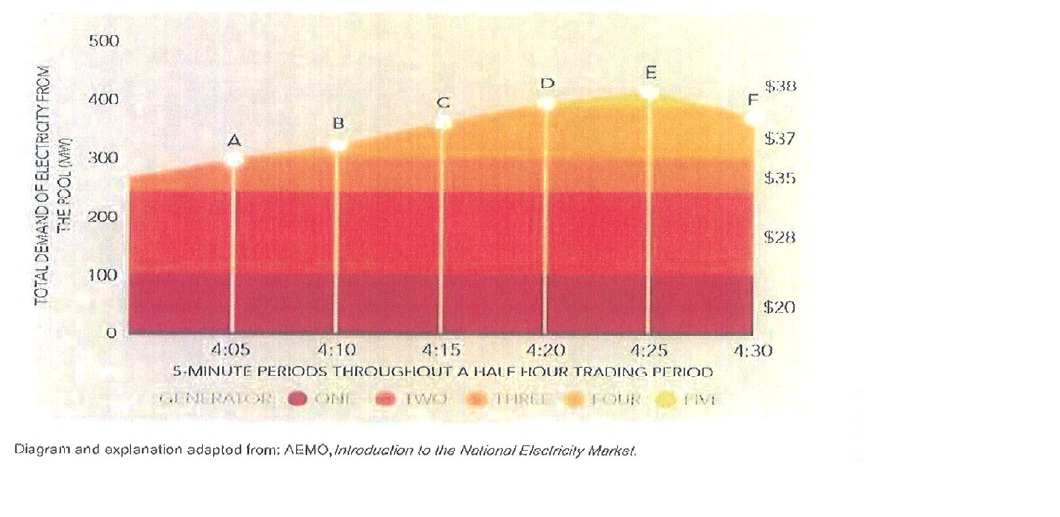
a. The generator bands within bids and relevant rebids of different generators offering to produce electricity at any particular time (or in the case of scheduled loads to reduce consumption) can be visualised as being stacked in ascending order of dispatch price/cost.
b. Note that, although the example labels the bands as being from different generators, two or more of the bands may be from the same generating unit.
c. [The Operator] then calls or schedules for the lowest price/cost options to meet the prevailing demand. In the example shown:
i. In order to meet the demand at 4:05 (point A) [the Operator] will schedule generators one, two and three to the full availability offered. The Dispatch Price is based on the price of generator three at $35/MWh.
ii. At 4:10 (point B), in order to meet the increased demand at this time bands from generators one, two and three are fully scheduled and availability from generator four is partially scheduled and the Dispatch Price is based on the dispatch price/cost of generator four at $37/MWh.
iii. Similarly at 4:15 (point C), more of generator four is scheduled and the Dispatch Price remains at $37/MWh.
iv. By 4:20 (point D) a small amount of generator five is required and the Dispatch Price rises to $38/MWh.
v. By 4:25 (point E) more of generator five is required and the Dispatch Price continues to be set from it at $38/MWh.
vi. In the final 5-minute period of the half hour demand has fallen from its peak and none of generator five is needed and only part of generator four is required meaning the Dispatch Price is set from generator 4 at $37/MWh.
vii. The Spot Price for the half hour overall is the arithmetic average of the Dispatch Price in each of the 5-minute periods at $37/MWh.
40 Concerning the design of the NEM, Mr Thorpe says, at paras 122-124 of his report:
122. Amounts paid to generators, and by wholesale buyers, in the NEM are based on the Spot Price for the region in which they are located after adjustment for the effect of losses incurred in the transmission system.
123. This form of market design is known as an energy-only market.
124. The energy-only mechanism in the NEM is based on the well established economic principle of marginal pricing and is designed to enable market participants to establish the value of electricity over time through competitive pricing of their product to market. As a result Spot Prices can fall when there is a surplus and rise as demand approaches the available supply.
41 Paragraph 122 reflects the fact that in the course of transmitting electricity over the supply networks, there is some loss of energy. The Spot Price was adjusted to reflect the varying losses incurred, depending upon the location of each generating unit.
42 In a footnote to para 124 Mr Thorpe adds:
An objective of the design is that each generator will receive sufficient revenue to recover its capital costs and operating [costs] and a commercial level of profit but only if the overall portfolio of generating types and sizes is economically optimum. If it is not optimum one or more generation types may recover more or less than the “correct” amount. The over or under recovery is intended to create incentives for participants to either increase investment in a particular technology type that is currently recovering more than its costs, or to retire or reduce capability on those recovering less than the “correct” amount, in order that the overall portfolio of generation plant self corrects to the optimum over time.
43 I have already referred to the practice of hedging adopted by generators and large consumers, often by “contracts of difference”. Mr Thorpe demonstrates the operation of such arrangements at paras 139-143 as follows:
139. In the following paragraphs I outline the operation of a number of the financial risk management instruments available in the NEM including hedge contracts introduced earlier at paragraph 63.
140. Depending on the volume of hedge contract each party enters into, typical contract forms provide stability of the net price paid by wholesale customers and received by generators for the contracted volume, irrespective of the Spot Price.
141. Figure 14 illustrates the effect of a hedge contract where the parties have agreed to a price of $40/MWh (i.e. in Figure 8 the value for $C is $40/MWh). Generators continue to receive the prevailing Spot Price (adjusted by the relevant loss factor for each participant) from [the Operator] for all of the energy they deliver to the network and the customer continues to pay [the Operator] at that price for all of their consumption. Under the terms of the hedge contract the parties also make or receive additional payments between themselves that results in the generator receiving and the customer paying net $40/MWh for the contracted quantity and the Spot Price for amounts in excess of the contract volume.
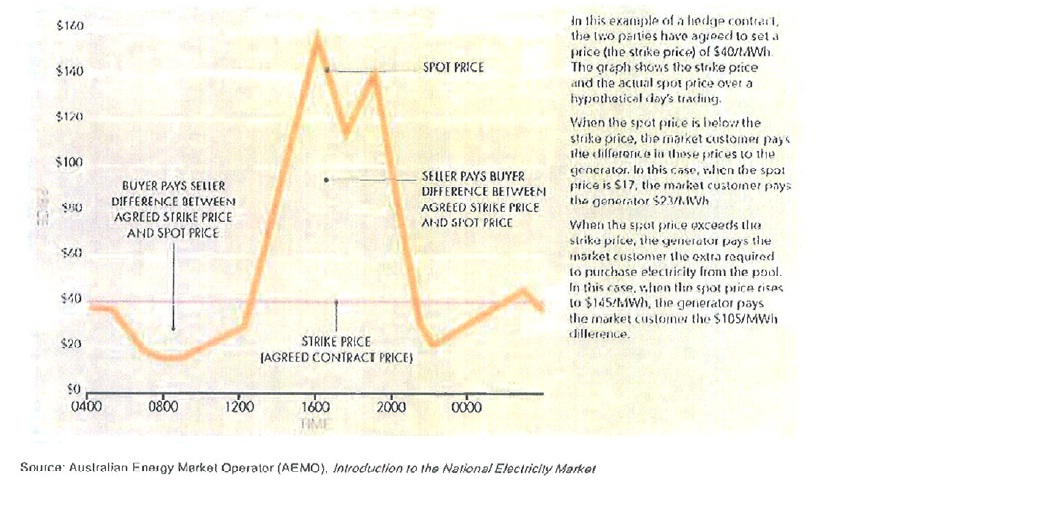
142. Note that generators face significant financial risk at high prices depending on the level of generation actually dispatched. This is because when the Spot Price is above the contract strike price and as [the Operator] only pays for the amount of electricity a generator actually delivers, but a typical contract obligates generators to make contract payments to counterparties for the difference between the Spot Price and the Contract Price for the contracted volume regardless of the amount the relevant generator(s) dispatches.
143. Accordingly there is a strong incentive for generators to ensure they achieve dispatch sufficient to cover contracted volumes, at a minimum. Generators also have an opportunity-cost incentive to generate above their contracted volumes whenever the spot price is above their actual [short run marginal cost], particularly if price is high. However, there will generally be a price-volume trade-off as price commonly falls if more generation is offered to market.
44 A generator’s need to cover its contract position is of some importance in this case. At a later stage, I shall discuss the matter in more detail. For the moment, I observe that for a generator, there was a tension between maximizing price and dispatching a particular volume of electricity. The process for resolving that tension is referred to in the evidence as a “price/volume trade off”.
45 Mr Thorpe discusses the relationship between price and investment, commencing with the proposition that in a market such as the NEM, very high prices might be efficient and necessary in order to provide a commercial return to generation investors. At paras 152-163 he observes:
152. Because customer demand is highly dependent on the weather and because electricity cannot be stored, some generation plants may only be called on to deliver energy for a very limited number of hours per year in periods of peak demand or following breakdown of other generators. These are termed peaking or peak load generators.
153. Although customer demand rises and falls across the day there is always some demand from customers and a need for a matching level of generation 24 hours per day. Generators that can cost effectively run 24 hours per day, termed base load generators, will generally offer bids and rebids that position them at the bottom of the dispatch merit order. In the NEM base load generators are predominantly coal fired thermal units.
154. In an energy-only market peaking generators can only cover their annual fixed costs and operating costs if they receive very high revenue from the spot market for the short time they are dispatched, or alternatively can arrange to receive at least some revenue from other sources, such as from the sale of hedging contracts to wholesale customers.
155. Typical hedging contracts provide a stable revenue stream for the generators as customers will make steady payments who in turn will be protected from the effects of volatile Spot Prices (for the contracted volume).
156. In principle the price a wholesale customer will pay a generator for a contract will be related to the likely expense the customer would be exposed to at Spot Price alone. Similarly a generator would seek a contract arrangement that at least covered its fixed and variable costs and reflected the amount it might receive from the spot market alone. Accordingly the potential exposure to Spot Price is a key factor in contract pricing.
157. Spot Price in the NEM can rise up to the maximum allowed level of $10,000/MWh. The following example illustrates why this relatively high amount aligns with the potential costs of low utilisation peaking generators:
a. Consider a hypothetical generating unit with typical cost parameters that requires revenue of $150,000/MW per annum of installed capacity to repay capital costs over its operating life, plus operating costs such as for fuel consumed when it is dispatched;
b. If this unit were operated in a base load role for 90% of the possible 8760 hours in a year (assuming it was undergoing maintenance for 10% of the time) each MW would produce 8760 [y multiplied by] 0.9 MWhs of electrical energy and require to be paid at an average wholesale price of 150,000 [divided by] 8760/0.9 = $19.0/MWh plus operating costs, in order to recover costs;
c. On the other hand, if this same generator operated as a peak load generator and ran only for 15 hours per year it would require a wholesale price of 150,000/15 = $10,000/MWh plus operating costs for every hour it ran; and
d. In practice the same technology would be unlikely to be cost effective for both peaking and baseload roles and thus the two types would require somewhat different prices – but not markedly so. The example is intended to illustrate the very significant effect that the duty cycle or number of hours of operation has on the revenue and price requirements for generators and to provide context for the occasionally very high Spot Prices.
158. Except for the peak hours of the year, generally there is more than enough capacity to meet demand in each region, although breakdowns of generators and periods of planned outages for maintenance can result in the demand approaching the level of capacity available for service at any time.
159. As a result Spot Price is moderate most of the time, for example Figure 13 presented earlier shows the Queensland region Spot Price was less than $100/MWh for 96.8% of 2007 – 08, but occasionally the Spot Price spikes to high levels and as noted earlier up to over $8,000/MWh in February 2008.
160. The prices in bids and rebids and the level of demand are key determinants of the Spot Price. However, the probability of any particular price band being called in the dispatch process is strongly impacted by the volume of relatively lower priced bands that are immediately available for dispatch by [the Operator].
161. Availability of lower priced bands is determined by the physical availability of different technology generators and the prices and volumes assigned to the bands of bids and rebids by participants to the extent permitted by the [Rules].
162. Ancillary service prices can vary over a similar range to energy. Historically ancillary service prices have been very low for most of the time but very occasionally spike to very high levels reflecting the opportunity cost that a generator forgoes from energy production when it provides an ancillary service at times when energy prices are very high.
163. In general generators will make decisions about the level at which they set “dispatch cost/prices” in bids and indirectly for rebids (through the volume in different price bands) depending on their actual costs, levels of hedge contract that they have negotiated with customers or other generators, market conditions and power system conditions. Generally they will also use the price bands to position different levels of output of generating units at different points of the merit order: for example where a generator operating a coal unit wishes to ensure that its unit is called to dispatch the minimum level that it can safely operate the unit at it will often set the price for its first bands relatively low. Similarly an operator of a gas turbine plant may wish to avoid short runs with marginal returns that might occur if it sets its price too low and thus sets a relatively high price so that it is only called if it is clearly profitable.
46 One might infer from the above explanation that generating units were either base load units or peak load units, and that the higher spot prices, which were occasionally available, were really designed to compensate the generators operating the latter category for only limited periods of time. However Dr Rose argues that generators operating base load units also needed the benefit of higher spot prices in order to operate on a viable financial basis. I do not understand the applicant to dispute that view.
47 At paras 167-183 Mr Thorpe addresses the role of information in the NEM. Again it is convenient that I set out the relevant paragraphs in full.
167. While the calculations for actual dispatch and price and the issue of instructions to generators are of necessity undertaken in the final minutes and seconds before the time electricity is consumed, preparation for dispatch and its associated trading commences a number of years before.
168. In the NEM many of the preparatory decisions are taken by market participants. However, [the Operator] has an oversight role and publishes aggregated information about future conditions to inform participants’ decisions. Relevant decisions and information includes:
a. Forecasts of demand for between the next 5 minutes and up to a number of years in advance;
b. Decisions about amount, location and type of generating capacity taken far enough in advance to allow new generation to be constructed;
c. Decisions about the timing of major shutdowns for maintenance;
d. Decisions about fuel supply;
e. Forecasts of likely wholesale price based on analysis of expected supply and demand;
f. Agreements between market participants about financial contracts;
g. Decisions about prices to be bid for dispatch; and
h. Decisions about rebids.
169. Efficient and effective decisions rely on the decision makers having timely, accurate and relevant information and forecasts. The [Rules] includes provisions designed to provide information to inform a number of the decisions taken by participants. Information published in accordance with cl 3.13 of the [Rules] is particularly relevant to decisions about rebidding.
170. Relevant provisions include a requirement for [the Operator] to prepare and publish a schedule with a resolution of 30 minutes for approximately one day ahead (30 minute predispatch schedule) showing:
a. Expected demands and prices in the different price regions;
b. Demand estimates (formed by [the Operator]);
c. Network capacity and ancillary service requirements current at the time of the preparation of the schedule; and
d. Details of the expected generation from each generator in the 30 minute predispatch schedule which are made available to the relevant generators, but not to other generators.
171. Information about the prices and volumes bid and rebid by each generator are not included in the 30 minute predispatch schedule but details of the final bids and rebids used for dispatch are published in full the following day (in accordance with [the Rules] cl 3.13).
172. [The Operator] updates the 30 minute predispatch schedule each 30 minutes and may also issue updates more frequently if circumstances change materially between routine updates.
173. After consultation with market participants, each 5 minutes [the Operator] also publishes a forecast for each 5 minutes of the next hour (5 minute predispatch schedule). Other than being calculated each 5 minutes and providing a 5 minute resolution, the 5 minute predispatch schedules contain information of the same form as 30 minute predispatch schedules.
174. Calculations in relation to 30 minute predispatch schedules, 5 minute predispatch schedules and for dispatch instructions (for the next 5 minute period) use the most recent bid or rebid available at the time of each calculation. Accordingly, rebids made less than 30 minutes before the time of dispatch may not appear in the last 30 minute predispatch, but will be taken into account in calculation of each 5 minute predispatch and dispatch instruction.
175. Rebids by generators are often the source of change in information provided in updates of 30 minute predispatch schedules and 5 minute predispatch schedules.
176. The NEM design places decisions with generators about how any limited amounts of fuel should be rationed and when a generator should begin preparations to present availability for future dispatch periods. Similar considerations apply for scheduled loads.
177. Consequently, the NEM also places decisions with generators about when it is efficient to not present capacity for dispatch, for example in order to undertake short term maintenance work, or because the value of a particular generator as evidenced by the forecast market price does not warrant it operating at that time.
178. The volumes and prices in bids and rebids are the primary means generators have to communicate their decisions to [the Operator]. The market forecasts that [the Operator] subsequently publish are a key mechanism by which [the Operator] disseminates relevant market consequences of those decisions – effectively inviting rebid(s) if appropriate.
179. I say inviting a rebid because I am aware from my experience that because of the potential for market and power system conditions to change rapidly it is normal and efficient practice for decisions to be reviewed and amended in the lead up to dispatch.
180. I am also aware from my experience that it is very difficult to design a set of conditions to limit the basis for rebids without excluding amendments that increase efficiency and therefore reduce the cost of production of electricity.
181. Similarly, decisions taken by [the Operator] as it prepares for dispatch and assesses the level of reserve and ancillary services and the likely loading on networks also require information.
182. [The Operator] has obligations under the [Rules] and [the Law] to ensure safe operation of the power system and has a power to intervene in the operation of the market in the event sufficient generating capacity is not presented to it through the bidding processes. To fulfil this obligation [the Operator] therefore must continually assess the outlook for security of the power system and determine if security standards are likely to be met or whether it should consider intervention. Intervention is a relatively rare occurrence.
183. Together, the provisions for bids and rebids, 30 minute predispatch schedules, 5 minute predispatch schedules and assessments of the security of operation, spot pricing and financial contracting are designed to elicit decisions by participants based on commercial incentives that deliver cost effective, reliable and secure operation of the wholesale market and allow [the Operator] to assess if it needs to intervene.
48 Although the Operator may have had both short and long term responsibilities and required information to perform those duties, paras 175 et seq demonstrate that rebids were primarily to reflect commercial considerations, and that it was difficult to design limitations which would accommodate that fact.
49 At paras 184-194 Mr Thorpe describes “underlying principles” which reflect his views as to the way in which the market was designed in order to achieve efficiency in the supply of electricity as follows:
184. Earlier sections have presented descriptions of the relatively detailed measures for bidding and rebidding and operation of the dispatch process and how they interact and accommodate the complex technical characteristics of electricity. This section aims to very briefly set these arrangements in the context of a market designed to deliver reliable and cost effective electricity in order to address the final questions put to me concerning inaccuracy in bids and rebids (dispatch offers).
185. In very general terms an efficient market will see buyers and sellers identify a fair value for the commodity being traded.
186. Information about future prices and market conditions is crucial in this regard. In the electricity sector this is complex as conditions vary continuously because electricity is not storable and demand varies markedly over a day. As a result different generators must be brought in and out of service across the daily cycle of operation as part of the dispatch process.
187. As different generating technologies have different operating costs (see Section 4) and need to recover different fixed costs, the cost to supply varies significantly.
188. In the longer term, economies of scale can be significant as well, meaning that investment and retirement is “lumpy” and the cost effective size of new generating units will be somewhat larger than is needed immediately – creating a short term surplus. As a result the supply/demand balance often will move from just sufficient to a surplus which will be eroded over time as demand grows or old generators are retired from service until the investment cycle repeats.
189. In the NEM buyers and sellers are expected to find an agreed set of prices and volumes in a mix of short term spot and longer term contract trading. However, there are strong linkages between the two forms of trading. If either is distorted the other is likely to be distorted also and distortion will generally mean lower efficiency and higher cost, which is eventually borne by consumers.
190. The bidding and rebidding provisions are a key element of the overall functioning of the NEM and are designed to assist the participants find an agreed set of spot and contact positions and in particular to respond to changing circumstances.
191. The different characteristics of different generating technologies noted earlier affect the practical capability for amendment via rebids for the different technologies – for example a technology with a long start up time cannot change a decision not to offer capacity at just a few hours notice.
192. As a result:
a. Only those generation plants already in a condition to increase production, such as a boiler fired steam turbine plant that had been started previously or generation plants with rapid start up time can respond to changing conditions close to the time of dispatch; and
b. It is generally the case that closer to the time of dispatch fewer generators can physically increase their total capacity available to the market (that is the sum of all price bands), but all that are available are able to adjust the volume within each price band (up to the capacity that is available).
193. Similarly, any arrangements for demand side response may require a number of hours notice to arrange.
194. Information is a key part of most markets establishing a fair and reasonable price and is the basis for the requirements for [the Operator] to publish forecasts and historical information discussed earlier (see paragraph 167).
INACCURACIES IN THE BIDDING PROCESS
50 At section 7.4 of his report Mr Thorpe offers his views as to the effects of inaccuracy in the bidding process as follows:
7.4 Forecast inaccuracy and dispatch inaccuracy
195. I now turn to the consequences of inaccurate bids and rebids.
196. Bids and rebids may be seen to be inaccurate in two ways, which for the purposes of this report I will term Forecast Inaccuracy and Dispatch Inaccuracy. Both forms can have physical and commercial impacts on the market as a whole and on individual participants.
7.4.1 Forecast inaccuracy
197. Forecast Inaccuracy occurs when subsequent to a bid or rebid being made, a participant submits a rebid (or further rebid) before the time of dispatch. To the extent that information in the first bid or rebid(s) is altered by the final rebid, the information in the first bid or rebid will have been inaccurate.
198. This may seem a harsh term to apply to a situation where new information comes to light and the information in both the first and any subsequent bids and rebids was accurate at the time it was presented.
199. However, the earlier information will have been the basis for a number of forecast and decisions, in particular:
a. [The Operator] will have counted now inaccurate capacity foreshadowed in the earlier bid or rebid in their planning for power system operation, including provision of reserve needed to maintain system security;
b. [The Operator] may have made decisions to allow or disallow planned network outages or to issue, or not issue, low reserve notices in accordance with cl 4.8 of the [Rules]; and
c. [The Operator] will have prepared and issued 30 minute predispatch schedules and 5 minute predispatch schedules including information for:
1. power system operation;
2. dispatch of all schedulable generation and demand side blocks;
3. predictions of network flows;
4. forecasts of Spot Price; and
5. forecasts of Dispatch Price.
200. Each of these items may therefore be inaccurate although the degree of error will be dependent on the circumstances and may range from very large to immaterial.
201. Participants may have acted on the forecasts of dispatch volumes and prices in forming any rebids they have made.
202. End users who are not market participants in their own right may arrange to buy from a retailer that is a participant under an arrangement that passes through all or part of the relevant Spot Price.
203. End users may wish to do this where they manage controllable demand (or small non market in-house generators that can be used to reduce the users net demand) and I would expect they will then actively monitor market conditions and make decisions about their operations – although I would expect these to be limited to situations where only extreme prices had been forecast on the basis of the first bid and rebid.
204. The final rebid may also be inaccurate at the time of dispatch giving rise to Dispatch Inaccuracy.
7.4.2 Dispatch inaccuracy
205. Dispatch Inaccuracy occurs when bids or rebids contain inaccurate information about the physical capability to respond to a dispatch instruction.
206. As noted earlier, [the Operator] uses the information contained in the bid or last rebid it receives before undertaking a dispatch calculation and issues associated dispatch instructions on the assumption all scheduled generators and scheduled loads can comply with the instructions. However, if a scheduled generator or scheduled load receiving a dispatch instruction finds that they cannot comply with their instructions because their particular plant is not able to operate to the level envisaged when they formed the bid or rebid due to an unexpected technical problem with their plant, by default that bid or rebid therefore will be shown to be inaccurate.
207. The consequences of a dispatch based on bids or rebids that lead to Dispatch Inaccuracy may include:
a. Ancillary Services will automatically compensate for the scheduled unit that does not respond as expected – for example if a generator had been instructed to increase in accordance with an inaccurate bid Ancillary Services will detect that this has not occurred and increase in its place;
b. [The Operator] may have over or under provided for different forms of operating reserves leading to increased costs or risks to operating security, or both;
c. [The Operator] may have made different decisions about allowing network outages to proceed leading to increased costs to network operators (and thus eventually to customers who pay those costs); and
d. Other participants may have made different decisions about their rebids had they been aware of the consequences of the inaccuracy in a bid and therefore suffer an opportunity loss.
208. It is important to note that both Forecast and Dispatch Inaccuracies also can occur in the normal course of operation of a power system and market operation. Unexpected technical problems that limit responses from generators in particular do occur.
209. Further, efficient operation of the NEM is premised on participants responding to forecasts of future market outcomes for both dispatch volumes and prices. For example, initial bids would normally be developed on the basis of expectations of market outcomes on the basis of experience and contracting prices.
210. However, if a price forecast in a 30 minute predispatch schedule and 5 minute predispatch schedule shows a higher or lower price than was expected, all participants would normally review their operation to consider if, subject to cl 3.8.22 and 3.8.22A, they should rebid. For example:
a. To offer increased capacity in response to a high price due to shutdown of another participant or because they perceive the market value has changed;
b. To offer less capacity in response to a lower than expected price due to early return to service of a low cost generator or changes in volumes offered in low priced bands of another generator; or
c. To offer different amounts of capacity at the prices of the bands established at the time of the initial bid.
51 I note that Mr Thorpe’s category of “forecast inaccuracies” includes any bid or rebid which was superseded by a rebid or further rebid. However the Rules permitted rebids and further rebids. The evidence suggests that rebids were accepted up until very shortly before the commencement of a relevant Dispatch Interval. Thus it would seem to be at least arguable that the Rules recognized the value of late bids or rebids, whatever the effect on the integrity of decisions made on the basis of any earlier bid or rebid. Further, as Mr Thorpe demonstrates at paras 175-183, rebids were intended to reflect commercial considerations. They occurred in a very complex structure, designed to collect, supply and analyse an enormous amount of information in a very short time. It is, perhaps, implicit in Mr Thorpe’s evidence that even a small “inaccuracy” may have had surprising consequences, or that the combined consequences of numerous “inaccuracies” may have been surprising. One must, however, question his use of the term “inaccuracy”. Forecasts are, after all, by definition, subject to change, particularly where they are based upon such a wide range of information which, itself, is subject to change. Use of the word “inaccuracy” to describe an earlier bid or rebid simply because a later bid varies it is not only “harsh”, to use Mr Thorpe’s description, but also, itself, inaccurate. Both earlier and later bids and rebids might reflect bona fide assessments of conditions at the relevant times. Mr Thorpe seems to say that changed conditions, as reflected in rebids or further rebids, might have led to the need to change earlier decisions. That situation seems to be contemplated by the market design.
52 Clearly, the vast amount of information available and supplied by the Operator was intended for use by generators in bidding and rebidding. As Mr Thorpe says, market participants acted on the basis of available information. During the trial I expressed the tentative view that the conduct which is impugned in this case may well be seen as an attempt to acquire further information about market conditions. If that characterization is correct, then it would be curious if the Rules were to be construed so as to prohibit such conduct, at least in the absence of any clear intention so to do.
53 I turn to Dr Rose’s evidence. First, Dr Rose dealt with the question of system instability, pointing out that the system was designed to remain stable, at least over a short period, even without intervention by the Operator. All generating units connected to the NEM were equipped with automatic governor mechanisms which provided a response to any sudden load increase or decrease. As most load changes would amount to only small percentages of total demand, and as such changes and resulting changes in frequency would be spread amongst all generating units, the individual effect would be small and co-ordinated amongst the units. There was also provision for automatic responses from the control centre or manual intervention by dispatchers. These responses would be slower. In general they were not dependent upon communication systems which might be subject to failure, resulting in a system-wide blackout.
54 Dr Rose gives significant further information concerning system security, but I need not discuss it for present purposes. He stresses the proposition that system security should be seen as an “envelope” within which the system must be kept, rather than a sole “safe” point at which it must operate. Dr Rose demonstrates this point in his Figure 2.1, below. The “envelope” of secure operation is surrounded by a larger “envelope” of satisfactory, but insecure operation. The Operator’s role was to identify movement from the secure operating state to the satisfactory, but insecure state, to take action to prevent movement to the emergency state and to return the system to the secure state.
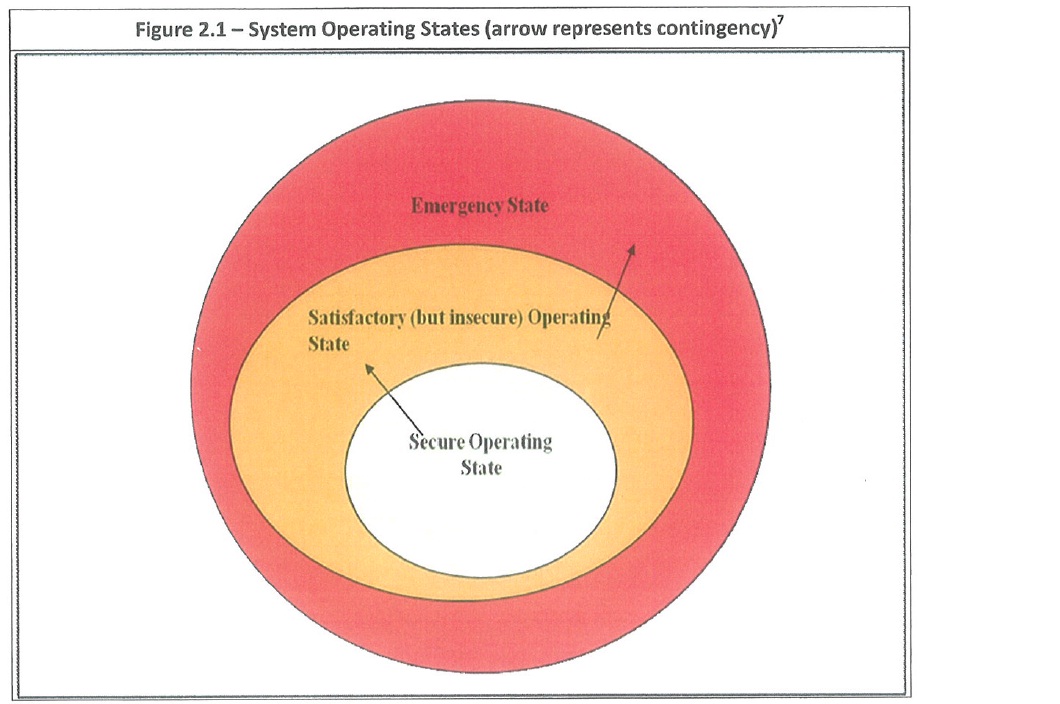
55 In Dr Rose’s view the Operator’s role was to oversee the NEM in order to ensure that it managed itself at five minute intervals throughout the bidding process, rather than to “control” the grid. The Operator had software tools which enabled it to assess the security of the system, whilst allowing generators to manage their production through their competitive bids. The 5 minute Dispatch Intervals facilitated such assessment. Dr Rose says that the system was designed to minimize the risk of instability, and to ensure that generating units operated within satisfactory boundaries, notwithstanding fluctuations in demand.
56 Dr Rose distinguishes between rebids which change total available capacity and rebids which move available capacity between price bands. As to changes in total capacity, Dr Rose points out that subject to one exception, any such rebid would reflect changes in the physical capability of the plant to provide the maximum level of capacity at any price. The exception was the case in which a generator withdrew capacity in the expectation that the Operator would direct it, pursuant to the Rules, to operate the generating unit in question. A generator might take that course if the generating unit was connected to a part of the network where additional generation was needed in order to avoid network overload, but the value of the Spot Price was lower than the price at which the generator was willing to operate the generating unit. That situation might arise as the result of local circumstances not generally prevailing throughout the network. If a generator withdrew a generating unit, the Operator could direct its re-instatement. Where such a direction was given and complied with, an investigation would be conducted, leading to the generator being paid a fair price for its generation. Dr Rose concedes that a reduction in available capacity may cause reduced security or stability within the system. However he considers that whether it is likely to do so depends upon the efficacy of the measures which are in place in order to deal with such changes. Elsewhere in his evidence he makes it clear that he considers that significant instability is unlikely.
57 As to the movement of capacity between price bands, such action would affect the price at which power was available but not the level of supply. Each generator had up to ten price bands, any of which may have been setting the price at a point in time. Generators did not have access to competitors’ rebids as they were submitted, although some aggregated information was available. Dr Rose observes that on 22 and 23 February 2008, the dates with which this case is concerned, even at peak load periods, there was spare capacity in Queensland of approximately 2,000 MW. See Figure 3.1 below. In those circumstances a single generator could not have been sure that its rebidding would have resulted in an increase in the Spot Price rather than non-sale. That observation is of some importance in this case in connection with price/volume trade off.
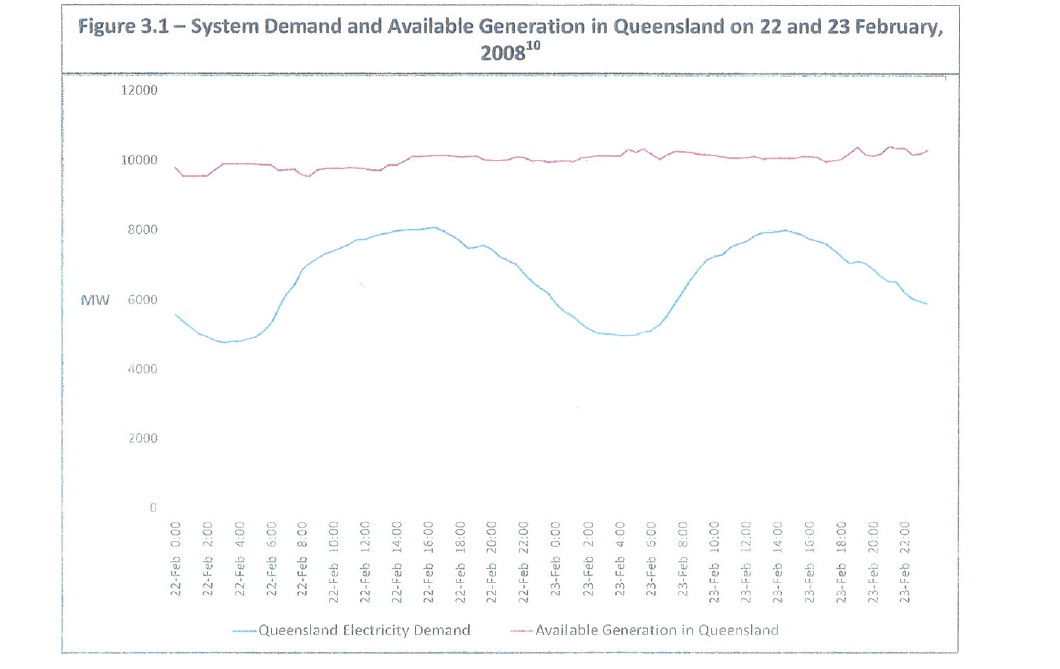
58 This Figure shows that, for 22 and 23 February 2008, available generation was fairly constant at about 10,000 MW. Demand fluctuated between about 5,000 MW and 8,000 MW, with the low points being early in each morning, and the high points being around the middle of the day.
59 Information acquired in the 5 minute dispatch process was used by generators and was also available for use in ensuring system security. However Dr Rose asserts that the Operator’s dispatcher focused on the next 5 minute Dispatch Interval and did not attempt to manage energy resources over longer periods of time. In this respect, his evidence differs in emphasis from Mr Thorpe’s. I do not understand Dr Rose to be saying that planning and security were not the Operator’s concern. Rather, he is saying that rebids did not raise the need for human decision-making which might require time and distract the decision-maker from other duties. The NEMDE programme was designed to deal with such rebids, both in accepting bids and in ensuring system security. He also points out that at all material times the market was functioning within a comfortable margin as between supply and demand, notwithstanding the fact that demand was unusually high. At paras 32-34 Dr Rose describes the system as follows:
32 The bids and rebids for MW outputs of the generators, together with the system load, are therefore the primary tools for managing security, and are automatically processed by the NEMDE dispatch system to maintain the technical envelope.
33 The market works in this way. The generators send their MW preferences each 5 minutes for the next 5 minutes through their bids and rebids. It is not necessary for a generator to submit rebids for each 5 minutes unless they choose to do so. They are then sorted at the control centre on the basis of ascending prices and dispatched MW.
34 The control centre software sorts the bids into an ascending list from the lowest price to the highest price called a ‘bid stack’, which will be used to dispatch the bid bands for all generators in order, and assesses it for security implications. If the generator ‘bid stack’ will result in line overloads or other actual or contingent breaches in security, the bid stack is adjusted by NEMDE at the least increase in market cost, to meet the security criteria. NEMDE does this by replacing lower priced bids by higher priced bids such that the dispatch objective of maximising the efficiency of market dispatch is achieved without compromising security.
(Emphasis in original.)
60 As I understand it, Dr Rose is here dealing with the way in which the Operator, through its dispatchers, addressed bids received from generators in order to meet demand and maintain system security. In some circumstances, it may have been necessary that a higher bid be accepted over a lower bid in order to maintain system security. As the Dispatch Price for the Dispatch Interval would be, in effect, the highest bid accepted, that price would be increased by acceptance of a higher bid. Dr Rose then discusses various aspects of the systems used for maintaining security in the market. It is not necessary that I deal with those aspects. Dr Rose considers that neither rebids as to capacity nor those as to price band allocation would cause any disturbance to the grid or reduction in security, other than in exceptional circumstances. Dr Rose is not aware of any incident where rebidding behaviour has led to instability and widespread shutdowns.
Generating technologies and costs
61 Dr Rose then addresses the various generating technologies, highlighting some of their economic characteristics. Dr Rose considers that the role of coal-fired generating units was closely related to their short-run marginal cost (“SRMC”) for most of the time. He considers that market design dictated that for a large percentage of time, a generator would bid at just above its marginal cost, that is the cost of producing additional electricity. He further suggests that a generator would tend to bid the “shadow price” which is the SRMC of the next generator in order of ascending SRMCs. This bidding practice enabled a generator to increase bid price slightly without sacrificing production volume. Dr Rose observes that coal-fired generators tended to bid in merit order, that is in a band between SRMC and the shadow price in order of ascending SRMCs. This had a marked effect on what is called the “capacity factor”, in effect the percentage relationship between average production level of a generating unit and its maximum production level. The average production level was, of course, dictated by market forces.
62 The coal-fired generating unit in each region which had the lowest SRMC would operate at or near base load whenever it was available to do so. Coal-fired generating units with higher SRMCs would operate progressively less frequently because of the difference demonstrated in Fig 3.1 (see earlier) between power demand and available generation. By definition a generator which bid its SRMC would not be able to recover any of its fixed costs unless other generators were bidding higher prices and setting a higher Spot Price. The result was that the lower SRMC base load generators would be on line at all times. Whenever higher SRMC generating units were running, the lower SRMC units would recover their SRMCs and part of their fixed costs, as the higher SRMC generating units would be forcing up the Spot Price. However the higher SRMC generating units would be off-line or operating at reduced levels for most of the time. When they were on line they would tend to be setting prices at or near their own SRMCs and would not be able to recover their fixed costs, except for periods when prices were very high, and peak load generators were setting the price. These periods were rare and of considerable importance to the less competitive coal-fired generators in meeting their fixed costs.
63 Higher SRMC, coal-fired generating units are those with a higher combination of coal costs “at the mine mouth” plus rail freight costs. Generally speaking, lower SRMC generating units were those located at the mine mouth. They had no transportation component in the cost of fuel. Conversely, higher SRMC generating units were those located away from the mine mouth, relying upon transported fuel. Obviously, generating units are designed for particular locations and cannot be shifted. Thus certain fundamental characteristics of generating units are established when they are built and dictate their employment throughout their respective lifetimes. Such characteristics affect competitiveness. Coal-fired generating units with higher SRMCs tend to be used in providing security of supply as they are usually built to be more flexible than mine mouth stations. They have to be able to burn different types of coal transported from various locations. They are usually designed to provide “spinning reserve” and other ancillary services. Although they may be slow to bring on-line, once on-line, output can be increased fairly quickly. In fact, once on-line, response capacity may not vary greatly from those of other fuel types. Mine mouth generating units, on the other hand, are designed to provide steady output and are not as responsive to changes in demand. Responsiveness and flexibility come at a price which must be recovered in the market. The only way to recover such compensation for responsiveness and flexibility is to achieve higher prices at times when the demand for power is higher.
64 There are other, longer term consequences which flow from decisions as to location and design of coal-fired generating units. For example a unit which relies on transported coal can take advantage of cheap coal from various sources. Part of the coal which is produced for export is unsuitable for that purpose and is provided to generating units at a relatively low cost, enhancing their competitiveness. This has occurred at the Stanwell power station. On the other hand, a mine mouth station may consume all available coal and be “stranded”. Power stations may also run short of sufficient water for cooling, owing to prolonged drought. Tarong power station has incurred both problems in recent years and has been forced to change its operating mode to conserve both coal and water. The Stanwell and Gladstone power stations are both large power stations, built to rely on railed coal. In contrast Tarong, Millmerran, Kogan Creek, Callide B, Callide C and Collinsville are all mine mouth stations. The only other station which is comparable with Stanwell and Gladstone is Swanbank B. It was formerly a mine mouth station but owing to closure of local coal mines, now relies on railed coal. Swanbank B will be retired between 2010 and 2012.
65 The mixture of generating units in any system will depend upon available energy sources. Thus, in Queensland between 1970 and 1998, during which time most of the existing coal-fired power stations were planned and constructed, available resources were coal for base load generation and hydro-power for peak generation. Since the commencement of the NEM in 1998 open cycle gas turbine generating units have become a reliable and cost-effective alternative peak supplier. Before the advent of such units, older or higher fuel cost, coal-fired steam generators and hydro-power stations were used in peaking roles. Until recently the only other competitive fuel was diesel, used in small gas turbines which performed the dual roles of extreme peaking generation and back-up supply in regional areas in the event of cyclones, floods and other extreme weather conditions which disrupted the transmission grid. More recently, the major providers of peaking generation in Queensland have been the Wivenhoe pumped storage hydro station and coal-fired generators such as Swanbank B and A (now retired), Collinsville, Callide A (now retired), Gladstone and Stanwell. Stanwell was planned as a “third order of merit” coal-fired generator, implying that it was not designed to be the lowest cost supplier of power. It seems, however, that it has overcome the relevant competitive disadvantage. Coal-fired generators still perform a major role in peak load supply in Queensland, owing to their flexibility of operation in the range from half to full output.
66 All generators rely on higher prices to meet their annual fixed costs. This is the fundamental feature of an “energy only” market in which all generators are paid the same price for power for a given Dispatch Interval. In other systems generators may receive only the prices which they have bid, even if the overall price in the market is higher. Dr Rose asserts that:
The concept of the energy only market is to allow all generators to freely decide the best trade-off between price and volume that meets their business objectives, including price and delivery of fuel.
67 In a large power station such as Gladstone, Stanwell or Tarong, where there are four or more generating units, a single unit will frequently be out of service for maintenance. Within such a station, operations will be divided into a base load component, usually equivalent to the minimum output of each generating unit, and a load-following, or peaking component, adjusted to provide the trade off between price and volume which is needed to meet the station’s overall revenue requirements in the longer term. An entirely base load station is often a “price taker” in the market. I understand that proposition to mean that such a station relies upon prices effectively set by other generators. This is to be contrasted with power stations such as Stanwell and Gladstone. They use more expensive coal and thus are prepared to sacrifice volume by being price setters in the market, bidding higher prices when demand is higher. During normal conditions, when demand is lower, Stanwell and Gladstone have to forego dispatch as they cannot compete with the mine mouth stations. The economics of operation of non-base load coal-fired stations is therefore similar in some respects to “pure” peaking generators. Inherent in these propositions is the proposition that the price/volume trade off, to which I have referred, and to which I shall frequently refer, is a recognized feature of market operation, of benefit to base load generators as well as peaking generators.
68 As third order coal-fired generating units cannot compete with base load generating units, and as there is usually more capacity than demand, their maximum capacity may not be frequently dispatched. Therefore they must trade off loss of production by achieving higher prices at other times. In 2007-2008 Gladstone was at capacity for 57% of the time whilst Millmerran was at capacity for in excess of 90% of the time. Gladstone’s higher average price, as compared to that of Millmerran, reflects that fact. Price spikes play an important role in enabling different types of base load generators to cover their fixed and operating costs. Without price spikes generators would have to be paid at their capacity to ensure that returns were sufficient to cover fixed costs. These propositions are of some importance in view of the fact that in these proceedings, the applicant has at least implied that price spikes are undesirable in market operation.
69 To demonstrate his point Dr Rose suggests that a typical generating unit, halfway through its life, would be valued at about $1 million per MW of installed capacity. To recover sufficient annual revenue to provide for interest payments and depreciation, an indicative fixed cost would be $100,000 per MW per annum. The base load generator with the lowest SRMC would be able to recover a proportion of these fixed costs during day time periods when other generators with a higher SRMC were bidding and setting higher Spot Prices. However a coal-fired generator with a higher SRMC may not be able to recover more than a small proportion of its fixed costs from the normal day time price and so must recover its costs from occasional price spikes. In order to recover its fixed costs of $100,000 per MW per annum, the price would need to reach the cap of $10,000 MWh for 10 hours per annum. Thus it must look for opportunities to recover its fixed costs from price spikes. In this respect the higher SRMC coal-fired generator has a similar role to that of a peaking generator which only operates during peak periods. Such opportunities may only exist for a few weeks in summer high demand periods.
70 Generators operating higher SRMC coal-fired generating units often suffer revenue shortfalls overnight because they maintain operation at or above their stable minimum generation levels to avoid having to cycle up and down daily, that is start up and shut down daily. Daily cycling of large, coal-fired generating units is typically more expensive in fuel start-up costs than revenue shortfalls from receiving less than SRMC during overnight periods. They therefore bid a negative price up to their minimum generating level to avoid being “dispatched off”, which I take to mean that they are not called upon to provide electricity. Again, such generators must look for opportunities during peak periods to recover their losses in off-peak periods.
71 Dr Rose then considers supply side and demand side responses to changing conditions. First he considers the ability of different types of generating units to increase dispatch in response to changing conditions close to the time of dispatch. Each generator is capable of varying its output over time, between a minimum which is specific to its generating units and their combined maximum output. However the rate at which such units increase output may vary. This is known as the “ramp rate”. As previously mentioned, once a coal-fired steam generating unit is synchronized and operating at its minimum generating level, its capacity to dispatch anywhere between its minimum and maximum generation levels is similar to that of a gas turbine generating unit or a hydro generating unit. Market forces will dictate how generating units are operated within that range.
72 Each coal-fired generating unit is fed by coal pulverising mills. Each generating unit has five or six such mills. The number in service may range from a minimum of two or three to five or six at full output. However output may be varied within a single configuration of pulverising mills. The range is up to 20%. If output is to be varied by more than about that figure, then the number of mills in service will have to be varied, typically requiring a short delay of a minute or so. This is a routine activity in coal-fired power stations. Coal-fired generating units have a stable minimum generating level of about half the rated output. Below that level such units are relatively inflexible as the coal burners become unstable unless supplemented with costly oil support. During start up and shut down, oil consumption is high. The cost of this is a major contributor to the high cycling costs of such units.
73 Combined cycle generating units have similar restrictions. They generally operate at about 50% of rated output to avoid cycling the steam turbines. They thus operate in open cycle gas turbine mode which is much less efficient in terms of gas consumption. Gas-fired open cycle generators are the most flexible as they can operate at almost any point from near zero output to full output, subject to ramp rates. However they generally have higher fuel costs as they burn natural gas, distillate or aviation kerosene. They are inherently inefficient thermo-dynamically as compared with coal-fired units or combined cycle units.
74 Generating efficiency is better when units operate at a relatively constant output, close to full generating design value. This may influence operators to avoid varying the output of their stations widely in the absence of appropriate compensation in the market. The ancillary services part of the market has been created to allow market participants to trade the desire for constant production levels against the need for flexibility in responding to changing demand and unforeseen contingencies.
75 On the demand side purchasers are generally electricity retailers, although one large consumer participates in the market. It is a company which operates a zinc smelter in Townsville with a substantial demand, part of which is used by the company for demand side response. I take that term to describe the way in which that company might respond to higher prices in order to reduce cost. It is able to initiate such response within one, or a few 5 minute Dispatch Intervals. Further details are confidential. Electricity retailers practise demand side responses by managing their own loads. They have various mechanisms, including switching off hot water storage systems. This may be by previous arrangement with customers. The customer accepts curtailed supply in the event of high prices in return for a more competitive power price. A survey by the Operator suggests that in Queensland, demand side participation is to the extent of a little more than 200 MW. I take this to mean that retailers and the Townsville consumer may reduce their total demand by about 200 MW in response to unacceptable price levels.
76 Dr Rose also comments upon so-called inaccurate dispatch offers and dispatch inaccuracy. As I have said, he does not accept that the Operator performs planning functions on the basis of individuals’ bids or rebids. He says that the Operator provides information to the market to allow participants to change their bids to take advantage of market parameters, in particular the price of energy and ancillary services. Dr Rose considers that the movement of capacity between price bands would not have any effect other than to vary prices.
77 Mr Thorpe suggests that bids or rebids which contain inaccurate information about capacity to respond to dispatch instructions may lead to dispatch inaccuracy. However Dr Rose says that with one exception, any such problem will be dealt with by responses built into the dispatch software. The exception involves the possibility that the Operator might have made decisions about allowing network outages upon the basis of bids. If there are changes in available capacity, it may have to reconsider such decisions. Dr Rose considers that it is unlikely that the Operator would change its decision to allow an outage in that situation, particularly as any high load situation would probably be identified in advance and accommodated. All actions taken by the Operator during a day are logged and published. Dr Rose observes that the log reveals no unusual action taken by the Operator on 22 or 23 February 2008, save that at 15:43 hrs on 23 February, the Operator advised that the cumulative price threshold was forecast to be exceeded at 16:30 hrs on that day. The cumulative price threshold is the point at which the Operator may intervene by suspending operation of the Spot Market and capping prices. See Rule 3.14.
78 In cross-examination Dr Rose was referred to the saw-tooth effect in Mr Thorpe’s Figure 5. Dr Rose attributed such effect, at least in part, to heavy dragline use with continued cycling effects as draglines lifted and deposited loads, and to fluctuating demand caused by blocks of retail consumers having hot water systems turned on and off.
79 Although Mr Thorpe and Dr Rose were cross-examined, such cross-examination was limited and demonstrated very little direct disagreement between them. Whilst Mr Thorpe gives a good general overview of the market, Dr Rose provides a more specific description of certain aspects. In particular Dr Rose gives a more detailed explanation of the economics of power generation. He identifies the overlapping functions performed by coal-fired generating units, including their base load and peak load functions and accompanying economic consequences. I do not understand that evidence to be challenged. I accept it. Mr Thorpe may over-state the importance of generators’ daily bids in the long term planning of the NEM, and the extent to which such considerations were addressed in day-to-day market operation. Dr Rose may, to some extent, under-estimate the potential consequences of instability arising from changes in the levels of electricity availability. However I accept his evidence that the system is designed to accommodate such changes. I accept also that changes in allocation of electricity to price bands will generally only affect price, and that individual dispatch decisions are made on the basis of price, having regard to system stability. I also accept that on 22 and 23 February 2008, the system was well within its available capacity. In general, I accept the evidence of both men.
OTHER WITNESSES FOR THE APPLICANT
80 The applicant led evidence from two other witnesses. Brian James Nelson was, at the relevant time, an acting senior manager with the Operator. In his affidavit Mr Nelson provides information concerning various rebids and other information relating to the respondent’s operations on 22 and 23 February 2008. Peter William Adams was employed by the applicant. Mr Adams exhibits a graph which demonstrates aggregated available capacity of all scheduled generating units for each registered participant in the Queensland region of the NEM on 22 and 23 February 2008. He also attaches the figures which the graph reflects. At this stage, I need not refer in detail to the evidence of either witness.
81 Pursuant to cl 3.13.7(d) of the Rules:
[The applicant] must, within 20 business days of the end of a week in which the spot price exceeded $5,000/MWh in a trading interval or trading intervals, prepare and publish a report which must for each trading interval in which the spot price exceeded $5,000/MWh in that week:
(1) describe the significant factors that contributed to the spot price exceeding $5,000/MWh, including the withdrawal of generation capacity and network availability;
(2) assess whether rebidding pursuant to clause 3.8.22 contributed to the spot price exceeding $5,000/MWh; and
(3) identify the marginal scheduled generating units for the dispatch intervals, the relevant trading interval and all scheduled generating units for which any dispatch offer for the trading interval was equal to or greater than $5,000/MWh and compare these dispatch offers to relevant dispatch offers in previous trading intervals.
82 The applicant prepared such a report, dated April 2008. It reveals that on 22 and 23 February 2008 the Spot Price in Queensland exceeded $5,000 per MW on 14 occasions, peaking at $9,561.00 per MW on 22 February and $9,153.00 per MW on 23 February. The report then recites the following circumstances:
On Friday 22 February temperatures reached 33 degrees in Brisbane driving demand to around 8100 MW, which was the highest for the summer and within 500 MW of the highest-ever. Around 2200 MW of Queensland’s 10 000 MW of available generating capacity was offered at prices exceeding $5000/MWh. This capacity was offered by Tarong Energy, CS Energy, Stanwell Corporation and Millmerran. The spot price exceeded $5000/MWh for the seven trading intervals between 1 pm and 4 pm inclusive, but not at the time of highest demand. These high prices were only forecast intermittently.
On Saturday 23 February temperatures reached 39 degrees in Brisbane driving demand to around 8000 MW, the highest weekend demand ever. Similar to the previous day, 2470 MW of capacity was priced above $5000 MWh by Tarong Energy, CS Energy and Stanwell Corporation. Significantly higher than forecast demand combined with rebidding by Stanwell and CS Energy that shifted as much as 770 MW of capacity into high prices led to higher than forecast prices. These rebids often took place close to dispatch. The spot price exceeded $5000/MWh for the seven trading intervals between 12.30 pm and 3.30 pm inclusive. These high prices were not forecast until after the high price period had commenced.
The seven-day cumulative price in Queensland reached $144 000 on 23 February, just short of the threshold of $150 000 which would see administered pricing applied.
83 A footnote explains that “administered pricing” caps the maximum price to $100 per MW during peak periods and $50 per MW at other times. Figure 1 in the report appears below. It compares the actual demand and Spot Prices in Queensland with those forecast by the Operator 4 and 12 hours ahead of dispatch on 22 February 2008. Figure 2, which also appears below, provides the same information for 23 February 2008.
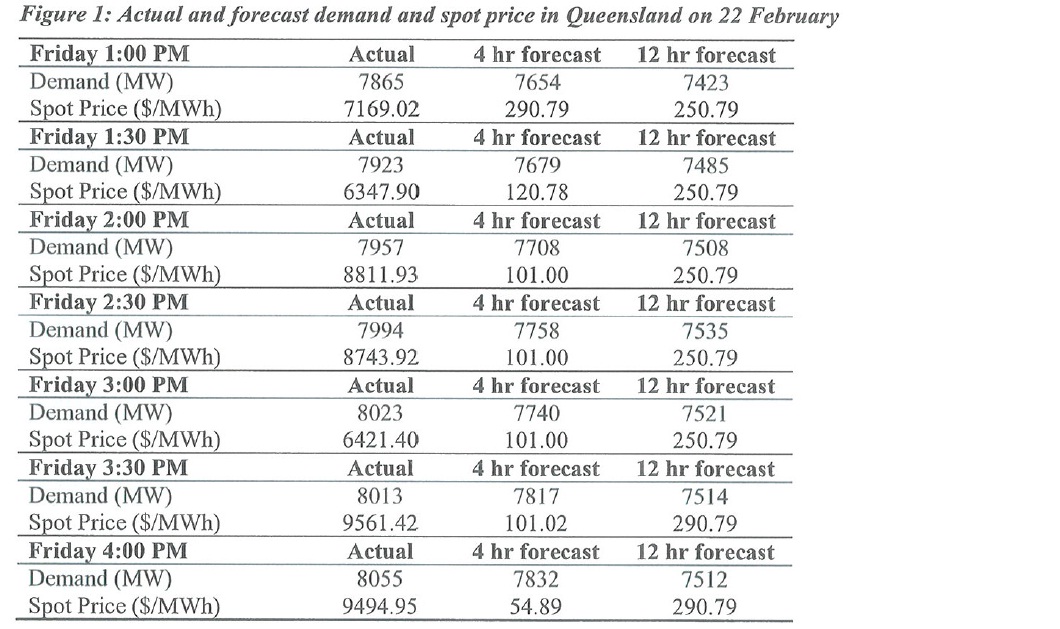
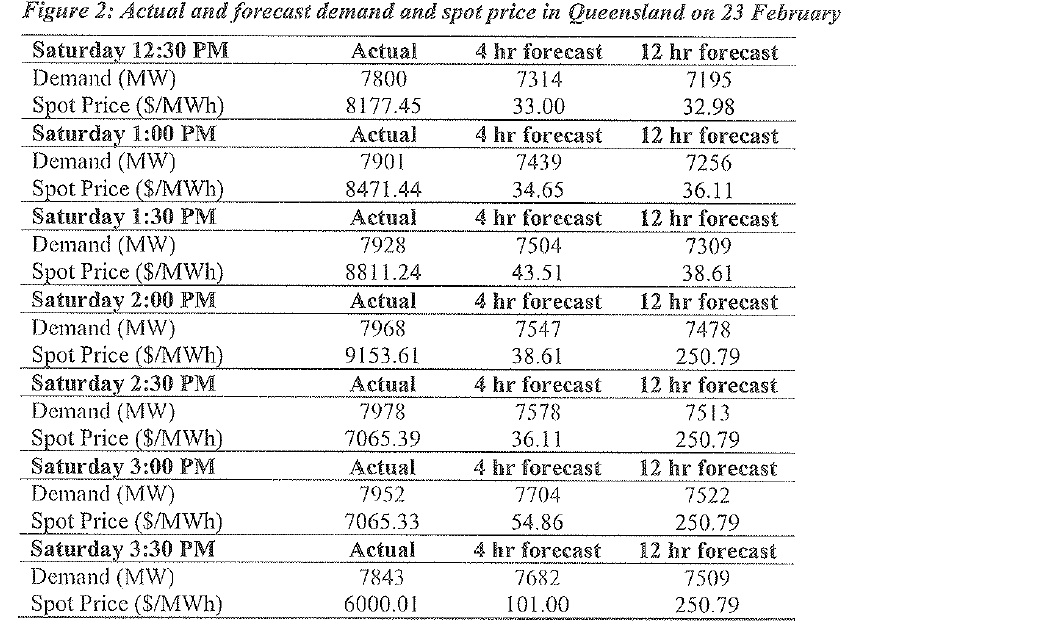
84 The report then states that on both days, “imports” from New South Wales were restricted to a combined total of less than 200 MW. It is not necessary to go into the reasons for such limitation, save to note that at least part of the problem appears to have arisen as a result of a reduction in output at Kogan Creek power station which is operated by CS Energy. Other evidence suggests that the availability of electricity from New South Wales was being used as a reserve against significant failures in Queensland generation. The quantum of the reserve was fixed by reference to a possible failure at Kogan Creek which was the largest single power station in Queensland.
85 The report then notes that through a combination of initial offers and rebids, more than 20% of capacity in Queensland was offered on both days at prices above $5,000 per MW and a further 1314 MW, or 12% of capacity was not presented to the market. The report then goes on to summarize the closing offers and significant rebids related to the periods during which prices were above $5,000.00 per MW on each day as follows:
22 February: CS Energy presented an average of 387 MW of capacity at prices above $5000/MWh, mostly through initial offers. This capacity was priced at less than $100/MWh at other times of the day. A further 489 MW of capacity was not presented to the market. Rebids reduced the available capacity at Kogan Creek and Collinsville by up to 220 MW, with half of this priced at less than $30/MWh. The reasons given included “SCC limitations”, “Lost B mill” and “Colnsv availability”.
Over a number of rebids from 8.45 am Millmerran Energy Trader shifted an average of 166 MW of capacity from prices of less than $25/MWh to prices above $5000/MWh. All of this capacity was initially offered for the whole day at prices of less than $25/MWh. The reason given for all rebids was “Changed PD::Adjust MW dist”.
Stanwell Corporation presented an average of 426 MW of capacity at prices above $5000/MWh with a further 420 MW of capacity not presented to the market. Rebids from 10.56 am shifted up to 120 MW of capacity at Gladstone from prices of less than $100/MWh to above $5000/MWh. These rebids were short in duration – typically for only one hour – and were extended a number of times during the day. The reasons given included “Portfolio optimisation::change MW distrib”, “Rearrange/rebalance portfolio::change avail/MW distrib” and “Extend previous bid::change avail/MW distrib”.
Tarong Energy presented an average of 1180 MW or around 50 per cent of its capacity at prices above $5000/MWh, mostly through initial offers. Rebids from 11.55 am shifted 80 MW of capacity from prices above $9000/MWh down to less than $100/MWh. The reasons given were “Manage contract position::volume profile change”.
23 February: CS Energy presented an average of 393 MW of capacity at prices above $5000/MWh. Most of this capacity was priced at less than $100/MWh at other times of the day. A further 515 MW of capacity was not presented to the market. Rebids from 10.47 am shifted 195 MW of capacity at Swanbank E from prices below $30/MWh to above $5000/MWh. The reason given was “Change in predispatch”. Additional rebids from 8.17am reduced the available capacity of the portfolio by 270 MW, with 105 MW priced below $30/MWh. These reductions occurred at Collinsville, Callide B, Swanbank B and Kogan Creek. The reasons given included “Extend outage”, “Swan B1 70 MW mill PF leak”, “Call B2 max availability”, “SCC limitations” and “Call B1 vac limit”.
Stanwell Corporation presented an average of 780 MW of capacity at prices above $5000//MWh, with a further 296 MW of capacity not presented to the market. Rebidding from 12.11 pm shifted 420 MW of capacity from prices of less than $100/MWh to above $5000/MWh. The reasons given were “Portfolio optimisation::change MW distrib” and “material change in market conditions::change MW distrib”.
Tarong Energy presented an average of 1297 MW or around 50 per cent of its capacity at prices above $5000/MWh through initial offers made the previous day.
The National Electricity Rules (NER) requires all rebids to be made in good faith. The AER is examining the rebids that occurred on these two days to assess their compliance with the NER.
Figures 1a and 1b show for all participants in Queensland the capacity that was presented at prices above $5000/MWh and the amount of capacity not presented to the market when compared to the registered capacity of the plant. It also shows a combined total of high priced or unavailable capacity as a percentage of the registered capacity.
86 Those figures are as follows:
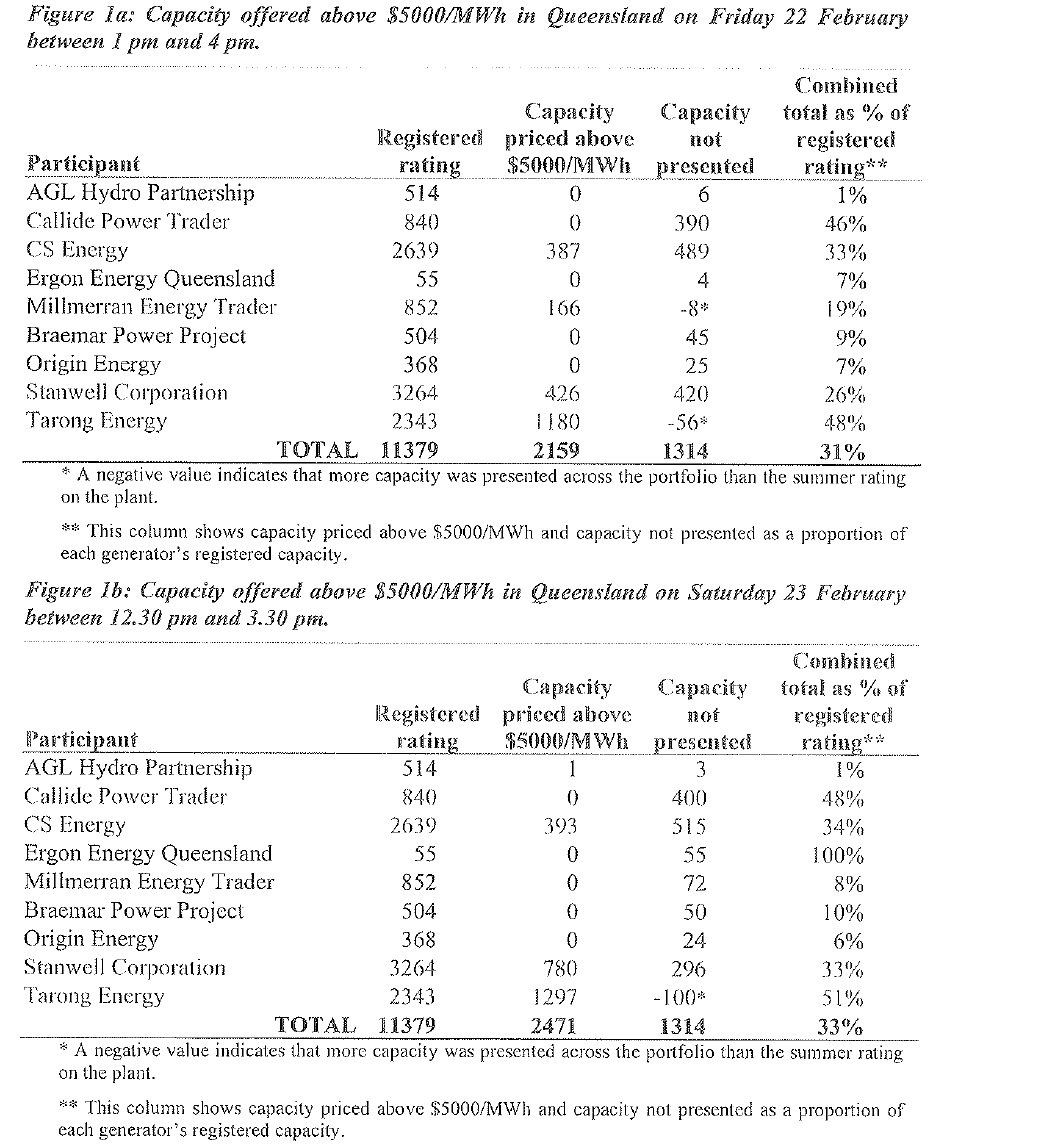
87 Figure 1a demonstrates that on 22 February 2008 the respondent offered 2,844 MW of its 3,264 MW registered rating, of which 426 MW were offered at prices above $5,000.00 per MW. Other evidence demonstrates that at least part of the respondent’s capacity was not presented because a generating unit at Gladstone was off line for maintenance. On 23 February 2008 the respondent offered 2,968 MW of its registered rating of 3,264 MW. 780 MW were offered at prices above $5,000.00 per MW. Again, one of the Gladstone generating units was off line. In these tables the applicant chose to express the amalgamated total of power not offered and power offered at more than $5,000.00 per MW as a percentage of registered ratings. This suggests that it was attributing the high prices to a combination of withheld power and power offered at high prices.
88 At p 5, the applicant suggests that Appendix A to the report identifies “… the generators involved in setting the spot prices during the times of prices above $5,000.00 per MW and how that price was determined by the market systems …”. Appendix A suggests that on 22 February 2008 Tarong was primarily setting the price, particularly during the period of high prices. It suggests that on Saturday 23 February 2008 Tarong and the respondent were, together, setting the price during the relevant periods. At p 6 of the report the applicant concludes:
On Friday 22 and Saturday 23 February, the spot price in Queensland exceeded $5000/MWh on 14 occasions. The highest demands for the summer coupled with a large proportion of generation capacity priced at greater than $5000/MWh contributed. A number of rebids by Millmerran Energy Trader, CS Energy and Stanwell Corporation shifted capacity from lower prices into prices above $5000/MWh. [The applicant] is investigating further the rebids during this period to assess compliance with the good faith provisions of the [Rules].
89 In considering the report, one should keep in mind that, as Dr Rose points out, there was always an excess available capacity of not less than about 2000 MW or about 20% of available capacity.
90 In the course of both 22 and 23 February 2008 the respondent made numerous rebids. I shall use the term “rebids” to describe offers to supply other than the initial bids made prior to the commencement of the relevant trading days. The applicant asserts that a number of rebids were not made in good faith and so were contrary to cl 3.8.22A of the Rules. Broadly speaking, the applicant asserts that each impugned rebid was made with the intention that, should the Dispatch Price not rise sufficiently as a result of it, the respondent would make a further rebid for the same Trading Interval. Such an intention is said to be inconsistent with the requirement contained in cl 3.8.22A that a rebid be in good faith as there defined. It is said that such a rebid would not be accompanied by the intention that the rebid be honoured, absent any change in material conditions and circumstances. Not all of the respondent’s rebids have been impugned in these proceedings. Some rebids were initially, but are no longer impugned. As identified in the third further amended statement of claim (the “statement of claim”) the impugned rebids have been identified, in the course of the proceedings, as Rebids 19, 24, 28, 67, 69, 81, 83 and 86. Each rebid, other than Rebid 86, is impugned by reference to one subsequent rebid. Rebid 86 is impugned by reference to two subsequent rebids. In effect, the applicant argues that the subsequent rebid or rebids demonstrated absence of good faith.
91 At this point the case becomes more complex, partly because of the way in which the applicant investigated the matter and presented its case, and partly because of the way in which the respondent has attempted to explain the rebids made on 22 and 23 February 2008, both in these proceedings and prior thereto. I shall begin by trying to explain the structure of the statement of claim.
92 The statement of claim commences with a definitions section which has no paragraph number. The first 17 numbered paragraphs are relevant, but largely uncontroversial. Paragraph 16 has some ongoing relevance. It states:
The Material Conditions for the Initial Generation Dispatch Offers referred to in paragraphs 14 and 15 were:
(a) the Queensland region forecast average spot price for the trading days 9-15 February 2008, which was $37.46/MWh;
(b) the Queensland region forecast average demand for the trading days 9-15 February 2008, which was 6439 MW;
(c) the fact that each of the generating units of Stanwell power station and the Gladstone power station except G4 had sufficient fuel, and were available;
(d) the Respondent’s contract position and average contract strike price.
Particulars
Annexure 9 to the NEL Notice Information (Annexure D to the Statement of Claim)
93 Paragraphs 18 to 42 have been deleted and not replaced. Paragraphs 43 to 54C relate to Rebids 19 and 20. Rebid 19 is impugned by reference to Rebid 20. The rest of the document follows that pattern for the other impugned rebids. Thus a simple index is as follows:
Definitions | |
Paragraphs 1-17 | General introductory matters |
Paragraphs 43-54C | Rebid 19 (and Rebid 20) |
Paragraphs 55-65C | Rebid 24 (and Rebid 25) |
Paragraphs 66-75 | No longer relevant |
Paragraphs 80-86C | Rebid 28 (and Rebid 29) |
Paragraphs 87-98C | Rebid 67 (and Rebid 68) |
Paragraphs 99-102 | No longer relevant |
Paragraphs 107-111 and 115-118C | Rebid 69 (and Rebid 70) |
Paragraphs 130-131 | No longer relevant |
Paragraphs 150-160C | Rebid 81 (and Rebid 82) |
Paragraph 161-171C | Rebid 83 (and Rebid 84) |
Paragraphs 172-185C | Rebid 86 (and Rebids 87 and 88) |
94 The paragraphs noted as “no longer relevant” relate to rebids which were impugned at the time that the third amended statement of claim was delivered but are no longer impugned. Missing paragraph numbers indicate paragraphs which have been deleted and not replaced.
95 The pleaded case concerning Rebid 19 is structured in a way which is broadly similar to the pleaded cases for the other impugned rebids. In connection with Rebid 19, the applicant pleads:
in paras 43 and 44, the effects of the rebid, further particularized in Annexure A;
in para 45, reasons for Rebid 19, allegedly given by the respondent and adopted by the applicant;
in para 46, a matter which is peculiar to Rebid 19;
in para 47, that “Material Conditions for Specific Rebid 19” were matters pleaded in paras 45 and 16 (the “Material Conditions”);
in paras 48 and 49, the making of Rebid 20 and its effects, again particularized in Annexure A;
in para 50, reasons for Rebid 20, allegedly given by the respondent and adopted by the applicant;
in para 51, that there was no change in the Material Conditions for Rebid 19 between the time when it was made and the time at which Rebid 20 was made or alternatively, no change upon which the respondent acted in making Rebid 20;
in para 52, that by reason of the facts alleged in paras 43 to 51, the respondent did not, at the time at which it made Rebid 19, have a genuine intention to honour it in the event that the Material Conditions remained unchanged until the relevant Dispatch Interval;
in paras 53 and 54, that pursuant to cl 3.8.22A(a) and (b) of the Rules, Rebid 19 was not made in good faith;
in paras 54A to 54C, an alternative case, based primarily upon the respondent’s oral evidence, which alleges that:
in para 54A, when Rebid 20 was made, there had been no change in the Material Conditions pursuant to which Rebid 19 was made;
when Rebid 19 was made, the respondent did not have a genuine intention to honour it in the event that Material Conditions remained unchanged until the relevant Dispatch Interval;
the respondent intended, if that goal were not achieved, to make a further rebid; and
in paras 54B and 54C, Rebid 19 was not made in good faith.
96 The term “Material Conditions” has been borrowed from cl 3.8.22A(b) of the Rules. However the term is not there defined. The applicant seeks to define it by reference to its own views as pleaded in para 16, and to selected aspects of the respondent’s explanations of the rebids. While this may be a legitimate approach to pleading a case of this kind, it should not be permitted to distract attention from the fact that the meaning of cl 3.8.22A is to be found in the Rule itself, and in the context in which it appears.
97 All rebids were made by one or other of the respondent’s traders. The traders worked in a trading room operated by the respondent. Traders had access to a large amount of information derived from the Operator and other sources, including the respondent’s power stations. When rebids were made, the relevant trader gave brief reasons to the Operator. Rebids were made on line, using a programme which contained a number of standard reasons for rebid from which the trader could choose. Presumably at the same time, or shortly thereafter, the trader recorded reasons in his or her log, a hand-written document. Thus there are two, more or less contemporaneous sources of information concerning reasons for rebids. However those given to the Operator are formulaic and of little assistance in this case. However the log entries are of considerable assistance.
98 As I have said, following the events of 22 and 23 February 2008, the applicant conducted an inquiry. On 25 February 2008, the applicant sought certain information from the respondent (the “February request”). This information was provided on 24 June 2008 (the “June response”). On 22 December 2008, the applicant served a notice requiring further information to be supplied by 16 February 2009, and threatening civil or criminal penalties in the event of non-compliance (the “s 28 notice”). On 10 February 2009 the respondent’s solicitors wrote to the applicant. They indicated that they would be able to respond to sections 1 to 5 of the s 28 notice by the specified date but sought an extension until 2 March 2009 for supplying responses to sections 6 and 7 which concerned the rebids. The applicant granted an extension only until 23 February 2009.
99 Prima facie, one would have expected rather more understanding from the applicant, given the time of year at which the notice was delivered, together with the fact that the respondent was a major supplier in the NEM, and was likely to continue in that role. It was represented by reputable solicitors, was able to comply with a major part of the request and sought a relatively short extension of time in which to comply with the balance. The respondent now asserts that to some extent, the haste demanded by the applicant led to errors in its response (the “s 28 response”). It certainly seems that differences in point of view, emphasis or, perhaps, expression emerge from a consideration of the explanations given, at various stages, by the respondent and its traders. Whether these differences are of any great moment must be considered in light of the circumstances in which they were provided.
100 I propose now to summarize:
the objective facts concerning each impugned rebid; and
the reasons given to the Operator at the time, and those recorded in the relevant trader’s log.
101 I shall deal with the June response and the s 28 response in dealing with the evidence of the relevant traders.
The applicant focuses upon the changes made in each impugned rebid in the light of a subsequent rebid, or subsequent rebids affecting the same Dispatch and/or Trading Interval or Intervals. Each rebid related only to part of the respondent’s total offering for the period in question. As I have said, on 22 and 23 February 2008 the respondent actually offered 2844 MWh and 2968 MWh respectively, or thereabouts. The applicant’s case is that a “rebid” as defined in Ch 10 of the Rules, is a variation to a bid or offer made pursuant to cl 3.8.22 and therefore includes a variation to a “dispatch offer”. A “dispatch offer” is, according to Ch 10, a “generation dispatch offer”, which is, in turn, a “notice submitted by a Scheduled Generator to [the Operator] relating to the dispatch of a scheduled generating unit in accordance with cl 3.8.6”. There is no doubt that each of the respondent’s generating units was a scheduled generating unit, or that the impugned rebids were rebids for the purposes of cl 3.8.22A. Each dispatch offer is for a separate generating unit. It is possible to construe the word “rebid” in cl 3.8.22A as denoting the variation to the dispatch offer made by the rebid, or the dispatch offer in its amended form after the rebid. However the definition in Ch 10 suggests that the variation constituted the rebid. Thus it was the variation which had to be made in good faith.
102 I note also that the test of good faith in cl 3.8.22A referred to unchanged material conditions and circumstances “until the relevant dispatch interval”. This implied that in the event of a change in material conditions and circumstances, a trader might rebid up until the commencement of the relevant Dispatch Interval. Although rebids generally related to Trading Intervals, some relevant rebids were made after the commencement of a Trading Interval, for the remaining Dispatch Intervals in that Trading Interval. I also note cl 3.8.22A(c). It permits an inference of absence of good faith even if the actual intention of the generator is “ascertainable only by inference from the conduct of the [generator], or of any other person, or from relevant circumstances”. The purpose of this provision is obscure but it clearly does not shift the burden of proof.
103 Much of the applicant’s case is directed towards establishing that rebids were made for the purpose of increasing the Dispatch Price for particular Dispatch or Trading Intervals. The applicant accepts that the respondent was entitled to move power from one band to another for the purpose of maximizing its revenue by forcing the Operator to acquire power from a more highly priced band, thus raising the relevant Dispatch Price and therefore the relevant Spot Price. However the applicant submits that each relevant trader, in making each impugned rebid, had in mind the possibility that if the price did not rise sufficiently as a result of such rebid, he would make another rebid for some or all of the same Trading Interval. The applicant further submits that such a state of mind deprived each impugned rebid of the necessary characteristic of being in good faith.
104 In addressing the evidence and the submissions, I shall try to treat each impugned rebid discretely. In considering the traders’ decision-making processes, their evidence and the submissions, I shall, from time to time, repeat relatively substantial parts of the evidence. My purpose in so doing is to assist the reader to understand the fairly subtle case advanced by the applicant without repeated references to other parts of these reasons, the trial transcript or the exhibits. In the following tables the letters “G” and “S” are used to describe generating units at Gladstone and Stanwell respectively.
Rebid 19 – impugned by reference to Rebid 20
Date of Rebids | 22 February 2008 |
Generating units | G1-G3, G5, G6 |
For Trading Interval | 13:30 |
Time of impugned Rebid 19 | 12:57:29 |
Time of Rebid 20 | 13:06:07 |
Effect of Rebid 19 | Move 50MW from Band 4 to Band 10 for Trading Interval 13:30 |
Effect of Rebid 20 | Move a further 50MW from Band 4 to Band 10 for Dispatch Intervals 13:15, 13:20, 13:25 and 13:30 |
Reasons for Rebid 19 provided to Operator | 1257F Portfolio optimisation::change MW distrib |
Reasons for Rebid 19 in trader’s log | R GPS1-6 ↓ 10 each Port opt – extending the previous bid with some modification because Price ∆ from ≈ VoLL to $54 |
Reasons for Rebid 20 provided to Operator | 1302F Portfolio optimization::change MW distrib |
Reasons for Rebid 20 in trader’s log | R GPS1-6 ↓ 10 each extra price has dropped from ┼ ≈ voll to $50 within last 15 mins. I push too much MW … in. This is just pulling some MW out |
NOTES: • Generating unit 4 at Gladstone was off-line on 22 February 2008. • During 22 February 2008 it was necessary to back-flush one or more of the Gladstone generating units, leading to reduction in output of the unit or unis being back-flushed. Compensating adjustments were made by raising outputs from other units. | |
Rebid 24 – impugned by reference to Rebid 25
Date of Rebids | 22 February 2008 |
Generating units | G1-G3, G5, G6 |
For Trading Interval | 15:00 |
Time of impugned Rebid 24 | 14:32:00 |
Time of Rebid 25 | 14:36:39 |
Effect of Rebid 24 | Move 50MW from Band 4 to Band 10 for Dispatch Intervals 14:40, 14:45, 14:50, 14:55 and 15:00 |
Effect of Rebid 25 | Move a further 50MW from Band 4 to Band 10 for Dispatch Intervals 14:45, 14:50, 14:55 and 15:00 |
Reasons for Rebid 24 provided to Operator | 1431F Extend previous bid::change avail/MW distrib |
Reasons for Rebid 24 in trader’s log | R GPS 1-6 Extending previous bid, because the price drop from ≈ VoLL to $54 |
Reasons for Rebid 25 provided to Operator | 1436F Portfolio optimisation::change MW distrib |
Reasons for Rebid 25 in trader’s log | R GPS 1-6, Port opt ↓ 10 |
NOTES: • Generating unit 4 at Gladstone was off-line on 22 February 2008. • During 22 February 2008 it was necessary to back-flush one or more of the Gladstone generating units, leading to reduction in output of the unit being back-flushed. Compensating adjustments were made by raising outputs from other units. | |
Rebid 28 – impugned by reference to Rebid 29
Date of Rebids | 22 February 2008 |
Generating units | G1-G3, G5, G6 |
For Trading Interval | 17:00 |
Time of impugned Rebid 28 | 16:42:40 |
Time of Rebid 29 | 16:53:20 |
Effect of Rebid 28 | Move 50MW from Band 4 to Band 10 for Dispatch Intervals 16:50, 16:55 and 17:00 |
Effect of Rebid 29 | Move a further 75MW from Band 4 to Band 10 for Dispatch Interval 17:00 |
Reasons for Rebid 28 provided to Operator | 1637F Portfolio optimisation::change MW distrib |
Reasons for Rebid 28 in trader’s log | R GPS1-6 Port opt price ∆ from ≈ 5000 to $50 |
Reasons for Rebid 29 provided to Operator | 1637F Portfolio optimization::change MW distrib |
Reasons for Rebid 29 in trader’s log | R GPS1-6 Port opt. Demand drop but there is still some volatility |
NOTES: • Generating unit 4 at Gladstone was off-line on 22 February 2008. • During 22 February 2008 it was necessary to back-flush one or more of the Gladstone generating units, leading to reduction in output of the unit being back flushed. Compensating adjustments were made by raising outputs from other units. | |
Rebid 67 – impugned by reference to Rebid 68
Date of Rebids | 23 February 2008 |
Generating units | S1-S4 |
For Trading Intervals | 11:30, 12:00 and 12:30 |
Time of impugned Rebid 67 | 10:59:27 |
Time of Rebid 68 | 11:08:32 |
Effect of Rebid 67 | Move 80MW from Band 4 to Band 10 for Dispatch Intervals 11:10, 11:15, 11:20, 11:25 and 11:30 and for Trading Interval 12:00; move 240MW from Bands 4 and 5 to Band 10 for Trading Interval 12:30 |
Effect of Rebid 68 | Move 40MW from Band 4 to Band 10, 20MW from Band 3 to Band 9 and 20W from Band 10 to Band 9 for Dispatch Intervals 11:15, 11:20, 11:25 and 11:30 and for Trading Intervals 12:00 and 12:30 |
Reasons for Rebid 67 provided to Operator | 1058F Portfolio optimisation::change MW distrib |
Reasons for Rebid 67 in trader’s log | SPS Portfolio optimisation, extend 23-019 till 12:30, increase in sensitivity, change in market conditions |
Reasons for Rebid 68 provided to Operator | 1058F Portfolio optimisation::change MW distrib |
Reasons for Rebid 68 in trader’s log | SPS Port Optimization till 12:30 |
NOTE: • Band 10 was the default recipient of any transfer which was not otherwise specifically designated. This may explain the “double handling” involved in transferring to and from Band 10. | |
Rebid 69 – impugned by reference to Rebid 70
Date of Rebids | 23 February 2008 |
Generating units | S2, S4 |
For Trading Interval | 12:00 |
Time of impugned Rebid 69 | 11:26:52 |
Time of Rebid 70 | 11:43:42 |
Effect of Rebid 69 | Move 20MW from Band 10 to Band 3 for Trading Intervals 12:00 and 12:30 |
Effect of Rebid 70 | Move 40MW from Band 3 to Band 10 for Dispatch Intervals 11:50, 11:55 and 12:00 |
Reasons for Rebid 69 provided to Operator | 1125F Portfolio optimisation::change MW distrib |
Reasons for rebid 69 in trader’s Log | SPS Port Optimisation till 12:30 |
Reasons for Rebid 70 provided to Operator | 1143F Portfolio optimisation::change MW distrib |
Reasons for Rebid 70 in trader’s Log | SPS 2, 4 Port optimisation till 12:00 material change in market conditions |
NOTE: • The respondent denies that Rebid 70 was made in time for it to be taken into account for dispatch interval 11:50. | |
Rebid 81 – impugned by reference to Rebid 82
Date of Rebids | 23 February 2008 |
Generating units | G1-G3, G5, G6, S1-S4 (Rebid 81); S2, S4 (Rebid 82) |
For Trading Interval | 15:30 |
Time of impugned Rebid 81 | 14:39:50 |
Time of Rebid 82 | 14:46:24 |
Effect of Rebid 81 | Move 380MW from Bands 4 and 5, placing 20MW in Band 9 and 360MW in Band 10 for Trading Interval 15:30 |
Effect of Rebid 82 | Move 40MW from Band 3, placing 20MW in Band 9 and 20MW in Band 10 for Trading Interval 15:30 |
Reasons for Rebid 81 provided to Operator | 1325F Material change in market conditions::change MW distrib |
Reasons for Rebid 81 in trader’s Log | SPS + GPS extend two previous bids till 15:30, reduce SPS 2, 4 PB9 from 20MW to 10MW, material change in mkt conditions, price higher than forecast till 15:30 |
Reasons for Rebid 82 provided to Operator | 1445F Material change in market conditions::change MW distrib |
Reasons for Rebid 82 in trader’s Log | SPS 2, 4 extend previous bid till 15:30, material change in mkt conditions |
NOTE: • Generating unit 4 at Gladstone was off-line on 23 February 2008. | |
Rebid 83 – impugned by reference to Rebid 84
Date of Rebids | 23 February 2008 |
Generating units | G1-G3, G5, G6, S1-S4 (Rebid 83); G1-G3, G5, G6 (Rebid 84 for Dispatch Intervals 15:45, 15:50, 15:55, 16:00); G1-G3, G5, G6, S1-S4 (Rebid 84 for Trading Interval 16:30) |
For Trading Interval | 16:00 |
Time of impugned Rebid 83 | 15:14:55 |
Time of Rebid 84 | 15:34:17 |
Effect of Rebid 83 | Move 420MW from Bands 3, 4 and 5 to Bands 9 and 10 for Trading Interval 16:00 |
Effect of Rebid 84 | Move 25MW from Band 10 to Band 4 for Dispatch Intervals 15:45, 15:50, 15:55 and 16:00 |
Reasons for Rebid 83 provided to Operator | 1445F Material change in market conditions::change MW distrib |
Reasons for Rebid 83 in trader’s Log | SPS + GPS extend previous 2 bid to 16:00 material change in market conditions |
Reasons for Rebid 84 provided to Operator | 1532F Portfolio optimisation::change MW distrib |
Reasons for Rebid 84 in trader’s Log | Extend previous bid to 16:30, adding 5MW in GPS PB4 till 16:00 to test sensitivity, plant response time |
NOTES: • Generating unit 4 at Gladstone was off-line on 23 February 2008. • By Rebid 84, 420MW were also moved from Bands 3, 4 and 5 to Bands 9 and 10 for Trading Interval 16:30. | |
Rebid 86 – impugned by reference to Rebids 87 and 88
Date of Rebids | 23 February 2008 |
Generating units | G1-G3, G5, G6, S1-S4 (Rebid 86); S2, S4 (Rebid 87); G1-G3, G5, G6 (Rebid 88 for Dispatch Intervals 16:50, 16:55, 17:00); G1-G3, G5, G6, S1-S4 (Rebid 88 for Trading Interval 17:30) |
For Trading Interval | 17:00 |
Time of impugned Rebid 86 | 16:24:33 |
Time of Rebids 87 and 88 | 16:31:44 and 16:41:53 |
Effect of Rebid 86 | Move 330MW from Bands 4 and 5 to Band 10 for Trading Interval 17:00 |
Effect of Rebid 87 | Move 40MW from Band 3 to Band 10 for Dispatch Intervals 16:40, 16:45, 16:50, 16:55 and 17:00 |
Effect of Rebid 88 | Move 50MW from Band 4 to Band 10 for Dispatch Intervals 16:50, 16:55 and 17:00 |
Reasons for Rebid 86 provided to Operator | 1541F Portfolio optimisation::change MW distrib |
Reasons for Rebid 86 in trader’s Log | GPS + SPS Portfolio optimisation till 17:00 |
Reasons for Rebid 87 provided to Operator | 1541F Portfolio optimisation::change MW distrib |
Reasons for Rebid 87 in trader’s Log | SPS 2, 4 Portfolio optimisation till 17:00 |
Reasons for Rebid 88 provided to Operator | 1541F Portfolio optimisation::change MW distrib |
Reasons for Rebid 88 in trader’s Log | SPS + GPS Portfolio optimisation till 17:30 |
NOTES: • Generating unit 4 at Gladstone was off-line on 23 February 2008. • By Rebid 88 420MW were also moved from Bands 3, 4 and 5 to Band 10 for Trading Interval 17:30. | |
105 Mr Gobi Krishna Gnanananthan was the trader who made Rebids 19, 24 and 28. At his request he was referred to by counsel in the course of his evidence as “Gobi”, presumably because of expected difficulties in the pronunciation of his surname. I shall not adopt that practice in these reasons. I propose to deal with Mr Gnanananthan’s evidence by first outlining that part of his evidence which was of a general nature, as opposed to that concerning impugned rebids. I shall also deal with his cross-examination and re-examination concerning those general matters. I shall then deal with his evidence concerning the impugned rebids.
106 From about October 2008, Mr Gnanananthan was employed by the respondent as a spot trader. He holds degrees in Commerce and Arts from Griffith University, the former with First Class Honours. Prior to his employment with the respondent he had been employed in a policy role in a state government department. He has subsequently returned to policy work in another department. His evidence in chief and cross-examination extended over several days. Given the relatively short periods of time during which he was involved in incidents relevant to this case, it is surprising that his evidence should have taken so long. He gave evidence of his understanding of the bidding system. That understanding differed to some extent from the descriptions given by Mr Thorpe and Dr Rose, no doubt reflecting differences in perspective. He also gave evidence concerning the physical layout of the respondent’s trading facilities and of the circumstances in which he made the impugned bids for which he was responsible.
107 In the trading room, large amounts of information were displayed on numerous video screens. The information included forecast and actual spot prices, dispatch prices, weather information and levels of demand. This information was provided on a national basis, but the focus in the Brisbane trading room was on Queensland and New South Wales. Traders also had access to information concerning current operations at the respondent’s power stations, and the flow of power between Queensland and New South Wales. The traders used a computerized bidding programme. Some of the displays on the video screens could also be displayed on the trader’s screen. Forecasts of dispatch prices were renewed every five minutes. Forecasts of spot prices were renewed every half hour. Conditions at the power stations were displayed on a white board. Also on the white board was information concerning the respondent’s hedge contracts. As I understand it, traders aimed to maximize the respondent’s revenue. One aspect of that process was to ensure that the respondent’s exposure under its hedge contracts was “covered”. The other was to exploit opportunities to dispatch electricity at higher prices. As I understand the hedge contracts, such exposure arose as follows:
• the respondent and the other party to the contract sought the certainty offered by the advance sale and purchase of a fixed volume of electricity at a fixed price;
• such electricity would be supplied through the distribution grid so that the respondent did not actually supply electricity to the purchaser, but rather to the grid as a whole, from which the purchaser acquired it;
• the respondent would receive, from the Operator, the spot price for electricity supplied to the grid, and the purchaser would pay a similar price to the Operator; and
• the hedge contract would require payment by the respondent to the purchaser of any amount by which the spot price exceeded the contract price, or by the purchaser to the respondent of any amount by which the spot price fell below the contract price.
108 The trader would have a target volume to sell at or above a target price, calculated by reference to all of the respondent’s hedge contracts. If that target were not achieved, and the spot price was above the contract price, the respondent would, in effect, have to pay the difference to the purchasers, although the respondent would not, itself, have been paid at that price. Further, if prices were high, and the respondent’s contract position was covered, it would enjoy the benefit of high prices. If its contract position was not covered, it would have to share the high prices, which it received for the electricity which it had sold, with its hedge contract purchasers. For present purposes, it is also relevant to note that if a trader tried to push up the Dispatch Price by moving dispatch volume to a higher band, he or she ran the risk that it would not be sold. This would occur if there was sufficient capacity in lower bands to meet actual demand.
109 On 22 February 2008 Mr Gnanananthan started work at about 6.30 am when he attended a handover briefing. He started trading at about 7.00 am and probably continued until 7.00 pm. In the half hour between 6.30 and 7.00 am, he was briefed by the outgoing night trader as to market activity and technical information. Mr Gnanananthan thought that on 22 February, he probably would have been told that it was going to be a hot day, that demand would be high and other information of that kind. Traders were expected to assess available information as to price, demand, weather and technical information. There were telephone links to the power stations for the exchange of technical and market information. Mr Gnanananthan said that early in the day he would have focussed on the forecast figures for the next two hours or, perhaps, for the whole of his shift, with a view to assessing how weather might affect demand. He would have considered the available information concerning the previous day’s trading, analysing competitors’ conduct and seeking to understand it. He would also have considered information as to price and demand sensitivity.
110 The respondent issued a daily document described as a “spot trading daily strategy and weather report” which prescribed parameters for the day’s bidding activity. There were also monthly and weekly documents of this kind. The daily documents would reflect the weekly and monthly documents. At p 267A et seq in Court Book 1/4, there is a weekly strategy document for the week described as “20080222”, presumably 22 February 2008. It deals with the week from Saturday, 23 to Friday, 29 February 2008. It contained forecasts as to demand which, Mr Gnanananthan said, were probably based on material provided by the Operator, and modelling carried out by the respondent. It also included forecast spot prices for the week. There was a large amount of confidential information concerning price, demand and output, together with revenue forecasts. There was also a “bidding strategy”. Broadly speaking it reflected many of the considerations to which I have already referred, including the need to cover the contract position so as to be able to respond appropriately when prices went above certain levels.
111 Mr Gnanananthan stressed the importance of covering the contract position by ensuring that a sufficiently high volume of electricity was sold at an appropriate price. A trader might seek to trade off volume in order to produce a higher price. There was an inevitable tension between achieving high volume and achieving a high price. A trader’s decision would be influenced by the data available in the trading room, his or her experience and historical information. A trader would generally have some knowledge of the price bands used by other generators and could infer from price movement that:
… there’s something happening in the market. You know on a hot day generators are more likely to decrease their dispatch level at lower prices and offer more volume in a higher price with their rebids. You know that information. You know what’s likely to happen around certain prices. One of the contract which is offered is called a $300 cap contract. Cap contract is basically an option. It’s like an insurance, so you pay a premium to buy it and with the $300 cap basically what happens is if the spot price exceeds $300 the person who sells that cap contract, generally a generator with a peaking generation, would pay the difference between $300 and the spot price. So when you get around to a price near $300, or a bit below $300, what you will see if you get up to that price as the day progresses on a hot day, then it may stay for a little while because generators who have sold that cap contract say for 200 or 300 MW, would want to increase their generation by 200 or 300 MW. So as a trader, what you’re looking to do is you know there are certain generators who will sell these contracts. For example, in Queensland, Tarong has got a peaking generation capacity with Wivenhoe, so the price goes around to say, $250 or $290, or just under $300, you know Tarong may be likely to increase the volume. So you know all those kind of patterns. (ts 396.)
112 Knowledge of other generators’ past conduct would influence decisions. Information as to actual dispatch by other generators was not available until the next day. Nor would an operator know the actual price bands being used by other generators until the next day, although such information might be inferred from earlier experience. Generators did not change their price bands frequently. Whilst Mr Gnanananthan was trading he would primarily focus on the next half hour, looking at “every half an hour in pieces”. Where the market was volatile, as it was on 22 February 2008, he would tend to make his rebids:
… toward the, just on the end of the half-hour to impact the next half-hour. The reason is because the market information was changing rapidly … . It seems like it was changing rapidly in a significant way, so I wait to get the most latest information before I make a rebid. I know I reacted like that in the first part of the day, then toward the end, you know, I made rebids which encompass several half-hours.
113 In making such decisions he considered price, including forecast price, dispatch levels compared to contract levels, temperature and demand. During Mr Gnanananthan’s shift on 22 February 2008 certain technical activities affected supply. There were “a couple of back-flushes at Gladstone”. That power station takes its water from the sea and so tends to collect debris which is removed by back-flushing. Back-flushing was not generally performed during the day. One of the Stanwell generating units was leaking, and one of the Gladstone units was off-line. The trader’s log indicates that some disruption was also caused by the need to start up a mill fuelling one of the generating units at Stanwell. Each of these incidents, at least potentially, created a need for rebalancing of the respondent’s portfolio. Mr Gnanananthan seems not to have been particularly concerned with initial Dispatch Offers previously made for 22 February. He was more concerned with changes in circumstances on the day in question.
114 Rebidding was done by computer, using drop-down boxes with a selection of identified, apparently standard, reasons for rebids. It was possible to enter different reasons. This mechanism generated the “Portfolio optimisation::change MW distrib” reason which is referred to above. The witness said that, “Portfolio optimisation basically means you’re acting in the commercial interest of your corporation, trying to optimise the portfolio. So you’re trying to maximise the revenue, maximise the profit, in effect”. He said that following the communication of a rebid to the Operator, he would usually make an entry in his trader’s log. However, on occasions he made the entry before the rebid. He explained some of the terminology which he used in his log entries. Use of the letter “R” indicated a rebid. The annotation “GPS 1-6” referred to the six power stations at Gladstone. The term “Port opt” was short for “Portfolio optimisation”. The letters “VoLL” described the maximum price of $10,000 per MW.
115 I formed the impression that the applicant’s February request and the s 28 notice inevitably led the respondent’s employees, including Mr Gnanananthan, to reconstruct the thought processes which led to the impugned rebids. I do not use the word “reconstruct” in a necessarily pejorative sense. The case concerns numerous decisions based upon a wide range of information and taken in very short time frames. Such decisions inevitably reflected the weight given by individual traders to particular aspects of the information available to them and the dual, and, to some extent, conflicting objectives of maximizing the volume of electricity supplied and the price at which it was supplied. Such decisions, no doubt, also reflected the particular personalities and experiences of the traders, some being more risk-averse than others. The difficulties inherent in testifying after the event concerning such thought processes should not be under-estimated. Mr Gnanananthan was involved in preparation of the June response but not the s 28 response. By that time he had left the respondent’s employ.
116 In cross-examination, Mr Gnanananthan said that he had not approved of the content of the June response. He had been consulted in the course of its preparation. He said that the February request had been sent to him by email, and that he may have “scanned over it” but did not read it in detail. He said that had he been responsible for preparing the June response, his approach would have been different from that actually adopted. On 23 June 2008 he received a draft of the response and was invited to indicate whether he was “happy with the reasons given for each rebid”. He assumed that annexure B (which deals with the rebids on 22 and 23 February 2008) was supplied to him at that time. He said that he did not look at it in detail. However he agreed that in an email dated 24 June 2008, he responded to the inquiry concerning the draft. In it, he suggested inclusion of Spot Price information and commented on the relevance of the interstate connector between Queensland and New South Wales. He also indicated that he was satisfied with the reasons given for his rebids.
117 He said that he was dissatisfied with the response itself, not with annexures A and B which he had prepared. He said he looked at them in detail but not at the body of the response. He said that at the time he prepared the annexures, he did not have a particularly good relationship with the respondent’s trading management, although he had a good relationship with Mr Wallace who had sent him the draft.
118 He said that shortly after 22 February 2008, he had considered his conduct on that day, making reference to his trader’s log. In connection with preparation of the June response Mr Schutte asked him to consider the matter in terms of pre-dispatch price and pre-dispatch demand. He did not approve of that approach, thinking that it was “ingenuine”. He said that any response to the applicant’s request for reasons for the rebids should have reflected his trading methods. He said that he did not always look at pre-dispatch demand or pre-dispatch price, and that they were not always key aspects of rebidding. Although he disagreed with the approach, he prepared the schedules in accordance with Mr Schutte’s request. The outcome of all of this was that he did not “bother too much about the logic or reasons” provided in the June response.
119 Mr Gnanananthan was referred to certain telephone conversations with other employees of the respondent on or about 22 February 2008. Such conversations were routinely recorded. He had previously seen transcripts of conversations between himself and Lana Stockman. It was suggested to him that he had also spoken to Mr Wallace, another trader and witness in this case. He said that he remembered seeing a transcript of a conversation with Ms Stockman but was not sure about any conversation with Mr Wallace.
120 He was shown a transcript of a conversation with somebody called “Brett”, an operator at the Stanwell power station. The conversation occurred on 21 February 2008. Brett told Mr Gnanananthan that there was a leak in a condensing unit in generating unit 3 at Stanwell. The witness assumed that this led to a reduction in the generating capacity of the unit. This was probably the reduction in capacity at Stanwell to which he referred in evidence-in-chief. It seems that the NEMDE programme would respond to such a reduction in capacity by treating bids in the lower bands, up to the reduced capacity, as valid, so that any bids in higher bands were ignored. The witness was then referred to another conversation on 22 February 2008, concerning the Stanwell leak and bidding strategy for the day. In that conversation the witness indicated that he proposed to reduce cheap generation by transferring it into higher bands, so effecting a price/volume trade off. However he did not want generating unit 3 at Stanwell to become unserviceable. He was therefore happy to “sit at 180”, presumably 180 MW. In effect, he was accepting technical advice that the particular unit should be kept at 180 MW. He agreed that he was happy to accept the reduction in generating capacity because it fitted into his strategy for the day. That strategy involved reducing generation, or taking generation from lower bands to higher bands.
121 In a further conversation logged at 11:41 on 22 February 2008, a Gladstone operator informed him that he needed to perform a back-flush on generating unit 5. This is the back-flush referred to in connection with Rebids 19 and 20. As a result the output from that unit was reduced to about 150 MW. He was also referred to a conversation on 23 February 2008 with Mr Wallace. The conversation concerned the revenue derived by Stanwell from trading on the previous day, said to be about $7.5 m. The witness said to Mr Wallace, “Thanks mate. I wanted to push a bit more in hey, but nobody else was playing the game.” He agreed that he was saying that he could have made more money if other generators had “played the game”, by transferring capacity from lower bands into higher bands. He said that he formed the view on 22 February that other generators were not seeking to adopt similar tactics. On the following day, he performed an analysis and concluded that they had not done so.
122 The witness was then referred to a conversation with Ms Stockman which took place on 23 February 2008. It concerned his successful trading on Friday 22 February. He told her that he had been reviewing his actions and had identified some errors of judgment. He also referred to “a couple of messages” which he had “sent”. The messages seemed to be that the respondent’s strategy was to reduce the volume of generation moved in order to produce price increases. He said that he always tried to move the minimum volume necessary in order to raise prices so as to maximize both volume and price. There was always the risk that such a relocation would result in a loss of dispatch volume. A number of other generators had lower Band 10 prices than did the respondent, so that it was reasonable to expect that a lot of the MW in the respondent’s Band 10 would not be dispatched. The message was that other generators would have to assist by moving generation from lower to higher bands, thus sharing the risk that some generation would not be dispatched. The witness told Ms Stockman that he would write an account of his actions and send it to her.
123 Mr Gnanananthan’s attention was drawn to the fact that he had said that the matter was “pretty sensitive”. He said that he knew that the applicant would conduct an investigation as a result of the spot price having gone above $5,000.00. It was then put to him that such sensitivity was “because you were conscious at the time because of the high prices which had been achieved that there would be an investigation by the regulator?”. He replied, “I was conscious that – well, I know the regulator had to investigate it if the price goes above $5,000.00.” He was aware of that fact by virtue of his previous employment with the Department of Mines and Energy. He then said (at ts 493 ll 39-41):
In relation to what you say about sensitive, when I say its pretty sensitive, I was actually referring to the mistakes I made. It was kind of embarrassing. I was referring to the things I thought I made mistakes.
124 In my view the witness did not actually agree with the suggestion that the sensitivity to which he referred arose out of the possibility that there would be an investigation. He seems to have been saying that whilst he was aware that there would be an investigation, such knowledge was not the basis of his assertion of sensitivity. The sensitivity rather related to his own errors.
125 The witness was asked questions concerning the supply of electricity from New South Wales. As I have said, the Operator’s policy was to use part of the supply available from New South Wales as a reserve, the reserve being calculated by reference to the generating capacity at the Kogan Creek power station. The witness was aware that there was such a limitation upon utilization of electricity from New South Wales.
126 The witness was further questioned concerning his reference to sending messages to traders employed by other generators. Counsel for the applicant seems to have wanted him to agree that such messages were meant to be immediately understood by those traders. The witness thought that they might have understood them at the time, but that it was more likely that they would have identified them in subsequent reviews of the trading day. As I have said, the messages seem to have been that the respondent was not going to bear the full risk of moving generating capacity into higher bands in order to raise the price, and that it expected that other generators would share the risk. In view of Mr Gnanananthan’s telephone conversation with Mr Wallace, in particular his reference to “playing the game”, I would infer that he had hoped that other traders would have understood his “message” on 22 February.
127 The witness said that there was a view amongst some of the respondent’s staff that, “even a price/volume trade-off would attract the attention of [the applicant]”. He considered this to be a “conservative” position. Ms Stockman was not of that view. Another person called “Erin” was more conservative in her views. Ms Stockman also suggested that Mr Schutte was concerned about the possibility of an investigation. She suggested to the witness that he might need to be “a little bit careful”.
128 Mr Gnanananthan said that change in price was the key indicator upon which he relied in his rebidding. He also considered the forecast price and that most of the information provided by the Operator:
… in some form flows into price. If demand increases that has an impact on price. If the weather is, you know, temperature is high, it impacts demand which eventually impacts price. So price is a key thing. (At ts 509 ll 17-20.)
129 The witness said that he understood that, “some changes need to occur to make a rebid. I couldn’t make a rebid without any changes.” He also said that he understood that, “… you can’t collude, slight basic economic principle with competition, economics … and, you know, yes, basically anti-competitive behaviour, we can’t engage in kind of anti-competitive behaviour.” He agreed that he had distinguished in his evidence between a change in data and the situation in which anticipations or expectations had not been fulfilled. It was suggested to him that he was drawing that distinction rather more clearly than he had in 2008. He denied this, saying that, “trading is both responding to changes in the data and also relying upon educated instinct”. He said that he would not make a rebid on the basis of a change in data which was of no consequence or little consequence, and that the identification of a relevant change was a matter of assessment. He also considered that if he had made a mistake in the inferences which he had drawn, and upon which he had based a rebid, he would correct it in order to maximize revenue for the respondent. He considered that he was entitled to correct errors of judgment.
130 The witness was shown a document which he had prepared for Ms Stockman shortly after the events of 22 February 2008, probably on 25 February. He agreed that in it he said:
Over the past year, [the respondent] has supported price by pulling MWs but lately with the commissioning of Kogan Creek and water problems there is more incentive for Energy and Tarong to support the price as they have more exposure to the pool.
131 His meaning was that the Kogan Creek generator had a greater incentive to push prices higher than did the respondent because of the substantial exposure which it had in the market as a result of the size of its generating unit or units. He considered that its interests would have led it to move more capacity from lower bands to higher bands. He recognized this incentive by shifting less in terms of volume from lower to higher bands. He was asked if he meant that the Kogan Creek generator was not protected by hedge contracts to the same extent as was the respondent. He said that he would not exactly put it that way. However he went on to say that he was comparing the respondent’s exposure in the market to that of the Kogan Creek generator, and suggesting that it was a matter of comparing the extent by which generating capacity exceeded contract volume. The witness described this as the “dispatch margin”. He said that to the extent of a generator’s commitment under its hedge contracts, any profit from high sale prices had to be shared with the other parties to the contracts. To the extent that power was dispatched in excess of its total contractual volume, at very high prices, the generator derived the whole of the benefit of those prices. The witness seems to have understood that both the Kogan Creek and Tarong operators had greater dispatch margins than other generators, and therefore greater incentives to achieve higher prices. In this context he said, in the document dated 25 February 2008, that:
As such, the duty trader was keen to send the message to the market that [the respondent] will only pull certain amount to support the price and it will compete to get more generation when the price is high.
132 The last clause meant that the respondent would take capacity from a lower to a higher band only to the extent that it was required to raise the price. This seems to have meant that the witness would sell large volumes of energy from the lower bands but, at the same time, seek to provoke an increased price through transferring small amounts to higher bands, the effect being that a large volume would be sold at a higher price. He also said in the document that, “this tactic led to two instances where the price collapsed to less than $100 for a short period of time.” This was one of his errors of judgment, as he thought at the time. He also said, “but overall, these collapses did not seem to have a significant impact on Stanwell’s bottom line as we ended up getting more generation.”
133 In addition to the data provided during a trading day, the Operator provided actual data for the day, including details of bids which had been accepted, on the following day. The witness was shown a version of this information in a format used by the respondent. It is at Tab I2 in Court Book 4/4. It shows Dispatch Price and actual demand for each Dispatch Interval, the generators whose bids were accepted and individual volumes supplied. In the far right-hand column, the witness has added his analysis of trading, some entries being in red. Those entries concern transactions which, as the witness thought at the time, had involved errors on his part. I shall return to this document at a later stage.
134 Counsel also drew Mr Gnanananthan’s attention to the information appearing in the Supplementary Court Book. For each impugned bid there are three separate documents. The first and second documents provide details of the rebid and of any other arguably relevant rebid, with the reasons given to the Operator at the time and the reasons given in the trader’s log. The third document is designed to display the data which was available to the relevant trader at the time of each rebid. In one or two cases, the parties do not agree that all of the information shown was known to the trader at a relevant time. This is the result of some uncertainty as to the precise times at which the Dispatch Price for a particular Dispatch Interval and the Spot Price for a particular Trading Interval actually became available, together with adjusted forecasts which, I infer, in some way reflected those actual figures. Mr Gnanananthan considered that the Dispatch Price for a particular Dispatch Interval was available less than a minute after the commencement of that interval. Shortly thereafter, forecasts of 5 minute pre-dispatch prices became available. 30 minute pre-dispatch prices were also published at the beginning of each Trading Interval. Other evidence suggests a slightly different sequence and time frame. The differences are of little consequence. A 5 minute pre-dispatch price is a forecast price for an identified future Dispatch Interval. A 30 minute pre-dispatch price is a forecast Spot Price for an identified future Trading Interval.
135 In re-examination, the witness was asked to resolve an anomaly concerning the timing of, and reasons for Rebids 27, 28 and 29. In the data in the Supplementary Court Book, the reasons for each of the three rebids are identical, and each is said to have been submitted at 16:37. In fact the rebids were made at 16:38:40, 16:42:40 and 16:53:20. The anomaly arose out of the fact that there was a facility in the bidding programme for the repetition of reasons given for the previous rebid. This function picked up both the standard form reasons and the time, unless steps were taken to change it.
136 The witness was offered an opportunity to comment upon his evidence concerning the compilation of the applicant’s June response. He said:
Initially, in the start of the process, I was asked to write reasons for my rebids, and I did that based on the log book and the analysis I prepared a couple of days after the trade in 22 February. Now I prepared that and, then, Walter asked me to look at, in terms of pre-dispatch price and pre-dispatch demand. And I didn’t approve that approach. I thought that approach was ingenuine, and so on.
137 He was then asked to describe the incidents of his involvement in the matter, commencing with reference to Court Book 4/4 at Tab J1, which is an email to him from Ms Forrest saying:
[The applicant] have officially approached us about the 22nd of February, we’re having a meeting on Thursday to try and sort out our reply. By Wednesday night can you please get together:
i. All of the initial conditions and circumstances upon which the initial offers were made
ii. All of the specific changes in these conditions that prompted each rebid
iii. The time these changes occurred
(emphasis in original)
138 The witness said that he may have been approached “verbally” before he received the email, but it was pointed out to him that the email dated 3 June 2008 followed a request received pursuant to a letter from the applicant dated 2 June. He thought that he had been asked to assist in responding to the applicant’s request on the first day on which he was at work following its receipt. He was then taken to Tab J2, an email from him to Mr Schutte dated 5 June 2008 entitled “Bid Reasons with Details”. Attached to it was the document at Tab J3 described as an “Analysis of bid on 22 Feb by every bid”. He referred to these documents in preparing his reasons for rebid. He was then taken to Tab J4 and Tab J6. Tab J4 contains an email to Mr Schutte from Mr Gnanananthan dated 12 June 2008. It states:
See the attachment. Note that QNI was not a factor on the day, because the actual flow into QLD was higher than predicted in the pre-dispatch.
139 The document at Tab J6 is described as “rebid explanation”. It provides data concerning pre-dispatch prices and pre-dispatch demand. The witness produced this document in response to Mr Schutte’s request. It was the approach in this document with which he disagreed, as he told Mr Schutte. Such disapproval was of Mr Schutte’s focus on pre-dispatch prices and demand. The witness considered that the actual Dispatch Price was a key consideration, as was forecast price. He considered that forecast demand was reflected in forecast and actual price. He said:
So you look at many things, and you do look at many things, but my focus of it being five minutes dispatch price and the forecast price, forecast demand and so forth in that kind of order, and dispatch, the actual level of dispatch comparison to the contract level and so forth. So that’s the mode I was trading in. To give a response just in terms of pre-dispatch price and pre-dispatch demand, which I thought was – genuinely wasn’t really reflecting on what I was doing, and that wasn’t the approach I would have taken if I was responsible for preparing a response and approving it.
140 The witness was then taken to Court Book 1/4 at Tab B4. This document is annexure B to the June response. He said that the document reflected the approach with which he disagreed. He gave as an example the reasons for Rebid 5 which suggest that relevant information was “demand materially greater than pre-dispatch (both initial forecast and period before forecast)”. He said:
So that’s something which was drawn from by looking at pre-dispatch demand. So I don’t believe pre-dispatch demand was one of the key things, although I would have looked at pre-dispatch demand throughout the period I was trading and it was one of the key things, its not – I wouldn’t have set out my reasons for rebids on those bases.
141 He considered this document, when it was sent to him for comment, only to see whether it contained significantly different information from that which he had provided.
142 Many of the rebids upon which the witness was cross-examined are no longer relevant. I shall therefore summarize the evidence which specifically relates to the currently impugned rebids. It is a little difficult to present relevant data in a form which is easily understood. The Supplementary Court Book is most useful, but it can be misleading. In considering the traders’ evidence concerning their rebids, I shall first provide relevant Dispatch and Spot Prices surrounding the rebids. Spot Prices appear in bold type in order to distinguish them from Dispatch Prices. Rebids are separated from price information by spacing. Rebids follow the Dispatch Price for the Dispatch Interval in which they occurred, highlighting the fact that, in general, they followed publication of those prices.
143 The following data from the Supplementary Court Book may be relevant:
Spot Price for Trading Interval | 12:30 | $1,720.64 |
Dispatch Price for Dispatch Interval | 12:30 | 4,991.99 |
Dispatch Price for Dispatch Interval | 12:35 | 4,991.85 |
Dispatch Price for Dispatch Interval | 12:40 | 9,491.85 |
Dispatch Price for Dispatch Interval | 12:45 | 9,491.85 |
Dispatch Price for Dispatch Interval | 12:50 | 9,491.85 |
Dispatch Price for Dispatch Interval | 12:55 | 9,491.85 |
Dispatch Price for Dispatch Interval | 13:00 | 54.89 |
Spot Price for Trading Interval | 13:00 | 7,169.02 |
Rebid 19 | 12:57:29 | |
Dispatch Price for Dispatch Interval | 13:05 | 54.89 |
Dispatch Price for Dispatch Interval | 13:10 | 54.89 |
Rebid 20 | 13:06:07 | |
Dispatch Price for Dispatch Interval | 13:15 | 9,494.95 |
144 Mr Gnanananthan said that Rebid 19 should be seen in the context of Rebid 18. By Rebid 18 he had, at 12:02, moved 100 MW from Band 4 to Band 10 for Trading Interval 13:00. By Rebid 19, at 12:57:29, he moved 50 MW from Band 4 to Band 10 for Trading Interval 13:30. By Rebid 20, at 13:06:07, he moved a further 50 MW from Band 4 to Band 10 for Dispatch Intervals 13:15, 13:20, 13:25 and 13:30, in effect replicating, for the balance of Trading Interval 13:30, the position which he had adopted by Rebid 18. He was asked to explain his entry in his trader’s log for Rebid 19. He said that he was increasing generation for Trading Interval 13:30 as compared to Trading Interval 13:00. By this he meant that by moving only 50 MW to Band 10 (as against 100 MW for the previous Trading Interval), he was ensuring that a greater volume was sold. By Rebid 20 he returned to the bid made by Rebid 18.
145 The witness was then referred to data in the Supplementary Court Book. Although there was a high Spot Price for Trading Interval 13:00, the Dispatch Price had fallen from $9,491.85 in Dispatch Interval 12:55 to $54.89 in Dispatch Interval 13:00. Rebid 19 occurred at 12:57:29, that is almost two and a half minutes after the commencement of Dispatch Interval 13:00. Since the Dispatch Price is the highest price accepted for dispatch in each dispatch period, each Dispatch Price reflects a band price of one of the generators. In effect Mr Gnanananthan said that by reducing the volume in Band 4 and increasing the volume in Band 10, he had made it more likely that the respondent’s peak load generation (and those of other generators) would be required to meet demand, simply because less electricity was available in the lower bands. If the strategy was successful, all electricity supplied in the relevant Dispatch Interval would be supplied at a higher rate. However Rebid 19 did not immediately produce this effect. The Dispatch Price for the 13:05 Dispatch Interval remained at $54.89, indicating that the same band from the same base load generator continued to be the highest band dispatched. Rebid 20 occurred at 13:06:07, after the end of the 13:05 Dispatch Interval. The Dispatch Price for the 13:10 Dispatch Interval remained at $54.89 but then, in Dispatch Interval 13:15, the price went to $9,494.95 which was, I think, the respondent’s Band 10 price.
146 Mr Gnanananthan was asked to identify the information which was relevant to his decision to make Rebids 19 and 20. He identified a price of $9,491.85 during the 13:00 Trading Interval and said that this price suggested that he should try to “get some more generation”. This appears to be a reference to a pre-dispatch price for Dispatch Interval 13:00 issued in Dispatch Interval 12:55. He seems to have meant that he tried to maximize both volume and price. However the Dispatch Price for Dispatch Interval 13:00 was $54.89. He said (ts 436 ll 5-9):
But I would not have considered – because the time I may have rebid 19, the price of $54.89 would have been on the board. It seems that I would not have looked at that because if I saw the price drop from $9491.85 to $54, I would not have been trying to increase Stanwell’s generation.
147 The evidence suggests that each Dispatch Price became available, more than one, but less than two minutes after the commencement of the relevant Dispatch Interval. On 22 February 2008 the Dispatch Price for Dispatch Interval 13:00 was probably available prior to 12:57:29. If so it seems curious that Mr Gnanananthan was not aware of it. Mr Gnanananthan said that when the price dropped and remained at $54.89, he reduced Stanwell’s dispatch with the aim of restoring the price to $9,000.00. He seems to have been referring to Rebid 20. By “reducing dispatch”, the witness meant transferring dispatch volume to higher bands. He considered that Rebid 19 had contributed to the drop in price, “so I’m, basically, reversing what I did on Rebid 19, so I’m reducing my dispatch again”. This seems to have been a reference to the fact that by Rebid 19 he had moved only 50 MW from Band 4 to Band 10 for Trading Interval 13:30 whereas, for Trading Interval 13:00 he had, by Rebid 18, moved 100 MW. By Rebid 20 he transferred a further 50 MW for the remaining Dispatch Intervals of Trading Interval 13:30, again producing a total transfer of 100 MW.
148 His attention was drawn to the fact that he referred to the fall in price in his log entry for Rebid 19. That entry was apparently inconsistent with his oral evidence that he was not aware of the $54.00 price at the time at which he made Rebid 19. He said that he made the entry after he made the rebid, and that it was not the reason for making the rebid. In his trader’s log, concerning Rebid 20, he wrote, “Just pulling some MW out”.
149 Mr Gnanananthan was then taken to an email dated 12 June 2008 (at Tab J3 in Court Book 4/4). In that email Mr Gnanananthan provided information to a superior, apparently in connection with the preparation of the June response. The relevant entries for 12:57 and 13:06 are as follows:
12:57 Gladstone unit 5 (coming back from back-flush).
Made an error in the previous bid. Did not rebalance Gladstone unit 5 coming back to 200MW from back-flush. This contributed to price dropping from near VoLL to
13:06 around $50. Henc [sic] moved 10MW each from Gladstone unit 1, 2, 3, 5 and 6.
150 The respondent suggests that the entry for 12:57 was “Gladstone unit 5 (coming back from back-flush)”, and that the other words were part of an entry timed at 13:06. Curiously, the witness now considers that he was incorrect in saying that he made an error in failing to compensate for the Gladstone unit coming back on line. The spreadsheet in the Supplementary Court Book demonstrates that by Rebid 15 he had reduced the capacity of generating unit G5 from 280 MW to 150 MW and, at the same time, moved 60 MW from Band 10 to Band 4. He said that the generating units at Gladstone were operating at about 210 MW, so that the reduction in the output of generating unit G5 was of about 60 MW, compensated for by the movement of power from band 10 to band 4. These arrangements continued until the end of Trading Interval 13:00 so that no adjustment was needed when generating unit 5 returned to full output. Much of the witness’s evidence-in-chief concerning this aspect and others was confused and not particularly convincing. However I suspect that these problems were largely attributable to the inevitable difficulty in re-constructing his thought processes.
151 The witness was cross-examined concerning his assertion that he had not seen the price drop to $54.89 when he made Rebid 19. It was suggested that he was trying to deal with the apparent inconsistency between his evidence and his log entry. Experience suggests that reasons given contemporaneously with a decision are more likely accurately to reflect the reason for it than those given after the event. It seems unlikely that the witness would have overlooked the most recent information available for his purposes. In any event that possibility is excluded by his entry in the trader’s log. I reject the suggestion that it was made after Rebid 19.
152 The witness rejected the suggestion made in cross-examination that Rebid 19 was prompted by his recognizing a low price and moving volume to a higher band in order to increase the price. By way of reasons for such rejection, he said at ts 613 ll 32-43:
One is what we just covered, because if you look at Dispatch Interval for 13:00, the price is $54.89. That price was there when I pulled 100 MW from a lower price band to a higher price band. So when I pull 100MW from a lower price band to a higher price band the price is $54.89. If I had noticed that, then it’s – I would not have – for the next period – pulled only 50. I would have pulled more than 100, as you suggested. And another thing is, in the log book and also in the analysis I’d done for Lana – sorry, which I sent to Lana Stockman, the spreadsheet analysis in I2 of Court Book No 4, I did make reference to “previous” or something to that effect. So it tells me that the line of thought in making the rebid I always had the previous half hour in mind. So that’s another thing. Yes, sorry, that’s two things which just suggest to me that reasons for disagreeing with Mr Santamaria.
153 Whilst all of this appears a little mysterious, it is fairly easily explained. The point seems to be that with Rebid 18 operating in connection with Trading Interval 13:00, that is with the additional 100 MW in Band 10 rather than Band 4, the price fell to $54.89. Rebid 18 did not relate to Trading Interval 13:30. Thus, absent a rebid, the 100 MW which had been moved from Band 10 would have reverted to Band 4. That event was not likely to assist in achieving a higher price. Thus it is suggested that logic dictates that any attempt to increase price would have involved a movement of more than 100 MW from Band 4 to Band 10 in order to provoke an upward movement in price. It follows that to move only 50 MW from Band 4 to Band 10, rather than 100 MW, was counter-intuitive, if the purpose was to increase price.
154 This approach, if it be adopted, may give some support to the otherwise unlikely proposition that Mr Gnanananthan had overlooked the fall in Dispatch Price, or perhaps had not appreciated its full significance. The latter is the more likely explanation in view of the reference in his log to such drop in price.
155 The most likely explanation of Rebids 19 and 20 is that the witness identified the significant fall in price between the 12:55 and 13:00 Dispatch Intervals, assumed that it could be easily remedied, and so made Rebid 19 in the expectation that it would bring about a return to high prices. It did not do so immediately, the price remaining at $54.89 for Dispatch Interval 13:05. At 13:06 Rebid 20 was made, no doubt with the same intention.
156 The following data may be relevant:
Spot Price for Trading Interval | 14:00 | $8,811.93 |
Dispatch Price for Dispatch Interval | 14:05 | 4,994.95 |
Dispatch Price for Dispatch Interval | 14:10 | 9,491.85 |
Dispatch Price for Dispatch Interval | 14:15 | 9,494.95 |
Dispatch Price for Dispatch Interval | 14:20 | 9,494.95 |
Dispatch Price for Dispatch Interval | 14:25 | 9,494.95 |
Dispatch Price for Dispatch Interval | 14:30 | 9,491.85 |
Spot Price for Trading Interval | 14:30 | 8,743.92 |
Dispatch Price for Dispatch Interval | 14:35 | 54.86 |
Rebid 24 | 14:32:00 | |
Dispatch Price for Dispatch Interval | 14:40 | 94.95 |
Rebid 25 | 14:36:39 | |
Dispatch Price for Dispatch Interval | 14:45 | 9,899.95 |
157 In Rebid 24, at 14:32:00, Mr Gnanananthan moved 50 MW from Band 4 to Band 10 for Dispatch Intervals 14:40, 14:45, 14:50, 14:55 and 15:00. By Rebid 25, at 14:36:39, he moved 50 MW from Band 4 to Band 10 for Dispatch Intervals 14:45, 14:50, 14:55 and 15:00.
158 The witness was invited to identify aspects of the data which were significant in his decision to make Rebid 24. He said that the increase in the Dispatch Price from around $5,000.00 to $9,491.85 was relevant, as was the fact that the price persisted at that level until 14:30. In Rebid 24 he took the opportunity to increase generation to capitalize on high prices. He said that the drop in price to $54.86 was also relevant to his decision.
159 Mr Gnanananthan said that Rebid 24 should be seen in the context of his earlier rebids. By Rebid 21 he had transferred 100 MW from Band 4 to Band 10 for Trading Interval 14:00. However, by Rebid 22, he moved 25 MW from Band 10 to Band 4 for Dispatch Intervals 13:50, 13:55 and 14:00. Thus the overall effect, in the last three Dispatch Intervals of Trading Interval 14:00, was the transfer of 75 MW from Band 4 to Band 10. In Rebid 23 he changed the Stanwell bids for technical reasons, increasing the output of each generating unit from 180 MW to 250 MW for Trading Intervals 14:30 and 15:00. In Trading Interval 15:00, the volume transferred from Band 4 to Band 10 by Rebid 22 reverted to Band 4. The increased generation at Stanwell, which had begun in Trading Interval 14:30, continued in Band 3. Thus there was an overall increase in generation in Bands 3 and 4. He said that the combined effect of Rebids 22 and 23 contributed to the price falling from about $10,000.00 to $54.00. Concerning Rebid 24 he said at ts 446 ll 23-29:
Because the price was $9,400 previously for several interval, and what I have done is I have not continued on with Rebid 22, and at the same time, I’m also increasing the generating of Stanwell unit 3 with the Rebid 23, so in fact, I was – on the start of that half hour ending in 15:00, what I’m doing is I’m increasing Stanwell’s generation, and that, I believe, contributed to dropping the price. So what I’m doing in Rebid 24 is I’m decreasing Stanwell generation in an effort to try and get the price back up.
160 Part of the difficulty in understanding this evidence arises out of the witness’s use of language. His use of the words “increase” and “decrease” in connection with the word “generation” is confusing. In describing the movement of capacity from a lower band to a higher band as “decreasing generation”, he means that he reduced the amount available at lower prices. Presumably, he expected to sell less, but at higher prices. Conversely, he describes the transfer of capacity from a higher to a lower band as “increasing capacity”. Thus, by not continuing Rebid 22 and increasing generation at Stanwell by Rebid 23, he was increasing output at lower prices. This reduced the price from around $10,000.00 to $54.00, leading him to make Rebid 24. By Rebid 24 he sought to “decrease” Stanwell’s generation by moving 50 MW from Band 4 to Band 10. The respondent’s Band 10 price was set at about $9,800.00. He did not expect that volume in that band would be dispatched, but he expected an increase in price to around $9,000.00. However it increased only to $94.95. He therefore “reduced” generation by a further 50 MW with the expectation that the price would rise to around $9,500.00. He was successful.
161 Mr Gnanananthan was referred to an email and attached spreadsheet dated 24 February 2008 (in Court Book 4/4 at Tab I2). In the email he said:
I finished analysing the events of 22 Feb. I had one brain explosion where I tried to increase generation by 140 MW, which I fixed up quickly. But apart from that I had okay day.
162 In the attached spreadsheet the following entry appears for 14:35 on 22 February:
Stanwell made a big play to get more volume but it was way to [sic] big. It collapsed the price but rebid straight away and got 45 MW.
163 A second entry, apparently for 14:45 on the same day, asserted:
Rebid got extra 45 MW. Roughly Stanwell came-out even. Next time I need to be bit more conservative.
164 In evidence he agreed that the observations related to Rebids 24 and 25 and said at ts 452 l 41-ts 453 l 7:
First of all, “Stanwell made a big play to get more volume but it was too big”, just refers to where I did not extend Rebid 22 in some form. Rebid 22 shifts 75 MW from price band 4 to price band 10. I did not extend that past 14:30 and also it had the effect of where, in Rebid 23, Stanwell unit 3 is ramping up from 180 to 250, so that also had the effect of increasing Stanwell’s generation. So that’s what “big play” refers to because that’s a significant increase in Stanwell’s generation, I think about 140 MW in total, and also it collapsed the price, but I rebid straight away and got 45. So it collapsed the price, it collapsed the price from around $10,000 to $54. I put a rebid straight away – that refers to my first rebid, 24. So that refers to Rebid 24 – should have said something like it collapsed the price but I put rebids, because I put two rebids, 24 and 25, but the net effect is, even after putting Rebid 24 and 25, I still came out – Stanwell increased its generation by around 45 MW from the previous half hour.
165 He said that the references to increasing Stanwell’s generation were to available capacity in the lower bands. His reference to a “brain explosion” was to the fact that he had not extended Rebid 22 and had made Rebid 23. He had intended to increase generation but not to the extent of trying to get “144 odd MW”. In his log Mr Gnanananthan attributed Rebid 24 to a drop in price from VoLL to $54.00. In cross-examination the following passage appears at ts 597 ll 31-33:
And your attitude was, when you made Rebid 24, “I want to get the price up with this rebid and if I fail to do so I will rebid again until I do get the price up”? --- Yes, you can say that. Yes.
He had effectively denied such an attitude in connection with Rebid 19. See ts 594 ll 41-44.
166 The witness was taken to the spreadsheet at Tab I2 in Court Book 4/4. The entry relating to Rebids 19 and 20 is as follows:
Stanwell made a big play to get more VoLL but it was way to [sic] big. It collapsed the price but rebid straight away and got 45 MW.
Rebid got extra 45 MW. Roughly Stanwell came out even. Next time I need to be a bit more conservative.
167 In re-examination, the witness said that as a trader he would know the outcome of any attempt to raise the price when the next relevant Dispatch Price became available. With respect to Rebid 24, he realized that he had failed to raise the price when he saw that the Dispatch Price had risen only to $94.95. He became aware of this fact a minute or so into Dispatch Interval 14:40. He said that had the price increased more substantially, say to $9,000.00 or even $5,000.00, he probably would not have made Rebid 25.
168 Clearly, Rebids 24 and 25 were prompted by a desire to provoke a return to high prices.
169 The following data may be relevant:
Spot Price for Trading Interval | 16:00 | $9,494.95 |
Dispatch Price for Dispatch Interval | 16:10 | 4,999.95 |
Dispatch Price for Dispatch Interval | 16:15 | 4,999.95 |
Dispatch Price for Dispatch Interval | 16:20 | 4,999.95 |
Dispatch Price for Dispatch Interval | 16:25 | 4,999.95 |
Dispatch Price for Dispatch Interval | 16:30 | 1,000.95 |
Spot Price for Trading Interval | 16:30 | 4,333.45 |
Dispatch Price for Dispatch Interval | 16:35 | 4,994.95 |
Dispatch Price for Dispatch Interval | 16:40 | 4,999.95 |
Dispatch Price for Dispatch Interval | 16:45 | 54.89 |
Rebid 28 | 16:42:40 | |
Dispatch Price for Dispatch Interval | 16:50 | 49.95 |
Dispatch Price for Dispatch Interval | 16:55 | 54.89 |
Rebid 29 | 16:53:20 | |
Dispatch Price for Dispatch Interval | 17:00 | 9,494.95 |
170 By Rebid 27, at 16:38:40, the applicant moved 50 MW from Band 4 to Band 10 for Dispatch Intervals 16:45, 16:50, 16:55 and 17:00. By Rebid 28, at 16:42:40, he moved a further 50 MW from Band 4 to Band 10 for Dispatch Intervals 16:50, 16:55 and 17:00. By Rebid 29, at 16:53:20, he moved a further 75 MW from Band 4 to Band 10 for Dispatch Interval 17:00. He also moved 175 MW from Band 4 to Band 10 for Trading Interval 17:30. The focus of the applicant’s case is on the changes for Trading Interval 17:00.
171 The witness was asked to identify information in the data which was relevant to Rebid 27. He said that prior to 16:00, the spot price had been at around $10,000.00. For half an hour thereafter, he accepted a price of about $5,000.00, presumably referring to Trading Interval 16:30. He then decided that if he decreased generation he might restore the price to $10,000.00. That reasoning led to Rebid 27. Prior to Rebid 28 the price had dropped to $54.89 from around $5,000.00. He hoped to increase it by a price/volume trade off. In other words he was willing to sacrifice generation in order to get a higher price. The data relevant to Rebid 29 was the 5 minute pre-dispatch price for Dispatch Interval 17:00 of $9,491.85, a significant increase over the preceding Dispatch Price. He said that:
… having a large pre-dispatch price indicated there was still volatility in the market so only a small change in terms of what’s offered into the market, or a small decrease in generation from any one of the Queensland generators could possibly get a high price around $10,000. That’s what it indicated, and I reacted to that by decreasing Stanwell’s generation. (ts 459 ll 38-42.)
172 He said that he expected a price around $10,000.00. The price moved to $9,494.95. The witness was referred to the analysis which he had provided to Mr Schutte on 5 June 2008 in connection with the June inquiry (Court Book 4/4 at Tab J3). The entry for 16:42 reads:
Price went from $5,000 to $54. Based on price volume trade off shifted 10 MW each from price band 4 to price band 10 for Gladstone unit 1, 2, 3, 5 and 6.
Despite the decreas [sic] in demand there is volatility to take the price to near VoLL. Based on price volume trade off shifted 15 MW each from price band 4 to price band 10 for Gladstone unit 1, 2, 3, 5 and 6.
173 The first sentence of the entry seems to relate to Rebid 28 and the balance, to Rebid 29. Concerning Rebids 28 and 29, the witness said that:
… price went from $5,000 to $54, so that’s the five minutes Queensland price. Based on price/volume trade-off I shifted 10 MW from band 4 to 10 to Gladstone unit 1, 2, 3, 5 and 6. That’s in total I shifted 50 MW. So that’s basically it. The price dropped based on price/volume trade-off. I shifted some MW trying to get a higher price … . And then with respect to the next entry, Rebid 29, the one that starts, “Despite the decrease” I say, “despite the decrease in demand there is volatility to take the price near VoLL.” (At ts 460-461.)
174 Mr Gnanananthan was (at ts 461 ll 40-43) referred to cl 3.8.22A(b) of the Rules and asked, in relation to Rebids 19, 24 and 28:
In relation to those three bids … can you tell me, please, in respect of each of them, whether when you made them you had the intention that they remain in place until they were dispatched either absolutely or unless something changed?
175 There was an objection to the question which I effectively overruled. The witness eventually answered (at ts 462) as follows:
I did make those rebids in terms of good faith. I didn’t intend to keep those bids if – I didn’t intend to keep those three bids and I would have only changed if there was some change in the market or some change that I anticipated in making those rebids didn’t eventuate.
176 The word “didn’t” where it twice occurs, in the first part of the second sentence, should obviously be “did”. By “change in the market” he meant:
… the changes I can observe from the data which [the Operator] publishes, or when I was talking about anticipation, as I said to you earlier, that when you’re trading you’re just not trading on what’s on the screens. You’re also trading based on your past experience, your expectation or your knowledge of how your competitors behave and so forth, so you have two elements when you’re trading: (1) is the data available to you; (2) is what your anticipation will be of others reacting and what will happen in the market. So as a trader you’re taking both into consideration. That’s how I traded throughout my time at Stanwell, so on that basis I believe I acted in good faith.
177 The witness was then referred to an email to Mr Schutte dated 12 June 2008, and to an attached spreadsheet which the witness had prepared (Court Book 4/4 at J5). He prepared it to assist the respondent in replying to the applicant’s June inquiry. The email of 12 June 2008 was also part of that process. As previously mentioned, Mr Schutte had asked him to look at the pre-dispatch prices, pre-dispatch demand and the differences which had prompted him to make his rebids. In preparing the spreadsheet the witness referred to his trader’s log and to another spreadsheet which he had prepared shortly after the event (ie 22 February 2008).
178 In cross-examination, it was put to the witness, in connection with Rebid 28 that:
And your reason for doing that would have been to get the price back up towards where it was, which was approximately $5,000?
179 To which he replied:
There or higher.
180 It was then put to him in respect of Rebid 29 that:
… what you did was you pulled a further 75 MW to get the price up from – to lift the price?
181 He replied:
Yes. (At ts 599 ll 35-41)
182 In his evidence-in-chief the witness had suggested that Rebid 29 was prompted by a forecast Dispatch Price of $9,491.85 for Dispatch Interval 17:00. The witness was referred to passages in the defence concerning Rebids 28 and 29 as follows:
Specified Rebid 28 moved 50 MW from Price Band 4 to Price Band 10 for the remainder of Trading Interval 17:00. Mr Gnanananthan, in believing and expecting that it may have the effect of placing upward pressure on the comparatively low Dispatch Price.
Specified Rebid 28 did not have that effect in that the Dispatch Price remained comparatively low, Dispatch Price when 29 was made was $54.89 and it had been $49.95. The respondent did not know that the Dispatch Price would remain low when specified Rebid 28 was made. Mr Gnanananthan made specified Rebid 29 believing and expecting that it may have the effect of placing upward pressure on the Dispatch Price and in particular, in an attempt to restore the high Dispatch Price that had been operative before 27.
183 The following passage then occurs in his cross-examination at ts 602 ll 29-35:
Now, what I am suggesting to you is that, in fact, is the explanation that you were seeking to provide to the Court until quite recently? --- Yes, that was the explanation I was seeking to provide to the Court at a point of time until I noticed that one, there was a huge jump in pre-dispatch price and it’s the same – and also, noticing what I wrote in the log book and there were – I guess they matched. There was no reason for me to doubt it. So once I noticed that then I said, “No, this is it” because two things matched … .
184 It was put to the witness that the latest available actual Dispatch Price at the time of both Rebids 28 and 29 was $54.89. He agreed that Rebid 28 had not increased the price. The price had actually dropped to $49.95 and then risen to $54.89. He accepted that Rebid 29 had prompted an increase in the Dispatch Price to $9,494.95. His notes indicated that volatility was a characteristic of the market on that day. It was suggested that his reference to the pre-dispatch price for the 17:00 Dispatch Interval in his trader’s log was not the reason for Rebid 29, but merely an observation concerning conditions on the day. He disagreed with that proposition. The following question and answer then occurred:
… when you made Rebid 28, your attitude was, “I’m going to pull MW in order to see if I can get the price back up again and, if I fail to do so, I’ll have another go to see if I can achieve it”? --- No, that’s not my attitude.
185 One other aspect of the cross-examination is of some interest. At ts 604 ll 33-34, this passage appears:
So what’s characteristic of this period of time is that there was volatility at the time of 28 and volatility at the time of 29 – no change in circumstances? --- Yes.
186 I mention this passage because it highlights the capacity of language to hide truth. To say that continuing volatility means “no change” is really to identify constant change. The Shorter Oxford English Dictionary defines the word “volatile” in relation to markets as “showing sharp changes in price or value; unstable”. From a semantic point of view it may be correct to say that continuing volatility indicates no change in that condition. However, for present purposes, such a proposition suggests constant change.
187 I have no doubt that Rebid 28 was designed to provoke a return to high prices, and that Rebid 29 was similarly motivated.
188 Since about October 2007 Mr Pope has been employed by the respondent as an energy trader. From 1995 until 2007, he was employed as an energy trader by another company. His professional training is as a civil engineer. On 22 February 2008 he was rostered as a duty trader. His duties included filling in for the rostered trader, where necessary, as well as performing other functions. The trading log indicates that between 10:09 and 10:56 on that day, Mr Pope was filling in for Mr Gnanananthan. When called upon to do so, Mr Pope would have asked Mr Gnanananthan for any information which he might need to know. He may have been briefed concerning various matters. He does not now remember the matters dealt with on that day. He would then have checked the market, looking at current prices, pre-dispatch prices, demand, the Stanwell portfolio and contract level and the generating units available at the time.
189 Mr Pope was concerned with two bids which are not now in contention – Rebids 10 and 11. His evidence concerning those rebids is not directly relevant. However I note that Mr Pope placed significant emphasis upon bidding for an entire trading interval. At ts 623 l 27 to ts 624 l 3, the following questions and answers appear:
Now, Rebid 10, if we go back to your trader’s log, was made only for the 11 o’clock trading interval, if I’ve got that correct? --- That’s correct.
So for half an hour? --- Yes.
Why? --- Normally in this situation you would bid – basically, you’re looking at what the market is doing, you’re looking for changes in the market. You don’t – you have to honour the bid, so I would normally just bid fairly close to the end of the half hour for the next half hour, and leave that bid there.
Right? --- Unless something drastically changed.
Right. And did you do that with respect to Rebid 10? --- Yes.
Ok. But what I want to understand is why for only half an hour, not ten hours or two hours or? --- The market changes. The market conditions change. The prices in pre-dispatch will be changing all the time. So your – my assessment of what I should be bidding changes as the market evolves on the day.
Yes. And how does that lead you to deciding to make it for half an hour? --- Well, half hour is actually the set – the time you actually settle.
Yes? --- So that’s a trading interval. Maybe I just choose to do it in half hour batches. You – you also can’t keep changing it all the time because you’ve got to assess what’s there, and it takes time to actually do it.
190 The witness would normally make a rebid for the ensuing Trading Interval shortly before its commencement, having regard to events in the preceding half hour and forecasts for the future. In bidding he was trying to achieve a price/volume trade off to maximize total revenue by balancing high dispatch volume (likely to produce low prices) against conduct designed to produce high prices (which might also result in reduced dispatch volume). The respondent had software available which assisted the trader in calculating the effect of a proposed rebid.
191 In cross-examination he agreed that any change in the pre-dispatch price would have to be drastic to lead him to rebid. He had received training from lawyers in connection with his responsibilities as a trader. In particular, he understood that he would have to honour a bid for a Trading Interval in the absence of some drastic reason for change. The legal training was supplemented by the various strategy documents to which I have previously referred.
192 I propose to deal with Mr Wallace’s evidence in the same way as I have dealt with Mr Gnanananthan’s evidence. I shall first discuss his evidence as to general matters, as opposed to that concerning specific rebids. I shall also deal with his cross-examination and re-examination concerning those general matters. I shall then deal with his evidence concerning specific rebids.
General matters
193 Mr Wallace is employed by the respondent as an energy trader physical. The use of the term “physical” refers to the physical market. This is the market concerned with the dispatch of electricity into the market place as opposed to the financial market which deals with hedge contracts. Prior to his employment with the respondent he was employed by the Queensland State Government as a policy adviser in the Department of Mines and Energy. For some of that time he was seconded to another generator as a trader. Mr Wallace’s evidence also seems to have taken very much longer than one might objectively have expected, having regard to his involvement in this matter.
194 Mr Wallace was the sole trader on duty on 23 February 2008. He started work at 6.30 am. In the course of the handover process the night trader briefed him on operational matters, including any proposed testing or maintenance work. He was also provided with a summary of likely events in the day ahead, including comments on forecasts and any analysis which had been carried out during the night. He was told that the previous day had been very hot, and that there had been quite high prices for extended periods of time. It was expected that the new day would have similar characteristics. According to his usual practice, Mr Wallace would then have reviewed plant operating conditions and market conditions, looking at the various price screens and forecasts. He would have considered the spot trading daily strategy, weather reports, information as to the respondent’s contract position and the prescribed targets and price points to be achieved during the day.
195 As expected, 23 February was a very hot day. The market was very volatile, with wild swings in the spot price and forecasts. Demand forecasts were inaccurate, actual demand far exceeding forecast demand. After trading on 23 February he produced a report which appears in Court Book 4/4 at Tab I4.
196 Concerning his trading methods, Mr Wallace said that the initial bids (made on the previous day) were likely to be based on outdated information, and that he paid little attention to them in the course of his duties as a trader. He was then asked about the information which he would have taken into account in making a rebid. He said that all information would be “referenced back to the strategy documents”. He would consider how far below his contract position he should be, the spot price and the 5 minute and 30 minute pre-dispatch prices. He would also consider actual demand, 5 minute and 30 minute forecast demand, and would keep in mind his total dispatch volume in order to know how far below the contract position he was. He would consider any restrictions on the availability of the NSW interconnector. He would consider transmission constraints and monitor them during the day to keep abreast of events in different parts of the market, apparently a reference to trading in other states. He said that the interstate connector was very important to the Queensland market and that, for 95% of the time, electricity flowed from Queensland into New South Wales. Prices in the two states were closely aligned. On 23 February 2008 power was coming from New South Wales into Queensland.
197 Mr Wallace said that his understanding of the expression “price/volume trade off” was that he was supposed to maximize the returns on the respondent’s exposure to the spot pool. In other words he was responsible for disposing of generation to the extent that it exceeded the contract position. That excess was used to generate revenue from the spot market. The aim was to maximize revenue from the excess of volume over the contract position. In undertaking a price/volume trade off, he would consider the likely conduct of other generators and the actual prices which the respondent was receiving on the day in question. This gave some indication as to which competitors were setting prices. To do this he used what is called a “bid stack analysis”. This is a list of all of the generators in the NEM, showing the price bands used on the previous day, and how each generator’s power was distributed amongst the price bands. Thus, if a competitor’s price came up as a Dispatch Price, he would recognize it and look at that generator’s conduct on the previous day in order to predict future conduct. The “bid stack analysis” document is exhibit 38. It is based on information obtained from the Operator after close of the day’s trading at 4.00 am. On 23 February 2008 the most recent information would have been that for 22 February.
198 In the extreme left hand column each generating unit supplying the NEM is identified, together with the region in which it is located. The name of the generator operating each unit also appears. The various band prices and numbers are then identified. The list is arranged so that the lowest Band 1 is first and the highest Band 10 is last. However it seems that many generators (including the respondent) had a Band 1 price of $-1,000.00 and a Band 10 price of $10,000.00. Other columns on the bid stack analysis show the various trading intervals in the day. The number in each column indicates the volume of power dispatched by a particular generating unit at the identified price.
199 In his evidence-in-chief the witness was referred to cl 3.8.22A and asked whether, when he made his rebids, he had an intention that they be honoured in the sense of remaining in place until the point of dispatch. After an objection, he was asked:
What intention did you have when you were making those six rebids in connection with the period during which they would remain in place?
200 He said:
I intended the bid to remain unchanged and be acted upon.
201 He was then asked questions concerning the respondent’s June and s 28 responses. At the time of the June response, Mr Wallace was not at work. He returned to work on about 16 June 2008, having been on leave. He then became involved in assembling information for the response. He was provided with a “spreadsheet” and a “table” which contained information concerning the rebids and was asked to provide reasons. The witness was then taken to annexure B to the June response (Court Book 1/4 at Tab B4). He said that the spreadsheet initially supplied to him contained the forecast and actual 30 minute data contained in that annexure. In addition to that data, he referred to other information in preparing his reasons, including 5 minute pre-dispatch price and demand data. He took a few hours to prepare his response. He said that the data with which he was supplied was “very coarse” and “not that easy to interpret as to what the reasons would be just by looking at that data”. The decision to limit annexure B to 30 minute data was not taken by Mr Wallace. He may have contributed to the information contained in the column headed “Further information” in connection with rebids on 23 February 2008.
202 In order to explain the annexure, he was referred to the entry relating to Rebid 68 (No 37 in the annexure). The column headed “Initial” under the heading “Forecast Price” contains the forecast made by the Operator on the previous day for the Trading Interval in which the relevant rebid occurred. It is not necessarily the forecast for the Trading Interval or Dispatch Interval affected by the rebid. The column headed “Bid Time”, gives the time at which each rebid was made, and therefore discloses the Trading Interval in which it was made. Thus, for the rebid shown as “37” (actually Rebid 68), the data shows that it was made at 11:08 in Trading Interval 11:30. The initial forecast price of $28.61 was for that Trading Interval. Rebid 68 actually affected Trading Intervals 11:30, 12:00 and 12:30. Similarly, the “Start of period” forecast price is the forecast published at the start of the Trading Interval in which the rebid occurred, as is the “1/2 hour before period” forecast price. The “1/2 hour actual price” is the Spot Price published at the end of the Trading Interval in which the rebid was made. The demand figures should be similarly understood.
203 The witness first saw the s 28 notice in early January 2009 and was involved in the preparation of the s 28 response. In responding to Sections 6 and 7 (concerning rebids) the respondent had to assemble a very large quantity of information. It took weeks to assemble the data. It was then necessary to develop appropriate tools in order to analyse it. The notice dealt with 92 rebids. Only 8 now remain in dispute. The response to Sections 6 and 7 was sent on 23 February. In evidence-in-chief counsel questioned the witness extensively concerning the preparation of the response. Such questioning appears to have been designed to establish that the respondent and its employees had insufficient time to prepare accurate responses.
204 At the commencement of his cross-examination, counsel sought to establish that the data appearing in the Supplementary Court Book was presented in a form which differed from that in which it was available at the time of the various rebids. Initially, this approach seemed to be leading to a suggestion that given the different format, the witness would not have utilized the data in making rebids in the ways which he described in his evidence-in-chief. However, the cross-examination turned to the possible effects of rebids on the state of information in the market. Counsel seemed to be seeking to induce the witness to agree that rebidding had the effect of rendering the 5 and 30 minute pre-dispatch prices unreliable, and therefore of less use to other market participants. Being unsuccessful in this endeavour, counsel moved to a consideration of the effect of increased bids upon prices. At ts 777 ll 4-29 the following exchange appears:
If you see price fall, on occasions, what you will do is rebid capacity into higher price bands? --- That’s correct.
And the reason that you do that is to try and force – put pressure on the price to go back up again? --- Can, yes, place upward pressure on price.
And you put upward pressure on price by taking away capacity in lower price bands and putting them into higher price bands? --- Yes.
And what you are seeking to do is to force the dispatch engine, when it seeks to satisfy demand, not to be able to satisfy demand at low prices, but satisfy demand at high prices? --- Well, if I could control my competitors, that’s what I would be doing, but I can’t control where they bid their MW.
You can’t achieve it, but it is what you are trying to do when you rebid in those circumstances? --- Yes.
What you’re wanting to say to his Honour is that what you’re trying to do, but you can’t determine whether or not that will happen? --- No I can’t.
Because as you are starving the system of supply in low price bands, some other competitor might be coming along and putting is capacity into lower price bands? --- I wouldn’t say “starving”, if we’re talking in economic ---
Taking it out of low price bands? --- You could say you’re encouraging competitors to place into lower price bands.
205 These initial sallies by counsel, at the beginning of a lengthy cross-examination, provide some insight into the applicant’s case. Although the idea was not developed in any detail, there was a suggestion that the respondent’s conduct may have had an adverse effect upon the efficient operation of the market. I stress that the applicant has not sought to prove any such adverse effect. The approach was, I suspect, designed to influence my approach to the construction of the relevant rule. Thus it was suggested that rebidding would affect the reliability of forecasts and “starve” the market of its supply of electricity. Of course, as the evidence indicates, any desire to “starve” the market of supply had to be offset against the need to cover contract positions and to maximize dispatch volume.
206 The witness was referred to the respondent’s weekly bidding strategy, an example of which appears in Court Book 1/4 at p 269. The relevant passage is set out below with figures omitted for reason of business sensitivity. It states:
Our summer base line strategy involves ensuring we are just short of our contract position by $[blank] and long by [blank] MW at $]blank]. Trading should ensure we are generally [blank]MW over contract position when prices go above $[blank] and all remaining MW are bid over $[blank] in order to help create some sensitivity when demand picks up in QLD and NSW. Overnight MW will be pushed slightly lower in order to capture extra volume when there is little market sensitivity. This base line strategy should not be changed structure-wise as this will ensure that more often than not PV trade-off involves pushing MW in rather than pulling out as a significant amount of volume will already be priced very highly.
207 The daily strategy for 22 February 2008 was as follows (at p 259):
Current overall weekly strategy is to ensure that we are just short of our contract position by $[blank] and approx [blank] long by $[blank]. This will be maintained and if appropriate [blank]MW may be pulled out from around [blank] to encourage sensitivity and send a market signal but this will be dependent on how market conditions develop through the day.
At this stage there is some volatility forecast during this period. The weather in QLD and NSW is forecast to be hot (up to 35C) and this will have a large impact on the day. The QNI interconnector flows should be monitored during this period for impact on the price.
208 At pp 260 and 261, as part of the daily strategy, there is a table setting out what is described as “the contract position” for the month of February. Although I again delete the figures, the various items shown are “peak price”, “off-peak price”, “peak contract volume”, “off-peak contract volume”, “cross-cover contract strike”, “cross-cover contract volume” and “Stanwell calls remaining”. Some of the figures concerning dispatch volume are expressed as ranges within which the trader was to operate. The witness agreed that on a volatile day such as 23 February 2008, he would have aimed for the higher figures in the ranges rather than the lower figures, even during periods when the strategy suggested that the lower figures were acceptable. He would have sought to ensure that the contract position was covered by trying to establish a “buffer” above it.
209 The witness was cross-examined about his mechanisms for covering the contract position. I have already dealt with that matter in dealing with his evidence-in-chief. The witness was also cross-examined concerning his training and experience. He was first employed as a trainee trader for two or three weeks. He received no legal training prior to 23 February 2008. He probably had not read the rebidding rules. The witness agreed that shortly after the beginning of a Dispatch Interval, the new Dispatch Price became available. Shortly thereafter, the 5 minute pre-dispatch prices were provided for the next hour, followed by the 30 minute pre-dispatch prices for the rest of the day. Sensitivities were also renewed every half hour, as were forecasts of demand. He agreed that superseded information disappeared from the screen.
210 Mr Wallace agreed that he was responsible for gathering and interpreting data with respect to the matters raised in Sections 6 and 7 of the s 28 notice. The s 28 notice is at Tab B9 in Court Book 1/4. Annexure B to the notice identifies the 92 rebids about which the applicant sought information and provides details concerning them. Those details include the trader’s reasons given at the time of each rebid, and the information provided in the June response, the last-mentioned material appearing in the column headed “Further information – provided in Stanwell’s response letter”. In Section 6 of the s 28 notice, the applicant sought information concerning each rebid. I shall not set out the questions in detail. Whilst some are as to purely factual matters, others are more problematic. For example, concerning factors affecting rebids, the applicant asked that the respondent “quantify” each factor, where possible, explaining how it assessed each factor and how it assessed the quantum of each quantifiable factor. It also asked that the respondent identify the effect which each factor had “individually or collectively” on deciding the extent of the change made by the rebid. This is not a process which any decision-maker could easily undertake. Section 7 was also problematic. It referred to the information provided in the June response and sought very detailed particulars of that information. Keeping in mind that 92 rebids were then challenged, the demands were substantial. Further, the questions had the effect of focussing attention upon the earlier explanations rather than those which might have been given in answer to the Section 6 questions.
211 The s 28 response appears in Court Book 2/4 at Tab B23, especially, for present purposes, in annexure 11. In annexure 11 there are numerous references to “7.1”, “7.2”, “7.4” and “7.5”. These references should be understood as follows:
7.1 | Court Book 2/4 pp 525-532 | Actual dispatch price |
7.2 | Court Book 2/4 pp 533-537 | 30 minute pre-dispatch data |
7.4 | Court Book 2/4 pp 538-540 | Actual dispatch for various trading intervals |
7.5 | Court Book 2/4 pp 541-543 | 30 minute pre-dispatch data |
212 The witness played a significant part in the preparation of annexure 11. He was cross-examined concerning a draft version of the response in which there were references to “upward pressure on price”. On legal advice such references were deleted from the final response.
213 On a number of occasions in his cross-examination the witness referred to notes which he had made in the course of bidding on 23 February 2008. Counsel for the applicant called for production of those notes. They were not produced. In re-examination counsel sought to ascertain the circumstances concerning them. The witness said that he normally made notes in a loose-leaf notepad or on a scribble pad. The notes concerned changes in price, telephone calls from plant personnel, demand and, perhaps, other things such as forecast prices and forecast demand. He had numerous pads scattered around the desk. The notes were not kept. They were destroyed at the end of each shift. It was pointed out to him that amongst documents discovered was a document which appears as part of exhibit 46. It is described as being made on an unknown date and being “handwritten notes made by spot traders during teleconferences with power station staff”. It was said to comprise “notes concerning power station operation, including portfolio coal management”. The date and details of disposal are unknown.
214 Potentially relevant data is as follows:
Spot Price for Trading Interval | 10:30 | $31.24 |
Dispatch Price for Dispatch Interval | 10:35 | 31.92 |
Dispatch Price for Dispatch Interval | 10:40 | 32.67 |
Dispatch Price for Dispatch Interval | 10:45 | 55.64 |
Dispatch Price for Dispatch Interval | 10:50 | 38.61 |
Dispatch Price for Dispatch Interval | 10:55 | 72.01 |
Dispatch Price for Dispatch Interval | 11:00 | 101.00 |
Spot Price for Trading Interval | 11:00 | 55.31 |
Rebid 67 | 10:59:27 | |
Dispatch Price for Dispatch Interval | 11:05 | 101.02 |
Dispatch Price for Dispatch Interval | 11:10 | 101.02 |
Rebid 68 | 11:08:32 | |
Dispatch Price for Dispatch Interval | 11:15 | 9,494.95 |
215 By Rebid 67, at 10:59:27, Mr Wallace moved 80 MW from Band 4 to Band 10 for Dispatch Intervals 11:10, 11:15, 11:20, 11:25 and 11:30 and for Trading Interval 12:00. For Trading Interval 12:30 he moved 160 MW from Band 4 to Band 10 and 80 MW from Band 5 to Band 10. By Rebid 68, at 11:08:32, he moved a further 40 MW from Band 4 to Band 10, 20 MW from Band 3 to Band 9 and 20 MW from Band 10 to Band 9, the changes being for Dispatch Intervals 11:15, 11:20, 11:25 and 11:30 and for Trading Intervals 12:00 and 12:30. The evidence suggests that the NEMDE programme has a default setting by which rebids are moved to Band 10. This may explain the fact that some dispatch volume was moved to Band 10, and then to Band 9.
216 Mr Wallace was taken to the Supplementary Court Book and asked to identify any matters which may have affected his decision to make Rebid 67. He initially misunderstood the question, thinking that it related to Rebid 68. His actual answer commences at ts 676 l 44. He noted that the Dispatch Price was volatile, jumping from $32.00 in Dispatch Interval 10:40 to $55.00 in Dispatch Interval 10:45, back to $38.00 in Dispatch Interval 10:50 and then to $72.00 in Dispatch Interval 10:55. He also noted a large increase in the 5 minute pre-dispatch price for Dispatch Interval 11:05, from $34.65 in the 10:50 Dispatch Interval to about $101.00 in Dispatch Intervals 10:55 and 11:00. He referred to other apparently significant changes in the figures, primarily increases. However his particular interest was the changes in the pre-dispatch price and, he said, in the Spot Price, probably meaning the Dispatch Price. The terms were often confused in the course of the trial. The witness also noted that in Dispatch Interval 11:00, the 5 minute pre-dispatch prices were much higher than the relevant 30 minute pre-dispatch prices appearing in rows 42, 43, 44 and 45. He said that 5 minute pre-dispatch prices were likely to be more sensitive than 30 minute pre-dispatch prices.
217 These matters suggested that, “it may be more sensitive going forward”, meaning that price might be more sensitive because volatile conditions were causing changes in demand. As a result he moved volume from lower to higher bands in order to achieve a better price/volume trade off. He was adjusting his portfolio to best suit the conditions as he saw them. He expected the price to be more sensitive to changes in demand and changes in the market. In other words he was trying to take advantage of higher prices.
218 He was then asked to give similar information concerning Rebid 68. He noted that the Dispatch Price had remained steady, presumably in Dispatch Intervals 11:05 and 11:10. However, when he made Rebid 67 the 5 minute pre-dispatch price for each of Dispatch Interval 11:15 and 11:20 was $101.02. In the 11:10 Dispatch Interval, when he made Rebid 68, that figure had increased to $120.78. He noted also that the 5 minute pre-dispatch price for Dispatch Intervals 11:45, 11:50 and 11:55 had jumped from $120.78 to, in one case $280 and in the others, $290. He would have considered these changes as being highly significant, suggesting that the Spot Price would be more volatile than he had expected at the time of Rebid 67. The 30 minute pre-dispatch prices for Trading Interval 11:30 and following Trading Intervals had also increased significantly. These forecast changes were dramatic, and he responded to them. He noted that the sensitivity forecasts had also been substantially revised. They suggested that if demand rose by 100 MW beyond forecast, the prices would be much higher than would have been expected at the time of Rebid 67. He also noted that the 500 MW sensitivity figures for these trading intervals had gone from about $280.00 to almost $9,500.00.
219 The 30 minute demand forecasts showed that when Rebid 68 was made, actual demand was 7,557 MW, whereas the forecast had been 7,462 MW, a difference of some 90 MW. He expected that this excess over forecast would continue. At ts 681 l 43–ts 682 l 1-3) he summarized his position as follows:
There’s been a change in the five minute pre-dispatch price. All the price forecasts going forward have increased dramatically. Demand is outstripping the temperature forecast. It’s showing that it’s more sensitive. We have a doubling or a tripling of the sensitivities prices for the plus 100 sensitivity, which is quite prominent on my screen. I believe, by moving a small amount – some MWs from lower price bands to higher price bands would, in fact, optimize the portfolio for the coming – well, my re-evaluated coming conditions for those three trade intervals.
220 He also said at ts 682 ll 8-13:
We have price – on this – well, yes, demand is the big driver of price, but we also have other things that influence price. It’s very sensitive to, I suppose, competitors’ behaviour, where they actually sit in the physical network of the [NEM], and what transmission constraints are on at the time. So on hot days like we have on the 22nd and 23rd, you’ll find there would be, like, temperature control constraints.
221 I understand the witness to have meant not simply that hot days meant greater demand, but also that temperature affected output from the generating units, thus reducing supply. At ts 682 ll 30-44, the following questions and answers occur:
When you … look at price you say, well, the likelihood is that in that particular dispatch interval, the demand is going to be sufficiently high to be dragging electricity out of the higher bands – higher price bands, and therefore we want to have more electricity in the higher price bands because the demand’s going to be higher? --- That’s right. If you think the demand is going to be sufficiently high enough to reach your higher price bands … .
Yes. And if it isn’t, then you lose? --- That’s right.
And then at the other – but the secondary aspect is that by moving small amounts rather than all of it, you encourage other people to participate in the exercise, so that other people are putting their prices up too, or moving the supply up too, often the bids – moving their rebids over? --- I guess that’s what’s going through your mind as well, trying to guess what your competitors are doing but you can’t know for sure. Well, you can’t know … .
222 The witness was then asked to clarify the figures in annexure B to the June response. By way of example counsel referred him to information concerning a rebid there described as Rebid 37 (now Rebid 68). The witness explained that in annexure B, the column headed “Forecast price” showed the 30 minute pre-dispatch price at 12.30 pm on the previous day for the trading interval in which Rebid 68 was made, that is Trading Interval 11.30 am on 23 February 2008. The column headed “Half hour before period” shows the 30 minute pre-dispatch price published half an hour before the commencement of the same trading interval. For the 11.30 am Trading Interval it would have been published at, or shortly after 10.30 am. The column headed “Start of period” gives the 30 minute pre-dispatch price made at the commencement of the relevant trading interval, in this case at, or shortly after 11.00 am. The three figures for Rebid 68 are $28.61, $36.11 and $101.02. In the relevant documentation for Rebid 68 in the Supplementary Court Book the figures of $36.11 and $101.02 appear. In that data, the figure of $36.11 first emerges in Dispatch Interval 10:35 (column D l 43) and remains until Dispatch Interval 11:00 (column I). In Dispatch Interval 11:05 (column J) the figure goes to $101.02 and remains at that level for Dispatch Intervals 11:10 and 11:15.
223 Returning to annexure B, the witness was taken to the column headed “Half hour actual price”. This is the actual Spot Price for the 11:30 Trading Interval. According to the witness, it was published just after the end of the 11:30 Trading Interval. That is not consistent with other evidence. The witness said that the figure would not have been available to him at the time of Rebid 68 (11:08:32). Clearly, the Spot Price for the 11:30 Trading Interval would not have been available until, at the earliest, after the Dispatch Price for the last Dispatch Interval in that Trading Interval had been published, one or two minutes into that Dispatch Interval. The witness was then taken to a column headed “Forecast demand” in annexure B. This shows the initial demand forecast made at 12.30 pm on the previous day. The “Half hour before” column shows the demand forecast made at about 10.30 am for the 11:30 Trading Interval, commencing at 11.00 am. The “Half hour actual demand” information would have been available to traders at the end of the Trading Interval. Again, it would not have been available when Rebid 68 was made.
224 The witness agreed that in making Rebid 67, he was seeking to apply pressure with a view to forcing up the price, at a time of volatility in the market. However the Dispatch Price had not risen significantly as a result of that rebid. At ts 815 ll 4-6, the following passage appears:
Then you were asked by Mr Doyle for your reasons for Rebid 68 and [he] asked you then to say what was different between 68 and 67. Do you recall that framework for the questions? --- Yes.
225 This question fairly summarized the question and answer at ts 679 ll 39-45. It should be noted that there were, in fact, two parts to the question in evidence-in-chief: first, as to the reasons for Rebid 68 and secondly, as to any difference in relevant data as between the two bids. However the cross-examination then proceeded as if the witness’s answers in-chief had concerned changes in data. This appears particularly at ts 815 ll 12-13 and ll 21-22 where counsel suggested that the fact that the Dispatch Price had not risen was “not a change” or “different”. Whilst the witness agreed with those suggestions, the fact nonetheless remains that he had identified the unchanged price as a reason for Rebid 68. I stress this apparently semantic point because the question of unchanged price and less than anticipated increases in price are significant factors in this case.
226 The witness was then referred to his suggestion that a relevant factor in making Rebid 68 was an increase in the 5 minute pre-dispatch prices. Counsel suggested that, at the time at which he made Rebid 68, the earlier pre-dispatch prices had gone from the screen, and that he therefore must have been relying on memory. He said that he made notes in a notebook. Counsel called for the notebook. It was not produced. It was also put to him that the increases were not significant. He rejected that proposition.
227 His attention was then drawn to changes in the 30 minute pre-dispatch price. At the time of Rebid 67 it was forecast that for Trading Interval 11:30 that price would be $36.11. By the time of Rebid 68 it was $101.02. It was pointed out to him that according to his evidence, when he made Rebid 68 the earlier forecast would have gone from the screen. The new 30 minute forecast would have appeared at about 11:03. It was suggested to him that when he made Rebid 67 at 10:59:27, he had not relied upon the 30 minute pre-dispatch price as at the beginning of the 11:00 Trading Interval. He said that he would still have been considering it. He was also aware of it when he considered Rebid 68.
228 He was cross-examined in an attempt to establish that the pre-dispatch price would no longer have been reliable, and that he therefore would not have relied on it. He said that it would be reliable if the data upon which it was based was reliable. He agreed that if the basis upon which the forecast had been made no longer existed it would be unreliable. He was then shown exhibit 41, a spreadsheet showing Rebids 63, 65, 67 and 68. It was put to him that by Rebid 63, at 10:33:24, he had made substantial rebids, and that by Rebid 65, at 10:44:41, he had made further substantial rebids, in each case taking volume from a lower to a higher price band. It was suggested that those rebids had radically changed the data upon which the forecast, made soon after 10.30 am, was based. He replied that competitors’ rebids may have offset the effects of his bids. He accepted that one reason for changes in forecasts was to reflect changes in data and expectations. It was suggested to him that when he made Rebid 67 he knew that the 30 minute forecast, then existing, had become unreliable to the extent that he had changed its underlying data by his rebids. His reply (at ts 825 ll 35-36) was, “No, because I don’t know – my competitors could have been outdoing – counteracting rebids”.
229 It was suggested that any comparison between 30 minute pre-dispatch prices, as at the time of Rebid 67, and as at the time of Rebid 68 was a comparison “which would never have been relevant to you at the time because you would not have relied upon the 30 minute forecast when you were making Rebid 67?”. He said that he would have taken it into account. It was then suggested to him that when he made Rebid 68, the 30 minute pre-dispatch price, published at 10.33 am, had dropped off the screen. He agreed. It was then suggested that for the purpose of Rebid 68, any comparison between the two forecasts was of no significance because of his own rebids. He replied:
No. The increase in the 30 minute pre-dispatch is quite large, so it would have struck me – that change would have struck me between two 30 minute forecasts.
230 He was then asked about changes in sensitivities upon which he had relied in making Rebid 68. He agreed that sensitivities were renewed every half hour, and that they appeared on the screen at about the time at which the 30 minute pre-dispatch prices appeared. However the two figures were displayed on different screens. It was suggested to him that the reliability of such sensitivities would decline with the passage of time. He agreed. It was suggested to him that his own rebidding would have changed the data upon which the sensitivity predictions were based. He agreed with this. However he considered that other changes in data would also be taken into account, including demand and competitors’ activity.
231 It was implicit in the cross-examination that the witness would not have been able to compare sensitivities as at the time of Rebid 67 with those as at the time of Rebid 68, given that the superseded figures had dropped off the screen. However the matter was not put directly to him. He had said that he referred to figures reflecting sensitivity to a 500 MW increase in demand. He agreed that at the time of making Rebid 67 he had no reason to believe that there would be a jump in demand of 500 MW.
232 He had also identified as relevant the fact that actual demand was higher than 30 minute forecast demand. It was suggested to him that demand would ebb and flow during the day, and that this was reflected in the saw-tooth pattern in Mr Thorpe’s report. It was put to him that the difference between forecast and actual demand at the time of each of the two rebids was “not much in the order of things”. He replied that he was still seeing forecasts well below actual demand when he made both rebids. He agreed that by the time he made Rebid 68 the price had not substantially increased from that which prevailed at the time of Rebid 67, and that he had been trying to put upward pressure on price. It was suggested to him (at ts 838 ll 13-14) that Rebid 68 was “an adjustment” to 67. He agreed that it affected the same trading interval. It was then suggested to him that “… your attitude was that if at first you don’t succeed, try and try again until you do?” He replied:
I don’t know about that. Well, I just saw it as the conditions were showing that I could do – you know, do further portfolio optimization to place further upward pressure on the price.
233 The following exchange then occurred:
And I suggest to you that your mental attitude when you made Rebid 67 in respect of Trading Interval 11:30, was, “I will try and get the price to rise”? --- Yes.
And if I fail, I will try again? --- No, I – I don’t believe that to be the case.
234 In cross-examination it had been suggested to him that a change in Dispatch Price from $101.00 to $120.78 was insignificant. He had said in evidence-in-chief that there might not be many other bands between the $120.00 band and higher bands, so that the jump from $100.00 to $120.00 might indicate that with a relatively small decrease in the power available in the lower bands, quite high prices would be achieved. At ts 1019 ll 26-32, he again said that such an increase might suggest a movement into higher bands. He also explained that sensitivity forecasts were presented in graph form on one of the bidding screens. I expect that such graphic display would have assisted him to recall sensitivity trends, even after the information was gone from the screen.
235 The following data in the Supplementary Court Book may be relevant:
Dispatch Price for Dispatch Interval | 10:55 | $72.01 |
Dispatch Price for Dispatch Interval | 11:00 | 101.00 |
Spot Price for Trading Interval | 11:00 | 55.31 |
Dispatch Price for Dispatch Interval | 11:05 | 101.02 |
Dispatch Price for Dispatch Interval | 11:10 | 101.02 |
Dispatch Price for Dispatch Interval | 11:15 | 9,494.95 |
Dispatch Price for Dispatch Interval | 11:20 | 4,991.85 |
Dispatch Price for Dispatch Interval | 11:25 | 72.03 |
Dispatch Price for Dispatch Interval | 11:30 | 72.03 |
Spot Price for Trading Interval | 11:30 | 2,472.15 |
Rebid 69 | 11:26:52 | |
Dispatch Price for Dispatch Interval | 11:35 | 120.78 |
Dispatch Price for Dispatch Interval | 11:40 | 4,991.85 |
Dispatch Price for Dispatch Interval | 11:45 | 4,991.85 |
Rebid 70 | 11:43:42 | |
Dispatch Price for Dispatch Interval | 11:50 | 280.00 |
Dispatch Price for Dispatch Interval | 11:55 | 4,994.95 |
236 By Rebid 69 at 11:26:52, the witness moved 20 MW from Band 10 to Band 3 for Trading Intervals 12:00 and 12:30. By Rebid 70, at 11:43:42, he moved 40 MW from Band 3 to Band 10 for Dispatch Intervals 11:50, 11:55 and 12:00. Mr Wallace said that Rebid 69 was made after a couple of very high Dispatch Prices. These appear to have been the prices for Dispatch Intervals 11:15 ($9,494.95) and 11:20 ($4,991.85). However, in Dispatch Interval 11:25, the price fell to $72.03. He said that in his bid, he was trying to increase dispatch after experiencing those high prices. He was trying to boost his generation so that he would not fall below the contract position. He also observed that the 5 minute pre-dispatch prices were fluctuating significantly and that, as he was “coming off the back of a high dispatch interval price trading interval”, he wanted to ensure that he increased his generation in those trading intervals so that he was not exposed financially. By reference to row 589 of the data, he said that his actual generation was below the margin specified in the respondent’s trading strategies, thus causing him to seek to increase generation, transferring power from a higher band to a lower band. Row 589 shows continuing decline in actual generation in the 11:30 and 11:35 Dispatch Intervals, with recovery in the 11:40 and 11:45 Dispatch Intervals. In the terminology used in this case, a decline in generation means a decline in power dispatched, rather than a decline in capacity to dispatch.
237 Concerning Rebid 70, Mr Wallace noted movements in the Dispatch Price. For the 11:25 Dispatch Interval, it was $72.03, rising to $120.78 for the 11:35 Dispatch Interval and $4,991.85 for Dispatch Intervals 11:40 and 11:45. From Dispatch Interval 11:25 until Dispatch Interval 11:45, the 5 minute pre-dispatch price for the 11:45 Dispatch Interval was about $5,000. The witness referred to other parts of the data, including forecast sensitivity and demand. In particular the 30 minute pre-dispatch forecast demand for Trading Interval 12:00 moved from 7,491 MW in Dispatch Interval 11:30 to 7,710 MW in Dispatch Interval 11:35 and thereafter. Actual generation had increased since Rebid 69, so that he could “be confident that, with the increase of the forecast demand, that I can maintain … a suitable level of dispatch”. The thrust of his evidence is that the data indicated a strengthening in price. This perception motivated Rebid 70.
238 The witness was then taken to information contained in the s 28 response. The witness assisted in the preparation of annexure A which is at p 478 of Court Book 2/4. Rebid 69 is dealt with at p 508. Under the heading “Significance of factor” it is said that:
The actual spot price for 11:25 Dispatch Interval was significantly lower than 11:20 Dispatch Interval. As a result, the trader moved capacity into a lower price band. Stanwell’s contract position was also a significant factor in this Rebid.
239 The witness agreed that he read that passage before the s 28 response was sent to the applicant. He was then taken to the data in the Supplementary Court Book. He noted that the Dispatch Price for Dispatch Interval 11:25 was $72.03, down from $4,991.85 in the preceding Dispatch Interval. This was the drop referred to in the s 28 response. The witness said that the above explanation was consistent with events on 23 February 2008. The reference to the contract position meant that his output was nearing his contract position and falling, and that if he did not address it “we could be exposed financially”. In the column headed “Effect on amount and price of available capacity”, it is said that:
Stanwell’s targeted dispatch was getting close to its contract position. Given the sudden decline in price, a relatively small amount of capacity from SPS units 2 and 4 was moved from price band 10 to price band 3 to ensure that Stanwell’s targeted dispatch did not fall below its contract position and leave Stanwell exposed to financial losses in the event that prices rose sharply again.
240 By reference to the Supplementary Court Book data at l 589, the witness pointed out the decline in generation over columns F, G, H, I and J, that is from Dispatch Interval 11:15 to Dispatch Interval 11:30.
241 Moving to Court Book 2/4, concerning Rebid 70, in the column “Significance of factor” it is said that:
Actual prices in the 11:30 Trading Interval and the 11:40 Dispatch Interval were significantly higher than forecast. As a result, the trader moved capacity into higher price bands in the expectation of a positive price volume trade-off.
242 At p 509 in Court Book 2/4, under the heading “Effect on amount and price of available capacity” it is said that:
Given that prices declined sharply leading up to the 11:25 Dispatch Interval, only a relatively small amount of capacity for SBS units 2 and 4 was moved from price band 3 to price band 10, and only until the end of the 12:00 Trading Interval.
While the volatility in the market was a factor that limited the extent of this rebid, there was still an expectation of a positive price volume trade-off. The price in the 11:40 Dispatch Interval was $4,991 so a small decrease in capacity in lower price bands could result in significant price increases.
The witness said that the second paragraph was a fair statement of his intention in making Rebid 70.
243 In the course of his cross-examination concerning Rebid 69, the witness said that in some circumstances a fall in price might be beneficial to the respondent. This situation would arise where the Spot Price fell to a level below its contract price, so that the respondent would, in effect, be paid the difference between the Spot Price and the contract price. The witness agreed that following a substantial fall in price, he had chosen not to move power from a lower band to a higher band, but to move power from a higher band to a lower band. He agreed that this conduct was not likely to produce an increase in price. The witness said that he took this step because he was concerned that the respondent’s contract position was not covered. In doing so he acted in accordance with the respondent’s bidding strategy. At the time of Rebid 69 his contract position was not in compliance with that policy. He made Rebid 69 in order to increase generation and so remedy the position.
244 The witness had said in evidence-in-chief that in making Rebid 69, he had regard to fluctuations in the 5 minute pre-dispatch prices. It was incorrectly put to him in cross-examination that he had referred to increases in those prices (at ts 845 ll 23-25). The witness’s responses, both in chief and in cross-examination, are a little unclear. The purpose of the cross-examination seems to have been to demonstrate that the format in which data is presented in the Supplementary Court Book may be misleading.
245 The witness agreed that when he made Rebid 69, the 5 minute pre-dispatch price for Dispatch Interval 11:45 was $4,991.85, and that the Dispatch Price at the time of Rebid 70 was as forecast at the time of Rebid 69. He was then asked:
Is it the case that your training tells you that where an actual price for a Dispatch Interval is identical to a 5 minute forecast price for that Dispatch Interval, that is a change in material conditions that permits you to make a rebid?
246 He replied:
No. You would have to … . My training would say that I would have to consider the lead-up to that relevant dispatch interval, comparing – you’re asking me to compare something 17 minutes before when we have – I would be looking at the adjoining intervals leading up to the 11:45 Dispatch Interval.
247 In the end his answer was:
The only way that we could rebid would be if there was subsequent changes to that forecast, if we were solely relying on that 5 minute pre-dispatch policy.
248 It was then put to him:
But there’s no subsequent change, is there? The price is identical here to the forecast? --- Yes, but there is a change – we move from $4991.85 to $4994.95 in the 11:30, 11:35 and 11:40 Dispatch Intervals before moving back to $4991.85.
249 It was suggested to the witness that when he made Rebid 69 he was no longer relying on the 30 minute pre-dispatch price for Trading Interval 11:30. He said that he would have taken it into consideration, “but knowing that it was old”, he would also have been looking at other factors. It was put to him that the 30 minute forecast was not of much significance when he had a 5 minute forecast. He replied, “I wouldn’t say not much significance, but probably the 5 minute forecast would be – would have more significance than the 30 minute”. It was put to him that he had said in evidence-in-chief that when he made Rebid 70 he compared the 30 minute pre-dispatch price for Trading Interval 11:30 (when he made Rebid 69) with the 30 minute pre-dispatch price when he made Rebid 70. He agreed that when he made Rebid 70, at 11:43:42, the earlier 30 minute forecast had disappeared from the screen. He agreed that he may have been relying on memory, or he may have made a note of it. It was also suggested to him that in making Rebid 70 he would not have relied upon the 30 minute pre-dispatch price for the balance of Trading Interval 12:00 because he had other 5 minute pre-dispatch prices available. He agreed that he would have been looking at the 5 minute pre-dispatch prices but said that he would also have been relying on the 30 minute pre-dispatch price.
250 He was then referred to his evidence-in-chief concerning reliance upon the 100 MW sensitivities. He was asked if he had relied on those sensitivities for Trading Interval 12:00 when he made Rebid 69. He said that he had. The relevant sensitivities had been on the screen since 11:03 and were to be replaced in five or six minutes. He was also relying upon 5 minute pre-dispatch prices for Trading Interval 12:00. It was suggested to him that when he made Rebid 69 he had not considered the sensitivity data because it was stale, and because he had more up-to-date 5 minute data for the next Trading Interval. He replied:
No, I would have still been considering it because the sensitivities are quite prominent in our bidding screen when it moves onto a new – the new sensitivity, it’ll – you’ll see the jump or the increase.
251 There was some cross-examination concerning his capacity to compare sensitivities, but he remained firm that he was able to do so. He agreed that he had very little actual memory of his trading on the day. The following passage then appears at ts 863 ll 38-43:
And your evidence to his Honour, in truth, has been based entirely upon differences that you have been able to detect over the last couple of months in this spreadsheet? --- No. The way I’ve approached it is to look at the numbers before me and how they would guide me in my decision-making process now, and whether they would have guided me in the same way in my decision-making process back in February.
252 At ts 868 ll 7-11 the following passage appears:
And I suggest to you that your thinking was at Rebid 69, “If I get sufficient cover above the margin, I will bid again to get a better price?’ --- No.
And I suggest to you that, when you made Rebid 69, that you had no intention of sticking with that offer in Rebid 69 if you didn’t have to? --- No, that’s not true.
253 The witness said in cross-examination that his training led him to consider the “lead up to the relevant dispatch interval”. Asked to explain this remark he said (at ts 1021 ll 30-35):
We’re looking for – well, you’re making an assessment of how the forecast changes through time. You don’t sort of consider one slice of time and ignore three or four dispatch intervals, or the rest of the dispatch intervals before making another bid. So we would be looking for changes between those numbers in the lead-up to making a rebid and forming an assessment on what those changes in the numbers mean.
254 At ts 1021 ll 37-40, this passage appears:
I imagine that you would have sort of in your mind the way things have been trending, if that’s the right word to use? --- You would have ideas on what you think the market is going to do, but in the electricity market on a day like today you’re getting surprised.
The reference to “today” is obviously to 23 February 2008.
255 The witness said that he would be looking for changes in the forecast price, the magnitude of each change and increases in the “occurrence of numbers”. This latter remark seems to have meant that if a large number appeared more than once, the trader might conclude that prospects for the relevant trading interval were strengthening. The trader might also recognize such numbers as representing competitors’ price bands.
256 Mr Wallace’s attention was directed to a response given in cross-examination concerning Trading Intervals 11:30 and 12:00. At 11:25 the 5 minute pre-dispatch price for the 11:45 Trading Interval was $4,991.85. That pre-dispatch price continued at about that level until Dispatch Interval 11:45 when Rebid 70 was made. However the witness said that between 11:25 and 11:45 there had been changes in other 5 minute pre-dispatch prices which he had taken into account. He said that he would have noticed the:
… increased incidence of the actual almost $5,000 price, and the increase, you know, from $120 to $280 forecast price. So important for a trader to consider intervals between – consider what has actually occurred between the time when a rebid is made and when another one is made.
257 As to the question of sensitivities, he had said in cross-examination that a change in sensitivities could be “pretty striking”. He said it would appear on his screen as a yellow shaded bar graph. At some points, the shaded area would be very narrow and at others, wide, reflecting changes in sensitivity “some orders of magnitude higher than what was previously, so you would see that small yellow line growing into a very big yellow line”. This seems to have related to the challenge in cross-examination to his capacity to compare current and past sensitivity data.
258 He was asked about the frequency with which competitors changed the specified prices of their bands and responded (at ts 1024 ll 36-40):
Specified prices, they are entitled to change them a trading day in advance, but not during the trading day. However, it’s not very often that the larger numbers, especially over $300, that those price bands change because we have so little time, I suppose, spent up in those regions, that normally – well, in my experience, a generator will set a price and leave it fairly stationary and static.
As to the lower price bands the respondent would consider its pricing on a weekly or fortnightly basis.
259 The following data may be relevant:
Spot Price for Trading Interval | 14:00 | $9,153.61 |
Dispatch Price for Dispatch Interval | 14:10 | 6,000.01 |
Dispatch Price for Dispatch Interval | 14:15 | 6,000.01 |
Dispatch Price for Dispatch Interval | 14:20 | 6,000.01 |
Dispatch Price for Dispatch Interval | 14:25 | 9,491.85 |
Dispatch Price for Dispatch Interval | 14:30 | 7,450.00 |
Spot Price for Trading Interval | 14:30 | 7,065.39 |
Dispatch Price for Dispatch Interval | 14:35 | 6,000.01 |
Dispatch Price for Dispatch Interval | 14:40 | 7,450.00 |
Rebid 81 | 14:39:50 | |
Dispatch Price for Dispatch Interval | 14:45 | 6,000.01 |
Dispatch Price for Dispatch Interval | 14:50 | 9,491.85 |
Rebid 82 | 14:46:24 | |
Dispatch Price for Dispatch Interval | 14:55 | 7,450.00 |
260 By Rebid 81, at 14:39:50, the witness moved 380 MW from lower bands to Bands 9 and 10 for Trading Interval 15:30. By Rebid 82, at 14:46:24, he moved a further 20 MW from Band 3 to Band 9, and a further 20 MW from Band 3 to Band 10 for the same Trading Interval. In the trader’s log he recorded, in connection with Rebid 81, that:
SPS + GPS extend two previous bids till 15:30, reduce SPS 2, 4, PB 9 from 20MW to 10MW, material change in mkt conditions, price higher than forecast till 15:30.
261 With respect to Rebid 82, the log entry reads:
SPS 2,4 extend previous bid till 15:30, material change in mkt conditions.
262 The reference to “previous bids” in the first entry was to Rebids 78 and 79. He was asked to identify the data which was of significance in making Rebid 81. He referred to the Dispatch Price for Dispatch Interval 14:40, which was $7,450.00, one of the respondent’s band prices. At that time, for Dispatch Interval 14:40, the 5 minute pre-dispatch price was also $7,450.00. For Dispatch Interval 14:45, the 5 minute pre-dispatch price was $9,491.85, a competitor’s band price. For Dispatch Interval 14:50 the 5 minute pre-dispatch price was again $7,450.00. For Dispatch Intervals 14:55 and 15:00, the 5 minute pre-dispatch price was $9,491.85. For subsequent Dispatch Intervals, the 5 minute pre-dispatch price collapsed to about $243.00, and then to $72.03. The witness said that this forecast price collapse, following a period of forecast high prices, indicated that he should “optimize” his portfolio. I understand the witness to have meant that as demand was going to drop, in order to maintain the price, he sought to reduce the amount of electricity available at lower prices. In Rebids 78, 79 and 80, the witness had made rebids affecting Trading Interval 15:00, for which those high prices were predicted.
263 The witness was taken to Court Book 2/4. In connection with Rebid 81, the “Significance of factor” column states:
Actual price for the 14:40 dispatch interval was significantly higher than the forecast prices for the 15:30 trading interval. As a result, the trader moved capacity to higher price bands in the expectation of a positive price/volume trade-off.
264 In the “Effect” column it is stated that:
The high price in the 14:40 dispatch interval created an expectation of continued higher than forecast prices through the 15:30 trading interval.
This rebid further extends (with some modification) rebid 73 into the 15:30 trading interval. Capacity was moved into higher bands in the expectation of achieving a positive price/volume trade off. Some capacity was moved to price band 9 rather than price band 10 to increase dispatch in the event that the price did not reach price band 10.
265 The reference to Rebid 73 may suggest that the bidding pattern in Rebids 78 and 79 was the continuation of an earlier pattern.
266 The witness was taken to the data concerning Rebid 82 in the Supplementary Court Book. He said that in making Rebid 82 (at 14:46:24), he probably had regard to the information which became available in the 14:45 Dispatch Interval, but not to that which became available in the 14:50 Dispatch Interval. He would have prepared that rebid during the 14:45 Dispatch Interval. However he conceded that he may have seen the later data. The Dispatch Price had dropped from $7,450.00 to $6,000.01. Five minute pre-dispatch prices had also fallen for both the current Trading Interval and for Trading Interval 15:30. The forecast fall in prices led him to believe that prices were falling more quickly than anticipated. He therefore wanted to place “more upward pressure on the price by moving a small volume … from a lower price band to a higher price band”.
267 He said that row 245 of the data demonstrated that between Dispatch Intervals 14:40 and 14:45, actual demand fell from 7975 MW to 7881 MW. Forecast demand had also dropped, reinforcing the view that demand was falling away rapidly. Thus, in Rebid 82 he moved generation from lower to higher bands “to counter the fall in demand”. He said that at the price levels then prevailing, small changes in capacity could have made a big difference to price. He said at ts 725 ll 12-18:
Your Honour, firstly, as a general rule of thumb, generators have a lot MWs bid up to $300 because it’s not very often that prices move beyond $300, and when they do move beyond $300, they move rapidly. And that is largely because in the higher price bands you’re not expecting to receive that sort of demand to drive it up there. You have typically less MWs in those higher price bands.
268 In cross-examination the witness agreed that by Rebid 73 he had moved 420 MW from lower to higher bands for Trading Intervals 13:00, 13:30 and 14:00. By Rebid 78 he had moved 330 MW from lower bands to Bands 9 and 10 for Trading Intervals 14:30 and 15:00. By Rebid 79 he had moved a further 50 MW from lower to higher bands for the balance of Trading Interval 14:30, that is for Dispatch Intervals 14:20, 14:25 and 14:30, and for Trading Interval 15:00, thus making a total of 380 MW moved into those bands. By Rebid 80 he moved a further 40 MW from lower to higher bands for the balance of Trading Interval 14:30, and for the whole of Trading Interval 15:00, so that the total increase for Trading Interval 14:30 was 420 MW. He agreed that he was moving MW and thus sacrificing generation in order to maintain high prices. He agreed that it was most likely that had those amounts been left in lower bands, they would have been dispatched. His attention was drawn to statements in the third further amended defence to the effect that Rebid 81 repeated Rebids 78 and 79. He agreed that he had been gradually moving MW from lower to higher bands in order to put upward pressure on price, and so sacrificing generation. It was put to him that by moving 380 MW rather than 420 MW, he had hoped to achieve a price rise without sacrificing as much generation as he had previously sacrificed. In the end he seemed to agree that he was taking the risk of sacrificing volume in order to put upward pressure on price. He said that he was evaluating conditions and coming to an assessment.
269 The witness was reluctant to accept that Rebid 81 had failed to create sufficient pressure to produce a price rise, pointing out that it may have been that other circumstances had changed. However he agreed that he moved another 40 MW by Rebid 82 in order to bring about that desired result. The following passage at ts 919 ll 16-19 summarizes the applicant’s case and the witness’s attitude to it:
And I put to you, Mr Wallace, that when you rebid 81 your attitude was, “I’ll see if by bidding a little bit less than I have been bidding, I’ll see if by pulling 380 rather than 420, I can lift, put upward pressure on forecast prices, but if 380 proves not to be enough, I can pull another 40 as I’ve been doing”? --- No.
270 The following data may be relevant:
Spot Price for Trading Interval | 14:30 | $7,065.39 |
Dispatch Price for Dispatch Interval | 14:45 | 6,000.01 |
Dispatch Price for Dispatch Interval | 14:50 | 9,491.85 |
Dispatch Price for Dispatch Interval | 14:55 | 7,450.00 |
Dispatch Price for Dispatch Interval | 15:00 | 6,000.11 |
Spot Price for Trading Interval | 15:00 | 7,065.33 |
Dispatch Price for Dispatch Interval | 15:05 | 6,000.01 |
Dispatch Price for Dispatch Interval | 15:10 | 6,000.01 |
Dispatch Price for Dispatch Interval | 15:15 | 6,000.01 |
Rebid 83 | 15:14:55 | |
Dispatch Price for Dispatch Interval | 15:20 | 6,000.01 |
Dispatch Price for Dispatch Interval | 15:25 | 6,000.01 |
Spot Price for Trading Interval | 15:30 | 6,000.01 |
Dispatch Price for Dispatch Interval | 15:35 | 6,000.01 |
Rebid 84 | 15:34:17 | |
Dispatch Price for Dispatch Interval | 15:40 | 6,000.01 |
271 By Rebid 83, at 15:14:55, the witness moved 420 MW from lower bands to either Band 9 or Band 10 for Dispatch Interval 16:00. By Rebid 84, at 15:34:17, he moved 25 MW from Band 10 to Band 4 for that Trading Interval. By that rebid he also moved 420 MW from lower bands to Price Bands 9 and 10 for Trading Interval 16:30.
272 Concerning Rebid 83 the witness said that the Dispatch Price for the 15:15 Dispatch Interval was $6,000.01, a competitor’s price, and that the 5 minute pre-dispatch prices for the next three Dispatch Intervals were at the same level, followed by a sharp decline in the 15:35 Dispatch Interval. The witness said that in moving capacity into higher price bands he had expected better prices. He also pointed to the substantial change in price sensitivity (at l 62) as between the 15:00 forecast and the 15:05 forecast. However he subsequently concluded that he was in error in suggesting that this matter was relevant. He was then taken to Court Book 2/4 at p 516. Concerning Rebid 83, in the “Significance” column it is said that:
Actual price for the 15:15 dispatch interval was significantly higher than the forecast prices for the 16:00 trading interval. As a result, the trader moved capacity into higher price bands in the expectation of a positive price/volume trade off.
273 The witness identified the relevant “forecast prices” as being those in the Supplementary Court Book data, in column H, at ll 31, 32 and 33. Returning to Court Book 2/4, in the “Effect” column it is said that:
The high price in the 15:15 dispatch interval created an expectation of continued higher than forecast prices through the 16:00 trading interval.
This rebid further extends rebid 73 into the 16:00 trading interval. Capacity was moved into higher bands in the expectation of achieving a positive price/volume trade off. Some capacity was moved to price band 9 rather than price band 10 to increase dispatch in the event that the price did not reach price band 10.
274 The witness was then taken to Rebid 84. He said that by the movement of 25 MW from Band 10 to Band 4 for the 16:00 Trading Interval, he was seeking to increase dispatch. In the data he pointed out that the Dispatch Price for the 15:35 Dispatch Interval was $6,000.01. However the 5 minute pre-dispatch price for that Dispatch Interval, as forecast in Dispatch Interval 15:20, had been $72.03, rising to $6,000.01 in subsequent forecasts. The witness said that he was trying to compete for volume by moving capacity from a higher to a lower band, presumably without reduction in price. His price was not setting the Dispatch Price. In his log entry for Rebid 83, he refers to an extension of a previous bid to 16:00, apparently because of “material change in market conditions”. In his log entry for Rebid 84 there is a reference to testing “sensitivity, plant response time”. He suggested that some aspect of Rebid 84 may have been designed to test the response times at the Gladstone power station.
275 As to the changes made in Rebid 84 for the 16:30 Dispatch Interval, the witness said that the forecasts for subsequent trading intervals were declining, particularly after Dispatch Interval 16:00. He also noted that at l 314 of the data, there was a forecast drop in capacity from 10,257 MW to 10,108 MW. This was a fairly large reduction and, with less competition, he expected that, “I could increase my dispatch a bit easier” in the expectation that prices would be higher.
276 In Court Book 2/4, in connection with Rebid 84, in the “Significance” column, it is said that:
Actual price for the 15:35 dispatch interval was significantly higher than the forecast prices for the 16:30 trading interval. As a result the trader moved capacity into higher price bands in the expectation of a positive price/volume trade off.
277 In the “Effect” column it is said that:
The high price in the 15:35 dispatch interval created an expectation of continued higher than forecast prices through the 16:30 trading interval.
This rebid further extends rebid 73 into the 16:30 trading interval. Capacity was moved into higher bands in the expectation of achieving a positive price/volume trade off. Some capacity was moved to price band 9 rather than price band 10 to increase dispatch in the event that the price did not reach price band 10.
278 It was pointed out to Mr Wallace that neither column referred to any reason for reviewing the bid for the 16:00 Trading Interval. He thought that it had been overlooked in preparing the response and that the statement in Court Book 2/4 should be taken as referring only to the 16:30 Trading Interval. He said that there was a forecast drop in prices. The Dispatch Price for Dispatch Interval 15:15 was $6,000.01. The 5 minute pre-dispatch prices for Trading Intervals after Trading Interval 15:30 were considerably lower, in the vicinity of $72.00, $54.00 and then $38.00. By Rebid 83, the witness moved dispatch capacity to higher bands in expectation of a positive price/volume trade off. He said that when, by Rebid 84, he moved dispatch capacity from Band 10 to Band 4 for Trading Interval 16:00, the price dropped sharply. In the data, this fall appears in column D, l 10 in a supplementary table at the back of Tab E14. It shows a drop from $6,000.01 in Dispatch Interval 15:40 to $243.46 in Dispatch Interval 15:45.
279 In cross-examination, the witness agreed that in making Rebid 83 he was hoping for an increase in forecast prices for the 16:00 Trading Interval. The witness also agreed that by Rebid 83 he had “brought that coming trading interval fully into alignment with the previous trading interval”. He meant that by Rebid 83 he had replicated for Trading Interval 16:00, the overall effect of Rebids 81 and 82 for Trading Interval 15:30. It was suggested to him that in Rebid 83 he was seeking to raise prices for Trading Interval 16:00. He replied that, “I was trying to place my optimal distribution to that Trading Interval, your Honour”. At ts 921 ll 15-17 the following exchange appears:
But what does that mean? Doesn’t it mean that what you were seeking to do was to maintain high forecast prices? --- You would be hoping to achieve high prices in the Trading Interval.
280 The witness said that in making Rebid 83, he would have taken into account forecast prices. His attention was drawn to rows 22-27 in the Supplementary Court Book data concerning the 5 minute pre-dispatch prices for the 15:30 Trading Interval. Those prices were generally around $6,000.00 from Dispatch Interval 14:55 until Dispatch Interval 15:15. The 5 minute pre-dispatch prices for Dispatch Intervals in Trading Interval 16:00 were substantially lower. In any event, the Dispatch Price remained at the same level for Dispatch Intervals 15:20, 15:25 and 15:30. By the time of Rebid 84, the 5 minute pre-dispatch prices had increased for the 16:00 Trading Interval.
281 The witness was given an extract from the data for Rebids 83 and 84. Lines had been drawn on it in order to highlight trends in 5 minute pre-dispatch prices for Trading Intervals 15:30 and 16:00. It was pointed out to the witness that from columns F, G and H, which were the forecasts made in the 15:05, 15:10 and 15:15 Dispatch Intervals, the 5 minute pre-dispatch price was consistently about $6,000.00 for the balance of Trading Interval 15:30, followed by an immediate collapse in price. The witness agreed that by Rebid 83 he had attempted to deal with that forecast collapse by moving 420 MW from lower bands to higher bands. It was put to him that the much lower forecast prices for Trading Interval 16:00 prompted Rebid 83. The witness agreed that it was one of his reasons for the Rebid. He would have been concentrating on the 5 minute pre-dispatch prices for the coming Trading Interval and other pieces of information.
282 The witness agreed that when engaging in a price/volume trade off, he sought to put upward pressure on price, hoping that the price would rise. It was put to him that in making Rebid 83 he had sought to put upward pressure on forecast price for Trading Interval 16:00. He agreed that he had hoped that there would be higher prices in the 16:00 Trading Interval. He also agreed that the forecast prices for the 16:00 Trading Interval had aligned with the forecast prices for the 15:30 Trading Interval prior to Rebid 83. He agreed that when he made Rebid 84 the forecast price for the 16:00 Trading Interval was at $6,001.01. It was then suggested that when he made Rebid 84, he did not consider that the changed forecasts were changed conditions from those obtaining when he made Rebid 83. He disagreed.
283 The following data may be relevant:
Spot Price for Trading Interval | 15:30 | $6,000.01 |
Dispatch Price for Dispatch Interval | 15:55 | 33.00 |
Dispatch Price for Dispatch Interval | 16:00 | 30.00 |
Spot Price for Trading Interval | 16:00 | 2,056.58 |
Dispatch Price for Dispatch Interval | 16:05 | 31.51 |
Dispatch Price for Dispatch Interval | 16:10 | 31.92 |
Dispatch Price for Dispatch Interval | 16:15 | 72.01 |
Dispatch Price for Dispatch Interval | 16:20 | 72.03 |
Dispatch Price for Dispatch Interval | 16:25 | 72.01 |
Rebid 86 | 16:24:33 | |
Dispatch Price for Dispatch Interval | 16:30 | 72.03 |
Spot Price for Trading Interval | 16:30 | 58.59 |
Dispatch Price for Dispatch Interval | 16:35 | 55.64 |
Rebid 87 | 16:31:44 | |
Dispatch Price for Dispatch Interval | 16:40 | 72.03 |
Dispatch Price for Dispatch Interval | 16:45 | 72.01 |
Rebid 88 | 16:41:53 | |
Dispatch Price for Dispatch Interval | 16:50 | 72.01 |
284 By Rebid 86, at 16:24:33, the witness moved 330 MW from lower bands to Band 10 for Trading Interval 17:00. By Rebid 87 at 16:31:44, he moved 40 MW from Band 3 to Band 10 for the last five Dispatch Intervals of the same Trading Interval. By Rebid 88, at 16:41:53, the witness moved 50 MW from Band 4 to Band 10 for Dispatch Intervals 16:50, 16:55 and 17:00 and 420 MW from lower bands to Band 10 for Trading Interval 17:30.
285 Concerning Rebid 86, the witness noted that the Dispatch Price for Dispatch Interval 16:25 was $72.01, whilst the 5 minute pre-dispatch price for Dispatch Interval 16:30 was $55.69, with a subsequent drop for Dispatch Interval 16:35 and later Dispatch Intervals to about $33.00. Thus the current Dispatch Price was higher than predicted Dispatch Prices into the next Trading Interval. Mr Wallace considered that he could optimize his portfolio by extending a previous rebid. The effect was to move capacity from a lower to a higher band. The purpose was to place pressure on price. The only other data relevant to Rebid 86 was the current Dispatch Price which was significantly higher than the 30 minute pre-dispatch price for the 17:00 Trading Interval ($30.00). This encouraged Mr Wallace to place further pressure on price.
286 In Court Book 2/4 at p 518, concerning Rebid 86, it is said in the “Significance” column that:
Actual price for the 16:25 dispatch interval was higher than the forecast prices for the 17:00 trading interval. As a result, the trader moved capacity into higher price bands in the expectation of a positive price/volume trade off.
287 In the “Effect” column it is said that:
The price in the 16:25 dispatch interval created an expectation of [sic] that prices may continue to be higher than forecast through the 17:00 trading interval.
This rebid further extends (with modifications) rebid 73 into the 17:00 trading interval. Capacity was moved into higher bands in the expectation of achieving a positive price/volume trade off.
288 In making Rebid 87, the witness had regard to data published in the 16:30 Dispatch Interval. He may have had the Dispatch Price for Dispatch Interval 16:35 but not the 5 minute pre-dispatch prices. In the 5 minute pre-dispatch prices published in the 16:30 Dispatch Interval, the witness noticed an increase in the forecast from the previous Dispatch Interval data as between columns H and I at lines 25-31. Those lines relate to Dispatch Intervals 16:30 to 17:00. The actual Dispatch Price had fallen as between Dispatch Intervals 16:30 and 16:35, from $72.03 to $55.64. Thus he moved capacity from a lower band to a higher band to place further pressure on prices.
289 Concerning Rebid 88 as it affected Trading Interval 17:00, the witness noted that the current Dispatch Price was $72.03. He also noted that the 5 minute pre-dispatch price for the 16:40 Dispatch Interval had moved from $33.00 at the time of Rebid 86 to $72.03 at the time of Rebid 88. At p 259 of the data, l 305 indicates a fall in actual available capacity as between Dispatch Intervals 16:25, 16:30, 16:35 and 16:40. At l 314, one can also discern a decline in forecast availability as between Trading Intervals 16:25 and 16:40. In so far as Rebid 88 affected Trading Interval 17:30, the witness noted that the 5 minute pre-dispatch prices for Dispatch Intervals 17:00 to 17:30 were declining. He therefore sought to place upward pressure on prices for the 17:30 Trading Interval. His log entries for all three rebids refer only to portfolio optimization.
290 The witness was taken to p 519 in Court Book 2/4 where, in the “Significance” column, concerning Rebid 88, it is said that:
Actual price for the 16:40 dispatch interval was higher than the forecast prices for the 17:00 and 17:30 trading intervals. As a result, the trader moved capacity in to higher price bands in the expectation of a positive price/volume trade off.
291 In the “Effect” column it is said that:
The price in the 16:40 dispatch interval created an expectation that prices may continue to be higher than forecast through the 17:30 trading interval.
This rebid further extends (with modifications) rebid 73 into the 17:00 and 17:30 trading intervals. Capacity was moved into higher bands in the expectation of achieving a positive price/volume trade off.
292 In cross-examination it was suggested to the witness at (ts 978 ll 39-42) that when he made Rebid 86 he was “… extending or copying forward a rebid which you had made in the previous trading interval, into the next trading interval?” He replied:
No, I would say that I’m adjusting my portfolio at 16:24 to suit my assessment of the 17:00 Trading Interval.
293 It was again put to him that he had extended or copied forward the earlier rebids. He replied:
The only similarity I see between Rebid 86 and the previous one is that they have the same MW distribution as the previous rebid.
294 It was put to him that in evidence-in-chief he had effectively said that he was extending or copying forward a previous bid or rebid. He agreed that he had given that answer in evidence-in-chief but that it was an answer upon which he would like to expand. He said that he was only copying in the sense that MW distribution was similar.
295 It was suggested to the witness that in making Rebid 86 he had not relied at all on the difference between the current Dispatch Price and the 30 minute pre-dispatch price. The witness said that he would have been considering that matter, as well as the 5 minute pre-dispatch prices. The 30 minute pre-dispatch price would have been published at the start of Trading Interval 16:00, about 16:03 or thereabouts. It was put to him that it would have been irrational for him to rely upon it in view of the fact that it was to be replaced in about six and a half minutes. He rejected this suggestion. The following passage appears at ts 984 ll 38-42:
That when you are at about 16:25 and you are rebidding for the next trading interval, it is more correct for a trader to rely upon five minute forecasts for the next trading interval rather than 30 minute forecasts or 30 minute sensitivities that might have been published previously? --- I think it would be correct for the trader to refer to them all, your Honour. (ts 984 ll 38-42)
He agreed that in Rebids 86 and 87 he had been attempting to put further pressure on price.
296 The witness was then cross-examined about perceived discrepancies between the respondent’s defence and his evidence. It was suggested that he now claimed to rely on material which had not been identified in the defence. To the extent that any such discrepancy may suggest that the witness’s evidence was based upon reconstruction, having regard to available data, I have little difficulty in so concluding. I do not understand the witness to have suggested otherwise. I have rather more difficulty in seeing how the witness could have given his evidence on any other basis, having regard to the nature of the decision-making process, the time frame in which it occurred and the time which has passed since the events in question. When a witness reconstructs on more than one occasion, there is a good chance that the outcomes will differ. If a witness is reconstructing his recollection of events, great care must be taken in assessing such evidence. It is little more than an opinion as to his own conduct.
297 It was suggested to the witness that some of the price differences upon which he had relied were “slight”. He generally did not agree with such characterizations. He was also cross-examined about his capacity to recall and act upon information, once it had disappeared from his screens. Defence counsel made this point particularly with respect to forecast figures. The witness said that his practice had been to make notes of such information for comparison purposes. He said that in performing his duties he looked particularly at future dispatch intervals going out for a period of an hour to an hour and a half, focussing on 5 minute price and 5 minute demand. I generally accept this evidence. It seems to be inherently probable.
298 Mr Schutte has sworn three affidavits, two filed on 18 June 2010 and the other on 1 July 2010. He was, at the relevant time, and is the respondent’s trading manager. In his first affidavit he provides details of the information available on screens in the trading room at the relevant time. It is not necessary that I set out that evidence. However I treat Mr Schutte’s affidavit as being definitive of that matter. He also gives evidence as to the timeframe within which information became available to traders. In particular he said that data for a Dispatch Interval would not be available to a trader during the first minute of that Dispatch Interval, but would be available two minutes into the Dispatch Interval. Actual availability would vary, within that range, from Dispatch Interval to Dispatch Interval. Mr Schutte also said that 30 minute data became available to traders between one and seven minutes after the commencement of a Trading Interval, save for the Spot Price for a Trading Interval. The Spot Price became available at approximately the same time as the Dispatch Price for the last Dispatch Interval in that Trading Interval, that is within one to two minutes after the commencement of the Dispatch Interval. He also provides other information concerning rebids on 22 and 23 February 2008. However it is not necessary that I presently say anything about that evidence.
299 In his second affidavit Mr Schutte deals with the June response and the s 28 response. He performed a co-ordinating role in their preparation but was, for much of the time, involved in another major project. He concedes that there are errors in the June response. Only limited time was available to prepare it. The traders had to reconstruct their recollections of relevant events. The response did not address all available data. At that stage no particular rebids had been impugned. He asserts that the response could have been more helpful had the respondent had a more specific understanding of the applicant’s concerns and more time. As to the s 28 notice, there were similar problems arising out of a shortage of time and Mr Schutte’s other commitments. The s 28 notice requested information and reasons concerning 92 rebids, most of which are no longer in issue. As I have previously observed, the respondent was given only part of the extension which it requested in order to comply with the notice. Mr Schutte said that the approach taken by the respondent was to deal with Section 7 first, thinking that the response would substantially answer Section 6. As I have said, Section 7 was partly based upon the information provided in the June 2008 response. Mr Schutte now thinks that this approach skewed the response to the s 28 notice by focussing on the incomplete data and reasons given in the June response.
300 Mr Schutte’s third affidavit deals with the respondent’s compliance programme and staff education. These matters are primarily relevant to any eventual penalty. Unless counsel direct me to it in submissions, I shall consider this evidence, if necessary, after I have decided whether any breach has been proven. Mr Schutte’s cross-examination was primarily concerned with compliance and education.
OTHER WITNESSES FOR THE RESPONDENT
301 Mr McCormack’s affidavits do not require detailed consideration. Of the two affidavits by Mr O’Rourke, one relates to compliance. Again, I need not consider that issue at this stage. The other relates to confidentiality considerations which are not presently relevant. There are two affidavits by Cameron Scott Low, filed on 18 June 2010. They also require no present comment. The affidavit of Tobias Edward Wyndham Rogers, filed on 18 June 2010 goes mainly to the extraction of data. To the extent that any of this material is relied upon in submissions, I shall deal with it in my consideration of the relevant submissions.
ASSESSMENT OF MR GNANANANTHAN AND MR WALLACE’S EVIDENCE
302 As I have previously suggested, the way in which the matter was investigated inevitably invited reconstruction of the circumstances leading up to the making of the impugned rebids. I am not being critical of the methods adopted by the applicant in investigating trading on 22 and 23 February, or the respondent’s methods in dealing with the applicant’s requests for information. The traders’ decisions involved an almost instantaneous analysis of substantial amounts of information, with only minimal opportunity to record the thought processes leading to them. The evidence also suggests a degree of sensitivity on the part of the respondent and its staff concerning the applicant’s likely approach to rebids. Further, whilst lawyers frequently seek to identify thought processes leading to disputed decisions, others lack such experience. I accept Mr Gnanananthan as an honest witness, but it is difficult to avoid the conclusion that his recollections are largely based on reconstruction. This view simply reflects the reality of the situation and the extreme difficulty of undertaking the task which was expected of him in these proceedings. In general, the best evidence of his reasons for rebids is that contained in his log entries.
303 Whilst the applicant was content to treat Mr Gnanananthan as being a generally truthful witness, it takes a much more aggressive line with respect to Mr Wallace. The applicant suggests that he was argumentative and that his “post hoc-reconstruction, or impression, of the data changes he ‘would’ be likely to have relied upon, was not credible”. It is also said that his evidence in cross-examination was defensive and punctuated by inconsistencies. Whilst these observations may have some substance, they fail to take into account the very difficult positions in which both witnesses were placed. I have already drawn attention to the inevitable difficulties involved in trying to reconstruct the circumstances which led to decisions taken in a relatively short time frame, and with regard to a very wide range of information. It is difficult to see how either witness could have performed the functions expected of him in this trial other than by seeking to reconstruct his thought processes, using such evidence as is available. In litigation reconstruction is regularly discounted as being unreliable, but it is often inevitable. Care must be taken with such evidence, but great injustice might occur if it were dismissed out of hand.
304 In assessing the evidence of both Mr Gnanananthan and Mr Wallace, one must take into account the nature of the applicant’s case, and the approach taken in the cross-examination of the witnesses. The case is, itself, of unusual subtlety, involving the close examination of intention, state of mind and language. The applicant’s counsel adopted appropriate subtlety in putting the case. However, on many occasions it was clear that the witnesses were not, at least initially, approaching the matter with the same subtlety. That is hardly surprising. Both of them, particularly Mr Wallace, eventually realized that counsel was drawing distinctions in respect of both state of mind and language which were, perhaps, counter-intuitive from their points of view. Such realization, particularly in Mr Wallace’s case, led to much greater care in responding to questions. In effect, the witnesses came to exercise as much subtlety in responding to questions as counsel put into framing them. Both witnesses are intelligent and well educated professional people. It is hardly surprising that they should have responded in that way, particularly as counsel was, in effect, attacking their professionalism. I stress that I am not criticizing counsel’s conduct. However I consider that the applicant cannot be heard to complain that the witnesses responded in kind to such treatment.
305 I accept that both Mr Gnanananthan and Mr Wallace based their evidence upon reconstruction, having regard to the data put before them. I accept that both witnesses, particularly Mr Wallace, became somewhat hostile towards counsel for the applicant. However I consider that it was understandable in the circumstances. Whilst I keep in mind the dangers associated with reconstruction, I do not consider that either witness was dishonest. The applicant says as much about Mr Gnanananthan and I so conclude with respect to Mr Wallace. I should say in this regard that the re-examination of Mr Wallace with reference to the s 28 response created a favourable impression in that, properly understood, the response seemed to reflect the log entries and support the witness’s evidence. That, of course, is one of the purposes of re-examination. However, as with Mr Gnanananthan, I conclude that Mr Wallace’s trader’s log entries probably more closely reflect his decisions for rebidding than do the attempted reconstructions in 2008, 2009 and in the course of evidence.
306 I also accept that performance by the witnesses of their duties depended upon their forming views as to trends as the day progressed, acting upon a vast amount of information. On the days in question they would have developed impressions as to sensitivity and price movement. From time to time they would have noticed apparently anomalous changes in data which may have caused them to react almost instinctively. It is, I think, very difficult to put oneself into the position in which each witness was placed in connection with these transactions. That view undermines much of the criticism made of each of the witnesses’ evidence. The applicant challenged both witnesses as to the relevance to their decisions of particular matters. In general, those matters were rationally capable of affecting the decisions in question. Where particular assertions of relevance were unsuccessfully challenged in cross-examination, I treat the witnesses’ opinions as being uncontradicted. I accept their views as to relevance. Whether the witnesses actually considered those matters is another question, to which there is probably no answer.
307 One other matter requires comment. The applicant’s approach involved the impugning of each of eight rebids by virtue of another rebid or, in one case, two rebids. That approach tended to focus attention upon each small group of rebids to the exclusion of events which had previously occurred on the day in question, forecasts for later in the day and the prevailing conditions. Such an approach may be misleading. There was no real attempt to re-create the atmosphere of the trading room or to appreciate the pressures to which the traders were subject. Perhaps it would have been impossible to do so.
308 Primarily in relation to penalties, the applicant placed some emphasis upon the fact that neither witness had been trained concerning the meaning and significance of Rule 3.8.22A. Such training as they had was acquired “on the job”. However I do not infer that either witness demonstrated any particular incompetence in either the performance of their functions or their understanding of the market. It is fair to say, however, that their points of view as traders differed somewhat from the points of view that lawyers may have expressed concerning both the structure of the market and the way it operated on the days in question. Their points of view no doubt also differed from those held by the Operator, the applicant and, to the extent that it may have been relevant, anybody primarily concerned with questions of competition. Their focus was very much on the mechanical aspects of assimilating information, assessing it and bidding in response to such assessments. Their over-arching purpose was to maximize the respondent’s revenue by maximizing the volume of energy dispatched by the respondent and the price obtained for it.
309 In connection with the construction of cl 3.8.22A, the applicant seeks to rely on certain extrinsic material. A great deal of such material was included in Court Book 1/4, at Tabs A1, A2, A3, A4, A5 and A6. It includes submissions made by a company called “National Electricity Code Administrator Ltd” (“NECA”) to the Australian Competition and Consumer Commission (the “ACCC”) concerning proposed changes to the National Electricity Code. NECA was, I infer, the predecessor of the present applicant. The National Electricity Code was a forerunner of the Rules. As I understand it, NECA was responsible for ensuring compliance with the terms of the National Electricity Code. The proposed amendments included adoption of a clause similar in some respects to cl 3.8.22A. It seems to have been thought that any change to the National Electricity Code might require the approval of ACCC, no doubt because of possible anti-competitive effects. The documents included in Court Book 1/4 date from February 2000, but ACCC’s determination was made on 4 December 2002. The proposed amendments were authorized subject to certain conditions. In its authorized form the relevant provision was virtually identical to cl 3.8.22A.
310 The applicant does not seek to tender all of that material, some of which relates to other applications for authorization. It rather seeks to tender a small number of individual pages. The first pages tendered are at pp 176-177 of Court Book 1/4. They are pp ix–x of the ACCC Determination (the “Determination”). The applicant submits that they contain “a summary of the merits of NECA’s proposal”. It seems that the proposal addressed concerns that generators were creating “price spikes” by the “strategic withdrawal of capacity”. ACCC noted that, as the evidence suggests, “the lower contract coverage, the stronger the incentives for economic withholding”. It is said to be “… important for an informed and competitive market that a participant’s current offer should at all times reflect the participants’ genuine expectation of what its final offer will be”. In this context, ACCC supported the requirement that bids be made in good faith.
311 It is possible that when ACCC spoke of “strategic withdrawal of capacity”, it meant to include movement of capacity from lower to higher bands, but the matter is not beyond doubt. It is also possible that ACCC’s reference to “price spikes” included price increases in periods of unusually high demand, but that is unlikely, given that the bidding process seems to have been designed to allow exploitation of such periods. Indeed, some generating units have been designed, built and maintained for use only when prices are sufficiently high as a result of high demand. Further, the term “spike” presumably refers to sudden, sharp increases in price, preceded and followed by sudden, sharp declines. The “spike” metaphor seems to reflect the appearance of a graph, plotting price against time, so that high prices for a short time might appear as a spike. It is a little difficult to apply that metaphorical description to the effect of an attempt to maintain prices at a high level, particularly when such prices are expected to be high.
312 The applicant also seeks to tender pp 187-188 of Court Book 1/4, which are pp 7-8 of the Determination. Under the heading “The proposed Code changes” ACCC outlined the concerns which NECA was seeking to address, or at least its understanding of NECA’s concerns. One objective was to “increase the effectiveness of market monitoring by prohibiting bids and rebids that result in unjustified price spikes”. However NECA also emphasized the “importance of rebidding to the effective operation of the NEM”. Rebidding “provides essential flexibility to generators to enable them to respond to changes in physical and commercial circumstances”. It asserted that efficient prices were produced by the efficient operation of markets, and that efficient prices were “essential signals for much-needed new investment and demand-side response in the NEM”.
313 The applicant also tenders pp 197 and 198 of Court Book 1/4, which are pp 17 and 18 of the Determination. They concern “good faith”. However the views are ACCC’s, not NECA’s. ACCC considered that it was, “… prudent to introduce a requirement that bids and rebids be made in good faith and therefore represent the true intentions of generators”. ACCC further considered that, “Each bid should represent a generator’s optimal price/capacity trade-off based on the information it has to hand”. Other relevant observations are:
The Commission endorses the intent of the good faith clause because the design of the electricity market auction relies on information being submitted by generators that reflects their true intentions relating to bids and rebids. If accuracy of data being submitted by participants cannot be relied upon, serious questions about the market design and its workability may need to be addressed.
…
Subsequent rebidding information, released to the market in the form of new forecasts, assists generators in refining the capacity offered in each price band in order to maximize profits and thus provide an efficient and competitive dispatch merit order.
…
The intention of the good faith proposal is to ensure that the pre-dispatch forecast price fully reveals information and at an earlier rather than later time. Reliable pre-dispatch forecasts are a public benefit flowing from the good faith proposal. Furthermore, an increase in the reliability of pre-dispatch forecasts, aids competitive responses and demand side management.
…
Some submissions argued that the term “good faith” is not appropriate for business to business transactions as good faith is typically used when businesses interact with consumers. However, the Commission believes that there is sufficient legal precedent to make the term work in this context. Nevertheless, to avoid problems of uncertainty the Commission, through its draft determination, encouraged NECA to develop a clear definition as to what behaviour constitutes bidding in good faith.
314 I have some difficulty with the view that good faith is primarily a concept relevant to the relationships between business and consumers. I would have thought that use of the term predated the concept of a consumer, let alone the particular sensitivities concerning consumers’ rights which have emerged relatively recently.
315 The applicant refers also to pp 199-200 in Court Book 1/4, which are pp 19 and 20 of the Determination. These pages concern ACCC’s requirement for a definition of good faith, apparently in the form presently found in cl 3.8.22A.
316 On p 200 ACCC observed:
The good faith proposal is not a restriction on rebidding per se. It does not limit or restrict generators’ bidding strategies, save only that bids must be honoured should all circumstances remain unchanged. Rebidding is a key element of the market design because it allows the market to balance supply and demand efficiently to ensure demand is met by efficiently priced supply.
The Commission notes the statement made in most submissions that point to significant costs to the market’s operational efficiency if restrictions to rebidding are introduced. Restrictions or a ban on rebidding could require the introduction of a separate balancing market into the market design, or increased and more extensive use of ancillary services.
More importantly however, restrictions on the ability to rebid, or the imposition of incentives not to rebid, could lead to less efficient outcomes and potentially higher prices, as compliance costs are recouped through generators’ bids. Restrictions on rebidding could produce a wedge between actual and competitive price outcomes, leading to less efficiency and inefficient dispatch of generation. This is clearly not in the long term interests of the market.
317 It is interesting to note that on the same page ACCC rejected a proposal that the onus of proof be reversed with regard to the question of good faith.
318 Finally, the applicant seeks to tender p 231 of Court Book 1/4 which is the formal Determination and the conditions of authorization, or at least some of them. ACCC’s conclusion was:
After consideration of the issues raised in Chapters 2-6 the Commission concludes that, subject to the conditions set out below, in all the circumstances the proposed amendments to the Code:
• are likely to result in a benefit to the public which outweighs the potential detriment from any lessening of competition that would result if the proposed conduct or arrangements were made, or engaged in;
• are likely to result in such a benefit to the public that the proposed conduct or arrangements should be allowed to take place or be arrived at, as the case may be.
The Commission therefore grants authorization … . In its review of these code changes, the Commission has identified a number of provisions that will detract from the public benefit or increase the level of anti-competitive detriment attributable to the implementation of these arrangements. Authorization is therefore granted subject to the conditions and deletions below. The Commission proposes to limit the period of the authorization to 31 December 2010.
319 The conditions included the deletion of the reverse onus provision, the insertion of the definition of good faith and the deletion of a proposed clause concerning “conduct prejudicial to the market”. There were other conditions.
320 I am presently concerned with the admissibility of these documents in connection with the construction of cl 3.8.22A. The applicant points to two bases upon which such extrinsic material may be received. The first is pursuant to cl 8 of Sch 2 to the Law. In cl 8(1) two categories of material are identified: “Law extrinsic material” and “Rule extrinsic material”. Clause 8(2) provides that, subject to cl 8(3), in the interpretation of a provision of the Law, consideration may be given to Law extrinsic material. Clause 8(2a) provides that, subject to cl 8(3), in the interpretation of a provision of the Rules, consideration may be given to Law extrinsic material or Rules extrinsic material capable of assisting in the interpretation:
(a) if the provision is ambiguous or obscure, to provide an interpretation of it; or
(b) if the ordinary meaning of the provision leads to a result that is manifestly absurd or is unreasonable, to provide an interpretation that avoids such a result; or
(c) in any other case, to confirm the interpretation conveyed by the ordinary meaning of the provision.
321 Clause 8(3) provides:
In determining whether consideration should be given to Law extrinsic material or Rule extrinsic material, and in determining the weight to be given to Law extrinsic material or Rule extrinsic material, regard is to be had to –
(a) the desirability of a provision being interpreted as having its ordinary meaning; and
(b) the undesirability of prolonging proceedings without compensating advantage; and
(c) other relevant matters.
322 The term “ordinary meaning” is defined in cl 8(1) as:
… the ordinary meaning conveyed by a provision having regard to its context in this Law and to the purpose of this Law.
323 I do not understand the applicant to suggest that the relevant extrinsic material is Rule extrinsic material. However it submits that it is Law extrinsic material and therefore may be used in construing the Rules. “Law extrinsic material” is defined in cl 8(1) as follows:
In this clause –
Law extrinsic material means relevant material not forming part of this Law, including, for example –
(a) material that is set out in the document containing the text of this Law as printed by authority of the Government Printer of South Australia; and
(b) a relevant report of a committee of the Legislative Council or House of Assembly of South Australia that was made to the Legislative Council or House of Assembly of South Australia before the provision was enacted; and
(c) an explanatory note or memorandum relating to the Bill that contained the provision, or any relevant document, that was laid before, or given to the members of, the Legislative Council or House of Assembly of South Australia by the member bringing in the Bill before the provision was enacted; and
(d) the speech made to the Legislative Council or House of Assembly of South Australia by the member in moving a motion that the Bill be read a second time; and
(e) material in the Votes and Proceedings of the Legislative Council or House of Assembly of South Australia or in any official record of debates in the Legislative Council or House of Assembly of South Australia; and
(f) a document that is declared by the Regulations to be a relevant document for the purposes of this clause.
324 I need not consider whether, for present purposes, the references to South Australia should be taken as being references to Queensland. The applicant points to certain statements made in the South Australian Parliament in connection with the enactment of the National Electricity Law. I am happy to assume for present purposes that such statements may be relevant. When the National Electricity (South Australia) (New National Electricity Law) Amendment Bill was introduced into the House of Assembly on 9 February 2005 the relevant Minister said:
The National Electricity (South Australia) (New National Electricity Law) Amendment Bill 2005 will make important governance reforms to the national electricity market, through separating high level policy direction, rule making and market development, and economic regulation and rule of enforcement. A further major reform is the streamlined rule change process, now embodied in the new National Electricity Law. As a result of these reforms, the rules that govern the national electricity market, and which are currently embodied in the National Electricity Code, will be remade as statutory rules under the National Electricity Law. These initial National Electricity Rules will be made by Ministerial Notice but will then be subject to change in accordance with the statutory Rule change process.
325 This statement, it is said, is sufficient justification for treating the various statements by ACCC to which I have referred as being Law extrinsic material for the purposes of cl 8. The question of the receipt of extrinsic material only arises pursuant to cl 8 if one of the three requirements contained in cl 8(2a) is satisfied. I keep in mind the fact that the respondent submits that cl 3.8.22A(b) of the Rules may not exhaustively define the circumstances in which good faith may exist. However, in my view, a bid made without a genuine intention to honour it, absent any change in relevant conditions and circumstances, could not be said to be in good faith. As I understand the applicant’s case, it is that each of the impugned bids was not in good faith because of the absence of such genuine intention. In those circumstances there is no relevant ambiguity or obscurity in the clause. It follows that cl 8(2a)(a) has no operation. I see no basis for concluding that any likely construction will produce a manifestly absurd or unreasonable result as contemplated by cl 8(2a)(b). It may be that the extrinsic material could assist in confirming the broad interpretation which I have already suggested, and so justify admission of that material pursuant to cl 8(2a)(c). However the admissibility of such material must be considered having regard to cl 8(3). The considerations there identified may also be taken into account in determining the weight to be attributed to such extraneous material.
326 In my view it is most important in this case that the provisions of the Rules be interpreted as having their ordinary meaning. I consider that reference to communications between NECA and ACCC in 2002, in order to depart from the ordinary meaning of the words, might well cause serious injustice to persons who have relied on the law as published. It is one thing to rely upon explanatory memoranda and second reading speeches in order to explore Parliament’s intention. The practice is now well established, although that has not always been the case. Further, it is well known that such extrinsic aids are likely to exist in connection with most legislation enacted in recent years. It is quite another thing to look at communications between regulatory bodies, occurring years before adoption of the provision in question, and in connection with other provisions. Even if one referred to the second reading speech in the South Australian House of Assembly it would not readily direct a reader to the 2002 ACCC Determination. It would be both unfair and seriously inconvenient to seek to construe this legislation by reference to such material, particularly as substantial penalties attend non-compliance. In those circumstances, even if I were satisfied that the material was otherwise admissible, I would, having regard to the factors identified in cl 8(3), determine that regard should not be had to it. Clearly, if the evidence were admitted, there would be serious questions as to its weight.
327 A further consideration is that these statements are, in the main, by ACCC and not by the regulator responsible for making the relevant rules. As I understand the mechanism, the amendments were offered for authorization by ACCC and authorized by that body upon the basis that certain amendments were made. ACCC’s responsibility in this regard appears to have been to protect competition. NECA’s motivation in proposing them appears to have been in its capacity as administrator of the Code. The amendments, in their final form, were a compromise between NECA’s views as to its obligations and ACCC’s views as to its obligations. Such a compromise is not likely to be a reliable guide to construction.
328 The applicant relies upon a second basis for admissibility of the extrinsic material. It submits that the material demonstrates the context in which cl 3.8.22A was adopted and so is admissible pursuant to the decision of the High Court in CIC Insurance Ltd v Bankstown Football Club Ltd (1997) 187 CLR 384 at 408. There, Brennan CJ, Dawson, Toohey and Gummow JJ said:
It is well settled that at common law, apart from any reliance upon s 15AB of the Acts Interpretation Act 1901 (Cth), the Court may have regard to reports of law reform bodies to ascertain the mischief which a statute is intended to cure. Moreover, the modern approach to statutory interpretation (a) insists that the context be considered in the first instance, not merely at some later stage when ambiguity might be thought to arise, and (b) uses “context” in its widest sense to include such things as the existing state of the law and the mischief which, by legitimate means such as those just mentioned, one may discern the statute was intended to remedy. Instances of general words in a statute being so constrained by their context are numerous. In particular, as McHugh JA pointed out in Isherwood v Butler Pollnow Pty Ltd, if the apparently plain words of a provision are read in the light of the mischief which the statute was designed to overcome and of the objects of the legislation, they may wear a very different appearance. Further, inconvenience or improbability of result may assist the court in preferring to the literal meaning an alternative construction which, by the steps identified above, is reasonably open and more closely conforms to the legislative intent.
329 However the respondent points to more recent statements by the High Court in Alcan (NT) Alumina Pty Ltd v Commissioner of Territory Revenue (2009) 239 CLR 27. At [4], French CJ said, in connection with a question of construction:
The starting point in consideration of the first question is the ordinary and grammatical sense of the statutory words to be interpreted having regard to their context and the legislative purpose. That proposition accords with the approach to construction characterized by Gaudron J in Corporate Affairs Commission (NSW) v Yuill as:
“dictated by elementary considerations of fairness, for, after all, those who are subject to the law’s commands are entitled to conduct themselves on the basis that those commands have meaning and effect according to ordinary grammar and usage.”
In so saying, it must be accepted that context and legislative purpose will cast light upon the sense in which the words of the statute are to be read. Context is here used in a wide sense referrable, inter alia, to the existing state of the law and the mischief which the statute was intended to remedy.
330 At [46]-[47] Hayne, Heydon, Crennan and Kiefel JJ said:
46 It was also common ground that the Act fastened on particular aspects of the bundle of rights created in connection with land.
47 This Court has stated on many occasions that the task of statutory construction must begin with a consideration of the text itself. Historical considerations and extrinsic materials cannot be relied on to displace the clear meaning of the text. The language which has actually been employed in the text of legislation is the surest guide to legislative intention. The meaning of the text may require consideration of the context, which includes the general purpose and policy of a provision, in particular the mischief it is seeking to remedy.
331 Whilst there may be a slight difference in emphasis and, perhaps, approach between that taken by the High Court in CIC and that taken in Alcan, I cannot see that it is of any relevance for present purposes. Clearly, the construction exercise may be informed by matters of context, including the state of the law and the mischief to be remedied. However it does not follow that in each case there must be an enquiry as to those matters in order to determine the proper meaning of the verbal formula in question. In the present case all that really flows from the extrinsic material is the fact that the definition of good faith was inserted at the instigation of ACCC, presumably to assist in protecting competition within the relevant market. As far as I can see, nothing in the material gives any assistance in construing cl 3.8.22A. In those circumstances the extrinsic material is not relevant. I see no reason to receive it in evidence. It will not be so received.
THE PROPER CONSTRUCTION OF CL 3.8.22A
332 The objectives of the Law to which I have referred at [1] above should not be treated as merely aspirational. The market has been designed to achieve those purposes. The necessity for a reliable, safe and secure electricity generation and distribution system is obvious. The political sensitivity of those issues and price are daily demonstrated. However the Law recognizes that market forces offer an effective basis for the investment decisions and efficient operations which are necessary in order that those goals be achieved. Thus the relevant legislative and regulatory agencies have chosen a market model in order to achieve them. By definition, a market is made up of potential buyers and potential sellers, each trying to maximize its own benefits from each transaction. Self-interest is the essence of competition. The Rules, the evidence of Mr Thorpe and Dr Rose and that of the traders underline that proposition. The relevant question for present purposes is as to the extent to which cl 3.8.22A restricts the pursuit of such self-interest.
333 At the relevant time, rebidding occurred in an environment which was established by the Law and the Rules. Traders had access to a great deal of information which was regularly updated. Rebidding was an accepted and, apparently, important aspect of market operation. Rebids were allowed until the last practicable moment. The NEMDE algorithm was run at five minute intervals, and rebids were allowed until very soon before that event. The running of the algorithm was an important aspect of market operation. It determined which of the generators’ bids would be accepted for each Dispatch Interval, and therefore the Dispatch Price for that Dispatch Interval. The Dispatch Price contributed directly to the calculation of the Spot Price for the Trading Intervals which, in turn, determined the cost to purchasers and the remuneration paid to generators. Clause 3.9.2(d) of the Rules provided that the Dispatch Price was to represent “the marginal value of supply … determined as the price of meeting an incremental change in load ... in accordance with clause 3.8.1(b)”. As I understand it, that price was the price of acquiring a further volume of generation, presumably 1MW. I infer that this requirement led to the practice of fixing the Dispatch Price by reference to the highest rebid accepted for the Dispatch Interval.
334 Clauses 3.13.4(l) and (u) required that on each occasion on which the Operator ran the dispatch algorithm, it was to publish, within five minutes, the Dispatch Price resulting from it and the basis for the calculation. In practice, publication occurred within two minutes of the commencement of the relevant Dispatch Interval. Clause 3.8.1(b) provided that:
The central dispatch process should aim to maximize the value of spot market trading i.e. to maximize the value of dispatched load based on dispatch bids less the combined cost of dispatched generation based on generation dispatch offers, dispatched network services based on network dispatch offers and dispatched market ancillary services based on market ancillary service offers subject to:
(1) dispatch offers, dispatch bids and market ancillary service offers;
(2) constraints due to availability and commitment;
(3) non-scheduled load requirements in each region;
(4) power system security requirements determined as described in Chapter 4 and the power system security and reliability standards;
(5) intra-regional network constraints and intra-regional losses;
(6) inter-regional network constraints and inter-regional losses;
(7) constraints consistent with registered bid and offer data;
(8) current levels of dispatched generation, load and market network services;
(9) constraints imposed by ancillary services requirements;
(10) arrangements designed to ensure pro-rata loading of tied registered bid and offer data; and
(11) ensuring that as far as reasonably practical, in relation to a direction or dispatch of plant under a reserve contract:
(A) the number of Affected Participants is minimised; and
(B) the effect on interconnector flows is minimised.
335 The applicant accepts that a trader may note a change in Dispatch Price at the beginning of a Dispatch Interval and rebid for the remaining Dispatch Intervals of that Trading Interval. However it submits that in the present case, such conduct raises doubts about whether an earlier rebid was made in good faith. In the case of each impugned rebid, it submits that a subsequent rebid is a basis for inferring absence of good faith in making the earlier rebid. The applicant submits that whilst a trader may take account of a change in the Dispatch Price in making a rebid for a Trading Interval or part thereof, he or she may not have the intention so to do at the time of an earlier rebid affecting the same Dispatch Interval or Intervals. The applicant also accepts that a trader might rebid, intending to put pressure on the Dispatch Price, by reducing the volume of energy in lower bands and increasing the volume in higher bands. One might well ask how else the market could have operated in order to produce the occasional high prices which both base load and peaking generators relied upon to recoup their capital investments, as Dr Rose demonstrated. Clearly, occasional high prices were contemplated by the very fact that the range of prices was so wide.
336 The current Dispatch Price was critical information for a trader in making rebids. The applicant tends to overlook such importance. The Dispatch Price was the product of a trader’s assessment of conditions and circumstances in the market. The trader who fixed a particular Dispatch Price was not necessarily the respondent’s trader. Because Dispatch Prices reflected opinions of the combined effect of all market conditions and circumstances, they informed all traders about the interaction of those conditions and circumstances and their effects on price. One factor which a trader might glean from a new Dispatch Price was the effect of his or her own recent rebids. Of course, the effect might be masked or negated by the conduct of other traders or other changes in conditions. Nonetheless, the sum total of knowledge about market conditions was greater after publication of a new Dispatch Price than it was before such publication. Conditions and circumstances in the market had changed by virtue of the publication of that Dispatch Price, together with the updating of other data, including 5 minute and 30 minute pre-dispatch prices. Further, the new Dispatch Price reflected changes in conditions and circumstances.
337 The applicant identifies the primary issue in this case as being the proper construction of cl 3.8.22A(b), particularly the meaning of the expression “the material conditions and circumstances upon which the offer, bid or rebid were based”. I agree.
338 The applicant submits that:
cl 3.8.22A must be construed in the context in which it occurs;
cl 3.8.22A(b) exhaustively defines “good faith” for the purposes of cl 3.8.22A, or at least for the purposes of this case; and
the words “… material conditions and circumstances … remain unchanged” are to be construed as “limited to objective conditions and circumstances and objective changes”. It is submitted that the continuation of a price or forecast price, notwithstanding a trader’s attempt to put upward pressure on the price in the hope that it would rise, is not a change in anything, let alone a change in material conditions and circumstances. The word “material” means “significant”.
339 The respondent submits that:
the NEM operates upon the basis that generators may rebid;
rebids are based on substantial amounts of information;
rebids are made on the basis of traders’ subjective assessments of this information;
occasional high prices are a feature of the NEM;
there is no issue concerning security of supply;
cl 3.8.22A(b) is not an exhaustive code as to good faith; and
traders’ forecasts or expectations are conditions or circumstances for the purposes of that clause.
340 In effect, the respondent submits that the requirement for good faith requires honesty. From that proposition it concludes that a rebid will be in good faith if:
(a) … when it is made, it represents what the trader is then prepared [to dispatch] … i.e. he did not then have an actual intention to displace it with another rebid;
(b) That may be because he simply did not turn his mind to any future rebid;
(c) Or because he knew things were volatile in the market and the trader said to himself: “I just cannot say if I will or will not change the bid”;
(d) Or because the trader expected (predicted) that something would occur but of course could not rule out that it may not occur.
341 The words “material”, “condition” and “circumstance” appear not infrequently in legislation and regulations and have been the subject of much judicial interpretation. However each word inevitably takes its meaning from the context in which it appears. Each has a potentially wide range of meanings. The following discussion is based upon definitions contained in the Oxford English Dictionary. Possibly relevant meanings are:
“condition”
each of the concurring antecedent circumstances viewed as contributory causes of a phenomenon; or
a single affecting element or influence.
342 Both definitions seem to imply some contributory or causal connection between the relevant “condition” and a “phenomenon” or event. In other words, a condition is a causal feature.
“circumstance”
that which surrounds material, morally, or logically;
that which stands around or surrounds; the totality of surrounding things; surroundings; environment;
(in the plural) the logical surroundings or “adjuncts” of an action; the time, place, manner, cause, occasion etc amid which it takes place; (in the singular) any one of these conditioning adjuncts;
that which is non-essential, accessary, or subordinate; a detail, a particular;
that which is not of the essence or substance;
subordinate matters or details: strictly matters “appendent or relative to a fact” (Johnson), viewed as extraneous to its essence, but passing into the sense of “subordinate parts of the fact, details”;
a circumstance (with plural): an accessory matter, a matter appertaining, relative, or subordinate; a particular, a detail; or
an event viewed as a detail of some narrative, or history, or of the general course of events; an incident, an occurrence; a matter or fact (properly of a secondary or subordinate kind).
343 These definitions suggest that a circumstance may be of subordinate significance or a mere surrounding circumstance, perhaps with no causal connection to the phenomenon or event with which it is connected.
344 In cl 3.8.22A, both words have to be construed having regard to the words “upon which the offer, bid or rebid were based”. Further, the word “conditions” is certainly qualified by the word “material”. The word “circumstances” may be similarly qualified.
“material”
having significance or relevance;
of serious or substantial import; of much consequence; important;
(chiefly in law) of evidence or a fact: significant or influential, especially in having affected a person’s decision-making; (US Law) having a logical connection with the facts at issue;
pertinent, germane, or essential.
345 In the context of the Rules as a whole, it seems unlikely that any particular condition or circumstance could ever be essential to a rebid. The rebids will almost always be the product of a combination of conditions or circumstances. It is likely that the word means “significant” or “relevant”.
346 In my view, cl 3.8.22A does not focus upon individual conditions or circumstances. Rather it prescribes an examination of the totality of relevant conditions and circumstances upon which a rebid is based, with a view to seeing whether or not there has been any change in that overall combination. Use of the words “conditions and circumstances” suggests that such examination includes the whole “scenario” in which the rebid was made, to the extent that it is known and relevant to the rebid. Such an approach is rational, but it poses difficulties in addressing questions of good faith. It cannot sensibly be expected that in making a particular rebid a trader would examine every item of data available at that point in time. Some aspects of the data may be substantially stable, not varying to any great extent or frequently. Such data would become a subconscious part of the rebidding process, and would probably only be consciously addressed if there were substantial and/or unusual changes in it. Other data may change frequently and/or unpredictably.
347 Weather no doubt became a given fact on 22 and 23 February 2008. There can be little doubt that movements in actual and forecast spot prices and dispatch prices were of primary significance to traders. Changes in demand and forecast demand were also significant. Sensitivity forecasts would also have been relevant but perhaps at a lower level of importance. I accept Mr Wallace’s evidence that the sensitivity information was presented on the screen in such a way that he kept trends in mind, even after such data had been refreshed. I also accept that he probably kept notes during the trading day, and that such notes were not retained. One cannot imagine how a trader could operate without making some notes. There was no reason to retain them after the day’s trading.
348 The applicant approaches the case on two bases. I have previously outlined the way in which the case is pleaded. In effect, the applicant’s first approach is to identify the conditions and circumstances said to be relevant to the making of each impugned rebid. Material conditions and circumstances are said to be those identified in para 16 of the pleading, apparently chosen by the applicant, together with those emerging from the June response and the s 28 response. The applicant then asserts that there was no change in those conditions or circumstances, or no change upon which the respondent acted in making the subsequent rebid. On that basis it alleges absence of a genuine intention to honour the impugned rebids. In its alternative case the applicant asserts that there was no change in material conditions and circumstances and absence of the requisite intention, based upon each trader’s evidence, and therefore absence of good faith.
349 The distinction between the applicant’s two approaches to the case is largely historical. The applicant drafted its initial pleading upon the basis of the information contained in the June and s 28 responses. The evidence of Mr Gnanananthan and Mr Wallace differed in some respects from that information, or the applicant’s understanding of it. The applicant therefore amended its pleading.
350 I must confess that I do not understand the first basis of the applicant’s case. In the end, it seems to involve the complete dismissal of the traders’ evidence and reliance only upon the facts identified by the applicant as being material to the impugned rebids, some of those facts being drawn from the June and s 28 responses. However the case must be decided on the whole of the evidence. A primary issue is the state of mind of each trader at the time of each impugned rebid. Although the traders were consulted about the content of the responses, there was clearly an element of editorial supervision by lawyers and management. Mr Gnanananthan said that the approach taken to his rebids was dictated by Mr Schutte. Mr Wallace said that references to “upward pressure on prices” had been deleted on legal advice. Mr Gnanananthan did not participate in the preparation of the s 28 response. It is also clear that the February Inquiry was unfocussed and the s 28 notice sought information concerning a large number of rebids.
351 In my view, because of these, and other matters to which I have referred in these reasons, the most useful evidence of the traders’ state of mind is their oral evidence and their log entries. When the traders were called to give evidence, it was for the applicant to put to them aspects of its case which were inconsistent with that evidence. To some extent, that was done, but little real inconsistency emerged. I have generally referred to questions concerning the content of each response in my summaries of the traders’ evidence.
352 I propose to deal with the case upon the basis of the traders’ evidence and their log entries, having regard to those aspects of the June and s 28 responses which have been dealt with in evidence or submissions, and in the context of the data which is in evidence.
353 Once it is accepted that a trader may properly rebid upon the basis of a change in Dispatch Price, it is difficult to see the logic in barring him or her from considering that possibility at the time of each rebid. It is simply a fact of life in the NEM. As the respondent points out, a rebid may be an honest assessment of all of the conditions and circumstances known to the trader, and yet he or she may still believe that he or she could rebid for some part of the same Trading Interval, if a desired price increase is not realized. Such a belief may not necessarily be accompanied by an intention to do so. The fact of such a belief, without the intention, would not be a basis for an inference that the trader lacked an honest intention that the rebid be honoured, absent a change in material conditions and circumstances.
354 In my view, it does not matter whether, for present purposes, cl 3.8.22A(b) exhaustively defines good faith. The applicant must demonstrate, on the balance of probabilities, that the relevant trader did not have an intention that a rebid be honoured for the Dispatch Intervals to which it related, at the time at which he made it. I accept that it may be possible to infer, from the conduct of a trader, that the requisite intention was absent. The circumstances relevant to such an inference may include the fact of a subsequent rebid. However it does not follow that a subsequent rebid for the same Trading Interval, or part thereof, necessarily leads to that conclusion. The question for determination, in respect of each of the impugned rebids, is whether or not the applicant has demonstrated, on the balance of probabilities, that the relevant trader did not, at the time of the impugned rebid, have a genuine intention to honour that rebid, absent a change in material conditions and circumstances.
355 For reasons which I have given, I consider that a subsequent Dispatch Price may have, itself, constituted, or evidenced a change in the material conditions and circumstances upon which an impugned rebid was made. A rebid might, itself, have constituted a change in the conditions and circumstances in which it was made, or upon which it was based. A new Dispatch Price might, itself, be a change in conditions or circumstances. Further, a Dispatch Price demonstrates the condition of the market at a particular time. The requirement in the Rules for prompt publication of each Dispatch Price recognized its importance as a source of information for market participants. Even if the Dispatch Price was unchanged, that fact would say something about the way in which the market was working, particularly where the trader in question had made a rebid. He or she would see at least part of its effect, subject to the possibility of other changed conditions.
356 The applicant also purports to rely upon what it describes as “evidence of the entire pattern of rebidding on 22 February 2008 and 23 February 2008 as set out in the third amended statement of claim”. I propose to refer to that evidence only to the extent that it is referred to by counsel in their submissions.
357 Finally, the applicant, in its submissions, frequently challenges a trader’s evidence that he would have acted on particular aspects of the data. The basis of such challenge is either that it is unlikely that the trader would have noted those aspects, or that it is unlikely that he would have treated them as relevant to his rebids. To some extent, the latter point of view merged with submissions concerning the “materiality” of conditions and circumstances. I find it difficult to accept this approach, given the problems inherent in seeking to explain decisions of this kind after the event, particularly where an explanation is supported by a trader’s log entry. Further, both traders understand the bidding process and their respective approaches to that task. I see no reason to believe that either was dishonest in their attempts to identify the data which he would have treated as significant in the decision-making process. Nonetheless I approach their evidence with caution, given the extent of the inevitable reconstruction.
Rebid 19
358 Rebid 19 occurred at the end of a Trading Interval which was marked by high or very high Dispatch Prices, until the final Dispatch Interval when it fell to $54.89. The trader responded by shifting 50 MW from Band 4 to Band 10. The respondent was offering a total of almost 3,000 MW on that day. According to the trader’s log the reason was the drop in price. He shifted capacity into a higher band in the expectation of a positive price/volume trade off. I accept that the trader moved a small volume with the intention that the NEMDE programme would be forced to select a higher band price, (not necessarily one of the respondent’s) than would otherwise have been the case. The expected effect would be an increase in Dispatch Price for the affected Dispatch Intervals, and therefore an increase in the Spot Price for the Trading Interval. I infer that the trader chose to move a small quantity in order to minimize the risk of losing generation, in the sense of reducing significantly the overall total dispatch by the respondent. Given the content of the trader’s log in connection with Rebid 19 I do not accept that the trader did not notice that the price had fallen to about $54.00. As to the suggestion that it would have been irrational to shift less dispatch volume than was moved by Rebid 18, I suspect that the sustained period of high prices suggested that he could provoke a price increase using a smaller adjustment. It was an erroneous judgment.
359 As to Rebid 20, I infer that it was made with knowledge of the fact that following Rebid 19, the Dispatch Price for Dispatch Interval 13:05 remained at $54.89. The trader’s log suggests that the trader attributed this in part to the difference between Rebid 18 and Rebid 19. He probably realized that whereas the shift of 100 MW from Band 4 to Band 10 for Trading Interval 13:00 had been sufficient to maintain high prices for most of that Trading Interval, the movement of 50 MW for the 13:30 Trading Interval had not been sufficient. I accept that Rebid 20 was intended to remedy the problem. The Dispatch Price moved to $9,494.95 for Dispatch Interval 13:15.
360 Clearly, the trader believed that he could again rebid in the event that a rebid did not produce the desired outcome. However it is not clear to me that he had that view in mind when he made Rebid 19. Save for Dispatch Interval 13:00 the price had been quite high since Dispatch Interval 12:30, and very high since Dispatch Interval 12:40. Further the 5 minute pre-dispatch price for Dispatch Interval 13:00, issued in Dispatch Interval 12:55 had been very high, perhaps suggesting that the price drop could be easily remedied. It seems likely that he believed that he could provoke a return to high prices by a minimal movement of generation. In his evidence he made a point of his preference for minimizing the extent to which he moved generating capacity for that purpose. I see no basis for inferring that his state of mind involved any reservation as to honouring the Rebid 19. In effect the applicant’s case fails for want of logic. He may have believed that he could rebid in the event that the Dispatch Price did not rise following a rebid, but it does not follow from the fact that he made a further rebid when the Dispatch Price did not rise following Rebid 19, that he had it in mind to do so at the time that he made Rebid 19.
361 In any event, for reasons which I have given, the unchanged Dispatch Price was either, itself, a change in material conditions and circumstances, or evidence of such change. It disclosed to the trader the fact that, even with the effect of Rebid 19, there was still sufficient dispatch volume in lower bands to make it unnecessary that the Operator call on higher bands. This may have been the result of inadequacy of the witness’s response to the lower Dispatch Price in Dispatch Interval 13:00, effectively rebids by other generators or a reduction in demand. The change in distribution of dispatch volume and the absence of any effect on the Dispatch Price were changes in material conditions and circumstances or evidence of such matters. For that reason, too, the applicant has failed to prove lack of good faith.
Rebid 24
362 Rebid 24 also occurred following a Trading Interval during which Dispatch Prices had been high or very high. However, in Dispatch Interval 14:35 the Dispatch Price fell to $54.86. Following Rebid 24 it rose to $94.95 for Dispatch Interval 14:40. I should refer to one specific submission made by the applicant in its written submissions. At para 242 it submits that Mr Gnanananthan gave evidence that he did not consider that there was anything significant about a rise from $54 to $95. The reference is to ts 537 ll 41-43. The witness’s evidence was that he did not recall anything about $95 “to make that a significant rise”. However the evidence was given in connection with another rebid and a different price which, the witness said, was significant for reasons which he gave. It is not true to say that the witness treated the difference between $54 and $95 as of no consequence for the purposes of Rebid 24.
363 At 14:36:39, the trader made Rebid 25, and the Dispatch Price went to $9,899.95 in Dispatch Interval 14:45. Each rebid involved the movement of 50 MW from Band 4 to Band 10. The trader’s log indicates that Rebid 24 was motivated by the drop in price. It also suggests that Rebid 25 was similarly motivated, demand not having “changed much”. This may suggest that the substantial fall in price was attributable to a relatively minor reduction in demand or an increase in available dispatch in lower bands. Thus a small change from a lower to a higher band might have reversed the trend. It did so. Two points of general application should be made here. First, if there can be such a substantial fall without any substantial change in demand, it seems unsurprising that generators should seek to reverse the trend. Secondly, the reference to demand tends to suggest that the trader took account of data other than price data.
364 In light of what was said in the log, and after considering Mr Gnanananthan’s evidence, I infer that the drop in price was the significant factor leading to Rebid 24, and that Rebid 25 was prompted by the fact that the price rose only to $94.95 following Rebid 24, coupled with the absence of any significant change in demand which might have accounted for the low prices in Dispatch Intervals 14:35 and 14:40. Counsel for the applicant points out that, in respect of this rebid, the following passage appears in cross-examination at ts 597 ll 31-35:
And your attitude was, when you made Rebid 24, “I want to get the price up with this rebid and if I fail to do so I will rebid again until I do get the price up?” --- Yes, you can say that. Yes.
When you say the second yes, that means yes, that is what your attitude was? --- Yes.
365 I accept that Mr Gnanananthan understood that he could, again, rebid in the event that a particular rebid did not produce an anticipated result. However I doubt that the witness was meaning to concede that he actually had that intention at the time of Rebid 24. He was rather acknowledging his general understanding. In any event, it is not clear that he was speaking in the context of the applicant’s case, which is that the trader must have the intention of honouring the rebid throughout the Trading Interval to which it relates, absent a change in conditions or circumstances. Further, the witness’s answer may not necessarily have related to rebidding in the same Trading Interval.
366 I am not satisfied that when he made Rebid 24, the witness had the intention to rebid in respect of the remaining Dispatch Intervals in Trading Interval 15:00, in the event that the Dispatch Price did not rise sufficiently following that Rebid. I see no reason for concluding that he doubted his own judgment as to the sufficiency of Rebid 24 to achieve the desired result. I accept that he understood that he could rebid in those circumstances, but that does not lead me to conclude that he lacked an intention that Rebid 24 be honoured, absent any change in material conditions and circumstances. Further, for reasons which I have given, the rebid and its consequences, as reflected in the slightly increased Dispatch Price, comprised changes in such conditions and circumstances, or evidence of such changes, particularly having regard to the earlier high prices.
Rebid 28
367 Rebid 28 followed six Dispatch Intervals in which the Dispatch Price was in the vicinity of $5,000, with one exception. In Dispatch Interval 16:30 it was $1,000.95. In Dispatch Interval 16:45, the Dispatch Price dropped to $54.89. By Rebid 28, at 16:42:40, Mr Gnanananthan moved 50 MW from Band 4 to Band 10 for Dispatch Intervals 16:50, 16:55 and 17:00. By Rebid 29, at 16:53:20, he moved a further 75 MW from Band 4 to Band 10 for Dispatch Interval 17:00. He also moved 175 MW from Band 4 to Band 10 for the following Trading Interval. In his log the trader said that he made Rebid 28 because the price had dropped from $5,000.00 to $50.00. He made Rebid 29 in the face of a drop in demand and continued volatility. Volatility was suggested by the change in the 5 minute pre-dispatch price for Dispatch Interval 17:00. In Dispatch Interval 16:50 the forecast figure was $49.95. In Dispatch Interval 16:55 the forecast figure was $9,491.85.
368 Once again, based upon the trader’s log, I conclude that Rebid 28 was made in order to provoke an increase in price. In fact, the Dispatch Price fell to $49.95 in Dispatch Interval 16:50. The applicant then made Rebid 29. The Dispatch Price rose to $54.89 in Dispatch Interval 16:55, and to $9,494.95 in Dispatch Interval 17:00. I see no basis for inferring that at the time at which the trader made Rebid 28, he had it in mind that he would again rebid for Trading Interval 17:00 in the event that the rebid did not raise the price. It is much more likely that Rebid 29 involved the exploitation of an unexpected opportunity. There was clearly a change in material conditions and circumstances. The failure to identify the changed forecast as a reason for Rebid 29 at an earlier stage does not concern me. It is clear that the task set for the respondent by the applicant was very substantial. It is understandable that some features may have been overlooked. The log entry is clear evidence as to the witness’s state of mind at the time of Rebid 29. In that entry, the witness was trying to reconcile the drop in price following Rebid 28, and the low price in the current Dispatch Interval, with his decision to make Rebid 29. In any event, even if the sole reason for Rebid 29 was the low Dispatch Price, for reasons which I have given, the failure to produce a substantial increase in price was either a change in material conditions and circumstances or evidence of such change.
Rebid 67
369 As with Mr Gnanananthan, the applicant submits that it is unlikely that Mr Wallace noticed certain aspects of the data which he identified as probably relevant to his decisions to rebid or, if he did so, that he relied upon such data. This is not an attractive argument. In general, I treat his log entries as reliable and accept that he probably relied on the data in formulating those entries and making his rebids. It is, no doubt, difficult to be sure of the extent of such reliance, but it is for the applicant to prove its case. Mr Wallace was paid to assess the data and rebid accordingly. I see no justification for assuming that he did not do so. As to questions concerning the capacity of certain data to influence his decisions, the applicant seems to suggest that I should treat as insignificant, matters which the witness identified as significant. Whilst I do not necessarily accept everything that he said, he is in a much better position to assess the significance of changes in data than am I, or counsel for that matter.
370 The trader’s log discloses that the reason for Rebid 67 was “Portfolio optimization, extend [an earlier bid] until 12:30, increase in sensitivity, change in market conditions”. I see no reason to doubt that this was an accurate, if terse statement of Mr Wallace’s reasons. By that rebid he moved 80 MW from a low band to a high band for Dispatch Intervals 11:10, 11:15, 11:20, 11:25 and 11:30 and Trading Interval 12:00, and 240 MW from low to high bands for Trading Interval 12:30.
371 In his evidence-in-chief he identified data which suggested increases in sensitivity and changes in market conditions, particularly changes in the Dispatch Price and pre-dispatch prices. In cross-examination it was suggested that it would have been difficult for him to compare such figures once they had disappeared from the screen. His explanation was that he relied upon notes and his memory. It is not surprising that a person performing functions of this kind should make notes. There is also nothing very surprising about the suggestion that they may have been destroyed, or not kept after the end of the trading day. Reasons had been entered in the log and given to the Operator. Whilst Mr Wallace’s evidence had the taste of reconstruction, to the extent that it supports the reasons given in his trader’s log, I accept it. The log demonstrates that he acted upon a perception of increased sensitivity, price volatility and changes in forecasts. No doubt he was seeking to optimize his portfolio in the sense of obtaining the highest price for the largest possible dispatch volume. That was, after all, his job.
372 His reasons for Rebid 68, as recorded in the log, were “Portfolio Optimization till 12:30”. By Rebid 68 he moved a further 40 MW from low price bands to high price bands for Dispatch Intervals 11:15, 11:20, 11:25 and 11:30 and Trading Intervals 12:00 and 12:30, or at least that was the nett effect of the rebid. At the time of Rebid 67 the Dispatch Price was $101.00. In the following Dispatch Interval it was $101.02, indicating that a different generator was setting the price. In Dispatch Interval 11:10, the price remained at $101.02. Rebid 68 was made at 11:08:32, after the last-mentioned Dispatch Price had become available.
373 The substantial movement of capacity in Rebid 67 for Trading Interval 12:30 suggests a fairly firm expectation that the price would rise rather than fall, and that the increase was likely to be sustained for some time. It does not have the minimalist quality which marked Mr Gnanananthan’s trading. No doubt Mr Wallace had the benefit of Mr Gnanananthan’s experiences on 22 February. Events on that day may have encouraged a robust approach on 23 February. At the time of Rebid 67, the Dispatch Price was rising, as were the 5 minute pre-dispatch prices. The sensitivity figures were also rising and, in Dispatch Interval 11:10, actual demand was above forecast.
374 I infer that Rebid 67 was made in the expectation of higher prices and with the intention of ensuring that they materialized. It is also likely that in the rebids for Trading Intervals 11:30 and 12:00 Mr Wallace was, to some extent, testing the waters for the more substantial transfer of dispatch volume in Dispatch Interval 12:30. I infer that Rebid 68 was motivated, at least in part, by the fact that the Dispatch Price had not moved following Rebid 67. I accept that some of the other matters to which Mr Wallace referred in evidence probably influenced his decision, but I would be hard pressed to identify which. The unchanged Dispatch Price may have suggested to him that he had under-estimated the volume needed to produce the desired result. However I see no reason to infer that he had it in mind, when he made Rebid 67, that he would rebid if that result were not achieved. I suspect that he was probably more concerned to avoid causing a collapse in price, but that is mere speculation on my part. I am not satisfied that when the witness made Reid 67, he lacked an intention that the rebid be honoured, absent any change in material conditions and circumstances. For reasons which I have given, I also do not accept that an intention to rebid, should the Dispatch Price not rise to a satisfactory level, deprives a rebid of the quality of good faith.
Rebid 69
375 By Rebid 69, at 11:26:52, Mr Wallace moved 20 MW from Band 10 to Band 3 for Trading Intervals 12:00 and 12:30. By Rebid 70, at 11:43:42, he moved 40 MW from Band 3 to Band 10 for the Dispatch Intervals 11:50, 11:55 and 12:00. The reason entered in the trader’s log was “Port Optimization till 12:30”. In evidence the witness said that his purpose was to increase the respondent’s dispatch volume, given that the price had dropped from $4,991.85 in the 11:20 Dispatch Interval to $72.03 in the 11:25 Dispatch Interval, and he was below his dispatch target. The price increased thereafter, reaching $4,991.85 in the 11:40 Dispatch Interval. Rebid 70 was made in the following Dispatch Interval. In Dispatch Intervals 11:25, 11:30 and 11:35 the 5 minute pre-dispatch price for Dispatch Interval 11:40 was only $120.78. The log entry asserts that this was “Port optimization till 12:00, material change in market conditions”. Rebid 70 was motivated by a rise in Dispatch Price in Dispatch Intervals 11:35, 11:40 and 11:45. From Dispatch Interval 11:25 until Dispatch Interval 11:45, the 5 minute pre-dispatch price for Dispatch Interval 11:45 was almost $5,000. There was also an increase in forecast demand. The witness’s dispatch volume had increased so that he was no longer concerned about low dispatch volume.
376 There seems to be no rational explanation for Rebid 69 other than that offered by the witness, namely that he was seeking to increase dispatch volume, although perhaps not by much. A substantially higher price was forecast for Dispatch Interval 11:45. Rebid 70 was almost certainly prompted by the high Dispatch Price in Dispatch Intervals 11:40 and 11:45, as well as the other matters to which the witness referred. I am not persuaded that at the time of Rebid 69, Mr Wallace lacked an intention that it be honoured, absent any change in material conditions and circumstances. In any event, for the reasons which I have given, I consider that an intention to rebid, should the Dispatch Price not rise to a satisfactory level, is not a basis for a finding of bad faith.
Rebid 81
377 When Rebid 81 was made at 14:39:50, it followed a run of very high Dispatch Prices in Dispatch Intervals 14:10 to 14:40. Rebid 82 was made at 14:46:24, almost seven minutes after Rebid 81. By Rebid 81, the trader moved 380 MW from lower to higher bands for Trading Interval 15:30. By Rebid 82, he moved a further 40 MW from lower to higher bands for the same Trading Interval. In his trader’s log Mr Wallace recorded that he was extending two previous rebids (78 and 79) until 15:30. He also recorded a reduction in the generation of two Stanwell units, and that there had been a change in market conditions in that the price was higher than predicted for the period until 15:30. In fact the prices were higher only until 15:00. The note may have meant that prices were high until the beginning of Trading Interval 15:30. The log entry concerning Rebid 82 states that it was an extension of the previous rebid until 15:30, reflecting a material change in market conditions.
378 The witness said that the relevant data was the current high Dispatch Price and the 5 minute pre-dispatch prices for Dispatch Intervals 14:40 to 15:00, with a substantial collapse forecast after Trading Interval 15:00. The current Dispatch Price was one of the respondent’s prices, but the higher price forecast for Trading Intervals 14:45, 14:55 and 15:00 was a competitor’s. In light of the forecast drop in price, he chose to move generation from lower to higher bands in order to avoid or minimize the effect of the forecast drop.
379 The applicant points to earlier Rebids 78 and 79 in which Mr Wallace moved 420 MW from lower to higher bands. The spreadsheet in the Supplementary Court Book suggests that he moved 430 MW by Rebids 78 and 79. The difference may be explained by the note in the trader’s log concerning a reduction in generation at Stanwell. It does not matter. By Rebid 78, he moved only 380MW. There seems to be two contradictory themes concerning this rebid in the applicant’s written submissions at paras 310-312. The applicant first submits that the witness had deliberately tried to minimize the volume transferred, presumably to maintain dispatch volume. The applicant then submits that when Mr Wallace realized that he had only moved 380MW, he made Rebid 82 to make up the difference.
380 At the time of Rebid 81, the Dispatch Price was $7,450. In Dispatch Interval 14:45 it fell to $6,000.01. In Dispatch Interval 14:50, it rose to $9,491.85. As Rebid 82 was made at 14:46:24, Mr Wallace may or may not have seen that figure. He also identified drops in the 5 minute pre-dispatch price for Trading Interval 15:30. The applicant effectively rejects the suggestion that such drops were relevant, suggesting that they involved only drops from $72.03 to $72.01. The witness said that such a drop might be significant, presumably because it would suggest a change in the generator determining the price. However the witness had also identified greater variations in the data. In Dispatch Interval 14:45, there were substantial drops in the forecasts for subsequent Dispatch Intervals as compared to the forecasts made in Dispatch Interval 14:40. The Dispatch Price had also dropped. The 30 minute pre-dispatch price for Trading Interval 15:00 was very low. There had also been a drop in demand and forecast demand. In its written submissions, the applicant submitted that fluctuations in demand which fell “within the saw tooth pattern of demand” were not of any significance and were “merely part of a flat demand trend”, whatever that means. I am not surprised that a trader would seek to deal with a fall in demand rather than wait to see if conditions improved without his intervention.
381 The applicant effectively submits that I should reject any attempt by the witness to identify reasons for his decision from the data, on the basis that he is merely reconstructing his reasoning. Whilst I accept that Mr Wallace’s evidence involves substantial reconstruction, I have explained my reasons for not rejecting it out of hand. He was, after all, simply explaining how the data offers support for his log entries, or at least, that is how I treat his evidence. Further, the applicant seems to imply that the trader would not have considered matters which were clearly relevant to the decisions which he had to make. I accept that he would have considered movements in Spot Price and Dispatch Price and that he would have had regard to changes in pre-dispatch prices. Questions of demand and forecast demand would also have been relevant.
382 It is probable that in making Rebid 81, he sought to achieve a high price whilst minimizing the risk of reduced dispatch volume. I accept that the Dispatch Price for Dispatch Interval 14:45 suggested that his strategy had failed and, having regard to that failure and other factors, he made Rebid 82. I am not satisfied that in making Rebid 81 he intended to rebid for the same Dispatch Intervals in the event that Rebid 81 failed to increase the Dispatch Price to a satisfactory level. I infer that when he made Rebid 81, he intended that it be honoured, absent a change in material conditions and circumstances. For reasons which I have already given I consider that the effect of Rebid 81 on the Dispatch Price, or the lack of such effect, was, in any event, evidence of a change in material conditions and circumstances.
Rebid 83
383 Pursuant to Rebid 83, at 15:14:55, Mr Wallace moved 420 MW from lower to higher bands for Trading Interval 16:00. The reason for Rebid 83 given in the log is “extend previous 2 bid [sic] to 16:00 material change in market conditions”. The Dispatch Price for that Dispatch Interval was $6,000.01. It had been between $6,000.00 and $9,500.00 since at least the 14:45 Dispatch Interval. The 5 minute pre-dispatch prices for Dispatch Intervals 15:20, 15:25 and 15:30 were, at the time of Rebid 83, at the same level as the Dispatch Price for Dispatch Interval 15:15. However the data forecast a substantial fall off in price after the end of the 15:30 Trading Interval. Mr Wallace considered that if he moved capacity into higher bands, he could expect better prices in the 16:00 Trading Interval. By Rebid 84, at 15:34:17, almost 20 minutes after Rebid 83, he moved 25 MW from Band 10 to Band 4 for Dispatch Intervals 15:45 to 16:00. He said that he did so in order to increase dispatch. In his log he said that he was extending the previous bid to 16:30 to test sensitivity and plant response time.
384 The witness said that in making Rebid 83 he was hoping for an increase in forecast prices for the 16:00 Trading Interval. He meant to replicate, in Trading Interval 16:00, the overall effect of Rebids 81 and 82 in Trading Interval 15:30. Following Rebid 83 the price remained steady until Dispatch Interval 15:35 when, by Rebid 84, he moved 25 MW from Band 10 to Band 4. He said that in so doing he was trying to increase dispatch. I assume that he was trying to do so without any significant reduction in price. Some aspect of Rebid 84 may also have been designed to test the response times at the Gladstone power station. The respondent points out that by Rebid 85, he effectively reversed Rebid 84 following a collapse in price.
385 The applicant’s submissions concerning Rebid 83 are not easy to understand. In general, the case has been conducted on the basis that a second bid affecting the same Dispatch Intervals offers a basis for inferring that the first bid was not made in good faith having been made without the intention that it be honoured in the absence of any change in material conditions and circumstances. Rebid 83 dealt with Trading Interval 16:00. Rebid 84 dealt with that Trading Interval only to the extent that it moved 25 MW from a higher to a lower band. It seems likely that at least 5 MW of that dispatch volume were moved to test sensitivity and/or plant response time. Bid 84 is not, itself, impugned. The balance of Rebid 84 concerns Trading Interval 16:30. That part of the rebid says nothing about Rebid 83.
386 The most likely explanation of Rebid 84, as it affected Trading Interval 16:00, is that it was an attempt to gain dispatch volume in a time of stable high prices, together with the testing purpose to which the witness referred in his log entry. There is no reason to believe that Mr Wallace intended to deal with those matters at the time at which he made Rebid 83. I am not satisfied that in making Rebid 83 Mr Wallace lacked the intention that the rebid be honoured in the event that there was no change in material conditions and circumstances. Again I note that I consider a change in Dispatch Price, or the absence of a change in the face of other changed conditions, is a change in material conditions and circumstances.
Rebid 86
387 By Rebid 86 at 16:24:33, Mr Wallace moved 330 MW from lower bands to Band 10 for the 17:00 Trading Interval. By Rebid 87, at 16:31:44, he moved 40 MW from a low band to Band 10 for Dispatch Intervals 16:40-17:00. By Rebid 88, at 16:41:53, he moved 50 MW from Band 4 to Band 10 for Dispatch Intervals 16:50, 16:55 and 17:00 and 420 MW from lower bands to Band 10 for Trading Interval 17:30.
388 The trader’s log entry suggests that each rebid was for portfolio optimization. Mr Wallace observed in evidence that the Dispatch Price for Dispatch Interval 16:25 was $72.01, and the 5 minute pre-dispatch prices for Trading Interval 17:00 were generally below $34.00. In Dispatch Interval 16:30, the Dispatch Price remained at just above $72.00, but the forecasts for Trading Interval 17:00 remained at roughly half of that sum. In Dispatch Interval 16:35, the Dispatch Price fell to $55.64 but the forecast for Trading Interval 17:00 rose to about $72. However, in Dispatch Interval 16:40 the Dispatch Price returned to about $72. The forecast figures for the balance of Trading Interval 17:00 and for Trading Interval 17:30 were declining. There had also been a fall in both actual and forecast capacity. Rebid 88 related to both Trading Intervals 17:00 and 17:30 whilst Rebids 86 and 87 related only to Trading Interval 17:00.
389 Clearly, Mr Wallace, at the time of these rebids, considered that there was a benefit to be derived from the movement of dispatch volume into higher bands. The applicant effectively asserts that he was motivated solely by a desire to force up the price, and that he intended, when he made Rebid 86, to rebid again if the Dispatch Price did not rise. To the extent that the witness points to factors which may have led to his decision, the applicant asserts that it is unlikely that he considered “minor” changes to be of any significance. One difficulty with that approach is that we are not presently concerned with objective reasonableness but actual state of mind. The applicant may submit that a particular view of the facts is unlikely, but the question is whether the witness honestly held that view, not whether it was objectively correct, or even reasonable. Further, Mr Wallace was, and is, much more familiar with the trading process than am I. In some circumstances I might reject a particular assertion as to the significance of data as unlikely to be correct, but in general, in the absence of contradictory evidence, I accept his views as to significance.
390 In this case, Rebids 86 and 87 were more than seven minutes apart. Rebids 87 and 88 were more than ten minutes apart. To the extent that Rebid 88 affected Trading Interval 17:30 it says little or nothing about Mr Wallace’s thought processes in making Rebid 86. I accept that Rebids 87 and 88 were made in response to the failure of Rebid 86 to produce higher prices. Other factors were probably also relevant although, again, I would be hard pressed to identify them. However Rebid 86 involved movement of a substantial dispatch volume. I see no reason to infer that Mr Wallace lacked confidence in his decision concerning Rebid 86. The applicant’s case is, in effect, that he reserved the right to engage in subsequent fine tuning. The evidence offers no basis for that view. I see no reason to conclude that at the time of Rebid 86, Mr Wallace lacked the intention that the rebid be honoured, absent a change in material conditions and circumstances. In any event I consider that the subsequent Dispatch Prices indicated that, notwithstanding Mr Wallace’s bids, the level of demand was not sufficient to produce the desired price rise. That rebid and the market’s response to it, as evidenced in the Dispatch Prices, comprised a changed in material conditions and circumstances.
391 The applicant requested 178 separate findings of fact. It is obviously impracticable that I address each request separately. Requests 1 to 14 appear to be largely uncontroversial, save possibly for requests 12 and 13. The balance of the requests relate to the impugned rebids. I have made such findings as I consider to be appropriate given the unsatisfactory nature of the evidence. If either party requires further findings, it may apply accordingly.
392 The application must be dismissed. In the absence of an application within seven days by either party for other orders as to costs, I shall order that the applicant pay the respondent’s costs of the proceedings, including reserved costs.
I certify that the preceding three hundred and ninety-two (392) numbered paragraphs are a true copy of the Reasons for Judgment herein of the Honourable Justice Dowsett. |
Associate:


