FEDERAL COURT OF AUSTRALIA
Isaacs on behalf of the Turrbal People v State of Queensland (No 2) [2011] FCA 942
|
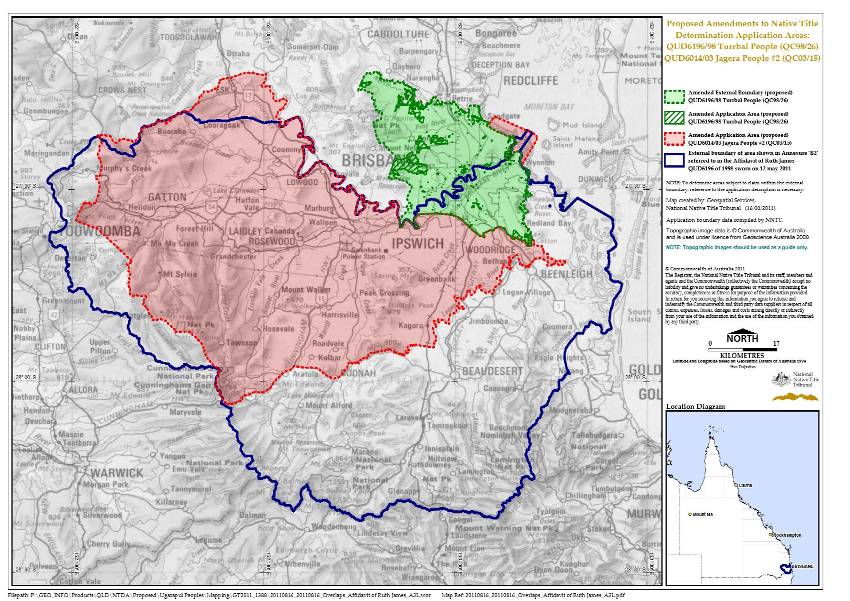
IN THE FEDERAL COURT OF AUSTRALIA |
|
|
CONNIE ISAACS AND MAROOCHY BARAMBAH ON BEHALF OF THE TURRBAL PEOPLE Applicant | |
|
AND: |
STATE OF QUEENSLAND AND OTHERS Respondents |
|
DATE OF ORDER: |
|
|
WHERE MADE: |
THE COURT ORDERS THAT:
1. The amended notice of motion filed 29 June 2011 be dismissed.
Note: Entry of orders is dealt with in Rule 39.32 of the Federal Court Rules 2011
|
QUEENSLAND DISTRICT REGISTRY |
|
|
GENERAL DIVISION |
QUD 6196 of 1998 |
|
BETWEEN: |
CONNIE ISAACS AND MAROOCHY BARAMBAH ON BEHALF OF THE TURRBAL PEOPLE Applicant |
|
AND: |
STATE OF QUEENSLAND AND OTHERS Respondents |
|
JUDGE: |
REEVES J |
|
DATE: |
19 august 2011 |
|
PLACE: |
SYDNEY (via videolink to BRISBANE) |
REASONS FOR JUDGMENT
1 Ms Ruth James, Ms Pearl Sandy and Mr Desmond Sandy (“the applicants”) have applied under s 84(5) of the Native Title Act 1993 (Cth) (“the Act”) to be joined as respondents in these proceedings.
2 The proceedings involve a native title determination application under s 61 of the Act made on behalf of the Turrbal People. In its recently amended form, the Turrbal People’s application covers numerous parcels of land within the external boundary of the lands and waters of the Turrbal People, including the CBD of the City of Brisbane and many of its suburbs lying north and south of the Brisbane River.
3 Annexed to these reasons (marked “A”) is a map prepared by the National Native Title Tribunal which shows, among other things (some of which I will explain later in these reasons), the claim area of the Turrbal People’s application – it is the green shaded area.
4 Section 84(5) of the Act provides that:
The Federal Court may at any time join any person as a party to the proceedings, if the Court is satisfied that the person’s interests may be affected by a determination in the proceedings and it is in the interests of justice to do so.
5 It is not in dispute in this application that a person claiming to hold native title rights and interests in an area of land and waters affected by a native title determination application has a sufficient interest to be joined as a party to those proceedings under s 84(5).
6 However, the following matters are in dispute:
(a) whether the land and waters in relation to which the applicants claim to hold native title rights and interests fall within the claim area of the Turrbal People’s application such that their native title rights and interests could be affected by the determination of that application;
(b) whether the applicants are seeking to be joined as respondents in a representative capacity, or in a personal capacity; and
(c) whether in the circumstances I should exercise my discretion under s 84(5) to join the applicants as respondents in these proceedings.
Could the applicants’ claimed native title rights be affected by the Turrbal people’s application?
7 The resolution of this first issue essentially depends upon whether the evidence in support of this application discloses any overlap between the lands and waters in relation to which the applicants claim to hold native title rights and interests; and the claim area in the Turrbal People’s application.
8 Before going to that evidence, it is necessary to identify the approach I consider should be taken in assessing it. On this aspect, I respectfully agree with the approach taken by Kiefel J in Wakka Wakka People #2 v State of Queensland [2005] FCA 1578 when dealing with an application for joinder under s 84(5), as follows (at [6]):
It is true, as Ms O’Brien appearing pro bono for Mr Bellear points out, that it is not for the Court on the hearing of this application to determine whether Mr Bellear’s assertion is correct. Nevertheless, he has to show a prima facie case in relation to an interest, in the sense referred to in the Arakwal People’s case.
9 In this context, I take the expression “prima facie” to mean at first sight without further investigation: see North Ganalanja Aboriginal Corporation v State of Queensland (1996) 185 CLR 595 at 615–6.
10 Accordingly, in considering the applicants’ evidence, I do not consider I should take into account the countering affidavit evidence from Ms Barambah, or the interrelated submissions of Mr Blackshield, on behalf of the Turrbal People. Both of them have disputed many of the factual assertions made by the applicants in their evidence, particularly those going to the location of the lands and waters of the Turrbal and Yugarapul People. Essentially, this evidence and these submissions assert that the northern boundary of the Yugarapul People’s lands and waters is farther south of the Brisbane River thereby creating no overlap with the Turrbal People’s claim area. If I were to entertain these factual disputes, I would be placed in the paradoxical position of having to determine one of the factual issues in dispute in the substantive proceedings for the purposes of determining whether or not the applicants should be joined as respondents to contest that very factual issue.
11 Turning then to the applicants’ evidence. As I have already mentioned, the applicants claim to hold native title rights and interests as members of the Yugarapul People. In their affidavits, Ms James and Ms Sandy claim that the lands and waters of the Yugarapul People are located in south-east Queensland and extend from the McPherson Range in the south, to the Brisbane River in the north. Ms James has annexed a map (Annexure B2) to her affidavit, which she describes in the affidavit as “Map of YUgarapul, Yugara & Yugambeh People”. The external boundary of the land and waters of the Yugarapul People as shown on this map has been shown as a dark blue line on the map (marked “A”) annexed to these reasons.
12 Ms James claims elsewhere in her affidavit that: “The determination area is the overlapping areas south of the Brisbane River in Annexure B2 – YUgarapul, Yugara & Yugambeh People map.” This overlap area is the green shaded area south of the dark blue line, which itself follows the Brisbane River, on the annexed map “A”.
13 Ms Sandy makes almost identical claims in her affidavit, although the map which she refers to in her affidavit (described as Annexure B) is not annexed to the copy of her affidavit filed with the Court.
14 Mr Sandy’s affidavit, which was filed about six weeks later, somewhat complicates the issue. He appears to put the northern boundary of the Yugarapul People’s land north of the Brisbane River. He has done that by attaching a map to his affidavit (Annexure B1), which is entitled “Places/areas of interest for Bell, Bonner and Sandy families”. That map shows a dotted line extending from a point near the Brisbane Airport, which is just north of the Brisbane River, in a westerly direction to an area north of Mt Coot-tha, which is much farther north of the Brisbane River. From that point, there is a gap in the dotted line until it resumes further west at a point north of a location called “Logan Camp”. It then extends in a north-westerly direction towards Mount Esk and then in a south-westerly direction towards Ravensbourne. In the area that falls generally south of this dotted line, there is a number of locations circled. They include Coominya, Lowood, Ipswich, Logan, Beaudesert and Boonah. All of these locations are south of the Brisbane River.
15 In his affidavit, Mr Sandy claims that his ancestors “camped a lot around Brisbane … at the Showgrounds too … they lived there for sometime too.” If he is there referring to the Brisbane Exhibition Grounds, they are, of course, located north of the Brisbane River. However, he also refers to a number of areas south of the Brisbane River, including Bulimba Creek, Minnippi Parklands and Yugarapul Park. These all fall within the green shaded overlap area shown on the annexed map “A” referred to above (at [12]). In a later paragraph of his affidavit, Mr Sandy refers to an annexure (Annexure B) to his affidavit. That annexure is said to show “the area defined by the Yugarapul, Yugara and Yugambeh People …”. However, as with Ms Sandy’s affidavit, this map is not annexed to the copy of his affidavit filed with the Court.
16 While there appears to be an inconsistency between the evidence of Ms James and Ms Sandy, on the one hand, and Mr Sandy, on the other hand, as to where the northern boundary of the Yugarapul People’s lands and waters is located, I consider this evidence does provide prima facie evidence of the existence of an area of overlap – the green shaded area south of the dark blue line/Brisbane River on the annexed map “A” – between the land and waters covered by the two sets of claims.
17 It follows that I consider the applicants have shown, at least on a prima facie basis, that the native title rights and interests they claim to hold as members of the Yugarapul People could be affected by the determination of the Turrbal People’s application because a part of the Turrbal People’s claim area appears to overlap those lands and waters.
A representative claim or a personal claim?
18 This issue arises because of various decisions of this Court that establish that where a person is seeking to be joined as a respondent to native title proceedings on the basis that he or she claims to hold native title rights and interests in an area of land or waters that may be affected by a determination in those proceedings, that person may only do so if he or she wishes to pursue a personal claim or interest in defensively asserting those native title rights and interests or, in other words, to protect them from erosion, dilution or discount: see Munn v State of Queensland [2002] FCA 486 (“Munn”) at [8], Davis-Hurst (on behalf of the traditional owners of Saltwater) v Minister for Land and Water Conservation (NSW) (2003) 198 ALR 315; [2003] FCA 541 at [27] per Branson J, Kokatha Native Title Claim v South Australia (2005) 143 FCR 544; [2005] FCA 836 at [24] per Mansfield J, Worimi Local Aboriginal Land Council v Minister for Lands for New South Wales (2007) 164 FCR 181; [2007] FCA 1357 at [16]–[17] per Bennett J and Bonner on behalf of the Jagera People #2 v State of Queensland [2011] FCA 321 (“Bonner”) at [18].
19 However, if that person wishes to obtain a positive determination of native title on behalf of his or her people, clan or group, then the Act prescribes that the only method by which that can be achieved is an application under s 13(1), complying with the requirements of s 61 et seq of the Act. Among other things, this means that a person cannot be joined as a respondent party if his or her purpose in being so joined is to act as a representative to assert native title rights on behalf of other people: Munn at [9]; Moses v Western Australia (2007) 160 FCR 148; [2007] FCAFC 78 at [18]; The Commonwealth of Australia v Clifton (2007) 164 FCR 355; [2007] FCAFC 190 at [48], [52], [53], [57], [58] and [61] and Bonner at [19].
20 In my view, it is clear from the form of the applicants’ original notice of motion (albeit that it was subsequently amended) and the affidavits they have filed in support, that the applicants do wish to pursue a representative claim on behalf of the Yugarapul People.
21 In their original notice of motion filed on 18 May 2011, the applicants sought orders “that Elders Ruth James and Pearl Rosa Sandy on behalf of their family clans and the Yugarapul People or as Yugarapul Elders be joined as a respondent party to the Turrbal People application”.
22 In Ms James’ affidavit in support of that notice of motion filed on 18 May 2011, she said, among other things, that:
We, the Yugarapul People, wish to claim native title rights in the area defined by the Yugarapul People traditional boundary map (Annexure B2). This is the traditional land of the Yugarapul People where we have continually exercised our native title rights throughout history from traditional days up until today when we, the descendants continue the usage of the Yugarapul land and waterways in accordance with our traditional laws and customs.
23 Ms Sandy’s affidavit also filed 18 May 2011 contained an almost identical statement. She said:
My people wish to claim native title rights in the land defined by the Yugarapul People (Annexure B). This is the traditional land of the Yugarapul People where we have continually exercised our native title rights throughout history from traditional days up until today when we, the descendants, continue the usage of the Yugarapul land and waterways in accordance with our traditional laws and customs.
24 As I have alluded to above, the applicants appear to have become aware of this impediment to their application because, on 29 June 2011, they filed an amended notice of motion which, as well as including Mr Desmond Sandy as an applicant, deleted the words: “on behalf of their family clans and the Yugarapul People or as Yugarapul Elders”. Despite this deletion, both Ms James and Mr Sandy filed affidavits in support of the amended application that made it clear that, while the form of their application may have been changed, the true substance of it was that they wished to pursue a representative claim on behalf of the Yugarapul People. In his affidavit filed on 29 June 2011, Mr Sandy said, among other things, that:
My people wish to claim native title rights in the area defined by the Yugarapul … People (Annexure B). This is the traditional land of the People where we have continually exercised our native title rights throughout history from traditional days up until today when we, the descendants, continue the usage of the Yugarapul land and waterways in accordance with our traditional laws and customs.
25 While Ms James was not quite so frank about the purpose of the amended application in her affidavit filed on 15 July 2011, in my view it is clear from its contents that she is seeking to positively assert the native title rights and interests of the Yugarapul People rather than pursue any personal interest she may have to protect those native title rights and interests from erosion, dilution or discount by the process of the Court determining the Turrbal People’s application. An example of this is contained in the final paragraph of her affidavit where she says:
The Turrbal claim area needs to totally withdraw from the southside of the Brisbane River. Some of my people are ‘sick’ today because they felt second-class and suffered from living in the shadows of white man’s society, now that should not happen again by not being properly recognised on our own country. In the 1800’s there was more than one Aboriginal in Brisbane and surrounding areas. Many descendants live there now, the southside of Brisbane is connected to my and their traditional country.
26 For these reasons, I consider it is clear that the applicants are seeking to pursue a representative claim on behalf of the Yugarapul People rather than a personal claim. It follows that their application to be joined as respondents for that purpose must be refused.
Discretionary considerations
27 Even if I had concluded that the applicants were pursuing a personal claim and were genuinely seeking to become respondents to these proceedings in order to protect their native title rights and interests from erosion, dilution or discount in the way I have described above, I would not, in the circumstances, have allowed them to be joined as respondents to these proceedings. To explain why I have reached this conclusion, it is necessary to set out some of the recent case management history of these proceedings and some related proceedings: the Jagera #2 claim.
28 The Turrbal People’s native title determination application was originally lodged with the National Native Title Tribunal on 13 May 1998. It has therefore been in existence for more than 13 years. It was allocated to my docket in late 2010. Because of its longevity, I considered this was a matter that needed to be determined as soon as it was reasonably possible to do so. As a result, at the directions hearing on 17 December 2010, I fixed a tentative trial date for the proceedings to commence in Brisbane on 28 November 2011. On 8 June 2011, I confirmed that trial date and made a series of trial programming orders to achieve it.
29 Given the imminence of the trial, these trial programming orders are now well-advanced. By 12 August 2011 (last Friday), all respondents were to have filed points of defence, any expert evidence that they wished to rely upon and affidavits containing any other evidence they wished to rely upon. It would follow that, if the applicants were now made respondents in these proceedings, these trial programming orders would have to be amended to accommodate them and that would require consequential amendments to other aspects of the trial program. All this would be likely to jeopardise the trial dates fixed for these proceedings. Moreover, I consider the fact that the applicants are not legally represented would also be likely to complicate the orderly preparation of these proceedings for trial if they were to become involved as respondents.
30 The Jagera #2 claim is relevant to this history because it is a neighbouring native title application to this application and, until recently, it presented an impediment to the Turrbal People’s application proceeding to trial in late November this year. This was so because there was a dispute between the Turrbal People and the Jagera People about the location of the boundary between their two native title claims. This resulted in an overlap between the two claim areas. However, that dispute was resolved in a mediation conducted earlier this year. That resolution was announced to the Court at a directions hearing conducted on 12 May 2011 and orders were made on 25 July 2011 to amend both sets of proceedings to give effect to that resolution. The amended claim areas of these two applications are shown on the annexed map “A” to these reasons. As can be seen from that map, the overlap between the two claim areas has now been removed. In turn, this has removed the final hurdle to this matter proceeding to trial in late November this year. In these circumstances, I consider it would be most unfortunate if a new overlap were to be introduced into these proceedings and that resulted in a delay to the trial date fixed for the proceedings, all the more so where no native title determination application has been filed on behalf of the Yugarapul People.
31 I should add that Ms James must have been aware of this history because she (along with a Ms Locke) successfully applied to become a respondent to the Jagera #2 claim. My decision in Bonner, delivered on 12 April 2011, dealt with that application. I should also add that these considerations do not apply to the Jagera #2 claim because it has not yet been set down for trial.
32 Apart from these considerations, I also consider it is significant that the applicants have left this application so late and, at the same time, offered no explanation for their tardiness. As I have already mentioned, the applicants filed their notice of motion on 18 May 2011, some five months after this matter was tentatively set down for trial. Despite this, none of the affidavits filed in support of their application contains any explanation as to why the applicants have left it this late to apply to become respondents in these proceedings.
33 The explanation could not lie in their ignorance as to the existence of the Turrbal People’s native title application. That is amply demonstrated by a document entitled “Memorandum of Understanding” made on 17 September 1998 which is annexed to Ms Barambah’s affidavit filed on behalf of the Turrbal People. In that affidavit, Ms Barambah claims that this Memorandum of Understanding was made between her mother and two Yugarapul Elders, sisters who are members of the “Yugarapul Anderson family”. On its face, the document records an agreement reached between the Turrbal People and the Yugarapul People about “the traditional boundary of the Turrbal People for their native title claim” (emphasis added). In her affidavit in response, Ms James says that she remembers this document and she says she raised an objection to it because “Aunty Mona Parsons herself said that Kathleen Anderson and Kathleen Anderson were the same person in the Deebing Creek book and it states their Apical is from Crow’s Nest”. Whether or not Ms James’ objection is valid, this document and her response to it show that she must have been aware of the existence of the Turrbal People’s native title claim since almost the outset of these proceedings some 13 years ago.
34 For all these reasons, even if I had concluded that the applicants wished to pursue valid personal claims as respondents in these proceedings, I would not have exercised my discretion to join them as respondents given their late application, the absence of any explanation for the delay and the likelihood that their presence as respondents would jeopardise the imminent trial of these proceedings.
Conclusion
35 For these reasons, I will order that the applicants’ amended notice of motion filed 29 June 2011 be dismissed.
|
I certify that the preceding thirty-five (35) numbered paragraphs are a true copy of the Reasons for Judgment herein of the Honourable Justice Reeves. |
Associate:
“A”