

FEDERAL COURT OF AUSTRALIA
QS Holdings Sarl v Paul’s Retail Pty Ltd [2011] FCA 853
IN THE FEDERAL COURT OF AUSTRALIA | |
DATE OF ORDER: | |
WHERE MADE: |
THE COURT ORDERS THAT:
1. On or before 4 pm on 5 August 2011, the applicants file and serve submissions as to the appropriate orders to be made, having regard to the reasons for judgment delivered today, together with a draft minute of proposed orders.
2. On or before 4 pm on 9 August 2011, the respondents file and serve responsive submissions and, if appropriate, an alternative draft minute of proposed orders.
3. There be a directions hearing at 2:15 pm on 12 August 2011.
Note: Entry of Orders is dealt with in Rule 39.32 of the Federal Court Rules 2011.
VICTORIA DISTRICT REGISTRY | |
GENERAL DIVISION | VID 652 of 2010 |
BETWEEN: | QS HOLDINGS SARL First Applicant GSM (TRADEMARKS) PTY LTD ACN 085 955 291 Second Applicant GSM (OPERATIONS) PTY LTD ACN 085 950 803 Third Applicant DC SHOES INC Fourth Applicant UG MANUFACTURING CO PTY LTD ACN 005 047 941 Fifth Applicant PINEAPPLE TRADEMARKS PTY LTD ACN 107 248 680 Sixth Applicant QUIKSILVER INC Seventh Applicant
|
AND: | PAUL'S RETAIL PTY LTD ACN 114 419 242 First Respondent PAUL ANDREW DWYER Second Respondent
|
JUDGE: | KENNY J |
DATE: | 2 August 2011 |
PLACE: | MELBOURNE |
REASONS FOR JUDGMENT
INTRODUCTION
1 On 6 August 2010, the applicants instituted proceedings for trade mark and copyright infringement.
2 There are two applications before the Court. First, there is the applicants’ motion, notice of which is dated 8 December 2010, seeking summary judgment pursuant to s 31A of the Federal Court of Australia Act 1976 (Cth) (“Federal Court Act”) (“the applicants’ motion”). At the hearing of the motion, the applicants made it clear that they were seeking summary judgment only against the first respondent in relation to allegations of trade mark and copyright infringement. It was, of course, open to the applicants to seek summary judgment against only one of the respondents.
3 Further, at the commencement of the hearing of the summary judgment motion, counsel for the applicants made it clear that summary judgment was not sought in respect of alleged copyright infringements of either the Billabong Split Script Copyright or the Quiksilver Mountain and Wave Copyright.
4 Broadly speaking, the first respondent’s position was that, save for the admissions that it had made in respect of a limited number of Quiksilver and Billabong brand board shorts and a limited number of Quiksilver and DC brand t-shirts, it had reasonable prospects of successfully defending the proceeding.
5 The applicants relied on the following affidavits in support of their motion:
the affidavit of Julian Ross Blanchard sworn on 15 December 2010;
the affidavit of Kenneth Paul Block sworn on 6 January 2011;
the affidavit of Raymond Jay Dombroski sworn on 7 December 2010;
the affidavit of Michael Laurence Anthony Egan affirmed on 6 December 2010;
the affidavit of Natas Kaupas sworn on 21 December 2010;
the affidavit of Robert Emmett McCarty sworn on 15 December 2010;
the affidavits of David Anthony Stevens Nock sworn on 3 December 2010 and 15 December 2010;
the affidavits of Kayla Perry sworn on 6 December 2010 and 14 February 2011;
the affidavits of Thomas Collins Potter sworn on 6 December 2010 and 15 December 2010;
the affidavit of Lesley Ellen Skipp sworn on 22 December 2010;
the affidavits of Stephen Marcus Stern sworn on 9 December 2010 and 4 February 2011;
the affidavit of Terry Strumpf sworn on 7 December 2010;
the affidavits of Kenneth James Taylor sworn on 14 December 2010 and 10 February 2011; and
the affidavit of Oliver St Clair Cunningham Wilson affirmed on 6 December 2010.
6 In written submissions, the applicants stated that they relied on the affidavit of Ian Roland Walter sworn on 4 January 2011. This affidavit principally related to the applicant’s copyright infringement claim regarding the Billabong Split Script Copyright and was not otherwise mentioned.
7 The respondents opposed the applicants’ motion. For this purpose, they relied on the following affidavits:
the affidavits of Paul Andrew Dwyer sworn on 3 February 2011 and 17 February 2011;
the affidavit of Zheng Mai sworn on 3 February 2011; and
the affidavit of Lisa-Maree Manu sworn on 3 February 2011.
8 By letter dated 18 January 2011, the applicants’ solicitors advised that the sixth applicant had determined that the “Bellview Bird” and “Roots Lion” products referred to in particulars (B) and (C) to paragraph 35 of the Statement of Claim were in fact genuine, and not counterfeit as the sixth applicant had first asserted.
9 By a letter dated 3 February 2011, the respondents also made an application for leave to file and serve a second amended defence. Amongst other things, this letter stated that the respondents sought to amend because:
1) Following receipt of the letter from Corrs Chambers Westgarth dated 18 January 2011 it is the position of the respondents that the admissions contained in that letter has [sic] necessitated amendments to the previous pleadings and the extent of the respondents’ admissions.
2) The respondents have also amended their responses to the allegations in paragraphs 32 to 41 of the Statement of Claim. The respondents through their preparation for summary judgment have now apprehended the generality of the allegations concerning the ‘Paul’s Warehouse Brochures’. These amendments are to preserve the respondents’ entitlement to argue that where logos are reproduced in brochures with reference to genuine products, such reproductions is [sic] not a breach of copyright.
10 The applicants did not oppose amendments to paragraphs 34 and 36 (in so far as paragraph 36 related to paragraph 40 of the applicants’ statement of claim) to modify the admissions that the t-shirts bearing the sixth applicant’s “Bellview Bird” and “Roots Lion” copyright works were counterfeit. Further, the applicants did not oppose the amendments that the respondents desired to make to paragraphs 16, 19, 20 and 22 of the amended defence. The applicants opposed the other amendments proposed by the respondents. These involved amendments to paragraphs 31, 32, 33, 35, and the rest of 36 of the amended defence. The amendments particularly sought appeared in the proposed second amended defence at paragraphs 32, 33, 35, and 36.
11 At the hearing, the parties addressed the applicants’ motion on the basis that the respondents’ pleading consisted of the amended defence as further amended to the extent the applicants did not oppose those amendments.
12 In these reasons, I discuss, first, the applicants’ motion and, secondly, the respondents’ amendment application, to the extent that it was opposed.
LAW REGARDING SUMMARY JUDGMENT UNDER SECTION 31A
13 Section 31A of the Federal Court Act relevantly provides:
(1) The Court may give judgment for one party against another in relation to the whole or any part of a proceeding if:
(a) the first party is prosecuting the proceeding or that part of the proceeding; and
(b) the Court is satisfied that the other party has no reasonable prospect of successfully defending the proceeding or that part of the proceeding.
(2) …
(3) For the purposes of this section, a defence or a proceeding or part of a proceeding need not be:
(a) hopeless; or
(b) bound to fail;
for it to have no reasonable prospect of success.
(4) This section does not limit any powers that the Court has apart from this section.
(5) …
14 The High Court considered s 31A in Spencer v Commonwealth (2010) 241 CLR 118 (“Spencer”), where Hayne, Crennan, Kiefel and Bell JJ said (at 139 [52]-141 [60]):
It is important to begin by recognising that the combined effect of sub-ss (2) and (3) is that the inquiry required in this case is whether there is a “reasonable” prospect of prosecuting the proceeding, not an inquiry directed to whether a certain and concluded determination could be made that the proceeding would necessarily fail.
In this respect, s 31A departs radically from the basis upon which earlier forms of provision permitting the entry of summary judgment have been understood and administered. Those earlier provisions were understood as requiring formation of a certain and concluded determination that a proceeding would necessarily fail. That this was the basis of earlier decisions may be illustrated by reference to two decisions of this Court often cited in connection with questions of summary judgment: Dey v Victorian Railway Commissioners [(1949) 78 CLR 62 at 91] and General Steel Industries Inc v Commissioner for Railways (NSW) [(1964) 112 CLR 125 at 129].
…
Because s 31A(3) provides that certainty of failure (“hopeless” or “bound to fail”) need not be demonstrated in order to show that a plaintiff has no reasonable prospect of prosecuting an action, it is evident that s 31A is to be understood as requiring a different inquiry from that which had to be made under earlier procedural regimes. It follows, of course, that it is dangerous to seek to elucidate the meaning of the statutory expression “no reasonable prospect of successfully prosecuting the proceeding” by reference to what is said in those earlier cases.
…
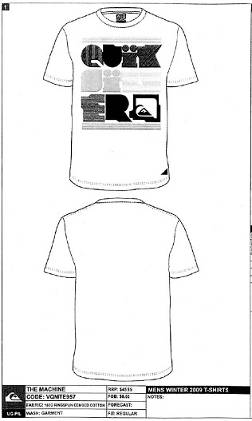
How then should the expression “no reasonable prospect” be understood? No paraphrase of the expression can be adopted as a sufficient explanation of its operation, let alone definition of its content. …
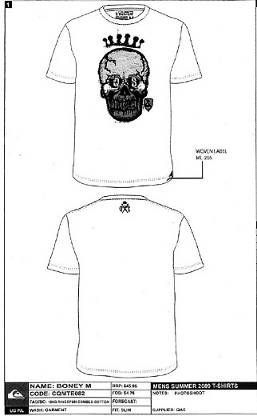
Rather, full weight must be given to the expression as a whole. The Federal Court may exercise power under s 31A if, and only if, satisfied that there is “no reasonable prospect” of success. Of course, it may readily be accepted that the power to dismiss an action summarily is not to be exercised lightly. But the elucidation of what amounts to “no reasonable prospect” can best proceed in the same way as content has been given, through a succession of the decided cases, to other generally expressed statutory phrases, such as the phrase “just and equitable” when it is used to identify a ground for winding up a company. …
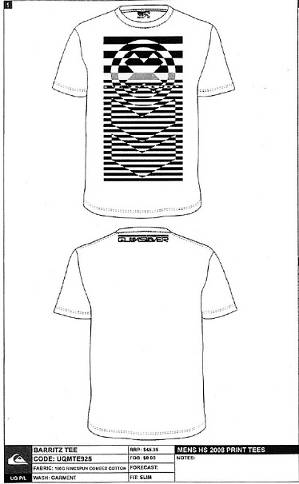
15 The discussion in Spencer of s 31A(2) can be readily adapted to s 31A(1). Both provisions contain identical tests. The key is to address the statutory question. That is, under s 31A, in order to grant summary judgment, the Court must be satisfied that the first respondent has no reasonable prospect of success in defending the relevant infringement claims brought by the applicants. As s 31A(3) makes clear, this does not mean that the Court must necessarily be satisfied that the first respondent’s defence is hopeless or bound to fail.
16 No hard and fast rule can be laid down as to when summary judgment is available. Much depends on the case at hand. Nonetheless, generally speaking, summary judgment would appear appropriate when well-established propositions of law deny the prospect of success. Summary judgment would appear inappropriate where there are “factual issues capable of being disputed and in dispute”. See generally Spencer 132 [25] per French CJ and Gummow J. Generally speaking, it also remains true to say, as Gordon J did in Jefferson Ford Pty Ltd v Ford Motor Company of Australia Ltd (2008) 167 FCR 372 (“Jefferson Ford”) at 407 [127] that “it is inappropriate in defence of a claim for judgment made under s 31A of the Federal Court Act to seek to defend by merely putting a claimant to formal proof”. There are, of course, a variety of circumstances that may attract summary judgment under s 31A of the Federal Court Act and, on each occasion, the critical question is that set by the statute – has the moving party persuaded the Court that the opposing party has no reasonable prospect of success?
LEGAL PRINCIPLES REGARDING TRADEMARK INFRINGEMENT
17 The first to fourth applicants allege trade mark infringements within s 120(1) of the Trade Marks Act 1995 (Cth) (“TMA”), which provides:
A person infringes a registered trade mark if the person uses as a trade mark a sign that is substantially identical with, or deceptively similar to, the trade mark in relation to goods or services in respect of which the trade mark is registered.
18 In considering whether marks are substantially identical, they are compared side by side, with their similarities and differences being noted and assessed, “having regard to the essential features of the registered mark and the total impression of resemblance or dissimilarity that emerges from the comparison”: see The Shell Co of Australia Ltd v Esso Standard Oil (Australia) Ltd 109 CLR 407 (“Shell Co”) at 414.
19 The question of deceptive similarity requires a different comparison to be made. There is no side by side comparison. Section 10 of the TMA states:
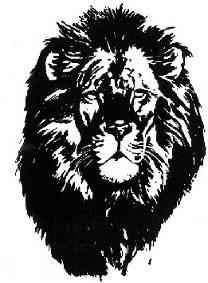
For the purposes of this Act, a trade mark is taken to be deceptively similar to another trade mark if it so nearly resembles that other trade mark that it is likely to deceive or cause confusion.
In considering deceptive similarity, the comparison is between the impression based on the recollection of the applicant’s mark that “persons of ordinary intelligence and memory would have” and the impression that such a person would have from the defendant’s alleged use: see Shell Co. at 415; Australian Woollen Mills Ltd v FS Walton & Co Ltd (1937) 58 CLR 641 at 658; Southern Cross Refrigerating Co v Toowoomba Foundry Pty Ltd (1954) 91 CLR 592 at 594-5; Registrar of Trade Marks v Woolworths Ltd (1999) 45 IPR 411 at 428 [50]; and Food Channel Network Pty Ltd v Television Food Network GP (2010) 86 IPR 437 at 460-463. It is sufficient if persons who only know one of the marks and have perhaps an imperfect recollection of it are likely to be deceived: Aristoc Ltd v Rysta Ltd [1945] AC 68 at 86-87. Whilst it is necessary to show a tangible danger of deception or confusion, it is enough if an ordinary person entertains a reasonable doubt. See Crazy Ron’s Communications Pty Ltd v Mobileworld Communications Pty Ltd (2004) 209 ALR 1 at 17-19 [73]-[79].
20 Members of the public are more likely to recall the general impression created by the mark. To quote Lord Radcliffe in de Cordova v Vick Chemical Co (1951) 68 RPC 103 at 106, “in most persons the eye is not a accurate recorder of visual detail, and … marks are remembered rather by general impressions or by some significant detail than by any photographic recollection of the whole”. If the impugned mark incorporates the idea or the essential features of the registered trade mark, it may infringe that registered trade mark. See Jafferjee v Scarlett (1937) 57 CLR 115 at 121-122; Sports Café Ltd v Registrar of Trade Marks (1999) 42 IPR 552 at 559; and Saville Perfumery Ltd v June Perfect Ltd (1939) 58 RPC 147 at 174
THE FIRST APPLICANT’S TRADE MARK CLAIMS
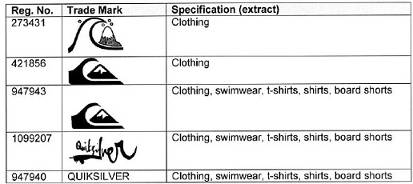
21 There was evidence as to the first applicant’s incorporation. The evidence showed, as the first applicant pleaded, that the first applicant was the registered owner of the Australian registered marks 273431, 421856, 947943, 1099207, 947940 (“the Quiksilver Trade Marks”) in respect of goods including clothing, swimwear, t-shirts, shirts, and board shorts, as set out in the following table.
22 The first respondent admits that:
(a) it has “imported, advertised, offered for sale, distributed, supplied and sold” board shorts and t-shirts bearing “one or more” of the Quiksilver Trade Marks “without the licence or authority of the first applicant”; and
(b) this conduct constitutes use of “one or more” of the Quiksilver Trade Marks as trade marks.
23 These admissions are supported by evidence of a trap purchase of a pair of board shorts from the first respondent on 26 February 2010 at Sunshine in Victoria. This evidence is contained in the 3 December 2010 affidavit of Mr Nock and the 6 December 2010 affidavit of Ms Perry. Board shorts and t-shirts are goods in respect of which the Quiksilver Trade Marks are registered.
24 The evidence shows that the board shorts sold by the first respondent bear trade marks that are substantially identical with the first applicant’s Australian registered trade marks 421856, 947943, 1099207 and 947940.
25 The first applicant also submitted that the board shorts bore trade marks that were deceptively similar to Australian registered trade mark 273431. The first applicant submitted that the mountain and wave device applied to the board shorts conveyed the same general impression as 273431 and incorporated the same essential features of that mark. Australian registered trade mark 273431 is registered with respect to clothing. I accept that the mountain and wave device applied to the board shorts conveys the same general impression as 273431 and incorporates the same essential features of that mark. A person of ordinary intelligence and recollection who only knew Australian trade mark 273431 but had an imperfect recollection of it is likely to be deceived or, at the least, to entertain a reasonable doubt as to whether the board shorts bore the first applicant’s mark.
THE SECOND AND THIRD APPLICANTS’ TRADE MARK CLAIMS
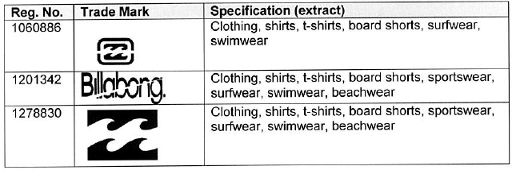
26 There was evidence as to the second and third applicants’ incorporation. The evidence showed, as these applicants pleaded, that the second applicant was the registered owner of the Australian registered mark 358063 (“the Billabong Word Trade Mark”) in respect of clothing. The evidence also showed that the third applicant is the registered owner of the Australian registered marks 1060886, 1201342 and 1278830 (“the Billabong Stylised Trade Marks”) in respect of goods including clothing, swimwear, t-shirts, shirts, and board shorts.
27 The following tables show the Billabong Word Trade Mark and the Billabong Stylised Trade Mark.

28 The first respondent admits that:
(a) it has “imported, advertised, offered for sale, distributed, supplied and sold” board shorts bearing the Billabong Word Trade Mark “without the licence or authority of the second applicant”; and
(b) it has “imported, advertised, offered for sale, distributed, supplied and sold” board shorts bearing “one or more” of the Billabong Stylised Trade Marks “without the licence or authority of the third applicant”; and
(c) this conduct constitutes use of “one or more” of the Billabong Word Trade Mark and the Billabong Stylised Trade Marks as trade marks.
29 These admissions are supported by evidence of a trap purchase of a pair of board shorts from the first respondent on 31 March 2010 at Sunshine in Victoria. This evidence is contained in the 6 December 2010 and 15 December 2010 affidavits of Mr Potter. Board shorts are goods in respect of which the Billabong Word Trade Mark and the Billabong Stylised Trade Marks are registered. The board shorts bear trade marks that are substantially identical with the Billabong Word Trade Mark and the Billabong Stylised Trade Marks.
THE FOURTH APPLICANT’S TRADE MARK CLAIMS
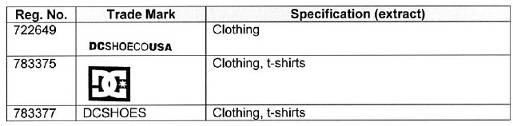
30 There was evidence as to the fourth applicant’s incorporation. The evidence showed, as the fourth applicant pleaded, that the fourth applicant was the registered owner of the Australian registered marks 722649, 783375 and 783377 (“the DC Shoes Trade Marks”) in respect of clothing and t-shirts.
31 The following tables show the DC Shoes Trade Marks.
32 The first respondent admits that:
(a) it has “imported, advertised, offered for sale, distributed, supplied and sold” t-shirts bearing “one or more” of the DC Shoes Trade Marks “without the licence or authority of the fourth applicant”; and
(b) this conduct constitutes use of “one or more” of the DC Shoes Trade Marks as trade marks.
33 These admissions are supported by evidence of a trap purchase of a t-shirt from the first respondent on 26 February 2010 at Sunshine in Victoria. This evidence is contained in the 3 December 2010 and 15 December 2010 affidavits of Mr Nock, and the 6 December 2010 affidavit of Ms Perry. T-shirts are goods in respect of which the DC Shoes Trade Marks are registered. The t-shirt bears trade marks that are either substantially identical with, or deceptively similar to, the DC Shoes Trade Marks.
34 The evidence before the Court and first respondent’s admissions establish that the first respondent has no reasonable prospect of success in defending the applicants’ claims of trade mark infringement. In its existing and proposed pleading, the first respondent alleges that its conduct was innocent. Innocence per se is not, however, a defence to liability for trade mark infringement: compare TMA, s 122.
35 The first respondent also submitted that “any remedies granted in respect of the applicants’ trade mark infringement claims should be limited to the infringing board-shorts and the infringing t-shirts” since “[t]hese [were] the only infringing articles which have been particularised and had evidence directed to them”. In this connection, the first respondent relied on the 3 February 2011 affidavit of Mr Dwyer, director and shareholder of the first respondent, who deposed that the first respondent dealt “in a large amount of stock” annually, with “several checks in place to prevent counterfeit or infringing goods being sold by the company’s retail outlets, including the policy of buying branded goods only from authorised sellers”. Mr Dwyer deposed, in effect, that he was not aware of any complaints concerning goods the subject of these proceedings other than those referred to in the evidence led by the applicants.
36 In response, the applicants argued, and ultimately the first respondent accepted, that issues as to the scope of relief should be considered subsequently, when the court’s findings as to the substantive claims were published. This is indeed the better course. Until this time, argument about relief is somewhat abstract and unfocused.
37 For the reasons stated, the first respondent has no reasonable prospect of defending the applicants’ allegations of trade mark infringement and the applicants are entitled to summary judgment on this part of their claims in accordance with these reasons. As indicated, the argument about relief is deferred to after delivery of these reasons for judgment.
THE APPLICANTS’ COPYRIGHT CLAIMS
38 In their statement of claim, the third to seventh applicants made claims of copyright infringement. I refer to these applicants collectively hereafter as the “copyright applicants”.
LEGAL PRINCIPLES REGARDING COPYRIGHT INFRINGEMENT
39 Section 32 of the CA provides that:
(1) Subject to this Act, copyright subsists in an original literary, dramatic, musical or artistic work that is unpublished and of which the author:
(a) was a qualified person at the time when the work was made; or
(b) if the making of the work extended over a period – was a qualified person for a substantial part of that period.
(2) Subject to this Act, where an original literary, dramatic, musical or artistic work has been published:
(a) copyright subsists in the work; or
(b) if copyright in the work subsisted immediately before its first publication – copyright continues to subsist in the work;
if, but only if:
(c) the first publication of the work took place in Australia;
(d) the author of the work was a qualified person at the time when the work was first published; or
(e) the author died before that time but was a qualified person immediately before his or her death.
(3) Notwithstanding the last preceding subsection but subject to the remaining provisions of this Act, copyright subsists in:
(a) an original artistic work that is a building situated in Australia; or
(b) an original artistic work that is attached to, or forms part of, such a building.
(4) In this section, qualified person means an Australian citizen or a person resident in Australia.
40 This case concerns artistic works. In IceTV Pty Ltd v Nine Network Australia Pty Ltd (2009) 239 CLR 458 (“IceTV”), the High Court considered the general principles relating to the subsistence and ownership of copyright. Following IceTV, in order to succeed, the copyright applicants must:
(a) identify with precision the work or works in which they allege that copyright subsists (“the copyright work”) and the author of the copyright work;
(b) establish that the author of the copyright work was a qualified person for the purpose of the CA;
(c) establish that the copyright work is a “work” for the purpose of the CA;
(d) establish that the copyright work is an “original” work; and
(e) prove the foundation of their claim to own that work.
41 The originality referred to in s 32 is the originality of the form of expression, and not of the idea itself. As Gordon J noted in Krueger Transport Equipment Pty Ltd v Glen Cameron Storage & Distribution Pty Ltd (2008) 78 IPR 262 (“Krueger”), originality in this context does not require novelty or invention. If the form of expression involves independent application of knowledge, judgment, skill or labour, that will be sufficient: see Krueger at 292 [125] and the authorities cited.
42 Originality requires that the work in question originated with the author and that it was not copied from another work: see IceTV at 474 [33], where it was also said that:
It is the author or joint authors who bring into existence the work protected by the Act. In that context, originality means that the creation (that is the production) of the work required some independent intellectual effort, but neither literary merit nor novelty or inventiveness as required in patent law.
(Citations omitted)
43 French CJ, Crennan and Kiefel JJ went on to say (at 478-479 [47]-[48]):
Much has been written about differing standards of originality in the context of the degree or kind of “skill and labour” said to be required before a work can be considered an “original” work in which copyright will subsist. “Industrious collection” or “sweat of the brow”, on the one hand, and “creativity”, on the other, have been treated as antimonies in some sort of mutually exclusive relationship in the mental processes of an author or joint authors. They are, however, kindred aspects of a mental process which produces an object, a literary work, a particular form of expression which copyright protects. …
It may be that too much has been made, in the context of subsistence, of the kind of skill and labour which must be expended by an author for a work to be an “original” work. The requirement of the Act is only that the work originates with an author or joint authors from some independent intellectual effort. Be that as it may … since the subsistence of copyright need not be considered in this appeal, the relevance of skill and labour to that inquiry need not be considered further.
(Citations omitted)
44 Whilst the High Court in IceTV was concerned with literary works, these observations are also apposite for artistic works. The term “artistic work” is defined in s 10 to include a drawing. Copyright in an artistic work made by an author pursuant to his or her employment will be owned by his or her employer: see CA, s 35(6).
45 Section 31 of the CA further provides:
For the purposes of this Act, unless the contrary intention appears, copyright in relation to a work, is the exclusive right:
…
(b) in the case of an artistic work, to do all or any of the following acts:
(i) to reproduce the work in material form;
(ii) to publish the work.
46 Section 36(1) of the CA states:
Subject to this Act, the copyright in a literary, dramatic, musical or artistic work is infringed by a person who, not being the owner of the copyright, and without the licence of the owner of the copyright, does in Australia, or authorizes the doing in Australia of, any act comprised in the copyright.
47 Section 37 of the CA provides:
Subject to Division 3, the copyright in a literary, dramatic, musical or artistic work is infringed by a person who, without the licence of the owner of the copyright, imports an article into Australia for the purpose of:
(a) selling, letting for hire, or by way of trade offering or exposing for sale or hire, the article;
(b) distributing the article:
(i) for the purpose of trade; or
(ii) for any other purpose to an extent that will affect prejudicially the owner of the copyright; or
(c) by way of trade exhibiting the article in public;
if the importer knew, or ought reasonably to have known, that the making of the article would, if the article had been made in Australia by the importer, have constituted an infringement of the copyright.
48 Section 38 of the CA further provides:
(1) Subject to Division 3, the copyright in a literary, dramatic, musical or artistic work is infringed by a person who, in Australia, and without the licence of the owner of the copyright:
(a) sells, lets for hire, or by way of trade offers or exposes for sale or hire, an article; or
(b) by way of trade exhibits an article in public;
if the person knew, or ought reasonably to have known, that the making of the article constituted an infringement of the copyright or, in the case of an imported article, would, if the article had been made in Australia by the importer, have constituted such an infringement.
(2) For the purposes of the last preceding subsection, the distribution of any articles:
(a) for the purpose of trade; or
(b) for any other purpose to an extent that affects prejudicially the owner of the copyright concerned;
shall be taken to be the sale of those articles.
(3) In this section:
article includes a reproduction or copy of a work or other subject-matter, being a reproduction or copy in electronic form.
49 The onus of showing that the alleged infringer does not have any such licence lies on the copyright owner: see Avel Pty Ltd v Multicoin Amusements Pty Ltd (1990) 171 CLR 88 at 94-95, 105, 119-120, 123 and Lorenzo & Sons Pty Ltd v Roland Corporation (1992) 23 IPR 376 (“Lorenzo”) at 380. In this context, the word “licence” means “consent”. A licence for the purposes of ss 37 and 38 may be oral or implied: see Interstate Parcel Express Co Pty Ltd v Time-Life International (Nederlands) BV (1977) 1B IPR 253 (“Time-Life”) at 256 and Broderbund Software Inc v Computermate Products (Australia) Pty Ltd (1991) 22 IPR 215 (“Broderbund”) at 227.
50 Where it is shown that there was no licence, the inquiry under s 37 (in the case of an allegedly infringing importer) is whether or not the importer knew or ought reasonably to have known that, if the importer had made the article in Australia, the importer would have infringed copyright. Under s 38 (in the case of an allegedly infringing seller) the question is much the same, namely, whether or not the seller knew or ought reasonably to have known that the making of the article constituted an infringement of the copyright or, in the case of an imported article, would, if the article had been made in Australia by the importer, have constituted an infringement of the copyright.
51 The knowledge required to establish infringement can be actual or constructive. Actual knowledge can be inferred from the particular facts of the case. Constructive knowledge focuses on “the knowledge, capacity and circumstances” of the alleged infringer: see Raben Footwear Pty Ltd v Polygram Records Inc (1997) (“Raben”) 75 FCR 88 at 91; 37 IPR 417 at 420 per Burchett J, with whom Lehane J agreed. An objective assessment is to be made as to whether the alleged infringer “ought reasonably to have known”. A failure to make the inquiries that a reasonable person would make may, depending on the circumstances, lead to a finding of constructive knowledge: compare Raben at 75 FCR 97; 37 IPR 426 per Tamberlin J. It is not necessary that the infringer know the precise nature of the rights that would be infringed: see Star Micronics Pty Ltd v Five Star Computers Pty Ltd (1990) 18 IPR 225 at 236 and Milpurrurru v Indofurn Pty Ltd (1994) 30 IPR 209 at 225.
THE PARTIES’ SUBMISSIONS WITH RESPECT TO THE COPYRIGHT INFRINGEMENT CLAIMS
52 The copyright applicants argued that they were entitled to summary judgment. They submitted that, taken together, the evidence on which they relied and the first respondents’ admissions made out their allegations of copyright infringement against the first respondent. It followed, they said, that the first respondent had no reasonable prospect of defending their claims for copyright infringement. Whilst there was a dispute as to whether the first respondent’s conduct was innocent, this issue was relevant to damages, rather than liability.
53 The first respondent argued that the copyright applicants had failed to establish their copyright infringement claims because the copyright applicants had failed: (1) to demonstrate that the works are original and created with a sufficient degree of “authorial contribution”; (2) to show source material for derivative works in order for an assessment of originality to be made; (3) to substantiate their claims to ownership by reason of the operation of CA, 35(6); and (4) to prove alleged assignments.
THE THIRD APPLICANT’S COPYRIGHT CLAMS
54 The third applicant claimed to be the owner of copyright in the original artistic work referred to in its submissions as “the Billabong Stylised Copyright Work”, which included the “Military Wave”. The third applicant relied on Mr McCarty’s 15 December 2010 affidavit (and accompanying exhibits) and Ms Skipp’s 22 December 2010 affidavit.
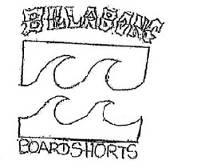
55 In his 15 December 2010 affidavit, Mr McCarty specifically stated that, in the United States, in or about July 1999, “in the course and scope of [his] employment” by Burleigh Point Limited (“Burleigh Point”: see below), he created the “Military Wave” work. Mr McCarty further stated that, “[i]n creating this work [he] was inspired by an earlier artistic work created by Mr GS Merchant which came to be called the Square Wave”. A reproduction of the “Square Wave” was contained in exhibit REM 1, which depicted the “Square Wave” as follows:
The “Military Wave”, depicted in REM 2, took the following form:

56 Whilst the “Military Wave” was created in the United States of America, the Court applies the CA to the artistic works of an author in the United States in like manner as to works first published in Australia and to citizens and residents of Australia: see CA, ss 184 and 249 and Copyright (International Protection) Regulations 1969 (Cth), reg 4(1). See also Enzed Holdings Ltd v Wynthea Pty Ltd (1984) 3 IPR 619 at 635.
57 In her 22 December 2010 affidavit, Ms Skipp deposed that there was a licence agreement between Burleigh Point and the third applicant, pursuant to which the third applicant is the owner of the copyright in the “Military Wave” work. Clause 10.4 of the licence agreement effectively provided that Burleigh Point agreed to assign copyright to the third applicant in respect of copyright created in the period 1 January 1999 to 31 December 2003. The third applicant’s copyright ownership in the “Military Wave” flowed from this agreement.
58 The alleged infringement by reproduction is pleaded and particularised in paragraph 32 of the statement of claim by reference to a “Paul’s Warehouse” catalogue published around 29 March 2010. In its amended defence, the first respondent admitted that it “reproduced [the “Military Wave”] in material form, [and] published and communicated [it] to the public” (or authorised or caused this to occur) “without the licence or authority of the third applicant”. Also, in its amended defence, subject to proof of ownership and subsistence of copyright, the first respondent admitted infringement of copyright in the “Military Wave” work, stating that this infringement was innocent. As discussed hereafter, however, the first respondent seeks leave to amend its amended defence by pleading positive defences. For the reasons set out below, I would not grant such leave.
59 In relation to the “Military Wave” work, the first respondent submitted:
(1) Mr McCarty’s employment by Burleigh Point had not been adequately proved because no contract of employment was in evidence.
(2) The third applicant had not established the subsistence of copyright in the “Military Wave” (see [55] above).
a. The first respondent noted that the “Military Wave” was said to be a copy of an earlier artistic work created by another person. The first respondent maintained that the addition of a border and softened edges did not result in the creation of a new original work.
b. Further, having regard to Mr McCarty’s statement that he used Adobe Illustrator on an Apple computer in creating the Military Wave, the first respondent submitted that there was a factual question as to the extent of Mr McCarty’s “intellectual independent effort”.
60 I reject the first respondent’s submission that Mr McCarty’s employment by Burleigh Point had not been adequately proved. Mr McCarty deposed that he was an employee of Burleigh Point at the relevant time. There was nothing to indicate that this statement might be incorrect.
61 Also at the hearing, counsel for the first respondent argued that there was a live question as to whether Mr McCarty’s employment satisfied s 35(6) of the CA. Counsel advanced the same submission in respect of the employment of other putative authors of other works. The evidence in Mr McCarty’s case was that the work was made by Mr McCarty pursuant to the terms of his employment and, as appears below, in each other instance, by the other authors pursuant to the terms of their employment. There is nothing in the evidence or any other material before the Court to indicate that s 35(6) did not operate in respect of Mr McCarty or any other putative author, with the effect that copyright in the work made by the author was owned by his employer.
62 In advancing her argument with respect to s 35(6), counsel for the first respondent referred the Court to Edsonic Pty Ltd v Cassidy (2010) 272 ALR 589 (“Edsonic”) and Antocks Lairn Ltd v I Bloohn Ltd [1972] RPC 219 (“Antocks Lairn”). There was nothing in the evidence before the Court that might indicate that a circumstance of the kind discussed in those cases had, or might reasonably be thought to have, arisen in this case.
63 I also reject the first respondent’s submissions as to lack of originality. The mere fact that an artist drew inspiration from an earlier work does not deprive the new work of originality if originality is otherwise there. In the present instance, the evidence is that Mr McCarty exercised independent intellectual effort to create the “Military Wave” work and that he did not simply copy the earlier work. This much is borne out by comparing the two works. There are clear differences between the “Military Wave” and the earlier “Square Wave”. There is a distinct border around the “Military Wave” and not on the “Square Wave”. The border is split and the edges of the waves are, as Mr McCarty said, “softer” in the “Military Wave”. Other elements present in the earlier work are missing in Mr McCarty’s work, as for example the word “Billabong”. The two works create different impressions. Further, nothing in this case turns on the admitted fact that Mr McCarty used a computer and computer software to create the work in question.
THE FOURTH APPLICANT’S COPYRIGHT CLAMS
64 The fourth applicant claimed to be the owner of copyright in the original artistic work referred to in its submissions as the “DC Stylised Work” or the “DC Stylised Copyright Work”. The fourth applicant relied on Mr Block’s 6 January 2006 affidavit and accompanying exhibits. In this affidavit, Mr Block stated that, in the United States, in or about 1995, “in the course and scope of [his] employment” by the fourth applicant, he worked with a graphic designer (a Mr Kinsey) to create an original work referred to as the DC Stylised Copyright Work. He further stated that, in working with the graphic designer, he had “direct design and creation input”. A reproduction of the DC Stylised Copyright Work was set out in exhibit KPB 1 to this affidavit, as follows.

Mr Block said this work was created using Adobe Illustrator on an Apple Computer owned by the fourth applicant. Mr Block added that he was a citizen of the United States.
65 The alleged infringement by reproduction is pleaded and particularised in paragraph 33 of the statement of claim by reference to a “Paul’s Warehouse” catalogue published around 29 March 2010. In its amended defence, the first respondent admitted that it “reproduced [the above work] in material form, [and] published and communicated [it] to the public” (or authorised or caused this to occur) “without the licence or authority of the fourth applicant”. In its amended defence, subject to proof of ownership and subsistence of copyright, the first respondent admitted the infringement of copyright in the DC Stylised Copyright Work. As discussed hereafter, however, the first respondent seeks leave to amend its amended defence by pleading positive defences. Again, for the reasons set out below, I would not grant such leave.
66 In relation to the DC Stylised Copyright Work, the first respondent submitted:
Th[e] evidence is ambiguous. The DC stylised copyright work is said by Mr Block, to be derivative of earlier logos designed by Mr McKenzie [sic]. The earlier logos are not in evidence and the respondents and the court cannot compare them to determine whether the DC stylised copyright work was a new original work.
Additionally, there is no evidence to suggest that the DC stylised copyright work was not generated primarily using the Adobe Illustrator program stated to have been used in creating the works.
Further, Mr Block describes himself as “one of the founding directors of DC Shoes Inc”. He does not state what the terms of his employment were circa 1995. It cannot be inferred that the logo design was part of Mr Block’s usual duties.
Further, if copyright was jointly created by Mr Block and Mr McKenzie [sic], the evidence must prove that both Block and McKenzie [sic] were both [sic] employees under a contract of service. There is no corroborative evidence of this.
67 First, I reject the first respondent’s submission that Mr Block’s (and, if it were relevant, Mr Kinsey’s) employment by DC Shoes Inc (“DC Shoes”) has not been sufficiently proved. Mr Block specifically deposed that he created the DC Stylised Copyright Work with Mr Kinsey “in the course and scope of [his] employment”. He further deposed to the fact that Mr Kinsey was employed by DC Shoes. Nothing indicates that this statement is incorrect. Further, as Antocks Lairn recognizes at 221, a director may act as both a director and as an employee of a company. The fact that Mr Block was a founding director of DC Shoes (as he deposed) did not preclude him from also being its employee (as he also deposed). I am not therefore satisfied that there was, as counsel for the first respondent argued, a real question as to whether Mr Block’s employment satisfied s 35(6) of the CA. Further, nothing turns on the admitted fact that Mr Block used a computer and computer software to create the work in question.
68 I would also reject the first respondent’s submission that, in effect, there is insufficient evidence as to independent intellectual effort. In this regard, Mr Block’s affidavit is specific. Mr Block deposed that:
Under my direction, Mr Kinsey had, in or about 1995, developed for DC Shoes in the course of his employment, various logos, including two stylised D’s. To create the DC Stylised Copyright Work, I changed the letters into a “D” and “C” and added a star.
This evidence indicates that the nature of the changes was sufficient to show independent intellectual effort.
THE FIFTH APPLICANT’S COPYRIGHT CLAMS
69 The fifth applicant claimed to be the owner of copyright in the original artistic works referred to in its submissions as the “Machine”, “Boney M” and “Biarritz”, or collectively “the Ug Manufacturing Copyright Works”.
70 The fifth applicant relied on various affidavits, including Mr Egan’s 6 December 2010 affidavit and accompanying exhibits. In this affidavit, Mr Egan stated that, in May 2008, he was employed by the fifth applicant as a Senior Apparel Manager/Designer, Head of Garment and Art Design. In or about May 2008, as part of his duties of employment, he deposed that he created an original design, which he referred to as the “Machine Copyright Work”. He deposed that this work was created by him alone, using software called Adobe Illustrator. Exhibit MLAE 1 was a coloursheet for the t-shirt upon which appeared a reproduction of the “Machine”, depicted below.
71 Mr Egan also deposed that in or about June 2008, as part of his employment duties, he created an original design, which he referred to as the “Boney M Copyright Work”. He further deposed that this work was created by him alone, using software called Adobe Photoshop and Adobe Illustrator. Exhibit MLAE 2 was a coloursheet for the t-shirt upon which appeared a reproduction of the “Boney M” work. This appears below:
72 In relation to the “Biarritz” work, the fifth applicant relied on Mr Wilson’s 6 December 2010 affidavit and accompanying exhibits. In this affidavit, Mr Wilson stated that he was employed by the fifth applicant as a graphic artist. His evidence was that, in or about 2007, he was team leader for the fifth applicant’s Special Make-Up team. In or around November 2007, the Special Make-Up team received a suggestion that it create new designs extending the “Quik Strike” range of clothing produced by the fifth applicant. In response, Mr Wilson said that he created an original design, which he referred to as the Biarritz Tee Copyright Work. Mr Wilson stated that he created the work alone, using the Adobe Illustrator computer program. Exhibit OSCCW 1 was a reproduction of the Biarritz work in a coloursheet for the t-shirt, as shown below.
73 The alleged infringement by reproduction; and/or importation of reproductions; and/or by sale of counterfeit reproductions is pleaded and particularised in paragraph 34 of the statement of claim. In its amended defence, the first respondent admitted that it “reproduced in material form, published and/or communicated to the public” one or more of the Ug Manufacturing Copyright Works (or authorised or caused this to occur) “without the licence or authority of the fifth applicant”; imported as alleged; and “offered for sale and sold” articles bearing “pirated” reproductions of “one or more” of the Ug Manufacturing Copyright Works. Also, in its amended defence, subject to proof of ownership and subsistence of copyright, the first respondent admitted infringement of copyright in the Ug Manufacturing Copyright Works. The first respondent’s admissions were supported by evidence of trap purchases from the first respondent. There was evidence of these trap purchases in the 6 December 2010 affidavit of Kalya Perry, a Brand Enforcement Counsel, who also gave evidence that none of the designs had been applied with the licence of the fifth applicant.
74 With respect to the Biarritz Tee work, the first respondent argued that, without sighting the earlier works referred to by Mr Wilson, no determination can be made as to whether the Biarritz Tee work was an original work for the purposes of the CA. Further, so the first respondent said, the use of the Adobe Illustrator raised a question of “the degree of independent intellectual effort (if any) input by Mr Wilson”. The first respondent also complained about the lack of evidence to corroborate Mr Wilson’s assertion that he was the fifth applicant’s employee at the relevant time.
75 With respect to the Machine and Boney M works, the first respondent reiterated its submissions with respect to the use of Adobe Illustrator and the lack of corroboration with respect to Mr Egan’s employment.
76 I would reject the first respondent’s submissions. As already stated, nothing in this case turns on the admitted facts that Mr Wilson and Mr Egan used a computer and computer software to create the works in question. Bearing in mind that both Mr Wilson and Mr Egan specifically deposed to their employment by the fifth applicant at the time they created the relevant works, I reject the first respondent’s submission that their employment has not been sufficiently proved.
77 Further, I would reject the first respondent’s submission that, without sighting the earlier works referred to by Mr Wilson, no determination can be made as to whether the Biarritz Tee work was an original work for the purposes of the CA. This point is sufficiently answered by Mr Wilson’s evidence at paragraphs 5 and 6 of his affidavit to the effect that, whilst he referred to earlier motifs used in the “Quik Strike” clothing range, he alone created the original design known as Biarritz Tee work by using a computer program. There is nothing in the evidence indicating that Mr Wilson copied previous work.
THE SIXTH APPLICANT’S COPYRIGHT CLAMS
78 The sixth applicant claimed to be the owner of copyright in the original artistic work referred to in its submissions as the “Roots Lion”, “Foo Fighters” and “Bellview Bird” works (collectively, “the Billabong Artistic Copyright Works”). With respect to the “Roots Lion” and “Foo Fighters” works, the sixth applicant relied on Mr Strumpf’s affidavit of 7 December 2010 and accompanying exhibits. In this affidavit, Mr Strumpf stated that he was responsible for the operation of the Merchandise and Design Department at Burleigh Point. In particular, he stated that he was responsible for supervising the work of a number of the company’s employees, including: (1) Aaron Hennings, art director, 25 April 2001-5 March 2010; (2) Matthew Scott Alvarez, graphic designer, 28 March 2005-30 May 2006; and (3) William Brian Kesling, graphic designer, 26 April 2006-29 May 2009. Each was a citizen and resident of the United States of America. Mr Strumpf deposed that:
Mr Hennings directly supervised the design and creation of artistic works by artists and graphic designers employed in his department, including Mr Alvarez and Mr Kesling;
Mr Alvarez and Mr Kesling were required to create designs in line with styles, themes and other directions provided by the company and Mr Hennings; and
Mr Strumpf was kept apprised and was aware of the various projects and designs being created by Mr Hennings, Mr Alvarez and Mr Kesling and had final responsibility for the approval of all artwork.
79 Mr Strumpf’s evidence was that, in or about March 2006, Mr Alvarez created the “Roots Lion” work under the supervision of Mr Hennings. Mr Strumpf also stated that he was responsible for giving his approval to the design. The following are images of the constituent elements of the “Roots Lion” work, the second image constituting part of a border around the central lion image.
|
|
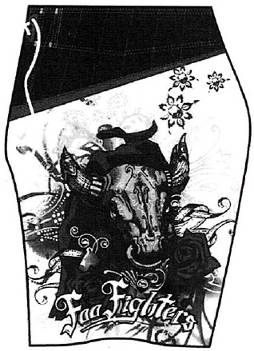
80 Mr Strumpf also deposed that, in or about July 2006, Mr Kesling created the “Foo Fighters” work under the supervision of Mr Hennings. Mr Strumpf also stated that he was responsible for giving his approval to the design. The following is part of the colourway for the board shorts upon which the final version of the “Foo Fighters” work was reproduced.
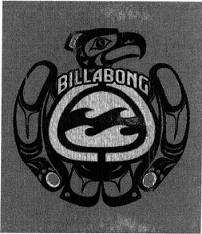
81 With respect to the “Bellview Bird” work, the sixth applicant relied on Mr Dombroski’s 7 December 2010 affidavit, in which Mr Dombroski stated that he was a graphic designer employed by Burleigh Point and that, in the course of his employment with the company, he created the “Bellview Bird” in or about March 2006 in the United States. Mr Dombroski also deposed that, in creating the work, he was inspired by totem poles of Native American tribes of the Pacific Northwest United States. He said that:
I first sketched the work by hand, then scanned it into the computer and manipulated the image using computer software to create the initial electronic versions of the Bellview Bird … .
An initial version of the “Bellview Bird” work appears below:

A colourway for the t-shirt on which the final work appeared is depicted below:
82 In relation to the Billabong Artistic Copyright Works, their alleged infringement by reproduction; and/or importation of reproductions; and/or by sale of counterfeit reproductions is pleaded and particularised in paragraph 35 of the statement of claim. In its amended defence, the first respondent admitted that it “reproduced in material form, published and/or communicated to the public” one or more of the Billabong Artistic Copyright Works (or authorised or caused this to occur) “without the licence or authority of the sixth applicant”; imported as alleged; and “offered for sale and sold” articles bearing “pirated” reproductions of “one or more” of the Billabong Artistic Copyright Works. Also, in its amended defence, subject to proof of ownership and subsistence of copyright, the first respondent admitted infringement of copyright in the Billabong Artistic Copyright Works.
83 The first respondent’s admissions were supported by evidence of trap purchases from the first respondent. In his 6 December 2010 affidavit, Mr Potter gave evidence that, on 31 March 2010 at Sunshine in Victoria, he purchased a pair of board shorts bearing the “Foo Fighters” work. In relation to the “Bellview Bird” and “Roots Lion” works, Mr Potter gave further evidence in his 6 December 2010 affidavit that, also on 31 March 2010, at Sunshine in Victoria, he purchased a t-shirt bearing the “Bellview Bird” work and a t-shirt bearing the “Roots Lion” work. As noted earlier, however, the sixth applicant accepted that the t-shirts bearing the “Bellview Bird” and the “Roots Lion” works were genuine products bearing these designs with the consent of the sixth applicant.
84 As noted above, the first respondent sought leave to amend its amended defence. The applicants did not oppose the amendment in so far as the first respondent sought leave to amend its defence so as to modify the admissions that the t-shirts bearing the sixth applicant’s “Bellview Bird” and “Roots Lion” copyright works were counterfeit or pirated. Leave to make these amendments will be granted. However, for the reasons set out below, in so far as these amendments were opposed, I would not grant such leave.
85 In relation to the “Roots Lion” and the “Foo Fighters” works, the first respondent relied on the fact that there was no direct evidence from Mr Alvarez, Mr Kesling or Mr Hennings as to their responsibility for the relevant works, creativity, or employment. The first respondent submitted:
Without evidence of Mr Alvarez or Mr Kesling’s and Mr Hennings authorial contributions [sic], the creative process and corroboration of employment the sixth applicant cannot satisfactorily demonstrate originality or ownership.
Further, the alleged assignments of copyright to the sixth applicant (insofar as concerns Australia) are not proven, as outlined in relation to the Bellview Bird Copyright Work.
86 I reject the first respondent’s submissions as to the lack of evidence from Mr Alvarez, Mr Kesling and Mr Hennings. Mr Strumpf deposed as to their employment by Burleigh Point. There was no reason to doubt the accuracy of his testimony in this regard. Mr Strumpf’s evidence was also to the effect that the works were the product of the independent intellectual effort of Mr Alvarez and Mr Hennings in March 2006 in the case of the “Roots Lion” work and Mr Kesling and Mr Hennings in July 2006 in the case of the “Foo Fighters” work. Again, there was no reason to doubt his testimony. For reasons already stated, there was also nothing to indicate that Mr Dombroski’s evidence as to his employment and authorial responsibility for the “Bellview Bird” work should be doubted.
87 The first respondent also noted that the “Bellview Bird” was a derivative work inspired by totem poles and alleged that it contained Mr McCarty’s Military Wave. The first respondent submitted that, since the source works were not in evidence, it was impossible to assess Mr Dombroski’s input. I would reject this submission. In his affidavit, Mr Dombroski described in some detail the process of creating the “Bellview Bird” work, stating that whilst he was inspired by the totem poles of Native American tribes, he exercised his own independent intellectual effort in creating the work in question. There was nothing to indicate that Mr Dombroski arrived at the “Bellview Bird” by copying.
88 On the question of copyright ownership, the sixth applicant relied on Mr Blanchard’s 15 December 2010 affidavit, in which he deposed that, prior to the creation of any of the Billabong Artistic Copyright Works, Burleigh Point entered into a distribution agreement under which the sixth applicant authorised Burleigh Point to undertake certain activities on its behalf, including the creation of designs for Billabong Products. The distribution agreement was the subject of a confidentiality order. Mr Blanchard deposed:
Under clause 16.4 of the Distribution Agreement, all intellectual property created by Burleigh Point from 1 July 2005 until 30 June 2010 was assigned by Burleigh Point to [the sixth applicant]. This is set out in clause 16.4 of the Distribution Agreement, which states the following:
If not created by [the sixth applicant], all Intellectual Property will be automatically assigned to [the sixth applicant] by [Burleigh Point] upon its creation or upon their assignment to [Burleigh Point]. [Burleigh Point] must do all things necessary (if any) to assign the Intellectual Property to [the sixth applicant]. [Burleigh Point] irrevocably appoint[s] [the sixth applicant] as [Burleigh Point’s] attorney for the purpose of giving effect to this clause.
“Intellectual Property” is defined in clause 36 of the Distribution Agreement as meaning “all intellectual property rights”, and includes, but is not limited to, the following:
(a) know-how, trade secrets, patents, copyright, rights in circuit layouts, registered designs, registered and unregistered trade marks and any rights to have confidential information kept confidential; and
(b) any application or right to apply to register any of the rights referred to in paragraph (a).
89 During the hearing on 18 February 2011, I inquired whether the distribution agreement limited distribution by reference to defined territories, because it seemed to me, on reading that part of the document with which I was provided, that it did. In a note filed, with leave, subsequent to the hearing, the sixth applicant confirmed that this was the case, and sought leave to provide a complete copy of the distribution agreement and its schedules for the purposes of the summary judgment application. The first respondent opposed the grant of leave.
90 It is unnecessary to consider whether the sixth applicant should be permitted to provide the full distribution agreement to the Court. Having regard to clause 16.4 of the distribution agreement and to the affidavit of Mr Blanchard, I am satisfied that the sixth applicant has established a prima facie case of ownership; and the first respondent has not shown that this proposition is subject to any relevant doubt.
91 The first respondent submitted that:
[T]he sixth applicant claims ownership of copyright by assignment through a distribution agreement between Burleigh Point. … This distribution agreement, insofar as it concerns Billabong branded goods, is limited to territories which do not include Australia. Arguably the assignment of intellectual property at clause 16.4 is likewise limited. The applicant’s evidence is ambivalent.
Whilst the agreement as to distribution is with respect to certain territory, I accept that, as the sixth applicant argued at the hearing, clause 16.4 does not contain any territorial limitation.
92 In these circumstances, given that the t-shirts the subject of the trap purchases are genuine products bearing the designs with the consent of the sixth applicant, to make out its case for summary judgment, the sixth applicant must show that the first respondent imported and sold the garments without the licence of the sixth applicant.
93 The sixth applicant maintained that the first respondent was not an authorised retailer and it so informed the first respondent by letter dated 9 December 2008 (exhibited to Mr Blanchard’s affidavit). Moreover, in his 3 February 2011 affidavit, Mr Dwyer stated that the sixth applicant’s authorised distributor had refused to deal with the first respondent. In his 15 December 2010 affidavit, Mr Blanchard, the sixth applicant’s general counsel, also deposed that a search of the relevant business records had failed to show that the respondents or any of the entities named in their amended defence as its suppliers had been authorised to manufacture Billabong products (being products to which the Billabong Artistic Copyright Works can lawfully be applied). Further, Mr Blanchard’s searches of the relevant business records failed to show that the respondents or any of the entities named in the amended defence were parties to any distribution agreement with the Billabong Companies (of which the sixth applicant was one). Mr Blanchard specifically deposed that his “review indicates that neither the respondents nor any of those entities named as suppliers in the amended defence are parties to a distribution agreement with any of the Billabong Companies”.
94 This evidence is sufficient to establish that neither the first respondent nor any of its suppliers had any licence or authority from the sixth applicant in relation to these garments or any other relevant products. The first respondent has not adduced any evidence that might lead to a contrary conclusion.
95 A further question arises as to whether the first respondent knew or ought reasonably to have known that, had it or an importer made the article in Australia, the making would have constituted an infringement of the copyright: see CA, ss 37 and 38 at [47]-[48] above. The first respondent submitted that the sixth applicant had not established this to the requisite degree and relied on various affidavits, including those of Mr Dwyer and Ms Manu, which included evidence to the effect that they had dealt with certain suppliers for some time without issues as to genuineness arising. In this context, however, the sixth applicant referred to the following matters to support the proposition that the first respondent had a high level of awareness of intellectual property rights and was well aware of the Billabong brand and the concerns that the copyright applicants had about infringement of their intellectual property rights at the Paul’s Warehouse stores.
(1) Mr Dwyer’s evidence indicates that the first respondent is a significant Australian retailer.
(2) Mr Dwyer’s evidence was that the first respondent used a number of checks to ensure that it was dealing with genuine goods, including seeking confirmation from suppliers that goods were genuine, comparing prices of goods acquired with market prices, and examining incoming goods. The first respondent’s claim to use these practices indicated that it was well aware of intellectual property rights and the need to avoid infringement of them.
(3) There was no evidence that the first respondent conducted any checks to ensure that it was dealing with genuine goods in relation to the particular garments in question.
(4) The first respondent was placed on notice in writing of the second, third and sixth applicants’ concerns about its dealings in Billabong products in late 2008-early 2009 and was informed that it was not an authorised retailer of these products. This was evident from Mr Blanchard’s affidavit and the accompanying exhibits. The first respondent, through Mr Dwyer, was therefore put on notice well before the first respondent claimed to have purchased the garments in question: see Mr Dwyer’s 3 February 2011 affidavit.
(5) The “Bellview Bird” and “Roots Lion” works were complex images; and therefore the kind of works that the first respondent would presumably have associated with intellectual property protection.
96 Having regard to these circumstances, I conclude that the first respondent ought reasonably to have known that, had it or an importer made the t-shirts bearing the “Bellview Bird” and/or “Roots Lion” works in Australia, its conduct would have constituted a copyright infringement. Accordingly, subject to the discussion below, the first respondent’s conduct in relation to these t-shirts is shown to have constituted an infringement of the sixth applicant’s copyright in the “Bellview Bird” and “Roots Lion” works.
97 In reaching this conclusion, I put to one side the dispute between Mr Taylor and Mr Dwyer as to the contents of a conversation between them on 27 April 2010. I do no more than note that, in his 14 December 2010 affidavit, Mr Taylor deposed that, in this conversation, Mr Dwyer admitted to Mr Taylor that he had “doubts” about the relevant garments “when we saw the stock”. In his 17 February 2011 affidavit, however, Mr Dwyer made it clear that he disputed making any such admission. For the reasons already stated, nothing relevantly turns on this disputed evidence.
THE SEVENTH APPLICANT’S COPYRIGHT CLAMS
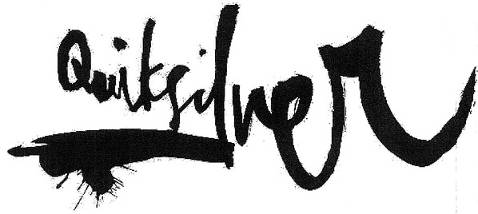
98 The seventh applicant claimed to be the owner of copyright in the original artistic work referred to in its submissions as “the Quiksilver Stylised Copyright Work”. The seventh applicant relied on the 21 December 2010 affidavit of Mr Kaupas and accompanying exhibits. In this affidavit, Mr Kaupas, a US citizen, stated that he was formerly employed by the seventh applicant as the Global Creative Director and Vice President of Marketing. As part of his employment he was required to design and create designs and artistic works to be applied to clothing. Mr Kaupas stated that, in or about 2002, in the course of this employment, he created a design that came to be called the Quiksilver Script Copyright Work. He deposed that this work incorporated the word “Quiksilver” in a stylised freehand script known as the “Natas” script. Exhibit NK 1 (below) was a reproduction of the Quiksilver Script Copyright Work. This is referred to in the copyright applicants’ submissions as “the Quiksilver Stylised Copyright Work”.
99 The alleged infringement of the Quiksilver Stylised Copyright Work by reproduction is pleaded and particularised in paragraph 36 of the statement of claim by reference to a “Paul’s Warehouse” catalogue published around 12 December 2009. In its amended defence, the first respondent admitted that it “reproduced [the works] in material form, [and] published and communicated [it] to the public” (or authorised or caused this to occur) “without the licence or authority of the seventh applicant”. In its amended defence, subject to proof of ownership and subsistence of copyright, the first respondent admitted the infringement of copyright in the Quiksilver Stylised Copyright Work. As discussed hereafter, however, the first respondent seeks leave to amend its amended defence by pleading positive defences. Again, for the reasons set out below, I would not grant such leave.
100 With respect to the Quiksilver Stylised Copyright Work, the first respondent complained of the lack of corroborative evidence concerning Mr Kaupas’ employment. The first respondent submitted:
In particular, Mr Natas’ [sic] position in 2002 is unclear. He says that he joined the seventh applicant in 1999 as a freelance designer. He does not say when his services changed from freelance to employee. If this occurred after the creation of the Quiksilver script copyright work in 2002, copyright (if it subsists) would have remained with Mr Natas [sic] as there is no evidence of an assignment to the seventh applicant.
Further, the subsistence of copyright in the Quiksilver script copyright work is denied by the respondents. The work, as Mr Natas [sic] describes it, is nothing more than “… the word Quiksilver in a heavily stylized script”. The nature and extent of Mr Natas’ [sic] creative effort is doubtful, especially given that it was “finished” by a computer program.
101 I would reject the first respondent’s submission as to lack of evidence of employment. Mr Kaupas specifically deposed that he created the Quiksilver Stylised Copyright Work “in the course and scope of my employment duties with Quiksilver” in or about 2002. Further, I would reject the first respondent’s submissions as to lack of creative effort. In paragraph 4 of his affidavit, Mr Kaupas described the process of creating the work. Mr Kaupas deposed:
In creating this work, I was inspired by the styles that were used by graffiti artisits and “taggers”. Using one of my worn, old brushes and ink, and working in freehand, I wrote out the word Quiksilver in a heavily stylised script. I then scanned an image of this work into a computer program and manipulated it with said program to finalise it.
Mr Kaupas’ evidence and the work itself show that there was a sufficient degree of independent intellectual effort involved and that the first respondent’s submission as to lack of creativity should be rejected.
consideration of respondents’ copyright defences as pleaded
102 In their amended defence, the respondents pleaded that, in each instance, their infringement of copyright was innocent. This is relevant to the application of s 115(3) of the CA and bears upon the availability of damages. This will fall for consideration at the next stage of the proceeding.
103 Accordingly, subject to the outcome of the respondents’ application to amend their amended defence, the applicants are entitled to summary judgment on the claims that they relied on for this purpose. Considered as a whole, the applicants’ evidence and the first respondent’s admissions sufficiently made out the applicants’ allegations of copyright infringement against the first respondent to establish that the first respondent has no reasonable prospect of defending these allegations.
104 In the course of the hearing, the first respondent invoked the court’s overriding discretion not to grant summary judgment in the particular case, referring in particular to the insufficiencies of proof discussed above.
105 There remains some doubt as to whether the word “may” in s 31A of the Federal Court Act confers a discretion on the court as to whether to grant summary judgment, notwithstanding the court is otherwise satisfied that the other party has no reasonable prospect of successfully defending the proceeding or that part of the proceeding. Compare Jefferson Ford 167 FCR 372 at 407 [128], where Gordon J held that the word “may” in s 31A(1) and (2) was used in an empowering (not a discretionary) sense, and Kowalski v MMAL Staff Superannuation Fund Pty Ltd (2009) 178 FCR 401 at 408 [28] where Spender, Graham and Gilmour JJ stated that in their view “a discretion is reposed in the judge hearing the relevant application to grant summary judgment”. See also JF Keir Pty Limited v Sparks [2008] FCA 611 at [12] (Graham J), Luck v University of Southern Queensland (2009) 176 FCR 268 at 295 [110] (Rares J). It is, however, unnecessary to discuss this question further because, in the circumstances of this case, for the reasons already stated, no question of exercising discretion in favour of the first respondent arises.
consideration of respondents’ proposed copyright defences
106 As already stated, the respondents sought leave to amend their amended defence, in part to introduce some positive defences. In written submissions, the respondents explained that they had not originally “apprehended the generality of paragraphs 32, 33 and 36” of the Statement of Claim, because they had understood these paragraphs to concern only “complaints relating to the reproduction of the applicants’ logos on Paul’s Warehouse brochures … specifically advertising the Infringing Board Shorts and the Infringing t-shirts”. The respondents went on to say:
The realisation that paragraphs 32, 33 and 36 of the SOC were directed at the Respondents’ advertising generally came during preparation for this application and was also prompted by the service on the Respondents’ solicitors, of a Notice to Admit, on 17 January 2011, which attached copies of the brochures particularised in paragraphs 32, 33 and 36 of the SOC.
The Respondents’ position, now expressed by paragraphs 31, 32, 33 and 36 of the SAD, is that where genuine goods are promoted by reference to the Applicants’ logos, such use is not an infringement because there is an implied licence and/or because of the operation of section 44C(2). …
107 Pursuant to O 13 r 2 of the Federal Court Rules 1979 (Cth) (see now Rule 16.53 of the Federal Court Rules 2011), the Court has a wide discretion to permit amendments to pleadings in appropriate cases. I accept that, as the respondents contended, the circumstances in this case are different from those considered in Aon Risk Services Australia Ltd v Australian National University (2009) 239 CLR 175: compare Cement Australia Pty Ltd v Australian Competition and Consumer Commission (2010) 273 ALR 147. Leave will not be given, however, if the proposed pleading is likely to be struck out (see O 11 r 16; and now Rule 16.21 of the Federal Court Rules 2011) or if the issue sought to be raised is unlikely to succeed: see Research in Motion Ltd v Samsung Electronics Australia Pty Ltd (2009) 255 ALR 508 at 512 [21]-[22]. The applicants argued that such was in fact the position with respect to the proposed positive defences.
108 As the respondents made clear, the opposed amendments sought to raise positive defences to the allegations in paragraphs 32, 33 and 36 of the Statement of Claim, which concern the reproduction of the Billabong Stylised Copyright Works, the DC Stylised Copyright Work and the Quiksilver Stylised Copyright Works. In particular, they raise two issues.
(a) whether, as the respondents contended, in respect of products bearing copyright works with the consent of the owner of the copyright, there is an implied licence in favour of the respondents:
(i) to use the relevant copyright works to advertise, promote and market those products; and
(ii) import, offer for sale and sell those products in Australia.
(b) where the first respondent has reproduced copyright works in its brochures in connection with genuine goods, whether, as the respondents contended, those brochures are non-infringing accessories for the purposes of s 44C of the Copyright Act 1968 (Cth) (“CA”).
Implied licence proposed pleading
109 The first respondent seeks to introduce an implied licence defence at paragraphs 32, 33, 35 and 36 of its proposed second amended defence. Paragraph 32 of the proposed pleading reads as follows:
In answer to paragraph 37, the respondents say, subject to copyright being found to subsist in the Billabong Stylised Copyright Works and the Third Applicant being found to be the owner:
a) to the extent that the first respondent reproduced the Billabong Stylised Copyright Works for the purpose of advertising, promoting and marketing products to which the Billabong Stylised Copyright Works have been applied by or with the consent of the Third Applicant (Genuine Billabong Products):
i. The Billabong Stylised Copyright Works were reproduced with the license of the Third Applicant:
Particulars
(A) By permitting Genuine Billabong Products to be wholesaled to third parties without restriction, the Third Applicant implicitly licensed such third parties, including the First Respondent, to use the Billabong Stylised Copyright Works to advertise, promote and market such products, that being the purpose for which the said works were created;
(B) The Respondents refer to and rely on a letter from Corrs Chambers Westgarth Lawyers dated 18 January 2011
ii. Alternatively, the said reproductions were of non-infringing accessories to imported articles within the meaning of s 44C of the Copyright Act 1968 and therefore did not infringe copyright in the Billabong Stylised Copyright Works.
b) to the extent that the first respondent reproduced the Billabong Stylised Copyright Works for the purpose of advertising, promoting and marketing the Infringing Board-shorts, they admit that the First Respondent has infringed copyright in the said works but say that such infringement was innocent and refer to paragraph 37 below;
c) deny that the first respondent is continuing to infringe copyright in the Billabong Stylised Copyright Works;
d) Otherwise deny the allegations in paragraph 37.
110 Paragraphs 33, 35, and 36 of the proposed second amended defence are in similar terms. Besides the implied licence issue in paragraph 32(a), other paragraphs raise the applicability of s 44C, which is further discussed hereafter.
111 In Time-Life (1B IPR 253), the High Court considered the circumstances in which a licence might be implied. Time-Life related to books that were imported into Australia by the appellant, Interstate Parcel Express Co Pty Ltd. The books had been sourced from a company in the USA that had obtained them from the copyright owner’s distributor. The books were genuine. The appellant argued that it had an implied licence to import the books into Australia by reason of the fact that they were genuine articles sold without restriction. In rejecting this argument, Jacobs J stated in Time-Life (at 268):
A positive licence to import for purposes of sale is not necessarily an express licence. A positive licence may in certain circumstances be implied, as for example where a copyright owner overseas sells copyright articles in commercial quantities to a purchaser in Australia. But that is very different from implying a licence to import into Australia for purposes of sale from the mere fact that the copyright owner made sales in his own country in commercial quantities to a purchaser in that country without expressly imposing a restriction on importation into Australia. It cannot be maintained that in such circumstances the copyright owner positively licensed the importation into Australia of the articles which he had sold on his own domestic market.
112 Stephen J, with whom Barwick CJ agreed, explained in more detail why the argument failed, stating (at 262-264):
The appellant seeks to make out the necessary licence from the circumstances which are assumed to have governed the original sale in the United States of the books by Time Incorporated to its United States distributor, Little, Brown & Company. Because, so it is said, the sale contained no term restrictive of the use to which the buyer might put the books, including their subsequent resale anywhere in the world, it involved the grant of a licence by the copyright owner, Time Incorporated, to its distributor to deal with the books as it saw fit without restriction as to locality of resale. Those claiming through that distributor, as does the appellant, are in a like position and thus have the consent of Time Incorporated, the owner of the copyright, to import books into and sell them in Australia, “licence” in the sections meaning no more than “consent”, which was the word used in a like context in the Copyright Act 1911 (UK).
This implied licence or consent cannot be made out by the appellant as arising, as a matter of necessary implication, from any particular circumstances of the sale by Time Incorporated. No question of supplying business efficacy to that contract of sale would justify it, no officious bystander’s question could be expected to have evoked the response by the parties that, of course, Little, Brown & Company was free to sell the books wherever it chose: the existence since 1961 of an exclusive licence granted by Time Incorporated to its affiliate, Time-Life, in respect of publication in the British Commonwealth other than Canada refutes it, as does the evidence that books intended for sale in the United States employ American units of weight and of measure and adopt American usage in the spelling of certain words whilst those intended for sale overseas by Time-Life do not. …
It is rather by recourse to the different concept of a term implied by law as inherent in the nature of the contract that the appellant must seek to establish the necessary licence. …
Thus the appellant relies upon the doctrine to be found in patent cases such as Betts v Wilmott (1871) LR 6 Ch App 239; Societe Anonyme des Manufactures de Glaces v Tilghman’s Patent Sand Blast Co (1883) 25 Ch D 1 at 8-9 and National Phonograph Co of Australia Ltd v Menck (1908) 7 CLR 481 (HC); (1911) 12 CLR 15; [1911] AC 336 (PC). In my view the appellant’s reliance upon these authorities is misconceived.
…
[These authorities] should, I think, be seen as confined to the quite special case of the sale by a patentee of patented goods and as turning upon the unique ability which the law confers upon patentees of imposing restrictions upon what use may after sale be made of those goods. If the patentee, having this ability, chooses not to exercise it and sells without imposing any such restrictions, the purchaser and any successors in title may then do as they will with the goods, for they are then in no different position from any purchaser of unpatented goods. But, to ensure that consequence despite the existence, albeit in the instance unexercised, of this power on the patentee’s part, the law treats the sale without express restrictions as involving the grant of a licence from the patentee authorising such future use of the goods as the owner for the time being sees fit. The law does this because, without such a licence, any use or dealing with the goods would constitute an infringement of the patentee’s monopoly in respect of the use, exercise and vending of the patent. … Absent that monopoly, peculiar to patents, there is no occasion for any licence. The buyer of monopoly-free goods, goods not the subject of patent rights, obtains by his purchase title to and possession of the goods and with it, of course, goes the ability, subject to the relevant laws of the jurisdiction in question, to use and deal with the goods as he sees fit. But this is only the consequence of chattel ownership and nothing in the nature of a licence is involved. The buyer of a book in which copyright exists is just such a buyer; the book, once bought by him, is not thereafter subject to any monopoly rights of the copyright owner but may be dealt with by the buyer entirely as he chooses. The copyright in the literary work of course remains with the copyright owner; the buyer has bought no part of it and remains as he was before his purchase, unable lawfully to enjoy any of those exclusive rights, reproduction, adaption or the like, which ownership of the copyright preserves exclusively for the copyright owner.
Because a copyright owner, unlike a patentee, has no monopoly in the use of or dealing in a book which he sells, there exists no general prohibition of such use or dealing calling for modification, as in the case of patented articles, by any implied grant of a licence. Instead, the buyer of such a book obtains just such rights, no more and no less, as does the buyer of any other chattel and those rights, which flow from his acquisition of ownership and possession, do not involve any licence.
See also Time-Life at 258-259 per Gibbs J. The same approach has been adopted in such cases as Computermate Products (Aust) Pty Ltd v Ozi Soft Pty Ltd (1988) 12 IPR 487 at 491-493; Broderbund (22 IPR 215 at 227-228); and Lorenzo (23 IPR 376 at 380-383).
113 The respondents accepted that Time-Life and Lorenzo were against their argument but they sought to distinguish Time-Life and Lorenzo arguing that:
(1) Time-Life was decided over 30 years ago and concerned the importation of books. The obstacles it presented in relation to books were negated by the introduction of CA, ss 44A and 112A.
(2) In Time-Life the copyright work was the sum of the product. By contrast, the copyright works contained in paragraphs 32, 33 and 36 of the proposed second amended defence were logos, not the garments. Their predominant purpose was to identify their source. When used to promote genuine goods, they were being used for this purpose. The TMA countenanced such use under s 123. In this regard, the respondents referred to Transport Tyre Sales Pty Ltd v Montana Tyres, Rims and Tubes Pty Ltd (1999) 93 FCR 421 (“Transport Tyre”) at 440 [94]-[96].
(3) Time-Life was applied in Lorenzo but was not the primary factor in the Full Court’s decision. Other factors included, in particular, health and safety and compliance issues arising from the goods being electronic products manufactured for Asian conditions. These factors were said to have “immeasurably strengthened” the appellant’s case that a licence was not to be implied from the circumstances: see Lorenzo at 382.
(4) Acohs Pty Ltd v Ucorp Pty Ltd (2010) 86 IPR 492 (“Acohs”) was a recent example of a licence to reproduce copyright works being implied in circumstances where there was no relationship between the copyright holder and the user.
114 The respondents further argued that there was additional scope for the development of the law around the implied licence issue and that argument at trial was warranted. I reject this submission. For the reasons stated below, these proposed amendments are unlikely to succeed at trial and should not be allowed.
115 First, as the copyright applicants noted, the respondents do not include in their proposed amendment a claim that the first respondent was the beneficiary of any express licence from a copyright applicant. Indeed, as noted above, the copyright applicants rely on evidence in the 6 December 2010 Perry affidavit and the 15 December 2010 Blanchard affidavit to the effect that the copyright applicants had not authorised either the respondents or their suppliers to deal with the copyright applicants’ goods. As noted already, this was supported by Mr Dwyer’s own evidence.
116 The proposed amendments identify only one fact as the basis for the claimed implied licence – that some goods bear the copyright works with the consent of the copyright owner. Time-Life and subsequent decisions indicate that such a licence will not be implied unless there is some additional evidential and factual basis to support such an implication.
117 Further, the factors that the respondents rely on to distinguish Time-Life and Lorenzo do not justify departing from these authorities. The principles stated in Time-Life were not confined to books and have been consistently applied by this Court in relation to various products. There has been no relevant legislative change.
118 The respondents refer to Acohs as an example of an implied licence in relation to copyright works. In Acohs, however, the regulatory environment relevant to the works in dispute (material safety data sheets) was a significant, if not the key, factor in the implication of the licence: see Acohs at 530 [118], 536-537 [132], [135], [136] and 539 [140]. The licence in that case was akin to a term implied by law. Indeed, Time-Life is not mentioned in Acohs and the respondents have not identified any factor equivalent to that in Acohs. There is no reason to doubt the applicability of the Time-Life principles in this case.
Section 44C proposed pleading
119 As the proposed paragraph 32 set out at [109] above shows, the respondents also sought to amend their pleading so as to rely on s 44C(2) of the CA. The proposed s 44C amendments in paragraphs 32, 33 and 36 of the proposed second amended defence were intended to relate to the reproduction of the copyright works on brochures distributed by the first respondent. The respondents argued that the ambit of s 44C(2) could extend to the reproduction of non-infringing accessories in brochures in the same way as s 123 of the TMA countenanced the use of trade marks on advertising materials, if its conditions were otherwise made out. In this connection, the respondents referred to Transport Tyre at 440 [94]-[96], also noting that s 44C(2) had received little judicial consideration: compare Polo/Lauren Co LP v Ziliani Holdings Pty Ltd (2008) 173 FCR 266 (“Ziliani”).
120 For the reasons stated hereafter, these proposed amendments based on s 44C(2) are unlikely to succeed at trial and should not be allowed.
121 Section 44C of the CA provides:
(1) The copyright in a work a copy of which is, or is on, or embodies in, a non-infringing accessory to an article is not infringed by importing the accessory with the article.
Note: See the definition of accessory in subsection 10(1) and see also section 10AD for an expanded meaning of accessory in relation to certain imported articles.
(2) Section 38 does not apply to a copy of a work, being a copy that is, or is on, or embodied in, a non-infringing accessory to an article, if the importation of the accessory is not an infringement of copyright in the work.
122 Section 10(1) provides that accessory, in relation to an article, means one or more of the following:
(a) a label affixed to, displayed on, incorporated into the surface of, or accompanying, the article ….
123 The respondents submitted that:
Relevantly, subsection 44C(2) nullifies section 38 (secondary infringement by commercial dealing) “… if the importation of the accessory is not an infringement of the work”. There is an anomaly here because the prohibition in section 38 is expressed to be in relation to commercial dealings with articles (not accessories) and an article generally cannot be an accessory [citing Ziliani at 271 [18]].
124 I would also reject the respondents’ submission with respect to s 44C. Section 44C of the CA relates to a non-infringing accessory that is imported into Australia with the article to which it relates. There is no evidence to suggest that the brochures in question were imported into Australia, either independently or with any goods relevant to this proceeding. Further, the definitions of “accessory” and “non-infringing accessory” in s 10(1) of the CA have no application in the circumstances of this case since the relevant brochures do not fall within the definition of “accessory”, which contemplates some physical relationship between the accessory and the item to which it relates. There is no such relationship between these brochures and the garments in questions here. The brochures therefore cannot be “non-infringing accessories” as defined, because they are not “accessories” as defined.
Public interest argument
125 Finally, the respondents argued that the applicants were seeking “to control the market for their goods by the enforcement of copyright in circumstances where relief is not available under the Trade Marks Act because of s 123”. In this regard, the respondents referred to the comments of the Full Court in Ziliani at 275[34]. The respondents went on to submit:
Likewise, Parliament has progressively reigned in the effect of Time-Life by the introduction of ss 44A and 112A (books); ss 44C and 112C (“accessories” to imported articles); ss 44D and 112D (sound recording), s 44E (computer programs) and ss 44F and 112A (copies of electronic literary or music items).
Paragraphs 32, 33 and 36 of the SOC strike at a business model used by retailers throughout Australia. It is in the public interest that the argument be fully articulated in a trial setting.
126 This submission involves considerations that lie outside the purview of this litigation and, in the absence of a relevant law, are not for this court to decide.
127 For the reasons already stated, I would refuse leave to make the amendments to the amended defence that are proposed by the respondents and opposed by the applicants.
DISPOSITION
128 For the reasons already stated, the applicants have established that the first respondent has no reasonable prospect of successfully defending the claims against it for trade mark infringement. Apart the alleged copyright infringements of the Billabong Split Script Copyright and the Quiksilver Mountain and Wave Copyright, the applicants have also established that the first respondent has no reasonable prospect of successfully defending the claims against it for copyright infringement. Pursuant to s 31A of the Federal Court Act, the applicants are therefore entitled to summary judgment in respect of their trademark infringement claims and, save for the alleged copyright infringements of the Billabong Split Script Copyright and the Quiksilver Mountain and Wave Copyright, their copyright infringement claims.
129 Issues relating to relief remain to be determined.
130 At this stage, it is convenient to note an argument raised by counsel for the respondents. Counsel for the respondents sought some recognition in any costs orders that the applicants’ notice of motion of 8 December 2010 sought summary judgment against the respondents, as opposed to the first respondent. I reject this submission. The Notice of Motion was accompanied by draft orders sought by the applicants. These draft orders, as well as the applicants’ written submission filed before the hearing, indicated that summary judgment was sought only as against the first respondent. The respondents’ written submissions in response indicate that the respondents were not under any misapprehension in this regard. Moreover, no occasion for additional and unnecessary costs was identified. Subject to any further matter that has not yet been the subject of submissions, it seems to me, provisionally at least, that the respondents should bear both the applicants’ costs of the applicants’ motion, notice of which is dated 8 December 2010 and of the respondents’ application to amend their amended defence, notified by letter dated 3 February 2011.
131 At the hearing the parties sought an opportunity after delivery of these reasons for judgment to make submissions as to the appropriate form of orders. I would make orders accordingly.
I certify that the preceding one hundred and thirty-one (131) numbered paragraphs are a true copy of the Reasons for Judgment herein of the Honourable Justice Kenny. |
Associate:


