

FEDERAL COURT OF AUSTRALIA
Kngwarraye on behalf of the members of the Arnerre, Wake-Akwerlpe, Errene and Ileyarne Landholding Groups v Northern Territory of Australia [2011] FCA 765
IN THE FEDERAL COURT OF AUSTRALIA |
|
DATE OF ORDER: |
|
WHERE MADE: |
A. The Applicants in this proceeding have made a native title determination application (“the application”) that relates to an area of land and waters which is the subject of a proposed determination of native title.
B. The Applicants, the Northern Territory of Australia and the Pastoral Respondents (“the parties”) have reached agreement as to the terms of the Determination which is to be made in relation to the land and waters covered by the application (“the Determination area”). The external boundaries of the Determination area are described in Schedule A of the Determination.
C. Pursuant to ss 87(1)(a)(i) and 87(1)(b) of the Native Title Act 1993 (Cth) (“the Act”), the parties hereby file with this Court their agreement in writing (“the Determination”).
D. Pursuant to ss 87 and 94A of the Act, the terms of the parties’ agreement involve the making of consent orders for a determination that native title exists in relation to the Determination area as provided by the Determination.
E. The parties acknowledge that the effect of the making of the Determination is that the members of the native title claim group, in accordance with the traditional laws acknowledged and the traditional customs observed by them, should be recognised as the native title holders for the Determination area as provided by the Determination.
F. The parties have requested that the Court hear and determine this proceeding in accordance with their agreement.
BEING SATISFIED that a determination of native title in the terms set out in the Determination in respect of this proceeding would be within the power of the Court and, it appearing to the Court appropriate to do so, pursuant to s 87 of the Act and by the consent of the parties:
THE COURT ORDERS THAT:
1. There be a determination of native title in terms of the Determination set out below.
2. The native title is not to be held on trust.
3. An Aboriginal corporation whose name is to be provided within 12 months, or such further time as the Court may allow, is:
(a) to be the prescribed body corporate for the purposes of s 57(2) of the Act;
(b) to perform the functions outlined in s 57(3) of the Act after becoming a registered native title body corporate.
4. In the event that there is no nomination within the time specified in accordance with Order 3 or such later time as this Court may order, the matter is to be listed for further directions.
5. The parties have liberty to apply for the following purposes:
(a) to establish the precise location and boundaries of any public works and adjacent land and waters identified or otherwise referred to in Schedule C of the Determination;
(b) to establish the precise location of the boundaries of land on which the pastoral improvements referred to in Schedule C of the Determination have been constructed and any adjacent land or waters the exclusive use of which is necessary for the enjoyment of the improvements; and
(c) to establish whether any pastoral improvements referred to in Schedule C of the Determination have been constructed unlawfully.
6. There be no order as to costs.
THE COURT DETERMINES THAT:
The determination area
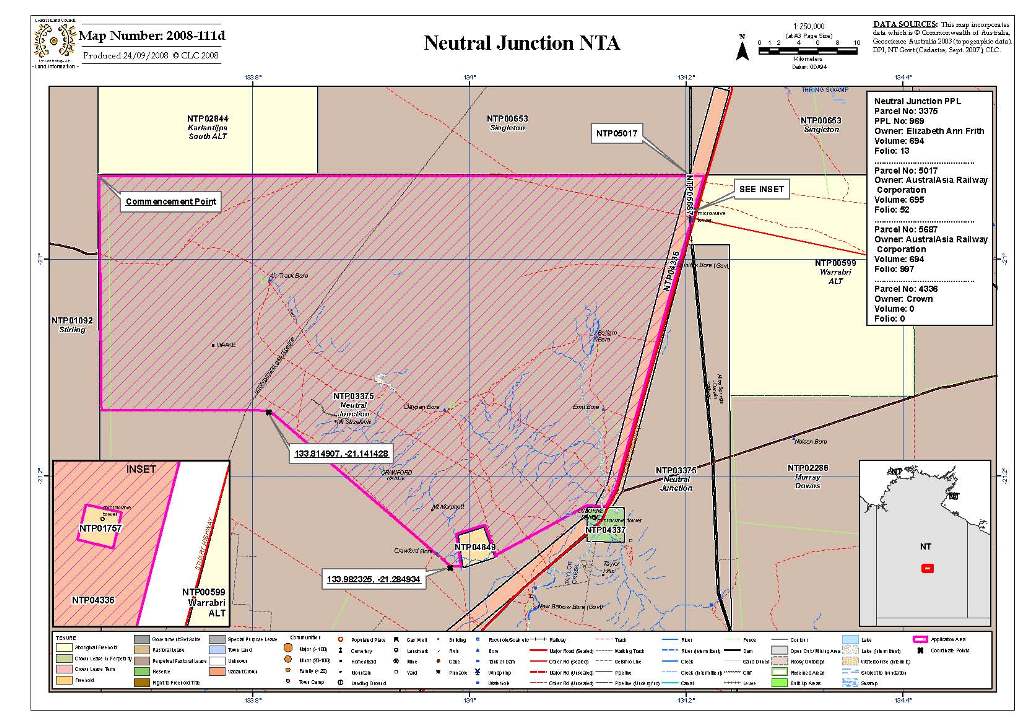
1. The Determination area comprises parts of Northern Territory Portion (“NT Portion”) 3375, NT Portion 4336, NT Portion 5017 and NT Portion 5687, being the land and waters more particularly described in Schedule A and depicted on the map comprising Schedule B.
2. Native title exists in the Determination area as follows:
(a) NT Portion 4336 (part): exclusive native title rights and interests – s 47B of the Act applies;
(b) NT Portion 3375 (part): the native title rights and interests in paragraph 7 apply;
(c) NT Portion 5017 (part) and NT Portion 5687 (part): the native title rights and interests in paragraph 7 would apply were they not wholly ineffective due to the operation of s 238 of the Act.
3. Native title does not exist in those parts of the Determination area described in Schedule C.
The native title holders
4. The Determination area comprises four estate areas associated with the Arnerre, Wake-Akwerlpe, Errene and Ileyarne landholding groups.
5. The persons who hold the common or group rights comprising the native title are the Aboriginal persons who are:
(a) members of one or more of the landholding groups referred to in paragraph 3 by virtue of descent (including adoption) through father’s father, father’s mother, mother’s father and mother’s mother;
(b) accepted as members of one or more of the landholding groups referred to in paragraph 3 by senior members of a landholding group, referred to in subparagraph (a) immediately above, by virtue of non-descent connections to an estate.
Native title rights and interests
6. In relation to NT Portion 4336 (part), the native title rights and interests confer possession, occupation, use and enjoyment of the land and waters on the native title holders to the exclusion of all others.
7. In relation to NT Portion 3375 (part), NT Portion 5017 (part) and NT Portion 5687 (part), the native title rights and interests of the native title holders are the rights possessed under and exercisable in accordance with their traditional laws and customs, including the right to conduct activities necessary to give effect to them, being:
(a) the right to access and travel over any part of the land and waters;
(b) the right to live on the land, and for that purpose, to camp, erect shelters and other structures;
(c) the right to hunt, gather and fish on the land and waters;
(d) the right to take and use the natural resources of the land and waters;
(e) the right to access, take and use natural water on or in the land;
(f) the right to light fires for domestic purposes, but not for the clearance of vegetation;
(g) the right to access and to maintain and protect sites and places on or in the land and waters (h)that are important under traditional laws and customs;
(h) the right to conduct and participate in the following activities on the land and waters:
(i) cultural activities;
(ii) ceremonies;
(iii) meetings;
(iv) cultural practices relating to birth and death including burial rites;
(v) teaching the physical and spiritual attributes of sites and places on the land and waters that are important under traditional laws and customs,
and, subject to the rights of any person arising under the laws in force in the Northern Territory to be present on the land, the right to privacy in the exercise and enjoyment of those activities;
(i) the right to make decisions about the use and enjoyment of the land and waters by Aboriginal people who recognise themselves to be governed by the traditional laws and customs acknowledged by the native title holders;
(j) the right to share or exchange natural resources obtained on or from the land and waters, including traditional items made from the natural resources;
(k) the right to be accompanied on the land and waters by persons who, though not native title holders, are:
(i) people required by traditional law and custom for the performance of ceremonies or cultural activities on the land and waters;
(ii) people who have rights in relation to the land and waters according to the traditional laws and customs acknowledged by the native title holders;
(iii) people required by the native title holders to assist in, observe, or record traditional activities on the areas.
8. The native title rights and interests referred to in paragraph 7 do not confer possession, occupation, use and enjoyment of the land and waters on the native title holders to the exclusion of all others.
9. The native title rights and interests referred to in paragraphs 7(c), 7(d), 7(e) and 7(j) are for the personal or communal needs of the native title holders which are of a domestic or subsistence nature and not for any commercial or business purpose.
10. The native title rights and interests referred to in paragraphs 6 and 7 hereof are subject to and exercisable in accordance with:
(a) the valid laws of the Northern Territory of Australia and the Commonwealth of Australia;
(b) the traditional laws acknowledged and traditional customs observed by the native title holders.
Other rights and interests
11. The nature and extent of the other interests in the determination area are:
(a) in relation to NT Portion 3375 (part), the interest of the pastoral lease holders under Perpetual Pastoral Lease No 969;
(b) in relation to NT Portion 5017 (part) and NT Portion 5687 (part), the interest of AustralAsia Railway Corporation under Crown Lease Term 1879 and Crown Lease Term 1901 respectively;
(c) in relation to SEL 26825 (current), the interest of Newmont Tanami Pty Ltd granted under the Mining Act (NT);
(d) in relation to EL 26228 (current), the interest of Nupower Resources Ltd granted under the Mining Act (NT);
(e) in relation to EL 27138 (current), the interest of Toro Energy Ltd granted under the Mining Act (NT);
(f) the rights and interests of NT Gas Pty Ltd:
(i) as the beneficiary of the rights and interests under an energy supply easement granted to the Northern Territory of Australia for the purpose of the construction, operation and maintenance of the Amadeus Basin to Darwin gas pipeline and related infrastructure; and
(ii) as the holder of Pipeline Licence No. 4 granted under the Energy Pipelines Act (NT);
(g) in relation to NT Portion 3375 (part), the rights of Aboriginal persons (whether or not native title holders) pursuant to the reservation in favour of Aboriginal people contained in the pastoral leases and identified in ss 38(2) to 38(6) of the Pastoral Land Act 1992 (NT);
(h) the rights of Aboriginal persons (whether or not native title holders) by virtue of the Northern Territory Aboriginal Sacred Sites Act 1989 (NT);
(i) rights of access by an employee, servant, agent or instrumentality of the Northern Territory, Commonwealth or other statutory authority as required in the performance of his or her statutory duties;
(j) the interests of persons to whom valid or validated rights and interests have been:
(i) granted by the Crown pursuant to statute or otherwise in the exercise of its executive power; or
(ii) conferred by statute.
Relationship between rights and interests
12. To the extent that the continued existence, enjoyment or exercise of the native title rights and interests referred to in paragraph 6 in relation to NT Portion 4336 (part) and paragraph 7 in relation to NT Portion 3375 (part) is inconsistent with the existence, enjoyment or exercise of the other rights and interests referred to in paragraph 11, the other rights and interests and the doing of any activity required or permitted to be done by or under the other interests prevail over, but do not extinguish, the native title rights and interests.
13. In relation to NT Portion 5017 (part) and NT Portion 5687 (part), the relationship between the native title rights and interests referred to in paragraph 7 and the interest of the AustralAsia Railway Corporation referred to in paragraph 11 is that:
(a) the leases granted to the Corporation are wholly inconsistent with the continued existence, enjoyment or exercise of the native title rights and interests;
(b) the native title continues to exist but has no effect in relation to the grants;
(c) if the grants or their effects are wholly removed or otherwise wholly cease to operate, the native title rights and interests will again have full effect;
(d) if the grants or their effects are removed to an extent or otherwise cease to operate only to an extent, the native title rights and interests will again have effect to that extent.
Other matters
14. There are no native title rights and interests in:
(a) minerals (as defined in s 2 of the Minerals Acquisition Act 1953 (NT));
(b) petroleum (as defined in s 5 of the Petroleum Act (NT));
(c) prescribed substances (as defined in s 5 of the Atomic Energy Act 1953 (Cth) and s 3 of the Atomic Energy (Control of Materials) Act 1946 (Cth)).
15. Unless the contrary intention appears, a word or expression used in the Native Title Act 1993 (Cth) has the same meaning in this Determination as it has in the Act.
16. In this Determination the term:
(a) “natural resources” means:
(i) animals ferae naturae, birds, fish and plants, including timber, wax, resin and gum; and
(ii) surface soils, clays, stone, rocks and ochre;
but does not include minerals, petroleum and prescribed substances;
(b) “natural waters” includes springs and rockholes.
Schedule A
1. The determination area comprises the following areas of land:
(a) part of NT Portion 3375 comprising an area of 1,619.4899 square kilometres being land held under Perpetual Pastoral Lease No 969;
(b) part of NT Portion 4336 comprising an area of 43.8728 square kilometres of vacant Crown land, being part of the North-South Stock Route;
(c) part of NT Portion 5017 comprising an area of 0.01 square kilometres held under Crown Lease Term 1879 by AustralAsia Railway Corporation;
(d) part of NT Portion 5687 comprising an area of 1.15 square kilometres held under Crown Lease Term 1901 by AustralAsia Railway Corporation,
as described below:
The determination area commences at the north-west corner of Northern Territory Portion (“NT Portion”) 3375 (Neutral Junction Pastoral Lease, Perpetual Pastoral Lease No 969) and travels east along the entire length of the northern boundary of NT Portion 3375. Upon reaching the north-east corner of NT Portion 3375, the determination area boundary (“the boundary”) continues in an easterly direction along the length of the northern boundary of NT Portion 5017 (a small section of railway corridor owned by the AustralAsia Railway Corporation). From the north-east corner of NT Portion 5017, the boundary travels due east, cutting across NT Portion 5687 (railway corridor owned by AustralAsia Railway Corporation) and NT Portion 4336 (vacant Crown land) until it reaches the eastern boundary of NT Portion 4336, which is also the western boundary of the Stuart Highway road corridor. The boundary then travels southwards down the western boundary of the Stuart Highway road corridor until it intersects NT Portion 4337 (Reserve Crown land), then westerly along the northern boundary of NT Portion 4337 until it reaches the north-west corner of that parcel. From that corner, the boundary travels in a south-westerly direction to the south-east corner of NT Portion 4849 (freehold owned by Akwerrenge Aboriginal Corporation) and then north, north-westerly along the length of the eastern boundary of NT Portion 4849. It then follows the entire length of the northern boundary of that parcel, and then along the length of the western boundary of that parcel to the south-west corner of NT Portion 4849. From that corner, the boundary travels west to 133.982325, -21.284934; then north-westerly to 133.814907, -21.141428; then due west to the western boundary of NT Portion 3375. The boundary then travels north along the western boundary of NT Portion 3375 to the point of commencement at the north-west corner of that parcel.
2. NT Portion 1757 (freehold owned by the Australian Telecommunications Commission) is excluded from the Determination area. This parcel is located near the north-eastern corner of the claim area.
Schedule B – Map of the Determination Area
Schedule C
Areas where native title does not exist
Native title rights and interests have been wholly extinguished in the following areas of land and waters:
Pastoral improvements
Those parts of the determination area being:
(a) sheds and other buildings;
(b) bores, turkey nests, squatters’ tanks, constructed dams or other constructed stock watering points;
(c) stockyards and trapyards.
The areas described in (a) to (c) comprise the land on which the improvements were constructed prior to the date of this Determination and any adjacent land or waters the exclusive use of which is necessary for the enjoyment of the improvements.
Public works
Those parts of the Determination area being the land or waters on which any public work as defined in s 253 of the Act is situated, including:
(a) public roads and bores;
(b) gravel and fill pits that are on land or waters defined in s 251D of the Act;
(c) transmission water pipes, distribution water pipes, sewer pipes, bores, sewer pump stations, overhead power lines.
The areas described in (a) to (c) comprise the land on which the public works were constructed prior to the date of this Determination.
Note: Settlement and entry of orders is dealt with in Order 36 of the Federal Court Rules. The text of entered orders can be located using Federal Law Search on the Court’s website.
NORTHERN TERRITORY DISTRICT REGISTRY |
|
GENERAL DIVISION |
NTD 13 of 2008 |
BETWEEN: |
TOMMY THOMPSON KNGWARRAYE AND OTHERS ON BEHALF OF THE MEMBERS OF THE ARNERRE, WAKE-AKWERLPE, ERRENE AND ILEYARNE LANDHOLDING GROUPS Applicants
|
AND: |
NORTHERN TERRITORY OF AUSTRALIA First Respondent ELIZABETH ANN FRITH AND CHARLES OLIVER FRITH Second Respondent
|
JUDGE: |
REEVES J |
DATE: |
13 JULY 2011 |
PLACE: |
AKWERRENGE COMMUNITY LIVING AREA |
REASONS FOR JUDGMENT
1 On 13 August 2008, a native title determination application was filed in the Court seeking the recognition of native title rights and interests over part of Northern Territory Portion (“NT Portion”) 3375 held under Perpetual Pastoral Lease No 969; part of NT Portion 4336, being part of the former North-South Stock Route; part of NT Portion 5017 held under Crown Lease Term No 1879 and part of NT Portion 5687 held under Crown Lease Term No 1901. In keeping with the Court’s practice in relation to Northern Territory native title claims, the application was assigned the short title of “Neutral Junction”.
2 The application is for a determination of native title in respect of an area of land covering approximately 1,620 square kilometres and located approximately 290 kilometres north of Alice Springs in the Northern Territory of Australia.
3 The application is brought on behalf of the members of landholding groups associated with four estates of the Kaytetye society: the Arnerre, Wake-Akwerlpe, Errene and Ileyarne landholding groups. The territory of that society covers the area associated with the Kaytetye language, including the area covered by this application. The respondents are the Northern Territory of Australia and Ms Elizabeth Frith and Mr Charles Frith, the pastoral lease holders.
4 On 9 June 2011, the Applicants filed a Minute of Proposed Consent Determination of Native Title seeking a determination pursuant to s 87 of the Native Title Act 1993 (Cth) (“the Act”). The Minute was supported by the parties’ joint submissions and a statement of agreed facts that were filed on the following day by the Solicitor for the Northern Territory.
Section 87 of the native title act
5 The provisions of s 87 of the Act allow the Court to make a determination of native title by consent over an area of land and waters covered by a native title determination application without holding a hearing where certain conditions are met. These conditions are:
1. the period specified in the notice given under s 66 of the Act has expired (s 87(1));
2. the parties have reached agreement on the terms of an order of the Court in relation to the proceedings (s 87(1)(a)(i));
3. the terms of that agreement are in writing and are signed by or on behalf of the parties and filed with the Court (s 87(1)(b));
4. the Court is satisfied that an order in, or consistent with, those terms would be within its power (s 87(1)(c)); and
5. it appears to the Court to be appropriate to make the order sought (ss 87(1) and 87(2)).
The application of s 87 to this application
6 In Nelson v Northern Territory of Australia (2010) 190 FCR 344; [2010] FCA 1343, I canvassed the authorities that identify the factors that the Court will routinely have regard to in determining whether it is appropriate to make a determination in terms of the parties’ agreement: at [5]–[13]. Beyond setting out the concluding summary, it is not necessary for me to repeat that process here. That summary is as follows (at [14]):
It follows from all these considerations that the central issue in an application for a consent determination under s 87 is whether there exists a free and informed agreement between the parties. In this respect, the process followed by the State party respondent, particularly how it goes about assessing the underlying evidence as to the existence of native title, is critical. Other critical factors, all directed to the processes that lead to the agreement and what was agreed, that have been previously identified by the Court include: whether the parties have independent and competent legal representation …; whether the terms of the proposed order are unambiguous and clear …; and whether the agreement has been preceded by a mediation process ….
7 The conditions required by s 87 have been satisfied in this case. In particular:
1. the period specified in the notice under s 66 ended on 20 August 2009;
2. the parties have reached agreement on the terms of an order;
3. the Minute of Proposed Consent Determination filed on 9 June 2011 records those agreed terms;
4. an order consistent with the terms of the Minute would be within the power of the Court because:
4.1 the application is valid and made in accordance with s 61 of the Act;
4.2 the application is for a determination of native title over an area for which there is no approved determination of native title (s 13(1)(a));
4.3 the terms of the Minute comply with ss 94A and 225 of the Act.
8 I also note that:
8.1 the Territory has obtained searches of land and mining tenure and other relevant interests to determine the extent of “other interests” within the proposed Determination area; and
8.2 there are no other proceedings before the Court relating to native title determination applications that cover any part of the area the subject of the proposed Determination area which would otherwise require orders to be made under s 67(1) of the Act.
9 Finally, it is appropriate that the Court make the orders sought, for the following reasons:
9.1 each of the parties to the proceeding is legally represented;
9.2 the Territory, acting on behalf of the community generally, has played an active role in the negotiation of the consent determination. The Territory, having conducted a thorough assessment process is satisfied that the determination is justified in all the circumstances; and
9.3 based on this and the terms of the proposed order, it is apparent that there is a free and informed agreement between the parties.
the native title holders
10 While the findings I have made above are sufficient in themselves, I will set out below some excerpts from the parties’ joint submissions to demonstrate the nature of the native title holding group and the nature and extent of the native title that is to be recognised.
11 The native title holders are members of the four estates or countries in the determination area – Arnerre, Wake-Akwerlpe, Errene and Ileyarne. The joint submissions provided by the parties in support of the Determination explains:
Each estate is associated with a group of people whose descent (including adoption) can be traced to common ancestors. A landholding group consists of apmerew-arteweye (apmerek-artwey) and kwertengerle (kwertengerl). Persons affiliated with a landholding group and its estate or country through their father and father’s father are apmerew-arteweye and those affiliated with a group and its country through their mother, mother’s father, father’s mother and mother’s mother are kwertengerle. A landholding group may also include persons accepted as members by senior descent based members of the group on the basis of non-descent connections. Members of a landholding group by virtue of non-descent connections may include people with a conception or birth place affiliation, ancestral connections, close kinship ties, shared moiety or subsection affiliation, long-term residence in an estate, possession of secular or spiritual knowledge of and responsibility for an estate, shared Dreaming track connections and responsibility and seniority in traditional matters in relation to an estate area.
12 Part of the evidence before the Court in support of the Determination are the affidavits of claimants Tommy Thompson Kngwarraye, Sonny Jakara, Hilda Pwerle, Lena Pwerle and Michael Hayes and the witness statements of Tommy Thompson Kngwarraye, Sonny Jakara, Tommy Walkabout, Mick Wake and Alison Ross. The affidavits and witness statements talk to the deponents’ membership of one or more of the landholding groups, their connections to the Determination area and the exercise of rights and interests under the shared laws and customs of the groups.
13 Sonny Jakara explains how he has come to be apmerek-artwey for Arnerre country:
According to our traditional law, I have rights and interests in the application area because my father, Fred Pwerle and grandfather (FF), Mick Ampetyane were both apmerek-artwey for Arnerre and I take my interests through them. Arnerre is my country and I am apmerek-artwey.
14 As a senior apmerew-arteweye Sonny Jakara has responsibilities under traditional law for important Arnerre sites and Dreaming tracks:
My father gave me that Rain Dreaming. My father, my grandfather Mick, Peter Horsetailer, and Alec Kapetye taught me the songs and the ceremony. The main place for that Arnerre country is Arnerre cave. That’s the main place I look after but there are many other rain sites on the application area … I am owner for all those Arnerre sites so I can tell people to leave if they shouldn’t be there, for example a boy who hasn’t been through the law, or a woman … We have very important places on Arnerre country where all our objects are stored. They are like the title for our land and they show we Arnerre, the Rain Dreaming mob are the owners for that land. When we go to those places and get those objects out, we must have the right people present before we can do that. If I go there as owner and senior apmerek-artwey I must have a very senior and knowledgeable kwertengerl with me.
15 Lena Pwerle and her sisters Amy Pwerle and Hilda Pwerle are also apmerek-artwey for Arnerre because, as Lena states:
My father and arrangye (father’s father) Tommy Pwerle were apmerek-artwey for Arnerre and that means I am also apmerek-artwey and so are my sisters, Amy Pwerle and Hilda Pwerle … My country and my father’s country is Arnerre.
16 Tommy Thompson has connections to all four landholding groups through means that are not based in descent. He explains how this is so:
I am a senior knowledge holder for all four groups on the application area. I am connected to those groups because I know all that country and I know all those Dreamings and that Law. I grew up with those old men from all those groups and they taught me. I have lived all my life around there and now live close by at Tara Community which used to be part of Neutral Junction. All our families were close together growing up.
I act as kwertengerl for Arnerre landholding group because I know the Law for that country, I have lived on and near that country all my life and I am close family for that mob … I grew up and lived on that Arnerre country most of my life … I grew up with those old Rainmaker men, walking around with them, learning. I also act as kwertengerl for Wake-Akwerlpe because I know that country and I know that Law and because I share the Ahakeye Dreaming with that group … I hold all that knowledge and I help them out. Those old Wake men showed me that Law.
I act as apmerek-artwey for Ileyarne and Errene because of my knowledge of the country and that Law. My ceremony runs through Ileyarne. It’s my job to give the proper apmerek-artwey the knowledge, when they are ready to learn. I just hold it for them until they learn and take over … I am the right skin to act as apmerek-artwey for Ileyarne and I share the same Awerentyerrnge (Whirlwind) Dreaming. I also act as apmerek-artwey for Errene because I am the right skin and I have been given those Errene ceremonies… I have the ceremony for Arlpantywerle, the Errene site in the application area. I can’t take the country, but I am just helping and I help them make decisions. I will help the proper apmerek-artwey until they learn enough to take over… I teach them the Law for Errene country…My father also acted as apmerek-artwey for Errene and he helped pass on those Errene ceremonies, as I do now. He taught me those ceremonies, with those other old Errene kwertengerls, so I can teach the apmerek-artwey today.
17 Several of the witness statements and affidavits go to the exercise of rights and interests by the native title holders in their country and the passing of information from generation to generation. Hilda Pwerle, for example, states:
We still go out there for bush food and hunting and out to Sugarbag Bore (Air Track Bore). We still camp out there and make windbreaks and fires for cooking. We get water from the soakages, from places likes (sic) Arlangkwe in Taylor Creek (in the application area) … We have songs to make the bush tucker grow. The songs make the country healthy. It’s good for the country and makes the food grow. We still sing those songs. I learnt the songs from my older sister, Amy and she learnt from Daisy, Old Tywerlame’s daughter … [and] those old women … I can teach my daughter and my granddaughters those songs.
18 Tommy Thompson recounts how he looked after country while walking across the Determination area as a younger man, camping, hunting and collecting bush foods. He explains that he was taught about the Law by following the old people around. Today he fulfils his responsibilities as a very senior knowledgeable man for all four of the estate groups by passing on that knowledge to the younger men:
The old men took us to all the places. It’s the same today when we are teaching young people, we can’t leave until we are finished and we take them home after…I know the Arnerre Euro, Thorny Devil, and Turkey Dreaming stories. The old men took me and showed me where the kangaroo was born in a cave, Arrngernynenke, and the Bush Turkey site and Arwengerratnewenhe both in the application area. We use the Thorny Devil story in ceremony. I pass that story onto Arnerre mob during ceremony and they know that now.
19 Sonny Jakara was the recipient of knowledge from his old people and now teaches others:
When I was growing up my father used to take me out onto my country, Arnerre country on the application area. We used to travel up on the old road up to Claypan Bore and the claypan up there … When we were there my father, grandfather Mick and other old men used to show me the best places to go hunting and to get water … My father would often take me to visit our main place, Arnerre cave in the application area. We would make sure those places were clean and not being damaged by anyone. My grandfather Mick, would come along and he would tell me some of the stories for my country … When I was living out there I went hunting all the time. I can go out on my country to camp, hunt and get water without asking permission from anyone. I do this because I am an apmerek-artwey for Arnerre.
I go with the other old men and do the teaching for the young men who have just been through Business. The young men have to follow us. We teach the young men at every mekemeke site, keep it going, and we are keeping watch all the time. We teach the young men the songs, stories and everything for that place. When we are doing that teaching, it is like a ceremony on that country.
When I gather up the other men to teach the young men, the kwertengerls must be there with them to look after them. That knowledge of our country is passed on from one generation to the next. From the old people, to the next one, next one, all along. When you get old, retired, the younger men take it on and keep going. I am boss, for my country, I might have my son behind or my brother’s son and my sister’s son, kwertengerl for him with my son and all of them have to look after my country.
20 Alison Ross explains that the native title holders continue to access the Determination area to gather bush food and bush medicine, of which the latter is shared with others:
When I went out hunting with my mother and … my grandmother they used to get bush medicine all over the application area, in the mulga. Still today I go out and get bush medicine when we need it … We share it with other Arnerre people who might need it, like Lena Pwerle and her kids.
We go out hunting or camping every second weekend. I go out with my brother Michael and all our kids. We take the kids out and show them and teach them about their country.
We visit our sacred places regularly … We go to those places to check up they are not being damaged, that the country is ok and to show the kids and to teach them.
21 Mick Wake is senior apmerew-arteweye for the Wake estate. He explains how, under the laws and customs of the native title holders, people who do not belong to one of the landholding groups must obtain permission from senior, knowledgeable apmerek-artwey or kwertengerl before accessing the determination area:
I can go onto that Wake country on Neutral Junction without asking permission because I am apmerek-artwey for Wake. I can go there just as my father and my father’s father did and my children can do the same. I am free to look through that country, to hunt or get bush tucker anywhere on Wake country … If other people wanted to go onto Wake country, they should ask me or my kwertengerl … They need to find out where they can go and where they must stay away from … If I saw someone down there who hadn’t asked permission I could tell them to get out. There would be big trouble.
22 All of the evidence provided in support of the determination speaks to a vibrant continuing system of laws and customs according to which the native title holders exercise the rights and interests that are to be recognised.
nomination of a prescribed body corporate
23 The orders proposed by the parties include orders that native title is not to be held on trust and that an Aboriginal corporation is to be nominated within 12 months, or such further time as the Court may allow, to be the prescribed body corporate for the purposes of s 57(2) of the Act and to perform the functions outlined in s 57(3) of the Act after becoming a registered native title body corporate. Section 55 of the Act requires the Court, either at the time of making a determination, or as soon as practicable after it, to make the determinations required by ss 56 and 57 of the Act. In this instance, as native title is not to be held on trust, no determination under s 56 is necessary.
24 The nomination of a prescribed body corporate and its performance of the functions outlined in the Act is an important step in giving practical effect to a determination of native title. The functions required of any prescribed body corporate are not to be undertaken lightly and so it is important that the corporation that is to be the prescribed body corporate understands the nature of its responsibilities and functions and has the human and other resources necessary to carry them out.
25 Any extensive delay in the nomination of a prescribed body corporate is undesirable. The Court expects that where orders of the type sought here are made, the steps necessary to nominate a prescribed body corporate will be undertaken in a timely manner and certainly within the 12 month period specified in the orders.
conclusion
26 The co-operative approach of the parties and their legal practitioners has culminated in today’s consent determination hearing, which, for the members of the Kaytetye society is one of celebration and recognition. Recognition of an ancient connection with the land to the fullest extent possible under the laws of Australia is no insignificant matter. The rights and interests that the Applicants have always exercised and the knowledge they continue to pass on to their young people are today recognised by the Australian people through these orders.
I certify that the preceding twenty-six (26) numbered paragraphs are a true copy of the Reasons for Judgment herein of the Honourable Justice Reeves. |
Associate:


