

FEDERAL COURT OF AUSTRALIA
Lewis v Lamru Pty Ltd; In the Matter of Lewis [2011] FCA 758
| IN THE FEDERAL COURT OF AUSTRALIA | |
IN THE MATTER OF PETER LAWRENCE LEWIS
| Applicant | |
| AND: | LAMRU PTY LTD (ACN 052 117 923) Respondent |
| DATE OF ORDER: | |
| WHERE MADE: |
THE COURT ORDERS THAT:
1. The Application be dismissed.
2. The applicant pay the respondent’s costs of and incidental to the Application.
Note: Settlement and entry of orders is dealt with in Order 36 of the Federal Court Rules. The text of entered orders can be located using Federal Law Search on the Court’s website.
| NEW SOUTH WALES DISTRICT REGISTRY | |
| GENERAL DIVISION | NSD 1540 of 2010 |
IN THE MATTER OF PETER LAWRENCE LEWIS
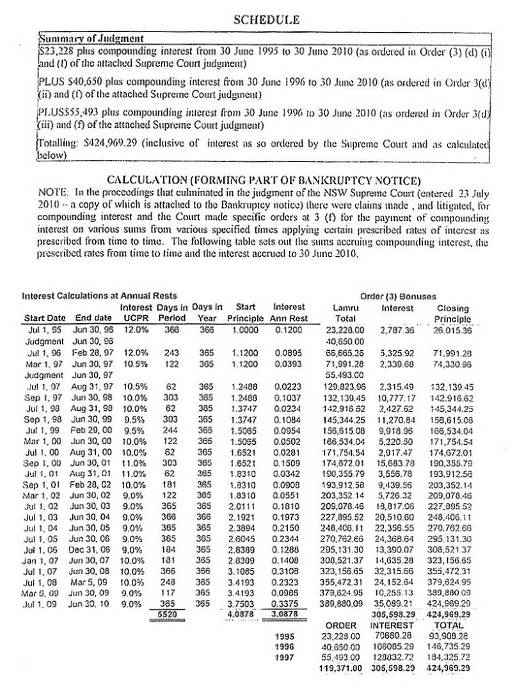
| BETWEEN: | PETER LAWRENCE LEWIS Applicant |
| AND: | LAMRU PTY LTD (ACN 052 117 923) Respondent |
| JUDGE: | FOSTER J |
| DATE: | 6 JULY 2011 |
| PLACE: | MELBOURNE (VIA VIDEO LINK TO SYDNEY) |
REASONS FOR JUDGMENT
1 The applicant has applied for an order reviewing a decision of a Registrar of this Court. The application is made pursuant to s 35A(5) of the Federal Court of Australia Act 1976 (Cth) (the Federal Court Act). Such a review requires a hearing de novo (see s 35A(6) of the Federal Court Act; Martin v Commonwealth Bank of Australia (2001) 217 ALR 634 at [6]–[7] (pp 635–636) (per North, Mansfield and Katz JJ); and Mazukov v University of Tasmania [2004] FCAFC 159 at [24] (per Kiefel, Weinberg and Stone JJ). As the Full Court decided in Mazukov, such a hearing is a rehearing in the full sense of the term—that is to say, it is a fresh hearing at which the parties may adduce fresh evidence as of right (see also Totev v Sfar (2008) 167 FCR 193 at [11]–[15] (pp 196–197) (per Emmett J); and at [81]–[100] (pp 210–211) (per Cowdroy J, with whom Bennett J agreed)).
2 By her decision, the Registrar refused to set aside a Bankruptcy Notice (No 4655 issued on 19 October 2010) (the Bankruptcy Notice) issued by the Official Receiver upon the application of Lamru Pty Ltd (the creditor) against the applicant.
3 Before me, the applicant seeks an order setting aside the Bankruptcy Notice. He relies upon subss (2), (3) and (5) of s 41 of the Bankruptcy Act 1966 (Cth) (the Bankruptcy Act).
4 The Bankruptcy Notice is expressed to be founded upon orders entered by the Supreme Court of New South Wales on 23 July 2010.
5 The Bankruptcy Notice was served on 21 October 2010 and the time for compliance has been extended from time to time since that date. The last extension of the time for compliance with the Bankruptcy Notice operates up to and including today (6 July 2011).
6 In a letter dated 9 November 2010, sent by the applicant’s lawyers to the creditor, care of its lawyers, the following was said:
2. Notice is hereby given under section 41(5) of the Bankruptcy Act 1966 that Peter Lawrence Lewis disputes the validity of he Bankruptcy Notice on the ground that the sum specified in the notice as the amount due exceeds the amount in fact due.
3. In that regard, we note that no judgment or orders were given or made on 23 July 2010. The relevant judgment or orders were made by Hamilton J on 23 May 2006. Therefore, to the extent that the amount specified in the Bankruptcy Notice as the judgment amount includes interest after 23 May 2006, that amount is overstated in the Bankruptcy Notice.
7 In Written Submissions dated 8 February 2011 and 24 June 2011, Counsel for the applicant further explained the grounds which the applicant proposed to advance in support of his application to set aside the Bankruptcy Notice. The grounds relied upon by the applicant may be shortly stated as follows:
(a) In the Bankruptcy Notice, the judgment which is the foundation of the Bankruptcy Notice is misdescribed in that, in the copy of the sealed orders made by the Supreme Court of New South Wales which is attached to the Bankruptcy Notice, the relevant orders are said to have been “made or given” on 23 July 2010 when, according to the applicant, no orders at all affecting him were made by that Court on that day. The applicant concedes, as he must, that orders were made on other occasions which do affect him. However, his simple point was that no orders were made on 23 July 2010; and
(b) In any event, the claimed debt is overstated. The overstatement arises because the creditor has miscalculated the interest payable in respect of the orders relied upon. It was submitted that, when calculating the interest claimed, the creditor failed to distinguish appropriately between pre-judgment interest and post-judgment interest.
8 The creditor submitted that neither of these grounds warranted setting aside the Bankruptcy Notice.
The Bankruptcy Notice
9 In the Bankruptcy Notice, the creditor claims the amount of $424,969.29 (the claimed debt) as a debt due to it from the applicant. The Bankruptcy Notice generally complies with Form 1 in the ITSA Administrative Forms forming part of the Bankruptcy Regulations 1966 (the Bankruptcy Regulations). Regulation 4.02 of the Bankruptcy Regulations provides:
4.02 Form of bankruptcy notices
(1) For the purposes of subsection 41(2) of the Act, the form of bankruptcy notice set out in Form 1 is prescribed.
(2) A bankruptcy notice must follow Form 1 in respect of its format (for example, bold or italic typeface, underlining and notes).
(3) Subregulation (2) is not to be taken as expressing an intention contrary to section 25C of the Acts Interpretation Act 1901.
Note Under section 25C of the Acts Interpretation Act 1901, where an Act prescribes a form, then, unless the contrary intention appears, strict compliance with the form is not required and substantial compliance is sufficient; see also paragraph 46(1)(a) of that Act for the application of that Act to legislative instruments other than Acts.
10 On p 1 of the Bankruptcy Notice, the claimed debt is the amount appearing next to Item 1. Item 1 is described as:
Amount as per the attached final judgment/s or final order/s (note A).
11 The amount claimed is then carried forward in the Items listed on p 1 of the Bankruptcy Notice and appears next to Item 6 (Total Debt Amount). On p 1 of the Bankruptcy Notice, no amounts are claimed for legal costs or for interest accrued since the date of the judgment/s or order/s (Items 2 and 3). “$0.00” has been inserted in the appropriate box next to those items.
12 Under the terms of the Bankruptcy Notice, the applicant was required to pay the debt to the applicant’s lawyers at their business premises.
13 Page 3 of the Bankruptcy Notice is headed: “Schedule of Post-Judgment Interest Calculation”. Next to the first item (“Judgment/order number:”) the following appears:
2002/061144
14 At the foot of the page, next to the Item “Total amount of interest claimed” a zero has been inserted. Thus, no post-judgment interest is claimed in that part of the Bankruptcy Notice.
15 Attached to the Bankruptcy Notice and forming part of it is a Schedule in the following form:
16 Attached to the Bankruptcy Notice immediately after the Schedule which I have extracted at [15] above is a copy of sealed orders made and entered by the Supreme Court of New South Wales. Those orders comprise five (5) pages. Only orders (1) and (3) are presently relevant. The formal parts of those orders and the terms of orders (1) and (3) are:
JUDGMENT
| COURT DETAILS | ||
| Court | Supreme Court | |
| Division | Equity | |
| Registry | Sydney | |
| Case number | 2002/061144 (formerly SC 1750 of 2002) 1997/025260 (formerly SC 3081 of 1997) | |
| TITLE OF PROCEEDINGS | ||
| In 2002/061144 | ||
| Plaintiff | Lamru Pty Ltd | |
| First defendant | Kation Pty Ltd | |
| Number of defendants | 4 | |
| In 1997/025260 | ||
| Applicant | Lamru Pty Ltd | |
| First Respondent | Brian Silvia | |
| Second Respondent | Kation Pty Ltd | |
| DATE OF JUDGMENT | ||
| Date made or given | 23 July 2010 | |
| Date entered | 23 July 2010 | |
TERMS OF JUDGMENT MADE BY THE COURT
(1) In relation to the financial years ended 30 June 1991, 1992, 1993, 1994 and 1995 DECLARE that subject only to order 3(d) of these orders none of the parties is entitled to question re-open or have amended the accounts of Nortex Pty Ltd (in liquidation) (“Nortex”);
…
(3) In relation to the issue concerning the payments made by Nortex of the disputed bonuses for Mark Lewis of:
(i) $58,070 in respect of the 1995 financial year to Kation,
(ii) $101,626 in respect of the 1996 financial year to Mark Lewis, and
(iii) $138,733.30 in respect of the 1997 financial year to Mark Lewis:
(a) DECLARE that each of such payments was made in breach of trust;
(b) DECLARE that Peter Lawrence Lewis (“Lewis”) participated in each of the breaches of trust;
(c) DECLARE that Kation participated in the breach of trust that occurred in respect of the 1995 financial year;
(d) ORDER that Lewis and Kation pay to Lamru;
(i) in respect of the 1995 financial year $23,228 together with interest calculated from 30 June 1995;
(ii) in respect of the 1996 financial year $40,650 together with interest calculated from 30 June 1996;
(iii) in respect of the 1997 financial year $55,493 together with interest calculated from 30 June 1997;
(e) ORDER that Lewis and Kation reconstitute the Nortex Unit Trust by paying into the Trust Fund:
(i) in respect of the 1996 financial year an amount of $60,976 together with interest calculated from 30 June 1996;
(ii) in respect of the 1997 financial year an amount of $83,240 together with interest calculated from 30 June 1997;
(f) IN RESPECT of the calculations of interest the amount is calculated on the sum to which it relates at the rate specified in schedule 5 to the Uniform Civil Procedure Rules 2005 and compounded on annual rests until payment.
…
17 Orders (4) to (14) in the orders entered on 23 July 2010 are not presently relevant.
18 The orders are signed and sealed by a Deputy Registrar of the Supreme Court of New South Wales.
19 The amounts of principal claimed as part of the claimed debt are the three amounts referred to in orders (3)(d)(i), (ii) and (iii) respectively. Compound interest up to 30 June 2010 is claimed in accordance with the terms of order (3)(f).
20 The creditor, therefore, relies upon orders made by the Supreme Court of New South Wales which, on their face, appear to have been regularly entered on 23 July 2010.
21 At the hearing before me, Counsel for the applicant conceded and accepted that the arithmetic embodied in the interest calculations which are set out in the Schedule attached to the Bankruptcy Notice correctly reflect the relevant requirements of the Uniform Civil Procedure Rules (NSW) and the terms of order (3)(f) for the relevant periods (the earliest of which commenced in 1995) up to and including 30 June 2010. Interest has not been claimed for any part of the period after 30 June 2010.
A Conspectus of the Litigation in the Supreme Court of New South Wales
22 On 23 May 2006, Hamilton J, who was then a judge of the Supreme Court of New South Wales, made orders in proceedings No 3081 of 1997 and No 1750 of 2002 in the Equity Division of that Court (the 23 May 2006 orders). On the same day, his Honour delivered reasons for making those orders (Lewis v Nortex Pty Ltd (In Liq); Lamru Pty Ltd v Kation Pty Ltd [2006] NSWSC 480). At [1] of his Reasons, his Honour referred to the disputes between the parties as giving rise to “… long running proceedings …” and noted that the trial had occupied a total of 103 hearing days. His Honour also noted that he had earlier delivered two substantive judgments in the proceedings. It is not necessary for present purposes to traverse the subject matter of the many disputes which had arisen amongst the parties involved in the Supreme Court litigation. His Honour ordered the present applicant to pay certain specified sums to the creditor. He also ordered the present applicant to pay interest on those sums. Whether interest should be compounded and the rate at which interest should be paid were both matters which were litigated before his Honour and determined by his Honour when he made the 23 May 2006 orders. At [12] of his Reasons, his Honour decided that compound interest should be awarded. As to the appropriate rate of interest, his Honour said, at [13] of his Reasons:
13 As to the rate of interest, there has been a change over the years as to this Court’s approach to the appropriate rate of interest in trustee cases: see Re Dawson supra; Hagan v Waterhouse supra; Alemite Lubrequip Pty Ltd v Adams (1997) 41 NSWLR 45. The traditional view was that there should be a trustee rate of interest, which was at one time four per cent and subsequently eight per cent. These fixed and comparatively low rates of interest were determined on the basis that, traditionally, the investments in which trust funds could be placed were limited and conservative. Today, however, the trading trust is a familiar business vehicle and this trust was a trading trust. The business, as already observed, was a successful business. At one end of the scale of interest rates available in present day markets are the comparatively low rates offered by overnight deposit funds and the slightly higher rates for term deposits and home loans. Moneys borrowed to support trading activities are generally borrowed at much higher rates. The rates fixed by court rules as the standard rates for interest upon judgments, as formerly embodied in Sch J of the Supreme Court Rules 1970 (“SCR”) and now embodied in Sch 5 of the Uniform Civil Procedure Rules 2005 (“UCPR”), are rates designed to strike a balance between these extremes. It seems to me that they are the appropriate rates to apply in the present circumstances, where the trust deprived of the funds in question is a commercial trading trust. The orders for interest will therefore be for interest calculated at Sch 5 rates and compounded on annual rests.
23 His Honour’s orders were effected by the entry of orders in proceeding No 3081 of 1997 and the entry of a second set of orders in proceeding No 1750 of 2002. The two sets of orders were identical.
24 There was an appeal and a cross-appeal from his Honour’s judgments and orders and from decisions made in a further proceeding (No 3354 of 2002). The appeal matters were allocated plaint numbers CA 40366 of 2006 and CA 40523 of 2006 in the New South Wales Court of Appeal. The appeal and cross-appeal were decided on 12 June 2009 (Kation Pty Ltd v Lamru Pty Ltd; Lewis v Nortex Pty Ltd (In Liq) (2009) 257 ALR 336). The orders made by the Court of Appeal on 12 June 2009 included orders varying the orders made by Hamilton J on 23 May 2006. Included within the orders made by the Court of Appeal on 12 June 2009 were orders varying the 23 May 2006 orders by deleting pars 3(d) to (f) of those orders and inserting in lieu thereof:
3(d) [An] order that Lewis [the present applicant] and Kation pay to Lamru:
(i) in respect of the 1995 financial year, $23,228, together with interest calculated from 30 June 1995;
(ii) in respect of the 1996 financial year, $40,650, together with interest calculated from 30 June 1996;
(iii) in respect of the 1997 financial year, $55,493, together with interest calculated from 30 June 1997;
(e) [An] order that Lewis and Kation reconstitute the Nortex unit trust by paying into the trust fund:
(i) in respect of the 1996 financial year, an amount of $60,976, together with interest calculated from 30 June 1996;
(ii) in respect of the 1997 financial year, an amount of $83,240, together with interest calculated from 30 June 1997;
(f) in respect of the calculations of interest, the amount is calculated on the sum to which it relates at the rate specified in Sch 5 to the Uniform Civil Procedure Rules 2005 and compounded on annual rests until payment.
25 The Court of Appeal also directed that the orders which it made on 12 June 2009 not be entered for 28 days and thereafter only with leave of a judge of the Court of Appeal and that, within 28 days, the parties should:
(a) apply by notice of motion for variation of these orders on the basis of:
(i) any suggested failure to deal with an issue addressed on the appeal or cross-appeal, or
(ii) any suggested failure of the orders to accord with the reasons for judgment;
(b) provide to the court agreed figures, or submissions in support of their separate calculations, with respect to the terms of a declaration as to the respective loan account balances of Kation and Lamru as at 2 September 1997, and
(c) provide submissions (if any) as to the orders proposed in [185] above with respect to Nortex’ costs.
26 In a further judgment (Kation Pty Ltd v Lamru Pty Ltd; Lewis v Nortex Pty Ltd (In Liq) (No 2) [2009] NSWCA 428) delivered on 21 December 2009, the Court of Appeal (inter alia) ordered that most of the orders made on 12 June 2009 be entered forthwith. Relevantly, the Court of Appeal ordered that the orders made on 12 June 2009 varying orders (3)(d) to (3)(f) in the 23 May 2006 orders made by Hamilton J should be entered forthwith. Those orders were, in fact, entered on 21 December 2009 (although they appear to have been sealed on 13 January 2010).
27 On 23 July 2010, a Registrar of the Supreme Court of New South Wales caused to be entered the orders, a copy of which is attached to the Bankruptcy Notice. The terms of orders (3)(d), (3)(e) and (3)(f) of the orders entered on 23 July 2010 are identical to the terms of orders 3(d), 3(e) and 3(f) of the orders made by the Court of Appeal on 12 June 2009 which that Court, on 21 December 2009, had ordered be entered forthwith and which had, in fact, been entered on 21 December 2009. Thus, the Supreme Court entered orders (3)(d) to (3)(f) made on 12 June 2009 twice—once on 21 December 2009 and again on 23 July 2010.
Consideration
Ground 1 – Misdescription of Judgment
28 Counsel for the applicant submitted that:
(a) No order was made in proceedings in the Equity Division of the Supreme Court of New South Wales Nos 061144 of 2002 (formerly No 1750 of 2002) and 025260 of 1997 (formerly No 3081 of 1997) on 23 July 2010;
(b) Orders in each of those proceedings were made by Hamilton J on 23 May 2006. Those orders were relevantly varied by the New South Wales Court of Appeal on 12 June 2009. The Court of Appeal’s 12 June 2009 orders were entered on 21 December 2009;
(c) The sealed orders attached to the Bankruptcy Notice state that the orders were “made or given” on 23 July 2010 and “entered” on 23 July 2010. The date “23 July 2010” written next to the typescript on p 1 of the orders “Date made or given …” is handwritten. Originally, the date when the orders were said to have been “made or given” was stated in typescript to have been “23 May 2006”. However, the typescript date “23 May 2006” has been ruled through by an officer of the Supreme Court. That alteration has been certified by the application of a seal or stamp of the Supreme Court of New South Wales affixed by an appropriate officer of that Court; and
(d) Therefore, the orders of the Supreme Court attached to the Bankruptcy Notice do not satisfy the requirements of ss 41(1)(a)(i), 41(1)(d) and 41(2) of the Bankruptcy Act. The orders attached to the Bankruptcy Notice failed to meet those legislative requirements because they included a statement to the effect that orders had been made or given on 23 July 2010 when the orders embodied in the attachment were not made or given on that day and when no other final orders affecting the applicant were made or given on that day.
29 The circumstances which led to the entry of what the respondent has described as “the consolidated orders” are set out at [22] to [27] above. There is no doubt that the terms of paragraphs 3(d) and 3(f) of those orders (being the paragraphs relied upon by the creditor for the purposes of the Bankruptcy Notice) accurately reflect the Court of Appeal’s 12 June 2009 orders which themselves varied the 23 May 2006 orders made by Hamilton J. Those orders are final and have not been stayed or disturbed.
30 The fact that the orders were entered twice (on 21 December 2009 and again on 23 July 2010) is neither here nor there.
31 Furthermore, given the history of the litigation involving the applicant, corporations with which he is connected and the creditor, which has spanned some 15 years and many proceedings, it is inconceivable that the applicant was misled by the way in which the relevant orders were referred to and relied upon in the Bankruptcy Notice and inconceivable that he did not fully understand at all relevant times that the Notice was founded upon the orders of the Court of Appeal made on 12 June 2009. There was no evidence before me that suggested that the applicant had been misled in any respect.
32 The fact that the sealed orders attached to the Bankruptcy Notice contained an incorrect statement of fact as to the date when the relevant orders were “made or given” does not, in my view, invalidate the Bankruptcy Notice. The creditor attached a sealed copy of the relevant orders, as it was obliged to do, and it was no part of the creditor’s function to alter or tamper with those orders. In the Bankruptcy Notice itself, the creditor did not specifically mention the date when the orders were “made or given” but simply relied upon the date when those orders were entered. The orders are final orders which are susceptible to immediate execution. The terms of the orders are well known to the applicant and to the creditor. Those orders meet the requirements of s 40(1)(g) of the Bankruptcy Act (see Amos v Brisbane TV Ltd (2000) 100 FCR 82 at [23]–[24] (pp 88–89)).
33 In any event, the relevant defect is a “formal defect” or “irregularity” within the meaning of s 306 of the Bankruptcy Act. The obligation to attach a copy of the judgment or orders upon which a bankruptcy notice is founded is imposed upon a creditor by reg 4.02 of the Bankruptcy Regulations. If there is a difficulty here with the orders which were attached to the Bankruptcy Notice, it is one which arises by reason of a failure to comply with a requirement imposed by reference to the regulations. In the present case, s 306(1) would be enlivened subject to the Court being of the opinion that substantial injustice has not been caused by the defect or irregularity and that that injustice cannot be remedied by an order of the Court (as to which see Adams v Lambert (2006) 228 CLR 409 at [18] (pp 415–416) and at [23]–[34] (pp 418–422); and Re Wimborne; Ex parte The Debtor (1979) 24 ALR 494 at 498–500).
34 Here, there is no prospect that the applicant was misled by the statement in the relevant orders to the effect that they had been made on 23 July 2010. Nor is there any prospect that the misstatement in the orders of the date when the relevant orders were made has caused substantial injustice to the applicant. Should it be necessary to have regard to s 306 of the Bankruptcy Act, I think that the section is engaged in the present case.
35 The applicant has failed to make out his first ground.
Ground 2 – Overstatement
36 This ground focuses on the terms of order 3(f).
37 As I have mentioned at [22] and [23] above, order 3(f) was made by Hamilton J after considering the nature of the breaches which founded the orders for payment which his Honour made. Although, on 12 June 2009, the Court of Appeal varied order 3(f) made by Hamilton J on 23 May 2006, in order to reflect a change in the terms of the orders for payment, the Court of Appeal did not alter the substance or effect of the order in relation to the payment of interest which his Honour had made. The clear intent of that order was that compound interest should be payable on each of the three amounts covered by order 3 and that the commencement of the period in respect of which interest was to be paid in each case was the date specified in the subparagraphs of order 3(d). Each of those dates predated the date of Hamilton J’s orders. The clear intent of the orders made by Hamilton J and of the orders made by the Court of Appeal was that interest would be payable in respect of periods pre-judgment and periods post-judgment on the same basis, that is to say, in accordance with order 3(f). There was no distinction made by the Supreme Court of New South Wales between pre-judgment and post-judgment interest. The creditor was not obliged to introduce such a distinction into the Bankruptcy Notice.
38 It was open to the Supreme Court of New South Wales to make an order in the terms of order 3(f) and that order took effect in accordance with its terms. Nothing in the Civil Procedure Act 2005 (NSW) or in the Uniform Civil Procedure Rules 2005 (NSW) altered the effect of the Court’s order in any way.
39 The applicant has conceded that the creditor has correctly calculated the interest payable on the amounts specified in order 3(d) of the orders relied upon by the creditor if, as I have held, order 3(f) operates according to its terms.
40 There was no need, nor was it appropriate, for the creditor to distinguish between pre-judgment and post-judgment interest in the Bankruptcy Notice nor was the creditor obliged to calculate interest on a simple interest basis. The approach taken by the creditor in the Bankruptcy Notice in respect of interest did not render that Notice non-complying with the terms of reg 4.02 of the Bankruptcy Regulations and Form 1. There was substantial compliance with those requirements.
41 Both Hamilton J and the Court of Appeal made perfectly clear that, for the purposes of order 3(f), the rate of interest was that rate which was prescribed from time to time under Schedule 5 of the Uniform Civil Procedure Rules 2005 (NSW) and that compound interest should be payable on each of the amounts specified in order 3(d) from the particular date specified in each case in order 3(d).
42 Ground 2 also fails.
43 The creditor also submitted that the applicant failed to notify the creditor prior to or at the time he commenced the present proceeding of the extent to which and the reasons for which the amount claimed in the Bankruptcy Notice had been allegedly misstated or overstated. The creditor relied upon Seovic Civil Engineering Pty Ltd v Groeneveld (1999) 87 FCR 120.
44 In the present case, the notice given by the applicant’s lawyers on 9 November 2010 asserted that the misstatement or overstatement arose from the fact that interest had been claimed in respect of a period after 23 May 2006. The contention of the applicant contained in that notice was that the orders made by Hamilton J on 23 May 2006, properly understood, provided only for pre-judgment interest. The contentions ultimately advanced by the applicant in respect of the misstatement or overstatement ground went further than the simple proposition contained in the notice given by his lawyers on 9 November 2010. Although it is not strictly necessary for me to decide the point, I think that the notice did not adequately meet the requirements of s 41(5) of the Bankruptcy Act when one has fair regard to the contentions ultimately advanced by the applicant at the hearing before me. For this reason, it was not open to the applicant to argue matters which went further than the notice which his solicitors gave (see Seovic at [36]–[38] (pp 128–129)).
Conclusion
45 For all of the above reasons, the application must be dismissed with costs.
| I certify that the preceding forty-five (45) numbered paragraphs are a true copy of the Reasons for Judgment herein of the Honourable Justice Foster. |
Associate:


