

FEDERAL COURT OF AUSTRALIA
Zoltaszek v Downer EDI Engineering Pty Ltd [2011] FCA 744
IN THE FEDERAL COURT OF AUSTRALIA | |
| Appellant | |
AND: | DOWNER EDI ENGINEERING PTY LTD Respondent |
DATE OF ORDER: | |
WHERE MADE: |
THE COURT ORDERS THAT:
2. The question as to costs is reserved.
3. Any application for a further oral hearing in respect to costs is to be made by either party within 7 days.
4. In the absence of any application for an oral hearing as to costs:
(i) the Respondent is to file and serve such further written submissions in respect to costs within ten days;
(ii) the Applicant is to file and serve further written submissions in respect to costs within fourteen days.
Note: Settlement and entry of orders is dealt with in Order 36 of the Federal Court Rules. The text of entered orders can be located using Federal Law Search on the Court’s website.
NSW DISTRICT REGISTRY | |
GENERAL DIVISION | NSD 1848 of 2010 |
ON APPEAL FROM THE FEDERAL MAGISTRATES COURT OF AUSTRALIA |
BETWEEN: | ZENON ZOLTASZEK Appellant
|
AND: | DOWNER EDI ENGINEERING PTY LTD Respondent
|
JUDGE: | FLICK J |
DATE: | 1 July 2011 |
PLACE: | SYDNEY |
REASONS FOR JUDGMENT
1 On 1 July 2009 the Appellant, Mr Zenon Zoltaszek, filed an application in the Federal Magistrates Court of Australia pursuant to s 46PO of the Human Rights and Equal Opportunity Commission Act 1986 (Cth). He alleged discrimination and harassment under the Disability Discrimination Act 1992 (Cth).
2 The Federal Magistrate who heard the application dismissed it and gave reasons for doing so on 21 September 2010: Zoltaszek v Downer EDI Engineering Pty Limited (No 2) [2010] FMCA 938.
3 Mr Zoltaszek now appeals to this Court pursuant to s 24(1)(d) of the Federal Court of Australia Act 1976 (Cth). As with the other appellate jurisdiction conferred by s 24(1), an appeal from a judgment of the Federal Magistrates Court is not an appeal by way of a hearing de novo, nor is it an appeal in the strict sense, but is conducted as a re-hearing: Farrington v Deputy Commissioner of Taxation [2002] FCA 1013, 50 ATR 429 at [4] per Kenny J. See also: Jones v Southall and Bourke Pty Ltd [2004] FCA 539 at [2] per Crennan J; Karabassis v Deputy Commissioner of Taxation [2011] FCA 434 at [14] per Ryan J. Such reliance as is now sought to be placed by Mr Zoltaszek upon the Administrative Decisions (Judicial Review) Act 1977 (Cth) is misplaced.
4 The appeal is to be dismissed.
The Grounds of Appeal
5 The Grounds of Appeal were expressed in the Notice of Appeal (without alteration) as follows:
1 The interpreter was not enough skill
2. The hearing was scheduled for three days but lasted whole day.
3. I represented my self in this hearing, I do not have legal experience therefore I could not quickly respond.
4. Magistrate did some errors in judgement
6 Whatever else may be said of these Grounds, it would appear that the Appellant is seeking to contend that:
he was denied an effective opportunity to present his case before the Federal Magistrate by reason of the lack of proper assistance from an interpreter, the length of the hearing and the fact that he was unrepresented;
and that:
the decision of the Federal Magistrate is vitiated by reason of some unspecified “errors”.
A document titled “An Appeal” was filed together with the Notice of Appeal. Although it starts with a statement that Mr Zoltaszek is the “deponent” and that the statements made are made “on oath”, there is no attestation at the conclusion of the document and it is manifestly not an affidavit. But such facts perhaps matter little.
7 Fundamental to the primary manner in which Mr Zoltaszek sought to advance his case before the Federal Magistrate was the proposition that he had been denied a fair hearing. There has been over the years increasing attention given to what goes into ensuring that a hearing is fair. There has thus been consideration given to whether a fair hearing requires (for example) an oral hearing, and whether legal representation is required, and whether the evidence being relied upon has to be particularly probative and whether such evidence need be tested by cross-examination. And, as is well recognised, the content of procedural fairness depends upon the facts and circumstances of each particular case and the statutory context in which a decision needs to be made.
8 The present arguments of Mr Zoltaszek, however, go to the very fundamentals of procedural fairness. He may have been present during the course of the hearing before the Federal Magistrate – but he maintains that his fluency in English, and the lack of a proficient interpreter, has denied him of the opportunity to meaningfully participate in that hearing. An inability to comprehend the evidence being given and the arguments being advanced may in some circumstances make the provision of court hearing time an illusory right.
The Background Facts
9 The Complaint as first filed with the Human Rights and Equal Opportunity Commission (now the Australian Human Rights Commission) (the “Commission”) on 2 October 2007 made a complaint as against the present Respondent, Downer EDI Engineering Pty Ltd (“Downer”) and against Mr George Vlahakis, a person described as a “supervisor”.
10 Mr Zoltaszek claimed that he had been discriminated against by reason of his having a disability and by reason of his having been treated “unfairly for another reason”. The disability was there identified as a “back injury and tendonitis”. On 26 May 2009 the Commission wrote to Mr Zoltaszek informing him of the decision to terminate his complaint. The Commission stated that it was “satisfied that some allegations in your complaint are lacking in substance and that some allegations could be more effectively or conveniently dealt with by another statutory authority”. The reasons provided in support of that decision stated that the complaint was lacking in substance because there was “no evidence to indicate that Downer withheld work from you because of your disability”. Those reasons also recorded that Downer had not “discriminated against you in the work it offered to you”. The other statutory authority to which reference was made was identified as the Workcover Authority of New South Wales.
11 On 1 July 2009 Mr Zoltaszek filed an Application in the Federal Magistrates Court. Part C of that Application called for the provision of details identifying the Applicant and any special needs that he may require at the hearing. Four of the details to be provided and the responses provided were as follows:
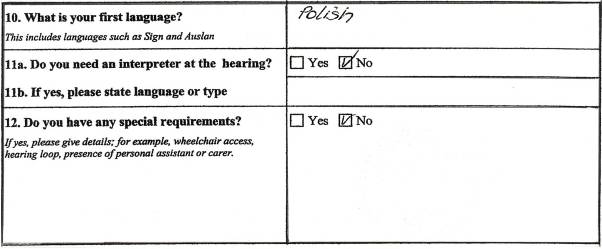
12 A Federal Magistrate heard that Application on 21 September 2010 and delivered her reasons for decision on 3 December 2010.
An Unskilled Interpreter?
13 The first purported Ground of Appeal states that the “interpreter was not enough skill”.
14 A fair hearing may require the provision of an interpreter. If a party is not proficient in English, he is “effectively unable to exercise his right to give evidence unless an interpreter assists him”: Perera v Minister for Immigration and Multicultural Affairs (1999) 92 FCR 6 at 17 per Kenny J.
15 But, as with other grounds of judicial review (VAAD v Minister for Immigration and Multicultural and Indigenous Affairs [2005] FCAFC 117 at [45] per Hill, Sundberg and Stone JJ; Dunghutti Elders Council v Registrar of Aboriginal and Torres Strait Islander Corporations [2011] FCA 370 at [24]), the onus of establishing that the absence of an interpreter has denied a party a meaningful opportunity to present his case remains upon the party making that claim. And how that onus is to be discharged will also depend upon the particular facts and circumstances of each individual case. On occasions it may be apparent to the court itself that evidence or submissions are not being translated at all or not completely. On those occasions it may be incumbent upon the court to intervene to ensure that the hearing is being conducted fairly.
16 In those cases where a party has no command, or very little competence, in speaking and understanding English, procedural fairness may well require the provision of an interpreter. Where a party, however, has some competence in English, the absence of an interpreter may not necessarily lead to an unfair hearing. An applicant who has some command of English but who nevertheless complains of a denial of procedural fairness by reason of the absence of an interpreter may have to point to some prejudice or difficulty occasioned by the absence of an interpreter. Such prejudice may emerge from a review of the transcript where (for example) questions put are simply not answered or where such answers as are given are self-evidently not a response to the question.
17 By way of example, in SYYB v Minister for Immigration and Multicultural and Indigenous Affairs [2006] FCA 24 Mansfield J rejected an argument that the applicants had been denied a “hearing” before the Refugee Review Tribunal as required by s 425 of the Migration Act 1958 (Cth) by reason of the failure to provide a competent interpreter. His Honour rejected this argument as follows:
[11] The Tribunal conducted a hearing on 28 January 2005. An Albanian interpreter was present. The applicant had asked for a Tosk dialect Albanian interpreter, and the interpreter present did not speak that dialect well. The hearing was adjourned. It next took place on 18 February 2005. Again, the interpreter was said by the applicant not to be specifically a Tosk dialect speaker, although the interpreter said he commonly interpreted in the Tosk dialect. The Tribunal observed that the applicant and her husband appeared to be speaking fluently with the interpreter, and that the interpreter had previously in a number of other matters interpreted in the Tosk dialect. In the course of the discussions about the competence of the interpreter, the applicant in English said she wished to proceed with the hearing. Thereafter, at her election, she conducted the hearing in English, although on a number of occasions she sought the assistance of the interpreter, and the interpreter appears to have interpreted parts of the course of the hearing to the applicant’s husband. The applicant had her migration agent present during the hearing.
[12] In my view, the applicant has not shown that she was in effect deprived of a hearing by the Tribunal by any failure to provide a competent interpreter for her at the hearing. It provided an Albanian interpreter, and there is nothing to indicate the interpreter could not effectively interpret the applicant’s statements, or the Tribunal’s statements to the applicant, using the Tosk dialect. Indeed, the applicant herself said she could understand the interpreter, and that the difficulty arose only in the case of her husband. The transcript of the hearing does not demonstrate any apparent difficulties in interpretation. It flows naturally, and there are no obvious examples of inappropriate answers to questions or answers which are not responsive or meaningful so as to suggest there was any misunderstanding between the applicant and the Tribunal, either when she was speaking in English or when she was speaking through the interpreter. The particular references to the transcript to which I was taken by the applicant do not indicate any interpretation difficulties.
See also: SZGYM v Minister for Immigration and Citizenship [2007] FCA 1923.
18 The mere fact that a party may not have the facility of an interpreter, accordingly, does not necessarily mean that he has been denied a procedurally fair hearing. Similarly, there is no unqualified duty imposed upon a decision-maker to obtain a translation of all material that a claimant may seek to rely upon, particularly when its relevance is unexplained: Cabal v Minister for Immigration and Multicultural Affairs [2001] FCA 546 at [25] per Wilcox, Whitlam and Marshall JJ.
19 Such differences as may be relevant to an administrative decision-maker as opposed to the principles to be applied when a party is appearing before a court need not be presently pursued.
20 In the circumstances of the present proceeding, the Applicant had completed in hand the Application in fact filed with the Federal Magistrates Court and had expressly stated that he did not need an interpreter and had no other special requirements.
21 Consistent with the manner in which that Application had been completed, during the course of the hearing before the Federal Magistrate Mr Zoltaszek again disavowed any need to rely upon an interpreter. Thus, at the outset of the hearing there was the following exchange:
HER HONOUR: | … we have provided a Polish interpreter. Do you need the interpreter to translate everything, or do you just need to turn to her? |
THE INTERPRETER: | Only sometimes. |
HER HONOUR: | Okay, all right. So we will proceed in English and when you need a translation, if you could indicate and Ms Nomchong and I will try to keep track of that and pause when that happens. |
MR ZOLTASZEK: | Yes. |
HER HONOUR: | All right. So, Interpreter, you won’t need to translate until we say. |
And, at the commencement of his evidence, there was the following exchange:
HER HONOUR: | … do you want the – sit down, and you stay sitting down in the witness box. Do you want the interpreter to translate everything? |
THE WITNESS: [MR ZOLTASZEK] | No, I don’t. |
HER HONOUR: | No. All right. So, again, Interpreter, if you just wait until you are needed. |
22 The Federal Magistrate thereafter in her reasons for decision thus correctly stated:
[10] Mr Zoltaszek, who is self-represented, requested and had the assistance of a Polish/English interpreter during the hearing, although for the most part he chose not to use the interpreter.
The document provided together with the Notice of Appeal attempted to supplement this ground as follows:
4. … I had the assistance of a Polish/English interpreter during the hearing, although for the most part I choose not to use the interpreter because the interpreter was not enough skill for this hearing …
…
6. … I had assistance of Polish/English interpreter during the hearing. However, this interpreter was not enough skill for this hearing; therefore I chose not to use interpreter.
Other than these assertions, there was no foundation for any conclusion to be reached as to the competence of the interpreter. Nor was there any evidence of any complaint having been made to the Federal Magistrate as to any prejudice having been experienced by reason of any asserted lack of competence nor any evidence of any application having been made for an adjournment in order to secure an alternative interpreter.
23 Given the manner in which the Application had been completed by Mr Zoltaszek and the manner in which the hearing was conducted before the Federal Magistrate, the first purported Ground of Appeal is without substance. It is dismissed.
A Three Day Hearing?
24 The second purported Ground of Appeal states that the “hearing was scheduled for three days but lasted whole day”.
25 Again, the document provided together with the Notice of Appeal supplemented this Ground as follows (without alteration):
4. First, I represented my self in this hearing; I do not have any legal experience and did not have any legal advice during the hearing. I had the assistance of a Polish/English interpreter during the hearing, although for the most part I choose not to use the interpreter because the interpreter was not enough skill for this hearing. Second, the hearing was scheduled for three days, nonetheless, it lasted whole day (from 10;15 AM to about 4:00 PM). As I mentioned above I do not have legal experience, therefore the whole day hearing was exhausting for me, and additionally, I am suffering from insomnia, which restrict my ability to quick respond. Third, counsel for Respondent Ms K Nomchong presented to me some legal Act, which was not annexed to any Respondent’s Affidavit or early presented to me, thus I could not early seek legal advice in regarding to it. Forth, Respondent did not early presented names of Respondent’s witnesses before the hearing; therefore, I was not properly prepared for questioning. Fifth, Barnes FM did some errors in judgment and omitted some evidence, which were significant in this hearing. Sixth, Barnes accepted Respondent’s witnesses despite strong evidence that they provided misleading information in theirs Affidavit.
5. Paragraph (par. 7) of the Reasons for Judgement (RFJ) objection was taken by Downer with the submission into evidence of part of the compact disc that contained recording of two conversations. Counsel for the Respondent Ms K. Nomchong produced copy of Listening Devices ACT 1984 (annexure A) and suggested that these recordings are unlawful. Therefore, (as I mentioned above) I did not have time to read these Act or take any legal advice in respect of that Act and its alligation. As a result, significant evidence was hold up (blocked).
26 Paragraph [7] of the Federal Magistrate’s reasons for decision, to which reference is made by Mr Zoltaszek, stated as follows:
The evidence
[7] Mr Zoltaszek filed an application and points of claim and relies on affidavits sworn by him in these proceedings. Annexed to one of these affidavits was a compact disc containing Word files and what appear to be recorded conversations. Insofar as the compact disc contained Word files no objection was taken by Downer. In pre-hearing written submissions Downer foreshadowed that issue would be taken with the admission into evidence of that part of the compact disc that contained recordings of two conversations. At the hearing Mr Zoltaszek told the court that he did not wish to rely on that part of the compact disc. Hence I have not had regard to those recordings.
27 None of these further complaints as made by Mr Zoltaszek have any substance.
28 The complaint that the hearing was listed for three days but took only one seems to be a complaint that the hearing proceeded with some undue haste or at least at a pace which exceeded the abilities of Mr Zoltaszek. Again, there is an absence of any evidence to support the complaint so construed. Nor is there any evidence of any application made by Mr Zoltaszek to the Federal Magistrate for either a short adjournment to accommodate whatever difficulties Mr Zoltaszek may have been experiencing or even to stand the proceeding over to the following day.
29 And, given the fact that Mr Zoltaszek did not wish to rely upon the “recordings of the two conversations”, any reliance that may otherwise have been placed upon the Surveillance Devices Act 2007 (NSW), or the Listening Devices Act 1984 (NSW), to exclude such evidence assumes no relevance.
30 The second purported Ground of Appeal is dismissed.
An Unrepresented Party
31 The plight of an unrepresented party is not to be underestimated. Unlike the party who has no or little competence or fluency in English, the unrepresented party may well understand and comprehend what is being said. But the fact that he is not represented may expose him to different difficulties. He may well understand the case being mounted against him, but his lack of representation may well place him in a position where he does not know how to answer that case.
32 Nor is the plight of the self-represented litigant confined to relatively few numbers. The Annual Report 2009-2010 for the Federal Court sets forth Tables 3.15 and 3.17 recording the fact that for that year 572 self represented litigants commenced proceedings in this court and that 391 self-represented litigants commenced appeals in this court.
33 No matter what the difficulties a self-represented litigant may present to a court by reason of his lack of skills or ability to present his arguments, it is the right of every person to have access to a court having jurisdiction to have his rights vindicated in accordance with law: Jeray v Blue Mountains City Council (No 2) [2010] NSWCA 367 at [7] per Allsop P. And the role of the court in such circumstances has been variously expressed but was summarised as follows by Sackville, North and Kenny JJ in Minogue v Human Rights and Equal Opportunity Commission (1999) 84 FCR 438 at 445 to 446:
The primary judge’s duty to the appellant
[26] Unrepresented litigants present difficult issues for courts and for individual judges. As the majority observed in Cachia v Hanes (1994) 179 CLR 403 at 415:
“Whilst the right of a litigant to appear in person is fundamental, it would be disregarding the obvious to fail to recognise that the presence of litigants in person in increasing numbers is creating a problem for the courts.”
Increasing attention is being devoted to the policy issues created by the increasing numbers of litigants in person. See, for example, Australian Law Reform Commission, The Unrepresented Party (Background Paper 4, December 1996).
[27] In Neil v Nott (1994) 68 ALJR 509; 121 ALR 148, the High Court considered whether the trial judge’s exercise of discretion to refuse an extension of time for lodging an application for maintenance and support under the Administration and Probate Act 1958 (Vic). The Court observed (at 150) that a:
“frequent consequence of self-representation is that the court must assume the burden of endeavouring to ascertain the rights of parties which are obfuscated by their own advocacy.”
In Abram v Bank of New Zealand [1996] ATPR 42,340 at 42,347, a full Federal Court, faced with an unrepresented litigant’s claim that the trial judge had not given him appropriate assistance to present his case, made this comment:
“What a judge must do to assist a litigant in person depends on the litigant, the nature of the case, and the litigant’s intelligence and understanding of the case.”
We respectfully agree with this observation. Because the duty of the judge varies according to the factors identified by the Full Court in Abram, the duty to assist an unrepresented accused in criminal proceedings is likely to be more extensive than that imposed on a judge hearing civil proceedings in which one or more of the parties are not legally represented; cf MacPherson v The Queen (1981) 147 CLR 512; D A Ipp, “Judicial Intervention in the Trial Process” (1995) 69 Australian Law Journal 365 at 369–70.
[28] The general principles governing the role of the judge in civil proceedings involving an unrepresented litigant have been stated in Rajski v Scitec Corporation Pty Ltd (Unreported, Court of Appeal, NSW, Full Court, No CA 146 of 1986, 16 June 1986). Samuels JA said this (at 14):
“In my view, the advice and assistance which a litigant in person ought to receive from the court should be limited to that which is necessary to diminish, so far as this is possible, the disadvantage which he or she will ordinarily suffer when faced by a lawyer, and to prevent destruction from the traps which our adversary procedure offers to the unwary and untutored. But the court should be astute to see that it does not extend its auxiliary role so as to confer upon a litigant in person a positive advantage over the represented opponent … At all events, the absence of legal representation on one side ought not to induce a court to deprive the other side of one jot of its lawful entitlement … An unrepresented party is as much subject to the rules as any other litigant. The court must be patient in explaining them and may be lenient in the standard of compliance which it exacts. But it must see that the rules are obeyed, subject to any proper exceptions. To do otherwise, or to regard a litigant in person as enjoying a privileged status, would be quite unfair to the represented opponent.”
Mahoney JA made the following observation (at 27):
“Where a party appears in person, he will ordinarily be at a disadvantage. That does not mean that the court will give to the other party less than he is entitled to. Nor will it confer upon the party in person advantages which, if he were represented, he would not have. But the court will, I think, be careful to examine what is put to it by a party in person to ensure that he has not, because of the lack of legal skill, failed to claim rights or to put forward arguments which otherwise he might have done.”
These comments have been referred to with approval in subsequent cases: see Johnson v Johnson (1997) 139 FLR 384 at 406 (Fam Ct/FC) (and cases cited there); Morton v Vouris (1996) 21 ACSR 497 at 513–14, per Sackville J. There is nothing in Neil v Nott inconsistent with what was said in Rajski v Scitec Corporation.
[29] A trial judge often faces something of a dilemma. While he or she may be bound to provide some advice and assistance to an unrepresented litigant, the authorities make it clear that the judge should not intervene to such an extent that he or she cannot maintain a position of neutrality in the litigation: Burwood Municipal Council v Harvey (1995) 86 LGERA 389 (CA(NSW)) at 397, per Kirby P. However, the boundaries of legitimate intervention are flexible and will be influenced by the need for intervention to ensure a fair and just trial: Panagopoulos v Southern Healthcare Network (Unreported, Supreme Court, Vic, Smith J, 15 September 1997) at 6.
These observations have since been cited with approval by a Full Court of this court (eg, Platcher v Joseph [2004] FCAFC 68 at [104] to [105] per Tamberlin and Emmett JJ) and by other judges of this court (eg, Zoia v Secretary, Department of Education, Employment and Workplace Relations (No 2) [2009] FCA 924 at [15] per McKerracher J; Hood v Secretary, Department of Families, Housing, Community Services and Indigenous Affairs [2010] FCA 555 at [15] per Ryan J; Andelman v Secretary, Department of Families, Housing, Community Services and Indigenous Affairs [2011] FCA 299 at [21] per Jagot J) and other courts (eg, Riverlea Corporation Pty Ltd v Bocol Constructions Pty Ltd [2007] WASC 317 at [102] per McKechnie J; Russell v Yarra Ranges Shire Council [2009] VSC 486 at [21] per Kaye J; Opperman v State of Western Australia [2011] WASC 25 at [44] per E M Heenan J).
34 The difficulty confronting Mr Zoltaszek in advancing his third Ground of Appeal, however, is that the reasons for decision provided by the Federal Magistrate expose a careful analysis of the evidence placed before that court and the relevant law. Again, Mr Zoltaszek raised no complaint before the Federal Magistrate as to any difficulty being encountered by reason of his being unrepresented and an examination of the reasons for decision expose no legal or factual issue which did not receive proper and adequate attention.
35 A further difficulty confronting Mr Zoltaszek in respect to this Ground of Appeal is that Mr Zoltaszek undertook a cross-examination of Mr Vlahakis. Although not extensive, such questions as were asked further demonstrate an understanding by Mr Zoltaszek of at least some of the factual issues that needed to be addressed. Moreover, Mr Zoltaszek has undertaken a detailed analysis of the reasons for decision of the Federal Magistrate in his document filed in this court and headed “An Appeal”. Whatever may be the merits of the contentions advanced in that document, the document evidences no lack of comprehension on the part of Mr Zoltaszek as to the reasons for decision. Rather, it evidences a detailed command of the issues being addressed and resolved by the Federal Magistrate. There is no reason to conclude that Mr Zoltaszek’s command of the facts now evident on appeal was not also exercised by him when presenting his case before the Federal Magistrate.
36 No inference, it is concluded, is reasonably open that the lack of representation on the part of Mr Zoltaszek deprived him of a meaningful opportunity to be heard.
37 The third purported Ground of Appeal is dismissed.
Some Errors
38 The Grounds of Appeal themselves do not identify the “errors” said to have been committed by the Federal Magistrate. The “errors” to which reference is made, however, may be discerned from the document titled “An Appeal” and from the Outline of Submissions filed by Mr Zoltaszek.
39 Chronologically, the periods of time under consideration were events prior to December 2006; events between December 2006 and May 2007; and events subsequent to May 2007. It was on 11 December 2006 that Mr Zoltaszek first informed Mr Vlahakis about an injury to his right elbow and requested light duties. It was in May 2007 that Mr Zoltaszek claimed that his services were terminated. As explained by the Federal Magistrate, the “main aspect of Mr Zoltaszek’s claim is, in essence, that after he notified Downer of his December 2006 tendonitis he requested light duties but that Downer failed to provide him with light duties”: [2010] FMCA 938 at [4].
40 The “errors” now advanced by Mr Zoltaszek take issue with much of the reasoning process of the Federal Magistrate. The manner in which such “errors” have been expressed does not make it easy to distil the arguments now sought to be advanced by Mr Zoltaszek – other than to understand that he disagrees with the ultimate conclusions of the Federal Magistrate. But two matters in particular assume greater importance than the others.
41 First, however the claim of discrimination or harassment was advanced, it depended upon Mr Zoltaszek establishing that he in fact suffered from a disability. But he failed to do so.
42 As set forth in the reasons for decision of the Federal Magistrate, a “disability” was relevantly defined in s 4 of the Disability Discrimination Act as follows:
disability, in relation to a person, means:
(a) total or partial loss of the person’s bodily or mental functions; or
(b) total or partial loss of a part of the body; or
(c) the presence in the body of organisms causing disease or illness; or
(d) the presence in the body of organisms capable of causing disease or illness; or
(e) the malfunction, malformation or disfigurement of a part of the person’s body; or
(f) a disorder or malfunction that results in the person learning differently from a person without the disorder or malfunction; or
(g) a disorder, illness or disease that affects a person’s thought processes, perception of reality, emotions or judgment or that results in disturbed behaviour;
and includes a disability that:
(h) presently exists; or
(i) previously existed but no longer exists; or
(j) may exist in the future; or
(k) is imputed to a person.
Mr Zoltaszek relied upon paragraph (e).
43 To the extent that Mr Zoltaszek claimed direct discrimination, s 5 of the Act provided as follows:
(1) For the purposes of this Act, a person (discriminator) discriminates against another person (aggrieved person) on the ground of a disability of the aggrieved person if, because of the aggrieved person’s disability, the discriminator treats or proposes to treat the aggrieved person less favourably than, in circumstances that are the same or are not materially different, the discriminator treats or would treat a person without the disability.
(2) For the purposes of subsection (1), circumstances in which a person treats or would treat another person with a disability are not materially different because of the fact that different accommodation or services may be required by the person with a disability.
Indirect discrimination was defined in s 6 as follows:
For the purposes of this Act, a person (discriminator) discriminates against another person (aggrieved person) on the ground of a disability of the aggrieved person if the discriminator requires the aggrieved person to comply with a requirement or condition:
(a) with which a substantially higher proportion of persons without the disability comply or are able to comply; and
(b) which is not reasonable having regard to the circumstances of the case; and
(c) with which the aggrieved person does not or is not able to comply.
The operation of s 5 was explained by Gordon J in Stevenson v Murdoch Community Services Inc [2010] FCA 648, in reliance upon Purvis v New South Wales (Department of Education and Training) (2003) 217 CLR 92, as follows:
[85] The words “because of” in s 5(1) require a causal connection between the disability and the “less favourable treatment”. In Purvis v New South Wales (Department of Education and Training) (2003) 217 CLR 92 at [236] Gummow, Hayne and Heydon JJ posed the question to be asked in the following terms:
“[T]he central question will always be — why was the aggrieved person treated as he or she was? If the aggrieved person was treated less favourably was it “because of”, “by reason of”, that person’s disability?”
[86] In determining whether a person has been treated “less favourably” in circumstances that are the same or not materially different, the proper comparator is a person with the same behavioural characteristics without the disability: see Purvis 217 CLR 92 at [11] and Zhang 174 FCR 366 at [64] per Jessup and Gordon JJ.
See also: Walker v State of Victoria (Department of Education and Early Childhood Development) [2011] FCA 258 at [70] per Tracey J.
44 Before the Federal Magistrate Mr Zoltaszek contended that he had the following disabilities, namely:
back pain as from 2000;
a right elbow injury in December 2006; and
a left elbow injury in May 2007.
This was sufficient compliance with the need to identify the disability said to be the reason for the discrimination: cf. Qantas Airways Ltd v Gama [2008] FCAFC 69 at [91] to [92] per French and Jacobson JJ.
45 The Federal Magistrate, however, was critical of the evidence relied upon by Mr Zoltaszek to make out his claim as to any disability as follows:
[39] It is the case that there is evidence of mild scoliosis and what may be described as changes to Mr Zoltaszek’s back (in October 2007), changes in his right elbow (in December 2006 and October 2007) and changes in his left elbow (in May 2007). However, even if such changes are capable of constituting or giving rise to a disability, despite the absence of any evidence as to the impact of such matters, it has not been established that Mr Zoltaszek had (or was imputed to have) a disability prior to December 2006 or throughout the whole of the period December 2006 to May 2007. While right elbow changes were observed in December 2006 and October 2007 this evidence of itself does not establish an ongoing condition throughout the period in question. The medical evidence about Mr Zoltaszek’s back postdates the period in issue and does not establish that the matters observed in October 2007 constituted a disability at any time during which Mr Zoltaszek performed work for Downer. On Mr Zoltaszek’s evidence, the left elbow change observed on 10 May 2007 occurred as a result of an injury on 9 May 2007, the last day on which he performed work for Downer. It has not been established that Mr Zoltaszek had a disability occasioned by any injury to his left arm or elbow prior to 9 May 2007.
[40] As discussed below, a difficulty that faces Mr Zoltaszek, whichever aspect of the Act is in issue, is the lack of evidence (such as a detailed medical report) as to the seriousness of the conditions of which he complains and their impact on his functional ability and hence on his ability to perform work. Mr Zoltaszek’s submissions proceeded on the basis of an assumption that the injuries he suffered constituted disabilities. He did not give Downer or adduce in these proceedings any expert evidence as to how the claimed conditions manifested themselves (beyond that referred to above) or how they affected him at any relevant time or placed restrictions on the type of work he could undertake, beyond his assertion that he was discriminated against by being given jobs requiring substantial physical effort.
46 The evidence in respect to the claimed disabilities has been reviewed. There is no reason to reach any different conclusion to that reached by the Federal Magistrate. The reasons provided accurately set forth the observations contained in each of the medical reports and only serve to demonstrate – as was the conclusion of the Federal Magistrate – “the lack of evidence … as to the seriousness of the conditions of which [Mr Zoltaszek] complains”.
47 Second, and equally fundamental to the lack of success of Mr Zoltaszek’s claims, the Federal Magistrate rejected both the claims of direct and indirect discrimination. In respect to direct discrimination the Federal Magistrate relevantly concluded:
[110] Mr Zoltaszek has not established that he was treated less favourably than another contract worker in the same or similar circumstances who was a technician providing services as a full services technician who requested light duties jobs. His complaint of direct discrimination on this basis fails.
[111] Moreover, even if there had been less favourable treatment after December 2006 (which presumably could only relate to the heavier jobs offered in April and May 2007), in circumstances where there was no then current medical evidence provided to Downer to identify the impact of the claimed disability (the December 2006 injury to Mr Zoltaszek’s right elbow) and having regard to the fact that it was open to Impowest, (which Mr Zoltaszek controlled) to decline work, and the nature and quantity of work allocated to Impowest as evidenced by Mr Zoltaszek’s data and the graph prepared for the respondent, it has not been established that any such treatment (allocating such heavier jobs) was on the ground of Mr Zoltaszek’s disability. This complaint of direct discrimination is not made out.
The Federal Magistrate thereafter went on to reject each of the ways in which Mr Zoltaszek sought to make out his claims of direct discrimination. The Federal Magistrate separately addressed the claim as to indirect discrimination and also rejected that claim. Those conclusions are also considered to be clearly correct.
48 Mr Zoltaszek’s claims also suffered other difficulties.
49 Thus, for example, Mr Zoltaszek claimed discrimination pursuant to s 15(2)(b) and (d) of the Disability Discrimination Act. Section 15(1) and (2) at the relevant time provided as follows:
(1) It is unlawful for an employer or a person acting or purporting to act on behalf of an employer to discriminate against a person on the ground of the other person’s disability or a disability of any of that other person’s associates:
(a) in the arrangements made for the purpose of determining who should be offered employment; or
(b) in determining who should be offered employment; or
(c) in the terms or conditions on which employment is offered.
(2) It is unlawful for an employer or a person acting or purporting to act on behalf of an employer to discriminate against an employee on the ground of the employee’s disability or a disability of any of that employee’s associates:
(a) in the terms or conditions of employment that the employer affords the employee; or
(b) by denying the employee access, or limiting the employee’s access, to opportunities for promotion, transfer or training, or to any other benefits associated with employment; or
(c) by dismissing the employee; or
(d) by subjecting the employee to any other detriment.
Whether or not Downer was the “employer” of Mr Zoltaszek was characterised by Counsel on behalf of the Respondent at the hearing of this appeal as being “peripheral” – it being conceded that if Mr Zoltaszek did not bring himself within s 15 he could invoke s 17. But the matter received the attention of the Federal Magistrate and received some attention on appeal. It should thus be briefly addressed.
50 The Federal Magistrate rejected Mr Zoltaszek’s contention that he was an “employee” of Downer. Mr Zoltaszek claimed he was an employee either by reason of a document dated 26 October 2004 or because the relationship between himself and Downer was one of employment. Mr Zoltaszek also sought to rely upon a later 2006 document titled “Agreement” in which Downer Connect Pty Ltd was recited as a party.
51 The 2004 agreement titled the “Foxtel Subcontractor Agreement” was executed by Impowest Pty Ltd and Mr Zoltaszek. Attempts by Mr Zoltaszek to have the 2004 agreement declared void were unsuccessful; as was his attempt to characterise his relationship with Downer as one of employment. The attempt to rely upon the later 2006 document was also unsuccessful. There was no executed copy of this agreement.
52 The conclusions of the Federal Magistrate were expressed (in part) as follows:
[75] Mr Zoltaszek seemed to suggest that in 2006 Downer contracted with him personally, Mr Vlahakis’ evidence, which I accept in the absence of satisfactory evidence of any contract between Downer and Mr Zoltaszek, is that Mr Zoltaszek was employed by Impowest to perform the services required by Foxtel as a technician under the 2004 Subcontractor Agreement. Further, I accept that while Mr Vlahakis did not have any ongoing day to day working relationship with Mr Zoltaszek, he understood from a supervisor that Mr Zoltaszek preferred to do only two jobs a day and was “quite particular about the amount and type of work he wanted to do”. From 2004 to about November 2006 Mr Zoltaszek “primarily performed Full Installations/Connection work”. Downer’s control over the times of appointments with customers and working hours must be seen in light of this evidence.
The Federal Magistrate further concluded later in her reasons as follows:
[85] I have had regard to the totality of the circumstances, including the nature and extent of the control exercisable by Downer over an individual technician such as Mr Zoltaszek, the provisions of the contract and the fact that Impowest could select its own workers to provide the services, the provision in relation to tools, equipment, insurance, warranties, the method of payment and provisions in relation to income tax, the limited control exercised or exercisable by Downer over Mr Zoltaszek’s method of doing the work and the absence of any provision for dismissal of him by Downer (notwithstanding the provision for suspension). These matters and the circumstances in which the contract with Impowest could be brought to an end, seen in light of the fact that Impowest had the power to select and dismiss its technicians and was able to decline jobs and that Mr Zoltaszek could work for other entities is such that on the evidence before the court I am satisfied that, notwithstanding the matters raised by Mr Zoltaszek, at all material times Mr Zoltaszek was an employee of Impowest (and not of Downer) and that Impowest was an independent contractor providing the services of Mr Zoltaszek as a contract worker to Downer.
[86] Accordingly, s 15 of the Act, which relates to discrimination by an employer or a person acting or purporting to act on behalf of an employer, has no application in these proceedings. …
53 Again, each of the findings made by the Federal Magistrate which led her to these conclusions has been reviewed. There is no error in the findings or conclusions of the Federal Magistrate.
54 Separate from his reliance upon s 15 and his contention that Downer was the “employer”, Mr Zoltaszek also invoked s 17 of the Disability Discrimination Act. That section made it “unlawful for a principal to discriminate against a contract worker on the ground of the contract worker’s disability …”. The Federal Magistrate also rejected this basis for the claim of discrimination. Specifically, for example, in the context of s 17 the Federal Magistrate further concluded that “in relation to the period prior to December 2006 the requirement in s 17 of the Act that any discrimination (whether direct or indirect) be ‘on the ground of’ a disability has not been made out”: [2010] FMCA 938 at [92]. The Federal Magistrate further addressed – and rejected – the claim upon the basis of indirect discrimination: [2010] FMCA 938 at [118] to [131]. No error is exposed in the findings and conclusions there made.
55 The conclusions of the Federal Magistrate as to the lack of evidence in support of a finding of a relevant disability and the conclusions as to an absence of discrimination or harassment necessarily meant that the Application as filed in the Federal Magistrates Court had to be dismissed. The lack of substance in the claims made by Mr Zoltaszek were further summarised in the concluding paragraphs of the Federal Magistrate’s reasons which addressed the events that occurred on 9 May 2007 as follows:
[151] It appears that Mr Zoltaszek may have intended to raise some claim in relation to an alleged dismissal. However Mr Zoltaszek was not an employee of Downer. There is no evidence that Downer terminated the contractual arrangement with Impowest on the ground of any disability of Mr Zoltaszek.
[152] Insofar as it is intended to be claimed that there was direct or indirect discrimination arising from any dismissal there is no evidence of any dismissal or termination of Mr Zoltaszek. Even if Impowest and Mr Zoltaszek did not work for Downer after 9 May 2007 because Mr Zoltaszek had injured his left elbow that of itself does not establish discrimination (of any kind) or harassment by Downer on the ground of Mr Zoltaszek’s disability.
[153] Finally, I note that the claims Mr Zoltaszek made about an invalid contract between Impowest and Downer are not such as to establish that he has any remedy against Downer.
[154] As no discrimination or harassment within the Act has been established it is not necessary to consider the issue of loss or damage. The applicant has not established any unlawful conduct under the Act.
Concurrence is also expressed with those conclusions.
56 The simple fact is that the Federal Magistrate concluded that Mr Zoltaszek had not made out essential elements of the claim he sought to advance – the Federal Magistrate correctly rejected the claims that Mr Zoltaszek suffered any relevant disability and rejected any claims that he had been directly or indirectly discriminated against. Nor is the conclusion of the Federal Magistrate as to Mr Zoltaszek not being employed by Downer considered to be subject to appellable error.
57 The final purported Ground of Appeal is also dismissed.
Conclusions
58 The appeal is to be dismissed. Mr Zoltaszek has not established any appellable error committed by the Federal Magistrate.
59 Reference was made by both Mr Zoltaszek and Counsel for the Respondent to a subsequent decision of the Federal Magistrate in respect to the basis upon which costs were awarded in that court. That decision was Zoltaszek v Downer EDI Engineering Pty Ltd (No 3) [2011] FMCA 141. Both parties were content for the question of costs and the basis upon which any costs orders should be made to be addressed separately. In the absence of any application for any further oral hearing to be undertaken in respect to costs, orders should be now be made for the filing of further written submissions in respect to costs.
ORDERS
60 The orders of the Court are:
1. The appeal is dismissed.
2. The question as to costs is reserved.
3. Any application for a further oral hearing in respect to costs is to be made by either party within 7 days.
4. In the absence of any application for an oral hearing as to costs:
(i) the Respondent is to file and serve such further written submissions in respect to costs within ten days;
(ii) the Applicant is to file and serve further written submissions in respect to costs within fourteen days.
I certify that the preceding sixty (60) numbered paragraphs are a true copy of the Reasons for Judgment herein of the Honourable Justice Flick. |
Associate:


