

FEDERAL COURT OF AUSTRALIA
VIP Plastic Packaging Pty Ltd v B.M.W. Plastics Pty Ltd [2011] FCA 660
IN THE FEDERAL COURT OF AUSTRALIA | |
VIP PLASTIC PACKAGING PTY LTD (ACN 095 313 705) Applicant/Cross Respondent B.M.W. PLASTICS PTY LTD (ACN 006 358 934) Respondent/Cross Claimant | |
DATE OF ORDER: | |
WHERE MADE: |
THE COURT ORDERS THAT:
1. On or before 17 June 2011 the applicant/cross-respondent file and serve a minute of proposed orders that it considers give effect to the reasons for judgment delivered today and are appropriate to be made at this stage of the proceeding.
2. If the respondent/cross-claimant disagrees with any order proposed by the applicant/cross-respondent, then, on or before 21 June 2011, the respondent/cross-claimant file and serve a statement concerning any point of disagreement.
Note: Settlement and entry of orders is dealt with in Order 36 of the Federal Court Rules. The text of entered orders can be located using Federal Law Search on the Court’s website.
VICTORIA DISTRICT REGISTRY | |
GENERAL DIVISION | VID 680 of 2008 |
BETWEEN: | VIP PLASTIC PACKAGING PTY LTD (ACN 095 313 705) Applicant/Cross Respondent B.M.W. PLASTICS PTY LTD (ACN 006 358 934) Respondent/Cross Claimant
|
JUDGE: | KENNY J |
DATE: | 10 JUNE 2011 |
PLACE: | MELBOURNE |
REASONS FOR JUDGMENT
INTRODUCTION
1 The applicant, VIP Plastic Packaging Pty Ltd (“VIP”), is the registered owner of Australian Standard Patent number 2001235262 (“the VIP Patent”), which has a priority date of 24 February 2000. The VIP Patent is for a “variable-length dip tube for a fluid transfer container”. At trial, VIP produced a prototype tube (“FCM 7”) and a sample of the VIP dip tube product as marketed (“A1”).
2 In its original statement of claim, VIP alleged that, contrary to s 13 of the Patents Act 1990 (Cth) (“the Act”) the respondent, BMW Plastics Pty Ltd (“BMW”), had infringed claims 1, 2, 5, 6, 7, 9, 10 and 11 of the VIP Patent by manufacturing a dip tube answering the description in these claims and selling that dip tube to customers such as Nufarm Australia Limited (“Nufarm”). Nufarm was a national chemical manufacturer. On the first day of trial, VIP was granted leave to substitute claim 8 for claim 9 and, in consequence, also on that day, VIP filed an amended application, an amended statement of claim and amended particulars of infringement. VIP seeks relief under s 122 of the Act.
3 BMW denied that its product infringed the VIP Patent and, in a cross-claim, sought an order for revocation of the VIP Patent under s 138 of the Act, alleging a number of grounds of invalidity and, in particular, that :
(a) the claimed inventions lack novelty as required by s 18 of the Act by reason of:
i. prior public disclosure in US Patent number 5,540,355 (“the Hancock Patent”); and
ii. the following formed part of the common general knowledge in the art in Australia as at 24 February 2000:
- the use of environmental stress crack-resistant grades of plastics resin;
- the manufacture of plastics articles by the process of extrusion;
- the manufacture of plastics articles by the process of blow moulding;
- the knowledge that, when plastics articles are manufactured by the process of blow moulding, the components of the said articles are formed as one piece;
- the fuse joining of plastics components; and
- the fuse joining of plastics components by a process of ultrasonic welding.
Save for the last item – fuse joining by ultrasonic welding – VIP admitted that these items of knowledge were in fact part of the common general knowledge in the patent area as at 24 February 2000: see the statement of agreed and admitted facts mentioned below. VIP disputed that the common general knowledge included the fuse joining of plastics by a process of ultrasonic welding and the Hancock Patent.
The Court and VIP were also advised that an additional item – [t]he use of radially extending shoulders, cuffs and the like to determine the relative longitudinal placement of coaxial components – should be “excised” from the Particulars of Grounds of Invalidity Amended Pursuant to Order of the Court of 16 February 2009: see p 7, paragraph (d) and paragraph [100] below.
(b) the claimed inventions are obvious and lack an inventive step as required by s 18 of the Act, having regard to the disclosure in the Hancock Patent and the common general knowledge.
(c) the claimed inventions are not a manner of manufacture within the meaning of s 6 of the Statute of Monopolies, having regard to the disclosure in the Hancock Patent and the common general knowledge.
(d) Claim 1 of the complete specification of the VIP Patent does not define the invention and is not clear and succinct as required by s 40 of the Act because:
i. claim 1 “does not define the position of the lower end of the first … tube relative to the end of the collapsible and extensible portion of the second tube when that collapsible and extensible portion is ‘extended’”.
ii. claim 1 is not clear in that it does not define whether the collapsible and extensible portion of the second tube is in an “extended” state, or whether it is some other state.
BMW abandoned a lack of utility ground: see paragraph [100] below. VIP defended the VIP Patent and replied that it was not invalid on any of the alleged grounds.
4 The parties prepared a statement of agreed and admitted facts (“agreed statement”). According to the agreed statement, since about September 2004, BMW has carried on the business of manufacturing and supplying dip tubes. Between September 2004 and June 2009, BMW made the allegedly infringing product (“the BMW product”) and sold the BMW product to its customers, including to Nufarm. Also in the agreed statement, the parties agreed that the MicroMatic dip tube (at trial referred to as “FCM 4”, discussed below) was, as of 24 February 2000, publicly available in the patent area.
5 Further, VIP agreed at trial that: (1) engineering students receive some general training early in their course before specializing; and (2) Professor Field inspected the BMW product sample with a cutaway portion, marked at trial “A2”, and the MicroMatic samples marked “FCM 4”, when he attended at the offices of Davies Collison and Cave to inspect the exhibits. Also in cross-examination, Professor Field confirmed that, as stated in his 14 September 2009 affidavit, he had received what was called “the Nufarm sample”(“BWF 3”) on 19 June 2009, although he had not referred to the Nufarm sample in his first report dated 8 August 2009.
6 The trial was on liability alone. In addition to the agreed statement, VIP relied on four affidavits of Robert McFadyen of 28 October 2009, 21 January 2010, 17 February 2010 and 3 March 2010; an affidavit of Simon George Ware of 23 December 2009; and an affidavit of Frank Christopher Mandile of 29 January 2010. Mr Mandile, though now retired, is the named inventor and a former employee of VIP. Mr McFadyen is a chemical engineer and VIP employee; and, at the relevant time, was part of VIP’s design team. Mr Ware is a patent attorney. Mr Mandile and Mr McFadyen were subject to cross-examination.
7 BMW relied on an affidavit of Michael Herman Kraemer of 8 September 2009 and four affidavits of Bruce William Field – of 14 September 2009, 9 February 2010, and two of 2 March 2010. BMW filed an affidavit of William Wiseman of 9 September 2009 but did not ultimately relied on it. Mr Kraemer is a patent attorney. Associate Professor Field (referred to in these reasons as Professor Field) is a consulting engineer and Associate Professor of Engineering at Monash University. Professor Field was subject to cross-examination.
8 Pursuant to directions, VIP gave notice of objections to the admissibility of BMW’s evidence. Its objections challenged a large part of Professor Field’s evidence. Some of these objections were dealt with at the trial. VIP’s closing written submissions included a table of the rulings and BMW’s concessions concerning Professor Field’s evidence that had by then been made. I received the balance of Professor Field’s evidence provisionally and subject to the parties’ submissions in closing. The remaining objections were general overarching objections to Professor Field’s evidence. These objections are made on the basis that: (1) Professor Field lacked relevant qualification for the opinion stated; (2) there was no acceptable basis for the opinion proffered by him; and (3) the evidence given by him was irrelevant. I discuss the admissibility of Professor Field’s evidence below.
the patent
9 The VIP Patent is entitled “Variable-length Dip Tube for a Fluid Transfer Container”. The field of the invention is said to relate to “container apparatus and more particularly relates to a variable-length dip tube suitable for connection to a pump or valve at an opening of a container”. The Patent states that the invention is “particularly useful in the field of chemical transfer drums or tank-like containers designed for returnable circuit use and equipped with dry-break (dripless) valve(s) in an upper wall”.
10 The VIP Patent succinctly explains the background of the invention as follows:
Dry-break valves in drum containers find widespread application in the agricultural and veterinary fields, for example. In those fields, toxic, concentrated liquid herbicides, insecticides and lousicides, among other substances, are provided for dilution preceding application to farm crops and animals, as the case may be. A widespread delivery method involves 110 litre (30 US gallon) capacity drums that have, in the head (upper end) of the drum, a dry-break valve such as one provided by Micromatic Operations Inc of Holland, Michigan. The particular valve employed is not crucial to the invention, nor is the capacity of the drum.
It is known to attach an end fitting having a concertina bellows structure to the end of a dip tube, the dip tube being attached to the fitting above the bellows structure. While such an arrangement allows for the length of the dip tube and fitting to be varied by collapsing the bellows structure, such fittings have a tendency to buckle, thereby blocking the passage of liquid.
The present invention ... seeks to avoid the above disadvantage.
11 The VIP Patent described preferred embodiments by reference to two drawings.
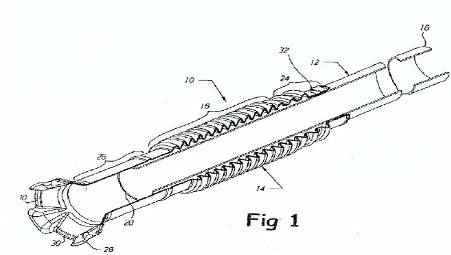
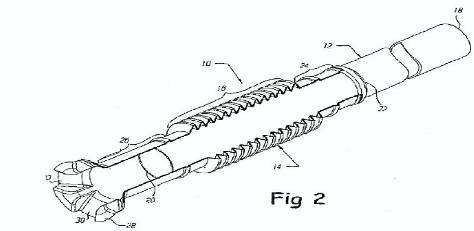
12 With regard to Figure 1, the specification states.
Fig 1 shows a variable-length dip tube 10 suitable for connection to a dry-break valve closure for a container. It has two component parts, including a longer tube 12 and, to fit over the longer tube in the manner of a sleeve, a shorter tube 14. The shorter tube includes an easily compressible and extensible concertina bellows 16. The longer tube is straight, relatively rigid and attachable at its top end 18 to a pump or valve for insertion into a container. At a pre-determined distance from its other end 20, it has an ultrasonically welded patch 32 to fix the shorter tube to the longer in the required position. The concertina bellows is between two portions 24, 26 of straight, relatively rigid plain tube. The upper end 24 of this tube has an inside diameter just larger than the outside diameter of the longer tube and makes fluid tight contact with the outside surface of the longer tube adjacent to the welded patch 32. The remainder of the shorter tube, including the concertina bellows and the second end portion are loose clearance fits, thereby acting as a sleeve over the open end of the longer tube. The lower end of the shorter tube has, as part of the one-piece moulding, a foot 28 that contacts the bottom of the drum and has channels 30 which guide the flow of liquid from the drum into the dip-tube. The foot has a diameter that fits inside a small well in the bottom wall of the container, into which the remaining liquid drains when the container is almost empty. This ensures maximum possible emptying of the drum.
The length of the longer tube is determined in advance of providing the dip tube for a particular application. When assembled to the particular valve or pump desired, it must be short enough not to touch the bottom of the shortest drum or container in which it is to be installed. However, it must be not so short that the shorter tube, when fully extended, does not fall short of touching the base of the drum, since, otherwise, all the contents could not be withdrawn. When correctly sized, the length of the longer tube will result in the all drums of required nominal capacity being substantially completely emptied, regardless of individual manufacturing process-based variances in their inside height between the bung-hole and the bottom wall vertically below the bung-hole.
The two tube components are made of polypropylene of a grade suitable for extrusion of the longer tube and blow moulding of the concertina tube and suitable for resisting environmental stress-cracking by substances which are prone to induce environmental stress-crack failure in many commodity plastics resinous materials such as used for container and closure manufacture ...
13 With regard to Figure 2, the specification provides:
Fig 2 shows an embodiment of dip tube according to the invention identical in every way to the embodiment shown in Fig 1 except that the longer tube 12 may have, at a pre-determined distance from its ends 18, 20, a circumferentially extending cuff 22 to provide a location stop to assist positioning the shorter tube to the longer where it is fixed. The cuff 22 can be a full circumferential ring of outside diameter greater than that of the remainder of the longer tube. The exact outside diameter is not crucial but it may be approximately the same as the outside diameter of the shorter tube. The cuff 22 provides a positive location when assembling the shorter tube to the longer tube. The cuff 22 may be separately formed and attached to the longer tube 12 such as by fusion, adhesive bonding or shrinking on.
14 The VIP Patent subsequently indicates that there are various “[o]ptional features or preferences” that may be varied, including the use of environmental stress-cracking resistant grades of polypropylene or HDPE “if a particular application does not involve any particular substance inducing that mode of failure”.
PRINCIPLES OF CONSTRUCTION
15 The first step in a case such as this is to ascertain the invention described in the specification and, in particular, as claimed in claim 1, since BMW contends that all points of distinction between the invention as claimed in the VIP Patent and the BMW product apply in relation to claim 1. As Stone J observed, however, in Clorox Australia Pty Ltd v International Consolidated Business Pty Ltd (2006) 68 IPR 254 (“Clorox”) at 260 [13], it is important that consideration of the allegedly infringing product does not influence the determination of the proper construction of the claims.
16 It is for the Court to construe the claim or claims that define the invention the subject of the patent, aided by the relevant evidence adduced in the case: see El Dupont & Co v Imperial Chemical Industries Plc (2002) 54 IPR 304 (“El Dupont”) at 323 [59]. The principles according to which the Court is to construe the claims are well established: see Decor Corporation Pty Ltd v Dart Industries Inc (1988) 13 IPR 385 (“Decor”) at 400 and Kinabalu Investments Pty Ltd v Barron and Rawson Pty Ltd [2008] FCAFC 178 (“Kinabalu”) at [44]. Amongst other things, the specification must be read as a whole and in light of the common general knowledge in the art before the priority date. The common general knowledge is the general knowledge of the notional skilled addressee. The words used in the specification are to be given the meaning that the skilled addressee would give them, in light of the addressee’s own general knowledge and in light of what is disclosed in the body of the specification: see Kinabalu at [44].
17 A patent specification must be given a purposive construction and not a literal construction: see Decor at 400; Clorox at 261 [18]; Root Quality Pty Ltd v Root Control Technologies Pty Ltd (2000) 49 IPR 225 (“Root Quality”) at 236 [44]-[45]; Populin v HB Nominees Pty Ltd and Binder (1982) 41 ALR 471 at 476; Nesbit Evans Group Australia Pty Ltd v Impro Ltd (1997) 39 IPR 56 at 81; and Catnic Components Ltd v Hill & Smith Ltd [1982] RPC 183 (“Catnic”) at 242-3.
18 In construing a claim or claims, reference can be made to the specification to explain the background, to ascertain the meaning of technical terms, and to resolve ambiguities: see Kinabalu at [44] and Clorox at 260 [16]. Nonetheless, the focus is on the claims. Whilst the claim or claims must be construed having regard to the specification as a whole, the court cannot “narrow or expand the boundaries of the monopoly as fixed by the words of a claim, by adding to those words glosses drawn from other parts of the specification”: Decor at 400 and Kinabalu at [44]. If a claim is clear and unambiguous, the claim cannot be varied, qualified, or made obscure by reference to statements in other parts of the specification.
19 Admissible evidence may be given by persons with the knowledge, skill and experience of the notional skilled addressee as to how that addressee would have read the specification in the patent in suit or a prior publication: see El Dupont at 323 [59]. Evidence may also be given by experts as to the meaning that those skilled in the art would give to technical or scientific terms, and as to unusual or special meanings that those skilled in the art would attribute to words that might otherwise bear their ordinary meanings. See Clorox at 262 [21] and Glaverbel SA v British Coal Corp [1994] RPC 443 at 486. It is ultimately for the Court to determine the weight to be accorded all such evidence: compare Clorox at 262 [22], citing Allsop Inc v Bintang Ltd (1989) 15 IPR 686 at 697.
20 The relevant art in this case is the manufacture and use of dip tubes, particularly in chemical transfer drums or like containers used in the agricultural and veterinary fields. The skilled addressee is the non-inventive person skilled in the art before the priority date: see, e.g., Clorox at 261 [20]. That is, as Finkelstein J said in Root Quality at 241 [71], the skilled addressee is “the person who works in the art or science with which the invention is connected”. Plainly enough, skilled addressees are likely to have “a practical interest in the subject matter of [the] invention”: see Catnic at 242.
21 Mr Mandile, the named inventor, expressed an opinion about the attributes of a person skilled in the art of making and using dip tubes. In his view, these attributes included a good working understanding of the processing of plastics and the manufacture of plastic products (involving, amongst other things, an understanding of varying grades and types of plastics and manufacturing processes such as extrusion and blow, injection and vacuum moulding, as well as the economies of such processes). According to Mr Mandile, it was also necessary to have some experience and understanding of the manufacture of large plastic fluid containers (of a size more than 20 litres in volume) incorporating some sort of extraction system. Further, it was necessary to have an understanding (of the kind that a chemical engineer would have) of the environmental stress effects on plastics and the performance characteristics of varying grades of polymers under stress and when interacting with the types of chemicals solutions used in agriculture and likely to be stored in the drums. Finally, it was necessary to have some familiarity with the various products and solutions that had been tried in the industry. In Mr Mandile’s opinion, knowledge of this kind was generally confined to people working in the plastics industry, who had experience in the design and processing of plastic containers of larger sizes and the manufacture of plastic packaging and transfer of chemical fluid to and from such packaging. In cross-examination, Mr Mandile stated that he regarded himself as a person skilled in working in the field of dip tubes for agricultural and horticultural purposes.
22 Wellcome Foundation Ltd v VR Laboratories (Aust) Pty Ltd (1981) 148 CLR 262 (“Wellcome”) at 287 decided that evidence of research and experiments (if any) of a patentee leading up to the claimed invention is generally admissible, subject to the caveat that such evidence is “not always likely to be helpful”. By the same process of reasoning, evidence of the inventor’s opinion as to the characteristics of a person who works in the art with which the invention is concerned is admissible, although the Court must assess such evidence carefully.
23 With this in mind, I accept that, on the basis of the evidence in this case, including that of Mr Mandile, the skilled addressee is a person with practical knowledge of and experience in the manufacture of plastic products, particularly large fluid containers incorporating some kind of extraction system. That is, such a person would have practical knowledge and experience in the manufacture of plastic packaging for the storage of fluid and the transfer of such fluid from the packaging. Such a person would also have an understanding of the environmental stress effects on plastics.
24 In opening, counsel for BMW submitted that “just about any engineer with a basic knowledge of manufacturing techniques and a basic knowledge of mechanics of devices could be classified as a skilled addressee”. I reject this proposition, which was contrary to the evidence. Counsel for BMW further submitted that Professor Field could be regarded as both a person skilled in the art or a skilled addressee and a relevant expert. Whilst Professor Field had specialised knowledge based on his training, study and experience, I reject these propositions. I discuss the admissibility of Professor Field’s evidence hereafter.
25 In this case there were only two witnesses at trial who worked in the art or science with which the invention as claimed in the VIP Patent was concerned. One was the named inventor, Mr Mandile, and the other was Mr McFadyen, a member of VIP’s design team who had assisted Mr Mandile. Notwithstanding the parties’ apparent agreement that Mr Mandile was a skilled addressee, I doubt that Mr Mandile can properly have this status since (at least on VIP’s case) he cannot properly be said to be a non-inventive person skilled in the art.
26 There was limited evidence as to the nature of Mr McFadyen’s responsibilities in the design team. I need not, however, enquire further as to his status as a non-inventive person skilled in the art, since both parties agreed that he was in fact a skilled addressee. There was no challenge to the admissibility of his evidence on this or any other account. Indeed, it was clear enough that Mr McFadyen was a skilled and practical worker in the art with which the invention as claimed was concerned. There was no other witness fitting (or better fitting) the description of a skilled addressee (or non-inventive person skilled in the art) who gave evidence at trial.
THE CLAIMS
27 The VIP Patent is for a combination of integers. Argument at trial focussed on claim 1. Claim 1 of the complete specification as amended (but as presented in the form relied on by the parties at trial) is as follows:
A variable-length dip tube suitable for connection to a closure for a container comprising:
a first tube and a second tube, one of which is attachable to a closure for a container,
the first tube is of fixed length and is adapted to fit inside the second tube,
the second tube has a collapsible and extensible portion intermediate [] upper and lower [e]nd portions of the second tube,
at least a part of the upper end portion being in fluid tight contact with the first tube at a distance from the lower end of the first tube,
said collapsible and extensible portion and said lower end portion being a loose clearance fit over the first tube,
said distance being such that a lower end of the first tube extends to a position just below the end of the collapsible and extensible portion so that the first tube inhibits bending of the collapsible and extensible portion.
I accept Mr McFadyen’s evidence as to the slips in claim 1. What is set out above reflects this fact. None of these slips is material in this proceeding.
28 The other relevant claims are all dependent on claim 1 as operating in combination with it. These claims are as follows:
Claim 2:
The dip tube of claim 1, wherein said collapsible and extensible potion includes a concertina bellows portion.
Claim 5:
The dip tube of any preceding claim further including a foot portion at the lower end portion of the second tube.
Claim 6:
The dip tube of claim 5, wherein the foot portion and the lower end portion of the second tube are formed as one piece.
Claim 7:
The dip tube of any preceding claim, wherein the first and second tubes are formed from environmental stress crack-resistant grades of plastics resin.
Claim 8:
The dip tube of any preceding claim in which the second tube portion is blow-moulded while the first portion is extruded.
Claim 10:
The dip tube of any preceding claim, wherein the second tube is fused joined to the first tube.
Claim 11:
The dip tube of any preceding claim, wherein the second tube is fused joined to the first tube by ultrasonic welding.
As Mr McFadyen noted, both claims 7 and 11 contained the same typographical mistake, in that each referred to a “tip” tube rather than a “dip” tube. Nothing turns on this.
THE BMW PRODUCT
29 BMW admitted that most elements of claim 1 were present in the BMW product (see “A2” and “BWF 10”): see agreed statement and Notice Disputing Facts dated 14 August 2009. In particular, BMW admitted or agreed that the BMW product has each of the following features:
a. In relation to claim 1:
i. A variable-length dip tube suitable for connection to a closure for a container;
ii. The dip tube comprises a first tube and a second tube, one of which is attachable to a closure for a container;
iii. The first tube is of a fixed length and is adapted to fit inside the second tube; and
iv. At least a part of the upper end portion of the second tube is in fluid tight contact with the first (or inner) tube at a distance from the lower end of the first tube.
b. In relation to claim 2:
i. The features of claim 1 contained in a. above; and
ii. The BMW dip tube having a collapsible and extensible portion which includes a concertina bellows portion.
c. In relation to claim 5:
i. The features of claim 1 contained in a. above or the features of claim 2 contained in b. above; and
ii. The second tube having a foot portion.
d. In relation to claim 7:
i. The features of claim 1 contained in a. above, the features of claim 2 contained in b. above or the features of claim 5 contained in c. above; and
ii. The first and second tubes are formed from environmental stress crack-resistant grades of plastic resin.
e. In relation to claim 8:
i. The features of claim 1 contained in a. above, the features of claim 2 contained in b. above, the features of claim 5 contained in c. above or the features of claim 7 contained in d above; and
ii. The second portion is blow moulded.
f. In relation to claim 10:
i. The features of claim 1 contained in a. above, the features of claim 2 contained in b. above, the features of claim 5 contained in c. above, the features of claim 7 contained in d above or the features of claim 8 contained in e. above; and
ii. The second tube is fused to the first tube.
g. In relation to claim 11:
i. The features of claim 1 contained in a. above, the features of claim 2 contained in b. above, the features of claim 5 contained in c. above, the features of claim 7 contained in d above, the features of claim 8 contained in e. above or the features in claim 10 contained in f. above; and
ii. The second tube is fused joined to the first tube by ultrasonic welding.
30 Despite these admissions, BMW maintained that the BMW product did not infringe because it lacked the following integers of claim 1 and its dependent claims – namely:
(a) a second tube which has a lower end portion;
(b) a second tube the lower end portion of which is a loose clearance fit over a first tube;
(c) a first tube which inhibits bending of a collapsible and extensible portion of a second tube; or
(d) a first tube which extends to a position just below the end of a collapsible and extensible portion of a second tube so that the first tube inhibits bending of the collapsible and extensible portion of a second tube.
31 Items (c) and (d) are stated to be alternative descriptions of the same point. The dispute in the present proceeding focuses on these elements.
THE EVIDENCE
32 I summarise below the evidence given by each witness relied on by the parties except Mr Kraemer. BMW did not refer to his affidavit in closing submissions. As the ensuing discussion shows, however, these summaries are not in any sense exhaustive of the relevant witness’s evidence.
Mr McFadyen’s evidence
33 At the time of the trial, Mr McFadyen was a Senior Design Engineer at VIP, with a Bachelor’s degree in chemical engineering from the University of Sydney and around forty years’ experience in the packaging industry. In 1984, he had been elected a Fellow of the Australian Institute of Packaging; and, in 1998, a National Vice President of the Australian Institute of Packaging. He had joined an earlier emanation of VIP in 1999, as part of the design division. In late 1999 to early 2000, Mr McFadyen assisted Mr Mandile in the development of the invention the subject of the VIP Patent.
34 Notwithstanding that Mr McFadyen was, in this historical sense, associated with the invention and a long-standing VIP employee, he impressed me as a most reliable witness. Unless otherwise indicated, I have accepted his evidence.
35 In his first affidavit, Mr McFadyen explained claim 1 in the following way:
Claim 1 requires that the collapsible and extensible portion of the second tube and the lower end portion of the second tube are “a loose clearance fit” over the first tube. The collapsible and extensible portion of the second tube is flexible and bends easily. Its purpose is to allow deformation in the vertical sense (along the axis of the tube) only, and sideways bending is not desirable. Sideways bending can lead to cracking in the collapsible and extensible portion. By extending the more rigid first tube through the collapsible and extensible portion of the second tube, the collapsible and extensible portion of the second tube is permitted to collapse and extend in the vertical sense, but is prevented from undesirable sideways bending. So the rigidity of the first tube acts as an internal vertical guide for the collapsible and extensible portion of the second tube. To be an effective guide, the collapsible and extensible portion of the second tube only has to be a loose clearance fit over the first tube and should extend through the entire length of the collapsible and extensible portion of the second tube to prevent sideways bending of the collapsible and extensible portion of the second tube.
Giving the words “loose clearance” their ordinary meanings, the word “loose” means that the fit is not tight, so as to allow the collapsible and extensible portion and the lower end portion to move, in the vertical sense, in relation to the lower end of the first tube. The word “clearance” simply means that there is a gap or space between the first tube and the collapsible and extensible portion and the lower end portion of the second tube to allow the relative movement just referred to to take place.
36 In cross-examination, Mr McFadyen reiterated that the term “loose clearance fit” was not a term with a special technical meaning.
37 Mr McFadyen said that he had examined BMW’s product. His evidence was that the BWM product included all the disputed elements in claim 1 and the dependent claims. Mr McFadyen reiterated this evidence in cross-examination.
38 In cross-examination, Mr McFadyen repeated that, his opinion, there was a loose clearance fit between the lower end of the second tube and the first tube. In his fourth affidavit and in cross-examination, he said that, in the present context, for there to be “a loose clearance fit”, “the clearance is to be such that it can act as to inhibit the bending of the bellows”. Mr McFadyen reaffirmed in cross-examination that the inner tube in the BMW product (“A2”) projected just below the end of the collapsible and extensible portion (the bellows); and that the extension inhibited the bending of that portion. Also, in cross-examination, Mr McFadyen said in substance that bending and compressing the bellows of “A1” (sample VIP product) and “A2” (sample BMW product) showed no functional difference.
39 In cross-examination, Mr McFadyen was asked about bellows generally and the foot portion of the MicroMatic sample product (“FCM 4”) in particular. Mr McFadyen agreed that he knew the function of the bellows and foot portion well, and that he would design a dip tube with some sort of foot at the bottom. Mr McFadyen also agreed that, in seeking to solve a problem of environmental stress cracking, it would be routine to consider using different materials, different grades of the same materials, and different designs for the product. Further, he agreed that, depending on the environment and the polymer, some methods of joining polymers would be better than others, including ultrasonic, heat, or spin welding.
40 In cross-examination, Mr McFadyen stated that the VIP dip tube product was produced in a mould in separate pieces, perhaps for reasons of convenience. He also said that the MicroMatic product was made of a different material to the VIP product. The MicroMatic product was mostly made of a blow-moulding grade of polyethylene, although the foot and cover were made of an injection-moulding-grade polyethylene. These were materials of different molecular weights.
41 Also, in cross-examination, Mr McFadyen agreed that the invention the subject of the Hancock Patent (see especially Fig. 6) functioned in much the same way as the invention in the VIP Patent. In his opinion, however, there were material differences between these two inventions. Mr McFadyen suggested one difference in the following exchange concerning the Hancock Patent:
Counsel for BMW: [I]t’s a matter of convenience that the items 150 and 32 [on Fig. 6] were produced first as separate components, then joined?
Mr McFadyen: No, I don’t believe that’s correct. My understanding of what I read in this patent here, this Hancock, is that that portion 150 is made out of a different material, and that material would be unsuitable for a dip tube.
Counsel for BMW: You say unsuitable for a dip tube. What sort of dip tube?
Mr McFadyen: Well, it would not withstand the vacuum. ...
...
Counsel for BMW: [Y]ou seem to be saying that item 150 in [Fig. 6], the Hancock Patent, would not withstand vacuum?
Mr McFadyen: It’s claimed to be made of and, again, I’m reading into my understanding of what I read in [the Hancock Patent] the preferred material is an elastomer, which is a rubber. I would suggest that the bottom portion, if that was made of rubber, would be unsuitable and that it would collapse.
42 In cross-examination, Mr McFadyen agreed that Figure 6 in the Hancock Patent discloses a height compensator (in the sense that it compensates for the height of the tube): see paragraph [109] below. Mr McFadyen disagreed with the proposition that “the height compensator of the Hancock Patent serves exactly the same function as [VIP’s] variable-length dip-tube”. Mr McFadyen said that the Hancock invention:
... is for water. It is just to accommodate for the different heights ... of the container. In the case of the VIP tube, ... the variable length is to compensate for minor differences in the container but also changes in the dip tube due to the environment.
43 Immediately thereafter, counsel for BMW put to Mr McFadyen that “both ... compensate for changes in the distance between the top of the container and the bottom of the container”. Mr McFadyen again disagreed, saying that this was only true of the Hancock invention because “it is water you wouldn’t expect the tube to be altered in any way by compatibility”. Mr McFadyen also disagreed with the proposition that the combination of item 150 and item 32 in Figure 6 of the Hancock Patent was a tube, because he considered that they were two tubes. In Mr McFadyen’s view, when account was taken of item 25, Figure 6 disclosed three tubes: see paragraph [109] below. According to Mr McFadyen, the components had different functions and were not made of the same material. Mr McFadyen’s evidence was that the function of item 32 was to seal against item 25. If the bellows (item 150) were made of elastomer, there would be a sealing effect between item 25 and item 150 and, possibly, between item 150 and item 32 (if stretched over that tube). Mr McFadyen did not consider the latter sealing effect as necessary if there were a seal between item 25 and item 32. If there were no sealing effect between item 150 (the bellows) and item 125, the bellows would compress and act as a spring. Finally, Mr McFadyen agreed that item 15 could go up and down but could not bend because item 25 and item 32 were in close contact.
Mr Mandile’s evidence
44 Mr Mandile deposed that he was the inventor of the VIP Dip Tube, which was the subject of the VIP Patent. Counsel for VIP stated that VIP was not relying on Mr Mandile’s evidence to explain the VIP Patent or to define the scope of the claims. Rather, VIP relied on Mr Mandile’s evidence as to the state of common general knowledge as at the priority date (24 February 2000) and as to the problem to be solved. VIP accepted that Mr Mandile was “[o]bviously historically allied” but submitted that this factor affected the weight of his evidence only. Generally speaking, I have treated Mr Mandile’s evidence in accordance with VIP’s submissions. Broadly speaking, this approach is consistent with Wellcome.
45 Whilst I necessarily treat the inventor’s evidence cautiously, I would note that I found Mr Mandile to be a thoroughly honest witness who was plainly endeavouring to assist the Court as best he could.
46 Although retired at the time of the trial, Mr Mandile had many years of experience in the packaging industry, having begun work in it in 1966. Like Mr McFadyen, amongst other things, Mr Mandile held a Bachelor’s degree in Chemical Engineering from the University of Sydney. As at January 2010, he was a member of the Plastic Industry Manufacturers Association and Secretary of the Blow Moulders’ Institute of Australia. He had been President of that Institute from 1991 to 2006.
47 Mr Mandile stated that, by reason of his employment history, in 1999-2000, he was familiar with the market for packaging chemical solutions used in agriculture in Australia. Mr Mandile stated that:
These chemical solutions were often sold in drums of varying volumes made of steel or plastic, sealed with a cap on the top. Users utilized a “dip tube” inserted through the top, when the cap was removed, which tube was attached to a valve and a pump to empty the contents.
48 Mr Mandile also stated that, in 1999-2000, drum and dip tube assemblies were most popular. In such an assembly, the dip tube was affixed to a valve and assembled in the drum, which was then filled and sold in that configuration. Mr Mandile noted that:
A commercial virtue of the design of the drum/dip tube assembly was that, once filled, the drum was sealed and could remain sealed throughout its use. ...
[It] was essential that the integrity of the seal was maintained throughout the use and return of the drum ... That requirement imposed a further practical requirement that the system allowed recovery of virtually all the liquid in the drum so that waste was negligible and commercially acceptable and there was no need to open the drum to recover the last of its contents. This requirement in turn mandated that the dip tube should reach to the bottom of the drum to maximize contents recovery ...
Mr Mandile went on to observe that at this time dip tubes commonly had a bellows section, which could compress under pressure and allow the tube a range of adjustment in length or depth. The flexibility of the bellows section also mean that “the dip tube tended to cant or buckle which lead to extraction problems”.
49 According to Mr Mandile, as at 1998-2000, his then employer (an earlier emanation of VIP) used a type of dip tube that was manufactured by MicroMatic in the United States of America (“the MicroMatic Dip Tube”). Mr Mandile deposed that “[t]o [his] knowledge from working in the field and to the best of my recollection, no equivalent substitute for the MicroMatic Dip Tube was available or in use in Australia at the time”. He repeated this in cross-examination, explaining that whilst other dip tubes, such as the CypherCo Dip Tube, were available, no other dip tube at the time performed as well as the MicroMatic Dip Tube. His evidence in cross-examination was that the CypherCo Dip Tube “was made of a plastic valve” and would “not stand up to the rigours” of use in the relevant environment. Mr Mandile said that his customer, CropCare, only used the MicroMatic Dip Tube.
50 In his affidavit, Mr Mandile gave the following description of the MicroMatic Dip Tube:
The MicroMatic Dip Tube [was] comprised of two joined tubes, the inner one of which had a bellows section near the end of the tube with a small section of tube below. This tube is the conduit for fluid transfer. An injection moulded outer section is attached to the base of inner tube by a “snap-lock” fitting and comprises an outer sleeve and foot to the dip tube. The sleeve extends back up over the inner or first tube covering the bellows section, thereby forming a loose fit around it, which is intended to stiffen and support the bellows section and inhibit it collapsing or buckling. The two components are made from high density polyethylene (“HDPE”).
51 Mr Mandile deposed to the tendency of the MicroMatic Dip Tube to crack around the bellows and where the tubes were pushed onto the MicroMatic valve stem. Mr Mandile and other members of his employer’s design group investigated the problem with a view to finding a solution. In cross-examination, Mr Mandile stated, in effect, that there were two ways of addressing the problem of cracking. The first was to change the material out of which the dip tube was made; and the second was to reduce the stress that led to the cracking. His evidence was that the manufacturer of the MicroMatic Dip Tube was consulted about changing the material, but that the manufacturer was not interested in doing this.
52 Mr Mandile’s evidence was that the invention (as claimed in the VIP Patent) was the result of work by him and other members of his employer’s design group to solve the problems with the MicroMatic Dip Tube. Mr Mandile described a practical process and one in which he did not search other patents or literature. Only one prototype was in evidence (“FCM 7”). Mr Mandile’s evidence was that, in his experience, no-one in the industry in Australia did, or would have done, a patent search to address the problems presented by the MicroMatic Dip Tube.
53 In cross-examination, Mr Mandile agreed that, as at February 2000 – the use of bellows to provide a collapsible and extensible portion in a dip tube; the use of a foot portion as in the MicroMatic sample; environmental stress crack resistant types of plastic resins; blow moulding of plastics; environmental stress resistant grades of polypropylene; methodologies for fuse-joining of polymer materials – were all known to those working in the field.
54 Mr Mandile also gave some evidence about the Hancock Patent (which was not the subject of objection). Amongst other things, Mr Mandile’s evidence was that the apparatus in the Hancock Patent was assembled from three parts as opposed to the two of the invention in the VIP Patent. Mr Mandile said that:
This is a significant difference since additional parts involves additional assembly and seals. These have implications for cost and as potential points of failure of the apparatus.
Mr Ware’s evidence
55 Mr Ware was an associate of the firm of solicitors acting for VIP and a patent attorney. In his affidavit, he deposed as to the steps that he would have taken had he been conducting a search for prior art in relation to the subject matter of the VIP Patent as at 24 February 2000. He also said that his search would not have located the Hancock Patent because “the abstract or title does not contain the phrase ‘extend* or telescop* or (variable and length)’”. Mr Ware was not cross-examined.
Professor Field’s evidence
56 As indicated above, VIP maintained its objections to the admissibility of that part of Professor Field’s evidence provisionally admitted pending final submissions. For the reasons that follow, I would uphold VIP’s objections.
57 As noted above, Professor Field was Associate Professor of Engineering at Monash University and an engineering consultant. Professor Field’s first affidavit disclosed that he was a mechanical engineer and had published books and papers on engineering design theory, engineering education, the innovation process, and mechanical equipment research and development. In oral evidence, Professor Field stated that he had acted as “solely [a] professional engineer for the wool industry for 10 years in the 1980s” and, since then, he had “mainly been an academic, teaching in the area and consulting in minor ways for engineering”.
58 Section 76(1) of the Evidence Act 1995 (Cth) (“the Evidence Act”) provides that “[e]vidence of an opinion is not admissible to prove the existence of a fact about the existence of which the opinion was expressed”. Section 79(1) provides, however, that “[i]f a person has specialised knowledge based on the person's training, study or experience, the opinion rule does not apply to evidence of an opinion of that person that is wholly or substantially based on that knowledge”. Evidence that is not relevant is inadmissible: see s 56. Further, under s 80, evidence of an opinion is not inadmissible only because it is about a fact in issue or an ultimate issue. Thus, if evidence of an opinion is otherwise admissible, the opinion may be about a fact in issue or an ultimate issue.
59 The first important point to make about Professor Field’s evidence is that Professor Field is not in the class of skilled addressees. Indeed, in cross-examination, Professor Field readily conceded that he was not in the class of people that he himself had described as skilled in the art of dip tubes, and that Mr McFadyen and Mr Mandile were in this class. Professor Field simply did not fall within the class of people who could be regarded as “a skilled addressee and in a position to give expert evidence of assistance to the Court, or a person whose evidence, together with other evidence, creates the construct of the skilled addressee”: see Fina Research SA v Halliburton Energy Services Inc [2003] FCA 55 (“Fina”) at [3] (Moore J).
60 Of course, in a case such as this, a court may receive expert evidence from persons other than skilled addressees if it is otherwise relevant. There was, however, a serious difficulty with Professor Field’s evidence in another respect: it was not just that he was not a skilled addressee but that he had no history of working in the fields of dip tubes or plastics, or some related field. Without this specialised knowledge, based on training, study or experience, Professor Field was not in a position to give relevant evidence to the court bearing on the meaning of the VIP Patent or a prior publication, the issue of novelty and the issue of obviousness: compare Fina at [8].
61 The second point to note is that, to the extent that Professor Field gave evidence based on his specialized knowledge of the industrial innovation process, he did not give evidence within the art. Opinion evidence of this kind was not relevant to any issue in the proceeding: compare British Celanese Ld v Courtaulds Ld (1933) 50 RPC 63 at 90.
62 A further difficulty with Professor Field’s evidence was that, in so far as he expressed opinions involving mixed questions of fact and law, his opinions were in some key instances apparently based on mistaken understandings of the relevant legal principles. See, in this regard, Minnesota Mining and Manufacturing Company v Tyco Electronics Pty Ltd (2002) 56 IPR 248 at 259 [49].
63 Moreover, as already noted, on the issue of obviousness, in his 8 August 2009 report (referred to below as “BWF 8”) at par [4.5.5], Professor Field posited “the inverted solution”, which he relies on in his 20 August 2009 report (referred to below as “BWF 20”) to justify his opinion of obviousness. In BWF 20, Professor Field noted that he had received the Nufarm sample on 19 June 2009 but did not also mention that the Nufarm sample dip tube had an internal tube running partially through the bellows section of a lower outer tube, when discussing obviousness. The Nufarm sample dip tube has at the least a “close ... arrangement to the VIP Dip Tube”.
64 It is evident from Professor Field’s lack of relevant qualifications and, indeed, his own evidence, that he could not give reliable evidence of the state of the common general knowledge of a skilled addressee in the relevant art as at 24 February 2000: contrast Wellcome at 287.
65 The following paragraphs outline Professor Field’s evidence and state the rulings on VIP’s objections to admissibility.
66 In BWF 8, Professor Field gave evidence as to the class of persons that were to be regarded as skilled addressees and as to the state of common general knowledge of those skilled addressees as at the priority date. Thus, in BWF 8, Professor Field said that:
[T]he person who was skilled in the art of dip tubes as at 24 February 2000 and was in a position to comprehend problems and solutions with dip tubes required two attributes: a practical understanding of the function of dip tubes and a basic knowledge of manufacturing methods and economies relevant to dip tube production.
Broadly speaking, this conformed to Mr Mandile’s evidence on the point.
67 Professor Field went on to describe “[t]he types of person with the relevant practical understanding of dip tubes”; “[t]he types of person with the relevant knowledge of manufacturing alternatives of dip tubes”; and the common general knowledge that he attributed to them as at 24 February 2000. He stated that he was unaware of “any particular text or articles that reflected the general knowledge assumed to be held by the person skilled in the art”. As counsel for VIP noted, his statements about this common general knowledge were “couched in the language of supposition”. VIP did not, however, disagree with Professor Field’s statement that “only very few persons skilled in the relevant art would have accessed” “information about dip sticks ... available from patent literature in February 2000” “as a matter of course”. In this regard, Professor Field’s evidence was also consistent with that of Mr Mandile.
68 In BWF 8, Professor Field also expressed the view that a person skilled in the art of dip tubes and motivated to address the “buckling problem” might either have engaged an outside expert or have attempted to solve the problem himself. Professor Field outlined various possibilities that might have led to a solution from the perspective of a professional innovator, as opposed to the perspective of the skilled addressee. That Professor Field placed himself in this former category was clear from his evidence in his cross-examination. The perspective of a professional innovator is not, however, relevant to any issue in the proceeding. Professor Field’s description of what a skilled worker within the field might do was almost entirely speculative. He was unable to give evidence about the nature of the routine tests and procedures that those skilled in the art would conduct.
69 Possibly too, his report was further compromised by reference to “common sense” as a subset of suggested relevant experience or knowledge – a subset introduced by the question to which he was asked to respond. As VIP’s counsel pointed out and BMW’s counsel conceded, this was not a relevant category of knowledge.
70 For reasons stated below, omitting formal parts, much, if not all, of BWF 8 was inadmissible. To the extent that it was admissible, I would accord BWF 8 little weight.
71 In his 14 August 2009 report (referred to below as “BWF 12”), Professor Field expressed a view about the “basic knowledge of plastics manufacturing methods that would have been held by a person who had a practical understanding of the function of dip tubes”. This short additional report suffered from the same defects as those already outlined. For these reasons too, BWF 12 was largely, if not wholly, inadmissible. In so far as any of BWF 12 was admissible, I would accord it little weight.
72 BWF 20 depended for its admissibility, first, on whether it could be said to be wholly or substantially based on Professor Field’s training, study or experience. As set out above, Professor Field was not a skilled addressee and his training, study and experience was not in dip tubes, plastics, or any relevantly related field. His evidence as to the common general knowledge of a skilled addressee and as to the “routine” tests that such an addressee would conduct lacked any proper basis: it was in the nature of mere surmise. I note too that this report is also compromised by reference to the irrelevant category of “common sense experience”.
73 For the reasons stated, omitting formal parts, that which remains of BWF 20 was inadmissible. To the extent that it was admissible, I would accord BWF 20 little weight.
74 In a second affidavit of 9 February 2010, Professor Field responded to Mr McFadyen, stating that, in his opinion:
(a) A tube “is a construction which has a fully enclosed internal space with a substantially uniform wall thickness and is of substantially uniform cross-section lengthwise … [A] person skilled in the art of dip tubes would have the same understanding”.
(b) As to the requirement that “a lower end of the first tube extends to a position just below the end of the collapsible and extensible portion so that the first tube inhibits bending of the collapsible and extensible portion” the skilled addressee would (so Professor Field thought) interpret these features of claim 1 as requiring inhibiting of both: (1) sideways displacement of the lower end of the bellows with respect to the axis of the first tube; and (2) bending angularly, to prevent the central axis of the lower end of the bellows from adopting an oblique angle to the axis of the first tube. His view was that, in the case of the VIP Patent, “[t]his pair of constraints was achieved by making the lower portion of the second tube a clearance fit over the first tube, and of sufficient common length that the tubular parts remained largely concentric and parallel”.
(c) In comparison, it was (so Professor Field said) the bellows in the BMW dip tube that was used to guide axially the lower end of the “second tube”. The short (and what he described as “zero”) axial length of contact between the lowest convolution of the bellows and the first tube on the BMW design, coupled with their very large clearance, meant that the BMW arrangement inhibited only lateral deflection of the bellows and the lower foot portion. According to Professor Field, the BMW arrangement did not inhibit angular bending of the bellows, “and the person skilled in the art of dip tubes would interpret the functionality of the VIP clearance fit … as a requirement to inhibit significant angular bending”.
(d) The lower cylindrical extension of the BMW “second tube” only had one functional purpose – to rigidly connect the castellated opening to the bellows. The BMW design, so Professor Field said, did not have a lower tubular portion (in the functional meaning of “tube”) at all, but the lower portion of the foot had a unique self-aligning characteristic.
75 Professor Field summarized his conclusions in drawings, concluding that the BMW product did not have all the features of claim 1 of the VIP Patent. Nor, in his opinion, did the BMW product have all the features of the other allegedly infringed claims.
76 The first difficulty with Professor Field’s 9 February 2010 affidavit is that the opinions expressed in it are not shown to be wholly or substantially based on his specialised knowledge based on his training, study or experience. Unless this is shown, then Professor Field’s opinion evidence is inadmissible. Secondly, even if it is assumed that his opinion evidence is based on his training, study and experience as a mechanical engineer, it is an irrelevant opinion. Professor Field is not a skilled addressee and he cannot therefore give a skilled addressee’s opinion. As indicated above, Professor Field is unable, relevantly, to comment on the state of the relevant common general knowledge as at the priority date. His field of training, learning and study is mechanical engineering but this is not the art in question. An opinion based on this training, learning and study is not relevant to an issue in the case. I would not, therefore, regard Professor Field’s opinion evidence about the meaning of “tube”, “loose clearance fit” and “fit” as relevant and admissible in this case. If I were wrong about this, however, I would, for the reasons stated, accord his evidence less weight than that of Mr McFadyen, whom the parties accepted was a skilled addressee. In any event, as already indicated, Mr McFadyen impressed me as a most reliable witness with a great deal of practical knowledge and experience in the relevant field.
77 For much the same reasons, I would not accept Professor Field’s evidence as to what a skilled addressee would understand the promise of the VIP Patent to be, with respect to the inhibition of bending. As I have said, Professor Field is unable to give relevant and admissible evidence as to what a skilled addressee would understand and as to the common general knowledge as at 24 February 2000. Further, the claims of the VIP Patent do not support the construction that Professor Field seeks to give. I would therefore reject the distinction that he seeks to draw in this regard between the invention as claimed in claim 1 of the VIP Patent and the BMW product. For the same reasons, I would reject Professor Field’s opinion evidence concerning the foot.
78 I would uphold VIP’s objection to the remaining parts of Professor Field’s 9 February 2010 affidavit on the basis that it is inadmissible because it is either irrelevant or fails to satisfy the requirements of s 79 of the Evidence Act. To the extent that it was admissible, I would accord the affidavit limited weight.
79 In a third affidavit sworn on 2 March 2010, Professor Field gave an opinion as to the economics of plastics processing and an opinion as to the versatility of the “Hancock design”. In relation to the Hancock Patent, Professor Field said:
[I]t is obvious that the three-part Hancock design could easily be adapted to place the bellows anywhere along its length, and this makes the design more versatile for a range of applications. Larger or smaller openings 151 can be cheaply cut in the more rigid lower extruded portion, allowing liquids of differing viscosities and flow rates to be optimally accommodated. Consequently, it is feasible that a greater number of dip tubes of the Hancock design could be sold, and the larger production volume could well lead to economies of scale and a cheaper product than a two-piece alternative. The point here is that the two-part versus three-part manufacturing choice makes no difference to the functional performance of concept, and principally affects the versatility.
80 The opinion evidence sought to be adduced in Professor Field’s third affidavit suffered from the difficulties already identified. First, this suggested evidence would not apparently satisfy s 79 because it does not appear to be wholly or substantially based on his specialised knowledge based on his training, study or experience. Secondly, since it cannot be the opinion evidence of a skilled addressee or of a person having training, study or experience within the relevant art, the suggested evidence is irrelevant. For the reasons stated, I would uphold VIP’s objections to the remaining parts of Professor Field’s third affidavit. To the extent that it was admissible, I would accord the affidavit limited weight.
81 The remaining parts of a fourth affidavit, also sworn on 2 March 2010, contain much that is speculation and without proper basis. For the reasons previously outlined, it also contains inadmissible or irrelevant assertions. Amongst other things, in this fourth affidavit, Professor Field states that the non-inventive person skilled in the art of dip tubes would read the disclosure in the Hancock Patent not as a three-piece arrangement but as consisting of suitable material welded so as to consist of two parts. Professor Field’s evidence as to how a skilled addressee would read the Hancock Patent is inadmissible, first, because he is not, relevantly, a skilled addressee; second, the evidence is not shown to be wholly or substantially based on his specialised knowledge based on his training, study or experience so as to fall within s 79 of the Evidence Act; and third, to the extent his opinion is drawn from his specialised knowledge based on his training as a mechanical engineer, it is irrelevant as not within the relevant art. I would therefore uphold VIP’s objections to the admissibility of Professor Field’s fourth affidavit. To the extent it was admissible, I would, for the reasons stated, not accord it much weight.
INFRINGEMENT
82 During the term of a patent, the patent confers on its owner the exclusive right to exploit the invention and to authorise another person to exploit the invention: see the Act, s 13(1). VIP has alleged that BMW infringed claim 1 and the other nominated dependent claims by manufacturing the BMW product and selling it to its customers such as Nufarm. VIP’s case on infringement is that the BMW product has exploited the invention the subject of the VIP Patent.
83 As Finkelstein J observed in Root Quality at 234 [37], “literal infringement of a patent is rare”. Protection is not therefore limited to a literal copy. At one time, it was said that a patent could be infringed by a device that employs the principle of the patent and appropriates the substance of the invention: see Clark v Adie (1875) LR 10 Ch App 667 at 675 and Olin Corp v Super Cartridge Co Pty Ltd (1977) 180 CLR 236 at 246. The decision of the House of Lords in Catnic changed the law for England. Lord Diplock said (at 243):
A patent specification should be given a purposive construction rather than a purely literal one derived from applying to it the kind of meticulous verbal analysis in which lawyers are too often tempted by their training to indulge. The question in each case is: whether persons with practical knowledge and experience of the kind of work in which the invention was intended to be used, would understand that strict compliance with a particular descriptive word or phrase appearing in a claim was intended by the patentee to be an essential requirement of the invention so that any variant would fall outside the monopoly claimed, even though it could have no material effect upon the way the invention worked.
See also Improver Corp v Remington Consumer Products Ltd [1990] FSR 181.
84 It would appear that the Catnic approach is also the approach to be adopted in Australia. To quote Finkelstein J in Root Quality at 236 [44]-[45]:
It seems that the following is the position that now pertains. Before Catnic, the subject matter of a patent was defined in accordance with the literal meaning of the claim. Nevertheless, if the substance (pith and marrow) or mechanical equivalent of the claim was taken, there would be an infringement. The rules were made necessary to render patents useful. The change brought about by Catnic was that a patent specification is to be given a purposive and not a literal construction. The question to be determined under this approach is whether the patentee intended strict compliance with an element of the invention to be an essential requirement of the invention. On this basis the former approach, that is, whether the “pith and marrow” or substance of a claim has been taken, is no longer necessary.
In Australia the so-called “purposive approach” to construction has been adopted (see Populin v HB Nominees Pty Ltd and Binder (1982) 41 ALR 471; Nesbit Evans Group Australia Pty Ltd v Impro Ltd (1997) 39 IPR 56) although some cases imply that the former approach can still have application: see Populin at 475-7; see also J W Dwyer and A Dufty (eds) Lahore on Patents Trademarks and Related Rights, 1966, paras 18,135 and 18, 140. On the other hand, when the Improver questions are posed and answered, it is difficult to see what can be achieved by recourse to the “pith and marrow” approach.
85 With these considerations in mind, I turn to consider the question of infringement. As indicated earlier, the resolution of this question turns on the proper construction of claim 1 of the VIP Patent and consideration of the BMW product (see “A2” and “BMF 10”).
86 The first matter to determine is whether the BMW product has a second (outer) tube with: (i) a lower end portion (ii) in a loose clearance fit over the first (inner) tube? BMW argued that the BMW product did not have a lower end portion or the loose clearance fit.
87 For the reasons I am about to state, I reject the proposition that the BMW product did not have a lower end portion in a loose clearance fit over the first (inner) tube. I accept the evidence of Mr McFadyen that the BMW product has a second (outer) tube with a lower end portion in a loose clearance fit over the first (inner) tube.
88 BMW’s contention that there was no lower end portion to the BMW product – that is, a portion that comes after the collapsible and extensible portion (or bellows) – rested on the proposition that the lower reach of the BMW product is all “foot” as opposed to “lower end portion”. This argument apparently proceeds on the basis that the claims of the VIP Patent contemplate the presence of a foot independently of the lower end portion and that the “foot” might be a discrete piece, which is attachable, rather than integrated.
89 I reject this part of BMW’s analysis essentially for the following reason. Claim 1 of the VIP Patent does not circumscribe the character of the lower end portion and the bottom of the second (outer) tube may have more than one function. A key function of the bottom (or lower end portion) of the second (outer) tube in the BMW product, as Mr McFadyen’s evidence showed, was to provide some vertical separation between the bottom of the bellows and the first (inner) tube and the bottom of the container into which the dip tube apparatus is inserted, so as to allow the first (inner) tube to push down and thereby allow the bellows to work. The BMW product has a “lower end portion” which performs this function, although in a relatively wider configuration than that in the preferred embodiments of the invention the subject of the VIP Patent. If the bellows had no lower end portion and instead sat at the bottom of the apparatus, the first tube would be unable to extend and the bellows unable to compress, with the result that the whole apparatus would be unable to compensate for different depths – which is its function.
90 Professor Field’s evidence about the meaning of “tube” possibly supported an argument that, by reason of its configuration, the second (outer) tube of the BMW product was not a tube at all. If this evidence were admissible (and in my view it was not), I would nonetheless prefer the evidence of Mr McFadyen on this point. His evidence was to the contrary effect, and that the BMW product exhibited a second (outer) tube, notwithstanding that the configuration differed from the preferred embodiments of the VIP Patent. Mr McFadyen’s evidence in this regard was consistent with the ordinary meaning of the word “tube”: see definition of “tube” in The Macquarie Dictionary (1981) and online (http://www.macquariedictionary.com.au).
91 Accordingly, I accept that the BMW product has second (outer) tube with a lower end portion.
92 BMW’s second contention that the lower end portion of the second (outer) tube of the BMW product was not a loose clearance fit with the first (inner) tube apparently depended on the following propositions:
(a) the fact that in the BMW product the lower portion of the second (outer) tube had a wider diameter than the bellows and the upper portion of the second (outer) tube meant that the diameter of the lower end portion of the second (outer) tube was outside the range covered by the expression “a loose clearance fit”; and/or
(b) the fact that in the BMW product the lower portion of the second (outer) tube had a wider diameter than the bellows and the upper portion of the second (outer) tube meant that the bellows and lower end portion of the second (outer) tube had more than one clearance fit and, consequently, was outside claim 1, which describes the “collapsible and extensible portion and … lower end portion being a loose clearance fit over the first tube” (emphasis added).
93 Mr McFadyen’s evidence was that the purpose of the “collapsible and extensible portion and … lower end portion being a loose clearance fit over the first tube” (as claimed) was for the first (inner) tube to inhibit bending only of the collapsible and extensible portion of the second (outer) tube. According to what is taught, the first tube is always passing entirely through that portion. The loose clearance fit is so designated in order to indicate that there should be sufficient clearance between the first (inner) and second (outer) tubes in this portion and the lower end portion to enable the collapsible and extensible portion (bellows) to compress and decompress, whilst the arrangement should also be near enough to allow the first (inner) tube to inhibit the collapsible and extensible portion from bending. For this purpose, a uniform clearance fit throughout is inessential to the purpose as understood and appreciated by a skilled addressee. Construed in this purposive way, a skilled addressee would not construe claim 1 (and the dependent claims) as requiring a uniform clearance fit. I accept Mr McFadyen’s evidence in this regard and reject the contrary propositions advanced by BMW.
94 The evidence of Mr McFadyen made it clear that the essential aspect of this integer was the effective loose but close relationship of the collapsible and extensible portion and the first (inner) tube. The terms of claim 1 are clear and require no gloss to give effect to this essential aspect. The BMW product includes this integer.
95 At one point, counsel for BMW argued that the expression “loose clearance fit” was a term of art used in engineering. The evidence did not establish this fact.
96 As noted, Professor Field’s evidence included his opinion as to the meaning of the word “tube” and the expression “loose clearance fit”. Even if Professor Field’s evidence on this point were admissible (and it was not: see above), I would accept the evidence of Mr McFadyen in preference to that of Professor Field. That is, as Mr McFadyen said, “the word ‘loose’ means that the fit is not tight, so as to allow the collapsible and extensible portion and the lower end portion to move, in the vertical sense, in relation to the lower end of the first tube”; and “the word ‘clearance’ simply means that there is a gap or space between the first tube and the collapsible and extensible portion and the lower end portion of the second tube to allow the relative movement”. As noted above, Mr McFadyen was a most reliable witness with a great deal of practical knowledge and experience in the relevant field. His evidence on this point conforms to the ordinary meaning of the words in question. I note too that Mr Mandile’s evidence was to the same effect.
97 Construed in this way, the words “a loose clearance fit” are to be understood as teaching that the arrangement should be such that there is sufficient clearance between the first (inner) tube and the second (outer) tube’s named portions such that there is no interference with the operation of the collapsible and extensible portion and yet the first (inner) tube is near enough to the collapsible and extensible portion of the second (outer) tube that it acts to inhibit bending. The BMW Product satisfied this requirement. It clearly included a first (inner) tube which inhibits bending of a collapsible and extensible portion of a second (outer) tube.
98 In the alternative, BMW argued that the BMW product had no first tube which extends to a position just below the end of a collapsible and extensible portion of a second tube so that the first tube inhibits bending of the collapsible and extensible portion of a second tube. I would reject BMW’s submissions on the meaning of “just below”: see further paragraph [145] below. The “just below” phrase is to be construed purposively, as indicated in the preceding paragraph, such that the first tube extends sufficiently as to inhibit bending.
99 BMW’s dip tube product discloses all the essential integers of claim 1 and the other relevant claims, namely 2, 5, 6, 7, 8, 10 and 11. BMW’s defence to VIP’s infringement case must therefore fail.
CHALLENGE TO VALIDITY
100 In the course of the trial, BMW abandoned a number of its grounds of challenge. In particular, BMW sought to confirm that which it abandoned in two emails dated 17 March 2010 sent by Mr Allen Evans, BMW’s counsel, to my associate and to VIP’s counsel. (The second email was also sent to Mr Vinod Nath, who appeared with Mr Evans part-way through the trial.) The first email stated that BMW “concedes that the following material should be excised from the Particulars of Grounds of Invalidity Amended Pursuant to Order of the Court of 16 February 2009” (“Amended Particulars”):
1. All of paragraphs 2, 3, 4, 5, 6, 7 and 8.
2. Sub-paragraphs 9(a), 9(b) and 9(d);
3. In sub-paragraphs 9(a), the text “9(a) to”.
4. In sub-paragraph 10(a), the text “9(a) to”.
5. In sub-paragraph [10(b)], the text “9(d) to”.
6. In sub-paragraphs 11(a), the text “9(a) to”.
7. Paragraph 12.
8. Sub-paragraph 13(a) and 13(b).
9. Sub-paragraph 14(a).
The second email sought to correct item 5, so as to read:
5 In sub-paragraph 10(b), delete the text “9(d) to” and insert “9(e)”.
101 The only challenge seriously advanced in BMW’s closing submissions was as to lack of novelty. The other grounds that also apparently remain, however, are lack of inventive step, a manner of manufacture ground, and a lack of definition or clarity grounds.
Novelty
102 BMW argued that the VIP Patent lacked novelty within the meaning of s 18(1)(b)(i) of the Act, in that it was not novel when compared with the prior art base (as defined in Sch 1) as it existed before the priority date of each claim (24 February 2000). For the purpose of this submission, BMW relied on the Hancock patent. The remaining particulars of VIP’s novelty ground were as follows:
The publication on 30 July 1996 by the United States Patent and Trademarks Office of United States patent number 5, 540, 355 (Hancock et al.). Particular reference is made to figures 5 and 6 of said patent, and to the description of figures 5 and 6 which appears at lines 3 to 27 of column 7 of said patent.
BMW bears the onus of establishing that the invention as claimed is not novel.
103 An invention is a patentable invention for the purposes of a standard patent if the invention as claimed is novel when compared with the prior art base as it existed before the priority date of the claim: see the Act, s 18(1)(b)(i). Section 7(1) of the Act describes the circumstances in which an invention is not to be taken to be novel. In this case, one need only refer to s 7(1)(a), which relevantly provides “for the purposes of this Act, an invention is to be taken to be novel when compared with the prior art base unless it is not novel in the light of” “prior art information … made publicly available in a single document”. It is unnecessary to set out in detail the definition of “prior art base” in Schedule 1. It suffices to note that the definition includes information in a document publicly available anywhere. Schedule 1 defines “prior art information”, for the purposes of s 7(1) of the Act to mean “information that is part of the prior art base in relation to deciding whether an invention is or is not novel”.
104 In Hill v Evans (1862) 1A IPR 1 at 7, Lord Westbury made his much-cited statement that, in order for an invention as claimed to lack novelty:
The invention must be shewn to have been before made known. Whatever, therefore, is essential to the invention must be read out of the prior publication. If specific details are necessary for the practical working and real utility of the alleged invention, they must be found substantially in the prior publication.
Apparent generality, or a proposition not true to its full extent, will not prejudice a subsequent statement which is limited and accurate, and gives a specific rule of practical application.
The reason is manifest, because much further information, and therefore much further discovery, are required before the real truth can be extricated and embodied in a form to serve the use of mankind. It is the difference between the ore and the refined and pure metal which is extracted from it.
Again, it is not, in my opinion, true in these cases to say, that knowledge, and the means of obtaining knowledge, are the same. There is a great difference between them. To carry me to the place at which I wish to arrive is very different from merely putting me on the road that leads to it. There may be a latent truth in the words of a former writer, not known even to the writer himself; and it would be unreasonable to say that there is no merit in discovering and unfolding it to the world.
Upon principle, therefore, I conclude that the prior knowledge of an invention to avoid a patent must be knowledge equal to that required to be given by a specification, namely, such knowledge as will enable the public to perceive the very discovery, and to carry the invention into practical use.
105 This approach has been regularly followed: see, for example, The General Tire & Rubber Company v The Firestone Tyre and Rubber Company Ltd [1972] RPC 457 (‘General Tire’), Bristol-Myers Squibb Company v FH Faulding & Co Limited (2000) 97 FCR 524, Re ICI Chemicals & Polymers Ltd and Lubrizol Corporation Inc (2000) 49 IPR 513 at 528, and H Lundbeck A/S v Alphapharm Pty Ltd (2009) 177 FCR 151 at 192-194 [180]-[192].
106 In General Tire (at 485-6) the English Court of Appeal explained anticipation by prior publication in the following terms:
To determine whether a patentee’s claim has been anticipated by an earlier publication it is necessary to compare the earlier publication with the patentee’s claim. … If the earlier publication … discloses the same device as the device which the patentee by his claim … asserts that he has invented, the patentee’s claim has been anticipated, but not otherwise. In such circumstances, the patentee is not the true and first inventor of the device and his claimed invention is not new …
When the prior inventor’s publication and the patentee’s claim have respectively been construed … the question whether the patentee’s claim is new … falls to be decided as a question of fact. If the prior inventor’s publication contains a clear description of, or clear instructions to do or make, something that would infringe the patentee’s claim if carried out after the grant of the patentee’s patent, the patentee’s claim, will have been shown to lack the necessary novelty, that is to say, it will have been anticipated.
If, on the other hand, the prior publication contains a direction which is capable of being carried out in a manner which would infringe the patentee’s claim, but would be at least as likely to be carried out in a way which would not do so, the patentee’s claim will not have been anticipated, although it may fail on the ground of obviousness. To anticipate the patentee’s claim the prior publication must contain clear and unmistakeable directions to do what the patentee claims to have invented: Flour Oxidizing Co Ltd v Carr & Co Ltd (1908) 25 RPC 428 at 457, line 34, approved in BTH Co Ltd v Metropolitan Vickers Electrical Co Ltd (1928) 45 RPC 1 at 24, line 1. A signpost, however clear, upon the road to the patentee’s invention will not suffice. The prior inventor must be clearly shown to have planted his flag at the precise destination before the patentee.
107 In Bristol-Myers at 548, Black CJ and Lehane J said (after referring to these passages from General Tire):
What all those authorities contemplate, in our view, is that a prior publication, if it is to destroy novelty, must give a direction or make a recommendation or suggestion which will result, if the skilled reader follows it, in the claimed invention. A direction, recommendation or suggestion may often, of course, be implicit in what is described and commonly the only question may be whether the publication describes with sufficient clarity the claimed invention or, in the case of a combination, each integer of it.
108 With these considerations in mind, I turn to the Hancock patent, published on 30 July 1996. The Hancock patent states that the invention “relates generally to water dispensers, and in particular, to drinking water dispensers for bottled water in which the bottle remains below the dispensing port during operation”. Under the heading “Summary of the Invention”, the patentee states:
The present invention overcomes … problems with an improved water cooler and dispensing system. The preferred embodiment of the water cooler and dispensing system comprises a housing, a pump, a cap, a siphon tube, a reservoir, a cooling unit, a controller and a faucet.
109 In pleadings, as appears above, BMW relied on Figure 5 and Figure 6 in the Hancock patent. These appear below.
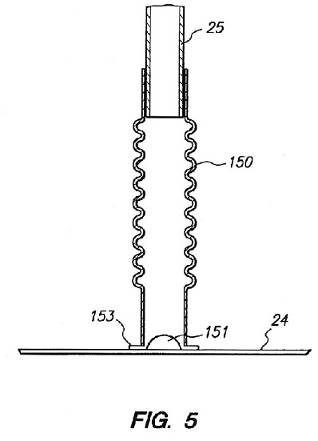
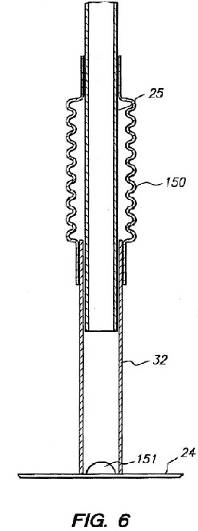
110 In pleadings, BMW also relied on the description at l 3 to 27 of column 7, which was as follows:
Alternate embodiments of the depth compensator that use a flexible ribbed cylindrical member 150 are illustrated in FIGS. 5 and 6. FIG 5 shows an alternate depth compensator that eliminates the need for the second tube 32. The ribbed cylindrical member 150 is preferably made of an FDA approved elastomer and is simply attached about the end of the first tube 25. The ribs allow the cylindrical member 150 to be compressed like spring loaded bellows or an accordion to vary the overall length of the siphon tube 22. Member 150 may be spring reinforced if desired. The embodiment shown in FIG. 5 advantageously modifies the end of the cylindrical member 150 with water notches 151 and a flange or flanges 153 so that it can be positioned flush with bottom 24 of the bottle 16. In FIG 6, another embodiment of the compensator is shown. In FIG 6, the upper end of the cylindrical member 150 is attached near the lower end of the first tube 25, and the lower end of the cylindrical member 150 is attached to the second tube 32. In this embodiment, the first tube 25 has an outer diameter sized for a close, but low friction, fit within the second tube 32. In the fully extended position the tip of the first tube 25 remains positioned inside the second tube 32. The first tube 25 can slide further into the second tube 32, but such movement is resisted by the cylindrical member 150. It should be understood that the member 150 may be other than cylindrical as may be the tubing to which it connects. .
111 At trial, BMW focussed chiefly on Figure 6. In summarising his argument in closing submissions, counsel for BMW said:
[I]n summary, those contentions are the interpretation of figure 6 of the Hancock patent is quite clear-cut. There is no sliding seal. There is a tube, a second tube, even though that second tube is made of two parts. The functionality of claim 1 of the VIP patent is inherent in the structure of Hancock figure 6, and this would be a skilled reader, skilled addressee reading Hancock, would see that there were clear and unmistakable directions in Hancock to put one tube inside another to inhibit bending of the bellows. True, according to Mr McFadyen’s evidence, if there was a sliding fit between those two components of the lower tube, there would be no need and no purpose in inhibiting the bending of the bellows.
However, that does not detract from the proposition that Hancock, however it works, does inhibit the bending for the bellows and it does have the structural components, which are defined in the VIP claim 1. It may be unfortunate for VIP if they drew up a claim, which read on a piece of prior art of which they were not aware, but that is a risk inherent in drawing up a claim with functional limitations in it, or finding by result. Definition by result – I haven’t put the case in the list of authorities, your Honour, but the classical case that establishes it as legitimate to define an invention by result.
112 In my view, BWM has not discharged its onus of showing that the invention as claimed in the VIP Patent is anticipated by the Hancock Patent. Figure 6 depicts a dip tube apparatus that, in terms and/or according to Mr McFadyen’s evidence (which I accept):
(a) is made of three pieces as compared with the two pieces of the invention as claimed in the VIP Patent; and
(b) compared with the invention as claimed in VIP Patent, has a different arrangement of the tubes and bellows such that the first tube is inserted into the second tube in a loose friction fit;
(c) is designed to operate in a vacuum/suction system.
113 I note Professor Field’s evidence, in cross-examination, that the relationship of tubes 25 and tube 32 (see Figure 6 above) could form an airtight seal with the result that the bellows would not operate at all. Professor Field considered, however, that this interpretation of Figure 6 would be incorrect because the two tubes would not have any “play” due to the friction fit and therefore the bellows would not be operative as a spring. Mr McFadyen disagreed, stating that the tubes 25 and 32 could provide an air tight seal and still move. I accept that, as counsel for VIP said in closing, Professor Field’s evidence depended on a correlation of the idea of seal and attachment, which is not justified. Mr McFadyen accepted that, on his interpretation, the only work for the bellows was as a spring, but he remained of the view that that was a correct interpretation. For the reasons stated above, I accept Mr McFadyen’s evidence in preference to Professor Field’s evidence. As counsel for VIP noted, Mr McFadyen’s evidence was consistent with the Hancock patent at column 7, l11 (see the passage from the Hancock patent at [110] set out above).
114 Moreover, the dip tube depicted in Figure 6 has a bellows section that is stated to be preferably made from elastomer providing an outer seal without any need for fusion. This contrasts with the material referred to in claims 7 to 10 of the invention as claimed in the VIP Patent. As noted earlier, Mr McFadyen’s evidence was that elastomer would not be a suitable material for use in a dip tube.
115 As counsel for VIP submitted, the modifications necessary to render the dip tube apparatus disclosed in Figure 6 of the VIP Patent equivalent to the invention as claimed in the VIP Patent would be extensive and affect the overall function of the Figure 6 apparatus. Mr McFadyen identified these modifications and the consequential issues in his evidence.
116 For the reasons stated, BMW has failed to show that the VIP Patent is not novel over the Hancock patent.
Lack of inventive step
117 BMW argued that the VIP Patent lacked inventive step within the meaning of s 18(1)(b)(ii) of the Act, in that it did not involve an inventive step compared with the prior art base (as defined in Sch 1) as it existed before the priority date of each claim (24 February 2000). BMW bears the onus of establishing the lack of inventive step. In closing written submissions, BMW stated that it was not pressing the allegation of obviousness of claim 1 of the VIP Patent. BMW contended, however, that “none of the subsidiary claims adds any inventive step over claim 1 and relies on the material at paragraph 41 of Mr Mandile’s affidavit and on concession elicited in cross-examination of Mr McFadyen”. I propose to consider the issue of obviousness as it was put in opening and during the course of the trial, also having regard to the apparent concession made in closing submissions.
118 An invention is a patentable invention for the purposes of a standard patent if the invention as claimed involves an inventive step when compared with the prior art base as it existed before the priority date of the claim: see the Act, s 18(1)(b)(ii). Section 7(2) of the Act provided that “an invention is to be taken to involve an inventive step when compared with the prior art base unless the invention would have been obvious to a person skilled in the relevant art in the light of the common general knowledge as it existed in the patent area before the priority date, whether that knowledge is considered separately or together with” the information in s 7(3). The reference to “the prior art base” in s 7(2) was to par (a) of the definition of that term in Schedule 1 to the Act. For the purposes of s 7(2), s 7(3) mentioned two kinds of information, including prior art publicly available in a single document, “being information that the skilled person … could, before the priority date of the relevant claim, be reasonably expected to have ascertained, understood and regarded as relevant” to work in the relevant field.
119 The question of obviousness involves asking whether the invention would have been obvious to a non-inventive worker in the field, equipped with the common general knowledge in that particular field as at the priority date, without regard to documents in existence but not part of such common general knowledge: see Wellcome at 270. The question is not whether it was or would have been obvious to the inventor or to some other particular worker in the field: see Minnesota Mining and Manufacturing Co. v. Beiersdorf (Aust.) Ltd. (1980) 144 CLR 253 at 293-5. To quote Aickin J in Wellcome at 286, “[t]he test is whether the hypothetical addressee faced with the same problem would have taken as a matter of routine whatever steps might have led from the prior art to the invention, whether they be the steps of the inventor or not”.
120 Lockwood v Doric (No 2) (2007) 235 CLR 173 at 195-198 reiterated the applicable principles, having regard to the current legislation. Amongst other things, the High Court there said (at 195 [52]):
There is no distinction between obviousness and a lack of inventive step. A “scintilla of invention” remains sufficient in Australian law to support the validity of a patent. [Citations omitted]
The Court continued (at 197 [56]):
Whether a patent is obvious under the Act is still to be determined by reference to the hypothetical non-inventive worker in the field (now a person skilled in the relevant art (ss 7(2) and 7(3) equipped with common general knowledge, as stated by Aickin J in [Minnesota Mining & Manufacturing Co v Beiersdorf (Aust) Ltd (1980) 144 CLR 253] and followed since. Therefore it is irrelevant whether the invention was arrived at as a matter of chance or luck or the result of long experiment or great intellectual effort. However, reference to and use of prior disclosures, in existence but not part of the common general knowledge, has now been extended. [Citations omitted]
121 In the present case particularly, the High Court’s observations in Aktiebolaget Hässle v Alphapharm Pty Ltd (2002) 212 CLR 411 at 423 are noteworthy. Here the Court said:
The defendant to an infringement action who cross-claims for revocation on the ground of obviousness bears the onus of establishing that case. This obliges the defendant to lead evidence looking back to the priority date, sometimes, as here, many years before trial. In those circumstances, the warnings in the authorities against the misuse of hindsight are not to be repeated as but prefatory averments and statements of trite law. The danger of misuse will be particularly acute where what is claimed is a new and inventive combination for the interaction of integers, some or all of which are known.
122 Professor Field gave evidence in support of BMW’s case that the invention as claimed lacked inventive step. Even if his evidence on the question were admissible (contrary to my ruling), I would not be persuaded that BMW had discharged its onus of establishing invalidity on this ground.
123 I consider that BMW correctly abandoned its challenge to claim 1 and that any remaining challenge on this ground also fails.
124 BMW failed to adduce any evidence that the hypothetical skilled addressee faced with the problem of buckling (which the VIP Patent identifies as the problem addressed) would have taken as a matter of routine whatever steps might have led from the prior art to the invention as claimed in any of the claims of the VIP Patent.
125 Thus, for example, as VIP noted, BMW failed to establish that the relationship of the first tube to the second tube in loose clearance fit through the collapsible and extensible portion (i.e., the bellows) was part of the common general knowledge of the non-inventive worker in the field as at the priority date. This was an essential integer in the invention as claimed in all claims.
126 There is no evidence that the Hancock patent formed part of the prior art information that a skilled worker in the field could, before the priority date, be reasonably expected to have ascertained so as to enable it to be read with the common general knowledge at the priority date for the purposes of determining obviousness. Further, BMW cannot read sufficient disclosure or obviousness out of the earlier Micromatic Dip Tube because it lacks the essential integers of the invention as claimed. In effect, the invention as claimed was, on Mr Mandile’s evidence, directed to a problem encountered with the MicroMatic Dip Tube, the solution to which has not otherwise been shown to be obvious to a person skilled in the art.
127 In this connection, it is relevant to note, as VIP did, that Professor Field acknowledged in cross-examination that he had received “the Nufarm sample” on 19 June 2009, although he had not mentioned this in BWF 8 and did not refer to the Nufarm sample in his discussion of obviousness in BWF 20. Whilst I would not impute to him any improper motive (amongst other things, the receipt of the Nufarm sample was noted in his 14 September 2009 affidavit and at the outset of BWF 20), the fact is that the Nufarm sample is very close to the invention as claimed. Given the nature of Professor Field’s analysis, any force in his assertion of obviousness on the basis of his readily alleged identification of a solution is greatly diminished by the fact that he had the Nufarm sample in front of him. In any case, as already observed, Professor Field’s evidence in this regard was for the most part inadmissible.
128 BMW pointed to paragraph 41 of Mr Mandile’s affidavit. This stated that certain “later developments represented refinements to the central idea”. The reference to later developments was a reference to use of an interference seal and ultrasonic welding “as the optimal approach for post process fixing of the two tubes to make the dip tube”. I would reject BMW’s submission as to the effect of this evidence. Indeed, as VIP noted, there was no evidence that ultrasonic welding formed part of the common general knowledge as at the priority date. Even if Professor Field’s evidence on this point were admissible, Professor Field conceded in BWF 20 that ultrasonic welding as claimed in claim 11 (in combination with claim 1) was not obvious. See also claim 12.
129 Further, I would not treat the evidence in cross-examination of Mr McFadyen as sufficient to discharge BMW’s onus of showing that any claim, including claims 2 and following, of the VIP Patent relevantly lacked inventive step.
130 I would reject BMW’s challenge on the lack of inventive step ground.
Manner of manufacture
131 Section 18(1)(a) of the Act provides that an invention is a patentable invention for the purposes of a standard patent if the invention as claimed is “a manner of manufacture within the meaning of section 6 of the Statute of Monopolies”. “Invention” is defined in Schedule 1 as “[a]ny manner of new manufacture the subject of letters patent and grant of privilege within section 6 of the Statute of Monopolies, and includes an alleged invention”.
132 In closing submissions, BMW challenged the VIP Patent on the basis that “none of the claims of the VIP Patent is in respect of any manner of new manufacture”, once again relying on paragraph 41 of Mr Mandile’s affidavit and “concession elicited in cross-examination of Mr McFadyen”. The authorities show that a challenge on this ground can only properly be understood as a submission that the alleged invention was not, on the face of the specification, an alleged manner of new manufacture properly the subject of letters patent according to traditional principles: see, for example, N V Philips Gloeilampenfabrieken v Mirabella International Pty Ltd (1995) 183 CLR 655 (‘Mirabella’) at 665; Lockwood Security Products Pty Ltd v Doric Products Pty Ltd (No 2) (2007) 235 CLR 173 at 211 [106].
133 In relation to a standard patent, the majority in Mirabella explained (at 663-664) the manner of manufacture requirement in s 18(1)(a) of the Act in the following way:
The effect of those opening words of s 18(1) is that the primary or threshold requirement of a “patentable invention” is that it be an “invention”. Read in the context of s 18(1) as a whole and the definition of “invention” in the Dictionary in Sch 1, that clearly means “an alleged invention”, that is to say, an “alleged” “manner of new manufacture the subject of letters patent and grant of privilege within s 6 of the Statute of Monopolies”. In the light of what has been said above about what is involved in an alleged manner of new manufacture, that threshold requirement of “an alleged invention” will, notwithstanding an assertion of “newness”, remain unsatisfied if it is apparent on the face of the relevant specification that the subject matter of the claim is, by reason of absence of the necessary quality of inventiveness, not a manner of new manufacture for the purposes of the Statute of Monopolies. That does not mean that the threshold requirement of an “alleged invention” corresponds with or renders otiose the more specific requirements [of s 18(1A) of the Act]. It simply means that, if it is apparent on the face of the specification that the quality of inventiveness necessary for there to be a proper subject of letters patent under the Statute of Monopolies is absent, one need go no further. (Emphasis added.)
The majority went on immediately to cite in support of this passage part of the judgment of Dixon CJ, Kitto and Windeyer JJ in National Research Development Corporation v Commissioner of Patents (1959) 102 CLR 252 at 261-262.
134 Subsequently, in Advanced Building Systems Pty v Ramset Fasteners (Aust) Pty Limited (1998) 194 CLR 171 at 191-192, the majority discussed the significance of Mirabella, observing that Mirabella:
… came on appeal to this Court on a grant of special leave confined to the construction of s 18(1)(a) of the 1990 Act. But it was decided upon a construction of the introductory words of s 18(1), namely “a patentable invention is an invention that”. Reference to the definition of “invention” in the Dictionary which constitutes Sch 1 to the 1990 Act was held to have imported into the introductory words the requirement that a manner of new manufacture for the purposes of the Statute of Monopolies should appear on the face of the specification. …
In [Mirabella], the appellant failed in its attempt to establish that although a claimed use was nothing but a new use of an old substance this could still be a proper subject of letters patent under the 1990 Act where this character of the claimed use was apparent on the face of the specification. (Citations omitted.)
135 There is no statement to be found on the face of the specification of the VIP Patent that the invention as claimed is not an alleged manner of new manufacture properly the subject of letters patent according to traditional principles. There is nothing on the face of the specification that shows that all the essential elements of the claimed invention, including their combination, were known integers.
136 I would therefore reject BMW’s challenge on this ground.
Lack of definition or clarity
137 Under s 40(2)(b) of the Act, a complete specification must end with a claim or claims, “defining the invention”. By force of s 40(3), the claim or claims must be “clear and succinct”.
138 The claims must define the invention in such a way that it is “not reasonably capable of being misunderstood”: see Welch Perrin & Company Pty Ltd v Worrel (1961) 106 CLR 588 at 610 and Decor Corporation Pty Ltd v Dart Industries Inc (1988) 13 IPR 385 at 400. If, applying the proper rules of construction and having regard to the common general knowledge in the art before the priority date, it is impossible to ascertain what the invention is from a fair reading of the specification as a whole, it will be invalid.
139 To assess a challenge made on lack of definition and clarity grounds, the specification must be read as a whole from the perspective of the skilled addressee, and in the light of the common knowledge in the art before the priority date. Reference can be made to the specification to explain the background of the claims, to ascertain the meaning of technical terms, and to resolve ambiguities in the construction of the claims. Whilst the claims must be construed having regard to the specification as a whole, if a claim is clear and unambiguous, it cannot be varied, qualified, or made obscure by reference to statements in other parts of the specification. Ambiguity or uncertainty may be the product of obscure language, or the use of a relative expression that requires an exercise of judgment. In the latter case, the claims will be valid as long as they provide a workable standard suitable to the intended use. The expressions in question must be understood in a practical, common sense manner.
140 In Albany Molecular Research Inc v Alphapharm Pty Ltd [2011] FCA 120 at [174] Jessup J observed that:
The purpose of the claim is to define the invention (s 40(2)(b)), and it is in that context that the requirement of clarity is to be considered. In my view, that requirement is that a claim must clearly define the invention, so far as it relates to the matter claimed.
This observation is apposite with respect to the invention as claimed in the VIP Patent.
141 It was not clear from his closing address whether BMW’s counsel had abandoned the challenge on the basis of lack of definition and lack of clarity. In the Amended Particulars referred to earlier, the following paragraphs apparently remained at the end of the trial.
As to lack of definition:
(c) Claim 1 of the complete specification of the Patent (unlike claim 12 of the complete specification of the Patent before amendment) does not define the position of the lower end of the first … tube relative to the end of the collapsible and extensible portion of the second tube when that collapsible and extensible portion is “extended”. In so far as the claim does not define the state of the collapsible and extensible portion as being “extended”, it does not define the invention.
As to lack of clarity:
(b) Claim 1 of the complete specification of the Patent is not clear in that it does not define whether the collapsible and extensible portion of the second tube is in an “extended” state, or whether it is some other state.
142 BMW did not address any submissions in support of these particulars – at least not as I understood its submissions. So far as I understand the particulars, it does not appear to me that they support a lack of definition or lack of clarity ground. At best BMW’s submissions left open the possibility that BMW alleged lack of definition and lack of clarity upon the basis that the words “just below the end” and “inhibits bending” were ill-defined or unclear.
143 In closing written submissions, BMW complained that “inhibits” is “a relative term”. BMW stated that:
Nowhere do the specification or the claims teach the address[ee] anything as to the degree to which the first tube is to project in order to “inhibit” bending. Neither the specification nor the claim teach anything about the minimum degree of inhibition to bending that will be necessary to overcome the problem of environmental stress cracking. The meaning of the term remains irresolvable.
As to “just below the end”, in written closing submissions, BMW stated “[t]he meaning of the term remains undetermined”.
144 Reading the specification as a whole, adopting a purposive approach to construction that takes account of the subject matter, there are no difficulties of the kind that BMW has sought to identify. As Mr McFadyen’s evidence showed, a skilled addressee would readily understand that the specification taught that the arrangement should be such that there is sufficient clearance between the first (inner) tube and the second (outer) tube’s named portions such that there is no interference with the operation of the collapsible and extensible portion and yet the first (inner) tube is near enough to and extends sufficiently below the collapsible and extensible portion of the second (outer) tube that it acts to inhibit bending.
145 The authorities recognise that the use of a relative expression necessitating judgment is not objectionable providing the claim provides a workable standard suitable to the intended use: see Nesbit Evans Group Australia Pty Ltd v Impro Ltd & Anor (1997) 39 IPR 56 at 95 where Lindgren J stated:
[I]t is not unusual for a claim to define an invention partly by the use of a relative expression which necessitates exercise of judgment (see, eg Elconnex Pty Ltd v Gerard Industries Pty Ltd (1992) 25 IPR 173 at 190 … ; Populin v HB Nominees Pty Ltd (1982) 41 ALR 471 at 477 …; Leonardis v Sartas No 1 Pty Ltd (1996) 35 IPR 23 at 32-3 and cases there cited …; Blanco White, Patents for Inventions, 5th ed, 1983, para 2-112) and so long as the claims provide a workable standard suitable to the intended use, they will be valid: Minnesota Mining & Manufacturing Co v Beiersdorf (Aust) Ltd (1980) 144 CLR 253 at 273 et seq; 1A IPR 231 (Aickin J). The expressions in question must be understood in a practical, common sense manner.
[Emphasis added.]
In the present case, the use of the words “just below the end” and “inhibits bending” may not have a precise meaning but, in the context, in which they are used they provide the skilled addressee with a workable standard suitable to the intended use.
146 To the extent that these grounds were pressed, I would reject them for the reasons stated.
DISPOSITION
147 BMW’s cross-claim should be dismissed. VIP has established an entitlement to relief and will be given an opportunity to submit a minute of the orders that it considers would give effect to these reasons and would be appropriate to make at this stage of the proceeding.
I certify that the preceding one hundred and forty-seven (147) numbered paragraphs are a true copy of the Reasons for Judgment herein of the Honourable Justice Kenny. |
Associate:


