

FEDERAL COURT OF AUSTRALIA
Tower Australia Group Limited, in the matter of Tower Australia Group Limited (No 2) [2011] FCA 432
| IN THE FEDERAL COURT OF AUSTRALIA | |
IN THE MATTER OF TOWER AUSTRALIA GROUP LIMITED (ABN 79 003 401 698)
| TOWER AUSTRALIA GROUP LIMITED (ABN 79 003 401 698) Plaintiff |
| DATE OF ORDER: | |
| WHERE MADE: |
THE COURT ORDERS THAT:
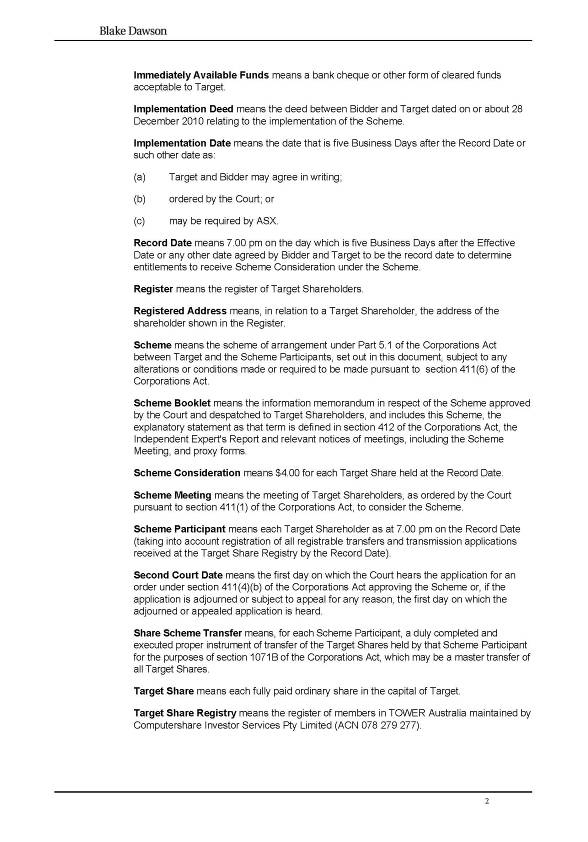
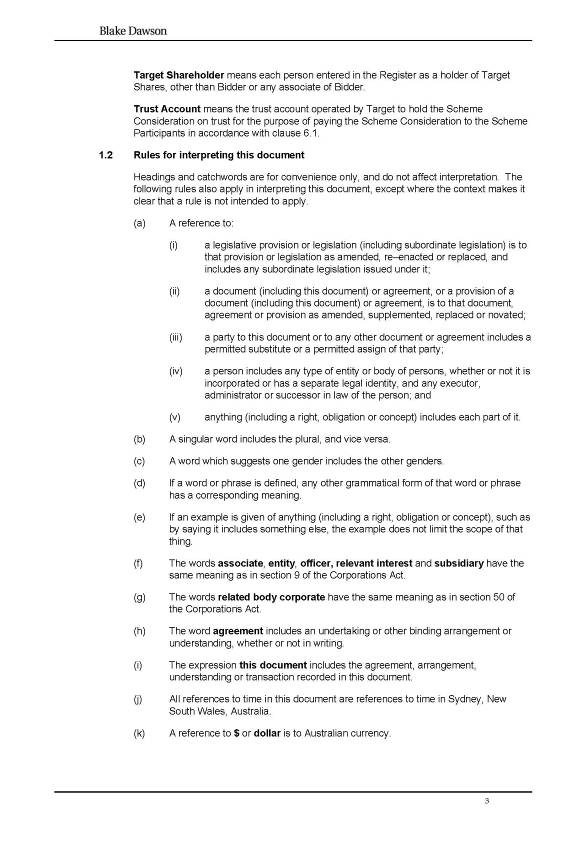
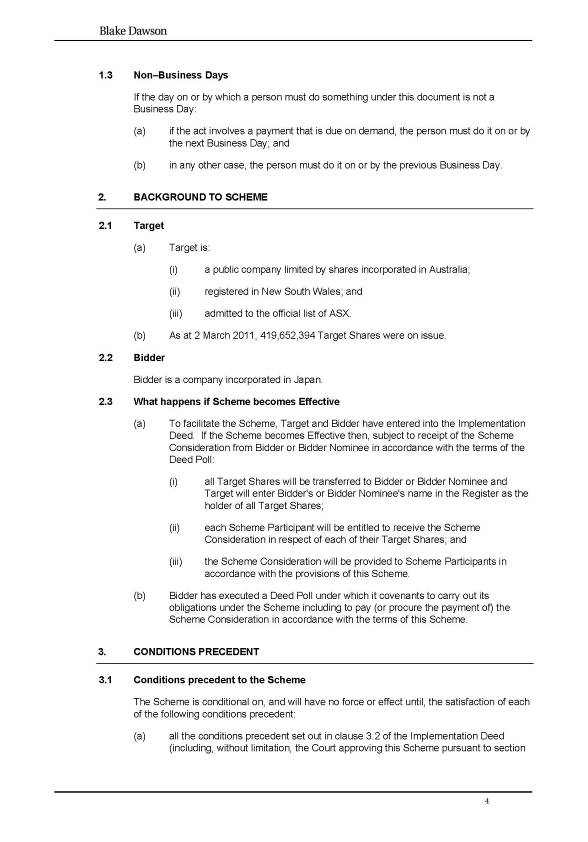
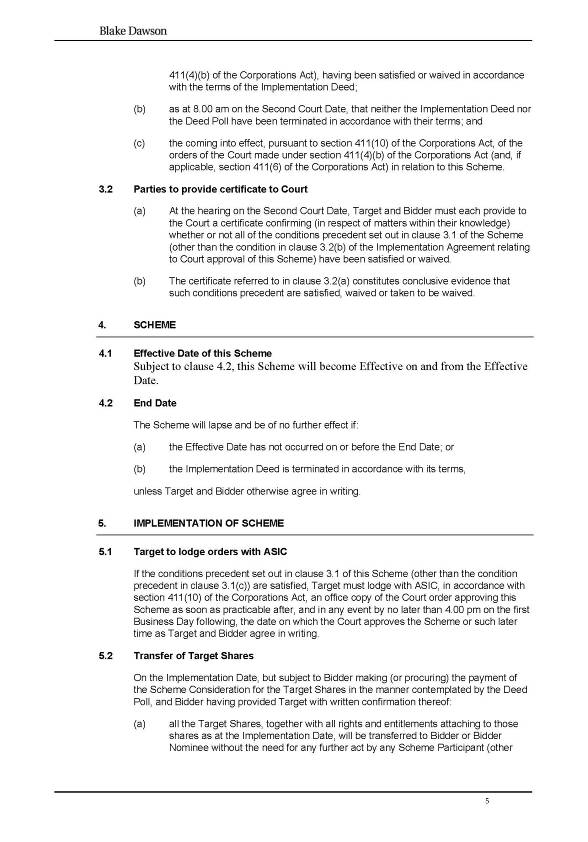
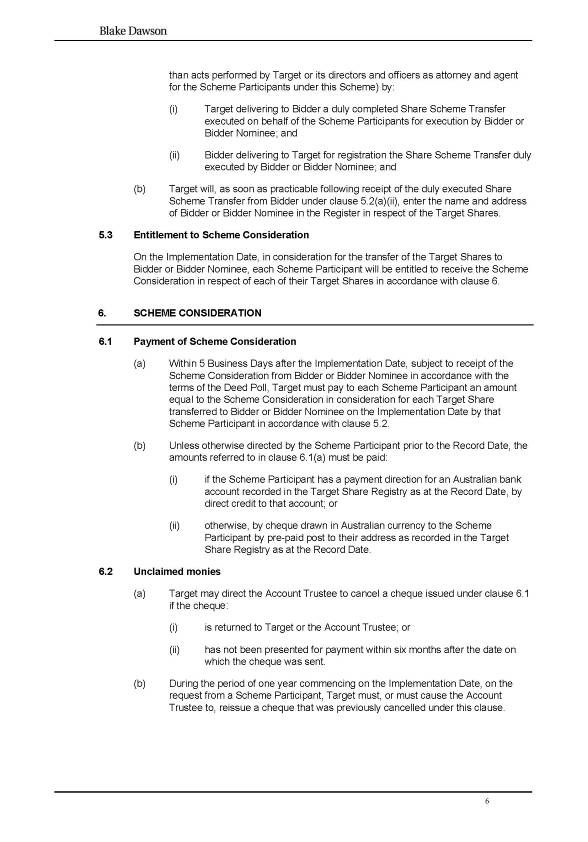
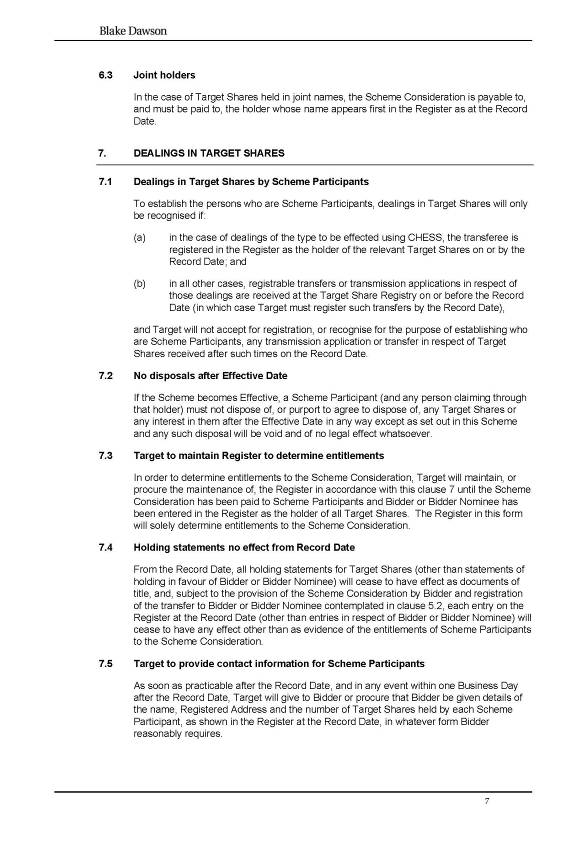
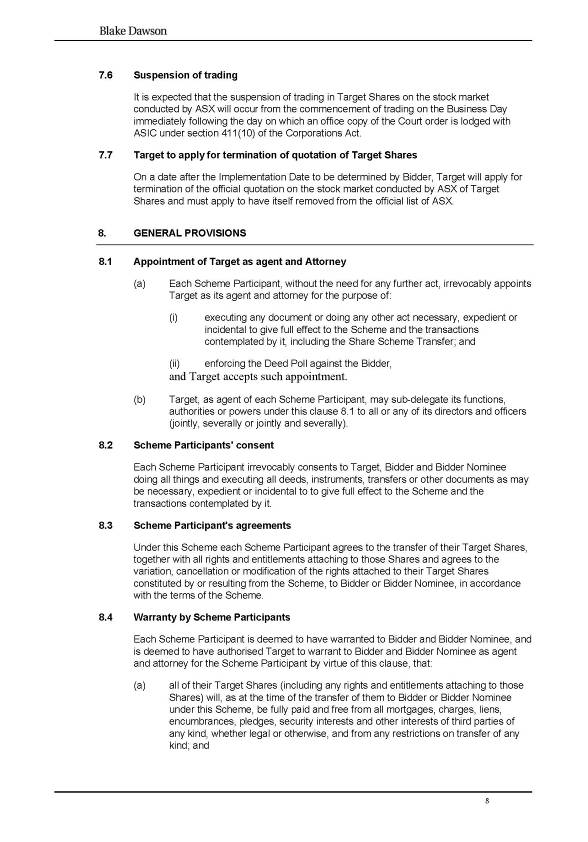
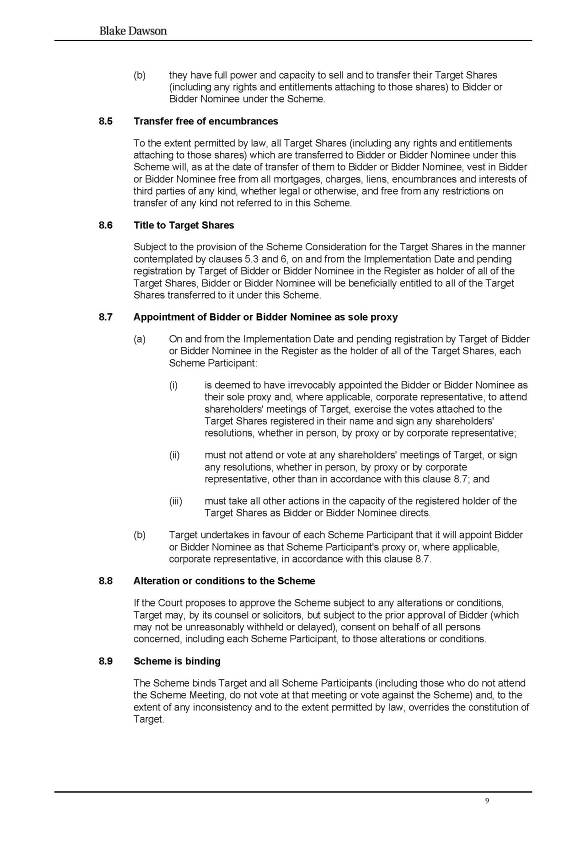
1. Pursuant to subsections 411(4)(b) and 411(6) of the Corporations Act 2001 (Cth) (the Act), the scheme of arrangement between the plaintiff and the holders of ordinary shares in the plaintiff (other than The Dai-ichi Life Insurance Company, Limited or any of its associates) (Shareholders), in the form set out in Annexure A to these Orders, be approved.
2. Pursuant to subsection 411(12) of the Act, the plaintiff is exempted from compliance with section 411(11) of the Act.
3. These Orders be entered forthwith.
Note: Settlement and entry of orders is dealt with in Order 36 of the Federal Court Rules. The text of entered orders can be located using Federal Law Search on the Court’s website.

| IN THE FEDERAL COURT OF AUSTRALIA | |
| NEW SOUTH WALES DISTRICT REGISTRY | |
| GENERAL DIVISION | NSD 234 of 2011 |
IN THE MATTER OF TOWER AUSTRALIA GROUP LIMITED (ABN 79 003 401 698)
| TOWER AUSTRALIA GROUP LIMITED (ABN 79 003 401 698) Plaintiff | |
| JUDGE: | STONE J |
| DATE: | 5 May 2011 |
| PLACE: | SYDNEY |
REASONS FOR JUDGMENT
1 On 11 March 2011, pursuant to an application made by the plaintiff, Tower Australia Group Limited (Tower), I made orders for the convening of a meeting of the plaintiff’s shareholders other than Dai-ichi Life Insurance Company (Dai-ichi) or any of its associates (Scheme Shareholders). The purpose of the meeting was for the Scheme Shareholders to consider and, if thought fit, approve the Scheme pursuant to which Dai-ichi will acquire all of the Scheme Shareholders’ shares in Tower. The details of the Scheme and my reasons for making those orders (earlier reasons) are to be found at [2011] FCA 224.
2 On 21 April at the second Court hearing the plaintiff sought approval of the Scheme on the basis that the statutory preconditions had all been met including that the required percentage of votes in favour of the Scheme were cast at the meeting on 18 April 2011. I made orders pursuant to s 411(4)(b) of the Corporations Act 2001 (Cth) approving the Scheme. These are my reasons for those orders. These reasons should be read in conjunction with my earlier reasons. Acronyms and abbreviations in the earlier reasons have the same meaning in these reasons.
Evidence
3 Evidence in support of the application for approval includes evidence adduced at the first hearing as well as the following additional affidavits which were read in support of the application:
Robert Bain Thomas sworn on 19 April 2011. This is the second affidavit sworn in this proceeding by Mr Thomas. He is a director and Chairman of Tower and was designated chairman of the Scheme Meeting which was the subject of order made on 11 March 2011;
Catherine Dorothy Duloy sworn on 19 April 2011. Ms Duloy is the general counsel and alternate company secretary of Tower Australia Group Limited;
Julius Gyula Kohazy sworn on 19 April 2011. Mr Kohazy is a production manager at Designate Group Proprietary Limited;
Michelle Mimi Shek sworn on 20 April 2011. Ms Shek is a solicitor in the employ of Blake Dawson, the solicitors for the plaintiff;
David Charles Dickson sworn on 20 April 2011. Mr Dickson is the Relationship Manager of Computershare Investor Services Pty Limited (Computershare);
Andrew Keith Carter affirmed on 21 April 2011. Mr Carter is a partner at Blake Dawson; and
Thomas Andrew Storer affirmed on 20 April 2011. Mr Storer is an employed solicitor at Blake Dawson.
4 Ms Shek deposed to the form of the Scheme Booklet which was lodged with ASIC, the minor amendments that were made to the Booklet, including the amendment required by my earlier orders. It is clear from her evidence that important procedural steps were appropriately taken, including the publication of an advertisement in The Australian newspaper with details of the second court hearing.
5 Ms Duloy gave evidence as to the typesetting and printing of the Scheme Booklet by Designate Group Pty Limited (Designate), its checking and approval for printing by an employee of Tower. As printed the Scheme Booklet included the amendment required in order 1(e) of the orders made on 11 March 2011 and some minor corrections and additions of dates. She also detailed the announcements to the ASX concerning the decision of the Foreign Investment Review Board not to object to the Scheme and the decisions of the Australian Prudential Regulation Authority and the Financial Services Agency of Japan to approve the Scheme.
6 The final printing of the Scheme Booklet was overseen by Mr Kohazy who confirmed that final approval was received from Rod Metcalfe of Tower and Ms Shek and that 40,000 copies were provided to Computershare. Computershare maintains the register of shareholders for Tower. It was also retained by Tower to dispatch the Scheme Booklet (including the Notice of Court Ordered Meeting) and personalised proxy forms for the Scheme meeting to Tower Shareholders. Mr Dickson deposes that on 16 March 2011 he received 40,000 copies of the Scheme Booklet and supervised the dispatch of the Booklets and forms. Exhibited to his affidavit was a signed Form 530 as required by reg 5.6.13 of the Corporations Regulations 2001 (Cth) as well as a Postage Lodgement Summary generated by Computershare confirming lodgement of the Scheme Documents to Australia Post. Mr Dickson also gave a detailed account of the process of checking the Scheme Meeting Proxy Forms and determining their validity, the registration of Shareholders at the Scheme Meeting and the counting of votes.
7 In his second affidavit Mr Thomas deposes that the Scheme Meeting was held on 18 April 2011 in accordance with the orders of 11 March. He states that a quorum of Tower members was present as required by clause 17.1 of the company’s Constitution. The resolution contained in the Notice of Court Ordered Meeting was put to the Shareholders and a poll was conducted by written ballot. 6,598 Shareholders were present at the Meeting, either in person or by proxy and 6,401 of those Shareholders voted in favour of the Scheme Resolution. Mr Thomas states that the votes in favour of the Resolution represented 99.78% of the votes cast on the Resolution and 97.32% by number of all Shareholders present and voting at the Meeting. Those percentages were confirmed by a poll report dated 18 April 2011 provided by Computershare which was retained by Tower to calculate the result of the poll at the Scheme Meeting.
8 The hearing of the present application to approve the Scheme was advertised in accordance with the order made on 11 March 2011. The notice of hearing appeared in The Australian newspaper on 8 April 2011. The notice directed persons who wished to oppose the approval of the Scheme to file and serve on the plaintiff a Notice of Appearance and supporting affidavit at the address for service given in the advertisement. Mr Carter was named in the advertisement as the relevant contact person. Mr Carter deposes that no notice of an intention to oppose approval of the Scheme had been received up until 9 am on the morning of the second court hearing. There were no appearances when the matter was called outside the Court at the commencement of the hearing.
9 The Scheme which has now been approved by the Shareholders allowed for the acquisition of the Tower shares to be by Dai-ichi or its nominee, being a wholly owned subsidiary of Dai-ichi. Dai-ichi has nominated Tal Dai-ichi Life Group Pty Ltd ACN 150 070 509 as the company which is to acquire the shares. Annexed to the affidavit of Mr Storer are two ASIC and Business Names searches which show that: (a) Tal Dai-ichi Life Group Pty Ltd is wholly owned by Tal Dai-ichi Australia Pty Ltd ACN 150 070 483; and (b) Tal Dai-ichi Australia Pty Ltd is wholly owned by Dai-ichi. It follows that it is correct to describe the nominee as a wholly owned subsidiary of Dai-ichi.
10 Finally, at the hearing the plaintiff tendered a letter from ASIC dated 20 April 2011 signifying in the usual way that it had no objection to the Scheme proceeding; s 411(17)(b). In addition two certificates provided respectively by Tower and Dai-ichi confirmed that, in respect of matters within each company’s knowledge, the conditions precedent to the Scheme had been satisfied or waived other than the requirement of Court approval and the coming into effect of orders of the Court in relation to the Scheme.
11 The Court has a supervisory jurisdiction in relation to schemes of arrangement however it is not for the Court to express a view as to the commerciality of the proposal. It is directed to ensuring that the scheme has been fairly and fully presented to members so that they can make an informed decision and that those voting at the meeting have done so in good faith and not in pursuit of special interests not shared by the ordinary independent members. As Jacobson J observed in Re Seven Network Ltd (No 3) (2010) 267 ALR 583 at [31]:
The principles which govern the exercise of the court’s discretion to approve a scheme are well settled. The court has a discretion whether to approve a scheme, and is not bound to approve it merely because it has previously made orders for the convening of meetings or … because the statutory majorities have been achieved: Re NRMA Ltd (No 2) (2000) 156 FLR 412 at [22]. Santow J there referred to a passage from a well-known text on takeovers and reconstructions, in which it was said that the court’s jurisdiction is supervisory; it is concerned to be satisfied that there has been an absence of oppression, and that the compromise or arrangement is one which is capable of being accepted.
12 I am satisfied that all the required procedures in relation to the Scheme have been followed, all necessary consents have been obtained and that there is no evidence of oppression or other conduct which would be a reason for withholding the Court’s approval. I have reached this conclusion conscious of the views expressed by Barrett J in Prime Infrastructure Holdings Limited [2010] NSWSC 1337 to which the plaintiff quite properly drew my attention.
13 Prime Infrastructure concerned a scheme of arrangement under Pt 5.1 of the Corporations Act which was expressed to involve the holders of fully paid ordinary shares in Prime Infrastructure “other than the Excluded Securityholder”. Barrett J commented that it was “undesirable” for the Court to approve the Scheme “until it had been amended to identify with clarity and precision” each of the Excluded Securityholders. The definition of “Excluded Securityholder” was:
any Prime Stapled Securityholder who is BIP, BIP Bermuda Holdings IV Limited, a Bermuda exempt limited company (registration number 43696) or a Subsidiary of BIP or any Prime Stapled Securityholder who holds any Prime Stapled Securities on behalf of, or for the benefit of BIP, BIP Bermuda Holdings IV Limited or a Subsidiary of BIP.
14 Justice Barrett’s concern was that it might not be possible to identify who fell within that definition and was therefore bound by the scheme. At [9] his Honour observed that eventually it was made clear that “in fact, all securities intended to be excluded were held by one or other of BIP and BIP Bermuda Holdings IV Limited” and that the definition was amended accordingly.
15 In the present Scheme a shareholder whose shares are to be acquired is referred to as a “Target Shareholder”, which means a person entered in the Register as a holder of Tower shares other than Dai-ichi or any “associate” of Dai-ichi. While this provision might, at first glance, appear to raise a problem similar to that which troubled Barrett J there are a number of reasons for concluding that no such problem arises. Both Mr McHugh SC who appeared for the plaintiff and Mr Leeming SC, who appeared for Dai-ichi as a person interested and was given leave to be heard, were on one mind in submitting that, as matter of fact, there were no associates of Dai-ichi to be excluded.
16 This much, it was submitted could be deduced from the information in the Scheme Booklet which has been verified and accepted as true and correct; see [18] of the earlier reasons. In particular, in the questions and answers at page 8 of the Scheme Booklet it is said in answer to the question, “What is the Scheme?” that the Scheme involves Dai-ichi Life or its Nominee acquiring all Tower’s issued shares “that Dai-ichi Life does not already own”. As Mr Leeming submitted this statement would not be true if there were associates that were going to stand outside the Scheme. Similarly, on page 17 of the Booklet, in summarising the consequences of the Scheme being implemented, it is said that Tower will become “a wholly-owned Subsidiary of Dai-ichi … or its Nominee”. That statement would not be true if there were any shareholder of Tower other than Dai-ichi who stands outside the Scheme.
17 I am satisfied that in the circumstances of this Scheme there is no real practical ambiguity or uncertainty arising from the reference to “associate” in the definition of “Target Shareholder”.
Conclusion
18 On the basis of the evidence tendered by the plaintiff and for the reasons given above, I was satisfied that the orders sought by the plaintiff should be made.
| I certify that the preceding eighteen (18) numbered paragraphs are a true copy of the Reasons for Judgment herein of the Honourable Justice Stone. |
Associate:
Dated: 5 May 2011


