

FEDERAL COURT OF AUSTRALIA
Kngwarrey on behalf of the members of the Irrkwal, Irrmarn, Ntewerrek, Aharreng, Arrty/Amatyerr and Areyn Landholding Groups v Northern Territory of Australia [2011] FCA 428
| IN THE FEDERAL COURT OF AUSTRALIA | |
| DATE OF ORDER: | |
| WHERE MADE: |
THE COURT ORDERS THAT:
1. There be a determination of native title in the terms set out below (‘the determination’), the determination to take effect:
(a) as to paragraph 3 and 4 of the determination – immediately upon the making of these Orders; and
(b) as to the balance of the determination – immediately upon the making of a determination under section 57(2) of the Native Title Act 1993 (Cth) in accordance with orders (3) or (4).
2. Upon the determination taking effect, native title is not held in trust but is held by the common law holders of native title being the persons referred to in paragraph 3 of the determination.
3. Within twelve months of the date of this order, the Applicants in NTD6043/2001 are to file and serve a notice nominating a prescribed body corporate to:
(a) be the prescribed body corporate for the purposes of section 57(2) of the Native Title Act 1993 (Cth); and
(b) perform the functions mentioned in section 57(3) of the Native Title Act 1993 (Cth) after becoming a registered native title body corporate.
4. In the event that there is no nomination within the time specified in accordance with order (3) or such later time as this Court may order, the matter is to be listed for further directions.
5. The parties have liberty to apply to establish the precise location and boundaries of any public works and adjacent land and waters identified or otherwise referred to in Schedule C of the determination.
6. There be no order as to costs.
THE COURT DETERMINES THAT:
The determination area
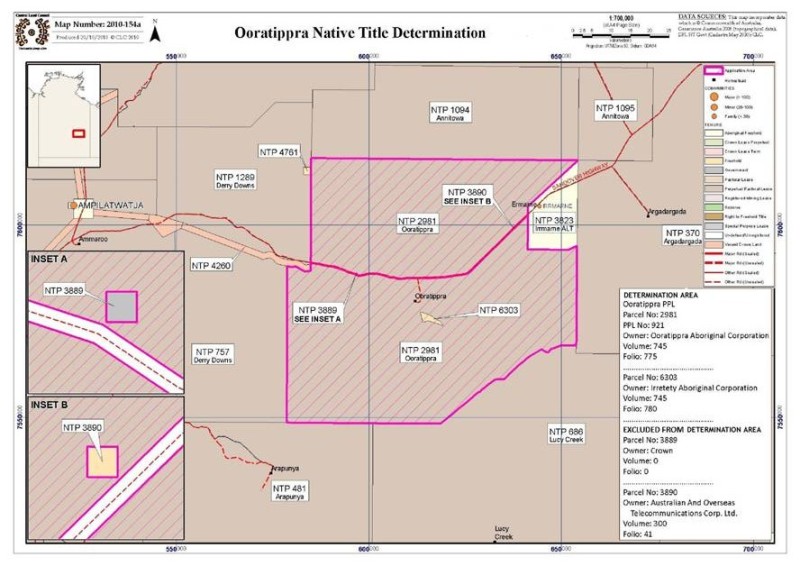
1. The determination area comprises NT Portion 2981 and NT Portion 6303 being the land and waters more particularly described in Schedule A and depicted on the map comprising Schedule B.
2. Exclusive native title rights and interests exist in the determination area – section 47 of the Native Title Act 1993 (Cth) applies.
The native title holders
3. The determination area comprises four estate areas associated with the Irrkwal, Irrmarn, Ntewerrek, Aharreng, Arrty/Amatyerr and Areyn landholding groups.
4. The persons who hold the common or group rights comprising the native title are the Aboriginal persons who are:
(a) members of one or more of the landholding groups referred to in paragraph 3 by virtue of descent (including adoption) through father’s father, mother’s father, father’s mother and mother’s mother;
(b) accepted as members of one or more of the landholding groups referred to in paragraph 3 by senior members of a landholding group, referred to in subparagraph (a), by virtue of non-descent connections to an estate.
Native title rights and interests
5. The native title rights and interests confer possession, occupation, use and enjoyment of the land and waters on the native title holders to the exclusion of all others.
6. The native title rights and interests are held subject to and exercisable in accordance with the traditional laws and customs of the native title holders.
Other interests
7. The nature and extent of the other interests in the determination area are:
(a) NT Portion 2981 – the interest of Ooratippra Aboriginal Corporation under Perpetual Pastoral Lease No. 921;
(b) NT Portion 2981 – the interest of Richard Cadzow, Anne Cadzow and Steven Cadzow under a sub-lease of the whole of the land comprised in Perpetual Pastoral Lease No. 921;
(c) NT Portion 6303 – the interest of Irretety Aboriginal Corporation as the holder of a fee simple estate in the land;
(d) the interest of Mincor Zinc Pty Ltd in EL25089 and EL25091 granted under the Mining Act (NT);
(e) the interest of Acacia Minerals Pty Ltd in SEL 27526, EL27568, EL27626, EL27714, EL27715, EL27716, EL27717, EL27718, EL27719, and EL27720 granted under the Mining Act (NT);
(f) the interest of Territory Phosphate Pty Ltd in EL25185 granted under the Mining Act (NT);
(g) the interest of Natural Resources Exploration Pty Ltd in EL27840 granted under the Mining Act (NT);
(h) the interest of Petrofrontier (Australia) Pty Ltd and Texalta Australia Pty Ltd in EP103 granted under the Petroleum Act (NT);
(i) the interest of Northern Territory Oil Limited, Baraka Petroleum Limited and Petrofrontier (Australia) Pty Ltd in EP128 granted under the Petroleum Act (NT);
(j) the rights and interests of Telstra Corporation Limited:
(i) as to the owner or operator of telecommunications facilities within the Determination Area;
(ii) created pursuant to the Post and Telegraph Act 1901 (Cth), the Telecommunications Act 1975 (Cth), the Australian Telecommunications Corporation Acts 1989 (Cth), the Telecommunications Act 1991 (Cth) and under Schedule 3 to the Telecommunications Act 1997 (Cth), including the right;
A. to inspect land for the purpose of determining whether the land is suitable for its purposes;
B. to install and operate telecommunication facilities;
C. to alter, remove, replace, maintain, repair and ensure the proper functioning of its existing and any new telecommunication facilities; and
D. for its employees, agents or contractors to access the Determination Area for the purpose of exercising the rights in (i), (ii) and (iii) above in respect of telecommunication facilities in and in the vicinity of the Determination Area; and under any licences or access agreements relating to its telecommunications facilities in the Determination Area.
(k) in relation to NT Portion 2981 the rights of Aboriginal persons (whether or not native title holders) pursuant to the reservation in favour of Aboriginal people contained in pastoral leases set out in sections 38(2) to (6) of the Pastoral Land Act 1992 (NT);
(l) the rights of Aboriginal persons (whether or not native title holders) by virtue of the Northern Territory Aboriginal Sacred Sites Act 1989 (NT);
(m) rights of access by an employee, servant, agent or instrumentality of the Northern Territory, Commonwealth or other statutory authority as required in the performance of his or her statutory duties;
(n) the interests of persons to whom valid or validated rights and interests have been:
(i) granted by the Crown pursuant to statute or otherwise in the exercise of its executive power; or
(ii) conferred by statute.
Relationship between the rights and interests
8. In relation to NT Portion 2981 the relationship between the native title rights and interests referred to in paragraph 5 and the interest of the Ooratippra Aboriginal Corporation is that the non-extinguishment applies. The grant of Perpetual Pastoral Lease No. 921 is:
(a) partly inconsistent with the continued existence, enjoyment or exercise of the native title rights and interests as follows:
(i) to the extent that the rights and interests confer possession, occupation, use and enjoyment of the land and waters to the exclusion of all others;
(ii) the native title continues to exist in its entirety, but the rights and interests have no effect in relation to the lease to that extent;
(iii) if the lease or its effects are wholly removed or otherwise wholly cease to operate the native title rights and interests again have full effect;
(b) not inconsistent with the continued existence, enjoyment or exercise of the non-exclusive native title rights and interests set out in paragraph 9 hereof.
9. The native title rights and interests that are not inconsistent with the interest of the Ooratippra Aboriginal Corporation under Perpetual Pastoral Lease No. 921 are the rights possessed under and exercisable in accordance with the traditional laws and customs of the native title holders, including the right to conduct activities necessary to give effect to them, being:
(a) the right to access and travel over any part of the land and waters;
(b) the right to live on the land, and for that purpose, to camp, erect shelters and other structures;
(c) the right to hunt, gather and fish on the land and waters;
(d) the right to take and use the natural resources of the land and waters;
(e) the right to access, take and use natural water on or in the land;
(f) the right to light fires for domestic purposes, but not for the clearance of vegetation;
(g) the right to access and to maintain and protect sites and places on or in the land and waters that are important under traditional laws and customs;
(h) the right to conduct and participate in the following activities on the land and waters:
(i) cultural activities;
(ii) ceremonies;
(iii) meetings;
(iv) cultural practices relating to birth and death including burial rites;
(v) teaching the physical and spiritual attributes of sites and places on the land and waters that are important under traditional laws and customs, including the power to regulate the presence of others at any of these activities on the land and waters, other than persons exercising a right conferred by or arising under a law of the Northern Territory or the Commonwealth in relation to the use of the land and waters;
(i) the right to make decisions about the use and enjoyment of the land and waters by Aboriginal people who recognise themselves to be governed by the traditional laws and customs acknowledged by the native title holders;
(j) the right to share or exchange natural resources obtained on or from the land and waters, including traditional items made from the natural resources;
(k) the right to be accompanied on the land and waters by persons who, though not native title holders, are:
(i) people required by traditional law and custom for the performance of ceremonies or cultural activities on the land and waters;
(ii) people who have rights in relation to the land and waters according to the traditional laws and customs acknowledged by the native title holders;
(iii) people required by the native title holders to assist in, observe, or record traditional activities on the areas.
10. In relation to NT Portion 6303 the relationship between the native title rights and interests referred to in paragraph 5 and the interest of the Irretety Aboriginal Corporation as the holder of a fee simple estate in the land is set out in the Irretety ILUA which was entered on the Register of Indigenous Land Use Agreements on 14 November 2003. The non-extinguishment principle applies:
(a) the grant of the estate in fee simple is wholly inconsistent with the continued existence, enjoyment or exercise of the native title rights and interests;
(b) the native title continues to exist, but has no effect in relation to the grant;
(c) if the grant or its effects are wholly removed or otherwise wholly cease to operate the native title rights and interests again have full effect;
(d) if the grants or its effect are removed to an extent or otherwise cease to operate only to an extent the native title rights and interests again have effect to that extent.
11. In relation to NT Portion 2981 to the extent, if at all, that the exercise of the native title rights and interests referred to in paragraph 5 is inconsistent with the exercise of the other rights and interests referred to in paragraph 7, the other rights and interests prevail over, but do not extinguish, the native title rights and interests.
Other matters
12. The native title rights and interests are subject to and exercisable in accordance with the valid laws of the Northern Territory of Australia and the Commonwealth of Australia.
13. There are no native title rights and interests in:
(a) minerals (as defined in s 2 of the Minerals Acquisition Act 1953 (NT));
(b) petroleum (as defined in s 5 of the Petroleum Act (NT));
(c) prescribed substances (as defined in s 5 of the Atomic Energy Act 1953 (Cth) and s 3 of the Atomic Energy (Control of Materials) Act 1946 (Cth)).
14. In this determination the term:
(a) “natural resources” means:
(i) animals, birds, fish and plants, including timber, wax, resin and gum; and
(ii) surface soils, clays, stone, rocks and ochre,
but does not include minerals, petroleum and prescribed substances;
(b) “natural waters” includes springs and rockholes.
Schedule A
1. The determination area comprises the following areas of land:
(a) NT Portion 2981 comprising an area of 4,292 square kilometres held under Perpetual Pastoral Lease No. 921;
(b) NT Portion 6303 comprising an area of 8 square kilometres, 10 hectares held for an estate in fee simple by the Irretety Aboriginal Corporation.
2. The following areas within the external boundaries of NT Portion 2981 are excluded from the determination area:
(a) NT Portion 3889;
(b) NT Portion 3890; and
(c) the Sandover Highway (100 metres wide).
Schedule B
Determination Area Map
Schedule CAreas where native title does not exist
Native title rights and interests have been wholly extinguished in the following areas of land and waters:
Public works
Those parts of the determination area being the areas on which any public work as defined in section 253 of Native Title Act 1993 (Cth) is situated, including the land and waters defined in section 251D of the Act, and including:
(a) public roads and bores (presently the responsibility of the Department of Lands and Planning) including any gravel and fill pits that are part of the adjacent land referred to section 251D of the Act;
(b) transmission water pipes, distribution water pipes, sewer pipes, bores, sewer pump stations, overhead power lines (presently the responsibility of Power and Water Corporation)
The areas described in (a) and (b) comprise the land on which the public works were constructed prior to the date of this determination.
Note: Settlement and entry of orders is dealt with in Order 36 of the Federal Court Rules. The text of entered orders can be located using Federal Law Search on the Court’s website.
| NORTHERN TERRITORY DISTRICT REGISTRY | |
| GENERAL DIVISION | NTD 6043 of 2001 |
| BETWEEN: | JOHNNY BARBER KNGWARREY, BILLY COOK APETYARR, STUART RUSTY AKEMARR, BANJO MORTON APETYARR AND SAM PETERSON APETYARR ON BEHALF OF THE MEMBERS OF THE IRRKWAL, IRRMARN, NTEWERREK, AHARRENG, ARRTY/AMATYERR AND AREYN LANDHOLDING GROUPS Applicant |
| AND: | NORTHERN TERRITORY OF AUSTRALIA First Respondent TELSTRA CORPORATION LTD Second Respondent |
| JUDGE: | REEVES J |
| DATE: | 5 MAY 2011 |
| PLACE: | OORATIPPRA |
REASONS FOR JUDGMENT
1 Ooratippra, or more formally, the Ooratippra Perpetual Pastoral Lease, lies north east of Alice Springs in Central Australia. It is characterised by parakeelya and spinifex plains to the north of the Sandover River; a number of low ranges along the southern boundary; and kerosene grass plains dominating the area between the southern ranges and the Sandover River.
2 According to the traditional beliefs of the Alyawarr People, the current Ooratippra landscape evidences the creative travels of their mythical ancestors who made and marked it by their actions, journeys and singing, imbuing the land with spiritual potency before transforming it into its present day physical features. The term Alyawarr encompasses many meanings – a language, a people, their laws, beliefs and customs, and their land and territory.
3 It was on behalf of the group of Alyawarr People who are connected to Ooratippra that, on 4 July 2001, Johnny Barber Kngwarrey and Billy Cook Apetyarr filed an application for a determination of native title in accordance with the provisions of the Native Title Act 1993 (Cth) (“the Act”). The application related to that area of land and waters comprising the Ooratippra Perpetual Pastoral Lease, which then covered Northern Territory Portion numbered 2981, making up an area of approximately 4,292 square kilometres.
4 The application was substantially amended on 9 February 2011. Among other things, the amendments excluded NT Portion 3889, corrected the description of a recently excised community living area on Ooratippra, NT Portion 6303, and ensured that all of the landholding groups for Ooratippra were included in the application.
5 The parties have informed the Court that they have now reached agreement to resolve the application and they have requested the Court to make a determination of native title in the terms of a Minute of Proposed Consent Determination of Native Title (“the Draft Minute”) filed with the Court on 23 February 2011.
section 87 of the native title act
6 The power of the Court to give effect to the parties’ agreement is founded on s 87 of the Act. In Nelson v Northern Territory of Australia (“Nelson”) [2010] FCA 1343, I set out the various conditions that the parties needed to meet in order to have the Court make a consent determination of native title under s 87: see at [3]–[4]. The first three of those conditions, and the evidence that shows the parties to these proceedings have complied with them, are as follows:
The notice period under s 66 of the Act must have ended before the written agreement of the parties is filed with the Court: s 87(1). As the three month notification period relating to this application ended on 16 January 2002, this condition has been met.
The agreement of the parties must relate to the whole of the proceedings, part of the proceedings, or a matter arising out of the proceedings: s 87(1)(a). On its face, the Draft Minute relates to the whole of the proceedings, so this condition, too, has been met.
The agreement must be reduced to writing, signed by the parties, and filed with the Court: s 87(1)(b). The Draft Minute demonstrates that each of these aspects has been met.
7 The fourth condition is that the Court must be satisfied that an order in the terms of the Draft Minute (or consistent with those terms) would be within the power of the Court: s 87(1)(c). This condition will be satisfied where: the terms of the Draft Minute comply with s 94A of the Act; the rights and interests proposed to be recognised are capable of recognition by the common law of Australia; and there is no other determination of native title in existence over the area the subject of the proposed determination.
8 Section 94A requires the Court in making a determination to set out the details of the matters mentioned in s 225 of the Act. Section 225 outlines the content of a determination of native title as:
A determination whether or not native title exists in relation to a particular area of land and waters and, if it does exist, a determination of:
(a) who the persons, or each group of persons, holding the common or group rights comprising the native title are; and
(b) the nature and extent of the native title rights and interests in relation to the determination area; and
(c) the nature and extent of any other interests in relation to the determination area; and
(d) the relationship between the rights and interests in paragraphs (b) and (c) (taking into account the effect of this Act); and
(e) to the extent that the land or waters in the determination area are not covered by a non-exclusive agricultural lease or a non-exclusive pastoral lease – whether the native title rights and interests confer possession, occupation, use and enjoyment of that land or waters on the native title holders to the exclusion of all others.
9 I have examined the Draft Minute and I am satisfied that each of the matters referred to in s 225(a) to (c) of the Act (above) is appropriately articulated therein.
10 Before dealing with ss 225(d) and (e), I record that I am also satisfied from an examination of the Draft Minute and the other materials filed by the parties that the rights and interests proposed to be recognised are capable of recognition by the common law of Australia and there is no other determination of native title in existence over the area the subject of the proposed consent determination.
11 As to ss 225(d) and (e), with two qualifications I will mention below, the native title rights and interests to be recognised confer possession, occupation, use and enjoyment of the land and waters on the native title holders to the exclusion of all others. The first qualification relates to the existence, within NT Portion 2981, of the rights and interests held under Perpetual Pastoral Lease 921 in favour of the Ooratippra Aboriginal Corporation. Those rights and interests are agreed to be partly inconsistent with the continued existence, enjoyment and exercise of exclusive native title rights and interests. However, as the non-extinguishment principle applies to that Perpetual Pastoral Lease, the exclusive native title rights and interests will continue in their entirety, but they will have no effect in relation to that Lease for its lifetime, to the extent of any inconsistency. Further, the parties have agreed that the continued existence, enjoyment and exercise of non-exclusive native title rights and interests are not inconsistent with the rights and interests held under Perpetual Pastoral Lease 921.
12 The second qualification relates to NT Portion 6303. That portion was excised from NT Portion 2981 on 26 March 2010 and granted as an estate in fee simple to the Irretety Aboriginal Corporation for the purpose of an Aboriginal community living area. The parties have agreed that freehold grant is wholly inconsistent with the continued existence, enjoyment or exercise of the native title rights and interests for the area of land covered by NT Portion 6303. However, since the excision was undertaken pursuant to an Indigenous Land Use Agreement that was executed on 19 May 2003 and registered on 14 November 2003, the non-extinguishment principle applies to it and the native title rights and interests in relation to the area of land covered by the excision will continue to exist, but will have no effect for the life of that grant.
13 The final condition the parties need to meet in order to have the Court make a consent determination of native title relates to the operation of s 87(1A). That section essentially requires the Court to decide whether it is appropriate make a determination in terms of the parties’ agreement.
14 In Nelson I canvassed the authorities that identified the factors that the Court will routinely have regard to in determining that question: at [5]–[13]. Beyond setting out the concluding summary, it is not necessary for me to repeat that process here. The concluding summary was as follows (at [14] but excluding case references):
It follows from all these considerations that the central issue in an application for a consent determination under s 87 is whether there exists a free and informed agreement between the parties. In this respect, the process followed by the State party respondent, particularly how it goes about assessing the underlying evidence as to the existence of native title is critical. Other critical factors, all directed to the processes that lead to the agreement and what was agreed, that have been previously identified by the Court include: whether the parties have independent and competent legal representation..; whether the terms of the proposed order are unambiguous and clear…; and whether the agreement has been preceded by a mediation process.
15 In this matter, the parties have filed a Statement of Agreed Facts and Joint Submissions in Support of the Draft Minute. As summarised below, those documents describe the process followed and the evidence used by the parties to reach the view that a credible basis exists for the proposed consent determination of native title over Ooratippra.
16 On 11 November 2009, the Central Land Council (CLC), acting as the legal representatives of the applicants, provided the first respondent, the Northern Territory (NT), with a report prepared by Mr Craig Elliott and Mr Olaf Geerken, described as the “Ooratippra Native Title Application: Anthropology Report”. At the same time the CLC provided the NT with affidavits by Mr Johnny Barber, Mr Martin Morton Kngwarrey, Mr Roy Rusty, Mr Banjo Morton Apetyarr and Ms Susan Polden.
17 The NT commissioned an anthropological assessment of the Ooratippra Report and the supporting affidavit materials, to be undertaken by Emeritus Professor Basil Sansom. Professor Sansom subsequently advised the NT that those materials disclosed a proper basis for recognition of native title over Ooratippra. That assessment was, in turn, reviewed by the Solicitor for the Northern Territory (SFNT). The SFNT then recommended to the Northern Territory Cabinet that the NT should agree to the Draft Minute. The NT Cabinet subsequently instructed the SFNT to agree to the Draft Minute being made by consent.
18 I am satisfied that the steps taken by the parties as described in the materials filed in support of the determination, together with the fact that all parties have had the advantage of competent legal representation, indicates that their agreement is free and informed. I am also satisfied that the terms of the Draft Minute are unambiguous and clear.
THE native title HOLDERS
19 Notwithstanding this finding, I consider it is appropriate to record some of the anthropological evidence and the evidence of the applicants that go to establish that native title exists in the determination area. As in Nelson (see at [18] and following), I do not do this to second guess the process that has been followed by the parties as outlined above, but to give some acknowledgment to the time and effort that has obviously been devoted to the preparation of the materials that have been placed before the Court in support of this application.
20 The determination recognises that native title is held by six landholding groups of Alyawarr society: the Irrkwal, Irrmarn, Ntewerrek, Aharreng, Arrty/Amatyerr and Areyn landholding groups. John Barber, who is an Alyawarr person and a member of the Irrkwal, Irrmarn and Ntewerrek landholding groups, explains that “most of Irrkwal country is within the centre of the [determination] area. Irrmarn country covers the eastern side of the [determination] area and extends into Argadargada Station in the east and Lucky Creek Station in the south. Ntewerrek country comes into the south western and western boundaries of the [determination] area and lies mainly on Derry Downs and Arapunya Stations”. Sam Peterson, also an Alyawarr person, states in his affidavit that “Aharreng country is mainly on Ammaroo and part of Derry Downs Stations and covers the central western part of the [determination] area, along the Sandover River”. Map Two of the Anthropology Report of Craig Elliott and Olaf Geerken shows Areyn country in the north west of the determination area crossing over into Derry Downs Station and Arrty/Amatyerr country along the northern boundary of the determination area extending into Annitowa Station.
21 The traditional laws and customs of the Alyawarr people have their source in Altyerre (or Dreaming) and Aknganenty (the Dreamings one inherits patrilineally through one’s father and father’s father). Those laws and customs regulate all aspects of Alyawarr society including kinship and social organisation, marriage and the division of the society into landholding groups. The rules that govern recruitment to those groups, principles of descent and non-descent based connections to land, the positions and roles of apmerek-artwey and kwertengerl, cultural processes of succession and the transmission of knowledge all are said to have their source in Altyerre and Aknganenty. It is from that same source that the native title rights and interests to be recognised in this determination arise.
22 Alyawarr country is made up of local countries that are held by the particular landholding groups associated with them. Each landholding group is made up of people who can trace their descent to common ancestors via either patri or matri links or a combination of both through parents and grandparents. Each of the four descent lines is said to generate different forms of connection to up to four different estate groups. People who can trace their descent connection through the patrilineage (father and paternal grandfather) are called apmerek-artwey. They are generally referred to as owners or bosses of an estate. Kwertengerl is the Alyawarr word used to describe the position inherited by individuals through descent connections involving female parents or grandparents. Kwertengerl are often referred to as policeman, manager or worker by the Alyawarr denoting their role in ceremony and land management matters. The joint submissions filed in support of the determination indicate that a landholding group “may also include persons accepted as members by senior descent based members of the group on the basis of non-descent criteria such as conception or birthplace affiliation, extensive physical and spiritual knowledge of country, residential/historical affiliations and/or a shared Dreaming connection”.
23 Neither apmerek-artwey nor kwertengerl perform ceremonies or make major decisions about country by themselves. Billy Cook explains that under the laws and customs of the native title holders “decisions about country and who has authority to speak for or act on behalf of a landholding group are made by the senior, knowledgeable apmerek-artwey and kwertengerl of the group”.
24 Several affidavits and witness statements have been provided that set out the deponents’ membership of one or more of the landholding groups and their continuing connections to the determination area. Banjo Morton’s father was apmerek-artwey for Aharreng country through his father. This means that Banjo Morton is apmerek-artwey for Aharreng through his father and his father’s father. His father’s father had two wives who were sisters from Ntewerrek. The first wife was the mother of Banjo Morton’s father, meaning that Banjo Morton is also kwertengerl for Ntewerrek. Stuart Rusty takes his apmerek-artwey interest in Irrmarn country through his father and father’s father. This means that Stuart Rusty can pass those rights on to his children who are apmerek-artwey for Irrmarn through him. Johnny Barber’s mother was born and grew up on Ooratippra before it was a station. She was apmerek-artwey for Irrmarn as her father was from that country. Consequently, Johnny Barber is kwertengerl for Irrmarn. He is also kwertengerl for Ntewerrek country through his father’s mother. Johnny Barber also has a relationship with Irrkwal country where his father had been told to look after Irrkwal country, Dreamings and business like an apmerek-artwey because “he was the right skin for Irrkwal and had the knowledge”. Johnny Barber’s relationship with that country derives from the knowledge of it his father passed on to him and his older brother, Mannie Norman.
25 Apmerek-artwey and kwertengerl can exercise rights in their own country and more widely in the determination area. The affidavits and witness statements contain numerous examples of the continuing connections that the native title holders maintain with the country through activities such as camping, gathering water, hunting and collecting bush foods, medicines and other resources, looking after sites and places of importance and passing on cultural knowledge to young people. Johnny Barber states that he and his family moved back to Ooratippra after it was bought by the Indigenous Land Corporation. Today, he regularly stays at Ooratippra where he camps and cooks around the homestead area. He talks of “hunting kangaroo, emu and perentie all across Ooratippra, down around Weepita and Trackrider Bore” with young men to teach them the “best places for hunting and how to track down those animals”. Sometimes he brings back emu, kangaroo and bush potatoes to share with his family.
26 Martin Morton, apmerek-artwey for Aharreng country, walked through Ooratippra as a boy with his father numerous times, camping and getting water along the way from soakages. Martin explains this as the process of his father teaching him “all that country” by showing him Aharreng country and teaching him the names of the soakages and, after Martin had been through young men’s business, the stories for the country. He explains how he still uses that knowledge today:
We got water from Irretety soakage when we were walking around then. I have got water from that soakage most of my life when I am travelling through there, even lately. We watch emus drinking there. We watch those emu tracks and watch where those tracks go, make a camp and watch the water for the emus to come and drink, then we shoot them to eat…. We track them down same as in the old days, same way… We go down to Ooratippra to get kangaroo, emu, porcupine and goanna…I take the young men down there and show them where to go hunting. We camp anywhere we feel like staying or where the bush food is at that time of year.
27 Martin Morton explains his duty, as a knowledgeable apmerek-artwey for Aharreng, to pass on knowledge to younger generations. He states:
I take the young men around and show them their country and teach them about the sites and the stories. I teach them the Law, just like I was taught by the older men. I can take them and teach them because I have the knowledge and I have permission from the older men. Those main old men like Banjo, Cigarette George and Alec Peterson are still in front of me, but when they pass I will be one of the main men for Aharreng. Everybody is following the footsteps of the men in front of them.
28 Roy Rusty, apmerek-artwey for Irrmarn country, recalls walking between Ooratippra and Lake Nash as a young man with his father, camping at waterholes and hunting for kangaroo, goanna, pussycat, possum and porcupine. He visited places like Amameny and Wankerewem along the way, places he was taken back to when he had been through men’s business by his father, and then other senior men after his father’s death, to be taught the stories and the Dreamings. He has since shown his sons these places and taught them the stories in fulfilment of his duties as apmerek-artwey. Roy explains:
My father got that dreaming through his father, and I got them through my father and my sons take it through me… As apmerek-artwey it is my responsibility to look after those Irrmarn sites on my country. Now I go down with my son Stuart to check up on those places and look after them and make sure there is no damage from cattle.
29 As a senior apmerek-artwey for Aharreng and kwertengerl for Ntewerrek, Banjo Morton has responsibility for the Dreamings, sites and ceremonies for those landholding groups. He has passed on the knowledge of country he learned from walking through it with his family as a young man, camping, hunting and getting water from the soakages. While he has finished a lot of his teaching for Aharreng today he still helps out by teaching his knowledge to young men from other groups like Ntewerrek, Irrkwal and Arrty, particularly where there is no apmerek-artwey to undertake the task. Banjo describes how every year after young men’s business he, along with other knowledgeable old men, takes the young men around to teach them the songs and stories for their country: “That’s how I learnt and that’s how these men learn. The old men took me around to every sacred site and now I teach the younger men.”
30 Johnny Barber, apmerek-artwey for Irrkwal and kwertengerl for Irrmarn and Ntewerrek, gained his knowledge from walking the country with the old men after his initiation. His responsibility as apmerek-artwey and kwertengerl gives him the right to speak for, make decisions about and grant permission, with the other owners, to strangers to enter those countries. Banjo Morton explains that people, including even Alyawarr people who are not from Ooratippra, still need to ask permission today: “There are rules about when people can go onto country. If a stranger went into my country without asking permission, without me knowing, there would be trouble…I have to know about people going onto my country and I have to give permission…That’s how the Law is.”
31 The requirement to seek and be granted permission extends to people who do not know the country who want to go hunting or collecting bush tucker on Ooratippra. Banjo Morton says:
We are the only ones who can decide who can come into our country, where they can go and if they can use the water or go hunting, because it is our country….Even if people who are not Alyawarr come and live for a long time, and they have asked us and we have shown them that country, they still have to ask the owners before they go out hunting. If people come and live and marry and we have shown them, still someone from this place has to go with them if they want to go hunting. They can’t just go by themselves without asking.
32 At times access to country is restricted to those who may not have sufficient knowledge. Banjo Morton explains:
It’s the same Law for all Alyawarr special places, sacred places. People must ask permission and get someone to take them. Special places, special rules. Everywhere is the same including Ooratippra. The rule applies to everybody not just Alyawarr, all other aboriginal people and white fellas too. They all have to ask; they can’t just go. If they get permission then they can go.
33 Martin Morton explains that the same applies to mining companies and those running cattle on Ooratippra:
We show them the places they have to stay away from and where they can look around for minerals. It’s our job to tell people that under our Law…We can also tell people who shouldn’t be there to leave our country on that station, because we hold that lease, not just aboriginal way but white way too.
Nomination of a prescribed body corporate
34 As in Nelson (see at [31]), the parties have sought orders that have the effect of delaying the operational commencement of this determination until a prescribed body corporate is nominated by the applicants for the purposes of s 57 of the Act. In the event that no such nomination is made within the twelve months following this determination, the matter is to be listed by the Registrar before the Court for further directions.
35 As in Nelson I have not been told why it has not been possible for a prescribed body corporate to be nominated at the same time as the Draft Minute was filed by the parties. As I observed in Nelson (at [32]), the concurrent determinations of a prescribed body corporate and of native title is the standard position under s 55 of the Act. However, that section does allow, as an exception, that the determination of a prescribed body corporate may occur subsequently to the determination of native title, provided that this is done as soon as practicable thereafter.
36 As in Nelson, the orders in this matter provide that the determination of native title will not come into effect until the nomination and determination of a prescribed body corporate have been made. There is, therefore, a considerable incentive for the applicants to attend to the nomination of a prescribed body corporate as soon as possible. Moreover, if that does not occur within twelve months, the matter is to be listed by the Registrar for further directions.
37 Despite the fact that this is the second time in a six month period that the CLC has applied to have an applicant party excepted from the standard position stated in s 55, because the same incentive exists as existed in Nelson, I will again accede to the request. However, I do indicate that for future applications of this kind I will be much more reluctant to follow the same course unless there is a good reason advanced, supported by evidence, as to why it was not possible to nominate a prescribed body corporate for determination concurrently with the determination of native title.
conclusion
38 The achievement of a settlement of a native title claim by agreement is to be encouraged and congratulated. The orders that the Court will now make determine that, under the laws of Australia, native title exists in Ooratippra according to the traditional laws and customs of the claimants’ society, and is held by the six landholding groups I have mentioned above. But it is important to note that these orders do not grant native title to the claimants, they merely recognise the native title that they have long held.
| I certify that the preceding thirty-eight (38) numbered paragraphs are a true copy of the Reasons for Judgment herein of the Honourable Justice Reeves. |
Associate:


