

FEDERAL COURT OF AUSTRALIA
Australian Competition and Consumer Commission v Dimmeys Stores Pty Ltd [2011] FCA 372
| IN THE FEDERAL COURT OF AUSTRALIA | |
| AUSTRALIAN COMPETITION AND CONSUMER COMMISSION Applicant | |
| AND: | DIMMEYS STORES PTY LTD (ACN 073 979 781) Respondent |
| DATE OF ORDER: | |
| WHERE MADE: |
THE COURT DECLARES THAT:
1. Between 3 May and 24 June 2010, the Respondent contravened s 65C(1) of the Trade Practices Act 1974 (Cth) (the TPA) by supplying, in trade or commerce, children’s dressing gowns labelled “Glamour Girl” bar code 9 000000 293021 (Glamour Girl Gowns) and “Apache Boys” bar code 9 000000 293014 (Apache Boys Gowns):
(a) that were intended to be used, or were of a kind likely to be used, by a consumer, and
(b) to which the standard AS/NZS 1249:2003 entitled “Children’s nightwear and limited daywear having reduced fire hazard” published by Standards Australia on 29 December 2003 subject to certain variations (the Standard) prescribed as a consumer safety standard by the Trade Practices (Consumer Product Safety Standards) (Children’s Nightwear and Paper Patterns for Children’s Nightwear) Regulations 2007 (Cth) (the Regulations) applied; and
(c) in circumstances where a substantial number of the Glamour Girl Gowns and Apache Boys Gowns supplied did not comply with the Standard in that there were no fire hazard information labels on the Glamour Girl Gowns and Apache Boys Gowns as required by cl 5.2(c) of the Standard.
2. Between 16 April 2009 and 2 September 2010, the Respondent contravened s 65C(1) of the TPA by supplying, in trade or commerce, children’s dressing gowns labelled “Minitong” bar code 9 000000 283664 (Minitong Gowns) and “Zhong Da” bar code 9 000000 283664 (Zhong Da Gowns):
(a) that were intended to be used, or were of a kind likely to be used, by a consumer, and
(b) to which the Standard prescribed as a consumer safety standard by the Regulations applied; and
(c) in circumstances where at least 311 of the Minitong Gowns and the Zhong Da Gowns supplied did not comply with the Standard in that the fire hazard information labels attached to the Minitong Gowns and the Zhong Da Gowns were not located inside the back neck of the garments as required by cl 5.3(a) of the Standard for one piece garments.
THE COURT ORDERS THAT:
3. The Respondent be restrained, for a period of five years from the date of this Order, whether by itself, its officers, servants, agents or howsoever otherwise, in trade or commerce in Australia from supplying children’s nightwear which are intended to be used by, or of a kind likely to be used by, consumers that do not comply with the Standard or such other prescribed safety standards as may from time to time be applicable at the time of the supply.
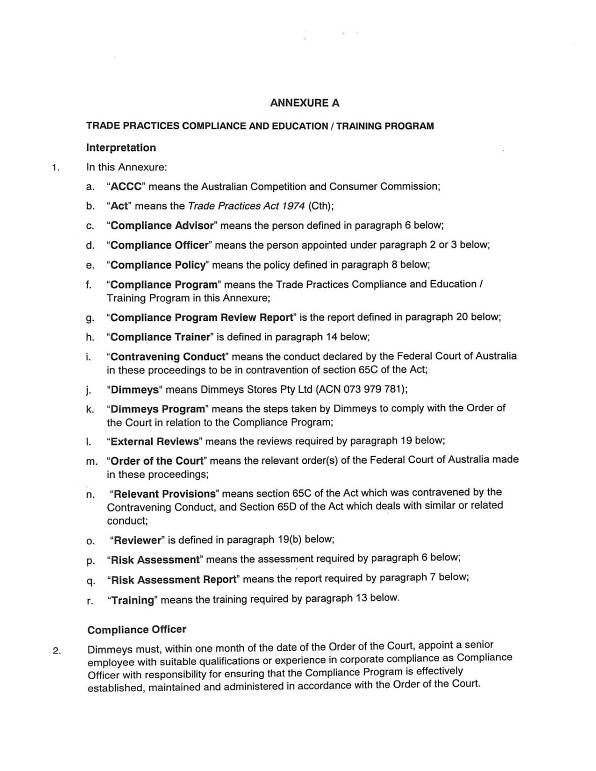
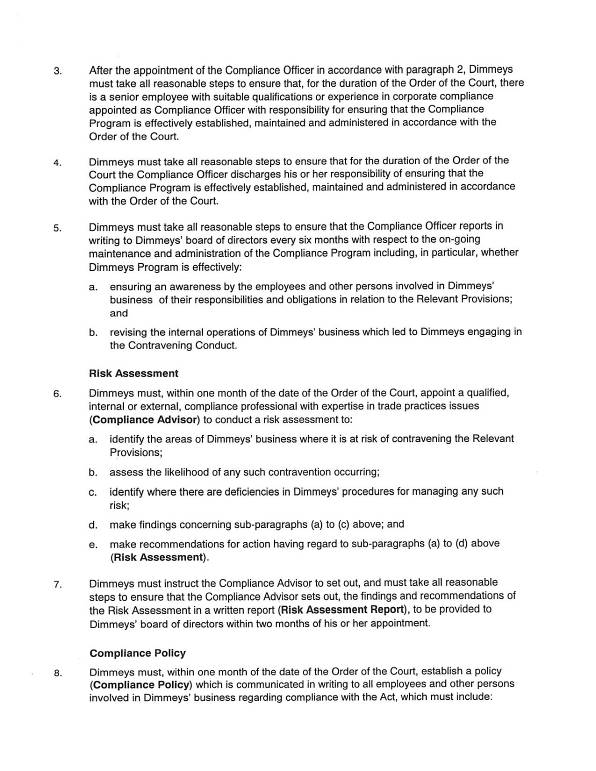
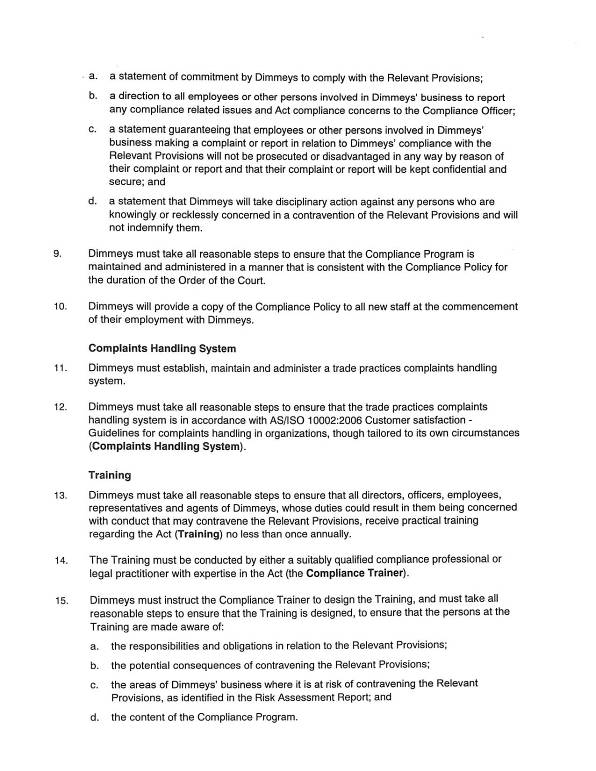
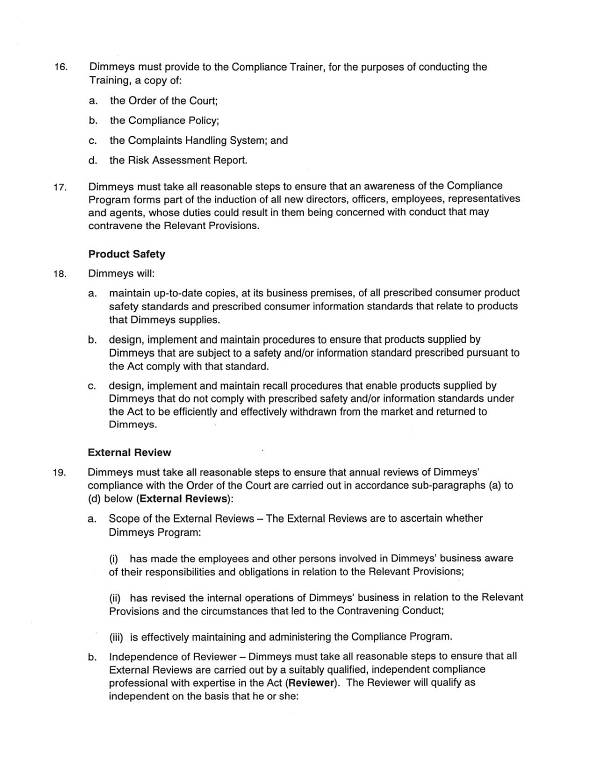
4. The Respondent establish a compliance program in accordance with the program set out in Annexure A to these Orders:
(a) for the employees or other persons involved in the Respondent’s business, being a program designed to ensure their awareness of the responsibilities and obligations in relation to the conduct declared by the Court in this proceeding to be in contravention of s 65C of the TPA and any similar or related conduct; and
(b) revising the internal operations of the Respondent’s business which led it to engage in the conduct declared by the Court in this proceeding to be in contravention of s 65C of the TPA;
(c) maintain and administer, at its own expense, the compliance program set out in Annexure A to these Orders for a period of three years from the date of this Order; and
(d) provide, at its own expense, a copy of any documents to be provided to the Applicant pursuant to the compliance program set out in Annexure A to these Orders.
5. The Respondent pay to the Commonwealth of Australia a pecuniary penalty in the total amount of $400,000 in respect of the contraventions of s 65C of the TPA referred to in paragraph 1 and 2 above that occurred on or after 15 April 2010:
(a) $140,000 within 12 months of the date of this Order;
(b) $130,000 within 24 months of the date of this Order; and
(c) $130,000 within 36 months of the date of this Order.
6. In the event that there is a default in the making of any of the instalment payments referred to in paragraph 5 above and that default continues for fourteen (14) days, the whole of the outstanding amount is due and payable by the Respondent.
7. The Respondent pay to the Applicant, within twenty eight (28) days of the making of this Order, a contribution towards its costs of and incidental to these proceedings in the total amount of $60,000.
Note: Settlement and entry of orders is dealt with in Order 36 of the Federal Court Rules. The text of entered orders can be located using Federal Law Search on the Court’s website.
ANNEXURE A
| VICTORIA DISTRICT REGISTRY | |
| GENERAL DIVISION | 964 of 2010 |
| BETWEEN: | AUSTRALIAN COMPETITION AND CONSUMER COMMISSION Applicant |
| AND: | DIMMEYS STORES PTY LTD (ACN 073 979 781) Respondent |
| JUDGE: | GORDON J |
| DATE: | 8 APRIL 2011 |
| PLACE: | MELBOURNE |
REASONS FOR JUDGMENT
1 On 10 November 2010, the Australian Competition and Consumer Commission (the ACCC) commenced proceedings in Fast Track alleging contraventions of s 65C(1)(a) of the Trade Practices Act 1974 (Cth) (TPA) by Dimmeys Stores Pty Ltd (ACN 073 979 781) (Dimmeys).
2 Section 65C(1)(a) of the TPA provided, at the relevant time, that:
A corporation shall not, in trade or commerce, supply goods that are intended to be used, or are of a kind likely to be used, by a consumer if the goods are of a kind:
(a) in respect of which there is a prescribed consumer product standard and which do not comply with that standard.
3 Dimmeys did not file a Fast Track Response. For the purposes of this proceeding, Dimmeys admits that it contravened s 65C(1)(a) of the TPA as follows:
1. Between 3 May and 24 June 2010, Dimmeys supplied, in trade or commerce, children’s dressing gowns in sizes between 00 and 14 labelled “Glamour Girl” (Glamour Girl Gowns) that were intended to be used, or were of a kind likely to be used, by a consumer but which did not comply with consumer safety standard prescribed by the Trade Practices (Consumer Product Safety Standards) (Children’s Nightwear and Paper Patterns for Children’s Nightwear) Regulations 2007 (Cth) (the Regulations), namely the AS/NZS 1249:2003 entitled “Children’s nightwear and limited daywear having reduced fire hazard” published by Standards Australia on 29 December 2003 subject to certain variations (the Standard) (the Glamour Girl Gowns Contraventions);
2. Between 3 May and 24 June 2010, Dimmeys supplied, in trade or commerce, children’s dressing gowns in sizes between 00 and 14 labelled “Apache Boys” (Apache Boys Gowns) that were intended to be used, or were of a kind likely to be used, by a consumer but which did not comply with the Standard (the Apache Boys Gowns Contraventions);
3. Between 16 April 2009 and 2 September 2010, Dimmeys supplied, in trade or commerce, children’s dressing gowns in sizes between 00 and 14 labelled “Minitong” (Minitong Gowns) that were intended to be used, or were of a kind likely to be used, by a consumer but which did not comply with the Standard (the Minitong Gowns Contraventions);
4. Between 16 April 2009 and 2 September 2010, Dimmeys supplied, in trade or commerce, children’s dressing gowns in sizes between 00 and 14 labelled “Zhong Da” (Zhong Da Gowns) that were intended to be used, or were of a kind likely to be used, by a consumer but which did not comply with the Standard (the Zhong Da Gowns Contraventions).
4 A statement of agreed facts has been filed. That statement, to which s 191 of the Evidence Act 1995 (Cth) applies, is evidence. It will be necessary to return to consider the content of that statement in further detail later in these reasons for decision.
RELIEF SOUGHT BY CONSENT
5 The ACCC and Dimmeys have jointly requested the Court:
1. grant declarations pursuant to s 21 of the Federal Court of Australia Act 1976 (Cth) (the FCA) of contraventions by Dimmeys of s 65C(1)(a) of the TPA;
2. grant an injunction pursuant to s 232 of Sch 2 of the Competition and Consumer Act 2010 (Cth) (the CCA) restraining Dimmeys from engaging in similar conduct for a period of five years;
3. make a probation order pursuant to s 86C(2)(b) of the TPA providing for a compliance program for Dimmeys; and
4. order Dimmeys pay a contribution to the ACCC’s costs, fixed in the sum of $60,000.
6 The ACCC also seeks a pecuniary penalty pursuant to s 76E of the TPA. Dimmeys does not oppose the imposition of a penalty but contends that the level of penalty sought by the ACCC is outside the appropriate range.
Competition and Consumer Act 2010
7 Before turning to consider the question of relief, it is necessary to set out the relevant statutory provisions.
8 Section 76E was added to the TPA by the Trade Practices Amendment (Australian Consumer Law) Act (No 1) 2010 (Cth) (No 44, 2010) (Amendment Act No 1), by provisions commencing on 15 April 2010: items 1 and 18 of Sch 2 to Amendment Act No 1 and s 2(1) table item 3 of Amendment Act No 1. The CCA commenced on 1 January 2011. Section 76E of the TPA was repealed. However, s 76E, in its form prior to 1 January 2011, continues to apply to conduct after 15 April 2010 up to and including 31 December 2010: see cll 6 and 7 of Sch 7 of the Trade Practices Amendment (Australian Consumer Law) Act (No 2) 2010 (Cth) (Amendment Act No 2).
9 In relation to injunctions, pursuant to cl 7(2) of the Amendment Act No 2, as of 1 January 2011, the power of the Court to grant an injunction in relation to conduct in contravention of what was Pt V of the TPA is provided for under s 232 of the Sch 2 of the Act (s 232 of the Australian Consumer Law) rather than s 80 of the TPA.
Orders by Consent: applicable principles?
10 The principles are well established. The Court must be satisfied that it has the power to make the orders proposed and that the orders are appropriate: Australian Competition and Consumer Commission v Real Estate Institute of Western Australia (1999) 161 ALR 79 and Australian Competition and Consumer Commission v Virgin Mobile Australia Pty Ltd (No 2) [2002] FCA 1548 at [1]. Once satisfied of those matters, the Court should be slow to impede final settlement of proceedings especially where the orders may have been different had it been the Court’s task to draft them: Australian Competition and Consumer Commission v Target [2001] FCA 1326 at [24]. Next, in deciding whether consent orders conform with legal principle, the Court is entitled to treat a respondent’s consent as involving an admission of all facts necessary or appropriate to the granting of the relief sought: Thomson Australian Holdings Proprietary Limited v Trade Practices Commission (1981) 148 CLR 150 at 164. With those principles in mind, I turn to deal with the relief sought by consent.
DECLARATIONS
11 The declarations sought by consent are to the effect that Dimmeys contravened s 65C of the TPA by supplying children’s gowns that were non-compliant with a consumer safety standard.
12 The Court has a wide discretionary power to make declarations under s 21 of the FCA. The pre-requisites to the making of a declaration are threefold: (1) the question must be real and not a hypothetical or theoretical one, (2) the applicant must have a real interest in raising it and (3) there must be a proper contradictor: Forster v Jododex Australia Pty Ltd (1972) 127 CLR 421 at 437-438. Each of those requirements is satisfied in the present case.
13 As a general principle, a Court does not make declarations on matters relating to public rights by consent or on admissions, unless it is satisfied by evidence: Australian Competition and Consumer Commission v Allergy Pathway Pty Ltd [2009] FCA 960 at [18] – [19]; Australian Competition and Consumer Commission v Skins Compression Garments Pty Ltd [2009] FCA 710 at [13]; Australian Securities & Investment Commission v Rich (No 2) (2004) 50 ACSR 500 at [10]; Williams v Powell [1894] WN (Eng) 141; Gramophone Co Ltd v Magazine Holder Co (1911) 28 RPC 221 at 225-227; Termijtelen v Van Arkel [1974] 1 NSWLR 525; Wallersteiner v Moir [1974] 3 All ER 217; Metzger v Department of Health and Social Security [1977] 3 All ER 444 at 451; BMI Ltd v Federated Clerks Union of Australia (NSW) Branch (1983) 51 ALR 401; Young P W, Declaratory Orders (2nd ed, 1984) [601]. In the present case, that is not an issue. As noted earlier, Dimmeys signed the Agreed Statement: see [4] above. That statement, to which s 191 of the Evidence Act 1995 (Cth) applies, is evidence.
14 Finally, I consider that the declarations are appropriate: Tobacco Institute of Australia Ltd v Australian Federation of Consumer Organics Inc (No 2) (1993) 41 FCR 89 at 100 and Australian Competition and Consumer Commission v Midland Brick Co Pty Ltd (2004) 207 ALR 329 at [21] – [22]; Australian Competition and Consumer Commission v LG Electronics Australia Pty Ltd [2006] FCA 1118 at [8] – [9] and Australian Competition and Consumer Commission v The Construction, Forestry, Mining and Energy Union (2007) ATPR 42-140 at [6]. They are an appropriate vehicle to record the Court’s disapproval of the contravening conduct. They may deter other corporations from contravening the CCA. There is, however, in the circumstances of this case, a further reason for granting the declarations. In the absence of them, the contravening conduct would not otherwise be clearly identified and there is at least some public benefit in that contravening conduct being clearly identified.
INJUNCTIONS
15 The parties seek an injunction. The terms are agreed. The effect of the injunction is to restrain Dimmeys for a period of five years from supplying children’s nightwear to consumers that do not comply with the Standard or such other prescribed safety standard as may from time to time be applicable at the time of the supply.
16 Section 232 of the Australian Consumer Law is relevantly identical to s 80 of the TPA. The power of the Court to grant an injunction under s 232 is broad. It is, however, subject to at least three limitations:
1. the power is confined by reference to the scope and purpose of the Act. The relief should be designed to prevent a repetition of the conduct for which the relief is sought;
2. because the jurisdiction to grant an injunction is enlivened by an alleged or actual contravention of Pt V of the TPA, there must be a sufficient nexus or relationship between the contravention and the injunction; and
3. the Federal Court exercises judicial power under Ch III of the Constitution in respect of “matters” and therefore the injunction must relate to the case or controversy,
see Australian Competition and Consumer Commission v Z-Tek Computers Pty Ltd (1997) 78 FCR 197 at 203-4.
17 In the present case, the injunction proposed by the parties is appropriate. It satisfies the three limitations: it is directed at preventing the precise conduct the subject of the proceeding (supplying children’s nightwear to consumers that do not comply with the Standard or such other prescribed safety standard as may from time to time be applicable at the time of the supply). Moreover, the injunction is capable of being readily obeyed and does not require ongoing Court supervision: Real Estate Institute of Western Australia Inc (1999) 161 ALR 79 at [26].
PROBATION ORDER
18 A probation order compliance program is sought by consent under s 86C(2)(b) of the TPA. Dimmeys consents to the Order and the terms of the program, a copy of which will be annexed to the Orders.
19 The focus of probation orders is education and prevention: Australian Competition and Consumer Commission v Danoz Direct Pty Ltd [2003] FCA 881 at [267]. It takes time to achieve its objective: Danoz Direct at [268] and Australia Competition and Consumer Commission v Real Estate Institute of Western Australia Inc (1999) 95 FCR 114 at [51]. In my view, having regard to the circumstances of this case, the fact of the Order and the terms of it are appropriate.
COSTS
20 The ACCC and Dimmeys have agreed to Orders that Dimmeys contribute $60,000 towards the ACCC’s costs. There will be an Order in those terms.
PENALTIES
21 That brings me the issue in dispute – the quantum of the penalty to be imposed by Dimmeys under s 76E(1) of the TPA. The ACCC seeks a total pecuniary penalty of $500,000 comprised of a total pecuniary penalty of $330,000 for the Glamour Girl Gowns Contraventions and the Apache Boys Gowns Contraventions and a total pecuniary penalty of $170,000 for the Minitong Gowns Contraventions and the Zhong Da Gowns Contraventions. Dimmeys submits that the penalty should be $100,000 - $150,000 for the Glamour Girl Gowns Contraventions and the Apache Boys Gowns Contraventions and $30,000 for the Minitong Gowns Contraventions and the Zhong Da Gowns Contraventions.
22 As noted above (see [8]), s 76E came into force on 15 April 2010.
23 Section 76(1) empowers the Court, in respect of a contravention of Pt V of the TPA, to order the contravener to pay “such pecuniary penalty, in respect of each act or omission … as the Court determines to be appropriate”. Section 76E(3) of the TPA provides that the Court may impose a maximum penalty of 10,000 penalty units (or $1.1 million) for each act or omission. The parties acknowledge that each supply of a non-compliant gown on or after 15 April 2010 may constitute a separate contravention of s 65C of the TPA. However, the parties submit it is appropriate to treat the supply of non-compliant gowns as two courses of conduct, with each course attracting one penalty: Australian Competition and Consumer Commission v ABB Transmission and Distribution Ltd (No 2) (2002) 190 ALR 169 at [38]; Australian Competition and Consumer Commission v Rural Press Ltd [2002] FCA 1065 at [19] and Australian Competition and Consumer Commission v CI & Co Pty Ltd [2010] FCA 1511 at [27]. The Glamour Girl Gowns Contraventions and the Apache Boys Gowns Contraventions is one course of conduct and the Minitong Gowns Contraventions and the Zhong Da Gowns Contraventions is the second course of conduct.
24 Some guidance on the question of the “course of conduct” is obtained from looking at the Court’s approach when contraventions of Pt V of the TPA were deemed to be offences under s 79(1) of the TPA. The principal authority was Trade Practices Commission v Advance Bank Australia Limited (1993) ATPR 41-229 at 41,164. The case concerned charges in relation to a series of misleading advertisements. In assessing penalty, Gummow J cited with approval the following passage from Trade Practices Commission v Bata Shoe Company of Australia Pty Ltd (No 2) (1980) 44 FLR 149 at 176:
Guidance is given in the field of sentencing for criminal offences by the well known principle that where several offences are heard together and arise out of the same transaction it is a sound working rule that the sentences imposed for those offences should be made concurrent; it is inappropriate to sentence consecutively when the offences were all really involved in the same episode … I accept that the contraventions arose out of the one course or pattern of conduct. Although it is necessary to look at each contravention separately, nevertheless consideration must be given to the facts common to each contravention.
25 The “one course of conduct” principle has also been applied to other contraventions of the TPA which have attracted pecuniary penalties under s 76 of the TPA: see by way of example Australian Competition and Consumer Commission v IPM Operation and Maintenance Loy Yang Pty Ltd (No 2) [2007] FCA 11 (dealing with contraventions of s 45E); ABB Transmission and Distribution at [38]; Rural Press Ltd at [19] and Australian Competition and Consumer Commission v Telstra Corporation Ltd [2010] FCA 790 at [221] – [227].
26 Section 76E(2) provides that in determining the appropriate pecuniary penalty, the Court is required to have regard to all relevant matters including:
1. the nature and extent of the act or omission and of any loss or damage suffered as a result of the act or omission;
2. the circumstances in which the act or omission took place; and
3. whether the contravener has previously been found by the Court in proceedings under Pt V or Pt VI to have engaged in similar conduct.
27 The ACCC submitted that the principles that have been applied by the Court in determining penalties for contraventions of Pt IV of the TPA under s 76 of the TPA may be appropriately adapted and taken into account in the Court’s assessment of an appropriate penalty under s 76E of the Act. In my view, the underlying contraventions of the TPA dealt with by ss 76 and 76E are of a different nature but the general principles applied by the Court in determining penalties under s 76 can and should be relied upon to the extent relevant in setting a penalty under s 76E of the TPA. Such a conclusion is not surprising. Sections 76 and 76E are drafted in similar terms and the matters to which the Court must have regard under s 76E(2) are the same mandatory considerations under s 76(1) of the TPA.
28 In Trade Practices Commission v CSR Limited (1991) ATPR 41-076 at 52,152-52,153, French J identified the following additional considerations relevant to the assessment of a pecuniary penalty under s 76:
1. the nature and extent of the contravening conduct;
2. the amount of loss or damage caused;
3. the circumstances in which the conduct took place;
4. the size of the contravening company;
5. the degree of power it has, as evidenced by its market share and ease of entry into the market;
6. the deliberateness of the contravention and the period over which it extended;
7. whether the contravention arose out of the conduct of senior management or at a lower level;
8. whether the company has a corporate culture conducive to compliance with the TPA as evidenced by educational programs and disciplinary or other corrective measures in response to an acknowledged contravention; and
9. whether the company has shown disposition to cooperate with the authorities responsible for the enforcement of the TPA in relation to the contravention.
29 Those considerations were approved and expanded upon by the Full Court in NW Frozen Foods Pty Ltd v Australian Competition and Consumer Commission (1996) 71 FCR 285 and J McPhee & Son (Australia) Pty Ltd v Australian Competition and Consumer Commission (2000) 172 ALR 532 as follows:
1. whether the respondent has engaged in similar conduct in the past;
2. the respondent’s financial position; and
3. whether the conduct was systematic, deliberate or covert.
30 It is apparent that at least the fifth factor identified by French J (the degree of power it has, as evidenced by its market share and ease of entry into the market) is not relevant in the context of s 76E. With this exception, each of the other factors identified by French J and the Full Court may be applied to the assessment of a penalty under s 76E.
31 A principal object of a penalty under s 76 is deterrence: Trade Practices Commission v Stihl Chain Saws (Aust) Pty Ltd (1978) ATPR 40-091 at 17,896 and Trade Practices Commission v CSR Limited at 52,152-52,153. In Australian Competition and Consumer Commission v Leahy Petroleum Pty Ltd (No 3) (2005) 215 ALR 301 at [39], Goldberg J concluded that:
The penalty imposed must be substantial enough that the party realises the seriousness of its conduct and is not inclined to repeat such conduct. Obviously the sum required to achieve this object will be larger where the court is setting a penalty for a company with vast resources.
32 Similarly, the principal object of a penalty under s 76E is deterrence, both specific and general. The Explanatory Memorandum to the bill which become Amendment Act No 1 (Trade Practices Amendment (Australian Consumer Law) Bill 2009 – Explanatory Memorandum, pp 49-50) referred to deterrence as an objective and adverted to facilitation of civil proceedings in which both penalties and compensation could be sought, in the following terms:
4.3 The lack of availability of civil pecuniary penalties and disqualification orders for enforcement of consumer law represents a significant gap in the range of enforcement options available to the Australian Competition and Consumer Commission (ACCC) and the Australian Securities and Investments Commission (ASIC). While criminal sanctions provide an important deterrent against the most serious forms of contravening misconduct, and civil remedies can achieve timely outcomes for consumers, there is currently no means of obtaining sanctions in the timely manner available under the civil regime.
4.4 Civil pecuniary penalties and disqualification orders are a feature of other national regulatory regimes - including the restrictive trade practices provisions in Part IV of the TP Act. Their availability will enable a more targeted and proportionate regulatory response, in addition to increasing the deterrent effect of consumer law provisions.
4.5 Moreover, at present the ACCC and ASIC are unable to obtain compensation for consumers when bringing a criminal action alone. If a matter is serious enough to warrant a penalty, the ACCC or ASIC must institute both civil and criminal proceedings in order to secure any type of compensation. Civil pecuniary penalties and disqualification orders will provide an alternative to this duplicative process, and provide timely and proportionate resolutions to instances of illegal conduct that do not call for criminal sanctions to be sought.
33 Of course, a penalty must not be so high as to be oppressive: Stihl Chainsaws (Aust) Pty Limited; NW Frozen Foods (at 293) and Australian Competition and Consumer Commission v Leahy Petroleum (No 2) [2005] FCA 254 at [5].
34 As the parties submitted, the cases that have considered s 76E (see Australian Competition and Consumer Commission v Gourmet Goody’s Family Restaurant Pty Ltd [2010] FCA 1216 at [10]; CI & Co Pty Ltd at [31] – [32] and Australian Competition and Consumer Commission v Le Sands Restaurant and Le Sands CafÉ Pty Ltd [2011] FCA 105 at [9]; Australian Competition and Consumer Commission v Al Constructions (ACT) Pty Ltd [2010] FCA 1377) are of limited or no assistance in determining an appropriate penalty in this case. They did not concern product safety. Each was concerned with a contravention of ss 52 or 53C of the TPA.
35 In Gourmet Goody’s Family Restaurant, Jagot J imposed penalties under s 76E of the Act. The Respondents had contravened s 53C of the TPA by failing to specify in a prominent way and as a single figure the single price for the goods supplied in their restaurant. In imposing a penalty of $13,200 for each contravention, her Honour stated that:
... it is important that I record that I am satisfied on the agreed statement of facts that the penalty which the parties have agreed between themselves in an appropriate reflection of the circumstances of the culpability of each respondent in the proceedings. In reaching this conclusion I have had regard to the fact that a principal object of a penalty under s 76 is deterrence.
…
… Specific deterrence of the respondents themselves is not a weighty consideration in this case because as soon as the respondents were notified of the problem by the ACCC, they took immediate action to rectify the problem
…
… That having been said, general deterrence remains critical.
36 The process to be applied in arriving at a particular penalty was considered in the context of criminal sentencing by the High Court in Markarian v The Queen (2005) 228 CLR 357. That process is applicable to the assessment of pecuniary penalties under s 76 of the TPA: see Australian Competition and Consumer Commission v Liquorland (Australia) Pty Ltd (2005) ATPR 42-070 at [68]. In Markarian, the plurality judgment held:
1. the Court’s assessment of the appropriate penalty is a discretionary judgment based on all relevant factors (see [27]);
2. “… careful attention to maximum penalties will almost always be required, first because the legislature has legislated for them; secondly, because they invite comparison between the worst possible case and the case before the court at the time; and thirdly, because in that regard they do provide, taken and balanced with all of the other relevant factors, a yardstick.” (see [31]);
3. it will rarely be appropriate for a Court to start with the maximum penalty and proceed by making a proportional deduction from that maximum (see [31]);
4. the Court should not adopt a mathematical approach of increments or decrements from a pre-determined range, or assign specific numerical or proportionate value to the various relevant factors (see [37] citing Wong v The Queen (2001) 207 CLR 584 at 611-612 [74] – [76] per Gaudron, Gummow and Hayne JJ);
5. it is not appropriate to determine an “objective” sentence and then adjust it by some mathematical value given to one or more factors such as plea of guilty or assistance to authorities (see [37] citing Wong v The Queen (2001) 207 CLR 584 at 611-612 [74] – [76] per Gaudron, Gummow and Hayne JJ);
6. the Court “may not add and subtract item by item from some apparently subliminally derived figure” to determine the penalty to be imposed (see [39]); and
7. since the law strongly favours transparency, accessible reasoning is necessary in the interests of all, and, while there may be occasions where some indulgence in an arithmetical process will better serve the end, it does not apply where there are numerous and complex considerations that must be weighed (see [39]).
In my view, that process is also applicable to the assessment of pecuniary penalties under s 76E of the TPA.
APPLICATION OF PRINCIPLES TO PRESENT CASE
Nature of contravening conduct and circumstances in which it took place
37 The contravening conduct was serious. It involved the supply of non-compliant children’s nightwear. The contravening conduct for the purposes of s 76E is limited to the supply by Dimmeys of:
1. 850 Glamour Girl Gowns and 1,264 Apache Boys Gowns, many of which did not carry a low fire hazard warning label; and
2. at least five (being those gowns purchased by the ACCC after 15 April 2010) and possible many more Minitong Gowns and Zhong Da Gowns, each of which carried a low fire hazard warning label but not in the location required by the Standard. The label was located on a side seam about two centimetres from the bottom and not inside the back of the neck of the garments,
see [3] above.
38 The Glamour Girl Gowns and Apache Boys Gowns were supplied in April 2010. The garments were imported from overseas and shipped directly to Dimmeys warehouse. They were ordered by Mr Douglas Zappelli, the controlling mind of Dimmeys. Upon their receipt, the Dimmeys Buyer for Children’s wear, Mr Ron Bower, inspected one box and concluded that the gowns in that box were labelled correctly with the required fire hazard warning label. Dimmeys believes that the inspected box contained 16 items. Mr Bower signed a form entitled “Trade Practices Compliance Sign-Off Form” dated 15 April 2010 stating that the gowns were “compliant for Trade Practices Purposes”. That was an error. The gowns were then despatched from the warehouse to retail stores. Some stores noticed that some of the Gowns were not labelled and returned them to the warehouse. Not all stores were so diligent. That was another error.
39 Dimmeys believes that it made arrangements for 1020 gowns that had been returned to be sent to have a “Low Fire Hazard” label attached to them. It has no record substantiating that work was requested or done. Dimmeys did not inspect the gowns on their return to see if they were correctly labelled. The gowns were despatched once more to the retail stores and offered for sale. No action was taken by Dimmeys to check whether other Glamour Girl Gowns and Apache Boys Gowns which remained at Dimmeys stores were correctly labelled. A substantial number of gowns offered for sale did not carry the fire hazard warning label. The contravening conduct in relation to the Minitong Gowns and Zhong Da Gowns was less serious: see [37(2) above].
40 Dimmeys ordered, at the direction of Mr Zappelli, 5000 Girls Fleece Tops. These garments were imported from overseas and arrived in or about April 2009. A sample of the Girls Fleece Tops had been inspected by Mr Zappelli and as there was no safety product standard applicable to the Girls Fleece Tops the boxes were not inspected for Trade Practice compliance. It is not uncommon for overseas suppliers to substitute a small percentage of the total number of items ordered with different items if there is a shortfall of stock on hand to meet the order. Included in the boxes received by Dimmeys were the Minitong Gowns and the Zhong Da Downs.
41 Dimmeys believes that of the 3238 garments received, at least 323 were the Minitong Gowns and the Zhong Da Gowns. The Minitong Gowns, the Zhong Da Gowns and the Girls Fleece Tops all carried the same barcode. Dimmeys did not become aware that Minitong Gowns and the Zhong Da Gowns had been supplied to them until 18 August 2010 when Dimmeys received correspondence from the ACCC. Each of the Minitong Gowns and the Zhong Da Gowns carried a low fire hazard warning label but not in the location required by the Standard. The label was located on a side seam about two centimetres from the bottom and not inside the back of the neck of the garments: see [37(2)] above.
42 I accept that there is no evidence to suggest that the contravening conduct was deliberate. The gowns were sold from many (if not all) of Dimmeys network of 43 stores across Australia. The contraventions were not isolated to one store or one region. There was therefore a critical failure at the warehouse and at the retail level in failing to identify that the garments did not comply with the Standard.
43 None of the gowns were classified as inherently dangerous or unsafe but were to be labelled a low fire hazard. There is no evidence to suggest that a child was injured or that a consumer suffered any loss or damage. However, the risk of possible harm to consumers from the use of children’s night wear without the prescribed warning label is a factor to be taken into account in assessing penalty.
44 The contravening conduct ceased only after the ACCC detected the breach and contacted Dimmeys. On 23 June 2010, an ACCC officer informed Mr Bower by telephone that the ACCC had purchased Glamour Girl Gowns, Apache Boys Gowns and Minitong Gowns from specified Dimmeys stores which did not comply with the Standard because they did not carry any fire hazard warning label or had the label in the incorrect position. On 24 June 2010, the ACCC confirmed its position in writing and requested Dimmeys give immediate consideration to taking action by way of recall or otherwise, in relation to gowns supplied and the gowns still in stock. On 28 June 2010, Dimmeys told the ACCC that a recall notice had been forwarded to stores and an advertisement would be published nationally. Dimmeys also offered a full refund. No items were returned. In the case of the Minitong Gowns and the Zhong Da Gowns, Dimmeys continued to supply the gowns for a further two months after the ACCC told Dimmeys that the gowns did not appear to comply with the Standard.
45 So far as is relevant for the purposes of s 76E of the TPA, the Glamour Girl Gown Contraventions and the Apache Boys Gowns Contraventions took place between 3 May and 24 June 2010 whereas the Minitong Gowns Contraventions and the Zhong Da Gowns Contraventions took place from 16 April 2009 until 2 September 2010. Dimmeys continued to supply the Minitong Gowns and the Zhong Da Gowns on the basis that it considered the ACCC’s reference to the Minitong Gowns and the Zhong Da Gowns to be a reference to other garments sold under the brand name “Minitong”. Why? Because it did not know that the supplier of fleece tops had included these gowns to make up a shortfall in stock of fleece tops. Upon learning of this misunderstanding, Dimmeys took the same steps in relation to these gowns – recall notices in the stores, advertised nationally and withdrew the garments from the stores.
46 Finally, the evidence discloses that since these proceedings were commenced, Dimmeys has admitted the conduct alleged in the Fast Track Statement, fully cooperated with the ACCC, agreed to all forms of relief sought in the Fast Track Application (other than the quantity of the penalty) and thereby reduced the time and expense of the proceeding and saved public time and resources including those of the Court.
Whether Dimmeys previously engaged and / or been found by the Court to have engaged in similar conduct
47 Section 76E(2) expressly refers to the Court considering whether the person has previously been found by the Court to have engaged in similar conduct: see [26] above.
48 Dimmeys conceded that it has previously breached the TPA and the Fair Trading Act 1999 (Vic): see Australian Competition and Consumer Commission v Dimmeys Stores Pty Ltd [1999] FCA 1175 (the Dimmeys 1999 Decision) and Australian Competition and Consumer Commission v Dimmeys Stores Pty Ltd [2001] FCA 299 (the Dimmeys 2001 Decision). In my view, these cases concerned “similar conduct” for the purposes of s 76E(2). I rejected the ACCC’s submission that a conviction in the Magistrates’ Court for the supply of non compliant candles was conduct of a similar nature for the purposes of s 76E(2).
49 Dimmeys, however, submits that there are distinctions to be drawn between those transgressions and the current proceeding. The Dimmeys 1999 Decision concerned the sale of bicycles not fitted with a number of prescribed safety features. The Court imposed a fine of $60,000 on Dimmeys and $30,000 on Starite Distributors Pty Ltd, a related entity (Starite). The Dimmeys 2001 Decision concerned children’s nightwear which did not contain the relevant fire hazard warning. In relation to that decision, there were two separate breaches two months apart. The penalty was $60,000 for the first and $100,000 for the second contravention. In both cases, the maximum penalty was $200,000. There are distinctions to be drawn but I do not accept that they are distinctions that result in the decisions being not a relevant consideration in the assessment of the quantum of penalty.
Deliberateness of the Conduct
50 As indicated, there is no evidence to suggest that the conduct was deliberate or undertaken covertly by officers of Dimmeys: see [38] to [42] above.
Whether the contravention arose out of conduct of senior management or at a lower level
51 Dimmeys admitted that although the conduct was not deliberate, the contravening conduct arose out of an erroneous assumption that having checked one box, all the items were the same. In my view, senior management were involved. Mr Zappelli ordered the goods. Mr Bower, Dimmeys Buyer for Children’s wear, inspected the goods. The systems in place for ensuring compliance with consumer safety standards were unsatisfactory.
Size and financial position of Dimmeys
52 Dimmeys is a large and well recognised retailer of consumer goods. At the time of the contraventions it operated 43 retail outlets around Australia. As at 29 March 2011, it employs 577 full time, part time and casual staff.
53 The financial position of Dimmeys is a relevant factor to be taken into account in the assessment of the appropriate penalty including the effect on third persons, such as creditors and employees: Schneider Electric (Australia) Pty Ltd v Australian Competition and Consumer Commission [2003] 196 ALR 611 at [8] and Australian Competition and Consumer Commission v McMahon Services Pty Ltd [2004] FCA 1425 at [25] – [29].
54 However, as deterrence is the primary objective of penalties, the financial capacity of a respondent to pay must not prevent the Court from doing its duty even if in some cases, the penalty is so high that the offender will become insolvent: Australian Competition and Consumer Commission v High Adventure Pty Ltd (2006) ATPR 42-091 at [11]. Put another way, I accept that capacity to pay is a relevant factor, but one of “less importance when balanced against the necessity of imposing a penalty that satisfies the objective of general deterrence”: Australian Communications and Media Authority v Mobilegate Ltd A Company Incorporated in Hong Kong (No 6) [2009] FCA 1533 at [28] and Leahy Petroleum (No 2) [2005] FCA 254 at [9] and [11].
55 What then is the financial position of Dimmeys? Dimmeys submits it is precarious. In 2008, it reported a loss of $8.2 million. In 2009, it reported an operating profit of $397,054 but only after a one off payment of $3,056,000 for a lease break fee it received for one of its flagship stores. In 2010, the position was much the same. An operating loss of $812,174 before the payment of a lease break fee in respect of the sale of another of its flagship stores. Its management accounts for the first six months of the 2011 financial year record an operating loss of close to $1 million. Since 2003, there has been a decline in sales. The global financial crisis, the shift in consumer spending and the rise in online shopping were all said to have contributed to Dimmeys’ predicament. Its main asset is its stock. As at 30 June 2010, the stock was valued at cost at $23.454 million. Dimmeys’ external accountant, Mr Singer, gave evidence that on a fire sale, the value of the stock would be between 10 and 15% of cost. Dimmeys’ net assets also include plant, equipment and goodwill. Plant and equipment is primarily limited to store fit out and has limited commercial value. The goodwill figure in the accounts is a historical value dating back to 1996. Mr Singer estimated the current valuation of goodwill would not exceed $1.00.
56 Its largest creditor is Starite, its major supplier. As at 30 March 2011, the total debt owing to Starite was $12.44 million. Payments are made from time to time to Starite in reduction of the debt. Interest on the unpaid invoices accrues at the rate of 5% per annum, well below commercial lending rates. The non Starite creditors total about $2.5 million. Evidence was adduced that Dimmeys’ have taken steps to save costs including through voluntary retrenchments. As at 29 March 2011, the total amount owing to staff for long service leave and annual leave entitlements was $1.09 million. Mr Singer accepted that if Dimmeys was placed under external administration, these employee entitlements could be satisfied from its current assets. Dimmeys submitted that it could not afford to pay a penalty of $500,000 and that the effect of any significant penalty would be that Dimmeys would have great difficulty in making the payment of employee benefits in the near future.
57 Finally, Dimmeys submitted that even if I was not satisfied about its precarious financial position, then the penalty sought by the ACCC was outside the appropriate range.
58 I am satisfied that Dimmeys, as a stand alone entity, is in financial hardship. However, given the financial support (direct and indirect) that it receives from related entities and individuals including Starite, the beneficiaries of the Dimmeys Unit Trust (of which Dimmeys is the trustee) and Forges of Footscray Properties Pty Ltd, it is not possible on the evidence available to conclude that the imposition of a penalty in or near the range sought by the ACCC would have the “crushing” effect contended for by Dimmeys. That conclusion is fortified by three facts and matters. First, the ACCC proposed that the penalty be paid by instalments. Secondly, as was discussed during the course of argument, no evidence was led by Dimmeys as to the financial position of these and other related entities. Finally, there was no evidence to suggest that the support provided by these entities and individuals in the past would not continue in the near future.
Whether Dimmeys has a culture of compliance
59 Dimmeys had a Trade Practices Compliance Program during the relevant period. That Program failed to prevent the contravening conduct from occurring. Dimmeys admits that the processes it had in place for inspection of in coming goods at the warehouse and at the retail stores was inadequate. Dimmeys accepts that it needs to implement a more rigorous, systematic and ongoing compliance program. Since late 2010, Dimmeys commenced to do so. As noted earlier, Dimmeys also consents to an order being made for a Trade Practices Compliance Program in specified terms.
Whether Dimmeys has shown a disposition to cooperate with the ACCC in relation to the contraventions
60 As noted earlier, since the ACCC first raised theses issues with Dimmeys, it has cooperated fully with the ACCC. Since the commencement of the proceedings, it did not file a defence contesting liability. It cooperated on the Agreed Statement of Facts, the consent orders and the joint submissions on all relief except penalty. As a result, preparation and conduct of a trial has been avoided.
Deterrence
61 As noted earlier, a principal object of a penalty under s 76E is deterrence – specific and general: see [31] – [33] above. The primary object of s 65C(1) is the protection of consumers. In the present case, infants and children are a significantly vulnerable class of consumers. Standards were enacted to protect them. Standards that Dimmeys and other retailers are fully aware of.
62 As Tracey J said in Australian Competition and Consumer Commission v Skippy Australia Pty Ltd [2006] FCA 1343 at [21]:
The warnings were intended to lessen the risk of harm befalling vulnerable young children. The failure to provide the cautionary notices meant that parents and carers were deprived of essential warnings and advice.
63 The risk of fire and burning is serious and dangerous. The goods which were the subject of the Standard were to be used by children. For those reasons, deterrence (specific and general) must be given significant weight. In the context of Dimmeys, the penalty for specific deterrence must be substantial – this is not the first time: see the 1999 and the 2001 Dimmeys’ Decisions. The only saving grace, if there be one, is that the previous episodes were 10 years ago.
The Appropriate Penalty?
64 The Glamour Girl Gown Contraventions and the Apache Boys Gown Contraventions are more serious in nature and extent than the Minitong Gown and Zhong Da Gown contraventions. Both general and specific deterrence is a significant factor weighing in favour of imposing a substantial penalty. However, in considering the quantum of the penalties for these two courses of conduct I am required to give effect to the totality principle in order to avoid a crushing aggregate penalty and to ensure, so far as is possible, that the aggregate penalty reflects the totality of the criminality involved: Australian Competition and Consumer Commission v Chubb Security Australia Pty Ltd [2004] FCA 1750 at [141] – [143].
65 In all the circumstances, I consider an appropriate penalty for the Glamour Girl Gown Contraventions and the Apache Boys Gown Contraventions should be $300,000. In relation to the less serious Minitong Gown and Zhong Da Gown contraventions, I consider an appropriate penalty to be $100,000.
66 The ACCC submitted that it was appropriate to allow the penalties to be paid by instalments. I am satisfied that those arrangements are appropriate. Accordingly, I will direct Dimmeys to pay the penalty by the following instalments:
1. $140,000 within 12 months of the date of this Order;
2. $130,000 within 24 months of the date of this Order; and
3. $130,000 within 36 months of the date of this Order.
67 I am also prepared to order that if there is a default in payment that continues for more than 14 days the amount outstanding by Dimmeys is to become due and payable.
| I certify that the preceding sixty-seven (67) numbered paragraphs are a true copy of the Reasons for Judgment herein of the Honourable Justice Gordon. |
Associate:


