

FEDERAL COURT OF AUSTRALIA
Australian Competition and Consumer Commission v Yellow Page Marketing BV (No 2) [2011] FCA 352
| IN THE FEDERAL COURT OF AUSTRALIA | |
| AUSTRALIAN COMPETITION AND CONSUMER COMMISSION Applicant | |
| AND: | First Respondent YELLOW PUBLISHING LTD Second Respondent |
| DATE OF ORDER: | |
| WHERE MADE: |
UPON THE UNDERTAKING BY THE APPLICANT (the ACCC) by its Counsel to use its best endeavours to return the cheques and other documents, produced by the Commissioner of Police of Western Australia in response to the subpoena issued in this proceeding dated 19 November 2010, to the respective drawers or the relevant drawee financial institution.
THE COURT ORDERS THAT:
1. There be judgment against the Respondents pursuant to O 35A r 3(2)(c) of the Federal Court Rules.
THE COURT DECLARES THAT:
2. Each of the First Respondent (YPM) and the Second Respondent (YPL), during the period from on or about 12 May 2010 until a date in or about August 2010, has, in trade or commerce:
(a) in contravention of s 52 of the Trade Practices Act 1974 (Cth) (applicable under items 6 and 7 of Sch 7 to the Trade Practices Amendment (Australian Consumer Law) Act (No 2) 2010 (Cth)) (the TPA), engaged in conduct that was misleading and deceptive or was likely to mislead and deceive; and
(b) in connexion with the supply and possible supply of business listing and advertising directory services (Business Directory Services) and in connexion with the promotion of the supply and use of such services:
(i) in contravention of s 53(c) of the TPA, represented that the services have sponsorship, approval, performance characteristics, uses or benefits they do not have;
(ii) in contravention of s 53(d) of the TPA, represented that YPL had a sponsorship, approval or affiliation that it does not have; and
(iii) in contravention of s 53(e) of the TPA, made false and misleading representations with respect to the price of the Business Directory Services,
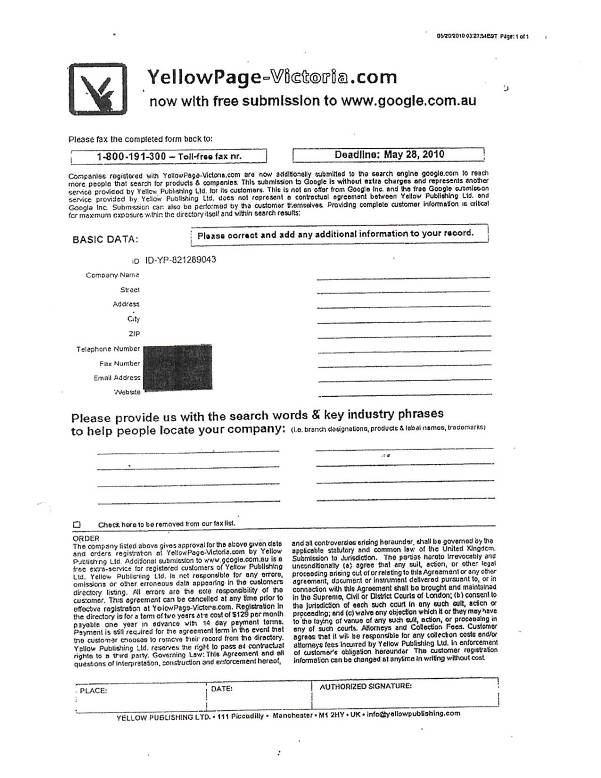
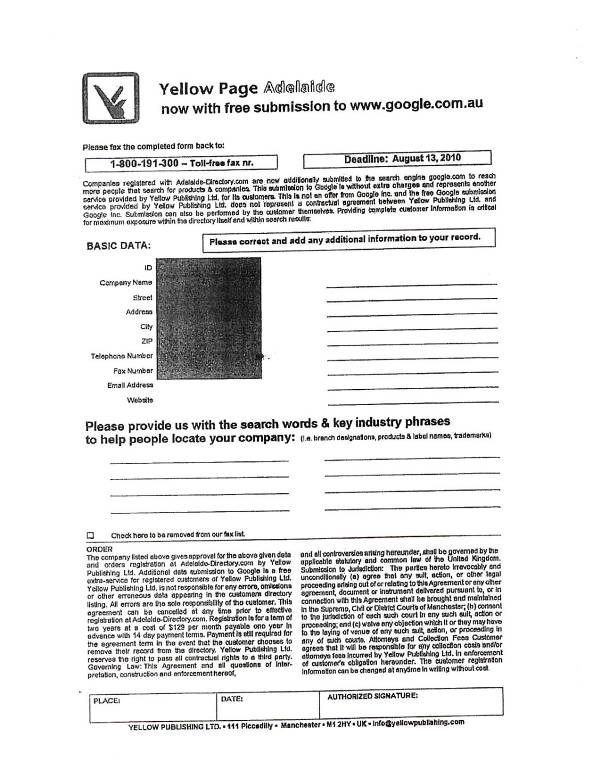
by sending, or causing to be sent, facsimiles to individuals and companies operating businesses in Australia to procure subscription to YPM’s online business directories (each a Yellow Page Facsimile) substantially in the form of the redacted facsimiles attached as Annexure A to these Orders, and thereby representing that:
(c) the Yellow Page Facsimile was sent by the owner or publisher of the paper business directories published in Australia since about 1975 under the name “Yellow Pages” and the mark Yellow Pages® (Yellow Pages® Business Directories) or was otherwise affiliated with the Yellow Pages® Business Directories, when this was not the case;
(d) completion of the Yellow Page Facsimile and its transmission in accordance with the directions and the deadline appearing on the Yellow Page Facsimile was required in order to renew or otherwise obtain listing in the Yellow Pages® Business Directories, when this was not the case;
(e) the offer contained in the Yellow Page Facsimile was for a submission to www.google.com.au that was free of charge, when the offer was not free of charge and involved charges in accordance with fine print appearing at the bottom of the Yellow Page Facsimile.
3. Each of YPL and YPM, during the period from a date in or about July 2010 to 4 November 2010, has, in trade or commerce:
(a) in contravention of s 52 of the TPA, engaged in conduct that was misleading and deceptive or was likely to mislead and deceive; and
(b) in contravention of s 53(e) of the TPA, in connexion with the supply and possible supply of Business Directory Services and in connexion with the promotion of the supply and use of such services made false and misleading representations with respect to the price of the services,
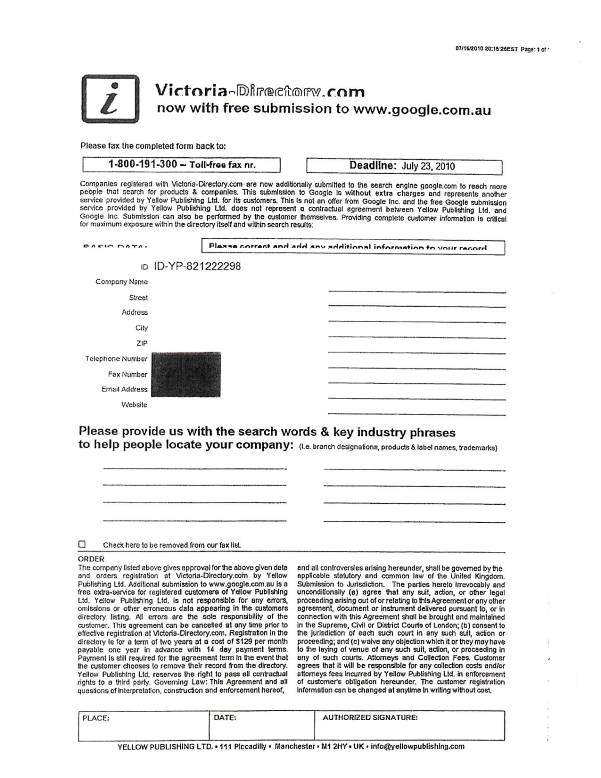
by sending, or causing to be sent, facsimiles to individuals and companies operating businesses in Australia to procure subscription to YPM’s online business directories (each an i Directory Facsimile) substantially in the form of the redacted facsimile attached as Annexure B to these Orders, and thereby representing that:
(c) the individual or company receiving the i Directory Facsimile had an existing arrangement with the sender of the i Directory Facsimile and/or the business directory referred to in the banner heading, when this was not the case;
(d) the offer contained in the i Directory Facsimile was for a submission to www.google.com.au that was free of charge, when the offer was not free of charge and involved charges in accordance with fine print appearing at the bottom of the i Directory Facsimile.
4. Each of YPM and YPL, during the period from on or about 12 May 2010 to 4 November 2010, has, in trade or commerce:
(a) in contravention of s 52 of the TPA, engaged in conduct that was misleading and deceptive or was likely to mislead or deceive; and
(b) in connexion with the supply and possible supply of Business Directory Services and in connexion with the promotion of the supply and use of such services:
(i) in contravention of s 53(c) of the TPA, represented that the services have sponsorship, approval, performance characteristics, uses or benefits they do not have; and
(ii) in contravention of s 53(d) of the TPA, represented that YPL or YPM have a sponsorship, approval or affiliation that they do not have,
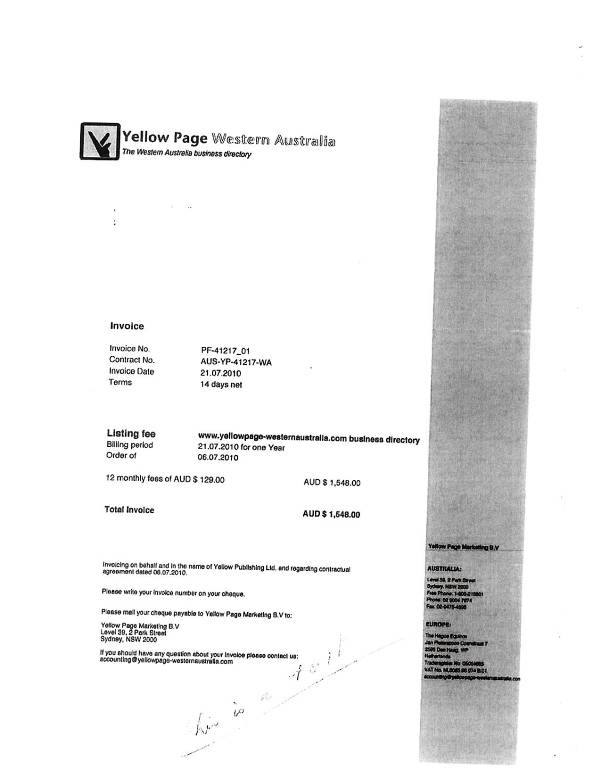
by sending, or causing to be sent, to individuals and companies operating businesses in Australia, including those who had responded to a Yellow Page Facsimile and those who had not previously received or responded to a Yellow Page Facsimile, invoices for purported Business Directory Services (each a Yellow Page Invoice) substantially in the form of the redacted facsimile attached as Annexure C to these Orders, and thereby representing that:
(c) the Yellow Page Invoice was rendered by the owner or publisher of the Yellow Pages® Business Directories or was otherwise affiliated with the Yellow Pages® Business Directories, when this was not the case; and
(d) payment on the Yellow Page Invoice was required in respect of listing in the Yellow Pages® Business Directories, when this was not the case.
THE COURT FURTHER ORDERS THAT:
Pecuniary Penalties
5. On or before 23 May 2011, or by such further time and by such instalments as the District Registrar may allow, YPM pay to the Commonwealth of Australia, pursuant to s 76E of the TPA, a pecuniary penalty of $1,350,000 in respect of its conduct in contravention of the TPA referred to in paragraphs 2 to 4 above.
6. On or before 23 May 2011, or by such further time and by such instalments as the District Registrar may allow, YPL pay to the Commonwealth of Australia, pursuant to s 76E of the TPA, a pecuniary penalty of $1,350,000 in respect of its conduct in contravention of the TPA referred to in paragraphs 2 to 4 above.
Injunctions
7. Pursuant to s 232 of the Australian Consumer Law set out in Sch 2 to the Competition and Consumer Act 2010 (Cth), each of YPM and YPL be restrained, whether by themselves, their agents, servants or howsoever otherwise, in trade or commerce, from:
(a) registering or facilitating the registration of any domain name which includes the words “yellow page” or “yellow pages”, howsoever they shall appear, in combination with an “.au” country code top-level domain or the name of (or any reference to) a city, state or other location in Australia, including but not limited to:
www.yellowpage-nsw.com;
www.yellowpage-sydney.com;
www.yellowpage-queensland.com;
www.yellowpage-victoria.com;
www.yellowpage-melbourne.com;
www.yellowpage-southaustralia.com;
www.yellowpage-adelaide.com;
www.yellowpage-westernaustralia.com;
www.yellowpage-perth.com;
www.yellowpage-tasmania.com; and
(the Yellow Page Domain Name(s))
(b) transferring or facilitating the transfer of ownership or control of any Yellow Page Domain Name (other than to Sensis Pty Ltd in accordance with the Administrative Panel Decision of the World Intellectual Property Organisation in Sensis Pty Ltd, Telstra Corporation Limited v Yellow Page Marketing BV Case No 2001-0057 dated 15 March 2011 (the WIPO Decision));
(c) transferring or facilitating the transfer of any Yellow Page Domain Name to a new or different domain name registrar or Domain Name System (DNS) server (other than to Sensis Pty Ltd in accordance with the WIPO Decision);
(d) using any Yellow Page Domain Name to direct persons or internet traffic to any domain name server or webpage selected, owned or controlled by YPM or YPL;
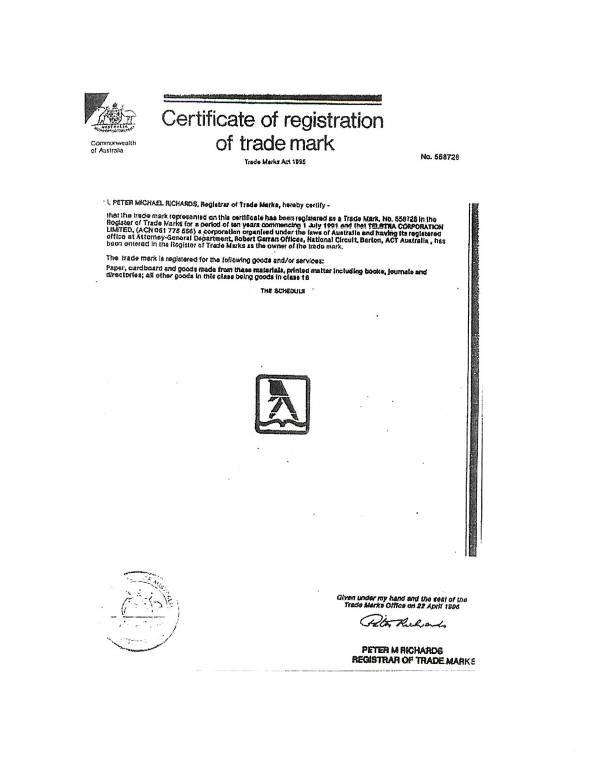
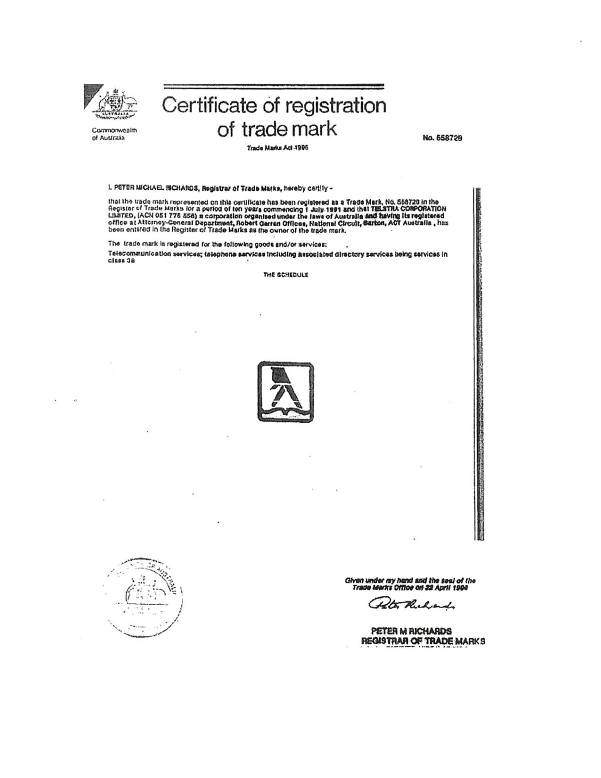
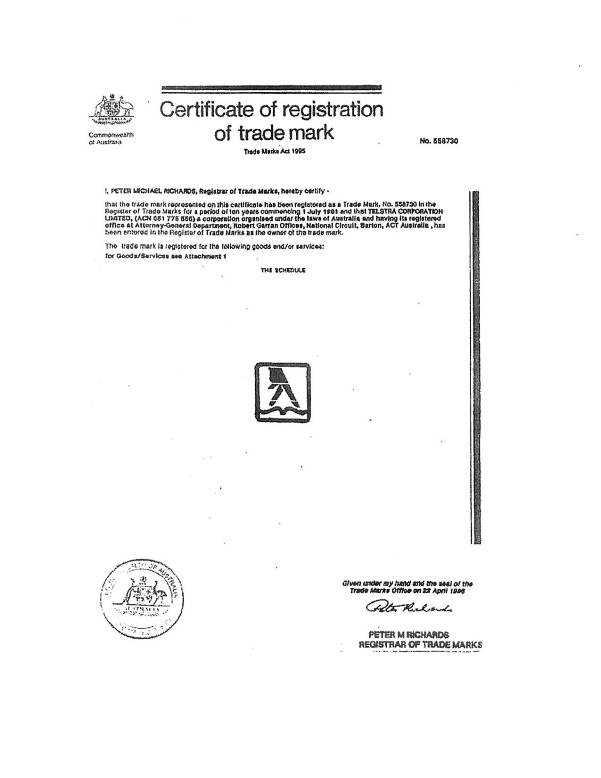
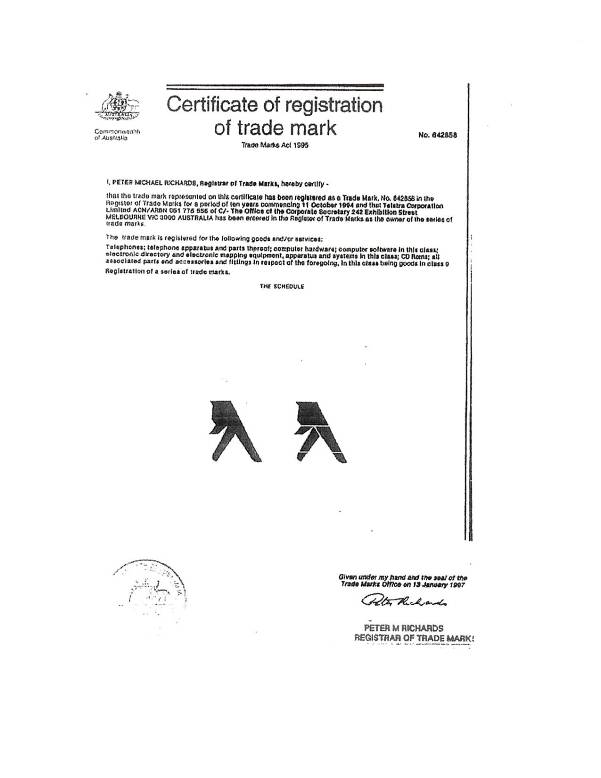
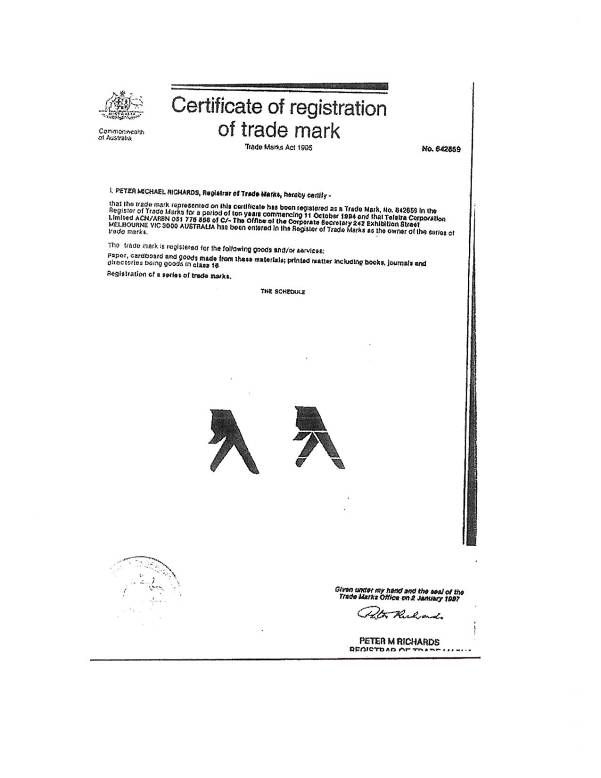
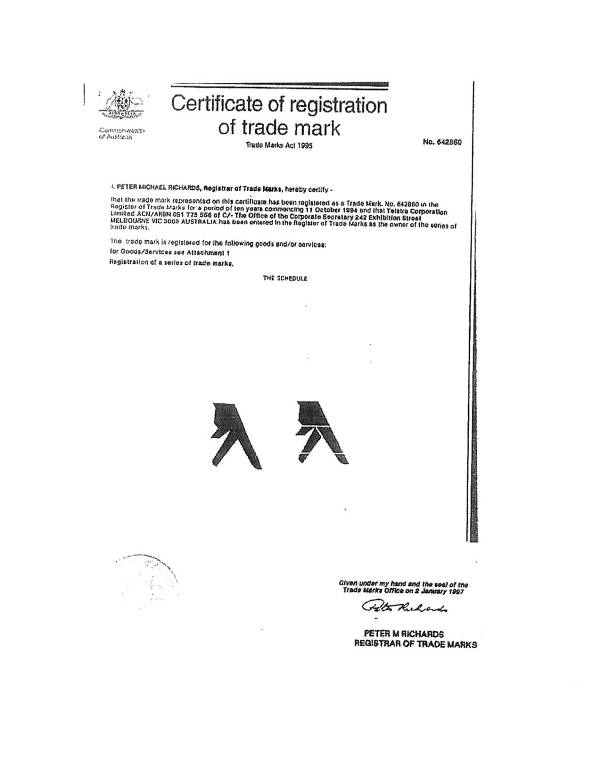
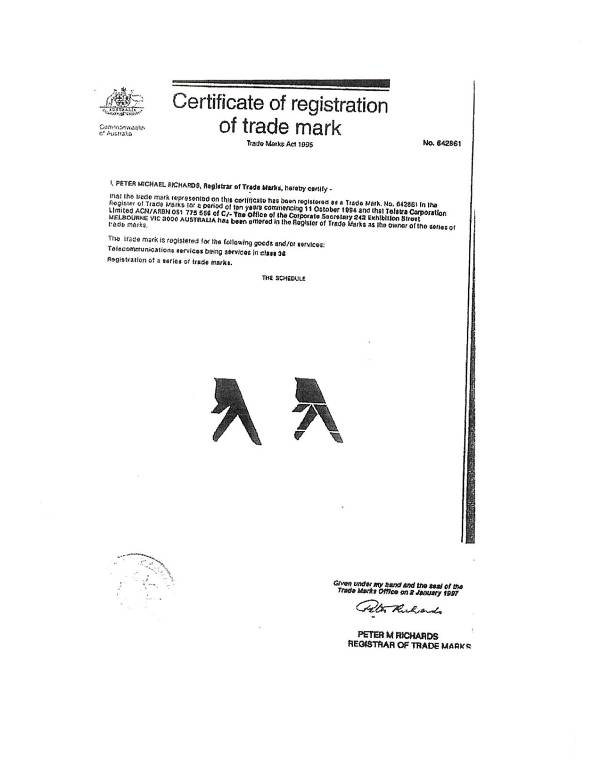
(e) sending any communication that in any way refers to “yellow page” or “yellow pages”, or in any way includes the device pictured in Annexure D to these Orders (the Walking Fingers Device) in any orientation or any depiction similar to the Walking Fingers Device;
(f) making any representations to the effect that:
(i) YPM or YPL or any associate of YPM or YPL is acting on behalf of, or with the approval or consent of, Sensis Limited, Telstra Limited, the owner or publisher of the Yellow Pages® Business Directories, or the owner or licensee of the Walking Fingers Device; or
(ii) the services that YPM or YPL offers will be provided by, or are in any way associated with or approved by, or affiliated with Sensis Limited, Telstra Limited, the owner or publisher of the Yellow Pages® Business Directories, or the owner or licensee of the Walking Fingers Device;
(iii) the recipient of any correspondence from YPM or YPL or any associate of YPM or YPL has a prior relationship with YPM or YPL or any associate of YPM or YPL which it does not have;
(g) offering to provide Business Directory Services without clearly and prominently stating the price for those services;
(h) taking any step, including sending any communication, to recover amounts claimed to be owing in respect of Yellow Page Invoices.
Orders under s 87AAA(1) of the TPA
8. Pursuant to s 87AAA(1) of the TPA:
(a) on or after the day that is 90 days after the date of this Order (the Effective Date), each contract made between YPL and an individual or company operating a business in Australia who has responded to a Yellow Page Facsimile, an i Directory Facsimile or a Yellow Page Invoice on or after 12 May 2010 (the Contracts) is declared void ab initio unless, before the Effective Date, an individual or business has by notice in writing communicated to YPM or YPL its intention to confirm his, her or its contract with YPL; and
(b) if a Contract is void ab initio in accordance with paragraph (a):
(i) YPM and YPL must refund all monies paid under that contract to the individual or business that responded to the Yellow Page Facsimile, an i Directory Facsimile or a Yellow Page Invoice;
(ii) no further amounts will be payable under the Contract.
Other Orders
9. Pursuant to O 27 rr 8 and 10(1) of the Federal Court Rules, the cheques and other documents produced by the Commissioner of Police of Western Australia in response to the subpoena issued in this proceeding dated 19 November 2010 be delivered into the custody of the ACCC.
10. A copy of the Reasons for Judgment be retained in the Court for the purposes of s 83 of the TPA.
11. The Respondents pay the ACCC’s costs of the proceeding.
Note: Settlement and entry of orders is dealt with in Order 36 of the Federal Court Rules. The text of entered orders can be located using Federal Law Search on the Court’s website.
NOTICE PURSUANT TO ORDER 37 RULE 2 OF THE FEDERAL COURT RULES
TO: YELLOW PAGE MARKETING BV
You are liable to imprisonment or to sequestration of property if:
(a) where this order requires you to do an act within a specified time, you refuse or neglect to do the act within that time; or
(b) where this order requires you to abstain from doing an act, you disobey the order.
NOTICE PURSUANT TO ORDER 37 RULE 2 OF THE FEDERAL COURT RULES
TO: YELLOW PUBLISHING LTD
You are liable to imprisonment or to sequestration of property if:
(a) where this order requires you to do an act within a specified time, you refuse or neglect to do the act within that time; or
(b) where this order requires you to abstain from doing an act, you disobey the order.
ANNEXURE A
ANNEXURE B
ANNEXURE C
ANNEXURE D
| VICTORIA DISTRICT REGISTRY | |
| GENERAL DIVISION | VID 942 of 2010 |
| BETWEEN: | AUSTRALIAN COMPETITION AND CONSUMER COMMISSION Applicant |
| AND: | YELLOW PAGE MARKETING BV First Respondent YELLOW PUBLISHING LTD Second Respondent |
| JUDGE: | GORDON J |
| DATE: | 12 april 2011 |
| PLACE: | MELBOURNE |
REASONS FOR JUDGMENT
1 The Applicant, the Australian Competition and Consumer Commission (the ACCC), alleges that each of the First Respondent (YPM) and the Second Respondent (YPL) contravened ss 52, 53(c), 53(d) and 53(e) of the Trade Practices Act 1974 (Cth) (applicable under items 6 and 7 of Sch 7 to the Trade Practices Amendment (Australian Consumer Law) Act (No 2) 2010 (Cth)) (the TPA) by reason of their promotion to potential subscribers in Australia of online business directory services and associated invoicing in what colloquially has been described as a “directory scam”. The proceedings were filed in Fast Track. The ACCC allegations were contained in a Fast Track Statement (FTS).
2 Before turning to the substance of the matter, it is necessary to say something about the Respondents and the history of the matter.
3 YPM is a company incorporated and registered in the Netherlands. Its registered office is in The Hague. YPL is a company incorporated and registered in the United Kingdom. Its registered office is in Manchester, United Kingdom. Neither company appears to have a permanent physical presence in Australia. However, at times, they utilised the services of a virtual office service provider which operates at addresses in Australia (Regus).
4 In general terms, the ACCC alleges that:
1. the Respondents conducted a business whereby invitations to businesses in Australia to subscribe to internet online business directories published by YPM on websites registered to YPM were sent direct to businesses in Australia;
2. the invitations and subsequent billing documentation purported to establish YPL as the principal in contracts with Australian businesses; and
3. YPM published the directories, owned the websites and received the money paid by the businesses in accordance with remittance directions on the billing documentation.
5 The proceedings were filed on 4 November 2010. On the same date, the ACCC also applied ex parte for leave to serve the originating process on the Respondents out of Australia, for an order permitting substituted service and interlocutory orders in the nature of injunctions. On 8 November 2010, after further hearing, the ACCC was granted leave to serve the originating process on the Respondents out of Australia, granted a substituted service order and certain limited injunctions: see Australian Competition and Consumer Commission v Yellow Page Marketing BV [2010] FCA 1218.
6 On 18 November 2010, the Respondents submitted to the jurisdiction and filed an appearance. The proceeding returned to Court on 2 December 2010. Orders were made on that date by consent in the following terms:
1. Until the determination of the proceeding, or further order, the First Respondent (YPM) and the Second Respondent (YPL), whether by themselves, their agents, servants or howsoever otherwise, be restrained from:
(a) sending any communication in the form of the facsimile at Annexure A to this Order to an individual or company operating a business in Australia, regardless of what letterhead or logo is used in the communication or the mechanism through which payment is requested;
(b) taking any step to obtain payment from any individual or company operating a business in Australia in respect of any invoice in the form of the invoice in Annexure B to this Order (including any invoice in that form which identifies different customer details and any invoice in that form which refers to another State or a city of Australia in place of the words “Western Australia” or “western australia” or “westernaustralia”) regardless of the mechanism through which payment is requested;
(c) sending any communication to any individual or company operating a business in Australia that in any way refers to “yellow page” or “yellow pages”, or in any way includes the Walking Fingers Device in any orientation or any depiction similar to the Walking Fingers Device;
(d) sending any communications offering the supply or possible supply of business listing and advertising directory services (Business Directory Services) to individuals or companies operating businesses in Australia, including any communication in the form of the Yellow Page Facsimile, i Directory Facsimile or Yellow Page Invoice; and
(e) removing from Australia any funds received in respect of any offer or supply of Business Directory Services by YPL or YPM.
2. Within 7 days of being served with this Order, Regus Plc (ARBN 141 571 342) (Regus) deliver to the Applicant (ACCC) at Level 35, The Tower, 360 Elizabeth Street, Melbourne all documents in it possession in Australia that it has received since 1 January 2010:
(a) from YPM and YPL for delivery to businesses located in Australia; and/or
(b) that are addresses to YPM and YPL.
3. Regus deliver to the ACCC at Level 35, The Tower, 360 Elizabeth Street, Melbourne all documents that it receives after the date of this Order:
(a) from YPM and YPL for delivery to businesses located in Australia; and/or
(b) that are addressed to YPM and YPL.
4. Within 14 days of receiving any document from Regus pursuant to paragraphs 2 and 3 of this Order, the ACCC must provide Regus with a list of the documents received.
7 On 13 December 2010, the Respondents filed a Fast Track Response (FTR). It stated, inter alia, that:
A. NATURE OF DISPUTE
YPM and YPL provide online business directory services in Australia and in other countries around the world on websites with domain names www.yellowpage-[town/region].com. YPM and YPL promote their services using the name “Yellow Page” and a “walking fingers” device. Variations of the phrase “Yellow Pages” and the “walking fingers” device are used around the world by numerous providers of business directories in order to describe those directories.
The ACCC alleges that YPM and YPL have engaged in misleading and deceptive conduct by the manner in which they seek to gain subscribers to their business directory services and invoice those subscribers for their services, in particular by sending registration forms (described by the ACCC as the “Yellow Page Facsimile” and the “i Directory Facsimile”) and invoices (described by the ACCC as the “Yellow Page Invoice”). The Yellow Page Facsimile and the Yellow Page invoice make use of the name “Yellow Page” and the “walking fingers” device but the i Directory Facsimile does not.
YPM and YPL deny the allegations in the Fast Track Statement but in any event have, without any admission, consented to interlocutory orders made … on 2 December 2010 that effectively restrain YPM and YPL from seeking to obtain any new subscribers to their business directories until the determination of this proceeding and, in particular, restrain them from sending the Yellow Page Facsimile, i Directory Facsimile and Yellow Page Invoice. YPM and YPL propose to seek to resolve the proceeding as soon as possible on the basis that they will amend the communications that they direct to their subscribers and potential subscribers so as to remove any likelihood that subscribers or potential subscribers will be misled in the future.
…
A copy of the Yellow Page Facsimile, the i Directory Facsimile and the Yellow Page Invoice are attached as Annexures A, B and C to these reasons for decision. They were also attached as Annexures to the FTS.
8 On 2 February 2011, YPM and YPL’s solicitors (Phillips Ormonde Fitzpatrick) wrote to the Court stating that they no longer had instructions from the Respondents. The matter had previously been listed for directions on 3 February 2011. As a courtesy to the Court, Phillips Ormonde Fitzpatrick attended and informed the Court that they had served a notice of intention to cease to act under O 45 r 7(1) of the Federal Court Rules. Phillips Ormonde Fitzpatrick provided the ACCC’s solicitors with current email contact details for YPM and YPL. The Court then made orders and directions for the future management of the proceeding including service of any further documents. In particular, the Orders and directions on 3 February 2011 required the Respondents to:
1. On or before 10 February 2011, to produce to the ACCC:
(a) a list of Australian businesses that have paid Yellow Page Invoices (as defined in the FTS) together with the amount paid from 12 May 2010 to date; and
(b) a list of Australian businesses to whom they have sent a Yellow Page Facsimile, i Directory Facsimile or Yellow Page Invoice (as defined in the FTS) from 12 May 2010 to date.
2. On or before 21 February 2011, to file and serve any affidavit material on which they intended to rely at the hearing of the proceeding.
3. Five days before the hearing of the proceeding, to file an outline of submissions.
The proceeding was listed for a three day hearing commencing on 7 March 2011 at 10:15am.
9 The Respondents failed to comply with any of the directions. On 15 February 2011, the ACCC filed a Notices of Motion seeking leave to file an amended application. On 28 February 2011, the ACCC sought orders pursuant to O 35A r 3(2)(c) and (d) of the Federal Court Rules upon the Respondents’ default in complying with the Orders made on 3 February 2011.
10 The hearing of the matter commenced on 8 March 2011. The Respondents were served with a copy of the Notices of Motion referred to in [9] above and were given notice of the change in hearing date. The Respondents did not appear. The ACCC was given leave to amend its application: see Australian Competition and Consumer Commission v Yellow Page Marketing BV [2011] FCA 226.
STRUCTURE OF THE REASONS FOR DECISION
11 These reasons for decision are structured as follows:
1. The applicable principles in an application for judgment under O 35A r 3(2)(c) and (d) of the Federal Court Rules;
2. the relevant legislative amendments to the TPA;
3. whether the ACCC is entitled to judgment under O 35A r 3(2)(c) and (d) of the Federal Court Rules for contraventions of ss 52 and 53 of the TPA;
4. Appropriate relief including:
(a) declarations of contravention;
(b) permanent injunctions;
(c) pecuniary penalties;
(d) orders under s 87AAA of the TPA;
(e) orders under ss 86C and 86D of the TPA; and
(f) costs.
APPLICABLE PRINCIPLES - O 35A R 3(2)(c) OF THE FEDERAL COURT RULES
12 As noted earlier, the ACCC seeks judgment against the Respondents under O 35A r 3(2)(c) of the Federal Court Rules. The relevant parts of O 35A r 2(2)(d) provide:
For this Order, a respondent is in default if the respondent has not satisfied the applicant’s claim and:
…
(d) the respondent fails to comply with an order of the Court in the proceeding;
…
13 Order 35A r 3(2)(c) provides:
If a respondent is in default, the Court may:
…
(c) if the proceeding was commenced by an application supported by a statement of claim or the Court has ordered that the proceeding continue on pleadings – give judgment against the respondent for the relief that:
(i) the applicant appears entitled to on the statement of claim; and
(ii) the Court is satisfied it has power to grant.
…
14 An order for judgment in default under O 35A r 3(2)(c):
1. does not require proof of the claim by evidence, but only requires that – on the face of the statement of claim – there is a claim for the relief sought; and
2. the claim must fall within the jurisdiction of the Court:
see Arthur v Vaupotic Investments Pty Ltd [2005] FCA 433 at [3]. See also Quarte-Bornes Pty Ltd v John H Walker & Associates [2010] FCA 492; Turner, In the matter of L.A. Technologies Pty Ltd (ACN 092 001 495) (In Liquidation) [2009] FCA 805; Chanel Limited v Donoghue [2008] FCA 1643; Nokia Corporation v Yu (No 2) [2008] FCA 1088 and Australian Competition and Consumer Commission v 1Cellnet LLC [2005] FCA 856 at [14].
15 Three questions arise. Do applications under O 35A r 3 apply to proceedings issued in Fast Track and if so, are the Respondents in default? If the answer to both those questions is yes, the next question is whether the Court should exercise its discretion and enter judgment for the ACCC against the Respondents?
16 In relation to the first question, I consider that applications under O 35A r 3 can be and should be made in relation to proceedings issued in the Fast Track. Filing a proceeding in Fast Track means that there are no formal pleadings. Instead, there is a fast track statement and a response: see [1] and [7] above. A key purpose of these documents required by the Court’s fast track practice note is to ensure parties know the case they are required to meet: see Practice Note CM 8 – Fast Track, paragraphs 4.1 – 4.3 and its Annexure.
17 As the Court has now stated on a number of occasions, parties are entitled to expect that a proceeding will be resolved on the basis of the pleadings or, in the case of a fast track application, the documents that perform the same function as the pleadings: Yarrabee Chicken Company Pty Ltd v Steggles Limited [2010] FCA 394 at [75]; see also Hoop & Javelin Holdings Limited v BT Projects Pty Limited (In Liq) (No 6) [2010] FCA 742 at [6]; Hoop & Javelin Holdings Limited v BT Projects Pty Limited (In Liq) (No 2) [2010] FCA 190. In this matter, there was an Amended Application identifying the relief sought by the ACCC and a fast track statement identifying the ACCC’s claims against the Respondents.
18 Accordingly, as the fast track statement can and, in the present case does, perform the same function as the statement of claim by identifying the applicant’s claim, the requirements for an order for judgment in default under O 35A set out in Arthur (see [14] above) can and should be adopted to these proceedings filed in fast track. Further, if there is doubt about the applicability of O 35A (and I do not consider there is), this is a case in which I should direct (and out of an abundance of caution I do direct, pursuant to O 1 r 9(1)) of the Federal Court Rules that O 35A is to apply to the proceeding, thus engaging the provisions of O 35A for the purposes of considering the Applicants’ motion: O 1 r 9(1).
19 In relation to the second and third questions, the Respondents are in default of the Orders made by the Court on 3 February 2011: see [8] above. Further, those Orders were made while the Respondents had solicitors on the record. Despite being accorded an opportunity to explain why the Orders were not complied with, no explanation has been forthcoming from the Respondents. In those circumstances, I consider that the Court should move to consider exercising its discretion under O 35A of the Federal Court Rules.
RELEVANT LEGISLATIVE AMENDMENTS TO THE TPA
20 Before turning to consider whether the ACCC has satisfied the requirements for an order for judgment in default under O 35A r 3(2)(c) (see [13] and [14] above), it is necessary to refer to some of the recent legislative amendments to the TPA.
21 The title of the TPA, and various of its provisions, were amended by the Trade Practices Amendment (Australian Consumer Law) Act (No 2) 2010 (Cth) (No 103, 2010) (the Amendment Act No 2). The short title of the TPA is now the Competition and Consumer Act 2010 (Cth) (the CCA): see s 1 of the CCA, as amended by item 2 of sch 5 of the Amendment Act No 2.
22 By item 6(1) of Sch 7 to Amendment Act No 2, the TPA as in force immediately before the commencement of that item (namely, before 1 January 2011) continues to apply to acts and omissions before that date, and by item 7(1) the TPA continues to apply to or in relation to the current proceeding, because the proceeding was commenced before that date.
23 Aside from s 80 of the TPA, action may be taken under or in relation to Pt VI of the TPA as in force immediately before 1 January 2011: items 6(2) and 7(1) of Sch 7 to Amendment Act No 2. Under item 7(2) of Sch 7 to Amendment Act No 2, the ACCC’s application for injunctions under s 80 of the TPA is now to be taken to be an application for injunctions under s 232 of the Australian Consumer Law set out in Sch 2 to the CCA as applied under Subdiv A of Div 2 of Pt XI of the CCA (the Australian Consumer Law).
24 The ACCC seeks orders under s 76E (for the contravening conduct insofar as the Respondents contravened s 53 of the TPA) and s 87AAA of the TPA. Both provisions were added to the TPA by the Trade Practices Amendment (Australian Consumer Credit Law) Act (No 1) 2010 (Cth) (No 44, 2010) (Amendment Act No 1), by provisions commencing on 15 April 2010: items 1 and 18 of Sch 2 to Amendment Act No 1 and s 2(1) table item 3 of Amendment Act No 1. Section 87AAA was amended in ways not material to the present proceeding by provisions of Amendment Act No 1 that commenced on 1 July 2010.
25 What then are the applicable provisions? Section 52 of the TPA provided as follows:
(1) A corporation shall not, in trade or commerce, engage in conduct that is misleading or deceptive or is likely to mislead or deceive.
(2) Nothing in the succeeding provisions of this Division shall be taken as limiting by implication the generality of subsection (1).
26 Sections 53(c), (d) and (e) of the TPA provided:
A corporation shall not, in trade or commerce, in connexion with the supply or possible supply of goods or services or in connexion with the promotion by any means of the supply or use of goods or services:
…
(c) represent that goods or services have sponsorship, approval, performance characteristics, accessories, uses or benefits they do not have;
(d) represent that the corporation has a sponsorship, approval or affiliation it does not have;
(e) make a false or misleading representation with respect to the price of goods or services; ...
27 Australian Competition and Consumer Commission v Dukemaster Pty Ltd [2009] FCA 682 considered s 53 of the TPA. The requirement that the representation be false or misleading was considered at paragraphs [14] and [15] as follows:
In relation to the first element, s 53(e) requires the representation to be “false or misleading” as opposed to “misleading or deceptive” (in s 52). I was not taken to, and I have not found, any authority which attributes a meaningful difference to this dichotomy for the purposes of the TPA. (For a discussion of the phrase “false and misleading” under a different Act, see Construction, Forestry, Mining and Energy Union v Hadkiss (2007) 160 FCR 151). Indeed, the vast majority of cases that discuss an alleged breach of s 53(e) couple it with a breach of s 52 and deal with the “false or misleading” and “misleading or deceptive” aspect of the conduct mutatis mutandis: see Foxtel Management Pty Ltd (2005) 214 ALR 554 at [94]; ACCC v Target Australia Pty Ltd (2001) ATPR 41-840; ACCC v Harbin Pty Ltd [2008] FCA 1792; ACCC v Prouds Jewellers Pty Ltd [2008] FCAFC 199 at [42].
That is not altogether surprising. The purpose of s 53 has been described as being to “[support] s 52 by enumerating specific types of conduct which, if engaged in by a corporation in trade or commerce in connection with the promotion or supply of goods or services, [would] give rise to a breach of the Act”: see R Miller, Miller’s Annotated Trade Practices Act (30th ed, 2009), [1.53.5]. Accordingly, and in the absence of any submission to the contrary, I see no reason why the application of s 53(e) should not fall to be determined upon the conclusions I reach in relation to s 52 - namely that the representations were misleading and deceptive or likely to mislead or deceive.
28 For the same reasons, I consider that the application of s 53(c) and (d) should also fall to be determined upon the conclusions reached in relation to s 52 – namely that the representations were misleading and deceptive or likely to mislead or deceive.
29 Two other matters of principle should be noted. I accept the ACCC’s submission that the alleged representations should be considered having regard to the ordinary class of consumers to whom they were directed: Parkdale Custom Built Furniture Proprietary Limited v Puxu Proprietary Limited (1982) 149 CLR 191 at 199, 209-210; Campomar Sociedad, Limitada v Nike International Limited (2000) 202 CLR 45 at 85-86; Astrazeneca Pty Limited v GlaxoSmithKline Australia Pty Limited [2006] FCAFC 22 at [37]; Campbell v Backoffice Investments Pty Ltd (2009) 238 CLR 304 at [24] – [26]; as to s 53(c), see Osgaig Pty Ltd v Ajisen (Melbourne) Pty Ltd (2004) 213 ALR 153 at [99] – [115], and that intention is not an element of a contravention of s 52 or s 53 of the TPA: Given v C V Holland (Holdings) Pty Ltd (1977) 15 ALR 439 in relation to s 53.
ACCC ENTITLED TO JUDGMENT FOR CONTRAVENTIONS OF SS 52 and 53 OF THE TPA?
30 The issues to be addressed are as follows:
1. the proper construction, meaning and effect of the Respondents’ representations;
2. whether the Respondents’ representations were false, misleading and deceptive or likely to mislead and deceive.
Of course in the present case, those issues fall to be determined by reference to the content of the FTS: see [12] – [18] above.
31 Before turning to consider the pleaded representation, it is necessary to address other parts of the FTS which concern the Yellow Pages® Business Directories.
Yellow Pages® Business Directories
32 The ACCC’s FTS pleads the following facts and matters. The Respondents’ response in their FTR is summarised at the end of each pleaded fact or matter.
1. At all times since about 1975, Telstra Corporation Limited (ABN 33 051 775 556), including its predecessors in law, the Post Master General’s Department, Australian Telecommunications Commission, Australian Telecommunications Corporation and Australian and Overseas Telecommunications Corporation Limited (Telstra), has directly or through its subsidiaries provided (or caused to be provided) services including business listing and advertising directory services (Business Directory Services) in Australia under the name and mark “Yellow Pages”. This was admitted in the FTR.
2. Telstra is the owner under Australian law of:
(a) Australian Trade Marks for the name and mark “Yellow Pages”, the subject of Certificates of Registration for Trade Mark Nos 545667, A545668, 545669 and 704079, reproduced in Annexure A to the Fast Track Statement (Yellow Pages®); and
(b) Australian Trade Marks for the “Walking Fingers Device” the subject of Certificates of Registration for Trade Mark Nos 558728, 558729, 558730, 642858, 642859, 642860 and 642861, reproduced as Annexure B to the Fast Track Statement (the Walking Fingers Device).
The Respondents admitted that Telstra was recorded in the Register of Trade Marks as the owner of the trade mark registrations. The other allegations were not admitted.
3. Since about 1975, Telstra has published, or caused to be published, a series of paper business directories under the name “Yellow Pages” and the mark Yellow Pages® (the Yellow Pages® Paper Business Directories). This was admitted in the FTR.
4. The covers of the Yellow Pages® Paper Business Directories each have the following distinctive features:
(a) the words “Yellow Pages” appear prominently;
(b) the name of one of the major cities of Australia, or another locale in Australia, appears prominently;
(c) the Walking Fingers Device appears prominently; and
(d) the cover is predominantly coloured yellow.
The Respondents admitted that the covers of the Yellow Pages® Paper Business Directories each had those features but otherwise denied the allegations.
5. The Yellow Pages® Paper Business Directories list telephone and fax numbers and other contact information, and carry advertisements, for businesses located in the major city or other locale to which the cover of the directory refers. This is admitted in the FTR.
6. Since about 1994, Telstra has caused a Yellow Pages® online directory to be provided via the internet (the Yellow Pages® Online Business Directory) listing businesses located in Australia. This is admitted in the FTR. The Respondents went further and said that the Yellow Pages® Online Business Directory has at all times been located on a website found by the domain name www.yellowpages.com.au and not found by any variations of that domain name, including any variations that incorporated town or region names.
7. At all times since about 1994, the Yellow Pages® Online Business Directory has had the following features distinctive in relation to Business Directory Services for businesses located in Australia:
(a) the words “Yellow Pages” appear prominently;
(b) the Walking Fingers Device appears prominently; and
(c) the extensive use of the colour yellow.
The Respondents admitted that the Yellow Pages® Online Business Directory each had those features but otherwise denied the allegations.
8. Further, searches on the Yellow Pages® Online Business Directory are made by reference to fields of information including location within Australia. This was admitted in the FTR.
9. During the relevant period, Telstra’s subsidiary Sensis Pty Ltd (ABN 30 007 423 912) (Sensis):
(a) has been the exclusive licensee of Telstra’s Australian Trade Marks for the Yellow Pages® and the Walking Fingers Device reproduced as Annexures A and B to the Fast Track Application; and
(b) has continued to produce the Yellow Pages® Paper Business Directories and to publish the Yellow Pages® Online Business Directory.
The Respondents did not admit (a) but admitted (b) in the FTR.
10. The Yellow Pages® Business Directories (which includes the Yellow Pages® Paper Business Directories (see [32(3)] above) and the Yellow Pages® Online Business Directory (see [32(6)] above) including their distinctive features referred to in paras [32(4)] and [32(7)] above), have substantial recognition amongst businesses and consumers in all parts of Australia. The Respondents admitted that the Yellow Pages® Business Directories have substantial recognition amongst businesses and consumers in all parts of Australia but otherwise did not admit the allegations. They went on to say that:
(a) the Yellow Pages® Paper Business Directories have at all times been known amongst businesses and consumers in Australia by the name “Yellow Pages” and not by variations of that name, including the variation “Yellow Page”;
(b) the Yellow Pages® Online Business Directory has at all times been known amongst businesses and consumers in Australia as being located on a website found by the domain name www.yellowpages.com.au and not found by any variations of that domain name, including any variations that incorporated town or region names; and
(c) the phrase “Yellow Pages” and variations on that phrase are used around the world by numerous providers of business directories in order to describe those directories, including for example, in the USA by many different companies, including AT&T (www.realpageslive.com), Verizon (www.superpages.com), Yellow Book USA (www.yellowbook.com) and Export Yellow Pages (www.exportyellowpages.com).
33 As is apparent, the Respondents made a number of admissions.
REPRESENTATIONS
34 The ACCC contend that the representations are to be found in the redacted documents – the Yellow Page Facsimile, the i Directory Facsimile and the Yellow Page Invoice, respectively Annexures A, B and C to these reasons for decision. Each was attached to the FTS.
35 I will deal with each in turn.
Yellow Page Facsimile – Annexure A
36 The ACCC Fast Track Statement (para 15) alleges that from on or about 12 May 2010 until at least in or about August 2010, each of YPL and YPM (through its agent) or alternatively, YPL, sent or caused to be sent, facsimiles (substantially in the form of Annexure A) to individuals and companies operating business in Australia seeking to procure subscriptions to YPM Online Directories. The FTS alleges that the Yellow Page Facsimile included the following features:
1. a prominent device in the top left hand corner closely resembling the Walking Fingers Device, inverted;
2. a banner heading in prominent lettering “YellowPage” followed, in different lettering, by a hyphen and the name of a State or major city in which the business is located to which the Yellow Page Facsimile was sent. In some instances, the banner details were followed by “.com”;
3. the words appearing prominently below the banner heading “now with free subscription to www.google.com.au”, That was wrong. The words appearing below the banner heading read “now with free submission”, not subscription;
4. a direction “Please fax the completed form back to:”, followed by boxed text containing a toll free number, and accompanied by further boxed text stating a purported “Deadline”;
5. a block of text in small font beneath the boxed fax number and deadline, commencing with the words:
(i) “Companies registered with YellowPage-[State or city].com are now additionally submitted to the search engine google.com to reach more people ...”; or
(ii) words to that effect but not referring to a domain name containing “yellowpage”;
6. prominent boxed text stating “Please correct and add any additional information to your record”; and
7. prominent text in large font stating “Please provide us with the search words & key industry phrases to help people locate your company”.
Those features appear on the Yellow Page Facsimile, a copy of which is Annexure A to these reasons for decision.
37 The Yellow Page Facsimile also included, in fine print at the foot of the document, a statement which read:
… Registration in the directory is for a term of two years at the cost of $129 per month payable one year in advance with 14 day payment terms. Payment is still required for the agreement term in the event that the customer chooses to remove their record from the directory.
The ACCC alleged (and I find) that the Yellow Page Facsimile did not include a reasonably prominent reference to the price or fixed duration for which the referenced Business Directory Services were offered. It was at the foot of the page, in fine print, placed in a large body of fine text which was difficult to understand. Moreover, its size and placing stood in stark contrast to the banner in the heading which read “now with free submission to www.google.com.au”.
38 The ACCC then alleges that, having regard to the facts and matters set out in [32] above (many of which are admitted), by reason of sending or causing to be sent the Yellow Page Facsimile:
1. to individuals and companies operating businesses in Australia including those currently listed in the Yellow Pages® Business Directories; and
2. having the features referred to in paragraph [36] above or any combination of them;
3. having no reasonably prominent reference to the price and fixed duration for which the Business Directory Services referred to in the Yellow Page Facsimile were offered; and
4. having no disclaimer of affiliation with Yellow Pages® Business Directories or their owner or publisher,
each of YPL and YPM (through its agent YPL), or alternatively YPL, represented (the Yellow Page Facsimile Representations) that:
5. the Yellow Page Facsimile was sent by the owner or publisher of the Yellow Pages® Business Directories or was otherwise affiliated with the Yellow Pages® Business Directories; and/or
6. completion of the Yellow Page Facsimile and its transmission in accordance with the directions and the deadline appearing on the Yellow Page Facsimile was required in order to renew or otherwise obtain listing in the Yellow Pages® Business Directories; and/or
7. the offer contained in the Yellow Page Facsimile was for a submission to www.google.com.au that was free of charge.
39 As noted earlier, the analysis proceeds from the established principle that the representations should be considered having regard to ordinary members of the class of consumers to which they were directed: see [29] above.
40 Applying that principle to the facts pleaded by the ACCC, the Yellow Page Facsimile falls to be assessed by reference to three matters. First, that the Yellow Pages® Business Directories and Walking Fingers Device enjoy very substantial recognition in Australia in connexion with business directory services and the “Yellow Page” directories do not. Indeed, the Respondents admitted that the Yellow Pages® Business Directories have substantial recognition amongst businesses and consumers in all parts of Australia: see [32(10)] above. Secondly, that the reasonable Australian business to whom the Respondents directed the Yellow Page Facsimile was very likely to be a business having an existing listing in the Yellow Pages® Business Directories and persons operating those businesses were very likely not to scrutinise the documentation sent by YPL and YPM in detail.
41 Having read the Yellow Page Facsimile, I consider that each of the Yellow Page Facsimile Representations was conveyed by the Yellow Page Facsimile.
Misleading and deceptive?
42 The ACCC alleges that the Yellow Page Facsimile Representations were false, misleading and deceptive, or likely to mislead and deceive because:
1. the Yellow Page Facsimiles were and are not sent by the owner or publisher of the Yellow Pages® Business Directories and were in no way affiliated with the Yellow Pages® Business Directories;
2. completion of a Yellow Page Facsimile was not required in order to renew or otherwise obtain listing in the Yellow Pages® Business Directories, either by a deadline or at all; and
3. the offer contained in the Yellow Page Facsimile was not free of charge and involved charges in accordance with fine print appearing at the bottom of the Yellow Page Facsimile.
43 There are two aspects. One concerns the Yellow Pages® Business Directories and the other price. In relation to the Yellow Pages® Business Directories, I consider that the presence of references to YPL in small text on the Yellow Page Facsimile was not sufficient to dispel the impression that it originated from, or was connected with, the Yellow Pages® Business Directories.
44 In relation to price, I consider that the explanation of charges in the fine print at the foot of the Yellow Page Facsimile was not sufficiently prominent to prevent it from conveying the Yellow Page Facsimile Representations as to price identified in [38] above: see George Weston Foods Ltd v Goodman Fielder Ltd (2000) 49 IPR 553; Gillette Australia Pty Ltd v Energizer Australia Pty Ltd (2002) 193 ALR 629; Australian Competition and Consumer Commission v Signature Security Group Pty Ltd [2003] FCA 3; Medical Benefits Fund of Australia Ltd v Cassidy (2003) 135 FCR 1; and Energizer Australia Pty Ltd v Remington Products Australia Pty Ltd (2008) 76 IPR 63.
45 For those reasons, I find that each of YPM and YPL, during the period from on or about 12 May 2010 until a date in or about August 2010, in trade or commerce:
(1) in contravention of s 52 of the TPA, engaged in conduct that was misleading and deceptive or was likely to mislead and deceive; and
(2) in connexion with the supply and possible supply of Business Directory Services and in connexion with the promotion of the supply and use of such services:
(a) in contravention of s 53(c) of the TPA, represented that the services have sponsorship, approval, performance characteristics, uses or benefits they do not have;
(b) in contravention of s 53(d) of the TPA, represented that YPL had a sponsorship, approval or affiliation that it does not have; and
(c) in contravention of s 53(e) of the TPA, made false and misleading representations with respect to the price of the Business Directory Services,
by sending, or causing to be sent, a Yellow Page Facsimile to individuals and companies operating businesses in Australia to procure subscription to YPM’s online business directories (each) substantially in the form of Annexure A thereby representing that:
(3) the Yellow Page Facsimile was sent by the owner or publisher of the Yellow Pages® Business Directories or was otherwise affiliated with the Yellow Pages® Business Directories, when this was not the case;
(4) completion of the Yellow Page Facsimile and its transmission in accordance with the directions and the deadline appearing on the Yellow Page Facsimile was required in order to renew or otherwise obtain listing in the Yellow Pages® Business Directories, when this was not the case;
(5) the offer contained in the Yellow Page Facsimile was for a submission to www.google.com.au that was free of charge, when the offer was not free of charge and involved charges in accordance with the fine print appearing at the bottom of the Yellow Page Facsimile.
i Directory Facsimile – Annexure B
46 The ACCC’s FTS then alleged (para 19) that from at least in or about July 2010 until November 2010, each of YPL and YPM (through its agent YPL), or alternatively YPL, sent, or caused to be sent, facsimiles (substantially in the form of the redacted facsimile at Annexure B to these reasons for decision) that included the following features or features substantially to the following effect (i Directory Facsimiles):
1. a boxed “i “ icon and banner heading “Victoria[or other locale]- Directory.com”;
2. the words appearing prominently below the banner heading “now with free subscription to www.google.com.au”: see [36(3)] above;
3. a direction “Please fax the completed form back to:”, followed by boxed text containing a toll free number, and accompanied by further boxed text stating a “Deadline”;
4. a block of text in small font beneath the boxed fax number and deadline, commencing with the words “Companies registered with Victoria[or other locale]-Directory.com are now additionally submitted to the search engine google.com to reach more people ...”;
5. prominent boxed text stating “Please correct and add any additional information to your record”; and
6. prominent text in large font stating “Please provide us with the search words & key industry phrases to help people locate your company”.
Those features appear on the i Directory Facsimile, a copy of which is Annexure B to these reasons for decision.
47 Again, at the foot of the i Directory Facsimile, there was a statement in fine print which read:
… Registration in the directory is for a term of two years at a cost of $129 per month payable one year in advance with 14 day payment terms. Payment is still required for the agreement term in the event that the customer chooses to remove their record from the directory.
The ACCC alleged (and I find) that the i Directory Facsimile did not include a reasonably prominent reference to the price or fixed duration for which the referenced Business Directory Services were offered. The statement was at the foot of the page, in fine print, placed in a large body of fine text which was difficult to read and understand. Moreover, its size and placing stood in stark contrast to the banner in the heading which read “now with free submission to www.google.com.au”.
48 The ACCC then alleges that by reason of sending or causing to be sent the i Directory Facsimile which has the features identified in [46] above or any combination of them and which has no reasonably prominent reference to the price and fixed duration for which the Business Directory Services referred to in the i Directory Facsimiles were offered, each of YPL and YPM (through its agent YPL), or alternatively YPL, represented (the i Directory Facsimile Representations) that:
1. the individual or company receiving the i Directory Facsimile had an existing arrangement with the sender of the i Directory Facsimile and/or the business directory referred to in the banner heading; and
2. the offer contained in the i Directory Facsimile was for a submission to www.google.com.au that was free of charge.
49 Again, the analysis proceeds from the principles and in light of the facts and matters discussed in paragraphs [29], [32] and [46] above. Having read the i Directory Facsimile, I consider that each of the i Directory Facsimile Representations was conveyed by the i Directory Facsimile.
50 Again, the next question is whether or not the i Directory Facsimile Representations were false, misleading and deceptive, or likely to mislead and deceive. The ACCC alleges that they were false, misleading and deceptive, or likely to mislead and deceive because:
1. each individual or business receiving an i Directory Facsimile did not have an existing arrangement with the sender of the i Directory Facsimiles or the business directory referred to in the banner heading; and
2. the offer contained in the i Directory Facsimile was not free of charge and involved charges in accordance with the fine print appearing at the bottom of the i Directory Facsimile.
51 Again there are two aspects. One concerns the recipient having a pre-existing arrangement with the sender of the i Directory Facsimile and the other price. I have addressed the price issue in [47] above. In relation to the first, the FTS pleads that the individual or company receiving the i Directory Facsimile did not have an existing arrangement with the sender of the i Directory Facsimile and/or the business directory referred to in the banner heading.
52 For those reasons, I find that each of YPL and YPM, during the period from a date in or about July 2010 to 4 November 2010, has, in trade or commerce:
1. in contravention of s 52 of the TPA, engaged in conduct that was misleading and deceptive or was likely to mislead and deceive; and
2. in contravention of s 53(e) of the TPA, in connexion with the supply and possible supply of Business Directory Services and in connexion with the promotion of the supply and use of such services made false and misleading representations with respect to the price of the services,
by sending, or causing to be sent, the i Directory Facsimile to individuals and companies operating businesses in Australia to procure subscription to YPM’s online business directories and thereby representing that:
3. the individual or company receiving the i Directory Facsimile had an existing arrangement with the sender of the i Directory Facsimile and/or the business directory referred to in the banner heading, when this was not the case;
4. the offer contained in the i Directory Facsimile was for a submission to www.google.com.au that was free of charge, when the offer was not free of charge and involved charges in accordance with fine print appearing at the bottom of the i Directory Facsimile.
Yellow Page Invoice – Annexure C
53 The ACCC’s FTS then alleged (para 23) that from about 12 May 2010 until November 2010, each of YPL and YPM (through its agent YPM), or alternatively YPM, in trade or commerce, prepared and sent (or caused to be sent by mail) invoices (substantially in the form of the redacted invoice at Annexure C to these reasons for decision) which were addressed to:
1. individuals and companies operating businesses in Australia who had responded to Yellow Page Facsimiles (Australian Subscribers); and
2. individuals and companies operating businesses in Australia who had not previously received or responded to a Yellow Page Facsimile (Australian Non-Subscribers),
(the Yellow Page Invoices).
54 The ACCC alleged, and I find, that the Yellow Page Invoices included the following features or combinations of features:
1. a prominent device in the top left corner closely resembling the Walking Fingers Device, inverted;
2. a banner heading in prominent lettering referring to the relevant YPM Online Directory;
3. a sub-heading, “The [relevant State or major city] business directory”;
4. a reference to “Yellow Page Marketing BV” followed by an address;
5. directions near the foot of the page, “Please mail your check payable to Yellow Page Marketing BV to: Yellow Page Marketing BV”, followed by an address; and
6. prominent use of the colour yellow, inside the inverted Walking Fingers Device and in a strip running down the right-hand side of the page.
Those features appear on the Yellow Page Invoice, a copy of which is Annexure C to these reasons for decision.
55 The ACCC then alleges that by reason of sending or causing to be sent the Yellow Page Invoice which has the features identified in [54] above or any combination of them, which has no disclaimer of affiliation with Yellow Pages® Business Directories or their owner or publisher and, in the case of Australian Subscribers, by reason of the facts and matters set out in [29] above, each of YPL and YPM (through its agent YPM), or alternatively YPM, represented (the Yellow Page Invoice Representations) that:
1. the Yellow Page Invoice was sent by the owner or publisher of the Yellow Pages® Business Directories or was otherwise affiliated with the Yellow Pages® Business Directories; and/or
2. payment of the Yellow Page Invoice was required in respect of listing in the Yellow Pages® Business Directories.
56 Again, the analysis proceeds from the principles, and in light of the facts and matters, discussed in paragraphs [29], [32] and [54] above. Having read the Yellow Page Invoice, I consider that each of the Yellow Page Invoice Representations was conveyed by the Yellow Page Invoice.
57 Finally, the next question is whether the Yellow Page Invoice Representations were false, misleading and deceptive, or likely to mislead and deceive. The ACCC alleges that they were because:
1. the Yellow Page Invoices were not sent by the owner or publisher of the Yellow Pages® Business Directories and were not in any way otherwise affiliated with the Yellow Pages® Business Directories; and
2. payment of the Yellow Page Invoice was not required in respect of listing in the Yellow Pages® Business Directories.
58 There are two aspects. One concerns an affiliation which does not exist and the other price. I have addressed the price issue in [44] above. In relation to the first, the FTS pleads that Yellow Page Invoices were not sent by the owner or publisher of the Yellow Pages® Business Directories and were not in any way otherwise affiliated with the Yellow Pages® Business Directories.
59 For those reasons, I find that each of YPM and YPL, during the period from on or about 12 May 2010 to 4 November 2010, has, in trade or commerce:
1. in contravention of s 52 of the TPA, engaged in conduct that was misleading and deceptive or was likely to mislead or deceive; and
2. in connexion with the supply and possible supply of Business Directory Services and in connexion with the promotion of the supply and use of such services:
(a) in contravention of s 53(c) of the TPA, represented that the services have sponsorship, approval, performance characteristics, uses or benefits they do not have; and
(b) in contravention of s 53(d) of the TPA, represented that YPL or YPM have a sponsorship, approval or affiliation that they do not have,
by sending, or causing to be sent, to individuals and companies operating businesses in Australia, including those who had responded to a Yellow Page Facsimile and those who had not previously received or responded to a Yellow Page Facsimile, a Yellow Page Invoice substantially in the form of the redacted facsimile attached as Annexure C to these reasons for decision and thereby representing that:
3. the Yellow Page Invoice was rendered by the owner or publisher of the Yellow Pages® Business Directories or was otherwise affiliated with the Yellow Pages® Business Directories, when this was not the case; and
4. payment on the Yellow Page Invoice was required in respect of listing in the Yellow Pages® Business Directories, when this was not the case.
RELIEF
EVIDENCE TO BE RELIED UPON?
60 During the course of the hearing, an issue arose in relation to the evidence, if any, the ACCC was entitled to rely upon in support of its application for pecuniary penalties and the orders it sought under s 87AAA. The ACCC filed, as a supplementary submission, a schedule of evidence sought to be relied upon by the ACCC. The evidence comprised the following categories:
1. correspondence between Sensis and YPM in relation to YPM’s conduct between 21 May 2010 and 12 October 2010;
2. correspondence between the ACCC and YPM of 4 and 30 August 2010;
3. correspondence between consumers and YPM providing examples of consumer complaints and YPM sending reminder letters to consumers between 1 July 2010 and 25 November 2010; and
4. correspondence between consumers and YPM providing examples and consumer payments made to YPM.
All of the documents listed in the Schedule had been exhibited to affidavits filed in the proceeding and served on the Respondents. Moreover, a copy of the ACCC’s supplementary submissions was served on the Respondents. I had not looked at the evidence listed in the Schedule for the purposes of the earlier findings.
61 As noted earlier, the ACCC’s application for judgment was made under O 35A of the Federal Court Rules. The general rule is that an application under O 35A is determined on the face of the facts pleaded in the claim and without recourse to evidence which supplements or supports these facts: see [14] above.
62 As Keifel J said in Australian Competition and Consumer Commission v Dataline.Net.Au Pty Ltd (2006) 236 ALR 665 at 678, judgment must be entered according to the pleading alone. However, her Honour formulated an exception to the general rule. Dataline concerned resale price maintenance and the relief sought included, inter alia, declarations, injunctions and pecuniary penalties. Kiefel J cited with approval the decision in Phonographic Performance Ltd v Maitra [1988] 2 All ER 638 at 644 where Lord Woolf MR confirmed the general rule that “judgment on default is given upon the facts pleaded in the statement of claim and that affidavit evidence to supplement or support those facts is not appropriate as the pleaded facts are deemed to be admitted” and then formulated the exception as follows:
… However, that cannot be rigidly applied where the judge has to exercise a discretion whether to grant the relief sought. Where an injunction is sought facts relevant to the grant of that injunction, which are not deemed to be admitted, should be brought to the attention of the judge by way of affidavit or otherwise. Further, if the judge is aware of matters relevant to the exercise of his discretion, he can seek an appropriate explanation before coming to any decision …
63 In other words, where the relief is discretionary (including declarations, injunctions, pecuniary penalties), the Court is entitled, if not obliged, to receive materials relevant to the exercise of that discretion so long as that evidence does not contain evidence of additional facts which should have been pleaded in the claim: see Dataline at 678.
64 It is against that background, I turn to consider the various forms of relief sought by the ACCC.
DECLARATIONS
65 The Court has power, pursuant to s 21 of the Federal Court of Australia Act 1976 (Cth) (FCA), to grant declarations that particular persons have engaged in conduct that contravenes the TPA: Tobacco Institute of Australia Limited v Australian Federation of Consumer Organisations Inc (No 2) (1993) 41 FCR 89 at 97-98. The form of declarations sought by the ACCC were set out in the Amended Application and served on the Respondents.
66 The Court has a wide discretionary power to make declarations under s 21 of the FCA. How does O 35A sit with this discretionary power? Order 35A imposes no restraints upon the relief sought. It is now established that refusals by the Courts in the past to make declarations in cases of default and deemed admissions were based on a practice, not a rule of law: Dataline at [52] – [59]; Bank of Kuwait and the Middle East v Ship MV “Mawashi Al Gasseem” (No 2) (2007) 240 ALR 120 at [15].
67 Consistent with that line of authority, it is necessary to identify considerations relevant to the exercise of the discretion to grant or not grant declarations in a case such as the present. Considerations include:
1. whether the declaration will have any utility;
2. whether the proceeding involves a matter of public interest;
3. whether the circumstances call for the making of the Court’s disapproval of the contravening conduct,
Tobacco Institute at 99-100; Australian Competition and Consumer Commission v Powerballwin.com.au Pty Ltd [2010] FCA 378 at [41] and Forster v Jododex Australia Pty Limited (1972) 127 CLR 421 at 437-438.
68 Consistent with that exercise of discretion, a further question which then arises is whether the declarations sought contain appropriate and adequate particulars of how and why the conduct complained of is a contravention of the TPA: BMW Australia Ltd v Australian Competition and Consumer Commission (2004) 207 ALR 452 at [35], applying the decision of the High Court in Rural Press Limited v Australian Competition and Consumer Commission (2003) 216 CLR 53 at [90], and Australian Competition and Consumer Commission v Francis (2004) 142 FCR 1 at [113].
69 In the present case, the declarations will have utility. In the absence of them, the contravening conduct would not otherwise be clearly identified. There is also public interest to be served in making the declarations. For example, they will serve as a warning to the public to be wary about signing up to what look like “free offers”. Finally, I consider that this is a case where the circumstances call for the marking of the Court’s disapproval of the contravening conduct. The Respondents’ conduct contravened the TPA by not only seeking to exploit affiliations which they did not have but did so through the facsimile and the post in a manner which involved no human contact.
70 In my view, it is appropriate for there to be declarations in accordance with paragraphs 2, 3 and 4 of the Amended Application.
INJUNCTIONS
71 The ACCC seeks injunctions under s 232 of the Australian Consumer Law. The Respondents have had notice of the injunctions sought by the ACCC. Subject to one matter addressed below, the injunctions now sought are substantially the same as the injunctions set out in paragraph 5 of the Amended Application.
72 Section 232 of the Australian Consumer Law is relevantly identical to s 80 of the TPA for the current purposes. The power of the Court to grant an injunction under s 232 is broad. It is, however, subject to at least three limitations:
1. the power is confined by reference to the scope and purpose of the TPA. The relief should be designed to prevent a repetition of the conduct for which the relief is sought;
2. because the jurisdiction to grant an injunction is enlivened by an alleged or actual contravention of Pt V of the TPA, there must be a sufficient nexus or relationship between the contravention and the injunction; and
3. the Federal Court exercises judicial power under Ch III of the Constitution in respect of “matters” and therefore the injunction must relate to the case or controversy,
see Australian Competition and Consumer Commission v Z-Tek Computers Pty Ltd (1997) 78 FCR 197 at 203-4.
73 In my view, the injunctions are within power and are appropriate to deter a repetition of the contraventions (by attaching the sanctions available for contempt of Court to any repetition of the contraventions): see ICI Australia Pty Limited v Trade Practices Commission (1992) 38 FCR 248 per French J at 268 (see also Lockhart J at 256). The terms of the injunctions are limited by reference to the conduct in contravention of the TPA in which the Respondents has engaged and are designed to prevent a repetition of that conduct: cf Foster v Australian Competition and Consumer Commission (2006) 149 FCR 135.
74 Paragraph 5(a) and (b) of the Amended Application sought injunctions to restrain the Respondents from transferring ownership or control or re-registering certain domain names, defined as “Yellow Page Domain Names”. On 24 March 2011, the ACCC provided the Court with a copy of a decision of the Administrative Panel of the World Intellectual Property Organisation (WIPO) of 15 March 2011 concerning Sensis Pty Ltd and Telstra Corporation Limited’s complaint to WIPO about YPM’s registration of certain domain names. In that decision, WIPO Ordered that:
… the Domain Names, <yellowpage-adelaide.com>, <yellowpage-melbourne.com>, <yellowpage-nsw.com>, <yellowpage-perth.com>, <yellowpage-queensland.com>, <yellowpage-southaustralia.com>, <yellowpage-sydney.com>, <yellowpage-tasmania.com>, <yellowpage-victoria.com>, and <yellowpage-westernaustralia.com>, be transferred to [Sensis Pty Ltd].
75 The Yellow Page Domain Names include, but are not limited to, the domain names listed in the WIPO Order. The evidence discloses that WIPO’s decisions regarding domain name disputes are implemented by the domain name register of the disputed domain name. As a result, an amended form of injunctions was sought by the ACCC so as not to prevent or thwart compliance with the WIPO decision. Although it appears that some Yellow Page Domain Names will be transferred to Sensis Pty Ltd as a consequence of the WIPO decision, I remain of the view that the injunction now sought by the ACCC is appropriate and of utility.
PECUNIARY PENALTIES
76 Pursuant to s 76E of the TPA, the ACCC sought an order that each of YPM and YPL pay pecuniary penalties for their contraventions of s 53 of the TPA. As noted earlier, YPM is incorporated in the Netherlands. YPL is incorporated in the United Kingdom. As far as the ACCC is aware, neither YPM nor YPL have offices or assets located in Australia.
Enforceable?
77 During the course of the hearing, the issue of enforceability of any pecuniary penalty was raised by the Court. After the hearing, the ACCC filed supplementary submissions addressing this issue. The ACCC accepted that because:
1. of the general principle of the conflict of laws that “the courts of one country will not enforce the penal and revenue laws of another country” (see Dicey and Morris on The Conflict of Laws (13th ed, 2002) at p 89-93); and
2. the word “penal” has been construed broadly to include “all branches of public law punishable by pecuniary mulct or otherwise, at the instance of the State Government, or of someone representing the public (Huntington v Attrill [1893] AC 150),
any order under s 76E of the TPA is unlikely to be enforceable against YPM in the Netherlands or against YPL in the United Kingdom.
78 Moreover, the ACCC could not point to any treaty between Australia and the Netherlands or the United Kingdom which provided for enforcement in those jurisdictions of penalties ordered by an Australian Court. The Convention between the United Kingdom and the Netherlands regarding Legal Proceedings in Civil and Commercial Matters (London, 31 May 1932), signed by Australia only covers service of judicial and extra judicial documents and the taking of evidence. There is no treaty in place between Australia and the Netherlands in relation to the enforcement of judgments. In the United Kingdom, the enforcement of Australian judgments is regulated by the Foreign Judgments (Reciprocal Enforcement) Act 1933 (UK) (the 1933 Act): see Art 2 of the Reciprocal Enforcement of Foreign Judgments (Australia) Order 1994. Section 2 of Pt 1 of the 1933 Act embodies the general principle that the United Kingdom will not enforce the penal or revenue laws of another country.
79 Notwithstanding those matters, the ACCC submitted that although it may be difficult (probably impossible) to enforce any pecuniary penalty order, that fact should not itself be a reason for a reduced penalty (Australian Competition and Consumer Commission v High Adventure Pty Ltd [2005] FCAFC 247 at [11]) or even no penalty in circumstances where YPL and YPM have an incentive to return to Australia to seek to recover $6.7 million in relation to the second year of the 4,329 contracts. In addition, the ACCC submitted that in the interests of general deterrence, there was utility in ordering a substantial penalty.
80 The present case is unusual. Although having no known physical presence or assets in Australia, the Respondents submitted to the jurisdiction of this Court. They filed an appearance and a FTR. Moreover, the Respondents submitted to the jurisdiction and proposed to seek to resolve the proceedings on the basis that they would amend the communications that they direct “to their subscribers and potential subscribers” so as to remove any likelihood that subscribers or potential subscribers will be misled in the future: see [7] above. Put simply, at that time, the Respondents intended to continue to do business in Australia. Given those facts, I consider that it is appropriate to turn to consider the question of pecuniary penalties.
Principles
81 Section 76E(1)(a)(ii) of the TPA provides that, if the Court is satisfied that a company has contravened a provision of Div 1 of Pt V of the TPA (save for s 52), the Court may order that company to pay such pecuniary penalty as the Court determines appropriate, in respect of each relevant act or omission.
82 Section 76E received Royal Assent on 14 April 2010 and commenced on 15 April 2010. Pecuniary penalties may be ordered under s 76E in relation to contravening conduct that took place after 15 April 2010. The FTS claims that all the contravening conduct the subject of this proceeding took place after 15 April 2010. The maximum penalty for a company under s 76E is $1.1 million for each act or omission.
Contravening conduct – one course of conduct?
83 What then was the conduct contravening s 53 of the TPA? As noted earlier, I have found that each of the Respondents:
1. contravened ss 53(c), (d) and (e) in relation to the Yellow Page Facsimile;
2. contravened s 53(e) in relation to the i Directory Facsimile; and
3. contravened s 53(d) in relation to the Yellow Page Invoice.
84 Notwithstanding that the ACCC contended that every separate facsimile and invoice sent to a consumer was able to be characterised as a breach of the TPA Australian Competition and Consumer Commission v C.I. & Co Pty Ltd [2010] FCA 1511, the ACCC submitted that it was appropriate to regard the Respondents’ conduct in making the (i) Yellow Page Facsimile Representations, (ii) the i Directory Facsimile Representations and (iii) the Yellow Page Invoice Representations as three separate courses of conduct in contravention of the TPA and that, in assessing the appropriateness of the penalty, each of the three separate courses of conduct should attract a penalty even though there were multiple contraventions which comprise each of those courses of conduct: see by analogy Australian Competition and Consumer Commission v ABB Transmission and Distribution Ltd (No 2) (2002) 190 ALR 169 at [38], and Australian Competition and Consumer Commission v Rural Press Ltd (2001) ATPR 41-833 at [19].
85 During the further hearing on 30 March 2011, the basis on which the ACCC submitted that the Respondents’ conduct was comprised of three distinct courses of conduct was raised. The issue has not been addressed before in the context of s 76E of the TPA. Before turning to consider the cases in other areas said to be analogous, it is important to recall that s 76E provides the Court with power to impose a pecuniary penalty “in respect of each act or omission by the person” to which the section applies.
86 The ACCC submitted that some guidance on this issue is obtained from looking at the Court’s approach when contraventions of Pt V of the TPA were deemed to be offences under s 79(1) of the TPA. The principal authority was Trade Practices Commission v Advance Bank Australia Limited (1993) ATPR 41-229 at 41,164. The case concerned charges in relation to a series of misleading advertisements. In assessing penalty, Gummow J cited with approval the following passage from Trade Practices Commission v Bata Shoe Company of Australia Pty Ltd (No 2) (1980) 44 FLR 149 at 176:
Guidance is given in the field of sentencing for criminal offences by the well known principle that where several offences are heard together and arise out of the same transaction it is a sound working rule that the sentences imposed for those offences should be made concurrent; it is inappropriate to sentence consecutively when the offences were all really involved in the same episode. … I accept that the contraventions arose out of the one course or pattern of conduct. Although it is necessary to look at each contravention separately, nevertheless consideration must be given to the facts common to each contravention.
87 The “one course of conduct” principle has also been applied to other contraventions of the TPA which have attracted pecuniary penalties under s 76 of the TPA: see by way of example Australian Competition and Consumer Commission v IPM Operation and Maintenance Loy Yang Pty Ltd (No 2) [2007] FCA 11 (dealing with contraventions of s 45E); ABB Transmission and Distribution at [38]; Australian Competition and Consumer Commission v Rural Press Ltd at [19] and Australian Competition and Consumer Commission v Telstra Corporation Ltd (2010) 188 FCR 238 at [221] – [227].
Other considerations
88 The ACCC submits that the principles that have been applied by the Federal Court in determining penalties for contraventions of Pt IV of the TPA under s 76 of the TPA may be appropriately adapted and taken into account in the Court’s assessment of an appropriate penalty under s 76E of the TPA. In support of that contention, the ACCC referred to the fact that the matters to which the Court must have regard under s 76E(2) of the TPA are the same mandatory considerations as set out in s 76(1) of the TPA.
89 The non-exhaustive mandatory considerations that the Court must have regard to in ss 76(1) and 76E(2) in determining the appropriate level of pecuniary penalty are as follows:
1. the nature and extent of the act or omission and of any loss or damage suffered as a result of the act or omission;
2. the circumstances in which the act or omission took place; and
3. whether the person has previously been found by the Court in proceedings under Pt VI to have engaged in any similar conduct.
90 In Trade Practices Commission v CSR Limited (1991) ATPR 41-076 at 52,152-52,153, French J identified the following additional considerations relevant to the assessment of a pecuniary penalty under s 76:
1. the nature and extent of the contravening conduct;
2. the amount of loss or damage caused;
3. the circumstances in which the conduct took place;
4. the size of the contravening company;
5. the degree of power it has, as evidenced by its market share and ease of entry into the market;
6. the deliberateness of the contravention and the period over which it extended;
7. whether the contravention arose out of the conduct of senior management or at a lower level;
8. whether the company has a corporate culture conducive to compliance with the TPA as evidenced by educational programs and disciplinary or other corrective measures in response to an acknowledged contravention; and
9. whether the company has shown disposition to cooperate with the authorities responsible for the enforcement of the TPA in relation to the contravention.
91 Those considerations were approved and expanded upon by the Full Court of the Federal Court in NW Frozen Foods Pty Ltd v Australian Competition and Consumer Commission (1996) 71 FCR 285 and J McPhee & Son (Australia) Pty Ltd v Australian Competition and Consumer Commission (2000) 172 ALR 532 as follows:
1. whether the respondent has engaged in similar conduct in the past;
2. the respondent’s financial position; and
3. whether the conduct was systematic, deliberate or covert.
92 It is apparent that at least the fifth factor identified by French J (the degree of power it has, as evidenced by its market share and ease of entry into the market) is not relevant in the context of s 76E. With this exception, each of the other factors identified by French J and the Full Court may be applied to the assessment of a penalty under s 76E.
93 A principal object of a penalty under s 76 is deterrence: Trade Practices Commission v Stihl Chain Saws (Aust) Pty Ltd (1978) ATPR 40-091 at 17,896 and Trade Practices Commission v CSR Limited at 52,153. In Australian Competition and Consumer Commission v Leahy Petroleum Pty Ltd (No 3) (2005) 215 ALR 301 at [39], Goldberg J concluded that:
The penalty imposed must be substantial enough that the party realises the seriousness of its conduct and is not inclined to repeat such conduct. Obviously the sum required to achieve this object will be larger where the court is setting a penalty for a company with vast resources.
94 Similarly, the principal object of a penalty under s 76E is deterrence, both specific and general. The Explanatory Memorandum to the bill which become Amendment Act No 1 (Trade Practices Amendment (Australian Consumer Law) Bill 2009 – Explanatory Memorandum, pp 49-50) referred to deterrence as an objective and adverted to facilitation of civil proceedings in which both penalties and compensation could be sought, in the following terms:
4.3 The lack of availability of civil pecuniary penalties and disqualification orders for enforcement of consumer law represents a significant gap in the range of enforcement options available to the Australian Competition and Consumer Commission (ACCC) and the Australian Securities and Investments Commission (ASIC). While criminal sanctions provide an important deterrent against the most serious forms of contravening misconduct, and civil remedies can achieve timely outcomes for consumers, there is currently no means of obtaining sanctions in the timely manner available under the civil regime.
4.4 Civil pecuniary penalties and disqualification orders are a feature of other national regulatory regimes - including the restrictive trade practices provisions in Part IV of the TP Act. Their availability will enable a more targeted and proportionate regulatory response, in addition to increasing the deterrent effect of consumer law provisions.
4.5 Moreover, at present the ACCC and ASIC are unable to obtain compensation for consumers when bringing a criminal action alone. If a matter is serious enough to warrant a penalty, the ACCC or ASIC must institute both civil and criminal proceedings in order to secure any type of compensation. Civil pecuniary penalties and disqualification orders will provide an alternative to this duplicative process, and provide timely and proportionate resolutions to instances of illegal conduct that do not call for criminal sanctions to be sought.
95 In Australian Competition and Consumer Commission v Gourmet Goody’s Family Restaurant Pty Ltd [2010] FCA 1216, Jagot J imposed penalties under s 76E of the TPA. The Respondents had contravened s 53C of the TPA by failing to specify in a prominent way and as a single figure the single price for the goods supplied in their restaurant. In imposing a penalty of $13,200, her Honour stated that:
... it is important that I record that I am satisfied on the agreed statement of facts that the penalty which the parties have agreed between themselves in an appropriate reflection of the circumstances of the culpability of each respondent in the proceedings. In reaching this conclusion I have had regard to the fact that a principal object of a penalty under s 76 is deterrence.
…
… Specific deterrence of the respondents themselves is not a weighty consideration in this case because as soon as the respondents were notified of the problem by the ACCC, they took immediate action to rectify the problem ...
… That having been said, general deterrence remains critical.
96 Of course, a penalty must not be so high as to be oppressive: Stihl Chainsaws (Aust) Pty Limited; NW Frozen Foods (at 293) and Australian Competition and Consumer Commission v Leahy Petroleum (No 2) [2005] FCA 254 (at [9]).
97 The process to be applied in arriving at a particular penalty was considered in the context of criminal sentencing by the High Court in Markarian v The Queen (2005) 228 CLR 357. That process is applicable to the assessment of pecuniary penalties under s 76 of the TPA: see Australian Competition and Consumer Commission v Liquorland (Australia) Pty Ltd (2005) ATPR 42-070 at [68]. In Markarian, the plurality judgment held:
1. the Court’s assessment of the appropriate penalty is a discretionary judgment based on all relevant factors (see [27]);
2. “… careful attention to maximum penalties will almost always be required, first because the legislature has legislated for them; secondly, because they invite comparison between the worst possible case and the case before the court at the time; and thirdly, because in that regard they do provide, taken and balanced with all of the other relevant factors, a yardstick.” (see [31]);
3. it will rarely be appropriate for a Court to start with the maximum penalty and proceed by making a proportional deduction from that maximum (see [31]);
4. the Court should not adopt a mathematical approach of increments or decrements from a pre-determined range, or assign specific numerical or proportionate value to the various relevant factors (see [37] citing Wong v The Queen (2001) 207 CLR 584 at 611-612 [74] – [76] per Gaudron, Gummow and Hayne JJ);
5. it is not appropriate to determine an “objective” sentence and then adjust it by some mathematical value given to one or more factors such as plea of guilty or assistance to authorities (see [37] citing Wong v The Queen (2001) 207 CLR 584 at 611-612 [74]-[76] per Gaudron, Gummow and Hayne JJ);
6. the Court “may not add and subtract item by item from some apparently subliminally derived figure” to determine the penalty to be imposed (see [39]); and
7. since the law strongly favours transparency, accessible reasoning is necessary in the interests of all, and, while there may be occasions where some indulgence in an arithmetical process will better serve the end, it does not apply where there are numerous and complex considerations that must be weighed (see [39]).
In my view, that process is also applicable to the assessment of pecuniary penalties under s 76E of the TPA.
98 Before turning to consider the imposition of penalties in the current proceeding, there is the important question of the nexus between s 76E and s 87AAA. In particular, the question which arises is whether consideration is to be given to the existence of s 87AAA orders when the Court comes to consider penalties under s 76E? In particular, does the reference to “loss or damage” in s 76E(2)(a) mean loss or damage net of non-party consumer redress ordered under s 87AAA, or not?
99 The Explanatory Memorandum for the bill which became Amendment Act No 1, which introduced both ss 76E and 87AAA is silent. As noted above, paragraph 4.5 of the Explanatory Memorandum (see [94] above) makes it clear that penalties and compensation may be sought in the same proceeding. It does not suggest there or elsewhere in the Explanatory Memorandum that the penalty should be discounted to any extent where compensation is also ordered.
100 In this context, s 79B is relevant. It provides that where the Court considers it is appropriate to impose a pecuniary penalty and appropriate to order the defendant to pay compensation but the defendant does not have sufficient financial resources to pay both, “the Court must give preference to making an order for compensation”: s 79B. Here, the Respondents have chosen not to participate in the hearing and have placed no evidence before the Court as to their financial position.
Pecuniary penalties - application of principles to this case
101 As noted at the outset, this was a “directory scam”. Having regard to its scale and its effect on individual businesses, the ACCC submitted that the contraventions were at the very high end of culpability for contraventions of s 53 of the TPA. The ACCC relied upon a number of facts and matters.
102 First, the Respondents stood to generate considerable revenue from their contravening conduct. The Respondents have placed before the Court no material as to their financial positions. However, the Respondents’ FTR (para D1(d)) admitted that from the launch of its “Yellow Page directories in Australia” in May 2010 to 3 December 2010, “4329 businesses have registered with YPM’s Australian Yellow Page directories”. Next, the FTR (para 1(f)) admitted that new subscriptions resulted from responses to Yellow Page Facsimiles (referred to in para 15 of the FTS) and to i Directory Facsimiles (referred to in para 19 of the FTS). Notwithstanding that the Respondents’ FTR states that it might be possible that some Australian businesses might have made online registrations (para 1(g)), no allegation is made that any Australian businesses did so. I therefore find that 4329 businesses were registered as a result of the contravening conduct alleged in the FTS.
103 Next, the Respondents’ FTR (at paras D2 and D6) contained admissions that the Yellow Page Facsimiles and i Directory Facsimiles were disseminated in the forms alleged, and (at para D10) that the Yellow Page Invoices were sent in the form alleged. As noted earlier, the fine print appearing on both the Yellow Page Facsimiles and i Directory Facsimiles (Annexures C and D to the FTS) purported to impose a cost of $129 per month for a two year registration, the first year payable in advance. Consistently with the fine print, the Yellow Pages Invoices (Annexure E to the FTS) indicated that YPM demanded $1,548 from each subscribing Australian business for the first year of registration.
104 In those circumstances, it may be inferred that each of the 4,329 Australian businesses treated by YPM as subscribers have paid or have at least been subjected to claims to pay $1,548 with the result that the maximum potential value of the business the Respondents sought to generate in relation to the first year of registration of Australian businesses alone was approximately $6.7 million. Of course, the actual cash received by the Respondents may be substantially less than that figure. The evidence discloses that not every Australian business paid over $1,548, some may have paid in instalments and 215 cheques made out to YPM totalling $178,704.12 were recovered by the Western Australian Police and produced to the Court. Moreover, some Australian businesses have refused to pay and have been subjected to repeated demands and the imposition of late payment charges. It is not possible on the evidence to determine how many of the 4,329 Australian businesses fall into this last category.
105 What is clear, though, is that some Australian businesses have paid in full. The ACCC submitted that it was possible to obtain an estimate (albeit rough) of the cashflow generated by the Respondents from the 215 cheques seized by the Western Australia Police. Those cheques were seized at various times from 6 September 2010 until 18 October 2010 at a rate of between 30-50 cheques per week. On the first occasion, 6 September 2010, 33 cheques were seized from Regus. On the second occasion three days later, 17 cheques were seized. The fact that 17 more cheques were seized on 9 September would tend to suggest that cheques were not retained at Regus for any great period of time prior to 6 September 2010. It is not known how many cheques were delivered in the period from the commencement of the contravening conduct in May 2010 until just prior to 6 September 2010.
106 In addition, the Respondents failed to comply with Order 2(a) of the Orders made on 3 February 2011 which directed them to produce to the ACCC, on or before 10 February 2011, a list of Australian businesses that have paid Yellow Page Invoices together with the amount paid between 12 May 2010 and 3 February 2011. As a result, it is not possible to ascertain the extent to which the Respondents benefited from their contravening conduct. I accept the ACCC’s submissions that the Respondents should not be advantaged by the fact that they failed to comply with the Orders of 3 February. What is known is that the Respondents sought to benefit from their contravening conduct to the extent of $6.7 million in the first year.
107 As noted earlier, the ACCC submitted that notwithstanding that the ACCC contended that every separate facsimile and invoice sent to a consumer was able to be characterised as a breach of the TPA, it was appropriate to regard the Respondents’ conduct in making the (i) Yellow Page Facsimile Representations, (ii) the i Directory Facsimile Representations and (iii) the Yellow Page Invoice Representations as three separate courses of conduct in contravention of the TPA and that, in assessing the appropriateness of the penalty, each of the three separate courses of conduct should attract a penalty even though there were multiple contraventions which comprise each of those courses of conduct.
108 I agree. Although each separate facsimile and invoice the Respondents sent to a consumer was able to be characterised as a breach of the TPA, it is appropriate to characterise each of the following as one course of conduct:
1. the Yellow Page Facsimiles in substantially the same form;
2. the i Directory Facsimiles in substantially the same form; and
3. the Yellow Page Invoices in substantially the same form.
109 I say that for a number of reasons. The representations in each overlapped but were different: see [36] – [37], [46] – [47] and [53] – [54] above. They covered different periods of time: the Yellow Page Facsimiles from May to August 2010; the i Directory Facsimiles from June to November 2010 and the Yellow Page Invoices across the whole period. Next, some consumers received a Yellow Page Invoice without first receiving a Yellow Page Facsimile: see paragraph 24(b) of the FTS.
110 Further, in my view, the Yellow Page Facsimile conduct and the Yellow Page Invoice conduct was more serious conduct than the i Directory Facsimile conduct, which is of a lesser order of culpability: see [46] – [52] above. It is therefore appropriate that the penalties imposed for the i Directory Facsimile contraventions are of a lesser order.
111 However, each of the three courses of conduct involved hundreds or even thousands of communications that were in flagrant contravention of s 53 of the TPA. The conduct was aggravated by the further communications calculated to intimidate consumers into paying. The conduct was deliberate. The manner in which the Respondents organised their business structures was also deliberate – off shore registered entities communicating electronically and by post through the “public face” of Regus. Complaints were made to the Respondents by consumers on a large scale. There was no evidence that YPM addressed those complaints in an appropriate manner. Although concerns were raised with the Respondents about the contravening conduct over a course of months it was not until the proceeding was commenced and an interim injunction was imposed that the conduct came to an end. Since 13 December 2010 there has been no co-operation from the Respondents.
112 Finally and no less importantly, there is a need for specific and general deterrence. Given the difficulties in ascertaining the exact quantum of revenue generated by the Respondents, in the context of specific deterrence I consider that the penalty must bear a relationship to the potential value generated by the contravening conduct which might have been as high as $6.7 million in respect of the first year of registrations. There is also a need for a substantial penalty for general deterrence. Companies must be deterred from engaging in this kind of conduct.
113 Is there a distinction to be drawn between YPL and YPM? In my view, no relevant distinction can be drawn. The Respondents’ business practices were confusing and, in my view, were deliberately structured in that manner. The Yellow Page Facsimiles and the i Directory Facsimiles bore only the name of YPL. However, it must be recalled that in the FTR, the Respondents admitted that both YPM and YPL sent “registration forms”. In addition, the Respondents admit in the FTR that the relevant online business directory business was owned and operated by YPM (para 1(a)-(e)), that YPM received the funds payable from subscribers and that YPL was an agent of YPM for business data collection purposes (para 1(g)). On the other hand, the Yellow Page Invoice purports to describe YPM as the agent of YPL. In the present case, the inconsistency can be put to one side. Both YPM and YPL engaged in the conduct and the conduct of an agent is deemed for the purposes of the TPA to have been engaged in by the principal also: s 84(2) of the TPA.
114 Next, the significance of the orders made under s 87AAA. The ACCC submitted that the Court’s consideration of an appropriate penalty under s 76E should proceed without regard to any orders that may be made under 87AAA (and likewise without regard to the likelihood of compliance with those orders). At the core of the ACCC’s submission was that:
1. the principal object of each section was different: s 76E deterrence, s 87AAA compensation;
2. the reference to “loss or damage” in s 76E(2)(a) should be interpreted as meaning loss or damage inflicted by the contravening conduct without regard to redress ordered for the future under s 87AAA.
115 I reject the ACCC’s submission. Even if the reference to “loss or damage” in s 76E(2)(a) is a reference to the loss or damage inflicted, I do not consider that it is open to ignore the fact and consequences of orders having been made under s 87AAA. In the present case, the fact and consequence of the s 87AAA orders (which I address in further detail below) is unknown. For that reason, they are to be considered in assessing the imposition of the penalties but in the present case do not lead to a reduction in the quantum of the penalty.
116 By way of mitigation, two factors are relevant. First, there was an absence of a finding of similar contravention of the TPA against the Respondents: s 76E(2)(c). However, given the nature of the conduct and the Respondents’ attitude to the proceedings, I consider that the discounting effect on the appropriate penalty should not be of a large order. Secondly, after the Respondents ceased the conduct as a result of the Court imposing an interim injunction, they consented to an interlocutory injunction on 2 December 2010 which has remained in place until further order: see [6] above.
117 In light of those facts and matters, what is the appropriate level of penalty? The ACCC submitted that penalties should be imposed on each of YPM and YPL in the following ranges:
1. Two penalties in the range of $900,000-$1.1 million each in respect of the Yellow Page Facsimile contraventions, one against YPL and the other against YPM (YPL having committed the contravention by its direct actions and by YPM having committed the contraventions by the actions of its agent, YPL);
2. Two penalties in the range of $450,000-$550,000 each in respect of the i Directory Facsimile contraventions, one against YPL and the other against YPM (YPL having committed the contravention by its direct actions, and YPM having committed the contravention by the actions of its agent, YPL); and
3. Two penalties in the range of $900,000-$1.1 million each in respect of the Yellow Page Invoice contraventions, one against YPL and the other against YPM (YPM having committed the contravention by its direct actions, and YPL having committed the contravention by the actions of its agent, YPM).
118 Alternatively, the ACCC submitted that if the Court was of the view that its s 87AAA order should be taken into account in assessing the penalty under s 76E, the Court should impose the following pecuniary penalties on both of the Respondents to mark the Court’s disapproval of their conduct and to send a clear signal to others that this type of misleading conduct is unlawful, and will attract substantial pecuniary penalties:
1. Two penalties in the range of $800,000-$900,000 each, in respect of the Yellow Page Facsimile contraventions;
2. Two penalties in the range of $400,000-$450,000 each, in respect of the i Directory Facsimile contraventions; and
3. Two penalties in the range of $800,000-$900,000 each, in respect of the Yellow Page Invoice contraventions.
119 For the reasons set out above, I consider that the penalties proposed by the ACCC are too high. In my view, the following pecuniary penalties should be imposed on each respondent pursuant to s 76E of the TPA:
1. a penalty of $500,000 in respect of the Yellow Page Facsimile contraventions;
2. a penalty of $350,000 in respect of the i Directory Facsimile contraventions; and
3. a penalty of $500,000 in respect of the Yellow Page Invoice contraventions.
120 I will direct that on or before 23 May 2011, or by such further time and by such instalments as the District Registrar may allow, each respondent pay to the Commonwealth of Australia, pursuant to s 76E of the TPA, a pecuniary penalty of $1,350,000 in respect of its conduct in contravention of the TPA referred to in paragraphs 1 to 3 of the Amended Application.
ORDERS UNDER S 87AAA
121 By paragraph 6 of the Amended Application, the ACCC sought orders pursuant to s 87AAA(1) of the TPA:
1. declaring void ab initio each contract between YPL and any individual and company operating a business in Australia who responded to a Yellow Page Facsimile, an i Directory Facsimile or a Yellow Page Invoice after 12 May 2010;
2. directing YPM and YPL to refund all monies paid under such contracts; and
3. directing YPM and YPL to refund all monies directly or indirectly paid by any individual or company operating a business in Australia in respect of a Yellow Page Invoice on or after 12 May 2010.
122 Section 87AAA commenced on 15 April 2010. It relevantly provided:
(1) Without limiting the generality of section 80, if:
(a) a person engaged in conduct (the contravening conduct) in contravention of a provision of Part IVA, of Division 1 or 1AAA of Part V or of Part VC; and
(b) the contravening conduct caused, or is likely to cause, a class of persons to suffer loss or damage; and
(c) the class includes persons who are non-party consumers in relation to the contravening conduct;
the Court may, on the application of the [ACCC], make such order or orders (other than an award of damages) as the Court thinks appropriate against a person referred to in subsection (2) of this section.
Note: The orders that the Court may make include all or any of the orders set out in section 87AAB.
(2) An order under subsection (1) may be made against the person who engaged in the contravening conduct or a person involved in that conduct.
(3) The Court must not make an order under subsection (1) unless the Court considers that the order will:
(a) redress, in whole or in part, the loss or damage suffered by the non-party consumers in relation to the contravening conduct; or
(b) prevent or reduce the loss or damage suffered, or likely to be suffered, by the non-party consumers in relation to the contravening conduct.
…
(6) In determining whether to make an order under subsection (1) against a person referred to in subsection (2), the Court may have regard to the conduct of the person, and of the non-party consumers in relation to the contravening conduct, since the contravention occurred.
(8) In determining whether to make an order under subsection (1), the Court need not make a finding about either of the following matters:
(a) which persons are non-party consumers in relation to the contravening conduct;
(b) the nature of the loss or damage suffered, or likely to be suffered, by such persons.
(9) If:
(a) an order is made under subsection (1) against a person; and
(b) the loss or damage suffered, or likely to be suffered, by a non-party consumer in relation to the contravening conduct to which the order relates has been redressed, prevented or reduced in accordance with the order; and
(c) the non-party consumer has accepted the redress, prevention or reduction;
then:
(d) the non-party consumer is bound by the order; and
(e) any other order made under subsection (1) that relates to that loss or damage has no effect in relation to the non-party consumer; and
(f) despite any other provision of this Act or any other law of the Commonwealth, or a State or Territory, no claim, action or demand may be made or taken against the person by the non-party consumer in relation to that loss or damage.
As mentioned previously, s 87AAA was amended on 1 July 2010 in ways not material to the present proceedings.
123 Section 87AAB provides:
Without limiting subsection 87AAA (1), the orders that the Court may make under that subsection against a person (the respondent) include all or any of the following:
(a) an order declaring the whole or any part of a contract made between the respondent and a non-party consumer referred to in that subsection, or a collateral arrangement relating to such a contract:
(i) to be void; and
(ii) if the Court thinks fit--to have been void ab initio or void at all times on and after such date as is specified in the order (which may be a date that is before the date on which the order is made);
…
(c) an order refusing to enforce any or all of the provisions of such a contract or arrangement;
(d) an order directing the respondent to refund money or return property to a non-party consumer referred to in that subsection;
…
124 The Court has not yet made an order under s 87AAA in any proceeding.
125 Paragraphs 7.2 and 7.3 of Explanatory Memorandum for the bill that became Amendment Act No 1 (Trade Practices Amendment (Australian Consumer Law) Bill 2009 - Explanatory Memorandum, p 71) explain the context in which s 87AAA was enacted in the following terms:
7.2 The Full Court of the Federal Court of Australia in Medibank Private Ltd v Cassidy [2002] FCAFC 290 held that the existing section 87 of the [TPA] does not allow orders to be made for those who are not parties to the proceedings. The High Court refused the ACCC special leave to appeal the Full Court’s decision.
7.3 The [TPA] and the [Australian Securities and Investments Commission Act 2001 (Cth)] will include provisions allowing the Court to make orders for the provision of civil redress to non-parties to proceedings, within the limits provided by the Australian Constitution.
126 As noted above, the Respondents did not comply with Order 2 made by the Court on 3 February 2011 leaving the Court and the ACCC ignorant of the identities of affected non-party consumers. As a result, the ACCC accepts that it is not possible to identify all affected non-parties and it cannot be said with any certainty that all of the relevant non-parties will necessarily wish to have their contracts voided and money refunded. Notwithstanding these difficulties, the ACCC submits that the orders sought under s 87AAA should still be made.
127 Section 87AAA(8) provides that Court need not make a finding about which persons are the relevant non-party consumers, nor about the nature of the loss or damage suffered or likely to be suffered by them. Further, the prospect that some relevant non-parties may not desire their contract to be set aside is adequately provided for in s 87AAA(9) which provides that non-parties offered redress may refuse that redress. Paragraph 7.5 of the Explanatory Memorandum (at p 71) indicates that the intention behind s 87AAA(9) was as follows:
The non-party consumer is only bound by such an order if they choose to accept the order. If a non-party consumer does accept the redress they can not make further claims or take further action in relation to that loss or damage.
128 The relevant criteria which must be satisfied before the Court’s discretion arises to make an order under s 87AAA(1) are listed below and, in my view, are satisfied in the present case:
1. the Respondents engaged in conduct in contravention of a provision of Pt V (s 87AAA(1)(a)) – here, the conduct was in contravention of ss 52 and 53;
2. the contravening conduct caused, or is likely to cause, a class of persons to suffer loss or damage (s 87AAA(1)(b)) – here, the class was described in paragraph 25 of the FTS as “Invoiced Businesses”, being those businesses who had received the Yellow Page Invoice referred to at [53] above. Those businesses were affected because they paid the invoice. This fact was not pleaded but evidence was adduced from some of the Invoiced Businesses they had paid the invoice; and
3. the class includes persons who are non-party consumers in relation to the contravening conduct (s 87AAA(1)(c)) – here, the Invoiced Businesses were individuals and companies acquiring services from YPM and YPL as consumers within the meaning of s 4B of the TPA, because the services cost less than $40,000. This fact was pleaded in the FTS: see [33] of the FTS.
129 The Respondents are persons to whom an order under s 87AAA may be directed: s 87AAA(2). However, under s 87AAA(3), the Court must not make an order under s 87AAA(1) unless the Court considers that the order will:
1. “redress, in whole or in part, the loss or damage suffered by the non-party consumers in relation to the contravening conduct...”; or
2. “prevent or reduce the loss or damage suffered, or likely to be suffered, by the non-party consumers in relation to the contravening conduct...”.
130 The ACCC submitted and I accept that both criteria under s 87AAA(3) are satisfied. There is one issue that must be noted. There is a real possibility that the Respondents will not comply with the second of the Orders – an Order to refund money. It is unclear whether the likelihood of that occurring is a matter to be taken into account under s 87AAA(3). The ACCC further submitted (and I accept) that s 87AAA(3) should not be interpreted as requiring consideration of the likelihood of compliance but should rather be interpreted as directed to the practical effect of the proposed orders on the assumption that the orders will be complied with. This issue does not arise in relation to the first of the Orders – a declaration that the each contract between YPL and any individual and company operating a business in Australia who had responded to a Yellow Page Facsimile, an i Directory Facsimile or a Yellow Page Invoice after 12 May 2010 are void ab initio.
131 Section 87AAA(6) has the effect that the Court, in determining whether to make an order, may have regard to the conduct of YPM and YPL and of the affected consumers “in relation to the contravening conduct, since the contravention occurred”. Relevantly to this aspect of the relief, the ACCC placed before the Court considerable evidence to demonstrate that the Respondents had hectored businesses demanding payment be made to YPM by the Invoiced Businesses and threatening the Invoiced Businesses with the imposition of late fees if the invoices were not paid. As mentioned previously, complaints were made to the Respondents by consumers on a large scale. There was no evidence that YPM addressed these complaints in an appropriate manner.
132 After the substantive hearing, the ACCC filed supplementary submissions which suggested alternative forms of relief under s 87AAA to that contained in the Amended Application. The alternative forms of relief comprised an “opt-in” or an “opt-out” procedure. Under the “opt-in” procedure, the effect of the proposed orders was that any contract made between YPL and an individual or company operating a business in Australia is void ab initio except where an individual or business communicated to YPL or YPM its intention to affirm the contract within a specified period. Under the “opt-out” procedure, the effect of the proposed orders was that a business or individual could terminate a contract made with YPL at its election communicated to YPM or YPL in writing. Each of the alternatives was far from perfect. For example, under either procedure (and especially the “opt-out” procedure), acceptance of the communication relied upon the Respondents. They have displayed considerable reluctance recently in engaging on any of the issues raised by these proceedings.
133 On balance, the appropriate form of relief consistent with the objects of s 87AAA of the TPA is to adopt the “opt-in” procedure and order that:
Pursuant to s 87AAA(1) of the TPA:
(a) on or after the day that is 90 days after the date of this Order (the Effective Date), each contract made between YPL and an individual or company operating a business in Australia who has responded to a Yellow Page Facsimile, an i Directory Facsimile or a Yellow Page Invoice on or after 12 May 2010 (the Contracts) is declared void ab initio unless, before the Effective Date, an individual or business has by notice in writing communicated to YPM or YPL its intention to confirm his, her or its Contract with YPL; and
(b) if a Contract is void ab initio in accordance with paragraph (a):
(i) YPM and YPL must refund all monies paid under that Contract to the individual or business that responded to the Yellow Page Facsimile, an i Directory Facsimile or a Yellow Page Invoice; and
(ii) no further amounts will be payable under the Contract.
134 An important issue is bringing these Orders to the notice of the individuals or businesses who entered into these Contracts. It is to that issue I now turn.
OTHER ORDERS
Corrective advertising and publication orders
135 Pursuant to s 86C and/or s 86D of the TPA, the ACCC sought the orders in paragraphs 7, 8 and 9 of the Amended Application. After the hearing, the ACCC informed the Court that it no longer pressed for orders in terms of paragraph 8 of the Amended Application. That leaves for consideration paragraphs 7 and 9. In general terms, the Orders if made would require the Respondents to publish and distribute at their own expense a letter in an identified form to each individual or company operating a business in Australia who received a Yellow Page Facsimile, an i Directory Facsimile or a Yellow Page Invoice on or after 12 May 2010. A draft of the letter was provided by the ACCC. I have read the draft. It reads like an ACCC press release.
136 I am not persuaded that the Court should make the Order sought by the ACCC. If the Order was calculated to raise general public awareness of the conduct that has contravened the TPA and the outcome of the litigation (Australian Competition and Consumer Commission v Real Estate Institute of Western Australia Inc (1999) 95 FCR 114) , then, in the present case, those objectives are more likely to be achieved by the ACCC releasing its own press release or itself placing notices in the paper. In the present case, the ACCC accepts that any order of the kind sought would be unenforceable. There are two aspects to that issue – the order requiring the letter to be sent and the order requiring evidence of compliance to be filed by the Respondents. Both are unenforceable. And even if the Respondents asserted that they had sent the notice in accordance with the order, it would be difficult (if not impossible) to ascertain that they had in fact complied and, if not, to enforce compliance.
Return of cheques
137 On 19 November 2010, the Court issued a subpoena to the Commissioner of Police of Western Australia (the Commissioner) for production of:
All cheques and other documents seized or collected by the Western Australia Police Service from DHL Express at Dawson Road, Perth Airport, Western Australia and the Regus office located at Level 29, 221 St Georges Terrace, Perth, Western Australia during the period from 6 September 2010 to 18 October 2010.
215 cheques made out to YPM totalling $178,704.12 were produced by the Commissioner.
138 By paragraph 6A of the Amended Application, the ACCC sought an order that the 215 cheques that were produced by the Commissioner in response to that subpoena be delivered into the custody of the ACCC so that it could use its best endeavours to return the cheques to the drawers of the cheques or, failing that, to the banks on which the cheques were drawn.
139 Delivery of a cheque means the transfer of possession of the cheque from one person to another: ss 3 and 25 of the Cheques Act 1986 (Cth) (the Cheques Act). Absent effective delivery of the cheques, property in the cheques is retained by the drawers: see ss 3 and 25. Under s 25, a contract arising out of the drawing or indorsement of a cheque is incomplete and revocable until delivery of the cheque. There is no provision deeming acceptance or delivery by the drawer placing the cheque in the post. On 8 March 2011, the ACCC applied for and was granted leave to seek an order of this kind: Australian Competition and Consumer Commission v Yellow Page Marketing BV [2011] FCA 226. In the course of that judgment, observations were made at [3] and [4] that:
On 1 March 2011, an officer of the ACCC instructed Mr Fogarty [ACCC’s solicitor] to contact the West Australian Police. Mr Fogarty has deposed to telephone conversations with a senior solicitor employed by the West Australian Police in which he informed that solicitor that the ACCC intended to seek to amend the relief sought in the proceeding to include a direction in the form described in para 1(2) above. Namely, that the cheques be delivered to the ACCC so that the ACCC could use its best endeavours to return the cheques either to the drawers of the cheques or, failing that, to the banks on which the cheques are drawn.
In direct response to an inquiry of Mr Fogarty as to whether the West Australian Police opposed an order to that effect, an email was received which has been tendered as evidence in this Court. In that email, a senior solicitor for the Special Crime Portfolio of the West Australian Police advised Mr Fogarty that the Major Fraud Squad did not seek to be heard by the Court in respect of the proposed order, did not have a position in respect of whether or not any such order should be made, and asked those instructions be communicated to the Court. They have been.
140 In the ordinary course, original subpoened documents are returned to the addressee of the subpoena: O 27 r 10(1) of the Federal Court Rules. The Court may, however, “otherwise order” (O 27 r 10(1)) or “give directions” for the disposal of items produced in answer to a subpoena (O 27 r 8). It is pursuant to these Rules, that the ACCC seeks an order that the cheques and other documents produced by the Commissioner be delivered to the ACCC.
141 In my view, there is utility in the Court making the orders sought in paragraph 6A of the Amended Application. The Respondents engaged in the contravening conduct for a considerable period of time: see [109] above. The cheques are not stale: s 3(5) of the Cheques Act. I would make an order substantially in the terms sought by the ACCC. Of course there is nothing to prevent any drawer of a cheque from returning the cheque to YPL should they desire to do so.
142 After the further hearing on 30 March 2011, the ACCC submitted that the Court also has power under s 87AAA(1) of the TPA to include an order against a person to “refund money or return property to a non-party consumer”: see s 87AAB(d) of the TPA. In the present case, the ACCC contended that it was the cheques that was the property to be returned to the non-party consumers. I do not consider that s 87AAA(1) assists in the present case. The Respondents do not have the cheques – the Court does in answer to a subpoena. As noted earlier, in the ordinary course, those original subpoenaed cheques would be returned to the Commissioner of Police of Western Australia.
Costs
143 Finally, the ACCC seeks and, in my view is entitled, to an order against the Respondents (jointly and severally) for payments of its costs of and incidental to the proceeding.
| I certify that the preceding one hundred and forty-three (143) numbered paragraphs are a true copy of the Reasons for Judgment herein of the Honourable Justice Gordon. |
Associate:
Dated: 12 April 2011
ANNEXURE A
ANNEXURE B
ANNEXURE C


