FEDERAL COURT OF AUSTRALIA
Easyway Australia Pty Ltd v Infinite Plus Pty Ltd [2011] FCA 351
| IN THE FEDERAL COURT OF AUSTRALIA | |
| DATE OF ORDER: | |
| WHERE MADE: |
THE COURT DECLARES THAT:
1. By distributing and causing to be distributed in July and August 2010 the 16-page pocket sized colour booklet entitled "TOP SECRETS", a copy of which is Exhibit C in the proceeding (the booklet), by causing to be published a full page colour advertisement on p 30 of the edition of Citywalker magazine published on 8 August 2010, a copy of which is Exhibit 1 in the proceeding (the advertisement), and by placing or causing to be placed in July 2010 the internet post, a printout of which is Annexure "C" to the affidavit of Henn Sheng Ong sworn on 2 December 2010 and filed in this proceeding (the internet post), the respondent represented that its products were superior to the "Easy Way" products sold by the applicants and, in particular, represented that its products were healthier, tastier, fresher and more nutritional than the "Easy Way" products sold by the applicants in circumstances where there was no basis in fact for such representations to be made with the consequence that the respondent thereby engaged in misleading or deceptive conduct or conduct that was likely to mislead or deceive and thereby contravened s 52 of the Trade Practices Act 1974 (Cth) (the Act).
THE COURT ORDERS THAT:
2. Pursuant to s 80 of the Act, the respondent by itself, its officers, its servants, its agents or otherwise howsoever, be restrained from distributing or publishing or causing or permitting to be distributed or published the booklet, the advertisement, the internet post or any booklet, advertisement, internet post or other publication, whether in printed or electronic form, containing representations to the effect that the products sold by the respondent in Australia to the public are superior to the "Easy Way" products sold by the applicants in Australia to the public and, in particular, containing representations to the effect that its products are healthier, tastier, fresher and more nutritional than the "Easy Way" products sold by the applicants to the public in Australia unless there is a basis in fact for such representations to be made.
3. By 19 April 2011, the respondent, by its proper officer, make, file and serve upon the solicitors for the applicants, Ma & Company of Suite 301, 401 Sussex Street, Sydney, in the State of New South Wales, an affidavit in which the deponent sets out the number of booklets which the respondent distributed or published or caused to be distributed or published and the manner of doing so and in which the deponent identifies and quantifies any similar advertising or promotional material distributed or published by the respondent whether in a printed or electronic form.
4. By 19 April 2011, the respondent deliver up to Ma & Company for destruction all remaining copies of the booklet, the advertisement, the internet post and any other similar advertising material, whether in a printed or electronic form, in the possession, custody or power of the respondent.
5. By 19 April 2011, in relation to such offending material in electronic form, the respondent permanently disable access to and delete all material from all websites, internet and other electronic media and make, file and serve upon the applicants an affidavit by its proper officer setting out the steps taken to so disable and delete such material and the permanency of the action so taken and annexing documentary records evidencing the same.
6. Pursuant to s 80 of the Act, the respondent cause to be published at its cost corrective advertising in the first twenty pages of the next available edition of the Citywalker magazine in the form of the advertisement set out in the Schedule hereto.
7. The respondent pay the applicants' costs of and incidental to the proceeding.
THE SCHEDULE HEREIN BEFORE REFERRED TO
MISLEADING ADVERTISING BY CHATIME
On 12 April 2011, the Federal Court of Australia concluded that an advertisement published on page 30 of the August 2010 edition of this magazine by Chatime, which compared Chatime with Easy Way, was misleading or deceptive or likely to mislead or deceive and in contravention of s 52 of the Trade Practices Act 1974 (Cth). The advertisement represented that the products sold by Chatime are healthier, fresher, tastier and of a higher quality than those sold by Easy Way.
There was and is no factual basis for suggesting that Chatime's products are healthier, fresher, tastier or of a higher quality than those sold by Easy Way. Chatime has been ordered by the Federal Court to publish and pay for this corrective advertisement.
Note: Settlement and entry of orders is dealt with in Order 36 of the Federal Court Rules. The text of entered orders can be located using Federal Law Search on the Court's website.
| NEW SOUTH WALES DISTRICT REGISTRY | |
| GENERAL DIVISION | NSD 1063 of 2010 |
| BETWEEN: | EASYWAY AUSTRALIA PTY LTD (ACN 104 693 763) First Applicant EASYWAY FRANCHISING PTY LTD (ACN 101 858 815) Second Applicant ETERNITY TRADING PTY LTD (ACN 096 343 903) Third Applicant INFINITY ENTERPRISE PTY LTD (ACN 100 743 771) Fourth Applicant WORLD VENTURE PTY LTD (ACN 113 047 251) Fifth Applicant PERPETUAL CORPORATION PTY LTD (ACN 109 359 266) Sixth Applicant EASY WAY QUEENSLAND PTY LIMITED (ACN 108 821 530) Seventh Applicant |
| AND: | INFINITE PLUS PTY LTD (ACN 136 677 453) Respondent |
| JUDGE: | FOSTER J |
| DATE: | 12 APRIL 2011 |
| PLACE: | SYDNEY |
REASONS FOR JUDGMENT
1 The applicants are members of a corporate group known as "The Easy Way Group". "Easy Way" is a registered trade mark and the business name under which the applicants sell non-alcoholic beverages from retail outlets. The best known Easy Way beverage is bubble milk tea. The applicants commenced trading in Australia under the trading name "Easy Way" in 2001. They currently operate more than sixty-six franchised and company-owned stores throughout Australia.
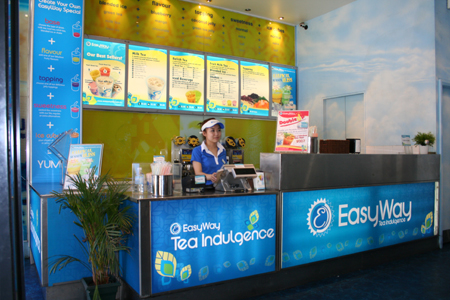
2 The respondent (Chatime) trades under the business name "Chatime". Chatime is a competitor of the applicants both in Australia and in several other countries in the Asia-Pacific region. It operates fourteen retail outlets at various locations in Sydney and one retail outlet in Melbourne. Chatime commenced trading in Australia in September 2009. The directors and shareholders of Chatime are Yang Yang Qian and Chen Zhao, both of whom live and work in Sydney.
3 In 2010, Chatime published and distributed certain promotional and advertising material, of substantially similar content, in two formats. These were:
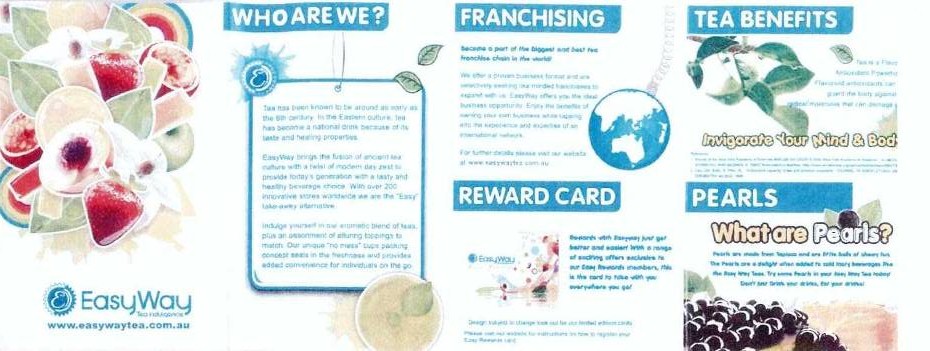
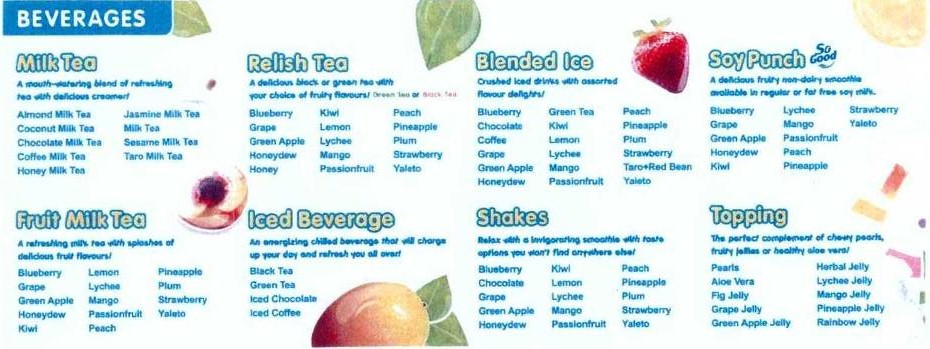
(a) A 16-page pocket-sized glossy colour booklet entitled "TOP SECRETS" (Ex C) (the booklet). An image of a cup of tea, the Chatime name and the Chatime logo are displayed on the front page of the booklet. I will describe the booklet in more detail later in these Reasons. Chatime began distributing the booklet at its retail outlets on or about 9 July 2010. At the same time, it arranged for copies of the booklet to be handed to members of the public as they walked along various streets in and near the Haymarket area of the city of Sydney.
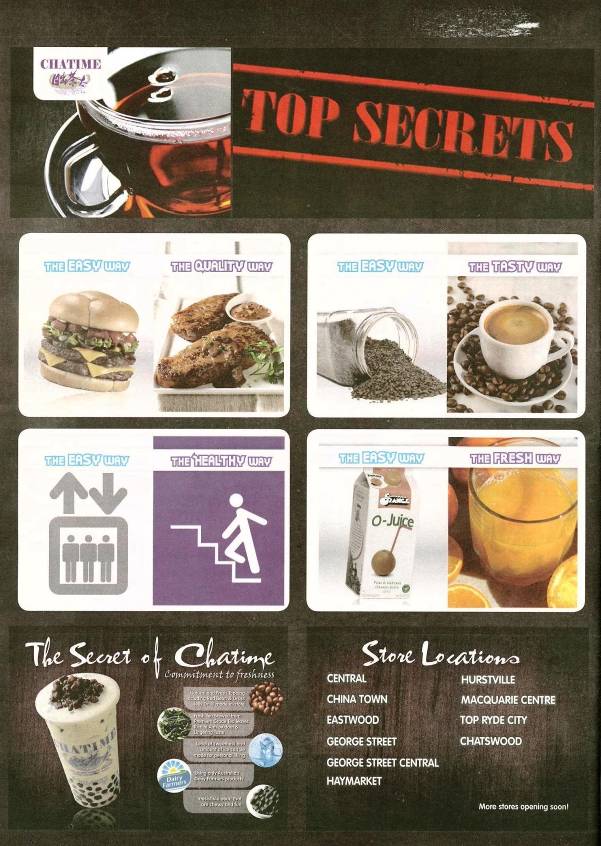
(b) A full-page colour advertisement which appeared on p 30 of the 8 August 2010 edition of a magazine entitled "Citywalker" (Ex 1) (the advertisement). That edition comprised 78 pages. I have attached as Attachment "A" to these Reasons a colour photocopy of the advertisement. The images which appear in the advertisement reproduce pp 1–11 of the booklet. The booklet contains some additional matter. It includes the address of several Chatime stores in Sydney. It also contains coupons for special offers for free and discounted products. An advertisement for a pop concert appears on the last page of the booklet.
4 The booklet has also been published on the Internet. Chatime denies any involvement in that publication.
5 The applicants contend that both the booklet and the advertisement convey representations which are broadly to the effect that the products sold by Chatime are healthier, fresher, tastier and of a better quality than those sold by the applicants. Chatime disputes that the booklet and the advertisement convey the representations alleged by the applicants. However, they accept that, if the representations pleaded by the applicants were, in fact, conveyed by those publications, those representations were false.
6 The applicants contend that, by publishing and distributing the booklet and by causing the advertisement to be published, Chatime engaged in conduct which was misleading or deceptive, or likely to mislead or deceive, and thus contravened s 52 of the Trade Practices Act 1974 (Cth) (the Act). The applicants seek declaratory and injunctive relief, an order for delivery up of the offending material, an order for corrective advertising and costs. Prior to the hearing, the applicants abandoned their claim for damages.
The Applicants' Case
7 The first applicant is the master franchisor of the Easy Way business in Australia. It derives its rights from a Master Franchise Agreement dated 1 March 2004 between it and a Taiwanese corporation, Leisure Station Co Ltd (Leisure Co). The second applicant is the master franchisee of the Easy Way business in Australia. It derives its rights from a Master Sub-Franchise Agreement dated 1 March 2004 between it and the first applicant. Its function is to license franchisees in Australia to operate one or more Easy Way retail outlets and to support those franchisees once they are licensed. The third to seventh applicants own and operate the company-owned Easy Way stores in Australia. Leisure Co is the registered proprietor of certain trade marks registered in Australia. It makes available those trade marks to the applicants for use in the Easy Way business in Australia.
8 All of the applicants have a legitimate interest in the relief which is claimed in this proceeding. It is not necessary to consider the entitlement of each applicant individually to the relief claimed.
9 In par 15 of the Amended Statement of Claim, the applicants allege that, by distributing or publishing, or causing or permitting to be distributed or published, the booklet and the advertisement, Chatime:
… made certain representations to:
a. customers and prospective customers of the Applicants and the Respondent;
b. readers of the Booklet and the Citywalker magazine; and
c. the public at large;
namely that:
a. the products sold by the Applicants and their franchisees are of poor quality;
b. the products sold by the Applicants and their franchisees are not tasty;
c. the products sold by the Applicants and their franchisees are not fresh;
d. the products sold by the Applicants and their franchisees are packaged or processed;
e. the products sold by the Applicants and their franchisees include packaged (and not fresh) fruit juice;
f. the products sold by the Respondent are of a better, or significantly better, quality than those sold by the Applicants and their franchisees;
g. the products sold by the Respondent are tastier, or significantly more tasty, than those sold by the Applicants and their franchisees;
h. the products sold by the Respondent are fresher, or significantly fresher, than those sold by the Applicants and their franchisees;
i. the products sold by the Respondent include a higher proportion of fresh, rather than packaged or processed, items or ingredients than those sold by the Applicants and their franchisees;
j. the products sold by the Respondent are more likely, or significantly more likely, to contain fresh (rather than packaged) ingredients than those sold by the Applicants and their franchisees;
k. the products sold by the Respondent are healthier, or significantly more healthy, than those sold by the Applicants and their franchisees;
l. the products sold by the Respondent have a higher, or significantly higher, nutritional value than those sold by the Applicants and their franchisees;
m. the products sold by the Respondent are more compatible, or significantly more compatible, with a healthy lifestyle than those sold by the Applicants and their franchisees;
n. the products sold by the Respondent offer a healthier, or significantly healthier, alternative to consumers than the products sold by the Applicants and their franchisees;
o. in general, the products sold by the Respondent are fresher and healthier than those sold by the Applicants and their franchisees;
p. there is a sound or reasonable factual or scientific basis for the comparisons made in the Booklet between, on the one hand, the products sold by the Applicants and their franchisees and, on the other, the products sold by the Respondent;
q. if a consumer purchases products from the Respondent, rather than from the Applicants and their franchisees, the consumer will experience increased health benefits and will enjoy a healthier, fresher, tastier and better quality product;
10 These representations are said to be express or, alternatively, partly express and partly implied.
11 The essence of the applicants' complaint is that, in both the booklet and the advertisement, Chatime denigrates the quality, taste, freshness and nutritional value of the applicants' Easy Way products without having any proper basis for doing so and that, in those publications, Chatime represents that the products sold by Chatime are superior to the Easy Way products sold by the applicants in terms of quality, taste, freshness and nutritional value when, in truth, there is no basis for suggesting that Chatime's products are superior in those respects, or at all.
12 The applicants allege that the representations pleaded in subpars (a) to (p) of par 15 of the Amended Statement of Claim are assertions of fact and that the representation pleaded in subpar (q) of that paragraph is a representation with respect to a future matter. In respect of this last allegation, the applicants plead and rely upon s 51A of the Act.
The Respondent's Defence
13 Chatime admits that it distributed the booklet and caused the booklet to be published and distributed. It also accepts that it caused the advertisement to be published. It denies publishing the booklet on the internet.
14 Chatime denies that the booklet and the advertisement convey any of the representations alleged by the applicants. In par 13 of its Defence, however, it admits that, if the Court should find that it made the representations, or any of them, by publishing and distributing the booklet and the advertisement, it had no factual basis for making any of those representations.
15 It also resists the applicants' claim for a corrective advertising order.
16 In its Defence, Chatime admits that its products are promoted and marketed for sale by use of the colours purple, black and white in a number of different shades.
The Issues
17 There are, therefore, three groups of issues of substance to be determined by these Reasons for Judgment. They are:
(a) What, if anything, was conveyed by the booklet and by the advertisement in the circumstances in which each of them was published and distributed? If the Court should hold that some or all of the representations alleged by the applicants were conveyed by those publications, Chatime concedes that it had no basis for making those representations.
(b) Is the respondent responsible for publishing the booklet on the internet? If so, what, if anything, was conveyed by that publication?
(c) In the event that the respondent is held liable, should an order for corrective advertising be made? If so, what should be the form of the corrective advertisement and where and on how many occasions should it be required to be published?
The Interlocutory Regime
18 This proceeding was commenced on 18 August 2010. On that day, the applicants applied to the Duty Judge for orders abridging the time for the service of their Application and of the affidavits in support and for an urgent hearing of their application for interlocutory relief. The Duty Judge acceded to those applications and listed the applicants' application for interlocutory relief before him on 20 August 2010.
19 On 20 August 2010, Chatime gave an undertaking to the Court (without admissions) that, until further order:
(a) It would not distribute the booklet or cause it to be distributed or publish the booklet or cause it to be published;
(b) It would inform the publisher of Citywalker magazine (Ozstar Media Pty Limited) of the existence of this proceeding and request that that organisation not include a copy of the advertisement in its future print runs of that magazine; and
(c) It would not publish or cause to be published any advertisement consisting of or including any of the material contained in the document which was Annexure "A" to the undertaking. Annexure "A" comprised a copy of pp 2–9 of the booklet.
Consideration
Some Additional Facts
20 Bubble milk tea is a sweet tea-based beverage which originated in Taiwan. It is very popular in Taiwan and amongst Chinese communities around the world. It is becoming increasingly popular amongst non-Chinese communities. The basis of the beverage is usually black Oolong tea or green Jasmine tea. It is generally served cold and with milk, sugar syrup and toppings. The customer chooses the tea flavour as well as the topping. Included in the drink are tapioca balls known as "chewy pearls". These "pearls" are rolled black balls which have a smooth chewy texture and which sit at the bottom of the drink. The drink is usually served in a glass or a disposable takeaway cup. The sale of bubble milk teas generates approximately 80% of the applicants' gross sales revenue.
21 The Easy Way business commenced in Taiwan in the early 1990s and has since expanded to a dozen other countries around the world. The applicants were the first business group to specialise in the retail sale of Taiwanese bubble milk teas in Australia. The applicants are the current market leaders in the sale of Taiwanese bubble milk teas in Australia.
22 In addition to their extensive range of Taiwanese bubble milk teas, the applicants sell relish tea, blended ice drinks, milk shakes, iced chocolate, iced coffee, fruit punch, fruit juices, soy punch and hot tea. The applicants do not sell hamburgers, steak, instant coffee, hot coffee or coffee beans. They do not sell fried foods or snacks of a similar nature.
23 Some of the ingredients used by the applicants in their products are fresh and some are prepared and packaged by others and supplied to the applicants in pre-packaged form. Many of the pre-packaged ingredients are imported from Taiwan. The applicants adduced evidence that suggested that their products were of good quality and that their outlets were clean and well maintained. In the proceeding, Chatime did not contend that the applicants' products were not of good quality or that their outlets were not clean and well maintained. Nor did Chatime argue that the applicants' products were in any way inferior to its products. Chatime accepted that there was no basis in fact for suggesting that any of its products were superior to comparable Easy Way products sold by the applicants.
24 The applicants sell fruit juices at some of their retail outlets. When fruit juices are sold, they are always freshly squeezed on site. They are made from fresh fruit which is stored on site. The applicants do not sell packaged fruit juices nor do they use packaged fruit juice as an ingredient in any of their Easy Way products.
25 The applicants promote their products through their website, through advertisements placed on the internet, on radio, in newspapers, in magazines and in promotional pamphlets, through their loyalty program and by means of instore signage and instore promotional items. They also maintain a site on the social networking website, Facebook.
26 In Australia, the focus of the applicants' marketing is on the Asian community.
27 The typical retail outlet operated by the applicants is relatively small and configured as a shopfront or kiosk with no customer seating available.
28 The colour light blue features prominently in the fit-out of the typical Easy Way retail outlet both in Australia and elsewhere throughout the world. That colour is also used in the applicants' advertising and promotional materials.
29 I have attached as Attachment "B" to these Reasons a photograph of the Easy Way outlet located at Shop B, 653 George Street, Sydney. The fit-out and presentation of that outlet is fairly typical of the fit-out and presentation of all Easy Way retail outlets in Australia. The name "Easy Way" is always presented as two words and in a font similar to the font used at the retail outlet shown in Attachment "B".
30 I have attached as Attachment "C" a brochure and menu used by the applicants in the early days of its activities in Australia. That brochure and menu show the extensive use by the applicants of the light blue colour in their advertising and promotional materials and the same presentation of the trade name "Easy Way" as is shown in Attachment "B". Attachment "C" is typical of the brochures and menus used by the applicants subsequently in Australia.
31 The applicants have spent significant sums of money on advertising their products during the ten years or so that they have been in business in Australia. That advertising has been extensive across all types of media. They have also engaged in a large number of promotional activities, including their Easy Way membership scheme and sponsorship of various Asian pop musicians.
32 Chatime's range of products is very similar to that of the applicants. The sale of Taiwanese bubble teas constitutes a significant part of Chatime's sales revenue. Subject to an exception concerning orange juice, it was common ground at the hearing that the Easy Way products of the applicants and those of Chatime were of similar quality, freshness, taste and nutritional value. Unlike the applicants, who sell only freshly-squeezed juices, Chatime sells pre-packed orange juice, not fresh orange juice. At the hearing, Chatime accepted that it had no basis for suggesting (if it had done so, which it denied) that the products of the applicants were inferior to those of Chatime. Chatime uses the colour purple in its promotional and advertising materials. Chatime also maintains a site on Facebook.
33 While both the applicants and Chatime are hoping to sell their products to members of the public in Australia generally, they both target the Asian community here. Their focus is on that community although each of them is keen to expand its customer base to include non-Asian customers.
34 The evidence established that 30,000 copies of the booklet were distributed in Sydney in July and August 2010. Many of these booklets were distributed on George Street, Sydney, near the Chatime and Easy Way outlets there. A significant proportion of the pedestrians who generally move about in that part of Sydney is Asian or of Asian heritage.
35 As mentioned at [3] above, the advertisement appeared on p 30 of the 8 August 2010 edition of Citywalker magazine. That magazine is published monthly. It is a Chinese language lifestyle magazine. Its principal function appears to be to advertise goods and services, in some cases by reference to specified categories. Citywalker's own promotional literature boasts that the magazine is an absolute life guide catering for every aspect and is specifically designed for young adults and adolescents. Its contents cover news, current events, cultural activities and entertainment relevant to the daily life of Sydney's Chinese community. The magazine is in a large format (27 cm × 38 cm), has a glossy outer cover in colour print and is attractively presented. Fiona Xiong, who is the editor-in-chief of Citywalker, told Marco Feng Yu, the marketing co-ordinator of the second applicant, that the publisher of Citywalker produces more than 50,000 copies of each edition of the magazine and that those copies are made available all over metropolitan Sydney. The magazine has a circulation of approximately 56,000 copies. The Citywalker magazine is free to consumers.
36 By letter dated 13 July 2010, the applicants' solicitors wrote to Chatime complaining about the booklet. This initial written complaint was founded upon allegations that Chatime had infringed Leisure Co's trade marks by publishing and distributing the booklet. In that letter, the applicants claimed to be the authorised users of those trade marks in Australia. The applicants' complaint made in their solicitors' letter dated 13 July 2010 was rebuffed by a response sent by the lawyers for Chatime on 15 July 2010.
37 By letter dated 5 August 2010, the lawyers for the applicants renewed their complaint. On this occasion, the essence of the complaint was that, by publishing and distributing the booklet, Chatime was engaging in misleading and deceptive conduct. In this letter, the applicants' lawyers said:
EASY WAY AND CHATIME
We refer to your letter of 15 July 2010 and respond as follows:
1. The use of the words "The Easy Way" combined with the use of light blue lettering clearly identifies our client and illustrates that the representations contained in the brochure are comparative in nature;
2. While comparative advertising is not prohibited per se it is not permissible for your client to advertise in a manner which is misleading or deceptive or is likely to mislead and deceive;
3. Your client's booklet and advertisement in Citywalker August 2010 issue contain the following representations which are inaccurate and misleading or likely to mislead and deceive:
(a) that Easy Way's products are not healthy;
(b) that Easy Way's products are not fresh;
(c) that Easy Way's products are of poor quality;
(d) that Easy Way's products are not tasty;
(e) that Chatime's products are much tastier than Easy Way's products;
(f) that Chatime's products are much fresher than Easy Way's products;
(g) that Chatime's products are of much better quality than Easy Way's products; and
(h) that Chatime's products are much healthier than Easy Way's products.
4. The representations have been made without any proper basis and are untrue.
5. The booklet is an unfair way of promoting your client's products while denigrating our client's products. In particular our client:-
(a) does not sell hamburgers;
(b) does not sell hot coffee;
(c) does not sell packaged orange juice;
And our client reserves its position as to any claim in respect of those clearly false representations.
As your client is well aware, Easy Way:
• is the pioneer and market leader of Taiwanese milk tea business in Australia;
• has invested considerable sums in establishing goodwill and a positive reputation in relation to its products and services [sic] well as its franchise system in the Australian market; and
Easy Way's considerable goodwill and reputation is being damaged by the publication and distribution of the booklet and advertisement by your client.
On or about 12 July, 2010 Mr Shih (on behalf of our client) raised our client's concerns with Mr Zhao (on behalf of your client). Mr Shih was informed that your client had almost finished with distribution of the booklets. Notwithstanding this, booklets continue to be distributed.
Accordingly, we are instructed to demand the following:
1. Chatime agree with and undertake to Easy Way to immediately refrain from further distributing the booklet or publishing the advertisement or any booklets or advertisements containing the same or similar representations;
2. Chatime agree with and undertake to Easy Way to refrain from making any further misleading or deceptive statement regarding Easy Way's products and services and franchise system in the future;
3. Chatime offer an unconditional written apology to Easy Way for the conduct complained of above within seven days from the date hereof;
4. Chatime will publish or caused [sic] to be published in English and Chinese newspapers widely distributed in Sydney a statement of apology to Easy Way (on terms satisfactory to Easy Way) within seven days from the date hereof.
In the event that Chatime fails or refuses to indicate its agreement to the above by 5.00pm on Friday 6 August 2010 we are instructed to issue proceedings in the Federal Court of Australia seeking interlocutory and permanent injunctions and damages and we will rely [sic] this letter.
38 Neither Chatime nor its lawyers responded to that letter. Their failure to do so left the applicants with no real choice but to commence this proceeding.
39 On 12 July 2010, prior to the applicants' making their first formal demand, James Shih, who is an officer of the applicants, telephoned Chen Zhao (who is also known as Charlley Zhao). On that day, a conversation took place between those two gentlemen in which Mr Shih complained about the booklet. The conversation proceeded as follows:
| Mr Shih said: | It seem to contain materials insulting Easy Way. |
| Mr Zhao said: | Really, I don't think so. |
| Mr Shih said: | Yes there is, with easy way with quality way, and easy way with healthy way, the colours for easy way are all blue and other wording are all in purple. |
| Mr Zhao said: | Really? I didn't know about it, it was done by our outsourced marketing company, maybe the colours are just coincidence. |
| Mr Shih said: | Can you stop distributing it? |
| Mr Zhao said: | But we already printed it and almost finish with distributing it. |
| Mr Shih said: | We have consulted our solicitor and we may take legal action on this matter. |
| Mr Zhao said: | I have also asked our lawyer and he/she said it's OK, if you have any problem you can ask your solicitor to contact my lawyer. |
| Mr Shih said: | So you will continue distributing? |
| Mr Zhao said: | We almost finished, if there is any inconvenience I am sorry. |
| Mr Shih said: | OK we will discuss with our solicitor. |
40 Prior to the commencement of the hearing, Chatime filed and served affidavits from three persons. Only one of those affidavits was read and relied upon at the hearing. This was the affidavit affirmed by Yang Yang Qian. Chen Zhao did not file any affidavit nor did he give any oral evidence at the hearing.
41 The applicants filed and served a number of affidavits in support of their case. None of the applicants' witnesses was cross-examined.
42 In her affidavit, Yang Yang Qian said that the target market for Chatime is the general public with particular emphasis on the Asian community because members of that community are familiar with the concept of bubble milk tea. Yang Yang Qian said that Chatime had retained Wai Wai Pty Limited (Wai Wai), a marketing and publishing company, to design promotional materials for Chatime. She said that Wai Wai had submitted various drafts of the booklet to Chatime for its approval. She said that the final form of the booklet was approved by Chatime and that 30,000 copies of the final version were then printed. She said that copies of the booklet were sent to Chatime stores in George Street Sydney, the Haymarket (Sydney), Hurstville, Macquarie Centre, Top Ryde and Chatswood Chase and were distributed to customers when they attended at those stores. Her evidence also made clear that Chatime had been responsible for retaining persons to distribute the booklets on the streets in and near the Chinatown area in Sydney. Yang Yang Qian testified that only 560 copies of the booklet remained in the possession of Chatime. The effect of this evidence was that 29,440 copies of the booklet had been handed out to the customers of Chatime between about 9 July 2010 and 20 August 2010. In her affidavit, Yang Yang Qian did not deny that Chatime was responsible for posting or arranging the posting of the internet materials. She said nothing about that matter in her affidavit.
43 The applicants served a subpoena on Wai Wai requiring it to produce various documents associated with the promotional activities carried out by Wai Wai on behalf of Chatime.
44 Amongst the documents produced in answer to that subpoena was a document entitled "Chatime Winter Promotional Proposal". That document is undated. It appears to have been prepared by an employee of Wai Wai and to relate to the period from May to August 2010. In that document, the author set out his or her views about the strengths and weaknesses of Chatime and its beverage business. The author described Easy Way as the market leader in Australia in tea-based drinks. The customer base of such products was described as young persons of Asian background who were single or couples with no children.
45 Under the heading "Competitive Analysis", the author referred to Easy Way as Chatime's "main competitor". The author said that Easy Way was well known across Asian populations and in the Asian community in Australia. The author advocated drawing customers away from Easy Way using a variety of promotional and advertising methods. One medium suggested was: "Online Media – Websites".
46 Under the heading "Creative Strategy", after again referring to Easy Way, the author set out six ideas as follows:
Idea 1:
To achieve the objective of letting more people know that CHATIME provides a variety of hot beverages. We need to impress the customer with the message we want to send. To do so, an interactive way is considered to be more effective than a passive way.
Here is the basic idea people would more easily remember things that they have considered than things are told by somebody. Therefore we first present a question and give a bit of time for people to think of the answer then we give out the answer that we want customer to remember.
A small booklet is the platform to make this idea work. We consider designing a 12 pages size A7 (H105mm, W74mm) booklet and contents are as follow:
1. The question: How many hot beverages you can think of in just 2 minutes?
2. Possible answer that you can think of – Hot tea (picture)
3. Hot milk (picture)
4. Hot chocolate (picture)
5. Coffee (picture)
6. The message: In just 2 minutes we can serve you a hot beverage that you may think of or you can't even think of. There are over 30 different hot beverages you can choose from CHATIME. So don't think, just choose. /Pictures of CHATIME hot beverages
7. Pictures of CHATIME hot beverages
8. Shop locations
9. Shop locations
10. Coupon
11. Coupon
12. Coupon / CHATIME logo
Slogan: Don't think, just choose.
Idea 2:
To help people identify CHATIME as a unique brand from other competitors and emphasis its focus – quality and freshness.
The basic idea is to enlarge your advantage by comparing it to your competitors. A small booklet is also work in presenting the idea. The design idea is:
1. Win a voucher by spotting the difference
2. (L) The easy way – a burger (picture)
3. (R) The quality way – a steak (picture)
4. (L) The easy way – instant coffee (picture)
5. (R) The tasty way – brewed coffee/coffee machine (picture)
6. (L) The easy way – canned juice (picture)
7. (R) The fresh way – fresh juice (picture)
8. (L) The easy way – lift (picture)
9. (R) The healthy way – stairs (picture)
10. (L) The easy way – $5 note (picture)
11. (R) The same rate – $5 coins (picture)
12. Display the ingredients of CHATIME's product, e.g. tea, beans, milk
13. Display the ingredients of CHATIME's product, e.g. tea, beans, milk
14. Shop locations
15. Shop locations
16. CHATIME logo / Coupon – Taste the difference
Slogan: Giving you the 'cha' enjoyment is NOT an easy way.
OR Taste the difference.
Idea 3:
Categorising the hot drinks in 3 series. They are
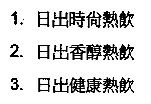
These 3 series will be introduced and promoted in different period, i.e. introducing 1 series per month from May to July. Each series will contain existing products and new products. Three types of flyers will be designed to accompany this promotion.
Idea 4:
"I love CHATIME" online campaign on August
This is a warm up activity for CHATIME 1 year anniversary. The idea is you take photo for yourself with any CHATIME product and post it on waiwai.com.au and write down why you love CHATIME's products and what is your favourite. The best writer can win a great prize from CHATIME, e.g. 365 cups of Free Drink or Buy one get one free card available for whole year.
Idea 5:
July 'O-week' promotion with student societies, joined societies promotion with at least 2 societies. Special offer to the society members in a limited time.
Idea 6:
"Step on freshness" Store/Street Campaign
We design a path of 6 – 8 steps that is used to show people how does a CHATIME product is made. Show people step by step from choosing ingredients to the tea brewed process to the final product.
47 Idea 2 was planned to be implemented in August 2010.
48 Wai Wai also proposed that a half page advertisement in each of the June, July and August editions of Citywalker would be taken out.
49 It appears from the materials produced by Wai Wai in answer to the subpoena served upon it that Idea 2 was subsequently revised as follows:
The design idea is as follow, please research on the pictures.
The basic idea is to enlarge your advantage by comparing it to your competitors. A small booklet is also work in presenting the idea. The design idea is:
1. Win a voucher by spotting the difference
2. (L) The easy way – a burger (picture)
3. (R) The quality way – a steak (picture)
4. (L) The easy way – instant coffee (picture)
5. (R) The tasty way – brewed coffee/coffee machine (picture)
6. (L) The easy way – canned juice (picture)
7. (R) The fresh way – fresh juice (picture)
8. (L) The easy way – lift (picture)
9. (R) The healthy way – stairs (picture)
10. Display the ingredients of CHATIME's produce, e.g. tea, beans, milk
11. Display the ingredients of CHATIME's product, e.g. tea, beans, milk
12. Shop locations
13. Shop locations
14. Coupon
15. Coupon
16. CHATIME logo / Franchise information
50 The differences between the original exposition of Idea 2 and the final exposition of Idea 2 were:
(a) The following introductory words were deleted:
To help people identify CHATIME as a unique brand from other competitors and emphasis its focus – quality and freshness.
(b) Items 10 and 11 in the first version (which refer to a $5 note and $5 worth of coins) were deleted.
(c) The text at the foot of the original version:
Slogan: Giving you the 'cha' enjoyment is NOT an easy way.
OR Taste the difference.
was deleted.
51 An organisation called M Connections was identified as the entity which would organise all marketing activities for Chatime's winter promotion (direct and online). Chatime was to supervise the campaign. The "I Love CHATIME" campaign was proposed to commence in August 2010.
52 Yang Yang Qian was cross-examined at the hearing.
53 It was made clear during Yang Yang Qian's cross-examination that Chatime's bubble milk tea was the same type of product as the bubble milk tea sold by the applicants.
54 Yang Yang Qian was also questioned about Wai Wai's Chatime promotions proposal which I have described at [44]–[51] above. She attempted to distance herself from the booklet and from the advertisement. She said that she was not in charge of Chatime's marketing and that Chatime's marketing and advertising campaigns were handled by Chen Zhao. She gave unconvincing evidence when she attempted to deny that the booklet and the advertisement were part of a deliberate and premeditated strategy to disparage the applicants' Easy Way products by comparing those products with those of Chatime in a way which suggested that the applicants' Easy Way products were inferior to the comparable products sold by Chatime. At Transcript 18 ll 5–35, the following exchange occurred:
Could I suggest to you this, that one of the objectives of the campaign devised by Wai Wai was to draw customers away from Easyway? No.
Didn't you want to – well, perhaps I will put another question. One of the objectives of a campaign, devised by Wai Wai, was to differentiate the image of Chatime from that of Easyway? No.
Did you not wish to convey the message that Chatime produces high quality, tasty, fresh and health tea drinks? And I can break that down if you like? I didn't get you.
Well, did you not want to give the message that Chatime produces high quality tea drinks? Yes.
And did you not want to give the message that Chatime produces tasty tea drinks? Yes.
And did you not want to give the message that Chatime produces fresh tea drinks? Yes.
And did you not want to give the message that Chatime produces healthy tea drinks? Yes.
Didn't you, at the same time, want to give the message that Easyway doesn't produce tea drinks which are of the same high quality as those produced by Chatime? No.
And that Easyway doesn't produce tea drinks which are as tasty as those produced by Chatime and Easyway doesn't produce tea drinks which are as fresh as those produced by Chatime? No.
And Easyway doesn't produce tea drinks which are as healthy as those produced by Chatime? No.
55 After giving the evidence which I have extracted at [54] above, the witness said that the references in the booklet and in the advertisement to "the Easy Way" were not and were not intended to be a reference to the applicants' "Easy Way" trade name or to their Easy Way products. She tried to place the entire responsibility for the booklet and the advertisement on Wai Wai. She said (at Transcript 19 l 24–20 l 45):
So did you see this before it was distributed? Yes.
And you see it says Top Secrets, what did you understand that to be a reference to? It's – Top Secrets, it's the secret of Chatime.
The secret of Chatime. And what is the secret of Chatime? The freshness – the freshness of our drinks is our secret, yes.
So if you look at the first two pages there, you will see one has a big triple-decker or double decker hamburger and "the easy way" is above that. Was that intended to be a reference to Easyway's products? No.
Why were the words "easy way" used there? It's just a simple meaning, it's convenient, simple.
Sorry? It's just a meaning of convenient, simple.
And why was "easy way" in blue? It's just a colour chosen by the designer.
It had nothing to do, do you say, with Easyway your competitor? No.
And do you see on the right hand side it says, "The quality way" in purple? Mm.
What is that a reference to? It's just a descriptor of quality, like, it's another choice, like, yes, two different ways.
It's drawing a – two pages are drawing a comparison, though, aren't they? No, there's no – no.
Aren't they saying that – well, you would agree with me that in the second page there, it's a sirloin steak, a good quality sirloin steak, freshly cooked? No, sorry, I haven't
You have it in front of you, I think, at page 27.
HIS HONOUR: 27 of the bundle? 27? Yes.
MR DOUGLAS: So it's comparing a hamburger - and that's a big hamburger - to a freshly cooked sirloin steak; would you not agree? Sorry, can you repeat again?
It's comparing a hamburger to a freshly cooked sirloin steak? They are two – yes.
Yes, and saying that a freshly cooked sirloin steak is the quality way? Yes.
And that the hamburger is the easy way? Yes.
What was the purpose of that comparison in this booklet? It's just showing two different lifestyles.
You see, what I want to suggest to you is that the easy way is intended to be a reference to your competitor's product, Easyway? No.
And that the quality way is intended to be a reference for your own product, Chatime? No.
And it is seeking to suggest that Chatime is a quality drink, compared to Easyway, which is, essentially, fast food or bad for you? No.
Then, the next page, you will see, again, it's "the easy way and the tasty way." Were the words "the easy way" on the first of those pages, intended to be a reference to your main competitor, Easyway? No.
What was it intended to be a reference to? It's just an easy way to make coffee.
Well, what was the purpose of making or saying that in this booklet? It's the – it's from my opinion it's just the two different lifestyles. One is simple and convenient and the other is, like, quality and tasty, yes, two different lifestyles.
HIS HONOUR: Is one of them meant to refer to Chatime? No.
56 Ultimately, she accepted that, at pp 2–9 of the booklet, and in the advertisement, comparisons were being made. She said that all that was being compared were "… two different lifestyles …". She denied that the message conveyed by the booklet and the advertisement was that Chatime's products were fresher, tastier, healthier and of better quality than the Easy Way products sold by the applicants. She also denied that the reason that Chatime placed the advertisement in the Citywalker magazine was to target the Asian community.
57 She denied having any knowledge of or involvement in the internet post which I describe at [59]–[60] below.
58 Ultimately, at Transcript 24 ll 23–39, the witness said:
See, what I want to suggest to you is that the booklet was published by Chatime to make a comparison which was unfavourable between Chatime and Easyway in – for the way in which I have put to you in my cross-examination? No.
And I also want to suggest to you that the advertisement was placed in the Citywalker magazine for the same purpose? No.
And I also want to suggest to you that the organisation behind Chatime that is the respondent, is responsible for publishing on the Internet ? No.
… this publication? No.
And I want to suggest you sought to draw an unfavourable comparison between Chatime and Easyway, so that you could profit from the market reputation that Easyway, had by portraying Chatime as a better product? No.
I've got nothing further.
The Internet Post
59 The evidence adduced by the applicants established that, published on the website styled http://deluphie.com/?p=122 (the deluphie website), was the booklet and some associated commentary. The publication was headed in large bold type: "There is No Easy Way in Doing It" and first appeared on that website on 11 July 2010. 11 July 2010 was a day or two after Chatime began distributing the booklet. After referring to the pop group "S.H.E." and mentioning Chatime, the person who posted the material reproduced the comparison images from the booklet found at pp 2–9. Under each pair of images there was a caption. They were:
|
| Under pp 2 and 3 (the image of the hamburger on the left and the steak on the right): | "Easy Way vs. Quality Way" |
|
| Under pp 4 and 5 (the image of the instant coffee on the left and the brewed coffee and coffee beans on the right): | "Easy Way vs. Tasty Way (simple but?)" |
|
| Under pp 6 and 7 (the image of the pre-packaged orange juice on the left and the freshly squeezed orange juice on the right): | "Easy Way vs. Fresh Way" |
|
| Under pp 8 and 9 (the image of the lift on the left and the stairs on the right): | "Easy Way vs. Healthy Way" |
The following text then appeared:
Chatime, anything but Easy way!
For the uninitiated, Easy Way is the popular bubble tea franchise in Australia. Chatime is the competitor, entering the Sydney market just less than a year ago, therefore the oft-mentioned 'Easy Way' in the booklet.
While it doesn't look like it, but Chatime is extremely aggressive in the way that there were already 3 stores opening up in the city within a couple of months time. This latest marketing effort merely confirmed that they mean to mount a serious challenge to the incumbent. And to do it in real straight-in-your-face 'I AM NOT SCARED OF YOU" style, guess where they hand out these booklets?
Two meters away from an Easy Way stall.
60 The post finished with two logos on the left hand margin and the following:
© 2010 deluphie Design by SRS Solutions
61 The applicants also established that, if an interested person were to use Google as a search engine for the purpose of searching "Easyway and Chatime", the deluphie website came up as the third entry listed on the list of search results. On 2 December 2010, the total number of entries listed in response to that search command was 1,050.
Issue 1 – The Alleged Representations
62 Chatime was responsible for the printing and distribution of the booklet and the publication of the advertisement. It admitted that responsibility in its Defence and conducted the proceeding upon the basis that there was no issue about that matter.
63 Both the booklet and the advertisement also make clear that they are intended to advertise, promote and praise Chatime's products. The ultimate aim of both publications is to enhance the image of Chatime and to increase the sales of its products.
64 The advertisement reproduces pp 1–11 of the booklet. There is a slight difference between p 1 of the booklet and the image which appears at the very top of the advertisement but the essence of those two images is the same. Pages 12 and 13 of the booklet identify seven Chatime retail outlets and provide the address for each of those stores. The last image in the advertisement identifies ten Chatime outlets but does so by reference only to the suburb in which each outlet is located and does not provide any address. Pages 14 and 15 of the booklet contain coupons for free and discount offers of Chatime products. Images of several of Chatime's drinks products are attractively presented on those pages. Page 16 of the booklet comprises an advertisement for the Taiwanese pop musical trio, S.H.E. Pages 14–16 of the booklet do not appear at all in the advertisement.
65 Chatime first began distributing the booklet on or about 9 July 2010. The advertisement appeared for the first and only time in the Citywalker edition published on or about 8 August 2010. The contents of the booklet are substantially the same as the contents of the advertisement. The evidence established that the distribution of the booklet and the publication of the advertisement were part of a single co-ordinated advertising and promotional campaign commissioned by Chatime and designed and orchestrated by Wai Wai in conjunction with and on the instructions of Chatime.
66 Given the substantial identity between pp 1–11 of the booklet and the advertisement, given that the balance of the booklet (pp 12–15) concentrates on Chatime's business and products only, given that both the booklet and the advertisement were aimed at the same section of the public and given that the booklet was distributed and the advertisement was published at about the same time, I think that whatever messages were conveyed by the booklet were also conveyed by the advertisement. For this reason, I will focus on the booklet in considering whether the representations which the applicants allege were made by Chatime in both publications were, in fact, made.
67 When considering the import of an advertising or promotional brochure such as the booklet, the Court is bound to read and evaluate the material as a whole. In the present case, regard must be had to all sixteen pages of the booklet with particular attention being paid to pp 1–11. Those pages contain various colour images, some promotional text and some factual information. It is not appropriate to look at each page in isolation in order to determine what, if any, representation is made on that page. The booklet must be viewed as a whole and all of its contents must be assessed as a whole.
68 As submitted on behalf of the applicants:
It is the first impression conveyed by the advertising, which creates the impact on a reader, rather than an analysis of the constituent parts of the advertised message or the weighing of each word in the advertisement. Most consumers would not make a close study of the advertisement, but would absorb its general thrust (Sterling Winthrop Pty Ltd v R & C Products Pty Ltd (1994) ATPR 41-308 at 42,126 (Lockhart J), 42,133 (Sheppard and Burchett JJ); Telstra Corporation Ltd v Optus Communications Pty Ltd (1997) ATPR 41-541, (1996) 36 IPR 515 at 523 (Merkel J); Bristol-Myers Squib Australia Pty Ltd v Astra Pharmaceuticals Pty Ltd (1999) 45 IPR 144 at 164 (Weinberg J)).
69 I accept that submission as encapsulating the approach which I should take in the present case and I propose to apply the principles summarised in that submission in the present case.
70 The applicants' submission which I have quoted at [68] above applies a fortiori to the advertisement. All of the images on pp 1–11 of the booklet appeared in the advertisement on a single page and would be taken in by a reader more or less in one hit. A reader of the booklet, on the other hand, would thumb his or her way quickly through the various pages until, perhaps, the pages with the coupons (pp 14 and 15) are reached. Those pages might be read more carefully. However, I do not think a reader of the booklet would spend much time studying and thinking too deeply about the contents of pp 1–11. The applicants' Easy Way products and Chatime's competitive offerings are all relatively cheap commodities and most consumers of them would not spend much time thinking about whether or not to purchase any of them.
71 Although both the applicants and Chatime would dearly love to sell their products to the Australian public at large, the evidence before me established that, at the moment, the real market for both organisations' products consists of young adults or adolescents of Asian background who are single or couples with no children and who live in metropolitan Sydney and metropolitan Melbourne. This group of consumers views the consumption of the Easy Way and Chatime products as trendy or in vogue. This group is well aware of the Easy Way business and the Easy Way product range. Easy Way products have been sold in Australia for ten years and have been promoted and advertised heavily throughout that period. The target group may also have some awareness of Chatime and its products. The booklet was handed out with this target group in mind. The advertisement was placed in a publication whose readership principally comprises this target group.
72 When an ordinary reasonable member of Chatime's target customer group receives and opens the booklet, the first words which that person sees are: "The Easy Way". Those words are printed in stylised capital letters at the top of p 2 of the booklet and are quite prominent and eye-catching. The use of the colour light blue as the frame for shaping those letters in white would inevitably call the applicants' Easy Way business and products to the mind of any ordinary reasonable reader from the target group of consumers. The font and colours (light blue and white) are reminiscent of the way in which and the colours in which the applicants' business and products are promoted, branded and advertised. Once Easy Way is called to mind in this way, the reader would think that the booklet was going to contain some information or statement about the Easy Way business and its products. Of course, the reader is well aware that the booklet is published by Chatime (at least because of p 1) so that the reader is drawn quite quickly into thinking that there is going to be some comparison made between the Easy Way business and products, on the one hand, and the business and products of Chatime, on the other hand. This thought is reinforced by the use of the colour purple (Chatime's corporate colour) to frame the letters which appear at the top of p 3. However, the reader is also aware that the applicants do not sell hamburgers and that Chatime does not sell sirloin steak. The reader's curiosity is, therefore, aroused. It had probably already been aroused by the title on p 1 of the booklet in large capital letters in red ink: "TOP SECRETS". It would now be further aroused. What is the comparison which is being sought to be made? He or she reads on. On the left hand page of each succeeding pair of pages, the words "The Easy Way" are repeated in identical fashion to the manner in which they appear on p 2. They remain bold and eye-catching. Unappealing images appear under those words on pp 4 and 6 (instant coffee blandly presented and pre-packaged orange juice under the name "Clockwork Orange"). Those images stand in stark contrast to the attractive images on pp 5 and 7 (freshly made coffee and coffee beans and freshly-squeezed orange juice). Each of the pages where those images appear has an important message emblazoned across the top: On p 5 it is "The Tasty Way" and on p 7 it is "The Fresh Way". On p 3 it is "The Quality Way". The colour purple features prominently in the slogans which appear on pp 3, 5 and 7.
73 Page 8 depicts statue-like figures in a lift. This contrasts with the energetic figure climbing stairs shown on p 9 under the heading: "The Healthy Way". Page 9 is flooded with purple and conveys an image of good health and vitality.
74 In my view, by the time the reader reaches p 9 of the booklet, he or she would realise that the none-too-subtle comparison being made is between the quality, taste, freshness and nutritional value of the applicants' Easy Way products (or, rather, the alleged lack thereof) and the quality, taste, freshness and nutritional value of Chatime's products. The repeated references to "The Easy Way" (white framed in light blue, the applicants' trade colours) in association with fast food, instant coffee and pre-packaged orange juice on pages which are on display right next to attractive images of healthy, tasty, fresh and nutritional foods depicted in association with the slogans and purple colours which I have described at [72] above and which can be seen in Attachment "A", constitute representations that Chatime's products are superior to Easy Way products and that Chatime's products are generally of better quality, more tasty, fresher and more healthy than the applicants' Easy Way products. The clear message conveyed by the booklet is that the applicants' Easy Way products are inferior in every material respect to the comparable products sold by Chatime. It does not matter that the images under the words "The Easy Way" are images or products which the applicants do not, in fact, sell. Nor does it matter that the only product depicted in association with the colour purple on pp 3, 5 and 7 which is, in fact, sold by Chatime, is hot coffee. The images are figurative and illustrative, not literal. Nonetheless, the messages are clear. Chatime's products are superior and, in particular, superior in the specific respects which are highlighted by the headings on pp 3, 5 and 7 and by the attractive images displayed on those pages.
75 These messages are rammed home by the material which appears on pp 10 and 11 of the booklet. The images there clearly relate only to Chatime's products. The attributes of those products, which are emphasised on those pages, are their quality, freshness and high nutritional value. They are described as being "natural" (as distinct from being "artificial"). The quality and attractiveness of the ingredients used by Chatime in its products is also emphasised by the references to "Dairy Farmers" milk (a highly-respected local product) and by the use of the word "Premium" in respect of the grade of tea leaves used.
76 The representations which I have found were made by Chatime in the booklet are quite general and unqualified in their terms. No attempt was made to support them in the offending publications with hard facts or with any reasoned or logical argument. In the proceeding, Chatime conceded that it had no basis for making any of them. They were false and therefore misleading or deceptive or likely to mislead or deceive at the time when they were made. They had great potential to mislead consumers in the target group and consumers generally and great potential to harm the Easy Way business carried on by the applicants. The comparisons which were undertaken were unfair and inaccurate in the messages which they conveyed. The comparisons and representations contained in the booklet are likely to mislead consumers into thinking that there is a real basis upon which they can make a choice between the Easy Way products sold by the applicants and the Chatime products sold by Chatime when, in truth, there is no such basis. Those comparisons and representations are also likely to mislead consumers into thinking that, if they choose between the two ranges of products upon the grounds featured in the comparisons, they would be doing so upon grounds which are valid when, in truth, those grounds would not be valid.
77 The conclusions which I have reached in respect of the booklet apply equally to the advertisement.
78 I do not think that the representations which are made in the booklet and in the advertisement are susceptible to being broken down into the seventeen detailed representations pleaded by the applicants in par 15 of their Statement of Claim. The representations which I have found were made are adequately captured by subpars (k) to (q) of par 15 of the Statement of Claim.
79 The Wai Wai Chatime proposal supports the view which I have taken of the booklet and the advertisement. That material makes very clear that the linchpin of the campaign proposed by Wai Wai was a comparison between Easy Way and Chatime and that the intent of that campaign was to exploit and to build upon Easy Way's dominant position in the relevant market whilst at the same time attempting to draw customers away from the applicants to Chatime. Wai Wai's Idea 2 proposed a direct comparison. Idea 2 as modified is reflected in the booklet. The planning for Idea 2 demonstrates that the pages in the booklet headed with the words "The Easy Way" were intended to call to mind the applicants and their Easy Way products and that the method of comparison reflected in the booklet was to denigrate the Easy Way products sold by the applicants whilst at the same time promoting and praising the products sold by Chatime. The amendments to the initial description of Idea 2 made in the second exposition of Idea 2 suggest that some concern was felt by Wai Wai and by Chatime that the language used to describe the planned promotion might have gone too far. The very fact that those amendments were made shows that considerable thought went into the planning of the campaign. I do not doubt that, in the end, the publication and distribution of the booklet and the publication of the advertisement were the result of a deliberate and calculated decision taken by the directors of Chatime to try to build revenue in Chatime's business by mounting an unfair and misleading advertising campaign in which the applicants' Easy Way products would be denigrated in the respects set out in the booklet and in which Chatime's products would be lauded for outshining the applicants' Easy Way products in the critical respects highlighted in the booklet. The directors of Chatime were prepared to take their chances as to whether the applicants could stop the campaign before its impact could really be felt.
80 These findings necessarily mean that I reject much of the evidence given by Yang Yang Qian as well as the submissions made on Chatime's behalf.
81 I found Yang Yang Qian's evidence unconvincing, contrived and implausible. It manifested a disregard for her obligations to the Court and a continuing disrespect for the applicants and their rights. The substance of her evidence is flatly contradicted by the Wai Wai materials and by the format and contents of both the booklet and the advertisement. I do not accept the evidence of Yang Yang Qian.
82 Counsel for Chatime submitted that the representations which I have found were made in the booklet and in the advertisement were not, in fact, made in either publication. She submitted that the references to "Easy Way" on pp 2, 4, 6 and 8 of the booklet would not be understood by a reader of the booklet as a reference to the applicants' business or products. She submitted that the trade name "Easy Way" was always used by the applicants in conjunction with the additional words "TEA INDULGENCE" and that, in circumstances where the words "Easy Way" do not appear in conjunction with those additional words, no reader of the booklet in the target group would think that the references in the booklet were to the applicants' Easy Way business or products. She submitted that I should simply view the repetitive reference to "The Easy Way" in the booklet as references to a lifestyle choice which was being compared in the booklet with a different and more healthy lifestyle choice. These submissions reflected the point of view which Yang Yang Qian urged upon me in her evidence. For the reasons which I have already explained, I am not persuaded by these submissions. They are unreal and I reject them.
83 The applicants are entitled to permanent injunctions restraining Chatime from making the representations which I have found it made in both the booklet and the advertisement unless, at the time when they are made in the future, they are true. The restraint should extend to substantially similar representations. The applicants are also entitled to orders for the delivery up of the remaining copies of the booklets in the possession of Chatime and its servants and agents (including Wai Wai and M Connections).
84 The applicants have also claimed a declaration. Declarations are often made when the Act is contravened in order to mark the Court's disapproval of the conduct which has been held to contravene the Act in a public way and in the public interest (see eg Australian Competition & Consumer Commission v Alvaton Holdings Pty Ltd [2010] FCA 760 at [34] (per Gilmour J)).
85 I agree with the applicants that the contraventions of the Act which I have found were committed by Chatime were serious. Chatime embarked upon a deliberate plan to run down the applicants and to denigrate their Easy Way products even though they had no basis for thinking that any of the claims which they proposed to make in respect of the applicants' Easy Way products were true.
86 I propose to make an appropriate declaration.
Issue 2 – The Internet Post
87 Part of the strategy recommended to Chatime by Wai Wai was that the campaign should be conducted online. The use of websites was advocated by Wai Wai. M Connections was retained to organise (inter alia) online activities for Chatime's proposed winter promotion. Young adults and adolescents are adept at accessing and making use of online facilities and materials. I find that, in light of the above matters, it was very likely that Chatime would deploy some online marketing in its campaign.
88 The internet post about which the applicants complain was first posted on 11 July 2010. 11 July 2010 is immediately after Chatime began handing out copies of the booklet and shortly before the advertisement was placed. By 11 July 2010, the distribution of the booklet was in full swing and it made perfect sense for Chatime to try to stimulate internet dialogue about the booklet and about its products at that time.
89 The contents of the post smack of Wai Wai and Chatime's marketing people. The technique of comparing Chatime's products with the applicants' Easy Way products is contrived and developed in the post. The text deployed in the post is reminiscent of the marketing language found in the Wai Wai materials. The tone of the language in the post and the format of the material used in the post do not create in the reader's mind a sense that the author is an interested customer or potential customer of Chatime (or of the applicants, for that matter). The whole post seems artificial and contrived and presents as yet another promotional item. The very fact that the booklet is substantially reproduced in the post tends to support this impression.
90 Yang Yang Qian did not deal with the internet post in her affidavit. She did deny involvement in placing that post when cross-examined about it. Chen Zhao said nothing about the matter. According to the evidence before me, Chen Zhao was in charge of Chatime's promotions and advertising at the time. The fact that he did not give any evidence and, in particular, did not deny involvement on his part in the placing of the post is significant. I am entitled to draw a very strong inference against Chatime by reason of the absence from the witness box of Chen Zhao. That inference, in the circumstances, may go so far as to provide a basis for concluding that not only would his evidence not have helped Chatime but that it would have possibly harmed its case (Jones v Dunkel (1959) 101 CLR 298 at 308 (per Kitto J); at 312 (per Menzies J); and at 320–321 (per Windeyer J)). I propose to draw that strong inference and to weigh it in the balance with all other evidence relevant to the determination of the issue with which I am now dealing.
91 The coincidence in the timing of the placing of the internet post and the commencement of the distribution of the booklet coupled with the other matters I have mentioned at [87]–[90] above lead me to the conclusion that it is highly likely that Chen Zhao and Wai Wai were responsible for the placing of the internet post. Chatime had every reason to place such a post. No-one else had any reason to place the post. The subject matter of the post is not so scintillating or topical as to cause a member of the public generally or even a member of the target group of customers to place the post. Further, despite its upbeat tone, no-one added any comment to the post at any time between 11 July 2010 and the date of the hearing. Such a long period of silence suggests that, apart from the person who placed the post, no-one was interested in its contents. This is a circumstance tending to favour the conclusion that the post was placed by Chatime or by someone else on its instructions.
92 For the reasons explained at [87]–[91] above, I find that Chatime either placed the internet post or caused it to be placed. I also find that it contained the same representations as were made in the booklet and in the advertisement. They were false and misleading and deceptive or likely to mislead or deceive.
93 These findings will be reflected in the orders which I propose to make.
Issue 3 – Corrective Advertising
94 The power to grant injunctions under s 80 includes the power to order corrective advertising for the purpose of correcting any lingering impression left by the respondent's misleading and deceptive conduct (Medical Benefits Fund of Australia Ltd v Cassidy (2003) 135 FCR 1 at [49] (p 20) (per Stone J, with whom Moore and Mansfield JJ agreed); Luxottica Retail Australia Pty Ltd v Specsavers Pty Ltd (No 2) [2010] FCA 644 at [9] (per Perram J); Hoover (Australia) Pty Ltd v Email Ltd (1991) 104 ALR 369 at 377 (per Gummow J)).
95 In Medical Benefits Fund, at [50]–[52] (p 21), Stone J said:
50. Advertising that is directed to dispelling incorrect or false impressions created as a result of deceptive or misleading conduct will generally have, as an ancillary benefit, some public educational effect in relation to the operation of the relevant legislative provisions. In Australian Competition and Consumer Commission v Target Australia Pty Ltd [2001] ATPR 41-840 Lee J commented, at 43,382, that:
"The purpose sought to be achieved by corrective advertising is to raise public awareness — for both consumers and competitors — as to the type of conduct that may contravene the Act, and as to the outcome of the particular litigation."
51 This benefit had often been recognised including in Australian Competition and Consumer Commission v Real Estate Institute (WA) (1999) 95 FCR 114[PDF]. Although French J was there dealing with breaches of Pt IV of the TPA, his comments are equally applicable to the conduct under consideration here. French J accepted that under s 80 of the TPA there was power to make orders to bring the outcome of those proceedings to the attention of the members of the Real Estate Institute of Western Australia and to the public as consumers. Nevertheless his Honour observed that it is important that corrective advertisements do more than merely announce a "win" for the ACCC. In relation to the contraventions of Pt IV of the TPA French J held, at 133, that s 80 authorised advertisements "directed to informing the relevant markets of the outcome of the litigation so that those in the market have at least a broad understanding of the ways in which the contravenors have had to change their conduct." Such advertisements "aid in the enforcement of the primary orders and the prevention of the repetition of the contravening conduct".
52 His Honour expressed similar views in Australian Competition and Consumer Commission v Virgin Mobile Australia Pty Ltd (No 2) [2003] ATPR (Digest) 46-230; (2003) Aust Contracts R 90-164, where he was prepared to make consent orders for corrective advertising because the proposed advertisement was "consistent with the objectives of consumer protection for which such advertisements should be ordered in respect of contraventions of Pt V". His Honour noted, at [22], that the advertising would "assist in drawing [the contravention] to the attention of consumers generally who may have acquired Virgin Mobile packages or may be contemplating doing so" and would serve "the positive function of alerting consumers to the obligation imposed on Virgin Mobile to disclose those things", namely the cash price and minimum cost of the phone package.
96 In Medical Benefits Fund, a period of three years had elapsed between the end of the offending advertising program and the date of the Full Court's judgment. At [58] (p 23), the Full Court considered that "… the effluxion of time must have a bearing on the utility of orders for corrective advertising". In considering this factor in that case, the Court held that the contravening conduct no longer had any impact on consumers. Yet, the Full Court did not set aside the order for corrective advertising made by the trial judge.
97 Further, corrective advertising will generally have, as an ancillary benefit, some public educational effect in relation to the operation of the relevant legislative provisions (Medical Benefits Fund at [50] (p 21)).
98 The applicants submitted that:
43. Alternatively, corrective advertising may be ordered if it might (Medical Benefits Fund v Cassidy (2003) 135 FCR 1 at 22 [54]; Luxottica v Specsavers (No 2) [2010] FCA 644 at [9]):
43.1 alert consumers to the fact of the misleading or deceptive conduct;
43.2 inform consumers that they might have some remedy provided there is a nexus between the conduct and the order;
43.3 aid the enforcement of a primary order; or
43.4 prevent repetition of the conduct.
44. Corrective advertising may be ordered so as to address an applicant's "legitimate commercial concern about the impact of the advertisements and the fact that the impact may linger", even where several months have passed since the advertisements (King Furniture [2007] FCA 1845 at [51]–[52]). It is relevant to consider the nature and likely effect of the advertisement and of the proposed corrective advertising, the time which has elapsed, and the requirement that the corrective advertising not be disproportionate to the extent of publication of the misleading material (Hoover (Aust) Pty Ltd (1991) 104 ALR 369 at 377 (Gummow J); Makita (Aust) Pty Ltd (1990) ATPR 41-030, (1990) 18 IPR 270 at 281 (Wilcox J)).
45. There is no principle that any particular period is appropriate as a point beyond which corrective advertising is not warranted. It is necessary to examine the nature, extent and intensity of the advertising and the media in which it has been released, with a view to deciding whether there could reasonably be any current misapprehension as a result of the advertisements (Medical Benefits Fund v Cassidy (2003) 135 FCR 1 at 20 [49], quoting ACCC v On Clinic Australia Pty Ltd (1996) 135 IPR 635 at 640 (Tamberlin J)).
99 These submissions are correct. I accept them and will apply them in the present case.
100 Counsel for Chatime opposed the making of any order for corrective advertising and also made submissions directed to the form of such advertising, if ordered. She submitted that the booklet had been distributed only for a relatively short period of time and that the advertisement had appeared only once. Counsel also submitted that the contravening conduct occurred eight or nine months ago and had ceased altogether by 20 August 2010. She argued that the effect of the contravening conduct was transitory and that most consumers in the target group would not remember the booklet or the advertisement.
101 There is much force in the submissions made on behalf of Chatime which I have summarised at [100] above. However, I think that those submissions ignore the fact that a large number of copies of the booklet were distributed in areas of importance to Chatime and to the applicants across Sydney and that the advertisement was placed in a magazine which has a substantial readership. Also, the messages conveyed by the type of promotional activity undertaken by Chatime through the booklet, the advertisement and the internet post have the capacity to linger in the consumer's mind. Although Chatime ceased distributing the booklet in August 2010 and did not publish any further misleading advertisements after August 2010, the internet post remained available as at the date of the hearing (December 2010). The messages conveyed by Chatime were general, false and potentially very damaging to the applicants.
102 As the applicants submitted (at par 54 of their Written Submissions):
Having regard to its striking, graphic and colourful features, the directness of the disparagement, and the brash and aggressive character of the campaign, it is likely that the effect of the advertising lingered in the public mind a long time after the booklet and the advertisement ceased to be distributed.
103 I propose to order Chatime to publish corrective advertising. The applicants sought an order that Chatime be required to publish one advertisement in Citywalker magazine. There was a difference of opinion between the parties as to the appropriate form of that advertisement. The differences are minor. I will make an order substantially in accordance with the form of order suggested by the applicants.
Costs
104 The applicants have succeeded in all of their claims for relief. Costs should follow the event.
| I certify that the preceding One hundred and four (104) numbered paragraphs are a true copy of the Reasons for Judgment herein of the Honourable Justice Foster. |
Associate: