

FEDERAL COURT OF AUSTRALIA
Danisco A/S v Novozymes A/S (No 2) [2011] FCA 282
| IN THE FEDERAL COURT OF AUSTRALIA | |
| First Applicant/Cross Respondent DANISCO AUSTRALIA PTY LTD (ACN 096 139 392) Second Applicant | |
| AND: | First Respondent/Cross Claimant NOVOZYMES AUSTRALIA PTY LTD (ACN 001 420 677) Second Respondent |
| DATE OF ORDER: | 29 March 2011 |
| WHERE MADE: |
THE COURT ORDERS THAT:
1. The parties submit draft orders to give effect to these reasons, including as to reserved costs and the future conduct of the proceedings, by 4 p.m. on 31 March 2011.
2. The parties notify Bennett J’s chambers by 4 p.m. on 30 March 2011 if there are confidentiality concerns as to [141] and [163] of the reasons.
3. The matter be stood over for directions to 9:30 a.m. on 1 April 2011.
Note: Settlement and entry of orders is dealt with in Order 36 of the Federal Court Rules. The text of entered orders can be located using Federal Law Search on the Court’s website.
| NEW SOUTH WALES DISTRICT REGISTRY | |
| GENERAL DIVISION | NSD 1968 of 2008 |
| BETWEEN: | DANISCO A/S First Applicant DANISCO AUSTRALIA PTY LTD (ACN 096 139 392) Second Applicant |
| AND: | NOVOZYMES A/S First Respondent NOVOZYMES AUSTRALIA PTY LTD (ACN 001 420 677) Second Respondent |
| JUDGE: | BENNETT J |
| DATE: | 29 March 2011 |
| PLACE: | SYDNEY |
REASONS FOR JUDGMENT
1 The applicants (together Danisco) sue the respondents (together Novozymes) for infringement of Australian Patent No 752215 entitled “Foodstuff” (the Patent). The Patent relates to a process for preparing a foodstuff comprising certain steps which involve the use of, inter alia, an enzyme. Lipopan Xtra is a Novozymes product said by Danisco to infringe the Patent. The important claims for the purpose of Danisco’s infringement case are claims 1, 2, 7 and 14, although Novozymes’ cross-claim for revocation is broader.
2 Novozymes’ cross-claim seeks revocation of the Patent on the grounds set out in its Fourth Further Amended Particulars of Invalidity, being that:
(a) the alleged invention, as claimed in claims 1 to 9, 14 and 15 of the Patent is not a manner of new manufacture (s 18(1) of the Patents Act 1990 (Cth) (the Act));
(b) the alleged invention, as claimed in claims 1 to 9, 14 and 15 of the Patent is not novel (s 18(1)(b)(i) of the Act) in light of:
(i) US Patent no. 3,386,903 (the Johnson patent);
(ii) International Patent Application no. WO 94/04035 (the Qi Si patent);
(iii) International Patent Application no. WO 98/26057 (the Novo patent); and
(iv) International Patent Application no. WO 98/45453 (the Poulsen patent);
(c) the alleged invention did not involve an inventive step when compared with the prior art base (s 18(1)(b)(ii) of the Act); and
(d) the claims of the Patent are unclear (s 40(3) of the Act).
3 In its written submissions filed after the completion of the hearing, Novozymes raised the question of fair basis and indicated reliance on this ground as an alternative. No application was made to amend the Fourth Further Amended Particulars of Invalidity to raise fair basis as an alternative ground. It was clear that Danisco did not consent to any such ground being relied on. Indeed, Danisco says, and it is not disputed, that it ran its case on the understanding that lack of fair basis was not relied on. I shall not consider it further as a ground for revocation.
4 The present hearing is concerned with issues of liability only, issues of the quantum of any pecuniary relief having been reserved for later determination.
5 The Patent was granted on an application filed on 20 July 1999. As such, relevantly, the provisions of the Act as in force prior to the amendments effected by the Patents Amendment Act 2001 (Cth) apply.
6 The parties have agreed upon the contents of a primer which sets out technical background relevant to the litigation. The primer, with some amendment, is Annexure A to these reasons.
7 In addition to their oral submissions, both parties provided several sets of written submissions after the hearing. The positions taken in these written submissions were not always consistent with the parties’ earlier oral submissions or with other written submissions that were provided to the Court. As a result, setting out each party’s submissions in their entirety is neither practical nor desirable. I have, however, endeavoured to summarise the position taken by each party where appropriate.
8 These reasons are divided into the following sections:
9 The Patent claims priority from two basic applications filed in the United Kingdom, the earlier of which was filed on 21 July 1998. There is no dispute in this proceeding that the claims of the Patent are entitled to that priority date.
10 The specification of the Patent provides a dictionary of some relevant terms. “Functional ingredient” means any one of a number of constituents of the foodstuff which performs a specific function in the foodstuff, including an emulsifier, preservative, antioxidant, colouring and flavouring. This is a wide class. Preferably, the term “functional ingredient” is said to mean ‘a constituent of the foodstuff which has one or more of surface active properties, antioxidative effect, anti-bacterial effect including bacteriostatic effect and/or bactericidal effect and viscosity modifying effect, preferably viscosity improving effect’.
11 “Functional” is not otherwise defined in the specification. It is, however, relevantly defined in the Macquarie Dictionary (rev 3rd ed, Macquarie, 2003) to mean ‘of or relating to a function or functions’.
12 “Foodstuff” means a substance which is suitable for human or animal consumption.
13 The invention described and claimed in the Patent is said to have application in relation to the preparation of foodstuffs generally but more particularly in the context of baking and the production of baked products. The description in the Patent commences with a general statement of the field of the invention in the conventional way. This indicates that the invention relates to a foodstuff, and more particularly a foodstuff comprising at least one functional ingredient which has been generated in situ by a conversion agent. That is, the reference is to an enzyme and at least one (which includes one) functional ingredient.
14 A discussion of the background to the invention is then provided. The background is said to be a desire to prepare foodstuffs meeting quality requirements while minimising the number of additives in the final foodstuffs. Developments in the industrial preparation of food are noted, including the use of functional ingredients such as emulsifiers, hydrocolloids, preservatives, antioxidants, colourings and flavourings. The Patent refers to recent demand from consumers to reduce the number of additives in foodstuffs, such as functional ingredients.
15 Reference is then made to various journal articles and patent specifications reporting the use of lipases in food production. Various prior art publications are cited which teach the use of a lipase for the production of emulsifiers. One of the publications refers to the use of a lipase for the hydrolysis and ester exchange of triglyceride, where the triglyceride is partially hydrolysed to free fatty acid and the partially hydrolysed triglyceride product is used for production of margarine. Another refers to the transesterification of two oils or fats; another to rearrangement by transesterification of the fatty acid components of a fat or oil. Each of the latter two publications are said to be relevant to use of the process in the production of margarine.
16 A further cited publication relates to the production of mayonnaise. There, a lipase is added to a mixture of water and oil; the oil is degraded to free fatty acid or fatty acid salts (soap) and glycerol, which may provide the emulsifying properties. In this context, the pH dependency is noted and the statement made that at low pH free fatty acid is present in the acid form, which has low emulsification properties, whereas at alkaline pH free fatty acid is available as a soap, which has good emulsification properties. Whether or not this is a problem depends on the foodstuff to be produced.
17 The invention is said to address the problems of the prior art.
18 The specification then describes the invention. As is not uncommon, the invention is described in the specification with increasing particularisation.
19 The invention as described in the first, second and third aspects of the invention does not correspond to claim 1. For example, the conversion agent of these aspects is not necessarily an enzyme. It is only three pages later that the specification states that preferably the conversion agent is a catalyst and that in a preferred or particularly preferred aspect the conversion agent is an enzyme. As a further example of the breadth of those earlier described aspects of the invention, there is no reference to the requirement in claim 1 that the enzyme be denatured or inactivated, since the conversion agent of the second aspect of the invention is not limited to an enzyme.
20 The specification says that the invention utilises a conversion agent, such as an enzyme, to generate one or more functional ingredients such as emulsifiers, antioxidants or preservatives from a constituent or ingredients of a food material from which the foodstuff is prepared. Instead of adding food additives produced by traditional chemical synthesis, this enables the in situ synthesis of a required functional ingredient. This is said to overcome disadvantages that may arise with chemical synthesis, such as extreme conditions. It also means that there is one less additive in the foodstuff. This is advantageous because the reduction or elimination of additives is desirable to consumers and because additives often must be declared as ingredients by listing on the foodstuff. The specification also states that, provided the conversion agent is suitably chosen so that it is compatible with the foodstuff in the sense of being edible, further processing of the foodstuff may not be necessary. However, the invention encompasses foodstuffs which have been further processed.
The state of the enzyme at the end of the reaction
21 Following this discussion, the specification turns to the use of a catalyst and preferably an enzyme as a conversion agent. It explains that enzymes are particularly preferred because they are readily available, may be chosen to convert a specific constituent of the food material and/or may be chosen to generate a specific functional ingredient. Yet further, the specification says, they may be denatured by heat:
… Thus in a further preferred aspect, the foodstuff/food material is heated after generation of the functional ingredient. The enzyme will be denatured and may then constitute protein. This is advantageous because the denatured enzyme need not be declared on the foodstuff/food material ingredients.
The use of enzymes is advantageous because denatured enzymes are considered, particularly under food labelling regulations, to constitute a processing aid. Inactivated enzymes are not considered to be additives; the addition of additives to foodstuffs is undesirable to many consumers.
Inactivation of the conversion agent, in particular denaturation of the enzyme, is advantageous because it allows one to control the amount of functional ingredient generated. For example, the generation of the functional ingredient may be monitored (for example by measurement of the functional properties of the food material) or the rate thereof determined. One may then terminate the generation of the functional ingredient, when a suitable amount of functional ingredient has been generated, by heating the food material. Thus the amount of the functional ingredient and the properties of the food material/foodstuff may easily be controlled.
22 Thus the use of the enzyme is beneficial because, relevantly to its state after the reaction:
Enzymes are denatured by heat.
The foodstuff or food material is heated after generation of the functional ingredient.
The enzyme will be denatured.
The enzyme may then constitute protein.
The denatured enzyme need not be declared.
Inactivated enzymes are not considered to be additives and additives may be considered undesirable.
Denaturation of the enzyme allows control of the amount of functional ingredient generated by heating the food material. That is, a denatured enzyme has no activity.
23 The specification later states that the conversion agent is preferably present in the foodstuff, more preferably in an inactive form or in a denatured form.
24 No measure of inactivation is given in the specification of the Patent. The examples for the preparation of margarine say that the mixture is ‘shortly heated to 100°C to denature the enzyme’. For sponge cake, the specification says that the reaction mixture is ‘shortly treated at 100°C in order to inactivate the enzyme’. The recipe for sponge cake includes baking for 35 minutes at 180°C.
25 The specification states that ‘preferably the enzyme is an enzyme as described in and/or as claimed in Danish Patent Application No 0400/97’, that is, the Priority Application for the Poulsen patent (Poulsen Priority Application). The enzyme is also said to be preferably capable of exhibiting lipase activity. The specification provides that the enzyme comprises at least one amino acid sequence selected from a group of three sequences provided. In a further aspect, the enzyme may be an enzyme as described in and/or as claimed in International Patent Application No PCT/IB98/00708 filed 6 May 1998.
The functional ingredients and the constituents
26 The specification is very general in its description of possible functional ingredients and constituents. It is stated that ‘the at least one’ functional ingredient may be generated from ‘the at least one’ constituent by two or more conversion agents. It is said that preferably, ‘the at least one’ constituent of the food material is selected from a large class of compounds, including esters, mono-, di- and triglycerides, fats, fatty acid esters, various oils, proteins, amino acids, a constituent comprising a hydroxy group, polyvalent alcohols, including glycerol, water, ethanol and sugars. Indeed there seems to be a repetition of proteins and amino acids in the list.
27 A more detailed description is given of the meaning of the term “triglyceride” to mean a triester of an alcohol, preferably glycerol and a fatty acid.
28 A number of preferred aspects of the integers of the invention are then described:
The triglyceride of the first constituent is selected from triglycerides of specified fatty acid chain lengths.
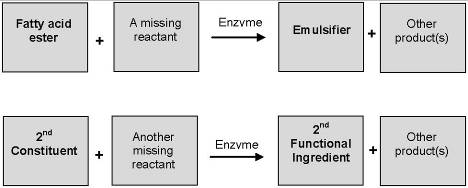
The functional ingredient is generated from at least two constituents of the food material where at least two constituents of the foodstuff may interact and/or react and/or combine together to generate at least one functional ingredient.
The functional ingredient is generated from a first constituent and a second constituent of the food material.
The first and second constituents are constituents of the foodstuff. The functional ingredient is generated from a first and a second constituent of the food material and these constituents are also present in the foodstuff. That is, the constituents/ingredients are only partially used.
The first constituent of the food material/foodstuff is hydrophobic and/or lipophilic.
The first constituent of the food material/ foodstuff is selected from a broad class of compounds including esters, mono-, di- and triglycerides and various oils, derivatives and mixtures thereof. More preferably, the first constituent of the food material/foodstuff comprises or is an ester or a triglyceride.
The second constituent is hydrophilic and may be selected from proteins, amino acids, mixtures and derivatives.
The second constituent is selected from a constituent comprising a hydroxy group including glycerol, water and ethanol, more preferably glycerol. This preferred group does not include fatty acid esters.
The first constituent is an ester, preferably a triglyceride and the second constituent is a constituent comprising a hydroxy group, preferably an alcohol, more preferably a polyvalent alcohol and yet more preferably glycerol.
In a highly preferred embodiment, the first constituent is a triglyceride and the second constituent is a sugar or a sugar alcohol. These constituents interact on contact with the conversion agent to generate an ester derived from the first constituent with a lower degree of esterification than the first constituent, and a sugar ester. Each of the ester and the sugar ester may act as a functional ingredient such as an emulsifier. Thus, two functional ingredients may be generated from two constituents of the food material/foodstuff by a conversion agent. This describes a single reaction, known as interesterification. In that highly preferred embodiment, the second constituent is preferably ascorbic acid.
In a further broad aspect of the invention, the foodstuff comprises at least two functional ingredients which have been generated from a first constituent of the food material (preferably a triester, more preferably a triglyceride) and a second constituent of the food material (preferably a sugar or sugar alcohol and more preferably ascorbic acid) by a conversion agent.
In a further preferred aspect of the invention, the food material/foodstuff further comprises greater than two constituents, preferably a third constituent. This is selected from the constituents listed for the first and second constituents, preferably one that comprises a hydroxy group, including glycerol and water. Preferably, it is selected from sugars.
The provision of one or more of the constituents in liquid form may significantly increase the reaction velocity of the generation of ‘the at least one’ functional ingredient.
The conversion agent may be contacted with all of or a portion of the food material. An example is described in the specification and in Figure 1, resulting in margarine.
Preferably, the functional ingredient is generated by a reaction selected from alcoholysis, preferably glycerolysis, hydrolysis, interesterification and combinations thereof, more preferably alcoholysis, preferably glycerolysis.
The ‘at least one’ functional ingredient is selected from emulsifiers, hydrocolloids, preservatives, antioxidants, colourings and flavourings. Preferably, at least one functional ingredient comprises or is selected from a group including emulsifiers and, more preferably, is an emulsifier. The emulsifier may comprise or be selected from mono- and diglycerides, derivatives and mixtures thereof.
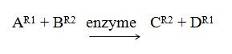
The food material and/or the food material contacted with the conversion agent and/or the conversion material is substantially free of water. An example of this aspect of the invention is where a lipase carried in glycerol is contacted with a triglyceride. Mono- and diglycerides and preferably sugar esters are generated as functional ingredients. Two single reactions are exemplified, one an interesterification using a lipase where the constituents are triglyceride and glycerol, the other using triglyceride and glycerol/sugar, that is three constituents, and a lipase. It is possible to select the ‘at least one constituent’ to provide a required functional ingredient. Where it is an emulsifier being a mono-, di- or triglyceride, ‘the at least one’ constituent may be, for example, a triglyceride and a polyvalent alcohol.
The foodstuff provided may be selected from a very wide range of goods including baked goods. In one aspect of the invention, it is other than mayonnaise. A preferred embodiment is margarine.
29 The specification contains 16 examples which illustrate the invention. These examples relate to the production of a variety of foodstuffs, including where the foodstuff is full fat margarine, 60% fat spread with protein, 40% fat spread with whey powder, filling cream, ice cream and various other forms of margarine. Example 14 relates to the production of sponge cake, a baked product.
30 It is not in dispute that there are reactions described in the specification that are single reactions. The specification also describes a reaction in which the first and second constituents are contacted with the conversion agent under conditions of controlled water activity.
31 The relevant claims of the Patent are set out later in these reasons.
32 Two experts gave evidence at the hearing. Danisco adduced evidence from Professor Darryl Small. Novozymes adduced evidence from Professor Russell Hoseney. There was no dispute that both experts were skilled in the relevant art now and as at the priority date, that is, in the preparation of baked goods (in particular, bread), including the use of enzymes in the preparation of bread.
33 Professor Small obtained a Bachelor of Agricultural Science with Honours from the University of Sydney in 1974. In 1981, he obtained a PhD from the University of Sydney, studying metabolism of storage polysaccharides. From 1978 to 1982, Professor Small worked as a Scientific Research Officer at the Biological and Chemical Research Institute, NSW Department of Agriculture. Professor Small was then employed by the Australian Wheat Board (AWB) from 1982 to 1992, first as Chief Chemist and subsequently as Manager of the Grain Quality Laboratory. In 1989, he was appointed Assistant Director of the AWB’s Academy of Grain Technology, the responsibilities of which involved baking, the testing of wheat and flour and protein and enzyme analysis. From 1993 to 1995, Professor Small held the position of Senior Food Technologist with the National Food Authority in Melbourne. From 1995 to 2002, he lectured at Victoria University in Food Science and Technology. During this time, Professor Small became involved in various projects and publications relating to enzymes. Since 2002, Professor Small has been employed by the Royal Melbourne Institute of Technology University (RMIT), first as a Senior Lecturer in Food Chemistry and, since 2009, as an Associate Professor. Professor Small’s research at RMIT has involved investigations into the practical outcomes of the use of enzymes in food production and food processing, including the use of enzymes in baking.
34 Professor Hoseney obtained a Bachelor of Science in 1957 and a Master of Science in 1960, both from Kansas State University (KSU), specialising in Grain Science and Chemistry. From 1956 to 1970, Professor Hoseney worked as a chemist and subsequently as a research chemist at the United States Department of Agriculture. He was awarded a PhD in 1968, his thesis being entitled the “Determination of Biochemical and Bread Making Properties of Wheat Flour Components”. Professor Hoseney accepted a position as an Associate Professor in the Department of Grain Science and Industry at KSU in 1970. Professor Hoseney was promoted to full professorial status in 1975 and held this position until retiring in 1997, upon which he was appointed a Professor Emeritus, an appointment which he continues to hold. During his time at KSU, Professor Hoseney researched and published papers in matters relevant to cereal chemistry, as well as teaching courses such as “Wheat and Flour Quality” and “Advanced Cereal Chemistry”. Since 1971 Professor Hoseney has also operated a consultancy business through which he regularly consults with various milling companies and baking companies on a range of different matters relating to the milling of grains and the preparation of baked goods.
35 Professor Hoseney has attended the annual conferences of the American Association of Cereal Chemists since 1961. Australian researchers have been prominently represented at this conference each year. Professor Hoseney has also attended and presented at a number of meetings of the Cereal Division of the Royal Chemical Society of Australia, including meetings in 1986, 1991, 1995, 1998 and 2006. Through these meetings, he came to know and maintain regular correspondence with many researchers in the field of cereal chemistry working at various Australian institutes, universities and companies.
36 Neither Professor Hoseney nor Professor Small was familiar with the carrying out of molecular biology techniques. Professor Hoseney was unfamiliar with a number of terms used in molecular biology, as used in the Novo patent.
Construction OF CLAIMS 1 AND 7
37 It is not necessary to set out the basic principles of claim construction which are well-known, accepted and not in issue. The construction of the claims is determined by the Court, assisted, where relevant, by the evidence of persons skilled in the relevant act. The parties draw attention to various statements that are, they say, particularly apposite to the construction of the claims in this case. It is therefore helpful to record some of the directions in earlier cases:
A patent is not a written instrument operating inter partes but a public instrument which must, if it is to be valid, define a monopoly in such a way that is not reasonably capable of being misunderstood (Welch Perrin and Co Pty Ltd v Worrel (1961) 106 CLR 588 at 610).
The invention is ascertained from a fair reading of the specification of a whole. If it is impossible to do so that ‘is an end of the matter’ (Welch Perrin at 610).
If a verbal or grammatical question can be resolved according to the ordinary rules of construction, that does not leave uncertain the ambit of the monopoly claimed (Welch Perrin at 610).
It is not legitimate to narrow or expand the boundaries of monopoly as fixed by the words of a claim by adding to those words glosses drawn from other parts of the specification (Welch Perrin at 610).
If a claim is clear it is not to be made obscure simply because obscurities can be found in particular sentences in other parts of the document (Welch Perrin at 610).
The meaning of the claims and the terms used in the claims may be made clear by using the specification as a dictionary of the jargon of the claims (Welch Perrin at 616).
Once the nature of the invention has been appreciated, it is not to be ‘demolished’ by finding that particular phrases used could, out of context, be ambiguous (Welch Perrin at 617).
The specification must be read as a whole (Welch Perrin at 610; Decor Corporation Pty Ltd v Dart Industries Inc (1988) 13 IPR 385 at 410).
If words are used in a particular way in a specification whether or not by way of a formal dictionary and thereby it is shown that the draftsman used such words to have a particular meaning, that meaning must be given to those words in the claims (Decor Corporation at 410; Flexible Steel Lacing Company v Beltreco (2000) 49 IPR 331 at [76]–[77]).
There is a fine line between reading down the words of a patent claim to reflect how a person skilled in the art would understand it in a practical and common sense way and impermissibly limiting the clear words of the claim because the reader skilled in the art would be likely to apply those wide words only in a limited range of all of the situations that they would describe (Sachtler GmbH & Co KG v RE Miller Pty Ltd (2005) 65 IPR 605 at [42]).
An essential part of the process of construction involves understanding the nature of the invention described and claimed and the way in which the patentee has used words or phrases describing and then claiming the invention. It is appropriate to try to understand what the patentee seeks to convey by the words used, especially where those words convey matters of biological or technological complexity (Inverness Medical Switzerland GmbH v MDS Diagnostics Pty Ltd (2010) 85 IPR 525 at [15]).
The patentee must define the invention with sufficient precision to permit the monopoly to be determined and to allow the general public to identify from the words of the claims the conduct prohibited (British United Shoe Machinery Co Ltd v A Fussell & Sons Ltd (1908) 25 RPC 631 at 650–651; Clorox Australia Pty Ltd v International Consolidated Business Pty Ltd (2006) 68 IPR 254 at [18]).
If the monopoly as defined by the claims is reasonably capable of being misunderstood, it is open to the Court to conclude that the terms of the specification are so ambiguous that a proper construction must always remain a matter of doubt. In such circumstances the duty of the Court would be to declare the patent void (Martin v Scribal Pty Ltd (1954) 92 CLR 17 at 59 per Dixon CJ).
The fact that there are alternative constructions of a claim does not mean that the claim is invalid for want of clarity (Welcome Real-Time SA v Catuity Inc (2001) 113 FCR 210 at [167]-[168]).
38 It is accepted that a claim is not to be construed with an eye to the infringing article, nor should it be construed with an eye to the prior art. However, it is a fact and is well understood that patentees may draft a claim with knowledge of the prior art and in order to avoid anticipation.
39 Danisco emphasises that H Lundbeck A/S v Alphapharm Pty Ltd (2009) 177 FCR 151 at [118]–[120] per Bennett J (Middleton J agreeing) reiterates that the words used in a claim are to be given the meaning which the person skilled in the art would attach to them, having regard to his or her own general knowledge and to what is disclosed in the body of the specification, that is in the context which they appear. Further, the claims are part of the specification, which must be read as a whole.
40 As to the construction of the Patent, Danisco points out that:
The Patent’s specification is broader than the Patent’s claim and many embodiments of the invention are not claimed.
The boundaries of the Patent’s claimed monopoly should not be expanded by reference to broad disclosures of the specification that are not claimed.
There is no dispute that the claims are fairly based.
A claim is not ambiguous or lacking clarity because it uses inexact expressions or is difficult to construe, as long is it provides a “workable standard” suitable to the intended use (Henrikson v Tallon Ltd [1965] RPC 434; Minnesota Mining & Manufacturing Co & 3M Australia Pty Ltd v Beiersdorf (Aust) Ltd (1980) 144 CLR 253 at 274).
41 Novozymes submits that in order to find the claims unambiguous and in order to adopt Danisco’s submissions on construction, it is necessary to ignore the entire specification. Novozymes submits that on Danisco’s construction, the claims exclude the only thing described in the specification as the invention.
42 The claims define the subject matter of the claimed monopoly. The Patent contains 17 claims which define the invention. Danisco asserts infringement of claims 7 and 14, as appended to claims 1 and 2.
43 Claim 1 is to:
A process for preparing a foodstuff suitable for consumption comprising an emulsifier, the process comprising the steps of
(i) providing a food material containing a fatty acid ester and a second constituent;
(ii) contacting the food material with an enzyme such that an emulsifier is generated by the enzyme from the fatty acid ester and a second functional ingredient is generated from the second constituent;
(iii) inactivating or denaturing the enzyme to provide the foodstuff comprising the emulsifier, the fatty acid ester and the enzyme in an inactive form or a denatured form.
44 Claim 2 is to:
A process according to claim 1 wherein the fatty acid ester comprises at least two ester groups.
45 Claim 7 is to:
A process according to any one of the preceding claims wherein the foodstuff comprises at least the emulsifier and the second functional ingredient, and wherein the emulsifier and the second functional ingredient have been generated from the fatty acid ester and the second constituent of the food material by the enzyme.
46 Claim 9 is dependent on the preceding claims, including claim 1 and claim 7. It provides that the second constituent is selected from a constituent comprising a hydroxy group, including ethanol, water and glycerol. While Danisco does not press claim 9 for the purposes of infringement or validity, Novozymes relies upon the claimed characterisation of the second constituent and, specifically, the inclusion of water to submit that claim 1, the independent claim, should be similarly construed to include water as a second constituent.
47 Claims 10 to 12 denote as the second constituent glycerol, a sugar or sugar alcohol and ascorbic acid respectively. Claim 13 denotes, generally speaking, proteins as the second constituent. No submissions were made as to whether or not the second constituents of these claims are inconsistent with the parties’ construction of claim 1 or claim 7.
48 Claim 14 is to, inter alia:
A process according to any one of the preceding claims wherein the foodstuff is selected from baked goods, including breads, cakes, muffins, doughnuts, biscuits, crackers and cookies …
49 Although the construction of claim 1 and claim 7 is a matter for the Court, the experts gave evidence, without objection, of their reading of the claims. I have had regard to that evidence to the extent that it relates to the skilled addressee’s understanding of the terminology and the reactions described.
50 The construction of the claims of the Patent has been particularly difficult. This can, in part, be attributed to the use of the expression “generated from” and the fact that the specification describes more than is claimed. However, as stated in Blanco White TA, Patents for Inventions (5th ed, Stevens, 1983) at [4-701]:
Certainly a claim is not invalid merely because it might have been better drafted, nor merely because the patentee puts forward a construction that the court is not prepared to adopt; nor merely because it is capable of more than one construction, even though it be difficult to decide which is the right one.
51 Despite the difficulties associated with the construction of the Patent I have found, as detailed below, that there is a clear construction available. Accordingly, the claims of the Patent cannot be revoked for lack of clarity under s 40(3) of the Act.
52 The foodstuff that is prepared by the process of claim 1 comprises, in the sense of includes, an emulsifier. The claimed process comprises, that is consists of, three steps:
(i) starting with a food material containing a fatty acid ester and a second constituent;
(ii) contacting the food material with an enzyme such that:
an emulsifier is generated by the enzyme from the fatty acid ester; and
a second functional ingredient is generated from the second constituent;
(ii) inactivating or denaturing the enzyme to provide the foodstuff comprising, that is including:
the emulsifier;
the fatty acid ester; and
the enzyme in an inactive or a denatured form
53 It can be seen that claim 1 is to a more specific process than many of the more general processes described in the specification. The conversion agent is an enzyme, the process is for preparing a foodstuff which includes an emulsifier, and the first constituent of the food material is a fatty acid ester.
54 The main issues in construing claim 1 are:
Is the enzyme a single enzyme, or does the claim encompass the use of more than one enzyme?
Does the claim describe a single reaction, two reactions or both?
What is meant by the phrase “generated from” the second constituent?
Are there any limitations on the “second constituent”? Can the second constituent include water?
What is meant by a “functional ingredient”?
Must the enzyme be completely or only substantially denatured?
55 The fatty acid ester is a substrate for the enzyme. The claim provides that an emulsifier is generated by an enzyme from the fatty acid ester. As a result of contacting the food material with the enzyme, the emulsifier is generated from the fatty acid ester and a second functional ingredient is generated from the second constituent. This leads to a number of further questions, some of which are interrelated in outcome:
Is the second constituent a substrate for the enzyme?
Does the claim describe a second reaction, being the reaction between the second constituent and the enzyme, or is the second functional ingredient also a product of the reaction where the first constituent is a substrate for the enzyme?
Accepting that the emulsifier is generated by the enzyme from the fatty acid ester, does the claim require that the second functional ingredient is generated by the enzyme from the second constituent or simply that it come from the second constituent? Does this affect the question of whether the second constituent must be a substrate for the enzyme?
Does claim 1 encompass the use of more than one enzyme?
56 The experts were asked, for the purposes of a joint experts’ report, to comment on the use of one enzyme or two enzymes in the process of claim 1. The experts agreed that claims 1 and 7 (I shall return to the latter) covered the use of one enzyme to catalyse two reactions to create an emulsifier and a functional ingredient.
57 Professor Small interpreted claim 1 as referring to the use of a single enzyme only. However, Professor Hoseney read claim 1 to indicate, further, the use of a single enzyme to catalyse one reaction and two enzymes to catalyse two reactions, each to create an emulsifier and a functional ingredient. Thus, Professor Hoseney interpreted claim 1 as also referring to a number of enzymes. He did not read this from the claim but interpreted the claim as not excluding multiple enzymes. He drew a distinction between “an enzyme” and “a pure enzyme” and noted that an enzyme may have some side activity. He also relied upon a reference in the specification to the enzyme being preferably selected from ‘lipases, esterases, derivatives or mixtures thereof’.
58 In my view, in the context of the claims the reference to “an enzyme” means “the enzyme”, that is, a single enzyme. The enzyme of claim 1 is a single enzyme and not a mixture of enzymes. Claim 1 refers to “an enzyme” and “the enzyme” in the singular, the latter on three occasions. There is no reference to the plural, “enzymes”. Inactivation or denaturation is of “the enzyme”.
59 The reference in the specification to a mixture of enzymes does not change the meaning of the claim to include a mixture of enzymes. Rather, as Danisco submits, the specification refers to a single enzyme isolated from a mixture of various enzymes produced by the relevant microorganism. In coming to his conclusion, Professor Hoseney referred to a statement in the specification that two or more enzymes may be involved in the reaction that produces ‘the at least one’ functional ingredient. Importing that broader description into the clear wording of the claims to alter their meaning is not permissible.
60 Nothing in the specification changes my conclusion.
Single and/or more than one reaction?
61 I repeat for convenience step (ii) of claim 1:
(ii) contacting the food material with an enzyme such that an emulsifier is generated by the enzyme from the fatty acid ester and a second functional ingredient is generated from the second constituent.
62 The possible reaction schemes encompassed by claim 1 are:
A. One enzyme to catalyse one reaction to create an emulsifier and a functional ingredient.
B. One enzyme to catalyse two reactions to create an emulsifier and a functional ingredient.
C. Two enzymes to catalyse two reactions to create an emulsifier and a functional ingredient.
63 Professor Small read claim 1, initially apart from the body of the specification, as describing two reactions catalysed by the one enzyme. He conceded in cross-examination that the claim does ‘not specifically’ preclude the possibility of one enzyme/one reaction and that this remains a ‘very narrow possibility’. Professor Small, I observed, was not given to speak in absolutes or to preclude possibilities. He remained of the view that claim 1 was to the use of one enzyme to catalyse two reactions to create an emulsifier and also a functional ingredient. Professor Small’s opinion was based in part on his grammatical reading of the claim and the wording ‘such that’. He maintained that view after reading the whole of the specification.
64 Professor Hoseney accepted that claim 1 encompasses all three schemes: one enzyme/one reaction, one enzyme/two reactions and two enzymes/two reactions. Professor Hoseney’s evidence was based on his reading of the claims in light of the specification. He drew his conclusion as to the two enzymes/two reactions possibility not from his reading of the claim but from his reading of the specification. He then decided that it was not precluded from the claim. He said that in his view claim 1 did not actually state or set out the two enzymes/two reactions possibility.
65 As I determined above, claim 1 refers to the use of a single enzyme; therefore the two enzymes/two reactions scheme is not within the claim.
66 Novozymes contends that claim 1 must include one reaction and that, on one view, is limited to one reaction. Such a reaction may be depicted as:

67 Novozymes points out that the reaction which it contends is described by claim 1 is a single reaction in which each of the reactants and products are identified. That is, the reactants are the fatty acid ester and the second constituent and the products are the emulsifier and a second functional ingredient. Claim 1 does not specify any additional reactants. This is despite the fact that the specification refers to an aspect of the invention where the foodstuff comprises greater than two constituents and then expressly identifies those constituents. Novozymes contends that the specification does not contemplate the involvement of missing reactants in claim 1.
68 Novozymes also characterises step (ii) of claim 1 as providing for a limitation by result. That is, step (ii) involves contacting the food material with an enzyme with the result that an emulsifier is generated from the first constituent and a second functional ingredient is generated from the second constituent. On this basis, the claim encompasses and arguably is limited to a single reaction whereby two functional ingredients are generated from two constituents of the food material.
69 This is in contrast to Danisco’s contention that claim 1 only refers to two reactions catalysed by one enzyme, whereby the enzyme acts on the fatty acid ester to produce the emulsifier and other products and also acts on the second constituent to produce the second functional ingredient and other products. For each reaction this would necessitate a second reactant. Such a reaction may be depicted as:
70 Novozymes points out that claim 1 does not identify reactants additional to the fatty acid ester and the second constituent in the reactions contended for by Danisco, nor does it identify the products of those two reactions, other than the emulsifier of the first reaction and the second functional ingredient of the second reaction.
71 Danisco’s construction of claim 1 is that it claims the use of a single conversion agent to catalyse the hydrolysis of two different fatty acids and describes no other reaction. However, Danisco denies that it has characterised the invention, or that the invention should be characterised, as a “dual activity enzyme”. This term was used, however, as a convenient shorthand.
72 Novozymes submits that Danisco’s construction ignores the specification which, it says, does not specifically describe or exemplify the use of a single conversion agent to catalyse the hydrolysis of two different fatty acid esters. Novozymes contends that it is unlikely that the specification is silent about the very thing which Danisco submits is the invention. Novozymes points out that, on Danisco’s construction, the claim is limited to hydrolysis reactions which must involve two different types of fatty acid esters and that claim 1 excludes transesterification reactions. This, Novozymes says, supports its construction of claim 1 as a single reaction whereby the enzyme catalyses the reaction or interaction between the fatty acid ester and the second constituent. Danisco’s construction, Novozymes says, is one advanced ‘with an eye to the allegedly infringing article’ and with ‘an eye to the prior art’, which is impermissible.
73 Professor Small and Professor Hoseney agreed that the one enzyme/two reactions scheme is within the claims, where an emulsifier and a second functional ingredient are generated from their respective constituents by a single enzyme by way of two hydrolysis reactions. That is, claim 1 is not limited to the use of an enzyme in a single reaction.
74 Each expert agrees that if there were two reactions whereby the enzyme acted on two separate substrates, in each case another reactant would be necessary to produce, for example, the emulsifier. This could, according to Professor Small, be water, glycerol or ‘a number of possibilities’. Novozymes contends that if there are two reactions, the second reactants in each case are not identified.
75 There is no evidence that the skilled reader such as Professor Hoseney or Professor Small, in carrying out a reaction whereby an enzyme acted on a fatty acid ester to produce an emulsifier, would have difficulty in determining what separate reactant would be necessary or useful to achieve that outcome. For example, it could be said that in a hydrolysis reaction, water as a second reactant is “a given”. The evidence is silent as to the skilled reader’s understanding from the specification as to how to achieve the two reactions Danisco contends for. This may be because neither fair basis nor lack of sufficient description under s 40 of the Act are pleaded grounds of invalidity. There is no basis on which to contend that the skilled reader would have difficulty in working the claimed process as a one enzyme/two reactions scheme. The skilled reader does not need the second reactants to be identified.
76 The next question is whether the one enzyme/one reaction scheme is also included in claim 1.
77 The assumption that the unspecified reactants of a “dual reaction” scheme are water for a hydrolysis reaction or glycerol for a glycerolysis reaction does not provide a complete answer to Novozymes’ submission that the claim also describes a single reaction, because the claim is not limited, for example, to hydrolysis reactions. I accept that, in addition to describing two reactions catalysed by the one enzyme, claim 1 may also, as a matter of grammatical construction, describe a single reaction in which the enzyme acts on the fatty acid ester to generate the first functional ingredient. In the same reaction, a second functional ingredient is generated from the second constituent. This would depend on the nature of the second constituent. In one way, the second functional ingredient could be seen as a by-product of the action of the enzyme on the first constituent.
What is the meaning of “generated from”?
78 The meaning to the skilled reader of “generated from” was a topic of much evidence.
79 Professor Hoseney said that he read “generated from” simply to mean “comes from”. His view was that everything on the right side of an equation is “generated from” everything on the left side of the equation. Professor Hoseney said that in a single reaction parts of the product material “come from” each reactant; that is, in the single reaction A + B = C + D, each of C and D “come from” each of A and B. However, if the claim uses “generated from” in that simple sense, there would be no need to spell out that the first functional ingredient came from the first constituent and the second functional ingredient came from the second constituent. Indeed, it is inconsistent with the requirement of the claim that certain products on the right side of the equation are “generated from” specific constituents on the left side. The claim must mean something different.
The submissions
80 Novozymes relies on a passage in the specification of the Patent which states:
Preferably, the functional ingredient is generated from at least two constituents of the food material. In this aspect at least two constituents of the food material may interact and/or react and/or combine together to generate at least one functional ingredient.
81 This, Novozymes says, is a “dictionary” for the meaning of “generated from” which must be incorporated into the claims. That means, Novozymes contends, that the term “generate” describes the generation of at least one functional ingredient as a result of two constituents interacting or combining together in a single reaction. Novozymes gives as an example the generation of an emulsifier and a second functional ingredient from a fatty acid ester and water. Professor Small accepted the view that the use of “generated from” in that particular passage means that the production of a second constituent involves the interaction/reaction/combining of two molecules.
82 Danisco counters this reliance on that particular passage in the specification by saying, in summary, that:
The text of claim 1 uses the word “generated” twice, indicating two reactions.
The experts both read claim 1 as describing (at least including) two reactions catalysed by a single enzyme.
The specification covers more than the subject matter of the claims.
The specification describes both:
1. glycerolysis reactions, which occur in a non-aqueous environment where two substrates interact, react or combine in the presence of an enzyme to produce a functional ingredient; and
2. hydrolysis reactions, wherein the language of the skilled addressee is to say the functional ingredient is generated from the respective constituent or substrate by which the enzyme is defined by the International Union of Biochemistry and Molecular Biology (IUBMB) classification system. For example, a lipase acts on lipids and a phospholipase acts on phospholipids.
The one enzyme of the claims cannot catalyse both the non-aqueous glycerolysis and the aqueous hydrolysis. If the enzyme is a lipase, it is a hydrolase which catalyses a hydrolysis reaction, in the presence of water.
The passage relied on by Novozymes is not a definition but a description of what may occur. Even if it were a definition, the context of the claims must prevail (Memcor Australia Pty Ltd v GE Betzdearborn Canada Company (2009) 81 IPR 315 at [60], upheld on appeal). First, the incorporation of that definition would render the second use of “generated” in the claim redundant. Secondly, it introduces incorrect terminology if it means that the functional ingredient is “generated from” water. Thirdly, it contradicts the skilled reader’s reading of the claim as describing the use of one enzyme to catalyse two reactions.
83 Danisco submits that the language of the claims, in particular the requirement that the emulsifier and the functional ingredient be “generated from” the fatty acid ester and the second constituent, must be read the same way each time the term is used; it means that the enzyme must act on each of those constituents as a substrate. The enzyme is a lipase which is a hydrolase. Danisco says that this single enzyme therefore catalyses a hydrolysis reaction in each case. It cannot be said, Danisco contends, that the enzyme acts on water as a substrate in a hydrolysis reaction. Therefore, according to this logic, there must be two reactions with the substrates being a fatty acid ester (a triglyceride) which produces the emulsifier and a second lipid on which the lipase can act.
consideration
84 In any reaction involving two reactants combining to yield a product or products, the products “come from” both reactants – yet the claims speak of a product being “generated from” one reactant. The claim is using “generated from” in conjunction with “functional” to mean other than the broader notion that something in the product comes from each of the reactants. Professor Hoseney agreed that chemists would not normally use the terminology of “generated from water”. Certainly Professor Small would not do so. In context, where the product is a functional ingredient, the claim is saying that the functional ingredient comes from, or takes its functional part from, the named constituent, generated by the enzyme.
85 Functionality, that is, the functional part of the product, is relevant. For example, in the reaction:
where R1 and R2 are functional groups, assume that only R2 conveys functionality. It is correct to say that C “comes from” A and B. So too does D. However, if C is the functional ingredient and R2 confers that functionality, while it is strictly correct to say that C “comes from” or is “generated from” A and B, the functional ingredient of C can be said to have been generated by the enzyme from B. In my view, this is the meaning conveyed in the claims by the requirement that the functional ingredient be generated from the constituent by the enzyme.
86 Claim 1 requires that there be generation of a second functional ingredient from the second constituent as a result of the action of the enzyme on the fatty acid ester as a substrate of the first constituent (in a single reaction) or on the second constituent as a substrate (in a second reaction).
Can the second constituent be water?
87 Professor Small could not accept that a functional ingredient could be said to be generated from water. Professor Hoseney was also clearly uncomfortable with such terminology. Professor Small did not read the claims as including water as a constituent from which a functional ingredient would be generated. He said that due to its small size, the fact that it is a component present in virtually all foods and because the products of the reaction are large molecules, he would not talk of water being converted into one such large molecule. Specifically, he could not think of a large molecule such as a mono- or diglyceride being generated from water. In this regard, Professor Small said water is distinguishable from other small molecules such as ethanol and glycerol because the latter contain carbon atoms. This distinction did not cause a problem to Professor Hoseney because of his view that part of a mono- or diglyceride, the products of the hydrolysis of fatty acid esters, that is the –OH groups, “came from” water.
The submissions
88 Novozymes asserts that water is not only included as a second constituent in a hydrolysis reaction, it is also specifically included as a second constituent in the specification and in claim 9, which is dependent on claim 1. Danisco maintains that, where the selected reaction is hydrolysis, water is not a second constituent. Recognising that claim 9 specifies water as a second constituent, Danisco simply says that the claim is ‘erroneous’ and consents to an order for its revocation.
89 Danisco’s submissions can be summarised:
There is no doubt that the emulsifier is generated from the fatty acid ester.
There is no doubt that water is part of the reaction.
The skilled reader would not consider water in a hydrolysis reaction to be “interacting”, “reacting” or “combining” with the substrate to form the second functional ingredient. It is not the normal language of the skilled addressee to say that the second functional ingredient is “generated from” water.
Therefore, the claim describes another reaction involving the same enzyme. As a lipase is a hydrolase, this is another hydrolysis reaction. Professor Hoseney described a hydrolase as an enzyme that splits molecules, or acts on molecules, in the presence of water. In a hydrolysis reaction, Professor Hoseney said water is ‘taken for granted’.
The experts agreed that part (ii) of claim 1 appears to disclose the use of one enzyme to catalyse two reactions to create an emulsifier and a functional ingredient. In such a case, where one normally speaks of an enzyme acting on a substrate (such as a lipase acting on a lipid in the presence of water), the skilled reader would not consider water as the second constituent from which the second functional ingredient is generated in the second reaction.
While, chemically, some part of the second functional ingredient “comes from” water, that ingredient has to have a functional element and it is not appropriate and would not be read to encompass water (H2O) as the substrate for generation. For example, as Professor Hoseney said, ‘you cannot just take water and convert it over to monoglyceride’. Professor Hoseney also said that it would be ‘wrong’ or ‘alchemy’ to speak of a second functional ingredient as being “generated from” water.
While the fatty acid ester and water are participants in the reaction sensibly read, the claim describes two reactions where water is part of both reactions but the functional ingredients are generated from a fatty acid ester and another constituent, not water, such as a triglyceride, diagalactosyl diglyceride (DGDG) or phosphatidyl choline (PC). This is supported by the description in the specification of the reactions of the claims, whereby the mechanism of action is hydrolysis by way of the action of a hydrolase as a combination of hydrolysis reactions (that is, two hydrolysis reactions). The presence of water does not need to be specified in the claims and it cannot be described as some ‘undisclosed reactant’.
The language of “generation” from two interacting, reacting or combining constituents in the presence of an enzyme is apt to cover transesterification, which is described in the specification but not claimed. The specification also describes the generation of one or more functional ingredients by the action of an enzyme on one or more constituents.
As stated by Professor Small, water is a small molecule. The other constituent and the functional ingredients are much larger molecules. It is not appropriate nor normally understood by the skilled addressee to talk of water being converted into large molecules, such as mono- or diglyceride, which are the products of the claimed reaction, even assuming it to be a single reaction.
Consideration
90 There is no restriction in claim 1 or claim 7 on the second constituent. The specification describes a very broad class, which may include the class of the first constituent. It provides that ‘the at least one’ constituent is selected from a class that includes esters and fatty acid esters, as well as compounds containing a hydroxy group. While in preferred embodiments the second constituent is not selected from esters or fatty acid esters but from proteins or hydroxy containing compounds or sugars, there is no specific restriction.
91 Claim 1 is the primary claim, the independent claim on which not only claim 7 depends but also other dependent claims in which the second constituent is a compound that cannot be a substrate for a lipase, such as glycerol, a sugar or ascorbic acid (claims 10 to 12). If the specification is read as a whole or if resort is had to the body of the specification, it is apparent that the second constituent may include a compound with a hydroxy group, including water. That is, the second functional ingredient may be generated by the action of the enzyme on a second substrate or may come from a second constituent of the food material as a result of the reaction in which the enzyme acts on the first constituent as a substrate.
92 The skilled reader would understand the enzyme responsible for catalysing the reaction whereby a fatty acid ester is the substrate and an emulsifier is the product to be a lipase. This is confirmed by the specification, which states that the enzyme responsible is preferably selected from a group including lipases. Lipases are classified, as a matter of nomenclature, within class 3 of the IUBMB classification system, that is as a class of hydrolases. Hydrolases are enzymes that split molecules in the presence of water, liberating the hydroxyl (or –OH group) from water through the process of hydrolysis. A lipase is a hydrolase that acts on a lipid as a substrate and reacts with water. This would be understood by the skilled reader. As noted by Professor Small, lipases are typically able to catalyse hydrolysis and transesterification reactions.
93 As Professor Hoseney pointed out, claim 1 does not explain how the second functional ingredient is generated. From Professor Hoseney’s and Professor Small’s evidence, the skilled reader would not understand the claims to be referring to a functional ingredient in a hydrolysis reaction such as a monoglyceride being “generated from” water. As Professor Small said, he could not think of a molecule which might be a mono- or diglyceride being generated from water. While the –OH or hydroxy group of the monoglyceride may have come from water in the reaction in which the lipase acts on a triglyceride, it is not normal language to describe a functional ingredient such as a monoglyceride (the second functional ingredient in the context of the claims) as having been “generated from” water. That, according to Professor Hoseney, would be to bring up something ‘magical’ rather than applying chemistry. However, he also said that, if the reaction were a hydrolysis reaction where a di- or triglyceride was hydrolysed, that is where water was a reactant, it would not be correct to say that one product was generated from the di- or triglyceride and the other from water. The products are each generated from the combination rather than one from one reactant (the substrate) and the other from the second reactant, the water. It follows that it is not correct to say that a monoglyceride is generated from either the diglyceride or from water; it is generated from the triglyceride and water.
94 In such a context, the skilled reader would not need to be told that water was a necessary constituent. The presence of water is, as Professor Hoseney acknowledged, ‘a given’ and ‘taken for granted’ in hydrolysis reactions. The specification describes the generation of one functional ingredient, such as an emulsifier, from one constituent, such as a fat, by the enzyme without needing to state that water participates in the reaction.
95 However, although it is not appropriate or the normal language of the skilled addressee to say that the water “generates” the functional ingredient, water is a reactant, as Professor Hoseney emphasised, even though it is not something from which the functional ingredient is “generated”. On this basis, water would not be the second constituent as it does not provide the functional groups, nor is it a substrate for the lipase, the enzyme of the claim that acts on the fatty acid ester. Water is not, in the words of Professor Small, ‘acting to generate’ the second functional ingredient.
96 If the specification and claim 9 of the Patent were silent, it would follow that water would not be considered a second constituent of the claims. However, the specification and claim 9 specify water as a possible second constituent. The reference to “second constituent” of the food material in claim 1, on which claim 9 is dependent, has no limitation. It is not in dispute that water is an ingredient of most foods and would be expected to be an ingredient of the food material of the claims. Indeed, as the enzyme that acts on the fatty acid ester is a lipase, water would be required for its action.
97 It may be that claim 1 seeks to encompass a variety of reactions, including simple hydrolysis in a single reaction. The specification describes single reactions, including where a single functional ingredient is generated from a first constituent and a second constituent. An example is interesterification between a fatty acid and a proteinaceous second constituent; another is the conversion of triglyceride and glycerol/sugar by a lipase to mono-, di- and triglyceride plus sugar esters. This is generation of two functional ingredients from first and second constituents in the general sense described by Professor Small in a single reaction.
98 It does not assist Danisco to assert during these proceedings that the reference to water in claim 9 is a “mistake” and that it accepts revocation of claim 9. There has been no application to amend the specification to delete the reference to water, nor has the basis for the “mistake” been explained. It is not only the claim that nominates water as a second constituent but also the specification. Consenting to an order for revocation of claim 9, which is dependent on claim 1, may mean that that claim is not taken into account in construing the claims as a whole. However, it is not suggested that claim 9 is not fairly based on the specification. The specification remains unamended and describes water as a second constituent. Accepting that claims 1 and 7 do not claim all that is described in the specification, the question is how the skilled reader would understand the claims.
99 It follows that the second constituent in claim 1 can be water.
Can the second constituent be a fatty acid ester?
100 As this point of construction relates to whether infringement has occurred, I will deal with this issue in that section of my reasons below.
What is a “functional ingredient”?
101 The specification refers to the use of functional ingredients to mean:
[A] constituent of the foodstuff which performs a specific function in the foodstuff. Preferably by the term “functional ingredient” we mean an emulsifier, hydrocolloid, preservative, antioxidant, colouring, flavouring and/or viscosity modifier. Preferably by the term “functional ingredient” we mean a constituent of the foodstuff which has one or more of surface active properties, antioxidative effect, anti-bacterial effect including bacteriostatic effect and/or bactericidal effect and viscosity modifying effect, preferably viscosity improving effect.
102 The claims do not refer to an ingredient but to a “functional” ingredient. Danisco accepts that if an asserted functional ingredient is capable of performing a desirable function then it comes within the claim. Danisco does not dispute that mono- and diglycerides and free fatty acids are capable of functioning as functional ingredients but says that it is necessary for the purposes of anticipation that they be disclosed as functional ingredients within the context of baking, as performing the desired function. For example, the evidence is that fatty acid esters and free fatty acids were not normally used as flavouring in breads prior to the priority date because of their propensity to cause rancidity and off-flavours, which make them undesirable.
103 Danisco accepts that if a prior publication described a reaction where a functional ingredient such as diagalactosyl monoglyceride (DGMG) or monogalactosyl diglyceride (MGDG) was generated by an enzyme, that would be sufficient for the purposes of prior disclosure and that Novozymes does not need to prove that the ingredient so generated in fact performed the desired function.
104 The specification provides that ‘the at least one’ functional ingredient comprises or is a functional ingredient selected from a class including emulsifiers and that more preferably ‘the at least one’ functional ingredient comprises or is an emulsifier. This does not preclude the second functional ingredient also being an emulsifier. Professor Hoseney understood from the specification that the second functional ingredient may also be an emulsifier. The Patent also describes a highly preferred embodiment in which the two functional ingredients may both be emulsifiers. Emulsifiers are described in the specification by reference to their function. Different examples are given of possible emulsifiers including esters, sugar esters, mono- and diglycerides, their derivatives and mixtures of them.
105 Novozymes does not dispute that, according to the Patent, in the context of foodstuffs, a functional ingredient is a constituent of the foodstuff that performs a specific function in the foodstuff. The question is whether the term functional ingredient conveys a positive, desirable function or merely performs a function.
106 The product of the process is a foodstuff. The specification and the way in which the experts read the specification makes it clear that the foodstuff is suitable for consumption. While the term “functional ingredient” is defined as a constituent that performs a specific function in the foodstuff, it is clear from the specification that the intention is to provide a functional ingredient which performs a specific, desired function in the foodstuff.
What is the standard of the inactivation or denaturation of the enzyme?
107 It is worth repeating step (iii) of claim 1:
[I]nactivating or denaturing the enzyme to provide the foodstuff comprising the
emulsifier, the fatty acid ester and the enzyme in an inactive form or a denatured
form.
108 Both parties accept that step (iii) of claim 1 imports a limitation by result. Danisco submits that claim 1 incorporates a limitation by result whereby the finished foodstuff must not contain any significant or material amount of active enzyme. Novozymes submits that step (iii) does not require the inactivation or denaturation to be undertaken to the extent that 100% of the enzyme is inactivated or denatured. Novozymes says that the claims only require inactivation by baking.
109 The specification seems to assume that enzymes that are not inactivated will need to be declared as additives and that if the enzyme retains activity there would be further generation of functional ingredients. The purpose of inactivation or denaturation is clearly to stop enzyme activity and a measurable presence of active enzyme. An active enzyme would not fulfil the requirement that the enzyme be present in the foodstuff in an inactive or denatured form. Neither Professor Small nor Professor Hoseney expressed difficulty with the direction to inactivate or denature the enzyme, or its meaning, or the reason for that outcome.
110 Both Professor Hoseney and Professor Small understood the claim to be describing an extent of inactivation that was not necessarily 100% but sufficient to ensure fulfilment of the necessary outcome: no rancidity, a suitable product and a “clean label”.
111 The specification is telling the reader that, in the conditions provided, the enzyme will be denatured and inactivated sufficiently to ensure that it has no remaining activity and is not present in an active state, which would require labelling. The evidence from the experts was that the skilled reader, who is a baker, would assume denaturation and inactivation at the exemplified temperature in the Patent.
112 I do not find lack of clarity in the requirement of step (iii). It is an unambiguous direction that the enzyme be inactivated or denatured. Denaturation would result in inactivation. If there were any question as to the reason for that step, it is apparent from the specification. So far as baking is concerned, the recipe for sponge cake directs that an inactivation step is taken and then the resulting mixture is baked for 35 minutes at 180°C in order to ensure inactivation. Reading the specification as a whole, the examples for margarine and sponge cake, together with the explanation in the specification, direct the baker of bread to the fact that heating should inactivate the enzyme.
113 For reasons set out above, step (iii) makes it clear that the process requires a step to be taken such that the foodstuff comprises, relevantly, the enzyme in an inactive or denatured form and not in an active form. It provides a “workable standard” (Minnesota Mining at 274) to the skilled reader who would understand how to achieve this outcome using well-known techniques. Novozymes has not advanced evidence to the contrary. However, the claim does require that, at the end of the process, step (iii) is complied with. That is, there must be no significant or material amount of active enzyme in the foodstuff. This is also sufficient for the purpose of the invention, that it be necessary to list the enzyme in the foodstuff as an additive.
114 Claim 7 requires the foodstuff to contain both the emulsifier and the second functional ingredient, each of which have been generated from the fatty acid ester and from the second constituent of the food material by the enzyme. That is, a single enzyme must act on each of the fatty acid ester and the second constituent to generate the emulsifier and the second functional ingredient.
115 Claim 7 relevantly limits step (ii) of claim 1 by stipulating that:
the emulsifier and the second functional ingredient must be present in the final foodstuff; and
each of the emulsifier and the second functional ingredient are required to have been generated from the constituents (of which the first is a fatty acid ester) by the enzyme.
116 Each of the fatty acid ester and the second constituent from which the emulsifier and the second functional ingredient are generated are substrates for the enzyme. The enzyme must act on each constituent to generate a functional ingredient. Claim 1 does not require the second functional ingredient to have been generated by the enzyme from the second constituent. Claim 7, a dependent claim, adds a further requirement or limitation to claim 1. Claim 7 describes two reactions of the enzyme. Claim 7 also restricts the second constituent of claim 1 by providing that it be a constituent on which the enzyme can act to generate the second functional ingredient.
117 Claim 7 makes it clear that water cannot be the second constituent in that claim. To the extent that claim 9 is said to be dependent on, inter alia, claim 7 as a preceding claim, the specificity of claim 7 would be understood to exclude water, even though it was one of the broad class of second constituents of claim 9. The skilled reader would not read claim 7 to include the generation of the second functional ingredient from water where the claim is only describing two reactions in each of which the enzyme acts on the constituent as a substrate to generate a functional group. The skilled reader would not consider water such a substrate, as water is not understood as the source of the functionality or of the functional group of the required product generated by the enzyme which acts as a lipase on the fatty acid ester.
118 The alleged infringement relates to the use of a product supplied by Novozymes called Lipopan Xtra (which I will also refer to as the product). The only purpose for which the product is promoted and supplied is for use in the production of baked products such as bread. No claim for infringement is made in respect of another Novozymes product, Lipopan F. The active component in Lipopan Xtra is a different enzyme from that in Lipopan F.
119 Danisco contends that Lipopan Xtra is capable of being used as the enzyme in accordance with the process of the claims of the Patent said to have been infringed. Danisco contends that Lipopan Xtra is capable of use and, indeed, is only used in a manner which infringes the process claimed in claims 7 and 14 of the Patent as set out in [45] and [48] above. The infringement case is straightforward and is largely based upon admissions made by Novozymes and documentary evidence.
120 Danisco does not contend that Novozymes has engaged in direct, primary infringement of the Patent. Rather, Danisco’s case is that Novozymes has infringed the Patent:
(a) pursuant to s 117(1) of the Act. Danisco relies upon each of ss 117(2)(a), (b) and (c);
(b) as joint tortfeasor through the infringing activities of its customers;
(c) by authorising primary infringement within the meaning of s 13(1) of the Act (Inverness); and
(d) by otherwise exploiting the invention.
121 Danisco alleges that Novozymes has promoted, supplied and provided instructions for the use of the product for that purpose and that the product has been used by persons in the baking industry for that purpose.
122 Novozymes admits that it has sold and supplied Lipopan Xtra in Australia since at least September 2008. Novozymes also admits that it has promoted Lipopan Xtra in Australia since at least 2006. The product was imported and supplied to customers for use in baking trials from at least April 2006 when it was identified as “Novozym 27079”.
123 Danisco alleges that, in the period since first importation and supply:
(i) Lipopan Xtra has been used as the enzyme in accordance with the process of claims 7 and 14 of the Patent by persons within the baking industry;
(ii) Novozymes has acted in concert with such persons, for example, by involvement in baking trials; and
(iii) Novozymes has advertised, promoted and provided instructions for use of Lipopan Xtra in a manner that infringes claims 7 and 14 of the Patent.
124 Supply within Australia is by the second respondent (Novozymes Australia). Danisco asserts, and Novozymes accepts, that no relevant distinction should be drawn between the respondents for the purposes of infringement. Novozymes Australia is a wholly owned subsidiary of the first respondent (Novozymes A/S). Novozymes admits that it engages in the promotion of food grade enzymes within Australia, an example of which is the promotion of Lipopan Xtra on its website. Novozymes also publishes promotional materials for Lipopan Xtra which are distributed by Novozymes Australia in Australia. Danisco submits that this is sufficient to establish a common design to promote and supply Lipopan Xtra in Australia (Caterpillar Inc v John Deere Ltd (1999) 48 IPR 1). Novozymes does not contend to the contrary.
125 The dispute between the parties as to infringement is based primarily on the construction of the claims. If Danisco’s construction is preferred, or if it is found that Lipopan Xtra when used infringes any of the claims of the Patent, there is little dispute that Novozymes participates in the infringing activities of the customers who use Lipopan Xtra, through the provision of instructions and through involvement in baking trials. Novozymes does not put forward any basis to dispute contributory infringement for supply of Lipopan Xtra under s 117 of the Act, subject to a reminder that Danisco bears the onus to establish, to the requisite standard, that the requirements of s 117 are fulfilled.
126 Specifically, if Lipopan Xtra otherwise infringes any of the claims of the Patent, there is no issue for the purposes of s 117 that a direction to bake, without a particular baking recipe or conditions to be used, is sufficient to result in the requisite enzyme activity and sufficient to constitute instructions or directions to infringe the claims of the Patent.
127 Novozymes promotes Lipopan Xtra for the purposes of ‘strengthen[ing] your dough and your profit’. It asserts that “dough strengthening” is an important part of making high quality bread improvers. Novozymes points out that chemical emulsifiers are often added to bread improver formulations to improve bread quality and prevent the dough from collapsing during production. Novozymes says in its promotional material that in Lipopan Xtra it has created a dough strengthening lipase that will ‘bring you even greater cost savings’ in:
a straight dough; and
chorley wood baking.
128 It promotes the product as a cost effective emulsifier replacement. Danisco submits, and I accept, that Novozymes promotes Lipopan Xtra as a new product that is not a staple commercial product for a specific use, that is, in baking. Other evidence including the cereal food application sheet refers specifically to industrial baking and the fact that the “Lipopan enzymes” generally represent enzymatic options ‘for cost efficient replacement of emulsifiers in a vast range of baked goods’ with reference specifically to industrial bread making.
129 Novozymes’ product data sheet for Lipopan Xtra states that it is a lipase diluted in wheat flour and that it is produced by polypeptide separation and purification from Aspergillus oryzae. The active component of Lipopan Xtra is an enzyme with phospholipase and glycolipase activity. That is, it acts on both phosopholipids and glycolipids. The phospholipase present in Lipopan Xtra is said in a Novozymes information sheet to be produced by a genetically modified fungus, thermomyces lanuginosus. It is said in a Novozymes advertisement to replace chemical emulsifiers and ‘complements the ground-breaking Lipopan F’, which was launched in 2001. Lipopan Xtra is said to be ‘yet another lipase that can enhance business for bread improver manufacturers’. Lipopan Xtra is said in another Novozymes advertisement to have been developed to complement Lipopan F as a lipase soluble in liquid bread improvers, offering improved loaf volume and breadcrumb structure. The key benefit of “Lipopan enzymes” is the replacement of emulsifiers, allowing significant savings in ingredient costs, along with good dough stability, improved loaf volume and crumb appearance and a reduction or elimination of acidic flavour associated with some emulsifiers. These are attributes of functional ingredients. The “Lipopan Mechanism” is set out as the action of lipase on native flour lipids with DGDG to DGMG and lecithin to lysolecithin, that is both lipase and phospholipase activity (glyceride to monoglcyceride). Lipopan Xtra is said to be used in a broad range of baking processes. A further Novozymes advertisement makes the link between the use of Lipopan Xtra and a “clean label”.
130 Danisco contends that the admissions made by Novozymes, together with documentary evidence, demonstrate that Lipopan Xtra is used in baking as “an emulsifier replacement” for conventional (additive) emulsifiers. Emulsifiers function as “dough conditioners” in baking and in so doing provide a number of benefits to the baker. The replacement of the emulsifier by Lipopan Xtra occurs by generation in situ of lysophosphatidyl choline (LPC) and DGMG. Each of these two emulsifiers, which are functional ingredients, are generated by the removal of one fatty acid chain from PC and DGDG respectively. These reactions are catalysed by the active ingredient in Lipopan Xtra.
131 The generation in situ of LPC and DGMG by Lipopan Xtra as an alternative to adding conventional (additive) emulsifiers means that there is no need to list chemical additives as ingredients on the label; it becomes a “clean label”.
132 Danisco contends that the integers of claim 7 and claim 14 of the Patent, via the dependency of those claims on claims 1 and 2, are infringed as follows:
(a) Lipopan Xtra is used as the enzyme in a process for preparing bread and other baked products which are foodstuffs suitable for consumption. For example, Novozymes admits that it supplies Lipopan Xtra to a named customer (the Customer) and that the Customer has used Lipopan Xtra in baking. There is only one enzyme in the product.
(b) The finished foodstuff, which is bread or other products baked by persons such as the Customer, includes an emulsifier, LPC.
(c) The process undertaken by bakers to whom Lipopan Xtra is supplied involves:
(i) providing a food material (wheat or dough) containing a fatty acid ester, PC and a second constituent (DGDG). Both PC and DGDG are naturally present in flour, an essential ingredient in the baking of bread. For the purposes of claim 2, PC has two ester groups;
(ii) contacting that food material with the enzyme. This occurs by addition of Lipopan Xtra to the wheat or dough;
(iii) such than an emulsifier (LPC) is generated by Lipopan Xtra from PC and a second functional ingredient (DGMG) is generated from DGDG. Novozymes admits, and indeed promotes, these reactions as the modus operandi of Lipopan Xtra;
(iv) inactivating or denaturing the enzyme. The fact of de-activation is relied upon by Novozymes to allay customer concerns, as they arise, in relation to protein engineering regulatory requirements;
(v) to provide the foodstuff (bread or other baked products) comprising the LPC, PC and Lipopan Xtra in an active form or denatured form. This integer again is the subject of admissions and is not properly in dispute.
(a) The finished foodstuff comprises at least the emulsifier (LPC) and the second functional ingredient (DGMG). There is no dispute that both LPC and DGMG are emulsifiers and that emulsifiers are functional ingredients for the purposes of claim 1 and that these are generated by the action of Lipopan Xtra.
(b) LPC is generated from the fatty acid ester (PC) and DGMG is generated from the second constituent (DGDG) of the food material by the enzyme (Lipopan Xtra).
(a) The foodstuff is selected from baking goods, including bread.
133 Novozymes contends that the use of Lipopan Xtra does not infringe the relevant claims of the Patent because:
1. The second constituent in Claim 1 cannot be a fatty acid ester, whereas the second constituent for Lipopan Xtra (DGDG) is a glycolipid, which is a fatty acid ester.
2. Danisco has not proven that Lipopan Xtra is completely inactivated or denatured during baking as instructed, there being no conditions of baking specified in the evidence relied on.
134 Novozymes submits that if the claims require two sequential reactions, that is, a second reaction that involves a product of the first reaction and not concurrent reactions, Danisco has not proven infringement of the claims. However, Danisco does not suggest that the claims require two sequential reactions or that the evidence supports such a scheme. That is not a basis for the claimed infringement. It is not the construction I have given to the claims.
Can the second constituent in claim 1 be a fatty acid ester?
135 Novozymes submits that claim 1 should be read so that the second constituent is not a second fatty acid ester. It also submits that if claim 1 is to, or includes, a single reaction, then the second constituent cannot be a fatty acid ester, as two fatty acid esters cannot interact or react together. Further, it submits that if claim 1 is to two reactions there is no description in the specification of a single enzyme that acts on two different fatty acid esters. Novozymes says that as the second constituent of Lipopan Xtra identified by Danisco for infringement is a fatty acid ester no infringement has occurred. It is sufficient for infringement if there is infringement of the two reaction process of the claim.
136 Different classes of fatty acid esters are reflected in different classifications of enzymes which act on them: galactolipases act on galactolipids, lipases act on triglycerides, phospholipases act on phospholipids. The Patent states that the enzyme is preferably selected from lipases, specifying the classification Enzyme Classification number (EC) 3.1.1.3, which is different from the classification of the other enzymes. That is, the enzyme nomenclature system differentiates lipases from phospholipases and galactolipases.
137 Novozymes’ submissions are based on an assertion that no classes of fatty acids are included in the list of preferred second constituents. It is the case that “fatty acid esters” are not in any of the many variations of possible second constituents stated to be preferred. However, Professor Hoseney did not read the specification to exclude phospholipids and glycolipids, both of which are polar and hydrophilic, as second constituents. Indeed, he considered them to be examples of second constituents, as the second constituent is said in the specification to be preferably hydrophilic. Professor Hoseney suggested DGDG as an example of the second constituent. Furthermore, Professor Small pointed out that the preferred second constituents of the specification include examples of fatty acid esters, by reference to selection from constituents containing a hydroxyl group (–OH). Some fatty acid esters which do not contain a hydroxyl group, such as triglycerides and phospholipids, would not be included within this criterion. However, DGDG does include a hydroxyl group.
138 It is also the case that fatty acid esters and triglycerides are said to be preferred first constituents. On the other hand, the specification says that ‘the at least one’ constituent is selected from, inter alia, esters, mono-, di- and triglycerides and fats. Further, there is no exclusion in the specification of possible second constituents and the preferred second constituents do not purport to be exhaustive. These factors, along with the evidence of the experts, satisfy me that the second constituent in the claims of the Patent can include a fatty acid ester. On that basis, the presence of DGDG as a second constituent in Lipopan Xtra falls within the relevant integer of the claims of the Patent.
The extent of inactivation of the Lipopan Xtra enzyme
139 Novozymes submits that Danisco has not shown that Lipopan Xtra infringes step (iii) of Claim 1 because Danisco has not proven that the enzyme of Lipopan Xtra is ‘completely inactivated or denatured during baking’.
140 Danisco does not dispute that it has not proven inactivation or denaturation of the enzyme in Lipopan Xtra to this standard of complete inactivation. Danisco contends that the relevant workable standard in the Patent is that there must be no significant or material amount of active enzyme in the foodstuff. In the section on construction above, I concluded that this workable standard was the requirement of the claims.
141 Danisco says that Novozymes’ documents and marketing materials confirm that Lipopan Xtra conforms to this standard. Danisco relies on a note of a visit to the Customer in New South Wales, which is discussed in the attached Confidential Annexure. Danisco also relies on an email from Novozymes to the Customer in Australia, the content of which is contained in the attached Confidential Annexure.
142 This evidence indicates that Novozymes advised and thereby represented to a customer that Lipopan Xtra will be denatured as a result of the baking process. This is not evidence of complete denaturation but it is evidence of denaturation to a workable standard, whereby no significant or material amount of active enzyme remains in the foodstuff.
143 Based on a standard of inactivation or denaturation whereby there is no significant or material amount of active enzyme in the foodstuff, I am satisfied that the use of Lipopan Xtra results in step (iii) of claim 1 of the Patent.
144 I accept that the use of Lipopan Xtra infringes claims 7 and 14 of the Patent. It is now necessary to turn to whether Novozymes has infringed these claims.
Infringement by Supply – Section 117 of the Act
Legal Principles
145 Section 117 of the Act states:
(1) If the use of a product by a person would infringe a patent, the supply of that product by one person to another is an infringement of the patent by the supplier unless the supplier is the patentee or licensee of the patent.
(2) A reference in subsection (1) to the use of a product by a person is a reference to:
(a) if the product is capable of only one reasonable use, having regard to its nature or design--that use; or
(b) if the product is not a staple commercial product--any use of the product, if the supplier had reason to believe that the person would put it to that use; or
(c) in any case--the use of the product in accordance with any instructions for the use of the product, or any inducement to use the product, given to the person by the supplier or contained in an advertisement published by or with the authority of the supplier.
146 The dictionary to the Act defines “supply” to include ‘supply by way of sale, exchange, lease, hire or hire-purchase’. It also includes an ‘offer to supply’. Danisco says that the term “product” is to be read according to its ordinary meaning (Northern Territory v Collins (2008) 235 CLR 619 at [34] per Hayne J) and includes the supply of products that may be used to infringe a patented process, such as Lipopan Xtra.
147 The construction of the three limbs of s 117(2) was elucidated by Hayne J in Collins (Gummow ACJ and Kirby J relevantly agreeing) as follows:
In many cases, the starting point is to ask ‘what is the use of the product that is alleged to engage the provision?’ (at [35]).
It is this use that must infringe the patent (at [35]).
Section 117(2)(a) is concerned with products capable of only one reasonable use (at [50]).
The question under s 117(2)(a) is: For what can the product be used (at [50])?
A “staple commercial product” for the purposes of s 117(2)(b) is an article of commerce that not only can be used in a variety of ways, but also is traded for use in various ways (at [41], [48] and [50]).
The question posed under s 117(2)(b) is: To what uses is the product in fact put? If the product is supplied commercially for various uses, it is a staple commercial product (at [50]).
Section 117(2)(c) is concerned with “instructed use”, such as where the supplier instructs or induces a particular use which infringes, or advertises a product for that use (at [50]).
148 Danisco says the relevant “use” that is alleged to infringe in this case is the use of Lipopan Xtra to generate in situ LPC and DGMG in the course of baking, which are functional ingredients that act as an emulsifier replacement. Novozymes makes no submissions to the contrary. For the reasons outlined earlier, this use would infringe claims 7 and 14 of the Patent.
149 As Novozymes has supplied the product, Novozymes falls within s 117(1) subject to satisfying any of the three limbs of s 117(2).
150 Danisco says that the only reasonable use of Lipopan Xtra, having regard to its nature and design, is use in baking. Danisco relies on:
the product data sheet for Lipopan Xtra published by Novozymes, which lists ‘wheat flour’ as the only possible diluent for the product; and
Novozymes’ promotion of Lipopan Xtra for no use other than as an emulsifier in baking.
151 Novozymes makes no submissions to the contrary. I accept Danisco’s submissions that the use of Lipopan Xtra comes within s 117(2)(a).
152 Novozymes has infringed claims 7 and 14 of the Patent pursuant to s 117(1). I will nevertheless consider the remaining limbs of s 117(2).
153 Danisco submits that Lipopan Xtra is not a staple commercial product for the purposes of s 117(2)(b) if that term is given its plain English meaning. Danisco points out that all advertising and promotional documents in evidence show that Lipopan Xtra is only promoted for use as an emulsifier in baking and that there is no evidence to suggest Lipopan Xtra is traded for any other use.
154 Danisco says that the requirement that Novozymes must have had reason to believe its customers would use Lipopan Xtra as an emulsifier replacement in baking is satisfied by Novozymes’ catch-cry in its advertising material that ‘the more emulsifier you replace with Lipopan Xtra, the more you increase your profits’.
155 Novozymes makes no submissions to the contrary. I accept Danisco’s submissions and am satisfied that the use of Lipopan Xtra comes within s 117(2)(b).
156 Danisco submits that the relevant inducements and advertisements for the purposes of s 117(2)(c) are found in the following extracts from Novozymes’ promotional materials:
(i) ‘Lipopan Xtra – Strengthen your dough and your profit.’
(ii) ‘FIGHT RISING RAW MATERIAL COSTS - Minimize the impact of the soaring price of flour and other raw materials by optimizing your recipes with Lipopan Xtra.’
(iii) ‘The more emulsifier your replace with Lipopan Xtra, the more you increase your profits.’
(iv) ‘Lipopan enzyme products unlock the dough strengthening potential of the natural lipids in flour. The key benefits of using Lipopan enzymes for dough strengthening are:
Replacement of emulsifiers allowing significant savings in ingredient costs.
Good dough stability, improved loaf volume and a fine, white crumb appearance.
Reduction or elimination of the acidic flavour commonly associated with some emulsifiers.’
157 Danisco also points out that instructions as to how to use Lipopan Xtra as an emulsifier replacement in baking are set out in an Application Sheet published by Novozymes and distributed to its Australian customers; further instructions are also given by way of advertising and customer presentations.
158 Novozymes makes no submissions to the contrary. I accept Danisco’s submissions and am satisfied that the use of Lipopan Xtra falls within s 117(2)(c).
Indirect Infringement as a Joint Tortfeasor
Legal Principles
159 The principles underpinning the doctrine of patent infringement by way of joint tortfeasor were summarised by French J (as he then was) in Collins v Northern Territory (2007) 161 FCR 549 at [24]-[30]. His Honour explained:
A person is liable as an infringer who aids or induces, or procures another person to infringe a patent. This can be traced at least as far as Gibson and Campbell v Brand (1841) 1 WPC 631 (at [25]).
What is required is conduct of the kind that characterises a person as a joint tortfeasor according to common law principles (at [25] and [28]).
160 Mere “facilitation” is to be distinguished from procurement: MÖlnlycke AB v Procter & Gamble Ltd (No 4) [1992] 4 All ER 47 at 52 per Dillon LJ. In Ramset Fasteners (Aust) Pty Ltd v Advanced Building Systems Pty Ltd (1999) 164 ALR 239, the Full Court said at [41]:
The necessary circumstances have been variously described: the defendant may “have made himself a party to the act of infringement”; or participated in it; or procured it; or persuaded another to infringe; or joined in a common design to do acts which in truth infringe. All these go beyond mere facilitation. They involve the taking of some step designed to produce the infringement, although further action by another or others is also required. Where a vendor sets out to make a profit by the supply of that which is patented, but omitting some link the customer can easily furnish, particularly if the customer is actually told how to furnish it and how to use the product in accordance with the patent, the court may find the vendor has “made himself a party to the [ultimate] act of infringement”. He has indeed procured it.
161 See also Inverness at [179]-[192], especially at [183].
162 Danisco contends that Novozymes is liable for infringement as a joint tortfeasor in respect of the infringing activities of the Customer. Danisco says that primary infringement is established on the basis that Novozymes admits it has supplied the Customer with Lipopan Xtra and that the Customer has used Lipopan Xtra in baking. Danisco submits that Novozymes is a joint tortfeasor for three reasons.
163 First, Novozymes appears to have participated in, or at least supervised, the conduct of Lipopan Xtra baking trials by the Customer. The following evidence is relied upon:
The notes of a representative of Novozymes, concerning his visit to the Customer.
A file note of a telephone conversation between a Novozymes representative and a representative on behalf of the Customer.
164 From this and other evidence, Danisco says it is clear that:
Novozymes supplied the Lipopan Xtra used in the course of the trials.
The benefits of the emulsifier replacement were observed.
The Novozymes representative maintained close contact with the Customer around the period of the trials, having undertaken at least 3 customer visits.
Novozymes presents the results of the Customer’s trials in the course of promoting Lipopan Xtra to potential customers.
165 Second, Danisco submits that Novozymes has engaged in a course of instructing, inducing and persuading customers such as the Customer to infringe by way of its advertisements, brochures, information sheets and other promotional materials. Novozymes makes no submissions to the contrary in this respect.
166 Third, Danisco submits that the “missing link” is limited to the oven and the dough, which is something that the customer can easily furnish (Ramset at [41]). Novozymes makes no submissions to the contrary in this respect.
167 Although there is no evidence that Novozymes or its representative conducted the tests carried out by the Customer, I am satisfied that Novozymes made itself a party to the act of infringement by the Customer. It aided the Customer and, in its activities and use of the results of the trials, entered into a common design to induce and procure infringement by use of Lipopan Xtra in baking.
168 I accept Danisco’s submissions and am satisfied that Novozymes is liable for infringement as a joint tortfeasor.
Indirect Infringement pursuant to s 13(1) of the Act
Legal Principles
169 Danisco says that patent infringement by authorisation pursuant to s 13(1) of the Act requires proof that Novozymes has sanctioned, approved or countenanced infringement of claims 7 and 14 by its Australian customers: Inverness at [194], [202]. It will be established if Novozymes has made itself ‘a party to the act of infringement’ (Inverness at [194]).
Application
170 Danisco contends that, for the reasons given above in relation to liability by way of infringement as a joint tortfeasor, Novozymes has sanctioned, approved or countenanced the Customer’s infringing use of Lipopan Xtra as an emulsifier replacement in baking, including during the course of baking trials. Danisco says that Novozymes had the power to prevent the Customer from committing the acts of exploitation by withholding supply and/or withholding instructions, but instead sanctioned and countenanced the impugned conduct through its role in overseeing the baking trials and inducing customers through advertising to use Lipopan Xtra to generate profits. Conduct of this kind, Danisco contends, incorporates active steps towards infringement and goes well beyond ‘the degree of inactivity from which authorisation or permission may be inferred’.
171 Danisco further submits that the abovementioned actions also constitute exploitation of the Patent, as the term “exploit” is defined in non-exhaustive terms by the dictionary to the Act. To construe “exploit” as excluding the abovementioned actions would, Danisco submits, unduly limit the monopoly.
172 Novozymes submits that even if it could be shown that its representative had given instructions for carrying out the baking trials, this does not constitute using the process of the invention. Novozymes relies on Bristol-Myers Squibb Co v FH Faulding & Co Ltd (1998) 41 IPR 467 at 487, in which Heerey J concluded that mere supply of a product with instructions for use does not constitute exploitation of a patent to a method or process. Novozymes contends that on this authority it has not used the process of the invention and therefore its actions cannot constitute direct exploitation of the claimed invention.
173 In view of my above findings on s 117 and joint tortfeasorship, I find it unnecessary to determine these issues.
174 A patent is liable to revoked if a claim is not to a patentable invention (s 138(3)(b) of the Act). A patentable invention, insofar as claimed in any claim, must be novel when compared to the “prior art base” as it existed before the priority date (s 18(1)(b)(i) of the Act). The “prior art base” means, relevantly, information in a document that is publicly available (paragraph b(i) of the definition of “prior art base” in the Dictionary in Schedule 1 to the Act).
175 The prior publications relied upon by Novozymes for anticipation are the Johnson patent, the Qi Si patent and the Novo patent. It is not in dispute that each of these patents was made publicly available before the priority date of the Patent. It is not in dispute that the Poulsen patent was filed prior to but published after the priority date. This forms part of the prior art base (para (b)(ii) of the definition of “prior art base” in the Dictionary in Schedule 1 to the Act) and will be discussed later in these reasons.
176 The determination of whether any of the prior art publications relied upon anticipate the claim depends on the construction of claims 1 and 7. I have determined that:
claim 7 but not claim 1 is limited to a “dual reaction”;
water would be understood by the skilled reader to be a second constituent of claim 1 but not of claim 7; and
claims 1 and 7 claim the use of a single enzyme only.
177 It is not in dispute that mono- and diglycerides and free fatty acids are each functional ingredients. It follows from my findings on the meaning of “functional ingredient” within the context of the specification that, for the purposes of disclosure, the skilled addressee would appreciate that a particular ingredient or product is present in order to perform a desired function. This is because the claims specify a “functional” ingredient. While the parties agree that it is not necessary to demonstrate the performance of an actual function, it must be recognised as a functional ingredient in the preparation of the foodstuff for the purposes of anticipation.
Legal Principles
178 The law imposes a high threshold on a party seeking to demonstrate lack of novelty. There is no need to recite the test for novelty. It has been set out in cases such as Hill v Evans (1862) 1A IPR 1 and Nicaro Holdings Pty Ltd v Martin Engineering Co (1990) 91 ALR 513. The parties drew attention in particular to the following relevant statements of principle:
To anticipate the patentee’s claim, the prior publication must contain clear and unmistakable directions to do what the patentee claims to have invented: General Tire & Rubber Co v Firestone Tire & Rubber Co Ltd (1971) 1A IPR 121.
When there has been less than explicit or express disclosure of the integers of the claim under consideration and directions are relied upon as a substitute for disclosure of some part of the claimed invention:
There is a lack of novelty if the prior publication contains a clear description of, or clear instructions to do or make something that would infringe the claim: General Tire at 138.
If carrying out the clear and unmistakable prior directions would inevitably or inexorably result in something being made or done that would constitute infringement, there is anticipation: General Tire at 138.
A prior publication, if it is to destroy novelty, must give a direction or make a recommendation or suggestion which will, if the skilled reader follows it, result in the claimed invention. A direction, recommendation or suggestion may often, of course, be implicit in what is described. Commonly, the only question will be whether the publication describes with sufficient clarity the claimed invention or, in the case of a combination, each integer of it (Bristol-Myers Squibb Co v FH Faulding & Co Ltd (2000) 97 FCR 524 at [67] per Black CJ and Lehane J).
A familiar metaphor illustrating the concept of anticipation is that the prior inventor must clearly be shown to have planted the flag at the precise destination before the patentee rather than the skilled addressee rummaging through the prior flag locker to find a flag which the prior publication possessed and could have planted: ICI Chemicals & Polymers Ltd v Lubrizol Corp Inc (2000) 106 FCR 214 at [51]. Danisco submits that this analysis demonstrates that, even if the disclosure contained in the prior art literally includes all of the integers of the invention, among other possible combinations, this of itself may not be enough to anticipate.
Anticipation is deadly but requires the accuracy of a sniper, not the firing of a 12 gauge shotgun: Apotex Pty Ltd (formerly GenRx Pty Ltd) v Sanofi-Aventis (2008) 78 IPR 485 at [91] per Gyles J, approved in Lundbeck at [170] per Bennett J (Middleton J agreeing).
The requirement for lack of novelty is that the prior publication anticipate or disclose the claimed invention, not that it renders it obvious to the skilled reader to apply or try to apply what is disclosed for one compound to another: Apotex Pty Ltd v Sanofi-Aventis (2009) 82 IPR 416 (Apotex) at [137] per Bennett and Middleton JJ.
A “whole of contents” objection under s 7(1)(c) and paragraph (b)(ii) of the definition of “prior art base” in the Dictionary in Schedule 1 to the Act attracts additional considerations. The usual rules as to clarity of disclosure to the skilled addressee apply but, in addition, it must be possible to draft a notional claim (assuming there is not an actual claim to the relevant subject matter) that is fairly based on the disclosure of the prior specification relied upon (E I Du Pont de Nemours & Co v ICI Chemicals & Polymers Ltd (2005) 66 IPR 462 at [80]–[84] per Emmett J).
179 As indicated by its “Abstract of the Disclosure”, the Johnson patent discloses a method involving addition of a lipase preparation to a dough mixture during the production of bread. Use of the lipase preparation is associated with increased production of monoglycerides in the dough and a retarded tendency for the resulting bread to become stale.
180 Novozymes contends that each integer of the relevant claims of the Patent is disclosed in the Johnson patent. Danisco submits that the Johnson patent cannot anticipate the Patent if:
a claim of the Patent is limited to a “dual reaction”; or
water is not a second constituent in the Patent; or
a claim of the Patent claims use of a single enzyme only.
181 In summary, Danisco’s position as to the disclosure by the Johnson patent of the relevant integers of the relevant claims of the Patent is:
| Integer | Danisco |
| Process | Included (not in dispute) |
| Emulsifier in foodstuff | Excluded (no emulsifier) |
| Fatty acid ester | Included (not in dispute) |
| Second constituent | Excluded (water is not second constituent) |
| An enzyme | Excluded (no single enzyme) |
| Emulsifier generated by enzyme from fatty acid ester | Excluded (no emulsifier) |
| Second functional ingredient generated | Excluded (water is not second constituent, no second reaction and other deficiencies of disclosure) |
| Inactivated/denatured enzyme | Excluded (no inactivation or denaturation of enzyme) |
| Foodstuff: emulsifier, fatty acid ester, denatured enzyme | Excluded (no inactivated or denatured enzyme) |
| Foodstuff: emulsifier and second functional ingredient | Excluded (no emulsifier or second functional ingredient in foodstuff) |
| Emulsifier and second functional ingredient generated | Excluded (no emulsifier, second functional ingredient or second constituent) |
182 I have concluded that water can be a second constituent of claim 1 but not claim 7. The Johnson patent discloses this integer of claim 1.
183 The skilled reader would understand that the enzyme referred to in claim 1 of the Patent is a lipase. Claim 1 does not specify that the enzyme preparation is pure, simply that the food material is contacted with an enzyme with the stated result.
184 There was no dispute between Professor Hoseney and Professor Small that the “lipase preparations” used in the bread making processes set out in examples 3 and 8 of the Johnson patent contain a mixture of enzymes that include, at least, an enzyme with lipase activity, as well as other enzymes such as proteinases and amylases. It is also stated that those extraneous enzymes are not essential or related to the invention of the Johnson patent. The lipase preparations are used to provide a softening effect when used in doughs having no added shortening increment.
185 The question arises whether contacting the food material with a preparation containing a mixture of enzymes ensures that the food material is contacted with a specific enzyme in that mixture to generate the first and second functional ingredients. Claim 1 of the Patent requires that the contacted enzyme be a lipase that can, inter alia, generate an emulsifier from a fatty acid. The Johnson patent teaches that some lipase preparations are mixtures of active components which are ineffective when separated. However, it also teaches that the lipase preparations, to be useful, must contain lipases of the type which are capable of splitting triglyceride fats containing fatty acids having 12 carbons or more. The result is an increased level of monoglycerides. There is also a direction to inactivate the lipase at the conclusion of the method described.
186 The Johnson patent describes the use of a lipase, a single enzyme existing in a mixture of enzymes, that acts on the fatty acid ester to produce a functional ingredient.
187 Danisco accepts that monoglycerides, described as the products of the action of a lipase on the fatty acid esters, are emulsifiers. They are also functional ingredients. Danisco contends, and Novozymes does not dispute, that there is no description of the monoglyceride as an emulsifier or any description of emulsification in the Johnson patent. The Johnson patent refers to an anti-staling effect. Novozymes submits that, although the precise mechanism by which the anti-staling effect is achieved is said not to be understood and is not described, it is the production of the monoglycerides which is associated with that effect. Novozymes adds that the claims of the Patent do not require proof that the functional ingredients actually perform any function.
188 The claims of the Patent do require the generation of an emulsifier from the fatty acid ester. What is required is that the prior publication disclose the generation of an emulsifier to the skilled reader as at the priority date. The monoglycerides of the Johnson patent may in fact be emulsifiers but their use as an emulsifier is not disclosed, nor is the mechanism of action of the monoglcyerides. There is no disclosure to tell the skilled reader that they are acting as, or should be characterised as, emulsifiers. The evidence of the experts does not establish that this would have been clear to the skilled reader of the Johnson patent.
189 This integer is not disclosed in the Johnson patent. It follows that this prior publication does not anticipate the claims of the Patent. I shall, however, briefly consider the other integers said by Danisco to be absent.
A second functional ingredient generated from a second constituent
190 The Johnson patent discloses that the decomposition products, that is, the products of the reaction by the lipase preparation, are mainly mono- and diglycerides, fatty acids and glycerine. Both experts understood that this was disclosed by the Johnson patent. The skilled addressee would know that mono- and diglycerides and free fatty acids are functional ingredients, whether or not they are disclosed as desirable in the process there described in varying proportions. The experts agreed that the reaction being catalysed by the enzyme disclosed is: triglyceride + H2O → mono-/diglyceride + free fatty acids. That is, a second ingredient is generated in the single reaction in which the lipase acts to generate the mono-/diglyceride. When asked, the experts conceded that those free fatty acids could be described as functional ingredients. However, there is no description in the Johnson patent of a second ingredient having a function, that is, a second functional ingredient. The evidence does not establish that the skilled reader would have recognised a second product of the reaction as a functional ingredient in the foodstuff. This integer is not disclosed.
191 Even if there were a disclosure of a second functional ingredient of the single reaction encompassed by claim 1, Claim 7 requires that the same enzyme act on the second constituent to generate the second functional ingredient. There is no disclosure in the Johnson patent of a process in which that same enzyme acts on a second constituent of the foodstuff in a “dual reaction”.
Inactivating or denaturing the enzyme
192 The claims of the Johnson patent disclose a method of preparing baked goods which includes inactivating the lipase as the final step. This amounts to a disclosure of that integer of the process of the Patent.
193 The Qi Si patent is entitled “Use of Lipase in Baking” and, as indicated by the “Abstract”, discloses a method for preparing a baked product, such as bread, in which a lipase preparation is added to the dough during mixing.
194 The Qi Si patent refers to the previous understanding that the use of lipase in the baking industry was seen as undesirable. The disclosure of the invention describes the finding that the use of lipase without addition of bread improving agents may result in improvements in the dough and in the baked products. Such improvements are in the increased volume and improved softness of the baked product, the improved anti-staling effect and colour of the crumb of the baked product, as well as improved consistency in the dough.
195 The lipase used in the Qi Si patent is of microbial origin. This is said to result in lipases of higher purity than other types of lipases, reducing the amount of undesirable non-lipase enzymatic activity. The preparation may comprise lipase as the only or major enzymatic activity. A substantially pure form of enzyme preparation comprising lipase is preferred. Alternatively, an enzyme preparation may comprise one or more enzymes, such as amylase, in addition to the lipase.
196 The lipase is said to act on triglycerides in the flour components of the dough. As the experts agreed, the reaction is, again, triglyceride + H2O → mono-/diglyceride + free fatty acid.
197 It is said in the Qi Si patent that the action of the lipase is ‘presently believed’ to be by modification of the interaction between lipid and gluten protein. Specifically, it is stated that it is believed that the lipase forms an in situ emulsifier comprising mono- and diglycerides in dough. Examples include a direction to bake the dough mixture after proofing at 225°C, 20 minutes for rolls and 30 minutes for loaf.
198 In summary, Danisco’s position as to the Qi Si patent’s disclosure of the integers of the claims of the Patent is:
| Integer | Danisco |
| Process | Included (not in dispute) |
| Emulsifier in foodstuff | Included (not in dispute) |
| Fatty acid ester | Included (not in dispute) |
| Second constituent | Excluded (water is not a second constituent) |
| An enzyme | Excluded (no single enzyme) |
| Emulsifier generated by enzyme from fatty acid ester | Included (not in dispute) |
| Second functional ingredient generated | Excluded (water is not second constituent, no second reaction) |
| Inactivated/denatured enzyme | Excluded (no inactivation or denaturation of enzyme) |
| Foodstuff: emulsifier, fatty acid ester, denatured enzyme | Excluded (no inactivated or denatured enzyme) |
| Foodstuff: emulsifier and second functional ingredient | Excluded (no second functional ingredient) |
| Emulsifier and second functional ingredient generated | Excluded (water is not second constituent, no second reaction) |
The second constituent
199 I have concluded that water can be a second constituent of claim 1 but not claim 7. The Qi Si patent discloses this integer of claim 1.
Use of a single enzyme
200 There is no dispute between the parties that the “lipase preparations” used in the bread making processes set out in examples 1 to 7 of the Qi Si patent include at least “an enzyme” with lipase activity.
201 The disclosure is of a microbiologically produced preparation of a lipase using recombinant DNA techniques. There is no suggestion of multiple enzymes in the preparation or of more than one lipase. The disclosure is of a substantially pure preparation. It is a disclosure of a single enzyme. The Qi Si patent discloses this integer of the relevant claims of the Patent.
A second functional ingredient generated from a second constituent
202 The Qi Si patent discloses the use of a lipase acting in a single reaction on a fatty acid ester to produce an emulsifier and a free fatty acid. The question is whether the free fatty acid can be described as a second functional ingredient. There is no disclosure of the use of the lipase to produce a second functional ingredient or to produce such an ingredient from a second constituent. The Qi Si patent specification refers to the use of an enzyme preparation having only one major well-defined enzymatic activity as being preferred. What is described, as Professor Hoseney observed, is the use of additional enzymes to produce additional functional ingredients. There is no suggestion in the Qi Si patent that anything other than the monoglyceride produced by the action of the lipase constitutes a possible functional ingredient or that a second ingredient is of any relevance. The evidence does not establish a clear disclosure of a second product of the single reaction or of any such product as a second functional ingredient. The evidence does not establish that the skilled reader would imply such an understanding from the Qi Si patent.
203 It is also apparent that the Qi Si patent does not disclose the two reactions of claim 7 of the Patent.
204 It follows that this integer is not present in the Qi Si patent. This means that the Qi Si patent does not anticipate the claims of the Patent. I will nevertheless consider the other integer said by Danisco to be absent.
Inactivating or denaturing the enzyme
205 The final step of the process for baking bread in the examples of the Qi Si patent is to heat the dough at a temperature and for a time that would be understood by the skilled reader to result in inactivation or denaturation of the lipase. However, the Qi Si patent does not expressly state that the enzyme would be inactivated on baking as described in the examples.
206 Novozymes points out, as is the case, that the Patent itself does not provide specific direction for how to achieve a denatured or inactivated enzyme. Novozymes does not allege insufficient information in the Patent to enable a person of ordinary skill to work the invention, including denaturing or inactivating the enzyme. Indeed, Novozymes asserts that the skilled reader, armed with common general knowledge, would understand that baking the dough in the conditions described in the Patent would result in an inactivated, denatured enzyme, as it was part of common general knowledge as at the priority date that there were no lipases known to survive the baking process. It was also part of common general knowledge that the only enzymes known to be capable of surviving the baking process were the thermostable bacterial alpha amylases. That assertion is supported by the evidence of Professor Hoseney and Professor Small.
207 Danisco relies on the fact that there is no express direction, recommendation or suggestion in the text of the Qi Si patent to the effect that the lipase preparation is inactivated or denatured during baking. Where such an outcome is required, Danisco submits that the skilled reader should be told, as occurs in the Patent and the Johnson patent. Further, Danisco points to Professor Small’s evidence to support the proposition that the skilled reader would not know from the baking directions whether or not an enzyme was inactivated, just because the temperature inside a loaf of bread can reach between 95°C to 99°C. Professor Small expressed caution in extrapolating from test tube data to the baking environment. Professor Small’s evidence was that he could not say for certain that the enzymes identified in the Qi Si patent were inactivated in the baking process. However, he also observed, as a matter of general practice in the baking industry, that scientific certainty was not required in regard to whether an enzyme used will be completely inactivated by the baking process. Professor Hoseney agreed with Professor Small that caution needed to be exercised in extrapolating from test tube experiments to baking but assumed from the information in the Qi Si patent that the baking process would inactivate the lipase in those experiments. Indeed, Professor Hoseney commented before being shown the Patent that the baking process in the Qi Si patent would inactivate the lipase used in the experiments.
208 The examples in the Patent give no reference to inactivation of the enzyme. This includes the example of the baking of dough, which is an example of the invention as described in the claims. The patentee, in compliance with an obligation to describe the invention fully and to give sufficient instruction to enable the person of ordinary skill to work the invention, did not explicitly state how to denature or inactivate the lipase.
209 It is not to the point that the Johnson patent and the Patent give specific direction that the enzyme be denatured. The question is what would be disclosed to the skilled reader of the Qi Si patent. Would that reader understand that by following the method in the examples the enzyme would be denatured? Would that disclosure be implicit, to the skilled reader, on reading the Qi Si patent?
210 Neither the Qi Si patent nor claim 1 of the Patent is limited to a process for the baking of bread. If, however, the process were read by a baker armed with common general knowledge as at the priority date and the baker was told to bake the dough at 225°C for 20 or 30 minutes, the baker would read that step, as did Professor Hoseney, to result in the inactivation or denaturation of the lipase present. There is nothing in the Qi Si patent to suggest that the lipase has any unusual property of thermotolerance. He or she might not be able to state with scientific certainty that there had been total inactivation, which was a matter that concerned Professor Small. However, while the extent of that inactivation or denaturation might not be understood to be 100% of the enzyme present, it would be sufficient to the standard that no significant or material amount of the enzyme would remain. It would be to a sufficient standard for the baker to say that the enzyme was inactivated and to say that the product could be sold under a “clean label”, without reference to any remaining enzyme. The fact that the baker might wish to substantiate such experiments in baking trials does not alter the effect of the disclosure of the method described.
211 This integer is disclosed in the Qi Si patent.
212 The invention of the Novo patent relates to a method of reducing the content of phosphorous containing components in an edible oil comprising a high amount of non-hydratable phosphorous by the use of a phospholipase, a process known as degumming. The invention also relates to the use of an enzyme with phospholipase activity and its use for a number of industrial applications, including baking. Phospholipids, the substrate for phospholipases, are described relevantly as consisting of glycerol esterified with two fatty acids. The fatty acyl groups are hydrolysed by the enzyme. It is stated that phospholipases are known to be used as an additive to bread dough to improve elasticity of the bread and for the preparation of lysolecithin with special emulsifying properties.
213 One aspect of the invention relates to ‘a new cloned phospholipase’. An ‘isolated fraction’ comprising several ‘components’ having lipase activity is described, of which one component exhibited phospholipase activity. The phospholipase of the invention is described as having been ‘intensively characterized’ and isolated and purified, preferably to 95% purity. The amino acid sequence of ‘a phospholipase of the invention’ is provided. The Novo patent states that a microorganism from which the phospholipase of the invention was produced was deposited on 25 November 1996 in Germany in accordance with the Budapest Treaty on the International Recognition of the Deposit of Microorganisms for the Purposes of Patent Procedure (opened for signature 28 April 1977, entered into force 9 August 1980) (the Budapest Treaty), with the notation that until grant of a European patent, a sample was only to be provided to independent experts.
214 The Novo patent is focussed on phospholipase activity. One aspect of the invention concerns investigations into the nature of the lipase activity found in Fusarium oxysporum (also referred to as F. oxypsorum). The isolated fraction comprised ‘several components having lipase activity’ of which one exhibited phospholipase activity. Some components had neither lipase nor phospholipase activity and some only lipase activity. The inventors say that they managed, with difficulty, to clone an enzyme exhibiting phospholipase activity. It can be assumed that this was from a fraction that contained a component, an enzyme, which had lipase activity but this does not necessarily mean that the same component or enzyme exhibited both lipase and phospholipase activity. It only means that they were in the same isolated fraction. The inventors explain that this was the first time a filamentous fungal phospholipase A had been cloned. A number of DNA sequences are described by reference, inter alia, to homology and hybridisation. The phospholipase of the invention was characterised and said to be very suitable for use in oil degumming because of its activity at low pH. The Novo patent then states that ‘a deduced amino acid sequence of an isolated phospholipase of the invention is shown in SEQ ID No 2’. The Novo patent states that the determined C-terminal sequence was most likely to reside in the expressed mature active enzyme but that further C-terminal processing may occur, giving a fragment of the sequence SEQ ID No 2 that is still active. Accordingly, the Novo patent says that an aspect of the invention is an enzyme exhibiting phospholipase activity, selected from a group comprising a range of polypeptides within the sequence of SEQ ID No 2, fragments of that sequence.
215 It is stated that the term “Phospholipase A” is used in connection with an enzyme of the invention, to cover an enzyme with phospholipase A1 and/or A2 activity, defined according to standard EC classification for those phospholipases. That is, a phospholipase is referred to and defined by reference to its phospholipase activity. ‘A lipase with phospholipase side activity’ is separately defined.
216 The use of the phospholipase of the invention of the Novo patent is described for a purified enzyme which, ‘if desired’, can be inactivated after the reaction by heating, for example at pH 7 at 80°C for 1 hour or 90°C for 10 minutes and at pH 5 (the approximate pH of dough) by heating at 95°C for 5 minutes. An example given of use is the preparation of dough, bread and cakes as a phospholipase. Another is for the partial hydrolysis of phospholipids such as lecithin to obtain phospholipid emulsifiers. It is stated that the bread or dough improving composition may, further, comprise another enzyme such as a lipase.
217 Another section of the Novo patent is “Use of lipase activity of an enzyme of the invention” in which it is stated that ‘a phospholipase of the invention may further exhibit lipase activity’ in standard uses of a lipase such as cleaning and detergent compositions. Activity is said to be measured as phospholipase activity (PHLU) and lipase activity (LU), both at pH 7.
218 The enzyme is said to be stable at temperatures up to 45°C at pH 5. Measurements of phospholipase activity and temperature stability over the range of 5 to 55°C without substrate and with substrate over the range 30 to 55°C led to the statement that ‘the low stability of the enzyme may be advantageous to register an eventual product as a process aid as the active enzyme should not be expected in the final product in either degumming of edible oils or baked products’.
219 It is then stated that the ‘the phospholipase obtained from Fusarium oxysporum of the invention has both phospholipase and lipase activity’. The activity on various different lipase and phospholipase substrates was investigated and compared to commercially available enzymes. Reference is then made to the ‘phospholipase/lipase of the invention’.
220 Example 20, the example on which Novozymes relies for its case on disclosure and inevitability of outcome of the use of the enzyme with directions for use, is entitled “Use of a phospholipase obtained from F. oxysporum as a bread improving agent”. The substrate used is lecithin, a phospholipid. The Novo Patent says that the results, which relate to quantity of phospholipase added, identified as LU/kg flour, show a clear volume increasing effect of the phospholipase on both rolls and panned bread and even better volume effects if lecithin is added, demonstrating a ‘positive synergy’ between the phospholipase and the lecithin.
221 Also described is a phospholipase which may further exhibit lipase activity, to be used in standard uses of a lipase. It is here clearly stated that the enzyme has both phospholipase and lipase activity. This is the “dual activity” discussed in the context of the Patent. The specification of the Novo patent then provides experimental results purporting to demonstrate dual activity by comparison with a commercial phospholipase and a commercial lipase. Professor Hoseney read those results as demonstrating that the enzyme had more lipase than phospholipase activity. Professor Small said that he would not accept the comparison quantitatively because different methods were used to measure the two activities. The Novo patent specification describes an enzyme which has 100 fold higher phospholipase than lipase activity at pH 7. There is no disclosure that, in the dosages used, the enzyme will generate mono- or diglycerides from any ester above de minimus.
222 The claims of the Novo patent encompass a large number of potential enzymes, including, relevantly, an isolated polypeptide exhibiting phospholipase activity. The enzyme is relevantly characterised in terms of its phospholipase activity and the temperature optimum for phospholipase activity. The use of a phospholipase obtained from a strain of the genus Fusarium is claimed, in particular from a strain of Fusarium oxysporum, in a process comprising treatment of a phospholipid or lysophospholipid with the phospholipase so as to hydrolyse fatty acyl groups. Also claimed is the use of adding the phospholipase of that claim to dough and baking the dough to make a baked product. The dough or baked product ‘comprising the phospholipase’ of earlier claims is also claimed.
223 It is not disputed that the Novo patent discloses an enzyme that has “dual activity”. In particular, it is not in dispute that the Novo patent discloses an enzyme that has both lipase activity (that is, it is capable of hydrolysing triglycerides) and phospholipase activity (that is, it is capable of hydrolysing phospholipids). Danisco submits, however, that the Novo Patent does not teach the use of a single enzyme for the purpose of the process claimed in the Patent.
224 In summary, Danisco’s position as to the disclosure of the integers of the Patent by the Novo patent is:
| Integer | Danisco |
| Process | Included (not in dispute) |
| Emulsifier in foodstuff | Included (not in dispute) |
| Fatty acid ester | Included (not in dispute) |
| Second constituent | Apparently inclusion not in dispute (no submissions to the contrary) |
| An enzyme | Excluded (no single enzyme) |
| Emulsifier generated by enzyme from fatty acid ester | Included (not in dispute) |
| Second functional ingredient generated | Excluded (no lipase action in context of baking) |
| Inactivated/denatured enzyme | Excluded (no inactivation or denaturation of enzyme) |
| Foodstuff: emulsifier, fatty acid ester, denatured enzyme | Excluded (no inactivated or denatured enzyme) |
| Foodstuff: emulsifier and second functional ingredient | Excluded (no second functional ingredient) |
| Emulsifier and second functional ingredient generated | Excluded (no second functional ingredient generated) |
225 The Novo patent includes the disclosure of a single enzyme. The Novo patent also describes preparations from the microorganism Fusarium oxysporum containing other enzymes which may not have disclosed to the skilled reader, such as Professor Small, the degree of purity of any particular enzyme component. While the disclosure of the DNA sequence for the phospholipase includes sequences that encode parts only of a polypeptide and, Danisco says, it is not made clear whether the ‘phospholipase encoding region’ encodes for only one phospholipase, this does not mean that the Novo patent fails to disclose a purified phospholipase. Both of the witnesses understood that the enzyme disclosed in the Novo patent was the enzyme having the amino acid sequence identified as SEQ ID No 2. Professor Hoseney understood that the enzyme used in example 20 was in a substantially pure form and his opinion was not challenged in cross-examination. The specification, read as a whole, refers to and discloses the use of an isolated, purified enzyme, cloned and characterised.
226 This integer of the relevant claims of the Patent is disclosed by the Novo patent.
The use of an enzyme to produce the second functional ingredient
227 The experts agreed that the Novo patent discloses an enzyme with both phospholipase and lipase activity and that the enzyme preparation is useful for degumming purposes. Although the experts expressed some reservations about the comparative data in the Novo patent of the enzyme’s phospholipase and lipase activity, they ultimately agreed that the data show that the enzyme had significant activity, both as a phospholipase and as a lipase. In addition, it appeared to have potential applications in various other contexts, including baking.
228 The parties’ submissions are directed to the relevant disclosures of the use of the enzyme in baking. An issue in dispute is whether there is express or implied disclosure to the skilled reader that the enzyme, described as a phospholipase, also has lipase activity when used in baking. Professor Hoseney said that he understood that the enzyme of the Novo patent had both phospholipase and lipase activity and that when added to dough it would ‘have activity’ towards both triglycerides and phospholipids present in dough.
229 A number of matters arise from example 20, in the context of the Novo patent as a whole.
230 The example refers to a phospholipase. The Novo patent differentiates, in its discussion and definitions, between a phospholipase, a lipase with phospholipase side activity and a phospholipase/lipase. The description as a phospholipase does not tell the skilled reader that the enzyme of the example may also have lipase activity; not all of the enzymes described in the Patent necessarily have such activity. Further, it does not tell the skilled reader to look for lipase activity or products of that activity. Even though lipase units (LU) are referred to, this conveys no relevant information in the context of the example which refers to a phospholipase and a substrate for that enzyme. There are no results with a substrate for a lipase.
231 It is not stated that the enzyme to be used is of the whole of the sequence of SEQ ID No 2. The Novo patent says that other fragments of that sequence may have phospholipase activity and that the use of ‘a phospholipase’ may have been intended to allow for the use of such fragments. However, I accept that the skilled reader, a baker and not a molecular biologist, would, as did Professor Small, assume that the enzyme was the enzyme of that sequence. However, the information in example 20 is to look for phospholipase activity only. Even if the enzyme now known to be Lipopan F had been used, the information that it had both lipase and phospholipase activity would not have been disclosed, nor would the information that two functional ingredients were generated by that enzyme from two constituents.
232 Example 20 does not make any reference to a second functional ingredient. Nor does it make any reference to the activity of that enzyme as a lipase. In the table that forms part of example 20, the passing reference to the phospholipase being added in LU/kg flour, with LU referring to lipase units, does not change the fact that the example is of the use of a phospholipase. Professor Hoseney speculated that it may have been a typographical error. Professor Small’s reaction was that it did not make sense to use lipase units in referring to an enzyme that is a phospholipase.
233 The specification does disclose an enzyme with dual phospholipase and lipase activity. However, no use of lipase activity and phospholipase activity of the enzyme is described in the production of a foodstuff and there is no disclosure of such a use. The use that is referred to in the context of the dual activity is ‘in standard uses of a lipase, in particular for use in cleaning and detergent compositions’. The description of the use of the enzyme in a process for the preparation of a foodstuff, exemplified in the use in baking, is in terms of phospholipase activity.
234 The evidence of Professor Small and Professor Hoseney does not amount to a recognition that the Novo patent disclosed to the skilled addressee a process whereby the enzyme was used to generate an emulsifier from phospholipids and to produce a second functional ingredient from triglycerides. The experts did not say that they would have read example 20 as a direction, recommendation or suggestion to use the enzyme in baking for its lipase activity, rather than, if a lipase were of interest, to add a lipase. That latter direction, recommendation or suggestion is specifically made in the Novo patent specification. The evidence is that, at the priority date, there were lipases available for bakers but that their use was ‘a developing area’. Professor Small agreed that the use of lipases in baking was a known use but there was no evidence that their use could properly be described as “standard” or that they were used commercially in baking.
235 From the evidence, the disclosure in example 20, in the context of the Novo Patent specification, teaches away from the disclosure of the generation of a second functional ingredient by the enzyme acting on a second constituent.
236 Novozymes draws attention to isolated parts of the extensive Novo patent specification, combining passages and information to support a submission of disclosure of the invention of the claims of the Patent. Many of these disclosures require the skilled reader to draw conclusions as to, for example, activity at different pHs and a comparison of the enzyme’s activity as a phospholipase and a lipase. This is not straightforward. The evidence from Professor Hoseney and Professor Small was to the effect that if the level of lipase activity is too low, it is not a simple matter of increasing the level of enzyme to obtain more lipase activity because increasing the dose to increase the impact of a minor activity could result in problems in the resulting product from the major activity, as demonstrated in Example 20. There are also some general statements that the phospholipase may also exhibit lipase activity. Relying on and adding together the statements to which Novozymes draws attention requires the reader to ignore other observations in the specification, such as the statement that ‘the bread- and/or dough-improving composition of the invention may further comprise another enzyme. Examples of other enzymes are… a lipase (useful for the modification of lipids present in the dough or dough constituents so as to soften the dough)’ and the fact that the example of the use of the enzyme in baking refers only to its phospholipase activity.
237 During cross-examination, Professor Small was taken to some of these passages individually and together, and asked to agree on what they revealed. I did not find that helpful. There is no single linear protocol disclosed in the Novo patent that can be unambiguously followed in the knowledge that all steps are explicitly defined. No such route was put to Professor Small. I am not satisfied that the skilled reader, as at the priority date and, therefore, without having read the Patent or having been alive to the issues in these proceedings, would have put together the various references relied on such that they amounted to the process of the claims of the Patent or, indeed, the use of an enzyme to obtain the functional ingredients of the claims in the process of preparing a foodstuff such as in baking. As both Professor Hoseney and Professor Small said, the skilled addressee’s focus is on the look and taste of the loaf produced. In example 20, it is assessed by reference to the use of varying levels of an enzyme with phospholipase activity together with varying levels of its substrate, a phospholipid.
238 Further, while there is disclosure of a “dual activity enzyme” in the Novo patent, there is no disclosure that mono- or diglycerides generated by lipase activity perform some desired function in a foodstuff, whether as an emulsifier or otherwise as a functional ingredient. There is no disclosure of the use of such an enzyme in the preparation of a foodstuff. The use of the enzyme in such a process refers only to its phospholipase activity.
239 Even if the Novo patent does provide a sufficient description of the enzyme in SEQ ID No 2 in example 20, there is no anticipation of the claimed process. There was no communication of the relevant result of the use of the enzyme in baking, nor of information being the process of the claims. There is no disclosure of the generation of a second constituent from the second functional ingredient as required in claims 1 and 7.
240 For these reasons, this integer is not disclosed in the Novo patent. It follows that the Novo patent does not anticipate the relevant claims of the Patent by disclosure of all of the integers of the claims. I will, however, consider the other integers said by Danisco to be absent.
Inactivating or denaturing the enzyme
241 The claimed process of the Patent includes a step of inactivating or denaturing the enzyme to provide a foodstuff that includes the enzyme in an inactive or denatured form. If a process that is disclosed in a prior publication includes a step that brings about the result, it may be a disclosure of that step of the claimed process. The directions in the Patent are to heat the dough shortly to 100°C to denature the enzyme.
242 Example 20 of the Novo patent is of the use of a phospholipase as a bread improving agent. The dough was baked at 230°C for 22 minutes for rolls and for 35 minutes for panned bread. The specific volume and dough stickiness were evaluated. Varying amounts of lecithin and the enzyme were added and the resulting specific volumes of the baked products recorded.
243 There is no direction in the Novo patent to inactivate the enzyme. There is no link between the reference in the specification that the active enzyme should not be expected in the final product in baking and example 20. Danisco relies on these omissions.
244 The information in the Novo patent is that, if desired, the enzyme may be inactivated, under heating conditions less stringent than those of example 20. I accept that the baking conditions would have caused inactivation and that the skilled reader would, taking the whole of the disclosure of the Novo patent into account, have understood that the enzyme would have no phospholipase activity after the baking process. I am of the view that the directions and data of the Novo patent disclose inactivation, at least to the practical standard that no significant or material amount of active enzyme remains in the foodstuff. The specification provides information that is, in my view, sufficient disclosure to the skilled addressee of that integer. The conditions of baking at which the enzyme is denatured are described variously in the specification, being in each case at lower temperatures and for shorter periods than as used in example 20. There can therefore be little doubt that, following the directions in example 20 of the Novo patent, the enzyme would be denatured or inactivated to the extent that no significant or material amount of active enzyme remains in the foodstuff.
245 As to the common general knowledge of the reader of the disclosures, I accept that the skilled reader would, on the evidence of the experts, expect that a phospholipase would be denatured in those conditions. The Patent has given no more extensive information to the skilled reader to bring about step (iii) of claim 1. The conditions for denaturing the enzyme in the Patent involve a lower temperature than that of example 20. There was no suggestion that baking for 22 minutes and 35 minutes as directed in the Novo patent were less rigorous than the timing of “shortly” in the Patent. The claims of the Patent do not specify a degree of inactivation. I have previously accepted Danisco’s submission that, in the context of the subject matter, the Patent requires inactivation to a practical standard. The disclosures of the Novo patent do not specify a degree of inactivation. The disclosures in the Novo patent are also of inactivation to a practical standard. Further, the Novo patent refers to the low “stability” of the enzyme and the fact that the active enzyme should not be expected to remain in the final baked products. That this is said to be an advantage highlights for the reader the benefit of achieving that outcome.
246 The inactivation/denaturation integer in step (iii) of claim 1 and in dependent claim 7 is disclosed in the Novo patent.
247 In addition, I am satisfied for the purposes of the discussion below that a baker following the directions to bake in example 20 would inevitably have a foodstuff where the phospholipase was in a denatured or inactive form.
248 A claimed invention is deprived of novelty if it has been given to the public prior to the priority date. One way of this occurring is if a product or a process has been prior used. Another is if information that equates to the claimed invention has been published. To constitute an anticipation, a prior publication must, before the priority date of the claims of the Patent, disclose all of the integers of the claimed invention. There are, however, circumstances in which a prior publication does not expressly make that complete disclosure but still deprives the subsequently claimed invention of novelty (see generally Lundbeck at [180]–[182] per Bennett J, Middleton J agreeing). One example is where the skilled reader understands the disclosures of the prior publication to include a missing integer. Another is where the prior publication contains a direction to use a process that inevitably or inexorably results in something within the claim (General Tire; Lundbeck at [181]–[182]).
249 Novozymes submits that if the Court finds that the lipase activity of the enzyme of SEQ ID No 2 in baking applications was not expressly or implicitly disclosed in the Novo Patent, it was nevertheless inherently disclosed by the Novo patent. Novozymes relies on the polypeptide disclosed in the Novo patent to contend that the claims of the Patent are not novel.
250 Novozymes says that the following of the directions in example 20 of the Novo Patent leads inevitably to the claimed process within the test in General Tire. It says that the disclosed enzyme, when used in baking, “inherently” results in the claimed process. This is on the basis that both phospholipase and lipase activity are the inevitable result of the use of the enzyme in baking under the baking conditions of example 20 of the Novo patent. That activity includes lipase activity to generate mono- and diglycerides (second functional ingredients) from triglyceride (the second constituent) in dough. Novozymes also says that a Novozymes enzyme, Lipopan F, was the enzyme used in example 20 and that the evidence of the characteristics of Lipopan F, originally the subject of an allegation by Danisco of infringement of the claims of the Patent, means that example 20 anticipated the claims of the Patent.
251 Danisco does not challenge the application of the General Tire principle in Australia (Lundbeck at [180]–[182]; Abbott GMBH and Co KG v Apotex Pty Ltd (No 2) (2010) 87 IPR 561 at [55]–[56] per Jessup J). However, it submits that the Novo patent does not provide a clear and unmistakable direction to use the enzyme of SEQ ID No 2 as the single enzyme in a relevant baking process and that there is no single linear protocol disclosed in the Novo patent that could unambiguously be followed in the knowledge that all variables at all steps are explicitly defined in obtaining the cloned phospholipase from Fusarium oxysporum. Danisco submits that the evidence does not establish that the skilled addressee could obtain the sequence of SEQ ID No 2 either at all or without labouring through an unduly drawn out and difficult process. Even so, Danisco contends that the disclosure of the enzyme is not of itself sufficient for anticipation. Danisco further submits that anticipation by “inevitable result” does not apply when the prior art could not have been applied to achieve that result before the priority date of the Patent in circumstances where there was not a sufficient disclosure of the process in the prior publication itself.
Is there anticipation by inevitable outcome?
252 Danisco relies on the fact that example 20 says to use “a phospholipase” rather than specifying the enzyme of SEQ ID No 2. Other examples in the Novo patent do so specify. Danisco also contends that the precise polypeptide sequence of the enzyme to be used is not clear, because the Novo patent says that the active enzyme sequence is contained within SEQ ID No 2. However, for the purposes of both following example 20 and understanding the Novo patent to ascertain whether it anticipates the Patent, Danisco and Novozymes accept that the skilled addressee is not a molecular biologist but a baker. Professor Small read example 20 as referring to the enzyme the subject of the Novo patent: a phospholipase of the sequence SEQ ID No 2. Professor Hoseney also said this in an affidavit but conceded in cross-examination that he was not certain. I accept that the skilled addressee would know to use the enzyme of SEQ ID No 2 in the baking process of example 20.
253 However, there is no information in example 20 concerning lipase activity and the testing for lipase activity that is reported in the Novo patent was not conducted under baking conditions. Novozymes has not established that even if the enzyme used in example 20 had both phospholipase and lipase activity, the use of the enzyme in each possible dosage would result in a non-de minimis amount of mono- or diglyceride being generated as a second functional ingredient. Novozymes led no evidence to establish that the skilled addressee, following example 20, would inevitably produce the subject matter of the claims of the Patent.
Is there anticipation by reason of the inherent activity of the enzyme disclosed in the Novo patent?
254 Novozymes’ submission is that the disclosure of the enzyme of SEQ ID No 2 in the Novo patent with directions to use the enzyme in example 20 will, by reason of the inherent activity of the enzyme in baking, inevitably result in the process of the claims of the Patent. However, this would not necessarily disclose to the public or the skilled reader the claimed process. The disclosed enzyme is not the claimed process. Even if the use of the enzyme in baking disclosed an end result of a denatured or inactivated enzyme as I found above, it would not disclose the action of the enzyme to generate the emulsifier and the second functional ingredient by the enzyme in the claimed process. No such information was available from the disclosures of the Novo patent. No such information would be disclosed by the use of the enzyme. Novozymes’ contention that the use of the enzyme as directed in example 20 equates to the disclosure of claim 1 of the Patent is therefore incorrect.
255 Novelty is tested by reference to the prior art base (s 7(1) of the Act). “Prior art base” is defined in Schedule 1 of the Act in terms of information in a document made publicly available. Where sufficient information is not present in a publicly available document and the party alleging the anticipation relies on the use of the information in that document, it must be shown that information equivalent to the claimed invention was publicly available prior to the priority date. Novozymes is relying on directions to use an enzyme in order to complete a disclosure of information that is of itself insufficient to anticipate the invention of the claims. It is not sufficient for the purposes of Novozymes’ claim of anticipation by reason of the inherent activity of the enzyme only to provide information that enables the use of an enzyme in baking that will “inherently” result in the claimed process where, at the end of that use, the public will be none the wiser as to the integers of the claims.
256 It is worth repeating what was said by Lord Westbury in Hill v Evans at 6–7:
I apprehend that the principle is correctly thus expressed: the antecedent statement must be such that a person of ordinary knowledge of the subject would at once perceive, understand, and be able practically to apply the discovery without the necessity of making further experiments and gaining further information before the invention can be made useful. If something remains to be ascertained which is necessary for the useful application of the discovery, that affords sufficient room for another valid patent. By the words of the statute of James, it is necessary for the validity of a patent that the invention should not have been known or used at the time. These words are held to mean “not publicly known or publicly used”. What amounts to public knowledge or public user is still to be ascertained. One of the means of imparting knowledge to the public is the publication of a book, or the recording of a specification of a patent. If, therefore, in disproving that allegation which is involved in every patent, that the invention was not previously known, appeal be made to an antecedently published book or specification, the question is, what is the nature and extent of the information thus acquired which is necessary to disprove the novelty of the subsequent patent? There is not, I think, any other general answer that can be given to this question than this: that the information as to the alleged invention given by the prior publication must, for the purposes of practical utility, be equal to that given by the subsequent patent. The invention must be shewn to have been before made known. Whatever, therefore, is essential to the invention must be read out of the prior publication. If specific details are necessary for the practical working and real utility of the alleged invention, they must be found substantially in the prior publication.
Apparent generality, or a proposition not true to its full extent, will not prejudice a subsequent statement which is limited and accurate, and gives a specific rule of practical application.
The reason is manifest, because much further information, and therefore much further discovery, are required before the real truth can be extricated and embodied in a form to serve the use of mankind. It is the difference between the ore and the refined and pure metal which is extracted from it.
Again, it is not, in my opinion true in these cases to say, that knowledge, and the means of obtaining knowledge, are the same. There is a great difference between them. To carry me to the place at which I wish to arrive is very different from merely putting me on the road that leads to it. There may be a latent truth in the words of a former writer, not known even to the writer himself; and it would be unreasonable to say that there is no merit in discovering and unfolding it to the world.
Upon principle, therefore, I conclude that the prior knowledge of an invention to avoid a patent must be knowledge equal to that required to be given by a specification, namely, such knowledge as will enable the public to perceive the very discovery, and to carry the invention into practical use.
257 The information disclosed in example 20 of the Novo patent is a direction to use an enzyme in baking. Even if the enzyme was the polypeptide of SEQ ID No 2 and had the requisite activity and would in fact have yielded two functional ingredients by generating them from the two constituents, there is no provision, disclosure or recognition of the reaction or of the fact that the products of the reaction had functionality in the foodstuff. This is not the case of an inevitably produced product of a disclosed process, as in General Tire, but of an alleged inevitable carrying out of a process with identified results. Where the Novo patent did not itself disclose the claimed process or the products of that process, there is no necessary disclosure of that information after the directions are followed. As discussed in Lundbeck at [180]–[190] per Bennett J (Middleton J agreeing), it is necessary for anticipation that the skilled addressee would add missing information as a matter of course, or that the prior disclosure of a process would lead inexorably to the product, or that a skilled addressee may observe on inspection sufficient to enable him or her to comprehend the complete invention. There is no sufficient evidence here that the performance of example 20 would necessarily infringe the claims of the Patent. In view of the limited information about any lipase activity of the phospholipase of the Novo patent, it cannot be said that the disclosure enables the skilled addressee to perceive, understand or apply that disclosure necessarily to obtain the claimed invention.
258 Put another way, the Novo patent does not contain clear and unmistakable directions to the process of the claims – a process with a specified result. The direction is to use the enzyme in baking. Without further direction, the skilled addressee who used that enzyme would not know that the result was the process. That information would not necessarily be made available to the skilled addressee or to the public. There is no suggestion in the Novo patent that the use of the enzyme in example 20 revealed that information to the inventors of the Novo patent.
259 Therefore, accepting for this aspect of consideration that:
the use of the enzyme described in the Novo patent has inherent phospholipase, glycolipase and lipase activity;
the Novo patent gives clear and unmistakable directions to use the enzyme of SEQ ID No 2 in baking; and
the use of the enzyme in baking would give the results specified in the claims of the Patent;
I do not accept that this resulted in anticipation of the invention of the claims of the Patent prior to the priority date. Novozymes emphasises that the information is all contained in the Novo patent: that is, after obtaining the enzyme and following the direction to use it in baking, the skilled addressee would then obtain the foodstuff of the claims of the Patent. However, the information equating to the process of the claims was not disclosed in the Novo patent. There was no disclosure of the generation of the two ingredients or of two functional ingredients, one of which was an emulsifier. There is no prior information in the Novo patent as required to deprive the claims of the Patent of novelty under the Act. The skilled reader following example 20 would not inevitably obtain the products of the process of those claims. Even if, in the dosages used, the enzyme inherently generated those products, there is no evidence that this would have been ascertained or understood by the skilled addressee at the priority date.
Is there anticipation by reason of the use of Lipopan F in example 20 of the Novo patent?
260 Danisco’s infringement case against Lipopan Xtra includes reference to the activity of Lipopan F. In particular, Danisco relies on Novozymes’ documents (commercial literature) for Novozymes’ “LIPOPAN” product line. These documents describe the enzymatic mechanism of Lipopan F and Lipopan Xtra together, as they are both “triple activity” enzymes.
261 Danisco initially alleged infringement by Lipopan F. Novozymes relied on the “Gillette defence” (Gillette Safety Razor Company v Anglo-American Trading Co Ltd (1913) 30 RPC 465), that is, that the prior disclosure of infringement rendered the claims anticipated. Danisco withdrew that claim of infringement and pursued Novozymes’ product Lipopan Xtra as the infringing product. Novozymes points out that, despite the withdrawal of the infringement claim in respect of Lipopan F, Danisco’s position is that the use of Lipopan F in baking satisfies all integers of the relevant claims of the Patent. Novozymes says that Danisco continues to take the position that an enzyme described in the prior art for use in baking (that is, Lipopan F and its active ingredient, the enzyme of SEQ ID No 2) satisfies each integer of the Patent’s claims. Danisco cannot, Novozymes submits, escape this by formally withdrawing its infringement claim insofar as it relates to Lipopan F. Novozymes says Danisco is ‘impaled on the horn of invalidity’.
262 Novozymes relies on the following admissions by and evidence of Danisco:
SEQ ID No 2 is the enzyme identified as SP 972 in the Novo patent, although Danisco qualifies this admission as accepting that the amino acid sequence identified as SP 972 appears in SEQ ID No 2.
The only enzyme identified by its amino acid sequence is the enzyme SEQ ID No 2, which is the enzyme used in example 20 of the Novo patent.
SP 972 is the enzyme present in the commercial product Lipopan F.
Lipopan F has lipase, glycolipase and phospholipase activity in dough in baking applications.
Example 20 of the Novo patent is a baking application involving common ingredients and a basic recipe.
Danisco originally claimed infringement by the use of Lipopan F in baking. That allegation has not been withdrawn.
Some of the documents relied upon to establish infringement by the use of Lipopan Xtra contain references to Lipopan F which are consistent with the characteristics of Lipopan F as set out above and evidence the inactivation of Lipopan F by baking.
Danisco sought an admission from Novozymes, which was made, that Lipopan F is completely inactivated by baking.
263 Novozymes says that, as the Novo patent teaches the use of Lipopan F in baking, a person practising the Novo patent would infringe the claims of the Patent and would be unable to practise the prior art. Novozymes relies on the proposition that if it infringes, it anticipates. Novozymes submits that the information disclosed in the Novo patent would have allowed the skilled addressee to practise the later claimed method.
264 Novozymes argues that the continued existence of the Patent on the Register of Patents would mean that anyone using Lipopan F in baking in Australia, although specifically instructed in the Novo Patent to do so, would remain subject to a threat of infringing the Patent, despite the fact that the use of Lipopan F in baking had been disclosed before the priority date. Novozymes says that this would be contrary to the public interest.
265 Danisco denies that Lipopan F has any relevance to its case on infringement and says that it does not rely on any reference to Lipopan F in the evidence. Further, Danisco points out that there is no allegation of anticipation by prior use of Lipopan F. Danisco emphasises that there is no information disclosed by or reference in the Novo patent concerning Lipopan F, which was commercially released after the priority date. Danisco also says that SEQ ID No 2 discloses the amino acid sequence for a number of different potential enzymes and cannot be read as equivalent to disclosure of the active component in Lipopan F or as a disclosure of its use or of the use of an enzyme with that amino acid sequence and with the activities of Lipopan F in example 20, which calls for “a phospholipase”.
266 I have concluded that the skilled addressee would have understood that the reference to “a phospholipase” in example 20 would be read as a reference to the enzyme of the amino acid sequence disclosed in SEQ ID No 2. Even if that translated into an understanding that the enzyme was that identified as SP 972, that was the only information of the identity of the enzyme in the Novo patent. It is now known that Lipopan F has both lipase and phospholipase activity in the dosages presently recommended for use and that it is inactivated by the baking process. However, that information was not available to the skilled addressee before the priority date. The necessary information was not disclosed in the Novo patent and the subsequently available information does not assist Novo to establish anticipation by reference to the prior art base.
267 As to Novozymes’ alternative submissions on inherency and inevitable result, even if the skilled reader were armed with the polypeptide sequence of SEQ ID No 2, there is no certainty that he or she would choose SP 972 to use in example 20. Novozymes points out that the recommended dosage of Lipopan F in Novozymes’ literature ranges from 100 LU/kg to 750 LU/kg. Whether or not the reference to LU in example 20 in connection with phospholipase activity is an error (a matter as to which the experts were not certain), there is no information in example 20 that establishes that the skilled addressee before the priority date would have understood to use a dosage of the enzyme that would, inevitably, have provided the lipase activity to generate the functional ingredients of the process of the claims of the Patent or that the dosage chosen would inevitably have yielded the results of that process.
268 Novozymes has failed to demonstrate lack of novelty by the inherent nature of the enzyme or by its direction for use as exists in the Novo patent.
Could the disclosure have been complete before the priority date?
269 Danisco raises a further basis to deny anticipation. It says that Novozymes has not established that any necessary disclosure or any carrying out of example 20 could have been complete before the priority date.
270 Novozymes submits that it is only necessary for the Court to be satisfied of the inevitability of the result of the disclosure made prior to the priority date to make a finding of want of novelty. Novozymes says that the only necessary disclosure is of the steps of the method claimed, not the result, which is inevitable. However, that ignores the content of the claims of the Patent, which specify particular results of the process. One example of the benefit of those results, as given in the Patent, is the knowledge that listed additives in the foodstuff can be reduced. That is not in the claims of the Patent and so forms no part of the test for anticipation but it does serve to highlight the fact that the claims provide for specified results that have not been disclosed by the Novo patent or by the direction to use the Novo patent enzyme. In the context of these claims, the public could not have had information equal in utility to the information of the claims prior to that date (Hill v Evans at 6; Nicaro at 530 per Gummow J).
271 Danisco submits that the cases do not support the proposition that an invention may be anticipated where the directions in the prior art could not have been followed by the skilled addressee before the priority date. Danisco says that in these circumstances the invention has not been given to the public before the priority date and that the enforcement of the Patent from that date would take nothing from the public. Danisco accepts that it is not necessary to establish that a skilled reader actually carried out the directions to use the Novo patent enzyme, as the consideration is of hypothetical use. However, Danisco contends that such hypothetical use must be in the context of what was known and available prior to the priority date. Unusually in this case, where Novozymes relies on following directions for use in a prior publication, the Novo patent was only published shortly (32 days) before the priority date of the Patent, in circumstances where:
the Novo Patent enzyme was not commercially available;
there is no evidence that the skilled addressee could obtain the enzyme of SEQ ID No 2 either at all, or without going through the difficult process of cloning the enzyme; and
although the cloned SEQ ID No 2 polypeptide was deposited, there were restrictions on access and a formal process to be followed in order to access it.
272 Danisco submits that it would not have been possible to reproduce the baking experiments of example 20 in this time period. In particular, by reference to the restrictions on obtaining a sample of the deposited cloned enzyme in the relevant time, Danisco contends that the skilled addressee could not, as a matter of fact, have been able to obtain the enzyme of SEQ ID No 2 before the priority date of the Patent. As I have recorded, the Novo patent states that a microorganism from which the phospholipase of the invention was produced was deposited on 25 November 1996, with the notation that until the grant of a European patent a sample only be provided to independent experts.
273 Novozymes submits that, as novelty is judged at the priority date by reference to the information made publicly available to the skilled addressee by that time, what might have been able to have been achieved between the date of publication of a prior art document, when the information disclosed became publicly available, and the later priority date is irrelevant. Novozymes argues that if anticipation depended on proving that a person could actually have obtained a starting material in the time available, the answer would depend on a very wide range of factors including the financial and human resources available to the skilled addressee and the speed of Australia Post, which would be an ‘absurd result’.
274 A patent is invalid for want of novelty if it has, by a prior publication, been given or disclosed to the public, prior to the priority date. Just as a prior existing document that has not been published before the priority date will not anticipate, a direction to use an enzyme which cannot be obtained prior to the priority date does not complete the necessary steps to have given the invention of the result of a process involving its use to the public. The disclosure, by way of the invention itself or the information that constitutes the invention, is not complete.
275 Even on a hypothetical basis, the hypothetical use of the enzyme is as directed in the prior publication. In this case, that is a direction to use an enzyme that was not commercially available at the relevant time. The information in the Novo patent would have required a person wishing to use the enzyme first to obtain the enzyme or to make the polypeptide of SEQ ID No 2 or of SP 972. That is, the only alternatives available to the skilled addressee were to seek to obtain the enzyme from the deposit as set out in the Novo patent or to attempt to make the enzyme of the amino acid sequence described in the Novo patent.
276 Novozymes relies on the evidence of Professor Small in cross-examination that he could have obtained the enzyme. However, in regard to the possibility of cloning the enzyme of SEQ ID No 2, the evidence adduced from Professor Small, who is not a molecular biologist and who answered questions on the availability of the deposit without having his attention drawn to the timeframe between the publication of the Novo patent and the priority date of the Patent, does not assist Novozymes. Danisco points to the complexities of obtaining the enzyme of SEQ ID No 2 by the route of cloning from Fusarium oxysporum and says that it was clearly not inevitable that a person following the steps described in the Novo patent or otherwise would obtain the correct enzyme. Novozymes does not contend to the contrary. In any event, bearing in mind that the Novo patent itself records difficulties encountered by the inventors in the complex procedures of cloning the enzyme, the evidence does not establish that such an enzyme would have been obtained by a microbiologist, let alone a baker, within the test in General Tire.
277 Novozymes also points out that the SEQ ID No 2 deposit could have been ordered, as the skilled person had a legally enforceable right to obtain a sample of the deposit under reg 3.25 of the Patents Regulations 1991 (Cth) (the Regulations) once the Australian form of the Novo patent became open to public inspection. However, Danisco has raised a serious question as to whether the enzyme could have been obtained by any skilled addressee prior to the priority date by way of that deposit of an expression plasmid containing the full cDNA of the enzyme transformed into an E.coli host or otherwise, bearing in mind the content of the Regulations, the time frame and the right of the applicant of the Novo patent not to authorise the release of the deposit. Indeed, Professor Hoseney had never obtained a microorganism that had been deposited according to the Budapest Treaty, under which an isolate of the strain of F. oxysporum from which ‘the phospholipase of the invention’ and the expression plasmid encoding ‘the phospholipase of the invention’ were deposited. Novozymes has not provided evidence or a sufficient answer to establish the contrary.
278 It is for Novozymes to establish that the enzyme would have been available to the skilled worker seeking to follow example 20 prior to the priority date. There was, however, no evidence as to whether the skilled addressee could simply produce a functional enzyme from the given DNA or amino acid sequence or whether he or she could obtain it in sufficient quantities to use it in baking. Such matters of timing are rarely relevant and there is commonly no need for evidence that goes to whether or not the hypothetical skilled addressee could have carried out the directions prior to the priority date as a matter of timing. Evidence is often available to show that such steps were routine. However, in this case, the fact is that the hypothetical skilled addressee had only 32 days in which to complete the disclosure by following the directions to use the required enzyme in baking. Danisco asserts that the evidence is that it could not have been done. Novozymes has not adduced evidence to demonstrate how a skilled addressee would follow the Novo patent teaching to obtain the process of the claims of the Patent before the priority date. Rather, its response is to say that the inability of the skilled addressee to obtain SEQ ID No 2 in the relevant period of time is not relevant. Novozymes points to the amino acid sequence in the Novo patent and submits that the skilled addressee could have obtained the enzyme. However, there is no evidence of the fact that the skilled addressee would follow this course rather than seek to obtain the deposited enzyme, or of the ability of the skilled addressee to obtain the enzyme, or of the ability of the skilled addressee to obtain it for use in the relevant time.
279 It follows that even if I had found that the skilled addressee, following the instructions of example 20, would have been chosen to use the enzyme of SEQ ID No 2 and that such use would inevitably result in the process of the claims of the Patent, this disclosure could not have been complete before the priority date.
280 Novozymes contends that it is an unjust result if the Patent is valid in light of the Novo patent such that a person who now follows the directions in the prior published Novo patent then infringes the claims of the Patent. In particular, Novozymes would infringe by use of Lipopan F which it does not deny is an enzyme which, when used in baking, results in the claimed process and which has a polypeptide sequence of or within the sequence of SEQ ID No 2.
281 This may seem a strange result when put so broadly. However, this is a consequence of the available grounds of invalidity under the Act and the evidence adduced in these proceedings. The subject of inherency and inevitable result was said by Novozymes to have long been part of its case. However, it was not the subject of evidence directed to the following of directions in the Novo patent, or of the inherent activity of the enzyme of sequence of SEQ ID No 2 or of enzyme SP 972, or of obtaining the enzyme prior to the priority date. This aspect of Novozymes’ case also imports a measure of hindsight and of knowledge of the Patent and the claimed invention. The Novo patent is extensive and broadly targeted. Its emphasis is not on the use of an enzyme with phospholipase and lipase activity in baking. There is no discussion of the consequences of the use of such an enzyme or of the nature of the products of any such reaction. Applying the tests of disclosure to the skilled reader and of the inevitability of following the direction to use “a phospholipase” in baking, Novozymes has not established anticipation of the claims of the Patent. In the sense of Hill v Evans, it has not established that the invention of those claims is not novel.
282 The Novo patent does not deprive the invention of the claims of the Patent of novelty by reason of an “inherent disclosure”.
283 The Poulsen patent says that the invention provides novel polypeptides having lipase activity which were found to confer highly desirable characteristics to food products, including bakery products. One aspect of the invention is the method comprising the addition of the polypeptide of the invention to the dough. There is no reference to the state of the enzyme at the end of the baking process.
284 In the summary of the invention, it is stated that the polypeptide has characteristics of stability and activity, in particular that it retains at least 60% of its activity after 1 hour at 60°C in buffer at pH 5. As part of the detailed disclosure of the invention, it is stated that according to the invention, the lipase active polypeptide is one which retains 80% activity after 4 days at 20°C and at a pH in the range of 3.5–8.
285 Claim 1 of the Poulsen patent is to the polypeptide with characteristics of the retention of activity, one of the two characteristics being the retention of at least 60% of its activity after 1 hour at 60°C.
286 It is not in dispute that the Poulsen patent discloses the use of a “dual activity enzyme” in the preparation of bread and other baked products. The enzyme is described as having lipase activity, as well as having activity towards the glycolipids (DGDG and MGDG), which are ‘naturally present in flour’. The action of the enzyme on DGDG and MGDG produces DGMG and monogalactosyl monoglyceride (MGMG) respectively, ‘which are more surface active components than MGDG and DGDG’.
287 Examples 10 to 17 of the Poulsen patent comprise a series of experiments in which a fungal enzyme designated “lipase 3” is used in a process for preparing baked products. The results confirm the action of lipase 3 on each of triglycerides, MGDG and DGDG. Given these matters, in closing submissions Danisco conceded that the integers which comprise step (ii) of the process in claim 1 of the Patent are disclosed by the Poulsen patent.
288 In summary, the position of the parties as to the disclosure of integers is:
| Integer | Danisco |
| Process | Included (not in dispute) |
| Emulsifier in foodstuff | Included (not in dispute) |
| Fatty acid ester | Included (not in dispute) |
| Second constituent | Included (not in dispute) |
| An enzyme | Included (not in dispute) |
| Emulsifier generated by enzyme from fatty acid ester | Included (not in dispute) |
| Second functional ingredient generated | Included (not in dispute) |
| Inactivated/denatured enzyme | Excluded (no inactivation or denaturation of enzyme) |
| Foodstuff: emulsifier, fatty acid ester, denatured enzyme | Excluded (no inactivated or denatured enzyme) |
| Foodstuff: emulsifier and second functional ingredient | Included (not in dispute) However, Danisco argues that claim 7 is not anticipated as claim 7 is dependent on claim 1 and the Poulsen patent does not disclose the integers relating to inactivation/denaturation in claim 1. |
| Emulsifier and second functional ingredient generated |
289 The Poulsen patent was filed before, yet published after, the first and earliest priority date of the Patent. For convenience, the filing history is as follows:
9 April 1997 – priority date of the Poulsen patent.
3 April 1998 – international filing date of the Poulsen patent.
21 July 1998 – priority date of the Patent.
15 October 1998 – publication of the Poulsen patent.
290 Section 7(1)(c) of the Act provides that, in the consideration of novelty, the comparison is with the prior art base, which relevantly includes prior art information contained in a single specification of the kind mentioned in paragraph (b)(ii) of the definition of prior art base in Schedule 1 to the Act. The definition of prior art base provides relevantly that the comparison is with:
(ii) information contained in a published specification filed in respect of a complete application where:
(A) if the information is, or were to be, the subject of a claim of the specification, the claim has, or would have, a priority date earlier than that of the claim under consideration; and
(B) the specification was published after the priority date of the claim under consideration; and
(C) the information was contained in the specification on its filing date and when it was published.
291 That includes a patent that was filed before but not published until after the priority date of the Patent. The Poulsen patent is one such specification.
292 The information relied on by Novozymes is not the subject of a claim of the specification of the Poulsen patent. There is no claim of the Poulsen patent that discloses the integers of the claims of the Patent, nor is there a claim that refers to enzyme inactivation or the cessation of enzyme activity. Novozymes accepts that it bears the onus of submitting notional claims for the purposes of its case on anticipation. It did not ask the Court to consider whether or not any other claim could be drafted. Novozymes has submitted two notional claims:
1. A method of preparing a baked product comprising:
(a) providing a dough containing triglyceride and DGDG;
(b) adding to the dough a polypeptide according to any of claims 1–16 of the Poulsen patent, such that:
(i) monoglyceride is generated by the polypeptide from the triglycerides; and
(ii) DGMG is generated from DGDG by the polypeptide;
(c) baking the dough at 220°C to produce a baked product comprising monoglyceride, triglyceride and the polypeptide,
wherein the enzyme is active throughout at least part of the baking process.
2. A method of preparing a baked product comprising:
(a) providing a dough containing triglyceride and DGDG;
(b) adding to the dough a polypeptide according to any of claims 1–16 of the Poulsen patent, such that:
(i) monoglyceride is generated by the polypeptide from the triglycerides; and
(ii) DGMG is generated from DGDG by the polypeptide;
(c) baking the dough at 220°C to produce a baked product comprising monoglyceride, triglyceride and the polypeptide,
wherein the enzyme is active throughout only part of the baking process.
293 In E I du Pont at [80]–[84], Emmett J considered the comparison to be made. His Honour concluded that it was necessary first to identify the information in the prior-filed patent and secondly to determine whether that information could be the subject of a valid notional claim of that prior-filed patent. The parties agree that anticipation by the Poulsen patent is to be determined accordingly. Both parties accept that the information is to be construed in the light of common general knowledge of persons skilled in the art before the priority date. The first issue is whether Novozymes’ notional claims would be fairly based on the Poulsen patent specification as a whole.
294 Danisco submits that it is not a correct approach to craft the proposed claims with hindsight. However, that is what the definition allows for in making provision for a notional claim. The question is whether the notional claim would be valid and have an earlier priority date than that of the Patent, that is, the date of filing of the Poulsen patent.
295 Anticipation based on the “whole of contents” of the Poulsen patent by reason of s 7(1)(c) of the Act and, relevantly, paragraph (a) of the definition of “prior art information” and paragraph (b)(ii) of the definition of “prior art base” in Schedule 1 to the Act, must be by information contained in the Poulsen patent which is the subject of the identified notional claim.
296 In E I du Pont, Emmett J emphasised the need to identify the information that both anticipated the claimed invention and was the subject of the valid notional claim. It was submitted before his Honour that the party relying on the unpublished patent (the Daikin patent) was not required to prepare notional claims as it was entitled to rely upon all of the information set out in the process of that patent. His Honour did not specifically address that issue. Justice Emmett did say, however, that the party did not identify any information for the purposes of paragraph (b)(ii) of the definition of “prior art base” (at [91]). His Honour also said at [92] that he did not consider it appropriate, in an opposition proceeding, to embark on the task of ascertaining what notional claims might, consistently with s 40 of the Act, be derived from the Daikin patent, particularly in circumstances where the authors of that patent had not attempted to do so. Justice Emmett observed that the formulation of alternative claims emphasised the difficulty that would be met by a skilled addressee in determining precisely what information was disclosed by the Daikin patent.
297 I do not consider it appropriate to draft further notional claims myself.
298 The introduction of s 7(1) and the definition of “prior art base” into the Act expanded the concept of novelty to include some aspects of prior claiming, such that the doctrine of prior claiming was subsumed into novelty (see Alcatel NV v Commissioner of Patents (1996) 68 FCR 8 at 10-11). The intention, as revealed in the IPAC report (Industrial Property Advisory Committee, Patents, Innovation and Competition in Australia (Industrial Property Advisory Committee, Canberra, 1984)) to which Burchett J referred in Alcatel, was to introduce a “whole of contents” approach such that novelty was judged by reference to the whole of a specification filed but not published before the priority date and not just by the claims of that specification. The IPAC Report refers at 7.3 to ‘any disclosure contained in an earlier specification’. That does not assist in an understanding of the scope of “information” in paragraph (b)(ii) of the definition of “prior art base”. It may refer to the disclosure of the whole of the specification or, as Novozymes has accepted, require identified information, such as the passages relied on by Novozymes below.
299 This was not the subject of submissions. On one hand, Novozymes has identified the information. On the other hand, Novozymes made detailed submissions as to other information in the Poulsen patent. One question that was not addressed, for example, was whether, in reading the relevant passages of the specification, the skilled reader would bring to bear other information in the Poulsen patent. Another question was whether the notional claims were required to be fairly based on the identified information or on the whole of the specification. The submissions demonstrate that the parties accepted a test of fair basis on the identified information. As stated in Lockwood Security Products Pty Ltd v Doric Products Pty Ltd (No 1) (2004) 217 CLR 274, fair basis is assessed by understanding the invention as described in the specification as a whole. However, whether this was the correct course was not canvassed and it is not appropriate to discuss it further. The parties, when questioned, reaffirmed their adoption of the test in E I du Pont.
300 After the hearing I gave the parties the opportunity to consider this ground further and the submissions previously made.
301 Novozymes then specifically identified the parts of the specification of the Poulsen patent and the information arising from these parts on which it relies for anticipation. The parts of the specification are:
To be practically useful, it is also advantageous that the polypeptide of the invention has a good thermotolerance and optimum temperature for activity, at least to an extent where it is fully active in a dough at least up to the proofed dough is heated in an oven. Preferably, the lipase has a thermostability which renders the enzyme active during at least part of the baking process. Specifically, the thermostability of the polypeptide is at a level where it retains at least 60% of its activity after 1 hour at 60°C in 100mM sodium acetate buffer at pH 5.0, including a polypeptide that retains at least 80% of its activity after 1 hour at 50°C under the same conditions. [the baking passage]
Determination of temperature stability: Eppendorf tubes with 25 µl of purified lipase 3 plus 50 µl 100 mM sodium acetate buffer (pH 5.0) were incubated for 1 hour in a water bath at respectively 30, 40, 50, and 60°C. A control was treated in the same way, but left at room temperature. After 1 hour the lipase 3 activity was determined by the p-nitrophenyl acetate assay as described above. The purified lipase had a good thermostability. It was found that the lipase maintained 60% of its activity after 1 hour at 60°C. 80% and 85% activity was maintained after 1 hour at 50°C and 40°C respectively. [the test tube data passage]
Baking experiments using lipase 3 ... (i) Baking procedure for Danish toast bread ... Flour (Danish reform flour) 2000 g, dry yeast 30 g, salt 30 g and water... the dough were proofed in tins for 50 min at 33°C and baked in a Wachtel oven for 40 min at 220°C with steam injection for 16 sec. [the baking experiments passage]
302 Danisco defends the novelty attack based on the Poulsen patent on two grounds:
(a) there is no disclosure of inactivation of the enzyme during baking, limited by result as in the claims of the Patent, and as part of the claimed process as a whole;
(b) notional claim 2 is not fairly based on the specification, with the consequence that the information upon which it is purportedly based does not form part of the “prior art base”.
Are the notional claims fairly based?
303 Danisco accepts that some support for notional claim 1 is derived from the statement in the baking passage that ‘preferably, the lipase has a thermostability which renders the enzyme active during at least part of the baking process’ and that this statement acts as a consistory clause for the part of notional claim 1 that reads: ‘wherein the enzyme is active throughout at least part of the baking process’.
304 On this basis, notional claim 1 is fairly based on the specification of the Poulsen patent.
305 In order to support notional claim 2 and, specifically, the integer ‘wherein the enzyme is active throughout only part of the baking process’ Novozymes says that the information disclosed by the baking passage is that it is preferable for the enzyme to be active during part of the baking process to optimise its action.
306 In changing “at least part” as in the consistory clause to “only part” when talking about the thermostability of the enzyme, notional claim 2 changes not only the language but also the sense of the consistory clause. In a sense, notional claim 2 reverses the language of the consistory clause of the baking passage and changes the meaning. That information does not provide fair basis for that claim. On that basis, it would follow that notional claim 2 would be invalid for failure to comply with s 40(3) of the Act and, accordingly, it does not anticipate the claims of the Patent. I will nevertheless consider below whether notional claim 2 would anticipate the relevant claims of the Patent if it were fairly based on the specification of the Poulsen patent.
Do the notional claims contain information that anticipates the claims of the Patent?
307 Notional claim 1 is to a method in which integer (c) is the step of baking. The method is limited by the result that the enzyme is active throughout at least part of the baking process. As a matter of construction, “at least part” may include the whole. This is reinforced by the use of “throughout”. When claim 1 of the Patent is compared to the prior art base that includes notional claim 1, there is no anticipation. Notional claim 1 teaches away from the invention of claim 1 of the Patent. It includes an enzyme that is active throughout the whole of the baking process such that the enzyme would not be inactive or denatured at the end of that process.
308 Danisco submits that, even if notional claim 2 were fairly based, it includes no limitation by result to the effect that no significant or material amount of active enzyme remains in the finished foodstuff. That is, Danisco contends that notional claim 2 would not anticipate the claims of the Patent. Danisco submits that the language of ‘the enzyme is active throughout only part of the baking process’ comprehends, for example, a situation where the enzyme may be active for the second (or concluding) part of the baking process, and continue to remain active thereafter. This is especially so where the enzyme is thermostable and will not reach optimum activity until the loaf core arrives at higher temperatures.
309 Danisco submits that there is no express or implied disclosure in the Poulsen patent of the inactivation of the enzyme during baking. Danisco says that the only disclosure addressing the topic of enzyme activity, that is, the baking passage, teaches away from inactivating the enzyme by describing the enzyme as thermostable. Danisco says the skilled addressee would read the Poulsen patent on the basis that enzymes used in food processing vary ‘widely in their thermal stability’, as the expert witnesses agreed. Danisco contends that the teaching that thermotolerance is advantageous raises a far greater doubt in the mind of the skilled addressee as to whether the enzyme will be inactivated than, for example, does the Qi Si patent. Danisco also points out that no duration of baking is specified in notional claim 2. If a short period is adopted, Danisco says there is every chance that the enzyme will be remain active after baking. Danisco adds that the test tube data passage of the Poulsen patent says nothing about the temperature at which the enzyme of the Poulsen patent will be denatured or inactivated during baking as it concentrates on temperature and pH conditions that allow for optimum activity. Danisco says that an enzyme may continue to be active under less than optimum conditions.
310 Novozymes submits that the test tube data passage and the baking experiments passage at least implicitly disclose to the skilled addressee the “information” that the enzyme used as part of the process for preparing bread that is described in the Poulsen patent is probably completely inactivated, and certainly substantially inactivated by baking.
311 Novozymes submits that, on a plain reading, the baking passage tells the reader that the enzyme should survive the proofing process and preferably the early stages of baking; that is, that the enzyme is able to act for a longer period before the early stages of baking. It does not, Novozymes says, suggest to the reader that the enzyme will survive the entire baking process, nor that there would be any advantage to the enzyme having any activity after baking. Novozymes argues that the Poulsen patent’s use of the relative term “thermostability” and description of the enzyme as having “good thermostability” does not imply that the enzyme is sufficiently thermostable to survive the baking process. Novozymes says that of necessity every enzyme possesses some degree of thermostability and describing the thermostability of an enzyme does not necessarily imply that the enzyme is thermostable.
312 Professor Hoseney and Professor Small agreed that if the centre of a loaf of bread does not reach a temperature of 95 to 99°C during baking, a product defect termed “key holing” can result, which is not acceptable in the baking industry. The products of the baking process in the Poulsen patent were examined at the completion of that process. The fact that no such defect was recorded would tell the skilled reader that such a temperature was achieved. It was part of common general knowledge, as acknowledged by Professor Small, that most enzymes would be inactivated within a few minutes at that temperature. Both experts were aware of the exception of thermostable alpha-amylases that were used in baking and retained activity. As at 1998, neither expert was aware of any lipase enzyme that could survive the baking process. Novozymes also relies on the fact that the enzyme of the Poulsen patent is a fungal enzyme as to which, as a general proposition, the understanding was that it was less thermostable than a bacterial enzyme.
313 Each expert said that he would assume that an enzyme was denatured during the baking process unless there was a statement to the contrary. Professor Hoseney said that he proceeds on the assumption that all enzymes are denatured below 100°C and that enzymes, if recommended for baking, will be denatured by the baking process.
314 Professor Hoseney and Professor Small directed their attention in the joint expert report to the question of disclosure of an inactivated enzyme in the Poulsen patent as follows:
The enzyme being describe [sic] is clearly a lipase and this is described as having good thermotolerance. This means it has some activity in the dough during the baking stage within the oven. The data on thermal tolerance of the enzyme probably indicates that inactivation occurs during baking.
315 Professor Small added:
I have some hesitation in extrapolating the data in the [Poulsen] patent from "test tube" experiments run over an hour long period, to being confident that the lipase would have been inactivated in the dough during baking.
316 Both Professor Small and Professor Hoseney said in effect that they understood from the baking passage that the enzyme active in the dough has thermotolerance up to some stage during the baking process. Professor Small referred to the fact that the Poulsen patent speaks of the enzyme’s thermotolerance and expressed the view that the Poulsen patent does not expressly say that the enzyme is inactivated during the baking process. Professor Hoseney said that he understood the baking passage to indicate a preference for the enzyme to be active for part of that process to optimise its action. Professor Hoseney agreed that the Poulsen patent does not describe or claim an enzyme that is inactivated at any particular point. Even though Professor Hoseney assumed that there would be inactivation, he accepted that this was a ‘best estimate’. Both experts also expressed the view that test tube data, as reported in the Poulsen patent, could not necessarily be extrapolated directly to baking conditions.
317 The baking passage is referring to desired activity in the dough during part of the baking process. It does not say that the enzyme is still active or inactive after the baking process. Baking and test tube experiments reported in the Poulsen patent do not seek to replicate baking conditions, in particular the temperature of the baking or of the inside of the loaf. As Professor Hoseney observed, the test tube data indicate a loss of activity under the stated conditions. While this demonstrates some thermotolerance by the enzyme, he would have expected a thermostable enzyme to retain essentially all of its activity at 60°C for 1 hour, rather than to retain only 60%. As stated above, Professor Small had ‘some hesitation’ in extrapolating data from test tube experiments to being ‘confident’ that the lipase would have been inactivated during baking. He did, however, agree with Professor Hoseney that the data on thermotolerance ‘probably indicates that inactivation occurs during baking’.
318 This does not equate with Novozymes’ contention that the information discloses that the enzyme was ‘probably completely inactivated’ or ‘certainly substantially inactivated by baking’. There is a difference between a disclosure that there was a degree of inactivation during baking and substantial or complete inactivation of an enzyme that is characterised in the Poulsen patent by its thermostability.
319 Even if the statement in notional claim 2 that the enzyme is active throughout only part of the baking process is fairly based on the specification of the Poulsen patent, the evidence is insufficient to establish disclosure to the skilled addressee of inactivation to the extent that no significant or material amount of active enzyme remains in the finished foodstuff.
320 The flag of inactivation cannot be planted either during or at the end of the baking process. The reader is left not knowing if it can be planted or where.
321 It follows that notional claim 1, although fairly based on the specification of the Poulsen patent, does not contain information that anticipates the relevant claims of the Patent. Notional claim 2 is not fairly based on the specification of the Poulsen patent, nor does it contain information that anticipates the relevant claims of the Patent.
322 Neither the Johnson patent, the Qi Si patent, the Novo Patent nor the Poulsen patent anticipate claims 1 to 9 or claims 14 to 15 of the Patent.
323 A patentable invention, so far as claimed in any claim, must involve an inventive step (s 18(1)(b)(ii) of the Act). The test for inventive step is set out in s 7(2) of the Act. The information for the purposes of determining inventive step as in s 7(2) is prescribed by s 7(3). The “relevant prior art information” is compared with the “prior art base” defined in the Dictionary in Schedule 1 to the Act.
324 As pleaded by Novozymes, the basis for the alleged obviousness and want of inventive step is:
Claims 1 to 9, 14 and 15 of the Patent do not involve an inventive step when compared with the prior art base as the alleged invention, so far as it is claimed in each of those claims, would have been obvious to a person skilled in the relevant art in light of the common general knowledge as it existed before the earliest priority date of the relevant claim.
At the earliest priority date of the Patent, the common general knowledge of a person skilled in the relevant art in Australia included knowledge that:
(a) Functional ingredients, such as emulsifiers, hydrocolloids, preservatives, antioxidants, colourings, flavourings and viscosity modifiers, are used in industrially prepared food to improve characteristics of the food, such as taste, eating quality and shelf life.
(b) Industrially prepared foods that contain functional ingredients include baked goods, such as breads and cakes.
(c) It is desirable to reduce the number of additives, such as functional ingredients, in industrially prepared foods.
(d) As an alternative to additives, enzymes may be used to produce functional ingredients in industrially prepared foods.
(e) Lipolytic enzymes may be used to produce functional ingredients in industrially prepared foods.
(f) Monoglycerides and diglycerides are used as emulsifiers in industrially prepared foods.
(g) Lipolytic enzymes may be used to produce monoglycerides and diglycerides from fatty acid esters, including triglycerides.
(h) Galactolipids and lysogalactolipids, including … DGDG, … DGMG, … MGDG and … MGMG have functional properties in industrial prepared foods, including in baked goods.
(i) Lipolytic enzymes may be used to produce lysogalactolipids from galactolipids.
(j) Phospholipids and lysophospholipids have functional properties in industrial prepared foods, including in baked goods.
(k) Lipolytic enzymes may be used to produce lysophospholipids from phospholipids.
(l) Fatty acid esters, including triglycerides, phospholipids and galactolipids, are present in the ingredients used to produce many industrially prepared foods, including in wheat flour used to prepare baked goods, such as, bread.
(m) A lipolytic enzyme may be used to produce an emulsifier from a fatty acid ester present in the ingredients used to produce many industrially prepared foods.
(n) Lipolytic enzymes can catalyse reactions of multiple substrates, including the hydrolysis of triglycerides, phospholipids and/or galactolipids.
(o) Lipolytic enzymes may catalyse side reactions.
(p) Lipolytic enzymes can catalyse reactions to produce multiple products.
(q) A lipolytic enzyme, which can hydrolyse a triglyceride, has lipase activity.
(r) A lipolytic enzyme, which can hydrolyse a phopholipid, has phospholipase activity.
(s) A lipolytic enzyme, which can hydrolyse a galactolipid, has galactolipase activity.
(t) Industrially prepared foods are produced from multiple ingredients that may provide multiple substrates for lipolytic enzymes.
(u) A lipolytic enzyme uses a water molecule and/or another hydrogen and hydroxide ion sources in a hydrolysis reaction, such as, in the hydrolysis of triglycerides, phospholipids and/or galactolipids.
(v) Under certain conditions, a lipolytic enzyme can catalyse a reaction between a fatty acid ester and glycerol or sugar alcohol.
(w) Under certain conditions, a lipolytic enzyme may be used to produce one or more emulsifiers from a fatty acid ester and glycerol or sugar alcohol.
(x) Under certain conditions, lipolytic enzymes may catalyse reverse reactions.
(y) Enzymes, including lipolytic enzymes, are proteinaceous in nature and are therefore sensitive to heat.
(z) Enzymes, including lipolytic enzymes are denatured and/or deactivated at higher temperatures, such as at the temperatures used for baking bread and other baked goods.
(aa) Enzymes may be obtained from plants, animals or micro-organisms.
(bb) Enzymes that are used in the production of industrially prepared food are commonly obtained from micro-organisms.
325 The pleaded case is limited to reliance on common general knowledge.
Legal Principles
326 The legal principles are not in issue. Rather, the parties propound different emphases. The principles for the determination of obviousness under ss 7(2) and 18(1)(b)(ii) of the Act are as enunciated by the High Court in Aktiebolaget Hassle v Alphapharm Pty Ltd (2002) 212 CLR 411 (Alphaparm), Lockwood Security Products Pty Ltd v Doric Products Pty Ltd (No 2) (2007) 235 CLR 173 and Wellcome Foundation Ltd v VR Laboratories (Aust) Pty Ltd (1981) 148 CLR 262 and by the Full Court in Lundbeck and Apotex, relevantly:
The question is whether the skilled person would have been directly led as a matter of course to try the invention as claimed in the reasonable expectation that it might well work or produce a useful result.
The steps taken by the inventor do not form the basis for the assessment of obviousness.
“Obvious” has the ordinary English meaning of ‘very plain’.
A scintilla of inventiveness is sufficient to support an inventive step.
It is necessary to guard against the use of hindsight.
For a claimed combination, the question is whether the combination is obvious and not whether each individual integer is obvious. That is, the selection of the integers out of perhaps many possibilities, in a process necessarily involving the rejection of other possible integers, must be shown to be obvious.
In assessing obviousness, it is necessary first to determine the nature of the claimed invention and the inventive step described in the Patent. This may involve ascertaining the “starting point” of the inventive step, sometimes described in terms of an existing problem for which the inventor found a solution. The obviousness of the invention as claimed is then assessed by reference to common general knowledge in Australia at the priority date.
327 Danisco adds the cautionary note that ss 7(2) and 18(1)(b)(ii) of the Act require that inventive step be assessed against the “prior art base”. Based on the definition in the Dictionary in Schedule 1 to the Act, the prior art base for inventive step is limited to material that is publicly available as at the priority date. That, Danisco points out, does not include the Poulsen Priority Application.
328 As Danisco framed the approach adopted in Alphapharm and Apotex:
[It] allows the hypothetical person skilled in the relevant art to be presented with the problem as the starting point for the inquiry, whether or not it formed part of the common general knowledge. But from that point, it is up to that person to solve the problem using the common general knowledge.
329 The fact that a specification makes reference to earlier patents or patent applications does not necessarily amount to an admission that those documents were part of common general knowledge. It depends on the description of the invention in the patent under consideration. It may also reflect the inventor’s own journey, especially where the references are to the inventor’s own work (Apotex at [162], discussing Insta Image Pty Ltd v KD Kanopy Australasia Pty Ltd (2008) 78 IPR 20).
330 Danisco has reserved its right to argue, in due course, that the reasoning in Alphapharm and Apotex is incorrect.
331 Both parties have proceeded on the basis that the hypothetical skilled addressee is a person skilled in the art of preparing baked goods (in particular, bread), including the use of enzymes in the preparation of bread. Danisco contends that Professor Hoseney was not qualified to give evidence on common general knowledge as it existed in Australia before the priority date; however, nothing turns on this contention. There is no dispute that Professor Small was qualified to give this evidence.
332 Novozymes and Danisco accept that neither Professor Hoseney nor Professor Small was aware of an enzyme having both lipase and phospholipase activity as at the priority date. Professor Small gave evidence in cross-examination to the effect that if he had had such an enzyme he would have expected that it may have had application in bread and would have wanted to trial it. Novozymes relies on this evidence. Danisco says that this evidence, given after Professor Small had seen the Patent and the prior art and had given detailed consideration to the invention, represents hindsight analysis. Further, Danisco submits that the general evidence given by Professor Small did not extend to the carrying out of all of the steps of the claimed process.
333 The parties agree that the patentee has adopted the “problem and solution” approach in describing the invention in the patent.
The submissions
334 Novozymes characterises the problem and solution as set out in the Patent as follows:
(a) The “problem” which the patentee purports to have overcome by its invention relates to the following:
To ensure acceptable product quality, industrially prepared foods, including baked goods, must incorporate functional ingredients, including emulsifiers. However, consumers demand that food additives, such as emulsifiers and other functional ingredients, be kept to a minimum
Prior art processes which involve generating functional ingredients separately, including by chemical means, for subsequent incorporation into the food material/foodstuff reduce “ease of production” of the foodstuff.
(b) The “solution” claimed by the patentee may be paraphrased, in broad terms, as follows: In a process for the preparation of a foodstuff (such as bread):
generate two functional ingredients, including an emulsifier, in situ using a suitable enzyme [which, Danisco submits, means a “dual activity” enzyme]. In other words, use a suitable enzyme to generate an emulsifier and a second functional ingredient from the constituents of the food material; and
include a step of inactivating the enzyme.
335 Novozymes says that the invention described is in the use of enzymes, specifically the enzyme of the Poulsen Priority Application (the Poulsen enzyme), to generate functional ingredients in situ. This, it contends, is supported by the Invention Disclosure Statement filed with the Patent. The Invention Disclosure Statement is titled “(In situ) production of emulsifiers by enzymatic reaction of food product and their use in production of food items”. Under the heading “Invention”, it states:
The idea of the present invention is to use lipases and esterases, during the production of the food item, to generate functional ingredients like emulsifiers, anti-oxidants or preservatives from food raw materials like fat and sugar etc instead of adding food additives produced by traditional chemical synthesis.
336 Specifically, Novozymes argues that the existence of an enzyme with dual activity is not part of the invention set out in the Patent. Novozymes submits that, as the enzyme does not form part of the invention, knowledge of such an enzyme forms part of the starting point for the analysis of inventive step (Apotex at [153] and [160]–[161], per Bennett and Middleton JJ).
337 Novozymes also points out that the mere reference in the specification to the Poulsen enzyme does not tell the reader of the Patent that the enzyme has “dual activity”, nor does it provide the full amino acid sequence of that enzyme. It follows, says Novozymes, that whether or not the enzyme was known or formed part of common general knowledge is not relevant to the issue of obviousness, nor is the question whether the person skilled in the art in Australia at the priority date would have been able to arrive at a “dual activity enzyme” based on common general knowledge.
338 Novozymes says that the evidence establishes that it was known as part of common general knowledge that:
Wheat flour used to make baked goods naturally contains triglycerides, phospholipids and glycolipids and that each of these are examples of fatty acid esters.
Triglycerides, phospholipids and glycolipids may be enzymatically hydrolysed to generate emulsifiers.
In the preparation of baked goods, functional ingredients may be generated in situ by the use of enzymes.
In the preparation of baked goods, emulsifiers may be generated in situ by the use of lipolytic enzymes.
Enzymes may be inactivated by heat (for example, during baking).
339 Novozymes submits that irrespective of whether the Court construes the claims to describe the use of one enzyme to generate an emulsifier and a second functional ingredient via a single reaction or to describe the use of a single enzyme with “dual activity” to generate an emulsifier and a second functional ingredient via two reactions, claims 1 and 7 are invalid for lack of inventive step.
340 Novozymes’ submissions proceed on the basis of the latter construction. Novozymes contends that the hypothetical skilled addressee in Australia:
faced with the problem of providing functional ingredients, including an emulsifier, required for acceptable product quality while minimising the use of food additives and maintaining ease of production;
possessing common general knowledge; and
possessing knowledge of the Poulsen enzyme and its activity;
would be led as a matter of routine to trial the use of the enzyme in the preparation of a foodstuff such as bread with the expectation that the enzyme would:
generate an emulsifier (monoglyceride) from a fatty acid ester (triglyceride) present in the wheat flour;
generate a second functional ingredient (DGMG) from DGDG present in the wheat flour; and
be inactivated during the baking process.
341 Danisco submits that the threshold of inventiveness has been met. Danisco contends that the evidence does not support certain aspects of Novozymes’ alleged common general knowledge as at the priority date. Specifically:
While Professor Small gave evidence of familiarity with the reactions of lipases generally, this was not in the context of wheat flour.
Professor Small’s evidence does not support a conclusion that phospholipids and glycolipids were used in foods rather than free fatty acids in general. Professor Small made no reference to baked goods in this respect.
Professor Hoseney’s evidence as to knowledge that both mono- and triglycerides were capable of functioning as emulsifiers in baking applications was given in the context of a discussion of the Johnson patent, a patent which was not suggested to have been part of common general knowledge.
While the evidence was that Professor Small knew of the availability of lipase preparations with potential application in baking, this did not extend to knowledge that emulsifiers may be generated in situ by use of lipolytic enzymes. Professor Small said that he did not know if lipases were routinely being used by the baking industry.
342 As to the integer of inactivation by heat, Novozymes submits that it is not part of the invention because the patentee does not claim to have discovered that enzymes may be denatured by heat. Rather, Novozymes says, ‘the patentee purports to utilise that known property of enzymes advantageously in the process described and claimed in the Patent’, such utilisation being within ‘the skill of the calling’. Relying on the Invention Disclosure Statement, Novozymes contends that inactivation by heat is not part of the invention. Danisco accepts that it was part of common general knowledge that enzymes may be inactivated by heat, including during baking, but adds that it was also part of common general knowledge that enzymes are inactivated at different temperatures and that some enzymes are thermostable.
Consideration
343 The Invention Disclosure Statement represents a statement by the inventor of the characterisation of the invention. It may represent what in the inventor’s mind was the invention. As such, it may be useful in understanding the invention and the inventive step and can be read as part of the total specification. It cannot, however, substitute for a reading of the whole of the specification and the claims for that purpose. The claims may, for example, claim less than the whole invention. For the reasons discussed in a number of cases including Wellcome Foundation and Alphapharm, the inventor’s characterisation may not be determinative of the characterisation of the invention and the analysis of the inventive step apparent in the Patent. Therefore, reliance on the Invention Disclosure Statement cannot substitute for construction of the Patent.
344 The claim of the Patent is to a process that includes the use of the Poulsen enzyme. Danisco submits that the reasoning in Alphapharm and Apotex as to the starting point for an analysis of inventive step is inapposite because the specification in this case does not start with the proposition that there is a “dual activity enzyme” and then say that the inventors have found a way to do something with it. Accepting that this is not a correct characterisation of the invention described, that does not mean that it is impossible to ascertain a starting point as a basis from which to determine whether there was an inventive step or whether the claimed invention was obvious. Ascertaining a starting point is particularly apposite where the specification is drafted to describe a problem and a solution to that problem.
345 Even if the Poulsen enzyme was not part of the invention, the problem was not what to do with the Poulsen enzyme. The problem was the in situ creation of functional ingredients in the foodstuff so as to eliminate the need to list additives. The solution propounded in the specification is the use of appropriate enzymes which are then denatured or inactivated. One process, that of claim 7, requires the use of a single enzyme that acts on the fatty acid ester and on the second functional ingredient, a characteristic described in submissions as a “dual activity enzyme”. The Poulsen enzyme is such an enzyme, although its activity is not described in the specification. The reference to the Poulson Priority Application may well have been included to fulfil the patentee’s obligations under s 40(2)(a) of the Act. The use of the Poulsen enzyme is presented as part of the solution to the problem.
346 There is no evidence that the Poulsen enzyme, its uses or potential uses formed part of the common general knowledge. Professor Small’s evidence is to the contrary. To the extent that Novozymes is contending that the hypothetical skilled addressee was armed with knowledge of the Poulsen enzyme and/or its capacity to hydrolyse triglycerides, phospholipids and glycolipids naturally present in wheat flour, that contention is not made out. It did not form part of common general knowledge and it did not form part of the “prior art base” as defined in Schedule 1 to the Act for the purposes of ss 7(2) and 18(1)(b)(ii) of the Act. It had not been published as at the priority date of the Patent. The reference to the Poulsen Priority Application in the specification did not constitute an admission that the enzyme there described formed part of common general knowledge.
347 Further, in regard to the essential integer of inactivation by heat, it is not to the point that the skilled worker knew that enzymes could be inactivated by heat or that baking of dough normally inactivated a lipase. The relevance of the inactivation step was set out in the specification. In order to show that the claimed process was obvious, Novozymes needed to demonstrate that the hypothetical skilled worker would try each integer of that process. It has not done so. There is no evidence that such a person would have taken or tried the steps in (i) and (ii) of claim 1. There is no evidence that step (iii) would have been tried or ascertained or that the skilled person would have had a reason for taking it.
348 Novozymes also asserts that further factual matters relating to knowledge of free fatty acids and the capability of free fatty acids, mono- and diglycerides to act as emulsifiers in baked goods were part of common general knowledge. Many of these were disputed by Danisco. It is not necessary to canvass the detail of those matters. Even if they did form part of common general knowledge, the claimed processes of claims 1 and 7 were not obvious.
349 Novozymes has not established that the hypothetical skilled worker would have been led to try the claimed process of the Patent as a matter of course. Novozymes has not established that the invention would have been obvious to a person skilled in the art in light of the common general knowledge as it existed in 1998. Novozymes has not established that the relevant claims of the Patent are invalid for want of inventive step.
350 As pleaded, Novozymes alleges that:
The alleged invention, as claimed in claims 1 to 9, 14 and 15 of the Patent, is not a patentable invention within the meaning of section 18(1) of the Act, in that it is apparent on the face of the Specification that what is claimed in claims 1 to 9, 14 and 15 is not a manner of new manufacture.
351 Both parties’ submissions centred on claims 1 and 7.
352 Novozymes submits that if the Court:
accepts Novozymes’ construction of the claims of the Patent, that is, that they at least include the use of a single enzyme to catalyse a single reaction, there can be no question that the claimed invention is not a patentable invention as it is not a manner of new manufacture;
finds that the invention is a “dual activity enzyme”, there is no manner of new manufacture as the Patent discloses no new substance, no new characteristics of a known substance, no new use and no new method.
353 Novozymes’ submissions, which are directed towards the second ground, characterise the invention as a “dual activity enzyme”. Danisco rejects that characterisation and urges reference to the claims as defining the invention.
354 Novozymes relies principally on the disclosure in the specification of the Poulsen Priority Application which, it says, is incorporated in its totality in the Patent. Danisco’s response is that:
The Poulsen Priority Application was not published before the priority date and is therefore not to be taken into consideration as it was not known or available.
The nature and quality of the cross-reference to the Poulsen Priority Application in the specification did not incorporate the Poulsen Priority Application’s specification as a whole.
Even if the Poulsen Priority Application was incorporated as a whole, it cannot be demonstrated that the invention is not a manner of new manufacture.
Legal principles
355 There is no real dispute as to the principles to be applied to the alleged lack of manner of manufacture on the face of the specification of the Patent. The parties agree that the question is whether a manner of new manufacture appears on the face of the specification properly construed (National Research Development Corp v Commissioner of Patents (1959) 102 CLR 252 at 261-2 (NRDC); NV Philips Gloeilampenfabrieken v Mirabella International Pty Ltd (1995) 183 CLR 655 at 664; Merck & Co Inc v Arrow Pharmaceuticals Ltd (2006) 154 FCR 31 at [62]).
356 Relevantly, the question posed by s 18 of the Act (as relevant at the time) is whether, as a threshold requirement, there is a patentable invention, being an invention as defined in terms of a manner of manufacture within the meaning of s 6 of the Statute of Monopolies (Philips at 663; Merck at [63]). That requirement will not be met, relevantly to the allegation in this case if, on the face of the specification, the subject matter lacks the necessary quality of inventiveness under the Statute of Monopolies or is not new (Philips at 664-5; Merck at [63]). A new use of an old substance is not an invention if its known properties make it suitable for that use; the new purpose is then no more than analogous to the purposes for which the utility of the substance is already known (NRDC at 262; Merck at [63]). However, Danisco says, the ground of the new use of an old substance is not available as a basis of invalidity as it was not pleaded.
357 The parties agree that in order to determine whether the Patent discloses a manner of manufacture it is necessary to understand the claimed invention and the specification properly construed. That includes understanding the disclosures in the specification relied on in context.
358 Claim 1 is to a process for preparing a foodstuff including an emulsifier. The process involves providing a food material containing a fatty acid ester and a second constituent and contacting it with an enzyme so that an emulsifier is generated from the first constituent and a second functional ingredient is generated from the second constituent. The effect of my construction of claim 1 is that this could be brought about by a single reaction or by two reactions. That is, the enzyme could act on each constituent as a substrate in two reactions, or it could act only on the fatty acid ester, with the second functional ingredient being a product of the single reaction between the fatty acid ester and the second constituent, catalysed by the enzyme. As part of the claimed process, the enzyme is inactivated or denatured and the foodstuff contains the emulsifier, fatty acid ester and the enzyme in an inactive or denatured form.
359 I have concluded that claim 7 narrows the process of claim 1 by stipulating that the emulsifier has been generated by the enzyme from the fatty acid ester and that the second functional ingredient has been generated by the enzyme from the second constituent in two reactions.
360 The invention that must be a manner of manufacture is the process as claimed in the claims.
361 The broad description of the invention in the specification is of a process that utilises the constituents to produce the functional ingredients in the foodstuff. This is brought about by the action of an enzyme which is not present in an active form in the foodstuff and so does not need to be listed as an additive. That is achieved by inactivation or denaturation of the enzyme, which also allows control of the amount of functional ingredient generated and therefore control of the properties of the foodstuff.
362 The specification says that lipases are one of the preferred class of enzymes. The specification then states with respect to the Poulsen enzyme:
Preferably the enzyme is an enzyme as described in and/or as claimed in [the Poulsen Priority Application]. In other words preferably the enzyme is a polypeptide in glycosylated or non-glycosylated form capable of exhibiting lipase activity wherein the polypeptide comprises at least one amino acid sequence selected from the group consisting of:
[specified polypeptide sequences]
363 The specification not only provides the partial amino acid sequences taken from the Poulsen Priority Application but also tells the reader that the preferred enzyme is ‘as described in and/or as claimed in’ that application. There is no other reference to, or description of, such an enzyme that can carry out the reactions of the claims. The specification later states that ‘all publications mentioned in the above specification are herein incorporated by reference’.
364 Danisco submits that the reference to the Poulsen Priority Application incorporates that document only to the extent of and for the purpose of identification of the Poulsen enzyme and does not extend to disclosures relating to the use of the Poulsen enzyme. Danisco says that when the Patent is properly construed, the reference to the Poulsen Priority Application should be limited accordingly.
365 In my view, the reference to the Poulsen Priority Application at page 7, which directs the reader to the document in order to ascertain the description and characterisation of the preferred enzyme, is sufficient to include so much of the document that describes or claims the Poulsen enzyme. The description includes the relevant activity of the Poulsen enzyme in the different methods of use. It is not limited to the DNA or the amino acid sequence. An enzyme may also be described in terms of its activity and the expression of activity in different circumstances. That is so whether or not the statement of incorporation by reference itself serves to include the entirety of the Poulsen Priority Application.
The Poulsen Priority Application
366 The Poulsen Priority Application relevantly describes an invention that relates to a polypeptide having lipase activity. As well as relating to the DNA sequences coding for the polypeptide, the invention relates to ‘the use of the polypeptide in fat-free flour dough for baked products and a method for preparing such baked products’. The Poulsen Priority Application also says, relevantly and in summary:
Lipases are very important enzymes that hydrolyse fats to produce glycerol and fatty acids but can also function in synthetic mode in esterification and transesterification reactions.
Within the baking industry it is well known to use enzymes such as amylases, xylanases, oxidases and proteases for the improvement of dough, retarded staling and greater softness. The use of lipases as a baking additive is also known.
A purified lipase preparation when added to bread dough significantly retarded the tendency of bread to become stale. There are other descriptions of its utility in bread making by reference to volume, softness and anti-staling. On the basis of the prior art, lipases as well as their functional properties are highly variable when used in dough for baked products.
The inventors have purified a polypeptide exhibiting lipase activity which imparts positive characteristics without deteriorating properties.
The polypeptide has unexpected and useful properties when used in a fat-free flour dough or baked products. The baked products have smaller average pore diameter and greater pore homogeneity with unchanged crumb porosity. The product is more sliceable and resistant to physical handling.
The polypeptide is very stable at pH 5 where it retains 100% of its activity after 48 hours at room temperature. To be practically useful it is essential that the polypeptide has good thermotolerance and optimum temperature for activity.
An interesting characteristic is the Poulsen enzyme’s capability of hydrolysis of endogenous galactolipids present in wheat flour to the corresponding galactosyl monoglycerides.
The invention relates in a particular aspect to improving the stability of the gluten network in a fat-free flour dough and to impart improved pore homogeneity and reduced pore diameter to the baked product.
The major ingredients of the dough are, inter alia, flour and at least one further dough additive such as an emulsifying agent, a starch-degrading enzyme or a cellulose or hemicellulose-degrading enzyme.
Using the polypeptide according to the invention in fat-free dough provides baked products with a fortified crumb structure.
It is believed that the improved pore homogeneity of the bread crumb using the polypeptide of the invention is caused by the formation of the more surface active glycerides (MGMG and DGDG) in combination with liberated fatty acids in ionised form.
The purified lipase had good thermostability and maintained 60% of activity after 1 hour at 60°C. It was also very stable at pH 5.
An example is given for a baking procedure for Danish toast bread where the dough was proofed and baked for 40 min at 220°C and the crumb was evaluated. A baking procedure for Danish rolls is also exemplified where the dough was baked for 18 min at 220°C and the volume of the rolls measured.
Another example is given where the lipase was tested in Danish toast bread and Danish rolls and volume, firmness, resultant fatty acids and mono-, di- and triglycerides measured.
The results of adding the lipase were a not significant decrease in volume, improved bread crumb homogeneity and reduced crumb pores.
Analyses showed hydrolysis of triglycerides and modification of glycolipids, MGDG and DGDG. This was linked to surface activity and improved crumb cell structure and homogeneity.
It is apparent that the lipase had a significant effect on the hydrolysis of DGDG whereas the effect of two commercial lipases was negligible.
Free fatty acids were produced when the lipase was added to a dough. The Poulsen enzyme not only catalysed the hydrolysis of triglycerides but also ‘it was surprisingly found’ that ethyl ester of fatty acids was also formed. This might explain the finding that lipase added to a dough is able to mask the “old” taste of bread made from stored flour.
The claims are variously to the polypeptide, its DNA sequence and organisms from which it was produced. The claims are also, relevantly, to the use of the polypeptide in baked product to improve the stability of the gluten network and to impart pore homogeneity and reduced pore diameter of the baked product.
Consideration
367 Novozymes says that the specification of the Patent (including the Poulsen Priority Application) discloses as known:
(a) the use of a lipolytic enzyme in the preparation of bread (a foodstuff) from dough (a food material);
(b) an enzyme that acts in situ:
(i) to hydrolyse triglycerides (fatty acid esters) naturally present in flour to produce mono- and diglycerides (each of which are emulsifiers); and
(ii) simultaneously with (i), to hydrolyse galactolipids (second constituents) naturally present in flour to produce MGMG and DGMG (each of which is an emulsifier, that is, a second functional ingredient);
(c) that the enzyme does not hydrolyse all of the triglycerides or galactolipids; some of them remain in the final baked product;
(d) baking of the dough to produce bread; and
(e) that enzymes, in general, may be inactivated by heating.
368 Novozymes submits that, therefore, the Patent ‘discloses no new substance, no new characteristic of a known substance, no new use and no new method’ as follows:
(a) no new substance disclosed – the preferred enzyme, the Poulsen enzyme, is disclosed in the Poulsen Priority Application;
(b) no new characteristic of a known substance – the “dual activity” of the Poulsen enzyme is identified in the Poulsen Priority Application, while it is apparent from the specification that inactivation of enzymes by heat is known;
(c) no new use – the use relevantly is for the in situ generation of functional ingredients, which is disclosed in the Poulsen Priority Application; and
(d) no new method – a method of preparing a foodstuff, that is, the preparation of bread from dough, is described in the Poulsen Priority Application.
369 I have set out the disclosures in the Poulsen Priority Application that relate to the characterisation and description of the enzyme in some detail. These disclosures fall short of describing the invention of the claimed combination of the integers of the Patent, which includes the limitation by result of inactivation or denaturation of the enzyme. Even if it were accepted that the unpublished Poulsen Priority Application and the ability of the Poulsen enzyme to catalyse the described reactions were “known” for the purposes of assessing whether the Patent discloses a manner of manufacture, the Poulsen Priority Application is silent both as to the relevant utility of the Poulsen enzyme and as to the necessary inactivation of the Poulsen enzyme. The references to temperature in the Poulsen Priority Application are in the context of the stability and activity of the Poulsen enzyme, not to denaturation or inactivation. Although the Poulsen Priority Application contains examples of baking which would inactivate the Poulsen enzyme, the document is silent as to that fact and as to the importance of such inactivation. Therefore, there is no admission in the Patent that the relevant utility of the Poulsen enzyme and the necessary inactivation of the Poulsen enzyme were known, either expressly, by implication or when the specification is properly construed in the light of common general knowledge.
370 Further, in context, while the Poulsen Priority Application does disclose a “dual activity enzyme”, this is not accompanied by any suggestion that it may be advantageous to avoid the requirement to list additives in the products of the process or to use the Poulsen enzyme in the process of the claims of the Patent. The integer of inactivation as a part of and result of the process is an essential integer of the claimed invention. It has a function and purpose as described in the specification. It cannot be said that, on the face of the specification, the use and then inactivation of the enzyme to achieve the required functional ingredients and its subsequent inactivation or denaturation so that there is no requirement to list the enzyme as an additive in the final product is no more than an analogous use of the enzyme of the Poulsen Priority Application (NRDC at 262). It is not a “mere” new use (cf Commissioner of Patents v Microcell Ltd (1959) 102 CLR 232). The process of the invention of the Patent takes advantage of the activity of the enzyme and its subsequent inactivation. As in Dura-Post (Aust) Pty Ltd v Delnorth Pty Ltd (2009) 177 FCR 239 at [32], the specification does not admit that the invention is nothing but a new use of the enzyme for a purpose for which its properties made it suitable, nor is there support for drawing such an inference. There is, for example, no reference in the Poulsen Priority Application to the features of the first and second functional ingredients being generated from the fatty acid ester and second constituent respectively or to the need to inactivate or denature the Poulsen enzyme. Rather, the Poulsen Priority Application emphasises the thermostability of the Poulsen enzyme.
371 There is no suggestion that the contents of the Poulsen Priority Application formed part of common general knowledge. Indeed, the evidence of Professor Small was to the effect that he had no knowledge of the Poulsen Priority Application or of any enzyme capable of carrying out the two reactions said to be a surprising discovery in that document. No issue of the extent of common general knowledge of the skilled reader was raised in the context of manner of manufacture. It follows that there is no need to consider the relevance or otherwise of the knowledge of the skilled addressee in determining this ground of invalidity.
372 It is true that the properties of the Poulsen enzyme and its ability to act on the different substrates were disclosed in the Poulsen Priority Application. However, there was no relevant discussion in that document of the advantages or disadvantages of those properties such that it could be said that it was well-known or well-understood, nor can it be said that it constituted an analogous use, as was considered in the judgment of Lord Halsbury LC in Morgan & Co v Windover & Co (1890) 7 RPC 131, which was cited with approval in Merck at [67] and relied on by Novozymes.
373 The Patent specification, on its face, does not disclose or claim a new enzyme but it does disclose and claim a new process for a new purpose.
374 The description in the specification of the Patent gives context to the integers of the claims and explains in particular the reason for inactivation of the enzyme. Even if the whole of the Poulsen Priority Application was incorporated into the specification, it does not deprive the Patent or the claims of the Patent from disclosing an invention, being a manner of manufacture within the meaning of s 18(1) of the Act. I do not accept Novozymes’ assertion that the invention as claimed in the claims of the Patent was, on the face of the specification, known or admitted to have been known in the sense of being well-known or as forming part of common general knowledge. The same applies to its properties.
375 It is unnecessary in reaching my conclusion on manner of manufacture in this case to decide whether the fact that the Poulsen Priority Application was not published as at the priority date of the Patent makes its contents unavailable for consideration in determining whether or not there is a manner of manufacture disclosed in the Patent. Danisco contends that it is not available for that reason. I am of the view that, as set out in the specification, the Poulsen Priority Application is available. The question is not whether the Poulsen Priority Application was made available to the public or had become part of common general knowledge. It is whether, on the face of the specification itself, taking all of the information in the specification into account, including directions to include and incorporate other information, the subject matter of the claims is disclosed as an invention within the specification itself.
376 Novozymes does not rely on any other reference for this ground of alleged invalidity. There is no admission in the specification, nor is it apparent on the face of the specification, that there is no invention or no sufficient inventiveness described or claimed. Revocation on the ground of lack of manner of manufacture is not made out.
377 Claims 1 to 9 and 14 to 15 of the Patent are not invalid on the bases of lack of manner of manufacture, lack of novelty or lack of an inventive step. The claims of the Patent are not invalid for want of clarity. Novozymes’ cross-claim should be dismissed.
378 Novozymes has infringed claims 7 and 14 of the Patent pursuant to s 117(1) of the Act and as a joint tortfeasor.
| I certify that the preceding three hundred and seventy-eight (378) numbered paragraphs are a true copy of the Reasons for Judgment herein of the Honourable Justice Bennett. |
Associate:
ANNEXURE A: PRIMER
It is useful to set out some background technological information relevant to the understanding of the Patent and the issues for determination before the Court.
Lipids
1. Lipids are a broad group of naturally occurring molecules such as fats, oils and waxes. They are generally composed of carbon (C), hydrogen (H) and oxygen (O) and sometimes other elements such as nitrogen (N), phosphorus (P) and sulphur (S) and are vital to all living cells for both structure and energy. Examples of fats are glycerides (including triglycerides, diglycerides and monoglycerides), phospholipids and glyceroglycolipids (which will be referred to as “glycolipids”).
Triglycerides, diglycerides and monoglycerides
2. A triglyceride (also referred to as a triacyl glycerol) is a fat comprising a single unit of glycerol, combined with three fatty acid groups. Triglycerides are the major components of vegetable oils and animal fats. They are also naturally present in flour. A general schematic of a triglyceride is shown below.
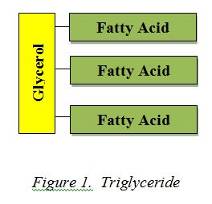
3. Glycerol is a compound with a “backbone” of three carbon atoms and three oxygen-hydrogen (OH) groups protruding from the backbone, one OH group from each of the three carbons. The OH group is known as a hydroxyl group. A compound that contains an OH group bound to a hydrocarbon group is an alcohol. Glycerol is a polyvalent alcohol, that is, an alcohol with more than one OH group. It may also be referred to as a sugar alcohol.
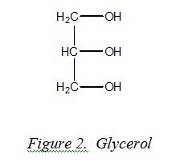
4. Fatty acids are compounds comprising a chain of carbon atoms (referred to as a “hydrocarbon chain”) bound to a carboxylic acid group. The carboxylic acid group is formed of an oxygen atom bound to a carbon atom and an OH group bound to the same carbon atom to form a COOH group. Fatty acids can have a hydrocarbon chain with varying numbers of carbon atoms, ranging from as little as about four up to twenty or thirty.
5. Esters are organic compounds formed by reaction between acids and alcohols. This reaction is known as esterification. In Figure 4, the –COR component is derived from the acid and the R’O from the alcohol. The R and R’ groups may be hydrocarbons or hydrocarbon chains. A fatty acid ester is an example of an ester, and a triglyceride is an example of a fatty acid ester.
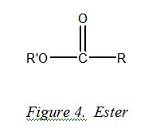
6. A triglyceride is formed by replacing the hydrogen (H) atoms of the OH groups on the glycerol with fatty acids. In Figure 5, an example of a triglyceride is shown. The three carbon atoms in the vertical line form the glycerol backbone, and the three chains of carbons atoms extending to the right comprise the fatty acids.
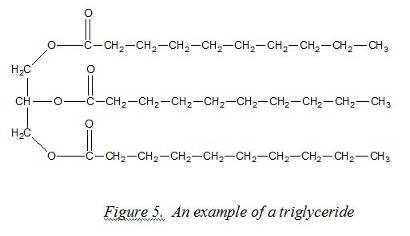
7. Due to the long chains of carbon atoms on the fatty acids, triglycerides in oils and fats do not interact with water and are collectively termed ”hydrophobic” (water-hating). The stratification of oil and water into two distinct layers when they are brought together is an example of this behaviour.
8. A diglyceride (also referred to as a diacyl glycerol) is a fat comprising a single unit of glycerol, combined with only two fatty acid groups. A monoglyceride (also referred to as a monoacyl glycerol) is a fat comprising a single unit of glycerol which has only one fatty acid group on the glycerol backbone. Both diglycerides and monoglycerides are examples of fatty acid esters and are naturally present in flour.
9. A diglyceride may have the fatty acid groups on the first and second or the first and third carbons of the glycerol backbone as shown in Figures 6(a) and 6(b) respectively. A monoglyceride may have the fatty acid group on the first or second carbon of the glycerol backbone as shown in Figures 7(a) and 7(b) respectively.
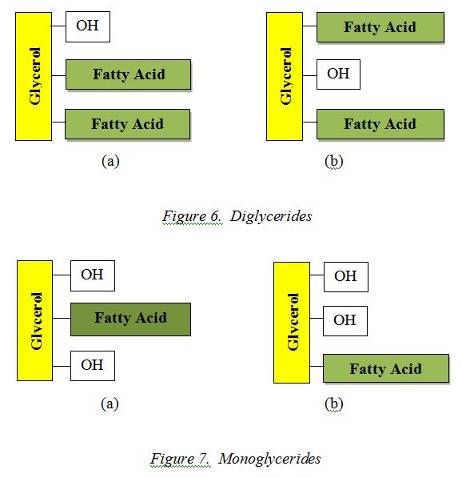
10. A diglyceride may be formed by removing one fatty acid group from a triglyceride. A monoglyceride may be formed by removing one fatty acid group from a diglyceride or by removing two fatty acid groups from a triglyceride. In each case, the reaction is referred to as alcoholysis or hydrolysis, depending on whether the reaction involves the breaking of a bond by the addition of an alcohol (alcoholysis) or the breaking of a bond by the addition of water (hydrolysis).
11. As shown in Figures 6 and 7, monoglycerides and diglycerides have one or two free OH groups. Because the OH groups are hydrophilic (water-loving), diglycerides and monoglycerides have both a hydrophilic part (OH groups) and a hydrophobic part (fatty acid groups). Overall, diglycerides and monoglycerides are more hydrophilic than triglycerides, which do not have any free OH groups.
12. Triglycerides, diglycerides and monoglycerides are generally referred to as “non-polar” lipids.
Phospholipids
13. Phospholipids are fats with a similar structure to triglycerides, except they comprise a phosphate group in place of one of the fatty acid groups. In some phospholipids, an organic molecule, such as an amine, may be further bonded to the phosphate group as shown in Figure 8. Amines are organic compounds that contain a nitrogen atom with up to three other groups attached. In the case of phospholipids most commonly found in foods, as depicted in Figure 8, two fatty acid groups are bound to two of the carbon atoms of the glycerol backbone and a phosphate group is bound to the third carbon atom. An amine group is further bound to the phosphate group. Due to the presence of the two fatty acid groups on the glycerol and the ester links between the fatty acids and the glycerol, phospholipids are examples of fatty acid esters. Phospholipids are major lipid components of cell membranes and are naturally present in flour.
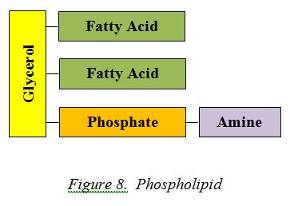
14. The phosphate and amine groups of a phospholipid are able to interact with water, i.e. they are ‘hydrophilic’ (‘water-loving’) and the fatty acid groups are hydrophobic (‘water-hating’). Phospholipids are generally referred to as “polar” lipids.
15. A common phospholipid is phosphatidyl choline (Figure 9). It is a phospholipid composed of two long chain fatty acids, a phosphate group and an amine group in the form of acetyl choline (Figure 10) attached to a glycerol backbone.
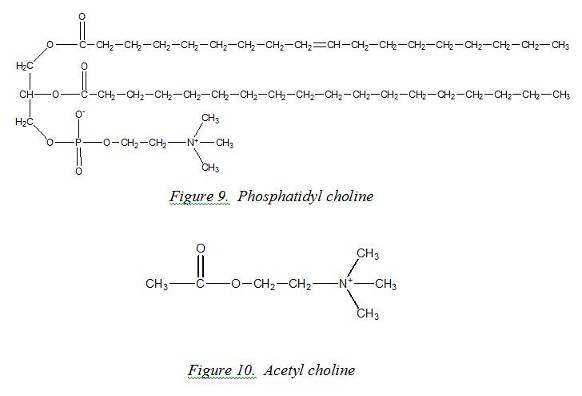
16. Phosphatidyl choline is naturally present in flour. It may be referred to by the common name “lecithin”.
17. Phosphatidyl choline may be appreciated if the molecule is imagined as a balloon with two long paper streamers attached. The balloon or "head" region corresponds to the polar, hydrophilic portion of the molecule, comprising the negatively-charged phosphate group and the positively charged choline, which readily dissolve in water. The streamers or "tails" represent the non-polar, hydrophobic part, the long chains of 12 to 18 carbon atoms in each of the two fatty acids, which are insoluble in water. Due to the presence of the two fatty acid groups on the glycerol, phosphatidyl choline may be termed a fatty acid ester. Phosphatidyl choline is naturally present in flour.
18. Removal of one of the fatty acid groups from phosphatidyl choline generates lysophosphatidyl choline (sometimes referred to as lysolecithin), which has the general structure shown in Figure 11. The remaining fatty acid group in lysolecithin may be attached to the first or second carbon atom of the glycerol backbone, as shown in Figures 11(a) and (b) respectively.
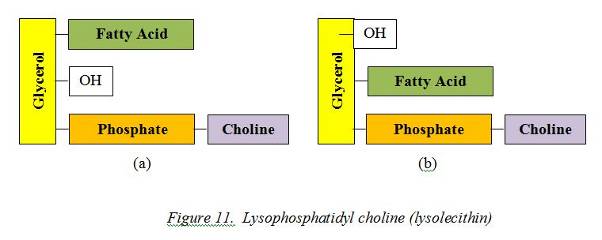
Glycolipids
19. Glycolipids are fats with a similar structure to a triglyceride except they comprise one or two sugar groups in place of one or two of the fatty acid groups, in the same way that phospholipids have a phosphate group.
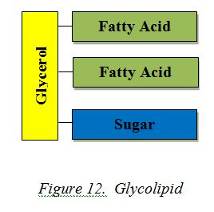
20. A sugar is a compound made up of one or more organic compounds called saccharides. Simple sugars comprise one or two saccharide units with more complex sugars comprising up to ten saccharide units bound together. Monosaccharides generally contain a chain of about three to six carbon atoms or more commonly a ring of five or six carbon atoms. All sugars contain a number of hydroxy groups. Examples of saccharide units include glucose (also known as dextrose), fructose or galactose; whilst examples of disaccharides include sucrose (a glucose linked to a fructose), lactose (a glucose linked to a galactose) and maltose (two glucoses linked together).
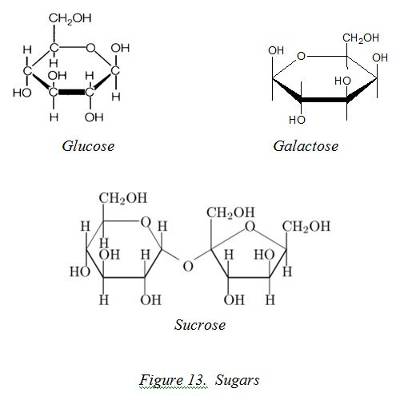
21. Glycolipids can interact with both water and fat. The non-polar fatty acid group(s) will interact with fats, and the polar sugar group(s) will interact with water. Glycolipids are also referred to as “polar” lipids.
22. A class of glycolipids is galactolipids, in which the sugar group(s) include galactose. An example of a galactolipid is digalactosyl diglyceride (DGDG), which comprises a glycerol backbone, with two fatty acid groups and one sugar group (Figure 14). As is apparent from the names, the sugar group comprises two galactose saccharides. Due to the presence of the two fatty acid groups on the glycerol, DGDG is an example of a fatty acid ester. DGDG is naturally present in flour.
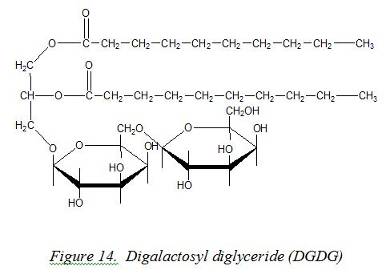
23. One of the fatty acid groups on DGDG can be removed to generate digalactosyl monoglyceride (DGMG), which has the general structure shown in Figure 15.
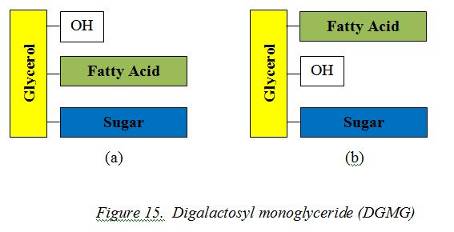
24. DGMG has one fatty acid group, which can be attached to either the first or the second carbon of the glycerol backbone, and one sugar group formed by two galactose saccharide units, as shown in Figure 15(a) and (b) respectively.
Emulsifiers
25. Oil and water are immiscible liquids, that is, they generally do not mix. However, they may be caused to mix by the formation of an emulsion wherein one liquid is dispersed in another. Examples of oil/water emulsions include butter and margarine, milk and cream, and vinaigrettes. In butter and margarine, fat surrounds droplets of water (a water-in-oil emulsion). In milk and cream, water surrounds droplets of fat (an oil-in-water emulsion). Emulsification is the process by which emulsions are prepared.
26. Emulsifiers are agents comprising a water-hating hydrophobic component and a water-loving hydrophilic component and can interact with both oil and water to form stabilised emulsions. Phospholipids, glycolipids, diglycerides and monoglycerides all have emulsifying properties.
27. An emulsifier acts by spanning the interface between the oil and the water phases. In Figure 16, it can be seen that the hydrophilic ends of the emulsifier are located in the water environment, whilst the hydrophobic ends are located in the oil environment. Emulsifiers are vital in the food production industry, as well as in the manufacture of detergents and a wide variety of other applications.
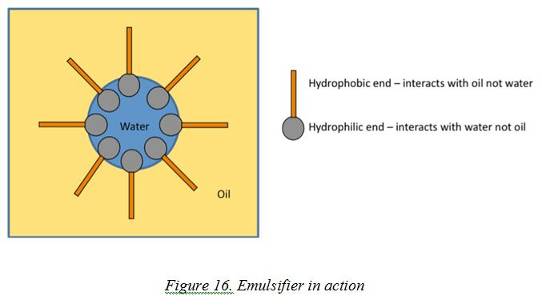
28. The emulsifying properties of monoglycerides and diglycerides are vital to a vast range of food production techniques. They allow, for example, the formation of foods such as mayonnaise (oil droplets in water), margarine (water droplets in oil) and are important in improving the quality of baked products such as breads and cakes.
29. Emulsifiers are incorporated into bread mixtures to improve dough handling and the products overall quality. They result in significant improvements in qualities such as dough conditioning and shelf life extension or "crumb softening."
30. Emulsifiers function as dough conditioners. Dough conditioners provide a number of benefits during bread making, such as: compensating for variations in raw materials (e.g., variations in flour quality); increasing gas retention leading to increased bread volume; better bread texture; and improved symmetry of baked bread.
31. Emulsifiers used in baking include DATEM (Diacetyl Tartaric Acid Ester of Monoglyceride), SSL (sodium stearoyl lactylate), DMG (distilled monoglyceride) and lecithin.
Enzymes
32. Proteins (also known as polypeptides) are organic compounds made of a chain of amino acids. Proteins are molecules essential to all cells (including bacterial, fungal, plant and animal cells). They may serve a structural role (e.g. they are the basic component of hair, skin, cartilage etc) or be required for the functioning and regulation of cells, tissues and organs.
33. Examples of proteins include whole classes of important compounds, among them enzymes, some hormones, and antibodies. Enzymes are proteins that catalyse (i.e. increase the rate of) chemical reactions.
34. In enzymatic reactions, the molecules at the beginning of the process are called substrates. The enzyme helps to convert them into different molecules, called products. Enzymes are usually very specific to the type of reactions they catalyse and the substrates that are involved in the reactions.
35. Although enzymes differ when it comes to the processes they catalyse, they all have one feature in common, viz, a high catalytic capacity. Typically, the presence of enzymes will accelerate a biochemical process several million times. Thus, an enzyme is best characterised as a biological catalyst, since it can accelerate processes (for this purpose, biochemical reactions) that normally would not occur by themselves, or at any rate would proceed only very slowly.
36. Like other catalysts, enzymes are characterised by supporting and increasing the rate of biochemical reactions without undergoing any permanent change themselves. Thus, a salient feature of enzymes is that they can catalyse an indefinite amount of chemical change without themselves being diminished or altered by the reaction. At the end of a reaction, the enzyme is ready to catalyse a new reaction process. Unless the enzyme gradually loses its activity, is removed or is deactivated, it will continue to catalyse the reaction for as long as any substrate is present and a suitable environment is present for activity of the enzyme, or until an equilibrium has been reached between the substrate of the enzyme and the product that is the result of the biochemical process in question.
Lipase
37. A lipase is a type of enzyme that hydrolyses the ester bonds in lipids, for example triglycerides. A lipase degrades triglycerides by cleaving the ester bond that attaches the fatty acid chain to the glycerol backbone. In the presence of water, this cleavage reaction is referred to as hydrolysis. This yields monoglycerides and diglycerides and free fatty acids.
38. Quite commonly and more specifically, the term lipase refers to enzymes that break the bond between a fatty acid and the rest of a lipid molecule.
Phospholipase
39. A phospholipase is a type of enzyme that hydrolyses the ester bond in phospholipids, for example phosphatidyl choline.
Glycolipase
40. A glycolipase is a type of enzyme that hydrolyses the ester bond in glycolipids, for example digalactosyl diglyceride.
CONFIDENTIAL ANNEXURE
[This material is confidential]


