FEDERAL COURT OF AUSTRALIA
Barrett Property Group Pty Ltd v Dennis Family Homes Pty Ltd [2011] FCA 246
VICTORIA DISTRICT REGISTRY | |
GENERAL DIVISION | VID 1244 of 2005 |
BETWEEN: | BARRETT PROPERTY GROUP PTY LTD (ACN 088 015 267) First Applicant SRS PROPERTY HOLDINGS PTY LTD (ACN 096 513 218) Second Applicant
|
AND: | DENNIS FAMILY HOMES PTY LTD (ACN 056 254 249) Respondent
|
JUDGE: | DODDS-STREETON J |
DATE: | 18 March 2011 |
PLACE: | MELBOURNE |
REASONS FOR JUDGMENT
[1] | |
[14] | |
[14] | |
[15] | |
[18] | |
[21] | |
[21] | |
[30] | |
[35] | |
[39] | |
Did the Dennis works reproduce a substantial part of Barrett works | [86] |
[86] | |
[109] | |
Was the alfresco quadrant a substantial part of the Barrett works? | [130] |
[134] | |
[151] | |
[158] | |
[174] | |
[198] | |
[201] | |
[219] | |
[219] | |
[220] | |
Conclusion on whether alfresco quadrant a substantial part of Barrett houses | [222] |
Whether sufficient objective similarity between Barrett and Dennis works | [228] |
[233] | |
[233] | |
[242] | |
[250] | |
[257] | |
[260] | |
[265] | |
[266] | |
[267] | |
[281] | |
[283] | |
[284] | |
[285] | |
[286] | |
[287] | |
[288] | |
Were the Dennis works created without reference to the copyright works? | [292] |
[293] | |
[304] | |
[331] | |
[348] | |
[375] | |
[385] | |
[387] | |
[393] | |
[401] | |
[429] | |
[436] | |
[449] | |
Dr Cooke’s analysis of design pathway of Mr Rowley’s designs | [482] |
[489] | |
[490] | |
[522] | |
[534] | |
[579] |
1 In this proceeding, it was necessary to determine whether the respondent, Dennis Family Homes Pty Ltd (“Dennis”), infringed the applicants’ copyright in plans and houses constituting original artistic works under the Copyright Act 1968 (Cth) (“the Act”) by making use of the applicants’ works to design and build various project houses. For the reasons set out in detail below, I have found that the applicants’ infringement claims are established.
2 The applicants (collectively, “Barrett”) design, build and market project homes, under the name Porter Davis, competing in the volume housing market with other participants, including Dennis.
3 Dennis, a member of the Dennis Family Corporation group of companies (“Dennis Group”), is and was an established volume builder which, in competition with Barrett, designs, constructs and sells project houses in Victoria and southern New South Wales.
4 The applicants’ artistic works in question are the plans and the house versions thereof known as the Seattle 31 (“Seattle”) and the Memphis 33 (“Memphis”). The subsistence and ownership of copyright in the works, while initially in dispute, were ultimately conceded. The first applicant, Barrett Property Group Pty Ltd (“BPG”), owns the copyright in the house versions and the second applicant, SRS Property Holdings Pty Ltd (“SRS”), owns the copyright in the plans.
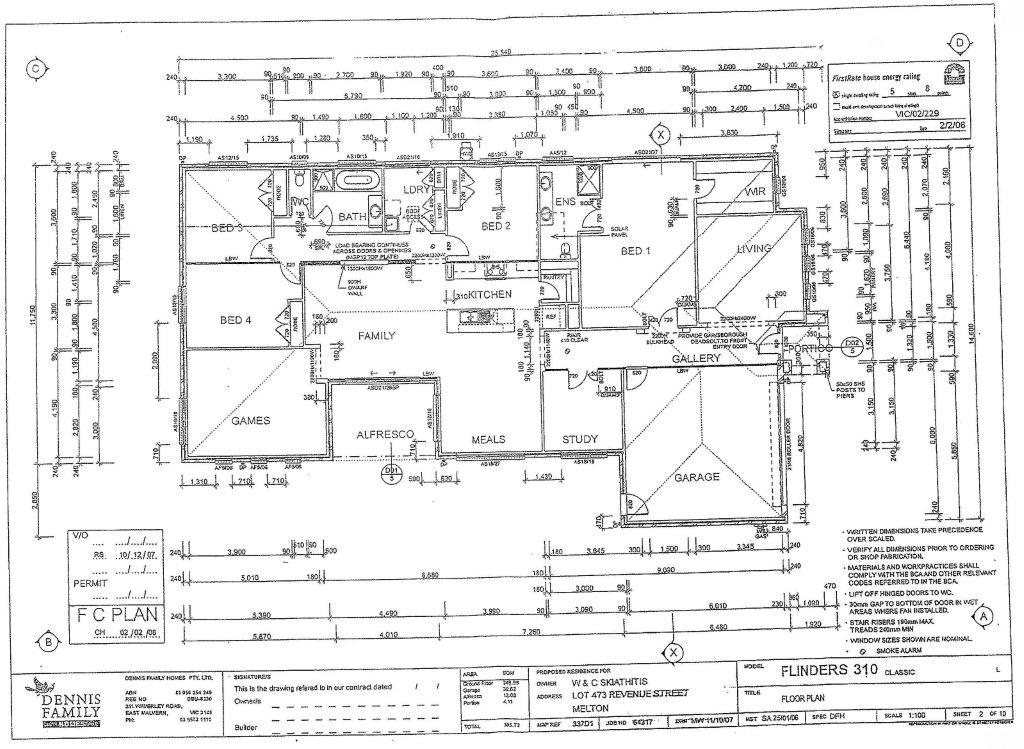
5 Barrett alleged that, from at least early to mid2003, Dennis infringed their copyright in the Seattle and Memphis house and plans by reproducing a substantial part thereof known as “the alfresco quadrant” to create plans for seven different project home designs and subsequently to build, market, promote and sell houses constructed in accordance with the designs. The Dennis designs in question are:
(a) the Grange 291
(b) the Grange 322
(c) the Thornton 310
(d) the Esperance
(e) the Flinders 270
(f) the Flinders 290
(g) the Flinders 310
(collectively, “the Dennis works”).
6 A schedule of the plans of the above Barrett and Dennis designs is attached.
7 The term “alfresco”, sometimes used interchangeably with the term “sala”, is used in the housing industry and was used by the parties in this proceeding to describe a covered outdoor eating area under the roof of the house and proximate to the informal living areas.
8 In the present case, the alfresco was situated in an the alfresco quadrant to the rear of the houses, described by Barrett as follows:
…the Alfresco Quadrant [refers] to the following areas in [the Seattle and Memphis] designs: (running from the top right hand corner) the rumpus, family, kitchen and meals areas around the alfresco on the side, all under the one roofline, but also having regard to the location and relative dimensions of rooms in this part of the house design.
9 The proceeding incorporated a large number of distinct infringement claims, as Barrett alleged that seven Dennis plans and seven Dennis houses infringed its copyright in the Seattle and Memphis plans and the resulting houses. In practice, a number of factors reduced the scope of the issues in dispute. The claims had a common background and there was a considerable overlap of the relevant evidence. Further, it was usually possible, for present purposes, to treat the Seattle and Memphis designs as broadly interchangeable. (The Memphis plan was a somewhat larger version of the Seattle with few variations.) It was also mostly unnecessary to distinguish between the plan and house versions of the designs in issue.
10 Similarly, it was undisputed that the Grange 322 (of which there were two versions) and the Thornton 310 were relevantly similar to, and derived from, the Grange 291, or that the Flinders 270, Flinders 290 and the Flinders 310 were relevantly similar to, and derived from, the Esperance.
11 As the subsistence and ownership of copyright were conceded, the questions ultimately remaining in dispute were:
(a) whether the alfresco quadrant constituted a substantial part of the Barrett works;
(b) if so, was the Barrett alfresco quadrant reproduced in any or all of the Dennis works;
(c) were the Dennis works independently created by Dennis’ employees without copying, directly or indirectly, the Barrett works. Alternatively,
(i) did Ms Wilson, a designer employed by Dennis in the Shepparton office of its Regional Division, copy the Barrett works in designing the Grange 291, from which Dennis’ National Design Manager, Mr Rowley, subsequently derived the Grange 322 and Thornton 310? Subject to the possibility that the pronounced projection of the sala in one version of the Grange 322 distinguished it from the Barrett works sufficiently to preclude infringement, the determination of whether the Grange 291 infringed the copyright in the Barrett works would also determine whether the Grange 322 and Thornton 310 also infringed, as it was common ground that those designs were derived from the Grange 291 by making modest variations;
(ii) did Mr Rowley create the Esperance (from which the relevantly similar Flinders 270, Flinders 290 and Flinders 310 were admittedly derived) independently and without copying, directly or indirectly, the Barrett works, instead deriving it, as he testified, from the Lexton B3 which Mr Rowley designed for Dennis in 1999? Or, as Barrett argued, did Mr Rowley produce the Esperance and the three Flinders plans by copying or making use of the Barrett works?
12 It was necessary to consider voluminous evidence, including numerous plans of the copyright works; plans of the alleged infringing works; earlier Dennis plans; plans of third party builders; and expert evidence in relation to the originality and substantiality of the alfresco quadrant in the Barrett copyright works, its alleged reproduction in the Dennis works and the alleged independent design pathways by which the Dennis employees asserted that they had developed the Dennis works. The Court participated in views of houses constructed according to the plans.
13 It was also necessary to consider the evidence of lay witnesses, including, most importantly, that of the Dennis designers, Ms Wilson and Mr Rowley, whose credit in relation to the processes, antecedents and context of their creation of the allegedly infringing designs was particularly significant.
The parties’ principal submissions
14 Barrett submitted that:
1. The alfresco quadrant represented a substantial part of the original Barrett works in the requisite qualitative sense. While the individual elements were not novel, it was an original arrangement of spaces different from any preexisting design, which resulted from the application of considerable skill and labour. It was not merely dictated by functional requirements or volume housing constraints.
2. The Barrett alfresco quadrant was reproduced in the Dennis works. There was a strong visual resemblance and sufficient objective similarity, despite various differences of detail and dimension. The similarities were not dictated by a combination of external constraints and functional requirements.
3. In designing the Grange 291, Ms Wilson made use of or copied the Barrett plans or the Seattle and Memphis houses (or infringing Metricon houses) the creation and public display of which predated the creation of the Grange 291. Further, Mr Rowley, as he acknowledged, subsequently modified the Grange 291 to produce the Grange 322 and Thornton 310. Mr Rowley also made use of or copied the Barrett works or infringing copies thereof to create a second group of infringing Dennis works comprising the Esperance, the Flinders 270, the Flinders 290 and the Flinders 310.
4. The evidence the Dennis designers (Ms Wilson and Mr Rowley) gave of their independent creation of the Dennis works should be rejected. Considerable time had elapsed since the production of the Dennis works and, as the Dennis witnesses conceded that they had no memory of many significant matters and were unreliable in other respects, the picture emerging from the contemporaneous documents in evidence should be preferred. It established that Dennis design personnel had access to, and an interest in, the Barrett works for a prolonged period prior to the creation of the infringing works, evidenced by documents which Dennis failed to discover and which its witnesses initially denied, consistently attempted to minimise, but ultimately conceded.
5. Barrett acknowledged that, contrary to its case on opening, Ms Wilson produced the Grange 262 and Grange 292 (to which the Grange 291, first documented on 20 June 2003, was relevantly similar) by 27 April 2003. For approximately two and a half years prior to the production of the Grange 291, the Barrett works (from their introduction to the market in 2000 onwards) were frequently located near or adjacent to a number of Dennis display sites or display sites of other builders (Metricon and Carlisle) exhibiting houses which were subsequently held to have infringed Barrett’s copyright in the Seattle and Memphis plans and houses. In August 2002, a Dennis designer took photographs of the Memphis house, which were stored on the Dennis computer network. In early 2003, shortly prior to Ms Wilson’s design of the Grange 291, Dennis’ awareness of opposition products, its own outdated designs and its loss of competitive advantage caused Mr Rowley, as newly appointed National Design Manager, to institute a formal program of inspection of competitors’ display sites. The Dennis designers consequently visited houses including those of Barrett. On 2 April 2003, Mr Rowley participated in a design team inspection of the Metricon Tyrell and Prada houses (which have been held to constitute infringements of the Barrett copyright works). At the inspections, Dennis design personnel (probably the late Ms Shirley Rak) took notes of the display houses’ features. Mr Rowley intended to disseminate the notes and made related reports to the Dennis board. Ms Wilson was, prior to and while designing the Grange houses, in frequent communication with Mr Rowley, Ms Rak, other Dennis design staff and the Dennis acting Chief Executive Officer, Mr Hofmeyer, in relation to design. Those persons had the opportunity to transmit to Ms Wilson details, materials or instructions about the Barrett works with which they were familiar. Ms Wilson also had opportunities to view the Barrett works or infringements thereof directly.
6. In contrast to the unchallenged evidence of Barrett’s witnesses as to the laborious process of creating the Barrett works by successive sketches, interchange, variations and instructions (resulting in a significant record of memoranda and sketches), the Dennis designers offered no detailed, credible explanation or substantial file record of their claimed independent design pathway leading to the production of the Dennis works. There was no record at all of Ms Wilson’s alleged design processes leading to her creation of the Grange 291 (or other Grange designs). Rather, the earliest documented Grange 291 plan was 20 June 2003, and there was no indication of what design work had occurred between 27 April 2003 and that date. Similarly, Mr Rowley’s account of how he had produced the Esperance from the preexisting Dennis Lexton B3 design was evidenced only by a few conceptual pencil sketches.
7. In the opinion of Barrett’s expert witness, Dr Cooke, the Dennis works did not constitute a continuation of a chain of design commencing with prior Dennis or any other identified third party builder’s designs. Dr Cooke considered that the Grange designs (and hence the Grange 322 and Thornton 310) were independent of the prior Dennis Derwent and Stratford designs which Ms Wilson identified as influences.
8. Further, in Dr Cooke’s view, the plans for the balance of the Dennis works produced by Mr Rowley did not show a chain of design back to the Dennis Lexton B3 but rather, were unlikely to have been developed without reference to the Grange plans, which included the distinctive alfresco quadrant.
15 Dennis denied that its works reproduced a substantial part of the Barrett copyright works. It submitted, for reasons discussed in more detail at paras 132 to 133 below, that the alfresco quadrant was a nondistinctive arrangement of known features.
16 Dennis also denied that its designers had copied or made use of the Barrett’s copyright works to produce the Dennis works.
17 Dennis submitted that:
1. Ms Wilson independently conceived of and designed the Grange 291 in about April 2003 without any reference to Barrett’s copyright works. In mid to late 2003, the Grange 291 was modified to create the Grange 322. Mr Rowley, in April 2004, marked up the Grange 322 plan and created the Thornton 310 in October 2005 by marking up the Grange 322.
2. Mr Rowley created the balance of the Dennis works without reference to Barrett’s copyright works. Between 2003 and 2006, he also successively designed the Esperance and the Flinders 270, Flinders 290 and Flinders 310. As he testified, the Esperance was a new version of the Lexton B3. The Lexton B3 was a very commercially successful project house Mr Rowley had designed for Dennis in 1999, prior to the creation and public exhibition of the Barrett copyright works. Mr Rowley modified the Lexton B3 to produce the Esperance by adding a sala (a feature already included proximate to informal living in other preexisting Dennis homes) in an obvious location. The three Flinders plans and houses were, in turn, variations of the Esperance.
3. Similarities between the alfresco quadrant (or sala) in Barrett’s Seattle and Memphis plans and houses and the Dennis plans and houses were dictated by the very limited compass for variation imposed by the external constraints associated with volume housing, including block size, cost, the necessary rooms, amenities and functional features typically included in project houses, and their logical mutual positioning.
4. There were many differences between, on the one hand, the Grange 291 and the Seattle and, on the other hand, the Esperance and the Seattle. The Grange 291 had similarities to earlier Dennis designs and there was a limited range of options realistically available to the designer, given the requisite standard features and applicable constraints.
5. Essentially Barrett sought, contrary to copyright principles, to protect the mere idea of a sidefacing sala within a single roofline. An alfresco area consisting of an alfresco (or sala) recessed into the side of the house bounded on three sides and covered by the main house roof to give a strong indoor/outdoor connection was not a new concept, as the antecedent Bordeaux and Independence 2002 designs showed.
6. The Hawkesbury design (although later than the Barrett copyright works) included an area almost identical to the Barrett alfresco quadrant, and there was no evidence that it had been copied from the Barrett works. The Sandalwood and the Woollahra houses, produced by independent designers, showed almost identical covered courtyards. The Sandalwood and the Hawkesbury houses demonstrated that salas could be placed in various locations.
7. Numerous plans predating the Barrett works included an alfresco area and established that there was a considerable scope for variation in expressing the concept of a sala. Mere similarity in general arrangement of the outdoor alfresco area in conjunction with the rumpus room, living, meals and kitchen areas did not establish infringement or support an inference to copying. Reproduction of the particular form of expression, as opposed to the idea, required a similarity of detail between the Barrett and Dennis alfresco quadrants, including the position in the house, the shape, the dimensions, the extent to which it was under a roofline and the proximate rooms.
8. In fact, there were many significant differences of detail, shape and dimension between the Barrett and Dennis works, including in their alfresco areas, which indicated that they shared similarities only of the idea, rather than its detailed expression.
9. The shape of the alfresco quadrant in the Grange 291 differed from that of the Seattle which was not square. The sala itself in the Grange 291 was essentially square with a chamfered corner and different dimensions from those of the Seattle. The Grange 291 had a solid wall between the sala and the home theatre. The front part of the Grange 291 and its informal living areas had many differences, including in shape and dimension when compared with the Seattle. There were also differences of arrangement and dimension in the subsidiary bedroom wing.
10. The inclusion of the sala under a simple roofline (while obvious in any event) was not reproduced in either the Grange 291 (where the roofline had its own hip and valley construction) or in the Grange 322, where the first version had a projecting sala on piers. The second version of the Grange 322 had a sala brought under the roofline. The alfresco in the Esperance differed in proportion and shape from that of the Seattle. It was a long thin rectangle with different walls and windows.
11. Dennis’ witnesses’ evidence of their independent creation of the two distinct groups of houses was, on the totality of the evidence, credible and fatal to the establishment of infringement.
12. Given the common place constituent features and standard spaces and amenities which must be placed logically visÀvis each other within the constraints of cost and block size, it was credible that Ms Wilson, as she testified, created the Grange 291 independently from “the furniture of her mind”, based on her background and experience.
13. The various rooms and features included in the Dennis houses were not unusual and their location was, in each case, logical. In 2003, when Ms Wilson designed the Grange 291 for a standard rectangular block, including a rumpus room or home theatre as she had seen in Perth, once it was decided to add a sala, she placed it in a logical and obvious position. As Dr Cooke, Barrett’s expert witness, conceded, if all the other rooms in the Grange 291 were positioned as they were and a rumpus room or home theatre were located in the back lefthand corner, it would create a logical place for a sala. The only sensible location for an added sala in the Grange 291 would be its current position.
14. It was not alleged that the front third or the Lshaped subsidiary bedroom wing in the Grange 291 was copied, which was consistent with the independent creation of the entirety.
15. By the time she designed the Grange 291 in the Regional Division, Ms Wilson was aware of covered pergolas and had observed the sala in the Atrium and other houses in Queensland in 2001. Ms Wilson had already created the Panorama with a sala and rumpus room and was aware of or had modified other Dennis houses, including the Stratford 282, the Mandalay, the Glenrowan, the Lexton B3 and the Derwent. She had already designed the Karinya, the Montville and Lonsdale Square.
16. The Grange 291 had significant similarities with plans Ms Wilson had already modified or produced and other Dennis or third party plans of which she was aware. The kitchen bench in the Grange 291 was similar to that in the Lonsdale. The location of the meals areas was selfevident having regard to functionality, and Dr Cooke conceded that the location of various features was sensible and logical.
17. Thus, Ms Wilson’s explanation of how she created the Grange houses was consistent with developing, in an obvious way, plans she had already designed or observed or the preexisting Dennis or other plans with which she was familiar, in the light of the logical requirements of positioning.
18. When required to design new plans in March 2003, Ms Wilson created a number of houses including a sala in various positions, as well as the Grange houses. Ms Wilson first created the Grange 262 (in draft with a “meat cleaver” shape) and Grange 292 (in draft with a square sala under the roofline) by 27 April 2003. By June 2003, they were modified to create the Grange 291. Ms Wilson’s brochure plans for the Grange 291 were sent on disk to a draughtsman in the Shepparton office, Mr Caiafa, who transformed them into working drawings dated 20 June 2003. In the working drawings, the Grange 262 was finalised in a square shape with a sala to the rear corner and the Grange 292 had a projecting sala.
19. The evidence supported Ms Wilson’s assertion that she had not seen the Barrett designs before designing the Grange 291. Ms Wilson was employed by a third party and was thus independent of Dennis at the time of giving evidence. While employed by Dennis, she was based in the Shepparton division and thus, both geographically and administratively, segregated from other divisions and the personnel who worked in them:
19.1 The regional market in which she operated was a “little world” in which Porter Davis had no presence. She knew nothing of Porter Davis, the popularity and success of its sala, nor Metricon’s success with an alfresco, as the developments in the Melbourne market were irrelevant to her work.
19.2 Ms Wilson had no recollection of being told of the Dennis metropolitan design team’s visits to competitors’ display sites in 2003 or of seeing notes of the visits. She could recall no awareness that Dennis faced competition from Porter Davis and Metricon. She became aware that Metricon was coming to the Regional area, but probably not before late 2003.
19.3 Ms Wilson testified that her interaction with Melbourne Dennis personnel was uncommon and, when it occurred, she viewed herself as an outsider rather than a member of the team. Despite her formal membership of the Dennis National Design Team in 2003, her evidence was that she made no contribution to it prior to midJune 2003.
19.4 Other Dennis employees who had or may have had access to the Barrett works did not communicate material or relay directions to Ms Wilson. Mr Hofmeyer, who was also an independent witness, confirmed that he only communicated general directions to Ms Wilson and had no input into the design of the Grange 291. He confined his input to building and construction issues. Mr Rowley gave evidence that he had no discussions with Mr Hofmeyer or Ms Wilson about the implementation of the design task Mr Hofmeyer assigned her, and prior to about April 2003, he did not know that Ms Wilson had been instructed to design seven houses.
19.5 There were no diarised meetings in 2003 between Mr Rowley and Ms Wilson prior to May 2003. The subsequent diarised meetings could not have had any impact on Ms Wilson’s design of the Grange in late April 2003. Mr Rowley could not recall any discussions with Ms Wilson prior to telephoning her shortly before about 1 May 2003 in order to request copies of the designs she was working on. On 1 May 2003, he received her fax of brochure plans for the Grange 262, the Amberleigh and the Palladium (then called the Atrium). Ms Wilson’s evidence was that she did not fax the Grange 292 plan because Mr Rowley requested only those designs contemplated for construction. Mr Rowley then provided feedback in a telephone conversation, which was the only instruction Ms Wilson recalled receiving in relation to the Grange.
19.6 Ms Wilson could not recall visiting display home sites prior to May 2002, when she probably visited Dennis homes. She could not recall the August 2003 visit she made to the Dennis display site, although she could recall visiting a number of different builders’ display sites. The August 2003 photographs she admittedly took of the Memphis were of presentation features. Her admitted late 2003/2004 visit to the Metricon display site with a new colleague, Ms Fraser, postdated the alleged infringing designs and was directed at specification items, being a feature wall and a spa bath.
19.7 Ms Wilson’s assertion that she rarely saw The Herald Sun Property Guide was not challenged and Mr Hofmeyer was not examined about how often he provided it to Ms Wilson. Ms Wilson gave evidence that she rarely used the internet or saw the websites of other builders.
20. Ms Wilson was not challenged about her failure to maintain a design file. Ms Wilson recalled that she did not copy the Barrett works.
21. Mr Rowley’s evidence of designing the balance of the Dennis works without reference to the Barrett works was also credible. Mr Rowley was also an experienced designer who had produced the very successful Lexton B3.
22. In contrast to Ms Wilson, Mr Rowley kept a design file. He did not absolutely deny awareness of Porter Davis or his possible access to the Seattle or Memphis. Nor did he conceal the Dennis “opposition visits” to competitors’ display sites. He gave a satisfactory explanation for his late production of his diaries and the notes of the opposition visits. Mr Rowley gave a credible account of using the successful Lexton B3 in 2003 to produce an updated design for narrower blocks at the behest of Mr Denison (the manager of Triline) and Ms Schaefer (who requested that he include an alfresco). Once it was decided to add an alfresco to the Lexton B3, he placed it in the logical position, between the meals and rumpus room in a preexisting quadrant of rooms. There was an existing area between the meals and the rumpus room which was partly covered by a simple roofline. Mr Rowley considered that the Lexton B3 and the Seattle had essentially the same connection between the indoor and outdoor spaces. If, contrary to Dennis’ submission, he took the added alfresco itself from the Barrett copyright works, it would not constitute infringement unless the entire alfresco quadrant was also taken.
Background and summary of evidence
18 The following affidavits were filed and read on behalf of Barrett:
(a) Affidavits of Anthony John Roberts sworn 23 May 2007, 7 December 2009 and 21 December 2009.
(b) Affidavit of Daniel John Studderd sworn 5 June 2007.
(c) Affidavit of Keith Fuller sworn 12 July 2007.
(d) Affidavit of Randall Redfern Pye sworn 12 July 2007.
(e) Affidavit of Adele Mihalcsek sworn 25 July 2007.
(f) Affidavit of David Peter Shergold sworn 26 July 2007.
(g) Affidavit of Rhonda Kellett sworn 27 July 2007.
(h) Affidavits of Dr John Richard Cooke sworn 19 September 2008 (“first Cooke affidavit”) and 2 December 2009 (“second Cooke affidavit”).
(i) Affidavit of Annika Jessie Anderson affirmed 4 December 2009.
(j) Affidavit of Mark David McLoughlan sworn 7 December 2009.
(k) Affidavit of Paul Anthony Wolff sworn 7 December 2009.
(l) Affidavit of Shane Keast sworn 7 December 2009.
(m) Affidavit of Anthony Brooke Watson sworn 9 December 2009.
19 The following affidavits were filed and read on behalf of Dennis:
(a) Affidavit of Graham Keith Hofmeyer sworn 3 December 2008.
(b) Affidavits of Jodie-Maree Wilson sworn 3 December 2008 (“first Wilson affidavit”) and 27 April 2010 (“second Wilson affidavit”).
(c) Affidavits of Kelvyn James Rowley sworn 23 December 2008 (“first Rowley affidavit”) and 6 April 2010 (“second Rowley affidavit”).
(d) Affidavit of Anthony David Denison sworn 21 January 2009.
(e) Affidavits of Leighton Russell Wade sworn 27 March 2009 (“first Wade affidavit”) and 26 April 2010 (“second Wade affidavit”).
(f) Affidavit of Bryan Gordon Eakins Miller sworn 7 May 2009.
(g) Affidavit of Ian Morris Kiefel sworn 30 March 2010.
(h) Affidavit of Jason Bryan Brigden sworn 22 April 2010.
(i) Affidavit of Paul John Caiafa sworn 27 April 2010.
20 The following witnesses were crossexamined:
(a) Jason Brigden;
(b) Dr John Cooke;
(c) Anthony Denison;
(d) Graham Hofmeyer;
(e) Shane Keast;
(f) Mark McLoughlin;
(g) Bryan Miller;
(h) Kelvyn Rowley;
(i) Jodie-Maree Wilson; and
(j) Paul Wolff.
The Barrett business and copyright in the plans
21 The Barrett business was formed in May 1999 when Daniel Stutterd and Anthony Roberts, who had previously been employed by other volume builders (Metricon and Henley respectively), set up their own business. The plans for the Seattle, in which Barrett ultimately acquired the copyright, originated in drawings made prior to June 1999 by Daniel Stutterd, who was then an employee and director of BPG.
22 In June 1999, Mr Stutterd engaged Keith Fuller to design a single storey home with more luxurious features usually found in double storey designs. As Mr Fuller’s engagement proved unproductive, Mr Stutterd gave the drawings to a contract draughtsperson, Mr Pye (trading as Randall Pye Building Design and Drafting Services), between June 1999 and September 1999. In consultation with Mr Stutterd, Mr Pye worked on the project with his employee, Ms Mihalcsek, also using earlier work of another contract draughtsperson, Ms Kellett. By that process, the Seattle design was developed. Mr Pye’s evidence of his interaction, particularly with Mr Stutterd, and the process of developing and varying the successive drafts of the plans, was unchallenged. The affidavits of Ms Kellett and Ms Mihalcsek described their work and involvement in the overall design process.
23 The evidence of the above persons concerning the creation of the Seattle and the Memphis was previously considered in detail in Barrett Property Group Pty Ltd v Carlisle Homes Pty Ltd [2008] FCA 375 (“Carlisle”) and Barrett Property Group Pty Ltd v Metricon Homes Pty Ltd (2007) 74 IPR 52 (“Metricon”).
24 In Carlisle, Heerey J concluded that Carlisle’s Provence design infringed Barrett’s copyright in the Seattle and Memphis plans and houses. In Metricon, Gilmour J concluded that Metricon’s Prada 35, Tyrell 29, Connolly 30, Couburn 33 and Streeton 34 had infringed Barrett’s copyright in Seattle and Memphis plans and houses.
25 In Metricon, the subsistence of copyright in the Barrett works was not challenged. Gilmour J noted (at [34]):
The drawing process, as evidenced in the applicants’ affidavit material, shows a substantial evolution in the design concept and implementation, which is clearly revealed in the sequence of drawings exhibited. There are approximately 130 drawings and notes that culminate in the final Seattle 31 plan, which Barrett approved in or about September 1999.
26 In contrast, in Carlisle, the respondent did not concede the subsistence of copyright in the Barrett works and disputed the number of 130 preparatory drawings. Heerey J’s estimate, however, accorded with the finding of Gilmour J. Heerey J considered Mr Stutterd a credible witness, whose evidence was corroborated by Mr Pye, Ms Kellett and Ms Mihalcsek. Heerey J concluded that Barrett “came to the design of the Seattle in the way it says” (at [32]).
27 In this case, Barrett submitted, and it was undisputed, that the design of the Seattle involved a significant and continuing process of interchange between Messrs Stutterd and Pye, including:
(a) the giving of written instructions by Stutterd and written responses by Pye…;
(b) Pye’s initial drawings with dimensions;
(c) Stutterd’s written responses;
(d) Pye’s notes on drawings;
(e) Pye's plans and notes for aspects of the design, such as the roof design, lighting positions, en suite layouts at and detailed final amendments; and
(f) a record of Pye’s attendances in connection with the Seattle design
28 Barrett gave the following unchallenged account of the creation of the Memphis plans:
Keith Fuller, a designer employed by BPG, created a modified version of the Seattle Plan in or about early 2001 which became known as the Memphis design. The detail of changes made to the Seattle is referred to by Stutterd ... Fuller gives evidence on the design process for the Memphis plan … and exhibits copies of plans he created, based on the Seattle, in the course of creating the Memphis …. Fuller demonstrates the enlargement of Seattle to become Memphis ….
BPG approved the Memphis design in or about July 2001
29 Barrett acquired copyright in the Seattle plans by the following assignments and licences:
Assignments of copyright in the relevant plans for Seattle (together with the rights to bring infringement proceedings for past infringements) have been made as follows:
(a) from Pye to BPG dated 9 April 2001 and 1 June 2005 respectively:;
(b) from BPG to SRS dated 5 July 2001, and 1 June 2005 respectively; and
(c) from Kellett to SRS dated 27 February 2007 (in the same form as the Pye assignment).
On 19 July 2005, SRS granted BPG a non-transferable, exclusive and royalty-free licence to use the copyright in the Seattle plans for a period of 20 years.
30 In September 1999, the Seattle plan was completed. Thereafter, Barrett, trading as “Porter Davis”, began to market, build and sell houses in accordance with the Seattle plan.
31 In January 2000, Barrett opened a 31 square display house constructed by Shergold, a registered builder, in accordance with the Seattle plan (“the Seattle house”) at a display village in Beaconsfield.
32 In 2001, during the course of his employment with BPG, Mr Fuller created a modified version of the Seattle plan which became known as the Memphis. Copyright in the Memphis plans vested automatically in BPG as employer of Mr Fuller, pursuant to s 35(6) of the Act.
33 From November 2001, it also displayed, built and marketed the Memphis, which was essentially a larger version of the Seattle.
34 From January 2000, a number of Barrett display villages containing either the Seattle or the Memphis were opened throughout various outer Melbourne areas. In a number of instances, the Barrett display centres were situated adjacent or near to an existing Dennis (or a Metricon) display centre. In other cases, Dennis opened a display centre near to an existing Barrett display centre.
35 From 1996, following the Dennis Group’s acquisition of Executive Family Homes Pty Ltd, Dennis sold houses under three brand names directed at different market sectors. The Glenbrae brand was aimed at first home buyers, the Executive brand was aimed at second or third home buyers, and the Triline brand occupied a midrange position.
36 Prior to September 2004, Dennis conducted its business through three operating divisions, namely, the Melbourne Metropolitan Division (“Metro Division”), a regional Victorian Division (“Regional Division”) and the Queensland Division. In September 2004, the Queensland Division was closed.
37 The Metro Division offered all three Dennis brands of project houses, while the Regional and Queensland Divisions offered only the Glenbrae and Executive brands.
38 At all relevant times, Dennis employed Kelvyn Rowley, Jodie Wilson and Graham Hofmeyer. From 1994, Mr Rowley, an architect, was successively employed by different Dennis Group entities in various drafting positions. Mr Rowley was principally based in Melbourne at the Metro Division. From 1996, Ms Wilson, an architectural draughtsperson, was successively employed by various Dennis Group entities. Ms Wilson was based at the head office of the Regional Division in Shepparton. From 1996 to about 2004, Mr Hofmeyer was, inter alia, the manager of the Regional Division, including the main Shepparton office and offices in Ballarat, Bendigo, Mildura, Albury, Wodonga and Wagga.
39 In May 2000, Barrett opened a second Seattle display site at Chirnside Park. A third Seattle display site opened in May 2001 at The Gateway, Lilydale.
40 On 4 April 2001, Mr Rowley met Ms Wilson and Mr Hofmeyer in Melbourne.
41 In or about early 2001, Keith Fuller created the Memphis plan by making modest variations to the Seattle plan. In essence, the Memphis was slightly larger than the Seattle.
42 On 1-2 May 2001, Mr Rowley (then a draughtsman with Dennis Metro Division), Ms Wilson (then the design manager of the Regional Division at Shepparton) and two other Dennis employees, a Metro division designer, Alistair McLean and a colour consultant, Danielle Taylor, visited Queensland together in order to view Dennis’ Queensland houses, including a house known as the Grand Atrium which included a sala.
43 In July 2001, the Memphis plan was completed and Barrett approved it.
44 In October 2001, Dennis opened a display site at Highgate Way, Ferntree Gully/Rowville.
45 In November 2001, Barrett introduced a Memphis house, constructed under Shergold’s direction in accordance with the Memphis plan (“the Memphis house”), at a display village at 5 Highgate Way, Rowville, Victoria.
46 At a date after the above Memphis display site opened, probably in 2001, Dennis personnel visited, or otherwise became aware of, the Memphis house.
47 Over the period from January 2002 to July 2003, further Dennis display sites opened at 9, 11 and 13 Highgate Way, Rowville, adjacent to the Barrett Memphis display site in Highgate Way, Rowville.
48 On 8 May 2002, Mr Rowley met with Ms Wilson, probably at Shepparton.
49 On 9 May 2002, Ms Wilson, together with other Dennis personnel including Mr Rowley, visited display sites (asserted by Mr Rowley to be Dennis display sites) in and around the Melbourne area. On the following day, Ms Wilson sent an email to Mr Rowley in relation to the visits.
50 In August 2002, Barrett opened another Memphis display site at Moondara Drive, Berwick.
51 In early August 2002, an unidentified Dennis designer took a number of photographs of the Memphis display house at Rowville, which were stored in the Dennis computer network.
52 On 1 to 2 August 2002, a Dennis corporate conference attended by a large number of employees, including Mr Rowley and a large contingent of Shepparton based personnel, took place. Ms Wilson did not attend.
53 Prior to the end of 2002, Ms Wilson visited the Dennis display site outside Pakenham (which was close to the Barrett Berwick Seattle and Beaconsfield Memphis display sites).
54 In 2003, Barrett released a further modified version of the Seattle design, known as the Aberdeen.
55 In January 2003, the Dennis business underwent major changes in structure, personnel and operations, as serious sales and budget problems had emerged. As a result of the reorganisation:
(a) Mr Hofmeyer was appointed the acting Chief Executive Officer of Dennis;
(b) Mr Rowley was appointed the National Design Team Manager;
(c) Ms Wilson became a member of the National Design Team; and
(d) Mr Rowley instituted a formal programme of opposition display site visits for the members of the Dennis National Design Team
56 Also in February 2003, a Dennis three day corporate planning meeting occurred.
57 In February 2003, a Memphis display site opened at Elliot Parade, Lynbrook.
58 On 5 February 2003, Mr Rowley met Mr Hofmeyer in Shepparton or Melbourne.
59 In March 2003, a Metricon Tyrell (the subject of litigation in Metricon, discussed above at para 25) display site opened at Paramatta Walk, Craigieburn, an area where Dennis display sites had existed since about September 1999.
60 In March 2003, the first documented visit by members of the Dennis National Design Team to an opposition display site occurred. It included inspections, on 5 March 2003, of a Henley display home at Princes Highway, Hallam, and a “Mirvac – The Heath” display home at St Andrews Drive, Heatherton, attended by Jason Brigden, Alistair McLean and Shirley Rak.
61 In March 2003, Mr Rowley made a written report to the Dennis Board.
62 In March 2003, Ms Wilson received instructions from Mr Hofmeyer about the style of a number of new house designs she was required to design for Dennis. Ms Wilson also visited Perth to inspect houses at the behest of Mr Hofmeyer.
63 On 1 April 2003, the Metricon Prada display site opened at Fogarty Avenue, Highton.
64 On 2 April 2003, members of the Dennis National Design Team (Messrs Rowley, McLean and Brigden and Ms Rak) made an “opposition inspection visit” to the Metricon Tyrell display house at Craigieburn. A participant (identified as the late Ms Rak) made notes on the visit, which referred to the house’s “Porter Davis style alfresco area”.
65 On or before 8 April 2003, Susie Fraser, a former employee of Metricon who was enthusiastic about its products, commenced employment with Dennis.
66 On about 27 April 2003, Ms Wilson produced the Grange 262 and Grange 292 “Draft” plans.
(a) 27 April 2003 is the handwritten date on CAD plans of the Grange 262 (which was meat cleaver shaped, with a sala in the rear corner rather than a rumpus room as in the alfresco quadrant, and is not the subject of infringement allegations) and the Grange 292 (with a flush sala windowed on three sides, but showing no roofline) which was never built. No later than 27 April, Ms Wilson provided them to the draughtsman Paul Ciaifa in the form of a brochure plan, which became the basis of more detailed working drawings.
(b) Late April 2003 was the date by which Ms Wilson asserted that she had largely completed the Grange 262 and Grange 291 designs.
(c) On 1 May 2003, Ms Wilson faxed three plans, the Atrium, the Palladium and the Grange 262 to Mr Rowley, who circulated them to Ms Rak and Mr Brigden at the Melbourne office for their comments and provided feedback to Ms Wilson in a telephone conversation.
(d) 20 June 2003 is the issue date of working drawings of the earliest documented plan for the Grange 291, the Grange 262 (finalised in a square shape) and the Grange 292 (finalised with a projecting sala).
(e) At a date between 7 May 2003 and 5 August 2003, Mr Rowley, according to his testimony, became aware of the Grange 291 plans.
67 On 14 May 2003, Rob Carter was appointed Chief Executive Officer of Dennis and, at about the same time, Mr Hofmeyer was appointed National Housing Manager.
68 For 16 May 2003, Mr Rowley’s diary recorded an appointment in Shepparton and for 27 May 2003, a planned meeting between Mr Rowley and Ms Wilson in Shepparton.
69 On 4 June 2003, Dennis Metro Design Team employees (including Ms Rak, Mr Brigden and possibly Mr Rowley) made an opposition display visit to the Memphis display and the Metricon Prada display at Cairnlea. Mr Rowley prepared a design report to the Dennis Board in relation to that visit in June 2003.
70 On 28 July 2003, a new brochure plan for the Grange 262 in final form was produced. On 29 July 2003, the brochure plan for the Grange 291 was produced.
71 On 19 August 2003, on Mr Rowley’s instructions, Ms Wilson visited the Memphis display site at Rowville.
72 Throughout August 2003, Dennis “product briefs” were produced. Mr Rowley emailed Ms Wilson and various meetings between Ms Wilson and Mr Rowley were scheduled.
73 On 11 August 2003, Mr Rowley made his first hand drawn drawing for the Esperance.
74 At a subsequent unidentified date, Mr Rowley made a second drawing for the Esperance.
75 On 26-27 October 2003, Mr Rowley made further handwritten drawings for the Esperance and produced marked up CAD drawings of the Esperance.
76 In November 2003, plans were made to build the Grange 291 as a display in Berwick. The Grange 291 was used to create a plan for the Grange 322 Contemporary.
77 In April 2004, Mr Rowley marked up a Grange 322 plan.
78 In May 2004, Mr Rowley visited the Metricon Prada and Barrett Aberdeen display sites at Berwick.
79 On 7 August 2004, the Grange 322 display site was opened at The Chase, Berwick.
80 After February 2005, Mr Rowley made the undated first drawings for the Flinders house (then marked “Esperance Mk1”). Between 6 June 2005 and 14 June 2005, Mr Rowley made further drawings for the Flinders house. On 11 October 2005, the final plan for the Flinders 270 was made (albeit inaccurately labelled).
81 On 18 October 2005, according to Mr Rowley’s evidence, he created the first Thornton 310 drawing by marking up the Grange 322, which became the final Thornton 310 plan.
82 On 25 January 2006, Mr Rowley created the Flinders 290 and Flinders 310 plans.
83 On 15 November 2006, the first Thornton 310 house was built at Monbulk.
84 Both the Seattle and the Memphis designs were very successful. Approximately 640 houses were sold, about 245 of which were Seattle designs. A further 155 houses were sold under the Aberdeen designation, which was a related design.
85 From May 2002, a large number of homes including an alfresco quadrant were built by Metricon. They were subsequently held to have infringed the Barrett copyright works: see Metricon.
Did the Dennis works reproduce a substantial part of Barrett works
Relevant legislation and legal principles
86 Section 10 of the Act defines “artistic work” as:
(a) a painting, sculpture, drawing, engraving or photograph, whether the work is of artistic quality or not;
(b) a building or a model of a building, whether the building or model is of artistic quality or not; or
(c) a work of artistic craftsmanship whether or not mentioned in paragraph (a) or (b);
but does not include a circuit layout within the meaning of the Circuit Layouts Act 1989.
87 It was not disputed that the Barrett plans and houses constitute artistic works within the meaning of subparagraphs (a) and (b) respectively of the definition of that term in s 10 of the Act.
88 Section 31(1) of the Act provides that:
For the purposes of the Act, unless the contrary intention appears, copyright, in relation to a work, is the exclusive right:
…
(b) in the case of an artistic work, to do all or any of the following acts:
(i) to reproduce the work in a material form;
(ii) to publish the work;
(iii) to communicate the work to the public;
89 Barrett, as owners of the copyright, therefore has the exclusive right to do the above acts for the duration of the copyright specified in s 33 of the Act in relation to the Barrett works.
90 Section 21(3) of the Act provides:
(3) For the purposes of this Act, an artistic work shall be deemed to have been reproduced:
(a) in the case of a work in a two-dimensional form—if a version of the work is produced in a three-dimensional form; or
(b) in the case of a work in a three-dimensional form—if a version of the work is produced in a two-dimensional form;
and the version of the work so produced shall be deemed to be a reproduction of the work.
91 Section 21(4) of the Act provides:
The last preceding subsection has effect subject to Division 7 of Part III.
92 Thus, it was common ground that the Barrett twodimensional plans could be reproduced in the form of a threedimensional house, and the Barrett houses could be reproduced in the form of twodimensional plans.
93 In S.W. Hart & Co Pty Ltd v Edwards Hot Water Systems (1985) 159 CLR 466 (“S.W. Hart”), Gibbs CJ (with whom Mason J agreed and Brennan J agreed on that issue) stated at 472:
The notion of reproduction, for the purposes of copyright law, involves two elements — resemblance to, and actual use of, the copyright work, or, to adopt the words which appear in the judgment of Willmer LJ in Francis Day & Hunter Ltd v Bron [[1963] Ch 587 at 614], “a sufficient degree of objective similarity between the two works” and “some causal connection between the plaintiffs’ and the defendants’ work”.
94 In order to establish that any of the Dennis works infringes any of the Barrett works, Barrett must prove first that the Dennis work reproduces in a material form the Barrett work or a substantial part thereof and secondly, that the creation of the Dennis work involved use or copying of the Barrett work.
95 The requirement of reproduction in a material form of a substantial part, at least, of the copyright work results from the combined effect of s 31(1)(b)(i) of the Act (conferring the exclusive right to reproduce the artistic work in a material form) and s 14(1) of the Act, which states:
(1) In this Act, unless the contrary intention appears:
(a) a reference to the doing of an act in relation to a work or other subject-matter shall be read as including a reference to the doing of that act in relation to a substantial part of the work or other subject-matter; and
(b) a reference to a reproduction, adaptation or copy of a work shall be read as including a reference to a reproduction, adaptation or copy of a substantial part of the work, as the case may be.
96 As Lindgren J (with whom Finkelstein and Weinberg JJ agreed) stated in Eagle Homes Pty Ltd v Austec Homes Pty Ltd (1999) 87 FCR 415 (“Eagle Homes”) at [70]:
The word “reproduce” is not defined in the Act. It has its ordinary meaning of “make a copy, representation, duplicate, or close imitation of” (Macquarie Dictionary) or “repeat in a more or less exact copy; produce a copy or representation of” (New Shorter Oxford English Dictionary). But these definitions prompt such inquiries as how much of the copyright work must be reproduced before it can be said that that “work” has been reproduced and how similar must what is produced be to the copyright work? The effect of s 14(1) of the Act is that the reference in s 31(1)(b)(i) to reproducing an artistic work in a material form includes a reference to reproducing a substantial part of such a work in a material form. In terms, this provision acknowledges a distinction between the undifferentiated whole of a copyright work and a substantial part of it. … Copinger and Skone James on Copyright (13th ed, 1991) para 8-20 states as follows:
“It is unusual for an infringement to consist of an exact copy or use of the whole of the plaintiff's work. In some cases, the defendant's work may to a greater or lesser degree resemble the whole of the plaintiff's work, in which case the question is whether the defendant's work is a colourable imitation. [Sillitoe v McGraw-Hill Book Co (UK) Ltd [1983] FSR 545.] Alternatively, the defendant's work may have been taken from part only of the plaintiff's work. Here, the defendant's work may be an exact reproduction of that part of the plaintiff's work or it may only to a greater or lesser degree resemble that part. In this alternative class of case, the first step is to identify the part of the plaintiff's work which is alleged to have been reproduced and then decide whether it constitutes a substantial part of the plaintiff's work. If it does, but it is not an exact copy of that part, it must then be decided whether it is a reproduction or colourable imitation of that part of the plaintiff's work. [Spectravest Inc v Aperknit Ltd [1988] FSR 161.]”
(emphasis in original)
97 Lindgren J referred to the statement in Ricketson, The Law of Intellectual Property (1984) at para 9.4, that s 14(1) of the Act, in introducing the concept of a substantial part, addressed the question of the quantum or “how much” of the copyright works or other subject matter must be taken to infringe (at [71]).
98 His Honour nevertheless observed that the question of how closely a reproduction (if not exact or literal) must resemble the original in order to infringe it directly (at [43]) was more complex, because it could invoke the idea/form of expression dichotomy (at [71]).
99 Lindgren J stated that in a case of a resemblance between the whole of the copyright and allegedly infringing works, it was necessary to determine whether the alleged infringement was a reproduction or colourable imitation of the former. If, on the other hand, the alleged infringement resembled only a part of the copyright works, it would be necessary to determine whether that part was a substantial part of the copyright works (at [72]).
100 Further, his Honour recognised that although not expressly stated in the legislation, infringement requires a causal link between the copyright and the infringing works, that is, a use of the original works, excluding from infringement “an accidental and independent reproduction” (at [86]).
101 As Lindgren J observed in Eagle Homes, copyright law is concerned to protect against “subjective copying”, which can be avoided, whereas an accidental and independent reproduction is unavoidable. Thus, subjective copying will entail infringement unless the subsequent work is so dissimilar that the copyright work can no longer be seen in it (at [86]).
102 In Eagle Homes, the Full Federal Court allowed an appeal against the decision of the primary judge, who dismissed a project home builder’s allegation that the copyright in its floor plans and homes were infringed by those of another builder. The primary judge found that, despite actual copying, the alleged infringements were not sufficiently similar to constitute a reproduction or a substantial part thereof.
103 The Full Federal Court concluded that the primary judge had erred by first inferring copying on the basis of “probative similarity”, applying an overly stringent tests for objective similarity, and implicitly “reasoning … that because project home plans were simple drawings of the “commonplace”, lacked “marked originality”, and … share common features, sufficient objective similarity could not exist in the absence of a very close resemblance” (at [85]).
104 Lindgren J discussed the peculiar difficulties associated with copyright protection for the plans of project homes, arising from their shared common features within the tight parameters of cost, land size and marketplace requirements (at [80][81]). Such common features, in a context of tight constraints, could render it difficult to establish infringement, because despite access by the alleged infringer, the similarities might less readily support an inference of copying. There was thus “an emphasis on the need for close similarity if infringement is to be proved” (at [84]).
105 Lindgren J concluded (at [91]) that, having once found actual copying, the primary judge in Eagle Homes had erred in emphasising:
… the difficulty of proving infringement in the absence of ‘marked originality’” and the pervasiveness of the commonplace in the plans of project homes. In no case concerning project homes of which I am aware, where there has been a finding of actual copying, has it been held that nonetheless the copies will not have infringed copyright unless there is in addition an extraordinarily close resemblance between his or her drawing and the copyright work. Rather, I think that the issue of sufficient objective similarity simply poses in the cases of project homes, as in other cases, the usual question whether the copyright drawing can still be seen embedded in the allegedly infringing drawing, that is, whether the allegedly infringing drawing has adopted the “essential features and substance” of the copyright works: Hanfstaengl v H R Baines & Co Ltd & Mansfield [1895] AC 20 at 31 (Lord Shand) …
106 Lindgren J observed that at [98]:
The two elements of “causal link” and “sufficient objective similarity” are not referred to in the Act and are but aspects of “reproduction”. The two are interrelated and it can be artificial to consider them separately, at least in a case like the present one where actual copying is found to have occurred. A finding of copying can add significance to objective similarity …
107 Lindgren J stated that although the two elements of subjective copying and sufficient similarity were distinct matters to be proved by the copyright owner, “there may be overlap between them. For example, if proof of copying cannot be established directly (for example, by admissions), it will be necessary to prove it by inference. As noted earlier, this is usually done by showing that the defendant had access to the protected material and that the allegedly infringing work is so similar to it to give rise to an inference of subjective copying in preference to other explanations. That is, there will be cases where the similarities between the protected material and the allegedly infringing material are so persuasive that in substance the same evidence will justify an inference of subjective copying and will establish sufficient objective similarity”: at [101].
108 Lindgren J considered (at [102]) that “the rough practical test” expressed by Peterson J in University of London Press Ltd v University Tutorial Press Ltd [1916] 2 Ch 601 at 602, that “what is worth copying is prima facie worth protecting”, should not be taken too far and a proper reading of the evidence was always required.
109 In the present case, it is not alleged that any of the Dennis works either exactly or totally reproduced any of the Barrett works. The allegation of infringement relates only to the alfresco quadrant area of the Barrett works. Further, it is not alleged that the Barrett alfresco quadrant area is exactly reproduced in any of the Dennis works, which are acknowledged to include a number of different features and details.
110 Therefore, in determining whether any of the Dennis works constitutes an infringement of any of the Barrett works, it is necessary to decide whether the alfresco quadrant is a substantial part of the Barrett works, and if so, whether there is a sufficient objective resemblance between the Barrett and Dennis works.
111 It has been long established that the substantiality of the relevant part of a copyright work is determined by reference to its quality, rather than its quantity.
112 In Ladbroke (Football) Ltd v William Hill (Football) Ltd [1964] 1 WLR 273 (“Ladbroke”), Lord Pearce stated at 293:
Whether a part is substantial must be decided by its quality rather than its quantity. The reproduction of a part which by itself has no originality will not normally be a substantial part of the copyright and therefore will not be protected. For that which would not attract copyright except by reason of its collocation will, when robbed of that collocation, not be a substantial part of the copyright and therefore the courts will not hold its reproduction to be an infringement. It is this, I think, which is meant by one or two judicial observations that “there is no copyright” in some unoriginal part of a whole that is copyright.
113 It is trite law that copyright protects not ideas but the form of their expression, albeit the dichotomy may be difficult to draw in practice when applied to some subjects. As Gilmour J recognised in Metricon, some subject matter may be so simple and the scope for expression so narrow that the idea and the form of expression essentially coincide, thus precluding copyright protection. Gilmour J referred to the old case of Kenrick and Co v Lawrence and Co (1890) 25 QBD 99 (“Kenrick”) as an illustration of that extreme.
114 His Honour stated (at [13]):
The application of copyright law to project homes and designs is not without difficulty. The competing concepts in copyright law of “ideas” and “expression of ideas” underpin the difficulty: Kenrick … provides an apt illustration. In that case, the author had printed a card that assisted illiterate voters. The card’s design was simple. The design depicted a hand holding a pencil in the act of completing a cross within a square. Willis J held that the copyright protection sought would protect the idea rather than the expression alone, since “a square can only be drawn as a square, a cross can only be drawn as a cross, and for such purposes as the plaintiff’s drawing was intended to fulfil, there are scarcely more ways than one of drawing a pencil or the hand that holds it”: Kenrick at 104. The case is an extreme example, but gives expression to the idea-form dichotomy.
115 In Eagle Homes, Lindgren J observed that a very simple depiction of a simple subject, as in Kenrick, posed the danger of an impermissible protection of ideas (so that nothing short of an exact and literal reproduction could constitute an infringement). His Honour observed, however, that project home plans differed from the Kenrick example, because they did not represent a preexisting object, and there remained, despite the external constraints, scope for the individual expression of a concept through the application of skill, judgment and labour.
116 As the authorities recognise, the difficulties of applying the idea/form of expression dichotomy are exacerbated by the requirements and constraints peculiar to designing project homes.
117 In Tamawood Ltd v Henley Arch Pty Ltd (2004) 61 IPR 378 (“Tamawood”), the majority (Wilcox and Lindgren JJ) stated that “[t]he idea-form distinction, often elusive, is particularly so in the case of project homes” (at [39]). The majority recognised that project homes incorporated common features or amenities demanded by the market and functional requirements logically necessary to the efficient operation of the house, such as the reasonable proximity of a kitchen to a dining room.
118 The majority in Tamawood accepted that standard external constraints, necessary standard amenities and functional requirements could blur the dividing line between ideas and the form of their expression. A placement or proximity suggested by functional requirements (for example, the need for a kitchen to be near a dining room) would constitute an idea and could not be seen as a substantial part of the plan as an artistic work. Nevertheless, there could be scope for satisfying the broad functional requirements in a variety of ways or for aesthetic or decorative features requiring the application of labour, skill and judgment.
119 The majority stated (at [55]-[56]):
Nor do we accept Henleys’ submission that any part of a work which, considered in isolation, satisfies the low threshold of originality for the purpose of the subsistence of copyright, will necessarily constitute a substantial part of that work for the purpose of infringement. The reason is that it is not infringement of the part, but infringement of the whole that is in question. Whether there has been an infringement of the whole requires that the originality of the part be considered in relation to the work in suit as a whole. It must be determined whether the part is an “essential or material” feature of the whole work, regarded as a copyright work, in the present case, as an artistic work. In our opinion, it must be asked whether the part or parts taken represent a substantial part of the labour, skill and judgment of the author that made the whole work “original”. Factual questions of degrees of “significance” or “importance” of the part to the whole are involved.
In applying the “substantial part” test in the present case, one must bear in mind that the plan for a project home is partly functional. Placing a kitchen in reasonable proximity to a dining room, and bedrooms in reasonable proximity to each other and to a bathroom, is suggested by broad functional considerations. Those proximities would not be a substantial part of a plan or house regarded as an artistic work. Moreover, they would be ideas. But broad functional requirements can be satisfied in more ways than one. Some features of a project home plan may be dictated by aesthetic and decorative concerns, for example. In these ways, the labour, skill and judgment of the author are called upon. The dividing line between that which is dictated by broad functional requirements and that which is not, is, however, often unclear.
(emphasis in original)
120 The application of sufficient labour, skill and judgment in combining commonplace features may, even in the context of project home plans, attract copyright protection. Conversely, where the originality lies in the combination or arrangement of individuality commonplace components, using such a component of a work, which secured copyright protection only as a total collocation, would not infringe.
121 The same test for originality applies to the work as a whole and the assessment of a substantial part. While on one view the High Court majority in Autodesk Inc v Dyason (No 2) (1993) 176 CLR 300 (“Autodesk”) contemplated that even a nonoriginal part of a computer program might be relevantly substantial if the program would not operate without it, Mason CJ (dissenting) stated at 305:
… [I]n determining whether the quality of what is taken makes it a “substantial part” of the copyright work, it is important to inquire into the importance which the taken portion bears in relation to the work as a whole: is it an “essential” or “material” part of the work?
…
[I]n the context of copyright law, where emphasis is to be placed upon the ‘originality’ of the work's expression, the essential or material features of a work should be ascertained by considering the originality of the part allegedly taken. This is particularly important in the case of functional works, such as a computer program, or any works which do not attract protection as ends in themselves (eg, novels, films, dramatic works) but as means to an end (eg, compilations, tables, logos and devices).
122 In Data Access Corporation v Powerflex Services Pty Ltd (1999) 202 CLR 1 (“Data Access”), the majority (Gleeson CJ, McHugh, Gummow and Hayne JJ) preferred Mason CJ’s dissenting judgment in Autodesk and maintained the traditional originality requirement. Their Honours stated (at [85]) that “the originality of what was allegedly taken from a computer program must be assessed with respect to the originality with which it expresses that algorithmic or logical relationship or part thereof.”
123 In Tamawood, Wilcox and Lindgren JJ at [54] stated:
We do not accept Tamawood’s submission that in Data Access the High Court intended to lay down a new test of ‘substantial part’. Autodesk and Data Access concerned computer programs. Every digit in a computer program is essential to the successful operation of the program. The High Court was concerned in those cases to reject the notion that this meant that every such part also necessarily constituted a substantial part of a computer program regarded as a literary work for copyright purposes.
(emphasis in the original)
124 If a respondent takes an original part of the copyright work, liability for infringement is not avoided because the part taken is not quantitatively or a qualitatively substantial part of, or important to, the respondent’s work. Thus, in Designers Guild Ltd v Russell Williams (Textiles) Ltd t/as Washington DC [2001] 1 All ER 700, Lord Millett at 709 said that, once copying had been established:
…the question is whether what has been taken constitutes all or a substantial part of the copyright work. This is a matter of impression, for whether the part taken is substantial must be determined by its quality rather than its quantity. It depends upon its importance to the copyright work. It does not depend upon its importance to the defendants' work, as I have already pointed out. The pirated part is considered on its own (see Ladbroke (Football) Ltd … at 293 per Lord Pearce) and its importance to the copyright work assessed. There is no need to look at the infringing work for this purpose.
125 In Metricon, Gilmour J considered in detail the principles governing copyright in project homes and the difficulties of their application, both generally and in relation to the Barrett Seattle and Memphis plans and houses. Gilmour J adopted the analysis in Tamawood, supra. His Honour added (at [22]) that “[e]mphasis on quality rather than quantity is further exemplified in more recent Australian authorities” and quoted Mason CJ’s dissent in Autodesk.
126 Gilmour J then added:
[23] While the High Court’s holding in Powerflex applied to a computer program, the passage is of general application. In any event, a common thread in a case which involves computer programs and one which involves project homes, is that the copyright may overlap with functional considerations.
…
[27] Accordingly, three interrelated and overlapping issues arise in determining whether in this case, infringement is made out as to a substantial part of the applicants’ works:
• first, the court must identify the part of the applicants’ works which is alleged to be reproduced and then decide whether it constitutes a substantial part of the applicants’ works as a whole;
• second, the court is required to compare the substantial part of the applicants’ work with the respondent’s works and assess whether there is a sufficient objective similarity between the works; and
• third, the court must determine whether the substantial part of the applicants’ works identified has been used to derive the respondents’ works.
[28] While the above considerations are, typically, considered in a cumulative sense, I will address each of them in turn.
127 On appeal from, inter alia, Gilmour J’s holding that Metricon had reproduced a substantial part (identified as the alfresco quadrant) of the plan for the Seattle house, the Full Federal Court stated in Metricon Homes Pty Ltd v Barrett Property Group Pty Ltd (2008) 75 IPR 455 (at [42]-[43]):
It is trite that the dominant principle of copyright law is that protection is given, not for ideas, but only for the form of expression. … Copyright cannot subsist in the idea of a house with an alfresco quadrant to the side of the back portion of the house. However, copyright can subsist in a plan that reflects that idea for a house. Whether it does or not will depend on whether the plan is an original artistic work within the meaning of s 32(1) of the Act. The plan will be an original artistic work in the statutory sense if it is recognisably the author’s own work as opposed to a copy of another’s work or a trivial variation on another’s work…
In this case the Metricon Parties conceded that copyright subsists in the Copyright Works. They thereby conceded that the Copyright Works were original artistic works within the meaning of s 32(1) of the Act. Their reliance on evidence which tended to show that the arrangement of a rumpus, family, kitchen and meals room around a courtyard or patio to the side of a home was commonplace in the industry sits uncomfortably with this concession.
128 After referring (at [44]) to the dissenting judgment of Mason CJ in Autodesk at 305, their Honours continued (at [45]-[46]):
We note, incidentally, that while neither a house plan nor a constructed house is exactly a "functional work" of the kind identified by the Chief Justice in the above passage from Autodesk Inc v Dyason (No 2), a project home is nearer in concept to a "functional work" than the types of work with which his Honour drew a contrast. That is, a project home is more of a ‘functional work’ than a novel, film or drama, which necessarily attracts copyright protection. We therefore conclude that in determining whether the quality of what is taken from a plan for a project home in which copyright subsists makes it a "substantial part" of the copyright work it is important to consider the originality of the part allegedly taken.
This is the approach adopted in Tamawood …
129 The High Court refused special leave to appeal in Metricon v Barrett Property Group Pty Ltd [2008] HCTrans 277.
Was the alfresco quadrant a substantial part of the Barrett works?
130 In the present case, Barrett submitted that the alfresco quadrant was relevantly original and a substantial part of the copyright works because:
(a) the arrangement or relationship of the individual areas to each other is significant: it would be incorrect to disaggregate each area and to consider it on its own;
(b) in particular, the alfresco is a key feature of the arrangement, with the meals, family and rumpus areas opening on to it on three sides;
(c) the kitchen is important, being at the hub of the design aspects of the Alfresco Quadrant; and
(d) the grouping of these elements under the one roofline (a feature of considerable functional importance, but one that has even more pronounced visual significance in the house claims…).
131 Barrett submitted that despite the variety of ways available to express the above elements in a house plan, no examples of the “prior art” in evidence contained an alfresco quadrant like that in the plans at issue in this case. No previous plan “showed the precise combination of features using the simple and inexpensive roofline”. The quality of the alfresco quadrant, its overall placement, presentation of features, their visual interrelationship, the floor layout in the overall context and the single rear roofline were all significant.
132 Dennis disputed that “the alfresco quadrant” constituted a substantial part of the Barrett copyright works. It submitted that the subsistence of copyright in the Barrett works, which it conceded, required only a low level of originality. The Barrett alfresco quadrant was, however, neither novel nor remarkable and did not constitute a substantial part of the Barrett works. Dennis submitted that Barrett exaggerated both the distinctiveness of its alfresco quadrant, and its importance in the context of the Seattle and the Memphis plans and houses as whole.
133 The alfresco quadrant was located in the rear two thirds of the Barrett plans. Dennis submitted that although Barrett’s expert witness, Dr Cooke, considered that the entire rear two thirds of the Barrett houses, including the subsidiary bedroom wing (albeit not in isolation), was distinctive, he agreed that the relevant areas were neither novel nor unique and the individual elements could be found in other plans. Nor did Dr Cooke testify that the similarities between the Dennis and Barrett plans necessarily indicated that the Dennis plans involved copying from the earlier Barrett plans.
Dr Cooke’s Evidence on substantial part
134 Barrett’s expert witness, Dr John Cooke, is a chartered architect who was admitted as a solicitor of the Supreme Court of New South Wales and the High Court of Australia. He has worked as an architect at firms in Sydney and London, as a solicitor, and as a Senior Lecturer in the Faculty of the Built Environment of the University of New South Wales. He holds, among other qualifications, a PhD in architecture from the University of Sydney.
135 Dr Cooke gave evidence that, in his opinion, the alfresco quadrant was a distinctive feature of the Barrett plans and houses, which had not been seen in any previous realisations of the concept.
136 By his affidavit dated 19 September 2008, Dr Cooke exhibited his successive letters of instruction dated 7 November 2007, 28 May 2008 and 26 August 2008, and his amended report dated 22 February 2009 (“first Cooke report”) and supplementary report dated 18 September 2008 (“second Cooke report”).
137 By his affidavit sworn 2 December 2009, Dr Cooke exhibited a further letter of instruction dated 15 October 2009 and a further supplementary report dated 24 November 2009 (“third Cooke report”).
138 Dr Cooke was a most impressive witness. His written reports were thorough, detailed and logical. The factual basis for his opinions was consistently and clearly stated. While Dennis criticised Dr Cooke for asserting that he considered the entire rear part of the Barrett houses distinctive without stating grounds for the inclusion of the subsidiary bedroom wing, in my opinion, in crossexamination Dr Cooke was responsive, frank, did not hesitate to make appropriate concessions, and presented carefully reasoned views. Dr Cooke was clearly conscious of, and scrupulously fulfilled, the obligations of an expert witness.
139 Dr Cooke observed that the floor plans of both the Barrett and the Dennis houses were essentially rectangular, with the irregularities chiefly at the front.
140 Dr Cooke described the Seattle plan in detail as follows:
The Seattle Plan provided to me is of the House built at 6 Scenic Drive, Beaconsfield which I inspected on 8 December 2005. …
The Seattle plan is approximately rectangular, with the Garage projecting to the front and one side of the main rectangle, an indentation at the front door and a shallow bay projecting from the front wall of the Master Bed.
The Seattle plan has a well defined entrance hallway (Entry). On one side of the hallway is a Master Bed and Retreat (a sitting area forming part of the bedroom), with adjacent Ensuite and WIR (walk in robe). On the other side of the Entry is an attached double garage with a rear door for pedestrians. The Entry opens on to a formal Lounge and Dining area, either side of the long axis of the Entry. Beyond the Lounge and Dining areas is a space containing Meals and Family areas with a Kitchen in one corner. The Family area provides access to a Rumpus room.
The Rumpus, Family and Meals areas are arranged around three sides of the Alfresco area, which is a covered external area with glazing on three sides (windows to the Rumpus and Meals areas, doors to the Family area).
The remainder of the floor plan contains Bed 2, Bed 3, Bed 4, Laundry, Bath, WC, and linen cupboard opening from a corridor behind the side wall of the Kitchen/Family area, with access to the corridor via a doorway between the Kitchen and Family areas.
141 Dr Cooke described the Memphis plan as follows:
The Memphis 33 Plan is a slightly enlarged version of the Seattle 31 Plan, with some differences in plan details, the addition of a Portico and an amended bay window to the Retreat.
There are numerous slight differences (some increases, some decreases) in dimensions and differences in room proportions resulting from the changes in dimensions. In my view these changes in dimensions are not significant individually or in their totality and it is therefore not necessary for every change to be described. As the Memphis 33 is about 2 squares larger than the Seattle 31, I assume the changes have resulted in an increase in total floor area of about 2 squares compared with the Seattle 31. I have not checked this by a calculation of the floor areas as it does not seem to me to be relevant.
The changes made to the Seattle 31 plan to produce the Memphis 33 Tuscan plan that are most obvious are as follows: the increased WIR area for the Master Bed, the replacement of the small linen cupboard with a much larger walk in broom and linen cupboard, a walk in robe in both Bed 3 and Bed 4 instead of a built in wardrobe, a larger Rumpus (4300 x 5000 internal dimensions (21.5 m2) compared with 3800 x 5410 (20.56 m2) in the Seattle 31), and a longer Entry with a raised ceiling (300 mm higher than the general ceiling height). One WIR to the Master Bed has been deleted to make room for a spa in the Ensuite. A short length of return wall containing an aperture has been added at the doorway from the Family into the bedroom corridor. The other changes, resulting from slight alterations in dimensions, are less obvious on inspection of the plan.
(emphasis added)
142 The first Cooke report relevantly compared, inter alia, the Seattle plan and house, the Memphis plan and house, the Grange 262 plan and house, the Grange 291 plan and house and the Grange 322 plan and house. Dr Cooke stated that he assessed:
…the differences between the Seattle Plan [and] the Memphis Plan…and the differences between the Seattle House [and] Memphis House...
whether I consider the draftsman of the Grange 322 had reference to the Seattle Plan, the Memphis Plan, the Aberdeen Plan, the Seattle House, Memphis House or the Aberdeen House in creating the Grange 322 house and plan.
143 Dr Cooke acknowledged that many features of project homes are dictated by function, cost and market constraints. He deposed that he would expect single storey project houses of the same or similar floor area, competing in the project house market, to have a number of similar features, namely:
an approximately rectangular plan (to fit typical lot sizes), a reasonably compact plan to minimize the total length of external wall and therefore cost (as external walls are more expensive than internal walls), an efficient plan to reduce corridor length (with circulation space forming part of usable room area as far as possible in preference to enclosed corridors), an attached double garage, a front door in the front facade, entrance area, master bedroom with ensuite bathroom, informal dining and family/living area with open kitchen, formal dining and/or sitting area, two or three subsidiary bedrooms with a second bathroom (possibly with a separate WC) and laundry, and (depending on floor area) possibly a study and/or rumpus room.
144 Dr Cooke deposed that the approximately rectangular lot shape would itself dictate the following features:
…a front entrance door in the front faÇade must be positioned centrally or roughly centrally to allow the entrance hall to give access to rooms on either side (if there are rooms on both sides of the entrance hall).
145 In cross-examination, Dr Cooke amplified his list of typical features in the project home market in volume houses designed to fit typical block sizes, as follows:
(a) The houses are essentially rectangular in their footprint depending on the price bracket in which the houses compete.
(b) The houses vary in floor area;
(c) The houses may consist of three bedrooms, three bedrooms and a study, or four bedrooms, depending on the intended price bracket.
(d) Putting to one side the alfresco area, a fairly large four bedroom project home of the kind that the Grange represents would typically have the general type and layout of rooms seen in the Grange (that is, it would have the master bedroom at the front and the subsidiary bedrooms towards the rear).
(e) The houses would have a formal living area typically located towards the front of the house, commonly consisting of a master bedroom with an ensuite and a walk in robe. The houses would also have a formal living area (perhaps a formal lounge and a dining room) towards the front. There would be also an informal open plan living area in the house towards the rear.
(f) Towards the rear of the house, there would be a subsidiary bedroom area, which would commonly have children’s bedrooms (the number of which depended on the budget), bathrooms, a toilet and laundry.
(g) The informal open plan living area of the house would commonly contain a kitchen, a meals area and some sort of informal lounge or family area.
(h) A garage would typically be located towards the front of the house.
(i) Not uncommonly, there would be some sort of outdoor entertaining or dining area located in proximity to the informal living area. The informal living place would usually be related to the external garden area, but might merely give access to the garden, or take the form of a paved area or a pergola. There were different ways of treating that feature.
(j) Project builders commonly offered a range of house sizes as variations or versions of particular house styles. The differences in size often reflected the addition or absence of bedrooms, studies, rumpus rooms, home theatres and the like.
146 Although Dr Cooke acknowledged that “[t]he arrangement of the rooms is significantly influenced by functional relationships and the constraints of a compact plan shape (if a compact plan shape is used)”, he maintained that “within those constraints there is scope for originality and there are almost limitless planning possibilities”.
147 In his first report, Dr Cooke stated that within the constraints he had recognised, Barrett’s Seattle and Memphis (and Aberdeen) plans “exhibit distinctive features”, namely “the Alfresco area (an external area with a floor, generally three walls, and a roof, open to the outdoors, around which are placed informal living/kitchen areas)” and “the planning of the subsidiary bedroom, bathroom and laundry areas around a corridor behind the family/kitchen area”.
148 Dr Cooke observed that the Seattle and Memphis plans generally had “very similar components and organisation”, and differed mainly in their room size, rather than in fundamentals of planning. He stated that the Memphis was approximately 33 squares and thus slightly larger than the Seattle, which was approximately 31 squares.
149 Dr Cooke described the entry into the houses and the alfresco area at the rear of the Barrett houses as follows:
The planning and detailing of the Applicants' Plans and Houses create spatial and visual effects of considerable impact, commencing with the Entry which provides a welcoming, and spatially well defined, formal arrival space (with bulkheads and attached columns framing and defining the space) and followed up by the flowing space of the informal living areas which, by means of the Alfresco, have a very good visual and functional connection with each other and with the outdoor living space of the Alfresco. The Alfresco is a clever device, giving a strong indoor/outdoor connection, a highly effective outdoor eating/sitting area, and enabling borrowed external space to bring light and a sense of spaciousness to the interior. Photographs Nos 7-11 in JRC-5 show that part of the Seattle House.
(emphasis added)
150 Dr Cooke stated that in the Barrett houses, unusable space was minimised and the visual barriers were broken down by features such as wide doorways.
151 In crossexamination, Dr Cooke reiterated his opinion that the alfresco area, and the planning and general arrangement of the subsidiary bedroom, bathroom and laundry areas around a corridor behind the family kitchen area, were distinctive features of the Barrett plans.
152 He conceded that the subsidiary bedroom wing was not novel or exclusive when considered in isolation, and distinctive only in combination with the alfresco quadrant area, but maintained that the Barrett alfresco quadrant differed from any previous realisations of the relevant concept.
153 In the first Cooke report, Dr Cooke referred to a number of plans or houses of third party builders to illustrate that the concept of an alfresco, although not unique to Barrett, could have a distinctive realisation. The third party plans contained a covered external area similar to the alfresco in the Barrett and Dennis houses.
154 Dr Cooke conceded that there were some similarities between the alfresco quadrant in the Barrett plans and the corresponding area in some of the third party plans, but maintained that the realisation of the alfresco quadrant concept in all other plans of which he was aware was “particularly different” from its realisation in the Barrett plans:
1. Dr Cooke stated that the Kendall and Willandra designs by Armstrong Homes had an alfresco quadrant area, but were “distinctly different” from the Barrett and Dennis plans. In crossexamination, he conceded that the addition of a rumpus room in a logical position in the Kendall and the Willandra (which postdated the Seattle, and was not established to be independently created) would render them similar to the Seattle. Nevertheless, he did not accept that the Willandra was fundamentally similar to the Seattle.
2. The Hawkesbury by Domaine Homes, illustrated in a publication dated 19 March 2005, had an alfresco quadrant area, with an angled corner between the meals and kitchen area. In his report, Dr Cooke noted that the “rear part of the [Hawkesbury] plan [was] very similar to the Applicants’ Plans”.
3. The Bordeaux (a plan of which was published in a Western Australian newspaper in November 1999) had an outdoor covered alfresco area. However, Dr Cooke considered that it differed from the alfresco quadrant in the Barrett plans, as it had rooms only on two sides, rather than three sides. Some ideas in the planning and disposition of areas were similar, but the ideas had been put into effect to result in a plan “substantially different” from the Barrett plans.
4. The Independent 2000 also had an alfresco quadrant. In oral testimony, Dr Cooke stated that although it probably had a roof over the alfresco area, it may have been a pergola or pavement. It differed from the Barrett plans, as it had a wide opening between the family room and the alfresco quadrant, rather than using the Barrett arrangement of rooms on three sides of the alfresco quadrant.
5. The Chopin plan and the Great Living Homes plan had alfresco quadrants but, despite some similarity in concept, in Dr Cooke’s opinion, each was substantially different from the Barrett plans in realisation. They had a recessed verandah between the home theatre, family room and part of the kitchen and thus a similar concept to the Barrett plans, but had a “dissimilar” impact because there was no complete enclosure on the kitchen side and no relationship with all of the informal living and kitchen areas. Dr Cooke stated “the arrangement of the [plans was] substantially different from that of [the Barrett] plans”.
6. The plan for the Beaumonde, described as “the West Coast Eagles auction home” in the brochure annexed to Dr Cooke’s report, had a small recessed area which may have been an alfresco. It was not clear from the plan whether it was covered or not (in his report, Dr Cooke said it was covered but withdrew that description in cross-examination).
7. The Dixon Homes “Sandalwood” had (Dr Cooke initially agreed in crossexamination) two courtyards under the main roofline (as conventionally represented by dotted lines). One courtyard, flanked by the games, family and meals area, was the same kind of space as an alfresco area, created a strong indoor/outdoor area and brought in a sense of light and spaciousness, as in the Seattle. In reexamination, Dr Cooke agreed that the Dixon Sandalwood plan showed trees or plantings represented under the broken line, which conventionally indicated the roofline. There were also pillars, so Dr Cooke was ultimately unsure how the roof shape was resolved. In his report, Dr Cooke noted that the Sandalwood plan had a concept similar to the Barrett plans and houses, “but its impact is dissimilar because of the lack of complete enclosure on the kitchen side and absence of relationship with all of the informal living and kitchen areas” Dr Cooke also considered the arrangement of the Dixon Sandalwood plan to be different.
155 Dr Cooke agreed that an outdoor dining area, integrated, recessed or indented into the footprint or plan of the house, was not novel after 1990. It was not new to have such an area bounded by three walls or to use it for outdoor dining or entertaining.
156 Dr Cooke also agreed that a movement away from precisely rectangular designs had occurred in volume housing but maintained that as lot sizes shrank, the plans tended to shrink into “roughly rectangular shapes”.
157 Dr Cooke conceded that his conclusions about the similarities or the differences of the Barrett and Dennis plans did not establish that the similar features in the Dennis plans were copied from the Barrett plans, rather than drawn from some other source.
158 Dr Cooke’s evidence that the alfresco quadrant was distinctive was fortified by the testimony of several sales persons who worked in the Melbourne volume housing industry from about 2000 to 2004. They testified on behalf of Barrett that the alfresco quadrant in the Barrett houses struck them as a successful and unusual feature, which differed from anything available in prior or similar volume housing of which they were aware. They also testified that customers indicated that the alfresco quadrant appealed to them.
159 Mark McLoughlin worked as a Henley salesman at the Narre Warren/Hallam display centre for five years prior to May 2003, after which he commenced work as a sales manager for Barrett.
160 While working at Henley, Mr McLoughlin formed the view that the Memphis was an excellent product. In particular, he considered that the alfresco design was unlike any feature he had seen in another house, which was likely to appeal to buyers. He had wished that Henley had a similar design.
161 Many customers told Mr McLoughlin he had lost a sale because they had decided to buy the Memphis instead of a Henley house. Mr McLoughlin recalled that this occurred more frequently regarding the Memphis than for any other house. Mr McLoughlin also recalled one set of purchasers who forfeited soil testing fees they had already paid for a Henley design, because they subsequently saw and preferred the Memphis display home.
162 When Mr McLoughlin subsequently joined Barrett, he observed that the Memphis sold really well. It was one of four houses at his display centre but accounted for about 70% of the sales. Mr McLoughlin recalled a customer telling him that he purchased the Memphis because of “its particular design advantages”.
163 Mr McLoughlin recounted that while working for Barrett at the Porter Davis Lynbrook display centre in the period May 2003 to January 2004, he observed many potential customers visiting, on the same day, multiple display centres which were clustered in the same area. Such customers frequently informed him of the features or prices they found attractive in the displays of Porter Davis and its competitors. Many visitors told Mr McLouglin that they liked the Memphis display’s covered alfresco dining area, centrally positioned around the open plan living areas.
164 In crossexamination, Mr McLoughlin agreed that the Memphis had a number of desirable features, including a modern faÇade, stylish fittings and European appliances, a larger than usual main bedroom, four bedrooms and some luxurious features, all of which, according to customer feedback, contributed to its desirability.
165 Shane Keast, a colleague of Mr McLoughlin at the Henley display centres in Greenvale and Hallam from about 2000 to mid 2003, testified that he also subsequently moved to Porter Davis. While working at Henley, Mr Keast had received favourable comments from customers about the Memphis. He observed that sales were lost to the Memphis design more frequently than to any other house. Mr Keast’s opinion at the time was that the Memphis, especially the alfresco design, was excellent and different from other features he had seen.
166 In crossexamination, Mr Keast agreed that the Memphis had “good inclusions”, such as spa baths and raised timber floors. Further, Porter Davis emphasised its service, quality, design and style. Mr Keast agreed that the Memphis’ modern faÇade, quality fittings, contemporary styling, larger main bedroom and four bedrooms were also features on which customers provided feedback.
167 Paul Wolff, now a director of the PDH Group, testified that he was a tender presenter with Henley until 1999, after which he joined Porter Davis.
168 From 2000, Mr Wolff managed Porter Davis’ Beaconsfield sales centre, which contained a Seattle house and a double story house.
169 Mr Wolff stated:
Almost immediately, the ‘Seattle 31’ house was very successful. 111 ‘Seattle 31’ houses were sold from the Beaconsfield display centre in the first 12 months. Porter Davis also sold some other Seattle plans in other sizes; however the majority of the sales were the ‘Seattle 31’. The double story house on sale made up 10 or 15% of the sales.
170 Mr Wolff also testified that from 2000 to 2004, customers commented favourably about the Seattle and, in particular, its alfresco design, which they described as “excellent” and “different”. Mr Wolff stated that customers “very often” told him that the alfresco design was a major influence behind their decision to purchase the house.
171 Mr Wolff subsequently managed other Porter Davis display centres, where sales of the Seattle were excellent. He stated that Mr Reiter, a Dennis salesperson at the Dennis display centre next door to the Seattle display centre at the Gateway in Lilydale, also remarked on the success of the Porter Davis display centre.
172 Mr Wolff stated that the Seattle was so popular in some housing estates, it was necessary to enforce Barrett’s policy of avoiding identical houses within a row of five houses on either side of the street by selling it only to customers who agreed to a varied faÇade.
173 In crossexamination, Mr Wolff agreed that the Seattle had a number of desirable attributes and features, and was promoted as midpriced but high quality. The landscaping in the display homes was set up to look attractive. Mr Wolff agreed that the alfresco courtyard was used to promote entertaining but stated that it was also “a part of a central hub…from the kitchen out to an external living area…”. Mr Wolff agreed that many other features of the Seattle were also selling points.
174 In contrast to Dr Cooke, Bryan Miller, the expert witness who gave evidence on behalf of Dennis, considered that neither the Barrett plans generally, nor the alfresco quadrant in particular, were distinctive.
175 Mr Miller’s qualifications and professional experience were as follows:
I was awarded a Fellowship Diploma of Architecture from the Royal Melbourne Institute of Technology (RMIT) in 1966 and became a Registered Architect in 1967. Since that time I have held a range of professional appointments in the field of architecture, including with Daryl Jackson Pty Ltd from 1973 to 1986 and Hassell Pty Ltd from 1986 to 1992. In 1992 I established my own project management and architectural firm, Bryan Miller and Associates which I continue to operate today.
Since 1982 I have also held a number of appointments with the Australian Institute of Architects ("AIA") including:
(a) as a Councillor on the Victorian Chapter Council;
(b) as a Councillor on the National Council;
(c) as a member of the Victorian Chapter practice committee; and
(d) as a member of the National practice committee.
I was made a Fellow of the AIA in 1984 and a Life Fellow in 2007. I have also acted as an examiner and member of the Architects Registration Board of Victoria. I am currently a member of the City of Manningham Sustainable Urban Design Task Force. From 1980 to 1986 I was a lecturer at the RMIT School of Architecture and each year since 1996 I have been a visiting lecturer at the Melbourne University School of Architecture.
176 Mr Miller deposed that he had inspected the following houses:
For the purposes of preparing this affidavit I have inspected various houses, namely:
(a) the Applicants' Seattle house constructed at 6 Scenic Drive Beaconsfield, inspected by me on 15 November 2007;
(b) the Applicants' Memphis house constructed at 5 Highgate Way Rowville, inspected by me on 15 November 2007;
(c) the Respondent's Grange 322 house constructed at 11 Hawkesbury Street Berwick, inspected by me on 15 November 2007;
(d) the Respondent's Flinders 270 house constructed at 191 Bulmans Rd Melton West, inspected by me on 13 November 2008;
(e) the Respondent's Flinders 290 house constructed at 29 Ironbark Way, Melton, inspected by me on 13 November 2008;
(f) the Respondent's Flinders 310 house constructed at 6 Revenue St, Melton, inspected by me on 13 November 2008;
(g) the Respondent's Thornton 310 house constructed at 25 Bolton View, Derrimut, inspected by me on 14 November 2008; and
(h) the Respondent's Esperance house constructed at 3 Sunray Rise, Melton West, inspected by me on 26 November 2008.
177 Mr Miller had not inspected the Grange 291 or the Lexton B3 but had been provided with the plans of all the houses at issue in the proceeding.
178 In crossexamination, Mr Miller stated that at his conferences with instructing solicitors, various plans were handed to him. The AV Jennings catalogues at Exhibits 5, 6, 7, 8 and 10 to Mr Miller’s affidavit (that is, all the third party plans) were not from his own records but were provided by his instructing solicitors. Mr Miller conceded that he exhibited no documents or prior plans to his affidavit other than those provided to him by Dennis, and the only illustrations he gave to support his opinion of design trends were based on plans provided to him by Dennis. Mr Miller referred to other unidentified documents he had considered at the conferences with Dennis’ solicitors but stated “we decided they weren’t relevant.”
179 Mr Miller deposed that he was wellacquainted with the volume housing industry, particularly in Victoria. He acted as an expert witness in copyright proceedings involving volume housing, acted as a judge of plans for a Master Builders Association of Victoria award, and had assisted clients in choosing between various volume housing plans. From time to time, he had visited volume housing display sites.
180 Mr Miller deposed to general factors influencing house design and historical developments. He deposed that most modern Australian house designs included certain fundamental amenities. The relevant rooms were necessarily arranged to form a functional house design:
The subsidiary bedroom area and the informal living area will typically be located toward the rear of the house. Depending on the general orientation of the plan and the arrangement of the informal living area and the bedroom area, the outdoor entertaining area will typically be located to one side of the house or at the rear of the house.
181 Mr Miller stated that due to current expectations of a high level of amenity in the Australian volume or project home market, house size had significantly increased, but the size of the available building blocks had decreased. As consequence of that trend, there was “less scope for designers of volume houses to vary the basic footprint of a new house design”.
182 Mr Miller noted that since 2003, volume houses on typical building blocks in Melbourne tended to cover a significant proportion of the block, and the majority of outdoor space was either at the rear or to one side.
183 Mr Miller deposed that the informal living area was typically arranged to allow a close connection to an outdoor entertaining area at the rear or to one side of the block. Further, if a house deviated from a rectangular shape, it increased the cost, but some deviations were included to add visual interest or to gain a practical benefit.
184 Mr Miller deposed that in his experience of major trends in house design:
A major trend in house design which has been in progress since at least the 1980's has been a move toward a more informal way of living. In terms of the broad design and arrangement of housing, this trend has been manifested in two significant ways, namely:
(a) a move from the formal lounge room and dining room being the indoor entertainment hub of the house to the kitchen / meals area performing that function; and
(b) a blurring of the formal delineation between indoor and outdoor spaces.
185 Mr Miller referred to the prevalence of house designs incorporating open plan living with little or no formal delineation between separate rooms. He compared, in that context, the AV Jennings catalogue for 1967 (which mainly included houses with rooms constituting a distinct and enclosed space) with the 1987 AV Jennings catalogue (in which the designs had predominately open plan informal living areas).
186 Mr Miller discussed the AV Jennings Farmhouse design in the 1987 catalogue, which showed a porch covered by the main roof and surrounded by internal rooms on three sides and open to the outdoors on the fourth side. It faced a paved area with a table and barbeque.
187 Mr Miller referred to the Dixon Sandalwood house illustrated in The Courier Mail on 23 June 1990, which had an outdoor entertaining area with a large pergola. The side of the house facing it included two recessed spaces, one bounded by the games room, the family room and the meals area, and the other bounded by the meals area, the dining room and the master bedroom. The dashed line indicated to Mr Miller that the recessed spaces were covered by the main roof structure of the house. Mr Miller also referred to the Grand Atrium house plan by Mondo Architects dated 30 April 2001, which had a sala at the rear surrounded by internal rooms on two sides open to the outdoors on the two remaining sides and covered by the main roof structure of the house.
188 Mr Miller stated:
I do not recall having seen the AV Jennings Farmhouse Design, the Dixon Sandalwood Design or the Grand Atrium Design prior to being engaged to provide evidence in this proceeding. However, I had seen many house designs prior to the beginning of 2003 that incorporated an outdoor entertaining area covered by the main roof structure of the house and associated with the informal living areas of the house, particularly the kitchen, in a similar manner to those designs.
189 Mr Miller generally agreed with Dr Cooke’s list of features typically expected in a project house. He added that since 2003, a walkinrobe, outdoor entertaining or dining area, and possibly a home theatre would also be included. He would also expect some deviation from the rectangular shape in order to create visual interest.
190 Mr Miller disagreed with Dr Cooke’s opinion that there were almost limitless possibilities within the recognised constraints. To the contrary, given the features and functional constraints, Mr Miller thought:
…there are limited planning possibilities available to a designer of such a house in considering the broad organisational arrangement of rooms within the design. Accordingly, in many instances, it is not the broad planning and arrangement of rooms with such a house which distinguishes it from other such houses, but the specific details of its design.
191 Mr Miller disagreed that the Barrett plans and houses exhibited distinctive features. He stated that:
I do not share Dr Cooke’s views that either the alfresco area or the subsidiary bedroom area of the Applicants’ Plans and Houses are particularly distinctive. In my view the Applicants’ Plans and Houses do not have any particularly distinctive features. The designs are logical but unremarkable.
192 Mr Miller thought the components and organisation of the Barrett houses described by Dr Cooke were unremarkable in the light of the usual features referred to above (including the additional features and the constraints of the volume housing industry). He considered that once a designer decided on the number and types of rooms, and the basic organisation of the formal living, informal open plan with kitchen, bedroom and bathroom areas, there were such limited organisational possibilities that differentiation “comes down to the specific details of the design”.
193 Mr Miller disagreed that the alfresco in the Barrett plans and houses gave the flowing space of the informal living areas “a very good visual and functional connection with each other”.
194 Mr Miller thought Dr Cooke overstated the significance of the alfresco, which was but one form of the outdoor entertaining area Mr Miller would expect to see in association with an informal living area. The alfresco’s function as an outdoor space protected from the elements by a roof and walls on three sides, was, in Mr Miller’s view, similar to that of the Farmhouse and the Dixon Sandalwood designs. Contrary to Dr Cooke’s opinion, Mr Miller did not think that the alfresco provided a strong indoor/outdoor connection. Nor did he consider that it enabled borrowed external space to bring light and a sense of spaciousness to the interior.
195 Mr Miller stated:
In my view the alfresco is simply one possible configuration which has some advantages and some disadvantages over a design which did not have the alfresco but simply a straight wall, or alternatively a traditional courtyard. In my view the alfrescos found in the Applicants' Plans and Houses are not particularly remarkable or distinctive.
196 Mr Miller disagreed that in the Barrett plans, ceiling bulkheads created an impressive arrival space. He disagreed that the circulation space was meaningfully incorporated into the usable space of the lounge or dining rooms in the Seattle.
197 Mr Miller disagreed that the subsidiary bedroom area of the Barrett plans was distinctive. He considered it very similar to that of the AV Jennings Homes’ Illawarra and the Dixon Sandalwood.
Cross-examination of Mr Miller
198 In crossexamination, Mr Miller conceded that:
(a) There was no similarity between the rumpus room, family, kitchen and porch areas at the back of the A.V. Jennings Farmhouse and the Grange 291 house designs.
(b) The rear of the Dixon Sandalwood was of two rooms’ width, while the Memphis’ corresponding area was of three rooms’ width. He conceded that he not seen the Sandalwood house and was unable, from looking at the plan, to state precisely how the room shape was resolved. He stated that “because we don’t have any more information, it’s possible that there are penetrations in that roof. … some houses they don’t roof the exterior totally, but, from what we’re shown here, it appears as if there’s a roof over the both of those areas”. Although initially reluctant to concede that an inspection was required to “get a feel of how a house actually worked”, Mr Miller ultimately agreed that it would be preferable.
(c) Mr Miller acknowledged that he had not identified any plan predating the release of the Seattle which was similar, in any significant extent, to the Seattle.
(d) Mr Miller agreed that there were various ways of expressing the covered outdoor area in the Memphis, of which the Memphis expression was just an example. He maintained, however, that the Memphis realisation was neither unique nor relatively original, in the sense that it either had not been done before or was rare.
199 Mr Miller explained that his opinion that the plans for the Memphis and Seattle were not remarkable or unusual was according to the sense of “the creativity test of an architect”, and meant that “it’s never been done before and it creates a level of excitement, enjoyment, when one experiences it”.
200 Mr Miller disagreed with Dr Cooke’s view that the arrangement of the alfresco and surrounding living areas (including the indoor outdoor connection) were a highly significant feature of the Barrett designs. He maintained that a number of other houses had exterior areas fully or partly covered and such a feature, being common, could not be highly significant, in the sense of unique or architecturally exciting and “not seen before”. When asked whether his opinion allowed for the prior creation of the Seattle, Mr Miller’s response was argumentative and defensive.
201 Mr Miller deposed that he was engaged by Dennis’ lawyers to provide his opinion in the proceeding after being informed of the infringement allegations, and provided with Dr Cooke’s affidavits of 3 September 2007 and 19 September 2008. Mr Miller stated:
I have been requested by POFL to review and provide my comments in relation to the Amended Report and the Supplementary Report ("the Cooke Reports"). I understand the Amended Report to, in effect, replace Dr Cooke's report of 24 July 2007. Accordingly, I have not provided any separate comments in relation to that earlier report.
202 Mr Miller did not exhibit any letter of instructions. The Practice Note “Expert Witnesses in Proceedings in the Federal Court of Australia” issued by Black CJ on 25 September 2009 (“Guidelines”) states, in relation to expert reports:
2.7 There should be included in or attached to the report: (i) a statement of the questions or issues that the expert was asked to address; (ii) the factual premises upon which the report proceeds; and (iii) the documents and other materials that the expert has been instructed to consider.
203 The Guidelines are not part of the rules of the Court but rather are, as described by Nicholson J, “not requirements of law in the sense that non-compliance may give rise to legal rights or consequences… [they] will influence judicial assessment of an expert report but not compel its resolution in any particular way”: Australian Competition and Consumer Commission v Lux Pty Ltd [2003] FCA 89 at [30].
204 In Access to Justice: Final Report to the Lord Chancellor on the civil justice system in England and Wales (July 1996), Lord Wolff discussed the importance of expert witnesses providing their instructions at 144:
32. … The Chancery Working Group has pointed out that major problems can arise when opposing experts are working from different instructions, which leads to reports that are hard to compare and use. Joint or agreed instructions would meet this specific point, but even a single expert's report may be unclear or open to misinterpretation unless the instructions on which it is based are known.
33. Under the new system, transparency of instructions to experts will be particularly important. … in cases where there are diverging opinions in two reports, it will be absolutely essential for the parties and the judge to know the basis on which the experts have been instructed.
205 Certain correspondence between Mr Miller and Dennis’ instructing solicitors was, however, tendered. The letter of Phillips Ormonde Fitzpatrick (“POF”) to Mr Miller dated 17 December 2007 (which enclosed a copy of Dr Cooke’s report and exhibits) requested Mr Miller to review the report and exhibits and to discuss his impressions with POF, preferably by telephone.
206 The email of POF to Mr Miller dated 11 August 2008 stated that Barrett now alleged that additional Dennis designs infringed their copyright and proposed that Mr Miller view the relevant houses.
207 The letter of POF to Mr Miller dated 26 December 2008 enclosed Dr Cooke’s amended report of 2 February 2008 and supplementary report of 18 September 2008. It requested that Mr Miller carefully consider them and meet to discuss that material.
208 POF did not provide file notes of conversations and meetings with Mr Miller, in reliance on legal professional privilege.
209 In Cadbury Schweppes v Darrell Lea (2007) 159 FCR 397 (“Cadbury Schweppes”), the Full Court discussed the admissibility of opinion evidence at [101] to [110].
210 The Full Court stated at [106]-[107]:
A court should not act upon opinions, unless the prerequisites of s 79 [of the Evidence Act 1995 (Cth) (“Evidence Act”) are satisfied. It must be established, on the balance of probabilities, that the witness who gives an opinion has specialised knowledge, that the specialised knowledge is based on the witness’ training, study or experience and that the opinion is wholly or substantially based on that specialised knowledge. Accordingly, there must be evidence explaining both how the opinion stated is said to rest on the specialised knowledge of the witness and how the specialised knowledge is based, wholly or substantially, on the witness’ training, study or experience.
The evidence in chief of a witness giving opinion evidence must explain how the field of specialised knowledge possessed by the witness … and on which the opinion is wholly or substantially based, applies to the facts established or assumed, so as to produce the opinion about which evidence is to be given.
211 The Full Court held that if those matters were not “made explicit in chief, it would normally not be possible for the court to make a judgment as to whether the prerequisites of s 79 have been satisfied and whether the evidence is in fact admissible”.
212 The Full Court stated that opinion evidence is “valueless” unless the witness states in his or her evidence in chief the grounds and reasoning that have led to the opinion ([108]). The Court must know the facts on which an opinion is based in order to asset the value of the opinion. The Full Court stated (at [108]-[109]):
… Before the Court can assess the value of an opinion, it must know the facts on which it is based. If the opinion is based on irrelevant facts or facts that are clearly not going to be proved, the opinion is likely to be valueless. It should not be for a cross-examiner to endeavour to elicit the facts or assumptions upon which an opinion is expressed, and it would be unfair to leave such matters to the cross-examiner. Except in a straightforward, uncomplicated case, where the facts are admitted or otherwise readily identified, opinion evidence would normally be rejected under s 135 if the facts or assumptions upon which the opinion is based are not expressly stated
Opinion evidence, like any other evidence, must be comprehensible and reach conclusions that are rationally based. The process of inference or reasoning that leads to conclusions ought to be stated or revealed in a way that enables the conclusions to be tested and a judgment to be made about their reliability and the weight that should be given to them. If not, the opinion evidence would normally be rejected under s 135.
213 The Full Court did not determine whether (as the trial judge had accepted) lack of the factual basis for opinion evidence simply went to weight rather than rendering it inadmissible. The Full Court stated (at [58]):
However, his Honour accepted the submissions of senior counsel for Cadbury that the lack of proof of a substantial part of the factual basis of Dr Gibbs’ opinions does not of itself render his evidence inadmissible under s 79. His Honour considered that such lack of proof merely goes to the weight that may be given to the opinion. Darrell Lea did not contest that view of s 79 in the appeal. It is therefore not necessary to address the question, or the application of the statements made by Heydon JA in the Makita case. Our failure to do so should not necessarily be taken as endorsement of the correctness of the view adopted by the primary judge.
214 In the present case, Barrett contended that little weight should be accorded to Mr Miller’s evidence because he did not set out his instructions and did not satisfactorily state the grounds, reasoning or facts on which his opinions were based. Further, Mr Miller’s opinions, particularly on design trends, were not based on or illustrated by reference to plans of which he was independently aware, but depended solely on plans provided to him by Dennis’ solicitors.
215 In my view, there is force in those submissions. Mr Miller’s opinions (including that in volume housing, the arrangement of rooms was so limited that only specific design details distinguished them, and that the Barrett alfresco quadrant was commonplace, unremarkable, insignificant and lacking in distinction) necessarily depended on his assessment of the applicable trends, constraints and features of volume housing generally.
216 Mr Miller gave no evidence of independent research or of an independent library of relevant material to support his opinions. His instructions were not set out, so the basis on which he reported was not clarified. The factual basis for his opinions on trends and his associated conclusions was the plans with which he was not previously familiar, provided to him by Dennis or its solicitors for the purpose of giving evidence. The selection criteria for and the representative quality of the plans were not the product of Mr Miller’s specialist expertise and his knowledge was limited to what the documents revealed.
217 Mr Miller’s testimony was unimpressive in several other respects. When giving evidence at trial, he was, at times (as I have already mentioned), argumentative or defensive. Mr Miller made some significant concessions but, in some instances, appeared unwilling to make appropriate concessions. The acknowledgement that he was not aware of any plan predating the Seattle which was significantly similar appeared inconsistent with Mr Miller’s assertion that the Barrett plans were not original in the sense of not having been done before. Mr Miller also made clear that in assessing whether features of an artistic work were original or distinctive, he applied criteria of novelty and architectural distinction. In all the circumstances, I accord Mr Miller’s evidence little weight.
218 In contrast, in my opinion, Dr Cooke’s evidence was soundly based and persuasive. Further, on my own visual impression, discussed below, the alfresco quadrant of the Barrett houses was striking and constituted an essential or material part of each house regarded as a whole.
Court’s view of Barrett houses
219 On 19 April 2010, when I inspected a Seattle house at Beaconsfield, I observed and noted, inter alia, the following:
There was a spacious entry with a main bedroom to the right and a garage to the other side. The hallway led to dining and lounge areas on either side, then to a columned square arch leading into the open plan area.
On entering that open plan area, the kitchen was to the right, and to the left an informal dining space with windows on two sides.
To the left was an alfresco. A single roofline covered the “alfresco” area and the projections of the house on either side of it, so that the outdoor alcove fitted into the house’s rectangular configuration. Each projecting “room” had windows giving on to the outside. The informal dining space, living space and rumpus room were placed around the alfresco.
220 On 19 April 2010, I inspected a Memphis house at Rowville. I observed and noted, inter alia, the following:
As with the Seattle, there was an entrance with a main bedroom to the right.
Progressing down the hallway to the right side, there was a study area, while to the left there was a lounge area, with a fireplace at one end and two windows on either side.
On progression through the archway into an open plan area, the kitchen was to the right, with an informal dining area to the other side. One wall of the informal dining area comprised a window and it also had a shared wall with alfresco. The end wall of the informal dining area largely comprised a large window.
Across from the kitchen (opposite the alfresco’s glass doors) was a further informal lounge area. The entrance to the subsidiary bedroom wing was situated between the kitchen/lounge area.
One then entered a further separate lounge, one wall of which was shared with the alfresco. The opposite wall had a large window, and the third wall had two smaller windows.
The alfresco appeared larger than that in the Seattle. It had an angled wall and “window walls” shared with the house. It was within the one roofline save for a projecting pergola framework attached.
Unsurprisingly, the Memphis looked very like the Seattle (although larger with less garden).
221 When I visually inspected the Seattle and Memphis houses, it was my clear impression that the alfresco quadrant was both striking and distinctive. It constituted a light filled and attractive area comprising a number of “subareas” which, while functionally distinct, connected seamlessly inter se, creating an impression of ease of movement, amplitude of space and integration of indoor with outdoor areas.
Conclusion on whether alfresco quadrant a substantial part of Barrett houses
222 I am satisfied that the alfresco quadrant not only comprised a quantitatively significant part (about half of the rear two thirds) of the Barrett plans and houses, but was also qualitatively significant. It made great visual impact and was clearly the principal and central public living space or hub within the house as a whole, oriented around the kitchen, with all the component spaces mutually visible and within ready reach.
223 Further, I am satisfied that although previous plans incorporated a sala recessed into the side of a house to produce a covered courtyard and various constituent features of the Barrett arrangement, none of the preexisting plans in evidence displayed precisely the same spaces and features, combined in the same way, integrated under the same roofline as in the Barrett alfresco quadrant. The Barrett works’ particular and highly effective combination of mutually related spaces and indooroutdoor connection differed materially from those of the various houses which included an alfresco prior to the Seattle.
224 While none of the individual constituent elements of the Barrett alfresco quadrant was novel or original in itself, to my observation the total arrangement and disposition of the elements inter se created the visual impression and effect as described by Dr Cooke, which was confirmed by the testimony of the sales staff. Moreover, novelty or uniqueness is not a prerequisite of copyright protection.
225 Although there were functional requirements and external constraints, as Dennis’ expert witness acknowledged and the various other houses in evidence using an alfresco confirmed, the Seattle and Memphis alfresco quadrant was merely one illustration of the use of an “alfresco”. The evidence did not establish that the arrangement of the constituent elements was dictated by common external constraints or mere functional requirements upon including an alfresco at the side of the house. Other significantly different arrangements of the constituent features and spaces, even with the addition of the sala to the side of the house, were in evidence. Functional and practical requirements, combined with the addition of a sala to the side of the house, did not render inevitable the overall mutual arrangements of the constituents or the indooroutdoor relationship achieved in the Barrett alfresco quadrant. Within the limitations, there was considerable scope for variation, yet Dr Cooke regarded the Barrett houses’ alfresco quadrant as different from any previous realisations and Mr Miller did not know of any prior plan which was significantly similar to the Seattle.
226 The unchallenged evidence established that considerable labour, trial and error, and skill and judgment were applied to develop and create the Seattle and the Memphis.
227 While Barrett did not claim that the subsidiary bedroom wing of the Barrett works contained any distinctive features or was distinctive as an arrangement (albeit Dr Cooke found its position vis-À-vis the alfresco distinctive), and while there were many other aspects of the Seattle and Memphis which also attracted purchasers, I am satisfied that the alfresco quadrant as described by Barrett constitutes a substantial part of the Seattle and the Memphis designs.
Whether sufficient objective similarity between Barrett and Dennis works
228 It is also necessary to determine whether each of the Dennis works have a sufficient visual similarity to the Barrett works to constitute a reproduction in the relevant sense.
229 The determination of objective similarity essentially depends on the Court’s visual judgment arrived at by actual inspection, typically assisted by expert evidence (particularly where the reproduction is from two to three dimensions) and the comparison of plans and photographs. While the question overlaps with the issues of substantiality and derivation, as Gilmour J stated in Metricon [at 28]:
Ultimately, however, whether the alleged infringing works are, in each case, sufficiently similar to the copyright works such as to amount to a reproduction of a substantial part of these or any of these, is for the court to determine and the court will be assisted by expert evidence which “is of value in exposing the facets of the ultimate question to which the expert opinion evidence is directed”: Ancher, Mortlock, Murray & Woolley Pty Ltd v Hooker Homes Pty Ltd [1971] 2 NSWLR 278 at 286.
230 I first consider the evidence of the parties’ expert witnesses, whose assessment of the objective similarity of the Barrett and Dennis works differed.
231 Dr Cooke not only considered the alfresco quadrant to be a striking and distinctive part of the Barrett plans and houses, but considered the alfresco quadrant in the Dennis plans and houses to be essentially the same.
232 In contrast, Mr Miller denied that the alfresco quadrant in the Barrett houses was striking or anything other than a commonplace arrangement of standard spaces and features which was, in a sense, the inevitable outcome of their inclusion in the context of functionality, logic and external constraints. He considered that in so far as the arrangement of the constituent spaces in the Barrett and Dennis alfresco quadrants was similar, it was inevitable and the only significant differences were those of detail.
Dr Cooke’s evidence on similarity
233 Dr Cooke assessed and compared the Seattle plan with the Grange 291 plan. He noted a number of differences but concluded that they were very similar in the disposition of spaces. In particular, Dr Cooke concluded that the rear part of both plans was distinctive, particularly the alfresco area and the relationship between it and the adjacent areas and the arrangement of bedrooms and wet areas behind the kitchen and family areas. Dr Cooke deposed:
The Respondent's Grange 291 plan is approximately rectangular, with the Garage projecting to one side of the front of the main rectangle and the Living area external wall indented. The Porch is also indented. The front of the Garage projects slightly in front of the Master Suite front wall. The front wall of the Master Suite bathroom is set back from the Master Suite front wall face. The rear part of the plan, containing Kitchen, Meals, Family, Sala, Home Theatre, Bed 2, Bed 3, Study, Bed 4, Laundry, Bathroom and WC, is very similar in layout to the corresponding area in the Seattle Plan, except that the there is no study in the Seattle Plan. Space for the Study in the Grange 291 has been created by reducing the area occupied by the Master Suite in comparison to the area occupied by the Retreat, Master Bed, Ensuite and WIR (walk in robe) in the equivalent location in the Seattle Plan. Other differences are in the arrangement of wet areas, angled double doors to the Home Theatre instead of the wide doorway into the Seattle Rumpus, the angled wall at one corner of the Sala, the projection of the Sala beyond the adjacent wall line (compared with the equivalent Alfresco, which does not project beyond the adjacent external wall line in the Seattle), and differences in cupboard and wardrobe positions and sizes.
Although the two plans are different in size, the Grange 291 is very similar in the disposition of spaces, with the Lounge of the Seattle deleted, a similar space to that occupied by the Dining in the Seattle but designated as Living, and the Master Suite area reduced in comparison to the equivalent space in the Seattle to enable a study to be provided as well as Bed 4.
…
The rear part of the Applicants' Plans and the Respondent's Grange 291 plan as described above is distinctive, particularly the Alfresco area (called Sala in the Respondent's plan) and the relationship between it and the adjacent areas and the arrangement of bedrooms and wet areas behind the Kitchen and Family areas. The front part of the Grange 291 plan is very similar in principle to the Seattle Plan, although the Lounge area in the Seattle has been deleted, the equivalent space to the Dining area in the Seattle has been designated as Living, and the Master Suite area in the Grange 291 is a reduced version of the equivalent area in the Seattle Plan, with the result that space has been made for a Study in the Grange 291.
Annexed to this report and marked JRC-23 is a transparency of the Respondent's Grange 291 plan overlaid on part of the Seattle Plan to assist in the comparison of the parts of the plans described in the preceding paragraph.
(emphasis added)
234 In examination in chief, Dr Cooke expanded on his comparison of the Seattle and Grange 291 plans, using transparencies to highlight the differences and similarities. After enlarging on the successive areas encountered on moving through the houses from their entrances to the alfresco quadrants, Dr Cooke described the “alfresco” areas at the rear of both houses as follows:
Then, I think the term alfresco quadrant has been used already in this case, so we then enter the alfresco quadrant in both schemes. In the Grange, the alfresco is called a sala, and in this version of the Grange it projects slightly beyond the main line of the external wall. It also has a chamfered corner. In the Seattle, it’s called an alfresco, but in both schemes, the alfresco or sala is in a similar relationship to the adjoining spaces, a meals, kitchen and family space, which is all open planned in both schemes, and then at the back, on the left-hand side of the plan, there’s a home theatre or rumpus, in the case of the Seattle, which are opened from the family room space. The entry – the doorway into the home theatre in the Grange is on an angle, which is achieved by the use of the chamfered corner of the sala. In both plans, the kitchen is in the bottom right-hand corner of the alfresco quadrant, with the bench separating the kitchen form the adjoining meals and family space. Different details, as can be seen, in both plans, but in the – but both questions occupying similar areas. In the Grange, the front of the bench is angled, whereas in the Seattle, the bench is curved on the corner and is also continuous; it runs through to the sidewall, whereas its open – there’s an open – but – opening in that part of the kitchen in the Grange. The design of the alfresco quadrant creates an impressive – quite an impressive space, a distinctive space in my view, a distinctive volume, with the meals and family room opening onto the alfresco, and with light flooding from the alfresco into that space, into that adjoining family, meals and kitchen space. In the Seattle, the rumpus room also has windows opening into the alfresco, compared with the Grange which has a solid wall at that position.
HER HONOUR: …. When you say the alfresco creates the impressive space with the light and distinctive volume, you’re referring to both the alfresco quadrants, as we’re calling them, in both the Grange and the Seattle? Yes, your Honour.
Thank you? I think there are similar effects in both schemes.
Yes. Thank you? The remainder of the plan – before I go onto the bedroom area, the – a feature of both plans is the incorporation of circulation space into living areas without the use of defined corridors or hallways, and certainly in this part of the plain we’ve talked about it anyway. So as I’ve said before, there’s a circulation spine that runs from the entry in both plans through – plan, through the alfresco quadrant and then into the rumpus room, or it leads to the entrance to the rumpus room. So
Yes. And by circulation spine, do you mean just an area where people can freely walk around and get from A to B without necessarily following a – without a corridor or passageway as such? Yes, your Honour. It’s a notional circulation space.
Thank you. So somebody walking from the entry through the living space doesn’t have to go into the living space as such, but walks past the left-hand side of the living space.
Yes? But that space, although it’s a circulation space, is visually and spatially incorporated into the living room area.
Yes. They haven’t got a constrained path as such? Quite. That’s right. And the same sort of things occurs in the alfresco quadrant, although there are notional circulation paths, there’s no defined corridor or hallway with walls.
Yes? So that the space is available – the available space is maximised visually
Yes? if you like, and also in terms of what space is available for furnishing.
(emphasis added)
235 Dr Cooke observed that the inclusion of a study in the Grange 291 plan represented a shrinkage of the master suite area in the Seattle. He considered that the general arrangement of the subsidiary bedrooms, bathrooms and laundry areas in both plans was very similar.
236 Dr Cooke acknowledged that the Grange 291 plan did not include a formal dining room. He noted numerous differences in detail in the kitchens, but considered that they did not detract from the fundamental similarity of the plans.
237 Dr Cooke compared the Seattle house with the Grange 291 house as follows:
The Seattle House and the Respondent's Grange 291 house were both occupied at the time of my inspection. The Grange 291 inspected had the plan shown in JRC-4. Ignoring the furniture and furnishings, there were numerous differences in colours, details and floor materials between the two houses. However, these decorative features did not significantly affect the fundamentals of the two houses.
My [earlier] comments about spatial flow and use of circulation space … generally apply. The design of the Entry in both houses makes use of perimeter bulkheads and a glossy (timber) floor finish. The detailing of the bulkheads differs …
The vista from the Entry in the Grange 291 … leads to a blank wall in the Home Theatre (seen through the open, angled doors of the Home Theatre), whereas the corresponding vista in the Seattle … is closed by an aperture in the wall beside the Rumpus room doorway and the doorway of the Rumpus room itself.
The spatial effects in both houses are similar.
(emphasis added)
238 Dr Cooke concluded:
Overall, in my opinion the arrangement of the Alfresco/Sala and surrounding living areas, including the indoor/outdoor connection and the Alfresco/Sala space itself is a highly significant feature of both houses, as is the organization of the circulation areas to minimize waste and maximize visual impact.
239 In his oral evidence, Dr Cooke agreed that standing in the doorway of the Seattle created a more spacious impression than the Grange 291. Standing in the Grange 291 near the doorway produced a narrower appearance before arriving at the informal living area.
240 Dr Cooke conceded that the Grange 291 used some different design solutions. The light was brought into the Grange 291 differently. The rumpus room did not open up in the same way as the home theatre. In the Grange 291, the front of the kitchen bench angled, which differed from the Seattle bench, which was curved on the corner and continued through to the sidewall.
241 Dr Cooke nevertheless rejected the assumption that in the Grange 291 the sala was located in the only logical place available after all other desired features were placed. Dr Cooke considered that it was a false assumption given the nature of the design process, which was characteristically fluid and involved interrelated decisions. He would normally not decide where to locate the alfresco only after deciding what to do with the front and all the other elements of the living zone.
242 Dr Cooke compared the Seattle plan with the Grange 322 plans as follows:
The Grange 322 plan is an enlarged version of the Grange 291, with most of the additional floor area given to the main bedroom. The Grange 322 has a Retreat/Bed 1, Ensuite (with separate WC) and WIR considerably larger than the Master Suite in the Grange 291 and similar in area (although different in layout) to the Retreat/Master Bed, Ensuite and WIR area in the Seattle.
243 In examination in chief, Dr Cooke enlarged on the comparison of the Grange 322 with the Grange 291 and the Seattle, using overlaid transparencies. He noted that the Grange 322 was considerably larger at the front end of the house than the Grange 291, having a significantly bigger parents’ retreat and master suite, but was otherwise very similar to the Grange 291 in size.
244 In the Grange 322, the alfresco quadrant area was similar but slightly larger in size. Although the sala projected further from the sides of the building, having freestanding pillars instead of solid projecting walls, in Dr Cooke’s opinion, it was “really a detail”. In one version of the Grange 322, the projecting sala did not correspond with the flush external wall of the alfresco. In another version of the Grange 322, the sala did not project out. He concluded that the alfresco quadrants in the Grange 291 and the Grange 322 were very similar. The differences were really in the main bedroom areas and the details of the entry hallway. Dr Cooke’s comparison of the Grange 291 and Seattle otherwise applied equally to the Grange 322.
245 Dr Cooke’s comparison of the Seattle house with the Grange 322 house was to the same effect as his comparison of the respective plans. He deposed:
The Seattle House was occupied. The Respondent's Grange 322 was a display house and therefore more stylishly furnished than the Seattle. The Grange 322 inspected was a mirror reverse of the plan shown in JRC-4. The garage of the Grange 322 was being used as the office (as is common practice in display houses). Ignoring the furniture and furnishings, there were numerous differences in colours, details and floor materials between the two houses. However, these decorative features did not significantly affect the fundamentals of the two houses.
My [previous] comments about spatial flow and use of circulation space … generally apply. The design of the Entry in both houses makes use of perimeter bulkheads containing recessed lighting and a glossy floor finish contrasting with the carpeted floor of adjacent areas.
The vista from the Entry in the Grange 322 … leads to a window in the Home Theatre (seen through the open, angled doors of the Home Theatre), whereas the corresponding vista in the Seattle … is closed by an aperture in the wall beside the Rumpus room doorway and the doorway of the Rumpus room itself.
The spatial effects in both houses are similar.
Overall, in my opinion the arrangement of the Alfresco/Sala and surrounding living areas, including the indoor/outdoor connection and the Alfresco/Sala space itself is a highly significant feature of both houses, as is the organization of the circulation areas to minimize waste and maximize visual impact. … However, the interior photographs of the Alfresco space and the surrounding areas in the Seattle 31 House do not give a good indication of the potential spatial impact of these areas because of the heavy curtains and blinds used by the occupants …
…The house inspected had a projecting Sala, as shown on the plan in JRC-4. The Sala had a tiled floor … as does the Alfresco of the Seattle 31 House. The Sala and the Alfresco are both under the main roof of the house in each case, rather than roofed separately.
Photograph No 9 (Seattle) and Photograph No 70 (Grange 322) show the similar kitchen/family areas in the two houses.
Photographs Nos 62-65 show the Bed 1/Retreat area of the Grange 322. As discussed above, this is different in layout from the corresponding Retreat/Master Bed area of the Seattle 31.
Photographs Nos 66 & 67 show the fireplace in the external wall of the Living room of the Grange 322. This does not appear in the Seattle 31 as the Seattle 31 has a Dining room corresponding to the Living room in the Grange 322 and a Lounge room to the left of the main circulation axis (Photograph No 4).
Photograph No 90 shows the study area in the Grange 322. There is no corresponding area in the Seattle 31.
(emphasis added)
246 Dr Cooke also compared the Seattle plan with the Grange 322 house to the same effect:
The Respondent's House appeared on inspection to be a mirror reverse of the [Seattle 31] plan, … except that the projecting window in the Master Suite (W2/W3/W4) was not the same as shown on the plan.
The arrangement of spaces and use of planning devices in the Seattle Plan (particularly the Alfresco and related areas, the use of circulation spaces to add to the illusion of abundant space, the use of a large doorway opening into the Rumpus room, and the arrangement of the subsidiary bedroom area) suggest an experience of space and flow of space from area to area and inside to outside that is realized in the Respondent's Grange 322 house.
(emphasis added)
247 In his oral evidence, Dr Cooke amplified the comparison of the Grange 322 with the Thornton 310.
248 Dr Cooke stated that the main difference in the plans was that the main bedroom and retreat area were slightly smaller in the Thornton 310 than in the Grange 322, although similar in concept. The alfresco quadrant, if not identical, was effectively and substantively the same in both cases, save for small details. That included all the subsidiary bedrooms, laundry and bathroom.
249 Dr Cooke noted that the Seattle was about a metre shorter than the Thornton 310, and the additional space in the Thornton 310 was used in a larger meals area. The Thornton 310 had a slightly smaller main bedroom and retreat, but included a study.
250 Dr Cooke compared the Memphis plan with the Grange 291 plan as follows:
The Memphis plan is a close version of the Seattle Plan. Accordingly, my comments … on comparisons between the Seattle Plan and the Respondent's Grange 291 plan generally apply to the Memphis Plan.
In relation to the remainder of the plan (the front section), the description of similarities and differences between the Seattle 31 Plan and the Respondent's Grange 291 plan generally applies.
251 Dr Cooke compared the Memphis plan with the Grange 322 plan:
The Memphis plan is a close version of the Seattle Plan. Accordingly, my comments … on comparisons between the Seattle Plan and the Respondent's Grange 322 plan generally apply to the Memphis Plan.
In relation to the remainder of the plan (the front section), the description of similarities and differences between the Seattle 31 Plan and the Respondent's Grange 322 plan generally applies.
252 Dr Cooke compared the Memphis house with the Grange 322 house as follows:
The Memphis House was occupied. The Respondent's Grange 322 was a display house and therefore more stylishly furnished than the Memphis. The Grange 322 inspected was a mirror reverse of the [Seattle 31] plan…. The garage of the Grange 322 was being used as the office (as is common practice in display houses). Ignoring the furniture and furnishings, there were numerous differences in colours, details and floor materials between the two houses. However, these decorative features did not significantly affect the fundamentals of the two houses.
My comments about spatial flow and use of circulation space … generally apply. The design of the Entry in both houses makes use of perimeter bulkheads containing recessed lighting and a glossy floor finish contrasting with the carpeted floor of adjacent areas.
The vista from the Entry in the Grange 322 … leads to a window in the Home Theatre (seen through the open, angled doors of the Home Theatre), whereas the corresponding vista in the Memphis … is closed by an aperture in the wall beside the Rumpus room doorway and the doorway of the Rumpus room itself, and a small rectangular window in the external wall.
The spatial effects in both houses are similar.
Overall, in my opinion the arrangement of the Alfresco/Sala and surrounding living areas, including the indoor/outdoor connection and the Alfresco/Sala space itself is a highly significant feature of both houses, as is the organization of the circulation areas to minimize waste and maximize visual impact. Photographs Nos 69 & 71-78 show the visual impact of the Sala area and related internal areas of the Grange 322. However, the interior photographs of the Alfresco space and the surrounding areas in the Memphis House do not give a good indication of the potential spatial impact of these areas because of the blinds used by the occupants …
Photographs Nos 30 & 31 show the Alfresco of the Memphis House from the exterior. Photographs Nos 79-81 are comparable views of the Sala of the Grange 322. The house inspected had a projecting Sala, as shown on the [Seattle 31] plan …. Its Sala had a tiled floor, as does the Alfresco of the Memphis House. The Sala and the Alfresco are both under the main roof of the house in each case, rather than roofed separately.
Photograph No 24 (Memphis) and Photograph No 70 (Grange 322) show the similar kitchen/family areas in the two houses.
Photographs Nos 62-65 show the Bed 1/Retreat area of the Grange 322. As discussed above, this is different in layout from the corresponding Retreat/Master Bed area of the Memphis, although very similar in area.
Photographs Nos 66 & 67 show the fireplace in the external wall of the Living room of the Grange 322. This does not appear in the Memphis as the Memphis has a Dining room corresponding to the Living room in the Grange 322 and a Lounge room to the left of the main circulation axis …
Photograph No 90 shows the study area in the Grange 322. There is no corresponding area in the Memphis.
…
(emphasis added)
253 Dr Cooke compared the Memphis plan and the Grange 291 house as follows:
The arrangement of spaces and use of planning devices in the Memphis plan (particularly the Alfresco and related areas, the use of circulation spaces to add to the illusion of abundant space, the use of a large doorway opening into the Rumpus Room, and the arrangement of the subsidiary bedroom area) suggest an experience of space and flow of space from area to area and inside to outside that is realized in the Respondent's Grange 291.
254 Dr Cooke’s comparison of the Memphis plan and the Grange 322 house was in identical terms to the above.
255 Dr Cooke concluded:
The Applicants and the Respondent sell project homes in competition with each other. It is therefore to be expected that houses of comparable size will contain very similar accommodation.
It is not surprising that the competitors in the same housing market would produce roughly rectangular plans for single storey houses (as have the Applicants and Respondent) as a rectangular plan shape is likely to fit a typical lot size more readily than other plan shapes. In addition, a plan form with economical use of external walls will keep costs down.
However, within those constraints the Applicants and Respondent have produced plans with striking similarities, although the respective plans are by no means identical and there are numerous differences in dimensions and details and in some of the room arrangements. In particular, the nucleus of the part of the plan containing the subsidiary bedrooms, second bathroom, WC and laundry, and informal living/dining areas and kitchen (about two thirds of the total habitable floor area in most of the designs considered) consists (in the Grange 291 and Grange 322) of an Alfresco/Sala area cut into the rectangular plan shape and bounded on three sides by informal living/dining areas. In my opinion this is a crucial factor in the generation of that substantial part of the plan and is a highly distinctive feature.
The Respondent's Grange 291 and Grange 322 plans incorporate a Sala with surrounding informal living/dining areas and a subsidiary bedroom area that is very similar in realization to the corresponding areas in the Applicants' Plans. In expressing that opinion, I am aware that the Respondent's plans have a study in the bedroom area where the Applicants have no study. The space for the study has been gained at the expense of the master bedroom area in the Grange designs.
In my view, when the similarities between the Applicants' Plans and Houses and the Grange 291 and Grange 322 plan and house are compared, the impact of the similarities between them on the visual and spatial qualities of the design in each case outweighs the impact on the whole design of the differences in size, detail and finishes.
(emphasis added)
256 In the second Cooke report, Dr Cooke compared the Seattle plan and house and the Memphis plan and house with the Esperance, Flinders 270, Flinders 290, Flinders 310 and Thornton 310 plans and houses.
257 Dr Cooke compared the Esperance plan and Seattle plan as follows:
The rear part of the Esperance plan (from the Kitchen/Meals area back), contains the same accommodation in essentially the same configuration as the corresponding area in the Seattle, with the plan flipped over. The Kitchen bench layout in the Esperance is rectangular rather than triangular as in the Seattle. The Family space in the Esperance is much longer and slightly narrower than in the Seattle (and even narrower in the version of the Esperance R plan (as for the house inspected) where cupboards have been inserted on one side) and the Meals area in the Esperance is much larger than the Meals area in the Seattle. However, apart from the wet areas (Laundry, WC, Bath) which are arranged in a different order in the Esperance from those in the Seattle, all of the spaces and rooms in the rear part of the plan are in the same relationship in the Esperance and the Seattle.
The Entry and entry axis is in the same relationship to the rear part of the plan in the Esperance as in the Seattle, but the Entry is considerably longer in the Esperance because of the location of the Living room at the front of the plan. Both plans have the Garage and main bedroom either side of the Entry, but the planning and sizes of the main bedroom differ. Although the Esperance has a smaller floor area than the Seattle, the Esperance has more space allocated to the informal living/meals and kitchen area around the Alfresco made available by having no separate Dining area (as in the Seattle) and having a reduced area for the main bedroom compared with the Seattle.
From the point of view of architectural design, the rear part of the Esperance plan and its connection to the Entry is very similar to that of the Seattle, but with the Family and Meals areas enlarged.
The rear part of the Applicants' Seattle Plan and the rear part of the Respondent's Esperance plan as described above is distinctive, particularly the Alfresco quadrant, and relationship between it and the adjacent areas and the general arrangement of bedrooms and wet areas behind the Kitchen and Family areas. In describing the rear part of the plan as "distinctive", my meaning is as follows: In my opinion, the arrangement of the open planned informal living/kitchen/meals areas around the external Alfresco area (and its architectural engagement with those areas by means of its insertion into the basically rectangular plan shape under the main roof) results in a strong connection of indoor and outside spaces and an outdoor eating/sitting area which is also a highly effective element in the design in its own right, providing a space which is sheltered but open to the outdoors. The insertion of the Alfresco into the plan shape under the main roof results in the external Alfresco space making a significant contribution to the feel of the interior space when seen from indoors; and it enables daylight to be drawn into the interior, thereby heightening the sense of spaciousness generated by the open planning of the interior and the disposition of the open planned areas around the Alfresco. The quality of the space of the Alfresco quadrant is partly felt upon entry at the front door through the positioning of the Alfresco quadrant on the entry axis and gradually unfolds to its full extent on approach along that axis. The doorway from the Alfresco quadrant provides a neat link into the subsidiary bedroom area, with minimal corridor area. In my view the Alfresco quadrant is the nucleus of the plan and generates the spatial quality of the majority of the interior which I would describe as welcoming and generous in feel, with good natural light and an appealing indoor/outdoor relationship. That internal spatial quality owes much its effectiveness to the intimate indoor/outdoor connection produced by the Alfresco and the disposition of the open planned areas around the Alfresco, with the more enclosed Games/Rumpus room visually being brought into the open planned area by means of a wide doorway.
(emphasis added)
258 In examination in chief, Dr Cooke amplified his comparison between the Seattle and the Esperance. He stated that the Esperance plan was larger and narrower than the Seattle. Unlike the Seattle, the Esperance had a living space at the front instead of a bedroom. Its main bedroom was situated between the living space and the alfresco area.
259 Dr Cooke acknowledged that the Esperance had a significantly larger alfresco quadrant than the Seattle. In particular, its family room and meals room were significantly larger, although slightly narrower. The proportions thus differed from those of the similar space in the Seattle.
260 Dr Cooke compared the Seattle plan with the Flinders 270 plan as follows:
The rear part of the Flinders 270 plan (from the doorway into the Meals area back) is a longer and slightly narrower version of the corresponding part of the Respondent's Grange 322 plan. The Kitchen in the Flinders 270 has a rectangular layout rather than the triangular layout in the Grange 322. The Family area is longer than in the Grange 322. The Alfresco is about the same size as the corresponding Sala in the Grange 322, but without the angled corner. The space occupied by the Study in the Grange 322 is occupied by Bed 2 (with similar area) in the Flinders 270 plan.
The informal Family/Kitchen/Meals spaces around the Alfresco are in the same configuration as the corresponding spaces and Sala in the Grange 291 and Grange 322 plans, but they have been enlarged by eliminating the recess in the plan between the Garage and Meals and by moving the Living space to the front of the plan. The Study has been removed and Bed 1, Ensuite and WIR reduced in area so that the overall length of the plan is almost the same as that of the Grange 322 plan.
The rear part of the Flinders 270 plan (from the Kitchen/Meals area back), contains the same accommodation in essentially the same configuration as the corresponding area in the Seattle, with the plan flipped over. The Kitchen bench layout in the Flinders 270 is rectangular rather than triangular as in the Seattle. The Family space in the Flinders 270 is longer and slightly narrower than in the Seattle and the Meals area in the Flinders 270 is longer than the Meals area in the Seattle. However, apart from the wet areas (Laundry, WC, Bath) which are arranged in a different order in the Flinders 270 from those in the Seattle, all of the spaces and rooms in the rear part of the plan are in the same relationship in the Flinders 270 and the Seattle.
The Entry and entry axis is in the same relationship to the rear part of the plan in the Flinders 270 as in the Seattle, but the Entry is considerably longer in the Flinders 270 because of the location of the Living room at the front of the plan. Both plans have the Garage and main bedroom either side of the Entry, but the planning and sizes of the main bedroom differ. Although the Flinders 270 has a smaller floor area than the Seattle, the Flinders 270 has more space allocated to the informal living/meals and kitchen area around the Alfresco made available by having no separate Dining area (as in the Seattle) and having a reduced area for the main bedroom compared with the Seattle.
From the point of view of architectural design, the rear part of the Flinders 270 plan and its connection to the Entry is very similar to that of the Seattle, but with the Family and Meals areas enlarged and the Kitchen layout rectangular on plan rather than triangular as in the Seattle.
The rear part of the Applicants' Seattle Plan and the rear part of the Respondent's Flinders 270 plan as described above is distinctive, particularly the Alfresco area, and relationship between it and the adjacent areas and the arrangement of bedrooms and wet areas behind the Kitchen and Family areas, as defined in paragraph 43.
(emphasis added)
261 It is unnecessary to set out Dr Cooke’s comparisons of Seattle with the Flinders 290 and Flinders 310, as they are very similar to the comparison with the Flinders 270, set out above.
262 In examination in chief, Dr Cooke amplified the comparison of the Seattle and the various versions of the Flinders.
263 Dr Cooke stated that the Flinders 270 was significantly shorter than, although similar in width to, the Esperance, but otherwise both houses provided the same accommodation in similar positions, except that the ensuite and walk in robe of bedroom 1 in the Flinders were in a different place. Dr Cooke considered that the differences were those of dimensions, rather than of configuration of the plan.
264 In examination in chief, Dr Cooke stated that the alfresco area in the Flinders 270 was the same width as the Esperance alfresco area, but “significantly shorter in length” and thus smaller. The Flinders 270 and the Esperance had a very similar overall plan and configuration, with similar length and similar disposition of spaces. When Dr Cooke compared the Seattle, the Flinders houses were significantly longer but slightly narrower than the Seattle, with a slightly larger meals area, a larger and narrower family room and a larger kitchen occupying the open part of the alfresco. The Flinders had a rectangle island bench whereas in the Seattle the bench was an angled shape.
265 Dr Cooke compared the Thornton 310 plan with the Seattle plan as follows:
The whole of the rear part of the Thornton 310 plan (as inspected), containing Living, Kitchen, Meals, Family, Games, Bed 3, Bed 2, Bath, WC, Laundry, Study and Bed 4, is identical (apart from some very minor dimensional variations) to the corresponding part of the Respondent's Grange 291 plan and the Respondent's Grange 322 plan. … As discussed above, the Thornton 310 plan reproduced in JRC-29, which l assume is the standard plan, does not have a doorway providing direct access between Bath and adjacent Bed; and the standard pantry has been altered in the Thornton 310 plan (as inspected; see JRC-30). The standard pantry arrangement is the same as in the Grange 291 plan and the Grange 322 plan.
The only significant differences between the Thornton 310 plan and the Grange 291 plan and the Grange 322 plan occur at the front part of the plan. As can be seen by comparing the two plans in JRC-37, the Entry, Bed 1, Retreat, Ensuite and WIR (walk in robe) in the Thornton 310 is a reduced version of the corresponding accommodation in the Grange 322. The Garage in the Thornton 310 has been moved closer to the Living room than it is in the Grange 322 and columns have been added in front of the Portico.
A reverse transparency of the Respondent's Thornton 310 plan is shown over the Seattle Plan in JRC-43 to assist in the comparison of the parts of the plans described below.
The Respondent's Thornton 310 plan is approximately rectangular, with the Garage projecting to one side of the front of the main rectangle and the Living area external wall indented. The Portico is slightly indented at the front door, with a projecting roof supported on square columns. The Bed 1/Retreat has a projecting bay at the front. The rear part of the plan, containing Kitchen, Meals, Family, Alfresco, Games, Bed 2, Bed 3, Study, Bed 4, Laundry, Bathroom and WC, is very similar in layout to the corresponding area in the Seattle Plan, except that the there is no study in the Seattle Plan. Space for the Study in the Thornton 310 has been obtained by reducing the area occupied by Bed 1, Retreat, Ensuite and WIR (walk in robe) in comparison to the area occupied by the Master Bed, Retreat, Ensuite and two WIRs in the equivalent location in the Seattle 31 Plan. Other differences are in the arrangement of wet areas, angled double doors to the Games room instead of the wide doorway into the Seattle Rumpus, the angled wall at one corner of the Alfresco (otherwise the two are almost identical in size), and differences in cupboard and wardrobe positions and sizes.
Although the two plans are different in size, the Thornton 310 Alfresco quadrant and Seattle Alfresco quadrant are very similar in the disposition of spaces. In the remainder of the Thornton 310 plan, the Lounge of the Seattle has been deleted, a similar space to that occupied by the Dining in the Seattle is provided but designated as Living, and the Master Suite area has been slightly reduced and pushed forward in comparison to the equivalent space in the Seattle, to enable a study to be provided as well as Bed 4.
In the front part of the plans, the Garage and Master Bedroom in the Thornton 310 are on either side of the Entry, as in the Applicants' Seattle plan. The Entry axis in the Respondent's Thornton 310 plan is very similar to that of the Seattle. In both plans, the Entry has a coffered ceiling, with attached columns at the far end, with another pair of attached columns beyond, in the opening in the wall leading into the rear part of the plan (between Kitchen and Meals in both plans), giving emphasis to the continuation of the entry axis. The Entry in the Thornton 310 is wider than the Entry in the Seattle (1990 mm compared with 1810 mm in the Seattle), with additional alcoves in the side wall of the Thornton 310 Entry (Garage side).
The use of attached columns is not unique to the Applicants' designs and there are differences in the detail of the columns between the two plans. In the Seattle, the attached columns are dressed up with mouldings (Photographs Nos 1 & 2), whereas in the Thornton 310 the columns at the end of the Entry do not read on approach from the front door and the pair of columns at the Kitchen/Meals doorway is not embellished ….
In addition to the attached columns, ceiling bulkheads around the sides of the Entry in both plans and houses add to the visual impact of the attached columns. Photograph No 3 shows the Entry ceiling bulkheads in the Seattle House. Photograph No 92 in JRC-36 shows the similar bulkheads in the Entry of the Thornton 310 House. The idea of ceiling bulkheads in entry halls is not novel.
The Seattle Plan and the Thornton 310 plan both have similar Kitchen layouts, triangular on plan. The areas and proportions of the Alfresco quadrant are very close in both plans. The Alfresco quadrant in both plans is distinctive, as defined in paragraph 43. The front part of the Thornton 310 plan is very similar in principle to the Seattle Plan, although the Lounge area in the Seattle has been deleted, the equivalent space to the Dining area in the Seattle has been designated as Living, and the Bed 1 /Retreat area in the Thornton 310 is a reduced version of the equivalent area in the Seattle Plan. The Bed 1/Retreat has also been pushed forward in the plan. This, combined with the reduction in area, has resulted in the creation of space for a Study in the Thornton 310, as described above.
From the point of view of architectural design, the rear part of the Thornton 310 plan and its connection to the Entry is very similar to that of the Seattle, with the plan flipped over.
The rear part of the Applicants' Seattle Plan and the rear part of the Respondent's Thornton 310 plan as described above is distinctive, particularly the Alfresco area, and relationship between it and the adjacent areas and the general arrangement of bedrooms and wet areas behind the Kitchen and Family areas, as defined in paragraph 43.
(emphasis added)
Memphis and Esperance/Flinders
266 I do not set out Dr Cooke’s comparisons of the Esperance and Flinders series of plans and houses with the Memphis plans and houses, as they were essentially the same as the comparisons with the Seattle plans and houses.
Mr Miller’s evidence on similarity
267 Mr Miller disagreed that the Grange 291 and Grange 292 had essentially rectangular floor plans like the Barrett plans with some irregularities. Rather, he considered that they departed from an essentially rectangular floor plan, which constituted “a significant point of difference between the Applicants' Plans and the Grange 291 Plan and the Grange 322 Plan”.
268 Mr Miller stated that, in the Grange houses, the sala projected outwardly from the side of the house. The projection of the Grange 291 sala and the greater projection of the Grange 322 sala were different.
269 In Mr Miller’s view, the house designs containing alfresco type outdoor entertaining areas referred to in Dr Cooke’s first report (referred to above at para 153) reinforced his point “that such house designs typically include an outdoor entertaining or dining area, of which an alfresco area is merely one example”.
270 Mr Miller found nothing in the Seattle or Grange 291 plans or in Dr Cooke’s report to indicate that the Grange 291 was derived from the Seattle. He observed that Dr Cooke’s transparencies did not assist comparison, because the plans had not been reproduced on the same scale.
271 Mr Miller denied that there were striking similarities between the Barrett and Dennis plans. He maintained that the similarities were unsurprising and unremarkable, given the expected features and the constraints of the volume housing market.
272 In Mr Miller’s view, the Barrett plans and the Grange plans were distinguishable due to their differences in detail, such as specific dimension, arrangement of particular rooms and the manner in which windows were used to bring light into the house.
273 Mr Miller listed the relevant differences as follows:
(a) the open courtyard bounded by the garage, living room and meals area, which has a significant impact on the amount of natural light available to the living room and meals area and which also results in a significantly different visual impact upon entry to the house when compared to the arrangement of the lounge and dining rooms found in the Applicants' Plans and Houses;
(b) the projection of the sala of the Grange 291 and the Grange 322 constructed as a display house at 11 Hawkesbury Street Berwick which, along with the courtyard referred to above, results in a significantly different visual impact when viewing that side of the house compared to the single expanse of unbroken roofline found in the Applicants' Plans and Houses;
(c) the home theatre having the capacity to be closed off from the family room and without windows to the sala, resulting in that room having a different functionality and different connection to the remainder of the design when compared to the rumpus room found in the Applicants' Plans and Houses;
(d) the open study space in the subsidiary bedroom area which provides both a useful functional area as well as giving the corridor servicing that bedroom area a more open feel;
(e) the island bench used in the kitchen which allows access to the kitchen from both the meals area and the family room when compared to the more closed off U shaped bench found in the Applicants' Plans and Houses; and
(f) the specific arrangement of the master bedroom including the arrangement of the walk-in-robes and ensuite within that area of the house.
274 Contrary to Dr Cooke’s conclusion, Mr Miller considered that the Grange plans had only a broad similarity with Metricon Prada 35, Tyrell 29, the Connolly 39 and the Carlisle Provence Plan.
275 Mr Miller’s responses to Dr Cooke’s supplementary report on the Thornton 310, Flinders and Esperance were to similar effect. Mr Miller considered that the rear of the Esperance differed in significant respects and in particular details from that of the Seattle. It was not, in his view, very similar. The Flinders 270, Flinders 290 and Flinders 310 also differed significantly and the rear parts were not very similar. Nor did Mr Miller accept that there was any derivation.
276 Mr Miller concluded:
I have reviewed each of the Applicants' Plans and Houses, the Grange Plans and Houses and the Respondent's Additional Plans and Houses as well as the Cooke Reports. In my opinion, there is nothing about any of the plans or houses that I have considered which is particularly remarkable or distinctive. On the contrary, I consider that each of the plans and houses are typical examples of single storey houses of a particular size which I would have expected to find being offered for sale in the volume building market since at least the beginning of 2003.
I have not been provided with any details regarding the process by which the Grange Plans and Houses or the Respondent's Additional Plans and Houses were designed. However, in my opinion, there is nothing about the Applicants' Plans and House, the Grange Plans and Houses and the Respondent's Additional Plans and Houses or anything in the Cooke Reports, which in my opinion indicates that any of the Grange Plans and Houses or the Respondent's Additional Plans and Houses were designed by reference to any of the Applicants' Plans or Houses.
277 In crossexamination, Mr Miller conceded that:
(a) the arrangement of the alfresco quadrant in the Grange 291 and Memphis were similar, subject to the differences he had mentioned;
(b) none of the third party plans to which he referred in his report were as close to the Memphis in appearance as was the Grange 291;
(c) the Mandalay and the Lexton B3 designs showed covered areas under rooflines which, although not unique, were different from the Memphis;
(d) there were broad similarities between the Memphis and the Grange 291. It would be simple to add double doors in the Memphis rumpus room or remove them in the Grange 291, thus eliminating a difference;
(e) the Esperance had an arrangement of rooms very similar to the Memphis and was “basically the same”, although the proportions were slightly different;
(f) the Flinders 270 and the Thornton 310 also had essentially the same or a very similar arrangement; and
(g) in order to form a conclusive view as to whether the Grange 291 was designed with reference to Barrett plans, he would require some instructions on the process of creation. He conceded that he knew nothing of how the Grange 291 came into existence and had no record of any prior document relating to it.
278 Mr Miller initially stated that Mr Rowley’s initial sketches required “a giant leap” to recognise the alfresco quadrant. He ultimately agreed that Mr Rowley’s sketches were very rough concept drawings. He did not see that the spaces in each drawing were the same.
279 When asked whether Mr Rowley’s sketches expressed the concept of the alfresco quadrant of Memphis, Mr Miller’s response was unhelpful. He stated:
Just a second. The concept of the alfresco quadrant that we see, for example, in the Memphis? If the person who drew these sketches has said that’s what they are, what are you asking me?
Well, I’m just getting you to agree that that’s how it looks to you as well? Well, I’m sorry, I don’t quite understand what I’m supposed to say when someone else has already said what this is and I’m not the author of these drawings.
280 In my opinion, the evidence established that, as summarised by Barrett, a comparison between the relevant areas of Barrett plans and those of Dennis plans revealed the following similarities:
(a) Grange 291:
(i) the ordering of the rooms around the alfresco area is the same – home theatre (rumpus), family, kitchen and meals;
(ii) it is to the side of the house towards the rear (cf the various salas on corners and at the rear in the various prior Dennis plans);
(iii) the shape and configuration of these spaces is broadly the same, other than the alfresco are which is square rather than rectangular with an angled corner;
(iv) the kitchen is oriented diagonally to the right hand inside corner of the alfresco;
(v) the configuration of the kitchen is broadly similar, with a pantry in the corner;
(vi) all these features come under the one roofline, albeit with the protrusion of the alfresco out to the side, and give effect to the “three room” width concept seen in the Applicants’ copyright works. The hipped form of the roof line does not take the Alfresco Quadrant outside the analysis of sufficient similarity.
(b) Grange 322:
(i) the ordering of the rooms around the alfresco area is the same – home theatre (rumpus), family, kitchen and meals;
(ii) it is to the side of the house towards the rear (cf the various sales on corners and at the rear in the various prior Dennis plans);
(iii) the shape and configuration of these spaces are very similar, with the alfresco having a rectangular shape of similar dimensions other than the angled corner;
(iv) the kitchen is oriented diagonally to the right hand inside corner of the alfresco;
(v) the configuration of the kitchen is broadly similar, with a pantry in the corner;
(vi) all these features come under the one roofline, with the alfresco being aligned flush with the home theatre (rumpus) and meals areas rather than protruding outwards (in the Grange 322 …, the alfresco does protrude to the side posts supporting a separate hipped roof, and again there is the “three room” width effect;
….
(c) Thornton 310:
(i) the ordering of the rooms around the alfresco area is the same – home theatre (rumpus), family, kitchen and meals;
(ii) it is to the side of the house towards the rear (cf the various sales on corners and at the rear in the various prior Dennis plans);
(iii) the shape and configuration of these spaces is broadly the same, other than the alfresco, which although rectangular has an angled corner;
(iv) the configuration of the kitchen is broadly similar, with a pantry in the corner;
(v) all these features come under the one roofline, again with the “three room” width effect. The roof line here is not hipped.
…
(g) Esperance:
(i) the ordering of the rooms around the alfresco area is the same –rumpus, family, kitchen and meals;
(ii) it is to the side of the house towards the rear (cf the various sales on corners and at the rear in the various prior Dennis plans);
(iii) the shape and configuration of these spaces is very similar, other than the kitchen layout which is longer and rectangular with parallel benches but a pantry in the corner;
(iv) all these features come under the one roofline, with the alfresco being flush with the rumpus and meals areas, again with the “three room” width effect. Again, the roof line is not hipped.
(h) Flinders 270:
(i) the ordering of the rooms around the alfresco area is the same –rumpus, family, kitchen and meals;
(ii) it is the side of the house towards the rear (cf the various sales on corners and at the rear in the various prior Dennis plans);
(iii) the shape and configuration of these spaces is much the same, other than the rectangular alfresco which is longer than in Seattle/Memphis and the kitchen layout which is longer and rectangular with parallel benches but a pantry in the corner;
(iv) all these features come under the one roofline, with the alfresco being flush with the rumpus and meals areas, again with the “three room” width effect. Again, the roof line is not hipped.
(i) Flinders 290:
The same comments apply as in relation to Flinders 270, apart from the fact that this is a slightly largely version of that plan.
(j) Flinders 310:
The same comments apply as in relation to Flinders 270, apart from the fact that this is a slightly largely version of that plan.
Court’s visual impression of similarity
281 The determination of whether there is a sufficient degree of similarity between the copyright works and the allegedly infringing works is ultimately a matter for the court, although expert evidence may assist its assessment.
282 In addition to the Seattle and Memphis houses, I viewed the following Dennis houses in order to form a visual impression of the degree of resemblance between the Barrett and Dennis works.
283 At the time of inspecting a Grange 322 at Berwick, I observed and noted, inter alia, the following:
On progressing from the front entrance, there was a bedroom on left side, then a large lounge or dining area, then the open plan area. There was a kitchen area to the left and to the right was an informal dining area.
There were differences from the Seattle, including a different orientation, the apparent coverage of more of the site, increased size, the shape of the kitchen bench, the angled shared wall of the alfresco and the lounge, the projection built on to the alfresco beyond the roofline, a different number and position of windows (including in the walls of the alfresco), and different size, shape and position of the kitchen bench. Nevertheless, essentially, the alfresco quadrant appeared to be a very similar floor plan with the same mutual relationship of each of the key spaces to one another.
Adjacent to the kitchen was another informal lounge area opposite most of the sala. Between the kitchen and the lounge area was a small door leading to the subsidiary bedrooms.
The alfresco area had a window only on one side – the angled side had no window. The alfresco was not contained within the single straight roofline as in Seattle but projected out further. The sides were not built in – there were columns.
A separate lounge, larger than in the Seattle, had an angled shared wall with sala and windows.
Despite a different orientation, the essential configuration of the functional spaces vis-À-vis each other in the alfresco quadrant was overwhelmingly similar to that of the Seattle (which I had previously inspected); the approximate size and the entire feeling, impression and planning; the entrance to the alfresco seemed the same; and the informal dining and additional lounge were similar, save for the angle on one side of the alfresco shared with the additional lounge area.
The alfresco quadrant appeared essentially similar to those in the Seattle and Memphis and the obvious differences seemed minor or insignificant. They did not detract from the impression that essentially, it was the same area.
284 At the time of inspecting a Flinders 270 house at Melton West, I observed and noted, inter alia, the following:
There was an entrance with a lounge to the left and a garage to the right – then a bedroom to left. On entering the informal living area, on either side of alfresco, there were dining and lounge areas.
The alfresco had a shared window wall with the dining area and another window to outside.
The open plan area appeared longer, perhaps larger and more rectangular than in the Seattle.
There was a rectangular kitchen with the bench placed horizontally at one end, opposite an informal dining space.
The door to the bedroom wing was in about the same place but appeared wider.
The open plan quadrant seemed essentially an elongated version of the Seattle’s internal floor plan, with some different details.
The alfresco appeared bigger. It had wide sliding glass doors and a window on one side only. It was all under one roofline.
In my view, the Flinders 270 was very similar to the Seattle in the essential floor plan of the alfresco quadrant as well as the mutual relationship of functional spaces, one to the other.
It appeared to be a larger alfresco quadrant, but with the same essential characteristics and floor plan as the Seattle. The similarities were strong and obvious.
285 At the time of inspecting a Flinders 290 house at Melton, I observed and noted, inter alia, the following:
On entering, to the left was an empty room and then, also on the left, a bedroom. The garage was to the right.
It was obviously very like the Flinders 270.
The informal open plan area was more obviously rectangular than the Seattle, but the configuration of spaces was essentially the same.
The kitchen had a horizontal bench and faced an informal dining space.
There was another lounge area adjacent to the entrance to the alfresco area.
The alfresco appeared quite large and within a single roofline – and only one side of alfresco comprised a window.
Overall, the impression was as for the Flinders 270 above.
286 At the time of inspecting a Thornton 310 house at Derimut, I observed and noted, inter alia, the following:
The front of the house had a garage and bedroom between a monumental columned porch.
Progressing down the hallway, there was first a bedroom and then an informal lounge to left – with a window opposite the lounge.
In the informal open plan area, on entry, there was a kitchen area to right with an island bench. Approximately opposite was an informal dining area, which shared a window wall with the alfresco and contained two other windowed walls.
The entrance to the bedroom wing opposite the door of alfresco seemed wider than in some other houses viewed.
There was a small informal sitting space to the other side of the kitchen.
An angled side wall of alfresco, with open doorway, led to the lounge. The lounge had a window to the outer wall.
The angled wall shared with the alfresco had no window.
The alfresco was large. It had an angled wall one side with no window. It was under one roofline, but had an attached covered pergola.
Overall, the informal open plan area had a very similar layout and impression to the Seattle.
287 At the time of inspecting a Grange 291 house at Ballarat North, I observed and noted, inter alia, the following:
At the front was a garage to one side projecting out and to the other side the main bedroom complex, which seemed somewhat smaller than in the Barrett houses. On progressing past a lounge room to the right, one entered the open plan area at the rear. The kitchen area was situated to the right with an angled bench. To the left, opposite the kitchen area, was an informal dining area with “window walls” to three sides, one of which was shared with the sala. The sala was a large square area with a tiled floor and a little fence. It had a window on one side only and glass doors. Around the sala were grouped the dining area described above, a lounge area and a separate lounge room or home theatre, which shared an angled wall with the sala and had windows in the other three walls.
Where the tiling on the sala floor ended, there was added decking over which a large perspex gabled roof had been added. Even without the added structure, the sala jutted out beyond the house roofline.
Despite the differences, I considered that the rear informal alfresco quadrant was very similar indeed to the Seattle and the Memphis in the arrangement of the component areas inter se, and created a very similar impression and ambience.
Conclusion on whether sufficient objective similarity
288 My comparisons of the plans of the copyright works and those of the alleged infringing works indicated that the alfresco quadrant displayed, in each case, great fundamental similarities, despite some differences of dimension, proportion, feature and detail.
289 My own visual impression of the strong essential similarities between the alfresco quadrants of Dennis houses I visited and those of the Barrett houses accorded with the impression derived from a comparison of the plans, and with the comparisons and assessment of Dr Cooke, rather than those of Mr Miller, the unsatisfactory features of whose evidence I have already noted. Mr Miller nevertheless acknowledged the broad similarities between the Memphis and the Grange 291, and conceded that the relevant arrangement of rooms in the Esperance, Thornton 310 and Flinders houses was basically the same as that of the Memphis. I considered that there were striking fundamental similarities between the alfresco quadrant areas in the Barrett and Dennis plans and houses.
290 There were also many other differences in the front third of the parties’ houses and other areas outside the alfresco quadrant but, as Dennis alfresco quadrants had sufficient objective similarity to constitute a reproduction of a substantial part of the Barrett works, the differences do not avoid infringement. Further, it is unnecessary to determine whether the alfresco quadrant was a substantial part of the Dennis works.
291 For the reasons expressed above, I conclude that the alfresco quadrant constitutes a substantial part of the Barrett works to which the corresponding alfresco quadrant areas in each of the Dennis works bears a strong visual resemblance and objective similarity.
Were the Dennis works created without reference to the copyright works?
292 In order to establish infringement, Barrett must also prove that there was a causal link between the copyright works and the infringing works.
293 In a case of deliberate copying, the objective similarity necessary to prove infringement may be less than that required to support an inference of subjective copying. In Eagle Homes, for example, it was accepted that the respondent had deliberately copied a part of the applicant’s works. In the present case, copying was not admitted and there was no direct evidence of it. Barrett’s case depended on an inference of copying from the relevant circumstances.
294 In Antocks Lairn Ltd v I Bloohn Ltd [1972] RPC 219, Graham J stated at 222 that copying “may be proved directly, but normally can only be deduced by inference from all the surrounding circumstances. It is not, however, enough for a plaintiff to show that the defendant has made something which looks like the subject of the plaintiffs’ copyright, since the defendant may quite properly have arrived at the alleged infringement quite independently”.
295 It is not necessary to establish that the defendant had direct access to or viewed the copyright work itself. The necessary causal link may be satisfied indirectly, where for example the defendant gained access to an infringing work or an intermediate version of the copyright work, such as a three dimensional item reproducing a sketch, a brochure or newspaper advertisement reproducing a house plan, or sufficiently precise written or oral instructions. In Solar Thomson Engineering Co Ltd v Barton [1977] RPC 537 (“Solar Thomson”), the English Court of Appeal held that the plaintiffs’ copyright in its working drawings of a rubber ring for a component of its conveyer system was infringed when reproduced in three dimensional form by the defendants’ subcontractor.
296 Neither the defendant nor the subcontractor had ever seen the copyright drawings, but the defendant provided components to the subcontractor from which the latter made a mould to produce an exact copy of the plaintiffs’ unworn rubber ring which was substantially in accordance with the plaintiffs’ drawings of that component. Buckley LJ (with whom Orr and Goff LLJ agreed) stated (at 559):
This was not due to coincidence but to reproduction of a threedimensional reproduction of the sectional drawing. There is a clear causal link at each step in the process.
297 His Lordship observed that the defendant, hoping to avoid indirect reproduction of the plaintiffs’ drawings, then commissioned a designer to make a rubber ring for the component supplying only instructions, including measurements and detailed directions as to shape and dimensions. The designer produced, inter alia, a rubber ring which resembled the plaintiffs’ design in all essential respects despite some slight differences.
298 Buckley LJ concluded (at 560):
Having regard to the terms of the designer’s instructions it seems to me to have been virtually inevitable that he would produce a design having the essential features … It cannot, in my opinion, be regarded as a coincidence that that alternative bears the strong resemblance to the plaintiffs’ design which it does. It must in my judgment be regarded as a reproduction of the plaintiffs’ sectional drawing, the instructions given by the defendant to the designer affording a sufficient causal link to eliminate mere coincidence and to give the designer’s version the quality of an indirect reproduction of a sectional drawing. So the defendant will not in my judgment escape from the charge of infringement by making use of the independent designer’s design.
299 In Plix Products Ltd v Frank M Winstone (Merchants) Ltd (1984) 3 IPR 390, Pritchard J of the High Court of New Zealand applied the reasoning in Solar Thomson to the defendant’s reproduction of the plaintiffs’ design drawings for a fruit “pocket pack” (which he had not seen), using information conveyed by the packaging specifications and from weighing and measuring the relevant fruit.
300 Pritchard J stated (at 421):
[A]n allegation of copying via a verbal description can only be sustained if the verbal description conveys to the alleged infringer the actual form (ie physical shape or pattern) of those substantial parts of the copyright work which he is said to have appropriated.
and concluded (at 423):
In my view, although it might not be immediately apparent, the written description is indeed capable of conveying to a skilled designer the essential dimensions of the pockets in each individual pack. The fact that the defendant's pocket packs reproduce to within a few millimetres the essential dimensions (ie length and breadth) of the pockets in the corresponding count of each pocket pack in the plaintiff's range is, in my view, a design feature which was derived from the plaintiff's work via the written description. … [T]he pocket dimensions must, inevitably, follow from the descriptions and that this is sufficient to establish that the dimensions are derived from the description.
301 On appeal in Frank M Winstone (Merchants) Ltd And Ors v Plix Products Ltd (1985) 5 IPR 156, the Court of Appeal of New Zealand upheld Pritchard J’s reasoning. Cooke J (with whom Richardson and Somers JJ agreed) stated at 161:
There can be no doubt that in principle a reproduction may be the result of indirect copying. We see no sound reason for introducing a generic limitation; and in this and other cases it could be most difficult to apply. The question must always be whether the work alleged to be an infringement can fairly be said to be a reproduction of the copyright work or of a substantial part of that work. If words alone enable a drawing to be reproduced, it seems to us that copyright in the drawing is infringed. It would be dangerous to hold otherwise.
302 In the present case, inspection of a display home or an infringing house, viewing of photographs, plans or sketches depicted in advertisements or brochures, or even sufficiently precise oral or written instructions or descriptions received by an experienced and skilled designer, could amount to a sufficient causal link between the Barrett works and infringing plans or houses.
303 Dennis relied on the evidence of Ms Wilson and Mr Rowley, supported by the testimony of other Dennis personnel, that they designed the Dennis works without reference to the Barrett works. Although it is necessary to consider the evidence as a whole, for convenience, I shall first consider the evidence of each relevant witness separately.
304 In her affidavit, Ms Wilson deposed that she was an experienced qualified architectural draughtsperson who, from 1993 to December 1994, was employed by AV Jennings in that capacity. From March 1995 to November 1996, she was employed by Blunts Homes in Shepparton as a senior architectural draughtsperson.
305 Following a short period working outside the building industry, from August 1997, Ms Wilson was employed by Executive Homes until 2001. She was then employed by Dennis Personnel until her resignation in 2006. (Following her resignation, she continued to do contract design work for Dennis.) Throughout her employment with the Dennis Group, Ms Wilson was, save for a short temporary relocation, based in the head office of the Regional Division at Shepparton. Following maternity leave, she sometimes worked from home.
306 Ms Wilson was initially employed as the Design Manager at the Shepparton office. She deposed that it was principally a production role, in which she managed and allocated work, and produced and checked working drawings (the detailed plans from which builders constructed houses). Ms Wilson also had a creative design role, one aspect of which required her to modify existing Dennis Metro Division plans which the manager, Mr Hofmeyer, sometimes brought back to Shepparton after his visits to Melbourne for use in the Regional Division, where buyers’ requirements differed. Mr Hofmeyer and Ms Wilson would decide on which Dennis Metro Division plans were suitable for such modification.
307 Ms Wilson was also required to create new plans for the Regional market, such as the Karinya house plan in November 1997 and the Montville in 2000.
308 In crossexamination, Ms Wilson stated that Mr Hofmeyer gave her broad preliminary instructions but wide scope to produce what she chose.
309 Ms Wilson deposed that in May 2001, at the request of Mr Hofmeyer, she visited Brisbane with other Dennis employees, including Mr Rowley, Danielle Taylor (a colour consultant) and Alistair McLean (a member of the Metro Design Team) on a two day view of Dennis Queensland Division houses which were potentially suitable for use in the Regional division. Ms Wilson stated:
The main purpose of the trip to Queensland was to view a range of display houses built by the Queensland division. Mr. Hofmeyer asked me to join the Queensland trip, as he thought the house designs used by the Queensland division were good designs, many of which would be suitable for use by the Regional division.
310 Ms Wilson deposed that it was during the Queensland trip that she first saw a sala (an outdoor entertaining or dining area covered by the main roof of the house). The sala was incorporated in a house known as the Grand Atrium, designed by Mondo Architects but licensed to Dennis, which Mr Hofmeyer had asked her to view. Mr Hofmeyer may have showed Ms Wilson the Grand Atrium floor plan beforehand. While in Queensland, Ms Wilson viewed a Dennis house known as the Monterey which had a sala in the rear corner associated with the kitchen, meals and family area. She also viewed other Dennis houses and houses built by Dixon Homes. She deposed that she could not recall visiting the houses of any other builder during her Queensland trip. In particular, she had no recollection of seeing any Porter Davis houses. In cross-examination, Ms Wilson denied that much discussion of design took place during the Queensland trip, but ultimately agreed that it was difficult to recall.
311 While Ms Wilson acknowledged that Mr Hofmeyer “loved the Atrium design” and regarded the sala under the roof line as a good idea suitable for use by Dennis in the Regional market, she denied that he actively promoted the inclusion of a sala, directed her attention to its commercial success or requested her to incorporate it in her design work.
312 Ms Wilson deposed that, prior to designing the Grange 291 in 2003, she had already designed houses including a sala (an outdoor dining area covered by the main roof structure of the house), a feature which had been included in other Dennis homes. While initially doubtful whether the additional cost associated with a sala would be acceptable to Regional buyers, in June 2001, shortly after returning from the Queensland trip, she incorporated, for the first time, a sala in a house design known as the “Panorama”. Previously, she had only used pergolas (which, unlike salas, were not incorporated under the main roof) in Regional Division houses.
313 Ms Wilson stated that although the first version of the Panorama did not include a rumpus room, she designed a subsequent version with a rumpus room directly behind the family room (with a dwarf or part/full wall between them). Ms Wilson deposed that another Dennis display house, the Stratford 282, was subsequently modified to include a sala. She exhibited a plan for the modified version of the Stratford 282 dated 17 December 2001, which was known as the Stratford 287.
314 In November 2001, Ms Wilson also included a sala in a medium density subdivision she designed, known as the Lonsdale Square development. The Lonsdale Square group of houses did not combine the sala with a rumpus room due to the small block size.
315 Ms Wilson denied that in March 2003 she was aware that the sala was a popular feature in the Melbourne Metro market.
316 While acknowledging that she adapted Dennis Metro plans for the use in the Regional market, Ms Wilson denied that she saw any relationship between Melbourne plans and country Regional plans. She maintained that metropolitan designs had no direct influence on her designs for the Regional market.
317 Like Mr Hofmeyer and Mr Rowley (whose evidence is discussed below), Ms Wilson deposed that until about 2004, the three divisions of Dennis operated almost as separate businesses, with different and unconnected computers and CAD software.
318 Ms Wilson maintained that even in the context of the Regional market, she did not actively monitor the public reaction to designs and only became aware of the popularity of particular designs indirectly, by observing the number of working drawings produced in the office and whether particular features were frequently modified. She also kept up to date by talking to suppliers and interior designers and reading magazines.
319 Ms Wilson deposed that she did not regularly visit the display houses of other volume builders and usually did so only on request. In crossexamination, she stated that the reason for such requested visits was “[g]enerally, …because someone had invited me to do that”. She then stated that it was mostly to “look at the specificational items” (that is, items such as taps and tiles).
320 Ms Wilson acknowledged that “every now and then”, Mr Hofmeyer brought back to Shepparton The Herald Sun Property Guide which she had “probably seen…once or twice”. She stated that she rarely looked at the websites of other builders at that time.
321 Ms Wilson conceded that it was commonplace for her to meet with Dennis sales people at Shepparton, from whom she learnt how things were going.
322 Ms Wilson conceded that she sometimes met with Dennis Metropolitan designers in Melbourne, but not “all that regularly prior to 2003…maybe mid to late 2003, it was a little bit more common, because I was more involved with the National Design Team”.
323 In her affidavit, Ms Wilson recalled only one visit to a display house. It was a Dennis Glenbrae display house situated outside Pakenham. In crossexamination, Ms Wilson’s recollection of visiting display sites in Melbourne was very vague. She conceded that she possibly visited a display site in 2002 or 2003 “somewhere down the south end” and remembered seeing Glenbrae products. She could not recall the suburb but agreed that the visit probably occurred before 2003. Ultimately, Ms Wilson conceded “I know that I’ve been to other project builders’ display homes…in the Melbourne area”. She testified that she had no specific recollection and could not recall whether it was in the 2002 or 2003 period.
324 Mr Rowley’s electronic diary noted a meeting with Ms Wilson at Shepparton on 8 May 2002, and a tour of Dennis display homes in southeast Melbourne with Ms Wilson, Mr Moon and Mr Sullivan on 9 May 2002. After the tour, Mr Rowley sent an email dated 9 May 2002 to Ms Wilson stating, inter alia:
Hope the rest of your trip went well & you didnt get lost. … Hope you saw what you wanted to see & it was worthwhile. If you need drawings or brochures or have queries why anything was done in a particular way, just contact me.
325 Ms Wilson replied by email on 9 May 2002, indicating that after Mr Rowley’s departure, the other persons in the party continued to inspect additional houses in the North West of Melbourne. The email stated:
Thanks Kelvyn for the time you gave us yesterday. … It certainly gave me some new product that I can implement straight into both Executive and Glenbrae. … We didn’t get lost…We saw Burnside, didn’t get to Taylors Hill, we were all displayed out by then. … I’ll review what drawings I’ve got copies of and be in touch if I need any. …
326 When taken to Mr Rowley’s diary and the emails, Ms Wilson was unable to recall participating in the tour of the display houses at all and was unable to say which houses were visited.
327 In crossexamination, Ms Wilson acknowledged that she had visited display homes in Melbourne with a colleague, Susie Fraser, and perhaps Mr Rowley, during 2003. Ms Wilson could not recall the exact dates or which display houses they visited, but stated that Ms Fraser (who had previously worked for Metricon) was very enthusiastic about Metricon plans. Ms Wilson stated that Ms Fraser was “with Dennis when I was on the National Design Team”, but could not recall whether she had commenced employment by March 2003.
328 In relation to the collection of photographs of the Memphis house in Rowville dated 4 August 2002, Ms Wilson deposed that she did not take, and did not, until December 2006 see, the collection, which included photographs of the alfresco and were stored on the Dennis computer network.
329 Ms Wilson denied any recollection of discussing design with Dennis personnel who had attended the Dennis National Conference in August 2002 or discussing what they had learnt there. She agreed that she would have talked to them but could recall no detail.
330 Ms Wilson deposed that after she returned from maternity leave in March 2003, at Mr Hofmeyer’s suggestion she visited Perth with her family for about five days to view housing estates and the display houses of different builders. She visited approximately 50 houses during the course of her visit, and observed an indoor/outdoor feel and incorporation of salas. She also observed the inclusion of home theatres, two way bathrooms and a study in the childrens’ bedroom wings. Ms Wilson agreed that she collected and retained brochures available at the display sites she visited.
331 Ms Wilson deposed that at all material times, Mr Hofmeyer was the manager of the Regional Division at Shepparton. In her affidavit, she did not refer to his appointment as National Interim Housing Manager or as acting CEO in January 2003. In crossexamination, she stated that she did not recall those appointments. Ms Wilson deposed that Mr Hofmeyer was located in both Melbourne and Shepparton, and discussed Dennis plans with her when he returned from trips to Melbourne.
332 Ms Wilson deposed that in early 2003, the Regional Division planned to construct new display houses in Shepparton, Bendigo and Wodonga. Mr Hofmeyer, to whom she reported, told her to produce new designs which had not been previously built to “meet this need”. Ms Wilson deposed that Mr Hofmeyer gave her “some directions regarding the types of house designs which were required, but that the direction was very general”.
333 In crossexamination, she denied that Mr Hofmeyer in 2003 gave her any input on the design work in the Melbourne office or told her what work was going on there. She could not recall that he brought any plans of competing builders back to Shepparton.
334 In crossexamination, Ms Wilson maintained that Mr Hofmeyer only gave her broad instructions and directions related to matters such as target size or faÇade type. When asked whether Mr Hofmeyer gave her information about customer preferences, she reiterated that she obtained it indirectly from seeing the number of design changes required for working drawings for homes. Ultimately, Ms Wilson conceded that she could not recall what instructions Mr Hofmeyer had given her around March 2003.
335 Ms Wilson deposed that although she joined the National Design Team in early 2003 (when the team was established), she did not become actively involved in it until mid to late 2004, prior to which the three divisions of Dennis used incompatible computer networks and CAD software. Ms Wilson asserted that she felt like an outsider during the trip to Queensland with the other design staff (referred to above at para 309).
336 In crossexamination, Ms Wilson acknowledged that after she returned from maternity leave in early 2003, considerable change was occurring in the Dennis business in early 2003.
337 Ms Wilson stated that when she joined the Dennis National Design Team in the course of the restructure, “it wasn’t a very nice environment” and “fighting” occurred. In her opinion, at that time, the Dennis floor plans were “very plain and boring and dated.” She denied, however, that it was proposed to update the plans and make them more competitive, or that there was any perceived need for significant change.
338 In crossexamination, Ms Wilson initially maintained that she reported to Mr Hofmeyer, rather than to Mr Rowley, until towards the end of 2003. She then stated that it was “probably more likely” to be Mr Hofmeyer until that time. She acknowledged that in 2003, there was “that blur of moving into the National Design Team” and she reported to Mr Hofmeyer “in regards to the production role of [her] position”. Ms Wilson conceded that she met Mr Rowley “on occasions” in the period 2000 to 2003, but did not recall meeting him and having a meeting “specifically about design” prior to 2003.
339 Ms Wilson conceded, however, that it was a “safe assumption” that, during 2003, she was communicating by email and by telephone with both Mr Rowley and Mr Hofmeyer. She also agreed that she communicated with the late Ms Shirley Rak, a member of the Metro Design Team, during 2003. She denied, however, that Ms Rak informed her of the visits to competitors’ display sites that the Dennis Metro Design Team were conducting.
340 Ms Wilson deposed that Mr Rowley (at an unspecified date) informed her that it was important that she understand how builders designed display houses with a focus on furnishing, decoration and landscaping, to achieve a stylish appearance without a high specification and cost.
341 In crossexamination, Ms Wilson was unable to recall any meetings with Mr Rowley in May 2003 or June 2003, although Mr Rowley’s diary scheduled meetings with her on 16 May, 27 May and 19 June 2003. She could not recall any design meetings at all.
342 In crossexamination, Ms Wilson was taken to an email from Mr Rowley to herself and others dated 23 June 2003, which proposed a design workshop over two days, on 8 and 9 July 2003, to discuss the rules of design. She was initially unable specifically to recall either the meeting or any design issues discussed. Although she eventually recalled some discussion, Ms Wilson’s memory was extremely poor and she could not recall any mention of the alfresco quadrant feature.
343 Exhibited to Mr Rowley’s affidavit was his email exchange with Ms Wilson, proposing that she visit Melbourne on 18 August 2003. Mr Rowley’s email dated 11 August 2003 stated:
The main purpose of your proposed trip to Melbourne was for me to take you around the specific competitor sites around Melbourne showing particular homes of Mirvac, Porter Davis, Henley and Metricon. If you are designing for Executive on a national basis you will need to understand what they are offering and how they currently beat Executive on many fronts, Metricon will also be following Simmonds into country areas.
344 Ms Wilson deposed that on 19 August 2003, she made a one day visit with another designer, Mr Jaworski, to some Melbourne display sites of other builders. Although she was unable to recall which sites she visited, Ms Wilson deposed that she took photographs of the Memphis house. Ms Wilson denied any memory of visiting the Memphis, but conceded, on the basis of the photographs, that she had done so.
345 On 19 August 2003, Mr Rowley wrote to Ms Wilson in relation to the visit, stating that the aim was “aid you and design background to competitors in the metro market and those that may enter the country market, especially as you are designing homes for Executive on a national basis”.
346 Ms Wilson conceded that “it may have been the case” that Mr Rowley constantly discussed such aims with her throughout 2003, but she could not recall. Ms Wilson was not surprised that in 2003 the Dennis head office believed that the Executive Brand was being beaten on many fronts by other builders, including Porter Davis. She maintained that her awareness was limited at the time because such builders were not competitors in the “little world” of regional building in which she worked. She agreed that joining the National Design Team would have increased her awareness of the metropolitan competition, but maintained that her principal concern was the specification items and competitors’ products were not as important to her designing work.
347 Ms Wilson denied any interest in the floor plans when she visited the Memphis in August 2003, asserting that she would have looked at “specificational items”. When asked whether she accepted “when you visited the Memphis that you observed the similarity in the floor plan to your Grange 291?”, Ms Wilson responded:
As I was saying to you earlier, my recollection of going through, if I went through that plan, was looking at specificational items. So I don’t recall going into the floor plan, or into the Memphis and saying this was similar, but I would say that that wasn’t what I was there to look at. I wasn’t looking at floor plans or anything like that, so I may not have recognised it for that reason.
348 Ms Wilson stated that in 2003 she was informed of the “parameters” of what style and the sizing of the home Dennis required by “the sales manager of certain areas plus Graham Hofmeyer”. She created the following designs to meet the need in accordance with Mr Hofmeyer’s instructions:
the Amberleigh (May 2003) ;
the Chateau 380 (mid 2003);
the Killara 320 (mid 2003) ;
the Grange 262 (April 2003);
the Grange 291 (April 2003);
the Palais 262 (mid 2003); and
the Palladium 301 (May 2003).
349 Ms Wilson deposed that when designing a house, she began with a main idea, and then designed the remaining features to accommodate it within the usual confines of market requirements and cost.
350 She included a sala communicating with the family, meals and kitchen area in the Palais, Palladium, Killara, Amberleigh and Chateau plans.
351 In her first affidavit, Ms Wilson deposed that she created the Grange 291 and Grange 262 designs in April 2003 using the CAD software and without reference to the Barrett copyright works. She deposed that she had largely completed the design work by late April 2003.
352 Ms Wilson acknowledged that she designed a number of other houses at around the time she designed the Grange houses, but she had no “detailed recollection of the design processes for these houses”.
353 In crossexamination, Ms Wilson agreed that she probably started to design the Grange group of plans in March 2003 after she returned from Perth. She agreed that the earliest documented plan for the Grange 262 (which had a sala feature to the rear of the house and a home theatre) was 27 April 2003, which she faxed to Mr Rowley on 1 May 2003. There was, however, no set of documents or sketches, whether electronic or handdrawn, to indicate the design steps she had taken to produce the plan.
354 Ms Wilson deposed that, at about the same time as creating the Grange 292, she also created a smaller “Grange 262” design, which lacked a home theatre. (The Grange 262 is not the subject of an infringement claim.)
355 Although Ms Wilson deposed that she created the Grange 291 at about the same time as the Grange 262 (of which there were earlier and later versions), she in fact exhibited brochure plans not for the Grange 291, but for the Grange 262 and Grange 292 (which had a projecting sala).
356 Ms Wilson agreed that the earliest printed date for the Grange 291 plan was 20 June 2003, and its release was announced on 27 June 2003. On 27 June 2003, Dennis also announced the release of an amended form of the Grange 262, for which a brochure plan was issued on 28 July 2003.
357 Ms Wilson deposed:
When I designed the Grange 291 house, it was one of two different sized floor plans which were to make up the range of houses referred to by the name Grange, the other being known as the Grange 262.
…
When producing a new design for a house, I typically produced two or three floor plans for houses having different internal areas to form a range of designs. A range of house sizes, based on a single theme or idea, is a way of satisfying the requirements of different customers without having to develop large numbers of different plans. Typically, houses within a range have a different number of bedrooms or living spaces or both. Depending on the market for which the range was being designed, plans had three or four bedrooms plus a study, and two or three indoor living spaces.
358 Ms Wilson deposed that the Grange series of houses was designed for a second or third home buyer with a family. She was not sure whether she began drawing the Grange 262 or the Grange 291 house first, but deposed that it was probably the Grange 262, as it was easier to modify a plan to make it larger rather than smaller. In crossexamination, she stated that she believed that the Grange 291 was a modification of the Grange 262.
359 At another point in her affidavit, Ms Wilson deposed that prior to designing the Grange 291, she produced the Grange 292, which was prepared at the same time as the draft Grange 262. The Grange 292 was never built. Ms Wilson could not recall why the Grange 292 had a modified sala that projected out, with a more complex roof structure.
360 When crossexamined, Ms Wilson confirmed that the Grange 291 was a modification of the Grange 292 with the extended sala. Ms Wilson denied that this was inconsistent with her assertions that the Grange 291 was a modification of the Grange 262 and appeared defensive, asserting that she was being accused of “lying, cheating , stealing, whatever you’d like to call it”.
361 Ms Wilson deposed:
To the best of my recollection, the configuration of the rooms within the floor plans of the Grange houses was devised entirely by me. To the best of my recollection, I did not receive instructions or other input from Mr. Hofmeyer or any other employee of the Dennis Group in relation to the way in which these plans were designed, other than as discussed … below. I do not recall asking for or receiving suggestions in relation to the design of the Grange houses from anyone else in the Shepparton office. At the time of designing the Grange houses I was working partly from home and partly in the Shepparton office. As discussed … above, when I had completed a plan for a new house, I showed it to Mr. Hofmeyer for approval. He did not usually suggest changes, and to the best of my recollection, he did not suggest changes to the plans for the Grange houses.
In designing the Grange houses, I did not copy any part of the floor plan, or any document recording any part of the floor plan, of a house of any builder other than Dennis and Executive Homes. To the best of my recollection I had not seen the Porter Davis houses or brochures or floor plans for those houses at the time I designed the Grange houses. Nor, to the best of my recollection, had I viewed any website for Porter Davis.
362 In crossexamination, Ms Wilson initially denied that she submitted designs to Mr Hofmeyer for comment or approval, but ultimately agreed that she did so and always gave him a copy of the plan. She agreed that she knew that he would show the plan to other staff and she sometimes adjusted her designs to reflect the production team’s views.
363 When asked if she submitted the Grange drawings to Mr Hofmeyer according to her general practice, Ms Wilson appeared evasive. She testified that she “could not be specific in regards to the Grange”, and could not specially recall whether she received any instruction or input from Mr Hofmeyer before finalising the Grange plans.
364 In crossexamination, Ms Wilson did not concede any inconsistency between her suggestion at one point in her affidavit that in designing the Grange houses, she may have used other Dennis plans and, at another point, her professed inability to recall any conscious use of other Dennis plans. She ultimately agreed that she did not use any particular Dennis plan to develop the Grange 291. She conceded that she had no recall of her design process for the Grange 291. Ms Wilson conceded that there was a range of ways in which the sala features could be placed under the roofline, as indicated by the Mandalay 288, Lexton 280 and Lonsdale designs (all previous Dennis houses with a sala under the roofline) to which she referred in her affidavit.
365 Ms Wilson deposed that in designing the Grange houses, she drew on her experience and general knowledge and Dennis designs with which she was familiar. She deposed that the “main idea” of the Grange houses was not a specific feature of the floor plan, but the option of a contemporary faÇade for the Regional market and the front consisting of a master bedroom, formal living room entrance and garage, as observed during her trip to Perth.
366 Ms Wilson deposed:
The floor plans for both Grange houses included a centrally located meals projection, which creates a pair of courtyards along one side of the house, one on either side of the meals projection. A meals projection of this type, whereby two courtyards are created, was a feature of the plans for the Lexton house of which I was aware. These courtyards had the effect of enhancing the indoor / outdoor feel of the house.
367 Ms Wilson deposed that on 1 May 2003, she forwarded to Mr Rowley plans for the earlier version of Grange 262 (which was never built) with a sala in the rear corner, the Atrium (which became the Palladium) and the Amberleigh. In her affidavit, she assigned no reason for forwarding only those three plans.
368 In crossexamination, however, Ms Wilson stated that she believed that Mr Rowley requested her to forward plans only for display houses Dennis was currently constructing or “any new products we had”. Although denying that it was her usual practice to send work to Mr Rowley for comment, she agreed that she faxed the plans as part of her liaison with the Metro Design Team about her designs, which “was very common”. Ms Wilson did not recall discussing changes to the relevant designs with Mr Rowley, but agreed that she may have done so in a telephone conversation in early May 2003. She did not recall receiving any feedback from Ms Rak or other members of the Metro Design Team about the designs. When asked whether she faxed Mr Rowley all the drawing work for the Grange houses she was doing at the time, Ms Wilson reiterated, contrary to Mr Rowley’s evidence, that he had requested only proposed display houses. Ms Wilson could not explain why she had omitted that detail from her written evidence and ultimately agreed that she did not specifically remember her discussions with Mr Rowley.
369 Ms Wilson acknowledged that at around the time she did the drawing work for the Grange 291 (although she could not be “100 per cent sure” of the timing), she believed that there was “a lot of communication in regards to the display homes…and all the…restructuring of Dennis Family [which] was just happening…”. She stated that her “communication” at the time was with a committee of Dennis employees, including Metro Queensland and Regional personnel who discussed desired standard inclusions in the homes. She agreed that at the time she “definitely” also had communication with Mr Rowley with whom she recalled discussing “specificational items”. Ms Wilson could not recall whether Mr Rowley directed her attention to the alfresco quadrant. She asserted “[n]o, not that I recall, no”. When asked whether it were possible, she responded “I don’t recall that conversation happening, no”.
370 Ms Wilson maintained that much of the communication she had with the Metro Division sales staff was “more in regards to the specifications”. She could not recall that it extended to design features. She could not recall her communications with Mr Hofmeyer.
371 Ms Wilson deposed that to the best of her recollection, she had not seen any Metricon brochures or floor plans when she designed the Grange houses. She conceded, however, that she probably became more aware of Metricon after Susie Fraser, an exMetricon employee who “spoke nothing else [but] Metricon plans”, joined Dennis in April 2003, at the time when Ms Wilson was on the National Design Team.
372 Ms Wilson deposed that she believed that she placed the sala between the meals projection and home theatre in the Grange 291 because the sala (which provided an outdoor dining area) was best associated with the informal living area of the house, including the kitchen, and she was aware of a similar arrangement in the adaptation of the Stratford 282 (referred to above at para 313) to create the Mandalay.
373 When crossexamined, however, Ms Wilson was unable to say whether she independently recalled the Stratford and Mandalay designs as “design influences” or whether they had been suggested to her. She was unable to recall the preparation of her first affidavit. Ms Wilson agreed that she had retained no files and had obtained from Dennis’ lawyers copies of all the plans she referred to in preparing her affidavit.
374 Similarly, when asked whether her reference to the Glenrowan, Lexton and Derwent designs was independent, Ms Wilson stated “I don’t exactly recall”.
Dr Cooke’s analysis of Grange design pathway
375 Although Ms Wilson identified the Derwent and Stratford designs as influences relevant to her design of the Grange, which constituted part of “the furniture of her mind”, in Dr Cooke’s opinion, there was no developmental link between, on the one hand, the Derwent and Stratford, and, on the other hand, the Grange designs.
376 In his third report, Dr Cooke analysed the chain of creation of the Dennis works to which Ms Wilson and Mr Rowley deposed, and for which the respondent contended. Dr Cooke summarised the respondent’s evidence on the independent creation of the Dennis works by the relevant Dennis employees as follows:
Grange 291, Grange 322 and Thornton 310
Date | Development |
January 1994 | Derwent 203 was designed by an independent contractor engaged by the respondent |
15 April 1998 | Kevin Rowley (Rowley) of the respondent designed the Stratford 203 from the Derwent 203 |
1 May 2000 | Jodie Wilson (Wilson) designed the Stratford 282 from the Stratford 203 |
17 December 2001 | Wilson designed the Stratford 287 from the Stratford 282 |
27 April 2003 | Wilson design the "Draft Grange"(marked "The Grange 262") and the Grange 292 |
Late April 2003 | Wilson designed the Grange 262 (marked "The Grange 262 Contemporary") |
Late April 2003 | Wilson designed the Grange 291 |
November 2003 | An employee of the respondent created a plan for the Grange 322 Contemporary plan from the Grange 291 |
As built plan for the Grange 322 display | |
April 2004 | Rowley marked up a Grange 322 plan, as a preliminary plan for a display built in Epping |
18 October 2005 | Rowley created the first drawing for the Thornton 310 by marking up the Grange 322 |
Final plan for Thornton 310 |
Esperance, Flanders 270, Flinders 290 and Flinders 310
Date | Development |
June 1999 | Rowley designed the Lexton B3 |
11 October 2003 | Rowley created the first hand written drawing for the Esperance from the Lexton 3B |
Undated | Rowley created the second hand written drawing for the Esperance |
26-27 October 2003 | Rowley created further hand written drawings for the Esperance |
27-29 October 2003 | Rowley marked up CAD drawings for the Esperance titled "Lexton Mk 2" and "Lexton 300" which an employee of the respondent had created |
17 June 2004 | Plan for Esperance display |
Post February 2005 | Rowley created first drawing for the Flinders house (marked "Esperance Mk 1"), as a redesign of the Esperance |
6-14 June 2005 | Rowley did further drawings for the Flinders house (marked "Esperance Mk1 ") |
11 October 2005 | Final plan for the Flinders 270 display (marked "Esperance 270" however identified by name "Flinders 270") |
25 January 2006 | Rowley's redesign of the Esperance also resulted in the Flinders 290 |
25 January 2006 | Rowley's redesign of the Esperance also resulted in the Flinders 310 |
377 Dr Cooke concluded that the Derwent 215 was derived from the Derwent 203, and the Stratford 203 was derived from the Derwent 203, by making small changes. The Stratford 282 was a logical development of the Stratford 203, with some aspects derived from the Derwent 215. The Stratford 287 was derived from the Stratford 282.
378 Dr Cooke examined and compared the various versions of the Grange design. He concluded that the Grange 262 and Grange 292 were identical, save for some minor noted differences relating to the position of the sala and the size of the meals area. The Grange 262 Contemporary was identical to the Grange 262, save for slight changes.
379 The Grange 291 was a slightly enlarged version of the Grange 262 Contemporary, with a home theatre, an extended meals area and the sala differently placed. The Grange 291 was a modified version of the Grange 322. The Thornton 310 was similar to the Grange 322 except for minor differences, including dimensions.
380 Dr Cooke concluded that:
In my opinion, the Grange 292 has been derived from the Grange 262 (or vice versa). In my opinion the design of the Grange 262/292 is not a link in a chain of design development from the Derwent 203, Derwent 215, Stratford 203, Stratford 282 and Stratford 287.
381 Rather, in Dr Cooke’s opinion, the Grange was very similar to the Seattle and the Memphis. It was far closer to the Seattle than to the Stratford.
382 Dr Cooke explained his opinion in detail and concluded that:
Accordingly, when considering the plans in the sequence in which they have been presented to me, my view is that Derwent 203, Derwent 215, Stratford 203, Stratford 282 and Stratford 287 appear to form a chain of logical design development, but the Grange plans are not a continuation of that same design chain. By comparison, the Grange 262, Grange 291 and Grange 322 all have the distinctive alfresco quadrant arrangement seen in the applicant’s Seattle, coupled with the linear entry space, leading first into a formal living area before opening up into the alfresco quadrant with the same immediacy of the connection between the alfresco and the adjacent meals and family areas seen in the applicant’s Seattle plans and houses (and variants).
In my opinion, the Grange plans are in a design chain independent of the Derwent and Stratford sequence of designs, leading up to the Thornton (and apparently influencing the alfresco quadrant in the Flinders plans, as discussed below).
383 In crossexamination, Ms Wilson accepted that the floor plans of the alfresco quadrant of the Grange 291 and the Memphis had similarities, which she identified as follows:
Can you identify them? Yes. So the positioning of the rooms for the meals/kitchen/family, and what we refer to as home theatre and rumpus, which are effectively the same room, alfresco sala, the positioning of those rooms are the same.
384 Nevertheless, Ms Wilson denied that she noticed the similarity of floor plans when she visited the Memphis. Ms Wilson stated:
So I don’t recall going into the floor plan, or into the Memphis and saying this was similar, but I would say that that wasn’t what I was there to look at. I wasn’t looking at floor plans or anything like that, so I may not have recognised it for that reason.
Absence of file of Ms Wilson’s work
385 Ms Wilson deposed that she did not make any preparatory drawings, hand sketches or any other associated documents in creating any of her four Grange drawings. When creating the Grange 291 design, she did not maintain a hard copy or an electronic file. Rather, she saved each successive revision of the design over the previous one. Ms Wilson explained that throughout her employment by Dennis, she never made any preliminary drawings or any hand sketches when designing houses. Instead, she used a computer program known as CAD Software. She agreed that she printed off copies for Mr Hofmeyer for his comments prior to finalising a design, but had never retained them.
386 Ms Wilson deposed that in December 2004, she decided to resign. She cleared out her office and discarded much material after asking various employees in the Shepparton office if there was any material they wanted. In crossexamination, Ms Wilson agreed that the documents she disposed of included the floor plans of builders other than Dennis. She could not recall whether any Metricon plans were included. She deposed that she was not aware that Barrett had made allegations in relation to the Grange 291 house when she destroyed her files. Ms Wilson ceased to be the Design Manager at Shepparton in December 2004, but was subsequently persuaded not to resign. Her position was then changed to draughtsperson.
387 Paul Caiafa, a draughtsman currently employed by Dennis, was a contract draughtsman for the Shepparton office from mid 1998 to mid 2003, working in the Shepparton office from late 2002. He deposed that Ms Wilson was on maternity leave in late 2002, but returned in early 2003, initially working partly from home.
388 Mr Caiafa observed that Ms Wilson created new designs using CAD software to create basic floor plans called “brochure plans”, from which Mr Caiafa and other draughtspersons made working drawings. Ms Wilson gave the floor plans to draughtspersons in the form of an electronic file (or, if working from home, as a floppy disc).
389 If Ms Wilson created brochure plans for a number of different sizes of houses with a similar floor plan, she included them in the same electronic CAD file.
390 If Ms Wilson instructed Mr Caiafa to make changes, including to the floor plan, he changed his working drawings and then used the floor plan on the electronic CAD file to create a consistent new brochure plan.
391 Mr Caiafa saved each version of the working drawings over the previous one he had made.
392 Mr Caiafa deposed that in about April 2003, Ms Wilson gave him a CD with an electronic drawing file with two new house designs, the Grange 262 and Grange 292. Mr Caiafa saved a copy to his computer hard drive. He then created working drawings for the Grange 262 and Grange 292 (which became Grange 291).
393 Mr Brigden swore an affidavit on 22 April 2010.
394 Mr Brigden has been employed by the Dennis Group as a draughtsman since 1997, save for an interval between 2004 and 2006 when he was employed by Barrett.
395 Mr Rowley’s diary listed Mr Brigden as an attendee at the “Monthly Opposition Display Visits” for 5 March, 2 April, 4 June, 2 July, 6 August, 3 September, 6 October and 5 November 2003.
396 Mr Brigden deposed that he had “a recollection of making a small number of visits to display houses of builders other than Dennis in about 2003”, but did not recall “a series of monthly visits occurring over a period of many months”. He recalled visiting a Mirvac development known as “The Heath” in about 2003 but otherwise had no recollection of visiting other builders’ display sites. He recalled no details of the display houses. He did not recall visiting a Henley house on 5 March 2003, and had no recollection of any related discussions or the events in 2003.
397 Mr Brigden was unable to identify the author of the notes of the opposition visit referring to a “Porter Davis style alfresco”. He thought that the measurements included in the notes could have been judged by inspection, but acknowledged that the notes reflected a detailed consideration of the house.
398 In cross-examination, although unable to recollect the series of visits at all or any associated discussions, Mr Brigden maintained that the visiting program “was more of a presentation exercise” rather than directed to design. He denied that the Metro Design Team was interested in design features of the houses it visited.
399 Mr Brigden was unable to explain how he could be confident of the purpose of visits he professed to be unable to recall at all. He initially stated that he was aware of the purpose through conversations. Ultimately, he conceded that he could not recall any conversations and had no other basis for his assertion.
400 Mr Brigden could not recall a meeting with Mr Rowley in March 2003 or meetings in April 2003. He could not recall ever seeing a “Porter Davis style alfresco” and maintained that he did not know what it was. The reference to the Porter Davis style alfresco in the notes of the opposition visits was “a mystery” to him. He did not recall receiving a copy of the opposition visit notes or of visiting a Porter Davis house in 2001 or 2002. He had no idea what “Porter Davis like features” meant.
401 Mr Rowley is a qualified architect. He was initially engaged as an independent contractor from 1994 to March 1995, to provide drafting services to Dennis. From March 1995 to 1 July 2001, he was employed by Dennis. At the date of the hearing, he was employed as design manager by Dennis Personnel, a member of the Dennis Group.
402 In his first affidavit, Mr Rowley deposed that he was appointed production drafting team leader in 1997. In early 2000, he was one of three members of the Dennis Metro Design Team.
403 In May 2000, when the Seattle design display house was opened at Chirnside Park, Mr Rowley was based at the Dennis Headquarters in East Malvern. Although about 100 personnel worked there, the Dennis sales representatives were not based at the East Malvern premises. They only attended headquarters periodically for sales meetings with their brand manager. There were about 30 sales staff who reported to their appropriate brand manager and some part-time display hosts. In crossexamination, Mr Rowley conceded that he spoke with the sales representatives, but denied that they gave him feedback on market demand. Rather, according to Mr Rowley, he relied primarily on “market trends”.
404 In crossexamination, Mr Rowley agreed that in 2000, he regularly visited opposition display sites to find out “how the other builders were approaching their display homes”. Nevertheless, he could not recall visiting a Porter Davis site in 2000. He testified that he did not know the location of any Porter Davis display sites at that time.
405 Mr Rowley agreed that he visited Dennis display sites and regularly attended the openings of new Dennis display sites. He talked to Dennis staff on such occasions and conceded that he looked at adjoining competitor’s display sites.
406 From June 2001, Mr Rowley was the Metro Division drafting team leader to whom two other designers, Messrs McLean and Marshall, reported.
407 In his affidavit, Mr Rowley stated that the Metro Division operated separately from the Regional Division, but in crossexamination he agreed that during 2001, he discussed design developments with Ms Wilson in Shepparton from time to time. His diary indicated that on 4 April 2001, he chaired a designs meeting in Shepparton for which Ms Wilson and Mr McLean were listed as required invitees (Mr Hofmeyer and Oscar Calleja, the Metro manager, were listed as optional attendees). The meeting was scheduled for several hours, and required a laptop and a data projector. Mr Rowley could not recall the meeting in Shepparton in April 2001 at all.
408 In crossexamination, Mr Rowley could not recall attending the opening of the Dennis Lexton and Oxley display sites at Lilydale in February 2002 or visiting the adjacent Seattle site, which had opened in May 2001. He conceded that he would have visited the Dennis display site and might have visited the Seattle display site at the same time if it were open. He thought it improbable that he visited The Gateway, Lilydale display site more than once.
409 Mr Rowley denied that, as a designer, he needed to know about the success or market performance of the display site homes. He denied that Dennis sales personnel informed him of how the adjacent Porter Davis display was performing and denied speaking to any Dennis sales staff about the performance of competitors’ houses.
410 In cross-examination, the following exchange occurred:
…this is your evidence, isn’t it? The head of Dennis design hasn’t been told, at any time, about how an opposition house was going. Is that your evidence? Yes.
You operate in a complete vacuum, you say, as to how opposition designs are going? Yes.
411 Mr Rowley denied that he knew of the Seattle design by May 2001, by which time it had been on display for over a year. He could not recall when he first saw the Seattle or the Memphis, or indeed, that he had ever seen or visited a Seattle or Memphis display site. He had only a vague recollection of once being in a Porter Davis home, and was unsure of the date of his visit and the design of the house. He did not believe that he had ever been in a Seattle or Memphis house. He agreed, however, that he could have seen the Seattle and the Memphis at the relevant time.
412 Mr Rowley conceded that he knew that a Porter Davis display site was situated adjacent to a Dennis display site opened at Highgate Way, Ferntree Gully/Rowville in October 2001, the opening of which he probably attended. He initially denied that he knew at the time that the Rowville Porter Davis display site included a Memphis. He then testified that he probably knew that it was a Memphis, then testified that he knew at the time only that it was a Porter Davis house. Ultimately, Mr Rowley agreed that he may have visited the Memphis house at Rowville and may have attended the opening of the Dennis display site, but asserted that he could not recall. When taken to notes of a visit by the Dennis Design Team to the Memphis display house at Cairnlea in June 2003, which referred to a “lack of change” from two years before, Mr Rowley did not concede that he or other members of the Dennis Design Team had an awareness of the Porter Davis display two years earlier.
413 Mr Rowley acknowledged that his diary showed a meeting with Ms Wilson on 8 May 2002 from 8.30am to 4.30pm. Mr Rowley had no recollection of the meeting, but agreed that it probably took place in Shepparton and that design matters were possibly discussed.
414 Mr Rowley’s diary indicated that the next day, on 9 May 2002, he visited display homes in southeast Melbourne with Ms Wilson, Mr Haydon Moon and Mr Michael Sullivan, who had travelled to Melbourne from Shepparton. Initially, Mr Rowley had no recollection of the visit. He believed that both the meeting and the visits may have occurred on the same day. Mr Rowley nevertheless asserted that while he was present, only Dennis display homes were visited.
415 Mr Rowley stated that the purpose of the day-long tour of display houses with Ms Wilson on 8 May 2002 was to familiarise Ms Wilson with designs in the Metro area. He did not believe that they visited any competitors’ houses. Mr Rowley acknowledged that the party may have visited the Dennis site at Rowville (Highgate Way, Ferntree Gully) but denied that they visited the nearby Memphis house situated two houses down. He denied that they visited Dennis’ The Gateway, Lilydale site. When asked if his denial was based on actual recollection, Mr Rowley was unresponsive, stating that “I recollect that they wanted to see a lot of Dennis homes all in one day”.
416 As noted above in para 50, in August 2002, a Memphis display site opened in Berwick, where, from March 2002, Dennis also maintained a display site. Mr Rowley could not say whether the Dennis sales staff were familiar with competitors’ nearby display sites. He was unable to say whether members of his design team would have visited local sites. He stated that there was no overriding sales manager. Mr Rowley appeared reluctant and defensive in relation to those questions.
417 Mr Rowley agreed that in August 2002, eight photographs of the Memphis house at Rowville were taken by a member of the Dennis Design Team. The photographs, which included several shots of the alfresco quadrant, were stored and available on “the shared drive for the computer network of the Dennis business computer system”. Mr Rowley stated that at the time they were taken, the Shepparton office could not access Melbourne’s shared drives. Only from September 2003 onwards could overnight replication of the master files occur. He stated he did not take the photographs.
418 From 1 to 2 August 2002, Mr Rowley attended a large national conference of Dennis personnel. He could not recall Ms Wilson attending the conference. Mr and Mrs Hofmeyer and about 45 people from the Shepparton office attended.
419 In December 2002, the Dennis Metro Design group designed the Manor Mark 2 which was, Mr Rowley agreed, the first house it designed with an alfresco with a covered roof.
420 In January 2003, Mr Rowley was appointed the National Design Manager for the volume housing business carried on by members of the Dennis Group. Mr McLean, Shirley Rak and Jason Brigden reported to him. Mr Rowley deposed that Ms Wilson did not report to him as at January 2003, because as the Shepparton designer she operated separately. Nevertheless, as National Design Manager, he had responsibility for the overall activity of the Dennis Group. Mr Rowley deposed:
In that role, I became responsible for the design and coordination of all new housing products produced by the Dennis business, the design and documentation of all display houses built by the Dennis business and the creation and maintenance of master drawings for all housing products sold by the Dennis business …. I continue to have these responsibilities in my role of Design Manager for the Dennis Group.
421 Mr Rowley stated that the purpose of his new role in January 2003 was to coordinate resources between the Melbourne Metro office, Shepparton office and the Queensland office.
422 In crossexamination, Mr Rowley stated that Mr Hofmeyer, in about February 2003, became the acting housing manager and thereafter divided his time between Melbourne and Shepparton. As such, Mr Hofmeyer was the person responsible for profit or loss, to whom everyone reported. Mr Rowley denied that Mr Hofmeyer was aware of design developments in the industry in February 2003, as it was not part of his job. Mr Rowley stated he did not believe that any person in the Dennis Group was required to be aware of design developments. He stated that only as part of his “KPIs” from 2003 to 2004, as head of design at the relevant time, was he required to be aware of design development. Mr Rowley was very evasive in relation to whether his duties as National Design Manager required him to be aware of industry developments. He reiterated that there was no official requirement for such awareness, as it was not “formalised” until 2003 to 2004.
423 Ultimately, Mr Rowley acknowledged that even prior to 2003, and clearly by February 2003, although there was no official requirement, he recognised that it was his job to be fully abreast of design developments in the industry and he “may have” proposed monthly visits to competitors’ display sites for that reason.
424 Mr Rowley’s testimony on his awareness of competitors’ products was evasive, grudging and reluctant, as exemplified by the following exchange:
You’re head of design at the time and you don’t accept that you had a role to play in understanding design developments in the industry in February 2003? I believe that became part of my KPIs, yes.
When did that become part of your KPI? ’03, ’04.
’03, ’04, when did it start? That’s the earliest I can recall it being formalised.
No, no, but do you know when in ’03 that you took on this new responsibility? Well, it was for the financial year.
The financial year. Now, before you taking on this responsibility, I think that’s your position as national design manager or something, but you were the senior person in design before you took that role, weren’t you, in the metro office? Of the design team in the metro office, I was the – I forget what the title was at the time, but yes, according to the resume timeline, I can't remember what that was off the top of my head.
Yes, and do you say – are you telling her Honour you didn’t see it as part of your role in that job as being a senior person in design not to be fully abreast of design developments in the industry in Melbourne? There was no official requirement for me to do so, but that may have been why I set up what was proposed as a monthly competitive visit.
Yes, we will come to that, but for the moment, before we got to the competitor’s visit, we say there’s no official role for you to have in that capacity, but do you not accept that you had the responsibility, in fact, as the senior person in design in metro in early 2003 to be abreast of design developments in the industry? I’m not sure what you’re meaning by design developments, but I was across the requirements for housing as it related to all the displays being built, so changing of – sizes were changing how the developer requirements were evolving, those sorts of things.
You can’t have – sorry, when you’re ready? Sorry, further to that, five-star energy ratings coming in, all the regulatory res codes and all those sorts of things, yes.
You couldn’t seriously be engaged in a design process making up to 10 new designs in a year around this time without having a fair familiarity what the competition was doing? I did say I hadn’t been seeing competitor houses.
All right. So that you knew what the competition was doing as far as you were concerned? I had an awareness.
And you knew about the popularity of the Seattle and Memphis design as at the start of 2003, didn’t you? No.
425 Despite his ultimately acknowledged awareness of competitors’ products in early 2003 and the formal process of monthly opposition display visits established by March 2003, Mr Rowley maintained that he did not know, in early 2003, of the popularity of the Porter Davis Seattle and Memphis designs.
426 Mr Rowley deposed that following his appointment as National Design Manager in January 2003, the preexisting separate divisions in the Dennis Group persisted until at least 2004. The Executive Homes regional business, acquired by Dennis in 1996, was not immediately integrated and the range of house designs offered by each division differed significantly from those offered by the others. Therefore, Mr Rowley did not directly oversee all the design work undertaken by the Regional Division until early 2004. He was often unaware of new house designs until very late in their development.
427 Mr Rowley deposed that the CAD software designers and draughtspersons used to create drawings was incompatible between the different divisions until 2004. Prior to 2004, the Shepparton office used AutoCAD, whilst Melbourne and Brisbane used a different CAD product. The Shepparton office would have to redraw the plans if a customer wished to use a design offered by the Metro Division. Working drawings and nomenclature for the house designs were also inconsistent between the divisions. Until 2004, each division engaged in its own marketing and promotional activities. The sales brochures differed in style and the manner of setting out floor plans. Neither the brochures nor the bills of quantity could be shared.
428 Mr Rowley deposed that from 2003 to early 2004, Dennis managers met in order to rationalise and consolidate the large number of different house designs on offer.
429 In March 2010, shortly before the trial (in response to Barrett’s notice to produce) ,Dennis produced Mr Rowley’s 2003 electronic diary entries which noted a number of “opposition” visits by Dennis personnel to competitors’ display sites. In his second affidavit (sworn 6 April 2010), Mr Rowley exhibited notes of the opposition visits prepared by a participating member of the Metro Design Team, the late Ms Shirley Rak. Mr Rowley’s first affidavit, prepared in December 2008, made no mention of any Dennis opposition visits to competitors’ display sites in 2003 and Dennis did not discover any documents referrable to such visits at that time.
430 In the second affidavit sworn on 6 April 2003, Mr Rowley explained his previous failure to disclose the opposition visits or make the related discovery. He deposed that when he swore his first affidavit on 23 December 2008, he had no recollection of making any visits to competitors’ display houses and no recollection of the diary entries. He became aware of the diary entries only after Barrett served a notice to produce and another Dennis employee, Mr Kieffel, informed him that it was possible to access his electronic diaries for 2003 which referred to the opposition visits. Further, it was only on 6 April 2010, immediately prior to giving evidence, that Mr Rowley found Ms Rak’s notes of the opposition visits and the reports he had prepared for the Board.
431 The relevant discovered diary entries for the “monthly opposition display visits” in 2003 were in the following standard form:
Calendar Entry
Meeting
Subject Monthly Opposition Display Visits | Chair Kelvyn Rowley/Melbourne/Dennis |
Starts Wed 05-03-2003 01:00 PM When Ends Wed 05-03-2003 05:00 PM 4 hours □ Specify a different time zone | Location Where Reserved No rooms or resources have been reserved |
Invited The following invitees have been invited Alistair McLean/Melbourne/Dennis@Dennis Invitees Required (to) Jason Brigden/Melbourne/Dennis@Dennis Shirley Rak/Melbourne/Dennis@Dennis Optional (cc) John Stewart/Melbourne/Dennis@Dennis | Categorize |
Schedule Click to see invitee status | |
Description Review opposition display development to establish Benchmarking of DFC product Specifications Facades Specific display items such as landscaping, outdoor entertaining, furnishing Etc for our benefit of not designing in isolation and to provide feedback as required to the brands & marketing | |
432 The monthly design reports prepared by the Design Group for the Dennis Board for March, April and June 2003 referred to visits to the following opposition display home sites. The reports to the Board were in relation to the following:
Henley: 5 March 2003
Mirvac, The Heath: 5 March 2003
Simonds Homemaker Series, Craigieburn: 2 April 2003
Orbit, Craigieburn: 2 April 2003
Metricon Solution 1, Craigieburn: 2 April 2003
Porter Davis, Cairnlea: 4 June 2003
Simonds Homemaker, Cairnlea: 4 June 2003
Metricon Designer Series, Cairnlea: 4 June 2003
433 Mr Rowley’s electronic diary entries indicated that opposition display site visits occurred in March, April, June, July, August, September, October and November 2003. Mr Rowley deposed that he had no recollection of making the diary entries. He had conflicting diary entries for March, June, September and November 2003.
434 Mr Rowley deposed that he could not remember participating personally in any opposition display site visits, but accepted that he attended Simonds Homemaker, Orbit Homes and Metricon displays in April 2003, as Ms Rak’s notes stated that he was present. In crossexamination, Mr Rowley maintained that the opposition display site visits ceased after June 2003 although the diary notifications indicated otherwise.
435 Mr Rowley deposed that he had no recollection of implementing the opposition display site visits programme. During crossexamination, however, he acknowledged that in 2003, he conceived of and implemented the programme for systematic Dennis design staff visits to opposition display sites. Mr Rowley testified “I set it up” some time between becoming National Design Manager and March 2003.
The Opposition Display Visits 2003
436 The handwritten “opposition visit notes” prepared by Ms Rak relate to Mirvac – The Heath, Henley, Metricon, Solution One – Orbit and Simonds Homemaker.
437 The opposition review reports considered various topics systematically, always including a general category.
438 The opposition review report for Henley at Princes Highway, Hallam on 5 March 2003, probably prepared by Ms Rak, noted that the aim was to “investigate: specification, feeling of style, simplicity of construction, faÇade treatment, outdoor treatment”. It noted that Jason Brigden, Alistair McLean and Shirley Rak attended. Under “Landscaping” it stated “small rear porch with furniture (? Al-fresco)”. It also stated: “kitchen location in centre of home – negative appeal” and “Outcome for DFC: Not design central kitchen without strong outdoor link.”
439 The opposition review report for Mirvac The Heath dated 5 March 2003 referred to “classy impression…[a]ppears open yet space not large…emphasis on formal Living/Dining – small Family areas”.
440 The opposition review report on the Simonds Homemaker series dated 2 April 2003 stated “outcome for DFC: not have hole in wall between formal & informal living as it doesn’t open up the view…”
441 The opposition review report of the visit to the “Metricon Solution One” display site at Craigieburn on 2 April 2003 noted the attendees as Jason Brigden, Alistair McLean, Shirley Rak and Kelvyn Rowley. It noted under “Landscaping” – “Porter Davis style al-fresco area”.
442 The opposition review report to the Board for 4 June 2003 on the visit to the Porter Davis, Cairnlea display site also stated that the aim was “to investigate specification, feeling of style, simplicity of construction, faÇade treatment and outdoor treatment”. It noted that Brett Bernard, Jason Brigden, Alistair McLean and Shirley Rak attended. Further:
Under “housetype” it stated, inter alia, “no progression from Ferntree Gully – same presentation & product”.
Under “specification”, it stated, inter alia, “Bifold doors to al-fresco”.
Under “landscaping”, it stated “Al-fresco area”.
Under “outcome for DFC”, it stated, inter alia, “lack of innovation or change seen from Ferntree Gully displays of 2 years ago, suggest that this company does not have a design resource to develop new product.”
443 The opposition review report for the “Simonds Homemaker Series, Cairnlea” on 4 June 2003, under “Colours” stated “Trying to achieve same as Metricon & Porter Davis but not succeeding”. Under “General” it stated “Porter Davis style walk in linen in laundry”.
444 The opposition review report for the “Metricon – Designer Series Cairnlea” on 4 June 2003 stated under “Construction”, “[l]ots of glass in family area in spite of 5 star” and “Porter Davis like features”. Under “Landscaping” it stated “Porter Davis style al-fresco area”.
445 While Mr Rowley in crossexamination eventually conceded his need, as National Design Manager at the beginning of 2003, to understand the market, he denied that the reference in the monthly opposition visit diary entries to the landscaping of outdoor display areas reflected an awareness that Dennis must respond to the alfresco available in the Melbourne market from competitor builders.
446 Mr Rowley’s March Board report referred to the opposition reviews and “the benefit of not designing in isolation”. It also stated that “the introduction of a common drafting software across regional offices has also allowed the development of common CAD set up as well as a common drafting layout…The Design Team has been heavily involved with the Country and the Queensland team in particular over the last month to ensure that a common standard is reached”.
447 Mr Rowley’s June Board report stated “Design work is continuing on developing the Executive range by Jodie Wilson in line with agreed direction of the brand” and “Jodie Wilson in our Shepparton office is now also a member of the National Design Team”.
448 In crossexamination, Mr Rowley agreed that he planned to disseminate the information gained from the Dennis visits to opposition display sites. He could not recall, however, that Dennis was slipping in sales at the time.
449 Mr Rowley deposed that in April 2003, he learnt that Mr Hofmeyer had directed Ms Wilson to design a number of new house plans for display houses in the Regional Division. Mr Rowley asked Ms Wilson to send to him “copies of the plans on which she was working”.
450 On 1 May 2003, Ms Wilson faxed Mr Rowley three brochure plans for the Atrium 296, Grange 262 and Amberleigh 303 designs. On 7 May 2003, Mr Rowley gave copies of the three plans to members of the Melbourne Design Team (Mr McLean, Mr Brigden and Ms Rak) for their comments. He could not recall whether he returned the copies to Ms Wilson with the comments. He thought that he relayed them by telephone to Ms Wilson.
451 On 27 June 2003, the Shepparton office released a memorandum announcing the launch of the Grange 262 and the Grange 291, which included brochure plans for the Grange 262 and Grange 291.
452 On 5 August 2003, a Dennis Executive Team Meeting took place at Melbourne. The agenda included an item for “design update” for which Mr Rowley produced a paper describing seven designs, including the Grange, being completed for new Regional Division display houses. The paper did not identify particular versions of Grange. Mr Rowley could not recall how or when he became aware of the Grange 291, but thought that it was prior to 5 August 2003.
453 In mid 2003, Mr Rowley was aware that Melbourne volume builders were, or soon would be, selling houses in Regional Victoria. He requested Ms Wilson to visit Melbourne to view competitors’ display homes. He deposed as follows:
I requested that Ms. Wilson make a trip to Melbourne to view display houses of other metropolitan Melbourne volume builders including Mirvac, Porter Davis, Henley and Metricon. I wanted Ms. Wilson to see how other builders presented display houses so as to appear stylish, without having a high specification and therefore cost (including by use of facades and simplicity of design and construction). I also considered that it was important that Ms. Wilson see how other builders presented display houses through the use of furnishing, decoration and landscaping.
454 Mr Rowley’s email to Ms Wilson dated 11 August 2003 proposed that she visit Melbourne and he would drive her around competitors’ display sites.
455 Mr Rowley did not concede that his proposal reflected, contrary to his earlier testimony, his awareness of the location of Porter Davis sites. The following exchange occurred:
Now, just pausing there for a moment. Does that remind you that you were aware yourself of the competitor sites of Mirvac, Porter Davis, Henley and Metricon, which you intended to take her around to? At the time or now?
I’m asking you today? No.
Looking at that note, does it now remind you that you had an awareness of the sites of Mirvac, Porter Davis, Henley and Metricon, which you intended to take her around to? No.
I assume, Mr Rowley, you must have known where you were going to take her? Probably any of the large display villages.
Well, you weren’t going to just drive her to a Mirvac site, site unseen previously, were you? No, that would be right.
Or, indeed, a Porter Davis site, site unseen? That would be right.
Or, indeed, a Metricon site, on a similar basis. You will have seen these sites before, and you had every intention of taking her to these sites to show her things of interest? Yes.
456 Mr Rowley denied that reference in his email to Dennis being “beaten” applied to design features. He testified that instead, he had perceived that Dennis was beaten on “presentation and cost of construction”. He therefore wished Ms Wilson to visit particular Metricon and Porter Davis locations to see the “presentation and construction simplicity” rather than design features.
457 Mr Rowley stated that in August 2003, he was frustrated with Ms Wilson because she had not complied with instructions he had been giving her in going “way back to earlier on in the year” and Ms Wilson “had no time for anything the design team were wanting to do”, suggesting that, contrary to the impression his first affidavit created, he was directing Ms Wilson early in 2003.
458 In April 2004, Mr Rowley was involved in selecting designs for the new standardised Dennis range to be released in September 2004. The Queensland Division closed in 2004.
459 Mr Rowley deposed:
For as long as I have been employed by the Dennis Group, the range of designs offered for sale by the Dennis business has included houses having:
a) A formal living area located toward the front of the house, typically including a master bedroom having a walk-in robe and ensuite bathroom, a dining room and a living room;
b) An informal living area located toward the rear of the house, including a kitchen, meals area, family room and / or rumpus roome, with two or more of those rooms facing onto a courtyard area to one side of the house;
c) A children's bedroom wing comprising two or more bedrooms, a centrally located bathroom toilet and laundry, with each of the rooms opening onto a single corridor accessed from the informal living area.
460 Mr Rowley exhibited several plans for houses, predating the Barrett works, which were sold by Dennis, including the Carrington plan dated 1999, the Capri plan dated 1993, the Derwent 215, the Clairemont, the Glenrowan 209, the Stratford 215 and the Clairemont 218 dated 19 November 1998.
461 Mr Rowley also exhibited sketch plans he drew of the Dennis Oxley home dated 4 August 2000, the Winton 270 dated May 2001 (which Mr Rowley designed with another designer, Mr McLean), the Stratford 282 dated 1 May 2000, the Oxley 280 dated December 2000 (which Mr Rowley designed for the Regional Division) and the Mandalay 288 Courtyard dated November 2002.
462 Mr Rowley deposed that increasingly, customers placed greater importance on outdoor living as follows:
… the general arrangement of rooms … continued to be commonly used in Dennis houses from September 1999. Increasingly however, with customers placing greater importance on outdoor living, the courtyard area associated with the rooms comprising the informal living area was being developed to provide a more sheltered space by the use of pergolas, especially on display houses, and by incorporating the outdoor area beneath the main roof structure of the house.
463 Mr Rowley deposed that he first became aware of salas because the Dennis Queensland Division had used them since at least mid 2001. He was aware that the Regional and Queensland Divisions called outdoor dining rooms “salas”, as in the Mandalay 288 Sala. Mr Rowley exhibited the floor plan for the Atrium and the Monterey, both of which had salas.
464 Mr Rowley explained his understanding of a sala or alfresco as follows:
As discussed in paragraph 32 above, the plan for the Mandalay 288 Sala includes an undercover outdoor room identified as a sala. The sala is covered by the main roof structure of the house, by which I mean that it is roofed as if it were an interior room of the house. This may be contrasted with a pergola which, while in many ways similar to a sala, typically has a flat roof which is distinct from the main roof structure of a house. I was aware that outdoor dining rooms of the kind found in the plan for the Mandalay 288 Sala, were referred to as a sala by both the Regional Division and the Queensland Division from at least 2001. I was aware from at least 2002, that such outdoor dining rooms were also commonly referred to in the volume building industry as alfrescos, which is the name I typically use to describe such a room and which is the name used by the Metro Division. I consider an alfresco to be a sheltered space for outdoor dining and entertaining. To achieve the function of an outdoor dining area, an alfresco needs to be of a sufficient size to allow at least an outdoor dining table and chairs to be placed within it. I consider this to be the principle difference between an alfresco and a verandah.
465 Mr Rowley considered that the porch of the Clairmont 218 was, although smaller than some examples, an alfresco. He could not recall when he became aware of the Clairmont 218 plan dated 19 November 1998 or when it was first offered for sale. In mid 2000, Mr Rowley designed the Hamilton plan (which was noted to have a “deep verandah under roof line”) for the Queensland Division.
466 Mr Rowley deposed to his visit in Brisbane with Ms Wilson and others in May 2001 as follows:
During this trip, we visited a number of display houses constructed by the Queensland Division. One of the display houses which I recall visiting was built in accordance with the plan for the Perigian house referred to … above. Another house which I recall visiting was the Atrium house referred to … above. I may have seen the plans for the Atrium house prior to viewing the display house as part of this trip however I can not now recall. I recall that during the trip we visited display houses of builders other than Dennis and that some of those display houses included alfrescos. I believe that we may have visited display houses of Dixon Homes. Other than Dixon Homes, I do not now recall the names of the other builders whose display houses we visited. However I do recall that they were not builders who were familiar to me as competitors of Dennis in the Melbourne market.
467 Mr Rowley deposed that although he was initially sceptical about the inclusion of salas in metropolitan Melbourne due to the different climatic conditions, Ms Wilson began to include alfrescos (or salas) soon after the May 2001 trip to Brisbane. Dennis offered its first house with an alfresco in late 2001, as part of the Lonsdale Square development which was advertised in The Shepparton News on 16 November 2001.
468 The first Dennis display house in Victoria with a sala was the Panorama (the plan of which is dated 25 June 2001) designed by Ms Wilson. Mr Rowley deposed that the Regional Division thereafter added salas to existing house designs. For example, the Mandalay 288, with sala, was developed from the Stratford 282. Mr Rowley described how the Stratford became the Mandalay 288 and stated that by February 2002, a Stratford with a sala was built as a display house.
469 In mid to late 2002, Mr Rowley and Mr McLean merged their independent designs for a house called Manor Mk2 and Mr Rowley decided to include an alfresco.
470 Mr Rowley deposed that he had designed the Lexton B3 house in late 1998 for the Queensland Division. The Lexton allowed customers to choose various options for formal and informal living and the faÇade (called “mix and match”). Therefore, it effectively added 16 different floor plans to the range. It included an outdoor dining and entertaining sheltered space. Mr Rowley exhibited six Lexton building plans for the Queensland market dated between February and September 2002 which (unlike the Lexton B3) included an outdoor room or terrace.
471 For some years, the Lexton B3 was the best selling house in the Triline range and one of the best in the whole Dennis business. It sold 152 houses in the Metro Division in 2002 and was a finalist or winner of various awards. Mr Rowley deposed that he became aware of the popularity of houses sold by the Metropolitan Division by the number of production drawings required.
472 Mr Rowley testified that he considered that the Grange 291 was like many Dennis houses and similar to the Mandalay 288 Sala.
473 He conceded that he had possibly visited the Memphis display house at Rowville before he became aware of the Grange 291 house, but could not recall whether he had already seen plans for the Seattle or the Memphis.
474 Mr Rowley testified that because the Grange 291 was too wide for Melbourne blocks, in August/September 2003 he instructed Ms Wilson to narrow it and set back the garage by creating a larger master bedroom. The requested changes did not eventuate.
475 Mr Rowley then designed the Grange 322 in mid 2003, when Mr Denison, the Triline brand manager, asked him to prepare a modified version of the Lexton B3 to suit 16 metre wide blocks which were commonly available in Melbourne. The Lexton B3 required blocks of 17 metres width or more, and by 2003, fewer such blocks were available in Melbourne.
476 Mr Rowley maintained a file when doing design work. He stated:
As a matter of practice, when conducting design work I maintain a file of the work I have undertaken. During the early stages of a design, the process is often not one of linear development but involves working around an idea from a number of different angles. During this time, maintaining a design file typically involves collecting each of the sketches I have produced as part of my design work on a given day, dating those sketches and placing those sketches within a file. I followed this practice when I conducted my design work to modify the plan for the Lexton house.
477 Mr Rowley deposed that he began to modify the Lexton B3 to produce the Esperance in October 2003, by making four sketches. The Lexton B3 did not include an alfresco but had a small undercover area. Its projecting meals area created two courtyards, one of which (between the meals area and rumpus room) was partially covered by the roof structure. Mr Rowley deposed: “Once I had decided to include an alfresco…the position of that alfresco chose itself”.
478 Mr Rowley stated that he decided to include an alfresco in the Esperance for the following reasons:
By October 2003 when I commenced my design work which led to the plan for the Esperance house, the concept of an alfresco was very well known to me. …[C]overed outdoor areas had been employed by the Queensland Divisions since 1998 and salas in particular had been employed by the Queensland and Regional divisions since 2001. As discussed, I was aware by that time of the Dennis houses known as the Atrium, Monterey, Mandalay as well as the houses forming part the Lonsdale Square development, each of which included a sala. Also, by late 2002, I had introduced an alfresco into a house design to be offered for sale by the Metro division, being the Manor Mk2 house …[F]rom about mid 2003 I was also aware of the design for a house known as the Grange 291, designed by Ms. Wilson and offered for sale by the Regional Division.
Also in about mid 2003, the Dennis Business, being the housing business of the Dennis Group, took over responsibility for a "build out" project known as SpringHaven from the land development business of the Dennis Group. The SpringHaven project was located at the Rose Grange estate in Tarneit. … The floor plan of the SpringHaven Display includes an alfresco associated with the kitchen, dining room and family room of the house. I was aware of the floor plan of the SpringHaven Display, and its inclusion of an alfresco area, from about the time this facsimile was sent.
Accordingly, … by the time I commenced my design work which lead to the plan for the Esperance house, I was well aware of alfrescos. Both the Regional and Queensland Divisions had been selling houses including alfrescos (referred to as salas by those divisions) for at least two years, and designs including this feature had proven to be popular. I had included an alfresco in two display houses in Metropolitan Melbourne. My decision to include an alfresco in the plan for the modified Lexton house was influenced by my awareness of the inclusion of alfrescos in previous designs for Dennis houses and the success experienced with those designs. However in designing the Esperance house, I did not have particular regard to, or rely on, any of those designs.
479 In crossexamination, Mr Rowley agreed that the alfresco quadrant in the Esperance had a number of similar features to the Memphis, including the arrangement of spaces under one roof line. Mr Rowley conceded that the alfresco area in the Esperance was much more similar to that in the Memphis than that in the Lexton B3. Mr Rowley stated that the only similarities he perceived between the Lexton B3 and the Esperance alfresco quadrant were the location and the access from the interior to the exterior.
480 In 2005, Mr Rowley designed the Thornton 310 as a modification of the Grange 322. The earliest drawing for the Thornton 310 was dated 18 October 2005.
481 Mr Rowley deposed that he also designed the three Flinders houses derived from the Esperance, in order to reduce building costs without detracting from the visual appearance. Mr Rowley exhibited successive Flinders plans from the design file he maintained. The first Flinders drawing is dated 6 June 2005. The Flinders 270 display house opened on 15 April 2006.
Dr Cooke’s analysis of design pathway of Mr Rowley’s designs
482 In Dr Cooke’s opinion, however, the Thornton 210, Esperance and Flinders plans were not derived from the Lexton B3. Dr Cooke identified significant differences between the Lexton B3 and the Thornton 310. In particular, he observed that the Lexton B3 lacked the Thornton 310’s deeply recessed alfresco and the consequent strong internal/external link between the family/meals/rumpus area created by the relationship between the games/family/meals alfresco area.
483 Dr Cooke examined the handwritten drawings for the Esperance, which Mr Rowley said he created from the Lexton B3. The first drawing, on Dr Cooke’s analysis, had superficial similarities with the Lexton B3, but also with the Stratford 282, Stratford 287, Grange 291, Grange 322 and Thornton 310. Dr Cooke deposed that the recessed external area containing a dining table in the sketch suggested the influence of the Grange 291, Grange 322 and Thornton 310.
484 Further, Dr Cooke noted that when a freehand sketch of a plan derived from an earlier plan is created, it is usual to sketch onto tracing paper laid over the earlier plan. There was, however, no evidence that Mr Rowley used that process in creating the first Esperance sketch.
485 Dr Cooke considered that Mr Rowley’s second handsketched Esperance drawing showed a rear section with striking similarity to the corresponding rear part of the Grange 291 plan, particularly in relation to the sala. It showed an alfresco quadrant similar to that in the sala of the Grange 322 and to the Thornton 310 alfresco.
486 Dr Cooke regarded the Flinders 270 plan as a shortened version of the Esperance, the Flinders 290 as a lengthened version of the Flinders 270 and the Flinders 310 as a lengthened version of the Flinders 290, as demonstrated by overlaying transparencies on the relevant plans.
487 Dr Cooke concluded that it was unlikely that the Esperance and Flinders plans were developed without reference to the preceding Grange plans with the distinctive alfresco quadrant. He deposed:
In my opinion, there is a discernible chain of design development from the Lexton Mk 2 to the Lexton 300, Esperance, Esperance Mk 1, Flinders 270, Flinders 290 and then to the Flinders 310. The freehand sketches do not show a chain of design development back to the Lexton B3. The freehand sketch dated 27/10/03 (JRC44) has the entry axis, bed 1 and the disposition of rooms in the rear part of the plan similar to the corresponding parts of the Lexton B3, but the alfresco quadrant in the freehand sketch plan is closely similar to that of the Grange plans, as shown by the overlays in JRC64 and JRC65, rather than to the Lexton B3 in which the narrow external covered area is a minor part of the design.
On the basis of the plans and houses as built, my view is that it is unlikely that these plans and houses were developed without reference to the preceding Grange plans which show the distinctive alfresco quadrant not used in the Lexton B3.
488 In crossexamination, Dr Cooke conceded that if the same designer were asked to modify the Lexton B3 for construction on a narrower block, considering the plan in isolation, one sensible location for an alfresco would be between the rumpus room and meals area; and if it were desired to retain the size of the rumpus room, one way to achieve that would be to turn it around at right angles, possibly enlarging the third and fourth bedrooms, which would (with some modifications) start to produce an alfresco area.
489 When I inspected a Lexton B3 house on 20 April 2010 at Taylors Hill, I observed and noted, inter alia, the following:
The open plan area was different in layout from the other Barrett and Dennis houses viewed.
There was a kitchen area with an adjacent informal dining and window around it, without discrete functional spaces or areas as in the Seattle and other houses viewed.
The kitchen had an adjacent informal dining. There was a large space with lounges and the adjacent doorway leading to the outside. The doorway was not an “alfresco” and the “sub areas” were not divided up in the same way as in the other houses.
Then there was a “cut away” wall, giving way to a much larger and more conventional lounge.
The Lexton B3 did not contain an alfresco as such but rather a doorway, a little undercover and a wall with a window projecting out a little on one side. It was not under the same roofline.
The Lexton B3 appeared very different from the other houses viewed, in which the alfresco quadrants were all very like Seattle in fundamentals. It was not apparent how the organisation of sub spaces inter se of the alfresco quadrants in the Esperance and Flinders houses could have been derived from the Lexton B3.
490 Mr Hofmeyer deposed that he commenced employment with Executive Homes in 1991 as Manager of the Shepparton area business. He continued in that position after Dennis acquired Executive Homes in 1996, until July 2001 when he became Victorian Regional Manager based in Shepparton. He deposed that from November 2003, he was National Housing Manager with the Dennis Group until ceasing employment with Dennis in July 2004. Although he did not mention it in his affidavit, in cross-examination, Mr Hofmeyer acknowledged that from early 2003, he occupied the position of Acting Chief Executive Officer for the Dennis Group. In that position he was responsible for management in Melbourne, Shepparton and other regional offices and Queensland. He travelled between all those locations.
491 Mr Hofmeyer deposed that until the late 1990s, the Regional Division used house designs produced by a particular architect together with some Dennis Metro Division designs. Metro designs were often unsuitable, however, as they were aimed at smaller block sizes and a colder climate than encountered in rural areas. In the Regional Division, there was an emphasis on outdoor living and designs made frequent use of courtyards bounded by three walls of the house. The courtyard was not covered as a standard feature, but customers typically added a covering or pergola.
492 Mr Hofmeyer deposed that he instructed Regional sales staff to pass on customer feedback to the design staff, which was discussed at six monthly meetings. To keep up to date with design trends at the forefront of volume housing, he visited cities and regions, arranged for staff also to do so and passed on his observations.
493 He considered that housing designs which succeeded in Perth and Brisbane were likely to be suitable for the Regional Division, due to the similar warmer climate.
494 Mr Hofmeyer deposed that he monitored the Regional Division’s competitors to benchmark prices, rather than assessing the details of house design. He deposed that he did not monitor Melbourne metropolitan trends closely because they had limited application to the Regional Division business. He did, however, attend monthly meetings with the Metro Division and was aware of many house designs it offered.
495 Mr Hofmeyer stated that the Melbourne marketing department took a copy of the Friday Herald Sun Property Guide for monitoring purposes, which he brought back to Shepparton after his monthly visits to Melbourne. He also took Metro brochures back to the Regional Division and occasionally instructed the Regional Division staff to adapt a Metro Division plan. He looked at house designs featured in The Herald Sun Property Guide and occasionally, but not routinely, visited other builders’ display sites in Melbourne.
496 Mr Hofmeyer deposed that in mid to late 2001, Ms Wilson, whom he regarded as a skilled designer, designed the Lonsdale Square development with integrated houses, each of which included a sala.
497 In cross-examination, Mr Hofmeyer conceded that in early 2003, when he became Acting Chief Executive Officer, Dennis was experiencing serious business and operational problems. In Melbourne, the company was unable to get the required turnover and thus profitability, as “there was a lot of work in the system” and it was “very difficult to get it out into site”. The Triline and Executive brands were having difficulties. In November 2002, Triline was performing approximately $2 million below budget. Glenbrae and Executive were also below budget. In Queensland, it was difficult to get sales, as the market had been “tough for a number of years”.
498 Mr Hofmeyer conceded that (as contemporaneous memoranda such as the Business Performance Report indicated) the months of December 2002 and January 2003 were seen as critical to achieving or exceeding budgeted turnover and site starts, to achieve the overall budget for the 2003 financial year.
499 Mr Hofmeyer was reluctant to concede, or could not recall, that there was any interaction between Dennis designers and marketers. Nor, when taken to a number of emails relating to the operation of the Dennis business, could he recall the existence of focus groups in relation to the development and design of new business.
500 Ultimately, Mr Hofmeyer stated that he also maintained “a feedback loop” for sales people to report on customer feedback. He did not recall introducing that practice and assumed that design people were “talking all the time to salespeople about what the market wants”.
501 Mr Hofmeyer deposed that in January or February 2003, he instructed Ms Wilson (who was working both in the Shepparton office and from home) to prepare a number of new housing designs for the Regional Division. Ms Wilson subsequently provided several designs, including the Grange 291. Mr Hofmeyer could not recall suggesting any changes.
502 In a memorandum Mr Hofmeyer prepared dated 2 January 2003, he recommended, inter alia, as urgent steps, that a national designs manager be appointed and that design display disciplines be developed. The memorandum stated that it would be a “big task” to achieve all the recommended action but “we do not have any option” because it was necessary “to gain momentum” on the relevant issues as soon as possible. Mr Hofmeyer acknowledged that his recommendations addressed shortcomings which were urgent when he assumed the responsibilities of Acting Chief Executive Officer.
503 Mr Hofmeyer did not, however, concede that it was imperative to understand the market demand in relation to design. Initially, he denied that it was necessary for design staff to have close regard to the marketplace, including the displays of competitors. He stated that Dennis’ problem was having too many designs.
504 When taken to an email between Dennis staff which stated, inter alia, “we’re going to develop a range of homes that are fighting product…so we can be really competitive…”, Mr Hofmeyer conceded that Dennis “had a very close eye on the competition in the marketplace of other builders in the Melbourne metro area”. Ultimately, he acknowledged that it was important to understand the competition in the marketplace.
505 The minutes of the meeting on 14 January 2003 which Mr Hofmeyer attended as Acting Chief Executive Officer, together with Mr Rowley and others, in order to convene a two day planning workshop for February 2003 indicated, inter alia, that:
(a) In January, Mr Rowley had been appointed National Design Manager, with responsibility for design right across the company, including country Queensland and estate housing.
(b) The Dennis financial controller, Mr Shea, reported that there was a company-wide fall off in sales and a shrinkage or loss of business, with a 30% reduction in new deposits. (In cross-examination, Mr Hofmeyer asserted that there was more of a bottleneck, in that Dennis had orders but could not carry them out.)
(c) There were “10 commandments” and Dennis needed “product to match the market”.
506 The minutes stated that:
(a) the Executive Division was “bleeding to death” and “[t]he product we had was not cutting the mustard”;
(b) Dennis needed “to come up with the right market for Executive homes”;
(c) Mr Rowley’s “focus as new National Design Manager will be to put more focus into design, integrate back into land and stop designs that do not fit into our criteria”;
(d) Executive needed to look at more innovative designs, rather than modifying current designs;
(e) Metricon would do well with “fresh and new plans” when it arrived in Bendigo.
507 Mr Hofmeyer agreed that in January 2003, the Dennis business was performing very poorly, struggling and needed to be turned around. He did not concede, however, that it was necessary to revise the Dennis product range to attract new business. He appeared evasive on that issue, stating that he thought the problems were caused by second rate advertising and marketing.
508 Mr Hofmeyer agreed that Mr Rowley, from January 2003, was responsible for the whole of the company, including Shepparton, and was required to ensure design consistency between the various outlets.
509 Although Mr Hofmeyer initially denied, but ultimately conceded, that it was necessary for design to respond to market demand, he professed a lack of detailed recollection, stating “I can’t remember a lot of it”. He nevertheless denied that he would have known, in early 2003, that hundreds of Metricon and Porter Davis houses with alfrescos were selling in the market Dennis was trying to match. He explained that, due to the demands of his role and the travel involved, “I had no knowledge that alfrescos were being used in Melbourne”. He conceded, however, that the Dennis design and marketing groups should have known what was going on in the market.
510 Mr Hofmeyer was unresponsive and evasive about whether (given that he visited Melbourne for several days each week, was in touch with all branches of Dennis, and attended the sales management meetings) he was aware of Metricon’s great success in 2002 to 2003. He stated “I had never visited a Metricon house…”. He conceded that he was a “particular fan” of the “sala” feature. He denied, or stated that he had no recall, that the sala feature was available in Melbourne in the Porter Davis houses and stated that his first exposure to the sala was in Queensland. Ultimately, he agreed that, as at March 2003, a sala or alfresco feature was certainly a desirable design feature in his region.
511 Mr Hofmeyer denied that he had any knowledge of the structured opposition display site visits Mr Rowley initiated, organised for the Dennis design team in March 2003. He did not agree that Dennis needed to make any significant design changes as at January 2003. Rather, he stated that Mr Rowley was required to design houses that fitted on narrower blocks.
512 Mr Hofmeyer accepted that in February, March, April and May of 2003, he had a series of meetings, and probably telephone conversations, with Mr Rowley, who also prepared a board report in relation to design issues.
513 Mr Rowley’s report for the Dennis midMarch board meeting stated that “[r]egular monthly visits to other builders began for the benefit of not designing in isolation…”. It stated that a report of the visits with “outcomes” for Dennis would be filed for reference.
514 While denying any knowledge of the opposition display site visits, Mr Hofmeyer accepted that he attended board meetings while Acting Chief Executive Officer, and must have known and approved of the opposition visits.
515 Mr Hofmeyer conceded that he must have known of Metricon’s intended move into the Bendigo market if the documents indicated that he had perceived it as a threat, but said he had “no idea” what he had heard about it. Mr Hofmeyer conceded that he would have spoken to Ms Wilson about Metricon as an emerging threat, but was unable to recall the relevant dates.
516 Mr Rowley’s email of 26 March 2003 stated that it was necessary to improve the performance of Executive as Mr Hofmeyer directed, including progressing on product development.
517 The Board minutes for April 2003, under “market knowledge”, stated that the design team had visited Metricon and Orbit display homes at Craigieburn.
518 Mr Hofmeyer, after accepting that he must have known of the visits, stated that they were probably directed at interior decoration, because Susie Fraser (appointed by April) praised Metricon and was obsessed with “how good Metricon [was] and how bad [Dennis] were”. Mr Hofmeyer stated that Ms Fraser was “pushing people to go and look at Metricon display houses” and Metricon was the subject of frequent discussion in the Dennis business.
519 A new Chief Executive Officer, Rob Carter, was appointed by 14 May 2003 and Mr Hofmeyer was appointed National Housing Manager at around that time.
520 The Dennis board minutes for June 2003 contained a report by the design group’s report on, inter alia, inspections focusing on Simonds, Porter Davis and Metricon.
521 Mr Hofmeyer did not recall that the Dennis Design Team regarded Porter Davis as an important competitor. He agreed that he would have asked the Design Team about the opposition display site visits and could have seen their reports, but he had no recollection. Mr Hofmeyer could not recall seeing the April 2003 opposition display site visit report which included a reference to the Porter Davis style alfresco area. He was not aware of the term “alfresco” being used around the company in April 2003, as Mr Hofmeyer and other employees always referred to an outdoor living area as a “sala”. He denied that he had regard to the Porter Davis version of the alfresco area at that time. He testified that he had never visited a Porter Davis display site, but conceded that he may have seen their designs in The Herald Sun Property Guide when checking the advertising of Dennis products. He had no recollection of seeing the Porter Davis advertisements for the Seattle design and took no notice of the Metricon designs. Mr Hofmeyer acknowledged, however, that the Dennis Glenbrae sales consultants inspected, evaluated and reported on Metricon displays.
522 Mr Denison was employed by Dennis in early 2003 as Brand Manger of the Triline brand until it was discontinued in 2004. He was then employed in various management positions with Dennis until about April 2008.
523 Mr Denison deposed that the Dennis Glenbrae, Triline and Executive brands shared offices, design and account departments, but otherwise operated as separate businesses.
524 He deposed that in 2003, the Lexton B3 was the most popular Triline design, which achieved the highest sales, amounting to 152 in 2002. By 2003, it was, however, increasingly difficult to sell, because it required blocks of 17 metres width or greater, which were becoming less readily available.
525 Mr Denison deposed that he and Mr Rowley discussed the possibility of modifying the Lexton B3 to suit a 16 metre wide block. He did not recall giving Mr Rowley specific instructions, but believed that he asked him to aim for low construction costs and a simple roofline.
526 In 2004, the redesign of the Lexton was largely completed and the Triline brand was discontinued. The Esperance was sold under the Glenbrae brand.
527 In crossexamination, Mr Denison stated that the Triline sales staff “always” talked to him about competitors’ activities, of which they were very aware, from a marketing perspective. He did not believe, however, that sales staff had an “in depth” awareness of design features of the opposition builders’ products, or particularly discussed features offered by Metricon in 2003.
528 Mr Denison stated that in 2003, he perceived the main problem to be the large backlog of houses ordered but not yet constructed.
529 Mr Denison stated that he discussed “quite a few issues” with Mr Rowley and members of the Design Team, but could not recall being directed in August 2003 to “focus on indooroutdoor alfresco living areas” in Triline homes.
530 Mr Denison stated that while he did not encourage his staff to visit opposition builders’ display sites, they may have done so. He acknowledged that the industry consultants commonly talked to their competitors in display village areas.
531 Mr Denison agreed that customers commonly discussed the need for access from a family outdoor area. In 2003, however, he was “not necessarily” aware of customer interest in the Porter Davis Seattle alfresco quadrant.
532 Mr Denison agreed that the sale of over 240 Seattle homes in 2000 to 2002 was a very substantial level of sales which would have been noticed by “other players in the industry”. He conceded that at that time, he met Porter Davis staff who told him how well they were going. He acknowledged that the combined sale of 640 Memphis and Seattle houses was a “very noticeable presence in the market”.
533 Mr Denison stated that in 2003, he saw Metricon as a key competitor, but was not aware of their Tyrell or Prada designs or any design including an alfresco quadrant.
534 In my opinion, the evidence given by a number of Dennis witnesses to the effect that Ms Wilson did not have access to the Barrett works prior to designing the Grange plans by 27 April 2003, and that Ms Wilson and Mr Rowley arrived at the relevant Dennis plans by independent design pathways rather than copying or making use of the Barrett works, was unpersuasive.
535 On seeing them give their testimony at trial, I concluded that Ms Wilson, Mr Rowley, Mr Hofmeyer and Mr Brigden were unreliable and defensive witnesses whose evidence was lacking in candour. Due to the time which has elapsed between the trial and the publication of these reasons, I record that I formed and maintained an unfavourable view of the credit of the above witnesses at the time of trial.
536 As appears from the detailed discussion of the evidence of individual witnesses above, their oral testimony was frequently evasive and reluctant. In many instances, the testimony of Mr Rowley, Ms Wilson and Mr Hofmeyer shifted as they made reluctant but significant concessions essentially necessitated by contemporaneous documents. The oral testimony of those witnesses was also, in many significant respects, inconsistent with their written evidence which, in turn, did not accord with the picture which clearly emerged from relevant contemporaneous documents.
537 Ms Wilson lived and worked in Shepparton where Porter Davis houses, including the Seattle and the Memphis, had not been constructed as at 27 April 2003, by which date she had designed the draft Grange 262 and Grange 292. Ms Wilson did not concede, and indeed denied any recollection of, having seen or being aware of the Barrett works, or any infringing work, plan, photograph or other depiction thereof prior to or at the time of designing the Grange plans.
538 Barrett was unable to establish any specific instance of Ms Wilson’s access to the Barrett works prior to 27 April 2003. It is well established that in the absence of direct evidence of a respondent’s access to or copying of the copyright works, the causal link may be inferred: S.W. Hart at 472; Clarendon Homes (Aust) Pty Ltd v Henley Arch Pty Ltd (1999) 46 IPR 309 (“Clarendon Homes”); Inform Design & Construction Pty Ltd v Boutique Homes Melbourne Pty Ltd (2008) 77 IPR 523 (“Inform Design”) at [69]. Barrett submitted that in this case, the court should infer access from the surrounding circumstances, including the Dennis corporate context and goals prevailing at the time. Barrett submitted that it was probable that Ms Wilson had access in that context, whether by her direct inspection of the Barrett houses, infringing houses, plans, photographs or advertisements, or by instructions or materials transmitted to her by Dennis Metro division design or other staff who, prior to 27 April 2003, had the opportunity for, and, in some instances, proven access to, the Barrett works.
539 The above Dennis witnesses (including Mr Hofmeyer and Ms Wilson, who were independent in the sense that they were no longer employed by Dennis) professed a complete inability to remember many matters which were highly significant to the present dispute, but asserted a selective recollection of matters supportive of Dennis’ case. Their evidence was to the effect that:
(a) Ms Wilson did not have any effective opportunity for direct access to the Barrett works prior to designing the Grange plans;
(b) Although Mr Rowley and other Melbourne based Dennis staff had the opportunity for and in some cases proven access to the Barrett works, they had little or no interest in or awareness of competitors’ designs. Further, they had little opportunity to, and did not, transmit any relevant awareness, information, material or instructions concerning the Barrett works to Ms Wilson prior to or during her design of the Grange houses; while Mr Hofmeyer regularly travelled between Shepparton and Melbourne, initially on a monthly basis, he gave Ms Wilson only general instructions in relation to her design work; and
(c) Ms Wilson and Mr Rowley, in any event, produced their respective Dennis designs by pathways independent of the Barrett works.
540 Ms Wilson, while unable to recall the process of designing the Grange plans at all, was confident that at the time she was unaware and made no use of the Barrett works.
541 She did not mention her visits to Metricon houses with Ms Fraser in her written evidence and could not recall the dates or details of the visits in crossexamination, but recalled, implausibly in my view, that they were directed only at specification items such as taps, rather than design.
542 Ms Wilson’s assertion that, although an experienced and skilled designer, she did not notice the similarities between the Memphis alfresco quadrant and that of the Grange 291 when she inspected the Memphis in August 2003 was also, in my opinion, improbable and unconvincing.
543 Mr Rowley deposed that in December 2008, when he prepared his first affidavit, he had completely forgotten the formal programme of opposition display visits he personally instituted in early 2003, in which he participated and on which he both received and prepared written reports. His claimed recollection that the visits were directed only at specification items and presentation was, given his related memory loss, unpersuasive. Despite the passage of time between the events of 2003 and the preparation of his first affidavit in this matter, it was surprising that Mr Rowley would entirely forget a formalised programme of inspecting competitors’ display houses that he personally devised, given its importance to the issues in dispute. Mr Rowley’s explanation for his failure to make timely discovery of the relevant diary entries, review reports and reports to the board was also, in my opinion, unsatisfactory, as comprehensive inquiries should have been made for the purposes of discovery.
544 While, as Dennis submitted, Mr Rowley did not categorically deny his access to Barrett houses, his evidence about his familiarity with Porter Davis and access to Barrett works was, in my opinion, calculating and evasive, rather than frank.
545 Mr Hofmeyer’s evidence did not disclose some significant realities of the prevailing context and his own role within it. His affidavit neither mentioned that he was appointed Acting Chief Executive Officer of Dennis in January 2003 nor acknowledged the concurrent important developments in the Dennis corporate structure, business environment and goals requiring, inter alia, nationalisation and renewal of design, against which backdrop Mr Hofmeyer instructed Ms Wilson to produce the series of new designs which included the Grange plans.
546 Although Mr Hofmeyer acknowledged those matters in crossexamination, he did not satisfactorily explain their omission from the written evidence. Mr Hofmeyer could not recall the 2003 Metro design team opposition visits, or a number of business objectives and problems noted as significant in contemporaneous board papers or reports. He nevertheless recalled that in 2003 he had no knowledge that alfrescos were used in Melbourne, or that Metricon and Porter Davis were selling large numbers of houses which included that feature. I considered it improbable that Mr Hofmeyer was unaware of such matters in 2003, given his total inability to recall other related matters, his central leadership position in the Dennis organisation at the time, the references to Porter Davis and associated features in board papers he received, and Mr Denison’s evidence (supported by that of industry sales staff) that the success of the Barrett houses containing an alfresco was well known in the industry at the time.
547 Mr Brigden was an unimpressive and unresponsive witness, whose assertion of purpose for meetings he acknowledged that he could not recall was selfserving and unpersuasive. Mr Brigden’s evidence related to a limited issue. His total lack of recall of any visits he participated in, and professed lack of any knowledge of a Porter Davis style alfresco or features, suggested, however, a lack of candour.
548 There was force in Barrett’s submission that the affidavits of Ms Wilson, Mr Rowley, Mr Brigden and Mr Hofmeyer, taken together, presented a sanitised and selective version of the antecedents of and context in which the Dennis plans were produced.
549 Contrary to the contemporaneous documents, including those produced only shortly before or during the trial, the affidavits gave no indication that in early 2003, the Dennis business was undergoing a restructure in order to address urgent problems in meeting market demand for, inter alia, renewed or more innovative designs and to make up ground lost to competitors. Instead, the written evidence depicted a stable Dennis corporate organisation and culture which was essentially unchanged when Ms Wilson designed the Grange 262 and Grange 292 plans in late April 2003, and where the Regional and Melbourne design and other staff continued, in practice, to operate separately, with little or no interchange or crossfertilisation between either the design staff of the different divisions or between design and sales staff generally. The written evidence indicated that despite the acknowledged introduction in January 2003 (under Mr Rowley’s leadership) of the National Design Team, which Ms Wilson joined at an unspecified point in 2003, divisions persisted until considerably later and Ms Wilson’s effective participation in national design work did not begin until at least mid 2003.
550 The written evidence also maintained that Dennis designers, including Mr Rowley and Ms Wilson, were largely indifferent to the designs and market success of their competitors both prior to and during the creation of the Grange designs.
551 In crossexamination, Mr Rowley, consistently with that evidence, while conceding that he met Dennis sales staff, denied that he received feedback about designs from them. At one point, Mr Rowley asserted, most implausibly, in my opinion, that as head of Dennis he had no interest in, awareness or monitoring of, competitors’ designs or commercial success, but “operated in a complete vacuum”. Ms Wilson also maintained that although she met sales staff, she did not receive feedback on the popularity of designs from them. It is probable, however, on the evidence, that well before April 2003, interchange about, inter alia, successful house designs occurred between volume building industry competitors’ display site staff, with a likelihood of resultant feedback from Dennis sales staff to designers and other Dennis staff.
552 Dennis did not dispute that, for a considerable time prior to April 2003, Dennis Metro design and other staff had ready opportunity for access to the Barrett works or relevant infringing works through a variety of means, including their public exhibition in display villages situated at various locations throughout outer Melbourne, or related brochures, plans and advertisements published in The Herald Sun Property Guide (a publication taken by the Metro division) or elsewhere. Dennis did not dispute that from August 2002, photographs of the Memphis, including the alfresco quadrant, were stored on the Dennis computer network (although Mr Rowley deposed that they could not be directly accessed by Regional Division computers as at April 2003).
553 I am not persuaded that Mr Rowley and Dennis design staff generally were, prior to April 2003, largely indifferent to competitors’ designs and products and consequently, despite the available opportunities for access, lacked detailed awareness of the Barrett works.
554 In my opinion, the evidence established that well prior to 2003, Dennis design staff, as the witnesses to some extent acknowledged, inspected, monitored and were aware of competing builders’ products. They also maintained a degree of contact and communication about design between the different divisions. Further, the evidence established that prior to 2003, Ms Wilson had some opportunity for direct personal inspection of the Barrett works or infringing houses.
555 Prior to 2003, Mr Hofmeyer directed Ms Wilson to view Queensland Dennis houses with Mr Rowley and other staff in order to gain design inspiration. He made clear his admiration for the sala, which she promptly thereafter incorporated into a design. Mr Hofmeyer also, occasionally at least, brought back from his regular visits to Melbourne Metro designs for Ms Wilson to adapt and copies of The Herald Sun Property Guide.
556 Prior to 2003, Mr Rowley also occasionally met Ms Wilson in Melbourne, Shepparton. They thus had opportunities to discuss design during the period when the Barrett houses and third party builders’ infringing houses were exhibited in the Melbourne area, sometimes adjacent to Dennis display sites, the opening of which Mr Rowley acknowledged he typically attended. The evidence established that Henley sales staff were highly aware of the nearby Barrett houses’ strong customer appeal and considerable commercial success. The evidence also established the tendency of display village sales staff in the volume housing industry to meet and exchange information with their competitors. It is probable that Dennis sales staff were, like the Henley staff, aware of the success of the Seattle and Memphis houses on display near their own display sites.
557 Mr Denison agreed that “other players in the industry” would have noticed the very substantial success of the Seattle and Memphis in 2000, which created a “very noticeable market presence”. He conceded that during 2003, he saw Metricon as a key competitor and that Porter Davis staff themselves informed him of their market success.
558 In August 2002, around the time of a Dennis national conference attended by a large contingent of Shepparton staff, there was sufficient interest in the Memphis within the Dennis organisation for a member of the Dennis design staff to take photographs of it, including shots of the alfresco quadrant, which were thereafter stored on and available from the Dennis computer network. The notes of the Dennis Design Team’s inspection of the Cairnlea Porter Davis Memphis display house on 4 June 2003 compared a lack of progress with two years earlier, thereby indicating the author’s awareness of the Barrett’s display at Ferntree Gully as long ago as mid 2001.
559 Ms Wilson could not recall participating in the 2002 inspection of display houses in Melbourne or the meeting with Mr Rowley that preceded it, even when taken to a contemporary email exchange. Mr Rowley deposed that he arranged the trip so that the Shepparton designers could observe Dennis Melbourne display sites and, while conceding that the party may have visited Rowville, denied that they visited the adjacent Porter Davis Memphis display. He conceded, however, that he was not present for the entire trip. I was not persuaded that the offer in Mr Rowley’s email to provide Ms Wilson with brochures established that the Dennis personnel viewed only Dennis houses.
560 Contemporaneous documents produced only at a late stage of the litigation established that by late 2002 to early 2003, Dennis had resolved to restructure its business organisation and policies to achieve an urgent turnaround in lost market and competitive ground. The business was experiencing significant problems. All divisions were performing below budget, Triline significantly so. There was a decline in sales, and the Dennis product was perceived as “not cutting the mustard” and the Executive Division as “bleeding to death”. Ms Wilson conceded that at the time, she regarded the Dennis designs as plain, dated and boring.
561 From January 2003, the process of inspection and monitoring of competitors’ products and the interchange between Dennis design staff was formalised in response to the pressing business problems which had emerged. Mr Hofmeyer was appointed Acting Chief Executive Officer, a position which placed him at the heart of the organisational response and involved him in more frequent travel between Melbourne, Shepparton and other locations.
562 As a part of the reorganisation, Mr Rowley was appointed head of a National Design Team. Documents which were not produced until shortly before trial revealed that Mr Rowley then instituted the structured program of design team visits to review competitors’ display sites (including the Barrett works and infringing Metricon houses) which actively commenced in March 2003. The visits were recorded in detailed notes. The opposition display visit programme, which was not mentioned in Mr Rowley’s first affidavit, rendered untenable the view that Dennis design and other staff were, immediately prior to and during the design of the Grange houses, generally indifferent to and largely unaware of competitors’ designs and products. The reports of the visits documented extensive examination of the features of the relevant houses, including design. They indicated, as stated above, a previous inspection of the Ferntree Gully Barrett display up to two years prior to 2003.
563 The reports did not, on a fair reading, reflect an interest limited to specification items, presentation, outside areas or landscaping. A stated aim of the opposition display visits programme was to avoid designing in isolation and the reports reflected a sustained active interest in the products of the relevant competitors, extending to design. While there is no indication that the visits targeted any particular feature or of their length, the reports reflected a serious and detailed general examination which was clearly more than a fleeting survey.
564 Mr Rowley prepared corresponding reports on design to the board, conceded that he intended to disseminate the information gained from the visits and acknowledged his own participation in a visit to a Metricon display site containing an infringing Tyrell houses on 2 April 2003.
565 I am satisfied that by early 2003, Mr Rowley and various other members of the Dennis design team were aware of the Barrett designs and their commercial success.
566 Further, I am persuaded that Mr Hofmeyer, given the prevailing corporate context and his own central position, was, at the time, aware of the Barrett designs and their popularity, which, as Mr Denison acknowledged, would have been very noticeable to those in the industry.
567 Ms Wilson became a member of the National Design Team in 2003. The precise date of her formal membership was not established. Dennis contended that her active participation did not begin until at least mid 2003, well after Grange plans were essentially completed and after the first documented exchange about her designs with Mr Rowley on 1 May 2003. I am satisfied, however, that prior to 27 April 2003, interchange and communication between Ms Wilson and Melbourne Dennis design or other staff who had direct access to the Barrett works had already occurred.
568 By early April 2003 at the latest, Ms Fraser, who was obsessed with Metricon and pressed Dennis staff to visit Metricon display houses, had commenced her employment with Dennis. According to Ms Wilson, Ms Fraser accompanied Ms Wilson and perhaps Mr Rowley on an indefinite number of inspections (the precise dates of which Ms Wilson could not recall) of Metricon display houses (the precise identity of which Ms Wilson could not recall). I was not persuaded that such visits postdated the design of the Grange houses or that their purpose was limited to viewing specification features. Further, in crossexamination, Ms Wilson ultimately expressly conceded that she commonly liaised with Metro design staff about her designs and at the time she was designing the Grange houses, contrary to the impression created by her affidavit, she was also “definitely” in communication with Mr Rowley, Ms Rak (who took the notes of the opposition display site visits) and a committee of Metro staff. I do not accept that such communication was limited to specification or presentation issues. Mr Hofmeyer also, at the relevant time, travelled more frequently between Melbourne and Shepparton. Despite his lack of recall, I am persuaded that, at that time, Mr Hofmeyer read the design reports to the Dennis board, was conscious of the urgent business goals, including the need to introduce more innovative designs, and was aware of and approved the design team’s competitor display site visits. There was thus opportunity, capacity and incentive for Mr Hofmeyer to transmit or communicate material or instructions to Ms Wilson prior to her completion of the Grange draft designs.
569 I am satisfied on the balance of probabilities that, although it is not possible to identify the precise means, Ms Wilson, contrary to her denial, had access to and awareness of the Barrett works, or the infringing plans or houses of other volume builders which relevantly reproduced the Barrett works, prior to and during her production of the Grange 291, whether by her own visual inspection of the Barrett houses, infringing houses, brochures, advertisements, plans or photographs, or more indirectly, through instructions or descriptions transmitted or conveyed to her by others who had access to the works in Melbourne. Further, I am satisfied that Ms Wilson copied or made use of the Barrett works in designing the Grange plans. In this context, the questions of objective similarity and copying overlap. In summary, I infer Ms Wilson’s access and copying from the totality of the facts and circumstances, including the following principal matters:
(a) The opportunities for and actual access by Dennis staff to Barrett works or intermediate versions of them prior to 2003, and the opportunities for transmission of materials and information to Regional staff;
(b) The Dennis corporate restructure and business context in early 2003, where the renewal of design to meet the market was one of a number of pressing business goals;
(c) The appointment in January 2003 of a National Design Manager and formation of a National Design Team, to which Ms Wilson belonged and with some members of which she frequently liaised by April 2003;
(d) The institution in early 2003 of the formal program of visits and detailed scrutiny of competitors’ houses (including, on 2 April 2003, the Metricon Tyrell) by members of the Dennis Metro design team, including Mr Rowley, the reports on which reflected a past familiarity and present awareness of the Barrett alfresco area and other features;
(e) Ms Wilson conceded that she participated in visits to competitors’ display houses which she could not recall, at dates she could not remember, with Ms Fraser, who commenced employment with Dennis by early April 2003, was obsessed with Metricon and urged staff to view Metricon houses;
(f) Ms Wilson conceded that she commonly liaised with Metro design staff and, at the time of designing the Grange houses, she was “definitely” in communication and interchange with Mr Rowley and other design team members, including Ms Rak, Mr Hofmeyer and a “committee” of Dennis staff;
(g) By the time Ms Wilson designed the Grange 291, photographs of the Memphis house and its alfresco quadrant were, and had been for months, stored and available on the Dennis computer network;
(h) Ms Wilson was, as she conceded, in possession of the brochures and plans of other builders, the identity of which she could not recall;
(i) Ms Wilson was an experienced and capable designer, with the ability to absorb the features of the Barrett works from a relatively transient inspection or indirect instructions;
(j) In March 2003, in the context of the restructuring, Ms Wilson was instructed by Mr Hofmeyer to inspect housing in Perth and to produce a considerable number of new designs to meet requirements and, by a facsimile dated 1 May 2003, submitted the plans on which she was working to Mr Rowley for approval, comment and circulation to the design teams;
(k) The strong objective similarity and visual resemblance between the alfresco quadrant of the Grange 291 and that of the Barrett works, in which the alfresco quadrant was arranged differently from any prior work, and which was the product of considerable skill and labour;
(l) Ms Wilson was completely unable to recall the process of designing the Grange houses and many circumstances leading up to or surrounding it, such as the identity of houses she visited with Ms Fraser or the relevant dates. I have referred above to the lack of candour, inconsistency and other unsatisfactory features of Ms Wilson’s testimony. Despite the passage of time, her total absence of recollection was, in my view, surprising, particularly when contrasted with her certainty that she did not make use of Barrett works. Ms Wilson’s total lack of memory of the design process further attenuated her disavowal of awareness or making use of, or receiving details or instructions related to, the Barrett works or intermediate or infringing versions thereof;
(m) Ms Wilson was unable to posit a credible alternative design path for the Grange plans, including the Grange 291. She did not strongly press and did not assert that she independently identified the Dennis designs to which she referred in her affidavit as constituents of “the furniture of her mind” in the genesis of the Grange designs;
(n) The Grange 291 included some features similar to those previously used by Ms Wilson in other Dennis designs or in houses she viewed in Perth, and senior counsel for Dennis submitted that, for example, the addition of a rumpus room to plans with which Ms Wilson was familiar indicated that relevant aspects of the Grange 291 were merely a logical progression. The inclusion of features which were not copied could not, however, negate the fundamental similarity of the alfresco quadrants of the Seattle and the Grange 291. Further, Ms Wilson, who was herself critical of existing Dennis designs, did not describe a design pathway from any particular plan or demonstrate the application of the furniture of her mind to the production of the Grange designs.
(o) In the expert opinion of Dr Cooke, the nominated Dennis designs were not links in the Grange design chain.
(p) While Ms Wilson’s failure to preserve any record at all of her design process and workup was in great contrast to the practices of the Barrett designers, Barrett did not challenge the evidence that she created designs without making any handdrawn sketches, instead using CAD software and successively deleting the penultimate electronic drawing of each design when amending it. There was no evidence of a uniform industry practice of preserving records of the design process or work-up. Therefore, in itself, the absence of any documentary record of the design record did not reflect adversely on Ms Wilson’s credit. Nevertheless, as Weinberg J observed in Inform Design, both the credibility of the respondent designers in that case, and the contemporaneous documentation showing the development and evolution of their plans, persuaded him to accept their assertions of independent creation. In the present case, when Ms Wilson’s total lack of memory of the design process was combined with a complete absence of a documentary record of her design work up and other relevant circumstances, including credit, it rendered her assertion of an independent design pathway for the Grange untenable.
570 In my opinion, it is highly improbable that Ms Wilson independently produced, within a short space of time, without any specific genesis, identified lineage or demonstrated workup, a house plan incorporating an alfresco quadrant strongly resembling that of the distinctive and successful Barrett works (the creation of which, on unchallenged evidence, involved a prolonged and laborious design process).
571 I therefore conclude that Ms Wilson had access, either direct or indirect, to the Barrett works through one or more of the opportunities presented by the corporate context and activities described above, and did in fact make use of or copy them to produce the Grange 291, which therefore infringed Barrett’s copyright in the Barrett works.
572 Barrett invited me to find that Ms Wilson may have made unconscious use of the Barrett works, while Dennis asserted that I should find that she copied them deliberately or not at all.
573 The authorities recognise the possibility of unconscious copying: Francis Day & Hunter Ltd v Bron [1963] Ch 587; Clarendon Homes at [24]. Infringement of copyright does not require deliberate copying or a consciousness of wrongdoing. I have expressed an unfavourable view of Ms Wilson’s testimony and there is, due to her absolute inability to recall designing the Grange plans, a vacuum in the evidence on her accompanying state of mind. The cases recognise that the subconscious copying of architectural plans is likely to be unusual. In the circumstances, I consider it improbable that Ms Wilson’s use of the Barrett works was unconscious.
574 It follows that, as the Grange 322 and Thornton 310 were created largely by Mr Rowley through adapting the Grange 291, and given the strong visual similarity of their alfresco quadrants (from which the addition of a projecting sala in the Grange 322 did not, in my opinion, fundamentally detract), the Grange 322 and Thornton 310 were likewise derived from the Barrett works rather than independently created, and thus infringed Barrett’s copyright.
575 It was established that Mr Rowley, in contrast to Ms Wilson, prior to designing the relevant Dennis works, had direct access to a Grange draft and the Metricon Tyrell by late April 2003, in addition to the many other opportunities for access to the Barrett works, whether in display sites or by other more indirect means available in the corporate and industry milieu described above.
576 In my opinion, for the reasons set out above, Mr Rowley was not a credible witness. His evidence generally was unreliable and inconsistent. In particular, his explanation of his creation of the Esperance, from which the Flinders series of house plans was derived, was not plausible.
577 The Lexton B3, which Mr Rowley identified as the genesis of the Esperance (from which the Flinders series of houses was derived), did not have an alfresco quadrant. Although Mr Rowley maintained a design file, it contained only several concept sketches in relation to the creation of the Esperance. The sketch Mr Rowley identified as the very first sketch of the Esperance already included an alfresco quadrant, which Mr Rowley testified he had already worked out. Dr Cooke observed no evidence of tracing, and although Mr Rowley was familiar with the Lexton B3, Dr Cooke stated that tracing is common when a new plan is created by modifying an existing plan. There was nothing in the sketches to demonstrate either that the Lexton B3 was the starting point of the Esperance or how the Esperance sketches developed from the Lexton B3. Dr Cooke considered, and I accept, that that the Esperance was not derived from the Lexton B3, but was probably produced with reference to the Grange 291, as it shared the distinctive alfresco quadrant fundamentally similar to that of the Barrett works.
578 I therefore conclude that Mr Rowley made use of or copied the Barrett works, directly or indirectly, to produce the Esperance, Thornton 310 and Flinders plans.
579 In my opinion, the applicants’ claims of infringement are established and they are accordingly entitled to relief. I shall invite submissions in relation to the form of orders and further directions in this proceeding.
I certify that the preceding five hundred and seventy nine (579) numbered paragraphs are a true copy of the Reasons for Judgment herein of the Honourable Justice DoddsStreeton. |
Associate:
schedule
Seattle 31
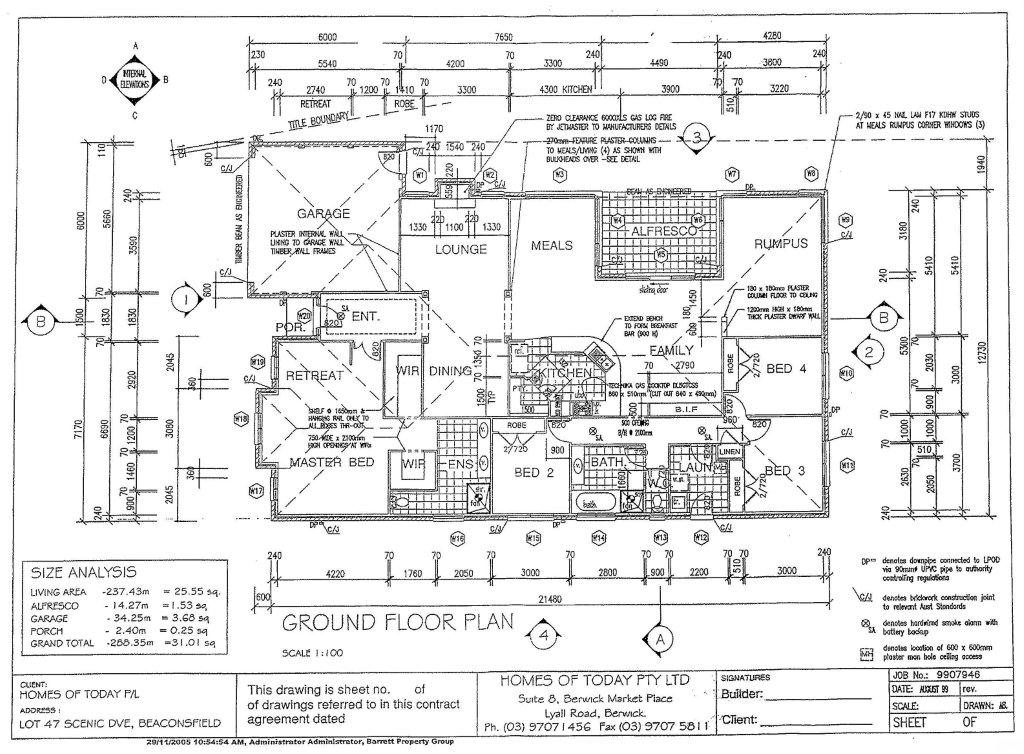
Memphis 33
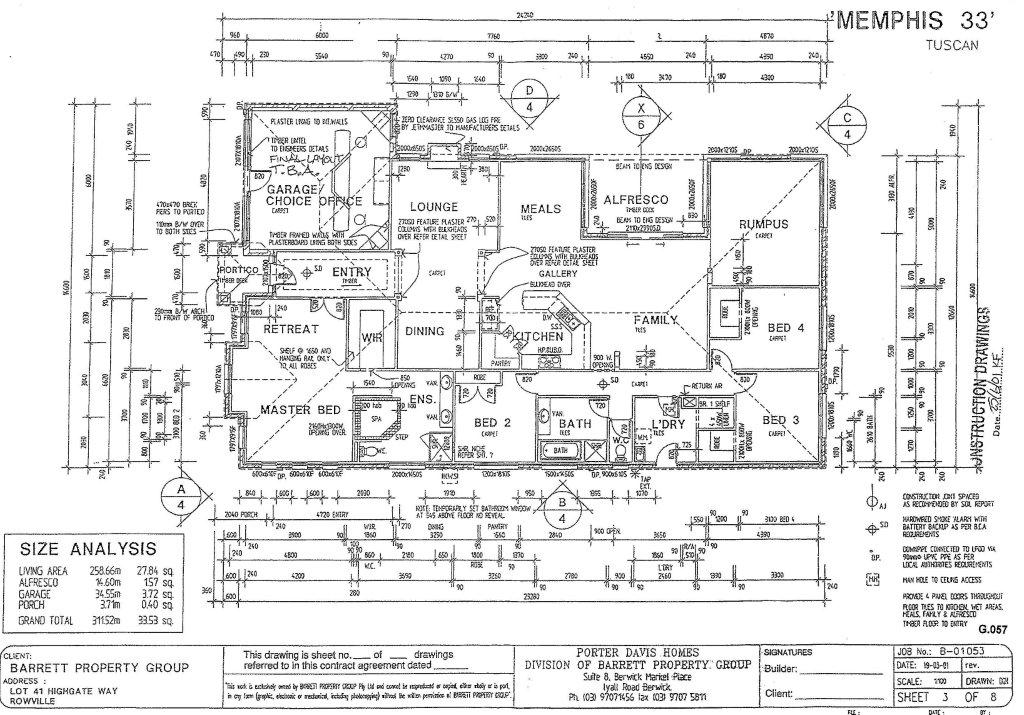
Grange 291
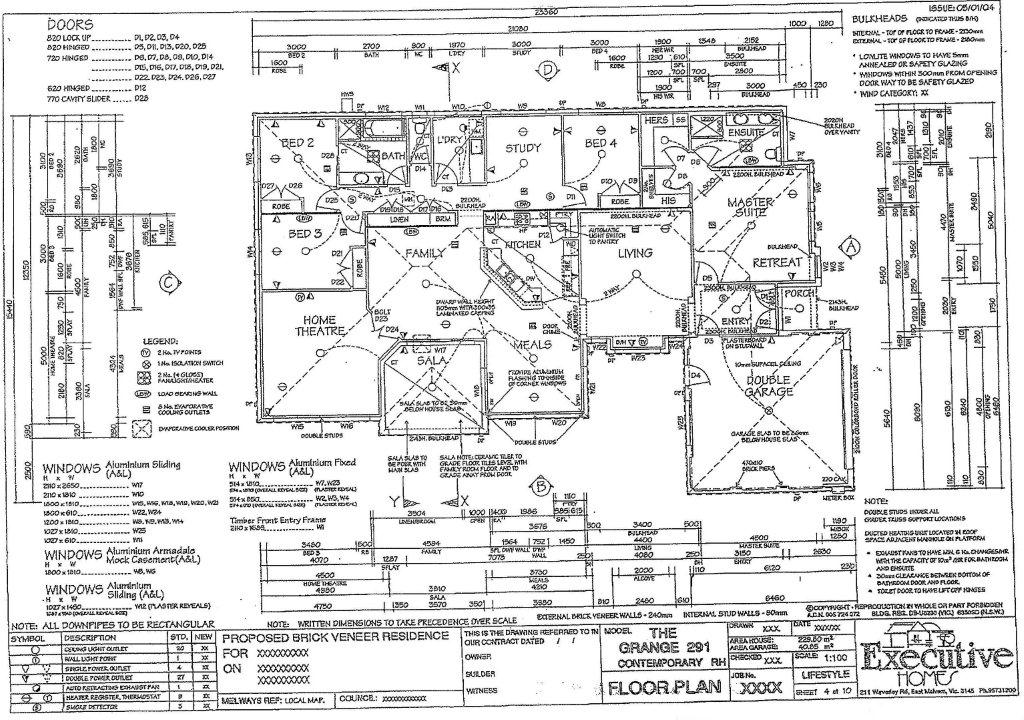
Grange 322 (a)
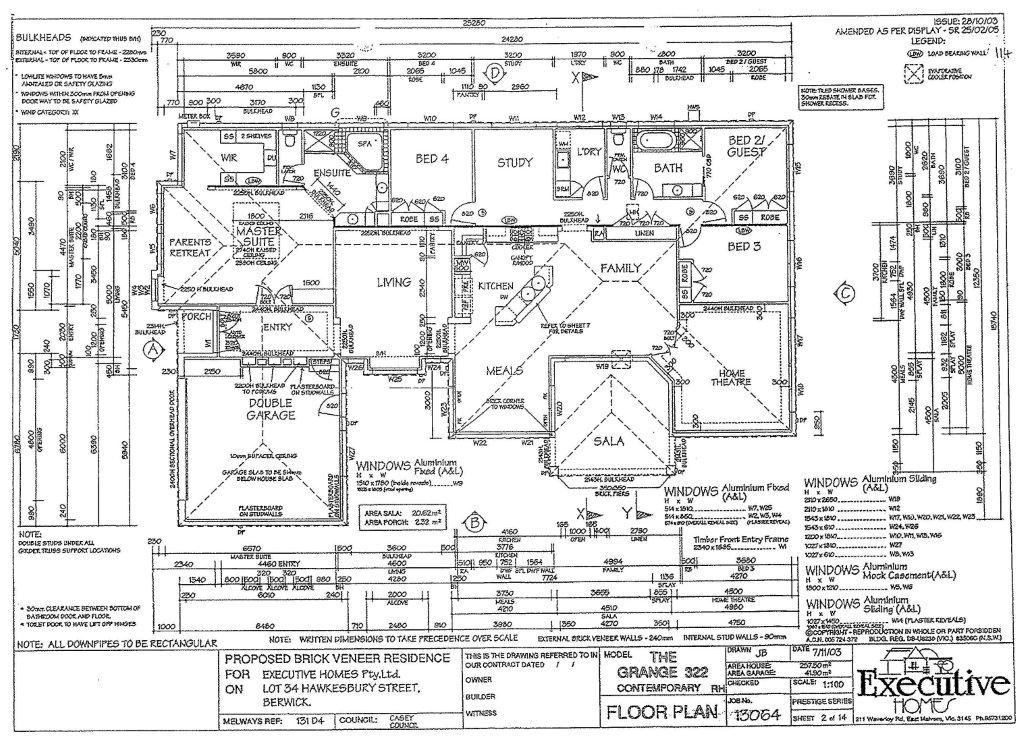
Grange 322 (b)
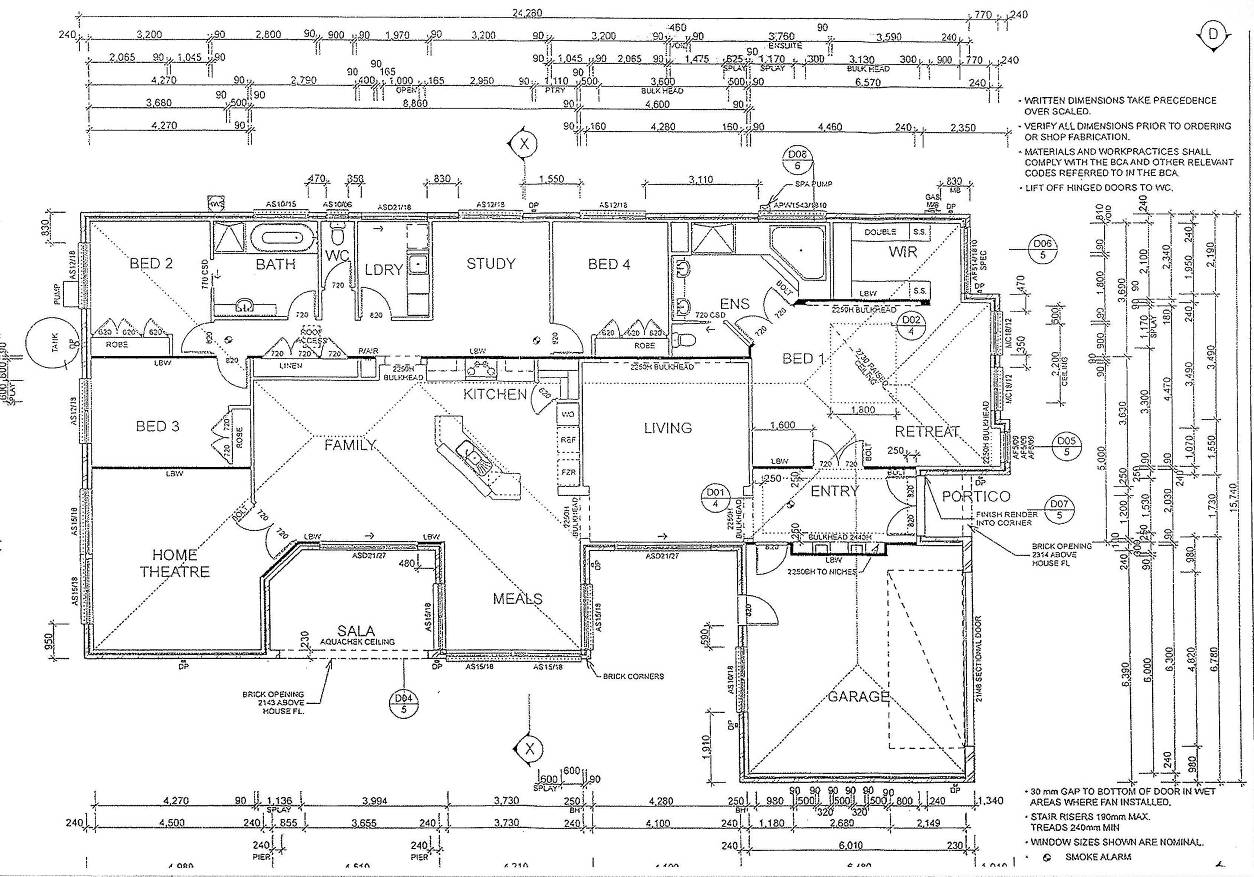
Thornton 310
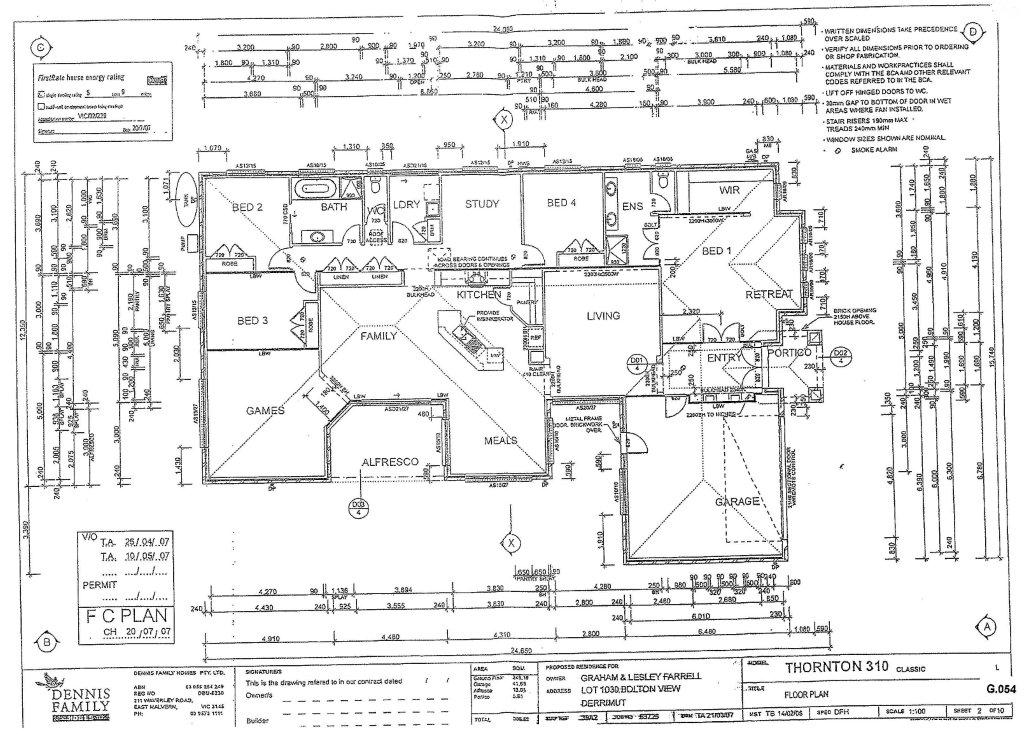
Esperance
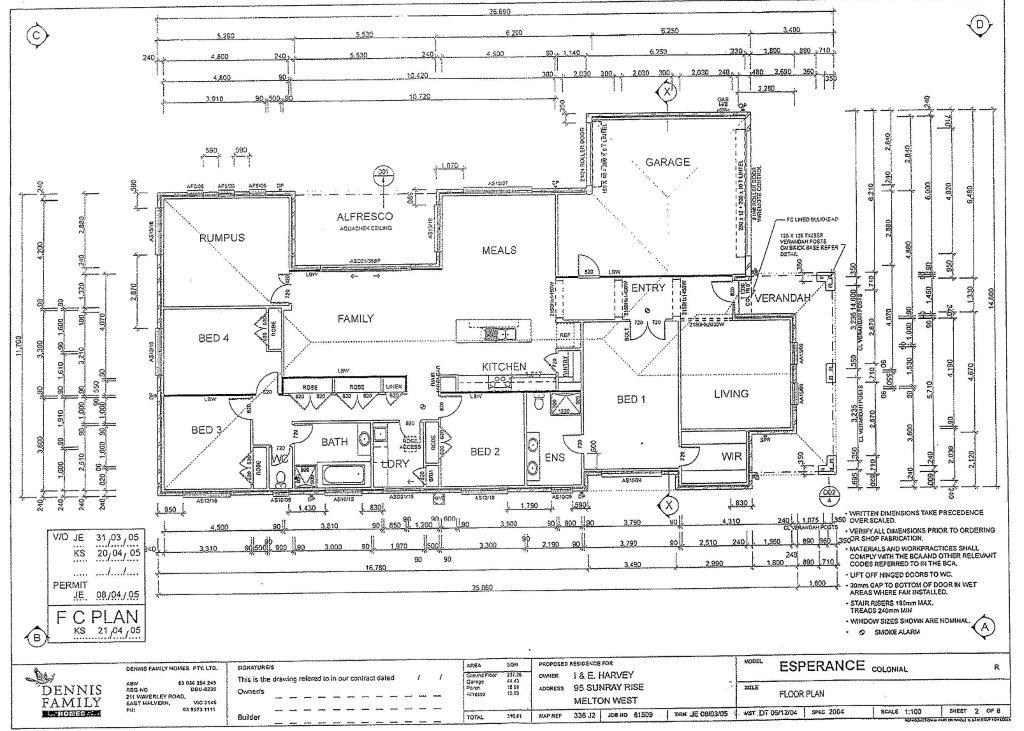
Flinders 270
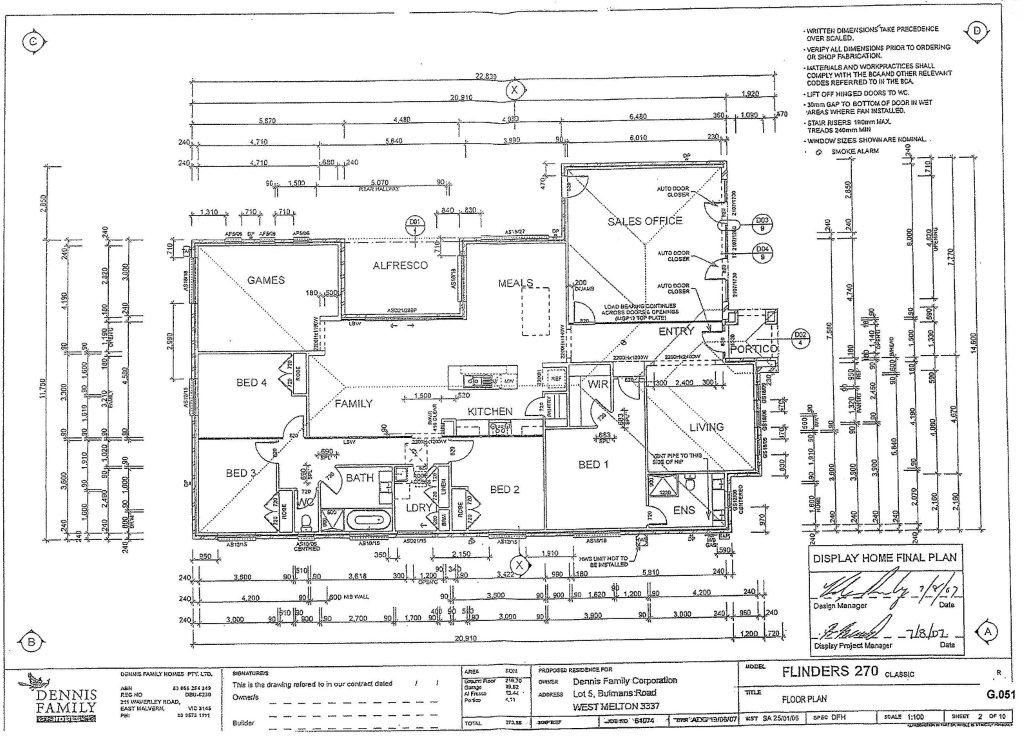
Flinders 290
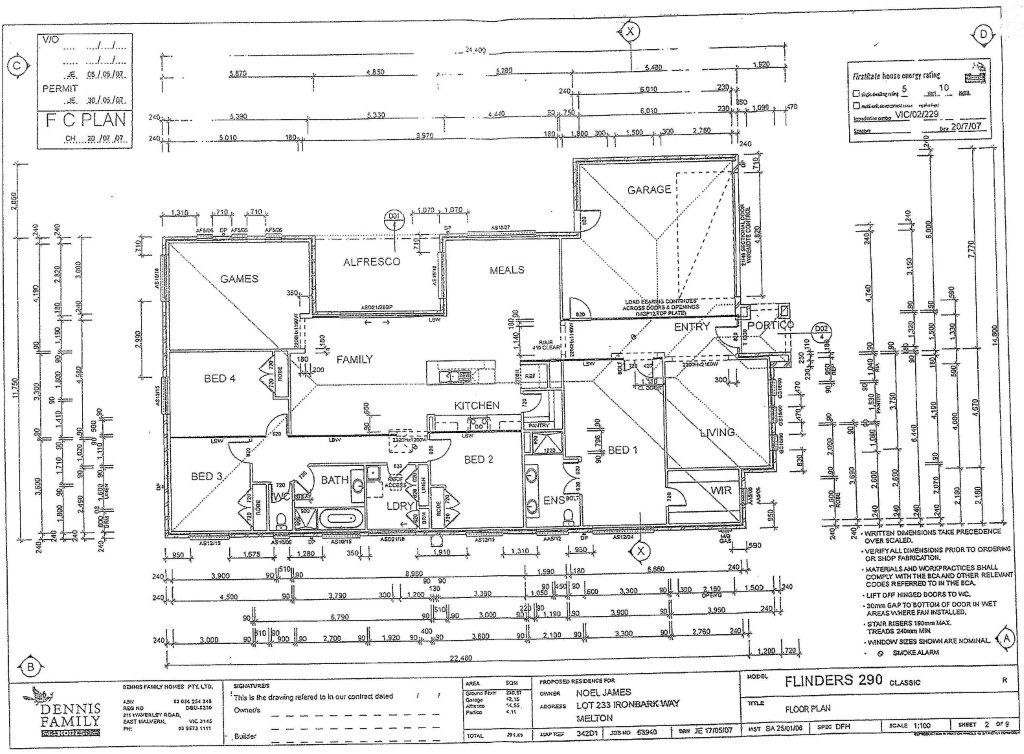
Flinders 310