

FEDERAL COURT OF AUSTRALIA
Avoca Resources Limited, in the matter of Avoca Resources Limited
[2011] FCA 208
IN THE FEDERAL COURT OF AUSTRALIA | |
IN THE MATTER OF AVOCA RESOURCES LIMITED ABN 30 097 082 282
AVOCA RESOURCES LIMITED (ABN 30 097 082 282) Plaintiff |
DATE OF ORDER: | |
WHERE MADE: |
THE COURT ORDERS THAT:
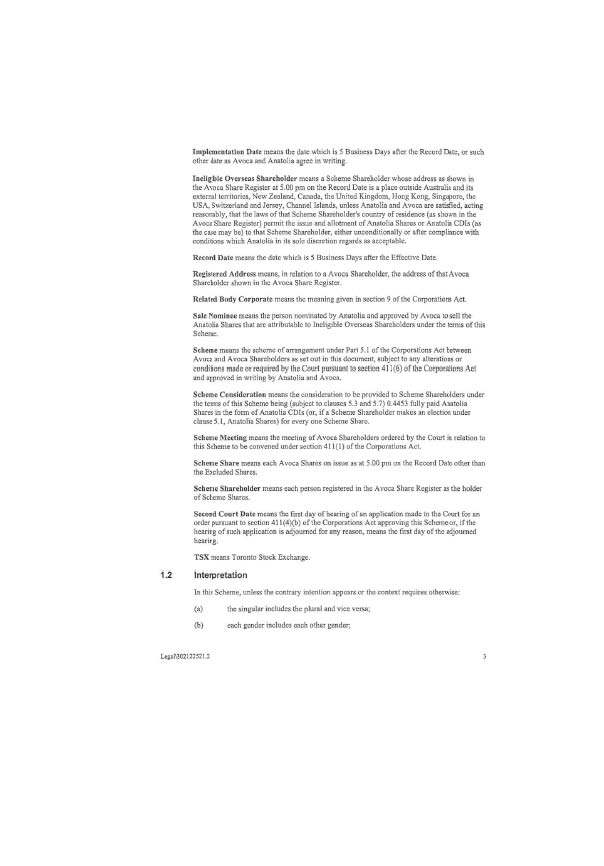
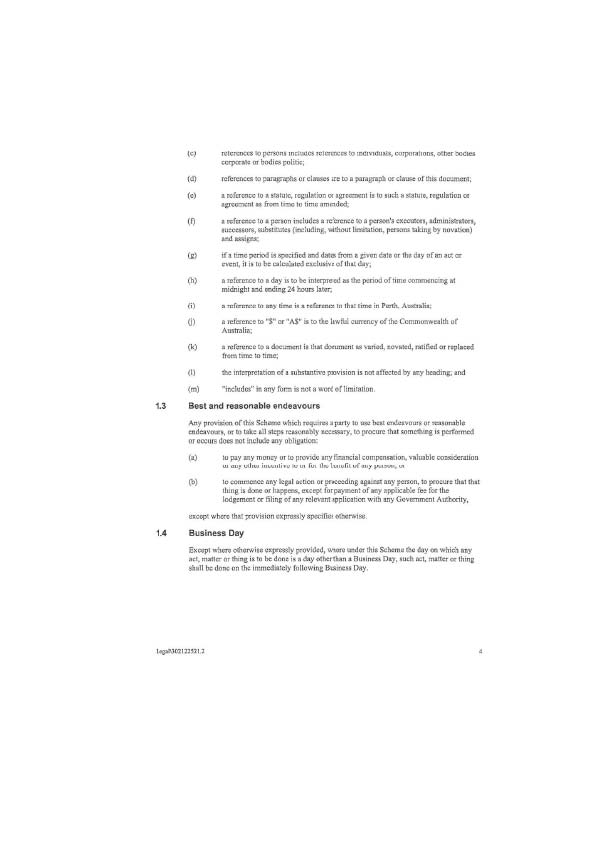
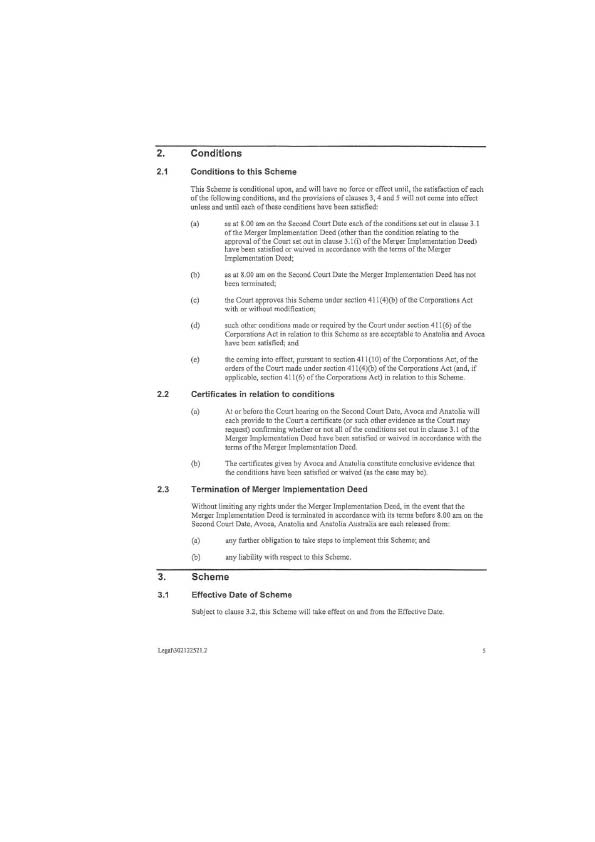
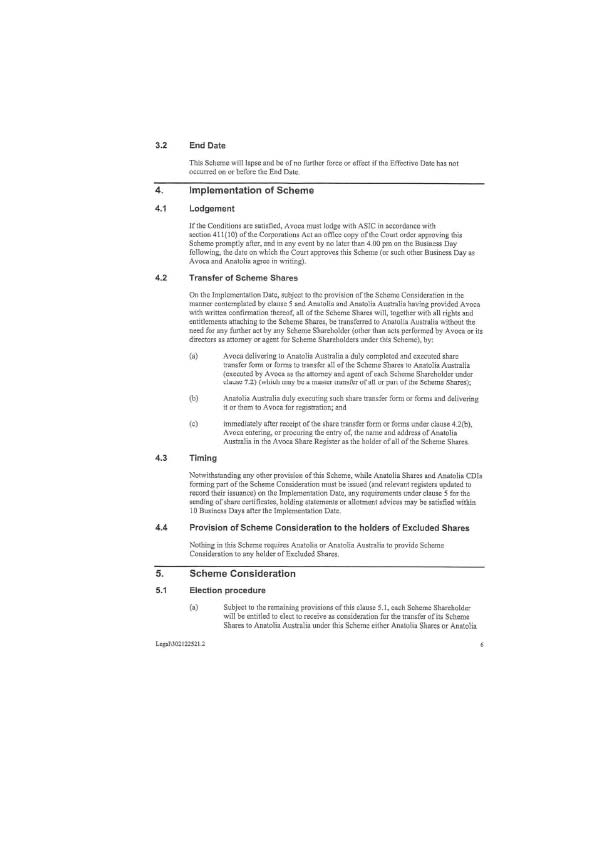
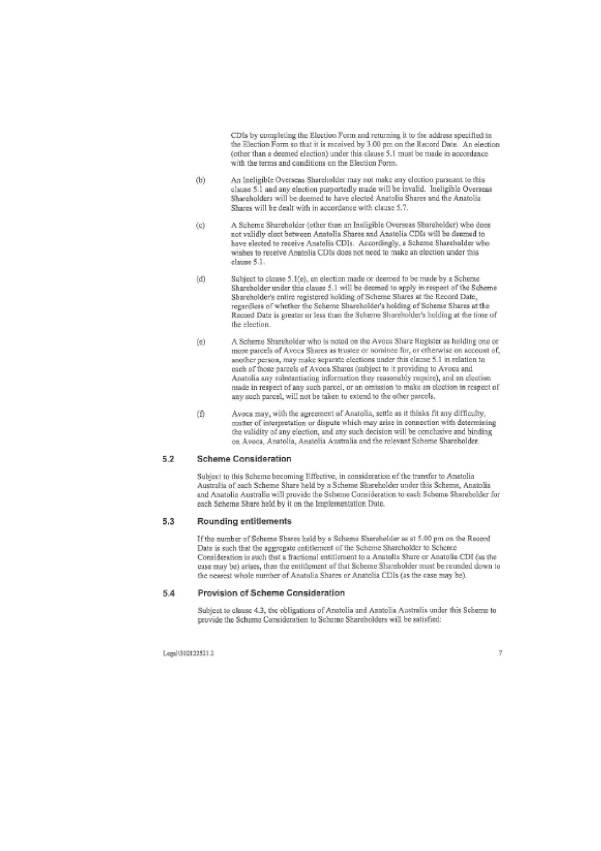
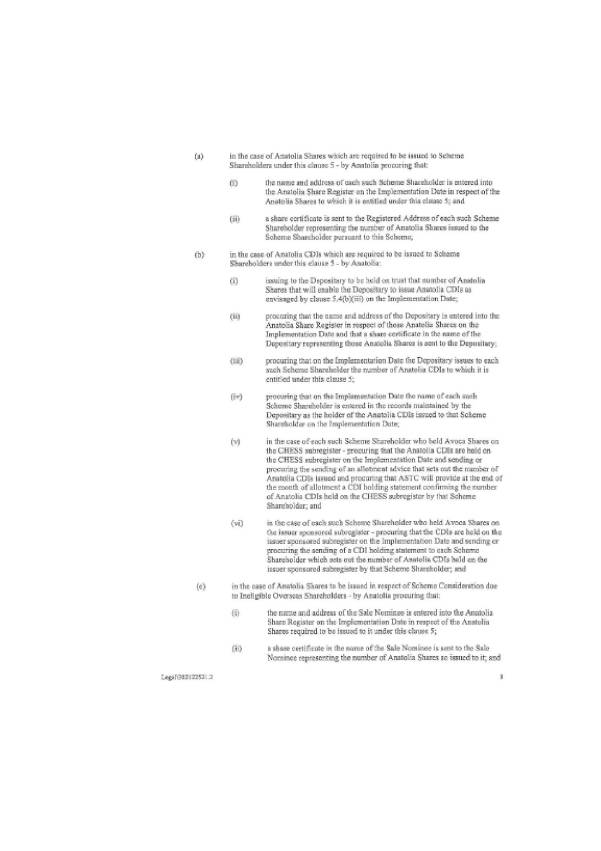
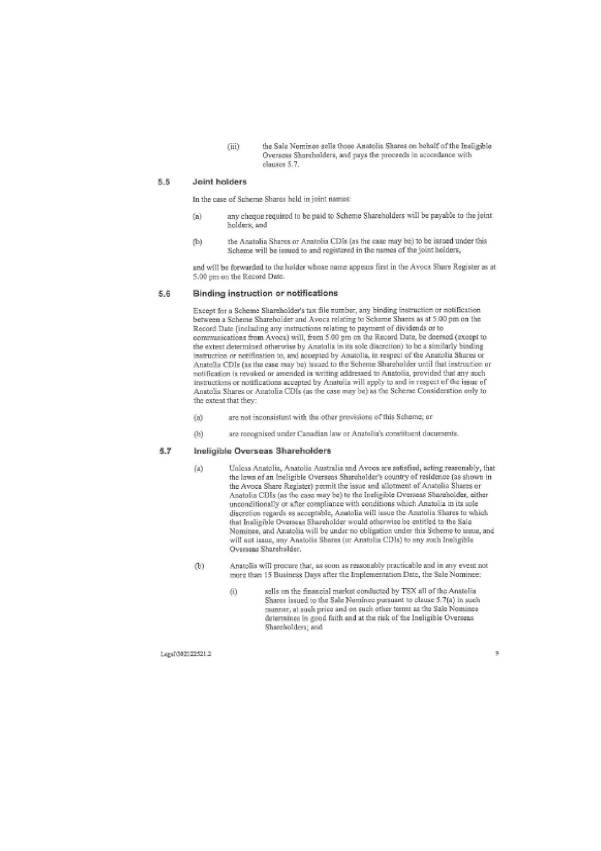
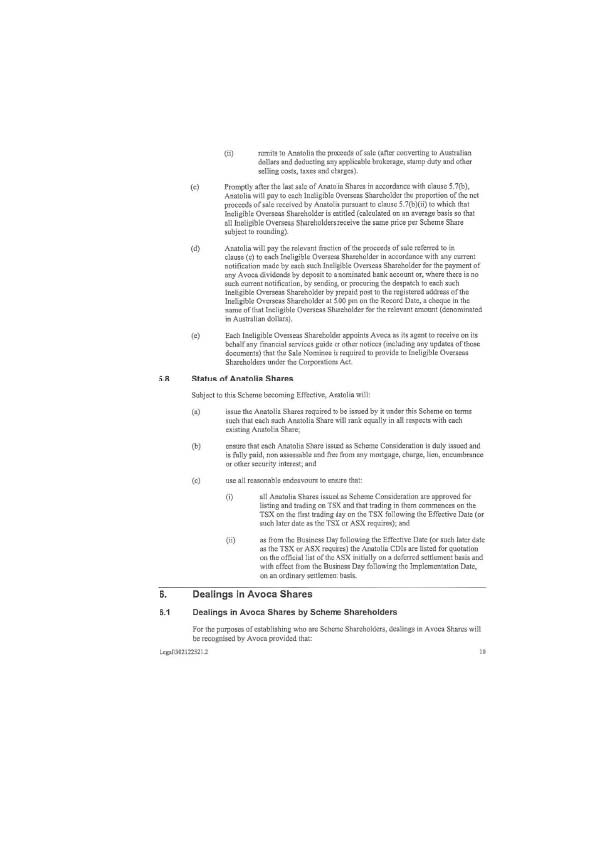
1. Pursuant to section 411(4)(b) of the Corporations Act 2001 (Cth), the scheme of arrangement between the plaintiff and its shareholders in the form of attachment A to these orders be approved.
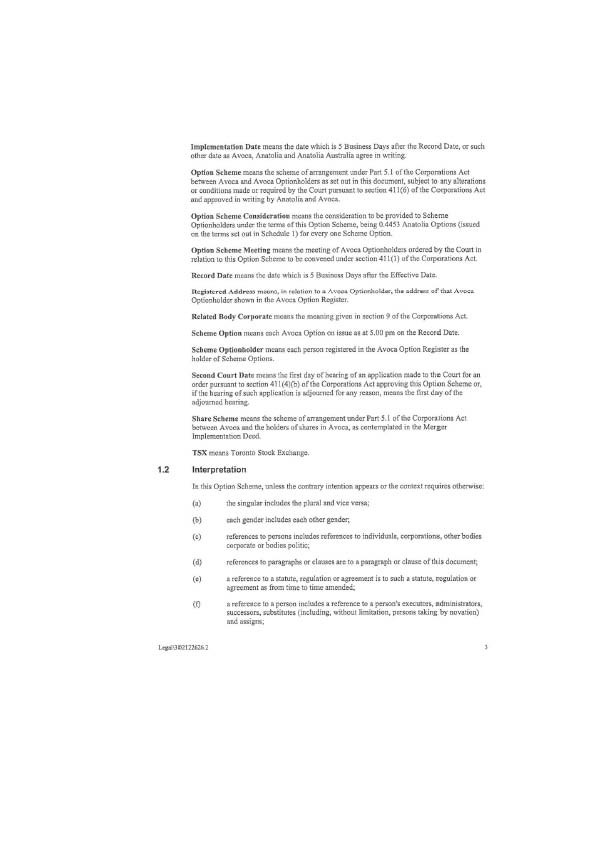
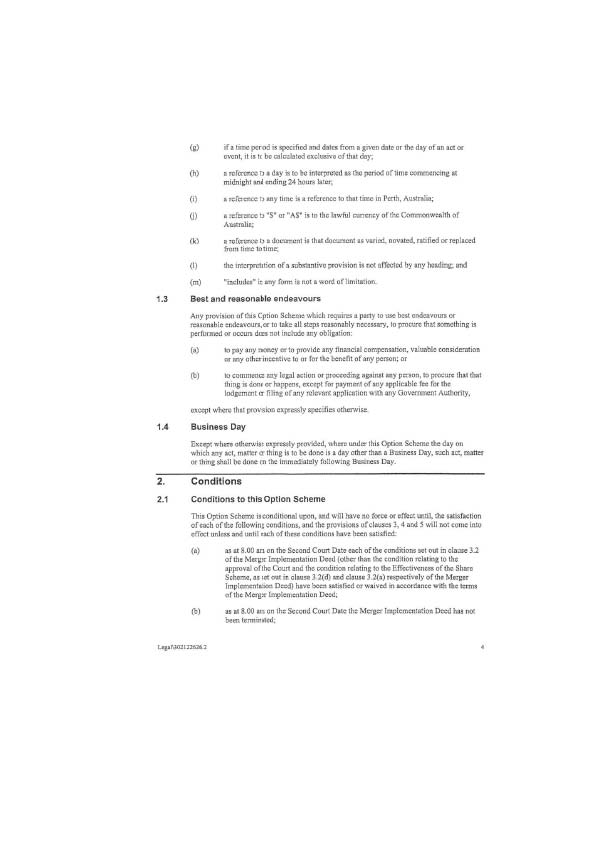
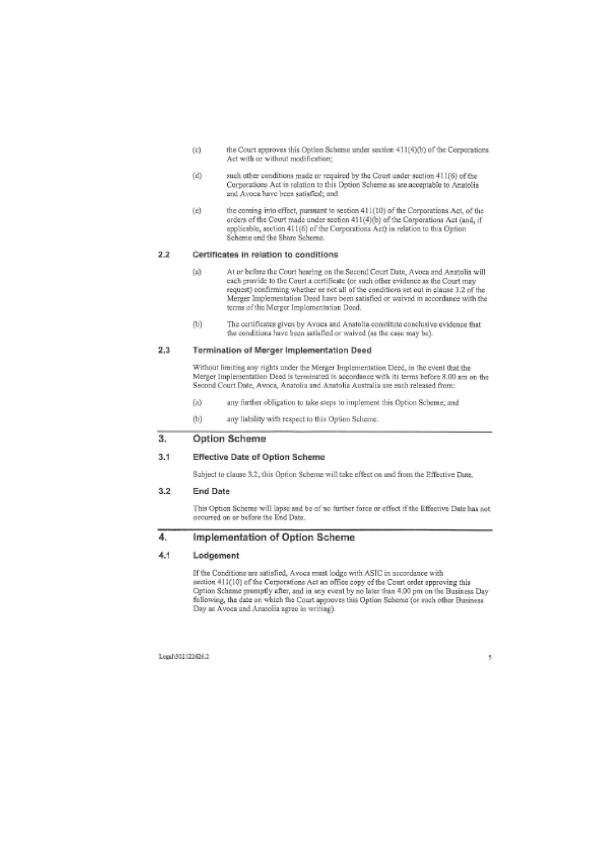
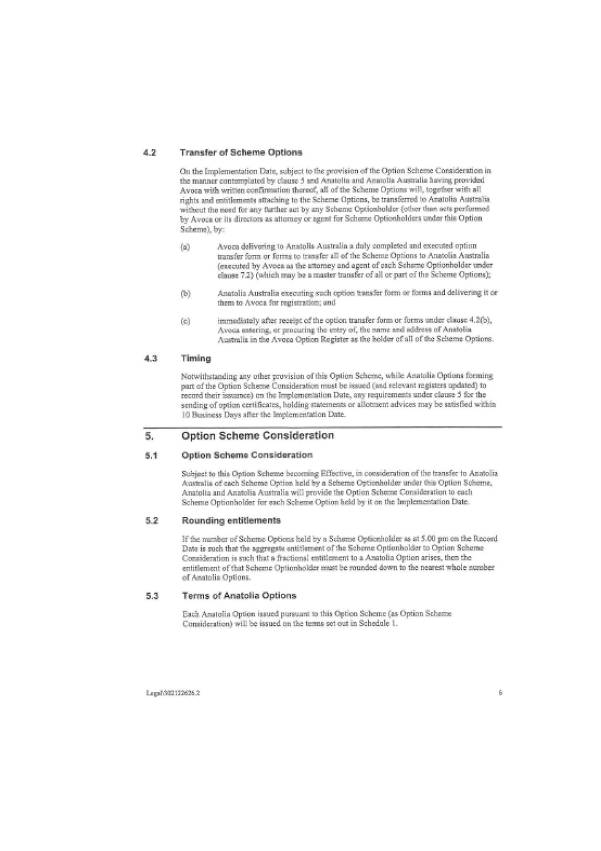
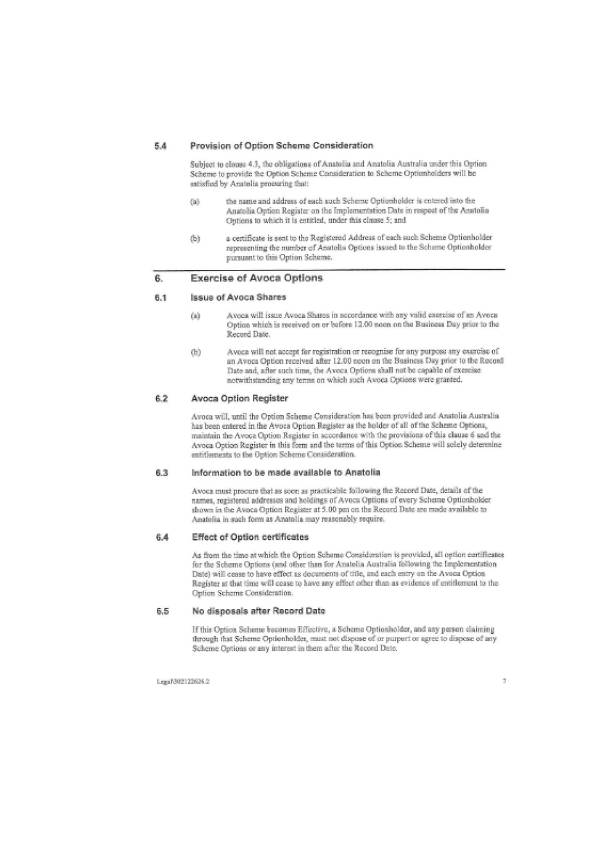
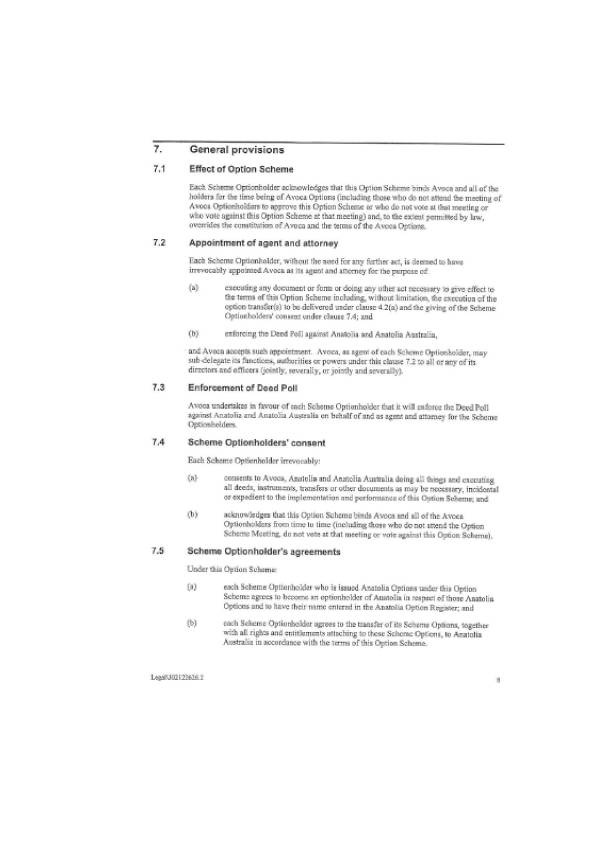
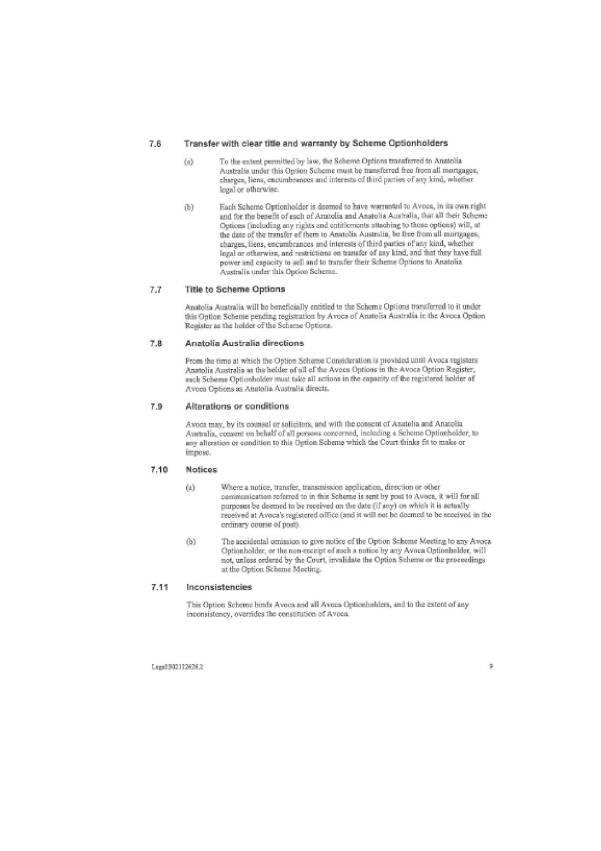
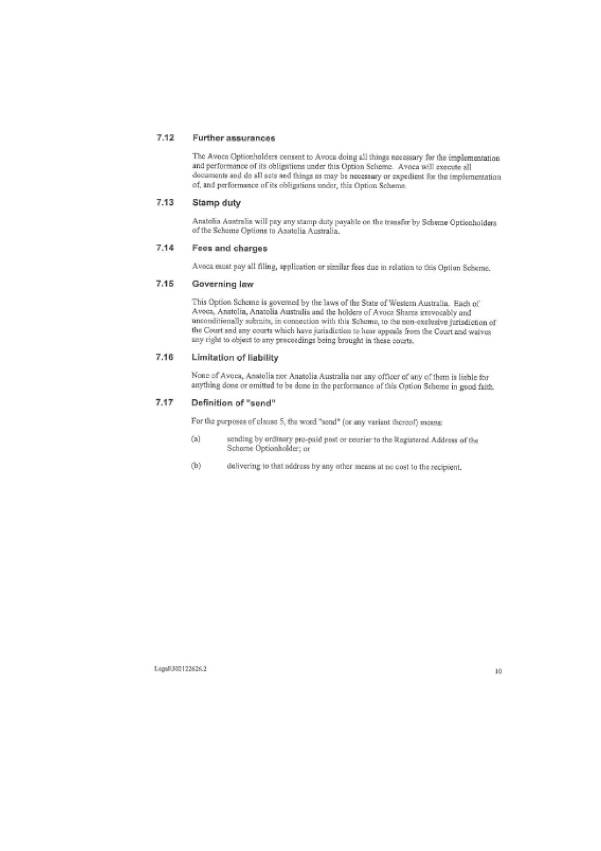
2. Pursuant to section 411(4)(b) of the Corporations Act 2001 (Cth), the scheme of arrangement between the plaintiff and holders of options to acquire shares in the plaintiff in the form of attachment B to these orders be approved.
3. Pursuant to s 411(12) of the Corporations Act 2001 (Cth), the Plaintiff be exempted from compliance with s 411(11) in relation to paragraphs 1 and 2.
Note: Settlement and entry of orders is dealt with in Order 36 of the Federal Court Rules. The text of entered orders can be located using Federal Law Search on the Court’s website.



WESTERN AUSTRALIA DISTRICT REGISTRY | |
GENERAL DIVISION | WAD 378 of 2010 |
IN THE MATTER OF AVOCA RESOURCES LIMITED ABN 30 097 082 282
AVOCA RESOURCES LIMITED (ABN 30 097 082 282) Plaintiff
|
JUDGE: | GILMOUR J |
DATE: | 10 March 2011 |
PLACE: | PERTH |
REASONS FOR JUDGMENT
1 At the second hearing on 3 February 2011 (second court hearing) of its application under s 411(4)(b) and (12) of the Corporations Act 2001 (Cth) (the Act) I made orders approving the schemes of arrangement between Avoca Resources Limited and its members and optionholders and Anatolia Minerals Development Limited, a Canadian company. These are my reasons for so ordering.
2 At the Court ordered meetings of shareholders and optionholders respectively the statutory majorities were obtained. As to the members’ scheme, 98.9% of votes present voted in favour and 90.7% of members present voted in favour. As to the optionholders’ scheme, 100% by value present voted in favour and 100% of optionholders present voted in favour.
3 At the first hearing of the application on 17 December 2010, (first court hearing) the Court formed the view as expressed in F T Eastment & Sons Pty Ltd v Metal Roof Decking Supplies Pty Ltd (1977) 3 ACLR 69 at 72 that:
... the scheme is of such a nature and cast in such terms that, if it receives a statutory majority at the creditors' meeting the court would be likely to approve it on the hearing of a petition which is unopposed.
4 With an uncontested scheme, on proof of procedural fairness and obtaining the statutory majorities, an approval ordinarily follows at the second court hearing.
5 The conditions that must be satisfied before the orders sought may be made are:
(a) the convening of a meeting under s 411(1) of the Act, a requirement of s 411(4)(a) of the Act; and
(b) satisfaction of the majorities set out in s 411(4)(a) of the Act.
6 These two may generally be described as satisfaction of s 411(4)(a): Chief Commissioner of Payroll Tax v Group Four Industries Pty Ltd (1984) 8 ACLR 973 at 683F.
Discretionary considerations
7 The Court also exercises a "discretionary power": Re Dorman, Long & Co Ltd [1934] Ch 635 at 655 and noted in Group Four Industries at 684A to C.
8 I have had regard to the five considerations which courts have taken into account as informing their discretion whether or not to approve a scheme. These were referred to by the Corporations and Markets Advisory Committee and noted in Re Seven Network Ltd (No 3) (2010) 267 ALR 583 at [35]-[39]. They are in summary as follows:
(i) Whether the members have voted in good faith and not for an improper purpose.
(ii) Whether the proposal is fair and reasonable so that an intelligent and honest man or woman who was a member of the relevant class, properly informed and acting alone might approve it.
(iii) Whether the plaintiff has brought to the Court’s attention under the ex parte disclosure principle all information relevant to the exercise of the Court’s discretion.
(iv) Whether there has been full and frank disclosure of all information material to the members’ decision.
(v) Whether minority shareholders would be oppressed by the scheme.
9 I am satisfied that there is nothing to suggest that members or optionholders voted other than in good faith or that they cast their votes for an improper purpose, nor anything which casts doubt on the procedural integrity of the meeting process.
10 The Independent Expert's Report by Grant Samuel & Associates Pty Limited (Report), expresses the opinion that the merger is fair and reasonable and in the best interests of Avoca’s shareholders and optionholders. There is no contrary evidence and nothing in the Report on its face that suggests that the opinions expressed lacks validity. Fairness may also be inferred from the obtaining of the statutory majorities for the scheme in the circumstances of adequate and verified disclosure on the basis that those voting are the best judges of their own interest. The reasonableness of the scheme was prima facie established at the first court hearing under the Eastment principle. This of course was subject always to new matters being brought to the Court’s attention at the second court hearing. No relevant new matters have been identified.
11 The actual Scheme Booklet and the sworn verification of the factual information in the Scheme Booklet are in evidence. There is criticism of disclosure made on behalf of one shareholder, Granic Pty Ltd, which Avoca submits and I find, for reasons which follow, is without substance. I infer from the actual text of the disclosure in the Scheme Booklet and the fact that there is no criticism of the disclosure by any regulatory body or optionholder, that full and adequate disclosure has been made.
12 By letter addressed to my associate, dated 29 January 2011, Mr John Fielding, a director of Granic Pty Ltd, which is a shareholder in Avoca, set out a complaint in relation to disclosure. Mr Fielding forwarded a copy of this letter to ASIC which in turn brought it to the attention of Avoca. In summary, the complaint is that disclosure in the Scheme Booklet is inadequate because it fails to state that one effect of the merger is that franked dividends will not be available in the future as shares will be held in a Canadian company rather than an Australian company.
13 Avoca responded to ASIC by email of 31 January 2011. I am satisfied that the issue of franking credits is not materially relevant for disclosure. Avoca has never paid a dividend, nor has Anatolia, and Anatolia has no short to medium term intention of doing so after the merger. The merged group will have a number of exploration and development assets which will require capital expenditure. Both the Avoca and Anatolia securities before and after the merger are capital growth securities and not dividend securities. The Canadian taxation position on sale of the securities, and on any dividends should they ever be declared, is disclosed.
14 In a situation where Avoca has never paid a dividend and the merged entity does not intend to do so in the short to medium term, in my opinion, the fact that franked dividends will not be available as a result of the merger, is not a material fact requiring disclosure.
15 Shareholders and optionholders have been told, under “Intentions” in Section 7.5(f), page 72 of the Scheme Booklet, that they should not expect any dividends in the short to medium term. Under Section 9.4, on page 91 of the Scheme Booklet, Canadian tax considerations are disclosed – Section 9.4(iii) discloses Canadian tax on dividends. Of particular relevance is the disclosure, in Section 9.4(iv), of the Canadian capital gains tax consequences for non-Canadian holders of securities.
16 Avoca referred the complaint to the Independent Expert and to the Tax expert for comment. Both have indicated that nothing in the letter of complaint causes them to add to, or change any matter in their respective reports. Their conclusion, in that respect, seems to me to be well-founded for the reasons I have discussed.
17 I find for these reasons that the criticism made on behalf of Granic Pty Ltd has no substance.
18 There is no suggestion in the evidence that the proposed scheme would work an oppression against minority shareholders.
19 A further consideration identified in Seven Network at [40] is whether the scheme offends public policy. The Australian Securities and Investments Commission (ASIC) has provided a s 411(17)(b) statement. It did not appear at the second court hearing. ASIC has not raised any “public policy” concern and there is nothing on the face of the proposal which would suggest that there should be such a concern.
Turnout Percentage
20 In Lion Nathan Ltd, in the matter of Lion Nathan (No 2) [2009] FCA 1261 at para [6] Emmett J noted that 64% of eligible shares had been represented and voted at the scheme meeting. In Re MB Group PLC [1989] BCLC 672 at 675 Harman J described a turnout of 52% of scheme shares as “a high turnout”.
21 Since then, this Court has expressed an interest in knowing the turnout percentage of eligible shares (both for and against), and more recently of shareholders. These percentages have no statutory significance, but a low turnout percentage might suggest a flaw in the convening procedure. There is no basis for such an inference to be drawn here.
22 Avoca has 303,301,781 shares on issue which are held by approximately 7,300 shareholders. Avoca has 8,467,879 options on issue held by 27 optionholders.
23 The members’ scheme meeting poll report discloses the number of shares and shareholders represented at the scheme meeting.
24 The optionholders’ scheme meeting poll report discloses the number and value of options and number of optionholders represented at the optionholders’ scheme meeting.
25 219,530,105 shares were represented and voted (72.38% of shares on issue). Approximately 11.49% of shareholders were represented at the meeting.
26 93.9% of options were represented and voted and 20 of the optionholders were represented (71.4% of Optionholders).
US Securities Act 1933
27 Anatolia intends to issue the scheme consideration securities in reliance on the exemption from registration requirements of the United States Securities Act of 1933. This exemption is set out in s 3(a) (10) of that Act, based on the approval of the schemes by the Court.
28 There is a well-established path with respect to this which is conveniently summarised in the judgment of Emmett J in Central Pacific Minerals NL [2002] FCA 239 at paras [28] to [34]. See also Re Simeon Wines Ltd (2002) 42 ACSR 454; Re Permanent Trustee Co Ltd (2002) 43 ACSR 601 and Re Solution 6 Holdings Ltd (2004) 50 ACSR 113 at para [37].
29 As to the US requirements noted by Lander J in Simeon and adopted in Solution 6, I note the following:
(a) The scheme contemplates the issue of Anatolia securities in exchange for the Avoca securities.
(b) The Court has been advised before commencement of the approval hearing that Anatolia will rely on the s 3(a)(10) exemption on the basis of the Court’s approval of the scheme.
(c) The Court has been fully informed of the value of the securities to be surrendered and the value of the securities to be offered in consideration of that surrender. The valuation has been prepared by an expert independent of both the scheme company and the acquirer and is a sworn valuation. The Court has taken this evidence into account in determining whether the scheme is fair and thus should be approved. As noted in Solution 6 at [43] the Court has not acted as a valuer in this process, but has received the assistance of an unaligned expert.
(d) The Court, pursuant to statutory requirement, has held a hearing to consider the fairness and reasonableness of the scheme proposal.
(e) That hearing has been open to the public and any person to whom securities are to be issued had standing to appear. Notice of the date of the hearing was included in the Scheme Booklet sent to all securityholders of Avoca prior to the proposal being considered by meetings of those securityholders and was advertised in a daily newspaper circulating throughout the country. There was no appearance by any securityholder.
Section 411(17) of the Act
30 ASIC has provided a "statement in writing" under s 411(17)(b). Santow J in Re Advance Bank Australia Ltd (1997) 22 ACSR 513 at 519 described the effect of the statement as follows:
... what the ASIC statement does do, is preclude the court from withholding approval to the scheme where the ground for doing so is under section 411(17)(a) of the Corporations Law.
31 For all these reasons I am satisfied that I should make the orders sought.
I certify that the preceding thirty-one (31) numbered paragraphs are a true copy of the Reasons for Judgment herein of the Honourable Justice Gilmour. |
Associate:


