

FEDERAL COURT OF AUSTRALIA
Wide Bay Conservation Council Inc v Burnett Water Pty Ltd (No 8)
[2011] FCA 175
FEDERAL COURT OF AUSTRALIA
Wide Bay Conservation Council Inc v Burnett Water Pty Ltd (No 8)
[2011] FCA 175
CORRIGENDUM
1. In paragraph 58 of the Reasons for Judgment, in the second sentence, the reference to “Macquarie Dictionary Online” should read “Oxford Dictionary Online”.
2. In paragraph 58 of the Reasons for Judgment, in the second sentence the words “(Online version, November 2010)” should be inserted after the words “Oxford Dictionary Online”.
3. In paragraph 58 of the Reasons for Judgment, in the fourth sentence the reference to “(Online Version, November 2010)” should be deleted.
4. In paragraph 165 of the Reasons for Judgment, in the first sentence the words “does not” after the word “requirement” should be deleted.
I certify that the preceding four (4) numbered paragraphs are a true copy of the Corrigendum to the Reasons for Judgment herein of the Honourable Justice Logan. |
Associate:
Dated: 15 March 2011
IN THE FEDERAL COURT OF AUSTRALIA | |
WIDE BAY BURNETT CONSERVATION COUNCIL INC Applicant | |
AND: | BURNETT WATER PTY LTD ACN 097 206 614 Respondent |
DATE OF ORDER: | |
WHERE MADE: |
THE COURT ORDERS THAT:
1. The application is dismissed.
Note: Settlement and entry of orders is dealt with in Order 36 of the Federal Court Rules. The text of entered orders can be located using Federal Law Search on the Court’s website.
QUEENSLAND DISTRICT REGISTRY | |
GENERAL DIVISION | QUD 319 of 2008 |
BETWEEN: | WIDE BAY BURNETT CONSERVATION COUNCIL INC Applicant
|
AND: | BURNETT WATER PTY LTD ACN 097 206 614 Respondent
|
JUDGE: | LOGAN J |
DATE: | 4 MARCH 2011 |
PLACE: | BRISBANE |
REASONS FOR JUDGMENT
introduction
1 The Queensland (Australian) lungfish Neoceratodus forsteri (N forsteri) has frequently been termed a “living fossil”. It is a truly remarkable species in terms of phylogeny, anatomy and physiology. It is the sole extant member of an extensive lungfish fauna known in Australia from the Triassic, Cretacious and Tertiary periods.
2 The Queensland lungfish is one of only six surviving members of a highly successful group of fish that first appeared in the Devonian period, some 350 million years ago. The other surviving members of this group are found in South America (1 species) and in Africa (4 species). What makes these lungfish remarkable is their bimodal respiratory system; bimodal in the sense that they have both gills and lungs. Although air breathing is practised by more than 400 fish species worldwide, only the lungfish have true lungs, homologous with those in the tetrapods, which include mammals such as mankind. All of the other surviving lungfish species must breathe air to survive. In contrast and uniquely among the surviving species, the Queensland lungfish rarely breathes air when at rest in well-aerated water. In these conditions its respiration is supported largely by the gills.
3 Fossil evidence demonstrates that the distribution of N forsteri within Australia has contracted over time. Fossil material for the species has been collected from Lightning Ridge in New South Wales and from Chinchilla in Western Queensland. By the time of the British settlement of Australia, the species was confined to the Mary and Burnett Rivers in South East Queensland; hence the popular term “Queensland lungfish”. Such was the limited distribution of the species in the late 19th century that scientists of the day, fearing its extinction, translocated a limited number of lungfish to the upper reaches of the Brisbane River, to the North Pine River, to a lagoon near the Albert River, to the Enoggera Reservoir, to the Condamine River and to the Coomera River. Lungfish continue to be found in these places of translocation (save perhaps for the Enoggera Reservoir, where the translocated population may recently have become extinct). Their principal distribution remains in the Mary and Burnett Rivers.
4 It will be necessary later in these reasons for judgment to consider in greater detail the lungfish of the Burnett River. Why that is so arises from a feature of the Burnett River of much more recent origin. That feature is the Burnett River Dam, now popularly known as the Paradise Dam.
5 The Paradise Dam is located on the lower Burnett River at 131.2 km Average Middle Thread Distance (AMTD), approximately 80 km southwest of Bundaberg. The respondent, Burnett Water Pty Ltd ACN 097 206 614 (Burnett Water) caused this dam to be constructed.
6 Burnett Water is wholly owned subsidiary of a Queensland Government owned corporation, SunWater Limited (SunWater). It is a corporate manifestation of the State of Queensland. The use of corporations ultimately controlled by a body politic has been a feature of public administration in modern times in Australia. It is not necessary for the purposes of this case to explore the motivations of the Queensland Government in, or any advantages or disadvantages of, consigning this aspect of its management of the State’s water resources to bodies such as SunWater and this subsidiary.
7 Construction of the Paradise Dam commenced in November 2003. Practical completion of the dam occurred some two years later.
8 Materially, the construction of the dam constituted, and its operation continues to constitute, a controlled action the taking of which required the written approval under s 133 of the Environment Protection and Biodiversity Conservation Act 1999 (Cth) (EPBC Act) by the Minister administering that Act. Approval for the construction and operation of the dam was given by the then Minister (The Hon D A Kemp) on 25 January 2002. At that time the Queensland lungfish was not listed as a threatened species under that Act. Thus, the Ministerial approval as originally formulated made no reference to the lungfish.
9 Even though its listing under the EPBC Act is but recent, the lungfish has long enjoyed a more limited form of protection under Queensland legislation. It has been protected from fishing. This first occurred under the Fish and Oyster Act 1914 (Qld) (rep) and continues to this day under a successor statute, the Fisheries Act 1994 (Qld).
10 The action which the Minister approved under the EPBC Act was the following:
to construct and operate the Burnett River Dam with a capacity of 300,000 megalitres, on the lower Burnett River at 131.2 km Average Middle Thread Distance, and make controlled discharges of water for agricultural, commercial, domestic and environmental uses (EPBC 2001/422) by Burnett Water Pty Ltd subject to the conditions set out in annexure 1.
11 On 8 August 2003 the original approval was amended by the Minister (still The Hon D A Kemp) so as to add, with the agreement of Burnett Water, seven further conditions (numbered 3 to 9) to the original two in annexure 1 to the approval. The description of the approved action remained the same.
12 For the purposes of this proceeding, it is common ground that the Ministerial approval as amended is lawful, which necessarily includes a concession that the conditions are reasonable.
13 Though it will be necessary later in this judgment to make reference to other conditions, it is with one of the conditions added by amendment, condition 3, with which this proceeding is particularly concerned. Condition 3 states:
Burnett Water Pty Ltd must install a fish transfer device on the Burnett River Dam suitable for the lungfish. The fishway will commence when the dam becomes operational.
14 Provision, indeed elaborate provision, was made in the design and construction of the Paradise Dam taking into account the requirement made by condition 3. The end result was the incorporation into the dam of a fishway comprising both upstream and downstream fish transfer devices. These are more particularly described below. Put shortly, the principal issue in the proceeding is whether what resulted is “suitable for the lungfish”? Another issue is whether it has commenced as required by condition 3.
15 These issues are raised against Burnett Water in this proceeding not by the Minister but rather by the Wide Bay Burnett Conservation Council Inc (the Conservation Council).
16 Section 475 of the EPBC Act makes provision for the granting by this Court of injunctive relief if a person has engaged, engages or proposes to engage in conduct consisting of an act or omission that constitutes an offence or other contravention of that Act. The Conservation Council’s case is, in essence, that non-compliance with condition 3 constitutes such a contravention. It claims an injunction requiring Burnett Water to comply with the condition.
standing
17 Standing to claim such an injunction is conferred by s 475(1) of the EPBC Act on:
(a) the Minister; or
(b) an interested person (other than an unincorporated organisation); or
(c) a person acting on behalf of an unincorporated organisation that is an interested person
18 Subsection 475(7) of the EPBC Act defines the term “interested person”. It is not necessary to set out that provision. It is common ground that the Conservation Council is an “interested person”.
19 The EPBC Act thus creates the potential, realised in this case, for a shared responsibility to construe the terms of a Ministerial approval, to assess whether there is evidence sufficient to allege a contravention or proposed contravention of its provisions, and if so, to decide whether to institute in this Court a claim for injunctive relief. Following the institution of this proceeding by the Conservation Council, the Minister (by then The Hon P R Garrett AM), officers of whose department had conducted auditing activity in relation to compliance with the conditions of the approval, was initially disposed at least to consider seeking to intervene. However, at an early interlocutory stage, the Minister, by his solicitor, informed the Court that he would not participate in the proceeding. There is longstanding precedent for such disengagement by an official in cases of overlapping responsibility (Gospel of St Matthew, Chapter 27, Verse 24).
20 The standing to seek injunctive relief expressly conferred upon an “interested person” such as the Conservation Council by the EPBC Act makes academic any question as to whether, having regard to authorities on the subject such as Australian Conservation Foundation Inc v Commonwealth of Australia (1980) 146 CLR 493; Bateman's Bay Local Aboriginal Land Council v Aboriginal Community Benefit Fund Pty Ltd (1998) 194 CLR 247 and Truth About Motorways Pty Ltd v Macquarie Infrastructure Investment Management Ltd (2000) 200 CLR 591, it would otherwise have enjoyed standing to seek the relief claimed.
21 The express sharing of responsibility for the enforcement of the terms of a Ministerial approval is something of an experiment by Parliament. It is a civil jurisdiction departure, in the field of environmental law, from the usual practice of public administration and public law in our system of government. Traditionally, it is the Attorney-General who has standing to seek in the public interest the judicial review and remedies in respect of allegedly unlawful acts. Sometimes, as in the EPBC Act, that role is consigned to another Minister within that Minister’s area of administrative responsibility. The express conferral of standing on an “interested person” as defined has the benefit of precision of application and at least the apprehended benefit of enabling proceedings for injunctive relief in respect of an alleged contravention or proposed contravention of the EPBC Act to be initiated by an “interested person” even in circumstances where, for one reason or another, the Minister is unable or unwilling to institute such proceedings. It does though create a disjunct.
22 The disjunct is this. The general administration of the EPBC Act is, in accordance with longstanding principles of responsible government, consigned by the Governor-General under the Administrative Arrangements as made from time to time to a Minister responsible to Parliament which, in turn, is responsible to the electorate. More particularly, the power to approve the taking of a controlled action, subject to conditions or otherwise, is consigned to that Minister alone. The claiming of injunctive relief to compel compliance with the terms of such an approval is a logical corollary of that power.
23 In contrast, an “interested person” is neither responsible to Parliament nor to any other constituency beyond its own membership base, large or small. Neither does it have any formal role in an approval process or in the wider administration of the EPBC Act nor access to the resources of a Department of State.
24 Particularly where a condition of a Ministerial approval is cast in broad, perhaps ambiguous, even aspirational terms, it is by no means impossible to envisage circumstances where, in good faith, a Minister might consider that there had been no contravention whereas an “interested person”, approaching those same circumstances from a different perspective, and without the benefit of an understanding gained from involvement in the process of approval and the general administration of the EPBC Act as to the intent of a condition, might consider that there was a contravention. In this fashion, a party having the benefit of an approval with, as a result of seeking the same, a like understanding as the Minister as to its intended meaning might be put unnecessarily to the expense of litigation in defending, and limited judicial resources consumed, in hearing an application for injunctive relief. The potential for this to occur is enhanced where the responsible Minister chooses to be disengaged with that litigation.
25 Express provision for shared responsibility for law enforcement is not completely unknown in other fields of Commonwealth law. It is a general feature of Commonwealth criminal law. By virtue of s 13 of the Crimes Act 1914 (Cth), it remains generally possible for any person, not just a public official, to
(a) institute proceedings for the commitment for trial of any person in respect of any indictable offence against the law of the Commonwealth; or
(b) institute proceedings for the summary conviction of any person in respect of any offence against the law of the Commonwealth punishable on summary conviction.
This breadth of standing in respect of the enforcement of the criminal law and any potential for the abuse of that standing is tempered though by the ability of the Commonwealth Director of Public Prosecutions to take over and decline further to carry on any such proceeding: s 9(5) Director of Public Prosecutions Act 1983 (Cth).
26 In the field of public law there has never been such universality of standing for the prevention, in the public interest, of illegality. Lord Denning once made this point in characteristic style in observing that standing to claim prerogative relief is denied “to a mere busybody who is interfering in things which do not concern him”: R v Greater London Council; Ex parte Blackburn [1976] 1 WLR 550 at 559. I have already referred to leading Australian authorities on the subject of standing in such matters. For present purposes, the point is that as presently enacted, though it has the real or apprehended benefits mentioned, the breadth of standing afforded by s 475(1) of the EPBC Act is not tempered by, for example, the conferring on the Minister of an ability to take over and decline further to carry on a proceeding instituted by an “interested person”. For any Minister to adopt such a course would require a political value judgement for which he or she would be answerable to Parliament, and indirectly to the wider community. Such a qualification on the breadth of standing might though serve to prevent or truncate cases which were frivolous, vexatious, misconceived or otherwise contrary to the public interest. As the EPBC Act stands, the price of addressing the contingency of Ministerial reticence to claim injunctive relief in a worthy cause may perhaps in other cases be the litigious ardour of the zealot in what, objectively, is not such a cause. Power is best combined with responsibility for its exercise. Whether this is a desirable law reform is a matter for Parliamentary value judgement.
27 However this may be, here there is a claim brought by a person with standing which requires determination.
the legislation and the ministerial approval
28 In the list of the statute’s objects in s 3(1) of the EPBC Act, the first two are:
(a) to provide for the protection of the environment, especially those aspects of the environment that are matters of national environmental significance; and
(b) to promote ecologically sustainable development through the conservation and ecologically sustainable use of natural resources.
29 Evident from Pt 3 of ch 4 of the EPBC Act is that one way in which Parliament intends that these objects will be achieved, and if need be reconciled, is by the prohibition of the taking of particular kinds of action without Ministerial approval.
30 Section 178 of the EPBC Act obliges the Minister to establish a list of threatened species divided into various categories. A species may only be placed on the list if it meets the relevant eligibility criteria specified in the EPBC Act. If so, it is listed by an instrument made by the Minister and published in the Gazette. Collectively, species so listed are known for the purposes of that Act as “listed threatened species”.
31 One of the categories established is “vulnerable” (s 178(1)(e)). Neoceratodus forsteri was listed in the “vulnerable” category by instrument published in the Gazette on 6 August 2003. There is no doubt on the evidence that the variation of the conditions of approval so as to add condition 3 was a related sequel to this listing.
32 Within Pt 3, Subdiv C of Div 1, which is directed to “Listed Threatened Species or Endangered Community”, became applicable in respect of the Queensland lungfish upon that listing. Materially, s 18(4) provides:
Vulnerable species
(4) A person must not take an action that:
(a) has or will have a significant impact on a listed threatened species included in the vulnerable category; or
(b) is likely to have a significant impact on a listed threatened species included in the vulnerable category.
Civil penalty:
(a) for an individual—5,000 penalty units;
(b) for a body corporate—50,000 penalty units.
Section 18A of the EPBC Act creates contains prohibitions to which criminal sanctions apply in respect of the taking of action which results or is likely to result in a significant impact on a listed threatened species. Section 19 provides that these prohibitions do not apply to an action which is the subject of a Ministerial approval under Pt 9 of ch 4 of the EPBC Act.
33 Section 133, to which brief reference has already been made, is found in Pt 9 of the EPBC Act.
34 Section 67 provides:
67 What is a controlled action?
An action that a person proposes to take is a controlled action if the taking of the action by the person without approval under Part 9 for the purposes of a provision of Part 3 would be prohibited by the provision. The provision is a controlling provision for the action.
Materially, an action which results or is likely to result in a significant impact on the Queensland lungfish would, having regard to s 18 and s 18A of the EPBC Act, constitute a “controlled action”. In turn, each of those sections of the EPBC Act is a “controlling provision”.
35 Section 68 requires a person proposing to take an action which that person thinks is or may or even may not be a controlled action to refer the proposal to the Minister for decision as to whether the action is or is not a “controlled action”. Related provision is made for the referral of a proposal to other Commonwealth Departments for the provision of relevant information and for the inviting of comment in respect of the proposal by State agencies and the public before the Minister’s decision is made. The Minister is then obliged to decide whether the proposed action is a “controlled action” and thus one which requires approval (s 75).
36 A sequel to a Ministerial decision that a proposed action is a controlled action is an assessment of its impact (qv Pt 8 of ch 4 of the EPBC Act). This assessment may take one or the other of the following formats in a manner more particularly detailed in that Part of the Act:
(a) an accredited assessment process;
(b) an assessment on preliminary documentation;
(c) a public environment report;
(d) an environmental impact statement ;
(e) a public inquiry.
37 Once assessment has occurred, the Minister is obliged to make a decision as to whether the proposed action will be approved for the purposes of a “controlling provision”.
38 I have already set out the action approved by the Minister and the critical condition in respect of the taking of that action, condition 3. So as to place matters in context, it is desirable now, albeit at the cost of a degree of repetition, to set out all of the conditions to which the Ministerial approval as varied was subject. For this purpose, I have consolidated the original and the additional conditions:
ANNEXURE 1
1. Burnett Water Pty Ltd must prepare and submit for the Minister’s approval a plan to mitigate impacts of the action on the Black-breasted Button Quail by securing compensatory habitat at Mount Blandy. The Burnett River Dam may not be operated before the plan is approved. The approved plan must be implemented.
2. Burnett Water Pty Ltd must prepare and submit for the Minister’s approval, at least one year prior to commencement of operation of the Burnett River Dam, a plan to manage the impacts of the dam on listed migratory species in the Burnett River estuary. The plan must include:
(a) surveying listed migratory species;
(b) sufficient monitoring of water quality and environmental flows to determine whether the operation of the dam is impacting on listed migratory species habitat; and
(c) measures to be taken if the information derived from (a) and (b) indicates that the action is having an adverse impact on listed migratory species.
Additions
3. Burnett Water Pty Ltd must install a fish transfer device on the Burnett River Dam suitable for the lungfish. The fishway will commence when the dam becomes operational.
4. Burnett Water Pty Ltd must adhere to the environmental flow requirements specified in the Water Resource Plan (Burnett Basin) 2000 and the Resource Operation Plan (Burnett Basin) 2003 and the Burnett River Dam Flow Strategy for Lungfish dated 22 May 2003.
5. Prior to commencing operation of the Burnett River Dam, Burnett Water Pty Ltd must provide to the Minister a report detailing the results of baseline monitoring of the lungfish population in the vicinity of the Burnett River Dam Wall.
6. Burnett Water Pty Ltd must undertake annual aquatic ecosystem monitoring at about AMTD 119 km, AMTD 201km and at least two sites between these points and provide to the Minister five biennial summary reports. This 10-year monitoring program will include the measurement of the condition of lungfish and lungfish habitat/macrophytes. Monitoring will commence when the dam becomes operational.
7. Burnett Water Pty Ltd must conduct a review of the impacts of Burnett River Dam on the lungfish at the conclusion of the 10 year monitoring program in consultation with the Commonwealth Environment portfolio to determine whether future monitoring is required.
8. Burnett Water Pty Ltd must make lungfish information and data from research and monitoring activities freely available for inclusion in State and Commonwealth lungfish recovery programs or programs relating to water quality in the Burnett River.
9. If aquatic ecosystem monitoring required under paragraph 4 or the review required under paragraph 5 indicates ongoing lungfish population decline at about AMTD 119 km that cannot be attributed to natural periodic fluctuations, then Burnett Water Pty Ltd will initiate appropriate recovery actions. The recovery actions cannot be inconsistent with an adopted Commonwealth Lungfish Recovery Plan.
39 The “controlling provisions” expressed to be affected by the Ministerial approval were, materially, s 18 and s 18A of the EPBC Act.
40 Section 142 of the EPBC Act requires compliance with the terms of an approval granted by the Minister. That section provides:
142 Compliance with conditions on approval
(1) A person whose taking of an action has been approved under this Part must not contravene any condition attached to the approval.
Civil penalty:
(a) for an individual—1,000 penalty units, or such lower amount as is prescribed by the regulations;
(b) for a body corporate—10,000 penalty units, or such lower amount as is prescribed by the regulations.
(2) A contravention of a condition attached to an approval under this Part does not invalidate the approval.
41 Section 143 of the EPBC Act permits the Minister, in particular nominated circumstances, to vary the conditions attached to an approval. As no controversy attends the Minister’s ability to make the variations, especially so as to add condition 3, it is not necessary further to consider this provision.
42 The engaging or proposed engaging in conduct constituting a contravention of s 142 of the EPBC Act provides a basis upon which application may be made to the court under s 475 of that Act for the granting of injunctive relief. It is s 142 which the Conservation Council calls in aid as the basis of its claim for injunctive relief.
The alleged contraventions
43 As the interlocutory judgments (Wide Bay Conservation Council Inc v Burnett Water Pty Ltd (No 2) [2009] FCA 237 and Wide Bay Conservation Council Inc v Burnett Water Pty Ltd (No 3) [2009] FCA 540) in this matter reveal, the formulation of the Conservation Council’s case proved controversial. Its statement of claim underwent much revision. As finally amended, the Conservation Council alleged (para 17 of the further amended statement of claim) and Burnett Water denied that a fish transfer device which was suitable for the lungfish was one which:
17. …
(a) is likely to allow any normal sized lungfish attempting to move upstream and downstream of the dam wall to do so without injury or death irrespective of the water level in the dam;
(b) operates continuously each day of the year both day and night, subject only to minor interruptions for repairs and maintenance and environmental flows, such interruptions being on average less than 5% of total time per annum; and/or
(c) is actually operating to allow any normal sized lungfish to move upstream and downstream of the dam wall.
[Extract shows the amendments made to the pleading]
44 One premise of this allegation as to what the word “suitable” in condition 3 meant was the allegation in para 15 of the further amended statement of claim, which was not admitted, that:
15. Prior to the construction of the dam, lungfish were historically able to move upstream and downstream along the reach of the Burnett River where the dam is now constructed with high connectivity and effectively continuously, subject to rare and limited times of zero river flow when no movement was possible between isolated reaches or pools along the river, such times of zero river flow being on average less than 5% of total time per annum.
[Extract shows the amendment made to the pleading]
45 It was common ground that the description (para 16) in the further amended statement of claim of adult lungfish of 1.5 metres in length as “normal sized lungfish” was accurate.
46 Burnett Water was alleged by the Conservation Council to have contravened Condition 3 of its approval and thus s 142 of the EPBC Act in one or more of the following ways:
27 (c) …
(i) installing the downstream fishway with an operation range of water levels in the dam reservoir between EL 62.0 m and EL 67.6 67.9 m, such that it is not suitable for lungfish when water levels in the dam reservoir are beneath EL 62.0 m because it cannot be operated and lungfish are unable to enter it;
(ii) failing to commence to operate the downstream fishway when the dam became operational in or about November 2005;
(iii) failing to operate the downstream fishway continuously, subject only to minor interruptions for repairs and maintenance and environmental flows, after the dam became operational in or about November 2005; and/or
(vii) failing to operate the upstream fishway for the periods particularised in paragraph 26.
[Periods not reproduced; amendments shown]
47 The Conservation Council further alleged that Burnett Water proposed, during the life of the approval (i.e. until 1 January 2052) to contravene condition 3 and thus s 142 in the following ways:
28 (c) …
(i) failing to operate the downstream fishway whenever water levels in the dam reservoir fall beneath EL 62.0m;
(ii) failing to operate the downstream fishway continuously, subject only to minor interruptions for repairs and maintenance and environmental flows; and/or
(iii) failing to operate the upstream fishway continuously, subject only to minor interruptions for repairs and maintenance and environmental flows.
[Extract shows the amendments made to the pleading]
the meaning of condition 3
48 The Minister’s approval is an “instrument” for the purposes of s 46 of the Acts Interpretation Act 1901 (Cth).
49 Both as originally formulated and as added by variation the terms of the conditions which the Minister came to impose on the approval were the subject of extensive and intensive study and prior correspondence and other consultation between officers of his department and Burnett Water (or related entities) and other Queensland Government agencies. There is some laxity of language in condition 3 but, for all that, I have not found it necessary in construing it to have regard to such secondary materials as s 46 of the Acts Interpretation Act might permit.
50 Where a condition of the approval incorporates by reference another document then it is both necessary and permissible to have regard to that other document to ascertain the meaning and application of that condition. Condition 3 does not do this.
51 The first sentence of the condition refers to the installation of a “fish transfer device” whereas the second refers to a “fishway” commencing. Neither term is more particularly defined in the approval. There is nothing to suggest that they carry anything other that the words carry their ordinary English meaning. They are evidently used interchangeably by the Minister.
52 The Conservation Council noted in its submissions that “fish transfer device” was cast in the singular whereas there were separate downstream and upstream fish transfer devices at the dam. It did not submit anything turned on this. I agree. This is but an example of the laxity of language in the condition to which I have already referred. Further and in any event, the general applicability of the Acts Interpretation Act would allow the singular to be read as the plural (s 23(b)). Of the two terms, “fishway” is the broader. The Macquarie Dictionary Online defines that word to mean, “a channel or series of pools designed to allow fish to migrate past an obstacle such as a weir or dam”. So defined, the word is apt to embrace more than one “fish transfer device” and a system for migration that facilitates either or each of upstream and downstream migration.
53 In contrast with other conditions of the approval, it is noteworthy that condition 3 does not make a detailed prescription in respect of its subject. It is not prescriptive as to the particular type of fishway which must be installed at the dam, only that, whatever the type may be, it must have a particular feature namely, it must be “suitable for the lungfish”. In so formulating this condition, the Minister has adopted a form of what is known in military leadership and managerial theory as “directive control”, i.e. a specification of general guidance as to a result without prescriptive oversight (qv see, e.g., D M Keithly and S P Ferris, Auftragstaktik, or Directive Control, in Joint and Combined Operations, Parameters, Autumn 1999, p 118). This well proven form of control leaves it to the recipient of the directive, here Burnett Water, to use its discretion, good sense and judgement as to how to achieve the specified result. It presents the advantages of maximising a recipient’s opportunity for lateral thinking, innovation and initiative, especially in reacting to unforeseen and perhaps unforeseeable circumstances.
54 The Conservation Council further submitted that condition 3 posits an objective standard. Here too, I agree. “Suitable” is not governed by a phrase such as “in the opinion of”. It would be quite wrong to construe the language of the condition as if it were. As it happens, Burnett Water did not suggest to the contrary in its submissions as to the meaning of that condition. Thus, while the Minister has given Burnett Water latitude as to how to go about meeting condition 3, whether or not that condition has been met is nonetheless to be determined objectively.
55 Controversy did attend what was meant by the words “suitable” and “the lungfish” as they appear in condition 3.
56 What is clear is that these words must not be read in isolation but in the context in which they appear in condition 3, and in turn, in the context of the approval as a whole. Further, s 46(1)(c) of the Acts Interpretation Act requires the approval to be read and construed subject to its enabling legislation, the EPBC Act. Given that it was common ground in this case that the approval (including its conditions) was lawful then, for the purposes of this case, unless its language compels a contrary conclusion (and it does not), its construction ought consequentially to be approached on the basis not just that it should operate harmoniously with the subject matter, scope and purpose of the EPBC Act (as the Minister intended) but that it does.
57 It is also clear on the face of the approval that, whatever else “suitable for the lungfish” might mean, none of the criteria specified by the Conservation Council in para 17 of its further amended statement of claim is expressly stated in that approval. That means those criteria are only relevant if the fishway must, on the evidence, meet them in order to be “suitable for the lungfish”. It is for the Conservation Council to prove that by evidence.
58 “Suitable” bears its ordinary English meaning in condition 3. According to The Macquarie Dictionary Online, the word “suitable” means, “That is fitted for, adapted or appropriate to a person's character, condition, needs, etc., a purpose, object, occasion, or the like.” The Oxford English Dictionary (Online version, November 2010) offers a variety of meanings, depending upon the way in which the word is used. As used in conjunction with “for”, it is defined in that dictionary in a manner identical to the Macquarie Dictionary definition. As used in that way, it focuses on the needs of a purpose or object. Here, that object is “the lungfish”. I approach the meaning of “suitable” in the condition accordingly.
59 Burnett Water drew attention in its submissions to the use of the definite article, “the” to govern “lungfish”. That, it submitted, gave a species specific, not an individual, focus to the condition. The Conservation Council did not, in terms, admit this, but it was nonetheless a feature of its submission that the fishway was not suitable because of its impact upon the lungfish population as a whole. It may therefore be that, at a general level of abstraction, there is no difference between the parties on this question.
60 To construe “the lungfish” as referring to the species, not an individual, would be in conformity with the listing and approval scheme in the EPBC Act. That Act envisages the listing of a species and the making of an assessment of the impact of action on the species before an approval is granted. As a matter of ordinary English, the use of the definite article to govern “lungfish” has this effect. The drafting of the condition is therefore in conformity with the scheme of the governing legislation. I construe the expression “the lungfish” as being a species specific reference.
61 So to construe “the lungfish” leaves begging to be answered a further question of construction which is, in effect, suitable in what way for the species?
62 It is, after all, each fish transfer device (or the fishway) in the approved dam at that location which must be “suitable for the lungfish”. The answer is supplied by reading the approval as conditioned in the context of the statute under which it was made.
63 What made it relevant for the Minister to impose on the approval under the EPBC Act a condition referring to “the lungfish” was, given the statutory scheme which I have described above, the listing of that species under that Act. The lungfish is a listed threatened species because it is regarded as falling within the “vulnerable” category (as to the meaning of which, see s 182). The fish transfer device (or fishway) is therefore only “suitable” if it meets the needs of, or is appropriate or adapted for, a species which is “vulnerable”.
64 The Conservation Council submitted that, to be “suitable for the lungfish”, the fishway must “maintain similar opportunity for lungfish movement as existed prior to the construction of the dam”. I disagree. This puts a gloss on the language of the condition. Further and even more fundamentally, so to approach the question of suitability is, with respect, overly simplistic. The construction and operation of a dam at a particular location has been approved. That necessarily means that the river can never be as before. It will now be divided at the site of the dam between head-waters and tail-waters. A dam necessarily interrupts the pre-existing flow of the river. It necessarily inundates areas which were hitherto dry land, including areas which were hitherto river banks. It creates new banks. The fishway which must be “suitable” for the species is one which takes into account the needs of the species in the context of the impact of the approved dam as constructed. Such considerations flow naturally from recalling that the condition must be construed in the content in which it appears.
65 A fishway which maintained similar opportunity for lungfish movement as existed prior to the construction of the dam may or may not be “suitable”. When determining whether a fish transfer device is “suitable” it is certainly relevant to consider lungfish movement behaviours in the river before the construction of the dam. However, the environment which existed prior to the construction of the dam no longer exists. In the changed environment, depending upon the impact of the change, the needs of the species may perhaps be suitably met by greater or lesser opportunity for movement. If the effect of the dam were to create a more benign breeding and habitation environment than before, be it upstream or downstream (or both), the species may perhaps be rendered less “vulnerable”. Any resultant conclusion that the fishway was therefore “suitable” would though be subject to the necessary qualification, again referable to the species specific focus of the condition, that the interruption of connectivity created by the dam did not create or tend to the creation of some mutation in the species, however abundant the result, as a result of isolation. A fishway may also not be “suitable” for “the lungfish” (that is the species as listed) if it did not prevent this. The short point is that a priori assumptions that there can never be “suitability” unless things are just as before should not be made.
66 These considerations necessarily intrude on the meaning to be given to the second sentence of condition 3. What must commence is a fishway which is “suitable for the lungfish”, suitable for that species. A fishway of that kind must commence when the dam becomes “operational”. The word “continuous” does not appear anywhere in the condition. The word “commence” does not carry with it any implication of continuous operation. Only if continuity of operation is necessary so as to make the fishway “suitable for the lungfish” would condition 3 carry with it a requirement of continuity of operation. That is a matter for the Conservation Council to prove if it is to make out any absence of continuity case. The requirement is neither explicit nor necessarily implicit in the language of condition 3 alone.
67 What is meant by “operational” is not stated in the Ministerial approval. In its pleading, the Conservation Council alleged that the dam became “operational” in or about November 2005. Burnett Water’s pleading in response was more temporally specific but, given the mutual use of the composite “in or about”, not inconsistent with the generality of the Conservation Council’s allegation. Thus, Burnett Water put the date of practical completion of the dam as on or about 28 November 2005 and the time when it became “operational” as “in or about December 2005”. Insofar as there is any difference, Burnett Water’s differentiation of the times of practical completion and when the dam became operational is the more exact on the evidence but nothing turns on any difference in the allegations.
68 As it happened, though the dam became operational in or about December 2005, its headwaters did not reach EL 62, the base of the entry level of the downstream fish transfer device, for some three years thereafter. This was much longer than expected. On the evidence, this was a result of the relative paucity of rainfall in the dam’s catchment over this period. “EL”, it should be noted, is an abbreviation for Australian Height Datum or Elevation. The “EL” figures in this judgment are expressed in metres.
69 These reasons for judgment will be delivered at a time when, as a matter of public notoriety, there has been recent, widespread flooding throughout much of Southern Queensland, including in Bundaberg, which lies on the Burnett River, downstream from the dam. It would be quite wrong though to take this phenomenon into account for the purpose of deciding this matter and I have not. It is a necessary discipline in the judicial determination of a matter that it must be decided on the issues raised, the evidence presented and the submissions made by the parties at the trial. On that evidence, there is an initial, impressionistic attraction, and it is a strong one, in the Conservation Council’s submission that, whatever else may be the merits of the contraventions which it alleged, Burnett Water had necessarily in the circumstances breached the requirement found in the second sentence of condition 3 because the downstream fishway did not “commence” when the dam became operational. It could not commence, so the Conservation Council’s submission went, because the water height in the dam had not reached the entry level of that transfer device.
70 Strong though it is, the attractiveness of this submission is but prima facie. Upon further reflection, the submission can be seen to be grounded in errors as to the construction of condition 3.
71 Firstly, in imposing that condition, the Minister was obliged to act reasonably and the condition must be construed accordingly. The condition governed the construction and operation of a dam. Though a dam, any dam, becomes “operational” when, upon the completion of its construction and commissioning, it starts to fulfil its intended purpose of holding back and storing water, a dam takes time to fill. In imposing condition 3 the Minister, acting reasonably, must be taken to have appreciated this. This must be borne in mind when construing the condition.
72 Secondly and more fundamentally, what must “commence” when the dam becomes operational is a fishway which is “suitable for the lungfish”. The fishway referred to in the second sentence of condition 3 is the same as the item described in the first sentence of that condition.
73 “Commence” is also used in the condition in its ordinary English sense and with its ordinary English meaning. It is used in an intransitive sense in the condition. As so used it means “to have a beginning; come into being” (Macquarie Dictionary Online).
74 If, apart from its entry level, the downstream fish transfer device were not at all capable of operation when the Paradise Dam became operational then, on any view, it could not be said to have “commenced” in or about December 2005. That is not the case on the evidence. The downstream device was ready for use at that time. It had come into being.
75 On analysis, the Conservation Council’s alleged contravention of the second sentence of condition 3 raises a like issue to its case in respect of the alleged contravention of the first sentence. The second sentence must be construed reasonably. The downstream device necessarily had to operate when the headwater in the dam reached some particular level. No-one suggested that that level was, for example, EL 1. This fishway, the entry base of which was set at EL 62 for its downstream device, did “commence” when the dam became operational in that it was then ready for use. Whether, set at that particular level it was one “suitable for the lungfish” is a matter for evidence. Here, too, the onus of proof lies on the Conservation Council.
76 The present is a civil proceeding. That means that the Conservation Council will discharge the onus of proof which falls upon it if I am satisfied that it has proved its case on the balance of probabilities: s 140(1) of the Evidence Act 1995 (Cth) (Evidence Act). In deciding whether it has so proved its case, s 140(2) of the Evidence Act entitles me to (and I do) take into account:
(a) the nature of the cause of action or defence; and
(b) the nature of the subject matter of the proceeding; and
(c) the gravity of the matters alleged.
That said, that a contravention of s 142 of the EPBC Act may sound in a civil penalty does not thereby convert this case into a civil penalty proceeding. Neither does the remarkable quality of the lungfish and the longstanding interest in its protection lead to some special, lesser or informal standard of proof.
77 Before turning to the question of whether the Conservation Council has proved that the fishway is not “suitable for the lungfish”, it is first necessary to describe the upstream and downstream transfer devices which collectively comprise that fishway.
the fish transfer devices at the dam
78 I had the benefit of inspecting both the upstream and downstream fish transfer devices and the onsite monitoring station at the Paradise Dam in the course of a view conducted during the period when the case was originally listed for trial. I have an enduring memory of each of those devices as then inspected and of the obvious ingenuity entailed in their integration into the dam.
79 Of the witnesses who gave evidence touching upon the design process for the devices and their suitability for the lungfish, I gained particular assistance from the evidence of Dr M G Mallen-Cooper. He was well placed to provide that assistance. He is a fish scientist with an earned doctorate awarded in 1996, his doctoral thesis topic being “Freshwater Fish Migration and Fishways in South-Eastern Australia”. Dr Mallen-Cooper has had over 23 years experience in the field of fish migration and fishway design. That has included personal involvement in over 100 fish passage projects. One of those was the selection and design of the fishway at the Paradise Dam. I thought that Dr Mallen-Cooper’s evidence, affidavit and oral, was careful, frank, candid and reliable. In making these observations I have expressly taken into account his personal involvement in the process which led to the selection of the upstream and downstream fish transfer devices as found at that dam.
80 The findings which follow in relation to the composition and characteristics of the fishway draw upon my acceptance of Dr Mallen-Cooper’s evidence and also that of Mr Maughan (see below), together with, in the case of descriptions of the devices, memories of them, the dam and its surrounds as a result of the view. The description of the selection process is likewise based on my acceptance of Dr Mallen-Cooper’s evidence and also on my review of correspondence which passed between a group of companies known as the “Burnett Dam Alliance” (of which more shortly) and the Queensland Department of Primary Industries (DPI) and related minutes of meetings or “workshops”. I have also taken into account evidence which I received from others, including officers of the DPI, as to the selection process but do not find it necessary to refer in detail to this evidence.
81 Fishway design for Australian conditions and fish species is a developing science in our country. Until the mid-1980’s fishway designs in Australia were based on the Northern Hemisphere models designed primarily for salmon. These proved ineffective in Australia because of the very different swimming ability and behavioural characteristics of many Australian fish species and also the different operational range necessary to cater for the highly variable Australian hydrology.
82 Dr Mallen-Cooper has been one of the pioneers in Australia in the development of fishway designs directed to the meeting of requirements dictated by Australian species and conditions. To this end, he works (and did in respect of the fishway at the Paradise Dam) closely with engineers providing biological parameters by reference to which they then design and build fishways. Of this he stated, candidly, “It is often an iterative process in which cost efficiencies are balanced with ecological outcomes”.
83 I have no doubt that the fishway at the Paradise Dam is the end result of just this type of balancing. That end result was emphatically not the result of an uncritical adoption of a concept design for the fishway at the dam as originally proposed by Burnett Water’s parent, SunWater. That concept design, for example, involved a fishway consisting of but one fish transfer device which would provide for both upstream and downstream passage of fish. Further, even before the Minister came to impose by amendment of the approval a condition specifically directed to the lungfish, it is clear that the needs of that species in the context of the impact of the planned dam were very much a concern of those involved in the process that led to the adoption of the fishway one sees today at the Paradise Dam.
84 The Paradise Dam has a spillway height of approximately 36 metres. The dam has a span of about 600 metres. It is the highest structure in Australia to incorporate fish passages in both upstream and downstream directions. The total storage capacity of the dam is about 300,000 megalitres. It reaches its full supply level at EL 67.6.
85 The fishway as built at the dam consists of separate devices that respectively allow the upstream and downstream passage of fish.
86 The upstream fish transfer device which came to be installed was the first in the world specifically targeted to the whole fish community at a high dam. It has the widest size range of any upstream fish lift or lock in the world.
87 The upstream fish transfer device consists of two attraction channels to transfer fish from the outlet channel and right-hand side spillway apron to a hopper chamber where they enter a hopper. That hopper is then transported on rails up the downstream face of the dam by a purpose built crane, disengaged from the rails at the top of the dam wall, lifted across the dam wall by the crane and then lowered into the reservoir where it opens, allowing release of the fish in it.
88 The operating range for the upstream device covers a headwater range of EL 44.4 to EL 67.6. On the tailwater side of the dam the upstream device design makes allowance for three levels of water supply into the hopper chamber. This is so as to allow for precise control of the water energy of the flow in the hopper chamber. The reason for incorporating this feature in the design is because of a risk that water energy at the middle supply level for the hopper chamber might be too high for some fish. The maximum tailwater level at which the upstream device is functional is EL 37.0
89 The downstream fish transfer device is a lock and sluice arrangement. Fish are attracted, by a small outlet flow from the reservoir, to a fish collection chamber attached to the right hand side of the irrigation outlet. Two alternative fish entrances are provided. One is through a narrow slot in the wall of the lock chamber, adjacent to the irrigation outlet and the other is through an opening in the back wall which is connected to a channel attached to the upstream face of the dam with an entrance next to the spillway, that enables the attraction of fish that congregate near the spillway. This spillway entrance works when there are low spill depths (e.g. 5 to 10cm) and fish are attracted to the flow over the spillway but there is insufficient depth for fish to pass directly over the spillway. [Dr Mallen-Cooper related by way of explanation that hydrological modelling showed that low spill depths could be a common occurrence]. Periodically, the entrance gates are closed and the chamber gradually emptied via a pipe, specifically sized to pass lungfish, which discharges both fish and water into the outlet channel on the downstream side of the outlet weir.
90 The headwater operating range for the downstream device is between EL 62 and EL 67.6. While the entrance (quad-leaf) gate range in fact extends down to EL 61.7, a minimum water depth is necessary for the passage of fish. There was some evidence that the lungfish might achieve passage in water of a depth as little as 12 cm. I also received evidence (Paradise Dam Downstream Fishway Monitoring Program Quarterly Report – June 2009, Agreed Bundle of Documents, Volume 13, p 7609) that a depth of water through the quad-leaf gate slot of 30 cm was needed to operate the downstream fish transfer device. The latter seems to be the planning figure from which is derived, when added to the lowest level of the gate range, the minimum entry level of EL 62 for the downstream device.
91 The design of the upstream and downstream devices which comprise the fishway is more particularly described in a Burnett Dam Alliance Detail Design Report, Section 10 – Fishway exhibited to Dr Mallen-Cooper’s affidavit (Ex MMC-28) and in Mr Maughan’s affidavit. It is not necessary for the purpose of resolving this case to describe the fishway to the level of detail found in that report or that affidavit.
92 All of the systems at the Paradise Dam, including each of the devices which comprise the fishway, are controlled by a state of the art, automated system known as the “Supervisory Control and Data Acquisition System” (SCADA) and a programmable logic controller (PLC) system. Burnett Water’s Service Delivery Supervisor (Mr Maughan) (and his backup operators) discharges the role of inputting various operating parameters, e.g. irrigation flow release rate, into the SCADA system. With such inputs various dam and fishway functions are undertaken accordingly by their various components. For example, when the supervisor inputs required irrigation releases into the SCADA system, the PLC system automatically opens the irrigation valves to the required flow rate. If the reservoir level rises or falls the PLC system automatically opens and closes the dam’s outlet works so as to continue releases at the required rate.
93 The SCADA system also registers operational alarms from both the dam and fishway operations. Mr Maughan deposed (and I accept) that the most common cause of fishway downtime has been when the sensors which form part of the SCADA system have registered an operational fault of one sort or another in a fishway system component and shut the transfer device concerned down.
94 The nature of the fault detected determines the action required. Some are warnings which may indicate a need for future action, others can be reset remotely and yet others require onsite investigation. The two fish transfer devices, especially the upstream device, are made up of a large number of complex electronic and mechanical systems. Many of these are purpose designed for these devices. Though there are examples overseas, the uniqueness in Australia of the upstream device has meant that the components of the device have required, and as at July 2009, still required, various modifications and adjustments to ensure effective movement of fish over the dam wall. To witness, as I did on the view, the upstream device in operation is to have underscored the accuracy of Mr Maughan’s description of the device as “complex”.
95 I received a large body of evidence as to the process that led to the selection and adoption of the fishway found at the dam. Interesting though this was in terms of the insight it offered into the practice of public administration with respect to an infrastructure project, to chart that process in detail would serve only to distract from answering the essential species suitability question which, as explained above, lies at the heart of this case. That is why I have not found it necessary to detail all of the evidence which I received on the fishway selection process. Further, it is nothing to the point, in my opinion, that a fishway with different characteristics, perhaps those promoted in views expressed by some DPI officers during the course of the selection process, may also have been suitable for the lungfish or even perhaps more suitable. The essential question is whether the Conservation Council has proved that the fishway as installed is suitable for the lungfish? The proceeding is not an audit of the process that led to the selection of that fishway although at times during the trial it may have given that impression. Some brief reference to that process is nonetheless desirable.
96 That there were differing schools of thought as to the operating range which the prospective fishway should have was a feature of the process which led to the selection of the fishway. Particularly that was so with regard to the downstream device.
97 SunWater’s early concept design specified an upper headwater operating level of EL 67.9 and a lower headwater operating level of EL 62.4, a 5.5 metre operating range. These were not figures plucked from the air but rather the result of expert hydrological and fishway design advice taken by SunWater. The crest of headwater levels within the proposed dam were at the time expected to be within this range for about 76% of the time. On the evidence, that remains the case. The availability of the downstream device for movement of fish would increase to 90% were the entry level at EL 50. The difference in availability by varying the entry level for the downstream device may be illustrated graphically (and was, for the purpose of one of the workshops to which I have referred below):
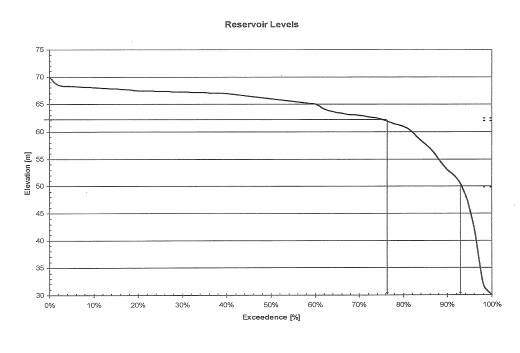
98 In contrast, at this time the objectives of the DPI were more rigorous and included the following:
(a) the fishway should operate down to a minimum headwater (dead storage level or minimum off-take level whichever was lower) and up to a 1 in 50 year flood or drown out;
(b) the fishway should be designed to be operational all year round and during all releases from the impoundment;
(c) the fishway should cater for the whole fish community at each site in terms of size classes, swimming abilities and biomass. This includes all life stages of the fish species at each site;
(d) the fishway should provide upstream and downstream passage all year round for the whole fish communities.
99 Such was the position encountered by Dr Mallen-Cooper at the time when he became engaged in May 2003 in the process that culminated in the selection and then construction of the fishway one sees at the dam today. He stated, and I accept, that he approached the task of advising as to an appropriate fishway independently and notwithstanding SunWater’s then existing concept design.
100 In 2003 the dam project was at a competitive tender stage. The design of the fishway evolved in the course of a series of workshops in which those tendering and the DPI participated. These continued after October 2003 when the group advised by Dr Mallen-Cooper, a group of companies known as the “Burnett Dam Alliance” (BDA), was announced as the successful tenderer. The workshops were concluded by July 2004. Thereafter, there was further correspondence between the DPI and the BDA concerning the fishway, especially in relation to a suggestion by the DPI for the lowering of the operating range of the downstream device to EL 52.
101 In the result, in mid-October 2004, the DPI accepted in writing the operating range for the downstream device as designed by the BDA (DPI letter of 14 October 2004 – Ex GWN-65 to the affidavit of Mr G W Newton). In this same correspondence the DPI accepted the upstream device as designed. The designed operating range for this device had not provoked suggestions for change by the DPI in the same way as had the downstream device. That was because, unlike the downstream device, as designed, the upstream device operated over the whole range of headwaters at the dam. The upstream and downstream devices were thereafter built to these designs with the operating ranges as described above.
is the fishway “suitable for the lungfish”?
102 It is now necessary to describe in some detail certain characteristics of the lungfish.
103 On this subject and apart from the evidence of Dr Mallen-Cooper, I had the singular advantage of hearing evidence in relation to the lungfish from Dr P K Kind.
104 Dr Kind is a fisheries scientist. He is the Principal Scientist, Freshwater Fisheries within the DPI. Dr Kind undertook undergraduate study in science (zoology) at the University of Queensland which led to his being admitted to the degree of Bachelor of Science with First Class Honours. His undergraduate honours thesis was entitled, “Respiratory physiology of the Queensland lungfish Neoceratodus forsteri – responses to hypoxia”. He pursued post-graduate study at that university in relation to the lungfish. These studies led in 2003 to his being awarded the degree of Doctor of Philosophy (Zoology) by that university. His doctoral thesis, which formed an annexure to a report from him received in evidence, was entitled “Movement patterns and habitat utilisation in the Queensland lungfish Neoceratodus forsteri”.
105 Apart from his academic studies, Dr Kind has a wealth of applied knowledge and experience in freshwater fisheries management and the development of new techniques for studying fish passage through dams and weirs gained during more than a decade of service in various positions within the DPI. His work during this time has included co-authorship (with Mr Brooks) of a report entitled, “Ecology and demography of the Queensland lungfish Neoceratodus forsteri in the Burnett River Qld”. He has taken a lead role within the DPI in developing a survival strategy and recovery plan for the lungfish. He has much field experience monitoring and studying the lungfish.
106 Dr Kind was very well placed to give evidence on the suitability of the fishway at the Paradise Dam for the lungfish. I have no hesitation in accepting his evidence, which I thought was candid, careful and independent. As to the latter, though he is an employee of the State of Queensland, I have no doubt that his evidence was not influenced by whatever burden or benefit it might offer Burnett Water, as opposed to being the genuinely held views of a man who has devoted a good portion of his adult life to our better understanding, and the continued survival, of the lungfish.
107 Though he had not read Dr Kind’s thesis at the time of his consultancy to the BDA, Dr Mallen-Cooper was then familiar with Dr Kind’s general work and findings about the lungfish. He has since read Dr Kind’s thesis. In giving his evidence as to the suitability of the fishway, Dr Mallen-Cooper took account of Dr Kind’s work but expressed his own views. He was well qualified so to do. As it happens, there is no material difference between these two learned gentlemen on the subject of the suitability of the fishway for the lungfish.
108 Of all of the evidence which I received concerning whether the fishway was suitable for the lungfish, I have given that of Dr Mallen-Cooper and Dr Kind the most weight. That is because each of these gentlemen was, by reason of both qualification and experience, better placed than others to express an opinion on this subject.
109 The following findings concerning the lungfish and the suitability of the fishway for the lungfish are based on my acceptance of the evidence they respectively gave on these subjects. Some of them also draw upon points of agreement as between Dr Kind and a Mr J Tait (of whom more below) as recorded in a document which became Exhibit 82. In acting on these points of agreement I do so insofar as they record opinions of Dr Kind with which, as it happens, Mr Tait agrees, not because I regard Mr Tait as a person of commensurate expertise to Dr Kind.
110 Fish move within river systems in order to undertake migration as part of their life cycle or as a mechanism for dispersal of the population through available habitats within the river system. Migrations where species require unimpeded fish passage in order to complete their life cycle are often called “obligate” and are classified as:
(a) Potamodromous – that is, fish that migrate wholly within fresh water; and
(b) Diadromous – that is, fish that migrate between freshwater and the sea.
Examples of Diadromous fish are striped mullet, Australian bass, barramundi, and eels. Examples of Potamodromous fish are Australian smelt and Hyrtis tandan. The lungfish is also classed as a Potamodromous fish.
111 The category of “Potamodromous” traditionally refers to an obligatory migration but there is also a spectrum of obligate and facultative movement both between and within fish species. The spectrum includes:
(a) At one end, the “Potamodromous” species that have separate feeding, spawning or refuge habitats and have active seasonal migrations by the bulk of the population between these habitats.
(b) At the other end, are fish that don’t move to spawn, or move between feeding or refuge habitats; essentially the bulk of the adult population moves very little with no specific migrations. There are, however, almost always, small numbers of individuals of the population that move, sometimes great distances. Immature fish also often disperse from adult spawning areas in these populations. These are important movements for gene flow and recolonisation (e.g. after droughts) and maintaining movements of these fish is an important ecological objective. Lungfish fall into this other end of the spectrum, with no major seasonal migration of the bulk of the population but with some individuals moving significant distances and the dispersal of immature fish.
(c) Within this spectrum of migration and movement are one-off refuge-seeking migrations where the majority of the population might move (e.g. in an extreme drought) or,
(d) There can be density-dependent movements. In a dense population there are greater emigration rates because there is more competition.
Such is the range of this spectrum that, in the management of freshwater fish, definitions of ‘migratory’ and ‘non-migratory’ are used less and less, and ecological objectives for whole populations are used more and more.
112 The lungfish is a long lived and generally slow growing species. In the wild they may live more than 50 years. They have a life history characterised by the longevity of adults and low adult mortality levels. These characteristics give the lungfish a resilience which counters sporadic and inconsistent recruitment success. The latter may even be normal in the lungfish as a species. Put another way, because of the adult longevity a loss of a spawning opportunity for one reason or another in a particular annual season does not present the same potentially adverse impact for species propagation as it would for a fish species whose adult reproductive life is much shorter.
113 Lungfish predominantly spawn in shallow pools and glides. Their main spawning season each year is August to December but may start as early as July and extend as late as January in the following year.
114 The major movement of lungfish in low flows in the Burnett River is upstream and the main movement downstream is when there are significant flows in the order of more than 1000 ML per day (Report of Brooks and Kind, “Ecology and Demography of the Queensland Lungfish in the Burnett River Queensland”, exhibit “MMC-5”, at page 108). Movements occur following the peak of moderate flow events. The ramification of this is that the downstream operating range of the fishway should include those periods when there are significant inflows which are likely to occur at higher headwater levels, as well as periods following the peak of moderate flow events. The operating range of the downstream fish transfer advice meets these requirements.
115 Lungfish movement is generally localised with low numbers of individuals moving long distances. Most lungfish in the Burnett River and its catchments (and the Mary River for that matter) occupy discrete, “home range” sections of the river. Here they spend the majority of their time. Movements by lungfish outside these sections are rare but do, exceptionally, occur. The reasons for these exceptional, longer movements are not presently known but are most likely to be related to foraging, breeding or dispersal. Insofar as this exceptional movement relates to breeding, a reason for this is probably that suitable spawning habitat is not available within the normal home range of that lungfish. Findings (which I accept and adopt) made by Dr Kind in the course of his postgraduate research and summarised by him by graphical representations in his doctorial thesis bear this out:
(a) Figure 3.17 at page 86 shows that of 113 radio tagged lungfish, the majority of them moved only plus or minus 5 kilometres from the tag site. There was the odd one, however, which moved 15 kilometres downstream and 26 kilometres upstream. It is instructive to compare this finding about lungfish movement patterns with the patterns of other freshwater fish species. Dr Mallen-Cooper opined and I find that if, for example, this graph related to Australian bass or striped mullet, the entire bar graph would be situated to the right or left because they, without question, have obligate migrations to spawn. Lungfish, in general, do not.
(b) Figure 3.18 on page 89 is a comparison of the movement of lungfish in flowing water as opposed to impoundments (dams and weirs). That graph shows that: i) in the case of flowing water, no lungfish moved more than 5 kilometres from the tag site and ii) in impoundments the majority of lungfish also did not move more than 5 kilometres while low numbers of lungfish that are looking for suitable spawning habitat will move longer distances downstream or upstream.
(c) Figure 3.20 on page 91 graphs juvenile lungfish movement. The evidence there summarised and represented indicates that, of 44 juvenile lungfish, only one moved more than 3 kilometres from the tag site with the exception not moving more than 5 kilometres upstream. These results for juvenile lungfish mirror the results of movement for adult lungfish in the radio telemetry studies.
116 Even accepting that this localised movement is a general feature of the species, lungfish in impoundments do make significantly longer movements than those in unimpounded, riverine reaches. Some of these movements can be attributed to individuals seeking out alternative suitable spawning grounds. Impoundment by its very intent will inundate areas where hitherto there were shallow pools and glides.
117 There is evidence in the form of habitat preferences of spawning lungfish that impoundment reduces the quality and availability of lungfish spawning habitat. About half of the total core lungfish habitat in the Burnett River has been subject to impoundment by water infrastructure. That proportion applies to habitat in the reach of the Burnett River which is subject to impoundment by the Paradise Dam.
118 Noteworthy though they are, this evidence of some longer movement and habitat reduction must be seen in context.
119 The fishway at the Paradise Dam affects only a small proportion of lungfish in the Burnett River and even less across the distribution of the species as a whole. In the Burnett River alone, the total lungfish population, based on extrapolation from the recapture percentile of tagged lungfish, is in excess of 100,000. While it is undeniable that the fishway does reduce opportunities for lungfish to access spawning habitat downstream of Paradise Dam to some extent, with its downstream device entry level at EL62 there are nonetheless opportunities for lungfish to move through the fishway during most years. Further, lungfish that were unable in some years to move through the downstream device in the fishway because of low water levels could still potentially access alternative spawning sites upstream of the Paradise Dam impoundment, up to the wall of Claude Wharton Weir. That weir is situated on the Burnett River at AMTD 202 km, some 70 km upstream from the Paradise Dam. Until March 2008 when a fishway was retro-fitted to the Claude Wharton Weir, the wall of that weir would have prevented access by lungfish to any potential spawning sites yet further upstream.
120 Context is also given by an understanding of the pre-development position.
121 Via what is known as Integrated Quality and Quantity Modelling (IQQM) using historical flow data and other information it is possible to derive a hydrological model of the Burnett River catchment in various pre and post water infrastructure development scenarios.
122 On the basis of IQQM flow modelling for the Burnett River, even under pre-development conditions, it is unlikely that suitable lungfish spawning would have been available in the river each and every year. On the basis of such modelling Dr Kind opined (and I find) that suitable spawning habitat may have only been available in approximately 73% of years, largely because of major flow events. A major flow event (>8 metres) scours macrophytes in the river to the extent where suitable spawning habitat would not be available to the lungfish for the following season.
123 Such major flood events aside, even before the creation of what are now seven man made barriers on the Burnett River, of which the Paradise Dam is but one, there were periods when low water levels in the river would have prevented the passage of lungfish past the site where the Paradise Dam is now located. Such periods would not have occurred more than 5% of the time.
124 The placing of the entrance to the downstream device at EL 62 does represent a break with the past. So too, in their own way, progressively, did each of the other impoundments on the river. With an entry level at EL 62 the Paradise Dam offers downstream passage about 80% (more likely about 76%) of the time. That figure is based on modelling conducted by, inter alia, Ms Fernando, an engineer with specialist expertise in hydrological modelling, who gave reliable evidence in the trial. When the dam is at or above EL 62 the likelihood is that releases of 14 ML per day for about 97% of the time.
125 Even taking the EL 62 limitation into account, it is the considered opinion of each of Dr Kind and Dr Mallen-Cooper that the fishway is suitable for the lungfish. Their opinion is, and I find, that the fishway does not need to be operable at all times to be suitable for lungfish. In expressing those opinions, each assumed the fishway would operate as designed subject to initial commissioning and maintenance. Dr Mallen-Cooper opined that commissioning of the upstream device in particular might take between 12 and 24 months after the completion of the dam.
126 As designed, the fishway still provides considerable opportunities for lungfish to move past and access habitat downstream. In these circumstances, the existence of the Paradise Dam with this fishway is not likely to result in serious or irreversible harm to lungfish populations in the Burnett River or across the distribution of the species.
127 The weight of other evidence does not contradict such a conclusion but rather does much to support it.
128 Dr I Stuart is a freshwater fisheries biologist. He too, has much expertise and experience in the design and assessment of fishways. His doctoral thesis was titled, “Fishways in eastern Australia: assessment of effects on native fish and an introduced fish species”. I also note that, in the course of his career, he has, inter alia, co-authored with Dr Mallen-Cooper, publications in relation to fish passage. He regards Dr Mallen-Cooper as, “the foremost fish passage and fishway expert in Australia”. That accolade underscored for me the weight I ought to give to Dr Mallen-Cooper’s opinions. To observe that in no way detracts from Dr Stuart’s eminence in his own right.
129 Dr Stuart was called by the Conservation Council. Given his relevant qualification and experience, I found it surprising that he was not asked by the Council to express an opinion as to the suitability of the fishway as a whole or either of its component fish transfer devices. What Dr Stuart did say in evidence in relation to the fishway was that, even if neither of the devices had been operating from 2005 until trial, the impact of that on large bodied fish such as the lungfish would not be great because they are resilient and can migrate later. The lungfish may not breed every year but this is matched by a long life span. Thus, he opined that, even where a river had naturally had no connectivity for about 5 years, the impact on the species would not be great.
130 In 1999, prior to the completion of his doctoral studies, Dr Stuart co-authored with Mr Berghuis of the DPI a report entitled “Passage of native fish in a modified vertical slot fishway in the Burnett River barrage, South-eastern Queensland”. This report formed part of the evidence in the case.
131 The Burnett River barrage is located near Bundaberg, far downstream from the site of the Paradise Dam. The purpose of the barrage is to act as a separator between fresh (river) and salt (estuarine) water. As already noted, the lungfish is a Potamodromous (wholly freshwater) fish. This 1999 report concerned the behaviour of lungfish in the marginal freshwater of the estuary attempting to move upstream to freshwater reaches of the river. Quite understandably, I thought, Dr Stuart stated that such lungfish “are trying to move for very, very different reasons than fish further upstream”. Accordingly, behaviours described in that report are not of assistance in relation to lungfish behaviour in the freshwater reaches of the river upstream from the barrage.
132 A decade later Dr Stuart conducted what one might describe as a “desktop review” of the monitoring programme in place at the dam as a result of other approval conditions. It will be necessary to make reference to observations made in the course of that monitoring shortly. The present relevance of Dr Stuart’s review lies in his complimenting the standard of that monitoring. While that adds to the confidence I have in acting on the monitoring observations, the review is not otherwise relevant. The review was but one sequel to exchanges between the Minister’s department and Burnett Water in relation to compliance with the conditions of the approval under the EPBC Act. I am not engaged in a general audit of that compliance.
133 Another person with extensive experience of lungfish and fishways who was called by the Conservation Council was Mr C Broadfoot. He has been engaged in the monitoring programme which has been in place since the completion of the Paradise Dam and the fishway. The reports in respect of that monitoring were in evidence. What was not in evidence, because yet again the Council chose not to seek the same from a person with relevant expertise called by it, was whether there was anything in his monitoring observations which might lead him to believe that the fishway was not suitable for the lungfish species. What he did do was to confirm the species characteristic of sedentary, localised home range behaviour. He put the percentage of the lungfish population which undertook longer range movements as less than 5%.
134 Mr A Berghuis was another fish biologist called by the Conservation Council. He, too, has expertise in relation to fishways. He is employed within the DPI. In that capacity, he took part in the workshops which preceded his department’s final approval of the fishway as found today. He has also been involved with Mr Broadfoot in the monitoring of the fishway.
135 Unlike others called by the Conservation Council, I did have the benefit of his opinion, which he was certainly qualified to furnish, on the suitability of the fishway for the lungfish. He considered that the upstream device was suitable.
136 As to the downstream device, my strong impression was that his ideal was a device which would permit a fish to move downstream any time or at least operated when there was natural flow into the river. He said as much in evidence. I am quite sure that this was his sincere view. Equally sincerely, he did believe that the design of the downstream device was suitable for the species. For him to change that belief would require more than the experience of the few years which followed the completion of the dam but rather observation of how well it performed over the longer term. Mr Berghuis was well aware that the Paradise Dam had taken about 3 years to reach the entry level of the downstream device but this awareness was tempered by his knowledge that fluctuating headwater levels were always going to be an operational feature of the dam.
137 Another with apparently relevant expertise who participated in the workshops and who might have been called (and whom the Council at one stage proposed to call) but was not was Mr Berghuis’ superior in the DPI, Dr P Jackson. It is evident that, in the course of the workshop process, he was concerned to receive a cost benefit analysis of alternatives under consideration. It is likewise evident that such an analysis was undertaken and then discussed at a workshop. I have already referred to the end result of the process so far as Dr Jackson’s department was concerned. I have no evidence that thereafter, Dr Jackson held a different, personal view in relation to the fishway. The onus of proving a contravention always remained with the Conservation Council. Dr Jackson’s absence is, at best, neutral in terms of determining whether it has done so. I make nothing more of that absence than that.
138 That there were differing schools of thought as to what fishway to install at what is now known as the Paradise Dam will already be evident from the reference which I have made to the evidence of Dr Mallen-Cooper. Even before the workshops, there was an initial proposal to have but one passage with both upstream and downstream movement of fish. To read, as I have, evidence of the discussions at the workshops is also to appreciate the existence of differing schools of thought. The relative merits of a downstream device with an entry at EL 50 or even lower, as compared with an entry at EL 62, were debated and assessed. A distance of 12 metres does not seem very far when considered in abstract but, on the evidence before me, when translated to a vertical distance requiring gating involves a much more considerable engineering feat and a structure much taller than that which one sees today on the downstream device at the dam. In the course of workshop discussions an additional construction cost of $125,000 was suggested but the unchallenged engineering evidence before me (from Mr Murray) was that the actual cost of attempting the same even during the construction phase would probably have been much higher than this.
139 It bears repeating that this case is not about whether there were other or even more suitable fishways which might have been employed, but rather whether the fishway, downstream and upstream which was in fact employed has been proved by the Conservation Council not to be suitable for the lungfish. This it has failed to do.
140 It does not detract from this conclusion that, on the evidence, the fishway at the dam exemplifies a cost/benefit compromise. It is none the worse for that. It is pellucidly clear on the evidence that suitability for all of the fish species in the Burnett River, including the lungfish, was a factor that underpinned the design of the fishway adopted and of alternatives considered.
141 I drew attention at the outset of these reasons for judgment to the first two objects of the EPBC Act. There is no necessary antipathy between such a compromise and “ecologically sustainable development through the conservation and ecologically sustainable use of natural resources”. Indeed, in many cases it may well be a feature of the meeting of this statutory object. On its face, the intent of the approval of the construction and operation of the Paradise Dam, subject to conditions including, materially, condition 3, was to conform to this object. In employing in condition 3 what I have described as a “directive control” type of condition the Minister left room for the making of a value judgement which might well entail a cost/benefit compromise, but a judgement the end result of which would fall for objective measurement.
142 Such measurement as has occurred to date does not, viewed objectively, support a conclusion that the fishway is not suitable for the lungfish.
143 Monitoring of the fishway is undertaken by the DPI pursuant to a contract with Burnett Water. Even though each of these bodies is an emanation of the State of Queensland, there is nothing on the evidence which persuades me that Burnett Water and the DPI have ever, including most recently in relation to the monitoring programme, dealt other than at arm’s length with each other. To the contrary, my distinct impression, formed from a review of the affidavit and other documentary evidence authored by DPI officers and from observing those DPI officers who gave oral evidence was that the DPI had adopted a thoroughly professional attitude to the fisheries management, advisory and monitoring tasks consigned to that department. The DPI is not to be regarded as a handmaiden of Burnett Water.
144 It is obvious from the monitoring reports that the DPI plays close attention to operational issues concerning the upstream and downstream transfer devices and of associated radio telemetry devices which are used for the tracking of fish movement. Quarterly reporting is undertaken with these results consolidated into an annual report. For example, the June 2009 Quarterly Monitoring Report (the most recent in the Agreed Bundle) discloses a concern about the flow of water from the downstream fishway competing with the attraction water for the upstream fishway during times of simultaneous operation. This concern is of a general nature, not confined to the passage of lungfish. It was not suggested that I should make anything of this so far as suitability was concerned. Mr Maughan deposed (and I accept) that, as a result of the testing and monitoring by the DPI of fish movement through the fishway he has adjusted attraction flow rates, hopper positions and gate openings in accordance with the advice provided by the DPI to improve operations and ensure that the fishway simulates river conditions in both directions of the dam’s wall. I have no reason to doubt, based on this evidence, that Burnett Water will do other than react responsibly to the concern which I have mentioned was identified in the June 2009 report.
145 Mr Maughan described in detail in his affidavit the operations of the fishway between November 2005 and the date of his affidavit (31 July 2009). I do not find it necessary for the purpose of determining this case to descend to that level of detail. I do though accept the accuracy of Mr Maughan’s account.
146 Mr Maughan divides his description of the operations of the upstream fish transfer device between what he describes as a “Start Up/Testing Period” (November 2005 – July 2007) and the period thereafter, which he describes as “Normal Operations”. Each of these is a fair description.
147 The “Start up/Testing Period” coincides with that which Dr Mallen-Cooper would expect for a fishway of this complexity. It is obvious from Mr Maughan’s detailed description that a number of commissioning issues arose and were resolved during this period. Resolution did entail periods when it was not possible to operate the upstream device. Such events were only to be expected. It would be an unreasonable construction of condition 3 to regard them either individually or collectively as contraventions of that condition. Further, having regard to the authoritative evidence of Dr Mallen-Cooper and Dr Kind, these non-operational periods did not render the device unsuitable for the lungfish. The importance of a long term perspective cannot be over-emphasised. An observer of the upstream device over the “Start up/Testing Period” may well have formed the view that there appeared to be significant lengths of time when it was not operating. To extrapolate that into a threat to the species is though, on the evidence, neither to understand the species nor the challenge of commissioning complex and nationally unique machinery.
148 One issue which arose during the “Start up/Testing Period” was probably not expected and referable to a then prevailing very low reservoir level – EL 49 in about August 2006. At this level a basalt rock pimple was exposed. This occurred at a time when the BDA still had responsibility for defects rectification. That gave rise to a concern on the part of the BDA’s Project Manager, Mr C Thamm, that the fish hopper might be damaged by hitting that pimple or unknown obstacles below the water level such as rocks or debris. It is to be remembered that the hopper must be lowered by the crane into the headwater in order to release its load. The greater the drop from the dam wall to the reservoir level, the more the hopper might move due to increased effects of wind. As between the BDA and Burnett Water it took about a year to resolve this concern. Once again, periods when the upstream device did not operate because of this concern are referable to what is, relatively, a short term phenomenon. The evidence is that, most of the time, the reservoir level will be above EL 62 and certainly well above the EL 49 level. Further, in the resolution of the concern identified by the BDA, Sunwater’s Regional Manager (Mr D Green) came to issue (in August 2007) a direction that the upstream device was to be operated when:
(a) the dam storage level was between EL 44.4 and EL 66.6; and
(b) adequate releases were being made from the dam that allowed fishlift operation (which may be less than that specified in the governing resource operations plan (ROP)).
This direction entails a level of risk assumption by Burnett Water’s parent in relation to the operation of the upstream device in the event that the reservoir level were again to fall to such a low level. Its minimum level coincides with the lowest headwater operating range of the upstream device. Viewed in the context not only of the likely predominant headwater levels over the long term at the dam but also of resolving a problem quite literally first exposed by an unusually low headwater level, the associated periods of non-operation of the upstream device did not constitute a breach of condition 3. Also in this case, such periods of non-operation did not, taking the long term view, render the upstream device unsuitable for the lungfish. Taking the long term view, water level conditions over the life of the approval will more likely than not be such that the upstream device will operate for the proportion of the time Dr Mallen-Cooper and Dr Kind consider will be suitable for the lungfish.
149 From around late 2007, the upstream device has generally operated on a 24 hour cycle when releases are required under the governing ROP, subject to downtime for maintenance events, fault issues and the like.
150 As soon as the storage level in the dam reached EL 62 the downstream device operated as designed. Thereafter, no significant problems have been experienced with its operation. It is a much simpler device than the upstream device. It does not have as many moving components or sensors. Apart from Burnett Water’s own monitoring, any issues concerning the operation and improvement of this and the upstream device are subject to regular, independent monitoring by the DPI.
151 Apart from the monitoring of the fishway itself, the DPI is also engaged in the monitoring of the lungfish as required by condition 6 of the approval. A ten-year (2006 – 2016) is presently in place. Tagging and the use of radio telemetry form part of that programme. Dr Kind and another DPI officer, Mr Brooks, are responsible for this monitoring programme. In my respectful opinion, that monitoring programme is in good hands. Dr Kind summarised the position with respect to that monitoring programme as at the end of the two year mark (the years 2006 and 2007) thus:
Our findings … were that the population structure of the lungfish was similar to previous surveys carried out prior to construction and filling of the dam with comparable length, frequency, relationships and sex ratio. We found an unusually high egg mortality rate during 2007 which, in my view, was most likely attributable to the ongoing drought conditions which contributed to the deterioration in the quality of spawning habitat.
As with other observations and opinions furnished by Dr Kind, I have no hesitation in accepting them. So doing offers no support for a conclusion that the fishway is not suitable for the lungfish. The “before and after” structure of the lungfish population was similar. It is ongoing drought, not the effects of the dam, which is affecting egg mortality.
152 It was put on behalf of the Conservation Council that lungfish are relatively slow going and that adverse impacts to the species by reason of the dam with the fishway as designed and operated may not be apparent in the short term from the monitoring which has occurred. This theory is not supported by the evidence of Dr Kind or Dr Mallen-Cooper, each of whom regard the fishway as suitable.
153 Some further reference should be made to the ROP. Condition 4 to the approval makes reference to and requires compliance with a number of State instruments. One of these is the Resource Operation Plan (Burnett Basin) 2003 (the 2003 ROP).
154 A number of points should be made about these State instruments. Condition 3 does not, in terms, require compliance with any of them. Yet, for example, the nature of the upstream device is that some release of water is necessary for fish attraction. The conditions of the approval were, as I have observed, presumably intended to operate harmoniously. It does not necessarily follow that flows sufficient to comply with an ROP, and to this extent, condition 4 will be sufficient to make the upstream device “suitable for the lungfish”. However, the ROP was prepared to meet the objectives of another of the State instruments referred to in condition 4, the Water Resource Plan (Burnett Basin) 2000 (Qld), and these objectives included maintenance of habitat for the lungfish (Ex DRC 3 to Mr Charles’ affidavit, p 3).
155 Though condition 4 refers to the 2003 ROP it is to that ROP as a whole to which regard must be had and that ROP makes provision for its amendment. Burnett Water submitted, and I accept, that this lends an ambulatory quality to the reference. The reference to the 2003 ROP is to be read as that ROP is amended from time to time. That is not without relevance in this case because, in the period following the initial making of the 2003 ROP it was amended so as to include, in para 2.8.4, rules for the operation of the fishway. These rules require the fishway to be operated when the headwater level is between EL 62 and EL 67.9 and releases or overflows of greater than 14 megalitres per day are being made from the dam. Releases at other times so as to operate the fishway may also occur when Burnett Water is permitted by the ROP to make releases. It was apparent from Mr Maughan’s evidence that, before the amendment of the 2003 ROP, there was some uncertainty as to the requirements of the ROP in relation to releases. That uncertainty has been resolved. The position now is that, subject to maintenance requirements, the upstream fishway operates on a 24 hour cycle when releases permit. Further, preferential treatment is given to the fishway in relation to water releases.
156 Dr Mallen-Cooper and Dr Kind do not suggest that the upstream device must be in continuous operation or even 95% of the time operation in order to be “suitable for the lungfish”. In this regard it is important to recall that the views of Dr Kind are of a man who has a particular involvement in and responsibility for recovery planning in respect of the lungfish. The Conservation Council has not proved that it must be so operated to achieve this end. There is no reverse onus of proof in this case. As it happens, the weight of the expert evidence, insofar as either party sought to elicit the same, leads to a conclusion that it is more likely than not that the fishway is suitable.
157 The Conservation Council’s adoption of an at least 95% operational requirement for the fishway drew upon a pre-development connectivity figure for the Burnett River derived by Mr Burgess using IQQM modelling. It is important to note that pre-development means before any impoundments or water infrastructure came to be erected on that river. Mr Burgess was a mathematician and statistician who certainly had the expertise to utilise IQQM modelling to derive outcomes. What he did not have was the expertise in fish biology, particularly in respect of the lungfish, or in fishway design so as to interpret the ramifications of those outcomes in terms of whether the fishway was suitable for the lungfish. For those who did have expertise, knowledge that there had never been continuous connectivity in the Burnett River and yet the lungfish had survived there for millions of years was a marker of the resilience of that species. Mr Winders, an engineer with experience in hydrology, seemingly drew upon the 95% pre-development connectivity figure derived by Mr Burgess but not to the end of expressing an opinion, for example, about the feasibility and cost of lowering the entrance to the downstream device to EL 50. He had no expertise in fish biology or fishway design. The evidence of Messrs Burgess and Winders did not advance the Conservation Council’s case.
158 Mr Burgess’ modelling outcomes did highlight the possibility of occasional over-topping events at the dam. Just how this rendered the fishway unsuitable for the lungfish was not though supported by expert evidence. Dr Kind did comment upon lungfish movement in such circumstances. He opined that in circumstances where the dam filled to the point of over-topping it was likely that lungfish would move over the dam wall regardless of the operation of the downstream device. His further opinion was that it was not possible to say whether an operating downstream device would reduce the risk of that spillway passage. His further opinion was that there was insufficient evidence (even taking into account a 2008 monitoring report of Mr Broadfoot) to conclude that lungfish would accumulate against the dam wall should there be an over-topping event. Nothing in this proved that the downstream device was not suitable for the lungfish.
159 Much reliance, in relation to the question of fishway suitability, was placed by the Conservation Council on the evidence of Mr Tait. For reasons which I gave in the course of the trial, I ruled that a report prepared by him, in the form sought to be tendered, was not admissible: Wide Bay Conservation Council Inc v Burnett Water Pty Ltd (No 5) [2009] FCA 1320. Mr Tait also gave oral evidence.
160 Mr Tait has expertise in fish biology and in environmental planning. His expertise in fish biology is not specific to the lungfish. He has, through a family connection with the Burnett River, had occasion to view that species in that environment but he has not undertaken field work or species specific research in relation to the lungfish. His knowledge and experience of the species was far inferior to that of Dr Kind and, for that matter, even to that of other DPI officers who gave evidence. The same applies in relation to theoretical and applied knowledge and experience in relation to fishways. Whatever knowledge and experience he had in this field was far inferior to that of Dr Mallen-Cooper and Dr Stuart.
161 I thought that a telling indication of his inadequacy of knowledge in relation to the lungfish, as well as his reliability generally, was his choice of source for a view that there were but a few thousand lungfish in the Burnett River. It emerged that the source was nothing more than a media report. If that report had any foundation in scientific data Mr Tait did not seek it. Rather, he seems to have accepted it at face value. That approach is in marked contrast to that of Dr Kind, whose population estimate is based on extrapolations from field research and a deep understanding of the species. That Mr Tait’s selection of such a population figure may not have been just a product of relative ignorance or an absence of scientific rigour was highlighted by views he expressed not in court but rather in a “blog”. He acknowledged in cross-examination that, in the blog he had expressed the view that the lungfish had proven itself to be a resilient and adaptable species and that it was something of a sidetrack to consider it, as opposed to what he regarded as really threatened species. Absent this evidence, I may have been inclined just to dismiss references which were proved to have been made by him in exchanges with the Council’s solicitors to “our case” and to “building a picture of threats to lungfish in the catchment” just as infelicity of language. Considered though in the context of the comments which he made in the blog, I was not in the end satisfied that Mr Tait had brought to the task of giving expert evidence the degree of dispassionate detachment that the Court expects from those called to give expert evidence. Thus, apart from relative weight, I am not in any event inclined to place any reliance on Mr Tait’s opinions where these are uncorroborated.
162 The only reference by the Conservation Council in its written closing submission to what remained of Mr Tait’s evidence after the exclusion of his report was inferential in the references to the joint experts’ report prepared by him and Dr Kind. The weight to give to the views expressed there though derived from Dr Kind, not Mr Tait.
163 Reference was made in the course of submissions to the “precautionary principle”. For the purposes of the making of certain Ministerial decisions, the EPBC Act, s 361(2) defines that principle thus, “The precautionary principle is that lack of full scientific certainty should not be used as a reason for postponing a measure to prevent degradation of the environment where there are threats of serious or irreversible environmental damage”. To the extent that it is possible so to do consistently with other provisions of that Act, s 361(1) obliges the Minister to take that principle, as defined, into account when making those decisions which are listed in a table under s 361(3). The approval of an action under s 133 of the EPBC Act is one such decision. The decision to grant Burnett Water an approval, subject to conditions, in respect of the construction and operation of the Paradise Dam was subject to this requirement. There is no issue in this proceeding that this requirement was not observed.
164 The condition precedent to the question of whether to grant injunctive relief is proof of a contravention. The “precautionary principle”, as defined, has no role to play in deciding whether or not a contravention has been proved.
165 Neither does this statutory requirement does not attend a decision as to whether or not, as a matter of discretion, to grant an injunction in the exercise of the power conferred on the court by s 475 of the EPBC Act. Were a contravention proved, the exercise of the discretion would necessarily be informed not only by the circumstances of the particular contravention as proved but also by the subject matter, scope and purpose of the EPBC Act and, in a case such as this of the approval as conditioned. Other discretionary factors might also intrude, for example in terms of the time for or manner of remedial compliance. Were a contravention proved, another factor which it may well be relevant to take into account in deciding whether to grant injunctive relief would be a need to order the taking of remedial action as a precaution even though there was not scientific certainty as to the position if such relief were not granted. In that sense, a factor akin to the “precautionary principle” as defined in the EPBC Act may become relevant in the circumstances of a particular case.
166 Here, the Conservation Council, for the reasons given above, has not proved the contravention pleaded. Its case was characterised by a want of persuasive expert evidence directed to the pleaded and particularised contravention and also by a related failure to appreciate that it was necessary to view in context the occasions when the fishway had not been not operating. Further, for the reasons given, its view as to the meaning of condition 3 to the approval is, with respect, mistaken.
167 For completeness, I should add the following. Even if, contrary to the conclusion which I have reached, the Conservation Council ought to be regarded as having proved the pleaded contravention, if only on the particularised basis that the upstream device did not commence when the dam became operational, I should not, as a matter of discretion grant any injunctive relief. That is because, on the evidence I have preferred and taking the long term view, such periods when that device did not operate after December 2005 were attributable to what may aptly be described as transitory commissioning events. The influence of these events has passed. The weight of the evidence is that, as presently operated, the upstream device is suitable for the lungfish.
168 It follows that the application must be dismissed.
I certify that the preceding one hundred and sixty-eight (168) numbered paragraphs are a true copy of the Reasons for Judgment herein of the Honourable Justice Logan. |
Associate:


