FEDERAL COURT OF AUSTRALIA
Australian Competition and Consumer Commission v TPG Internet Pty Ltd [2010] FCA 1478
IN THE FEDERAL COURT OF AUSTRALIA | |
AUSTRALIAN COMPETITION AND CONSUMER COMMISSION Applicant | |
AND: | TPG INTERNET PTY LTD (ACN 068 383 737) Respondent |
DATE OF ORDER: | |
WHERE MADE: |
THE COURT ORDERS THAT:
1. The application for interlocutory relief be refused.
2. Subject to any further or other directions of the Judge administering the Fast Track List, there be a speedy trial of the application herein.
3. The costs of each party of and incidental to the application for interlocutory relief, including the costs of the hearing on 22 December 2010, be costs in the cause.
Note: Settlement and entry of orders is dealt with in Order 36 of the Federal Court Rules. The text of entered orders can be located using Federal Law Search on the Court’s website.
VICTORIA DISTRICT REGISTRY | |
GENERAL DIVISION | VID 1099 of 2010 |
BETWEEN: | AUSTRALIAN COMPETITION AND CONSUMER COMMISSION Applicant
|
AND: | TPG INTERNET PTY LTD (ACN 068 383 737) Respondent
|
JUDGE: | RYAN J |
DATE: | 23 DECEMBER 2010 |
PLACE: | MELBOURNE |
REASONS FOR JUDGMENT
1 The applicant (the “ACCC”) has instituted these proceedings against the respondent, TPG Internet Pty Ltd (“TPG”) by way of a fast track application seeking;
(a) … orders under sections 76E, 80, 86C and/or 86D of the Trade Practices Act 1974 (Cth) (the Act); and
(b) declaratory relief under section 21 of the Federal Court of Australia Act 1976 (Cth); and
(c) interlocutory relief under section 80(2) of the Act.
in respect of conduct that is alleged to contravene sections 52, 53(e), 53(g) and 53C of the Act by the Respondent (TPG), in relation to the supply in trade or commerce of a broadband internet service.
2 The ACCC also seeks an interlocutory injunction restraining TPG from;
… making a representation with respect to the price payable for the supply of an internet service:
(a) per month;
(b) over the contract term; or
(c) for another period of time,
if that service is only offered at that price on condition that the customer purchase another service or services from TPG (“bundling condition”), without:
(d) prominently disclosing the bundling condition;
(e) stating with equal or greater prominence the total price payable for all services for the relevant period referred to in the representation; and
(f) prominently disclosing any additional up front costs payable.
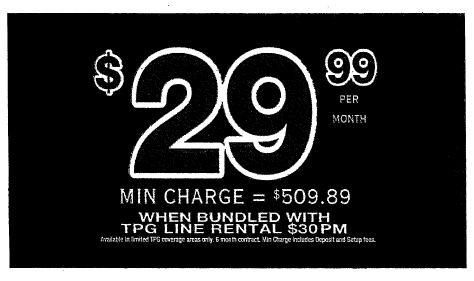
3 The evidence presently before the Court discloses that TPG has, since late September 2010, extensively advertised its provision of broadband internet services which it makes available to subscribers. A particular aspect of TPG’s advertising campaign which has attracted the attention of the ACCC has been that for a particular service plan designated “Unlimited ADSL2+”. TPG’s advertising of that plan, the ACCC contends, creates the misleading or deceptive impression that the service plan is available to a subscriber for a payment of only $29.99 per month. After the ACCC’s concerns had been indicated to Alan Latimer, an officer of TPG, the form of TPG’s newspapers advertisements related to the “Unlimited ADSL2+” plan was changed with effect from about 7 October 2010. Corresponding changes were made at about the same time to an advertisement for the same plan on TPG’s internet webpage and to television and radio commercials which it was causing to be broadcast as part of the same advertising campaign. Mr C M Archibald of Counsel for the ACCC properly accepted that the application for an interlocutory injunction should be determined on the basis that TPG, unless restrained, will continue to advertise the “Unlimited ADSL2+” plan in one or other of the revised forms which it has utilised since about 5 October 2010.
The newspaper advertisements since 5 October 2010
4 At the foot of p 96 of the “Daily Telegraph” newspaper for 11 November 2010 appeared a “banner” advertisement for TPG’s “Unlimited ADSL2+” six month plan which is reproduced as Schedule 1 to these reasons. The small print terms and conditions appended to that advertisement recited;
Min charge includes $20 Home Phone Deposit @ $129.95 Setup. Only available in selected TPG ADSL2+ coverage areas to customers when ADSL2+ and Home Phone Line Rental are purchased as a bundle. All calls charged at TPG’s Home Phone rates displayed on website. Some call types are not supported, including fax, pay TV back to base alarms and similar. Home Phone Deposit of $20 required for all call usage. Deposit automatically topped up if it falls below $5. Service barred if deposit topup payment fails. Broadband early termination and relocation fees apply. Plan fees payable monthly in advance. This offer may be withdrawn at any time. For full terms, conditions and exclusions visit tpg.com.au.
5 On p 16 of the “Age” newspaper for 8 December 2010 appeared a full page advertisement inserted by TPG, almost half of which was devoted to the “Unlimited ADSL2+” plan. That part of the advertisement is reproduced as Schedule 2 to these reasons. The rest of the “Age” advertisement, about which the ACCC makes no complaint, variously described a stand alone “ADSL2+” twelve month plan limited to 200 gigabytes available for $49.99 per month or $659.83 for twelve months and another stand alone “Unlimited ADSL2+” plan available for $59.99 per month and a “min. charge” of $779.83 and two mobile, as distinct from fixed line, services available for $14.99 and $9.99 respectively with a respective total cap value of $700 and $250. At the foot of the “Age” advertisement in much smaller type than any used in the body of the advertisement were set out in detail the terms and conditions applicable to the purchase of one or other of the advertised plans. The terms and conditions referable to the largest part of the advertisement which is Schedule 2 to these reasons recited conditions substantially identical to those reproduced at [4] above.
The radio and television advertisements after 7 October 2010
6 The effect of TPG’s radio advertisements for the “Unlimited ADSL2+” plan which each ran for 30 seconds can be gathered from the following transcript;
TPG gives you unlimited ADSL2+ for only $29.99 a month.
Yep unlimited ADSL2+ for only $29.99 a month.
When you bundle TPG’s home phone line rental for $30 a month.
With TPG’s new unlimited ADSL2+ you never have to worry about download limits again.
tpg.com.au
Total min charges $509.90 available in selected coverage areas.
Visit tpg.com.au for details.
7 The television advertisements from the same date show a series of graphics accompanied by a voice over commendation of the “Unlimited ADSL2+” plan, a transcript of which reads “TPG gives unlimited ADSL2+ for $29.99 a month. Yep, unlimited ADSL2+ for $29.99 a month. TPG is a multi-award winner. tpg.com.au.” The graphics include the TPG logo and three frames which are reproduced as Schedule 3 to these reasons. The second last graphic contains stylised reproductions of medallions and ribbons apparently signifying awards won by TPG and the concluding graphic comprises the TPG logo surmounting the website address “TPG.COM.AU” and the telephone number “13 14 23”. Each commercial runs for 15 seconds.
The contentions of the ACCC
8 Despite the revised versions of the advertisements which TPG commenced to publish on or shortly after 5 October 2010, Mr Zawa, the ACCC’s General Manager, Enforcement Operations, Victoria, contended in a letter dated 22 October 2010 to Mr Latimer of TPG that the advertisements contravened s 53C(1) of the Trade Practices Act 1974 (Cth) (“the TPA”) because the monthly minimum quantifiable consideration for the “Unlimited ADSL2+” is $59.99 being the total of the advertised monthly price of $29.99 for the broadband component and the minimum monthly charge for the TPG telephone service with which the broadband component has to be “bundled”. Section 53C(1) of the TPA provides;
(1) A corporation must not, in trade or commerce, in connection with:
(a) the supply or possible supply of goods or services to a person (the relevant person ); or
(b) the promotion by any means of the supply of goods or services to a person (the relevant person ) or of the use of goods or services by a person (the relevant person );
make a representation with respect to an amount that, if paid, would constitute a part of the consideration for the supply of the goods or services unless the corporation also:
(c) specifies, in a prominent way and as a single figure, the single price for the goods or services; and
(d) if, in relation to goods:
(i) the corporation does not include in the single price a charge that is payable in relation to sending the goods from the supplier to the relevant person; and
(ii) the corporation knows, at the time of the representation, the minimum amount of a charge in relation to sending the goods from the supplier to the relevant person that must be paid by the relevant person;
specifies that minimum amount.
9 In the same letter, Mr Zawa contended;
The amended advertisements also do not address the concerns … about the additional charges payable, being the broadband setup fee of $129.95 and the home phone deposit of $20.00. These charges are either not disclosed or are buried in the fine print or in the “min cost”. In my view, the advertisements contravene ss 52 and 53(e) of the TPA in this respect.
10 Sections 52 and 53 of the TPA provide, so far as is relevant;
52(1) A corporation shall not, in trade or commerce, engage in conduct that is misleading or deceptive or is likely to mislead or deceive.
… …
53 A corporation shall not, in trade or commerce, in connexion with the supply or possible supply of goods or services or in connexion with the promotion by any means of the supply or use of goods or services:
… …
(e) make a false or misleading representation with respect to the price of goods or services;
11 After some further communications between the ACCC and TPG which culminated in a letter from the latter’s solicitors dated 22 October 2010 rejecting the ACCC’s contentions, Mr Zawa wrote to TPG’s solicitors on 26 November 2010 in these terms;
TPG Unlimited ADSL2+ Broadband plan
I refer to the letters sent by the Australian Competition and Consumer Commission (ACCC) to your client TPG dated 4 and 20 October 2010 and to telephone conversations between you and representatives of this office on 29 October and 4 November 2010.
During our conversation on 29 October 2010, we discussed the ACCC’s concerns about your client’s Unlimited ADSL2+ Broadband advertising campaign. It has now been almost one month since you notified us that you would obtain your client’s instructions and respond to us further.
I note that your client is continuing to run advertisements for its Unlimited ADSL2+ Broadband plan. As we discussed on 29 October 2010, this office is of the view that these advertisements contravene sections 52 and/or 53(e) of the Trade Practices Act 1974.
This matter is now being referred to the Commission for consideration. This office will be recommending that the Commission institute proceedings against your client for the abovementioned contraventions.
12 The present proceedings, in the form of a Fast Track Application, were issued on 16 December 2010.
The strength of the ACCC’s case
13 It has recently been made clear by the High Court in Australian Broadcasting Corporation v O’Neill (2006) 227 CLR 57 that, on an application like the present for an interlocutory injunction, a court must conduct two inquiries. The first is into whether, if the evidence remains as it is, it is probable that at trial, the applicant will be held entitled to injunctive relief. The second, is whether the inconvenience or injury which the applicant would be likely to suffer if the injunction were refused outweighs, or is outweighed by, the injury which the respondent would suffer if an interlocutory injunction were granted; see Beecham Group Ltd v Bristol Laboratories Pty Ltd (1968) 118 CLR 618, at 622-3. As Gummow and Hayne JJ pointed out in O’Neill at [65], the two inquiries are not to be conducted with a rigid separation of one from the other. Their Honours there said;
The relevant principles in Australia are those explained in Beecham Group Ltd v Bristol Laboratories Pty Ltd [(1968) 118 CLR 618]. This Court (Kitto, Taylor, Menzies and Owen JJ) said that on such applications the court addresses itself to two main inquiries and continued:
“The first is whether the plaintiff has made out a prima facie case, in the sense that if the evidence remains as it is there is a probability that at the trial of the action the plaintiff will be held entitled to relief ... The second inquiry is ... whether the inconvenience or injury which the plaintiff would be likely to suffer if an injunction were refused outweighs or is outweighed by the injury which the defendant would suffer if an injunction were granted.”
By using the phrase “prima facie case”, their Honours did not mean that the plaintiff must show that it is more probable than not that at trial the plaintiff will succeed; it is sufficient that the plaintiff show a sufficient likelihood of success to justify in the circumstances the preservation of the status quo pending the trial. That this was the sense in which the Court was referring to the notion of a prima facie case is apparent from an observation to that effect made by Kitto J in the course of argument With reference to the first inquiry, the Court continued, in a statement of central importance for this appeal:
“How strong the probability needs to be depends, no doubt, upon the nature of the rights [the plaintiff] asserts and the practical consequences likely to flow from the order he seeks.”
14 I accept that it is necessary in evaluating the tendency of an advertisement to mislead or deceive a reader, viewer or listener, to have regard to the class of consumers likely to be affected by the conduct imputed to the advertiser. Mr Archibald referred to the observations of Gibbs CJ in Parkdale Custombuilt Furniture v Puxu Pty Ltd (1982) 149 CLR 191, at 199, that the relevant class of consumers may include the inexperienced as well as the experienced, and the gullible as well as the astute. For the purposes of the present case, Mr Archibald ventured that the relevant class of consumer is comprised of prospective users of internet services.
15 I also accept that the tendency of an advertisement to mislead or deceive must be evaluated having regard to the complete spectrum represented by the class propounded as likely to be influenced by it. However, as Gibbs CJ went on to point out in the passage from Parkdale v Puxu to which I have already referred, the relevant provisions of the TPA must be;
… regarded as contemplating the effect of the conduct on reasonable members of the class. The heavy burdens which the section creates cannot have been intended to be imposed for the benefit of persons who fail to take reasonable care of their own interests. What is reasonable will of course depend on all the circumstances.
16 In the present case, I consider the inference available from the evidence, mainly constituted by the terms and context of the advertisements themselves, to be that the consumers to whom they are directed would have some familiarity with the market for the provision of broadband internet services to the extent of knowing that ADSL2+ is a product in that market in which products are variously offered for sale “bundled” with other products or on a “stand alone” basis. As I observed in a different context in Specsavers Pty Ltd v The Optical Superstore Pty Ltd [2009] FCA 692, at [9];
It is important in this context to have regard to the nature of the merchandise to which the advertisements are related. The purchase of spectacle frames, with or without lenses, will not ordinarily occur on impulse or more frequently than about once a year. That makes it likely that prospective purchasers will come to The Optical Superstore advertisements with some knowledge of comparative prices in the relevant market or, at least, will have an opportunity to acquaint themselves with those comparative prices or pricing policies. Frequent changes in styles or fashions of spectacle frames also make it unlikely that frames identical to those to which a particular advertisement relates would have been in stock for a significant time before publication of the advertisement.
17 More directly in point are the very recent observations of Nicholas J in Singtel Optus Pty Limited v Vodafone Pty Limited [2010] FCA 1448, at [18]-[19];
18 In my view, there are aspects to the applicant’s case which are by no means straightforward and which raise complex and subtle issues concerning the overall effect of the commercials on the ordinary and reasonable consumer that will need to be explored at a final hearing in the light of all the evidence. One such issue concerns the relationship between what might be called the “main message” and the “fine print” and whether the latter might be thought to undermine the “substance and integrity” of the former: see Australian Competition and Consumer Commission v Boost Tel Pty Limited [2010] FCA 701 at [80] per Siopis J.
19 It also needs to be remembered that ordinary and reasonable consumers, who might be expected to take some care of their own interests, are likely to do more than simply rely upon these particular television commercials in deciding whether or not to sign up to the respondent’s plan. These types of plans typically involve a contractual commitment of a year or more in duration and are invariably the subject of terms and conditions which relate to matters of detail of the kind that the applicant’s complaints focus upon.
18 In the same way, it can be pointed out that any consumer who reaches the point of concluding a contract with TPG for the supply of six months of unlimited ADSL2+ broadband will quickly be disabused of any belief that he or she will obtain that product for $29.99 per month without “bundling” it with a TPG telephone line at a minimum additional or monthly payment of $30 and without paying a minimum fee inclusive of a setup fee and upfront charges of $509 for the whole six months. Mr Archibald sought to meet this point by contending that the vice of the conduct which leads such a consumer to be deceived or misled, however temporarily, is that he or she is “enticed into the marketing web by the advertisement.” That quotation was taken from the reasons of Tamberlin J in Trade Practices Commission v Optus Communications Pty Ltd (1996) 64 FCR 326, where his Honour said, at 340;
I am not persuaded that any or all of the post-broadcast steps leading to signing of the contract would dispel the impression generated by the misleading message in the television broadcast in all or most cases. Once the impression is engendered by the advertisement, an interested viewer would normally be led to make further enquiries of Optus or its representatives. If this occurs, the viewer will probably be led to take those actions as the result of the attractive but misleading publicity set out in the television broadcast. The viewer is enticed into the marketing web by the advertisement: cf the comments of Beaumont J in Tec & Thomas (Australia) Pty Ltd v Matsumiya Computer Co Pty Ltd (1984) 1 FCR 28, at 38.
19 However, this is not a case where a consumer is likely to be drawn by the presumptively misleading conduct into dealings or negotiations with the advertiser which continue after the effect of the conduct has dissipated. Such a case was described by Beaumont J in Tec & Thomas (Australia) Pty Ltd v Matsumiya Computer Co Pty Ltd (1984) 1 FCR 28 where his Honour observed, at 38;
… the name “Seiko” has been a “door opener” in marketing terms, indicates that a potential purchaser of computers may well commence to deal with the respondents in circumstances where he would not have done so if the respondents had made no mention of "Seiko" in its trade or business name and in advertising. In my view, to induce the introduction of such a dealing is conduct which contravenes s. 52, even if, ultimately, the consumer becomes aware that the equipment he is purchasing is not that of the Hattori Seiko group, the deception having occurred at an earlier stage: what is relevantly induced is the dealing or the negotiations, as distinct from the subsequent purchase itself. As Taco's case held, there is no reason why s. 52 cannot apply to the earlier inducement, even if, as Puxu's case held, the conduct in respect of the purchase itself does not offend s. 52 because, by then, the consumer knows or ought to have known that he is purchasing a product other than that of the Hattori Seiko group.
20 In the present case, there is no suggestion that any post-advertisement negotiations will occur between TPG and a prospective purchaser of the “Unlimited ADSL2+” broadband plan. The plan is made available on a “take it or leave it” basis with all its attendant fees and charges and “bundled” obligations.
21 There is also, as Mr Hoyne of Counsel for TPG pointed out, an inconsistency between the ACCC’s contention that the subject advertisements suggest that the ADSL2+ is offered at a “bare” price of $29.99 per month without any other charges or obligations and its argument that the upfront fees and other charges are “buried” in the small print or the “min charge”. In my view, a consumer of the relevant class, reading with reasonable, but not minute, attention an advertisement like that in Schedule 2 to these reasons would readily grasp that a minimum charge of $509 for six months contains fees and charges in addition to the advertised monthly rate of $29.99 which would yield a total charge for the six month plan of only $179.94.
22 I am not persuaded that the ACCC has a strong prospect at trial of proving that any of the revised advertisements contravened s 53C of the TPA. Indeed, a reliance on that section was not pressed by Mr Archibald in the course of his argument in support of an interlocutory injunction. The terms of s 53C(1) are reproduced at [8] above and make it clear, in my view, that it applies to representations about the price of goods or services which do not disclose an additional component such as a delivery charge which additional component increases the actual or net price above that which has been represented. In the present case, both the price of the Unlimited ADSL2+ and the minimum net cost of that service for the six month life of the plan have been disclosed. The only thing left unquantified is the cost of calls made on the TPG telephone line which is included in the “bundle” but is not part of the Unlimited ADSL2+ to which the advertised price of $29.99 is related.
Balance of convenience
23 A considerable body of evidence has been directed by TPG’s General Counsel, Mr Moffatt, in an affidavit affirmed 21 December 2010 to the irrecoverable costs which TPG would incur if it were compelled by an interlocutory injunction to suspend its present advertising campaign. As well, Mr Moffat has pointed out, TPG would be subjected to a delay of the order of at least six weeks in erecting a new series of radio, television, newspaper and other advertisements. Some advertisements such as those on billboards could not readily be removed in response to an injunction of the kind which the ACCC seeks.
24 On the other hand, the inconvenience to the ACCC (and the members of the public whom it can be taken to represent), if an interlocutory injunction be refused is that TPG’s present advertising will continue uncorrected on its contracted course until the hearing and determination of the substantive Fast Track Application. In view of the likelihood that the Fast Track Application can be concluded, at least at first instance, before the end of March 2011, I consider that the balance of convenience weighs heavily against the grant of an interlocutory injunction.
Other discretionary factors
25 I do not regard as militating for or against the grant of an interlocutory injunction the fact that the ACCC has delayed for over two months since the publication of the revised advertisements before seeking that relief. TPG has been on notice since 20 October that the ACCC regards even the revised advertisements as contravening the TPA and has been considering whether to take further action. It is true, as Mr Hoyne indicated, that the ACCC at no point intimated to TPG its intention to seek an interlocutory injunction, but, in the circumstances, TPG must be regarded as having taken the risk of that eventuality when it pressed ahead without attempting to curtail or modify its revised advertising campaign. In my view, this factor has a neutral operation on the exercise of the Court’s discretion.
26 A factor which is bound up with the balance of convenience is the consideration that the ACCC is relieved by s 80(6) of the TPA from the requirement normally imposed on an applicant for interlocutory relief to give the usual undertaking as to damages. It is an open question whether that factor should be taken into account on the exercise of a discretion like the present. However, I prefer the view expressed in APM Investments Pty Ltd v Trade Practices Commission (1983) 49 ALR 475, at 484 and 508 and ACCC v Allphones Retail Pty Ltd (No 2) (2009) 253 ALR 324, at 28 that the ACCC’s immunity in this respect and its declining to offer an undertaking can be allowed a bearing on the discretion. I have, accordingly, given this factor some weight in deciding not to grant an interlocutory injunction.
27 I have also given some weight, albeit slight, to the possible anti-competitive effect of excluding TPG for something like six weeks from the advertising arena in which its competitors will continue to promote their broadband services. There is some evidence that those competitors use techniques, including “bundling” which are not markedly different from those used by TPG which the ACCC impugns. It may, therefore, be contrary to the public interest if prospective purchasers of broadband services are deprived, for a significant period, of advertisements bringing to their notice the existence and availability of TPG’s services which, it asserts, are among the most cost-competitive on the market.
28 The terms in which the ACCC seeks the interlocutory injunction to be framed are also troubling. A requirement on TPG of “prominently disclosing” the bundling condition would not be easy to comply with, at least with a suitable degree of certainty. That is because reasonable minds may differ on what amounts to prominent disclosure. It is at least arguable that the “bundling condition” is prominently disclosed in the advertisements in Schedules 1 and 2 and the second and third of the advertisements in Schedule 3 to these reasons. Similar considerations apply to a requirement to “prominently disclose” any additional upfront costs payable. “Additional to what”, it may rhetorically be asked – “the ‘bare monthly charge’ for the Unlimited ADSL2+ service or the total cost of the ‘bundled’ services?” There is also some ambiguity in the requirement that TPG state “with equal or greater prominence” the total price payable for all services for the relevant period. That may require a legend at least as prominent as the disclosure of the bundling condition or it may alternatively require at least equal prominence to that given to the representation about the monthly cost of the “bare” Unlimited ADSL2+ service. As Bowen CJ observed in World Series Cricket Pty Ltd v Parish (1977) 16 ALR 181, at 191-192;
In my view, it is often undesirable to frame interlocutory orders in such a way as to raise the very issues that will fall to be decided at the hearing. If the conduct is again called in question, it will usually not be possible to determine, on a contempt application, whether or not the interlocutory order has been infringed (Australian Consolidated Press Ltd v Morgan (1965) 112 CLR 483; [1966] ALR 387). By leaving that question to the final hearing, there will be a failure to meet the need for urgent relief, and the party enjoined will, on the final hearing, be put at risk not only of a final injunction but also of being in contempt. That is not a purpose which an interlocutory order is meant to serve.
29 It is not, in a technical case like the present, appropriate for the Court to essay its own formulation of the terms of an interlocutory injunction which would overcome concerns of the kind which I have just outlined. The absence of any alternative formulation proferred by the ACCC which would make any infringing conduct easier to identify has contributed to some extent to my decision to refuse any form of interlocutory relief.
Conclusion
30 For the reasons outlined above, I do not regard the ACCC’s case for final relief on the present state of the evidence, as a strong one. It is undesirable for me on this interlocutory application to indicate more precisely its weaknesses or how they may be overcome. As I consider that the preponderance of convenience and the other relevant discretionary factors is heavily against the grant of an interlocutory injunction, the ACCC’s application for that relief must be refused. I shall order that the costs of each party of and incidental to that application, including the costs of the hearing on 22 December 2010, be costs in the cause. I shall also order that subject to any direction of the Judge administering the Fast Track List, there be a speedy hearing of the substantive application.
I certify that the preceding thirty (30) numbered paragraphs are a true copy of the Reasons for Judgment herein of the Honourable Justice Ryan. |
Associate:
SCHEDULE 1

SCHEDULE 2

SCHEDULE 3