

FEDERAL COURT OF AUSTRALIA
Specsavers Pty Limited v The Optical Superstore Pty Limited [2010] FCA 1446
Citation: | Specsavers Pty Limited v The Optical Superstore Pty Limited [2010] FCA 1446 | |
Parties: | SPECSAVERS PTY LIMITED (ACN 097 147 932) v THE OPTICAL SUPERSTORE PTY LIMITED (ACN 095 737 894) | |
File number: | NSD 251 of 2010 | |
Judge: | KATZMANN J | |
Date of judgment: | ||
Catchwords: | TRADE PRACTICES – misleading and deceptive conduct – comparative advertising – whether corrective advertising appropriate | |
Legislation: | ||
Cases cited: | Australian Competition and Consumer Commission v Boost Tel Pty Ltd [2010] FCA 701 Australian Competition and Consumer Commission v On Clinic Australia Pty Ltd (1996) 35 IPR 635 Browne v Dunn (1893) 6 R 67 (HL) Campomar Sociedad, Limitada v Nike International Ltd (2000) 202 CLR 45, [2000] HCA 12 Gillette Australia Pty Ltd v Energizer Australia Pty Ltd (2002) 193 ALR 629, [2002] FCAFC 223 Global Sportsman Pty Ltd v Mirror Newspaper Ltd (1984) 2 FCR 82 Hornsby Building Information Centre Pty Ltd v Sydney Building Information Centre Ltd (1978) 140 CLR 216 Janssen Pharmaceutical Pty Ltd v Pfizer Pty Ltd (1985) 6 IPR 227 Luxottica Retail Australia Pty Ltd v Specsavers Pty Ltd (2010) 267 ALR 721, [2010] FCA 423 Medical Benefits Fund of Australia Ltd v Cassidy (2003) 205 ALR 402, [2003] FCAFC 289 Parkdale Custom Built Furniture Pty Ltd v Puxu Pty Ltd (1982) 149 CLR 191 Puxu Pty Ltd v Parkdale Custom Built Furniture Pty Ltd (1980) 31 ALR 73 S & I Publishing Pty Ltd v Australian Surf Life Saver Pty Ltd (1998) 88 FCR 354 Specsavers Pty Ltd v The Optical Superstore Pty Ltd (No 2) [2010] FCA 566 Taco Company of Australia Inc v Taco Bell Pty Ltd (1982) 42 ALR 177 | |
Date of hearing: | 16-17 August 2010 | |
Place: | Sydney (heard in Melbourne) | |
Division: | GENERAL DIVISION | |
Category: | Catchwords | |
Number of paragraphs: | 76 | |
Counsel for the Applicant: | Mr D Studdy SC | |
Solicitor for the Applicant: | Minter Ellison | |
Counsel for the Respondent: | Mr D Robertson | |
Solicitor for the Respondent: | Maddocks | |
IN THE FEDERAL COURT OF AUSTRALIA | |
| (ACN 097 147 932) Applicant | |
AND: | THE OPTICAL SUPERSTORE PTY LIMITED (ACN 095 737 894) Respondent |
DATE OF ORDER: | |
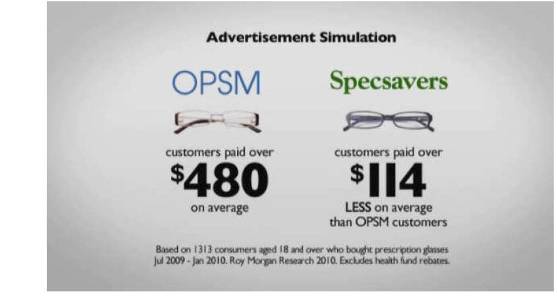
WHERE MADE: |
THE COURT DECLARES THAT:
1. From 11 March 2010 to 15 March 2010 the respondent
(a) engaged in conduct that was misleading or deceptive or likely to mislead or deceive, in contravention of s 52 of the Trade Practices Act 1974 (Cth); and
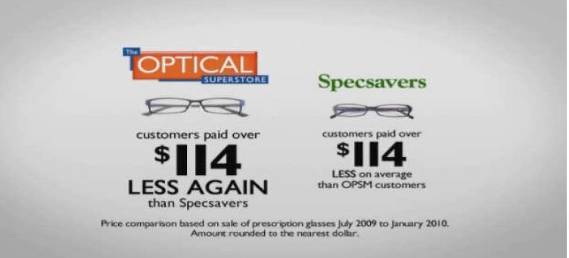
(b) made false or misleading representations, in contravention of s 53(e) of the Trade Practices Act,
by representing in advertisements shown on free-to-air television stations in regional New South Wales, regional Queensland, Brisbane, Adelaide and Canberra that, during the period July 2009 to January 2010, (excluding health fund rebates) consumers paid on average $114 less for a pair of prescription glasses at the respondent’s stores than at the applicant’s stores, when they did not, and also by representing in those advertisements that, during the same period, (excluding health fund rebates) consumers paid on average $366 per pair of prescription glasses at the applicant’s stores, when they did not.
THE COURT ORDERS THAT:
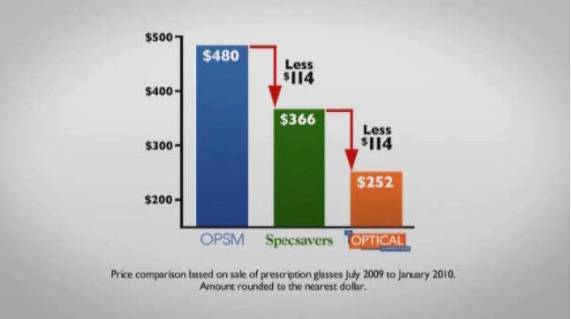
2. Within 14 days the respondent is to arrange for the publication in newspapers circulating in the regions where the respondent’s television advertisement was broadcast an advertisement in the following form:
CORRECTIVE ADVERTISEMENT
Order of the Federal Court of Australia
[INSERT THE OPTICAL SUPERSTORE'S LOGO]
A correction from The Optical Superstore Pty Ltd.
The Federal Court of Australia has declared a television advertisement promoting our glasses was misleading or deceptive or likely to mislead or deceive.
The advertisement was broadcast from 11 March 2010 to 15 March 2010. The Federal Court made this declaration because, despite representations to the contrary, consumers did not pay on average over $114 less per pair of prescription glasses, excluding health fund rebates, at The Optical Superstore's stores than at Specsavers' stores during the period July 2009 to January 2010. In addition and despite a representation to the contrary, consumers did not pay on average $366 per pair of prescription glasses, excluding health fund rebates, at Specsavers' stores during the period July 2009 to January 2010.
This corrective advertisement was paid for by The Optical Superstore.
3. The respondent is to pay the applicant’s costs.
Note: Settlement and entry of orders is dealt with in Order 36 of the Federal Court Rules. The text of entered orders can be located using Federal Law Search on the Court’s website.
NEW SOUTH WALES DISTRICT REGISTRY | |
GENERAL DIVISION | NSD 251 of 2010 |
BETWEEN: | SPECSAVERS PTY LIMITED (ACN 097 147 932) Applicant
|
AND: | THE OPTICAL SUPERSTORE PTY LIMITED (ACN 095 737 894) Respondent
|
JUDGE: | KATZMANN J |
DATE: | 22 DECEMBER 2010 |
PLACE: | SYDNEY (HEARD IN MELBOURNE) |
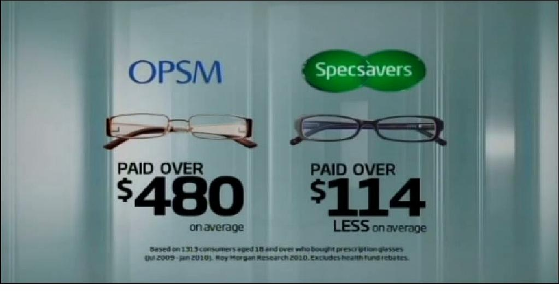
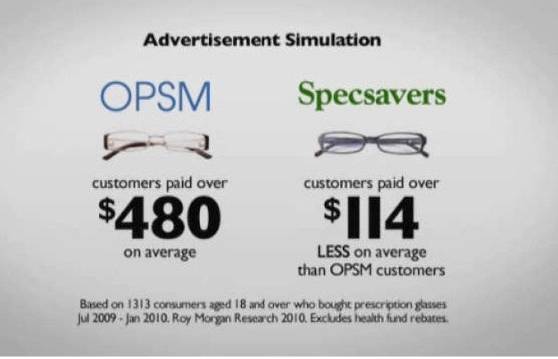
REASONS FOR JUDGMENT
1 This is another case of comparative advertising where one company boasts that its prices are lower than those of a leading competitor. There are, of course, no special rules that apply to this kind of advertising. But a trader who compares its products with those of a competitor invites litigation if it does not take care to ensure that the representations it makes are accurate and that there is no real chance they could mislead the consumer. Cf. Gillette Australia Pty Ltd v Energizer Australia Pty Ltd (2002) 193 ALR 629 at [44]; [2002] FCAFC 223.
2 On 11 March 2010 the Seven Network first broadcast an advertisement for The Optical Superstore Pty Ltd (“The Optical Superstore”). The advertisement (“the TOSS advertisement”) set out to capitalise on a recent advertisement for another company, Specsavers Pty Ltd (“Specsavers”), in which Specsavers had claimed its prices were on average $114 less than those offered by OPSM (“the Specsavers advertisement”). The TOSS advertisement referred to the Specsavers advertisement, suggested it was not telling consumers the full story and went on to assert, amongst other things, that prices offered by The Optical Superstore were $114 lower still.
3 The next day Specsavers filed an application in this Court for injunctive and other relief (including damages and an order for corrective advertising). In its statement of claim it alleged that by broadcasting the advertisement The Optical Superstore engaged in misleading or deceptive conduct in contravention of s 52 of the Trade Practices Act 1974 (Cth) (“the Act”) and made false or misleading representations with respect to the price of goods in contravention of s 53(e) of the Act. On 12 March 2010 it successfully applied to Foster J for an interlocutory injunction restraining The Optical Superstore from continuing to broadcast or publish the advertisement. On 16 March I continued that injunction and it is still in force. The claim for damages is no longer pressed.
The parties
4 Specsavers is an Australian registered company of European origin. It entered the wholesale optical market in this country in January 2007, supplying frames, lenses and complete spectacles to retailers. It first entered the Australian retail market in February 2008 when it opened its first store. Since then it has engaged in the business of providing eye examinations and selling eye care products, including frames and lenses and other goods such as solutions and accessories. Now it has 234 stores, nine directly and 225 under a franchise system.
5 The Optical Superstore was established in July 1989, initially selling only spectacle frames. Since then the business has expanded. It now has approximately 63 stores in Australia, 31 of which operate under licence. According to the evidence of its sole director, Margaret Douglas, its business model is to sell glasses at discounted prices compared to those of other retailers.
6 The two companies are in keen competition with each other.
Facts
7 The background facts are not in dispute.
8 In December 2009 Specsavers engaged the services of the well known Australian market research business, Roy Morgan Research (“Roy Morgan”), to conduct a survey “that would produce a fair, accurate and robust comparison of the average price paid for prescription glasses by Specsavers customers and OPSM customers”. On Roy Morgan’s advice it decided that the survey would be conducted on-line. The survey was commissioned in January 2010. Roy Morgan carried out the survey between 11 and 22 January 2010 (“the Survey”).
9 Armed with the information supplied by the Survey, Specsavers commissioned its advertisement, focussing on the differences in its prices and those offered by OPSM. Between 7 and 27 February 2010 and between 5 and 9 March 2010 the Specsavers advertisement was broadcast nationally, although during the first week it was not shown in Perth and in the last week of February apparently only shown in Perth.
10 The Specsavers advertisement has not been broadcast since 9 March 2010.
11 The TOSS advertisement sought to exploit the Specsavers advertisement to the advantage of The Optical Superstore. It was first broadcast on 11 March 2010 and continued until 15 March 2010, three days after the injunction had been granted. The parties agreed that it was broadcast on the following free-to-air television channels on the number of occasions shown:
Station | Region | Times broadcast |
Prime | Canberra | 28 |
Coffs Harbour / Port Macquarie | 34 | |
Gold Coast | 39 | |
Wagga Wagga | 43 | |
Wollongong (FSC) | 6 | |
Wollongong (SOF, SOB & SOS) | 39 | |
Southern Cross Ten | Coffs Harbour / Port Macquarie | 12 |
Port Macquarie (Taree signal) | 9 | |
Seven Queensland (Regional) | Cairns | 18 |
Bundaberg | 14 | |
Maroochydore | 22 | |
Toowoomba | 24 | |
Rockhampton | 20 | |
Nine Brisbane (QTQ9) | 25 | |
Nine Brisbane (QTQ99) | 67 | |
Nine Adelaide (NWS9) | 20 | |
Nine Adelaide (NWS99) | 61 | |
Total number of times broadcast in Australia | 481 | |
The dispute
12 Specsavers alleged there were two representations made by the TOSS advertisement that contravened the Act. The first was:
Consumers paid on average over $114 less per pair of prescription glasses at the Respondent’s stores than at the Applicant’s stores during the period July 2009 to January 2010, excluding health fund rebates.
13 The second was:
Consumers paid on average $366 per pair of prescription glasses at the Applicant’s stores during the period July 2009 to January 2010, excluding health fund rebates.
14 Section 52 of the Act provides:
(1) A corporation shall not, in trade or commerce, engage in conduct that is misleading or deceptive or is likely to mislead or deceive.
(2) Nothing in the succeeding provisions of this Division shall be taken as limiting by implication the generality of subsection (1).
15 Section 53(e) relevantly provides:
A corporation shall not, in trade of commerce,…in connexion with the promotion by any means of the supply or use of goods or services:
…
(e) make a false or misleading representation with regard to the price of goods or services.
16 Where, as here, the representations are made to a class of person and not to identified individuals, it is necessary to identify the class of person and then to consider whether the misconceptions or deceptions alleged to arise or likely to arise are properly to be attributed to the ordinary or reasonable members of the class: Campomar Sociedad, Limitada v Nike International Ltd (2000) 202 CLR 45 (“Nike”) at [103]-[105]; [2000] HCA 12. The parties were in agreement that the relevant class was the ordinary and reasonable consumer watching the commercial. It includes the astute and the gullible, the educated and the poorly educated (Puxu Pty Ltd v Parkdale Custom Built Furniture Pty Ltd (1980) 31 ALR 73 at 93 per Lockhart J, approved in Taco Company of Australia Inc v Taco Bell Pty Ltd (1982) 42 ALR 177 at 202) but it does not include those who do not take reasonable care for their own interests and otherwise behave unreasonably: Nike at [102]. For convenience I will refer to the class as the parties did by the term “the reasonable viewer”.
17 The question of relief aside, the issues are whether either of the pleaded representations was made in the advertisement; and, if so, whether it was misleading or deceptive or likely to mislead or deceive.
18 The Optical Superstore denies that the advertisement made the representations and also denies that, if it is found to have made them, they were misleading or deceptive or likely to mislead or deceive. If Specsavers nonetheless makes out its claim, its position is that corrective advertising is inappropriate in view of the lapse of time since the last broadcast and the close connection between the TOSS advertisement and the Specsavers advertisement. Moreover, since the Specsavers advertisement is unlikely to be repeated, it submitted that injunctive relief is not called for. Thus, the position of The Optical Superstore on the question of relief is that the only suitable remedy is a declaration.
The advertisement
19 The Specsavers advertisement was the subject of a judgment of this Court: Luxottica Retail Australia Pty Ltd v Specsavers Pty Ltd (2010) 267 ALR 721; [2010] FCA 423 (“Luxottica”). The Optical Superstore relied on it to justify its own conduct. It submitted that the advertisement was merely a commentary on the assertions Specsavers made in its advertisement and did not offend against the Act.
20 The Specsavers advertisement is of limited relevance to this proceeding. On the question of liability what matters, of course, is whether the TOSS advertisement was misleading, not what caused or inspired it. The TOSS advertisement must be judged independently of the Specsavers advertisement. Not everyone who saw one will have seen the other. The TOSS advertisement stands or falls on its own.
21 The TOSS advertisement opened with the following words both depicted on the screen and uttered by a deep, self-assured male voice:
Ever wondered why Specsavers price comparison advertises against OPSM and not The Optical Superstore.
22 The next frame offered:
Here’s a clue.
23 The third frame showed:
24 The voiceover accompanying this frame proclaimed:
Specsavers have advertised that their customers pay on average over $114 less than OPSM customers.
25 The fine print at the bottom of the screen, which the parties referred to as a “disclaimer”, reads:
Based on 1313 consumers aged 18 and over who bought prescription glasses July 2009 – Jan 2010. Roy Morgan research 2010. Excludes health fund rebates.
26 The frame did not actually depict what was shown in the Specsavers advertisement although it purported to reproduce it. I will deal with this matter later.
27 The fourth frame took the following form:
28 At first only the right-hand column appears. That shows what purports to be part of the Specsavers advertisement. But then the first column fades in at which point the announcer declares:
But you haven’t been told that on average Optical Superstore customers pay $114 less again.
29 I would point out, too, that at the time the right-hand column appears so does the disclaimer, which does not feature in the Specsavers advertisement.
30 The fifth frame set out to emphasise the price discrepancies in an even more graphic way:
31 The voiceover in this case was:
That’s 114 good reasons why you get better value at The Optical Superstore.
32 The final frame read:
Always check prices first at the Optical Superstore.
Did the advertisement contravene the Act?
33 In substance The Optical Superstore’s case was that whatever representations were made about Specsavers’s prices, they were Specsavers’s representations, and it made no representations about the prices customers paid at its competitor’s stores. Counsel for The Optical Superstore, Mr Robertson, submitted that a reasonable viewer would have considered that the first representation in context compared the average price per pair sold at The Optical Superstore with the average price Specsavers in its own advertisement represented its customers paid. That, he went on to say, was because the TOSS advertisement was in essence a commentary on the Specsavers advertisement. In other words, it was “... an assertion about an assertion. It is not and cannot...be taken, as an assertion about ultimate fact, about ultimate actual prices of Specsavers...”.
34 I am satisfied that the representations were conveyed in the fifth and sixth frames of the advertisement, if not before. There, the advertisement expressly makes a price comparison “based on sale of prescription glasses...”.
35 The real issue is whether the representations were misleading or deceptive. First impressions are what count in this kind of advertising: Luxottica at [26]-[27]. I believe that the subtleties of the distinctions The Optical Superstore sought to draw would be lost on “the casual, but not overly attentive viewer”, whose impressions, the authorities tell us, are determinative.
36 Specsavers alleged that the first representation was misleading or deceptive because it was contrary to the fact, the fact being that which it claimed the Survey had revealed, namely, it contended, that the average price Specsavers’s customers aged 18 and over paid for a pair of prescription glasses during the period referred to in the representation was $204.97, whereas the average price for the same product paid by the same class of customer at The Optical Superstore outlets during the same period was $258.54.
37 According to the amended statement of claim, the second representation was said to be misleading or deceptive because customers at Specsavers stores in the relevant period were found in the Survey to have paid on average $204.97 and not $366. In oral argument Mr Studdy SC, who appeared for Specsavers, submitted that Specsavers had never said that its customers paid on average $366 per pair of prescription glasses, so the advertisement made a false assumption. He also submitted that the “disclaimer” appearing in frame 4 was misleading because it suggests the representation was based on an actual price comparison, when it was not.
38 The Optical Superstore argued that Specsavers must fail, because it tendered no reliable evidence to show the average price of its prescription glasses during the relevant period.
39 Specsavers relied, first, on the results of the Survey and evidence given by Julius Kornides, a project director for Roy Morgan, to show that the advertising boasts were false. Secondly, it called evidence about prices paid by customers from one of its own employees.
40 Mr Kornides said that 4,253 people over the age of 18 were polled but 634 were then excluded because they could not recall exactly how much they had paid for the last prescription glasses they had last bought. That left 3,619 of whom 659 had bought their glasses from Specsavers and 205 from The Optical Superstore. Mr Kornides weighted the raw data. That is to say he compared the ages, genders and regions of the sample in the Survey with the profile of the target population, being those Australian adults who wore and purchased glasses within the previous six months. Mr Kornides then compared the weighted and unweighted data to ensure that there were no significant skews as a result of the sampling and was satisfied that both sets of data were accurate. He said that the mean (or average) price Specsavers customers paid per transaction when they last bought glasses, calculated before any health fund rebate, (reflecting the total amount paid) was $350.39 or $352.53 if weighted to reflect the age, sex and region pattern of people who bought glasses who were polled in an earlier Roy Morgan survey. He compared these figures with the average price paid by OPSM customers ($503.98 unweighted and $508.56 weighted), thus on average $153.59 more on the unweighted data and $156.03 more on the weighted data. He said that the average price Survey respondents paid per pair of glasses at Specsavers was $203.03 on the unweighted data and $204.97 on the weighted data. According to the Survey, Mr Kornides’s evidence was that the average prices for The Optical Superstore customers calculated on the same bases were either less per transaction, but nowhere near $114 less, and when measured by the sale of individual pairs, actually exceeded the average prices paid for glasses bought from Specsavers. The differences are easily seen in the following table:
Price category | Specsavers | The Optical Superstore | Difference |
Price per transaction | $350.39 (unweighted) | $318.37 (unweighted) | - $32.02 |
$352.53 (weighted) | $308.54 (weighted) | - $46.99 | |
Price per pair | $203.03 (unweighted) | $267.18 (unweighted) | + 62.25 |
$204.97 (weighted) | $258.54 (weighted) | + 53.57 |
41 Conduct is misleading or deceptive if it induces or is capable of inducing error: Parkdale Custom Built Furniture Pty Ltd v Puxu Pty Ltd (1982) 149 CLR 191. Conduct will be likely to mislead or deceive if there is a real or not remote chance or possibility that it will do so even if the chance or possibility is less than 50%: Global Sportsman Pty Ltd v Mirror Newspaper Ltd (1984) 2 FCR 82. Based on the data in the Survey, the representations in the TOSS advertisement were misleading. They were capable of causing the reasonable viewer to fall into error. There was certainly a real chance that reasonable viewers would believe what the advertisement told them: that (health fund rebates aside) they would pay on average more than $114 per pair of prescription glasses at Specsavers than they would during the same period at The Optical Superstore and that, at the former, the average price during the period in question (excluding health fund rebates) was actually $366. The Survey data demonstrates that such a belief would have been false. It showed that customers at The Optical Superstore during the relevant period did not pay $114 less for a pair of prescription glasses than they would if they had shopped at Specsavers and did not pay on average at Specsavers $366 for each pair. On the contrary, the Survey results showed that customers surveyed actually paid more for a single pair of glasses at The Optical Superstore during the period than they would at Specsavers.
42 The Optical Superstore challenged the reliability of the Survey data but, in my view, even if the challenge were well-founded, it cannot undermine Specsavers’s case. There was no suggestion that Mr Kornides misrepresented the results of the Survey and the TOSS advertisement did not call into question its reliability. I will return to the challenge to the evidence shortly.
43 Specsavers also relied on evidence from its Financial Analyst, Michael Emmerling, to prove that the average price for a pair of prescription glasses during the relevant period was less than $366. In his affidavit Mr Emmerling said that on 12 August 2010 he interrogated the sales data on the Specsavers server relating to the prices paid by its customers for prescription glasses (inclusive of GST) for all ages in the period between July 2009 to January 2010 (“Total Price”). Mr Emmerling also determined the total number of pairs of prescription glasses sold during that period (“Total Number of Pairs”). To determine the actual average price paid by Specsavers customers per pair of prescription glasses during the period he said he divided the Total Price by the Total Number of Pairs. He gave evidence of the figures derived from this calculation. It was also substantially less than the $366 price The Optical Superstore represented customers paid. Counsel for The Optical Superstore, Mr Robertson, sought to undermine this evidence in two ways. In my view, however, he did not succeed.
44 First, he noted that Mr Emmerling’s evidence established only that he took a gross sales figure for lenses, frames and coats and divided that figure by the number of frames sold which, he submitted, is not the same as establishing an average price for a pair of prescription glasses. But, as Mr Studdy pointed out, there were problems with the attack on the evidence. In the first place, no challenge was made to the witness’s methodology, so the witness had no opportunity to deal with it. In the circumstances, the principles in Browne v Dunn (1893) 6 R 67 (HL) would ordinarily preclude The Optical Superstore from making the submission. In any event, Mr Studdy showed that the inclusion of sales of lenses would only have the effect of overstating the average price. If anything, therefore, Mr Emmerling erred in favour of The Optical Superstore. As Mr Studdy explained:
Simple maths demonstrates that the inclusion by Mr Emmerling of sales of lenses alone can only have had the effect of resulting in a higher average price in his calculation than would have been the case if he had excluded sales of lenses alone. A simple example is as follows. Assume there are 3 sales:
a) Sale 1: customer purchased a frame and a set of lenses total price $250
b) Sale 2: customer purchased 2 frames and 2 sets of lenses and 2 coats $375
c) Sale 3: customer purchased just a set of lenses at $150.
The total amount paid is $775. Based on Mr Emmerling’s evidence that entire total would have gone into the numerator in his calculation (this is consistent with the Respondent's submissions). But Mr Emmerling says that he then divided by the number of frames sold across the total transactions. In this simple example, the total number of frames sold was 3. Taking the total sale price and dividing by the number of frames then produces an average of $258.33. If however Sale 3 had been excluded from the calculation altogether (as the Respondent submits it should have been) the total sale price would have been $625. There were still 3 frames sold. Taking the total sale price and dividing by the number of frames sold produces an average of $208.33. Consequently, if anything Mr Emmerling has stated a higher average per pair of frames than was the case.
45 Mr Robertson also emphasised that Mr Emmerling’s evidence was that the average price to which he was referring was the average price for customers of all ages whereas the advertisement was concerned with the prices for customers aged 18 and over and there is no evidence about the effect of the discrepancy. These criticisms, in my view, are well founded. I cannot be confident that the figure nominated by Mr Emmerling is in fact the average price paid by Specsavers’s customers for a pair of prescription glasses during the relevant period. But the evidence has some value. It seems to me to be unlikely that children’s glasses would be more expensive than adult’s so that it is unlikely that the prices would increase by factoring in the prices paid for children’s glasses.
46 I return to the challenge to the Survey evidence. Mr Robertson’s criticism of the Survey evidence was put in this way:
The Roy Morgan survey evidence does not establish the average price of Specsavers. No valid statistical inference can be drawn from it unless the sample was random nor can any inference [scil.] be drawn about standard error or confidence unless the population from which the sample was taken has a normal distribution with respect to the relevant characteristic (Mr Kornides T43). In fact, the sample was not randomly chosen, depending, as it did, on persons selected by some unknown means by one of two sample supply companies (T44-45) deciding whether or not to answer the survey (T44). In addition, the respondents to the survey were limited to e-mail users (T45). There is no evidence that the distribution of spectacle users in the Australian population is a normal distribution.
47 I do not accept the submission. Mr Kornides did agree that for a survey of a sample of a population to produce statistically valid results it is necessary that the sample be random. But Mr Kornides’s evidence was that the survey was conducted on the basis of a random selection. Neither he nor Specsavers selected the respondents. He said another company chose the sample and it was up to the respondents to reply to the survey questions. He did not say that this kind of self-selection was not random selection for statistical purposes. And, as Mr Studdy pointed out in his submissions, such a survey was no less random than a survey conducted on the street or by telephone where a random member of the public chooses whether or not to participate. Mr Kornides did concede that, because the survey was conducted by email, it was possible that some people might be excluded from participating by reason of age or poverty and others, who gave partial or non-responsive answers, would also be excluded. But, as I understood his evidence, the process of weighting the survey results, that is, adjusting them according to the distribution of people on the bases of age, gender and region is designed to correct for this. Mr Kornides said that Roy Morgan conducted a survey in 2008 across a representative sample of Australians aged 18 and over to determine what proportions of the population wore glasses and had actually purchased glasses in the previous six months. In re-examination he said that Roy Morgan used those proportions to determine the target number of interviews for the demographic criteria of age, gender and region for the 2010 survey to ensure that the appropriate number of older people, for example, were interviewed. The Optical Superstore called no evidence from a suitably qualified expert to challenge the methodology used to conduct the Survey or Mr Kornides’s interpretation of the Survey results. Whilst there will always be difficulties with survey evidence, if this survey or Mr Kornides’s interpretation of it were unreliable I would expect to have heard expert evidence to that effect. In fact, the evidence The Optical Superstore called about the average price of its own prescription glasses during the relevant period taken from its computer records was sufficiently close to the figures disclosed in the Survey to give me some confidence in the reliability of its results. More importantly, however, as I said earlier, for the purpose of its advertisement, The Optical Superstore accepted the representations made in the Specsavers advertisement including that they were based on the Survey.
48 Criticisms were also levelled at the reliability of the responses given by Survey participants as the Survey covered a six-month period and because of the potentially confounding issue of health fund rebates. The criticisms fell flat. The Survey participants were asked when they purchased their last pair of prescription glasses. The relevant period was July 2009 to January 2010. Therefore not all respondents were being asked to cast their minds back six months. In some cases the Survey participants may have purchased prescription glasses the day before. Moreover, Mr Kornides said that in his experience with research in this particular category (the purchase of spectacles) people tend to recall the actual price. He also said that the majority of Survey participants specified the precise dollar amounts of their purchases. This supports the inference that, for the most part, the Survey participants probably consulted their receipts before responding. Mr Robertson also raised the spectre that the prices quoted could reflect the prices after health fund rebates. But the Survey participants were specifically asked to select the total cost of their last purchase of glasses before any health fund rebate. And Mr Kornides said that in his experience survey respondents tend to recall the actual price they agreed to pay and regard a rebate from a private health insurer like a bonus when they get it back. There is no reason for me not to accept this evidence. No challenge was levelled at Mr Kornides’s experience.
49 The TOSS advertisement began uncontroversially. The trouble starts at frame 3. The comparison in frame 3 purports to reproduce a frame from the Specsavers advertisement. In fact, however, it distorts it. This is frame 3 of the Specsavers advertisement:
50 This is frame 3 of the TOSS advertisement.
51 There are three differences. One is the inclusion of the word “customers”. Although Specsavers tried to make something of this, I cannot see it matters. The second is the inclusion of the words “than OPSM customers”, which is certainly inconsequential. But the third difference I think is significant. The third difference is that the words “paid over” are reduced to lower case in The TOSS advertisement, potentially reducing their impact on the viewer. In addition, the voiceover omits the preposition “over” when making the comparison with the prices offered at The Optical Superstore. The tone of the announcer’s voice also changes at this point. It is louder and more emphatic. This prepares the viewer for what is to come in frame 5.
52 As the advertisement proceeds, it tricks the viewer into thinking that Specsavers’s price was in fact the mathematical difference between $480 and $114 or $366. This was convenient for The Optical Superstore. If the average price customers paid at Specsavers for a single pair of prescription glasses during the relevant period were $366, then the difference between that sum and the average price of its prescription glasses rounded to the nearest dollar was $114. But – whatever the uncertainties about Specsavers’s prices – I am well satisfied that the average price during the relevant period was not $366 and that Specsavers did not make any such representation.
53 I am also satisfied that frame 5 is overtly misleading. It represents a sleight of hand in that the word “over” – present in the earlier frames – has been removed. It tricks the viewer into thinking that the preposition is redundant. The plain intention is to have customers think that at Specsavers the average price per pair of prescription glasses was $366. Ms Douglas admitted as much. Ms Douglas may have proceeded in good faith but there may be a contravention of the relevant sections of the Act although there is no intention to mislead: Hornsby Building Information Centre Pty Ltd v Sydney Building Information Centre Ltd (1978) 140 CLR 216 at 228.
54 The deception is complete when read with the so-called disclaimer. On the case The Optical Superstore presented, no comparison was made in the advertisement between its prices and those offered by Specsavers. The comparison was between an assumed price of $366, purportedly derived from the Specsavers advertisement, said to be based on the Survey results, and The Optical Superstore’s actual average price. Mr Robertson supported this argument with the proposition that the TOSS advertisement was really a commentary on the Specsavers advertisement. A reasonable viewer, he argued, would not expect The Optical Superstore to know the average price offered by its competitors and “would find natural the stated reliance for the Specsavers (and OPSM) price data on Specsavers own advertised survey results”. I disagree. The TOSS advertisement, itself, stated that the price differentials shown in frame 4 were based on price comparison based on sales. It also referred to the Roy Morgan survey data. The reasonable viewer would have no idea who commissioned the research, where the data had been published or to whom. They were not “Specsavers own advertised survey results”. They were Roy Morgan’s. Roy Morgan is an independent company. A reasonable viewer might readily conclude that The Optical Superstore had access to the results of the Survey. Both the reference to the Survey in frame 4 and the unqualified representation in frame 5 that the price comparison was based on actual sales would suggest to the reasonable viewer that The Optical Superstore knew the average prices. What is more, no attempt is made in frame 5 to distinguish between the sources of information for the prices offered by the two businesses. In any case, why wouldn’t the viewer reasonably believe that the actual prices were the same as the prices disclosed in the Survey?
55 Mr Robertson submitted that the prepositions used in the advertisement were designed to show that the figures were approximate but only in so far as they rounded off the price to the nearest dollar. This was the position Ms Douglas had taken in cross-examination. Mr Robertson said:
The assertion in the Optical Superstore’s TVC about the price differential between itself and Specsavers was an assertion that the difference was $114 and some cents.
Similarly, the assertion in the Specsavers’ TVC about the price differential between itself and OPSM was an assertion that the difference was $114 and some cents, being $114 and some cents less than a number being something over $480. Thus the Specsavers’ TVC was asserting, by stating the OPSM price of (over) $480 and the price differential of $114 and some cents, that its own average price was $366.
56 I reject the submission. In my opinion, the reasonable viewer would not expect to see “over $114 less” if the true price were $114 and some cents less. In context, in its ordinary meaning “over” simply means “higher or more than”. If the figures shown were rounded off to the nearest dollar, the viewer would expect to see a disclaimer to that effect. Indeed, in frame 4 The Optical Superstore’s disclaimer actually stated that the average was rounded to the nearest dollar whereas the Specsavers advertisements made no such representation.
57 I am satisfied that the two representations were misleading or deceptive or likely to mislead or deceive and Specsavers has made out its case that the TOSS advertisement contravenes both ss 52 and 53(e) of the Act.
Relief
58 The first remedy sought is a declaration that The Optical Superstore engaged in conduct that contravened the Act. The terms of the declaration were not the subject of argument. I have, however, varied the proposed terms to accord more closely with the findings.
59 Specsavers also seeks an injunction and corrective advertising.
60 I turn first to consider the claim for injunctive relief. The injunction sought is that The Optical Superstore be restrained:
whether by itself, its directors, officers, employees, agents or otherwise howsoever, from broadcasting, publishing, causing to be published or making available to consumers the television advertisement [the subject of the proceeding].
61 The Optical Superstore opposed the making of a permanent injunction on the ground that it was highly unlikely that it would broadcast the TOSS advertisement again so long after the conclusion of the Specsavers advertising campaign and where, since the decision in Luxottica, there was no prospect that Specsavers would re-broadcast its own advertisement.
62 Section 80(5) of the Act gives the Court power to issue an injunction although it is satisfied that there is no intention to repeat the offending conduct. In Luxottica Perram J said at [41]:
[T]he terms of s 80 of the Act make plain that an injunction may be issued in respect of a past contravention and even, as subsection (5) emphasises, if there is no intention on the part of the respondent to repeat the conduct. There may be circumstances when it will be appropriate to grant such an injunction where, for example, future breaches may be expected not because of deliberate conduct but rather by reason of deficient systemic controls. So too, a court may feel that there is a risk that without an injunction a respondent may be tempted into contravention.
63 In the present case Specsavers submitted that the parties are in vigorous competition with each other, of which there can be no doubt. It pointed to the fact that this is not the first time in which The Optical Superstore has deployed comparative advertising nor the first time it had been found to have been in contravention of the Act. See Specsavers Pty Ltd v The Optical Superstore Pty Ltd (No 2) [2010] FCA 566. There is no evidence touching upon the prospect of whether the advertisement will be re-broadcast if the interlocutory injunction is not made permanent. The Optical Superstore did continue to broadcast it during a three-day period after the interlocutory injunction was granted and no evidence was adduced to explain why. Specsavers relied upon the breach in support of its claim for a permanent injunction, although it had indicated in opening that it would not be likely to.
64 Despite the breach of the injunction, for the reasons advanced by The Optical Superstore I do not consider there is any real utility in making the injunction permanent. The purpose of the advertisement was to exploit an opportunity afforded by the Specsavers advertisement. It is clear that the window of opportunity has now closed.
65 The next question is whether an order should be made for corrective advertising.
66 The form of the advertisement proposed is:
CORRECTIVE ADVERTISEMENT
Order of the Federal Court of Australia
[INSERT THE OPTICAL SUPERSTORE'S LOGO]
A correction from The Optical Superstore Pty Ltd.
The Federal Court of Australia has declared a television advertisement promoting our glasses was misleading or deceptive or likely to mislead or deceive.
The advertisement was broadcast from 11 March 2010 to 15 March 2010. The Federal Court made this declaration because, despite representations to the contrary, consumers did not pay on average over $114 less per pair of prescription glasses, excluding health fund rebates, at The Optical Superstore’s stores than at Specsavers’ stores during the period July 2009 to January 2010. In addition and despite a representation to the contrary, consumers did not pay on average $366 per pair of prescription glasses, excluding health fund rebates, at Specsavers' stores during the period July 2009 to January 2010.
This corrective advertisement was paid for by The Optical Superstore.
67 The Optical Superstore submitted that corrective advertising should not be ordered where the detail of any deception has, in substance, been lost with the passage of time. It submitted, too, that the TOSS advertisement was intimately connected to the Specsavers advertisement, which was discontinued in early March 2010 when the campaign came to an end and is highly unlikely to be repeated, and there had been no delay on the part of The Optical Superstore in bringing the matter to trial.
68 There is at least one difficulty with this submission. Lynne Peach, the solicitor with the carriage of the matter for Specsavers, gave the following evidence in an affidavit read in the proceeding and upon which she was not cross-examined:
[3] On 19 March 2010, I had a telephone conversation with Michelle Dixon of Maddocks Lawyers, who has primary carriage of this matter on behalf of The Optical Superstore. During the course of that telephone conversation we said, amongst other things, words to the following effect:
I said: “We need to get this proceeding moving. I am concerned about the delay, what is your client’s position?”
Michelle replied: “My client is still considering whether it is going to contest the ex parte injunction or whether it is happy to go to an expedited hearing.”
[4] Ms Dixon and I continued to discuss the proceedings. During the course of that further discussion, we said words to the following effect:
I said: “I'm concerned that your client is trying to benefit from delaying this case. My client is seeking corrective advertising and I'm concerned your client's delay will be used as an argument to try to prevent an order for corrective advertising.”
Michelle replied: “No, we wouldn't do that.”
69 In late April Ms Peach said she arranged to have the matter listed for directions and in late June she sent an email to chambers, copied to the solicitors for The Optical Superstore, explaining that The Optical Superstore was responsible for the delay, noting its agreement that delay on its part would not prejudice Specsavers’ claim for corrective advertising. She pointed out that at no time did the solicitors for The Optical Superstore dispute there was such an agreement.
70 Specsavers filed its application the day after the TOSS advertisement first went to air. The evidence is all one way that the delay that followed the filing of the application is not of its making.
71 In support of its argument for corrective advertising Specsavers relied on some remarks of Siopis J in Australian Competition and Consumer Commission v Boost Tel Pty Ltd [2010] FCA 701 in which his Honour noted at [117] that an order of this kind was “for the purpose of protecting consumers by informing the market of the outcome of the litigation ‘so that those in the market have at least a broad understanding’ of the ways in which the Court has applied the norms of conduct prescribed by the Trade Practices Act, specifically in relation to the advertising practices of [the respondent company]”. That case, however, was concerned with the powers given to the Court under s 86C of the Act, which may only be invoked on the application of the Australian Competition and Consumer Commission. The power to make an order for corrective advertising in a case such as this does not derive from s 86C but from s 80: Janssen Pharmaceutical Pty Ltd v Pfizer Pty Ltd (1985) 6 IPR 227.
72 Nevertheless, the purpose of Part V of the Act is to protect the consumer and the remedies for a contravention of its provisions should further that purpose. Informing consumers of misleading conduct by corrective advertising is one way to do that. The courts have recognised as much. See Medical Benefits Fund of Australia Ltd v Cassidy (2003) 205 ALR 402 at [48]ff, [2003] FCAFC 289, where (at [49]) the following remarks of Tamberlin J in Australian Competition and Consumer Commission v On Clinic Australia Pty Ltd (1996) 35 IPR 635 at 640 were cited with approval:
The purpose of corrective advertising is to protect the public interest … Corrective advertising is intended to dispel incorrect or false impressions which may have been created as a result of deceptive or misleading conduct. It is not intended to be punitive. In any matter concerning corrective advertising the timing of such corrective advertising is of course important… There is no principle that any particular period is appropriate as a point beyond which corrective advertising is not warranted. In the context of advertising it is necessary to examine the nature, extent and intensity of the advertising and the media in which it has been released with a view to deciding whether there could reasonably be any current misapprehension as a result of the advertisements.
73 As Stone J stressed in MBF at [50], there is also an ancillary educative benefit from advertising of this kind. It raises the awareness of the general public and the industry about the type of conduct that can contravene the Act:
74 I am persuaded that it is appropriate to make an order for corrective advertising. This was not a lengthy advertising campaign but it was an intensive one. It is impossible to know what impact it had. There was certainly no evidence on the question. Still, the advertisement would clearly have impressed upon the target audience that there was a substantial difference in the prices offered by the two competitors, that The Optical Superstore offered a much better deal and that Specsavers, by leaving it out of its advertisement, was trying to get an unfair advantage. Prescriptions need to be filled periodically and, with age, increasingly often. Therefore, the target audience includes people who are likely to return to the store for repeat purchases. A false or misleading impression can endure unless it is removed.
75 The Optical Superstore made no submissions on the form of advertising Specsavers proposed, although it had an opportunity to do so. Mr Robertson asked to be heard on the question after the reasons were handed down. Mr Studdy opposed this course. I have given consideration to Mr Robertson’s request but do not think there is any useful purpose in adding to the costs of the parties by acceding it. The proposed form of advertisement is in conformity with the terms of the declaration I will be making. I will therefore make an order in the form sought.
76 The Optical Superstore should pay Specsavers’s costs.
I certify that the preceding seventy-six (76) numbered paragraphs are a true copy of the Reasons for Judgment herein of the Honourable Justice Katzmann. |
Associate:


