

FEDERAL COURT OF AUSTRALIA
Yarra Valley Dairy Pty Ltd v Lemnos Foods Pty Ltd [2010] FCA 1367
IN THE FEDERAL COURT OF AUSTRALIA | |
THE YARRA VALLEY DAIRY PTY LTD (ACN 067 021 863) Applicant | |
AND: | LEMNOS FOODS PTY LTD (ACN 078 380 855) First Respondent TERRY PAULE Second Respondent |
DATE OF ORDER: | |
WHERE MADE: |
THE COURT ORDERS THAT:
1. The parties confer and submit minutes of orders reflecting these reasons and any agreed orders as to costs by 4:00pm on 17 December 2010.
Note: Settlement and entry of orders is dealt with in Order 36 of the Federal Court Rules. The text of entered orders can be located using Federal Law Search on the Court’s website.
VICTORIA DISTRICT REGISTRY | |
GENERAL DIVISION | VID 400 of 2009 |
BETWEEN: | THE YARRA VALLEY DAIRY PTY LTD (ACN 067 021 863) Applicant
|
AND: | LEMNOS FOODS PTY LTD (ACN 078 380 855) First Respondent TERRY PAULE Second Respondent
|
JUDGE: | MIDDLETON J |
DATE: | 10 DECEMBER 2010 |
PLACE: | MELBOURNE |
REASONS FOR JUDGMENT
INTRODUCTION
1 This is a proceeding primarily concerning the validity of the registered trade mark, PERSIAN FETTA, and also the alleged infringement of that trade mark by the first respondent Lemnos Foods Pty Ltd (‘Lemnos’). The applicant, The Yarra Valley Dairy Pty Ltd (‘Yarra Valley’), also brings actions for passing off and seeks relief under the Trade Practices Act 1974 (Cth) (‘the TPA’) for misleading and deceptive conduct.
OVERVIEW OF Yarra Valley’s BUSINESS
2 Yarra Valley is a farm-based cheese maker in the Yarra Valley in the State of Victoria which has been making and selling a range of cheese products since 1994.
3 In 1994, Mary Mooney and her husband Leo Mooney joined with Richard Thomas in setting up a new cheese making business at the Mooney family farm property ‘Hubertswood’ in the Yarra Valley. The original focus of the business was on the production and sale of a camembert style cheese together with small amounts of fresh cow curd to local customers, including a number of restaurants in the Yarra Valley and in Melbourne.
4 Richard Thomas was employed by Yarra Valley to establish the cheese making facility and to develop cheeses. Mary and Leo Mooney provided the capital required to start the business as well as the location. Although Richard Thomas was the primary cheese maker, Mary Mooney was also involved in making, delivering and selling the cheese.
5 In mid 1995, Yarra Valley commenced making goat’s milk fetta. The seasonal nature of goat’s milk flows in that year meant that there was more milk, and consequently fresh cheese, than could be sold. The goat’s milk fetta was not easy to sell and competed against less expensive fettas. In 1995, goat’s cheese was a relatively new product to the Australian market and most consumers were unfamiliar and somewhat suspicious of it. Consequently, the market was relatively small and generally restricted to customers, particularly chefs, with knowledge of European cheeses.
6 This oversupply created the problem of finding a way to preserve the surplus cheese. Richard Thomas and Mary Mooney decided to marinate the cheese as a way of preserving, value adding and attracting a higher price for the cheese. A traditional Italian mix of herbs (thyme, bay leaf, garlic and black pepper) in olive oil was used to produce the marinade.
7 After this marinated cheese product was developed Yarra Valley called the product ‘Persian Fetta’. I will return later to the making of this decision.
8 Yarra Valley started selling the PERSIAN FETTA product in the tasting room at the Hubertswood farm. Yarra Valley then sold some of this goat’s cheese product to delicatessens, speciality cheese shops and restaurants in Melbourne.
9 By autumn 1996, the goat’s milk supply was seasonally fading just as interest in the PERSIAN FETTA product was developing. Yarra Valley was faced with an inability to supply customers’ orders. This problem was resolved by making the product from cow’s milk. The change from using goat’s milk to cow’s milk was not difficult as Yarra Valley was already producing fresh curd from cow’s milk at that time.
10 From 1995, the PERSIAN FETTA product has been sold in a distinctive ‘paint tin’. Until commencement of the Lemnos conduct, the PERSIAN FETTA product was the only cheese product sold in a tin of this type and dimension. Similar cheese products were typically sold in plastic tubs or glass containers, which were less expensive and allowed the product to be viewed prior to purchase. The PERSIAN FETTA tin product was typically sold in delicatessens and speciality cheese shops as well as directly from the Yarra Valley farm.
11 On 21 March 2000, Yarra Valley filed a trade mark application for PERSIAN FETTA in class 29 for “dairy products including cheese”. Registration was obtained on 24 May 2002 and has remained on the Trade Mark Register from that date (‘the PERSIAN FETTA registration’).
12 In 2002, Yarra Valley entered into a licence agreement with National Foods which licensed use of the PERSIAN FETTA mark to National Foods to use as part of its ‘South Cape’ range. The PERSIAN FETTA product was and continues to be made by Yarra Valley for National Foods. The PERSIAN FETTA product has been made available in supermarket chains, including Coles, since 2003.
13 Sales and promotion of the PERSIAN FETTA product has grown since 1996 and continues to grow. I will return to the extent of the sales and promotion later.
14 Yarra Valley now has 17 full-time employees and revenue in excess of $5 million per annum.
OVERVIEW OF LEMNOS’ BUSINESS
15 Lemnos is a cheese manufacturer which produces a range of cheese products principally for supermarket chains, including Coles. The second respondent is the managing director of Lemnos.
16 The Lemnos business was started in the 1960s by Kon and George Tsantis and was originally based in Lang Lang in Gippsland, Victoria.
17 From the back of their van, the Tsantis brothers sold fetta, amongst other things, to migrant families in Melbourne in the late 1960s and 1970s. They also sold their products through continental delicatessens, restaurants and market stalls.
18 In 1998, when the Tsantis brothers were in their seventies, the second respondent Terry Paule, his brother Spiro Paule, and Peter Biantes bought the Lemnos business.
19 Since then, Terry Paule and his partners have built Lemnos into a medium sized speciality food manufacturer. Lemnos is now Australia’s leading manufacturer of fetta and haloumi cheeses.
20 Lemnos produces seven different varieties of fetta as well as varieties of haloumi, ricotta and paneer, all of which are sold under the LEMNOS brand, which appears with a lambda in circle device as shown here:
21 The LEMNOS name and lambda device have been registered in Lemnos’ name as Australian Trade Mark Registration 890174 for goods including cheese, with effect since 26 September 2001.
22 In 2008, Choice Magazine’s judges independently tested various fetta products available in Australia and nominated LEMNOS as Australia’s best fetta brand. Choice Magazine’s judges awarded a number of prizes to LEMNOS branded fetta products.
23 Other white cheese products sold by Lemnos prior to the launch of LEMNOS PERSIAN MARINATED CHEESE included:
(a) LEMNOS HALOUMI – CYPRUS STYLE CHEESE;
(b) LEMNOS SMOOTH FETTA;
(c) LEMNOS REDUCED FAT FETTA;
(d) LEMNOS SMOOTH/SPREADABLE RICOTTA CHEESE;
(e) LEMNOS RICOTTA;
(f) LEMNOS RICOTTA DIPS;
(g) LEMNOS PANEER.
24 Lemnos has sold its LEMNOS branded products through supermarkets and delicatessens for decades, and advertises them in various ways including food and recipe magazines, radio, supermarket catalogues, internet and trade shows.
25 In addition to its own brands, Lemnos manufactures products for other companies, including Coles, which sells fetta products under the Coles house brand “You’ll Love Coles”.
26 Lemnos has used two variant marks: PERSIAN FETTA and PERSIAN MARINATED CHEESE.
27 Lemnos first started using the PERSIAN FETTA mark in 2009 in response to a request from Coles to replace the South Cape PERSIAN FETTA product. Initially, Lemnos used the PERSIAN FETTA mark on its web-site. Subsequently, Lemnos commenced selling a marinated cheese product through Coles under the PERSIAN MARINATED CHEESE mark. This product was sold in a ‘paint tin’ of almost identical shape and dimension to the Yarra Valley PERSIAN FETTA tin.
28 Since 2000, Lemnos has been exporting its products overseas to places including Saudi Arabia, the United Arab Emirates, India, Taiwan, Hong Kong, China, Indonesia, Malaysia, Singapore, New Zealand, Canada and the United States.
REGISTERED TRADE MARK VALIDITY AND INFRINGEMENT
Introduction
29 Lemnos’ use of the words PERSIAN FETTA and PERSIAN MARINATED CHEESE will constitute an infringement of the PERSIAN FETTA registration if, contrary to s 120(1) of the Trade Marks Act 1995 (Cth) (‘the TMA’), in either case:
(a) The words are found to be substantially identical with or deceptively similar to the PERSIAN FETTA registration; and
(b) Lemnos is found to have used the words as a trade mark in relation to any of the goods covered by the PERSIAN FETTA registration.
30 The Respondents’ primary contention in relation to trade mark infringement is that the PERSIAN FETTA registration should be cancelled pursuant to s 88(2)(a) and (e) of the TMA on the basis that:
(a) the registration could have been successfully opposed; and
(b) the application for registration was accepted as a result of misrepresentation.
Onus of Proof
31 The question of onus of proof in relation to the claim pursuant to s 88(2)(a) of the TMA and reliance upon s 41 of the TMA was raised. I do not consider it has any practical significance in this proceeding. Nevertheless, I make the following comments.
32 In my view, the onus is on Lemnos to establish grounds of cancellation, including an allegation that the registered mark does not satisfy the requirements of s 41 of the TMA.
33 Section 41 of the TMA is relevant in this proceeding by virtue of the Respondents (as cross-claimants) (whom unless the context otherwise requires I will now refer to collectively as Lemnos) relying on s 88(2)(a) of the TMA. This provides that the grounds for seeking cancellation of a registered trade mark include grounds of opposition available under Div 2 of Pt 5 of the TMA. This in turn incorporates substantive grounds of examination (including s 41) under Div 2 of Pt 4 by which the Registrar of Trade Marks is required to determine whether to accept a trade mark application.
34 After examination, the Registrar of Trade Marks accepted Yarra Valley’s application for PERSIAN FETTA pursuant to s 41(5) of the TMA on 30 January 2002. No third parties opposed registration of the application. The application was registered with effect from the filing date of 21 March 2000.
35 Lemnos relies on the authority of Chocolaterie Guylian NV v Registrar of Trade Marks (2009) 82 IPR 13 to assert that the trade mark owner bears the onus of establishing that its registered mark should remain on the Register. In Guylian there was an appeal from a refusal of the Registrar of Trade Marks to register a trade mark under Div 2 of Pt 4 of the TMA. The Court’s comments on the burden imposed by ss 41(5) and (6) were in the context of the presumption of registerability imposed on the examination process by s 33 of the TMA, and in light of the references to an applicant needing to establish certain matters, and the Registrar reaching a certain state of satisfaction.
36 In Guylian the trade mark applicant appealed the decision of the Registrar of Trade Marks pursuant to s 35 of the TMA. Such an appeal is a de novo hearing where the court in effect puts itself in the position of the Registrar of Trade Marks: see eg Registrar of Trade Marks v Woolworths Ltd (1999) 45 IPR 411 (Full Court); Blount Inc v Registrar of Trade Marks (1998) 83 FCR 50 at 59; Philmac Pty Ltd v Registrar of Trade Marks (2002) 56 IPR 452 at 455 and Ocean Spray Cranberries Inc v Registrar of Trade Marks [2000] FCA 177 at [16].
37 Accordingly, the question of whether the trade mark is to be accepted in accordance with s 41 is a matter for the court. In other words, the reference to the “Registrar” in s 41 is, for the purposes of the de novo appeal, a reference to the Court.
38 In contrast, an application for cancellation pursuant to s 88 of the TMA is not a de novo hearing of the application for registration and the Court is not standing in the shoes of the Registrar.
39 There is no basis for inferring a legislative intention that the evidentiary burdens imposed on an applicant for registration should be imposed on a registered trade mark owner seeking to defend a cancellation action.
40 Undoubtedly, there may be practical difficulties for either party if the burden of proof is placed upon that party. Requiring a registered proprietor to provide evidence to a court as to the state of the market at the application date in order to prove that the trade mark satisfied s 41(5) or s 41(6), potentially many years after the application date of the registration, may be said to impose an inappropriate burden on the registered proprietor. However, the registered proprietor may be better placed than an applicant seeking rectification, with such evidence more likely to be in the possession of the registered proprietor. It may also be practically difficult for the party seeking rectification to prove the negative proposition that the trade mark applicant had not used the mark to the extent necessary.
41 Be that as it may, in a matter such as this one, coming before the Court pursuant to s 88(2)(a) of the TMA, the normal burden of proof upon a claimant should be imposed subject to any legislative indication to the contrary. I see no such indication to alter the burden of proof which would normally be upon a claimant seeking relief, no matter which subsection of s 41 becomes applicable.
Section 88(2)(a) – Section 41
42 The primary contest between the parties has been on the operation of s 41. The result of this contest will be determinative of the primary issue in this proceeding for the reasons I am about to give.
43 Lemnos contends that the trade mark PERSIAN FETTA was not capable of distinguishing Yarra Valley’s goods from the goods of other persons, contending that the trade mark was not to any extent inherently adapted to distinguish at the filing date.
44 The relevant question posed by s 41(2) is whether “the trade mark is not capable of distinguishing the applicant’s goods … in respect of which the trade mark is sought to be registered … from the goods … of other persons”. Section 41 requires that a trade mark must possess the requisite capability to distinguish in order to be registrable. That is, the mark must distinguish (or be capable of distinguishing) Yarra Valley’s goods from those of other persons.
45 This question must be considered in the context of the TMA as a whole, including s 17 of the TMA.
46 In determining whether a mark is capable of distinguishing the relevant goods the Registrar, and thus this Court, is obliged by s 41(3) to undertake an initial inquiry as to the extent to which Yarra Valley’s mark is “inherently adapted” to distinguish Yarra Valley’s goods from the goods of other persons.
47 The relevant date for assessing a trade mark’s capability to distinguish is the priority date of the trade mark application.
48 An issue arose as to whether the claim under s 88(2)(a) of the TMA giving rise to the application of s 41 of the TMA should be decided under the terms of s 41 as it stood prior to the amendments affected by the Trade Marks Amendment Act 2006 (Cth). The aim of the relevant amendment to s 41 was merely to clarify the existing provision. Whatever form of that provision is adopted the same conclusion would be reached in this proceeding. This has been accepted by the parties.
49 In these reasons, I rely upon the existing provisions of s 41. In so doing, I do not necessarily endorse the view that the existing provisions are applicable. I see a strong basis for applying s 41 of TMA in the terms that stood at the time when Yarra Valley’s trade mark “could have been opposed”. However, I need not dwell on this issue any further.
50 Unlike the other grounds of examination, s 41 sets out, in effect, a decision tree to follow in the assessment of a trade mark’s capability to distinguish.
51 I adopt the analysis of Branson J in Blount at [56]-[57]:
Subsections (3)–(6) of s 41 of the Act are designed to control the process by which the registrar is to reach a conclusion as to whether the trade mark for which registration is sought is capable of distinguishing the applicant's goods or services in respect of which the trade mark is sought to be registered (the designated goods or services). If the trade mark is not so capable, the application for its registration must be rejected: s 41(2). Subsection (3) requires the registrar first to ``take into account the extent to which the trade mark is inherently adapted to distinguish the designated goods or services from the goods or services of other persons'’. Having taken such matter into account, it is theoretically open to the registrar to conclude:
(a) that the trade mark is inherently adapted to distinguish the designated goods or services from the goods or services of other persons and capable, on that basis alone, of so distinguishing the designated goods or services; or
(b) that the trade mark is not to any extent inherently adapted to distinguish the designated goods or services from the goods or services of other persons; or
(c) that the trade mark is to some extent inherently adapted to distinguish the designated goods or services from the goods or services of other persons, but there is uncertainty, on that basis alone, that the trade mark is actually capable of so distinguishing the designated goods or services.
52 If conclusion (a) is reached, the application will be accepted unless there are other reasons to reject the application. If conclusion (b) is reached, the application can proceed, if at all, only if s 41(6) is satisfied. Where the examiner comes to conclusion (c), and is satisfied of the matters referred to in s 41(5)(a)(i), (ii) and (iii), the application will be accepted because the trade mark is taken to be capable of distinguishing. If not so satisfied, the examiner will reject the application.
53 The test for determining a trade mark’s inherent adaptation to distinguish was formulated by Kitto J in Clark Equipment Co v Registrar of Trade Marks (Michigan case) (1964) 111 CLR 511, at p 514, where his Honour described the test as follows:
…the question whether a mark is adapted to distinguish [is to] be tested by reference to the likelihood that other persons, trading in goods of the relevant kind and being actuated only by proper motives – in the exercise, that is to say, of the common right of the public to make honest use of words forming part of the common heritage, for the sake of the signification which they ordinarily possess – will think of the word and want to use it in connection with similar goods in any manner which would infringe a registered trade mark granted in respect of it.
54 Justice Kitto, in Clark Equipment at p 513, also referred to Lord Parker of Waddington in Registrar of Trade Marks v W & G du Cros Ltd [1913] AC 624 at 634-635, where his Lordship said:
The applicant's chance of success in this respect [ie in distinguishing his goods by means of the mark, apart from the effects of registration] must, I think, largely depend upon whether other traders are likely, in the ordinary course of their businesses and without any improper motive, to desire to use the same mark, or some mark nearly resembling it, upon or in connection with their own goods.
55 In Clark Equipment at 517, Kitto J identified an improper motive as a “desire to get for themselves a benefit from the appellant’s reputation”.
56 The ‘Clark Equipment test’ has been applied on numerous occasions by the courts in determining a trade mark’s inherent adaptation to distinguish pursuant to s 41 of the TMA: see eg Kenman Kandy Australia Pty Ltd v Registrar of Trade Marks [2002] FCAFC 273 at [18] [85] [146]; Blount at [506]-[507]; Philmac at [42]; Ocean Spray Cranberries at [26] and MID Sydney Pty Ltd v Australian Tourism Co Ltd (1998) 42 IPR 561 at [572].
57 I do not consider that any party before me sought to reformulate this test. Each party accepted it as the current and correct statement of the law. To the extent it was suggested otherwise, I do not consider that Foster J in Alcon Inc v Bausch & Lomb (Australia) Pty Ltd [2009] FCA 1299 was suggesting any reformulation.
58 The test to be applied in assessing the extent to which a geographical term is inherently adapted to distinguish the designated goods is the same test that is applied to all trade marks. There is no separate test applicable to marks which may contain a geographical reference.
59 I do not accept that general laudatory epithets or geographical terms are inherently incapable of ever being used as trade marks: see Aldi Stores Ltd Partnership v Frito-Lay Trading Co GmbH (2001) 190 ALR 185, at [62].
60 The categories of descriptive words on the one hand and those that are capable of distinguishing goods and services on the other are not mutually exclusive. As Lockhart J said in Johnson & Johnson Australia Pty Ltd v Sterling Pharmaceuticals Pty Ltd (1991) 30 FCR 326 at [335]-[336]:
The mere fact that a word is descriptive or has a descriptive flavour does not necessarily prevent it being distinctive of somebody’s goods: see Re application of H N Brock & Co Ltd, for a trade mark (“Osowoolo”) and trade marks (“Orlwoola”) (1909) 26 RPC 683, 850, 854 (the Orlwoola case) and Re application of Joseph Crosfield & Sons Ltd to register a trade mark (“Perfection”) (1909) 26 RPC 837 (the Perfection case).
If a word is prima facie descriptive the difficulty of establishing that it is distinctive of the plaintiff’s goods is considerably increased. Also, if the plaintiff has not used the word simply for the purpose of distinguishing his own goods from those of others but primarily for the purpose of describing the particular kind of article to which he has applied it and only secondarily, if at all, for the purpose of distinguishing his own goods, it will be more difficult for him to establish that it is distinctive of them.
A word may be so totally descriptive of the goods concerned as to be unregistrable, for example, ELECTRICS for electrical apparatus: see Electrix Ltd’s application for the registration of trade marks [1959] RPC 283 at 288. In less extreme cases the question is one of degree. There must be a sufficient degree of distinctiveness to counterbalance the descriptive character of the word: see Re application by J & P Coates Ltd for registration of a trade mark (1936) 53 RPC 355 at 368 and Yorkshire Copper Works Ltd v Registrar of Trade Marks [1954] 1 WLR 554; [1954] 1 All ER 570. A word which is prima facie descriptive may become distinctive in connection with particular goods and yet retain its descriptive meaning: see Burberrys v J C Cording & Co Ltd (1909) 26 RPC 693 at 704, per Parker J and the Perfection case (supra) (at 857-858). But the word must, in order to become distinctive, have a new and secondary meaning different from its primary descriptive one and thus cease to be purely descriptive: see Reddaway v Banham [1896] AC 199 at 213, per Lord Herschell.
Distinctive means distinctive in the sense that the mark distinguishes the registered proprietor’s goods from others of the same type in that market, though it does not mean that the goods must specifically identify the plaintiff as the source of those goods. Often the identity of the supplier will be unknown, but what is important is that a significant number of consumers in the relevant market identify the plaintiff’s goods as coming from one trade source: see S Ricketson, par 25.8.”
61 Nevertheless, geographical names do require specific attention.
62 In Clark Equipment, Kitto J said at [514]-[516]:
The fact that this is the test is the basic reason for the frequent refusal, exemplified in this Court by the case of Thomson v B Seppelt & Sons Ltd (1925) 37 CLR 305, to register as a trade mark a word of prima facie geographical signification. It is well settled that a geographical name, when used as a trade mark for a particular category of goods, may be saved by the nature of the goods or by some other circumstance from carrying its prima facie geographical signification, and that for that reason it may be held to be adapted to distinguish the applicant's goods. Where that is so it is because to an honest competitor the idea of using that name in relation to such goods or in such circumstances would simply not occur: see per Lord Simonds in the Yorkshire Copper Works Ltd v Registrar of Trade Marks (1954) 71 RPC 150, at p 154. This is the case, for example, where the word as applied to the relevant goods is in effect a fancy name, such as "North Pole" in connexion with bananas: A Bailey & Co Ltd v Clark, Son & Morland Ltd (the Glastonbury Case) (1938) AC 557, at p 562; (1938) 55 RPC 253, at p 257 (see also the Livron Case (1937) 54 RPC 327, at p 339), or where by reason of user or other circumstances it has come to possess, when used in respect of the relevant goods, a distinctiveness in fact which eclipses its primary signification. Compare the case of a descriptive word: Dunlop Rubber Co's Application (1942) 59 RPC 134. But the probability that some competitor, without impropriety, may want to use the name of a place on his goods must ordinarily increase in proportion to the likelihood that goods of the relevant kind will in fact emanate from that place. A descriptive word is in like case: the more apt a word is to describe the goods, the less inherently apt it is to distinguish them as the goods of a particular manufacturer. This may seem at first blush a paradox, as Lord Simonds and Lord Asquith suggested in the Yorkshire Copper Works Case (1954) 71 RPC 150, at pp 154, 156, but surely not when Lord Parker's exposition of the subject is borne in mind.
The consequence is that the name of a place or of an area, whether it be a district or a county, a state or a country, can hardly ever be adapted to distinguish one person's goods from the goods of others when used simpliciter or with no addition save a description or designation of the goods, if goods of the kind are produced at the place or in the area or if it is reasonable to suppose that such goods may in the future be produced there. In such a case, the name is plainly not inherently, ie in its own nature, adapted to distinguish the applicant's goods; there is necessarily great difficulty in proving that by reason of use or other circumstances it does in fact distinguish his goods; and even where that difficulty is overcome there remains the virtual if not complete impossibility of satisfying the Registrar or the Court that the effect of granting registration will not be to deny the word to a person who is likely to want to use it, legitimately, in connexion with his goods for the sake of the geographical reference which it is inherently adapted to make. The leading authorities on the subject include the Yorkshire Copper Works Case (1954) 71 RPC 150 (the judgment of Lord Evershed in that case when it was in the Court of Appeal (1953) 70 RPC 1 contains a valuable discussion of the topic), the Glastonbury Case (1938) AC 557; (1938) 55 RPC 253 and the Liverpool Electric Cable Co Ltd's Application (1929) 46 RPC 99. These cases show, as the Registrar said in "Dan River" Trade Mark (1962) RPC 157, at p 160, in a decision which was endorsed by Lloyd-Jacob J, that there is a category of words which are so adapted for descriptive purposes that no amount of acquired distinctiveness can justify their registration, and that among such words are the names of large and important industrial towns or districts, and also of smaller towns or districts if they are a seat of manufacture of the goods for which registration is sought.
63 After referring to Kitto J’s judgment in Clark Equipment, Bennett J in Bavaria NV v Bayerischer Brauerbund eV [2009] FCA 428 made the following comments:
This has led to the rejection of a word of prima facie geographical signification, particularly when it is used simpliciter and where goods of the kind for which it is sought to be registered are produced at the place or in the area (Clark Equipment at 515-516), or if it is reasonable to suppose that such goods in the future would be produced there (Chancellor, Masters and Scholars of the University of Oxford (Trading as Oxford University Press) v Registrar of Trade Marks (1990) 24 FCR 1 at 23 per Gummow J). This is because other traders have a legitimate interest in using the geographical name to identify their goods and it is this interest which is not to be supplanted by permitting any one trader to effect trade mark registration (Clark Equipment at 514-515). Justice Gummow in University of Oxford came to the view that, if a court is in doubt as to the likelihood of another trader legitimately wishing to use a mark, the application should be refused (at 25). In Clark Equipment, Kitto J held that the word MICHIGAN was not adapted and was not capable of becoming adapted to distinguish earth-moving and other equipment. Similarly, OXFORD was refused for printed publications (University of Oxford) and COLORADO refused for bags (Colorado Group Ltd v Strandbags Group Pty Ltd (2007) 164 FCR 506). In each case, the registration sought was of a word mark that connoted a geographical location.
64 I accept the contention of Yarra Valley that a number of English cases (including Joseph Crosfield & Sons Ltd to Register a Trade Mark (“Perfection”) (1909) 26 RPC 837; the Liverpool Electric Cable Co Ltd’s Application (1928) 46 RPC 99; A Bailey & Co Ltd v Clark, Son & Morland; Re Glastonbury’s Trade Mark (1928) 55 RPC 253 and Yorkshire Copper Works Ltd’s Application for a Trade Mark (1954) 71 RPC 150) indicate that the question of whether a mark referring to a geographical location is inherently adapted to distinguish is to be looked at on a sliding scale, with examples given of, at one end, “British”, and at the other end, “Monte Rosa Cigarettes”, “Teneriffe Boiler Plates” and “North Pole Bananas”. The cases in which it was held that the marks referring to geographical locations were not registrable (Yorkshire, Liverpool and Glastonbury) were cases in which the geographical location was associated or could be associated with the goods in respect of which registration was sought.
65 It was submitted by Yarra Valley that the vice consistently identified by the courts in these cases and in Clark Equipment was the difficulty registration of the trade mark would present to honest traders wishing to refer to their products or potential products as originating in that geographical centre. For instance, a trader in copper tubes made in Yorkshire has a legitimate right to refer to its goods as Yorkshire copper tubes. Similarly, in the case of Glastonbury slippers, Liverpool cables and Michigan Cranes. Of course, context is important. Therefore, the term “North Pole Bananas” may be considered fanciful, because clearly bananas are not grown at the North Pole and therefore no honest trader would want to describe its bananas as coming from the North Pole.
66 Undoubtedly, then, the degree of association of the place with the goods may assist in determining where along the scale of inherent adaptability to distinguish a given mark lies. Even well known places such as “Sahara”, “Atlantic” or “North Pole” could be capable of distinguishing a variety of products if no reputation or association for the designated goods or services exists in relation to the relevant geographical area. Again, it will all depend upon context.
67 In this respect, I should indicate that the context must be viewed in light of the product the subject of the trade mark registration. In the case of this proceeding, much mention was made of various products ‘described’ as Persian other than dairy (including cheese) products. I think there is a danger in relying upon such use of the word “Persian” in a context other than that of dairy products. However, as observed later, I do rely upon the use of the word “Persian” in other contexts to demonstrate the common usage or common heritage of the word, and in the context of considering the legitimate actions of honest traders in dairy products who may wish to adopt such a word. The honest traders are those who do or may wish to trade in Australia.
The Colorado Decision
68 It is convenient at this point to refer to the Full Court decision in Colorado Group Ltd v Strandbags Group Pty Ltd (2007) 164 FCR 506. There was much discussion in the submissions of the parties as to the findings of the Full Court.
69 The Full Court effectively decided in its reasoning that the word “Colorado” was not (to any extent) inherently adapted to distinguish the designated goods or services from the goods or services of other persons. This would have involved the Full Court then considering s 41(6) of the TMA.
70 However, the Full Court did not direct its attention to s 41(6) because the respondent had accepted that the word was to some extent inherently adapted, and s 41(5) applied.
71 Justice Allsop at [129] recognised that after concluding that “Colorado” was not (to any extent) inherently adapted to distinguish, the correct next step might be seen to be to examine the position under s 41(6):
[129] On this basis, the correct next step might be seen to be to examine the position under s 41(6) on the hypothesis that the trade mark is not inherently adapted to distinguish the designated goods or services from those of others: cf Woolworths Ltd v BP plc (No 2) (2006) 154 FCR 97. The respondent, however, accepted in submissions in its approach to the appeal that the word was to some extent inherently adapted to distinguish the designated goods or services and submitted that the relevant enquiry was under s 41(5). It is unnecessary, therefore, to consider the application of s 41(6) and whether it would lead to any different result than would the application of s 41(5).
Justice Gyles confirmed this at [41] of the Full Court’s judgment:
As Allsop J has explained, the respondent accepted that the relevant inquiry was under s 41(5).
72 The Full Court then identified the specific reasons for its finding that the trade mark COLORADO was not inherently adapted to distinguish. In doing so, the reasoning recognises that “Colorado” was not to any extent inherently adapted to distinguish.
73 Justice Allsop explained as follows:
[126] Thus, the respondent submitted that the relevant question was not, as the primary judge stated, whether the word was used by the appellants in a geographical sense, but whether the word has a “signification” which it ordinarily possesses (geographic or not) which other traders may wish to use (honestly) for that signification in relation to similar goods. Thus, it was submitted that if, as his Honour found, “the word “Colorado” conjures up notions of trekking, ruggedness, fashion, Rocky Mountains and so on” (see [36] of the first judgment), other traders may wish to use the word for the signification of such attributes as well as a simple geographic signification.
[127] The submissions of the respondent showed that the evidence was replete with recognition by witnesses that the word was used to conjure up an image of adventure, the outdoors, ruggedness, trekking and the like by association with the Rocky Mountains and Colorado. This, it was submitted was not “arbitrary use making it inherently distinctive” as the primary judge found at [35] of his first judgment. Thus, it was submitted, proof of secondary meaning was required, as the Registrar had found.
[128] The appellants relied upon and supported the primary judge’s approach. In particular, they tended to brush away the importance of the geographical indicator by saying that the State of Colorado was not recognised as a place with any reputation for shoes, clothes, bags or wallets. This approach of the appellants rather ignores the possible relationship between backpacks and mountains and trekking — Colorado backpacks, for instance, is a possible signification of backpacks from that State or backpacks that might conjure the images redolent of that State that his Honour found. I have difficulty in accepting that the word “Colorado” is inherently adapted to distinguish backpacks, or even bags, wallets and purses. It is not a fancy or made up word. It is the use of a name being a State of the United States of America which has well-known mountains and is a rugged holiday area. In my view, the honest trader could well wish to make use of the signification of the word for geographic reasons — especially in relation to backpacks, or to raise a connotation from the geographic attributes of that State. In my view, the primary judge was wrong to conclude that the word was inherently adapted to distinguish.
Justice Gyles said:
[35] The issues on the appeal and cross-appeal have been comprehensively analysed in the reasons of Allsop J that I have had the benefit of reading in draft. In my opinion, the trade mark Colorado is not capable of distinguishing the appellants’ goods from the goods of other persons within the meaning of s 41 of the Trade Marks Act 1995 (Cth) (the Act) thus leading to a failure of the appeal and success of the cross-appeal as to the trade mark issues on the basis explained by Allsop J. I agree with the reasoning of Allsop J on this point but wish to add some supplementary reasons of my own.
[41] As Allsop J has explained, the respondent accepted that the relevant inquiry was under s 41(5). When the questions posed by s 41(5) are addressed, in my opinion, the word “Colorado” is inherently adapted to distinguish the designated goods or services only to a slight extent. Whether taken to indicate the origin of goods or the association of the goods with the known or perceived characteristics of the American state, “Colorado” is unlikely to distinguish the goods of the first appellant compared with the goods of other parties who may legitimately choose to use the word in connection with such goods. The use or intended use of the trade mark by the first appellant can be taken to be considerable. It may be that some people would associate the mark with the first appellant and would not make the connection between the mark and the place. However, it is likely that many would. In my opinion, the use and intended use by the first appellant would not distinguish its goods in the manner required. That conclusion is put beyond doubt by considering the “other circumstances”. In my opinion, they must include the considerable use of the word in connection with goods by the respondent and its predecessor. In my opinion, that circumstance is decisive against a finding that the trade mark does or will distinguish the designated goods or services of the first appellant.
Justice Kenny said:
[29] Presumably, the phrase “inherently adapted to distinguish the designated goods from the goods of other persons” in s 41(3) of the 1995 Act is intended to be understood in light of earlier decisions under the 1955 Act, such as Clark Equipment. I agree with Gyles and Allsop JJ that the word “Colorado” as applied to backpacks, bags, wallets, purses, shoes and other goods of the first appellant was not a “fancy name” as that expression was used by Kitto J in Clark Equipment: at CLR 515; ALR 346. It is the name of a state in the United States of America. There was evidence that the word was used to invoke adventure, ruggedness, trekking and like images associated with the state of Colorado, on account of the Rocky Mountains being there. The use of the word “Colorado” was entirely different from the use of the expression “North Pole” in connection with bananas, which was one of Kitto J’s examples of a “fancy name”. The use of the word “Colorado” was not arbitrary and its use was not equivalent to a made-up word or device. I agree in substance with Allsop J that it is likely that another trader will want to use the word “Colorado”, legitimately, with regard to his goods, for the sake of the geographical reference which it is inherently adapted to make or the connotations that that geographic reference invokes. Accordingly, I agree in the conclusion of Gyles and Allsop JJ that the word “Colorado” alone is not inherently adapted to distinguish the designated goods or services of the first appellant from the goods or services of other persons.
[30] Further, I agree, for the reasons stated by Allsop J, that the use by the respondent of the word “Colorado” is relevant to an inquiry under s 41(5) of the 1995 Act (and, for the same reasons, an inquiry under s 41(6)). Having regard to the evidence, which is set out in detail by Allsop J, it is tolerably clear that, as his Honour concludes, it cannot be said that, as at 2001, the appellants’ use of the word “Colorado” alone or in conjunction with any device was such that the word did or would distinguish the designated goods as being the appellants’. If s 41(5) applied, then it did not assist the appellants. There seems no reason to believe that s 41(6) would offer them any greater assistance.
74 In a written submission by Yarra Valley dated 19 March 2010, it was contended by Yarra Valley that the Full Court in Colorado did not find that the trade mark COLORADO was not to any extent inherently adapted to distinguish.
75 The written submissions continued:
In Colorado at first instance Finkelstein J referred to a mark being “inherently adapted to distinguish” or “inherently distinctive”. In that case his Honour found that the use of the word ‘Colorado’ in connection with the kinds of goods concerned in that case was arbitrary making it “inherently distinctive and thus requiring no proof of secondary meaning.” On appeal the Full Court took a different view. Justice Allsop stated that the primary judge was wrong to conclude that the word (Colorado) was inherently adapted to distinguish. Although his Honour then went on to say that “the correct next step might be seen to be to examine the position under s 41(6) on the hypothesis that the trade mark is not inherently adapted to distinguish the designated goods or services from those of others” his Honour did not consider s 41(6). As has been pointed out previously the Respondent accepted that the word “Colorado” was to some extent inherently adapted to distinguish designated goods or services and submitted that the relevant enquiry was under s 41(5). The remainder of his Honour’s discussion is in respect of s 41(5). The finding by Allsop J therefore is that the mark COLORADO was not inherently adapted to distinguish in the sense referred to by the trial judge, namely that is sufficient to satisfy s 41 without the need for evidence of use (s 41(3)). Justice Gyles states that “the word ‘Colorado’ is inherently adapted to distinguish the designated goods or services only to a slight extent. (emphasis added).
There is no suggestion in the decision of Gyles J that s 41(6) applied. Justice Kenny states that she agrees “with the conclusion of Gyles and Allsop JJ that the word ‘Colorado’ alone is not inherently adapted to distinguish the designated goods or services of the first appellant from the goods or services of other persons”. Given the clear statement by Gyles J that his Honour considers that the mark was inherently adapted “to a slight extent“, the statement of Kenny J that she agrees with Gyles and Allsop JJ indicates that not only does her Honour consider that Colorado is to at least to some extent inherently adapted to distinguish but also that Allsop J had that view.
76 In my view, this is a wrong interpretation of the approach taken by the Full Court. Their Honours in the Full Court effectively came to a view that the word “Colorado” alone was not to any extent inherently adapted to distinguish. They only considered s 41(5), and not s 41(6), because of the concession made in the appeal. The reference that Gyles J made to “a slight extent” emphasised above must be seen in context. That phrase was prefaced by the words:
[41] As Allsop J has explained, the respondent accepted that the relevant inquiry was under s 41(5). When the questions posed by s 41(5) are addressed, in my opinion, the word ‘Colorado’ is inherently adopted to distinguish the designated goods or services only to a slight extent. (emphasis added)
77 I have otherwise referred to the full statements made by the members of the Full Court, which in my view, properly read, indicate the approach taken by the Full Court. In the end, the differing interpretations as to the approach of the Full Court in Colorado may not matter, for as I explain later, recourse by Yarra Valley to either s 41(5) or s 41(6) will make no difference to the result in this proceeding.
Yarra Valley’s Primary Contentions as to Section 41
78 In addition to the above submissions on the Full Court’s decision in Colorado, the primary contentions of Yarra Valley on the application of s 41 were as follows:
(1) Lemnos failed to establish that, as at 21 March 2000, Yarra Valley’s PERSIAN FETTA trade mark was not capable of distinguishing its marinated cheese product from similar products of other persons operating in the relevant trade in Australia.
(2) The PERSIAN FETTA mark has a significant degree of inherent adaptation to distinguish. At the filing date of 21 March 2000, the term PERSIAN FETTA did not possess a signification such that honestly motivated traders in Australia would be likely to think of the term and want to use it in connection with similar goods.
(3) The first task in applying s 41 is to determine the “likelihood” that other traders would legitimately think of the word and want to use it for the signification which it ordinarily possesses.
(4) Lemnos’ argument involved two separate concepts, first, as to the geographic origin; and secondly as to type (more particularly, that PERSIAN FETTA indicated that the cheese or the cheese product was made in Iran).
(5) These two concepts are separate and involve different factual considerations. To conflate them would lead to error.
(6) The term PERSIAN FETTA had a significant degree of inherent adaptability to distinguish at the filing date of 21 March 2000 for the following reasons:
(a) The inherent unlikelihood that a trader in Australia would legitimately want to use PERSIAN FETTA to indicate that cheese goods emanated from Iran.
(b) The inherent unlikelihood that a trader in Australia would legitimately want to use PERSIAN FETTA to indicate a kind, type or style of cheese recognised in Australia, or indeed anywhere else.
(7) The trade mark PERSIAN FETTA arises in the circumstances different from the Colorado decision:
(a) Unlike Colorado, Persia is not the current name of any geographical location.
(b) There is no association between Persia and cheese in the same sense as there is with Colorado and outdoor clothing and equipment.
(c) In Colorado the Court found that “Colorado” had a connotation that was directly descriptive of a character or quality of the designated goods. That is, “Colorado” denoted qualities of ruggedness and durability, for example in relation to outdoor shoes or clothing. By contrast any association between “Persian” and cheese is at best indirect, being of exoticness and mysticism. These are not qualities of a product.
(d) Unlike the trade mark COLORADO, PERSIAN FETTA is a combination of two terms – similar to “California Syrup of Figs”.
(8) As noted by Dixon CJ in Mark Foy’s Ltd v Davies Co-op & Co Ltd (1956) 95 CLR 190 at p 194-195:
… in ordinary English speech the words do not possess a connotation sufficiently definite to amount to a direct reference to the character or quality of the goods ... Many uses of words are purely emotive. A word or words are often employed for no purpose but to evoke in the reader or hearer some feeling, some mood, some mental attitude ... They may have an emotive tendency, but they do not appear to me to convey any meaning or idea sufficiently tangible to amount to a direct reference to the character or quality of the goods.
Evidence and Findings of Fact
79 A great deal of evidence was relied upon by the parties in this proceeding. It is convenient to deal with such evidence and make findings of fact. Some of this evidence and findings of fact applies to the actions brought by Yarra Valley for passing off and misleading and deceptive conduct, as well as being relevant to the question of validity.
Yarra Valley’s witnesses
80 Yarra Valley filed the following main affidavits:
(a) Affidavit of Neil Willman dated 4 September 2009, who was a consultant and educator working in the cheese industry;
(b) Second Affidavit of Neil Willman dated 13 October 2009;
(c) Affidavit of Steven Alan Berman dated 7 September 2009, who was the National Foods executive responsible for adding PERSIAN FETTA to National Foods’ ‘South Cape’ range of products;
(d) Affidavit of Mary Antoinette Mooney dated 8 September 2009, who was Yarra Valley’s managing director;
(e) Second Affidavit of Mary Antoinette Mooney dated 12 October 2009;
(f) Affidavit of Kristine Helen Baird Van Ruiten dated 8 September 2009, who was a trade marks attorney and private investigator;
(g) Second Affidavit of Kristine Helen Baird Van Ruiten dated 12 October 2009;
(h) Affidavit of Stephanie Anderton dated 10 September 2009, who was the Group Marketing Manager (Cheese) for National Foods;
(i) Affidavit of Gary Allan Cooper dated 5 October 2009, who was the chef and part owner of a restaurant in the Yarra Valley;
(j) Affidavit of David John Brown dated 11 October 2009, who was the Managing Director of Milawa Cheese Company Pty Ltd;
(k) Affidavit of Iwona Chrzaszcz dated 12 October 2009, who was a consultant and Technical Auditor of OzTAM Pty Limited.
Lemnos’ witnesses
81 Lemnos filed the following main affidavits:
(a) Affidavit of Benjamin Fraser Dowling dated 7 September 2009, who was Lemnos’ solicitor;
(b) Second Affidavit of Benjamin Fraser Dowling dated 15 October 2009;
(c) Third Affidavit of Benjamin Fraser Dowling dated 12 January 2010;
(d) Fourth Affidavit of Benjamin Fraser Dowling dated 3 February 2010;
(e) Fifth Affidavit of Benjamin Fraser Dowling dated 9 April 2010;
(f) Sixth Affidavit of Benjamin Fraser Dowling dated 16 April 2010;
(g) Affidavit of Richard Peter Thomas dated 7 September 2009, who was the primary cheese maker;
(h) Second Affidavit of Richard Peter Thomas dated 6 November 2009;
(i) Third Affidavit of Richard Peter Thomas dated 12 April 2010;
(j) Affidavit of Denny Karamoshos dated 12 October 2009, who was Lemnos’ National Sales and Marketing Manager;
(k) Affidavit of Hari Raman dated 12 October 2009, who was Lemnos’ General Manager of Exports and International Marketing;
(l) Affidavit of Terry Paule dated 23 October 2009, who was the second respondent and the managing director of Lemnos.
Development of the cheese by Yarra Valley
82 As I have already indicated, the YARRA VALLEY DAIRY PERSIAN FETTA product was first developed by Yarra Valley in about 1996 when the business was in its infancy. At this time, goat’s cheese was a relatively new product to the Australian market and tended to be of interest only to those with knowledge of European cheeses.
83 I find that Mr Thomas was primarily responsible for cheese production at the Yarra Valley Dairy at this time and that he developed a new goat’s cheese based on his experience in Iran in 1973. Mr Thomas said that in the early years at Yarra Valley, he:
… came up with all sorts of ideas and conducted considerable experimentation … including trying to replicate the white fetta style cheese that I had first seen in the Iranian village in 1973. The working name I had for the cheese at this stage was simply “Iranian White Cheese”.
84 Whether or not Mr Thomas’s motivation to develop a new goat’s cheese product was based solely on his experiences in Iran, I have no doubt they strongly influenced his approach.
85 Mr Thomas stated in his third affidavit that at the time he was developing the PERSIAN FETTA product he recalls using a book by Kosikowski which he owned. In his third affidavit he says that in his earlier affidavit he was referring to a specific recipe in Kosikowski, being that entitled “Feta and Iranian White Cheese from Pasteurised Cow’s Milk (suited for American conditions)”.
86 Although Mr Thomas says he used the Kosikowski recipe during the time he developed the Persian Fetta product he does not state how he used it. Mr Thomas did not depose that he followed the recipe in exhibit RT-19 entitled “Feta and Iranian White Cheese from Pasteurized Cow’s Milk” (‘the Recipe’) fully or exactly. He merely deposed that he “recalls using” the book.
87 Lemnos did not assert that the Yarra Valley Persian Fetta cheese and the cheese described in the Recipe were relevantly similar cheeses and did not seek to rely on any alleged similarities between the Yarra Valley Persian Fetta cheese and the cheese described in the Recipe as “Feta and Iranian White Cheese from Pasteurized Cow’s Milk”. However, there is the similarity of the names which both carry a reference to Iran (in the Recipe) or Persia (Yarra Valley Persian Fetta) which include the word Fetta or Feta. Both cheeses are white coloured cheeses made from pasteurised cow’s milk.
88 “White Cheese”, Mr Thomas said, was “a common way of describing fetta or fetta style cheeses from Europe and the Middle East.” It was also commonly used to describe cheeses made from goat’s or sheep’s milk as the milk from these animals lacks the protein that causes cow’s milk to produce yellow cheese. Cow’s milk is not white unless bleached.
89 Whether Mr Thomas or Mrs Mooney was responsible for the concept of a cheese marinated in an oil base was in dispute, but I do not consider it matters. Mrs Mooney has said that at this time she was aware of marination of cheese being done in Italy and France but not anywhere else. I think that both Mr Thomas and Mrs Mooney probably made a contribution to this concept.
90 Mr Thomas said that the use of olive oil in the Yarra Valley Persian Fetta product was for “final presentation to the market” and for its preservative qualities. He said he used a low flavour olive oil so as not to impact too much on the flavour of the cheese in the way that an unfiltered olive oil, for example, would. Olive oil, he said, was compatible with the flavour of the cheese but it was not used for flavour enhancement. Rather, it was complimentary to the flavour of the cheese. The marinade was undoubtedly a significant part of the product as presented to the consumer. It was not just packaging, it interacted with the cheese and added olive oil taste and herb flavours to the cheese.
91 Mr Thomas said that there were other cheeses in herb-flavoured oils in existence at the time he developed the PERSIAN FETTA product for Yarra Valley but that these other products used inferior ingredients:
[these products] were in herb-flavoured oils, which were incidentally not olive oil, and vegetable oils, and they used also, I guess as a cost saving matter, dried herbs in those marinades. And they were, in my opinion, unacceptable in terms of quality, and the sort of market that we were pitching for, and we ultimately got the likes of Tetsuya Wakuda restaurant in Sydney.
92 He said there were many aspects in addition to quality oil and fresh herbs that distinguished the Yarra Valley PERSIAN FETTA from the other products that were on the market.
93 With regard to the choice of the name YARRA VALLEY DAIRY PERSIAN FETTA, Mrs Mooney stated that:
… having developed what I regarded was a new and unique product; I wanted to give it a unique name. The cheese used for the product was a fetta style of soft cheese. Rather than simply calling it marinated fetta, I suggested that we call the product Persian Fetta and Richard agreed. I had never heard of anyone using the word “Persian” in relation to cheese and I thought that the name suggested a sense of the exotic, which is what I wanted to convey…
94 She said that the name “in no way acted to describe the product.”
95 In contrast, Mr Thomas claimed that he was responsible for the choice of name and style of cheese. He said:
I decided that it would be called Persian Fetta. My reason[s] for giving the cheese this description were as follows:
(a) it retained the link with my experience in the Iranian village in 1973;
(b) Iran had negative political connotations due to the Iranian Government of the day; and
(c) I felt that Persian Fetta had the right mix of mysticism and exoticness as well as descriptiveness that would be attractive and identifiable to the consumer.
In my mind, the word Persian always described the culture of that country, even if the official name is now Iran.
96 In the course of cross-examination, Mr Thomas was asked what he meant by the word “descriptiveness” in the above passage. He explained that the use of the word fetta was descriptive and:
… the Persian part was to draw people’s focus away from the fettas that they had seen, which were very low-priced in the marketplace, and give it a sense that this was something different.
He continued:
… the Persian thing had two connections, in my mind. The cheese that came most notably to mind was the style that I had first experienced in Iran. I had eaten brick fetta before that, but that is a totally different, had totally different texture. In fact, I have never actually made fetta of that style, of the Greek style.
97 Mr Thomas said in his second affidavit that he chose the word “Persian” because it:
… emphasised that it came from a different culture and would have different qualities to other fetta or white cheeses such as Greek fetta or Danish fetta.
He recognised that:
... [n]aming a cheese using a Middle Eastern reference was unusual and commercially risky at that time.
Nevertheless, he said:
… the name Persian had personal significance to me and I also thought that because the name had a story behind it, it would help to capture the imagination of food writers and journalists.
98 Mr Thomas explained in his oral testimony that he was reluctant to use the word fetta because fetta was a cheese that, at that time, brought very low prices. He said that:
… some of the very best fetta in the world is made in Bulgaria and such places; but no one had a concept of the style of cheese that I had developed at the Yarra Valley Dairy, inspired by this experience in Iran. None of the fettas, so-called, at the time were – had the textural qualities that are very important to solubility in the mouth, particularly with cold wines. But it gave people a picture of something white, something that had a shape to it, and it would be, it is, very hard to define any particular cheese, and it just gave people a mental picture they couldn’t see on the tin.
99 In giving this evidence, I do not consider that Mr Thomas was using the word “Persian” to only distinguish the product from other fettas, but was using the word to describe a different style of fetta that was known as “Persian”. In this sense, it was descriptive, referring to a textural quality of the cheese. This is not to say the word “Persian” does not also conjure up feelings of mysticism associated with an area of the world previously known as Persia. However, the reference to Persia is not a reference that is used for no other purpose than evoking some feeling, mood or mental attitude. According to Mr Thomas, the reference is one directly to a style of cheese from Persia as it was then known. This is not, therefore, the type of situation referred to by Dixon CJ in Mark Foy’s Ltd at p 194-195, which was referred to and relied upon by Yarra Valley.
100 In re-examination, Mr Thomas confirmed the evidence he had given in his affidavit which was that “[u]sing ‘Persian’ also reflected where I had first come across this style of cheese and the source of my inspiration.” Here I accept that Mr Thomas is recalling the source of his inspiration and a ‘style’ of cheese, which although difficult to define, is still a reference to a quality or style of cheese.
101 Mrs Mooney, in her second affidavit, reaffirms her claim that she was responsible for the idea of the name PERSIAN FETTA and says that both she and Mr Thomas thought it was a good name and that they decided on the name together. She says that she believes customer interest in the product was due to the “mysticism and exoticness” of the name. As I have indicated already, Mrs Mooney did not see the reference as being in any way descriptive.
102 In oral testimony, Mrs Mooney said that she had been inspired by “house decoration books, Vogue Living and so on” and well as food magazines where one of the trends at the time was “Persian, the idea of Persian.” She said that the word was also chosen because it gave “the idea of luxury and exoticness.”
103 Having regard to the working relationship between Mrs Mooney and Mr Thomas, and the responsibilities and background of each person, with the prime responsibility as cheese maker being with Mr Thomas, I find that the idea of the name “PERSIAN FETTA” was that of Mr Thomas based upon his earlier experience. This is consistent with the later promotional material coming from Yarra Valley, expressly referring to traditional Persian or Middle Eastern recipes, to which I will shortly refer. I do not accept the explanation given by Mrs Mooney that this promotional material was not in fact true, and was just part of the “marketing exercise”. In my view, it is more probable that Mr Thomas’ version of events as to the choice of name PERSIAN FETTA and his account of the style of cheese were correct.
104 Criticisms were made by Yarra Valley of Mr Thomas’ evidence which included the following:
(a) he had limited cheese making experience prior to 1973;
(b) the cheese making he saw in Iran was in a desolate and remote part of Iran;
(c) the equipment used was extremely rustic;
(d) he did not write down a recipe;
(e) he did not know the details of the manufacturing process he saw in Iran; and
(f) the process used by Yarra Valley was different to what he saw in Iran.
105 Each of these criticisms can be accepted. However, I do not consider any of these criticisms individually or cumulatively detract from the evidence that Mr Thomas was replicating a style of cheese, and that his experience in Iran was the reason for the choice of the name PERSIAN FETTA and the source or inspiration for a style of cheese. I do not consider it matters, as is certainly the case here, that Mr Thomas did not exactly replicate a recipe from Iran for the fetta cheese.
106 With regard to the choice of a tin as packaging for Yarra Valley’s PERSIAN FETTA product, Mrs Mooney’s evidence was that while she was painting the tasting room floor at Yarra Valley it occurred to her:
… that the tins used for the [paint] samples would be a good option for packaging of the Persian Fetta product. I had never seen this type of packaging being used for cheese, but that was part of the attraction.
107 Mrs Mooney has said that apart from bulk packs of fetta, she is unaware of any other marinated cheese products being sold in tins in Australia.
108 In contrast to Mrs Mooney’s evidence, Mr Thomas said that the choice of a tin for the packaging of the new product was his idea. He said that he considered a number of options for the packaging of the new cheese and that he:
… determined that a tin would be ideal because it is very good for storing oil and also reminded me of the tins I saw back in Iranian village in 1973 (although they were a much larger size), and I had been aware of tin being used for many other cheese products. I remember that tin packaging was used for cheese which was sent to Australian soldiers in the Middle East in World War II.
109 My impression is that the choice of a tin for packaging the product was made by Mr Thomas. On balance, I so find. However, I do not think whether the choice of a tin was that of Mrs Mooney or Mr Thomas makes any difference to the outcome of these proceedings.
Yarra Valley’s sales and promotion
110 Since its release in 1996, the YARRA VALLEY DAIRY PERSIAN FETTA product has always been Yarra Valley’s biggest selling product, representing more than half total sales.
111 The YARRA VALLEY DAIRY PERSIAN FETTA product has been advertised through various media such as newspapers, magazines and websites since it was launched in 1996. Yarra Valley has also promoted its YARRA VALLEY DAIRY PERSIAN FETTA product at trade shows and in-store tastings as well as to chefs for use in their restaurants. The product has been promoted at food and wine festivals, racing carnivals and cheese making workshops and has won many cheese awards both in Australia and overseas.
112 As Yarra Valley’s Managing Director between 1996 and 2004, Mrs Mooney was personally responsible for sales and promotion.
113 However, most of the promotion occurred after 21 March 2000. I find that prior to this date, the promotion was minimal, and focussed upon a specific boutique market. Sales were also not extensive prior to 21 March 2000, and again were mainly to a boutique market.
114 Nevertheless, the promotional material did refer to a Persian recipe and Middle Eastern recipes, and to Richard Thomas in his capacity as a cheese maker from Yarra Valley.
115 Press coverage of the YARRA VALLEY DAIRY PERSIAN FETTA product included:
(a) an article in the Sunday Times newspaper on 14 November 1999 in which a retailer was quoted as saying that “the cheese was developed by Australian cheesemaker Richard Thomas after a trip to Iran where he learnt how to make the cheese”; and
(b) an entry in an Autumn/Winter edition of a Vogue Entertaining Cookbook, which was undated but was in Yarra Valley’s possession by October 2001, which described the Yarra Valley Persian Fetta as a “farmhouse cheese developed from a traditional Persian recipe.”
116 Further, since about June 2001, the YARRA VALLEY DAIRY PERSIAN FETTA product had been promoted via an entry on the citysearch.com.au website (but not currently), which was controlled by Yarra Valley, as being “a very soft style fetta which originates in the Middle East.”
117 Yarra Valley also promoted its YARRA VALLEY DAIRY PERSIAN FETTA product by entering it into many national and international cheese shows. These occurred in the main after 21 March 2000. In the program for the 2002 Australian Specialist Cheesemakers’ Show, for example, Yarra Valley’s Persian Fetta was described as “A smooth textured feta based on traditional Middle Eastern recipes, marinated in olive oil and fresh herbs.”
118 YARRA VALLEY DAIRY PERSIAN FETTA has also featured in several books. In her first affidavit, Mrs Mooney referred to a book called “Cheese Slices” by Will Studd, which was published in 2007. The reference to YARRA VALLEY DAIRY PERSIAN FETTA in that book includes the following:
This was the first of the Australian cow’s milk fetta cheeses to be marinated in oil. It was originally developed from the traditional Persian recipe by Richard Thomas, hence the name.
119 Mrs Mooney also referred in her first affidavit to a book called “World Cheese Book” by Juliet Harbutt, which was published in 2009. The reference to YARRA VALLEY DAIRY PERSIAN FETTA in that book contains the following sentence:
There are dozens of marinated fetta style cheeses in Australia, but the first was created by Richard Thomas in 1994, inspired by a Persian recipe and using milk collected from Yarra Valley Dairy’s herd of Holstein Friesian Cows.
120 Mrs Mooney said in her affidavit evidence that both of these books are “mainstream books aimed at the general consumer”.
121 There is nothing in any of Yarra Valley’s promotional material which seeks to dispute or correct the repeatedly expressed fact that YARRA VALLEY DAIRY PERSIAN FETTA is based on a traditional Persian recipe. However, Yarra Valley’s current web-site no longer contains this assertion. Nor does the promotional material now produced by Yarra Valley to promote the PERSIAN FETTA product.
122 In cross-examination, Mrs Mooney confirmed the evidence she had given in her affidavit that the book “Cheese Slices”, by Will Studd, was a mainstream book aimed at the general consumer and that the book had general exposure to people in Australia and she accepted that Will Studd was an expert in the field and that he knew a lot about cheese and the history of cheese.
123 Mrs Mooney agreed that the statement in Mr Studd’s book was probably correct, that:
Fetta has been produced from a blend of ewe’s and goat’s milk in the Eastern Mediterranean for at least the last 5000 years making it the oldest European cheese known today.
124 She accepted as correct Mr Studd’s statement that:
Fetta is made on the Greek mainland, the surrounding islands and several neighbouring countries.
125 In addition to such coverage in the media and in books, for many years Yarra Valley has been a popular tourist destination attracting tourists from local areas, interstate and overseas. Mrs Mooney estimated that Yarra Valley has had approximately half a million visitors to its tasting room since 1996.
126 Yarra Valley has spent more than $300,000 on advertising and promotion of its products over the last three years and Mrs Mooney has estimated that at least 50% of this expenditure could be attributed to its YARRA VALLEY DAIRY PERSIAN FETTA product alone. This, of course, says nothing about the position prior to 21 March 2000.
127 I should also indicate that none of the press articles and advertisements exhibited by Mrs Mooney refers to the YARRA VALLEY DAIRY PERSIAN FETTA product without the words YARRA VALLEY DAIRY or YARRA VALLEY either immediately adjacent to the words PERSIAN FETTA or very nearby. The use of PERSIAN FETTA was consistently accompanied by the use of the ® symbol immediately next to PERSIAN FETTA.
Yarra Valley’s application to register PERSIAN FETTA as a trade mark
128 As I have indicated, Yarra Valley applied to register the words PERSIAN FETTA as a trade mark on 21 March 2000. That application was the subject of prolonged correspondence between Yarra Valley and the Trade Marks Office. Separate research was also carried out by the Registrar of Trade Marks.
129 By letter dated 7 December 2000 a Trade Marks Office Examiner (acting as a delegate of the Registrar of Trade Marks) wrote to the solicitors for Yarra Valley and advised that the phrase PERSIAN FETTA:
… is not capable of distinguishing your goods because it is a term other traders will need to use in the ordinary course of business to describe their Persian style fetta cheeses appropriately. However, I may be able to reconsider this matter if you:
Exclude cheeses from your specification of goods so that it reads dairy products excluding cheeses
OR
Provide evidence of use of your trade mark under s 41 (5). Please note that the amount of evidence will have to be substantial as PERSIAN FETTA has a very limited inherent adaptation to distinguish cheeses.
130 By letter from Yarra Valley’s solicitors to the Examiner dated 2 May 2001, Yarra Valley requested reconsideration of Yarra Valley’s application and stated:
… there is no such thing as a Persian style cheese nor Persian style fetta cheese. Indeed there is no longer a country known as Persia and so there is no need for any manufacturer of cheeses to designate a product as Persian Fetta. Thus, there is no basis for the objection.
131 By a letter dated 25 May 2001 the Examiner replied in the following terms:
I have considered your submission that the word “Persian” no longer has a meaning in relation to the goods specified in your client’s application because it is no longer needed to indicate the origin of the goods.
I am however maintaining my objection to your trade mark under s 41(5) of the Trade Marks Act 1995 as being descriptive of a characteristic of your client’s goods.
The term “Persian” is well known in relation to food products. It is used to designate a style of food preparation. Persian cuisine would include, amongst other things, a style of making various cheeses, yoghurts and other diary [sic] products. The term “Persian Fetta” therefore refers to fetta cheese made in the traditional Persian style. My research has shown that some restaurants are using the term “Persian Fetta” on their menus to indicate the style of fetta cheese they offer.
I may be able to reconsider the objection if you provide evidence of use of your trade mark under s 41(5) of the Trades Marks Act 1995.
132 By letter from Yarra Valley’s solicitors to the Examiner dated 5 June 2001, Yarra Valley replied:
We refer to the Official Report. We are not aware of any use of the term “Persian” to indicate a style of cheese making or in relation to dairy products. We note that the Examiner has undertaken research and we would like to receive the specific detail.
133 The Examiner replied by letter to Yarra Valley’s solicitors dated 18 June 2001, enclosing a number of articles and internet references indicating the Examiner’s research into the use of the term PERSIAN FETTA or the word “Persian” in relation to cheese. The Examiner said:
The research indicates that Persian cuisine is a recognised style of food preparation and that the term Persian is being used in restaurants and recipes as a descriptive term indicating the style of fetta cheese being used.
The reference to your applicant’s site also indicates that the term Persian is being used on their site in a descriptive sense to indicate the style of fetta cheese.
134 By letter from Yarra Valley’s solicitors to the Examiner dated 28 August 2001, Yarra Valley requested that its application be amended to reflect that the mark PERSIAN FETTA was sought to be registered with respect only to “dairy products other than cheese”. This request was subsequently countermanded by Yarra Valley’s solicitors as noted below.
135 By letter to Yarra Valley’s solicitors dated 5 September 2001, the Examiner said:
I have reviewed this application. The request to amend the statement of goods to read “dairy products other than cheese” is noted. It is also noted that this was suggested in an earlier examination report. However, I consider that the proposed amendment creates a question that needs to be clarified, that is would the words PERSIAN FETTA be misdescriptive, deceptive or confusing if applied to goods that were not Persian Fetta, or at the very least fetta.
Your comments in relation to Persian being an out of date term are also noted. The fact that the original country of origin may no longer exist does not however, mean that consumers do not recognise the term as indicating a type of product. For example Turkish Delight is made all over the world and is instantly recognised as a form of confection. Siamese Ginger is a ginger type spice used in South East Asia. Siam is no longer the term used to refer to a nation however, the product Siamese Ginger would still be recognisable to consumers who would have an expectation of that product that is not limited by the demise of the name of the nation it theoretically originated from.
The internet material shows that that the term Persian Fetta is used to describe a cheese. Other traders should be free to use the words Persian Fetta for the purpose of ordinary description. Equally the use of the term Persian Fetta in relation to cheeses appears to indicate that consumers purchasing dairy products could reasonably expect a product marked with the words Persian Fetta to be a description of the contents of the product.
Further consideration could be given to the acceptance of this application if examples of the mark in use could be supplied. Alternatively, evidence in terms of s 41 (5) that establishes that the trade mark is capable of distinguishing the applicant’s goods from those of other traders is requested.
136 By letter from Yarra Valley’s solicitors to the Examiner dated 17 December 2001, Yarra Valley formally withdrew its letter to the Examiner dated 28 August 2001, and enclosed a statutory declaration by Mrs Mooney dated 19 October 2001 which sought to show significant use of PERSIAN FETTA as a trade mark. That declaration also sought to show a reputation having been established due to the promotion of PERSIAN FETTA and the business associated with it.
137 Yarra Valley’s solicitors’ letter dated 17 December 2001 also claimed that:
… there is an appropriate generic name for this style of cheese, being panir, thus the trade mark is not one that other traders will wish to use unless with improper motive. Alternative and accepted terminology is available to them.
138 Yarra Valley’s solicitors’ letter dated 17 December 2001 further stated that:
… nobody knows what country or countries are “Persian”, hence, the various references to “Iran” and “the Middle East” throughout the [research material]. In some cases where the word “Persian” is used it seems necessary to have added the word Iranian.
139 In the statutory declaration attached to the 17 December 2001 letter Mrs Mooney said:
Fetta is a popular cheese style widely known in Australia. Originally it was either goats or sheep cheese produced in Greece and other Mediterranean countries. The fetta cheese sold under the trade mark PERSIAN FETTA is a soft style fetta derived by marinating cheese derived from cow’s milk in a blend of virgin olive oil and herbs. Because of this my company adopted the name Persian Fetta to distinguish the cheese produced from the traditional fetta varieties.
140 By letter to Yarra Valley’s solicitors dated 1 February 2002, the Examiner indicated that Yarra Valley’s trade mark application for the words PERSIAN FETTA in relation to dairy products including cheese had been accepted subject to an endorsement that the provisions of s 41(5) had been applied. The certificate of registration carries that endorsement.
141 None of the above letters from Yarra Valley’s solicitors to the Examiner, nor Mrs Mooney’s declaration dated 19 October 2001, made any reference to the fact that Mr Thomas’ idea for a marinated soft fetta was derived from his experiences in Iran in 1973. Mrs Mooney said she had known this fact since some time shortly after the product was launched in 1996.
142 I make mention at this point to the references to panir cheese. Mr Willman, a cheese consultant, had inspected and tasted each of the YARRA VALLEY DAIRY PERSIAN FETTA and LEMNOS PERSIAN MARINATED CHEESE products. Mr Willman concluded that each product was a marinated cheese product made in the same way in which the cheese component is a fresh curd made from cow’s milk. Mr Willman believed each product to be quite different to what he understood paneer or panir cheese to be. Mr Willman was not familiar with the spelling ‘panir’ and assumed it was just a different spelling of ‘paneer’. Mr Willman said specifically:
I am not familiar with the spelling “panir”, but assume it is a different spelling of “paneer” and refers to the same type of cheese as paneer that I have described above. I note that the Lemnos Product lists “cheese (panir) [cow’s milk, cultures, salt, non-animal (microbial) rennet]” in the list of ingredients on the tin. As discussed above I consider that the cheese used in the Lemnos Product is a fresh curd, which is the same as the cheese used in the PERSIAN FETTA product. It is quite different to what I understand “paneer” or “panir” cheese to be (on the assumption that “panir” is simply an alternative spelling of “paneer”).
143 Mrs Mooney stated in her first affidavit that the Yarra Valley PERSIAN FETTA product was “a feta style of soft cheese” which might properly be described as “marinated feta”. She also stated in her second affidavit that the base cheese used in the LEMNOS PERSIAN MARINATED CHEESE product was different from what she understood paneer (or panir) to be. However, like Mr Willman, Mrs Mooney thought that paneer and panir were synonyms and referred to the same type of cheese.
144 Mr Paule, the managing director of Lemnos, gave evidence that ‘panir’ was the Persian word for cheese and that ‘paneer’ was commonly associated with Asia or India.
145 He said that the Lemnos product was “Persian marinated cheese with panir as its ingredient” and that “panir is a better description of what is in the tin”. This last statement did not detract from Mr Paule’s view that the cheese was still of a “Persian” style, and that the use of the word ‘Persian’ was descriptive and an accurate description of what was in the tin. Mr Paule said in his evidence that a Persian style product is “a style of panir cheese made in Persia which would be as opposed to a Greek style”.
146 I accept Mr Paule’s evidence. Both Mr Willman and Mrs Mooney did not have the knowledge that Mr Paule had on this topic. Both Mr Willman and Mrs Mooney were either not familiar with the terms or had an inexact understanding of them. I should indicate that this disposes of any contention by Yarra Valley that the use of the word “Panir” by Lemnos was in itself misleading and deceptive. It was a reference to cheese of a particular texture and style, being a reference to the Persian word for cheese and style of cheese. On the basis of my other findings in this proceeding as to the style of cheese referred to by Mr Thomas, the word “panir” was appropriately used by Lemnos. It is to be recalled that both parties accepted that the competing products were similar, as Mr Willman and Mrs Mooney attested.
Lemnos’ development of the LEMNOS PERSIAN MARINATED CHEESE product
147 Lemnos decided to develop marinated cheese products sometime in 2007 after interest in such a cheese had been expressed by overseas distributors to Mr Hari Raman, Lemnos’ General Manager of Exports and International Marketing. It was initially thought that such a cheese could be developed both for overseas export and the Australian market. A committee within Lemnos known as ‘the Innovation Team’ considered the development of marinated cheese products at several meetings over the course of 2007 and 2008. Since Lemnos did not make any products using oil, which raises special workplace safety issues, it commissioned a third-party to produce the new products.
148 The development of two Lemnos marinated cheeses was largely complete by the end of 2008. An Innovation Team meeting was held in December 2008 and the minutes of that meeting indicate that a further meeting was to be held by 15 December 2008 “to finalise costing, artwork, logistics etc” for the new products. Significant development of the packaging for both products took place during 2009.
149 At this time, the two products being considered had the working names:
(a) LEMNOS CORSICAN CHEESE (a goat’s milk cheese); and
(b) LEMNOS PERSIAN FETTA (a cow’s milk cheese).
150 It is unclear who within Lemnos first suggested the name LEMNOS PERSIAN FETTA but Mr Raman has said that he “thought it was a good name because we were intending to export the product to the Middle East and I thought the name Lemnos Persian Fetta would help consumers in that region identify with the regional style of that product.” I accept that explanation. Mr Raman accepted in the course of his oral testimony that it was possible, although he did not remember with certainty, that he may have suggested the name PERSIAN FETTA.
151 Mr Raman gave evidence that when new products were being developed at Lemnos it was the usual practice to take the best quality product available in the market and compare it with the samples that have been made for the new Lemnos product. In the case of the proposed Lemnos Persian Fetta, Yarra Valley’s Persian Fetta was considered the best in the market in that category at that time and so comparisons were drawn with it.
152 Mr Raman’s understanding at that time was that Yarra Valley’s registered mark was for the full name YARRA VALLEY DAIRY PERSIAN FETTA, and not PERSIAN FETTA alone. He said he believed that is was not possible to register the words PERSIAN FETTA. When asked in cross-examination whether, if he wanted to use the word PHILADELPHIA for cream cheese, it would be necessary to search the register to see if that name was registered, Mr Raman said he thought PHILADELPHIA would probably be an exception to the rule. Mr Raman accepted that he should have done a trade mark search to see whether the words PERSIAN FETTA were registered as a trade mark but, instead, he simply assumed that “being a descriptive term there would be no problem.”
153 Mr Paule gave evidence to similar effect. He said that his understanding of the ® symbol on the Yarra Valley tin was to indicate that “Yarra Valley Dairy is the brand and Persian fetta is a descriptive name to describe what’s in it, what’s in the tin”. Similarly, he said with regard to the use of the ® symbol on the South Cape Persian Fetta packaging and website that he regarded the symbol as relating to the entire phrase SOUTH CAPE PERSIAN FETTA.
154 In general I accept the evidence of Mr Raman and Mr Paule. However, to the extent it is material to my conclusion in this proceeding, I find that Lemnos was aware of the words ‘PERSIAN FETTA’ being the subject of the registered trade mark. Lemnos had made its own trade mark applications for ‘Lemnos Corsican’ and ‘Saganaki’, and knew about the process and likelihood of the subject of a registered trade mark. There was an indication from the Tarago River Cheese Company (‘Tarago’) to Mr Raman that it was ‘Persian fetta’ that was the subject of registered trade mark rights owned by Yarra Valley and the subsequent inclusion of the ® symbol next to “Persian” on the draft packaging. Lemnos was put on notice of the precise rights owned by Yarra Valley in the letter of demand sent in March 2009. Lemnos’ own use of the ® on its products would also indicate that it was more than likely that Lemnos knew of the specific use of ® in relation to the words PERSIAN FETTA.
155 Nevertheless, I accept that Lemnos did consider that the use of PERSIAN FETTA was merely descriptive.
156 I also accept that the tin can was chosen for the Lemnos Persian Fetta product for a number of reasons, including:
(a) it was desired to differentiate the Lemnos Persian Fetta product from the Lemnos Corsican Cheese product which was to be packed in a glass jar;
(b) executives at Lemnos had seen, and had been impressed by, the tin cans used by Yarra Valley on the YARRA VALLEY DAIRY PERSIAN FETTA product;
(c) a “retro” look was desired which evoked a feel of earlier times when cheese was often sold in tin cans; and
(d) its durability and the fact that tin presents a strong oxygen barrier.
157 However, Mr Raman accepted that the Lemnos product was in a tin of almost the same size, shape and dimension as the Yarra Valley product and that this was not a coincidence because he had instructed his graphic designers that he wanted a similar tin.
158 Mr Paule said that he did not know the story of Mr Thomas’s trip to Iran at the time Lemnos adopted the word “Persian” for its new product but that he “certainly knew of Iran and Persia and its cheesemaking”. He said he did not discount the possibility that Lemnos may “at some point in the future ... make a product in Iran and import it to Australia, as is done with Greek, Bulgarian, Danish, Macedonian and New Zealand etc.” I accept this evidence.
159 In February 2009, Lemnos was approached by Coles to provide a range of products to replace certain South Cape Dairy products in their supermarkets including the SOUTH CAPE PERSIAN FETTA product. The LEMNOS PERSIAN FETTA product was the obvious candidate in the Lemnos range to replace the SOUTH CAPE PERSIAN FETTA product. By late March or early April 2009, the list of Lemnos products to be ranged by Coles in replacement of South Cape Dairy products was being finalised. As a result of correspondence between Yarra Valley and Lemnos, the name of the LEMNOS PERSIAN FETTA product was changed to LEMNOS PERSIAN MARINATED CHEESE prior to any product being sold by Lemnos. Lemnos continues to supply LEMNOS PERSIAN MARINATED CHEESE to Coles and other retailers.
Similarities and differences between YARRA VALLEY DAIRY PERSIAN FETTA and LEMNOS PERSIAN MARINATED CHEESE products
160 As I have already indicated, it is not controversial that each of the respective cheeses (that is, the cheese in each product, not its name or packaging) is made in the same way. Each of the respective products had been inspected and tasted by Yarra Valley’s witness Neil Willman, a consultant and educator who has worked in the cheese industry since 1971. From Mr Willman’s inspection of the two products and the description of the ingredients on the two tins, he concluded that they were made in the same way as marinated cheese products in which the cheese component is a fresh curd made from cow’s milk. Mrs Mooney also gave evidence that she had tasted the respective products and on the basis of that comparison and the list of ingredients used for the two products she believed that the cheese in Lemnos’ product was made in the same way as in Yarra Valley’s product.
161 Apart from the common use of the word “Persian”, the other significant similarities between the get-up of the respective products were the use of the small tin can packaging, the composition of the product itself and the similarity in product description.
162 However, there were many significant differences between the products, including:
(a) the prominent and distinctive trade marks “YARRA VALLEY DAIRY” and “LEMNOS” with lambda device on the front of each respective product and repeated on the lid of the Lemnos product;
(b) the background colour:
(i) black on Yarra Valley’s product; and
(ii) yellow/gold on Lemnos’ product, with a swirling pattern;
(c) orange text on Yarra Valley’s product;
(d) corrugated tin background design on Yarra Valley’s product;
(e) around the top and bottom of Lemnos’ product, and in a circle around the lid label, a band of text reading “PERSIAN CHEESE MARINATED IN THE FINEST BLEND OF HERBS AND OILS”;
(f) on Yarra Valley’s product, a different design (with a map or cow) from the Lemnos product; and
(g) the name, address and webpage of each of Yarra Valley and Lemnos on each respective product.
163 Some of the main differences between the products can be illustrated by pictures of the products, as follows:
|
|
|
Earlier YARRA VALLEY DAIRY PERSIAN FETTA product | YARRA VALLEY DAIRY PERSIAN FETTA product | LEMNOS Persian Marinated Cheese product |
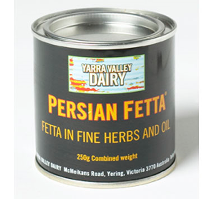
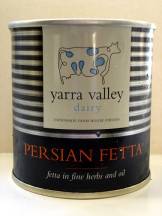
![Imported Photos 00799[1]](https://www.judgments.fedcourt.gov.au/__data/assets/image/0008/222299/Image4.jpeg)
Third parties’ use of PERSIAN and PERSIAN FETTA in Australia
164 In addition to Yarra Valley and Lemnos (but not prior to March 2000) the word “Persian” has been used in relation to cheeses made by:
(a) the Binnorie Dairy in the Hunter Valley, New South Wales, which marketed products called:
(i) “Marinated Fetta” described as:
“Our flagship - an international Gold Medal Winner.
This Fetta is rich and creamy, in a Persian style. It's less hard and crumbly than the one you may be used to and it's marinated in olive oil and selected herbs.
Australian Specialist Cheesemakers Gold Medal - 2004 & 2006”
(ii) “Marinated Goat Fetta” described as:
“Rich, creamy goat milk Fetta with herbs
This Fetta is rich and creamy, in a Persian style. Made from locally sourced goat's milk and marinated in olive oil and selected herbs.”
(a) the Vanella Cheese Factory Pty Ltd in North Queensland, which marketed products called:
(i) “Buffalo Fetta” described as follows:
“The Buffalo Fetta is a Persian Style Fetta and the fact of being made from Buffalo Milk makes it very unique, in fact Vannella Cheese Factory is the only producer in the world of this pearly white, creamy cheese.”
(ii) “Marinated Buffalo Fetta” described as follows:
“Our unique cheese, Buffalo Persian Style Fetta, comes also marinated in Extra Virgin Olive Oil, with Black Pepper and a mixture of fresh Herbs.”
(b) Mundella Foods Pty Ltd in Mundijong, Western Australia, which called its product “Feta – Persian in Oil 3kg” and described it as:
“Persian Feta – Indulgence – a very soft and creamy smooth textured feta, complimented by oil. Mind Blowing!”
(c) Witches Chase in Queensland, which described its product as “Persian Fetta”.
165 I should indicate that I accept that these manufacturers adopted the term as a result of the success of the Yarra Valley product. This in itself does not necessarily impute an improper motive to the manufacturer. I also observe that in some cases the term is no longer used by these manufacturers.
166 In addition to use by Yarra Valley, Lemnos and the above four Australian cheese manufacturers, the word “Persian” has been used in relation to cheese as shown by various publications referred to later.
167 This evidence does give some support for the conclusion that persons trading or considering trading in cheese products in Australia and activated only by proper motives, would think of the word “Persian” and want to use it themselves.
Yarra Valley’s evidence of reputation in PERSIAN FETTA
168 Mr Gary Cooper, a chef with many years experience in the restaurant industry, had said that apart from the YARRA VALLEY DAIRY PERSIAN FETTA he had never heard of anyone using the term “Persian Fetta” or the word “Persian” in relation to cheese. He did not understand the phrase “Persian Fetta” or the word “Persian” to be descriptive of any style of cheese. He also gave evidence that he has known of and used the Yarra Valley DAIRY PERSIAN FETTA product for more than a decade and that, in his opinion, the Yarra Valley DAIRY PERSIAN FETTA product has been very well known in Victoria for the last decade or so.
169 Similarly, Mr David Brown, the managing director of the Milawa Cheese Company which, at one time, employed Richard Thomas, said that:
(a) he considered the expression “Persian Fetta” to have always been aligned with the Yarra Valley Dairy;
(b) he was not aware of the term “Persia” or “Persian” ever being used for cheese other than in relation to the YARRA VALLEY DAIRY PERSIAN FETTA and more recently the Lemnos product;
(c) he had never otherwise heard of the word “Persian” being used in relation to cheese and is not aware of any cheese distributors in Australia importing cheese from Iran;
(d) in the time that Richard Thomas worked with the Milawa Cheese Company he did not mention that he was trying to replicate a cheese he had made in Iran or that he had ever been to Iran or seen cheese made there; and
(e) the term “Persian Fetta” would have not meant anything to persons in the speciality cheese industry and market if Yarra Valley had not used the term.
170 Neither witness was cross-examined. Necessarily, however, the evidence of each witness must be viewed in light of the other evidence and keeping in mind that the evidence of Mr Cooper and Mr Brown is necessarily based only on their own knowledge and perceptions. Their evidence is obviously of an idiosyncratic nature and reflects very much their special position in the restaurant and cheese industry. Further, this evidence does not address the position specifically as at 21 March 2000.
Correspondence between the parties and litigation
171 By letter from Yarra Valley’s solicitors to Lemnos dated 26 March 2009, Yarra Valley informed Lemnos of its registered trade mark for PERSIAN FETTA.
172 At the time this letter was received a product labelled LEMNOS PERSIAN FETTA was depicted on the Lemnos website but no sales had been made of that product and it was not available for sale anywhere. Lemnos did not manufacture or sell the LEMNOS PERSIAN FETTA product.
173 Following the receipt of that letter, the image of the LEMNOS PERSIAN FETTA product was removed from the Lemnos website and the name of Lemnos’ product was changed from LEMNOS PERSIAN FETTA to LEMNOS PERSIAN MARINATED CHEESE.
174 In cross-examination, Mr Paule explained that once he received the letter, Lemnos decided to change the name of the new product from “Lemnos Persian Fetta” to “Lemnos Persian Marinated Cheese” and that, to the best of his knowledge, Lemnos stopped using the name “Persian Fetta” and instructed all staff to stop using it. Mr Paule said that the motivation for this change was “actually commercial compromise so that we didn’t end up in a court wasting a lot of time and money.” Mr Paule said he was unhappy about this decision but that it seemed a sensible course.
175 Mr Paule was confronted in cross-examination with email correspondence between Lemnos and Tarago (Lemnos’ supplier of the Persian Marinated Cheese product) as late as July 2009 which contained references to “Persian Fetta”. Mr Paule explained that, despite this, PERSIAN FETTA was not used in any communications with the general public. The correspondence was only between Lemnos and the supplier of the cheese. Mr Paule was then shown other email correspondence containing the words PERSIAN FETTA and he explained that “there are 90 odd staff at Lemnos” and that he “had certainly given the instruction not to use the term PERSIAN FETTA.”
176 Mr Paule was then shown a photograph of a display in a Coles supermarket in which the South Cape Persian Fetta product and the Lemnos Persian Marinated Cheese product were displayed for sale side by side. This photograph was exhibited to the affidavit of Benjamin Dowling dated 12 February 2010. The photo shows that, on the Coles ticket underneath the Lemnos product, it is described as Persian Fetta.
177 Mr Paule explained that Lemnos has “no control on the way Coles ticket their shelving. We would certainly have informed them of the product name because, if anything, it could detract from our sales because we’re selling Lemnos Persian Marinated Cheese clearly in the photograph, and they’ve got a note there for “Lemnos cheese Persian fetta” which could confuse their customers and our customers”.
178 I accept this evidence of Mr Paule.
Admissibility of the affidavit evidence of Mr Dowling
179 Evidence was sought to be placed before the Court by Lemnos of various publications showing the use of the term “Persian”.
180 This was in response to the factual assertion of Yarra Valley that the term “Persian Fetta” or “Persian” has not been used to describe a type of cheese, either in Australia or elsewhere.
181 Through Mr Dowling, the solicitor for Lemnos, Lemnos sought to put into evidence a range of materials arising from Mr Dowling’s research which sought to demonstrate that, in fact, the term “Persian” has indeed been used to describe cheese, including Fetta style cheese, in Australia and overseas. This evidence was to demonstrate that cheese, including Fetta style cheese, was known to emanate from the area now known as Iran but formerly called Persia. The publications also showed various uses of the word “Persian” in relation to other types of food.
182 Yarra Valley objected to such evidence on the basis that it was hearsay.
183 Before addressing Yarra Valley’s objection, it is helpful to consider some examples of the type of evidence exhibited by Mr Dowling.
184 Exhibit BD-8 is an extract from a book titled “Cheese: Chemistry, Physics and Microbiology Volume 2 Major Cheese Groups, Second Edition”, edited by P.F. Fox of the Department of Food Chemistry, University College, Cork, Ireland, published in London in 1993, and found by Mr Dowling in his search of books and journals currently on the shelves of three libraries in Melbourne. Page 443 of this book, under the heading “Non-European Cheese Varieties”, includes the following statement:
4.2 Iran
FAO statistics indicate that cheese production was 112,303 tonnes in 1989. In 1981, according to the same sources, production was estimated at 107,000. However, Kosikowski reported a figure of nearly twice that for pickled white cheese alone.
Liqvan cheese is famous in Iran and known as the best white cheese made in the country. Its production is limited to the Liqvan Valley near Tabriz. It is similar to Feta or Bulgarian white cheese which are described in chapters 9 and 11, Volume 2. Actually, Iran, which previously imported Bulgarian cheese to supplement national production of white cheese, has become a major importer of Feta-type cheese from European countries. Liqvan cheese is made, in general, from sheep’s milk and occasionally from surplus cow’s milk. Traditionally, curing in brine was carried out in rooms dug in the ground, with access through a narrow gallery just wide enough for a man.
White cheese, known also as Iranian cheese, is made throughout Iran in the mountainous areas where sheep are kept. Is technically similar to Liqvan and Bulgarian cheeses…
185 Exhibit BD-9 is an extract from the book “Food of Life a Book of Ancient Persian and Modern Iranian Cooking and Ceremonies” by Najmieh Batmanglij, published in Washington DC by Mage Publishers Inc in 1990, and found by Mr Dowling on the shelves of the State Library of Victoria. A stamp in the title page suggests that it has been held by the State Library of Victoria since 11 July 1991. Page 8 of that book, under the heading “Persian Cheese”, contains the following statements:
No Persian table would be complete without nan-o panir-o sabzi-khordan, quite simply bread and fresh feta cheese with raw vegetables and herbs. The bread is spread with fresh feta cheese and garnished with raw vegetables and herbs.
…
Panir is a cheese similar to feta cheese. It can be made from either cow’s or goat’s milk.
186 Exhibit BD-10 is an extract from a book titled “Feta and Related Cheeses” edited by RK Robinson at the Department of Food Science and Technology, University of Redding, and AY Tamme of the Foods Science and Technology Department, the Scottish Agricultural College – Auchincruive, Ayr., published in 1991 and found by Mr Dowling in his searches of library shelves in Melbourne. On page 15 of that book under the heading “Table 1 - Nomenclature and description of some pickled cheese varieties” is a description of “Lighvan” cheese from Iran, made of sheep’s, goat’s and cow’s milk, with the further description “the cheese is also known as Iranian white and the average composition is moisture 38%, fat 32.2%, protein 22%, ash 5.3% and salt 3.5%.”
187 A factual issue arising from Yarra Valley’s contentions is whether it is true or not that the term “Persian Fetta” or “Persian” has been used to describe a type of cheese, either in Australia or overseas.
188 The above evidence is relevant to demonstrate that, contrary to Yarra Valley’s assertion of fact, the terms “Persian” and “Fetta” have been used to describe a type of cheese, both outside Australia in the countries where those books were published, as well as inside Australia by way of their publication here and availability in Australian libraries. The fact of such use of those words is distinct from the truth of those words. For example, the usage in the book “Food of Life a Book of Ancient Persian and Modern Iranian Cooking and Ceremonies”, by its author Najmieh Batmanglij, of the term “Persian Cheese” and a comparison of such cheese to “feta” demonstrates use of the terms “Persian” and “feta” to describe a type of cheese. Whether or not those representations are truthful is a separate matter from the fact that the words “Persian” and “feta” have simply been used, contrary to Yarra Valley’s assertion. The evidence is also relevant to the common usage of the word “Persian” generally.
189 Therefore, by operation of s 60 of the Evidence Act 1995 (Cth) (‘the Evidence Act’), the representations in the publications, to the extent they also are proof of the facts asserted, are not caught by the hearsay rule. No application was made to utilise the discretion conferred on the Court by s 136 of the Evidence Act. In any event, I do not consider that there is a danger that the particular use of the evidence might be unfairly prejudicial to Yarra Valley or that it is misleading and deceptive.
190 Further, s 190(3) of the Evidence Act provides that the Court may order that the hearsay rule does not apply in relation to evidence if the application of that rule would cause or involve “unnecessary expense or delay”. Section 190(4) describes, without limitation, the following matters that the Court may take into account in deciding whether to exercise the power conferred by s 190(3):
(a) the importance of the evidence in the proceeding;
(b) the nature of the cause of action or defence and the nature of the subject matter of the proceeding;
(c) the probative value of the evidence; and
(d) the powers of the court (if any) to adjourn the hearing, to make another order or to give a direction in relation to the evidence.
191 In the present case, Lemnos is faced with an assertion of fact by Yarra Valley that the terms “Persian Fetta” or “Persian” have not been used to describe a type of cheese, either in Australia or elsewhere. The evidence sought to be introduced, to which Yarra Valley objects, contradicts Yarra Valley’s factual assertion.
192 Such evidence is also relevant to the correctness of Yarra Valley’s representations to the Registrar of Trade Marks that “there is no such thing as Persian style cheese nor Persian style fetta cheese”.
193 If the hearsay rule were applied to exclude such evidence, the alternative for Lemnos would be to call each of the authors of the relevant books as witnesses to verify the truth of each relevant statement contained in their books. These authors are scattered around the world, and such a process would involve enormous expense and delay.
194 Undoubtedly, the evidence sought to be relied upon by Lemnos is important and probative. As I have indicated, such evidence has probative value, indicating that “Persian” and “Fetta” have an ordinary descriptive role as words of the English language, thus forming part of the “common heritage” which all traders should be entitled to use.
195 However, in light of the nature of the publications and the lack of utility in requiring the authors to be called to give evidence, if the hearsay rule did apply I would have exercised my discretion under s 190(3) to permit the publications to be admitted into evidence without limiting their use. The application of the hearsay rule in these circumstances would have caused unnecessary expense and delay in the hearing of this proceeding.
Evidence of foreign use
196 Lemnos sought to introduce evidence of foreign use of the term “Persian”.
197 Evidence of foreign use of a trade mark cannot assist a trade mark applicant seeking to prove inherent adaptability to distinguish for the purposes of s 41 of the TMA: Burger King Corporation v Registrar of Trade Marks (1973) 1A IPR 504.
198 However, evidence of foreign use of a mark can be relevant and admissible in some circumstances. In Burger King, for example, evidence of foreign use of the word WHOPPER was held to be admissible for the purpose of determining whether that word was capable of becoming distinctive in Australia. Similarly, in this case, evidence of foreign use of the word “Persian” and the phrase PERSIAN FETTA and its synonyms is relevant to the question of whether the words PERSIAN FETTA were (or could have become) distinctive of Yarra Valley.
199 I do not regard the comments of Foster J in Alcon at [71]-[72] as authority for the contention that evidence of use of a term in overseas jurisdictions can never be relevant to the determination of inherent adaptability to distinguish in the context of s 41 of the TMA.
200 Evidence of use (both in Australia and overseas) is relevant to whether PERSIAN FETTA is a fanciful or arbitrary term like NORTH POLE BANANAS, or truly descriptive. It also assists the Court in determining whether honest traders trading or contemplating trading in Australia might wish to use PERSIAN FETTA to describe such products, and in determining the extent of the common usage of the word “Persian”.
201 Such evidence is also relevant in considering the various representations which Yarra Valley made to the Registrar of Trade Marks to the effect that there is no such thing as Persian style cheese or Persian style fetta cheese.
Consideration of question of whether inherently adapted to distinguish
202 It is common ground that the word “Fetta” is wholly descriptive of a type of cheese and could not be distinctive in itself of Yarra Valley’s product. It is not common ground that the phrase PERSIAN FETTA is descriptive. It is this phrase that must be considered, not each individual word. On the evidence before the Court, including that of Mr Thomas, the promotional material of Yarra Valley, and the publications relied upon by Lemnos, I have concluded that there is a style or quality of fetta which originates from or is associated with the geographical location then known as Persia.
203 If the phrase “Iranian Fetta” was sought to be registered, I think there is little doubt that such application for registration would have been rejected. What then is the position with the phrase “Persian Fetta”?
204 The word “Persian” is commonly used, even now, to describe a thing pertaining to Persia (now Iran), or something native to, made in or attributed to Persia. Further, the words “Persian” and “Iranian” or “Persia” and “Iran” still seem to be interchangeable.
205 The Shorter Oxford Dictionary (6th edition) defines “Persian” as follows:
1 Of or pertaining to Persia (now Iran), a country in the Middle East, its inhabitants, or their language.
2A Of a thing: native to, made in, or attributed to Persia. B Made of the material called ‘Persian’ … C Of or pertaining to a Persian cat (see below)
- SPECIAL COLLOCATIONS: Persian berry the unripe fruit of a Persian buckthorn, Rhammus infectoria, formerly the source of a yellow dye. Persian blinds = PERSIENNES. Persian blue a bright pale blue. Persian carpet, Persian rug: woven esp. in Persia in a traditional brightly coloured pattern of animals, plants, figures, geometric shapes, etc. Persian cat (an animal of) a breed of cat, orig. from Persia, with long hair, a broad round head, and a stocky body. Persian green a bright dark green. Persian greyhound = SALUKI. Persian insect-powder pyrethrum powder. Persian lamb = KARAKUL 2. Persian lilac” See LILAC. Persian morocco: made from the skin of a hairy variety of sheep. Persian red = INDIAN red. Persian rug: see Persian carpet above. Persian sheep (an animal of) a southern African breed of sheep, bred for its meat. Persian silk ... Persian walnut: Persian wheel … a type of waterwheel with radial compartments, used for raising water. Persian Yellow (rose) a variety of the Austrian briar with fragrant double yellow flowers. ….
206 The Oxford English Dictionary, (2nd Volume VIII, Clarendon Press 1989) defines “Iranian” as follows:
Of or pertaining to Iran or Persia …
207 The word “Persia” is defined in the Macquarie Dictionary (Macquarie Library) as:
1. An ancient empire situated in western and south western Asia; at its peak it extended from Egypt and the Aegean to India; conquered by Alexander the Great 334-331 BC. 2. Former official name (until 1935) of Iran.
208 The word “Persian” is defined in that dictionary as including the meaning:
… of or pertaining to Iran, its people or their language.
209 The word “Iranian” is then defined as follows:
1. pertaining to Iran (or Persia). 2. pertaining to Iranian 3. a subgroup of Indo-European languages including Persian and Pushtu. 4. Persian (the language). 5. an inhabitant of Iran; a Persian.
210 “Persian” is a term used to generally describe a style of cheese according to Mr Thomas, and as shown by various publications and the promotional material of Yarra Valley itself. Other examples of the adjective “Persian” being commonly used to describe different types of foods include Persian lamb, Persian spices and Persian bread.
211 Further, Persia is not a made up or fictitious country that did not ever exist, and is a name which does relate to a region of the world which can be identified. The name “Persia” has been officially superseded only within the last century, and there is general usage of the name. Just like names such as “Peking” and “Ceylon”, the original geographical meaning is still the main signification of the name. Even if not necessarily being used interchangeably with the new name of the country Iran, the name Persia still is a reference to a specific part of the world in the Middle East. The use of the word “Persian” in the trade mark PERSIAN FETTA does not save the word “Persian” from carrying is prima facie geographical signification.
212 There is also a possible relationship between the word “Persian”, and the connotations that word invokes, and “dairy products including cheese”, in the same way that the Full Court in Colorado found there was a possible relationship between backpacks and Colorado’s connotations of mountains and trekking. “Persian” in reference to cheese is not a fanciful or arbitrary geographical reference like the North Pole is for bananas. The evidence indicates that there is a degree of association with cheese and the former region known as Persia to conclude that an honest trader would legitimately want to use the term “Persian” to describe fetta cheese. PERSIAN FETTA (as a composite term) is certainly not a made up term or device unrelated to cheese, or unrelated to a geographical region of the world associated with cheese production of a specific type or style.
213 On the evidence there is a “possible relationship” between cheese (fetta) and Iran or Persia, in the past, the present and in the future. Cheese has originated from or been associated with the region then known as Persia, now encompassing Iran, for many centuries. This connection is directly with Persia as it was known when the cheese was originally produced. Mr Thomas went to Iran, but the type of cheese is derived from a style of cheese developed before Iran as a country was so named. As to the possible future association, Mr Paule referred to the opportunity to produce cheese from Iran in the future, and it is reasonable to suppose that fetta cheese may in the future be produced there and imported into Australia.
214 There is the question of whether an honest trader in connection with trading in Australia would use the word “Iranian” instead of “Persian”. If the reference is to a style of cheese originating from Persia before the coming into existence of the named region “Iran”, then an honest trader may legitimately use the word “Persian”. If, however, the reference is just to a geographical region where the product is to be manufactured, different considerations may apply as there is currently no geographical region associated with cheese production called Persia (putting aside the Persian Gulf).
215 The parties accepted that the term “Persian” “suggested a sense of the exotic”, had “mysticism and exoticness” and “it had the right mix of mysticism and exoticness”. These connotations derive from the reference to Persia. The words “Iran” and “Persian” are interchangeable in ordinary usage. The reference to “Persia” in this sense is not arbitrary, the very connotations suggested come from the attributes of the word “Persian”. As Mr Thomas said in his evidence, no trader would want to use the phrase “Iranian” because of the political connotations it may import. An honest competitor would then readily want to use the word “Persian” to describe a cheese even from a style derived from Iran, a cheese producing region. The honest trader, wanting to excite in the consumer the connotations of the exotic, in reference to a cheese style that was connected to a place previously referred to as Persia, would want to use the geographical place name of Persia and not Iran (as it is currently called). To choose the name Persia over Iran does not indicate an improper motive in circumstances where “Persia” is still a recognised descriptive term and has an association with fetta cheese production, and where the term “Persian” has the accepted connotations of the exotic and mystical, and where the alternative “Iranian” has negative connotations which a trader would not wish to employ.
216 The Full Federal Court in Colorado considered the connotations of Colorado as a rugged, mountainous place. This was not a direct reference to the quality or character of the goods. It involved images of adventure, ruggedness and trekking. These are not features or qualities of the goods themselves. The Full Court held that COLORADO was not inherently adapted to distinguish, and made clear that traders could honestly and legitimately seek to use COLORADO to raise those connotations of a mountainous and rugged holiday area.
217 As I have indicated, I accept then that other cheese makers in Iran, Australia, or elsewhere, trading or wishing to trade in Australia, may want to use the word “Persia” or “Persian”, on or in connection with fetta, either to signify the style of cheese or to indicate that their cheese comes from the region formerly known as Persia. These traders would have a legitimate interest in using both the geographical and style name to identify their goods. I am also satisfied that there is a likelihood of other traders legitimately wishing to use in Australia the phrase “Persian Fetta” in relation to cheese products in the appropriate circumstance.
218 It follows that PERSIAN FETTA was not inherently adapted to distinguish Yarra Valley’s cheese, and s 41(6) TMA applies in the present case, not s 41(5).
Section 41(6): did PERSIAN FETTA acquire the capability to distinguish because of Yarra Valley’s use before 21 March 2000?
219 I now turn to consider s 41(6) of the TMA.
220 As I have said, no practical issue of the onus of proof arises, as all the evidence relevant to s 41(6) (and s 41(5)) is before the Court, and is considered in its entirety.
221 Section 41(6) TMA opened the door, for the first time, for registration in Australia of trade marks lacking inherent adaptability to distinguish.
222 Section 41(6) provides as follows:
(6) If the Registrar finds that the trade mark is not to any extent inherently adapted to distinguish the designated goods or services from the goods or services of other persons, the following provisions apply:
(a) if the applicant establishes that, because of the extent to which the applicant has used the trade mark before the filing date in respect of the application, it does distinguish the designated goods or services as being those of the applicant--the trade mark is taken to be capable of distinguishing the designated goods or services from the goods or services of other persons;
(b) in any other case--the trade mark is taken not to be capable of distinguishing the designated goods or services from the goods or services of other persons.”
223 The consideration of s 41(6) is specifically limited to use by Yarra Valley of PERSIAN FETTA before the filing date of 21 March 2000. Yarra Valley’s evidence includes materials which both predate and postdate the filing date, and the Court must be careful to exclude the latter from its consideration of the application of s 41(6).
224 Yarra Valley’s evidence of use in support of registration under s 41(6) largely postdates the filing date of 21 March 2000. The evidence of use before 21 March 2000 is scant.
225 In an article published in The Age newspaper in November 2001, a year and a half after the filing date, Mrs Mooney is quoted as saying that “because of the small scale of the operation, [the Yarra Valley Persian Fetta product] was so far only available to the food service industry.” It is therefore not surprising that the evidence of use before 21 March 2000 is minimal, and does not assist Yarra Valley in showing any real use of the trade mark.
226 It is also important not to equate use with distinctiveness. The mere use of PERSIAN FETTA by Yarra Valley does not, of itself, establish that those words distinguish Yarra Valley’s cheese from the cheeses of other persons.
227 Justice Jacobs explained in British Sugar plc v James Robertson & Sons Ltd [1996] RPC 281:
There is an unspoken and illogical assumption that “use equals distinctiveness”. The illogicality can be seen from an example; no matter how much use a manufacturer made of the word “Soap” as an unsupported trade mark for soap the word would not be distinctive of his goods.
228 As Lord Davey said in Cellular Clothing Co Ltd v Maxton & Murray [1899] AC 326:
… where a man produces or invents… a new article and attaches a descriptive name to it – a name which, as the article has not been produced before, has, of course, not been used in connection with the article – and secures for himself either the legal monopoly or a monopoly in fact of the sale of that article for a certain time, the evidence of persons who come forward and say that the name in question suggests to their minds and is associated by them with the plaintiff's goods alone is of a very slender character...
229 This principle stated by Lord Davey applies to Yarra Valley’s witnesses who give evidence to the effect that they associate PERSIAN FETTA with Yarra Valley.
230 Yarra Valley was the first manufacturer in Australia to make and sell a product bearing the name PERSIAN FETTA. As I have said, the evidence of Mr Thomas confirms that the term PERSIAN FETTA describes the style of the cheese. The evidence indicates that for many years no other similar product was made or sold in Australia. As such, Yarra Valley’s witnesses, Mr Gary Cooper and Mr David Brown, had no other Persian fetta product to compare with Yarra Valley’s product, and no other manufacturer to resort to for such a product, except Yarra Valley. Their evidence is necessarily based on their own knowledge, and is confined by their own perceptions. The evidence also does not indicate the position prior to 21 March 2001.
231 In such circumstances, I do not find the evidence of witnesses such as Mr Cooper and Mr Brown, that PERSIAN FETTA is associated with Yarra Valley alone, of any significance in considering the application of s 41(6) of the TMA.
232 It is important also to appreciate that in nearly all instances Yarra Valley did not use PERSIAN FETTA alone on its product or in its promotional material without some reference to the brand YARRA VALLEY DAIRY very nearby. I do not accept the contention by Yarra Valley to the contrary. In those cases where in the text of some promotion the words PERSIAN FETTA appeared alone, they appeared in the context of promotional material about or identifying Yarra Valley or the Yarra Valley Dairy.
233 In such circumstances, the Court must be wary of the type of “sleight of hand” which Jacob J warned against in Unilever plc’s Trade Mark, Re (Striped Toothpaste Case) [1984] RPC 155. In that case, Unilever sought registration of the shape of its “Viennetta” ice cream product. Justice Jacob considered survey evidence which demonstrated a “high degree” of association (approximately 67% of ice cream eaters) between an image of the “Viennetta” ice cream and “Walls”, a name long used by the applicant for its ice cream products. His Lordship dismissed the value of such evidence as follows:
Putting the other products on one side for the moment, there can be no doubt that the product appearance has achieved considerable recognition on its own as denoting Walls’ “Viennetta” – the product of a particular manufacturer. Is that enough to give it a “distinctive character” within the meaning of Art.3(3)? For what has not been proved is that any member of the public would rely upon the appearance alone to identify the goods. They recognise it but do not treat it as a trade mark.
There is a bit of sleight of hand going on here and in other cases of this sort. The trick works like this. The manufacturer sells and advertises his product widely and under a well-known trade mark. After some while the product appearance becomes well-known. He then says the appearance alone will serve as a trade mark, even though he himself never relied on the appearance alone to designate origin and would not dare to do so. He then gets registration of the shape alone. Now he is in a position to stop other parties, using their own word trade marks, from selling the product, even though no-one is deceived or misled.
I do not think that is what the European Trade Mark system is for. It is a system about trade marks, badges of trade origin. For that reason I think that in the case of marks consisting of product shapes it is not enough to prove the public recognises them as the product of a particular manufacturer. It must be proved that consumers regard the shape alone as a badge of trade origin in the sense that they would rely upon that shape alone as an indication of trade origin, particularly to buy the goods. If that cannot be proved, then the shape is not properly a trade mark, it does not have a “distinctive character” for the purposes of trade mark law.
234 Justice Sundberg applied the above passage from Unilever with approval in Guylian.
235 Even if the PERSIAN FETTA trade mark became well known and well associated with Yarra Valley, in my view this was only because of the fact that PERSIAN FETTA or its products is invariably presented together with YARRA VALLEY DAIRY.
236 Consistent with the approach of Jacob J in Unilever and Sundberg J in Guylian, no member of the public would rely upon the words PERSIAN FETTA alone to identify the goods – they may recognise PERSIAN FETTA and associate such a term with YARRA VALLEY DAIRY, but they would not treat PERSIAN FETTA as a badge of trade origin.
237 It is also important to recall that s 41(6) requires use of PERSIAN FETTA “as a trade mark”.
238 In Woolworths Ltd v BP plc (No 2) (2006) 154 FCR 97, the Full Federal Court held that s 41(6) requires specific consideration of the extent to which BP had used each of the marks applied for as a trade mark before the date of filing and whether that use was sufficient to distinguish the designated goods and services as being those of BP.
239 The Full Court in Woolworths (No 2) found that the primary judge had fallen into error by failing to make an express finding about what precisely had been used as a trade mark.
240 The Full Court considered that despite BP’s acknowledged heavy use of the colour green, it had not been used “as a trade mark” and therefore could not meet the test provided by s 41(6). The Full Court found specifically that green was an important part of BP’s “get-up” and was part of their method of identifying and distinguishing BP’s products and services, but had not been used separately as a trade mark.
241 More recently, in Guylian, a s 41(5) case, Sundberg J applied the Full Court’s reasoning in BP to conclude that the seahorse shape for which the applicant sought trade mark registration had not been used by the applicant “as a trade mark.” This was because:
(a) the seahorse picture on the front of the Guylian box was descriptive of or “an example of” the box’s contents; and
(b) the GUYLIAN trade mark on the applicant’s packaging had the effect of diluting any trade mark significance the seahorse shape might otherwise have had.
242 Similarly, in Ocean Spray Cranberries, Wilcox J held that the words CRANBERRY CLASSIC were not used “as a trade mark” because the words were:
(a) descriptive of the particular product on which they were displayed; and
(b) always used on the product label with the words OCEAN SPRAY which was the applicant’s brand name.
243 In the present inquiry under s 41(6), a key question is whether Yarra Valley’s use of the phrase PERSIAN FETTA before 21 March 2000 would have appeared to consumers as possessing the character of a brand.
244 In my view, the presence of the YARRA VALLEY DAIRY name and logo on all versions of the YARRA VALLEY DAIRY PERSIAN FETTA product makes it “difficult to conclude”, as Sundberg J said in Guylian, that the phrase PERSIAN FETTA “has by itself become distinctive” of Yarra Valley’s products.
245 There are similarities between this case and the facts considered by the Full Courts who decided Johnson & Johnson, Pepsico Australia Pty Ltd v The Kettle Chip Company Pty Ltd (1996) IPR 161, Mars Australia Pty Ltd v Sweet Rewards Pty Ltd (2009) 81 IPR 354 and the decision of Sundberg J in Guylian.
246 Nevertheless, every case needs to be determined on its own facts and in context. In this proceeding, it is the YARRA VALLEY DAIRY name and logo on Yarra Valley’s PERSIAN FETTA product that does the work of identifying the commercial source or trade origin of Yarra Valley’s product, and not the words PERSIAN FETTA.
247 It follows from the above that s 41(6) cannot apply to allow Yarra Valley’s registration of PERSIAN FETTA because Yarra Valley did not use the words PERSIAN FETTA as a trade mark prior to 21 March 2000 to the extent necessary to establish that by then the words PERSIAN FETTA no longer conveyed their inherent descriptive meaning, but instead distinguished Yarra Valley’s cheese from the cheese of other persons. The use by Yarra Valley prior to 21 March 2000 had certainly not ‘eclipsed’ the primary descriptive nature of or the primary signification of the term PERSIAN FETTA.
Application of section 41(5) TMA
248 As explained above, and consistent with the analysis of Branson J in Blount and the Full Court in Colorado, s 41(5) should not arise for consideration in the present case.
249 However, I turn to make some observations as to the application of s 41(5).
250 Section 41(5) provides as follows:
(5) If the Registrar finds that the trade mark is to some extent inherently adapted to distinguish the designated goods or services from the goods or services of other persons but is unable to decide, on that basis alone, that the trade mark is capable of so distinguishing the designated goods or services:
(a) the Registrar is to consider whether, because of the combined effect of the following:
(i) the extent to which the trade mark is inherently adapted to distinguish the designated goods or services;
(ii) the use, or intended use, of the trade mark by the applicant;
(iii) any other circumstances;
the trade mark does or will distinguish the designated goods or services as being those of the applicant; and
(b) if the Registrar is then satisfied that the trade mark does or will so distinguish the designated goods or services--the trade mark is taken to be capable of distinguishing the applicant's goods or services from the goods or services of other persons; and
(c) if the Registrar is not satisfied that the trade mark does or will so distinguish the designated goods or services--the trade mark is taken not to be capable of distinguishing the applicant's goods or services from the goods or services of other persons.
251 Section 41(5) TMA requires a balancing exercise. If a mark is inherently adapted only to a small degree it will require greater evidence of the fact that it has been (or will be) used in such a way as to distinguish the relevant goods.
252 The relevant date for assessment of capacity to distinguish is the priority date of the trade mark application, which in this case is 21 March 2000.
253 In Austereo Pty Ltd v DMG Radio (Australia) Pty Ltd (2004) 61 IPR 257, Finn J considered the authorities relevant to s 41(5) and explained that:
(a) the criterion is forward looking but the required capability must be possessed by the mark at the priority date;
(b) it is insufficient that the mark may have the potential or capacity to acquire that capability in the future;
(c) evidence of use after the priority date, no less than evidence of intended use, is relevant only to the question of whether the mark possessed the required capability at the priority date; and
(d) It will not assist an applicant for registration if that use after the priority date demonstrates no more than:
(i) the mark has the potential or capacity to acquire that capability in the future; or
(ii) that the mark has acquired distinctiveness only because the relevant community has since the priority date been “educated” to see the mark as an indicator of the origin of particular services.
254 Accordingly, in this case, the question would be whether the phrase PERSIAN FETTA had the capability, as at 21 March 2000, to distinguish the Yarra Valley’s product from the products of other traders.
255 There were a large number of reports that Yarra Valley’s product was derived from Iran which continued to be republished after 2001, including on Yarra Valley’s own website and at public cheese industry shows. These are relevant factors under s 41(5)(a)(iii) of the TMA which weigh against Yarra Valley by reinforcing the descriptive, not distinctive, nature of PERSIAN FETTA, as the public had been educated to believe that PERSIAN FETTA was descriptive of Yarra Valley’s product.
256 In Colorado, one of the factors taken into account by the Full Federal Court under s 41(5) of the TMA was the use of COLORADO by persons other than the trade mark applicant.
257 As noted above, apart from Yarra Valley and Lemnos, other persons have sought to use “Persian” and “Fetta” and similar descriptive terms in Australia in relation to cheese products. As in Colorado, such use by persons other than Yarra Valley weighs heavily against the conclusion that PERSIAN FETTA distinguishes Yarra Valley’s cheese from the cheeses of other persons, particularly other persons’ Persian style fetta cheeses.
258 Insofar as s 41(5)(a)(ii) of the TMA requires consideration of Yarra Valley’s actual or intended use of PERSIAN FETTA, it refers to use “of the trade mark” in terms comparable to s 41(6). It follows that, consistently with the Full Court’s interpretation of s 41(6) in Woolworths (No 2), the use relevant to s 41(5)(a)(ii) is Yarra Valley’s use of the words PERSIAN FETTA as a trade mark.
259 For the reasons set out above with respect to s 41(6) of the TMA, Yarra Valley’s use of PERSIAN FETTA prior to 21 March 2000 was not use of those words as a trade mark.
260 Insofar as Yarra Valley’s conduct after 21 March 2000 is relevant to demonstrate the capability of PERSIAN FETTA to distinguish Yarra Valley’s cheese at that date, the evidence after that date does not lead to any different conclusion. Both before and after 21 March 2000, the YARRA VALLEY DAIRY brand name was prominently displayed at the top of the front of Yarra Valley’s product and it is this name that does the work of distinguishing the product.
261 In the same way, the use of the words PERSIAN FETTA by National Foods (since 2003) under licence from Yarra Valley, is descriptive and issued always in conjunction with the distinctive trade mark SOUTH CAPE.
262 Moreover, Yarra Valley’s change of packaging to its current YARRA VALLEY DAIRY PERSIAN FETTA product has substantially decreased the size and prominence of the words PERSIAN FETTA, and increased the size and prominence of YARRA VALLEY DAIRY and a blue cow logo. This could be seen as consistent with the conclusion that YARRA VALLEY DAIRY has always designated the brand of that product, whereas PERSIAN FETTA has described its contents.
263 It follows that s 41(5), even if applicable, would not prevent Yarra Valley’s registration from being cancelled.
PASSING OFF AND MISLEADING AND DECEPTIVE CONDUCT
264 I now turn to the causes of action for passing off and misleading and deceptive conduct.
265 Generally speaking, there are three elements that must be established in a passing off action:
(a) that the applicant’s “get-up”, including any brand name, is recognised by the public as distinctive, specifically of the applicant’s goods or services;
(b) that there has been a misrepresentation by the respondent to the public (whether or not intentional) leading or likely to lead the public to believe that the goods offered by the respondent are the applicant’s goods; and
(c) that the applicant suffers or, in a quia timet action is likely to suffer, damage by reason of the erroneous belief engendered by the respondent’s misrepresentation that the source of the respondent’s goods is the same as the source of those offered by the applicant.
266 As noted by the House of Lords in Reckitt and Colman Products Ltd v Borden Inc and others (1990) 17 IPR 1:
Although your Lordships were referred in the course of the argument to a large number of reported cases, this is not a branch of the law in which reference to other cases is of any real assistance except analogically. It has been observed more than once that the questions which arise are, in general, questions of fact. Neither the appellants nor the respondents contend that the principles of law are in any doubt. The law of passing off can be summarised in one short general proposition – no man may pass off his goods as those of another.
267 The principles relating to the application off ss 52 and 53 of the TPA need not be repeated and were not in dispute between the parties.
268 In my view, Yarra Valley’s case for passing off and breach of s 52 and s 53 of the TPA cannot succeed because there is an insufficient likelihood that consumers would have been misled by the packaging of the LEMNOS PERSIAN MARINATED CHEESE product to think that Lemnos or its product was associated with Yarra Valley.
269 There is insufficient likelihood that consumers or retailers would be misled to establish any claim for passing off or breach of s 52 and s 53 of the TPA, by reason of:
(a) the prominent, distinguishing features on Lemnos’ product consisting of Lemnos’ well known trade mark LEMNOS and lambda device;
(b) the prominent distinguishing features on Yarra Valley’s product consisting of Yarra Valley’s trade mark YARRA VALLEY DAIRY and cow (or map) design;
(c) the descriptive role played by PERSIAN MARINATED CHEESE on Lemnos’ product;
(d) the other differentiating features of the two products, including:
(i) the background colour, which is:
(A) black on Yarra Valley’s product; and
(B) yellow/gold on Lemnos’ product, with a swirling pattern;
(ii) orange text on Yarra Valley’s product;
(iii) corrugated tin background design on Yarra Valley’s product;
(iv) around the top and bottom of Lemnos’ product, and in a circle around the lid label, a band of text reading “PERSIAN CHEESE MARINATED IN THE FINEST BLEND OF HERBS AND OILS”;
(v) the name, address and webpage of each of Yarra Valley and Lemnos on each respective product.
270 The respective current products would appear to consumers (if shown side by side) as follows:
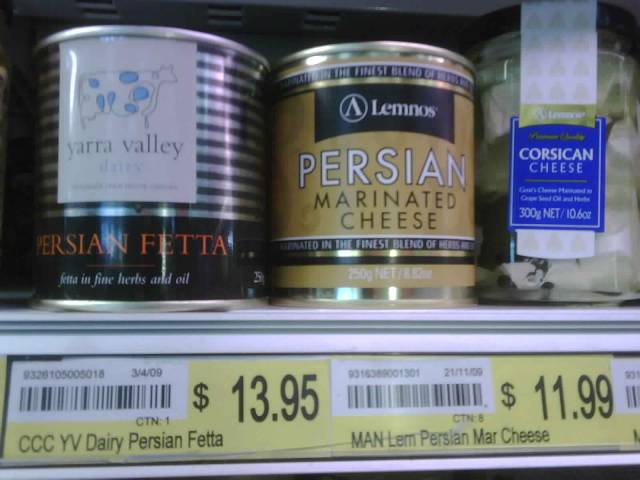
271 Further, as noted above on the question of use as a trade mark, the distinctiveness of the LEMNOS product and the associated lambda device is reinforced by:
(a) the fact that Lemnos is Australia’s leading manufacturer of fetta and haloumi cheeses, producing seven different varieties of fetta as well as varieties of haloumi, ricotta and paneer, all of which are sold under the LEMNOS brand;
(b) the fact that Lemnos and its predecessors in business have sold fetta and other white cheeses under the LEMNOS brand since the 1960s, over 25 years before Yarra Valley sold any relevant product, through supermarkets and delicatessens, market stalls and other retail outlets;
(c) the recognition of LEMNOS branded fetta products as high quality fetta products;
(d) the recognition of the LEMNOS and lambda device trade mark as a distinctive mark by way of its registration as Australian Trade Mark Registration 890174 for goods including cheese.
272 In the present case, notwithstanding the use of similar tins, Lemnos has clearly distinguished its product from that of Yarra Valley.
273 I accept that the evidence establishes that Yarra Valley’s tinned PERSIAN FETTA product is typically sold in delicatessens and speciality food stores, whilst the Lemnos product is sold primarily in Coles supermarkets. Therefore, there may not always be a side by side comparison of the two products. Even so, the extent of the differences would lead a consumer to differentiate the two products even though a side by side comparison is not possible. No evidence was introduced by Yarra Valley to indicate anything to the contrary. Whilst the lack of such evidence is not decisive or conclusive, the lack of evidence is a factor to be considered.
274 I have reached the above conclusions, even though the evidence establishes a clear intention on the part of Lemnos to adopt the key indicia of the PERSIAN FETTA product. It is apparent from Lemnos’ contemporaneous documents and the oral evidence of Mr Raman and Mr Karamoshos that the Lemnos Persian Fetta/Persian Marinated Cheese product was consciously modelled on the Yarra Valley Persian Fetta product.
275 The three key indicia of Yarra Valley’s PERSIAN FETTA product were:
(i) The product itself, being a cow’s cheese marinated in extra virgin olive oil, garlic, thyme, black peppercorn and bay leaf;
(ii) The term “Persian”; and
(iii) The distinctive paint tin.
276 Undoubtedly, these are the indicia that a consumer recalls. In addition to these key indicia, the use of similar wording “in the finest blend of herbs and oil”, and the use of the same recipe and ingredients could increase the risk of persons being misled and deceived.
277 However, I do not accept that the composition of the product, the prominent use of the word “Persian” and the characteristic paint tin, when used in marketing Lemnos’ product, individually or cumulatively form a representation that Lemnos’ product is Yarra Valley’s PERSIAN FETTA or that it is associated with the maker of the PERSIAN FETTA product. I do not accept that consumers would be likely to be misled or deceived.
278 Accepting in favour of Yarra Valley that consumers either would not have the opportunity to make a side by side comparison or would not be motivated to do so in the circumstances of filling a supermarket trolley, it is the extent of the differences (which I have described above) between the products that would alert the consumer to the different origin of the products. This is particularly so in a ‘boutique market’ where consumers probably are either already aware of the different products, or at least take some care in choosing the product they intend to purchase. The consumer of this type of product is likely to be astute as to the characteristics of the product, and discerning in his or her purchasing habits. This is certainly not a situation of impulse purchasing.
279 Therefore, I would dismiss the application of Yarra Valley seeking relief on the basis of passing off and misleading and deceptive conduct.
ANother matteR
Notification to Registrar of Trade Marks
280 An issue was taken up by Yarra Valley that Lemnos had failed to notify the Registrar of Trade Marks of its application as required by s 90 of the TMA.
281 On 23 March 2010 (after the initial hearing of the proceeding) notification was given by Lemnos to the Registrar of Trade Marks. The Registrar responded by not seeking to intervene.
282 On 13 May 2010, the Court made orders giving leave for the re-opening of the case of Lemnos. A further hearing was fixed on 29 June 2010 for that purpose.
283 As the matter was re-opened after the notification to the Registrar of Trade Marks, in my view no issue arises in relation to the requirements of s 90 of the TMA not being met.
284 In any event, I would not regard any failure of giving notification as impacting on the jurisdiction of this Court to grant relief in relation to the cancellation action based on s 62 or s 88(2)(a) of the TMA. With respect, I do not agree with the decision in Hall v Lewis (2004) 64 IPR 61, to the extent it decided that the consequence of non-compliance means the Court has no jurisdiction. Undoubtedly, the requirements in s 90 are couched in mandatory terms, but the consequence of non-compliance is not that the Court lacks jurisdiction to proceed, but may mean the Court should not grant the relief sought without giving the Registrar of Trade Marks the notification so that an appearance can be made if necessary.
CONCLUSION
285 As the cross-claim for removal of Yarra Valley’s mark from the Register is successful, there is no need for the Court to consider the claim for trade mark infringement.
286 It is also unnecessary to consider the other grounds sought to have the trade mark removed.
287 As the claims by Yarra Valley against the first respondent have failed, the claims against the second respondent, Mr Paule, must similarly fail.
288 It is apparent that in light of the above the registration of the trade mark should be cancelled in accordance with s 88(1)(a) of the TMA. I will leave it to the parties to formulate the appropriate orders and seek to agree as to costs. If agreement cannot be reached, proposed directions can be submitted for the determination of any outstanding matters.
I certify that the preceding two hundred and eighty-eight (288) numbered paragraphs are a true copy of the Reasons for Judgment herein of the Honourable Justice Middleton. |
Associate:


