

FEDERAL COURT OF AUSTRALIA
Nelson v Northern Territory of Australia [2010] FCA 1343
FEDERAL COURT OF AUSTRALIA
Nelson v Northern Territory of Australia [2010] FCA 1343
CORRIGENDUM
1. In paragraph 3 of the Reasons for Judgment, in the third, sixth, ninth and eleventh lines, delete “criteria” and substitute “criterion” instead.
2. In paragraph 4 of the Reasons for Judgment, in the first line, delete “criteria” and substitute “criterion” instead.
| I certify that the preceding two (2) numbered paragraphs are a true copy of the Corrigendum to the Reasons for Judgment herein of the Honourable Justice Reeves. |
Associate:
Dated: 8 April 2011
IN THE FEDERAL COURT OF AUSTRALIA | |
HARRY JAKAMARRA NELSON, JACOB JUNGARRAYI SPENCER AND BOB JUPURRURLA DIXON Applicant
| |
AND: | NORTHERN TERRITORY OF AUSTRALIA First Respondent AUSTRALIAN WILDLIFE CONSERVANCY Second Respondent |
DATE OF ORDER: | |
WHERE MADE: |
THE COURT ORDERS BY CONSENT THAT:
1. There be a determination of native title in the terms set out below (“the determination”), the determination to take effect:
(a) as to paragraph 3 of the determination – immediately upon the making of these orders; and
(b) as to the balance of the determination – immediately upon the making of a determination under s 57(2) of the Native Title Act 1993 (Cth) (“the Act”) in accordance with Orders 3 or 4.
2. Upon the determination taking effect, native title is not held in trust but is held by the common law holders of native title being the persons referred to in paragraph 3 of the determination.
3. Within twelve months of the date of this order, the applicants in NTD 6028 of 2000 file and serve a notice nominating a prescribed body corporate to:
(a) be the prescribed body corporate for the purposes of s 57(2) of the Act; and
(b) perform the functions mentioned in s 57(3) of the Act after becoming a registered native title body corporate.
4. In the event that there is no nomination within the time specified in accordance with Order 3 or such later time as this Court may order, the Registrar will arrange for the matter to be listed for further directions.
5. The parties have liberty to apply for the following purposes:
(a) to establish the precise location and boundaries of any public works and adjacent land and waters identified or otherwise referred to in Schedule C of the determination;
(b) to establish the precise location of the boundaries of land on which the pastoral improvements referred to in Schedule C of the determination have been constructed and any adjacent land or waters the exclusive use of which is necessary for the enjoyment of the improvements; and
(c) to establish whether any pastoral improvements referred to in Schedule C of the determination have been constructed unlawfully.
6. There be no order as to costs.
THE COURT DETERMINES THAT:
The determination area
1. The determination area is the area described in Schedule A.
The native title holders
2. The determination area comprises land and waters associated with the Jipalpa-Winitjaru, Pikilyi, Yarripilangu-Karrinyarra, Watakinpirri and Winparrku landholding groups respectively.
3. The persons who hold the common or group rights comprising the native title are the Aboriginal persons who are:
(a) members of one or more of the landholding groups referred to in paragraph 2 by virtue of descent (including adoption) through father and father’s father and mother and mother’s father;
(b) accepted as members of one or more of the landholding groups referred to in paragraph 2 by senior members of a landholding group, referred to in subparagraph (a), by virtue of conception or birthplace affiliation.
The native title rights and interests
4. The native title rights and interests of the native title holders are the rights possessed under and exercisable in accordance with their traditional laws and customs, including the right to conduct activities necessary to give effect to them, being:
(a) the right to access and travel over any part of the land and waters;
(b) the right to live on the land, and for that purpose, to camp, erect shelters and other structures;
(c) the right to hunt, gather and fish on the land and waters;
(d) the right to take and use the natural resources of the land and waters;
(e) the right to access, take and use natural water on or in the land;
(f) the right to light fires for domestic purposes, but not for the clearance of vegetation;
(g) the right to access and to maintain and protect sites and places on or in the land and waters that are important under traditional laws and customs;
(h) the right to conduct and participate in the following activities on the land and waters:
(i) cultural activities;
(ii) ceremonies;
(iii) meetings;
(iv) cultural practices relating to birth and death including burial rites;
(v) teaching the physical and spiritual attributes of sites and places on the land and waters that are important under traditional laws and customs,
including the power to regulate the presence of others at any of these activities on the land and waters, other than persons exercising a right conferred by or arising under a law of the Northern Territory of Australia or the Commonwealth of Australia in relation to the use of the land and waters;
(i) the right to make decisions about the use and enjoyment of the land and waters by Aboriginal people who recognise themselves to be governed by the traditional laws and customs acknowledged by the native title holders;
(j) the right to share or exchange natural resources obtained on or from the land and waters, including traditional items made from the natural resources;
(k) the right to be accompanied on the land and waters by persons who, though not native title holders, are:
(i) people required by traditional law and custom for the performance of ceremonies or cultural activities on the land and waters;
(ii) people who have rights in relation to the land and waters according to the traditional laws and customs acknowledged by the native title holders;
(iii) people required by the native title holders to assist in, observe, or record traditional activities on the areas.
5. The native title rights and interests referred to in paragraph 4 hereof do not confer on the native title holders possession, occupation, use and enjoyment of the determination area, to the exclusion of all others.
6. The native title rights and interests referred to in subparagraphs 4(c), (d), (e) and (j) hereof are for the personal or communal needs of the native title holders which are of a domestic or subsistence nature and not for any commercial or business purpose.
7. The native title rights and interests referred to in paragraph 4 hereof are subject to and exercisable in accordance with:
(a) the valid laws of the Northern Territory of Australia and the Commonwealth of Australia;
(b) the traditional laws acknowledged and traditional customs observed by the native title holders.
Other interests in the determination area
8. The nature and extent of other interests in relation to the determination area are the interests, created by the Crown or otherwise, as follows:
(a) the interest of Australian Wildlife Conservancy (ACN 068 572556) under Perpetual Pastoral Lease No. 1078;
(b) the rights of Aboriginal persons (whether or not native title holders) pursuant to the reservation in favour of Aboriginal people contained in pastoral leases set out in s 38(2) to (6) of the Pastoral Land Act 1992 (NT);
(c) the rights of Aboriginal persons (whether or not native title holders) by virtue of the Northern Territory Aboriginal Sacred Sites Act 1989 (NT);
(d) the rights of access by an employee, servant, agent or instrumentality of the Northern Territory or Commonwealth, or other statutory authority as required in the performance of statutory duties;
(e) the interests of persons to whom valid and validated rights and interests have been:
(i) granted by the Crown pursuant to statute otherwise in the exercise of executive power; or
(ii) conferred by statute.
Relationship between rights and interests
9. To the extent that the continued existence, enjoyment or exercise of the native title rights and interests described in paragraph 4 is inconsistent with the existence, enjoyment or exercise of the other rights and interests referred to in paragraph 8 the other rights and interests and the doing of any activity required or permitted to be done by or under the other interests prevail over, but do not extinguish, the native title rights and interests.
Other matters
10. There are no native title rights and interests in:
(a) minerals (as defined in s 2 of the Minerals (Acquisition) Act (NT));
(b) petroleum (as defined in s 5 of the Petroleum Act (NT));
(c) prescribed substances (as defined in s 3 of the Atomic Energy (Control of Materials) Act 1946 (Cth) and/or s 5(1) of the Atomic Energy Act 1953 (Cth));
(d) those parts of the determination area referred to in Schedule C, where native title has been wholly extinguished.
11. In this determination the term:
(a) “natural resources” means:
(i) any form of living or deceased organism, including but not limited to animals (vertebrates and invertebrates) plants and fungi, at any point in the life cycle, and any part thereof; and
(ii) surface soils, clays, stone, rocks and ochre,
but does not include minerals, petroleum and prescribed substances; and
(b) “natural waters” includes springs and rockholes, but does not include any water captured by the holders of Perpetual Pastoral Lease No. 1078.
Schedule A
Determination Area
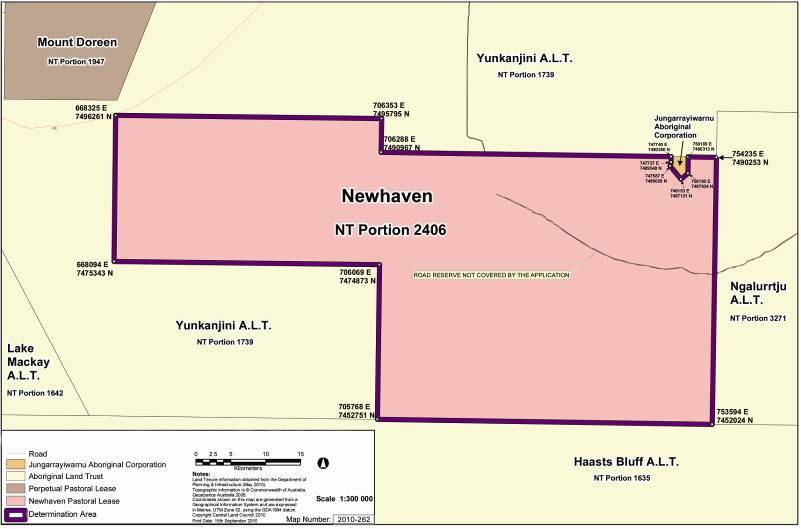
1. The determination area consists of NT Portion 2406 (Lake Mackay) from Survey Plan S 831085 being an area of 2,610 square kilometres held under Perpetual Pastoral Lease No. 1078.
2. The determination area does not include the strip of land (100 metres wide) being a public road constructed between Newhaven Station Homestead and the eastern boundary of NT Portion 2406.
Schedule B
Map of Determination Area
Schedule C
Areas where native title does not exist
Native title rights and interests have been wholly extinguished in the following areas of land and waters:
Pastoral improvements
Those parts of the determination area being:
(a) the homestead, house, sheds and other buildings;
(b) the constructed airstrip;
(c) bores, turkey nests, squatters’ tanks, constructed dams and other constructed stock watering points;
(d) stockyards and trapyards.
The areas described in (a) to (d) comprise the land on which the improvements were constructed prior to the date of this determination and any adjacent land or waters the exclusive use of which is necessary for the enjoyment of the improvements.
Public works
Those parts of the determination area being the land or waters on which any public work as defined in s 253 of the Native Title Act 1993 (Cth) is situated, including:
(a) public roads and bores (presently the responsibility of the Department of Lands and Planning);
(b) gravel and fill pits (presently the responsibility of the Department of Lands and Planning) that are on land or waters defined in s 251D of the Act;
(c) transmission water pipes, distribution water pipes, sewer pipes, bores, sewer pump stations, overhead power lines (presently the responsibility of Power and Water Corporation)
The areas described in (a) to (c) comprise the land on which the public works were constructed prior to the date of this determination.
Note: Settlement and entry of orders is dealt with in Order 36 of the Federal Court Rules. The text of entered orders can be located using Federal Law Search on the Court’s website.
NORTHERN TERRITORY DISTRICT REGISTRY | |
GENERAL DIVISION | NTD 6028 of 2000 |
BETWEEN: | HARRY JAKAMARRA NELSON, JACOB JUNGARRAYI SPENCER AND BOB JUPURRURLA DIXON Applicant
|
AND: | NORTHERN TERRITORY OF AUSTRALIA First Respondent AUSTRALIAN WILDLIFE CONSERVANCY Second Respondent
|
JUDGE: | REEVES J |
DATE: | 8 DECemBER 2010 |
PLACE: | NEWHAVEN |
REASONS FOR JUDGMENT
1 Since 1882 the land under claim in the present application has been the subject of a number of pastoral leases which have at times supported cattle enterprises. More recently the land has been acquired by conservation interests and managed to conserve threatened species and ecosystems. This period however represents only the very recent history of the determination area. According to the claimants’ beliefs the determination area was created and fashioned by their ancestors in the form of Jukurrpa or Dreaming who imbued the countryside with their spirit essence and in some instances continue to exist in the country.
2 On 20 December 2000 Sheila Napallarri Brown, Dolly Nampijinpa Daniels, James Japandgardi Marshall, Noel Japaljarri Spencer and Jilly Nakamarra Spencer filed an application for a determination of native title over an area of approximately 2,610 square kilometres held under Perpetual Pastoral Lease No. 1078. As is the custom of the Court in pastoral lease matters in the Northern Territory that application was allocated the short title of Newhaven, reflecting the name of the pastoral station over which the claim was lodged. As a result of the negotiations that had occurred between the parties to the claim the application was amended with the leave of the Court on 13 October 2010. The parties have now informed the Court that they have reached an agreement to resolve the claim and have filed the terms of that agreement, requesting that the Court make a determination of native title under s 87 of the Native Title Act 1993 (Cth) (“the Act”) in the terms agreed by the parties.
section 87 of the native title act
3 Section 87(1) of the Act sets out the various conditions which will trigger the jurisdiction of the Court in the event that the parties reach agreement on the terms of an order in relation to the proceeding. The first necessary criteria is that the notice period under s 66 of the Act must have ended prior to the parties’ written agreement being filed with the Court (s 87(1)). The National Native Title Tribunal’s notification of the application was completed on 12 September 2001 and so that criteria is met. Secondly, the agreement of the parties must be on the terms of an order of the Court in relation to the proceedings, part of the proceedings or a matter arising out of the proceedings (s 87(1)(a)). In this instance the agreement of the parties relates to the whole of the proceedings and so that criteria is also met. Thirdly, the terms of the agreement must be in writing, signed and filed with the Court (s 87(1)(b)). Again, this criteria has been met with the filing of the signed Minute of Proposed Consent Determination of Native Title dated 10 November 2010.
4 Having satisfied those matters the fourth criteria is that the Court must be satisfied that the terms of the order sought or an order consistent with those terms would be within the power of the Court (s 87(1)(c)). An order will be within the power of the Court if it is consistent with s 94A of the Act, the rights and interests included in the proposed determination are recognisable by the common law of Australia and there is no other determination in existence over the area the subject of the proposed determination. I will return to s 94A of the Act and the rights and interests claimed below. The Newhaven Pastoral Lease area which is the subject of the proposed determination of native title is surrounded by lands held by various Aboriginal Lands Trusts. To the north and west is the Yunkanjini Aboriginal Lands Trust. The Ngalurrtju Aboriginal Lands Trust lies to the east of Newhaven and immediately south of Newhaven is the Haasts Bluff Aboriginal Lands Trust. No previous determination of native title has been made over the area the subject of this proposed determination.
5 Section 87(1A) provides that:
The Court may, if it appears to the Court to be appropriate to do so, act in accordance with:
(a) whichever of subsection (2) or (3) is relevant in the particular case; and
(b) if subsection (5) applies in the particular case – that subsection.
6 In this case, subs (2) is the relevant subsection and subs (5) does not apply. Subsection (2) of s 87 provides that:
(2) If the agreement is on the terms of an order of the Court in relation to the proceedings, the Court may make an order in, or consistent with, those terms without holding a hearing or, if a hearing has started, without completing the hearing.
7 The words in s 87(1A): “… if it appears to the Court to be appropriate to do so …” have been held to confer on the Court a discretion which, subject to the Court being satisfied about the pre-conditions mentioned above, is unfettered. However, like all discretions conferred on the Court, it must be exercised judicially and in exercising it, the Court must have regard to the objects of the Act, one of the most important being the resolution of disputes by negotiation and agreement, rather than litigation: Munn v Queensland (2001) 115 FCR 109; [2001] FCA 1229 (“Munn”) at [26] and [28].
8 In considering the effect of these words, it is important to identify what it is that s 87(1A) requires the Court to consider appropriate. The wording of the section makes it clear that the question for the Court is whether it is appropriate to make an order in the terms of the agreement reached between the parties. Therefore the central focus of the section is that agreement: Lovett v Victoria [2007] FCA 474 (“Lovett”) at [37]; Nangkiriny v Western Australia (2002) 117 FCR 6; [2002] FCA 660 at [8]; James v Western Australia [2002] FCA 1208 at [4]; Ward v Western Australia [2006] FCA 1848 at [9]; Cox v Western Australia [2007] FCA 588 at [12]; Brown v Western Australia [2007] FCA 1025 at [23]; Hughes v Western Australia [2007] FCA 365 at [9]; Kogolo v Western Australia [2007] FCA 1703 at [18] and Eringa v South Australia [2008] FCA 1370 (“Eringa”) at [33].
9 As North J said in Lovett:
… when the Court is examining the appropriateness of an agreement, it is not required to examine whether the agreement is grounded on a factual basis which would satisfy the Court at a hearing of the application. The primary consideration of the Court is to determine whether there is an agreement and whether it was freely entered into on an informed basis ….
(emphasis added)
10 It follows that the critical issue is whether the existence of a free and informed agreement is founded in fact, not whether the matters dealt with in the agreement, specifically the existence of native title, are founded in fact. In Eringa, Lander J expressed it thus:
… the Court adopts a different approach to the task of deciding whether it is appropriate to enter a determination reached by agreement than it brings to the task of deciding whether native title should be recognised in a contested matter. In each case the definition of native title is the same. The Act requires the Court to set out details of the matters mentioned in s 225 in all determinations whether reached by agreement or contest. Although there needs to be some foundation upon which the Court can exercise its jurisdiction, in matters in which the parties have reached agreement on the terms of a determination the Court will have particular interest in whether the agreement has been freely entered into and on an informed basis …. If that question is answered in the affirmative, the Court will consider the fact that an agreement has been reached as weighing in favour of the making of a determination of native title …
(emphasis added).
11 In other words, if the material filed by the parties in support of the consent determination establishes a free and informed agreement, the Court will infer the existence of the native title that is at the heart of that agreement. I have emphasised the word “informed” because the process the State respondent party follows to inform itself is critical to this issue. In Munn, Emmett J observed that the Court’s deliberations on an application under s 87:
… would include a consideration of the extent to which the State is a party, on the basis that the State, or at least a Minister of the State, appears in the capacity of parens patriae to look after the interests of the community generally. The mere fact that the State was a party may not be sufficient. The Court may need to be satisfied that the State has in fact taken a real interest in the proceeding in the interests of the community generally. That may involve the Court being satisfied that the State has given appropriate consideration to the evidence that has been adduced, or intended to be adduced, in order to reach the compromise that is proposed. The Court, in my view, needs to be satisfied at least that the State, through competent legal representation, is satisfied as to the cogency of the evidence upon which the applicants rely.
(emphasis added).
12 It is appropriate to make some comments about the difficult balance a State party needs to strike between its role in protecting the community’s interests, including the stringency of the processes it follows in assessing the underlying evidence going to the existence of native title, and its role in the native title system as a whole, to ensure that it, like the Court and all other parties, takes a flexible approach that is aimed at facilitating negotiation and achieving agreement. In Lovett North J commented:
… There is a question as to how far a State party is required to investigate in order to satisfy itself of a credible basis for an application. One reason for the often inordinate time taken to resolve some of these cases is the overly demanding nature of the investigation conducted by State parties. The scope of these investigations demanded by some States is reflected in the complex connection guidelines published by some States.
The power conferred by the Act on the Court to approve agreements is given in order to avoid lengthy hearings before the Court. The Act does not intend to substitute a trial, in effect, conducted by State parties for a trial before the Court. Thus, something significantly less than the material necessary to justify a judicial determination is sufficient to satisfy a State party of a credible basis for an application. The Act contemplates a more flexible process than is often undertaken in some cases.
13 I respectfully agree with North J in these observations. In my view, it would be perverse to replace a trial before the Court with a trial conducted by the State party respondent and I do not consider that is what is intended by the provisions of s 87 of the Act.
14 It follows from all these considerations that the central issue in an application for a consent determination under s 87 is whether there exists a free and informed agreement between the parties. In this respect, the process followed by the State party respondent, particularly how it goes about assessing the underlying evidence as to the existence of native title, is critical. Other critical factors, all directed to the processes that lead to the agreement and what was agreed, that have been previously identified by the Court include: whether the parties have independent and competent legal representation: Munn at [29], [39] and [40] and Lovett at [39]–[40]; whether the terms of the proposed order are unambiguous and clear: Munn at [32]; and whether the agreement has been preceded by a mediation process: Nangkiriny v Western Australia [2004] FCA 1156 at [6]; Trevor Close on behalf of the Githabul People v Minister for Lands [2007] FCA 1847 at [6] and Lovett at [41]–[42].
15 The parties have filed a Statement of Agreed Facts and Joint Submissions in Support of the Proposed Minute of Consent Determination. These documents, taken together, describe the process and evidence used by the parties to reach the view that a credible basis exists for the application. In September 2009 the legal representatives of the applicant provided the Northern Territory with a Consent Determination Report prepared by Dr Lee Sackett and Ms Anna Meltzer based on historical ethnographic material and detailed fieldwork carried out in and around the determination area. The anthropological report was supplemented by a series of affidavits and witness statements from claimants attesting to their membership of one or more of the claimant landholding groups and their connections, under their traditional laws and customs, to the application area. The Northern Territory commissioned an anthropological assessment of the material by Emeritus Professor Basil Sansom which was in turn reviewed by the solicitors for the Northern Territory. It was on the basis of this material and the assessments undertaken that the solicitors for the Northern Territory were able to advise the applicant’s solicitors on 18 February 2010 that they believed a proper basis existed for a determination of native title by consent.
16 I have already said that the proposed determination area is surrounded by Aboriginal Lands Trust lands and is situated in a remote part of the Northern Territory of Australia. The anthropological material produced for the land claims adjacent to the determination area as well as the historical ethnographic material of Baldwin Spencer and Frank Gillen, Norman Tindale, Ted Strehlow and others was studied and analysed by Dr Sackett and Ms Meltzer for the current claim. Importantly, the anthropologists also conducted fieldwork with claimants in order to gain an understanding and formulate expert opinions on the claimants’ laws and customs.
17 I am satisfied that the steps taken by the parties as described in the materials filed in support of the determination, together with the fact that all parties have had the advantage of competent legal representation, indicates that their agreement is free and informed. I am also satisfied that the terms of the proposed orders are unambiguous and clear.
The native title holders
18 Notwithstanding this finding, I consider it is appropriate to record some of the anthropological evidence and the evidence of the claimants that goes to establishing that native title exists in the determination area. I do not do this to second guess the process that has been followed by the parties as outlined above, but to give some acknowledgment to the time and effort that has obviously been devoted to the preparation of the materials that have been placed before the Court in support of this application.
19 Dr Sackett and Ms Meltzer have concluded that the determination area is located in a region where both historically and more recently the lands and peoples of the Ngaliya Warlpiri and the Luritja language communities come together, intermingle and intermarry one another. Members of the claim group variously identify as Ngaliya Warlpiri, Luritja or as Ngaliya-Warlpiri mix-up. The Ngaliya Warlpiri and Luritja groups readily recognise each other’s rights and interests in portion of the determination area and actively engage with each other. Indeed, while the determination area lies at the Ngaliya Warlpiri and Luritja language community interface, the claimants, whether they identify as Ngaliya Warlpiri, Luritja or as Ngaliya-Warlpiri mix-up, observe the same body of laws and customs which have their foundation in the Jukurrpa or Dreaming. Under that body of laws and customs individual claimants are connected to Dreaming tracks and landholding groups and all aspects of their social and religious organisation are regulated including the exercise of rights and interests in land and the transmission of customary knowledge about Dreamings, sites and country.
20 Not all members of the Ngaliya Warlpiri and Luritja language communities hold rights and interests in the determination area. Native title rights and interests are vested in a subset of those communities made up of five landholding groups: the Jipalpa-Winitjaru, the Pikilyi, the Yarripilangu-Karrinyarra, the Watakinpirri and the Winparrku landholding groups. These landholding groups are, under the laws and customs of the claimants’ society, connected to particular Dreaming tracks and clusters of Dreaming places and the lands that surround them. The landholding groups are said by Dr Sackett and Ms Meltzer to be products of widely known, localised ancestral and Dreaming affiliations, local country rights and responsibilities, descent lines and patri-couple membership or classifications. These same Dreaming activities join and unite neighbouring groups regardless of what language or dialect is spoken.
21 Membership of each landholding group and the possession of rights and interests in land is principally inherited through descent (whether biological or through adoption) traced back to a common ancestor. The parties’ submissions and the anthropological report filed indicates that each landholding group consists of kirda and kurdungurlu and may also include persons accepted as members by senior descent-based members of the group on the basis of conception or birthplace affiliation. Kirda are those persons affiliated with the landholding group and its country through their father and father’s father. Those affiliated with a group and its country through their mother and mother’s father are kurdungurlu.
22 Harry Nelson Jakamarra belongs to the Watakinpirri group and is kirda for the Yarripirri (Snake) and Yarla (Yam) Dreamings through his father and father’s father. Jacob Spencer Jungarrayi and his siblings are kirda for Yarripilangu-Karrinyarra country as was his father and his father’s father. Jacob Spencer Jungarrayi is also kurdungurlu for Watakinpirri as that was his mother’s father’s country. Tess Napaljarra Ross’s country, like her father and father’s father, is around Yarripilangu and so she is kirda for the Yarripilangu-Karrinyarra group. Her children take their kirda country through their father, Jack Ross. They are kirda for the Watakinpirri and kurdungurlu for the Yarripilangu-Karrinyarra. In this way many claimants have multiple connections to the landholding groups that make up the native title holding community.
23 The different social and ceremonial responsibilities of kirda and kurdungurlu are described in the materials filed in support of the proposed consent determination. Harry Nelson Jakamarra describes his responsibilities as kurdungurlu for the Yarripilangu-Karrinyarra mob and country as including responsibility to ensure the dances for the group during ceremony are being done the proper way. He is also responsible for going out on country regularly to ensure that nothing has been damaged. Neville Poulson Japangardi is kurdungurlu for the Watakinpirri group. He describes his responsibility to teach younger men and children from his kurdungurlu country to look after the country on a physical level and to teach kirda how to look after their country. Kirda are responsible for Dreaming tracks, thus Harry Nelson Jakamarra as kirda for the Yarripirri Dreaming is now responsible for the Dreaming track from Impalu to Warlujarrayi and to Yuturlpu and Ngama. As kirda he teaches the younger men Yarripirri songs and their meaning during ceremony times.
24 The material filed documents numerous examples of the detailed knowledge that the claimants have of the determination area, its resources and how that knowledge has been and continues to be transmitted from generation to generation. Neville Poulson Japangardi describes how, as a young man, he would go hunting and looking for bush tobacco with his father and other family members on Newhaven country from Karrinyarra west. He describes how, under the correct process that is followed after the killing of kangaroo, the meat must go to the kurdungurlu first and the kirda get what is left over. He also describes being shown by the old people where all the water places are on Newhaven and how he now takes children to those places to teach them how to get water and the importance of those places.
25 For the native title holders Newhaven is a special place for bush food and medicine. Neville Poulson Japangardi describes going out regularly on country with his family to get yarla or bush potatoes which are said to grow best on the northern side of the determination area and down through Juluru and the western side at Jilpapa. He and his family also collect bush medicine, including a special grass for headaches, on the determination area on the northern side of the road to Nyirripi. Jacob Spencer Jungarrayi recalls walking all around Yarripilangu country with his father and grandfather, being taught about the country and hunting kangaroo, goanna and whatever else they could find. After his father’s death, he was taught by his father’s brother his responsibilities in relation to sacred places around Yarripilangu and Jungarrayiwarnu, including how to clean out all the leaves and mess made by bullocks. Jacob Spencer Jungarrayi tells how he continues to fulfil these responsibilities, cleaning out blocked springs and checking on country on his regular trips across the claim area.
26 Under the traditional laws and customs of the group, kirda and kurdungurlu have rights and interests which may be exercised in their own country and more widely in the determination area. The affidavit materials filed provide extensive examples of members of the claimant group and their ancestors travelling across and using the claim area and its resources as of right. Tess Napaljarra Ross recounts that when she was a young girl she and her family would camp around the Yarripilangu Hills. It was at this time that she was taught to look for food, water and soakages. As she became older she was taught the songs to sing to grow more yarla and other food. This knowledge is passed on by her to her daughters and her brother’s sons and daughters because they are kurdungurlus for Yarripilangu-Karrinyarra. Ms Ross tells that Jacob and Noel Spencer still go onto Newhaven and sing it to make sure food like bush potato and goanna are always growing.
27 Under the traditional laws and customs of the claimants, people who do not belong to one of the landholding groups must obtain permission from senior, knowledgeable kirda and kurdungurlu before accessing the determination area, its sites or to go hunting or collecting bush tucker. Harry Nelson Jakamarra confirms that if someone from a different country wants to come onto Newhaven they have to ask the kurdungurlu and kirda for permission first and that he is asked when people want to visit his country around Mala Dreaming. Bob Dixon Jupurrurla explains that the requirement to obtain permission from kirda and kurdungurlu relates to their responsibility to keep strangers safe and to introduce them to resident Dreaming Beings who would otherwise know that strangers do not belong to that country and might hurt them. Tess Napaljarri Ross also says that strangers to the country must ask permission from the old men or old women who are kirda and kurdungurlu before they enter her country to go hunting or to collect ochre or bush tobacco and that even today, unless this process is followed, there would be trouble and the visitor might get sick. The same requirement to seek permission from kirda and kurdungurlu is described by Jacob Spencer Jungarrayi in relation to Yarripilangu-Karrinyarra country. He notes that the spirits are always watching and that things might happen if visitors went to places they were not meant to go.
28 The material filed speaks to a continuing vibrant and complex system of traditional laws and customs that have been transmitted from generation to generation since well before white men showed interest in the claim area.
Section 94A of the native title act
29 Section 94A of the Act requires any native title determination of the Court to set out the following details:
(a) who the person, or each group of persons, holding the common or group rights comprising the native title are; and
(b) the nature and extent of the native title rights and interests in relation to the determination area; and
(c) the nature and extent of any other interests in relation to the determination area; and
(d) the relationship between the rights and interests in paragraphs (b) and (c) (taking into account the effect of the Act); and
(e) to the extent that the land or waters in the determination area are not covered by a non-exclusive agricultural lease or a non-exclusive pastoral lease – whether the native title rights and interests confer possession, occupation, use and enjoyment of that land or waters on the native title holders to the exclusion of all others.
30 I am satisfied that each of those matters is articulated in the proposed determination and that the rights and interests proposed are capable of being recognised by the common law of Australia.
Nomination of a prescribed body corporate
31 The parties have sought orders that have the effect of delaying the operational commencement of the determination until a prescribed body corporate is nominated by the applicant and accepted by the Court. Upon the determination taking effect, native title is not to be held in trust but rather will be held by the determined native title holders. The applicant in the claim, being a subset of the native title holding community, is to nominate within twelve months of the determination a prescribed body corporate for the purposes of s 57(2) of the Act that will perform the functions outlined in s 57(3) of the Act. In the event that no such nomination is received within the twelve months following the determination, the matter is to be listed by the Registrar before the Court for further directions.
32 I am unaware of the reason why it has not been possible for a prescribed body corporate to be nominated at the same time as the filing of the proposed consent determination orders. While a concurrent determination of a prescribed body corporate and a determination of native title is the preferable course, s 55 of the Act does allow the determination of a prescribed body corporate to occur separately from the determination of native title by the Court provided that it is done as soon as practicable thereafter. In this case, the orders provide that the determination of native title will not come into effect until the determination of a prescribed body corporate has been made. There is therefore a considerable incentive for the claimants to attend to the nomination of a prescribed body corporate as soon as possible. Moreover, if that does not occur, the matter is to be listed by the Registrar for further directions. In these circumstances, I am satisfied that it is appropriate to make orders giving effect to the substance of the orders sought.
conclusion
33 The achievement of a settlement of a native title claim by agreement is to be encouraged and congratulated. The order that the Court will now make determines, under the laws of Australia that native title exists according to the traditional laws and customs of the claimants’ society, and is held by the five landholding groups I mentioned above. This order does not grant native title to the claimants, it merely recognises the native title they have long held.
I certify that the preceding thirty-three (33) numbered paragraphs are a true copy of the Reasons for Judgment herein of the Honourable Justice Reeves. |
Associate:


