

FEDERAL COURT OF AUSTRALIA
Australian Competition and Consumer Commission v Yellow Page Marketing BV [2010] FCA 1218
|
Citation: |
Australian Competition and Consumer Commission v Yellow Page Marketing BV [2010] FCA 1218 | |
|
Parties: |
AUSTRALIAN COMPETITION AND CONSUMER COMMISSION v YELLOW PAGE MARKETING BV and YELLOW PUBLISHING LTD | |
|
File number: |
VID 942 of 2010 | |
|
Judge: |
GORDON J | |
|
Date of judgment: |
8 November 2010 | |
|
Date of hearing: |
5 and 8 November 2010 | |
|
|
| |
|
Date of last submissions: |
8 November 2010 | |
|
|
| |
|
Place: |
Melbourne | |
|
|
| |
|
Division: |
GENERAL DIVISION | |
|
|
| |
|
Category: |
No Catchwords | |
|
|
| |
|
Number of paragraphs: |
59 | |
|
|
| |
|
Counsel for the Applicant: |
Mr P Gray | |
|
|
| |
|
Solicitor for the Applicant: |
Corrs Chambers Westgarth | |
|
IN THE FEDERAL COURT OF AUSTRALIA |
|
|
VICTORIA DISTRICT REGISTRY |
|
|
GENERAL DIVISION |
VID 942 of 2010 |
|
AUSTRALIAN COMPETITION AND CONSUMER COMMISSION Applicant
| |
|
AND: |
YELLOW PAGE MARKETING BV First Respondent
YELLOW PUBLISHING LTD Second Respondent
|
|
JUDGE: |
|
|
DATE OF ORDER: |
8 NOVEMBER 2010 |
|
WHERE MADE: |
MELBOURNE |
THE COURT ORDERS THAT:
(a) the Fast Track Application dated 4 November 2010;
(b) the Fast Track Statement dated 4 November 2010;
(c) the ACCC’s Notice of Motion dated 4 November 2010;
(d) the Affidavit of Katherine Stavrinidis sworn on 3 November 2010;
(e) the Affidavit of John William Fogarty affirmed on 3 November 2010;
(f) the Second Affidavit of John William Fogarty affirmed on 4 November 2010;
(g) the Second Affidavit of Katherine Stavrinidis sworn on 5 November 2010;
(h) the Affidavit of David Paul Chiappetta affirmed on 5 November 2010; and
(i) this Order and the Reasons for Judgment dated 8 November 2010,
outside the Commonwealth by:
(i) employing a competent person in The Netherlands to serve the documents on the First Respondent (YPM), a company incorporated and registered in The Netherlands, by personally delivering the documents to YPM’s registered address at Jan Pieterszoon Coenstraat 7, 2595WP, Den Haag (The Hague), NL (The Netherlands)or, if informed otherwise by YPM, at a place or by a means reasonably designated by YPM, such service being deemed good and sufficient service of the documents on YPM as of the time of delivery; and
(ii) employing an English solicitor to serve the documents on the Second Respondent (YPL), a company incorporated and registered in England and Wales, by personally delivering the documents to YPL’s registered address at 111 Piccadilly, Manchester, United Kingdom, M1 2HY, or, if informed otherwise by YPL, by personally delivering the documents at a place and by a means reasonably designated by YPL, such service being deemed good and sufficient service of the documents on YPL as of the time of delivery.
2. In addition to the leave referred to in paragraph (1) above, pursuant to O 7 r 9 of the Federal Court Rules, the ACCC has leave to serve the documents referred to in paragraphs 1(a) to 1(i) above on YPM and YPL by serving the documents on the office of Phillips, Ormonde & Fitzpatrick at 367 Collins Street, Melbourne, such service being deemed good and sufficient service of the documents on YPM and YPL as of the time of delivery. After such service, the ACCC must attempt to notify YPM and YPL that such service has occurred by:
(a) Sending a facsimile transmission to that effect to +31 70 799 93 70, marked to the attention of “Mr Steve Green or other proper officer”, Yellow Page Marketing BV, Legal Department and marked “Important Legal Document”; and
(b) Sending an email to that effect to info@yellowpage-group.com, marked to the attention of “Mr Steve Green or other proper officer”, Yellow Page Marketing BV, Legal Department and marked “Important Legal Document”; and
(c) Sending a letter to that effect by mail to “Mr Steve Green or other proper officer”, Yellow Page Marketing BV, Legal Department, Jan Pieterszoon Coenstraat 7, 2595WP, Den Haag, The Netherlands; and
(d) Sending an email to that effect to info@yellowpublishing.com, marked to the attention of “The Proper Officer, Yellow Publishing Ltd” and marked “Important Legal Document”.
3. Until 4:00pm on 19 November 2010, or further order, YPM and YPL, whether by themselves, their agents, servants or howsoever otherwise, be restrained from:
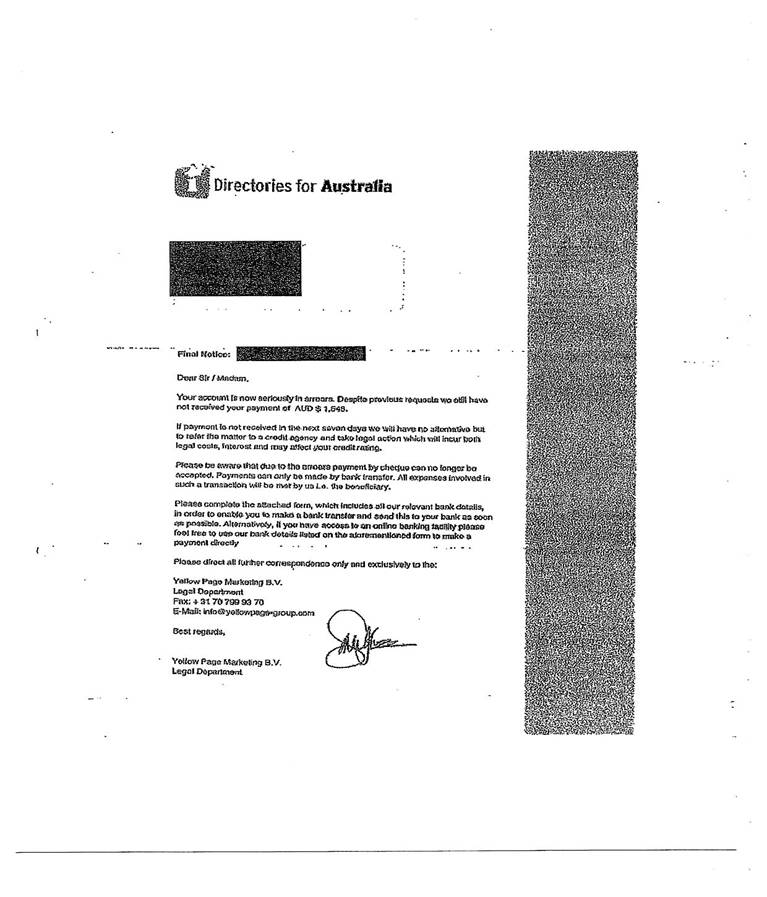
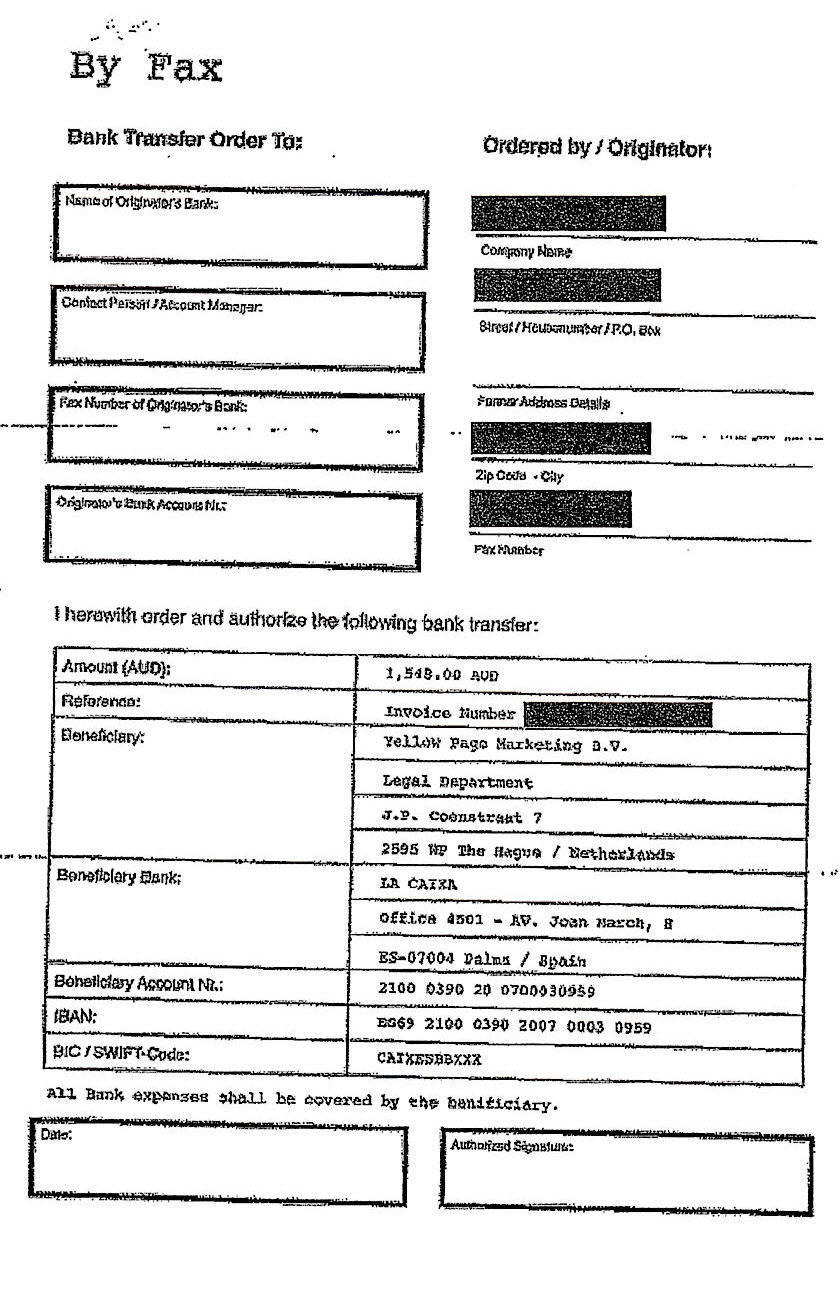
(a) sending any communication in the form of the facsimile at Annexure A to this Order to any individual or company operating a business in Australia, regardless of what letterhead or logo is used in the communication or the mechanism through which payment is requested; and
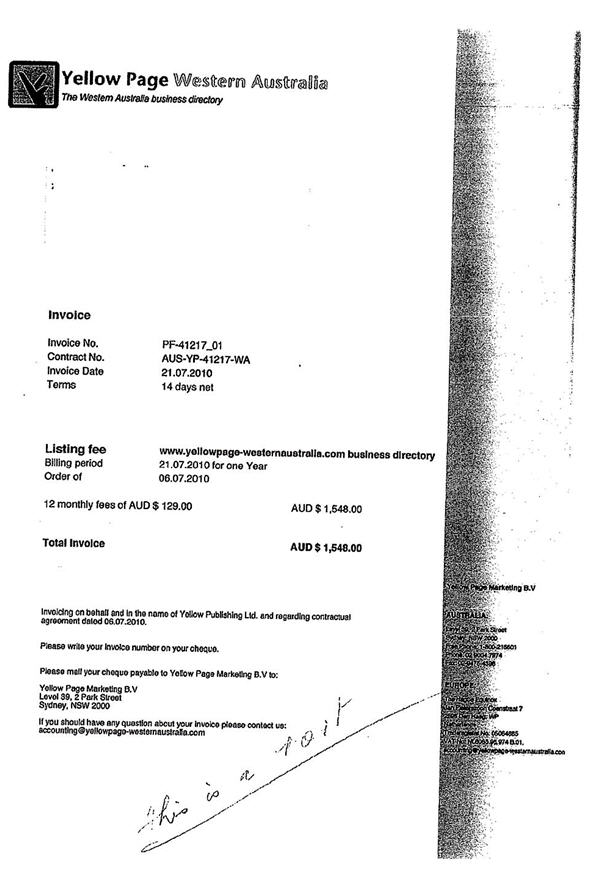
(b) taking any step to obtain payment from any individual or company operating a business in Australia in respect of any invoice in the form of the invoice in Annexure B to this Order (including any invoice in that form which identifies different customer details and any invoice in that form which refers to another State or a city of Australia in place of the words “Western Australia” or “western australia” or “westernaustralia”), regardless of the mechanism through which payment is requested.
4. The ACCC’s Notice of Motion dated 4 November 2010 otherwise be adjourned to 9:15am on 19 November 2010.
5. Costs reserved.
Note: Settlement and entry of orders is dealt with in Order 36 of the Federal Court Rules.
The text of entered orders can be located using Federal Law Search on the Court’s website.
ANNEXURE A
ANNEXURE B
|
IN THE FEDERAL COURT OF AUSTRALIA |
|
|
VICTORIA DISTRICT REGISTRY |
|
|
GENERAL DIVISION |
VID 942 of 2010 |
|
BETWEEN: |
AUSTRALIAN COMPETITION AND CONSUMER COMMISSION Applicant
|
|
AND: |
YELLOW PAGE MARKETING BV First Respondent
YELLOW PUBLISHING LTD Second Respondent
|
|
JUDGE: |
GORDON J |
|
DATE: |
8 NOVEMBER 2010 |
|
PLACE: |
MELBOURNE |
REASONS FOR JUDGMENT
INTRODUCTION
1 This proceeding was commenced on 4 November 2010 by the Australian Competition and Consumer Commission (the ACCC) against the First Respondent, Yellow Page Marketing BV (YPM), a company incorporated and registered in The Netherlands and the Second Respondent, Yellow Publishing Ltd (YPL), a company incorporated and registered in England and Wales (collectively, the Respondents).
2 The ACCC alleges that together the Respondents conduct a business by which invitations are made, by direct communication to businesses in Australia, to subscribe to internet online business directories published by YPM on websites registered to YPM. Neither company has any permanent presence in Australia, although at times they have retained the services of a virtual office service provider which operates at addresses in Australia (Regus).
3 The documentary evidence exhibited to affidavits tendered by the ACCC (including invitations and subsequent billing documentation) appears to establish YPL as the principal in contracts it made with Australian businesses. However, YPM publishes the directories, owns the websites and receives the relevant money in accordance with remittance directions on the billing documentation.
4 In the proceeding, the ACCC seeks declarations under s 21 of the Federal Court of Australia Act 1976 (Cth) and final orders under s 76E of the Trade Practices Act 1974 (Cth) (TPA) (for pecuniary penalties), s 80 of the TPA (for injunctions), ss 86C and 86D of the TPA (for certain corrective information to be published) and s 87AAA of the TPA for relief on behalf of non-party consumers who have allegedly suffered loss as a result of the Respondents’ conduct which the ACCC alleges contravened and continues to contravene the TPA.
5 The ACCC alleges that the Respondents have made false, misleading and deceptive representations in respect of online business directory services in Australia, thereby contravening ss 52 and 53(c), (d) and (e) of the TPA. It will be necessary to return to consider the substance of the allegations later in these reasons for judgment.
CURRENT EX PARTE APPLICATION
6 By a Notice of Motion dated 4 November 2010, the ACCC sought:
1. Leave pursuant to O 8 r 3 of the Federal Court Rules to serve the originating process (and other material) on the Respondents out of Australia: paragraph 1 of the Notice of Motion;
2. An order pursuant to O 7 r 9 of the Federal Court Rules permitting substituted service on two law firms known recently to have acted for YPM: paragraph 2 of the Notice of Motion; and
3. Interlocutory orders in the nature of injunctions: paragraphs 3 and 4 of the Notice of Motion.
7 At the hearing of these ex parte applications, the ACCC informed the Court that it sought to limit the substituted service order to one law firm and only sought one of the injunctions referred to in the Notice of Motion on an interim basis. That injunction is a refined version of the injunction sought by paragraph 4(c) of the Notice of Motion. The ACCC sought an order that the balance of its applications for the interlocutory injunctions set out in paragraphs 3 and 4 of the Notice of Motion be otherwise adjourned to a date to be fixed.
8 In support of its ex parte application, in addition to the Fast Track Statement and the Notice of Motion, the ACCC relied upon the following affidavits and submissions:
1. affidavit of Katherine Stavrinidis sworn 3 November 2010;
2. second affidavit of Katherine Stavrinidis sworn 5 November 2010;
3. affidavit of John Fogarty sworn 3 November 2010;
4. second affidavit of John Fogarty sworn 4 November 2010;
5. Outline of Submissions filed 5 November 2010;
6. Supplementary Outline of Submissions filed 5 November 2010;
7. affidavit of David Paul Chiappetta affirmed 5 November 2010; and
8. Further Supplementary Outline of Submissions filed 7 November 2010.
A. APPLICATION FOR LEAVE TO SERVE OUTSIDE AUSTRALIA
9 Applications of this kind are not unusual. However, this application raises interesting issues. It is one of the first applications since Australia acceded to the Hague Convention on the Service Abroad of Judicial and Extrajudicial Documents in Civil and Commercial Matters 1965 (Hague Convention) on 1 November 2010. The Respondents are located in countries who are parties to the Hague Convention. YPM in The Netherlands and YPL in the United Kingdom.
10 On the same day, 1 November 2010, the Federal Court Amendment Rules 2009 (No 1) (the Amendment Rules) commenced: see r 2 of the Amendment Rules, s 59(4) of the Federal Court of Australia Act 1976 (Cth) (the FCA) and s 12(c) of the Legislative Instruments Act 2003 (Cth). The Explanatory Statement to the Amendment Rules stated that the purpose of the Amendment Rules was to give effect to the harmonised rules in relation to the Hague Convention developed by the Council of Chief Justices’ Harmonised Rules on Service Outside the Jurisdiction Committee.
11 The Amendment Rules, inter alia, amended O 8 r 3 of the Federal Court Rules as follows:
3 Application for leave to serve originating process outside Australia
(1) Service of an originating process on a person in a foreign country is effective for the purpose of a proceeding only if:
(a) the Court has given leave under subrule (2) before the application is served; or
(b) the Court confirms the service under subrule (5); or
(c) the person served waives any objection to the service by entering an appearance in the proceeding.
(2) The Court may give leave to a party to serve an originating process on a person in a foreign country in accordance with a convention convention, the Hague Convention or the law of the foreign country, on such terms and conditions as it considers appropriate, if the Court is satisfied that:
(a) the Court has jurisdiction in the proceeding; and
(b) the proceeding is of a kind mentioned in rule 2; and
(c) the person seeking leave has a prima facie case for all or any of the relief claimed by the person in the proceeding.
Note The law of a foreign country may permit service through the diplomatic channel or service by a private agent.
Note 1 The law of a foreign country may permit service through the diplomatic channel or service by a private agent.
Note 2 Order 8A, Division 2 deals with service of local judicial documents in a country, other than Australia, that is a party to the Hague Convention.
(3) The evidence on an application for leave under subrule (2) must include the following:
(a) the name of the foreign country where the person to be served is or is likely to be;
(b) the proposed method of service;
(c) a statement that the proposed method of service is permitted by:
(i) if a convention applies — the convention; or
(ii) in any other case — the law of the foreign country.
(ii) if the Hague Convention applies — the Hague Convention; or
(iii) in any other case — the law of the foreign country.
(4) Nothing in this rule prevents the Court from giving leave to a person to give notice, in a foreign country, of a proceeding in the Court on the basis that giving the notice takes the place of serving the originating process in the proceeding.
(5) If an originating process was served on a person in a foreign country without the leave of the Court, the Court may, by order, confirm the service if the Court is satisfied that:
(a) paragraphs (2) (a), (b) and (c) apply to the proceeding; and
(b) the service was permitted by:
(i) if a convention applies — the convention; or
(ii) in any other case — the law of the foreign country; and
(ii) if the Hague Convention applies — the Hague Convention; or
(iii) in any other case — the law of the foreign country; and
(c) the failure to apply for leave is sufficiently explained.
(Emphasis added.)
12 The ACCC submitted that the amendments to O 8 r 3 create a hierarchy whereby (1) if a convention, treaty etc “about service abroad of judicial documents to which the Crown in right of the Commonwealth, or where appropriate, in right of a State, and a foreign country are parties” other than the Hague Convention applies, then service is to be effected in a manner permitted by that convention, (2) if the Hague Convention applies, then service is to be effected in a manner permitted by the Hague Convention and (3) if no convention applies, then service is to be effected in a manner permitted by the law of the foreign country. For the purposes of the present application, it is unnecessary to resolve that question. The ACCC’s application relies upon the Hague Convention.
13 Order 8 r 3 is not the only relevant amendment. The Amendment Rules also inserted a new O 8A.
14 The ACCC submitted that despite the express wording of O 8A, O 8 r 3(3)(c)(ii) was to be construed as providing for methods of service permitted under the Hague Convention in addition to those referred to in O 8A. The ACCC acknowledged that other than O 8A, there was no specific and express Rule in the Federal Court Rules providing for proof of service “in accordance with” the Hague Convention. The ACCC submitted that the Court has a general power under O 1 r 9 to make directions to fill this gap.
15 The Hague Convention provides a number of mechanisms for effecting service. The Convention establishes a mechanism for formal reception by Contracting States of requests for service coming from other Contracting States (Art 2) having the following salient elements or steps:
1. each Contracting State organises a “Central Authority” (Art 2);
2. an authority in the State of origin forwards to the Central Authority of the State of destination a request (conforming to a model annexed to the Hague Convention) annexing the document to be served (Art 3);
3. the Central Authority in the State of destination serves – or arranges to have served – the document, together with part of the request summarising the document (Art 5), either by a method prescribed by domestic law for service of documents in domestic actions in the State of destination (and potentially also requiring a translation), or by another method not incompatible with the laws of the State of destination;
4. after service, the Central Authority (or another authority it may have designated) shall complete a certificate confirming service (conforming to a model annexed to the Hague Convention) (Art 6) to be forwarded directly to the applicant.
16 In addition to the process outlined in the Arts 3 to 6 of the Hague Convention (referred to in the preceding paragraph):
1. each Contracting State is free to effect service “without application of any compulsion”, through its diplomatic or consular agents, subject to the right of the State of destination to oppose such service, unless in relation to a national of the State of origin (Art 8);
2. the Hague Convention leaves Contracting States free to call upon consular or diplomatic channels (Art 9);
3. Article 11 recognises the ability of Contracting States to agree on specific channels of transmission and communication;
4. Article 10 provides:
Provided the State of destination does not object, the present Convention shall not interfere with-
(a) the freedom to send judicial documents, by postal channels, directly to persons abroad,
(b) the freedom of judicial officers, officials or other competent persons of the State of origin to effect service of judicial documents directly through the judicial officers, officials or other competent persons of the State of destination,
(c) the freedom of any person interested in a judicial proceeding to effect service of judicial documents directly through the judicial officers, officials or other competent persons of the State of destination.
17 The method for service referred to in Art 10(c) is relevant here, namely the freedom of a person interested in a judicial proceeding (the ACCC) to effect service of an originating process directly through “other competent persons of the State of destination”. The ACCC submitted, and I accept, that this method of service is not one of the methods of service established by the Hague Convention. Rather, depending on whether the State of destination objects and the existence of “other competent persons” in that State, this method is not “interfered” with by the Hague Convention. In other words, within the meaning of O 8 r 3(3)(c)(ii), it is a method permitted by the Hague Convention.
18 What then is the role of O 8A Div 2? The ACCC submitted, and I accept, that O 8A Div 2 prescribes steps which mirror and implement only the key elements on the State of origin side of the mechanism for formal service under Arts 3 to 6 of the Hague Convention: see [15] above. Order 8A r 4 concerns the establishment of authorities in the State of origin which have responsibility for forwarding requests for service (defined as the “forwarding authority” in O 8A). Order 8A r 5 relates to that part of Art 3 which relates to the forwarding authority forwarding to the Central Authority of the State of destination a request (conforming to a model annexed to the Hague Convention) annexing the document to be served and O 8A rr 6 to 8 relate to receipt of a certificate of service under Art 6. Such a conclusion is supported by the express words of O 8A r 3(2) which provides that the Division “does not apply if service of the document is effected, without application of any compulsion, by an Australian diplomatic or consular agent mentioned in Article 8 of the Hague Convention”.
19 Division 2 of O 8A says nothing about service through diplomatic channels or service by one of the modes not interfered with by Art 10. Accordingly, I do not consider that modes of service not interfered with by Art 10 are precluded by the commencement of O 8A. The amendments made to O 8 including r 3(3)(c)(ii) support the view that there is potential work to be done by the Hague Convention in the context of O 8. That work is not exhausted by the formal mechanism in Arts 3 to 6. If it was intended that the work done by O 8 r 3(3)(c)(ii) was limited to the mode of service required by O 8A Div 2 it would be expected that this would have been expressly stated. It is not. On a literal interpretation of O 8 r 3(3)(c)(ii) that provision can include modes of service not interfered with by Art 10 of the Hague Convention.
20 Another indication that this construction is correct is to be found in the opening words of O 8A r 4(1): “A person may apply to the Registrar ...”. This language indicates that the invocation of the formal mechanism under Arts 3-6 of the Hague Convention is discretionary. If the modes of service referred to in Art 10 are available in the case of a given State of destination, then those modes are permitted both by the Hague Convention and by the Federal Court Rules. In the event that one such mode is used, it will be O 8 and O 8 alone which governs the mechanism for effecting service out of the jurisdiction.
21 Under O 8 r 3(2), the Court may give leave to serve an originating process outside Australia if the Court is satisfied that:
1. the Court has jurisdiction in the proceeding;
2. the proceeding is of a kind mentioned in O 8 r 2; and
3. the party seeking leave has a prima facie case for all or any of the relief claimed by the person in the proceeding.
THE COURT HAS JURISDICTION IN THE PROCEEDING
22 In its Fast Track Statement, the ACCC alleges that the Respondents contravened ss 52 and 53(c), (d) and (e) of the TPA. By virtue of the communications made by the Respondents into Australia, the conduct of the Respondents is conduct to which those provisions of the TPA apply: see Australian Competition and Consumer Commission v Chen (2003) 132 FCR 309, especially at [32] (Sackville J) and cf Bray v F Hoffman-La Roche Ltd and Others (2002) 118 FCR 1 at [147] where Merkel J held that communications into Australia by a parent company to officers of a subsidiary, expected to be received in Australia, constituted conduct in Australia for the purposes of s 45 of the TPA. The Federal Court has jurisdiction to hear this proceeding pursuant to s 19 of the FCA and s 86 of the TPA.
THE PROCEEDING IS OF A KIND MENTIONED IN ORDER 8 RULE 2
23 Order 8 r 2 provides that an originating process may be served outside Australia if the proceeding consists of, or includes, one or more of the kinds of proceeding listed in the table under this rule. This proceeding is based on, among other things, alleged breaches of ss 52 and 53 of the TPA resulting from conduct that occurred in Australia. It is a proceeding that falls at least under item 11 of the table in O 8 r 2 – “Proceeding based on a breach of a provision of an Act that is committed in Australia”. It is unnecessary to address whether any of the other items are also satisfied.
PRIMA FACIE CASE
24 This proceeding concerns facsimiles sent by each of the Respondents (through its agent YPL) that the ACCC alleges:
1. were misleading or deceptive or likely to mislead or deceive, contrary to s 52 of the TPA;
2. represented that services have sponsorship, approval, performance characteristics, uses or benefits they do not have, contrary to s 53(c) of the TPA;
3. represented that the Respondents have a sponsorship, approval or affiliation they do not have, contrary to s 53(d) of the TPA;
4. made a false or misleading representation with respect to the price of services, contrary to s 53(e) of the TPA.
25 The requirement to demonstrate a prima facie case in this context is not particularly onerous. The question is whether on the material before the Court, inferences were open which, if translated into final findings of fact, would support the relief claimed. A prima facie case exists, provided there is such evidence, even on a hearsay basis, as to sufficient elements of the proceeding leading to any (and not necessarily all) of the relief sought: Bray v F Hoffman-La Roche Ltd (2003) 130 FCR 317 at [39], [55], [58] and [97].
26 As noted earlier, in support of its application, the ACCC relied upon an affidavit of one of its investigators, Katherine Stavrinidis sworn 3 November 2010 (the First Stavrinidis Affidavit). The ACCC submitted and I accept that the material deposed to and exhibited to the First Stavrinidis Affidavit satisfies the prima facie case requirement. I address the substance of the ACCC’s claim in further detail below when considering its application for an interim injunction.
COUNTRIES WHERE YPM and YPL ARE LOCATED
27 From the material filed by the ACCC in support of its application:
1. YPM is incorporated, registered and has its registered office in The Netherlands; and
2. YPL is incorporated and registered in England and Wales and has its registered office in the United Kingdom.
METHOD OF SERVICE
28 Mr Chiappetta, a solicitor with Corrs Chambers Westgarth, swore an affidavit in which he deposed to the following facts:
1. he accessed the official website of the Hague Conference on Private lnternational Law (HCCH), located at http://www.hcch.net (the HCCH Website);
2. the HCCH Website records that it is a global inter-governmental organisation which develops and services multilateral legal instruments. The website identifies the Hague Convention as one of the instruments adopted through HCCH;
3. the HCCH website contains a page relating to the United Kingdom’s adoption of the Hague Convention which:
3.1 records that when adopting the Hague Convention, the United Kingdom made a reservation of rights in relation to Art 10(c) to the effect that “documents for service through official channels will be accepted in the United Kingdom only by the central or additional authorities and only from judicial, consular or diplomatic officers of other Contracting States”;
3.2 records that on 11 September 1980, the Foreign and Commonwealth Office of the United Kingdom wrote to the Permanent Bureau of the HCCH in the following terms:
… Thank you for your letter of 31 July in which you ask for assistance in the interpretation of the declaration made by the United Kingdom on 17 November 1967 in relation to Article 10c) of the Convention.
I am happy to confirm our declaration does not preclude any person in another Contracting State who is interested in a judicial proceeding (including his lawyer) from effecting service in the United Kingdom “directly” through a competent person other than a judicial officer or official, eg a solicitor. …
3.3 contains a quote from the Conclusion and Recommendations of the HCCH 2003 Special Commission in relation to Art 10 in the following terms:
The 2003 SC noted that the UK confirmed its position expressed at the Special Commission meeting of 1989, indicating its preference for the use of direct service through English solicitors on residents of England and Wales.
4. the HCCH website contains a page relating to The Netherlands’ adoption of the Hague Convention which records that The Netherlands did not make any reservation of rights in adopting Art 10(c).
29 Initially, the ACCC informed the Court that it intended to serve the Respondents by “private agent”. The ACCC submitted that the reference to “private agent” was in fact a reference to a lawyer in each country. The phrase “private agent” was the relevant language under Art 4(a) of the earlier applicable convention – the Convention between the United Kingdom and the Netherlands regarding Legal Proceedings in Civil and Commercial Matters (London, 31 May 1932) (the 1932 Convention).
30 Under Art 10(c) of the Hague Convention, the phrase is “other competent persons of the State of destination”. The term “competent person” is not defined in the Hague Convention. The United Kingdom has stated that under Art 10(c) of the Hague Convention a solicitor is considered by that State to be a “competent person”: see [27] above. The Order has been amended to require service through an English solicitor. The position in The Netherlands is different. Under the 1932 Convention, the Netherlands accepted service by private agent under Art 4(a) of that Convention. What then is a competent person in The Netherlands for the purposes of Art 10(c) of the Hague Convention? The ACCC tendered in evidence a page from the HCCH website relating to The Netherlands’ adoption of the Hague Convention. That page records The Netherlands’ response to the 2003 and / or the 2008 Service Convention Questionnaires issued by the Permanent Bureau of the HCCH. In the context of Art 10(b) (which for present purposes uses the same language), the phrase “judicial officers, officials or other competent persons of the State of destination” includes the Royal Professional Association of Judicial Officers in The Netherlands (Organisation professionnelle royale de huissiers de justice / Koninklijke Beroepsorganisati van Gerechtsdeurwaarders (KBvG)). The HCCH page contains a link to the website of KBvG which states in English “Documents which must be served in the Netherlands must be sent directly to one of the judicial officers”. The website contains a list of judicial officers in each area where documents are to be served. Those judicial officers are bailiffs – the same persons used by The Netherlands to effect formal service under Art 5(1)(a) of the Hague Convention. The Order has been amended to require service in The Netherlands through a “competent person”.
B. APPLICATION FOR SUBSTITUTES SERVICE
31 Under O 7 r 9 of the Federal Court Rules, the Court may make an ex parte order for substituted service where it is for any reason impractical to serve a document in the manner set out in the Rules.
32 It is now accepted that in certain circumstances, an order for substituted service under O 7 r 9 can be made in relation to a respondent that is outside of Australia: e.g. The Swan Brewery Co Ltd v Atlee [1998] FCA 277; Mercator Property Consultants Pty Ltd v Christmas Island Resort Pty Ltd and Ors (1999) 94 FCR 384; Unilever Australia Ltd v PB Foods Ltd [2000] FCA 798; Australian Competition and Consumer Commission v Kokos International Pty Ltd [2007] FCA 2035 and Commissioner of Taxation v Ma (1999) 92 FCR 569.
33 The ACCC initially sought orders to effect substituted service by:
1. delivering the documents to the Melbourne offices of Wisewould Mahony and Phillips, Ormonde & Fitzpatrick; and
2. sending the documents by email to email addresses associated with YPM and YPL.
34 During the hearing of the application, the ACCC informed the Court that it no longer sought to effect substituted service by delivering the documents to the Melbourne offices of Wisewould Mahony.
35 The ACCC accepted that it must demonstrate that service is impractical and that the method of substituted service proposed should be one which in all reasonable probability, if not certainty, will be effective to bring knowledge of the documents to the person to be served. As is now well established, the question of impracticability must be considered in the factual context in which it arises: Unilever.
36 A number of factors have been recognised as relevant considerations:
1. whether the outcome of the proceeding is time sensitive, for example where the interests of the applicant are at immediate risk: Mercator;
2. whether there are case management benefits for the Court in allowing substituted service: Unilever; and
3. whether personal service would result in significant delays and there are more convenient alternatives: Swan Brewery.
37 The ACCC alleges that the outcome of this proceeding is time sensitive because the Respondents’ contravening conduct appears to be ongoing thereby necessitating the need to expedite the hearing of the balance of the application for injunctions which it submits are calculated to protect consumers.
38 The ACCC’s proposal to effect substituted service on Phillips, Ormonde & Fitzpatrick was based on the production of a letter dated 12 October 2010 which Phillips, Ormonde & Fitzpatrick had sent to the ACCC’s solicitors in which it described YPM as its “client”. In light of the contents of that letter, I accept that the method of substituted service sought by the ACCC should be one which in all reasonable probability, if not certainty, will be effective to bring knowledge of the process to the Respondents: see, by way of example,Kokos at [25]. That conclusion requires some explanation. The letter from Phillips, Ormonde & Fitzpatrick identifies YPM as its “client”. However, given the apparent inter-relationship between the Respondents, I also consider that the method of substituted service sought by the ACCC should be one which in all reasonable probability, if not certainty, will be effective to bring knowledge of the process to the other Respondent – YPL.
39 For those reasons, I consider that the requirements of O 7 r 9 of the Federal Court Rules have been satisfied and that the ACCC is entitled to effect substituted service of the proceedings in the manner proposed. I record that the ACCC intends to effect service on the Respondents in accordance with the Hague Convention and by serving the documents on Phillips, Ormonde & Fitzpatrick.
C. APPLICATION FOR A LIMITED INTERIM INJUNCTION
40 As noted earlier, by way of ex parte interlocutory relief, until the determination of the proceeding or further order of the Court, the ACCC sought that the Respondents be restrained, whether by themselves, their agents, servants or howsoever otherwise, in trade or commerce, from:
1. sending any communication to any individual or company operating a business in Australia that in any way refers to “yellow page” or “yellow pages”, or in any way includes the Walking Fingers Device in any orientation or any depiction similar to the Walking Fingers Device;
2. sending any communications offering Business Directory Services to individuals or companies operating businesses in Australia, including any communication in the form of the Yellow Page Facsimile, iDirectory Facsimile or Yellow Page Invoice;
3. sending invoices or taking any other step to seek or recover payment from any individual or company operating a business in Australia in relation to Business Directory Services, including any communication in the form of the Yellow Page Invoice; and
4. removing from Australia any funds received in respect of any offer or supply of Business Directory Services by YPL or YPM.
41 At the hearing of the application, the ACCC informed the Court that it sought a more limited interim order directed to restraining the Respondents from sending communications in a particular form to any individual or company operating a business in Australia in which payment was requested in relation to the Business Directory Services.
42 The Court has power to grant the interim relief sought by the ACCC: s 80(2) of the TPA. The ACCC submitted, and I accept, that the order can be made on application by the ACCC and in that circumstance the Court must not require as a condition of the grant that there be an undertaking as to damages: s 80(6) of the TPA.
43 In relation to the exercise of the power to grant the interim relief, the principles are well established. First, it is a discretionary power exercised in accordance with well-known equitable principles: Australian Broadcasting Corporation v O’Neill(2006) 227 CLR 57, in particular at [54] – [72]. In O’Neill, at paragraph [65], Gummow and Hayne JJ stated:
The relevant principles in Australia are those explained in Beecham Group Ltd v Bristol Laboratories Pty Ltd. This Court (Kitto, Taylor, Menzies and Owen JJ) said that on such applications the court addresses itself to two main inquiries and continued:
The first is whether the plaintiff has made out a prima facie case, in the sense that if the evidence remains as it is there is a probability that at the trial of the action the plaintiff will be held entitled to relief ... The second inquiry is ... whether the inconvenience or injury which the plaintiff would be likely to suffer if an injunction were refused outweighs or is outweighed by the injury which the defendant would suffer if an injunction were granted.
By using the phrase “prima facie case”, their Honours did not mean that the plaintiff must show that it is more probable than not that at trial the plaintiff will succeed; it is sufficient that the plaintiff show a sufficient likelihood of success to justify in the circumstances the preservation of the status quo pending the trial. That this was the sense in which the Court was referring to the notion of a prima facie case is apparent from an observation to that effect made by Kitto J in the course of argument. With reference to the first inquiry, the Court continued, in a statement of central importance for this appeal:
How strong the probability needs to be depends, no doubt, upon the nature of the rights [the plaintiff] asserts and the practical consequences likely to flow from the order he seeks.
PRIMA FACIE CASE?
44 Has the ACCC established a prima facie case against the Respondents?
45 In my view, it has. The ACCC tendered copies of facsimiles and invoices which the Respondents have sent to or issued to consumers in Australia. A number of statements from customers who had responded to the facsimiles were also tendered in evidence.
46 The “context” in which the documents were sent to consumers was described by the ACCC in the following terms:
YPL and YPM (via YPL as its agent) send the Yellow Page Facsimiles and i Directory Facsimiles offering an advertising service and requesting that the recipient complete and return the form that constitutes the facsimile. Once YPL and YPM (via YPL as its agent) have received the completed facsimiles from the consumer they send the Yellow Page Invoices to demand payment periodically until payment is received.
(Emphasis added.)
47 Three types or categories of documents were identified by the ACCC – the Yellow Page Facsimiles, the i Directory Facsimiles and the Yellow Page Invoices. In relation to the Yellow Page Facsimiles, the ACCC submitted that it included the following features:
1. a device in the top left hand corner closely resembling the Walking Fingers Device, inverted;
2. a banner heading in prominent lettering “YellowPage” followed in different lettering by a hyphen and the name of the State or major city in which the business was located, followed by “.com”;
3. alternatively to (2), a banner heading in prominent lettering “YellowPage” followed in different lettering by the name of the State or major city in which the business was located;
4. the words appearing prominently under the banner heading “now with free subscription to www.google.com.au”;
5. a direction “Please fax the completed form back to” followed by boxed text containing a toll free number and accompanied by further boxed text stating a “Deadline”;
6. a block of text in small font under the boxed fax number and deadline commencing with the words “Companies registered with YellowPage-[State or city].com are now additionally submitted to the search engine google.com to reach more people …” or words to that effect;
7. prominent boxed text stating “Please correct and add any additional information to your record”; and
8. prominent text in large font stating “Please provide us with the search words & key industry phrases to help people locate your company”.
48 The ACCC alleges that the Yellow Page Facsimiles did not include a reasonably prominent reference to the price (about $129 per month) or the fixed duration for which the Business Directory Services were offered (two years).
49 The ACCC contends that in relation to the Yellow PageFacsimiles, each of the Respondents represented one or more of the following; that the Yellow Page Facsimile was sent by the owner or publisher of the Yellow Pages Business Directories or was otherwise affiliated with the Yellow Pages Business Directories, completion of the Yellow Page Facsimile and sending it in accordance with the directions and deadline appearing on the form was required in order to renew or otherwise obtain listing in the Yellow Pages Business Directories and the offer in the facsimile was for a submission to www.google.com.au that was free of charge.
50 The ACCC further contends that the representations were false, misleading or deceptive or likely to mislead or deceive because the Yellow Page Facsimiles were and are not sent by or any way affiliated with the Yellow Pages Business Directories, completion of the facsimile was not required in order to renew or obtain listing in the Yellow Pages Business Directories and the offer was not free of charge but instead involved charges which appeared in fine print at the bottom of the facsimile.
51 In relation to the iDirectory Facsimiles, these included similar features to the Yellow PageFacsimiles but without the reference to the Yellow Pages and the Walking Fingers Device inverted. The ACCC submitted that each of the Respondents represented one or more of the following; that an individual or entity receiving the iDirectory Facsimile had an existing arrangement with the sender of the facsimile and / or the business directory referred to in the banner heading and the offer contained in the facsimile was for a submission to www.google.com.au that was free of charge.
52 The ACCC contends that those representations were false, misleading or deceptive or likely to mislead or deceive because each individual or entity receiving the iDirectory Facsimile did not have an existing arrangement with the sender of the facsimile and / or the business directory referred to in the banner heading and the offer was not free of charge but instead involved charges which appeared in fine print at the bottom of the facsimile.
53 In relation to the Yellow Page Invoices, these included similar features to the Yellow Page Facsimiles such as:
1. a device in the top left hand corner closely resembling the Walking Fingers Device, inverted;
2. a banner heading in prominent lettering referring to the relevant YPM Online Directory;
3. a sub-heading, “The [relevant State or major city] business directory”;
4. a reference to “Yellow Page Marketing BV” followed by an address;
5. directions near the foot of the page, “Please mail your check payable to Yellow Page Marketing BV to: Yellow Page Marketing BV”, followed by an address; and
6. prominent use of the colour yellow, inside the inverted Walking Fingers Device and in a strip running down the right hand side of the page.
54 The ACCC submitted that each of the Respondents represented one or more of the following; that the Yellow Page Invoice was sent by an owner or publisher of the Yellow Pages Business Directories or was otherwise affiliated with the Yellow Pages Business Directories and that payment of the Yellow Page Invoice was required in respect of listing in the Yellow Pages Business Directories.
55 The ACCC contends that those representations were false, misleading or deceptive or likely to mislead or deceive because the Yellow Page Invoices were not sent by an owner or publisher of the Yellow Pages Business Directories and were not otherwise affiliated with the Yellow Pages Business Directories and payment of the Yellow Page Invoice was not required in respect of listing in the Yellow Pages Business Directories.
56 For present purposes, it is unnecessary for me to determine whether the representations were made and were false, misleading or deceptive or likely to mislead or deceive. It is sufficient that the he documentary and other evidence discloses, as it does, that the ACCC has a prima facie case.
57 Where does the balance of convenience lie? In my view, the balance lies in favour of the grant of the interim relief ultimately sought by the ACCC. The evidence discloses that as late as 15 October 2010 the Respondents were continuing to seek “subscribers”. Secondly, the interests of members of the public are affected by the sending of the notices. The evidence is that the faxes and invoices have not only been the subject of warnings published by Consumer Affairs regulators in Victoria, South Australia, New South Wales and Western Australia but that steps have been taken by the Major Fraud Squad in Western Australia. In particular, the evidence disclosed that an investigator at the ACCC had been told by a Detective with the Major Fraud Squad that the Regus offices in Perth through which the First Respondent previously operated continues to receive 30-50 cheques each week sent by Australian businesses and payable to YPM, that those cheques are collected by the Major Fraud Squad which they continue to hold totalling approximately $178,000 and that the Major Fraud Squad has received a number of calls from a lawyer acting on behalf of YPM requesting the Major Fraud Squad to release the cheques to YPM.
58 The ACCC acknowledged (and I accept) that if the Respondents had been notified of the application, it is likely that they would have submitted that they would suffer some degree of economic loss if the interlocutory order was made as sought. However, given the narrow scope of the injunction and the fact that the order is on an interim basis, I consider that the balance in favour of granting the order far outweighs the interests of the Respondents.
CONCLUSION
59 For those reasons, I will make orders which give effect to these reasons for judgment.
|
I certify that the preceding fifty-nine (59) numbered paragraphs are a true copy of the Reasons for Judgment herein of the Honourable Justice Gordon. |
Associate:
Dated: 8 November 2010


