

FEDERAL COURT OF AUSTRALIA
Habib v Minister for Foreign Affairs and Trade [2010] FCA 1203
| Citation: | Habib v Minister for Foreign Affairs and Trade [2010] FCA 1203 | |
| Parties: | ||
| File number: | NSD 1235 of 2010 | |
| Judge: | FLICK J | |
| Date of judgment: | 5 November 2010 | |
| Catchwords: | ||
| Legislation: | Administrative Decisions (Judicial Review) Act 1977 (Cth), ss 5, 10, 13 Australian Security Intelligence Organisation Act 1956 (Cth), ss 37, 38 Australian Passports Act 2005 (Cth), ss 7(1), 9(1), 14, 18, 22 Federal Court of Australia Act 1976 (Cth) Judiciary Act 1903 (Cth) | |
| Cases cited: | Alexandra Private Geriatric Hospital Pty Ltd v Blewett (1985) 7 FCR 341, followed Assistant Treasurer and Minister for Competition Policy and Consumer Affairs v Cathay Pacific Airways Ltd [2009] FCAFC 105, 179 FCR 323, cited Attorney-General for the State of New South Wales v Quin (1990) 170 CLR 1, cited Australian Broadcasting Tribunal v Bond (1990) 170 CLR 321, applied Australian Institute of Marine and Power Engineers v Secretary, Department of Transport (1986) 13 FCR 124, followed Bosnjak’s Bus Service Pty Ltd v Commissioner for Motor Transport (1970) 92 WN (NSW) 1003, cited Habib and Minister for Foreign Affairs and Trade, Re [2007] AATA 1908, cited Habib v Director-General of Security [2009] FCAFC 48, 175 FCR 411, cited Habib v Minister for Foreign Affairs [2010] FCA 890, cited Hockey v Yelland (1984) 157 CLR 124, cited Hussain v Minister for Foreign Affairs [2008] FCAFC 128, 169 FCR 241, cited Kamha v Australian Prudential Regulation Authority [2005] FCAFC 248, 147 FCR 516, cited Kelly v Coats (1981) 35 ALR 93, cited Kimberly-Clark Ltd v Commissioner of Patents (1988) 83 ALR 714, cited Minister for Immigration and Multicultural Affairs; Ex parte Applicant S20/2002, Re [2003] HCA 30, 73 ALD 1, cited Minister for Immigration and Multicultural Affairs v Eshetu [1999] HCA 21, 197 CLR 611, followed Minister for Immigration and Multicultural Affairs v Rajamanikkam [2002] HCA 32, 210 CLR 222, cited Minister of State for Immigration and Ethnic Affairs v Teoh (1995) 183 CLR 273, cited MLC Investments Ltd v Commissioner of Taxation [2003] FCA 1487, 137 FCR 288, cited Murrumbidgee Groundwater Preservation Association Inc v Minister for Natural Resources [2005] NSWCA 10, 138 LGERA 11, followed N V Beaulieu Real v The Minister for Justice and Customs [2002] FCA 467, cited Parkin v O’Sullivan [2006] FCA 1413, 162 FCR 444, cited Public Service Board of New South Wales v Osmond (1986) 159 CLR 656, cited R v Holt, Ex parte Glover (Unreported, High Court of Australia, Taylor J, 7 April 1955), cited Salemi v Mackellar (No 2) (1977) 137 CLR 396, cited Telstra Corporation Ltd v Kendall (1995) 55 FCR 221, considered The Church of Scientology Inc v Woodward (1982) 154 CLR 25, cited Zentai v Honourable Brendan O’Connor (No 3) [2010] FCA 691, 116 ALD 476, cited Commonwealth Administrative Review Committee (Parl Paper No 144, 1971) Prerogative Writ Procedures – Report of Committee of Review (Parl Paper No 56, 1973) Akehurst, M “Statements of Reasons for Judicial and Administrative Decisions” (1970) 33 Modern Law Review 154 Doulman, J and Lee, D Every Assistance & Protection – A History of the Australian Passport (2008) Hardy, K ‘ASIO, Adverse Security Assessments, and A Denial of Procedural Fairness’ (2009) 17 Australian Journal of Administrative Law 39 Lancy, R S ‘The Evolution of Australian Passport Law’ (1982) 13 Melbourne University Law Review 428 | |
|
|
| |
| Date of hearing: | 19, 22 October 2010 | |
|
|
| |
| Date of last submissions: | 26 October 2010 | |
|
|
| |
| Place: | Sydney | |
|
|
| |
| Division: | GENERAL DIVISION | |
|
|
| |
| Category: | Catchwords | |
|
|
| |
| Number of paragraphs: | 108 | |
|
|
| |
| Counsel for the Applicant: | Mr C J Dibb | |
|
|
| |
| Solicitor for the Applicant: | Peter Erman, Solicitor | |
|
|
| |
| Counsel for the Respondent: | Mr A P Berger | |
|
|
| |
| Solicitor for the Respondent: | Australian Government Solicitor | |
| IN THE FEDERAL COURT OF AUSTRALIA |
|
| NSW DISTRICT REGISTRY |
|
| GENERAL DIVISION | NSD 1235 of 2010 |
| MAMDOUH HABIB Applicant
| |
| AND: | MINISTER FOR FOREIGN AFFAIRS AND TRADE Respondent
|
| JUDGE: | |
| DATE OF ORDER: | 5 NOVEMBER 2010 |
| WHERE MADE: | SYDNEY |
THE COURT ORDERS THAT:
2. Upon the return of the affidavit of David Taylor Irvine sworn on 15 October 2010, the order as made on 19 October 2010 as to the manner of retention of that affidavit is vacated.
3. The Notice of Motion filed on 15 October 2010 is dismissed.
4. The Further Amended Application for an Order of Review as filed on 19 October 2010 is dismissed.
5. The Applicant is to pay the costs of the Respondent.
Note:Settlement and entry of orders is dealt with in Order 36 of the Federal Court Rules.
The text of entered orders can be located using Federal Law Search on the Court’s website.
| IN THE FEDERAL COURT OF AUSTRALIA |
|
| NSW DISTRICT REGISTRY |
|
| GENERAL DIVISION | NSD 1235 of 2010 |
| BETWEEN: | MAMDOUH HABIB Applicant
|
| AND: | MINISTER FOR FOREIGN AFFAIRS AND TRADE Respondent
|
| JUDGE: | FLICK J |
| DATE: | 5 November 2010 |
| PLACE: | SYDNEY |
REASONS FOR JUDGMENT
1 On 22 September 2010 the Applicant filed an Application for an Order of Review in this Court. The decision sought to be reviewed was there identified as a decision made by the Respondent Minister to refuse to issue the Applicant an Australian passport.
2 One difficulty potentially confronting the Applicant was that he had been the subject of an adverse security assessment provided by the Australian Security Intelligence Organisation (“ASIO”). A “refusal/cancellation request” had been received by the Secretary of the Department of Foreign Affairs and Trade (“the Department”) from the Director-General of Security at ASIO not to issue a passport to the Applicant. The Applicant was advised of the decision now sought to be reviewed by way of a letter dated 25 August 2010. That letter annexed an “unclassified” statement of the grounds for the adverse security assessment.
3 In seeking judicial review, reliance was placed only upon s 5 of the Administrative Decisions (Judicial Review) Act 1977 (Cth) (“Judicial Review Act”). Schedule 1(d) of that Act provides (inter alia) that decisions made under the Australian Security Intelligence Organisation Act 1956 (Cth) are not reviewable under the 1977 Act. No reliance was placed upon s 39B of the Judiciary Act 1903 (Cth). The sole decision the subject of review was the decision of the Minister to refuse to issue the passport.
4 The proceeding first came before the Court for directions on 1 October 2010.
5 On that date the Respondent foreshadowed the filing of a Notice of Motion seeking an order that the Application be summarily dismissed pursuant to s 31A of the Federal Court of Australia Act 1976 (Cth). Given the desire of the Applicant to have an early final hearing, the course pursued on 1 October 2010 was to stand over to the hearing any Notice of Motion that may be filed. A hearing date of 19 October 2010 was set.
6 The evidence relied upon by the Applicant at the hearing on 19 October 2010 was an affidavit of the Applicant himself, sworn on 8 October 2010, which simply annexed the letter dated 25 August 2010. The Respondent relied upon an affidavit of Mr Dominic Trindade.
7 Also before the Court on the final hearing was a Notice of Motion that had been filed on 15 October 2010. That Motion did not seek an order that the proceeding be struck out but did seek an order restricting access to what it described as the “confidential material” within an affidavit of Mr David Irvine. Access to the “confidential material”– even (in part) to the legal representatives of the Applicant – was opposed, although Counsel for the Applicant indicated that he would not wish to see any material that was not also available to his client. If orders in accordance with that Motion were made, Counsel on behalf of the Respondent foreshadowed that he would wish to contend that there was available to the Minister when he made his decision an “unexpurgated” version of the statement of grounds provided by ASIO in respect to the Applicant. If such materials as had been made available to the Applicant on or around 25 August 2010 were not a sufficient answer to the grounds of review sought to be relied upon, the “unexpurgated” version of the document was said to remedy any deficiency. Subsequent to the conclusion of the hearing on 19 October 2010 the Court was advised by the Respondent that the affidavit would not be relied upon if the Court rejected the claim to keep it confidential.
8 Also subsequent to the hearing on 19 October 2010 the Applicant indicated that he did “not wish to continue having my lawyer representing me”. No notice of ceasing to act had been filed by the Applicant’s solicitor on the record at this time, nor has such a notice been filed since. The proceeding was re-listed on 22 October 2010 when the Applicant appeared in person. He indicated that there was additional material that he wished to rely upon which had not been tendered at the hearing; that material being a further affidavit (filed in the Registry on 20 October 2010) and a limited number of letters and other documents.
9 Objection to the tender of that material was taken on behalf of the Respondent on the basis of relevance, but no prejudice was claimed and there was no additional evidence in reply. The affidavit stated that the Applicant wished to have a passport issued to him as there was an “urgent need … to visit my very ill sister”. The objection of the Respondent was well founded. The additional material ultimately assumed little (if any) relevance. The Applicant, however, appeared unrepresented on 22 October 2010 and it was considered preferable to at least permit him the opportunity to advance all such materials as he wished the Court to take into account.
10 Given the past events experienced by the Applicant, he was also understandably concerned to ensure that his present case was heard by an independent Court and that a decision would be reached that was not based upon suspicions as to what he may or may not have done in the past. The arguments advanced on his behalf a few days earlier were again summarised for him to emphasise the confined task now entrusted to this Court. The Applicant was assured in unambiguous terms that those arguments would be the only issues resolved and that they would be resolved solely upon the basis of the evidence now before the Court. Indeed, he was assured that the task of resolving those arguments was difficult enough without embarking upon any further more wide ranging inquiry as to his past conduct. The concern of the Applicant to secure the issue of a passport to enable him to visit his sister overseas was understandable.
11 Whatever the concerns, the task of the Court to be presently undertaken was that of reviewing the Minister’s decision to determine if it was vitiated by legal error. Wherever the truth may lie in respect to the beliefs or suspicions that ASIO may hold in respect to the Applicant is not a task entrusted to this Court in this case to resolve.
The Facts — In Outline
12 Mr Habib is apparently an Australian citizen who was born in Egypt.
13 Surprisingly little evidence as to the factual background to the present dispute has been presented. But the decision presently under review may be traced back, at least in part, to an application for a passport made on 15 May 2009.
14 That application, it would appear, was itself preceded by the cancellation of the Applicant’s Australian passport in 2005 and an earlier decision to refuse to issue a fresh passport in 2006. That earlier decision was the subject of an application to the Administrative Appeals Tribunal seeking a review on the merits. The Tribunal heard that application and affirmed the decision under review: Re Habib and Minister for Foreign Affairs and Trade [2007] AATA 1908. The Tribunal concluded in respect to Mr Habib that there were “reasonable grounds to suspect that he would be likely to engage in conduct which might prejudice the security of Australia or a foreign country”: [2007] AATA 1908 at [122]. There were then appeals to the Full Court of the Federal Court of Australia: Habib v Director-General of Security [2009] FCAFC 48, 175 FCR 411. Applications for special leave to appeal to the High Court of Australia were filed with that Court on 22 May 2009. Special leave was granted on 4 September 2009. The matter has been remitted to the Tribunal. Whether or not that proceeding is of any continuing utility, given the later decision in August 2010 is a question that can be left to the Tribunal to resolve.
15 For present purposes, however, the proceeding now before the Court may be traced to May 2009 when the current application for a passport was made.
16 Thereafter, on 10 June 2009, the Department wrote to ASIO seeking confirmation as to whether or not there remained current an earlier request by the Director-General of Security at ASIO to refuse to issue Mr Habib a passport.
17 In that context, brief reference should perhaps also be made to the filing of a further Application for an Order of Review with this Court on 27 July 2010. That Application claimed that there had been unreasonable failure on the part of the Minister to make a decision in respect to the passport application. On 13 August 2010 an order was made requiring that the Minister make a decision in respect to the application for a passport by no later than 27 August 2010: Habib v Minister for Foreign Affairs [2010] FCA 890.
18 Whilst those events were unfolding in Court, on 6 August 2010 the Director-General of Security at ASIO had already written to the Secretary of the Department advising him in part that:
… ASIO suspects on reasonable grounds that if Habib receives an Australian passport, he would be likely to engage in conduct that might prejudice the security of Australia or a foreign country. ASIO requests that the re-issue of Habib’s Australian passport be prevented in order to prevent him from engaging in such conduct …
That letter stated that “ASIO wishes to make a refusal/cancellation request for the purposes of section 14 of the Australian Passports Act 2005 (Cth) in relation to Habib”. A copy of this letter, attaching inter alia, the statement of grounds for the security assessment (in its entirety), was provided by hand to the Department’s office on or about 10 August 2010.
19 A Ministerial Submission was prepared on 10 August 2010 and considered by the Minister on 11 August 2010. On that occasion the Minister noted that he first “sighted” the submission on that date but added in handwriting the notation “further advice required” and the words “to discuss with Secretary DFAT”. Presumably by reason of the need to receive further advice and the desire to discuss the application with the Secretary, a recommendation in the Submission that the Minister either agree or not agree to the refusal of a passport was left unaddressed.
20 A separate Ministerial Submission was forwarded to the Minister on 12 August 2010 and signed by him on 13 August 2010. That Submission set forth a series of different recommendations, directed in part to an affidavit that had been served by Mr Habib elaborating “on his need to undertake urgent travel” and whether he should be “invited to apply for a limited validity travel document”. “Background” information provided with the Submission referred to a suggestion made by the Australian Government Solicitor that the Minister “should have regard to the financial and humanitarian grounds set-out in Mr Habib’s affidavit prior to making your decision on his passport application”. When signing this Submission on 13 August 2010 the Minister added by hand the following notations:
“1 Discussed with Secretary DFAT 12/08/10
2 If required, C’wlth Solicitor to be advised that I received Deptal + agency advice on this matter on 10/11 – 08/10 and asked for further advice, which I rec’d on 12/08/10. I propose to give the matter careful consideration in the very near future and make a decision shortly.”
21 On 25 August 2010 the Minister again considered the same submission as he had previously first “sighted” on 11 August 2010. The same recommendations which on 11 August 2010 had been left unaddressed were now dealt with as follows:
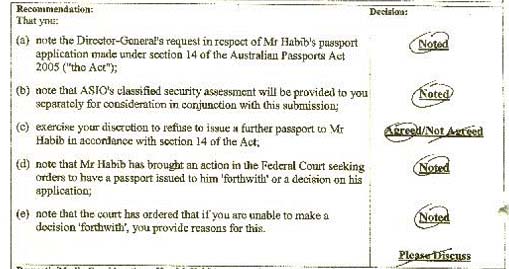
The Minister also provided the following additional hand-written notations:
“1 Dealt with 10-1788 11/08/10; 10-1798 13/08/10; 10-1807 25/08/10;
2 Discussed with Secretary DFAT 12/08/10;
3 ASIO advice confirmed as current 25/08/10;
4 MR Habib’s affidavit considered;
5 Recdn (c) agreed;
6 Given caretaker arrangements, please brief Shadow Minister for Foreign Affairs (ASIO + DFAT)”
22 The unclassified statement of grounds which had been provided to the Applicant together with the letter of 25 August 2010 stated as follows:
Background:
Travel
Mamdouh Habib left Australia on 29 July 2001. He was apprehended by Pakistan authorities in Pakistan on or around 5 October 2001. He was then detained by foreign governments until 28 January 2005 when he was repatriated to Australia. Between May 2002 and 28 January 2005 he was detained by US authorities in Guantanamo Bay, Cuba.
Habib was interviewed by ASIO on several occasions between October 2001 and November 2003. During these interviews Habib indicated he travelled to Afghanistan in the periods March to May 2000 and August to October 2001, during which time he attended militant jihad training camps.
Habib also stated he travelled to a LeT militant jihad training camp (Moska Aska) north of Lahore, Pakistan, in early 2000. Though Habib stated his involvement in the camp was limited to observation, ASIO’s assessment that Habib attended a LeT militant jihad camp in early 2000 is corroborated by emails sent by Mr and/or Mrs Habib between 1997 and 2001, discussions between Habib and his wife in September and October 2001 that were the subject of ASIO telecommunications interception and a notebook ASIO seized from Habib’s premises on 20 September 2001 pursuant to a search warrant.
Support for Islamic extremism
During interviews with ASIO prior to 2001 Habib made a variety of statements indicating his support for various acts of Islamic extremism. Habib also stated to ASIO he personally knew the 1993 World Trade Centre Bombers and supports Usama bin Laden. ASIO telecommunications interception in September 2001 indicated that Habib supported the attacks in the United States on 11 September 2001.
During proceedings in the Administrative Appeals Tribunal in June 2007, Habib repeatedly lied in relation to matters concerning his contact and involvement with Islamic extremist groups. This included denying holding extremist anti-Western views, attempting to develop connections with extremists overseas and attending a militant jihad training camp run by LeT, even when directly confronted with strong evidence to the contrary. ASIO also assesses that on a number of occasions during these proceedings, Habib sought to avoid directly answering questions when he considered that an honest answer would be prejudicial to him.
Security Assessment Interview process and engagement with Australian Government
In order to further ASIO’s assessment of the security implications surrounding the return of Habib’s passport, ASIO invited Habib to attend a Security Assessment Interview (SAI). The interview was held on 6 January 2010.
Habib repeatedly refused to directly answer questions seeking his views on al-Q’aida and Usama bin Laden.
Habib ultimately became abusive and threatening towards ASIO officers, and the interview was terminated.
Habib did not consent to a further interview.
ASIO directly contacted Habib on 22 July 2010 and offered to arrange a second SAI. Habib agreed to attend an SAI with ASIO to be held on 26 July 2010. Habib failed to attend the arranged SAI. When subsequently contacted by ASIO, Habib denied having agreed to attend the interview.
Current likelihood of Mamdouh Habib engaging in activities prejudicial to security
Habib’s activities from 2000 to present have garnered significant public attention in Australia and overseas (including amongst international security agencies).
ASIO assesses that the risk to security posed by Habib would be significantly decreased if he does not hold a passport.
Recommendation
ASIO recommends that, in the circumstances, action be taken under the Australian Passports Act 2005 to refuse to issue Habib an Australian passport.
The proceeding in the Tribunal to which reference is there made was to Re Habib and Minister for Foreign Affairs & Trade [2007] AATA 1908.
23 The Applicant was advised by the 25 August 2010 letter of his entitlement to seek review of the adverse security assessment by the Security Appeals Division of the Administrative Appeals Tribunal.He was also advised of his right to seek review of the Minister’s decision by the Tribunal.
An Entitlement to a Passport
24 Commonwealth legislation with respect to the issue and cancellation of passports has a long history.
25 Originally, and not surprisingly, when Captain Phillip arrived at Sydney Cove on 26 January 1788 none of the convicts or anyone else carried a passport: Jane Doulman and David Lee, Every Assistance & Protection – A History of the Australian Passport (2008) at 18. But a document titled a “Ticket of Leave Passport” was thereafter issued to convicts who wished to move internally within the colony.
26 As explained by Doulman and Lee, Commonwealth responsibility for the issue of passports, as opposed to the States, seems to have emerged with the outbreak of World War 1 and the then concern of the Commonwealth with issues as to national security: at 54 to 55.
27 The first Commonwealth legislation with respect to passports was the Passports Act 1920 (Cth). That Act was enacted in the post World War 1 era and replaced the War Precautions (Passports) Regulations. Thereafter, there was enacted the Passports Act 1938 (Cth) and then later still the current Australian Passports Act 2005 (Cth) (“Australian Passports Act”). The exercise of such discretionary powers as have been conferred by such legislation from time to time has repeatedly confronted those who have political ideals contrary to the majority. As at 1948, for example, the then Prime Minister stated:
It is not the practice to refuse to grant passport facilities solely on account of the political beliefs of a person and it is considered that it would be undesirable to adopt a rule which could be used to deny the grant of such facilities on the ground that an applicant had communistic tendencies and which could conceivably serve as a precedent for similar action in the case of persons holding other political views.
See: Doulman and Lee at 127. The authors there further recount the withdrawal of Jessie Street’s credentials in November 1947 precluding her from representing Australia at the signing of the United Nations Declaration of Human Rights in 1948.
28 And in R v Holt, Ex parte Glover (Unreported, High Court of Australia, Taylor J, 7 April 1955) an order was sought calling upon the Minister to show cause why he should not be required to authorise and direct an officer to issue a passport to Mr Glover. The application was dismissed. In doing so, Taylor J observed:
In the present case the passport was refused upon grounds which may be compendiously referred to – and which were referred to in argument – as grounds directly connected with the security of the Commonwealth. No discussion took place concerning the cogency of the matters which actuated the refusal. Indeed, no such discussion could have been relevant to this application for their cogency was entirely a matter for the Minister or officer concerned. The contention was that no grounds of such a nature, in law, can justify the refusal of a passport to an Australian citizen who is shown to be a person of good repute. I may have failed to appreciate the full significance of the applicant’s argument on this point, but I can see no reason to suppose that a passport may not lawfully be refused upon such grounds. On the contrary I am satisfied that whatever limits to the statutory discretion may be suggested by a consideration of “the general objects of the Act”, or the constitutional powers which support it, none could be assigned which would exclude such grounds.
Whether His Honour’s observations as to the “cogency of the matters which actuated the refusal” being “entirely a matter for the Minister” would still prevail today, is a matter which need not be further explored. The case remains as an early instance of review being sought of a decision to refuse to issue a passport and whether there was any discretion to refuse to issue a passport based upon an assessment of national security considerations.
29 Whatever may have been the origins of Commonwealth passport legislation and prior concerns, s 7(1) of the Australian Passports Act now provides that an “Australian citizen is entitled, on application to the Minister, to be issued with an Australian passport by the Minister”. The “entitlement” to which s 7(1) now refers stands in contrast to s 7(1) of the Passports Act 1938 (Cth) which merely provided that “the Minister … may issue Australian passports to Australian citizens”.
30 Section 9(1) of the 2005 Act further provides that the Minister may, on application, “issue … a document of a kind specified in a Minister’s determination, being a document issued for the purposes of travel”.
31 The decision to refuse to issue the Applicant with a passport in the present proceeding was taken pursuant to s 14(2) of the Australian Passports Act.
32 Section 14(1) and (2) provide in relevant part as follows:
Reasons relating to potential for harmful conduct
(1) If a competent authority suspects on reasonable grounds that:
(a) if an Australian passport were issued to a person, the person would be likely to engage in conduct that:
(i) might prejudice the security of Australia or a foreign country; or
(ii) …; or
(iii) …; or
(iv) …; or
(v) …; and
(b) the person should be refused an Australian passport in order to prevent the person from engaging in the conduct;
the competent authority may make a refusal/cancellation request in relation to the person.
(2) If a competent authority makes a request under subsection (1), the Minister may refuse to issue the person an Australian passport.
No question arises in the present proceeding as to the ambit of the phrase “competent authority”.
33 There were no comparable provisions to those now found in s 14(1) in the Passports Act 1938 as originally enacted. The counterpart to s 14 would seem to be s 7E of the Passports Act 1938, a provision inserted by way of amendment in 1979 by the Passports Amendment Act of that year.
34 In the present proceeding, it is s 18 of the 2005 Act which provided for the making of a request to the Minister “to refuse to issue an Australian passport to a person” and s 22 provides for the cancellation of an Australian passport.
35 It is Part IV of the Australian Security Intelligence Organisation Act 1979 (Cth) which provides for the preparation of what are there described as “security assessments”. Section 37(1) provides that the functions of ASIO include the furnishing to Commonwealth agencies of such assessments. Section 37(2) provides that an adverse or qualified security assessment is to be accompanied “by a statement of the grounds for the assessment”. Section 37(5) is an important limitation upon the availability of judicial review in respect to the making of a security assessment. That sub-section provides as follows:
No proceedings, other than an application to the Tribunal under section 54, shall be brought in any court or tribunal in respect of the making of an assessment or anything done in respect of an assessment in accordance with this Act.
The reference to the Tribunal is a reference to the Administrative Appeals Tribunal.
36 In The Church of Scientology Inc v Woodward (1982) 154 CLR 25 at 55 (“Church of Scientology”) a submission that had earlier been made was “disavowed” and later expressed in “less ambitious” terms. The earlier submission had been that each of the Australian Security Intelligence Organisation Acts of 1956 and 1979 “evinces a legislative intent to shield the conduct of ASIO from judicial review”. In disavowing that submission, it was later “conceded that decisions made and acts done corruptly or mala fides were open to such review”. See also: Parkin v O’Sullivan [2006] FCA 1413 at [17], 162 FCR 444 at 448 per Sundberg J.
37 Section 38(2) provides as follows:
The Attorney-General may, by writing signed by the Attorney-General delivered to the Director-General, certify that the Attorney-General is satisfied that:
(a) the withholding of notice to a person of the making of a security assessment in respect of the person is essential to the security of the nation; or
(b) the disclosure to a person of the statement of grounds contained in a security assessment in respect of the person, or of a particular part of that statement, would be prejudicial to the interests of security.
Section 38 was the provision relied upon for not disclosing to the present Applicant the entirety of the grounds relied upon when making the adverse security assessment against him.
Judicial Review and the Grounds of Review Relied On
38 When the proceeding first came before the Court on 1 October 2010 the Respondent contended that the form of the Application for an Order of Review was manifestly deficient. That Application relied upon as the sole ground of review a ground which was understood to be “unreasonableness” as set forth in s 5(1)(e) and s 5(2)(g) of the Judicial Review Act.
39 The contention then advanced by the Respondent was most probably correct.
40 Thereafter, on 8 October 2010 an Amended Application for an Order of Review was filed. The Amended Application sets forth the making of the application for the passport on 13 May 2009 and continues on as follows:
8. The grounds on which the Respondent determined the application were that the Director General of the Australian Security Intelligence Organisation had requested that the Respondent refuse to issue the Applicant and [sic] Australian Passport. That request was based on a statement of grounds for an adverse security assessment annexed to the letter dated 25 August 2010 informing the Applicant of the Respondents [sic] decision.
9. The Respondent should not have refused to issue the Applicant an Australian Passport because the statement of grounds by the Director-General of ASIO does not disclose any reasonable ground for suspecting that the Applicant might engage in conduct prejudicial to the national interest the security of Australia or a foreign country if permitted to travel, such that there is no evidence or other material to justify the making of the decision, contrary to s5(1)(h) of the Administrative Decisions (Judicial Review) Act 1977.
10. Further or in the alternative, in the circumstances of this case, the decision was an improper exercise of power within the meaning of s5(1)(e) because it amounted to the Respondent exercising his discretion at the direction or behest of another person, being the Director General of the Australian Security Intelligence Organisation.
An order was sought “that the Respondent issue the Applicant an Australian Passport”, together with an order for costs.
41 Reliance upon “unreasonableness” was thereby presumably abandoned; two different grounds emerged for resolution. During the course of submissions on 19 October 2010, however, Counsel for the Applicant sought to resurrect reliance upon the ground of “unreasonableness” and sought leave to further amend the Amended Application by inserting the following additional ground:
9A: Further or alternatively to paragraph 9 above, in the circumstances of this case, the decision was an improper exercise of power within the meaning of s5(1)(e) because it was an exercise of power that was so unreasonable that no reasonable person could have so exercised the power, contrary to s5(1)(g) of the Act.
Reliance upon “unreasonableness” had been foreshadowed in written submissions filed on behalf of the Applicant. The amendment was not opposed and leave was granted. A Further Amended Application for an Order of Review was filed on 19 October 2010.
42 The subsections of s 5 of the Judicial Review Act to which reference is made in the Further Amended Application provide as follows:
Applications for review of decisions
(1) A person who is aggrieved by a decision to which this Act applies that is made after the commencement of this Act may apply to the Federal Court or the Federal Magistrates Court for an order of review in respect of the decision on any one or more of the following grounds:
(a) …
(b) …
(c) …
(d) …
(e) that the making of the decision was an improper exercise of the power conferred by the enactment in pursuance of which it was purported to be made;
(f) …
(g) …
(h) that there was no evidence or other material to justify the making of the decision;
(j) …
(2) The reference in paragraph (1)(e) to an improper exercise of a power shall be construed as including a reference to:
(a) …
(b) …
(c) …
(d) …
(e) an exercise of a personal discretionary power at the direction or behest of another person;
(f) …
(g) an exercise of power that is so unreasonable that no reasonable person could have so exercised the power;
(h) …
(j) …
(3) The ground specified in paragraph (1)(h) shall not be taken to be made out unless:
(a) the person who made the decision was required by law to reach that decision only if a particular matter was established, and there was no evidence or other material (including facts of which he or she was entitled to take notice) from which he or she could reasonably be satisfied that the matter was established; or
(b) the person who made the decision based the decision on the existence of a particular fact, and that fact did not exist.
43 Section 13(1) of the Judicial Review Act should also be noted. That sub-section provides as follows:
Where a person makes a decision to which this section applies, any person who is entitled to make an application to the Federal Court or the Federal Magistrates Court under section 5 in relation to the decision may, by notice in writing given to the person who made the decision, request him or her to furnish a statement in writing setting out the findings on material questions of fact, referring to the evidence or other material on which those findings were based and giving the reasons for the decision.
44 These are the provisions of relevance to the judicial review now sought of the Minister’s decision communicated by way of the 25 August 2010 letter.
45 Given the entitlement of an Australian citizen conferred by s 7 of the Australian Passports Act to be issued with an Australian passport on application being made, a decision refusing to issue such a passport pursuant to s 14(2) at the request of a competent authority is a most serious encroachment upon that entitlement.
46 And a legislative regime which authorises the making of a decision refusing to issue a passport upon the basis of information which may not be disclosed in its entirety to an applicant is truly worrying. An adverse decision may be made upon the basis of information which may well be susceptible to explanation if exposed to scrutiny: cf. Hussain v Minister for Foreign Affairs [2008] FCAFC 128 at [135], 169 FCR 241 at 274 per Weinberg, Bennett and Edmonds JJ. But such has been the judgment of the Legislature. It is a judgment which has long been held. Debates in Parliament as to the Passports Act 1938, for instance, also exposed a commitment to Ministers retaining a power to make decisions without explanation: Lancy, ‘The Evolution of Australian Passport Law’ (1982) 13 Melbourne University Law Review 428 at 441. But it has long been acknowledged that “[r]easons of security may make it impossible to disclose the grounds on which the executive proposes to act”: Salemi v Mackellar (No 2) (1977) 137 CLR 396 at 421 per Gibbs J.
47 The “formidable” difficulties confronting those who seek judicial review of the decisions and conduct of ASIO (cf Church of Scientology at 61 per Mason J) only compound the concern to ensure that decisions made by the Minister are made in accordance with law. The importance of decisions made as to “national security” may be accepted. So, too, should it be accepted that those who make those decisions should remain accountable to the Courts. There is, with respect, considerable force in the following observations of Murphy J in the Church of Scientology case:
Experience thus shows that for a free society to exist intelligence organizations must be subject to administrative supervision and amenable to legal process: (1982) 154 CLR 25 at 67.
A little later His Honour further observes:
Therefore, if a violation of the law by ASIO is proved, ASIO and its officers are amenable to legal process and to remedies available at least under the Constitution. The difficulty the plaintiffs face is that assertion of violation of the law is one thing, proof is another. If a case comes before the courts where it is claimed on what appear to be reasonable grounds that ASIO has misused its powers, it is to be expected that the courts will be astute to ensure that misuse of power is not cloaked by claims of national security. Because of the experience that secret organizations of this kind from time to time misuse their powers in relation to individuals and institutions, it is essential that the judicial process be exerted, no doubt with caution, but if occasion warrants it, firmly, to keep the organization and officers within the law: (1982) 154 CLR at 68 to 69.
48 Notwithstanding the importance to the Applicant of the decision made on or about 25 August 2010, the grounds of review now relied upon have no substance. The Further Amended Application should be dismissed. Even if any of the grounds had any substance, the Further Amended Application would also have been dismissed by reason of the availability of review by the Administrative Appeals Tribunal.
The Absence of a Statement of Reasons
49 A difficulty confronted by the Applicant at the outset of his case was that no attempt had been made to obtain an explanation from the Minister as to the reasons for his decision to refuse to issue the passport.
50 There was of course no right at common law to reasons for an administrative decision: Public Service Board of New South Wales v Osmond (1986) 159 CLR 656; Hockey v Yelland (1984) 157 CLR 124; Zentai v Honourable Brendan O’Connor (No 3) [2010] FCA 691 at [383], 116 ALD 476 at 567 per McKerracher J. See also: Michael Akehurst, “Statements of Reasons for Judicial and Administrative Decisions” (1970) 33 Modern Law Review 154. And the absence of any explanation for an administrative decision made the identification and establishment of a ground of review difficult.
51 A significant feature of the Judicial Review Act was the introduction of a statutory right to reasons. The Kerr Committee had made a recommendation in 1971 that there should be such a right: Commonwealth Administrative Review Committee, Parl Paper No 144 (1971) at [266]. This recommendation had been endorsed by the Ellicott Report two years later: Prerogative Writ Procedures – Report of Committee of Review, Parl Paper No 56 (1973). That Committee there stated:
34. The recommendation of the Kerr Committee is that before issue of a summons, a person aggrieved or adversely affected by an administrative decision will be entitled to apply for and receive reasons for that decision. To confer such a right would clearly alter the existing law. However, it seems to us desirable that this recommendation be implemented. We think it is in the interest not only of the citizen but also of efficiency in the public service. It may also have the merit that persons who feel that they have been wronged by an administrative decision will abandon their claim when the reasons are known. The recommendation is also in accordance with the principles of open Government.
It was s 13 of the Judicial Review Act which gave effect to these recommendations. A statement in accordance with that section serves a number of fundamental purposes.
52 One purpose is to inform a person who has been aggrieved by a decision to which the Act applies of the evidence or other materials that have been taken into account by a decision-maker; the findings on material questions of fact and the decision-maker’s reasons for the decision reached. Section 13 has, accordingly, been correctly described as a “remedial provision”: Australian Institute of Marine and Power Engineers v Secretary, Department of Transport (1986) 13 FCR 124 at 130 per Gummow J.
53 A further purpose is to assist the Court in the management of a case prior to trial: Assistant Treasurer and Minister for Competition Policy and Consumer Affairs v Cathay Pacific Airways Ltd [2009] FCAFC 105 at [49], 179 FCR 323 at 337 per Flick J (Spender and Lander JJ agreeing).
54 Another fundamental purpose is that the decision the subject of review can be considered in context. The decision-maker’s findings on material questions of fact can be considered in the context of the evidence or other materials which were before him. And the manner in which the decision-maker applied the relevant statutory regime to those findings can be discerned.
55 These purposes are by no means exhaustive.
56 Despite the importance served by what is loosely described as “a statement of reasons”, in the present proceeding no statement in accordance with s 13 was sought and none provided. No explanation was provided as to why such a statement was not sought. It was not contended on behalf of the Applicant or Respondent that a request could not have been made; nor was it contended that the decision the subject of review fell within Schedule 2 to the Judicial Review Act such that a statement need not have been provided even if sought.
57 The submission that the letter dated 25 August 2010 was itself a statement setting out the reasons for the Minister's decision is rejected.
No Evidence or Other Material
58 The absence of a statement in accordance with s 13 denies to this Court any real ability to consider the decision presently under review in any certain factual context.
59 The Ministerial Submissions disclose in part the material that was before the Minister and it may be assumed that the Minister gave consideration to the views expressed by the Director-General of Security. But what the Minister actually did with that material and what findings of fact he made and his reasons for refusing the passport were all matters largely left to speculation. The 25 August 2010 letter contained very little information as to the basis upon which the Minister proceeded as opposed to providing an historical account as to how the decision came to be made. It relevantly thus stated (in part):
Further to our letters of 10 June 2009 and 12 July 2010, I am writing to inform you that, in accordance with the powers provided under sections 14(2) and 18(1)(a) of the Australian Passports Act 2005 (the ‘Act’), the Minister for Foreign Affairs has refused to issue you a passport following a request from a competent authority authorised under section 14(3) of the Act and subsection 3.4(3)(c) of the Australian Passports Determination 2005 (the Determination).
The Minister’s refusal has been made at the request of the Director-General of Security who, on the basis of an adverse security assessment by the Australian Security Intelligence Organisation (ASIO), suspects on reasonable grounds that if an Australian passport were issued to you, you would be likely to engage in conduct that might prejudice the security of Australia or a foreign country.
The letter then went on to inform the Applicant as to his entitlement to access to documents and his rights of review.
60 Given the absence of any statement provided in accordance with s 13, it is thus difficult to be certain as to the entirety of the factual basis upon which the Minister proceeded when making his decision and the evidence he accepted and that which he rejected in making his findings.
61 Notwithstanding this difficulty, Counsel on behalf of the Applicant contended that it was nevertheless readily apparent that the Minister made his decision upon the basis that there were reasonable grounds for believing that the issue of a passport would enable the Applicant to engage in conduct that might prejudice the security of Australia or a foreign country.
62 Why such an unqualified assumption should be made in the present proceeding may be left to one side.
63 The reliance placed by the Applicant upon s 5(1)(h) and s 5(3) of the Judicial Review Act is in any event without substance.
64 Section 5(3), it has long been recognised, limits “severely the area of operation of the ground of review in s.5(1)(h)”: Australian Broadcasting Tribunal v Bond (1990) 170 CLR 321 at 357. Mason CJ there commented as follows upon the operation of s 5(3):
The effect of s 5(3) is to limit severely the area of operation of the ground of review in s.5(1)(h). If we put to one side the situation to which par. (b) is directed (proof of the non-existence of a fact critical to the making of the decision), the opening part of par. (a) restricts the "no evidence" ground to decisions in respect of which the decision-maker was required by law to reach that decision only if a particular matter was established. In such a case the ground of review is that there was “no evidence or other material ... from which he could reasonably be satisfied that the matter was established”.
The then Chief Justice then went on to refer to s 5(1)(f) (i.e., error of law) and continued at 358:
… The better view, one which seeks to harmonize the two grounds of review, is to treat “error of law” in s. 5(1)(f) as embracing the “no evidence” ground as it was accepted and applied in Australia before the enactment of the A.D.(J.R.) Act and to treat the “no evidence” ground in s. 5(1)(h), as elucidated in s. 5(3), as expanding that ground of review in the applications for which pars (a) and (b) of s. 5(3) make provision. Within the area of operation of par. (a) it is enough to show an absence of evidence or material from which the decision-maker could reasonably be satisfied that the particular matter was established, that being a lesser burden than that of showing an absence of evidence (or material) to support the decision. This interpretation of the two grounds of review enables one to say that s. 5(1)(h) and (3)(a) have the effect of overcoming to a limited extent and in a limited area the restrictions on the traditional “no evidence” ground considered by Barwick C.J. and Gibbs J. in Sinclair v. Maryborough Mining Warden [(1975) 132 CLR at 481, 483].
Reference may also be made to the subsequent observations in Minister for Immigration and Multicultural Affairs v Rajamanikkam [2002] HCA 32, 210 CLR 222 at [30] to [34] per Gleeson CJ, at [49] to [52] per Gaudron and McHugh JJ, at [99] to [100] and [114] to [116] per Kirby J, and at [116] and [158] per Callinan J; Re Minister for Immigration and Multicultural Affairs; Ex parte Applicant S20/2002 [2003] HCA 30 at [57], 73 ALD 1 at 14 per McHugh and Gummow JJ.
65 Section 5(3)(a) is thus directed to the need to identify a “particular matter” required by law to be established to reach the decision under review: e.g., N V Beaulieu Real v The Minister for Justice and Customs [2002] FCA 467 at [57] per Conti J.
66 Section 5(3)(b), it is also apparent, is directed to the “proof of the non-existence of a fact critical to the making of [a] decision”: MLC Investments Ltd v Commissioner of Taxation [2003] FCA 1487 at [95], 137 FCR 288 at 310 per Lindgren J (applying Bond). His Honour there rejected the argument founded upon s 5(3)(b) as it could not be established that the decision had there been based upon the “particular fact” there identified. “That finding”, it was said, “was one strand of the many making up a net, rather than a link in a chain or fork in a road, on which the Decision depended”. And s 5(3)(b) is directed to the negativing of the “particular fact” – hence the words “and that fact did not exist”. In Minister for Immigration and Multicultural Affairs v Rajamanikkam, supra, at 234 Gleeson CJ thus observed:
[32] In Television Capricornia Pty Ltd v Australian Broadcasting Tribunal [(1986) 13 FCR 511 at 519-520], Wilcox J pointed out how s 5(3)(b) … was intended to restrict the operation of s 5(1)(h) ... If it had not been for that provision, an administrative decision could be challenged on the ground that it was based upon the assumption of a particular fact of which the decision-maker had no evidence. But the legislation in this respect limits the “no evidence” ground to a case where the applicant for review can actually negative the fact on which the decision was based. The legislative policy for this was explained by Wilcox J in a convincing manner.
67 No attention was paid in the Applicant’s written submissions to the manner in which he was to bring himself within the ambit of s 5(3). The submissions only generally contend that there was “no evidence or other material to justify the making of the decision” by the Minister.
68 If reliance was sought to be placed upon s 5(3)(a), questions which the Applicant really left unresolved were whether the “particular matter” in respect to which it was said there was “no evidence or other material” was:
· the making of the “request” for the purposes of s 14(1) of the Australian Passports Act; or
· the formation of the suspicion for the purposes of that sub-section, s 14(1) being not expressed in terms of there in fact being “reasonable grounds” but rather in terms of what the Director-General “suspects”.
Further questions left unresolved were:
· whether the absence of “reasonable grounds” would deny to a “request” in fact made by the Director-General to the Minister the character of a “request” for the purposes of the Minister thereafter considering whether to grant or refuse a passport; and
· whether the absence of “reasonable grounds” was in any event a “particular matter” that had to be established before the Minister could make his decision under s 14(2) of the Australian Passports Act.
If reliance was sought to be placed upon s 5(3)(b) of the Judicial Review Act, questions which the Applicant again left unresolved were:
· the identification of the “particular fact” which it was said “did not exist”; and
· how it could be established that the Minister in fact “based the decision” on the existence of any “particular fact” in the absence of a Ministerial statement of reasons or other evidence of the basis for his decision.
The submission advanced on behalf of the Applicant was the generally expressed submission that the “statement of grounds by the Director-General of ASIO does not disclose any reasonable ground for suspecting that the Applicant might engage in conduct prejudicial to the security of Australia or a foreign country if permitted to travel”.
69 Even if the constraints imposed by s 5(3) are left to one side, the submission made by the Applicant is respectfully considered to be without substance. On the materials available to the Applicant, it is considered that there was more than an adequate basis for the Director-General suspecting that the Applicant might engage in the conduct specified.
70 The unclassified statement of grounds provided to the Applicant with the letter dated 25 August 2010 provides material upon which such a conclusion could be reached. That statement thus sets forth (in part) the Applicant’s:
· travel to and attendance at militant jihad training camps;
· making statements indicating his support for various acts of Islamic extremism; and
· making statements that he supported Usama bin Laden.
It is not considered that such information as is there contained can be accurately or sufficiently characterised as but a statement of long past conduct of the Applicant which does not provide a basis for concluding that he may still harbour the same views as he apparently did in 2000 and 2001. The unclassified statement itself records that the Applicant attended an interview in January 2010 and then, apparently, “repeatedly refused to directly answer questions seeking his views on al-Q’aida and Usama bin Laden”. The statement of grounds cannot be properly characterised as but “allegations” that are “vague, tendentious and old”.
71 Also rejected is the contention that the past conduct of the Applicant referred to in the statement of grounds could not provide the foundation for a conclusion as to whether the Applicant is “likely” to engage in particular conduct. Section 14(1) of the Australian Passports Act, it was correctly contended, was addressed to the formation of a view as to whether the Applicant was “likely” to engage in particular conduct. Past events, so the submission was understood, provided an unsatisfactory or uncertain foundation to form any such view as to what future conduct was “likely”. Why such past conduct was not relevant to the assessment to be made was not adequately explained. It was not submitted on behalf of the Respondent Minister that there was any obligation on the part of a person such as the Applicant to answer such questions as may be asked of him by ASIO. Indeed, given his detention for a number of years in Guantanamo Bay, a lack of enthusiasm on his part to deal with intelligence organisations may not be surprising. But his more recent refusal to answer questions cannot be discounted as irrelevant to the formation of a view as to whether he will be “likely” to engage in conduct.
72 The contention that there was “no evidence or other material” upon which the Minister’s decision could be reached is rejected. The rejection of this ground is founded upon only that evidence that was available to the Applicant and his legal representatives. No recourse was had to such further confidential material as may have been contained within the affidavit of Mr Irvine.
At the Behest of Another Person
73 The reliance now placed by the Applicant upon s 5(1)(e) and s 5(2)(e) of the Judicial Review Act is misplaced. There was no dispute as to the relevant principles of law being invoked; the dispute was the application of those principles to the facts. But brief reference should be made to the principles to be applied.
74 Prior to the introduction of the Judicial Review Act in 1977, the present ground of review had long been accepted as but an instance of the common law principle of ultra vires. At common law the repository of a statutory discretion had to exercise the discretionary power personally; he could not abdicate the responsibility entrusted to him by the legislature by “acting under the dictation” of another: e.g., Bosnjak’s Bus Service Pty Ltd v Commissioner for Motor Transport (1970) 92 WN (NSW) 1003.
75 The years leading to the introduction of the Judicial Review Act, it will be recalled, were occupied by a review of these common law principles and a commitment to expressly incorporating in a statutory context the grounds upon which it was proposed judicial review was to be available. The drafting of a list of these grounds was seen as but one of the means whereby the process and scope of judicial review could be simplified.
76 The Kerr Report expressly recommended the inclusion of a ground of “ultra vires action”: at [258]. The reliance of that Committee upon the earlier common law principles was unquestioned. The Committee had thus earlier in its report addressed ultra vires in part as follows:
Ultra Vires
30. In Australia we are familiar with the doctrine of ultra vires as applied to the constitutionality of Commonwealth and State legislation and delegated legislation of the Executive. If a Minister or official is empowered by statute or regulation to do a thing and he does things not within that authorisation he has gone beyond power. The principles of statutory interpretation are of great importance in this area. The doctrine of ultra vires extends beyond the mere excess of statutory power to the improper exercise of statutory power, thereby permitting judicial control in some cases, of powers which are not limited by express statutory standards or which are deliberately conferred so as to allow the administrator a wide discretion.
31.The major grounds on which courts will review discretionary decisions on the basis of this extended doctrine of ultra vires are:
(i) …
(ii) …
(iii) …
(iv) Where an official who has a personal discretionary power exercises it on the directions or at the behest of some other person or body. An official in such a case may have regard to government policy but he must apply his mind to the question and the decision must be his decision and the product of his own mind.
(v) …
(vi) …
(vii) …
77 These recommendations were the genesis of what is now found in s 5(1)(e) and s 5(2)(e) of the Judicial Review Act.
78 There has, however, been scant attention to these particular provisions. But one instance may be found in Telstra Corporation Ltd v Kendall (1995) 55 FCR 221. A decision had there been taken to disconnect telephone services. It was believed that those services were being used in activities connected with prostitution. A request for disconnection had been made by the Queensland Police Service. It was concluded that there was no relevant power to disconnect the telephone service. A further argument advanced, however, was that the decision-maker had not independently exercised any discretion but had done so at the request of the police. In rejecting that further argument Black CJ, Ryan and Hill JJ concluded at 231 to 232:
The next attack was founded upon s 5(1)(e) of the ADJR Act, read in conjunction with s 5(2)(e), namely, that the decision was vitiated because it was an exercise of a discretionary power at the direction or behest of another person.
…
There is a fine line between saying that a decision-maker has taken into account as evidence what is said by another person in arriving at his or her conclusion and saying that the decision was one made at the direction or behest of another. What is encompassed by the ground referred to in s 5(2)(e) of the ADJR Act is the case where the decision-maker gives no real independent attention to the discretion which is conferred upon him or her, so that the exercise of discretion is really the exercise of that discretion by some other person. In the present case, the decision under challenge was the decision to disconnect the service. That was not a decision made by the Police; it was a decision made by Mr Bennett. In making that decision, Mr Bennett took into account as a factor in the decision-making process what the Police said had been revealed by their investigations. He was entitled so to do. There was no obligation placed upon Mr Bennett to conduct an independent investigation into the use of the services for prostitution. He was entitled to take into account as evidence what he had been told by the Police. He certainly did not act at the direction of the Police.
The word “behest” is defined in the Oxford English Dictionary (2nd ed), relevantly as “a command, injunction, bidding”, stemming from middle English where its meaning was “to command”.
This is consistent with its meaning as given in the Macquarie Dictionary (2nd Revised ed) of “bidding or injunction; mandate or command”.
In the context in which it appears in the ADJR Act, the word “behest” can not simply be a substitution for request. Both words are used against the background of the ordinary administrative law principle that, for a discretion to be valid it must be a real exercise of discretion by the decision-maker, not an acceptance by the decision-maker of a direction by some other person to whom the making of the decision has not been entrusted: cf R v Anderson; Ex parte Ipec-Air Pty Ltd (1965) 113 CLR 177 at 189 per Kitto J. There is no evidence to suggest that this was other than a genuine exercise of discretion by Mr Bennett in the present case.
79 The argument on behalf of the Applicant in the present proceeding is that it was the Minister for Foreign Affairs who was the repository of the discretionary power to issue or refuse a passport but that the Minister did not independently exercise that discretion but rather impermissibly made a decision at the behest of the Director-General of Security atASIO. The written submissions filed on his behalf contended that the Minister was engaged in a process of “rubber-stamping”.
80 Given the constraints upon an individual the subject of an adverse security assessment in challenging that assessment, the importance of the Minister making a truly independent decision pursuant to s 14(2) is only increased.
81 The inter-connection between the making of the request and the decision may readily be accepted. Indeed, the condition precedent to the exercise of the discretionary power conferred by s 14(2) is the making of a request in accordance with s 14(1). But there the connection factually ends in the present case.
82 Notwithstanding the argument advanced on behalf of the Applicant, it is concluded that the Minister did in fact give independent consideration to the exercise of the discretion conferred by s 14(2) and did not make that decision at the behest of the Director-General of Security. Any conclusion that the Minister was merely “rubber stamping” what the Director-General had done is denied by:
· the notation made by the Minister to the submission on 11 August 2010 – that notation indicating that the Minister considered that “further advice [was] required”;
· the notations made by the Minister to the submission on 13 August 2010 – those notations indicating that the Minister considered it either necessary or appropriate to discuss the matter with his Secretary, to seek “further advice” and to give the matter “careful consideration” before he would “make a decision …”; and
· the notations made by the Minister on 25 August 2010 – those notations indicating (inter alia) that the Minister had by that date discussed the matter with his Secretary and considered the affidavit provided by Mr Habib.
That sequence of events and the notations made by the Minister expose the fact that the Minister did not satisfy himself simply by reference to the request made by the Director-General. Those notations expose the fact that the Minister was seeking, and apparently receiving further advice, as to the decision to be made.
83 The ground of review relying upon s 5(1)(e) and s 5(2)(e) is rejected.
Unreasonableness
84 The further amendment sought to be made to the Amended Application in the Further Amended Application filed on 19 October 2010 places reliance once again upon s 5(1)(e) and s 5(2)(g).
85 It was contended on behalf of the Applicant that the Minister’s decision was unreasonable. Even if the assumption is to be made that the Minister’s decision was founded in whole or in part upon the adverse assessment as to the risk posed by the Applicant, the decision remains a decision open to be made by the Minister.
86 For present purposes it is unnecessary to conduct any detailed review of the many authorities which have discussed the ground of unreasonableness. For present purposes it is sufficient to note two matters.
87 First, care must be taken in respect to any ground of judicial review – but especially the ground of unreasonableness – not to trespass beyond the legitimate role of judicial review and into the field of merits review. Mere disagreement with a decision made by the Minister does not make that decision unreasonable. In Minister for Immigration and Multicultural Affairs v Eshetu [1999] HCA 21, 197 CLR 611, Gleeson CJ thus said:
[40] … Someone who disagrees strongly with someone else’s process of reasoning on an issue of fact may express such disagreement by describing the reasoning as “illogical” or “unreasonable”, or even “so unreasonable that no reasonable person could adopt it”. If these are merely emphatic ways of saying that the reasoning is wrong, then they may have no particular legal consequence. …
Nor will a decision “be vitiated just because a court believes that the decision is unreasonable. It must be satisfied that no person acting reasonably could arrive at such a decision”: Alexandra Private Geriatric Hospital Pty Ltd v Blewett (1985) 7 FCR 341 at 357 per Sheppard J.
88 Second, the limited ambit of operation of this ground of review is well-established. That which must be established to make out a case of unreasonableness has been variously expressed. Thus, for instance, in Minister of State for Immigration and Ethnic Affairs v Teoh (1995) 183 CLR 273 at 290. Mason CJ and Deane J there observed:
… Just as a power is exercised in an improper manner if it is, upon the material before the decision-maker, a decision to which no reasonable person could come, so it is exercised in an improper manner if the decision-maker makes his or her decision in a manner so devoid of plausible justification that no reasonable person could have taken that course.
In Zentai v Honourable Brendan O’Connor (No 3) [2010] FCA 691 at [372], 116 ALD 476 at 564, McKerracher J employed the language of a decision “verging on absurdity.” A decision is not unreasonable if it is a matter upon which reasonable minds can differ: Murrumbidgee Groundwater Preservation Association Inc v Minister for Natural Resources [2005] NSWCA 10 at [152], 138 LGERA 11 per Spigelman CJ (Beazley and Tobias JJA agreeing).
89 The overlap between these two matters is self-evident.
90 In the present proceeding, this final ground of review has not been made out.
91 Although different Ministers may have exercised the discretionary power conferred by s 14(2) in a different manner, it is no part of the function of this Court to itself form a view as what decision may have been made by a different Minister or to form a view as to the decision the Court itself would have made had it been the decision-maker. Even if it were to be assumed that a different decision may have been reached, it is not open to this Court to thereby conclude that the decision under review should be set aside as being “unreasonable”. The decision in fact made by the Minister in the present case was one clearly open to him. It can certainly not be characterised as “unreasonable” or “so devoid of plausible justification that no reasonable person could have taken that course”.
92 Any different conclusion is rendered only more difficult in circumstances where the ground of “unreasonableness” has to be considered in a context divorced from full consideration of all such materials as were before the Respondent Minister. Although some indication is given in the Ministerial Submissions as to at least some of the material that was before the Minister, including the complete statement of grounds provided by the Director-General, little is known as to such further matters as:
· the content of the discussions between the Minister and the Secretary of his Department – it not being known whether the Secretary was supporting or opposing the views being expressed by the Director-General;
· the content of such “further advice” as was sought or the factual basis upon which such advice was provided;
or even:
· the content of the affidavit prepared by the Applicant; an affidavit that the Australian Government Solicitor was suggesting should be taken into account.
The Right To Seek Merits Review
93 Section 10 of the Judicial Review Act relevantly provides as follows:
Rights conferred by this Act to be additional to other rights
(1) The rights conferred by sections 5, 6 and 7 on a person to make an application to the Federal Court …. in respect of a decision, in respect of conduct engaged in for the purpose of making a decision or in respect of a failure to make a decision:
(a) are in addition to, and not in derogation of, any other rights that the person has to seek a review, whether by the court, by another court, or by another tribunal, authority or person, of that decision, conduct or failure; and
(b) …
(2) Notwithstanding subsection (1):
(a) …; and
(b) the Federal Court … may, in its discretion, refuse to grant an application under section 5, 6 or 7 that was made to the court in respect of a decision, in respect of conduct engaged in for the purpose of making a decision, or in respect of a failure to make a decision, for the reason:
(i) …; or
(ii) that adequate provision is made by any law other than this Act under which the applicant is entitled to seek a review by the court, by another court, or by another tribunal, authority or person, of that decision, conduct or failure.
(3) In this section, review includes a review by way of reconsideration, re-hearing, appeal, the grant of an injunction or of a prerogative or statutory writ or the making of a declaratory or other order.
94 The expression “adequate provision” in s 10(2)(b)(ii) has been the subject of previous consideration by this Court: e.g., Kamha v Australian Prudential Regulation Authority [2005] FCAFC 248 at [87], 147 FCR 516 per Emmett, Allsop and Graham JJ; Kimberly-Clark Ltd v Commissioner of Patents (1988) 83 ALR 714 at 718; Kelly v Coats (1981) 35 ALR 93 at 94. Many decisions of this Court have also considered the more specific question as to whether the existence of a right of appeal to the Administrative Appeals Tribunal constitutes “adequate provision” for review and whether the existence of that right is a sufficient discretionary reason for this Court to decline to entertain an application for judicial review.
95 There may be added reason in a case of the present kind to conclude that the Tribunal is the most appropriate forum to resolve the issues dividing the parties. That Tribunal now has a specialist Security Appeals Division that is constituted under s 21AA(2) of the Administrative Appeals Tribunal Act 1975 (Cth) by a presidential member and two other members. Where review is sought of a security assessment, special provision is made in s 21AA(5) as to the qualifications of the members. Special provision is also made in s 38A for the lodgement of material with the Tribunal where a certificate has been given under s 38(2)(b) of the Australian Security Intelligence Organisation Act 1979 (Cth). The very real constraints imposed upon a person who thereby seeks to hold ASIO accountable must nevertheless be readily acknowledged. See: Hardy, ‘ASIO, Adverse Security Assessments, and A Denial of Procedural Fairness’ (2009) 17 Australian Journal of Administrative Law 39.
96 In the present proceeding Counsel for the Respondent did not place primary reliance upon the availability of review of the Minister’s decision by the Administrative Appeals Tribunal as a discretionary reason for refusing the Applicant relief. He quite properly preferred to address the substance of each of the grounds of review. Reliance, however, was placed upon the fact that “adequate provision” is made for the review of the Minister’s decision in the Tribunal.
97 This further submission of the Respondent Minister is also accepted.
98 Counsel on behalf of the Applicant correctly contended that his client had a right to invoke the jurisdiction of this Court. Indeed, s 10(1)(a) of the Judicial Review Act expressly states that the “rights” conferred by s 5 are “in addition to, and not in derogation of, any other rights” that an applicant may have to “seek a review … by another tribunal”. The Applicant, it was said on his behalf, wanted his claims resolved in this Court. The affidavit filed by the Applicant subsequent to the conclusion of the hearing on 19 October 2010 explained that he did “not wish under any circumstances to go back to the AAT due to the lack of trust in their system and unfairness process”.
99 Although the existence of the “right” that had been invoked by the Applicant and his personal desire to have his claims resolved in this Court are matters to be taken into account, s 10(2) confers a discretion to “refuse to grant an application under section 5 …”.
100 Even if the Further Amended Application were not to be dismissed by reason of the failure on the part of the Applicant to establish any ground of review, it would have been dismissed by reason of the availability of review by the Tribunal – a right of review of which the Applicant was expressly advised in the letter dated 25 August 2010. The desire of the Applicant not to have his claims resolved in that forum is noted; but his concern as to the “fairness” of the processes of the Tribunal is, with respect, misplaced.
The Security of the Commonwealth
101 Given the conclusion that each of the grounds of review can be resolved upon the basis of such material as was made available to the Applicant, it has proved unnecessary to consider the Notice of Motion filed on 15 October 2010.
102 No hesitation is expressed in taking such a course. Wherever possible, it is considered preferable to resolve a case upon a factual basis that is publicly available for scrutiny and upon a factual basis that permits a litigant meaningful participation in the Court’s consideration of his claims.
103 Recourse to material which may be withheld from the public gaze and withheld from a party may, in an appropriate case, be necessary. But such a course, it is respectfully considered, should not be pursued if it can be avoided.
104 The affidavit of Mr Irvine which was the subject of an order maintaining its secrecy has not been read. It should be returned to the solicitor appearing for the Respondent. The submission advanced by the Applicant in person on 22 October 2010 thus need not be resolved. That submission was that little confidence could be placed in the process whereby material was deleted from the statement of grounds before it was provided to him. Whether material should or should not have been deleted does not arise for consideration. The case has been resolved on the basis of material available to him.
Conclusions
105 The Further Amended Application as filed on 19 October 2010 should be dismissed.
106 It should, perhaps, be finally noted that success on the part of the Applicant in establishing any of the grounds of review relied upon would not have entitled him to an order “that the Respondent issue the Applicant an Australian Passport”. Subject to discretionary considerations, success on an application for judicial review would normally entitle an applicant to an order that the decision under review is to be set aside and reconsidered in accordance with law. An order that a particular decision be made, such as an order that a passport be issued, is normally an order that may be made where “merits review” is sought as opposed to “judicial review”. A Court, it has been said, when conducting judicial review “has no jurisdiction simply to cure administrative injustice or error”: Attorney-General for the State of New South Wales v Quin (1990) 170 CLR 1 at 35 to 36 per Brennan J.
107 There is no reason why the normal rule as to costs should not apply. Rejected is the submission that the Applicant should not pay the costs even in the event that he was unsuccessful because of the withholding of some information. The Applicant took no steps to expose or obtain the reasons for the Ministerial decision under review. In any event, he cannot resist an order for costs because the Minister in his evidence annexed the Ministerial Submissions and separately sought to make available to the Court evidence that had been withheld. There was nothing inappropriate in the manner in which the Respondent conducted the present case. Moreover, the Applicant has been unsuccessful in his principal argument by reference to material that had been disclosed to him. The Applicant is to pay the costs of the Respondent.
ORDERS
108 The Orders of the Court are:
2. Upon the return of the affidavit of David Taylor Irvine sworn on 15 October 2010, the order as made on 19 October 2010 as to the manner of retention of that affidavit is vacated.
3. The Notice of Motion filed on 15 October 2010 is dismissed.
4. The Further Amended Application for an Order of Review as filed on 19 October 2010 is dismissed.
5. The Applicant is to pay the costs of the Respondent.
| I certify that the preceding one hundred and eight (108) numbered paragraphs are a true copy of the Reasons for Judgment herein of the Honourable Justice Flick. |
Associate:
Dated: 5 November 2010


