

FEDERAL COURT OF AUSTRALIA
Mosaic Oil NL, in the matter of Mosaic Oil NL (No 2) [2010] FCA 1186
| IN THE FEDERAL COURT OF AUSTRALIA | |
IN THE MATTER OF MOSAIC OIL NL (ACN 003 329 084)
| MOSAIC OIL NL (ACN 003 329 084) Plaintiff |
| DATE OF ORDER: | |
| WHERE MADE: |
THE COURT ORDERS THAT:
1. Pursuant to clause 7.1 of the deed poll (“Deed Poll”) executed by AGL Energy Limited (“AGL”) in favour of shareholders of Mosaic Oil NL (“Mosaic”) other than Excluded Shareholders (“Shareholders”) on 3 September 2010, the amendments to the Deed Poll set out in Annexure “A” to these Orders do not preclude approval of the scheme of arrangement between Mosaic and its Shareholders, as set out in the following Orders (“Scheme”).
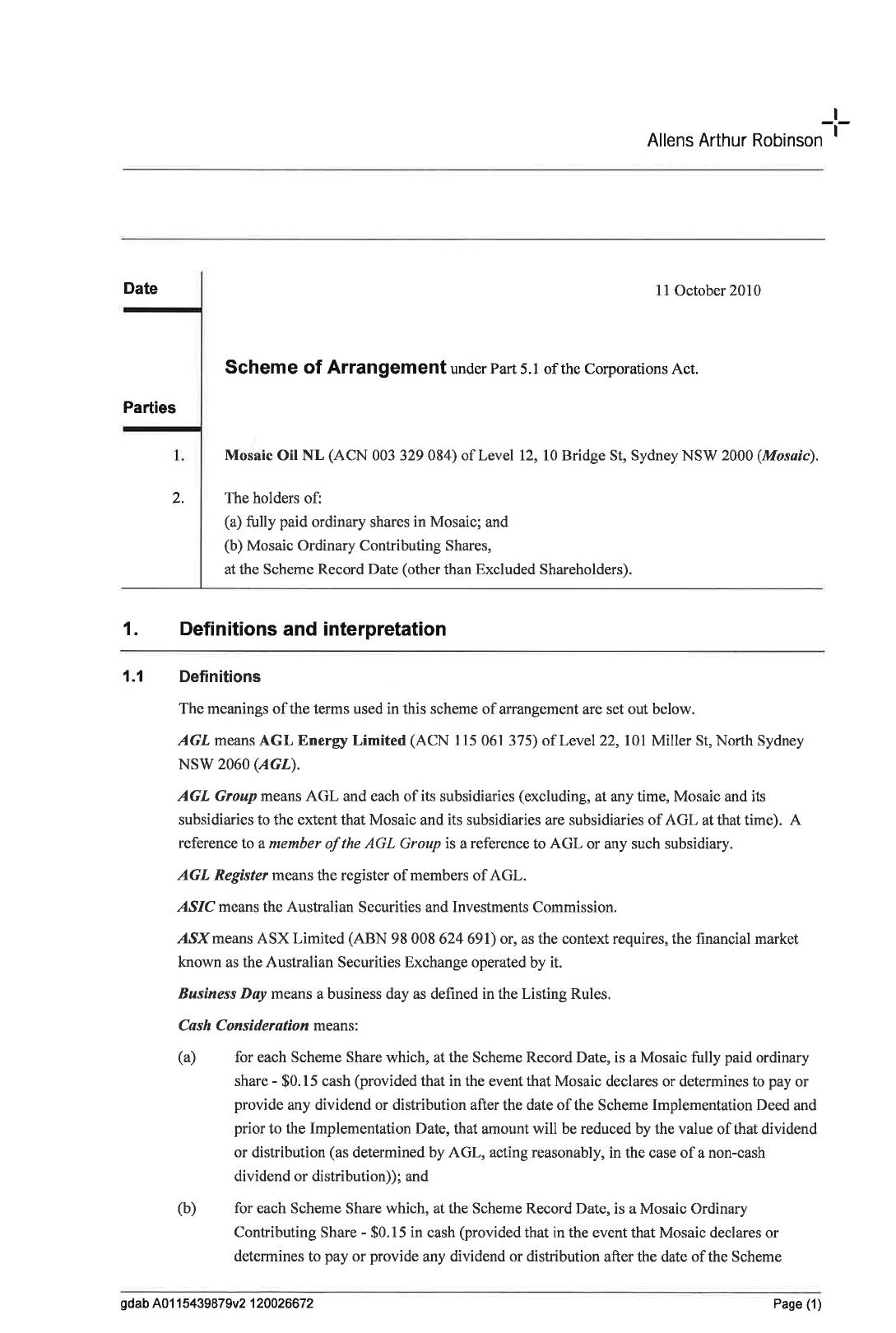
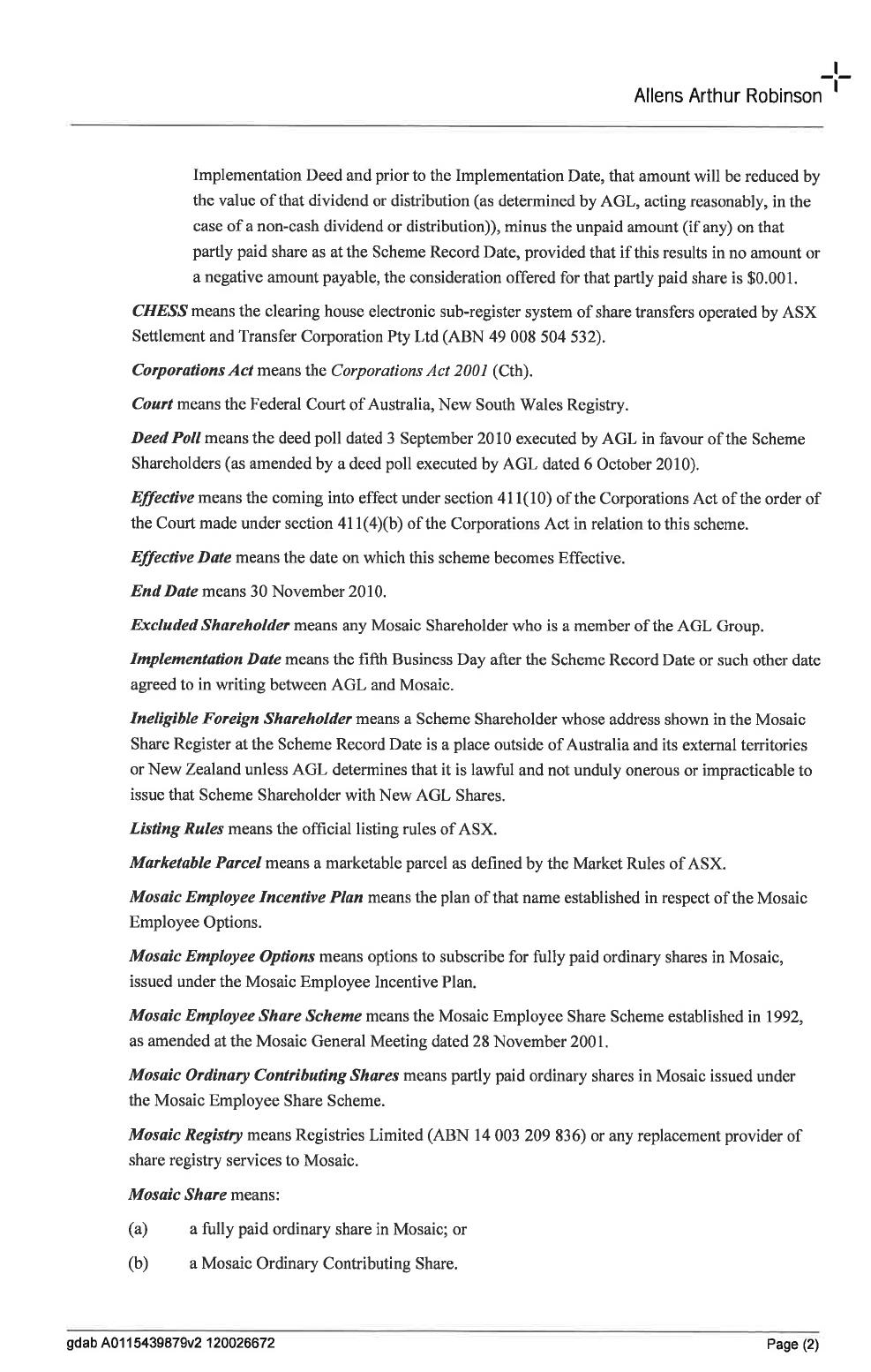
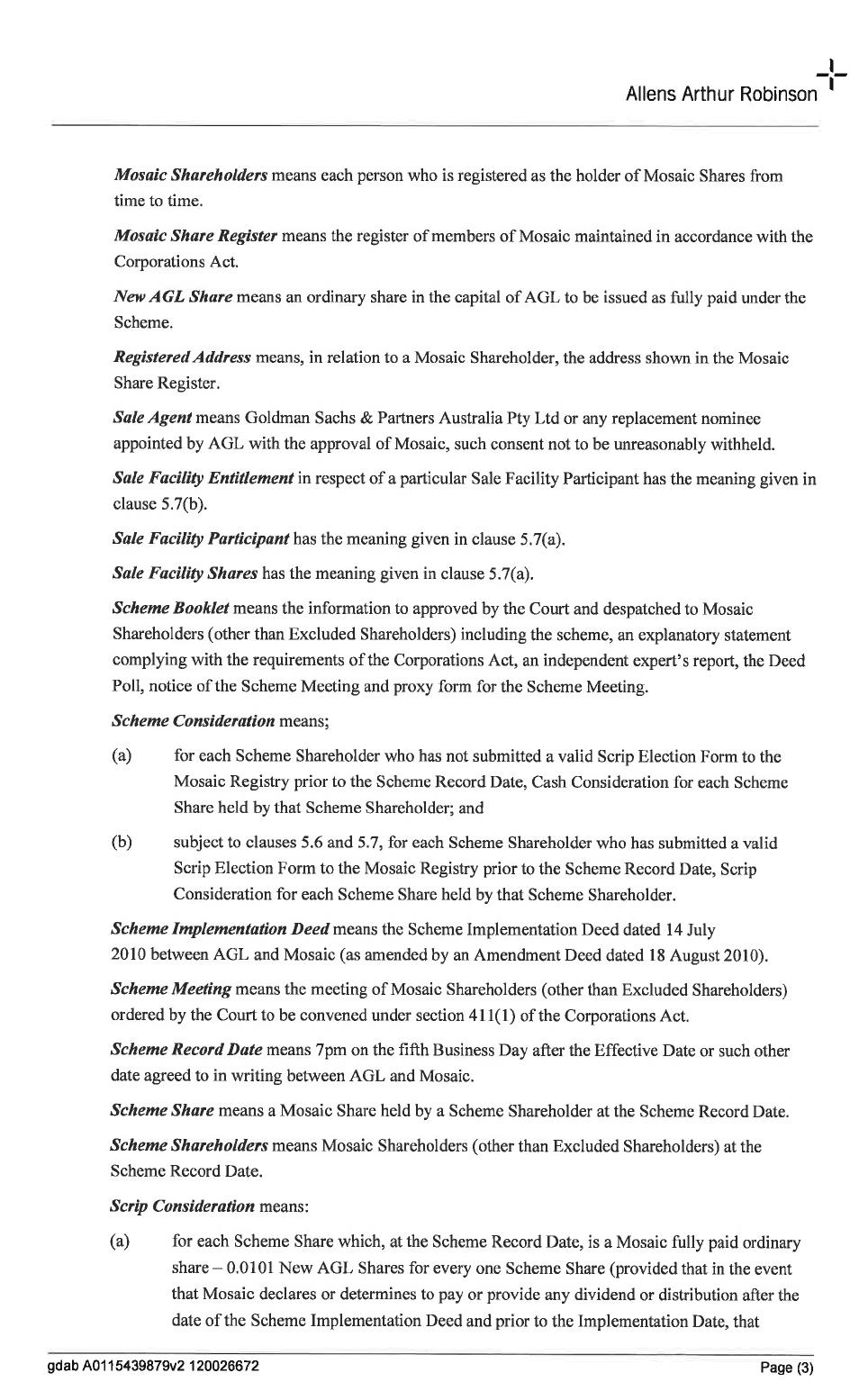
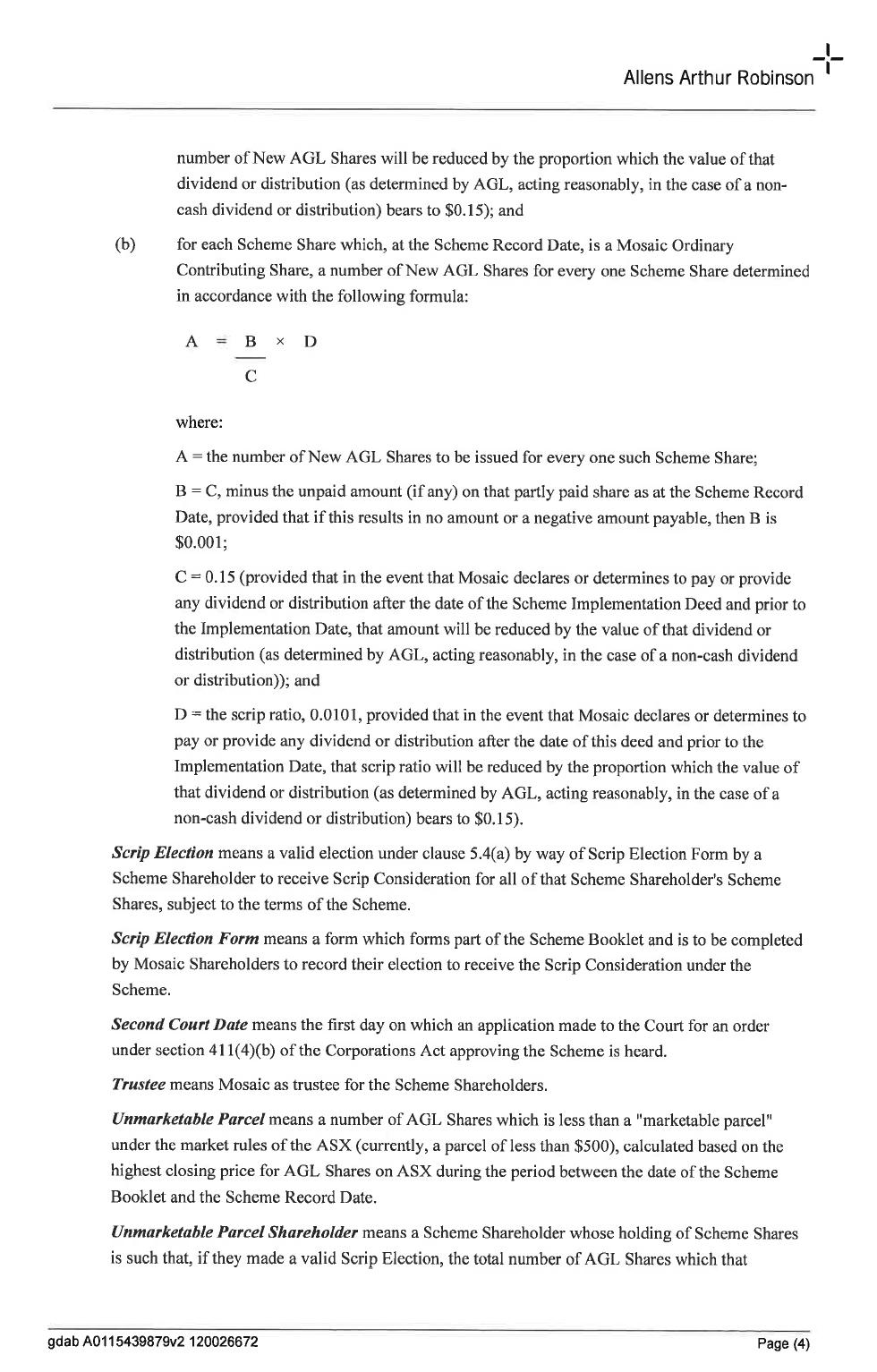
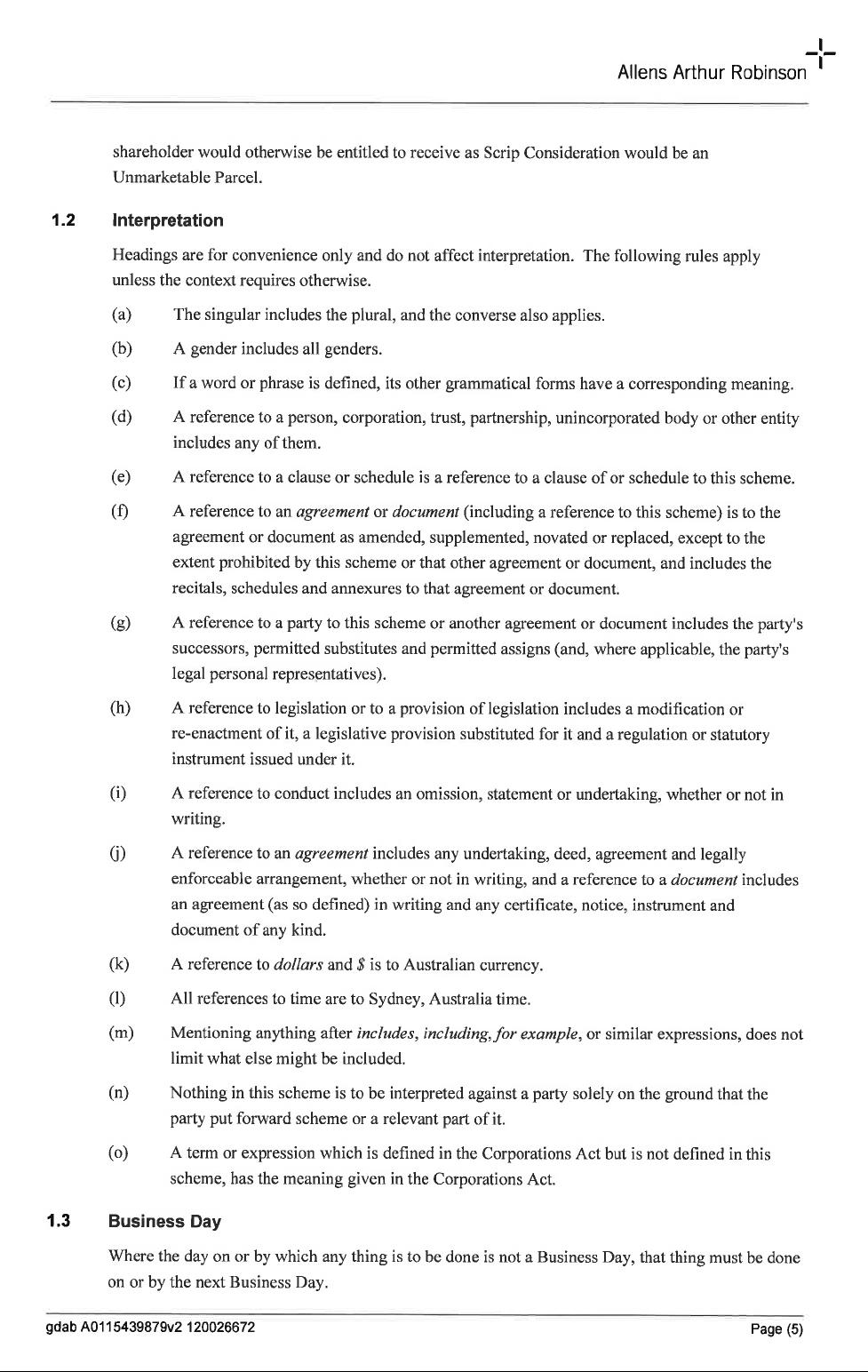
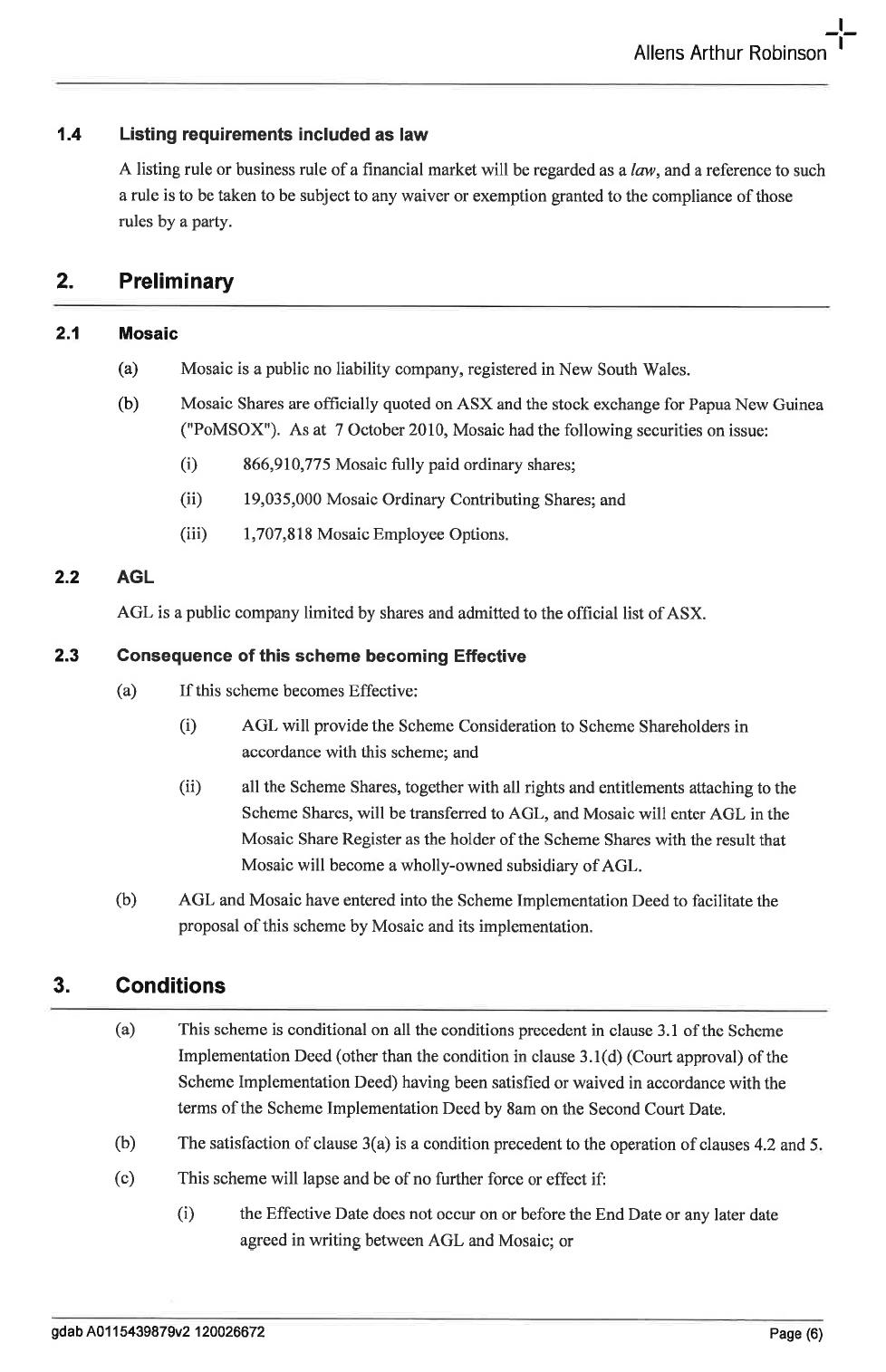
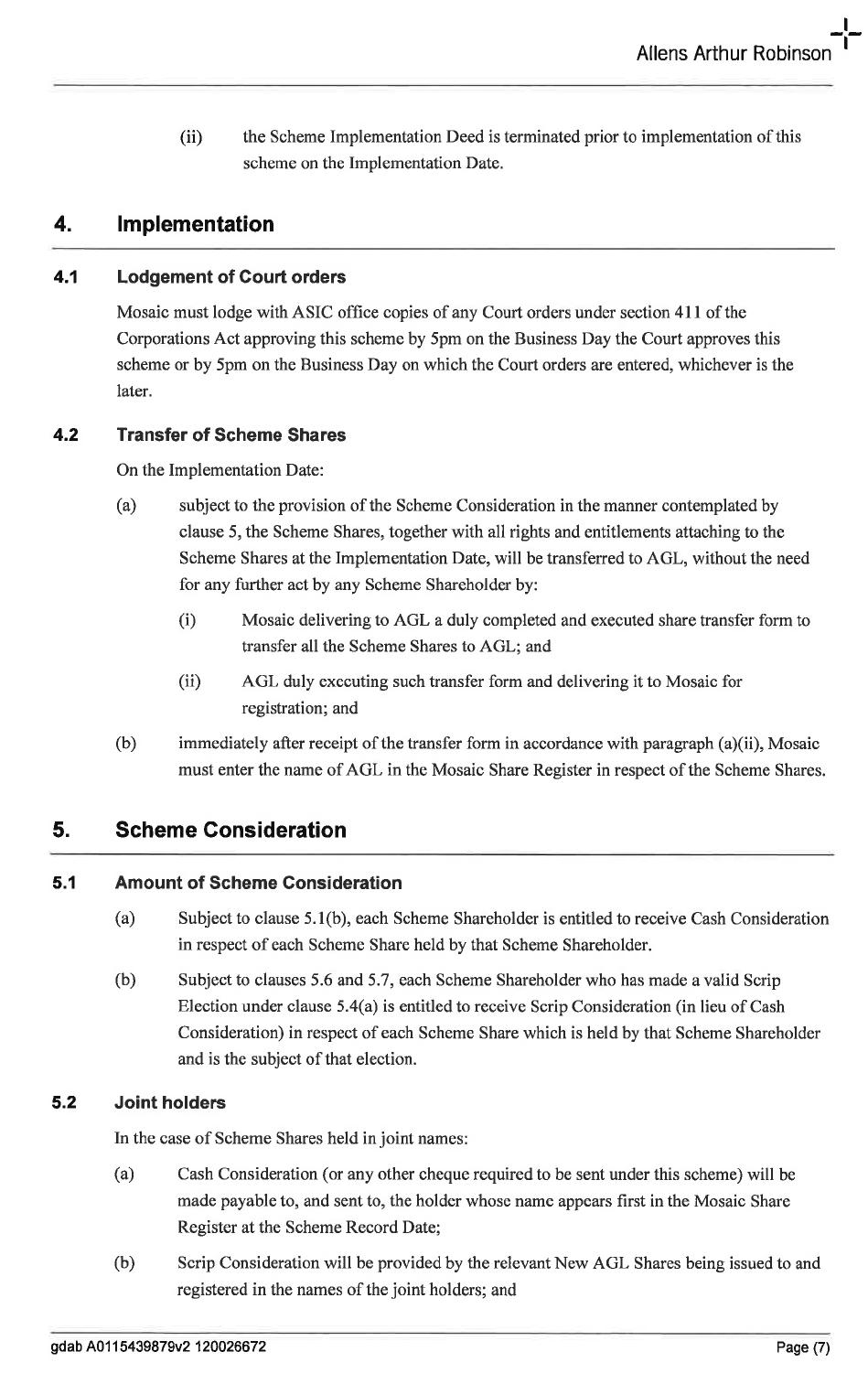
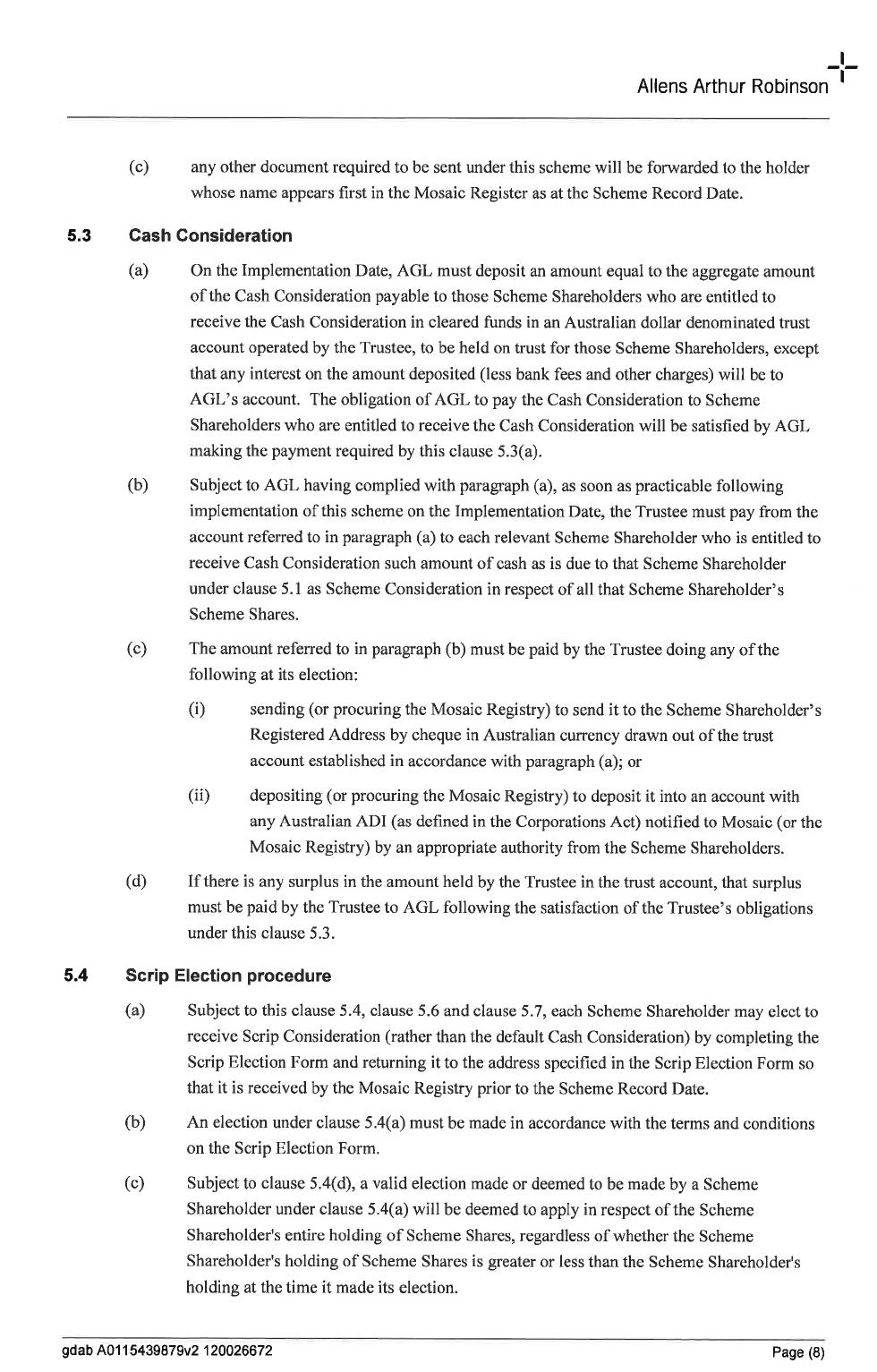
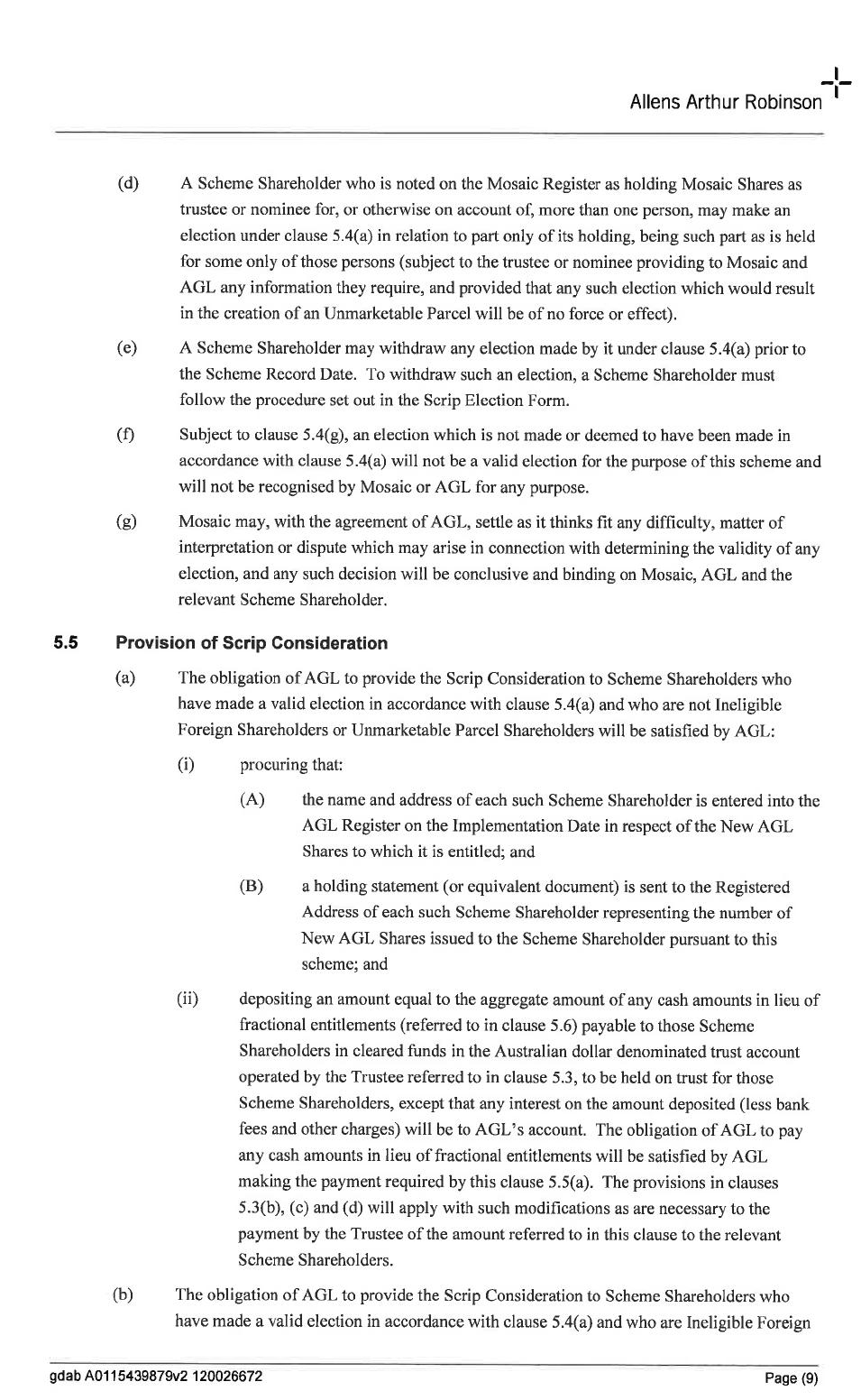
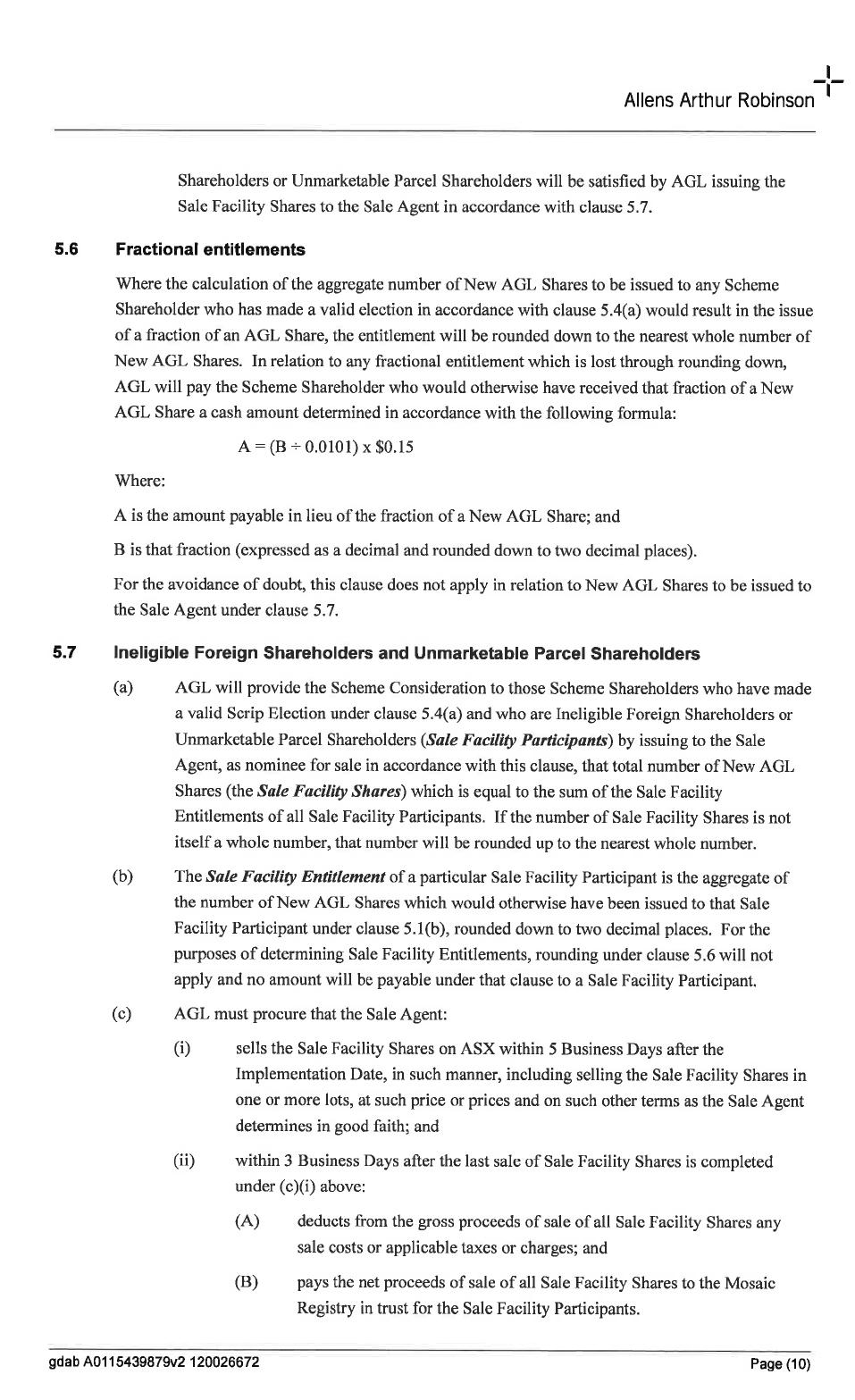
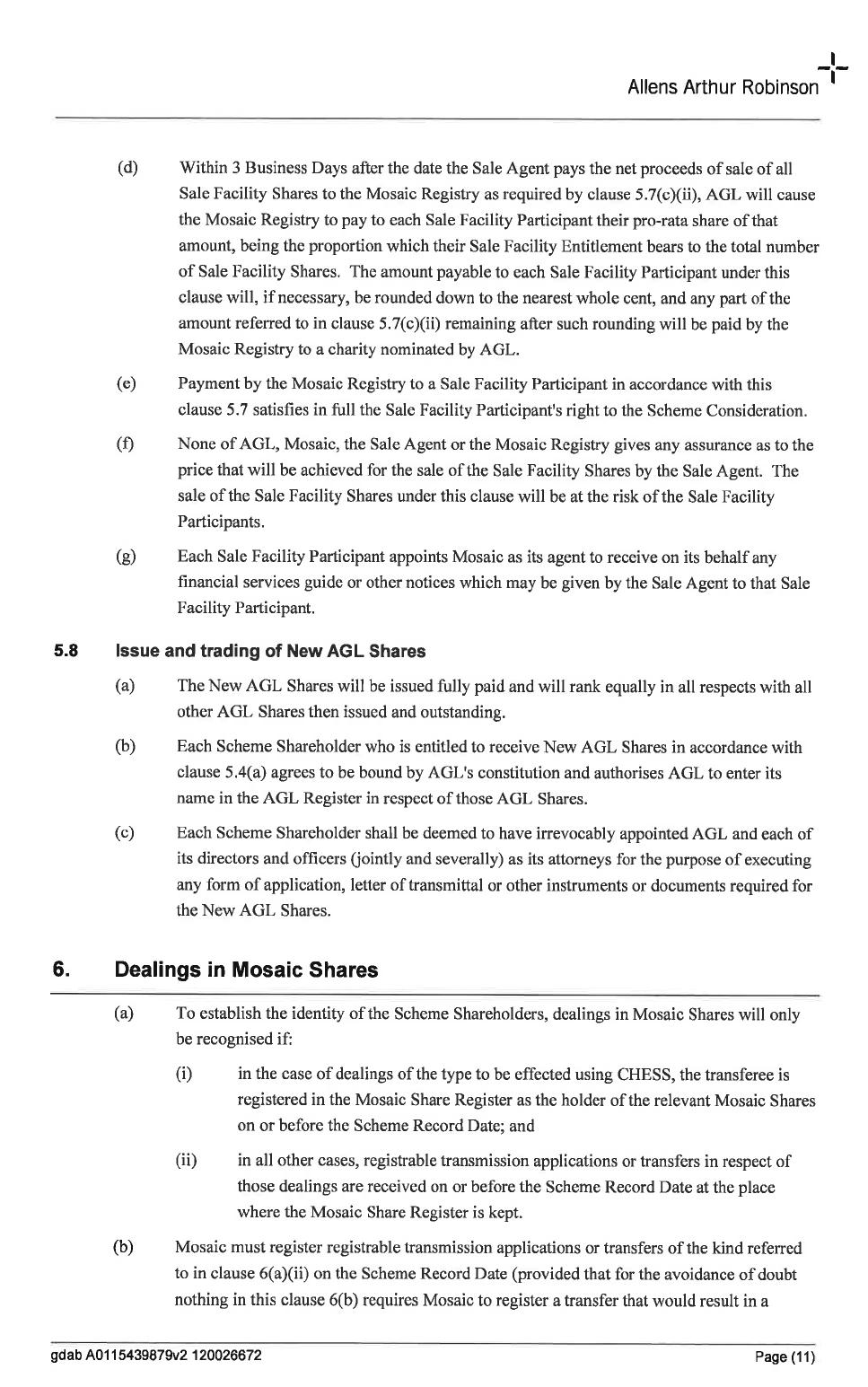
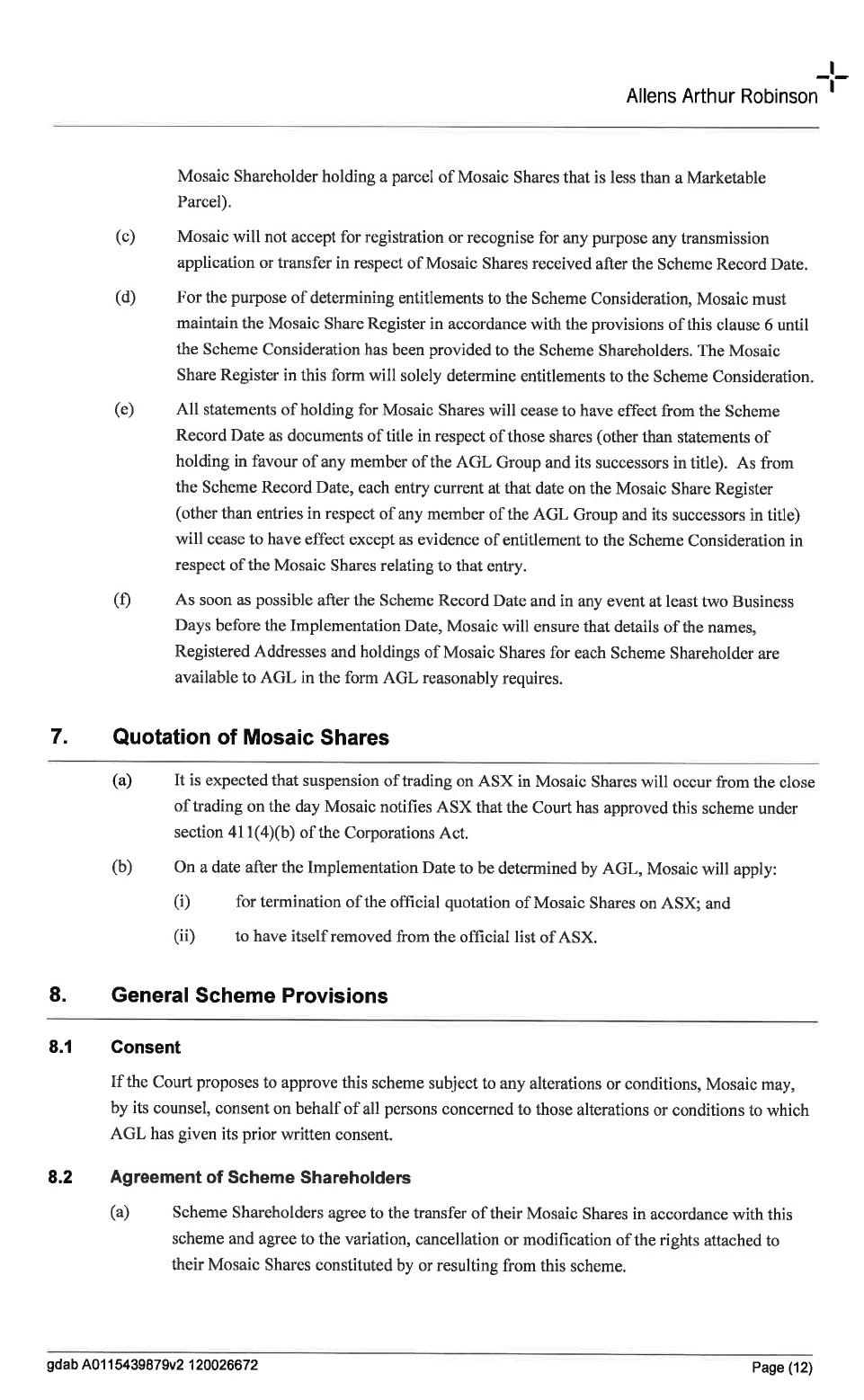
2. Pursuant to s 411(4)(b) and (6) of the Corporations Act 2001 (Cth) (“the Act”), the Scheme between Mosaic and its Shareholders, being in the form of the Scheme contained in Annexure B of the Scheme Booklet which was registered with the Australian Securities and Investments Commission on 6 September 2010 and assigned document number 026139310, be approved subject to the following alterations to the Scheme:
(a) inserting the words “11 October” before the reference to “2010” in the “Date” of the Scheme on page 1;
(b) inserting the words “(as amended by a deed poll executed by AGL dated 6 October 2010” after the words “Scheme Shareholder)” in the definition of “Deed Poll” in clause 1.1 of the Scheme;
(c) inserting the words “(as amended by an Amendment Deed dated 18 August 2010)” after the words “between AGL and Mosaic” in the definition of “Scheme Implementation Deed” in clause 1.1 of the Scheme;
(d) replacing the words “[insert date]” with the date “7 October 2010” in clause 2.1(b) of the Scheme;
(e) replacing the number “[821,710,775]” with the number “866,910,755” in clause 2.1(b)(i) of the Scheme;
(f) replacing the number “[19,235,000]” with the number “19,035,000” in clause 2.1(b)(ii) of the Scheme;
(g) deleting the symbols “[“ and “]”in clause 2.1(b)(iii) of the Scheme;
(h) inserting a space after the words “paragraph (a)” in clause 5.3(b) of the Scheme;
(i) deleting the second full-stop appearing at the end of clause 5.7(b) of the Scheme;and
(j) replacing the word “Securities” with the word “Shares” in clause 5.7(d) of the Scheme;
so that the Scheme as altered and approved is in the form of Annexure “B” to these Orders.
3. Pursuant to s 411(12) of the Act, Mosaic be exempted from compliance with s 411(11) of the Act.
4. These orders be entered forthwith.
In these orders, an “Excluded Shareholder” is any Mosaic Shareholder who is a member of the AGL Group, meaning AGL Energy Limited and each of its subsidiaries.
ANNEXURE A
The Deed Poll is amended as follows:
1. inserting the words “and, subject to clause 2, to perform its obligations under the Scheme” after the words “terms of the Scheme” in clause 3.1(a) of the Deed Poll.
ANNEXURE B
Note: Settlement and entry of orders is dealt with in Order 36 of the Federal Court Rules. The text of entered orders can be located using Federal Law Search on the Court’s website.
| NEW SOUTH WALES DISTRICT REGISTRY | |
| GENERAL DIVISION | NSD 1064 of 2010 |
IN THE MATTER OF MOSAIC OIL NL (ACN 003 329 084)
| MOSAIC OIL NL (ACN 003 329 084) Plaintiff |
| JUDGE: | JACOBSON J |
| DATE: | 11 OCTOBER 2010 |
| PLACE: | SYDNEY |
REASONS FOR JUDGMENT
Introduction
1 This is the second Court hearing of an application to approve a scheme of arrangement (“Scheme”) between the plaintiff, Mosaic Oil NL (“Mosaic”) and its shareholders pursuant to s 411 of the Corporations Act 2001 (Cth) (“the Act”).
2 The Scheme was described by Stone J in her reasons for judgment given in relation to the convening of the meeting at the first Court hearing: see Mosaic Oil NL, in the matter of Mosaic Oil NL [2010] FCA 985.
Approval at Scheme meeting
3 The Scheme was approved at the meeting held on 7 October 2010 by an overwhelming majority of shareholders. The relevant percentage figures are set out in the outline of the plaintiff’s submissions for the second Court hearing, which I will mark as MFI1.
4 I will not set out the figures in detail, but it is sufficient to say that the Scheme was approved by more than 97.55% of votes cast by 1336 shareholders representing over 91% in number. The votes which were cast at the meeting constituted a very substantial percentage of the total number of issued shares of the company.
Subcategories of members
5 Mr Gleeson SC, in his written submissions, set out in the form of tables the approval percentages of four subcategories of members which Mosaic separately counted for the purposes of reporting back to the Court.
6 Those subcategories were referred to by Stone J in her reasons for judgment. Her Honour accepted that the subcategories did not constitute separate classes, but the counting of those subcategories was carried out for an abundance of caution.
7 The holders of Mosaic Ordinary Contributing Shares (that is to say the partly paid shares) approved the Scheme by a vote of approximately 99% in favour of the Scheme.
8 Needless to say the members who entered into Pre-Bid Acceptance Agreements with AGL Energy Limited (“AGL”) approved the Scheme unanimously. There were two other subcategories. The first was holders of Mosaic Employee Options who are also members of Mosaic. There are only seven such members. Three of them voted in favour of the Scheme whilst four voted against it.
9 The second is holders of fully paid ordinary shares which were issued under the Employee Share Ownership Plan. There are 18 such members, 11 of whom voted in favour of the resolution to approve the Scheme whilst seven voted against it.
10 The numbers of shareholders covered by those last mentioned subcategories are very small, and I do not consider that their votes have any significance in the question of the exercise of my discretion, having regard to the overwhelming support for the Scheme to which I have referred.
Issues arising on the application
Dispatch of proxy forms
11 Three issues arise on the present application. The first is that proxy forms sent to shareholders with the Scheme Booklet on 7 September 2010 contained an error. The proxy form stated that the resolution for the Scheme meeting was “to approve the Employee Share Scheme”.
12 However, that error was noticed by someone at Mosaic on 8 September, and the following day, 9 September 2010, a letter, under the signature of the Chief Executive Officer of Mosaic, was sent to shareholders enclosing an amended proxy form which correctly stated the resolution for the Scheme meeting which was “to approve the Scheme.”
13 A total of 572 invalid proxy forms were received and Mosaic arranged for a letter to be sent to those members advising them that the proxy was not valid and that they should lodge an amended proxy form. Of the invalid proxy forms received, ultimately, amended proxy forms were not received from 198 members holding a total of approximately 11 million shares. That number of shares is slightly in excess of 1% of the total of the issued shares of Mosaic.
14 The error, or omission, in relation to the invalid proxy form, is a procedural error under s 1322(1)(b)(ii) of the Act. It is a deficiency of notice or time because the amended proxy form was dispatched to shareholders less than 28 days prior to the meeting. However, the deficiency was a matter of only two days and, in my opinion, it is a procedural irregularity which does not invalidate the proceeding unless the Court is of the opinion that it has caused or may cause substantial injustice and declares the proceeding to be invalid.
15 Here, in my view, the deficiency of a matter of only two days is one which has not caused substantial injustice bearing in mind, in particular, the large element of support for the Scheme at the meeting. It is unnecessary for there to be a validating order because validation is brought about by s 1322(2) of the Act: see SGIC Insurance Limited v Insurance Australia Limited (2004) 51 ACSR 593 at [12] – [16].
Amended Deed Poll
16 The second issue which arises is that the Deed Poll in favour of shareholders was amended by an Amended Deed Poll executed on behalf of AGL on 6 October 2010.
17 The original form of the Deed Poll related only to the provision of the Scheme consideration but the Amended Deed Poll provides that AGL undertakes to Mosaic shareholders to perform its obligations under the Scheme, in addition to the provision of the consideration. The obligations include those contained in clauses 5.7(c) and 5.7(d) of the Scheme which require AGL to procure or cause the Sale Agent and Mosaic Registry to take certain actions for the sale of the script entitlements of Ineligible Foreign Shareholders and the Unmarketable Parcel Shareholders.
18 I was taken to the terms of the relevant documents including the agreements made with, in particular, the sale agent, Goldman Sachs. The amendment to the Deed Poll is beneficial to Mosaic shareholders. The terms of the Deed Poll require the amendment to be agreed to by Mosaic in writing and it also requires the Court to indicate that the amendment would not, itself, preclude approval of the Scheme. Mosaic has indicated its agreement in writing.
19 The form of clause 7 is virtually identical to the terms of the Deed Poll considered by Lindgren J in Re Independent Practitioner Network Limited (No 2) (2008) 26 ACLC 1,249 at [7] – [8].
20 In that case his Honour made an order that the amendment to the Deed Poll did not preclude approval of the scheme of arrangement. The form of the order is not set out in the report of the judgment but appears in the unreported version of the judgment in [2008] FCA 1593.
21 Mosaic seeks an order in very similar terms to that which was made by Lindgren J. I am satisfied that I ought to do so because it is clear that the amendment is, as I have said, beneficial to shareholders and could not have affected the voting on the Scheme at the meeting on 7 October 2010.
Amendments to the Scheme
22 The third issue which arises is that I am asked to approve the Scheme, subject to a number of alterations which are set out in full in [32] of the outline of submissions. The power to approve a Scheme, subject to alterations, was discussed by Lindgren J in Re Independent Practitioner Network at [10] – [25]. His Honour reviewed the relevant authorities, including the decision of Barrett J in Re Permanent Trustee Co Ltd (2002) 43 ACSR 601.
23 Barrett J, at [21], said that it was clear, in that case, that the changes or differences were of a minor and technical kind and that their effect was to improve the smooth working of the Scheme.
24 Those comments apply equally here and I am, therefore, satisfied that I ought to approve the Scheme subject to the alterations to which I have referred.
Legal Principles
25 The principles which govern the exercise of the Court’s discretion to approve a Scheme are well settled. They were discussed in some detail by Santow J in Re NRMA Ltd (2003) 33 ACSR 595 at [41]. I endeavoured to collect the relevant authorities and principles in Re Seven Network Limited (No 3) (2010) 77 ACSR 701 at [31] – [44]. I am satisfied that I ought to exercise my discretion in the present case for a number of reasons.
26 First, I am satisfied for the reasons referred to in the written submissions that all necessary procedural requirements have been attended to. The evidence to which I was taken this morning indicates that meticulous detail has been devoted to the various procedural and formal matters. This is, perhaps, evidenced by the speedy way in which the error in the form of the proxy was discovered and corrected.
27 Second, the shareholders who voted at the Scheme meeting voted by a very substantial number, in a very substantial percentage, to approve the Scheme. Those members represented a significant percentage of the shares on issue.
28 Third, the disclosures in the Scheme Booklet sent to shareholders, including the independent expert report, together with a report by a technical expert and an investigating accountant’s report, were essentially the same as those which would have occurred in relation to a takeover.
29 Fourth, ASIC has provided the usual form of no objection letter to the Scheme, in accordance with s 411(17)(b). Mr Gleeson referred, in his written submissions, to some of the authorities which have considered the question raised by s 411(17)(a).
Section 411(17)
30 The authorities include an observation made by Robson J in Re Coles Group Limited (No 2) (2007) 65 ACSR 494 at [22] that the Act is generally “neutral” as to the choice which is made between the provisions of Chapter 5 and Chapter 6 of the Act.
31 Mr Gleeson also referred me to a helpful discussion of the principles by Barrett J in Macquarie Private Capital A Limited [2008] NSWSC 323 at [29]ff. As Barrett J observes, the production of an ASIC statement under s 411(17)(b) leaves the Court free to exercise its discretion even if the existence of a purpose of avoidance within s 411(17)(a) arises. Barrett J observed at [30] that the production of an ASIC statement in accordance with s 411(17)(b) absolves the Court of any direct responsibility to address the s 411(17)(a) question. His Honour emphasised the separateness of the inquiry under s 411(17)(a), which is confined to the second Court hearing. His Honour referred to the legislative history of s 411(17)(a) at [32]ff, in his reasons for judgment.
32 The provision of this kind first appeared in s 315(21) of the Companies Act 1981 (Cth) and corresponding State and Territory codes. Barrett J’s discussion at [33] – [35] is noteworthy, and I will reproduce it as follows:
33 By the Corporate Law Simplification Program Act 1999, however, Chapter 6 was rewritten and part of its former content was removed into Chapter 6A. All the provisions about compulsory acquisition of the shares of dissenting minorities in case of Chapter 6 takeovers then became housed in Chapter 6A.
34 When s 315(21) of the Companies Act 1981 was enacted, there was a general view that it was concerned with what might be described in loose terms as attempts to sidestep or circumvent the threshold for compulsory acquisition under the take-over provisions in the Companies (Acquisition of Shares) Act 1980. That view is recorded at page 81,019 (22 July 1988) of Paterson, Ednie and Ford, “Australian Company Law” (third edition). The same authors refer, however, to other ways in which a scheme of arrangement might be seen to avoid the operation of the takeover provisions. One is the equality of opportunity principle: see also Re Ranger Minerals Ltd [2002] WASC 207; (2002) 42 ACSR 582. The NCSC, ASIC’s predecessor, saw s 315(21) as concerned, at least in part, with attempts to sidestep the exacting and detailed information and disclosure requirements of the take-over provisions. That is a view that ASIC continues to hold: see ASIC Regulatory Guide 60.
35 The precise scope of s 411(17)(a) has been potentially different since the compulsory acquisition provisions were placed outside Chapter 6 in 1999.
33 More recently, in Re Rusina Mining NL (No 2) (2010) 78 ACSR 615, Barker J referred to this question, in particular, at [38] of his reasons for judgment. His Honour pointed out that an intention to avoid the operation of the provisions of Chapter 6 cannot be inferred from the general intention to prefer the procedure under Part 5.1, when that Part delivers a legal outcome that cannot be achieved under the provisions of Chapter 6. His Honour included in the examples “the timely and cost effective implementation” of an acquisition or merger. It would appear that this is one of the benefits which underlies the adoption of the scheme of arrangement approach because it produces a quick and effective outcome of an acquisition, in particular, the determination of 100% ownership of the target in the one proceeding.
Exclusivity provisions
34 It is true that Schemes often contain provisions such as break fees and “no shop” and “no talk” provisions. Those are matters which are addressed at the first Court hearing where the Court considers the question of whether the provisions, in effect, contain a disincentive to shareholders to vote against a Scheme. The question is usually determined by reference to whether there has been an appropriate fiduciary carve-out.
35 In this matter, Stone J dealt with the question of the break fee and the exclusivity provision contained in the Scheme Implementation Agreement, and no such question arises in the present case.
36 There are a large number of authorities dealing with these questions including the decision of Santow J in Re Arthur Yates & Co Limited (2001) 36 ACSR 758 at [9]. There are also a large number of authorities in this Court, however as I have said, no such question arises in the present application.
Conclusion
37 For these reasons, I propose to make orders in terms of the draft short minutes of order which I will sign and date and place with the Court papers.
| I certify that the preceding thirty-seven (37) numbered paragraphs are a true copy of the Reasons for Judgment herein of the Honourable Justice Jacobson. |
Associate:


