

FEDERAL COURT OF AUSTRALIA
Gothard, in the matter of AFG Pty Limited (Receivers and Managers appointed) (in liq) v Davey [2010] FCA 1163
|
Citation: |
Gothard, in the matter of AFG Pty Limited (Receivers and Managers appointed) (in liq) v Davey [2010] FCA 1163 |
|
Parties: |
|
|
File number: |
NSD 256 of 2009 |
|
Judge: |
EDMONDS J |
|
Date of judgment: |
28 October 2010 |
|
Catchwords: |
CORPORATIONS— whether the respondents and the persons, if any, they represent are employees of AFG Pty Limited (Receivers and managers appointed) (in liquidation) (‘AFGPL’), Allco Finance Group Limited (Receivers and managers appointed) (in liquidation) (‘AFGL’) or Allco Finance (Australia) Limited (Receivers and managers appointed) (in liquidation) (‘AFAL’) for the purposes of s 556(1)(e) of the Corporations Act 2001 (Cth) (‘the Act’) —whether the respondents and the persons, if any, they represent, are priority creditors of AFGPL, AFGL or AFAL pursuant to s 433(3)(c) of the Act.
Held: Representative proceedings are appropriate in the circumstances; the respondents are employees of AFGL, or alternatively AFAL for the purposes of s 556(1)(e); the respondents are priority creditors of AFGL or alternatively AFAL pursuant to s 433(3)(c). |
|
Legislation: |
Corporations Act 2001 (Cth) ss 433(3)(c), 556(1)(e) Federal Court Rules (Cth) O 6 r 13 |
|
Cases cited: |
Ackers v Austcorp International Ltd [2009] FCA 432 Air Great Lakes Pty Ltd v K S Easter (Holdings) Pty Ltd (1985) 2 NSWLR 309 Amann Aviation Pty Ltd v Commonwealth (1990) 22 FCR 527 Amos Removals & Storage Pty Ltd v Small [1981] 2 NSWLR 525 Attorney-General for New South Wales v The Perpetual Trustee Company (Limited) (1952) 85 CLR 237 Australian Insurance Employees Union v WP Insurance Services Pty Ltd (1982) 42 ALR 598 Bank of America National Trust and Savings Association v Taylor [1992] 1 Lloyd’s Rep 484 Boston Commercial Services Pty Ltd v GE Capital Finance Australasia Pty Ltd (2006) 236 ALR 720 Bright v Femcare Ltd (1999) 166 ALR 743 BT Australasia Pty Ltd v New South Wales [1997] FCA 1553 Carnie v Esanda Finance Corp Ltd (1995) 182 CLR 398 Dalgety Farmers Ltd (t/as Grazcos) v Bruce (1995) 12 NSWCCR 36 Damevski v Giudice (2003) 133 FCR 438 Denman v Midland Employers Mutual Assurance Ltd [1955] 2 All ER 561 Duke of Bedford v Ellis [1901] AC 1 EMI Records Ltd v Kudhail [1985] FSR 36 Finance Sector Union of Australia v Commonwealth Bank of Australia [2001] FCA 1613 Geelong Wool Combing Ltd v Textile, Clothing and Footwear Union of Australia (2003) 130 FCR 447 HJ Lyons & Sando Ltd v Houlson [1963] SASR 29 In the matter of C&T Grinter Transport Services Pty Ltd (In Liquidation) & Grinter Transport Pty Ltd (In Liquidation) (Controller Appointed) [2004] FCA 1148 Jameson v Professional Investment Services Pty Ltd (2009) 72 NSWLR 281 McCluskey v Karagiozis (2002) 120 IR 147 Multiplex Funds Management Ltd v P Dawson Nominees Pty Ltd (2007) 164 FCR 275 Nokes v Doncaster Amalgamated Collieries Ltd [1940] AC 1014 Pitcher v Langford (1991) 23 NSWLR 142 Public Trustee v Taylor [1978] VR 289 Re North Sydney District Rugby League Football Club (admin apptd); Murray v Donnelly (2000) 34 ACSR 630 Romero v Auty (2001) 19 ACLC 206 Shaw v Bindaree Beef Pty Ltd [2007] NSWCA 125 Smith v Blandford Gee Cementation Co [1970] 3 All ER 154 Stacey Brothers Plumbing Pty Ltd v Waterco Ltd [2009] FCA 438 Sturesteps v McGrath [2010] NSWSC 169 Textile Footwear and Clothing Union of Australia v Bellechic Pty Ltd [1998] FCA 1465 Tony Blain Pty Ltd trading as Acme Merchandising v Jamison (1993) 41 FCR 414 Tony Blain Pty Ltd trading as Acme Merchandising v Jamison (1993) 41 FCR 414 Trustees of the Roman Catholic Church for the Archdiocese of Sydney v Ellis (2007) 70 NSWLR 565 Walker v Citigroup Global Markets Australia Pty Ltd (formerly known as Salomon Smith Barney Australia Securities Pty Limited) (2006) 233 ALR 687 Zhang v Minister for Immigration, Local Government & Ethnic Affairs (1993) 45 FCR 384 DC Pearce and RC Geddes, Statutory Interpretation in Australia (6th ed, LexisNexis Butterworths, 2006) FMB Reynolds, Bowstead and Reynolds on Agency (18th ed, Sweet & Maxwell Ltd, 2006) GE Dal Pont, Law of Agency (1st ed, LexisNexis Butterworths, 2001) Sir WR Anson, Law of Contract (28th ed, Oxford University Press, 2002) |
|
|
|
|
Dates of hearing: |
14 September 2009, 29, 30 and 31 March 2010, 1 April 2010, 6 and 7 May 2010. (Last amended originating process filed 17 June 2010) |
|
|
|
|
Place: |
Sydney |
|
|
|
|
Division: |
GENERAL DIVISION |
|
|
|
|
Category: |
Catchwords |
|
|
|
|
Number of paragraphs: |
252 |
|
|
|
|
Counsel for the Applicant: |
Mr IM Jackman SC with Ms KL Eastman |
|
|
|
|
Solicitor for the Applicant: |
Corrs Chambers Westgarth |
|
|
|
|
Counsel for the Respondents: |
Mr HJ Dixon SC with Ms CL Cochrane |
|
|
|
|
Solicitor for the Respondents: |
Harmers Workplace Lawyers |
|
IN THE FEDERAL COURT OF AUSTRALIA |
|
|
NEW SOUTH WALES DISTRICT REGISTRY |
|
|
GENERAL DIVISION |
NSD 256 of 2009 |
IN THE MATTER OF
AFG PTY LIMITED (ACN 051 982 560)
(RECEIVERS AND MANAGERS APPOINTED) (IN LIQUIDATION)
ALLCO FINANCE GROUP LIMITED (ACN 077 721 129)
(RECEIVERS AND MANAGERS APPOINTED) (IN LIQUIDATION)
ALLCO FINANCE (AUSTRALIA) LIMITED (ACN 003 315 446
(RECEIVERS AND MANAGERS APPOINTED) (IN LIQUIDATION)
|
BETWEEN: |
PETER JAMES GOTHARD AND STEVEN JOHN SHERMAN AS RECEIVERS AND MANAGERS OF EACH OF AFG PTY LIMITED (IN LIQ) (ACN 051 982 560), ALLCO FINANCE GROUP LIMITED (IN LIQ) (ACN 077 721 129), ALLCO FINANCE (AUSTRALIA) LIMITED (IN LIQ) (ACN 003 315 446) Applicants/Cross-Respondents
|
|
AND: |
STEVEN DAVEY First Respondent/First Cross-Claimant
MICHELLE SEGAERT Second Respondent/Second Cross-Claimant
IAN GRAYBURN Third Respondent/Third Cross-Claimant
CHRISTINE BOWEN Fourth Respondent/Fourth Cross-Claimant
TIMOTHY RICH Fifth Respondent/Fifth Cross-Claimant
EVAN GALLAGHER Sixth Respondent/Sixth Cross-Claimant
|
|
JUDGE: |
EDMONDS J |
|
DATE OF ORDER: |
28 OCTOBER 2010 |
|
WHERE MADE: |
SYDNEY |
THE COURT ORDERS THAT:
1. The applicants’ application be dismissed.
THE COURT DECLARES THAT:
2. The first cross-claimant is a priority creditor of Allco Finance Group Limited (Receivers and Managers appointed) (in liquidation) or alternatively Allco Finance (Australia) Limited (Receivers and managers appointed) (in liquidation) for the purposes of s 433(3)(c) of the Corporations Act 2001 (Cth).
3. The second cross-claimant is a priority creditor of Allco Finance Group Limited (Receivers and Managers appointed) (in liquidation) or alternatively Allco Finance (Australia) Limited (Receivers and managers appointed) (in liquidation) for the purposes of s 433(3)(c) of the Corporations Act 2001 (Cth).
4. The third cross-claimant is a priority creditor of Allco Finance Group Limited (Receivers and Managers appointed) (in liquidation) or alternatively Allco Finance (Australia) Limited (Receivers and managers appointed) (in liquidation) for the purposes of s 433(3)(c) of the Corporations Act 2001 (Cth).
5. The fourth cross-claimant is a priority creditor of Allco Finance Group Limited (Receivers and Managers appointed) (in liquidation) or alternatively Allco Finance (Australia) Limited (Receivers and managers appointed) (in liquidation) for the purposes of s 433(3)(c) of the Corporations Act 2001 (Cth).
6. The fifth cross-claimant is a priority creditor of Allco Finance Group Limited (Receivers and Managers appointed) (in liquidation) or alternatively Allco Finance (Australia) Limited (Receivers and managers appointed) (in liquidation) for the purposes of s 433(3)(c) of the Corporations Act 2001 (Cth).
7. The sixth cross-claimant is a priority creditor of Allco Finance Group Limited (Receivers and Managers appointed) (in liquidation) or alternatively Allco Finance (Australia) Limited (Receivers and managers appointed) (in liquidation) for the purposes of s 433(3)(c) of the Corporations Act 2001 (Cth).
Note:Settlement and entry of orders is dealt with in Order 36 of the Federal Court Rules.
The text of entered orders can be located using Federal Law Search on the Court’s website.
|
IN THE FEDERAL COURT OF AUSTRALIA |
|
|
NEW SOUTH WALES DISTRICT REGISTRY |
|
|
GENERAL DIVISION |
NSD 256 of 2009 |
IN THE MATTER OF
AFG PTY LIMITED (ACN 051 982 560)
(RECEIVERS AND MANAGERS APPOINTED) (IN LIQUIDATION)
ALLCO FINANCE GROUP LIMITED (ACN 077 721 129)
(RECEIVERS AND MANAGERS APPOINTED) (IN LIQUIDATION)
ALLCO FINANCE (AUSTRALIA) LIMITED (ACN 003 315 446)
(RECEIVERS AND MANAGERS APPOINTED) (IN LIQUIDATION)
|
BETWEEN: |
PETER JAMES GOTHARD AND STEVEN JOHN SHERMAN AS RECEIVERS AND MANAGERS OF EACH OF AFG PTY LIMITED (IN LIQ) (ACN 051 982 560), ALLCO FINANCE GROUP LIMITED (IN LIQ) (ACN 077 721 129), ALLCO FINANCE (AUSTRALIA) LIMITED (IN LIQ) (ACN 003 315 446) Applicants/Cross-Respondents
|
|
AND: |
STEVEN DAVEY First Respondent/First Cross-Claimant
MICHELLE SEGAERT Second Respondent/Second Cross-Claimant
IAN GRAYBURN Third Respondent/Third Cross-Claimant
CHRISTINE BOWEN Fourth Respondent/Fourth Cross-Claimant
TIMOTHY RICH Fifth Respondent/Fifth Cross-Claimant
EVAN GALLAGHER Sixth Respondent/Sixth Cross-Claimant
|
|
JUDGE: |
EDMONDS J |
|
DATE: |
28 OCTOBER 2010 |
|
PLACE: |
SYDNEY |
REASONS FOR JUDGMENT
Introduction
Background
1 On 4 November 2008, a number of companies in the Allco Finance group of companies (‘the Allco Finance Group’ or ‘the Group’) were placed into voluntary administration and Tony McGrath and Joseph Hayes of the firm, McGrath Nicol, were appointed administrators. The companies included:
(1) AFG Pty Limited (ACN 051 982 560) (Receivers and Managers appointed) (in liquidation) (‘AFGPL’); and
(2) Allco Finance Group Limited (ACN 077 721 129) (Receivers and Managers appointed) (in liquidation) (‘AFGL’); and
(3) Allco Finance (Australia) Limited (ACN 003 315 446) (Receivers and Managers appointed) (in liquidation) (‘AFAL’).
2 On the same day, the applicants were appointed as receivers and managers of AFGPL, AFGL and AFAL.
3 On 26 May 2009, AFGPL, AFGL and AFAL went into liquidation and Tony McGrath and Joseph Hayes were appointed liquidators of those companies.
4 AFGPL is a wholly owned subsidiary of AFAL and has been since 1 July 2004. At all times since about 1 July 2006, AFAL has been a wholly owned subsidiary of AFGL.
5 A change of company name occurred in respect of AFAL and AFGL on 4 July 2006 as follows:
(1) From 16 June 1987 up to 3 July 2006, AFAL was known as ‘Allco Finance Group Limited’;
(2) On 4 July 2006, AFAL changed its name to ‘Allco Finance (Australia) Limited’;
(3) From 11 March 1997 up to 3 July 2006, AFGL was known as ‘Record Investments Limited’; and
(4) On 4 July 2006, AFGL changed its name to ‘Allco Finance Group Limited’.
6 The applicants, following their appointment as receivers and managers of AFGPL, AFGL and AFAL, received a number of claims from current and former employees from within the Allco Finance Group, including the respondents and the persons, if any, they represent. The respondents and the persons, if any, they represent, claim that they are, or were, employees of AFGL and that they should receive any outstanding employment entitlements as priority creditors of AFGL: see ss 433(3)(c) and 556(1)(e) of the Corporations Act 2001 (Cth) (‘the Act’). The respondents’ defence and cross-claim cast their claims so as to include an alternative finding, namely, that if they are not priority creditors of AFGL, they are priority creditors of AFAL.
7 In January 2009, the applicants wrote to the current and former employees advising them that they would treat their claims for employee entitlements as claims against AFGPL not AFGL.
8 On 27 March 2009, the applicants commenced this proceeding under s 424 of the Act seeking directions from the Court as to the identity of the employer of three groups which were broadly representative of the employees. Three persons, Steven Davey, Michelle Segaert and Ian Grayburn, were identified in the originating process as contradictors but not named as respondents to the proceeding.
9 On 1 May 2009, the application was amended to name those three persons as respondents and seek declarations from the Court as to the entity of which the employees were priority creditors. Those persons are the current first, second and third respondents.
10 Subsequently, the applicant filed a statement of claim, the respondents filed a defence and a cross-claim and the applicants filed a defence to the cross-claim.
11 On 29 September 2009 I made the following orders:
‘1. Ms Christine Bowen be joined as a Respondent and Cross-Claimant to the proceeding and cross-claim NSD 256 of 2009 (the Proceedings) and be appointed to represent herself and the persons set out in Annexure ‘LS3’ to the Affidavit of Lisa Anna Spence, sworn 10 September 2009.
2. The First Respondent and Cross-Claimant (First Applicant to the Notice of Motion) be appointed to represent himself and the persons set out in Annexure ‘LS4’ to the Affidavit of Lisa Anna Spence, sworn 10 September 2009 as Respondent and Cross-Claimant in the Proceedings.
3. The Third Respondent and Cross-Claimant (Third Applicant to the Notice of Motion) be appointed to represent himself and the persons set out in Annexure ‘LS5’ to the Affidavit of Lisa Anna Spence, sworn 10 September 2009 as Respondent and Cross-Claimant in the Proceedings.
4. Subject to Order 5 each party bear their own costs of the Proceedings.
5. The Applicants pay so much of the Respondents’ costs determined by the Court at the conclusion of the Proceedings, not being less than the sum referred to in Order 6.
6. The Applicants forthwith pay to the Respondents’ solicitors the sum of $200,000 on account of the determination contemplated by Order 5.’
12 At the time of hearing the motion on notice that gave rise to these orders, I indicated that I would give my reasons for making the orders in paras 1 to 3 inclusive at the time of giving judgment on the application and these reasons are set out in [13] to [38] below.
Reasons for judgment on the motion
13 Order 6 r 13 of the Federal Court Rules (Cth) (‘the Rules’) relevantly provides:
‘(1) Where numerous persons have the same interest in any proceeding the proceeding may be commenced, and, unless the Court otherwise orders, continued, by or against any one or more of them as representing all or as representing all except one or more of them.
(2) At any stage of a proceeding pursuant to this rule the Court may appoint any one or more of the respondents or other persons (as representing whom the respondents are sued) to represent all, or all except one or more, of those persons in the proceeding.’
Overview
14 This rule facilitates the administration of justice by enabling parties who have the same interest to secure a determination in one action rather than in separate proceedings. As Lehane J observed in Bright v Femcare Ltd (1999) 166 ALR 743 at 752, rules such as r 13 are ‘to be treated as being not a rigid matter of principle but a flexible tool of convenience in the administration of justice’.
15 Before the Court can exercise its discretion to make a representative order under O 6 r 13(2), the requirements of O 6 r 13(1) must be satisfied. There are two requirements:
(1) First, there must be numerous persons; and
(2) second, those persons must have the ‘same interest’ in the proceedings.
16 Only a limited number of authorities have considered the operation of O 6 r 13 of the Rules. However, the present rule is similar in its terms to r 7.4 of the Uniform Civil Procedure Rules 2005 (NSW) (‘UCPR’) (and identical to its predecessor Pt 8, r 13 of the Supreme Court Rules 1970 (NSW)), both rules being originally derived from equivalent provisions in the English Rules of Court, and, ultimately, from the former practices of the Court of Chancery: Carnie v Esanda Finance Corp Ltd (1995) 182 CLR 398 (‘Carnie’) at 415. It is well accepted that, when construing a statute, reference may be made to statutes in different jurisdictions if those statutes are sufficiently analogous. This is particularly true of statutes originating from the same source: DC Pearce and RS Geddes, Statutory Interpretation in Australia (6th ed, LexisNexis Butterworths, 2006) at [3.36].
Pre-conditions to the exercise of discretion
17 Order 6 r 13(2), unlike O 6 r 13(1), does not expressly require that, where an applicant seeks to appoint a respondent as representing other persons, the respondent and the other persons must have the ‘same interest in [the] proceedings’. Nor does it expressly require that there be ‘numerous persons’. However, as Sackville J observed in BT Australasia Pty Ltd v New South Wales [1997] FCA 1553 (‘BT Australasia’), ‘so much seems to be implicit in O 6, r 13(2), having regard to the terms of r 13(1)’. This view was also taken by Waller J on the equivalent English rule in Bank of America National Trust and Savings Association v Taylor [1992] 1 Lloyd’s Rep 484 at 494 – 495.
18 In any event, the parties conceded that that these requirements were satisfied and that the question for the Court was primarily one of discretion.
Discretionary considerations
19 The Court’s discretion whether or not to make a representative order under O 6 r 13 is to be exercised having regard to the objective of facilitating the administration of justice by enabling parties having the same interest to receive a determination in one action, rather than separate actions: BT Australasia. There are a number of factors relevant to the determining whether a representative respondents’ proceeding is appropriate in these circumstances. I will address these factors in turn.
(1) The nature of respondent representative proceedings
20 The applicants in their written submissions made much of the distinction between the nature of applicant (or plaintiff) representative actions and respondent (or defendant) representative actions. This Court has recognised the significant distinction between the two: BT Australasia; Stacey Brothers Plumbing Pty Ltd v Waterco Ltd [2009] FCA 438 (‘Stacey Brothers’).
21 In Stacey Brothers,Kenny J observed that ‘some care needs to be taken’ with regard to Carnie because it concerned plaintiff representative actions, not defendant representative actions.
22 At [30], her Honour said:
‘Speaking generally, it may be accepted that an important purpose of the representative procedure in O 6 r 13 of the Federal Court’s rules, whether the proceeding is an applicant representative proceeding or a respondent representative proceeding, is to avoid numerous proceedings where one proceeding could determine a common question in which numerous persons have the same interest. There are, however, differences in the purposes of applicant and respondent representative proceedings. In the present case, in contrast to an applicant representative action, the question is whether there can be a single determination of a common issue of law or fact in a way that binds those interested to justify some relief the applicant seeks against them. This must be determined by reference to the issues that the proceeding raises and the relief that is sought.’
(Emphasis in original.)
23 And at [34], her Honour said:
‘As foreshadowed, I accept that there are significant differences between plaintiff (or applicant) representative actions and defendant (or respondent) representative actions: see also BT (Australasia) Pty Ltd v New South Wales [1997] FCA 1553 per Sackville J. As Sackville J noted, members of a represented group may have much to gain when represented by a plaintiff and everything to lose when represented by a defendant.’
24 However, their Honours’ observations should not be read out of context. Sackville J’s comments were made in light of the Law Reform Commission’s report entitled Grouped Proceedings in the Federal Court (Report No 46, 1988). The Commission acknowledged that, ‘[a]lthough defendant classes appear to mirror plaintiff classes they differ in several important respects’. These differences were identified at para 6 of the Report as follows:
‘· A defendant representative does not voluntarily take on that role but is selected to represent others by the plaintiff
· Although a representative plaintiff who brings proceedings on behalf of a group exposes group members to the risk of their claim being defeated, no personal liability ensues. Proceedings against a representative defendant on the other hand exposes defendant group members to the risk of liability being found against them and that they will have to pay damages
· The institution of a representative claim prevents the limitation period running against a member of the plaintiff group; where a claim is brought against a representative group the limitation period will cease to run in favour of group members.’
25 Ordinarily the nature of respondent representative proceedings would be a factor against constituting such proceedings. However, the facts at hand differ importantly from a typical respondents’ representative proceeding. The applicants in this case are seeking declarations from the Court as to the identity of the employer of the respondents to ascertain which entity is liable to pay various entitlements. There is no risk of liability being found against the representative respondents and them having to pay damages. Nor have the particular representative respondents been selected by the applicants. As such, it could not be said in this instance that ‘members of a represented group may have much to gain when represented by a plaintiff and everything to lose when represented by a defendant.’ For this reason the nature of respondent representative proceedings is not a factor against constituting such proceedings.
(2) The characteristics of the class or group
26 The persons to be represented should form an identifiable group or class: Amos Removals & Storage Pty Ltd v Small [1981] 2 NSWLR 525 (‘Amos Removals’) at 529 – 530. The fact that the represented group is a fluctuating or indefinite body is not an obstacle to a representative action, provided that it can be determined whether or not a particular person falls within the class: Duke of Bedford v Ellis [1901] AC 1 (‘Ellis’) at 11; Zhang v Minister for Immigration, Local Government & Ethnic Affairs (1993) 45 FCR 384.
27 It has been held that the class may permissibly be defined by reference to the clients of a particular firm or parties who have entered into an arrangement with a litigation funder. No particular significance necessarily attaches to the question whether the class is defined exclusively by that particular description (the ‘opt in’ procedure) or includes all potentially affected persons (the ‘opt out’ procedure): see Jameson v Professional Investment Services Pty Ltd (2009) 72 NSWLR 281 at [44] – [47], [98] – [121]; Multiplex Funds Management Ltd v P Dawson Nominees Pty Ltd (2007) 164 FCR 275.
28 It would be inappropriate to order representative proceedings if the essential inquiries concern the individual circumstances of the members: Stacey Brothers at [38]; Geelong Wool Combing Ltd v Textile, Clothing and Footwear Union of Australia (2003) 130 FCR 447 (‘Geelong Wool’) at [12]; Trustees of the Roman Catholic Church for the Archdiocese of Sydney v Ellis (2007) 70 NSWLR 565 at [83]. The imposition of a penalty would be an example of an essential enquiry specific to an individual: Geelong Wool at [12]. A common interest would also be defeated if the respondents were to rely upon different defences: Stacey Brothers at [39].
29 The applicants acknowledge that the respondents are an identifiable group or class; they have a common interest or community of interest with all other former employees with respect to the question of identifying their former employer; the defence filed by the respondents is not such that it would defeat a finding of commonality of interest; and the relief sought is not specific to the representatives.
30 Accordingly, this would indicate that representative proceedings are appropriate in the circumstances.
(3) The suitability of the representative
31 Those selected to be a representing party, must have a common interest or a community of interest with all other members: Amos Removals. However, some members, and even the representing party, may have separate interests in addition to a common interest: Ellis at 7.
32 In Amos Removals, Hunt Jidentified three requirements for defendant representative proceedings. One requirement (at 530) was that the person selected as a representative must be in management of the group or class and have control of its funds. As Kenny J correctly observed in Stacey Brothers at [37], ‘[s]ubsequent cases indicate, however, that “management” is neither a sufficient nor necessary requirement, although there must be something that binds the group together so as to give rise to a commonality of interest and render a representative proceeding appropriate’. Respondent representative orders have been made in circumstances where there has been no management and control, although there has been some other factor linking the group: see Tony Blain Pty Ltd trading as Acme Merchandising v Jamison (1993) 41 FCR 414; EMI Records Ltd v Kudhail [1985] FSR 36. In these cases, there were factors other than mere management and control that supported the representative order, such as knowledge within the group of the group’s members, co-ordinated action, and common purpose.
33 In Carnie the willingness and ability of the representative as a party to litigious proceedings was also thought to be a relevant factor. As Brennan J said at 408, ‘[t]he self proclaimed carrier of a litigious banner may prove to be an indolent or incompetent champion of the common cause in the courtroom.’
34 The applicants have made no complaint as to the suitability of the representatives, and nor should they. For the reasons canvassed above there is a common interest between the representatives and their respective classes. Whilst there may be no management and control, other factors such as a co-ordinated action and common purpose are present. There is nothing to indicate that the representative will not execute the litigation in a way that is anything less than competent. Moreover, the representative parties and their classes have retained the same solicitors. Therefore, the classes would not execute the litigation in a manner any different from their respective representatives.
35 This further demonstrates the appropriateness of representative proceedings.
(4) The comparative cost of representative proceedings
36 Rule 7.4(4D) of the UCPR requires the Court to consider the comparative cost of representative proceedings. That rule, which was inserted in December 2009, is derived from a similar provision in s 33N of the Federal Court of Australia Act 1976 (Cth) (‘the Federal Court Act’). Section 33N relates to representative proceedings conduct pursuant to Pt IVA of the Federal Court Act. Order 6 r 13 of the Rules does not contain an equivalent provision. However, naturally any consideration on the appropriateness of representative proceedings must include its comparative cost and efficiency. This approach is consistent with the underlying purpose of O 6 r 13 as previously discussed.
37 At the time of making the representative orders there were 49 former employees who were represented by the same firm. The benefits to cost and efficiency of three representatives is self-evident.
Conclusion
38 For these reasons, I am of the view that representative proceedings would facilitate the administration of justice by allowing persons who have the same interest to secure a determination in one action rather than in separate proceedings.
The hearing of the application
39 I heard the application (further amended originating process and amended statement of claim) and cross-claim (amended cross-claim) over six days from 29 March to 1 April inclusive and on 6 and 7 May 2010.
40 On the last day of the hearing, I granted leave for Timothy Rich and Evan Gallagher to be joined as the fifth and sixth respondents respectively to the effect that neither of them continued to be represented by the fourth respondent, Christine Bowen. I also granted leave to the respondents to re-open their case and read an affidavit of Mr Gallagher affirmed 13 November 2009 which I admitted into evidence, subject to a number of objections I upheld and a number of paragraphs that were not pressed.
41 To reflect the leave granted on the last day of the hearing for Mr Rich and Mr Gallagher to be joined as the fifth and sixth respondents respectively, subsequent to the hearing, a second further amended originating process and a further amended statement of claim were filed by the applicants and a further amended defence and a further amended cross-claim were filed by the respondents. The further amended statement of claim pleaded that the first respondent, Steven Davey was representative of himself and the persons listed in schedule 1 hereunder; the third respondent, Ian Grayburn, was representative of himself and the persons listed in schedule 2 hereunder; and the fourth respondent, Christine Bowen, was representative of herself and the persons listed in schedule 3 hereunder:
|
Schedule 1 |
Schedule 2 |
Schedule 3 |
|
Bronwyn Skinner |
David Swain |
Chris Waring |
|
John Pace |
Deborah Stoddart |
Gerard Pacheco |
|
Julian Radford |
Eliza Tong |
Harmen Fredrikze |
|
Julian Ross |
Matthew Bangel |
Julie Keon |
|
Nick Cowney |
Raman Bhalla |
Paul Lam-Po-Tang |
|
Nicola Hanrahan |
Robert Partos |
Paul Marando |
|
Ray Fleming |
Vinay Kolhatkar |
Peter Manchester |
|
Robert Clow |
Giorgio Leung |
Philip Hodgkinson |
|
Tony Wong |
Sandra Lai |
Richard Tebbutt |
|
Neil Brown |
Shirley Cao |
Suzannah Hogan |
|
Larissa Wong |
Todd Stanley | |
|
Catriona Green (nee Ogilvie) |
Bernhard Voll | |
|
Nevell Skuse |
Tze Masters | |
|
Sarah Currie |
Phillippe Sung | |
|
Karen Cuenco |
Wayne Horne | |
|
Heidi Elliot (nee Pritchard) | ||
|
Jim Hope Murray | ||
|
Geoffrey Johnson | ||
|
Laura Hayes |
42 On the Friday before the hearing commenced, the applicants filed a statement of agreed facts (‘SAF’) comprising some 97 paragraphs. At the commencement of the hearing, the SAF (together with two volumes of documents referred to therein) were tendered and admitted into evidence: Ex 1. After the conclusion of the hearing a supplementary agreed statement of facts was filed by the respondents comprising two paragraphs together with copies of documents referred to therein. For the purposes of these reasons, I propose to treat this supplementary agreed statement as if it were part of Ex 1.
The relief sought
43 The applicants seek declarations that for the purposes of s 433(3)(c) of the Act:
(1) The respondents are not priority creditors of AFGL, AFAL and, the fifth and sixth respondents, are also not priority creditors of AFGPL;
(2) the first, second, third and fourth respondents are priority creditors of AFGPL.
44 By their cross-claim, the respondents are seeking declarations that for the purposes of s 433(3)(c) of the Act, they are priority creditors of AFGL or AFAL.
The Legislative Provisions
45 Section 433(3)(c) of the Act provides (omitting irrelevant parts):
‘In the case of a company, the receiver … of the company must pay, out of the property coming into his, her or its hands, the following debts or amounts in priority to any claim for principal or interest in respect of the debentures:
(c) … any debt or amount that in a winding up is payable in priority to other unsecured debts pursuant to paragraph 556(1)(e) …’
46 Section 556(1)(e) of the Act provides (omitting irrelevant parts):
‘Subject to this Division, in the winding up of a company the following debts and claims must be paid in priority to all other unsecured debts and claims:
(e) … wages, superannuation contributions and superannuation guarantee charge payable by the company in respect of services rendered to the company by employees before the relevant date;’
47 Section 433(9) of the Act provides:
‘For the purposes of this section, the references in Division 6 of Part 5.6 to the relevant date are to be read as references to the date of the appointment of the receiver, or possession being taken or control being assumed, as the case may be.’
48 The term ‘wages’ is defined in s 9 of the Act in relation to a company to mean:
‘[A]mounts payable to or in respect of an employee of the company (whether the employee is remunerated by salary, wages, commission or otherwise) under an industrial instrument, including amounts payable by way of allowance or reimbursement but excluding amounts payable in respect of leave of absence’.
49 The term ‘industrial instrument’ is defined in the same section as:
‘(a) a contract of employment; or
(b) a law, award, determination or agreement relating to terms or conditions of employment’.
50 There are, relevantly, definitions of the terms ‘employee’ and ‘superannuation contribution’ in relation to a company, in s 556(2), but they are of no particular assistance in the present case.
51 There was a good deal of argument as to the proper construction of s 556(1)(e) of the Act and its application to the variety of factual circumstances in this case but, at this stage, I do not propose to analyse the different arguments which were ventilated with a view to coming to conclusions on that issue. For present purposes, it suffices to say that, unassisted by authority, having regard to the terms of s 556(1)(e), its statutory context, the legislative policy and purpose as is discernable from its presence in the Act and from relevant extrinsic material as well as the definition of ‘wages’ in s 9, I am of the view that a person can only be a priority creditor of a company under s 556(1)(e) if he or she has been an employee of the company before the relevant date, and then only for amounts payable (but not paid) to the person as an employee in respect of services rendered before the relevant date, in the present case, before the date of appointment of the applicants as receivers. So understood, the task and only task is to identify which of AFGPL, AFGL or AFAL, if any of them, was the employer of each of the respondents and the group of persons, if any, each represents before the appointment of the applicants as receivers on 4 November 2008. On the other hand, the applicants say that while so much may be necessary, it is not sufficient; they say, that even if I was to find that the respondents, or some of them, were ‘actually employees’ of AFGL or AFAL, that would not be sufficient to make those respondents priority creditors of AFGL or AFAL in respect of unpaid entitlements, because neither of those companies is liable to pay those respondents; only AFGPL has that contractual liability. Further, they say, that where what is payable to those respondents by the entity having that contractual liability was not in respect of services rendered to that entity, but rather in respect of services rendered to another entity, the second limb or integer of s 556(1)(e) is not satisfied. For reasons which I profile below, the applicants’ submissions have no foundation in fact or law.
Identifying an Employer from Two or More Possibilities: The Relevant Principles to be Applied
52 Unsurprisingly, the outcome in cases which have been concerned with identifying an employer of a person or group of persons from two or more possibilities, whether from within the same group of companies or otherwise, has turned on their own facts and, in consequence, the case law in this area is of limited assistance. Nevertheless, it is possible to discern certain general principles that the courts have applied in the identification process. The courts have adopted the position that in undertaking this exercise, they are entitled to take a wide view of the putative relationship, beyond the terms of the contractual documentation, to examine how the parties conducted themselves in practice and whether, where there is contractual documentation, the reality of the situation accords with the terms of that documentation or whether it points to another entity being the employer.
53 I thought it would be helpful if I analysed these principles before moving to consider the evidence so to give guidance to that consideration, in particular, the relative weight to be accorded to different matters.
54 In In the matter of C&T Grinter Transport Services Pty Ltd (In Liquidation) & Grinter Transport Pty Ltd (In Liquidation) (Controller Appointed) [2004] FCA 1148, Finn J at [20] said:
‘[20] The principles to be applied in the identification of the employer of an employee where there are two or more possible employers, are reasonably well settled. For present purposes I would note the following:
(1) A contract of service cannot be transferred by one employer to another or novated as between them without the employee’s consent: Nokes v Doncaster Amalgamated Collieries Ltd [1940] AC 1014; Re Coogi Nominees Pty Ltd (Administrators appointed); McCluskey v Karagiosis (2002) 120 IR 147. Questions of estoppel apart: Smith v Blandford Gee Cementation Co Ltd [1970] 3 All ER 154; the employee’s consent must be a real one whether express or implied and is “not to be raised by operation of law”: Denham v Midland Employers Mutual Assurance Ltd [1955] 2 QB 437 at 443.
(2) The totality of the circumstances surrounding the relationships of the various parties including conduct subsequent to the creation of an alleged employment relationship is relevant to the assessment to be made: Romero v Auty (2001) 19 AGLC 206 at [10] and [42]-[44].
(3) Documentation created by one or more of the parties describing or evidencing an apparent employment relationship will be relevant to, but not necessarily determinative of, the true character of that relationship: Pitcher v Langford (1991) 23 NSWLR 142; Marrs Fabrics Pty Ltd & Nathan Wholesale Fabrics Pty Ltd v Whipps (1991) 33 AILR 167. In determining the identity of a disputed employer, the Court is entitled to consider “the reality of purported contractual arrangements”: Dalgety Farmers Ltd t/a Grazcos v Bruce, NSWCA, 3 August 1995. The documentation may have been brought into existence for other purposes, for example, tax minimisation or the reduction of insurance premiums, without reflecting the reality of the parties relationship: ibid; Pitcher v Langford, at 149; Sharrment Pty Ltd v Official Trustee in Bankruptcy (1988) 18 FCR 449 at 454.
(4) Conversions and conduct at the time of the alleged engagement of the employee is of considerable significance: Romero, at [9]. The beliefs of the employees as to the identity of their employer is admissible and is entitled to weight: Pitcher v Langford.
(5) In cases of the engagement of new employees to work in a business in which a number of separate corporate entities participate otherwise than as partners:
“… it was open to those controlling the business to select which company should be the employer provided that the selection was consistent with the financial and administrative organisation of the business and was not otherwise a sham.”
See Textile Footwear and Clothing Union of Australia v Bellechic Pty Ltd, FCA, Ryan J, 19 November 1998.’
55 The majority of the NSW Court of Appeal (Basten JA dissenting) made the following observation in Shaw v Bindaree Beef Pty Ltd [2007] NSWCA 125 at [59] regarding the court’s earlier decision in Pitcher v Langford (1991) 23 NSWLR 142:
‘The result in Pitcher v Langford turned on its own facts, and on the need for error in point of law. There is no doubt, however, that without going so far as to find a sham the “reality of purported contractual arrangements” (per Handley JA) can be considered, and the case illustrates that it can extend to the identity of a contracting party and that it can be found that a purported contracting party was not in reality party to the contract even where a written contract gives it as the party.’
56 The majority further noted (at [61] – [62]) that determination of the entity that entered into a contract is based upon an objective assessment of the state of affairs between the parties.
57 In Dalgety Farmers Ltd (t/as Grazcos) v Bruce (1995) 12 NSWCCR 36, Kirby ACJ (with whom Clarke and Cole JJA agreed) made the following observations:
‘Disputes concerning the employment of shearers are not uncommon. Specifically, disputes have quite frequently arisen out of “paper” arrangements designed to settle the assignment of employment to a particular organisation ... There is no alternative in such cases but to examine the detailed evidence.
…
In disputes concerning the existence of employment-type arrangements, and the characterisation of those arrangements, the proof of paper documentation, although relevant, will not necessarily he determinative ... Priestley JA and Handley JA in Pitcher ... made it plain that, in determining the identity of a disputed employer, the Court is entitled to consider the reality of the purported contractual arrangements …
[T]he paper arrangements [are] not irrelevant, and should not be ignored ... In determining whether a contract of service has been entered, and if so with whom, it is necessary to look to the circumstances of the engagement and to ascertain who it was that offered employment, and whether the worker accepted that offer. To determine whether what then ensued was indeed employment (in the sense of a contract of service) it is necessary to look to the whole of the relationship.... Thus the search which is on is for the essence of the relationship, not the simple touchstone of actual control, or the right of control.’
58 In Pitcher,at 150, the NSW Court of Appeal observed that establishment of an employment relationship, where in dispute, will often take a court into a detailed examination of the features of the relationship between the parties. This case was recently followed in Sturesteps v McGrath [2010] NSWSC 169, a case involving the identification of the employer in a corporate group.
59 It is open to persons controlling a business in which a group of companies is involved to select an entity within the corporate group to be the employer. However, as Ryan J pointed out in Textile Footwear and Clothing Union of Australia v Bellechic Pty Ltd [1998] FCA 1465, if such a selection is to be made, the arrangement must be consistent with the financial and administrative organisation of the business in order to be effective.
60 Aspects of the practical realities of the relationship which have been considered relevant in the cases referred to above, include a consideration of the entity which:
(a) had practical and legal control and direction of the employees;
(b) made decisions about hiring;
(c) made decisions about disciplinary issues;
(d) made decisions about the level of remuneration;
(e) actually paid remuneration;
(f) communicated with employees about leave;
(g) made decisions about termination of employment.
61 In Australian Insurance Employees Union v WP Insurance Services Pty Ltd (1982) 42 ALR 598 at 606, Evatt J held that the fact that Mrs Roberts’ salary was paid by WPA and that tax group certificates issued to her showed that company as her employer was not conclusive evidence of the fact that it was the employer. Evatt J was satisfied that that arrangement was one of financial convenience to the Watkins Group, with the result that those facts were ‘neutral indicia’ in determining the issue which company was her employer in the legal sense during the relevant period.
62 In Textile Footwear and Clothing Union, Ryan J observed that despite the introduction of ‘Bellechic Pty Ltd’ as the name on the pay slips and group certificates, the preferable analysis was that they remained employees of David Keys Australia Pty Ltd, or Bellhop Pty Ltd as it became, and that company made their services available to Bellechic Pty Ltd upon the latter agreeing to pay their wages and attend to the tax deductions on behalf of Bellhop Pty Ltd.
63 In Romero v Auty (2001) 19 ACLC 206 (‘Romero’), Warren J held that insofar as documents such as pay advice slips, group certificates and superannuation documents may have referred to a new or different employer, namely, Westbury Joinery Services an implied assignment does not arise.
64 In Air Great Lakes Pty Ltd v K S Easter (Holdings) Pty Ltd (1985) 2 NSWLR 309 at 330D, the NSW Court of Appeal held actual subjective intention to be a factor the law takes into account in determining whether a contract exists.
The Evidence
65 Before dealing with the evidence specific to each respondent and the group of persons, if any, each represents, I propose to deal first with the evidence going to the birth and evolution of AFGPL and to then deal with the respective roles and activities of AFGPL, AFGL and AFAL in the Allco Finance Group, specifically their respective roles and activities in relation to the employment of employees within the group, by reference to business books and records, financial statements and accounting records, as well as records of reports to statutory and regulatory bodies or prepared for the administrators or the applicants as receivers and managers. There does not appear to be any substantive dispute as to the findings of primary fact this evidence supports; merely differences of view on the findings or conclusions of secondary fact that might be drawn therefrom and their significance in resolving the ultimate issues.
The Birth and Evolution of AFGPL
66 Mr Timothy Rich, the fifth respondent, gave evidence going to the incorporation of AFGPL in 1991 and to its assumption as a ‘central payroll entity’ for the Allco Finance Group in or around 1994 – 1995. Relevantly, his evidence in chief was:
‘[7] … I was the Financial Controller and Company Secretary of the Allco Group. In that role, and given the structure of the Allco Group, each month we were required to prepare at least 8 to 10 sets of management accounts. These accounts were for each of the separate joint ventures and operating entities in the Group. Where necessary, each of these entities was registered with the relevant tax authority as a group tax payer. This required that the monthly forms necessary for the tax authority were completed for each such entity. This was a time consuming exercise which required considerable duplication of work.
[8] Further, because the Allco Group was operating by way of partnerships, each time the partners of a partnership changed, or a new joint venture was created, we needed to register the new partnership with the relevant taxation authority (“Tax department”) as a tax payer and/or payroll entity.
[9] In or around 1995, the NSW Revenue Office conducted a payroll audit of the Allco group of companies. As a result of the audit and the significant duplication of work for each company, I had discussions with Brian Holmes, whom I understood at the time was the Director – Administration, about these accounting issues and said to him words to the effect of, “it would be much easier if we have a central entity from which we could pay employees,” to which Mr Holmes agreed. It was my view that, by having one central entity as the payroll entity, it would streamline the accounting and record keeping activities, reduce unnecessary duplication of work and save a considerable amount of time.
[10] I recall that I wrote a memorandum to Mr Holmes setting out how I thought the Allco Group could be structured with one central payroll entity. I have not retained a copy of this memorandum. I do however recall that the memorandum suggested that the group use a special purpose company to be the single group tax payer for the purposes of the group payroll, and as such this company would be the group tax payer on record and registered with the Tax Department. The memorandum also described how employee costs and expenses would be allocated to the different joint ventures and other operating entities to ensure that the appropriate joint ventures and entities would bear the economic costs associated with employment.
[11] It was my view that AFGPL would be a company to fill the role of central payroll entity for the Allco Group. It was never intended by me or anyone else that any other activities related to employment be carried out by AFGPL, but that it would be an administrative entity, for the purposes of registering for group and payroll tax.
[12] In or around 1994, I registered AFGPL with the Tax Department, as the Allco Group tax payer. I recall that this involved the completion of a number of forms to the effect that AFGPL was going to be group taxpayer and payroll entity within the Allco Group.
[13] In or around 1994, a deed of cross guarantee was put in place for the companies in the Allco group. I do not recall there being formal arrangements put in place within the Allco Group pursuant to which funds would be transferred into and out of AFGPL.
[14] In or about 1996, it was decided to create a central treasury for the group. To my knowledge, as Company Secretary and Financial and Management Accountant at that time, Allco Management Limited and AFAL jointly took on this role. Coupled with the cross guarantee, this allowed the cash payments in relation to salaries to be made directly from treasury and current accounted to the relevant joint ventures and operating entities. AFGPL did not charge a service fee or a management fee to any other entity in respect of acting in the central payroll capacity. Employee accruals for annual leave and long service leave continued to be accounted for in the division for which the employee provided services. After this time, I considered AFGPL to be an administrative nicety. …’
67 In cross-examination, Mr Rich was pressed to concede that one of the roles AFGPL would have as a ‘central payroll entity’ would be to pay employees. Mr Rich resisted making such a concession saying that it had more to do with streamlining ‘the accounting and record keeping activities’ and to ‘reduce unnecessary duplication of work’. The most that Mr Rich would concede is embodied in the following extract from the transcript of his cross-examination (T309.28 – 45):
‘Yes, Thank you. And then in paragraph 12 you refer to registering AFGPL with the tax department as the Allco Group taxpayer. Correct?---That’s right.
And that reflected the intention that it would be AFGPL that would be remitting money to employees which they had earned. Correct?---No. It would be the entity that would be remitting the group tax to the tax department.
And it made sense to do it that way because AFGPL, as you expected, would be the entity that would be paying the employees?---I don’t think we had envisaged at that point who would actually pay the employees. We were more concerned with the fact that we had a lot of duplication of administrative work.
But you did envisage who would be paying employees when you had your discussion with Mr Holmes in paragraph 9. Correct?---As I said, I would have used that term in a general sense.
Yes. And in a general sense it includes the important task for a payroll entity of paying employees. Correct?---It could have included that, yes.’
68 A little later (T310.29 – 312.13), the transcript reads:
‘Thank you. Now, can I ask you to go to paragraph 17, please? You refer there to January 2003. And if you drop down to the seventh line you say:
Notwithstanding given I had set the company up as the payroll entity –
just pausing there. You are using the words payroll entity there in the same sense that we discussed in relation to paragraph 9?---Yes.
Thank you. And you are here giving evidence about events in January 2003. Correct?---Yes.
So AFG Pty Limited had now been fulfilling that function of payroll entity for about eight years. Correct?---Yes.
Including, as you understood it, bearing the liability to pay employees the money that they earned in working for the Allco group?---Not necessarily.
Well, was that actually your understanding or not, that AFGPL was paying the employees the money that they had earned in working for the Allco group?---It may have been the case that – very early on that AFG did pay employees. I don’t actually recall whether money or funds were put through a bank account. But certainly for the majority of that eight years, I don’t believe that the actual payments to the employees came from AFG Pty Limited.
Whether or not the cash was physically paid by AFG Pty Limited, it was certainly your understanding in January 2003, was it not, that AFGPL was liable to pay your own remuneration?---Well, I would never have thought of AFGPL as the person – the entity that was paying my salary, no.
I see. Have a look at this document. And I will hand a copy to your Honour. Do you see your name on the left hand side of that document?---Yes. I do.
And is it your signature about half way down the page on the right hand side?---Yes. It is.
Thank you. And you are applying there for a tax file number. Is that correct? Sorry, the question in – sorry, the question in question 2 is:
Do you authorise your payer to give your tax file number to the trustee of your superannuation fund
Correct?---Yes.
And by payer there, you understood that to mean the payer of your remuneration in working for the Allco group. Correct?---I would actually have thought that that was the payer of my group tax, I think.
All right. And, then, do you see a little over half way down there is a section (b) to be completed by the payer. And do you see at about three quarters of the way down the page the payer is referred to as AFG Pty Limited?---Yes.
And did that correspond to your understanding at the time, that AFG Pty Limited was the payer of your group tax?---It was the registered group tax payer.
Yes. Thank you. Because you in fact had had it registered as the group tax payer?---That’s right.
Is that right?---That’s right.
Yes. And so you certainly understood AFG Pty Limited to be paying your group tax. Is that right?---Certainly to be the registered group tax payer.
Well, you understood that it was the payer of your group tax, did you not?---Well, at that point I wouldn’t say I knew who was paying. Who was making the payments, no.
I see. You didn’t know who was making the payments, but you do know that you had registered that company, AFGPL, as the group tax payer?---Yes.
Yes. As part of its role as payroll entity. Correct?---That’s right.
Which included, as you understood it at this time, paying the remuneration earned by people like yourself working for the Allco group?---Well, at this point in time, which was 2003, I wasn’t working in the administration area any more. I would have just assumed that things were as, you know, they were on the face of it. If the payroll people had asked me to sign a form saying, “This is the form you have to sign to provide your tax file number details”, then I probably would have signed it. I wouldn’t necessarily have thought that this was the company that was paying or otherwise.’
69 The Directors’ Report attached to the financial statements of AFGPL for the year ended 30 June 1997 record, inter alia, the following:
‘2. PRINCIPAL ACTIVITIES
The principal activity of the company during the year was to hold interests in partnerships and act as agent and manager for a joint venture. There has been no significant change in the nature of these activities during the year.
3. TRADING RESULTS
The net profit for the year ended 30 June 1997 after income tax expense of $3,022 (1996 $17,866) was $5,832 (1996 $32,059).’
70 The Directors’ Report attached to the financial statements of AFGPL for the year ended 30 June 1998 record, inter alia, the following:
‘2. PRINCIPAL ACTIVITIES
The principal activity of the company during the year was to hold interests in partnerships and act as agent and manager for a joint venture. There has been no significant change in the nature of these activities during the year.
3. TRADING RESULTS
The net profit for the year ended 30 June 1998 after income tax expense of $8,186 (1997 $2,562) was $14,553 (1997 $8,832).’
The Roles and Activities of AFGPL, AFGL and AFAL
71 In a Questionnaire for Directors and Officers completed for Ferrier Hodgson and McGrath Nicol in relation to AFGPL by its directors, Ray Fleming, David Coe, David Veal and Christopher West, they state, inter alia, the following:
(1) AFGPL had a share capital of $4;
(2) no superannuation policy was effected through AFGPL;
(3) AFGPL has been dormant since the merger of Record Investments Limited and Allco Finance Group on 1 July 2006;
(4) AFGPL remains dormant, has no products or services, agents, customers or suppliers;
(5) AFGPL has no bank accounts;
(6) the directors were aware of the dormant status of AFGPL;
(7) AFGPL was targeted as part of an entity closure project to be wound up and de-registered;
(8) AFGPL has no creditors;
(9) AFGPL did not pay payroll tax, PAYE and withholding amounts, superannuation, fringe benefits tax, or income tax because the company did not trade;
(10) AFGPL does not have any employees.
72 An earlier report as at 4 November 2008 records that no money is owing by AFGPL for employee entitlements.
73 There has been no accounting for employee liabilities or costs by or in accounts of AFGPL since 1 July 2000, except the expense of worker’s compensation insurance in the year ended 30 June 2002 of $2,250. There is no indication in the financial statements, ledgers or journals at any time between 2003 and 4 November 2008 of AFGPL that there was accounting for the obligations that would arise from employment contracts (such as obligations for salary, superannuation, long service leave, annual leave, workers compensation or payroll tax).
74 There are no entries in the trial balance accounts of AFGPL reflecting the accrual of employee entitlements, liabilities or costs, such as annual leave, long service leave, superannuation, salaries, bonuses, workers compensation, payroll tax or fringe benefits tax for 2001 to 2009 (except the expense of workers compensation insurance in the year ended 30 June 2002 of $2,250).
75 AFAL was the primary entity for the accounting, funding and settlement of the Allco Finance Group employment related liabilities and expenses. AFAL received funding from AFGL for this purpose.
76 The accounting records indicate that AFGPL had no employees.
77 AFGPL did not account for any persons as its employees.
78 From 1 July 2007 to 30 June 2008 AFGPL has had no income and had expenses of only $200. The only significant balance sheet movement for AFGPL since 30 June 2007 was the closure of the AFGPL bank account and the transfer of the closing balance to the Allco Finance (Australia) Limited No 2 Account.
79 In the 2006 Annual Report for AFGL, it was described in the balance sheets as at 30 June 2006 as incurring liability for employee entitlements and as making payments to suppliers and employees. AFGL’s liability for employee entitlements and employee payments for 2006 and 2005 are the same as those of the consolidated entity, which indicates that, for internal accounting purposes, the employee entitlement liabilities for the consolidated group are treated as belonging to AFGL.
80 The 2006 Annual Report for AFGL states that the consolidated financial statements incorporate assets, liabilities and results of a list of subsidiaries. AFGPL is not included in that list. AFGPL is not mentioned in the Annual Report at all.
81 The 2007 Annual Report for AFGL did not mention AFGPL as having any role in relation to employees, their remuneration, or other processes affecting them.
82 AFGPL was not included in the list of significant subsidiaries in the report; nor was AFGPL described as having a role in relation to determining key management personnel remuneration or other terms of their engagement.
83 The audited financial statements for AFAL for the years ended 30 June 2003 through 2006 indicate that it accounted for employment related expenses and liabilities as if it was an employer during that period.
84 During the period 1 July 2006 to 4 November 2008, Employee Journal Entries indicate that payments relating to employee entitlements were made by AFAL and recovered from other companies within the group, not including AFGPL.
85 AFGPL did not contribute to the Allco Finance Group’s profit during the period covered by the 2007 consolidated statutory accounts.
86 AFGPL was not mentioned in the Financial Report for 2008 for AFGL as having a role of any kind.
87 AFGPL was not included in the list of significant subsidiaries in the notes to the consolidated financial statements of AFGL for the year ended 30 June 2008. A subsidiary was said to be significant to the group based on:
(1) Its contribution to the group’s profit;
(2) the size of the investment;
(3) whether it is a key holding subsidiary within the group;
(4) the main operating subsidiaries in each of the countries in which the group operates; and
(5) whether it holds licences to carry out certain specified investing activities and management functions.
88 AFGPL is not listed as a party to the Allco Group Deed of Cross Guarantee in notes to the consolidated financial statements of AFGL for year ended 30 June 2008.
89 AFGPL did not contribute to the Allco Finance Group’s profit during the period covered by the 2008 consolidated statutory accounts.
90 An agreement dated 12 May 2008 existed between Automatic Data Processing Limited (‘ADP’) and AFAL for provision of payroll services. AFGPL was not a party, nor was reference made to it. ADP prepared PAYG payment summaries (group certificates) and payslips for employees, under the agreements.
91 From at least 12 May 2008 ADP arranged for each of the respondents to be paid their monthly salary and paid superannuation payments to each employee’s nominated superannuation funds.
92 An agreement dated 14 September 2006 between Smart Salary Pty Limited and AFAL as employer provided for Smart Salary Pty Limited to provide salary packaging services for employees in the Allco Finance Group. AFGPL was not a party to the agreement, nor was it referred to in the agreement.
93 Payroll Tax liabilities were accounted for and settled by AFAL not AFGPL.
94 An internal document entitled ‘Employee Briefing April 2008’ described the Group’s intention to exit some of its businesses to reduce debt and an anticipated headcount reduction from 620 to 350. The document contained no mention of AFGPL.
95 An internal document entitled ‘Business Plans-Communication to Employees Manager Q&A 17 March 2008’ described a restructuring programme aimed at exiting non-core activities and structuring core business differently. The document contained extensive discussion of the impact on employees including anticipated redundancies, the decisions about making positions redundant, procedures to be followed and entitlements on redundancy. AFGPL is not mentioned in the document.
96 An internal document entitled ‘Allco Finance Group (“Allco”) Redundancy Guidelines (Extract) Effective 5 March 2008’ sets out the general approach that the group wished to take in the event of redundancy. The document dealt with the selection of employees for redundancy and entitlement on termination on the ground of redundancy. The document made no mention of AFGPL.
97 The bank statements for AFGPL for the period 5 July 2005 to 22 May 2008, during which time AFGPL had a bank account, show no activity during this three year period apart from a single deposit on 7 February 2006 of $50,000, which was a distribution to AFGPL arising from a joint venture arrangement.
98 The bank statements referred to above indicate that the hank account was closed on 22 May 2008.
99 AFGPL did not have a bank account from on or about 22 May 2008.
100 The bank statements for AFGPL for the period 5 July 2005 to 22 May 2008 show no payments related to employee entitlements, or payments of any kind.
101 Natasha Kent, Belinda Castine, Lina Marotta, Bevan Jaensch, Mark McGee, Donna Hall, Penina Joseph and Deepax Sethuram signed payment authorisation forms during 2006, 2007 and 2008 which authorised payments from the following accounts with the Commonwealth Bank of Australia to state and federal tax offices for payroll tax and PAYG withholding tax and FBT instalments:
(1) Allco Finance (Australia) Limited – CBA No 2 Account, BSB 062 022, Account Number 10099606; and
(2) Allco Management Limited No 3 Account, BSB 062 022, Account Number 319126.
102 Wages were paid to employees in the Allco Finance Group from a bank account in the name of ‘Allco Finance (Australia) Limited No. 2 Account’, the account number being 062 022 10099609.
103 AFGPL did not make any payments to any superannuation fund.
104 The documents exhibited to Ms Wagner’s first affidavit (Ex 4) show it was AFAL that paid employee’s salaries, superannuation contributions and PAYG tax.
105 Superannuation statements provided to employees note AFGL as the employer. AFGL represented to the ATO that it was the employer in the Choice of Superannuation Funds Standard Choice Forms provided to the ATO by the Allco Finance Group.
106 Regardless of the division of the business in which the employee is recorded as having worked, or the legal entity which is recorded in association with the employee’s name in the payroll records, the money for salaries, tax payments and superannuation for all employees was provided by AFAL.
107 The documents exhibited to Ms Wagner’s first affidavit (Ex 4) show it was AFAL (not AFGPL) that paid the October 2008 salaries and PAYG tax.
108 The bank statements for AFGPL for the period 5 July 2005 to 22 May 2008 show no payments related to employee entitlements, indeed they show no payments of any kind until 22 May 2008 when the bank account was closed.
109 Worker’s compensation liabilities were paid for by AFAL not AFGPL.
110 Workers compensation insurance was maintained which named the insured as AFGPL. Payment of the premiums for this insurance was made by AFAL from a bank account with Commonwealth Bank of Australia Account Name Allco Finance (Australia) Limited – CBA No 2 Account BSB 062 022 Account Number 10099606.
111 No workers’ compensation insurance policy is reflected in the trial balances or detailed general ledgers of AFGPL.
112 The board of AFGL created the Human Resources and Remuneration Committee (HR&RC). The purpose of the HR&RC was to make decisions and/or recommendations in relation to remuneration, human resources matters, and employment policies and practices in relation to the Allco Finance Group. The HR&RC reported to the board of AFGL and was responsible to the board of AFGL. AFGPL did not have such a committee.
113 The HR&RC was responsible for:
(1) Approving AFGL’s remuneration policy and any subsequent changes to the remuneration policy;
(2) approving the terms of the Share Plans offers and participant eligibility criteria;
(3) approving AFGL’s results and relevant profit share pool(s) created for the purpose of STI payments (i.e. short term, annual incentive or performance aligned pay);
(4) determining the remuneration arrangements of the Executive Chairman and other executive directors for approval by the board of AFGL or shareholders of AFGL;
(5) approving the remuneration arrangements for the other Executive Committee members and any other individual or class of employee as requested by the board of AFGL;
(6) being informed of and monitoring the remuneration arrangements of other senior executives or class of employee as requested by the board of AFGL;
(7) providing guidance to the board of AFGL on evaluating the performance of the Executive Chairman and other Executive Committee members;
(8) reviewing and making recommendations to the board of AFGL on the total level of remuneration of non-executive directors and for individual fees for non-executive directors and the Deputy Chairman of the board of AFGL, including any additional fees payable for membership of board of AFGL committees;
(9) reviewing management succession planning for AFGL in general, but specifically in regard to the CEO of AFGL and Executive Committee members of AFGL;
(10) reviewing the group’s obligations on matters such as superannuation and other employment benefits and entitlements; and
(11) considering such other matters as requested by the board of AFGL.
114 The HR&RC performed the above functions without reference to AFGPL.
115 One of applicants gave evidence with respect to the use of an entity within corporate groups as an employing entity; that it is not unusual for a corporate group (of the size and structural complexity of the Allco Finance Group) to have an entity (or a limited number of entities) set up or allocated as the employers within the corporate group; from an accounting, financial and general administrative perspective, that it minimises costs if the number of employers within a corporate group is restricted. Some of the administrative and legal obligations of employers, according to the evidence, include:
(1) Payment of compulsory employer superannuation contributions to an employee’s nominated superannuation fund or the employer’s default fund;
(2) accrual and payment of various types of leave including annual leave, personal/carer’s leave, compassionate leave, long service leave and parental leave;
(3) payment of monthly payroll tax in respect of employee wages to an applicable Office of State Revenue. In New South Wales, the Payroll Tax Act 2007 (NSW) provides that an employer is liable to pay payroll tax on wages and is to be registered under that Act;
(4) payment of fringe benefits tax to the ATO in respect of benefits provided to employees such as living away from home allowance, salary sacrificing arrangements and leased motor vehicles;
(5) registration and withholding of PAYG tax from employees’ salaries and the remittance of that tax to the ATO on a quarterly basis;
(6) to be registered as an employer with the appropriate workers’ compensation insurer and then pay workers’ compensation insurance premiums in respect of a compulsory workers’ compensation policy; and
(7) keeping of employee records in accordance with the Fair Work Act 2009 (Cth) and the Workplace Relations Act 2006 (Cth).
116 According to the respondents, on no view of the evidence were any of the functions in [115(1) to (7)] above performed by AFGPL; rather the evidence shows it was AFAL or AFGL that performed those functions:
(1) As to (1) and (5) – The documents exhibited to Ms Wagner’s first affidavit (Ex 4) show it was AFAL not AFGPL that paid employee’s salaries, superannuation contributions and PAYG tax. These documents show that PAYG in respect of each of the respondents was remitted to the ATO by AFAL.
(2) As to (2) – The bank statements for AFGPL for the period 5 July 2005 to 22 May 2008 show no payments related to employee entitlements, indeed they show no payments of any kind until 22 May 2008 when the bank account was closed. AFGPL never accounted for employee expenses or liabilities of any kind between 2002 and 4 November 2008.
(3) As to (3) and (4) – The Fringe Benefits Tax expense ledger and Payroll Tax Clearing liability account was coded to AFAL for accounting purposes.
(4) As to (6) – No payments in respect of workers’ compensation insurance were made by AFGPL. All payments were made by AFAL and recorded in the accounts of AFAL.
(5) As to (7) – The minutes of the AFGL Board and the Annual Reports show that since 1 July 2006 AFGL was the company making the decisions about employment matters. It was from AFGL (rather than any of the other 867 entities) that employees received correspondence in relation to their employment and letter of offer.
117 As indicated at [65] above, and subject to what I have to say in [118] below, there was no substantive dispute that the evidence supported the findings of primary fact in [66] to [114] above; merely differences of view as to findings or conclusions of secondary fact that might be drawn therefrom and their significance in resolving the ultimate issues. So much is exemplified in the applicants’ reply submissions:
(1) That the Allco Finance Group represented to third parties that AFGPL was the employing entity for Australian employees: the attachment to the email headed ‘Allco Employing Entities as at 30 June 2008’ incorporated as Schedule 11 to the Syndicated Facilities Agreement dated 7 November 2008 (Ex 11); and nothing which represented that AFAL and AFGL were employing entities.
(2) The accounting evidence should be treated with some caution. The accounting evidence will not assist the Court to answer the question as to which entity had the liability to pay the respondents’ wages and superannuation payments.
(3) There are accounting records which are consistent with the employees being employed by AFGPL. AFGPL’s name was used for the purpose of representing to third parties, such as the ATO, workers’ compensation insurers and State payroll tax offices, which entity was responsible for relevant liabilities: Ex 4, Tab 11. The evidence shows that AFGPL paid the tax component of $1,358,441 from cash in the AFAL No 2 Account. AFAL provided a treasury function for the AFGPL employees.
(4) AFGPL was not a dormant company within the Allco Finance Group.
(5) Mr Rich gave evidence about the reasons for establishing AFGPL and its use as a payroll entity: see T309/1 – 40. It was clear that AFGPL was set up for the purpose of paying wages and salary. Mr Rich understood AFGPL to be paying ‘your’ group tax: T311/41.
(6) Mr Pace, who was employed as an accountant by AFGPL and working within the Allco Finance Group, agreed that AFGPL prepared and filed Business Activity Statements (BAS): T261. It was clear that Mr Pace had a limited understanding of the role of AFGPL and much of his evidence was irrelevant to the issue which properly arises for determination.
(7) The BAS returns set out in the SAF, Tabs 14 – 19, nominate AFGPL as paying the vast bulk, if not all, of the salary and wages of the Allco Finance Group. These returns give detail about the salaries and wages consistently with the proposition that AFGPL was the company that was liable to pay their remuneration.
(8) The evidence also shows that AFGPL was treated as a large remitter for PAYG purposes: T262. It also paid fringe benefits tax: T267.
(9) The evidence does not support the respondents’ contention that AFGPL had no assets or expenses, specifically in relation to employees. Mr Pace’s evidence here shows it did, and further that this corresponded with a greater number of employees in the Allco Finance Group: T262, 269.
(10) Further, the evidence does not support the respondents’ contention that AFGPL had no employee-related expenses and that AFAL paid all employee-related expenses and did not recover any money from AFGPL. There is reference to AFGPL name or code which appeared in the AFAL’s accounts: see Mr Samuels’ evidence at T283/17, 285/14, 286/9, 288/1, 289/21.
(11) This evidence does not support a finding that an entity other than AFGPL was contractually liable to pay the employees.
118 At this stage, I would merely make the following brief observations by way of response to these reply submissions:
(1) The payroll summary report at Ex 4, Tab 11, does not prove that AFGPL paid the bulk of the salaries and the tax that was being paid on those salaries.
(2) The matters referred to at [117(3)] above, do not prove that AFAL provided a ‘treasury function’ for AFGPL employees, whatever that means.
(3) Paragraph [117(4)]: This is no more than a general denial; it does not put in issue any of the findings of primary fact. Even if AFGPL was not ‘dormant’, it was so inactive that its business, if any, was nondescript.
(4) Paragraph [117(5)]: The transcript at T311/41, or even thereabouts, does not support the statement that Mr Rich understood AFGPL to be paying ‘your’ group tax.
(5) Paragraph [117(7)]: The BAS returns (Ex 1, Tabs 14 – 19) do not prove that AFGPL paid the vast bulk, if not all, of the salary and wages of the Allco Finance Group.
(6) Paragraph [117(8)]: The evidence at T262 does not establish that AFGPL was treated as a large remitter for PAYG purposes; and the evidence at T267 does not establish that AFGPL paid fringe benefits tax.
(7) Paragraph [117(9)]: The evidence at T262, T269 does not establish the respondents’ contention, that AFGPL had no assets or expenses, specifically in relation to employees, to be false.
(8) Paragraph [117(10)]: The evidence at T283/17, 285/14, 286/9, 288/1 and 289/12 does not establish the respondents’ contention, that AFGPL had no employee-related expenses and that AFAL paid all employee-related expenses and did not recover any money from AFGPL, to be false.
First Respondent Group: Documentary Evidence
119 Each of the persons in this group, represented by Mr Steven Davey, either originally made an agreement with AFGL (when named ‘Record Investments Limited’) or, having previously made an agreement with AFAL (when named ‘Allco Finance Group Limited’), made a new agreement with AFGL, the terms of which are analysed below.
120 By letter dated 31 July 2006, Mr Davey was offered full-time employment with the Allco Finance Group:
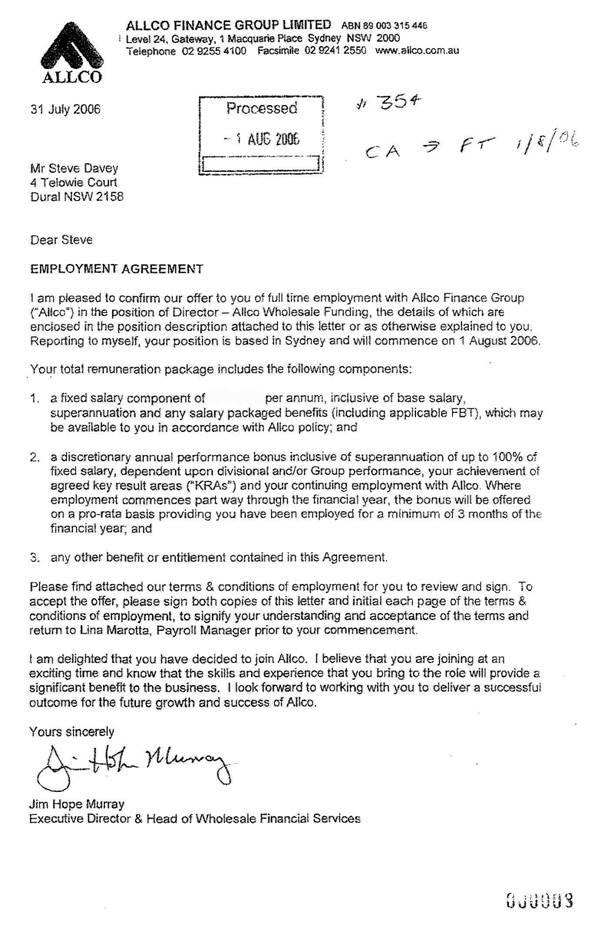

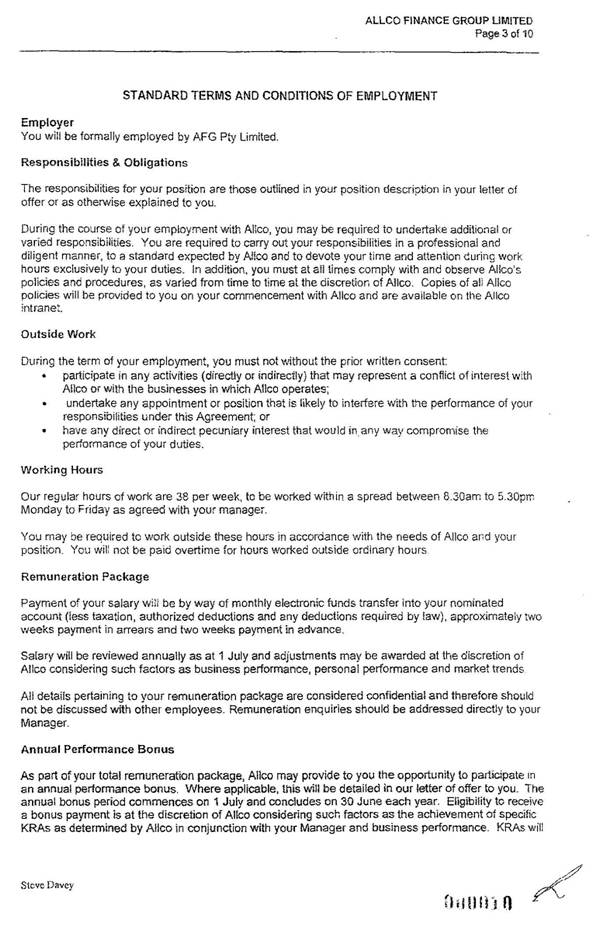
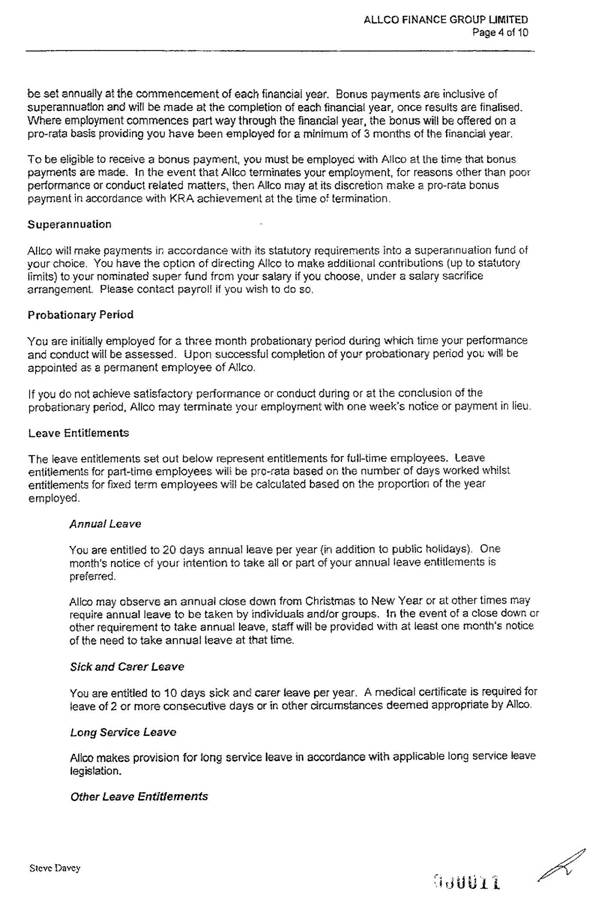
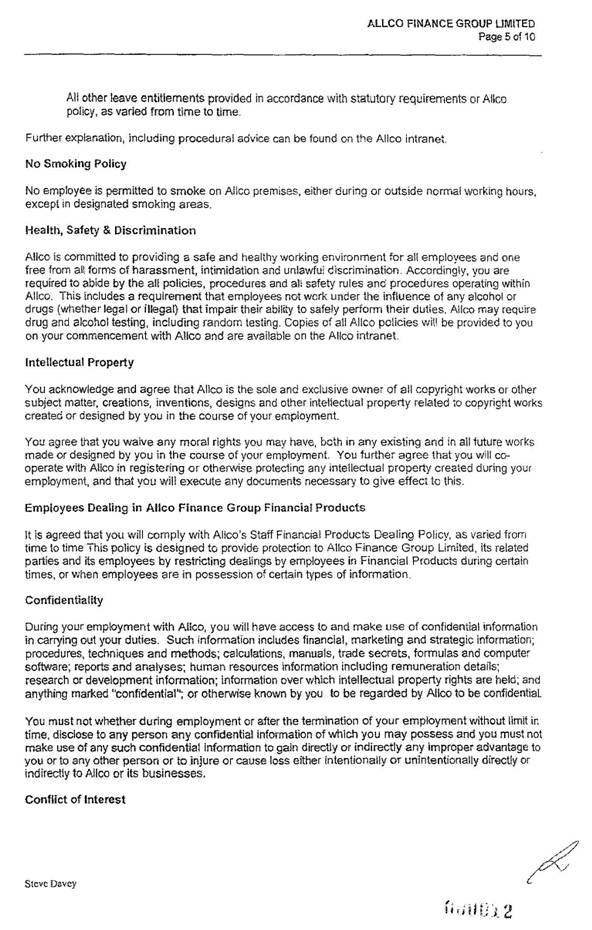
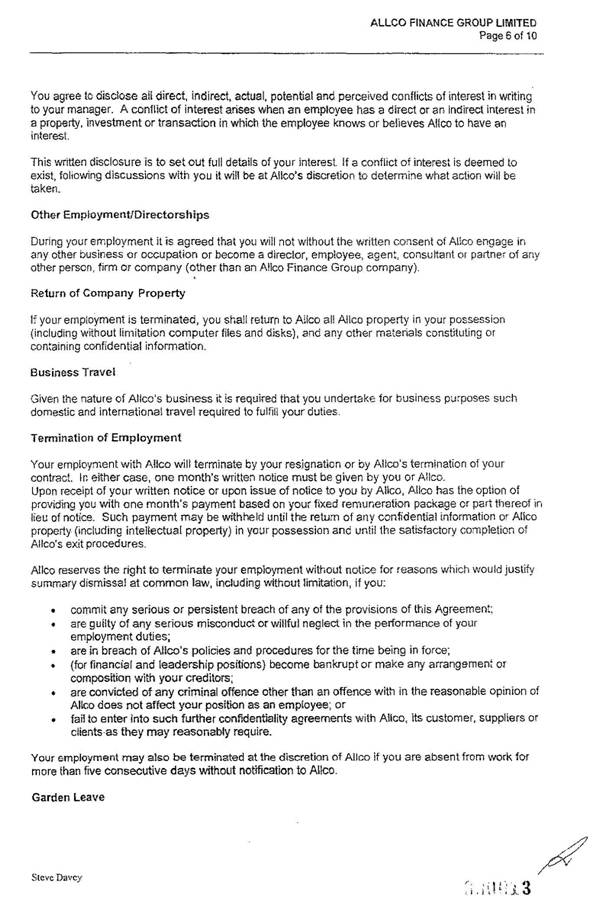
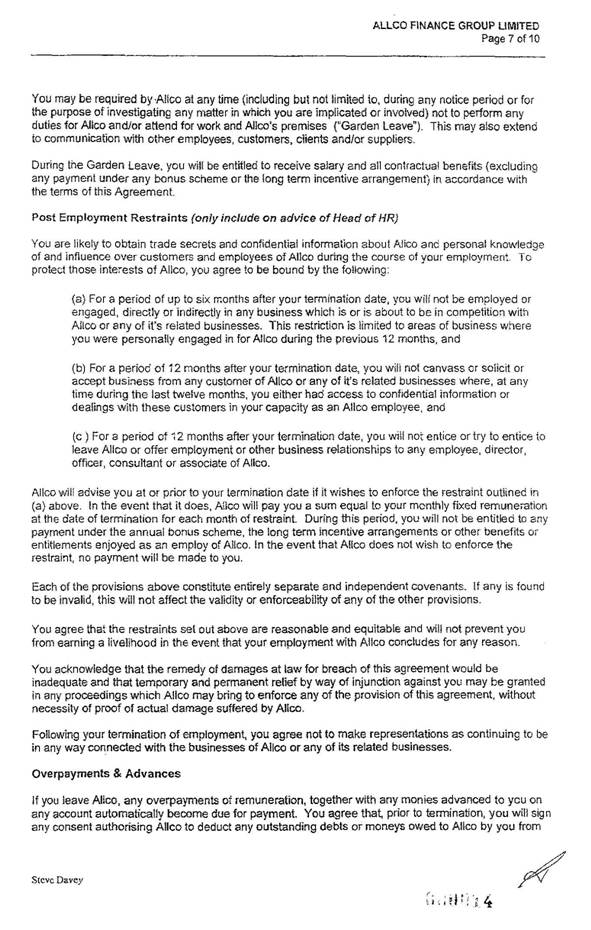
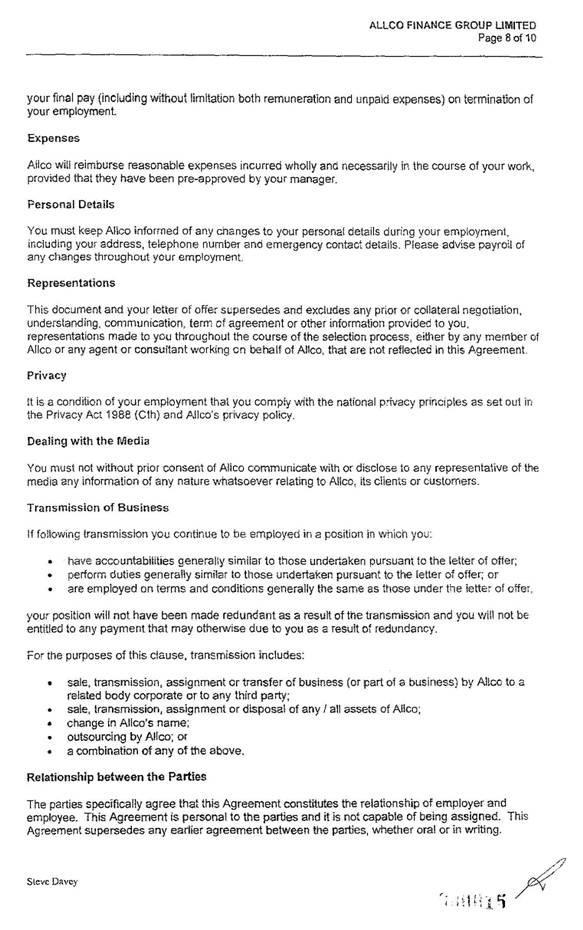
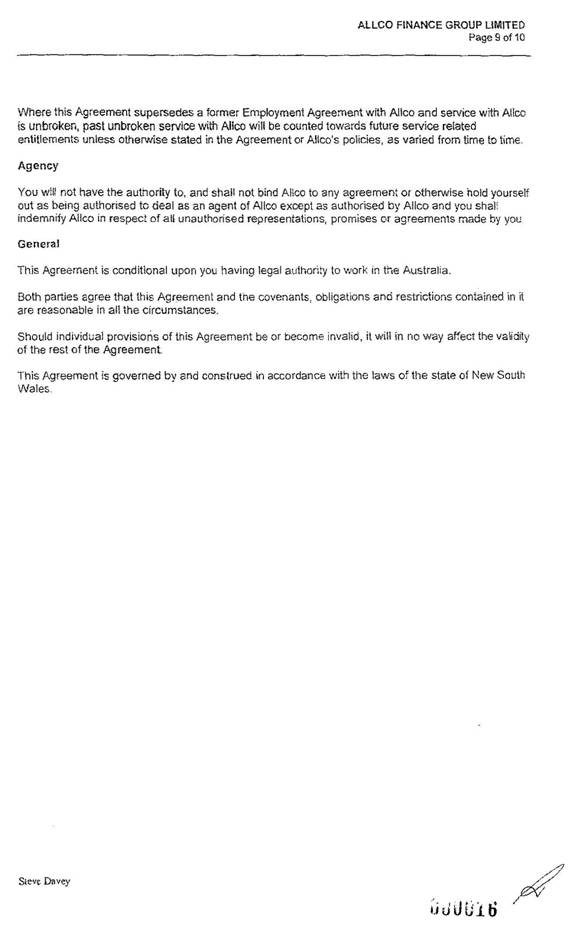

121 There is no evidence of any privity of contract between AFGPL and Mr Davey, nor any evidence that AFGL entered into the agreement with Mr Davey on behalf of AFGPL. In particular, Jim Hope Murray sought the authorisation of Michael Stefanovski to make the letter of offer to Steven Davey. Michael Stefanovski was a director of AFGL from 9 June 2005 and a director of AFAL from 5 July 2005, but never a director of AFGPL.
122 The following features of the offer of employment are relevant:
(1) The offer was made by AFGL;
(2) the offer was signed by a director or executive of AFGL;
(3) the offer was for employment with the ‘Allco Finance Group (“Allco”)’ in a nominated position;
(4) the letter of offer contained essential terms of employment, namely, salary, bonus and incentives, the position to be occupied and the person to whom the prospective employee would be reporting – a person employed in the business of AFGL;
(5) the letter of offer made reference to ‘any other benefit or entitlement contained in this Agreement’ (emphasis added);
(6) the letter of offer stipulated that to accept the offer (outlined in the letter) the employee was required to sign both copies of the letter and initial each page of ‘our standard terms and conditions of employment’;
(7) the signature of the employee was required at the bottom of the letter to record the understanding and acceptance of the terms and conditions of ‘this offer’ of employment with Allco.
123 The following features of the standard terms and conditions of employment which were attached to the letter of offer are relevant:
(1) They contain a statement under the heading ‘Employer’ as follows:
‘You will be formally employed by AFG Pty Limited’
In some other cases the ABN is provided. In the case of Steven Davey’s third letter of offer dated 1 May 2008, the standard terms and conditions say: ‘You will be formally employed be AFG Limited, ABN 51 051 982 560’. The Allco Finance Group does not include a company called ‘AFG Limited’. The ABN is AFGPL’s ABN;
(2) it is provided that responsibilities and obligations of the prospective employee are those outlined in his or her position description in the letter of offer, or as otherwise explained;
(3) it is provided that working hours could be agreed with ‘your manager’ – the only reasonable interpretation is that the manager is the one referred to in the AFGL letter of offer;
(4) it provides that superannuation will be paid by Allco (defined as Allco Finance Group in the letter);
(5) the confidentiality obligations provided for are referenced to the period of ‘employment with Allco’;
(6) the termination provisions relate to termination of ‘employment with Allco’ (as defined in the letter);
(7) under the heading ‘Relationship between the Parties’, it is provided, inter alia, that:
‘The parties specifically agree that this Agreement constitutes the relationship of employer and employee. This Agreement is personal to the parties and is not capable of being assigned …
Where this Agreement supersedes a former Employer Agreement with Allco and service with Allco is unbroken, past unbroken service with Allco will be counted towards future service related entitlements unless otherwise stated in the Agreement or Allco’s policies, as varied from time to time.’
(8) ‘The parties’ referred to must be AFGL and Mr Davey – they are agreeing that ‘this agreement constitutes the relationship of employer and employee and that it is personal to the parties and is not capable of being assigned’.
124 AFGPL was not a party to the employment agreement.
Second Respondent
125 Ms Segaert was recruited in 2005 from a position with a financial advisory firm to work in a role which was described to her by the legal recruitment agency as ‘a legal position at Allco Finance Group’.
126 Ms Segaert was interviewed for the position by Mr Frank Tearle who, at the time occupied the position of general counsel at AFAL.
127 There was no disclosure to Ms Segaert prior to, or at the time she was offered employment of an arrangement whereby she would be providing services to AFAL but be employed by AFGPL. AFGPL was not mentioned to Ms Segaert at any time during the interviews and discussions which led to her employment.
Documentary Evidence
128 In relation to Ms Segaert, the documentary evidence may be summarised as follows:
(1) By letter dated 20 July 2005 on letterhead showing AFAL’s then company name and company number from Frank Tearle (General Counsel), the second respondent was offered ‘full time employment with Allco Finance Group Ltd (the Company)’. The letter states: ‘Please find attached our Terms & Conditions of Employment for you to review and sign’. The letter is signed and dated 5 August 2005 under the statement: ‘I understand and accept the terms and conditions of this offer of employment with Allco Finance Group Limited’ (i.e., AFAL). Attached is a document entitled ‘Terms & Conditions of Employment’, which refers to ‘the Company’ and defines ‘Company’ as ‘Allco Finance Group Limited [AFAL], its associated businesses and any other Related Body Corporate and any joint venture, trust, partnership or other association in [which] Allco Finance Group Limited holds an interest or is a participant, either currently or in the future’.
(2) By letters dated 29 September 2006, 21 August 2007, 12 October 2007 and 7 July 2008, the first two and the last of which were signed by Tom Lennox, the second respondent was given information about bonus payments, the Allco Deferred Share Plan and the Allco Executive Option Plan and/or salary review, each of which was on letterhead showing AFGL’s company name and number. When she had concerns about the content of this correspondence, she discussed those concerns with representatives of AFGL.
129 There is no mention at all of AFGPL.
Other Matters
130 During the course of Ms Segaert’s employment she was made aware of a number of employment policies and procedures. These included: the Allco Code of Professional Conduct, the Related Party Transaction and Conflicts of Interest Policy, the Privacy Policy and the Employee Handbook. These documents referred to the Allco Finance Group in the role of employer and contained no reference to AFGPL in any capacity.
131 During the course of her employment, Ms Segaert did not receive any communication from AFGPL in relation to her employment.
132 During the course of her employment, decisions about Ms Segaert’s level of remuneration were made by Frank Tearle in about August 2005 and Tom Lennox from 2006 in their capacity as General Counsel of AFAL and AFGL respectively, and Michael Stefanovski in his capacity as Chief Operating Officer of AFGL. Michael Stefanovski was a director of AFGL from 9 June 2006 and a director of AFAL from 5 July 2005, but never a director of AFGPL. These decisions were made in accordance with a framework determined by the HR&RC.
133 Following termination of her employment Ms Segaert received a certificate of service from AFGL describing her as having been employed by AFGL.
134 Ms Segeart also received correspondence from AMP Superannuation Limited in relation to her superannuation, which described her employer as AFGL and described employer payments as having been received from AFGL.
Third Respondent Group: Documentary Evidence
135 Each employee in this group represented by Mr Ian Grayburn was initially employed by Rubicon Asset Management Limited (ACN 095 433 720).
136 In respect of the third respondent, Mr Grayburn, his employment with Rubicon is evidenced by a letter of offer dated 5 October 2006. There was no reference in his letter of offer to any company within the Allco Finance Group.
137 As a result of the acquisition of Rubicon Holdings (Aust) Limited by AFGL on 19 December 2007, each employee in the third respondent’s group made an agreement in January 2008 with AFGL.
138 Following the acquisition referred to in [137] above, AFGL wrote to Mr Grayburn (and each person in this group) on 22 January 2008 stating, inter alia, as follows:
‘Change of Employer
As you know, Rubicon became part of the Allco Group in December 2007.
As from 1 February 2008, we propose to transfer your employment from Rubicon Asset Management Limited to Allco Finance Group Limited (the Company). As you know, both of these companies are members of the Allco Finance Group. The reason for this change is that you be employed by the same company as the other employees of the Allco Finance Group.’ (Emphasis added.)
139 The statement by AFGL in the last sentence of course has relevance to the position of all the groups represented in these proceedings; the inference being that all other employees were similarly employed by AFGL.
140 The letter required Mr Grayburn to acknowledge the change of employer by requiring a signature under the following notation:
‘I acknowledge that effective from 1 February 2008 my employer will be Allco Finance Group Limited.’
141 Each of the employees in this group acknowledged the change of employer in the terms set out in [140] above.
142 Accordingly, by express offer by AFGL and acceptance by the employees, AFGL became the employer of each of the employees in this group to whom services were to be rendered with effect from 1 February 2008 (on the basis that their service would remain continuous and AFGL would be responsible for all service-related entitlements).
143 It is common ground that a contract of service cannot be transferred or novated from one employer to another without the consent of the employee. The employee’s consent must be the real consent of the employee and not a constructive consent raised by operation of law: Re C&T Grinter Transport Services; McCluskey v Karagiozis (2002) 120 IR 147; Finance Sector Union of Australia v Commonwealth Bank of Australia [2001] FCA 1613; Romero; Textile Footwear and Clothing Union; Smith v Blandford Gee Cementation Co [1970] 3 All ER 154; Denman v Midland Employers Mutual Assurance Ltd [1955] 2 All ER 561; Nokes v Doncaster Amalgamated Collieries Ltd [1940] AC 1014.
144 It can be seen from [138] and [140] above that the consent of the third respondent to the transfer of his employment was obtained on the basis that his new employer was to be AFGL. Alleged and undisclosed arrangements with other employers were not the basis on which he consented to the transfer of his employment.
145 Following the termination of their employment each of the employees in this group received a certificate of service from AFGL naming the employee and describing the employee as having been employed by AFGL.
Fourth Respondent Group: Documentary Evidence
146 Each of the persons in this group, represented by Ms Christine Bowen, either made an agreement with AFAL (when it was called ‘Allco Finance Group Limited’), or, having previously made an agreement with AFGL (when it was called ‘Record Investments Limited’) made a new agreement with AFAL, or having previously made an agreement with AFAL made a new agreement with AFGL.
147 The documentary evidence of the fourth respondent’s group is in a similar form to the documentary evidence of the first respondent’s group.
148 The letter of offer dated 10 October 2005 to Christine Bowen was on the letterhead of AFAL (then known as ‘Allco Finance Group Limited’) and was in almost identical terms to the letter sent to the first respondent reproduced in [120] above. The front page was endorsed by the signature of the fourth respondent and dated ‘12/10/05’ under the words:
‘I understand and accept the terms and conditions of this offer of employment with Allco Finance Group.’
149 Under the heading ‘Employer’ on the first page of the accompanying ‘Allco Finance Group Employment Terms and Conditions’, the following appears:
‘You will be formally employed by AFG Pty Limited, the Allco payroll entity.’
The underlined description of AFGPL’s role in the Group does not appear in the terms and conditions attached to the letter of offer to the first respondent, but their presence does provide a context for the purpose of construing the words ‘formally employed’, even where this description of AFGPL’s role in the Group is absent. This is dealt with further below.
Fifth Respondent
Documentary Evidence
150 On 16 June 2004 the fifth respondent, Mr Timothy Rich, accepted conditions of employment confirmed in a letter dated 11 June 2004 on the letterhead of AFAL (then known as ‘Allco Finance Group Limited’) which relevantly provided:
‘Dear Tim,
It is with much pleasure that we confirm your position with Allco Finance Group Limited (Allco) on the terms and conditions set out below:
Position and effective date:
You will continue as an Executive Director – Allco Funds Management Limited (AFML) employed by AFG Pty Limited. The activities and results of AFML will be treated implicitly as if AFML was a “Division” of Allco. References in this letter to Division have the same meaning as if the reference was to AFML.’
151 On 10 April 2006 Mr Rich accepted variations to the terms and conditions of his ‘appointment as an Allco Executive Director employed by AFG Pty Limited (Allco)’. The variations are embodied in a letter dated 10 April 2006 on the letterhead of AFAL signed by Mr David Coe in anticipation of the merger between AFAL and Record Investments Limited.
152 Conditional on the merger taking place, on the same date Mr Rich entered into a Restraint Deed with AFGL (then known as ‘Record Investments Limited’) restraining his activity for various alternative periods other than, inter alia, as an employee of AFGL or any ‘Related Body Corporate’. There is no specific mention of AFGPL.
153 By letter dated 29 November 2007 on the letterhead of AFGL, Lina Marotta, the Payroll Manager of AFGL confirmed that Mr Rich was a ‘full-time employee’ of AFGL.
154 Mr Rich received a letter dated 1 August 2008 on the letterhead of Allco (Singapore) Limited signed by Mr Nicholas McGrath, Chief Executive Officer, for and on behalf of Allco (Singapore) Limited. The letter read in part:
‘Dear Tim
CHANGE OF EMPLOYER
1. As you are aware, all of the issued shares in your current employer, Allco (Singapore) Limited (“ASL”), are the subject of a sale and purchase agreement between inter alia Allco Finance Group Limited and Frasers Centrepoint Limited (“FCL”) (“SPA”). Upon completion under the SPA, ASL will be owned by FCL and Allco Management Pte. Ltd. (“AMPL”) will become the operating company for the remaining Allco group of companies in Singapore.
2. As the SPA requires your employment to be novated from ASL to another Allco group company prior to completion under the SPA, AMPL will take over as your employer from ASL. Your employment with AMPL will begin from 5 August 2008 (“Effective Date”).
155 Mr Rich acknowledged receipt of the letter and his agreement to its terms by signing and returning a duplicate copy of the letter.
156 On 7 August 2008 Mr Rich received an email from the Executive Assistant to Mr Stefanovski attaching a letter on the letterhead of AFGL from Mr Stefanovski dated 26 February 2008 entitled ‘Secondment Agreement’. Mr Rich had not previously been provided this letter. It read in part:
‘SECONDMENT AGREEMENT
I am pleased to confirm our offer to you of full time employment with Allco (Singapore) Limited (“Allco”) in the position of Country Head, Singapore (the details of which are enclosed in the position description attached to this letter or as otherwise explained to you), or any other similar position that may be required by Allco from time to time in accordance with its business needs.
Reporting to me, your position is based in Singapore and is a short term secondment that will commence on 19 January 2008 and conclude at the close of business on 19 January 2009. As discussed, this secondment may conclude at an earlier date or be extended for up to five months at Allco’s discretion.
Upon completion of your secondment, you will be repatriated back to Sydney in accordance with the repatriation benefits outlined in this Agreement. On return to Sydney your employment will continue with Allco Finance Group Limited on the terms that applied prior to your secondment as outlined in your Appointment Letter dated 11 June 2004, and the Amendment to the Appointment Letter dated 10 April 2006.’
157 The terms and conditions of his employment were attached to the letter and were similar to those sent to the first and fourth respondents save that under the heading ‘Employer’, it provided:
‘You will be formally employed by Allco (Singapore) Limited.’
158 By email of the same date, Mr Rich rejected the terms of the Secondment Agreement as reflecting the terms of the agreement that he had with Mr Stefanovski concerning his secondment to Allco (Singapore) Limited.
159 By letter dated 27 March 2009 the applicants wrote to Mr Rich in the following terms:
‘Dear Sir
Allco Finance Group Limited and the attached Associated Companies (All Receivers and Managers Appointed) (All Administrators Appointed) (“the Companies”)
We refer to our appointment as Receivers & Managers of the Companies on 4 November 2008.
We understand that since early 2008 you have been employed by the Companies’ Singaporean operations, most recently by Allco Management Pte Ltd in the role of Country Head. We understand that after a temporary extension, your employment with Allco Management Pte Ltd concluded yesterday, 26 March 2009.
The current status of the receiverships is that the operations of the Companies are being wound down. In these circumstances, there is no longer a position for you to return to with your former employer AFG Pty Ltd (Receivers and Managers Appointed) (Administrators Appointed) (“AFGPL”), or with any other company to which we are appointed. In light of the current status of the receiverships, neither AFGPL or any other company to which we are appointed, is in a position to enter into a new contract of employment with you.’
Other Matters
160 Mr Rich’s evidence was that he arrived in Singapore on 19 January 2008 and that over the following months he had a number of discussions with Mr Stefanovski regarding the finalisation of his secondment agreement.
161 In cross-examination, Mr Rich said that whilst in Singapore he still regarded himself as employed by AFGL; that at all relevant times he had two employers: one in Singapore – first, Allco (Singapore) Limited and then, Allco Management Pte Ltd; and one in Australia – AFGL.
162 In response to questions I put to him, Mr Rich said that whilst in Singapore, he was paid in Singapore by the Singapore employing entity paying Singapore dollars into his Singapore bank account.
Sixth Respondent
Documentary Evidence
163 Mr Gallagher was employed by RentWorks Limited at the time its acquisition by the Allco Finance Group in about 2004. RentWorks Limited became known as Alleasing Finance Australia Limited. By letter dated 22 June 2005 Mr Gallagher was offered ongoing employment with Alleasing Pty Limited under the same terms and conditions as he then held with RentWorks Limited: ‘Alleasing Pty Ltd will regard all continuous service with RentWorks Limited as service with Alleasing Pty Ltd for all employee entitlements’. Mr Gallagher accepted this offer on 30 June 2005
164 On or about 1 July 2005, Mr Gallagher received a letter of offer of full-time employment with Allco IMF Limited (subsequently Allco Singapore Limited) reporting to Mike Dwyer, Managing Director of Allco IMF Limited.
165 On or about 2 July 2005, Mr Gallagher received a letter from Chris West, Director, on the letterhead of AFAL (then Allco Finance Group Limited) confirming the arrangements that were to apply during his secondment to Allco IMF Limited. Relevantly, the last paragraph of this letter reads:
‘Upon the conclusion of your secondment, a suitable employment opportunity will be made available to you within the Allco Finance Group.’
166 On 12 June 2008 Mr Gallagher received an email from Lee Burrows, Human Resources Manager of the Allco Finance Group, which reads:
‘Good to talk to you. I’ve attached your secondment letter and your current contract (and have discussed them with Belinda for my own education having only been in the business 2 weeks!)
What I can relay here (some of which is direct from Belinda) is that:
1 You are on secondment from AFG to Singapore and for the duration of that secondment your employer is the Singapore entity as per the attached contract – this says Allco IMF but I understand this may have evolved into another employer since.
2 Belinda was keen to reassure that whilst (as I understand it) many roles in Singapore are likely to move as part of a sale process, you would have a totally open choice about whether you wanted to move or not
3 Furthermore, your secondment letter clearly states that a suitable employment opportunity will be made available to you within the Allco Finance Group.
I understand (having spoken with Belinda) your potential nervousness at the moment, but it’s clear that whilst technically you are not employed by AFG for the duration of the secondment only, your future with the business is ‘protected’ and AFG would indeed become your employer again should your secondment end.
Let me know what more you need from us here to give you the clarity / reassurance you need (and if I’ve actually addressed your concerns and questions)
Kind regards
Lee’
167 By letter dated 22 July 2008 addressed to Mr Gallagher, c/- Allco Management Pte Ltd, and on the letterhead of that company, Mr Neil Brown, the Head of Funds Management, wrote:
‘Dear Evan
EMPLOYMENT AGREEMENT
I am pleased to confirm our offer to you of full time employment with Allco Management Pte Ltd (“Allco”) in the position of Head of Distribution, Asia and the Middle East, the details of which are enclosed in the position description attached to this letter or as otherwise explained to you. Reporting to me, your position is based in Singapore and as requested by you, is for a period of at least 1 year on secondment commencing on a date to be agreed. Upon completion of the secondment, you will be repatriated to Sydney (as per the benefits outlined under Additional Terms and Conditions of Employment) to continue in your role as Head of Distribution, Asia and the Middle East.
…
Please find attached our terms & conditions of employment for you to review and sign. To accept the offer, please sign both copies of this letter and initial each page of the terms & conditions of employment, to signify your understanding and acceptance of the terms and return to me prior to your commencement.’
168 Mr Gallagher signed the endorsement on the second page of this letter on 23 July 2008, which reads:
‘I understand and accept the terms and conditions of this offer of employment with Allco Management Pte Ltd.’
169 The attached Standard Terms and Conditions of Employment commenced:
‘Employer
You will be formally employed (on a secondment basis from Allco Finance Group Limited) by Allco Management Pte Ltd.’
170 The attached Additional Terms and Conditions of Employment contained the following:
‘Termination of Employment
Allco reserves the right to terminate the Secondment and the host country Employment Agreement upon 2 month’s written notice or payment in lieu. Notwithstanding this, you will remain an employee of the home country until such time as Allco provides written notice or payment in lieu that it intends to terminate your primary employment in the home country. In this situation, all normal termination rights and obligations of the home country will apply.’
(Emphasis added.)
171 By letter dated 14 January 2009 from Mr Rich on the letterhead of Allco Management Pte Ltd, Mr Gallagher was informed:
‘Termination of Secondment and Notice of Redundancy
Following our discussion today, I am writing to confirm that as result of your secondment with Allco Management Pte Ltd coming to an end effective 6 February 2009, and the appointment of Receivers to Allco Finance Group Limited (including AFG Pty Limited), it will be necessary to terminate your Employment agreement with Allco Finance Group Pty Limited effective 6 February 2009 (Termination Date).
The terms and conditions of your employment / secondment with Allco Management Pte Limited will continue until the Termination Date.’
Other Matters
172 Mr Gallagher gave evidence in chief by affidavit affirmed on 13 November 2009 (Ex O). He was not cross-examined. I upheld a number of objections to the affidavit as affirmed and a number of other paragraphs were not read or pressed.
173 Mr Gallagher took up his secondment in Singapore on or about 7 July 2006.
174 In relation to the letter in [171] above, Mr Gallagher said he never had an employment agreement with a company called Allco Finance Group Pty Limited or AFG Pty Limited.
175 Mr Gallagher deposed that, in 2008, Allco IMF Limited became Allco Singapore Limited. AFGL decided to sell the real estate management business in Singapore to Fraser and Neave. As a result of the sale, he had a choice to stay with Fraser and Neave and end his secondment or accept another secondment role that would have him remain with AFGL. He decided to accept the role offered by Neil Brown (see [167] above).
Findings or Conclusions of Secondary Fact
The Second Respondent: Michelle Segaert
176 The applicants accept that the second respondent’s contract of employment was with AFAL; that AFAL was her employer and that AFGPL had no contractual liability to pay her anything. Nevertheless, the applicants say that the second respondent is not a priority creditor of AFAL for the purposes of s 433(3)(c) of the Act because, consistent with their two-limbed construction contended for s 556(1)(e) (see [51] above), the second respondent rendered her services to AFGL, the parent company, not AFAL. I deal with this latter aspect below. If suffices for present purposes to note the applicants’ concession that the second respondent is not a priority creditor of AFGPL for the purposes of s 433(3)(c) of the Act.
The Third Respondent: Ian Grayburn
177 The applicants accept that the third respondent’s contract of employment (and the contracts of employment of the persons he represents) was (were) with AFGL; that AFGL was his (their) employer and that AFGPL had no contractual liability to pay him (them) anything. It was not submitted that the third respondent, and the persons he represents, rendered his (their) services to an entity other than AFGL so that, even on the applicants’ two limbed construction of s 556(1)(e), the applicants’ concession is not only that the third respondent, and the persons he represents, is not a (are not) priority creditor(s) of AFGPL, but that the third respondent, and the persons he represents, is a (are) priority creditor(s) of AFGL. I agree that this concession was properly made.
The First (Steven Davey) and Fourth (Christine Bowen) Respondents
178 In the case of both these respondents, the standard terms and conditions of employment attached to their employment offer letters contained a similar statement under the heading ‘Employer’. In the case of the first respondent, the statement read:
‘You will be formally employed by AFG Pty Limited.’
In the case of the fourth respondent, the statement read:
‘You will be formally employed by AFG Pty Limited, the Allco payroll entity.’
179 These statements, if not totally, then very substantially, form the foundation of the applicants’ case that AFGPL was the employer of the first and fourth respondents, and the persons they respectively represent; and even absent that finding, form the foundation of the applicants’ case that AFGPL was contractually liable to pay the first and fourth respondents, and the persons they respectively represent, so as to satisfy the first limb of the two-limbed construction of s 556(1)(e) contended for by the applicants in qualifying them as priority creditors of AFGPL.
180 I use the words ‘if not totally’ deliberately because the applicants’ case is also founded on other material such as:
(1) For the financial years ended 30 June 2006, 2007 and 2008, Mr Davey lodged income tax returns recording that his occupation was ‘Investment Banker’ and his employer was recorded as AFGPL;
(2) for the financial years ended 30 June 2006, 2007 and 2008, Ms Bowen lodged income tax returns recording AFGPL as her employer;
(3) Mr Davey’s pay slips referred to AFGPL;
(4) Mr Davey’s group certificate for the year ended 30 June 2008 stated that the payer of tax was AFGPL;
(5) Ms Bowen’s group certificate for the year ended 30 June 2008 stated the payer’s name as AFGPL.
181 In respect of this other material, the following observations are relevant:
(1) The income tax returns of Mr Davey and Ms Bowen for the financial years ended 30 June 2006, 2007 and 2008 did not record AFGPL as their employer; merely as the payer of their salary/wages and it is common ground that even that was not factually correct; it was common ground that AFAL was the payer even if it onward charged the amount to AFGL or some other entity in the Group, not including AFGPL;
(2) The reference to AFGPL on Mr Davey’s pay slips, in so far as it is a reference to the payer of his salary, is factually incorrect for the same reason;
(3) Mr Davey’s group certificate for the financial year ended 30 June 2008 is factually incorrect for the same reason; and
(4) Ms Bowen’s group certificate for the same year is factually incorrect for the same reason.
182 Which leaves us with the first of the standard terms and conditions of Mr Davey’s and Ms Bowen’s contracts of employment: ‘You will be formally employed by AFG Pty Limited’, and in Ms Bowen’s case, with additional words: ‘… the Allco payroll entity’ as the foundation of the applicants’ case that, AFGPL was their employer, but even if it was not, AFGPL was contractually liable to pay them, and the persons they respectively represent.
183 I am firmly of the view that there is no substance to either limb of this case for the reasons set out below.
AFGPL as Employer
184 Having regard to the evidence of Mr Rich, both in chief and in cross-examination, as to the purpose underlying the incorporation of AFGPL and its evolution in relation to employees of the Allco Finance Group, it is clear that its role was always envisaged, and in fact confined, to be a payroll entity for the Group, an employer of record for the purpose of reporting to the relevant authorities the obligations of companies in the Group in relation to employees in respect of group or PAYE tax, payroll tax, fringe benefits tax, superannuation levies or charges, workers’ compensation insurance and other employee-based levies. At or prior to its incorporation, Mr Rich’s evidence was that it may have been envisaged that its role might extend to paying employees in the Group and to paying the relevant taxes and levies imposed by reference to their employment, but there was no evidence that it did any of those things; quite the contrary, it was common ground that they were all done by AFAL. Thus, its role was confined to that of a reporting entity for the Group; reporting as the employer of record. The words, ‘you will be formally employed by AFG Pty Limited’, have to be construed in that context and, so construed, they do not elevate AFGPL to the status of a common law employer of the first and fourth respondents, and the persons they respectively represent.
185 Such a construction is undoubtedly assisted by the additional words ‘the Allco payroll entity’ in Ms Bowen’s standard terms and conditions. Moreover, it also assisted by the payslips, group certificates and income tax returns for, in respect of, or of the first and fourth respondents referred to in [180] and [181] above, in the face of the fact that it was common ground that AFAL paid all relevant salaries, taxes and charges.
186 Such a construction is the more compelling in the face of the facts that:
(1) Ms Segaerts’ (the second respondent’s) group certificate for the year ended 30 June 2008 also states that the payer of tax was AFGPL and her income tax returns for the years ended 30 June 2006, 2007 and 2008 all record AFGPL’s ABN as the ‘Payer’s business number’, despite the fact that it is now conceded she was not an employee of AFGPL;
(2) Mr Grayburn’s (the third respondent’s) payslips referred to AFGPL and his group certificate for the year ending 30 June 2008 states that the payer of tax was AFGPL despite the fact that it is now conceded that he was not an employee of AFGPL, but of AFGL;
(3) when, in February 2008, Mr Grayburn requested a letter from ‘Personnel’ to support his application to lease a property, Ms Hall, the Human Resources Administrator, prepared a letter dated 21 February 2008 addressed to ‘whom it may concern’ confirming that Mr Grayburn ‘is currently employed with AFG Pty Limited’, despite the fact that it is now conceded he was not an employee of AFGPL, but of AFGL;
(4) AFGL is recorded as being the first and fourth respondents’ employer in certificates of service received in 2008 and in superannuation documents; and
(5) AFGL is recorded as being the first respondent’s employer in his redundancy letter dated 10 March 2008 and the Allco HIT Limited Annual Report.
187 Finally on this issue of whether the provision: ‘You will be formally employed by AFG Pty Limited’, in the standard terms and conditions of the offer by AFGL to the first and fourth respondents made them, upon acceptance, or at some later time, employees of AFGPL, the respondents made the following submissions which I accept and adopt.
188 First, the Full Court and the High Court have made it clear that where (in a case such as this) there are clauses of a contract specially framed with the individual circumstances in mind, together with standard form clauses, it will normally be appropriate to give greater weight to the specially negotiated clauses: Walker v Citigroup Global Markets Australia Pty Ltd (formerly known as Salomon Smith Barney Australia Securities Pty Limited) (2006) 233 ALR 687 at [77], citing, inter alia, Hume Steel Limited v Attorney-General (Vic) (1927) 39 CLR 455 per Isaacs J at 462 – 463, Higgins J at 465; Godecke v Kirwan (1973) 129 CLR 629 per Walsh J at 637. See also Boston Commercial Services Pty Ltd v GE Capital Finance Australasia Pty Ltd (2006) 236 ALR 720 at [28] (Rares J).
189 In any event, it is significant that the term upon which the applicants rely (‘You will be formally employed by AFG Pty Ltd’) speaks of future events.
190 Moreover, it requires that attention be given to the phrase ‘formally employed’. The word ‘formally’ may have various meanings, including ‘in outward appearance, seemingly’; or ‘in the ordinary proper way’; ‘explicitly, expressly’; ‘with the formalities required to give validity or definiteness to the action’: Oxford English Dictionary Online 2010. If the first definition is adopted, formal employment in that sense by AFGPL will not alter the true position. If the latter definitions are adopted, the formalities were clearly not entered into.
191 On no view could such a term create an employment relationship between the employee and AFGPL. In substance and effect, the term contemplated the employee’s entry into a formal employment relationship with AFGPL at an unspecified time in the future. Until then, the person would be employed by AFGL. This is clear on the face of the letter of offer and the standard terms and conditions attached. It is made even clearer by consideration of the surrounding circumstances at formation, being the active role AFGL and AFAL were performing in employment related matters, as distinct from the dormant status of AFGPL and its incapacity to perform an employer role. See Re North Sydney District Rugby League Football Club (admin apptd); Murray v Donnelly (2000) 34 ACSR 630 (per Bryson J) at [5], [25].
192 That further steps and formalities were required to achieve the outcome of becoming ‘formally employed by AFG Pty Ltd’ can be illustrated by the letter of offer dated 22 October 2003 from AFL to Mr Jim Hope Murray, who is part of the fourth respondent’s group. The letter offers him employment as executive director, Allco Securitisation Limited with effect from 1 January 2003 (that is, retrospectively), but states that the company he ‘will be employed by is AFG Pty Limited’. Employment with AFGPL never occurred.
193 In the absence of any written or oral offer of employment by AFGPL that was accepted by the respondents in these groups, it is necessary to consider whether there was a contract which could be implied to exist based on the conduct of the parties.
194 Importantly, contracts are not to be implied lightly: see Damevski v Giudice (2003) 133 FCR 438 at [82] (per Marshall I) (‘Damevski’), citing Brambles Holdings Ltd v Bathurst City Council (2001) 53 NSWLR 153, Air Great Lakes Pty Ltd v KS Easter (Holdings) Pty Ltd (1985) 2 NSWLR 309 (‘Air Great Lakes’), Blackpool and Fylde Aero Club Ltd v Blackpool Borough Council [1990] 3 All ER 25 at 31 per Bingham LJ and Orion Insurance Co Plc v Sphere Drake Insurance Plc [1990] 1 Lloyd’s Rep 465 at 492 – 494 per Hirst J.
195 Post-contractual conduct is admissible on the question of whether a contract was formed See Tomko v Palasty [2007] NSWCA 258 at [63] – [67] (Einstein J, with whom Mason P agreed), citing Pethybridge v Stedikas Holdings Pty Ltd [2007] NSWCA 154 at [59] and [2] (Campbell JA, Beazley and Basten JJA agreeing), Film Bars Pty Ltd v Pacific Film Laboratories Pty Ltd (1979) BPR 9251 at 9254 – 9255 and Brambles Holdings Ltd v Bathurst City Council (per Heydon JA) (also citing Howard Smith & Co Ltd v Varawa (1907) 5 CLR 68 at 77; Barrier Wharfs Ltd v W Scott Fell & Co Ltd (1908) 5 CLR 647 at 668, 669, 672. B Sepppelt & Sons Ltd v Commissioner for Main Roads (1975) 1 BPR 9,147 at 9,149, 9,154–91,156). In particular, it is necessary to look at the whole relationship and not only at what was said and done when the relationship was first formed: Integrated Computer Services Pty Ltd v Digital Equipment Corp (Aust) Pty Ltd (1988) 5 BPR 11,110 at 11,117 – 11,118, McHugh JA (Hope JA and Mahoney JA concurring). The following observation of McHugh JA in Integrated Computer Services at 11,117 is apposite:
‘The question in this class of case is whether the conduct of the parties viewed in the light of the surrounding circumstances shows a tacit understanding or agreement. The conduct of the parties, however, must be capable of proving all the essential elements of an express contract ...’
196 In Damevski,Marshall J (with whom Wilcox J agreed) considered, first, the documentary evidence by reference to general law principles regarding the formation of contracts (at [30] – [78]) and, secondly, given the perceived ambiguity, the entire factual matrix to determine whether, considering all relevant evidence, whether there was a contract which could be implied to exist based on the conduct of the parties (at [79] – [102]).
197 As to the intention on the part of AFGPL and the employees to create legal relations, the evidence does not support such a conclusion. In Damevski,Marshall J referred to the following discussion in Anson’s, Law of Contract (28th ed, Oxford University Press, 2002) at 71 as to the test of intention in relation to the creation of legal relations:
‘The test of an intention to effect legal relations is an objective one. It may be that the promisor never anticipated that the promise would give rise to any legal obligation, but if a reasonable person would consider there was an intention so to contract, then the promisor will be bound.’
See also Australian Broadcasting Corp v XIVth Commonwealth Games Ltd (1988) 18 NSWLR 540; Air Great Lakes Pty Ltd; Blackpool and Fylde Aero Club Ltd and Toyota Motor Corp Australia Ltd v Ken Morgan Motors Pty Ltd [1994] 2 VR 106 at 176 per Tadgell J.
198 On no view could it be said a contract could be implied to exist between AFGPL and either of the first or fourth respondents, or those they have been appointed to represent, based on the parties’ conduct.
199 Adopting the analysis of Marshall J in Damevski v Giudice at [91], the facts indicate that no consideration passed between each of the first or fourth respondents and AFGPL.
(1) Each of those respondents provided services to AFGL, not AFGPL.
(2) AFGL, not AFGPL, determined the rate it would pay for those services. This is reflected in the documentary evidence and the fact that the Board of AFGL created and oversaw the HR&RC, whose purpose was to make decisions and/or recommendations in relation to remuneration, human resources matters, and employment policies and practices in relation to AFGL.
(3) Wages were paid to employees from a bank account in AFAL’s company name.
(4) AFAL was a party to the agreement with Automatic Data Processing Limited for the provision of payroll services dated 12 May 2008. From at least 12 May 2008, ADP arranged for each of the respondents to be paid their monthly salary and paid superannuation payments to each of their nominated superannuation funds.
200 Further, there was no control or direction exercised by AFGPL over any of the respondents or those they have been appointed to represent. Control and direction was by persons as directors and executive officers of AFAL or AFGL and was not simply by those persons acting as an employee of AFGPL: cf, Australian Insurance Employees Union v WP Insurance Services Pty Ltd (1982) 1 IR 212 at 216 – 217.
AFGL: A contractual liability to pay notwithstanding
201 The applicants submitted that even if I was to find that AFGPL was not the employer of the respondents, nevertheless, AFGPL had a contractual liability to pay them, or at least those respondents, other than the second and third respondents and, in the latter case, the persons he represents, and that this was sufficient to satisfy the first limb or integer of s 556(1)(e) of the Act according to the two limbed construction for which the applicants contended.
202 I deal with this argument below when analysing the construction of s 556(1)(e) contended for by the applicants.
The Fifth Respondent: Timothy Rich
203 Prior to his short term secondment to Singapore commencing 19 January 2008, Mr Rich’s position was the same as the fourth respondent, and the persons she represented.
204 Where an employee is seconded by his employer to work for another entity an issue can arise as to whether he becomes an employee of that entity or remains an employee of the seconding entity. This was an issue which came before Moore J in Finance Sector Union of Australia v Commonwealth Bank of Australia (2001) 111 IR 241. In that case the issue was whether certain employees of the Commonwealth Bank of Australia whose services the Bank had seconded to a company in which the Bank had a shareholding (‘EDSA’), became employees of that company or remained employees of the Bank.
205 Moore J approached the issue by applying what might be called the traditional general principles for determining who is the employer of an employee where there might be two or more possible employers as set out in [54] to [64] above. At [59] to [64], his Honour said:
‘59 It is convenient, at this point, to deal with an issue to deal with an issue raised by the applicants though it was raised as part of a subsidiary or alternative argument. It was contended that from 10 October 1997 the seconded employees were employed by EDSA and not the Bank. If this is correct, it may have a material bearing on the operation of the Award. If the employment of the seconded employees with the Bank was terminated on 10 October 1997, the only (or at least principal) question that would then arise concerning the operation of the Award would be whether the terminations occurred in circumstances that constituted "retrenchment" for the purposes of the Award.
60 The issue of who is the employer of an employee, when there might be two (or more) possible employers, can arise in various legal contexts including who is liable to pay workers compensation benefits: see Pitcher v Langford (1991) 23 NSWLR 142 and Dalgety Farmers Ltd t/a Grazcos v Bruce [1996] AILR 4,352; who is liable to pay redundancy payments: see Marrs Fabrics Pty Ltd & Nathan Wholesale Fabrics Pty Ltd v Whipps (1991) 33 AILR ¶167; whether a proof of debt can be maintained: see Romero v Auty (2001) 19 ACLC 206; and whether a person is liable under occupational health and safety legislation: see WorkCover Authority (NSW) v Swift Placements Pty Ltd (1999) 88 IR 53.
61 In many of the recent Australian cases in which this issue has arisen, the Court has adopted the approach of determining which of two possible employers is the employer by applying the principles developed for determining whether a person was an employer at all. That is, the principles applied to determine whether there was an employment relationship between an individual and a putative employer could also be applied to determine which of two putative employers employed an individual. A comparatively recent decision of the NSW Court of Appeal, Pitcher v Langford, is often cited in support of this approach. In that matter the various members of the Court of Appeal proceeded on the basis that the analysis of Mason J in Stevens v Brodribb Sawmilling Co Pty Ltd (1986) 160 CLR 16 at 24 concerning when an employment relationship existed, was apt to apply in ascertaining which of two possible employers, was the employer. In Stevens v Brodribb Sawmilling Co Pty Ltd, Mason J accepted that the right of control over the work of a person (together with the exercise of that right) was an important indicia of the existence of an employment relationship. However his Honour indicated that other indicia can also be relevant such as mode of remuneration, the provision and maintenance of equipment, the obligation to work, the hours of work and provision for holidays, the deduction of income tax and the delegation of work by the putative employee.
62 In the present matter, it is clear that the day-to-day control of the work of the seconded employees was exercised by EDSA. It is an agreed fact (see 33(e) and (f) above at par 5) that the seconded employees worked at the direction of EDSA though it is also an agreed fact that they did so at the direction of the Bank. I consider that the better view of the evidence as a whole is that while the Bank purported to reserve to itself the ultimate right to control the work of the seconded employees it effectively relinquished that right to EDSA. It must be accepted that there was some evidence of the Bank actually exercising control over the seconded employees by directing them to relocate and through involvement with some other employment issues concerning the seconded employees. However this evidence can be contrasted with the more general position concerning the control exercised by EDSA. Nonetheless regard must be had to the fact that the seconded employees continued to be paid by the Bank, retained their staff number, grade and classification level and were afforded benefits available to Bank employees but not available to employees of EDSA.
63 These various matters do not provide a clear answer one way or the other to the question of whether the seconded employees became employees of EDSA. Ultimately, however, the answer emerges, in my opinion, from a consideration of the intentions of the parties and, in particular, the position adopted by the seconded employees themselves. It was neither the Bank’s nor EDSA’s intention that the seconded employees would cease to be employees of the Bank and become employees of EDSA. In addition each of the seconded employees rejected the offer of EDSA, which the Bank encouraged them to accept, to become employees of EDSA. While the employees who rejected the offer were in the difficult position of not knowing whether they were, in the circumstances, entitled to severance payments and also of not knowing whether they would prejudice any such entitlement by accepting employment with EDSA, they nonetheless elected to reject employment with EDSA.
64 It is a settled principle that there cannot be an assignment of a contract of employment without the consent of the employee: see Nokes v Doncaster Amalgamated Collieries Ltd [1940] AC 1014. This principle was applied by Ryan J in Textile Footwear and Clothing Union of Australia v Bellechic (unreported, Federal Court of Australia, 19 November 1998) and by Warren J in Romero v Auty in determining whether there had been a transfer of employment (or an assignment of the contract of employment) from one company to another. In each instance the Court concluded there had been no transfer or assignment because the employees had not consented. It is difficult to avoid, in my opinion, the conclusion that the seconded employees did not become employees of EDSA having regard to the explicit rejection of the offer of employment with that company by each of them. Not only did each not consent to the transfer but each consciously elected not to take up employment with EDSA …’
206 In the present case, Mr Rich conceded in cross-examination that upon his secondment to Singapore he took up a new employment, first with Allco (Singapore) Limited, and then with Allco Management Pte Ltd. The issue which arises, and which Moore J in Finance Section Union of Australia did not have to consider, is whether in taking up a new employment with the Singaporean company, Mr Rich relinquished or terminated any existing employment with AFGL or AFAL. He did not think so and while that is not irrelevant, it is certainly not decisive.
207 The terms of his secondment agreement did not expressly terminate any existing employment agreement although such a termination might be implied from those very same terms or from the conduct of the parties.
208 In an article entitled ‘The seconded or transferred employee’ by Graham Rossiter of Massey University published in the New Zealand Law Journal, August 2007 at 265, reference is made to two New Zealand cases: Clifford v Rentokil Ltd [1995] 1 ERNZ 407 and Royds v FAI (NZ) General Insurance Co Ltd [1991] 1 ERNZ 820. The learned author writes:
‘In Clifford v Rentokil Ltd, the applicant was employed by Rentokil as an area manager. In 1991, he agreed to go to Fiji and take on the task of re-structuring a Fiji company. Rentokil and the second respondent were both subsidiaries of the same parent company. The applicant claimed he was constructively dismissed in early 1993 and brought proceeding against Rentokil. Rentokil applied to have the action struck out on the ground that the applicant had been employed by the Fiji company while in Fiji and that his employment was governed by Fiji law. The Employment Court held that this was a situation of the secondment of the applicant by the Rentokil to the Fiji company. The expression “second” in this context was said by Judge Palmer to mean “to transfer an employee to other employment or to another position”. A secondment does not, however, mean a severing of employment or contractual links with the general or primary employer. In this case, notwithstanding that Clifford was providing services for the Fiji company and was being paid by that company, his employment relationship with Rentokil continued. Accordingly, his personal grievance had been correctly commenced under New Zealand law. Somewhat similar circumstances and issues arose in Royds v FAI. Royds was employed by FAI and, in February 1998, was asked to work in Papua New Guinea in an equivalent role for an associated company for a three year term. In September, 1998, the applicant was given six months notice of termination. The Employment Court had to determine whether the applicant was entitled to bring a personal grievance in New Zealand or rather had to pursue remedies under PNG law on the basis he had been employed by the defendant’s associated company. Judge Travis held that what had taken place had the “characteristics of a secondment arrangement” (p 832). It therefore followed that the defendant remained throughout the plaintiff’s true employer and New Zealand law was applicable. A key factor in the Court’s reasoning appeared to be that the centre or, as it might be put, ultimate control of this business remained with the New Zealand company. Again, as in the Clifford matter, the arrangements at the time of the applicant’s appointment to PNG contemplated repatriation to and future employment in New Zealand by the defendant.’
209 At the end of the day, the answer to the issue is to be found from an overall view of the entire factual matrix but like the evidentiary deficiencies that faced the Court (Finn J) in Re C&T Grinter Transport Services, I suspect that I may not have all relevant material and information before me.
210 That said, I have come to the conclusion that Mr Rich’s employment with AFGL or AFAL continued during his secondment to Singapore; in other words, it was not severed by that secondment for the following reasons:
(1) His secondment was offered to him by Mr Stefanovski on behalf of AFGL.
(2) Mr Rich continued to report to Mr Stefanovski during his secondment.
(3) On completion of his secondment, his employment was to continue with AFGL on terms that applied prior to his secondment.
(4) It is open on the evidence to find, and I find, that it was an implied term of the secondment agreement that if his Singapore employer did not, for any reason, meet its contractual obligations to him, AFGL would, including payment of all his entitlements.
(5) His leave entitlements, other than long service leave, were ‘frozen’, for the duration of his secondment and long service leave continued to accrue ‘in line with Australian legislation’.
(6) It was a term of his employment agreement that if it superseded an earlier employment agreement with the Group and service with the Group was unbroken, past unbroken service with the Group would be counted towards future service-related entitlements unless otherwise stated in the employment agreement or the Group’s policies, as varied from time to time.
The Sixth Respondent: Evan Gallagher
211 The evidence supports a finding that Mr Gallagher was employed by AFGL or AFAL prior to his secondment to Singapore; and that it continued for the duration of that secondment notwithstanding that he was also employed, first by Allco IMF Limited (subsequently Allco Singapore Limited) and then by Allco Management Pte Ltd. All the documentary evidence refers to his employment with the Singapore companies as being on secondment from AFG, which I read as being AFGL (see the Standard Terms and Conditions referred to in [169] above), and there is no doubt that his employment with AFGL was going to continue upon the secondment coming to an end.
212 The extract from the Additional Terms and Conditions of Employment reproduced at [170] above makes it clear that Mr Gallagher’s employment with AFGL was to continue during the term of his secondment.
213 Again I think it is open on the evidence to find, and I find, that it was an implied term of the secondment agreement that if his Singapore employer did not, for any reason, meet its contractual obligations to him, AFGL would, including payment of all his entitlements.
214 That Mr Gallagher’s employment with AFGL continued for the duration of his Singapore secondment is also apparent from the letter dated 14 January 2009 he received from Mr Rich stating that as a result of his secondment coming to an end effective 6 February 2009 and the appointment of the applicants to AFGL (including AFGPL), it was necessary to terminate his employment agreement with ‘Allco Finance Group Pty Limited’ effective the same date. I read the reference to ‘Allco Finance Group Pty Limited’ as a reference to AFGL, but even if it is intended as a reference to AFGPL, having regard to the findings made with respect to AFGPL in relation to the first and fourth respondents, and the persons they respectively represent, the reference to AFGPL is merely a reference to the employer of record for reporting purposes. More importantly, the letter recognises that his employment agreement with AFGL remained on foot notwithstanding that his secondment had not, at the date of the letter, come to an end; consequently it (the employment agreement with AFGL) too had to be terminated.
Analysis of the Applicants’ Arguments
215 Both in their written and oral submissions the applicants made submissions on two subjects which need to be separately addressed if only because the first is a discrete matter of statutory construction, namely, the proper construction of s 556(1)(e) of the Act and its application to the facts of the case; and the second is a legal argument based on alleged facts which have no foundation in the evidence.
Construction of s 556(1)(e) of the Act
216 I alluded to the applicants’ arguments in [51] above but declined to deal with them at that stage.
217 The first limb of the argument is that under s 556(1)(e) no issue arises about a relationship of employment. The focus is only on the contract of employment and the identification of the company liable to pay the employee’s wages and other entitlements. Thus, it was said, that even if I decided that there was no relationship of employment between AFGPL and the respondents, I should find that AFGPL, and not AFGL or AFAL, was contractually liable to pay the respondents wages and other entitlements and that this was sufficient to engage the first limb of the section in concluding that the respondents were priority creditors of AFGPL and not AFGL or AFAL.
218 The argument is flawed for a number of reasons which are detailed below.
219 First, AFGPL was not privy to any contract of employment with any of the respondents or the persons, if any, they respectively represent. It had no contractual liability to pay them anything.
220 Second, it requires one to read the word ‘employees’ in s 556(1)(e) as meaning persons who are employees of any company, and not just employees of the company liable to pay the wages, etc. That would be contrary to the policy and purpose of the section.
221 Third, such a construction flies in the face of the definition of ‘wages’, namely, ‘amounts payable to or in respect of an employee of the company … under [a contract of employment]’. That must mean an employee of the company having the contractual liability to pay the amounts.
222 Fourth, in the absence of finding that AFGPL was the employer of the respondents and the persons, if any, they respectively represent, it is difficult to see how a contractual liability on the part of AFGPL nevertheless subsists towards the respondents. The argument was not developed to any extent. Indeed, the applicants’ outline of submissions and further outline of submissions in so far as they submitted that AFGPL had a contractual liability to pay the respondents and the persons, if any, they respectively represent, were predicated on a finding that AFGPL was their employer. In the absence of that finding, the argument that AFGPL nevertheless has a contractual liability to pay them must be rejected.
223 The second limb of the argument is that s 556(1)(e) requires the services, in respect of which wages are payable but unpaid at the relevant date, to have been rendered to the company having the contractual liability to pay the wages and not to any other entity. In other words, if the services have been rendered to any entity other than the company liable to pay the wages, the employee will not be a priority creditor of the company having that liability.
224 On the applicants’ own submissions, this would mean that the first and fourth respondents, and the persons they respectively represent, are not only not priority creditors of AFGL or AFAL – because even if one of these companies is the employer, neither according to the applicant has a liability to pay them, only AFGPL has that liability – but they would also not qualify as priority creditors of AFGPL, because it is common ground that none of the respondents rendered any services to AFGPL. Such a result would defeat the whole purpose of the legislation.
225 Again, the argument is flawed for the reasons detailed below.
226 First, the argument is predicated on the basis that s 556(1)(e) establishes a two-limbed or two-pronged requirement both of which must be found to exist before an employee can qualify as a priority creditor of a company –
(1) The company must have a contractual liability to pay the employee; and
(2) the contractual liability to pay must be in respect of services rendered to the company having the contractual liability.
In my view, s 556(1)(e) does not raise or impose a two-pronged requirement of that kind. It merely requires a finding that the company is the employer of the employee and that the service in respect of which the wages etc are payable were rendered before the relevant date. Such a finding satisfies the terms of the section because:
(3) amounts ‘payable by the company’ will only be ‘wages’ (as defined) if they are ‘amounts payable to or in respect of any employee of the company’; and
(4) the words ‘in respect of services rendered to the company by employees before the relevant date’ only impose a temporal requirement, namely, that the services in respect of which the wages etc are payable were rendered before the relevant date, not a substantive requirement over and above a finding that the company is the employer of the employee.
227 Second, that the words ‘in respect of services rendered to the company by employees before the relevant date’ only impose a temporal requirement and not a substantial requirement over and above a finding that the company is the employer of the employee, recognises that an employee in the course of his employment, and consistent with his contractual obligations, may provide services to his employer by performing work that benefits a third party and may provide services to a third party by performing work that benefits his employer. Neither is inconsistent with the employment relationship. In this day and age of large corporate groups of companies, employees of one company in the group will frequently provide services to other companies in the group. Provided this is not inconsistent with the terms of their employment, the provision of their services, and consequential benefits, to other companies in the group will, at one and the same time, involve the provision of services and benefits to the employer company. So much was recognised by Kitto J in Attorney-General for New South Wales v The Perpetual Trustee Company (Limited) (1952) 85 CLR 237 at 299 – 300:
‘[T]he widening of the range of private enterprise meant that the link between many kinds of servants and the households of their masters became attenuated and ceased to have any reality; but the relation has remained in the law as one which enables a man in the conduct of his private affairs to avail himself of the services of others who will enter into the appropriate relationship with him for that purpose …
It will be seen that three elements are involved: first, the relationship must entail, on the part of the servant, obedience to orders; secondly, the obedience to orders that is required is obedience to orders in doing work; and, thirdly, the doing of the work must be for the benefit of the master, that is, it must relate to his own affairs … As to the third element, the statement that the doing of the work must be for the benefit of the master does not mean, of course, that the direct benefit from the work itself must necessarily accrue to the master; he may, without altering the relationship, direct his servant to do work which will benefit another.’
(Emphasis added.)
The Agency and Indemnity Arguments
228 With a view to overcoming the privity ‘hurdle’ (see, for example, [121] and [219] above), that is, that AFGPL was not a party to any contract of employment with any of the respondents, the applicants’ ‘simple and obvious answer’ (the words of their senior counsel) was that the offers contained in the offer letters from AFGL or AFAL, were made by each as agent for AFGPL as principal. That was as it was put in opening, but a further argument was developed in address as outlined in [229] below.
229 With a view to overcoming the further ‘hurdle’ that it was an agreed fact that AFAL paid the employees’ wages and other entitlements, as well as the taxes and charges referrable thereto, and that it was common ground that no part of this cost was charged out to AFGPL, only to other companies in the Group, it was said that AFGL and AFAL requested (the request being implied from the circumstances) AFGPL to enter into all the contracts of employment (through them as agent for AFGPL) and that in consequence of AFGPL agreeing to do this for the benefit of AFGL or AFAL, AFGPL was entitled to an implied indemnity from AFGL or AFAL to meet AFGPL’s contractual obligations to employees (Amann Aviation Pty Ltd v Commonwealth (1990) 22 FCR 527 at 540 per Davies J; at 573 per Burchett J). That indemnity was discharged when AFAL (presumably on behalf of itself and AFGL) paid the employees’ wages etc; in other words, rather than have AFGL and AFAL pay AFGPL under the indemnity and then have AFGPL pay wages to the employees, AFAL paid the amounts to the employees direct, thus discharging the implied indemnity to AFGPL at the same time as discharging AFGPL’s liability to the employees for their wages.
230 If there were factual foundations for the arguments, they might have some resonance, but neither argument has any factual foundation. For a start, the indemnity argument does not explain the allocation of the cost of such wages by AFAL to companies in the Group other than AFGL. But there are more fundamental difficulties with the arguments.
The Agency Argument
231 The basic or general principle is that ‘if a man signs a written contract, he is to be considered as the contracting party, unless it clearly appears that he executes it as agent only’: Ackers v Austcorp International Ltd [2009] FCA 432 at [148] (Rares J) and the authorities cited therein.
232 To avoid liability under the contract the agent must establish it had authority to act so as to bind and entitle his principal: FMB Reynolds, Bowstead and Reynolds on Agency (18th ed, Sweet & Maxwell Ltd, 2006) at [8-072]. The relationship of principal and agent may be constituted in two ways, first, by agreement, whether contractual or not, between principal and agent, which may be express, or implied from the conduct or situation of the parties and, secondly, retrospectively, by subsequent ratification by the principal of acts done on his behalf. Importantly, however, it has been held that the doctrine of ratification does not apply to undisclosed principals: FMB Reynolds, Bowstead and Reynolds on Agency (18th ed, Sweet & Maxwell Ltd, 2006) at [8-072], citing Keighley, Maxsted & Co v Durant [1901] AC 240.
233 On no view have the applicants established that an agreement existed between AFAL or AFGL, on the one hand, and AFGPL on the other, by which AFAL or AFGL had authority to bind AFGPL to employment contracts.
234 Agreements are not to be implied lightly. The relationship of principal and agent cannot be constituted simply by the fact that AFGPL is the wholly owned subsidiary of AFGL. This alone does not establish the existence of an agreement. To imply the existence of such an agreement simply from the fact that AFGL is the parent company of AFGPL would be to ignore the laws of corporate governance. The business of a company is to be managed by or under the direction of the directors, who owe duties to act in the best interests of AFGPL (not AFGL).
235 There is no evidence of AFGPL having conferred authority upon either AFGL or AFAL to act as its agent in respect of employment contracts or otherwise and there is no evidence of any subsequent ratification by AFGPL of any such conduct.
236 In order to escape personal liability the agent must do more than disclose the identity of the principal, he (or it) must make it clear that he is contracting on the principal’s behalf and not on his (or its) own: HJ Lyons & Sando Ltd v Houlson [1963] SASR 29 at 31. That cannot be the present case in light of the contractual terms agreed upon by AFAL or AFGL, particularly those set out under the heading ‘Relationship between the Parties’. The cases range from situations where the third party has no knowledge of the involvement of any principal to cases where the third party is aware of the involvement of the principal but is not clear as to his exact relationship with the agent. According to Bowstead and Reynolds, in all these cases the first requisite is that the agent is personally liable as the contracting party: otherwise the transaction would lack certainty. In addition, many cases suggest or imply that a third party dealing with an apparent principal has no duty of inquiry as to whether that person has anyone behind him; that he need not establish that he had no knowledge of a principal’s existence; and that constructive notice of it is not to be attributed to him: FMB Reynolds, Bowstead and Reynolds on Agency (2006) (18th ed.) at [8-075] and the authorities cited therein, particularly Public Trustee v Taylor [1978] VR 289. See also, GE Dal Pont, Law of Agency (2001) (1st ed.) at [23.1]
237 In my view, the correct conclusion to draw from the objective evidence is that a reasonable observer of the communications that led to the entering of the contract, together with the background facts known to the parties, would conclude that the parties intended that the contracts of employment would be with ‘Allco Finance Group Limited’. That is, AFAL and AFGL entered into the relevant employment contracts as principals. No written offers of employment were sent to prospective employees on the letterhead of AFGPL. Instead, they were on the ‘Allco Finance Group Limited’ letterhead. AFAL and AFGL are the only companies referred to in the individually tailored terms. There is no evidence of any agency relationship having been disclosed at or before the time of contracting. The statement: ‘You will be formally employed by AFG Pty Ltd’ in the standard terms and conditions cannot absolve ‘Allco Finance Group Limited’ from liability under the contracts of employment. It is not a disclaimer of liability, being a clear statement that ‘Allco Finance Group Limited’ is not contracting on its own behalf. It is not even a clear statement that this contract in particular is being entered into on behalf of AFGPL; the statement is expressed in the future tense, in circumstances where the other terms are expressed in the present tense and it fails to expressly identify AFGPL as being the principal on whose behalf this particular contract is being signed.
238 Finally, the onus is on AFAL and AFGL to show there are circumstances, including such knowledge, sufficient to displace the prima facie inference that they are the ones liable on the contracts. This onus has not been discharged.
239 For these reasons, the applicants’ contention concerning agency is no answer to the fact that AFGPL is not a party to the contracts of employment.
The Indemnity Argument
240 On any view of the evidence, an act by the directors of AFGPL that caused AFGPL to assume liability for salaries and as an employer generally, for example under the anti-discrimination and occupational health and safety legislation, would have caused AFGPL to become insolvent. AFGPL had no assets. There is no evidence AFGL offered an express indemnity for these liabilities. There is no evidence of a direct request from AFGL that AFGPL assume such liabilities or that the directors of AFGPL accepted any such request. Unlike Eugenie Holdings Pty Ltd v Stratford (unreported, 12 November 1991, Supreme Court of NSW, Giles J), there is no factual basis for the Court to make a finding that AFGPL had an implied indemnity from AFGL in respect of these liabilities. There is no evidence that AFGPL assumed the liability or performed any act which could give rise to a consequential indemnity against AFAL or AFGL. There is no evidence in the financial records which in any way (over a lengthy period) reflects the existence of such an indemnity or that AFAL or AFGL were discharging a liability as indemnifier in favour of AFGPL. There is no evidence the directors of AFGPL were cognisant in any way that the very substantial liabilities assumed by AFGPL (on the applicant’s case) could be or were being discharged as alleged. The minutes of the Board of AFGPL show employees and employment issues were never considered.
241 There is a material difference between a request to AFGPL to act as a reporting entity, in respect of which role it would not incur any liability as employer of record, and a request to act as employer with all the contractual and statutory obligations arising from that role. That AFGPL never assumed or performed the role of employer is clear from the evidence. In addition, AFGPL did not meet any of the criteria relied upon by the receivers to determine whether it was an employer service company.
242 The existence of such an agreement is not capable of being inferred from the mere existence of a term in the standard terms and conditions annexed to the offers of employment that says: ‘You will be formally employed by AFGPL’. First, this inference would be contrary to the balance of the evidence. The minutes of the Board of AFGPL show employees and employment issues were never considered. None of the minutes relating to the parent company acknowledge the existence of such an agreement. Second, there is no evidence the standard terms and conditions were shown to, let alone ratified, by the directors of AFGPL. Third, the phrase speaks of future events. Fourth, the phrase ‘formally employed’ is consistent with the limited role AFGPL in fact performed in the Group, being the company that lent its name to be the reporting entity in respect of employee tax matters and workers compensation.
Ultimate Findings
243 For the foregoing reasons, I find that:
(1) At all relevant times prior to the appointment of the applicants as receivers and managers of AFGPL, AFGL and AFAL on 4 November 2009, the first respondent, and the persons he represents, were employees of AFGL or, if not, AFAL, and not employees of AFGPL;
(2) At all relevant times prior to the appointment of the applicants as receivers and managers of AFGPL, AFGL and AFAL on 4 November 2009, the second respondent was an employee of AFGL or, if not, AFAL, and not an employee of AFGPL;
(3) At all relevant times prior to the appointment of the applicants as receivers and managers of AFGPL, AFGL and AFAL on 4 November 2009, the third respondent, and the persons he represents, were employees of AFGL or, if not, AFAL, and not employees of AFGPL;
(4) At all relevant times prior to the appointment of the applicants as receivers and managers of AFGPL, AFGL and AFAL on 4 November 2009, the fourth respondent, and the persons she represents, were employees of AFGL or, if not, AFAL, and not employees of AFGPL;
(5) At all relevant times prior to the appointment of the applicants as receivers and managers of AFGPL, AFGL and AFAL on 4 November 2009, the fifth respondent was an employee of AFGL or, if not, AFAL, and not an employee of AFGPL;
(6) From 19 January 2008 until 4 November 2008 the fifth respondent was also an employee of Allco (Singapore) Limited and then Allco Management Pte Ltd;
(7) At all relevant times prior to the appointment of the applicants as receivers and managers of AFGPL, AFGL and AFAL on 4 November 2009, the sixth respondent was an employee of AFGL or, if not, AFAL, and not an employee of AFGPL; and
(8) From 7 July 2006 until 4 November 2008 the sixth respondent was also an employee of Allco (Singapore) Limited and then Allco Management Pte Ltd.
Conclusions
244 The first respondent, and the persons he represents, were priority creditors of AFGL or, if not, AFAL, for the purposes of s 433(3)(c) of the Act.
245 The second respondent is a priority creditor of AFGL or, if not, AFAL, for the purposes of s 433(3)(c) of the Act.
246 The third respondent, and the persons he represents, are priority creditors of AFGL or, if not, AFAL, for the purposes of s 433(3)(c) of the Act.
247 The fourth respondent, and the persons she represents, are priority creditors of AFGL or, if not, AFAL, for the purposes of s 433(3)(c) of the Act.
248 The fifth respondent is a priority creditor of AFGL or, if not, AFAL, for the purposes of s 433(3)(c) of the Act.
249 The sixth respondent is a priority creditor of AFGL or, if not, AFAL, for the purposes of s 433(3)(c) of the Act.
250 In the case of the fifth and sixth respondents, their respective claims as priority creditors of AFGL or, if not, AFAL, for the purposes of s 433(3)(c) will not extend to wages and other amounts specified therein payable by Allco (Singapore) Limited or Allco Management Pte Ltd in respect of service rendered to those companies.
Orders
251 In the face of these conclusions the applicants’ second further amended originating process must be dismissed and the declarations sought in the cross-claimants’ further amended cross-claim be made.
Costs
252 During the course of the hearing senior counsel for the respondents handed up a draft notice of motion dealing with the subject of costs. He did not seek to file it in Court but on the next day indicated that his instructions were not to file and move on it until after I delivered judgment in the proceeding. In the circumstances, I do not propose to make any order as to costs but will hear the parties at a mutually convenient time.
|
I certify that the preceding two hundred and fifty-two (252) numbered paragraphs are a true copy of the Reasons for Judgment herein of the Honourable Justice Edmonds. |
Associate:
Dated: 28 October 2010


