FEDERAL COURT OF AUSTRALIA
Mullett on behalf of the Gunai/Kurnai People v State of Victoria
[2010] FCA 1144
|
IN THE FEDERAL COURT OF AUSTRALIA |
|
|
DATE OF ORDER: |
|
|
WHERE MADE: |
THE COURT ORDERS THAT:
See Attachment B
Note: Settlement and entry of orders is dealt with in Order 36 of the Federal Court Rules. The text of entered orders can be located using Federal Law Search on the Court¡¯s website.
|
IN THE FEDERAL COURT OF AUSTRALIA |
|
|
VICTORIA DISTRICT REGISTRY |
|
|
GENERAL DIVISION |
VID 482 of 2009 |
|
BETWEEN: |
GWEN ATKINSON, SHEILA BAKSH, BERYL BOOTH, MARGARET DONNELLY, SHIRLEY FOSTER, RHODA GREEN, JULIE MONGTA, SANDRA PATTEN, LORRAINE SELLINGS, JAMIE THOMAS, LYNETTE WALSH, RITA WATKINS AND RICHARD YOUNG ON BEHALF OF THE GUNAI/KURNAI PEOPLE Applicant |
|
AND: |
STATE OF VICTORIA AND OTHERS (as per list at Attachment A) Respondents |
|
JUDGE: |
NORTH J |
|
DATE OF ORDER: |
22 OCTOBER 2010 |
|
WHERE MADE: |
KNOBS RESERVE, STRATFORD |
THE COURT ORDERS THAT:
See Attachment B
Note: Settlement and entry of orders is dealt with in Order 36 of the Federal Court Rules. The text of entered orders can be located using Federal Law Search on the Court¡¯s website.
|
VICTORIA DISTRICT REGISTRY |
|
|
GENERAL DIVISION |
VID 6007 of 1998 |
|
BETWEEN: |
ALBERT MULLETT, SANDRA MIDDLETON PATTEN, GRAHAM (BOOTSIE) THORPE AND OLIVE TREGONNING ON BEHALF OF THE GUNAI/KURNAI PEOPLE Applicants |
|
AND: |
STATE OF VICTORIA AND OTHERS (as per list at Attachment A) Respondents |
|
VID 482 of 2009 | |
|
BETWEEN: |
GWEN ATKINSON, SHEILA BAKSH, BERYL BOOTH, MARGARET DONNELLY, SHIRLEY FOSTER, RHODA GREEN, JULIE MONGTA, SANDRA PATTEN, LORRAINE SELLINGS, JAMIE THOMAS, LYNETTE WALSH, RITA WATKINS AND RICHARD YOUNG ON BEHALF OF THE GUNAI/KURNAI PEOPLE Applicants |
|
AND: |
STATE OF VICTORIA AND OTHERS (as per list at Attachment A) Respondents |
|
JUDGE: |
NORTH J |
|
DATE: |
22 OCTOBER 2010 |
|
PLACE: |
KNOBS RESERVE, STRATFORD |
REASONS FOR JUDGMENT
1 Aboriginal people have occupied the Gippsland area in south east Victoria for at least 18,000 years. Indeed, not far from here at Knobs Reserve, Albert Mullett, an applicant and senior Gunai/Kurnai man, took the Court to an old red gum tree scarred from where the bark was removed long ago to make a canoe. Those canoes were used to navigate the lakes, rivers and estuaries in Gippsland. Nearby Albert showed us signs in the rock where it was used to make or sharpen stone tools like the stone adze used to cut out the canoe. These examples are a small fragment of the large body of material from the memories and lives of the Gunai/Kurnai people, from historical records, and from scholars and writers which tell of an organised society of first people in Gippsland with roots in the depths of time.
The Applications for a determination of native title
2 In order to have their rights in this country recognised under Australian law, the descendants of the Aboriginal people who were in Gippsland at the time of white settlement filed applications for a determination of native title under the Native Title Act 1993 (Cth) (the Act). The first application for a determination for native title (VID 6007 of 1998) was filed on 7 April 1998 and a further application (VID 482 of 2009) was filed on 29 June 2009. The applications sought a determination in relation to over 8,000 specific parcels of land within the general area of Gippsland. The second application was filed to include a number of parcels which had not been included in the first application. The outer boundary of the application area extended in very approximate terms from a short distance east of Warragul on the western side, to the waters off the southern coast of Victoria on the southern side, to the Snowy River on the eastern side, and to the Great Dividing Range on the northern side. The claim group comprise the Gunai/Kurnai people being the descendants from 25 named apical ancestors. The State of Victoria (the State) and the Commonwealth of Australia are respondents as well as a large number of parties who are grouped for the purpose of representation by reference to their interests in local government, mining, farming, commercial fishing, forestry, water, petroleum, telecommunications, public access, fishing, and recreational land use.
the agreement to seek a consent determination
3 The Court heard some evidence in support of the applications. Then the parties engaged in negotiations which have resulted in an agreement. The parties now wish the Court to make orders reflecting that agreement which includes the making of a determination of native title. The Court has power to make such orders if certain conditions are satisfied (s 87). This hearing is to consider whether those orders should be made.
4 The agreement made between the parties seeks orders of the Court by consent to amend the area of the applications by reducing the claim area, to consolidate the two applications, and to make a determination of native title in relation to parcels of land in the application area. The general terms of the proposed determination recognise non-exclusive native title rights and interests to have access to or enter and remain on the land and waters, to use and enjoy the land and waters, to take the resources of the land and waters for the purposes of satisfying personal, domestic, or communal needs but not for commercial purposes, and to protect and maintain places and areas on the land and waters which are of importance according to Gunai/Kurnai traditional laws and customs. The proposed determination also identifies areas in which it is agreed that native title has been extinguished.
5 A further order sought by the parties gives them liberty to apply to the Court for specified purposes. This order will be referred to later in these reasons.
the requirements of section 87 of the native title act
6 There are a number of conditions which must be satisfied before the Court may make the orders sought. The written signed terms of the agreement must be filed with the Court (s 87(1)(b)). This condition has been satisfied in this case. The Court must be satisfied that the order is within the power of the Court (s 87(1)(c)). This condition has been satisfied because the rights and interests included in the proposed determination are recognisable by the common law of Australia, and there is no other determination in existence over the determination area.
7 Then, the Court must be satisfied that it is appropriate to make the orders sought (s 87(1A)(a)). The primary consideration of the Court is to determine whether there is an agreement and whether it was freely entered into on an informed basis. The Court is not required to examine whether the agreement is grounded on a factual basis, which would satisfy the Court at a hearing of the application: Nangkiriny v State of Western Australia (2002) 117 FCR 6; [2002] FCA 660, Ward v State of Western Australia [2006] FCA 1848, Lovett on behalf of the Gunditjmara People v State of Victoria [2007] FCA 474. The Court will usually need to be satisfied that the State party has taken steps to satisfy itself that there is a credible basis for an application: Munn v Queensland (2001) 115 FCR 109; [2001] FCA 1229.
8 The State filed a comprehensive submission which described how it has come to the view that there is a credible basis for the application. The Gunai/Kurnai agree with these submissions and expressly adopt them.
9 The submissions explain that, initially, progress on the applications was prevented by discord within the claim group. The descendents of one of the ancestral couples, Larry Johnson and Kitty Perry Johnson, asserted through Ms Pauline Mullet that they, as the Kurnai, were entitled, to the exclusion of all others, to a determination of native title in the Gippsland area. The Gunai/Kurnai, as descendants from 25 apical ancestors, including Larry Johnson and Kitty Perry Johnson, claimed that they were together entitled to a native title determination in the Gippsland area. This dispute led to the Kurnai filing their own application for determination of native title in April 2005.
10 In order to break the impasse between the Gunai/Kurnai and the Kurnai, in March 2006, the Court took the unusual step of itself commissioning an expert anthropological report from Dr John Morton to address the group composition issue. It was reported to the Court that Dr Morton¡¯s report was used in the mediation and assisted in providing a focus for the future direction of the case.
11 When the report did not lead to a resolution of the group composition issue, the Court conducted hearings in each of the Gunai/Kurnai and the Kurnai applications to take preservation evidence from elderly witnesses and to take early evidence. These hearings occupied 16 days between December 2007 and March 2008, predominantly in Gippsland. The State participated in these hearings. The written submissions describe the approach taken by the State thus:
38 Consistent with its official preference for mediated settlements over litigated outcomes the State made it plain in its opening to the Court that it did not see its role in the hearing as simply the contradictor of claimant evidence. Rather, the State saw its role as exploring whether, and to what extent, the Gunai/Kurnai and Kurnai Clans Applications were legitimate.
39 The State used the opportunity the EEH [Early Evidence Hearing] provided as a quality-assured means of gathering information. Its approach was to maximise information being offered by witnesses at the same time as clarifying evidence which appeared to it either inconclusive or ambiguous. The State also challenged evidence that it saw as unsustainable as a matter of logic, credibility or otherwise.
12 For the purpose of these hearings, the Gunai/Kurnai relied on and provided the State with ten volumes of historical materials which were intended to support the group composition case of the Gunai/Kurnai. It comprised historical records, including records of births, deaths and marriages, records from the Board for the Protection of Aborigines and records from contemporary western observers of early European contact with Aboriginal people in Gippsland, most particularly from Mr John Bulmer, the founder and superintendent of the Lake Tyers mission, and from eminent early ethnographer and local resident, Alfred Howitt.
13 The Court recorded at the conclusion of this hearing that the Gunai/Kurnai case on group composition had ¡°obvious signs of strength¡±. The State regarded the evidence adduced at the hearing and the observations of the Court as a sound basis for undertaking further work relating to the connection of the Gunai/Kurnai to the claim area.
14 Following the delivery of Dr Morton¡¯s report and its use in the mediation, Dr Morton¡¯s engagement with the Court ceased, but Native Title Services Victoria (NTSV), acting on behalf of the Gunai/Kurnai, then engaged Dr Morton to provide further expert anthropological reports. In July 2008 his reports were given to the State. The written submissions explain that the State was greatly assisted by these reports. Between then and April 2010, NTSV and Dr Morton progressively provided Connection Reports to the State. These were reviewed internally from both a legal and anthropological viewpoint. They were also independently reviewed externally by counsel and a consulting anthropologist.
15 The State progressed its connection investigation by informal meetings with Gunai/Kurnai claimants directly. The State, in its written submissions, particularly acknowledges the contribution and energy of Mr Albert Mullett in this phase. The State received 30 formal statements from members of the claim group. Representatives of the State also visited sites of significance and attended cultural events with the Gunai/Kurnai claimants.
16 In October 2009, the Court heard the Kurnai application over 6 days, mostly in Sale. The Gunai/Kurnai participated in the trial as a respondent. The Court delivered judgment on 14 May 2010: Rose on behalf of the Kurnai Clans v State of Victoria & Others [2010] FCA 460. It rejected the Kurnai application and found that the descendants of Larry Johnson and Kitty Perry Johnson were not alone the right people for Gippsland. The State¡¯s assessment of the Gunai/Kurnai applications relied on some of the findings made by the Court in the Kurnai hearing which accepted the reliability of the evidence of Dr Sue Wesson, the historian called by the State, and Ms Belinda Burbidge and Dr Morton, the anthropologists called by the Gunai/Kurnai. The State placed significance on the Court¡¯s conclusion [at 189] as follows:
… Whilst this application was not the vehicle for the Gunai/Kurnai to prove their entitlement to a determination of native title in favour of the wider Aboriginal society of Gippsland, the evidence, particularly from the voluminous historical and anthropological sources gave a clear indication of a strong basis for such an entitlement.
17 Then, in early 2010, some limited outstanding connection issues were addressed, firstly between anthropologists Dr Morton engaged by the Gunai/Kurnai, and Professor Memmott, engaged by the State, and then in a meeting with some members of the Gunai/Kurnai claim group, the two anthropologists, legal representatives of the Gunai/Kurnai and the State, and Registrar Irving of the Federal Court.
18 Agreement in principle between the Gunai/Kurnai and the State was reached in April 2010. Between June and October 2010 the State engaged in a process of consultation with the non-State respondents and with the Commonwealth, most of whom were legally represented.
19 In tandem with these developments, over the past three years, the State through the Traralgon office of the Victorian Department of Sustainability and Environment conducted a tenure analysis of over 8,000 parcels of land in the application area. The State and the Gunai/Kurnai agreed on the principles by which this tenure examination was to be approached and disagreement and queries were addressed in workshops and in case management conferences.
20 The State has used the principles established by the High Court in Members of the Yorta Yorta Aboriginal Community v Victoria [2002] 214 CLR 422 as the yardstick by which to assess whether there is cogent evidence to support the Gunai/Kurnai application. In summary, it has taken legal, historical and anthropological advice. It has participated in and had regard to the evidence and conclusions of the Court in over 20 days of hearings. Further, it has shared the results of its investigation with the other respondents and there has been full consultation with them over the terms of the ultimate agreement. It has conducted a rigorous tenure analysis of each of the parcels of land included in the application in cooperation with the Gunai/Kurnai to produce a determination area table which covers over 160 pages and is included in the draft determination. From this history, it is clear that the State has taken an active role in the proceeding in the interests of the Victorian community generally, and has conducted a very thorough investigation into the validity of the application.
21 The primary concern of the Court in an application under s 87 is whether the agreement was arrived at voluntarily and on a fully informed basis. In a case like the present, where the Court has commenced hearing evidence on the applications, the Court is able to draw on that evidence in assessing whether it is appropriate to make the orders sought. In the present circumstances the Court commenced hearing evidence in the Gunai/Kurnai applications, and heard and determined the Kurnai application. Together this has involved over 20 sitting days and involved the Court in reviewing a large number of historical documents. The Court has heard expert anthropological evidence from Dr Morton and Ms Burbidge, and expert historical evidence from Dr Wesson. It has also heard the voices of Indigenous witnesses. In the Kurnai application the Court heard evidence from Ms Pauline Mullett, Ms Cheryl Drayton, Ms Regina Rose, Ms Marion Flo Hood-Finn, and Ms Lynette Hayes. Of central importance to the Court¡¯s present consideration is the evidence which it heard from six Gunai/Kurnai witnesses in the course of the Gunai/Kurnai applications. There was evidence from Mr Albert Mullett, Ms Carol Wright, Ms Ollie Tregonning, Mrs Alice Thomas, Mr Michael Kenny, and Mr Lloyd Hood. Their evidence demonstrated a present proud and strong Indigenous society with a living culture. The depth and richness of all of this evidence confirms the conclusion contended for in the submissions of the parties that it is appropriate for the Court to make the orders which reflect the agreement of the parties.
the requirements of s94a of the native title act
22 When the Court makes a determination of native title, the determination must set out whether or not native title exists in relation to the determination area and, if it does exist:
(a) who the person, or each group of persons, holding the common or group rights comprising the native title are; and
(b) the nature and extent of the native title rights and interests in relation to the determination area; and
(c) the nature and extent of any other interest in relation to the determination area; and
(d) the relationship between the rights and interests in paragraphs (b) and (c) (taking into account the effect of the Act); and
(e) to the extent that the land or waters in the determination area are not covered by a non-exclusive agricultural lease or a non-exclusive pastoral lease ¨C whether the native title rights and interests confer possession, occupation, use and enjoyment of that land or waters on the native title holders to the exclusion of all others.
(S 94A, s 225 of the Act)
23 I am satisfied that the proposed determination includes these matters.
The terms of the proposed determination of native title
24 The written submissions explain how the parties came to agree on the wording of cl 5(a) of the proposed determination, which relates to the right to protect and maintain areas of importance to Gunai/Kurnai traditional laws and customs, and cl 11 of the proposed determination, which deals with the relationship between native title and other interests. In each case the parties had views which diverged, and a form of words was chosen to accommodate the common ground. Clause 6 of the proposed determination deals with the right to take water. It reflects a shared view of one limitation on those rights.
25 In an application under s 87, the Court is concerned that the parties have arrived at an agreement and that the terms of the agreement are expressed with clarity on their face. The construction of a consent determination should not be governed by extraneous materials such as explanations for the wording contained in submissions to the Court. Consequently, the background negotiations which gave rise to the form of words ultimately chosen is of limited relevance to an application under s 87 of the Act. I am satisfied that the terms of cl 5(a), 6, and 11 of the proposed determination reflect an agreement between the parties and that the meaning of these clauses is clear.
26 The proposed paragraph 6 of the consent orders raises a different issue. It provides:
6. Where a party¡¯s interests are or may be affected by any matter referred to in (a), (b) or (c) below, that party has liberty to apply to the Court by 22 October 2011 on 14 days written notice for the following purposes:
(a) to establish the precise location and boundaries of the extinguishment caused by the acts and facts referred to in the column headed ¡°Native Title Assessment¡± in the Determination Area Table; or
(b) to establish whether a particular work is an Unidentified Extinguishing Public Work; or
(c) to establish the precise location and boundaries of the extinguishment caused by an Unidentified Extinguishing Public Work.
27 In its original form this proposed order had no time limit on the exercise of liberty to apply. The Court indicated to the parties that it was undesirable to leave the matter open ended in that way. As a result, orders have been sought in a modified form which limits the period within which liberty to apply may be exercised.
28 The State filed supplementary written submissions in relation to the modified form of proposed order. The submissions explain that part of the reason for the reservation of liberty to apply was ¡°to complete the task of capturing those items of public work extinguishing native title which time and other circumstances had prevented being recorded in the Determination Area Table [¡°DAT¡±]¡±. The modified liberty to apply, even though limited in time, should accommodate this issue. Another purpose was ¡°to allow the status of public work not considered prior to the finalising of the DAT to be resolved between the parties as and when necessary¡±. This issue is addressed outside the determination by the State offering an arrangement to the parties to address the extinguishment of native title by public works not presently identified. Any arrangements made outside the determination of native title need not concern the Court further on this application.
29 Orders such as those proposed in [6(b)] and [6(c)] which contemplate the possibility of further applications to the Court to resolve outstanding issues relating to extinguishment are undesirable because they lack the finality which should be achieved when a determination is made. Consequently, the form of order made in this case in [6] should not be regarded as a precedent in future applications for determinations of native title. It is appropriate to make such an order in the modified form in this case because it responds to certain special circumstances. One circumstance is that the scope of the task of identification of particular parcels of land and their tenure history in this application is particularly daunting and time consuming because the area includes over 8,000 individual parcels of land. The difficulty was compounded because of the limited time between when the parties reached agreement and when the consent determination was listed for hearing. A further circumstance is that the negotiation of an agreement has been a long and complex undertaking and the parties have developed an expectation that there is a sufficient basis for a consent determination to be made on the present material on this day. After such a long and difficult road to reaching an agreement it would be a disproportionate response for the Court to refuse to make the order in the modified form.
30 The apparent width of the order proposed in [6(a)] also gave some cause for concern. However, the supplementary submissions explain that, typically, there are three causes of full extinguishment described in the ¡°Native Title Assessment¡± column, namely, former freehold, former exclusive leasehold, and public work. The spatial dimensions of freehold and leasehold interests are readily ascertainable from documents of the State. Thus, the order in [6(a)] would most usually be called upon in relation to public works. In view of the limited area of practical operation of the order, it also should not be an obstacle to the making of a consent determination today.
the appointment of a prescribed body corporate
31 The Court is also required to make a determination whether the native title is to be held on trust, and if so, by whom (s 56(1)). The Gunai/Kurnai Land and Waters Aboriginal Corporation (GLaWAC) has been nominated to hold the native title in trust and GLaWAC has consented to the nomination (s 56(2)). The proposed consent orders provide for GLaWAC to hold the native title in trust for the native title holders pursuant to s 56(2) of the Act. GLaWAC is a body corporate which, on making the determination naming it as the holder of native title, will be a prescribed body corporate for the purposes of s 56 of the Act (s 59 of the Act and reg 4 of the Native Title (Prescribed Bodies Corporate) Regulations 1999 (Cth)).
conclusion
32 It follows from these reasons that the requirements of the Act have been met and that the orders including the determination of native title sought by the parties will be made by the Court.
33 Today is a day of tremendous joy for Gunai/Kurnai people. Having experienced with them more than a decade of the progress of the applications, I share that joy with them. The successful outcome is a testament to the determination, persistence, energy and belief in, and commitment to, the tradition and living heritage of the Gunai/Kurnai people.
34 The day is significant for Gunai/Kurnai people because the orders which the Court will make will recognise under the Australian legal system the rights and interests which the Gunai/Kurnai people hold in Gippsland. That formal recognition is well deserved and has been hard won after many years of gruelling effort. This effort will be remembered by future generations of Gunai/Kurnai people who will enjoy the benefit of the foresight and dedication of the present Gunai/Kurnai people who have struggled for that recognition.
35 The achievement of a native title determination over such a large and significant part of Victoria ¨C 45,000 hectares of Crown land amounting to almost 20% of the Crown land in Victoria ¨C is a source of pride for Victorians and for Australians more generally. It addresses the issue referred to in the Preamble to the Act namely that:
They [Aboriginal and Torres Strait Islanders] have been progressively dispossessed of their lands. This dispossession occurred largely without compensation, and successive governments have failed to reach a lasting and equitable agreement with Aboriginal peoples and Torres Strait Islanders concerning the use of their lands.
As a consequence, Aboriginal people and Torres Strait Islanders have become, as a group, the most disadvantaged in Australian society.
36 The proposed native title determination responds to the intent of the Australian people stated in the Preamble to the Act as follows:
... to ensure that Aboriginal peoples and Torres Strait Islanders receive the full recognition and status within the Australian nation to which history, their prior rights and interests, and their rich and diverse culture, fully entitle them to aspire.
37 We all benefit when justice is accorded to members of our community. We feel good to know that our society operates on values of fairness, inclusion, and generosity.
38 It has become a matter of convention in Australia now to acknowledge the First People at the opening of public events. The making of the determination in favour of the Gunai/Kurnai people provides a firm legal basis for that acknowledgement in Gippsland.
39 It has taken a long time to reach a conclusion to these applications. That is largely explained by the fact that the applications cover a very large and populated area of Victoria. Further, the Gunai/Kurnai people had to navigate the difficult internal dispute which delayed progress in the early years. The Court has monitored the progress of the mediation at directions hearings about every three months for many years. I have had the opportunity to observe the actions and interactions between the parties, and in particular the representatives of the Gunai/Kurnai and the State. It is appropriate to observe that the representatives of those parties, both legal and otherwise, whilst properly serving the interest of their clients have acted with a great spirit of cooperation and mutual respect. The achievement of agreement has required enormous effort, energy and dedication by those parties and their legal and other advisors and they should be congratulated on their work.
40 Registrars Louise Anderson and Ian Irving of the Court have had a close involvement in the progress of the applications. Their wide experience in the native title jurisdiction and their focus on the value of mediated outcomes have allowed them to make valuable suggestions to the parties and to the Court about innovative processes which could be, and were, used to overcome a number of obstacles on the way to agreement. Their professionalism, commitment, and dedication to their roles has been extraordinary and justifies the unusual course of acknowledgement in these reasons for judgment.
41 The agreement could not have been reached without the commitment of the government of Victoria to advance land justice for Indigenous people. It has pursued that commitment by recently establishing a new system, the Victorian Native Title Settlement Framework (the Framework), to provide land justice to the Indigenous people of Victoria. The Traditional Owner Settlement Act 2010 (Vic) was the last piece of legislation necessary to establish the new system. It received Royal Assent on 21 September 2010 and came into operation on 23 September 2010, just one month ago. The negotiations in the present applications were substantially complete by then. There are hopes that the Framework will deliver the promise of making it easier for Indigenous people to achieve land justice in Victoria and provide enhanced outcomes despite some early teething troubles: Edwards on behalf of the Wamba Wamba, Barapa Barapa, Wadi Wadi People v State of Victoria [2010] FCA 744.
42 The act of recognition of the rights and interests of the Gunai/Kurnai people occurs by the Court making the orders and the determination of native title. In order to demonstrate, in a tangible way, the act of recognition by the Australian legal system I now present a copy of the signed orders including the determination of native title to the leaders of the Gunai/Kurnai people ¨C Albert Mullett, Gwen Atkinson, Rita Watkins and Margaret Donnelly. Your tireless work with the negotiation team and Elders Council has secured the rights of the Guani/Kurnai people.
|
I certify that the preceding forty-two (42) numbered paragraphs are a true copy of the Reasons for Judgment herein of the Honourable Justice North. |
Associate:
ATTACHMENT A
VID6007/1998
ALBERT MULLETT, SANDRA MIDDLETON PATTEN, GRAHAM (BOOTSIE) THORPE AND OLIVE TREGONNING ON BEHALF OF THE GUNAI/KURNAI PEOPLE
Applicant
STATE OF VICTORIA AND OTHERS
Respondents
RESPONDENT PARTIES
01 Government Interests ¨C State of Victoria
East Gippsland Region Water Authority
Gippsland Water
South Gippsland Region Water Authority
Southern Rural Water Authority
State of Victoria
West Gippsland Catchment Management Authority
02 Government Interests- Commonwealth
Commonwealth of Australia
03 Government Interests - Local
East Gippsland Shire Council
South Gippsland Shire Council
The Baw Baw Shire Council
Wellington Shire Council
04 Land Users 1
A and J Morphett Nominees
Bila, Hermann and Pam May
Bilney, Roger John
Boger, David V
Brown, Ian
Brown, Martin Robert and Beverly Joan
Carruthers, Penelope Anne
Coleman, Albert F and Marion J
De Voil, Thomas Robin and Philippa Hamilton
Dubelaar, Jacobus
Estate of Herbert Bubb
Fleming, Brian Charles
Foards Freeholds Pty Ltd
Gerald Anthony Feely
Gibbons, John F
Harper, Maurice Edward and Silvia Mary
Hector McLeod and Robyn Elizabeth Stagg
Matthews, Graham Lesley and Marie Lynette
Mt Hotham Alpine Resort Management Board
Mulvany, Thelma Jean
Pagels, Albert Gordon
Sherar, Glenda Joy
Stuart, Kenneth John
The Estate of H.C. Thurlby
Vaccaro, Ugo and Teresa
Wilson, Ian Geoffrey and Tana Lorraine
Wise, Peter John and Beverley Anne
Woodbridge, Peter and Lynette
05 Land Users 2 (VFF)
Albert, F.T.
Baldwin, Reginald David and Mary Winifred
Balfour, Davie and Sue Ellen
Chesterfield Pty Ltd
Coulson, Margaret Ann
Coverdale, Harold Edward and Janice Nola
Crawford, Maxwell Irving
Cropley, Raymond Searle
Davies, Judith Haydon
Ferguson, Anthony and Bernadette
Fiddelaers, Henricus Hubertus Franciscus and Gail
Gallagher, D.C.
Gates, Tanya and Ashley
Geary, Gerald Patrick and Barbara Marie
Gell, John William and Leonie Adele
Gunter, JDS
Heywood, Bruce Alfred and Elsie Faye
Kingham, Rex William
Knee, Bruce William and Rae
Lafferty, John Anthony
Lawlor, Simon and Sonia Nicole
Morley, Ian Donald and Faye Lorraine
Moyes, Ray and Diane
Nardino, Peter John and Paula Alice
Ramsay, Andrea Christine
Rendell, Clement Allen
Rodwell, Marjory Jean
Ryson's Creek Stud Pty Ltd
Stewart, Murray John and Debra Joy
Stringer, Dennis Webster
Tabuteau, Boyd Sylvester and Sandra May
The Estate of Kenneth Thompson Riley
The Estate of G Petersen
Waddell, Rosemary Patricia
Walker, Adrian Hurst
Walker, Robert Anthony and Dianne Elizabeth
06 Water Rights 1
Harrison, Jacqueline Ann and Kate Jessica
07 Water Rights 2 (VFF)
Bridle, Richard John and Lynne Maree
Chambers, John Sydney
Clay, Gary J and Trudy K
Cliff, Barry Selwyn and Suzanne Jane
Condron, Allan Desmond, Barbara May and Gary Allan
Crooke, Richard Alister James
Dean, KF
Di Marco, Gino
Donahoe, Timothy John and Margaret Mary Jose
Estate of RA Deppeler
Evenden, Reginald Robert
FH Grumley and Co
Greenaway, Albert William, Eric John and Margaret Ann
Hillbrich, Bronwyn Hamlyn and Gordon Mark
Hobson, Harold Rex, Hilary, Ronald James, Jennifer Lillian, Peter John and Louana Jane
Kennedy, Charles Hector and Heather Margaret
Killeen, Kevin Francis and Marion Enid
Kleinitz, Gregory Phillip and Leanne Myrtle
Lavery, E and BM
Logan, James Raymond and Barbara Dianne
Mancarella, P JNR
McGregor Bolton, Arnold Jack and Marguerita
Morrison, Glenn Alan and Belinda Lucia
Mosley, Jane
Newcomen, Barry Chisholm and Alicen Joan
Newcomen, Evan Owen
Nielsen, Otto Christian and Orla Sigfred
Osborn, Eileen Heather
Smith, David Ian and Heather Grace
Stewart, Peter James and Margaret May
Stuart, Kenneth John
Thomson, AW and RC
White, Peter Charles Armitstead and Wendy
09 Telecommunication Interests
Telstra Corporation Limited
10 Forestry Interests
Auswest Timber
Midway Pty Ltd
Paper Australia Ltd
Victorian Plantations Corporation
12 Recreational User Interests
Howard, Gary Michael
O'Reilly, Esmonde John
Loch Sport Boat Club Inc
13 Public Access 1
SPI Powernet Pty Ltd
14 Public Access 2
GasNet Australia (Operations) Pty Ltd
16 Forestry Interests II
Grand Ridge Plantations
17 Mining Interests I
Monash Energy Coal Limited
18 Mining Interests II
Ignite Energy Resources Pty Ltd
Loy Yang Power
19 Mining Interests III
Esso Australia Pty Ltd
HRL Developments Pty Ltd
20 Mining Interests IV
TRUenergy Yallourn Pty Ltd
21 Victorian Commercial Fishing Licence
A and A Reynolds Pty Ltd
Allen, Arthur
Anedda, Nicolino
Arendsen, Christopher Richard
Australian Aquaculture Products
Avery, Kenneth Norman
Barrett, John M
Chandler, Gilbert Wayne
Clarke, Neville David
Clyde Thomas Pty Ltd
Cripps, Brett Charles
Cripps, Gary Alan
Dunstone, Raymond Leslie
Extraband Pty Ltd
Gabes Investments Pty Ltd
Garland, Eugene R
Goulden, Matthew Charles
Haliotis Fisheries Pty Ltd
Hunt, David Anthony
Ingram Abalone Pty Ltd
J and M Armstrong Pty Ltd
Kazakas, Tony
Laub, Maxwell John and Dianne Patricia
Leckford Pty Ltd
Minehan, John Michael
Mitchelson, Harry Kevin
Mollusc Pty Ltd
Newman, Kevin Ronald
P and D Clarke
Pinzone, Joseph Domonic
PJ and H Johnston Pty Ltd
Pollard, Anthony Thomas
R Carstairs and "Mako" Fishing Charters
Seyah Pty Ltd
Shorland Fisheries Pty Ltd
Simon Tidswell and Ocean Depths Pty Ltd
Thirteenth Mount Cope Pty Ltd
22 Australian Commercial Fishing Licence
Lakes Entrance Fishermen's Co-Operative Society Limited
23 Work Authority Holder
Ian Sloan Pty Ltd
24 Petroleum 1
Basin Oil Pty Ltd
Santos Ltd
Santos Offshore Pty Ltd
29 Public Access 5
Jemena Eastern Gas Pipeline (1) Pty Ltd and Jemena Eastern Gas Pipeline (2) Pty Ltd
Tasmanian Gas Pipeline Pty Ltd
VID482/2009
GWEN ATKINSON, SHEILA BAKSH, BERYL BOOTH, RITA WATKINS, RICHARD YOUNG, SHIRLEY FOSTER, RHODA GREEN, MARGARET DONNELLY, LORRAINE SELLINGS, SANDRA PATTEN, JAMIE THOMAS, JULIE MONGTA AND LYNETTE WALSH ON BEHALF OF THE GUNAI/KURNAI PEOPLE
Applicant
STATE OF VICTORIA AND OTHERS
Respondents
RESPONDENT PARTIES
01 Government Interests ¨C State of Victoria
State of Victoria
02 Government Interests- Commonwealth
Commonwealth of Australia
03 Government Interests - Local
South Gippsland Shire Council
Baw Baw Shire Council
East Gippsland Shire Council
LaTrobe City Council
Wellington Shire Council
04 Land Users 1
Scripture Union Victoria
John & Barbara Butler
16 Forestry Interests II
Grand Ridge Plantations
18 Mining Interests II
Mt Wills Gold Mines NL
Ignite Energy Resources Pty Ltd
Australian Gold Mines NL
Loy Yang Power Management Pty Ltd
Orion Gold NL
BEING SATISFIED that a determination of native title in the terms set out in the following minute of consent determination of native title in respect of proceedings VID6007 of 1998 and VID482 of 2009 would be within the power of the Court and, it appearing to the Court appropriate to do so, pursuant to section 87 of the Native Title Act 1993 (Cth) and by the consent of the parties.
1. The Applicant have leave to amend the claim in proceeding VID6007 of 1998 as follows:
(a) by substituting the map in Schedule 6 to the determination of native title to be made shortly in this proceeding and in proceeding VID482 of 2009 (¡®the consent determination¡¯) for the map in Attachment CA of the native title determination application in this proceeding, as amended;
(b) by omitting from claim any and all areas that lie outside the external boundary description in Schedule 1 to the consent determination.
2. The Applicant have leave to amend the claim in proceeding VID482 of 2009 as follows:
(a) by substituting the external boundary description in Schedule 1 to the consent determination for the external location boundary described in Attachment B to the native title determination application in this proceeding;
(b) by substituting the map in Schedule 6 to the consent determination for the map of the external location boundary in Attachment C to the native title determination application in this proceeding;
(c) by omitting from claim any and all areas that lie outside the external boundary description in Schedule 1 to the consent determination;
(d) by omitting from claim the following additional areas:
|
Crown Allotment(s) |
Section |
Parish |
Certificate of Title |
|
6 |
A |
COLQUHOUN EAST |
Vol 08876 Fol 129 |
|
4B |
5 |
YEERUNG |
Vol 10037 Fol 211 |
|
17A & 17B |
WINDARRA |
Vol 06824 Fol 713 | |
|
10 |
BOOLE POOLE |
Vol 04746 Fol 136 |
3. That proceedings VID6007 of 1998 and VID482 of 2009 be consolidated pursuant to Order 29 Rule 5 of the Federal Court Rules.
4. There be a determination of native title in proceedings VID6007 of 1998 and VID482 of 2009, as consolidated, in terms of the determination of native title that follows, in relation to the land and waters covered by the proceedings within the location identified in Schedule 1 of the determination.
5. The Gunaikurnai Land & Waters Aboriginal Corporation shall hold the determined native title in trust for the native title holders pursuant to s 56(2) of the Native Title Act 1993 (Cth).
6. Where a party¡¯s interests are or may be affected by any matter referred to in (a), (b) or (c) below, that party has liberty to apply to the Court by 22 October 2011 on 14 days written notice for the following purposes:
(a) to establish the precise location and boundaries of the extinguishment caused by the acts and facts referred to in the column headed ¡°Native Title Assessment¡± in the Determination Area Table; or
(b) to establish whether a particular work is an Unidentified Extinguishing Public Work; or
(c) to establish the precise location and boundaries of the extinguishment caused by an Unidentified Extinguishing Public Work.
7. There be no order as to costs.
Date that entry is stamped: 22 October 2010
Justice A.M. North
THE COURT DETERMINES THAT:
Existence of native title (s 225)
1. Native title exists as provided in Order 5 in the areas described in Schedule 2 (¡°Native Title Area¡±).
2. Native title does not exist in the areas described in Schedule 3. To be clear, where the Determination Area Table refers to an area covered by a public work, the land and waters in respect of which native title does not exist include the land and waters adjacent to that public work, as described in s 251D of the Native Title Act 1993 (Cth).
3. There is no native title in the Native Title Area in or in relation to:
(a) minerals as defined in the Mineral Resources (Sustainable Development) Act 1990 (Vic), as in force at the date of this determination, as are owned by the Crown;
(d) petroleum as defined in the Petroleum Act 1998 (Vic), as in force at the date of this determination, as is owned by the Crown;
(e) groundwater as defined in the Water Act 1989 (Vic), as in force at the date of this determination.
The Native Title Holders (s 225(a))
4. The native title is held by the Gunai/Kurnai People, being those persons who identify as Gunai, Kurnai or Gunai/Kurnai and are descended from one or more of the Gunai/Kurnai Apical Ancestors described in Schedule 4.
The nature and extent of native title rights and interests (s 225(b))and exclusiveness of native title (s 225(e))
5. Subject to Orders 6-9, the native title that exists in the Native Title Area (¡°native title rights and interests¡±) consists of the non-exclusive:
(a) right to have access to or enter and remain on the land and waters;
(b) right to use and enjoy the land and waters;
(c) right to take the resources of the land and waters for the purpose of satisfying their personal, domestic or communal needs, but not for any commercial purposes;
(d) right to protect and maintain places and areas on the land and waters which are of importance according to Gunai/Kurnai traditional laws and customs; and
(e) without limiting the generality of the rights and interests referred to in (a) to (d), they include the right to undertake the following activities on the land and waters:
(i) camping, and for that purpose, erecting shelters and other temporary structures landward of the high water mark of the sea;
(ii) engaging in cultural activities;
(iii) engaging in rituals and ceremonies;
(iv) holding meetings and gatherings; and
(v) teaching and learning about the physical, spiritual and cultural attributes of places and areas of importance.
6. Insofar as the native title rights and interests may provide a right to take water from waterways, that right is limited to a right to take water from waterways for domestic and ordinary use.
7. The right in Order 5(d) does not entail a right to use physical force in a manner that would be unlawful.
8. The native title rights and interests do not confer possession, occupation, use and enjoyment of the land and waters on the native title holders to the exclusion of all others.
9. The native title rights and interests are subject to and exercisable in accordance with:
(a) the traditional laws and customs of the native title holders;
(f) the laws of the State of Victoria and of the Commonwealth, including the common law.
Nature and extent of any other interests (s 225(c))
10. The nature and extent of other interests in relation to the Native Title Area, as they exist at the date of this determination (¡°other interests¡±), are those set out in Schedule 5.
Relationship between native title and other interests (s 225(d))
11. The relationship between the native title rights and interests and the other interests is that:
(a) where and to the extent that any of the other interests are inconsistent with the continued existence, enjoyment or exercise of the native title rights and interests,
(i) the native title rights and interests continue to exist in their entirety; but
(ii) the native title rights and interests have no effect in relation to the other interests to the extent of the inconsistency during the currency of the other interests;
(b) otherwise, except where (c) applies:
(i) the existence and exercise of the native title rights and interests do not prevent the doing of any activity required or permitted to be done by or under the other interests; and
(ii) the other interests, and the doing of any activity required or permitted to be done by or under the other interests, prevail over the native title rights and interests and any exercise of the native title rights and interests, but do not extinguish them; and
(c) in relation to the other interests referred to in paragraph (a), (e), (f) or (g) of Schedule 5, those interests, and rights held under them, co-exist with the native title rights and interests, and both the rights held under the other interests and the native title rights must be exercised reasonably.
Definitions and interpretation
12. In this determination, including its schedules, unless the contrary intention appears, words and expressions have the same meaning as they have in Part 15 of the Native Title Act and:
¡°Crown¡± means the Crown in right of the State of Victoria or the Crown in right of the Commonwealth, as the case requires;
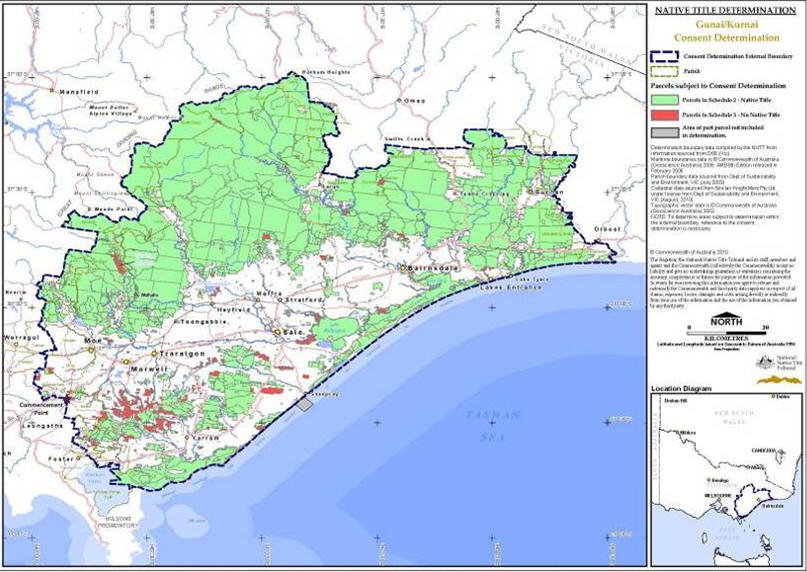
¡°Determination Area¡± means the land and waters referred to in Orders 1 and 2, being the land and waters of the areas described in the Determination Area Table in Schedules 2 and 3, and being certain lands and waters within the location described in Schedule 1;
¡°Determination Area Map¡± means the map in Schedule 6;
¡°Determination Area Table¡± means the table of that name forming part of Schedules 2 and 3;
¡°land¡± and ¡°waters¡± respectively have the same meanings as in the Native Title Act;
¡°Native Title Act¡± means the Native Title Act 1993 (Cth);
¡°Native Title Area¡± means the areas referred to in Order 1;
¡°native title rights and interests¡± means those rights and interests set out in Order 5 always as subject to Orders 6 - 9;
¡°other interests¡± means the interests referred to in Order 10, being the interests set out in Schedule 5;
¡°public work¡± has the same meaning as in s 253 of the Native Title Act.
¡°Unidentified Extinguishing Public Work¡± means any public work in the Native Title Area:
(a) the construction or establishment of which has extinguished native title in accordance with the Native Title Act; and
(b) the extinguishing effect of which has not been considered by the State and the Applicants prior to the date of this determination.
¡°waterway¡± has the same meaning as in s 3 of the Water Act 1989 (Vic) as in force at the date of this determination.
13. In this determination including its schedules, in the event of an inconsistency between a description of an area in a schedule and the depiction of that area on the Determination Area Map, the written description shall prevail.
SCHEDULE 1 ¨C Location of the Determination Area
External Perimeter within which the various areas comprising the Determination Area are located
The Determination Area is located wholly within the following external boundaries and comprises the particular allotments and areas identified in the Determination Area Table and as generally shown on the Determination Area Map.
The determination area covers all the land parcels listed within Schedule 2 and Schedule 3 to the extent that they are within the external boundary described as:
Commencing at a point on the western boundary of the Township of Mirboo North, being the intersection of the Parishes of Allambee East, Mirboo and Mardan and extending generally westerly, generally northerly and generally easterly along boundaries of the Parish of Allambee East to the western boundary of the Parish of Moe; then generally northerly along boundaries of that parish to the southern boundary of the Parish of Darnum; then generally westerly along boundaries of that parish to the centreline of Moe River; then generally easterly along the centreline of that river to its intersection with the western boundary of the Parish of Yarragon; then generally easterly and generally north westerly along boundaries of that parish to its intersection with the southern boundary of the Parish of Neerim East; then generally north westerly and generally northerly along boundaries of that parish to its intersection with the southern boundary of the Parish of Fumina; then generally north westerly, generally northerly and generally easterly along boundaries of that parish to its intersection with the western boundary of the Parish of Fumina North; then generally northerly and generally easterly along the western boundaries of that parish and western and northern boundaries of the Parish of Baw Baw to the south western corner of the Parish of Toombon; then generally northerly along boundaries of that parish to the southern boundary of the Parish of Moolpah; then westerly generally north easterly and generally easterly along boundaries of that parish and northern boundaries of the Parish of Binnuc to the western boundary of the Parish of Licola; then generally north easterly, generally north westerly, generally northerly and generally easterly along western boundaries of that parish, eastern boundaries of the Parish of Licola North, western and northern boundaries of the Parish of Magdala South to the south western corner of the Parish of Howitt Plains; then generally northerly, generally north easterly, generally easterly and southerly along western boundaries of that parish, northern boundaries of the Parish of Bolaira, northern boundaries of the Parish of Kybeyan, northern and eastern boundaries of the Parish of Yertoo and the eastern boundary of the Parish of Cooma to the north western corner of the Parish of Bulgaback; then easterly along the boundary of that parish to the centreline of the Dargo River, then generally easterly and generally southerly along the centreline of that river to the north western corner of the Parish of Quag-munjie, then generally easterly and generally north easterly along boundaries of that parish, western and northern boundaries of the Parish of Doodwuk to the western boundary of the Parish of Binnican; then generally north easterly, generally northerly and generally easterly along boundaries of that parish, western and northern boundaries of the Parish of Tabberabbera and northern boundaries of the Parish of Angora to the northern western corner of the Parish of Numbie-Munjie; then generally easterly, generally northerly, easterly and southerly along the boundaries of that parish, western, northern and eastern boundaries of the Parish of Noyong to a point on the centreline of the Timbarra River at Latitude 37.253946° South; then generally easterly and generally southery along the centreline of that river to its intersection with the northern boundary of the Parish of Mellick-Munjie; then generally easterly and generally southerly along boundaries of that parish to the north west corner of Allotment 21, Parish of Murrindal West; then easterly and southerly along boundaries of that allotment to the northern most point of Crown allotment 34F Parish of Murrindal West; then generally south easterly along boundaries of that allotment to its easternmost point and onwards to the northern most point of Crown Allotment 34E Parish of Murrindal West; then generally south easterly and generally easterly along boundaries of that allotment and southern and eastern boundaries of Crown Allotment 50 Parish of Murrindal West to the intersection of the prolongation westerly of the northern boundary of Lot 2 on PS309037; then easterly to and along the boundary of that lot and the northern boundary of Lot 1 PS309037 and onwards to the western boundary of the Parish of Murrindal East; then north easterly and generally easterly along boundaries of that parish to the centreline of the Snowy River; then generally southerly along the centreline of that River to its mouth at the intersection of the southern boundaries of the Parishes of Newmerella and Orbost East; then south to a point 200 metres seaward of the Territorial Sea Baseline; then generally westerly and generally south westerly along that line 200 metres seaward of that baseline to its intersection with the eastern boundary of Native Title Determination Application VID6005/98 Gunai/Kurnai/Boonerwrung (VC97/2), as lodged with the Federal Court 17 March 1997, at Longitude 146.513163° East; then north westerly along that application boundary to a point on the north eastern boundary of Crown Allotment 2 Parish of Warreen at Longitude 146.472505° East; then generally northerly to the southern boundary of Crown Allotment 22D Section B Parish of Wonga Wonga South; then generally westerly, generally north westerly and generally easterly along boundaries of that allotment to the southern boundary of the Parish of Toora; then generally northerly and generally westerly along boundaries of that parish to the eastern bank of the Franklin River; then generally north westerly along the bank of that river to Latitude 38.665785° South; then westerly to a point 20.12 metres (100 links) north easterly of the eastern bank of Deep Creek at Latitude 38.665785° South; then generally north westerly along a 20.12 metre buffer east of the eastern bank of that river to a point 20.12 metres north easterly of the source of Deep Creek at Latitude 38.601030° South; then north westerly to a point on the western boundary of the Parish of Mirboo South at its intersection with a line drawn between the source of Deep Creek and the source of Stony Creek; then generally north westerly and generally northerly along boundaries of that parish to its intersection with the southern boundary of the Parish of Mirboo; then generally westerly and generally northerly along southern and western boundaries of that parish back to the commencement point.
NOTES
Data Reference and source
Application boundary data compiled by the National Native Title Tribunal based on maps, and instructions supplied by the Department of Sustainability and Environment VIC (September 2010).
Freehold cadastral data sourced from Public Sector Mapping Agency (August 2010).
Non freehold cadastral data sourced from Sinclair Knight Merz Pty Ltd under license from Dept of Sustainability and Environment, VIC (August, 2010).
Parish boundaries sourced from Dept of Sustainability and Environment (July 2009) and compiled to cadastral boundaries.
River based on cadastral boundaries where possible or topographic vector data (1:25,000) sourced from Geoimage Pty Ltd under license from Geoscience Australia (March 2001).
Territorial Sea Baseline sourced from Maritime boundaries data and is © Commonwealth of Australia (Geoscience Australia) 2006. AMB 6th Edition released in February 2006.
Reference datum
Geographical coordinates have been provided by the NNTT Geospatial Services and are referenced to the Geocentric Datum of Australia 1994 (GDA94), in decimal degrees and are based on the spatial reference data acquired from the various custodians at the time.
Use of Coordinates
Where coordinates are used within the description to represent cadastral or topographical boundaries or the intersection with such, they are intended as a guide only. As an outcome to the custodians of cadastral and topographic data continuously recalculating the geographic position of their data based on improved survey and data maintenance procedures, it is not possible to accurately define such a position other than by detailed ground survey.
SCHEDULES 2 and 3 - where native title does and does not exist - Determination Area table ¨C determination area table notes
SCHEDULE 2 ¨C WHERE NATIVE TITLE EXISTS ¨C ORDER 1
Subject to Orders 3(c) and 6-9 and the Determination Area Table Notes 3 and 4, native title exists in:
i. land and waters of the areas and parts of areas listed in the column marked ¡°Schedule 2 Areas¡± in the Determination Area Table and shown generally on the Determination Area Map, excluding any land or waters on which there is an Unidentified Extinguishing Public Work; and
ii. other waters within the area described in Schedule 1, excluding any waters listed in the column marked ¡°Schedule 3 Areas¡± in the Determination Area Table and shown generally on the Determination Area Map and also excluding any waters on which there is an Unidentified Extinguishing Public Work.
SCHEDULE 3 ¨C WHERE NATIVE TITLE DOES NOT EXIST ¨C ORDER 2
Native title does not exist, because it has been wholly extinguished:
(a) in the land and waters of the areas and parts of areas listed in the column marked ¡°Schedule 3 Areas¡± in the Determination Area Table and shown generally on the Determination Area Map; and
(b) in any [other] land or waters on which there is an Unidentified Extinguishing Public Work.
.
DETERMINATION AREA TABLE
Table of Areas referred to in Schedules 2 and 3(To be read in conjunction with the following Determination Area Notes)
DETERMINATION AREA TABLE NOTES
Note 1: In the Determination Area Table areas are generally identified using parcel numbers and further described by official descriptions of allotment and section identifiers and parish and (where applicable) township names. Parcel numbers are internal references used by the State of Victoria for convenience. Where further description appears useful and convenient, or it is necessary to distinguish between areas where native title exists and areas where it does not (as to which, see Note 2), such further description is also included in the column headed ¡°Native Title Assessment¡±.
Note 2: In many instances native title exists over part of a parcel but has been extinguished over the balance of the parcel. In those instances, the parcel has two separate entries in the Determination Area Table; distinguished by adding ¡°A¡± and ¡°B¡± respectively in the column headed ¡°Entry¡± next to the relevant parcel reference. The letter ¡°B¡± is used for an area where native title exists. The letter ¡°A¡± is used for the part of a parcel where native title does not exist. Where an entry refers to part of a parcel where native title has been extinguished, the column headed ¡°Native Title Assessment¡± contains a short reference to the act or fact that has caused the extinguishment of the native title over those areas.
Note 3: The spatial extent of extinguishment has not been surveyed or otherwise fixed but is to be determined by the spatial extent of the act or fact referred to under the column headed ¡°Native Title Assessment¡± (and which, in the case of a public work, will include the land and waters referred to in s 251D of the Native Title Act). In a given parcel it is a possibility that, as a result of the spatial extent of an act or fact being determined, native title may be found to have been extinguished over the entire parcel.
Note 4: In the Determination Area Table, the numbers in the first column against each row are sequential and for convenience of reference only.
Note 5: For the avoidance of doubt, there is only a determination in respect of the land and waters identified in Schedules 2 and 3 to the extent those land and waters or parts thereof fall within the boundary described in Schedule 1.
Note 6: The parcel identifiers in the Determination Area Table (Parcel ID, Allotment and Section) were current as at 13 December 2009. The entries in the Determination Area Table relate to the area that was within the parcels, as described by the parcel identifiers, at that date. Fixing the parcel identifiers at a specific date is necessary, because regular changes are made to parcel identifiers, whether because of parcel subdivision or otherwise. Any changes in parcel boundaries and parcel identifiers after 13 December 2009, whether before or after the date of the determination, do not affect the area within the Determination Area Table.
SCHEDULE 4 ¨C Gunai/Kurnai Apical Ancestors
[ORDER 4]
(1) Charles Boldin / Bolden and Emily Clarke
(2) Jemmy Bull and Mary
(3) Tommy Bumberrah
(4) Bungil Narran
(5) Bungil Wrekallak
(6) Bungil Tay-a-bung
(7) Jack Chase and Kitty
(8) Dan Bun-gyl Tambo and Kitty Wangung
(9) Old Darby Tar-loomba and Mary Tur-un-gook
(10) Charles Rivers and Kitty
(11) Charles Hammond and Annabella / Hannah McLeod
(12) Jimmy
(13) Billy Login / Logan and Mary
(14) King Tom Kee-lum-bedine and Mary War-gyle
(15) Old Ngary and Mary Woon-grook
(16) James Scott
(17) George Thomas
(18) Timothy Bungil Barlijan and Patty Tu-duk
(19) Charlotte Mercawan
(20) Yallung / Tharnaberrang Kitty and Wookalnom Dukalunern Mary
(21) Wood-a-turn
(22) Merriguin Lucy Goold
(23) William McDougall
(24) Edward ¡®Neddy¡¯ O¡¯Rourke
(25) John Wilson and Polly
SCHEDULE 5 - ¡°other interests¡±
[ORDER 10]
The other interests, as they exist at the date of this determination, are as follows:
(a) so far as confirmed pursuant to s 15 of the Land Titles Validation Act 1994 (Vic) as at 24 November 1998, public access to and enjoyment of the following places:
(i) waterways;
(ii) beds and banks or foreshores of waterways;
(iii) coastal waters;
(iv) beaches;
(v) areas that were public places at the end of 31 December 1993;
(b) the right of an employee or agent or instrumentality of the Crown, or of any local government or other statutory authority, to access land or waters in the Determination Area as required in the performance of statutory or common law duties;
(c) the interests of the Crown, or a local government body or other statutory authority of the Crown, in any capacity in any public works and other facilities whose construction or establishment:
(i) was valid or has been validated;
(ii) did not extinguish native title (even as a consequence of validation); and
(iii) commenced prior to the date of this determination;
(d) the rights and interests of Telstra Corporation Limited:
(i) as the owner or operator of telecommunications facilities within the Determination Area;
(ii) created pursuant to the Post and Telegraph Act 1901 (Cth), the Telecommunications Act 1975 (Cth), the Australian Telecommunications Corporation Act 1989 (Cth), the Telecommunications Act 1991 (Cth) and the Telecommunications Act 1997 (Cth), including rights:
(A) to inspect land;
(B) to install and operate telecommunications facilities;
(C) to alter, remove, replace, maintain, repair and ensure the proper functioning of its telecommunications facilities; and
(D) for its employees, agents or contractors to access the Determination Area for the purposes of exercising the rights in (A),(B) and (C) above in respect of telecommunications facilities in and in the vicinity of the Determination Area;
(iii) under any leases, licences, access agreements or easements relating to its telecommunications facilities in the Determination Area.
(e) any public right to fish;
(f) the public right to navigate;
(g) the international right of innocent passage through the territorial sea;
(h) the interest of a holder of a pipeline licence granted pursuant to:
(i) the Pipelines Act 2005 (Vic); or
(ii) the Pipelines Act 1967 (Vic) and now governed by the Pipelines Act 2005 (Vic); or
(iii) the Petroleum (Submerged Lands) Act 1982 (Vic);
(i) the interest of a holder of a licence granted pursuant to Part 3A of the Victorian Plantations Corporation Act 1993 (Vic);
(j) the interests of persons holding licences, permits, statutory fishing rights, or other statutory rights pursuant to:
(i) the Fisheries Act 1995 (Vic) or regulations or management plans made under that Act;
(ii) the Fisheries Management Act 1991 (Cth), or regulations or management plans made under that Act;
(iii) any other legislative scheme for the control, management and exploitation of the living resources within the Determination Area; and
(k) the interests of persons to whom valid and validated rights have been:
(i) granted by the Crown pursuant to statute or otherwise in the exercise of its executive power; or
(ii) otherwise conferred by statute.
SCHEDULE 6 ¨C Determination Area Map
[ORDER 12]