FEDERAL COURT OF AUSTRALIA
Schutz DSL (Australia) Pty Ltd v VIP Plastic Packaging Pty Ltd (No 5) [2010] FCA 1105
|
Citation: |
Schutz DSL (Australia) Pty Ltd v VIP Plastic Packaging Pty Ltd (No 5) [2010] FCA 1105 | |
|
Parties: |
||
|
File number(s): |
WAD 136 of 2009 | |
|
Judge: |
MCKERRACHER J | |
|
Date of judgment: |
13 October 2010 | |
|
Catchwords: |
||
|
Legislation: |
Dangerous Goods Act 1985 (VIC) ss 3(1), 10(2) Dangerous Goods (Transport By Road or Rail) Regulations 2008 (VIC) regs 53(1)(a), 56 | |
|
Cases cited: |
Adam P Brown Male Fashions Pty Ltd v Philip Morris Inc (1981) 148 CLR 170 Australian Securities & Investments Commission v Burton-Clay [2003] FCA 111 Louis Vuitton Malletier SA v Knierum [2004] FCA 1584 Schutz DSL (Australia) Pty Ltd (ACN 009 069 907) v VIP Plastic Packaging Pty Ltd (ACN 095 313 705) [2009] FCA 1049 | |
|
|
| |
|
Date of hearing: |
6 August 2010 | |
|
|
| |
|
Place: |
Perth | |
|
|
| |
|
Division: |
GENERAL DIVISION | |
|
|
| |
|
Category: |
Catchwords | |
|
|
| |
|
Number of paragraphs: |
52 | |
|
|
| |
|
Counsel for the Applicants: |
ML Bennett with WC Zappia | |
|
|
| |
|
Solicitor for the Applicants: |
Lavan Legal | |
|
|
| |
|
Counsel for the Respondents: |
S Burley SC with AR Lang | |
|
|
| |
|
Solicitor for the Respondents: |
Gilbert + Tobin | |
|
IN THE FEDERAL COURT OF AUSTRALIA |
|
|
WESTERN AUSTRALIA DISTRICT REGISTRY |
|
|
GENERAL DIVISION |
WAD 136 of 2009 |
|
SCHUTZ DSL (AUSTRALIA) PTY LTD (ACN 009 069 907) First Applicant/Cross-Respondent
SCHUTZ GMBH & CO KGAA Second Applicant/Cross-Respondent
PROTECHNA S.A. Third Applicant/Cross-Respondent
| |
|
AND: |
VIP PLASTIC PACKAGING PTY LTD (ACN 095 313 705) First Respondent/Cross-Claimant
VIP STEEL PACKAGING PTY LTD (ACN 095 314 195) Second Respondent/Cross-Claimant
|
|
JUDGE: |
|
|
DATE OF ORDER: |
13 OCTOBER 2010 |
|
WHERE MADE: |
PERTH |
THE COURT ORDERS THAT:
1. The respondents/cross-claimants be released from the undertaking to the Court dated 27 August 2009, referred to in Order 2 of the Orders of the Court made on 6 October 2009 and lieu thereof the respondents/cross-claimants undertake that they, whether by themselves, their officers, servants, agents or otherwise:
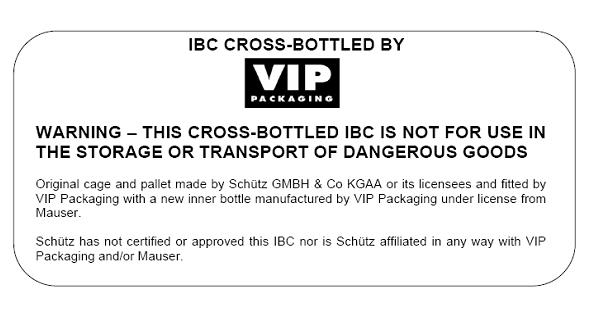
(a) will affix to each label plate of the cage of any Cross-Bottled DG IBC that is sold, offered for sale or distributed in the course of trade by them a heat resistant label in the form and dimensions of the example annexed hereto and marked ‘A’ and to remove therefrom any marking affixed by the applicants signifying that the Cross-Bottled IBC is certified for use in the transport of dangerous goods; and
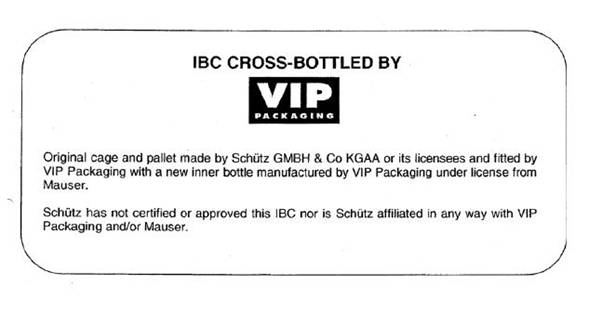
(b) will affix to each label plate of the cage of any Cross-Bottled Non-DG IBC that is sold, offered for sale or distributed in the course of trade by them a heat resistant label in the form and dimensions of the example annexed hereto and marked ‘B’ and to remove therefrom any marking affixed by the applicants signifying that the Cross-Bottled IBC is certified for use in the transport of dangerous goods,
until trial or further order of the Court.
2. The applicants/cross-respondents pay the respondents/cross-claimants’ costs of this motion.
3. There be liberty to apply in relation to the release or reduction of the deposit lodged in support of the undertaking as to damages.
Note:Settlement and entry of orders is dealt with in Order 36 of the Federal Court Rules.
The text of entered orders can be located using Federal Law Search on the Court’s website.
|
IN THE FEDERAL COURT OF AUSTRALIA |
|
|
WESTERN AUSTRALIA DISTRICT REGISTRY |
|
|
GENERAL DIVISION |
WAD 136 of 2009 |
|
BETWEEN: |
SCHUTZ DSL (AUSTRALIA) PTY LTD (ACN 009 069 907) First Applicant/Cross-Respondent
SCHUTZ GMBH & CO KGAA Second Applicant/Cross-Respondent
PROTECHNA S.A. Third Applicant/Cross-Respondent
|
|
AND: |
VIP PLASTIC PACKAGING PTY LTD (ACN 095 313 705) First Respondent/Cross-Claimant
VIP STEEL PACKAGING PTY LTD (ACN 095 314 195) Second Respondent/Cross-Claimant
|
|
JUDGE: |
MCKERRACHER J |
|
DATE: |
13 October 2010 |
|
PLACE: |
PERTH |
REASONS FOR JUDGMENT
INTRODUCTION
1 The respondents/cross-claimants (VIP) seek to be released from an undertaking given to the Court on 27 August 2009.
2 Specifically by order 2 of the orders of 6 October 2009, VIP undertook that they would:
(a) … refrain from selling, offering for sale or distributing in the course of trade Cross-Bottled IBCs designated as being suitable for the transport of dangerous goods; and
(b) … affix to each label plate of the cage of any Cross-Bottled IBC that is sold, offered for sale or distributed in the course of trade by them a heat resistant label in the form and dimensions of the example annexed hereto and marked ‘A’ and to remove therefrom any marking affixed by the applicants signifying that the Cross-Bottled IBC is certified for use in the transport of dangerous goods.
3 It is the first undertaking (the undertaking) that VIP seeks to discharge.
BACKGROUND
4 By application filed on 7 August 2009, the applicants (Schutz) sought and obtained ex parte orders to restrain VIP from engaging in the practice of cross-bottling Composite IBCs in Australia (Schutz DSL (Australia) Pty Ltd (ACN 009 069 907) v VIP Plastic Packaging Pty Ltd (ACN 095 313 705) [2009] FCA 1049 (Schutz 1) (at [31])); on 19 August 2009, the ex parte orders were discharged on the basis that the balance of convenience did not favour their continuation. On 27 August 2009, VIP gave the undertaking to the Court. When the undertaking was given, VIP’s certification under the Dangerous Goods legislation did not specify approval to sell particular cross-bottled 15.5 kilogram bottles manufactured under licence of Mauser-Maschinentechnik GmbH (Mauser) in a Schutz cage.
5 That position has now changed. The undertaking disposed of those issues concerning the first category, dangerous goods (DG) and left for determination the question of whether interlocutory orders should be made to restrain the supply by VIP of cross-bottled IBCs to consumers for non-dangerous goods (NDG). There was argument as to whether Schutz was able to demonstrate an arguable case on the basis that VIP’s conduct constituted misleading or deceptive conduct in breach of Pt IV of the Trade Practices Act 1974 (Cth) (TPA); contravention of the Patents Act 1990 (Cth); and contravention of the Trade Marks Act 1995 (Cth). I did not consider that there was a safety question because VIP had given an undertaking not to deal with DG IBCs. The primary question then was whether there was an arguable case as to TPA contraventions. The contraventions were said to relate to misleading a potential consumer that there was some affiliation or connection between Schutz and VIP or that the cross-bottling was authorised by Schutz (Schutz No 1 at [60]).
6 As a result of VIP undertaking to affix a clear label to the cage of any cross-bottled IBC in a form proposed by VIP, I concluded that on the balance of convenience the injunction should not be continued. VIP has been selling cross-bottled IBCs with a Mauser bottle and a Schutz cage. It ceased cross-bottling DG IBCs but continued to sell NDG IBCs with a label affixed in accordance with the orders of the Court.
7 VIP now contends that there has been a sufficient change in circumstances to warrant it being released from its undertaking not to supply cross-bottled IBCs for dangerous goods insofar as they conform with the certification obtained after the undertaking was given.
THE ASSERTIONS AGAINST VIP
8 In the current form of the amended statement of claim, the assertion against VIP is framed in the following terms:
(a) That since around July 2008 VIP has engaged in cross-bottling of IBC products …;
(b) That in December 2008 VIP obtained from WorkSafe Victoria approval under the number 30667 to manufacture, sell and supply cross-bottled IBCs identical to a sample supplied to WorkSafe (which sample consisted of a used SchÜtz manufactured outer steel cage of certain specifications and a new VIP manufactured inner container) …;
(c) That the specifications under which approval 30667 were granted stated that the inner rigid plastic container had a tare mass of 17.5 kg +/- 500g …;
(d) That since in or about December 2008 VIP had labelled cross-bottled IBCs with, inter alia, the designated approval number 30665 with a tare mass of approximately 15.5kg in two specific forms of labelling designated “CB1” and “CB2” …;
(e) That the use of the plastic container of a weight of approximately 15.5kg is outside the weight specification listed in approval 30667 and accordingly the impugned IBCs were not approved for the storage and transport of dangerous goods …;
(f) That VIP has represented that it is certified under the Dangerous Goods Legislation to manufacture, sell and supply cross-bottled IBCs … (Certification Representation);
(g) That VIP has also represented that cross-bottled IBCs are affiliated with and/or authorised by SchÜtz (respectively, Affiliation and Authorisation Representations) …;
(h) That the Certification Representation is false and misleading because VIP did not have the relevant certification for the cross-bottling of the specified IBCs for dangerous goods … .
9 Accordingly the certification misrepresentation is founded on the allegation that VIP’s conduct amounted to a breach of the TPA because the labelling on cross-bottled IBCs for the carriage of dangerous goods falsely represented that certification had been obtained pursuant to the relevant Dangerous Goods legislation.
10 It is necessary to consider that legislation.
Dangerous Goods legislation
11 The transport of dangerous goods is regulated by State and Territory legislation in Australia including, in particular insofar as it affects VIP, the Dangerous Goods Act 1985 (VIC) (DGA) and the Dangerous Goods (Transport By Road or Rail) Regulations 2008 (VIC) (DGR). In Victoria, the Victorian WorkCover Authority (WorkCover Victoria) is the competent authority in respect of the supervision and enforcement of the Dangerous Goods legislation by virtue of s 3(1) and s 10(2) DGA. By reg 56 DGR, an IBC design may be approved for the transport of dangerous goods. Approval is determined by Pt 6 of the Australian Dangerous Goods Code (Road and Rail) (ADG7). ADG7 in turn adopts the structure, format, definitions and concepts of the United Nations Recommendations on the Transport of Dangerous Goods Model Regulations (14th revised edition) while retaining Australia specific provisions.
12 A seller or supplier of cross-bottled IBCs for the transport of dangerous goods can only do so with approval under the Dangerous Goods legislation, for example, reg 56 DGR. VIP as part of its reconditioning services has cross-bottled IBCs manufactured by Schutz and specifically, has cross-bottled a Schutz IBC model MX 1000 with a steel pallet, using a bottle manufactured by Mauser.
13 VIP and its predecessor in title have provided reconditioning services in relation to DG IBCs and NDG IBCs since about 1985 according to evidence of Mr Andrew Robert Smith, General Manager of VIP Steel. Reconditioning is the process under which suitable IBCs are cleaned, dried, inspected, repaired and leak tested for reuse. This may sometimes involve the replacement of component parts including the bottle itself. Where that is replaced with the same type of bottle from the same manufacturer, this is described as ‘rebottling’. However, where the bottle is replaced with a new bottle from a different manufacturer, the process is described as ‘cross-bottling’.
14 On 22 October 2009, WorkCover Victoria certified VIP with an approval number 30746 in respect of a cross-bottled IBC for the Schutz IBC model MX 1000 with a steel pallet using a 15.5 kilogram bottle manufactured by Mauser.
15 VIP contends that the sale of cross-bottled IBCs which comply with this approval cannot amount to breach of the TPA. Further, it contends that no credible public safety issue can arise from the sale of IBCs which comply with the express certification given by WorkCover Victoria. No evidence has been adduced by Schutz, VIP contends, to suggest otherwise.
Principles governing discharge of an undertaking
16 When a material change in circumstances since an interlocutory injunctive order was made or undertaking to the Court given, or when there are exceptional circumstances which warrant reconsideration of the matter or, where as a matter of discretion, the justice of the matter requires that the issue be revisited, then the Court should do so. In Adam P Brown Male Fashions Pty Ltd v Philip Morris Inc (1981) 148 CLR 170 (at 177-178), Gibbs LJ, Aickin, Wilson and Brennan JJ said (footnotes omitted):
Considerable argument was directed to the question whether a court has power, otherwise than in the case of mistake operative at the time of giving it to release a party from an undertaking, at least in the absence of the consent of the other party. But in our opinion a court undoubtedly has such a power. Just as an interlocutory injunction continues “until further order”, so must an interlocutory order based on an undertaking. A court must remain in control of its interlocutory orders. A further order will be appropriate whenever, inter alia, new facts come into existence or are discovered which render its enforcement unjust: cf Woods v Sheriff of Queensland; Hutchinson v Nominal Defendant; Chanel Ltd v F W Woolworth & Co Ltd. Of course, the changed circumstances must be established by evidence: Cutler v Wandsworth Stadium Ltd.
Material changes
17 VIP contends that material changes include the following. First, it has become clear that the case relied upon by Schutz insofar as it concerns the regulatory regime for the carriage of dangerous goods is limited to the assertion that VIP failed to have regulatory approval for the cross-bottled 15.5 kilogram plastic container. A significantly broader attack had been made on the basis that any cross-bottling of IBCs presented a danger to the public. Schutz stressed that the overriding concern was that a safety hazard was posed in circumstances where consumers acquired cross-bottled IBCs containing a representation suggesting that they were certified under the Model Dangerous Goods Transport Code and UN Certification when they were not.
18 VIP points to the fact that that is no longer the pleaded case nor could it be given that:
(a) the Dangerous Goods legislation contains no prohibition on cross-bottling; and
(b) the regulatory authorities have supplied certification for cross-bottled IBCs.
19 Moreover, on 22 October 2009, VIP did obtain approval number 30746 and on or about 19 November 2009, the Competent Authorities Panel (CAP) decided in favour of giving this approval nationwide effect pursuant to the mutual recognition regimes provided under the various State and Territory legislative provisions.
20 Pursuant to the approval it has obtained, VIP wishes and intends to supply cross-bottled DG IBCs.
21 A further matter of some significance is that insofar as there might be any residual doubt as to the position of the regulatory authorities under the DGR, Schutz has made extensive complaints to those authorities about VIP’s cross-bottling practices. In consequence, WorkCover Victoria has undertaken additional and as far as VIP is aware unprecedented supervision of VIP’s activities in respect of the concerns raised by Schutz. There is no evidence or any indication at all that WorkCover Victoria has any concerns about the activities and practices of VIP. This is so notwithstanding an inspection of VIP’s premises as well as a number of additional matters. In correspondence to WorkCover Victoria on 2 November 2009 following the interlocutory orders, Schutz through Mr Johnston made further claims in relation to VIP’s cross-bottling activities concluding that VIP should urgently take the following steps:
(a) A public announcement to inform the marketplace of the non-approved packaging.
(b) A national recall of all units sold.
(c) Ongoing monitoring to advise WorkCover Victoria and Schutz of the total number of units sold together with the names and addresses of each customer. VIP should also advise both parties on a monthly basis how many units it collects each month pursuant to its National Recall program. Schutz said:
Our firm has serious concerns over the practice of IBC cross-bottling. We believe it’s impossible for cross-bottlers to accurately identify and define the precise cage and bottle specifications consistently in a production environment. We believe this creates most serious risks for the use of this packaging in the dangerous goods marketplace
22 As a result of this letter, WorkCover Victoria wrote to VIP on 24 November 2009 seeking assurances as to the ongoing compliance by VIP with its cross-bottling practices. VIP gave those assurances by letter from Mr Smith of 14 December 2009.
23 Mr Smith has said that in his 15 years experience the scrutiny exercised by WorkCover Victoria was unprecedented.
24 Schutz has suggested that its MX 1000 IBC has, over the years, been revised in various ways. The details of those changes have not been supplied. Schutz has asserted that VIP will fail to comply with its certification because it cannot tell whether revised MX 1000 models are precisely ‘the same’ as the one which was used in the testing which led to the grant of approval number 30746.
25 VIP points to the fact, which I accept, that Schutz has been at pains to ensure that WorkCover Victoria is aware of all of these issues by Schutz’s correspondence and VIP has discussions with WorkCover of its cross-bottling practices. Despite the complaints made by Schutz, WorkCover Victoria is apparently satisfied with those practices. It has extensive powers under the regulatory regime to investigate and address such further concerns as may arise. VIP continues to remain under an obligation to inspect each of its cross-bottled IBCs to the satisfaction of that authority to ensure that they conform to the design which has been approved.
26 In light of the detailed information that Schutz has supplied to WorkCover Victoria, and the attention WorkCover Victoria has given to VIP’s premises, it is not possible to conclude that any danger or otherwise unsafe practice has been made out by Schutz.
PUBLIC INTEREST CONSIDERATIONS
27 As against that, the conduct of Schutz might well have the effect of shutting a competitor out of the marketplace. That outcome cannot be in the public interest. Schutz DSL was the only local manufacturer in the IBC market in Australia from 2002 to 2008 and remains the dominant participant. Rebottling services form a part of that market. Because the bottling does not involve incurring the cost of a new cage but still provides a product which is equivalent to a new IBC, the services can be commercially attractive compared with selling new IBCs. The market in Australia has a value in excess of $5 million per year. The Schutz return ticket service is the dominant collection service in Australia. As it has a dominant position in the market in relation to new IBCs, about 90% of the used IBCs on the market are also Schutz IBCs. The effect of this is that predominantly the IBCs available to be cross-bottled are Schutz IBCs. Despite this dominant market position, VIP started competing in this market in December 2008 including by cross-bottling. As a result of the undertakings given on 27 August 2009, VIP has lost the opportunity in that time to further establish and grow its business. VIP complains that this is a significant and ongoing damage. But for the interim orders, it estimates it may have had a market share of at least 10% by the time of hearing this application. VIP complains that there is no reason it should be held out of this market any longer. Cross-bottling is commonplace and has become a growth area. There is evidence that Schutz itself has sought and obtained approval for cross-bottled IBCs having a cage manufactured by Mauser and a bottle manufactured by Schutz. Cross-bottling, according to VIP, is environmentally sound and promotes competition not only in the rebottling segment but also by driving down the prices of new IBCs.
Opposition by Schutz
28 Schutz opposes VIP’s motion to discharge their undertaking on two grounds. First, the undertaking was given in circumstances where there was a serious question to be tried that the respondents had engaged and were engaged in misleading and deceptive conduct in connection with the respondents’ manufacture and sale of cross-bottled DG IBCs using Schutz cages. Schutz say that if VIP is released from its undertaking, there would be a real risk that conduct would recommence. Secondly, the alternative undertaking proffered by VIP was inadequate in that it would enable VIP to engage in misleading and deceptive conduct in connection with the manufacture and sale of cross-bottled DG IBCs.
29 Schutz argues that ‘repeatedly’ VIP has represented that they may universally manufacture cross-bottled DG IBCs using Schutz cages pursuant to single approvals issued by WorkCover. That understanding is fundamentally incorrect, Schutz says and VIP does not hold approval to manufacture cross-bottled IBCs using any cage manufactured by Schutz as the approvals 30667 and 30746 issued by WorkCover each relate to a single design type of cross-bottled IBC comprised of a Schutz manufactured MX 1000L steel cage and a VIP manufactured inner container as performance tested by Falcon Test Engineers.
30 Regulation 53(1)(a) DGR provides that packaging is unsuitable for the transport of dangerous goods if it is required to undergo performance tests under Pt 6 of the ADG Code and it is not approved packaging. Clause 6.5.6.1.1 of the Pt 6 of ADG7 requires that each IBC design type must successfully pass the test prescribed in that Chapter of the ADG7 before being used. An IBC design type, according to that clause, is defined by the design, size, material and thickness, manner of constructions and means of filling and discharging and also includes IBCs which differ from the design type only in their lesser external dimensions. Schutz argues that they manufacture numerous certified MX 1000L capacity DG IBC design types and article specifications. Accordingly the potential for confusion on the part of consumers as a result of misleading and deceptive and false representations made by VIP as to certification status and suitability remains a matter of concern.
31 As such, whether VIP’s cross-bottled IBCs are actually safe for the transport of dangerous goods is not relevant to the pleaded case in the strict sense. If VIP manufactures cross-bottled IBCs without approval or without complying with the conditions of any approval, it is misleading and deceptive for VIP to hold those uncertified products out to the relevant classes of the public as being suitable for transport of dangerous goods.
32 Schutz points to the fact that it manufactures almost 2500 different certified DG IBC ‘articles’ of varying design types and specifications in the Schutz ‘MX’ product family with a capacity of about 1000 litres. Schutz makes the point that it is certified to manufacture 15 different design types of DG MX 1000 IBCs. Some of those design types are subject to several certified revisions meaning the different variations of those design types can be managed in accordance with the revised certification. Therefore, it is by no means clear that the certification is one which would in effect cover the field of the MX 1000 IBCs.
33 Moreover, Schutz contends that the certification relied on by VIP in support of its motion being approval number 30746 is insufficient to enable VIP to lawfully trade in cross-bottled DG IBCs. That approval is expressly limited in its application to the intended conduct of VIP in Victoria until the CAP extends the approval to have effect in all participating jurisdictions within Australia. Schutz contends that VIP has not adduced any definitive evidence in support of the motion that establishes that such approval that has been given so that there is national approval. Each DG IBC design type requires separate certification and the approval is confined to DG IBCs which conform in all respects to the sample used in testing. The approval is expressed to have effect only when all conditions listed in the approval are complied with in full.
34 Schutz also complains that VIP’s policies and procedures are insufficient as set out in their Environmental Management System which suggest that if permitted to recommence the cross-bottling they would comply with the approval and any regulatory requirements and ensure that their cross-bottled DG IBCs are manufactured to a quality standard.
35 As to the remaining and effectively substituted undertaking offered by VIP, Schutz complain, again, that it is insufficient to warn consumers about confusion in the industrial packaging industry as to the origin, nature and certification of VIP’s products because:
(a) DG IBCs cross-bottled by VIP may be reconditioned by third party reconditioners after use by VIP’s customers in which case the warning label will simply be removed or become illegible;
(b) the front label plates on IBCs are used by Schutz and VIP’s customers to display technical information, safety warnings and instructions which may obscure VIP’s proposed warning label;
(c) IBCs are designed to be lifted mechanically by forklift to approach from any of their four sides such that forklift drivers may not observe the warning label unless it is affixed to all four sides; and
(d) the transport of certain dangerous goods such as flammable liquids carries an inherent risk that any incident in which those goods are involved may result in fire. VIP’s warning label is heat resistant but will not remain legible after being subjected to flame.
36 Schutz points to the fact that VIP’s cross-bottled DG IBCs manufactured in accordance with the approval, if any, will be certified for use in the storage and transport of dangerous goods in packaging groups II and III as categorised in the Dangerous Goods list at cl 3.2.3 of Pt 3 ADG7. Those groups include class 3 flammable liquids. Schutz points to the fact that the Health and Safety Laboratory research report entitled ‘Fire Performance of Composite IBCs’ records that in the United Kingdom the result of research undertaken by the UK Health and Safety Executive into fire risks associated with Composite IBCs indicates that there have been at least three serious fires which have started or spread as the direct result of the use of IBCs for combustible liquids. The first of those fires was in 2000. A characteristic of the fires was the rapid release of liquid from the IBCs and the damage caused as a result of the unconfined flow of burning liquid. The Report concluded that problems of low ignition resistance and high rates of liquid loss in fire engulfment were generic problems for Composite IBCs.
37 The fire complaint is said to have an impact on the potential for consumers being misled because while the embossed Schutz trade mark would remain visible on the label plate of any IBC affected by fire and may expose Schutz to loss and damage including but not limited to loss of reputation and custom, the less resilient label to be affixed by VIP would not provide the necessary identification as to the source of the problem.
38 VIP should, if they are to be released from their undertaking, be required to affix a steel plate etched and ‘spray-filled’ with the text of the warning label to each side of any Schutz MX 1000 IBC cage cross-bottled for the transport of dangerous goods.
39 As to the response by VIP that not even the UN requirements impose such measures and therefore there is no basis upon which the Court should do so, Schutz says that the previous conclusions of the Court in relation to UN requirements were in relation to NDG IBCs as distinct from DG IBCs.
CONSIDERATION
40 Circumstances have considerably changed since the original undertaking was given. Since the orders were made on 6 October 2009, VIP has obtained approval for its cross-bottled IBCs and has satisfied the competent authorities of its compliance with the requirements of the Dangerous Goods legislation. WorkCover Victoria is aware of the ongoing concerns which Schutz has and the details of the practices conducted by VIP. VIP has an ongoing statutory obligation to inspect and test its IBCs.
41 WorkCover Victoria has the power to supervise that conduct and statutory provisions make it clear that its powers are extensive including the entry and inspection of premises; the requirement of production of documents; the taking of samples; the making of inquiries concerning events arising in relation to dangerous goods; the giving of directions; and the prosecuting for offences under the DGA.
42 It is inappropriate for this Court at an interlocutory level to interfere with the legislative scheme under which WorkCover Victoria and its corresponding bodies nationwide address in the first instance questions of compliance. Those are the bodies which have particular expertise in relation to such questions. It is inappropriate at this stage for this Court to purport to interfere with that regime by maintaining an injunction or requiring an undertaking which would prevent VIP from doing that which it is has been permitted to do. It is also undesirable to grant or continue an injunction against the commission of an offence in breach of a statutory prohibition because to do so would expose VIP to the risk of a double penalty: Louis Vuitton Malletier SA v Knierum [2004] FCA 1584 (at [13]-[15]) per Finkelstein J and Australian Securities & Investments Commission v Burton-Clay [2003] FCA 111.
43 It appears to me that the shift in emphasis in the claim by Schutz is from one which initially relied on possible danger to one which asserts contraventions of the TPA. On the case as pleaded, the complaints concerning misrepresentation as to certification no longer have the same force due to certification having been obtained.
44 The evidence relied upon by Schutz to contend that VIP will act in breach of its legal obligations is scant. VIP, on the other hand, has reaffirmed that it has no intention of supplying any cross-bottled DG IBCs which do not comply with the respective DG certification.
45 I can discern no basis for the submission by Schutz that there is a ‘repeated failure’ on the part of VIP to appreciate the requirements of the regulatory scheme. While there may be different types of Schutz MX 1000 IBC cages, this is a matter for the authorities. The submission does not add any weight to the fundamental complaint concerning misrepresentation or confusion in the marketplace. The evidence, in my view, is to the contrary. VIP has repeatedly assured the Court that it has no intention of releasing cross-bottled DG IBCs which are not the subject of regulatory approval. To the extent there is asserted by Schutz a contention that only its employees are capable of detecting nuanced variations in different types of IBCs manufactured by Schutz with a consequence that only Schutz could obtain approval for its IBCs, that contention is unsupported by evidence beyond such assertion.
46 In particular, there is no evidence detailing the nature of any of the variations or why the variation is said to be undetectable or the confidential information in training said to make it detectable to Schutz employees only. There is no evidence as to the use of any particular variation in Australia at particular times. The bare assertion that every revision constitutes a separate and distinct design type within the Dangerous Goods legislation which requires separate approval and that VIP intends to cross-bottle all of them is, again, no more than assertion.
47 VIP has always been aware, since the commencement of these proceedings and perhaps before that there are variations in Schutz designs. Equally, the relevant authorities are aware as Schutz has raised that matter repeatedly with them. In order to obtain its approvals, VIP has engaged independent test engineers, Falcon and has engaged in discussions and correspondence with WorkCover Victoria in respect of its cross-bottling practices in general and, in particular, the competent authority’s views about when separate and distinct approvals may and may not be required. Assurances have been provided by VIP to the effect that it will continue to comply with that obligation. There is no basis to conclude otherwise.
48 As to the complaint by Schutz that VIP has not produced a formal document evidencing national approval by the CAP, there is no evidence that the CAP issues such a document. It is equally probable that VIP has not been provided with one. This would not be particularly unusual. Once approval is obtained in Victoria it might reasonably be expected that within a national cooperative regime, approval would be mirrored in other places.
49 On the sufficiency of the undertaking in relation to labelling, the evidence from Mr Smith is that the labels used by VIP have ‘the highest heat and weather resistance of any plastic material available as label stock’. The label would be in and of the same form as VIP uses for its UN labelling of DG IBCs which are required to be durable and legible in accordance with Pt 6.5.2.1.1 of the ADG7. ADG7 does not require riveted metal plates for such labelling.
50 Although Schutz refers to a risk of fire which may arise by transporting flammable liquids, there is no evidence at all of any such event occurring in Australia. Mr Smith has said that he has not had a single experience of fire caused by a fill product of an IBC but, in any case, if such an incident were to occur, the filler or transporter will have documentation relating to the supply of the IBC such that ascertaining the identity of the manufacturer would not be difficult. It is not open to speculate that because some incidents have occurred in the United Kingdom, that such a danger necessarily exists under Australian conditions. The overtures from Schutz to the authorities must have placed the actions of VIP under their close scrutiny. No adverse response from the authorities on a danger risk has been evident.
51 Finally, as I have previously observed in this litigation, the public interest in legitimate lawful competition in the marketplace should not be stilted by anti-competitive court orders unless there is sound reason to do so such as public safety. If there was at one point a sound basis for provision of an undertaking or an injunction, that basis no longer exists on the current state of the evidence.
CONCLUSION
52 There is no good reason why, in light of the change of circumstances, VIP should not have the relief that it seeks and, accordingly, the following orders will be made:
1. The respondents/cross-claimants be released from the undertaking to the Court dated 27 August 2009, referred to in Order 2 of the Orders of the Court made on 6 October 2009 and lieu thereof the respondents/cross-claimants undertake that they, whether by themselves, their officers, servants, agents or otherwise:
(a) will affix to each label plate of the cage of any Cross-Bottled DG IBC that is sold, offered for sale or distributed in the course of trade by them a heat resistant label in the form and dimensions of the example annexed hereto and marked ‘A’ and to remove therefrom any marking affixed by the applicants signifying that the Cross-Bottled IBC is certified for use in the transport of dangerous goods; and
(b) will affix to each label plate of the cage of any Cross-Bottled Non-DG IBC that is sold, offered for sale or distributed in the course of trade by them a heat resistant label in the form and dimensions of the example annexed hereto and marked ‘B’ and to remove therefrom any marking affixed by the applicants signifying that the Cross-Bottled IBC is certified for use in the transport of dangerous goods,
until trial or further order of the Court.
2. The applicants/cross-respondents pay the respondents/cross-claimants’ costs of this motion.
3. There be liberty to apply in relation to the release or reduction of the deposit lodged in support of the undertaking as to damages.
|
I certify that the preceding fifty-two (52) numbered paragraphs are a true copy of the Reasons for Judgment herein of the Honourable Justice McKerracher. |
Associate:
Dated: 13 October 2010
‘A’
‘B’