

FEDERAL COURT OF AUSTRALIA
Abbott GMBH & Co. KG v Apotex Pty Ltd (No 2) [2010] FCA 940
| Citation: | Abbott GMBH & Co. KG v Apotex Pty Ltd (No 2) [2010] FCA 940 | |
| Parties: | ||
| File number: | VID 796 of 2009 | |
| Judge: | JESSUP J | |
| Date of judgment: | 2 September 2010 | |
| Catchwords: | INTELLECTUAL PROPERTY – Patent – Validity – Whether invention involved an inventive step when measured against prior art base as at priority date – Whether skilled worker would have considered formation of patented compound to be the obvious solution to problem presented by prior art INTELLECTUAL PROPERTY – Patent – Validity – Whether invention a manner of manufacture – Whether compound the subject of the invention would come into existence in natural course INTELLECTUAL PROPERTY – Patent – Validity – Whether patent obtained by false suggestion – Whether amendments made to satisfy examiner, and represented as making a material difference to previous meaning of claims and specification, made no difference at all INTELLECTUAL PROPERTY – Patent – Infringement – Consistency of compound with patentee’s claims determined by measuring water content – Relevance of deviations observed on measurement – Whether deviations took compound outside claims in patent | |
| Legislation: | ||
| Cases cited: | Aktiebolaget HÄssle v Alphapharm Pty Ltd (2002) 212 CLR 411 Commissioner of Patents v Microcell Ltd (1959) 102 CLR 232 H Lundbeck A/S v Alphapharm Pty Ltd (2009) 177 FCR 151 Lockwood Security Products Pty Ltd v Doric Products Pty Ltd (No 2) (2007) 235 CLR 173 N V Phillips Gloeilampenfabrieken v Mirabella International Pty Ltd (1995) 183 CLR 655 Shave v H V McKay Massey Harris Pty Ltd (1935) 52 CLR 701 The General Tire & Rubber Co. v The Firestone Tyre & Rubber Co Ltd [1972] RPC 457 | |
|
|
| |
| Date of hearing: | 19-22, 26 and 27 July 2010 | |
|
|
| |
| Place: | Melbourne | |
|
|
| |
| Division: | GENERAL DIVISION | |
|
|
| |
| Category: | Catchwords | |
|
|
| |
| Number of paragraphs: | 100 | |
|
|
| |
| Counsel for the Applicants: | Mr A Ryan SC with Mr I Horak | |
|
|
| |
| Solicitor for the Applicants: | Mallesons Stephen Jaques | |
|
|
| |
| Counsel for the Respondent: | Mr D K Catterns QC with Mr A J Maryniak | |
|
|
| |
| Solicitor for the Respondent: | Freehills | |
| IN THE FEDERAL COURT OF AUSTRALIA |
|
| VICTORIA DISTRICT REGISTRY |
|
| GENERAL DIVISION | VID 796 of 2009 |
| ABBOTT GMBH & CO. KG First Applicant
ABBOTT AUSTRALASIA PTY LTD (ACN 000 180 389) Second Applicant
| |
| AND: | APOTEX PTY LTD (ACN 096 916 148) Respondent
|
| JUDGE: | |
| DATE OF ORDER: | 2 SEPTEMBER 2010 |
| WHERE MADE: |
THE COURT ORDERS THAT:
2. Within a further 7 days, the respondent file and serve a memorandum in response to the applicants' minute and memorandum.
3. The applicants have leave to file and serve, within a further 7 days, a reply.
4. The proceeding be listed for the making of final orders at 9:30 am on 14 October 2010.
Note:Settlement and entry of orders is dealt with in Order 36 of the Federal Court Rules.
The text of entered orders can be located using Federal Law Search on the Court’s website.
| IN THE FEDERAL COURT OF AUSTRALIA |
|
| VICTORIA DISTRICT REGISTRY |
|
| GENERAL DIVISION | VID 796 of 2009 |
| BETWEEN: | ABBOTT GMBH & CO. KG First Applicant
ABBOTT AUSTRALASIA PTY LTD (ACN 000 180 389) Second Applicant
|
| AND: | APOTEX PTY LTD (ACN 096 916 148) Respondent
|
| JUDGE: | JESSUP J |
| DATE: | 2 SEPTEMBER 2010 |
| PLACE: | MELBOURNE |
REASONS FOR JUDGMENT
Introduction
1 The first applicant, Abbott GMBH & Co. KG, is the patentee of Australian Patent No 601167, which relates to an invention for a pharmaceutical compound called N,N-dimethyl-1-[1-(4-chlorophenyl)cyclobutyl]-3-methylbutylamine hydrochloride monohydrate (more conveniently known as, and hereinafter referred to as, “sibutramine hydrochloride monohydrate”). The second applicant, Abbott Australasia Pty Ltd, is the exclusive licensee of the patent. The patent has a priority date of 17 December 1985. It would have expired on 11 December 2006, but on 22 January 2003 it was extended for a further five years, such that it now expires on 11 December 2011.
2 Albeit that the compound in question is, according to the patent, useful in the treatment of depression, it has, apparently, been found to be effective as a weight-loss drug. The second applicant is the manufacturer, and the sponsor under the Therapeutic Goods Act 1989 (Cth), of a weight-loss drug included on the Australian Register of Therapeutic Goods in which the active ingredient is sibutramine hydrochloride monohydrate. In recent times, the respondent, Apotex Pty Ltd, has developed its own weight‑loss drug – in which the active ingredient is said (by the applicants) to be sibutramine hydrochloride monohydrate – which it proposes, unless restrained, to manufacture and to market in Australia. The applicants claim that this would infringe Claims 1 and 2 of the patent in suit.
3 The respondent denies that its drug would infringe either of the claims relied upon by the applicants, and cross-claims for revocation upon the grounds that the invention, so far as claimed in Claims 1 and 2 –
(a) was not novel as at the relevant priority date;
(b) did not involve an inventive step when measured against the prior art base as it existed at the priority date; and
(c) was not a manner of manufacture.
The respondent also seeks revocation on the ground that the patent was obtained by false suggestion.
4 The respondent advanced its cross-claim by reference to an assumption that the patent had been applied for, but had not been granted, when the Patents Act 1990 (Cth) (“the Patents Act”) commenced on 30 April 1991. I so infer from its specific reference to s 234(5) of that Act, but in fact there was no evidence of the date on which the patent in suit was granted. However that may be, it was common ground that the respondent was obliged to prosecute its invalidity case by reference to grounds available both under the Patents Act 1952 (Cth) (“the 1952 Act”), and under the Patents Act. Only in limited respects did this affect the content of the respondent’s case on invalidity.
5 Most of the evidence in the case was given by expert witnesses. The applicants called Dr J S Rowe, a pharmaceutical scientist with extensive research and industrial experience. His evidence related to the question whether the compound being produced by the respondent was sibutramine hydrochloride monohydrate. As such, Dr Rowe’s evidence was called on the applicants’ infringement case, but, as it happens, he was cross‑examined principally with respect to scientific questions arising on the respondent’s invalidity case.
6 With respect to the questions of novelty and obviousness, the applicants called Prof C J Easton, Distinguished Professor, Research School of Chemistry, Institute of Advanced Studies, Australian National University. He swore his affidavit which dealt with the point of obviousness on 23 February 2010, before he had seen the patent in suit. The respondent called separate witnesses to deal with these two issues. On novelty, they called Prof P Perlmutter, Professor of Chemistry at Monash University. The principle purpose of his evidence was to describe a preparation done under his supervision at Monash in which sibutramine hydrochloride monohydrate was produced without reference to, or knowledge of, the patent in suit. With respect to obviousness, the respondent called Dr P A Marshall, a pharmaceutical scientist with extensive research and industrial experience. His evidence on obviousness was given without having seen, and without being aware of, the patent in suit.
7 The prior art identified in the complete specification is British Patent Specification No 2098602 (“the British patent”), which related to the invention of a class of compounds with the following structure:
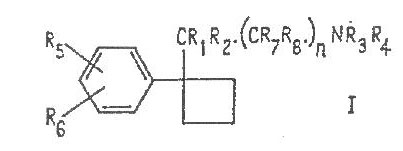
in which n=0 or 1;
in which, when n=0, R1 is a straight or branched chain alkyl group containing 1 to 6 carbon atoms, a cyclo‑alkyl group containing 3 to 7 carbon atoms, a cycloalkylalkyl group in which the cycloalkyl group contains 3 to 6 carbon atoms and the alkyl group contains 1 to 3 carbon atoms, an alkenyl group or an alkynyl group containing 2 to 6 carbon atoms or a group of formula II
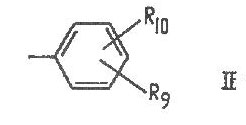
in which R9 and R10, which may be the same or different, are H, halo or an alkoxy group containing 1 to 3 carbon atoms;
in which, when n=1, R1 is H or an alkyl group containing 1 to 3 carbon atoms;
in which R2 is H or an alkyl group containing 1 to 3 carbon atoms;
in which R3 and R4, which may be the same or different, are H, a straight or branched chain alkyl group containing 1 to 4 carbon atoms, an alkenyl group having 3 to 6 carbon atoms, an alkynyl group having 3 to 6 carbon atoms, a cycloalkyl group in which the ring contains 3 to 7 carbon atoms, a group of formula R11CO where R11 is H or R3 and R4 together with the nitrogen atom to which they are attached form an optionally substituted heterocyclic ring having 5 or 6 atoms in the ring which may contain further hetero atoms in addition to the nitrogen atom;
in which R5 and R6, which may be the same or different, are H, halo, trifluoromethyl, an alkyl group containing 1 to 3 carbon atoms, an alkoxy or alkylthio group containing 1 to 3 carbon atoms, phenyl, or R5 and R6, together with the carbon atoms to which they are attached, form a second benzene ring which may be substituted by one or more halo groups, an alkyl or alkoxy group containing 1 to 4 carbon atoms or the substituents of the second benzene ring together with the two carbon atoms to which they are attached may form a further benzene ring;
and in which R7 and R8 which may be the same or different are H or an alkyl group containing 1 to 3 carbon atoms;
and their pharmaceutically acceptable salts. The specification for the British patent listed no fewer than 52 compounds which would comply with this structure. Most of them were in the form of hydrochloride salts. One of them was sibutramine hydrochloride (ie N,N-dimethyl-1-[1-(4-chlorophenyl)cyclobutyl]-3-methylbutylamine hydrochloride).
8 The difficulty which arose with sibutramine hydrochloride, and which the inventors under the patent in suit sought to overcome, was that samples of the compound were found to be hygroscopic, that is to say, they absorbed water from the atmosphere. The result was that variable amounts of water were incorporated depending on the atmospheric conditions under which the sample was stored. According to the specification in the patent in suit:
It is undesirable that hygroscopic materials are used in the preparation of medicines because of the difficulties inherent in the handling of hygroscopic materials. In the preparation of medicines it is essential that a consistent weight of active ingredient is included in each dosage form and it is difficult to achieve such consistency with active ingredients which are absorbing water from the environment.
In the invention the subject of the patent in suit, the solution to this problem was to bind (by hydrogen bonding) to each molecule of sibutramine hydrochloride a single molecule of water, thus creating sibutramine hydrochloride monohydrate. It was found that this compound was not hygroscopic.
9 The claims upon which the applicants rely in their infringement proceeding, and those which the respondent says should be revoked, are the following:
1. N,N-Dimethyl-1-[1-(4-chlorophenyl)cyclobutyl]-3-methylbutylamine hydrochloride monohydrate in which one molecule of water is present for each molecule of N,N-dimethyl-1-[1-(4-chlorophenyl)cyclobutyl]-3-methylbutylamine hydrochloride.
2. Pharmaceutical compositions comprising solid N,N-dimethyl-1-[1-(4-chlorophenyl)cyclobutyl]-3-methylbutylamine hydrochloride monohydrate in which one molecule of water is present for each molecule of N,N-dimethyl-1-[1-(4-chlorophenyl)cyclobutyl]-3-methylbutylamine hydrochloride together with a pharmaceutically acceptable diluent or carrier.
Although it will be apparent that each of these claims is for a compound, the various means by which sibutramine hydrochloride monohydrate might be prepared have, as will appear below, occupied centre stage in the respondent’s case on invalidity.
Novelty
10 Under the Patents Act, an invention is taken to be novel, when compared with the prior art base, unless the invention is not novel in the light of certain categories of information set out in s 7(1). In this case, the respondent contends that the present invention was not novel in December 1985 because the compound the subject of it was disclosed by the British patent. The respondent accepts that the British inventors did not in terms claim to have invented sibutramine hydrochloride monohydrate, and that the British patent did not in terms disclose that compound, but it submits that one of the examples in the British patent was for that compound in the sense that, by following it, one would inevitably produce the compound.
11 The example in the British patent upon which the respondent relies is Example 11, as follows:
The product of Example 10(c) (3.3 g) in the form of the free base, formic acid (2.99 g) and water (1 ml) were mixed with cooling. 37−40% Aqueous formaldehyde (3.93 ml) was added and the mixture heated for eighteen hours at a temperature of 85−95°C. Excess dilute hydrochloric acid was added and the solution evaporated to dryness. The residue was basified with 5N sodium hydroxide solution and the product was extracted into ether. Evaporation of the ether yielded a pale yellow oil which was dissolved in a mixture of propan-2-ol (4 ml) and ether (20 ml) and concentrated hydrochloric acid (2 ml) was added dropwise. The solution was evaporated and the residue dissolved repeatedly in ethanol and evaporated in vacuo to give a gum which was triturated with petroleum ether (b.p. 60−80°) to yield a yellow solid which was recrystallised from acetone. The product was N,N-dimethyl-1-[1-(4-chlorophenyl)cyclobutyl]-3-methylbutylamine hydrochloride (m.p. 195−
197°C). (Formula 1 n=0; R1=isobutyl;R2=H; R3,R4=Me; R5=4-Cl; R6=H).
Example 10(c) was a compound with the following structure (wherein R1, was isobutyl, R5 was chloride and R6 was hydrogen):
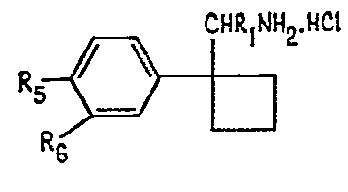
12 Although, according to the terms of the British patent, the product described in Example 11 was sibutramine hydrochloride – not the hydrated form – the respondent contended in the present proceeding that, if that example were followed by a worker skilled in the art, the crystalline product thereof would inevitably be the monohydrate form of the hydrochloride salt, since water was used at a number of stages where the reagents were in solution, and molecules of that water would inevitably bind themselves to the hydrochloride salt upon final re‑crystallisation.
13 The respondent’s contention led to a debate as to the involvement of water in the process proposed under Example 11. Before turning to that aspect, however, it is convenient to lay out the basic chemistry of Example 11, using Prof Easton’s explanation as a reference point. That aspect of the example was uncontroversial.
14 In his affidavit sworn on 16 June 2010, Prof Easton said that the first step was to obtain the free base of Example 10(c):
The purpose of the GB Example is to accomplish a dimethylation, and that reaction requires an amine to react with formaldehyde. Dimethylation would not occur with a hydrochloride salt. The product of Example 10(c) is the hydrochloride salt of an amine, so it must first be converted to the free base which is the corresponding amine.
The next step was to convert the amine group to an N,N-dimethylamino group through treatment with formic acid and formaldehyde. Prof Easton said that this process was the Eschweiler Clarke reaction, and involved the formation and reduction of an imine. By reference to structural diagrams which indicated the reactions which were occurring in the 18 hours referred to in Example 11, Prof Easton said:
The key reagent … is formaldehyde, which reacts with an amine to produce an imine as the first part of the alkylation process. The formic acid then reduces an imine to produce a methylated amine. This reaction occurs a second time to produce the NMe2 group.
15 Prof Easton said that, after the amine synthesis was complete, the remainder of Example 11 –
… is concerned with the preparation and purification of the hydrochloride salt. This involves converting the crude amine to the hydrochloride salt, then back to the free amine and then finally, back into the hydrochloride salt which is then isolated. This is a conventional process of purification of amines and relies on the amines and their hydrochloride salts having different properties from each other and from any impurities that may be present.
Thus the next step was the addition of dilute hydrochloric acid, as a result of which the alkylated amine was converted to its hydrochloride salt. How Prof Easton would have evaporated the solution to dryness after formation of the salt was not uncontroversial, but, for reasons which will appear, nothing turns on the difference between him and Prof Perlmutter at this point.
16 The next step, basification with 5N sodium hydroxide, had the purpose of converting the hydrochloride salt back to the free amine for the purpose of purification. Prof Easton understood from the example that sufficient sodium hydroxide should be used to convert all of the compound into the free amine.
17 The next step, extraction into ether, was explained by Prof Easton as follows:
“The product was extracted into ether” means to me that the product of basifying the residue with 5N NaOH was treated with ether, such that the free amine that had formed dissolved in the ether. The ether solution is then separated from the aqueous solution and the impurities not soluble in the ether are left behind. The aqueous solution is repeatedly treated with ether to maximise the amount of amine recovered.
Following that, the evaporation of the ether was also a step which involved controversy in the present case, but not, as I understand it, in a way that affected one’s understanding of the basic chemistry of the example. It is sufficient to note here, as Prof Easton did in his affidavit, that the result of the evaporation should be a pale yellow oil.
18 The purpose of the next step, according to Prof Easton, was to convert the free amine back to the hydrochloride salt. However:
Ether and concentrated hydrochloric acid are immiscible and the effect of the propan‑2-ol is to create a single phase and allow efficient interaction between the components.
I shall return to the significance of the requirement that the hydrochloric acid be in concentrated form, and that it be added drop-wise.
19 The purpose of the next evaporation, according to Prof Easton, was to remove the volatile organic components, but he did not think that all the hydrogen chloride and water would be removed at this point. Prof Perlmutter took issue with the latter aspect of Prof Easton’s reading of the patent. He said that, if there were an opportunity to evaporate volatiles, it was “standard practice to try to evaporate all volatiles, including, for example, water.”
20 Prof Easton took the view that it was the purpose of the next step – repeated dissolution in ethanol and evaporation – to remove the remaining water and hydrogen chloride. That view was controversial. As I shall note below, Prof Perlmutter did not so view this aspect of Example 11. However that may be (and I shall have to return to the point), the process was supposed to yield a gum, which Prof Easton understood to be “a viscous or sticky substance that resembles substances that are exuded by certain plants.”
21 Prof Easton explained the next step as follows:
It is my experience that a gum often will not crystallise because it contains traces of impurities that are very difficult to remove under vacuum. Trituration in the organic chemistry context means to agitate the gum with a solvent that is chosen to remove these impurities from the gum. Typically, this involves vigorously stirring the solvent in the presence of the gum until a solid material forms. This solid material is usually a suspended powder.
Prof Easton considered that it was implicit in Example 11 that the “yellow solid” the result of the trituration was next isolated before being recrystallised. As to the recrystallisation itself, Prof Easton said:
The yellow solid “was recrystallised from acetone” as a final purification step. This relies on the desired product being more soluble in hot than cold acetone and impurities either not dissolving in hot acetone or staying dissolved even in cold acetone.
The crystalline product of the cooled acetone was, according to the terms of the example, sibutramine hydrochloride.
22 As indicated above, the contentious aspect of Example 11 related to the part which water – or the absence of water – played therein. As Prof Easton read the terms of the example, anhydrous conditions were called for. Prof Perlmutter read the terms of the example differently. He did not perceive any need to employ a strictly anhydrous method. The terms of the example thus conveyed different things to different scientists, each of whom was accepted as a person skilled in the relevant art, and each of whom viewed the matter as he would have done in December 1985. This circumstance raised an interesting question as to the approach which a court should take to the construction of a prior art publication said to be anticipatory, and I shall return to it. I propose first, however, to consider in more detail the reasons given by Profs Easton and Perlmutter for their respective understandings of Example 11.
23 Although there was no shortage of water in the earlier stages of Example 11 (such as the use of dilute hydrochloric acid and 5N sodium hydroxide), Prof Easton identified four specific aspects of Example 11 that conveyed to him the inventors’ intention that anhydrous conditions should be observed. The first was the use of the concentrated form the second time that hydrochloric acid was added in the procedure. Given that dilute hydrochloric acid – the safer form to handle – had been indicated on the first occasion, Prof Easton considered that it was –
… a deliberate choice by the authors of the GB Example to use concentrated hydrochloric acid at this stage of the GB Example. The reason for using concentrated hydrochloric acid here is apparent to me from the steps that follow – that is, to use as little water as possible in order to minimise the difficulty with the removal of water in the following steps.
Prof Perlmutter did not share his colleague’s perception of the point of using the concentrated form of the acid. He said:
Commonly, in my experience concentrated hydrochloric acid is used rather than dilute hydrochloric acid where the product is a salt. This is to prevent the possible dissolution of the salt, which could be soluble in water, during the reaction. The handling of concentrated hydrochloric acid presents no difficulty to an experienced synthetic organic chemist. I consider that the more likely reason for the use of concentrated hydrochloric acid at line 42 of Example 11 of the UK Application is not the difficulty in the subsequent removal of water, which is generally a trivial process, but rather to avoid the loss of the salt by it being dissolved during this reaction.
The evidence of neither witness was relevantly undermined during cross-examination. Prof Easton was not challenged on the appropriateness of his reading of the example, although it was put to him, and he accepted, that, stoichiometrically, there would be enough water even in 2 ml of concentrated hydrochloric acid to produce a monohydrate. When Prof Perlmutter was cross-examined on the subject, he resisted the suggestion that the use of concentrated hydrochloric acid demonstrated that the inventors were concerned about the presence of excess water in the product being manipulated and, in my view, did so credibly.
24 In the light of this evidence, I consider that the skilled addressee, reading Example 11 in 1985, would not regard the specification of concentrated hydrochloric acid as mandating the adoption of anhydrous conditions, or the pursuit of an anhydrous outcome. If he or she were conscious of the importance of excluding water, he or she may have regarded the use of the concentrated form of the acid as consistent with that objective, but, if he or she came to the task with no agenda other than to carry out the example, I do not think that this circumstance would of itself have indicated that water was to be excluded (or minimised).
25 Prof Easton’s second aspect related to the use of ethanol to provide a solution which was repeatedly evaporated and reconstituted. This indicated to him that the inventors had in mind removing all remaining traces of water by azeotropic distillation, a process which makes use of the characteristic of a solution of ethanol and water, in which the water is no more than about 5% of the whole, to evaporate both components in the proportions in which they exist in solution. Prof Easton, recognising that azeotropic distillation was what was required at this point, would have ensured that sufficient ethanol was added each time: in his view, about 40 ml was required. The point was, as I understand it, that 40 ml of ethanol would remove at most 0.42 ml of water each time the procedure was repeated. If smaller quantities of ethanol were used, correspondingly less water would be removed.
26 Prof Perlmutter did not agree. He noted that Example 11 “does not say anything about azeotropic distillation”. He continued:
In any event, my interpretation of this step of Example 11 of the UK Application is that all volatiles needed to be removed before the addition of ethanol. Therefore, there were only trace quantities of water present in the sample prior to the addition of ethanol and I consider that there would have been sufficient ethanol to remove this residual amount of water.
I have referred to Prof Perlmutter’s view that it was the previous step which had the purpose of removing all volatiles at para 19 above. When he said that there “would have been sufficient ethanol”, Prof Perlmutter was referring to a practical implementation of Example 11 which he undertook at the request of the respondents, an area to which I shall return. At the level of his understanding of the terms of the example as such, he expressed the opinion that all but the trace quantities of water to which he referred ought to have been removed in the evaporation step immediately preceding the dissolution of the residue in ethanol.
27 During cross-examination, it was put to Prof Easton that, if the inventors under the British patent had intended the ethanol step to be by way of azeotropic distillation, they could have said so. He did not agree. He said:
I think it’s commonly understood that that’s the purpose of those steps…. [T]he fact that [ethanol is] being added and removed and that process is being repeated … [is] a conventional way of saying that it’s being used to remove something. I mean, the ethanol is added, when it’s being removed it’s taking something else with it and that will be volatiles that are present in the mixture.
Prof Perlmutter accepted that repeated dissolution in ethanol and evaporation in vacuo would have the effect of removing water (and any other volatiles), but he did not read the example as having such a purpose at this step. Although he allowed for the possibility that the purpose was to remove all traces of water, his interpretation of the example was as follows:
[B]ecause there was no specification of how much ethanol to use, … it was there simply to manipulate the material, to put it into a – to change its form, so that it’s easier to work with. And that’s the interpretation we took. Sometimes, if you repeatedly dissolve, and then evaporate material, the nature of the material changes. So it can change in physical form from, let’s say, something that’s very difficult to deal with, to something – to give you an example, things can often change from, let’s say, a gooey gum and you repeatedly treat with a solvent and evaporate. And when you evaporate it might turn into a foam, and that foam can often solidify and then you can work with it much more easily. So there are a number of scenarios there that are possible.
Nonetheless, under cross-examination, Prof Perlmutter accepted that the complete removal of water was a reasonable interpretation of the purpose of this step in Example 11. He also accepted that gums (the stated result of this step) were not as easy to work with as solids, because they could trap impurities.
28 The evidence of Profs Easton and Perlmutter to which I have just referred justifies the conclusion, in my view, that a skilled addressee in 1985 might reasonably have read the ethanol step in Example 11 in one of two ways. He or she well might, but need not, have read the step as requiring the addition of sufficient ethanol to remove all water by way of azeotropic distillation. The fact that the example did not in terms require such a process does not, in my view, exclude the position taken by Prof Easton. It was self‑evident to him that the removal of water by azeotropic distillation was here intended by the inventors, and Prof Perlmutter accepted that such an understanding of the words used was a reasonable one. On the other hand, Prof Perlmutter’s approach, which involved a more literal reading of the example, was also open.
29 Prof Easton’s third aspect related to the trituration with petroleum ether. He said:
The fact that the gum is triturated with petroleum ether suggests to me that all the water has been removed by this stage in the GB Example. This is because petroleum ether and water are immiscible. Therefore, the most obvious impurity at this stage of the GB Example is traces of ethanol that are not volatile by virtue of being trapped in the gum.
Prof Perlmutter’s response to this passage was as follows:
It is unclear to me on what basis Professor Easton makes the assumption at paragraph 2.29 that ethanol would be ‘the most obvious impurity at this stage of the GB example’. Firstly, there is no reason why ethanol would be trapped in the gum and not water. Indeed, it is unlikely that ethanol would remain trapped in the gum while the less volatile water would not. Furthermore, Professor Easton is also not taking into consideration the other impurities that are by‑products of the reaction, which are generally the reason for purification of the product of an organic synthesis reaction by trituration.
As it seems to me, here Prof Perlmutter did not directly engage with the main point being made by Prof Easton, namely, that the very choice of petroleum ether as a trituration medium suggested that all the water had previously been removed.
30 The thrust of the respondent’s cross‑examination of Prof Easton in relevant respects was to suggest to him, in effect, that his perception of the purpose of the use of petroleum ether went no further than to beg the question. Unless one started with the assumption that the inventors intended that there should be no water present at the conclusion of the previous step, there was no reason to view the present step as intended to achieve that state of affairs. Indeed, petroleum ether would not remove water: it would be effective to remove only any remaining unevaporated ethanol. The respondent’s point was that the use of petroleum ether was in no sense inconsistent with the presence of water, and with the production of a hydrate. Prof Easton accepted that, if water were present, it would not be removed by petroleum ether, and that his reading of the purpose behind the trituration with petroleum ether was informed by his view that the ethanol steps were by way of azeotropic distillation. However, he said:
I would expect the trituration to cause problems under those circumstances, because it won’t dissolve the water. So instead of leaving behind a solid material from which all of the solvent has been removed, including the water, it will leave behind solid material plus water. The net result is it’s much more difficult to get crystalline material. Or pure material. … I mean, the petroleum ether, when it’s separated, will leave behind the substance that you’re triturating, plus water.
Which was, of course, exactly the respondent’s point.
31 On the other hand, I am not convinced by Prof Perlmutter’s proposition (set out at para 29 above) that there was no reason why ethanol would be trapped in the gum and not water. The reason, with respect, is that the water might well (and, according to Prof Easton, would) have been removed at (or at least by) the previous step. Prof Perlmutter himself contended that the water and other volatiles would have been removed at the evaporation step prior to the addition of ethanol and that, in his working of the example at Monash, enough ethanol was used to remove whatever water remained. In this state of things, I consider that there is more to be said for Prof Easton’s view that the most obvious impurity likely to be remaining at this point was ethanol. Thus I accept the applicants’ point that the skilled addressee, looking at Example 11 in 1985, would be likely to have regarded the step of triturating with petroleum ether as having the purpose of removing the remaining ethanol.
32 Prof Easton’s fourth aspect related to the use of acetone during recrystallisation. Here it is relevant to note that there are various grades of acetone. Prof Easton gave as examples the “reagent grade” and the “washing grade”, the latter of which is used for the cleaning of laboratory glassware. Acetone is miscible with water: according to Prof Easton, “completely, in all proportions”. Only the highest grade of acetone – described as “analytical grade” or “dry” acetone – is completely free of water (save, according to Prof Easton, for the occasional molecule of adventitious water which can, it seems, never be excluded).
33 The significance of these various grades of acetone is that they provide a context for Prof Easton’s reading of the final, recrystallisation, step in Example 11. He said:
As it is the final purification step, the recrystallisation would be carried out using the highest purity acetone available. Given the efforts extended to remove water in the course of obtaining the yellow solid, I would expect that care would be taken to avoid the introduction of water at this stage.
Prof Easton resisted the suggestion put to him in cross‑examination that, had the inventors intended the use of dry acetone, they would have said so. He said:
No, they would [say] acetone if they mean acetone. I mean, they are saying acetone as a recrystallisation solvent, they’re saying use acetone, which is as pure as practically possible.
34 In an attempt to interpret what the inventors meant by “acetone” in Example 11, the parties referred me to other instances in the British patent where acetone was specified. In Example 15, “aqueous acetone” had been specified, which prompted the applicants to submit that, if the use of aqueous acetone had been intended in Example 11, the inventors would have said so. In Example 16, “dry acetone” was specified, which prompted the respondent to submit that, if the use of dry acetone had been intended in Example 11, the inventors would have said so. In the context of a series of examples addressed to a scientific audience, verbal distinctions of this kind strike me as altogether too nice. I think it quite unlikely that the hypothetical skilled worker, reading Example 11 in a practical way in 1985, would have scoured the detailed terms of the other examples with a view to giving content to the one with which he or she was concerned. I think it much more likely that he or she would have read Example 11 against the background of his or her own practical experience of working with materials, and of using methods, of the kind to which it refers, and would simply have opted for a grade of acetone that made sense to him or her.
35 In the result, I take the view that the intention of Example 11 with respect to the grade of acetone to be employed might well appear differently to different scientists. It did appear differently to Profs Easton and Perlmutter. Neither was wrong in his approach to the matter. What is tolerably clear is that the reference to acetone as such is not sufficient to convey the necessity of performing the example under anhydrous conditions. As Prof Perlmutter effectively said, absent a view, derived from previous aspects of the example, that such conditions should be observed, there is nothing in this fourth aspect which would require the use of dry acetone. On the other hand, if it were appropriate to perceive, in earlier aspects of the example, a need to observe anhydrous conditions, insistence on dry acetone at this final stage would seem to be not only obvious but essential.
36 Of the four aspects of Example 11 referred to by Prof Easton, clearly the second is pivotal. It has the potential to imply that anhydrous conditions should be observed. The others are capable of being read either way, that is, of providing the means by which either anhydrous or non-anhydrous conditions might be observed. As for the second aspect as such, I consider that a key to understanding its purpose is that the residue should be dissolved repeatedly in ethanol and evaporated. Although Prof Perlmutter considered that this process might have been required to produce a material with which it was easier to work, this change of characteristic was something which he encountered “sometimes”. He gave the example of “things [which] can often change from … a gooey gum … into a foam .…” This was, of course, an example only, and Prof Perlmutter made it clear that it did not relate to Example 11. But neither did he suggest that there was anything in Example 11 which carried the implication that a gum would be easier to work with than the solid form resulting from the immediately preceding evaporation. Indeed, he accepted that a gum would conventionally be expected to be more difficult to work with than a solid.
37 By contrast, Prof Easton’s evidence was that the process of repeatedly adding and evaporating ethanol had, as a matter of common understanding, the purpose of removing volatile substances from the material in question. I can, with respect, well understand why, to the scientific eye in 1985, this process would readily be perceived as implying azeotropic distillation. As explained above, at each evaporation stage, water would be drawn out of the material in proportion to the ethanol present at up to a ratio of 5:95. Because of the small quantity of water removed each time, repeated dissolution/evaporation steps were necessary. Each time, the remaining water would become a smaller fraction of the solution resulting from the addition of ethanol. Thus the importance of performing the procedure repeatedly. I accept Prof Easton’s evidence that there is a very obvious sense in which the use of azeotropic distillation would be indicated to the skilled worker in 1985. If so, he or she would, like Prof Easton, have read the example as requiring the observance of anhydrous conditions, particularly subsequent to the ethanol step.
38 That brings me to the work done by Prof Perlmutter and his colleagues (principally his research assistant Dr N Thienthong) in his laboratory at Monash University at the direction of the respondent. They followed (or purported to follow) Example 11. In the result, they produced sibutramine hydrochloride monohydrate. As it happens, although there were a number of respects in which, according to Prof Easton, Prof Perlmutter did not faithfully follow Example 11, the position ultimately adopted by Prof Perlmutter in his oral evidence was that the material which he derived after repeated dissolution in ethanol and evaporation was free of water. He also used analytical grade (ie “dry”) acetone at the final recrystallisation step. Yet it was common ground that the monohydrate could not have formed without water having been present during recrystallisation. Two questions which arise relate to the source of this water, and whether its presence was contemplated by, or implied a departure from, Example 11.
39 The position with which the applicants associated themselves was that, up to the point where ethanol was introduced, aqueous solutions had been used to such an extent as would make it most likely that some water remained. Not taking the view that the purpose of the ethanol dissolution/evaporation step was the removal of water, Prof Perlmutter did not turn his mind to the amount of ethanol that would have been necessary to achieve that purpose (although, as noted above, he later opined that sufficient ethanol had in fact been used to remove such water as may have remained after the previous evaporation step). Instead, according to Prof Easton (who was present as an observer):
I observed that a volume of 9.3 ml of ethanol was added by Dr Thienthong [Prof Perlmutter’s colleague]. In the Experiment, I observed that ethanol was added very carefully so as to almost but not fully dissolve all of the material. This was at the specific direction of Professor Perlmutter. The fact that the sample did not fully dissolve was not recorded in the Laboratory Notebook.
Prof Easton also observed that, at each of three subsequent dissolutions, Dr Thienthong used only about 2.5-3.0 ml of ethanol, making a total of less than 20 ml in all. By contrast, Prof Easton would have used 40 ml each time.
40 It seems that the reason that Dr Thienthong proceeded in the way that she did was because the terms of a protocol, prepared by the respondent to reflect Example 11, required the use of a quantity of ethanol that was “sufficient to dissolve the residue”. In their submissions, the applicants were critical of this passage, and asserted that it introduced a gloss on the actual terms of the example. However, in his oral evidence, Prof Perlmutter pointed to the circumstance that the example required only that the residue be “dissolve[d] … in ethanol” and, in the absence of any indication of the amount of ethanol to be used, he did not consider that he was entitled to use more than was necessary to achieve that end.
41 Notwithstanding that point of contention, Prof Perlmutter asserted that the amount of ethanol added by Dr Thienthong “would have clearly been sufficient to remove the residual amount of water remaining in the sample”. The water which ultimately gave rise to the formation of the monohydrate could not, therefore, on Prof Perlmutter’s view, have resulted from Dr Thienthong not using sufficient ethanol. But the applicants maintained their contention that the water had not all been removed at this stage. To deal with that contention, it is necessary to refer to four further observations which Prof Easton made during the course of Dr Thienthong’s work.
42 Prof Easton’s first observation related to the evaporations which were required by Example 11 after the addition of concentrated hydrochloric acid and again after each dissolution of the material in ethanol. He noticed that the low vacuum pump to which the rotary evaporator was connected emitted “the regular sound characteristic of air intake into the vacuum system”, which he considered would reduce the effective vacuum capacity and render less effective the removal of solvent. Prof Perlmutter said that he did not hear that sound, and noted that Prof Easton had not mentioned it at the time. Under cross-examination, it was put to Prof Easton that this was an instance of the approach which he took to the work being done in Prof Perlmutter’s laboratory, “… not as an expert who is going to attempt to assist the court to resolve a scientific question, but as an advocate lying in wait, to see as many errors as you could ….” Prof Easton rejected that suggestion. He interpreted his role as an observer as inconsistent with any attempt on his part to influence the course of things, and clearly he could not be criticised for taking this position. Save to advert to the fact that Prof Perlmutter did not hear the sound, counsel for the respondent did not challenge Prof Easton’s evidence as such. I am disposed to accept it.
43 The sound emitted by the rotary evaporator was not the only circumstance which gave Prof Easton cause for concern with respect to the effectiveness of that apparatus. He said:
It was apparent to me that the applied rotary evaporator vacuum was weak. The flask containing the solution to be evaporated was connected to the rotary evaporator via an adaptor that is designed to prevent any solvent condensing in the evaporator and running back into the flask. Solvent collected in this adaptor and, as far as I could tell, the volume of that solvent was roughly equal to the amount removed from the flask. Unless the vacuum was very weak, this condensate would not have formed in the adaptor. The adaptor containing the solvent was warm to my touch, indicating that material was not evaporating from the adaptor. This again suggests that the vacuum was insufficient to evaporate ethanol at room temperature (otherwise the adaptor would have become cold).
In his response to Prof Easton, Prof Perlmutter made no reference to this evidence, and Prof Easton was not cross-examined on it.
44 Prof Easton’s second observation was that the high vacuum pump was applied for less than a minute, which he described as “a very brief period”. He said that the pump was stopped at the specific instruction of Prof Perlmutter, notwithstanding that, as he noted from the bubbling of the material, evaporation was continuing. In his own evidence, Prof Perlmutter made no comment about this evidence of Prof Easton and, again, the latter was not challenged on the point when under cross-examination.
45 Prof Easton’s third observation related to the amount of material that remained after the repeated ethanol dissolution/evaporation steps. By measuring the diameter of the surface area of the material in the round-bottomed flask and performing some simple calculations on which he was not challenged, Prof Easton came to the conclusion that the material had “a much greater weight than 2.6 g”, which was the theoretical maximum yield if all the water, hydrogen chloride and ethanol had been removed. This demonstrated to him that “the material was still wet at this stage”. None of these calculations was challenged when Prof Easton was under cross-examination, and Prof Perlmutter did not suggest that Prof Easton’s calculations were wrong, or that the conclusion which he drew from them was inappropriate.
46 Prof Easton’s fourth observation was that, after the final evaporation of the ethanol solution, the material was not in the form of a gum. He said:
I observed that the material used at the start of this procedure was a free flowing solution rather than a gum, as evident from the observation that when a magnetic stirring bar was added to the material as part of the trituration procedure, it sank to the bottom of the flask and was able to stir.
Elsewhere, Prof Easton said that the material he observed was “substantially more fluid” than a gum and was “a free flowing solution”. He specifically contradicted the laboratory notes which had the material as “a yellow sticky oil”. He was also directly at odds with Prof Perlmutter who – while not directly referring to the passages set out above or to Prof Easton’s observation as to the behaviour of the stirrer bar – characterised the material as a “sticky oil” and as being “close to a ‘gum’”. Prof Perlmutter was cross-examined extensively about his observation of the material at this point (he had observed, and recalled, the condition of the material rather than relying simply on Dr Thienthong’s notes). He accepted that the material was not in fact a gum, but he insisted that it was highly viscous, and by no means “free-flowing”. He described the material in the following ways:
• This was not a free-flowing material. A yellow sticky material is something, literally, that if you stuck your fingers into it, it would adhere to your fingers as you pull it away.
• I’d have to say it’s on its way to being a gum. It’s not quite a gum, so I’m trying to think of some material that’s somewhere between an oil and a gum, something that’s very sticky. Glue, let’s say, some glues would possibly be close in consistency.
• No, it was something approaching a waxy substance, let’s say. But not a hard wax, a kind of a soft, waxy substance. That’s the reason for “sticky”.
• [Asked whether, if the material had been in a container that was turned upside-down, it would run out …] No. It would have stayed exactly where it was.
• [When challenged on the previous point …] Okay, if you turned it upside down and waited a while, it might start to slowly ooze. …. But it wasn’t, at all, free-flowing like you – like cooking oil, or something like that.
This evidence seems clearly at odds with Prof Easton’s observation about the stirrer bar, but that aspect of the matter was not clarified.
47 Prof Perlmutter insisted that there was no water in the sticky oil which he observed, since the presence of even a small amount of water would have been visible as beading on the surface, much as water would bead on the surface of a waxy leaf, for example. He expressed this view by reference to the truism that oil and water do not mix, and here was a sticky oil. He gave that evidence orally after Prof Easton had departed. The court does not know, therefore, what Prof Easton would have made of it. It was only at the stage of final submissions that the potential relevance of the circumstance that the only other liquid material which might have been present at this point was ethanol became apparent. Ethanol being miscible with water, I had cause to wonder why the presence of water would necessarily appear as beads on the surface of the material, notwithstanding that it was described as an oil. However, by then it was too late to receive any expert evidence on the point, and I say nothing further about it.
48 In the circumstances, the only conclusion I can reach from the rather unsatisfactory state of the evidence apropos the appearance of the product of the ethanol dissolution/evaporation step is that that product did not take the very form proposed in Example 11: it was not a gum. That circumstance was consistent with the presence of water in the material, but does not of itself justify the conclusion that water was in fact present.
49 However, the other matters observed by Prof Easton, as to which there is little or no dispute, provide important support for his conclusion that water was present. I am particularly struck by the failure of Prof Perlmutter, or of the respondent, to challenge the quantative estimate (approximate though it was) which Prof Easton undertook. Neither did they have any answer to Prof Easton’s evidence that the high vacuum was stopped while the material was still bubbling. When these factors are taken together with the failure of Dr Thienthong to derive a gum – notwithstanding that, on one view, she may have derived something close to a gum – they are sufficient to warrant the conclusion on the probabilities, which I do reach, that there was some water remaining in the material after the ethanol dissolution/evaporation stage.
50 The next stage of Dr Thienthong’s work – trituration with petroleum ether – was also controversial as between Profs Easton and Perlmutter. It was common ground that Dr Thienthong had considerable difficulty achieving the “yellow solid” referred to in Example 11, and that, ultimately, she completed the step effectively by employing an evaporative technique. The applicants, with the support of Prof Easton, submitted that this was outside the terms of Example 11, in that it went beyond trituration as conventionally understood. Prof Perlmutter insisted that it was, in effect, both regular and commonplace for evaporation to be used in aid of trituration. However, what strikes me as potentially important here is not that Dr Thienthong used evaporation, but the difficulties which she encountered in triturating the material. There really was no convincing challenge to Prof Easton’s position that those difficulties might well have implied the presence of something in the material which had not been contemplated by the inventors (ie water).
51 The final step taken in Prof Perlmutter’s laboratory – recrystallisation from acetone – was also significant. By Prof Easton’s observation, the acetone was first heated and, when the amount added to the material did not dissolve the material, the flask containing both was heated. At each stage, the heating was done by placing the relevant container in a water bath which in turn was sitting on a hotplate. Of that procedure, Prof Easton said:
In my experience, it is unusual that the acetone used to recrystallise the material was heated in a water bath sitting on a hot plate. It is also unusual that the flask containing the material was placed in a water bath on a hot plate. In my opinion, a person skilled in the art would have instead placed the conical flask containing the acetone and the flask containing the reaction mixture straight onto the hot plate.
Prof Perlmutter took issue with that evidence. He said:
Professor Easton’s assertion at paragraph 251 of the Statement that a flask of acetone would be placed directly on a hot plate is surprising. To heat any flammable solvent, such as acetone, on a hot plate directly would cause a risk of fire and danger to the chemist and would never be considered routine practice in an organic chemistry laboratory. Now produced and shown to me marked Exhibit PP-35 is a copy of the Material Safety Data Sheet (the Acetone MSDS) for the acetone that was used in the Experiments. It is clearly stated on page 2 of the Acetone MSDS under the heading ‘Handling and storage’ that acetone should be ‘kept away from open flames, hot surfaces and sources of ignition’ (emphasis added). This warning is repeated again on page 8 of the Acetone MSDS under the heading ‘Precautionary statements’.
When taken to this evidence during cross-examination, Prof Easton acknowledged that acetone was a “flammable solvent”. However, he added that “a hotplate was used anyway, it was just there was a water bath in the middle” and reaffirmed his evidence that he would have placed the acetone on a hotplate directly.
52 The significance of this debate is that, as stated by Prof Perlmutter, “[w]ater is highly soluble in acetone” and “acetone readily takes up water from the atmosphere”. Prof Easton said that the use of the water bath would allow for “the potential ingress of water into the material”. That water is likely to have entered the material at this point is, therefore, effectively common ground. Indeed, as I understood him, it was Prof Perlmutter’s position that it was here that the water did enter that led to the formation of the monohydrate. Where Prof Perlmutter departed from the position for which the applicants contended, however, was his evidence that, whether or not a water bath had been used, in normal laboratory work it may be expected that acetone would take up water from the atmosphere, and that the inventors under the British patent might be taken to have assumed that this would occur in any event. Prof Perlmutter said:
It is standard practice to crystallise open to the air. Therefore, in a standard crystallisation procedure with acetone, as indicated in Example 11 of the UK Application, the crystallisation flask would be open to air and therefore atmospheric moisture.
There are specific procedures that may be used to recrystallise in the absence of water from the atmosphere, but these procedures would be specifically stated in any protocol. For example, a Schlenk procedure uses a series of flasks under inert atmosphere so that no air, including moisture, can get in to the sample. This technique is generally only used for highly air sensitive organo-metallic compounds (which are [sic] can explode on contact with air) and not for simple organic compounds such as this.
Prof Easton accepted that the presence of sufficient water in the acetone would lead to the formation of sibutramine hydrochloride monohydrate, and referred to the patent in suit for his view that the water concentration needed to be of the order of 1-2%. It was because of his reading of the example that he would have insisted on “dry” acetone. However, that was the grade of acetone actually used by Prof Perlmutter, and Prof Easton made no comment on Prof Perlmutter’s evidence that, using “dry” acetone, and absent the water bath, sufficient water to generate the monohydrate would have been taken up from the atmosphere. In submissions, the applicants invited me to find that this could never have been the case, but there was no scientific evidence to support that submission.
53 In the result, the questions which I posed for myself at the end of para 38 above must be answered as follows. The water in the material which led to the formation of the monohydrate resulted partly from the incomplete removal of water at the point where the material was repeatedly dissolved in ethanol and evaporated, and partly from the ingress of atmospheric water when the material was dissolved in acetone. The answer to the second question – whether the presence of this water was contemplated by, or involved a departure from, Example 11 – ultimately turns on the terms of the example itself. However, I see no reason not to accept Prof Easton’s evidence that the difficulties encountered by Dr Thienthong in deriving a gum and then triturating the material which she did derive imply a departure from the scheme of things proposed by the inventors. Prof Perlmutter’s explanation was, in effect, that oftentimes there are minor obstacles to be surmounted in any experimental procedure, and the summary terms of explanations such as may be seen in Example 11 do not always cover all the ground that must be traversed. So much may be granted, but I do not think that it provides a fully satisfactory response to Prof Easton. The issues to which he referred were, it seems to me, more than minor procedural obstacles. On balance, I am persuaded that the experience of Prof Perlmutter’s team in performing the example supports the applicants’ case that, as a matter of practical scientific understanding as at 1985, Example 11 required the observance of anhydrous conditions.
54 In the light of the evidence discussed above, was the invention the subject of the patent in suit, insofar as claimed in Claims 1 and 2, novel when compared with the disclosure set out in Example 11 of the British patent? In the respondent’s case as presented in court, I perceive two respects in which it is said that a negative answer should be given to this question. The first is that the example, as construed on the printed page, discloses sibutramine hydrochloride monohydrate. The second is that the preparation undertaken by Prof Perlmutter in his laboratory at Monash in compliance with the example did in fact produce sibutramine hydrochloride monohydrate. To put the matter this way may, of course, be to propose a distinction without a difference, but it does tend to expose both the textual and the experimental dimensions of the present question.
55 Where a prior publication is relied upon as anticipatory, the construction of the publication is a function of the court: The General Tire & Rubber Co. v The Firestone Tyre & Rubber Co Ltd [1972] RPC 457, 485. However, this function must be approached through the notional eyes of the skilled addressee, a person of ordinary skill in the art: H Lundbeck A/S v Alphapharm Pty Ltd (2009) 177 FCR 151, 190 [173]. In such a context, the question is whether the publication discloses the claimed invention: Lundbeck at 190 [173]. In the present case, the British patent does not in terms disclose sibutramine hydrochloride monohydrate: indeed, in terms it discloses sibutramine hydrochloride only, the very compound which has been found to be hygroscopic. However, in the case of a patent for a product (rather than for a process) there will be disclosure if the prior publication “supplies sufficient information to enable a person of ordinary skill to produce the product” in question: Lundbeck at 190 [173].
56 It is this latter proposition which has become important in the present case. In Lundbeck, Bennett J (with the assent of Middleton J) said of the proposition (177 FCR at 192 [182]):
It may be that the prior disclosure is of a method that produces the claimed product. If that method leads inexorably to the product, there is anticipation …. If it may or may not result in the claimed product, there is no anticipation.
In the present case, it was common ground that, for there to be anticipation in the relevant sense, the method described in Example 11 of the British patent must lead inevitably to sibutramine hydrochloride monohydrate. In Lundbeck, Bennett J referred, with apparent approval as applicable to the Australian situation, to what was said by Lord Hoffman in SmithKline Beecham Plc’s (Paroxetine Methanesulfonate) Patent [2006] RPC 10, [22] (see 177 FCR at 193 [184]):
If I may summarise the effect of these two well-known statements, the matter relied upon as prior art must disclose subject-matter which, if performed, would necessarily result in an infringement of the patent. That may be because the prior art discloses the same invention. In that case there will be no question that performance of the earlier invention would infringe and usually it will be apparent to someone who is aware of both the prior art and the patent that it will do so. But patent infringement does not require that one should be aware that one is infringing: “whether or not a person is working [an] … invention is an objective fact independent of what he knows or thinks about what he is doing”: Merrell Dow Pharmaceuticals Inc v H N Norton & Co Ltd [1996] RPC 76, 90. It follows that, whether or not it would be apparent to anyone at the time, whenever subject-matter described in the prior disclosure is capable of being performed and is such that, if performed, it must result in the patent being infringed, the disclosure condition is satisfied. The flag has been planted, even though the author or maker of the prior art was not aware that he was doing so.
His Lordship adverted to a situation in which the ingestion of a previously‑disclosed compound led to the making of the now‑claimed compound in the livers of those concerned. His Lordship continued ([2006] RPC 10 at [23]):
But the infringement must be not merely a possible or even likely consequence of performing the invention disclosed by the prior disclosure. It must be necessarily entailed. If there is more than one possible consequence, one cannot say that performing the disclosed invention will infringe. The flag has not been planted on the patented invention, although a person performing the invention disclosed by the prior art may carry it there by accident or (if he is aware of the patented invention) by design. Indeed, it may be obvious to do so.
His Lordship went on to emphasise that ([2006] RPC 10 at [24]) “anticipation requires prior disclosure of subject-matter which, when performed, must necessarily infringe the patented invention”.
57 Against this brief exposition of the relevant law, I return to the constructional issue which I foreshadowed in para 22 above. It was submitted on behalf of the respondent that the court’s task of construing Example 11 was a conventional one, in the sense that it was necessary to seek, and ultimately to find, the true, or unique, meaning of the text. It was said that, within its relevant specialised context, the task was no different from that undertaken by a court in the construction of any written words. The applicants, on the other hand, submitted that the very circumstance (if it were the case) that the words of Example 11 admitted of no unique meaning in the eyes of the skilled addressee had the potential at least to justify the conclusion that the method described in the example did not lead inevitably to the compound claimed in the patent in suit.
58 On this point, I am disposed to the view that the applicants have the better of the argument. The court must, of course, construe the prior art document, and do so through the eyes of the skilled addressee. But the ultimate question is not what the document means in some absolute sense: it is whether the document discloses the invention in suit either in terms or by mapping out a path which, if followed, would inevitably lead to the compound the subject of that invention. If the document is reasonably open to two or more interpretations, only one of which would lead to the compound of interest, it will, in my view, be impossible to conclude that following the instructions in the document would inevitably lead to that compound.
59 On the respondent’s case, if the skilled addressee set to the task of following Example 11 in the British patent, and did so without any preconception or predilection, he or she would inevitably produce sibutramine hydrochloride monohydrate. Prof Easton accepted that, unless strictly anhydrous conditions were observed, that would be the result. However, the reason for the emergence of the monohydrate form of the compound would be the retention of some of the water that was incidentally involved as carrier of the active chemicals used in the process. That would not of itself be a disqualifying circumstance, of course: if the monohydrate form would inevitably be produced, so be it, however the water came to be there. But the absence of any express teaching of the means by which sibutramine hydrochloride monohydrate is produced in Example 11 provides a context for a reading of the example along the lines proposed by Prof Easton. He was a skilled addressee, and read the example as requiring the observance of anhydrous conditions. Specifically with respect to the ethanol step, he regarded it as self-evident that the method there being proposed involved azeotropic distillation. As mentioned above, Prof Perlmutter accepted that, while it was not a reading of the example which he himself favoured, it was a reasonable one.
60 In this state of the evidence, I am in no position to conclude, favourably to the respondent, that sibutramine hydrochloride monohydrate would inevitably be the result of carrying out Example 11 in the British patent. Indeed, for reasons given at paras 36 and 37 above, I am somewhat inclined to favour the reading of the example proposed by Prof Easton, namely, that all the then remaining water was to be removed at the ethanol step, and that thereafter anhydrous conditions should be observed. However, it is not necessary that I should go that far to deal with this aspect of the respondent’s defence and cross‑claim. It is enough for the applicants if I conclude, as I do, that the skilled addressee in 1985 might reasonably have read the example in the way proposed by Prof Easton.
61 That conclusion is probably sufficient for the applicants’ purposes, but it is necessary to consider also whether it is contradicted by the results of the work undertaken by Prof Perlmutter’s team at Monash. If there are two possible understandings of Example 11, the fact that Prof Perlmutter obtained sibutramine hydrochloride monohydrate when he proceeded in accordance with one of those understandings must, of course, be regarded as inconclusive apropos the question presently under consideration. I consider, however, that, if anything, Prof Perlmutter’s work tends to reinforce the position on interpretation taken by Prof Easton. In the respects to which I have referred at paras 49-51 above, Dr Thienthong obtained intermediate materials which appeared not to be in the form specified in the example. Where the question is whether following that example would inevitably yield the compound of interest, I take the view that these deviations from the path laid out by the inventors substantially compromise the utility of the procedure as a means of answering that question. If a laboratory preparation is to be held out as proof of the inevitability of a particular result, the process used, and all the indications along the way, should, in my view, correspond, very closely if not exactly, with every integer of the prior art relied on. Quite clearly, this was not the case in the work supervised by Prof Perlmutter. I am disposed to the view that that work provides a deal of support for Prof Easton’s interpretation of Example 11.
62 For the above reasons, I am not satisfied that Claim 1 of the patent in suit was anticipated by Example 11 in the British patent. Indeed, I think it was not. It follows that neither was Claim 2 so anticipated.
Inventive step
63 Under the Patents Act, an invention is taken to involve an inventive step, when compared with the prior art base, unless the invention would have been obvious to a person skilled in the relevant art in the light of the common general knowledge as it existed in Australia before the priority date: s 7(2). In the context of an invention such as that covered by the patent in suit, the obviousness question should be formulated as follows:
Would the notional research group at the relevant date, in all the circumstances, which include a knowledge of all the relevant prior art [and of the fact that sibutramine hydrochloride was hygroscopic] directly be led as a matter of course to try [forming the monohydrate] in the expectation that it might well produce [a non‑hygroscopic compound]?
Aktiebolaget HÄssle v Alphapharm Pty Ltd (2002) 212 CLR 411, 433 [53].
64 Dr Marshall was presented with the problem which the inventor presumptively faced without having seen, or being informed of, the patent in suit. The respondent’s solicitors did so in terms which Dr Marshall described as “the hygroscopicity question”. That question was as follows:
An earlier document describes preparative methods which would be suitable for the preparation of [sibutramine] hydrochloride. It has been found that different samples of [sibutramine] hydrochloride prepared by methods described in the document have variable amounts of water contained therein and that these samples are hygroscopic.
It is undesirable that hygroscopic materials are used in the preparation of medicines because of the difficulties inherent in the handling of hygroscopic materials. In the preparation of medicines it is essential that a consistent weight of active ingredient is included in each dosage form and it is difficult to achieve such consistency with active ingredients which are absorbing water form the environment.
Faced with this problem in December 1985, what would you have done?
It was only after providing his response to the hygroscopicity question that Dr Marshall was provided with a copy of the British patent.
65 As required, Dr Marshall approached the hygroscopicity question by reference to what he knew, and to how he would have approached the matter, in December 1985. First, he would have “scope[d] out” the problem being described. He would have investigated the “earlier document” referred to in the question. To Dr Marshall, the first paragraph of the hygroscopicity question suggested that there may be more than one method of preparing sibutramine hydrochloride described in the earlier document. If so, Dr Marshall surmised that each of these methods may not all result in hygroscopic products, and he would have investigated that. If the sibutramine hydrochloride was crystalline, Dr Marshall said that he would have investigated whether there was a direct correlation between the degree of hygroscopicity and the hydration state of the compound, adding that “[i]t was straightforward to characterise the degree of hygroscopicity and the hydration state using routine analytical techniques”.
66 Dr Marshall would have determined the processes that were used to prepare the problematic samples of sibutramine hydrochloride. This may have revealed to him where the water came from, and whether it was bound in the crystal structure of the compound (assuming the compound to be a crystalline one) or whether it was unbound. This process would also have informed him whether the compound was in an amorphous or crystalline form. The earlier document may have provided information on the melting point of the compound, which would have been useful as an indication of purity.
67 Dr Marshall would have investigated the extent of the hygroscopicity of different samples of the compound, to determine whether “this was in a fact a critical problem which needed to be addressed”, and would have checked the published literature to determine whether there was any information on the physico-chemical properties of the compound. In the absence of such information, he would have arranged for experimental characterisation of the water content of samples of the compound, using routine analytical techniques such as loss of water on drying to constant weight or Karl Fischer analysis.
68 Dr Marshall also surmised that there may be a correlation between the degree of purity of the compound, and the degree of hygroscopicity. If impurities were identified, he would have purified the product, and re-characterised it to determine whether this made a difference to hygroscopicity. For example, he said, it might have been possible to produce an anhydrous form using a non-water based solvent, and to test whether that form was hygroscopic. He would have looked for a cost‑effective, simple, solution to the hygroscopicity problem, so long as that was viable with respect to other physico-chemical and biological aspects of the drug. In his affidavit, Dr Marshall continued:
For example, if I observed a correlation between the hydration state of the crystalline compound and degree of hygroscopicity, I would have looked to see if it was possible to use the hydrated form having the least (or no) hygroscopicity without compromising other aspects of drug performance. That is, a less or non‑hygroscopic form would be chosen as the form of the active drug to be used in the formulation, as long as that form did not have a negative impact on other desired characteristics.
He added that, in 1985, the steps which he described above would have been carried out as a matter of routine.
69 In describing a series of different steps to which he would have had resort as a matter of routine, Dr Marshall was, in my view, in effect identifying alternatives that would have been “worth trying”, or even “obvious to try”. That approach does not appropriately address the question posed by s 7(2) of the Patents Act: Aktiebolaget HÄssle 212 CLR at 438-443 [66]-[76]. What Dr Marshall proposed amounted, in my view, to what has been described as “[varying] all parameters or [trying] each of numerous possible choices until one possibly arrived at a successful result”: In re O’Farrell (1998) 853 F.2d 894, 903, approved in Aktiebolaget HÄssle at 442 [76].
70 Prof Easton gave evidence that, as at 1985, there was no necessary, nor even usual, connection between the hygroscopicity of a compound and the hydration state of that compound. That is to say, the circumstance that a compound was a hydrate did not mean that it would not also be hygroscopic. There was no way of knowing, from the basic chemistry of a compound, whether the compound would, or would not, prove to be hygroscopic. As pointed out on behalf of the applicants, there was nothing in the published prior art which taught that a monohydrate would not be – or was even unlikely to be – hygroscopic. The respondent referred to publications, available in 1985, which described the various means by which water may exist in the environment of a crystalline lattice compound, but nothing in these works went to the extent of teaching that the way to render an otherwise hygroscopic compound non‑hygroscopic was to produce it in the monohydrate form. Indeed, even today as I understand it, there is no such general proposition applicable to all anhydrous compounds.
71 Prof Easton was also presented with the problem faced by the inventors under the patent in suit, and he too had not seen the patent at the time when he provided his answer on affidavit. It was not suggested by the respondent that, when Prof Easton was considering the problem, he had any notion as to the nature of the answer which would serve the interests of those who had retained him. He proposed a number of means by which the hygroscopicity problem might be overcome, none of which involved resorting to the formation of a monohydrate. Indeed, the path which he would have tended to follow would have involved exploring the possibility of using compounds other than sibutramine hydrochloride (such as other sibutramine salts) being equally efficacious from a pharmaceutical point of view. The respondent criticised him for thinking along these lines, submitting that the abandonment of the compound which had been shown to be pharmaceutically effective in favour of a completely different compound was a “fanciful” approach to the problem. The present question, however, is not whether Prof Easton’s alternative approaches were fanciful: it is whether the uninventive skilled addressee would, in 1985, have found it obvious to opt for the monohydrate form of sibutramine hydrochloride as a means of overcoming the hygroscopicity problem. Quite clearly, Prof Easton’s evidence goes no distance towards suggesting an affirmative answer to that question.
72 Although not called with respect to the question of obviousness, Dr Rowe was cross-examined extensively on that question. To the extent that the respondent relied on this evidence, its ability to do so was compromised by the circumstance that Dr Rowe was well aware of the patent in suit, and of the solution to the hygroscopicity problem proposed in it, when his evidence was given. Even so, I had the impression that Dr Rowe attempted to answer the respondent’s questions in a direct and impartial way, placing himself in the position that he might have occupied in 1985. His initial solution to the hygroscopicity problem was to take what he described as “the simple approach”. Although it would depend on the degree of hygroscopicity involved, if it were a tablet concerned, Dr Rowe would have first considered coating it with a water‑impermeable barrier; or he might have used “something like silicone dioxide to mop up the moisture”; or he might have used special packaging of the kind used for “effervescent type products for hangover cures”. Alternatively, Dr Rowe might have taken the course of “forming another salt”. The respondent pointed out that, once one chose to follow the latter path, one would effectively have a different drug, and would be required to obtain registration on the Register of Therapeutic Goods anew. Those kinds of practical, or commercial, considerations do not, however, address the issues of chemistry implicitly involved in identifying the obvious solution to the hygroscopicity problem. Quite clearly, there is nothing in the evidence of Dr Rowe that would provide support for the proposition that it would have been obvious to a skilled worker in the art in 1985 that that solution should be found by resorting to the monohydrate form of the compound.
73 Much of the evidence upon which the respondent relied in presently relevant respects related to the tendency of crystalline compounds to exist in polymorphic forms. In this respect they pointed out that solvates (including hydrates) of a compound are rightly described as pseudo‑polymorphs. The court was, in effect, taken on a voyage of discovery – both in the evidence of Dr Marshall and in the cross-examination of Prof Easton – with respect to the abundance of polymorphic forms, including pseudo‑polymorphic forms, of compounds which existed as crystalline solids. In my view, all of this involves something of an excursus from the central point involved on the question of obviousness. That point is not whether it might be readily expected that different crystalline compounds might form hemihydrates, monohydrates, dihydrates etc, and if so how readily. The question rather, is whether resort to the monohydrate form of sibutramine hydrochloride would, to the uninventive skilled worker in 1985, have been an obvious way of rendering the compound non‑hygroscopic. Unprompted by the recourse to the patent in suit, no witness in the present case gave evidence that he would, as a matter of course, have followed that path in the expectation that it might well have yielded positive results. As I have said, neither was there anything in the published literature to the effect that the way to eliminate the hygroscopicity of a crystalline compound was to prepare it as a monohydrate.
74 For the above reasons, I am not persuaded that the formation of the monohydrate would, to the uninventive skilled worker in December 1985, have been the obvious solution to the problem presented by sibutramine hydrochloride being hygroscopic.
Manner of manufacture
75 The respondent contended that, so far as claimed in Claims 1 and 2, the invention the subject of the patent in suit was not a manner of manufacture within the meaning of s 6 of the Statute of Monopolies: see s 18(1)(a) of the Patents Act. It submitted, and the applicants accepted, that the invention should not be regarded as a manner of manufacture if it should appear on the face of the specification “that the subject matter of the claim is, by reason of absence of the necessary quality of inventiveness, not a manner of new manufacture for the purposes of the Statute of Monopolies”: N V Phillips Gloeilampenfabrieken v Mirabella International Pty Ltd (1995) 183 CLR 655, 663-664. It was submitted on behalf of the respondent that the present case was in the same category as, or at least analogous to, Commissioner of Patents v Microcell Ltd (1959) 102 CLR 232, where the application of synthetic resinous plastic material, reinforced with mineral fibres, to the construction of self-propelled-rocket projectors was regarded as no more than a new use for a known material. In that case, the High Court said (102 CLR at 251):
We have in truth nothing but a claim for the use of a known material in the manufacture of known articles for the purpose of which its known properties make that material suitable. A claim for nothing more than that cannot be subject matter for a patent, and the position cannot be affected either by the fact that nobody thought of doing the thing before, or by the fact that, when somebody did think of doing it, it was found to be a good thing to do.
76 I was also referred to Merck & Co Inc v Arrow Pharmaceuticals Ltd (2006) 154 FCR 31, 51-52 [63], where the Full Court said that the following propositions had been established by the authorities:
1. The opening words of s 18(1) (“a patentable invention is an invention that”) impose a threshold requirement that the “patentable invention” be an “invention”, that is to say an “alleged” “manner of new manufacture” within s 6 of the Statute of Monopolies (Philips at 663).
2. That requirement will not be met if, on the face of the specification, the subject matter:
(a) lacks the necessary quality of inventiveness under the Statute of Monopolies (Phillips at 664);
(b) is not new (NRDC at 262; Philips at 664).
3. A new use of an old substance is not an invention if its known properties make it suitable for that use – in such a case the new purpose is “no more than analogous to the purposes for which the utility of the substance is already known” (NRDC at 262).
4. But there will be an invention if the new use consists in taking advantage of a hitherto unknown or unsuspected property of the substance (NRDC at 262).
77 The respondent relied upon what it claimed to be the uncontroversial circumstance that, if sibutramine hydrochloride were left exposed to air, it would inevitably be converted into the monohydrate form. This was something which, according to the respondent, appeared on the face of the specification. It relied upon the following passage in the specification:
Alternative methods to prepare N,N-dimethyl-1-[1-(4-chlorophenyl)cyclobutyl]-3-methylbutylamine hydrochloride monohydrate in which one molecule of water is present for each molecule of N,N-dimethyl-1-[1-(4-chlorophenyl)cyclobutyl]-3-methylbutylamine hydrochloride include (a) contacting solid N,N-dimethyl-1-[1-(4-chlorophenyl)-cyclobutyl]-3-methylbutylamine hydrochloride, preferably in finely divided form, with a gaseous medium consisting of or containing water vapour and (b) suspending N,N-dimethyl-1-[1-(4-chlorophenyl)-cyclobutyl]-3-methylbutylamine hydrochloride in water or a water-containing medium.
The respondent relied also upon Claim 10 in the patent in suit, as follows:
A process for the preparation of N,N-dimethyl-1-[1-(4-chlorophenyl)cyclobutyl]-3-methylbutylamine hydrochloride monohydrate in which one molecule of water is present for each molecule of N,N-dimethyl-1-[1-(4-chlorophenyl)cyclobutyl]-3-methylbutylamine hydrochloride as claimed in claim 4 comprising contacting solid N,N-dimethyl-1-[1-(4-chlorophenyl)-cyclobutyl]-3-methylbutylamine hydrochloride with a gasaous [sic] medium consisting of or containing water vapour.
It was submitted that, by their very claims in the patent in suit, the applicants had, in effect, “recited [themselves] out of court”: Chapman and Cook and Lectro Linx Ltd v Deltavis Ltd (1930) 47 RPC 163, 173, cited in Lockwood Security Products Pty Ltd v Doric Products Pty Ltd (No 2) (2007) 235 CLR 173, 211.
78 In resolving the present point, it is to be remembered that the claims under challenge are both product claims. That circumstance was not reflected in the following passage in the respondent’s written submissions:
In the present case, the invention claims a process for preparation of the monohydrate whereby the compound is contacted with a gaseous medium including water vapour, i.e. air.
In short, such a process simply takes advantage of the presence of water as a necessary component of the surrounding air, rather than asserting any new method of manufacture. The position is stronger than Microcell.
This minor point of confusion was clarified in the respondent’s oral submissions, where it was emphasised that a “manner” of manufacture was a “kind” of manufacture, not a method of manufacture, and thus applied to compound, or product, claims as much as to process claims. It was pointed out that the claimed invention in Microcell was a product, yet it was held not to amount to a manner of manufacture.
79 The difficulty facing the court in the present case is not resolved by a straight‑line application of the verbal formulae which the respondent derived from the decided cases. Sibutramine hydrochloride monohydrate was not, in 1985, a “known substance”, or a “known material”, for which a new use was ostensibly found. The present case is not, like Microcell, one in which a known material is used for the first time in the manufacture of an existing product. Neither is it, like Merck, one in which a known drug is to be administered according to a new dosage regime. As a compound, sibutramine hydrochloride monohydrate was, in 1985, a new thing in itself which, at least loosely, was “invented” by the work protected by the patent in suit. The respondent’s point, rather, was that sibutramine hydrochloride was a known compound in 1985, and, if one were to take no step other than to leave it exposed to the normal atmosphere (ie “leave it on the shelf” as it was occasionally put), the compound claimed to have been invented would come into existence of its own accord. That compound could not, therefore, be regarded as a manner of manufacture.
80 In support of this aspect of its case, the respondent referred to the evidence of Dr Rowe and of Prof Easton, both called by the applicants. It submitted that their evidence showed that the skilled addressee’s reading of the specification was that the monohydrate would in fact form when the known product was left “in air”. Dr Rowe was taken to the following experiment referred to in the specification, the purpose of which was, no doubt, to draw attention to the contrast between sibutramine hydrochloride and its monohydrate form with respect to hygroscopicity:
The non-hygroscopic nature of products prepared in the Examples hereinbefore is illustrated by the following comparative experiment. A sample of N,N-dimethyl-1-[1-(4-chlorophenyl)cyclobutyl]-3-methylbutylamine hydrochloride was dehydrated in a vacuum oven at 60°C for 16 hours and stored in a dessicator over phosphorus pentoxide. Analysis showed that this material contained no water. When the sample was exposed to the atmosphere for one month analysis showed the water content to be approximately 3% corresponding to about 0.6 molar equivalents of water. However, when a sample of N,N-dimethyl-1-[1-(4-chlorophenyl)cyclobutyl]-3-methylbutylamine hydrochloride monohydrate was exposed to the atmosphere for five months there was no increase in water content showing that no absorption of water had occurred.
When asked (by the court) whether this experiment implied that the water being taken up by the unhydrated form of the compound was, gradually, being bound to individual molecules, and thus hydrating them, Dr Rowe said that it was “a possibility” and continued:
What I would have liked to have seen was that the experiment performed for longer than a month, to see when the moisture stopped being taken up. In other words, it went up and up and up to three per cent. Did it, in fact, go to 5.4 per cent or thereabouts and then stop? Like similar to the second part of the experiment. If that data was there, I’d say, yes, that’s more than likely convinced me that that’s what’s happening.
81 Counsel for the respondent then took Dr Rowe to Claim 10 in the patent in suit, after which cross-examination proceeded as follows:
Now, in that case, we contact the anhydrous hydrochloride – that’s the starting point, isn’t it? Yes.
And we contact with a gaseous medium consisting of or containing water vapour? Yes.
And we know that in that case, if the claim works, that the water vapour is a source of water which goes into the crystal? That’s – yes, this process converts the anhydrous hydrochloride to the monohydrate, as it says in line – the third line down of the claim.
So we know that if the claim is – works, the – we’re being told, aren’t we, that a gaseous – that if you contact the hydrochloride and hydrosalt with a gaseous medium consisting of or containing water vapour, you will get a crystalline structure with one molecule of water to one molecule of the salt? That’s how I read it, yes.
So, in short, this claim relies on a property of the hydrochloride salt, that it does take up water from a gaseous medium containing water vapour and put it into the crystal? Yes. The monohydrate, to me, means a water of crystallisation, yes.
So if you read the – what one sees on page 9, that we have just been discussing, and assume that Claim 10 works, the – then it’s likely, isn’t it, that the process of claim that we see on page 9 is that that water content is going into the crystal form, forming monohydrate? Yes. I’d accept, taken in conjunction with Claim 10, if Claim 10 is correct then that’s probably what is happening.
82 In the course of his evidence, Prof Easton dealt, amongst other things, with the distinction between the take-up of water by a hygroscopic compound and the formation of a hydrate. He referred to that part of one of his affidavits in which he had stated that the existence of a hydrate was the exception rather than the rule, and that he would not expect a hydrate to form when a hygroscopic compound was simply left in air. He was, however, taken to Claim 10 of the patent in suit by counsel for the respondent, and asked to assume that he “had no further information” and that “this claim is working”. He agreed that, in such a case, “the water would be going into the crystal lattice in the stoichiometric one‑to‑one ratio” (as it was put to him by counsel). This evidence, and that of Dr Rowe referred to above, led the respondent to submit that, to a skilled addressee, the information conveyed by Claim 10 was that sibutramine hydrochloride monohydrate would form if the unhydrated form of the compound were left in the air.
83 It was submitted on behalf of the applicants that the patent in suit did not disclose that sibutramine hydrochloride monohydrate would form merely from exposure to air. They pointed out that the respondent’s own witnesses – Prof Perlmutter and Dr Marshall – had not suggested in chief that they would understand the patent as proposing that the monohydrate would necessarily form upon exposure to air, with nothing else. They pointed out that the passages in the specification, and in Claim 10, relied on by the respondent contained no teaching as to temperature, pressure or time; neither was there any indication of the amount of water that would need to be present in the gaseous medium. They submitted that, properly understood, the evidence of Prof Easton and of Dr Rowe did not go to the point of accepting that the monohydrate form would inevitably come into existence merely upon leaving the anhydrous form of the compound exposed to air. It was submitted that the specification as a whole, including the claims, did not disclose that sibutramine hydrochloride monohydrate had ever in fact been produced by the means proposed in Claim 10. With respect to the claim as such, it was said that this did not amount to a disclosure, but merely to an assertion of the monopoly which the applicants claimed, such that, if someone did happen upon sibutramine hydrochloride monohydrate by a process which involved nothing more than leaving the anhydrous form of the compound exposed to a gaseous medium containing water vapour, that person would have infringed the patent.
84 I must say, with respect, that there was something slightly surreal about the positions adopted by the parties with respect to the manner of manufacture point. For its part, the respondent submitted that there was no new manner of manufacture involved here because, under conditions which were disclosed on the face of the patent, sibutramine hydrochloride monohydrate would form itself, without human intervention. Yet the respondent’s own witnesses did not give evidence that, as persons skilled in the art reading the patent, they would have so understood the disclosure. The respondent’s evidentiary case, in relevant respects, was pieced together by a series of logical building blocks, which largely consisted of propositions to which the applicants’ witnesses were prepared to agree under cross‑examination – that air was a gaseous medium containing water vapour, and that Claim 10 proposed a method which “worked” – the result of which was that the uptake of atmospheric water would, over time, inevitably produce the monohydrate. Thus the respondent’s case appeared to be that the hygroscopicity problem was, in effect, self‑curing.
85 For their part, the applicants responded to the respondent’s manner of manufacture submissions by pointing out that nothing on the face of the patent disclosed that Claim 10 actually “worked”. In this respect, the applicants came very close to running a fair basis case against themselves in relation to Claim 10. In effect, they submitted that one of the means by which it was claimed that sibutramine hydrochloride monohydrate could be produced was not a means at all. They were able to take this approach, of course, because Claim 10 is not under challenge in the present proceeding.
86 In my view, sibutramine hydrochloride monohydrate is a manner of manufacture. The starting point is that it was not a known compound in 1985. It was the work of the present inventors which brought it into existence. Neither did the compound amount to no more than a new application for a previously known compound. Indeed, sibutramine hydrochloride monohydrate had a characteristic – non‑hygroscopicity – which clearly marked it out from what was then the most closely‑corresponding known compound. Assuming for the moment that Claim 10, and the corresponding passage in the consistory clause, disclosed that sibutramine hydrochloride monohydrate could be prepared – and would form of its own accord – if sibutramine hydrochloride were left exposed to the air, I do not accept that this would disqualify the compound as such, as claimed in Claims 1 and 2, from status as a manner of manufacture. The circumstance that sibutramine hydrochloride monohydrate could be prepared by leaving sibutramine hydrochloride exposed to the air does not, in my view, detract from the underlying inventiveness involved in coming up with a compound that did not previously exist. Put another way, the fact, if it be a fact, that one method of preparing the new compound may not have been a manner of manufacture does not mean that the compound itself was not a manner of manufacture.
87 As it happens, I am not prepared to accept that the manner of manufacture point must be determined by reference to the assumption referred to in the previous paragraph. Neither the specification nor Claim 10 states, in terms, that the gaseous medium there referred to may be air, or that sibutramine hydrochloride monohydrate will inevitably form if sibutramine hydrochloride is merely left exposed to the air. The relevant words in the consistory clause are, in my view, a shorthand description of a means by which the newly‑invented compound might be prepared. It is not to be assumed that particular conditions – as to the duration of the exposure and the content of water in the gaseous medium, for example – would not be required. The inventors were not here merely saying that they had hit upon something which existed in nature in the normal run of things.
88 It is also significant that the specification does not disclose, on its face that sibutramine hydrochloride monohydrate has ever been made by leaving sibutramine hydrochloride exposed to the air. The closest the specification goes is in the experiment to which I have referred in para 80 above, where 0.6 molar equivalents of water were taken up by the anhydrous compound after one month of exposure to the atmosphere. Even that disclosure does not amount to a statement that the take‑up of water in this way corresponds with a gradual process of hydration, as it were. To the contrary: the point of the experiment, and the teaching which it conveys, is to show that the anhydrous form is hygroscopic, whereas the monohydrate is not.
89 Although Prof Easton and Dr Rowe were invited, under cross‑examination, to assume that the process claimed in Claim 10 “worked”, it was not established on the evidence that that process did work, or would work. There was no example or experiment proffered in the specification in support of Claim 10. Looking only at the patent itself, I am disposed to think that the relationship between Claim 10 and the complete specification is at least as likely to amount to a fair basis deficiency in the claim as to an indication of an established means by which sibutramine hydrochloride monohydrate might be prepared. This is, in a sense, a consideration lying on the margin of the present controversy, and I was not addressed – at least directly – on it. For that reason, I shall say nothing further about it than to note that, looking only at the patent on its face, want of inventiveness in Claims 1 and 2 is not the only plausible explanation for the existence of Claim 10, and its relationship with the specification as a whole.
90 Finally on this question, I am disposed to accept the submission made on behalf of the applicants that Claim 10 is put forward not as a known way to prepare sibutramine hydrochloride monohydrate, but as a statement of the scope of the monopoly marked out by by the patentee: Shave v H V McKay Massey Harris Pty Ltd (1935) 52 CLR 701, 708. Thus it should not be taken from the words of the claim considered alone that sibutramine hydrochloride monohydrate would form if sibutramine hydrochloride were exposed to a gaseous medium containing water vapour. Rather, if someone did prepare sibutramine hydrochloride monohydrate that way, it would fall within the area of monopoly marked out by the patent.
91 For the above reasons, I reject so much of the respondent’s invalidity case as proposes that the invention, insofar as claimed in Claims 1 and 2, is not a manner of manufacture.
False suggestion
92 The final aspect of the respondent’s cross-claim is that the patent in suit should be revoked pursuant to s 138(3)(d) of the Patents Act, on the ground that the patent was obtained by false suggestion. Although the terms of the specification and claims as at the time when the patent was applied for are not in evidence, it may be inferred that in both the compound was described as sibutramine hydrochloride monohydrate. In his report under s 48 of the 1952 Act dated 13 December 1989, the examiner said:
The claims as a whole do not define the invention as the monohydrate should be referred to as the monohydrate “substantially free of other hydrated forms” to clearly distinguish it from the disclosed hygroscopic variety as seen on page 1a.
This is based on the belief that on taking up water, the compound becomes a hydrate, in at least part of the mixture.
93 In response to that report, the then applicant (The Boots Company Plc) filed a series of proposed amendments, the effect of which was stated in the letter of their patent attorneys to the Commissioner on 14 June 1990:
Amendments have been proposed in answer to the Examiner’s objections. The specification and claims have now been amended to define N,N-Dimethyl-1-[1-(4-chlorophenyl)cyclobutyl]-3-methylbutylamine hydrochloride monohydrate in which one molecule of water is present for each molecule of N,N-dimethyl-1-[1-(4-chlorophenyl)cyclobutyl]-3-methylbutylamine hydrochloride. It is submitted that the invention is now clearly distinguishable over the admitted prior art.
Each time sibutramine hydrochloride monohydrate was referred to in the specification, and in the claims, as proposed to be amended, it was followed by the words “in which one molecule of water is present…” set out in the passage above. The amendment was allowed, and the patent proceeded to grant in the amended terms.
94 In the present proceeding, it was common ground that, as a matter of chemical definition, the words inserted by the amendment to the patent added nothing to the naming of the compound as a monohydrate. That is to say, by definition, a monohydrate is one in which one molecule of water is present for each molecule of the basic compound. The respondent’s false suggestion point proceeds from an acceptance of that proposition. It says that the letter of 14 June 1990, by stating that, if the specification and claims were amended as proposed, “the invention is now clearly distinguishable over the admitted prior art”, implied that the amendment would make a difference. The letter implied, in other words, that, whereas the previous terms of the specification and claims would not have sufficiently distinguished the invention from the British patent, the amended form would do so. According to the respondent, that was a false suggestion: in truth, the amendments made no difference.
95 I do not think there is anything in the respondent’s false suggestion point. The applicants made no representation about the existence, absence or scope of the prior art, or about the nature or characteristics of the compound the subject of the proposed patent. Accepting that the applicants claimed to have invented a monohydrate which was “substantially free of other hydrated forms”, the examiner merely required a form of words in the specification and claims that would make that clear. The examiner appeared to take the view that the British patent disclosed a “hygroscopic variety” of sibutramine hydrochloride, and that this might have involved “other hydrated forms”. The amendment proposed by the applicants merely expressed in words the essence of what they had invented, such as to make it clear that the compound was free of other hydrated forms (which it was). The suggestion that this made the invention “now clearly distinguishable” over the British patent was not, in my view, a false one.
96 I reject the respondent’s application for revocation under s 138 of the Patents Act.
Infringement
97 Ultimately, the respondent’s defence to the applicants’ infringement case was but faintly put. It is established on the evidence, and the respondent accepts, that the compound which it proposes to make and to market is sibutramine hydrochloride monohydrate. It is true that the samples of the respondent’s products which were tested by the applicants were found to have amounts of water present which varied slightly from the theoretical content of 5.4% w/w. However, these slight variations might have arisen from the imprecision involved in the measuring procedures used, and from the presence of very small amounts of surface‑adsorbed water. The respondent did not take issue with that proposition.
98 In final submissions made on its behalf, the respondent proposed, in effect, that it would have to succeed either on the false suggestion point or on infringement. If the stated requirement of precise molar equivalence should be understood as having added something to the description of the claimed compound as sibutramine hydrochloride monohydrate, then the respondent’s compound did not infringe, as there was not precise molar equivalence. If, on the other hand, the requirement for precise molar equivalence added nothing to the claim that the compound in question was a monohydrate, then the grant of the patent had been achieved on a false suggestion. These alternatives were described by counsel for the respondent as the two edges of a single sword; and they made it clear that they regarded the false suggestion point as manifestly the sharper of the two.
99 I did not understand it to be proposed on behalf of the respondent, however, that an otherwise sound infringement case would inevitably be compromised by the applicants’ success on the false suggestion point. Clearly that could not be so. In my view, the proposition that the compound covered by Claims 1 and 2 is one in which one molecule of water exists for every molecule of sibutramine hydrochloride is not inconsistent with the conclusion that the respondent’s compound – admittedly sibutramine hydrochloride monohydrate – falls squarely within those claims. I consider that it does. The respondent’s compound is sibutramine hydrochloride monohydrate, that is to say, it is a compound in which a molecule of water is present for each molecule of sibutramine hydrochloride. As I have observed above, the minor deviations observed on measurement are explicable by reference to the imprecision of measuring devices and the possible presence of adsorbed water. The compound itself, however, is the very one claimed in Claims 1 and 2.
Disposition of the proceeding
100 It follows from my reasons above that the Cross‑claim must be dismissed. On the Application, the applicants claimed only a declaration and a permanent injunction. While their success on the infringement aspect of the case would seem to warrant some such relief, I propose to go no further at this stage than to require the applicants to bring in short minutes reflecting my conclusions in these reasons. I shall also hear the parties on the question of costs.
| I certify that the preceding one hundred (100) numbered paragraphs are a true copy of the Reasons for Judgment herein of the Honourable Justice Jessup. |
Associate:
Dated: 2 September 2010


