

FEDERAL COURT OF AUSTRALIA
Rex on behalf of the Akwerlpe-Waake, Iliyarne, Lyentyawel Ileparranem and Arrawatyen People v Northern Territory of Australia [2010] FCA 911
IN THE FEDERAL COURT OF AUSTRALIA | |
DATE OF ORDER: | |
WHERE MADE: |
THE PARTIES to these proceedings have reached agreement on the terms of orders of the Federal Court set out in this Minute. The terms of the agreement are that each party consents to the making of Orders, and a Determination of Native Title in terms of the Minute of Proposed Orders and Determination of Native Title as follows:
THE COURT NOTES THAT:
A. The Applicant in proceeding NTD 6011 of 2000 has made a native title determination application (“the application”) that relates to an area of land and waters, which is the subject of a proposed determination of native title (“the determination”).
B. The Applicant, the Northern Territory of Australia and the other Respondents to the proceeding (“the parties”) have reached an agreement as to the terms of the determination which is to be made in relation to the land and waters covered by the application (“the determination area”). The external boundaries of the determination area are described in Schedule 1 of the determination.
C. Pursuant to s 87(1)(a)(i) and s 87(1)(b) of the Native Title Act 1993 (Cth) (“the Act”) the parties have filed with this Court an agreement in writing setting out the terms of the agreement reached.
D. The terms of the agreement involve the making of consent orders for a determination pursuant to s 87 and s 94A of the Act that native title exists in relation to the determination area as set out in the attached determination.
E. The parties acknowledge that the effect of the making of the determination is that the members of the native title claim group, in accordance with the traditional laws acknowledged and the traditional customs observed by them, should be recognised as the native title holders for the determination area as set out in the attached determination.
F. The parties have requested that the Court hear and determine the proceedings that relate to the determination area.
BEING SATISFIED that a determination of native title in the terms set out in the attached Minute of Proposed Consent Determination of Native Title in respect of proceeding NTD 6011 of 2000 would be within the power of the Court and, it appearing to the Court appropriate to do so, pursuant to s 87 of the Act and by the consent of the parties:
THE COURT ORDERS THAT:
1. There be a determination of native title in the terms set out below.
2. The native title is not to be held on trust.
3. Mpwerempwer Aboriginal Corporation is:
(a) to be the prescribed body corporate for the purposes of s 57(2) of the Native Title Act 1993 (Cth) (“the Act”);
(b) to perform the functions outlined in s 57(3) of the Act after becoming a registered native title body corporate.
4. The parties have liberty to apply for the following purposes:
(a) to establish the precise location and boundaries of any public works and adjacent land and waters identified or otherwise referred to in Schedule C of the determination;
(b) to establish the precise location of the boundaries of land on which the pastoral improvements referred to in Schedule C of the determination have been constructed and any adjacent land or waters the exclusive use of which is necessary for the enjoyment of the improvements; and
(c) to establish whether any pastoral improvements referred to in Schedule C of the determination have been constructed unlawfully.
5. There be no order as to costs.
THE COURT DETERMINES THAT:
The determination area
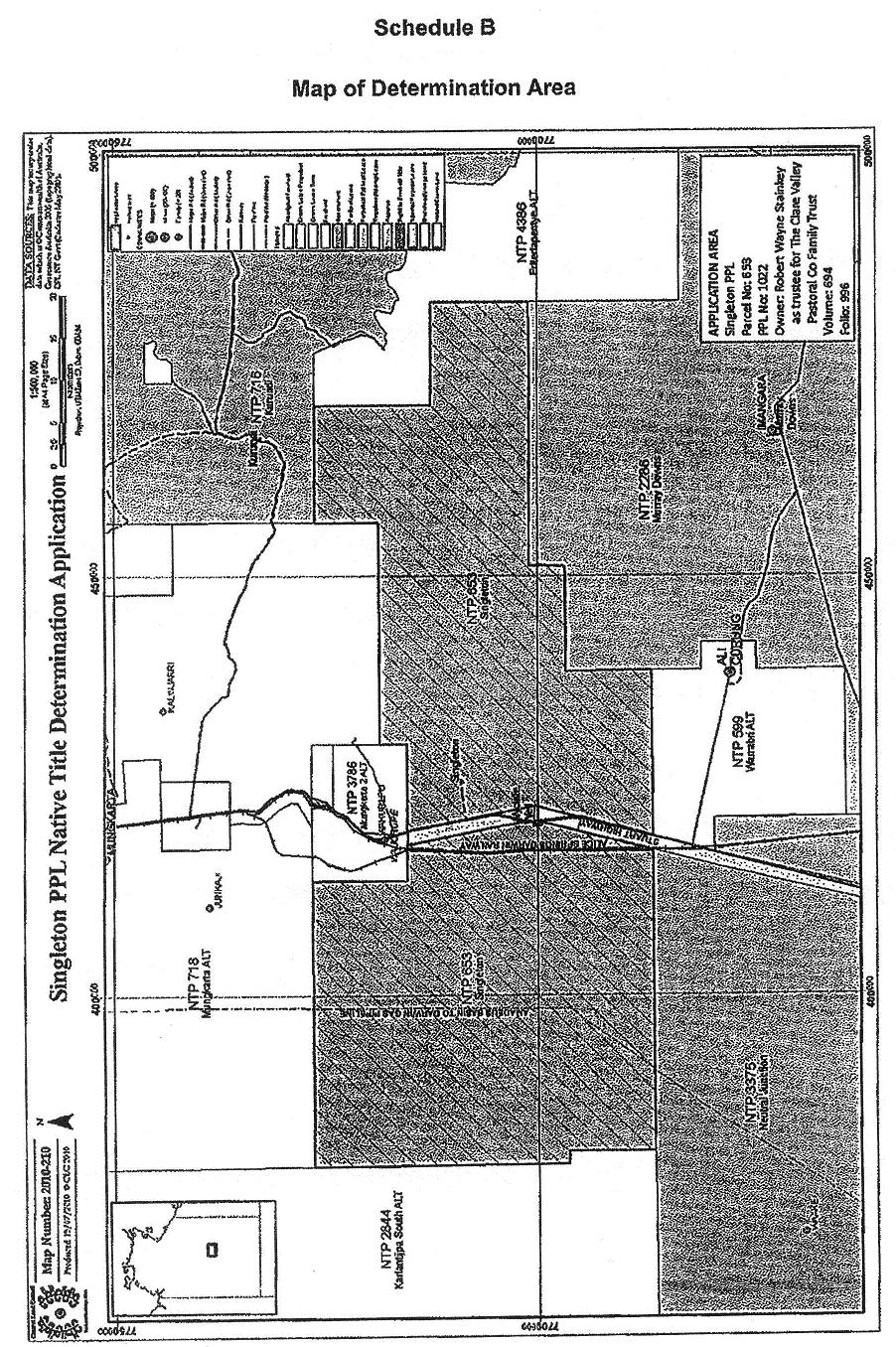
1. Native title exists in the determination area being the land and waters described in Schedule A and depicted on the map contained in Schedule B.
2. Native title does not exist in those parts of the determination area described in Schedule C.
The native title holders
3. The persons who hold the common or group rights comprising the native title are the Aboriginal persons who are:
(a) members of one or more of the Akwerlpe-Waake, Ileyarne, Lyentyawel Ileparranem or Arrawatyen landholding groups (“the landholding groups”) by virtue of descent, including adoption, through father’s father, father’s mother, mother’s father and mother’s mother; or
(b) accepted as members of one or more of the landholding groups by the senior members of a landholding group, referred to in subparagraph (a), by virtue of non-descent connections to an estate.
The native title rights and interests
4. The native title rights and interests of the native title holders are the rights possessed under and exercisable in accordance with their traditional laws and customs, including the right to conduct activities necessary to give effect to them, being:
(a) the right to access and travel over any part of the land and waters;
(b) the right to live on the land, and for that purpose, to camp, erect shelters and other structures;
(c) the right to hunt, gather, take and use the natural resources of the land and waters, including the right to access, take and use natural water resources on or in the land;
(d) the right to access, maintain and protect places and areas of importance on or in the land and waters;
(e) the right to do the following activities on the land:
(i) engage in cultural activities;
(ii) conduct ceremonies;
(iii) hold meetings;
(iv) teach the physical and spiritual attributes of places and areas of importance;
(v) participate in cultural practices relating to birth and death including burial rites;
including the power to regulate the presence of others at any of these activities on the land and waters;
(f) the right to make decisions about the use and enjoyment of the land and waters by Aboriginal people who recognise themselves as governed by Aboriginal traditional laws and customs and who acknowledge the traditional laws and customs of the native title holders;
(g) the right to share and exchange natural resources obtained on or from the land and waters, including traditional items made from the natural resources.
5. The native title rights and interests are held subject to and exercisable in accordance with the traditional laws and customs of the native title holders.
Other interests in the determination area
6. The other interests in the determination area are:
(a) the interest of Robert Wayne Stainkey as trustee for The Clare Valley Pastoral Co Family Trust under Perpetual Pastoral Lease No 1022;
(b) the rights and interests of NT Gas Pty Limited:
(i) as the beneficiary of the rights and interests under an energy supply easement and access easement granted to the Northern Territory of Australia for the purpose of the construction, operation and maintenance of the Amadeus Basin to Darwin gas pipeline and related infrastructure (including scraper station); and
(ii) as the holder of Pipeline Licence No 4 pursuant to the Energy Pipelines Act 1982 (NT);
(c) in relation to EL 26226 and EL 26228 the interest of Nupower Resources Ltd granted under the Mining Act 1982 (NT);
(d) in relation to EL 26102 the interests of Spinifex Uranium Pty Ltd granted under the Mining Act 1982 (NT);
(e) in relation to EL 24823 the interest of Hale Energy Ltd granted under the Mining Act 1982 (NT);
(f) in relation to EL 24937 the interest of John Baker, Allan Campbell and Thomas Raymond Hall granted under the Mining Act 1982 (NT);
(g) the rights and interests of Telstra Corporation Limited:
(i) as the owner or operator of telecommunications facilities within the Determination Area;
(ii) created pursuant to the Post and Telegraph Act 1901 (Cth), the Telecommunications Act 1975 (Cth), the Australian Telecommunications Corporation Acts 1989 (Cth), the Telecommunications Act 1991 (Cth) and under Schedule 3 to the Telecommunications Act 1997 (Cth), including the right:
A. to inspect land for the purpose of determining whether the land is suitable for its purposes;
B. to install and operate telecommunication facilities;
C. to alter, remove, replace, maintain, repair and ensure the proper functioning of its existing and any new telecommunication facilities; and
D. for its employees, agents or contractors to access the Determination Area for the purpose of exercising the rights in (i), (ii) and (iii) above in respect of telecommunication facilities in and in the vicinity of the determination area; and
(iii) under any licences or access agreements relating to its telecommunications facilities in the determination area;
(h) rights of access by an employee, servant, agent or instrumentality of the Northern Territory, Commonwealth or other statutory authority as required in the performance of his or her statutory duties;
(i) the interests of persons to whom valid or validated rights and interests have been:
(i) granted by the Crown pursuant to statute or otherwise in the exercise of its executive power; or
(ii) conferred by statute.
Relationship between rights and interests
7. The relationship between the native title rights and interests and the other interests in relation to the determination area is that the other interests and the doing of any activity required or permitted to be done by or under the other interests, prevail over the native title rights and interests, but do not extinguish them, and the existence and exercise of the native title rights and interests do not prevent the doing of the activity.
Other matters
8. The native title rights and interests are subject to and exercisable in accordance with the valid laws of the Northern Territory of Australia and the Commonwealth of Australia.
9. There are no native title rights and interests in:
(a) minerals as defined in s 2 of the Minerals Acquisition Act 1953 (NT);
(b) petroleum as defined in s 5 of the Petroleum Act 1984 (NT);
(c) prescribed substances as defined in s 5 of the Atomic Energy Act 1953 (Cth) and s 3 of the Atomic Energy (Control of Materials) Act 1946 (Cth).
10. In this determination the term:
(a) “natural resources” means animals, birds, fish, plants including timber, wax, resin and gum, and surface soils, clays, stone, rocks and ochre, but does not include minerals, petroleum and prescribed substances;
(b) “natural waters” includes springs and rockholes.
Schedule A
Determination Area
1. The determination area is NT Portion 653 comprising an area of 2,949 square kilometres held under Perpetual Pastoral Lease No 1022 by Robert Wayne Stainkey as trustee for The Clare Valley Pastoral Co Family Trust.
2. The determination area does not include any land or waters on which a public work is or has been constructed or established.
Schedule C
Areas where native title does not exist
Native title rights and interests have been wholly extinguished in the following areas of land and waters:
Pastoral improvements
Those parts of the determination area being:
(a) a house, shed and other buildings;
(b) a constructed airstrip;
(c) bores, constructed dams or other constructed stock watering points;
(d) stockyards and trapyards.
The areas described in (a) to (d) comprise the land on which the improvements were constructed prior to the date of this determination and any adjacent land or waters the exclusive use of which is necessary for the enjoyment of the improvements.
Public works
Those parts of the determination area being the areas on which any public work as defined in s 253 of Native Title Act 1993 (Cth) is situated, including the land and waters defined in s 251D of the Act, and including:
(a) public roads and bores (presently the responsibility of the Department of Lands and Planning) including any gravel and fill pits that are part of the adjacent land referred to s 251D of the Act;
(b) transmission water pipes, distribution water pipes, sewer pipes, bores, sewer pump stations, overhead power lines (presently the responsibility of Power and Water Corporation).
The areas described in (a) and (b) comprise the land on which the public works were constructed prior to the date of this determination.
Note: Settlement and entry of orders is dealt with in Order 36 of the Federal Court Rules. The text of entered orders can be located using Federal Law Search on the Court’s website.
QUEENSLAND DISTRICT REGISTRY | |
GENERAL DIVISION | NTD 6011 of 2000 |
BETWEEN: | ENA REX MPETYANE AND TOMMY THOMPSON KNGWARRAYE ON BEHALF OF THE AKWERLPE-WAAKE, ILIYARNE, LYENTYAWEL ILEPARRANEM AND ARRAWATYEN PEOPLE Applicant
|
AND: | NORTHERN TERRITORY OF AUSTRALIA First Respondent NT GAS PTY LIMITED Second Respondent
|
JUDGE: | COLLIER J |
DATE: | 7 SEPTEMBER 2010 |
PLACE: | SINGLETON |
REASONS FOR JUDGMENT
1 By an amended application filed on 30 July 2007 pursuant to the Native Title Act 1993 (Cth) (“the Act”), Kwementye Foster, Ena Rex Mpetyane and Tommy Thompson Kngwarraye, on behalf of the members of the Akwerlpe-Waake, Ileyarne, Lyentyawel Ileparranem and Arrawatyen People (“the native title claim group”), applied for a determination of native title under s 61(1) of the Act.
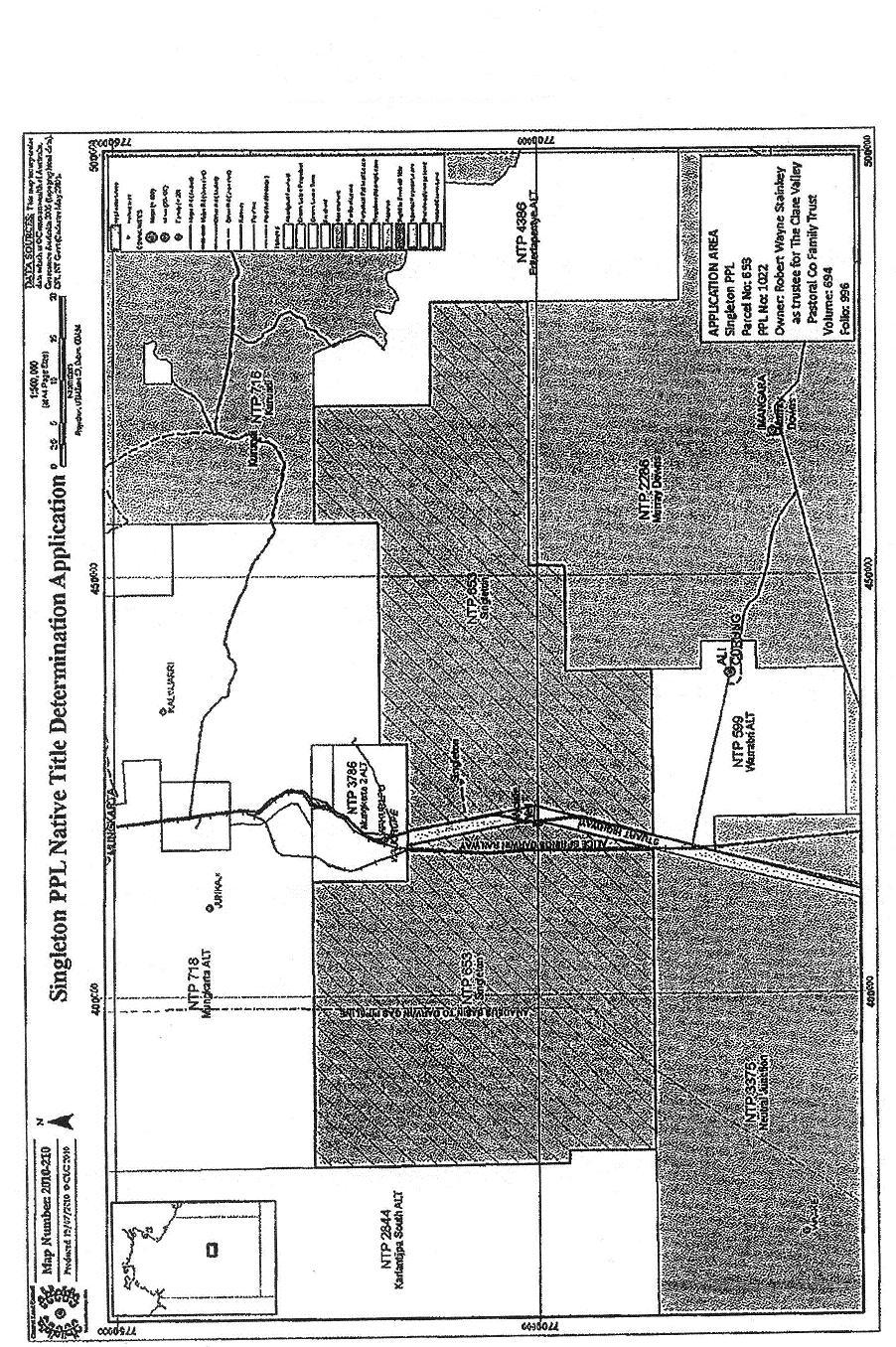
2 The area the subject of the application (“the determination area”) is in the Northern Territory, and is described as NT Portion 653. It comprises 2,949 square kilometres, currently held under Perpetual Pastoral Lease No 1022 by the Australian Land & Cattle Company Pty Ltd (ACN 071 064 741). Geographically the determination area is located west of 135ºE, 110 kilometres south of Tennant Creek and 310 kilometres north of Alice Springs. It is bisected by the Stuart Highway and the Alice Springs to Darwin railway corridor.
3 The determination area is represented in the map below.
4 It is common ground that the determination area is not subject to any previous determination of native title.
5 All parties to this application are legally represented. I note that the applicant is represented by the Central Land Council, which has also played a significant part in respect of the organisation of authorisation meetings of the native title claim group.
6 On 22 July 2010 joint submissions in support of a minute of a proposed consent determination, and a statement of agreed facts, were filed in these proceedings pursuant to s 87 of the Act. A minute of proposed consent determination of native title was filed on 27 July 2010.
7 As all parties to the minute acknowledge that the members of the native title claim group should be recognised as the native title holders for the determination area, the issues remaining for decision by me are:
whether the Court is satisfied orders in, or consistent with, the minute of proposed consent determination of native title are within its power (s 87(1)(c)); and
whether it is appropriate for the Court to make the orders sought by the parties (s 87(1) and (2)).
8 In my view the proposed orders are within the power of the Court, and it is appropriate for me to make the orders sought. My reasons for forming this view are explained below.
Background
The native title claim group
9 Traditionally, the area the subject of the application is part of Kaytetye territory. The four landholding groups in the area are affiliated with, and named after the following parts of the application area:
1. Akwerlpe-Waake: western portion.
2. Ileyarne: south-central and south-east portion.
3. Lyentyawel Ileparranem: eastern portion.
4. Arrawatyen: north and north-eastern portion.
10 The native title claim group in respect of this application is described by the application as comprising all those persons who are:
1. descendants (by birth or adoption) of one or more of the following named and unnamed ancestors of the respective landholding groups:
(a) Akwerlpe-Waake: two brothers: Mpetyane Wakurlpu-arenye, Mpetyane Waake-arenye (father’s fathers for Kwementye Foster and Mick Waake Mpetyane) and their two sisters, both unnamed Mpetyane;
(b) Ileyarne: two Kngwarraye brothers (one having no known descendants, the other being the father of Tommy “Galloper” Kapetye);
(c) Lyentyawel Ileparranem: Awawerr Penangke and her sister, the mother of Jim MacClean Thangale;
(d) Arrawatyen: Lame Ilpathic Tommy Thangale, Blanche Pitangali Thangale, Johnson Thangale and Pilinanta Thangale; and
2. accepted as members of one (or more) of the landholding groups by the senior descent-based members of the landholding group on the basis of their non-descent connections to the estate.
The application and amended application
11 An application for a determination of native title was originally filed in the Court on 23 June 2000, and accepted for registration on 21 July 2000.
12 On 30 July 2007 an amended application was filed by order of the Court, and accepted for registration on 12 December 2007.
13 It is common ground that both the original application and the amended application were authorised and made in accordance with the Act.
Anthropology
14 In December 2006 an expert report entitled “Anthropology Report” was completed by consultant anthropologist Ms SD Donaldson in respect of the original application. The parties accept that the report was completed following detailed field work undertaken in August and September 2005 and March 2006 in and around the determination area. Preliminary anthropological findings of the field research were presented to the claimant community at a document-proving meeting convened by the Central Land Council in March 2006. This meeting confirmed the analysis and findings subsequently set out in Ms Donaldson’s report.
15 It is also common ground that on 18 November 2009 the solicitor for the Northern Territory advised the applicant that the material in Ms Donaldson’s report provided a proper basis for the making of a consent determination, subject to confirmation of the Northern Territory’s interpretation of two aspects of the report (which appear to have been resolved).
Nomination of prescribed body corporate
16 On 20 July 2010 the applicant nominated Mpwerempwer Aboriginal Corporation as the Prescribed Body Corporate for the purposes of s 57(2)(a) of the Act. The nomination of the Mpwerempwer Aboriginal Corporation is in such terms that it does not hold the native title in trust. The nomination document recites further that Mpwerempwer Aboriginal Corporation consents to such nomination.
Recent amendments to the amended application
17 Since the amended application was accepted for registration, one of the persons comprising the applicant, Kwementye Foster, has died. On 21 July 2010 the applicant filed a notice of motion together with supporting affidavit seeking the leave of the Court to further amend the amended application by the removal of the name of Kwementye Foster (deceased) as an applicant. The notice of motion was not opposed. On 3 August 2010 I made an order to the effect that the amended application be further amended by the removal of the name of Kwementye Foster (deceased) as a named applicant without the need for a further authorisation meeting of the native title claim group pursuant to s 251B or an application pursuant to s 66B to replace the applicant. In making the order I respectfully applied the reasoning of Mansfield J in the recent decision of Lennon v State of South Australia [2010] FCA 743.
18 Further, on 30 July 2010 Telstra Corporation Limited, which had been second respondent to the application, filed a Form 162 Notice by Party Other than Applicant that the Party Wishes to Cease to be a Party. Section 84(6) of the Act and O 78 r 9(a) of the Federal Court Rules permit a party (other than an applicant) to withdraw at any time before the first hearing in the proceedings. (For the purposes of these provisions, “hearing” does not include directions hearings: s 84(6A).) At the time that the Form 162 was filed, for the purposes of s 84(6) and O 78 r 9(a), no hearing had occurred in these proceedings. Accordingly Telstra Corporation Limited was entitled, as of right, to withdraw from the proceedings on 30 July 2010.
Orders sought
19 The parties to the application have agreed on orders they seek in relation to the determination area. Further, and importantly, the parties ask the Court to make consent orders pursuant to s 87 and s 94A of the Act acknowledging that native title exists in respect of the determination area.
20 The orders sought by the parties are lengthy and, in summary, involve findings that:
native title exists in all areas of the determination area; other than:
in identified areas where other interests exist and native title does not exist; and
in respect of minerals and petroleum, and also prescribed substances as defined in the Atomic Energy Act 1953 (Cth) and the Atomic Energy (Control of Materials) Act 1946 (Cth);
the persons who hold the common or group rights comprising the native title are the Aboriginal persons who are members of one or more of the Akwerlpe-Waake, Ileyarne, Lyentyawel Ileparranem or Arrawatyen People by virtue of descent, or by virtue of non-descent connections to an estate;
the relevant native title rights and interests are not to be held on trust; and
the relevant native title rights and interests are those possessed under and exercisable in accordance with traditional laws and customs, including activities such as access and travel over the land; the right to live on the land; the right to hunt, gather and otherwise use the natural resources of the land; the right to access, maintain and protect places and areas of importance; the right to engage in cultural activities; the right to make decisions about the use and enjoyment of the land and waters by Aboriginal people who acknowledge the laws and customs of the native title holders; and the right to share and exchange natural resources.
Relevant legislation
21 The jurisdiction of the Court in these proceedings, being proceedings in which the parties seek a consent determination, is found in s 87 of the Act. So far as relevant, s 87 provides as follows:
Power of Federal Court if parties reach agreement
(1) This section applies if, at any stage of proceedings after the end of the period specified in the notice given under section 66:
(a) agreement is reached between the parties on the terms of an order of the Federal Court in relation to:
(i) the proceedings; or
(ii) a part of the proceedings; or
(iii) a matter arising out of the proceedings; and
(b) the terms of the agreement, in writing signed by or on behalf of the parties, are filed with the Court; and
(c) the Court is satisfied that an order in, or consistent with, those terms would be within the power of the Court.
(1A) The Court may, if it appears to the Court to be appropriate to do so, act in accordance with:
(a) whichever of subsection (2) or (3) is relevant in the particular case; and
(b) if subsection (5) applies in the particular case – that subsection.
(2) If the agreement is on the terms of an order of the Court in relation to the proceedings, the Court may make an order in, or consistent with, those terms without holding a hearing or, if a hearing has started, without completing the hearing.
Note: If the application involves making a determination of native title, the Court’s order would need to comply with section 94A (which deals with the requirements of native title determination orders).
22 Section 94A, to which reference is made in the note to s 87(2), provides:
An order in which the Federal Court makes a determination of native title must set out details of the matters mentioned in section 225 (which defines determination of native title).
23 In turn, s 225 provides:
A determination of native title is a determination whether or not native title exists in relation to a particular area (the determination area) of land or waters and, if it does exist, a determination of:
(a) who the persons, or each group of persons, holding the common or group rights comprising the native title are; and
(b) the nature and extent of the native title rights and interests in relation to the determination area; and
(c) the nature and extent of any other interests in relation to the determination area; and
(d) the relationship between the rights and interests in paragraphs (b) and (c) (taking into account the effect of this Act); and
(e) to the extent that the land or waters in the determination area are not covered by a non exclusive agricultural lease or a non exclusive pastoral lease--whether the native title rights and interests confer possession, occupation, use and enjoyment of that land or waters on the native title holders to the exclusion of all others.
Note: The determination may deal with the matters in paragraphs (c) and (d) by referring to a particular kind or particular kinds of non native title interests.
Evidence before the Court
24 In these proceedings it is common ground that the relevant notification period under s 66 of the Act ended on 12 December 2007. The minute of proposed consent determination of native title, filed on 27 July 2010, represents a written agreement reached by the parties for the purposes of s 87(1)(a) and s 87(1)(b) in relation to the determination area. No approved determination of native title has previously existed in respect of the determination area.
25 A considerable volume of material has been filed to support the native title determination application in both its original and amended forms. In particular, anthropological and affidavit evidence has been produced and filed to substantiate the claim of the applicant that the native title claim group has native title rights and interests in respect of the determination area.
Anthropological report
26 The anthropological report produced by Ms SD Donaldson details the manner in which the native title claim group is part of a broader Kaytetye community living in the region in which the determination area is located. The community constitutes a society whose members continue to acknowledge and observe a common body of traditional law and custom. Consistently with the information included in the application, Ms Donaldson opines that the determination area lies within the four Aboriginal territories or estate areas known as Ileyarne, Akwerlpe-Waake, Lyentyawel Ileparranem and Arrawatyen, and that the native title claim group is comprised of four landholding groups named after the four estate areas (report paras 6-8).
27 Ms Donaldson notes that archaeological excavations from sites 800 kilometres north of the determination area indicate human occupation of the area more than 7000 years ago. Archaeological surveys undertaken from an application area adjacent to the determination area indicate human occupation and use dating from at least several thousand years ago through to the early contact period (report para 35).
28 It appears that the earliest contact between the ancestors of the native title claim group and Europeans was during the 1860 expedition undertaken from Adelaide by John McDouall Stuart to investigate the viability of land north of South Australia. As the anthropologist observes:
Stuart noted evidence of Aboriginal occupation in the application area and surrounding region and made various observations about the people he encountered, including burials, sign language and headdress; the use of spears, wommeras, boomerangs and spear throwers; and hunting and gathering of food, including being presented with opossums and birds. (report para 38)
29 Ms Donaldson notes that Europeans in the region throughout the 1860s and 1870s described evidence of occupation, ceremonial preparations, weaponry, art and activity by the inhabitants (report paras 42-46). Later records following the commencement of pastoral and mining activities indicated that “station life in fact allowed for the continuation of a traditional lifestyle during the time of the year when people were not needed for station work” (report para 55). Ms Donaldson refers to detailed ethnographic records which have been conducted since 1901 in the region, with research describing the people of the area and their beliefs, practices, social organisation and lifestyle (report paras 68-85).
30 Ms Donaldson states in her report that those members of the claim group in the determination area have been principally associated with the Kaytetye language (report para 93), and that members of the native title claim group acknowledge and observe the laws and customs of Kaytetye society (report para 97). In particular, Ms Donaldson observes that the Altyerre, or “The Dreaming” or “Dreamtime”, covering a range of related concepts including mythical spiritual beings and their creative journeys, religious laws, ritual objects, sacred designs and songs, and rules governing the social order which affect the everyday life of members of the Kaytetye society, continues to underpin the everyday lives of the native title claim group (para 98 and para 104). Traditional initiation ceremonies and mourning customs remain customary in the group.
31 It is important to note that, in Ms Donaldson’s expert opinion, while the native title claim group is made up of the four landholding groups, they consider themselves interconnected because they jointly hold knowledge relating to the application area and acknowledge themselves to be “all one family” (report para 11).
32 Ms Donaldson describes the complex traditional system of kinship and social classification in Kaytetye society, and states that kin relationships are important in relation to marriage rules, ceremonial activity, societal roles, and interaction and relationship with the land and most Dreamings (paras 120-132). Descent is the most important basis for acquiring rights and interests in land (para 207), although persons without a descent connection to an estate may satisfy certain non-descent based criteria regarding their connections with the estate, and acquire rights in or over the estate (para 211).
33 Within a community, access to particular sites in an estate is related to one’s gender, age, knowledge, initiation status, and relationship with the site and associated ancestral beings (para 176). So, for example, Ms Donaldson notes that people from other tribes must ask persons with specific roles in the society, namely the apmerek-artwey (those affiliated with an estate through father’s father) and kwertengerl (those with affiliations through mother’s father) before drinking from sacred water sources, rock holes and swamps (para 170, cf paras 178-180). In her report Ms Donaldson describes her observation of these practices.
34 Ms Donaldson also refers to well-defined forms of punishment or payback as a means of controlling social order, including sanctions relating to improper access to culturally significant sites (paras 195-199).
35 In describing the source of the native title rights and interests claimed by the native title claim group, Ms Donaldson states in her report:
200. The traditional laws and customs currently acknowledged and observed by members of the native title claim group and under which they possess rights and interests in the application area have their origins in Altyerre Law. Donald Thompson Kemarre made this point in the following terms:
… It’s an old law from the Altyerre, old people give the same rules to young people today so they can carry it on. … the men have laws they give to the boys and the ladies have laws they give to the girls. …you can’t forget your law, your law is your culture. If you forget your law, your culture is finished.
201. The right to live on the land, and for that purpose, to camp, erect shelters and other structures, and to travel over and access any part of the determination area is possessed under traditional laws and customs, including those concerning mourning, social organisation (including marriage, kinship and subsection systems), access to land, the protection of sites and the use of resources.
202. The right to hunt, gather and take the natural resources of the determination area is possessed under rules and restrictions, including those concerning access to land (in terms of gender and ceremonial activities), the protection of sites and the use of resources.
203. The rights to access, maintain and protect places and areas of importance are possessed under rules and restrictions including those relating to the roles and joint responsibility of apmerek–artwey and kwertengerl concerning knowledge of, and access to land, and the protection of sites.
204. The right to engage in cultural activities, conduct ceremonies, hold meetings, teach the physical and spiritual attributes of places and areas of importance and to participate in cultural practices relating to birth and death, including burial rites are possessed under traditional laws and customs relating to the ritual roles acquired by apmerek–artwey and kwertengerl, together with customs associated with the cycle of life and death, in particular baby smoking, initiation ceremonies and mourning customs.
205. The right to make decisions about the use and enjoyment of the determination area by Aboriginal people who recognise themselves to be governed by the traditional laws and customs acknowledged by the native title holders is possessed under traditional laws and customs relating to succession, sanctions, access to land and the protection of sites.
206. The right to share and exchange natural resources obtained on or from the determination area, including traditional items made from the natural resources of the determination area are possessed under traditional laws and customs concerning access to land, the protection of sites and the use of resources.
36 Ms Donaldson also explains the manner in which claimants continue to acknowledge and observe the Kaytetye traditional laws and customs which give rise to rights and interests in the land. In particular Ms Donaldson refers to information provided by many members of the claimant group, including:
continued access to and residence on land in the determination area through, inter alia, employment at Singleton Station, notwithstanding that many were compelled to leave their traditional lands due to the emergence of the pastoral industry (report s 4.3.1);
exploitation of natural resources of the determination area in accordance with traditional laws and customs, and by employing traditional ecological knowledge about the land and its plants and animals (report s 4.3.2);
continued access to, maintenance of and protection of places of importance, in order to ensure that places are appropriately cared for. Examples given were:
the successful repatriation in 1999 of a boulder of spiritual significance (which had been removed from the region in 1952 without the permission of the Akwerlpe-Waake people) following petitioning by members of the native title claim group (report s 4.3.3, paras 282-283); and
in relation to important edible plants where production of such plants is enhanced by burning – regular burning of areas of land upon which such plants grow by members of the native title claim group to promote maximum production (para 284);
continuation of cultural activities, including initiation of young males (report s 4.3.4);
continued decisions about the use of the land, including successful negotiations to cause the realignment of the Alice Springs to Darwin railway corridor to ensure it avoided a culturally important site immediately north of the application area (report s 4.3.5);
continued sharing and exchanging natural resources (report s 4.3.6).
37 In her report, Ms Donaldson states that:
Evidence of land use practices employed by a group of people just two generations after sovereignty, coupled with details of stable societal characteristics such as a system of land tenure, knowledge of the local ecology to enable survival, the practising of customs such as those related to mourning recorded just one generation after sovereignty, and the use of a developed language recorded just two generations after sovereignty lead to my conclusion that practices such as these were also exercised by the claimants’ ancestors before sovereignty. (report para 14)
Affidavits and witness statements filed in support of the amended application
38 Affidavits in support of the amended application have been affirmed by members of the native title claim group, namely:
Tommy Thompson Kngwarraye (affirmed 3 April 2007);
Kwementye Foster (affirmed 3 April 2007);
Ena Rex Mpetyane (affirmed 3 April 2007).
39 Jacob Moore Kapetye and Kwementye Morrison, also members of the native title claim group, affirmed affidavits which were annexed to the original application.
40 Annexed to the affidavit of Ms SJ Polden, solicitor with the Central Land Council, filed 20 July 2010, are five witness statements. The witness statements have been affirmed by members of the native title claim group, namely:
Mick Waake Jampijinpa (affirmed 16 November 2006);
Kwementye Foster (affirmed 19 October 2006);
Jacob Moore Kapetye (affirmed 24 August 2006);
Mona Heywood Nungarrayl (affirmed 16 November 2006);
Kwementye Casson Nampajimpa (affirmed 23 August 2006).
41 The material in these documents attests to the basis of the witness’ membership of their respective landholding groups, and to their connection with the claim area under traditional laws and customs.
42 The affidavits and witness statements make compelling reading.
43 Mr Tommy Thompson Kngwarraye states in his affidavit that he has lived off the land in traditional fashion, and continues to hold duties and responsibilities by virtue of his position in the community. He also spoke of his connection to the Ileyarne People other than by reason of descent. He deposes:
11. After I was married, but before the war time (Second World War) I was living on Neutral Junction, travelling on foot to places like Taylor Creek and Emu Bore just to the south of the application area. I lived off bush tucker feeding my family. I had kangaroo dogs that helped me hunt kangaroos or goannas…
12. While I was working as a stockman I was taught all about the sacred sites and Dreamings on Singleton Station by senior knowledgeable men. My father taught me the Awerentyerrnge (Whirlywind). It connects my father’s country Ertwerrpe with Ileyarne on Singleton Station. Awerentyerrnge Dreaming track travels from Rrwentyenye in Ertwerrpe country through the southern part of Singleton Station in Illeyarne country, stopping at Arteperrwele before travelling on. My Awerentyerrenge Dreaming sits on top of that Ileyarne country. Ilyarne is underneath. Due to my knowledge of Ileyarne sites and Dreamings and my previous long residence on Singelton Station I am called upon as an “outside” kwertengerl, or custodian, for Ileyarne landholding group to help out when they need to make important decisions.
44 Ms Ena Rex Mpetayne spoke of her role as a woman in the Akerlpe/Waake landholding group, the traditional roles she has inherited, and the manner in which she continues to access the determination area for cultural purposes. She deposes:
10. I am also Kwertengerl for the Jarra Jarra landholding group through my jamirdi (mother’s father). Jarra Jarra is a neighbour to the Ileyarne group. I hold knowledge of the Kangaroo Dreaming, which links the two countries; Jarra Jarra and Ileyarne. I know Ileyarne country very well as I have lived around the area all my life and those stories have been told to me by the old people. I am a kwertengerl for Ileyarne also because I have been shown those Ileyarne sites and Dreamings by the old ladies. I am helping to look after that Ileyarne country. As a kwertengerl I can go and visit that country. Every second week I go with other ladies like my aunty Mona Heywood and we hunt for goannas or collect bush tucker. I see that the sites there are alright. I know that country.
…
13. My mother and her sister, Mona Heywood, taught me the Akwerlpe/Waake songs, ceremonies and sacred sites for women on Singleton Station and I hold that knowledge. We still do ceremonies and sing the songs for country in the application area. We did that Ahakeye ceremony for the McClaren Creek Land Claim during the 1980s. That time when Grace Koch was watching I helped out at as kwertengerl. The kwertengerl and apmerek-artwey come together for that Akwerlpe ceremony every year just after Christmas time. I also look after the women’s business for the Ileyarne women. I am now teaching that business to the younger Ileyarne women.
45 Kwementye Foster describes in his affidavit affirmed 3 April 2007 how rights and interests are passed through descent. He deposes:
9. I acknowledge and observe the traditional laws and customs of the Kaytetye people. That law comes from Altyerre (‘Dreaming’). According to our traditional law, I have rights and interests in the application area by descent through my father’s father. I take Akwerlpe from my father and his father, which makes me apmerek-artwey, a proper owner for Akwerlpe. My children will take Akwerlpe after me. This is our law.
10. My father was Kwementyaye (Charlie) Thangale, passed away when I was a little boy. I never met my kwarrenge (father’s father) but he was a proper Akwerlpe man. His country, Akwerlpe country goes from the western side of Singleton Station right up past Greenwood on the Mungkarta Aboriginal Land Trust. As my Kwarrenge was apmerek-artwey for Akkwerlpe country on Singleton and Mungkarta Land Trust, I can live out at Greenwood outstation. My kwarrenge, my father and I are all the owners for that country. As apmerek-artwey for Akwerlpe I can pass rights in Akwerlpe country on to my children and they can pass them on to their children.
11. I lived and worked on Singleton Station as a stockman for most of my early life. This enabled me to remain on and learn about my country. I have been hunting and camping on Singleton Station throughout my life. The old people showed me where the sacred sites are and taught me the songs and ceremonies for these places.
46 In his witness statement Kwementye Foster also said:
11. I take Akwerlpe country through my kwarrenge (father’s father). I am boss because of my father’s father, that’s the “same step”, through to the next generation, like that. I got stories for Akwerlpe country also from Antarrengeny old people before they passed away, they gave me that knowledge. Old Jampa, Mick Waake, also taught me stories for my country. He knows that Waake/Akwerlpe really well as he has walked all over it since he was a little boy. Jampa was shown those Waake/Akwerlpe sites, those soakages and rockholes, by his kwarrenge (father’s father) before he passed away. Jampa’s kwarrenge and my kwarrenge were brothers, but from different fathers.
47 Mr Mick Waake Jampijinpa states in his affidavit that he was born in about 1921 on Waake country and that he belongs to the Waake/Akwerlpe group. He speaks of his rights in relation to his country, the obligations of others who wish to enter on to his country, and the activities in which he engages. So, for example, he deposes:
14. I am an apmerek-artwey for that Ahakeye Dreaming. I get that Dreaming from my father. That Dreaming comes from Ilkewartn side. That Ahakeye Dreaming belongs to Waake country, it belongs to me. It also belongs to Akwerlpe country, it also belongs to Kwementye Foster. That Dreaming travels across Singleton Station.
15. As an apmerek-artwey for Waake I can go onto that Waake country on Singleton and Neutral Junction. I am free to look through that country, to hunt or get bush tucker. My family has those rights too. I can bring them onto that Waake country. I can cut wood to make boomerang or dig for anything, maybe that alatye (bush yam). I can do all those things because that is my country. I got those rights through my arrenge.
16. The right way, people should ask the owners before going on to Singleton country. They should ask me or Kwementye Foster before they go out. They need to find out which areas are open country and which places to stay away. If they don’t come to Leslie or me before going onto that Waake/Akwerlpe country people might get sick. If they drink water from a soakage or waterhole from Waake/Akwerlpe country without asking they might get sick.
48 Mr Jacob Moore Kapetye spoke of the meaning of the land and the stories and law associated with it. In his witness statement he said:
10. I was taught the stories and law by Peter Horsetailer’s father, Paddy Horsetailer Jungarray and Singleton Jangala. Paddy Jungarray, a Jarra Jarra man, worked on Singleton Station and taught me Kangaroo Dreaming when I was a young man and showed me the Dreaming track on Singleton Station. He tole me about the tracks and the places where I could not go, where I would get trouble if I went there. For example, the kangaroo place near the top of singleton creek down to Ileyarne swamp called Inturpul. Also the tree on Ileyarne block where the Two Women (Two Nangala women) went from Arnerre country. That old man told me the songs for Arnerre ceremony, the Two Women songs and also songs for Twerrpe country.
…
13. I have taught my sons how to hunt kangaroo and how to hunt using a spear. I have also taught my children about the stories for Singleton Station and they know I am running that place, Singleton Station. They take their country through me, and I have taught them about their country and where the dreaming tracks go travelling. They help out at ceremonies. The Ahakeye Dreaming travels through Singleton country and travels a long way, all the way to Yuendumu, where it finishes up. All the old people told me that. The Dreaming comes back this way in a circle and many people come together for ceremony. Kwertengerl belong to the country and it is our job to look after our country. My mother belonged to this place and now I belong to this place and look after Ahakey Dreaming.
49 Ms Mona Heywood Nungarrayi spoke of the manner in which she is passing important information and knowledge on to younger members of the claimant group. In her affidavit she deposed:
4. I take country at Jarra Jarra through my father, and am kirda for that country, but I am kurdungurlu for Singleton Station, for Akwerlpe mob through my father’s mother. My father was also kurdungurlu for Akwerlpe through his mother. I also take on some kirda responsibilities for Ileyarne because there are not many left who have the knowledge or stories. I can look after that kirda knowledge because I have been here a long time, I know all those stories and I am the right skin for that country. I am helping them. I have taught Ena Rex Ilyarne stories and Ena will be kurdungurlu then for Ileyarne. I am holding that knowledge until there is a kirda to take over.
5. Kirda and kurdungurlu together have to look after that country, protect the sacred sites and perform ceremony. Kurdungurlu look after country and at ceremony we paint kirda ready for ceremony, make sure everything is done correctly and help at young men’s ceremony. I am now handing over and teaching this knowledge to younger kurdungurlu women because I am getting older now.
…
17. Now when I go out to Singleton Station I tell my kurdanas, my daughter and my sister’s daughters, about the stories that belong to Singleton. I tell my kurdanas those Ileyarne stories about the Anemarranenke (Sand Frog) and the Mpwerempwerange (Lily) and that Akwerlpe story about the Ahakeye (Bush Plum). Those kurdanas like Ena Rex are kurdungurlus for that country. They have to look after Singleton country. I teach them those stories, those songs, and how to paint up for ceremony. Together kirda and kurdungurlu msut look after the land. They got to keep those stories and songs that belong to that land going. I also give a hand to my brothers. I help out for that story for Akwerlpe as a kurdungurlu.
18. After I have passed away all the other kurdungurlu will look after that Ahakeye Dreaming and those other Dreamings. Women who are Nampijinpa, Nakamarra, Nungarrayi and Napanangka will all be kurdungurlus. I am the only one left now to teach my family the stories, where to hunt, about the waterholes and the sites. No-one is helping me teach now that my two sisters have passed away.
50 Kwementye Casson Nampajimpa also deposed as to her activities on and connection with the land:
8. As a young girl and later when I was married and living on Singleton Station, we would go hunting and collecting bush food on that country and drink water. We would get bush potatoes, yams, bush banana, goanna, wild pussy cat and rabbits. The dogs would hunt the cats and rabbits for us. The men hunted kangaroo and emu. My mother and my aunties taught me how to hunt and where to go to get bush food when we walked around the country. They also taught me about the country and tole me the stories. After I went to live at Ali Curung I still went on to Singleton station to get bush foods. I used to travel back and forward getting bush food.
9. I know the Dreamings that cross Singleton Station, including Karlandji (lizard), Nangapa, Yarla and Ngarlatyl (bush potato) and Munga Munga Dreaming. My own personal Dreaming through my father is Ahekeye Dreaming. Ahekeye dreaming goes across Singleton Station from Waake country to Akwerlpe (Wakalpu) country.
51 Kwementye Morrison gave evidence that, as at the date of her affidavit (16 June 2000), she lived at Tennant Creek, but that she was a traditional owner of Iliyarne country through her father. Kwementye Morrison acknowledged the senior members of the native title group as “looking after” the country and its sacred sites, and as teaching her, her siblings and their children about the law relating to Iliyarne (para 10 of affidavit of Kwementye Morrison affirmed 16 June 2000).
Conclusion
52 I am satisfied that an order in, or consistent with, the terms of the consent orders proposed by the parties is within the power of the Court. In particular, I am satisfied that the material filed by the parties in these proceedings evidences native title rights and interests in the claim group as defined by s 223(1) of the Act, namely, communal, group or individual rights and interests of Aboriginal peoples in relation to land or waters, where:
(a) the rights and interests are possessed under the traditional laws acknowledged, and the traditional customs observed, by the Aboriginal peoples;
(b) the Aboriginal peoples, by those laws and customs, have a connection with the land or waters; and
(c) the rights and interests are recognised by the common law of Australia.
53 Material in the anthropological report filed by Ms Donaldson, in addition to material in affidavits and witness statements before the Court, supports the conclusion that the applicant, on behalf of the native title claim group, has native title rights and interests in the determination area.
Application of section 87: is the order appropriate?
54 In Brown (on behalf of the Ngarla People) v State of Western Australia [2007] FCA 1025, Bennett J observed:
[22] The exercise of the Court’s discretion pursuant to s 87A imports the same principles as those applying to the making of a consent determination of native title under s 87. The discretion conferred by s 87A and by s 87 must be exercised judicially and within the broad boundaries ascertained by reference to the subject matter, scope and purpose of the Act (Hughes at [8] citing Lota Warria (on behalf of the Poruma and Masig Peoples) v Queensland (2005) 223 ALR 62 at [7]). (emphasis added)
(cf similar comments of Emmett J in Munn (for and on behalf of the Gunggari People) v Queensland [2001] 115 FCR 109 at [28])
55 That an order recognising native title is good as against all third parties, and not only the specific parties to the application, is an important factor in determining whether an order is appropriate for the purposes of s 87 of the Act.
56 In this case:
It is clear from the evidence which I have summarised that the applicant has “native title rights and interests” as defined in s 223(1) of the Act in the determination area.
All parties to the application are legally represented, and thus have had the benefit of legal advice in reaching a consent position.
It is not in dispute that the Northern Territory has played an active role in the negotiation of the proposed orders. Furthermore, joint submissions filed by the parties to these proceedings stated:
In doing so, the Territory (acting on behalf of the community generally) having regard to the requirements of the Native Title Act and having conducted a thorough assessment process… is satisfied that the determination is justified in all the circumstances.
That this is an important issue of which the Court should be satisfied was explained by Emmett J in Munn [2001] 115 FCR 109, where his Honour observed:
Next, the Court must have regard to the question of whether or not the parties to the proceeding, namely, those who are likely to be affected by an order, have had independent and competent legal representation. That concern would include a consideration of the extent to which the State is a party, on the basis that the State, or at least a Minister of the State, appears in the capacity of parens patriae to look after the interests of the community generally. The mere fact that the State was a party may not be sufficient. The Court may need to be satisfied that the State has in fact taken a real interest in the proceeding in the interests of the community generally. That may involve the Court being satisfied that the State has given appropriate consideration to the evidence that has been adduced, or intended to be adduced, in order to reach the compromise that is proposed. The Court, in my view, needs to be satisfied at least that the State, through competent legal representation, is satisfied as to the cogency of the evidence upon which the applicants rely. (at [29])
Although pastoral interests were not represented in these proceedings, the inevitable inference to be drawn is that their absence was dictated by choice, rather than circumstance.
There are no other proceedings before the Court relating to native title determination applications that cover any part of the determination area which would require orders pursuant to s 67 of the Act.
57 In the circumstances, I am satisfied that an order in the terms proposed by the parties is appropriate within the meaning of s 87 of the Act.
I certify that the preceding fifty-seven (57) numbered paragraphs are a true copy of the Reasons for Judgment herein of the Honourable Justice Collier. |
Associate:


