

FEDERAL COURT OF AUSTRALIA
Kuzmanovski v New South Wales Lotteries Corporation
[2010] FCA 876
|
Citation: |
Kuzmanovski v New South Wales Lotteries Corporation [2010] FCA 876 |
|
|
Parties: |
ELIZABETH KUZMANOVSKI and BALE KUZMANOVSKI v NEW SOUTH WALES LOTTERIES CORPORATION |
|
|
File number: |
NSD 683 of 2009 |
|
|
Judge: |
RARES J |
|
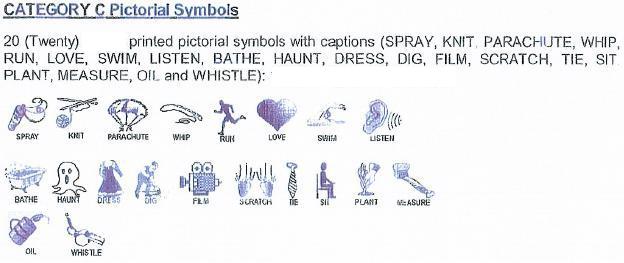
|
Date of judgment: |
17 August 2010 |
|
|
Catchwords: |
CONTRACTS – public lottery – lottery ticket governed by Public Lotteries Act 1996 (NSW) and rules made under Act – play instructions on ticket identify terms on which prize payable – whether Act imposed additional conditions to be satisfied before prize payable CONTRACTS – interpretation – use of dictionaries to construe words used in contract – whether any one dictionary authoritative STATUTORY INTERPRETATION – purposive construction – consumer contract – whether statutory licensee entitled to exercise power under s 50 of Public Lotteries Act 1996 (NSW) to use verification code or test inconsistent with play instructions on ticket to be satisfied before prize payable – whether statutory provision construed to override or be consistent with express terms of contract in lottery ticket TRADE PRACTICES – misleading and deceptive conduct – whether statutory licensee engaged in conduct in contravention of ss 51A, 52 and 53 of the Trade Practices Act 1974 (Cth) in the creation for sale and sale of lottery ticket – readable portions of ticket did not reveal winning status – lottery ticket play conditions made representations of basis ticket would have winning status different from unreadable code or test used by statutory licensee Held: applicants entitled to recover prize in contract |
|
|
Legislation: |
Fair Trading Act 1987 (NSW) ss 42, 44(a) and (k) Judiciary Act 1903 (Cth) New South Wales Lotteries Corporation Act 1996 (NSW) s 5 Public Lotteries Act 1996 (NSW) ss 4, 5, Pt 6 Div 3 State Owned Corporations Act 1989 (NSW) Trade Practices Act 1974 (Cth) ss 51A, 52, 53 |
|
|
Cases cited: |
Australian Woollen Mills Pty Ltd v The Commonwealth (1953) 92 CLR 424 applied Brown v Petranker (1991) 22 NSWLR 717 distinguished Carlill v Carbolic Smokeball Co [1893] 1 QB 256 referred to Comptroller of Stamps (Vict) v Howard-Smith (1936) 54 CLR 614 applied Dodson v Grew (1767) Wilm 272 at 278; 97 ER 106 applied eBay International AG v Creative Festival Entertainment (2006) 170 FCR 450 referred to Fell v Fell (1922) 31 CLR 268 cited Gates v City Mutual Life Assurance Society Ltd (1986) 160 CLR 1 distinguished Goodridge v Macquarie Bank Ltd (2010) 265 ALR 170 applied House of Peace Pty Ltd v Bankstown City Council (2000) 48 NSWLR 498 considered Life Insurance Co of Australia Ltd v Phillips (1925) 36 CLR 60 referred to Liversidge v Anderson [1942] AC 206 referred to Marks v GIO Australia Holdings Ltd (1998) 196 CLR 494 distinguished McRobertson, Miller Airline Services v Commissioner of State Taxation (WA) (1975) 133 CLR 125 applied New Zealand Shipping Co Ltd v AM Salterthwaite & Co Ltd [1975] AC 154 referred to Norman v Federal Commissioner of Taxation (1963) 109 CLR 9 applied Oceanic Sun Shipping Company Inc v Fay (1988) 165 CLR 197 applied Polo/Lauren Co LLP v Ziliani Holdings Pty Ltd (2008) 173 FCR 266 applied Project Blue Sky Inc v Australian Broadcasting Authority (1998) 194 CLR 355 referred to Provincial Insurance Australia Pty Ltd v Consolidated Wood Products Pty Ltd (1991) 25 NSWLR 541 applied Reinhold v New South Wales Lotteries Corporation [2008] NSWSC 5 considered State Lotteries Office v Burgin [1993] NSWCA 254 referred to Sydney Corporation v West (1965) 114 CLR 481 referred to Toll (FGCT) Pty Ltd v Alphapharm Pty Ltd (2004) 219 CLR 165 applied REFERENCES Australian Concise Oxford Dictionary of Current English (3rd ed) Collins Australian Dictionary (Gem: 8th ed 2006) Collins English Dictionary (3rd ed) Macquarie Dictionary (4th ed) New Shorter Oxford English Dictionary (Vol 1; 1993) |
|
|
|
|
|
|
Date of hearing: |
15, 16 March 2010 |
|
|
|
|
|
|
Place: |
Sydney |
|
|
|
|
|
|
Division: |
GENERAL DIVISION |
|
|
|
|
|
|
Category: |
Catchwords |
|
|
|
|
|
|
Number of paragraphs: |
106 |
|
|
|
|
|
|
Counsel for the First and Second Applicants: |
A Street SC and L Goodchild |
|
|
|
|
|
|
Solicitor for the First and Second Applicants: |
Maxwell Berghouse & Ives |
|
|
|
|
|
|
Counsel for the Respondent: |
JT Gleeson SC and NS Owens |
|
|
|
|
|
|
Solicitor for the Respondent: |
Eakin McCaffery Cox |
|
|
IN THE FEDERAL COURT OF AUSTRALIA |
|
|
NEW SOUTH WALES DISTRICT REGISTRY |
|
|
GENERAL DIVISION |
NSD 683 of 2009 |
|
ELIZABETH KUZMANOVSKI First Applicant
BALE KUZMANOVSKI Second Applicant
|
|
|
AND: |
NEW SOUTH WALES LOTTERIES CORPORATION Respondent
|
|
JUDGE: |
|
|
DATE OF ORDER: |
17 AUGUST 2010 |
|
WHERE MADE: |
SYDNEY |
THE COURT ORDERS THAT:
1. The respondent pay the second applicant $100,000 plus interest.
2. The respondent pay the applicants’ costs.
Note:Settlement and entry of orders is dealt with in Order 36 of the Federal Court Rules.
The text of entered orders can be located using Federal Law Search on the Court’s website.
|
IN THE FEDERAL COURT OF AUSTRALIA |
|
|
NEW SOUTH WALES DISTRICT REGISTRY |
|
|
GENERAL DIVISION |
NSD 683 of 2009 |
|
BETWEEN: |
ELIZABETH KUZMANOVSKI First Applicant
BALE KUZMANOVSKI Second Applicant
|
|
AND: |
NEW SOUTH WALES LOTTERIES CORPORATION Respondent
|
|
JUDGE: |
RARES J |
|
DATE: |
17 AUGUST 2010 |
|
PLACE: |
SYDNEY |
REASONS FOR JUDGMENT
1 Elizabeth Kuzmanovski bought her husband, Bale, a $5 instant scratchie lottery ticket for his birthday. The maximum prize was $100,000. The ticket was based on a board game called “Pictionary”. The play instructions on the ticket told a player that if a word matched the picture shown in the game he or she won the prize shown. Mr Kuzmanovski thought he had every reason to be happy on his birthday when he scratched a game on his ticket to reveal the word “BATHE”, a picture of a person swimming overarm in water and a $100,000 prize. One natural and ordinary meaning of “bathe” is “swim”. However, despite this, New South Wales Lotteries Corporation informed Mr and Mrs Kuzmanovski that the express rules on the ticket were not exhaustive and that Mr Kuzmanovski had not won any prize.
2 Mr and Mrs Kuzmanovski sued Lotteries for damages for breach of contract or, alternatively, for contravention of ss 52, 53(a) and (g) of the Trade Practices Act 1974 (Cth) and ss 42, 44(a) and (k) of the Fair Trading Act 1987 (NSW). Lotteries denied those claims. In addition, it relied on provisions in ss 50 and 51 of the Public Lotteries Act 1996 (NSW) that it contended overrode or qualified the express representations on the face of the ticket as to how a game was won. Mr and Mrs Kuzmanovski contended that those provisions of the Public Lotteries Act were invalid to the extent that they operated inconsistently with ss 52, 53(a) and (g) of the Trade Practices Act.
3 I will describe the terms of the ticket, the claims, the critical statutory provisions and then the factual issues in the contract claims before analysing their interaction. Then, I will deal briefly with the Trade Practices Act claims.
The Ticket
4 I have reproduced the ticket below, excluding some personal information inserted when Mr Kuzmanovski claimed the prize.
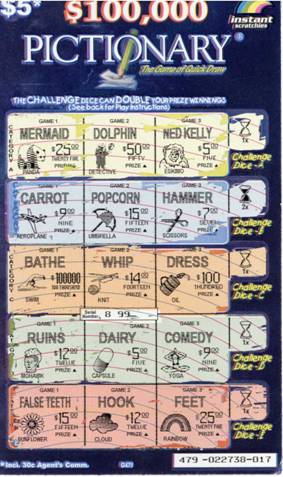
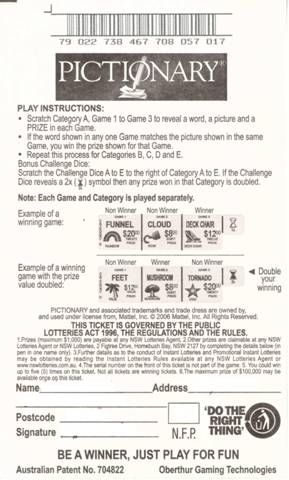
Front side Reverse side
5 Each of the 15 large panels on the front side was a “game”. The game with the word “BATHE” was in Category “C”. The serial number under the game to its right (with the word “WHIP”) is part of a verification code used by Lotteries. The barcode and number at the top of the reverse side was another verification code. I will explain the significance of these codes later. The ticket’s number appeared at the bottom right of the front side. Each game was originally covered by a layer that hid it, but could easily be scratched from the surface. Hence the name “scratchie”.
6 On the reverse side, relevantly, there were play instructions, examples of winning games and a number of other statements. The critical play instructions were:
“PLAY INSTRUCTIONS
- Scratch Category A, Game 1 to Game 3 to reveal a word, a picture and a PRIZE in each Game.
- If the word shown in any one Game matches the picture shown in the same Game, you win the prize shown for that Game.
-
Repeat this process for Categories B, C, D and E. …” (emphasis added)
Below these were examples of winning games and a reference to Mattel Inc having licensed the use of “Pictionary”, followed by:
“THIS TICKET IS GOVERNED BY THE PUBLIC
LOTTERIES ACT 1996, THE REGULATIONS AND THE RULES.
1. Prizes (maximum $1,000 are payable at any NSW Lotteries Agent. 2. Other prizes are claimable at any NSW Lotteries Agent or NSW Lotteries, 2 Figree Drive, Homebush Bay, NSW 2127 by completing the details below (in pen in one name only). 3. Further details as to the conduct of Instant Lotteries and Promotional Instant Lotteries may be obtained by reading the Instant Lotteries Rules available at any NSW Lotteries Agent or www.nswlotteries.com.au. 4. The serial number on the front of this ticket is not part of the game. 5. You could win up to five (5) times on this ticket. Not all tickets are winning tickets. 6. The maximum prize of $100,000 may be available once on this ticket.”
The Pleaded Claim in Contract
7 Mr and Mrs Kuzmanovski pleaded that they, or one of them, entered into a contract with Lotteries when Mrs Kuzamnovski purchased the ticket in July 2007. Lotteries asserted that only Mrs Kuzmanovski contracted with it. Mr and Mrs Kuzmanovski alleged that it was a term of the contract that the play instructions amounted to a promise to pay the prize shown in a game where the word “BATHE” matched the picture shown in the same game.
8 Lotteries denied this and relied on the Public Lotteries Act, the Rules, the game specifications for the game (made under the Public Lotteries Act) and the instructions on the ticket. I will explain the detail of those defences later.
The Legislative Scheme under the Public Lotteries Act
9 The Public Lotteries Act regulated the conduct of public lotteries such as the Pictionary scratchie lottery. Lotteries was a licensee under the Act. A “public lottery” was defined in s 5(1)(b) as meaning any lottery including a game of chance being an instant lottery in which “certain numbers are designated as prizewinning numbers” (emphasis added) (s 5(1)(b)). For the purposes of s 5, “numbers” included “symbols” (s 5(2)(a)) and a “symbol” included “amount, word, or picture” (s 4(1)). A public lottery conducted by a licensee was not unlawful despite the provisions of any other (State) Act or law (s 6(1)). A licensee who conducted a public lottery committed an offence if its licence did not authorise the conduct of that lottery or it was conducted in contravention of the Act, the Regulations or Rules made under the Act, or the conditions of the licence (s 8). However, an agreement, such as a contract of purchase of a ticket, was not void, voidable or unenforeceable merely because it related to, or was for the purpose of, a public lottery conducted by a licensee (s 7(1)).
10 A licensee had to make rules for the conduct of public lotteries (s 22(1)) that had to be submitted to the Minister for approval (s 23). Once approved, the licensee had to cause the rules to be published in the New South Wales Government Gazette (s 23(2)). The rules could make provision for determination of the entitlement, if any, of a subscriber to a prize in a public lottery and the payment of prizes (ss 22(2)(c), (d)). A complete copy of the rules had to be displayed in a prominent position at each place where entries in a public lottery were sold (s 24(1)). Any rule that was not consistent with the Act had no effect to the extent of any inconsistency (s 25).
11 A licensee had to keep a separate prize fund for each kind of public lottery that it was licensed to conduct in a specified account (ss 25A, 27). The licensee had to pay into the prize fund not less than the balance of the percentage, specified in its licence, of the total subscriptions received for each public lottery it conducted after adding the amount already applied by it or its agents in payment of prizes won in that lottery (s 26). The licensee could pay money out of the prize fund towards payment of prizes won in a public lottery in respect of which the fund was kept (ss 27(3), (8)(a)).
12 Instant lotteries were regulated specifically in Div 3 of Pt 6 of the Public Lotteries Act which provided:
“Division 3 Instant lotteries
48 Definitions
In this Division:
instant lottery means a public lottery that is an instant lottery, and includes a public lottery in which the prizes are determined (wholly or partly) by exposing the matter in panels on the tickets in the lottery (whether or not additional prizes are determined in any other manner).
numbers has the same meaning as in section 5 (2).
49 Application of Division
(1) This Division applies to all instant lotteries promoted or conducted before or after the commencement of this Division, whether under the New South Wales Lotteries Act 1990 or under this Act.
(2) This Division has effect despite any other Act or law or any agreement.
50 Verification of tickets and prizes
(1) A licensee may record on a ticket in an instant lottery a verification code by which the licensee can determine after the sale of the ticket whether it is a valid ticket and also whether it has won a prize.
(2) A licensee may implement other tests in respect of instant lotteries for determining whether a ticket is a valid ticket and also whether it has won a prize.
(3) Those verification codes or other tests have the following purposes:
(a) to prevent forgery or fraudulent alteration of tickets,
(b) to provide a conclusive means of determining prizewinning tickets in accordance with the total amount allocated for prizes in that lottery.
(4) A prize is not payable in respect of a ticket in an instant lottery if the ticket does not satisfy any such verification code or other test.
(5) This section has effect even though the ticket may indicate that a prize has been won.
(6) The regulations may make additional provisions for or with respect to the payment of prizes in instant lotteries.
51 Clarification of certain rules for winning prizes in instant lotteries
(1) In an instant lottery, a statement that a prize is won by matching 3 numbers or by matching 3 identical numbers (or a statement to the same effect) means, and is taken always to have meant, that a prize is won if the same number appears 3 times. For example:
7 1 7 1
3 7 wins a prize 3 7 does not win a prize
4 7 3 1
(2) In an instant lottery, a caption to a number (for example, the word “one” beneath the number “1”) forms part of the number and does not constitute a separate number for the purposes of counting the number of numbers.
(3) This section applies to a statement on a ticket in the instant lottery or to a statement publicly advertised or used in connection with the instant lottery.” (emphasis added)
The Rules
13 The Instant Lottery Game Rules in force on 24 July 2007 applied to public lottery games involving numbers (as defined in s 5(2) of the Public Lotteries Act) being revealed on tickets to determine, wholly or partly, a prize (r 1(a)(xv)). A prize was defined as any prize determined in accordance with rr 9 and 14 (r 1(a)(xxi). A player was a person who purchased a ticket and paid the price (called the “fee” consisting of the “commission” payable to the selling agent and the balance of the “subscription” payable to the licensee (r 1(a)(xiv), (xxviii)) (r 1(a)(xx)). A “ticket” meant the form of entry to an instant lottery evidencing that a player had paid the fee to enter it and it could include ticket serial numbers (r 1(a)(xxix)). Ticket serial numbers were defined as meaning the verification code in the form of numbers, letters and or bar codes that may be printed on tickets “and which constitute the means by which the licensee can determine after the issue of the Ticket whether it is a valid Ticket and also whether it has won a Prize” (r 1(a)(xxx)).
14 The rules provided that they were to be read subject to the Public Lotteries Act, and Regulations and the licensee’s licence (r 2(a)). And, r 3(b) provided that the Rules prevailed in the event of any inconsistency between the Rules and the conditions printed on tickets. The Rules had to be displayed and made available for inspection at each agency when tickets were sold (r 3(h)).
15 All decisions made by the licensee’s chief executive officer concerning the prize fund (being the account established under s 27 of the Public Lotteries Act: r 1(a)(xxii)) and the declaration and payment of prizes shall be final and binding on all Players (r 2(b). Prior to its commencement, the chief executive officer had to determine a prize structure for an instant lottery comprising the number and value of prizes to be offered to players by the licensee during the period of that lottery (rr 2(c), (d)). Rule 2(e) recognised that some or all of the prizes in the prize structure could have been won by players during the continuing currency of an instant lottery, so that the balance of prizes were still available to be won at the time of their entries by later players. The licensee had no obligation at any time to advise or inform prospective players of the balance of prizes available to be won in any instant lottery (r 2(f)).
16 The ticket issued to a player constituted his or her official receipt and by accepting it the player acknowledged “… all details thereon”. It was the only form issued by the licensee or agent to the player evidencing entry into the particular instant lottery (r 7(a)). The ticket itself remained the property of the licensee at all times (r 7(c)). In order to guard against fraudulent or other alteration of a ticket, r 7(b) provided:
“7(b) In the event that the particulars recorded on the Player’s Ticket are not consistent with the particulars held by the Licensee by way of Computer Records or such other records held by the Licensee, then the latter shall apply and shall determine what Prize, if any, the Player shall be entitled to and the Player shall be bound by any such determination. Particulars which may be recorded on a Ticket include the Ticket Serial Number, the Numbers revealed, the particular Instant Lottery or Promotional Instant Lottery entered.” (emphasis added)
However, r 7(h) then provided:
“7(h) Tickets in an Instant Lottery shall specify:-
(i) the manner in which the Ticket holder may determine whether an Instant Prize has been won; and
(ii) the procedures for claiming Instant Lottery Prizes.” (emphasis added)
Next, r 9 was as follows:
“RULE 9 DETERMINATION OF PRIZES
(a) The Licensee is to determine the number of Tickets in an Instant Lottery, the amount of money Prizes and the number and nature of other Prizes.
(b) The Prizes payable in respect of an Instant Lottery are to be determined:
(i) by revealing the Number on the Tickets in the Lottery; or
(ii) in such other manner as is approved by Chief Executive Oficer for the purposes of that Instant Lottery.
(c) Without limiting Rule 9(b), Prizes in an Instant Lottery may be determined by the inclusion of Tickets in the lottery in a draw.
(d) If any Prizes in an Instant Lottery are to be determined in a manner approved under Rule 9(b)(ii), the Licensee is to give notice of the manner of determination:
(i) by indicating the manner of determining the Prize on each Ticket in the Instant Lottery; or
(ii) by publicly advertising the manner of determination of the Prize, or both.” (emphasis added)
17 There was no evidence that any notice had been given for the purposes of r 9(d). Under r 16 a prize in an instant lottery was payable only on presentation of a ticket “indicating that the Prize has been won and after the Licensee has determined that the Ticket is valid and has won the Prize”. Rule 16 provided:
“A Prize in an Instant Lottery is payable only on presentation of a Ticket in that Instant Lottery indicating that the Prize has been won and after the Licensee has determined that the Ticket is valid and has won the Prize.”
18 Rule 22(a) provided that a prize was not payable in an instant lottery in certain situations including:
“(v) in such other circumstances as are specified on the Ticket or entry or as have been publicly advertised by the Licensee in relation to the Instant Lottery or Promotional Instant Lottery; or
(vi) in respect of a Ticket which fails any confidential security test of the Licensee.” (emphasis added)
By entering an instant lottery a player acknowledged that he or she had entered into an agreement with the licensee and agent and agreed to be bound by the Rules (r 23(a)).
The Game Specifications
19 The game specifications for the Pictionary scratchie instant lottery that governed the ticket Mr Kuzmansovki received, were approved by Lotteries on 30 November 2006. The game specifications provided in cl 4.2, headed “Game Fonts”, that there were 20 word symbols including “SWIM” and “BATHE” and 20 printed pictorial symbols with captions including:
20 The game specifications had a prize structure providing for, among other prizes, there to be two prizes of $100,000 for that instant lottery, one in each of the two groups’ prize structures. The prize structure required that in each group large prizes “… be balanced exactly on the 750,000 tickets and in total for the game”. The $100,000 prize could appear in any of categories B, C, D or E. The game specifications also stipulated that in a winning game:
“5.1 Winning Games
-
The word symbol to match the pictional symbol with a ‘GAME’.
…
-
The pictional symbols on any ticket will not match any word symbols on that ticket except within a winning ‘GAME’.
…
5.3 General Restrictions
…
-
Word and pictional symbols will only appear within the specific CATEGORY as defined under ‘Fonts’.
…” (emphasis added)
As noted above, the appearance of the pictorial symbols in cl 4.2 headed “Game Fonts” was of a picture or drawing only, as distinct from the caption. The introductory description was “printed pictorial symbols with captions”.
Lotteries’ Gaming System and Verification Process
21 Lotteries operated computer software to manage all aspects of its games, including instant scratchie lottery tickets. This software was used by its agents, such as the newsagent at which Mr Kuzmanovski attended to present his ticket. Lotteries entered into its gaming system the details of each instant scratchie lottery it conducted, including each individual Pictionary lottery. The details included the number of tickets in each book of tickets, the prize structure for that lottery, unique validation numbers to verify the status of a ticket as a winning one and the value of the prizes.
22 Scientific Games Products Australia Pty Ltd printed the tickets and provided Lotteries with computer files containing validation information for each book of tickets. Those files were entered into Lotteries’ computer system and checked prior to tickets in the particular lottery going on sale. When a ticket was presented for validation, the equipment at the (news)agent scanned the barcode on the reverse side and keyed in the three digit security code on the front side. This data was transmitted to Lotteries’ gaming system for “validation”. Lester Khan, Lotteries’ gaming systems manager, explained that the process of “validation” involved the gaming system decoding the encrypted information in the barcode and security code so as to create a unique validation number. That number was used to then interrogate validation files in the gaming system to determine the winning status of a ticket. If the prize was for more than $1,000 the gaming system interrogated a second set of files, supplied by Scientific Games with each lottery, to determine the amount won. This second step was an additional security measure.
23 Lotteries purged validation files from the gaming system about one year after the tickets for a particular lottery had been withdrawn from sale. This had occurred in respect of Mr Kuzmanovski’s ticket here. Scientific Games had to provide from its records, for the purposes of these proceedings, the validation material that it had supplied originally to Lotteries. This sought to reconstruct what had been used in July 2007 by Lotteries and the agent to justify the refusal to pay the $100,000 prize. The reconstruction for these proceedings of the validation process generated a computer result of “LOSER” for the ticket.
The Pictionary Game and the Pictionary Scratchie Lottery
24 Christine Jeffrey, Scientific Games’ sales manager, said that the instant scratchie lottery ticket closely resembled the board game product of Pictionary produced by Mattel. She explained that the ticket needed to have a close resemblance with the playing actions and visual appearance of the board game. The word symbols were developed using cards from Mattel’s game. She said that the pictorial symbols were created by Scientific Games. She said, and I accept, that nowhere in the Pictionary game were there pictures with captions on them. Cards in the game identified actions or things with particular colours as one moved around the board. Players picked up cards that had particular pictures referable to words that appeared on the relevant colours as they moved around the board. There was no action in the Pictionary game that referred to bathe.
The Claim in Contract
25 Mrs Kuzmanovski purchased the ticket from a newsagency in Parramatta, New South Wales. That newsagency was a licensed agent of Lotteries for the purposes of the Act and the Rules. Thus, Mrs Kuzmanovski entered into a contract with Lotteries, by its agent, for the purchase of the ticket.
26 Mr and Mrs Kuzmanovski pleaded that when she purchased the ticket, she did so as agent for him. Lotteries suggested that since she made the purchase intending to give the ticket to her husband later, it may be that she was the only contracting party. However, Lotteries was prepared to accept that there was a contract between it and Mr and Mrs Kuzmanovski. Thus, the legal basis on which Mr Kuzmanovski could sue Lotteries in contract was not argued. However, I am satisfied that Lotteries’ concession that he could was correct for each of the following two reasons. First, Mrs Kuzmanovski assigned all her rights to and in the ticket to husband when she made a gift of it to him. Secondly, he accepted the offer by Lotteries under rr 9(d) and 16 to pay him, as the holder of a ticket, any prize that it indicated had been won on its presentation, after Lotteries determined that it was a valid ticket and had won that prize.
Assignment
27 In my opinion, Mrs Kuzmanovski’s act of giving the ticket to her husband as a birthday present was a sufficient expression of her immediate intention to make over to him all her equitable interest in it so as to amount to a valid equitable assignment by way of gift of all her rights in the ticket, including the right to payment of any prize: Comptroller of Stamps (Vict) v Howard-Smith (1936) 54 CLR 614 at 622 per Dixon J; Norman v Federal Commissioner of Taxation (1963) 109 CLR 9 at 26, 33-34 per Windeyer J; see also Goodridge v Macquarie Bank Ltd (2010) 265 ALR 170 at 211-212 [172] per myself. Thus, when Mrs Kuzmanovski gave the ticket to her husband she did all that she could do to assign to him her rights in respect of it to determine whether a prize had been won under r 9(d) and to enforce the right to be paid that prize upon presentation of the ticket under r 16. The physical piece of paper on which the ticket was printed remained the legal property of Lotteries by force of r 7(c).
28 Because the right to payment under r 16 only required presentation of the ticket with a winning game, Mr Kuzmanovski, as assignee, could sue Lotteries for the prize in contract. His wife, as assignor, was also a party to these proceedings, so that all contracting parties would be bound by the result.
A Second Contract
29 In daily life, people frequently make gifts of lottery tickets to their family and friends. They also buy tickets for others as their agents. Typically, a purchase transaction occurs when the “player” simply hands over cash to an agent of Lotteries in exchange for one or more tickets. The purchaser is not required by the Public Lotteries Act or Rules to sign any document or to identify who he or she is. Lotteries ordinarily has no immediate means of knowing who the person handing the money to the agent was or the capacity in which he or she was acting (i.e. as sole beneficial purchaser or on some other basis for another or others). The Public Lotteries Act and Rules do not prohibit such purchases or seek to deny their efficacy.
30 Indeed, r 16 created a right in the person who presented a winning ticket to be paid the prize. And r 9(d) recognised that the holder of the ticket, as opposed to the player (being the person who purchased it), should be able to ascertain its winning status from the ticket itself. As a practical matter, Lotteries will only know the name of a person connected with the purchase of a ticket, if it is presented as a winning ticket under r 16 by someone seeking payment of the prize. These features are characteristic of the relationships that commonly occur with the purchase of lottery tickets and their later presentation to Lotteries for payment. It is not necessary that the original purchaser present a winning ticket for payment. Thus it is likely that Lotteries will often be uncertain who actually purchased any ticket later presented for payment. Yet, r 16 contemplates that the person who physically presents a ticket for payment of a prize will receive it, if the requirements on the ticket, and subject to what I say below, the Act and Rules are met.
31 These matters suggest that the person who presents the ticket agrees to be bound by its terms, and to the extent that it effectively imports the provisions of the Act and Rules, those provisions as consideration for Lotteries’ promise to pay the prize if it is a winning ticket. As Lord Wilberforce said in New Zealand Shipping Co Ltd v AM Salterthwaite & Co Ltd [1975] AC 154 at 167, the law of contract takes a practical approach in commercial situations “… often at the cost of forcing the facts to fit uneasily into the slots of offer, acceptance and consideration”. In Australasian Performing Right Association v Monster Communications Pty Ltd (2006) 71 IPR 212 at 229 [71] I said:
“The use of the concept of agency to overcome the need for privity is a technique which was described in Toll (FGCT) Pty Ltd v Alphapharm Pty Ltd (2004) 219 CLR 165 ; at [79] by Gleeson CJ, Gummow, Hayne, Callinan and Heydon JJ adopting the words of Lord Bingham of Cornhill (in Homburg Houtimport BV v Agrosin Private Ltd [2004] 1 AC 715 at 744 as “a deft and commercially-inspired response to technical English rules of contract, particularly those governing privity and consideration”. As their Honours went on to note in the case of a stevedore seeking the benefit of a Himalaya clause against a consignee of damaged cargo, courts have been ready to conclude that the carrier was acting with the stevedore’s authority.”
32 It may be correct to treat Mrs Kuzmanovski, when she purchased the ticket, as the agent for whomever she permitted to become its holder, being a person she authorised or permitted to present it for payment of any prize under r 16. On the other hand, r 16 can be seen as a promise for an act (namely presentation of the ticket for the purposes of satisfying the requirements of the rule, including the making of a determination under it) which is accepted by the doing of the act (namely presenting the ticket): cf Australian Woollen Mills Pty Ltd v The Commonwealth (1953) 92 CLR 424 at 456 per Dixon CJ, Williams, Webb, Fullagar and Kitto JJ applying Carlill v Carbolic Smokeball Co [1893] 1 QB 256. By taking the trouble to present the ticket for payment, Mr Kuzmanovski did everything as its holder that Lotteries required him to do under r 16 to be considered by it in making a determination whether he was entitled to be paid. The promise was to pay on presentation of a ticket if, when presented, it was determined to be a winning one: Australian Woollen Mills 92 CLR at 457. There the Court said:
“It is of the essence of contract, regarded as a class of obligations, that there is a voluntary assumption of a legally enforceable duty. In such cases as the present, therefore, in order that a contract may be created by offer and acceptance, it is necessary that what is alleged to be an offer should have been intended to give rise, on the doing of the act, to an obligation.”
33 Although not much is involved in a person engaging in the act of presenting a ticket, nonetheless Lotteries’ promise to pay was conditional on that act of presentation occurring. The fact that the ticket had been purchased earlier is no answer to that act resulting in the creation of a new contract between the presenter and Lotteries for the reason given by AL Smith LJ in Carlill [1893] 1 QB at 273 (see too Australian Woollen Mills 92 CLR at 458-459) namely:
“Now, is there not a request there? It comes to this: ‘In consideration of your buying my smoke ball, and then using it as I prescribe, I promise that if you catch the influenza within a certain time I will pay you £100’.” (emphasis added)
34 For these reasons, I am satisfied that when he presented the ticket for payment of the prize Mr Kuzmanovski had, or was entitled to enforce as assignee, a contractual right to require Lotteries to deal with the ticket he presented in accordance with the rules and to pay him any prize to which he was entitled.
Did the word “BATHE” match the picture?
35 Lotteries’ primary argument was that the word “BATHE” did not match the picture of the person swimming with the word “SWIM” underneath it. I reject that argument.
36 The following dictionaries define the verb “bathe” as having “swim” as one of its meanings:
- the Collins English Dictionary (3rd ed) (Special Australian Consultants GA Wilkes WA Krebs): sense 1 was: “intr[ansitive] to swim or paddle in a body of open water or a river”;
- the Australian Concise Oxford Dictionary of Current English (3rd ed): sense 1 was: “(intr) immerse oneself in water; exp to swim”;
- the Collins Australian Dictionary (Gem: 8th ed 2006) which was actually consulted by Mr Kuzmanovski: It gave a first sense as “swim in open water for pleasure”;
- the Macquarie Dictionary (4th ed): sense 7 (which was the second meaning for intransitive usage given): “Chiefly British: to swim for pleasure”;
-
the New Shorter Oxford English Dictionary (Vol 1; 1993): sense 4 (which was the first meaning for intransitive usage given): “Immerse oneself in water, esp in the sea, a river, a swimming pool etc, for recreation”; it gave the examples of “bathing beauty” as being “an attractive woman in a swimsuit” and of “bathers (esp Austral.) swim-trunks, a swimming costume”.
37 An ordinary and natural meaning in Australian English usage of “bathe” is “swim”. It follows that the picture of a person swimming, taken by itself, matches the word “bathe” on the ticket. Lotteries argued that because the Macquarie Dictionary used the qualification “chiefly British” in relation to this meaning of “bathe”, I should not make this finding. It contended that I should accord primary regard to that dictionary because in House of Peace Pty Ltd v Bankstown City Council (2000) 48 NSWLR 498 at 506 [33 par 3] Mason P had described it as the “most authoritative Australian dictionary” following what Kirby P had said in Provincial Insurance Australia Pty Ltd v Consolidated Wood Products Pty Ltd (1991) 25 NSWLR 541 at 553. It also pointed to the methodology that the Macquarie Dictionary stated it had employed, of putting the central meaning of each part of speech first. Lotteries relied on the fact that the “chiefly British” meaning was the second meaning the Macquarie Dictionary gave for the intransitive usage of “bathe”.
38 The meaning of a word used in ordinary speech or writing is a question of fact. Dictionaries provide a useful and often important source or aid from which the answer to that question of fact can be determined. However, it is not legitimate to defer to one particular usage in one dictionary as the only meaning for a word. Here, the Macquarie Dictionary, and three others prepared for Australian use, as well as common experience of the use of “bathe” as a word of ordinary speech, recognise that a natural and ordinary meaning of bathe was “swim”. No contractual provision or rule identified the exact means or dictionary by which a word’s meaning was agreed to be ascertained. Thus the relationship of the parties in these proceedings did not require deference to Lotteries’ asserted meaning for “bathe” as not being “swim”.
39 In a passage quoted with approval by Black CJ, Jacobson and Perram JJ in Polo/Lauren Co LLP v Ziliani Holdings Pty Ltd (2008) 173 FCR 266 at 273 [24] Mason P, with whom Stein and Giles JJA agreed, said (House of Peace 48 NSWLR at 505 [28]):
“A dictionary may offer a reasonably authoritative source for describing the range of meanings of a word, including obsolete meanings. Dictionaries recognise that usage varies from time-to-time and place-to-place. However, they do not speak with one voice, even if published relatively concurrently. They can illustrate usage in context, but can never enter the particular interpretative task confronting a person required to construe a particular document for a particular purpose.”
40 In Provincial Insurance 25 NSWLR at 560-561, Mahoney JA engaged in a valuable discussion about the use of dictionaries in construing words used in documents and statutes. He observed, and I agree, that dictionaries are not a substitute for the judicial determination of the interpretation and the construction of words used in such instruments: citing Life Insurance Co of Australia Ltd v Phillips (1925) 36 CLR 60 at 78 per Isaacs J. Mahoney JA also stated that there is no single authoritative dictionary and the Court would improperly restrict itself if it referred to only one dictionary and not another. He went so far as to say that it is “… dangerous, in interpreting or construing a document, to confine attention to a single dictionary”: Provincial Insurance 25 NSWLR at 561.
41 Next, Lotteries argued that the word “BATHE” did not “match” the picture of the person swimming because the primary meaning of “match” as used in the ticket’s play instructions was to pair, couple or marry two things together: cp State Lotteries Office v Burgin [1993] NSWCA 254 (BC 9301896) at 9 per Kirby P, or, to exactly correspond: per Sheller JA at 22. Lotteries contended that the examples shown on the ticket indicated that the caption, being the word in small print underneath the picture, confirmed its construction of “match” as requiring a precise identity between the word in larger print and the picture. I reject this argument. None of the four losing examples used a word which could have had the meaning of the picture in the same game. The real premise of this argument was that the caption created and delimited whether the word and picture matched. The flaw in the argument was that the game would then be to match the word and either only the caption but not the picture, or both the picture together with its caption. But that would be a different game to the one in the play instructions, which required only a matching of the word and the picture. They did not make the caption a part of the game or the process of matching.
42 Next Lotteries argued that by “exploring” the concepts or meanings at work there was a clear difference between bathing and swimming. It referred to dictionary definitions of “swim” to suggest that its primary meaning was to propel the body through water while “bathe” involved immersing the body in water. I reject this argument. The concept in the game was plain: the word “BATHE” was matched by the picture of the person swimming. The meaning of “swim” was not part of the game. A person playing the game on the scratchie lottery ticket was not expected to engage in a metaphysical debate about every possible permutation of the meanings that could be conveyed by the word and picture. The concept could not be simpler; indeed, a child could play, as no doubt children also often play, the board game of Pictionary. The real problem, self-evidently, was the poor design of the game, the play instructions and the lack of familiarity of the designers with the range of ordinary and natural meanings of the word “bathe”. That problem is no reason to construe a consumer product such as a scratch lottery ticket artificially or with the overrefinement that Lotteries suggested.
43 Lotteries argued that the overlap in the meaning or concepts of “bathe” and “swim” was relatively minor and not such as to support the result that the word “BATHE” matched the picture. I reject that argument too. As Wilmot LCJ said in Dodson v Grew (1767) Wilm 272 at 278; [97 ER 106 at 108] “Words are only pictures of ideas upon paper”: cited by Isaacs J in Fell v Fell (1922) 31 CLR 268 at 276 and Mason P in House of Peace 48 NSWLR at 504 [26]. English is a language full of words that both can match meanings as well as convey different senses depending on the context. Here, two words were not being used; only one word was used together with a picture it matched.
Was the Word “swim” Part of the Picture?
44 Lotteries contended that the word “BATHE” did not match the picture because the picture was a composite consisting both of the drawing and the word in the caption, “swim”. Mr Kuzmanovski said that when he looked at the two examples of “winner” on the reverse side of the ticket “the caption clarified what the picture was”. And he said that the caption under the drawing clarified that it was of someone bathing. Mrs Kuzmanovski considered that the caption defined the picture and that the picture matched the word “BATHE”. Both noted that the play instructions said nothing about the caption having to match the word. Lotteries argued that because of their acceptance that the caption defined or clarified the picture, Mr and Mrs Kuzmanovski could not have understood the play instructions to suggest a “match” between a word and a picture that had a different word in its caption. I reject this argument.
45 First, the meaning of provisions in a contract is determined objectively and not by reference to the subjective intentions, beliefs or understanding of the parties: Toll (FGCT) Pty Ltd v Alphapharm Pty Ltd (2004) 219 CLR 165 at 179 [40]per Gleeson CJ, Gummow, Hayne Callinan and Heydon JJ. Secondly, the picture is of a person who, in ordinary English, is bathing or swimming. Each word can be a synonym for the other. Thirdly, the play instructions gave no role to the caption. The game, after all, was not to match a word in big print with a caption in small print. Rather, the game was to match a written word with a different form of expression of the idea conveyed by the writing, namely a picture. The caption did clarify what the picture was about, but the play instructions did not exclude an ordinary and natural synonym of the word “BATHE” being conveyed by the picture captioned by the word “SWIM”.
46 Lotteries argued that s 51 of the Public Lotteries Act made the caption a part of the pictorial symbol. I reject that argument. The definition of a public lottery, including an instant lottery, in s 5(1)(b) as being one in which “certain numbers are designated as prize winning numbers” is important in construing s 51. The play instructions are critical in understanding what “number” (including a symbol or picture: see ss 4(1), 5(2)(a)) was designated as a prizewinner. Next, s 51(1) and (3) attributed a meaning to a statement in a ticket that a prize is won by matching 3 numbers or 3 identical numbers to mean that “the prize is won if the same number appears 3 times”. The section’s use of “3” was by way of example and clearly applied to any number of matches from one up.
47 However, the Pictionary instant lottery game did not deal with the same number or symbol appearing at all. Rather, that game required a match between a word and a picture. Neither was, or could by its nature, be identical, anymore than if the game required a “match” between synonyms. The word “five” will match the numeral 5, or the Roman numeral versions of V, or (v), however it is expressed. But, a person looking south east from a beach in Sydney towards New Zealand could say accurately that he or she was looking at or across the sea (the Tasman Sea), the ocean (the Pacific Ocean), the water or, to use a slang expression, “the ditch”. Each of those expressions conveys a synonymous use of the same concept, namely the expanse of sea, ocean or water between Sydney and New Zealand. This consequence draws one back to the use of the concept of “certain numbers” being “designated as prizewinning numbers” in s 5(1)(b)(i). The definition proceeded on the basis that the prizes in an instant lottery game of chance “… are distributed to persons holding the prizewinning numbers” (s 5(1)((b)(iii)) as distinct from a particular ticket or verification code. Section 51 can only operate on numbers (including symbols) that the play instructions designated as prizewinning. The play instructions were and defined the game. In his classic speech in Liversidge v Anderson [1942] AC 206 at 245, Lord Atkin said:
“I know of only one authority which might justify the suggested method of construction: “‘When I use a word,’ Humpty Dumpty said in rather a scornful tone, ‘it means just what I choose it to mean, neither more nor less.’ ‘The question is,’ said Alice, ‘whether you can make words mean so many different things.’ ‘The question is,’ said Humpty Dumpty, ‘which is to be master – that’s all.’” (“Through the Looking Glass,” c. vi.)”
48 Here, the play instructions must be “master” because they define the game and they designate the numbers that are prizewinning: namely, a match between the numbers being the symbols of a word and a picture. Nor does s 51(2) assist Lotteries’ argument. The caption here was not used for the purpose of counting. The Pictionary game was not one to match a word in a large front with a picture together with word caption in a much smaller font. Nor was it one in which a verification code was expressed to play any part. The “numbers”, as defined in ss 4(1) and 5(1), that the play instructions designated as match winning, did not include the word caption in small font. Nor did the fact that that caption read “swim” alter the capacity of the picture to match the word “BATHE”. The word and picture do match in ordinary English. The caption did not define or delimit exclusively, and is not made by s 5 to define or delimit, the picture. But the caption unmistakably demonstrated that the picture was of someone engaged in an activity, swimming, that was part of the ordinary and natural meaning of and matched the word “BATHE”.
The Operation of s 50 of the Public Lotteries Act on the Contract – the Verification Code Test
49 Lotteries relied on the express incorporation of the Public Lotteries Act and the Rules into the ticket. It contended that s 50(1) entitled it to record a verification code on the ticket. It relied on the code recorded and contended that this code determined that the ticket had not won a prize. Mr Kuzmanovski had taken the ticket to his local newsagent the day after his birthday. The agent scanned it and then Mr Kuzmanovski saw that the scanner panel read “not a winning ticket”. Mark Carter, Lotteries’ director of marketing and sales explained that components of the verification code appeared on both sides of the ticket. These were used by its selling agents to determine whether a ticket had won a prize. Mr Carter asserted that the game specification did not allocate this ticket for a $100,000 prize. He said that only two tickets had been created that paid a $100,000 prize, one of which had been sold and paid and that the other $100,000 winning ticket was not sold.
50 Rule 7(h)(i) required each ticket to specify the manner in which the ticket holder may determine whether a prize had been won. Rules 9(b)(ii) and (d) required Lotteries to indicate on the ticket or to advertise any other manner, as was approved by its chief executive officer, for determining whether a prize was payable. There was no evidence of any notice or advertisement for this purpose. Here, the play instructions gave the only specified means of a holder determining whether the ticket had won, namely that the word and picture for a game matched. The ticket’s references to the Public Lotteries Act and Rules did not specify any additional means of the holder determining whether he or she had a winning ticket. The mere reference to the governing force of that Act and Rules was not a specification of the manner in which a person could determine whether the ticket contained a winning game.
51 However, ss 50(4) and (5) of the Public Lotteries Act went further and elevated the importance of a verification code. They provided that even if the ticket indicated that a prize had been won, it was not payable if the ticket did not satisfy a verification code recorded on the ticket pursuant to s 50(1). Thus, Lotteries argued that s 50(4) operated not to change the status of the ticket as a winning ticket, but to relieve Lotteries of any obligation to pay the prize that a valid ticket represented had been won. I reject that argument.
52 Section 50(3) specified that the purposes of a verification code were first, to prevent forgery or fraudulent alteration of tickets and, secondly, to provide “a conclusive means of determining prizewinning tickets in accordance with the total amount allocated for prizes in that lottery”. There was no doubt that the ticket presented by Mr Kuzmanovski was valid. Lotteries argued that the second purpose of the verification code was critical here. It contended that s 50(3)(b) justified its refusal to pay the $100,000 prize because of its assertion that the ticket was not intended by it to be a winning one.
53 A verification code or test under ss 50(1) or (2) is a means of ensuring the integrity of the conduct of instant lotteries. It is important that there be a objective means of ascertaining first, whether a ticket is genuine and was, in fact, a ticket originally sold by Lotteries or its agent; secondly, whether apart from having its cover scratched off, it has not been altered so as to make it appear to be different from the article sold by Lotteries or its agent. Once a ticket has been accepted as valid, a verification test or code can also be used to determine if it is prizewinning in accordance with s 50(3)(b).
54 The question here is whether Lotteries’ argument is correct, namely that it can create a verification code or test that results in the disqualification of a ticket notwithstanding that it is valid and prizewinning on its face in accordance with the rules, game specifications and contract with the player (or person later presenting it). In my opinion, the Public Lotteries Act does not authorise the creation or use of such a test or code. Rather than providing a safeguard against fraud by third parties in seeking to pass off tickets as winning where they were not genuine, Lotteries’ argument would create a means for it to subvert the integrity of instant lotteries that it marketed. Its effect would be to allow Lotteries to engage in public marketing and sales of instant lotteries on a false basis. It would mean that Lotteries could contract with members of the public on one set of rules, including play instructions on the instant lottery tickets, with no intention of honouring its contractual promise because of a secret code or test that permitted it to eschew any liability to pay a prize.
55 I am not prepared to ascribe such a misleading or deceptive Parliamentary purpose to s 50 of the Public Lotteries Act. The legislature is unlikely to have intended to permit Lotteries to contravene its own Fair Trading Act let alone (if it had power to do so) to contravene ss 52 or 53 of the Trade Practices Act. In addition, Lotteries’ construction would result in it failing to comply with rr 7(h)(i), 9(b) and (d) and in stating false play instructions that omitted a material particular, namely that an unstated verification code or test could override the result contracted for in play instructions.
56 Any verification code or test used by the licensee or Lotteries under s 50 must be consistent with the Public Lotteries Act itself, and the rules and game specifications for the instant lottery. A verification code or test under s 50 cannot change the nature of the instant lottery so as to alter the prizewinning status of a valid ticket that contains numbers designated under s 5(1)(b) as prizewinning numbers.
57 Here, r 22(a)(vi) provided that a prize was not payable in respect of a ticket that “… fails any confidential security test of the licensee”. The drafting of this rule is consonant with the above construction of s 50; namely that the purpose of the verification code or test was to provide for the security or integrity of the instant lottery, not to insert a new, and publicly unknown, additional criterion that changed the nature of a contractually valid prizewinning ticket into a worthless piece of paper: cf Burgin [1993] NSWCA 254 (BC 9301896) at 19-20 per Kirby P; Sheller JA agreeing on this point at 12; Project Blue Sky Inc v Australian Broadcasting Authority (1998) 194 CLR 355 at 381-382 [69]-70], 384 [78] per McHugh, Gummow, Kirby and Hayne JJ.
58 This construction of s 50 is not negated by ss 50(4) or (5). All that s 50(4) does is to state a consequence for a ticket that does not satisfy a verification code or test that was validly applied to the ticket. And, s 50(5) operates to authorise the licensee to refuse to pay a prize on a ticket that apparently presents on its face as a winning one but which in truth is not valid or had not been a ticket sold by the licensee or had been altered.
Did Lotteries establish that the ticket had not satisfied a Verification Code or Test?
59 Mr and Mrs Kuzmanovski argued that ss 50(1) and (2) required, and only permitted, the licensee, and not a third party, to perform the verification test. They contended that Lotteries had not performed the test, but rather this had been done by Scientific Games. Lotteries argued that first, the test had been performed by its agent, the newsagency, at which Mr Kuzmanovski presented the ticket and, secondly, by Lotteries when the ticket was presented to it.
60 In July 2007, the newsagent had used a scanner to determine whether the ticket did win. This resulted in the reading “not a winning ticket”. However, the mere use of Lotteries’ gaming system by the agent did not exhaust the power of Lotteries, as licensee, to use a verification test under s 50 to determine whether the ticket was a winning one. Lotteries subsequently examined the ticket for this purpose. The precise test used by the agent and, its status for present purposes, was not proved by Lotteries. Scientific Games never tested the actual ticket. Its managing director, Paul Howell, said it never received that ticket. Rather he said, Scientific Games used the numbers from the ticket to reconstruct it from its records.
61 Importantly, Mr Carter’s evidence, which I accept, was that the only test that Lotteries itself had done on the ticket was simply to look at it when it was produced. He said that “… based on the instructions on the ticket, we had deduced, as a test, that it was not a winner because it didn’t fulfil the instructions”. He said those instructions were that the word had to match the picture including the caption.
62 I do not accept that Lotteries was entitled to determine that the ticket was not a winning ticket on this incorrect basis. The play instructions made no reference to a caption. While s 51(2) provided that a caption formed part of a number which, in turn, included a symbol, by force of s 5(2)(a), the play instructions did not state this. Thus, the mere visual test that Mr Carter used was not sufficient to justify Lotteries’ refusal to accept the ticket as having won the prize and Lotteries did not make this determination by using a proper verification test.
63 Moreover, s 51(2) did not have the effect of making the caption part of the picture for the purpose of the ticket. That is because s 51 dealt with counting or matching identical numbers (including symbols). The Pictionary game in the scratchie instant lottery was not concerned with matching identical numbers. Rather the game required matching a word with something that was not identical to that word but was a different expression of a meaning or idea conveyed by the word, being a picture. And, even if the caption did form part of the picture for the purposes of s 51(2), an ordinary and natural meaning of the word “BATHE” was “swim”. That being so, there was an identical match in this case.
64 As Mr Carter’s evidence established, Lotteries did not determine that the ticket did not win the prize by use of a verification code. He simply looked at the face of the ticket to make the decision for Lotteries. And, if the code or test was used, it was invalid because it used criteria that were not authorised by the Public Lotteries Act or any part of the rules, game specifications or contract.
No Notice was given of the Role of the Verification Code and Caption
65 Lotteries relied on the general statement on the ticket that it was governed by the Public Lotteries Act and the Rules. That statement did not give the notice required by the rules themselves that would have made a verification code or caption determine that the ticket won or lost. It would have been simple to add in the play instruction for determining a win after “picture” the words “and caption” as well as words to the effect “and satisfies the confidential winning verification code in this ticket”. If Lotteries’ argument were correct, the game specification created a ticket with a set of play instructions that falsely represented the game because they treated the picture as including the caption, yet omitted this critical information from the face of the ticket. Thus, this argument does not assist Lotteries’ in its refusal to pay the prize, even if the construction I have given to its power to employ a verification code or test in s 50 be wrong.
66 I am of opinion that if the caption or the verification code on the ticket overrode the result arrived at in the play instructions then, this instant lottery was conducted in contravention of rr 7(h)(i), 9(d)(i) and 22(a)(v) and s 8 of the Public Lotteries Act. This is because it did not give notice of the additional means that Lotteries proposed to use to determine if the prize on the ticket had been won namely, its use of the verification code or caption. The wording on the ticket did not give any hint that, even if the manner stated in the play instructions for determining that the holder had won the prize were followed, the ticket might not win because its verification code or the caption could produce a contrary result. Rules 7(h)(i), 9(d)(ii) and 22(a)(v) required the licensee, Lotteries, to give notice that a further, radically different, and conclusive means of determining the prize, contrary to or entirely omitted from the play instructions, governed the ticket.
67 In Reinhold v New South Wales Lotteries Corporation [2008] NSWSC 5 at [28] Barrett J held that although the Public Lotteries Act did not expressly cause the Rules to form part of a player’s contract, the contract entered into on purchase of an 0z Lotto ticket did incorporate them. Here, the ticket stated that it was governed by the Rules. The question is whether that statement sufficed to incorporate them into the contract. In Brown v Petranker (1991) 22 NSWLR 717 at 722D-E Clarke JA, with whom Handley JA and Waddell AJA agreed, said of a rule excluding a newsagent from liability:
“The Court is not dealing with a contract freely negotiated between two parties. On the contrary, while it can be accepted for present purposes that upon the facts alleged by the respondent the appellants came under a duty which may be described as contractual to send the validated coupon to the Lotto offices, the relationship between the parties was governed by an Act of Parliament and rules passed thereunder which imposed the terms and conditions under which the duty arose. The question which arises is not the same as the one which arises in the construction of a written private agreement. In that instance the Court is concerned to ascertain the presumed intention of the parties from the written words. In the present case the Court is concerned with the proper interpretation of a rule passed pursuant to a rule making power contained in an Act of Parliament. Accordingly, the line of cases dealing with the effectiveness of exclusion clauses in contracts to exclude liability for negligence exemplified in Canada Steamship and discussed in Bright v Sampson and Duncan Enterprises Pty Ltd (1985) 1 NSWLR 346, especially at 359, 362-368, has no application.”
68 However, here the Rules give effect to several purposes. One is to ensure that persons who play the game in the ticket know the terms on which the prize is won. Another is to give effect to securing the integrity of the conduct of the lottery and to prevent unintended payments. Moreover, Clarke JA made no reference to the binding norm of behaviour imposed on Lotteries by Pt V and in particular, ss 52 and 53 of the Trade Practices Act.
69 In an ordinary contractual relationship, if a ticket or other document is intended by the issuer to incorporate another document that contains terms of a contract, such as an exclusion clause or a foreign jurisdiction clause, the issuer cannot rely on those terms unless, at the time of the contract, it did all that was reasonably necessary to bring the terms to the other party’s attention: Oceanic Sun Shipping Company Inc v Fay (1988) 165 CLR 197 at 228-229 per Brennan J; McRobertson, Miller Airline Services v Commissioner of State Taxation (WA) (1975) 133 CLR 125 at 137 per Stephen J, 143 per Jacobs; Sydney Corporation v West (1965) 114 CLR 481 at 485 per Barwick CJ and Taylor J, see too at 503 per Windeyer; eBay International AG v Creative Festival Entertainment (2006) 170 FCR 450 at 453 [19] per myself; cp Toll 219 CLRat 184 [55] distinguishing between cases where a contract is signed and “ticket” cases where the document is handed by one party to the other.
70 There was nothing to draw a player’s or purchaser’s attention to the actual existence or use of the caption or any verification test for the purpose of determining whether a prize was won in the Pictionary instant scratchie lottery. Neither was referred to expressly in the rules. Importantly, s 50(1) of the Public Lotteries Act gave the licensee a discretion to include a verification code. The section did not impose an obligation to use one. The Rules too did not in terms provide that the verification code had to be, or would be, applied, if the ticket did not specify that it would not be a winning one without that code confirming the win. While r 22(a)(vi) provided that a prize was not payable if the ticket failed a confidential security test, it did not make such a test apply where notice of it had not been included on the ticket in accordance with rr 7(h)(i), 9(d) and 22(a)(v). There was no evidence of any public advertisement that a verification code or the caption was the, or a, manner of determining the prize (cp: r 9(d)(ii)).
71 The game specification did not refer to a requirement that the caption match the word, or that the ticket also satisfy a verification code or test for a winning game. The game specification stipulated the play instructions that appear on the face of the reverse side of the ticket. While the game specifications referred to the category C pictorial symbols as being printed with captions, they did not make the captions a part of the pictorial symbol. The description of the pictorial symbols as being “with captions” was in contrast to the winning and non-winning game specifications. The latter two game specifications referred to the pictorial symbols alone as matching, or not, a word symbol. That was consistent with the play instructions.
72 Lotteries contended that it disclosed that the picture included the caption by using the examples of winning games. It asserted that it could not “seriously be suggested that Lotteries was required to state as much in words as well”. I reject that argument. The examples did not negate the use of synonyms as matches or explain the asserted essentiality of the caption as a part of the matching. They could equally be an explanation or clarification of the picture so as to enable a person to determine whether the depicted thing matched the word. Lotteries created the potential for ambiguity in a consumer product by using synonymous concepts that were reasonably capable of matching. I am of opinion that if the caption were important, it could not have been omitted from the play instructions.
73 Lotteries also argued that the fact that the ticket “featured a verification code which confirmed that the [t]icket was a losing ticket (something that was apparent on its face) is irrelevant”. If the role of the verification code were merely confirmatory, it missed its mark since the face of the ticket revealed a win. However, Lotteries sought to use the verification code not as a means of confirming the obvious, but as a means of determining what may not have been obvious at all. But it failed to identify that intended use of the verification code as a means of determining the winning status of a game.
Lotteries’ other arguments on the Contractual Claim
74 Lotteries argued that it could not treat the ticket as a winning game because it would then contravene s 8 of the Public Lotteries Act. I reject this argument. The Pictionary scratchie instant lottery was not conducted in contravention of any requirement of or made under that Act or the Rules or a condition of Lotteries’ licence. There was no evidence of any requirement for a verification code to apply to the ticket. Nor was there any evidence that paying the $100,000 prize to Mr Kuzmanovski would be a contravention of any such requirement or was unauthorised.
75 Lotteries argued that only two prizes of $100,000 were payable under the game specifications. These provided that there were two prize groups each of 750,000 tickets. Only one of the two $100,000 prizes had been paid. Mr Carter said that the ticket for that unpaid prize had not been sold. Lotteries argued that if it were required to honour the ticket here it would contravene a requirement of the rules in r 9(a) because by approving the game specifications, it had determined the amount of money prizes. I reject this argument.
76 Rule 9(a) required Lotteries to make a determination of the amount of money prizes. In contrast r 9(a) also required Lotteries to determine “the number and nature of other Prizes”. Lotteries did so by providing for, among others, a money prize of $100,000. That rule did not require Lotteries to determine a maximum or any number of money prizes that it had to pay. If it mistakenly created a game in which it had to pay more than it had intended to pay, Lotteries was not excused or prohibited by the Public Lotteries Act or Rules from honouring its contractual obligations to make those payments.
77 Lotteries also argued that its construction of the Public Lotteries Act and Rules would prevent payment of more than had been paid into the prize fund account. I reject this argument. Under s 26(1) the licensee can retain money from subscriptions to reimburse itself for prizes that it has already paid. Thus, where agents pay amounts less than $1,000, the licensee can recoup those payments under s 26(1) before paying the balance of its receipts from a particular lottery into the prize fund. And, if it had to pay a large sum for a winning ticket or tickets before it had sufficient money in the prize fund for the particular lottery, the licensee was not excused from honouring its liability to the winner or winners. So too, if the licensee sold a lottery game that, by mistake, had many winning tickets, the legislation and rules did not relieve the licensee from its liability to honour those winning tickets. Mistakes in the printing or game design were not illegal. Their consequence may be a reduction in the licensee’s profits but there is nothing in the Public Lotteries Act and Rules that averted the licensee’s (or Lotteries’) liability to pay the prize in a winning ticket simply because it made a mistake. The Pictionary instant scratchie lottery was lawful even though Lotteries’ lack of understanding of the meaning of “bathe” exposed it to pay more than it intended.
78 Even if the ticket sold to Mr and Mrs Kuzmanovski were not intended to be a winning ticket, s 7 of the Public Lotteries Act expressly provided that an agreement was not void or voidable or otherwise unenforceable merely because it related to or was made for the purposes of a public lottery conducted by a licensee. There is no reason why Lotteries should be able to rely on the illiteracy or lack of knowledge of the English language of itself or the game designers to avoid paying the prize it promised was payable for matching the word “BATHE” with the picture of a person swimming. The integrity of public lotteries should be upheld by holding those, such as Lotteries, to conduct themselves according to their promises: cf Project Blue Sky 194 CLRat 390-392 [93], [97]; see too Burgin [1993] NSWCA 254 at pp 19-20 per Kirby P, with whom Sheller JA agreed on this point.
79 For these reasons, I am satisfied that Lotteries breached its contractual obligation to pay Mr Kuzmanovski the $100,000 prize. This makes it unnecessary for me to determine the other arguments put by Mr and Mrs Kuzmanovski. However, I will express my findings on the claims under the Trade Practices Act briefly lest my conclusion on the contract be found to be wrong.
The Pleaded Claims under the Trade Practices Act
80 Mr and Mrs Kuzmanovski pleaded that Lotteries made nine representations to them in trade or commerce by the play instructions, pictures and content of the ticket. These were that Lotteries represented to them that:
“(1) upon [their] scratching Game 1-3 in either categories A-E and revealing a word shown in one game that matches a picture shown in the same game, they were entitled to claim the prize being $100,000 and/or represented that [Lotteries] would pay the prize being $100,000 and/or represented that matching a word and picture entitled the holder to the prize being $100,000 and or represented that winning the prize shown required only the matching of a word and picture and/or represented that a winning ticket required only the matching of a word and picture.
(3) the play instruction prevailed over any game specification.
(4) the scratchie ticket was valid and that the game determined whether it won a prize.
(5) a prize was payable in respect of the ticket based on the game.
(6) the terms of the game in the play instructions would have contractual effect if the ticket indicates a prize has been won.
(7) the picture to be matched did not include a caption.
(8) the governing of the ticket by the Public Lotteries Regulations and Rules is consistent with effect being given to the play instructions.
(9) in connection with the supply or possible supply of goods [Lotteries] falsely represented that the scratchie ticket had a particular standard, quality and value by reason of the Pictionary game and the $100,000 heading. Whereas the standard of the goods was not determined by the game the quality of the goods was not of a game of chance and the value of $100,000 had no reference to the game but rather whether it was a winning ticket, contrary to s 53(a) of the Trade Practice Act 1974 … .
(10) the effect of the condition, right or remedy as to the prize payable upon matching a picture and word was misleading or false within the meaning of s 53(g) of the Trade Practices Act … .”
81 Mr and Mrs Kuzmanovski asserted that each representation was false. Additionally, they alleged that Lotteries had engaged in conduct that was misleading or deceptive or likely to mislead or deceive in the creation for sale, and sale of, the ticket, first, by concealing its winning status in readable form upon its being scratched by the player and/or, secondly, by not disclosing its losing status in readable form upon its being scratched by the player and in the play instructions because, in substance:
- the play instructions were not a complete or accurate statement for determining the winning status of the ticket;
- the play instructions omitted a rule that the caption to the picture had to match the word;
-
when the ticket was scratched by the player it did not disclose to him or her in a readable way that it was in fact a winning or losing ticket and that this would be determined by a verification code.
82 Additionally, the Kuzmanovskis alleged that each representation was made as to a future matter within the meaning of s 51A of the Trade Practices Act. They claimed that Lotteries did not have reasonable grounds for making each representation. They claimed to have suffered loss or damage by Lotteries’ conduct for the purpose of s 82 of the Act amounting to the value of the prize and, or alternatively, the distress caused to Mr Kuzmanovski from his disappointment caused by the ticket not being a winning one. Lotteries denied those allegations.
83 Lotteries admitted, correctly, that the Trade Practices Act applied to its conduct in as a trading or financial corporation formed within the limits of the Commonwealth for the purposes of the definition of “corporation” in s 4 of that Act. It was a corporation constituted by force of s 5 of the New South Wales Lotteries Corporation Act 1996 (NSW) and a statutory State owned corporation within the meaning of the State Owned Corporations Act 1989 (NSW). Lotteries admitted also that it carried on business and the commercial activity of gaming. Mr and Mrs Kuzmanovski also pleaded mirror claims under the Fair Trading Act. The latter provisions reflect those of the Trade Practices Act. Because there is no issue that the Trade Practices Act applied to Lotteries, it is not necessary for me to consider the claims under the Fair Trading Act separately.
The Legislative Scheme under the Trade Practices Act
84 Relevantly, the Trade Practices Act provided:
“51A Interpretation
(1) For the purposes of this Division, where a corporation makes a representation with respect to any future matter (including the doing of, or the refusing to do, any act) and the corporation does not have reasonable grounds for making the representation, the representation shall be taken to be misleading.
(2) For the purposes of the application of subsection (1) in relation to a proceeding concerning a representation made by a corporation with respect to any future matter, the corporation shall, unless it adduces evidence to the contrary, be deemed not to have had reasonable grounds for making the representation.
(3) Subsection (1) shall be deemed not to limit by implication the meaning of a reference in this Division to a misleading representation, a representation that is misleading in a material particular or conduct that is misleading or is likely or liable to mislead.
52 Misleading or deceptive conduct
(1) A corporation shall not, in trade or commerce, engage in conduct that is misleading or deceptive or is likely to mislead or deceive.
....
53 False or misleading representations
A corporation shall not, in trade or commerce, in connexion with the supply or possible supply of goods or services or in connexion with the promotion by any means of the supply or use of goods or services:
(a) falsely represent that goods are of a particular standard, quality, value, grade, composition, style or model or have had a particular history or particular previous use;
....
(g) make a false or misleading representation concerning the existence, exclusion or effect of any condition, warranty, guarantee, right or remedy.”
Were the Representations Conveyed?
Mr and Mrs Kuzmanovski’s evidence
85 In July 2007, Mrs Kuzmanovski put the two Pictionary scratchie tickets she had purchased into a birthday card which she gave to her husband on the evening of his birthday. They had included scratchie tickets in birthday cards through their married life. Prior to buying the ticket Mr and Mrs Kuzmanovski had seen and heard television, radio and newsagency advertisements for “scratchies” that used the slogan “scratch me happy”. Their experience with this particular ticket did not live up to that exhortation.
86 As he scratched at the winning game Mr Kuzmanovski became more excited with the prospect that he had won a prize. After he scratched the ticket he said to his wife that he thought he had won $100,000. He thought “bathe” had been matched by the picture. Mr Kuzmanovski counted the zeros and checked that the prize was $100,000. He felt “an explosion of elation as [he] thought [he] had won $100,000”. He confirmed that the play instructions specified that the word matched the picture in the game he would win the prize.
87 They discussed using the prize to reduce their mortgage and planned a family trip to visit his sick grandmother in Macedonia. They were excited by this prospect. (The grandmother passed away in October 2008.) On the day after his birthday, Mr Kuzmanovski was told by the newsagent that the ticket was not a winning one. He was stunned and could not believe what he had been told. That night he and his wife checked the dictionary definitions of “bathe” to confirm that it meant “swim”. He could not sleep much that night.
88 The following day Mrs Kuzmanovski spoke to a customer service operator at Lotteries telling him that “bathe” meant “swim”, a fact he readily confirmed. She sent him a confirmatory email with a copy of the ticket. Later that day another officer of Lotteries telephoned her and said that it was not a winning ticket because it had not come up as winning at the newsagent. Mrs Kuzmanovski said that her husband had been upset and disappointed by Lotteries’ rejection of his claim. She said that this continued to play on his mind and that he “just wasn’t focused”. Mr Kuzmanovski said that he was deeply angry that Lotteries had said that he did not have a winning ticket and felt cheated. He has remained disappointed and angry since.
89 On 26 July 2007, Lotteries wrote to Mrs Kuzmanovski asserting that unless the ticket had a correct verification code it was not a winning ticket. The letter stated that the caption had been added to the pictures on the Pictionary game “to assist players in determining if a picture matches the word”.
90 Mrs Kuzmanovski also asserted that had she known of the requirement that the caption to the picture had to also match the word, that the ticket would only be a winning one if a verification code determined it to be and that s 50 of the Public Lotteries Act overrode the terms of the ticket, she would not have purchased it. I do not accept that evidence. I think that it reflected her understandable disappointment with the lack of transparency and clarity in the play instructions and information on the ticket. And it was informed by hindsight. Of course, after she had experienced the disappointment from what happened, she felt that she would not have purchased the source of the trouble. That is a human and natural reaction. But I think that if the rules had been clear, she would still have purchased the ticket but both she and her husband would have known at the time whether they had won or lost according to transparent rules.
91 Mr Kuzmanovski said that when he played the tickets on the night of his birthday he, in effect, took them at face value and believed that there was nothing in the Public Lotteries Act or Rules inconsistent with the play instructions. I believe him. That evidence was criticised by Lotteries, but it was just commonsense. I do not consider that Mr and Mrs Kuzmanovski were being dishonest in giving their hypothetical reactions. Indeed, I considered that she and her husband were honest witnesses. They had a legitimate sense of grievance with Lotteries and their disappointment in dealing with a company owned by a State government that did not act transparently in business.
Were the Representations Conveyed?
92 I am of opinion that each of the pleaded representations other than (2) was conveyed by the ticket on its face to Mr and Mrs Kuzmanovski. Those representations were, in effect, restatements of the ordinary and natural meaning conveyed by reading the ticket. Representation (2) referred to the game specification which was not a concept recorded anywhere on the ticket. Mr and Mrs Kuzmanovski were not aware of the existence of a game specification.
93 Lotteries contended that it was not the Crown in right of the State of New South Wales or its government. That was correct. The consequence is that it is bound by Pt V of the Trade Practices Act. The express terms of the play instructions did not incorporate the caption to the picture or the verification code as any part of the game. It follows that if, contrary to my constructions of s 50 and the contract, ss 50(5) or 51(3) would have the effect of making the caption or the use of a verification code a part of the play instructions, then the play instructions appearing on the ticket were calculated to convey falsely that the game was of a materially different nature to the one in those additional instructions. If Lotteries’ contention that ss 50(5) and 51(3) were to have effect notwithstanding the express play instructions on the ticket I am satisfied that representations (8) and (9) would be established.
94 Lotteries could easily have specified in the play instructions additional requirements for a winning ticket that the caption also match and the verification code be satisfied. However, in a consumer contract, such as a lottery ticket, it is inconsistent with the operation and purpose of ss 52 and 53 of the Trade Practices Act to give effect to legislation by a State that would disguise its licensee’s trading terms from consumers of its public lottery services. This raises whether it would be appropriate to order under s 87(2) that ss 50(5) and 51(3) of the Public Lotteries Act and Rules not have the operation for which Lotteries contended and that those provisions not be imported by force of the references to them on the ticket. Those provisions operated to prevent Mr and Mrs Kuzmanovski obtaining payment of the $100,000 prize because of the unexpressed requirements that the caption had to match or the verification code had to be satisfied in a way that rendered the play instructions to be misleading, deceptive and, indeed, false.
95 Lotteries conduct was misleading and deceptive because it concealed on the face of the ticket critical information that substantively negated the crystal clarity of its play instruction:
“If the word shown in anyone Game matches the picture shown in the same Game, you win the prize shown for that Game.”
It was not open for Lotteries to suggest that the Delphic statement that the ticket is governed by the Public Lotteries Act, and Rules, negated the pellucid play instruction. It would have been a simple task to make the play instructions fit accurately the game Lotteries was seeking to play. All Lotteries had to do was add the words “and caption” after “picture” and a short statement at the end of the play instruction to the effect:
“Your ticket also contains, as a security measure, the confidential verification code for this prize.”
96 The face of the ticket had no reference at all to any requirement that it meet a verification code to win. The concealment or failure to state both this qualification and the need for a matching capacity was the essence of Lotteries’ misleading and deceptive conduct. It would follow that, if the play instructions were deficient in this way, Lotteries lacked reasonable grounds for making any future representations.
Remedies
97 Mr and Mrs Kuzmanovski sought an order under s 87(2)(a) declaring void the provisions in the contract in the ticket that gave effect to the caption and the verification code requirements. That would make the ticket reflect what it represented. But it would also convert an entry in a game of chance from a losing to a winning ticket. Lotteries argued that this would be contrary to the principles in Marks v GIO Australia Holdings Ltd (1998) 196 CLR 494 and Gates v City Mutual Life Assurance Society Ltd (1986) 160 CLR 1. The game specifications had allowed for one in 750,000 tickets to win the sole $100,000 prize.
98 On the other hand, the errors in the game design represented to a player in the position of Mr and Mrs Kuzmanovski, as it did to them, that the word “BATHE” and the picture of the person swimming, that the ticket had won $100,000. What loss or damage did each of them suffer from the representation?
99 I have found that Mrs Kuzmanovski would still have bought the ticket even if the play instructions had correctly represented the true nature of the Pictionary game. Lotteries argued that, on this hypothesis, the ticket would then have the very characteristics that it intended that ticket to have under the game specifications, namely that it did not create a match between the word and picture. It also contended that if the ticket were treated as winning the $100,000 prize because of an order varying the contract under s 87(2), that remedy would convert a misrepresentation into a contractual promise and so provide an inaccurate measure of loss.
100 Here, the ticket itself conveyed the misrepresentations. This is different from the position in Gates 160 CLR 1. There Mr Gates was induced to enter a policy of insurance by a misrepresentation as to the benefits provided under it. He could not prove that he would have been able to effect a policy that provided the benefits represented had he known the true position at the time of effecting the policy. And in Marks 196 CLR 494 borrowers entered into a loan facility on the faith of a representation that interest would be payable at a specified rate that the lender could not vary. When the lender later proposed to change the rate under the actual loan agreement, none of the borrowers could prove that they could have obtained better terms from any other financier had they known of the true rights of the lender before initially borrowing. Indeed, the original loan offered, even on the misleading terms, was at a rate more beneficial to the borrowers than they could have obtained elsewhere at the time: Marks 196 CLR at 516 [58]-[59] per McHugh, Hayne and Callinan JJ.
101 In this case, (on the hypothesis that my opinion that Lotteries was in breach of its contract to pay the prize is wrong) Mr and Mrs Kuzmanovski were not misled into the purchase of the ticket. Rather the terms of the ticket, once purchased and scratched, misled them as to its inherent characteristics. The loss or damage suffered by them was caused by Lotteries having failed to state on the ticket the true nature of how it operated. In other words, the purchase of the ticket was like a purchase of a defective product with a hidden fault that was revealed when it was used or consumed. In each case the purchaser wanted to buy the ticket or product, but suffered a consequence because of a hidden defect in the particular product selected, that would not have been present in similar or identical versions of the same thing available at the same time.
102 Here, the damage done was to raise a false hope in Mr and Mrs Kuzmanovski that the ticket won the $100,000 prize when in fact, because it misrepresented its own characteristics, it won nothing. As the inherent defects in the ticket became more and more apparent, the sense of disappointment, anger and frustration felt by Mr and Mrs Kuzmanovski increased. This was a natural reaction aptly described by Mr Kuzmanovski as his feeling cheated. This was the very kind of human feeling that the misrepresentations of the true nature of the Pictionary game would be likely to create, given the word and picture matched. The soaring of their hopes and dreams of being able to pay off some of their home mortgage and have an overseas family visit to a sick grandmother were ordinary human reactions.
103 Indeed, these were the very kind of reactions played on by the nature of public lottery sales pitches in ordinary life. Lotteries’ conduct in making the misrepresentations caused these natural feelings of disappointment, anger, frustration and of being cheated to arise and fester in Mr Kuzmanovski and, to a lesser extent, his wife.
104 There are no objective criteria for assessing the value of such injured feelings. Mrs Kuzmanovski bought the ticket to give her husband the pleasure of playing a game of chance in which he might win. That pleasure was neatly coined by Lotteries’ own advertised “scratch yourself happy” promotion. The result for Mr and Mrs Kuzmanovski was initial happiness followed by protracted vexation. Doing the best I can, I would have assessed Mr and Mrs Kuzmanovski’s damages under ss 82 or 87 at $20,000 (or, if I had to apportion these at $15,000 for him and $5,000 for her).
Mr and Mrs Kuzmanovski’s Other Arguments
105 Mr and Mrs Kuzmanovski also propounded arguments that characterised the Public Lotteries Act as containing provisions, such as ss 50 and 51, that were inconsistent with s 64 of the Judiciary Act 1903 (Cth), or were not capable of being surrogate federal laws picked up by ss 79 or 80 of that Act. They argued that because that State law excluded the contractual liability of Lotteries, as a State owned corporation, it was not enforceable in federal jurisdiction. Because I have concluded that they are entitled to succeed on their primary claim in contract it is not necessary for me to deal with this purely legal argument.
Conclusion
106 The claim in contract succeeded. Mr Kuzmanovski is entitled to recover $100,000 plus interest. Lotteries should pay the costs of Mr and Mrs Kuzmanovski’s proceedings. By its letter of 26 July 2007, Lotteries communicated its definite refusal to honour its contract. Interest on the $100,000 debt should be calculated from that date. The parties should bring in agreed short minutes of order to give effect to these reasons.
I certify that the preceding one hundred and six (106) numbered paragraphs are a true copy of the Reasons for Judgment herein of the Honourable Justice Rares.
Associate:
Dated: 17 August 2010


