

FEDERAL COURT OF AUSTRALIA
Citigroup Pty Limited v Commissioner of Taxation [2010] FCA 826
| Citation: | Citigroup Pty Limited v Commissioner of Taxation [2010] FCA 826 | |
|
| | |
| Parties: | ||
| | | |
| File number(s): | NSD 45 of 2009 | |
| | | |
| Judge: | EDMONDS J | |
| | | |
| Date of judgment: | 9 August 2010 | |
| | | |
| Catchwords: | Held: Part IVA applied. Section 204(3) of ITAA 1936 – general interest charge – whether taxpayer liable for general interest charge between date tax due and payable and date of amended determination of foreign tax credits allowed. Held: general interest charge did not apply
| |
| | | |
| Legislation: | ||
| | | |
| Cases cited: | Commissioner of Taxation v Consolidated Press Holdings Ltd (2001) 207 CLR 235 cited
| |
|
|
| |
| Date of hearing: | 8, 9, 10, 11 and 12 March 2010 | |
|
|
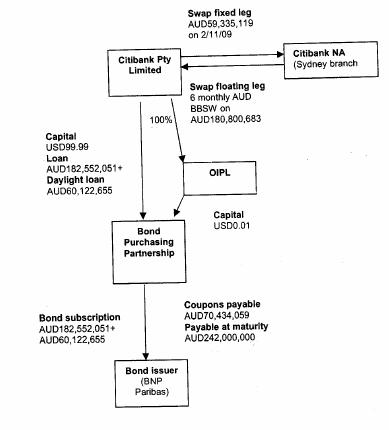
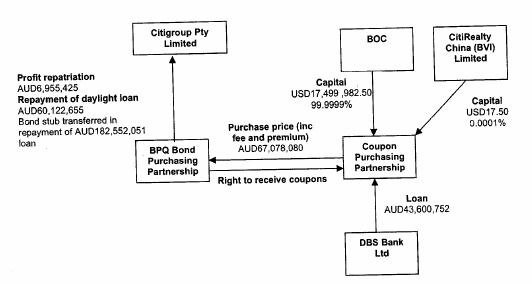
| |
| Place: | Sydney | |
|
|
| |
| Division: | GENERAL DIVISION | |
|
|
| |
| Category: | Catchwords | |
|
|
| |
| Number of paragraphs: | 197 | |
|
|
| |
| Counsel for the Applicant: | Mr AC Archibald QC, Mr SHP Steward SC, Ms CA Burnett | |
|
|
| |
| Solicitor for the Applicant: | Freehills | |
|
|
| |
| Counsel for the Respondent: | Mr NJ Williams SC, Ms E Collins, Mr J Kay Hoyle | |
|
|
| |
| Solicitor for the Respondent: | Maddocks Lawyers | |
| IN THE FEDERAL COURT OF AUSTRALIA |
|
| NEW SOUTH WALES DISTRICT REGISTRY |
|
| GENERAL DIVISION | NSD 47 of 2009 |
| BETWEEN: | CITIGROUP PTY LIMITED Applicant
|
| AND: | COMMISSIONER OF TAXATION Respondent
|
| JUDGE: | EDMONDS J |
| DATE OF ORDER: | 9 AUGUST 2010 |
| WHERE MADE: | SYDNEY |
THE COURT ORDERS THAT:
2. The applicant pay the respondent’s costs, as taxed or agreed.
Note:Settlement and entry of orders is dealt with in Order 36 of the Federal Court Rules.
The text of entered orders can be located using Federal Law Search on the Court’s website.
| IN THE FEDERAL COURT OF AUSTRALIA |
|
| NEW SOUTH WALES DISTRICT REGISTRY |
|
| GENERAL DIVISION | NSD 45 of 2009
|
| BETWEEN: | CITIGROUP PTY LIMITED (ABN 88 004 325 080) Applicant
|
| AND: | COMMISSIONER OF TAXATION Respondent
|
| JUDGE: | EDMONDS J |
| DATE OF ORDER: | 9 AUGUST 2010 |
| WHERE MADE: | SYDNEY |
THE COURT DECLARES THAT:
1. The applicant was not liable pursuant to s 204(3) of the Income Tax Assessment Act 1936 (Cth) (1936 Act), or otherwise, to pay General Interest Charge (GIC) for the period 1 June 2004 to 26 June 2008 on the liability to the respondent that arises by reason of s 160AN(5) of the 1936 Act on the difference between:
(a) the amount of $12,421,815, being the amount applied as a credit pursuant to ss 160AI and 160AJA of the 1936 Act in discharge of the applicant’s liability to pay income tax as assessed for the income year ended 31 December 2003 (Income Year); and
(b) the amount of $547,825, being the amount of foreign tax credits which the respondent determined by Notice of Amended Determination dated 27 June 2008 should be allowed to the respondent in respect of the Income Year.
2. The applicant was not liable pursuant to s 204(3) of the Income Tax Assessment Act 1936 (Cth) (1936 Act), or otherwise, to pay General Interest Charge (GIC) for the period 1 June 2005 to 22 April 2009 on the liability to the respondent that arises by reason of s 160AN(5) of the 1936 Act on the difference between:
(a) the amount of $12,467,760, being the amount applied as a credit pursuant to ss 160AI and 160AJA of the 1936 Act in discharge of the applicant’s liability to pay income tax as assessed for the income year ended 31 December 2004 (Income Year); and
(b) the amount of $729,096, being the amount of foreign tax credits which the respondent determined by Notice of Amended Determination dated 23 April 2009 should be allowed to the respondent in respect of the Income Year.
THE COURT orders THAT:
3. The respondent pay the applicant’s costs, as taxed or agreed.
Note:Settlement and entry of orders is dealt with in Order 36 of the Federal Court Rules.
The text of entered orders can be located using Federal Law Search on the Court’s website.
| IN THE FEDERAL COURT OF AUSTRALIA |
|
| NEW SOUTH WALES DISTRICT REGISTRY |
|
| GENERAL DIVISION | NSD 45 of 2009 |
| BETWEEN: | CITIGROUP PTY LIMITED Applicant
|
| AND: | COMMISSIONER OF TAXATION Respondent
|
| JUDGE: | EDMONDS J |
| DATE: | 9 August 2010 |
| PLACE: | SYDNEY |
REASONS FOR JUDGMENT
THE ISSUEs
1 There is only one substantive issue in this case; relevantly, whether the provisions of Part IVA of the Income Tax Assessment Act 1936 (Cth) (‘the 1936 Act’) apply to entitle the respondent (‘the Commissioner’) to cancel foreign tax credits to which the applicant (‘CPL’) is otherwise entitled for the year ended 31 December 2003 (in lieu of the year ending 30 June 2004) and for the year ended 31 December 2004 (in lieu of the year ending 30 June 2005) in consequence of its participation in two Hong Kong bond transactions, the first on 31 December 2003 (‘HKBT 2003’) and the second on 2 November 2004 (‘HKBT 2004’).
2 There is no issue in this case that, absent the application of Part IVA, CPL is entitled to foreign tax credits arising out of HKBT 2003 and HKBT 2004.
3 If the Court finds that the Commissioner is entitled to cancel the foreign tax credits in reliance on Part IVA, a consequential issue arises as to whether CPL is liable to pay the general interest charge (‘GIC’) pursuant to s 204(3) of the 1936 Act or otherwise:
(1) for the period 1 June 2004 (the date that tax for the year ended 31 December 2003 was payable) to 26 June 2008 on the liability to the Commissioner that arises by reason of s 160AN(5) of the 1936 Act on the difference between:
(a) the amount of AUD12,421,815, being the amount applied as a foreign tax credit pursuant to ss 160AI and 160AJA of the 1936 Act in discharge of CPL’s liability to pay income tax as self-assessed for the year ended 31 December 2003; and
(b) the amount of AUD547,825, being the amount of foreign tax credit which the Commissioner determined by notice of amended determination dated 27 June 2008 should be allowed to CPL in respect of that year.
(2) for the period 1 June 2005 (the date that tax for the year ended 31 December 2004 was payable) to 22 April 2009 on the liability to the Commissioner that arises by reason of s 160AN(5) of the 1936 Act on the difference between:
(a) the amount of AUD12,467,760, being the amount applied as a foreign tax credit pursuant to ss 160AI and 160AJA of the 1936 Act in discharge of CPL’s liability to pay income tax as self-assessed for the year ended 31 December 2004; and
(b) the amount of AUD729,096, being the amount of foreign tax credit which the Commissioner determined by notice of amended determination dated 23 April 2009 should be allowed to CPL in respect of that year.
4 I return to this consequential issue later in these reasons.
Part IVA: Legislative Scheme and Background
5 Part IVA of the 1936 Act embodies Australia’s general anti-avoidance rules. By s 177D, Pt IVA applies to any scheme that has been or is entered into after 27 May 1981, and to any scheme that has been or is carried out or commenced to be carried out after that date (other than a scheme that was entered into on or before that date), whether the scheme has been or is entered into or carried out in Australia or outside Australia or partly in Australia and partly outside Australia, where –
(1) a taxpayer (referred to as the ‘relevant taxpayer’) has obtained, or would but for s 177F obtain, a tax benefit in connection with the scheme; and
(2) having regard to eight matters or considerations, it would be concluded that the person, or one of the persons, who entered into or carried out the scheme or any part of the scheme did so for the sole or dominant purpose of enabling the relevant taxpayer to obtain a tax benefit in connection with scheme or of enabling the relevant taxpayer and another taxpayer or other taxpayers each to obtain a tax benefit in connection with the scheme (whether or not that person who entered into or carried out the scheme or any part of the scheme is the relevant taxpayer or is the other taxpayer or one of the other taxpayers).
6 By s 177C(1), reference in Pt IVA to the obtaining by a taxpayer of a tax benefit in connection with a scheme originally read as a reference to:
‘(a) an amount not being included in the assessable income of the taxpayer of a year of income where that amount would have been included, or might reasonably be expected to have been included, in the assessable income of the taxpayer of that year of income if the scheme had not been entered into or carried out; or
(b) a deduction being allowable to the taxpayer in relation to a year of income where the whole or a part of that deduction would not have been allowable, or might reasonably be expected not to have been allowable, to the taxpayer in relation to that year of income if the scheme had not been entered into or carried out …’
Section 177C(1) further deems, for the purposes of Pt IVA, the amount of the tax benefit in each case.
7 Part IVA is not self-executing. Where a tax benefit has been obtained, or would but for s 177F be obtained, by a taxpayer in connection with a scheme (s 177C(1)) to which Pt IVA applies (s 177D), by s 177F(1) the Commissioner may –
‘(a) in the case of a tax benefit that is referable to an amount not being included in the assessable income of the taxpayer of a year of income—determine that the whole or a part of that amount shall be included in the assessable income of the taxpayer of that year of income; or
(b) in the case of a tax benefit that is referable to a deduction or a part of a deduction being allowable to the taxpayer in relation to a year of income—determine that the whole or a part of the deduction or of the part of the deduction, as the case may be, shall not be allowable to the taxpayer in relation to that year of income…’
and, where the Commissioner makes such a determination, he is required to take such action as he considers necessary to give effect to that determination.
8 On 13 August 1998 the Treasurer of the day announced that the provisions of Pt IVA of the 1936 Act would be amended with immediate effect in relation to schemes entered into after that time which are designed to acquire or generate foreign tax credits that can be used to shelter low-taxed foreign source income from Australian tax. The Treasurer went on to say:
‘These transactions generally are structured to yield little or no economic profit relative to the expected Australian tax benefits. Typically they involve the acquisition of an asset that generates an income stream subject to foreign withholding tax. An illustrative example of one such arrangement is attached.
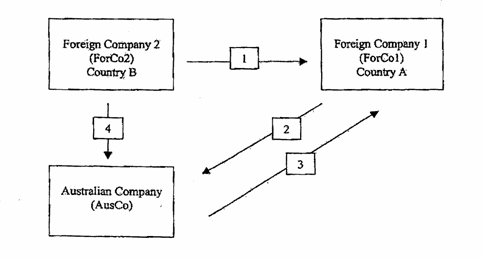
Step 1: Foreign Resident Company (ForCo2) owes royalty payment to Foreign Resident (ForCo1) for the use of intellectual property.
Step 2: ForCo1 & AustCo enter into assignment agreement under which the right to receive the income stream in respect of the intellectual property is assigned to AusCo.
Step 3: AusCo makes payment to ForCo1 for the right to receive the income stream.
Step 4: The assigned income is paid to AusCo by ForCo2. Country B withholds 10% tax on the royalty.
AusCo includes the income stream in its assessable income. After “grossing up” to reflect the foreign tax, and claiming a deduction in respect of the cost of acquiring the income stream, only a small amount of net income is included in AusCo’s taxable income. AusCo claims a foreign tax credit for the full amount withheld by Country B. This amount is greater than the amount needed to offset the tax in respect of the net foreign income. The excess credit is used to reduce the Australian tax payable on other foreign income of the same class.’
9 This announcement found legislative expression by the addition of paras (bb) and (f) to s 177C(1), which, as outlined in [6] above, deals with what constitutes the obtaining by a taxpayer of a tax benefit in connection with a scheme for the purposes of Pt IVA and the amount of the tax benefit. Relevantly, the additional paragraphs read:
‘177C(1) Subject to this section, a reference in this Part to the obtaining by a taxpayer of a tax benefit in connection with a scheme shall be read as a reference to:
(a) ...
(b) …
(ba) …
(bb) a foreign tax credit being allowable to the taxpayer where the whole or a part of that foreign tax credit would not have been allowable, or might reasonably be expected not to have been allowable, to the taxpayer if the scheme had not been entered into or carried out;
and, for the purposes of this Part, the amount of the tax benefit shall be taken to be:
(c) …
(d) …
(e) ..
(f) in a case where paragraph (bb) applies – the amount of the whole of the foreign tax credit or of the part of the foreign tax credit, as the case may be, referred to in that paragraph.’
10 A new para 177F(1)(d) was inserted into s 177F(1) to enable the Commissioner to cancel a tax benefit which is referable, in whole or in part, to a foreign tax credit.
11 Other amendments to Pt IVA were made by the same amending legislation Taxation Laws Amendment Act (No 3) 1999 (Cth) (‘Act No 11 of 1999’), but they are not relevant for present purposes.
12 The Explanatory Memorandum (‘EM’) circulated by authority of the Treasurer, at the time the amending bill was introduced into the House of Representatives, relevantly provided:
‘Background to the legislation
2.4 Australian taxpayers are subject to Australian income tax on all Australian sourced and foreign sourced income, except where a specific exemption applies. Generally, Australian taxpayers with assessable foreign sourced income may claim a credit for tax imposed by foreign jurisdictions against their Australian income tax liability on that foreign sourced income.
2.5 Arrangements which promote the purported acquisition of foreign tax credits by Australian taxpayers have come to the attention of the Australian Taxation Office. These arrangements are structured to acquire or generate foreign tax credits to be offset against tax payable on other foreign sourced income of the Australian taxpayer.
2.6 A foreign tax credit scheme operates on the basis that foreign income is earned which gives rise to an entitlement to foreign tax credits. A scheme is entered into whereby a foreign income stream is acquired. Where the acquisition cost of the income stream is deductible, those deductions largely cancel out the foreign income received. The major portion of the foreign tax credits which relate to that foreign income stream are then available to offset tax payable on the taxpayer’s other foreign income of the same class or to carry forward any excess to future years.’
AN OVERVIEW OF Part IVA IN the Present Case
Scheme
13 In respect of the HKBTs, CPL accepts that the ‘wider scheme’ and the ‘narrow scheme’ identified by the Commissioner are each capable of constituting a ‘scheme’ within the s 177A definition of that word for the purpose of Pt IVA.
Tax Benefit
14 CPL does not contend, for the purposes of s 177C, that had it not entered into one or both of the HKBTs, it would have entered into some other transaction that would have resulted, or might reasonably be expected to have resulted, in the payment of foreign tax and an entitlement to a foreign tax credit in that amount. The Commissioner contends that it necessarily follows from this that CPL obtained a tax benefit in connection with each scheme, and that the tax benefit obtained in each case was its entitlement to the whole of the foreign tax credits resulting from each scheme. This must be right, although CPL apparently does not accept that it obtained a benefit in the sense of a reduction in the amount of tax payable by it either generally or in relation to the HKBTs. That may be so, but the fact that CPL did not obtain a benefit in the sense of a reduction in the amount of tax (foreign and Australian) payable by it either generally or in relation to the HKBTs is not relevant for the purposes of s 177C.
Dominant Purpose
15 The real issue between the parties is the conclusion that should be drawn, having regard to the eight matters or considerations in s 177D(b), as to the dominant purpose of CPL in entering into each of the schemes constituted by the HKBTs. CPL’s case is that it should not be concluded that its dominant purpose in entering into each of the schemes constituted by the HKBTs was to obtain a tax benefit; rather, it should be concluded that its dominant purpose was to obtain fee income, premium and the return on the bonds. The Commissioner’s case is that it should be concluded that CPL’s purpose in entering into each of the schemes constituted by the HKBTs was to obtain a tax benefit in the form of a foreign tax credit.
16 The Commissioner’s case against persons, other than CPL, who entered into or carried out each of the schemes or part of them, as to the conclusion that should be drawn as to their dominant purpose in doing so, appears to be no different from that alleged against CPL itself. Consequently, if it was not concluded that CPL had the requisite purpose under s 177D(b) of entering into or carrying out each of the schemes, it would follow, according to CPL, that no other relevant person had such a purpose. Again, I think this must be right; nor did the Commissioner press that if the Court should conclude that CPL did not have the requisite purpose, it was nevertheless open to the Court to find that another relevant person did have such a purpose.
The Opening Salvos
17 In opening, CPL contended that a reasonable person could not conclude that the dominant purpose of a person making an actual payment of foreign tax was the acquisition of foreign tax credits in the same amount. That is evident, so CPL contended, because no rational taxpayer would pay a dollar of foreign tax simply to avoid an obligation to pay an equal amount of tax in Australia: why, one might ask, would the rational taxpayer be anything other than indifferent as to where it paid that tax?
18 So much may be conceded where the foreign tax on the relevant income is equal to or less than the Australian tax on that income; it may also be conceded where the foreign tax on the relevant income is greater than the Australian tax on that income by reason only of a greater foreign tax rate. But where, as here, the foreign tax rate (17.5%) is less than the Australian tax rate (30%) but the foreign income base, in the years in which the relevant transactions are entered into, is considerably greater than the Australian income base by reason of the different computation of those bases, resulting in greater foreign tax payable than the Australian tax that would otherwise be payable, giving rise to excess foreign tax credits, the door of inquiry under s 177D(b) as to the dominant purpose of a person entering into a scheme giving rise to a tax benefit in the form of those foreign tax credits, is not foreclosed by recourse to arguments based on the rationality of a taxpayer. It has to be determined by reference to the relevant matters or considerations set out in s 177D(b) and one of those matters or considerations will be whether the person has other foreign source income which has not borne foreign tax, or has borne foreign tax in an amount less than the applicable Australian tax, against which the excess foreign tax credits can be applied, in whole or in part, to reduce or otherwise relieve the Australian tax liability on the other foreign source income.
19 CPL contended that the HKBTs exhibited none of the elements identified in the Treasury Press Release issued on 13 August 1998 (see [8] above) as being the target of the relevant amendments made to Part IVA by Act No 11 of 1999 (see [9] above) nor any of the elements identified in the EM circulated by authority of the Treasurer at the time the amending bill was introduced into the House of Representatives (see [12] above). The Commissioner responded by observing that such a contention sought to read the EM in substitution for the plain words of the Act, which do not contain the restriction on the operation of the section for which CPL contended. That is of course impermissible: Re Bolton; Ex parte Beane (1987) 162 CLR 514 at 518. Had the intention been to so restrict the section, it could easily have been expressed in the section itself. CPL responded by saying that it did not dispute that the text of the legislation has primacy, but that the EM aids the interpretative task of identifying the particular mischief against which the amendment was directed. The Commissioner’s suggestion that the EM be discarded entirely is, according to CPL, entirely inconsistent with the need to construe legislation by reference to its intended purpose.
20 Clearly, Pt IVA, in its form as extended by the amendments effected by Act No 11 of 1999, is not to be construed as being confined to the examples given in either the Treasury Press Release or in the EM; they are just that, examples. The examples given all involved the acquisition of an income stream which is taxed in the foreign jurisdiction on a gross basis but where, for Australian income tax purposes, the cost of acquisition is an allowable deduction thus reducing the income base to a net basis. In such a situation, the product of the foreign tax rate, even one less than the applicable Australian tax rate, and the gross income base is likely to give rise to a greater amount of foreign tax than the product of the higher Australian tax rate and the net income base, and in turn give rise to excess foreign tax credits ‘available to offset tax payable on the taxpayer’s other foreign income of the same class or to carry forward any excess to future years’.
21 As will be seen, the relevant facts relating to the HKBT’s did not give rise to any allowable deductions to CPL in Australia which were not available to it in Hong Kong, but the income base in Hong Kong in the year in which the transactions were consummated included the gross amount of the consideration received by the bond purchasing partnerships, of which CPL was a member, for the sale of the interest coupons (similar to the outcome in Commissioner of Taxation v The Myer Emporium Ltd (1987) 163 CLR 199) whereas the income base in Australia, while starting from the same point, was, by virtue of the application of the provisions of Div 16E of Pt III of the 1936 Act, spread over the life of the bonds to equate with their treatment for financial accounting purposes. This meant that the income base in Hong Kong for HKBT 2003 and HKBT 2004 in the years in which the transactions were consummated included AUD60,495,296 and AUD61,199,317 respectively, whereas no amount was included in the income base in Australia for HKBT 2003 pursuant to Div 16E in the year in which the transaction was consummated (it having been consummated on the last day of the year of income) and only AUD1,977,415 was included in the income base in Australia for HKBT 2004 pursuant to Div 16E in the year in which the transaction was consummated. It is true that over the next five years (or four years plus part of a year for HKBT 2004) the balance was brought to account pursuant to Div 16E and included in the Australian income base of CPL in those years, but my purpose in noting the consequence in the years the transactions were consummated is to illustrate that there is, indeed, a measure of common ground between the examples in the extrinsic material and the facts of the present case.
22 In opening, the Commissioner submitted that the authorities establish that the fact that a Pt IVA scheme can be justified commercially, does not prevent Pt IVA from operating, and to reason otherwise is to adopt a false dichotomy: reference was made to Commissioner of Taxation v Spotless Services Limited (1996) 186 CLR 404 at 415 – 416 per Brennan CJ, Dawson, Toohey, Gaudron, Gummow and Kirby JJ. Reference was also made to what Gummow and Hayne JJ said in Commissioner of Taxation v Hart (2004) 217 CLR 216 at [64]:
‘[A]s was held in Spotless, there is a false dichotomy between a “rational commercial decision” and “the obtaining of a tax benefit as ‘the dominant purpose of the taxpayers in making the investment’”. Pointing to the “commercial end” of the scheme reveals the adoption of the same, or at least a substantially similar, false dichotomy. The presence of a discernible commercial end does not determine the answer to the question posed by s 177D. As Hely J rightly said [Hart (2002) 121 FCR 206 at 230 [81]]:
“A particular course of action may be both tax driven, and bear the character of a rational commercial decision. The presence of the latter characteristic does not determine in favour of the taxpayer whether, within the meaning of Pt IVA, a person entered into or carried out a ‘scheme’ for the dominant purpose of enabling a taxpayer to obtain a tax benefit.”’
23 So much may be conceded, but in the very next breath, Hely J said (at [81]):
‘But nor does the fact that a taxpayer adopted one of two or more alternative courses of action, being the one that produces a tax benefit, determine the answer to that question in favour of the Commissioner: Metal Manufactures Ltd v Commissioner of Taxation (Cth) (1999) 43 ATR 375 at 427; 99 ATC 5229 at 5275 per Emmett J (on appeal Commissioner of Taxation (Cth) v Metal Manufactures Ltd (2001) 108 FCR 150; [2001] ATC 4152); Spotless at 425 per McHugh J; Inland Revenue Commissioners v Brebner [1967] 2 AC 18 at 30, per Lord Upjohn.’
This was taken up by Gleeson CJ and McHugh J in Hart, as follows (at [15]):
‘As Hely J correctly observed in the Full Court, the fact that a particular commercial transaction is chosen from a number of possible alternative courses of action because of tax benefits associated with its adoption does not of itself mean that there must be an affirmative answer to the question posed by s 177D. Taxation is part of the cost of doing business, and business transactions are normally influenced by cost considerations. Furthermore, even if a particular form of transaction carries a tax benefit, it does not follow that obtaining the tax benefit is the dominant purpose of the taxpayer in entering into the transaction. A taxpayer wishing to obtain the right to occupy premises for the purpose of carrying on a business enterprise might decide to lease real estate rather than to buy it. Depending upon a variety of circumstances, the potential deductibility of the rent may be an important factor in the decision. Yet, if there were nothing more to it than that, it would ordinarily be impossible to conclude, having regard to the factors listed in s 177D, that the dominant purpose of the lessee in leasing the land was to obtain a tax benefit. The dominant purpose would be to gain the right to occupy the premises, not to obtain a tax deduction for the rent, even if the availability of the tax deduction meant that leasing the premises was more cost-effective than buying them.’
24 What these extracts from their Honours’ reasons in Hart go to exemplify is that the task for the Court under s 177D(b) in drawing a conclusion as to the dominant purpose of a taxpayer in entering into or carrying out a scheme is not to be determined by reference to whether it represents a ‘rational commercial decision’ or that the scheme has a ‘commercial end’, any more than it is to be determined by reference to the fact, if it be a fact, that a taxpayer adopted one of two alternative courses of action, being the one that produces a tax benefit. Moreover, I do not read their Honours’ articulation of the test in Spotless at 423 namely ‘… that, viewed objectively, it was the obtaining of the tax benefit which directed the taxpayers in taking steps they otherwise would not have taken by entering into the scheme’, as embracing a ‘but for’ test; the requisite dominant purpose is not to be drawn merely because, as a matter of objective fact, it is to be concluded that ‘but for’ the tax benefit the course of action adopted would not have been adopted or that ‘but for’ the tax benefit, another course of action would have been adopted, although those considerations may be relevant to the conclusion as to the alternative postulate or hypothetical construct by reference to which the ‘tax benefit’, if any, may be measured.
25 The conclusion which the Court is required to draw under s 177D(b) is one which must be drawn having regard to such of the eight matters or considerations referred to therein as are relevant to the scheme under scrutiny (in many cases they may not all be relevant), and to no other matters. This does not exclude consideration of particular matters which fall within the wider umbrella of one or more of the eight matters or considerations referred to, but if they do not, they cannot be taken into account as part of the process of conclusion-drawing that the Court is required to undertake. In my view, this still leaves the Court with considerable latitude in the matters or considerations it can have regard to in the conclusion-drawing process.
The Facts
Introduction
26 The following glossary of terms, some of which have already been defined, will assist in a reading of these reasons, particularly the factual phase upon which I am about to embark. Hopefully, it will also simplify the narration of the transactions which, even post first blush, have an aura of complexity. To that end, I have also decided to incorporate in these reasons diagrammatic representations of the transactions, annotated by reference to the narration of them, with a view to facilitating, as best I can, a comprehension to the reader of what occurred. I am grateful to counsel for CPL for providing the Court with draft diagrammatic representations which, hopefully, I have been able to embellish without making them misleading.
Term Definition
AUD Australian dollars
BOC Bank of China (Hong Kong) Limited
BNP BNP Paribas
BPP BPP (Hong Kong) Partnership, the partners in which were CPL and OIPL
BPQ BPQ (Hong Kong) Partnership, the partners in which were CPL and OIPL
CIFS Citibank Ireland Financial Services plc, a company incorporated in the Republic of Ireland whose ultimate parent company is Citigroup Inc
Citibank NA Citibank NA is a company incorporated in the United States of America which carries on the businesses of lending money and of providing financial services throughout the world and whose ultimate parent company is Citigroup Inc
Citicorp Citicorp International Limited, a company incorporated in Hong Kong
International whose ultimate parent company is Citigroup Inc
Citicorp Life Citicorp Life Insurance Limited (formerly Metlife Insurance Limited)
CMAC Citigroup’s Capital Markets Approval Committee
CPL Citigroup Pty Limited
CPP CPP (Jersey) Limited Partnership, the partners in which were BOC and CIFS
CPQ CPQ (Jersey) Limited Partnership, the partners in which were BOC and CRC
CRC Citirealty China (BVI) Limited, a company incorporated in the British Virgin Islands whose ultimate parent company is Citigroup Inc
DBS DBS Bank Ltd, a bank incorporated in Singapore
GCS Global Capital Structuring division of Citigroup’s global group of companies
Guidelines Guidelines issued by the HKIRD on bond transactions of the kind exemplified by the HKBTs
Healthcote Healthcote Limited, a company incorporated in Hong Kong whose ultimate parent company is Citigroup Inc
HKIRD Hong Kong Inland Revenue Department
2003 HKBT or Hong Kong Bond Transaction entered into on 31 December 2003
HKBT 2003
2004 HKBT or Hong Kong Bond Transaction entered into on 2 November 2004
HKBT 2004
HKBTs HKBT 2003 and HKBT 2004
HKD Hong Kong dollars
KPMG KPMG Tax Limited, Hong Kong
Lenlyn Lenlyn Limited, a private company incorporated in Jersey
MSJ Mallesons Stephen Jaques, Sydney
OIPL Outsourcing Investments Pty Ltd, a wholly owned subsidiary of CPL
USD United States dollars
Background
27 CPL is the head company of the Citigroup Pty Limited consolidated group. It is, in turn, a member of the global group of companies headed by Citigroup Inc, a corporation listed on the New York stock exchange (the global group is referred to as Citigroup).
28 At the time the HKBTs were entered into, one of the business divisions of Citigroup was GCS. GCS was not associated with any one legal entity; its directors and other executives were located in various countries including Hong Kong, Australia, the United Kingdom, Ireland and the United States and were employed by various companies, including CPL. GCS earned revenue by arranging transactions for Citigroup’s large corporate clients.
29 Prior to the HKBTs, Citigroup had not done a Hong Kong bond transaction although a number of its clients had approached it about doing one. They were sufficiently common place that the HKIRD had issued Guidelines to assist those contemplating entering into such transactions with their advance ruling requests.
30 Citigroup hired Mr Patrick Pang to join GCS in 2002. He was employed by Citicorp International in Hong Kong. One of the reasons for his recruitment was to help Citigroup break into the Hong Kong bond transaction market, as Mr Pang had prior experience with such transactions.
31 In September 2003 Mr Pang instructed KPMG to notify the HKIRD that companies within Citigroup proposed to enter into one Hong Kong bond transaction in 2003 and two such transactions in 2004 with BOC.
32 On 24 October 2003 Mr Pang attended a ‘greenlight’ meeting in relation to the first of the proposed Hong Kong bond transactions and approval was granted to approach Group Tax within Citigroup to obtain approval to submit a Hong Kong Advance Ruling Application, and to continue to work towards getting CMAC approval. The memorandum provided to Group Tax described the transaction in summary:
‘The following describes a well-established HK structure … which, if closed, by Dec 31, 2003, would:
- raise US$56.5MM of net financing for 6 months for Citigroup, and
- deliver to Citigroup approximately US$6.4MM of pre-tax earnings (US$7.2MM received upfront less US$0.8MM of funding cost).’
It further observed that the transaction would lead to the payment of tax in Hong Kong of USD11.2 million shortly after closing.
33 That approval was apparently granted by Group Tax on 28 October 2003.
34 Also on 28 October 2003 Mr Pang was advised by Mr Chris Leung, a Citigroup employee within GCS based in Sydney, that as for the first time CGM will form part of the tax consolidated group of CPL, this meant that for Australian tax purposes a Hong Kong bond transaction ‘shouldn’t be too unusual given the tax return will contain the activities of CGM as well’.
35 On 7 November 2003 BOC advised Mr Pang that they agreed in principle to participate in the proposed transaction. On the same day KPMG submitted an Advance Ruling Request (‘Request’) to the HKIRD. The Request advised, inter alia, that BPP would be comprised of two wholly owned subsidiaries of CPL. It also advised that BPP would fund the acquisition of the bond from sources outside of Hong Kong and that BPP would not incur any funding costs. BPP would enter into a sale agreement to sell to CPP the right to all the bond interest receipts (‘the Interest Rights’) and would be subject to Hong Kong tax on those sale proceeds.
36 Appendix 3 to the Request set out the proposed cash flow and tax profile details. It advised that BPP was projected to pay tax equal to USD8,767,500 after taking into account a deduction in respect of legals of USD300,000 and CPP was projected to claim a tax deduction with a value of USD8,819,900.
37 On 24 November 2003 the HKIRD wrote to KPMG with reference to paragraph (A)(1) of Revised Guidelines, namely, ‘the bond issue must be motivated by a genuine commercial need to raise funds ...’ and observed that it appeared that the proposed transaction would not result in raising any external funds to Citigroup. This observation was undoubtedly correct on the material contained in the Request. As originally envisioned, the bond issuer was to be a third party acceptable to both Citigroup and BOC. However, as a result of a third party bank pulling out as bond issuer because it feared losing its relationship with another bank, the GCS executives decided that the bond issuer would be a Citigroup entity (Healthcote Limited) in order to complete the transaction on time and without obstruction.
38 On 2 December 2003 KPMG wrote to the HKIRD stating (or reiterating) that:
(a) The funding for the acquisition of the bond by BPP would be sourced from outside of Hong Kong and BPP would not incur any funding costs on the partnership capital or the interest free loan;
(b) the overall net funding raised by Citigroup or ‘real’ funding amounted to USD50.4 million, which was the effective loan funding taking into account all cash flows and the economic effect on the Citigroup entities;
(c) BPP and its partners were not seeking to raise funds through the transaction – it was the Issuer (Healthcote Ltd) who was seeking to take up a commercially significant amount of external debt funding. It wrote:
‘As noted, the Department in analysing the transaction, appears to have focused primarily on the partners in BPP and BPP itself. Given that the cash flows between these entities do not in themselves, show external funding raised, this may also have been the perception reached by the Department. However, it is important to note for the purpose of analysing the transaction that BPP and its partners are not seeking to raise funds through their participation in the transaction – rather, it is the Issuer, a Citigroup entity, which is seeking to take up a commercially significant amount of external debt funding based on arm’s length terms and conditions.’
(d) the partners in BPP will not carry on business in Hong Kong apart from the bond transaction, consequently the HKIRD could be satisfied that they would not be in a position to apply any losses sustained in another business carried on in Hong Kong to set off against its share of the profits from BPP.
39 On 9 December 2003 Mr Leung and Mr John Walker of GCS, Sydney, prepared a memorandum entitled ‘Hong Kong Transaction – FTC Utilisation’. The memorandum noted that the proposed transaction generated up front AUD11.95 million in Australian foreign tax credits and that CPL’s net investment in the bond principal replicated and was treated as an investment in a zero coupon bond for Australian tax purposes. On an assumption that the foreign sourced discount income was recognised on a straight line basis, the FTCs generated under the transaction would be fully applied against the foreign sourced income generated by the end of the third year.
40 On 11 December 2003 KPMG advised the HKIRD that in view of the concern raised by the HKIRD, and with a view to facilitating the completion of the transaction, the partners of BPP agreed that the estimated legal and professional fees (i.e. USD300,000) will no longer be incurred by BPP, to increase BPP’s profit tax payable from USD8,767,500 to USD8,820,000. This made the transaction slightly revenue positive for the HKIRD.
41 On 12 December 2003 the HKIRD issued a ruling pursuant to s 88A of the Inland Revenue Ordinance. In the ruling the HKIRD advised, inter alia, that the application of the taxation law meant that BPP shall be assessable on the whole of the sale of the Interest Rights as well as the fee of USD3 million and that the amount paid by CPP to BPP for the acquisition of the Interest Rights and the USD3 million fee would be deductible in full to CPP, as would the interest accrued by CPP on the limited recourse loan from the lender.
42 On 12 December 2003 Mr Walker and Mr Leung advised that they had met with all Citi-appointed directors of CPL (Roberts, Mattheson and O'Callaghan) and that it had been resolved that CPL and OIPL enter into the transactions subject to requisite internal approvals, and that approval not be sought from the two independent directors.
43 On 19 December 2003 CMAC approved the transaction.
44 The paper provided to CMAC under the heading: Transaction Rationale, stated:
‘IV. Transaction Rationale
The overall effect of the transaction is for Citigroup to raise approximately USD50 million of 5 year amortising funding through the sale of interest coupons to BoC.
From BoC’s perspective, the purpose of this transaction is to obtain an enhanced after-tax yield through its investment in the bond coupon strip. This is achieved because BoC will be entitled to an immediate tax deduction in Hong Kong for the cost of purchasing the bond coupons.
From Citigroup’s perspective, the purpose of the transaction is to realise an upfront benefit of circa USD5.5million through the sale of bond coupons to BoC, which reflects Citigroup’s share of the benefit obtained by BoC from the purchase of the coupons.’
Under heading: Transaction Economics, it stated:
‘[CPL] achieves funding of at least 75bps p.a. below its usual cost on comparable terms. In addition, an upfront fee of USD3 million will be received.’
45 The appendix to the CMAC paper states the following:
‘The Hong Kong Partnership [‘HKP’] transaction provides BoC with an enhanced after-tax yield through its investment in a bond coupon strip arranged by Citigroup. At the same time Citigroup, as the bond issuer, obtains funding at an attractive rate. The effect is to generate funding for Citigroup at approximately 75bps less than our normal cost of funds from conventional capital markets issues plus an upfront fee of US$3mm.’
..
The HKP transaction provides Citigroup with a total benefit of circa USD$5.5million, which as noted above will be received in the form of an upfront fee of USD$3million and a premium price from CPP for the coupons which additionally reduces the annual cost of the funding by a further 75bps below our typical cost of funds under comparable “plain vanilla” funding,
…
6. Other Transaction Issues
Tax Considerations
• HK profits tax: KPMG (HK) is providing a tax opinion addressing the HK profits tax implications of the transaction. Additionally, the IRD provided on 12 December 2003 a binding advance tax ruling in respect of the transaction. KPMG (HK) has provided a written confirmation that the transaction documents (currently advanced drafts) accord with the fact pattern disclosed in the IRD advance ruling.
• Australian income tax: Mallesons Stephen Jaques is providing a tax opinion addressing the Australian income tax issues. As a consequence of the transaction is that BPP will pay USD8.8million of Hong Kong tax in 2003, it is clearly vital that (a) this tax is capable of being credited against Australian tax liabilities of its partners, i.e.. CPL and OIL and (b) that projected results of Citigroup in Australia support the view that the tax will be absorbed in a relatively short period of time thereby permitting a deferred tax asset to be created for any unabsorbed credits at end-2003. [masked for legal professional privilege] the forecasts of Australian Tax and Fincon are favourable on both points.
• U.S. federal income tax: Skadden Arps is providing a tax opinion addressing the US federal income tax. Essentially this concludes [masked for legal professional privilege]’
46 The minutes of that meeting record:
‘The most important condition for the proposed transaction to work is the availability of foreign tax credit in Australia with respect to the income booked by BPP and hence CPL. Rodger Chippindale confirmed that they have received a “should” opinion from Mallesons that such tax credit would be available.’
HKBT 2003
Step 1 – Bond issue
|
|
| Swap fixed leg AUD 60,495,295 on 31/12/08 |
| |||
|
| Citibank Pty Limited | (j) | Citibank NA (Sydney branch) | |||
|
| ||||||
| (j) | ||||||
|
USD99.99 Loan AUD169,504,704 |
(a) | |
100% | Swap floating leg 3 monthly AUD BBSW on AUD 169,504,704
|
| |
|
|
|
|
| |||
|
|
| OIPL |
| |||
|
|
|
|
| |||
|
|
| Capital USD0.01 |
| |||
|
| BPP Bond Purchasing Partnership |
|
| |||
|
AUD169,504,704 (Note 1) |
(c) |
|
(c) | Bond issued Coupons payable USD48,986,600 Payable at maturity AUD230,000,000 |
| |
|
| Bond issuer (Healthcote) |
|
| |||
|
AUD169,504,704 |
| (d) |
|
| ||
|
| Citibank NA (Singapore branch) |
|
| |||






Notes
(1) The balance of the bond subscription price (USD44,935,906) was funded from the proceeds of the coupon strip at step (h) below.
Step 2 – Coupon strip
|
| Citibank Pty Limited |
|
| BOC |
| Citibank Ireland Financial Services plc |
|
USD5,464,094 |
(i) |
| Capital USD17,639,982.36 99.9999% |
|
|
(f) |
|
Bond stub transferred in Repayment of AUD 169,504,704 loan |
|
| (f) |
| Capital USD17.64 0.0001% | |
|
|
| Purchase price (inc fee and premium) USD50,400,000 |
|
|
| |
|
| BPP Bond Purchasing Partnership | (h)
(h) |
| Coupon Purchasing Partnership |
|
|
|
|
| Right to receive coupons |
|
| Loan USD32,760,000 | |
| Balance of bond subscription USD 44,935,906 |
|
|
(g) |
|
| |
|
| Bond issuer (Healthcote) |
|
| DBS Band Ltd |
|
|
|
USD44,935,906 |
(d) |
|
|
|
|
|
|
| Citibank NA (Singapore branch) |
|
|
|
|
|
|
USD44,935,906 |
(e) |
|
|
|
|
|
|
| Citibank NA (Sydney branch) |
|
|
|
|
|







HKBT 2003 steps
47 On 31 December 2003:
(a) CPL lent AUD169,504,704 to BPP from its general pool of funds;
(b) CPL also made available a facility to BPP enabling it to draw down USD44,935,906;
(c) BPP paid AUD169,504,704 and USD44,935,906 to Healthcote in return for the issue of a five year AUD230,000,000 bond carrying the right to receive 10 fixed interest coupons payable at six-monthly intervals;
(d) Healthcote deposited AUD169,504,704 and USD44,935,906 to Citibank NA Singapore;
(e) Citibank NA Singapore deposited USD44,935,906 with Citibank NA Sydney;
(f) CPP was capitalised with USD17,639,982.36 from BOC and USD17.64 from the minority partner;
(g) CPP borrowed USD32,760,000 from DBS;
(h) CPP paid USD50,400,000 (including a fee of USD3,000,000) to BPP and in return received the right to receive the coupons on the Healthcote bond;
(i) BPP assigned the bond stub to CPL in repayment of the loan of AUD169,504,704; and
(j) CPL entered into a swap with Citibank NA, Sydney branch, pursuant to which it agreed to pay AUD60,495,296 on 31 December 2008 and in return received quarterly payments at three monthly AUD bank bill swap rate (BBSW) on AUD169,504,704.
48 The daylight loan of USD44,935,906 was not drawn on by BPP because it received USD50,400,000 from the sale of coupons of which:
(a) USD44,935,906 was paid to Healthcote as described in [47(c)] above; and
(b) the balance of USD5,464,094 was distributed to CPL (being the USD3,000,000 fee and a premium of USD2,464,094 on the sale of the coupons).
49 On 2 July 2004:
(a) DBS lent a further USD11,907,000 to a third party; and
(b) CPP assigned the right to receive the bond coupons to DBS in repayment of the two DBS loans.
HKBT 2003 Financial Consequences for CPL
50 The HKBT 2003 produced the following financial consequences for CPL (before tax is taken into account):
(a) CPL received the USD3,000,000 fee and USD2,464,094 premium in respect of the coupon sale. The total, USD5,464,094, translated into AUD7,356,211. On 30 March 2004 BPP ‘repatriated’ the profit of USD5,464,094 to CPL;
(b) CPL incurred transaction expenses of AUD863,699; and
(c) CPL paid AUD169,504,704 to acquire a bond which would pay AUD230,000,000 in five years on 31 December 2008, a return of AUD60,495,296, with that fixed return being swapped into a floating rate return equal to three monthly AUD BBSW on the amount invested of AUD169,504,704.
51 CPL submitted that it also derived a margin (or difference between the return on the bond investment taking into account the swap and the cost of funding the investment) of approximately AUD8,000,000, such that the net profit before tax approximated AUD14.5 million but the evidence in support of the funding cost, upon which the margin was calculated, was described as ‘notional’ and incapable of being ‘precisely identified’, and such a margin had not been taken into account by CPL in its decision to enter into the HKBT 2003. I return to this matter later in these reasons.
HKBT 2003 Other Benefits
52 In addition to those benefits to CPL, CPL identified that the transaction had the following benefits for the other participants:
(a) BOC was entitled to a Hong Kong tax deduction for the cost of acquiring the coupons;
(b) Citigroup:
(i) improved its client relationship with BOC and its commercial reputation in the Hong Kong finance sector;
(ii) having completed one HKBT in 2003, was in a position to complete two more in the following year;
(iii) raised five year amortising funding at market rates from DBS through Healthcote; and
(c) DBS earned a market rate of return on funds lent and an up-front loan establishment fee, also at the market rate.
Hong Kong Profits Tax
53 On 3 March 2004 the HKIRD issued an Assessment and Demand for Tax to BPP for Hong Kong Profits Tax of HKD68,558,742 (equivalent to AUD11,561,399) for the 2003/2004 Hong Kong tax year in respect of the coupon sale proceeds. On 1 April 2004 CPL remitted HKD68,558,742 (equivalent to AUD11,561,399) to Citibank HK and that amount was paid to the HKIRD on BPP’s behalf.
HKBT 2004
54 In early 2004 Mr Walker and Mr Leung began discussions with Australian banks about co-investing with CPL in the second bond transaction. It was not until June that BNP was identified as a potential issuer of the bond.
55 On 16 August 2004 KPMG sought a further Advance Ruling from the HKIRD in relation to HKBT 2004. KPMG provided further information to the HKIRD on 8 September 2004 and the HKIRD provided an Advance Ruling on 13 September 2004.
56 In an email Mr Pang sent to Mr Hal Davis and Ms Queenie Chong on 2 September 2004, he advised that one of the proposed co-investor banks (Westpac) had dropped out because they had losses in Hong Kong which made it difficult for them to have the Hong Kong tax payable creditable in Australia.
57 A CMAC meeting was held on 21 September 2004 in relation to the proposed second bond transaction. A memorandum provided to CMAC committee members dated 21 September 2004 described ‘Citigroup Benefits’ as follows:
‘The HKP transaction provides Citigroup with a total benefit of approximately A$[7.4]mm, which consists of a net upfront fee of A$[4.8]mm and a premium of A$[2.6]mm, equivalent to a margin of [30]bp p.a.’
The minutes of that meeting record under the heading ‘Motivation’:
‘CPL – Enhances relationship with BOC since the transaction provides an attractive benefit from their HK tax savings
- Australian jurisdiction chosen because of CPL is an APB23 entity whose earnings are indefinitely invested outside of the US, so does not directly affect Citigroup’s US tax return. Also, HK tax paid is neutral in HK, but a foreign tax credit can be claimed in Australia.
- Attractive upfront fees of AUD 4.8mm structuring fee and AUD 2.6mm in premium (margin approx. 30 bps p.a.)
BOC – Ability to secure in 2004, HK tax deductions based on half of bond coupons purchased, equivalent to approx. AUD 64mm x HK tax rate.
BNP – Ability to raise 3rd party funding from CPL and BOC at relatively attractive rates to their normal cost of funds.
Development Bank of Singapore (“DBS”) – Has a limited role lending to BOC for the coupon purchase. Attractively priced lending.’
Under the heading ‘Summary of Significant Issues/Concerns raised by Committee Members’ appears ‘tax’, and a note that the key tax risk is the utilisation of foreign tax credits in Australia.
58 On 24 September 2004 a meeting of the directors of CPL attended by Messrs Bunker, Craig, Matheson, Roberts, Scott and Walker resolved to approve the transaction on the basis that (i) global internal tax sign off was secured and (ii) Citibank NA in Hong Kong indemnified CPL if the tax credit was disallowed.
59 On 25 October 2004 a suite of transaction documents were apparently executed in Hong Kong and on 2 November 2004 certain funds were transferred between the participants in HKBT 2004.
60 Also around 2 November 2004 BPQ ‘repatriated’ the sum of AUD6,955,425 to CPL. On 30 March 2005 the HKIRD issued a profits tax return (final assessment and provisional payment) to BPQ recording assessable profits of HKD388,605,000 and tax payable of HKD68,005,875. As HKD68,250,000 had previously been paid on a provisional basis, a refund of HKD244,125 was due.
61 The only difference of significant between HKBT 2003 and HKBT 2004 is that the bond issuer in the HKBT 2004 was a third party, BNP, a bank incorporated in France. A third party bond issuer was critical in the 2004 transaction to ensure that CPL did not breach APRA limits on related party exposures and Citigroup had more time in developing the 2004 transaction to identify a third party bond issuer that was not subject to pressure from competitor banks.
62 The benefits of the HKBT 2004 for CPL, Citigroup and DBS were the same as those for the HKBT 2003, with the exception that, because the bond issuer was BNP rather than Citigroup raising funds from DBS, it invested funds in a bond issued by a third party and earned a market return on that bond. The benefit of the HKBT 2004 for BNP was a raising of funds at market rates.
HKBT 2004
Step 1 – Bond issue
Step 2 – Coupon strip
The Respective Cases
CPL
63 CPL’s case is that objectively considered, it should be concluded that its dominant purpose in entering into or carrying out the schemes, constituted by the HKBTs, was to obtain the fee income, premium and return on the bonds. It contends that this conclusion is compelling, especially when regard is had to the eight matters in s 177D(b). By reference to each of these matters, it makes the submissions set out in [64] to [87] below.
The manner in which the schemes were entered into or carried out
64 The manner in which the schemes were entered into or carried out was determined by the requirements of the Guidelines. They dictated the steps to be carried out, and, in large measure, the parties to them. The Guidelines thus required the use of special purpose vehicles, required that the partners in the BPP not otherwise carry on business in Hong Kong and set timing and gearing thresholds. The evident purpose of the manner in which the schemes were entered into was to secure for BOC a Hong Kong tax benefit. BOC had entered into transactions similar in structure to the HKBTs before. CPL wished to earn fee and premium income as well as the return on the bonds, court BOC's business and break a competitor bank’s monopoly in respect of this type of transaction.
65 The HKBTs were also entered into after substantial negotiation, and the obtaining of approvals and risk assessments. Thus, CPL followed its ordinary approvals process and all the constituent transactions were priced on an arm’s length basis.
66 In Commissioner of Taxation v Spotless Services Ltd (1996) 186 CLR 404, Brennan CJ, Dawson, Toomey, Gaudron, Gum mow and Kirby JJ, said at 416:
‘Much turns upon the identification, among various purposes, of that which is “dominant”. In its ordinary meaning, dominant indicates that purpose which was the ruling, prevailing, or most influential purpose. In the present case, if the taxpayers took steps which maximised their after-tax return and they did so in a manner indicating the presence of the “dominant purpose” to obtain a “tax benefit”, then the criteria which were to be met before the Commissioner might make determinations under s 177F were satisfied.’ ( Emphasis added.)
67 Their Honours went on to say of the facts of that case at 423:
‘In those circumstances, a reasonable person would conclude that the taxpayers in entering into and carrying out the particular scheme had, as their most influential and prevailing or ruling purpose, and thus their dominant purpose, the obtaining thereby of a tax benefit, in the statutory sense. The scheme was the particular means adopted by the taxpayers to obtain the maximum return on the money invested after payment of all applicable costs, including tax. The dominant purpose in the adoption of the particular scheme was the obtaining of a tax benefit ... It is true that the taxpayers were concerned with obtaining what was regarded as adequate security for an investment made “off-shore”. However, the circumstance that the Midland Letter of Credit afforded the necessary assurance to the taxpayers does not detract from the conclusion that, viewed objectively, it was the obtaining of the tax benefit which directed the taxpayers in taking steps they otherwise would not have taken by entering into the scheme.’ (Emphasis added)
68 There is no step or feature of the schemes alleged here which is explicable only or even partly by Australian tax consequences or which was inserted for Australian tax reasons, in contrast to the schemes in Spotless Services; Hart and Commissioner of Taxation v Consolidated Press Holdings Ltd (2001) 207 CLR 235. Nor has CPL taken specific steps, different from those dictated by the Guidelines, which are productive of the tax benefit which the Commissioner here seeks to cancel. Instead:
(a) The existence of the foreign tax credits is a necessary consequence of the payment of tax in Hong Kong and the application of Div 18 to that payment. CPL has not added any step to the HKBTs to cause Div 18 to so apply, or to enhance its application;
(b) the payment of tax in Hong Kong itself was a requirement of the Guidelines. It was not directed to the requirements of Div 18;
(c) CPL had no other expected foreign source income which it sought to shelter; and
(d) what attracted CPL to participate in what are otherwise wholly Hong Kong transactions was the fee and premium it received. All of the contemporaneous evidence identifies the fee and premium and the return on the bonds as the principal commercial rationale for CPL’s participation in the HKBTs.
The form and substance of the schemes
69 From CPL’s perspective, the form of the transactions was simple. It acquired two bonds and sold the right to receive the coupons on those bonds for a profit. The substance of the transactions was identical. That is, CPL in fact received fee and premium income for the sale of the coupons (which it returned as assessable income in Australia) and held the bonds to maturity, returning as income the difference between the deemed acquisition price and the face value, in accordance with Div 16E.
The time at which the schemes were entered into and the length of the period during which the schemes were carried out
70 The 2003 schemes commenced on 25 October 2003 and concluded around 2008. The 2004 schemes commenced on 31 May 2004 and concluded in 2009. CPL held the bond at the centre of each of the schemes for five years.
71 Aspects of the timing are indicative of Hong Kong tax requirements: hence, ensuring BOC obtained deductions that it could use to reduce its assessable profits in Hong Kong for the years ended 31 December 2003 and 31 December 2004.
72 Nothing in the timing or duration of the schemes supports a conclusion that a person entered into any of the alleged schemes for the dominant purpose of obtaining foreign tax credits for CPL. The 2003 HKBT was entered into at a time when it was expected that the Australian Citigroup consolidated group would have very little foreign source income.
The result in relation to the operation of this Act that, but for this Part, would be achieved by the schemes
73 Under Div 18, CPL obtained a FTC of AUD11,561,339 in relation to the HKBT 2003 and a FTC of AUD11,520,171 in relation to the HKBT 2004; neither would have been obtained absent the schemes.
74 But the fact that the taxpayer pays less tax under the scheme than under an alternative does not compel the conclusion that Pt IVA applies: Hart per Gleeson CJ and McHugh J at [15] and Gummow and Hayne JJ at [52], [53]; Macquarie Finance Ltd v Commissioner of Taxation (2005) 146 FCR 77 per Hely J at [232].
75 More fundamentally, the result obtained under the Act (being a reduction in domestic tax) cannot be considered in isolation. Each dollar of reduced liability flowed from the fact that CPL was required to pay a dollar of tax in Hong Kong. The payment of this foreign tax did not lead to a greater saving of tax in Australia. From CPL’s perspective, there was no reduction in its fiscal liability. From inception these were always going to be Hong Kong transactions which, as a condition for their performance, required the payment of Hong Kong tax. That payment, if anything, accelerated what would otherwise have been in Australia a payment of tax over five years.
76 This demonstrates that, objectively, the appeal of the HKBTs to CPL lay in the fee and premium income that CPL would derive, not in any Australian income tax consequence.
77 Further, an objective view of the facts shows that CPL’s foreign tax credits were never presented as a commercial or accounting benefit by CPL or any other person. The amount recorded in CPL’s accounts, on the basis of which the transactions were approved and undertaken, was CPL’s profit from the fee, premium and margin income.
Any change in the financial position of the relevant taxpayer that has resulted, will result, or may reasonably be expected to result, from the schemes
78 From the HKBT 2003, CPL derived a pre-tax profit of approximately $14.5 million, including a $4,038,772 fee and the $3,317,305 coupon premium and an approximately $8 million margin on the bond (less transaction costs of approximately $1 million). From the HKBT 2004, CPL could have expected, at the time it entered into the transaction, to derive a pre-tax profit of approximately $15 million, including a $4,517,812 fee, a $2,437,642 coupon premium and an approximately $9 million margin (less transaction costs of approximately $1 million).
79 The fee and premium from each transaction were described by Citigroup executives as attractive returns, and measured well against Citigroup’s Return on Tangible Equity rates.
80 The schemes were pre-tax positive for CPL. This is not a case such as Spotless where the rate at which the taxpayer earned interest in the Cook Islands was lower (even before Cook Islands withholding tax was subtracted) than the rate the taxpayer could obtain in Australia, or Hart where the taxpayer borrowed at a higher than market rate, with the difference in each case being compensated for by the tax benefit.
Any change in the financial position of any person who has, or has had, any connection (whether of a business, family or other nature) with the relevant taxpayer, being a chance that has resulted, will result or may reasonably be expected to result, from the schemes
81 Under the HKBT 2003, CPL raised USD44,935,906 from third party financiers at market rates, amortising over five years.
82 Under the HKBT 2004, BNP Paribas raised $242,000,000 for five years at market rates and a fee of $674,706.
83 Under the HKBTs:
(a) DBS lent funds at market rates and earned a loan establishment fee;
(b) professional advisers earned fee income; and
(c) BOC obtained Hong Kong tax deductions.
84 The transactions were pre-tax positive for every person other than BOC, and BOC’s Hong Kong deduction does not attract Pt IVA (it was also in conformity with a HKIRD Ruling).
Any other consequence for the relevant taxpayer, or for any person referred to in subparagraph (vi), of the scheme having been entered into or carried out
85 After CPL entered into the HKBT 2003, it was better placed to enter into and enjoy the benefits of two more similar transactions.
86 Citigroup considered that its participation in the HKBTs improved its relationship with BOC in Hong Kong, and that Citigroup’s reputation in the Hong Kong financial market was enhanced.
The nature of any connection (whether of a business, family or other nature) between the relevant taxpayer and any person referred to in subparagraph (vi)
87 Some of the parties to the HKBTs are in the same global group as CPL, but that is unsurprising given CPL’s GCS Division spanned legal entities. All the transactions were priced at arm’s length. Any connections between CPL and the other parties are neutral in arriving at a conclusion as to a person’s dominant purpose for entering into one of the schemes.
The Commissioner
88 The Commissioner’s contentions in response are embodied in [89] to [120] below:
The manner in which the schemes were entered into or carried out
89 The Commissioner contended that CPL’s contention that the manner in which the schemes were entered into or carried out were determined by the Guidelines was incorrect in a number of respects. Perhaps the most significant error is the inference (indeed the evidence of one former Citigroup employee) that it was a requirement of the Guidelines that the bond purchasing partnership be a foreign entity (that is, not from Hong Kong). There was no such requirement. It was a requirement of the Guidelines that the bond purchasing entity (or if it was a partnership, the partners) be a special purpose taxable entity that is not otherwise carrying on a business in Hong Kong. This requirement was capable of being satisfied by a non-trading Hong Kong registered entity. The selection of a foreign entity (CPL) is explicable by the taxation consequences of the selection. This is because, as explained below, from the bond purchasing entity’s perspective the transaction was loss making – the profit derived was less than the taxation liability. A foreign entity with appropriate recognition of tax paid overseas in the form of credits was essential to offset that loss.
The form and substance of the schemes
90 The Commissioner did not accept that the form of the transactions was simple. The complexity of the structure in fact adopted could have been avoided if, for instance, CPL was genuinely desirous of taking funds from its general pool and investing them elsewhere with a view to profit. The complex structure adopted was essential to both generate the desired tax deduction for BOC and to ensure that the BPP’s post-Hong Kong tax loss on the transaction was more than offset by a tax benefit in Australia.
91 The substance of the transaction was the acquisition of a tax deduction for BOC in Hong Kong, paid for by the BPP, and then the reimbursement of that cost to CPL as a member of the BPP plus a true ‘margin’ through a tax benefit in Australia. The Div 16E income expected to be returned in Australia over the life of the bond was wholly offset and hence neutralised by the funding cost deductions.
The time at which the schemes were entered into and the length of the period during which the schemes were carried out
92 While the bonds had a nominal life span of five years, in reality the transactions were one day transactions for CPL. CPL ensured, through its entry into the swaps, that the income to be accrued over the life of the bond was cancelled out by the value of its deduction in respect of payments made to Citibank NA.
93 Contrary to CPL’s submission, HKBT 2003 was not entered into at a time when it was expected that the CPL consolidated group would have very little foreign source income. The objective facts at the time of entering into HKBT 2003 were that Citicorp Life had returned foreign source income of AUD51 million in 2002; from 1 January 2003 Citicorp Life formed part of the MEC group headed by CPL; and in the year ended 31 December 2003 CPL itself had foreign source income in the form of interest income of AUD32,003,170 and Citicorp Life had foreign source income in the amount of AUD98,344,349.
94 CPL’s ‘expectation’ case is solely based upon incorrect information provided by Ms Marckatos to Ms Tan in December 2003. The evidence adduced in respect of the conversation between Ms Tan and Ms Marckatos falls short of establishing that Ms Tan positively expected that the CPL consolidated group would have no foreign source income in the 2003 year. However, even if she did, evidence of the expectation of one CPL employee is irrelevant in circumstances where the employee engaged on a fact finding mission in respect of such foreign source income has not been called, and clearly there would have been any number of employees who knew that Citicorp Life had returned substantial foreign source income in 2002 and continued to derive substantial foreign source income.
95 As at 31 December 2003 CPL had derived a pre-tax profit from HKBT 2003 of AUD6,493,512. It had paid tax in Hong Kong of AUD11,561,339. It had a liability for taxation in Australia of AUD1,948,058, but had foreign tax credits of AUD11,561,339. In other words, as at 31 December 2003 CPL had suffered a post tax loss of approximately AUD5 million. However, it had the balance of the foreign tax credits to be offset against its other foreign source income.
96 HKBT 2004 was entered into at a time when it was expected that the CPL consolidated group would have significant foreign source income. The objective facts at the time of entering into HKBT 2004 were that CPL had returned foreign source income of AUD137 million in 2003; from 1 January 2003 Citicorp Life formed part of the MEC group headed by CPL; and in the year ended 31 December 2003 CPL itself had foreign source income in the form of interest income of AUD32,003,170 and Citicorp Life had foreign source income in the amount of AUD98,344,349.
97 The evidence of Ms Tan was that the exercise she performed was dictated by the relevant financial accounting standard in relation to deferred tax assets. She knew that CPL had returned significant foreign source income in 2003 and had no reason to believe that significant foreign source income would not be received in the 2004 year. The objective facts at the time of entry into HKBT 2004 are that CPL had derived, and continued to derive, substantial foreign source income.
98 As at 2 November 2003 BPQ had derived a pre-tax profit from HKBT 2004 of AUD6,955,425. However, it expected to have, and did in fact have, an obligation to pay tax in Hong Kong of AUD11,520,171. CPL paid that tax on behalf of BPQ, and for the year ended 31 December 2004 returned AUD6,955,425, in Australia for which it incurred a liability for taxation in Australia of AUD1,867,008. As against that, CPL had foreign tax credits of AUD11,520,171. In other words, as at 2 November 2004 CPL knew it would have a post tax loss of approximately AUD4.6 million in relation to BPQ. However, it had the balance of the foreign tax credits to be offset against its other foreign source income.
99 In light of the implementation date of HKBT 2004, it can hardly be suggested that, having returned other foreign income of AUD137,693,730 four months earlier, CPL did not expect at that time that it would have any foreign source income against which the foreign tax credits arising out of HKBT 2004 could be applied.
The result in relation to the operation of this Act that, but for this Part, would be achieved by the schemes
100 It is common ground that the result obtained under the Act but for the application of Pt IVA was a reduction in CPL’s domestic tax; in both years, the reduction was in excess of AUD9.6 million, equal to the balance of the foreign tax credits available for each year.
Any change in the financial position of the relevant taxpayer that has resulted, will result, or may reasonably be expected to result, from the schemes
101 CPL initially contended that HKBT 2003 produced the following pre-tax financial consequences of the scheme for CPL – first, the USD3 million fee plus the USD2,464,094 in respect of the coupon sale, a total of USD5,464,094; and second, a return of AUD60,495,296 (AUD230 million less AUD169,504,704) which was swapped into the floating rate return equal to three monthly AUD BBSW on the sum of AUD169,504,704.
102 CPL next contended that the net profit before tax to CPL was or could have been expected to be approximately AUD14.5 million, comprising the fee and premium income of USD5,464,094 (AUD7,356,211) plus a margin (or difference between the return on the bond taking into account the swap and the cost of funding the investment) of approximately AUD8 million, less expenses of AUD862,699.
103 This alleged ‘margin’ is not referred to in the contemporaneous documents. Even if there was a margin, as Mr Walker admitted such a margin would have been earned on any investment by CPL of the funds employed, so that is not a change in the financial position that results from the scheme, since it would have occurred if the scheme had not been entered into. It is axiomatic that ‘the time for testing the dominant purpose must be the time at which the scheme was entered into or carried out...’: CPH Property Pty Limited v Commissioner of Taxation (1998) 88 FCR 21 at 42, per Hill J; Vincent v Commissioner of Taxation (2002) 124 FCR 350 at 372 [93] per Hill, Tamberlin and Hely JJ. It is also based on the evidence of Mr Russell, which in this respect is entirely inadmissible. While he is not put forward as an expert witness and was not apparently provided with the expert’s code of conduct he purports to give opinion evidence on a critical matter which is not based on his specialised knowledge, but rather upon his recollection (as the former audit partner) of CPL’s ‘accounting records’. Those records have not been produced and he does not explain what he means. Further, the assumption he makes is not made good by the lay evidence filed on CPL’s behalf.
104 The ‘return’ of AUD60,495,296 was swapped into three monthly AUD BBSW on the sum of AUD169,504,704 with Citibank NA. The sum paid to Citibank NA pursuant to the swap, that is, AUD60,495,296, was claimed as an allowable deduction. The amount CPL was obliged to pay Citibank NA exactly equalled the Div 16E income. The BBSW received by CPL under the swap was returned as income and CPL now says that its funding costs were approximately AUD8 million less than the BBSW income.
105 It follows that to be persuaded that CPL made or expected to make a margin on the bond of approximately $8 million the Court needs to be persuaded that the cost of funding the investment was about $8 million less than the BBSW received. The allegation is that CPL withdrew the funds loaned to BPP from its ‘general pool of funds’. The Commissioner submitted that the Court cannot reasonably be persuaded of either of these matters for essentially two reasons. First, there is no reference in the contemporaneous documentation to any expectation of such a margin, let alone of that magnitude. The first suggestion of such a margin is in the affidavits prepared for this hearing. Second, the evidence sought to be adduced by CPL to establish that in fact such a margin was made is speculative, unconvincing and (in the case of Mr Russell, assuming that his affidavits are proposed to be read) inadmissible.
106 It follows that the net profit before tax was at best the fee and premium income less the ‘expenses’, the sum of $6,493,512.
107 While BPP returned a profit in Hong Kong and funds were ‘repatriated’ to CPL in Sydney, in substance HKBT 2003 was a loss making transaction for BPP and CPL as the majority partner in the BPP in substance suffered an economic detriment as a consequence of the transaction. The plain fact of the matter is that the amount the partnership was obliged to pay by way of tax in Hong Kong substantially exceeded the amount of the ‘profit’ it made on the transaction. The tax in Hong Kong was akin to an additional transaction expense for BPP and hence CPL.
108 The Hong Kong tax paid equivalent to AUD11,561,339 was in fact paid by CPL. In other words, while a ‘profit’ was returned in Australia of AUD7,356,211 representing the profit made on the sale of coupons plus the structuring fee, Hong Kong tax equivalent to AUD11,561,339 plus transaction costs totalling AUD862,699 was then paid by CPL a day or two later. This means that the economic detriment to CPL amounted to AUD5,067,827, until account is taken of the foreign tax credits of AUD11,561,339.
109 The foreign tax credits of AUD11,561,339 were applied in Australia as follows:
(a) AUD1,948,054 against tax otherwise payable on the profit made by BPP of AUD6,493,512 (AUD7,356,211 less transaction cots of AUD862,699);
(b) AUD9,613,285 against tax otherwise payable on other foreign sourced income (which, as noted earlier, was substantial).
110 In other words, but for Pt IVA, the HKBT 2003 scheme delivered a financial consequence for CPL of a reduction in it’s fiscal liability of AUD9,613,285. Put another way, but for the scheme, CPL would have been liable to pay additional tax of AUD9,613,285 in Australia in respect of its other foreign income.
111 Similarly, HKBT 2004 was a certain loss making transaction for BPQ after discharging its liability to pay the HKIRD, and, in substance, CPL as the majority partner suffered an economic detriment as a consequence of the transaction. The foreign tax credits from HKBT 2004 were able to be applied against CPL’s other foreign source income, which was substantial.
Other matters – including any other consequence for the taxpayer or any other person who has had a connection with the taxpayer
112 In this respect, CPL placed some reliance on the proposition that some entities within the Citigroup group were motivated to enter into the scheme for reasons including a desire to improve the relationship with BOC. Whether or not this was so, there is no basis for concluding that CPL had such a motivation, let alone a dominant purpose. In any event, the existence of such a motivation does not detract from the conclusion that, viewed objectively, it was the obtaining of the tax benefit in the form of foreign tax credits which directed CPL in taking steps it otherwise would not have taken by entering into the scheme.
113 The Commissioner contended that, having regard to the factors in s 177D(b), it would be concluded that CPL entered into or carried out the schemes for the dominant purpose of enabling CPL to obtain a tax benefit in connection with the schemes.
114 Two other matters were given some emphasis in CPL’s submissions and were the subject of response by the Commissioner.
115 First, considerable emphasis is placed by CPL on what is said to be the ‘ordinariness’ of the transactions in Hong Kong. Whether and to what extent this is so, the Commissioner submitted that it is an issue which is entirely irrelevant to the s 177D enquiry and accordingly the evidence is inadmissible. In Spotless it would not have availed the taxpayer that it was not the only one putting funds on deposit in the Cook Islands.
116 Second, CPL contended that the foreign tax credits enabled CPL to avoid the burden of double taxation and, accordingly, Pt IVA should not apply. While the Commissioner does not accept that there has been ‘double taxation’, in any event, this point may be shortly disposed of. Part IVA is only enlivened where a taxpayer has paid foreign tax on foreign income it has derived. This is because it is the payment of foreign tax that relevantly confers an entitlement to a foreign tax credit, which credit is capable of being a tax benefit under s 177C(l)(b). It follows that Parliament has expressly contemplated a situation in which an entitlement to foreign tax credits will be disallowed under Pt IVA notwithstanding that, due to the very nature of the foreign tax credit, foreign tax has already been paid in respect of income derived by the taxpayer.
117 In conclusion, the complex structure deployed in relation to both HKBT 2003 and HKBT 2004 serves to mask the central fact about the transactions: once BPP had paid Hong Kong tax, the partnership made a substantial loss on the transaction. There were in truth no net ‘surplus funds’ for it to repatriate to CPL in Australia. In the case of HKBT 2003 that which it repatriated to CPL was a foreign tax credit in the sum of A$11,561,339.
118 The mechanism through which Citigroup was able simultaneously to create a tax benefit of more than US$8 million for Bank of China in Hong Kong, a modest net gain for the Hong Kong revenue and a transaction on ordinary commercial terms for DBS Bank and Lenlyn, the only other external parties, was by the selection of an entity in a jurisdiction where the tax payable on the net income of the partnership would be much less than the foreign tax credit. Here, CPL was liable to pay Australian tax at 30% on its share of the net income of BPP of AUD6,493,512, or AUD1,948,054. While paying AUD1,948,054 in Australian tax, it received a foreign tax credit of AUD11,561,339 in respect of the tax paid in Hong Kong. That provided a tax shelter with a value of AUD9,613,285 on CPL’s other foreign income.
119 There is no inconsistency between the asserted purpose of earning fee and premium income, and a dominant purpose of obtaining the foreign tax credits. Those credits were the mechanism through which the transaction, with its benefits for all parties except the Australian revenue, was funded. Obtaining the tax benefit was not merely a condition of the transaction proceeding, although it was certainly that. The dominant purpose for which the Citigroup entities entered into or carried out the scheme was to obtain the benefit.
120 The suggestion that CPL was able to source funds from its ‘general pool of funds’ cheaply, and that this somehow funded a surplus from the transaction does not withstand scrutiny. It is an assertion not made good on the evidence which smacks of recent invention. In any event, the AUD169,504,704 in funds was raised within CPL, and flowed on the same day through BPP and Healthcote Ltd (another Citigroup entity) to Citibank NA Singapore Branch. To the extent, if at all, to which CPL could raise funds at a ‘cheaper’ rate and invest them itself, or place them on deposit elsewhere within the group at a higher rate, it did not need this complex transaction to achieve that margin.
Analysis
Findings on two Factual Issues
121 The facts are largely not in dispute but there are two factual issues where there is a tension between the oral evidence and the contemporaneous documentation brought into existence prior to or in reporting on, the implementation of the HKBTs. The first concerns the quantum of the pre-tax profit, if any, which CPL made from the HKBTs, in particular whether it should also include a margin for the difference between CPL’s periodic return on the relevant HKBT bond (the floating rate swap income) and the cost of funding that bond. On this issue, I confine my observations and findings to the HKBT 2003 (a margin figure based on the HKBT 2004 could not be calculated because CPL’s funding cost for the year ended 31 December 2009 could not be ascertained until 2009 ended and CPL’s audited Annual Financial Report prepared) but my observations and findings are equally applicable to the HKBT 2004. The second concerns the tension between what is said to be the expectations of CPL and its relevant executives as to the quantum of other foreign source income (that is, foreign source income other than from the HKBTs) that would be derived by CPL, as a consolidated entity, in the years ended 31 December 2003 and 2004, and against which the excess tax credits on the HKBT transactions could be applied, and what in fact was derived by way of such foreign source income in those years.
Issue 1: HKBT 2003 – Pre-tax profit
122 CPL’s position is that such a margin should be included and that the margin is to be quantified by reference to the evidence of Mr Peter Russell, a chartered accountant and partner in the firm of KPMG, Sydney. Relevantly, Mr Russell’s evidence was as follows:
‘Funding cost
19. The accounting records of CPL do not evidence a specific fundraising to enable CPL to acquire the bond for AUD169,504,704. It is not possible to calculate the specific expense associated with funding the acquisition of the bond. However, the notes to the annual financial reports of CPL for each financial year set out the average interest bearing liabilities of the CPL group, the average interest expense and the average interest rate. This average interest rate represents the average cost during the relevant year of funding CPL’s general pool of funds.
20. Applying that average interest rate to the acquisition price of AUD169,504,704, gives a notional cost of fund the bond transaction over its 5 year term as follow:
| Year ended | 31/12/2004 | 31/12/2005 | 31/12/2006 | 31/12/2007 | 31/12/2008 | Total |
| Average interest rate | 4.49% | 4.81% | 5.10% | 5.77% | 6.40% |
|
| Funding cost (AUD) | 7,610,761.21 | 8,153,176.26 | 8,644,739.90 | 9,780,421.42 | 10,848,301.06 | 45,037,399.85 |
21. Although, for the reasons noted above, it is not possible to precisely identify the cost of funding the bond investment, taking into account the notional funding cost set out in paragraph 20 above, the accounting (pre-tax) profit of the Hong Kong Bond Transaction derived by CPL was AUD15,189,397.68.’
123 In reliance on this evidence, CPL produced the following table as a depiction of the actual cashflows over the life of the HKBT 2003 and the resulting pre-tax profit. The difference between Mr Russell’s figure of AUD15,189,397.68 and the figure in the table of AUD14,326,690 is due to the transaction costs of AUD862,699 which Mr Russell obviously did not take into account.
2003 HKBT Based on cashflows over life of transaction
|
| 2003 | 2004 | 2005 | 2006 | 2007 | 2008 | Total |
| Income Fee (I) |
4,038,772 |
|
|
|
|
| 4,038,772 |
| Premium (2) | 3,317,439 |
|
|
|
|
| 3,317,439 |
| Discountincome (3) |
| 12,099,059 | 12,099,059 | 12,099,059 | 12,099,059 | 12,099,059 | 60,495,296 |
| Swap income (4) |
| 9,330,265 | 9,585,667 | 9,893,758 | 11,201,192 | 12,859,694 | 52,870,576 |
| Expenses Swap expense (5) |
| (12,099,059) | (12,099,059) | (12,099,059) | (12,099,059) | (12,099,059) | (60,495,296) |
| Transaction costs (6) | (862.699) |
|
|
|
|
| (862,699) |
| Funding costs (7) |
| (7,610,761) | (8,153,176) | (8,644,739) | (9,780,421) | (10,848,301) | (45,037,398) |
| Pre-tax profit | 6,493,512 | 1,719,504 | 1,432,491 | 1,249,019 | 1,420,771 | 2,011,393 | 14,326,690 |
Notes
(1) Fee income recognised upfront for accounting and tax purposes.
(2) Premium income accrued over 5 years for accounting but recognised upfront for tax purposes.
(3) Discount income accrued for accounting and tax purposes pursuant to Division 16E.
(4) Actual amounts received pursuant to swap.
(5) Swap expense of $60,495,296 marked to market for accounting purposes and accrued over life of transaction for tax purposes.
(6) Taken up front for accounting and tax purposes.
(7) Funding costs cannot be precisely calculated. Estimate based on average interest rate on interest bearing liabilities over life of transaction.
124 In response, the Commissioner produced the following table as indicative of the pre-tax profit on HKBT 2003:
2003 HKBT Based on cashflows over life of transaction
|
| 2003 | 2004 | 2005 | 2006 | 2007 | 2008 | Total |
| Income Fee | 4,038,772 |
|
|
|
|
| 4,038,772 |
| Premium | 3,317,439 |
|
|
|
|
| 3,317,439 |
| Discount income |
| 12,099,059 | 12,099,059 | 12,099,059 | 12,099,059 | 12,099,059 | 60,495,296 |
| Expenses Swap expense |
| (12,099,059) | (12,099,059) | (12,099,059) | (12,099,059) | (12,099,059) | (60,495,296) |
| Transaction costs | (862.699) |
|
|
|
|
| (862,699) |
| Pre-tax profit | 6,493,512 | NIL | NIL | NIL | NIL | NIL | 6,493,512 |
Notes
(1) Lines 4 (Swap income) and 7 (Funding costs) in the table at [123] have been struck out because the precise amounts were unknown.
125 The Commissioner’s submission on this matter is set out at [105]. First, it is said that there is no reference in the contemporaneous documentation to any expectation of such a margin, let alone of that magnitude. Second, it is said that the evidence by reference to which it is sought to persuade the Court that such a finding should be made is speculative, unconvincing and inadmissible, although, at the end of the day, this latter ground was not pressed. In response, CPL observed that the absence of explicit reference to the margin in the transaction documents is explicable by the fact the margin was (as the Commissioner correctly noted) not a reason for entering into this transaction as opposed to any other bond investment. The contemporaneous documents understandably emphasise the benefits of this transaction over another bond investment. Those benefits were the fee and premium income that CPL earned, over and above the ordinary margin that, being a bank, it would expect to earn on any lending of money, and did earn from the HKBTs.
126 The Commissioner submitted that the net profit before tax was at best the fee and premium income less the ‘expenses’, the sum of AUD6,493,512. My assessment of the evidence is that this is more likely to be a ‘worse case’ pre-tax scenario; I think it is more likely than not that CPL did make a ‘margin’ over and above the cost of funds utilised in the HKBT 2003, but it is impossible, on the state of the evidence, to quantify that margin. The Court is therefore left with no alternative but to find that the pre-tax profit for CPL on HKBT 2003 was at least AUD6,493,512 and probably more, but how much more cannot be quantified. On the other hand, for reasons which I will come to, it is CPL’s post-tax profit on HKBT 2003, both before and post foreign tax credit relief, which sheds the more utile light on the matters to which regard is to be had in undertaking the process of drawing a conclusion of the kind mandated by s 177D.
Issue 2: Expectations as to CPL’s other Foreign Source Income
127 CPL’s submission was that at the time it entered into HKBT 2003 and HKBT 2004 it had little or no expectation that it would have significant foreign source income. The evidence relied on in supporting this submission was given by Ms Patricia Tan, the Tax Director and Public Officer of CPL. In relation to HKBT 2003 her evidence-in-chief was as follows:
‘9. Shortly after 9 December 2003, Mr Rodger Chippindale, the primary tax adviser to the business units of CPL who also reported to Mr Bardwell, asked me:
“Does CPL have any foreign source income to utilise the foreign tax credits from the Hong Kong Bond transaction in the first year of the transaction?”
I replied with words to the following effect:
“Based on past years, I do not think CPL has much foreign source income. However, I will look into whether Citibank Retail and Life Insurance has any foreign source income and I will get back to you.”
10. I approached Ms Angela Marckatos, who was the Compliance officer responsible for Citibank Retail and Life Insurance team, and said to her words to the following effect:
“Could you please look into the life insurance business and give me a dollar amount of any foreign source income?”
11. Ms Marckatos subsequently said to me words to the following effect:
“There is some foreign source income, but only a small amount – at most a few hundred thousand dollars.”
12. I subsequently said to Mr Chippindale words to the following effect:
“There is not enough foreign source income to utilise the foreign tax credits in the first year of the transaction.”’
In relation to HKBT 2004 her evidence-in-chief was as follows:
‘18. At tab 18 is a copy of an email from Roger Chippindale to me on 20 September 2004 attaching an analysis of the first and second Hong Kong bond transactions. The analysis records in relation to the second transaction that the foreign tax credits to which CPL would be entitled by reason of the payment of the Hong Kong tax referred to in paragraph 16 above would be fully applied against the foreign source income earned by CPL from the second Hong Kong Bond transaction (being the income referred to in paragraphs 5 to 10 above) after 3 years.
19. On 21 September 2004, I sent an email to Roger Chippindale stating that CPL was 50% confident that the foreign tax credits would be recoverable in the first year of the transaction. A copy of that email is at Tab 19. While I cannot specifically recall the conversations, I believe that statement was based on discussions I had with Angela Marckatos about the amount of foreign source income that CPL was expected to return in the year ending 31 December 2004.’
128 As the Commissioner pointed out by way of submission at [93] above, the objective facts at the time of entering into HKBT 2003 were that Citicorp Life had returned foreign source income of AUD51 million in 2002; from 1 January 2003 Citicorp Life formed part of the MEC group headed by CPL; and in the year ended 31 December 2003 CPL itself had foreign source income in the form of interest income of AUD32,003,170 and Citicorp Life had foreign source income in the amount of AUD98,344,349. As the Commissioner pointed out by way of submission at [96] above, the objective facts at the time of entering into HKBT 2004 were that CPL had returned foreign source income of AUD137 million in 2003; from 1 January 2003 Citicorp Life formed part of the MEC group headed by CPL; and in the year ended 31 December 2003 CPL itself had foreign source income in the form of interest income of AUD32,003,170 and Citicorp Life had foreign source income in the amount of AUD98,344,349.
129 Ms Tan was cross-examined, however, notwithstanding her position as the Tax Director and Public Officer of CPL, she was unable to shed any light on the divergence between the information provided by Ms Marckatos and the objective facts. Indeed, her evidence in cross-examination gave me the impression that her role within the organisation was above all this; that it was someone else’s function – perhaps Ms Marckatos. But Ms Marckatos was not called; nor was Mr Chippindale.
130 In the face of the objective facts, I am not prepared to accept Ms Tan’s evidence on a stand alone basis as establishing that CPL had little or no expectation of having any foreign source income, other than from the HKBTs, at the time those transactions were entered into. In one sense, the position at the time of entering into the HKBT 2004 transaction is even stronger against making any such finding than at the time of entering into the HKBT 2003 transaction because, by the latter time, CPL’s MEC group return for 2003 had been lodged returning foreign source income of AUD137 million. That may no doubt explain why Ms Tan, in her email to Mr Chippindale of 21 September 2004, stated that CPL was 50% confident that the foreign tax credits would be recoverable in the first year of the transaction. Whether that be right or not, I am not prepared, on her evidence, to make a finding that CPL, at the time it entered into the HKBTs, had little or no expectation of having any foreign source income other than what would be derived from the HKBTs themselves.
The Section 177D(b) Matters
131 As indicated in [25] above, some of the matters or considerations referred to in s 177D(b) will not be relevant in a particular case, while others will be relevant but neutral in the sense of not pointing in one direction or the other in the conclusion drawing process as to whether a person entered into or carried out a scheme for the requisite dominant purpose. My assessment of the facts of the present case leads me to the view that matters numbered (vi), (vii) and (viii) are not relevant to the task the Court has in the present case, but if they are, they are neutral in the sense which I have described and would not alter the conclusion to be drawn by a reasonable person having regard to the five matters which I now propose to analyse in detail.
The manner in which the schemes were entered into or carried out
132 There is no doubt that the structure of the schemes was dictated by the Guidelines designed, as they were, to allow BOC, as the principal partner in the CPP, a deduction, for Hong Kong Profits Tax purposes, for the purchase price of the interest coupons but at the same time requiring the BPP/BPQ to bring to account that price as assessable profits, for Hong Kong Profits Tax purposes. The matching required by the Guidelines was designed to avoid any leakage of revenue, not only quantitatively, but temporally by requiring the deduction on the one hand and the profit on the other to be brought to account in the same year. Additionally, it required that the BPP/BPQ not carry on any trade or business in Hong Kong which might give rise to losses which could be offset against the coupon profit.
133 But the identity of the participants in the structure, at least on the BPP/BPQ side, were not dictated by the Guidelines; they were dictated by the need for the participants, in particular the principal partner in the BPP/BPQ, to be entitled to some form of relief in a jurisdiction outside Hong Kong to offset the post-tax loss in Hong Kong. That relief might take a number of forms, but one form it could take was by giving a credit in the jurisdiction of the principal partner’s residence for the tax suffered in Hong Kong which might be applied against the tax liability of the principal partner in its jurisdiction of residence against other foreign source income which had not borne foreign tax at a rate equal to the jurisdiction of residence rate. In the relevant years of income, Div 18 of Pt III of the 1936 Act provided such relief.
134 In my view, the choice of CPL as the principal partner in the BPP/BPQ is explicable solely on the basis of the foreign tax credit regime in Australia embodied, in the relevant years, in Div 18 of Pt III of the 1936 Act. On the other hand, this does not determine the conclusion to be drawn in terms of s 177D(b); the fact that CPL’s participation in the HKBTs is facilitated by Australia’s foreign tax credit regime and that, but for that regime, CPL would not have participated as such, does not answer the conclusion to be drawn by s 177D(b); it remains to consider the other relevant matters or considerations before drawing any such conclusion.
The form and substance of the schemes
135 The form of the schemes was undoubtedly complex, largely because of the requirement of the Guidelines. Indeed, the whole form of the HKBTs had an air of artificial complexity which was no doubt a function of the Hong Kong fiscal objectives: a deduction for the CPP (BOC principal partner) and equivalent assessable profits for the BPP/BPQ (CPL principal partner). The existence of the Hong Kong partnerships on the CPL side no doubt provided a territorial nexus for an entity otherwise composed of two non-Hong Kong partners, but the partnerships were terminated the day after the transactions were consummated.
136 The substance of the scheme was more transparent and, in consequence, perceptibly simpler. In short, each scheme involved the subscription for an interest-bearing bond and the immediate sale of the interest coupons attached to the bond for a lump sum payment. That all occurred on day one and thereafter the stripped securities were continued to be held, although not necessarily by the day one parties, for the life of the bond. The financial and tax consequences for CPL over the life of the bond flowed from what occurred on day one, including the collateral arrangements involving, in the case of HKBT 2003 for example, the swap of the fixed leg of AUD60,495,296 on 31 December 2008 for the three monthly AUD BBSW floating leg on AUD169,504,704.
The time at which the schemes were entered into and the length of the period during which the schemes were carried out
137 I do not think this particular matter has any critical bearing on the conclusion the Court should draw as to the dominant purpose of CPL in entering into or carrying out the schemes. That said, it is not without relevance that the HKBT 2003 was consummated on 31 December 2003, the last day of the first year of income that CPL filed an Australian income tax return on a consolidated basis, thus bringing within the filing fiscal entity sources of income, including foreign source of income, that hitherto would not have been included.
The result in relation to the operation of this Act that, but for this Part, would be achieved by the schemes
138 It is common ground that the result obtained under the 1936 Act but for the application of Pt IVA was a reduction of CPL’s Australian tax. In the year ended 31 December 2003 the reduction amounted to AUD9,613,285 being the balance of the Hong Kong profits tax on HKBT 2003 (AUD11,561,339) available to be used as a credit against other foreign source income after application of AUD1,948,054 of such tax credit to the HKBT 2003 income in that year. In the year ended 31 December 2004 the reduction amounted to AUD9,653,163 being the balance of the Hong Kong profits tax on HKBT 2004 (AUD11,520,171) available to be used as a credit against other foreign source income after application of AUD1,867,008 of such tax credit to the HKBT 2004 income in that year.
Any change in the financial position of CPL that has resulted, will result, or may reasonably be expected to result, from the schemes
139 At [122] to [126] above I sought to demonstrate that the HKBTs, specifically by reference to HKBT 2003, gave rise to a pre-tax profit. That was so whether, as CPL contended, it would include a ‘margin’ over and above the cost of funds utilised in the HKBT 2003 or whether, as the Commissioner contended, it should not include such a ‘margin’. Inclusive of such a ‘margin’, the pre-tax profit was of the order of AUD14.3 million and without the ‘margin, the pre-tax profit was of the order of AUD6.5 million (see the tables in [123] and [124] above). But to consider the economic or financial outcome of a transaction without regard to the taxation costs of its implementation, is to ignore economic reality: see Spotless at 415 – 416 in the joint judgment. In that case, the Court concluded that the taxpayers took steps which maximised their after-tax return and they did so in a manner indicating the presence of a dominant purpose to obtain a tax benefit (at 416). In that case, the tax benefit took the form of an exemption from Australian tax on foreign source income which had borne foreign tax in the country of source. In the present case, the tax benefit is the availability of a credit for foreign tax against Australian tax on foreign source income generally, not necessarily the foreign source income which has borne foreign tax.
140 CPL’s post-tax profit on HKBT 2003 is to be approached at two levels. First, post-tax (both Hong Kong and Australian tax) but before any foreign tax credit relief in Australia; and second, post that last mentioned relief. The first two tables below illustrate the first level, with the first table illustrative of a pre-tax position inclusive of the ‘margin’ for which CPL contended and the second table illustrative of a pre-tax position absent the ‘margin’ for which the Commissioner contended:
2003 HKBT Based on cashflows over life of transaction (inclusive of margin)
|
| 2003 | 2004 | 2005 | 2006 | 2007 | 2008 | Total |
| Income Fee (1) | 4,038,772 |
|
|
|
|
| 4,038,772 |
| Premium (2) | 3,317,439 |
|
|
|
|
| 3,317,439 |
| Discount income (3) |
| 12,099,059 | 12,099,059 | 12,099,059 | 12,099,059 | 12,099,059 | 60,495,296 |
| Swap income (4) |
| 9,330,265 | 9,585,667 | 9,893,758 | 11,201,192 | 12,859,694 | 52,870,576 |
| Expenses Swap expense (5) |
| (12,099,059) | (12,099,059) | (12,099,059) | (12,099,059) | (12,099,059) | (60,495,296) |
| Transaction costs (6) | (862.699) |
|
|
|
|
| (862,699) |
| Funding costs (7) |
| (7,610,761) | (8,153,176) | (8,644,739) | (9,780,421) | (10,848,301) | (45,037,398) |
| Pre-tax profit | 6,493,512 | 1,719,504 | 1,432,491 | 1,249,019 | 1,420,771 | 2,011,393 | 14,326,690 |
| Tax Hong Kong | (11,561,339) |
|
|
|
|
| (11,561,339) |
| Australia (8) | (1,948,054) | (515,851) | (429,747) | (374,706) | (426,231) | (603,418) | (4,298,007) |
| Total tax before credit |
|
|
|
|
|
| (15,859.34) |
| Post-tax (loss) before foreign tax credit relief: |
|
|
|
| (1,532,456) | ||
Notes
(1)-(7) See notes to table at [123] above.
(8) Australian Corporate tax rate of 30% applied to pre-tax profit.
2003 HKBT Based on cashflows over life of transaction (absent margin)
|
| 2003 | 2004 | 2005 | 2006 | 2007 | 2008 | Total |
| Income Fee | 4,038,772 |
|
|
|
|
| 4,038,772 |
| Premium | 3,317,439 |
|
|
|
|
| 3,317,439 |
| Discount income |
| 12,099,059 | 12,099,059 | 12,099,059 | 12,099,059 | 12,099,059 | 60,495,296 |
| Expenses Swap expense |
| (12,099,059) | (12,099,059) | (12,099,059) | (12,099,059) | (12,099,059) | (60,495,296) |
| Transaction costs | (862.699) |
|
|
|
|
| (862,699) |
| Funding costs |
| (7,610,761) | (8,153,176) | (8,644,739) | (9,780,421) | (10,848,301) | (45,037,398) |
| Pre-tax profit | 6,493,512 | NIL | NIL | NIL | NIL | NIL | 6,493,572 |
| Tax Hong Kong | (11,561,339) |
|
|
|
|
| (11,561,339) |
| Australia | (1,948,054) |
|
|
|
|
| (1,948,054) |
| Total loss before credit |
|
|
|
|
|
| (13,519,393) |
| Post-tax (loss) before foreign tax credit relief |
|
|
|
| (7,026,339) | ||
In both cases, the post-tax position is negative or in loss.
141 Applying foreign tax credit relief in both situations on the basis, as in fact occurred, that the foreign tax credits were fully absorbed in the year in which the HKBT 2003 was entered into, the tables both disclose post-tax positive or profit situations.
2003 HKBT Based on cashflows over life of transaction (inclusive of margin)
|
| 2003 | 2004 | 2005 | 2006 | 2007 | 2008 | Total
|
| Pre-tax profit | 6,493,512 | 1,719,504 | 1,432,491 | 1,249,019 | 1,420,771 | 2,011,393 | 14,326,690 |
| Tax Hong Kong (8) | (11,561,339) |
|
|
|
|
| (11,561,339) |
| Australia (9) | (1,948,054) | (515,851) | (429,747) | (374,706) | (426,231) | (603,418) | (4,298,007) |
| Less FTCs | 11,561,339 |
|
|
|
|
| 11,561,339 |
| Tax paid |
|
|
|
|
|
| (4,298,007) |
| Post-tax profit after foreign tax credit relief |
|
|
|
| 10,028,683 | ||
2003 HKBT Based on cashflows over life of transaction (absent margin)
|
| 2003 | 2004 | 2005 | 2006 | 2007 | 2008 | Total |
| Pre-tax profit | 6,493,512 | NIL | NIL | NIL | NIL | NIL | 6,493,512 |
| Tax Hong Kong | (11,561,339) |
|
|
|
|
| (11,561,339) |
| Australia | (1,948,054) |
|
|
|
|
| (4,948,054) |
| Less FTCs | 11,561,339 |
|
|
|
|
| 11,561,339 |
| Tax paid |
|
|
|
|
|
| (4,948,054) |
| Post-tax profit after foreign tax credit relief |
|
|
|
| 1,509,518 | ||
142 Put shortly, while HKBT 2003 was pre-tax positive, it was post-tax negative prior to taking into account the foreign tax credits arising from the payment of Hong Kong Profits Tax on the transaction; this was so, irrespective of whether or not the pre-tax profit was inclusive of a ‘margin’ over cost of funds utilised in the transaction.
143 Moreover, CPL’s other foreign source income facilitated the immediate utilisation of the foreign tax credits.
144 In my view, these are matters which point strongly in the direction that the conclusion to be drawn by the Court under s 177D, having regard to the matters set out in subparas (i) to (v) inclusive of para (b) thereof, is that CPL entered into HKBT 2003, and it follows HKBT 2004, with the dominant purpose of obtaining a tax benefit in the form of those foreign tax credits.
145 I believe this to be consistent with what Mr John Walker said in response to a question I put to him during the course of his cross-examination (T-120):
‘So a decision to use an Australian company as the bond purchaser had been decided upon before this memorandum was written?---I think that is correct.
Yes?---Because, in essence, we knew that – that vehicle – or Citibank – Citigroup Proprietary Limited would be actually paying the tax itself in Hong Kong. So if we didn’t have the ability to then claim that back as an FTC in Australia, we are obviously – we are underwater by $12 million. So the transaction then made no sense. So it was critical that we actually broke even in a tax sense, and then we had the benefit of that upfront payment from the Bank of China, which, in essence, was 65 per cent of the Hong Kong tax benefit.’ [emphasis added]
146 Mr Walker’s response has a resonance with what was said in Spotless at 422 in the joint judgment when referring to the dissenting judgment of Beaumont J in the Full Court. Absent the foreign tax credits, the HKBTs did not make sense.
147 For the foregoing reasons, CPL’s appeals in NSD 47, 48, 996 and 997 of 2009 must be dismissed with costs.
General interest charge
148 Because of my conclusion on the substantive issue namely, that the Commissioner is entitled to cancel the foreign tax credits arising out of HKBT 2003 and HKBT 2004 in reliance on Pt IVA, it is necessary for me to address and decide whether CPL is liable to pay the GIC pursuant to s 204(3) of the 1936 Act or otherwise:
1. for the period 1 June 2004 (the date that tax for the year ended 31 December 2003 was payable) to 26 June 2008 on the liability to the Commissioner that arises by reason of s 160AN(5) of the 1936 Act on the difference between:
(a) the amount of AUD12,421,815, being the amount applied as a foreign tax credit pursuant to ss 160A1 and 160AJA of the 1936 Act in discharge of CPL’s liability to pay income tax as self-assessed for the year ended 31 December 2003; and
(b) the amount of AUD547,825, being the amount of foreign tax credit which the Commissioner determined by notice of amended determination dated 27 June 2008 should be allowed to CPL in respect of that year,
(No NSD 45 of 2009).
3. for the period 1 June 2005 (the date that tax for the year ended 31 December 2004 was payable) to 22 April 2009 on the liability to the Commissioner that arises by reason of s 160AN(5) of the 1936 Act on the difference between:
(a) the amount of AUD12,467,760, being the amount applied as a foreign tax credit pursuant to ss 160AI and 160AJA of the 1936 Act in discharge of CPL’s liability to pay income tax as self-assessed for the year ended 31 December 2004; and
(b) the amount of AUD729,096, being the amount of foreign tax credit which the Commissioner determined by notice of amended determination dated 23 April 2009 should be allowed to CPL in respect of that year,
(No NSD 995 of 2009).
149 CPL claims that it is not liable to pay GIC for the relevant periods in respect of the relevant differences whereas the Commissioner claims that it is so liable.
The Facts
150 The facts are not in dispute and the following statement of them is taken from the Commissioner’s closing submissions.
2004 tax return: proceeding NSD 45
151 CPL is a full self assessment taxpayer pursuant to section 6 of the 1936 Act.
152 On 15 July 2004 CPL lodged its income tax return for the year ending 31 December 2003 (2004 Year). The tax return was made on a self assessment basis.
153 As part of that return, CPL lodged a calculation statement setting out the amounts which it calculated as tax. CPL calculated its gross tax as $147,819,725. It deducted from this amount a foreign tax credit of $12,421,815 leaving a figure of $135,421,815 as the amount of tax payable (which was then reduced to $23,908,546.91 after taking into account PAYG instalments).
154 Pursuant to s 204(1A) of the 1936 Act, the date that tax for the 2004 Year was due and payable was 1 June 2004.
155 On or about 15 July 2004, CPL paid to the Commissioner the amount of $23,908,546.91.
156 On or about 27 June 2008, the Commissioner, pursuant to s 177F(l)(d) of the 1936 Act, determined that an amount of $11,561,339 – being a tax benefit referable to a foreign tax credit allowable to CPL in the 2004 Year – was not allowable to CPL.
157 On or about 27 June 2008, the Commissioner, determined that the amount of foreign tax credit allowed to CPL for the 2004 Year was $547,825; this amount being the difference between the amount of foreign tax credit of $12,421,815 originally claimed and the amount of foreign tax credit of $11,873,990 which was disallowed (2004 FTC Determination).
158 On or about 25 August 2008, CPL wrote to the Commissioner stating that GIC was not payable by it on the 2004 difference for the relevant period and requested a refund of the GIC paid by CPL to the Commissioner.
159 On or about 21 November 2008, the Commissioner wrote to CPL stating that GIC was payable on the 2004 difference from 1 June 2004 pursuant to s 204(3) of the 1936 Act.
2005 tax return: proceeding NSD 995
160 On 15 July 2005 CPL lodged its income tax return for the year ending 31 December 2004 (2005 Year). As with the 2004 Year, the tax return was made on a self assessment basis.
161 As part of that return, CPL lodged a calculation statement setting out the amounts which it calculated as tax. CPL calculated its gross tax as $89,072,235.45. It deducted from this amount a foreign tax credit of $12,467,760 leaving a figure of $76,604,475.45 as the amount of tax payable.
162 Pursuant to s 204(1A), the date that tax for the 2005 Year was due and payable was 1 June 2005. CPL accepts this.
163 On or about 15 July 2005, CPL paid the Commissioner the amount of $76,604,475.45.
164 On or about 23 April 2009, the Commissioner, pursuant to s 177F(l)(d) of the 1936 Act, determined that an amount of $11,520,121 – being a tax benefit referable to a foreign tax credit allowable to CPL in the 2005 Year – was not allowable to CPL.
165 On or about 23 April 2009, the Commissioner, determined that the amount of foreign tax credit allowed to CPL for the 2005 Year was $729,096; this amount being the difference between the amount of foreign tax credit of $12,467,760 originally claimed and the amount of foreign tax credit of $11,738,664 which was disallowed (2005 FTC Determination).
166 On or about 25 August 2008, CPL wrote to the Commissioner stating that GIC was not payable by it on the 2005 difference for the relevant period and requested a refund of the GIC paid by CPL to the Commissioner.
167 On or about 21 November 2008, the Commissioner wrote to CPL stating that GIC was payable on the 2005 difference from 1 June 2005 pursuant to s 204(3) of the 1936 Act.
168 Thus, in each case:
(a) CPL paid an amount in tax on or around the date on which the tax was due and payable;
(b) the amount that CPL paid at that time was less than it would otherwise have been due to the application of the foreign tax credit;
(c) subsequently the foreign tax credit was reduced.
The legislative scheme
Foreign tax credit and deemed determination
169 Pursuant to s 160AF(1) of the 1936 Act a resident taxpayer is entitled to a tax credit of the amount of foreign tax paid by that taxpayer on foreign income.
170 Section 160AI(1) requires the Commissioner, where a claim for a credit has been made, to determine whether the credit is allowable and, if so, the amount of the credit.
171 Section 160A1(2) provides that a determination (and so it follows, an amended determination) made under Div 19 does not form part of an assessment.
172 The word ‘credit’ in s 160AI (and in the rest of Div 19 which deals with ‘provisions with respect to credits’) is relevantly defined as meaning a credit under Div 18, 18A or 18B of the 1936 Act. Relevantly, those divisions all deal with certain aspects of foreign tax credit.
173 Section 160AIA provides for a person, ‘for the purpose of making a claim for a credit in relation to a year of income’ (ie a foreign tax credit), to determine whether the credit is allowable and the amount of the credit. In other words, the section allows a person to carry out a self-determination as to whether a foreign tax credit is available and, if it is, the amount of that credit.
174 This is consistent with the legislative provenance of s 160AIA. The section was inserted by Act No 20 of 1990 as part of a general legislative change providing for self-assessment. In line with that change, s 160AIA allowed for determination of foreign tax credits by a person rather than the Commissioner. Thus, if a person can self assess for tax generally then a person can self determine in respect of a foreign tax credit as well.
175 Section 160AJAapplies where a person who has ‘furnished a return in respect of income of a year of income makes in that return or at a later timea claim for a credit in relation to that year of income that specifies the amount of credit claimed’ (emphasis added). Read in conjunction with s 160AIA it follows that this is a reference to a self determination by the person.
176 Section 160AJA provides that where a person has carried out a self assessment then the Commissioner is deemed to have made a determination (both that the credit is allowable and as to the amount of the credit). Further, the claim is taken to be a notice of the ‘deemed determination’ and to be ‘under the hand of the Commissioner’ (s 160AJA(b)).
177 The general rule in s 160AI provides for the Commissioner to make a foreign tax credit determination. The deeming provision in s 160AJA stipulates that where a self determination is made (under s 160AIA) then it is taken to be a determination made by the Commissioner. Where self determination occurs then, without more, it might be argued that a determination by a person would not be considered to be a determination by the Commissioner. Section 160AJA addressed that difficulty.
178 A similar deeming provision operates in relation to a self assessment by a taxpayer, pursuant to s 166A. Under that section any such self assessment is taken to be an assessment of the Commissioner.
179 In each case, the purpose is clear: where a taxpayer assesses or determines its tax position rather than the Commissioner any such assessment or determination is treated as if it were an assessment or determination.
180 The effect is that whether a foreign tax credit is determined by the taxpayer or determined by the Commissioner in either case the outcome (whether the credit is allowable and, if so, for how much) constitutes a determination for the purposes of Div 19 of the 1936 Act.
181 The 1936 Act provides the Commissioner with the power to reconsider and amend both an assessment and a determination. Under s 170(1) the Commissioner’s power to amend an assessment is stated to be ‘notwithstanding that tax may have been paid in respect of the assessment’. Under s 160AK(1), the Commissioner has a similar power: some of the statutory consequences of that power are then set out in s 160AK(2) to s 160AK(5).
182 There is nothing in the statutory language or the statutory scheme that distinguishes between types of determination under ss 160AI and 160AIA. It follows, given the use of the term ‘determination’ in s 160AK(1), that the Commissioner is empowered to amend both a determination under s 160AI and a deemed determination under s 160AIA.
183 Any such amended determination is, under s 160AK(5), deemed to be a determination for the purposes of Div 19.
The status of a foreign tax credit and its effect: s 160AN
184 Section 160AN(1) provides that where a person has a credit then it is a debt due and payable by the Commissioner.
185 Under s 160AN(3) if the Commissioner applies an amount of credit in discharge of a liability of a person to reimbursement then that person is deemed to have paid ‘the amount so applied for the purpose for which, and at the time at which, it has been so applied’.
186 Section 160AN(5) provides that where by reason of an amendment of a determination, the amount or the sum of the amount, applied or paid by the Commissioner as a credit to which a person is entitled exceeds the amount of the credit to which that person is entitled, the Commissioner may recover the amount of the excess as if it were Australian tax due and payable by that person.
The General Interest Charge: GIC
187 By virtue of s 204(1A), for a full self assessment taxpayer, where the taxpayer’s year of income ends on a day other than 30 June, tax payable for a year of income becomes due and payable on the first day of the sixth month of the following year of income.
188 It is not in dispute that CPL was, at the relevant times, a full self assessment taxpayer. Its tax year ended on 31 December and so, pursuant to s 204(1A)(h), tax payable became due and payable on the first day of the sixth month of the year following 31 December: namely, 1 June of the following year.
189 Section 204(3) relevantly provides as follows:
‘If any of the tax … which a person is liable to pay remains unpaid after the time by which the tax or charge is due to be paid, the person is liable to pay the general interest charge on the unpaid amount for each day in the period that:
(a) started at the beginning of the day by which the tax or shortfall interest charge was due to be paid; and
(b) finishes at the end of the last day on which, at the end of the day, any of the following remains unpaid:
i. the tax or shortfall interest charge;
ii. general interest charge on any of the tax or shortfall interest charge.’
Analysis
190 When the Commissioner amended his determinations pursuant to ss 160AI and 160AIA of the 1936 Act for the 2004 year (on 27 June 2008) and the 2005 year (on 23 April 2009), CPL’s underlying tax liability in respect of those years was not thereby increased. So much is not surprising because the amended determinations did not operate as amended assessments any more than the original determinations or original deemed determinations operated as assessments: s 160AI(2).
191 Nor do the amended determinations undo the deeming worked by s 160AN(3), namely that where Commissioner has applied an amount of credit in discharge of a liability of a person to the Commissioner, that person shall be deemed to have paid the amount so applied for the purpose for which, and at the time at which, it had been so applied.
192 Indeed, the foregoing explains the existence of s 160AN(5) and why it provides as it does – namely, where, by reason of an amendment of a determination, the amount applied or paid by the Commissioner as a credit to which a person is entitled exceeds the amount of the credit to which that person is entitled, the Commissioner may recover the amount of the excess as if it were Australian tax due and payable by that person.
193 But it does not deem the excess to be “tax” for the purposes of the 1936 Act, or for the purposes of s 204 in particular.
194 Prior to the amended determinations, there was no tax which CPL was liable to pay remaining unpaid in respect of the 2004 Year after 15 July 2004 and no tax which CPL was liable to pay remaining unpaid in respect of the 2005 Year after 15 July 2005. The making of the amended determinations did not change those circumstances such as to trigger the operation of s 204(3) in respect of either year.
195 While neither party raised the issue, the position would be different today following the repeal of Division 19 of Part III of the 1936 Act and its replacement with the foreign transactions offsets regime in Div 770 of Pt 4-5 of the Income Tax Amendment Act 1997 (Cth) (‘the 1997 Act’). Section 770-10(1) provides:
‘You are entitled to a *tax offset for an income year for foreign income tax. An amount of *foreign income tax counts towards the tax offset for the year if you paid it in respect of an amount that is all or part of an amount included in your assessable income for the year.’
196 The term *tax offset directly impacts the amount of income tax a person has to pay by reference to the formula in s 4-10(3) of the 1997 Act.
197 It follows, in my view, that CPL is entitled to the declaratory relief sought in proceedings NSD 45 and NSD 995 of 2009. It should also have its costs in both proceedings. At this stage I do not propose to make any mandatory orders for the repayment of amounts paid by CPL to the Commissioner on account of the GIC. I have no reason to think that that will not occur. However, if one or both of the parties think it necessary or desirable that I make such orders, then the proceedings can be relisted before me and I will hear the parties.
| I certify that the preceding one hundred and ninety-seven (197) numbered paragraphs are a true copy of the Reasons for Judgment herein of the Honourable Justice Edmonds. |
Associate:
Dated: 9 August 2010


