

FEDERAL COURT OF AUSTRALIA
Australian Competition and Consumer Commission v April International Marketing Services Australia Pty Ltd (No 6) [2010] FCA 704
| Citation: | Australian Competition and Consumer Commission v April International Marketing Services Australia Pty Ltd (No 6) [2010] FCA 704 | |
| Parties: | ||
| File number: | NSD 2394 of 2006 | |
| Judge: | BENNETT J | |
| Date of judgment: | 6 July 2010 | |
| Catchwords: | ||
| Legislation: | Federal Court Rules O 8 r 2 and 3, O 9 r 7 Trade Practices Act 1974 (Cth) ss 5, 45(2)(a)(ii), 45(2)(b)(ii), 84(2) | |
| Cases cited: | Australian Competition and Consumer Commission v European City Guide SL [2009] FCA 1206 considered Australian Competition and Consumer Commission v Visy Industries Holdings Pty Ltd (No 3) (2007) 244 ALR 673 considered Amalgamated Wireless (Australasia) Ltd v McDonnell Douglas (1987) 16 FCR 238 cited Anabelle Bits Pty Ltd v Fujitsu Ltd (No 3) [2009] FCA 1089 discussed Bray v F Hoffman-La Roche Ltd (2002) 118 FCR 1 applied Bray v F Hoffman-La Roche Ltd (2003) 130 FCR 317 applied Century Insurance (in provisional liquidation) v New Zealand Guardian Trust Ltd [1996] FCA 376 cited Harris v the Commerce Commission [2009] NZCA 84 considered Ho v Akai Pty Limited (in liquidation) [2006] FCAFC 159 considered Jones v Dunkel (1959) 101 CLR 298 applied NMFM Property Pty Ltd v Citibank Ltd (2000) 107 FCR 270 referred to Poynter v Commerce Commission [2010] NZSC 38 cited State of Western Australia v Vetter Trittler Pty Ltd (In liq) (Receiver and Manager Appointed) (1991) 30 FCR 102 applied Sydbank Soenderjylland (A/S) v Bannerton Holdings Pty Ltd (1996) 68 FCR 539 applied Tycoon Holdings Ltd v Trencor Jetco Inc (1992) 34 FCR 31 considered West v TWG Services Limited (2009) 189 IR 97; [2009] FCA 1052 considered Zhu v the Treasurer of the State of New South Wales (2004) 218 CLR 530 cited | |
|
|
| |
| Dates of hearing: | 8 October 2009, 24, 30 November 2009, 18, 25-26 February 2010, 31 March 2010, 1 April 2010 | |
|
|
| |
| Place: | Sydney | |
|
|
| |
| Division: | GENERAL DIVISION | |
|
|
| |
| Category: | Catchwords | |
|
|
| |
| Number of paragraphs: | 116 | |
|
|
| |
| Counsel for the Applicant: | Mr M Wigney SC, Mr D Godwin, Ms V Priskich | |
|
|
| |
| Solicitor for the Applicant: | Australian Government Solicitor | |
|
|
| |
| Counsel for the Eleventh and Twelfth Respondents: | Mr P Whitford SC, Mr M Henry | |
|
|
| |
| Solicitor for the Eleventh and Twelfth Respondents: | Clayton Utz | |
| IN THE FEDERAL COURT OF AUSTRALIA |
|
| NEW SOUTH WALES DISTRICT REGISTRY |
|
| GENERAL DIVISION | NSD 2394 of 2006 |
| AUSTRALIAN COMPETITION AND CONSUMER COMMISSION Applicant
| |
| AND: | APRIL INTERNATIONAL MARKETING SERVICES AUSTRALIA PTY LTD ACN 106 134 472 First Respondent
APRIL FINE PAPER TRADING PTE LIMITED (SINGAPORE) Second Respondent
APRIL MANAGEMENT PTE LTD (SINGAPORE) Fifth Respondent
KELVIN TAN Sixth Respondent
JAMES LO Seventh Respondent
DENNIS LIM Eighth Respondent
GUS CHOO Ninth Respondent
ASIA PULP & PAPER COMPANY LTD (SINGAPORE) Eleventh Respondent
PT INDAH KIAT PULP AND PAPER TBK (INDONESIA) Twelfth Respondent
PAUL GEORGE Thirteenth Respondent
SUNIL SOOD Fifteenth Respondent
|
| JUDGE: | |
| DATE OF ORDER: | 6 JULY 2010 |
| WHERE MADE: | SYDNEY |
THE COURT ORDERS THAT:
1. The parties file and serve proposed orders to give effect to these reasons within 7 days.
2. The Commission file and serve any written submissions relating to the issue of available pecuniary penalties as referred to in [115] of these reasons within 7 days.
Note:Settlement and entry of orders is dealt with in Order 36 of the Federal Court Rules.
The text of entered orders can be located using Federal Law Search on the Court’s website.
| IN THE FEDERAL COURT OF AUSTRALIA |
|
| NEW SOUTH WALES DISTRICT REGISTRY |
|
| GENERAL DIVISION | NSD 2394 of 2006 |
| BETWEEN: | AUSTRALIAN COMPETITION AND CONSUMER COMMISSION Applicant
|
| AND: | APRIL INTERNATIONAL MARKETING SERVICES AUSTRALIA PTY LTD ACN 106 134 472 First Respondent
APRIL FINE PAPER TRADING PTE LIMITED (SINGAPORE) Second Respondent
APRIL MANAGEMENT PTE LTD (SINGAPORE) Fifth Respondent
KELVIN TAN Sixth Respondent
JAMES LO Seventh Respondent
DENNIS LIM Eighth Respondent
GUS CHOO Ninth Respondent
ASIA PULP & PAPER COMPANY LTD (SINGAPORE) Eleventh Respondent
PT INDAH KIAT PULP AND PAPER TBK (INDONESIA) Twelfth Respondent
PAUL GEORGE Thirteenth Respondent
SUNIL SOOD Fifteenth Respondent
|
| JUDGE: | BENNETT J |
| DATE: | 6 JULY 2010 |
| PLACE: | SYDNEY |
REASONS FOR JUDGMENT
1 On 28 May 2009 the Court granted leave to the applicant, the Australian Competition and Consumer Commission (the Commission), pursuant to O 8 r 3 and 4 of the Federal Court Rules (FCR) to serve an amended application (amended application) and second further amended statement of claim (the statement of claim) outside the jurisdiction on, relevantly, the eleventh respondent, Asia Pulp & Paper Company Ltd (APP Singapore), and the twelfth respondent, PT Indah Kiat Pulp & Paper Tbk (Indah Kiat) (collectively, the APP overseas respondents) (Australian Competition and Consumer Commission v April International Marketing Services Australia Pty Ltd [2009] FCA 735).
2 By notice of motion APP Singapore and Indah Kiat seek an order under O 9 r 7 of the FCRthat service of the amended application and the statement of claim be set aside or that orders giving leave to the Commission to serve the amended application and the statement of claim be discharged. This application proceeds by way of rehearing as a review of the original decision to grant leave, taking into account any additional material on the application (Tycoon Holdings Ltd v Trencor Jetco Inc (1992) 34 FCR 31 at 33 per Wilcox J; Bray v F Hoffman-La Roche Ltd (2003) 130 FCR 317 at [53] per Carr J (the Full Court decision)). The APP overseas respondents have not adduced any evidence.
3 In the amended application the Commission seeks declarations, injunctions, pecuniary penalties and other orders pursuant to:
· s 21 of the Federal Court of Australia Act 1976 (Cth) (FCA);
· ss 76 and 80 of the Trade Practices Act 1974 (Cth)(TPA); and
· ss 76 and 80 of the Competition Codes of each of New South Wales, Victoria, Queensland, Western Australia and South Australia (the Codes);
in respect of alleged contraventions of ss 45(2)(a)(ii) and 45(2)(b)(ii) of the TPA and of the Codes. The subject matter of the proceeding is accordingly whether the Commission has made out any of the contraventions and is entitled to the relief it seeks pursuant to the FCA, the TPA and the Codes.
The Commission’s Case
4 The Commission alleges that the APP overseas respondents have contravened s 45(2)(b)(ii) of the TPA and the Codesby giving effect to the provisions of an “overarching” agreement, arrangement or understanding (the overarching agreement) between members of the so called “AAA Club” reached and implemented between December 2000 and January 2004. The AAA Club members were competitors for the supply of uncoated woodfree paper to various markets, including Australia. The alleged overarching agreement consisted, broadly speaking, of the AAA Club members convening regular meetings at which they would agree upon the average prices at which they would supply paper to, inter alia, Australia and then taking steps to ensure that they each supplied paper in accordance with those agreed prices. The Commission relies upon 21 specific meetings of the AAA Club referred to in the statement of claim (the 21 AAA meetings) as overt acts of the overarching agreement to establish its existence and implementation.
5 The Commission also alleges in the amended application that 19 of those 21 AAA meetings gave rise to separate agreements, arrangements or understandings which themselves constituted contraventions of ss 45(2)(a)(ii) of the TPA and the Codes by the APP overseas respondents (the 19 AAA meetings). It is alleged that those separate agreements, arrangements or understandings were implemented by the APP overseas respondents in Australia in accordance with the agreement or understanding as to prices reached at each meeting, in contravention of ss 45(2)(b)(ii) of the TPA and the Codes. Those arrangements concerned increases in the price of paper or a decision to maintain the price at an existing level.
6 The overarching agreement was made outside Australia and the 21 AAA meetings took place overseas. However, the Commission submits that the conduct of the APP overseas respondents in implementing in Australia the agreements made at the AAA meetings constituted conduct within Australia. Further, the Commission says that the relevant overseas conduct of APP Singapore and Indah Kiat are caught by the TPA because each of those respondents carried on business in Australia for the purposes of s 5. Alternatively, they rely on s 6 of the TPA and s 8(1)(d) of the the Competition Policy Reform (New South Wales) Act 1995 (NSW) and of the other relevant State Acts applying the Codes (together, the Competition Code Acts) to establish the necessary nexus with Australia.
What the Commission must prove
7 It is not in dispute that the Court has jurisdiction in the proceeding, as well as accrued jurisdiction over the alleged contraventions of the Codes, under the TPA and s 39B(1A)(a) and (c) of the Judiciary Act 1903 (Cth),or that the proceeding consists of or includes a kind mentioned in O 8 r 2 of the FCR. That leaves the requirement of O 8 r 3 of the FCR that the Commission must establish a prima facie case for the relief claimed.
8 Establishing a prima facie case for the relief claimed for the purposes of O 8 r 3(2) of the FCR should not call for a substantial inquiry. A prima facie case is made out where, upon a broad examination rather than an intense scrutiny of the material before the Court, inferences are shown to be open which, if translated into findings of fact, would support the relief claimed (State of Western Australia v Vetter Trittler Pty Ltd (In liq) (Receiver and Manager Appointed) (1991) 30 FCR 102 at 110 per French J; Sydbank Soenderjylland (A/S) v Bannerton Holdings Pty Ltd (1996) 68 FCR 539 at 549; the Full Court in Bray at [17], [96]–[97] per Carr J). The relevant question was put in the following terms by Lee J in Century Insurance (in provisional liquidation) v New Zealand Guardian Trust Ltd [1996] FCA 376, a formulation approved by the Full Court (in Ho v Akai Pty Limited (in liquidation) [2006] FCAFC 159 at [10]):
What the Court must determine is whether the case made out on the material presented shows that a controversy exists between the parties that warrants the use of the Court’s processes to resolve it and whether causing a proposed respondent to be involved in the litigation in the Court in Australia is justified.
9 In these reasons, I have considered the material at this prima facie level to determine whether the Commission has established a prima facie case for the relief claimed. Wherever I refer to a fact or contention being established by the evidence, I should be taken to be referring to the fact or contention being established at a prima facie level.
10 The onus remains on the Commission to satisfy the Court that leave ought to have been granted. APP Singapore and Indah Kiat contend that leave should not have been granted because, contrary to O 8 r 3(2)(c), the Commission does not have a prima facie case for the relief claimed in the amended application. Alternatively, they contend that any leave that was granted ought to have been subject to conditions, in particular that leave should be confined to the specific relief for which the Commission has made out a prima facie case.
11 It is not contentious that under O 8 r 2 of the FCR, it is sufficient to attract the discretion to order service of an originating process outside Australia, if that process ‘consists of or includes any one or more of the kinds of proceeding’ specified in that rule, subject to O 8 r 3. The requirement that there be a prima facie case for the relief sought requires that it be shown that there is a prima facie case in respect of at least one of the causes of action relied upon for the relief sought in the amended application (the Full Court in Bray at [47]–[55] per Carr J, [176]–[191] per Branson J; Ho at [45]–[46], [78]).
12 The core of the APP overseas respondents’ submissions is that the Commission must prove a contravention of each of the 19 AAA meetings separately and that if no such proof is forthcoming, the Commission cannot “back fill” by reference to an overarching agreement, nor can it establish the overarching agreement. The APP overseas respondents point to the amended application, which seeks declaratory relief that each of the alleged 19 AAA meetings contravened s 45(2)(a)(ii) and 45(2)(b)(ii) of the TPA and of the Codes, declaratory relief that each of the APP overseas respondents gave effect to the provisions of the alleged 19 arrangements and injunctive relief, together with pecuniary penalties.
13 The APP overseas respondents submit that, in order to discharge the onus that it bears, the Commission must prove, on a prima facie basis, the making of contravening arrangements at each of the 19 AAA meetings and the giving effect to such arrangements. They emphasis that the relief sought as to one meeting is not the same as the relief sought with respect to any other meeting, for the purposes of applying the principle in Bray and Ho (Ho at [55], [57], [78]). Although the relevant declarations are in identical form, each declaration is, they say, different and constitutes separate relief sought in respect of each contravention. The APP overseas respondents emphasise that where a specific meeting is said to have resulted in an arrangement to contravene the TPA and declarations and penalties are sought in relation to that meeting, the Commission must establish a prima facie case of the contravention for that specific meeting to meet the requirement of O 8 r 3(2)(c) and it cannot use details of other meetings in order to establish that contravention.
14 The Commission submits that there is no requirement, as contended for by the APP overseas respondents, that as a precondition for service out of the jurisdiction, a prima facie case must be established for each item of relief sought in the application. The Commission submits that if a prima facie case is found for any relief in relation to one cause of action which meets the description in O 8 r 2 of the FCR then:
1. there is power to order service out of the jurisdiction in relation to the whole of the proceeding; and
2. the discretion of the Court to order service of the entire proceeding is engaged.
15 The Commission relies on West v TWG Services Limited (2009) 189 IR 97; [2009] FCA 1052, in which Gray J considered the operation of the O 8 following its amendment in 2006. In West, the application sought different relief on the basis of alleged breaches of contract and two different statutes. Justice Gray found there was only a prima facie case in respect of the statutory claims under one statute but not as to the relief sought on the basis of the other statute or the contract alleged to have been breached. His Honour commented that ‘technically the proceeding as a whole might fall within O 8 r 2 of the Federal Court Rules’ but declined to order service as a matter of discretion due the small number of claims justifying the grant of leave for service.
16 The Commission says that it has established a prima facie case with respect to all of the alleged contraventions but submits that, if it has done so only with respect of some of the alleged contraventions, O 8 r 3(2) is still satisfied and the Court can exercise its discretion to permit service of the amended application and the statement of claim in its present from. Alternatively, the Court may:
· permit an amendment to delete claims where no prima facie case has been established and then grant leave; or
· refuse leave.
The prima facie case against the APP overseas respondents
17 The Commission's case against the APP overseas respondents is based upon:
1. the extent to which the relevant acts of Koopthavonrerk Chirawood (Mr Chirawood), the fifteenth respondent Sunil Sood (Mr Sood) and the thirteenth respondent Paul George (Mr George) can, for the purposes of the TPA, be considered to be the acts of APP Singapore or Indah Kiat and, if so, whether those acts (particularly those that occurred overseas) are “caught” by the TPA or the Codes (the first issue); and
2. whether the Commission has a prima facie case against APP Singapore or Indah Kiat in relation to the pleaded overarching agreement, the arrangements made at the 19 AAA meetings and the implementation of those arrangements (the second issue).
The first issue
18 The APP overseas respondents’ contention as to the relationship between the APP overseas respondents and Australia is simple. They say that there is no evidence, including evidence from which inferences may be drawn, of any pleaded unlawful conduct by anyone on behalf of APP Singapore or Indah Kiat.
19 Three broad questions arise:
1. How is it said that acts of Messrs Chirawood and Sood at the AAA meetings and the correspondence in evidence are acts of and attributable to APP Singapore and Indah Kiat?
2. If it is accepted that those acts are those of the overseas entities APP Singapore and Indah Kiat, what is the nexus with Australia that allows their conduct to be caught by the TPA and the Codes? Do these companies carry on business in Australia so that s 5 of the TPA applies?
3. What are the actions of Asia Pulp and Paper Australia Pty Limited(APP Australia), and its managing director Mr George, in giving effect to the AAA agreements in Australia? How can those actions in Australia be attributed to APP Singapore and Indah Kiat?
20 As to the implementation of the AAA Club agreements or understandings in Australia, the Commission relies upon the setting of prices at which paper would be sold in Australia. This occurred primarily through Mr George and APP Australia which, the Commission says, was relevantly the conduct of APP Singapore and Indah Kiat.
21 The Commission contends that the connection with Australia is, in each case, through APP Australia and that APP Australia was acting as an agent of and as directed by APP Singapore and Indah Kiat. The relationship between APP Australia and the APP overseas respondents is sufficient, the Commission says, also to amount to those companies being ‘otherwise connected’ with Australia, through APP Australia, within the meaning of s 8(1)(d) of the Competition Code Acts.
22 As to the overarching agreement, the Commission relies upon a combination of circumstantial and documentary evidence, together with evidence and inferences from the evidence of Nils Löfgren, who attended various meetings of the AAA Club, to establish eleven basic contentions discussed below. Mr Löfgren was at the relevant time an employee of UPM Kymmene Corporation or one of its subsidiaries, which manufacture and supply paper.
The Commission’s basic contentions
23 The Commission advances eleven propositions (the basic contentions) which, it submits, are established by the evidence at a prima facie level. Together, it says, these established basic contentions demonstrate a prima facie case against the APP overseas respondents. The contentions are:
1. The corporate structure of the APP group is, relevantly, as follows:
· APP Singapore was the ultimate parent company of the APP Group and directly or indirectly controlled both Indah Kiat and APP Australia.
· Indah Kiat, a subsidiary of APP Singapore, was one of the paper mills that supplied paper to Australian customers through APP Australia.
· APP Australia was a subsidiary of APP Singapore.
2. Mr Suresh Kilam was, at various times:
· an executive director of APP Singapore;
· a Commissioner and director of Indah Kiat; and
· a director of APP Australia.
3. It may be inferred, in particular from the communication chain between APP Australia and Messrs Kilam, Chirawood and Sood, that Messrs Chirawood and Sood were employed by, or at relevant times acted for and on behalf of, both:
· APP Singapore; and
· Indah Kiat.
4. Messrs Chirawood and Sood were senior managers or officers of APP Singapore and Indah Kiat.
5. The AAA Club meetings, all of which occurred overseas, were attended by Messrs Chirawood and Sood. Mr Kilam was aware of the AAA Club meetings.
6. It may be inferred that Messrs Chirawood and Sood attended AAA Club meetings and participated in the AAA Club to the knowledge and with the consent or agreement of Mr Kilam, the executive director of APP Singapore and a Commissioner/director of Indah Kiat.
7. It follows from (3), (4), (5) and (6) that the conduct of Messrs Chirawood and Sood in attending AAA Club meetings was:
· conduct of APP Singapore and Indah Kiat because Messrs Chirawood and Sood were senior officers of, and acting on behalf of, APP Singapore and Indah Kiat (s 84(2)(a) of the TPA); and
· conduct of APP Singapore and Indah Kiat because it was done with the agreement and consent of Mr Kilam (s 84(2)(b) of the TPA).
8. Conduct relating to the implementation of the overarching agreement and the AAA Club agreements in relation to Australia occurred in Australia, in particular the conduct in Australia by Mr George and APP Australia. That conduct included:
· selling cut-size and folio paper at prices set in accordance with AAA Club arrangements; and
· reporting and monitoring pricing in Australia for the use at AAA Club meetings.
9. In relation to implementing the overarching agreement and AAA Club arrangements in Australia:
· Mr George was acting with the knowledge and consent of (and at the direction of) senior officers of APP Singapore and Indah Kiat, in particular Messrs Chirawood, Sood and Kilam. Therefore his conduct was the conduct of APP Singapore and Indah Kiat in Australia (s 84(2)(b) of the TPA).
· Mr George and APP Australia were doing so in fulfilment of the obligations of APP Singapore and Indah Kiat under the AAA Club agreement and were therefore acting as the agents of APP Singapore and Indah Kiat. This was conduct of APP Singapore and Indah Kiat in Australia (Bray v F Hoffman-La Roche Ltd (2002) 118 FCR 1 at [157] per Merkel J (the first instance decision)).
· The implementation involved communications sent to Australia (to Mr George and APP Australia) and intended to be received and acted on in Australia, mainly sent by Mr Kilam (who was a director of APP Australia), Messrs Chirawood and Sood and was the conduct of APP Singapore and Indah Kiat in Australia.
10. Both APP Singapore and Indah Kiat carried on business in Australia for the purposes of s 5 of the TPA and s 8(1)(a) of the Competition Code Acts.
· The combination of communications to Australia and internal implementation of the cartel in Australia on behalf APP Singapore and Indah Kiat amounts to conduct by them in Australia (Bray at [157]–[158] per Merkel J).
· The implementation of the AAA Club arrangements by the APP overseas respondents in Australia (through directions given to Mr George and APP Australia) on a continuous and repetitive basis amounts to the carrying on of business (Bray at [81] per Merkel J).
· APP Australia essentially conducted its business in Australia as the agent of the APP overseas respondents; it was essentially a “branch office” of the APP overseas respondents.
· Indah Kiat supplied paper to customers in Australia, essentially through the agency of APP Australia (Bray at [81] per Merkel J).
11. The necessary nexus with Australia in the case of APP Singapore and Indah Kiat is also established on the basis that:
· the relevant conduct involves trade and commerce between Australia and overseas for the purposes of s 6 of the TPA; or
· each of them is ‘otherwise connected with Australia’ within s 8(1)(d) of the Competition Code Acts, in that:
· they were involved directly or indirectly in the supply of paper to Australia;
· APP Singapore was APP Australia’s ultimate parent company;
· they had common directors with APP Australia;
· senior officers of the APP overseas respondents, Messrs Kilam, Sood and Chirawood, issued instructions or directions to APP Australia and Mr George in relation to the supply of paper to Australian customers; and
· Indah Kiat supplied paper to APP Australia for on-supply to customers.
24 The Commission represents how the basic contentions establish liability of the APP overseas respondents in diagrammatic form in the “APP Liability Flowchart” below: 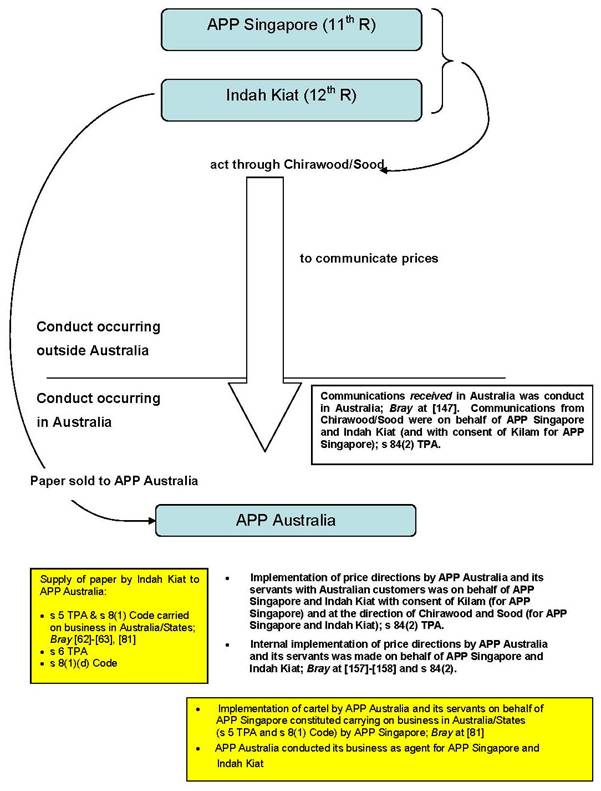
The first contention: the corporate structure
25 The Commission submits that the evidence establishes that the corporate structure of the relevant APP companies at the relevant time is as set out in the below chart “APP Corporate Respondents Hierarchy”:
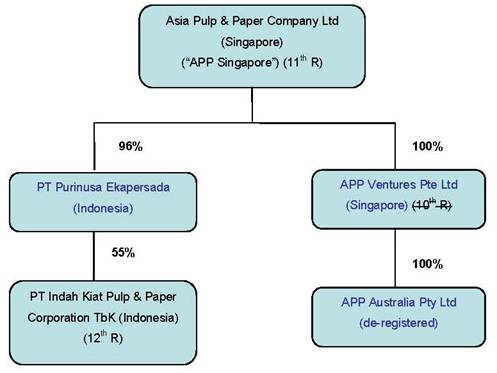
26 Documents in evidence that include company searches and audit reports of Indah Kiat establish that the ultimate parent company of Indah Kiat and of APP Australia is APP Singapore. There is also reference in the documents to APP Singapore and its subsidiaries, including Indah Kiat, as the “APP Group” or “APP”. Different persons within the broad structure and working within, inter alia, APP Singapore and Indah Kiat used the same corporate email domain, namely ‘[name]@app.co.id’. The APP overseas respondents submit that references in the pleadings and the evidence to “the APP group” is amorphous and meaningless in view of the evidence that there are a large number of companies, approximately 200, in that group. If the group is referred to internally as “the APP Group”, that is not meaningless. It does not, however, of itself establish a corporate hierarchy. If it is a term that has been used within the APP Group to include APP Singapore and Indah Kiat, it is sufficient, at this stage, for the evidence to refer to those companies in this compendious fashion, as part of that group.
27 There is evidence that APP Singapore was, relevantly, the parent company of the APP Group and that through the corporate hierarchy, it directly or indirectly controlled both Indah Kiat and APP Australia. There is evidence that Indah Kiat is a subsidiary of APP Singapore. There is also evidence that “Indah Kiat” is one of the paper mills that supplied paper to Australian customers through APP Australia. It can be inferred that Indah Kiat operated that mill.
28 There is prima facie evidence to establish the first contention.
The second contention: the role of Mr Kilam
29 A key component in the Commission’s case is Mr Kilam, as an officer of APP Singapore and of Indah Kiat. Mr Kilam is not alleged to have been a party to contraventions and is not a party in the proceedings. The Commission says that he is relevant as an important link in the evidential chain for establishing that the conduct of Messrs Chirawood and Sood in attending the AAA Club meetings was the conduct of the APP foreign respondents under s 84(2)(a) and (b) of the TPA:
1. Mr Kilam provides a link, whereby the acts of Messrs Chirawood and Sood are those of and can be attributed to APP Singapore and Indah Kiat (s 84(2) of the TPA). There is evidence that Mr Kilam was an officer of the APP Singapore and Indah Kiat. The pattern of correspondence between Messrs Kilam, Chirawood and Sood supports the inference that Messrs Chirawood and Sood also worked for and were senior managers or officers of APP Singapore and Indah Kiat.
2. The evidence of Mr Löfgren and the fact that correspondence in connection with the AAA Club were copied to Mr Kilam, establishes that Mr Kilam was aware of the AAA Club meetings. The attendances of Messrs Chirawood and Sood at AAA meetings were with the knowledge and consent of Mr Kilam as an executive director of APP Singapore and a Commissioner/director of Indah Kiat (s 84(2)(b) of the TPA).
30 Further the Commission says that if Mr Kilam was not employed by either of the APP overseas respondents, that is within their knowledge and they have chosen not to adduce any evidence. It follows, the Commission submits, that applying Jones v Dunkel (1959) 101 CLR 298, the inference that he was so employed can be drawn more readily, even though the Commission accepts that the APP overseas respondents are not obliged to adduce evidence.
31 The documentary evidence is that Mr Kilam was at all relevant times the Executive Marketing Director of APP Singapore and a member of its Executive Committee of Compensation and Audit. At least as at 2000 and 2001, he was a Commissioner of Indah Kiat and as at 2002 and 2003, a director of Indah Kiat. He was also a director of APP Australia from 1998 to 2007. I accept the Commission’s submissions as to the facts and inferences to be drawn to the role of Mr Kilam.
32 There is prima facie evidence to establish the second contention.
The third and fourth contentions: the employment and positions of Messrs Chirawood and Sood
33 The Commission submits that it should be inferred that Messrs Chirawood and Sood were employed by, or at relevant times acted for and on behalf of, both APP Singapore and Indah Kiat. Messrs Chirawood and Sood were, they say, senior managers of APP Singapore and of Indah Kiat and at a level to give directions to Mr George of APP Australia. Mr Chirawood was previously the sixteenth respondent to the proceedings but the proceedings against him have now been discontinued.
34 The APP overseas respondents submit that there is no evidence to connect Mr Sood to APP Singapore or to Indah Kiat and that there is no evidence to connect Mr Chirawood to APP Singapore. APP Singapore contends there is no evidence from which it can be inferred that Mr Chirawood was an officer, employee, agent, representative or otherwise acted on behalf of APP Singapore. APP Singapore says that there is no evidence that Mr Sood acted for any particular company of the approximately 200 companies within the APP Group. The Commission accepts that none of the documents relevant to Mr Chirawood or Mr Sood are on the letterhead of APP Singapore or Indah Kiat. They are mainly emails, faxes or letters and many of them are sent by Mr George of APP Australia. However, the email addresses for both Messrs Chirawood and Sood shared the same corporate email domain ‘@app.co.id’ as the email address of Mr Kilam.
35 Indah Kiat points to the timing of the evidence that purports to connect Mr Chirawood to various corporations. It accepts that the evidence establishes a connection between Mr Chirawood and Indah Kiat as at around March 2002, but submits that the inferences that can be drawn from evidence from 2001 and 2003 regarding his connection with Indah Kiat are limited. Indah Kiat points out that apart from evidence that Mr Chirawood was the Mills Sales Manager for Indah Kiat – Perawang as at March 2002, there is evidence that he performed different roles for different companies at different times. Indah Kiat relies on the limited and varied evidence as to the identity of Mr Chirawood’s employer, his apparent change of roles and the fact that no AAA meetings are alleged to have occurred between November 2001 and May 2002, when the evidence most clearly connects Mr Chirawood with Indah Kiat.
36 In May 2000, Mr Chirawood was an employee or officer of Sinar Mas. In May 2001 he appears to have been a regional director of an unnamed company with the title “Sales Operation Head”. In March 2002, his employer was Indah Kiat. In December 2003 he held a role in what was styled the “Sinar Mas Pulp Paper Stationery Division”. Indah Kiat submits that the Commission needs to show that Mr Chirawood was an employee of Indah Kiat throughout the period of the alleged unlawful conduct. Indah Kiat submits that the Commission has not discharged the onus to make good its assertion that Mr Chirawood was at all material times an employee of Indah Kiat.
37 Further, Indah Kiat points out that, while Mr Chirawood was the Mills Sales Manager for Indah Kiat – Perawang as at March 2002, the evidence is that at that time, pricing policy for Sinar Mas (an indeterminate business known as Sinar Mas Pulp, Paper, Stationery and Chemical Division) was made by the “Corporate Marketing” conveyed to each “mill sales head” and implemented by “branch managers”. Indah Kiat submits that it was not Mr Chirawood’s role either to fix prices or to cause sales to be made at such prices on behalf of Indah Kiat.
38 As to Mr Kilam, the APP overseas respondents submit that although there is evidence that he was connected to Indah Kiat, he was also connected with a number of other companies. Where Mr Kilam had numerous roles across a number of entities, they submit that there is no basis to infer that Messrs Chirawood and Sood who reported to him were necessarily involved with any particular entity within the APP group. They also submit that there is no support in the evidence for an association of both Messrs Chirawood and Sood with both of APP Singapore and Indah Kiat.
39 There is correspondence in evidence, from as early as 1999, between Messrs Kilam, Chirawood, Sood and George in relation to the prices at which paper was supplied to various markets by companies within the APP group, of which APP Singapore was the ultimate parent. The correspondence, including emails to addressees with the domain ‘@app.co.id’, supports the inference that Messrs Chirawood and Sood worked for the same companies as Mr Kilam; that is, they were part of the same corporate hierarchy and within the same reporting or management chain in the same corporations. As there is separate prima facie evidence to establish the second contention that Mr Kilam was an officer of APP Singapore and Indah Kiat, the inference is available that Messrs Chirawood and Sood were also officers or employees of APP Singapore and Indah Kiat.
40 In relation to the mill operations, Mr Chirawood is described in the evidence as a “Regional Director” and “Sales Operation Head”. He is also described as Mill Sales Manager of Indah Kiat – Perawang. Mr Sood is described in correspondence as the “Business Development Manager”.
41 As discussed above, there is evidence that Mr Chirawood was at different times within the relevant period an employee or officer of Sinar Mas. There is also correspondence in evidence from Mr Sood to branch managers including Mr George and mill sales managers including Mr Chirawood, copied to Mr Kilam, which is written on Sinar Mas letterhead. The corporate logo on the letterhead of Sinar Mas is the same as the logo for APP group and the letterhead refers to Indah Kiat as one of the ‘Group Paper Mills’. As pointed out by the Commission, Sinar Mas may be merely a trading group or a division of a company and not be a corporate name itself. The evidence as to the connection of Messrs Chirawood and Sood with Sinar Mas at the relevant times is not against but supports the inference that they were acting for Indah Kiat and APP Singapore at the same time.
42 The correspondence in evidence also supports the inference that Messrs Chirawood and Sood were sufficiently senior in the corporate hierarchy to deal directly with Mr Kilam and to be able to give directions to Mr George and APP Australia in relation to marketing and sales, and the prices to be charged for supplies of paper to Australia. Directions were given by Mr Sood to all mill sales managers and branch managers. Mr George is described in the evidence as “Branch Manager Australia” or “Branch Manager APP Melbourne”. The inference available is that Mr Sood was superior in the corporate hierarchy to Mr Chirawood and Mr George. Further, the correspondence details instructions sought by Mr George of APP Australia from Messrs Kilam, Sood and Chirawood as to the pricing of paper in Australia and reporting to them the effect on APP Australia’s market share of their decisions on pricing and the fact that he, Mr George, was required to ‘tow the party line [sic]’. The correspondence also supports the contention that Messrs Sood and Chirawood gave directions to Mr George with respect to APP Australia’s pricing of supplies of paper in Australia.
43 The APP overseas respondents have chosen not to adduce any evidence as to whether or not Mr Chirawood and Mr Sood were or were not employed by or acted on behalf of the APP overseas respondents, although such facts are inherently within their knowledge. The inference raised by the third contention is clearly open (Bray at [128] per Merkel J). There is evidence to support the inference that Messrs Chirawood and Sood were senior officers or managers of APP Singapore and Indah Kiat and establish, at a prima facie level, the fourth contention.
The fifth contention: the attendance at AAA Club meetings by Messrs Chirawood and Sood and the awareness of Mr Kilam of the AAA Club meetings
44 The Commission relies upon documents and Mr Löfgren’s evidence to establish that Messrs Chirawood and Sood attended the AAA Club meetings. Mr Löfgren and Mr Chirawood are noted as participants in a file note of an ‘AAA Conference Call’ on 8 March 2001. Mr Sood sent an email, inter alia to Mr Löfgren and Mr Chirawood, with the subject ‘AAA meeting’ and confirming the time and place for a meeting ‘by all participants’ on 7 November 2003 in Singapore. Mr Löfgren’s evidence was that Mr Chirawood attended almost all, and Mr Sood attended approximately half, of the AAA Club meetings at which Mr Löfgren was present. Mr Löfgren’s evidence was that he had met Mr Sood at an AAA Club meeting. In some of Mr Löfgren’s notes of particular AAA meetings, Mr Chirawood’s presence is noted. The evidence as to which of the 19 AAA meetings were attended by Messrs Chirawood and/or Sood and what occurred at those meetings are addressed in detail below in relation to the second issue.
45 Mr Löfgren’s evidence is that he met Mr Kilam at an AAA meeting from which it may be inferred that Mr Kilam was aware of the AAA Club. That inference is supported by correspondence copied to Mr Kilam concerning pricing for paper, referred to below.
46 There is evidence that establishes, at a prima facie level, the fifth contention that Messrs Sood and Chirawood attended and participated in a number of AAA meetings and that Mr Kilam was aware of the AAA Club and the AAA Club meetings.
The sixth contention: Messrs Chirawood and Sood attended and participated in the AAA Club meetings with the knowledge and consent of Mr Kilam
47 The Commission also contends that the conduct of Messrs Chirawood and Sood was deemed to be the conduct of APP Singapore and Indah Kiat by reason of s 84(2)(b) because they acted with the agreement and consent of Mr Kilam, an executive director of APP Singapore and a Commissioner or director of Indah Kiat.
48 The evidence supports the inference that Mr Kilam, through his own attendance at at least one AAA Club meeting, through Messrs Chirawood and Sood and through email correspondence on which he was copied, was aware of the AAA Club and the results of at least a number of AAA Club meetings. The email correspondence also establishes that he was aware that Messrs Chirawood and Sood attended AAA Club meetings and the emails made reference to the outcomes of and discussions in those meetings concerning prices, price increases and the maintenance of relativities of price. The inference is available to establish, prima facie, the sixth contention that Messrs Chirawood and Sood attended AAA Club meetings and participated in the AAA Club to the knowledge of and with the consent or agreement of Mr Kilam, who was the Executive Director of APP and a Commissioner or director of Indah Kiat.
The seventh contention: the conduct of Messrs Chirawood and Sood was the conduct of the APP overseas respondents
49 It would follow from the above contentions that the conduct of Messrs Chirawood and Sood in attending the AAA Club meetings was the conduct of APP Singapore and of Indah Kiat by reason of s 84(2)(a) and s 84(2)(b) of the TPA.
50 The evidence indicates that the conduct of Messrs Chirawood and Sood in attending AAA meetings and implementing the outcomes of those meetings was the conduct of APP Singapore and of Indah Kiat by reason of s 84(2)(a) of the Act, because they were senior officers of those companies and acted on their behalf. The documents that have been adduced in evidence, including group emails and emails copied to Messrs Kilam, Chirawood and/or Sood are, at the least, capable of supporting the inference that Messrs Sood and Chirawood were of sufficient seniority in the APP hierarchy to give directions to Mr George, a branch manager of APP Australia in Melbourne and that they gave such directions. Those directions, relevantly, related to the price to be charged in relation to the supply of paper to Australia by APP Australia to its customers.
51 Messrs Chirawood and Sood were servants or agents of the APP overseas respondents or, otherwise, attended at AAA Club meetings with the consent of Mr Kilam. In either case, the evidence indicates, at a prima facie level, that their actions were those of the APP overseas respondents within s 84(2)(a) and s 84(2)(b) of the TPA.
52 However, as the conduct of Messrs Chirawood and Sood in participating in the AAA Club meetings occurred overseas, such conduct is caught by the TPA and the Codes only if there is sufficient nexus with Australia under ss 5 or 6 of the TPA or s 8(1)(d) of the Competition Code Acts. These matters are developed in contentions 10 and 11 below.
The eighth contention: the implementation of the overarching agreement and individual AAA Club agreements occurred in Australia
53 The arrangements of the AAA Club were implemented in Australia by the actions of Mr George and APP Australia. Mr George was an employee of APP Australia. As set out above with respect to the fourth contention, the correspondence between Mr George and Messrs Kilam, Chirawood and Sood supports the inference that the price at which APP Australia sold paper in Australia was directed by Messrs Chirawood and Sood, subject to Mr Kilam’s approval. Mr George acted in Australia with the knowledge and consent and at the direction of senior officers of APP Singapore and Indah Kiat, namely Messrs Sood and Chirawood, in setting the prices at which APP Australia sold pulp paper.
54 There is evidence that the prices directed by Messrs Chirawood and Sood reflected the arrangements at AAA Club meetings. Mr George was aware of the significance of the AAA Club meetings in the setting of prices for Australia, and asked Mr Sood to update him on the outcome of AAA Club meetings. Given Messrs Chirawood and Sood’s involvement in making arrangements for the APP group at the AAA Club meetings, and the complaints by Mr George in the correspondence that ‘towing the party line [sic]’ would adversely affect APP Australia’s market share in Australia, it can be inferred that APP Australia was being directed to and did sell pulp paper in Australia at prices in implementation of the AAA Club arrangements. Further, Mr George and Mr Neeson, another employee of APP Australia, monitored prices in Australia for report to the AAA Club meetings via Messrs Chirawood and Sood.
55 I accept that the evidence suggests, at the prima facie level, that by reason of the conduct of APP Australia and Mr George, the conduct relating to the implementation of the overarching agreement and the arrangements made at specific AAA meetings in relation to Australia occurred in Australia.
The ninth contention: the implementation in Australia was the conduct of the APP foreign respondents
56 As to the Commission’s submission that APP Australia’s conduct, principally Mr George’s conduct, was conduct of the APP foreign respondents by reason of s 84(2) of the TPA, APP Singapore submits that:
1. to the extent that the allegations are directed towards conduct outside of Australia, s 84(2) of the TPA as no application (Bray at 14–17 per Merkel J); and
2. there is no evidence from which an inference can be drawn that Mr George or any other officer, employee or representative of APP Australia engaged in any of the allegedly unlawful conduct on behalf of anyone other than APP Australia.
57 The APP overseas respondents submit that the Commission must adduce evidence from which the Court can infer that APP Australia was carrying on the business not merely of one of its parent companies but of APP Singapore in particular, or that APP Australia was an agent of each of the APP overseas respondents. Something more than the indirect legal and commercial capacity of any parent company of APP Australia to control and direct APP Australia, even together with involvement of any of the APP overseas respondents in implementing the alleged cartel arrangement is, they say, required to lift the corporate veils between APP Australia and APP Singapore or Indah Kiat or to find that APP Australia acted as agent for that overseas respondent (Bray at [80] per Merkel J). APP Singapore submits that the Commission’s evidence against it falls far short of establishing the relationship of principal and agent as set out by Merkel J in Bray. Indah Kiat submits that there is no evidence to support an inference that APP Australia acted as agent for, or otherwise on behalf of, Indah Kiat.
58 In Poynter v Commerce Commission [2010] NZSC 38, the Supreme Court of New Zealand helpfully summarised the findings and analysis of Merkel J in Bray:
[68] …What was in issue in that case was s 5(1) of the Trade Practices Act 1974 (Cth) which provided that the Act extended “to the engaging in conduct outside Australia by bodies corporate incorporated or carrying on business within Australia”. The crucial first question was therefore whether the alleged contraveners, they being parent companies with subsidiaries in Australia, were carrying on business in Australia and were thus amenable to the jurisdiction of the Australian courts, despite their being incorporated overseas and not themselves directly carrying on business in Australia…. Merkel J held that the evidence did not establish that the overseas corporations carried on business in Australia through their Australian subsidiaries. His Honour considered that the corporate veil could not be lifted so as to treat the conduct of the Australian subsidiaries as the conduct of their overseas parents in that way. Nor was his Honour satisfied that, for his purposes, the subsidiaries could be treated as the agents of their parents, so as to attribute the conduct of the subsidiaries to the parents on that basis.
[69] The consequence was that, if the overseas parents were to be amenable to the jurisdiction of the Australian courts, that had to be on the basis of conduct by those parents in Australia. The case against the overseas parents in this respect was that by the conduct of their Australian subsidiaries the parents gave effect to, or were persons involved in, the alleged cartel arrangements in Australia. After a detailed review of the evidence Merkel J held that the implementation of the cartel arrangement in Australia was controlled and directed, directly or indirectly, by the parent companies. That control was effected, at least in part, by means of communications by officers of the parent companies to officers of the subsidiaries in Australia. The Judge held that these communications by the parents into Australia represented sufficient conduct by the parents in Australia to enable him to find that the parents had engaged in relevant conduct in Australia for the purposes of the Australian legislation…
[70] In Bray Merkel J also held that the conduct of the subsidiaries was conduct which they were undertaking “on behalf of” their parents…
59 In Bray, Merkel J held that when the officers of the Australian subsidiaries were taking internal corporate steps to implement the cartel arrangement, they were authorised to do so and did so for and on behalf of the overseas parent whose obligations they were performing, rather than independently as officers of the subsidiary (at [157]). His Honour concluded that as the relevant Australian personnel were acting on behalf of the international manufacturers, the international manufacturers had acted in Australia. Further, his Honour had concluded that it was a reasonable inference that the overseas manufacturer sent communications and directions from overseas to personnel in Australia in relation to the anti-competitive arrangement and that constituted conduct in Australia. One only has to make that statement to see how the same reasoning applies with respect to the evidence in this case.
60 The Commission points to the inferences drawn by Merkel J in Bray at [142] from facts established by the evidence, that the implementation of the cartel arrangement in Australia was controlled and directed, directly or indirectly, in all relevant aspects by the European and regional parent companies in each of the three groups involved in making and implementing the cartel arrangement. In drawing the inferences his Honour relied inter alia on the control and direction that arose from the requisite power of control and direction conferred by the corporate hierarchy, as well as from the fact that the overseas companies controlled the supply of products. Further, his Honour noted at [143] that the inherent nature of the cartel arrangement required that it be implemented at a national level and that there was supervision and monitoring of the cartel arrangement in Australia which was, necessarily, carried out by officers of the overseas corporation. Those directions, instructions and advice implementing the cartel arrangement in Australia were communicated inter alia by facsimile, email and letter to officers in Australia of the Australian subsidiaries. Those communications were, as here, on their face directed to Australia and were expected to be and were received in Australia.
61 The evidence in the present case relates to more than hierarchy and indirect control (Bray at [80] per Merkel J). As noted above in relation to contention 8, the evidence is that the APP overseas respondents, through Messrs Chirawood and Sood, directed the prices at which APP Australia sold paper in implementation of the arrangements of the AAA Club in Australia. Further, as in Bray (at [142] per Merkel J), products sold by APP Australia were supplied by the APP overseas respondents such that they could control the quantity and price at which they were supplied to APP Australia.
62 A further factor of relevance in Bray and in the present case is that the evidence indicated that the arrangement was made between overseas parents who were obliged to implement it, which they did through national subsidiaries. That is, the Australian subsidiaries were not so much making the arrangement but, as here, alleged to be implementing it at the direction of the overseas corporations. As in Bray, it is apparent from the correspondence to and from Mr George that the Australian subsidiary exercised little or no discretion in relation to the fixing of prices for pulp paper (the alleged implementation of the arrangement in Australia). In those circumstances in Bray, Merkel J concluded at [157] that it may be inferred that the officers of the Australian subsidiaries were carrying out their functions as agents of the parent. Justice Merkel was seeking to ‘grapple with the true facts’ at an interlocutory stage. His Honour observed that in the absence of contradictory evidence from the foreign respondents, he was more readily able to draw the inferences that he did and more readily discount any doubts as to alternative hypotheses that might have been open that supported the case of the overseas respondents. His Honour was prepared to infer, from the combination of conduct constituting communications by the parent to officers of the subsidiaries in Australia and internal implementation of the cartel arrangement by officers of the subsidiaries in Australia on a regular and ongoing basis over a significant period, that there was conduct by way of implementation of the cartel arrangement in Australia that, for the purposes of s 45(2)(b), could be inferred to be the conduct of the foreign parent in Australia.
63 The same logic applies here.
64 In Anabelle Bits Pty Ltd v Fujitsu Ltd (No 3) [2009] FCA 1089 at [74] to [75], Graham J considered circumstances where it can be said that an act is done ‘on behalf of a corporation for the purpose of s 84(2) of the TPA’. Graham J concluded that the conduct was engaged in with at least the implied consent of the directors, servants or agents of the company responsible. The fact that there was a contractual relationship between the overseas corporation and the Australian corporation of independent buyer and seller was irrelevant for the purpose of evaluating the consequences for the overseas corporation of the actor’s conduct in proliferating the overseas company’s brochures within Australia to potential purchasers. His Honour adopted the view expressed by Lindgren J in NMFM Property Pty Ltd v Citibank Ltd (2000) 107 FCR 270 at [1244]that it is sufficient if the actor engaged in the conduct intended to do so ‘for’the corporation.
65 In relation to implementing the overarching agreement and AAA Club arrangements in Australia, the evidence is capable of making out, to a prima facie level, that:
1. Mr George’s conduct was on behalf of APP Singapore and Indah Kiat and with the knowledge and consent of senior officers of APP Singapore and Indah Kiat, in particular Messrs Chirawood, Sood and Kilam. Therefore Mr George's conduct was the conduct of APP Singapore and Indah Kiat in Australia by reason of s 84(2)(b) of the TPA.
2. Mr George and APP Australia were acting in fulfilment of the obligations of APP Singapore and Indah Kiat under the AAA Club agreement and were therefore acting as the agents of APP Singapore and Indah Kiat. This was conduct of APP Singapore and Indah Kiat in Australia (see Bray at [157]–[158] per Merkel J).
3. The implementation of the overarching agreement and AAA Club arrangements involved communications sent to Australia (to Mr George and APP Australia) and intended to be received and acted on in Australia. The communications were principally from Mr Kilam (who was also a director of APP Australia), Mr Chirawood and Mr Sood. This was the conduct of APP Singapore and Indah Kiat in Australia (Bray at [81] per Merkel J).
The tenth contention: the APP overseas respondents carried on business in Australia
66 As discussed above in the context of contention 7, the conduct of the APP overseas respondents in participating in the AAA Club meetings, having occurred overseas, is caught by the TPA and the Codes only if there is sufficient nexus with Australia under ss 5 or 6 of the TPA or s 8(1)(d) of the Competition Code Acts. Section 5 provides that the TPA extends to conduct engaged in outside Australia by bodies corporate carrying on business within Australia. Section 5 is not relevant, however, to the implementation of the AAA Club arrangements in Australia by the APP overseas respondents, addressed in contentions 8 and 9, as such conduct occurred in Australia.
67 The Commission submits that APP Singapore and Indah Kiat carried on business in Australia for the purposes of s 5 of the TPA by:
· a combination of communications to Australia and the internal implementation of the AAA Club arrangements in Australia, which amounted to conduct in Australia by the APP overseas respondents (Bray at [157]–[158] per Merkel J);
· implementation of the arrangements on a continuous and repetitive basis, through directions given to Mr George and APP Australia (Bray at [62] per Merkel J);
· APP Australia’s conduct as the agent of APP Singapore and Indah Kiat. The Commission submits that APP Australia was basically a branch office of those two companies, so that implementation by APP Australia, by steps taken internally by that company, of the agreement of the AAA Club was implementation in Australia by the APP overseas respondents for the purposes of s 45(2)(b) or, at least, constituted their carrying on of business in Australia; and
· Indah Kiat supplied paper to customers in Australia essentially through APP Australia.
68 The Commission points out that it is not relying simply on a corporate structure and a piercing of the corporate veil (cf Bray in [71]-[72] per Merkel J). Here it relies upon a prima faciecase of direction and control by the APP overseas respondents through Messrs Chirawood, Sood and Kilam of APP Australia and Mr George.
69 As I have discussed in detail in relation to the ninth contention, the implementation of the AAA Club arrangements by Mr George and APP Australia, together with the communications from the APP overseas respondents directing such implementation, amounted to conduct in Australia by the APP overseas respondents. Such implementation occurred on a continuous and repetitive basis and was sufficient to constitute the APP overseas respondents carrying on business in Australia.
70 Further, the evidence establishes that APP Singapore did not simply leave APP Australia to carry on its own business on its own accord but used it as part of a worldwide enterprise on behalf of APP Singapore and Indah Kiat (cf Amalgamated Wireless (Australasia) Ltd v McDonnell Douglas (1987) 16 FCR 238 at [9] per Wilcox J). Mr George, as the managing director of APP Australia, exercised little or no discretion in relation to the fixing of prices for pulp paper sold by APP Australia but simply implemented directives and instructions made by Messrs Chirawood, Sood and Kilam on behalf of the APP overseas respondents.
71 There is evidence that Indah Kiat supplied paper to APP Australia, which applied a margin before selling the products to customers in Australia. Indah Kiat submits that the mere supply of folio and cut size paper by Indah Kiat to APP Australia is insufficient to amount to ‘carrying on business within Australia’ within the meaning of s 5 of the TPA. The Commission relies on Merkel J’s comments in Bray at [81] that the supply of group products to an Australian subsidiary may be an example of sufficient business activity by the foreign parents in Australia to satisfy s 5 of the TPA. The inference is open on the evidence that Indah Kiat supplied paper to customers in Australia through its agent, APP Australia and thereby carried on business in Australia.
72 The Commission has established a prima facie case that APP Singapore carried on business in Australia through its branch office, APP Australia, which acted under its direct control. The involvement of the APP overseas respondents in implementing the AAA Club arrangements in Australia is also sufficient to constitute their carrying on business in Australia. Finally, there is prima facie evidence that Indah Kiat carried on business in Australia by supplying paper to customers in Australia through its agent, APP Australia.
The eleventh contention: other bases for establishing nexus with Australia
73 The Commission submits that the necessary nexus with Australia has also been established on the basis that the conduct of APP Singapore and Indah Kiat involved trade and commerce between Australia and overseas for the purposes of s 6 of the TPA, or otherwise under s 8(1)(d) of the Competition Code Acts.
74 APP Singapore submits that the evidence is insufficient for establishing that either of the APP overseas respondents engaged in trade or commerce between Australia and places outside Australia for the purposes of s 6 of the TPA. APP Singapore emphasises that s 6 of the TPA does not extend the application of that Act to conduct outside Australia (relying on obiter of the High Court in Zhu v the Treasurer of the State of New South Wales (2004) 218 CLR 530 at [96]). APP Singapore submits that there is no support in s 6 for a contention that its purpose or function is other than to provide constitutional support for the TPA and that it was not intended by Parliament to extend the operation of the TPA extraterritorially by that section. In Bray at [51], Merkel J expressed the view that the Legislature intended the TPA only to apply to extraterritorial conduct in the circumstances and subject to the conditions laid down in s 5 of the TPA (see also [52]–[56]).
75 The Commission accepts that if s 5 of the TPA does apply to the APP overseas respondents, there is no need to consider s 6. It does accept that it is a novel question and that the weight of obiter dicta is against its submission that s 6 applies to bring the APP overseas respondents’ conduct overseas within the TPA.
76 As to the Commission’s contention that APP Singapore is a person ‘otherwise connected’ with a State or Territory within the meaning of s 8(1)(d) of the relevant Competition Code Acts, APP Singapore points out that there is no evidence to establish that APP Singapore supplied paper to any State or Territory. Further, it says that the evidence does not permit inferences about APP Australia’s relationship with either of its parent companies, still less APP Singapore specifically. It denies there is evidence that APP Singapore determined the price and conditions on which, and to whom, paper was sold in the States and Territories, or that it directed APP Australia on how to conduct its business in the States and Territories. Even if the evidence proved all of these matters, APP Singapore says that they do not prove a connection between APP Australian and the States and Territories.
77 As I am satisfied that the Commission has established, at the least by an inference that can be drawn, that the APP overseas respondents carried on business in Australia, it is not necessary for the purposes of this application to decide on the application of s 6 of the TPA or s 8(1)(d) of the Competition Code Acts.
The second issue
78 The Commission contends that it has established a prima facie case that:
· the AAA Club was in existence in the relevant period;
· there was an overarching agreement;
· there was agreement between a number of entities in the paper market;
· there was a process in place for the AAA Club meetings taking place;
· specific AAA Club meetings were held overseas in the relevant period;
· separate agreements or arrangements were made at at least some of those meetings; and
· implementation of those agreements or arrangements have been established.
The overarching agreement and the individual AAA Club meetings
79 The overarching agreement is pleaded at [46] of the statement of claim:
As at 6 December 2000 the AAA Club members, including within the APRIL Group the second to fifth respondents, and within the APP Group, APP Australia and the tenth to twelfth respondents, had made an arrangement or arrived at an understanding (the AAA Club agreement) containing provisions that:
46.1 each of the AAA Club members, including within the APRIL Group, the second to fifth respondents, and within the APP Group, APP Australia and the tenth to twelfth respondents, would meet in person or by telephone regularly, approximately monthly;
46.2 that in each meeting the AAA Club members would report their knowledge of, and discuss, the prevailing market conditions, the sales volumes achieved and prices charged by the members of their Group for sales of folio and cut-size paper in regions in which they supplied, including the Australian Paper market; and
46.3 that in each meeting the AAA Club members would agree prices at which the members would, until further agreement, supply folio and cut-size paper products for sales or the bulk of sales in particular geographic markets (average prices), including the Australian Paper market (including by agreements to maintain existing prices as reported or previously agreed, to increase reported prices by identified margins, or to set prices by reference to the prices of one of the AAA Club members in a particular market);
Particulars
In this pleading the expression “Agreed Prices” refers to the average prices agreed at a particular meeting for the supply of folio and cut-size paper in the Australian Paper market by members of the AAA Club.
46.4 that each of the members of the AAA Club would:
46.4(a) take steps to ensure that their Group priced and supplied folio and cut-size paper so their average prices would achieve the applicable agreed prices in the geographic markets to which they supplied, including the Agreed Prices for the Australian Paper market;
46.4(b) monitor the prices at which folio and cut-size paper was supplied by the other Club members in regions including the Australian Paper market;
46.4(c) inform other AAA Club members of failures by other groups to price and supply folio and cut-size paper so as to achieve the applicable average prices in the geographic markets to which they supplied, including the Agreed Prices for the Australian Paper market;
46.4(d) keep secret from other persons, including customers in the Australian Paper market, the existence of the AAA Club agreement and meetings and the fact of the agreements reached in relation to prices at those meetings.
Particulars
The agreement to be inferred from the matters alleged in paragraphs 53-174 below, which are relied on as overt acts in performance of the agreement and from the evidence of Lofgren paragraphs 53-54, and 78-170.
80 The APP overseas respondents submit that the Commission has not discharged the requirements for service of the amended application and the statement of claim because not all of the pleaded contraventions have been established. They say that it is necessary for the Commission to establish a prima facie case for each head of relief sought. Alternatively, they submit that, as a matter of discretion, if a prima facie case has only been made for one contravention, the Commission should not be permitted to serve the amended application and the statement of claim out of the jurisdiction.
81 As Gray J noted in West at [8], the Full Court in Bray was divided on the issue of whether the former O 8 r 2(c) (in terms identical to the current O 8 r 3(2)(c) which was considered in West) should be construed as a requirement that an applicant has a prima facie case in respect of every cause of action in the proceeding or only a prima facie case in respect of the relief sought in the application even if that relief was sought by reference to alternative causes of action which did not bring the proceeding within one of the kinds referred to in the former O 8 r 1. The majority held that it was sufficient that there was a prima facie case for the relief sought on the basis of any of the causes of action relied upon (the Full Court in Bray at [36]-[37] per Carr J; at [171]-[193] per Branson J).
82 In West,Gray J concluded that the requirements of O 8 r 3(2) were satisfied only in relation to one set of statutory claims. His Honour concluded that, with respect to the relief sought on the basis of contravention of s 52 of TPA and on the basis of contract, the applicant did not have prima faciecase for that relief. His Honour acknowledged that the proceeding as a whole might fall within O 8 r 2 but declined to exercise his discretion to permit service out of jurisdiction because of the small number of claims for which a prima faciecase had been made out. That is not the situation in this case.
83 In Harris v the Commerce Commission [2009] NZCA 84,the NZ Court of Appeal was considering whether the overseas parties were ‘necessary or proper parties’ to the proceedings (appeal allowed but not on this point). In order to succeed, the plaintiff needed to show that there was a good arguable case on the merits. Interestingly the Court of Appeal noted at [73] that the various claims were related, in that an overarching understanding was alleged, together with a number of specific understandings arising out of that overarching understanding. All of the understandings related to market manipulation of the timber preservatives market and all involved substantially the same players. Accordingly, the Court of Appeal considered that it would be sufficient to establish a good arguable case in relation to one claim to allow all to proceed. Their Honours said at [70] that the causes of action were related and that if a good arguable case was found on one it was appropriate to permit the other causes of action to proceed as well, and that ‘[t]o adopt the very narrow approach advanced by the appellants seems to us wrong in principle and, in practical terms, to be artificial and wasteful of court resources’. In saying that, the Court acknowledged that the position may be different where the causes of action do not arise out of the same sequence of events so that they are largely independent of each other, or where one cause of action can be shown to be certain to fail (at [71]). Neither of those qualifications apply here.
84 The parties agree that a prima facie case is made out where, on the material before the Court, inferences are shown to be open which, if translated into findings of fact, would support the relief claimed by the Commission. The APP overseas respondents emphasise, however, that there must be material before the Court which is capable of supporting a finding of fact ultimately at trial. They emphasise that it is not permissible to “plug” evidence missing with respect to one meeting with evidence of another meeting. They submit that each meeting must be looked at separately and not by reference either to another meeting or to the “systems evidence” as to what routinely occurred at meetings.
85 The APP overseas respondents point out that it is necessary to find a meeting of minds of the relevant participants authorised to enter into the contract, arrangement or understanding and submit that the Commission has not proved that, at the individual meetings, the meeting of minds by a person on behalf of each of the APP overseas respondents had been established. They say that the overarching agreement cannot be established unless each and every one of the individual agreements is established and that together they support the overarching agreement. The APP overseas respondents maintain that the use of the overarching agreement to fill gaps with respect to the individual meetings is impermissible, as the argument for doing so is “circular”.
86 The APP overseas respondents submit that if the individual meetings are not established to have given rise to contraventions of the TPA, then the individual allegations with respect to the overarching agreement in [46] of the statement of claim cannot be supported, nor can the relief as sought in the amended application. They submit that it is impermissible to use the overarching agreement to infer participation in particular meetings, or to infer the procedures followed or the specific subject matter discussed at particular meetings, because that overarching agreement has no life of its own. In any event they submit that, even considering the evidence from Mr Löfgren, there is no evidence to support [46.3] of the pleading, so that the overarching agreement fails as a tool to support what happened at those individual meetings where there is no evidence that prices were agreed. In other words, the APP overseas respondents submit that the overarching agreement is an artificial construct. This forms a key basis of their submissions.
87 The first declaration sought in the amended application is in respect of the overarching agreement. The Commission’s case is that the calling of regular meetings was a giving effect to the overarching agreement as pleaded in [46] of the statement of claim. On the pleadings, the overarching agreement has a separate life and is the basis for separate relief sought.
88 The overarching agreement is alleged to have been in effect as at 6 December 2000 (the occasion of the first specific AAA meeting alleged). There is evidence from Mr Löfgren as to the existence of the AAA Club in September 2000. There is also evidence of Mr Löfgren from which it can be inferred that an arrangement was in place between the members of the AAA Club to meet regularly to discuss the pricing of pulp paper, that is the overarching agreement, which continued throughout 2001-2003 and into 2004.
89 The alleged overarching agreement had the following key features:
1. The AAA Club members included, relevantly, APP Australia, APP Singapore and Indah Kiat.
2. The members would meet in person or by telephone regularly, approximately monthly.
3. At each meeting the AAA Club members would report the prices they had charged for sales of folio and cut-size paper, including in Australia.
4. At each meeting the AAA Club members would agree to increase prices of folio and cut-size paper or to maintain existing prices, including for Australia.
5. Each of the members of the AAA Club would take steps to ensure that they priced and supplied folio and cut-sized paper in accordance with the agreements reached at AAA Club meetings.
6. Each of the members of the AAA Club would monitor the prices at which folio and cut-sized paper was supplied by other Club members, including in Australia.
7. Each of the members of the AAA Club would inform other AAA Club members of failures by other members to supply paper into the Australian market in accordance with the agreements reached at AAA Club meetings.
8. Each of the members of the AAA Club would keep secret from other persons the existence of the AAA Club agreements and meetings.
90 The Commission’s case is that the necessary inferences for the above findings are available from the evidence of Mr Löfgren and from the holding of regular meetings, together with:
· what is reported to have occurred at some of those meetings;
· the monitoring and reporting of the implementation of what was agreed at the meetings;
· evidence and communications proximate to the meetings that give rise to a clear inference that the meetings were not just ad hoc or random; and
· the evidence that supports the existence of that arrangement from at least September 2000.
91 The evidence, including evidence from Mr Löfgren, supports the occurrence of AAA Club meetings on or about:
· 23 February 2001
· 8 March 2001
· 27 April 2001
· 13-15 June 2001
· 14 August 2001
· 28 September 2001
· 16-23 October 2001
· 24-26 November 2001
· May 2002
· 24 July 2002
· 29 August 2002
· 6-8 October 2002
· 14-27 January 2003
· March/early April 2003
· April 2003
· May 2003
· late May/June 2003
· July/August 2003
· 7 November 2003
· 16 January 2004
The Commission’s case is that those individual meetings occurred pursuant to the overarching agreement which was in place. These are the 21 AAA meetings referred to in the statement of claim.
92 I do not accept that the overarching agreement as pleaded is an artificial construct. The use of such an overarching agreement said to be implemented by subsequent acts is not circular as alleged by the APP overseas respondents (see for example Australian Competition and Consumer Commission v Visy Industries Holdings Pty Ltd (No 3) (2007) 244 ALR 673 at [41]–[47] per Heerey J). There is repeated reference in the evidence to the “AAA Club”. There is evidence that meetings did occur between competitors in the industry. They occurred on a regular basis. They were the subject of group emails. Emails before and after the meetings, as well as evidence of what occurred at the meetings, included references to the pricing of paper and whether it should be raised or maintained. It cannot be said, nor is there any evidence to suggest, that they were social meetings or that there was any matter other than the pricing of pulp paper that those participants regularly met to discuss.
93 The APP overseas respondents submit that the Commission’s case depends on the attendance at individual meetings of Messrs Chirawood and Sood. The APP overseas respondents point out that Mr Löfgren only says that Mr Chirawood attended “almost” all meetings, which means, they say, that the evidence cannot be used to place Mr Chirawood at any particular meeting. The APP respondents point out that there is only evidence to support the attendance of Mr Löfgren at 8 of the specific AAA meetings now alleged to have given rise to separate contravening arrangements. The APP overseas respondents point out that even if the evidence is sufficient to establish that Mr Chirawood was connected with Indah Kiat as at March 2002, the only meeting for which they accept there may be sufficient evidence to establish that he attended and that an agreement was reached, is the meeting of 8 March 2001. At the time of that meeting, there is not sufficient evidence, they submit, to connect Mr Chirawood with either of the APP overseas respondents. Indah Kiat contends that each of the 19 AAA meetings needs to be considered individually and that Mr Chirawood’s employer at the time of each meeting must be established.
94 The Commission seems to accept that, at this stage, there is only 1 AAA meeting for which there is presently sufficient evidence, by reference only to the evidence directly related to that meeting, to establish, separately, a contravention of the TPA at that meeting. For example, the APP overseas respondents have demonstrated, with respect to the other meetings, either that it cannot be shown that Mr Chirawood or Mr Sood was definitely present at that particular meeting, or that the outcome of that meeting is not apparent from the totality of the evidence directly related to that meeting.
95 The Commission relies upon Mr Löfgren’s evidence in two ways. First that he establishes a practice or a system that occurred at the meetings of the AAA Club. The Commission relies upon Mr Löfgren’s evidence as evidence of a system by regular and repeated performance of acts which might permit an inference as to what occurred on a particular day. The Commission says that if there is evidence of an invariable practice to discuss specific matters, it assists in support of an inference that that matter was discussed on a particular occasion. Secondly, the Commission relies upon Mr Löfgren’s evidence in relation to what occurred at specific AAA meetings.
· ‘The discussion at the AAA Club meetings were always about either maintaining existing prices, or increasing target prices... I did not reach any price agreements with the other mills outside of the AAA Club processes.’
· ‘At some of the meetings I attended, we reached agreement that the market was not moving, and that the existing target prices were to remain valid for a further period. If a particular region was not discussed, that was because there was no need or opportunity to move the prices.’
· ‘If the agreement reached was to increase target prices, there was also agreement as to the timing of the participants’ announcements of the increase, and the date from which the increase would have effect. When I started attending meetings, the arrangements were for the participants to announce the new prices on the same day as each other, and to apply the increases from common dates. In the course of the progress of the meetings, however, this changed as a result of participants stating that it might look suspicious to customers if they received price increase letters from all of us on the same day... For example, we typically agreed that price increases were to be announced within a week of the meeting, for making or shipments from a date a few weeks away. UPM Changshu followed a standard timeframe for price increases...’
· ‘The process…was that a table was created based on the announced prices. The host went through these country by country, and asked “is it possible to increase prices?” If there had been no erosion, this was measured from the previous target price, otherwise it would be based on where the mills’ reported prices were. Consensus was usually reached with difficulty.’
· ‘The previous list of target prices remained in force until changed.’
97 Mr Löfgren described the practice of reporting paper prices:
The meeting participants then discussed in turn the “bulk of trade” prices each mill claimed they had achieve for sales of paper over the period since the last meeting…
The prices were reported by each participant by country and product, that is, reel, folio and cut-size paper. When reporting their actuals, some participants had lists or notes of prices that they referred to.
The prices reported were usually put up in a matrix table on the whiteboard or butchers paper at meetings, so that they could be seen by all participants.
Mr Löfgren also said that participants challenged one another’s reported pricing.
98 Mr Löfgren’s handwritten notes of specific AAA Club meetings support the inference or conclusion that APP paper prices were reported by Mr Chirawood during the 14-27 January 2003 and May 2003 AAA Club meetings; by Mr Sood during the late May/June 2003 meeting; by Mr Chirawood and/or Mr Sood during the July/August 2003 meeting; and by Mr Chirawood and/or Mr Sood during the 7 November 2003 meeting.
99 The Commission points to the evidence which gives specific examples of price increases implemented by APP Australia after the AAA Club meetings of:
· 28 September 2001,
· 24-26 November 2001,
· May 2002,
· 24 July 2002 and
· 16 January 2004.
100 There is also evidence of specific examples of price monitoring before or after AAA Club meetings of:
· 28 September 2001,
· 16-23 October 2001,
· 24-26 November 2001,
· May 2002,
· 24 July 2002,
· 29 August 2002 and
· 23 January 2003.
101 As to the inferences that can be drawn about what occurred at specific AAA meetings, the Commission submits:
· The question is whether the inference arising from a specific meeting is available and that the inferences should be drawn from the whole of the evidence.
· Inferences are available from the evidence of Mr Löfgren as to who generally attended on behalf of APP. For example, Mr Löfgren said that Mr Chirawood attended almost all of the meetings and that at most there were only one or two when Mr Chirawood was not there. It follows, the Commission submits, that there is a reasonable inference that Mr Chirawood was at any particular meeting. In any event, from the email traffic, it is apparent that Mr Chirawood and Mr Sood were intimately involved in the implementation of the AAA Club meetings, as they were both invariably copied in to the emails.
· Inferences arise from the evidence concerning the occurrence of specific AAA Club meetings during the period, the agreements that were made at them and the implementing acts that occurred proximate to them.
· If, for example, there were five meetings where factor A, factor B and factor C occurred and then a sixth meeting where it is shown that factor A and factor B occurred, one can infer that factor C also occurred. Such inferences are available from the facts and from all of the available evidence, including the systems evidence.
· The evidence about individual meetings is consistent with and supported by Mr Löfgren’s evidence of the system and the dates of other meetings.
· The evidence concerning the system or practice at AAA Club meetings is capable of supporting the inference that the overarching agreement existed during the period December 2000 to January 2004. This inference is supported by direct evidence of the existence of an overarching agreement in the note of the AAA Club meeting which occurred on 8 March 2001:
If APP continue to sell to Thailand, AA and TPC [Advance Agro and Thai Paper Company - other AAA Club members] will stop the Club Meeting as it is against the Club agreement.
102 In looking at the whole of the evidence relied upon by the Commission, I am satisfied that the Commission has established a prima facie case as follows. There was a AAA Club and it met on a regular basis pursuant to an arrangement or understanding between the members of that Club who were competitors in the pulp paper market. Prior to those meetings information was gathered as to current prices in different countries of pulp paper and the action or pricing by competitors who were not members of the AAA Club. Prices of bulk paper were discussed at the meetings and reports given from each member as to the prices in the various countries including Australia. The members agreed on future pricing; that is, whether it would increase or be maintained. Each member agreed to apply that agreed pricing in, inter alia, Australia. It follows that the agreements reached at the meetings were as part of the overarching agreement, implemented in Australia. That implementation was monitored in Australia and reported back at the next individual meeting.
Evidence specific to the individual AAA meetings
103 The APP overseas respondents point out that the amended application only seeks relief separately in respect of 19 of the 21 AAA meetings referred to in the statement of claim. Of the 21 meetings, the Commission now alleges that contraventions arose separately from only 16 of those meetings (the 16 AAA meetings). It says that the remaining 5 meetings are nonetheless relevant because they give effect to the overarching agreement and the statement of claim correctly places those meetings in context. These 5 meetingsare:
· 23 February 2001: No relief is sought in the amended application.
· 16 January 2004: No relief is sought in the amended application.
· 13-15 June 2001: Relief is sought in the amended application but is no longer pressed.
· 29 August 2002: Relief is sought in the amended application but is no longer pressed.
· 6-8 October 2002: Relief is sought in the amended application but is no longer pressed.
The Commission acknowledges that it would need to amend the amended application to delete the relief sought in relation to the meetings of 13–15 June 2001, 29 August 2002 and 6–8 October 2002.
104 The 16 AAA meetings which are pressed by the Commission as separately giving rise to contraventions by the APP overseas respondents may be divided into three broad groups in terms of the nature of the evidence that is relied upon to support a prima facie case of the contraventions:
1. The first group are AAA Club meetings where there is documentary evidence, in the form of business records of either APP or April, or a note made by Mr Löfgren in relation to the meeting, which is sufficient alone to support an inference that a specific agreement was made at the meeting. Mr Löfgren’s systems evidence supports the drawing of the inference, but is not essential.
2. The second group or category is where there is some documentary evidence specifically relating to the meeting which, considered in the context of and together with Mr Löfgren’s evidence, supports the drawing of an inference that an agreement was made at the meeting.
3. The third category is where there is no documentary evidence specifically relating to the particular meeting. Any inference that an agreement was made at the meeting must be drawn from Mr Löfgren’s systems evidence and the absence of any indication or reason why the relevant system or practice in relation to AAA Club meetings was not followed on the specific occasion.
| Date of AAA meeting | Who attended | What was agreed | Examples of deficiencies in the evidence (as submitted by the APP overseas respondents) |
| Category 1 meetings | |||
| 27 April 2001 | One or more of Chirawood and Sood by inference from: · Documents indicating that someone from APP attended the meeting; · Löfgren’s evidence that Chirawood was at almost all the meetings he attended and Sood attended half of the meetings; and · their attendance at other meetings. (collectively, the general evidence of attendance)
| To increase prices by US$20 in Australia
| · No direct evidence of Chirawood or Sood’s attendance · References to APP do not equate to the APP overseas respondents · Löfgren had no recollection or records of this meeting · Evidence of Chirawood or Sood’s attendance at other meetings cannot support an inference that they were present at this meeting |
| 14 August 2001
| One or more of Chirawood and Sood by inference from the general evidence of attendance | To maintain prices
| Same as for 27 April 2001
|
| 28 September 2001
| One or more of Chirawood and Sood by inference from the general evidence of attendance and subsequent emails to Mr George
| To increase prices to AU$1510 (cut size) and $1410 (folio): ‘[Dennis Lim] gave a briefing on the AAA Club Meeting in Bangkok. All Club members agreed to increase price and a minimum price list was worked out for adherence by all. We will incorporate this into our October Price List’. ‘Producers are trying to push for a market recovery by announcing price increase of US$10-40/t in October.’ ‘Status Quo at October 8’ refers to April price for Aust of $1,410 (folio) on page 2 which corresponds to April price list. Further, page 1 says ‘APP…will announce price increase of US$30’. Email from George to Chirawood cc Sood. ‘We announced an AUD75 increase on all uncoated’. Email to George. Subject “new pricing” states ‘for december shipment please raise your price as following: woodfree and photocopy paper (Australia) please raise au$75/mt’.
| Same as for 27 April 2001
|
| Category 2 meetings | |||
| 8 March 2001
| Chirawood present (specific record by April as to his attendance on behalf of “APP”) | To maintain prices: ‘Conclusion: Price seem holding, we must keep on holding there to avoid price reduction’.
| Nothing to connect Chirawood with the APP overseas respondents at this point in time |
| 24-26 November 2001 | One or more of Chirawood and Sood by inference from the general evidence of attendance and: · Evidence that Chirawood sought report of prices in Australia prior to meeting for use at the meeting · Records of Löfgren attending this meeting
| To increase prices from December 2001 or January 2002: · Inferred from implementation of price increases
| · No direct evidence of Chirawood or Sood’s attendance
|
| 14-27 January 2003
| Chirawood present (from Löfgren’s notes of the meeting) | To maintain prices: Mr Löfgren: · No new target price set for Australia · Discussion at the meeting to ‘hold our markets no drastic moves’. AFPT/April sales meeting 22 Jan 03: ‘GC instructed that there should be no acceptance of long orders except for selective countries eg Australia where prices are good or for strategic reasons. Prices for March production onwards is expected to increase’.
| No evidence of agreement reached at this meeting, apart from Löfgren’s systems evidence |
| Late March-early April 2003
| One or more of Chirawood and Sood by inference from the general evidence of attendance
| Agreement as to target prices: A$1650/mt (cut size) and A$1540/mt (folio) from about May 2003. Löfgren’s evidence based on his notes of the meeting: “The entry in relation to AU refers to Australia…this records target prices for Australia cut-size (indicated by CS) and folio paper, in Australian dollars, on a delivered, duty paid basis”.
| No direct evidence of attendance by Chirawood or Sood
|
| April 2003
| Chirawood present: · Löfgren was not present but had a telephone conversation with Chirawood about the meeting | To maintain prices: Löfgren’s notes of the conversation with Chirawood (as interpreted by Löfgren): · Chirawood told him the target prices that the meeting had agreed they would maintain.
| · No reference to agreed prices for Australia |
| Late May/early June 2003 | One or more of Chirawood and Sood by inference from the general evidence of attendance and a reference to Sood in Löfgren’s meeting notes
| To maintain prices: · Löfgren’s notes does not contain a list of target prices but contains reported prices for Australia and other countries reported · Minutes of internal April sales meeting held on 27 June 2003 refer to a decision that ‘July price list will be maintained the same as June’.
| · Nothing in the notes to connect Sood to the APP overseas respondents · No evidence that agreement was made - minutes of internal April meeting does not purport to record events at an AAA meeting |
| 7 November 2003
| Chirawood and Sood by inference from: · Email from Sood to Löfgren and Chirawood confirming arrangements for the meeting | To maintain prices: Löfgren’s meeting notes record (as interpreted by him): · ‘Prices for supply to… Australia are to stay the same’. · Prices reported for Australia and other countries.
| [Not addressed specifically in APP’s submissions]
|
| Category 3 meetings | |||
| 6 December 2000
| One or more of Chirawood and Sood by inference from general evidence of attendance
| To maintain prices: · ‘Members expect order intake is slow until end of January 2001’. · ‘Difficult market situation’ · Context: Current prices for Australia and other countries were reported
| · No direct evidence of the meeting or an agreement · Same as for 27 April 2001 |
| 16-23 October 2001
| One or more of Chirawood and Sood by inference from general evidence of attendance and email from Chirawood seeking report of Australian prices prior to the meeting | To maintain prices: · As seen by a comparison of April prices of October 2001 and November 2001
| · No direct evidence of the meeting or an agreement · Same as for 27 April 2001 |
| May 2002
| One or more of Chirawood and Sood by inference from their attendance at other meetings | To increase prices: · Email from Sood to George sent 21 May 2002. ‘Time is coming to review the paper prices again’. · Email from George to Sood sent 23 May 02. ‘AA has confirmed they have withdrawn the last A$40 increase on copy paper…AA…have towed the line like us and have suffered loss of market because of it…We have now confirmed that APRIL copy price to Price and Pierce is USD710 fixed for the year, so much for them increasing’. · Email from Mr George to Mr Sood cc Kilam, Chirawood. ‘Other suppliers are either not adjusting their USD levels or are being very slow about it but in any case even with their suggested adjustments of 20-25USD our A$ levels are equating to prices that are 100-200 USD above our competitors’. · Email from Mr George to Mr Kilam, Mr Sood sent 2 July 02. ‘I think the other suppliers are telling us rubbish and we are rapidly losing ground’.
| · No direct evidence of the meeting or an agreement · Same as for 27 April 2001 |
| 24 July 2002
| One or more of Chirawood and Sood by inference from their attendance at other meetings and emails to and from Sood regarding price increases in Australia | To increase prices: · Email from Mr Sood sent 5 Aug 02. ‘Australia will see a price increase only in the 4th quarter ie September booking – October shipping. The price of UCWF will increase by AUD 75/T’. · Email from Mr George to Mr Sood sent 7 Aug 02. ‘For UCWF the increase should be A$60 for the second cycle September as you discussed with Graham, (A$1620DDP)’. · Email from Mr George to Mr Sood dated 18 July 02 attaching price comparison with competitors. (pre-meeting monitoring) · Email from Mr George to Mr Sood sent 14 August 2002. ‘although we may have been led to believe that were being followed in price by others we have been outplayed by UPM and others’. (post-meeting monitoring)
| · No direct evidence of the meeting or an agreement · Same as for 27 April 2001 |
| May 2003 | Chirawood present from Löfgren’s notes of the meeting | To maintain prices: · Löfgren’s notes did not record any new target prices , including for Australia. · Löfgren explains that no record of target prices was consistent with prices not moving at this time of the year because the market was quiet.
| Löfgren’s evidence not sufficient to infer that agreement was reached |
| July - August 2003
| One or more of Messrs Chirawood and Sood by inference from general evidence of attendance
| To maintain prices: · Löfgren’s notes did not record target prices · Löfgren explained that no decision was made as to timing of an announcement to increase paper prices in Sept indicated by the words ‘September announcement?’ in his notes. He said it would have been too late to make a price change. | · Löfgren’s evidence not sufficient to infer that agreement was reached · No direct evidence of attendance by Chirawood or Sood
|
106 The APP overseas respondents point to deficiencies in the evidence in respect of each of the individual meetings. I shall deal with some of the common themes.
107 With respect to the 16 AAA meetings referred to in the table above, the APP overseas respondents draw attention to the fact that neither Mr Chirawood nor Mr Sood have been placed at a number of those meetings by Mr Löfgren who has no note or recollection of their presence at that meeting, or was himself not present. From the whole of the evidence, including:
· Mr Chirawood’s presence at some of the meetings being established;
· Mr Löfgren’s evidence that Mr Chirawood was present at almost all of the meetings;
· the emails from Mr George providing information to Mr Sood or Mr Chirawood prior to a planned AAA meeting; and
· emails, instructions and changes or the maintenance of paper prices after the meeting;
the inference is available that “APP” was represented at each of the 16 AAA meetings and that either Mr Chirawood or Mr Sood (or in one case, Mr Kilam) was present.
108 I have already accepted that the evidence establishes, or at the least makes the inference available, that Messrs Chirawood and Sood acted on behalf of the APP overseas respondents. At this stage of the proceedings, it has not been established that, in respect of each meeting, the APP representative acted on behalf of each of APP Singapore and Indah Kiat. However, the evidence does show that Mr Chirawood and Mr Sood were officers of those companies and were routinely copied into correspondence about the meetings and the actions taken prior to and after the meetings. The inference is available that, during the time frame of the meetings and the actions consequent on them, they were acting on behalf of or as agents of both of the APP overseas respondents.
109 The APP overseas respondents submit that it has not been established that at each meeting there was an arrangement or understanding reached. They submit that the subject of the meeting may just have been to discuss the state of the market and what the prices were. They submit that, while they accept that there was material supporting an agreement at one meeting, there can be no extrapolation to others where, for example, there is no direct evidence to place Mr Chirawood at the meeting. In my view this submission, that the relevant parties in the pulp paper industry met to discuss the state of the market but not to agree on pricing, defies common sense. The whole of the evidence establishes, at a prima facie level, regular meetings at which the APP group was represented, at least usually, by Mr Chirawood. The purpose of those meetings was to implement the alleged overarching arrangement to maintain parity of pricing and to implement that arrangement in, inter alia, Australia.
110 It may be that, if the APP overseas respondents were to adduce evidence, they could negate the prima facie case of the overarching agreement, the alleged system and the events at the individual meetings. That evidence is not presently available.
· 6 December 2000
· 8 March 2001
· 27 April 2001
· 14 August 2001
· 28 September 2001
· 16-23 October 2001
· 24-26 November 2001
· May 2002
· 24 July 2002
· 14-27 January 2003
· March/early April 2003
· April 2003
· May 2003
· late May/June 2003
· July/August 2003
· 7 November 2003
112 Even if I had formed the view that a prima facie case has not been established for the relief sought in respect of each one of the 16 AAA meetings I would, as a matter of discretion, in view of the evidence of the overarching agreement and other specific AAA meetings, permit service of a further amended application seeking relief in respect of the 16 AAA meetings.
Whether the grant of leave should be subject to conditions
113 The APP overseas respondents submit that if a prima facie case has been made out at all, leave to serve should be confined to the specific relief for which the Commission has made out a prima facie case. It submits that in the exercise of its discretion, the Court should make any leave subject to conditions so that the litigation against the respondents is restricted to causes of action in connection with which the applicant can show a prima facie case (Tycoon at 35 per Wilcox J; Ho at [80]). The APP overseas respondents submit that any leave granted to the Commission should exclude those claims arising from specific meetings for which the Commission has been unable to make out, at a prima facie level, a connection with APP Singapore or Indah Kiat. I have found above, however, that the Commission has established, at the prima facie level, that either Messrs Chirawood or Sood acted on behalf of APP Singapore and Indah Kiat at each of the 16 AAA meetings referred to in [111] above.
114 The Commission notes that in Australian Competition and Consumer Commission v European City Guide SL [2009] FCA 1206, Moore J approved West and gave the Commission the opportunity to amend the originating process to delete a claim for relief where a prima facie case had not been made out and then granted leave to serve out of the jurisdiction.
conclusion
116 The Commission has established a prima facie case for the grant of relief sought in the amended application against APP Singapore and Indah Kiat, except for the relief that is no longer sought in relation to the meetings referred to in [2.1.5], [2.1.12] and [2.1.13] of the amended application. It is therefore appropriate that the amended application be further amended to delete the relief sought in respect of the meetings of 13–15 June 2001, 29 August 2002 and 6–8 October 2002. The application of the APP overseas respondents under O 9 r 7 to set aside service of the amended application and statement of claim on them, or to discharge the orders of 28 May 2009 granting leave for such service, should be refused with costs. I will give the parties 7 days to propose orders to give effect to these reasons and for the Commission to file and serve any written submissions on the matter referred to in [115] above.
| I certify that the preceding one hundred and sixteen (116) numbered paragraphs are a true copy of the Reasons for Judgment herein of the Honourable Justice Bennett. |
Associate:
Dated: 6 July 2010


